


Highlights
What are the main findings?
- Writers, readers, and erasers control mRNA fate, thereby orchestrating plant development.
- m6A regulators mediate tolerance to abiotic stresses with pronounced species, cultivar, and tissue specificity.
What are the implications of the main findings?
- By systematically organizing current knowledge on m6A regulators and their mechanisms in both development and stress responses, this review serves as a valuable resource for researchers in related fields and identifies critical gaps for future investigation.
- The observed species and cultivar specificity of m6A patterns, combined with emerging understanding of m6A regulatory mechanisms, lays a theoretical foundation for potentially engineering RNA modifications to enhance stress resilience or optimize developmental traits in crops.
Abstract
RNA N6-methyladenosine (m6A) is a prevalent epitranscriptomic modification that governs plant growth, development, and environmental adaptation. This review synthesizes recent advances in understanding the molecular mechanisms and biological functions of m6A in plants. The m6A landscape is dynamically regulated by methyltransferases (writers), demethylases (erasers), and m6A-binding proteins (readers), which collectively influence mRNA stability, translation efficiency, alternative polyadenylation (APA), and chromatin crosstalk. Functionally, m6A integrates diverse developmental processes—including embryogenesis, organogenesis, flowering, fruit ripening, and leaf senescence—with abiotic stress responses such as salt, drought, cold, and heat. Notably, m6A modification exhibits remarkable species-, cultivar-, and tissue-specific plasticity, enabling precise spatiotemporal gene regulation. Recent breakthroughs have revealed bidirectional crosstalk between m6A and histone modifications, forming a multi-layered regulatory network, while emerging concepts including phase separation, RNA structure dynamics, and stress memory further expand the functional repertoire of m6A. Despite significant progress, plant epitranscriptomics remains mechanistically underexplored, with critical gaps persisting in our understanding of translation initiation mechanisms, upstream regulatory signals controlling writers/erasers activities, and the functional significance of individual m6A sites. This review provided systematic insights into the complexity and specificity of m6A regulation in plants, offering a theoretical foundation for future efforts to decipher and ultimately manipulate this epitranscriptional layer for crop improvement.
1. Introduction
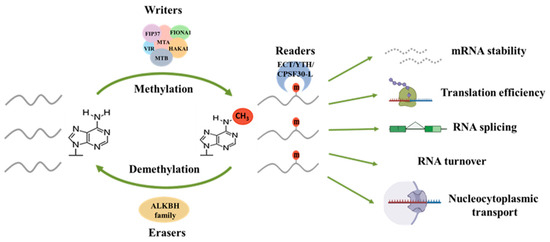
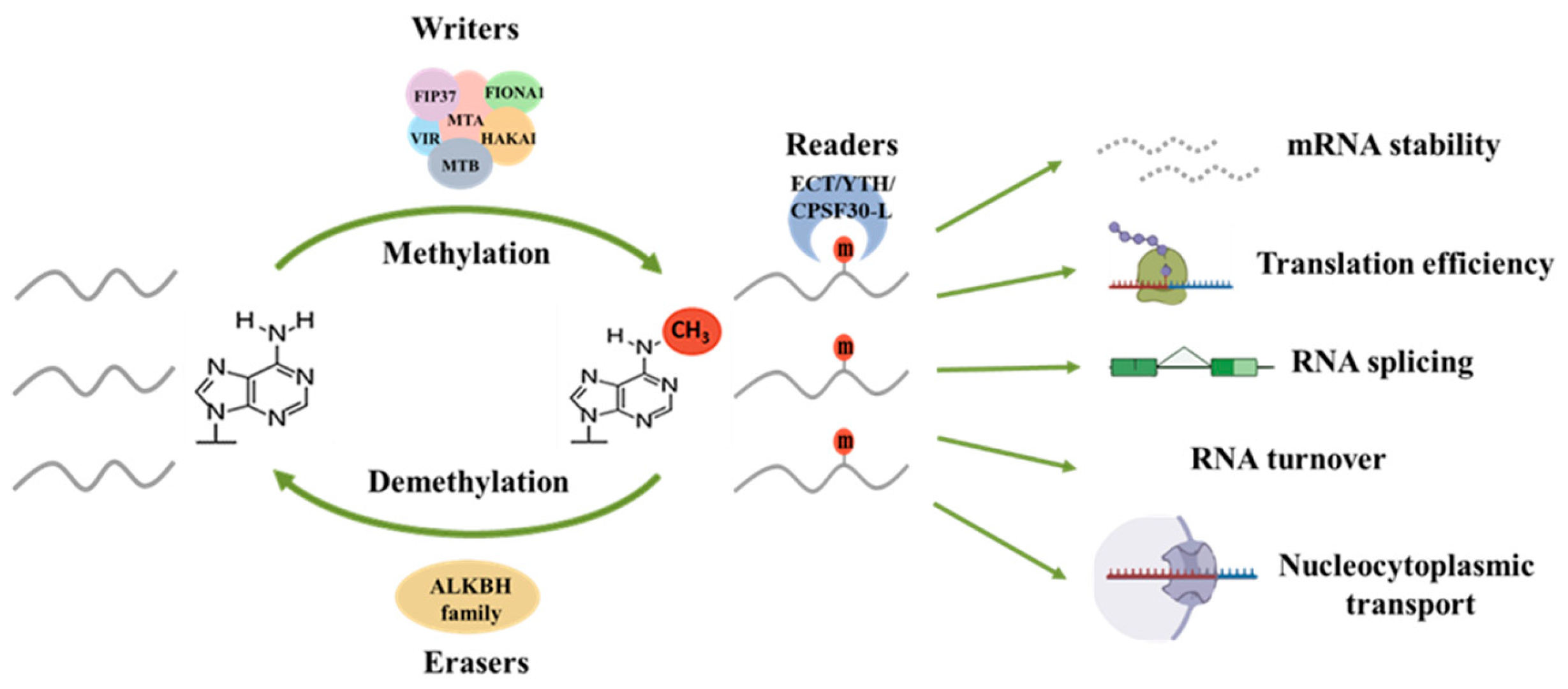
RNA modification, a crucial post-transcriptional regulatory mechanism, constitutes an important layer of epigenetics. Studies have identified over a hundred types of RNA modifications across eukaryotic mRNA, tRNA, rRNA, small non-coding RNA (snRNA), microRNA (miRNA), and long non-coding RNA (lncRNA) [1,2,3]. Among these, the addition of N6-methyladenosine (m6A) to mRNA is one of the most widespread and intensively researched types [4]. The m6A is not uniformly distributed across transcripts but is predominantly enriched near stop codons and within 3′ untranslated regions (3′ UTR) [5]. Transcriptome-wide mapping further reveals that m6A typically occurs within the conserved RRACH motif (R = A/G, H = A/C/U) [6,7]. Plants also possess a unique motif, URUAY (R = G > A, Y = U > A), located at the mRNA 3′ UTR [8]. Genetic and transcriptomic studies collectively indicated that m6A plays key roles in enhancing mRNA stability [9,10,11], promoting translation efficiency [12,13,14], as well as influencing splicing [15,16], RNA turnover, and nucleocytoplasmic transport [17] (Figure 1). These findings underscore the central role of co-transcriptional and post-transcriptional RNA chemical modifications in determining mRNA fate (Figure 1). Despite rapid advances in identifying m6A regulators in plants, our understanding of how this modification integrates developmental programs with abiotic stress responses remains incomplete. In this review, we discuss the molecular machinery controlling m6A dynamics, examine its roles in plant development and abiotic stress adaptation, and highlight emerging concepts and future directions in plant epitranscriptomics.
Figure 1.
m6A-mediated regulation of mRNA fate. m6A writers (methyltransferases) complex catalyze the addition of m6A modifications; readers (m6A-binding proteins) recognize m6A marks and mediate downstream functions; erasers (demethylases) remove m6A modifications. m6A modification controls multiple aspects of mRNA metabolism, including RNA stability, translation efficiency, RNA splicing, RNA turnover and nucleocytoplasmic transport. Through distinct reader proteins, m6A determines the post-transcriptional fate of target mRNAs.
2. m6A Writers, Readers, and Erasers: A Tripartite Synergistic System for Plant Epitranscriptomic Regulation
As a dynamic and reversible post-transcriptional marker [18], the addition or removal of m6A to nuclear mRNAs are mediated by methyltransferases (writers) or demethylases (erasers), respectively, while m6A-binding proteins (readers) recognize and bind modified sites to exert regulatory functions [19,20,21] (Figure 1).
Writers add m6A modifications to mRNA after recognizing specific motifs as substrates [6,7,8]. Writers are categorized into two types. The first includes multi-protein complexes composed of MTA (homolog of human METTL3), MTB (homolog of human METTL14), FIP37 (homolog of human WTAP), VIRILIZER (VIR) (homolog of human VIRMA), HAKAI (a ubiquitin E3 ligase), and HIZ2 (HAKAI-interacting zinc finger protein) (homolog of human ZC3H13). The second is the recently discovered single-protein writer FIONA1 [22,23,24,25]. Multiple studies have characterized that m6A writers play crucial roles in both plant development and abiotic stress responses. In terms of plant development, these factors are widely involved in various biological processes ranging from embryonic development and stem-cell differentiation to fruit ripening and floral transition [22,24,26,27,28,29]. In terms of abiotic stress responses, they are primarily involved in drought, low-temperature, and salt stresses, influencing plant tolerance by regulating mechanisms such as lignin synthesis, reactive oxygen species (ROS) scavenging, and mRNA stability [14,30,31].
Readers selectively recognize m6A signals added by writers, influencing the subsequent fate of transcripts [32]. Currently known readers mainly include YTH (YT521-B homology) domain proteins and KH (K-homology) domain proteins [33]. The most extensively studied YTH domain proteins rely on their conserved YTH domain for recognition and binding, which contains a hydrophobic pocket formed by four α-helices and six β-strands [34,35]. In total, 13 YTH domain proteins have been identified in Arabidopsis [36], with 11 belonging to the ECT (EVOLUTIONARILY CONSERVED C-TERMINAL REGION) family, including ECT1 to ECT12, and CPSF30-L (CLEAVAGE AND POLYADENYLATION SPECIFICITY FACTOR 30), all recognized as YTH family members [37,38,39].
Erasers can remove m6A modifications already formed on coding RNAs. This reversibility ensures that the methylation level within plants is a dynamically changing process under strict spatiotemporal regulation, serving as an important molecular basis for plants to adapt to complex and variable natural environments [32,40]. Currently, several members of the ALKBH (the a-ketoglutarate-dependent dioxygenase homolog) family have been identified as plant erasers [41], playing significant roles in various stages of growth and development, abiotic stress responses, and viral infection [28,42,43].
3. Mechanisms by Which m6A Controls Gene Expression
3.1. m6A and mRNA Stability
The relationship between m6A and mRNA stability is complex. In apple MdMTA RNA interference (RNAi) plants, reduced methylation levels correlate with decreased stability of genes involved in lignin deposition and oxidative stress response [44]. Anderson et al. [45] found that m6A can be dynamically deposited in salt stress response-related genes, enhancing their mRNA stability. However, m6A regulation of transcript stability is not always positive. m6A modification on shoot apical meristem (SAM) gene mRNAs restricts their transcript abundance, preventing meristem over-proliferation [27]. Similarly, mutation in the eraser slalkbh2 negatively affects DNA demethylase SlDML2 mRNA stability, delaying tomato fruit ripening [28]. These results indicate that the effects of m6A on stability are highly context-dependent. While an increasing number of studies point to the relationship between m6A and mRNA stability, the underlying molecular mechanisms remain poorly understood. Hu et al. [46] revealed a direct mechanism whereby m6A modification itself can physically protect transcripts from degradation. In this model, the presence of the methyl group at specific adenosine residues creates a steric hindrance that prevents recognition and cleavage by endonucleases. Additionally, m6A can function by altering mRNA secondary structure [9]. Kramer et al. [9] elegantly linked epitranscriptomic marks with RNA structural dynamics, demonstrating that the methyl group induces a looser secondary structure in the mRNA of the salt stress-responsive gene P5CS1 (DELTA 1-PYRROLINE-5-CARBOXYLATE SYNTHASE). This structural relaxation enhances accessibility for stabilizing RNA-binding proteins while potentially occluding recognition sites for degradation factors, ultimately leading to increased mRNA stability [9]. Cai Z et al. [47] also reported that ECT8 mediates the 5′-end de-capping degradation pathway. Specifically, ECT8 recognizes the m6A mark and recruits DCP5 (DECAPPING 5), a key component of the de-capping complex, to the 5′ end of target genes, initiating the 5′-to-3′ mRNA degradation pathway for negative stress regulators to enable an effective response to abiotic stress.
In summary, while m6A is known to either stabilize or destabilize mRNAs depending on context through mechanisms including steric hindrance, RNA structural remodeling, or reader-mediated degradation [9,27,28,44,45,46,47], it remains unclear what determines these opposing outcomes and how different readers are coordinated on the same transcript.
3.2. Regulation of Translation Efficiency
3.2.1. Evidence for m6A-Promoted Translation Efficiency
In the Arabidopsis mta knockdown mutant AmiR-mta, the mRNA abundance of DGAT1 (DIACYLGLYCEROL ACYLTRANSFERASE 1) did not significantly decrease compared to wild-type under both normal and cold conditions, yet its translation efficiency was negatively affected, leading to reduced protein expression [14]. This finding is critically important because it definitively demonstrates that m6A can directly regulate translation efficiency through mechanisms independent of stability, without altering transcript abundance. Similarly, Govindan et al. [48] employed polysome profiling to demonstrate that transcripts with high m6A levels exhibit higher ribosome occupancy, further supporting the positive role of m6A in translation efficiency. The strawberry writer MTA regulates strawberry fruit ripening by targeting the translation efficiency of genes in the abscisic acid (ABA) signaling pathway [13]. Under drought conditions, apple MdMTA effectively promotes the translation efficiency of genes involved in lignin biosynthesis and oxidative stress responses [44]. m6A-mediated translational control thus emerges as a conserved regulatory mechanism across species in plant development and stress adaptation.
3.2.2. Eukaryotic Initiation Factor 3 Recruitment Mechanism
In animal systems, m6A modification within the 5′ UTR can directly bind the eukaryotic translation initiation factor eukaryotic initiation factor 3 (eIF3), bypassing the cap-binding protein eukaryotic initiation factor 4E (eIF4E) and directly recruiting the 43S pre-initiation complex, thereby initiating cap-independent translation [49]. In plants, emerging evidence supports a similar mechanism. For instance, in rice, the OseIF3h physically interacts with OsMTA2, as demonstrated by yeast two-hybrid and co-immunoprecipitation assays [50]. Loss of OseIF3h function leads to severe growth retardation, reduced seed-setting rate, and abnormal pollen development, accompanied by attenuated translation efficiency of specific gene subsets [50]. These findings indicate that the functional coupling between m6A modification and eIF3-mediated translation initiation is at least partially conserved in plants, laying the groundwork for future investigations into cap-independent translation mechanisms [49,50].
3.2.3. Coordination with RNA-Binding Proteins
In rice, the RNA-binding protein EHD6 directly interacts with the m6A reader YTH07 [51]. Notably, EHD6 not only physically associates with YTH07 but also promotes its m6A-binding activity and facilitates its phase separation into ribonucleoprotein condensates [51]. These condensates sequester target mRNAs and repress their translation, thereby regulating flowering time [51]. This study provides a striking example of how an RNA-binding protein can modulate the function of an m6A reader to achieve specific translational control.
3.2.4. Translational Reprogramming Under Stress
Under stress conditions, global translation is suppressed to conserve energy, while translation of key stress-responsive genes is selectively activated [52]. m6A modification orchestrates this translational reprogramming. Under cold stress, m6A ensures preferential translation of cold-responsive transcripts while suppressing growth-related genes [14]. This selective activation enables rapid proteome remodeling, prioritizing survival over growth [14].
Thus, m6A is known to promote translation efficiency in multiple plant species independently of mRNA stability and to orchestrate translational reprogramming under stress, with recent evidence from rice showing physical interaction between eIF3 and the m6A writer complex [13,14,44]. However, whether plant readers directly recruit eIF3, whether cap-independent translation exists in plants, and how multiple readers coordinate translation control remain open questions.
3.3. m6A Participates in Alternative Polyadenylation
Alternative polyadenylation (APA) generates mRNA isoforms with distinct 3′ UTR lengths by selecting among different poly(A) sites [53,54], thereby influencing mRNA stability, translation efficiency, protein subcellular localization, and other biological processes through post-transcriptional regulation [55,56]. Recent studies have revealed extensive crosstalk between m6A modification and APA processes.
In the Arabidopsis cpsf30-L knockout mutant, more than half of all genes exhibit altered poly(A) site selection, with a pronounced shift toward proximal poly(A) sites [38]. This finding demonstrates that CPSF30-L, as an m6A reader, participates in regulating APA site choice through recognition of m6A modifications [38]. Under salt stress, VIR-mediated m6A marks influence APA site selection, preventing 3′ UTR lengthening of stress-related genes and thereby promoting transcript degradation [46]. Govindan et al. [48] further revealed that m6A facilitates the production of mRNA isoforms with shorter 3′ UTRs for cold-responsive genes, potentially allowing these transcripts to escape recognition by cleavage factors and enhancing their stability and translation efficiency.
Collectively, the m6A reader CPSF30-L is known to regulate poly(A) site choice, VIR-mediated m6A prevents 3′ UTR lengthening of stress-related genes, and cold stress induces m6A-facilitated production of shorter 3′ UTR isoforms [38,46,48]. Nevertheless, how m6A physically influences the polyadenylation machinery and what determines whether it promotes proximal versus distal site usage remain to be elucidated.
4. Crosstalk with Chromatin and Other Epigenetic Layers: Bidirectional Regulation and Transcriptional Coupling
4.1. Histone Modifications Guide Co-Transcriptional m6A Deposition
Events occurring within the nucleus directly influence the subsequent fate of RNA products. Chromatin states, particularly specific histone modifications, can serve as upstream signals that guide m6A deposition on nascent RNA chains, achieving coupling between transcriptional and post-transcriptional regulation [57,58]. In animal systems, this mechanism has been clearly elucidated: histone H3 lysine 36 trimethylation (H3K36me3)—a mark associated with active transcriptional elongation-recruits the writers complex component METTL14, thereby co-transcriptionally adding m6A modifications to nascent RNAs [57]. This coupling ensures spatiotemporal coordination between m6A modification and gene transcriptional activity. Emerging evidence suggests that similar conserved mechanisms may operate in plants. For instance, Shim et al. [58] demonstrated that H3 lysine 36 dimethylation (H3K36me2) levels in Arabidopsis strongly correlate with m6A abundance on target gene mRNAs, raising the possibility that H3K36me2 could function as an upstream signal influencing m6A deposition. It is important to note, however, that this remains speculative at present, as the direct molecular bridge connecting histone modifications to m6A writers in plants has not yet been identified. Nevertheless, this correlation suggests a hypothesis worth testing: that chromatin-state-guided RNA methylation might represent a conserved regulatory mechanism.
4.2. m6A Reciprocally Regulates Chromatin State and Transcription
More revolutionary is the discovery that this crosstalk is not unidirectional but bidirectional: m6A modifications themselves can reciprocally influence the chromatin state from which they originated, forming a closed-loop regulatory system [59]. Song et al. [59] achieved a breakthrough in Arabidopsis: they discovered that m6A modifications on retrotransposon RNAs can be recognized by specific reader proteins. Subsequently, these readers recruit histone methyltransferases to corresponding genomic DNA loci, catalyzing the addition of repressive Histone H3 lysine 9 dimethylation (H3K9me2), thereby compacting chromatin and suppressing retrotransposon transcription [59].
4.3. An Integrated Perspective: A Coupled Transcriptional–Epitranscriptional Regulatory Circuit
Taken together, an integrated model emerges: during transcriptional elongation, active chromatin states recruit writer complexes, guiding co-transcriptional m6A deposition on nascent RNAs [57,58]. These m6A marks subsequently influence RNA stability, splicing, or translation efficiency through reader proteins [57,58]. More critically, at certain loci such as transposons, these RNA m6A marks can, via specific readers, reciprocally recruit chromatin-modifying complexes to reshape the local chromatin environment, thereby influencing future transcriptional initiation [59]. This bidirectional coupling ensures the precision and robustness of gene expression regulation, enabling cells to coordinately fine-tune gene output at both transcriptional and post-transcriptional levels in response to different developmental stages and environmental signals [57,58,59]. This emerging research field not only challenges traditional disciplinary boundaries but also provides novel perspectives for understanding complex life phenomena. Future research should prioritize exploring: What are the specific molecular mechanisms linking histone modifications to m6A writers in plants? Which readers mediate the reverse signal from m6A to chromatin modifications? How is this crosstalk dynamically regulated during plant development and environmental responses?
5. Emerging Concepts in Plant m6A Biology
5.1. Single-Cell Heterogeneity of m6A
Methylated RNA immunoprecipitation sequencing (MeRIP-seq) is based on bulk tissue samples, and the resulting methylation profiles represent average signals across different cell types, masking intercellular heterogeneity [6]. Single-cell m6A sequencing (scm6A-seq) enables the acquisition of genetic information at single-cell resolution, revealing the cell type-specific distribution of m6A modifications [60]. In animal systems, studies have demonstrated the potential regulatory functions of m6A regulatory factors across different cell types [61,62]. In plants, however, scm6A-seq technology has not yet been maturely applied. In the future, integrating scm6A-seq with multi-omics analyses such as single-cell transcriptomics and single-cell ATAC-seq will comprehensively reveal the regulatory mechanisms of m6A modification in cell fate determination.
5.2. Phase Separation and m6A-Mediated Condensate Formation
m6A-modified RNAs and m6A readers can undergo liquid-liquid phase separation, forming membraneless organelles that concentrate specific transcripts and regulatory factors [63]. m6A modification and its readers have been established as key components of phase separation, orchestrating spatiotemporally specific regulation of target transcripts through recruitment of translation machinery or degradation factors [64,65]. Multiple m6A readers such as ECT1, ECT2, CPSF30-L, SiYTH1, and SlYTH2 participate in mRNA metabolism during heat stress, drought stress, salt stress, and immune responses by forming membraneless biomolecular condensates [39,66,67,68,69]. Furthermore, ALKBH9B-mediated demethylation influenced condensate formation and disassembly, thereby affecting the subcellular localization and fate of transcripts [70]. Phase separation therefore functions as a core mechanism of m6A-mediated RNA metabolism, with critical implications for plant development and stress adaptation.
5.3. Stress Memory and Transgenerational Inheritance
Whether stress-induced m6A patterns persist after stress relief and contribute to stress memory, which is defined as enhanced responses upon subsequent stress encounters, remains unknown. Even more provocatively, whether m6A modifications can be transmitted across generations, contributing to transgenerational stress adaptation, represents a fundamental question with profound implications for understanding plant environmental responses and evolution.
6. Epitranscriptomic Plasticity: Species, Cultivar, and Tissue Specificity
6.1. Species-Specific m6A Landscapes
In response to the same type of stress, m6A response patterns are not uniform across all plants and exhibit high complexity and species specificity [48,71,72]. In Arabidopsis, cold stress induces a significant increase in transcriptome-wide m6A levels [48]. This global increase is considered a conserved stress response, potentially suppressing growth-related genes by generally reducing transcript stability while reallocating resources to activate cold adaptation pathways [48]. In contrast, cold stress leads to a genome-wide decrease in m6A levels in tomato anthers [71]. This trend may be related to a protective mechanism unique to reproductive organs, which involves global demethylation to maintain mRNA stability of genes critical for fertility, prioritizing reproductive development under stress [71]. Mango seedlings exhibit another unique adaptation mechanism: cold stress-induced m6A modification enhances the binding of the molecular chaperone HSP70 (HEAT SHOCK PROTEIN 70) to specific methylated RNAs [72]. This does not directly indicate a simple global increase or decrease but reflects the functional specificity of m6A-mediated RNA-protein interactions at the translational regulation level, enhancing tolerance by promoting correct folding of cold-responsive proteins [72].
6.2. Cultivar-Specific Methylation Patterns
Different cultivars of the same species also show significant differences in m6A modification under stress, and these differences are closely related to resistance phenotypes [73,74,75].
6.2.1. Cultivar-Specific m6A Modifications Exert Bidirectional Regulation on Stress-Responsive Genes
Ma L et al. [73] analyzed whole-transcriptome m6A profiles and differential gene expression profiles in Brassica rapa varieties with different cold tolerance under low temperature. While both the cold-tolerant cultivar L7 and the cold-susceptible cultivar Lenox showed decreased methylation levels, the decrease was more pronounced in L7. Concurrently, m6A enrichment at the middle region of the ZAT12 (ZINC FINGER OF ARABIDOPSIS THALIANA 12) gene increased significantly in L7, but not in Lenox, indicating that m6A positively regulated ZAT12 expression to enhance cold tolerance [73]. Conversely, m6A levels of the MYBC1 (MYB DOMAIN PROTEIN C 1) gene increased significantly in Lenox but not in L7, suggesting that m6A negatively regulated MYBC1 expression, suppressing cold tolerance in Brassica rapa [73]. Remarkably, m6A modifications can steer the same transcript toward opposite regulatory fates in different cultivars, enabling genotype-specific stress adaptation strategies.
6.2.2. Cultivar-Specific Differences in m6A Modifications Affect the Activation Efficiency of Stress Signaling Pathways
Under mild drought treatment, the drought-resistant cotton cultivar ZY168 and the drought-sensitive cotton cultivar ZY7 exhibited significant differences in m6A levels under mild drought treatment, with ZY168 accumulating more m6A modifications in the 5′ untranslated regions (5′ UTR) [74]. These differential methylation patterns enabled the drought-resistant cultivar to regulate the abundance of transcripts associated with Ca2+ and ABA signaling pathways via m6A marks, generating a faster and stronger stress response [74]. In potato salt stress response, different cultivars displayed differential response patterns to StALKBH10B-mediated m6A demethylation [75]. StALKBH10B negatively regulates potato salt tolerance by removing m6A modifications from transcripts involved in flavonoid metabolism and ABA signaling pathways, and the efficiency of this regulatory mechanism varies among cultivars, directly contributing to differences in salt tolerance [75]. Cultivar-specific m6A differences thus manifest not merely as global methylation shifts, but as fine-tuned control over the activation efficiency of specific signaling pathways [74,75].
6.3. Tissue- and Stage-Specific Regulation
m6A modification also displays differential distribution and function across different tissues or developmental stages within the same plant [28,43,71,76]. Wang L et al. [43] found that Arabidopsis floral organs exhibited higher transcriptome-wide levels of m6A than leaves under heat stress, with distinct modification patterns: modifications were more enriched in coding sequence (CDS) regions in flowers, while more located in the 3′ UTR in leaves. More pronounced methylation in flowers negatively regulated gene expression variability, providing a new perspective for understanding why floral organs are more sensitive to high-temperature stress during heat waves [43,76]. Zhou et al. [28] monitored transcriptome-wide methylation levels at different ripening stages of tomato fruit, revealing a dynamic decreasing trend in m6A levels. Yang et al. [71] found that moderate low-temperature (MLT) treatments disrupt the m6A modification pattern of anther development-related genes in anthers, preventing normal gene expression, causing metabolic disorders, and ultimately leading to pollen abortion due to excessive ROS accumulation. m6A does more than simply respond to environmental stress signals—it interprets and executes them according to cell type and developmental state. This context-dependent logic enables precise post-transcriptional regulation that coordinates growth, development, and stress adaptation [28,43,71,76].
7. m6A Regulation of Plant Development
Multiple m6A regulatory factors have been functionally characterized in plant developmental processes (Table 1). Writers such as MTA, MTB, and FIP37 regulate embryonic development, stem cell maintenance, and fruit ripening across Arabidopsis, strawberry, and rice. Readers including ECT family members and CPSF30-L control leaf morphology, seed germination, and floral transition, while erasers such as ALKBH2, ALKBH5 and ALKBH10B participate in fruit ripening, flowering, and seed germination. Collectively, these findings establish the m6A machinery as a central regulator of plant development from embryogenesis to reproduction (Table 1).
Table 1.
The role of confirmed m6A writers, readers and erasers in plant development.
7.1. Embryogenesis and Early Development
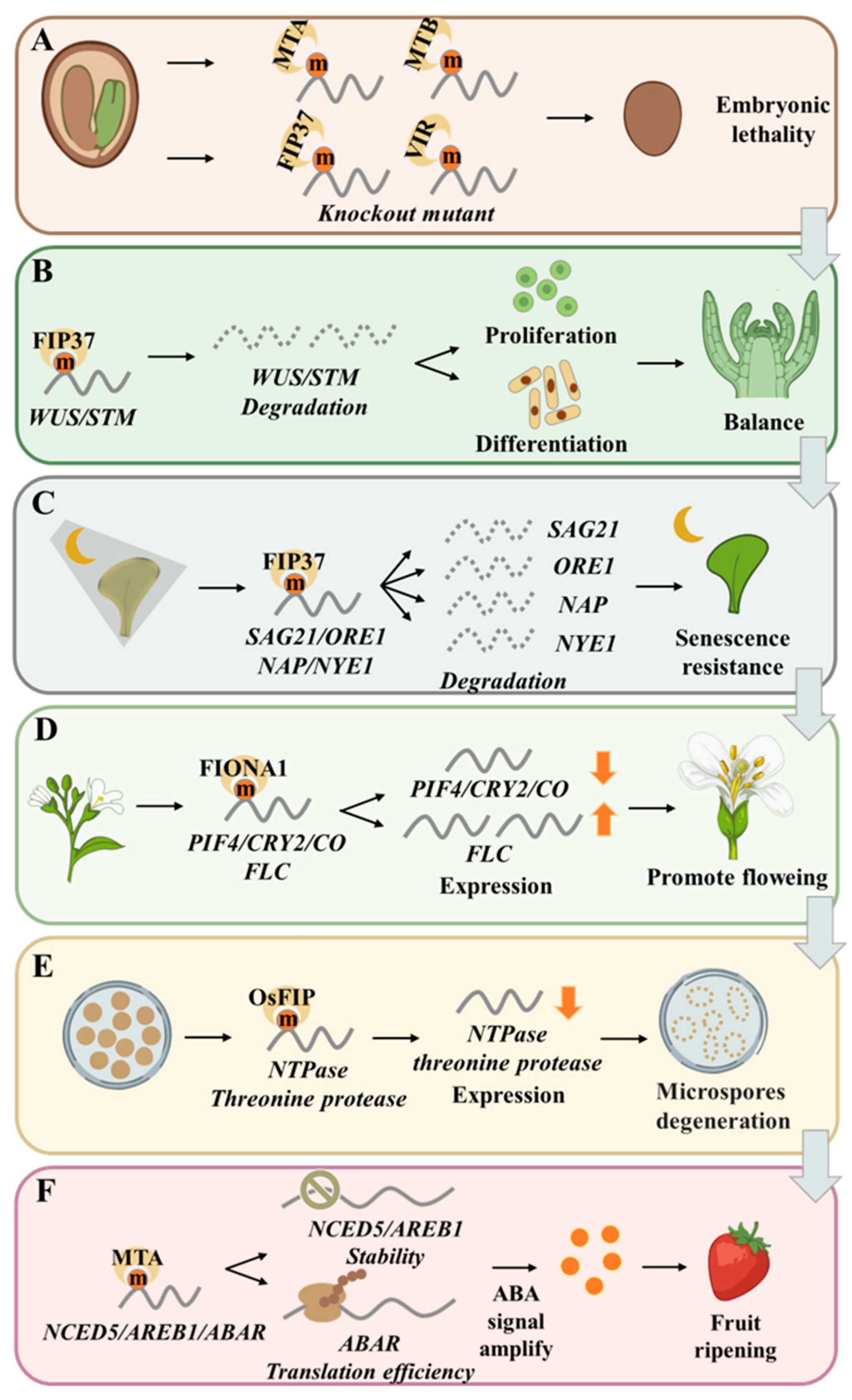
Genetic evidence has unequivocally established the essential role of m6A writers in embryonic development [22,24,26]. In Arabidopsis, knockout mutants of core writer components mta, mtb, vir, and fip37 arrest embryonic development at the globular stage, while knockdown mutants exhibit pronounced developmental defects, including shortened roots, increased branching, and aberrant vascular development [22,24,26] (Figure 2A). Thus, m6A modification is indispensable for normal embryogenesis and post-embryonic growth.
Figure 2.
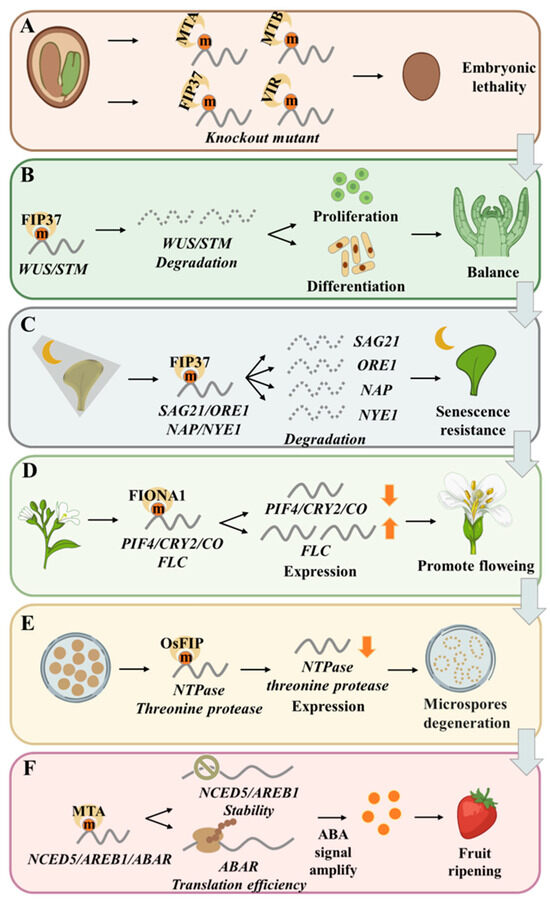
The multifaceted roles of m6A RNA methylation in plant development. (A) Knockout mutants of core components of the m6A writer complex (MTA/homolog of human METTL3, MTB /homolog of human METTL14, FIP37/homolog of human WTAP, VIR/homolog of human VIRMA) lead to embryonic lethality, indicating that m6A is essential for early embryogenesis in plants. (B) FIP37-mediated m6A modification promotes the degradation of transcripts of key developmental genes, WUS (WUSCHEL) and STM (SHOOTMERISTEMLESS), thereby balancing cell proliferation and differentiation to maintain the function of the SAM (shoot apical meristem). (C) FIP37 promotes the degradation of senescence-associated gene transcripts such as SAG21 (SENESCENCE-ASSOCIATED GENE 21), ORE1 (ORESARA 1), NAP (NAC-LIKE, ACTIVATED by AP3/PI), and NYE1 (NON-YELLOWING 1) through m6A modification, thereby delaying the leaf senescence process and enhancing the plant’s anti-aging capacity. (D) FIONA1 promotes flowering in plants by regulating the m6A levels and expression abundance of flowering- and light sensing- related genes such as PIF4 (PHYTOCHROME INTERACTING FACTOR 4), CRY2 (CRYPTOCHROMES 2), CO (CONSTANS), and FLC (FLOWERING LOCUS C). (E) The rice OsFIP protein regulates the expression of NTPase and threonine protease genes through m6A modification. Abnormalities in this process lead to microspore degeneration. (F) MTA-mediated m6A modification affects the transcript stability and translation efficiency of key genes in the ABA (abscisic acid) signaling pathway, including NCED5 (9-cis-epoxycarotenoid dioxygenase 5), AREB1 (ABA-responsive element-binding protein 1) and ABAR (ABA receptor), thereby amplifying the ABA signal and promoting fruit ripening. Symbols: Upward arrow indicates increased gene expression; downward arrow indicates decreased gene expression.
7.2. Vegetative Growth and Organ Development
7.2.1. Shoot Apical Meristem Maintenance
The balance between stem cell proliferation and differentiation in the SAM is tightly regulated by m6A modification, as fip37 mutants exhibit excessive shoot meristem proliferation [27]. FIP37-mediated m6A deposition on mRNAs encoding key SAM regulators, including WUS (WUSCHEL) and STM (SHOOTMERISTEMLESS), promotes their degradation, thereby maintaining the proper balance between stem cell self-renewal and differentiation [27]. Disruption of this m6A-mediated regulatory mechanism leads to meristem over-proliferation and developmental abnormalities [27] (Figure 2B).
7.2.2. Trichome Development
m6A modification also influences epidermal cell differentiation [8,23,26]. mta knockdown lines exhibit increased trichome branching, a phenotype similar to that observed in FIP37 overexpression plants [23,26]. Furthermore, the m6A reader ECT2 specifically regulates trichome morphology and branching by affecting the stability of mRNAs encoding trichome development-related genes [8].
7.2.3. Organogenesis and Leaf Senescence
The m6A readers ECT2, ECT3, and ECT4 exhibit functional redundancy in controlling cell proliferation and organ morphology [80,81]. Arribas-Hernández et al. [80] first reported that ect2/ect3 double mutants display significantly delayed leaf formation rates and aberrant leaf morphology. Subsequently, the same team further demonstrated that, in addition to leaf defects, ect2/3 and ect2/3/4 mutants exhibit slow root and stem growth, defective root gravitropism, abnormal flower and fruit morphology, and disrupted inflorescence phyllotaxis [80,81]. m6A writers are involved in leaf senescence, as MTA-deposited m6A counteracts dark-induced leaf senescence by promoting the decay of key senescence markers, including SAG21 (SENESCENCE-ASSOCIATED GENE 21), ORE1 (ORESARA 1), NAP (NAC-LIKE, ACTIVATED BY AP3/PI), and NYE1 (NON-YELLOWING 1) [77] (Figure 2C).
7.3. Reproductive Development
7.3.1. Floral Transition
m6A modification participates in the regulation of floral transition through multi-level molecular mechanism [29,39,82,83,84]. At the writers level, FIONA1 negatively regulates transcript levels of the blue light receptor CRY2 (CRYPTOCHROMES 2), the light-responsive transcription factor PIF4 (PHYTOCHROME INTERACTING FACTOR 4), and the positive flowering regulator CO (CONSTANS), while positively regulating FLC (FLOWERING LOCUS C) expression, thereby coordinately controlling Arabidopsis flowering time [29] (Figure 2D). OsYTH10 is involved in regulating flowering time in rice under long-day conditions by directly recognizing and promoting the degradation of flowering repressor mRNAs, leading to early flowering [82]. The m6A reader CPSF30-L plays a crucial role in floral transition by regulating APA site selection of flowering-related genes [39]. At the eraser level, GhALKBH5 efficiently erases m6A modifications from genes in the cotton photoperiodic flowering pathway, ensuring their stable expression and normal flowering [83]. ALKBH10B reduces m6A levels on transcripts of downstream flowering factors, including FT (FLOWERING LOCUS T), SPL3 (SQUAMOSA PROMOTER BINDING PROTEIN-LIKE 3), and SPL9 (SQUAMOSA PROMOTER BINDING PROTEIN-LIKE 9), through demethylation, thereby positively regulating their transcriptional abundance and ultimately promoting flowering in Arabidopsis [84].
7.3.2. Reproductive Organ Development and Fruit Ripening
During reproductive organ development, threonine protease and NTPase gene expression is impaired in the rice Osfip mutant, controlling early microsporogenesis, and disruption of this regulation leads to microspore degeneration and male sterility [78] (Figure 2E). Fruit ripening involves complex m6A regulation [13,28]. In strawberry, the writer complex MTA/MTB deposits m6A on mRNAs of key ABA signaling pathway genes, including NCED5 (9-cis-epoxycarotenoid dioxygenase 5), AREB1 (ABA-responsive element-binding protein 1), and ABAR (ABA receptor), enhancing their mRNA stability or translation efficiency, thereby amplifying ABA signaling and accelerating fruit ripening [13] (Figure 2F). In tomato, the eraser SlALKBH2 interacts with the DNA demethylase SlDML2, catalyzing m6A demethylation and promoting SlDML2 expression, thereby accelerating ripening [28]. Conversely, SlDML2-mediated DNA methylation feedback-regulates SlALKBH2 transcription, co-regulating the fruit ripening process [28]. This study reveals a new layer of m6A regulation, achieving cross-level dialogue between the epitranscriptome and epigenome [28].
7.3.3. Seed Germination
Seed germination is precisely regulated by ABA and gibberellic acid (GA) signaling, and m6A modification participates in this process through the coordinated action of erasers and readers [11,85,86]. The eraser ALKBH10B negatively regulates ABA signaling intensity by removing m6A modifications from ABA signaling factors, preventing its overactivation to ensure Arabidopsis normal germination [85]. In contrast, ALKBH6 exhibits an opposing function, as its loss leads to Arabidopsis germination insensitivity to ABA [86]. Furthermore, the m6A reader ECT1 promotes GA signaling by facilitating the degradation of RGA1 (REPRESSOR OF GA1-3 1) mRNA and integrates phyB (PHYTOCHROME B) light signals, coupling endogenous hormone signals with environmental conditions to positively regulate Arabidopsis seed germination [11]. Collectively, m6A modification functions as a central regulator of seed germination by dynamically modulating the ABA/GA signaling balance and integrating environmental signals.
8. m6A as a Regulator of Abiotic Stress Responses
As sessile organisms, plants must continuously adjust their growth and development in response to environmental challenges. Extensive functional characterization has established m6A writers, readers, and erasers as key regulators of plant abiotic stress responses across multiple stress types and species (Table 2). Through coordinated modulation of mRNA stability, translation efficiency, ROS homeostasis, and hormone signaling pathways, these factors orchestrate stress adaptation (Table 2).
Table 2.
The role of confirmed m6A writers, readers and erasers in abiotic stress.
8.1. Drought and Water Deficit
8.1.1. Regulation of Key Metabolic Pathways to Establish Stress Tolerance
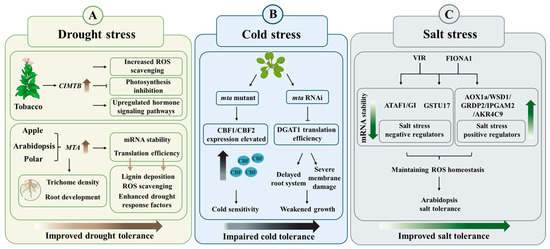
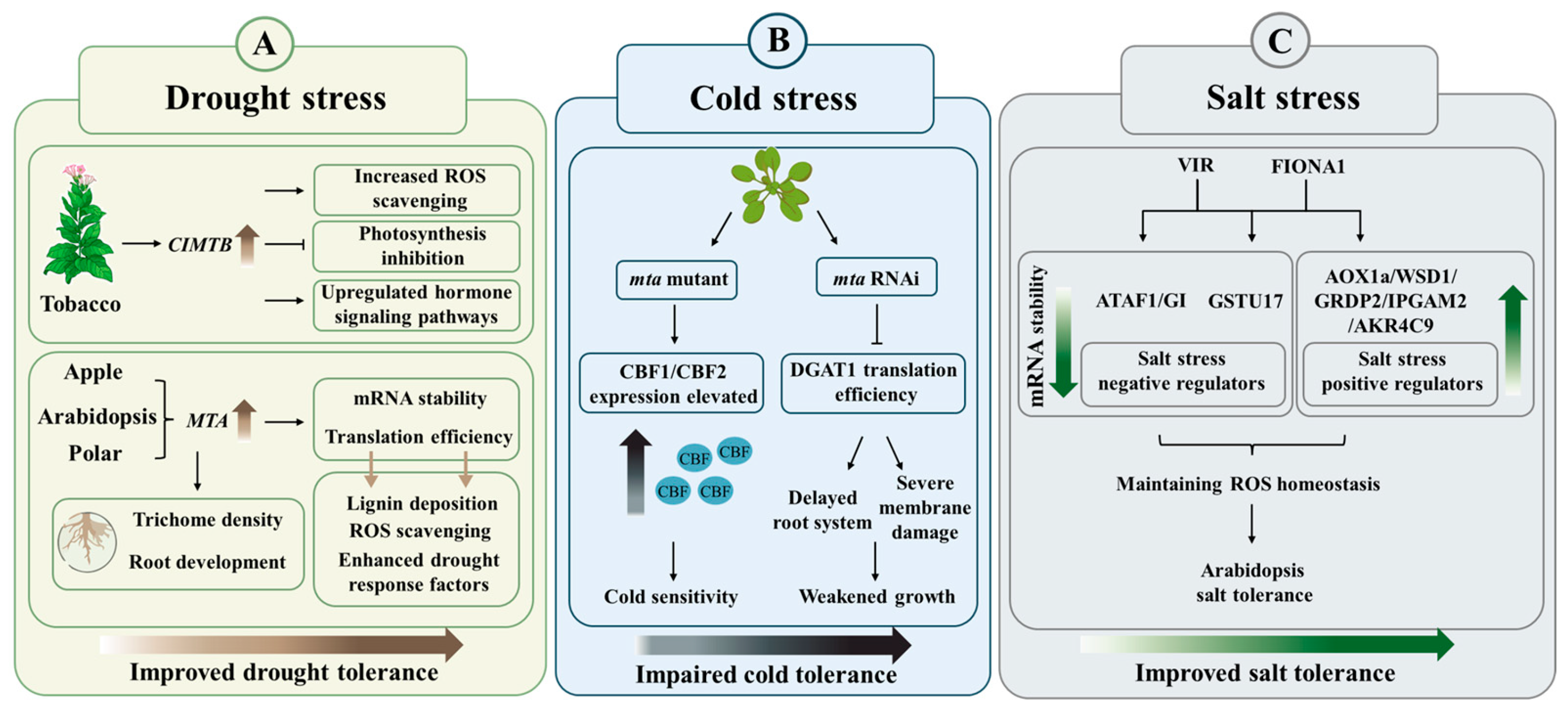
Under drought stress, overexpression of the watermelon writers component ClMTB actively mobilizes genes involved in ROS scavenging, photosynthesis, and hormone signaling pathways, gradually establishing drought tolerance in tobacco [30] (Figure 3A). Similarly, in apple and Arabidopsis, MTA promotes the translation efficiency of genes involved in lignin biosynthesis, oxidative stress responses, and drought-responsive regulators under drought conditions to enhance drought tolerance [44,87] (Figure 3A). Recently, ECT10 was identified as an m6A reader that exerts a negative regulatory role by influencing the stability of both positive and negative regulators of the drought stress response [91].
Figure 3.
Regulatory mechanism model of plant abiotic stress tolerance mediated by m6A modification and its associated proteins. (A) Upregulating the expression of MTB (homolog of human METTL14) and MTA (homolog of human METTL3) enhanced the tolerance of plants to drought stress. In tobacco, upregulation of watermelon m6A methyltransferase ClMTB promotes ROS (reactive oxygen species) scavenging, activates hormone signaling pathways, and alleviates the inhibition of photosynthesis by water deficit. In apple, Arabidopsis, and poplar, upregulation of MTA improves the mRNA stability and translation efficiency of key genes, thereby promoting lignin deposition, enhancing ROS scavenging capacity and the function of drought-responsive factors, and regulating trichome density and root development under drought conditions. (B) Loss of MTA function (in mta mutants or RNAi lines) leads to impaired cold tolerance. In mta mutants, the expression of cold-responsive genes CBF1/CBF2 (C-repeat binding transcription factor 1/C-repeat binding transcription factor 2) is abnormally elevated, increasing the sensitivity of Arabidopsis plants to low temperatures. In mta RNAi plants, the translation efficiency of DGAT1 (DIACYLGLYCEROL ACYLTRANSFERASE 1) is reduced, causing delayed root development and severe cell membrane damage, resulting in growth retardation. (C) The m6A-associated proteins VIR (homolog of human VIRMA) and FIONA1 enhance Arabidopsis salt tolerance by finely modulating mRNA stability to maintain ROS homeostasis. VIR primarily functions by reducing the mRNA stability of negative regulators of salt stress such as ATAF1 (NAC transcription factor), GI (GIGANTEA) and GSTU17 (glutathione S-transferase U17). In contrast, FIONA1 increases the mRNA stability of positive regulators of salt stress such as AOX1a (alternative oxidase 1a), WSD1 (Wax ester synthase DGAT acyltransferase 1), GRDP2 (glycine-rich domain-containing protein 2), IPGAM2 (2-phosphoglycolate phosphatase 2), AKR4C9 (aldo-keto reductase family 4 member C9), etc. Symbols: In (A,B), the arrows indicate upregulation of gene expression. The T-shaped lines in (A,B) represent inhibition. In (C), the upward and downward arrows indicate an increase and decrease in mRNA stability, respectively.
8.1.2. Influence on Epidermal Structure and Root Development to Enhance Drought Tolerance
Trichomes attached to plant epidermal tissues help plants effectively cope with abiotic stresses [96]. In poplar, plants overexpressing PtrMTA enhance adaptation to drought stress by increasing trichome density and promoting root growth and development [88,97] (Figure 3A).
8.1.3. Regulation of Hormone Signaling to Modulate Drought Adaptive Responses
In tomato, SlALKBH9B has been shown to participate in drought stress responses, as slalkbh9b mutant plants exhibit induced ethylene production under drought conditions, accelerating flower abscission [97]. ALKBH10B, a well-studied eraser in plants, has been reported to function in recent studies [74,85,93,94,95]. Salt and drought stress-induced ALKBH10B expression negatively regulates physiological and biochemical processes, including photosynthesis, ROS homeostasis, and ABA responses, thereby reducing plant stress tolerance [74,85,93,94,95].
8.2. Temperature Stress
Under high-temperature conditions, m6A modification plays a crucial role in reproductive thermotolerance. AtALKBH10B enhances gene expression variability in floral organs, improving thermotolerance of reproductive structures and facilitating reproduction and survival in extreme environments [43]. Cold stress triggers dynamic m6A responses that enhance plant survival through regulation of stress-responsive transcripts [14,48]. Under low-temperature stress, Govindan et al. [48] subjected Arabidopsis mta mutants to 4 °C treatment for 3 h and 24 h and found that the expression levels of key cold tolerance transcription factors CBF1 (C-repeat binding transcription factor 1) and CBF2 (C-repeat binding transcription factor 2) were significantly altered, leading to increased cold sensitivity in the mutants (Figure 3B). Similarly, under 4 °C cold stress, Wang et al. [14] observed significantly weakened growth in Arabidopsis MTA RNAi plants, manifested as delayed root growth and more severe membrane damage (Figure 3B). Integrated analysis of the Arabidopsis m6A methylome, transcriptome and translatome revealed reduced translation efficiency of the cold stress response factor DGAT1 without a decrease in transcript levels, suggesting positive regulation of translation by m6A marks [14]. In rice, the m6A reader ECT3 exhibits enhanced m6A-binding activity under cold stress due to reduced acetylation levels, leading to increased accumulation of cold-responsive gene transcripts and the establishment of cold tolerance in rice [89]. This post-translational regulation of reader activity adds another layer of control to the epitranscriptomic stress response [89].
8.3. Salt Stress
8.3.1. Maintenance of Cellular Homeostasis Through Regulation of mRNA Stability
FIONA1, which is involved in photomorphogenesis and flowering in Arabidopsis [29], also plays a key regulatory role in the salt stress response [31]. Both VIR and FIONA1 enhance salt tolerance by maintaining ROS homeostasis, achieved through reducing the mRNA stability of GSTU17 (glutathione S-transferase U17), a key negative regulator in the salt stress response [31,46] (Figure 3C). This pattern resembles that observed in drought and cold stress, where writers mediate tolerance by enhancing mRNA stability and translation efficiency [14,30,44,87]. Besides recognizing mRNA as a substrate, FIONA1 can also add methylation modifications to the spliceosomal U6 snRNA [29]. Therefore, the function of m6A extends beyond coding RNAs, directly influencing pre-mRNA splicing by regulating spliceosome function [25,29,98].
8.3.2. Precise Regulation of Salt Stress Responses Through Opposing Mechanisms
Readers regulate salt responses through opposing mechanisms [10,46,90]. On the one hand, ECT8 and ECT12—the latter identified as a potential m6A reader—enhance the stability of positive stress-responsive gene transcripts by recognizing and binding their m6A modifications under salt and drought stress, thereby positively regulating plant stress resistance [10,90]. On the other hand, some readers promote the degradation of negative regulator mRNAs to relieve inhibition [47]. Specifically, the protein–protein interaction between ECT8 and DCP5 accelerates the degradation of salt stress-responsive factor mRNAs, actively clearing inhibitory factors to maintain physiological homeostasis under stress [47]. Thus, this reader-mediated degradation pathway selectively eliminates negative regulators, enabling effective stress responses. The regulatory function of erasers in salt stress is further exemplified by ALKBH8B. Overexpression of ALKBH8B in Arabidopsis enhances salt tolerance and reduces global m6A levels, accompanied by altered expression of both positive and negative salt stress regulators [92]. Moreover, ALKBH8B-overexpressing plants exhibit enhanced cotyledon greening upon ABA treatment, with decreased transcript levels of ABA signaling-related genes ABI and ABI4, suggesting that ALKBH8B integrates salt stress and ABA signaling pathways through m6A demethylation [92].
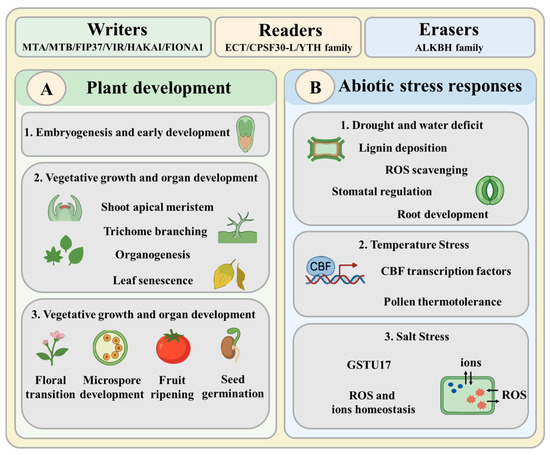
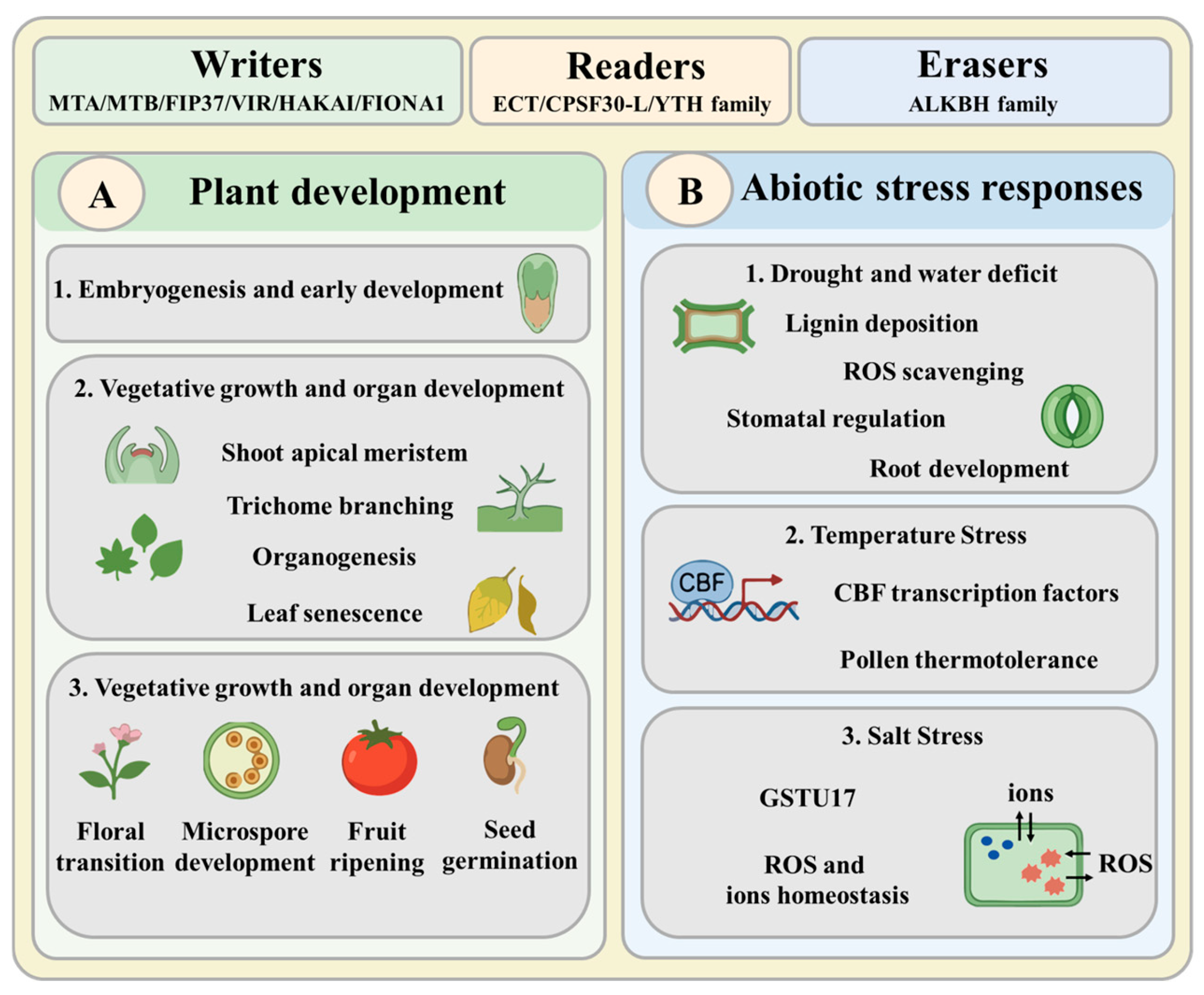
The m6A modification has emerged as a central epitranscriptional regulator integrating plant development with abiotic stress responses (Figure 4). Writers deposit methylation marks interpreted by readers to control mRNA stability, translation, and alternative polyadenylation, while erasers confer reversibility for rapid stress reconfiguration. This mechanistic versatility allows a single chemical mark to orchestrate diverse processes from embryogenesis to stress tolerance.
Figure 4.
Overview of m6A regulatory factors (writers/methyltransferases, readers/m6A-binding proteins, and erasers/demethylases) and their functions in plant development and abiotic stress responses. (A) Roles of m6A regulators in plant development, including embryogenesis and early development, vegetative growth and organogenesis (shoot apical meristem, trichome branching, organogenesis, and leaf senescence), and reproductive development (floral transition, microspore development, fruit ripening, and seed germination). (B) Roles of m6A regulators in abiotic stress responses, including drought and water deficit (lignin deposition, ROS/reactive oxygen species scavenging, stomatal regulation, and root development), temperature stress (CBF/C-repeat binding transcription factor) and salt stress (GSTU17/glutathione S-transferase U17, ROS, and ion homeostasis).
9. Perspectives
Despite significant progress, many questions remain. The molecular machinery linking m6A to translation initiation in plants is unclear. The upstream signals controlling writer and eraser activities require characterization. The specific readers mediating crosstalk between m6A and chromatin modifications have yet to be identified. And the functional significance of individual m6A sites remains largely unknown.
Looking forward, manipulating RNA modifications represents a new frontier in crop improvement. Developing single-base editing tools using CRISPR/dCas13 systems fused with writer or eraser domains will enable precise, locus-specific manipulation of m6A. Integrating single-cell m6A sequencing, multi-omics, and advanced gene-editing will reveal the dynamic and functional specificity of m6A modifications. Because m6A converges on common stress signaling hubs (e.g., ROS and ABA), epitranscriptome engineering holds promise for enhancing tolerance to combined stresses in the field. Furthermore, natural variation in m6A regulators and targeted editing of cultivar-specific m6A sites may accelerate breeding of stress-resilient, high-yielding crops. As climate change intensifies agricultural challenges, epitranscriptome engineering may become a transformative strategy for developing stress-resilient crops.
Author Contributions
Conceptualization, R.Z. and Y.S.; Methodology, Y.S. and W.Q.; Investigation, Y.G. and Y.J.; Writing—Original Draft Preparation, Y.S., R.Z., W.Q., Y.G. and F.J.; Writing—Review and Editing, Y.J., R.M.R., R.M. and Z.W.; Supervision, R.Z.; Funding Acquisition, R.Z., F.J. and Z.W. All authors have read and agreed to the published version of the manuscript.
Funding
We acknowledge the funding from National Key Research and Development Program of China (2023YFF1002000 and 2023YFD1201500), the earmarked fund for China Agriculture Research System (CARS-23).
Institutional Review Board Statement
Not applicable.
Informed Consent Statement
Not applicable.
Data Availability Statement
No new data were created or analyzed in this study.
Acknowledgments
We acknowledge the Bioinformatics Center of Nanjing Agricultural University. We are grateful to Jingxuan Li and Xiaoming Song for their valuable guidance and insightful discussions throughout this study.
Conflicts of Interest
The authors declare no conflicts of interest.
References
- Kadumuri, R.V.; Janga, S.C. Epitranscriptomic Code and Its Alterations in Human Disease. Trends Mol. Med. 2018, 24, 886–903. [Google Scholar] [CrossRef] [Scilit]
- Shen, L.; Liang, Z.; Wong, C.E.; Yu, H. Messenger RNA Modifications in Plants. Trends Plant Sci. 2019, 24, 328–341. [Google Scholar] [CrossRef] [Scilit]
- Boccaletto, P.; Stefaniak, F.; Ray, A.; Cappannini, A.; Mukherjee, S.; Purta, E.; Kurkowska, M.; Shirvanizadeh, N.; Destefanis, E.; Groza, P.; et al. MODOMICS: A Database of RNA Modification Pathways. 2021 update. Nucleic Acids Res. 2022, 50, D231–D235. [Google Scholar] [CrossRef] [Scilit] [PubMed]
- Yue, Y.; Liu, J.; He, C. RNA N6-methyladenosine Methylation in Post-transcriptional Gene Expression Regulation. Genes Dev. 2015, 29, 1343–1355. [Google Scholar] [CrossRef] [Scilit]
- Luo, G.Z.; MacQueen, A.; Zheng, G.; Duan, H.; Dore, L.C.; Lu, Z.; Liu, J.; Chen, K.; Jia, G.F.; Bergelson, J.; et al. Unique Features of the m6A Methylome in Arabidopsis thaliana. Nat. Commun. 2014, 5, 5630. [Google Scholar] [CrossRef] [Scilit] [PubMed]
- Meyer, K.D.; Saletore, Y.; Zumbo, P.; Elemento, O.; Mason, C.E.; Jaffrey, S.R. Comprehensive Analysis of mRNA MethylationReveals Enrichment in 3′ UTRs and Near Stop Codons. Cell 2012, 149, 1635–1646. [Google Scholar] [CrossRef] [Scilit] [PubMed]
- Pan, T. N6-methyl-adenosine Modification in Messenger and Long Non-coding RNA. Trends Biochem. Sci. 2013, 38, 204–209. [Google Scholar] [CrossRef] [Scilit]
- Wei, L.H.; Song, P.; Wang, Y.; Lu, Z.; Tang, Q.; Yu, Q.; Xiao, Y.; Zhang, X.; Duan, H.C.; Jia, G. The m6A reader ECT2 Controls Trichome Morphology by Affecting mRNA Stability in Arabidopsis. Plant Cell 2018, 30, 968–985. [Google Scholar] [CrossRef] [Scilit]
- Kramer, M.C.; Janssen, K.A.; Palos, K.; Nelson, A.D.L.; Vandivier, L.E.; Garcia, B.A.; Lyons, E.; Beilstein, M.A.; Gregory, B.D. N6-methyladenosine and RNA Secondary Structure Affect Transcript Stability and Protein Abundance During Systemic Salt Stress in Arabidopsis. Plant Direct 2020, 4, e00239. [Google Scholar] [CrossRef] [Scilit]
- Amara, U.; Hu, J.; Park, S.J.; Kang, H. ECT12, an YTH-Domain Protein, is a Potential mRNA m6A Reader That Affects Abiotic Stress Responses by Modulating mRNA Stability in Arabidopsis. Plant Physiol. Biochem. 2024, 206, 108255. [Google Scholar] [CrossRef] [Scilit]
- Li, Z.; Ma, Y.; Sun, W.; Ding, P.; Bu, Y.; Qi, Y.; Shi, T.; Jia, C.; Lei, B.; Ma, C. The N6-Methyladenosine Reader ECT1 Regulates Seed Germination via Gibberellic Acid- and Phytochrome B-Mediated Signaling. Plant Physiol. 2025, 198, kiaf180. [Google Scholar] [CrossRef] [Scilit]
- Jiang, B.; Zhong, Z.; Gu, L.; Zhang, X.; Wei, J.; Ye, C.; Lin, G.; Qu, G.; Xiang, X.; Wen, C.; et al. Light-induced LLPS of the CRY2/SPA1/FIO1 Complex Regulating mRNA Methylation and Chlorophyll Homeostasis in Arabidopsis. Nat. Plants 2023, 9, 2042–2058. [Google Scholar] [CrossRef] [Scilit]
- Zhou, L.; Tang, R.; Li, X.; Tian, S.; Li, B.; Qin, G. N6-Methyladenosine RNA Modification Regulates Strawberry Fruit Ripening in an ABA-Dependent Manner. Genome Biol. 2021, 22, 168. [Google Scholar] [CrossRef] [Scilit]
- Wang, S.; Wang, H.; Xu, Z.; Jiang, S.; Shi, Y.; Xie, H.; Wang, S.; Hua, J.; Wu, Y. m6A mRNA Modification Promotes Chilling Tolerance and Modulates Gene Translation Efficiency in Arabidopsis. Plant Physiol. 2023, 192, 1466–1482. [Google Scholar] [CrossRef] [Scilit]
- Haussmann, I.U.; Bodi, Z.; Sanchez-Moran, E.; Mongan, N.P.; Archer, N.; Fray, R.G.; Soller, M. m6A Potentiates Sxl Alternative Pre-mRNA Splicing for Robust Drosophila Sex Determination. Nature 2016, 540, 301–304. [Google Scholar] [CrossRef] [Scilit]
- Xiao, W.; Adhikari, S.; Dahal, U.; Chen, Y.S.; Hao, Y.J.; Sun, B.F.; Sun, H.Y.; Li, A.; Ping, X.L.; Lai, W.Y.; et al. Nuclear m6A Reader YTHDC1 Regulates mRNA Splicing. Mol. Cell 2016, 61, 507–519. [Google Scholar] [CrossRef] [Scilit] [PubMed]
- Roundtree, I.A.; Luo, G.Z.; Zhang, Z.; Wang, X.; Zhou, T.; Cui, Y.; Sha, J.; Huang, X.; Guerrero, L.; Xie, P.; et al. YTHDC1 Mediates Nuclear Export of N6-Methyladenosine Methylated mRNAs. eLife 2017, 6, e31311. [Google Scholar] [CrossRef] [Scilit]
- Yue, H.; Nie, X.; Yan, Z.; Weining, S. N6-methyladenosine regulatory machinery in plants: Composition, function and evolution. Plant Biotechnol. J. 2019, 17, 1194–1208. [Google Scholar] [CrossRef] [Scilit]
- Shi, H.; Wei, J.; He, C. Where, When, and How: Context-Dependent Functions of RNA Methylation Writers, Readers, and Erasers. Mol. Cell 2019, 74, 640–650. [Google Scholar] [CrossRef] [Scilit] [PubMed]
- Zheng, H.; Li, S.; Zhang, X.; Sui, N. Functional Implications of Active N6-Methyladenosine in Plants. Front. Cell Dev. Biol. 2020, 8, 291. [Google Scholar] [CrossRef] [Scilit] [PubMed]
- Tang, J.; Chen, S.; Jia, G. Detection, Regulation, and Functions of RNA N6-Methyladenosine Modification in Plants. Plant Commun. 2023, 4, 100546. [Google Scholar] [CrossRef] [Scilit] [PubMed]
- Zhong, S.; Li, H.; Bodi, Z.; Button, J.; Vespa, L.; Herzog, M.; Fray, R.G. MTA is an Arabidopsis Messenger RNA Adenosine Methylase and Interacts with a Homolog of a Sex-Specific Splicing Factor. Plant Cell 2008, 20, 1278–1288. [Google Scholar] [CrossRef] [Scilit] [PubMed]
- Bodi, Z.; Zhong, S.; Mehra, S.; Song, J.; Graham, N.; Li, H.; May, S.; Fray, R.G. Adenosine Methylation in Arabidopsis mRNA is Associated with the 3′ End and Reduced Levels Cause Developmental Defects. Front. Plant Sci. 2012, 3, 48. [Google Scholar] [CrossRef] [Scilit]
- Růžička, K.; Zhang, M.; Campilho, A.; Bodi, Z.; Kashif, M.; Saleh, M.; Eeckhout, D.; El-Showk, S.; Li, H.; Zhong, S.; et al. Identification of Factors Required for m6A mRNA Methylation in Arabidopsis Reveals a Role for the Conserved E3 Ubiquitin Ligase HAKAI. New Phytol. 2017, 215, 157–172. [Google Scholar] [CrossRef] [Scilit]
- Xu, T.; Wu, X.; Wong, C.E.; Fan, S.; Zhang, Y.; Zhang, S.; Liang, Z.; Yu, H.; Shen, L. FIONA1-Mediated m6A Modification Regulates the Floral Transition in Arabidopsis. Adv. Sci. 2022, 9, 2103628. [Google Scholar] [CrossRef] [Scilit]
- Vespa, L.; Vachon, G.; Berger, F.; Perazza, D.; Faure, J.D.; Herzog, M. The Immunophilin-Interacting Protein AtFIP37 from Arabidopsis Is Essential for Plant Development and Is Involved in Trichome Endoreduplication. Plant Physiol. 2004, 134, 1283–1292. [Google Scholar] [CrossRef] [Scilit]
- Shen, L.S.; Liang, Z.; Gu, X.F.; Chen, Y.; Teo, Z.W.N.; Hou, X.L.; Cai, W.L.M.; Dedon, P.C.; Liu, L.; Yu, H. N6-Methyladenosine RNA Modification Regulates Shoot Stem Cell Fate in Arabidopsis. Dev. Cell 2016, 38, 186–200. [Google Scholar] [CrossRef] [Scilit]
- Zhou, L.; Tian, S.; Qin, G. RNA Methylomes Reveal the m6A-Mediated Regulation of DNA Demethylase Gene SlDML2 in Tomato Fruit Ripening. Genome Biol. 2019, 20, 156. [Google Scholar] [CrossRef] [Scilit]
- Wang, C.; Yang, J.; Song, P.; Zhang, W.; Lu, Q.; Yu, Q.; Jia, G. FIONA1 Is an RNA N6-Methyladenosine Methyltransferase Affecting Arabidopsis Photomorphogenesis and Flowering. Genome Biol. 2022, 23, 40. [Google Scholar] [CrossRef] [Scilit]
- He, Y.; Li, Y.; Yao, Y.; Zhang, H.; Wang, Y.; Gao, J.; Fan, M. Overexpression of Watermelon m6A Methyltransferase ClMTB Enhances Drought Tolerance in Tobacco by Mitigating Oxidative Stress and Photosynthesis Inhibition and Modulating Stress-Responsive Gene Expression. Plant Physiol. Biochem. 2021, 168, 340–352. [Google Scholar] [CrossRef] [Scilit] [PubMed]
- Cai, J.; Hu, J.; Xu, T.; Kang, H. FIONA1-Mediated mRNA m6A Methylation Regulates the Response of Arabidopsis to Salt Stress. Plant Cell Environ. 2024, 47, 900–912. [Google Scholar] [CrossRef] [Scilit]
- Yang, L.; Wang, B.; Zhao, D.; Li, X.; Qin, Y.; Ouyang, N.; Xiao, Z.; Zhang, Z.; Galili, G.; Li, J.; et al. Selective recognition of PTRE1 transcripts mediated by protein–protein interaction between the m6A reader ECT2 and PTRE1. Plant Commun. 2024, 5, 101043. [Google Scholar] [CrossRef] [Scilit]
- Edupuganti, R.R.; Geiger, S.; Lindeboom, R.G.H.; Shi, H.; Hsu, P.J.; Lu, Z.; Wang, S.Y.; Baltissen, M.P.A.; Jansen, P.W.T.C.; Rossa, M.; et al. N6-Methyladenosine (m6A) Recruits and Repels Proteins to Regulate mRNA Homeostasis. Nat. Struct. Mol. Biol. 2017, 24, 870–878. [Google Scholar] [CrossRef] [Scilit] [PubMed]
- Theler, D.; Dominguez, C.; Blatter, M.; Boudet, J.; Allain, F.H.T. Solution Structure of the YTH Domain in Complex with N6-Methyladenosine RNA: A Reader of Methylated RNA. Nucleic Acids Res. 2014, 42, 13911–13919. [Google Scholar] [CrossRef] [Scilit] [PubMed]
- Luo, S.; Tong, L. Molecular Basis for the Recognition of Methylated Adenines in RNA by the Eukaryotic YTH Domain. Proc. Natl. Acad. Sci. USA 2014, 111, 13834–13839. [Google Scholar] [CrossRef] [Scilit] [PubMed]
- Li, D.; Zhang, H.; Hong, Y.; Huang, L.; Li, X.; Zhang, Y.; Ouyang, Z.; Song, F. Genome-Wide Identification, Biochemical Characterization, and Expression Analyses of the YTH Domain-Containing RNA-Binding Protein Family in Arabidopsis and Rice. Plant Mol. Biol. Rep. 2014, 32, 1169–1186. [Google Scholar] [CrossRef] [Scilit]
- Ok, S.H.; Jeong, H.J.; Bae, J.M.; Shin, J.S.; Luan, S.; Kim, K.N. Novel CIPK1-Associated Proteins in Arabidopsis Contain an Evolutionarily Conserved C-Terminal Region that Mediates Nuclear Localization. Plant Physiol. 2005, 139, 138–150. [Google Scholar] [CrossRef] [Scilit]
- Hou, Y.; Sun, J.; Wu, B.; Gao, Y.; Nie, H.; Nie, Z.; Quan, S.; Wang, Y.; Cao, X.; Li, S. CPSF30-L-Mediated Recognition of mRNA m6A Modification Controls Alternative Polyadenylation of Nitrate Signaling-Related Gene Transcripts in Arabidopsis. Mol. Plant. 2021, 14, 688–699. [Google Scholar] [CrossRef] [Scilit]
- Song, P.; Yang, J.; Wang, C.; Lu, Q.; Shi, L.; Tayier, S.; Jia, G. Arabidopsis N6-Methyladenosine Reader CPSF30-L Recognizes FUE Signals to Control Polyadenylation Site Choice in Liquid-Like Nuclear Bodies. Mol. Plant 2021, 14, 571–587. [Google Scholar] [CrossRef] [Scilit]
- Wei, J.; Liu, F.; Lu, Z.; Fei, Q.; Ai, Y.; He, P.C.; Shi, H.; Cui, X.; Su, R.; Klungland, A.; et al. Differential m6A, m6Am, and m1A Demethylation Mediated by FTO in the Cell Nucleus and Cytoplasm. Mol. Cell 2018, 71, 973–985. [Google Scholar] [CrossRef] [Scilit]
- Alemu, E.A.; He, C.; Klungland, A. ALKBHs-Facilitated RNA Modifications and De-Modifications. DNA Repair 2016, 44, 87–91. [Google Scholar] [CrossRef] [Scilit] [PubMed]
- Martínez-Pérez, M.; Aparicio, F.; Pilar Lopez-Gresa, M.; Maria Belles, J.; Sanchez-Navarro, J.A.; Pallas, V. Arabidopsis m6A Demethylase Activity Modulates Viral Infection of a Plant Virus and the m6A Abundance in Its Genomic RNAs. Proc. Natl. Acad. Sci. USA 2017, 114, 10755–10760. [Google Scholar] [CrossRef] [Scilit]
- Wang, L.; Zhuang, H.; Fan, W.; Zhang, X.; Dong, H.; Yang, H.; Cho, J. m6A RNA Methylation Impairs Gene Expression Variability and Reproductive Thermotolerance in Arabidopsis. Genome Biol. 2022, 23, 244. [Google Scholar] [CrossRef] [Scilit]
- Hou, N.; Li, C.; He, J.; Liu, Y.; Yu, S.; Malnoy, M.; Tahir, M.M.; Xu, L.; Ma, F.; Guan, Q. MdMTA-Mediated m6A Modification Enhances Drought Tolerance by Promoting mRNA Stability and Translation Efficiency of Genes Involved in Lignin Deposition and Oxidative Stress. New Phytol. 2022, 234, 1294–1314. [Google Scholar] [CrossRef] [Scilit] [PubMed]
- Anderson, S.J.; Kramer, M.C.; Gosai, S.J.; Yu, X.; Vandivier, L.E.; Nelson, A.D.L.; Anderson, Z.D.; Beilstein, M.A.; Fray, R.G.; Lyons, E.; et al. N6-Methyladenosine Inhibits Local Ribonucleolytic Cleavage to Stabilize mRNAs in Arabidopsis. Cell Rep. 2018, 25, 1146–1157. [Google Scholar] [CrossRef] [Scilit] [PubMed]
- Hu, J.; Cai, J.; Park, S.J.; Lee, K.; Li, Y.; Chen, Y.; Yun, J.Y.; Xu, T.; Kang, H. N6-Methyladenosine mRNA Methylation Is Important for Salt Stress Tolerance in Arabidopsis. Plant J. 2021, 106, 1759–1775. [Google Scholar] [CrossRef] [Scilit]
- Cai, Z.; Tang, Q.; Song, P.; Tian, E.; Yang, J.; Jia, G. The m6A Reader ECT8 Is an Abiotic Stress Sensor That Accelerates mRNA Decay in Arabidopsis. Plant Cell 2024, 36, 2908–2926. [Google Scholar] [CrossRef] [Scilit]
- Govindan, G.; Sharma, B.; Li, Y.F.; Armstrong, C.D.; Merum, P.; Rohila, J.S.; Gregory, B.D.; Sunkar, R. mRNA N6-Methyladenosine Is Critical for Cold Tolerance in Arabidopsis. Plant J. 2022, 111, 1052–1068. [Google Scholar] [CrossRef] [Scilit]
- Meyer, K.D.; Patil, D.P.; Zhou, J.; Zinoviev, A.; Skabkin, M.A.; Elemento, O.; Pestova, T.V.; Qian, S.B.; Jaffrey, S.R. 5′ UTR m6A Promotes Cap-Independent Translation. Cell 2015, 163, 999–1010. [Google Scholar] [CrossRef] [Scilit]
- Huang, Y.; Zheng, P.; Liu, X.; Chen, H.; Tu, J. OseIF3h regulates plant growth and pollen development at translational level presumably through interaction with OsMTA2. Plants 2021, 10, 1101. [Google Scholar] [CrossRef] [Scilit]
- Cui, S.; Song, P.; Wang, C.; Chen, S.; Hao, B.; Xu, Z.; Cai, L.; Chen, X.; Zhu, S.; Gan, X.; et al. The RNA binding protein EHD6 recruits the m6A reader YTH07 and sequesters OsCOL4 mRNA into phase-separated ribonucleoprotein condensates to promote rice flowering. Mol. Plant 2024, 17, 935–954. [Google Scholar] [CrossRef] [Scilit] [PubMed]
- Maric, A.; Hartman, S. Ethylene Controls Translational Gatekeeping to Overcome Flooding Stress in Plants. EMBO J. 2022, 41, EMBJ2022112282. [Google Scholar] [CrossRef] [Scilit] [PubMed]
- Edwalds-Gilbert, G.; Veraldi, K.L.; Milcarek, C. Alternative Poly(A) Site Selection in Complex Transcription Units: Means to an End? Nucleic Acids Res. 1997, 25, 2547–2561. [Google Scholar] [CrossRef] [Scilit] [PubMed]
- Barabino, S.M.; Keller, W. Last but Not Least: Regulated Poly(A) Tail Formation. Cell 1999, 99, 9–11. [Google Scholar] [CrossRef] [Scilit]
- Elkon, R.; Ugalde, A.P.; Agami, R. Alternative Cleavage and Polyadenylation: Extent, Regulation and Function. Nat. Rev. Genet. 2013, 14, 496–506. [Google Scholar] [CrossRef] [Scilit]
- Tian, B.; Manley, J.L. Alternative Polyadenylation of mRNA Precursors. Nat. Rev. Mol. Cell Biol. 2017, 18, 18–30. [Google Scholar] [CrossRef] [Scilit]
- Huang, H.; Weng, H.; Zhou, K.; Wu, T.; Zhao, B.S.; Sun, M.; Chen, Z.; Deng, X.; Xiao, G.; Auer, F.; et al. Histone H3 Trimethylation at Lysine 36 Guides m6A RNA Modification Co-Transcriptionally. Nature 2019, 567, 414–419. [Google Scholar] [CrossRef] [Scilit]
- Shim, S.; Lee, H.G.; Lee, H.; Seo, P.J. H3K36me2 Is Highly Correlated with m6A Modifications in Plants. J. Integr. Plant Biol. 2020, 62, 1455–1460. [Google Scholar] [CrossRef] [Scilit]
- Song, P.; Cai, Z.; Tayier, S.; Tian, E.; Chen, Z.; Yu, K.; Liu, L.; Jia, G. RNA m6A Regulates the Transcription and Heterochromatin State of Retrotransposons in Arabidopsis. Nat. Plants 2025, 11, 2300–2318. [Google Scholar] [CrossRef] [Scilit]
- Seyfferth, C.; Renema, J.; Wendrich, J.R.; Eekhout, T.; Seurinck, R.; Vandamme, N.; Blob, B.; Saeys, Y.; Helariutta, Y.; Birnbaum, K.D.; et al. Advances and Opportunities in Single-Cell Transcriptomics for Plant Research. Annu. Rev. Plant Biol. 2021, 72, 847–866. [Google Scholar] [CrossRef] [Scilit]
- Tegowski, M.; Prater, A.K.; Holley, C.L.; Meyer, K.D. Single-Cell m6A Profiling in the Mouse Brain Uncovers Cell Type-Specific RNA Methylomes and Age-Dependent Differential Methylation. Nat. Neurosci. 2024, 27, 2512–2520. [Google Scholar] [CrossRef] [Scilit]
- Ping, X.; Liang, X.; Xing, W.; Wang, S.; Gong, F.; Cheng, Y.; Duan, S.; Lv, X.; Li, X.; Zhang, T.; et al. Deciphering Single-Cell Landscape Unravels Cell-Type-Specific Functional Roles of RNA m6A Modification in Atherosclerosis. Theranostics 2025, 15, 4785. [Google Scholar] [CrossRef] [Scilit]
- Field, S.; Jang, G.J.; Dean, C.; Strader, L.C.; Rhee, S.Y. Plants Use Molecular Mechanisms Mediated by Biomolecular Condensates to Integrate Environmental Cues with Development. Plant Cell 2023, 35, 3173–3186. [Google Scholar] [CrossRef] [Scilit]
- Kang, H.; Xu, T. N6-Methyladenosine RNA Methylation Modulates Liquid—Liquid Phase Separation in Plants. Plant Cell 2023, 35, 3205–3213. [Google Scholar] [CrossRef] [Scilit] [PubMed]
- Nguyen, T.K.H.; Kang, H. Reading m6A Marks in mRNA: A Potent Mechanism of Gene Regulation in Plants. J. Integr. Plant Biol. 2024, 66, 2586–2599. [Google Scholar] [CrossRef] [Scilit] [PubMed]
- Scutenaire, J.; Deragon, J.M.; Jean, V.; Benhamed, M.; Raynaud, C.; Favory, J.J.; Merret, R.; Bousquet-Antonelli, C. The YTH Domain Protein ECT2 Is an m6A Reader Required for Normal Trichome Branching in Arabidopsis. Plant Cell 2018, 30, 986–1005. [Google Scholar] [CrossRef] [Scilit] [PubMed]
- Luo, W.; Tang, Y.; Li, S.; Zhang, L.; Liu, Y.; Zhang, R.; Diao, X.; Yu, J. The m6A Reader SiYTH1 Enhances Drought Tolerance by Affecting the Messenger RNA Stability of Genes Related to Stomatal Closure and Reactive Oxygen Species Scavenging in Setaria italica. J. Integr. Plant Biol. 2023, 65, 2569–2586. [Google Scholar] [CrossRef] [Scilit]
- Bian, H.; Song, P.; Gao, Y.; Deng, Z.; Huang, C.; Yu, L.; Wang, H.; Ye, B.; Cai, Z.; Pan, Y.; et al. The m6A Reader SlYTH2 Negatively Regulates Tomato Fruit Aroma by Impeding the Translation Process. Proc. Natl. Acad. Sci. USA 2024, 121, e2405100121. [Google Scholar] [CrossRef] [Scilit]
- Lee, K.P.; Liu, K.; Kim, E.Y.; Medina-Puche, L.; Dong, H.; Di, M.; Singh, R.M.; Li, M.; Qi, S.; Meng, Z.; et al. The m6A Reader ECT1 Drives mRNA Sequestration to Dampen Salicylic Acid–Dependent Stress Responses in Arabidopsis. Plant Cell 2024, 36, 746–763. [Google Scholar] [CrossRef] [Scilit]
- Fan, W.; Wang, L.; Lei, Z.; Li, H.; Chu, J.; Yan, M.; Wang, Y.; Wang, H.; Yang, J.; Cho, J. m6A RNA Demethylase AtALKBH9B Promotes Mobilization of a Heat-Activated Long Terminal Repeat Retrotransposon in Arabidopsis. Sci. Adv. 2023, 9, eadf3292. [Google Scholar] [CrossRef] [Scilit]
- Yang, D.; Xu, H.; Liu, Y.; Li, M.; Ali, M.; Xu, X.; Lu, G. RNA N6-Methyladenosine Responds to Low-Temperature Stress in Tomato Anthers. Front. Plant Sci. 2021, 12, 687826. [Google Scholar] [CrossRef] [Scilit]
- Huang, Y.; Chen, M.; Chen, D.; Chen, H.; Xie, Z.; Dai, S. Enhanced HSP70 Binding to m6A-Methylated RNAs Facilitates Cold Stress Adaptation in Mango Seedlings. BMC Plant Biol. 2024, 24, 1114. [Google Scholar] [CrossRef] [Scilit]
- Ma, L.; Tao, X.; Fahim, A.M.; Xu, Y.; Zhang, Y.; Li, S.; Yang, G.; Pu, Y.; Wang, W.; Liu, L.; et al. Novel Insights into the Unique Characterization of N6-Methyladenosine RNA Modification and Regulating Cold Tolerance in Winter Brassica rapa. Int. J. Biol. Macromol. 2025, 33, 140460. [Google Scholar] [CrossRef] [Scilit]
- Li, B.; Zhang, M.; Sun, W.; Yue, D.; Ma, Y.; Zhang, B.; Duan, L.; Wang, M.; Lindsey, K.; Nie, X.; et al. N6-Methyladenosine RNA Modification Regulates Cotton Drought Response in a Ca2+ and ABA-Dependent Manner. Plant Biotechnol. J. 2023, 21, 1270–1285. [Google Scholar] [CrossRef] [Scilit]
- Dong, X.; Ma, J.; Sui, C.; Li, Y.; Khassanov, V.; Jian, H.; Lv, D. StALKBH10B-Mediated RNA m6A Modification Inhibits Potato Salt Tolerance by Targeting Flavonoids and ABA Signalling Pathways. Plant Biotechnol. J. 2026. [Google Scholar] [CrossRef] [Scilit]
- Chaturvedi, P.; Wiese, A.J.; Zaveska-Drabkova, L.A.; Weckwerth, W.; Honys, D. Heat Stress Response Mechanisms in Pollen Development. New Phytol. 2021, 231, 571–585. [Google Scholar] [CrossRef] [Scilit]
- Sheikh, A.H.; Tabassum, N.; Rawat, A.; Trapp, M.A.; Nawaz, K.; Hirt, H. m6A RNA Methylation Counteracts Dark-Induced Leaf Senescence in Arabidopsis. Plant Physiol. 2024, 194, 2663–2678. [Google Scholar] [CrossRef] [Scilit]
- Zhang, F.; Zhang, Y.C.; Liao, J.Y.; Yu, Y.; Zhou, Y.F.; Feng, Y.Z.; Yang, Y.W.; Lei, M.Q.; Bai, M.; Wu, H.; et al. The Subunit of RNA N6-Methyladenosine Methyltransferase OsFIP Regulates Early Degeneration of Microspores in Rice. PLoS Genet. 2019, 15, e1008120. [Google Scholar] [CrossRef] [Scilit]
- Cai, Y.; Cheng, L.; Liu, X.; Li, R.; Liu, Y.; Ge, S.; Wang, S.; Liu, J.; Tan, C.; Meng, S.; et al. SlALKBH9B Is Involved in Drought-Induced Flower Drop by Regulating Ethylene Production. Hortic. Res. 2025, 12, uhaf173. [Google Scholar] [CrossRef] [Scilit]
- Arribas-Hernández, L.; Bressendorff, S.; Hansen, M.H.; Poulsen, C.; Erdmann, S.; Brodersen, P. An m6A-YTH Module Controls Developmental Timing and Morphogenesis in Arabidopsis. Plant Cell 2018, 30, 952–967. [Google Scholar] [CrossRef] [Scilit]
- Arribas-Hernandez, L.; Simonini, S.; Hansen, M.H.; Paredes, E.; Bressendorff, S.; Dong, Y.; Ostergaard, L.; Brodersen, P. Recurrent Requirement for the m6A-ECT2/ECT3/ECT4 Axis in the Control of Cell Proliferation During Plant Organogenesis. Development 2020, 147, dev189134. [Google Scholar] [CrossRef] [Scilit]
- Yang, J.; Chen, Z.; Wang, P.; Nyasulu, M.; Cheng, Q.; He, X.; Xu, J.; Fu, J.; Zhou, D.; Ouyang, L.; et al. The Critical Role of OsYTH10 in Promoting Early Flowering of Rice Under Long Sunlight. Theor. Appl. Genet. 2025, 138, 256. [Google Scholar] [CrossRef] [Scilit]
- He, Y.; Si, Z.; Mei, G.; Cheng, Y.; Zhang, J.; Jiang, T.; Chen, J.; Xiong, H.; Zhang, T.; Hu, Y. N6-Methyladenosine RNA Modification Regulates Photoperiod Sensitivity in Cotton. Plant Physiol. 2024, 196, 1095–1109. [Google Scholar] [CrossRef] [Scilit]
- Duan, H.C.; Wei, L.H.; Zhang, C.; Wang, Y.; Chen, L.; Lu, Z.; Chen, P.R.; He, C.; Jia, G. ALKBH10B Is an RNA N6-Methyladenosine Demethylase Affecting Arabidopsis Floral Transition. Plant Cell 2017, 29, 2995–3011. [Google Scholar] [CrossRef] [Scilit]
- Tang, J.; Yang, J.; Duan, H.; Jia, G. ALKBH10B, an mRNA m6A Demethylase, Modulates ABA Response During Seed Germination in Arabidopsis. Front. Plant Sci. 2021, 12, 712713. [Google Scholar] [CrossRef] [Scilit]
- Huong, T.T.; Ngoc, L.N.T.; Kang, H. Functional Characterization of a Putative RNA Demethylase ALKBH6 in Arabidopsis Growth and Abiotic Stress Responses. Int. J. Mol. Sci. 2020, 21, 6707. [Google Scholar] [CrossRef] [Scilit]
- Ganguly, D.R.; Li, Y.; Bhat, S.S.; Tiwari, S.; Ng, P.J.; Gregory, B.D.; Sunkar, R. mRNA Adenosine Methylase Promotes Drought Tolerance Through N6-Methyladenosine-Dependent and Independent Impacts on mRNA Regulation in Arabidopsis. New Phytol. 2025, 245, 183–199. [Google Scholar] [CrossRef] [Scilit]
- Lu, L.; Zhang, Y.; He, Q.; Qi, Z.; Zhang, G.; Xu, W.; Yi, T.; Wu, G.; Li, R. MTA, an RNA m6A Methyltransferase, Enhances Drought Tolerance by Regulating the Development of Trichomes and Roots in Poplar. Int. J. Mol. Sci. 2020, 21, 2462. [Google Scholar] [CrossRef] [Scilit]
- Ma, N.; Song, P.; Liu, Z.; Li, Y.; Cai, Z.; Ding, M.; Ma, X.; Xu, Q.; Yue, Y.; Luo, T.; et al. Regulation of m6A RNA Reader Protein OsECT3 Activity by Lysine Acetylation in the Cold Stress Response in Rice. Nat. Plants 2025, 11, 1165–1180. [Google Scholar] [CrossRef] [Scilit]
- Nguyen, T.K.H.; Amara, U.; Kang, H. ECT8, an mRNA m6A Reader, Enhances Salt Stress Tolerance by Modulating mRNA Stability in Arabidopsis. Physiol. Plant. 2025, 177, e70135. [Google Scholar] [CrossRef] [Scilit]
- Han, R.; Nguyen, T.K.H.; Yang, Z.; Kang, H. ECT10 Is an m6A Reader That Negatively Regulates the Drought Stress Response in Arabidopsis by Modulating mRNA Stability. Plant J. 2025, 124, e70637. [Google Scholar] [CrossRef] [Scilit]
- Huong, T.T.; Yang, Z.; Ngoc, L.N.T.; Kang, H. ALKBH8B, a Putative RNA Demethylase, Plays a Role in the Response of Arabidopsis to Salt Stress and Abscisic Acid. J. Plant Physiol. 2022, 65, 319–330. [Google Scholar] [CrossRef] [Scilit]
- Cui, C.; Ma, Z.; Wan, H.; Gao, J.; Zhou, B. GhALKBH10 Negatively Regulates Salt Tolerance in Cotton. Plant Physiol. Biochem. 2022, 192, 87–100. [Google Scholar] [CrossRef] [Scilit]
- Zhang, D.; Li, M.; Chen, C.; Wang, Y.; Cheng, Z.; Li, W.; Guo, W. Downregulation of GhALKBH10B Improves Drought Tolerance Through Increasing the Stability of Photosynthesis Related- and ABA Signaling Pathway Genes in Cotton. Environ. Exp. Bot. 2024, 220, 105687. [Google Scholar] [CrossRef] [Scilit]
- Shen, H.; Zhou, Y.; Liao, C.; Xie, Q.; Chen, G.; Hu, Z.; Wu, T. The AlkB Homolog SlALKBH10B Negatively Affects Drought and Salt Tolerance in Solanum lycopersicum. Int. J. Mol. Sci. 2023, 25, 173. [Google Scholar] [CrossRef] [Scilit]
- Yuan, S.; Li, Q.; Shen, H.; Wang, W.; Wang, T.; Ye, Z.; Yang, C. Advances in the Regulatory Mechanisms of Multicellular Trichome Formation and Its Secondary Metabolite Synthesis in Vegetable Crops. Veg. Res. 2023, 3, 24. [Google Scholar] [CrossRef] [Scilit]
- Ramakrishnan, M.; Rajan, K.S.; Mullasseri, S.; Ahmad, Z.; Zhou, M.; Sharma, A.; Ramasamy, S.; Wei, Q. Exploring N6-Methyladenosine (m6A) Modification in Tree Species: Opportunities and Challenges. Hortic. Res. 2024, 11, uhad284. [Google Scholar] [CrossRef] [Scilit]
- Cai, J.; Hu, J.; Amara, U.; Park, S.J.; Li, Y.; Jeong, D.; Lee, I.; Xu, T.; Kang, H. Arabidopsis N6-Methyladenosine Methyltransferase FIONA1 Regulates Floral Transition by Affecting the Splicing of FLC and the Stability of Floral Activators SPL3 and SEP3. J. Exp. Bot. 2023, 74, 864–877. [Google Scholar] [CrossRef] [Scilit]

Disclaimer/Publisher’s Note: The statements, opinions and data contained in all publications are solely those of the individual author(s) and contributor(s) and not of MDPI and/or the editor(s). MDPI and/or the editor(s) disclaim responsibility for any injury to people or property resulting from any ideas, methods, instructions or products referred to in the content. |
© 2026 by the authors. Licensee MDPI, Basel, Switzerland. This article is an open access article distributed under the terms and conditions of the Creative Commons Attribution (CC BY) license.