


You are currently viewing a new version of our website. To view the old version click .

Cells, Volume 12, Issue 5

March-1 2023 - 147 articles

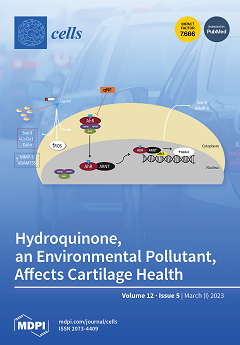
Cover Story: We know that pollution can negatively affect human and animal health; however, its impact on musculoskeletal health remains vastly unknown. Our study aimed to investigate whether hydroquinone (HQ), an environmental pollutant, could affect the homeostasis of articular cartilage. Our data showed that HQ could exacerbate the pro-degenerative effect of inflammatory molecules in the tissue, promoting the degradation and reducing the content of proteoglycans, and increasing oxidative stress. We showed that HQ mediates catabolic activity through the activation of the aryl hydrocarbon receptor. In summary, our findings demonstrate the harmful effects of HQ on articular cartilage health, showing how exposure to pollutants can favor the onset and/or sustain the progression of articular diseases. View this paper
  • Issues are regarded as officially published after their release is announced to the table of contents alert mailing list .
  • You may sign up for email alerts to receive table of contents of newly released issues.
  • PDF is the official format for papers published in both, html and pdf forms. To view the papers in pdf format, click on the "PDF Full-text" link, and use the free Adobe Reader to open them.

Articles (147)

  • Article
  • Open Access
14 Citations
3,685 Views
19 Pages

Fermented Soybean Paste Attenuates Biogenic Amine-Induced Liver Damage in Obese Mice

  • Ju-Hwan Yang,
  • Eun-Hye Byeon,
  • Dawon Kang,
  • Seong-Geun Hong,
  • Jinsung Yang,
  • Deok-Ryong Kim,
  • Seung-Pil Yun,
  • Sang-Won Park,
  • Hyun-Joon Kim and
  • Jae-Won Huh
  • + 3 authors

6 March 2023

Biogenic amines are cellular components produced by the decarboxylation of amino acids; however, excessive biogenic amine production causes adverse health problems. The relationship between hepatic damage and biogenic amine levels in nonalcoholic fat...

  • Feature Paper
  • Article
  • Open Access
12 Citations
6,062 Views
17 Pages

Electrophysiological Activity of Primary Cortical Neuron-Glia Mixed Cultures

  • Noah Goshi,
  • Hyehyun Kim,
  • Gregory Girardi,
  • Alexander Gardner and
  • Erkin Seker

6 March 2023

Neuroinflammation plays a central role in many neurological disorders, ranging from traumatic brain injuries to neurodegeneration. Electrophysiological activity is an essential measure of neuronal function, which is influenced by neuroinflammation. I...

  • Article
  • Open Access
7 Citations
2,934 Views
19 Pages

6 March 2023

Hypoxia induces the abnormal proliferation of vascular smooth muscle cells (VSMCs), resulting in the pathogenesis of various vascular diseases. RNA-binding proteins (RBPs) are involved in a wide range of biological processes, including cell prolifera...

  • Article
  • Open Access
3 Citations
2,410 Views
14 Pages

Increased Radiation Sensitivity in Patients with Phelan-McDermid Syndrome

  • Sarah Jesse,
  • Lukas Kuhlmann,
  • Laura S. Hildebrand,
  • Henriette Magelssen,
  • Martina Schmaus,
  • Beate Timmermann,
  • Stephanie Andres,
  • Rainer Fietkau and
  • Luitpold V. Distel

6 March 2023

Phelan-McDermid syndrome is an inherited global developmental disorder commonly associated with autism spectrum disorder. Due to a significantly increased radiosensitivity, measured before the start of radiotherapy of a rhabdoid tumor in a child with...

  • Commentary
  • Open Access
4 Citations
3,050 Views
7 Pages

6 March 2023

CD133, also called prominin-1, is widely known as a cancer stem cell marker, and its high expression correlates with a poor prognosis in many cancers. CD133 was originally discovered as a plasma membranous protein in stem/progenitor cells. It is now...

  • Article
  • Open Access
18 Citations
4,391 Views
18 Pages

Intermittent Lead Exposure Induces Behavioral and Cardiovascular Alterations Associated with Neuroinflammation

  • Liana Shvachiy,
  • Ângela Amaro-Leal,
  • Tiago F. Outeiro,
  • Isabel Rocha and
  • Vera Geraldes

6 March 2023

The nervous system is the primary target for lead exposure and the developing brain appears to be especially susceptible, namely the hippocampus. The mechanisms of lead neurotoxicity remain unclear, but microgliosis and astrogliosis are potential can...

  • Review
  • Open Access
129 Citations
18,982 Views
24 Pages

Pathogenesis Underlying Neurological Manifestations of Long COVID Syndrome and Potential Therapeutics

  • Albert Leng,
  • Manuj Shah,
  • Syed Ameen Ahmad,
  • Lavienraj Premraj,
  • Karin Wildi,
  • Gianluigi Li Bassi,
  • Carlos A. Pardo,
  • Alex Choi and
  • Sung-Min Cho

6 March 2023

The development of long-term symptoms of coronavirus disease 2019 (COVID-19) more than four weeks after primary infection, termed “long COVID” or post-acute sequela of COVID-19 (PASC), can implicate persistent neurological complications i...

  • Systematic Review
  • Open Access
10 Citations
3,054 Views
20 Pages

The Role of Preservation Solutions upon Saphenous Vein Endothelial Integrity and Function: Systematic Review and UK Practice Survey

  • Georgia R. Layton,
  • Shameem S. Ladak,
  • Riccardo Abbasciano,
  • Liam W. McQueen,
  • Sarah J. George,
  • Gavin J. Murphy and
  • Mustafa Zakkar

6 March 2023

The long saphenous vein is the most used conduit in cardiac surgery, but its long-term patency is limited by vein graft disease (VGD). Endothelial dysfunction is a key driver of VGD; its aetiology is multi-factorial. However emerging evidence identif...

  • Editorial
  • Open Access
1,520 Views
3 Pages

6 March 2023

The endocannabinoid system (ECS) is a widely-recognized lipid messenger system involved in many aspects of our our lives in health and diseases [...]

  • Communication
  • Open Access
6 Citations
5,163 Views
13 Pages

Phosphorylation of LKB1 by PDK1 Inhibits Cell Proliferation and Organ Growth by Decreased Activation of AMPK

  • Sarah Borkowsky,
  • Maximilian Gass,
  • Azadeh Alavizargar,
  • Johannes Hanewinkel,
  • Ina Hallstein,
  • Pavel Nedvetsky,
  • Andreas Heuer and
  • Michael P. Krahn

6 March 2023

The master kinase LKB1 is a key regulator of se veral cellular processes, including cell proliferation, cell polarity and cellular metabolism. It phosphorylates and activates several downstream kinases, including AMP-dependent kinase, AMPK. Activatio...

of 15

Get Alerted

Add your email address to receive forthcoming issues of this journal.

XFacebookLinkedIn
Cells - ISSN 2073-4409