


Abstract
Arbuscular mycorrhizal fungi (AMF) are widely applied as bioinoculants to enhance crop performance, yet their broader ecological effects on rhizosphere microbial assembly under field conditions remain insufficiently understood. Here, we evaluated the impact of a commercial AMF inoculant and its carrier material on lettuce performance and rhizosphere microbial communities in an open-field experiment. We hypothesized that both viable AMF propagules and formulation components contribute to shifts in rhizosphere processes. Active AMF inoculation significantly increased root colonization and fresh biomass at harvest, confirming successful establishment and enhanced plant performance under field conditions. Colonization levels in the heat-inactivated carrier treatment were comparable to the non-inoculated control, indicating that the carrier did not inhibit indigenous AMF activity or induce nutrient-mediated suppression of symbiosis. Plant physiological responses were stage-dependent, supporting the context-dependent nature of AMF effects in dynamic field environments. High-throughput sequencing revealed no significant treatment effects on bacterial or fungal alpha diversity. However, beta-diversity analyses demonstrated significant compositional restructuring of rhizosphere communities, particularly within the bacterial domain. A stable core microbiome persisted across treatments, yet relative abundances and community evenness were altered by both active inoculation and carrier application. These results suggest that AMF inoculation reorganizes microbial community structure predominantly via shifts in ecological niche occupation. Collectively, our results show that AMF inoculation functions not only as a symbiotic nutrient-acquisition strategy but also as a driver of rhizosphere microbial reorganization under field conditions. Integrating plant performance with microbiome dynamics provides a more comprehensive framework for understanding and optimizing microbial inoculants in sustainable agricultural systems.
1. Introduction
Lettuce (Lactuca sativa L.) is one of the most widely consumed leafy vegetables worldwide and represents a major component of fresh horticultural production systems [1,2,3,4]. Due to its short growth cycle and relatively shallow root system, lettuce is particularly sensitive to environmental fluctuations, especially during summer cultivation [5]. Rising temperatures, irregular precipitation patterns, and the increasing frequency of drought events associated with climate change threaten yield stability, product quality, and economic sustainability in open-field production systems [6,7,8,9,10,11]. Beyond direct abiotic stress effects, such environmental pressures may also alter soil–plant interactions, disrupt rhizosphere microbial dynamics, and influence pathogen pressure in agroecosystems [12,13,14]. Therefore, enhancing crop resilience requires strategies that address not only plant physiology but also belowground ecological processes. Among environmentally sustainable agronomic approaches, biofertilizers—particularly arbuscular mycorrhizal fungi (AMF)—have received increasing attention as alternatives or complements to intensive chemical fertilization [15,16,17]. The global biofertilizers market, including AMF inoculants, has grown rapidly in recent years, with an estimated value of USD 3.1 billion in 2023 and projected annual growth of ~11% through 2028, reflecting increasing adoption in vegetable, fruit, and ornamental production systems worldwide [18,19]. Such trends underscore the growing agricultural relevance of AMF and other microbial amendments, motivating research into their performance, stability, and ecological interactions under field conditions. Evidence from field studies also supports the practical relevance of AMF application. Pellegrino et al. [20] reported that AMF inoculation under field conditions increased plant productivity and nutrient uptake in low-input systems, with effects that remained detectable over more than one growing season. At the same time, Verbruggen et al. [21] pointed out that the success of inoculation is highly dependent on local soil conditions and the compatibility between fungal strains and host plants. In vegetable production systems, AMF have been linked to improved phosphorus acquisition, better water relations, and enhanced tolerance to environmental stress, especially under less favorable growing conditions [22,23].
Taken together, these findings suggest that AMF are already used in agricultural practice and can contribute to crop performance and stability, although their effects are strongly influenced by environmental context.
AMF establish mutualistic interactions with most plant roots, including lettuce, and enhance plant nutrient acquisition, especially phosphorus uptake, through extensive extraradical hyphal networks [24,25]. In addition, AMF influence plant physiological processes by regulating water balance, interacting with hormonal pathways, and strengthening resilience to environmental stressors [24,25].
Numerous studies have documented increases in plant biomass and overall growth in lettuce following AMF inoculation [16,26,27,28,29], particularly under suboptimal environmental conditions [26,30,31].
However, plant responses to AMF inoculation are highly context dependent. Under controlled cultivation systems with optimized nutrient supply and irrigation, biomass stimulation is often limited or inconsistent [15,17]. In such environments, AMF effects may manifest primarily through changes in secondary metabolism, stress-related pathways, or nutrient use efficiency rather than through substantial growth enhancement [32]. These findings highlight that AMF functioning cannot be fully understood from plant-level measurements alone.
Increasing evidence suggests that AMF may modulate rhizosphere conditions. By potentially altering carbon allocation patterns, root exudation chemistry, nutrient gradients, and soil aggregation, AMF may influence the composition and assembly of bacterial and fungal communities in the mycorrhizosphere [24,33,34,35]. Such indirect effects may contribute to plant performance through modified nutrient cycling, microbial competition, or enhanced stress buffering. Nevertheless, most lettuce-related studies focus primarily on growth and physiological responses, while the broader consequences of AMF inoculation for rhizosphere microbial community structure have not yet been comprehensively resolved, particularly under field-relevant conditions.
An additional and often overlooked aspect is the ecological role of inoculum formulation. Commercial AMF products typically contain carrier materials that may transiently modify nutrient availability or create microhabitats influencing indigenous microbial communities [36,37,38,39]. In many studies, the effects of viable AMF propagules are not disentangled from those of the carrier material, limiting mechanistic interpretation of observed plant and microbial responses.
To address these gaps, we conducted a field experiment under heat-stress-prone conditions to examine the effects of a commercial AMF inoculant on lettuce performance and rhizosphere microbial community assembly. Specifically, we aimed to (i) assess AMF effects on phenology and biomass, (ii) evaluate shifts in rhizosphere microbial composition independent of richness, and (iii) disentangle symbiotic and carrier effects. By integrating plant physiological measurements with high-resolution microbiome profiling under agronomically relevant conditions, this study seeks to clarify whether AMF inoculation functions primarily as a nutrient-delivery mechanism or as a broader modulator of plant–soil–microbe interactions in open-field lettuce production systems.
2. Materials and Methods
2.1. Experimental Setup
The experiment was conducted at the experimental field of the Hungarian University of Agriculture and Life Sciences (47.580710 N 19.376929 E). Seeds of butterhead lettuce (Lactuca sativa L. cv. Nicolina) a cultivar recommended for summer production, were sown on 19 June 2024 in 66-cell seedling trays filled with peat-based growing medium (Klasmann TS3 Medium Basic, Klasmann-Deilmann GmbH, Geeste, Germany). The substrate consisted of moderately decomposed white peat (0–25 mm), with a pH of 6.0 and a fertilizer level of 1.0 g L−1 including 140 mg N L−1, 160 mg L−1 P2O5, 180 mg L−1 K2O, and 100 mg L−1 Mg, along with trace elements, according to the manufacturer’s specification.
Three treatments were applied both at sowing and at transplanting: (i) inoculation with arbuscular mycorrhizal fungal inoculum (Symbivit®, produced by Symbiom Ltd. Lanskroun, Czech Republic), containing carrier material, spores, hyphae and colonized root fragments by Claroideoglomus etunicatum, Rhizoglomus microaggregatum, Rhizophagus intraradices, Claroideoglomus claroideum, Funneliformis mosseae and Funneliformis geosporum (NIS); (ii) sterilized inoculum was rendered biologically inactive by repeated heat treatment at 80 °C for 1 h on three consecutive days (NIX); (iii) a non-inoculated control (NIK). Seed germination and seedling development were carried out in the same growing medium described above under controlled greenhouse conditions from 19 June to 18 July under natural photoperiod. The substrate moisture was maintained by regular irrigation to ensure optimal germination conditions. Seed emergence occurred within 4 days after sowing, and seedlings were grown for four weeks under these conditions before transplanting.
Four-week-old seedlings were transplanted to the open field on 18 July 2024. During the period from transplanting to harvest the mean air temperature was 24.1 °C and cumulative precipitation was relatively low (62.5 mm), indicating warm and comparatively dry conditions. Plants were arranged in four rows with 30 cm plant spacing between plants. The outer rows served as border rows, while inner rows were used for data collection.
The experimental field is characterized by sandy soil with a slightly alkaline reaction (pH 7.4). The soil exhibits very low water-soluble salt content (<0.02%) and low humus content (0.83%). Plant-available phosphorus and potassium concentrations are 164.2 mg kg−1 and 216.9 mg kg−1, respectively, while the nitrate- and nitrite-nitrogen content is 13.6 mg kg−1.
Each treatment consisted of 20 biological replicates, resulting in a total of 60 plants. A nutrient solution containing 0.1% nitrogen (ammonium-nitrate) was applied once per week via irrigation throughout the cultivation period. Plants were harvested on 2 September 2024 at market maturity, corresponding to 46 days after transplanting and 75 days after sowing.
2.2. Growth Parameters and Sampling Scheme
Growth parameters (n = 10 per treatment) were assessed at defined developmental stages during the open-field experiment. At transplanting (18 July 2024), fresh weight (shoot; FW), dry weight (shoot; DW), and leaf number were determined on seedlings. At harvest, final growth measurements were recorded on 2 September 2024, prior to physiological analyses. Dry weight was determined in a forced-air oven at 65 °C until constant weight was achieved.
2.3. Relative Chlorophyll Content (SPAD)
Relative chlorophyll content was measured using a portable chlorophyll meter (SPAD-502Plus Chlorophyll Meter, Konica Minolta Inc., Osaka, Japan) on fully expanded leaves, located in the central part of the lettuce head. SPAD measurements were initiated six weeks after sowing (30 July 2024) and continued at weekly intervals until 28 August 2024, resulting in five sampling dates. At each sampling date, SPAD values were recorded for all plants (n = 30 per treatment), and mean values were used for statistical analyses.
2.4. Spectral Reflectance Measurements
Spectral reflectance measurements were performed on fully expanded leaves using a portable spectroradiometer (ASD FieldSpec HandHeld 2TM, Analytical Spectral Devices Inc., Boulder, CO, USA). Reflectance data were used to calculate vegetation indices, including the normalized difference vegetation index (NDVI), modified NDVI at 750 nm (mNDVI750), renormalized difference vegetation index (RDVI), chlorophyll index green (CI_green), and the photochemical reflectance index (PRI). These indices were used as non-destructive indicators of the plants’ physiological responses to the treatments.
Measurements were conducted at the leaf level on fully developed leaves located in the central part of the lettuce head. Reflectance spectra were acquired using a leaf contact probe. The 325–1075 nm spectral range was scanned with 1 nm resolution on 2 September 2024 from individual plants (n = 15 per treatment) and used to calculate vegetation indices related to plant vigor, pigment status, and stress response.
2.5. Estimation of Mycorrhizal Colonization
Root samples for mycorrhizal colonization assessment were collected at harvest. For each treatment, roots were sampled from five randomly selected plants, resulting in a total of 15 root samples (n = 5). Fine roots were carefully excavated from the rhizosphere, gently washed under running tap water to remove adhering soil particles, and cut into approximately 1 cm long segments. Prior to microscopic examination, root samples were cleared in 10% (w/v) KOH and subsequently stained with 0.05% (w/v) trypan blue, following standard procedures described in earlier studies [40]. Mycorrhizal colonization was assessed using the gridline intersect method [41] under a stereomicroscope (Olympus, Tokyo, Japan) at ×200 magnification.
2.6. DNA Extraction, PCR Amplification and Sequencing
Rhizosphere soil samples (n = 3) were collected at harvest (2 September 2024). In addition to rhizosphere samples from NIS, NIX, and NIK treatments, bulk soil samples were collected from the same experimental field at least 50 cm away from any lettuce plant to represent non-rhizosphere soil unaffected by direct root influence. DNA was extracted from 250 mg of soil using the ZymoBIOMICS 96 MagBead DNA Kit (Zymo Research, Irvine, CA, USA), following the manufacturer’s protocol. DNA concentrations were quantified using the Quant-iT dsDNA BR Assay Kit (Thermo Fisher Scientific, Waltham, MA, USA) on an Infinite Pro 200 F Nano+ Fluorescent Plate Reader (Tecan, Männedorf, Switzerland).
The abundance and composition of bacterial and fungal communities in the soil samples were assessed by high-throughput sequencing of the 16S rRNA and internal transcribed spacer (ITS) gene regions, respectively, using the Illumina NextSeq 2000 platform at Xenovea Ltd. (Szeged, Hungary). For eubacterial identification, the V3–V4 region of the 16S rRNA gene was amplified using tagged primers, as described by Klindworth et al. [42]. Fungal community profiling was performed by amplifying the ITS region of the ribosomal RNA genes with tagged ITS1F and ITS4R primers, following the protocols recommended in the 16S and Fungal Metagenomic Sequencing Library Preparation Guides (Illumina, San Diego, CA, USA) [43,44]. Briefly, 50 ng template DNA was used for target amplification with KAPA HiFi Hot Start Ready Mix (Roche AG, Basel, Switzerland) in a 25 cycles PCR1 reaction. The PCR products were purified and 10 ng of PCR1 products was used as template in index PCRs. The indexing was performed with Nextera XT index v2 Kit (Illumina, San Diego, CA, USA) primers with KAPA HiFi Hot Start Ready Mix (Roche AG, Basel, Switzerland) in an 8-cycle PCR reaction. The PCR products were purified with 0.8 volume KAPA Pure Bead (Roche AG, Basel, Switzerland). The libraries were quantified with Equalbit 1× dsDNA HS Assay Kit (Vazyme Biotech, Nanjing, China) on Infinite Pro 200 F Nano+ Fluorescent Plate Reader (Tecan, Männedorf, Switzerland). The library size was determined by capillary electrophoresis on LabChip GX Touch HT Nucleic Acid Analyzer on X-Mark HT Chip using DNA NGS 3k Assay kit (Revvity, Waltham, MA, USA). Equimolar libraries were normalized, pooled and sequenced on an Illumina NextSeq 2000 platform for 2 × 300 bp paired-end sequencing.
2.7. Bioinformatics
Raw sequenced reads, >0.2 M per sample, were demultiplexed and adapter-trimmed by using NextSeq Control Software (Illumina, San Diego, CA, USA), whilst FastQ Toolkit (Illumina, San Diego, CA, USA) was applied to bin reads having mean quality score less than 30. Paired-end amplicon reads of the ITS and 16S rRNA genes were processed using the FROGS pipeline (INRAE, Toulouse, France) [45]. Briefly, forward and reverse reads were quality-filtered and merged using VSEARCH (version 2.17.0) [46] with the following parameters: minimum amplicon size of 44 bp, maximum amplicon size of 550 bp, and a mismatch rate of 0.1. Merged sequences were clustered using SWARM (version 3.0.0) [47], and chimeric sequences were removed using the remove_chimera.py script within the FROGS pipeline, then the sequences were grouped into clusters and filtered: all clusters contained less sequences than 0.005% of all sequences were removed from further analysis. Taxonomic assignment was performed using BLAST(version 2.16.0) [48] against the SILVA 138.2 database [49] for 16S rRNA sequences and the UNITE Fungi 8.3 database [50] for ITS regions.
Before diversity analysis the information pertaining to Amplicon Sequence Variant (ASV) abundance was normalized using a standard sequence number corresponding to the sample with the least number of sequences. For bacterial 16S rRNA datasets, samples were rarefied to 94,649 reads per sample, while fungal ITS datasets were rarefied to 42,967 reads per sample. No samples were excluded due to low read counts. The alpha diversity indices (and all other diversity analyses) were calculated using the FROGS Phyloseq v1.38.0 tool [51]. Beta diversity was assessed using Bray–Curtis dissimilarity matrices calculated from ASV relative abundance data. Community dissimilarities were visualized by principal coordinates analysis (PCoA). Permutational multivariate analysis of variance (PERMANOVA) was performed to estimate the proportion of variation explained by sample type, using 9999 permutations.
2.8. Statistical Analysis
Statistical analysis was performed with R Statistical Software 4.4.3 [52]. Differences in microbial alpha diversity indices and relative taxon abundances were evaluated using one-way analysis of variance (ANOVA) followed by Tukey’s post hoc test. In all tests, a p < 0.05 was considered to indicate statistical significance. Growth and physiological parameters were also analyzed using one-way ANOVA, and mean comparisons were performed using Fisher’s least significant difference (LSD) test at p < 0.05. Before performing ANOVAs, normal distribution of populations and homogeneity of variance were checked by Kolmogorov–Smirnov and Levene’s tests, respectively. Data are presented as mean ± standard error (SE). In all tests, a p < 0.05 was considered to indicate statistical significance. Venn diagram-based analyses were performed in the ‘VennDiagram’ package. The heatmap of relative abundance by the corresponding z-score was plotted using the ‘pheatmap’ package (version 1.0.13). Z-score was calculated with the formula z = (x − µ)/σ, where x is the abundance of the taxonomic profiles in each sample, µ is the mean value of the abundances, and σ is the standard deviation of the abundances.
3. Results
3.1. Colonization and Growth Parameters
Arbuscular mycorrhizal colonization was detected in the roots of plants across all treatments during harvesting (Table 1). It was significantly higher in NIS plants, compared with both NIX and NIK treatments, while no significant difference was observed between the NIX and NIK plants.
Table 1.
Effects of active and heat-inactivated arbuscular mycorrhizal inoculation on growth parameters of butterhead lettuce. Values are means ± standard deviation (SD). Different letters indicate significant differences among treatments according to one-way ANOVA followed by Fisher’s LSD test (p < 0.05). Data marked with * refer to measurements taken at 29 days after sowing, while data marked with ** refer to measurements taken at 75 days after sowing.
Fresh weight and leaf number of 29-day-old seedlings differed among treatments (Table 1). NIX seedlings showed the highest fresh weight and leaf number, both of which were significantly higher than those of the control plants. NIS seedlings exhibited intermediate values and did not differ significantly from either the control or the NIX treatment. Dry weight of 29-day-old seedlings was significantly higher in both NIS and NIX treatments compared with NIK, while no significant difference was detected between the two inoculated treatments (Table 1).
At harvest, fresh and dry weight were significantly higher in NIS plants compared with the NIK plants. NIX plants exhibited intermediate fresh and dry weight values and did not differ significantly from either the NIK or the NIS treatment (Table 1).
3.2. Relative Chlorophyll Content
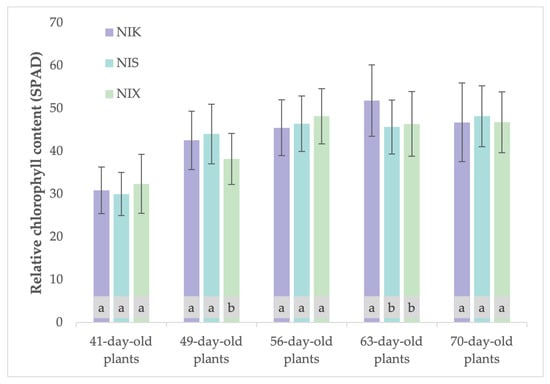
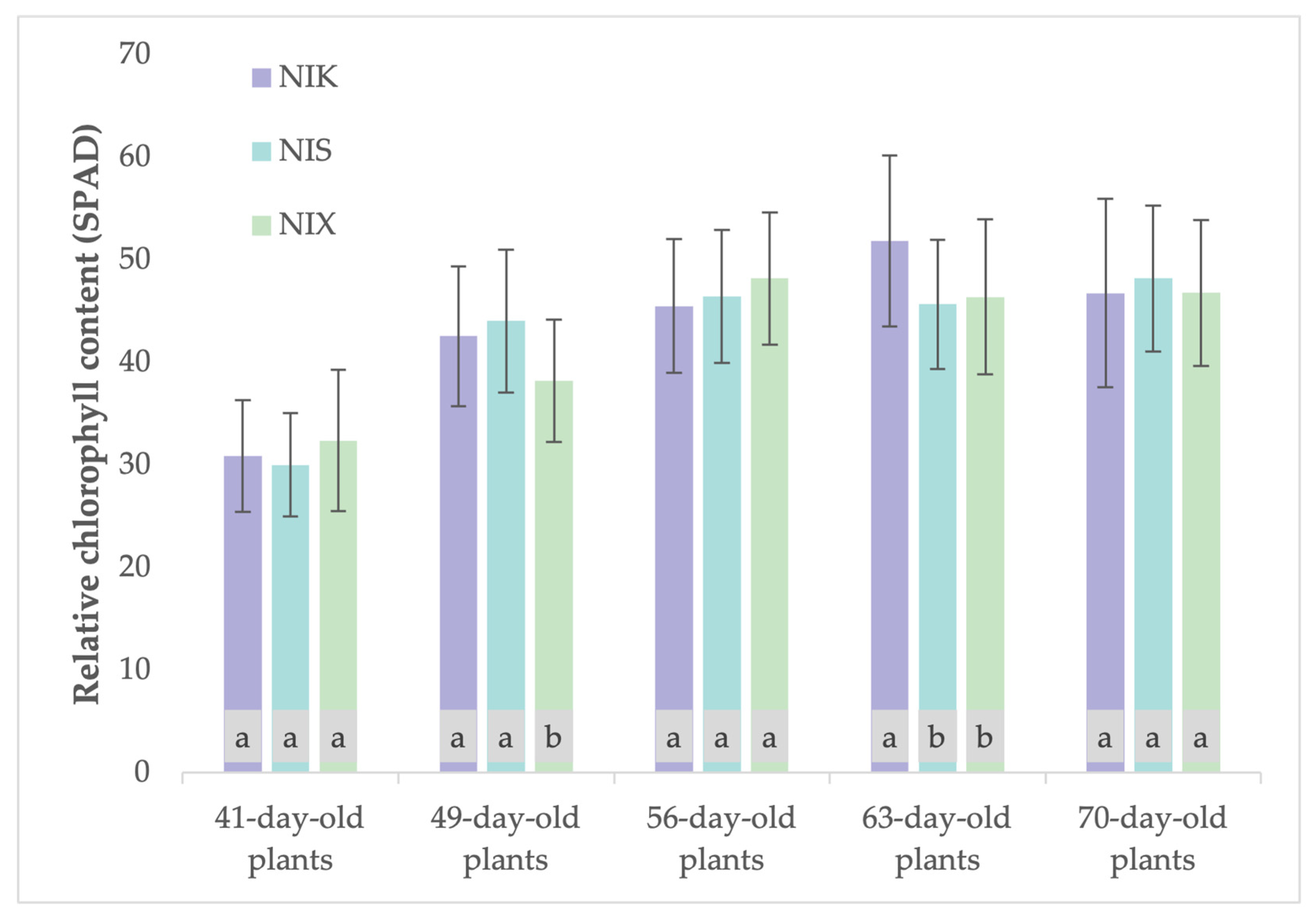
On the sixth and eighth week we observed significant differences in relative chlorophyll content. On the sixth week, the inactive-AMF plants had significantly lower values than the other two treatments (p = 0.01). By the eighth week, the control plants showed significantly higher values than both treated groups (p = 0.02) (Figure 1).
Figure 1.
Temporal changes in relative chlorophyll content (SPAD) of butterhead lettuce during open-field cultivation as affected by active (NIS) and inactivated (NIX) arbuscular mycorrhizal inoculation. Measurements were performed at five sampling dates between 30 July and 28 August. Bar charts represent mean ± SE (n = 10). Different letters indicate significant differences among treatments within a sampling date according to one-way ANOVA followed by Fisher’s LSD test (p < 0.05).
3.3. Reflectance Indices
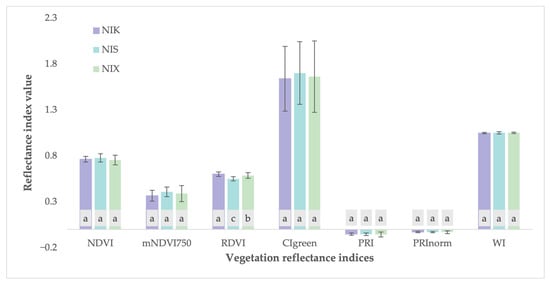
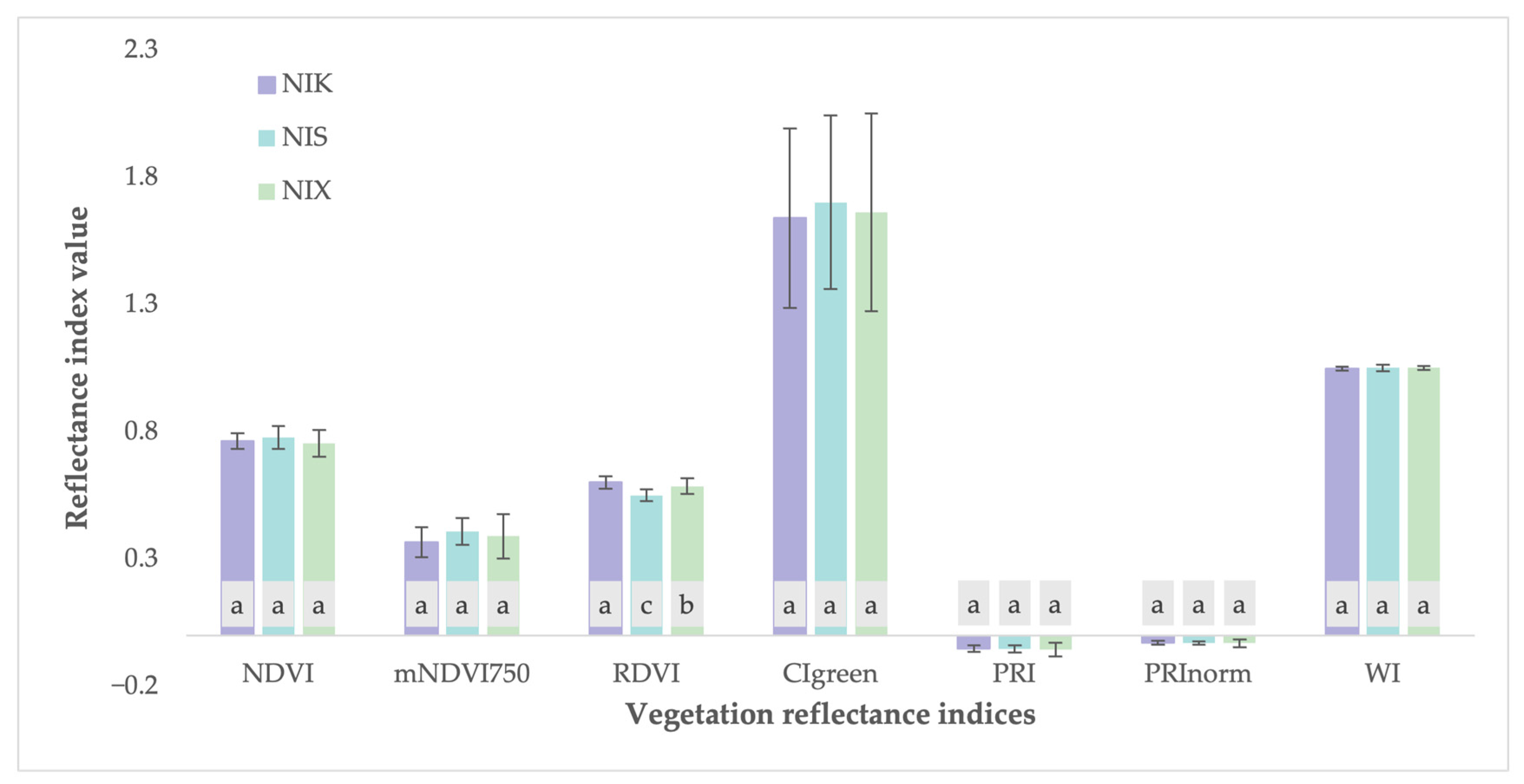
Spectral reflectance indices were applied to evaluate treatment-related differences in plant physiological status under open-field conditions (n = 15). NDVI values were highest in NIS, intermediate in the control NIK, and lowest in the inactivated NIX plants (p = 0.38), indicating a tendency toward enhanced canopy vigor associated with active mycorrhizal colonization, although the effect was not statistically significant. A similar ranking was observed for mNDVI750 (p = 0.23), with higher values in active inoculated NIS plants and lower values in the control NIK plants, suggesting a more favorable pigment-related physiological status in response to mycorrhization.
CIgreen values followed the same treatment order, with slightly higher values observed in NIS plants compared to the NIK and NIX treatments; however, these differences were not statistically significant. In contrast, RDVI differed significantly among treatments (p = 1.83 × 10⁻⁵), with the highest values recorded in control plants, intermediate values in the NIX treatment, and the lowest values in NIS plants.
PRI values showed a consistent but non-significant treatment-related trend with higher values in control plants and lower values in both AMF-treated groups. PRInorm exhibited the same treatment ranking. WI values differed only marginally among treatments (Figure 2).
Figure 2.
Spectral reflectance indices of butterhead lettuce cv. Nicolina at harvest under open-field conditions as affected by active (NIS) and inactivated (NIX) arbuscular mycorrhizal inoculation. Vegetation indices include NDVI, mNDVI750, RDVI, CI_green, PRI, PRInorm, and WI. Bars represent mean values (n = 15). Different letters indicate statistically significant differences among treatments within each index according to one-way ANOVA followed by Fisher’s LSD test (p < 0.05).
3.4. Sequencing
To investigate the impact of arbuscular mycorrhizal inoculation on the soil microbiota, we compared the rhizosphere fungal and bacterial communities of actively inoculated plants (NIS), carrier-treated plants receiving heat-inactivated inoculum (NIX), and non-inoculated controls (NIK), as well as bulk soil (Bulk), using next-generation sequencing. For each treatment condition, three biological replicates were sequenced. Illumina sequencing generated a total of 2,594,015 bacterial and 1,601,335 fungal raw reads. After filtering, 1,402,149 bacterial sequences were retained and grouped into 3313 amplicon sequence variants (ASVs), while 772,985 fungal sequences were clustered into 617 ASVs for downstream analysis. The total ASV counts and Venn analyses reported in this section are based on the full quality-filtered dataset, whereas diversity indices presented in subsequent sections were calculated after rarefaction as described in the Methods.
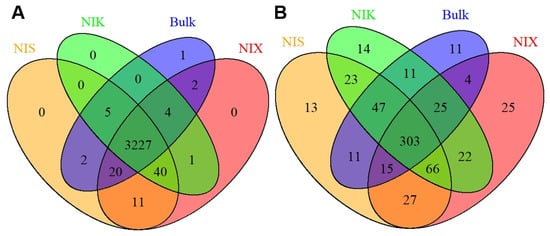
In the case of bacteria, the number of ASVs per sample ranged from 3145 to 3289, with no statistically significant differences observed between treatments. Across all 12 individual samples, 2791 ASVs were shared, while only a single sample-specific ASV was detected (present in sample Bulk_3, with a relative abundance of 0.48%). When samples were merged at the group level (NIS, NIK, NIX, and Bulk), the majority of ASVs (3227) were shared among all four groups (Figure 3A).
Figure 3.
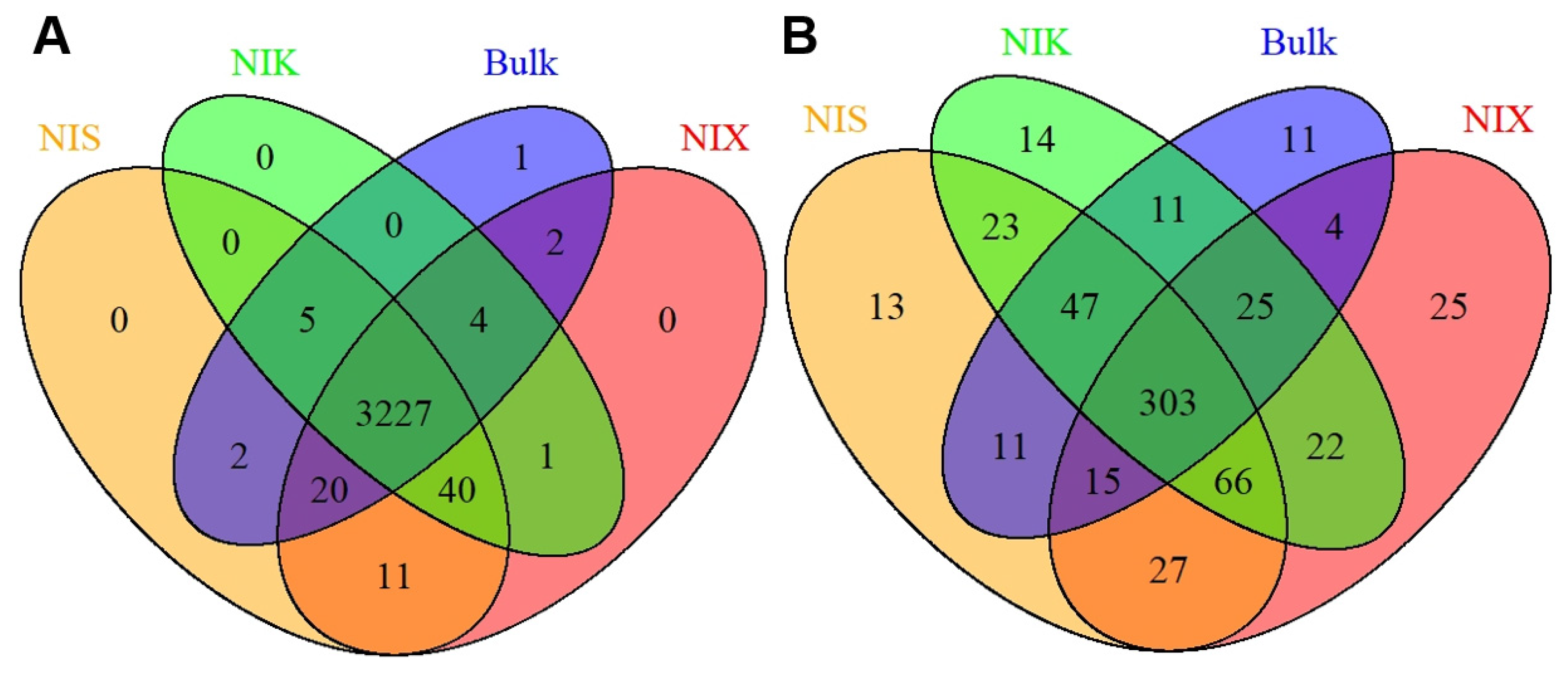
Venn diagrams showing the number of unique and shared ASVs in bacterial (A) and fungal (B) communities across treatments.
Similarly, no significant differences in the total number of fungal ASVs were detected across treatments. However, fungal communities exhibited markedly higher sample-to-sample variability compared with bacteria, with the number of unique ASVs ranging from 226 to 421 across individual samples. Only 76 ASVs were shared across all 12 individual samples. In contrast, group-level merging revealed 303 shared ASVs among the four groups (Figure 3B). A total of 46 unique ASVs were identified. Furthermore, the in silico merged data of treatment groups contained a higher number of unique ASVs (ranging from 11 to 25), suggesting greater differentiation within the fungal communities among treatments.
3.4.1. Bacterial Community Composition and Diversity
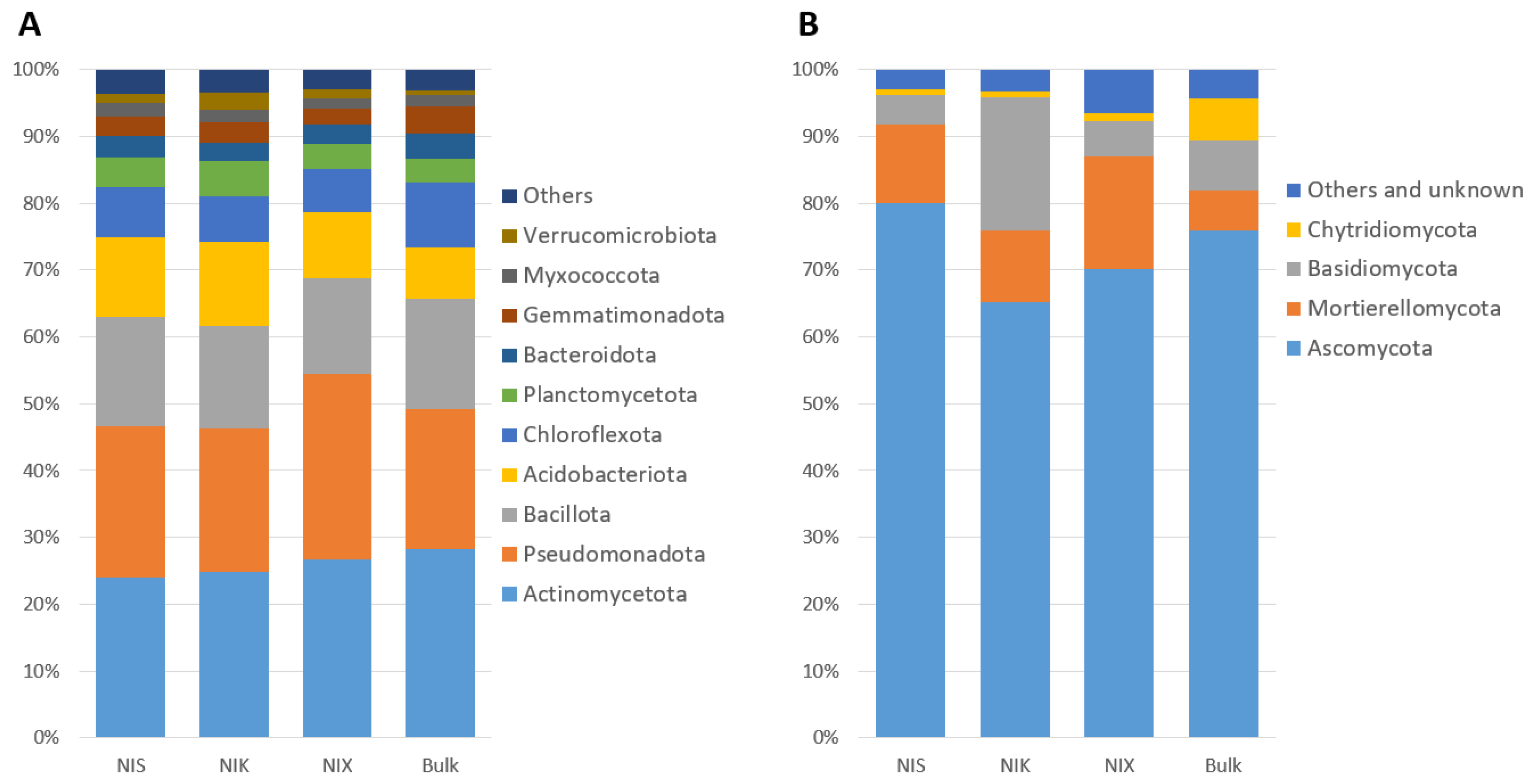
A total of 33 phyla, 81 classes, 178 orders, 268 families, 573 genera and 886 species were detected by sequencing (Table S1). The five most abundant bacterial phyla across all samples were Actinomycetota, Pseudomonadota, Bacillota, Acidobacteriota, and Chloroflexota, with average relative abundances of 25.95%, 23.17%, 15.65%, 10.52%, and 7.62%, respectively (Figure 4A). Only five additional phyla exhibited average abundances above 1%, while the remaining 23 identified phyla collectively accounted for just 3.28% of the total bacterial community. Although overall phylum-level composition was broadly similar among sample types, moderate differences in relative abundance were observed. For example, Pseudomonadota reached its highest relative abundance in NIX samples (27.72%), compared to values ranging from 20.93% to 22.66% in the other groups. Planctomycetota (5.24%) and Verrucomicrobiota (2.46%) were more abundant in NIK samples, whereas Gemmatimonadota (4.16%) showed its highest relative abundance in bulk soil.
Figure 4.
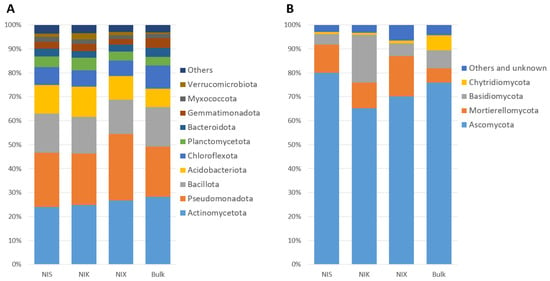
Relative abundance of bacterial (A) and fungal (B) phyla across rhizosphere and bulk soil sample types (NIS, NIK, NIX, and Bulk). Phyla with <1% average relative abundance were grouped as “Others” (bacteria) or “Others and unknown” (fungi).
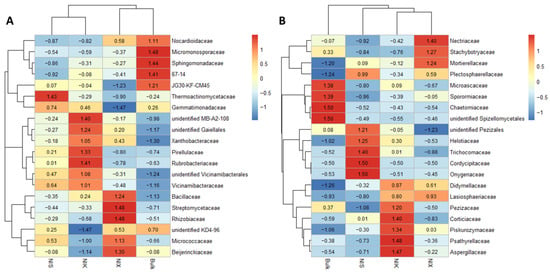
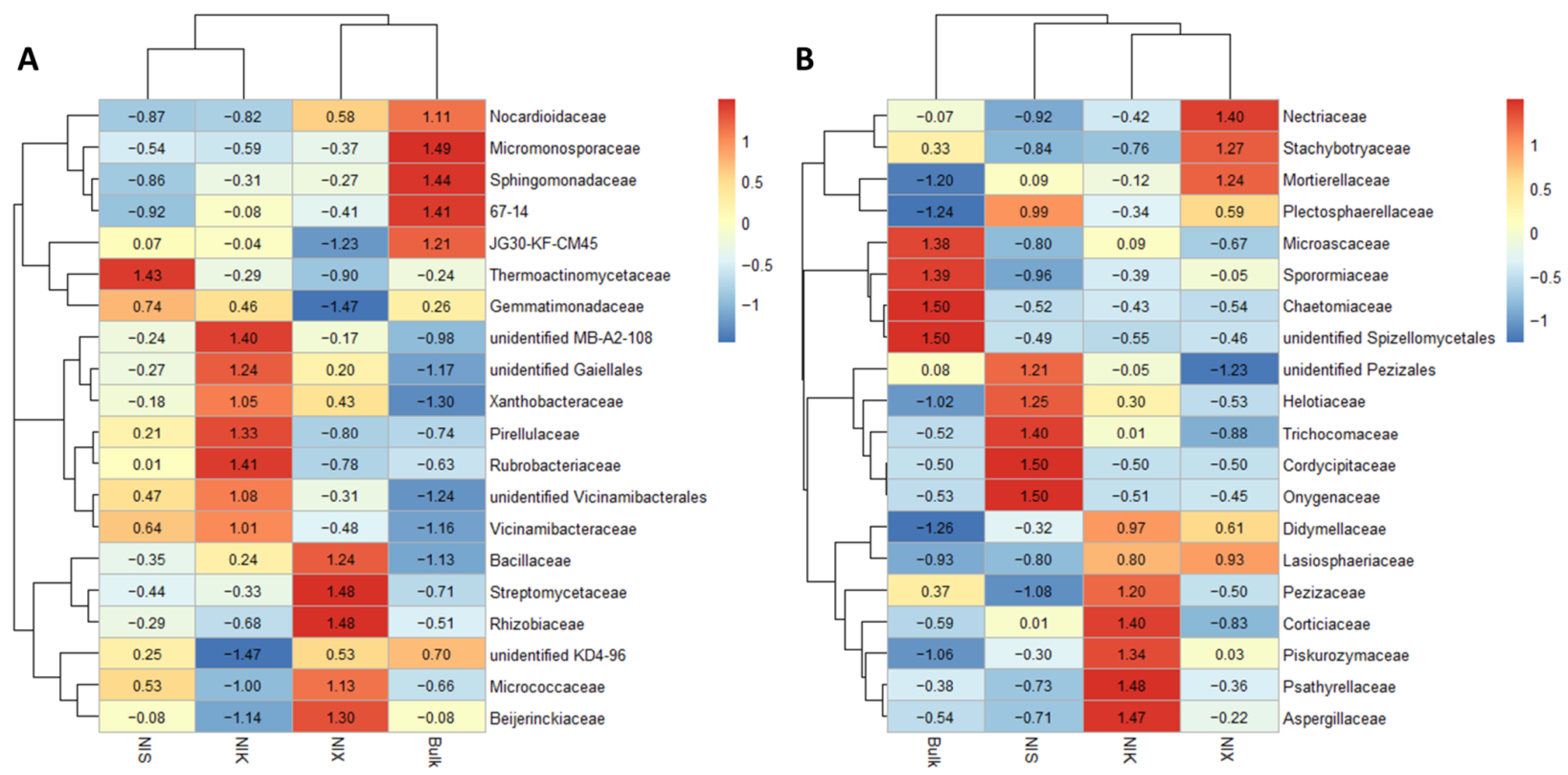
At the family level, compositional differences were more pronounced, particularly between rhizosphere and bulk soil samples. The heatmap of the 20 most abundant bacterial families (Figure 5A) highlights distinct abundance patterns across sample types. Rhizosphere samples (NIS, NIK, and NIX) were characterized by relatively higher representation of families such as Vicinamibacteraceae, Xanthobacteraceae, and members of the Gaiellales order compared with bulk soil.
Figure 5.
Heatmap of the 20 most abundant bacterial (A) and fungal (B) families across rhizosphere and bulk soil sample types (NIS, NIK, NIX, and Bulk). Columns are ordered according to hierarchical clustering. Colors represent row-wise Z-scores of mean relative abundance values.
The analysis of bacterial alpha diversity revealed no significant differences among sample types in terms of observed richness, Chao1, or Shannon indices (Table 2). Although minor variation in richness estimates was observed across groups, these differences were not statistically significant. In contrast, the inverse Simpson index differed significantly among groups (p < 0.05), with NIK samples showing higher evenness compared to both NIS and NIX samples. No other pairwise differences were detected.
Table 2.
Alpha diversity indices across rhizosphere and bulk soil sample types. Values are expressed as mean ± SD (n = 3 per group). Differences among groups were evaluated using ANOVA. When significant, pairwise comparisons were performed using Tukey’s post hoc test. Different letters within a row indicate significant differences between groups (p < 0.05).
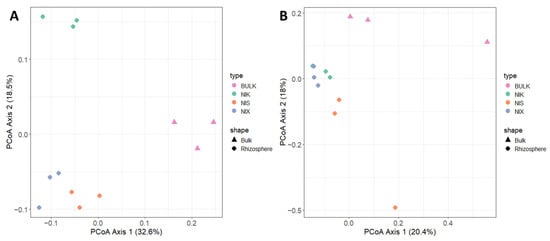
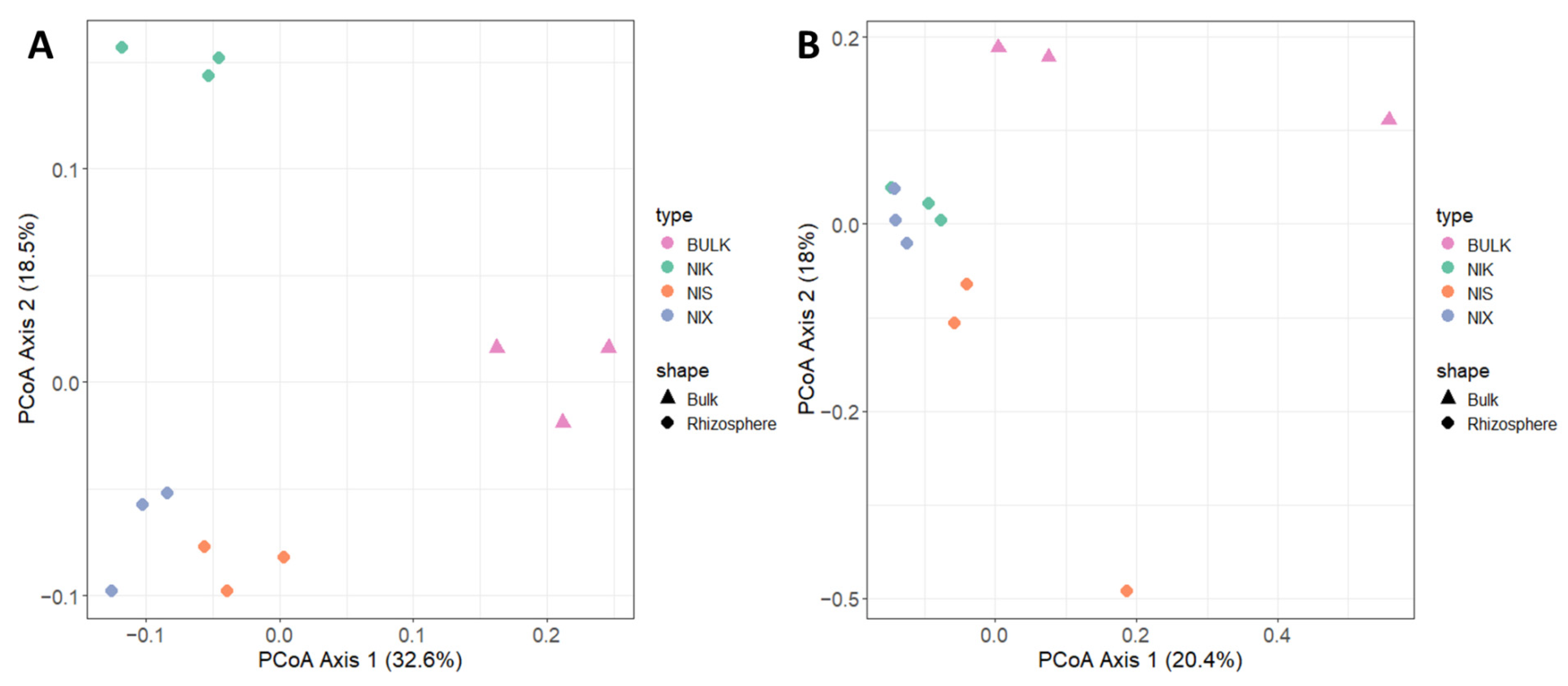
Bray–Curtis-based PCoA further revealed clear separation of bacterial communities according to sample type (Figure 6A). The first and second axes explained 32.6% and 18.5% of the total variation, respectively. Bulk soil samples formed a distinct cluster, while rhizosphere samples separated according to treatment. Notably, NIS and NIX samples were positioned closer to each other in the ordination space, whereas NIK samples formed a more distinct group. PERMANOVA analysis confirmed a significant effect of sample type on bacterial community composition (R2 = 0.624, F = 4.43, p = 0.0001; 9999 permutations), indicating that treatment explained a substantial proportion of the observed variation in community structure.
Figure 6.
Principal coordinates analysis (PCoA) based on Bray–Curtis dissimilarity showing differences in community composition among sample types. (A) Bacterial communities; (B) fungal communities. Each point represents an individual sample (n = 3 per group). Percentages on the axes indicate the proportion of variance explained by the respective coordinate.
3.4.2. Fungal Community Composition and Diversity
A total of 9 phyla, 25 classes, 50 orders, 113 families, 195 genera and 289 species were detected by sequencing (Table S2). Among the identified fungal phyla, Ascomycota (72.90%), Mortierellomycota (11.34%), Basidiomycota (9.29%), and Chytridiomycota (2.28%) exhibited average abundances exceeding 1%, whereas the combined average abundance of all other identified phyla remained below 1% (Figure 4B). Approximately 3.45% of sequences remained unclassified at the phylum level. Among dominant phyla, Basidiomycota reached its highest relative abundance in NIK samples (19.78%), compared with 4.43% in NIS, 5.42% in NIX, and 7.53% in bulk soil. Mortierellomycota showed its highest proportion in NIX samples (16.85%), whereas Ascomycota dominated all groups and peaked in NIS samples (80.30%; range across other groups: 65.27–75.87%).
At the family level, differences were visualized using the heatmap of the 20 most abundant fungal families (Figure 5B). Nectriaceae reached 28.07% in NIX samples compared with 11.04–16.57% in the other groups, and Mortierellaceae accounted for 16.84% in NIX samples compared with 5.97–11.72% elsewhere. Chaetomiaceae showed elevated abundance in bulk soil, largely driven by one sample (Bulk_3; 60.04%).
No statistically significant differences were detected among sample types for any of the fungal alpha diversity indices (Table 2). Although minor variation was observed in richness estimates (Observed and Chao1), these differences were not statistically significant. Evenness-based indices (Shannon and inverse Simpson) likewise showed no significant differences among groups, with slightly higher values observed in NIK samples.
Bray–Curtis-based PCoA indicated partial separation of fungal communities according to sample type (Figure 6B). The first two axes explained 20.4% and 18.0% of the total variation, respectively. Although group clustering was less distinct than observed for bacterial communities, bulk soil samples tended to separate from rhizosphere samples along the first axis, while rhizosphere treatments showed partial overlap in ordination space. PERMANOVA analysis nevertheless confirmed a significant effect of sample type on fungal community composition (R2 = 0.423, F = 1.95, p = 0.0002; 9999 permutations), indicating that treatment accounted for a substantial proportion of the observed variation despite the more diffuse clustering pattern.
4. Discussion
This open-field experiment demonstrates that arbuscular mycorrhizal fungal inoculation can restructure plant–soil interactions beyond simple enhancement of root colonization. While successful establishment of the introduced AMF was confirmed by significantly elevated colonization levels in the actively inoculated treatment (NIS), the broader ecological consequences extended to plant performance and rhizosphere microbial assembly. The absence of differences in colonization between the control (NIK) and the heat-inactivated inoculum treatment (NIX) confirms the presence of a functionally active indigenous AMF community in the field soil like in other works [21,53,54]. Importantly, the carrier material neither suppressed native colonization nor appeared to introduce inhibitory nutrient loads, particularly phosphorus, which is known to downregulate AMF establishment at elevated concentrations [55,56,57,58]. These findings validate the experimental system and indicate that the observed plant and microbial responses were not artifacts of formulation chemistry, but reflected biologically meaningful interactions.
The enhanced fresh biomass in the actively inoculated treatment supports the widely reported growth-promoting effects of AMF similar to other works [59,60]. However, the clear performance gradient (NIS > NIX > NIK) suggests that plant responses were not solely attributable to direct symbiotic nutrient transfer. The intermediate effect observed in NIX indicates that inoculum-associated organic substrates or microhabitat modifications may have transiently altered rhizosphere processes, potentially priming microbial activity or influencing root exudation patterns [61,62,63,64,65].
Temporal variation in SPAD values further highlights the dynamic nature of AMF-mediated physiological regulation. The lack of consistent chlorophyll advantages in AMF-treated plants despite higher biomass is consistent with dilution effects in rapidly growing tissues [66] and reinforces the notion that concentration-based indicators can obscure functional benefits under high growth rates. More broadly, the stage-specific detection of treatment effects corroborates that AMF functioning is strongly context-dependent, modulated by plant ontogeny, nutrient demand, and environmental conditions [60,67,68]. Such temporal contingency underscores the importance of repeated measurements in field-based mycorrhizal research.
Spectral indices provide additional mechanistic insight. Structural (NDVI, mNDVI750, CI_green) and water-related (WI) indices did not differ significantly among treatments at harvest, whereas RDVI showed significant treatment-related differences. Given its responsiveness to stress-related canopy optical properties [69,70], the lower RDVI values observed in NIS may indicate altered physiological responses under warm and dry conditions. This observation in nevertheless consistent with previous studies suggesting that AMF can contribute to plant resilience through modulation of stress physiology and hormonal signaling pathways [71,72]. Thus, AMF inoculation may influence field performance by stabilizing physiological processes rather than by substantially altering canopy structure.
High-throughput sequencing revealed that AMF inoculation did not significantly alter total ASV richness in either bacterial or fungal communities. Instead, the dominant effect was compositional restructuring. Stability in alpha diversity coupled with significant beta-diversity shifts indicates that AMF influenced relative abundances and community assembly processes rather than introducing or eliminating taxa. The large shared bacterial core across treatments suggests strong environmental filtering imposed by soil physicochemical conditions [73,74]. PERMANOVA and ordination analyses revealed consistent treatment-driven compositional shifts, consistent with AMF-mediated modification of rhizosphere resource gradients [24,33,34,35]. AMF colonization can modify rhizosphere conditions through changes in carbon allocation and root exudation patterns. Notably, the closer clustering of NIS and NIX relative to NIK indicates that the carrier material itself influenced bacterial assembly. The reduced evenness observed in inoculum-containing treatments indicates that a limited number of taxa increased in relative abundance following inoculation. This pattern suggests that inoculum formulation may influence rhizosphere microbial structure [75].
The bacterial community composition resembled typical agricultural soils, dominated by Actinomycetota, Pseudomonadota, Bacillota, and Acidobacteriota [76]. Differences among treatments were more apparent at lower taxonomic levels. Several bacterial families associated with plant-influenced soils showed higher relative abundance in rhizosphere samples compared with bulk soil, including Vicinamibacteraceae and Xanthobacteraceae. Members of Acidobacteriota such as Vicinamibacteraceae are frequently reported as abundant components of plant-associated soils and have been linked to nutrient cycling processes and the transformation of soil nitrogen and phosphorus compounds [77,78,79]. Xanthobacteraceae include metabolically versatile Alphaproteobacteria capable of utilizing diverse carbon substrates and, in some cases, fixing atmospheric nitrogen, traits that can support their persistence in rhizosphere environments enriched in plant-derived carbon inputs [80,81].
Differences among the rhizosphere treatments (NIS, NIX and NIK) further illustrate the influence of AMF inoculation on bacterial composition. In the AMF-inoculated treatment (NIS), the family Thermoactinomycetaceae showed a higher relative abundance compared with the non-mycorrhizal control (NIK). Members of this family are commonly involved in the decomposition of complex organic substrates in soils, particularly plant residues and organic matter [82,83].
In contrast, several bacterial families were more abundant in the non-mycorrhizal control (NIK), including Vicinamibacteraceae, Xanthobacteraceae, Pirellulaceae, and Rubrobacteraceae. These taxa are commonly reported in agricultural soils and rhizosphere microbiomes [79,84,85], suggesting that AMF colonization may alter the relative dominance of common soil bacterial groups rather than uniformly stimulating bacterial growth.
The sterilized inoculum treatment (NIX) showed higher relative abundance of Streptomycetaceae, Rhizobiaceae, Micrococcaceae, and Beijerinckiaceae. Many members of these families are fast-growing soil bacteria capable of utilizing diverse organic substrates and are known to respond rapidly to organic inputs or nutrient-rich microsites in soils [83,86]. Their enrichment in NIX samples likely reflects a response to organic components of the inoculum carrier.
Fungal assemblages exhibited greater variability and a smaller shared core compared to bacteria, suggesting higher sensitivity to microenvironmental heterogeneity. Although alpha diversity remained stable, PERMANOVA indicated that both AMF and carrier treatments influenced fungal composition.
At the phylum level, fungal communities were dominated by Ascomycota and Mortierellomycota, which are typical components of agricultural soils. Members of Mortierellomycota, particularly the family Mortierellaceae, are widely recognized as fast-growing saprotrophic fungi involved in the turnover of soil organic matter and carbon cycling processes [87,88,89].
In the NIS treatment, families such as Helotiaceae, Trichocomaceae, and Onygenaceae showed relatively higher abundance compared with the other rhizosphere treatments. Members of these groups are commonly reported as saprotrophic or opportunistic fungi capable of exploiting labile carbon sources in plant-associated soils [90,91]. In contrast, the non-mycorrhizal control showed higher relative abundance of several families including Pezizaceae, Corticiaceae, Piskurozymaceae, and Aspergillaceae. Many representatives of these groups are common soil fungi with broad ecological niches and are frequently detected in agricultural soils and rhizosphere environments [90,92]. The NIX treatment showed increased representation of families such as Didymellaceae and Lasiosphaeriaceae. These taxa include saprotrophic fungi associated with organic matter decomposition and plant residues in soils [92,93], and their enrichment in NIX samples may reflect responses to organic components of the inoculum carrier.
Greater dispersion of fungal communities compared with bacteria may reflect stronger interactions within fungal guilds. Because AMF are themselves fungi, their establishment can influence surrounding fungal assemblages through competition for root-derived carbon and changes in rhizosphere resource distribution [94,95].
Taken together, our results demonstrate that AMF inoculation under realistic field conditions modifies plant performance and rhizosphere microbial assembly without fundamentally altering community richness. Rather than introducing or eliminating taxa, inoculation appears to act through compositional reorganization and shifts in dominance patterns, consistent with potential niche modification and rhizosphere modulation [24,32,37,38]. The observed increases in biomass, coupled with detectable shifts in bacterial and fungal composition (e.g., increased relative abundance of Vicinamibacteraceae, Xanthobacteraceae, Mortierellaceae, and Nectriaceae; Figure 4 and Figure 5), suggest that AMF inoculation influences plant–soil–microbe interactions beyond direct nutrient exchange. These indirect effects—likely mediated through altered carbon allocation, root exudation chemistry, and microbial network interactions—may contribute to enhanced crop resilience and productivity in agroecosystems [37,96,97,98].
Importantly, our results also highlight the detectable influence of the inoculum carrier itself (e.g., differences between NIS, NIX, and NIK treatments), indicating that formulation components can affect microbial assembly and should not be considered biologically inert. This underscores the need to account for both environmental factors and inoculum formulation when evaluating AMF stability and performance in field conditions. While alpha diversity remained largely stable across treatments, the significant beta-diversity shifts demonstrate that AMF effects on microbial communities can be consistent but may vary depending on microenvironmental conditions, supporting cautious interpretation of inoculant stability [73,74].
Future work integrating high-resolution metagenomics, metabolomics, and network-based approaches would allow functional validation of the observed compositional shifts. Linking community restructuring to nutrient cycling rates, stress-response pathways, and ecosystem service provision will be critical for advancing AMF inoculation from empirical application toward mechanism-based agricultural management.
5. Conclusions
This study shows that arbuscular mycorrhizal inoculation under field conditions enhanced lettuce growth and physiological performance while also modifying rhizosphere microbial community structure. Although overall microbial richness remained stable, both bacterial and fungal communities exhibited treatment-related compositional shifts, indicating that inoculation primarily affected community assembly rather than diversity. Importantly, the detectable influence of the carrier material demonstrates that inoculum formulations themselves can contribute to rhizosphere restructuring and should be considered active components of microbial amendments. Together, these results highlight that AMF inoculation in agricultural systems operates through combined plant physiological responses and microbiome-mediated interactions.
Supplementary Materials
The following supporting information can be downloaded at: https://www.mdpi.com/article/10.3390/agronomy16080844/s1, Table S1: The basic sequence data of bacterial communities found in all samples; Table S2: The basic sequence data of fungal communities found in all samples.
Author Contributions
K.P. and A.O.: Supervision, Conceptualization, Formal analysis, Writing—Original Draft, Writing—Review and Editing. Á.J.: Formal Analysis, Writing—Review and Editing, Data Curation. J.B. and S.T.: Methodology, Investigation, Visualization. B.K.: Data Curation, Formal Analysis, Writing—Original Draft, Writing—Review and Editing, Investigation, Visualization, and Methodology. All authors have read and agreed to the published version of the manuscript.
Funding
This research was funded by the National Research, Development and Innovation Office of the Hungarian Government (grant no: RRF 2.3.1 21 2022 00007 for Agribiotechnology and precision breeding for food security National Laboratory), by the Flagship Research Groups Program of the Hungarian University of Agriculture and Life Sciences, and by the National Research, Development and Innovation Office (grant no: OTKA142974).
Data Availability Statement
The raw sequencing data have been deposited in the NCBI Sequence Read Archive (SRA) under BioProject accession number PRJNA1420736. All other relevant data are included within the manuscript and its Supporting Information file.
Acknowledgments
The authors would like to thank all colleagues who contributed to this study.
Conflicts of Interest
The authors declare no conflicts of interest. The funders had no role in the design of the study; in the collection, analyses, or interpretation of data; in the writing of the manuscript; or in the decision to publish the results.
Abbreviations
The following abbreviations are used throughout this manuscript:
| AMF | Arbuscular mycorrhizal fungi |
| ANOVA | Analysis of variance |
| ASD | Analytical Spectral Devices |
| ASV | amplicon sequence variant |
| BLAST | Basic Local Alignment Search Tool |
| CI_green | Chlorophyll index (green) |
| DW | dry weight |
| FW | fresh weight |
| FROGS | Find, Rapidly, OTUs with Galaxy Solution |
| ITS | internal transcribed spacer |
| KOH | potassium hydroxide |
| LSD | least significant difference |
| mNDVI750 | modified NDVI at 750 nm |
| NDVI | normalized difference vegetation index |
| NGS | next-generation sequencing |
| PcoA | principal coordinates analysis |
| PCR | polymerase chain reaction |
| PERMANOVA | pemutational mulivariate analysis of variance |
| PRI | photochemical reflectance index |
| PRInorm | normalized PRI |
| RDVI | renormalized difference vegetation index |
| rRNA | ribosomal RNA |
| SD | standard deviation |
| SE | standard error |
| SPAD | Soil–Plant Analysis Development (SPAD chrolophyll meter index) |
| WI | water index |
| NIS | lettuce plants inoculated with active arbuscular mycorrhizal fungi |
| NIK | non-inoculated control lettuce plants |
| NIX | lettuce plants treated with heat-inactivated mycorrhizal inoculum (carrier control) |
References
- Cabilovski, R.R.; Manojlovic, M.S.; Bogdanovic, D.M.; Rodic, V.; Bavec, M. Fertilization Economy in Organic Lettuce Production. J. Sustain. Agric. 2011, 35, 745–756. [Google Scholar] [CrossRef] [Scilit]
- Ribeiro, A.L.A.; Maciel, G.M.; Siquieroli, A.C.S.; Luz, J.M.Q.; Gallis, R.B.d.A.; Assis, P.H.d.S.; Catão, H.C.R.M.; Yada, R.Y. Vegetation Indices for Predicting the Growth and Harvest Rate of Lettuce. Agriculture 2023, 13, 1091. [Google Scholar] [CrossRef] [Scilit]
- Nicolle, C.; Cardinault, N.; Gueux, E.; Jaffrelo, L.; Rock, E.; Mazur, A.; Amouroux, P.; Rémésy, C. Health Effect of Vegetable-Based Diet: Lettuce Consumption Improves Cholesterol Metabolism and Antioxidant Status in the Rat. Clin. Nutr. 2004, 23, 605–614. [Google Scholar] [CrossRef] [Scilit]
- Shi, M.; Gu, J.; Wu, H.; Rauf, A.; Emran, T.B.; Khan, Z.; Mitra, S.; Aljohani, A.S.M.; Alhumaydhi, F.A.; Al-Awthan, Y.S.; et al. Phytochemicals, Nutrition, Metabolism, Bioavailability, and Health Benefits in Lettuce—A Comprehensive Review. Antioxidants 2022, 11, 1158. [Google Scholar] [CrossRef] [Scilit]
- Ilić, S.Z.; Milenković, L.; Dimitrijević, A.; Stanojević, L.; Cvetković, D.; Kevrešan, Ž.; Fallik, E.; Mastilović, J. Light Modification by Color Nets Improve Quality of Lettuce from Summer Production. Sci. Hortic. 2017, 226, 389–397. [Google Scholar] [CrossRef] [Scilit]
- Qian, D.; Wang, M.; Niu, Y.; Yang, Y.; Xiang, Y. Sexual Reproduction in Plants under High Temperature and Drought Stress. Cell Rep. 2025, 44, 115390. [Google Scholar] [CrossRef] [Scilit]
- Sarma, B.; Kashtoh, H.; Lama Tamang, T.; Bhattacharyya, P.N.; Mohanta, Y.K.; Baek, K.-H. Abiotic Stress in Rice: Visiting the Physiological Response and Its Tolerance Mechanisms. Plants 2023, 12, 3948. [Google Scholar] [CrossRef] [Scilit]
- Kumari, S.; Basu, S.; Kumar, G. A Systematic Review on the Implications of Concurrent Heat and Drought Stress in Modulating Floral Development in Plants. Plant Sci. 2024, 349, 112248. [Google Scholar] [CrossRef] [Scilit]
- Zhao, Z.; Cai, Y.; Gu, C.; Xu, H.; Teng, Y.; Guo, W. The Effects of Root-Zone Temperature Regulation on the Growth and Quality of Hydroponic Lettuce in Summer. Agronomy 2025, 15, 2768. [Google Scholar] [CrossRef] [Scilit]
- Zhao, X.; Sui, X.; Zhao, L.; Gao, X.; Wang, J.; Wen, X.; Li, Y. Morphological and Physiological Response Mechanism of Lettuce (Lactuca sativa L.) to Consecutive Heat Stress. Sci. Hortic. 2022, 301, 111112. [Google Scholar] [CrossRef] [Scilit]
- Siquieroli, A.C.S.; Maciel, G.M.; Durães, T.M.; da Silva, F.B.; Silva, F.G.; Bento, C.H.P.; Luz, J.M.Q.; Peres, H.G.; Rocha, I.P.S.; Morotti, C.F. Tropicalized Lettuce: Photosynthetic Efficiency, Water Use, and Agronomic–Nutritional Potential. BMC Plant Biol. 2025, 25, 1380. [Google Scholar] [CrossRef] [Scilit] [PubMed]
- Singh, B.K.; Delgado-Baquerizo, M.; Egidi, E.; Guirado, E.; Leach, J.E.; Liu, H.; Trivedi, P. Climate Change Impacts on Plant Pathogens, Food Security and Paths Forward. Nat. Rev. Microbiol. 2023, 21, 640–656. [Google Scholar] [CrossRef] [Scilit] [PubMed]
- Lahlali, R.; Taoussi, M.; Laasli, S.-E.; Gachara, G.; Ezzouggari, R.; Belabess, Z.; Aberkani, K.; Assouguem, A.; Meddich, A.; El Jarroudi, M.; et al. Effects of Climate Change on Plant Pathogens and Host-Pathogen Interactions. Crop Environ. 2024, 3, 159–170. [Google Scholar] [CrossRef] [Scilit]
- Hossain, M.M.; Sultana, F.; Mostafa, M.; Ferdus, H.; Rahman, M.; Rana, J.A.; Islam, S.S.; Adhikary, S.; Sannal, A.; Al Emran Hosen, M.; et al. Plant Disease Dynamics in a Changing Climate: Impacts, Molecular Mechanisms, and Climate-Informed Strategies for Sustainable Management. Discov. Agric. 2024, 2, 132. [Google Scholar] [CrossRef] [Scilit]
- Aini, N.; Yamika, W.S.D.; Ulum, B. Effect of Nutrient Concentration, PGPR and AMF on Plant Growth, Yield, and Nutrient Uptake of Hydroponic Lettuce. Int. J. Agric. Biol. 2025, 21, 175–183. [Google Scholar] [CrossRef] [Scilit]
- Rasouli, F.; Amini, T.; Asadi, M.; Hassanpouraghdam, M.B.; Aazami, M.A.; Ercisli, S.; Skrovankova, S.; Mlcek, J. Growth and Antioxidant Responses of Lettuce (Lactuca sativa L.) to Arbuscular Mycorrhiza Inoculation and Seaweed Extract Foliar Application. Agronomy 2022, 12, 401. [Google Scholar] [CrossRef] [Scilit]
- Almuslimawi, A.A.A.; Kuchár, B.; Navas, S.E.A.; Turóczi, G.; Posta, K. The Effect of Combined Application of Biocontrol Microorganisms and Arbuscular Mycorrhizal Fungi on Plant Growth and Yield of Tomato (Solanum lycopersicum L.). Agriculture 2024, 14, 768. [Google Scholar] [CrossRef] [Scilit]
- Markets and Markets. Biofertilizers Market by Type (Nitrogen-Fixing, Phosphate-Solubilizing, Potash-Mobilizing), Form, Crop Type and Region—Global Forecast to 2028; Markets and Markets: Pune, India, 2023. [Google Scholar]
- Calvo, P.; Nelson, L.; Kloepper, J.W. Agricultural Uses of Plant Biostimulants. Plant Soil 2014, 383, 3–41. [Google Scholar] [CrossRef] [Scilit]
- Pellegrino, E.; Bedini, S.; Avio, L.; Bonari, E.; Giovannetti, M. Field Inoculation Effectiveness of Native and Exotic Arbuscular Mycorrhizal Fungi in a Mediterranean Agricultural Soil. Soil Biol. Biochem. 2011, 43, 367–376. [Google Scholar] [CrossRef] [Scilit]
- Verbruggen, E.; van der Heijden, M.G.A.; Rillig, M.C.; Kiers, E.T. Mycorrhizal Fungal Establishment in Agricultural Soils: Factors Determining Inoculation Success. New Phytol. 2013, 197, 1104–1109. [Google Scholar] [CrossRef] [Scilit]
- Smith, J.E. Mycorrhizal Symbiosis (Third Edition). Soil Sci. Soc. Am. J. 2009, 73, 694. [Google Scholar] [CrossRef] [Scilit]
- Augé, R.M. Water Relations, Drought and Vesicular-Arbuscular Mycorrhizal Symbiosis. Mycorrhiza 2001, 11, 3–42. [Google Scholar] [CrossRef] [Scilit]
- Xu, W.; Liu, Q.; Wang, B.; Zhang, N.; Qiu, R.; Yuan, Y.; Yang, M.; Wang, F.; Mei, L.; Cui, G. Arbuscular Mycorrhizal Fungi Communities and Promoting the Growth of Alfalfa in Saline Ecosystems of Northern China. Front. Plant Sci. 2024, 15, 1438771. [Google Scholar] [CrossRef] [Scilit] [PubMed]
- Shah, S.; Nawaz, T.; Fahad, S. Arbuscular Mycorrhizal Fungi Role in Plant Beneficial Elements Uptake and Nutrient Acquisition. Rhizosphere 2025, 35, 101141. [Google Scholar] [CrossRef] [Scilit]
- Yan, Z.; Ma, T.; Guo, S.; Liu, R.; Li, M. Leaf Anatomy, Photosynthesis and Chlorophyll Fluorescence of Lettuce as Influenced by Arbuscular Mycorrhizal Fungi under High Temperature Stress. Sci. Hortic. 2021, 280, 109933. [Google Scholar] [CrossRef] [Scilit]
- Santander, C.; Sanhueza, M.; Olave, J.; Borie, F.; Valentine, A.; Cornejo, P. Arbuscular Mycorrhizal Colonization Promotes the Tolerance to Salt Stress in Lettuce Plants through an Efficient Modification of Ionic Balance. J. Soil Sci. Plant Nutr. 2019, 19, 321–331. [Google Scholar] [CrossRef] [Scilit]
- Wang, B.; Xiao, Q.; Geng, X.; Lin, K.; Li, Z.; Li, Y.; Chen, J.; Li, X. Arbuscular Mycorrhizal Fungi Alter Rhizosphere Bacterial Diversity, Network Stability and Function of Lettuce in Barren Soil. Sci. Hortic. 2024, 323, 112533. [Google Scholar] [CrossRef] [Scilit]
- Zrig, A.; Alsherif, E.A.; Aloufi, A.S.; Korany, S.M.; Selim, S.; Almuhayawi, M.S.; Tarabulsi, M.K.; Nhs, M.; Albasri, H.M.; Bouqellah, N.A. The Biomass and Health-Enhancing Qualities of Lettuce Are Amplified through the Inoculation of Arbuscular Mycorrhizal Fungi. BMC Plant Biol. 2025, 25, 521. [Google Scholar] [CrossRef] [Scilit]
- Ma, T.; Liu, R.J.; Li, M. Effects of Arbuscular Mycorrhizal Fungi on Heat-Tolerance of Lactuca sativa L. Plant Physiol. J. 2015, 51, 1919–1926. [Google Scholar]
- Baslam, M.; Goicoechea, N. Water Deficit Improved the Capacity of Arbuscular Mycorrhizal Fungi (AMF) for Inducing the Accumulation of Antioxidant Compounds in Lettuce Leaves. Mycorrhiza 2012, 22, 347–359. [Google Scholar] [CrossRef] [Scilit]
- Jeong, S.W.; Kim, G.-S.; Lee, W.S.; Kim, Y.-H.; Kang, N.J.; Jin, J.S.; Lee, G.M.; Kim, S.T.; Abd El-Aty, A.M.; Shim, J.-H.; et al. The Effects of Different Night-Time Temperatures and Cultivation Durations on the Polyphenolic Contents of Lettuce: Application of Principal Component Analysis. J. Adv. Res. 2015, 6, 493–499. [Google Scholar] [CrossRef] [Scilit]
- Chen, Y.; Sun, C.; Yan, Y.; Jiang, D.; Huangfu, S.; Tian, L. Impact of Arbuscular Mycorrhizal Fungi on Maize Rhizosphere Microbiome Stability under Moderate Drought Conditions. Microbiol. Res. 2025, 290, 127957. [Google Scholar] [CrossRef] [Scilit] [PubMed]
- Mei, L.; Liu, Y.; Wang, Z.; Xiong, Z.; Wang, Y.; Jin, T.; Yang, X. Diversity and Community Structure of Rhizosphere Arbuscular Mycorrhizal Fungi in Songnen Grassland Saline–Alkali-Tolerant Plants: Roles of Environmental Salinity and Plant Species Identity. Agronomy 2025, 15, 2070. [Google Scholar] [CrossRef] [Scilit]
- Li, Y.; Shen, Y.; Zheng, R.; Shang, P.; Wang, Y.; Nan, Z.; Duan, T. Arbuscular Mycorrhizal Fungus Reshapes the Rhizosphere Microbiome of Alfalfa in Response to Above-ground Attack by Aphids and a Fungal Plant Pathogen. Funct. Ecol. 2025, 39, 2149–2169. [Google Scholar] [CrossRef] [Scilit]
- Ghorui, M.; Chowdhury, S.; Burla, S. Recent Advances in the Commercial Formulation of Arbuscular Mycorrhizal Inoculants. Front. Ind. Microbiol. 2025, 3, 1553472. [Google Scholar] [CrossRef] [Scilit]
- Akyol, T.Y.; Niwa, R.; Hirakawa, H.; Maruyama, H.; Sato, T.; Suzuki, T.; Fukunaga, A.; Sato, T.; Yoshida, S.; Tawaraya, K.; et al. Impact of Introduction of Arbuscular Mycorrhizal Fungi on the Root Microbial Community in Agricultural Fields. Microbes Environ. 2019, 34, 23–32. [Google Scholar] [CrossRef] [Scilit]
- Ghorui, M.; Chowdhury, S.; Balu, P.; Burla, S. Arbuscular Mycorrhizal Inoculants and Its Regulatory Landscape. Heliyon 2024, 10, e30359. [Google Scholar] [CrossRef] [Scilit]
- Basiru, S.; Hijri, M. Does Commercial Inoculation Promote Arbuscular Mycorrhizal Fungi Invasion? Microorganisms 2022, 10, 404. [Google Scholar] [CrossRef] [Scilit]
- Vierheilig, H.; Coughlan, A.P.; Wyss, U.; Piché, Y. Ink and Vinegar, a Simple Staining Technique for Arbuscular-Mycorrhizal Fungi. Appl. Environ. Microbiol. 1998, 64, 5004–5007. [Google Scholar] [CrossRef] [Scilit]
- Giovannetti, M.; Mosse, B. An Evaluation of Techniques for Measuring Vesicular Arbuscular Mycorrhizal Infection in Roots. New Phytol. 1980, 84, 489–500. [Google Scholar] [CrossRef] [Scilit]
- Klindworth, A.; Pruesse, E.; Schweer, T.; Peplies, J.; Quast, C.; Horn, M.; Glöckner, F.O. Evaluation of General 16S Ribosomal RNA Gene PCR Primers for Classical and Next-Generation Sequencing-Based Diversity Studies. Nucleic Acids Res. 2013, 41, e1. [Google Scholar] [CrossRef] [Scilit]
- Illumina. Fungal Metagenomic Sequencing Demonstrated Protocol—Preparing ITS Amplicons for Sequencing on Illumina Sequencing Systems; Illumina: San Diego, CA, USA, 2019. [Google Scholar]
- Illumina. 16S Metagenomic Sequencing Library Preparation—Preparing 16S Ribosomal RNA Gene Amplicons for the Illumina MiSeq System; Illumina: San Diego, CA, USA, 2013. [Google Scholar]
- Escudié, F.; Auer, L.; Bernard, M.; Mariadassou, M.; Cauquil, L.; Vidal, K.; Maman, S.; Hernandez-Raquet, G.; Combes, S.; Pascal, G. FROGS: Find, Rapidly, OTUs with Galaxy Solution. Bioinformatics 2018, 34, 1287–1294. [Google Scholar] [CrossRef] [Scilit] [PubMed]
- Rognes, T.; Flouri, T.; Nichols, B.; Quince, C.; Mahé, F. VSEARCH: A Versatile Open Source Tool for Metagenomics. PeerJ 2016, 4, e2584. [Google Scholar] [CrossRef] [Scilit] [PubMed]
- Mahé, F.; Rognes, T.; Quince, C.; de Vargas, C.; Dunthorn, M. Swarm: Robust and Fast Clustering Method for Amplicon-Based Studies. PeerJ 2014, 2, e593. [Google Scholar] [CrossRef] [Scilit] [PubMed]
- McGinnis, S.; Madden, T.L. BLAST: At the Core of a Powerful and Diverse Set of Sequence Analysis Tools. Nucleic Acids Res. 2004, 32, W20–W25. [Google Scholar] [CrossRef] [Scilit]
- Quast, C.; Pruesse, E.; Yilmaz, P.; Gerken, J.; Schweer, T.; Yarza, P.; Peplies, J.; Glöckner, F.O. The SILVA Ribosomal RNA Gene Database Project: Improved Data Processing and Web-Based Tools. Nucleic Acids Res. 2012, 41, D590–D596. [Google Scholar] [CrossRef] [Scilit]
- Abarenkov, K.; Nilsson, R.H.; Larsson, K.-H.; Taylor, A.F.S.; May, T.W.; Frøslev, T.G.; Pawlowska, J.; Lindahl, B.; Põldmaa, K.; Truong, C.; et al. The UNITE Database for Molecular Identification and Taxonomic Communication of Fungi and Other Eukaryotes: Sequences, Taxa and Classifications Reconsidered. Nucleic Acids Res. 2024, 52, D791–D797. [Google Scholar] [CrossRef] [Scilit]
- McMurdie, P.J.; Holmes, S. Phyloseq: An R Package for Reproducible Interactive Analysis and Graphics of Microbiome Census Data. PLoS ONE 2013, 8, e61217. [Google Scholar] [CrossRef] [Scilit]
- Fox, J.; Leanage, A. R and the Journal of Statistical Software. J. Stat. Softw. 2016, 73, 1–13. [Google Scholar] [CrossRef] [Scilit]
- Öpik, M.; Vanatoa, A.; Vanatoa, E.; Moora, M.; Davison, J.; Kalwij, J.M.; Reier, Ü.; Zobel, M. The Online Database MaarjAM Reveals Global and Ecosystemic Distribution Patterns in Arbuscular Mycorrhizal Fungi (Glomeromycota). New Phytol. 2010, 188, 223–241. [Google Scholar] [CrossRef] [Scilit]
- Davison, J.; Moora, M.; Öpik, M.; Adholeya, A.; Ainsaar, L.; Bâ, A.; Burla, S.; Diedhiou, A.G.; Hiiesalu, I.; Jairus, T.; et al. Global Assessment of Arbuscular Mycorrhizal Fungus Diversity Reveals Very Low Endemism. Science 2015, 349, 970–973. [Google Scholar] [CrossRef] [Scilit]
- Smith, S.E.; Smith, F.A. Roles of Arbuscular Mycorrhizas in Plant Nutrition and Growth: New Paradigms from Cellular to Ecosystem Scales. Annu. Rev. Plant Biol. 2010, 62, 227–250. [Google Scholar] [CrossRef] [Scilit]
- Breuillin, F.; Schramm, J.; Hajirezaei, M.; Ahkami, A.; Favre, P.; Druege, U.; Hause, B.; Bucher, M.; Kretzschmar, T.; Bossolini, E.; et al. Phosphate Systemically Inhibits Development of Arbuscular Mycorrhiza in Petunia Hybrida and Represses Genes Involved in Mycorrhizal Functioning. Plant J. 2010, 64, 1002–1017. [Google Scholar] [CrossRef] [Scilit] [PubMed]
- Balzergue, C.; Puech-Pagès, V.; Bécard, G.; Rochange, S.F. The Regulation of Arbuscular Mycorrhizal Symbiosis by Phosphate in Pea Involves Early and Systemic Signalling Events. J. Exp. Bot. 2011, 62, 1049–1060. [Google Scholar] [CrossRef] [Scilit] [PubMed]
- Pan, S.; Wang, Y.; Qiu, Y.; Chen, D.; Zhang, L.; Ye, C.; Guo, H.; Zhu, W.; Chen, A.; Xu, G.; et al. Nitrogen-induced Acidification, Not N-nutrient, Dominates Suppressive N Effects on Arbuscular Mycorrhizal Fungi. Glob. Change Biol. 2020, 26, 6568–6580. [Google Scholar] [CrossRef] [Scilit]
- Lekberg, Y.; Koide, R.T. Is Plant Performance Limited by Abundance of Arbuscular Mycorrhizal Fungi? A Meta-analysis of Studies Published between 1988 and 2003. New Phytol. 2005, 168, 189–204. [Google Scholar] [CrossRef] [Scilit]
- Hoeksema, J.D.; Chaudhary, V.B.; Gehring, C.A.; Johnson, N.C.; Karst, J.; Koide, R.T.; Pringle, A.; Zabinski, C.; Bever, J.D.; Moore, J.C.; et al. A Meta-analysis of Context-dependency in Plant Response to Inoculation with Mycorrhizal Fungi. Ecol. Lett. 2010, 13, 394–407. [Google Scholar] [CrossRef] [Scilit]
- Bais, H.P.; Weir, T.L.; Perry, L.G.; Gilroy, S.; Vivanco, J.M. The Role of Root Exudates in Rhizosphere Interactions with Plants and Other Organisms. Annu. Rev. Plant Biol. 2006, 57, 233–266. [Google Scholar] [CrossRef] [Scilit]
- Dijkstra, F.; Cheng, W.; Johnson, D. Plant Biomass Influences Rhizosphere Priming Effects on Soil Organic Matter Decomposition in Two Differently Managed Soils. Soil Biol. Biochem. 2006, 38, 2519–2526. [Google Scholar] [CrossRef] [Scilit]
- Hartmann, M.; Niklaus, P.A.; Zimmermann, S.; Schmutz, S.; Kremer, J.; Abarenkov, K.; Lüscher, P.; Widmer, F.; Frey, B. Resistance and Resilience of the Forest Soil Microbiome to Logging-Associated Compaction. ISME J. 2014, 8, 226–244. [Google Scholar] [CrossRef] [Scilit]
- Kuzyakov, Y. Priming Effects: Interactions between Living and Dead Organic Matter. Soil Biol. Biochem. 2010, 42, 1363–1371. [Google Scholar] [CrossRef] [Scilit]
- Philippot, L.; Raaijmakers, J.M.; Lemanceau, P.; van der Putten, W.H. Going Back to the Roots: The Microbial Ecology of the Rhizosphere. Nat. Rev. Microbiol. 2013, 11, 789–799. [Google Scholar] [CrossRef] [Scilit] [PubMed]
- Jarrell, W.M.; Beverly, R.B. The Dilution Effect in Plant Nutrition Studies. Adv. Agron. 1981, 34, 197–224. [Google Scholar]
- Uddling, J.; Gelang-Alfredsson, J.; Piikki, K.; Pleijel, H. Evaluating the Relationship between Leaf Chlorophyll Concentration and SPAD-502 Chlorophyll Meter Readings. Photosynth. Res. 2007, 91, 37–46. [Google Scholar] [CrossRef] [Scilit]
- Gastal, F.; Lemaire, G. N Uptake and Distribution in Crops: An Agronomical and Ecophysiological Perspective. J. Exp. Bot. 2002, 53, 789–799. [Google Scholar] [CrossRef] [Scilit]
- Yan, K.; Gao, S.; Yan, G.; Ma, X.; Chen, X.; Zhu, P.; Li, J.; Gao, S.; Gastellu-Etchegorry, J.-P.; Myneni, R.B.; et al. A Global Systematic Review of the Remote Sensing Vegetation Indices. Int. J. Appl. Earth Obs. Geoinf. 2025, 139, 104560. [Google Scholar] [CrossRef] [Scilit]
- Alordzinu, K.E.; Li, J.; Lan, Y.; Appiah, S.A.; AL Aasmi, A.; Wang, H.; Liao, J.; Sam-Amoah, L.K.; Qiao, S. Ground-Based Hyperspectral Remote Sensing for Estimating Water Stress in Tomato Growth in Sandy Loam and Silty Loam Soils. Sensors 2021, 21, 5705. [Google Scholar] [CrossRef] [Scilit]
- Penuelas, J.; Pinol, J.; Ogaya, R.; Filella, I. Estimation of Plant Water Concentration by the Reflectance Water Index WI (R900/R970). Int. J. Remote Sens. 1997, 18, 2869–2875. [Google Scholar] [CrossRef] [Scilit]
- Špundová, M.; Kučerová, Z.; Nožková, V.; Opatíková, M.; Procházková, L.; Klimeš, P.; Nauš, J. What to Choose for Estimating Leaf Water Status—Spectral Reflectance or In Vivo Chlorophyll Fluorescence? Plant Phenomics 2024, 6, 0243. [Google Scholar] [CrossRef] [Scilit]
- Wright, F.; Grand, S.; Sanders, I.; Arraiano-Castilho, R. Mycorrhizal Control of Microbial Gene Transcription and Taxonomic Composition in the Rhizosphere and Bulk Soil. ISME J. 2025, 19, wraf282. [Google Scholar] [CrossRef] [Scilit]
- Brunel, C.; Pouteau, R.; Dawson, W.; Pester, M.; Ramirez, K.S.; van Kleunen, M. Towards Unraveling Macroecological Patterns in Rhizosphere Microbiomes. Trends Plant Sci. 2020, 25, 1017–1029. [Google Scholar] [CrossRef] [Scilit]
- Hu, W.; Wei, S.; Chen, H.; Tang, M. Effect of Sterilization on Arbuscular Mycorrhizal Fungal Activity and Soil Nutrient Status. J. Soil Sci. Plant Nutr. 2020, 20, 684–689. [Google Scholar] [CrossRef] [Scilit]
- Fierer, N.; Jackson, R.B. The Diversity and Biogeography of Soil Bacterial Communities. Proc. Natl. Acad. Sci. USA 2006, 103, 626–631. [Google Scholar] [CrossRef] [Scilit] [PubMed]
- Fierer, N.; Leff, J.W.; Adams, B.J.; Nielsen, U.N.; Bates, S.T.; Lauber, C.L.; Owens, S.; Gilbert, J.A.; Wall, D.H.; Caporaso, J.G. Cross-Biome Metagenomic Analyses of Soil Microbial Communities and Their Functional Attributes. Proc. Natl. Acad. Sci. USA 2012, 109, 21390–21395. [Google Scholar] [CrossRef] [Scilit] [PubMed]
- Ward, N.L.; Challacombe, J.F.; Janssen, P.H.; Henrissat, B.; Coutinho, P.M.; Wu, M.; Xie, G.; Haft, D.H.; Sait, M.; Badger, J.; et al. Three Genomes from the Phylum Acidobacteria Provide Insight into the Lifestyles of These Microorganisms in Soils. Appl. Environ. Microbiol. 2009, 75, 2046–2056. [Google Scholar] [CrossRef] [Scilit]
- Kielak, A.M.; Barreto, C.C.; Kowalchuk, G.A.; van Veen, J.A.; Kuramae, E.E. The Ecology of Acidobacteria: Moving beyond Genes and Genomes. Front. Microbiol. 2016, 7, 744. [Google Scholar] [CrossRef] [Scilit]
- Oren, A. The Family Xanthobacteraceae. In The Prokaryotes; Springer: Berlin/Heidelberg, Germany, 2014; pp. 709–726. [Google Scholar]
- Ma, X.; Chao, L.; Li, J.; Ding, Z.; Wang, S.; Li, F.; Bao, Y. The Distribution and Turnover of Bacterial Communities in the Root Zone of Seven Stipa Species Across an Arid and Semi-Arid Steppe. Front. Microbiol. 2021, 12, 782621. [Google Scholar] [CrossRef] [Scilit]
- Goodfellow, M.; Williams, S.T. Ecology of Actinomycetes. Annu. Rev. Microbiol. 1983, 37, 189–216. [Google Scholar] [CrossRef] [Scilit]
- Barka, E.A.; Vatsa, P.; Sanchez, L.; Gaveau-Vaillant, N.; Jacquard, C.; Klenk, H.-P.; Clément, C.; Ouhdouch, Y.; van Wezel, G.P. Taxonomy, Physiology, and Natural Products of Actinobacteria. Microbiol. Mol. Biol. Rev. 2016, 80, 1–43. [Google Scholar] [CrossRef] [Scilit]
- Delgado-Baquerizo, M.; Reich, P.B.; Trivedi, C.; Eldridge, D.J.; Abades, S.; Alfaro, F.D.; Bastida, F.; Berhe, A.A.; Cutler, N.A.; Gallardo, A.; et al. Multiple Elements of Soil Biodiversity Drive Ecosystem Functions across Biomes. Nat. Ecol. Evol. 2020, 4, 210–220. [Google Scholar] [CrossRef] [Scilit]
- Janssen, P.H. Identifying the Dominant Soil Bacterial Taxa in Libraries of 16S RRNA and 16S RRNA Genes. Appl. Environ. Microbiol. 2006, 72, 1719–1728. [Google Scholar] [CrossRef] [Scilit]
- Martínez-Hidalgo, P.; Hirsch, A.M. The Nodule Microbiome: N 2 -Fixing Rhizobia Do Not Live Alone. Phytobiomes J. 2017, 1, 70–82. [Google Scholar] [CrossRef] [Scilit]
- Ozimek, E.; Hanaka, A. Mortierella Species as the Plant Growth-Promoting Fungi Present in the Agricultural Soils. Agriculture 2020, 11, 7. [Google Scholar] [CrossRef] [Scilit]
- Li, F.; Zhang, S.; Wang, Y.; Li, Y.; Li, P.; Chen, L.; Jie, X.; Hu, D.; Feng, B.; Yue, K.; et al. Rare Fungus, Mortierella Capitata, Promotes Crop Growth by Stimulating Primary Metabolisms Related Genes and Reshaping Rhizosphere Bacterial Community. Soil Biol. Biochem. 2020, 151, 108017. [Google Scholar] [CrossRef] [Scilit]
- Zhang, Y.; Wang, J.; Dai, S.; Zhao, J.; Huang, X.; Sun, Y.; Chen, J.; Cai, Z.; Zhang, J. The Effect of C:N Ratio on Heterotrophic Nitrification in Acidic Soils. Soil Biol. Biochem. 2019, 137, 107562. [Google Scholar] [CrossRef] [Scilit]
- Tedersoo, L.; Bahram, M.; Põlme, S.; Kõljalg, U.; Yorou, N.S.; Wijesundera, R.; Ruiz, L.V.; Vasco-Palacios, A.M.; Thu, P.Q.; Suija, A.; et al. Global Diversity and Geography of Soil Fungi. Science 2014, 346, 1256688. [Google Scholar] [CrossRef] [Scilit]
- Nguyen, N.H.; Song, Z.; Bates, S.T.; Branco, S.; Tedersoo, L.; Menke, J.; Schilling, J.S.; Kennedy, P.G. FUNGuild: An Open Annotation Tool for Parsing Fungal Community Datasets by Ecological Guild. Fungal Ecol. 2016, 20, 241–248. [Google Scholar] [CrossRef] [Scilit]
- Frąc, M.; Hannula, S.E.; Bełka, M.; Jędryczka, M. Fungal Biodiversity and Their Role in Soil Health. Front. Microbiol. 2018, 9, 707. [Google Scholar] [CrossRef] [Scilit]
- Zhang, L.; Jing, Y.; Xiang, Y.; Zhang, R.; Lu, H. Responses of Soil Microbial Community Structure Changes and Activities to Biochar Addition: A Meta-Analysis. Sci. Total Environ. 2018, 643, 926–935. [Google Scholar] [CrossRef] [Scilit]
- van der Heijden, M.G.A.; Martin, F.M.; Selosse, M.; Sanders, I.R. Mycorrhizal Ecology and Evolution: The Past, the Present, and the Future. New Phytol. 2015, 205, 1406–1423. [Google Scholar] [CrossRef] [Scilit]
- Tedersoo, L.; Bahram, M.; Zobel, M. How Mycorrhizal Associations Drive Plant Population and Community Biology. Science 2020, 367, eaba1223. [Google Scholar] [CrossRef] [Scilit]
- Liu, R.; Mei, Y.; Zou, Y.; Kang, H.; Hu, Z.; Zhou, Y. Synergistic Interaction between Arbuscular Mycorrhizal Fungi and Falciphora Oryzae Enhances Rhizosphere Microbiota, Plant Growth, and Nitrogen Uptake in Pepper. Appl. Soil Ecol. 2026, 217, 106628. [Google Scholar] [CrossRef] [Scilit]
- Qi, X.; Wang, X.; Zheng, M.; Zhao, L.; Chai, B.; Jia, T. Arbuscular Mycorrhizal Fungi Modulate Soil Microbial Network Complexity via Microbial Interactions in Different Vegetation Ecosystems. Appl. Soil Ecol. 2025, 213, 106330. [Google Scholar] [CrossRef] [Scilit]
- Hernádi, I.; Sasvári, Z.; Albrechtová, J.; Vosátka, M.; Posta, K. Arbuscular Mycorrhizal Inoculant Increases Yield of Spice Pepper and Affects the Indigenous Fungal Community in the Field. HortScience 2012, 47, 603–606. [Google Scholar] [CrossRef] [Scilit]

Disclaimer/Publisher’s Note: The statements, opinions and data contained in all publications are solely those of the individual author(s) and contributor(s) and not of MDPI and/or the editor(s). MDPI and/or the editor(s) disclaim responsibility for any injury to people or property resulting from any ideas, methods, instructions or products referred to in the content. |
© 2026 by the authors. Licensee MDPI, Basel, Switzerland. This article is an open access article distributed under the terms and conditions of the Creative Commons Attribution (CC BY) license.