Influence of Various Intercropping Ratios on Arsenic Absorption and Remediation Efficiency in Maize/Peanut on Farmland Contaminated by Arsenic


Abstract
1. Introduction
2. Materials and Methods
2.1. Experimental Site and Plant Cultivation
2.2. Experimental Design
2.3. Analytical Methods
2.3.1. Sample Collection and Process
2.3.2. Determination of As in Plant Samples
2.3.3. Determination of Different As Forms in Rhizosphere Soil
- (1)
- Non-specifically sorbed As (F1): Soil samples were extracted with 25 mL of 0.05 M ammonium sulfate by shaking for 4 h at 20 °C.
- (2)
- Specifically sorbed As (F2): The residue from F1 was shaken with 25 mL of 0.05 M ammonium dihydrogen phosphate (NH4H2PO4) for 16 h at 20 °C.
- (3)
- Amorphous and poorly crystalline hydrous oxides of Fe and Al-bound As (F3): The residue from F2 was extracted with 25 mL of 0.2 M ammonium oxalate buffer [(NH4)2C2O4-H2C2O4, pH 3.25] in the dark for 4 h.
- (4)
- Well-crystallized hydrous oxides of Fe and Al-bound As (F4): The residue from F3 was treated with 25 mL of 0.2 M ammonium oxalate buffer containing 0.1 M ascorbic acid (C6H8O6, pH 3.25) and heated in a water bath at 96 °C for 0.5 h.
- (5)
- Residual As (F5): The remaining soil residue was digested using a microwave-assisted mixed acid system consisting of concentrated HNO3-HCl-HF.
2.3.4. Determination of Physicochemical Properties in Rhizosphere Soil
2.4. Data Analysis
2.5. Statistical Analyses
3. Results
3.1. Biomasses and Yields of Plants in Different Planting Systems
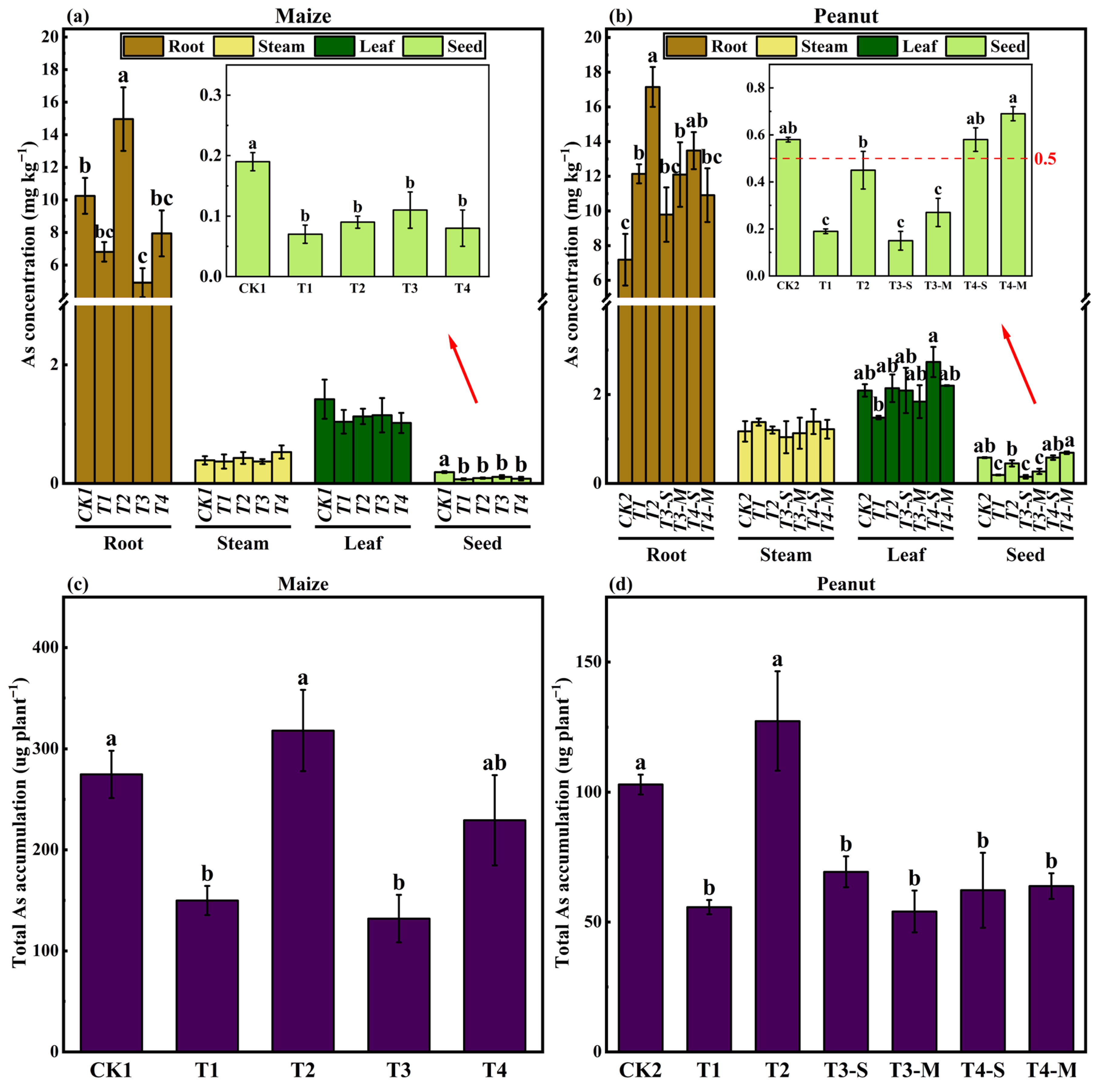
3.2. The As Content in Different Organs of Plants in Various Systems
3.3. Plant As BCF, TF, and MRER Under Different Planting Systems
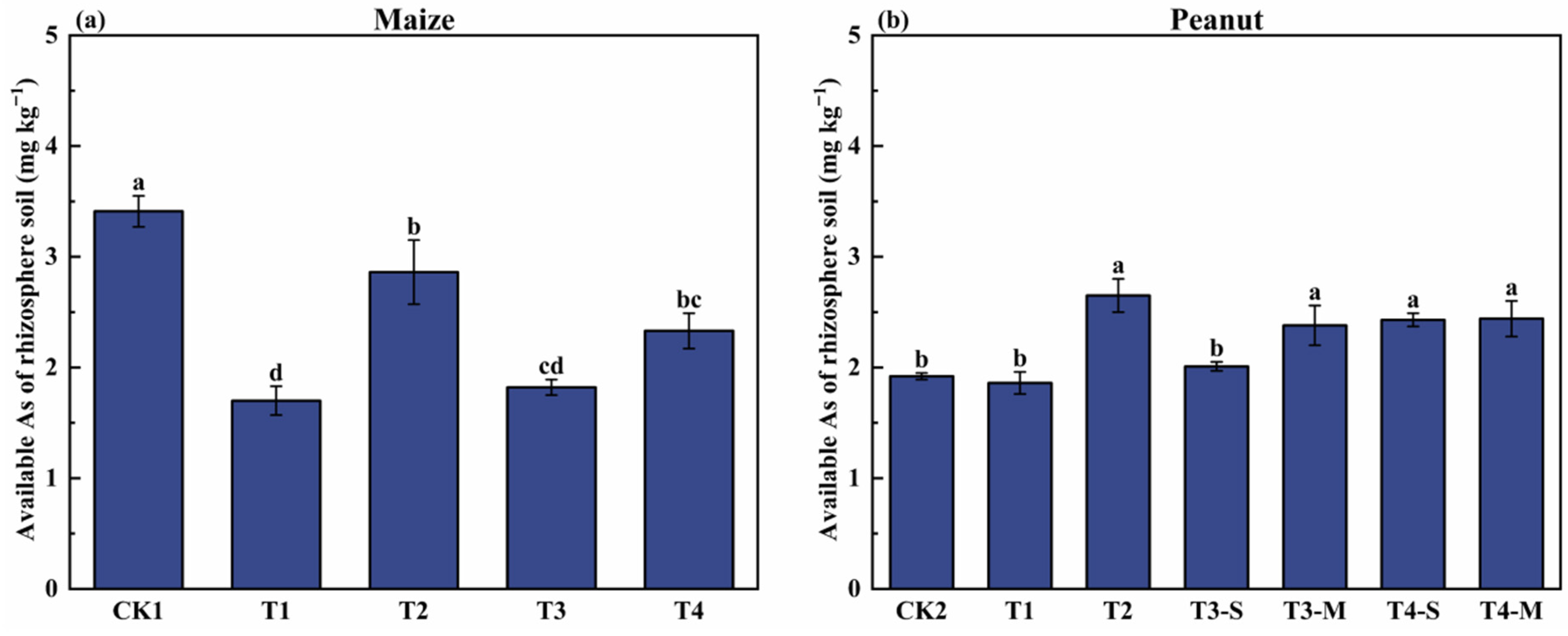
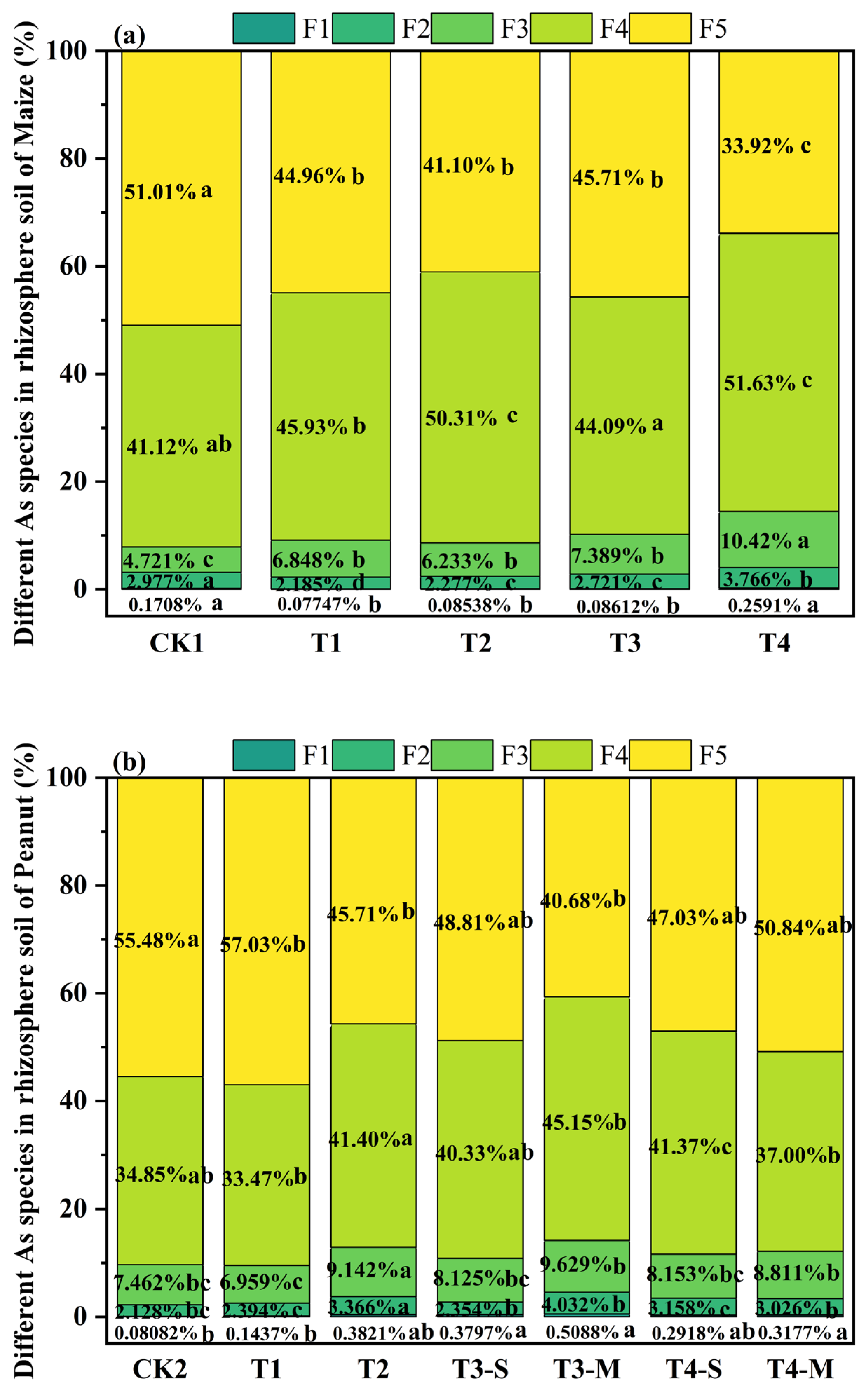
3.4. The Content of Available As and Different As Species in Rhizosphere Soil Under Various Systems
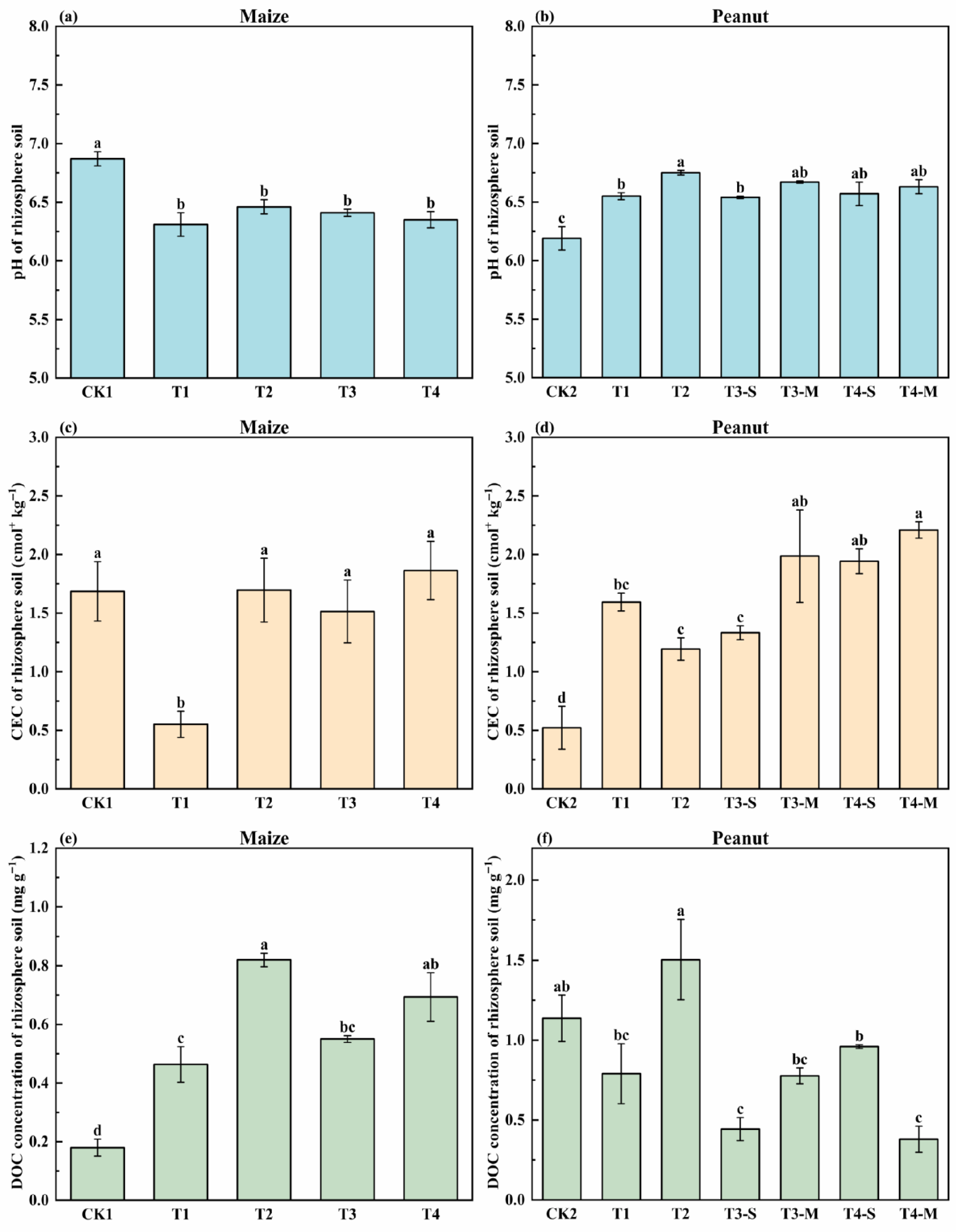
3.5. Traits of pH, CEC, and DOC in Rhizosphere Soil for Plants in Various Systems
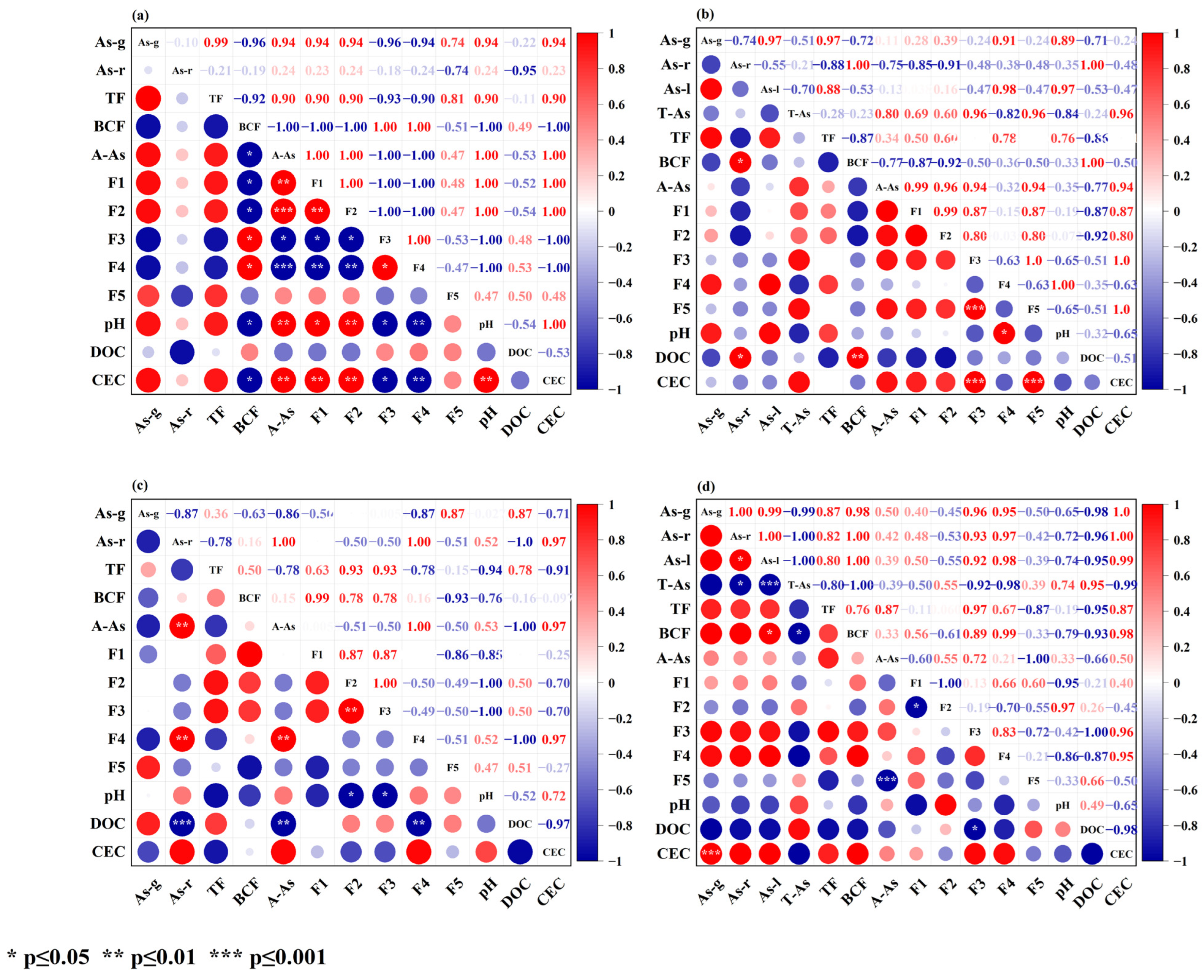
3.6. Correlation Analysis of the Physicochemical Properties of Rhizosphere Soil and As Uptake in Plants
4. Discussion
4.1. Biomasses and Yields of Plants in Various Systems
4.2. The Effects of Various Systems on As Absorption and Transfer in Plants
4.3. The Effects of Various Systems on the Physical and Chemical Factors of Plant Rhizosphere Soil
4.4. Ecosystem Services and Sustainable Biomass Management
5. Conclusions
Supplementary Materials
Author Contributions
Funding
Data Availability Statement
Conflicts of Interest
References
- Ministry of Environmental Protection of China. National Soil Pollution Survey Bulletin of China (2014); Ministry of Environmental Protection of China: Beijing, China, 2014.
- Gong, Y.; Qu, Y.; Yang, S.; Tao, S.; Shi, T.; Liu, Q.; Chen, Y.; Wu, Y.; Ma, J. Status of arsenic accumulation in agricultural soils across China (1985–2016). Environ. Res. 2020, 186, 109525. [Google Scholar] [CrossRef]
- Zhang, S.; Zhang, J.; Niu, L.; Chen, Q.; Zhou, Q.; Xiao, N.; Man, J.; Ma, J.; Wei, C.; Zhang, S.; et al. Escalating arsenic contamination throughout Chinese soils. Nat. Sustain. 2024, 7, 766–775. [Google Scholar] [CrossRef]
- Al-Makishah, N.H.; Taleb, M.A.; Barakat, M.A. Arsenic bioaccumulation in arsenic-contaminated soil: A review. Chem. Pap. 2020, 74, 2743–2757. [Google Scholar] [CrossRef]
- Chauhan, R.; Awasthi, S.; Tiwari, P.; Upadhyay, M.K.; Srivastava, S.; Dwivedi, S.; Dhankher, O.P.; Tripathi, R.D. Biotechnological strategies for remediation of arsenic-contaminated soils to improve soil health and sustainable agriculture. Soil Environ. Health 2024, 2, 100061. [Google Scholar] [CrossRef]
- Rehman, M.U.; Khan, R.; Khan, A.; Qamar, W.; Arafah, A.; Ahmad, A.; Ahmad, A.; Akhter, R.; Rinklebe, J.; Ahmad, P. Fate of arsenic in living systems: Implications for sustainable and safe food chains. J. Hazard. Mater. 2021, 417, 126050. [Google Scholar] [CrossRef]
- Antoniadis, V.; Shaheen, S.M.; Levizou, E.; Shahid, M.; Niazi, N.K.; Vithanage, M.; Ok, Y.S.; Bolan, N.; Rinklebe, J. A critical prospective analysis of the potential toxicity of trace element regulation limits in soils worldwide: Are they protective concerning health risk assessment?—A review. Environ. Int. 2019, 127, 819–847. [Google Scholar] [CrossRef] [PubMed]
- Mocek-Płóciniak, A.; Mencel, J.; Zakrzewski, W.; Roszkowski, S. Phytoremediation as an Effective Remedy for Removing Trace Elements from Ecosystems. Plants 2023, 12, 1653. [Google Scholar] [CrossRef]
- Cao, X.; Dong, Q.; Mao, L.; Yang, X.; Wang, X.; Zou, Q. Enhanced Phytoextraction Technologies for the Sustainable Remediation of Cadmium-Contaminated Soil Based on Hyperaccumulators—A Review. Plants 2025, 14, 115. [Google Scholar] [CrossRef]
- Guo, J.; Zheng, G.; Yang, J.; Chen, T.; Meng, X.; Xia, T. Safe utilization of cadmium- and lead-contaminated farmland by cultivating a winter rapeseed/maize rotation compared with two phytoextraction approaches. J. Environ. Manag. 2022, 304, 114306. [Google Scholar] [CrossRef]
- Yang, H.; Zhang, W.; Li, L. Intercropping: Feed More People and Build More Sustainable Agroecosystems. Eng. Agric. 2021, 8, 373–386. [Google Scholar]
- Kuyah, S.; Sileshi, G.W.; Nkurunziza, L.; Chirinda, N.; Ndayisaba, P.C.; Dimobe, K.; Öborn, I. Innovative agronomic practices for sustainable intensification in sub-Saharan Africa. A review. Agron. Sustain. Dev. 2021, 41, 16. [Google Scholar] [CrossRef]
- Lin, H.; Wang, Z.; Liu, C.; Dong, Y. Technologies for removing heavy metal from contaminated soils on farmland: A review. Chemosphere 2022, 305, 135457. [Google Scholar] [CrossRef]
- Wan, T.; Dong, X.; Yu, L.; Li, D.; Han, H.; Tu, S.; Wan, J. Influence of Pteris vittata-maize intercropping on plant agronomic parameters and soil arsenic remediation. Chemosphere 2024, 359, 142331. [Google Scholar] [CrossRef]
- Wang, W.; Yang, X.; Mo, Q.; Li, Y.; Meng, D.; Li, H. Intercropping efficiency of Pteris vittata with two legume plants: Impacts of soil arsenic concentrations. Ecotoxicol. Environ. Saf. 2023, 259, 115004. [Google Scholar] [CrossRef]
- Li, Y.; Yang, J.; Guo, J.; Zheng, G.; Chen, T.; Meng, X.; He, M.; Ma, C. Intercropped Amygdalus persica and Pteris vittata applied with additives presents a safe utilization and remediation mode for arsenic-contaminated orchard soil. Sci. Total Environ. 2023, 879, 163034. [Google Scholar] [CrossRef] [PubMed]
- Wan, X.; Lei, M. Intercropping efficiency of four arsenic hyperaccumulator Pteris vittata populations as intercrops with Morus alba. Environ. Sci. Pollut. Res. 2018, 25, 12600–12611. [Google Scholar] [CrossRef]
- Li, M.; Huang, X.; Li, W.; Huang, P.; Kou, Z.; Li, H. Effect of Peanut Intercropping on Arsenic Uptake and Remediation Efficiency of Plants in Arsenic-Contaminated Soil. Agronomy 2025, 15, 321. [Google Scholar] [CrossRef]
- Bian, F.; Zhang, X.; Li, Q.; Huang, Z.; Zhong, Z. Enhancement of Phytoremediation of Heavy Metal Pollution Using an Intercropping System in Moso Bamboo Forests: Characteristics of Soil Organic Matter and Bacterial Communities. Forests 2023, 14, 1895. [Google Scholar] [CrossRef]
- Seppelt, R.; Klotz, S.; Peiter, E.; Volk, M. Agriculture and food security under a changing climate: An underestimated challenge. iScience 2022, 25, 105551. [Google Scholar] [CrossRef]
- AbdElgawad, H.; Schoenaers, S.; Zinta, G.; Hassan, Y.M.; Abdel-Mawgoud, M.; Alkhalifah, D.H.M.; Hozzein, W.N.; Asard, H.; Abuelsoud, W. Soil arsenic toxicity differentially impacts C3 (barley) and C4 (maize) crops under future climate atmospheric CO2. J. Hazard. Mater. 2021, 414, 125331. [Google Scholar] [CrossRef]
- Ning, X.; Wang, S.; Long, S.; Dong, Y.; Li, L.; Nan, Z. Temporal distribution and accumulation pattern of cadmium and arsenic in the actual field calcareous soil-maize system, northwest China. Sci. Total Environ. 2023, 870, 162012. [Google Scholar] [CrossRef] [PubMed]
- Rosas-Castor, J.M.; Guzmán-Mar, J.L.; Hernández-Ramírez, A.; Garza-González, M.T.; Hinojosa-Reyes, L. Arsenic accumulation in maize crop (Zea mays): A review. Sci. Total Environ. 2014, 488–489, 176–187. [Google Scholar] [CrossRef]
- Cao, X.; Bai, L.; Zeng, X.; Zhang, J.; Wang, Y.; Wu, C.; Su, S. Is maize suitable for substitution planting in arsenic-contaminated farmlands? Plant Soil Environ. 2019, 65, 425–434. [Google Scholar] [CrossRef]
- Shi, L.; Wang, B.; Hu, Z.; Yang, H.H. Mechanism and Experiment of Full-Feeding Tangential-Flow Picking for Peanut Harvesting. Agriculture 2022, 12, 1448. [Google Scholar] [CrossRef]
- Yang, B.; Shan, J.; Xing, F.; Dai, X.; Wang, G.; Ma, J.; Adegoke, T.V.; Zhang, X.; Yu, Q.; Yu, X. Distribution, accumulation, migration and risk assessment of trace elements in peanut-soil system. Environ. Pollut. 2022, 304, 119193. [Google Scholar] [CrossRef]
- Zhang, X.; Liu, H.; Li, X.; Zhang, Z.; Chen, Z.; Ren, D.; Zhang, S. Ecological and health risk assessments of heavy metals and their accumulation in a peanut-soil system. Environ. Res. 2024, 252, 118946. [Google Scholar] [CrossRef]
- Wevar Oller, A.L.; Vezza, M.E.; Talano, M.A.; Agostini, E. Grain and Forage Legumes in an Arsenic-Polluted Agricultural Scenario. J. Plant Growth Regul. 2023, 42, 5332–5353. [Google Scholar] [CrossRef]
- Chi, G.; Fang, Y.; Zhu, B.; Guo, N.; Chen, X. Intercropping with Brassica juncea L. enhances maize yield and promotes phytoremediation of cadmium-contaminated soil by changing rhizosphere properties. J. Hazard. Mater. 2024, 461, 132727. [Google Scholar] [CrossRef]
- Wu, T.; Sun, H.-X.; Geng, L.-P.; Yang, S.-S.; Xue, P.-Y.; Gao, P.-P.; Han, M.-Z.; Liu, W.-J. Rhizosphere microbiota alleviate As accumulation in maize intercropped with peanut in long-term Cd and As co-contaminated farmland. Soil Environ. Health 2025, 3, 100162. [Google Scholar] [CrossRef]
- Wang, J.; Li, Z.; Zhu, Q.; Wang, C.; Tang, X. Review on arsenic environment behaviors in aqueous solution and soil. Chemosphere 2023, 333, 138869. [Google Scholar] [CrossRef]
- McBride, M.B. Arsenic and Lead Uptake by Vegetable Crops Grown on Historically Contaminated Orchard Soils. Appl. Environ. Soil Sci. 2013, 2013, 283472. [Google Scholar] [CrossRef]
- Zhang, X.; Dayton, E.A.; Basta, N.T. Predicting the modifying effect of soils on arsenic phytotoxicity and phytoaccumulation using soil properties or soil extraction methods. Environ. Pollut. 2020, 263, 114501. [Google Scholar] [CrossRef] [PubMed]
- Nelson, C.M.; Li, K.; Obenour, D.R.; Miller, J.; Misenheimer, J.C.; Scheckel, K.; Betts, A.; Juhasz, A.; Thomas, D.J.; Bradham, K.D. Relating soil geochemical properties to arsenic bioaccessibility through hierarchical modeling. J. Toxicol. Environ. Health Part A 2018, 81, 160–172. [Google Scholar] [CrossRef] [PubMed]
- Bedoussac, L.; Journet, E.-P.; Hauggaard-Nielsen, H.; Naudin, C.; Corre-Hellou, G.; Jensen, E.S.; Prieur, L.; Justes, E. Ecological principles underlying the increase of productivity achieved by cereal-grain legume intercrops in organic farming. A review. Agron. Sustain. Dev. 2015, 35, 911–935. [Google Scholar] [CrossRef]
- Motsomane, N.; Magadlela, A. Legume-grass intercropping systems improve soil health and plant nutrition. Plant Soil 2026, 1–17. [Google Scholar] [CrossRef]
- HJ/T 166-2004; Technical Specification for Soil Environmental Monitoring. Nanjing Institute of Environmental Sciences, Ministry of Environmental Protection: Nanjing, China, 2004.
- GB 15618-2018; Soil Environmental Quality Risk Management and Control Standards for Soil Pollution on Agricultural Land. Nanjing Institute of Environmental Sciences, Ministry of Environmental Protection: Nanjing, China, 2018.
- Zoz, T.; da Costa, A.; Steiner, F.; Zoz, A.; Witt, T.; Zuffo, A. Agronomic performance of creeping peanut (Arachis hypogaea L.), grown in different row spacing and plant densities under conditions of humid subtropical climate. Aust. J. Crop Sci. 2019, 13, 138–143. [Google Scholar] [CrossRef]
- Yang, X.; Qin, J.; Li, J.; Lai, Z.; Li, H. Upland rice intercropping with Solanum nigrum inoculated with arbuscular mycorrhizal fungi reduces grain Cd while promoting phytoremediation of Cd-contaminated soil. J. Hazard. Mater. 2021, 406, 124325. [Google Scholar] [CrossRef]
- Wenzel, W.W.; Kirchbaumer, N.; Prohaska, T.; Stingeder, G.; Lombi, E.; Adriano, D.C. Arsenic fractionation in soils using an improved sequential extraction procedure. Anal. Chim. Acta 2001, 436, 309–323. [Google Scholar] [CrossRef]
- Kang, Z.; Gong, M.; Li, Y.; Chen, W.; Yang, Y.; Qin, J.; Li, H. Low Cd-accumulating rice intercropping with Sesbania cannabina L. reduces grain Cd while promoting phytoremediation of Cd-contaminated soil. Sci. Total Environ. 2021, 800, 149600. [Google Scholar] [CrossRef]
- Zhan, X.; Zhou, L. Colorimetric determination of dissolved organic carbon in soil solution and water environment. China Environ. Sci. 2002, 22, 433–437. [Google Scholar]
- Li, L.; Yang, S.; Li, X.; Zhang, F.; Christie, P. Interspecific complementary and competitive interactions between intercropped maize and faba bean. Plant Soil 1999, 212, 105–114. [Google Scholar] [CrossRef]
- Kang, Z.; Zhang, W.; Qin, J.; Li, S.; Yang, X.; Wei, X.; Li, H. Yield advantage and cadmium decreasing of rice in intercropping with water spinach under moisture management. Ecotoxicol. Environ. Saf. 2020, 190, 110102. [Google Scholar] [CrossRef] [PubMed]
- GB 2762-2017; National Food Safety Standard: Maximum Levels of Contaminants in Foods. China National Standardization Administration: Beijing, China, 2017.
- Li, L.; Zou, Y.; Wang, Y.; Chen, F.; Xing, G. Effects of Corn Intercropping with Soybean/Peanut/Millet on the Biomass and Yield of Corn Under Fertilizer Reduction. Agriculture 2022, 12, 151. [Google Scholar] [CrossRef]
- Zhang, D.; Sun, Z.; Feng, L.; Bai, W.; Yang, N.; Zhang, Z.; Du, G.; Feng, C.; Cai, Q.; Wang, Q.; et al. Maize plant density affects yield, growth and source-sink relationship of crops in maize/peanut intercropping. Field Crops Res. 2020, 257, 107926. [Google Scholar] [CrossRef]
- Xia, H.; Wang, L.; Xue, Y.; Kong, W.; Xue, Y.; Yu, R.; Xu, H.; Wang, X.; Wang, J.; Liu, Z.; et al. Impact of Increasing Maize Densities on Agronomic Performances and the Community Stability of Productivity of Maize/Peanut Intercropping Systems. Agronomy 2019, 9, 150. [Google Scholar] [CrossRef]
- Yang, C.; Fan, Z.; Chai, Q. Agronomic and Economic Benefits of Pea/Maize Intercropping Systems in Relation to N Fertilizer and Maize Density. Agronomy 2018, 8, 52. [Google Scholar] [CrossRef]
- Ma, R.; Zan, Z.; Wang, C.; Zhao, S.; Kou, T.; Jiao, N. Effects of Multi-Year Maize–Peanut Intercropping and Phosphorus Application on Rhizosphere Soil Properties and Root Morphological and Microbial Community Characteristics. Agronomy 2025, 15, 913. [Google Scholar] [CrossRef]
- Rácz, A.; Vályi-Nagy, M.; Tar, M.; Irmes, K.; Szentpéteri, L.; Ujj, A.; Veresné Valentinyi, K.; Ladányi, M.; Kristó, I. Effects of Winter Cereals (Triticum aestivum L., Hordeum vulgare L., Triticosecale wittmack) and Winter Pea (Pisum sativum L.) Intercropping on Weed Cover in South-Eastern and Central Hungary. Agronomy 2023, 13, 1319. [Google Scholar] [CrossRef]
- Ma, J.; Lei, E.; Lei, M.; Liu, Y.; Chen, T. Remediation of Arsenic contaminated soil using malposed intercropping of Pteris vittata L. and maize. Chemosphere 2018, 194, 737–744. [Google Scholar] [CrossRef]
- Zhang, X.; Zhang, P.; Wei, X.; Peng, H.; Hu, L.; Zhu, X. Migration, transformation of arsenic, and pollution controlling strategies in paddy soil-rice system: A comprehensive review. Sci. Total Environ. 2024, 951, 175500. [Google Scholar] [CrossRef] [PubMed]
- Han, Z.; Yang, J.; Yan, Y.; Zhao, C.; Wan, X.; Ma, C.; Shi, H. Quantifying the impact of factors on soil available arsenic using machine learning. Environ. Pollut. 2024, 359, 124572. [Google Scholar] [CrossRef]
- Zhang, B.; Nasar, J.; Dong, S.; Zhou, X.; Gao, Q. Differential regulation of belowground rhizospheric ecosystem by biological and chemical nitrogen supplies: Implications for maize yield enhancement mechanisms. Plant Biol. 2024, 26, 1021–1032. [Google Scholar] [CrossRef] [PubMed]
- Tang, X.; He, Y.; Zhang, Z.; Wu, H.; He, L.; Jiang, J.; Meng, W.; Huang, Z.; Xiong, F.; Liu, J.; et al. Beneficial shift of rhizosphere soil nutrients and metabolites under a sugarcane/peanut intercropping system. Front. Plant Sci. 2022, 13, 1018727. [Google Scholar] [CrossRef] [PubMed]
- Kumar, M.; Ramanathan, A.L.; Mukherjee, A.; Verma, S.; Rahman, M.M.; Naidu, R. Hydrogeo-morphological influences for arsenic release and fate in the central Gangetic Basin, India. Environ. Technol. Innov. 2018, 12, 243–260. [Google Scholar] [CrossRef]
- Zeng, W.; Wan, X.; Lei, M.; Chen, T. Intercropping of Pteris vittata and maize on multimetal contaminated soil can achieve remediation and safe agricultural production. Sci. Total Environ. 2024, 915, 170074. [Google Scholar] [CrossRef] [PubMed]
- Tang, Z.; Liang, M.; Ding, Y.; Liu, C.; Zhang, Q.; Wang, D.; Zhang, X. Fe3O4/Mulberry Stem Biochar as a Potential Amendment for Highly Arsenic-Contaminated Paddy Soil Remediation. Toxics 2024, 12, 765. [Google Scholar] [CrossRef]
- Verbeeck, M.; Thiry, Y.; Smolders, E. Soil organic matter affects arsenic and antimony sorption in anaerobic soils. Environ. Pollut. 2020, 257, 113566. [Google Scholar] [CrossRef]
- Zhang, X.; Wei, L.; Yang, C.; Xie, Y.; Niu, J. Iron-loaded biochar for dual remediation of arsenic-contaminated saline-alkali soil. Environ. Technol. Innov. 2025, 40, 104459. [Google Scholar] [CrossRef]
- Chen, D.; Ye, X.; Jiang, Y.; Xiao, W.; Zhang, Q.; Zhao, S.; Shao, S.; Gao, N.; Huang, M.; Hu, J. Continuously applying compost for three years alleviated soil acidity and heavy metal bioavailability in a soil-asparagus lettuce system. Front. Plant Sci. 2022, 13, 972789. [Google Scholar] [CrossRef]
- Hu, L.; Ge, Y.; Zhou, L.; Li, Z.; Li, A.; Deng, H.; He, T. The Effects of Different Straw-Returning Methods on Soil Organic Carbon Transformation in Rice–Rape Rotation Systems. Agriculture 2025, 15, 1468. [Google Scholar] [CrossRef]
- Li, M.; Meng, D.; Huang, P.; Kama, R.; Ma, C.; Li, H. A “Win-Win” Strategy in Highly Arsenic-Contaminated Soils: Intercropping Cash Crops with Soil Amendments to Achieve Production While Remediating. J. Hazard. Mater. 2026, 504, 141368. [Google Scholar] [CrossRef]
- Ebbisa, A. Mechanisms underlying cereal/legume intercropping as nature-based biofortification: A review. Food Prod. Process. Nutr. 2022, 4, 19. [Google Scholar] [CrossRef]
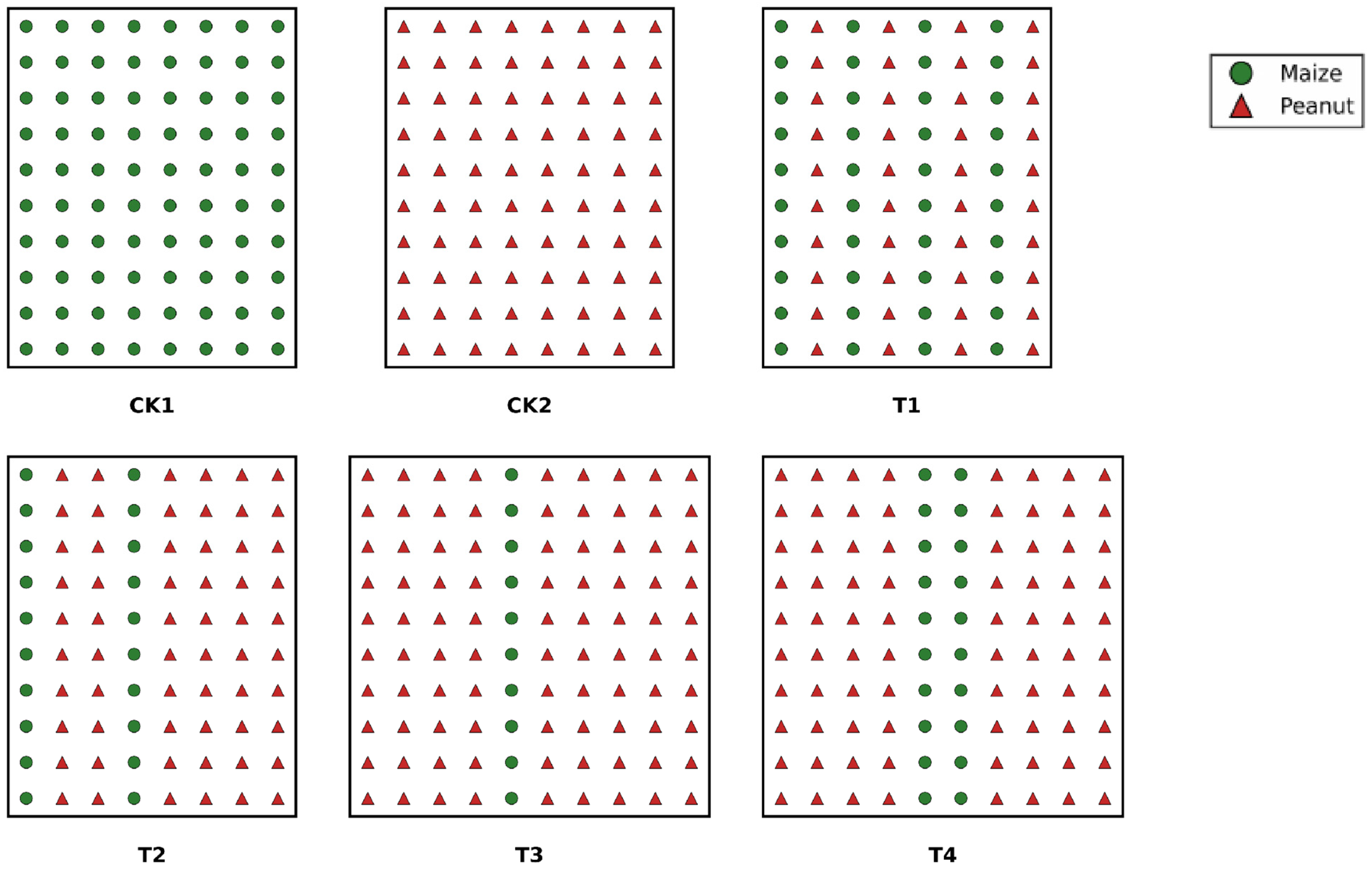




| Treatment | Planting Modes | Maize | Peanut | Maize–Peanut Inter-Row Spacing (cm) | Weighted Plant Density (×104 Plants ha−1) | ||
|---|---|---|---|---|---|---|---|
| Row Spacing (cm) | Intra-Row Spacing (cm) | Row Spacing (cm) | Intra-Row Spacing (cm) | ||||
| CK1 | Maize monocropping | 60 | 60 | - | - | - | 2.78 |
| CK2 | Peanut monocropping | - | - | 40 | 40 | - | 6.25 |
| T1 | 1 row of maize 1 row of maize | 60 | 60 | 60 | 40 | 20 | 4.52 |
| T2 | 1 row of maize 2 rows of peanut | 60 | 60 | 60 | 40 | 20 | 5.06 |
| T3 | 1 row of maize 4 rows of peanut | 60 | 60 | 60 | 40 | 20 | 5.60 |
| T4 | 2 rows of maize 4 rows of peanut | 60 | 60 | 60 | 40 | 20 | 5.06 |
| Crops | Items | Organs | Treatments | ||||
|---|---|---|---|---|---|---|---|
| CK1 | T1 | T2 | T3 | T4 | |||
| Maize | Biomass (g plant−1) | Roots | 17.10 ± 0.91 b | 13.28 ± 0.11 c | 16.55 ± 0.49 b | 13.86 ± 0.53 c | 22.09 ± 0.96 a |
| Steams | 54.73 ± 0.53 a | 40.52 ± 1.05 b | 52.85 ± 2.72 a | 36.73 ± 1.83 bc | 31.93 ± 1.91 c | ||
| Leaves | 36.60 ± 0.16 a | 34.7 ± 0.93 ab | 31.28 ± 0.11 bc | 29.97 ± 0.65 c | 28.36 ± 2.01 c | ||
| Seeds | 129.99 ± 0.61 a | 128.64 ± 14.88 a | 135.50 ± 0.94 a | 135.65 ± 2.70 a | 80.51 ± 3.56 b | ||
| Yield (kg ha−1) | 8666.00 ± 40.41 b | 10,720.00 ± 1240.34 a | 6775.00 ± 47.05 c | 1507.22 ± 29.96 d | 1342.89 ± 59.37 d | ||
| LER | - | 1.88 | 1.25 | 0.43 | 0.26 | ||
| Crops | Items | Organs | Treatments | ||||||
|---|---|---|---|---|---|---|---|---|---|
| CK2 | T1 | T2 | T3-S | T3-M | T4-S | T4-M | |||
| Peanut | Biomass (g plant−1) | Roots | 3.20 ± 0.47 AB | 1.06 ± 0.51 C | 3.74 ± 0.19 A | 2.13 ± 0.39 BC | 1.97 ± 0.30 BC | 1.45 ± 0.23 C | 2.27 ± 0.03 BC |
| Steams | 24.44 ± 1.05 A | 16.82 ± 1.51 AB | 16.92 ± 2.06 AB | 20.89 ± 6.18 AB | 12.58 ± 2.18 B | 13.48 ± 1.92 B | 12.12 ± 2.98 B | ||
| Leaves | 21.65 ± 1.20 A | 11.71 ± 1.27 BCD | 16.98 ± 2.80 AB | 15.19 ± 3.28 BC | 8.34 ± 0.35 D | 7.35 ± 2.22 D | 9.91 ± 1.70 CD | ||
| Seeds | 13.83 ± 0.57 AB | 14.23 ± 1.15 AB | 10.46 ± 0.17 BC | 15.87 ± 3.51 A | 4.98 ± 1.07 D | 7.21 ± 0.18 CD | 4.87 ± 0.39 D | ||
| Yield (kg ha−1) | 922.22 ± 38.25 A | 592.92 ± 48.11 B | 435.83 ± 6.96 C | 352.67 ± 78.08 C | 110.67 ± 23.88 D | 120.25 ± 2.93 D | 81.17 ± 6.53 D | ||
| Crops | Treatments | BCF of Plant/Soil | TF of Shoot/Root | Crops | Treatments | BCF of Plant/Soil | TF of Shoot/Root | MRER |
|---|---|---|---|---|---|---|---|---|
| Maize | CK1 | 0.29 ± 0.02 b | 0.20 ± 0.05 ab | Peanut | CK2 | 0.15 ± 0.03 c | 0.57 ± 0.14 a | - |
| T1 | 0.28 ± 0.02 bc | 0.22 ± 0.04 ab | T1 | 0.26 ± 0.05 abc | 0.25 ± 0.02 b | 1.09 | ||
| T2 | 0.39 ± 0.05 a | 0.11 ± 0.02 b | T2 | 0.37 ± 0.12 a | 0.22 ± 0.01 b | 2.41 | ||
| T3 | 0.11 ± 0.02 d | 0.34 ± 0.07 a | T3-S | 0.2 ± 0.02 bc | 0.37 ± 0.22 ab | 1.07 | ||
| -M | 0.27 ± 0.09 abc | 0.27 ± 0.04 b | ||||||
| T4 | 0.18 ± 0.04 cd | 0.21 ± 0.02 ab | T4-S | 0.32 ± 0.02 ab | 0.35 ± 0.04 b | 1.46 | ||
| -M | 0.31 ± 0.06 ab | 0.39 ± 0.09 ab |
Disclaimer/Publisher’s Note: The statements, opinions and data contained in all publications are solely those of the individual author(s) and contributor(s) and not of MDPI and/or the editor(s). MDPI and/or the editor(s) disclaim responsibility for any injury to people or property resulting from any ideas, methods, instructions or products referred to in the content. |
© 2026 by the authors. Licensee MDPI, Basel, Switzerland. This article is an open access article distributed under the terms and conditions of the Creative Commons Attribution (CC BY) license.
Share and Cite
Kou, Z.; Li, W.; Wei, Y.; Tang, Y.; Li, M.; Chen, Z.; Li, H. Influence of Various Intercropping Ratios on Arsenic Absorption and Remediation Efficiency in Maize/Peanut on Farmland Contaminated by Arsenic. Agronomy 2026, 16, 638. https://doi.org/10.3390/agronomy16060638
Kou Z, Li W, Wei Y, Tang Y, Li M, Chen Z, Li H. Influence of Various Intercropping Ratios on Arsenic Absorption and Remediation Efficiency in Maize/Peanut on Farmland Contaminated by Arsenic. Agronomy. 2026; 16(6):638. https://doi.org/10.3390/agronomy16060638
Chicago/Turabian StyleKou, Zhansheng, Wanlin Li, Ye Wei, Yisheng Tang, Miao Li, Zipeng Chen, and Huashou Li. 2026. "Influence of Various Intercropping Ratios on Arsenic Absorption and Remediation Efficiency in Maize/Peanut on Farmland Contaminated by Arsenic" Agronomy 16, no. 6: 638. https://doi.org/10.3390/agronomy16060638
APA StyleKou, Z., Li, W., Wei, Y., Tang, Y., Li, M., Chen, Z., & Li, H. (2026). Influence of Various Intercropping Ratios on Arsenic Absorption and Remediation Efficiency in Maize/Peanut on Farmland Contaminated by Arsenic. Agronomy, 16(6), 638. https://doi.org/10.3390/agronomy16060638