


Abstract
Plants adapt to abiotic stresses by modulating morphological, physiological, and biochemical processes, which constitute the fundamental mechanisms of stress tolerance. Rice is highly susceptible to drought stress at all developmental stages, leading to substantial reductions in growth and yield, signifying the urgent need to develop drought-tolerant rice genotypes. In this study, recombinant inbred lines (RILs) in rice with enhanced drought tolerance were developed through a cross between the high-yielding rice variety BRRI-28 and the commercial variety BINA-7, followed by successive selfing and phenotypic selection. The resulting lines were evaluated using integrated morphological, physiological, biochemical, and anatomical analyses under well-watered (WW) and drought conditions (DC). BRRIdhan-56, a known drought-tolerant variety, was included as a check genotype. Among the tested lines, RIL-3 exhibited superior agronomic performance under DC, including a significantly higher tiller number, plant height, and seed dry weight, and improved root attributes compared with its parental lines and, for several traits, exceeding those of BRRIdhan-56. Leaf rolling was absent in RIL-3 and the check variety until the 23rd day of drought stress, whereas other genotypes exhibited varying degrees of stress symptoms. Panicle exertion under DC was observed exclusively in RIL-3 and the check. Although all genotypes showed reductions in biomass, relative water content, and chlorophyll levels under DC, RIL-3 consistently maintained higher values than its parental lines and comparable or superior levels to the check variety. Notably, RIL-3 exhibited a distinctive physiological response characterized by sustained chlorophyll retention and low proline accumulation under severe drought, in contrast to the high proline levels observed in sensitive lines. A root anatomical analysis further revealed well-developed aerenchyma formation in RIL-3 following drought treatment, supporting its drought tolerance. Together, these results demonstrate that RIL-3 combines an enhanced drought tolerance with a stable agronomic and yield-related performance and a unique physiological trait profile under drought stress, highlighting its potential value as a promising genotype for drought-tolerance breeding programs.
1. Introduction
Rice (Oryza sativa L.) is a leading staple crop and fundamental component of global agriculture, providing food security and nutrition to more than one-third of the world’s population, and supplying 50–76% of dietary energy [1,2,3,4,5]. However, despite projections that global rice production must double by 2050 to meet population demands, current growth rates need to increase to 55% by 2050 with the limited ground, water, energy, and other facilities [6,7]. As a predominantly rain-fed crop, rice cultivation is subject to drought, which limits its genetic potential and reduces crop yield, leading to economic loss [8,9,10,11]. Climate change and global warming further exacerbate the risks to rice production [12,13,14]. To address these challenges, breeding for high-yielding and drought-tolerant genotypes must be the prime theme of research in the future. Therefore, genotype screening, selection from breeding, and research for target-oriented and sustainable breeding would help in increasing the yield capacity.
Progress in breeding drought-tolerant rice has been hindered by the scarcity of suitable donors with a high level of drought tolerance and suitable screening methods [15,16]. Genotype selection through phenotypic screening has become a powerful method in drought-tolerant crop improvement [17,18]. Selected genotypes through screening often exhibit a wide range of beneficial traits, like improved yield and disease resistance, as well as stress tolerance, making classical breeding a vital strategy for developing resilient crops, even though it remains a formidable challenge [19]. Bangladesh is one of the centers of origin of rice, and most drought-tolerant accessions (73% of total tolerant accessions) originate from Bangladesh, followed by India [20]. Consequently, the genotype screening of Bangladeshi accessions may be preferable for breeding drought-tolerant varieties.
Climate change is expected to aggravate water scarcity, with rising temperatures further intensifying drought stress [21,22]. Rice suffers significant damage due to water scarcity, and over 70 million hectares of rice-cultivable land in the world are affected by water scarcity [23,24,25]. Population growth and climate variability in rainfall and temperature are projected to reduce rice yields substantially in the near future [26,27]. According to an estimate, climate fluctuations affect 53% of the world’s rice-growing regions, reducing yields at a rate of 0.1 t/ha/year [28]. Drought stress due to water scarcity is considered the most significant challenge for rice cultivation throughout the world. Drought stress exerts a more severe impact on rice yield than biotic stresses, with reductions nearly double in magnitude [29]. Therefore, current agricultural investigations should emphasize understanding drought tolerance, particularly during the critical stages of growth and development, to accelerate the development of drought-tolerant cultivars [30].
Rice responses to drought are complex and involve various physiological, biochemical, and molecular changes [31,32,33]. A reduced water content, decreased water potential, loss of leaf cell turgor, and stomatal closure are the major signs and symptoms of drought stress limiting photosynthesis and reducing growth, development, and yield [9,34,35]. Chlorophyll pigments and the photosynthetic electron transport system are also degraded under drought stress [36], resulting in the generation of reactive oxygen species (ROS) [37]. The accumulation of low-molecular-weight metabolites, such as proline, enhances drought tolerance by regulating cell osmotic potential during stress. Beyond its role in osmotic adjustment, proline contributes to plant development and responses to stresses [38,39]. Proline is rapidly induced under drought compared to other amino acids, often reaching high concentrations [40,41]. Therefore, proline has been proposed as an assessing criterion for choosing drought-tolerant cultivars.
A healthy and robust root system enhances the capacity of crops to absorb additional water. An improved root morphology and well-developed root architecture play important roles in plant adaptation to drought stress [42,43,44]. Root length and branching, a small fine root diameter, a long specific root length and density, and increased root volumes are strongly associated with plant growth, development, and survival under drought stress [45]. Drought potentially decreases the nutrient availability and soil water content and significantly affects the root characteristics [46,47]. The efficiency of the water uptake is closely linked to the presence of an extensive root length in deeper layers of the soil [48,49]. Many factors responsible for the regulation of the root architecture under drought have proven to be beneficial for developing drought-tolerant crops. Rice possesses a fibrous root system with multiple branching orders that play a significant function in nutrient translocation and absorption under stress conditions [50].
Plants acclimate to adverse environments by regulating morpho-physiological, biochemical, and molecular processes, which constitute key tolerance mechanisms. Thus, the identification and selection of stress-tolerant genotypes from the hybridization between different varieties and the application of reliable selection indices for tolerance are crucial for variety development programs. Recombinant inbred lines (RILs) represent a valuable genetic resource in classical plant breeding and have been extensively utilized over time for the development of stress-resilient crop varieties. Their genetic stability, fixed through repeated selfing from a bi-parental cross, enables a consistent phenotypic evaluation and the effective selection of superior genotypes for complex drought-responsive traits. In this study, drought tolerance in rice was assessed among RILs at the F7 generation, developed from a cross between BRRI-28 and BINA-7, and their parental lines cultivated in the natural field without and with a moderate drought stress and polyvinyl chloride (PVC) pipes without and with severe drought stress. Drought stress was imposed during the vegetative (mid-tillering stage) to the reproductive stage by withholding water treatment, ensuring that all genotypes experienced the same level of drought stress at the same developmental stage. Furthermore, the levels of resistance were characterized based on morphological, physiological, biochemical, and anatomical features to investigate drought tolerance among RILs in response to drought stress across vegetative and reproductive stages.
2. Materials and Methods
2.1. Materials Collection, Cultivation, and Selection
This study was conducted at the rice research field and the Molecular Genetics Laboratory of the Department of Genetic Engineering and Biotechnology, University of Rajshahi, Rajshahi-6205, Bangladesh. The high-yielding and high-quality rice lines BRRIdhan-28 and BINA-7 were used as parental materials. The RILs were developed by crossing BRRI-28 and BINA-7, followed by successive self-pollination and phenotypic selection up to the F7 generation. At this stage, the lines were considered genetically stabilized and suitable for phenotypic and physiological evaluation under drought stress. BRRI-56, a known drought-tolerant variety, was included solely as a drought-tolerant check genotype to benchmark the performance of the RILs and parental lines under drought stress conditions. All rice lines were collected from the Bangladesh Rice Research Institute (BRRI), Gazipur. Through selfing and selection, a set of 200 progenies at F7 generation was developed using the pedigree selection method. The major agronomic and yield-related traits of the parental lines, the three RILs, and the check variety under both normal (well-watered; WW) and moderate drought conditions (DC) in the field were evaluated to observe phenotypic performance of the RILs. The traits included plant height at maturity, tillering ability per hill, flowering synchrony (days to flowering), panicle exertion ability, panicle number per hill, panicle length, seed setting rate, 100-grain weight, and drought avoidance tendency (leaf rolling score). Drought stress was induced by water withholding, ensuring that plants experienced significant stress without being wilted. Symptoms and score of leaf rolling feature were observed following established screening procedures [51,52,53]. Finally, 37 RILs were selected based on their phenotypic superiority and further screened for drought tolerance using polyethylene glycol (PEG-6000; Merck, Mumbai, India), following a previous study [54], and we selected 3 lines exhibiting superior performance.
2.2. PVC Pipe-Based Cylinder Cultivation and Drought Treatment
For further evaluation, three lines—designated as RIL-1, RIL-2, and RIL-3—were selected based on their high degree of drought tolerance [54]. BRRIdhan-56 was included as a drought-tolerant check. A sufficient number of seeds from two parents, their RILs, and the control (BRRIdhan-56) were germinated in plastic pots filled with field soil, collected from the experimental field of the university, under natural environmental conditions for up to 25 days. Three uniform and healthy seedlings from each material were then transplanted in PVC pipes (50 cm height and 18 cm diameter) containing thoroughly mixed 15 kg of field soil, collected from the experimental field of the university, and 12 g of fertilizers (4 g each of urea, phosphate, and potash). Soil texture was silt-loam. After 30 days from transplantation, only a single healthy plant was maintained in each pipe with three biological replications. Pipes were arranged in a randomized complete block design (RCBD) across six blocks in a laboratory corridor under natural sunlight, protected from rainfall. Three of the blocks were subjected to drought stress, while the remaining three served as controls for each line. Each pipe received 1 g of urea at the beginning of the tillering phase. Until the drought treatment started, all of the plants received an equal amount of irrigation. During the mid-tillering stage at 60 days after transplantation, drought stress was implemented by stopping the water supply in the treatment pipes, and the other pipes were used as a control for each line that received need-based irrigation. Drought stress treatment was continued until all the leaves of the treated plants folded following established procedures [54,55]. After 23 days of water withholding, treated plants were re-watered to permit recovery. Temperature and humidity were monitored daily throughout the treatment period.
2.3. Determination of Phenotypic Traits
The morphological data were recorded from three replications per genotype. Above-ground traits like tiller number (TN), plant height (PH), leaf rolling status, shoot fresh weight (SFW), and shoot dry weight (SDW) were recorded from treated and control plants at 21 days of treatment, when complete leaf folding occurred. Panicle emergence was recorded after complete extension of the panicle after recovery. At the end of the experiments, root traits were recorded. All plants were cut at the soil surface, and roots with soil were removed from PVC pipes, placed on a soil-washing stand with a 2 mm filter, and carefully handled to preserve their integrity. Then root traits like maximum root length (MRL), total root fresh weight (TRFW), deep root fresh weight (DRFW), total root dry weight (TRDW), shallow root fresh weight (SRFW), deep root length (DRL), shallow root dry weight (SRDW), shallow root diameter (SRD), deep root diameter (DRD), deep root dry weight (DRDW), and nodal root number (NRN) were measured.
2.4. Soil Moisture Content Measurement
Soil samples were collected from three distinct positions within each pipe replication at a depth of 15 to 30 cm. To determine the soil moisture, the fresh soil samples were measured, dried, and then reweighed. The percentage of soil moisture was calculated using the following equation [56].
2.5. Dry Matter Estimation from Leaf and Root
Fresh leaf and root samples were initially weighed to obtain fresh weight (FW). Samples were then oven-dried for 72 h at 80 °C to determine their dry weight (DW). The following equation was applied to obtain the dry matter using the FW and DW values [57].
2.6. Relative Water Content of Leaf and Root
The collected fresh leaves and root samples were immediately weighed to determine the fresh weight (FW), which was then used to determine their relative water content. Then, samples were oven-dried for 72 h at 80 °C and weighed to determine their dry weight (DW). The relative water content was obtained by using the values of FW and DW. Relative water content was calculated as a percentage of fresh weight using the following equation [58].
2.7. Estimation of Chlorophyll a, Chlorophyll b, and Total Chlorophyll
Fresh leaf samples (200 mg) were collected from treated and untreated plants and smashed with a mortar and pestle in 10 mL of 80% cooled acetone and centrifuged for 10 min at 10,000 rpm. Then, the supernatant was obtained and used for examination. A UV–visible spectrophotometer was used to determine the amounts of several photosynthetic pigments at 645 and 663 nm. As a blank, an 80% acetone solution was utilized. The following equations were used to determine the concentrations of chlorophyll a, chlorophyll b, and total chlorophyll [59].
2.8. Estimation of Proline Contents in Leaves
Proline content was determined using the acid–ninhydrin method [40]. Acid–ninhydrin was prepared for this experiment by warming and stirring 1.25 g of ninhydrin with 30 mL of glacial acetic acid and 20 mL of 6 M phosphoric acid until the mixture dissolved. The mixture was then refrigerated at 4 °C until use. The homogenate from 500 g of leaf samples was centrifuged at 10,000 rpm for 10 min after being homogenized in 10 mL of 3% liquid sulfosalicylic acid. In a water bath, 2 mL supernatant was reacted with 2 mL of acid ninhydrin and 2 mL of glacial acetic acid at 100 °C for 1 h, then transferred to an ice bath to stop the reaction. After that, 4 mL of toluene was mixed with the reacted supernatant using vortex agitation (15–20 s). A double-beam spectrophotometer was used to determine the toluene layer at 520 nm after aspiration. Proline content was estimated against a standard curve using L-proline as a standard.
2.9. Root Anatomy Investigation
Root anatomical features were examined following the methods of Singh et al. [60]. Collected treated and untreated root samples were cleaned with tap water and placed in formalin aceto-alcohol (FAA) solution for 4 h at room temperature. The samples were then transferred to a new FAA solution and kept at 4 °C until sectioning. Very thin transverse sections were prepared from root samples using a sharp blade placed into the potato pith. Sections were stained with safranin and observed under a light microscope. Root aerenchyma space was also observed manually from the microscopic photograph.
2.10. Statistical Analysis of Morphological Data
Morphological data variability was assessed using standard statistical measures, including mean, range, phenotypic and genotypic variances, and coefficients of variation using biometrical techniques developed based on the mathematical model of Fisher et al. [61]. The correlation coefficient among the above-ground traits and root traits was calculated using the equation of Haase et al. [62]. The experiment was carried out in triplicate, and the data presented are mean values ± standard deviation of three independent replicates (N = 3) and presented in tables and column bars using Microsoft Excel 13. Calculated data were further analyzed, followed by one-way analysis of variance (ANOVA) implemented in IBM SPSS Statistics software (version 26). Mean separation was performed using the Least Significant Difference (LSD) test at 5% significance level (p < 0.05).
3. Results
3.1. Screening and Phenotypic Evaluation of RILs Under Field and Controlled Drought Conditions
3.1.1. Field-Based Screening of RILs Under Normal and Moderate Drought Conditions
In this study, a total of 200 F7 RILs, along with their parental lines, were evaluated under field conditions under both normal irrigation and moderate drought stress. Key agronomic and yield-related traits were recorded, including plant height at maturity, tiller number per hill, panicle exertion ability, panicle length and number, days to heading and flowering synchrony, seed setting rate (fertility percentage), 100-grain weight, and leaf rolling score (Supplementary Tables S1–S4). Significant variation was observed among the parental lines and RILs for most evaluated traits under both conditions. In general, the parental lines exhibited reduced performance under moderate drought compared to normal irrigation. In contrast, several RILs maintained stable performance across environments. Notably, RIL-3 did not exhibit a yield penalty under drought stress. It maintained a superior tiller number, panicle characteristics, seed fertility, and 100-grain weight compared to the parental lines (Supplementary Table S4), indicating that the enhanced drought tolerance in RIL-3 was not associated with reduced productivity. Based on the overall phenotypic superiority and drought avoidance capacity, evidenced by the lower leaf rolling scores and absence of wilting symptoms, 37 RILs were selected for further evaluation. These selected lines were subsequently screened under polyethylene glycol (PEG-6000)-induced osmotic stress, from which three promising lines (RIL-1, RIL-2, and RIL-3) exhibiting a superior drought tolerance were identified and selected for a controlled drought evaluation using a PVC pipe experiment (Supplementary Tables S5 and S6).
3.1.2. Phenotypic Performance of Selected RILs and Parents Under Drought Conditions (Pipe Experiment)
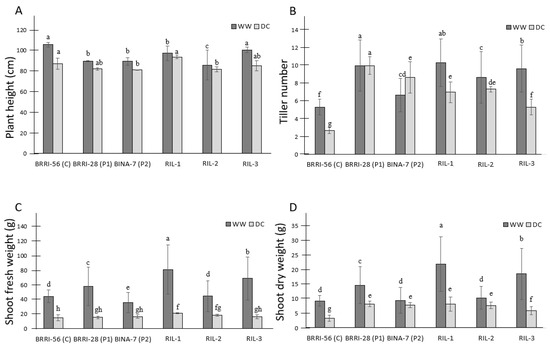
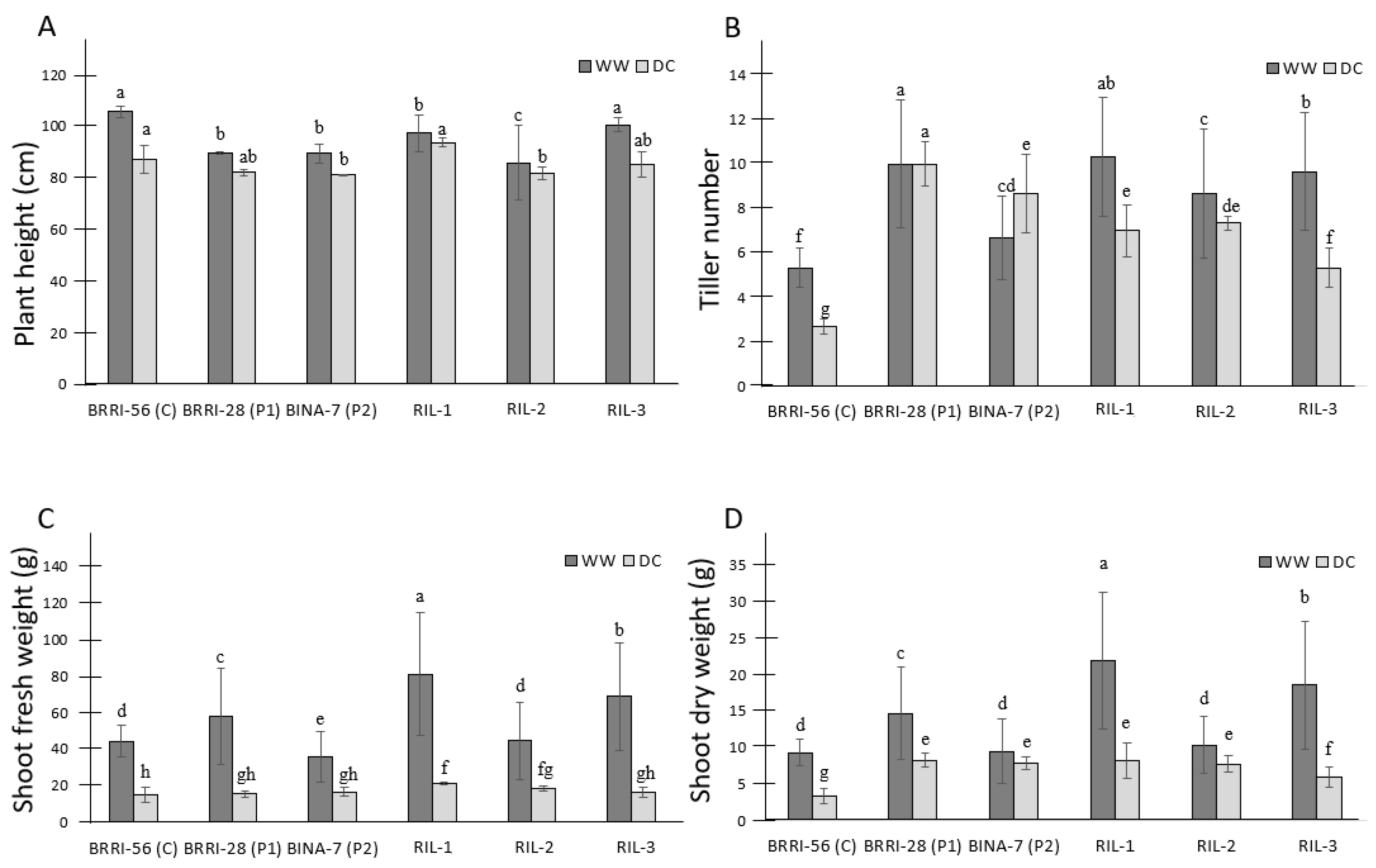
The three selected RILs were further evaluated using a PVC pipe-based cylinder cultivation system to assess their performance under controlled drought stress. Drought treatment was imposed at the tillering stage, and agronomic traits were recorded at physiological maturity. Plant height (PH), tiller number (TN), shoot fresh weight (SFW), and shoot dry weight (SDW) were significantly reduced under drought conditions (DC) compared with well-watered (WW) conditions across all genotypes (Figure 1). Under DC, the highest plant height was recorded in RIL-1 (93.53 cm), followed by the drought-tolerant check BRRI-56 (87.07 cm) and RIL-3 (85.07 cm). Similarly, RIL-1 exhibited the highest shoot fresh weight (20.85 g), followed by RIL-2 (18.33 g). The highest shoot dry weight (8.24 g) and tiller number were observed in BRRI-28, with RIL-1 showing comparable SDW (8.16 g). Although reductions were evident under drought stress, the selected RILs maintained a competitive performance relative to the parental lines and the check variety, indicating differential drought responses among genotypes.
Figure 1.
Morphological features of the genotypes under stress treatment; (A) plant height in cm, (B) tiller number, (C) shoot fresh weight in grams, and (D) shoot dry weight in grams. Error bars indicate the standard error of the mean values. Mean values were calculated from individual values of three plants per treatment and genotype (N = 3). WW: well-watered, DC: drought condition. Statistical significance was determined via one-way ANOVA. Mean separation was performed using the Least Significant Difference (LSD) test at 5% significance level. Bars sharing the same letter are not significantly different, whereas different letters indicate statistically significant differences between means at p < 0.05. The ANOVA is reported in Supplementary Table S7.
3.2. Survival Rates, Leaf Rolling, Root, and Panicle Features Under Drought Stress
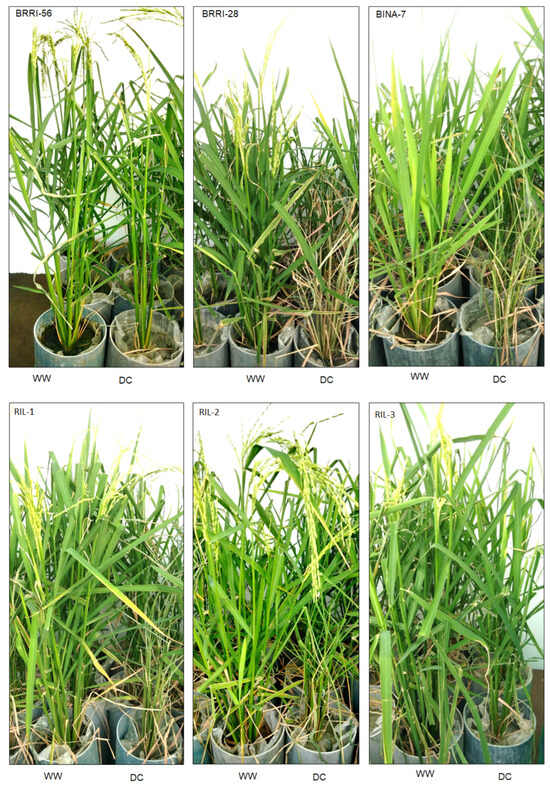
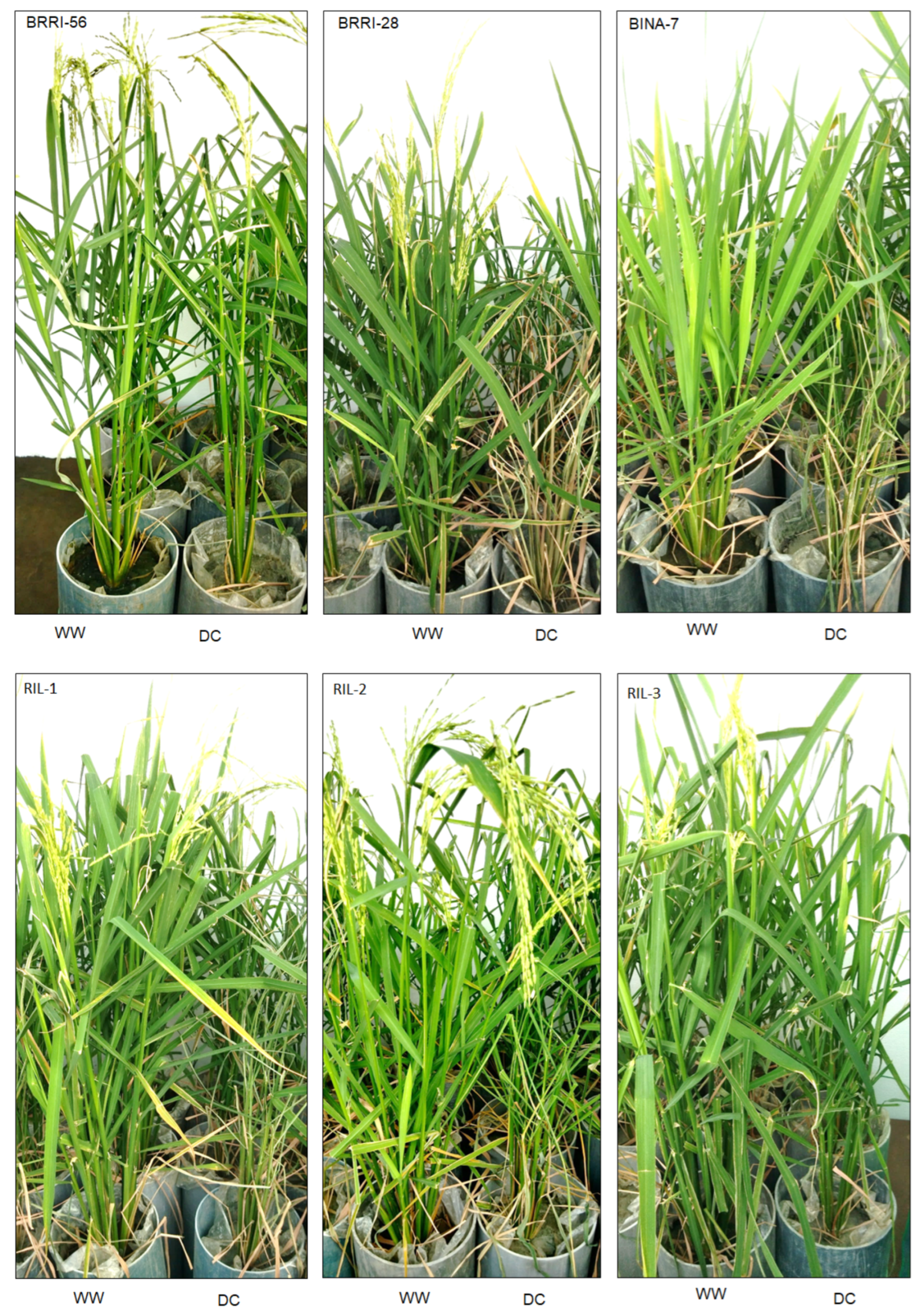
Upon drought treatment, plant wilting and leaf rolling were monitored regularly until the 23rd day of water withholding. Drought stress markedly reduced plant survival. Except for control and RIL-3, other genotypes wilted severely, nearing death (Figure 2). Leaf features were also drastically affected. Under WW conditions, plant damage was not observed in any genotype, whereas, under DC, the damage appeared on the 10th day of drought stress in BRRI-28 (P1) and the 17th day of drought stress in BINA-7 (P2). The control variety BRRI-56 and RIL-3 showed no plant death throughout the 23-day drought period.
Figure 2.
Phenotypic response and survival status of rice genotypes following 23 days of water withholding. WW: well-watered condition, DC: drought condition (no water supply), RIL-1: recombinant inbred lines no. 17 selected at F7 generation from the progeny row (F1005-39-02-06-07-17), RIL-2: line no. 09, as before (F1005-99-29-12-16-09), and RIL-3: line no. 21, as before (F1005-207-12-07-09-21).
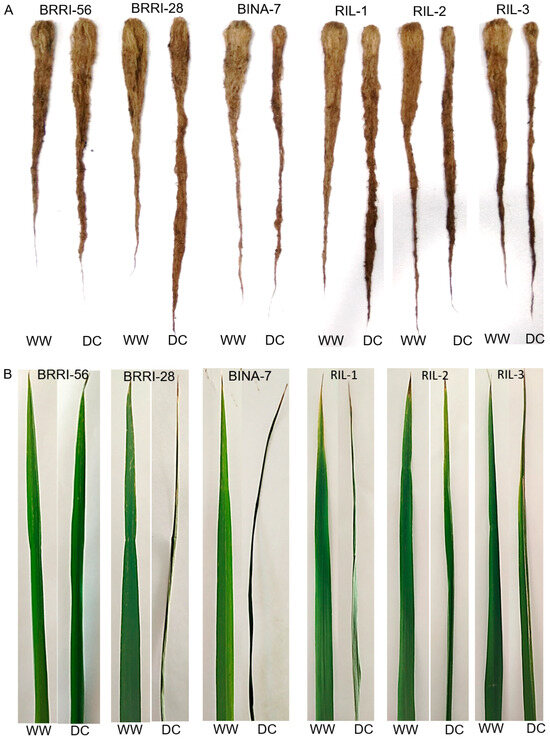
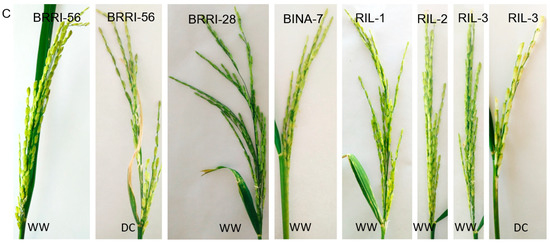
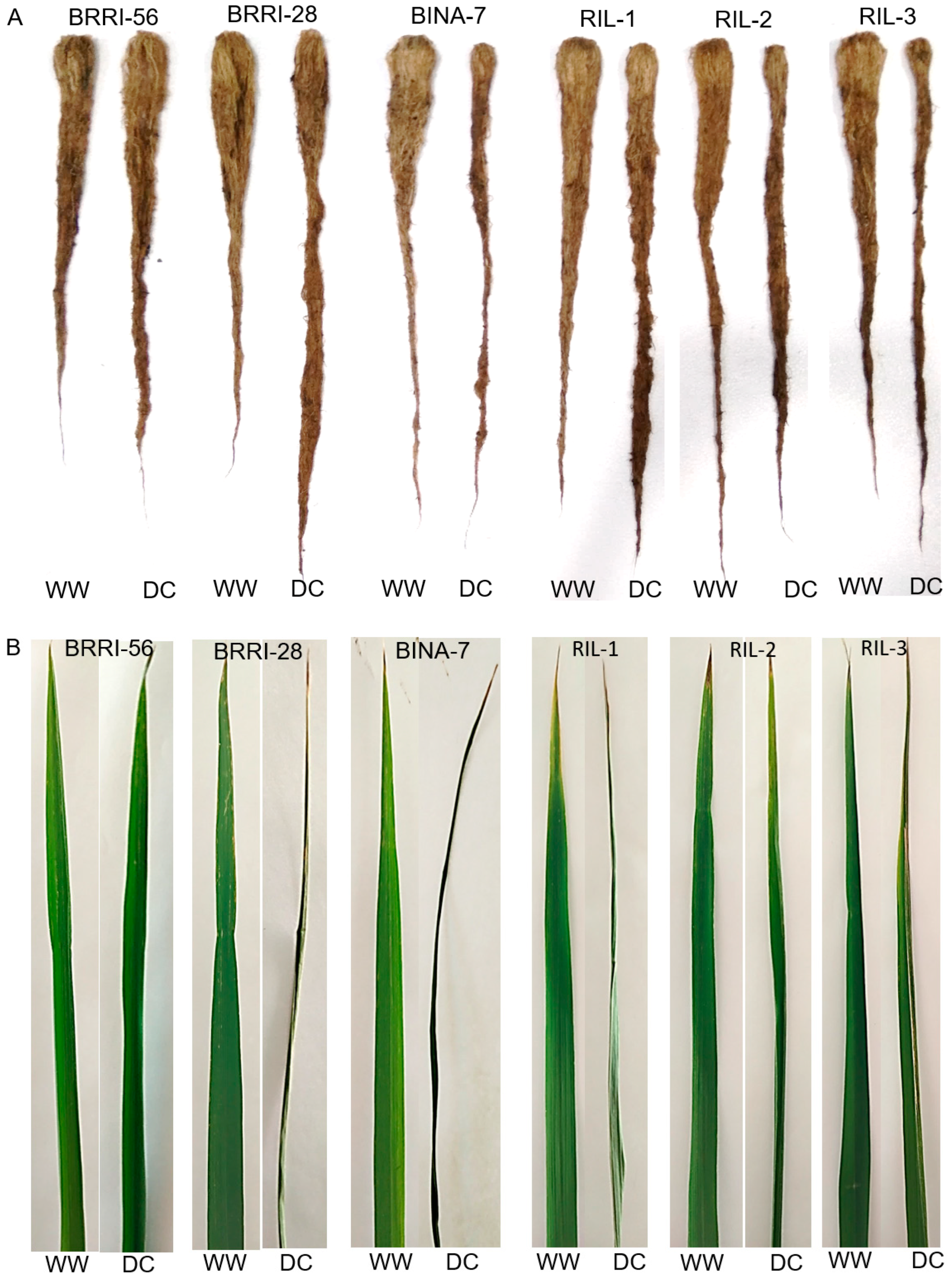
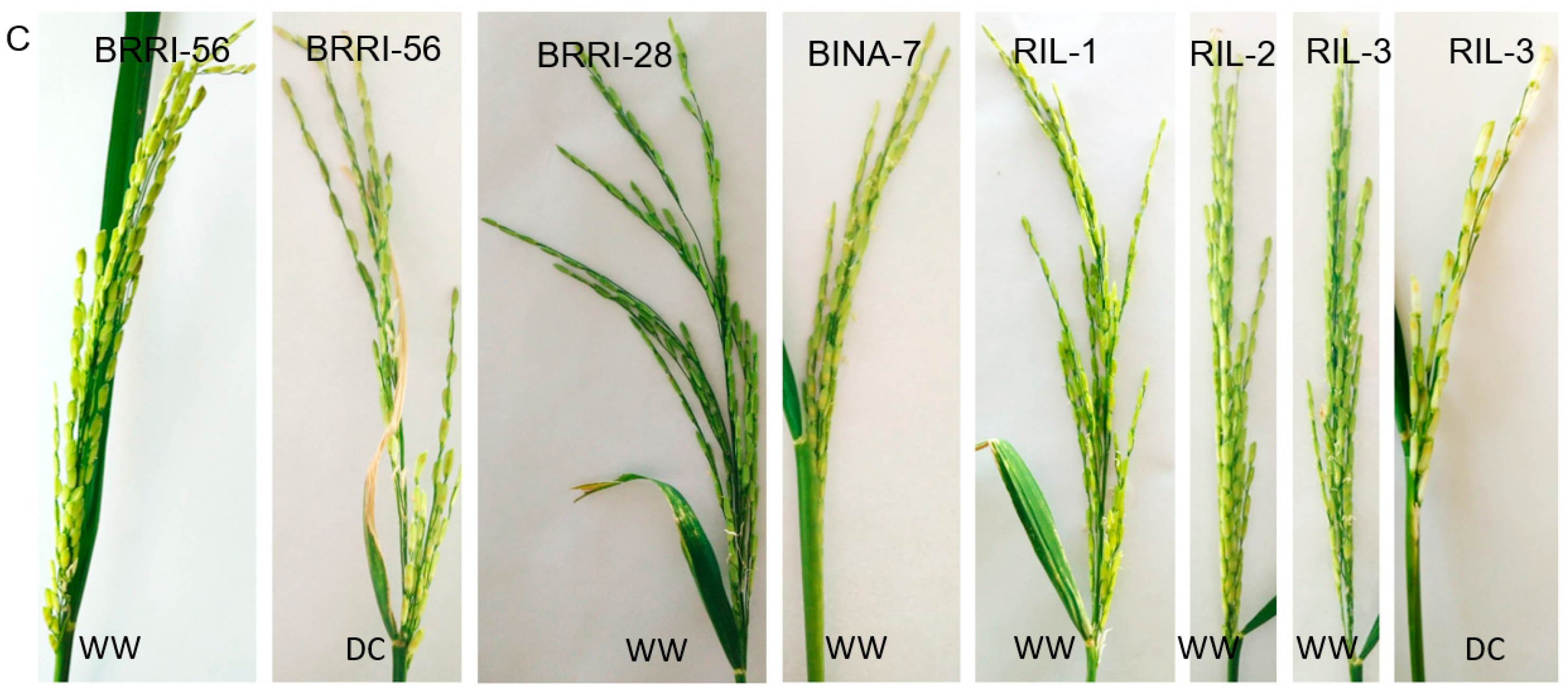
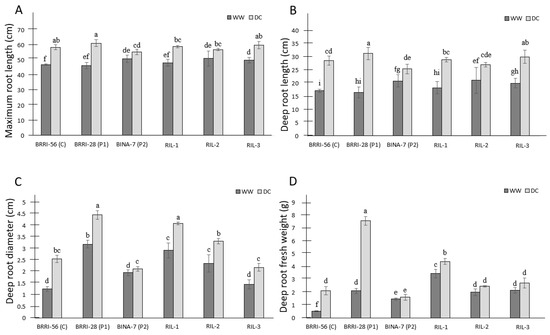
Root length, a critical determinant of plant growth and development, is directly associated with plant grain yield. In this investigation, under drought stress conditions, the maximum root length (MRL) of all genotypes was significantly increased (Figure 3A). Under WW conditions, no leaf rolling was observed in any genotype, whereas, under DC, the first leaf rolling appeared on the 10th day of drought stress in BRRI-28 (P1) and the 17th day of drought stress in BINA-7 (P2), and 16th and 21st days for RIL-1 and RIL-2, respectively. The control variety BRRI-56 and RIL-3 showed no leaf rolling throughout the 23-day drought period (Figure 3B). Under WW conditions, panicle exertion occurred without delay across all of the genotypes, with BRRI-56 showing the shortest duration (91 days) and BINA-7 the longest (102 days). RIL-1, RIL-2, and RIL-3 exerted panicles at 98, 90, and 95 days, respectively. However, under DC, most of the genotypes and RILs completely failed to exert panicles, except BRRI-56 and RIL-3, which exerted panicles at 94 and 98 d, respectively (Figure 3C). Panicle morphologies demonstrated that secondary branches per panicle were more severely affected and reduced as compared to primary branches per panicle, and eventually reduced the grain number and yield (Figure 3C).
Figure 3.
Plant morphology after 23 days of water withholding. (A) Root morphology. (B) Leaf phenotypes. (C) Panicle development in the treated and non-treated plants. WW; well-watered condition, DC; drought condition (no water supply), RIL-1; recombinant inbred lines no. 17 selected at F7 generation from the progeny row (F1005-39-02-06-07-17), RIL-2; line no. 09, as before (F1005-99-29-12-16-09), and RIL-3; line no. 21, as before (F1005-207-12-07-09-21).
3.3. Morpho-Physiological Features Change in Roots Under Drought Stress
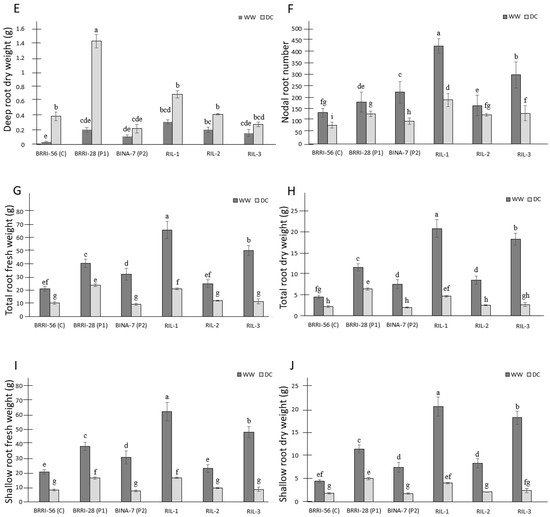
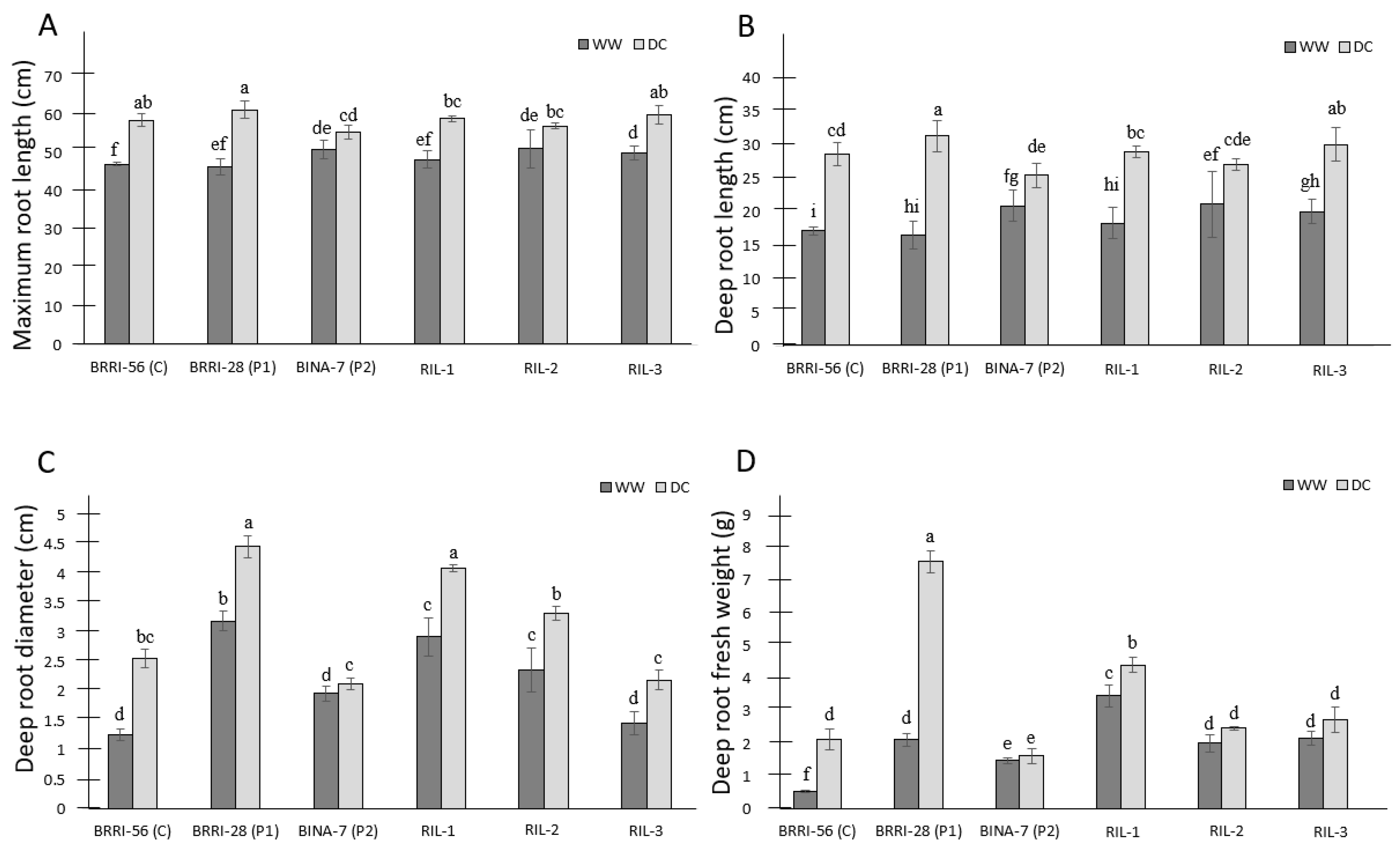
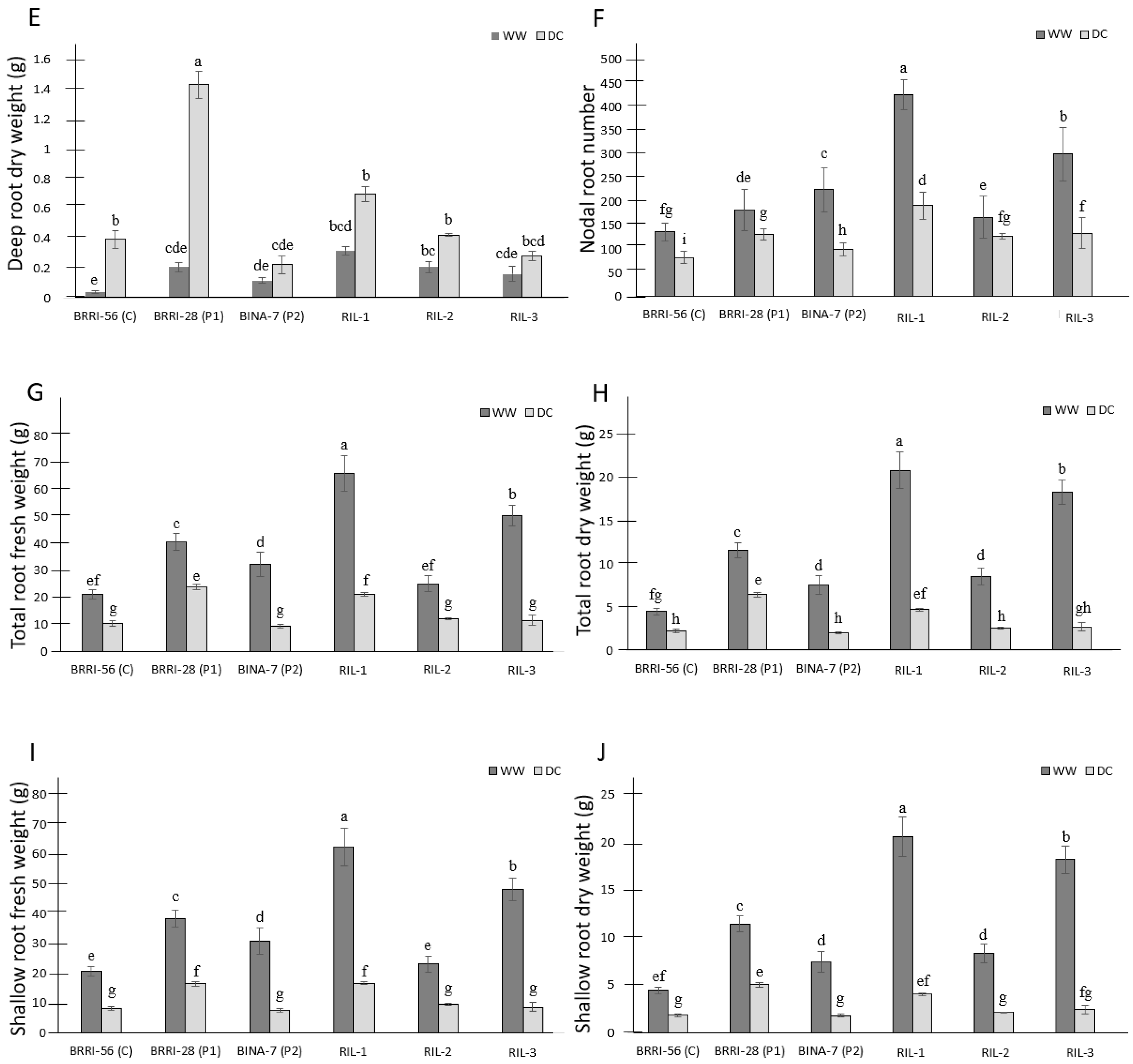
Root morphological features, including maximum root length (MRL), deep root length (DRL), deep root diameter (DRD), deep root fresh weight (DRFW), and deep root dry weight (DRDW), were significantly increased in all genotypes under DC compared with WW conditions (Figure 4). The longest MRL (61.40 cm) was observed in BRRI-28 (P1), followed by RIL-3 (60.13). Similarly, BRRI-28 exhibited the highest DRL (31.40 cm), followed by RIL-3 (30.13 cm). The maximum DRFW of 7.58 g, DRDW of 1.43 g, and DRD of 4.47 cm were observed in BRRI-28 (P1), followed by RIL-1 (Figure 3). On the other hand, nodal root number (NRN), total root fresh weight (TRFW), total root dry weight (TRDW), shallow root diameter (SRD), shallow root fresh weight (SRFW), and shallow root dry weight (SRDW) were decreased in all genotypes under DC compared with WW conditions. The highest TRFW (24.11 g) and TRDW (6.51 g) were observed in BRRI-28, followed by RIL-1 (21.17 g and 4.76 g). RIL-1 exhibited the highest SRFW (16.75 g), while BRRI-28 recorded the maximum SRDW (5.07 g), followed by RIL-1 (4.06 g). The highest SRD (7.20 cm) and NRN (192.33) were observed in RIL-1, followed by RIL-3 (6.47 cm and 134.33) (Figure 4).
Figure 4.
Morphological and physiological features of the roots under well-watered (WW) and drought-treated conditions (DC): (A) maximum root length (MRL), (B) deep root length (DRL), (C) deep root diameter (DRD), (D) deep root fresh weight (DRFW), (E) deep root dry weight (DRDW), (F) nodal root number (NRN), (G) total root fresh weight (TRFW), (H) total root dry weight (TRDW), (I) shallow root fresh weight (SRFW), and (J) shallow root dry weight (SRDW). WW: well-watered condition, DC: drought condition. Error bars indicate the standard error of the mean values. Mean values were calculated from individual values of three plants per treatment and genotype. Statistical significance was determined via one-way ANOVA. Mean separation was performed using the LSD test at 5% significance level. Bars sharing the same letter are not significantly different, whereas different letters indicate statistically significant differences between means at p < 0.05. The ANOVA is reported in Supplementary Table S8.
3.4. Soil Moisture Content (SMC) Under Drought Stress
The SMC was measured at three positions (top, middle, and bottom) of the pipe. Across all genotypes, SMC declined markedly under drought conditions (DC) compared with well-watered (WW) controls. However, this reduction was more pronounced in the parental lines than in their progenies and controls. Under DC, the highest SMC (28.22%) was observed in the control variety BRRI-56, followed by one of the progenies, RIL-3 (20.53%), during DC, whereas, under WW conditions, both genotypes exhibited a 35.15% SMC (Table 1).
Table 1.
Soil moisture content (%) under WW and DC conditions.
3.5. Relative Water Content and Relative Shoot and Root Dry Matter
The relative shoot water content (SWC) was significantly decreased under drought stress compared with well-watered conditions among the genotypes studied. However, BRRI-56 and RIL-3 exhibited comparatively smaller reductions. Under DC, BRRI-56 maintained the highest SWC (77.93%), followed by RIL-3 (63.25%), whereas BRRI-28 showed the lowest (46.57%). The shoot dry matter (SDM) percentage was highly increased under drought stress compared with well-watered conditions. The highest SDM (53.43%) was observed in BRRI-28, followed by BINA-7 (47.76%), and the lowest was for BRRI-56 (22.07%), followed by RIL-3 (36.75%) in the DC (Table 2). The root water content (RWC) percentage increased under drought stress compared with well-watered conditions among the genotypes studied. The highest RWC (78.76%) was observed in BRRI-56, followed by BINA-7 (76.38%), and the lowest was for RIL-3 (63.61%) in the WW condition, whereas, in DC, the highest was for RIL-2 (78.64%) followed by BRRI-56 (Table 2). The relative percentage of root dry matter (RDM) decreased under drought stress compared with well-watered conditions. The highest RDM of 26.99% was observed in BRRI-28, followed by RIL-3 (23.87%) in the DC, while, under WW, RIL-3 exhibited the highest RDM (36.39%) (Table 2).
Table 2.
Relative shoot water content (SWC), shoot dry matter (SDM), root water content (RWC), and root dry matter (RDM) percentages under well-watered (WW) and drought conditions (DC).
3.6. Leaf Chlorophyll and Proline Content Under Drought Stress
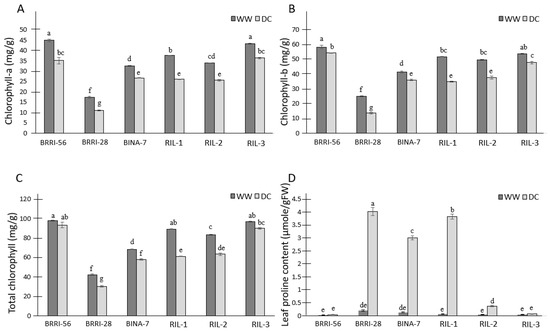
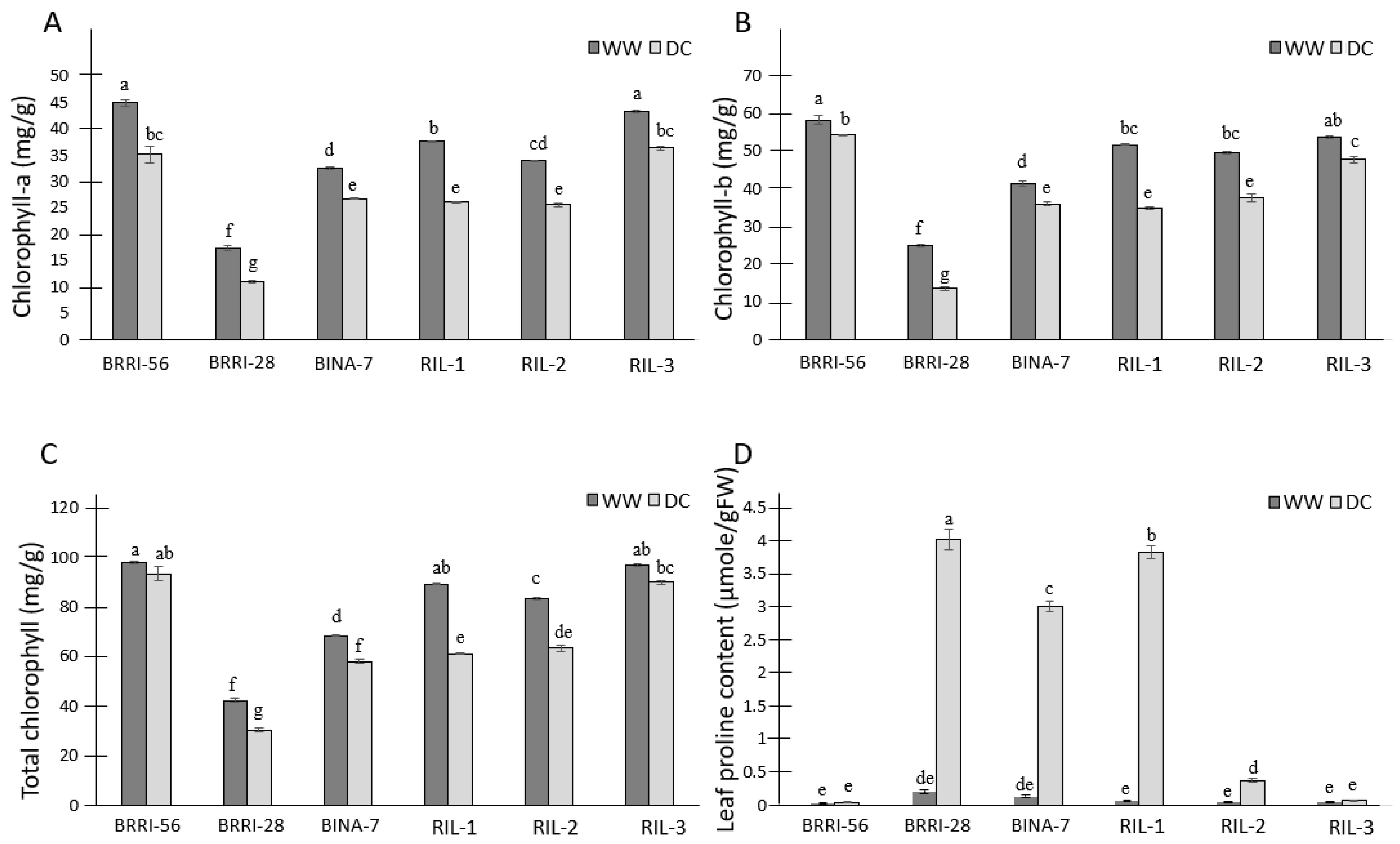
The chlorophyll a, chlorophyll b, and total chlorophyll content of rice leaves decreased in DC compared with WW conditions across all genotypes. Under WW, BRRI-56 exhibited the highest chlorophyll a content (44.91 mg/g), followed by RIL-3 (43.29 mg/g). Under DC, BRRI-56 and RIL-3 maintained relatively high levels (35.08 and 36.33 mg/g, respectively), whereas the parental lines recorded the lowest values (Figure 5). The chlorophyll b content also decreased in DC compared with the WW condition in all genotypes. Under WW, BRRI-56 showed the highest chlorophyll b (58.20 mg/g), followed by RIL-3 (53.50 mg/g), while BRRI-28 recorded the lowest (24.92 mg/g). However, in DC, the highest chlorophyll b content was observed in BRRI-56 (54.14), followed by RIL-3 (47.66 mg/g), while the minimum of 13.48 mg/g was observed in BRRI-28. A similar decreasing pattern in DC compared to WW was observed for the leaf total chlorophyll content for all genotypes. The maximum (93.25) was observed in BRRI-56, followed by RIL-3 (89.94 mg/g) (Figure 5). The results showed that, although tolerant genotypes were subjected to stress, they were able to protect the chlorophyll from damage through their internal mechanisms. As a result, the chlorophyll levels did not decrease after exposure, indicating these genotypes’ resilience to stress.
Figure 5.
Changes in leaf biochemical parameters after drought treatment: (A) leaf chlorophyll a (mg/g), (B) chlorophyll b (mg/g), (C) total chlorophyll (mg/g), and (D) leaf proline content (µmole/g FW) under well-watered (WW) and drought conditions (DC). Error bars indicate the standard error of the mean values. Mean values were calculated from individual values of three plants per treatment and genotype. Statistical significance was determined via one-way ANOVA. Mean separation was performed using the LSD test at 5% significance level. Bars sharing the same letter are not significantly different, whereas different letters indicate statistically significant differences between means at p < 0.05. The ANOVA is reported in Supplementary Table S9.
Proline is a versatile amino acid that can be involved not only in plant developmental processes but also in abiotic and biotic stress responses. Proline functions as an osmolyte, contributing to osmotic adjustment and serving as a key indicator of changes in physiological parameters in response to abiotic stress [63]. Under stress, plants regulate osmosis by synthesizing molecular substances, such as proline, to reduce the damage caused by stress [64,65]. During drought stress conditions, the leaf proline content increases in normal plants to respond to stress. In this experiment, the highest values and the most significant increase in leaf proline content were observed in BRRI-28, followed by RIL-1 and BINA-7 under DC, whereas the increase was negligible for BRRI-65 and RIL-3 in WW than DC, indicating their tolerance against drought.
3.7. Root Anatomical Variation
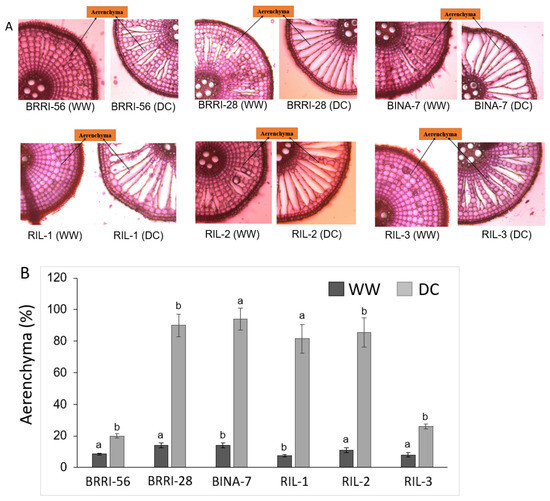
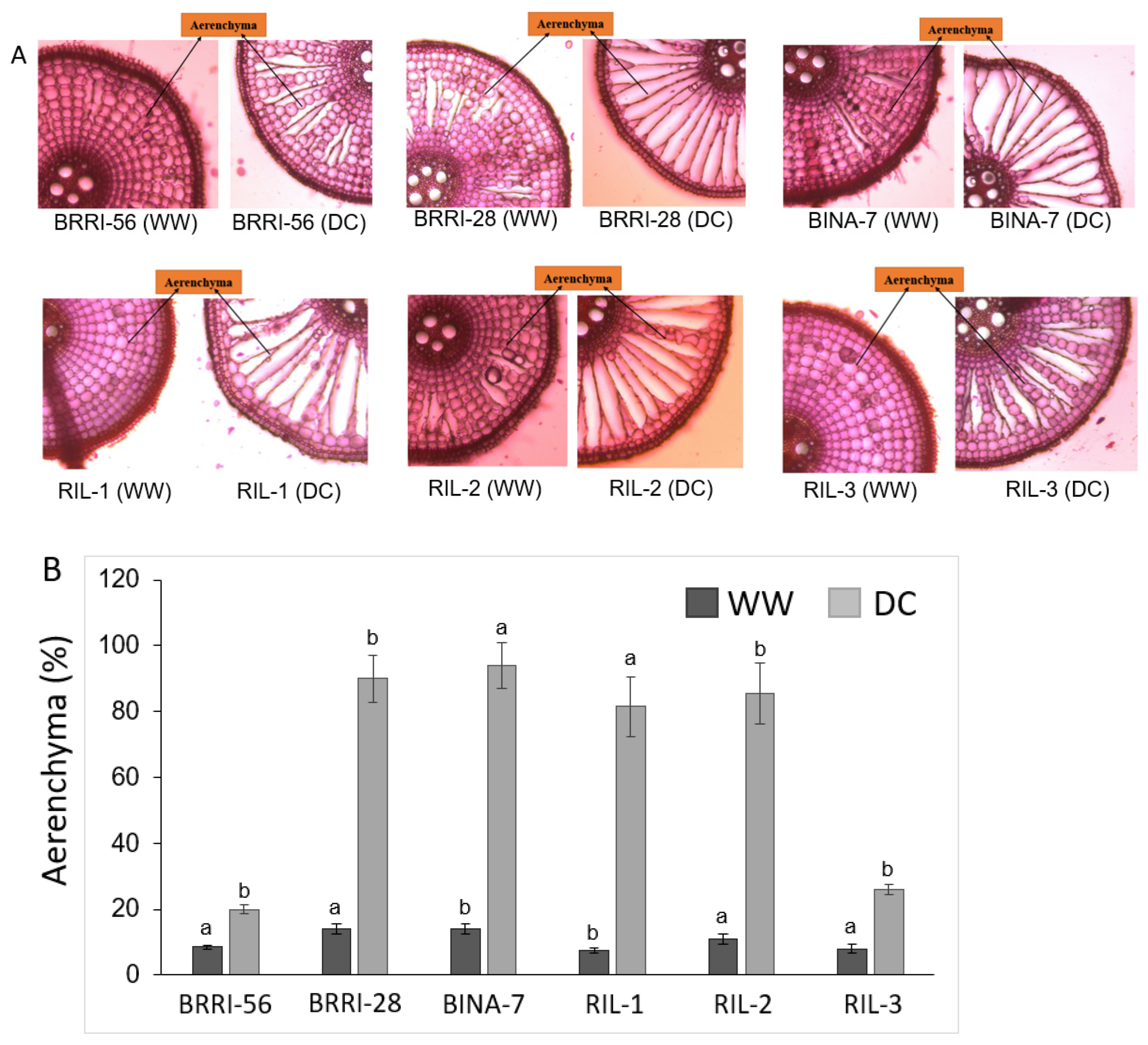
Root architectural and anatomical phenotypes are pivotal for adaptation to drought [66]. Given the fundamental role of the root system in water and nutrient uptake, as well as stress tolerance, we characterized the root anatomy of the genotypes studied. Anatomical features of the transverse sections of the root of all genotypes under both the DC and WW conditions were studied using microscopy. The outermost layer contained unicellular epiblema, followed by the cortex region made of multilayer cortical parenchymatous tissue, and, finally, vascular bundles containing xylem and phloem. Under WW conditions, all genotypes exhibited an increased aerenchyma density compared to DC; however, in DC, only the control variety BRRI-56 and RIL-3 displayed denser aerenchyma than other genotypes (Figure 6A). We also manually checked the area consisting of air spaces (aerenchyma percentage) from the microscopic photograph and found, except for check and RIL-3, other genotypes exhibited a higher aerenchyma formation. BRRI-56 and RIL-3 showed almost similar results in DC as with WW. Usually, drought-tolerant varieties have denser aerenchyma compared to the susceptible varieties under drought conditions [60].
Figure 6.
Root anatomical features after drought treatment. (A) Root transverse sections were observed under a microscope after treatment. The anatomical features of the root aerenchyma formation under well-watered (WW) and drought conditions (DC) of the studied genotypes. (B) Estimated aerenchyma percentage in the root regions. Data were analyzed by ANOVA, and mean comparisons were performed using the LSD test. Different letters above the columns indicate statistically significant differences between means at p < 0.05. All values are represented as the mean ± SE.
3.8. Correlations Among Morphological Traits Under Drought Stress
A correlation analysis of above-ground traits under DC revealed a positive and significant correlation between proline and other above-ground traits, viz., shoot dry weight (r = 0.727), tiller number (r = 0.756), and shoot dry matter % (r = 0.690). Moreover, soil moisture content % (r = −0.677), chlorophyll a (r = −0.753), chlorophyll b (r = −0.803), total chlorophyll (r = −0.827), and shoot relative water content % (r = −0.690) were significantly negatively correlated with proline. These results suggest that proline content was tightly linked to the above-ground traits (Table 3).
Table 3.
Correlations among above-ground traits under DC.
Regarding root traits under DC, the maximum root length demonstrated significant positive correlations with the total root fresh weight (r = 0.676), total root dry weight (r = 0.730), deep root length (r = 1.000), deep root fresh weight (r = 0.768), deep root dry weight (r = 0.697), deep root diameter (r = 0.525), and root dry matter % (r = 0.808). In contrast, a shallow root relative water content % (r = −0.800) exhibited a significant but negative correlation with the maximum root length. The data indicate that maximum root length is strongly linked to these root traits (Table 4).
Table 4.
Correlations among different root traits under DC.
4. Discussion
Rice responses to drought are complex and vary depending on the growth stage, genotype, and stress duration [67]. Most rice cultivars are extremely sensitive to drought stress at the seedling, vegetative, and reproductive phases. Stress during the reproductive phase usually results in more severe yield losses than that during the vegetative phase, and sometimes light drought stress can cause a considerable yield drop [68,69]. Although the development of drought-tolerant cultivars is challenging for sustainable agriculture [70], breeding for drought-tolerant rice cultivars represents a promising strategy to mitigate the adverse impacts of water limitation. Drought-tolerance is a complex trait, governed by the interaction of different morphological, biochemical, and physiological responses [71]. The superior performance of certain RILs compared with both parents may result from the favorable recombination and transgressive segregation of drought-responsive traits. The primary aim of this study was to screen the recombinant inbred rice lines to identify drought-tolerant lines from morpho-physiological parameters.
Morphological alterations are among the earliest visible responses of rice to drought stress [14,72]. In this study, most above-ground traits were reduced in all genotypes under drought stress. But all RILs showed higher magnitudes for traits than the control variety BRRI-56. Similar reductions in above-ground traits under drought stress have been reported in diverse rice genotypes [9,41,66,73,74]. Panicle length, primary/secondary rachis per panicle, seed setting rate, and grain weight were significantly reduced by drought stress in rice [75].
Leaf features like rolling and early senescence are characteristic drought-induced features [76,77]. Leaf rolling under drought stress occurs due to the plant’s inability to sustain transpiration, leading to reduced leaf turgor pressure [78,79]. In this study, leaf rolling appeared in parental lines but not in the check variety BRRI-56 and RIL, RIL-3, during the drought period until the 23rd day of treatment. In comparison with the control variety BRRI-56, the drought tolerance potential of RIL-3 was higher than other lines. Similar observations have been reported in the shallow rain-fed ecosystems of eastern India [56].
Drought stress poses a critical threat to panicle development, especially at the inflorescence development stage [80]. However, this severity was more prominent in sensitive varieties than in tolerant ones. In this experiment, drought treatment was initiated at the inflorescence development stage. Thus, most genotypes could not develop functional panicles, indicating their sensitivity to drought. On the other hand, only the check and RIL-3 developed panicles under drought, indicating their tolerance. In comparison with the control variety BRRI-56, the drought tolerance ability of RIL-3 was higher than other lines. Similar physiological and morphological responses under drought have been documented in several studies in rice [80,81,82].
Root traits, especially root system and development, root mass, and root length, are key attributes for enhancing production under drought stress in rice [14,45]. Field-based studies of root traits are inherently challenging and therefore limited. In this study, MRL, DRL, DRFW, DRDW, and DRD increased, while TRFW, SRFW, TRDW, SRDW, SRD, and NRN decreased in all genotypes under drought stress. All RILs exhibited higher DRFW, TRFW, SRFW, TRDW, NRN, and SRDW. Only RIL-3 exhibited higher MRL, SRD, and DRL than the control variety BRRI-56. Rice varieties with deep and profound root systems with many branches have shown better adaptability in drought [83,84]. It has been reported that, under drought stress, the rice root length and deep root diameter increase, but the shallow root fresh weight, shallow root diameter, and shallow root dry weight decrease, in agreement with the findings of our study [85]. Previous studies also reported increased deep root traits and reduced shallow root traits under drought stress, consistent with our observations [55]. Additional findings in our study were consistent with previously reported results on root traits under drought stress [66,86,87].
The soil moisture content % of all genotypes decreased under drought stress conditions. The RILs showed a lower SMC than BRRI-56, except RIL-3, which showed a result almost similar to BRRI-56. Earlier studies on shallow rain-fed ecosystems in eastern India found that the soil moisture decreased under drought, which aligns with the results of this study [56]. In this investigation, the shoot dry matter % increased, and the root dry matter % decreased under drought stress conditions. Most RILs showed a higher SDM and RDM compared with the check variety BRRI-56. During the selection of high-biomass rice for drought tolerance, Kondhia et al. reported that the shoot dry matter % highly increased and the root dry matter % highly decreased under drought stress [57]. Under drought stress conditions, the relative water content percentage of shoots and deep roots declined, whereas the total root and shallow root relative water content percentage increased. RIL-3 showed an almost similar SRWC compared with the control. On the other hand, RILs showed a higher DRWC than BRRI-56. Comparable results have been reported in rice seedlings subjected to PEG-6000-induced drought stress [9,41,76,88].
Usually, water deficiency reduces the function of mesophyll cells, leading to reductions in the chlorophyll content in rice plants [89]. Chlorophyll a, chlorophyll b, and total chlorophyll content decreased under drought conditions. RIL-3 maintained a higher chlorophyll a level compared with the drought-tolerant control BRRI-56. Notably, RIL-3 showed a higher chlorophyll a content and showed an almost similar chlorophyll b and total chlorophyll content to the control variety BRRI-56, which indicated that RIL-3 exhibited a higher drought tolerance than the other lines. Earlier studies showed that the chlorophyll a, chlorophyll b, and total chlorophyll content reduced in drought conditions, consistent with this finding [9,41,73,88].
The accumulation of compatible solutes, such as proline, is a widely reported adaptive response in plants to drought stress and is often associated with osmotic adjustment, redox buffering, and protein and membrane stabilization for cellular protection as well as ROS scavenging [90,91]. Proline synthesis is typically enhanced under stress conditions to mitigate oxidative damage and stabilize cellular structures [92]. In this study, the leaf proline content increased under drought stress in all genotypes; however, the magnitude of accumulation varied markedly. The parental lines and RIL-1 exhibited a substantially higher proline accumulation under drought compared with well-watered conditions, suggesting a greater physiological disruption and stress sensitivity. In contrast, RIL-3 and the drought-tolerant check variety BRRI-56 maintained a relatively low proline accumulation despite the prolonged water deficit. This inverse relationship between proline accumulation and drought tolerance suggests that, in tolerant genotypes, lower proline levels may reflect superior osmotic regulation and reduced stress perception rather than a weaker stress response. Similar results have been reported in rice and other crops, where sensitive cultivars accumulate higher proline concentrations under severe drought, while tolerant genotypes maintain moderate or stable levels due to the more efficient water status regulation and metabolic homeostasis [9,41,73,93].
Moreover, previous studies have demonstrated that proline accumulation is strongly influenced by the stress intensity and duration in tolerant and susceptible rice varieties, and often declines after re-watering [94,95], indicating that the proline accumulation in rice may serve as a potential marker of drought stress severity rather than a direct determinant of tolerance [94]. In drought-sensitive cultivars, excessive proline levels often coincide with severe cellular damage and morphophysiological retardation [96,97]. The proline content of tomato leaves was closely related to the relative water content of leaves, showing that, under drought stress, tomato plants with a better water status accumulated less proline than severely stressed plants, and it was concluded that proline is a reliable indicator of the environmental stress imposed on plants, whose concentration reflected the stress intensity rather than stress tolerance [98]. It was found that Thellungiella halophila and Lepidium crassifolium have elevated proline levels under unstressed conditions, which was reviewed and suggests that excessive proline accumulation is often a symptom of cellular damage rather than an adaptive response, and proline is not an absolute requirement for adaptation to extreme environmental conditions [91]. Collectively, these findings support the view that the lower proline accumulation in drought-tolerant genotypes, when accompanied by a higher relative water content, chlorophyll retention, and stable root anatomy, may indicate a reduced stress perception and enhanced physiological resilience under drought conditions rather than a lower stress response.
Correlation analyses revealed significant positive correlations between proline and other above-ground traits like shoot dry weight, tiller number, and shoot dry matter. Correlation analyses of root traits under drought conditions revealed positive and significant correlations between maximum root length and other root traits like total root fresh weight, total root dry weight, shallow root fresh weight, shallow root dry weight, deep root length, deep root fresh weight, deep root dry weight, deep root diameter, and root dry matter. These results suggest that proline accumulation is closely linked to above-ground performance, while maximum root length is strongly associated with root system traits. Previous studies reported the corresponding result for the relationship of PH, SFW, SDW, TN, SDM, MRL, TRFW, SRD, TRDW, SRFW, SRDW, DRFW, DRDW, DRD, and other above-ground and root traits in rice under drought stress [55,85].
A root anatomical analysis revealed a marked reduction in aerenchyma density under drought stress across all genotypes. Only RIL-3 exhibited almost similarly dense aerenchyma as the control variety BRRI-56, further supporting its superior drought tolerance. A similar genotypic variation in root anatomy under drought has been reported in upland rice [60]. Root aerenchyma is tissue containing air spaces that can develop in the plant root during stressful conditions. A higher aerenchyma percentage was observed in the drought-stressed plants [99]. Although root anatomical observations indicated enhanced aerenchyma formation in check and RIL-3 under drought stress, the analysis was qualitative in nature, and extensive quantitative measurements of porosity are required to further validate the contribution of this trait to drought adaptation. In conclusion, the identified genotypes demonstrate significant potential in enhancing the rice resilience to drought, offering a promising avenue for sustainable rice production in the face of climate change challenges.
Our study reveals distinct phenotypic, physiological, and anatomical responses to prolonged water withholding between RIL and its parents. The RIL exhibited superior drought tolerance at both the vegetative and reproductive stages, as reflected by the retarded leaf drying, improved plant vigor, greater root biomass, and stable chlorophyll content. These responses are highly relevant for drought resilience because rice is most vulnerable to a soil moisture deficit when stress coincides with early vegetative growth or reproductive transition. Previous research has identified several genetic loci contributing to root-based, osmotic, and reproductive-stage drought resilience in rice, including qDTY1.1, qDTY2.1 [100], OsLEA3-1 [101], OsNAC6 [102], and OsNAC25 [103], as well as OsbZIP27 [104]. The novel osmotin-like protein OsOLP1 confers drought tolerance via stomatal closure and lignin deposition in rice [105]. Functional studies of these regions collectively support deeper rooting, delayed senescence, enhanced osmotic tolerance, and improved grain filling under a moisture deficit. Notably, physiological markers observed in our RIL, a higher RWC, a sustained chlorophyll content, and an increased root mass, correspond with these reported mechanisms. Thus, the trait-level evidence obtained in the present study aligns closely with previously described drought-responsive pathways in rice. Our 23-day water-withholding assay represents severe drought stress that clearly differentiated the tolerant and susceptible lines. Future studies should focus on the functional characterization of the selected RILs to elucidate the genetic and molecular mechanisms underlying drought tolerance, thereby facilitating marker-assisted selection and breeding applications.
5. Conclusions
This study evaluated drought tolerance in recombinant inbred rice lines. Among the genotypes tested under drought stress, RIL-3 consistently demonstrated a performance comparable to the drought-tolerant check variety BRRI-56 across multiple traits, including the agronomic characteristics, and root architectural traits (deep rooting ability, enhanced shoot and root biomass, and aerenchyma development), together with the maintenance of the relative water status and chlorophyll content, which are the key candidate selection markers for future rice-breeding programs. Therefore, we propose that RIL-3 may represent a promising candidate that could be used as a parental line in inbreeding programs for developing improved drought-tolerant rice varieties. Even our results provide valuable insights for breeding strategies; however, as this study was conducted under specific environmental conditions, further multi-location trials are recommended to validate the performance of these lines across diverse agroecological zones. Although the study provides comprehensive phenotypic and physiological evidence of drought tolerance, functional validation through gene expression profiling or genetic analysis remains necessary and represents a limitation of the present work. Future research should include detailed phenological observations, and a transcriptome-level investigation under drought at key developmental time points, along with the validation of candidate genes or loci associated with osmotic adjustment, chlorophyll retention, and root anatomical stability.
Supplementary Materials
The following supporting information can be downloaded at: https://www.mdpi.com/article/10.3390/agronomy16050575/s1, Table S1. Scale of agronomic features; Table S2. Scores and symptoms for leaf rolling (LR) under drought stress; Table S3. Agronomic features and drought avoidance tendency by leaf rolling score of the RILs. The number of biological replicates was 3 (N = 3); Table S4. Important agronomic features of the selected genotypes in the field cultivation under normal (WW) and moderate drought conditions (DC) (N = 3); Table S5. Standard Evaluation System (SES) for rice (IRRI 1980); Table S6. Evaluation of the drought tolerance of the selected 37 RILs; Table S7. One-way ANOVA data of agronomic traits via SPSS; Table S8. One-way ANOVA data of Chlorophyll and Proline via SPSS; Table S9. One-way ANOVA data of Root morphological features via SPSS; Table S10. One-way ANOVA data of key yield components via SPSS.
Author Contributions
Conceptualization, S.K.P., K.-H.B., and M.N.M.; methodology, S.K.P. and M.F.R.; software, S.K.P., M.A.M.-u., M.S.H., M.R.C., and M.N.M.; validation, M.N.M., M.S.H., and K.-H.B.; formal analysis, S.K.P., M.S.A., M.A.M.-u., and M.R.C.; investigation, M.N.M., M.F.R., M.S.A., M.A.M.-u., M.R.C., and M.S.H.; resources, M.N.M., K.-H.B., and M.S.H.; data curation, S.K.P. and M.N.M.; writing—original draft preparation, S.K.P. and M.N.M.; writing—review and editing, K.-H.B., M.N.M., M.F.R., M.S.H., M.R.C., M.S.A., and M.A.M.-u.; visualization, M.N.M., M.S.H., and K.-H.B.; supervision, M.N.M.; project administration, M.N.M. and M.S.H.; funding acquisition, M.N.M., S.K.P., and M.N.M. contribute equally to this work. All authors have read and agreed to the published version of the manuscript.
Funding
This research was supported by the Ministry of Education (MoE), Bangladesh, and the Bangladesh Academy of Science and the United States Department of Agriculture (BAS-USDA) for the BAS-USDAPALSRU-CR41 project.
Data Availability Statement
The original contributions presented in the study are included in the article and Supplementary Materials; further inquiries can be directed to the corresponding author.
Acknowledgments
The authors wish to thank the Molecular Genetics Lab. Dept. of Genetic Engineering and Biotechnology, University of Rajshahi, Bangladesh, for providing all facilities during the whole research work. This research was supported by the Ministry of Education (MoE), Bangladesh, the Bangladesh Academy of Science, and the United States Department of Agriculture (BAS-USDA) for the BAS-USDAPALSRU-CR41 project. During the preparation of this manuscript, we used an AI-generated tool for the purposes of grammar checking. We have reviewed and edited the output and take full responsibility for the content of this publication.
Conflicts of Interest
The authors declare no conflicts of interest.
References
- Singh, Y.; Singh, U.S. Genetic diversity analysis in aromatic rice germplasm using agro-morphological traits. Indian J. Plant Genet. Resour. 2008, 21, 37–42. [Google Scholar]
- Muthayya, S.; Sugimoto, J.D.; Montgomery, S.; Maberly, G.F. An overview of global rice production, supply, trade, and consumption. Ann. New York Acad. Sci. 2014, 1324, 7–14. [Google Scholar] [CrossRef] [Scilit]
- Zhao, M.; Lin, Y.; Chen, H. Improving nutritional quality of rice for human health. Theor. Appl. Genet. 2020, 133, 1397–1413. [Google Scholar] [CrossRef] [Scilit]
- Mohidem, N.A.; Hashim, N.; Shamsudin, R.; Che Man, H. Rice for food security: Revisiting its production, diversity, rice milling process and nutrient content. Agriculture 2022, 12, 741. [Google Scholar] [CrossRef] [Scilit]
- Samal, R.; Roy, P.S.; Sahoo, A.; Kar, M.K.; Patra, B.C.; Marndi, B.C.; Gundimeda, J.N.R. Morphological and molecular dissection of wild rices from eastern India suggests distinct speciation between O. rufipogon and O. nivara populations. Sci. Rep. 2018, 8, 2773. [Google Scholar] [CrossRef] [Scilit] [PubMed]
- Ray, D.K.; Mueller, N.D.; West, P.C.; Foley, J.A. Yield trends are insufficient to double global crop production by 2050. PLoS ONE 2013, 8, e66428. [Google Scholar] [CrossRef] [Scilit]
- Bin Rahman, A.N.M.R.; Zhang, J. Trends in rice research: 2030 and beyond. Food Energy Secur. 2023, 12, e390. [Google Scholar] [CrossRef] [Scilit]
- Kaur, N.; Gupta, A.K. Signal transduction pathways under abiotic stresses in plants. Curr. Sci. 2005, 88, 1771–1780. [Google Scholar]
- Miftahudin, M.; Putri, R.E.; Chikmawati, T. Vegetative morphophysiological responses of four rice cultivars to drought stress. Biodiversitas J. Biol. Divers. 2020, 21, 3727–3734. [Google Scholar] [CrossRef] [Scilit]
- Muhammad, Z.M.; Muhammad, S.; Ghulam, A.; Javaid, A.; Zia, U.-Q. Drought stress impairs grain yield and quality of rice genotypes by impaired photosynthetic attributes and K nutrition. Rice Sci. 2020, 27, 5. [Google Scholar] [CrossRef] [Scilit]
- Aslam, M.M.; Rashid, M.A.R.; Siddiqui, M.A.; Khan, M.T.; Farhat, F.; Yasmeen, S.; Khan, I.A.; Raja, S.; Rasool, F.; Sial, M.A.; et al. Recent insights into signaling responses to cope drought stress in rice. Rice Sci. 2022, 29, 105–117. [Google Scholar] [CrossRef] [Scilit]
- Pareek, A.; Dhankher, O.P.; Foyer, C.H. Mitigating the impact of climate change on plant productivity and ecosystem sustainability. J. Exp. Bot. 2020, 71, 451–456. [Google Scholar] [CrossRef] [Scilit]
- Korres, N.E.; Norsworthy, J.K.; Burgos, N.R.; Oosterhuis, D.M. Temperature and drought impacts on rice production: An agronomic perspective regarding short-and long-term adaptation measures. Water Resour. Rural Dev. 2017, 9, 12–27. [Google Scholar] [CrossRef] [Scilit]
- Panda, D.; Mishra, S.S.; Behera, P.K. Drought Tolerance in Rice: Focus on Recent Mechanisms and Approaches. Rice Sci. 2021, 28, 119–132. [Google Scholar] [CrossRef] [Scilit]
- Singh, R.; Singh, Y.; Xalaxo, S.; Verulkar, S.; Yadav, N.; Singh, S.; Singh, N.; Prasad, K.S.N.; Kondayya, K.; Rao, P.V.R.; et al. From QTL to variety-harnessing the benefits of QTLs for drought, flood and salt tolerance in mega rice varieties of India through a multi-institutional network. Plant Sci. 2016, 242, 278–287. [Google Scholar] [CrossRef] [Scilit]
- Pandey, V.; Shukla, A. Acclimation and Tolerance Strategies of Rice under Drought Stress. Rice Sci. 2015, 22, 147–161. [Google Scholar] [CrossRef] [Scilit]
- Guan, Y.S.; Serraj, R.; Liu, S.H.; Xu, J.L.; Ali, J.; Wang, W.S.; Venus, E.; Zhu, L.H.; Li, Z.K. Simultaneously improving yield under drought stress and non-stress conditions: A case study of rice (Oryza sativa L.). J. Exp. Bot. 2010, 61, 4145–4156. [Google Scholar] [CrossRef] [Scilit]
- Anilkumar, C.; Sah, R.P.; Beena, R.; Tp, M.A.; Kumar, A.; Behera, S.; Sunitha, N.; Pradhan, S.; Raj, K.R.; C, P.; et al. Conventional and contemporary approaches for drought tolerance rice breeding: Progress and prospects. Plant Breed. 2023, 142, 418–438. [Google Scholar] [CrossRef] [Scilit]
- Saif-u-Malook, S.-u.-M.; Qaisarani, S.; Shabaz, M.; Ahmed, H.; Nawaz, M.A.; Muhammad Sarfaraz, M.S.; Ghulam Mustafa, G.M.; Qurban Ali, Q.A. Mutation breeding approach to breed drought tolerant maize hybrids. Int. J. Biosci. 2015, 6, 427–436. [Google Scholar]
- Torres, R.O.; McNally, K.L.; Cruz, C.V.; Serraj, R.; Henry, A. Screening of rice Genebank germplasm for yield and selection of new drought tolerance donors. Field Crops Res. 2013, 147, 12–22. [Google Scholar] [CrossRef] [Scilit]
- Biswas, A.; Sarkar, S.; Das, S.; Dutta, S.; Roy Choudhury, M.; Giri, A.; Bera, B.; Bag, K.; Mukherjee, B.; Banerjee, K.; et al. Water scarcity: A global hindrance to sustainable development and agricultural production—A critical review of the impacts and adaptation strategies. Camb. Prism. Water 2025, 3, e4. [Google Scholar] [CrossRef] [Scilit]
- Alotaibi, B.A.; Baig, M.B.; Najim, M.M.M.; Shah, A.A.; Alamri, Y.A. Water Scarcity Management to Ensure Food Scarcity through Sustainable Water Resources Management in Saudi Arabia. Sustainability 2023, 15, 10648. [Google Scholar] [CrossRef] [Scilit]
- Lafitte, H.R.; Bennett, J. Requirements for aerobic rice: Physiological and molecular considerations. In Water-Wise Rice Production; International Rice Research Institute: Los Baños, Philippines, 2002; pp. 259–274. [Google Scholar]
- Fahad, S.; Adnan, M.; Noor, M.; Arif, M.; Alam, M.; Khan, I.A.; Ullah, H.; Wahid, F.; Mian, I.A.; Jamal, Y.; et al. Chapter 1—Major Constraints for Global Rice Production. In Advances in Rice Research for Abiotic Stress Tolerance; Hasanuzzaman, M., Fujita, M., Nahar, K., Biswas, J.K., Eds.; Woodhead Publishing: Cambridge, UK, 2019; pp. 1–22. [Google Scholar]
- Hussain, S.; Huang, J.; Huang, J.; Ahmad, S.; Nanda, S.; Anwar, S.; Shakoor, A.; Zhu, C.; Zhu, L.; Cao, X.; et al. Rice Production Under Climate Change: Adaptations and Mitigating Strategies. In Environment, Climate, Plant and Vegetation Growth; Fahad, S., Hasanuzzaman, M., Alam, M., Ullah, H., Saeed, M., Ali Khan, I., Adnan, M., Eds.; Springer International Publishing: Cham, Switzerland, 2020; pp. 659–686. [Google Scholar]
- Lesk, C.; Rowhani, P.; Ramankutty, N. Influence of extreme weather disasters on global crop production. Nature 2016, 529, 84–87. [Google Scholar] [CrossRef] [Scilit] [PubMed]
- Khan, M.A.; Shad, A.A.; Marwat, K.B.; Khan, H. Temperature and salinity affect the germination and growth of Silybum marianum gaertn and Avena fatua L. Pak. J. Bot 2016, 48, 469–476. [Google Scholar]
- Ray, D.K.; Gerber, J.S.; MacDonald, G.K.; West, P.C. Climate variation explains a third of global crop yield variability. Nat. Commun. 2015, 6, 5989. [Google Scholar] [CrossRef] [Scilit]
- Boyer, J.S. Plant productivity and environment. Science 1982, 218, 443–448. [Google Scholar] [CrossRef] [Scilit] [PubMed]
- Abderemane, B.A.; Fakiri, M.; Zeroual, A.; Mitache, M.; Houasli, C. Selection of Chickpea (Cicer arietinum L.) Genotypes Through a Combining of Tolerance Indices and Root Architecture: An Efficient Approach for the Identification of Drought-Tolerant Genotypes. Plant Breed. 2025, 144, 509–528. [Google Scholar] [CrossRef] [Scilit]
- Upadhyaya, H.; Panda, S.K. Chapter 9—Drought Stress Responses and Its Management in Rice. In Advances in Rice Research for Abiotic Stress Tolerance; Hasanuzzaman, M., Fujita, M., Nahar, K., Biswas, J.K., Eds.; Woodhead Publishing: Cambridge, UK, 2019; pp. 177–200. [Google Scholar]
- Gupta, A.; Rico-Medina, A.; Caño-Delgado, A.I. The physiology of plant responses to drought. Science 2020, 368, 266–269. [Google Scholar] [CrossRef] [Scilit]
- Melandri, G.; AbdElgawad, H.; Riewe, D.; Hageman, J.A.; Asard, H.; Beemster, G.T.S.; Kadam, N.; Jagadish, K.; Altmann, T.; Ruyter-Spira, C.; et al. Biomarkers for grain yield stability in rice under drought stress. J. Exp. Bot. 2020, 71, 669–683. [Google Scholar] [CrossRef] [Scilit]
- Singh, N.P.; Pal, P.K.; Vaishali, S.K. Morpho-physiological characterization of Indian wheat genotypes and their evaluation under drought condition. Afr. J. Biotechnol. 2014, 13, 2022–2027. [Google Scholar] [CrossRef] [Scilit]
- Németh, M.; Janda, T.; Horváth, E.; Páldi, E.; Szalai, G. Exogenous salicylic acid increases polyamine content but may decrease drought tolerance in maize. Plant Sci. 2002, 162, 569–574. [Google Scholar] [CrossRef] [Scilit]
- Ommen, O.E.; Donnelly, A.; Vanhoutvin, S.; Van Oijen, M.; Manderscheid, R. Chlorophyll content of spring wheat flag leaves grown under elevated CO2 concentrations and other environmental stresses within the ‘ESPACE-wheat’project. Eur. J. Agron. 1999, 10, 197–203. [Google Scholar] [CrossRef] [Scilit]
- Zgallai, H.; Steppe, K.; Lemeur, R. Photosynthetic, physiological and biochemical responses of tomato plants to polyethylene glycol-induced water deficit. J. Integr. Plant Biol. 2005, 47, 1470–1478. [Google Scholar] [CrossRef] [Scilit]
- Szepesi, Á.; Szőllősi, R. Mechanism of proline biosynthesis and role of proline metabolism enzymes under environmental stress in plants. In Plant Metabolites and Regulation Under Environmental Stress; Elsevier: Amsterdam, The Netherlands, 2018; pp. 337–353. [Google Scholar]
- Errabii, T.; Gandonou, C.B.; Essalmani, H.; Abrini, J.; Idaomar, M.; Skali-Senhaji, N. Growth, proline and ion accumulation in sugarcane callus cultures under drought-induced osmotic stress and its subsequent relief. Afr. J. Biotechnol. 2006, 5, 1488–1493. [Google Scholar]
- Bates, L.S.; Waldren, R.P.A.; Teare, I.D. Rapid determination of free proline for water-stress studies. Plant Soil 1973, 39, 205–207. [Google Scholar] [CrossRef] [Scilit]
- Nahar, S.; Sahoo, L.; Tanti, B. Screening of drought tolerant rice through morpho-physiological and biochemical approaches. Biocatal. Agric. Biotechnol. 2018, 15, 150–159. [Google Scholar] [CrossRef] [Scilit]
- Ranjan, A.; Sinha, R.; Singla-Pareek, S.L.; Pareek, A.; Singh, A.K. Shaping the root system architecture in plants for adaptation to drought stress. Physiol. Plant. 2022, 174, e13651. [Google Scholar] [CrossRef] [Scilit] [PubMed]
- Uga, Y.; Sugimoto, K.; Ogawa, S.; Rane, J.; Ishitani, M.; Hara, N.; Kitomi, Y.; Inukai, Y.; Ono, K.; Kanno, N.; et al. Control of root system architecture by DEEPER ROOTING 1 increases rice yield under drought conditions. Nat. Genet. 2013, 45, 1097–1102. [Google Scholar] [CrossRef] [Scilit]
- Kushwah, A.; Bhatia, D.; Singh, G.; Singh, I.; Vij, S.; Bindra, S.; Siddique, K.H.M.; Nayyar, H.; Singh, S. Phenotypic evaluation of agronomic and root related traits for drought tolerance in recombinant inbred line population derived from a chickpea cultivar (C. arietinum L.) and its wild relative (C. reticulatum). Physiol. Mol. Biol. Plants 2022, 28, 1437–1452. [Google Scholar] [CrossRef] [Scilit]
- Comas, L.H.; Becker, S.R.; Cruz, V.M.V.; Byrne, P.F.; Dierig, D.A. Root traits contributing to plant productivity under drought. Front. Plant Sci. 2013, 4, 442. [Google Scholar] [CrossRef] [Scilit]
- Brunner, I.; Godbold, D.L. Tree roots in a changing world. J. For. Res. 2007, 12, 78–82. [Google Scholar] [CrossRef] [Scilit]
- Chaves, M.M.; Pereira, J.S.; Maroco, J.; Rodrigues, M.L.; Ricardo, C.P.P.; Osório, M.L.; Carvalho, I.; Faria, T.; Pinheiro, C. How plants cope with water stress in the field? Photosynthesis and growth. Ann. Bot. 2002, 89, 907. [Google Scholar] [CrossRef] [Scilit]
- Kamoshita, A.; Wade, L.J.; Yamauchi, A. Genotypic variation in response of rainfed lowland rice to drought and rewatering. III. Water extraction during the drought period. Plant Prod. Sci. 2000, 3, 189–196. [Google Scholar] [CrossRef] [Scilit]
- Siopongco, J.D.L.C.; Yamauchi, A.; Salekdeh, H.; Bennett, J.; Wade, L.J. Root growth and water extraction response of doubled-haploid rice lines to drought and rewatering during the vegetative stage. Plant Prod. Sci. 2005, 8, 497–508. [Google Scholar] [CrossRef] [Scilit]
- Rebouillat, J.; Dievart, A.; Verdeil, J.-L.; Escoute, J.; Giese, G.; Breitler, J.-C.; Gantet, P.; Espeout, S.; Guiderdoni, E.; Perin, C. Molecular genetics of rice root development. Rice 2009, 2, 15–34. [Google Scholar] [CrossRef] [Scilit]
- Loresto, G.C.; Chang, T.T. Decimal scoring systems for drought reaction and recovery ability in rice screening nurseries. Int. Rice Res. Newsl. 1981, 6, 9–10. [Google Scholar]
- de Datta, S.K.; Malabuyoc, J.A.; Aragon, E.L. A field screening technique for evaluating rice germplasm for drought tolerance during the vegetative stage. Field Crops Res. 1988, 19, 123–134. [Google Scholar] [CrossRef] [Scilit]
- Allah, A.A. Genetic studies on leaf rolling and some root traits under drought conditions in rice (Oryza sativa L.). Afr. J. Biotechnol. 2009, 8, 6241–6248. [Google Scholar]
- Mas-ud, M.A.; Matin, M.N.; Fatamatuzzohora, M.; Ahamed, M.S.; Chowdhury, M.R.; Paul, S.K.; Karmakar, S.; Kang, S.G.; Hossain, M.S. Screening for drought tolerance and diversity analysis of Bangladeshi rice germplasms using morphophysiology and molecular markers. Biologia 2022, 77, 21–37. [Google Scholar] [CrossRef] [Scilit]
- Yue, B.; Xue, W.; Xiong, L.; Yu, X.; Luo, L.; Cui, K.; Jin, D.; Xing, Y.; Zhang, Q. Genetic basis of drought resistance at reproductive stage in rice: Separation of drought tolerance from drought avoidance. Genetics 2006, 172, 1213–1228. [Google Scholar] [CrossRef] [Scilit]
- Swain, P.; Raman, A.; Singh, S.P.; Kumar, A. Breeding drought tolerant rice for shallow rainfed ecosystem of eastern India. Field Crops Res. 2017, 209, 168–178. [Google Scholar] [CrossRef] [Scilit]
- Kondhia, A.; Tabien, R.E.; Ibrahim, A. Evaluation and selection of high biomass rice (Oryza sativa L.) for drought tolerance. Am. J. Plant Sci. 2015, 6, 1962–1972. [Google Scholar] [CrossRef]
- Sumithra, K.; Jutur, P.P.; Carmel, B.D.; Reddy, A.R. Salinity-induced changes in two cultivars of Vigna radiata: Responses of antioxidative and proline metabolism. Plant Growth Regul. 2006, 50, 11–22. [Google Scholar] [CrossRef] [Scilit]
- Arnon, D.I. Copper enzymes in isolated chloroplasts. Polyphenoloxidase in Beta vulgaris. Plant Physiol. 1949, 24, 1. [Google Scholar] [CrossRef] [Scilit]
- Singh, A.; Shamim, M.; Singh, K.N. Genotypic Variation in Root Anatomy, Starch Accumulation, and Protein Induction in Upland Rice (Oryza sativa) Varieties Under Water Stress. Agric. Res. 2013, 2, 24–30. [Google Scholar] [CrossRef] [Scilit]
- Fisher, R.A.; Immer, F.R.; Tedin, O. The genetical interpretation of statistics of the third degree in the study of quantitative inheritance. Genetics 1932, 17, 107. [Google Scholar] [CrossRef] [Scilit]
- Haase, C.L.; Tybjærg-Hansen, A.; Nordestgaard, B.G.; Frikke-Schmidt, R. HDL Cholesterol and Risk of Type 2 Diabetes: A Mendelian Randomization Study. Diabetes 2015, 64, 3328–3333. [Google Scholar] [CrossRef] [Scilit] [PubMed]
- Zhou, N.; Huang, J.; Jiang, F.; Hu, E.; Song, X.; Zhou, R.; Wu, Z. SOS3-3 Enhances the Salt Tolerance of Tomato Plants by Regulating ROS Balance. Agronomy 2024, 14, 3044. [Google Scholar] [CrossRef] [Scilit]
- Flowers, T.J.; Munns, R.; Colmer, T.D. Sodium chloride toxicity and the cellular basis of salt tolerance in halophytes. Ann. Bot. 2015, 115, 419–431. [Google Scholar] [CrossRef] [Scilit] [PubMed]
- Zhao, S.; Zhang, Q.; Liu, M.; Zhou, H.; Ma, C.; Wang, P. Regulation of Plant Responses to Salt Stress. Int. J. Mol. Sci. 2021, 22, 4609. [Google Scholar] [CrossRef] [Scilit]
- Hazman, M.; Brown, K.M. Progressive drought alters architectural and anatomical traits of rice roots. Rice 2018, 11, 62. [Google Scholar] [CrossRef] [Scilit]
- Ji, K.; Wang, Y.; Sun, W.; Lou, Q.; Mei, H.; Shen, S.; Chen, H. Drought-responsive mechanisms in rice genotypes with contrasting drought tolerance during reproductive stage. J. Plant Physiol. 2012, 169, 336–344. [Google Scholar] [CrossRef] [Scilit]
- Xing, Y.; Zhang, Q. Genetic and Molecular Bases of Rice Yield. Annu. Rev. Plant Biol. 2010, 61, 421–442. [Google Scholar] [CrossRef] [Scilit] [PubMed]
- Takai, T.; Matsuura, S.; Nishio, T.; Ohsumi, A.; Shiraiwa, T.; Horie, T. Rice yield potential is closely related to crop growth rate during late reproductive period. Field Crops Res. 2006, 96, 328–335. [Google Scholar] [CrossRef] [Scilit]
- Luo, L.J. Breeding for water-saving and drought-resistance rice (WDR) in China. J. Exp. Bot. 2010, 61, 3509–3517. [Google Scholar] [CrossRef] [Scilit] [PubMed]
- Kumar, A.; Basu, S.; Ramegowda, V.; Pereira, A. Mechanisms of Drought Tolerance in Rice; Burleigh Dodds Science Publishing: Cambridge, UK, 2016. [Google Scholar]
- Mishra, S.S.; Panda, D. Leaf Traits and Antioxidant Defense for Drought Tolerance During Early Growth Stage in Some Popular Traditional Rice Landraces from Koraput, India. Rice Sci. 2017, 24, 207–217. [Google Scholar] [CrossRef] [Scilit]
- Shereen, A.; Khanzada, M.; Baloch, M.W.; Asma, A.; Shirazi, M.; Arif, M. Effects of peg induced water stress on growth and physiological responses of rice genotypes at seedling stage. Pak. J. Bot. 2019, 51, 2013–2021. [Google Scholar] [CrossRef] [Scilit]
- Islam, M.M.; Kayesh, E.; Zaman, E.; Urmi, T.A.; Haque, M.M. Evaluation of rice (Oryza sativa L.) genotypes for drought tolerance at germination and early seedling stage. Agriculturists 2018, 16, 44–54. [Google Scholar] [CrossRef] [Scilit]
- Muthurajan, R.; Shobbar, Z.-S.; Jagadish, S.V.K.; Bruskiewich, R.; Ismail, A.; Leung, H.; Bennett, J. Physiological and Proteomic Responses of Rice Peduncles to Drought Stress. Mol. Biotechnol. 2011, 48, 173–182. [Google Scholar] [CrossRef] [Scilit]
- Zhu, R.; Wu, F.; Zhou, S.; Hu, T.; Huang, J.; Gao, Y. Cumulative effects of drought–flood abrupt alternation on the photosynthetic characteristics of rice. Environ. Exp. Bot. 2020, 169, 103901. [Google Scholar] [CrossRef] [Scilit]
- Anjum, S.A.; Xie, X.Y.; Wang, L.C.; Saleem, M.F.; Man, C.; Lei, W. Morphological, physiological and biochemical responses of plants to drought stress. Afr. J. Agric. Res. 2011, 6, 2026–2032. [Google Scholar]
- O’Toole, J.C.; Cruz, R.T. Response of Leaf Water Potential, Stomatal Resistance, and Leaf Rolling to Water Stress. Plant Physiol. 1980, 65, 428–432. [Google Scholar] [CrossRef] [Scilit]
- Blum, A. Plant Breeding for Stress Environments; CRC Press: Boca Raton, FL, USA, 2018. [Google Scholar]
- Wei, H.; Chen, C.; Ma, X.; Zhang, Y.; Han, J.; Mei, H.; Yu, S. Comparative Analysis of Expression Profiles of Panicle Development among Tolerant and Sensitive Rice in Response to Drought Stress. Front. Plant Sci. 2017, 8, 437. [Google Scholar] [CrossRef] [Scilit] [PubMed]
- Yang, X.; Wang, B.; Chen, L.; Li, P.; Cao, C. The different influences of drought stress at the flowering stage on rice physiological traits, grain yield, and quality. Sci. Rep. 2019, 9, 3742. [Google Scholar] [CrossRef] [Scilit] [PubMed]
- Davatgar, N.; Neishabouri, M.R.; Sepaskhah, A.R.; Soltani, A. Physiological and morphological responses of rice (Oryza sativa L.) to varying water stress management strategies. Int. J. Plant Prod. 2012, 3, 19–32. [Google Scholar]
- Mishra, S.S.; Behera, P.K.; Panda, D. Genotypic variability for drought tolerance-related morpho-physiological traits among indigenous rice landraces of Jeypore tract of Odisha, India. J. Crop Improv. 2019, 33, 254–278. [Google Scholar] [CrossRef] [Scilit]
- Kim, Y.; Chung, Y.S.; Lee, E.; Tripathi, P.; Heo, S.; Kim, K.-H. Root Response to Drought Stress in Rice (Oryza sativa L.). Int. J. Mol. Sci. 2020, 21, 1513. [Google Scholar] [CrossRef] [Scilit]
- Li, X.; Guo, Z.; Lv, Y.; Cen, X.; Ding, X.; Wu, H.; Li, X.; Huang, J.; Xiong, L. Genetic control of the root system in rice under normal and drought stress conditions by genome-wide association study. PLoS Genet. 2017, 13, e1006889. [Google Scholar] [CrossRef] [Scilit] [PubMed]
- Sagar, A.; Rauf, F.; Mia, M.A.; Shabi, T.H.; Rahman, T.; Hossain, A.K.M.Z. Polyethylene Glycol (PEG) induced drought stress on five rice genotypes at early seedling stage. J. Bangladesh Agric. Univ. 2020, 18, 606–614. [Google Scholar] [CrossRef] [Scilit]
- Srividya, A.; Ramanarao, P.V.; Sridhar, S.; Jayaprada, M.; Anuradha, G.; Srilakshmi, B.; Reddy, H.K.; Hariprasad, A.S.; Siddiq, E.A.; Vemireddy, L.R. Molecular mapping of QTLs for drought related traits at seedling stage under PEG induced stress conditions in rice. Am. J. Plant Sci. 2011, 2, 190. [Google Scholar] [CrossRef]
- Meher; Shivakrishna, P.; Reddy, K.A.; Rao, D.M. Effect of PEG-6000 imposed drought stress on RNA content, relative water content (RWC), and chlorophyll content in peanut leaves and roots. Saudi J. Biol. Sci. 2018, 25, 285–289. [Google Scholar] [CrossRef] [Scilit] [PubMed]
- Sarwar, J.M.; Nozulaidi, B.N.M.; Khairi, B.C.L.M.; Mohd, K.Y. Effects of water stress on rice production: Bioavailability of potassium in soil. J. Stress Physiol. Biochem. 2013, 9, 97–107. [Google Scholar]
- Anjum, S.A.; Ashraf, U.; Tanveer, M.; Khan, I.; Hussain, S.; Zohaib, A.; Abbas, F.; Saleem, M.F.; Wang, L. Drought tolerance in three maize cultivars is related to differential osmolyte accumulation, antioxidant defense system, and oxidative damage. Front. Plant Sci. 2017, 8, 69. [Google Scholar]
- Szabados, L.; Savouré, A. Proline: A multifunctional amino acid. Trends Plant Sci. 2010, 15, 89–97. [Google Scholar] [CrossRef] [Scilit] [PubMed]
- Halder, U.; Radharamanan, C.; Venkatesan, K.; Perumal, S. Inhibition of Peanut (Arachis hypogaea L.) Growth, Development, and Promotion of Root Nodulation Including Plant Nitrogen Uptake Triggered by Polyvinyl Chloride Microplastics. ACS Omega 2025, 10, 18668–18681. [Google Scholar] [CrossRef] [Scilit] [PubMed]
- Mishra, S.S.; Behera, P.K.; Kumar, V.; Lenka, S.K.; Panda, D. Physiological characterization and allelic diversity of selected drought tolerant traditional rice (Oryza sativa L.) landraces of Koraput, India. Physiol. Mol. Biol. Plants 2018, 24, 1035–1046. [Google Scholar] [CrossRef] [Scilit]
- Dien, D.C.; Mochizuki, T.; Yamakawa, T. Effect of various drought stresses and subsequent recovery on proline, total soluble sugar and starch metabolisms in Rice (Oryza sativa L.) varieties. Plant Prod. Sci. 2019, 22, 530–545. [Google Scholar] [CrossRef] [Scilit]
- Mostajeran, A.; Rahimi-Eichi, V. Effects of drought stress on growth and yield of rice (Oryza sativa L.) cultivars and accumulation of proline and soluble sugars in sheath and blades of their different ages leaves. Agric. Environ. Sci 2009, 5, 264–272. [Google Scholar]
- Mafakheri, A.; Siosemardeh, A.; Bahramnejad, B.; Struik, P.C.; Sohrabi, Y. Effect of Drought Stress on Yield, Proline and Chlorophyll Contents in Three Chickpea Cultivars. Aust. J. Crop Sci. 2010, 4, 580–585. [Google Scholar]
- Hayat, S.; Hayat, Q.; Alyemeni, M.N.; Wani, A.S.; Pichtel, J.; Ahmad, A. Role of proline under changing environments. Plant Signal. Behav. 2012, 7, 1456–1466. [Google Scholar] [CrossRef] [Scilit]
- Claussen, W. Proline as a measure of stress in tomato plants. Plant Sci. 2005, 168, 241–248. [Google Scholar] [CrossRef] [Scilit]
- Mohammed, U.; Caine, R.S.; Atkinson, J.A.; Harrison, E.L.; Wells, D.; Chater, C.C.; Gray, J.E.; Swarup, R.; Murchie, E.H. Rice plants overexpressing OsEPF1 show reduced stomatal density and increased root cortical aerenchyma formation. Sci. Rep. 2019, 9, 5584. [Google Scholar] [CrossRef] [Scilit]
- Ghimire, K.H.; Quiatchon, L.A.; Vikram, P.; Swamy, B.P.M.; Dixit, S.; Ahmed, H.; Hernandez, J.E.; Borromeo, T.H.; Kumar, A. Identification and mapping of a QTL (qDTY1.1) with a consistent effect on grain yield under drought. Field Crops Res. 2012, 131, 88–96. [Google Scholar] [CrossRef] [Scilit]
- Hu, T.; Yang, J.; Yang, Y.; Wu, Y. Molecular characterization, heterologous expression and resistance analysis of OsLEA3-1 from Oryza sativa. Biologia 2014, 69, 625–634. [Google Scholar] [CrossRef] [Scilit]
- Lee, D.-K.; Chung, P.J.; Jeong, J.S.; Jang, G.; Bang, S.W.; Jung, H.; Kim, Y.S.; Ha, S.-H.; Choi, Y.D.; Kim, J.-K. The rice OsNAC6 transcription factor orchestrates multiple molecular mechanisms involving root structural adaptions and nicotianamine biosynthesis for drought tolerance. Plant Biotechnol. J. 2017, 15, 754–764. [Google Scholar] [CrossRef] [Scilit]
- Yang, A.; Luo, Q.; Liu, L.; Jiang, M.; Zhao, F.; Li, Y.; Liu, B. The OsNAC25 Transcription Factor Enhances Drought Tolerance in Rice. Int. J. Mol. Sci. 2025, 26, 4954. [Google Scholar] [CrossRef] [Scilit] [PubMed]
- Xu, Z.; Yang, Y.; Zhang, F.; Li, H.; Ma, H.; Wu, W.; Ding, Y. OsbZIP27 coordinates with OsHUB1 and OsHUB2 to modulate drought tolerance in rice. J. Genet. Genom. 2025, 52, 168–178. [Google Scholar] [CrossRef] [Scilit]
- Yan, J.; Ninkuu, V.; Fu, Z.; Yang, T.; Ren, J.; Li, G.; Yang, X.; Zeng, H. OsOLP1 contributes to drought tolerance in rice by regulating ABA biosynthesis and lignin accumulation. Front. Plant Sci. 2023, 14, 1163939. [Google Scholar] [CrossRef] [Scilit] [PubMed]

Disclaimer/Publisher’s Note: The statements, opinions and data contained in all publications are solely those of the individual author(s) and contributor(s) and not of MDPI and/or the editor(s). MDPI and/or the editor(s) disclaim responsibility for any injury to people or property resulting from any ideas, methods, instructions or products referred to in the content. |
© 2026 by the authors. Licensee MDPI, Basel, Switzerland. This article is an open access article distributed under the terms and conditions of the Creative Commons Attribution (CC BY) license.