


Abstract
In this research, the effects of organic amendments and planting methods on the grain yields, enzyme activity, soil quality, and the structures of fungal populations in the rhizosphere of rice were evaluated. In comparison to the control group with direct seeding, the transplanting method resulted in a 23.5% higher grain yield. Furthermore, rice straw addition significantly improved fungal diversity indices (i.e., Chao1, ACE, Shannon, and Simpson). Dissimilarity distances and principal coordinate analysis revealed substantial variations in the compositions of root-associated fungal communities across the experimental groups with different planting methods. When the transplanting method was used, the Ascomycota, Basidiomycota, Chytridiomycota, Olpidiomycota, Aphelidiomycota, Monoblepharomycota, and Calcarisporiellomycota phyla became dominant. Biochar and rice straw applications caused substantial increases in the abundance of the Ascomycota, Basidiomycota, Chytridiomycota, Rozellomycota, Mucoromycota, Olpidiomycota, Aphelidiomycota, and Gammaproteobacteria phyla. Changes in enzyme activity and the physicochemical properties of the soil were also observed across the treatment groups with different planting methods and organic amendments. Direct seeding enhanced cellulase activity, microbial biomass carbon and nitrogen, available nitrogen, available potassium, nitrate nitrogen, and ammonium nitrogen, whereas transplanting boosted the activity of sucrase and urease enzymes. Rice straw application enhanced cellulase activity and the concentrations of available nitrogen, available phosphorus, nitrate nitrogen, and ammonium nitrogen in the soil. Biochar addition resulted in increased urease activity, microbial biomass carbon and nitrogen, soil pH, and available potassium. The Ascomycota abundance and grain yield exhibited a positive connection, while unclassified_Fungi exhibited negative correlations with the soil pH, organic carbon, available phosphorus, grain yield, and activity of sucrase and urease. Mortierellomycota was positively correlated with microbial biomass nitrogen and nitrate nitrogen. Overall, both the organic additives and planting methods influenced the soil properties, enzyme activity, rhizosphere fungal populations, and grain yield. These results provide new insights and a theoretical basis for studying the changes in soil fungal diversity and richness with different planting methods and organic amendments in Northeastern China.
1. Introduction
Rice cultivation in China dates back hundreds of years and generates substantial amounts of agricultural residue as a byproduct. The key methods used to cultivate rice (Oryza sativa) are transplanting and direct seeding [1]. Transplanting is a method used to establish rice after growing seedlings in the nursery, and the field needs to undergo the process of soaking, raking, and settling. Dry direct seeding is a simple approach to rice cultivation in which rice seeds are sown on dry land. Direct seeding obviates the need for seedling nurseries, seeding management, or transplanting, thereby improving the overall mechanical efficiency and lowering labor costs. Planting methods alter the tilling systems in the field, which will affect the root growth environment and may indirectly affect the rhizosphere fungal community structure [2]. In Northeastern China, the conventional combustion of rice straw (RS) after harvest leads to soil degradation and air pollution [3]. To address these challenges, either straw can be returned to fields to enhance soil fertility or it can be converted into biochar (BC). The resulting BC can be added to the soil to improve its quality, adjust the acidity, improve the water retention capacity, and minimize the loss of nutrients, offering an environmentally friendly solution for sustainable agriculture [4]. Meanwhile, organic additives enhance the nutrient levels and structure of soil by improving the level of organic matter content, thus enhancing microbial biomass and enzymatic activity in the soil [5] and improving grain yields [6].
Fungi are the main degraders and carbon sequesters in the soils of agroecosystems [7]. Compositional shifts in fungal populations are caused by substrate inputs and the fungi existing in organic materials [8]. However, most reported studies have focused on the long-term responses of bacterial communities to organic materials in soil ecosystems [9,10]. Only a few studies have investigated the influences of organic additives and planting methods on fungal populations and soil fertility. In our previous study, we evaluated the influences of different organic additives and planting techniques on soil fertility and enzyme activity, as well as the compositions of bacterial communities at various stages. The results suggested that both factors significantly improved the enzyme activity and fertility of the soil, while promoting the growth of beneficial bacteria [1,11]. However, the effects on fungal populations were not explored.
In this study, the responses of fungal communities to different planting strategies and organic additives were examined via Illumina sequencing of the fungal internal transcribed spacer (ITS) region. The research was based on the assumption that different organic materials would influence the fungal communities by altering the abundance levels of various fungal taxa. Field trials were conducted in a rice field in Northern China to examine the impacts of different organic additives and planting methods on the rice yield, soil characteristics, microbial biomass, enzyme activity, and fungal populations.
2. Materials and Methods
2.1. Experimental Design
In 2021, field trials were carried out at the research farm of Liaoning Provincial Agricultural Academy in Shenyang City, China (40°57′ N, 122°14′ W). Annually, the area receives average precipitation of 716.5 mm, with a mean temperature of 8.2 °C. In October 2021, soil sampling was performed during the rice maturation phase. A split-plot, fully randomized block design was employed, with three replicates. Each plot had an area of 240 m2. A total of five treatment groups were set up, including two planting techniques (transplanting and direct seeding) and three different organic treatments (control group without organic amendment, RS addition at 9750 kg ha−1, and BC addition at 3450 kg ha−1). The application rate of RS was based on the average amount of rice straw produced, and the BC application rate was also based on the average amount of rice straw to be produced from it. Before addition to soil, RS was cut into pieces (30–50 mm). The BC used in this study was obtained by pyrolyzing RS for 1 h at 450 °C. The resulting BC consisted of granules (3–5 mm diameter) with pH 8.6 (1:2.5 H2O). In April 2021, BC and RS were applied to the soil by hand before rice planting. After plowing at up to 200 mm, a basal fertilizer (15% N, 15% P, 15% K) was incorporated into the soil at an application rate of 750 kg ha−1. During seedling establishment and the mid-tillering stage, urea was applied at 270 kg ha−1. Identical amounts of N, P, and K were used for transplanting (TP) and direct seeding (DS) plots. As per requirements, pests, diseases, weeds, and moisture levels were regulated to reduce the losses in rice yield. Rhizosphere soil samples were collected at the maturity stage of rice. From each plot, samples were collected from a depth of 20 cm (approximately 15 hills) in an area of 20 × 20 cm. The soil moisture content (0–20 cm rhizosphere soil) was monitored in real time by a TDR300 soil moisture rapid measuring instrument during sampling, and the soil moisture content of each treatment group was strictly maintained at 60–70% to avoid the interference of moisture differences in the experimental results. Five core samples were combined to create a single composite soil sample. Each treatment group had three replicates. Excess soil was shaken off the roots, leaving a ~1 mm soil layer. The remaining soil was then separated by vigorously shaking the roots in sterile PBS (50 mL). The resulting soil suspension was transferred to tubes with a volume of 50 mL. Part of each sample was kept at −80 °C before DNA isolation, while the remaining part was refrigerated at 4 °C and used for the assessment of microbial biomass, enzyme activity, and soil characteristics.
2.2. Assessment of Soil Characteristics, Enzyme Activity, and Microbial Biomass Content
Sucrase activity (SA) was determined via a colorimetric method using 3,5-dinitrosalicylic acid as the chromogenic reagent, with incubation at 37 °C for 24 h. The activity unit was defined as milligrams of glucose produced per gram of soil per day, and the detection limit of this method was 0.01 mg g−1 day−1. Urease activity (UA) was quantified by a colorimetric method with sodium phenol and sodium hypochlorite as chromogenic agents, incubated at 37 °C for 24 h. The activity unit was defined as micrograms of ammonia nitrogen produced per gram of soil per day, and the detection limit of this method was 0.001 μg g−1 day−1. Cellulase activity (CA) was assayed using carboxymethyl cellulose as the substrate with incubation at 37 °C for 72 h, and the produced glucose was determined colorimetrically; the detection limit of this method was 0.005 mg g−1 day−1 [12]. A suspension of soil and water (1:2.5) was formed to measure the soil pH. K2Cr2O7-H2SO4 wet oxidation was employed to measure the organic carbon (OC) content. The NaOH diffusion approach was utilized to assess the available nitrogen (AN). Two grams of soil was weighed and evenly distributed into the outer chamber of the diffusion dish, and 2 mL of the boric acid indicator was added to the inner chamber. Then, 10 mol/L sodium hydroxide solution was added to the soil for alkaline hydrolysis and diffusion at 40 °C for 24 h. Soil available phosphorus (AP) was extracted using NaHCO3, and the P concentrations in filtrate samples were measured via the molybdenum blue colorimetric method. The available potassium (AK) content was extracted using ammonium acetate at a pH of 7.0 and measured via flame photometry. The NH4+-N (NHN) and NO3−-N (NON) content in soil samples was extracted with 2 M KCl and then quantified by an auto-discrete analyzer [13]. The chloroform fumigation–extraction approach was employed for the assessment of microbial biomass nitrogen (MBN) and carbon (MBC) [14,15]. The conversion factor for MBN and MBC was 0.45.
2.3. DNA Sequencing
Using a Fast DNA SPIN Kit (Q-BIOgene, Carlsbad, CA, USA, CAT NO.6560200), DNA was isolated from soil (0.5 g) as directed by the manufacturer, and its quality was examined with a microplate reader (BioTek SynergyHTX, Gene Company Limited, South San Francisco, CA, USA). Subsequently, the ITS rRNA gene region was amplified using the primer pair ITS1F (5′-CTTGGTCATTTAGAGGAAGTAA-3′) and ITS2 (5′-GCTGCGTTCTTCATCGATGC-3′). The thermal cycles were set as follows: 95 °C for 5 min; 25 cycles of 95 °C for 30 s, 50 °C for 30 s, and 72 °C for 40 s; 72 °C for 7 min. Amplicons were extracted using Agencourt AMPure XP Beads (Beckman Coulter, Indianapolis, IN, USA, CAT NO. A63881). Subsequently, paired-end sequencing was conducted on an Illumina MiSeq 2500 by Beijing Biomarker Technologies Co., Ltd. in Beijing, China. The resulting data were merged via FLASH [16], joining primers and merged tags. Afterwards, tags with >6 matches were eliminated to omit low-quality sequences, followed by mass filtering [17]. Afterwards, chimeric reads were removed to obtain high-quality tagged reads [18]. These reads were clustered at a similarity level of 97% [19], using a filtering threshold of 0.005% OTU [20], to obtain efficient tags.
2.4. Statistical Analysis
The SAS MIXED Version 2.0 process was utilized for data analysis [21]. Data normality was examined by performing the Shapiro–Wilk test. After assessing the homogeneity of variation, transformations were implemented as per requirements to ensure the normal distribution of the results. ANOVA was performed to reveal extremely significant (p < 0.01) and significant (p < 0.05) outcomes. The impacts of different treatments on microbial biomass, soil parameters, and enzyme activity were clarified by least significant difference (LSD) tests. BMK Cloud (www.biocloud.net, accessed date: 22 February 2026) was utilized for bioinformatic analysis. Alpha diversity indices were determined to study the diversity and richness of fungal populations. Principal coordinate analysis (PCoA) based on the Jaccard distance dissimilarity matrix and analysis of similarities (ANOSIM) were employed to visualize the differences in fungal populations across the treatment groups. Redundancy analysis (RDA) was conducted to reveal the associations among enzyme activity, fungal communities, and soil factors [22]. Furthermore, major associations among dominant fungal phyla, enzyme activity, and soil characteristics were identified by determining Pearson’s correlation coefficients.
3. Results
3.1. Grain Yield
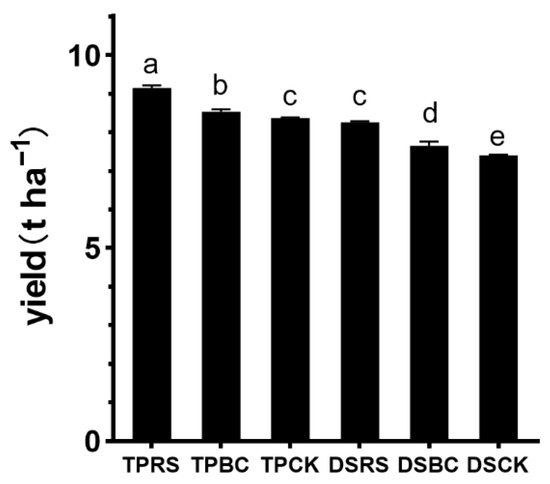
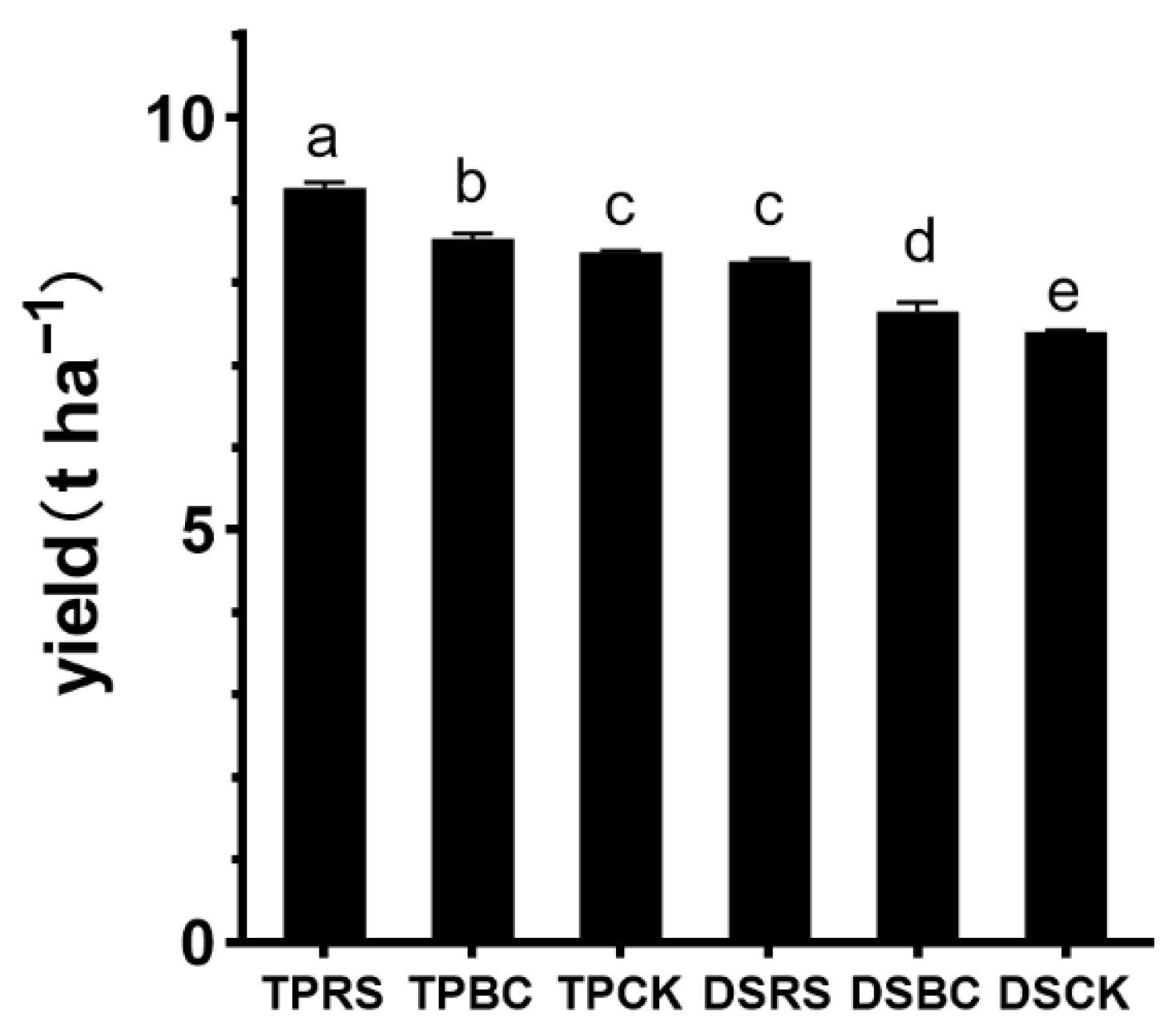
As shown in Figure 1, under transplanting and rice straw (TPRS) treatment (9.14 t ha−1), the paddy yield (YD) was 23.5% higher (p < 0.05) compared to that under direct seeding and without organic amendment (DSCK) treatment (7.4 t ha−1). No noticeable difference was noticed between direct seeding and rice straw (DSRS) and transplanting and without organic amendment (TPCK) in terms of YD.
Figure 1.
Impacts of different organic treatments on grain yield. Distinct letters signify significant variations at p < 0.05. TPRS, transplanting and rice straw; TPBC, transplanting and biochar; TPCK, transplanting and no organic amendment; DSRS, direct seeding and rice straw; DSBC, direct seeding and biochar; DSCK, direct seeding and no organic amendment.
3.2. Diversity of Fungal Populations
Table 1 shows the Chao1, ACE, Shannon, and Simpson indices for fungi in different groups (Table 1). The direct seeding (DS) and transplanting (TP) groups did not show any noticeable difference in Shannon, Chao1, and ACE. RS addition caused an increase in all four indices in comparison to BC or CK, which did not show any differences in the alpha diversity indices.
Table 1.
Richness and diversity of fungal communities in rhizosphere soil samples subjected to different planting methods and organic amendments.
3.3. Structure and Composition of Fungal Populations in Rhizosphere Soil Samples
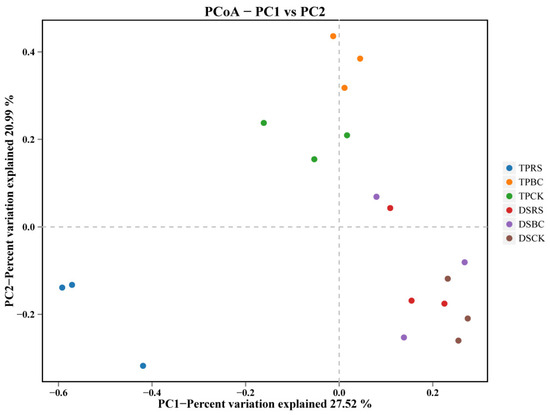
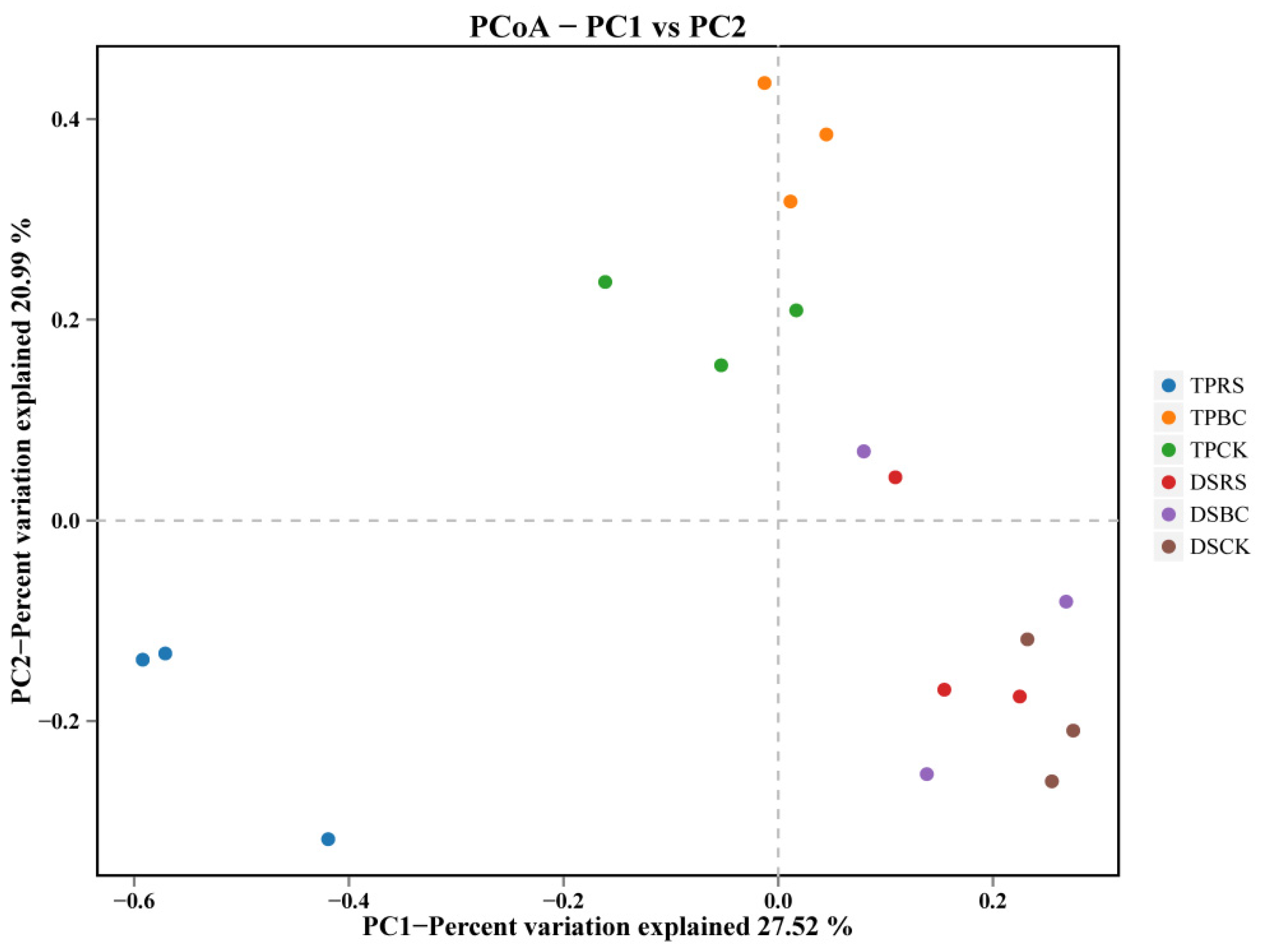
PCoA revealed clear distinctions between rhizosphere fungal communities at the OTU level under different treatments (Figure 2). The direct seeding (DS) and transplanting (TP) groups showed substantial differences in fungal community structure. In the TP groups, different organic amendments resulted in the clear separation of fungal communities.
Figure 2.
PCoA of the rhizosphere fungal populations at the OTU level, based on the Jaccard distance algorithm. TPRS, transplanting and rice straw; TPBC, transplanting and biochar; TPCK, transplanting and no organic amendment; DSRS, direct seeding and rice straw; DSBC, direct seeding and biochar; DSCK, direct seeding and no organic amendment.
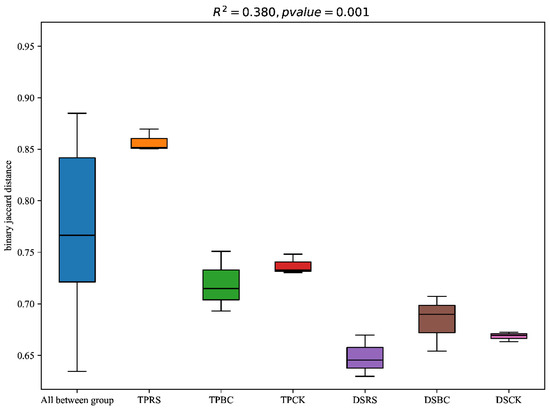
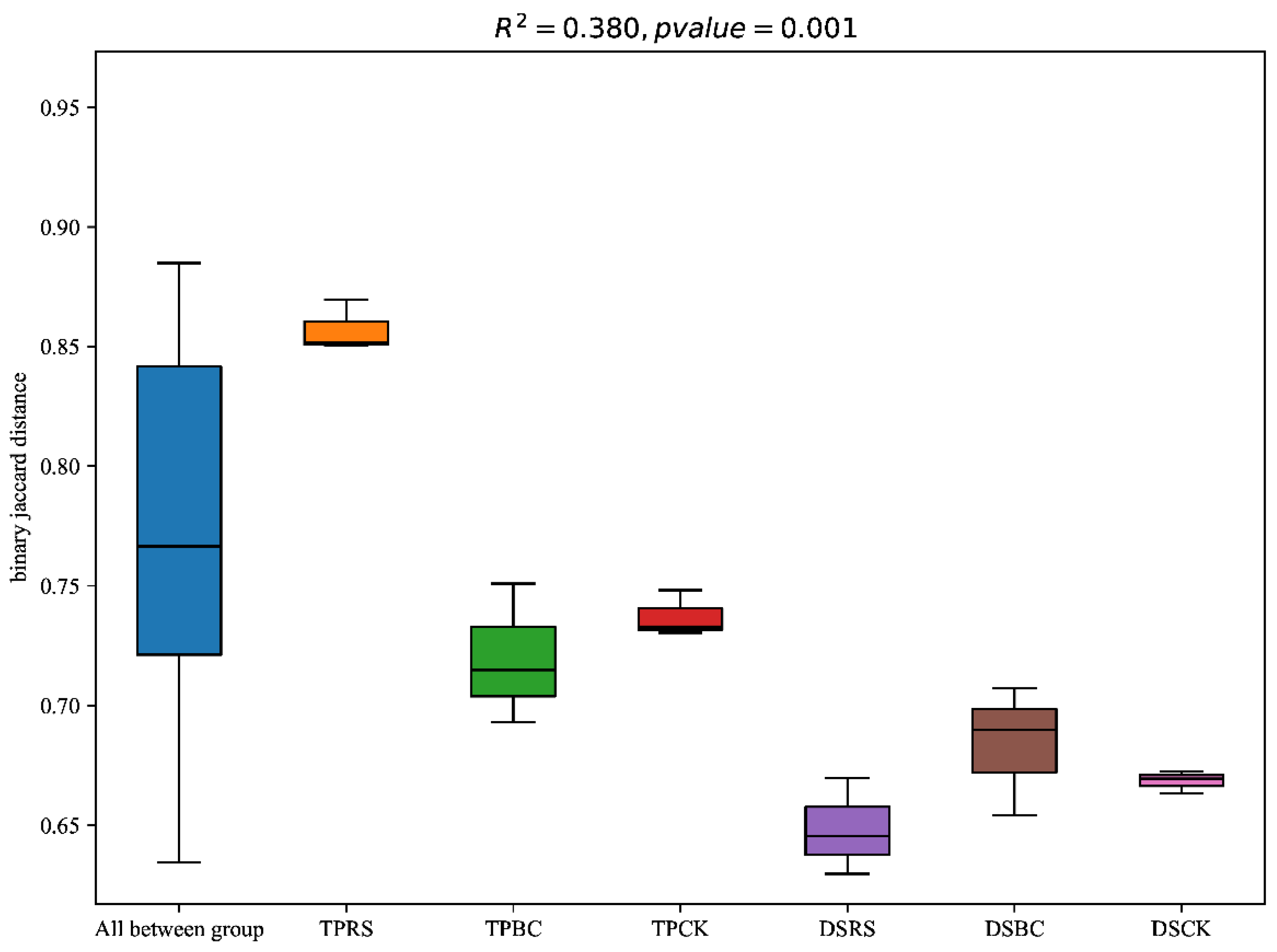
The dissimilarity distances further demonstrated the variations in the structure of the fungal populations across different treatment groups (Figure 3). The TP and DS groups displayed greater dissimilarity in their rhizosphere fungal communities. The fungal community structure under RS treatment significantly differed from those under the BC and CK treatments, which did not show any difference.
Figure 3.
OTU-level dissimilarity distances, based on the Jaccard distance algorithm, indicating variations in rhizosphere fungal populations. TPRS, transplanting and rice straw; TPBC, transplanting and biochar; TPCK, transplanting and no organic amendment; DSRS, direct seeding and rice straw; DSBC, direct seeding and biochar; DSCK, direct seeding and no organic amendment.
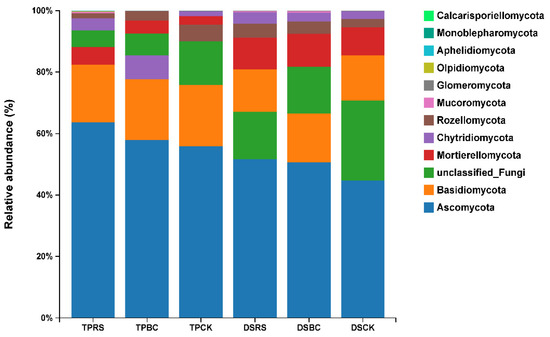
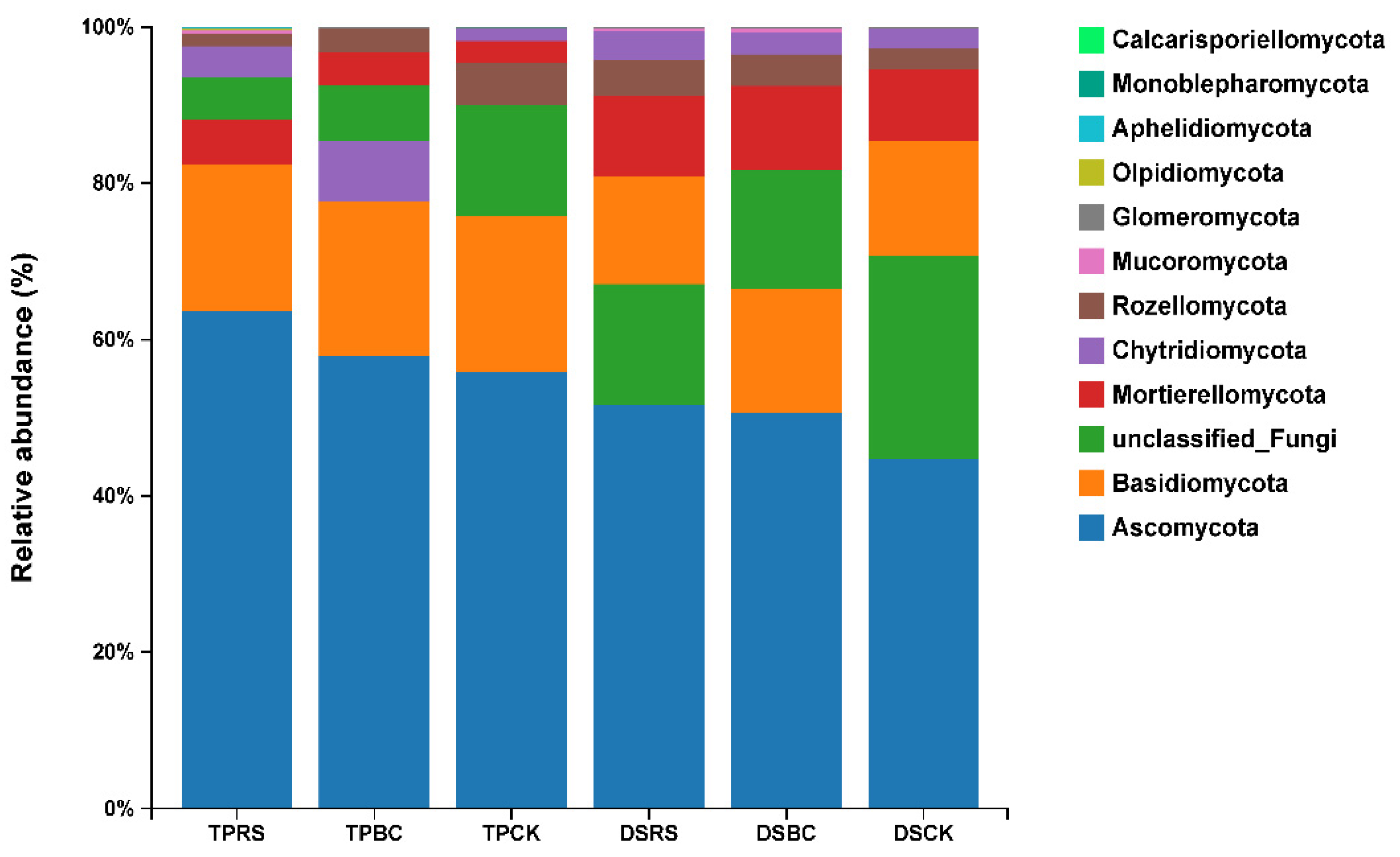
The fungal community compositions were further analyzed to understand the influences of different organic amendments and planting methods (Figure 4). For every treatment, different distributions at the phylum level were found. Among the 25 phyla (Figure 4), 47 classes, 215 families, and 399 genera, the most abundant phyla (>1% relative abundance) across all depths included Ascomycota (44.7–63.7%), Basidiomycota (13.9–20.0%), unclassified_Fungi (5.4–26.0%), Mortierellomycota (2.8–10.7%), Chytridiomycota (1.6–7.8%), and Rozellomycota (1.6–5.3%). The predominant classes (>1% relative abundance) throughout all depths were Sordariomycetes (20.6–36.6%), unclassified_Fungi (5.4–26.0%), Dothideomycetes (8.0–19.5%), Tremellomycetes (4.3–11.3%), Mortierellomycetes (2.8–10.3%), Leotiomycetes (4.8–7.8%), and Agaricomycetes (2.6–10.7%) (Figure S1). Unclassified_Fungi (5.4–26.0%), Mortierellaceae (2.5–10.2%), Lasiosphaeriaceae (1.2–7.6%), Cladosporiaceae (2.3–5.7%), and Chaetomiaceae (1.5–8.2%) were the most abundant families (>1% relative abundance) across all depths (Figure S2). Unclassified_Fungi (5.4–26.0%), Mortierella (2.5–10.2%), and Cladosporium (2.2–5.7%) were the most abundant families (>1% relative abundance) across all depths (Figure S3). Compared to DS, TP promoted the growth of fungi belonging to Ascomycota, Basidiomycota, Chytridiomycota, Olpidiomycota, Aphelidiomycota, Monoblepharomycota, and Calcarisporiellomycota, while reducing the abundance of unclassified_Fungi, Mortierellomycota, Rozellomycota, Mucoromycota, and Glomeromycota. The RS and BC amendments enhanced the abundance of Basidiomycota, Ascomycota, Rozellomycota, Chytridiomycota, Olpidiomycota, Mucoromycota, Aphelidiomycota, and Gammaproteobacteria.
Figure 4.
Abundance profiles of fungal phyla in rhizosphere soil under various treatments. TPRS, transplanting and rice straw; TPBC, transplanting and biochar; TPCK, transplanting and no organic amendment; DSRS, direct seeding and rice straw; DSBC, direct seeding and biochar; DSCK, direct seeding and no organic amendment.
3.4. Microbial Biomass and Enzyme Activity Levels in Soil
The microbial biomass nitrogen (MBN), microbial biomass carbon (MBC), sucrase activity (SA), urease activity (UA), and cellulase activity (CA) varied markedly across the treatment groups (Table 2), reflecting variations in organic matter degradation and nutrient levels. DS improved CA, MBC, and MBN, while reducing SA and UA, as compared to TP. BC addition boosted UA, MBC, and MBN, while RS application promoted CA activity. RS and BC treatments led to higher CA activity relative to CK.
Table 2.
Microbial biomass and enzyme activity in the soil under different treatments.
3.5. Soil Properties
The soil pH, organic carbon (OC), available potassium (AK), available phosphorus (AP), and available nitrogen (AN) varied markedly across the treatment groups (p < 0.05) (Table 3). Compared to transplanting (TP), direct seeding (DS) caused a significant increase in AN, AK, NON, and NHN. Furthermore, RS application enhanced the levels of AN, AP, NON, and NHN in the soil, while BC incorporation improved the AK content and soil pH. Both RS and BC addition led to higher OC content in the rhizosphere soil relative to CK.
Table 3.
Soil physicochemical characteristics under different planting methods and organic amendments.
3.6. Associations Among Soil Parameters, Fungal Communities, and Enzyme Activity in the Soil
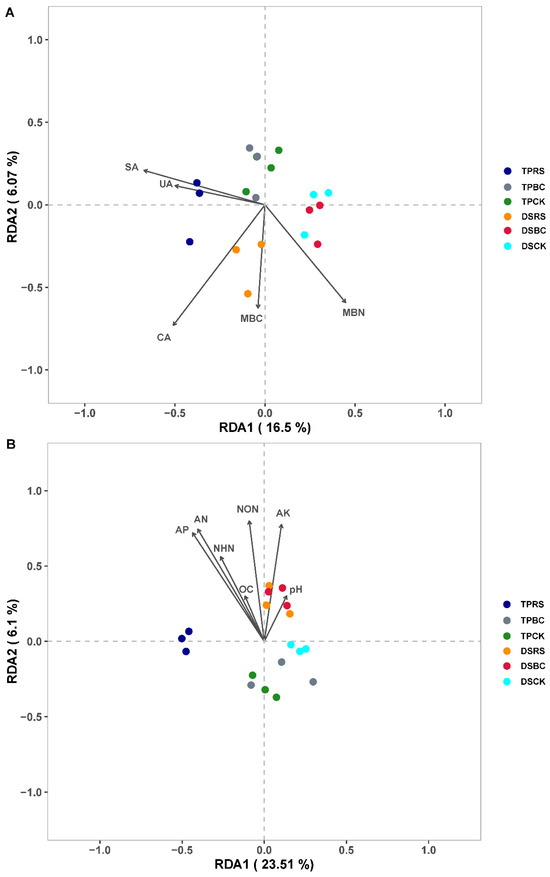
RDA revealed associations among soil parameters, enzyme activity, and fungal key genera (Figure 5). While the CK and BC treatments led to similar compositions of the rhizosphere fungal community under both planting methods, RS treatment resulted in clearly separated fungal communities. The fungal communities associated with TP and DS also showed clear separation (Figure 5A). Figure 5B shows that the fungal communities associated with BC and CK amendments were similar. However, they were visibly distant from the fungal populations in the TPRS group. Similarly, the fungal taxa linked to RS and BC amendments were similar but clearly separated from those observed in the DSBC group. The fungal communities associated with DS and TP also exhibited clear separation (Figure 5B). SA, CA, MBN, AN, AP, AK, and NON displayed strong correlations (p < 0.05) with the fungal communities. Under the TP approach, SA and UA showed strong associations with RS application. On the other hand, in the DSRS group, the DS, CA, and MBC content demonstrated strong connections with the fungal populations (Figure 5A). Under DS, the soil pH, AK, and NON demonstrated strong connections with the BC and RS amendments (Figure 5B).
Figure 5.
RDA results showing associations of rhizosphere fungal genera with enzyme activity (A) and soil parameters (B). TPRS, transplanting and rice straw; TPBC, transplanting and biochar; TPCK, transplanting and no organic amendment; DSRS, direct seeding and rice straw; DSBC, direct seeding and biochar; DSCK, direct seeding and no organic amendment.
3.7. Relationships Among Enzyme Activity, Soil Properties, Crop Yield, and Key Fungal Phyla
Pearson’s correlation analysis revealed links among enzyme activity, soil parameters, crop yields, and the dominant fungal phyla (Table 4 and Table 5). SA was positively associated with AP, pH, YD, and UA. Similarly, UA displayed positive relationships with AP, the pH, and YD, as well as OC. CA was positively linked with NHN, NON, AP, and AN. MBN demonstrated positive connections with the pH, AN, AP, NON, and NHN, while MBC exhibited positive connections with the soil pH, AP, OC, and AK. The soil pH was positively associated with OC, AP, and AK. In contrast, AN displayed positive links with AK, AP, NHN, and NON, while AK was positively linked to AP, NON, and NHN. Similarly, AP exhibited positive connections with NON and NHN. Furthermore, a positive connection was observed between NON and NHN. Among the dominant fungal phyla, the Ascomycota abundance was positively correlated with YD, while unclassified_Fungi displayed negative correlations with SA, UA, the pH, OC, AP, and YD (Table 5). The Mortierellomycota abundance was positively linked to the MBN and NON levels.
Table 4.
Pearson’s correlation coefficients indicating the connections among enzyme activity, soil factors, yield, and key fungal phyla.
Table 5.
Pearson’s correlation coefficients indicating the connections among soil parameters, key fungal phyla, and the activity of enzymes.
4. Discussion
Direct seeding and transplanting are two key methods of rice production. In prior reports, transplanting led to higher grain yields relative to direct seeding, which can be attributed to increased numbers of filled grains in a panicle. Transplanting involves earlier sowing and a longer pre-heading period than direct seeding, which promotes greater dry matter accumulation, leading to larger panicles and higher grain yields [23]. In this study, the TP groups achieved higher grain yields than the DS groups, supporting previous findings. Furthermore, straw incorporation is a practical approach to improving soil quality and crop yields [24]. In a previous study, optimized tillage and RS incorporation significantly improved the crop yield [25]. Similarly, RS addition improved the AN, NON, and NHN content in the soil, thereby enhancing the grain yield, in this study (Figure 1).
Fungi are the main source of soil enzymes. The extracellular enzymes secreted by fungi (e.g., cellulase, protease) can degrade the organic matter in soil, thus releasing carbon and other nutrients [26]. The enzyme activity levels in the soil reflect nutrient cycling and organic matter degradation [27]. Both organic treatments and planting techniques influenced microbial biomass and the activity of enzymes in the rhizosphere soil (Table 2). DS significantly improved CA activity, MBC, and MBN, which may be attributed to higher levels of nutrients, such as AN, AK, NON, and NHN. These nutrients exhibited positive connections with enzyme activity and microbial biomass content (Table 4). Compared to DS, TP caused a significant decrease in AN, AK, NON, and NHN. With TP, the sowing date was earlier and the period before heading was longer than that with DS, which absorbed more nutrients from the soil; this was conducive to improving the dry matter in the crops, resulting in a larger panicle and improving the grain yield. This is consistent with previous studies [23]. RS incorporation further boosted the activity of CA, likely due to the degradation of hemicellulose and cellulose in RS, which released carbohydrates and smaller organic compounds into the soil [28]. RS treatment also increased the levels of NHN, NON, AP, and AN, further enriching the nutrients in the soil (Table 3), in line with the findings of prior reports [1,29,30]. BC, with its porous structure and high C levels, provided an environment conducive to the growth of rhizosphere microbes [29]. It improved the soil pH, creating a suitable growth environment for certain microbial populations [31,32]. Furthermore, BC incorporation led to higher levels of OC, AK, UA activity, MBN, and MBC. These findings highlight the superior ability of BC, compared to RS and CK treatments, to improve microbial biomass, enzyme activity, the pH, carbon, and nutrient levels. These observations align with previously reported findings [33].
The diversity and richness of soil microorganisms are key indicators of soil fertility and the stability of ecosystems [34]. These factors are crucial for strong and sustainable agronomic productivity [35]. This research reveals the influence of organic amendments on fungal diversity and richness. Soil fungi can decompose the RS incorporated into the soil, producing cellulose and hemicellulose. Hemicellulose is further disintegrated to produce polysaccharides (such as carbohydrates and starch) and simple sugars [36]. This process is mediated by complex microbial consortia and various intracellular/extracellular enzymes. These phenomena explain the rise in fungal richness and diversity observed in this study after RS treatment. Furthermore, to assess the fungal diversity in the soil, the Simpson and Shannon indices were calculated. The ACE and Chao1 indices were also determined to analyze fungal richness (Table 1). The RS treatment caused a noticeable rise in the Chao1, ACE, Shannon, and Simpson indices, in comparison to the CK and BC treatments, which may be attributed to the higher availability of habitats after BC amendment, supporting microbial growth.
The PCoA results demonstrated the remarkable impacts of the organic amendments and planting methods on the composition of the fungal population at the OTU level (Figure 2). The results observed in this study support the findings of previous studies, showing the noticeable effects of organic amendments on the microbial α-diversity in the soil [37,38]. For both planting techniques, significant variations in fungal α-diversity were observed across the RS, BC, and CK treatments (Figure 3). Moreover, both the organic amendments and planting methods altered the compositions of the rhizosphere fungal populations (Figure 4). According to previous studies, Ascomycota and Basidiomycota are usually the dominant phyla in cultivated land and wetlands, and they are frequently observed in rice and corn fields [39]. Consistent with these studies, Ascomycota and Basidiomycota dominated the rice field in this study, along with unclassified_Fungi, in both the TP and DS groups. Compared to DS, the TP groups showed markedly elevated abundance levels for Ascomycota, Basidiomycota, Chytridiomycota, Olpidiomycota, Aphelidiomycota, Monoblepharomycota, and Calcarisporiellomycota. This phenomenon may be attributed to the intensive nutrient uptake by rice roots under the transplanting method, which requires more soil enzymes, thereby increasing the fungal richness and diversity [1]. The fungi belonging to Ascomycota are primarily associated with root exudate assimilation and organic matter decomposition. Previous studies have reported that a rise in litter is favorable to the growth of Ascomycota. As a primary source of nutrients, litter is crucial for soil microbial communities [40,41]. In this study, both the RS and BC treatments enhanced the abundance of Ascomycota. This may be because RS decomposition improved the organic matter in the soil, thus promoting the growth of Ascomycota and Basidiomycota. The fungal species of these two phyla adopt different strategies for the degradation of organic matter. Fungi of the Basidiomycota phylum are more efficient in decomposing recalcitrant compounds like lignin [42,43]. On the other hand, species of Ascomycota favor labile organic compounds [44]. Furthermore, the root residues and secretions of plants, as well as different crop management strategies, can influence the structure and composition of the microbial population by altering soil characteristics.
RDA further illustrated that the microbial community structure is associated with soil characteristics and enzyme activity (Figure 5). In the RS-treated soils, the microbial communities were strongly influenced by the soil parameters, including MBC, pH, AK, and NON, and the activity of SA, UA, and CA. These results indicate that the enzymes secreted by soil microorganisms degrade the cellulose and hemicellulose content in RS into nutrients, which are released into the soil [45,46]. Organic amendments influence the abundance and composition of the fungal community by altering soil properties and enzymatic activity. For example, the abundance of Ascomycota was positively connected with YD, SA, and UA under RS treatment (Table 4 and Table 5). This indicates that the enzymes secreted by the members of Ascomycota decomposed RS and released nutrients into the soil, thereby improving YD.
5. Conclusions
The effects of different organic amendments and planting methods on soil characteristics and enzyme activity, as well as on fungal diversity and the community structure, were assessed in this research. Both the organic treatments and planting techniques apparently affected the structure of the fungal community. In the transplanting method, the soil enzymes secreted by Ascomycota and Basidiomycota could degrade the rice straw in the soil, thus releasing carbon, AN, NON, and NHN. These changes ultimately improved the grain yield. This study offers deeper insights into the relationships among fungal populations, enzyme activity, soil properties, and grain yields, thus laying the groundwork for sustainable agronomic practices.
Supplementary Materials
The following supporting information can be downloaded at https://www.mdpi.com/article/10.3390/agronomy16050548/s1, Figure S1: Class-level fungal community composition as affected by each treatments. TPRS, transplanting and rice straw; TPBC, transplanting and biochar; TPCK, transplanting and no organic amendment; DSRS, direct seeding and rice straw; DSBC, direct seeding and biochar; DSCK, direct seeding and no organic amendment; Figure S2: Family-level fungal community composition as affected by each treatments. TPRS, transplanting and rice straw; TPBC, transplanting and biochar; TPCK, transplanting and no organic amendment; DSRS, direct seeding and rice straw; DSBC, direct seeding and biochar; DSCK, direct seeding and no organic amendment; Figure S3: Genus-level fungal community composition as affected by each treatments. TPRS, transplanting and rice straw; TPBC, transplanting and biochar; TPCK, transplanting and no organic amendment; DSRS, direct seeding and rice straw; DSBC, direct seeding and biochar; DSCK, direct seeding and no organic amendment.
Author Contributions
Conceptualization, Z.L.; methodology, C.L. and L.W.; software, L.W.; validation, C.L. and Z.L.; formal analysis, Z.T. and L.W.; investigation, C.L. and Z.L.; resources, Z.T.; data curation, Z.T.; writing—original draft preparation, Z.L. and Z.T.; writing—review and editing, Z.T. and Z.L.; visualization, L.W.; supervision, C.L.; project administration, Z.T.; funding acquisition, Z.T. and Z.L. All authors have read and agreed to the published version of the manuscript.
Funding
This study was funded by the Rice International Joint Breeding Laboratory (2026LHSYS01), the earmarked fund for the China Agriculture Research System (CARS-01), the Liaoning Province Xinmin City Rice Science and Technology Special Envoy Team (2025080180-JH5/104), and the China–Russia Cooperation Rice Breeding Laboratory (2019LHSYS04).
Data Availability Statement
The original contributions presented in this study are included in the article. Further inquiries can be directed to the corresponding author.
Conflicts of Interest
The authors declare no conflicts of interest.
References
- Tang, Z.; Zhang, L.; He, N.; Liu, Z.; Ma, Z.; Fu, L.; Wang, H.; Wang, C.; Sui, G.; Zheng, W. Influence of planting methods and organic amendments on rice yield and bacterial communities in the rhizosphere soil. Front. Microbiol. 2022, 13, 918986. [Google Scholar] [CrossRef] [Scilit] [PubMed]
- Ashraf, U.; Mo, Z.; Tang, X. Direct seeded vs. transplanted rice in Asia: Climatic effects, relative performance and constraints-a comparative outlook. In Recent Advances and Innovation in Rice Research; Verma, D.K., Srivastav, P.P., Nadaf, B., Eds.; Taylor and Francis: London, UK; Apple Academic Press: Oakville, ON, Canada, 2017. [Google Scholar]
- Cao, G.; Zhang, X.; Wang, Y.; Zheng, F. Estimation of emissions from field burning of crop straw in China. Chin. Sci. Bull. 2008, 53, 784–790. [Google Scholar] [CrossRef] [Scilit]
- Joseph, S.D.; Camps-Arbestain, M.; Lin, Y.; Munroe, P.; Chia, C.H.; Hook, J.; Van Zwieten, L.; Kimber, S.; Cowie, A.; Singh, B.P.; et al. An Investigation into the Reactions of Biochar in Soil. Soil Res. 2010, 48, 501–515. [Google Scholar] [CrossRef] [Scilit]
- Tayyab, M.; Islam, W.; Arafat, Y.; Pang, Z.; Zhang, C.; Lin, Y.; Waqas, M.; Lin, S.; Lin, W.; Zhang, H. Effect of Sugarcane Straw and Goat Manure on Soil Nutrient Transformation and Bacterial Communities. Sustainability 2018, 10, 2361. [Google Scholar] [CrossRef] [Scilit]
- Saha, S.; Gopinath, K.A.; Mina, B.L.; Gupta, H.S. Influence of continuous application of inorganic nutrients to a Maize-Wheat rotation on soil enzyme activity and grain quality in a rainfed Indian soil. Eur. J. Soil Biol. 2008, 44, 521–531. [Google Scholar] [CrossRef] [Scilit]
- Tedersoo, L.; Bahram, M.; Põlme, S.; Kõljalg, U.; Yorou, N.S.; Wijesundera, R.; Ruiz, L.V.; Vasco-Palacios, A.M.; Thu, P.Q.; Suija, A.; et al. Global diversity and geography of soil fungi. Science 2014, 346, 1256688. [Google Scholar] [CrossRef] [Scilit]
- Powell, K.I.; Chase, J.M.; Knight, T.M. Invasive plants have scale-dependent effects on diversity by altering species-area relationships. Science 2013, 339, 316–318. [Google Scholar] [CrossRef] [Scilit]
- Zhang, J.; Liu, Y.X.; Zhang, N.; Hu, B.; Jin, T.; Xu, H.; Qin, Y.; Yan, P.; Zhang, X.; Guo, X.; et al. NRT1.1B is associated with root microbiota composition and nitrogen use in field-grown rice. Nat. Biotechnol. 2019, 37, 676–684. [Google Scholar] [CrossRef] [Scilit]
- Sun, R.; Zhang, X.X.; Guo, X.; Wang, D.; Chu, H. Bacterial diversity in soils subjected to long-term chemical fertilization can be more stably maintained with the addition of livestock manure than wheat straw. Soil Biol. Biochem. 2015, 88, 9–18. [Google Scholar] [CrossRef] [Scilit]
- Tang, Z.; He, N.; Zhang, L.; Wang, L.; Gong, D.; Wang, C.; Wang, H.; Sui, G.; Zheng, W. Straw and Biochar Application Alters the Structure of Rhizosphere Microbial Communities in Direct-Seeded Rice (Oryza sativa L.) Paddies. Agronomy 2024, 14, 316. [Google Scholar] [CrossRef] [Scilit]
- Guan, S.; Zhang, D.; Zhang, Z. Soil Enzyme and Its Research Methods; China Agriculture Press: Beijing, China, 1986. [Google Scholar]
- Lu, R.K. Soil Agricultural Chemical Analysis Method; China Agricultural Science and Technology Press: Beijing, China, 2000. [Google Scholar]
- Brookes, P.C.; Landman, A.; Pruden, G.; Jenkinson, D.S. Chloroform fumigation and the release of soil nitrogen: A rapid direct extraction method to measure microbial biomass nitrogen in soil. Soil Biol. Biochem. 1985, 17, 837–842. [Google Scholar] [CrossRef] [Scilit]
- Vance, E.D.; Brookes, P.C.; Jenkinson, D.S. An extraction method for measuring soil microbial biomass C. Soil Biol. Biochem. 1987, 19, 703–707. [Google Scholar] [CrossRef] [Scilit]
- Magoč, T.; Salzberg, S.L. FLASH: Fast length adjustment of short reads to improve genome assemblies. Bioinformatics 2011, 27, 2957–2963. [Google Scholar] [CrossRef] [Scilit]
- Bolger, A.M.; Lohse, M.; Usadel, B. Trimmomatic: A flexible trimmer for Illumina sequence data. Bioinformatics 2014, 30, 2114–2120. [Google Scholar] [CrossRef] [Scilit] [PubMed]
- Edgar, R.C.; Haas, B.J.; Clemente, J.C.; Quince, C.; Knight, R. UCHIME improves sensitivity and speed of chimera detection. Bioinformatics 2011, 27, 2194–2200. [Google Scholar] [CrossRef] [Scilit] [PubMed]
- Edgar, R.C. UPARSE: Highly accurate OTU sequences from microbial amplicon reads. Nat. Methods 2013, 10, 996–998. [Google Scholar] [CrossRef] [Scilit]
- Schloss, P.D.; Westcott, S.L.; Ryabin, T.; Hall, J.R.; Hartmann, M.; Hollister, E.B.; Lesniewski, R.A.; Oakley, B.B.; Parks, D.H.; Robinson, C.J.; et al. Introducing mothur: Open-Source, Platform-Independent, Community-Supported Software for Describingand Comparing Microbial Communities. Appl. Environ. Microbiol. 2009, 75, 7537–7541. [Google Scholar] [CrossRef] [Scilit]
- Littell, R.; Milliken, G.; Stroup, W.; Wolfinger, R.; Schabenberger, O. SAS for Mixed Models, 2nd ed.; SAS Institute Inc.: Cary, NC, USA, 2006. [Google Scholar]
- The R Development Core Team. R: A Language and Environment For Statistical Computing; R Foundation for Statistical Computing: Vienna, Austria, 2015. [Google Scholar]
- Chen, S.; Cai, S.; Chen, X.; Zhang, G. Genotypic Differences in Growth and Physiological Responses to Transplanting and Direct Seeding Cultivation in Rice. Rice Sci. 2009, 16, 143–150. [Google Scholar] [CrossRef] [Scilit]
- Wang, J.; Wang, X.; Xu, M.; Feng, G.; Zhang, W.; Lu, C. Crop Yield and Soil Organic Matter after Long-Term Straw Return to Soil in China. Nutr. Cycl. Agroecosyst. 2015, 102, 371–381. [Google Scholar] [CrossRef] [Scilit]
- Mo, Z.; Cheng, S.; Ren, Y.; He, L.; Pan, S.; Liu, H.; Tian, H.; Ashraf, U.; Duan, M.; Tang, X. Reduced Tillage Coupled with Straw Return Improves the Grain Yield and 2-Acetyl-1-Pyrroline Content in Fragrant Rice. J. Integr. Agric. 2025, 24, 1718–1737. [Google Scholar] [CrossRef] [Scilit]
- Wang, W.; Li, Y.; Wang, H.; Zu, Y. Differences in the Activities of Eight Enzymes from Ten Soil Fungi and Their Possible Influences on the Surface Structure, Functional Groups, and Element Composition of Soil Colloids. PLoS ONE 2014, 9, e111740. [Google Scholar] [CrossRef] [Scilit]
- Zhou, G.; Xu, X.; Qiu, X.; Zhang, J. Biochar influences the succession of microbial communities and the metabolic functions during rice straw composting with pig manure. Bioresour. Technol. 2019, 272, 10–18. [Google Scholar] [CrossRef] [Scilit]
- Das, S.K.; Ghosh, G.K.; Avasthe, R.; Choudhury, B.U.; Mishra, V.K.; Kundu, M.C.; Roy, A.; Mondal, T.; Lama, A.; Dhakre, D.S. Organic nutrient sources and biochar technology on microbial biomass carbon and soil enzyme activity in maize-black gram cropping system. Biomass Convers. Biorefin. 2021, 13, 9277–9287. [Google Scholar] [CrossRef] [Scilit]
- Tang, Z.; Zhang, L.; He, N.; Gong, D.; Gao, H.; Ma, Z.; Fu, L.; Zhao, M.; Wang, H.; Wang, C.; et al. Soil bacterial community as impacted by addition of rice straw and biochar. Sci. Rep. 2021, 11, 22185. [Google Scholar] [CrossRef] [Scilit]
- Liu, Z.; Tang, Z.; Wang, L.; Wen, L.; Liang, Y.; Wang, C.; Wang, H. The Influence of Planting Method and Short-Term Organic Amendments on Rhizosphere Microbial Communities in Paddies: Preliminary Results. Agronomy 2025, 15, 540. [Google Scholar] [CrossRef] [Scilit]
- Das, S.K.; Ghosh, G.K. Soil hydro-physical environment as infuenced by diferent biochar amendments. Int. J. Bio-Resour. Stress Manag. 2017, 8, 668–673. [Google Scholar] [CrossRef] [Scilit]
- Hagemann, N.; Joseph, S.; Schmidt, H.P.; Kammann, C.I.; Harter, J.; Borch, T.; Young, R.B.; Varga, K.; Taherymoosavi, S.; Elliott, K.W.; et al. Organic coating on biochar explains its nutrient retention and stimulation of soil fertility. Nat. Commun. 2017, 8, 1089. [Google Scholar] [CrossRef] [Scilit]
- Singh, N.S.; Mukherjee, I.; Das, S.K.; Varghese, E. Leaching of clothianidin in two diferent Indian soils: Efect of organic amendment. Bull. Environ. Contam. Toxicol. 2018, 100, 553–559. [Google Scholar] [CrossRef] [Scilit] [PubMed]
- Bu, R.Y.; Ren, T.; Lei, M.J.; Liu, B.; Li, X.K.; Cong, R.H. Tillage and straw-returning practices effect on soil dissolved organicmatter, aggregate fraction and bacteria community under rice-rice-rapeseed rotation system. Agric. Ecosyst. Environ. 2020, 287, 106681. [Google Scholar] [CrossRef] [Scilit]
- Win, K.T.; Okazaki, K.; Ohkama-Ohtsu, N.; Yokoyama, T.; Ohwaki, Y. Short-term effects of biochar and Bacillus pumilus TUAT-1 on the growth of forage rice and its associated soil microbial community and soil properties. Biol. Fertil. Soils 2020, 56, 481–497. [Google Scholar] [CrossRef] [Scilit]
- Hansen, V.; Müller-Stöver, D.; Munkholm, L.J.; Peltre, C.; Hauggaard-Nielsen, H.; Jensen, L.S. The effect of straw and wood gasification biochar on carbon sequestration, selected soil fertility indicators and functional groups in soil: An incubation study. Geoderma 2016, 269, 99–107. [Google Scholar] [CrossRef] [Scilit]
- Yang, H.S.; Fang, C.; Meng, Y.; Dai, Y.J.; Liu, J. Long-term ditch-buried straw return increases functionality of soil microbial communities. Catena 2021, 202, 105316. [Google Scholar] [CrossRef] [Scilit]
- Zhao, S.C.; Qiu, S.J.; Xu, X.P.; Ciampitti, I.A.; Zhang, S.Q.; He, P. Change in straw decomposition rate and soil microbial community composition after straw addition in different long-term fertilization soils. Appl. Soil Ecol. 2019, 138, 123–133. [Google Scholar] [CrossRef] [Scilit]
- Cheng, Y.Y.; Jin, Z.J.; Wang, X.T.; Jia, Y.H.; Yuan, W.; Zhou, J.B. Effect of land-use on soil fungal community structure and associated functional group in huixian karst wetland. Huan Jing Ke Xue 2020, 41, 4294–4304. [Google Scholar] [PubMed]
- Hugoni, M.; Luis, P.; Guyonnet, J.; Haichar, F.E.Z. Plant Host Habitat and Root Exudates Shape Fungal Diversity. Mycorrhiza 2018, 28, 451–463. [Google Scholar] [CrossRef] [Scilit] [PubMed]
- Dang, P.; Yu, X.; Le, H.; Liu, J.; Shen, Z.; Zhao, Z. Effects of Stand Age and Soil Properties on Soil Bacterial and Fungal Community Composition in Chinese Pine Plantations on the Loess Plateau. PLoS ONE 2017, 12, e0186501. [Google Scholar] [CrossRef] [Scilit]
- Baldrian, P.; Valášková, V. Degradation of Cellulose by Basidiomycetous Fungi. FEMS Microbiol. Rev. 2008, 32, 501–521. [Google Scholar] [CrossRef] [Scilit] [PubMed]
- Yelle, D.J.; Ralph, J.; Lu, F.; Hammel, K.E. Evidence for Cleavage of Lignin by a Brown Rot Basidiomycete. Environ. Microbiol. 2008, 10, 1844–1849. [Google Scholar] [CrossRef] [Scilit]
- Seifert, K.A. Compendium of Soil Fungi-by K.H. Domsch, W. Gams & T.-H. Anderson. Eur. J. Soil Sci. 2008, 59, 1007. [Google Scholar]
- Huang, M.; Fu, H.; Kong, X.; Ma, L.; Liu, C.; Fang, Y.; Zhang, Z.; Song, F.; Yang, F. Effects of Fertilization Methods on Chemical Properties, Enzyme Activity, and Fungal Community Structure of Black Soil in Northeast China. Diversity 2020, 12, 476. [Google Scholar] [CrossRef] [Scilit]
- Zhang, Y.; Cao, H.; Zhao, P.; Wei, X.; Ding, G.; Gao, G.; Shi, M. Vegetation Restoration Alters Fungal Community Composition and Functional Groups in a Desert Ecosystem. Front. Environ. Sci. 2021, 9, 589068. [Google Scholar] [CrossRef] [Scilit]

Disclaimer/Publisher’s Note: The statements, opinions and data contained in all publications are solely those of the individual author(s) and contributor(s) and not of MDPI and/or the editor(s). MDPI and/or the editor(s) disclaim responsibility for any injury to people or property resulting from any ideas, methods, instructions or products referred to in the content. |
© 2026 by the authors. Licensee MDPI, Basel, Switzerland. This article is an open access article distributed under the terms and conditions of the Creative Commons Attribution (CC BY) license.