


Abstract
Soil salinization leads to soil nutrient loss and decreased crop yield. This research aims to determine the optimal reduction rate of diammonium phosphate (DAP) and suitable microbial inoculant for alfalfa cultivation and nitrogen-level improvement in saline-alkali land. The experiment consisted of a factorial arrangement of three DAP fertilizer levels (X1, 60%; X2, 70%; and X3, 80%) and four microbial inoculants (Y1, rhizobial inoculant; Y2, phosphate-solubilizing microbial inoculant; Y3, composite microbial inoculant; and Y4, control) in a split-plot design. The results indicated that DAP fertilizer, microbial inoculant, and their interaction significantly affected (p < 0.05) forage yield, crude protein, available nitrogen (N), and enzyme activities. Under 80% DAP fertilizer combined with the composite microbial inoculant, forage yield, plant height, soil urease (S-UE), and ammonium nitrogen (NH4+-N) reached maximum values of 17.1 t ha−1, 65.7 cm, 292.3 μg d−1 g−1, and 3.1 mg kg−1, respectively. However, the soil total nitrogen (TN) significantly increased at the 60% DAP fertilizer application rate (p < 0.05). Overall, this study demonstrates that co-application of DAP fertilizer with compound microbial inoculant delivers a green, science-based fertilization approach for improving nitrogen levels and alfalfa cultivation in saline-alkali soils.
1. Introduction
Soil salinization is a worldwide problem that constrains the development of ecological environments and agricultural production. Saline-alkali soil, which is often characterized by high pH, poor structure, and deficiency in nutrients and organic matter, hinders crop growth [1]. As a result of soil salinization problems, large areas of farmland are forced into abandonment, forming a vicious circle of “abandonment–ow productivity–abandonment again”. Nowadays, it is a growing global challenge because it seriously affects soil health and agricultural production [2]. According to the FAO, soil salinization affects an estimated 20% of irrigated croplands internationally [3]. The major causes of soil salinization include natural factors, such as saline groundwater intrusion, and anthropogenic activities, such as unreasonable irrigation and chemical fertilizer [4]. Currently, the main strategies to improve saline-alkali soils are physical (straw mulching), chemical (phosphogypsum application), biological (planting salt-tolerant plants and applying microbial fertilizers) and hydraulic engineering methods (construction of irrigation and drainage systems) [5]. Applying microbial inoculants is one of the critical biological strategies for improving saline-alkali soil. It is mainly through microbial metabolic activities to improve soil enzyme activity, thereby improving nutrient availability.
Alfalfa (Medicago sativa L.) is a perennial leguminous plant characterized by high feeding value and moderate saline-alkali tolerance [6]. Many saline-alkali soils lack the ability to supply macro- and micronutrients, making it difficult to maintain alfalfa growth [7]. One of the important strategies to improve crop yield and quality is to apply mineral fertilizers [8]. Diammonium phosphate (DAP) fertilizer can enhance the photosynthetic efficiency and growth of crops in saline-alkali soil, because it contains abundant phosphorus (P) and nitrogen (N) [9]. However, saline-alkali stress hinders the uptake and utilization of macronutrients and micronutrients in alfalfa. Partial substitution of mineral fertilizers by microbial inoculant promotes the nutrient uptake and utilization in alfalfa. For example, Peng et al. found that inoculant with bacillus and trichoderma improved the stability of soil aggregates in saline-alkali soil [10]. Research showed that rhizobial inoculant alleviates the saline-alkali stress of plant, mainly through improving N and P uptake, maintaining photosynthesis, and promoting growth [11]. Soil nutrient availability and salinization degree determine the application effect of microbial inoculants. This is related to the inconsistent field performance and delayed nutrient supply of microbial inoculant [12,13] linked the growth-boosting effect of microbial inoculant on roots and buds to its co-administration with stable ammonium fertilizer. The efficacy of microbial inoculants in saline-alkali soil is strongly potentiated by the co-application of N and P [14].
Two primary determinants of soil N status and crop growth are the selection of microbial inoculant and the dosage of DAP fertilizer [15,16]. The central hypothesis was that a synergistic effect of co-application of DAP fertilizer with microbial inoculant would lead to improved N levels, yield, and quality of alfalfa in saline-alkali soil. We assessed three levels of DAP fertilizer: 60%, 70%, and 80% (where 100% DAP fertilizer = 300 kg ha−1) in combination with four microbial inoculants: (rhizobial inoculant, phosphate-solubilizing microbial inoculant, composite microbial inoculant, and a control). To determine the effects of co-application of DAP fertilizer and microbial inoculant, we measured parameters related to both alfalfa growth performance (plant height, forage yield and nutritive value) and soil properties (N content, pH, and enzyme activity). We sought to determine the most effective microbial inoculant and the corresponding optimal dosage of DAP fertilizer for enhancing alfalfa productivity in saline-alkali soil. This study tested whether the co-application of DAP fertilizer and a microbial inoculant could enhance alfalfa growth in saline-alkali land by improving soil N activation. This study provides insights into how co-application of DAP fertilizer with microbial inoculant affects soil N levels and alfalfa growth performance in saline-alkali soil.
2. Materials and Methods
2.1. Field Experiment
This study took place at the Jinchang Experimental Station of Gansu Agricultural University (38°25′ N, 107°51′ E) from April to November 2024. It is located in the northwest of Gansu, the station is a major alfalfa planting region. The site experiences a temperate continental climate, with a mean annual temperature of 7.7 °C and precipitation of 235 mm (https://www.gansutq.com/jinchuanqu/history.html, accessed on 16 May 2025). The growing season includes a 150-day frost-free period. Solar radiation is substantial, with 2884.2 h of annual sunshine, while potential evaporation is high at 2000.6 mm per year. The variation in rainfall and temperature during the experiment, according to meteorological data (2024, https://www.tianqi24.com, accessed on 24 May 2025), is shown in Supplementary Figure S1.
The experimental field was originally a sandy beach and later ameliorated into farmland by soil filling, with no preceding crops planted. According to the international soil texture classification standard, the granulometric composition of the soil was 58.3% sand, 24.3% silt and 17.4% clay, which was classified as sandy loam soil (measured by the hydrometer method) [17]. The initial soil organic carbon (SOC) was determined using the potassium dichromate oxidation-external heating method, with a mean value of 6.2 g kg−1 [18]. Total nitrogen (TN) was determined by the Kjeldahl method, with a mean of 0.48 g kg−1 [19]. Total phosphorus (TP) was quantified using the molybdenum antimony colorimetric method, with a mean value of 0.11 g kg−1 [20]. Total potassium (TK) was determined using the NaOH alkali fusion-flame photometry method, and its average value was 4.46 g kg−1 [21]. Soil calcium content was determined via the NaOH alkali fusion-flame photometry method, with a mean value of 1.42 g kg−1 [22]. Soil available N, including ammonium nitrogen (NH4+-N) and nitrate nitrogen (NO3−-N), was extracted using a 2 mol·L−1 KCl solution (water-to-soil ratio 5:1) and determined by SKALAR continuous flow analyzer (San++Compact, Shanghai, China), with a mean of 8.1 mg kg−1 [23]. Soil salt content was determined by the gravimetric method; soil samples were mixed with water proportionally, shaken, and filtered, and the filtrate was evaporated to dryness, with the weight of the dried residue corresponding to a total salt content of 4.31% [24]. The soil pH was measured using a pH electrode (PHS-2F) at a soil/water ratio of 1:5, and the original soil pH was 8.15.
2.2. Experiment Material
The tested alfalfa seeds (Medicago sativa ‘Gannong No.3’) were purchased from Gansu Chuanglü Grass Industry Technology Co., Ltd. (Lanzhou, China). DAP fertilizer is rich in N and P with an N:P ratio of 18:20.1, and 1 kg of applied DAP fertilizer provides 0.381 kg of these two nutrients. Furthermore, all N in DAP fertilizer is in ammonium form, while P is primarily present as hydrogen phosphate ions.
The microbial inoculant was provided by the grassland microbial diversity laboratory of Gansu Agricultural University. The tested strains were identified as Sinorhizobium melilots and Pseudomonas sp., which were stored in a refrigerator at −80 °C. The main characteristics of Sinorhizobium melilots included nitrogen fixation, saline-alkali tolerance and secretion of growth-promoting substances. Pseudomonas sp. is mainly characterized by facilitating the conversion of insoluble inorganic phosphorus and secreting plant growth-promoting substances. The rhizobial inoculant was prepared from Sinorhizobium melilots, the phosphate-solubilizing microbial inoculant was prepared from Pseudomonas sp., and the composite microbial inoculant was a 1:1 mixture of the two strains above. Before the experiment, Sinorhizobium melilots was inoculated into liquid YMA medium and cultured at 28 °C and 150 r·min−1 for 48 h in a shaking incubator, while Pseudomonas sp. was inoculated into liquid LB medium and cultured under the same conditions for 24 h. Finally, the concentrations of the bacterial suspensions were determined to be OD600 ≥ 0.5 using an ultraviolet-visible spectrophotometer, and the viable cell quantities of both strains reached 1 × 10⁸ CFU·mL−1 using the dilution plate coating method.
2.3. Experiment Design
The experiment adopts split zone design. Local alfalfa growers primarily use DAP fertilizer, with an application rate of about 300 kg·ha−1·year−1. According to the available literature, about 20–50% of chemical fertilizers can be substituted by microbial inoculant [25]. Therefore, three fertilization gradients of 180 kg ha−1 (60%DAP, X1), 210 kg ha−1 (70%DAP, X2) and 240 kg ha−1 (80%DAP, X3) were set in the main area. Four sub-areas were set under each fertilization gradient: rhizobial inoculant (Y1), phosphate-solubilizing microbial inoculant (Y2), composite microbial inoculant (Y3) and a control (Y4), with a total of 12 treatments (n = 3, Table S1). Three replicates were established for each treatment, with individual plots measuring 5 m in length and 3 m in width. This configuration yields a plot area of 15 m2, and cells are spaced 50 cm apart.
Before sowing, the DAP fertilizer was evenly spread on the surface according to different treatments, and then it was rotated into the soil layer and leveled. Seed dressing method was used as the microbial inoculant, and the dosage was 0.20 L kg−1. The alfalfa was planted by artificial furrow drilling, with the sowing depth of 1–2 cm, the sowing amount of 22.5 kg ha−1 and the row spacing of 20 cm. The experimental field used a subsurface drip irrigation system with a drip tape spacing of 20 cm and an installation depth of 10 cm. Irrigation was applied after sowing and each alfalfa harvest, with an irrigation rate of 30 L·m−2. Sowing was carried out on 10 April 2024, and artificial mowing was carried out in July, August and October, respectively, with stubble of 5 cm.
2.4. Sampling and Measurements
2.4.1. Alfalfa Plant Height, Root Nodule and Yield in the Field Experiment
At the early flowering stage, 15 uniformly developed alfalfa plants were randomly sampled from each plot. Their natural height—from the soil surface to the apical leaf—was precisely measured using a measuring tape, with the mean value subsequently calculated. At each harvest, a representative quadrat (1 m × 1 m) was randomly selected from the center of each plot, and aboveground biomass was harvested by cutting the alfalfa at 5 cm above the soil surface. The sample was first heated at 105 °C for 30 min to inactivate residual biochemical activity, and then oven-drying at 65 °C to constant weight. Hay yield per plot was calculated based on the final dry weight of the sample [26]. The annual output is the sum of three alfalfa crops. After harvesting alfalfa, 10 intact roots of alfalfa were dug with a shovel, cleaned with distilled water and counted. After picking all the root nodules with tweezers, they were put into a measuring cylinder with a certain amount of water, and the volume of root nodules was calculated according to the rising height of the water surface.
V: Root nodule volume; Vm: The volume of water after the root nodule is put into the measuring cylinder; V0: The volume of water before the root nodule is put into the measuring cylinder.
2.4.2. Soil Sampling
After the final harvest, the five-point sampling method was employed to obtain rhizosphere topsoil samples (0–20 cm) from each plot using a soil auger [27]. In the field, the five individual samples were manually mixed to form a composite sample, which was collected in sealed plastic bag [28]. After being transported to the laboratory, the composite soil samples were air-dried and sieved at room temperature, soil properties and enzyme activities were determined.
2.4.3. Soil Physicochemical Properties
The TN concentration in soil was determined through Kjeldahl digestion [19]. The TP was quantified using the molybdenum antimony colorimetric method [20]. NH4+-N and NO3−-N were extracted using a 2 mol·L−1 KCl solution (water-to-soil ratio 5:1) and determined by SKALAR continuous flow analyzer (San++Compact, Shanghai, China) [23]. The available phosphorus (AP) content was measured using the molybdenum blue method [29]. The potassium dichromate oxidation-external heating method was adopted for the determination of SOC, and soil organic matter (SOM) was estimated as SOC × 1.724 [18]. Determination of soil moisture content (SMC) by weighing method: SMC = [(weight of wet soil) − (weight of dried soil)]/(weight of dried soil) [30]. The pH was measured using a pH electrode (PHS-2F) at a soil/water ratio of 1:5. Soil electrical conductivity (EC) was assessed using a conductivity meter (DDSJ-308F) at a soil/water ratio of 1:5.
2.4.4. Soil Enzyme Activities
The soil enzyme activities were determined by soil enzyme activities determination kit (Suzhou Grace Biotechnology Co., Ltd., Suzhou, China). Among them, soil urease (S-UE) was determined by indigo blue colorimetry (G0301F) [31]. Soil nitrate reductase (S-NR) mediates nitrate reduction to nitrite, which then combines with a color-developing reagent to produce red/pink azo pigments [32]. S-NR activity is subsequently determined via absorbance at 540 nm (G0309F). The soil enzyme activities of Leucine aminopeptidase (S-LAP) and N-acety1-β-D-glucosaminidase (S-NAG) were measured using a Soil-Leucine Aminopeptidase activity assay kit (G0329F), and soil N-acety1-β-D-glucosaminidase activity assay kit (G0321F), respectively. The specific process is as follows. Air-dried soil (0.05 g) was mixed with reagent Ⅰ (0.15 mL) and reagent Ⅱ (0.3 mL) in test tube, while an equal amount of air-dried soil was mixed with reagent Ⅱ (0.3 mL) and distilled water (0.15 mL) in control tube. The test tube and control tube were oscillated in a shaker at 37 °C for 1 h, homogenized with reagent Ⅲ (0.35 mL), and centrifuged at 12,000 rpm for 10 min. The absorbance of the supernatants from the test tubes and control tubes was measured at 405 nm, and the soil enzyme activities of N-acety1-β-D-glucosaminidase (S-NAG) were further calculated using the established formula. Air-dried soil (0.05 g) was, respectively, weighed and loaded into test tube and control tube, and the corresponding reagents were added for reaction, prior to centrifugation at 9000 rpm for 5 min. Their supernatants were collected to determine absorbance at 405 nm, and the soil enzyme activities of Leucine aminopeptidase (S-LAP) were calculated by plugging the values into the formula.
2.4.5. Nutritional Value of Alfalfa
The dried alfalfa was crushed by a crusher and screened by a 0.25 mm sieve for nutritional value analysis. The standard Kjeldahl method was adopted for the determination of TN, and crude protein content (CP, %) was estimated using the conversion formula: N% × 6.25 [33]. Acid detergent fiber (ADF, %) and neutral detergent fiber (NDF, %) were quantified using the Van Soest method [34]. Relative feed value (RFV) was determined using ADF (%) and NDF (%) based on dry matter digestibility (DMD) and dry matter intake (DMI), respectively [35].
2.5. Statistical Analysis
Data compilation and organization were performed in Microsoft Excel 2021, with statistical analyses conducted using SPSS 21.0. To investigate the interaction between fertilization rate and microbial inoculant, a two-way analysis of variance (two-way ANOVA) was employed to analyze plant height, yield, TN content, enzyme activity, and crude protein content. Before conducting two-way ANOVA, we tested the homoscedasticity and normality assumptions for all variables using Levene’s and Kolmogorov–Smirnov tests, respectively. Subsequently, one-way analysis of variance (one-way ANOVA) was further performed for individual factors to identify the specific differences among the treatments. Duncan’s test was utilized for post hoc multiple comparisons at a significance threshold of α = 0.05. The interactive Mantel test correlation heat map is used for visualization with statistical testing, and the multidimensional datasets are exploratively analyzed. The Mantel test analyzed whether there was a significant correlation between alfalfa yield, crude protein and soil. The interactive heat map intuitively shows the pairwise correlation between soil indexes (https://www.chiplot.online, accessed on 11 August 2025) [36]. Moreover, the partial least squares path model (PLS-PM) built constructed by R 4.3.1 was used to examine the effects of microbial inoculant on alfalfa yield and crude protein content [37]. PLS-PM can deal with complex multi-level causal relationships, and it is a method suitable for exploratory research, because it is applicable to both small-sample research and non-normally distributed data. For this model, the manifest variables are defined as microbial inoculum, root nodule, available N, enzyme activity, crude protein and yield.
The fuzzy mathematical membership functions were applied to calculate the membership values for each selected indicator across all treatments. The membership values were then summed and averaged, with treatments subsequently ranked based on these mean values. The larger the average value, the higher the ranking. Membership function calculation formula [38]:
Within the equation, R(Xi) denotes the degree of membership for a given index, with Xi representing its empirical measurement. Xmax and Xmin correspond to the maximum and minimum observed values of the index, respectively. For indices positively correlated with forage nutritional value, computation follows Equation (1); conversely, negative correlations utilize Equation (2).
3. Results
3.1. Effects of Co-Application of DAP Fertilizer with Microbial Inoculant on Growth Performance
3.1.1. Number and Volume of Nodules
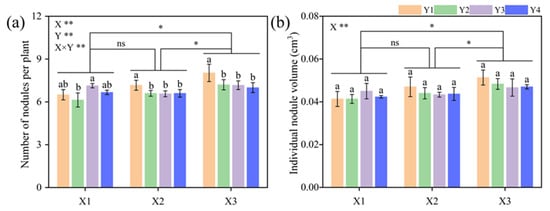
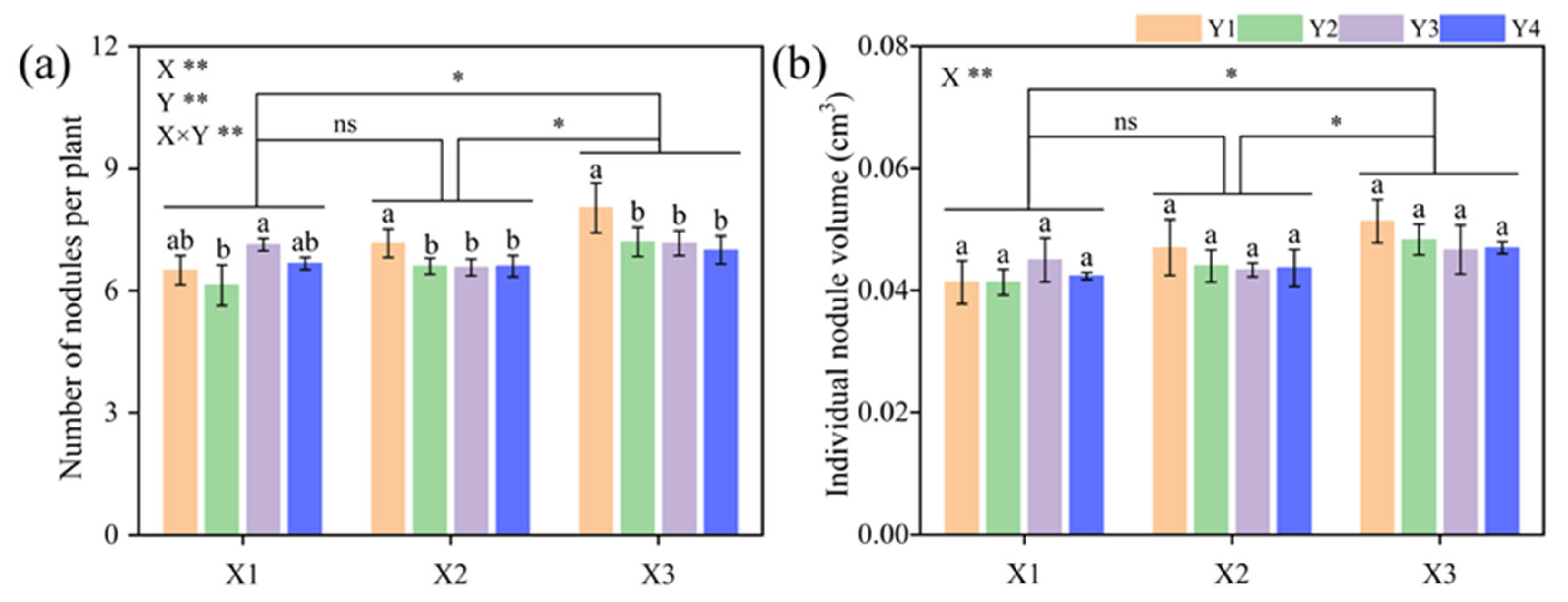
DAP (X) significantly increased both the number and volume of nodules, whereas microbial inoculant(Y) and their interaction (X × Y) had only significant effects on nodule number per plant (Figure 1a; p < 0.05). The number and volume of nodules overall exhibited an increasing trend with rising DAP fertilizer application rates, with the X3 treatment resulting in greater values compared to other DAP treatments. Under the X3Y1 treatment, the maximum number and volume were 8 and 0.05 cm3, respectively. However, co-application of DAP with rhizobial inoculant can significantly increase the number of nodules (p < 0.05) but has no significant effect on nodule volume (Figure 1b).
Figure 1.
Root nodule number and volume per alfalfa plant under different treatments. (a) Number of nodules per plant; (b) Individual nodule volume. X1 = 60%, X2 = 70%, and X3 = 80% DAP fertilizer; Y1 = rhizobial inoculant, Y2 = phosphate-solubilizing microbial inoculant, Y3 = composite microbial inoculant, and Y4 = control. Data are expressed as mean ± SD (n = 3). For the same DAP fertilizer rate, lowercase letters above the bars indicate significant differences (p < 0.05) among treatments according to Duncan’s multiple range test (DMRT) following one-way ANOVA. Significance is denoted as follows: ** for p < 0.01, * for p < 0.05, and ns for p ≥ 0.05.
3.1.2. Nutritional Value and Relative Feeding Value
DAP, microbial inoculant treatments, and their interaction showed significant effects on CP, ADF, NDF, and RFV (Table 1; p < 0.05). Mean alfalfa CP initially increased, then decreased with rising DAP rates, peaking under treatment X2 (22.9%). Under the same DAP treatment, the addition of microbial inoculant significantly increased the CP content (p < 0.01). In all treatments, the CP content of the X2Y1 treatment reached the maximum value of 23.6%, while that of the X2Y4 treatment reached 21.5%. In general, the content of NDF and ADF increased linearly with increasing DAP application rate, and the maximum value was observed under the X3 treatment. The mean NDF and ADF values of the X3 treatment were 7.2% and 23.9% greater than those of the X1 treatment, and 2.8% and 1.9% greater than those of the X2 treatment. Peak NDF and ADF were recorded under treatments X3Y2 (52.9%) and X3Y4 (34.3%), respectively. While the lowest values were observed under X1Y3 (44.2%) and X2Y2 (22.7%). RFV exhibited a downward trend with increasing DAP application rates. Among DAP-treated groups, the highest mean RFV was documented under treatment X1 (136.4%), followed by X2 (129.8%). Under the X1 treatment, the addition of microbial inoculant significantly increased RFV, except for the Y1 treatment (p < 0.05). Among all treatments, the highest RFV was reached under the X1Y3 (145.8%) and the X1Y2 (143.6%) treatments. Whereas the lowest RFV was observed under the X3Y4 (114.4%) and the X3Y2 (115.8%) treatments.
Table 1.
Nutritional value and relative feeding value of alfalfa under diverse experimental treatments.
3.1.3. Plant Height and Yield
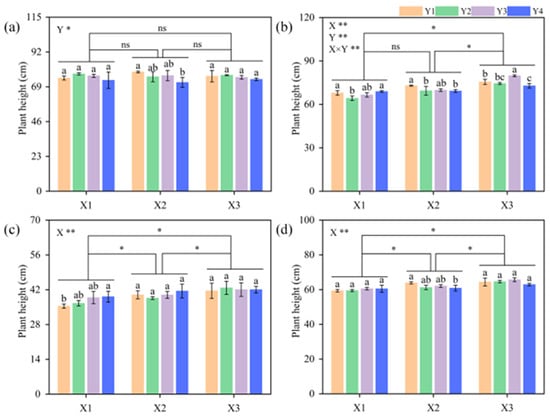
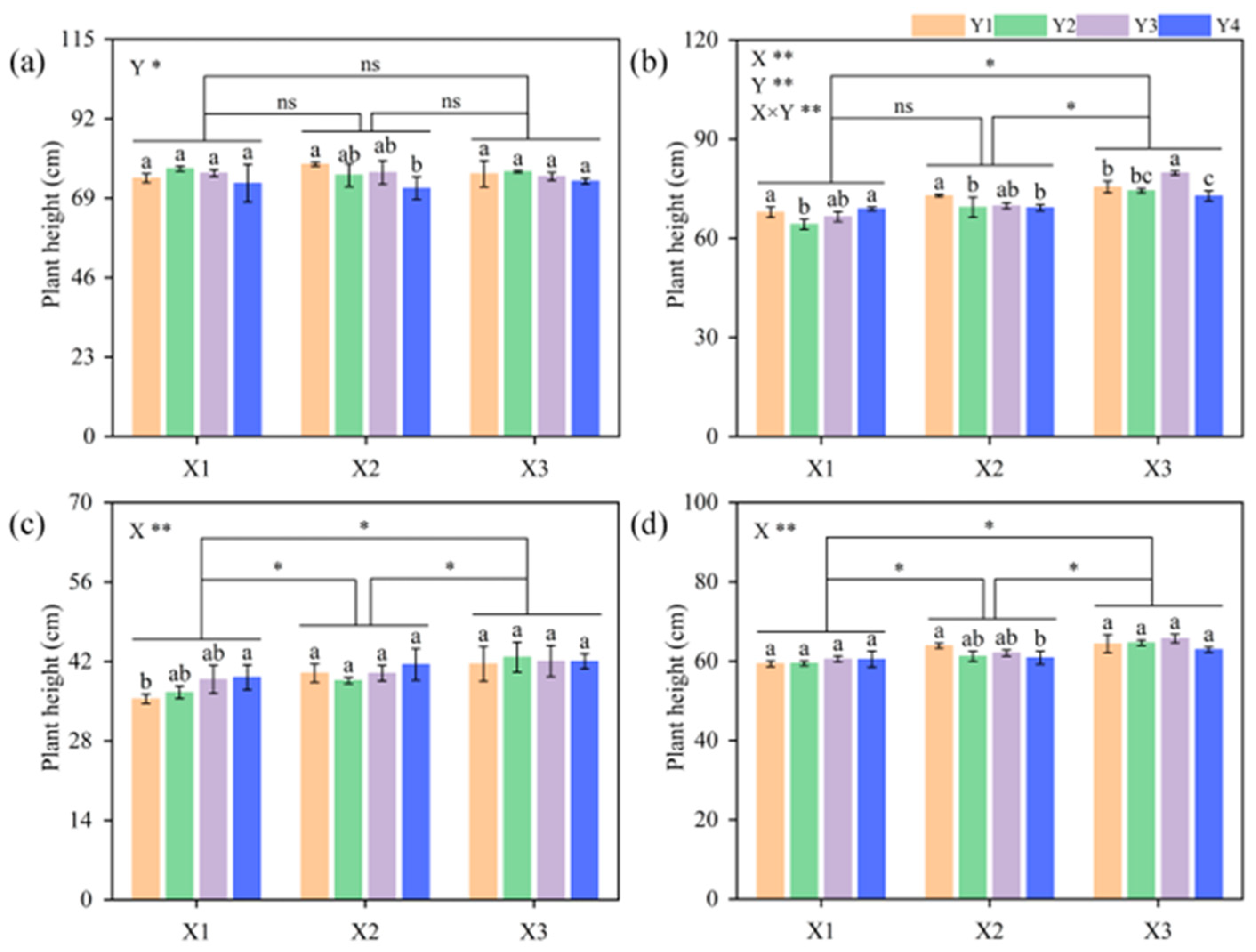
DAP treatment had a significant increase on the seasonal mean plant height in 2024 (Figure 2d; p < 0.01). The seasonal mean plant height increased linearly as the DAP level increased, reaching its maximum under X3. Under the X3 treatment, no significant differences were observed among microbial inoculant treatments, with a maximum value of 65.7 cm reached under the X3Y3 treatment. In general, as the number of harvests progressed, plant height followed an increasing trend, and a maximum value was achieved at the first harvest. At the first harvest, plant height was significantly affected by microbial inoculant treatment (p < 0.05), and plant heights ranged from 71.9 cm to 78.8 cm across different treatments (Figure 2a). At the second harvest, plant height was significantly influenced by the DAP level, microbial inoculant, and their interaction (p < 0.01), reaching a maximum of 79.7 cm under the X3Y3 treatment, which was 5.6–24.1% higher than other treatments (Figure 2b). At the third harvest, plant height was significantly affected by the DAP level, and plant heights ranged from 35.4 cm to 42.0 cm across different treatments (Figure 2c; p < 0.01).
Figure 2.
Plant height under different treatments. The first harvest (a), the second harvest (b) the third harvest (c), and the seasonal mean plant height in 2024 (d). X1 = 60%, X2 = 70%, and X3 = 80% DAP fertilizer; Y1 = rhizobial inoculant, Y2 = phosphate-solubilizing microbial inoculant, Y3 = composite microbial inoculant, and Y4 = control. Data are expressed as mean ± SD (n = 3). For the same DAP fertilizer rate, lowercase letters above the bars indicate significant differences (p < 0.05) among treatments according to Duncan’s multiple range test (DMRT) following one-way ANOVA. Significance is denoted as follows: ** for p < 0.01, * for p < 0.05, and ns for p ≥ 0.05.
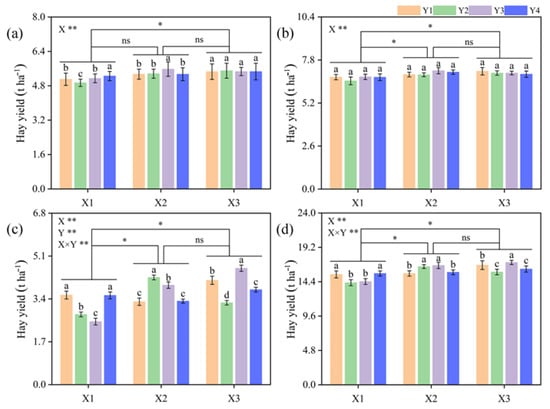
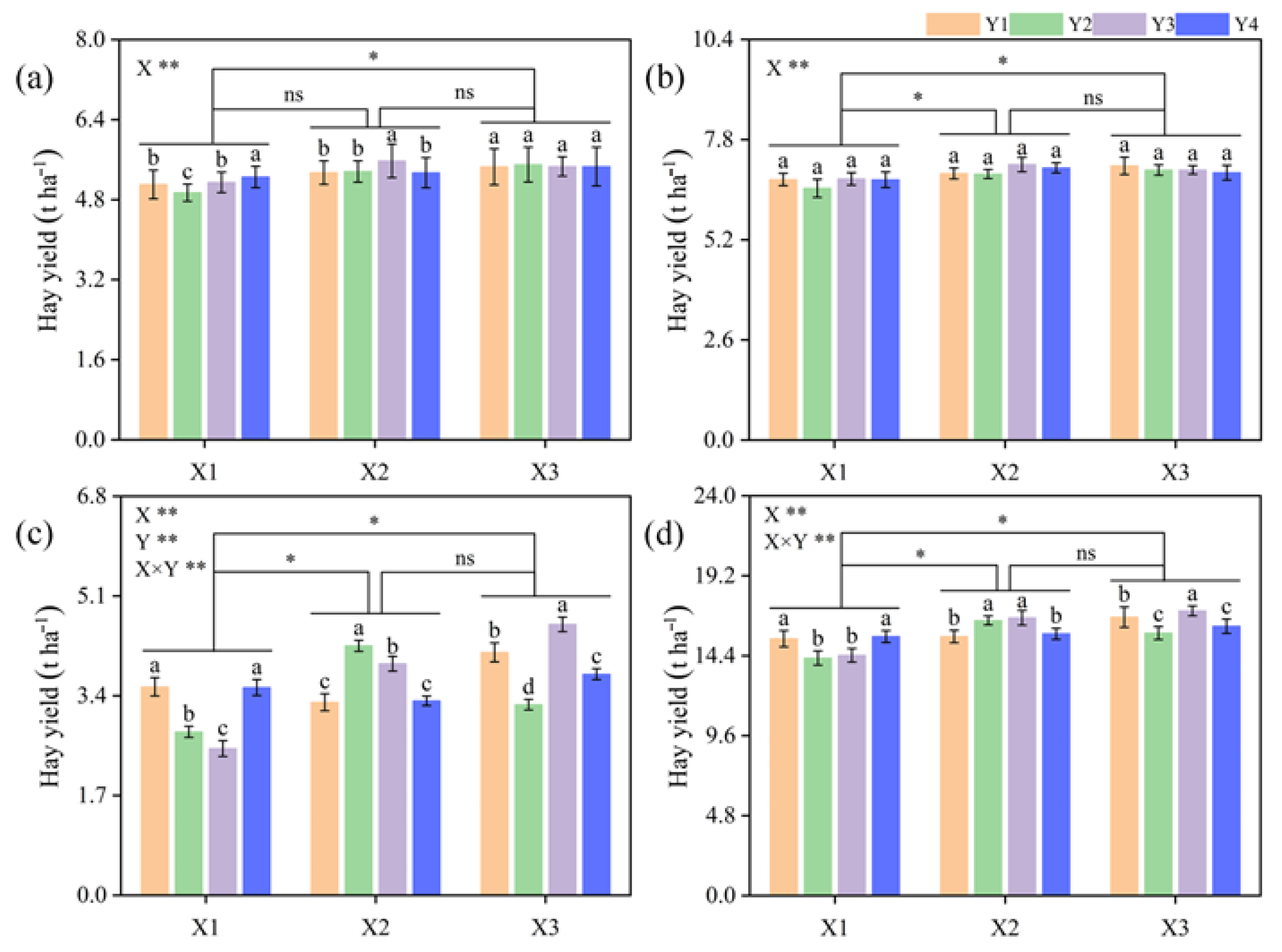
During the experiment, DAP and the interaction had a significant impact on the total hay yield (p < 0.01). Unlike the seasonal average plant height, the total hay yield initially increased with increasing DAP from the X1 to X2 treatment but showed no significant increase from the X2 to X3 treatment. The maximum value (17.1 t ha−1) was observed under the X3Y3 treatment, followed by the X3Y1 treatment (16.7 t ha−1), which were 5.6% and 3.1% higher, respectively, than the X3Y4 treatment (Figure 3d). Initially, as the number of harvests increased, hay yield followed an upward trend, and reached its highest level in the second harvest.
Figure 3.
Yield of alfalfa under different treatments. The first harvest (a), the second harvest (b) the third harvest (c) and the total yield in 2024 (d). X1 = 60%, X2 = 70%, and X3 = 80% DAP fertilizer; Y1 = rhizobial inoculant, Y2 = phosphate-solubilizing microbial inoculant, Y3 = composite microbial inoculant, and Y4 = control. Data are expressed as mean ± SD (n = 3). For the same DAP fertilizer rate, lowercase letters above the bars indicate significant differences (p < 0.05) among treatments according to Duncan’s multiple range test (DMRT) following one-way ANOVA. Significance is denoted as follows: ** for p < 0.01, * for p < 0.05, and ns for p ≥ 0.05.
However, the forage yields of all treatments decreased sharply at the third harvest (Figure 3). During the first harvest, hay yield was significantly differentiated by DAP application, with significant differences observed between the X3 and X1 treatments (Figure 3a; p < 0.01). hay yield reached its maximum under the X3 treatment, and hay yields among different microbial inoculant treatments were all 5.5 t ha−1. At the second harvest, DAP application significantly influenced hay yield (p < 0.01), while the trend among different microbial inoculant treatments was consistent with the total hay yield (Figure 3b). However, under the same DAP treatment, there was no significant difference among microbial inoculant treatments. At the third harvest, hay yield was significantly affected by the DAP level, microbial inoculant, and their interaction, reaching its maximum under the X3 treatment (Figure 3c; p < 0.01). Under the X3Y3 treatment, the maximum value of all treatments was 4.6 t ha−1, which was 7–84% higher than the other treatments, and this also served as the primary driver propelling total hay yield to its peak under the X3Y3 treatment.
3.2. Effects of Co-Application of DAP Fertilizer with Microbial Inoculant on Soil Physicochemical Properties and Enzyme Activities
3.2.1. Soil Physicochemical Properties
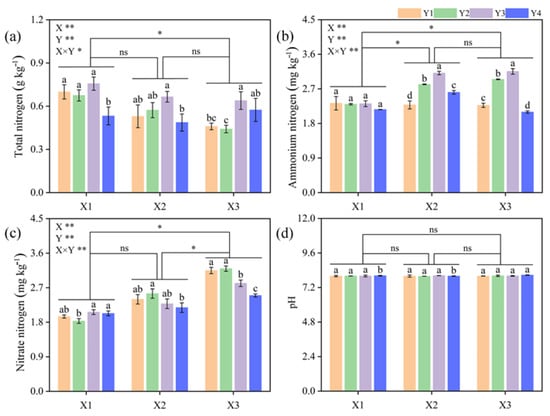
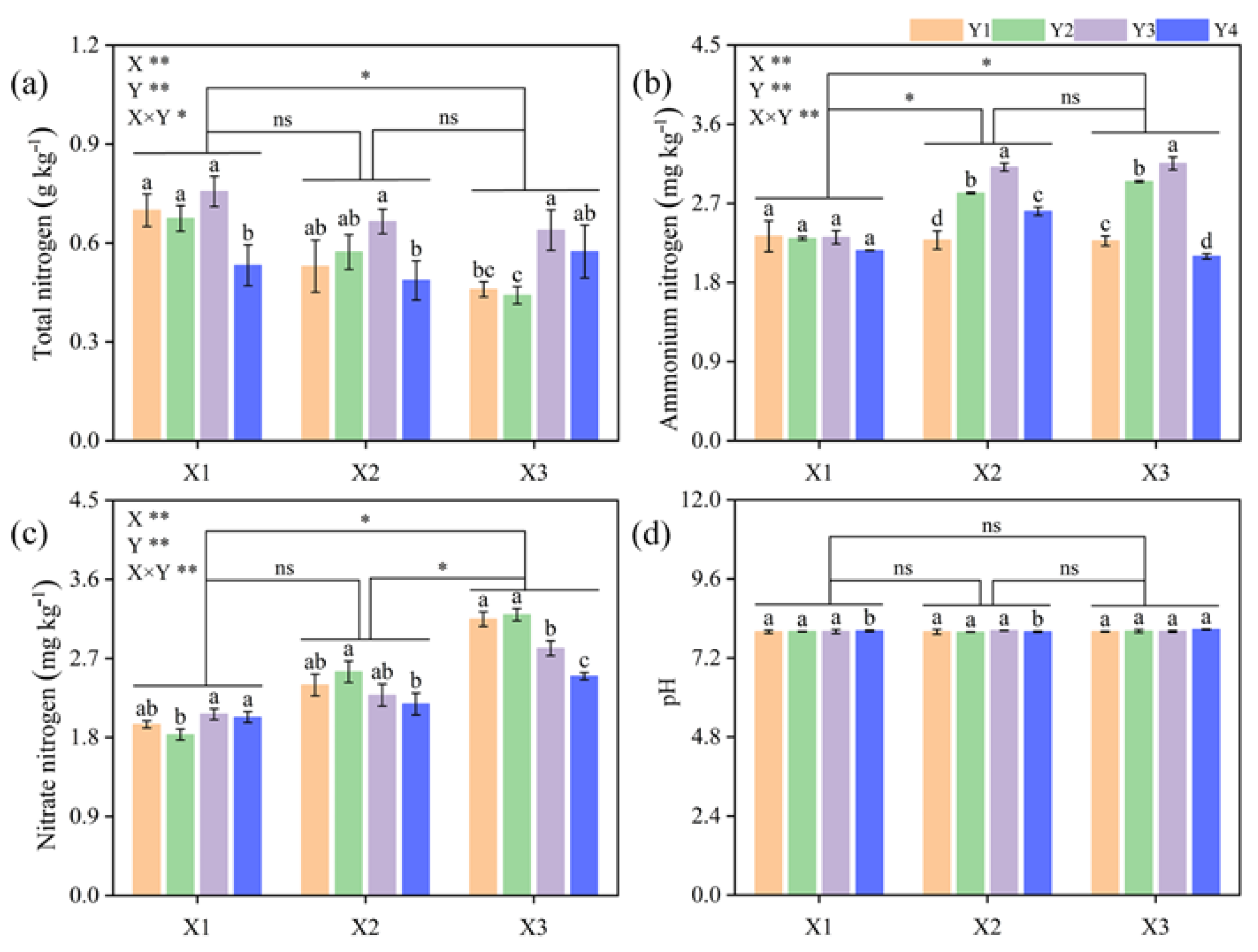
DAP, microbial inoculant, and their interaction had significant effects on soil TN NH4+-N, and NO3−-N, except for pH (Figure 4a; p < 0.05). The soil TN content was significantly higher in treatment X1 than in X3 (p < 0.05) but was not significantly different from that in X2. In the X1 treatment, the addition of microbial inoculant significantly increased the TN content (p < 0.05), which peaked at 0.76 g kg−1 in the X1Y3 treatment. Unlike the TN content, the NH4+-N content initially increased with increasing DAP from the X1 to X2 treatment but showed no significant increase from the X2 to X3 treatment (Figure 4b). At the X3 DAP application rate, NH4+-N content peaked at 3.2 mg kg−1 under the X3Y3 treatment, representing a 52% increase compared to X3Y4. In contrast, soil NH4+-N accumulation at the X1 DAP fertilizer level was not significantly influenced by microbial inoculant treatments. From the X2 to X3 treatments, DAP significantly increased soil NO3−-N content, and the maximum value of 3.2 mg kg−1 was observed under the X3Y2 treatment (Figure 4c; p < 0.05). At the X3 treatment, compared with the X3Y4 treatment, the addition of microbial inoculant significantly increased the NO3−-N content (12–28%). At the X1 treatment, the addition of microbial inoculant did not increase the NO3−-N content, except for the Y2 treatment. DAP had no significant effect on pH, which ranged from 7.9 to 8.1 across all treatments (Figure 4d). In addition, under the X1 and X2 treatments, the addition of microbial inoculant increased pH compared with the Y4 treatment.
Figure 4.
Soil physicochemical properties under different treatments. (a) TN; (b) NH4+-N; (c) NO3−-N; (d) pH. X1 = 60%, X2 = 70%, and X3 = 80% DAP fertilizer; Y1 = rhizobial inoculant, Y2 = phosphate-solubilizing microbial inoculant, Y3 = composite microbial inoculant, and Y4 = control. Data are expressed as mean ± SD (n = 3). For the same DAP fertilizer rate, lowercase letters above the bars indicate significant differences (p < 0.05) among treatments according to Duncan’s multiple range test (DMRT) following one-way ANOVA. Significance is denoted as follows: ** for p < 0.01, * for p < 0.05, and ns for p ≥ 0.05.
3.2.2. Soil Enzyme Activities
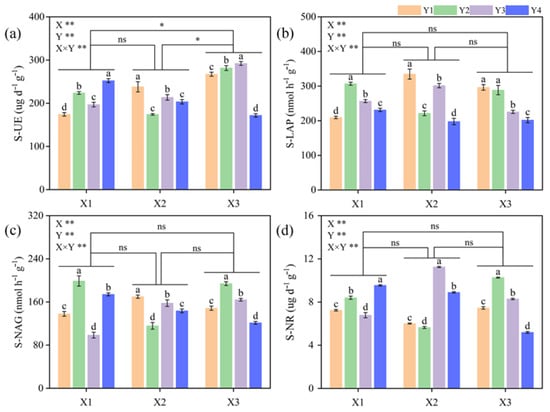
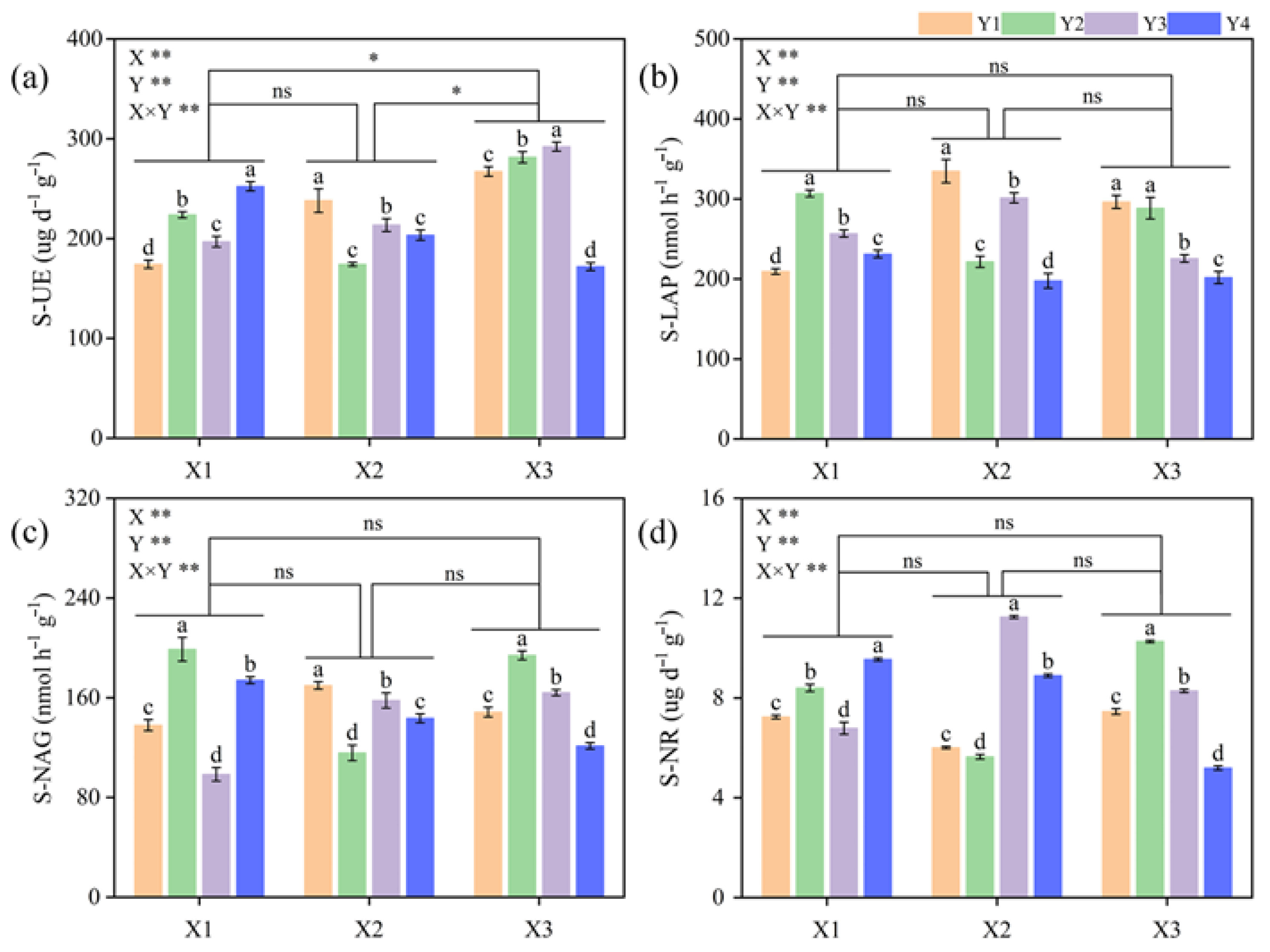
The DAP, microbial inoculant, and their interaction had significant effects on all soil enzyme activities (Figure 5; p < 0.01). Under the X3 treatment, the addition of microbial inoculant significantly promoted various enzyme activities (p < 0.05), but there were different trends among different microbial inoculant treatments. The activity of S-UE increased with increasing DAP, with X3 significantly higher than the X1 and X2 treatments (Figure 5a; p < 0.05). X3Y3 treatments reached the maximum activity of 292.3 μg d−1 g−1, followed by the X3Y2 treatment (281.6 μg d−1 g−1), which were 43.6% and 38.4% higher than the X3Y4 treatment, respectively. At the same DAP level, the addition of microbial inoculant significantly increased the activity of S-LAP, except for the X1Y1 treatment (Figure 5b; p < 0.05). Among all treatments, the minimum value reached 197.7 nmol h−1 g−1 (X2Y4), and the maximum value reached 334.7 nmol h−1 g−1 (X2Y1), which was 69.3% higher than the minimum value. Under different DAP levels, the activities of S-NAG and S-NR under different microbial inoculant treatment were different. The activities of S-NAG (Figure 5c) and S-NR (Figure 5d) reached a maximum of 198.9 nmol h−1 g−1 and 11.2 μg d−1 g−1 under the X1Y2 and X2Y3 treatments, respectively, and reached a minimum of 98.5 nmol h−1 g−1 and 5.2 μg d−1 g−1 under the X1Y3 and X3Y4 treatments, respectively.
Figure 5.
Soil enzyme activities under different treatments. (a) S-UE; (b) S-LAP; (c) S-NAG; (d) S-NR. X1 = 60%, X2 = 70%, and X3 = 80% DAP fertilizer; Y1 = rhizobial inoculant, Y2 = phosphate-solubilizing microbial inoculant, Y3 = composite microbial inoculant, and Y4 = control. Data are expressed as mean ± SD (n = 3). For the same DAP fertilizer rate, lowercase letters above the bars indicate significant differences (p < 0.05) among treatments according to Duncan’s multiple range test (DMRT) following one-way ANOVA. Significance is denoted as follows: ** for p < 0.01, * for p < 0.05, and ns for p ≥ 0.05.
3.3. Analysis of Co-Application of DAP Fertilizer with Microbial Inoculant on Soil Quality and Alfalfa Growth Performance
3.3.1. Effects of Microbial Inoculant on Forage Yield and Nutritive Value by PLS-PM
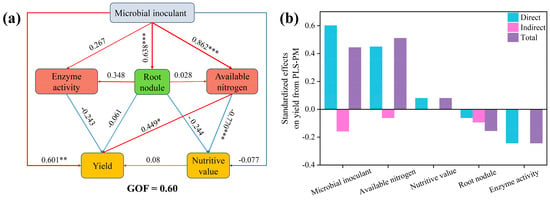
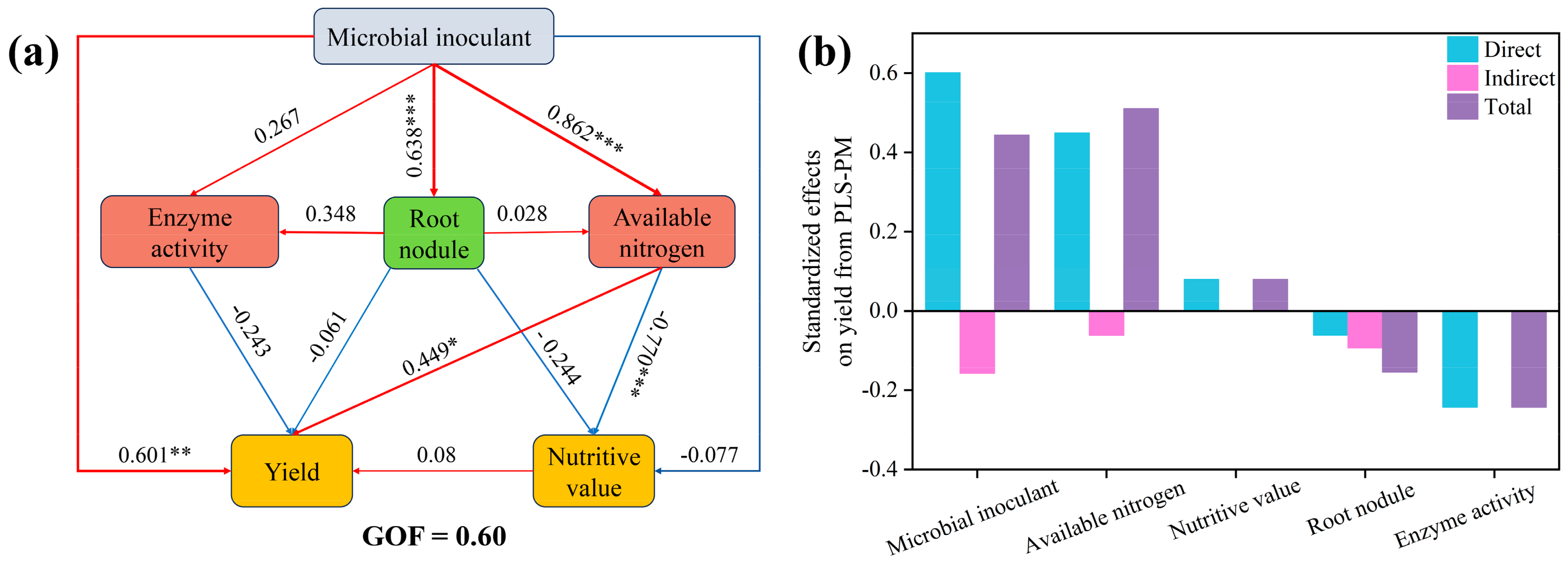
Path modeling analysis (PLS-PM) indicated that microbial inoculant and available n were the main controlling factors for forage yield (Figure 6). In the PLS-PM model, the effect is represented by the path coefficient (β). In the model for free ions (GOF = 0.6) (Figure 6a). Microbial inoculant significantly and positively influenced yield (β = 0.601, p < 0.01), root nodules (β = 0.638, p < 0.001), and available N (β = 0.862, p < 0.001), and had a positive influence on enzyme activity (β = 0.267). Available N positively influenced forage yield (β = 0.449, p < 0.05), while negatively impacting nutritive value (β = −0.77, p < 0.001).
Figure 6.
PLS-PM analysis was employed to evaluate how microbial inoculants influence alfalfa yield and crude protein (a). Panel (b) displays standardized effects on yield derived from the PLS-PM model. Positive variable associations are marked with red solid lines, negative ones with blue solid lines; line width reflects the magnitude of influence. Statistical significance is further indicated by asterisks: * for 0.01 < p < 0.05, ** for 0.001 < p < 0.01, and *** for p < 0.001.
Standardized effects show the explanatory variables’ direct, indirect, and total effects on yield (Figure 6b). Microbial inoculant and available N were the main regulatory factors of yield in terms of the total effect. As shown in figure, available N had the greatest impact on yield (0.511), followed by a microbial inoculant (0.444), nutritive value (0.08), root nodule (−0.154), and enzyme activity (−0.243). In terms of direct effect, microbial inoculant had the greatest impact on yield (0.601), followed by available N (0.449), nutritive value (0.08), root nodule (−0.061), and enzyme activity (−0.243).
3.3.2. Integrated Analysis Using Membership Function Methodology
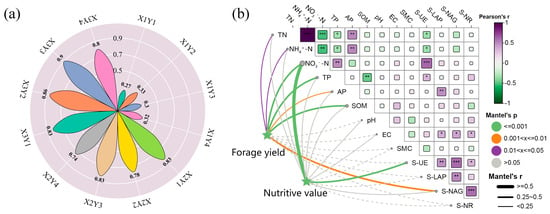
To integratively assess alfalfa performance, we applied membership function analysis to data on plant growth (plant height, forage yield, and root nodule), forage quality, and soil properties (physicochemical and enzymatic) across all treatments (Figure 7a). The results demonstrated that the membership values followed a descending order: X3Y3 > X3Y2 > X3Y1 = X2Y1 = X2Y3 > X > X2Y2 > X2Y4 > X1Y2 > X1Y4 > X1Y3 > X1Y1. Under the A1B1 treatment, membership values reached a minimum of 0.27, increasing to a maximum of 0.90 under the A3B3 treatment.
Figure 7.
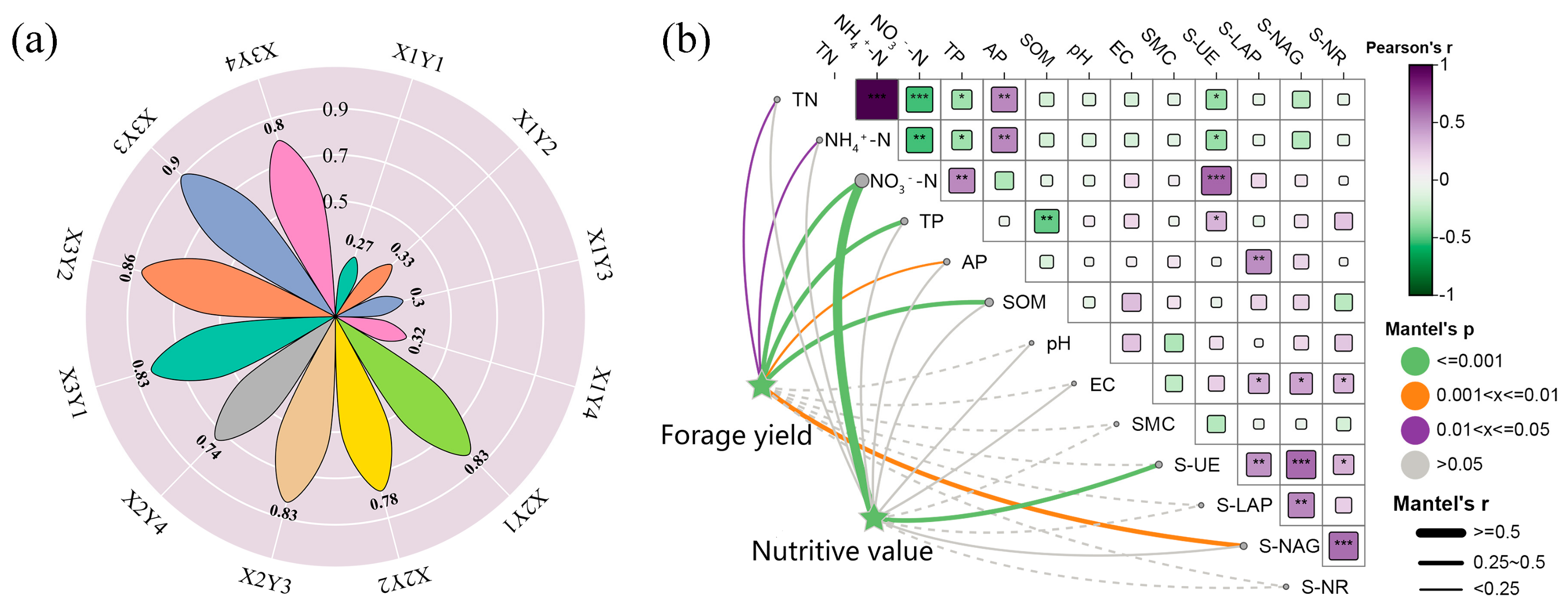
The results of the comprehensive membership function analysis are summarized in panel (a). The Mantel test correlation network in panel (b) illustrates the associations between soil properties and enzyme activities with alfalfa forage yield and nutritive value. Abbreviations: TN, total nitrogen; NH4+-N, ammonium nitrogen; NO3−-N, nitrate nitrogen; TP, total phosphorus; AP, available phosphorus; SOM, soil organic matter; EC, electrical conductivity; SMC, soil moisture content; S-UE, soil urease; S-LAP, soil leucine aminopeptidase; S-NAG, soil N-acetyl-β-D-glucosaminidase; S-NR, soil nitrate reductase. In the correlation network, the width of each edge is proportional to the magnitude of the Mantel’s r statistic, while the color denotes the sign and significance of the correlation. Specifically, green and purple edges represent significant positive and negative correlations, respectively. In the correlation matrix, colors represent the Pearson correlation coefficient (r) from −1 (dark green) to 1 (dark purple). Significance levels are indicated as * p < 0.05, ** p < 0.01, and *** p < 0.001.
3.3.3. Correlation Analysis of Soil Properties with Forage Yield and Nutritive Value
A correlative analysis of alfalfa yield, nutritional value, and soil physicochemical properties was conducted using Mantel test (Figure 7b). Detailed determination data pertaining to SOM, SMC, EC, TP, and AP were acquired from Table S2. Analysis indicated alfalfa yield positively correlated with soil TN (p < 0.05), NH4+-N (p < 0.05), NO3−-N (p < 0.001), and S-NAG activity (p < 0.01). Its nutritive value also showed positive associations with NO3−-N (p < 0.001) and S-UE activity (p < 0.001). However, TN exhibited a strong positive link with NH4+-N (p < 0.001) yet a negative association with NO3−-N (p < 0.001). NO3−-N exhibited a significant positive correlation with urease activity (p < 0.001).
4. Discussion
4.1. Effects of Co-Application of DAP Fertilizer with Microbial Inoculant on Growth Performance of Alfalfa
4.1.1. The Effect of Co-Application of DAP Fertilizer with Microbial Inoculant on Root Nodule
Root nodules are critical indicators reflecting the nitrogen fixation capacity in leguminous plants [39]. Nodule formation is strongly influenced by two key agronomic practices: the optimization of mineral fertilizer rates and the application of rhizobial inoculants [40]. Our results demonstrate that the co-application of rhizobial inoculant with DAP fertilizer significantly enhances nodulation only when the DAP application rate surpasses 70% of the standard dose. Generally, this supports the paradigm that legume nodulation is optimized at moderate fertilizer levels, beyond which a suppression occurs [41]. For example, Michael Asante reported that groundnut nodule numbers rose by 56% to 188% as phosphorus application increased [42]. Karavidas et al. established mineral N and rhizobium inoculation as major factors governing nodulation [43]. Since DAP application alone did not significantly increase nodule numbers, we infer that mineral N availability was not the primary factor limiting rhizobial infection and N fixation under the experimental condition. Unlike rhizobial inoculant, composite microbial inoculant failed to increase nodule numbers. This result is consistent with the challenges documented in the literature, such as microbial competition and suboptimal inoculant formulation [44].
4.1.2. The Effect of Co-Application of DAP Fertilizer with Microbial Inoculant on Nutritional Value and Relative Feeding Value
Excessive mineral fertilizer use impairs alfalfa’s symbiotic N fixation, ultimately compromising the accumulation of CP [45]. By improving nutrient uptake and reducing fertilizer application rate, microbial inoculants offer a potential strategy for sustainable agriculture [46]. As DAP fertilizer rates increased, alfalfa’s CP levels showed a unimodal pattern; applying 60–70% DAP increased CP but adding more than that did not bring further benefits. The observed response may be attributed to the role of DAP in activating key enzymes involved in N metabolism. The N assimilation and synthesis of CP can be promoted by improving symbiotic N fixation efficiency [47]. Our study found that co-application of DAP fertilizer with microbial inoculant led to higher CP in alfalfa. A possible mechanism is that microbial activity increases soil enzyme activities and releases plant growth regulators to promote nitrogen accumulation [48]. Phosphate-solubilizing microbes in the inoculant break down fixed phosphorus through their metabolic activity, which fuels ATP production and drives N reduction and amino acid conversion.
The significant rise in ADF and NDF levels with increasing DAP rates was associated with a reduction in cell wall density and lignin content. This shift in fiber composition may reflect a change in carbon partitioning within the plant under high mineral N availability [49]. Unkovich similarly noted that overloading alfalfa with N fertilizer speeds up lignification and increases the stem-to-leaf ratios in alfalfa, blunting the positive effects of N fertilization on reducing ADF and NDF [50]. A synergistic effect was observed when microbial inoculants were co-applied with DAP at rates exceeding 70%, leading to significantly lower ADF and NDF. Similarly, Bittencourt et al. demonstrated that microbial inoculants can improve soil N availability and suppress lignification by promoting plant growth and nutrient uptake [51]. This could be attributed to the secretion of phytohormones (indole-3-acetic acid, IAA) by microorganisms, whereby carbon and nitrogen resources are preferentially allocated to cell division and elongation growth rather than lignin synthesis [52]. Meanwhile, RFV trended closely with ADF and NDF, a pattern backed by stats. The combination of 60% DAP fertilizer with phosphate-solubilizing microbial inoculant and composite microbial inoculant showed the highest RFVs of 143.6% and 145.8%, respectively.
4.1.3. The Effect of Co-Application of DAP Fertilizer with Microbial Inoculant on Plant Height and Forage Yield
Studies demonstrate that crop productivity can be maintained with reduced N fertilizer inputs when combined with microbial inoculant [53]. We found that a combination of 80% DAP and microbial inoculant significantly increased alfalfa yield, consistent with existing literature. The sole exception was the phosphate-solubilizing inoculant, which showed no positive effect. Overall, DAP fertilizer combined with microbial inoculant enhanced photosynthetic capacity by stimulating chlorophyll synthesis and prolonging the growth period, thereby increasing the annual forage yield [54]. The maximum plant height was achieved with the co-application of 80% DAP and microbial inoculant. This result further supports the effectiveness of this fertilization regime in enhancing forage productivity. At the 60% DAP application rate, the addition of microbial inoculants failed to significantly improve alfalfa yields. The observed result can be attributed to N competition during microbial root colonization, which consequently depresses the plant’s N use efficiency [55]. This effect was most distinct during the initial harvest. Moreover, the study indicates that co-application of 80% DAP fertilizer with composite microbial inoculant led to a significant increase (p ≤ 0.05) in forage yield across both the second and third harvests. The efficacy of the composite microbial inoculant is driven by a dual process; symbiotic N fixation by rhizobia increases soil N, while the activity of phosphate-solubilizing microbes improves phosphorus acquisition [56]. This synergistic interplay establishes more conducive conditions for alfalfa growth. Additionally, the PLS-PM indicated that the yield enhancement from co-application DAP and microbial inoculant operates independently of nodule number, revealing a non-symbiotic pathway to improved alfalfa productivity. One plausible explanation for this is that some rhizobial strains are capable of invading plant roots to form nodules, yet they do not possess N-fixing ability [57]. Instead, these strains support plant growth by mobilizing soil nutrients, in addition to producing growth-stimulating phytohormones.
4.2. Effects of Co-Application of DAP Fertilizer with Microbial Inoculant on Soil Quality
4.2.1. The Effect of Co-Application of DAP Fertilizer with Microbial Inoculant on TN, NH4+-N, NO3−-N and pH
Integrating microbial inoculants with reduced mineral fertilizer is a key sustainable strategy. This approach enhances soil nutrient availability and enzyme activity while maintaining crop yield and quality [58]. Our results indicated that co-application of 80% DAP fertilizer with microbial inoculant led to a significant rise (p ≤ 0.05) in soil NH4+-N and NO3−-N. The 80% DAP application directly supplies available N, complemented by the inoculant’s role in accelerating soil N cycling via enhanced ammonification and nitrification. Wang et al. reported that high N input ultimately lowers soil TN content [59]. Similarly, our observations revealed that soil TN content peaked when 60% of the DAP fertilizer rate was co-applied with microbial inoculant, followed by a steady decrease as DAP application rates continued to rise. The main reason is that the elevated application amount of DAP fertilizer reduces N fixation by root nodules and increases nitrogen leaching losses [60]. The 60% DAP treatment appeared to suppress alfalfa root development and N assimilation, which conversely resulted in higher conservation of soil TN. Additionally, our results show that co-application DAP fertilizer with microbial inoculant helps maintain a stable soil pH, with no significant downward trend detected. The underdeveloped root system likely failed to facilitate adequate salt leaching [61]. Furthermore, a bare soil surface after mowing accelerated water evaporation, exacerbating salt accumulation.
4.2.2. The Effect of Co-Application of DAP Fertilizer with Microbial Inoculant on Soil Enzyme Activities
Soil enzymes are vital to soil nutrient cycling. Their activity in the rhizosphere originates predominantly from soil microorganisms [62]. These enzymes are involved in mediating key N transformation processes in soil, such as S-UE, S-LAP, S-NAG, and S-NR. Wu et al. documented that microbial fertilizers improved saline-alkali soil by a 26.14% increase in soil available phosphorus and a 38.46% rise in S-UE activity, and soil pH decreased by 2.21% and EC by 12.04% [63]. Our study found that higher rates of DAP fertilizer alone were observed to significantly inhibit soil enzyme activities, a finding consistent with prior reports [64]. When the DAP application rate exceeded 70%, co-application with a microbial inoculant enhanced (p ≤ 0.01) soil enzyme activities This reversal indicates that the inoculant counteracted the suppressive effect of DAP fertilizer. This effect is primarily driven by DAP fertilizer supplying substrates for enzyme synthesis, combined with the microbial inoculant expanding the population of enzyme-producing microbes in the soil [65]. The synergistic interaction ultimately enhances soil enzyme activities.
4.3. Relationship Between Soil Quality and Alfalfa Growth Performance in Saline-Alkali Soil
A major constraint in saline-alkali land is low soil N availability, caused by salinization, with consequent reductions in crop yield and quality. Consequently, a study by Zhao et al. investigated soil salinization effects on crops, evaluating soil N availability and pH should be a priority [66]. This study investigated the relationships between soil properties and alfalfa performance, finding that forage yield and nutritional value were closely linked to key soil characteristics. Pearson correlation analysis identified significant negative correlations of TN and NH4+-N with NO3−-N, in contrast to a positive correlation between S-UE activity and NO3−-N. This finding suggests that microbial inoculant addition facilitated N transformation into nitrate forms by boosting S-UE activity. S-UE is the key enzyme to promote soil N conversion [67]. Soil NO3−-N was the key determinant of forage yield and nutritive value, as revealed by the Mantel test. This finding suggests that NO3−-N is the key limiting factor for alfalfa yield and nutritional quality in saline-alkali soil.
We investigated the interrelationships within the soil–plant system governing alfalfa yield in saline-alkali soils, analyzing factors spanning microbial treatments, root nodule, soil quality (enzymes and available N), and forage nutritive value. To clarify the interconnections between these key variables, we employed PLS-PM for analysis. Alfalfa yields were directly linked to the application of microbial inoculant. Microbial metabolic activities drive the breakdown of organic materials and the release of phytohormones. Meanwhile, the statistical model identified microbial inoculant addition as a strong predictor of root nodule and available N, with its effect on yield mediated through changes in N availability. Root nodules promote (p ≤ 0.01) the improvement of soil enzyme activity and available N. However, root nodules did not enhance forage yield further. This lack of benefit suggests a possible allocation trade-off, where photosynthetic products are diverted to root-nodule development at the expense of biomass accumulation [68].
5. Conclusions
The co-application of DAP fertilizer with microbial inoculant significantly enhanced alfalfa growth performance and soil N levels in saline-alkali soil. The results show that the co-application of 80% DAP fertilizer with composite microbial inoculant significantly enhances forage yield, NH4+-N, NO3−-N, and S-UE activity. This study determined that when planting alfalfa in saline-alkali soil, the co-application of 80% DAP fertilizer and composite microbial inoculant was most appropriate. Additionally, PLS-PM revealed the main controlling factors affecting alfalfa forage yield after microbial inoculant addition. Finally, the regulation of alfalfa growth and soil nitrogen levels through co-application of DAP fertilizer and microbial inoculant is a highly complex biological process, influenced by natural factors such as interannual rainfall. This study was only based on data from first-year alfalfa, which imposes certain limitations. Therefore, subsequent studies are recommended to conduct long-term consecutive fertilization management experiments to comprehensively assess the effects of co-application of DAP fertilizer and microbial inoculant on soil nitrogen levels and the growth performance of alfalfa in saline-alkali soils.
Supplementary Materials
The following supporting information can be downloaded at: https://www.mdpi.com/article/10.3390/agronomy16030305/s1. Figure S1: Monthly average values of air temperature and precipitation at the experimental site during 2024. Table S1: Test treatments. Table S2: Effects of co-application of DAP fertilizer with microbial inoculant on total phosphorus, available phosphorus, soil organic matter, electrical conductivity and soil moisture content.
Author Contributions
Conceptualization, S.W.; methodology, S.W.; software, S.W. and C.Z.; validation, S.W., C.L. and Y.L.; formal analysis, X.W. and J.X.; investigation, X.W. and J.X.; resources, C.L. and X.W.; data curation, Y.F. and C.Z.; writing—original draft preparation, S.W.; writing—review and editing, S.W.; visualization, Y.L.; supervision, C.L.; project administration, C.L.; funding acquisition, C.L. All authors have read and agreed to the published version of the manuscript.
Funding
This research was funded by the science and technology project (GAU-KYQD-2022-01). Key Laboratory of Grassland Ecosystem, Ministry of Education (KLGE-2024-05; KLGE-2022-02).
Data Availability Statement
The original contributions presented in this study are included in the article/Supplementary Material. Further inquiries can be directed to the corresponding author.
Conflicts of Interest
The authors declare no conflicts of interest.
References
- Liang, J.; Li, Y.; Si, B.; Wang, Y.; Chen, X.; Wang, X.; Biswas, A. Optimizing biochar application to improve soil physical and hydraulic properties in saline-alkali soils. Sci. Total Environ. 2021, 771, 144802. [Google Scholar] [CrossRef] [Scilit]
- Gao, G.; Yan, L.; Tong, K.; Yu, H.; Lu, M.; Wang, L.; Niu, Y. The potential and prospects of modified biochar for comprehensive management of salt-affected soils and plants: A critical review. Sci. Total Environ. 2024, 912, 169618. [Google Scholar] [CrossRef] [Scilit] [PubMed]
- Litalien, A.; Zeeb, B. Curing the earth: A review of anthropogenic soil salinization and plant-based strategies for sustainable mitigation. Sci. Total Environ. 2020, 698, 134235. [Google Scholar] [CrossRef] [Scilit] [PubMed]
- Li, W.; Gao, S.; Pei, D.; Wen, Y.; Mu, X.; Liu, M.; Wang, Z. Spatio-temporal evolution and simulation of soil salinization in typical oasis water-saving irrigation area based on long series data. Agric. Water Manag. 2025, 307, 109275. [Google Scholar] [CrossRef] [Scilit]
- Chen, Y.; Zhang, W.Y.; Wang, M.; Zhang, J.H.; Chen, M.X.; Zhu, F.Y.; Song, T. Integrated approaches for managing soil salinization: Detection, mitigation, and sustainability. Plant Physiol. Biochem. 2025, 110484. [Google Scholar] [CrossRef] [Scilit]
- Zhang, Y.; Wang, L. Advances in basic biology of alfalfa (Medicago sativa L.): A comprehensive overview. Hortic. Res. 2025, 12, uhaf081. [Google Scholar] [CrossRef] [Scilit]
- Zhang, T.; Wan, W.; Sun, Z.; Li, H. Phosphorus uptake and rhizosphere properties of alfalfa in response to phosphorus fertilizer types in sandy soil and saline-alkali soil. Front. Plant Sci. 2024, 15, 1377626. [Google Scholar] [CrossRef] [Scilit]
- Fasani, E.; Franceschi, C.; Furini, A.; DalCorso, G. Effect of biostimulants combined with fertilization on yield and nutritional value of wheat crops. BMC Plant Biol. 2025, 25, 736. [Google Scholar] [CrossRef] [Scilit]
- Kihara, J.; Bekunda, M.; Chimonyo, V.; Kimaro, A.; Kotu, B.; Lyimo, S.; Mhango, W. Management of soil fertility through application of fertilizers. In Sustainable Agricultural Intensification: A Handbook for Practitioners in East and Southern Africa; CABI: Wallingford, UK, 2022; pp. 48–61. [Google Scholar]
- Peng, Y.; Zhang, H.; Lv, Z.; Zhang, J.; Li, G. Microbial inoculation improves soil aggregation by enhancing exopolysaccharides and lipopolysaccharides-related gene abundance in saline soil. Appl. Soil Ecol. 2025, 214, 106388. [Google Scholar] [CrossRef] [Scilit]
- Ben-Laouane, R.; Baslam, M.; Ait-El-Mokhtar, M.; Anli, M.; Boutasknit, A.; Ait-Rahou, Y.; Meddich, A. Potential of native arbuscular mycorrhizal fungi, rhizobia, and/or green compost as alfalfa (Medicago sativa) enhancers under salinity. Microorganisms 2020, 8, 1695. [Google Scholar] [CrossRef] [Scilit]
- Koziol, L.; Lubin, T.; Bever, J.D. An assessment of twenty-three mycorrhizal inoculants reveals limited viability of AM fungi, pathogen contamination, and negative microbial effect on crop growth for commercial products. Appl. Soil Ecol. 2024, 202, 105559. [Google Scholar] [CrossRef] [Scilit]
- Bradáčová, K.; Sittinger, M.; Tietz, K.; Neuhäuser, B.; Kandeler, E.; Berger, N.; Neumann, G. Maize inoculation with microbial consortia: Contrasting effects on rhizosphere activities, nutrient acquisition and early growth in different soils. Microorganisms 2019, 7, 329. [Google Scholar] [CrossRef] [Scilit]
- Lopes, M.J.D.S.; Dias-Filho, M.B.; Gurgel, E.S.C. Successful plant growth-promoting microbes: Inoculation methods and abiotic factors. Front. Sustain. Food Syst. 2021, 5, 606454. [Google Scholar] [CrossRef] [Scilit]
- Xun, W.; Huang, T.; Zhao, J.; Ran, W.; Wang, B.; Shen, Q.; Zhang, R. Environmental conditions rather than microbial inoculum composition determine the bacterial composition, microbial biomass and enzymatic activity of reconstructed soil microbial communities. Soil Biol. Biochem. 2015, 90, 10–18. [Google Scholar] [CrossRef] [Scilit]
- Kelling, K.A.; Wolkowski, R.P.; Speth, P.E.; Andraski, T.W. Interaction of fertilizer phosphorus rate and placement/timing on potatoes. Am. J. Potato Res. 2020, 97, 420–431. [Google Scholar] [CrossRef] [Scilit]
- Atterberg, A. Die mechanische bodenanalyse und die klassifikation der mineralböden schwedens. Int. Mitt. Bodenkd. 1912, 2, 312–342. [Google Scholar]
- Pribyl, D.W. A critical review of the conventional SOC to SOM conversion factor. Geoderma 2010, 156, 75–83. [Google Scholar] [CrossRef] [Scilit]
- Bremner, J.M.; Tabatabai, M.A. Use of an ammonia electrode for determination of ammonium in Kjeldahl analysis of soils. Commun. Soil Sci. Plant Anal. 1972, 3, 159–165. [Google Scholar] [CrossRef] [Scilit]
- Bao, S. Soil Agrochemical Analysis; China Agricultural Press: Beijing, China, 2000. [Google Scholar]
- Fu, S.; Wang, Y.; Zhang, R.; Zhao, M.; Jiang, Y. Method for Determination of Total Potassium in Soil; PRC National Standard: Brisbane, NSW, Australia, 1988. [Google Scholar]
- Morford, S.L.; Houlton, B.Z.; Dahlgren, R.A. Increased forest ecosystem carbon and nitrogen storage from nitrogen rich bedrock. Nature 2011, 477, 78–81. [Google Scholar] [CrossRef] [Scilit]
- Xu, C.; Xiao, D.; Song, C.; Guang, C.; Yuan-Hui, L.; Xiu-Fu, Z. Changes in the activities of key enzymes and the abundance of functional genes involved in nitrogen transformation in rice rhizosphere soil under different aerated conditions. J. Integr. Agric. 2023, 22, 923–934. [Google Scholar] [CrossRef] [Scilit]
- Yan, X.; Zhang, L.; Xu, Q.; Qi, L.; Yang, J.; Dong, X.; Wang, D. Effects of Variation in Tamarix chinensis Plantations on Soil Microbial Community Composition in the Middle Yellow River Floodplain. Int. J. Environ. Res. Public Health 2023, 20, 5015. [Google Scholar] [CrossRef] [Scilit] [PubMed]
- Yasmin, S.; Zaka, A.; Imran, A.; Zahid, M.A.; Yousaf, S.; Rasul, G.; Mirza, M.S. Plant growth promotion and suppression of bacterial leaf blight in rice by inoculated bacteria. PLoS ONE 2016, 11, e0160688. [Google Scholar] [CrossRef] [Scilit] [PubMed]
- Rillig, M.C.; Wright, S.F.; Eviner, V.T. The role of arbuscular mycorrhizal fungi and glomalin in soil aggregation: Comparing effects of five plant species. Plant Soil 2002, 238, 325–333. [Google Scholar] [CrossRef] [Scilit]
- Wang, N.; Ai, Z.; Zhang, Q.; Leng, P.; Qiao, Y.; Li, Z.; Li, F. Impacts of nitrogen (N), phosphorus (P), and potassium (K) fertilizers on maize yields, nutrient use efficiency, and soil nutrient balance: Insights from a long-term diverse NPK omission experiment in the North China Plain. Field Crops Res. 2024, 318, 109616. [Google Scholar] [CrossRef] [Scilit]
- He, S.; Zhang, Y.; Yang, X.; Li, Q.; Li, C.; Yao, T. Effects of microbial inoculants combined with chemical fertilizer on growth and soil nutrient dynamics of Timothy (Phleum pratense L.). Agronomy 2024, 14, 1016. [Google Scholar] [CrossRef] [Scilit]
- Lu, R.K. Soil and Agricultural Chemistry Analysis; Chinese Agricultural Science and Technology Press: Beijing, China, 2000. [Google Scholar]
- Samota, M.K.; Sasi, M.; Awana, M.; Yadav, O.P.; Amitha Mithr, S.V.; Tyagi, A.; Singh, A. Elicitor-induced biochemical and molecular manifestations to improve drought tolerance in rice (Oryza sativa L.) through seed-priming. Front. Plant Sci. 2017, 8, 934. [Google Scholar] [CrossRef] [Scilit]
- Guo, H.; Yao, J.; Cai, M.; Qian, Y.; Guo, Y.; Richnow, H.H. Effects of petroleum contamination on soil microbial numbers, metabolic activity and urease activity. Chemosphere 2012, 87, 1273–1280. [Google Scholar] [CrossRef] [Scilit]
- Szajdak, L.W.; Gaca, W. Nitrate reductase activity in soil under shelterbelt and an adjoining cultivated field. Chem. Ecol. 2010, 26, 123–134. [Google Scholar] [CrossRef] [Scilit]
- Ferreira, J.; Cornacchione, M.; Liu, X.; Suarez, D. Nutrient composition, forage parameters, and antioxidant capacity of Alfalfa (Medicago sativa, L.) in response to saline irrigation water. Agriculture 2015, 5, 577–597. [Google Scholar] [CrossRef] [Scilit]
- Van Soest, P.J.; Robertson, J.B.; Lewis, B.A. Methods for dietary fiber, neutral detergent fiber, and nonstarch polysaccharides in relation to animal nutrition. J. Dairy Sci. 1991, 74, 3583–3597. [Google Scholar] [CrossRef] [Scilit]
- Kamran, M.; Yan, Z.; Jia, Q.; Chang, S.; Ahmad, I.; Ghani, M.U.; Hou, F. Irrigation and nitrogen fertilization influence on alfalfa yield, nutritive value, and resource use efficiency in an arid environment. Field Crop Res. 2022, 284, 108587. [Google Scholar] [CrossRef] [Scilit]
- Mantel, N. The detection of disease clustering and a generalized regression approach. Cancer Res. 1967, 27, 209–220. [Google Scholar] [PubMed]
- Wold, H. Partial Least Squares. In Encyclopedia of Statistical Sciences; Kotz, S., Johnson, N.L., Eds.; Wiley: New York, NY, USA, 1985; Volume 6, pp. 581–591. [Google Scholar]
- Liu, H.; Li, S.; Qiang, R.; Lu, E.; Li, C.; Zhang, J.; Gao, Q. Response of soil microbial community structure to phosphate fertilizer reduction and combinations of microbial fertilizer. Front. Environ. Sci. 2022, 10, 899727. [Google Scholar] [CrossRef] [Scilit]
- Yuan, S.; Li, R.; Chen, S.; Chen, H.; Zhang, C.; Chen, L.; Zhou, X. RNA-Seq analysis of differential gene expression responding to different rhizobium strains in soybean (Glycine max) roots. Front. Plant Sci. 2016, 7, 721. [Google Scholar] [CrossRef] [Scilit]
- Zhang, H.; Xiao, Y. Contribution of mycorrhizal symbiosis and root strategy to red clover aboveground biomass under nitrogen addition and phosphorus distribution. Mycorrhiza 2024, 34, 489–502. [Google Scholar] [CrossRef] [Scilit]
- Amante, G.; Wedajo, M.; Temteme, S. Soybean (Glycine max (L.) Merr.) response to application of mineral nitrogen and bradyrhizobia on Nitisols of Teppi, Southwest Ethiopia. Heliyon 2024, 10, e30540. [Google Scholar] [CrossRef] [Scilit]
- Asante, M.; Ahiabor, B.D.K.; Atakora, W.K. Growth, Nodulation, and Yield Responses of groundnut (Arachis hypogaea L.) as influenced by combined application of rhizobium inoculant and phosphorus in the Guinea Savanna zone of Ghana. Int. J. Agron. 2020, 2020, 8691757. [Google Scholar] [CrossRef] [Scilit]
- Karavidas, I.; Ntatsi, G.; Ntanasi, T.; Tampakaki, A.; Giannopoulou, A.; Pantazopoulou, D.; Savvas, D. Hydroponic common-bean performance under reduced N-supply level and rhizobia application. Plants 2023, 12, 646. [Google Scholar] [CrossRef] [Scilit]
- Sun, W.; Shahrajabian, M.H. The application of arbuscular mycorrhizal fungi as microbial biostimulant, sustainable approaches in modern agriculture. Plants 2023, 12, 3101. [Google Scholar] [CrossRef] [Scilit]
- Wan, W.; Li, Y.; Li, H. Yield and quality of alfalfa (Medicago sativa L.) in response to fertilizer application in China: A meta-analysis. Front. Plant Sci. 2022, 13, 1051725. [Google Scholar] [CrossRef] [Scilit]
- Majeed, A.; Abbasi, M.K.; Hameed, S.; Yasmin, S.; Hanif, M.K.; Naqqash, T.; Imran, A. Pseudomonas sp. AF-54 containing multiple plant beneficial traits acts as growth enhancer of Helianthus annuus L. under reduced fertilizer input. Microbiol. Res. 2018, 216, 56–69. [Google Scholar] [CrossRef] [Scilit] [PubMed]
- Wang, Z.; Li, Y.; Zhao, Y.; Zhuang, L.; Yu, Y.; Wang, M.; Wang, Q. A microbial consortium-based product promotes potato yield by recruiting rhizosphere bacteria involved in nitrogen and carbon metabolisms. Microb. Biotechnol. 2021, 14, 1961–1975. [Google Scholar] [CrossRef] [Scilit] [PubMed]
- Liu, Q.; Meng, X.; Li, T.; Raza, W.; Liu, D.; Shen, Q. The growth promotion of peppers (Capsicum annuum L.) by Trichoderma guizhouense NJAU4742-based biological organic fertilizer: Possible role of increasing nutrient availabilities. Microorganisms 2020, 8, 1296. [Google Scholar] [CrossRef] [Scilit] [PubMed]
- Wang, F.; Liu, H.; Yao, H.; Zhang, B.; Li, Y.; Jin, S.; Cao, H. Reducing application of nitrogen fertilizer increases soil bacterial diversity and drives co-occurrence networks. Microorganisms 2024, 12, 1434. [Google Scholar] [CrossRef] [Scilit]
- Unkovich, M. Nitrogen fixation in Australian dairy systems: Review and prospect. Crop Pasture Sci. 2012, 63, 787–804. [Google Scholar] [CrossRef] [Scilit]
- Bittencourt, P.P.; Alves, A.F.; Ferreira, M.B.; da Silva Irineu, L.E.S.; Pinto, V.B.; Olivares, F.L. Mechanisms and applications of bacterial inoculants in plant drought stress tolerance. Microorganisms 2023, 11, 502. [Google Scholar] [CrossRef] [Scilit]
- Lim, S.L.; Subramaniam, S.; Baset Mia, M.A.; Rahmah, A.R.S.; Ghazali, A.H.A. Biotization of in vitro oil palm (Elaeis guineensis Jacq.) and its plant-microbe interactions. Front. Plant Sci. 2023, 14, 1150309. [Google Scholar] [CrossRef] [Scilit]
- Galindo, F.S.; Pagliari, P.H.; da Silva, E.C.; de Lima, B.H.; Fernandes, G.C.; Thiengo, C.C.; Lavres, J. Impact of nitrogen fertilizer sustainability on corn crop yield: The role of beneficial microbial inoculation interactions. BMC Plant Biol. 2024, 24, 268. [Google Scholar] [CrossRef] [Scilit]
- Alem, S. Response of the growth and survival of tree species planted in a degraded land with a supplement of diammonium phosphate (DAP) fertilizer. Land Degrad. Dev. 2024, 35, 2543–2549. [Google Scholar] [CrossRef] [Scilit]
- Win, K.T.; Wasai-Hara, S.; Tanaka, F.; Oo, A.Z.; Minamisawa, K.; Shimoda, Y.; Imaizumi-Anraku, H. Synergistic N2-fixation and salt stress mitigation in soybean through dual inoculation of ACC deaminase-producing Pseudomonas and Bradyrhizobium. Sci. Rep. 2023, 13, 17050. [Google Scholar] [CrossRef] [Scilit]
- Wang, X.; Sun, M.; Tian, L.; Yang, M.; Gao, Q.; Wang, L.; Zhang, L. Microbial fertilizers modulate tobacco growth and development through reshaping soil microbiome and metabolome. Microbiol. Spectr. 2025, 13, e02605-24. [Google Scholar] [CrossRef] [Scilit] [PubMed]
- Mahmud, K.; Makaju, S.; Ibrahim, R.; Missaoui, A. Current progress in nitrogen fixing plants and microbiome research. Plants 2020, 9, 97. [Google Scholar] [CrossRef] [Scilit]
- Liu, T.; Tong, D.; Chen, S.; Ning, C.; Zhang, X.; Filimonenko, E.; Yan, W. Fertilization shapes microbial life strategies, carbon and nitrogen metabolic functions in Camellia oleifera soil. J. Environ. Manag. 2024, 370, 122896. [Google Scholar] [CrossRef] [Scilit] [PubMed]
- Wang, J.; Ma, Y.; Di, L.; Qian, X.; Wang, G. Straw incorporation with nitrogen amendment shapes bacterial community structure in an iron-rich paddy soil by altering nitrogen reserves. Microorganisms 2021, 9, 988. [Google Scholar] [CrossRef] [Scilit] [PubMed]
- Zhang, L.; Feng, Y.; Zhao, Z.; Baoyin, B.; Cui, Z.; Wang, H.; Cui, J. Macrogenomics-based analysis of the effects of intercropped soybean photosynthetic characteristics and nitrogen-assimilating enzyme activities on yield at different nitrogen levels. Microorganisms 2024, 12, 1220. [Google Scholar] [CrossRef] [Scilit]
- Aryal, M. Phytoremediation strategies for mitigating environmental toxicants. Heliyon 2024, 10, e38683. [Google Scholar] [CrossRef] [Scilit]
- Xiang, X.; De, K.; Lin, W.; Feng, T.; Li, F.; Wei, X. Indirect influence of soil enzymes and their stoichiometry on soil organic carbon response to warming and nitrogen deposition in the Tibetan Plateau alpine meadow. Front. Microbiol. 2024, 15, 1381891. [Google Scholar] [CrossRef] [Scilit]
- Wu, Q.; Chen, Y.; Dou, X.; Liao, D.; Li, K.; An, C.; Dong, Z. Microbial fertilizers improve soil quality and crop yield in coastal saline soils by regulating soil bacterial and fungal community structure. Sci. Total Environ. 2024, 949, 175127. [Google Scholar] [CrossRef] [Scilit]
- Elhawat, N.; Kovács, A.B.; Antal, G.; Kurucz, E.; Domokos-Szabolcsy, É.; Fári, M.G.; Alshaal, T. Living mulch enhances soil enzyme activities, nitrogen pools and water retention in giant reed (Arundo donax L.) plantations. Sci. Rep. 2024, 14, 1704. [Google Scholar] [CrossRef] [Scilit]
- Hernández-Fernández, M.; Cordero-Bueso, G.; Ruiz-Muñoz, M.; Cantoral, J.M. Culturable yeasts as biofertilizers and biopesticides for a sustainable agriculture: A comprehensive review. Plants 2021, 10, 822. [Google Scholar] [CrossRef] [Scilit]
- Zhao, S.; Liu, G.; Xiong, J.; Chang, D.; Li, Y.; Wang, W.; Wang, D. Evaluation of hydrochar-derived modifier and water-soluble fertilizer on saline soil improvement and pasture growth. Sci. Rep. 2024, 14, 16759. [Google Scholar] [CrossRef] [Scilit]
- Ma, J.; Zhang, W.; Zhang, S.; Zhu, Q.; Feng, Q.; Chen, F. Short-term effects of CO2 leakage on the soil bacterial community in a simulated gas leakage scenario. PeerJ 2017, 5, e4024. [Google Scholar] [CrossRef] [Scilit]
- Chen, C.; Xiang, Y.; Jiao, X.; Gong, H. Enhancing maize phosphorus uptake with optimal blends of high and low-concentration phosphorus fertilizers. Front. Plant Sci. 2024, 15, 1451073. [Google Scholar] [CrossRef] [Scilit]

Disclaimer/Publisher’s Note: The statements, opinions and data contained in all publications are solely those of the individual author(s) and contributor(s) and not of MDPI and/or the editor(s). MDPI and/or the editor(s) disclaim responsibility for any injury to people or property resulting from any ideas, methods, instructions or products referred to in the content. |
© 2026 by the authors. Licensee MDPI, Basel, Switzerland. This article is an open access article distributed under the terms and conditions of the Creative Commons Attribution (CC BY) license.