Article

Morphology, Heterosis, and Fertility of Novel CMS-Based Solanum melongena × S. aethiopicum Hybrids

by
Konstantinos Krommydas
1,2,*,
Athanasios Mavromatis
2,
Fotios Bletsos
1 and
Demetrios Roupakias
2
1
Institute of Plant Breeding and Genetic Resources, Hellenic Agricultural Organization-Dimitra (ELGO-Dimitra), Thermi, GR-57001 Thessaloniki, Greece
2
Laboratory of Genetics & Plant Breeding, Faculty of Agriculture, Aristotle University of Thessaloniki, GR-54124 Thessaloniki, Greece
*
Author to whom correspondence should be addressed.
Agronomy 2026, 16(3), 306; https://doi.org/10.3390/agronomy16030306
Submission received: 31 December 2025 / Revised: 16 January 2026 / Accepted: 22 January 2026 / Published: 26 January 2026

Abstract

Although cytoplasmic male sterility (CMS) is well established in eggplant, CMS-based interspecific hybrids with allied species have not yet been reported or studied. In this study, five previously developed CMS-based interspecific F1 hybrids between eggplant and Solanum aethiopicum Group Aculeatum (=S. integrifolium) and Group Gilo (=S. gilo), together with their parental lines, were morphologically evaluated for 67 seedling, vegetative, floral, and fruit traits, and their heterosis for vegetative growth was studied. Male fertility was assessed based on anther morphology and pollen viability, while female fertility was evaluated through backcrosses to both parents. The hybrids exhibited predominantly intermediate phenotypes and clustered distinctly from parental lines as confirmed by principal component analysis. Remarkable heterosis was observed for most growth-related traits, indicating favorable nuclear–cytoplasmic interactions despite the use of CMS eggplant lines as maternal parents. All hybrids showed complete male sterility, characterized by non-viable pollen and pronounced anther homeotic alterations, the latter indicating CMS-related effects on male fertility. Female fertility was severely reduced, likely due to meiotic irregularities, as evidenced by the failure of most attempted backcrosses. However, successful recovery of BC1 progeny after backcrossing one CMS-based F1 hybrid to S. gilo demonstrates partial reproductive compatibility and provides a genetic bridge for CMS introgression into S. gilo. These results indicate that CMS systems are suitable for eggplant interspecific crosses aimed at vigorous rootstock production and CMS cytoplasm introgression into allied germplasm.

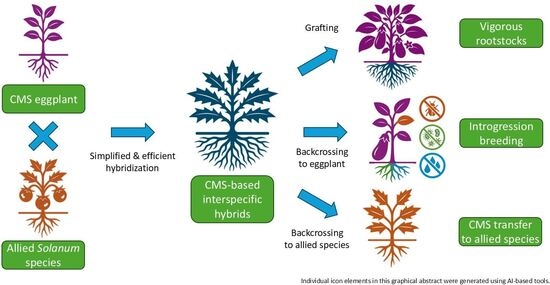
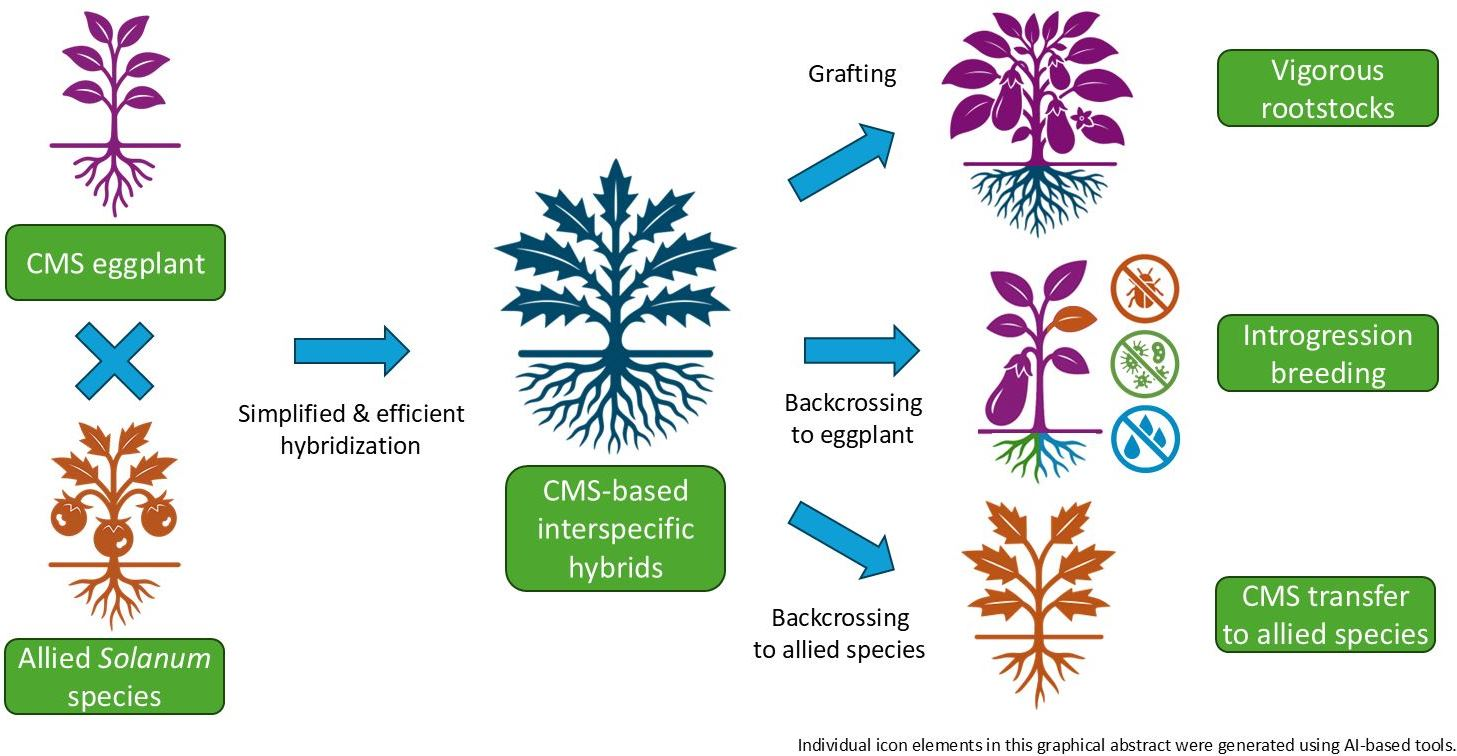
Graphical Abstract

1. Introduction

Eggplant (Solanum melongena L.) is an economically important crop of the Solanaceae family, with worldwide cultivation, especially in Asia and in the Mediterranean region. According to FAO statistics, in 2023, eggplant was cultivated on 1,922,783 hectares worldwide, with a total production of 60,793,941 t [1]. Modern agricultural practices and changing climate conditions pose new challenges in eggplant cultivation. Therefore, the development of genotypes better adapted to low-input farming and resistant to various stresses is crucial for the crop’s sustainability.
Wild and cultivated Solanum species, as well as interspecific hybrids with eggplant, are valuable genetic resources for introgression breeding programs aiming at improving biotic [2,3,4,5,6,7,8] and abiotic stress tolerance [9,10,11,12,13], nutrient use efficiency [14], and fruit quality [15,16,17,18]. Eggplant wide crosses have also been used for the development of grafting rootstocks [19], cytoplasmic male sterility (CMS) systems [20], and mapping populations [21,22,23,24].
Eggplant interspecific hybrids are promising grafting rootstocks, combining various resistances and hybrid vigor with more uniform germination, good grafting compatibility [25,26,27], offering greater practicality for the grafting procedure than the commonly used wild Solanum rootstocks, which possess some disadvantages including irregular germination, slow seedling growth, inconsistent grafting compatibility and unclear status of breeder’s rights [28,29,30,31,32]. However, large-scale interspecific hybrid production is constrained due to the need for manual emasculation in predominantly hermaphroditic Solanum species, making hybrid seed production a highly specialized, labor-intensive, costly procedure.
Utilization of CMS eggplant lines as female parents in crosses naturally prevents self-pollination due to anther non-dehiscence [33] or lack of pollen production [34], offering a cost-effective hybridization method, while ensuring seed genetic purity. Despite the availability of eggplant CMS lines for almost 40 years [35], their application in interspecific hybrid production has not yet been reported.
In a previous work, we produced alloplasmic CMS lines of three Greek eggplant cultivars carrying the cytoplasm of S. violaceum [36]. The CMS eggplant lines used in this study were derived from three popular Greek eggplant cultivars with distinct agronomic and morphological characteristics: ‘Langada’ is mid-early, vigorous, high-yielding with large, cylindrical purple fruits; ‘Emi’ is early and vigorous, with large, oval purple fruits; whereas ‘Tsakoniki’ is early, more compact, with medium-sized violet fruits with white stripes.
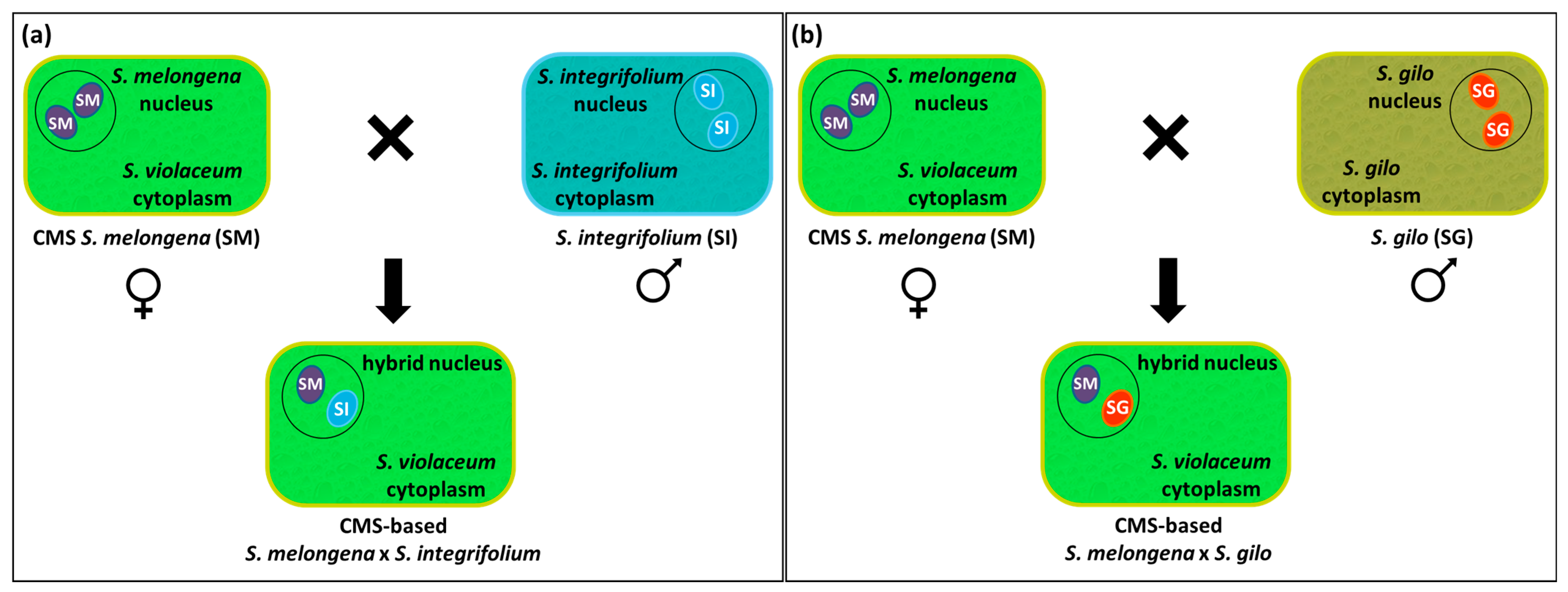
Preliminary crosses of these CMS lines to prickly S. integrifolium (=S. aethiopicum L. Group Aculeatum) and cultivated S. gilo (=S. aethiopicum L. Group Gilo) produced the respective CMS-based interspecific hybrids (Figure 1), suggesting a convenient and practical approach for large-scale interspecific hybrids. In addition, since S. aethiopicum groups are important African vegetables [37], transferring CMS into S. integrifolium and S. gilo through cytoplasm substitution would offer new breeding opportunities for these crops.
Both S. integrifolium and S. gilo are valuable for rootstock and introgression breeding, due to their resistance against various stresses, including dominant Fusarium wilt resistance [7] and good crossability with eggplant [38,39,40]. Their interspecific hybrids with eggplant exhibit vegetative vigor, good grafting compatibility, and tolerance to nematodes [25]. These characteristics make these two groups good candidates for interspecific rootstock production.
Before recommending CMS-based interspecific hybrids as rootstocks or genetic materials for breeding purposes, some questions need to be addressed. First, it is important to determine whether the nuclear–cytoplasmic composition of these hybrids (Figure 1) affects their vegetative vigor. Second, the identification of the most heterotic parental combinations is critical for selecting crossing parents for rootstock production. Third, the potential presence of fertility restorer genes (Rf-genes) inherited from S. integrifolium and S. gilo in their CMS-based hybrids would be of practical value and needs to be investigated. Finally, the possibility of transferring the CMS inducing cytoplasm from CMS eggplant in S. integrifolium and S. gilo should also be evaluated.
The objectives of this study were to (i) characterize the phenotype and evaluate the vigor of CMS-based interspecific hybrids between CMS eggplant and S. integrifolium and S. gilo, (ii) assess hybrid heterosis and identify the most heterotic parental combinations, (iii) evaluate male and female fertility to detect potential Rf-genes, and (iv) develop backcross progenies for introgression breeding and transferring the CMS cytoplasm into the S. aethiopicum groups.

2. Materials and Methods

2.1. Plant Material

Five CMS-based interspecific hybrids were previously produced using the scheme presented in Figure 1. The female parents of the hybrids were the CMS lines of Greek cultivars ‘Langada’ (cmsL), ‘Emi’ (cmsE), and ‘Tsakoniki’ (cmsT) carrying the S. violaceum cytoplasm [36]. The male parents were two S. aethiopicum groups: the wild Aculeatum (S. integrifolium; SI) and the cultivated Gilo (S. gilo; SG). In the present study, the evaluated hybrids were cmsL × SI, cmsE × SI, cmsT × SI, cmsE × SG, and cmsT × SG, as the cross cmsL × SG was unsuccessful. Parental genotypes were also grown as controls. The parental plant materials were provided by the Institute of Plant Breeding and Genetic Resources (IPBGR) of ELGO-DEMETER (Thermi, Thessaloniki, Greece).

2.2. Experimental Design, Site, and Climatic Conditions

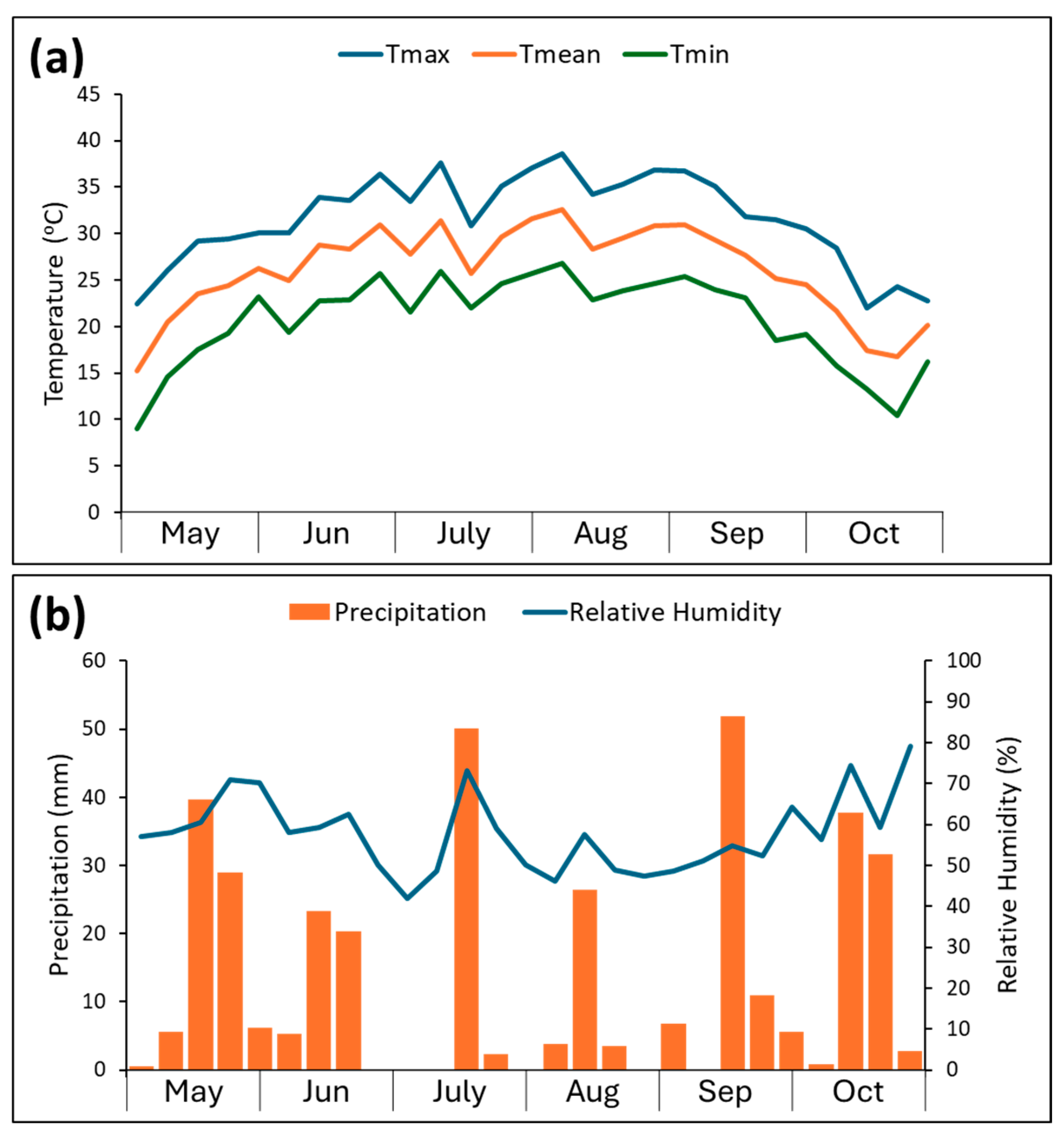
The experiment was conducted from May to September in an open field at IPBGR (latitude: 40.54° N, longitude: 22.99° E, altitude: 2 m). Climatic conditions are shown in Figure A1. Seeds of the plant material were sown in commercial peat-based substrate, and seedlings were raised for 40 days in an unheated greenhouse. Plants were transplanted in the experimental field in May, arranged according to a completely randomized experimental design, with 10 plants per genotype. The experimental area covered approximately 85 m2, including border corridors. Standard eggplant cultivation practices were applied throughout the experiment.

2.3. Phenotypic Characterization

The phenotypic characterization of the plant material was assessed at seedling, vegetative, flowering, and fruit-setting stages using CPVO TP-117/1 eggplant descriptors [41], with modifications when necessary (e.g., addition of fruit color and shape classes for S. integrifolium and S. gilo). Additional descriptors were defined when suitable ones were not available (Table A1). Quantitative traits were measured using the appropriate methods and organs (ruler, caliper, weighing scale, and manual counting). Digital imaging methods for leaf area estimation and leaf blade measurements are given in detail in Appendix A.1 and Appendix A.2.

2.3.1. Seedling Traits

The evaluated seedling traits included hypocotyl coloration, cotyledon length, width, and length-to-width ratio, presence of leaf prickles, and color and intensity of anthocyanins in midrib and prickles.

2.3.2. Plant Traits

Plant traits were examined at anthesis (early June) and included plant growth habit, shoot coloration and anthocyanin intensity, shoot prickle color, and type of inflorescence. Quantitative measurements were made for estimated leaf area (ELA), plant height, number of shoots and leaves, internode length, prickles per internode, flowers per inflorescence, and number of fruits per infructescence. ELA was determined using a digital imaging approach implemented in ImageJ software (version 1.50), described in detail in Appendix A.1.

2.3.3. Leaf Traits

Leaf measurements included midrib coloration, leaf dimensions, prickles number, margin sinuation, and number of lobes. Petiole length and diameter, as well as the number of petiole prickles, were also recorded. Leaf blade dimensions were also obtained using an ImageJ-based digital scanning procedure (Appendix A.2).

2.3.4. Flower Traits

For the characterization of the flower, the following traits were recorded: corolla color, presence of corolla stripes, corolla diameter, stigma color, and the number of anthers, petals, sepals, and stigma lobes.

2.3.5. Fruit Traits

Fruit traits were evaluated on fully developed fruits at the harvest maturity and physiological maturity stages for fruit shape, ribbing intensity, pistil scar depression depth and size, fruit color, presence of surface patterns, flesh color, and flesh texture. Quantitative traits included fruit weight, length, diameter, peduncle length, fruit calyx prickles, and number of locules.

2.4. Evaluation of Heterosis

To evaluate the relative performance of the hybrids in comparison to their parental controls, mid-parent heterosis (MPH) and heterobeltiosis (better-parent heterosis; BPH) were calculated for growth-related traits following the equations given in Fehr [42]:
M P H   ( % ) =   ( F 1 M P ) M P × 100
B P H % = F 1 B P B P × 100
where F1 = hybrid mean, MP = mid-parent mean, and BP = better-parent mean.

2.5. Male Fertility Assessment

Male fertility was evaluated using pollen staining, pollen release tests, and anther morphology, as described in a previous study [36]. For the staining method, anthers from 10 freshly opened flowers per genotype were smeared in 2% acetocarmine solution, 100 pollen grains per flower were counted with three replications, and the percentage of viable pollen grains was scored. Pollen release ability was assessed by tapping anthers over a black surface and examining pore dehiscence with a stereomicroscope. Anther morphology was visually examined both in the field and in the laboratory.

2.6. Female Fertility Assessment

Female fertility was determined by the percentage of successful backcrosses to their respective eggplant cultivars and allied species. For each combination, 30 backcrosses were made using the first four flowers of the plants (excluding the first) during June. Ten artificial self-pollinations per parental material were used as controls. The resulting fruits were harvested at physiological maturity, and the percentage of seeded fruits was calculated.

2.7. Statistical Analysis

Analysis of variance for morphological traits and pollen viability was conducted using SPSS v.17.0 (IBM Corp., Armonk, NY, USA and statistically significantly different means were separated using Tukey’s HSD test (p ≤ 0.05). Significance of mid- and better-parent heterosis was tested using a t-test (p ≤ 0.05) against mid- and better-parent values. Principal component analysis (PCA) was carried out to explore relationships among traits and among genotypes (XLSTAT, Lumivero, Denver, CO, USA).

3. Results

3.1. Morphological Characterization

3.1.1. Seedling

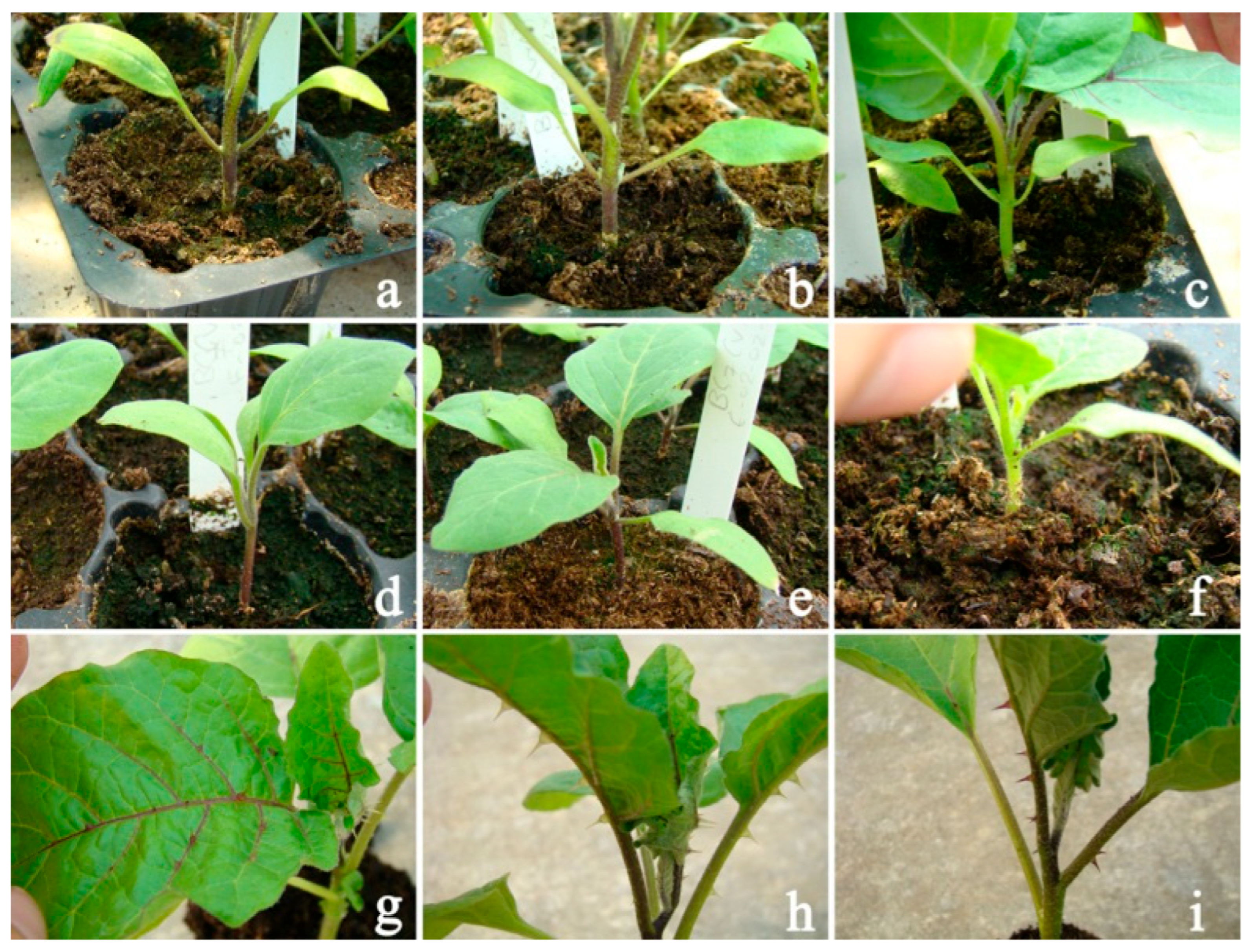
Seedling morphological traits are shown in Table 1. In general, the genotypes were distinguished by the presence of anthocyanins and prickles in various organs, while each genotype had a uniform phenotype, and no segregation was observed for the evaluated traits (Figure 2). All eggplant cultivars and the interspecific hybrids had purple hypocotyls, while hypocotyls of S. integrifolium and S. gilo were green. Additionally, leaf midrib anthocyanins were present in eggplant, S. integrifolium and hybrids, but were absent in S. gilo. Seedlings of S. integrifolium and its hybrids were also characterized by leaf prickles, whereas S. gilo, its hybrids, and eggplant lacked prickles.
Interestingly, anthocyanin formation in leaf midrib and prickles of S. integrifolium resulted in vinaceous coloration and was light-dependent, i.e., shaded organs did not form anthocyanins, contrasting to the consistent typical purple coloration observed in eggplant and hybrid genotypes (Table 1, Figure 2). Solanum integrifolium had weaker prickle anthocyanin intensity than its hybrids.
Cotyledon dimensions varied significantly among the plant material (Table A2). S. integrifolium and S. gilo had the shortest cotyledons (2.2 and 2.4 cm, respectively), while eggplant cultivars (2.9–3.4) and interspecific hybrids (2.8–3.4) had the longest (Table 1). Cotyledon width ranged from 0.9 cm in S. gilo to 1.2 cm in S. integrifolium. The genotypes were also differentiated by the cotyledon length-to-width ratio (Table 1). Eggplant ‘Langada’ had the highest ratio (3.66) while S. integrifolium had the lowest (1.98), with intermediate values recorded in the hybrids.

3.1.2. Plant

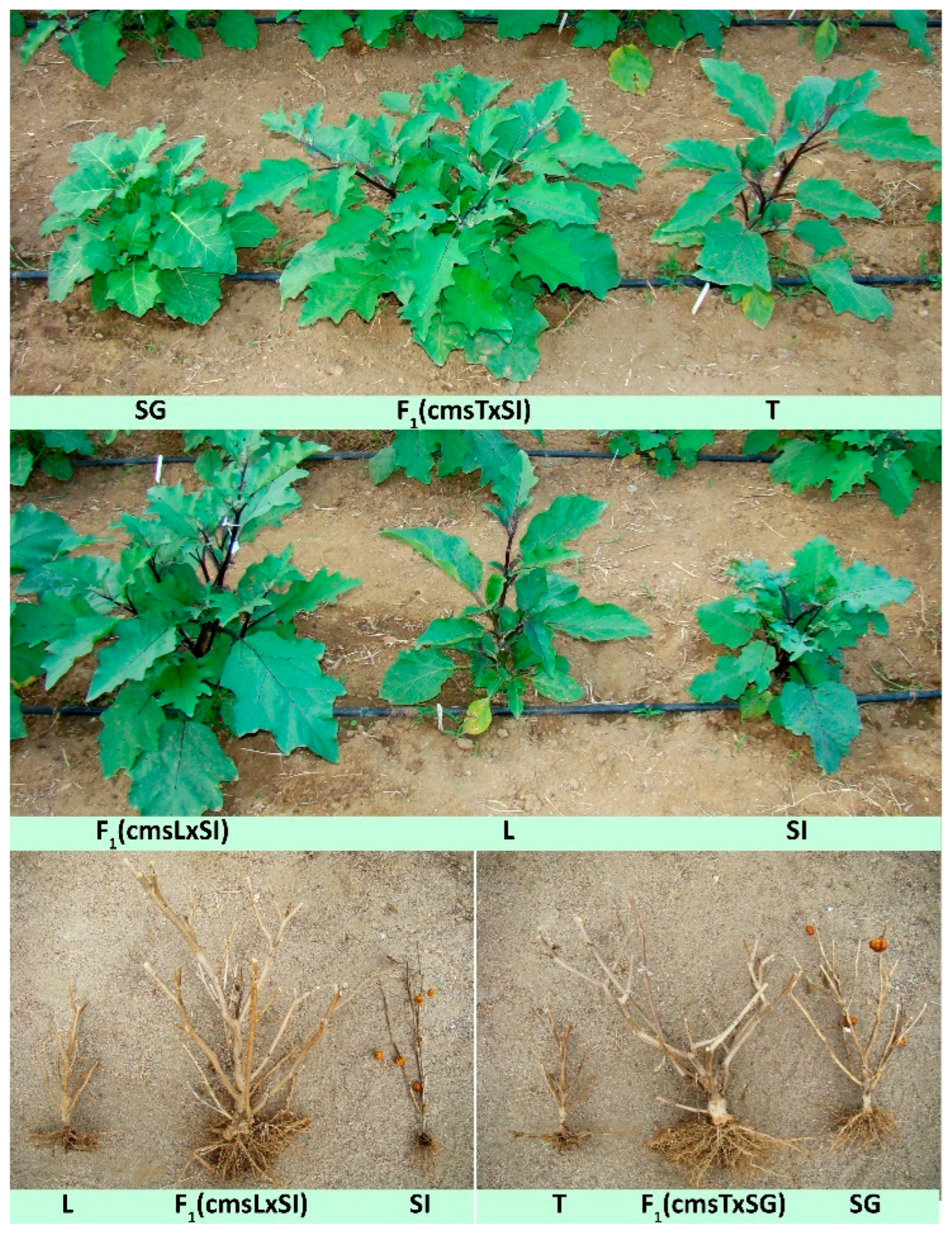
The overall appearance of the interspecific hybrids was intermediate between their respective parental controls (Figure 3). However, hybrid genotypes exhibited superior performance for most growth-related traits (Table 2). At the end of the experiment, representative plants were uprooted, air-dried, and their root systems were visually inspected, revealing a more extensive root system in the hybrids.
Plant growth habit was erect in eggplant cultivars ‘Langada’ and ‘Tsakoniki’, and was semi-erect in ‘Emi’, S. integrifolium, and S. gilo (Figure 3, Table 2), while the hybrids of S. integrifolium and S. gilo were semi-erect and spreading, respectively. Shoot coloration was vinaceous in S. integrifolium, green in S. gilo, and typical purple in eggplant and the interspecific hybrids. Moreover, the hybrids of S. integrifolium had very strong shoot anthocyanin intensity, in contrast to the other genotypes, which had medium intensity.
The estimated leaf area of the hybrids was more than double compared to their respective controls (2709.7–2984.4 cm2 vs. 942.4–1388.8 cm2). Also, hybrid plants were significantly taller (101.6–133.6 cm) than the controls (70.0–95.2 cm), while S. integrifolium hybrids were significantly taller than those of S. gilo. The interspecific hybrids also produced more shoots (22.5–41.8) and leaves (76.8–107.0) compared to the parental genotypes (6.8–11.4 and 26.0–42.6, respectively).
The interspecific hybrids had the longest internodes (12.3–14.3 cm), followed by eggplant (11.0–13.0 cm), while S. integrifolium and S. gilo had significantly shortest internodes (9.0 and 8.9 cm, respectively). Both S. integrifolium and its hybrids had internode prickles, but the latter had significantly fewer prickles per internode (1.6–2.8) than the former (4.3). Internode prickle density was highest in S. integrifolium (0.48 prickles cm−1) and moderate in its hybrids (0.17–0.20 prickles cm−1). The color of these prickles was similar to the shoot color, with vinaceous prickles in S. integrifolium and purple in the hybrids.
Inflorescence traits also varied significantly among genotypes (Table 2). Both S. integrifolium and its hybrids had compound inflorescences, with the former having significantly more flowers (9.6) than the latter (5.0–7.6). It is worth noting that while S. gilo and eggplant formed simple inflorescences with few flowers (1.3–2.1), their interspecific hybrids had compound inflorescences with significantly more flowers (5.0–6.3). It was also observed that in September, both F1(cmsE × SI) and F1(cmsE × SG) set many parthenocarpic fruits, averaging 3.7 and 2.5 fruits per infructescence, respectively. The number of fruits per infructescence in the parental genotypes ranged between 1.0 and 1.6.

3.1.3. Leaf

Leaf morphological traits also varied among the plant material (Table 3). The leaf midrib was vinaceous in S. integrifolium, green in S. gilo, and purple in eggplant and hybrid materials. Eggplant and hybrid genotypes had significantly longer leaves (22.4–26.6 cm) than S. integrifolium and S. gilo (16.2–16.8 cm). In addition, the hybrids had the widest leaves (18.7–20.7 cm), exceeding both parents (14.9–15.8 cm). The length/width ratio was highest in eggplant (1.42–1.78), lowest in S. integrifolium and S. gilo (1.07 and 1.04, respectively), and intermediate in the hybrids (1.21–1.29). The interspecific hybrids also had the largest leaf blade area (283.9–330.9 cm2), significantly surpassing both parental controls (168.3–259.8 cm2). The leaves of S. integrifolium, S. gilo, and their hybrids were strongly sinuated, contrasting with the very weakly sinuated eggplant leaves, while the number of leaf lobes did not differ significantly between the genotypes.
Solanum integrifolium and its hybrids were characterized by numerous prickles on both leaf surfaces (Table 3). On the other hand, eggplant cultivars sparsely formed very small prickles, and S. gilo and its hybrids completely lacked prickles. S. integrifolium averaged 11.0 prickles on the upper and 17.5 on the lower surface, significantly more than its respective hybrids (7.8–9.0 and 7.2–9.7, respectively) and eggplant (0.75–4.8 and 0.2–1.3, respectively). Notably, S. integrifolium produced more prickles on the lower leaf surface, contrary to eggplant, while the hybrids had an equal distribution. Leaf prickle density was significantly higher in S. integrifolium (0.06 prickles/cm2 on the upper and 0.10 on the lower surface than in the interspecific hybrids (0.02–0.03).
Leaf petiole was longer in hybrids (8.7–12.1 cm), intermediate in eggplant (4.8–9.5 cm) and shorter in S. integrifolium and S. gilo (5.3–5.4 cm), while the smallest petiole diameter was recorded in S. integrifolium and S. gilo (0.55–0.62 cm) and the largest in eggplant and hybrids (0.70–0.88 cm). The highest number of petiole prickles was recorded in the interspecific hybrids (3.0–4.2), followed by S. integrifolium (2.7) and eggplant (0.40–0.83). Petiole prickles were denser in S. integrifolium (0.50 prickles per cm), while its hybrids displayed intermediate values (0.28–0.45).

3.1.4. Flower

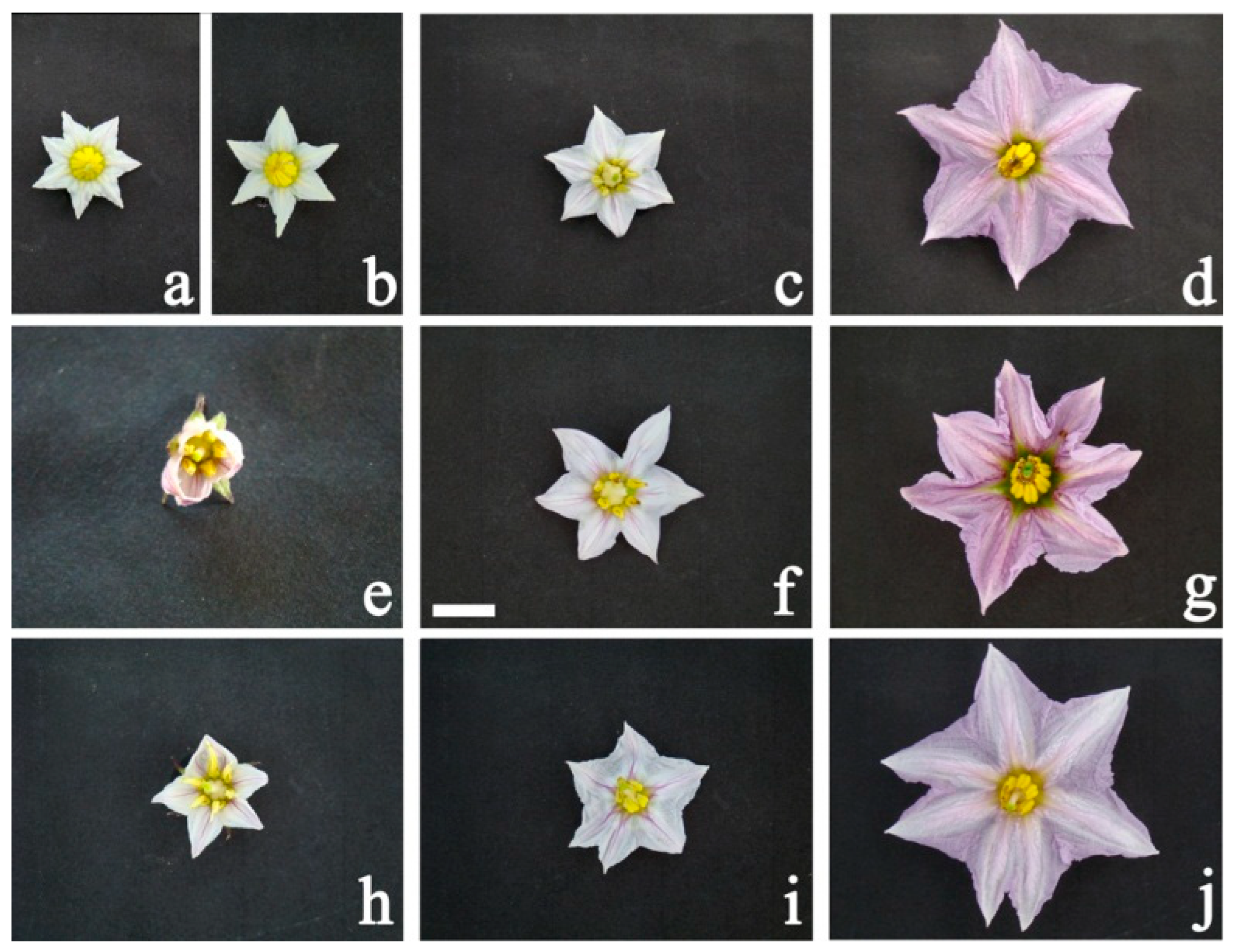
Flower morphology of the interspecific hybrids was generally intermediate between the respective eggplant cultivars and the wild species (Figure 4, Table 4). Eggplant flowers were purple with broad radial stripes of a lighter hue, contrasting with the entirely white flowers of S. integrifolium and S. gilo. The flowers of the hybrids were white with radial, narrow purple stripes, indicating the presence of anthocyanins. Eggplant had by far the largest corolla diameter (5.2–5.5 cm), while the interspecific hybrids (2.7–3.1 cm) were closer to S. integrifolium and S. gilo (2.3 cm).
In addition, the plant material exhibited differences in the stigma coloration, which was light orange in S. integrifolium and S. gilo, green in eggplant cultivars ‘Emi’ and ‘Langada’, and light green in ‘Tsakoniki’ and the hybrids. The number of petals, sepals, and anthers was slightly lower in hybrids (5.4–6.2) than in eggplant cultivars (6.2–7.5) and similar to S. integrifolium and S. gilo (6.1–6.4), with significant differences observed only between cv. ‘Emi’ and F1(cmsT × SG). Moreover, S. integrifolium and S. gilo had fewer stigma lobes (3.3–3.5) compared to eggplant (4.4–4.8) and their hybrids (4.0–4.6).

3.1.5. Fruit

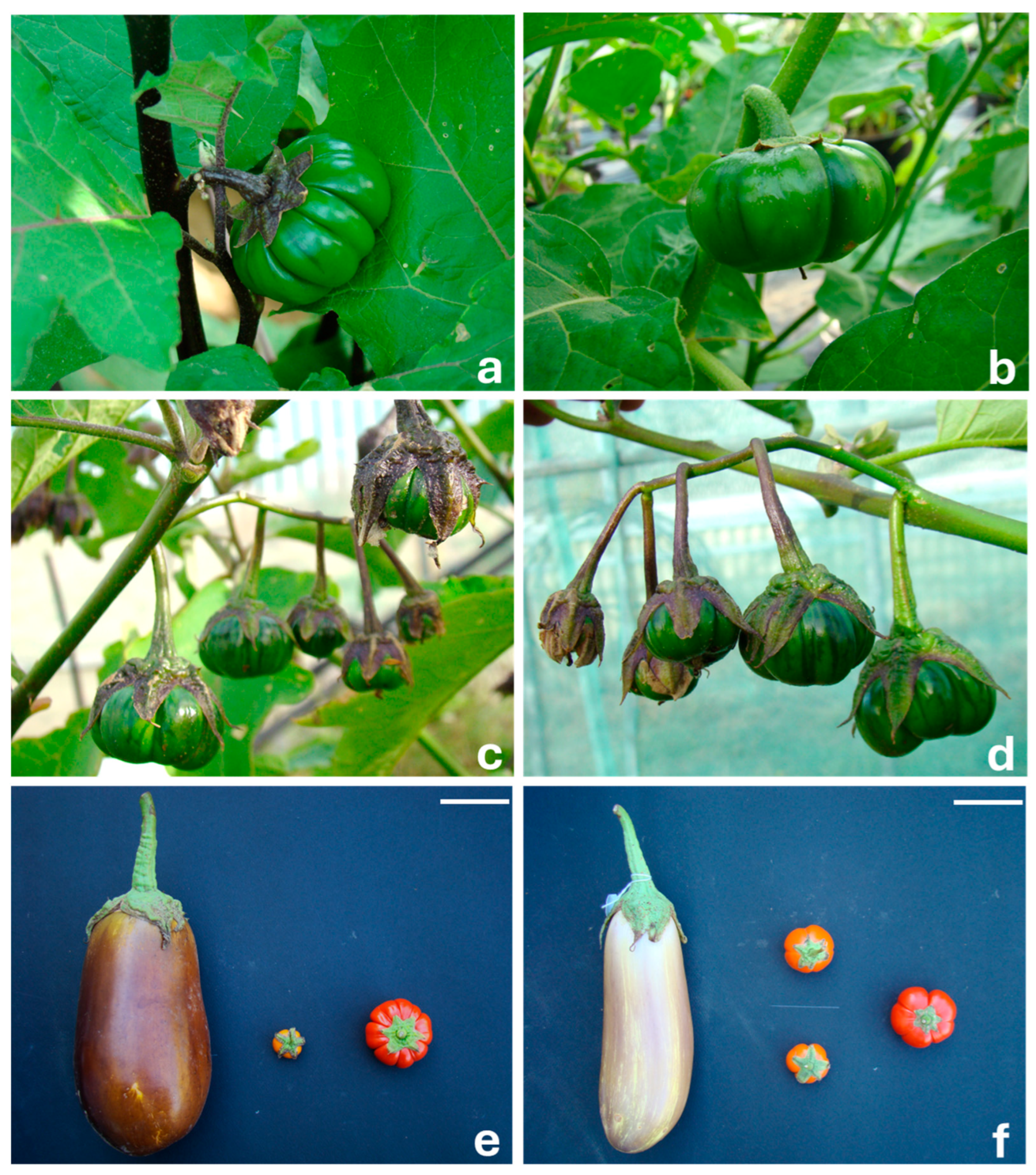
The genotypes examined displayed differences in fruit morphology and fruit-setting behavior (Figure 5, Table 5). The eggplant cultivars, as well as S. integrifolium and S. gilo, produced seeded fruits following both natural and artificial self-pollination. In contrast, the interspecific hybrids did not set any fruit until September, when abundant parthenocarpic fruit formation was observed in F1(cmsE × SI) and F1(cmsE × SG). The external appearance of these parthenocarpic fruits more closely resembled that of S. integrifolium and S. gilo rather than eggplant, although they exhibited several unique traits (Figure 5).
Solanum integrifolium and S. gilo had fruits of similar morphology (Figure 5, Table 5). Those of S. integrifolium were flattened with very strong ribbing, an indented apex, a very large pistil scar, and a very deep indentation. At harvest maturity, the fruit skin was green and very glossy, with weak, sparse stripes, turning red at physiological maturity. The fruit’s flesh was white with a gelatinous-to-compact texture. Solanum gilo had flattened fruits, with strong ribbing and an indented-to-flattened apex. The pistil scar was also very large with a deep indentation. External fruit features resembled S. integrifolium except for medium glossiness, while its flesh was orange with a gelatinous texture. Fruits of eggplant cv. ‘Emi’ were obovate and lacked ribs, with a flattened apex. The pistil scar was medium-sized with an absent or very shallow indentation. At harvest maturity, fruit color was purple without stripes and with medium to strong glossiness, turning brown at physiological maturity. The fruit flesh was white with a compact texture.
Both CMS-based hybrids produced flattened to globular fruits, with medium ribs and an indented-to-flattened apex. The pistil scar was very small with a shallow indentation, distinguishing the hybrids from their parents. At harvest maturity, the fruit skin was green, turning to orange at physiological maturity. Fruit stripes were present and more pronounced than in S. integrifolium and S. gilo, with medium density. The flesh color was green with gelatinous-to-compact texture in F1(cmsE × SI) and light green with a gelatinous texture in F1(cmsE × SG).
Eggplant cv. ‘Emi’ produced the heaviest fruits (436.8 g), whereas F1(cmsE × SI) and F1(cmsE × SG) had the lowest fruit weight (15.9 and 19.9 g, respectively). Fruits of S. integrifolium and S. gilo were approximately twice as heavy as those of the interspecific hybrids (37.5 and 35.4 g, respectively). The longest fruit peduncle was recorded in ‘Emi’ (8.6 cm), followed by the interspecific hybrids (3.0 and 2.8 cm, respectively), while S. integrifolium and S. gilo had the shortest peduncles (1.7 and 1.4 cm, respectively).
Regarding fruit dimensions, cv. ‘Emi’ had the largest polar and equatorial diameters (15.4 and 8.7 cm, respectively), while S. integrifolium and S. gilo had significantly smaller polar (2.9 and 2.6, respectively) and equatorial (5.2 and 4.8 cm, respectively) diameters. F1(cmsE × SI) had a significantly smaller value for polar diameter than S. integrifolium, while the opposite was observed for F1(cmsE × SG) and S. gilo. The interspecific hybrids recorded the smallest values for equatorial diameter (3.6–3.8) among the plant material. Consistent with its fruit shape, eggplant ‘Emi’ showed the highest equatorial/polar diameter ratio (1.78), while S. integrifolium and S. gilo exhibited the lowest ratios (0.55 and 0.54). On the other hand, the hybrids had intermediate values, with F1(cmsE × SI) producing slightly more flattened fruits (0.72) than F1(cmsE × SG) (0.79).
Interestingly, the highest number of calyx prickles was observed in F1(cmsE × SI), which formed 6.7 prickles, followed by ‘Emi’ (3.7) and S. integrifolium (1.8). Solanum gilo and its hybrid did not form calyx prickles. Finally, no significant differences were observed for the number of locules, which ranged from 4.9 in ‘Emi’ to 6.0 in S. integrifolium.

3.1.6. Principal Component Analysis

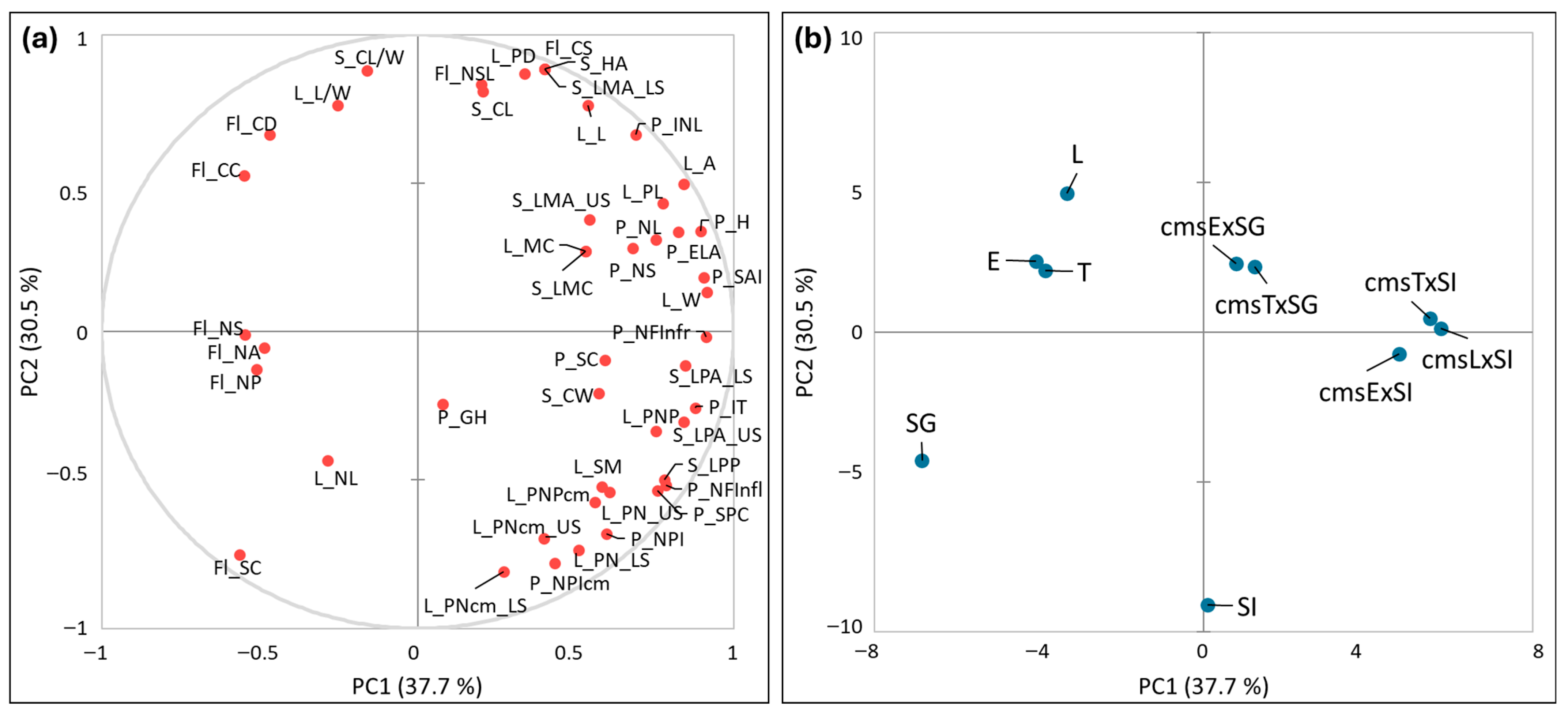
The 47 traits used in PCA correspond to all seedling, plant, leaf, and flower descriptors (Table A1), while fruit traits were excluded because most hybrids were sterile and did not produce fruit. Principal component analysis identified two principal components, PC1 and PC2, explaining 37.7 and 30.5% of the variation, respectively (Figure 6). These components were used as the x and y axes of the trait variables loading plot and genotype score plot. The loading plot indicated a considerable degree of trait grouping with respect to the plant organ and function. For example, seedling anthocyanin traits such as anthocyanin presence in the hypocotyl (S_HA), midrib color (S_LMC), and anthocyanin intensity (S_LMA_US, S_LMA_LS) were closely grouped on the upper right quadrant, while seedling leaf prickles anthocyanin intensity (S_LPA_US, S_LPA_LS) were located on the lower right quadrant close to the x-axis. Seedling cotyledon length (S_CL) and length/width ratio (S_CL/W) were positioned on the upper right and left quadrant, respectively, close to the y-axis. Seedling cotyledon width (S_CW) and leaf prickle presence (S_LPP) were in the lower right quadrant.
Plant traits were located on the right upper and lower quadrants (Figure 6). Specifically, growth-related traits, including height (P_H), estimated leaf area (P_ELA), number of shoots (P_NS), leaves (P_NL), and internode length (P_INL), as well as shoot anthocyanin intensity (P_SAI), were closely positioned on the upper right quadrant above the x-axis, suggesting a close relationship. On the other hand, plant traits regarding prickle presence (P_NPI), density (P_NPIcm), and anthocyanin presence (P_SC, P_SPC) were grouped on the lower right quadrant, together with inflorescence (P_IT, P_NFlInfl) and infructescence (P_NFrInfr) traits.
Most leaf traits were also located on the right quadrants (Figure 6). Traits related to leaf growth such as length (L_L), width (L_W), area (L_A), petiole length (L_PL) and diameter (L_PD) were mainly positioned on the upper right quadrant, while leaf traits related to the presence and density of prickles (L_PN_US, L_PNcm_US, L_PN_LS, L_PNcm_LS, L_PNP and L_PNPcm) were on the lower right. Leaf midrib color (L_MC) and sinuation of margin (L_SM) were on the upper and lower right quadrants, respectively, while the number of lobes (L_NL) was on the lower left quadrant.
Most of the flower traits were located on the upper and lower left quadrants (Figure 6). Some quantitative flower traits, including the number of anthers (F_NA), petals (F_NP), and sepals (F_NS), were closely located in the lower-left quadrants close to the x-axis, with flower stigma color (F_SC) also on the same quadrant but lower. Flower corolla color (F_CC) and diameter (F_CD) were on the upper-left quadrant, whereas the presence of flower stripes (F_CS) and the number of stigma lobes (F_NSL) were on the upper-right quadrant.
In addition, PCA clearly distinguished the genotypes examined into five distinct groups as demonstrated in the score plot in Figure 6. The first group, located on the upper-left quadrant, consisted of the three eggplant cultivars, while the second and third groups were represented by S. gilo and S. integrifolium, respectively, positioned on the lower-left and lower-right quadrants. The interspecific hybrids of S. integrifolium formed the fourth group with cmsT × SI and cmsL × SI on the upper-right and cmsE × SI in the lower-right, very close to the x-axis, while the interspecific hybrids of S. gilo were the fifth group on the upper right quadrant close to both axes, at the same height as the respective eggplant cultivars.

3.2. Heterosis and Heterobeltiosis

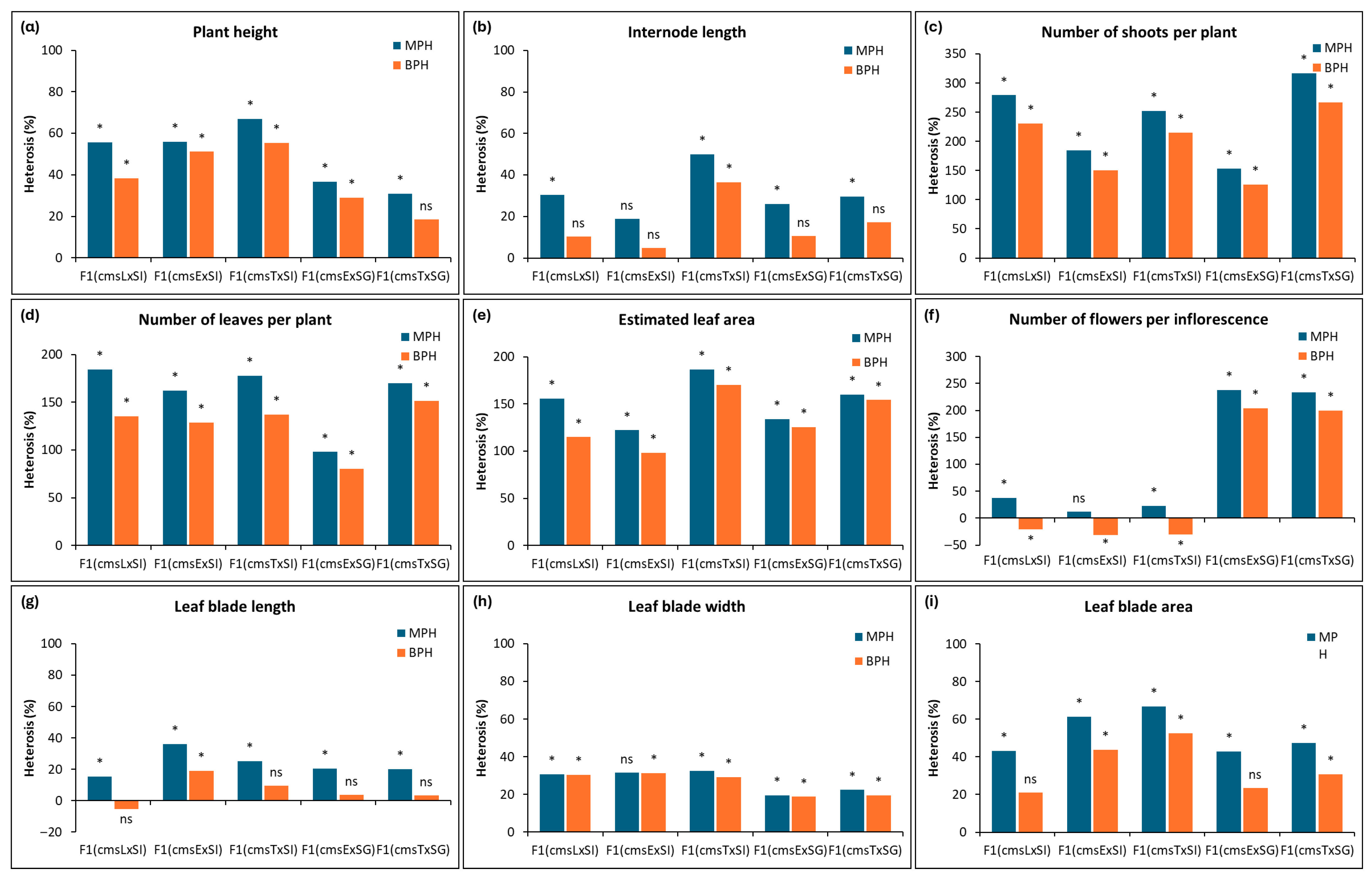
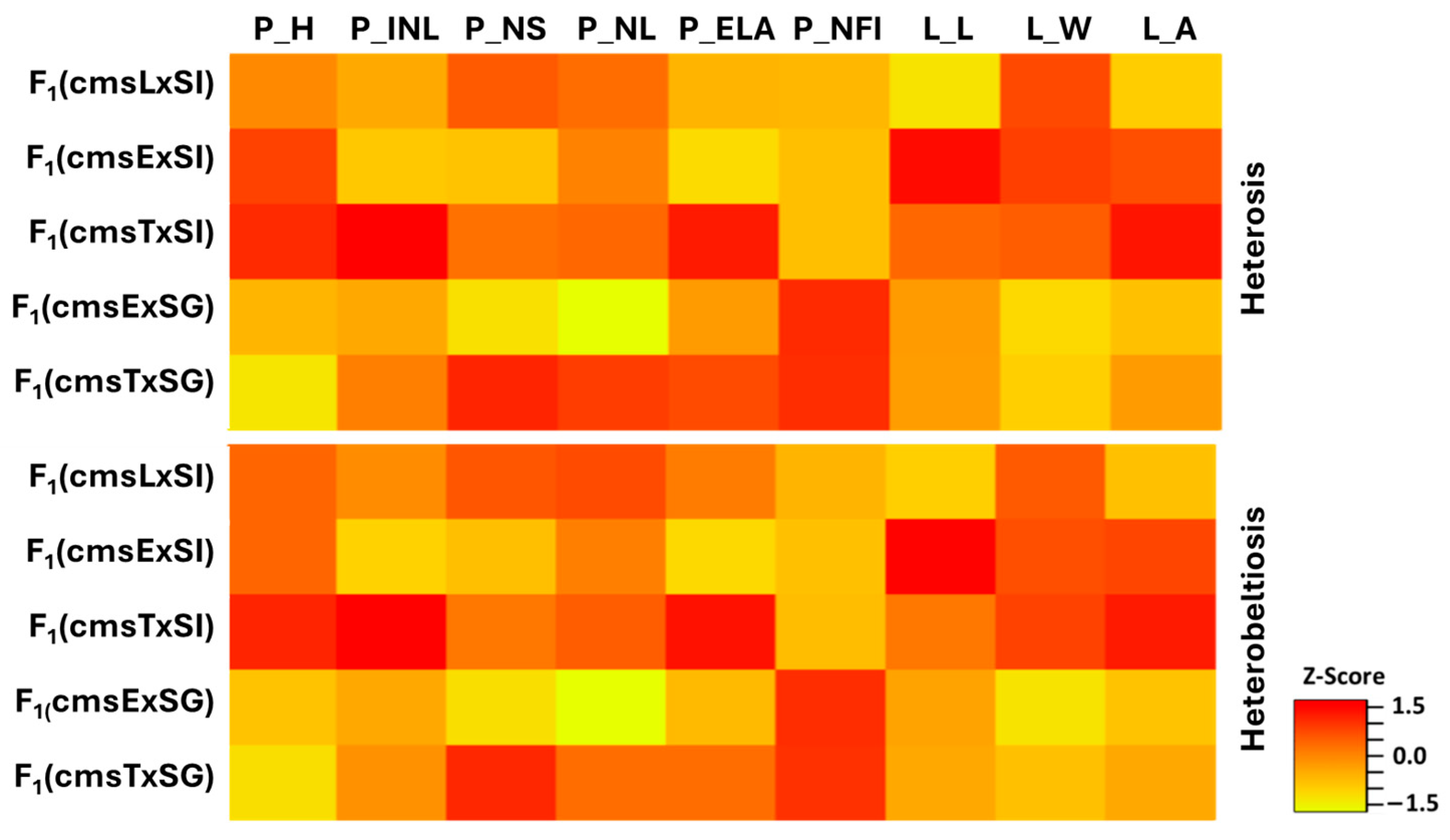
The interspecific hybrids displayed remarkable heterosis and heterobeltiosis for most of the traits studied (Figure 7), with distinct magnitudes and heterotic patterns among genotypes (Figure A2). In general, the hybrids of female parent cmsT were the most heterotic, with F1(cmsT × SI) being the most heterotic for the majority of the traits, followed by F1(cmsT × SG) in the remaining traits. Hybrids of cmsE exhibited statistically significant, yet less pronounced, heterotic responses. With respect to the male parent, hybrids of S. integrifolium were more heterotic compared to those of S. gilo.
Solanum integrifolium hybrids exhibited significant heterosis and heterobeltiosis for plant height, with the highest values (67.0% and 55.31%, respectively) recorded in F1(cmsT × SI), followed by F1(cmsE × SI) and F1(cmsL × SI). Significant heterotic responses, although of lesser magnitude (30.8–36.6%), were also recorded in the hybrids of S. gilo F1(cmsT × SG) and F1(cmsE × SG), while heterobeltiosis was significant in the former (29.0%) and non-significant in the latter (18.6%). For internode length, heterosis was significant in all hybrids except for F1(cmsE × SI), with F1(cmsT × SI) having the highest value (50.0%), followed by F1(cmsL × SI) and F1(cmsE × SG) with 30.3% and 25.9%, respectively. However, nearly all heterobeltiosis estimates were non-significant for this trait, except for F1(cmsT × SI), which surpassed its best parent by 36.4%.
The trait with the more pronounced heterosis and heterobeltiosis was the number of shoots per plant, with statistically significant values in all hybrids (Figure 7). F1(cmsT × SG) was the most heterotic genotype (316.5% and 266.7%), followed by F1(cmsL × SI) and F1(cmsT × SI). Similar responses were observed for the number of leaves per plant, with heterosis ranging from 97.4% in F1(cmsE × SG) to 184.2% in F1(cmsL × SI), and heterobeltiosis ranging from 80.3% in F1(cmsE × SG) to 151.2% in F1(cmsT × SG). Significant heterosis and heterobeltiosis were also recorded for estimated leaf area, particularly in F1(cmsT × SI) (186.8% and 170.2%) and F1(cmsT × SG) (160.1% and 154.2%), while lower, yet still significant values (98.2–133.37%), were observed in F1(cmsE × SI) and F1(cmsE × SG).
The strongest heterotic responses for flower number per inflorescence were observed in the hybrids of S. gilo (Figure 7). That was an expected result, given the contrasting phenotype of the hybrids and their parental genotypes (compound vs. simple inflorescence). F1(cmsE × SG) and F1(cmsT × SG) displayed exceptionally high heterosis (237.6% and 233.3%, respectively) and heterobeltiosis (204.3% and 199.4%, respectively). In contrast, S. integrifolium hybrids showed weak heterosis (12.3–37.7%) and negative heterobeltiosis, which ranged from −20.8 to −31.7%.
Heterosis for leaf blade length ranged from 15.3% in F1(cmsL × SI) to 36.0% in F1(cmsE × SI), with the former being the only non-significant estimate (Figure 7). Heterobeltiosis for the same trait was non-significant in all hybrids except F1(cmsE × SI), which surpassed its better parent by 18.9%. For leaf blade width, significant heterosis and heterobeltiosis were recorded in all hybrids, with S. integrifolium hybrids showing uniform and somewhat greater values compared to those of S. gilo. Heterosis ranged from 19.4% in F1(cmsE × SG) to 32.4% in F1(cmsT × SI), with comparable heterobeltiosis values, ranging from 18.8% in F1(cmsE × SG) to 31.2% in F1(cmsT × SI). Leaf blade area followed a similar heterotic pattern with heterosis ranging from 42.8% F1(cmsE × SG) to 66.8% in F1(cmsT × SI). Heterobeltiosis for this trait was not significant in F1(cmsL × SI) and F1(cmsE × SG), while significant values ranged from 30.8% in F1(cmsT × SG) to 52.6% in F1(cmsT × SI).

3.3. Male Fertility

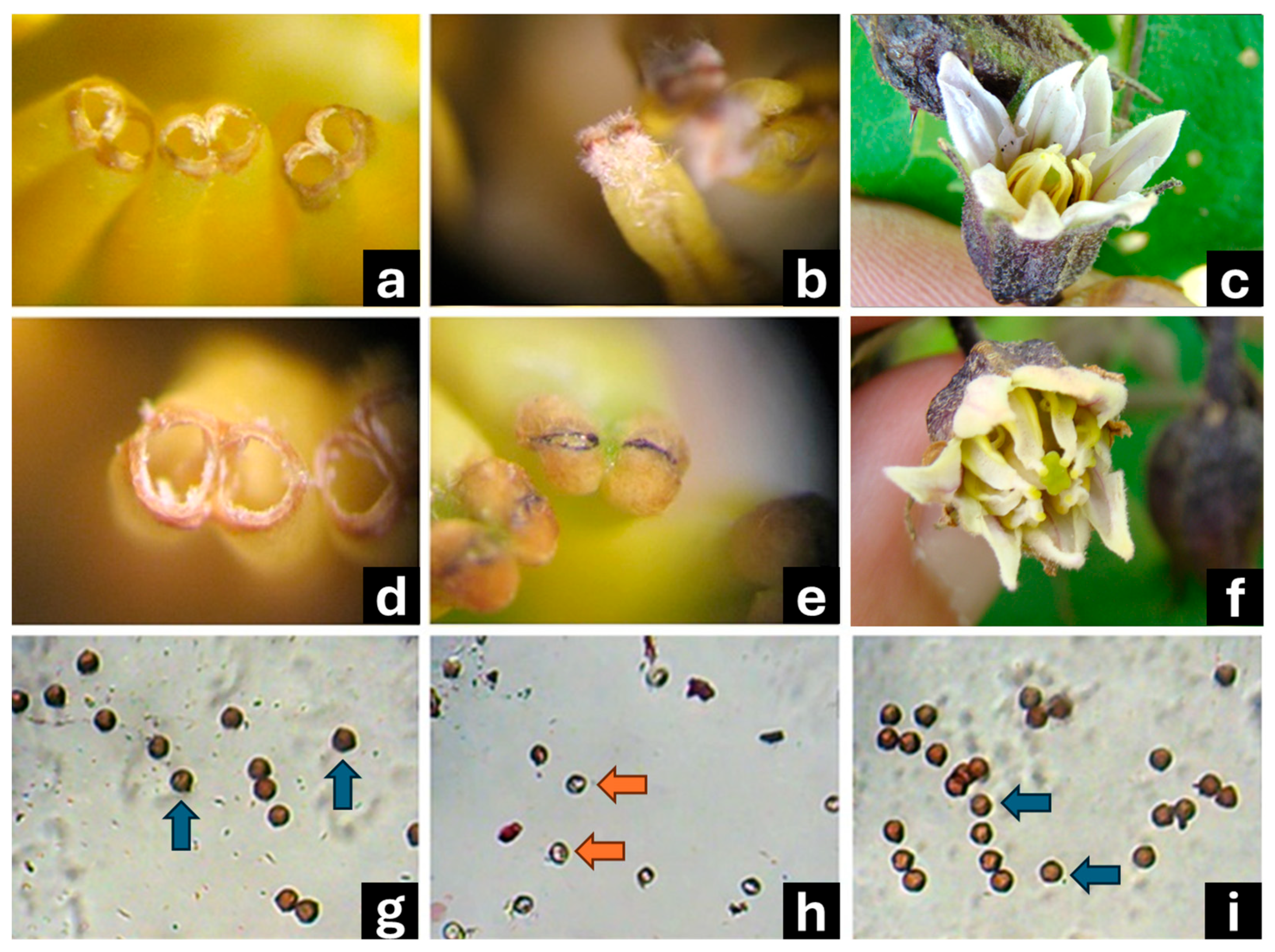
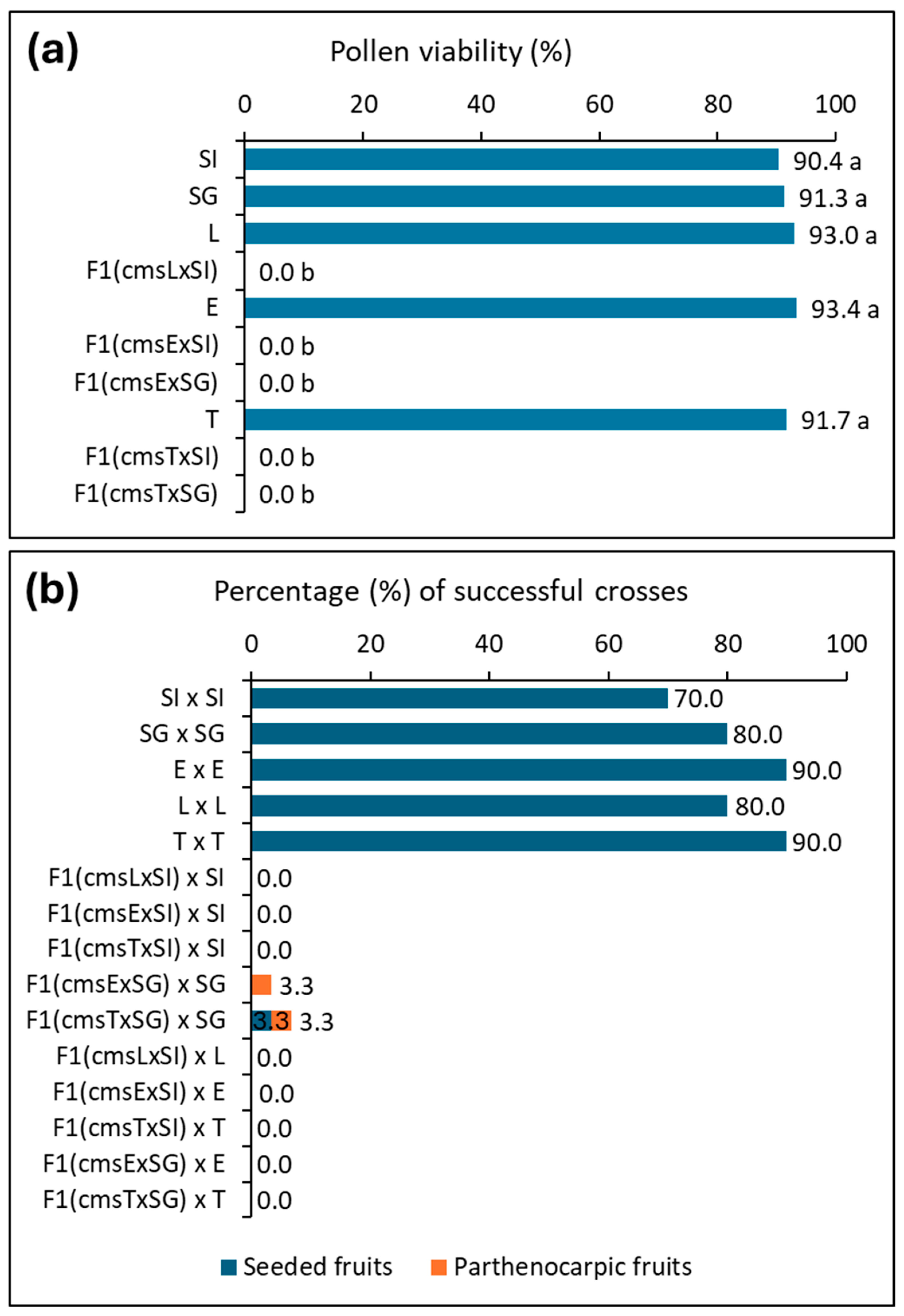
Stereomicroscopic examination confirmed that the anthers of eggplant, S. integrifolium, and S. gilo had typical morphology and functionality, with terminal pores that dehisced normally during anthesis to release pollen (Figure 8a,d). In contrast, the interspecific hybrids displayed structural and functional abnormalities, including constriction below the terminal pore, partially or slightly dehisced pores, and pores covered by hair-like structures. In addition, anther homeotic changes, i.e., petaloidy and pistilody, were also observed in the hybrids (Figure 8c,f). Pollen viability was high in eggplant cultivars and their allied species, ranging from 90.4% in S. integrifolium to 93.4% in eggplant ‘Emi’ (Figure 8g–i; Figure 9a). Conversely, all interspecific hybrids were completely male sterile, with no viable pollen grains detected.

3.4. Female Fertility

Female fertility of the plant material was assessed based on the percentage of successful backcrosses to the corresponding eggplant cultivars and allied species and the percentage of backcrosses that yielded seeded fruits (Figure 9b). Solanum melongena, S. integrifolium, and S. gilo set seeded fruits after controlled self-pollination, with a success rate ranging between 70.0 and 90.0%. In contrast, the interspecific hybrids failed to produce seeded fruits after selfing or backcrossing, with the exception of F1(cmsE × SG) and F1(cmsT × SG), which set one and two fruits, respectively, when backcrossed to S. gilo. These fruits were dissected, and it was concluded that only one fruit from the cross F1(cmsT × SG) × S. gilo contained seemingly viable backcross seeds, while the other fruits were seedless (parthenocarpic) (Figure 5f and Figure 9b).

4. Discussion

4.1. Phenotypic Characterization and Uniformity of CMS-Based Interspecific Hybrids

One key feature of a reliable CMS system is the ability to ensure genetic purity of hybrid seed by preventing self-pollination [43]. In the present study, the CMS-based interspecific hybrids between S. melongena and the two S. aethiopicum groups exhibited complete phenotypic uniformity across all developmental stages, with no segregation for the qualitative morphological traits evaluated (Table 1, Table 2, Table 3, Table 4 and Table 5, Figure 2, Figure 3, Figure 4 and Figure 5). This confirms the effectiveness of the maternal CMS eggplant lines in preventing self-pollination and ensuring genetic purity of the interspecific hybrid seed.
The phenotype of the hybrids was intermediate relative to their parental species (Figure 3, Figure 4 and Figure 5), which is typical for eggplant wide crosses [44,45,46]. Some traits, including prickliness, anthocyanins, and compound inflorescence, were dominantly inherited, consistent with previous reports [47,48,49,50,51], and confirmed hybridity. The fact that parthenocarpic hybrid fruits more closely resembled those of the allied species suggests dominant inheritance of fruit traits from the S. aethiopicum groups, whereas their reduced size can be attributed to the absence of seeds due to pollen sterility [46]. From the breeders’ point of view, the complete absence of prickles in S. gilo and its hybrids with eggplant, possibly reflecting the different domestication paths of these species, is a trait that could be exploited for the development of prickle-free eggplants through introgression breeding.
Vegetative development traits, including leaf area, shoot number, and internode length, were remarkably enhanced in all hybrids, which is typical for eggplant interspecific hybrids [44,45,52]. Principal component analysis clearly separated the eggplant cultivars, S. integrifolium, S. gilo, and their CMS-based hybrids into distinct clusters (Figure 6), reflecting both taxonomic differentiation and the strong influence of the male parent on hybrid morphology. Collectively, these results indicate that overall morphological development was not impaired by their maternal CMS background.

4.2. Expression of Heterosis and Parental Effects

In eggplant wide hybridization, heterotic responses are often maximized due to large genetic and phenotypic distances and genomic complementation [53]. In this study, all CMS-based interspecific hybrids had a very vigorous development, exhibiting significant heterosis and, in most cases, heterobeltiosis for major growth-related traits (Figure 3 and Figure 7), consistent with overdominant allelic interactions for these traits [54]. This demonstrates that heterosis was not compromised despite the unusual nuclear/cytoplasmic constitution of the hybrids (Figure 1). The combination of high vegetative heterosis and extensive root systems observed in the CMS-based hybrids further supports their potential as rootstocks.
Heterosis analysis showed that the magnitude of heterosis was strongly dependent on the parental combination, in agreement with previous reports on eggplant interspecific hybrids [53]. Hybrids involving the CMS line of ‘Tsakoniki’ were the most heterotic, particularly when crossed with S. integrifolium (Figure 7). This indicates that, in addition to the allied species genome, the nuclear background of the CMS eggplant parent plays a critical role in determining hybrid performance, highlighting the importance of parental selection for CMS-based rootstock breeding.

4.3. Fertility and CMS Effects in the Interspecific Hybrids

All CMS-based interspecific hybrids were completely male sterile, as evidenced by the absence of viable pollen and the presence of severe anther abnormalities (Figure 8 and Figure 9a). Although pollen sterility in eggplant wide hybrids may result from meiotic irregularities caused by parental genomic divergence [55,56,57,58,59,60,61], the petaloid and pistilloid homeotic anther phenotypes are characteristic of CMS expression in eggplant and other species [36,62,63,64], demonstrating a stable effect of the maternal sterile cytoplasm across all hybrid nuclear backgrounds. The partial anther dehiscence observed in the hybrids, in contrast to the complete indehiscence of their maternal CMS lines, indicates the absence of effective fertility-restorer alleles for this CMS system in the S. integrifolium and S. gilo accessions tested.
Female fertility was also strongly reduced, as revealed by the failure of all backcrosses to both parents, except for a single successful cross of F1(cmsT × SG) with S. gilo (Figure 9b). Female sterility is commonly observed in interspecific Solanum hybrids due to genomic incompatibilities, but is not a limiting factor for the practical use of these hybrids as rootstocks.
In eggplant, CMS arises by mitochondrial–nuclear conflicts in alloplasmic plants: open reading frames (orfs) related to mitochondrial genes are expressed after nucleus substitution, thus negatively affecting male fertility [65,66]. Because cytoplasmic organelles are maternally inherited in eggplant wide crosses and female fertility typically improves with successive backcross generations [67,68,69], the recovered BC1 population represents a genetic bridge for transferring the CMS trait into the cultivated Gilo.

4.4. Breeding Implications of CMS-Based Interspecific Hybridization

The results of this study define two breeding pathways: (i) the direct use of CMS systems to produce vigorous interspecific rootstocks and (ii) the introgression of CMS cytoplasm to Solanum gilo and related Solanum germplasm.

4.4.1. CMS-Based Rootstock Breeding

The combination of phenotypic uniformity and remarkable heterosis makes CMS-based interspecific hybridization a practical system that can be exploited for the development of vigorous commercial rootstocks. Given the broad cross-compatibility of eggplant with allied Solanum species, a wide array of CMS-based interspecific rootstocks can potentially be developed. In this context, future work should focus on the evaluation of grafting compatibility of the CMS-based interspecific rootstocks and their effect on scion yield, quality, and stress tolerance.

4.4.2. CMS Introgression into S. gilo and Related Germplasm

The BC1 population obtained in the present study provides the first practical entry point for transferring the CMS cytoplasm into the cultivated Gilo group through recurrent backcrossing using S. gilo as the recurrent parent. Marker-assisted backcrossing could be used to accelerate the recovery of the S. gilo nuclear genome while retaining the CMS phenotype. The same strategy could be extended to other cultivated Solanum germplasm, including the Kumba and Shum Groups of S. aethiopicum and S. macrocarpon, which currently lack CMS systems.

5. Conclusions

This study evaluated the morphology, heterosis, and fertility in cytoplasmic male sterility (CMS)-based interspecific eggplant hybrids involving Solanum integrifolium and S. gilo from the S. aethiopicum complex. The hybrids exhibited stable, predominantly intermediate morphology combined with enhanced vegetative vigor, while multivariate analysis clearly discriminated parental and hybrid groups. Heterotic responses were not compromised by CMS, supporting its use for the large-scale production of vigorous eggplant rootstocks. The presence of homeotic anther transformations and impaired pollen release ability in all hybrids indicated CMS effects across all nuclear backgrounds. Importantly, the recovery of BC1 progeny after backcrossing to S. gilo demonstrates the feasibility of CMS introgression within the S. aethiopicum complex. Overall, CMS-based wide hybridization provides an effective strategy for developing uniform, high-vigor interspecific rootstocks and for transferring CMS into cultivated allied species.

Author Contributions

Conceptualization, K.K., A.M., F.B. and D.R.; methodology, K.K., A.M., F.B. and D.R.; formal analysis, K.K. and A.M.; investigation, K.K. and A.M.; data curation, K.K.; writing—original draft preparation, K.K.; writing—review and editing, K.K., A.M., F.B. and D.R.; supervision, K.K. and D.R. All authors have read and agreed to the published version of the manuscript.

Funding

This research received no external funding.

Data Availability Statement

The original contributions presented in this study are included in the article. Further inquiries can be directed to the corresponding authors.

Conflicts of Interest

The authors declare no conflicts of interest.

Appendix A

Appendix A.1. Digital Estimation of Plant Leaf Area

Plant leaf area was digitally estimated using ImageJ software (version 1.50; National Institutes of Health and the Laboratory for Optical and Computational Instrumentation, University of Wisconsin–Madison, Madison, WI, USA) [70]. Each plant was photographed from a height of 150 cm using a Sony DSC-H9 digital camera (Sony Corporation, Tokyo, Japan), with a 12 cm paper strip placed nearby as a scale reference. The photographs, representing the non-shaded leaf area under overhead sunlight, were processed in ImageJ. A 12 cm line was digitally added along the paper strip and set as the image scale, and non-green pixels were excluded using the Threshold function. The remaining green pixels, representing leaf area, were recognized as objects by ImageJ’s ‘ROI Manager’. Area measurements were obtained, converted to cm2, and exported in .csv format for subsequent statistical analysis.

Appendix A.2. Digital Measurement of Leaf Blade Dimensions

Leaf blade dimensions were digitally determined following a similar digital procedure described for leaf area (see Appendix A.1). In brief, leaves (excluding the petiole) collected from the middle part of the plant were scanned at a 150 dots per inch (dpi) resolution (equivalent to 59 dots per cm) using an EPSON SX535WD digital scanner (Seiko Epson Corporation, Suwa, Japan). Each leaf was positioned with the midrib aligned vertically, the background was digitally removed, and leaf blade measurements were obtained using the scan resolution as the image scale.
Table A1. Descriptor list of the morphological traits evaluated in seedlings, plants, leaves, flowers, and fruits of the plant material.
TraitAbbreviationUnits/ScaleMethodsMethodsAuthority
Seedling
 Hypocotyl anthocyaninsS_HA1 = Absent; 9 = Presentvisual observationVO 1CPVO
 Cotyledon lengthS_CLcmrulerM
 Cotyledon widthS_CWcmrulerM
 Cotyledon length/width ratioS_CLW C
 Leaf midrib colorS_LMC1 = Green; 9 = Purple; 10 = Vinaceousvisual observationVO
 Leaf midrib anthocyanin intensity (US)S_LMA_US1 = Very weak; 9 = Very strongvisual observationVO
 Leaf midrib anthocyanin intensity (LS)S_LMA_LS1 = Very weak; 9 = Very strongvisual observationVO
 Leaf prickles presenceS_LPP1 = Absent; 9 = Presentvisual observationVO
 Leaf prickles anthocyanin intensity (US)S_LPA_US1 = Very weak; 9 = Very strongvisual observationVO
 Leaf prickles anthocyanin intensity (LS)S_LPA_LS1 = Very weak; 9 = Very strongvisual observationVO
Plant
 Growth habitP_GH1 = erect; 3 = semi-erect; 7 = horizontalvisual observationVOCPVO
 Shoot colorP_SC1 = green; 9 = purple; 10 = vinaceousvisual observationVO
 Shoot intensity of anthocyaninsP_SAI1 = very weak; 9 = very strongvisual observationVOCPVO
 HeightP_Hcmgraded stakeM
 Estimated leaf areaP_ELAcm2ImageJ softwareDA
 Number of shootsP_NS countingM
 Number of leavesP_NL countingM
 Internode lengthP_INLcmrulerM
 Number of prickles per internodeP_NPI countingM
 Internode prickles colorSPC visual observationVO
 Number of prickles per internode/cmP_NPIcm C
 Inflorescence typeP_IT1 = simple; 2 = compoundvisual observationVOmodified from CPVO
 Number of flowers per inflorescenceP_NFInfl countingM
 Number of fruits per infructescenceP_NFInfr countingM
Leaf
 Midrib colorL_MC1 = green; 9 = purple; 10 = vinaceousvisual observationVO
 Blade lengthL_LcmImageJ softwareDA
 Blade widthL_WcmImageJ softwareDA
 Blade length/width ratioL_LW C
 Blade areaL_Acm2ImageJ softwareDA
 Margin sinuationL_SM1 = absent or very weak; 9 = very strongvisual observationVOCPVO
 Number of lobesL_NL countingM
 Number of prickles (upper surface)L_PN_US countingM
 Number of prickles per cm2 (upper surface)L_PNcm_US C
 Number of prickles (lower surface)L_PN_LS countingM
 Number of prickles per cm2 (lower surface)L_PNcm_LS C
 Petiole lengthL_PLcmrulerM
 Petiole diameterL_PDcmcaliperM
 Petiole number of pricklesL_PNP counting
 Petiole number of prickles/cmL_PNPcm
Flower
 Corolla colorFl_CC visual observationVO
 Corolla stripeFl_CS visual observationVO
 Corolla diameter (cm)Fl_CDcmcaliperM
 Stigma colorFl_SC visual observationVO
 Number of anthersFl_NA
 Number of petalsFl_NP countingM
 Number of sepalsFl_NS countingM
 Number of stigma lobesFl_NSL countingM
Fruit
 ShapeFr_Sh0 = flattened; 1 = flattened to globular;
2 = globular; 3 = ovoid; 4 = obovate;
5 = pear shaped; 6 = club-shaped;
7 = ellipsoid; 8 = cylindrical
visual observationVOmodified from CPVO
 RibsFr_R1 = absent or very weak; 9 = very strongvisual observationVOCPVO
 ApexFr_A1 = indented; 2 = flattened; 3 = rounded;
4 = acute
visual observationVOCPVO
 Size of pistil scarFr_SPS1 = very small; 9 = very largevisual observationVOCPVO
 Depth of indentation of pistil scarFr_DIPS1 = absent or very shallow; 5 = very deepvisual observationVOCPVO
 Main skin color (HM)Fr_CHM1 = white; 2 = green; 3 = purplevisual observationVOCPVO
 Main skin color (HM)Fr_CPM1 = yellow; 2 = brown; 3 = red; 4 = orangevisual observationVO
 Glossiness (HM)Fr_Gl3 = weak; 7 = strongvisual observationVOCPVO
 Density of stripes (HM)Fr_DStr3 = sparse; 7 = densevisual observationVOCPVO
 Stripes (HM)Fr_Str1 = absent; 9 = presentvisual observationVOCPVO
 Prominence of stripes (HM)Fr_PStr3 = weak; 7 = strongvisual observationVOCPVO
 Flesh color (PM)Fr_FC1 = whitish; 2 = greenish; 3 = light green; 4 = green; 5 = orangevisual observationVOmodified from CPVO
 Flesh texture (PM)Fr_FT1 = gelatinous; 2 = gelatinous to compact; 3 = compactvisual observationVO
 WeightFr_Wgdigital scaleM
 Peduncle lengthFr_PLcmrulerM
 Polar diameterFr_PDcmcaliperM
 Equatorial diameterFr_EDcmcaliperM
 Polar/equatorial diameter ratioFr_PDED C
 Number of calyx pricklesFr_NCP countingM
 Number of loculesFr_NL countingM
1 VO = visual observation, M = measurement, C = calculation, DA = digital analysis.
Table A2. ANOVA table obtained from the statistical analysis of the traits evaluated.
Plant Stage/OrganTraitAbbreviationSource of VariationSum of SquaresdfMean SquareFSig.
SeedlingCotyledon lengthS_CLGenotype29.06093.22971.3190.000
Error7.6971700.045
Total36.756179
Cotyledon widthS_CWGenotype1.59090.17724.0130.000
Error1.2511700.007
Total2.841179
Cotyledon length/
width ratio
S_CLWGenotype26.49992.94448.4510.000
Error10.2701700.061
Total36.769179
PlantHeightP_HGenotype56,562.76196284.75118.6320.000
Error30,357.85890337.310
Total86,920.61999
Number of shootsP_NSGenotype13,767.04891529.67214.2110.000
Error9687.60090107.640
Total23,454.64899
Number of leavesP_NLGenotype84,885.29499431.69916.3970.000
Error51,768.79590575.209
Total136,654.08999
Internode lengthP_INLGenotype444.537949.39310.7610.000
Error413.100904.590
Total857.63799
Number of prickles per internodeP_NPIGenotype276.116930.68025.0470.000
Error110.239901.225
Total386.35599
Number of prickles per internode/cmP_NPIcmGenotype2.93690.32637.1500.000
Error0.790900.009
Total3.72699
Number of flowers per inflorescenceP_NFInflGenotype854.616994.95757.8320.000
Error147.776901.642
Total1002.39299
LeafBlade lengthL_LGenotype652.412972.49020.8630.000
Error163.308503.475
Total815.72059
Blade widthL_WGenotype280.148931.12813.1810.000
Error110.994502.362
Total391.14259
Blade length/width ratioL_LWGenotype1.72190.19130.3710.000
Error0.296500.006
Total2.01659
Blade areaL_AGenotype188,765.861920,973.98510.2840.000
Error95,859.124502039.556
Total284,624.98559
Number of lobesL_NLGenotype6.75090.7501.0870.391
Error31.750500.690
Total38.50059
Number of prickles (upper surface)L_PN_USGenotype984.5249109.39225.7560.000
Error199.617504.247
Total1184.14059
Number of prickles (lower surface)L_PN_LSGenotype1840.4029204.48954.7220.000
Error175.633503.738
Total2016.03559
Number of prickles per cm2
(upper surface)
L_PNcm_USGenotype0.02290.00218.9970.000
Error0.006500.0001
Total0.02859
Number of prickles per cm2
(lower surface)
L_PNcm_LSGenotype0.05390.00636.3420.000
Error0.008500.0002
Total0.06159
Petiole lengthL_PLGenotype345.762938.41823.9600.000
Error75.360501.603
Total421.12259
Petiole diameterL_PDGenotype22.37792.48622.1960.000
Error5.619500.112
Total27.99559
Petiole number of pricklesL_PNPGenotype135.752915.08414.6830.000
Error48.283501.027
Total184.03559
Petiole number of prickles/cmL_PNPcmGenotype1.85290.20612.8600.000
Error0.752500.016
Total2.60459
FlowerCorolla diameter (cm)Fl_CDGenotype89.82199.980175.4860.000
Error5.687900.057
Total95.50899
Number of anthersFl_NAGenotype20.89692.3227.3070.000
Error32.095900.318
Total52.99199
Number of petalsFl_NPGenotype20.51092.2797.8430.000
Error29.346900.291
Total49.85699
Number of sepalsFl_NSGenotype21.63592.4045.8100.000
Error41.788900.414
Total63.42399
Number of stigma lobesFl_NSLGenotype21.46192.3857.0130.000
Error34.003900.340
Total55.46499
Figure A1. Climatic data recorded during the experimental period. (a) Maximum, mean, and minimum temperatures (°C). (b) Precipitation (mm) and relative humidity (%).
Agronomy 16 00306 g0a1
Figure A2. Heatmap based on standardized values of heterosis and heterobeltiosis for nine plant growth traits in five CMS-based eggplant interspecific hybrids with Solanum integrifolium (SI) and S. gilo (SG). Abbreviations: P_H = Plant height, P_INL = Internode length, P_NS = Number of shoots, P_NL = Number of leaves, P_ELA = Estimated leaf area, P_NFI = Number of flowers per inflorescence, L_L = Lead length, L_W = Leaf width, and L_A = Leaf area.
Agronomy 16 00306 g0a2

References

  1. FAOSTAT. Statistical Database of the Food and Agriculture Organization of the United Nations. Online Database. Available online: https://www.fao.org/faostat/en/#data/QCL (accessed on 4 August 2022).
  2. Pugalendhi, L.; Veeraragavathatham, D.; Natarjan, S.; Praneetha, S. Utilizing Wild Relative (Solanum viarum) as Resistant Source to Shoot and Fruit Borer in Brinjal (Solanum melongena Linn.). Electron. J. Plant Breed. 2010, 1, 643–648. [Google Scholar]
  3. Liu, J.; Zheng, Z.; Zhou, X.; Feng, C.; Zhuang, Y. Improving the Resistance of Eggplant (Solanum melongena) to Verticillium Wilt Using Wild Species Solanum linnaeanum. Euphytica 2015, 201, 463–469. [Google Scholar] [CrossRef]
  4. Taher, D.; Rakha, M.; Ramasamy, S.; Solberg, S.; Schafleitner, R. Sources of Resistance for Two-Spotted Spider Mite (Tetranychus urticae) in Scarlet (Solanum aethiopicum L.) and Gboma (S. macrocarpon L.) Eggplant Germplasms. HortScience 2019, 54, 240–245. [Google Scholar] [CrossRef]
  5. Bletsos, F.; Roupakias, D.; Tsaktsira, M.; Scaltsoyjannes, A. Production and Characterization of Interspecific Hybrids between Three Eggplant (Solanum melongena L.) Cultivars and Solanum macrocarpon L. Sci. Hortic. 2004, 101, 11–21. [Google Scholar] [CrossRef]
  6. Toppino, L.; Tassone, M.R.; Ribolzi, S.; Sala, T.; Azzimonti, M.T.; Barchi, L.; Luciana, G.; Shaaf, S.; Rossini, L.; Rotino, G.L. Construction of a Living Library of Solanum tomentosum Introgression Lines into the S. melongena Genome: A Tool to Exploit Novel Genetic Diversity for Eggplant Breeding. Hortic. Plant J. 2025, in press. [Google Scholar] [CrossRef]
  7. Toppino, L.; Valè, G.; Rotino, G. Inheritance of Fusarium Wilt Resistance Introgressed from Solanum aethiopicum Gilo and Aculeatum Groups into Cultivated Eggplant (S. melongena) and Development of Associated PCR-Based Markers. Mol. Breed. 2008, 22, 237–250. [Google Scholar] [CrossRef]
  8. Rakha, M.; Namisy, A.; Chen, J.R.; El-Mahrouk, M.E.; Metwally, E.; Taha, N.; Prohens, J.; Plazas, M.; Taher, D. Development of Interspecific Hybrids between a Cultivated Eggplant Resistant to Bacterial Wilt (Ralstonia solanacearum) and Eggplant Wild Relatives for the Development of Rootstocks. Plants 2020, 9, 1405. [Google Scholar] [CrossRef] [PubMed]
  9. Cebeci, E. Comparative Evaluation of Eggplant Genotypes with Their Wild Relatives under Gradually Increased Drought Stress. Bragantia 2024, 83, e20230246. [Google Scholar] [CrossRef]
  10. Cebeci, E.; Boyacı, H.; Doğan, Y.; Toppıno, L.; Rotino, G. Determination of Heat and Drought Tolerant Lines in Segregating Populations Produced by Interspecific Crosses in Eggplant. Ekin J. Crop Breed. Genet. 2023, 9, 81–90. [Google Scholar]
  11. Krommydas, K.; Papa, E.; Gaitani, P.; Papadopoulou, A.; Mellidou, I.; Bouloumpasi, E.; Kadoglidou, K.I. Comparative Drought Response of Solanum melongena, S. macrocarpon, S. dasyphyllum, and S. melongena × S. dasyphyllum Interspecific Hybrids. Agronomy 2025, 15, 2516. [Google Scholar] [CrossRef]
  12. Ortega-Albero, N.; González-Orenga, S.; Vicente, O.; Rodríguez-Burruezo, A.; Fita, A. Responses to Salt Stress of the Interspecific Hybrid Solanum insanum × Solanum melongena and Its Parental Species. Plants 2023, 12, 295. [Google Scholar] [CrossRef] [PubMed]
  13. Cebeci, E.; Boyaci, H.; Kıran, S.; Ellialtioglu, S. Assessment Results of Salinity Stressed F2 Population Originated from Interspecific Hybridization of Eggplant with Wild Relative S. incanum L. Hortic. Stud. 2024, 41, 50–59. [Google Scholar] [CrossRef]
  14. Villanueva, G.; Plazas, M.; Gramazio, P.; Moya, R.D.; Prohens, J.; Vilanova, S. Evaluation of Three Sets of Advanced Backcrosses of Eggplant with Wild Relatives from Different Gene Pools under Low N Fertilization Conditions. Hortic. Res. 2023, 10, uhad141. [Google Scholar] [CrossRef]
  15. Kaushik, P.; Gramazio, P.; Vilanova, S.; Raigón, M.D.; Prohens, J.; Plazas, M. Phenolics Content, Fruit Flesh Colour and Browning in Cultivated Eggplant, Wild Relatives and Interspecific Hybrids and Implications for Fruit Quality Breeding. Food Res. Int. 2017, 102, 392–401. [Google Scholar] [CrossRef]
  16. Mennella, G.; Rotino, G.L.; Fibiani, M.; D’Alessandro, A.; Francese, G.; Toppino, L.; Cavallanti, F.; Acciarri, N.; Lo Scalzo, R. Characterization of Health-Related Compounds in Eggplant (Solanum melongena L.) Lines Derived from Introgression of Allied Species. J. Agric. Food Chem. 2010, 58, 7597–7603. [Google Scholar] [CrossRef] [PubMed]
  17. Gramazio, P.; Prohens, J.; Plazas, M.; Herraiz, F.J.; Castillo, E.; Knapp, S.; Meyer, R.S.; Vilanova, S. Location of Chlorogenic Acid Biosynthesis Pathway and Polyphenol Oxidase Genes in a New Interspecific Anchored Linkage Map of Eggplant. BMC Plant Biol. 2014, 14, 350. [Google Scholar] [CrossRef]
  18. Rosa-Martínez, E.; Adalid-Martínez, A.M.; García-Martínez, M.D.; Mangino, G.; Raigón, M.D.; Plazas, M.; Gramazio, P.; Prohens, J.; Vilanova, S. Fruit Composition of Eggplant Lines with Introgressions from the Wild Relative S. incanum: Interest for Breeding and Safety for Consumption. Agronomy 2022, 12, 266. [Google Scholar] [CrossRef]
  19. Bletsos, F.A.; Olympios, C.M. Rootstocks and Grafting of Tomatoes, Peppers and Eggplants for Soil-Borne Disease Resistance, Improved Yield and Quality. Eur. J. Plant Sci. Biotechnol. 2008, 2, 62–73. [Google Scholar]
  20. Khan, M.M.R.; Isshiki, S. Cytoplasmic Male Sterility in Eggplant. Hortic. J. 2016, 85, 1–7. [Google Scholar] [CrossRef]
  21. Doganlar, S.; Frary, A.; Daunay, M. A Comparative Genetic Linkage Map of Eggplant (Solanum melongena) and Its Implications for Genome Evolution in the Solanaceae. Genetics 2002, 161, 1697–1711. [Google Scholar] [CrossRef]
  22. Doganlar, S.; Frary, A.; Daunay, M.C.; Huvenaars, K.; Mank, R.; Frary, A. High Resolution Map of Eggplant (Solanum melongena) Reveals Extensive Chromosome Rearrangement in Domesticated Members of the Solanaceae. Euphytica 2014, 198, 231–241. [Google Scholar] [CrossRef]
  23. Toppino, L.; Ribolzi, S.; Shaaf, S.; Bassolino, L.; Carletti, G.; Fadda, S.; Rossini, L.; Boyaci, H.F.; Caliskan, S.; Unlu, A.; et al. Development of an Introgression Lines Population and Genetic Mapping of Novel Traits Linked to Key Breeding Traits in Eggplant. In Proceedings of the LXII SIGA Annual Congress, Verona, Italy, 25–28 September 2018. [Google Scholar]
  24. Mangino, G.; Plazas, M.; Vilanova, S.; Prohens, J.; Gramazio, P. Performance of a Set of Eggplant (Solanum melongena) Lines with Introgressions from Its Wild Relative S. incanum under Open Field and Screenhouse Conditions and Detection of QTLs. Agronomy 2020, 10, 467. [Google Scholar] [CrossRef]
  25. Gisbert, C.; Prohens, J.; Nuez, F. Performance of Eggplant Grafted onto Cultivated, Wild and Hybrid Materials of Eggplant and Tomato. Int. J. Plant Prod. 2011, 5, 367–380. [Google Scholar]
  26. Krommydas, K.; Mavromatis, A.; Bletsos, F.; Roupakias, D. Suitability of CMS-Based Interspecific Eggplant (Solanum melongena L.) Hybrids as Rootstocks for Eggplant Grafting. J. Agric. Ecol. Res. Int. 2018, 15, 1–15. [Google Scholar] [CrossRef]
  27. Sabatino, L.; Iapichino, G.; Rotino, L.G.; Palazzolo, E.; Mennella, G.; D’Anna, F. Solanum aethiopicum Gr. Gilo and Its Interspecific Hybrid with S. melongena as Alternative Rootstocks for Eggplant: Effects on Vigor, Yield, and Fruit Physicochemical Properties of Cultivar ‘Scarlatti’. Agronomy 2019, 9, 223. [Google Scholar] [CrossRef]
  28. Ibrahim, M.; Munira, M.K.; Kabir, M.S.; Islam, A.K.M.S.; Miah, M.M.U. Seed Germination and Graft Compatibility of Wild Solanum as Rootstock of Tomato. J. Biol. Sci. 2001, 1, 701–703. [Google Scholar] [CrossRef][Green Version]
  29. Bharathi, S.; Pugalendhi, L.; Priya, R.S.; Uma, D.; Tamilselvi, N.A. Grafting Studies of Tomato with Wild Solanum Rootstocks. J. Pharmacogn. Phytochem. 2021, 10, 2210–2213. [Google Scholar] [CrossRef]
  30. Ranil, R.H.G.; Niran, H.M.L.; Plazas, M.; Fonseka, R.M.; Fonseka, H.H.; Vilanova, S.; Andújar, I.; Gramazio, P.; Fita, A.; Prohens, J. Improving Seed Germination of the Eggplant Rootstock Solanum torvum by Testing Multiple Factors Using an Orthogonal Array Design. Sci. Hortic. 2015, 193, 174–181. [Google Scholar] [CrossRef]
  31. Musa, I.; Rafii, M.Y.; Ahmad, K.; Ramlee, S.I.; Hatta, M.A.M.; Oladosu, Y.; Muhammad, I.; Chukwu, S.C.; Sulaiman, N.N.M.; Ayanda, A.F.; et al. Effects of Grafting on Morphophysiological and Yield Characteristic of Eggplant (Solanum melongena L.) Grafted onto Wild Relative Rootstocks. Plants 2020, 9, 1583. [Google Scholar] [CrossRef]
  32. Petran, A.; Hoover, E. Solanum Torvum as a Compatible Rootstock in Interspecific Tomato Grafting. J. Hortic. 2014, 1, 103. [Google Scholar] [CrossRef]
  33. Isshiki, S.; Kawajiri, N. Effect of Cytoplasm of Solanum Violaceum Ort. on Fertility of Eggplant (S. melongena L.). Sci. Hortic. 2002, 93, 9–18. [Google Scholar] [CrossRef]
  34. Hasnunnahar, M.; Khan, M.R.; Isshiki, S. Inheritance Analysis of Fertility Restoration Genes (Rf) in a Male Sterile System of Eggplant Using Cytoplasm of Solanum Grandifolium. Aust. J. Crop Sci. 2012, 6, 475–479. [Google Scholar]
  35. Fang, M.; Mao, R.; Xie, W. Breeding of Cytoplasmically Inherited Male Sterile Lines of Eggplant (Solanum melongena L.). Acta Hortic. Sin. 1985, 12, 261–266. [Google Scholar]
  36. Krommydas, K.S.; Tzikalios, Z.; Madesis, P.; Bletsos, F.A.; Mavromatis, A.; Roupakias, D. Development and Fertility Restoration of CMS Eggplant Lines Carrying the Cytoplasm of Solanum violaceum. J. Agric. Sci. 2016, 8, 10–26. [Google Scholar] [CrossRef]
  37. Han, M.; Opoku, K.N.; Bissah, N.A.B.; Su, T.; Mauro, P.; Nicoletto, C.; Sabatino, L. Solanum aethiopicum: The Nutrient-Rich Vegetable Crop with Great Economic, Genetic Biodiversity and Pharmaceutical Potential. Horticulturae 2021, 7, 126. [Google Scholar] [CrossRef]
  38. Daunay, M.-C. Eggplant. In Vegetables II SE—5; Prohens, J., Nuez, F., Eds.; Handbook of Plant Breeding; Springer: New York, NY, USA, 2008; Volume 2, pp. 163–220. ISBN 978-0-387-74108-6. [Google Scholar]
  39. Ali, M.; Fujieda, K. Cross Compatibility between Eggplant (Solanum melongena L.) and Wild Relatives. J. Jpn. Soc. Hortic. Sci. 1990, 58, 977–984. [Google Scholar] [CrossRef][Green Version]
  40. Premabati Devi, C.; Munshi, A.D.; Behera, T.K.; Choudhary, H.; Vinod; Gurung, B.; Saha, P. Cross Compatibility in Interspecific Hybridization of Eggplant, Solanum melongena, with Its Wild Relatives. Sci. Hortic. 2015, 193, 353–358. [Google Scholar] [CrossRef]
  41. CPVO Protocol for Distinctness, Uniformity and Stability Tests. Available online: https://cpvo.europa.eu/en/applications-and-examinations/technical-examinations/technical-protocols/cpvo-technical-protocols?page=3 (accessed on 5 December 2025).
  42. Fehr, W.R. Principles of Cultivar Development: Theory and Technique; Fehr, W.R., Fehr, E.L., Jessen, H.J., Eds.; Macmillan: New York, NY, USA, 1987. [Google Scholar]
  43. Bohra, A.; Tiwari, A.; Pareek, S.; Joshi, R.; Satheesh Naik, S.J.; Kumari, K.; Verma, R.L.; Parihar, A.K.; Patil, P.G.; Dixit, G.P. Past and Future of Cytoplasmic Male Sterility and Heterosis Breeding in Crop Plants. Plant Cell Rep. 2025, 44, 33. [Google Scholar] [CrossRef]
  44. Kaushik, P.; Prohens, J.; Vilanova, S.; Gramazio, P.; Plazas, M. Phenotyping of Eggplant Wild Relatives and Interspecific Hybrids with Conventional and Phenomics Descriptors Provides Insight for Their Potential Utilization in Breeding. Front. Plant Sci. 2016, 7, 677. [Google Scholar] [CrossRef]
  45. Ghani, M.A.; Abbas, M.M.; Ziaf, K.; Azam, M.; Ali, B.; Amjad, M.; Anjum, R.; Noor, A.; Zahid, M. Production and Characterization of Inter and Intraspecific Hybridization Eggplant. Hortic. Bras. 2020, 38, 407–414. [Google Scholar] [CrossRef]
  46. Prohens, J.; Plazas, M.; Raigón, M.D.; Seguí-Simarro, J.M.; Stommel, J.R.; Vilanova, S. Characterization of Interspecific Hybrids and First Backcross Generations from Crosses between Two Cultivated Eggplants (Solanum melongena and S. aethiopicum Kumba Group) and Implications for Eggplant Breeding. Euphytica 2012, 186, 517–538. [Google Scholar] [CrossRef]
  47. Tigchelaar, E.C.; Janick, J.; Erickson, H.T. The Genetics of Anthocyanin Coloration in Eggplant (Solanum melongena L.). Genetics 1968, 60, 475–491. [Google Scholar] [CrossRef]
  48. Honda, T.; Zushi, K.; Matsuzqe, N. Inheritance of Anthocyanin Pigment and Photosensitivity in Eggplant (Solanum melongena) Fruit. Environ. Control Biol. 2012, 50, 75–80. [Google Scholar] [CrossRef][Green Version]
  49. Zhang, L.; Zhang, R.; Yan, P.; Zeng, L.; Zhao, W.; Feng, H.; Mu, R.; Hou, W. PE (Prickly Eggplant) Encoding a Cytokinin-Activating Enzyme Responsible for the Formation of Prickles in Eggplant. Hortic. Res. 2024, 11, uhae134. [Google Scholar] [CrossRef] [PubMed]
  50. Li, S.; He, Y.; Li, D.; Shi, S.; Wang, Y.; Tang, X.; Ge, H.; Liu, Y.; Chen, H. Fine Mapping an AUXIN RESPONSE FACTOR, SmARF18, as a Candidate Gene of the PRICKLE LOCUS That Controls Prickle Absence/Presence on Various Organs in Eggplant (Solanum melongena L.). Sci. Hortic. 2024, 327, 112874. [Google Scholar] [CrossRef]
  51. Miyatake, K.; Saito, T.; Nunome, T.; Yamaguchi, H.; Negoro, S.; Ohyama, A.; Wu, J.; Katayose, Y.; Fukuoka, H. Fine Mapping of a Major Locus Representing the Lack of Prickles in Eggplant Revealed the Availability of a 0.5-Kb Insertion/Deletion for Marker-Assisted Selection. Breed. Sci. 2020, 70, 438–448. [Google Scholar] [CrossRef] [PubMed]
  52. Borgato, L.; Conicella, C.; Pisani, F.; Furini, A. Production and Characterization of Arboreous and Fertile Solanum melongena + Solanum marginatum Somatic Hybrid Plants. Planta 2007, 226, 961–969. [Google Scholar] [CrossRef] [PubMed]
  53. Kouassi, K.B.A.; N’dri, K.E.; Asseh, E.E.; Kouassi, A.B.; Koffi, E.-B.Z.; Yao, S.D.M. Heterosis in Interspecific Hybrids between Solanum melongena L. and Species from the Primary and Secondary Gene Pools. Afrique Sci. 2024, 25, 1–14. [Google Scholar]
  54. Kumar, A.; Sharma, V.; Jain, B.T.; Kaushik, P.; Kumar, A.; Sharma, V.; Jain, B.T.; Kaushik, P. Heterosis Breeding in Eggplant (Solanum melongena L.): Gains and Provocations. Plants 2020, 9, 403. [Google Scholar] [CrossRef]
  55. Kirti, P.B.; Rao, B.G.S. Cytological Studies on F1 Hybrids of Solanum Integrifolium with S. melongena and S. melongena Var. insanum. Genetica 1982, 59, 127–131. [Google Scholar] [CrossRef]
  56. Daunay, M.-C.; Salinier, J.; Aubriot, X. Crossability and Diversity of Eggplants and Their Wild Relatives. In The Eggplant Genome. Compendium of Plant Genomes; Springer: Cham, Switzerland, 2019; ISBN 9783319992082. [Google Scholar]
  57. Kirti, P.B.; Rao, B.G.S. Chromosome Relationships of Spinous Solanums. Proc. Indian Acad. Sci.-Sect. B Part 3 Plant Sci. 1982, 91, 83–91. [Google Scholar] [CrossRef]
  58. Kirti, P.B.; Rao, B.G.S. Chromosome Pairing in Reciprocal Hybrids of Solanum integrifolium and S. indicum Var. Multiflora. Caryologia 1980, 33, 289–294. [Google Scholar] [CrossRef]
  59. Schaff, D.; Jelenkovic, G. Hybridization and Fertility of Hybrid Derivatives of Solanum melongena L. and Solanum macrocarpon L. Theor. Appl. Genet. 1982, 153, 149–153. [Google Scholar] [CrossRef]
  60. Kumchai, J.; Wei, Y.-C.; Lee, C.-Y.; Chen, F.-C.; Chin, S.-W. Production of Interspecific Hybrids between Commercial Cultivars of the Eggplant (Solanum melongena L.) and Its Wild Relative S. torvum. Genet. Mol. Res. 2013, 12, 755–764. [Google Scholar] [CrossRef]
  61. Isshiki, S.; Taura, T. Fertility Restoration of Hybrids between Solanum melongena L. and S. aethiopicum L. Gilo Group by Chromosome Doubling and Cytoplasmic Effect on Pollen Fertility. Euphytica 2003, 131, 195–201. [Google Scholar] [CrossRef]
  62. Linke, B.; Börner, T. Mitochondrial Effects on Flower and Pollen Development. Mitochondrion 2005, 5, 389–402. [Google Scholar] [CrossRef]
  63. Farbos, I.; Mouras, A.; Bereterbide, A.; Glimelius, K. Defective Cell Proliferation in the Floral Meristem of Alloplasmic Plants of Nicotiana tabacum Leads to Abnormal Floral Organ Development and Male Sterility. Plant J. 2001, 26, 131–142. [Google Scholar] [CrossRef] [PubMed]
  64. Liu, B.; Ou, C.; Chen, S.; Cao, Q.; Zhao, Z.; Miao, Z.; Kong, X.; Zhuang, F. Differentially Expressed Genes between Carrot Petaloid Cytoplasmic Male Sterile and Maintainer during Floral Development. Sci. Rep. 2019, 9, 17384. [Google Scholar] [CrossRef]
  65. Deng, W.; Gan, G.; Li, W.; Yu, C.; Jiang, Y.; Li, D.; Yang, Q.; Li, W.; Wang, P.; Wang, Y. Comparative Analysis of the Mitochondrial Genome of Eggplant (Solanum melongena L.) to Identify Cytoplasmic Male Sterility Candidate Genes. Int. J. Mol. Sci. 2024, 25, 9743. [Google Scholar] [CrossRef]
  66. Yoshimi, M.; Kitamura, Y.; Isshiki, S.; Saito, T.; Yasumoto, K.; Terachi, T.; Yamagishi, H. Variations in the Structure and Transcription of the Mitochondrial Atp and Cox Genes in Wild Solanum Species That Induce Male Sterility in Eggplant (S. melongena). Theor. Appl. Genet. 2013, 126, 1851–1859. [Google Scholar] [CrossRef] [PubMed]
  67. Khan, M.M.R.; Isshiki, S. Development of a Cytoplasmic Male-Sterile Line of Eggplant (Solanum melongena L.) with the Cytoplasm of Solanum anguivi. Plant Breed. 2011, 130, 256–260. [Google Scholar] [CrossRef]
  68. Khan, M.M.R.; Isshiki, S. Development of the Male-Sterile Line of Eggplant Utilizing the Cytoplasm of Solanum aethiopicum L. Aculeatum Group. J. Jpn. Soc. Hortic. Sci. 2010, 79, 348–353. [Google Scholar] [CrossRef]
  69. Khan, M.M.R.; Isshiki, S. Development of a Male Sterile Eggplant by Utilizing the Cytoplasm of Solanum virginianum and a Biparental Transmission of Chloroplast DNA in Backcrossing. Sci. Hortic. 2008, 117, 316–320. [Google Scholar] [CrossRef]
  70. Schneider, C.A.; Rasband, W.S.; Eliceiri, K.W. NIH Image to ImageJ: 25 Years of Image Analysis. Nat. Methods 2012, 9, 671–675. [Google Scholar] [CrossRef] [PubMed]
Figure 1. General schematic representation of the crossing scheme used to develop the CMS-based eggplant interspecific hybrids and their expected nuclear and cytoplasmic compositions. Alloplasmic CMS Solanum melongena (SM) lines carrying the S. violaceum cytoplasm were used as female parents and crossed with the allied species S. integrifolium (a) and S. gilo (b), producing interspecific hybrids with hybrid nuclear genomes and a common CMS cytoplasm.
Agronomy 16 00306 g001
Figure 2. Seedling morphological characterization. Hypocotyl coloration in seedlings of eggplant cv. ‘Langada’ (L), F1(cmsL × SI), and Solanum integrifolium (SI) (ac). Hypocotyl coloration in seedlings of eggplant cv. ‘Emi’ (E), F1(cmsE × SG), and S. gilo (SG) (df). Presence of prickles and anthocyanin prickles on the upper and lower leaf surfaces of S. integrifolium (g,h), and (i) on the lower leaf surface of F1(cmsE × SI), respectively.
Agronomy 16 00306 g002
Figure 3. Plant morphology. Top row: Solanum gilo (SG), F1(cmsT × SG), and eggplant cv. ’Tsakoniki’ (T). Middle row: F1(cmsL × SI), eggplant cv. ‘Langada’ (L) and S. integrifolium (SI). Bottom row: Root systems of eggplant cv. ‘Langada’, F1(cmsL × SI), S. integrifolium, cv. ‘Tsakoniki’, F1(cmsT × SG) and S. gilo.
Agronomy 16 00306 g003
Figure 4. Floral morphology of the examined plant material. Top row: Flowers of Solanum integrifolium (SI) (a), S. gilo (SG) (b), F1(cmsL × SI) (c), and eggplant cv. ‘Langada’ (L) (d). Middle row: Flowers of F1(cmsE × SI) (e), F1(cmsE × SG) (f), and eggplant cv. ‘Emi’ (E) (g). Bottom row: Flowers of F1(cmsT × SI) (h), F1(cmsT × SG) (i), and eggplant cv. ‘Tsakoniki’ (T) (j). (scale bar = 1 cm, same scale for all photographs).
Agronomy 16 00306 g004
Figure 5. Fruit morphology. Immature fruits of S. integrifolium (SI) and S. gilo (SG) (a,b), and parthenocarpic fruits F1(cmsE × SI) and F1(cmsE × SG) (c,d). Mature fruit of eggplant cv. ‘Emi’ (E) (left), and parthenocarpic fruit of F1(cmsE × SI) (center) and fruit S. integrifolium (right) (e). Fruits at physiological maturity of eggplant cv. ‘Tsakoniki’ (T) (left), seeded fruit of F1(cmsT × SG) (center top), parthenocarpic fruit of F1(cmsT × SG) (center bottom), and fruit of S. gilo (right) (f). White scale bar = 5 cm.
Agronomy 16 00306 g005
Figure 6. Loading plot of traits (a) and score plot of genotypes (b) from the principal component analysis of 47 seedling, plant, leaf, and flower traits in S. melongena cultivars ‘Langada’ (L), ‘Emi’ (E), and ‘Tsakoniki’ (T), as well as S. integrifolium (SI), S. gilo (SG), and their CMS-based interspecific hybrids. The plots were based on the first and second principal components (PC1 and PC2), explaining 37.7% and 30.5% of variation, respectively.
Agronomy 16 00306 g006
Figure 7. Mid-parent heterosis (MPH) and better-parent heterosis (BPH) for plant height (a), internode length (b), number of shoots (c), number of leaves (d), estimated leaf area (e), number of flowers per inflorescence (f), leaf blade length (g), leaf blade width (h), and leaf blade area (i) in five F1 hybrids (cmsL × SI, cmsE × SI, cmsT × SI, cmsE × SG, and cmsT × SG). Values are given as percentages. Significant and non-significant differences between the hybrid and the corresponding mid-parent value for MPH or better-parent value for BPH are indicated by * and ns, respectively, according to the t-test (p < 0.05).
Agronomy 16 00306 g007
Figure 8. Anther morphology and pollen viability assessment in Solanum integrifolium (SI) and S. gilo (SG), as well as the eggplant cultivars ‘Langada’ (L), ‘Emi’ (E), and ‘Tsakoniki’ (T), in addition to their respective CMS-based interspecific hybrids. Top row: Normal (dehisced) anther pore in S. integrifolium (a), closed pore covered by hair-like structures in F1(cmsT × SI) (b), and petaloid anthers in F1(cmsE × SI) (c). Middle row: Normal pore in S. gilo (d), partially opened pores with constriction in F1(cmsE × SG) (e), and anthers showing petaloidy and pistilody in F1(cmsT × SG) (f). Bottom row: Microphotographs of pollen grains stained with 2% acetocarmine solution in eggplant cv. ‘Emi’ (g), F1(cmsE × SG) (h), and S. gilo (i). Blue and orange arrows indicate viable and non-viable pollen grains, respectively.
Agronomy 16 00306 g008
Figure 9. Pollen viability (%) in Solanum integrifolium (SI) and S. gilo (SG), the eggplant cultivars ‘Langada’ (L), ‘Emi’ (E), and ‘Tsakoniki’ (T), as well as their respective CMS-based interspecific hybrids. Means followed by different letters differ significantly at p ≤ 0.05 according to Duncan’s multiple range test (a). Percentage (%) of successful artificial self-pollination in the parental lines (n = 10) and backcrosses of the interspecific hybrids (n = 30) (b).
Agronomy 16 00306 g009
Table 1. Seedling morphological traits in Solanum integrifolium (SI), S. gilo (SG), the eggplant cultivars ‘Langada’ (L), ‘Emi’ (E), and ‘Tsakoniki’ (T), and their respective CMS-based interspecific hybrids.
TraitSISGLF1(cmsL × SI)EF1(cmsE × SI)F1(cmsE × SG)TF1(cmsT × SI)F1(cmsT × SG)
Hypocotyl anthocyaninsabsentabsentpresentpresentpresentpresentpresentpresentpresentpresent
Cotyledon
 Length (cm)2.37 d 12.24 d3.41 a2.84 c3.38 a2.89 c3.22 b2.91 c3.41 a2.86 c
 Width (cm)1.20 a0.91 d0.94 d1.06 c1.04 c1.06 c1.18 a,b1.02 c1.13 b1.18 a,b
 Length/width ratio1.98 g2.50 f3.66 a2.67 e3.27 b2.73 d,e2.74 d,e2.89 c,d3.04 c2.86 c,d
Leaf midrib
 Colorvinaceousgreenpurplepurplepurplepurplepurplepurplepurplepurple
 Anthocyanin intensity (US) 2mediumabsentmediummediummediummediummediummediummediummedium
 Anthocyanin intensity (LS)absentabsentmediummediummediummediummediummediummediummedium
Leaf prickles
 Presencepresentabsentabsentpresentabsentpresentabsentabsentpresentabsent
 Anthocyanin intensity (US)medium--very strong-very strong--very strong-
 Anthocyanin intensity (LS)absent--medium-medium--medium-
1 Different letters within each row indicate significant differences between genotypes, according to Tukey’s test at p < 0.05. 2 US = upper surface; LS = lower surface.
Table 2. Plant morphological traits in Solanum integrifolium (SI), S. gilo (SG), the eggplant cultivars ‘Langada’ (L), ‘Emi’ (E), and ‘Tsakoniki’ (T), and their respective CMS-based interspecific hybrids.
TraitSISGLF1(cmsL × SI)EF1(cmsE × xSI)F1(cmsE × SG)TF1(cmsT × SI)F1(cmsT × SG)
Plant
 Growth habitsemi-erectsemi-erecterectsemi-erectsemi-erectsemi-erecthorizontalerectsemi-erecthorizontal
 Shoot colorvinaceousgreenpurplepurplepurplepurplepurplepurplepurplepurple
 Shoot intensity of anthocyaninsmediumabsencemediumvery strongmediumvery strongmediummediumvery strongmedium
 Height (cm)74.0 d 170.0 d95.17 b,c131.67 a78.75 c,d119.0 a101.60 b86.0 b–d133.57 a102.0 b
 Estimated leaf area (cm2)942.36 b1116.57 b1388.84 b2984.01 a1202.08 b2381.91 a2709.74 a1066.02 b2880.01 a2838.60 a
 Number of shoots6.83 c11.40 c9.17 c30.33 b9.0 c22.50 b25.80 b8.67 c27.29 b41.80 a
 Number of leaves26.0 c42.60 c39.67 c93.33 a,b35.0 c80.0 b76.80 b36.67 c87.0 a,b107.0 a
Internode
 Length (cm)9.0 d8.90 d13.0 a–c14.33 a,b11.75 c12.33 b,c13.0 a–c11.0 c15.0 a12.90 b,c
 Number of prickles4.33 a0.0 d0.0 d2.83 b0.0 d1.60 c0.0 d0.0 d2.50 bc0.0 d
 Prickle colorvinaceous--purple-purple--purple-
 Number of prickles per cm0.48 a0.0 d0.0 d0.20 b0.0 d0.13 c0.0 d0.0 d0.17 c0.0 d
Inflorescence
 TypeCompoundSimpleSimpleCompoundSimpleCompoundCompoundSimpleCompoundCompound
 Number of flowers9.60 a1.67 e1.44 e7.60 b2.08 e6.56 b,c6.33 c1.33 e6.71 b,c5.0 d
 Number of fruits1.55 c1.42 c1.00 c-1.25 c3.73 a2.50 b1.00 c--
1 Different letters within each row indicate significant differences between genotypes according to Tukey’s test at p < 0.05.
Table 3. Leaf morphological traits in Solanum integrifolium (SI), S. gilo (SG), the eggplant cultivars ‘Langada’ (L), ‘Emi’ (E), and ‘Tsakoniki’ (T), and their respective CMS-based interspecific hybrids.
TraitSISGLF1(cmsL × SI)EF1(cmsE × SI)F1(cmsE × SG)TF1(cmsT × SI)F1(cmsT × SG)
Blade
 Midrib colorvinaceousgreenpurplepurplepurplepurplepurplepurplepurplepurple
 Length (cm)16.77 c 116.17 c26.16 a24.74 a,b22.39 b26.63 a23.25 b22.36 b24.47 a,b23.12 b
 Width (cm)15.67 b15.60 b15.58 b20.44 a15.78 b20.70 a18.74 a14.88 b20.23 a18.65 a
 Length/width ratio1.07 d1.04 d1.68 a1.21 c1.42 b1.29 c1.24 c1.51 b1.21 c1.24 c
 Area (cm2)179.88 e,f168.31 f259.79 b–d314.51 a,b230.32 c–e330.90 a284.55 a–c216.99 d-f331.06 a283.86 a–c
 Sinuation of marginvery strongvery strongabsent or
very weak
very strongabsent or
very weak
very strongvery strongabsent or
very weak
very strongvery strong
 Number of lobes8.60 ns8.50 ns8.25 ns8.00 ns8.00 ns8.67 ns7.67 ns8.80 ns8.00 ns8.17 ns
Blade prickles
 Number (US 2)11.00 a0.0 d0.75 d8.00 b4.83 c9.0 a,b0.0 d1.40 d7.83 b0.0 d
 Number per cm2 (US)0.06 a0.0 c0.0 c0.03 b0.02 b0.03 b0.0 c0.01 c0.02 b0.0 c
 Number (LS)17.50 a0.0 d0.50 d7.17 c1.33 d9.67 b0.0 d0.20 d7.17 c0.0 d
 Number per cm2 (LS)0.10 a0.0 c0.0 c0.02 b0.01 c0.03 b0.0 c0.0 c0.02 b0.0 c
Petiole
 Length (cm)5.25 e5.38 d,e9.45 b,c12.08 a4.75 e9.42 b,c8.67 c6.90 d10.83 a,b9.92 b,c
 Diameter (cm)0.55 d0.62 c,d0.88 a0.83 a,b0.83 a,b0.83 a,b0.82 a,b0.70 b,c0.78 a,b0.82 a,b
 Number of prickles2.67 b0.0 c0.75 c3.33 a,b0.83 c4.17 a0.0 c0.40 c3.00 a,b0.0 c
 Number of prickles per cm0.50 a0.0 c0.07 c0.28 b0.16 b,c0.45 a0.0 c0.06 c0.28 b0.0 c
1 Different letters within each row indicate significant differences between genotypes according to Tukey’s test at p < 0.05. 2 US = upper surface and LS = lower surface.
Table 4. Flower morphological traits in Solanum integrifolium (SI), S. gilo (SG), the eggplant cultivars ‘Langada’ (L), ‘Emi’ (E), and ‘Tsakoniki’ (T), and their respective CMS-based interspecific hybrids.
TraitSISGLF1(cmsL × SI)EF1(cmsE × SI)F1(cmsE × SG)TF1(cmsT × SI)F1(cmsT × SG)
Corolla
 Colorwhitewhitemedium purplewhitemedium purplewhitewhitelight purplewhitewhite
 Stripeabsentabsentpresentpresentpresentpresentpresentpresentpresentpresent
 Diameter (cm)2.26 e 12.29 e5.26 a,b3.00 c5.48 a2.72 d3.05 c5.20 b2.73 d2.93 c,d
Stigma colorlight orangelight orangegreenlight greengreenlight greenlight greenlight greenlight greenlight green
Number of
 Anthers6.47 b6.00 b,c6.20 b,c5.86 b–d7.50 a6.0 bc5.73 c,d6.40 b5.77 c,d5.36 d
 Petals6.42 b6.14 b,c6.00 b,c5.76 c,d7.50 a6.0 b,c5.73 c,d6.20 b,c5.69 c,d5.36 d
 Sepals6.47 b,c6.14 b,c6.40 b,c5.86 c,d7.50 a6.18 b,c5.87 c,d6.60 b5.77 c,d5.36 d
 Stigma lobes3.47 c,d3.29 d4.75 a4.62 a–c4.50 a,b4.09 a,b4.33 a,b4.40 a,b4.15 a,b4.00 b,c
1 Different letters within each row indicate significant differences between genotypes according to Tukey’s test at p < 0.05.
Table 5. Fruit morphological traits of S. integrifolium (SI), S. gilo (SG), the eggplant cultivar ‘Emi’ (E), and their respective CMS-based interspecific hybrids.
TraitSISGΕF1(cmsE × SI)F1(cmsE × SG)
Shapeflattenedflattenedobovateflattened to
globular
flattened to
globular
Ribsvery strongstrongabsentmediummedium
Apexindentedindented to
flattened
flattenedindented to
flattened
indented to
flattened
Size of pistil scarvery largevery largemediumvery smallvery small
Depth of indentation
of pistil scar
very deepdeepabsent or
very shallow
shallowshallow
Main skin color (HM 1)greengreenpurplegreengreen
Main skin color (PM)redredbrownorangeorange
Glossiness (HM)strongmediummedium to
strong
strongstrong
Presence of stripes (HM)presentpresentabsentpresentpresent
Prominence of stripesweakweak-strongstrong
Density of stripessparsesparse-mediummedium
Flesh color (PM)whiteorangewhitegreenlight green
Flesh texture (PM)gelatinous to
compact
gelatinouscompactgelatinous to
compact
gelatinous
Weight (g)37.50 b 235.40 b436.77 a15.85 c19.87 c
Peduncle length (cm)1.68 c1.44 c8.56 a2.98 b2.77 b
Polar diameter (cm)2.87 b2.60 c15.42 a2.58 c2.94 b
Equatorial diameter (cm)5.20 b4.80 c8.68 a3.57 d3.81 d
Polar/equatorial diameter0.55 d0.54 d1.78 a0.72 c0.79 b
Number of calyx prickles1.83 c0.0 c3.70 b6.69 a0.0 c
Number of locules6.0 ns5.83 ns4.90 ns5.60 ns5.30 ns
1 HM = Harvest maturity; PM = Physiological maturity. 2 Different letters within each row indicate significant differences between genotypes according to Tukey’s test at p < 0.05.
Disclaimer/Publisher’s Note: The statements, opinions and data contained in all publications are solely those of the individual author(s) and contributor(s) and not of MDPI and/or the editor(s). MDPI and/or the editor(s) disclaim responsibility for any injury to people or property resulting from any ideas, methods, instructions or products referred to in the content.