


Abstract
Recently, ornamental plants in urban and unmanaged landscapes were found to be infected with several plant viruses transmitted by Brevipalpus mites. The main purpose of this research was to identify suitable tools for managing Brevipalpus yothersi in these environments by evaluating the efficacy, persistence, and rainfastness of selected biorational pesticides, as well as their compatibility with the predatory mite Amblyseius largoensis. We found that horticultural oils (i.e., petroleum distillates with varying levels of refinement, marketed as mineral or paraffinic oils) and Beauveria bassiana (Strain GHA) suppressed all developmental stages of B. yothersi at levels comparable to spirodiclofen, a commonly used acaricide for controlling B. yothersi. The paraffinic oil provided the best overall performance across the rainfastness, residuality, and greenhouse evaluations. This food-grade horticultural oil is exempt from residue tolerances and could be readily adopted for B. yothersi control in urban landscapes. Paraffinic oil had adverse effects on predatory mites. However, predator populations recovered after paraffinic oil application, and the combined treatment of paraffinic oil + A. largoensis ultimately provided better control than either the predators or the oil alone. When properly applied, horticultural oils provide a practical option for controlling populations of viruliferous Brevipalpus mites in urban and unmanaged landscapes.
1. Introduction
Flat mites in the genus Brevipalpus (Acari: Tenuipalpidae) are notorious for their association with viruses belonging to the families Kitaviridae and Rhabdoviridae, which are designated as Brevipalpus-transmitted viruses (BTVs) [1,2]. Recently, two of the three main BTVs known to cause citrus leprosis (CiL), one of the most damaging diseases of citrus, were found infecting multiple ornamental plants in Florida and California, and ornamentals and citrus in Hawaii [3,4,5,6]. A hibiscus strain of Citrus leprosis C2 (CiLV-C2H) was found in Hawaii and Florida, also infecting passion fruit in Hawaii [4,6]. Likewise, strains of Orchid fleck virus were found infecting rough lemon and mandarin orange in Hawaii, orchids in California, and Liriope spp., Smilax auriculata, Aspidistra elatior, and Pandanus amaryllifolius in Florida [3,4,5,7].
Brevipalpus yothersi (Baker) is the primary vector of the cileviruses responsible for citrus leprosis outbreaks in South and Central America [8,9], and is also the confirmed vector of passionfruit green spot disease [9,10]. This mite is present in Florida, where it was found to be associated with CiLV-C2H [4]. Concerns about potential outbreaks of existing viruses and the risk of spillover infection from ornamentals to citrus, as recently observed in South Africa [11], have prompted research into developing management strategies against this mite.
Unlike most plant viruses, many BTVs cannot systemically infect plants [12]. Therefore, if the vector is effectively controlled, the disease can be effectively managed. The traditional management of B. yothersi in citrus relies on conventional acaricides within an integrated pest management framework [13]. However, the BTVs recently detected in Florida have been found in urban landscapes without established integrated pest management programs and with restrictions on the use of conventional chemical control tools.
Earlier studies demonstrated that the native predator Amblyseius largoensis (Muma) (Acari: Phytoseiidae) is the primary predator associated with B. yothersi in dooryard citrus and hibiscus plants in the Florida urban landscape [14,15]. Later, Argolo et al. [16] demonstrated that A. largoensis can effectively suppress B. yothersi numbers on citrus plants under greenhouse conditions. In addition, studies by Della Vechia et al. [17] showed the potential compatibility of this predator with several conventional acaricides used against B. yothersi in citrus commercial production. However, conventional acaricides cannot be easily applied to dooryard citrus and ornamental plants such as Viburnum odoratissimum Ker Gawl. (Adoxaceae) and Hibiscus spp. (Malvaceae), where B. yothersi is commonly found. As a result, viruliferous mite populations remain unchecked and can potentially spread from urban to agricultural areas.
Biorational pesticides with reduced risks to humans and the environment could be an option for controlling B. yothersi populations in dooryard citrus and landscape settings. Biopesticides derived from natural sources (microbes, plants, minerals) are generally considered safer than conventional chemical pesticides [18]. They tend to degrade rapidly in the environment, resulting in reduced persistence of residues, and are increasingly available to homeowners, providing an accessible option for managing B. yothersi. Notable examples of biopesticides used in pest mite control include microbial pesticides based on entomo-acaropathogenic fungi that infect and kill mites (i.e., Beauveria bassiana, Cordyceps fumosorosea, Metarhizium anisopliae and Hirsutella thompsoni), and horticultural oils that physically coat and suffocate mites [19,20,21]. Although considered a safer alternative, biopesticides can harm beneficial arthropods depending on the concentration, application timing and method, and contact route [17,22,23,24]. Since A. largoensis has been identified as the main predator associated with B. yothersi [14,15] in the Florida landscape, understanding how biorational pesticides affect this key natural enemy is essential for maintaining the services it provides.
The efficacy and persistence of biorational pesticides in tropical and subtropical areas where B. yothersi is present can be strongly influenced by environmental conditions such as precipitation, temperature, humidity, and UV radiation [25]. These and other environmental factors can accelerate degradation, reduce efficacy, or alter how biopesticides interact with pests and non-target organisms throughout time. Many areas where B. yothersi is established experience periods of heavy precipitation; therefore, the ability of a biopesticide to remain effective after rainfall (i.e., rainfastness) is an important consideration in its management. While horticultural oils and microbial biopesticides are available for the control of B. yothersi, no studies have evaluated their rainfastness in urban microclimates or their impacts on A. largoensis. The main purpose of this research was to identify suitable tools for managing B. yothersi in the Florida landscape by evaluating the efficacy, persistence, and rainfastness of selected biorational pesticides, as well as their compatibility with A. largoensis.
2. Materials and Methods
2.1. Brevipalpus yothersi Colony
Brevipalpus yothersi females were collected from viburnum hedges (Viburnum odoratissimum) and Persian lime trees (Citrus latifolia Tan.) at the University of Florida—Tropical Research and Education Center (UF-TREC) in Homestead, FL, USA. The mites were reared on lemon (C. limon L.) fruit and lemon seedlings in climate chambers (Panasonic MLR-352H-PA, PHC Corporation of North America, Wood Dale, IL, USA) maintained at 27 ± 1 °C, 70 ± 5% RH and 12:12 h (L:D) at the Tropical Fruit Entomology laboratory as described by Revynthi et al. [26].
2.2. Amblyseius largoensis Colony
Standard methods for rearing phytoseiid mites [27] were used to rear A. largoensis, 7collected initially from coconut (Cocos nucifera L.) fronds at UF-TREC. Typha spp. pollen (Nutrimite™, Biobest, Westerlo, Belgium), Tetranychus urticae Koch (Acari: Tetranychidae), and B. yothersi mites from colonies maintained at UF-TREC were provided thrice weekly as food for the predatory mites [27]. The colony was kept in an environmental chamber under controlled conditions of 25 ± 1 °C, 80 ± 5% RH, and a 12:12 h (L:D) photoperiod.
2.3. Biorational Treatments
Three biopesticides and one conventional acaricide were evaluated, including: (1) Beauveria bassiana Strain GHA (BotaniGard ES® 2 × 10⁻¹³ spores L−1, BioWorks, Victor, NY, USA; dose tested, 0.5 L ha−1), a microbial pesticide; (2) paraffinic oil (Organic JMS Stylet Oil® 97.1%, JMS Flower Farms, Inc. Vero Beach, FL, USA; dose tested, 2 L ha−1); (3) mineral oil (Sunspray Ultrafine® 98.8%, HollyFrontier, S.A. Dallas, TX, USA; dose tested, 1.4 L ha−1); and (4) the conventional pesticide spirodiclofen (Envidor® 2 SC, Bayer CropScience AG, Whippany, NJ, USA; dose tested, 1.5 mL hl−1), which was used as a positive control. The doses used were based on the maximum label rate recommended for controlling mite species.
2.4. Plant Material for Rainfastness and Residual Evaluations
Seventy-five unsprayed 1-year-old lemon plants (Citrus limon) grown from seeds (about 30 cm tall, in 1.9 L pots) were used in this experiment. Pesticides were applied until runoff using a pressurized sprayer at 150 psi equipped with a fluid jar and a spray gun (Central Pneumatic®, Los Angeles, CA, USA; model 93506). Groups of fifteen plants were sprayed separately with one of the four acaricides described above, and one group was sprayed with water and used as a control. Treated plants were kept in a glasshouse with controlled temperature and relative humidity (25 ± 4 °C and 75 ± 15% RH). The same plants were used to evaluate the rainfastness and residual efficacy of the acaricides described above.
2.5. Rainfastness of Biorational Acaricides
To evaluate rainfastness, individual mature leaves were detached from the treated plants one day after the treatment application and immersed in a container containing tap water (1 L) for 0, 1, 2, 3, or 4 sequential dips. Leaves dipped more than once were allowed to air-dry between dips, and the water was replaced after each dip. This procedure was replicated eight times (replicates) with different leaves collected randomly from each group of treated plants. Once the dips were completed, experimental arenas were constructed by placing the leaves upside down on a Petri dish lined with a water-saturated sponge and cotton. Strips of wet cotton were placed along the edges of the leaves to ensure a constant water supply and prevent mites from escaping. Then, 10 adult B. yothersi females from the colony were transferred to each leaf using a single-hair brush under a stereomicroscope. The arenas were kept in a climate-controlled room at 25 ± 2 °C and 50–55% relative humidity, with a 12:12 h (L:D) photoperiod for 24 h. At the end of this period, the leaves were inspected under a stereomicroscope to record the number of dead or alive mites. Mites were considered dead if they did not move in response to a physical stimulus by gently poking with a fine brush.
2.6. Aged Residues of Biorational Acaricides
To evaluate the residuality of the different pesticide treatments, eight randomly selected mature leaves were detached from each group of treated plants 1, 7, 14 and 21 days after treatment and used to form experimental arenas as described above. Then, 10 B. yothersi adult females were transferred to each arena from the stock colonies and the number of dead or alive mites on each leaf was evaluated 24 h later under a stereomicroscope as described above.
2.7. Greenhouse Evaluations of Biorational Acaricides
The experiment was conducted in a greenhouse with controlled temperature and relative humidity (25 ± 4 °C and 75 ± 15% RH). Fifty unsprayed lemon plants (1-year-old potted, about 30 cm tall) were used in this experiment. Each plant was artificially infested with one lemon leaf from the stock colony containing 40 adults of B. yothersi. Infested leaves were attached to the abaxial surface of an experimental plant leaf using a paper clip and left undisturbed for 42 days. Each plant was enclosed in a fine-mesh screen cage (24.5 × 24.5 × 63.0 cm, 170 μm mesh aperture, BugDorm-4E2260 Insect Rearing Cage) to prevent mite movement among plants. A saucer filled with water was placed underneath each plant to exclude any crawling arthropods. After this period, the four acaricides described above, at the same doses, were applied to the plants to runoff using a pressurized (50 psi) backpack sprayer. Ten plants (replicates) were sprayed with each pesticide, and an additional 10 plants were sprayed with water (control). On days 7, 13, 29, and 44 after treatment, three mature leaves were removed from each plant and inspected under a stereomicroscope in the laboratory to record the number of B. yothersi eggs, nymphs and adults alive. The experiment ended 44 days after treatment application.
2.8. Compatibility of Paraffinic Oil and Predatory Mites
The experiment was conducted in a different greenhouse with similar controlled temperature and relative humidity. Thirty-six 1-year-old lemon plants (approx. 30 cm tall, unsprayed and pest-free) were used (9 per treatment). Each plant was artificially infested with 30 B. yothersi adults on a lemon leaf from the stock colony, which was attached to the abaxial surface of mature experimental plants using a paper clip. Plants were placed individually in fine-mesh screen cages as described above.
Infested plants were held for 52 days and then assigned to one of the following treatments: (1) B. yothersi alone (control), (2) B. yothersi + A. largoensis, (3) B. yothersi + paraffinic oil, and (4) B. yothersi + A. largoensis + paraffinic oil. Amblyseius largoensis females were released three times at one-week intervals. Each release consisted of transferring 10 gravid females from the laboratory colony to the corresponding experimental plant using a fine brush. The paraffinic oil was applied one day after the last release. Each plant was sprayed evenly with 15 mL of the solution using a pressurized sprayer (150 PSI). Brevipalpus yothersi counts began 2 weeks before releasing the predators and continued weekly thereafter, by detaching 2 leaves per plant and recording the numbers of B. yothersi adults, immatures, and eggs. Observed predators were also recorded.
2.9. Data Analysis
Data from the rainfastness experiments were subjected to a generalized linear model (GLM) with a quasi-Poisson error distribution for the effects of the number of dips, treatment, and their interaction on B. yothersi adult mortality. For the aged-residue assays, a GLM with a negative binomial error distribution was used to test the effects of residue age, treatment, and their interaction on the number of dead B. yothersi after treatment.
Greenhouse assays: Data on the number of eggs, nymphs and adults of B. yothersi per plant were analyzed separately using a generalized linear mixed-effects model (GLMM) with a negative binomial error distribution, using the glmmTMB package [28]. Treatment, evaluation date, and their interaction were fixed factors, while plant was a random factor to account for repeated measures.
For the compatibility experiments, the number of B. yothersi eggs, nymphs, and adults, and the number of predators were analyzed using a GLMM as described above. For all models, post hoc tests were performed using estimated marginal means with a Tukey adjustment for the probabilities from the emmeans package [29]. All analyses were performed using R version 4.2.2 [30].
3. Results
3.1. Rainfastness of Biorational Acaricides
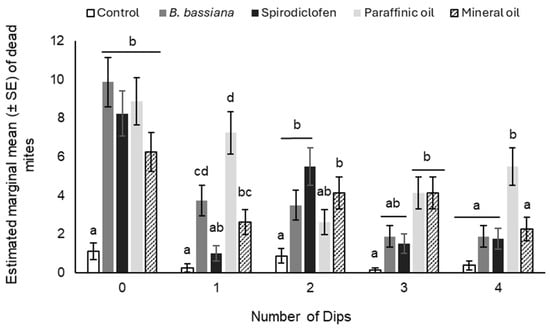
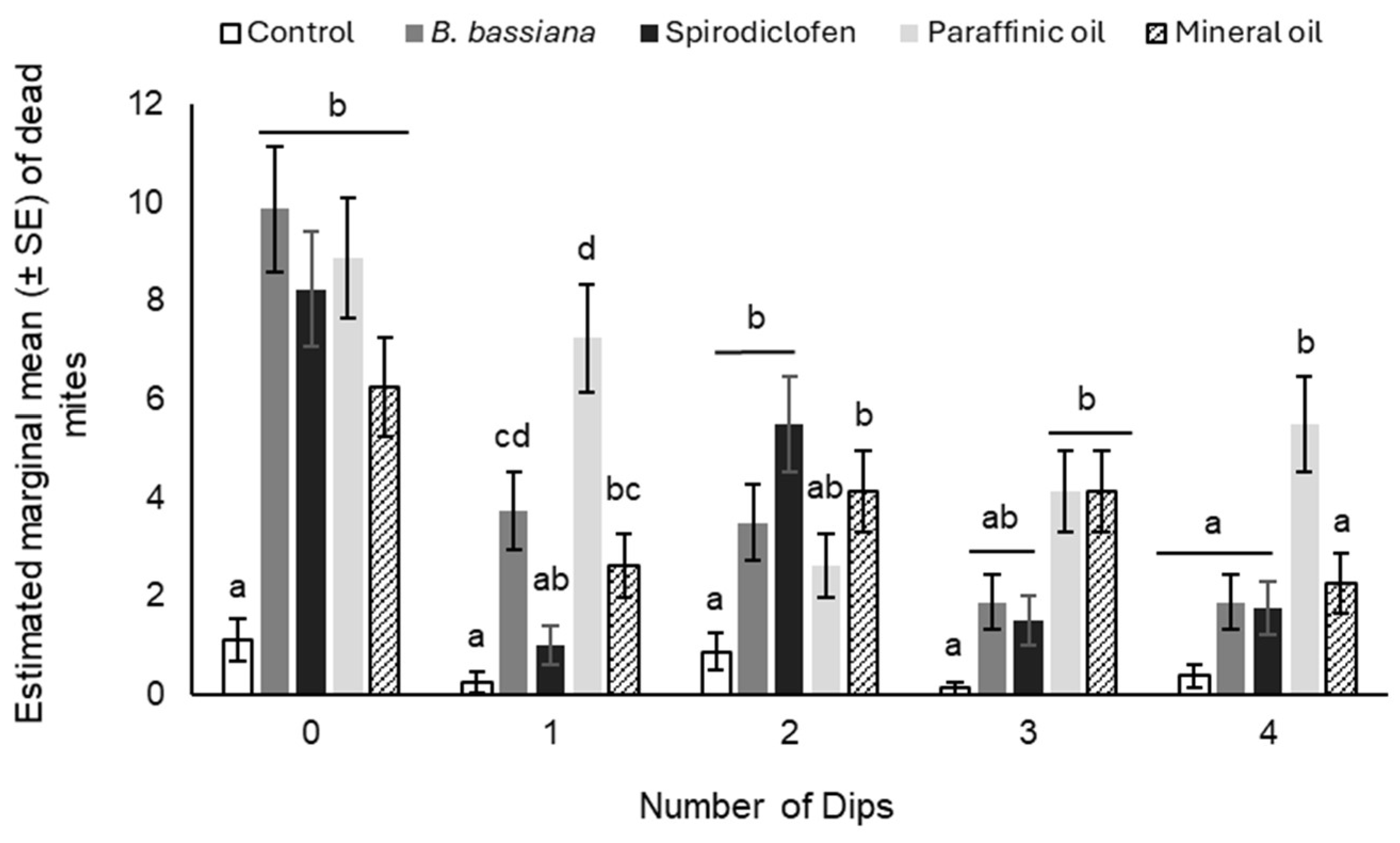
Brevipalpus yothersi mortality was significantly affected by the interaction between treatment and number of dips in water (GLM: deviance = 84.64, df = 16, p < 0.001). When leaves were not dipped in water, all treatments resulted in significantly higher mortality than the control, ranging from 98.8 to 62.5% (p < 0.0001). When leaves were dipped once, paraffinic oil caused the highest B. yothersi mortality, followed by intermediate mortality levels caused by B. bassiana. Among the treatments, mineral oil (p = 0.005) and spirodiclofen (p = 0.001) caused significantly less mortality than the paraffinic oil. Spirodiclofen showed mortality rates similar to those of the control (p = 0.55). When leaves were dipped twice, all treatments had similar mortality rates, and the mortality observed in the paraffinic oil treatment was similar to that in the control (p = 0.19). After the third dip, both oils, paraffinic and mineral, caused the highest mortality, followed by intermediate levels caused by B. bassiana (p = 0.15) and spirodiclofen (p = 0.23). However, the latter two were not statistically different from the control. After the fourth dip, only the paraffinic oil treatment caused significantly higher mortality rates than the control (p = 0.001) (Figure 1).
Figure 1.
Brevipalpus yothersi adult mortality after exposure to citrus leaves treated with three biopesticides (Beauveria bassiana, paraffinic oil, and mineral oil), one commercial acaricide (spirodiclofen), and subject to sequential dips in water. Within the different number of dips, bars with different lower-case letters indicate statistically significant differences (Tukey, N = 8, p < 0.05).
3.2. Aged Residues of Biorational Acaricides
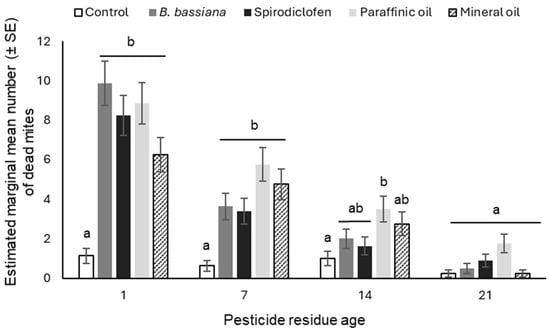
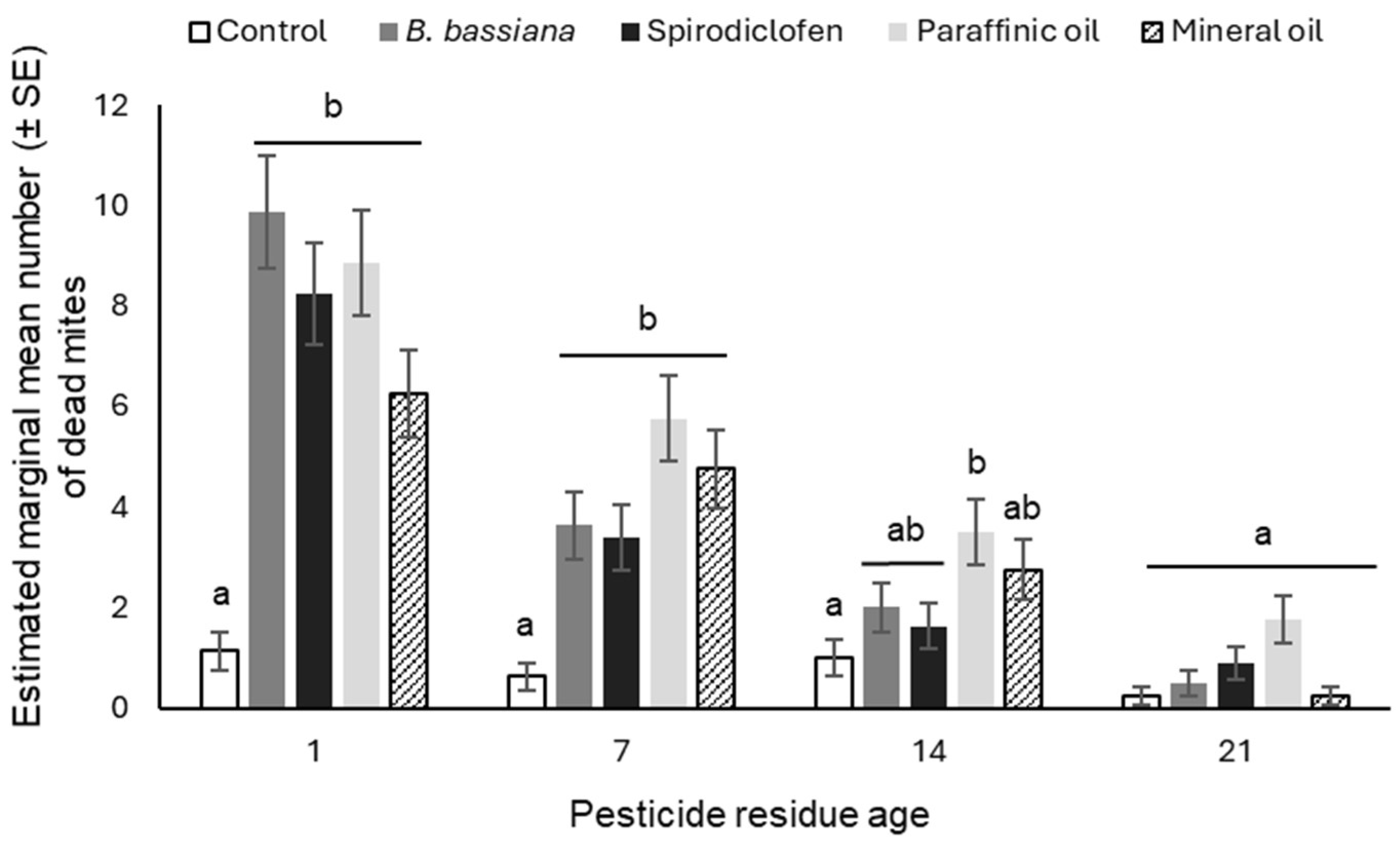
Brevipalpus yothersi adult mortality was significantly affected by the interaction between treatment and pesticide residue age (GLM: deviance = 26.42, df = 12, p = 0.01). Exposure of B. yothersi adult females to one- and seven-day-old acaricide residues caused significantly higher mortality rates in all treatments compared with the untreated control, and there were no significant differences among treatments (p < 0.0001). When B. yothersi adults were exposed to 14-day-old acaricide residues, only paraffinic oil induced mortalities greater than those in the water control (p = 0.02), even though no significant differences among acaricide treatments were observed (p > 0.05). No significant mortality of B. yothersi was observed when adults were exposed to 21-day-old residues of any of the biopesticides or spirodiclofen (Figure 2).
Figure 2.
Mortality of Brevipalpus yothersi adults after exposure to aged residues of three biopesticides (Beauveria bassiana, paraffinic oil, and mineral oil), one commercial acaricide (spirodiclofen). Within different residue ages, bars with different lower-case letters indicate statistically significant differences (Tukey, N = 10, p < 0.05) (Tukey, N = 8, p < 0.05).
3.3. Greenhouse Evaluations of Biorational Acaricides
The number of B. yothersi eggs (GLMM: χ2 = 85.03, df = 12, p < 0.001), nymphs (GLMM: χ2 = 71.31, df = 12, p < 0.001) and adults (GLMM: χ2 = 73.43, df = 12, p < 0.001) was significantly affected by the interaction of treatment and evaluation day (Table 1). Three days after application, only the plants treated with spirodiclofen (p = 0.048) and paraffinic oil (p = 0.01) showed significantly fewer B. yothersi eggs than the untreated control. At day 13, significantly more B. yothersi eggs were found on the control plants than in any of the treated plants, with no significant differences among treatments (p > 0.05). At days 29 and 44 after application, the number of B. yothersi eggs recorded in the control remained significantly higher relative to any of the treatments (p < 0.001). However, at day 44, plants treated with mineral oil had significantly more eggs than those treated with paraffinic oil, spirodiclofen, and B. bassiana (p < 0.0001) (Table 1).
Table 1.
Estimated marginal mean number (±SE) of Brevipalpus yothersi eggs, nymphs and adults 3, 13, 29 and 24 days post treatment application. Within each column and B. yothersi stage, different lower-case letters indicate statistically significant differences (Tukey, N = 10, p < 0.05).
The number of B. yothersi nymphs 3 days after application was significantly lower in all treatments compared to the control (p < 0.001). Populations of nymphs continued decreasing in all acaricide treatments except the mineral oil treatment, which had significantly higher populations than the other acaricides by day 29 (p = 0.001). By day 44, the control and mineral oil treatments showed the highest number of alive nymphs of B. yothersi compared to other acaricides (p < 0.001) (Table 1).
The number of B. yothersi adults per plant decreased significantly three days after application with any of the treatments compared to the untreated control (p < 0.001). From day 13 to day 44, there were no adult mites on the plants treated with spirodiclofen and paraffinic oil, while plants treated with B. bassiana and mineral oil had significantly fewer adult mites than the control (p < 0.001) (Table 1).
3.4. Compatibility of Paraffinic Oil and Predatory Mites
The number B. yothersi eggs (GLMM: χ2 = 345.26, df = 21, p < 0.001), nymphs (GLMM: χ2 = 301.1, df = 21, p < 0.001) and adults (GLMM: χ2 = 287.54, df = 21, p < 0.001) was significantly affected by the interaction of treatment and evaluation day (Table 2). During the first three weeks of the experiment, B. yothersi mean infestation levels were similar on all the experimental plants. After the predators were released and paraffinic oil applied, B. yothersi populations declined significantly from week 4 onward in all treated plants compared with the untreated control. Egg numbers per plant were lowest on plants receiving the combined treatment of oil and predators, compared to plants receiving either treatment alone. When the paraffinic oil was applied alone, B. yothersi egg numbers increased significantly during the final two weeks of the experiment. A similar trend was observed for B. yothersi nymph and adult numbers, when paraffinic oil or A. largoensis was applied alone, suppression of B. yothersi was temporary, and populations increased again a few weeks after treatment. Overall, plants receiving a combination of A. largoensis and paraffinic oil had long-lasting suppression B. yothersi eggs, nymphs and adults (Table 2).
Table 2.
Estimated marginal mean number (±SE) of Brevipalpus yothersi eggs, nymphs and adults 1–8 weeks post treatment application. Within each column and B. yothersi stage, different lower-case letters indicate statistically significant differences (Tukey, N = 10, p < 0.05).
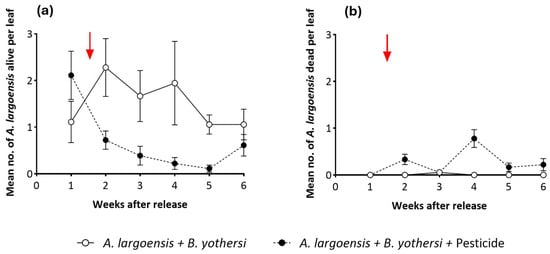
There was a significant reduction in A. largoensis numbers on plants treated with paraffinic oil compared with plants where the predator was released alone (GLMM: χ2 = 7.67, df = 1, p = 0.006). Evaluation day (GLMM: χ2 = 9.34, df = 4, p = 0.05) and its interaction with treatment application (GLMM: χ2 = 6.62, df = 4, p = 0.16) did not affect the predator population.
Predator mortality and a reduction in predator numbers were observed immediately after paraffinic oil application and persisted for approximately four weeks. At this period, A. largoensis populations recovered, reaching levels similar to those in untreated plants (Figure 3).
Figure 3.
Average number (±SE) of alive (a) and dead (b) Amblyseius largoensis on citrus plants. Red arrows indicate pesticide application.
4. Discussion
Brevipalpus-transmitted viruses have recently been detected in Florida’s urban landscapes, including residential and unmanaged areas. These environments can serve as reservoirs for unmanaged viruliferous mite populations that may expand and spread into agricultural areas [31,32]. We found that some bio-pesticides (mineral oil, paraffinic oil, and Beauveria bassiana Strain GHA) suppressed all developmental stages of B. yothersi at similar levels to spirodiclofen, a commonly used acaricide for controlling B. yothersi in citrus orchards in Brazil [33]. These biopesticides represent an easily adoptable alternative to conventional acaricides for use in residential and urban landscapes, with reduced risk of human and pet exposure and contamination [34]. However, both biopesticides and conventional pesticides break down in the environment and lose efficacy after application through photodegradation, volatilization, and microbial or chemical breakdown [35]. In our study, the residual effects of the bio-pesticides and the commercial pesticide began to decline seven days after application. Only the paraffinic oil showed higher adult mite mortality than the control 14 days after application. Moreover, water exposure reduced the efficacy of the bio-pesticides and spirodiclofen in controlling B. yothersi, resulting in inconsistent control. These results were consistent with previous studies by Decaro et al. [36], which showed that artificial rain applied 1 h after application washed off 50% of the spirodiclofen deposited on citrus leaves, even with the addition of an adjuvant. Similarly, Sanches et al. [37] reported that simulated rainfall reduced the efficacy of the acaricide propargite in controlling B. yothersi. Inglis et al. [38,39] further demonstrated that rainfall intensity reduced the amount of fungal inoculum, thereby reducing the efficacy of entomopathogenic fungi in pest control. However, among the biopesticides tested in our study, the oil treatments were more tolerant of water wash-off. Mineral oil withstood up to three water dips before losing its ability to induce adult mortality, while paraffinic oil was the most resistant to water exposure among the treatments. This bio-pesticide caused more than 50% mortality in B. yothersi even after four water dips.
In the first greenhouse evaluation, B. bassiana and paraffinic oil achieved levels of B. yothersi suppression comparable to spirodiclofen, demonstrating that these biopesticides can deliver effective and sustained pest control. Microbial biopesticides based on B. bassina or other entomopathogenic fungi control mites by penetrating the host integument using a combination of mechanical force and cuticle-degrading hydrolytic enzymes. Once inside, the fungi colonize the host and produce toxic metabolites, leading to mycosis and death [18]. Vasquez-Benito et al. [40] had already reported the efficacy of B. bassiana strains against B. yothersi in the laboratory. Moreover, Cavalcanti et al. [41] reported 100% mortality of B. phoenicis adults caused B. bassiana (UFLA 70) in laboratory studies. This study is the first to report the efficacy of B. bassiana and paraffinic oil under greenhouse conditions. The effectiveness of paraffinic oil has been observed in controlling other phytophagous mites, including Aceria litchii [42], Tetranychus urticae [43] and Panonychus ulmi [44]. Mineral oil has also shown promising results against phytophagous mites in citrus, including B. phoenicis [45].
Paraffinic oil provided the best overall performance across the rainfastness, residuality, and greenhouse evaluations. This highly refined, food-grade mineral oil is exempt from residue tolerances and could be readily adopted for B. yothersi control in urban landscapes. Paraffinic oil was selected for compatibility testing with A. largoensis because it has no use restrictions on dooryard and landscape plants, where both B. yothersi and A. largoensis are abundant. The combination of paraffinic oil and A. largoensis provided long-lasting suppression of all stages of B. yothersi. By contrast, when paraffinic oil or A. largoensis was applied alone, suppression of B. yothersi was temporary and populations increased again a few weeks after application. Although paraffinic oil adversely affected A. largoensis, predator populations recovered, and the combined treatment ultimately provided better control than either predators or oil alone. Our results suggest that paraffinic oil can have adverse effects on predatory mites; however, with proper use, effective mite control can still be achieved despite this trade-off. Another option that should be further explored is the use of B. bassiana, which provided satisfactory control of B. yothersi in our experiments. This biopesticide, and possibly other microbial biopesticides, can also be combined with predatory mites to enhance control of B. yothersi [40].
5. Conclusions
The novelty of this study lies in evaluating biopesticides in urban ornamental plant systems, with emphasis on preserving the biological control services provided by naturally occurring predators while effectively targeting pest mites. Horticultural oils—specifically, a paraffinic oil—provided the most satisfactory control of B. yothersi. These oils act by suffocating mites, blocking their respiratory openings, and causing their death. These biopesticides have low persistence, minimal non-target toxicity, and reduced bioaccumulation, making them especially suitable for IPM programs in environmentally sensitive settings [21]. They do not induce resistance in mites, even after long-term use [21]. This is particularly desirable because a major challenge in managing B. yothersi is its ability to develop resistance to several pesticides [33,46,47]. However, because they act solely by contact, thorough application is key to their effectiveness. It is worth noting that the use of horticultural oils can sometimes be limited due to potential phytotoxic effects and incompatibility with other pesticides. Phytotoxic effects include scorching, browning, reduced flowering, reduced growth and defoliation. This is concerning in ornamental plant systems where aesthetic quality is a priority. However, these issues can be minimized if a highly refined oil—such as the paraffinic oil used in this study—is properly applied according to recommended dosages and timing. For example, horticultural oils should not be applied to stressed plants or young foliage, at doses above label recommendations, in combination with sulfur-based products, or under extreme temperatures (above 37.8 °C or below 4.4 °C) and low humidity (<50%) [48]. Another area of concern that requires further research is the observed mortality of A. largoensis, a key natural enemy of B. yothersi. Even though the predators recovered from the adverse effects of paraffinic oil, further fine-tuning is needed to minimize its impact on natural enemies. This study shows that, when properly applied, horticultural oils provide a practical option for controlling populations of viruliferous Brevipalpus mites in urban and unmanaged landscapes.
Author Contributions
Conceptualization, P.S.A., A.L.R. and D.C.; methodology, P.S.A. and D.C.; software, P.S.A. and A.M.R.; validation, D.C. and A.M.R.; formal analysis, A.M.R.; investigation, P.S.A. and D.C.; resources, D.C.; data curation, P.S.A.; writing—original draft preparation, P.S.A.; writing—review and editing, all authors; visualization, P.S.A. and A.M.R.; supervision, D.C.; project administration, D.C.; funding acquisition, D.C. and A.L.R. All authors have read and agreed to the published version of the manuscript.
Funding
This research was funded in part by two USDA APHIS-UF Cooperative Agreements (FAIN: AP19PPQS&T00C115 & AP18PPQS&T00C125). The U.S. Department of Agriculture has not formally disseminated the findings and conclusions in this preliminary publication and should not be construed to represent any Agency determination or policy. Mention of trade names or commercial products in this publication is solely to provide specific information and does not imply recommendation or endorsement by the USDA; USDA is an equal opportunity provider and employer.
Data Availability Statement
The original data presented in this study are openly available in the FigShare repository at https://doi.org/10.6084/m9.figshare.31125382.
Acknowledgments
The authors thank Maria Alejandra Canon (Ornamental Entomology Lab, Tropical Research and Education Center, Institute of Food and Agricultural Sciences, University of Florida) for her support in evaluating the experiments.
Conflicts of Interest
The authors declare that they have no conflicts of interest.
References
- Dietzgen, R.G.; Freitas-Astúa, J.; Chabi-Jesus, C.; Ramos-González, P.L.; Goodin, M.M.; Kondo, H.; Tassi, A.D.; Kitajima, E.W. Dichorhaviruses in their host plants and mite vectors. Adv. Virus Res. 2018, 102, 119–148. [Google Scholar]
- Quito-Avila, D.F.; Freitas-Astúa, J.; Melzer, M.J. Bluner-, cile-, and higreviruses (Kitaviridae). In Encyclopedia of Virology; Elsevier: Amsterdam, The Netherlands, 2021; pp. 247–251. [Google Scholar]
- Fife, A.N.; Carrillo, D.; Knox, G.; Iriarte, F.; Dey, K.; Roy, A.; Ochoa, R.; Bauchan, G.; Paret, M.; Martini, X. Brevipalpus-transmitted orchid fleck virus infecting three new ornamental hosts in Florida. J. Integr. Pest Manag. 2021, 12, 43. [Google Scholar]
- Roy, A.; Stone, A.L.; Melzer, M.J.; Shao, J.; Hartung, J.S.; Mavrodieva, V.; Nakhla, M.K.; Brlansky, R.H.; Schneider, W.L. Complete nucleotide sequence of a novel hibiscus-infecting cilevirus from Florida and its relationship with closely associated cileviruses. Genome Announc. 2018, 6, e01521-17. [Google Scholar] [CrossRef] [Scilit]
- Dey, K.K.; Velez-Climent, M.; Padmanabhan, C.; Nunziata, S.; Rivera, Y.; McVay, J.; Roy, A. Smilax auriculata: A new host for Orchid fleck dichorhavirus identified in Florida, USA. Plant Dis. 2022, 106, 2271. [Google Scholar] [CrossRef] [Scilit]
- Olmedo-Velarde, A.; Roy, A.; Padmanabhan, C.; Nunziata, S.; Nakhla, M.K.; Melzer, M.J. First report of orchid fleck virus associated with citrus leprosis symptoms in rough lemon (Citrus jambhiri) and mandarin (C. reticulata) in the United States. Plant Dis. 2021, 105, 2258. [Google Scholar] [CrossRef] [Scilit]
- Alvarez-Quinto, R.A.; Grinstead, S.; Rott, P.; Mollov, D. Genome characterization and complete sequence of a new badnavirus from Pandanus amaryllifolius. Arch. Virol. 2022, 167, 1717–1720. [Google Scholar] [CrossRef] [Scilit]
- Ramos-González, P.L.; Chabi-Jesus, C.; Guerra-Peraza, O.; Breton, M.C.; Arena, G.D.; Nunes, M.A.; Kitajima, E.W.; Machado, M.A.; Freitas-Astúa, J. Phylogenetic and molecular variability studies reveal a new genetic clade of citrus leprosis virus C. Viruses 2016, 8, 153. [Google Scholar] [CrossRef] [Scilit] [PubMed]
- Ramos-González, P.L.; Arena, G.D.; Tassi, A.D.; Chabi-Jesus, C.; Kitajima, E.W.; Freitas-Astúa, J. Kitaviruses: A window to atypical plant viruses causing nonsystemic diseases. Annu. Rev. Phytopathol. 2023, 61, 97–118. [Google Scholar] [CrossRef] [Scilit] [PubMed]
- Kitajima, E.W.; Rezende, J.A.; Rodrigues, J.C. Passion fruit green spot virus vectored by Brevipalpus phoenicis (Acari: Tenuipalpidae) on passion fruit in Brazil. Exp. Appl. Acarol. 2003, 30, 225–231. [Google Scholar] [CrossRef] [Scilit]
- Cook, G.; Kirkman, W.; Clase, R.; Steyn, C.; Basson, E.; Fourie, P.H.; Moore, S.D.; Grout, T.G.; Carstens, E.; Hattingh, V. Orchid fleck virus associated with the first case of citrus leprosis-N in South Africa. Eur. J. Plant Pathol. 2019, 155, 1373–1379. [Google Scholar] [CrossRef] [Scilit]
- Bastianel, M.; Novelli, V.M.; Kitajima, E.W.; Kubo, K.S.; Bassanezi, R.B.; Machado, M.A.; Freitas-Astúa, J. Citrus leprosis: Centennial of an unusual mite–virus pathosystem. Plant Dis. 2010, 94, 284–292. [Google Scholar] [CrossRef] [Scilit]
- Escobar-Garcia, H.A.; de Andrade, D.J. Resistance levels of Brazilian populations of Brevipalpus yothersi (Acari: Tenuipalpidae) to hexythiazox: Monitoring and population performance. J. Econ. Entomol. 2025, 118, 2555–2569. [Google Scholar] [CrossRef] [Scilit] [PubMed]
- Childers, C.C.; Ueckermann, E.A.; de Moraes, G.J. Phytoseiidae on citrus in Florida dooryard, varietal, and commercial trees between 1951 and 2014, and species recommendations for evaluation in citrus under protective screen (CUPS). Fla. Entomol. 2022, 105, 27–36. [Google Scholar] [CrossRef] [Scilit]
- Roda, A.; Nachman, G.; Scheiner, K.; Carrillo, D. Density and distribution of the flat mite (Brevipalpus yothersi) (Acari: Tenuipalpidae) on four hibiscus varieties: Do leaves tell the full story? Exp. Appl. Acarol. 2025, 94, 9. [Google Scholar] [CrossRef] [Scilit] [PubMed]
- Argolo, P.S.; Revynthi, A.M.; Canon, M.A.; de Moraes-Berto, M.G.; Andrade, D.J.; Döker, I.P.; Roda, A.; Carrillo, D. Potential of predatory mites for biological control of Brevipalpus yothersi (Acari: Tenuipalpidae). Biol. Control 2020, 149, 104330. [Google Scholar] [CrossRef] [Scilit]
- Della Vechia, J.F.; Andrade, D.J.; Tassi, A.D.; Roda, A.; van Santen, E.; Carrillo, D. Can predatory mites aid in the management of the citrus leprosis mite? Front. Agron. 2023, 5, 1304656. [Google Scholar] [CrossRef] [Scilit]
- Marčić, D.; Döker, I.; Tsolakis, H. Bioacaricides in crop protection—What is the state of play? Insects 2025, 16, 95. [Google Scholar] [CrossRef] [Scilit]
- De Giosa, M.; Dale, A.G.; Wu, X.; Revynthi, A.M. Potential of commercial biorational and conventional pesticides to manage the ruellia erinose mite in ornamental landscapes. Insects 2025, 16, 801. [Google Scholar] [CrossRef] [Scilit]
- Hernández-Valencia, V.; Santillán-Galicia, M.T.; Guzmán-Franco, A.W.; Rodríguez-Leyva, E.; Santillán-Ortega, C. Combined application of entomopathogenic fungi and predatory mites for biological control of Tetranychus urticae on chrysanthemum. Pest Manag. Sci. 2024, 80, 4199–4206. [Google Scholar] [CrossRef] [Scilit]
- Baliota, G.V.; Athanassiou, C.G. Use of paraffin oils in agriculture and beyond: Back to the future. Environ. Sci. Pollut. Res. 2023, 30, 2392–2405. [Google Scholar] [CrossRef] [Scilit]
- Seni, A. Potential of various oils for insect pest management and their effects on beneficial insects. Int. J. Trop. Insect Sci. 2023, 43, 321–337. [Google Scholar] [CrossRef] [Scilit]
- Canon, M.A.; Ataide, L.M.S.; Villamarin, P.; De Giosa, M.; Osborne, L.S.; Tabanca, N.; Lahiri, S.; Revynthi, A.M. Sustainable management strategies for acarine pests of industrial hemp (Cannabis sativa subsp. sativa L.). Agronomy 2025, 15, 2785. [Google Scholar] [CrossRef] [Scilit]
- Li, X.-L.; Zhang, J.-J.; Li, D.-D.; Cai, X.-Y.; Qi, Y.-X.; Lu, Y.-Y. Toxicity of Beauveria bassiana to Bactrocera dorsalis and effects on its natural predators. Front. Microbiol. 2024, 15, 1362089. [Google Scholar] [CrossRef] [Scilit] [PubMed]
- Daam, M.A.; Chelinho, S.; Niemeyer, J.C.; Owojori, O.J.; De Silva, P.M.C.S.; Sousa, J.P.; van Gestel, C.A.M.; Römbke, J. Environmental risk assessment of pesticides in tropical terrestrial ecosystems: Test procedures, current status and future perspectives. Ecotoxicol. Environ. Saf. 2019, 181, 534–547. [Google Scholar] [CrossRef] [Scilit] [PubMed]
- Revynthi, A.M.P.; Peña, J.E.; Moreno, J.; Beam, A.L.; Mannion, C.; Bailey, W.D.; Carrillo, D. Effectiveness of hot-water immersion against Brevipalpus yothersi (Acari: Tenuipalpidae) as a post-harvest treatment for lemons. J. Econ. Entomol. 2020, 113, 126–133. [Google Scholar] [CrossRef] [Scilit] [PubMed]
- Carrillo, D.; Peña, J.E.; Hoy, M.A.; Frank, J.H. Development and reproduction of Amblyseius largoensis (Acari: Phytoseiidae) feeding on pollen, Raoiella indica, and other microarthropods inhabiting coconuts in Florida, USA. Exp. Appl. Acarol. 2010, 52, 119–129. [Google Scholar] [CrossRef] [Scilit]
- Brooks, M.; Bolker, B.; Kristensen, K.; Maechler, M.; Magnusson, A.; McGillycuddy, M.; Skaug, H.; Nielsen, A.; Berg, C.; Van Bentham, K.; et al. glmmTMB: Generalized Linear Mixed Models Using Template Model Builder. R Package. 2023. Available online: https://glmmtmb.github.io/glmmTMB/ (accessed on 13 February 2025).
- Lenth, R. Emmeans: Estimated Marginal Means, Aka Least-Squares Means. R Package Version 1.7.2. 2022. Available online: https://CRAN.R-project.org/package=emmeans (accessed on 13 February 2025).
- R Core Team. R: A Language and Environment for Statistical Computing; R Foundation for Statistical Computing: Vienna, Austria, 2025; Available online: https://www.R-project.org/ (accessed on 2 February 2025).
- Krasnov, H.; Cohen, Y.; Goldshtein, E.; Mendelsohn, O.; Silberstein, M.; Gazit, Y.; Blank, L. The effect of local and landscape variables on Mediterranean fruit fly dynamics in citrus orchards utilizing the ecoinformatics approach. J. Pest Sci. 2019, 92, 453–463. [Google Scholar] [CrossRef] [Scilit]
- Norman-Burgdolf, H.; Rieske, L.K. Healthy trees–healthy people: A model for engaging citizen scientists in exotic pest detection in urban parks. Urban For. Urban Green. 2021, 60, 127067. [Google Scholar] [CrossRef] [Scilit]
- Rocha, M.; Della Vechia, F.; Savi, J.; Omoto, C.; Andrade, J. Resistance to spirodiclofen in Brevipalpus yothersi (Acari: Tenuipalpidae) from Brazilian citrus groves: Detection, monitoring, and population performance. Pest Manag. Sci. 2021, 77, 3099–3106. [Google Scholar] [CrossRef] [Scilit]
- Md Meftaul, I.; Venkateswarlu, K.; Dharmarajan, R.; Annamalai, P.; Megharaj, M. Pesticides in the urban environment: A potential threat that knocks at the door. Sci. Total Environ. 2020, 711, 134612. [Google Scholar] [CrossRef] [Scilit]
- Liang, Z.; Abdelshafy, A.M.; Luo, Z.; Belwal, T.; Lin, X.; Xu, Y.; Wang, L.; Yang, M.; Qi, M.; Dong, Y.; et al. Occurrence, detection, and dissipation of pesticide residue in plant-derived foodstuff: A state-of-the-art review. Food Chem. 2022, 384, 132494. [Google Scholar] [CrossRef] [Scilit]
- Decaro, R.A.; Decaro, S.T.; Ferreira, M.d.C. Deposit of pesticides without and with adjuvants on citrus seedlings following different intervals of artificial rain. Ciênc. Rural 2016, 46, 13–19. [Google Scholar] [CrossRef] [Scilit]
- Sanches, J.J.; Ferreira, M.d.C.; Andrade, D.J. Impact of rainfalls on the acaricide propargite with and without addition of adjuvants for the control of the mite Brevipalpus yothersi. Rev. Bras. Frutic. 2018, 40, e775. [Google Scholar] [CrossRef] [Scilit]
- Inglis, G.D.; Ivie, T.J.; Duke, G.M.; Goettel, M.S. Influence of rain and conidial formulation on persistence of Beauveria bassiana on potato leaves and Colorado potato beetle larvae. Biol. Control 2000, 18, 55–64. [Google Scholar] [CrossRef] [Scilit]
- Inglis, G.D.; Goettel, M.S.; Johnson, D.L. Persistence of the entomopathogenic fungus Beauveria bassiana on phylloplanes of crested wheatgrass and alfalfa. Biol. Control 1993, 3, 258–270. [Google Scholar] [CrossRef] [Scilit]
- Vazquez-Benito, J.A.; Santillan-Galicia, M.T.; Guzman-Franco, A.W.; Hernandez-Dominguez, C.; Romero-Rosales, F.; Ortiz-Osuna, A.; Rodriguez-Maciel, J.C. Combined application of predatory mites and fungal pathogens for biological control of Brevipalpus yothersi (Acari: Tenuipalpidae) under laboratory conditions. Biol. Control 2022, 167, 104853. [Google Scholar] [CrossRef] [Scilit]
- Cavalcanti, R.S.; Reis, P.R.; Moino Junior, A.; Altoé, B.F.; Franco, R.A.; Carvalho, T.M.B. Pathogenicity of entomopathogenic fungi on three species of coffee plant mites. Coffee Sci. 2008, 3, 68–75. [Google Scholar]
- Revynthi, A.M.; Duncan, R.E.; Kendra, P.E.; Carrillo, D. Post-harvest paraffinic oil dips to disinfest lychee fruit from lychee erinose mite. Fla. Entomol. 2020, 103, 299–301. [Google Scholar] [CrossRef] [Scilit]
- Chueca, P.; Garcera, C.; Moltó, E.; Jacas, J.A.; Urbaneja, A.; Pina, T. Spray deposition and efficacy of four petroleum-derived oils used against Tetranychus urticae (Acari: Tetranychidae). J. Econ. Entomol. 2010, 103, 386–393. [Google Scholar] [CrossRef] [Scilit]
- Lawson, S.D.; Weires, R.W. Management of European red mite (Tetranychus urticae) and aphid species on apple with petroleum oils and an insecticidal soap. J. Econ. Entomol. 1991, 84, 1550–1557. [Google Scholar] [CrossRef] [Scilit]
- Haramoto, F.H. Biology and control of Brevipalpus phoenicis (Geijskes) (Acari: Tenuipalpidae). Hawaii Agric. Exp. Stn. Tech. Bull. 1969, 68, 1–63. [Google Scholar]
- Moreira, R.R.; Machado, F.J.; Lanza, F.E.; Trombin, V.G.; Bassanezi, R.B.; de Miranda, M.P.; Barbosa, J.C.; da Silva Junior, G.J.; Behlau, F. Impact of diseases and pests on premature fruit drop in sweet orange orchards in São Paulo state citrus belt, Brazil. Pest Manag. Sci. 2022, 78, 2643–2656. [Google Scholar] [CrossRef] [Scilit] [PubMed]
- Escobar Garcia, H.A.; de Andrade, D.J. Susceptibility to cyflumetofen in populations of the citrus leprosis mite, Brevipalpus yothersi, from Brazilian citrus orchards. Pest Manag. Sci. 2025, 82, 1046–1056. [Google Scholar] [CrossRef] [Scilit]
- Miller, F.D. The use of horticultural oils and insecticidal soaps for control of insect pests of amenity plants. J. Arboric. 1989, 15, 257–262. [Google Scholar] [CrossRef] [Scilit]

Disclaimer/Publisher’s Note: The statements, opinions and data contained in all publications are solely those of the individual author(s) and contributor(s) and not of MDPI and/or the editor(s). MDPI and/or the editor(s) disclaim responsibility for any injury to people or property resulting from any ideas, methods, instructions or products referred to in the content. |
© 2026 by the authors. Licensee MDPI, Basel, Switzerland. This article is an open access article distributed under the terms and conditions of the Creative Commons Attribution (CC BY) license.