Article

Optimized Nitrogen Application Under Mulching Enhances Maize Yield and Water Productivity by Regulating Crop Growth and Water Use Dynamics

1
College of Natural Resources and Environment, Northwest A&F University, Xianyang 712100, China
2
State Key Laboratory of Soil and Water Conservation and Desertification Control, Northwest A&F University, Xianyang 712100, China
3
College of Resources and Environment, Shanxi Agricultural University, Jinzhong 030031, China
*
Authors to whom correspondence should be addressed.
Agronomy 2026, 16(3), 290; https://doi.org/10.3390/agronomy16030290 (registering DOI)
Submission received: 5 December 2025 / Revised: 10 January 2026 / Accepted: 20 January 2026 / Published: 23 January 2026

Abstract

Surface mulching and nitrogen (N) application are widely used to enhance crop yield and water productivity (WP). However, their combined effects remain unclear. Here, a three-year field experiment was conducted to comprehensively assess the effects of surface mulching (no mulching, B; straw mulching, S; and plastic film mulching, F) and N fertilization (no N application, N0; split application of urea, N1; 1:2 mixture of controlled-release urea and urea, N2) on maize growth, yield, and WP on the Loess Plateau. Application of nitrogen (N) significantly increased evapotranspiration (ET), grain yield, and WP by 4.58%, 176% (from 5215.43 kg ha−1 in N0 to 14,548.21 kg ha−1 in N2), and 166% (from 11.36 kg ha−1 mm−1 in N0 to 30.63 kg ha−1 mm−1 in N2), respectively. Compared with B and S, F increased ET during the pre-silking stage by 16.75% and 23.99%, respectively, and shortened the vegetative period of maize by 3–9 days but extended the duration from the milky stage (R3) to physiological maturity (R6) in the reproductive period by 5–13 days. F significantly increased yield and WP by 9.18% and 8.26% compared with S. Under F combined with N application, deep soil water (100–200 cm) consumption during R1–R3 increased by 15.75 mm and 13.15 mm compared with B and S, respectively. The combination of F and N2 achieved the highest yield (15,648.28 kg ha−1) and WP (32.44 kg ha−1 mm−1) without causing detectable depletion of soil water within the 0–200 cm profile during the study period, providing an effective strategy for enhancing crop yield and improving water–fertilizer use efficiency in semi-arid regions.

1. Introduction

Water scarcity is a key constraint to crop productivity improvement in semi-arid regions [1,2]. Approximately 51.5% of global arable land is located in semi-arid regions, making it essential to ensure food production in these regions [3]. The widespread adoption of surface mulching measures, such as plastic film and straw mulching, has partially alleviated water limitations during crop growth [4,5,6,7]. Increased nitrogen (N) fertilizer input has also significantly enhanced crop yields [8]. However, enhanced yield is often accompanied by higher soil water consumption [9]. This may exacerbate crop reliance on deep soil water reserves and increase dependence on seasonal precipitation for soil water recharge, thereby increasing potential risks to agricultural sustainability [10]. Therefore, it is imperative to explore an optimized model of high-yielding, water- and N-efficient, and sustainable surface mulching and N fertilization for semi-arid regions.
In semi-arid regions, surface mulching is a widely adopted method to enhance crop yield and water productivity [11,12]. Generally, plastic film mulch provides a relatively stable water environment for crops, reducing the impact of water scarcity and rainfall variability on growth, while effectively lowering the evaporation-to-transpiration ratio, thus optimizing the balance between yield and water consumption [13]. In contrast, straw mulch reduces soil moisture loss by lowering surface soil temperature and inhibiting weed growth [14,15]. Mulching not only significantly affects soil moisture but also plays an important role in regulating maize phenology [16,17]. The effect of straw mulching on crop emergence is determined by its combined regulation of soil moisture and temperature, which can either promote or delay seedling emergence [18,19,20]. Under the cool spring conditions of the Loess Plateau, the shading and cooling effects of straw mulching often result in delayed maize emergence. Plastic film mulching significantly increases soil temperature during the early stages of maize growth, promoting rapid emergence and early development [21]. Plastic film mulch has been shown to shorten the phenological period of maize and advance physiological maturity [22]. Additionally, mulching alters the crop’s water consumption patterns. Li, et al. [23] found that plastic film mulch reduced the evapotranspiration from sowing to the jointing stage of wheat but increased it from jointing to the blooming stage. This alteration, if occurring during the peak water demand periods of maize (ten-leaf stage to silking stage and silking stage to milking stage), may limit grain yield [24]. Although plastic film mulch increases grain yield, it also increases water consumption in deep soil layers [25]. Since plastic film mulch may impede rainfall infiltration, deep soil moisture is less effectively replenished in the later stages of the growing season [26], potentially posing a threat to the sustainability of agricultural production.
It is common practice in maize and other major cereal cropping systems for farmers to apply the entire N fertilizer requirement in a single application before or at sowing [27,28,29]. This practice often leads to low nitrogen use efficiency and environmental risks, because applying the entire N dose at sowing results in excessive N availability during early growth stages but insufficient supply during periods of peak crop N demand, thereby increasing nitrogen losses through leaching, volatilization, and denitrification [30,31,32]. Therefore, adjusting the amount and timing of N fertilizer application based on the crop’s growth requirements is key to improving N use efficiency and increasing crop yield [33]. Research has shown that split N fertilizer applications during critical growth stages of crops, such as cotton and wheat, can significantly increase yields [34,35]. Applying regular urea in a 40%:30%:30% ratio at sowing, the ten-leaf stage, and silk emergence effectively increases maize yield and reduces N losses on the Loess Plateau of China [36]. Beyond split N applications, controlled-release urea also represents an effective solution [37]. The use of controlled-release urea effectively reduces N leaching, improves rice physiological traits, promotes growth, and increases yield [38]. However, the sole application of controlled-release urea can result in early-stage N deficiency in crops, and a combination of controlled-release urea and conventional urea is often used to optimize N supply throughout the crop’s growth period [27]. Guo et al. [39] demonstrated that a 1:2 ratio of controlled-release urea to conventional urea is a high-yield, efficient, and cost-effective fertilization strategy.
Most existing studies have focused on the individual effects of either surface mulching or nitrogen application, with limited attention to their combined impacts or the underlying interaction mechanisms. Therefore, a three-year field experiment was conducted in a semi-arid region to investigate spring maize, focusing on soil water, agronomic traits, maize growth, yield and WP. Specifically, this study aimed to (1) elucidate the effects of surface mulching and optimized N application on the spatiotemporal dynamics of soil moisture and its alignment with maize water demand periods; (2) explore the synergistic effects of mulching and N management on improving both grain yield and crop water productivity; and (3) establish an optimized planting model for spring maize that balances high yield, high efficiency, and sustainability in semi-arid regions. The findings are intended to provide a theoretical basis and technical guidance for improving crop production under water-limited conditions.

2. Materials and Methods

2.1. Experimental Site

Experimental data were collected from field trials conducted between 2019 and 2021 at the Changwu Agricultural and Ecological Experimental Station of the Chinese Academy of Sciences, located on the Loess Plateau in Shaanxi Province, China (107°41′ E, 35°14′ N; 1200 m above sea level) (Figure 1). The study site represents a typical semi-arid region of the Loess Plateau. Over the past 50 years, the average annual temperature, average annual precipitation, average annual sunshine hours, and average annual frost-free period at the study site were 9.7 °C, 548 mm, 2230 h, and 177 days, respectively.
All experimental plots were established within the same field, characterized by a flat topography, a uniform soil texture, and a deep soil profile with an average thickness of approximately 80 m. The soil was classified as Calcaric Regosol [40] with a silt loam texture. At the onset of the experiment, soil samples were collected from 0–20 cm depth to determine key soil properties, yielding the following results: pH 7.8, total N 0.94 g kg−1, mineral N 7.6 mg kg−1, available phosphorus 15.4 mg kg−1, and available potassium 145.5 mg kg−1.

2.2. Experimental Design and Treatments

This field experiment employed a two-factor completely randomized block design with four replicates. The two factors were surface mulching and nitrogen application. Three treatments of surface mulching: no mulching (B), straw mulching (S), and plastic film mulching (F). Three treatments of N application: no application (N0), split application of urea (N1), and a 1:2 mixture of controlled-release urea and conventional urea (N2) (Table 1). A total of 36 plots were established, each covering an area of 60.2 m2 (8.6 m × 7.0 m). The N fertilizer application rate for N1 and N2 treatments was 225 kg ha−1. The N1 treatment was fertilized three times with urea (pure N content 46%), 40% before sowing, 30% at the ten-leaf stage (V10), and 30% at the silking stage (R1). The N2 treatment was fertilized with a one-time application of controlled-release urea (pure N content 44%) and urea (pure N content 46%) at a ratio of 1:2 before sowing. In addition, this study applied potassium sulfate (K2O 80 kg ha−1) and calcium superphosphate (P2O5 40 kg ha−1) as phosphate and potash fertilizers. The maize variety for the experiment was Zhengdan 958, planted at a density of 65,000 plants ha−1 (Table 1).
The experimental planting pattern followed a double ridge–furrow system with a wide-narrow row arrangement (60 cm:40 cm). The plastic film used was a transparent polyethylene film with a width of 1.5 m and a thickness of 0.008 mm. It was manually laid on the soil surface after basal fertilization and immediately before maize sowing. Maize was sown manually through the mulch using a dibbling method. The mulch was removed manually prior to the next cropping season. This mulching practice did not interfere with manual harvesting operations. Straw mulching consisted of maize straw residues collected from the previous year’s harvest. The straw was evenly applied to the soil surface at the three-leaf stage (V3) of spring maize and was fully removed before sowing in the following year. No pest outbreaks occurred during the experimental years, and weed control was conducted manually across all plots. There was no artificial irrigation applied during the entire maize growing season; natural precipitation was the only source of water (Table 2).

2.3. Sampling and Measurements

Soil water content was measured using the oven-drying method at 105 °C [41,42]. Soil samples were collected using a soil auger at 20 cm intervals from 0–200 cm during the sowing, V10, R1, R3, and R6 stages of spring maize. For each treatment, samples were collected from all four replicated plots. Sampling locations within each plot were selected to avoid edge effects. Each soil sample was immediately placed in a separate, pre-labelled aluminum box with a lid for transport and oven-dried in a laboratory to determine soil water content.
Crop growth was monitored in each plot. Based on maize growth and reproduction patterns described by Ciampitti et al. and Nleya et al. [43,44], each growth stage of maize was defined by observing its morphological characteristics. The dates were recorded when the seedling emergence stage (VE), the six-leaf stage (V6), V10, R1, R3, and R6 were reached. With more than 50% of the plant individuals in the plot showing characteristics of a particular growth stage, it was determined that the plot had reached that growth stage.
Spring maize chlorophyll (SPAD) and leaf area index (LAI) were measured at the R1 stage. The chlorophyll levels of spring maize leaves were determined using a SPAD-502 chlorophyll meter (Konica Minolta, Osaka, Japan). At the R1 stage, the leaf at the ear position was selected for determination. When determining spring maize leaf SPAD values, plants with healthy leaves and uniform growth were selected. Three spring maize plants were chosen in each experimental plot to determine three points at the top, middle, and bottom of the leaves, respectively, and the average value of the nine points as the SPAD value of the leaves of a maize plant.
The determination of LAI was chosen on a date with favorable weather conditions and during a period when there was no direct sunlight, using the model of LAI-2200C Plant Canopy Analyzer (LI-COR Biosciences, Lincoln, NE, USA). For each experimental plot, an area with uniform growth of maize plants that was not affected by sampling was selected, and the average of two determinations for each of the wide and narrow rows was used as the LAI for that plot.
Spring maize aboveground biomass was measured at the V6, V10, R1, R3, and R6 stages, and spring maize plant height was determined at the R1 stage. Three plants that were uniform in growth and representative of the majority of the maize plants were selected, and plant height was measured, followed by drying at 75 °C to measure the aboveground biomass of spring maize. At physiological maturity, a 10 m2 area (four central rows) within each plot, unaffected by edge effects, sampling disturbance, or human activity, was selected for yield measurement. All ears within this area were manually harvested and threshed. Grain yield was determined at a standard moisture content of 15.4% and converted to kilograms per hectare based on the sampled area.

2.4. Calculations and Analyses

Evapotranspiration (ET) of spring maize farmland is calculated according to the soil water balance method [45] using the following equation [46]:
E T = Δ S W S + P + I + W g D R
where ET is evapotranspiration (mm), ΔSWS is the change in soil water storage in the soil layer during a period (mm), P is the amount of precipitation (mm), I is the amount of irrigation (mm), Wg is the amount of groundwater consumed by crops through soil capillary rise (mm), D is the amount of soil drainage, and R is the amount of surface runoff (mm). The experimental field is located in Changwu tableland, which is a semi-arid region without irrigation, with a deep soil layer and the groundwater table at a depth of 50–80 m, and flat land suitable for cultivation. Under the conditions of this experiment, I, Wg, D, and R were ignored. Therefore, the equation is simplified as:
E T   =   Δ S W S   +   P
Soil water storage (SWS, mm) is calculated according to the following equation:
S W S = W C × B D × H
where WC represents soil water content (%); BD is soil bulk density (g cm−3); and H is the depth (cm) of the soil layer.
Available soil water content (AWC, w/w, %) and available soil water storage (ASWS, mm) are calculated according to the following equations:
A W C   =   W C     P W P
A S W S = A W C × B D × H
PWP is the permanent wilting point (w/w, %); the PWP is 7.4% in our experimental farmland according to Bauer and Black [47].
Crop water productivity (WP) is calculated by the following equation [48]:
W P   =   G Y / E T
where WP is crop water productivity (kg ha−1 mm−1); GY is grain yield (kg ha−1); and ET is evapotranspiration.

2.5. Statistical Analysis

All data were screened for normality using the Shapiro–Wilk test and for homogeneity of variance using Levene’s test. Kendall’s rank correlation coefficient was applied to examine associations among grain yield, WP, ET, phenology, ASWS, and agronomic traits. Statistical analyses were conducted in R (version 4.4.0; R Core Team). Permutational multivariate analysis of variance (PERMANOVA) was performed using the adonis2 function from the vegan package to evaluate the effects of mulching, nitrogen application, and their interaction on pre- and post-silking ET, agronomic traits, aboveground biomass, grain yield, and WP. Post hoc comparisons among treatment groups were conducted using Duncan’s multiple range test via the duncan.test function from the agricolae package. All visualizations were generated using Origin 2024b (OriginLab Inc., Northampton, MA, USA).

3. Result

3.1. Pre- and Post-Silking ET in Spring Maize

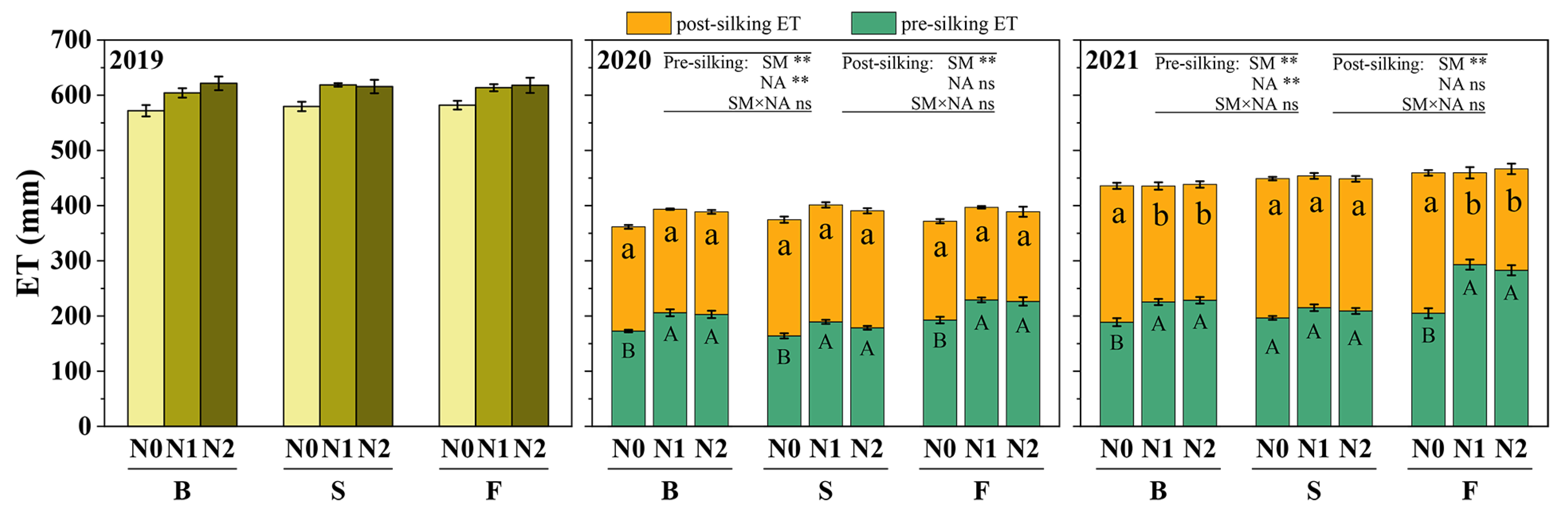
Both surface mulching and N application significantly enhanced ET (Figure 2). The three-year average data indicated that plastic film mulching and straw mulching significantly increased ET by 11.73 mm and 8.97 mm, respectively, compared to the no mulching treatment. Likewise, N application markedly promoted ET, with N1 and N2 treatments increasing ET by 21.32 mm and 21.28 mm, respectively, relative to N0. Post-silking ET was significantly increased by straw mulching, while plastic film mulching significantly reduced ET in both years. Similarly, post-silking ET showed no significant difference between N1 and N2 treatments but was lower in both cases compared to N0. The two-year average results further revealed that, relative to the no mulching treatment, plastic film mulching increased pre-silking ET by 16.75%, while straw mulching reduced it by 5.83%. Post-silking, plastic film mulching decreased ET by 9.40%, whereas straw mulching increased it by 11.04%. Compared with N0, N1 and N2 treatments increased pre-silking ET by 21.26% and 18.63%, respectively, while reducing post-silking ET by 11.21% and 10.43%, respectively.

3.2. Changes in ASWS During Critical Water Demand Periods (V10–R1 and R1–R3) and SWS in R6

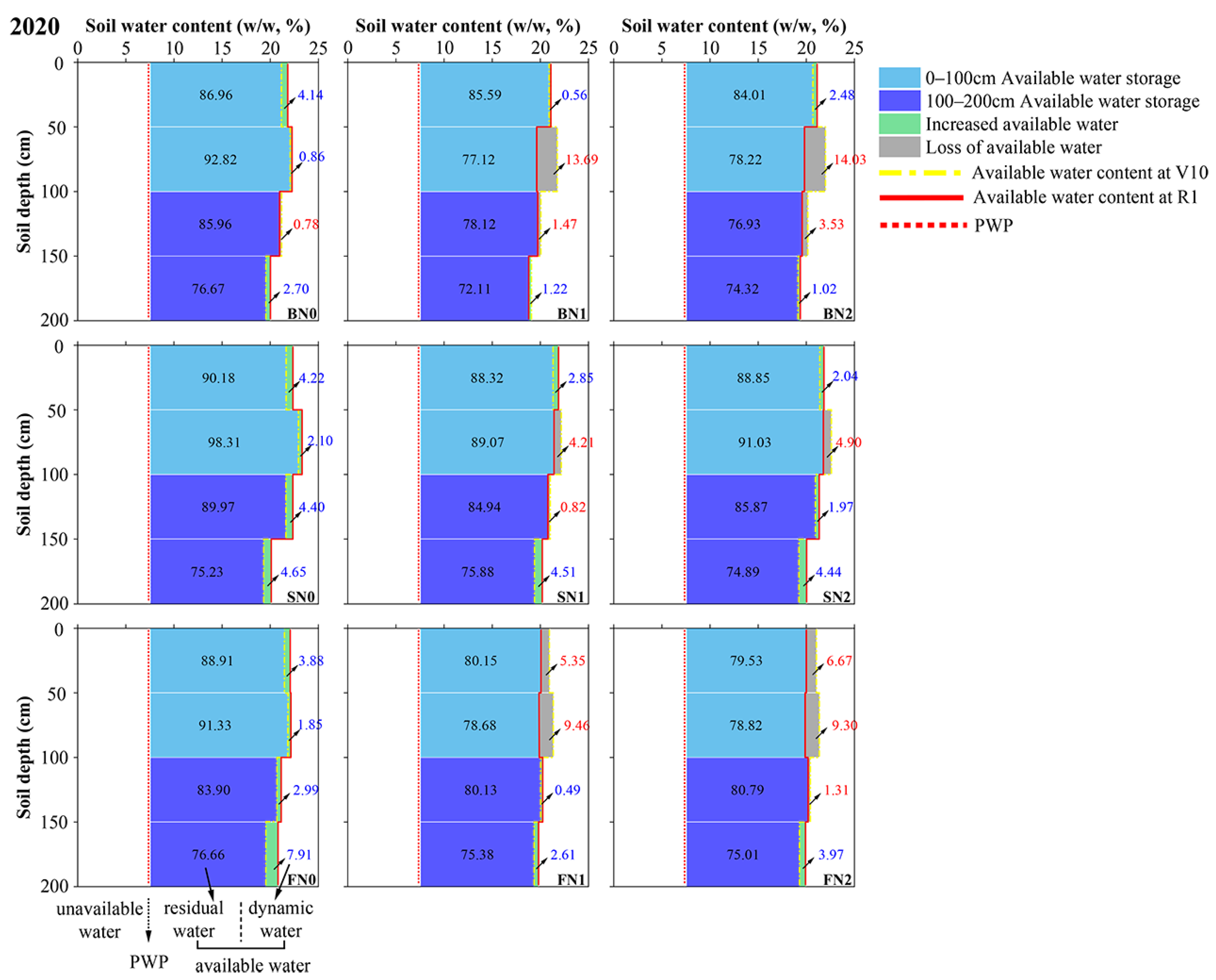
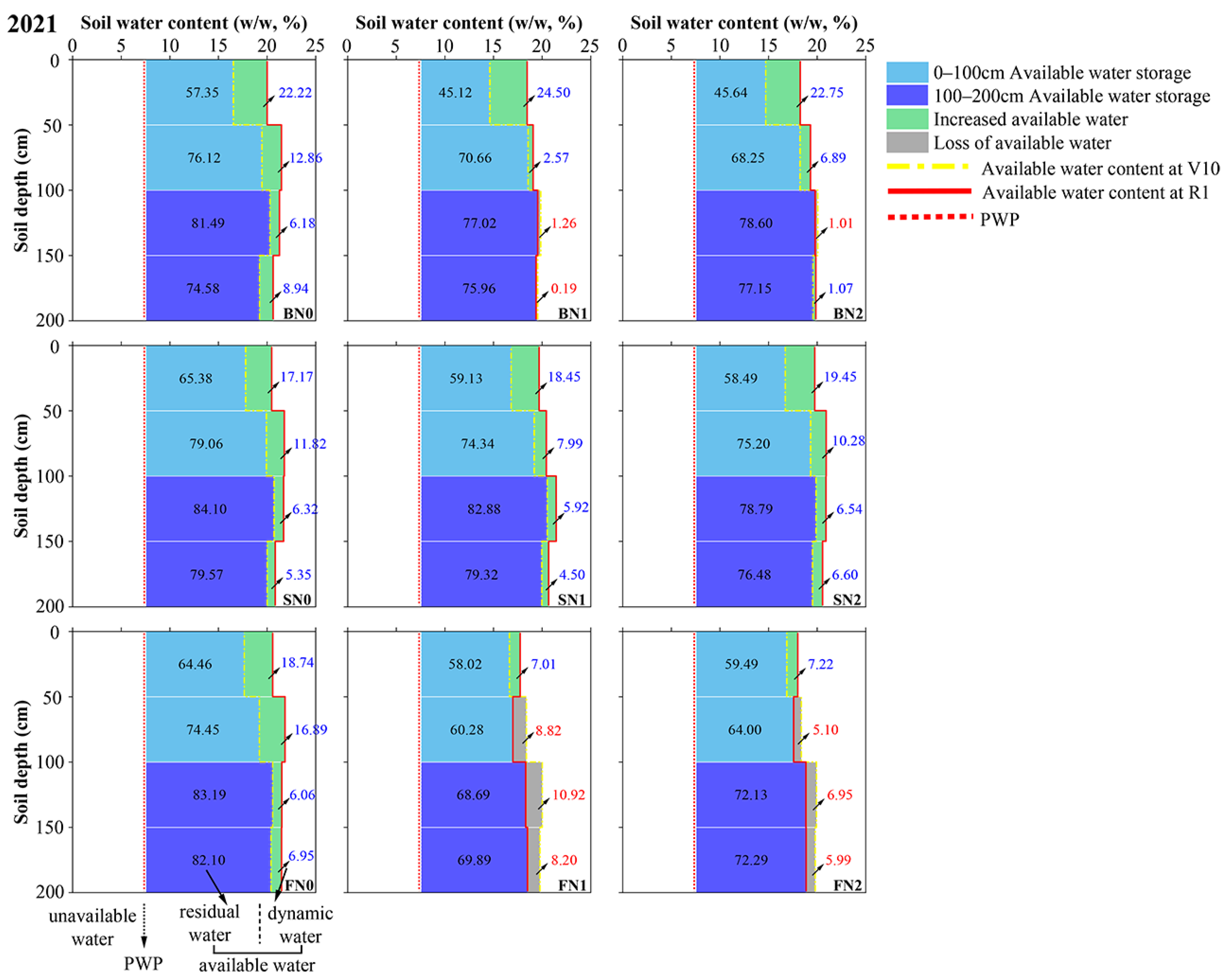
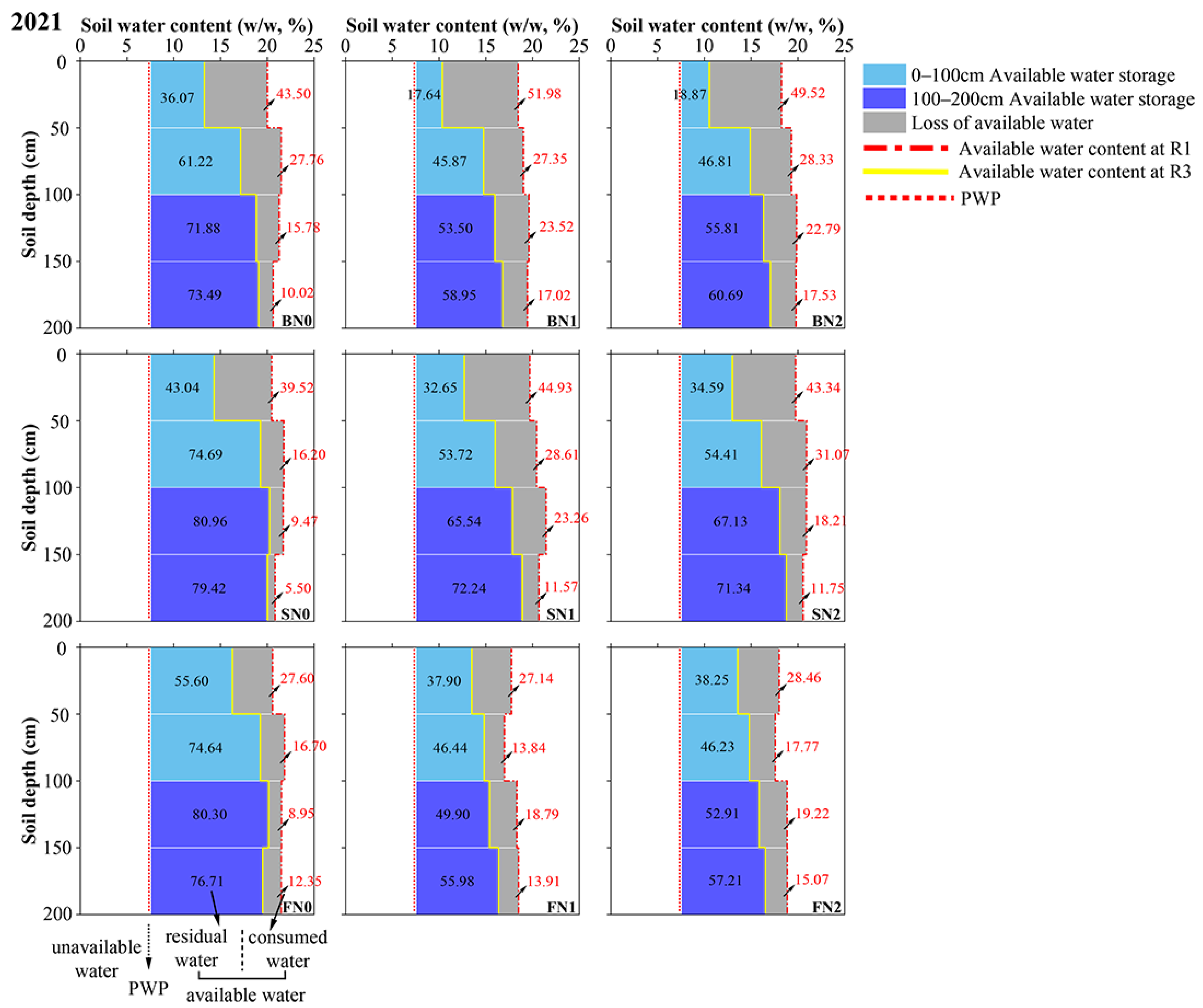
Changes in ASWS during the V10–R1 and R1–R3 stages of maize varied across planting years, mulching types, N application methods, and soil depths (Figure 3, Figure 4, Figure 5 and Figure 6). During the V10 to R1 growth stages in 2020, ASWS in the 0–100 cm soil layer decreased by 14.81 mm and 15.97 mm under FN1 and FN2, respectively (Figure 3). In the 50–100 cm soil layer, ASWS declined by 13.69 mm and 14.03 mm under BN1 and BN2 and by 4.21 mm and 4.90 mm under SN1 and SN2, respectively. Compared with the no N application, ASWS decreased across all soil layers under both N application treatments within the same mulching condition. During the V10 to R1 growth stages in 2021 (Figure 4), ASWS in the 50–200 cm soil layer decreased by 27.94 mm and 18.04 mm under FN1 and FN2 treatments, respectively. In contrast, ASWS in the 0–100 cm soil layer increased by 27.07 mm and 29.64 mm under BN1 and BN2 treatments, while variations in the 100–200 cm layer were minimal. Under SN1 and SN2 treatments, ASWS exhibited an increasing trend across all soil layers.
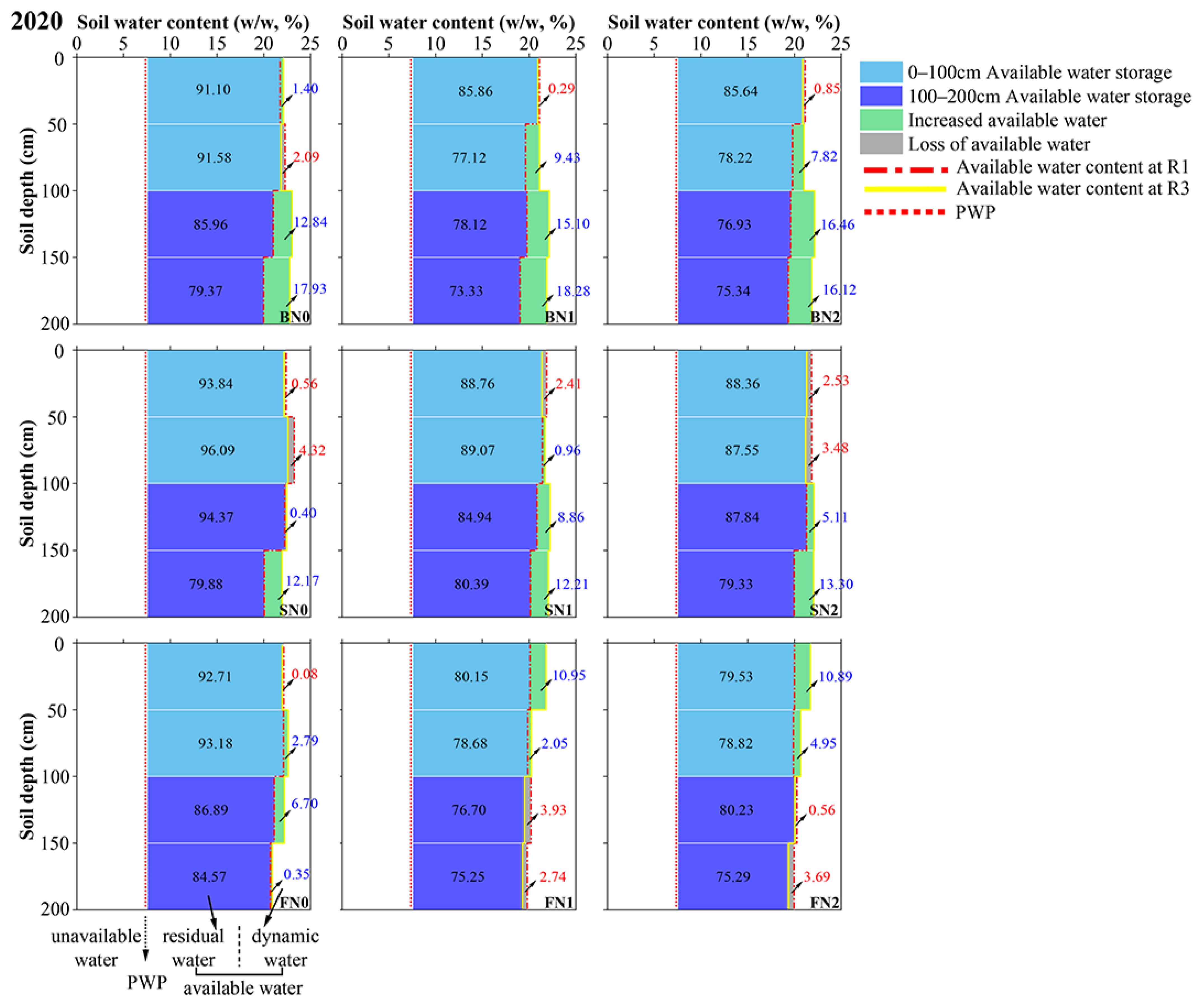
During the 2020 R1 to R3 growth stage, under no mulching and straw mulching, the increase in ASWS was predominantly observed in the 100–200 cm layer (Figure 5). However, for plastic film mulching, ASWS changes were influenced by fertilization. Under FN0, ASWS increased across the 100–200 cm soil layer, with a total gain of 7.05 mm. Unlike other treatments, FN1 and FN2 treatments (plastic film mulching combined with nitrogen fertilization) resulted in a decrease in ASWS in the 100–200 cm soil layer by 6.67 mm and 4.25 mm, respectively. During the R1–R3 growth stage in 2021, ASWS across the 0–200 cm soil profile decreased under all treatments (Figure 6). No mulching led to the greatest total ASWS reduction (97.6–119.87 mm), whereas plastic film mulching resulted in the smallest reduction (65.6–80.52 mm). ASWS reductions were significantly lower under N0 (65.6–97.06 mm) than under N1 (73.68–119.87 mm) and N2 (80.52–118.17 mm). Under N1 and N2 treatments, plastic film mulching resulted in a higher proportion of total ASWS reduction in the 100–200 cm soil layer. Specifically, deep soil water accounted for 44.38% and 42.59% of the total reduction under N1 and N2, respectively. In contrast, the proportion ranged from only 28.71% to 34.12% under no mulching and straw mulching. These findings suggest that the combination of plastic film mulching and nitrogen fertilization enhances deep soil water consumption during the reproductive stage of maize. At harvest, results over the three years showed that SWS in the 100–200 cm soil layer under F was generally comparable to or higher than that under B and S (Table S1).

3.3. Changes in Spring Maize Phenology

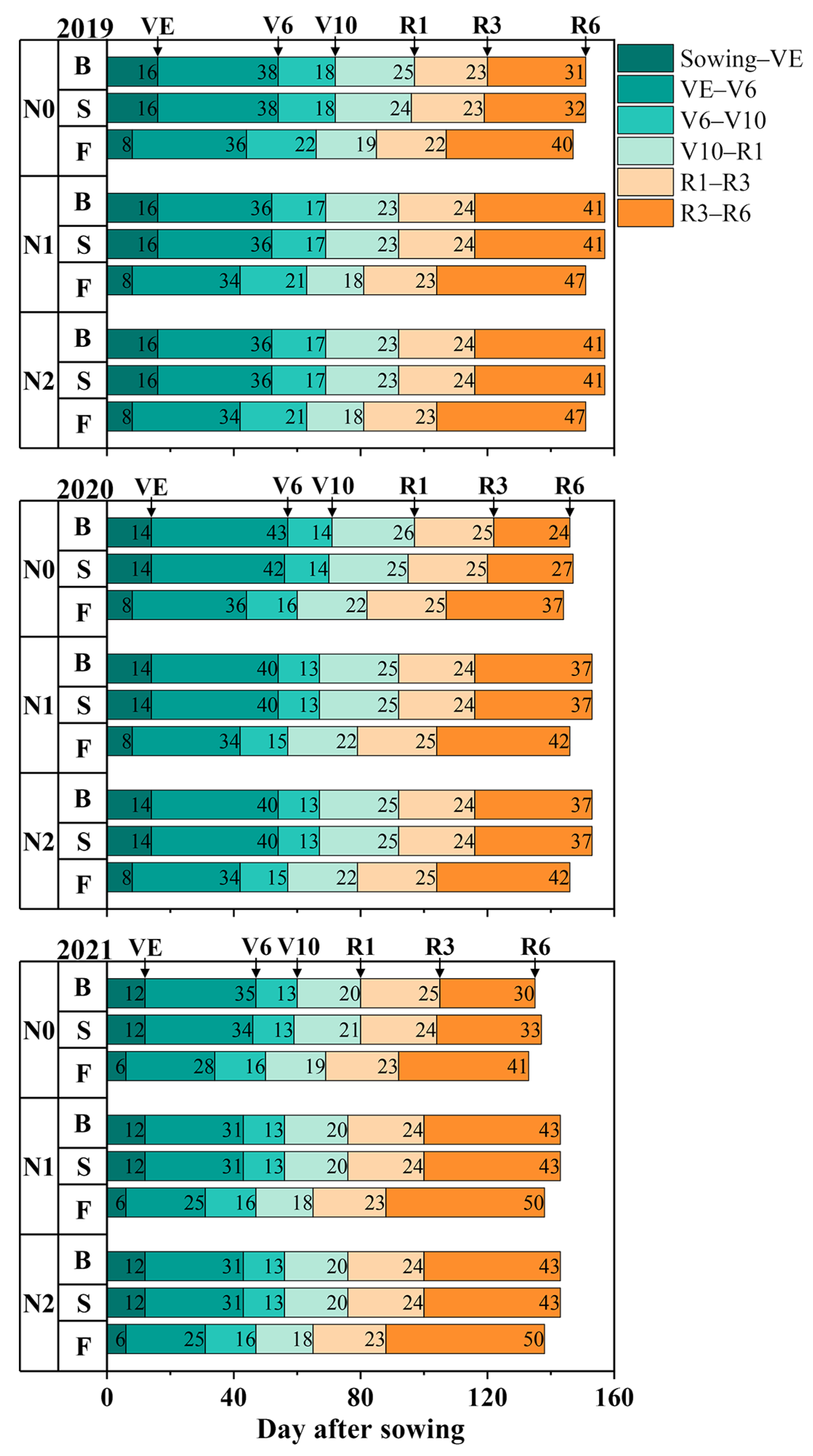
Surface mulching and N application method significantly influenced the timing and duration of specific growth stages in spring maize phenology (Figure 7). Across all three experimental years, N application significantly extended the growth duration of spring maize by 2–8 days compared to N0. However, no differences in growth duration were observed between the N1 and N2 treatments under identical mulching conditions. Plastic film mulching consistently shortened the growth duration of spring maize by 2–7 days compared to no mulching and straw mulching.
During the 2019–2021 growing seasons, no differences in maize emergence stage were observed between straw mulching and no mulching. In contrast, plastic film mulching advanced maize emergence by 6–8 days compared with no mulching and straw mulching. Plastic film mulching shortened the vegetative growth period (before R1) by 3–9 days and extended the reproductive period (after R1), particularly prolonging the R3–R6 period by 5–13 days.

3.4. Effects of Surface Mulching and Nitrogen Application on Soil Physical Properties and Agronomic Traits of Spring Maize

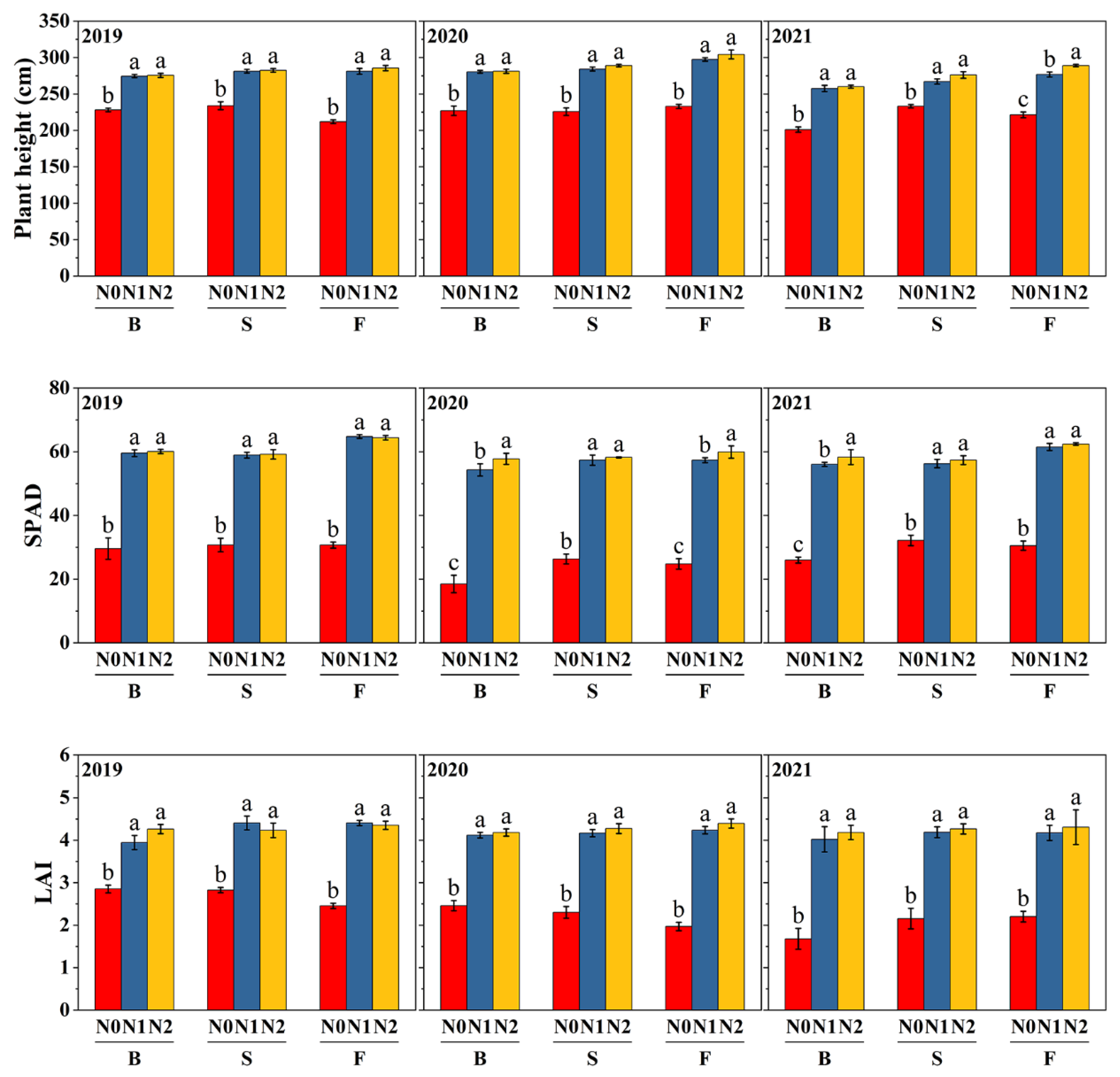
Results from 2019, 2020, and 2021 indicate that, under the same mulching conditions, both N1 and N2 treatments significantly increased plant height, LAI, and SPAD compared to N0, with N2 generally outperforming N1 (Figure 8). Overall, straw mulching and plastic film mulching enhanced maize growth. Compared with BN2 and SN2, FN2 increased plant height, LAI, and SPAD by 3.63–11.15%, 2.11–5.08%, and 3.72–7.16%, respectively, relative to BN2, and by 1.15–5.28%, 1.00–2.84%, and 2.89–8.85%, respectively, relative to SN2.
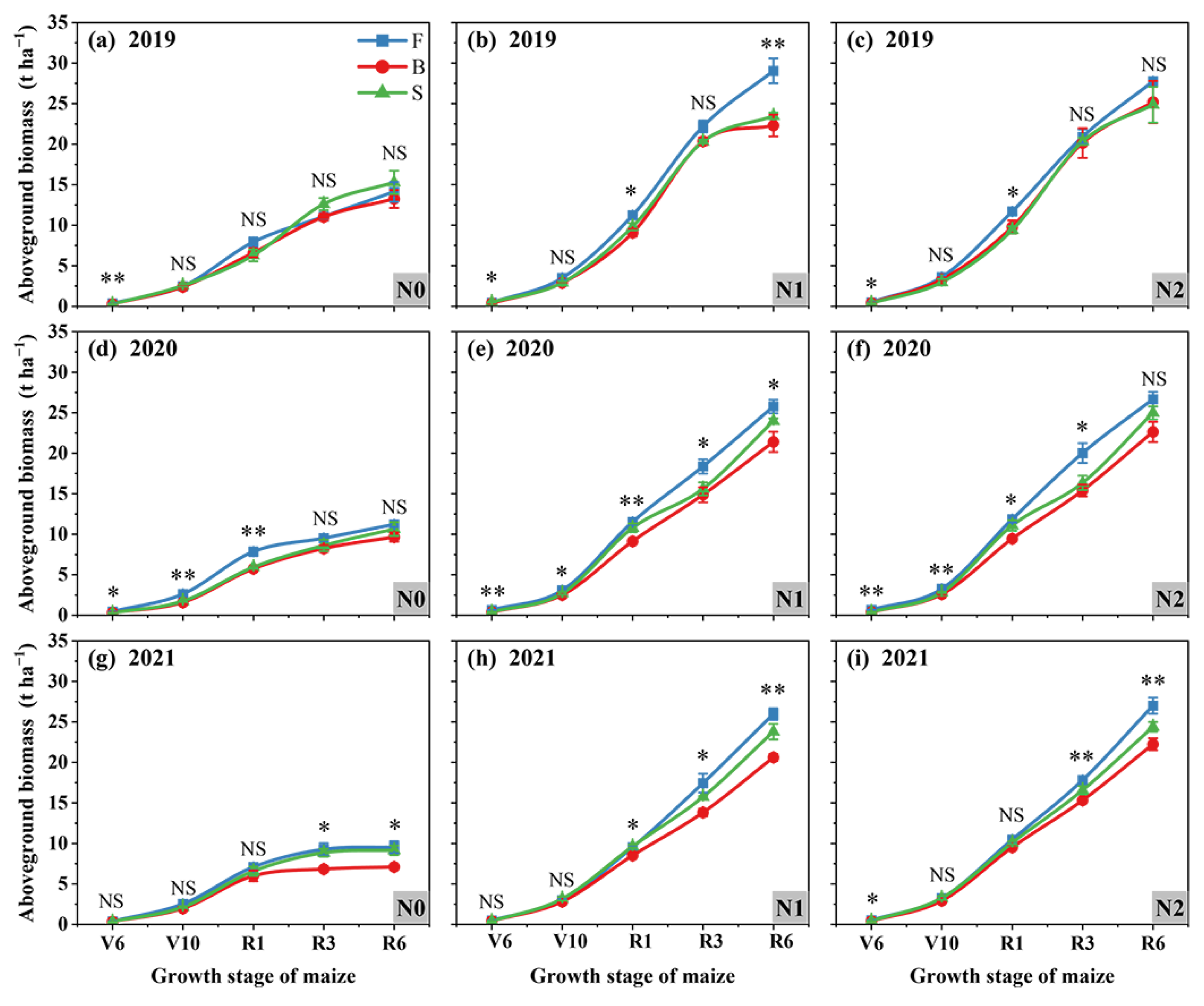
The three-year experimental results demonstrated that surface mulching and N application had significant effects on the aboveground biomass of spring maize (Figure 9). Compared with N0, both N1 and N2 significantly increased aboveground biomass, though the difference between N1 and N2 was not significant, with N2 achieving only a 4.35% increase over N1. Additionally, plastic film mulching and straw mulching enhanced aboveground biomass by 19.88% and 9.84%, respectively, compared to the no mulching treatment.
Surface mulching and nitrogen application exerted distinct effects on soil physical properties (Figure S1). Compared with B, F increased soil bulk density and reduced soil porosity, whereas S decreased bulk density and increased porosity. Significant differences in both porosity and bulk density were observed between F and S treatments (p < 0.05). In contrast, nitrogen application had no significant effect on soil bulk density or porosity, and no differences were detected among the N treatments.

3.5. Grain Yield and WP

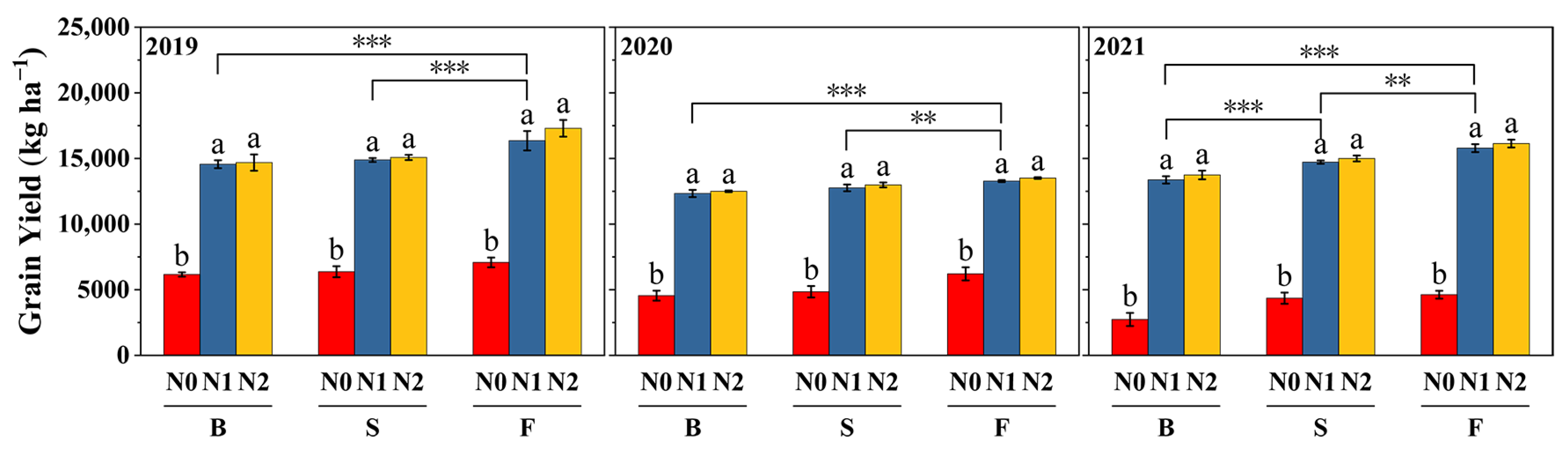
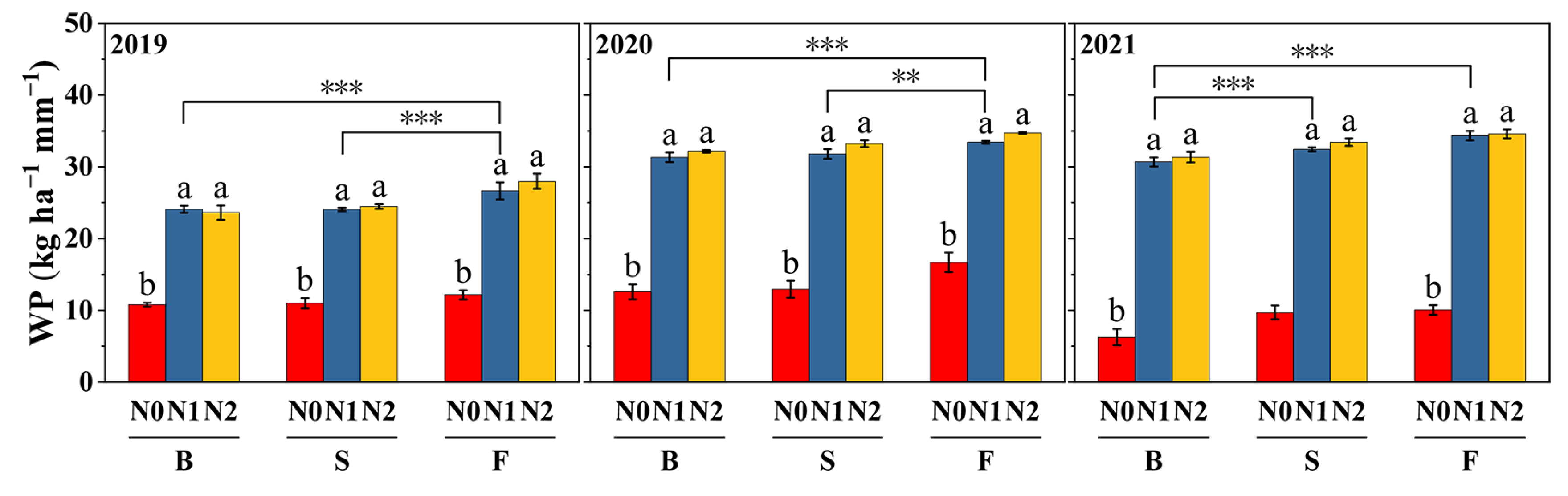
The three-year experiments indicate that maize grain yields under plastic film mulching and straw mulching were 16.53% and 6.73% higher, respectively, compared to no mulching. Compared to N0, grain yields increased by 172.79% and 178.95% under N1 and N2 treatments, respectively (Figure 10). From 2019 to 2021, straw mulching increased grain yield by 2.60%, 4.13%, and 14.19% compared to no mulching, with a significant difference in 2021 (p < 0.05). Under the same mulching conditions, N2 resulted in higher yields than N1, though the difference was not significant (p > 0.05). Over the three years, the combination of plastic film mulching and N2 treatment resulted in the highest grain yield. The three-year experiment consistently demonstrated that surface mulching significantly improved WP (Figure 11). Compared to no mulching, plastic film mulching and straw mulching increased WP by 25.45% and 5.57%, respectively. Both N1 and N2 treatments significantly increased WP relative to N0. Although WP under N2 was 2.4% higher than under N1, the difference was not statistically significant (p > 0.05). Correlation analysis revealed significant associations among grain yield, WP, pre-silking ET, agronomic traits, R1–R3 phenological duration, and changes in available soil water storage (Figure S2).

4. Discussion

4.1. Effects of Mulching and N Application on Spring Maize Phenology

As a key driver of crop development, the microenvironment shaped by surface mulching and N fertilization influenced maize phenology in distinct ways. Plastic film mulching, in particular, consistently accelerated early-stage development across three years, leading to a shortened growth cycle relative to straw and no mulching (Figure 7). Springtime, characterized by large diurnal temperature fluctuations and cooler morning and evening temperatures, results in significant condensation on the plastic film, which prevents evaporation [49,50]. This increases soil moisture in the plow layer, providing a favorable environment for seed germination. Additionally, while maintaining higher moisture levels in the topsoil, plastic film mulching also increased soil temperature [8]. Our previous research [51] showed that F significantly increased soil temperature in the plow layer. The resulting warmer and moister soil conditions created a favorable environment for seed germination and early seedling growth. Furthermore, we observed that certain vegetative growth stages (VE–V6 and V10–R1) were significantly shortened in duration (by 3–9 days) under plastic film mulching, which led to an earlier progression of growth stages compared to straw and no mulching treatments. However, plastic film mulching notably extended the R3–R6 stages (Figure 7). Although plastic film mulching can increase soil temperature and accelerate root senescence, potentially leading to earlier crop maturity [21], the improved hydrothermal conditions may enhance nitrogen availability [52], support greater nutrient uptake [53], and extend the R3–R6 phase. This sustained water and nutrient supply can prolong grain filling and ultimately contribute to higher yield potential [25]. These findings indicate that nitrogen fertilization, regardless of application strategy, effectively prolonged the growth period of spring maize (Figure 7). The comparable effects of N1 and N2 suggest that the form of N application may have limited influence on phenological development under equivalent N inputs.

4.2. Temporal and Spatial Variability in Soil Water Utilization by Spring Maize

In the Loess Plateau region, characterized by significant interannual variability in precipitation (Table 2), ET fluctuates markedly. Consequently, ET exhibited significant variations across the three growing seasons (Figure 2). The uneven distribution of seasonal precipitation, coupled with the varying water demands at different crop growth stages, exerted a significant influence on pre- and post-silking ET [54,55]. Our study revealed that both surface mulching and N application significantly increased ET in spring maize, with N application having a greater impact than mulching. The N1 and N2 treatments significantly improved agronomic traits (Figure 8 and Figure 9), which contributed to increased crop transpiration [56]. In contrast, surface mulching effectively reduced soil evaporation [57], thereby minimizing unnecessary water loss. Although plastic film mulching significantly enhanced soil water retention by directly suppressing soil evaporation, it also impeded the infiltration of limited pre-silking precipitation [58,59]. Furthermore, plastic film mulching substantially promoted maize growth by increasing soil temperature [60] resulting in greater aboveground biomass accumulation (Figure 9) and higher ET during the pre-silking period (Figure 2). These improvements in early-season growth ultimately contributed to increased grain yield in spring maize (Figure S2). Over the two years of the study, results consistently indicated that, regardless of the fertilization method, ASWS in the 0–200 cm soil layer under straw mulching was higher than under no mulching (Figure 3, Figure 4, Figure 5 and Figure 6). Straw mulching reduces soil temperature, which in turn decreases soil moisture evaporation [61]. The impact of plastic film mulching on ASWS varied depending on N fertilization. In 2020, a reduction in ASWS in the 100–200 cm soil layer was observed only under plastic film mulching with N treatments (FN1 and FN2) (Figure 5 and Figure 6), while no similar change occurred in other treatments. By 2021, all treatments showed a reduction in ASWS, but FN1 and FN2 exhibited a larger proportion of the total decrease in ASWS from the 100–200 cm soil layer (Figure 5 and Figure 6). The differences in deep soil moisture dynamics under different mulching treatments may be driven by the plant’s response to soil moisture availability. Lack of soil moisture typically slows both aboveground and root growth, limiting the plant’s ability to utilize deeper soil moisture [62]. Plastic film mulching improves the soil’s thermal and hydrological conditions [63], facilitating earlier growth and promoting both aboveground and root development [64]. In this study, plastic film mulching combined with N fertilization resulted in the highest plant height and aboveground dry biomass across the entire growing season (Figure 8 and Figure 9). Furthermore, previous studies suggest that plastic film mulching enhances root growth in deeper soil layers [65], improving root conditions in the 0–200 cm soil profile and increasing the proportion of root mass in deeper soil layers [66]. This further enhanced the spring maize’s ability to utilize deep soil moisture, leading to more pronounced deep soil ASWS depletion under plastic film mulching (Figure 4 and Figure 6). These findings suggest that plastic film mulching combined with N fertilization may exacerbate the consumption of deep soil moisture.

4.3. Optimizing Survival Strategies to Improve Yield and WP

Surface mulching and N fertilization synergistically improved spring maize grain yield and WP, with F consistently outperforming S and B (Figure 10 and Figure 11). This synergy is attributed to their complementary effects on soil moisture conservation and crop growth dynamics. In our study, F created a warmer and moister microenvironment, stimulating early seed germination and seedling growth, which subsequently supported stronger reproductive development. Previous studies have shown that surface mulching effectively reduces soil water evaporation in the plow layer [6,67], thereby supporting vegetative growth and root development [63,68], which further demonstrates the connection between improved early seed germination, crop growth, and increased dry matter accumulation under semi-arid conditions (Figure S2). Compared with S, F further promoted robust root growth by creating a more favorable soil environment, which resulted in a greater root volume [69], which helped enhance maize’s ability to utilize soil water during the pre-silking stage. This resulted in increased SPAD values, LAI, plant height, and aboveground biomass (Figure 8 and Figure 9), all contributing to higher grain yield and WP. Additionally, film mulching enhanced the utilization of deep ASWS (Figure 3, Figure 4, Figure 5 and Figure 6) and extended the reproductive growth phase, particularly during the R3–R6 stages (Figure 7), thereby promoting greater assimilate accumulation and translocation to the grain, which ultimately improved grain yield and increased WP (Figure S2). In addition to the physiological and phenological improvements observed, the superior WP under plastic film mulching can be attributed to reduced soil evaporation and improved moisture conservation [70]. This favorable soil moisture environment, especially under N application, also promoted the utilization of deeper soil water reserves (Figure 4 and Figure 6), further contributing to increased grain yield and WP. In contrast, S exhibited lower WP than F, primarily due to its weaker capacity for retaining soil moisture and suppressing evaporation [71].

4.4. Reasonable Combination of Surface Mulching and N Application

Surface mulching significantly increased spring maize grain yield (Figure 10), but high yields are often accompanied by greater ET (Figure 2). Surface mulching effectively improves the hydrothermal environment of soils in semi-arid regions. Studies have shown that enhanced soil moisture conditions provide strong support for increasing maize yield [72]. Plastic film mulching in combination with N application reduced shallow water loss compared to straw mulching, while simultaneously significantly enhancing the utilization of deep soil water by spring maize (Figure 4 and Figure 6). However, the application of organic mulch has been demonstrated to increase the soil content of K and Mg, with positive effects on the crop, as in the case of grape [73]. In addition, straw mulching can reduce soil bulk density and increase soil porosity (Figure S1), improving soil physical conditions. A previous report has further demonstrated that straw mulching can modify soil microbial community structure, enhance soil enzyme activities, and suppress weed growth [5]. These improvements can promote crop growth and contribute to more efficient utilization of soil water. But excessive depletion of deep soil moisture, particularly in water-limited regions where rainfall is insufficient for recharge [74,75], can result in the formation of persistent dry soil layers and pose a serious risk to the long-term sustainability of cropping systems [76]. However, in our study region, maize transpiration declined after the R3 stage, leading to a reduction in soil water consumption [77]. Moreover, beginning in the R3 stage, decreasing temperatures (Table 2), lower evaporation rates, and increased rainfall collectively contributed to the restoration of deep soil moisture depletion [78]. Our data showed that, under identical nitrogen treatments, plastic film mulching did not lead to a significant reduction in SWS across the 0–200 cm profile at the R6 stage (Table S1). Hence, the combination of plastic film mulching with optimized nitrogen application maintained the stability of the soil water balance.
Achieving high maize yields requires precise synchronization of N supply with the crop’s demand at the critical growth stage [79]. To minimize fertilizer waste and mitigate the environmental impact of over-fertilization, N in the N1 treatment was applied before sowing and at the V10 and R1 critical growth stages, in alignment with maize nutrient requirements [43,44,80]. This targeted approach effectively met maize demands while improving nutrient use efficiency. By contrast, the N2 treatment employed a pre-sowing application of controlled-release urea and regular urea in a 1:2 ratio, delivering a “quick-release + sustained-release” N supply [39]. This approach supported maize growth across the entire growth cycle while reducing environmental risks and production costs. However, the split application of urea in the N1 treatment requires more labor, is susceptible to weather conditions, exacerbates nutrient losses, and reduces efficiency [81]. Additionally, manual topdressing may not precisely match maize nutrient uptake patterns, potentially diminishing its benefits [27,82]. In contrast, the N2 treatment demands precise design of fertilizer application plans, including the ratio and quantity of application. The N2 allows a one-time nitrogen application before sowing, which substantially reduces labor input and improves operational feasibility. Over three years of trials (Figure 10), N2 did not significantly outperform N1 in grain yield but exhibited a slight advantage. Overall, the N2 treatment, combined with plastic film mulching, effectively satisfied the nutrient demands of spring maize throughout its growth cycle, achieving optimal grain yield and WP in the study region.

5. Conclusions

Field experiments showed that combining plastic film or straw mulching with optimized N application improved both the grain yield and WP of spring maize in semi-arid regions. Plastic film mulching, in particular, was highly effective when paired with optimized N management, enhancing deep soil water utilization and extending the reproductive growth period, which contributed to higher yield potential. While both N1 and N2 improved crop performance, N2 consistently outperformed N1, especially when combined with plastic film mulching, which resulted in the highest yields. These findings underscore the potential of integrating surface mulching with optimized N application to enhance maize productivity while improving water and nitrogen use in semi-arid regions.

Supplementary Materials

The following supporting information can be downloaded at https://www.mdpi.com/article/10.3390/agronomy16030290/s1, Figure S1: Effects of surface mulching and nitrogen application on bulk density and soil porosity; Figure S2: Correlation analysis among grain yield, water productivity, evapotranspiration, phenology, available soil water storage, and agronomic traits; Table S1: Soil water storage (mm) at 0–200 cm depth during R6 under surface mulching and nitrogen application in 2019, 2020 and 2021.

Author Contributions

H.S.: Writing—original draft, review, and editing; X.W., S.D., M.C., and G.X.: Sampling, data curation, and methodology; S.Y. and M.X.: Writing—review and editing; Y.S.: Supervision, validation, writing—review and editing. All authors have read and agreed to the published version of the manuscript.

Funding

This research was supported by the National Key R&D Program of China (2023YFD1900600, 2021YFD1900700), the Key Research and Development Program of Shaanxi (2024NC2-GJHX-08), and the National Natural Science Foundation of China (42477368, 41671307).

Data Availability Statement

The original contributions presented in the study are included in the article/Supplementary Material; further inquiries can be directed to the corresponding authors.

Conflicts of Interest

The authors declare that they have no known competing financial interests or personal relationships that could have appeared to have influenced the work reported in this paper.

References

  1. Alharbi, S.; Felemban, A.; Abdelrahim, A.; Al-Dakhil, M. Agricultural and Technology-based strategies to improve water-use efficiency in Arid and Semiarid areas. Water 2024, 16, 1842. [Google Scholar] [CrossRef]
  2. Deng, X.-P.; Shan, L.; Zhang, H.; Turner, N.C. Improving agricultural water use efficiency in arid and semiarid areas of China. Agric. Water Manag. 2006, 80, 23–40. [Google Scholar] [CrossRef]
  3. Zhang, B.; Han, H.; Guo, Z.; Shuai, G.; Si, S.; Liao, S.; Xin, W.; Zhou, S.; Zhang, Z. Plastic-film-side seeding, as an alternative to traditional film mulching, improves yield stability and income in maize production in semi-arid regions. J. Integr. Agric. 2023, 22, 1021–1034. [Google Scholar] [CrossRef]
  4. Mo, F.; Wang, J.; Zhou, H.; Luo, C.; Zhang, X.; Li, X.; Li, F.; Xiong, L.; Kavagi, L.; Nguluu, S.N. Ridge-furrow plastic-mulching with balanced fertilization in rainfed maize (Zea mays L.): An adaptive management in east African Plateau. Agric. For. Meteorol. 2017, 236, 100–112. [Google Scholar] [CrossRef]
  5. Du, C.; Li, L.; Effah, Z. Effects of straw mulching and reduced tillage on crop production and environment: A review. Water 2022, 14, 2471. [Google Scholar] [CrossRef]
  6. El-Beltagi, H.S.; Basit, A.; Mohamed, H.I.; Ali, I.; Ullah, S.; Kamel, E.A.; Shalaby, T.A.; Ramadan, K.M.; Alkhateeb, A.A.; Ghazzawy, H.S. Mulching as a sustainable water and soil saving practice in agriculture: A review. Agronomy 2022, 12, 1881. [Google Scholar] [CrossRef]
  7. Qin, X.; Zhang, Y.; Yu, R.; Chang, X.; Yao, Y.; Qiu, Q.; Li, H.; Wei, X. Biological conservation measures are better than engineering conservation measures in improving soil quality of eroded orchards in southern China. Soil Sci. Soc. Am. J. 2022, 86, 932–945. [Google Scholar] [CrossRef]
  8. Wang, X.; Fan, J.; Xing, Y.; Xu, G.; Wang, H.; Deng, J.; Wang, Y.; Zhang, F.; Li, P.; Li, Z. Chapter Three—The Effects of Mulch and Nitrogen Fertilizer on the Soil Environment of Crop Plants. Adv. Agron. 2019, 153, 121–173. [Google Scholar] [CrossRef]
  9. Condon, A.G.; Richards, R.; Rebetzke, G.; Farquhar, G. Improving intrinsic water-use efficiency and crop yield. Crop Sci. 2002, 42, 122–131. [Google Scholar] [CrossRef]
  10. Li, S.; Zhang, Q.; Li, H. The Impact of Farmer Differentiation Trends on the Environmental Effects of Agricultural Products: A Life Cycle Assessment Approach. Agriculture 2025, 15, 1182. [Google Scholar] [CrossRef]
  11. Sun, D.; Li, H.; Wang, E.; He, W.; Hao, W.; Yan, C.; Li, Y.; Mei, X.; Zhang, Y.; Sun, Z.; et al. An overview of the use of plastic-film mulching in China to increase crop yield and water-use efficiency. Natl. Sci. Rev. 2020, 7, 1523–1526. [Google Scholar] [CrossRef]
  12. Qin, W.; Hu, C.; Oenema, O. Soil mulching significantly enhances yields and water and nitrogen use efficiencies of maize and wheat: A meta-analysis. Sci. Rep. 2015, 5, 16210. [Google Scholar] [CrossRef] [PubMed]
  13. Wu, Y.; Huang, F.; Jia, Z.; Ren, X.; Cai, T. Response of soil water, temperature, and maize (Zea may L.) production to different plastic film mulching patterns in semi-arid areas of northwest China. Soil Tillage Res. 2017, 166, 113–121. [Google Scholar] [CrossRef]
  14. Liao, C.; Tang, M.; Zhang, C.; Deng, M.; Li, Y.; Feng, S. Impacts of Various Straw Mulching Strategies on Soil Water, Nutrients, Thermal Regimes, and Yield in Wheat–Soybean Rotation Systems. Plants 2025, 14, 2233. [Google Scholar] [CrossRef]
  15. Ma, X.; Wang, Z.; Ma, B.; Zhang, L.; Tian, J.; He, J. Effects of Plastic Film and Gravel-Sand Mulching on Soil Moisture and Yield of Wolfberry Under Ridge-Furrow Planting in an Arid Desert Region of China’s Loess Plateau. Agronomy 2025, 15, 2312. [Google Scholar] [CrossRef]
  16. Mo, F.; Wang, J.; Li, F.; Nguluu, S.N.; Ren, H.; Zhou, H.; Zhang, J.; Kariuki, C.W.; Gicheru, P.; Kavagi, L. Yield-phenology relations and water use efficiency of maize (Zea mays L.) in ridge-furrow mulching system in semiarid east African Plateau. Sci. Rep. 2017, 7, 3260. [Google Scholar] [CrossRef] [PubMed]
  17. Li, J.; Li, M.; Gao, X.; Fang, F. Corn straw mulching affects Parthenium hysterophorus and rhizosphere organisms. Crop Prot. 2018, 113, 90–96. [Google Scholar] [CrossRef]
  18. Liu, S.; Yi, S.; Ma, Y. Effects of Straw Mulching on Soil Temperature and Maize Growth in Northeast China. Teh. Vjesn. 2022, 29, 1805–1810. [Google Scholar] [CrossRef]
  19. Kara, B.; Atar, B. Effects of mulch practices on fresh ear yield and yield components of sweet corn. Turk. J. Agric. For. 2013, 37, 281–287. [Google Scholar] [CrossRef]
  20. Zhang, J.; Zhang, F.; Xing, Z.; Guo, X.; Hui, S.; Du, L.; Ding, L. Effects of mulching with crushed wheat straw padding and plastic film on sunflower emergence, yield, and yield components under different irrigation intensity in the northwest arid regions, China. Can. J. Soil Sci. 2021, 101, 466–479. [Google Scholar] [CrossRef]
  21. Bu, L.D.; Liu, J.L.; Zhu, L.; Luo, S.S.; Chen, X.P.; Li, S.Q.; Hill, R.L.; Zhao, Y. The effects of mulching on maize growth, yield and water use in a semi-arid region. Agric. Water Manag. 2013, 123, 71–78. [Google Scholar] [CrossRef]
  22. Ding, F.; Li, S.; Lu, J.; Penn, C.J.; Wang, Q.-W.; Lin, G.; Sardans, J.; Penuelas, J.; Wang, J.; Rillig, M.C. Consequences of 33 years of plastic film mulching and nitrogen fertilization on maize growth and soil quality. Environ. Sci. Technol. 2023, 57, 9174–9183. [Google Scholar] [CrossRef] [PubMed]
  23. Li, R.; Chai, S.; Chai, Y.; Li, Y.; Lan, X.; Ma, J.; Cheng, H.; Chang, L. Mulching optimizes water consumption characteristics and improves crop water productivity on the semi-arid Loess Plateau of China. Agric. Water Manag. 2021, 254, 106965. [Google Scholar] [CrossRef]
  24. Wu, L.; Quan, H.; Wu, L.; Zhang, X.; Ding, D.; Feng, H.; Siddique, K.H.; Li Liu, D.; Wang, B. Plastic mulching enhances maize yield and water productivity by improving root characteristics, green leaf area, and photosynthesis for different cultivars in dryland regions. Agric. Water Manag. 2024, 305, 109105. [Google Scholar] [CrossRef]
  25. Liu, Y.; Li, S.; Chen, F.; Yang, S.; Chen, X. Soil water dynamics and water use efficiency in spring maize (Zea mays L.) fields subjected to different water management practices on the Loess Plateau, China. Agric. Water Manag. 2010, 97, 769–775. [Google Scholar] [CrossRef]
  26. Deng, H.L.; Xiong, Y.C.; Zhang, H.J.; Li, F.Q.; Zhou, H.; Wang, Y.C.; Deng, Z.R. Maize productivity and soil properties in the Loess Plateau in response to ridge-furrow cultivation with polyethylene and straw mulch. Sci. Rep. 2019, 9, 3090. [Google Scholar] [CrossRef]
  27. Grant, C.; Wu, R.; Selles, F.; Harker, K.; Clayton, G.; Bittman, S.; Zebarth, B.; Lupwayi, N. Crop yield and nitrogen concentration with controlled release urea and split applications of nitrogen as compared to non-coated urea applied at seeding. Field Crops Res. 2012, 127, 170–180. [Google Scholar] [CrossRef]
  28. Rees, R.M.; Roelcke, M.; Li, S.X.; Wang, X.Q.; Li, S.Q.; Stockdale, E.A.; McTaggart, I.P.; Smith, K.A.; Richter, J. The effect of fertilizer placement on nitrogen uptake and yield of wheat and maize in Chinese loess soils. Nutr. Cycl. Agroecosyst. 1996, 47, 81–91. [Google Scholar] [CrossRef]
  29. McKenzie, R.H.; Middleton, A.B.; Zhang, M. Optimal time and placement of nitrogen fertilizer with direct and conventionally seeded winter wheat. Can. J. Soil Sci. 2001, 81, 613–622. [Google Scholar] [CrossRef]
  30. Cassman, K.G.; Dobermann, A.; Walters, D.T. Agroecosystems, nitrogen-use efficiency, and nitrogen management. AMBIO A J. Hum. Environ. 2002, 31, 132–140. [Google Scholar] [CrossRef]
  31. Zhang, F.; Cui, Z.; Fan, M.; Zhang, W.; Chen, X.; Jiang, R. Integrated soil–crop system management: Reducing environmental risk while increasing crop productivity and improving nutrient use efficiency in China. J. Environ. Qual. 2011, 40, 1051–1057. [Google Scholar] [CrossRef] [PubMed]
  32. Kekeli, M.A.; Wang, Q.; Rui, Y. The Role of Nano-Fertilizers in Sustainable Agriculture: Boosting Crop Yields and Enhancing Quality. Plants 2025, 14, 554. [Google Scholar] [CrossRef]
  33. Cui, Z.; Zhang, F.; Chen, X.; Miao, Y.; Li, J.; Shi, L.; Xu, J.; Ye, Y.; Liu, C.; Yang, Z. On-farm evaluation of an in-season nitrogen management strategy based on soil Nmin test. Field Crops Res. 2008, 105, 48–55. [Google Scholar] [CrossRef]
  34. Feng, W.; Li, P.; Zheng, C.; Sun, M.; Shao, J.; Li, X.; Dong, H. Split-nitrogen application increases nitrogen-use efficiency and yield of cotton. Nutr. Cycl. Agroecosyst. 2023, 125, 393–407. [Google Scholar] [CrossRef]
  35. Hamani, A.K.M.; Abubakar, S.A.; Si, Z.; Kama, R.; Gao, Y.; Duan, A. Suitable split nitrogen application increases grain yield and photosynthetic capacity in drip-irrigated winter wheat (Triticum aestivum L.) under different water regimes in the North China Plain. Front. Plant Sci. 2023, 13, 1105006. [Google Scholar] [CrossRef]
  36. Wang, S.; Luo, S.; Yue, S.; Shen, Y.; Li, S. Fate of 15 N fertilizer under different nitrogen split applications to plastic mulched maize in semiarid farmland. Nutr. Cycl. Agroecosyst. 2016, 105, 129–140. [Google Scholar] [CrossRef]
  37. Guo, J.M.; Xue, J.Q.; Blaylock, A.D.; Cui, Z.L.; Chen, X.P. Film-mulched maize production: Response to controlled-release urea fertilization. J. Agric. Sci. 2017, 155, 1299–1310. [Google Scholar] [CrossRef]
  38. Kenawy, E.-R.; Hosny, A.; Saad-Allah, K. Reducing nitrogen leaching while enhancing growth, yield performance and physiological traits of rice by the application of controlled-release urea fertilizer. Paddy Water Environ. 2021, 19, 173–188. [Google Scholar] [CrossRef]
  39. Guo, J.; Wang, Y.; Blaylock, A.D.; Chen, X. Mixture of controlled release and normal urea to optimize nitrogen management for high-yielding (>15 Mg ha−1) maize. Field Crops Res. 2017, 204, 23–30. [Google Scholar] [CrossRef]
  40. FAO. FAO—UNESCO Soil Map of the World (Revised Legend, with Corrections and Updates), 1st ed.; World Soil Resources Reports 60; FAO: Rome, Italy, 1988. [Google Scholar]
  41. O’Kelly, B.C.; Sivakumar, V. Water Content Determinations for Peat and Other Organic Soils Using the Oven-Drying Method. Dry. Technol. 2014, 32, 631–643. [Google Scholar] [CrossRef]
  42. Qin, X.; Zhu, H.S.; Ren, Y.Q.; Cao, Z.R.; Wang, X.; Zhao, Z.N.; Yao, Y.F.; Zhong, Z.K.; Kong, W.B.; Qiu, Q.; et al. Erosion intensity and check dam size affect the horizontal and vertical distribution of soil particles, carbon and nitrogen: Evidence from China’s Loess Plateau. Catena 2022, 217, 106451. [Google Scholar] [CrossRef]
  43. Nleya, T.; Chungu, C.; Kleinjan, J. Corn Growth and Development. In iGrow Corn: Best Management Practices; Clay, D., Carlson, G., Clay, S., Byamukama, E., Eds.; South Dakota State University: Brookings, SD, USA, 2016. [Google Scholar]
  44. Ciampitti, I.A.; Elmore, R.W.; Lauer, J. Corn growth and development. Dent 2011, 5, 1–24. [Google Scholar]
  45. Hati, K.; Mandal, K.; Misra, A.; Ghosh, P.; Bandyopadhyay, K. Effect of inorganic fertilizer and farmyard manure on soil physical properties, root distribution, and water-use efficiency of soybean in Vertisols of central India. Bioresour. Technol. 2006, 97, 2182–2188. [Google Scholar] [CrossRef] [PubMed]
  46. Fernández, E. Editorial note on terms for crop evapotranspiration, water use efficiency and water productivity. Agric. Water Manag. 2023, 289, 108548. [Google Scholar] [CrossRef]
  47. Bauer, A.; Black, A. Organic carbon effects on available water capacity of three soil textural groups. Soil Sci. Soc. Am. J. 1992, 56, 248–254. [Google Scholar] [CrossRef]
  48. Fernández, J.E.; Alcon, F.; Diaz-Espejo, A.; Hernandez-Santana, V.; Cuevas, M.V. Water use indicators and economic analysis for on-farm irrigation decision: A case study of a super high density olive tree orchard. Agric. Water Manag. 2020, 237, 106074. [Google Scholar] [CrossRef]
  49. Li, C.; Luo, X.; Wang, N.; Wu, W.; Li, Y.; Quan, H.; Zhang, T.; Ding, D.; Dong, Q.g.; Feng, H. Transparent plastic film combined with deficit irrigation improves hydrothermal status of the soil-crop system and spring maize growth in arid areas. Agric. Water Manag. 2022, 265, 107536. [Google Scholar] [CrossRef]
  50. Tarara, J.M. Microclimate modification with plastic mulch. Hortscience 2000, 35, 169–180. [Google Scholar] [CrossRef]
  51. Tang, L.; Zhou, J.X.; Zhai, X.F.; Sun, H.R.; Yue, S.C.; Guo, N.; Li, S.Q.; Shen, Y.F. Response of Maize Productivity and Resource Use Efficiency to Combined Application of Controlled-Release Urea and Normal Urea under Plastic Film Mulching in Semiarid Farmland. Agron. J. 2019, 111, 3194–3206. [Google Scholar] [CrossRef]
  52. Chen, N.; Li, X.; Šimůnek, J.; Shi, H.; Ding, Z.; Zhang, Y. The effects of biodegradable and plastic film mulching on nitrogen uptake, distribution, and leaching in a drip-irrigated sandy field. Agric. Ecosyst. Environ. 2020, 292, 106817. [Google Scholar] [CrossRef]
  53. Gao, Y.; Xie, Y.; Jiang, H.; Wu, B.; Niu, J. Soil water status and root distribution across the rooting zone in maize with plastic film mulching. Field Crops Res. 2014, 156, 40–47. [Google Scholar] [CrossRef]
  54. Fabrizzi, K.; Garcıa, F.; Costa, J.; Picone, L. Soil water dynamics, physical properties and corn and wheat responses to minimum and no-tillage systems in the southern Pampas of Argentina. Soil Tillage Res. 2005, 81, 57–69. [Google Scholar] [CrossRef]
  55. Wang, S.; Wang, H.; Hafeez, M.B.; Zhang, Q.; Yu, Q.; Wang, R.; Wang, X.; Li, J. No-tillage and subsoiling increased maize yields and soil water storage under varied rainfall distribution: A 9-year site-specific study in a semi-arid environment. Field Crops Res. 2020, 255, 107867. [Google Scholar] [CrossRef]
  56. Song, Y.; Li, J.; Liu, M.; Meng, Z.; Liu, K.; Sui, N. Nitrogen increases drought tolerance in maize seedlings. Funct. Plant Biol. 2019, 46, 350–359. [Google Scholar] [CrossRef]
  57. Liao, Y.; Cao, H.; Liu, X.; Li, H.; Hu, Q.; Xue, W. By increasing infiltration and reducing evaporation, mulching can improve the soil water environment and apple yield of orchards in semiarid areas. Agric. Water Manag. 2021, 253, 106936. [Google Scholar] [CrossRef]
  58. Feng, Y.; Shi, H.; Jia, Y.; Miao, Q.; Jia, Q.; Wang, N. Infiltration and water use efficiency of maize fields with drip irrigation and biodegradable mulches in the west liaohe plain, China. Plants 2023, 12, 975. [Google Scholar] [CrossRef]
  59. Zhao, Y.; Zhai, X.; Wang, Z.; Li, H.; Jiang, R.; Hill, R.L.; Si, B.; Hao, F. Simulation of soil water and heat flow in ridge cultivation with plastic film mulching system on the Chinese Loess Plateau. Agric. Water Manag. 2018, 202, 99–112. [Google Scholar] [CrossRef]
  60. Zhang, X.; Yang, L.; Xue, X.; Kamran, M.; Ahmad, I.; Dong, Z.; Liu, T.; Jia, Z.; Zhang, P.; Han, Q. Plastic film mulching stimulates soil wet-dry alternation and stomatal behavior to improve maize yield and resource use efficiency in a semi-arid region. Field Crops Res. 2019, 233, 101–113. [Google Scholar] [CrossRef]
  61. Chen, S.Y.; Zhang, X.Y.; Pei, D.; Sun, H.Y.; Chen, S.L. Effects of straw mulching on soil temperature, evaporation and yield of winter wheat: Field experiments on the North China Plain. Ann. Appl. Biol. 2007, 150, 261–268. [Google Scholar] [CrossRef]
  62. Comas, L.H.; Bauerle, T.; Eissenstat, D. Biological and environmental factors controlling root dynamics and function: Effects of root ageing and soil moisture. Aust. J. Grape Wine Res. 2010, 16, 131–137. [Google Scholar] [CrossRef]
  63. Duan, C.; Chen, G.; Hu, Y.; Wu, S.; Feng, H. Alternating wide ridges and narrow furrows with film mulching improves soil hydrothermal conditions and maize water use efficiency in dry sub-humid regions. Agric. Water Manag. 2021, 245, 106559. [Google Scholar] [CrossRef]
  64. Li, F.; Wang, J.; Xu, J.; Xu, H. Productivity and soil response to plastic film mulching durations for spring wheat on entisols in the semiarid Loess Plateau of China. Soil Tillage Res. 2004, 78, 9–20. [Google Scholar] [CrossRef]
  65. Zhang, R.; Lei, T.; Wang, Y.; Xu, J.; Zhang, P.; Han, Y.; Hu, C.; Yang, X.; Sadras, V.; Zhang, S. Responses of yield and water use efficiency to the interaction between water supply and plastic film mulch in winter wheat-summer fallow system. Agric. Water Manag. 2022, 266, 107545. [Google Scholar] [CrossRef]
  66. Wang, H.; Fan, J.; Fu, W.; Du, M.; Zhou, G.; Zhou, M.; Hao, M. Good harvests of winter wheat from stored soil water and improved temperature during fallow period by plastic film mulching. Agric. Water Manag. 2022, 274, 107910. [Google Scholar] [CrossRef]
  67. Li, H.; Zhang, Y.; Sun, Y.; Zhang, Q.; Liu, P.; Wang, X.; Li, J.; Wang, R. No-tillage with straw mulching improved grain yield by reducing soil water evaporation in the fallow period: A 12-year study on the Loess Plateau. Soil Tillage Res. 2022, 224, 105504. [Google Scholar] [CrossRef]
  68. Gu, X.; Cai, H.; Fang, H.; Chen, P.; Li, Y.; Li, Y. Soil hydro-thermal characteristics, maize yield and water use efficiency as affected by different biodegradable film mulching patterns in a rain-fed semi-arid area of China. Agric. Water Manag. 2021, 245, 106560. [Google Scholar] [CrossRef]
  69. Li, Y.; Yang, J.; Shi, Z.; Pan, W.; Liao, Y.; Li, T.; Qin, X. Response of root traits to plastic film mulch and its effects on yield. Soil Tillage Res. 2021, 209, 104930. [Google Scholar] [CrossRef]
  70. Fang, H.; Li, Y.; Gu, X.; Yu, M.; Du, Y.; Chen, P.; Li, Y. Evapotranspiration partitioning, water use efficiency, and maize yield under different film mulching and nitrogen application in northwest China. Field Crops Res. 2021, 264, 108103. [Google Scholar] [CrossRef]
  71. Li, S.; Wang, Z.; Li, S.; Gao, Y.; Tian, X. Effect of plastic sheet mulch, wheat straw mulch, and maize growth on water loss by evaporation in dryland areas of China. Agric. Water Manag. 2013, 116, 39–49. [Google Scholar] [CrossRef]
  72. Kresović, B.; Tapanarova, A.; Tomić, Z.; Životić, L.; Vujović, D.; Sredojević, Z.; Gajić, B. Grain yield and water use efficiency of maize as influenced by different irrigation regimes through sprinkler irrigation under temperate climate. Agric. Water Manag. 2016, 169, 34–43. [Google Scholar] [CrossRef]
  73. Mairata, A.; Labarga, D.; Puelles, M.; Rivacoba, L.; Portu, J.; Pou, A. Organic Mulching Versus Soil Conventional Practices in Vineyards: A Comprehensive Study on Plant Physiology, Agronomic, and Grape Quality Effects. Agronomy 2024, 14, 2404. [Google Scholar] [CrossRef]
  74. Li, B.B.; Zhang, W.T.; Li, S.J.; Wang, J.; Liu, G.B.; Xu, M.X. Severe depletion of available deep soil water induced by revegetation on the arid and semiarid Loess Plateau. For. Ecol. Manag. 2021, 491, 119156. [Google Scholar] [CrossRef]
  75. Zhao, M.; Fang, J.; Huang, J.; Lei, D.; Xing, Z. The Differences in Water Consumption Between Pinus and Salix in the Mu Us Sandy Land, a Semiarid Region of Northwestern China. Water 2025, 17, 2895. [Google Scholar] [CrossRef]
  76. Powlson, D.S.; Gregory, P.J.; Whalley, W.R.; Quinton, J.N.; Hopkins, D.W.; Whitmore, A.P.; Hirsch, P.R.; Goulding, K.W. Soil management in relation to sustainable agriculture and ecosystem services. Food Policy 2011, 36, S72–S87. [Google Scholar] [CrossRef]
  77. Huang, C.; Qin, A.; Gao, Y.; Ma, S.; Liu, Z.; Zhao, B.; Ning, D.; Zhang, K.; Gong, W.; Sun, M. Effects of water deficit at different stages on growth and ear quality of waxy maize. Front. Plant Sci. 2023, 14, 1069551. [Google Scholar] [CrossRef]
  78. Deng, L.; Yan, W.M.; Zhang, Y.W.; Shangguan, Z.P. Severe depletion of soil moisture following land-use changes for ecological restoration: Evidence from northern China. For. Ecol. Manag. 2016, 366, 1–10. [Google Scholar] [CrossRef]
  79. Ciampitti, I.A.; Vyn, T.J. Physiological perspectives of changes over time in maize yield dependency on nitrogen uptake and associated nitrogen efficiencies: A review. Field Crops Res. 2012, 133, 48–67. [Google Scholar] [CrossRef]
  80. Wang, S.; Luo, S.; Li, X.; Yue, S.; Shen, Y.; Li, S. Effect of split application of nitrogen on nitrous oxide emissions from plastic mulching maize in the semiarid Loess Plateau. Agric. Ecosyst. Environ. 2016, 220, 21–27. [Google Scholar] [CrossRef]
  81. Govindasamy, P.; Muthusamy, S.K.; Bagavathiannan, M.; Mowrer, J.; Jagannadham, P.T.K.; Maity, A.; Halli, H.M.; GK, S.; Vadivel, R.; TK, D. Nitrogen use efficiency—A key to enhance crop productivity under a changing climate. Front. Plant Sci. 2023, 14, 1121073. [Google Scholar] [CrossRef]
  82. Zhang, G.; Zhao, D.; Liu, S.; Liao, Y.; Han, J. Can controlled-release urea replace the split application of normal urea in China? A meta-analysis based on crop grain yield and nitrogen use efficiency. Field Crops Res. 2022, 275, 108343. [Google Scholar] [CrossRef]
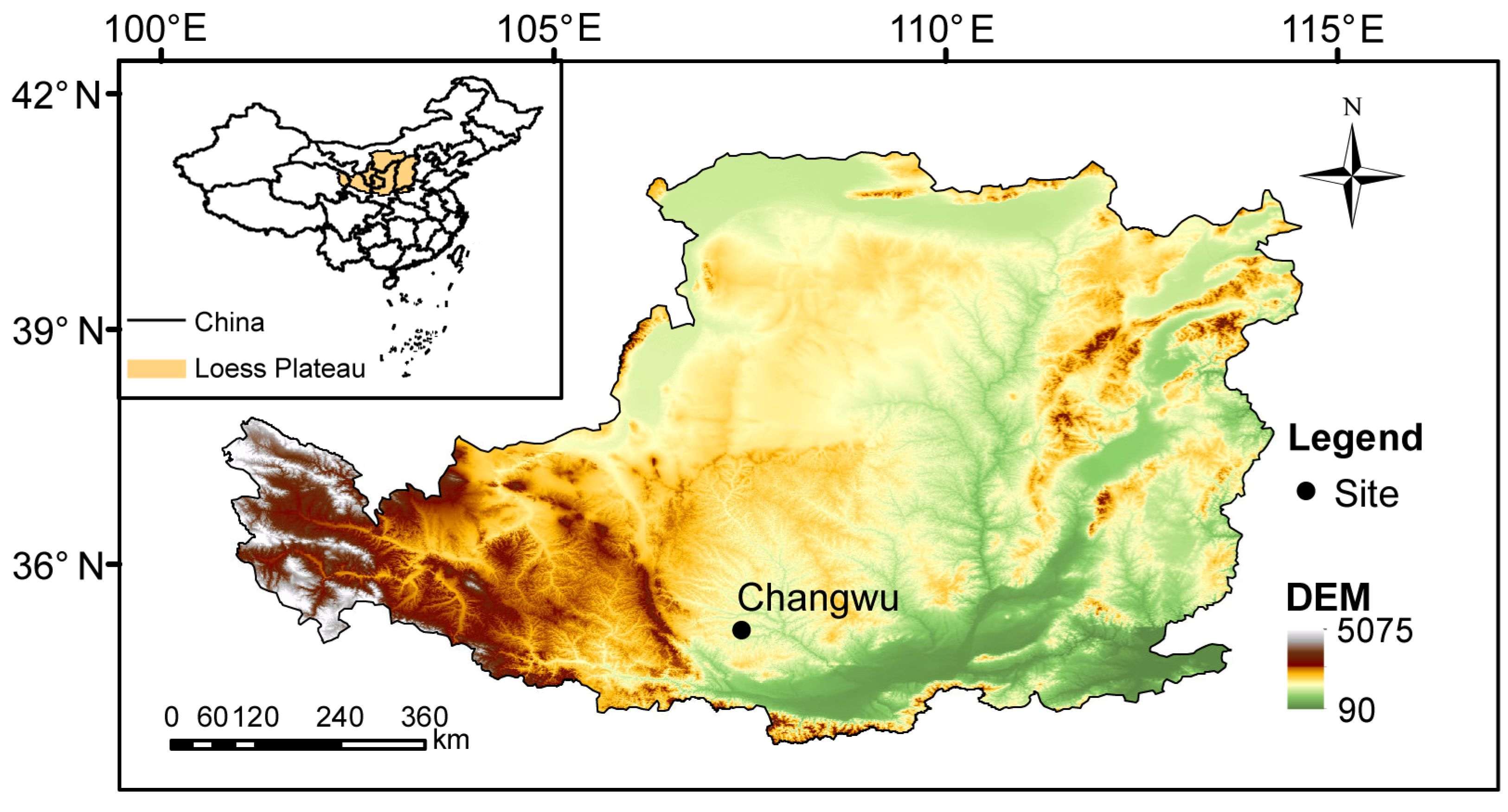
Figure 1. Location of the experimental site at the Changwu Agricultural and Ecological Experimental Station on the Loess Plateau, China. The inset map shows the location of the Loess Plateau within China, and the main map indicates the position of the study site.
Agronomy 16 00290 g001
Figure 2. The evapotranspiration of spring maize surface mulching and nitrogen application in 2019, 2020, and 2021. The x-axis represents combinations of mulching treatments (B, S, F) and N application (N0, N1, N2). The error bars represent the standard errors (n = 4). ** and ns indicate highly significant and non-significant effects (p < 0.01 and p ≥ 0.05, respectively) of surface mulching, nitrogen application, and their interaction. All statistical comparisons were conducted within the same year. Different letters indicate significant differences among N application within each mulching treatment, with capital letters referring to the pre-silking stage and lowercase letters referring to the post-silking stage (p < 0.05).
Agronomy 16 00290 g002
Figure 3. Available soil water storage (ASWS) at V10 and R1 stages under surface mulching and nitrogen application in 2020. The yellow dotted line and the red solid line represent the soil water content during V10 and R1, respectively. The blue and red numbers indicate a change in ASWS, with blue representing an increase and red a decrease. The black numbers represent residual water in the soil layer. The data represent the mean value (n = 4) for the same soil layer under different treatments for each growth stage.
Agronomy 16 00290 g003
Figure 4. Available soil water storage (ASWS) at V10 and R1 stages under surface mulching and nitrogen application in 2020. The yellow dotted line and the red solid line represent the soil water content during V10 and R1, respectively. The blue and red numbers indicate a change in ASWS, with blue representing an increase and red a decrease. The black numbers represent residual water in the soil layer. The data represent the mean value (n = 4) for the same soil layer under different treatments for each growth stage.
Agronomy 16 00290 g004
Figure 5. Available soil water storage (ASWS) at R1 and R3 stages under surface mulching and nitrogen application in 2020. The red dotted line and the yellow solid line represent the soil water content during R1 and R3, respectively. The blue and red numbers indicate a change in ASWS, with blue representing an increase and red a decrease. The black numbers represent residual water in the soil layer. The data represent the mean value (n = 4) for the same soil layer under different treatments for each growth stage.
Agronomy 16 00290 g005
Figure 6. Available soil water storage (ASWS) at R1 and R3 stages under surface mulching and nitrogen application in 2020. The red dotted line and the yellow solid line represent the soil water content during R1 and R3, respectively. The blue and red numbers indicate a change in ASWS, with blue representing an increase and red a decrease. The black numbers represent residual water in the soil layer. The data represent the mean value (n = 4) for the same soil layer under different treatments for each growth stage.
Agronomy 16 00290 g006
Figure 7. The phenology of spring maize under surface mulching and nitrogen application in 2019, 2020, and 2021. VE, V6, V10, R1, R3, and R6 denote the seedling emergence stage, six–leaf stage, ten–leaf stage, silking stage, milking stage, and physiological maturity stages, respectively. The numbers within the figure indicate the duration (days) between phenological stages.
Agronomy 16 00290 g007
Figure 8. Effects of surface mulching and nitrogen application on spring maize plant height, SPAD and LAI in 2019, 2020, and 2021. In the figure, the error bars represent the standard errors (n = 4). Different lowercase letters indicate significant differences among N application treatments (N0, N1, and N2) within the same mulching treatment and year at p < 0.05.
Agronomy 16 00290 g008
Figure 9. Effects of surface mulching and nitrogen application on aboveground biomass of spring maize in 2019 (ac), 2020 (df) and 2021 (gi). In the figure, the error bars represent the standard errors (n = 4). Within each year, growth stage, and N application treatment, * and ** indicate significant differences among mulching treatments at p < 0.05 and p < 0.01, respectively, while NS indicates no significant difference.
Agronomy 16 00290 g009
Figure 10. Effects of surface mulching and nitrogen application on spring maize grain yield in 2019, 2020, and 2021. In the figure, the error bars represent the standard errors (n = 4). Different lowercase letters indicate significant differences among N application treatments (N0, N1, and N2) within the same mulching treatment and year at p < 0.05; ** and *** indicate significant differences between different surface mulching at the p < 0.01 and p < 0.001 levels, respectively.
Agronomy 16 00290 g010
Figure 11. Effects of surface mulching and nitrogen application on spring maize WP in 2019, 2020, and 2021. In the figure, the error bars represent the standard errors (n = 4). Different lowercase letters indicate significant differences among N application treatments (N0, N1, and N2) within the same mulching treatment and year at p < 0.05; ** and *** indicate significant differences between different surface mulching at the p < 0.01 and p < 0.001 levels, respectively.
Agronomy 16 00290 g011
Table 1. Experimental treatments and crop management.
Treatment CodeMulchingN Application
BN0No mulchingNo application
BN1No mulchingSplit application of urea
BN2No mulchingControlled-release urea + urea (1:2)
SN0Straw mulchingNo application
SN1Straw mulchingSplit application of urea
SN2Straw mulchingControlled-release urea + urea (1:2)
FN0Plastic film mulchingNo application
FN1Plastic film mulchingSplit application of urea
FN2Plastic film mulchingControlled-release urea + urea (1:2)
Table 2. Precipitation and average temperature during different growth stages, and growth season precipitation and average temperature over the entire growing season for spring maize in 2019, 2020, and 2021.
GrowthPrecipitation (mm)Average Temperature (°C)
Stages201920202021201920202021
Sowing–VE68.435.227.412.7316.8116.26
VE–V670.821.448.416.9218.0218.86
V6–V1074.297.214.218.9420.2421.66
V10–R1186.883.484.821.8220.1322.60
R1–R379.9128.81123.3720.8322.91
R3–R6202.947.8275.216.9016.7917.92
Growing Season683413.846115.5017.6918.09
Disclaimer/Publisher’s Note: The statements, opinions and data contained in all publications are solely those of the individual author(s) and contributor(s) and not of MDPI and/or the editor(s). MDPI and/or the editor(s) disclaim responsibility for any injury to people or property resulting from any ideas, methods, instructions or products referred to in the content.