


Abstract
One of the factors contributing to the enhanced environmental sustainability of agroecosystems in Northern Kazakhstan is the introduction of intensive farming systems adapted to local climatic conditions. The application of zero-tillage technologies (hereinafter referred to as No-Till) offers several advantages, including the preservation of soil fertility. However, in Northern Kazakhstan, these technologies are currently used on relatively limited areas due to insufficient research and the long adaptation period required for their effective implementation. The aim of this study was to investigate the dynamics of soil organic matter (SOM) stocks under long-term No-Till management in two crop rotation systems. The study was conducted on ordinary chernozem soils of Northern Kazakhstan from 2014 to 2024, with monitoring of soil agrochemical, microbiological, and agrophysical properties, and was primarily exploratory in nature. The research was carried out at the experimental station (North Kazakhstan Region, Republic of Kazakhstan), located in the dry-steppe zone. The results showed that the long-term application of No-Till technology in crop rotation systems increased the soil humus balance by an average of 0.4–0.6%, whereas a decline in this indicator was observed under conventional farming systems. These findings were supported by correlation analysis of the interactions among the studied factors.
1. Introduction
One of the major challenges facing agricultural production in Northern Kazakhstan is the stabilization and enhancement of soil organic matter content; however, at the present stage, insufficient attention is being paid to this issue. According to the latest agrochemical survey conducted by the State Monitoring Center, soil fertility in the North Kazakhstan Region is characterized by a relatively low humus content of 4–5%, a correspondingly moderate level of readily hydrolysable nitrogen, low to very low phosphorus availability, and elevated potassium content. In terms of soil organic matter (humus), more than 95% of the region’s arable land is classified as having low to moderate contents (2.1–6.0%). Low humus content accounts for 39.0% of arable land, or 1817.9 thousand ha (no more than 4% humus), whereas moderate humus content is found on 58.4%, or 2720.2 thousand ha (4.1–6.0% humus). An annual decline in soil organic matter stocks of 0.5–0.8% has also been reported, resulting in a decrease of 5% or more over a 10-year period [1,2]. Furthermore, a long-term assessment of changes in soil humus stocks in the North Kazakhstan Region from 1989 to 2018 (30 years) revealed a decline of 20–35% relative to the initial content of 5.6–6.0% [3].
According to researchers, the main causes of declining soil fertility in Northern Kazakhstan include anthropogenic impacts, such as non-compliance with crop rotation practices, insufficient fertilizer application, and deep plowing, as well as natural factors, including climatic aridity, wind erosion, and desertification [4,5,6]. In addition to the degradation of the topsoil layer, other processes contribute to the deterioration of soil quality, resulting in approximately 25% of agricultural land worldwide currently being considered degraded [7]. Based on accumulated practical experience, agricultural practices that promote humus formation include diversified crop rotations, the use of cover crops, nitrogen-fixing legumes, plant species and cultivars with greater root biomass and deeper root systems, integration of livestock into cropping systems, agroforestry systems, retention of crop residues, and the application of amendments such as manure, compost, and biochar [8,9,10]. The application of resource-conserving No-Till technology is of particular importance for improving soil fertility. At the same time, its implementation alters interactions within the “crop–soil–environment” system [11,12].
The absence of mechanical soil disturbance under a No-Till system promotes humus accumulation under conditions where crop yields do not decline relative to plowing-based conventional farming systems. According to experimental data obtained in the Kurgan Region under similar soil and climatic conditions, after 42 years of regular plowing from 1968 to 2009, the humus content in the 0–20 cm layer of heavy loamy ordinary chernozem under an unfertilized grain–fallow rotation was 4.86%, compared with 5.29% under no-tillage conditions (+0.43%). With N40P20 fertilization, the corresponding values were 4.86 and 5.07% (+0.21%), respectively [13]. Moreover, according to some studies [14], the effects of No-Till on soil physical properties are comparable to those observed under perennial grasses, particularly in terms of improving soil structure and fertility, enhancing nutrient balance, controlling erosion, and stimulating biological processes.
Proper crop rotation is highly effective in promoting the accumulation of soil organic matter (SOM), as it contributes to the input of substantial amounts of organic biomass into the soil through root and crop residues. Observations indicate that diversified crop rotations incorporating perennial legumes and legume–grass mixtures for no more than two years, as well as grain legumes, are the most effective in promoting humus accumulation. In contrast, the inclusion of row crops in rotations or the use of grain–fallow rotation schemes results in a negative soil organic matter balance [15,16].
Thus, based on the above, it can be concluded that the existing problems of low soil organic matter stocks and the negative humus balance of ordinary chernozems in Northern Kazakhstan may be addressed through the widespread adoption of No-Till technology, provided that all essential components are considered, including optimal crop rotations, fertilizer application, and the use of high-performance agricultural machinery. Currently, these technologies are applied on only 10–15% of the total arable land in the North Kazakhstan Region and are mainly concentrated in the central and southern parts of the region, where annual precipitation does not exceed 250–300 mm. At the same time, experience from the North Kazakhstan Agricultural Experimental Station has demonstrated that during dry years, with 120–132 mm of precipitation during the growing season (and an average annual precipitation of 300–340 mm), crop yields under No-Till exceeded those under conventional tillage systems by 8.1–23.2% for wheat, 10.2–26.4% for grain legumes, and 7.6–27.5% for oilseed crops. These findings demonstrate the considerable potential of No-Till technology on the soils of Northern Kazakhstan, both as a means of stabilizing crop yields and as a strategy for enhancing and maintaining the environmental sustainability of agroecosystems.
Under the conditions of Northern Kazakhstan, No-Till represents a modern soil management system in which mechanical tillage is eliminated and the soil surface is uniformly covered with mulch consisting of shredded crop residues. Important structural components of the system include well-designed diversified crop rotation schemes, an integrated approach to plant protection, the replenishment of soil nutrients through fertilizer application, and the rational and professional use of external inputs [17]. In addition, this system reduces investment requirements for agricultural machinery, decreases labor requirements per hectare, lowers fuel consumption, and improves overall efficiency. Along with permanent pastures, No-Till can be regarded as one of the agricultural systems most closely resembling natural ecosystems [18,19,20].
At the current stage of agricultural technology development, no-till farming is gaining particular importance as a system that provides optimal conditions for crop production, reduces soil disturbance, and helps maintain the agroecological integrity of ecosystems [21,22]. To improve the efficiency of these systems, research has focused on developing optimal technical solutions, including direct seeding, crop residue chopping, and mulch distribution, as well as evaluating the effects of long-term no-till farming [23,24] and assessing the dynamics of its adoption in agricultural production [25], among other research areas. These studies reflect the growing interest in resource-conserving farming systems in both modern agricultural practice and scientific research. Furthermore, the adoption of no-till and other resource-conserving systems may contribute to addressing contemporary challenges associated with global climate change, water resource conservation, and increased production diversification [26]. Under the conditions prevailing in northern Kazakhstan, the adoption of no-till farming is becoming more of a necessity than an alternative, with the area under this system expanding annually across arid steppe and steppe plain regions. These developments have become the focus of in-depth research by Kazakhstani scientists, particularly regarding integrated crop protection systems, soil processes under no-till management, and the economic feasibility of these systems given the existing levels of resource availability and energy capacity in agricultural production [27,28,29].
A comprehensive assessment of the ecological functions of No-Till technology on ordinary chernozems of the steppe zone, including an in-depth evaluation of soil microbiological and agronomic parameters, will contribute to a better understanding of the importance of this technology in Northern Kazakhstan, both as a factor contributing to increased crop productivity and as a means of stabilizing humus stocks and associated soil processes.
The aim of this study was to assess the long-term effects of No-Till technology on soil organic matter dynamics under two diversified crop rotations and to evaluate associated changes in the agrochemical, microbiological, and agrophysical properties of the soil. To achieve this aim, several specific objectives were established:
- −
- To assess the dynamics of changes in total soil organic matter (humus) content under the long-term application of No-Till technology (more than 10 years);
- −
- To investigate the main parameters of humus group composition in crop rotations under No-Till management compared with a crop rotation under Traditional-Till (conventional farming system);
- −
- To evaluate the dynamics of key soil nutrients (nitrate nitrogen and available phosphorus) under the long-term application of No-Till technology;
- −
- To investigate changes in the main microbiological and agrophysical properties of the soil under the long-term application of No-Till technology.
2. Materials and Methods
2.1. Study Site and Experimental Conditions
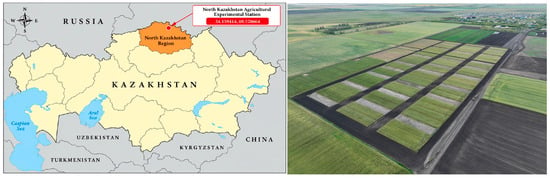
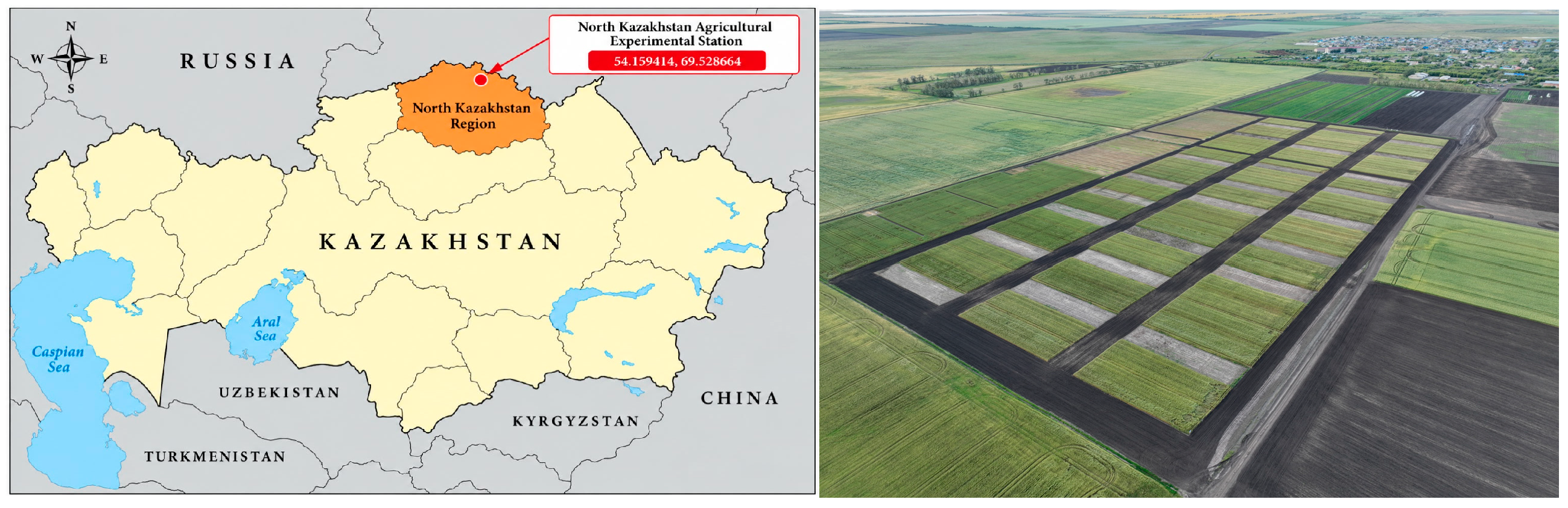
The study was conducted at the long-term field experimental site of the North Kazakhstan Agricultural Experimental Station LLP, located in the North Kazakhstan Region of Kazakhstan. The experimental site is situated within the dry-steppe zone of Northern Kazakhstan, characterized by a sharply continental climate with relatively low and unevenly distributed precipitation during the growing season (Figure 1).
Figure 1.
Geographic coordinates and overview of the experimental site (source: Google Earth, https://earth.google.com/web (accessed on 13 October 2026)).
The long-term average annual precipitation at the experimental site is approximately 360 mm, of which 70–75% occurs during the period from April to September. The period with mean daily air temperatures above 0 °C lasts approximately 125 days, while the sum of positive temperatures above +5 °C during the growing season ranges from 2300 to 2500 °C. The soils of the experimental site are classified as ordinary chernozems with a soil bonitet score of 65.
During the experimental period from 2014 to 2024, the mean annual precipitation was 414.8 mm, compared with the long-term average of 360 mm (15% above the long-term mean), while the mean annual air temperature was 2.4 °C, compared with the long-term average of 1.8 °C. Precipitation during the growing season amounted to 196.4 mm.
2.2. Experimental Design and Crop Rotation Systems
The experiment was established to evaluate the long-term effects of No-Till management and diversified crop rotations on soil organic matter and selected soil properties. Three crop rotation systems were compared: two rotations managed under No-Till and one rotation representing conventional tillage. The following crop rotations were evaluated: 1. PWRW—pea–wheat–rapeseed–wheat, managed under No-Till; 2. LWFW—lentil–wheat–flax–wheat, managed under No-Till; 3. FRWPW—mechanical fallow–rapeseed–wheat–pea–wheat, managed under conventional tillage and used as the control. The experimental treatments were arranged in 3 field replicates. The size of each experimental plot was 240 m2, and the total experimental area was 8 ha. The experiment was evaluated during the 2014–2024 period. For each crop rotation, soil and crop measurements were performed according to the same sampling and analytical procedures throughout the experimental period.
2.3. Crop Management and Field Operations
Crop management practices were selected according to the production conditions of Northern Kazakhstan and differed according to the tillage system.
Under No-Till management, crop residues were retained on the soil surface. Before sowing, weed control was performed using Tornado 500 (glyphosate) (August, Tatarstan, Russian Federation) at a rate of 2.5 L ha−1 in combination with dicamba at 0.5 L ha−1. Fertilization was performed using ammophos (Kazphosphate, Taraz, Republic of Kazakhstan) (N12:P52) at a rate of 120 kg ha−1. Seeds were treated with registered combined seed-treatment products at the manufacturer-recommended rates.
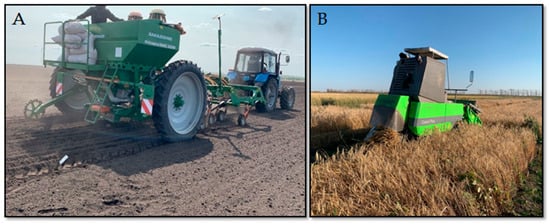
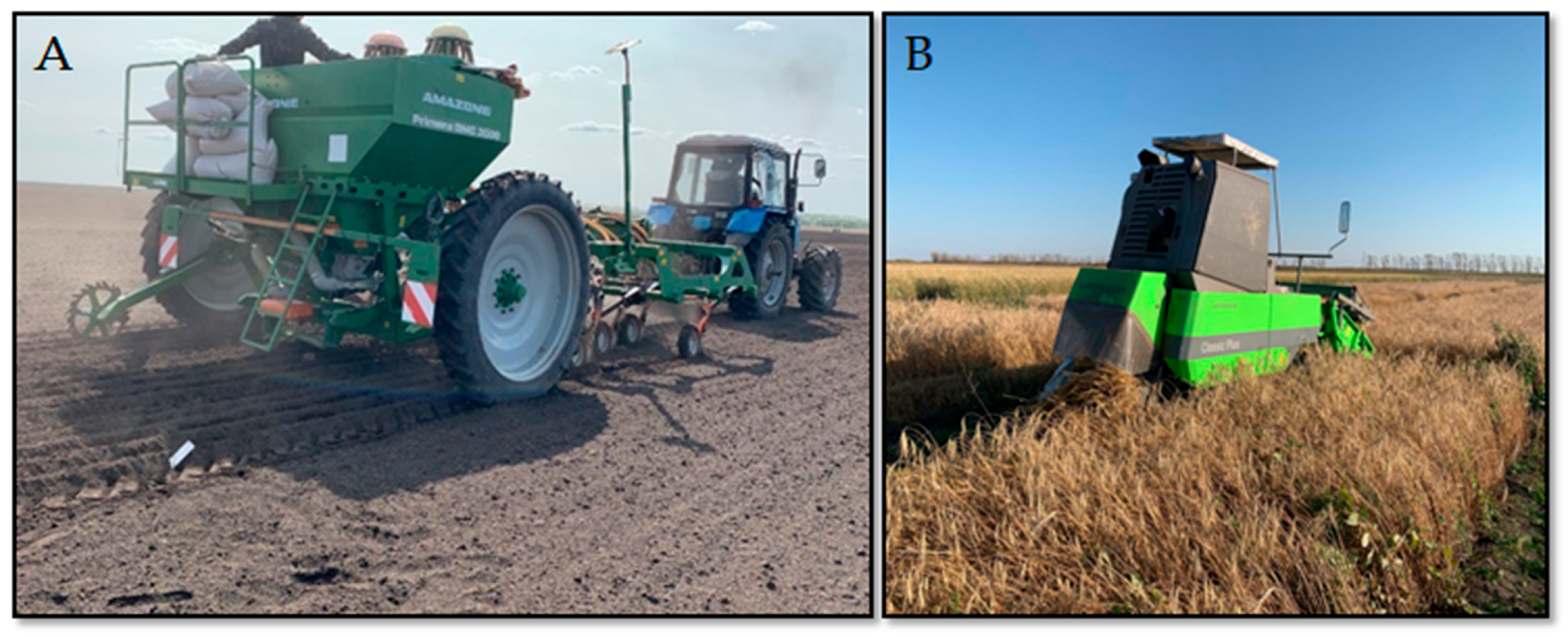
Sowing was performed using an Amazone DMC 3000 tine drill (Amazonen-Werke, Hasbergen, Germany) during the optimal sowing period, generally from 20 to 25 May. The seeding rates were 0.6–0.7 million viable seeds ha−1 for rapeseed, 3.5 million seeds ha−1 for wheat, 0.8 million seeds ha−1 for pea, 6.0–6.5 million seeds ha−1 for flax, and 2.2 million seeds ha−1 for lentil. Regionally adapted cultivars were used for all crops.
During the growing season, weed, disease, and pest control was performed using registered plant-protection products and tank mixtures according to the crop and phytosanitary conditions of the experimental plots. In the conventional-tillage rotation, soil preparation included. Spring harrowing was performed using a Veles harrow to distribute crop residues and conserve soil moisture. All crops were harvested using a Wintersteiger Classic plot combine (Wintersteiger AG, Ried, Austria) (Figure 2). Grain and seed yield were determined from each experimental plot.
Figure 2.
(A) Sowing of field experimental plots using an Amazone DMC 3000 tine-type direct drill, and (B) harvesting of measurement plots using a Wintersteiger Classic plot combine harvester.
2.4. Soil Sampling and Sample Preparation
Soil samples were collected from the 0–20 cm soil layer at the sowing stage and prior to crop harvesting throughout the study period. At each sampling point within each experimental plot, 12 soil cores were collected from each experimental plot and combined to obtain a composite sample. The number of sampling points per plot were five, and the total number of soil samples analyzed were 260.
Samples were transported to the laboratory, air-dried at 24–25 °C, gently crushed, and passed through a 2 mm sieve prior to chemical and biological analyses. For analyses requiring finer material, the soil was additionally ground and passed through a 0.25 mm sieve.
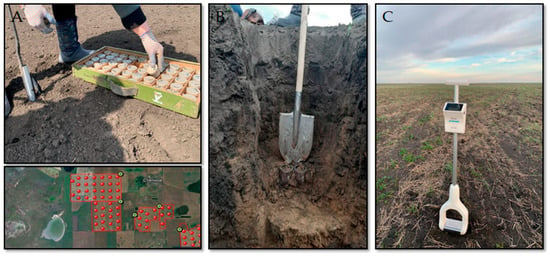
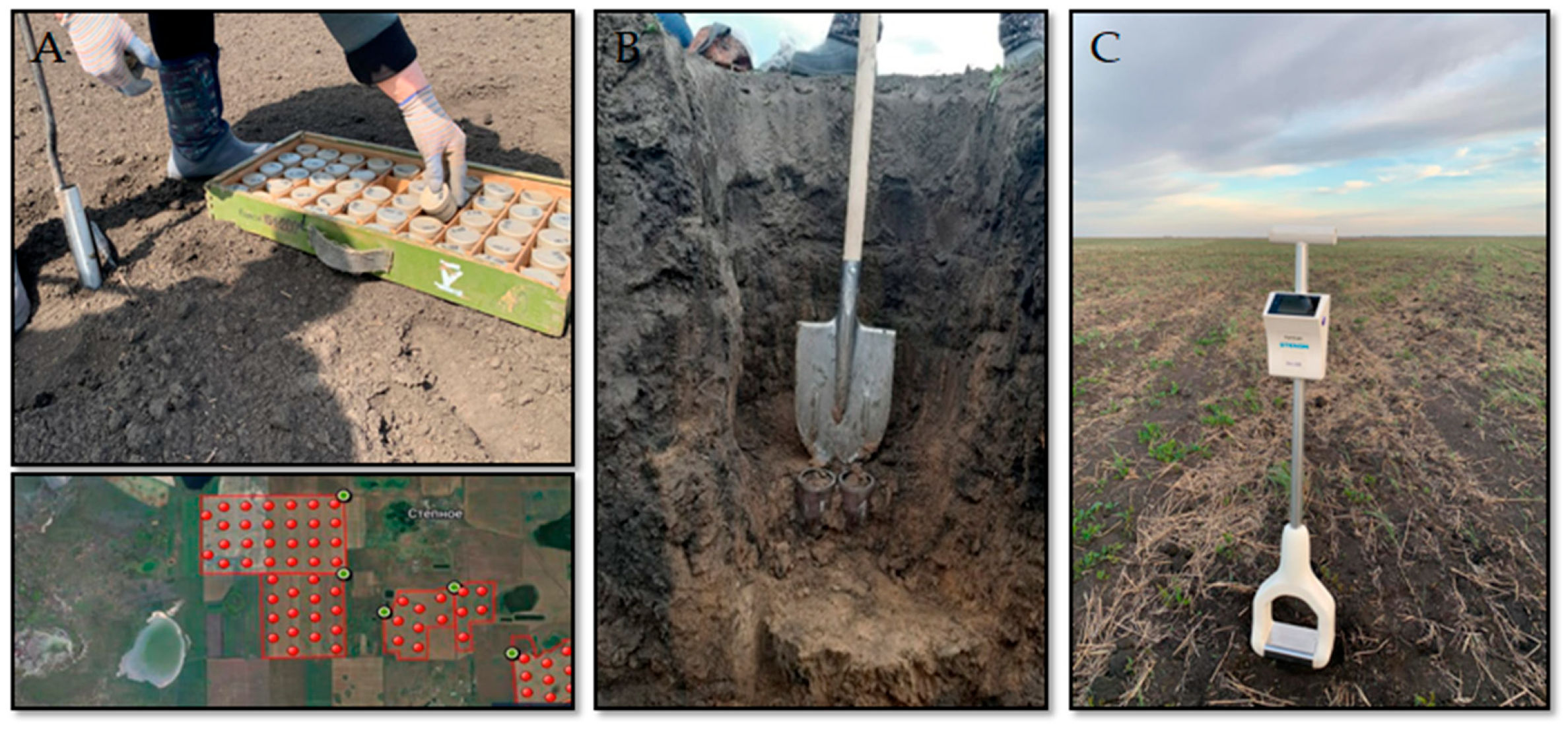
Soil bulk density was determined using the cylindrical ring method according to standard procedures. Undisturbed soil cores were collected from the 0–20 cm layer using sampling rings of known volume 132 cm3 (Figure 3). Bulk density was calculated as the ratio of oven-dry soil mass to the volume of the sampling ring and expressed in g cm−3.
Figure 3.
Field sampling of soil for agrochemical analyses: humus group composition (A), determination of soil bulk density (B), and determination of nitrogen, phosphorus, and humus contents (C). Red dots indicate predefined soil sampling points with geographic coordinates, while red boxes delineate designated sampling areas. The coordinates were used with a handheld GPS device to navigate to the sampling locations in the field.
2.5. Determination of Soil Organic Matter and Humus Composition
Soil organic matter/humus content was determined by the Tyurin method modified by TsINAO according to GOST 26213-91 [30]. Analyses were performed in 2014–2024. The composition of humus was characterized by determining the contents of labile carbon, humic acids, and fulvic acids. Labile organic carbon (C_lab) was determined using a potassium permanganate (KMnO4) solution, followed by optical density measurement and calculation [31]. Humic acid carbon (C_HA) and fulvic acid carbon (C_FA) were determined using the DSTU ISO 7855:2015 standard method [32]. The proportion of humic and fulvic acids was calculated from their respective carbon concentrations. The humic-to-fulvic acid ratio (HA/FA) was calculated as:
HA/FA = C_HA/C_FA
The soil carbon-to-nitrogen ratio (C:N) was calculated from the measured carbon and total nitrogen contents according to sulfochromic oxidation method in accordance with DSTU ISO 7855:2015 [32], while total nitrogen content was determined in accordance with GOST 26488-85 [33].
2.6. Determination of Soil Nutrients
Nitrate nitrogen (NO3−-N) was determined using the TsINAO method according to GOST 26488-85 [33]. Available phosphorus and potassium were determined using the Machigin method modified by TsINAO according to GOST 26205-91 [34]. The concentrations of nitrate nitrogen and available phosphorus were expressed as mg kg−1 of soil.
2.7. Determination of Soil CO2 Emissions and Biological Activity
Soil CO2 emission was determined using the absorption method for measuring soil respiration according to Sharkov (2025) [35]. Measurements were performed during the sowing period and after the harvest of the main crop, with the enclosure (chamber) left in place in the field for 24 h. CO2 emission was expressed as mg CO2 m−2. To assess the intensity of CO2 emissions during the growing season, the measurement results obtained during the sowing and harvesting periods were averaged to calculate the mean daily specific emission rate. The mean emission rate was calculated using the following formula:
where Ri is the emission rate measured at time point i, and n is the total number of measurements. This approach was used to obtain an average daily emission coefficient for the growing season [36].
Soil microbiological activity was assessed based on cellulolytic activity according to the method described by Nachimuthu et al. (2022) [37]. The cotton strip assay was used, in which strips of standardized linen fabric were vertically inserted into the soil to a depth corresponding to the main rooting zone (0–30 cm). The incubation period was 3 months, covering the entire growing season. The results were evaluated based on the percentage loss in fabric mass, calculated using the following equation:
where MA is soil microbiological activity (%), Winitial is the initial weight of the linen fabric, and Wsubincubated is the weight of the linen fabric after incubation.
MA = (Winitial − Wincubated) × 100%,
2.8. Determination of Soil CO2 Emissions and Biological Activity
The experimental data were statistically analyzed using multifactor analysis of variance (ANOVA) in Microsoft Excel and Statistica 10 software. Soil humus content was used as the primary response variable, while the structural components of humus (labile carbon, humic acids, and fulvic acids), changes in the major soil nutrients (nitrate nitrogen and available phosphorus), soil carbon dioxide emissions, microbiological activity, and soil bulk density were considered as additional factors. This approach made it possible to assess the contribution of each factor to humus formation and to estimate the associated experimental error. Relationships between soil humus content and soil properties were evaluated using Pearson’s correlation coefficients (r). The results were additionally visualized as heatmaps showing correlation coefficients at a significance level of p < 0.05. Pearson’s correlation analysis was considered appropriate because the data met the assumption of normality and the analysis was intended to evaluate linear relationships among the investigated soil properties. The analysis was performed using data averaged across years, while retaining three field replicates for each treatment combination.
2.9. Climatic Data and Additional Calculations
Meteorological data for the experimental period were obtained from the Shagalaly meteorological station (54.176462° N, 69.520838° E), which was considered representative of the study area. Annual precipitation, precipitation during the growing season, and mean air temperature recorded during 2014–2024 were compared with the corresponding long-term climatic averages for the study region. Where necessary, the percentage change relative to the long-term climatic values was calculated using the following formula:
Change (%) = [(experimental-period mean − long-term mean)/long-term mean] × 100.
3. Results
3.1. Long-Term Dynamics of Soil Humus Content
The long-term dynamics of soil humus content differed among the crop rotation systems during the 2014–2024 experimental period (Table 1).
Table 1.
Changes in soil humus content under different crop rotation systems between 2014 and 2024.
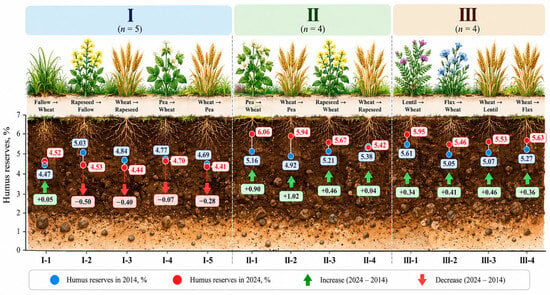
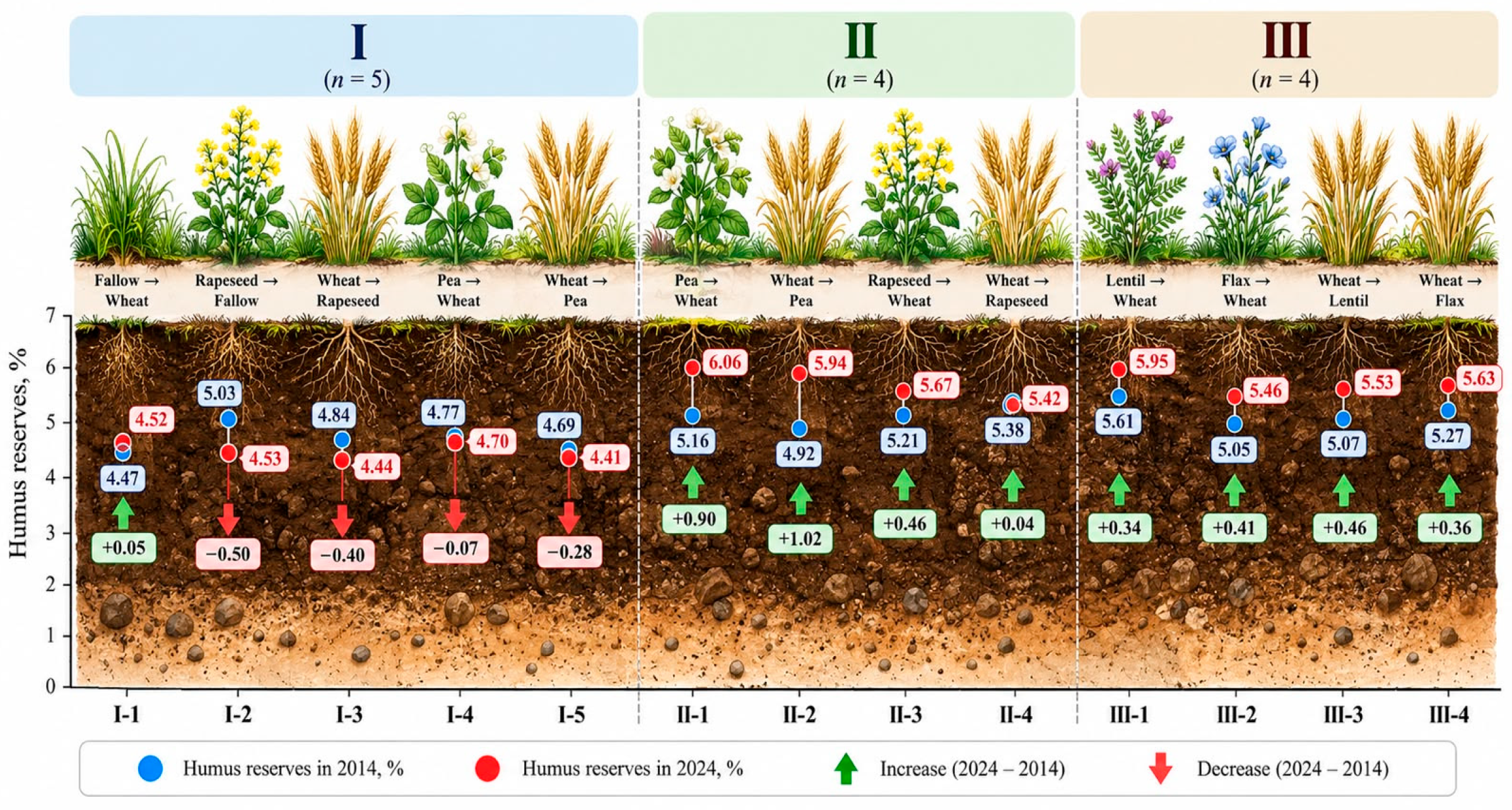
Under the conventional-tillage FRWPW rotation, humus content decreased in four of the five crop positions. The largest decrease was observed in rapeseed following fallow, from 5.03% in 2014 to 4.53% in 2024 (−0.50 percentage points), followed by wheat after rapeseed, from 4.84% to 4.44% (−0.40 percentage points). Humus content decreased by 0.07 percentage points in pea after wheat and by 0.28 percentage points in wheat after pea. In the fallow position following wheat, humus content increased slightly from 4.47% to 4.52% (+0.05 percentage points). The mean change in humus content across the FRWPW rotation was −0.24 percentage points.
In the PWRW No-Till rotation, humus content increased in all crop positions. The largest increases were observed in wheat after pea, from 4.92% to 5.94% (+1.02 percentage points), and pea after wheat, from 5.16% to 6.06% (+0.90 percentage points). Humus content increased from 5.21% to 5.67% (+0.46 percentage points) in rapeseed after wheat and from 5.38% to 5.42% (+0.04 percentage points) in wheat after rapeseed. The mean increase for the PWRW rotation was +0.61 percentage points.
In the LWFW No-Till rotation, humus content also increased in all crop positions. The increase ranged from +0.34 percentage points in lentil after wheat (5.61% to 5.95%) to +0.46 percentage points in flax after wheat (5.07% to 5.53%). Humus content increased by 0.36 percentage points in wheat after flax and by 0.41 percentage points in wheat after lentil. The mean increase for the LWFW rotation was +0.40 percentage points. Overall, mean humus content increased in both No-Till crop rotations, whereas a decrease was observed in the conventional FRWPW rotation (Figure 4).
Figure 4.
Changes in soil humus content under different crop rotation systems during the 2014–2024 experimental period.
3.2. Humus Group Composition and C:N Ratio
The composition of soil humus fractions in 2024 differed among the three crop rotation systems (Table 2).
Table 2.
Composition of soil humus fractions and C:N ratio in 2024.
The mean labile carbon content (C_lab) was 1.00% in the conventional FRWPW rotation, 1.13% in PWRW, and 1.20% in LWFW. Compared with the conventional rotation, C_lab was therefore 13.0% higher in PWRW and 20.0% higher in LWFW. The mean carbon content of humic acids (C_HA) was 0.74% in FRWPW, 0.78% in PWRW, and 0.80% in LWFW. Relative to FRWPW, the corresponding increases were 5.4% and 8.1% in PWRW and LWFW, respectively. The differences were more pronounced for fulvic acid carbon (C_FA). Mean C_FA content increased from 0.26% in FRWPW to 0.35% in PWRW and 0.40% in LWFW, corresponding to increases of 34.6% and 53.8%, respectively. Humic acids accounted for 74.0% of the sum of humic and fulvic acid carbon in FRWPW, compared with 69.0% in PWRW and 66.7% in LWFW. Consequently, the HA/FA ratio decreased from approximately 2.85 in FRWPW to 2.23 in PWRW and 2.00 in LWFW. The mean C:N ratio was 6.2:1 in FRWPW, 7.1:1 in PWRW, and 7.4:1 in LWFW. The highest C:N ratio at the individual crop-position level was 9.2:1. Overall, the No-Till rotations were characterized by higher contents of labile carbon, humic acid carbon, and particularly fulvic acid carbon, as well as higher C:N ratios than the conventional rotation.
3.3. Dynamics of Nitrate Nitrogen and Available Phosphorus
The concentrations of nitrate nitrogen and available phosphorus changed differently among the crop rotation systems during the 2014–2024 period (Table 3).
Table 3.
Dynamics of nitrate nitrogen and available phosphorus during 2014–2024.
In the conventional FRWPW rotation, mean nitrate nitrogen increased from 13.0 to 16.7 mg kg−1, corresponding to an increase of 3.7 mg kg−1. In contrast, available phosphorus decreased from 17.8 to 15.5 mg kg−1, representing a decrease of 2.3 mg kg−1 or 12.9%. In the PWRW No-Till rotation, nitrate nitrogen increased from 14.2 to 15.9 mg kg−1 (+1.7 mg kg−1), while available phosphorus increased from 21.2 to 28.3 mg kg−1 (+7.1 mg kg−1). In the LWFW No-Till rotation, nitrate nitrogen increased from 13.8 to 16.4 mg kg−1 (+2.6 mg kg−1), while available phosphorus increased from 20.5 to 25.2 mg kg−1 (+4.7 mg kg−1). The increase in available phosphorus was therefore approximately 33.5% in PWRW and 22.9% in LWFW. Nitrate nitrogen increased by approximately 12.0% and 18.8% in PWRW and LWFW, respectively. Thus, available phosphorus increased in both No-Till rotations but decreased in the conventional rotation, whereas nitrate nitrogen increased in all three crop rotation systems.
3.4. Soil CO2 Emission, Microbiological Activity, and Bulk Density
Soil CO2 emission, microbiological activity, and soil bulk density differed among the experimental treatments (Table 4).
Table 4.
Changes in the main microbiological and agrophysical soil parameters depending on the experimental treatments (North Kazakhstan Agricultural Experimental Station LLP; mean values for the 2014–2024 period).
At sowing, mean soil CO2 emission was 16.2 mg CO2 m−2 in the conventional FRWPW rotation, compared with 14.0 mg CO2 m−2 in PWRW and 13.5 mg CO2 m−2 in LWFW. Thus, the corresponding values in the No-Till rotations were 13.6% and 16.7% lower than in the conventional rotation. At harvest, mean soil CO2 emission was 8.4 mg CO2 m−2 in FRWPW, 6.0 mg CO2 m−2 in PWRW, and 5.9 mg CO2 m−2 in LWFW. Compared with FRWPW, the values were 28.6% lower in PWRW and 29.8% lower in LWFW. Microbiological activity measured over the four-month growing season was 15.2% in the conventional FRWPW rotation, compared with 23.2% in PWRW and 22.8% in LWFW. This represented increases of 52.6% and 50.0% relative to the conventional treatment, respectively.
At the individual crop-position level, microbiological activity in FRWPW ranged from 9.3% in fallow to 29.1% in rapeseed. The values for wheat after rapeseed, pea, and wheat after pea were 15.1%, 11.6%, and 10.7%, respectively. In PWRW, microbiological activity ranged from 15.6% in wheat after rapeseed to 31.8% in pea. The corresponding values for wheat after pea and rapeseed were 21.1% and 24.1%, respectively. In LWFW, microbiological activity ranged from 12.8% in wheat after flax to 33.2% in lentil. Values for wheat after lentil and flax were 21.5% and 23.7%, respectively.
Mean soil bulk density at sowing was 1.02 g cm−3 in FRWPW, 1.04 g cm−3 in PWRW, and 1.03 g cm−3 in LWFW. At harvest, bulk density increased to 1.07, 1.10, and 1.11 g cm−3, respectively. Compared with the conventional rotation, harvest-time bulk density was 2.8% higher in PWRW and 3.7% higher in LWFW. Across individual crop positions, harvest-time bulk density ranged from 1.02 to 1.13 g cm−3 in FRWPW, from 1.06 to 1.11 g cm−3 in PWRW, and from 1.08 to 1.14 g cm−3 in LWFW.
3.5. Relationships Between Soil Humus and Soil Properties
Pearson correlation analysis was used to assess relationships between soil humus content and selected soil properties (Table 5).
Table 5.
Pearson correlation coefficients between soil humus and selected soil properties.
Initial humus content in 2014 showed positive correlations with labile carbon (r = 0.76) and available phosphorus (r = 0.76). Positive correlations were also observed with soil bulk density (r = 0.47) and microbiological activity (r = 0.32), whereas the relationship with nitrate nitrogen was weaker (r = 0.16). Soil CO2 emission showed a negative correlation with initial humus content (r = −0.40).
In 2024, humus content was positively correlated with labile carbon (r = 0.72), microbiological activity (r = 0.54), soil bulk density (r = 0.47), nitrate nitrogen (r = 0.28), and available phosphorus (r = 0.78). A negative correlation was observed between humus content and soil CO2 emission (r = −0.69).
The change in humus content between 2014 and 2024 was positively correlated with labile carbon (r = 0.47), microbiological activity (r = 0.53), soil bulk density (r = 0.33), and available phosphorus (r = 0.56). Negative correlations were observed with soil CO2 emission (r = −0.68) and nitrate nitrogen (r = −0.50). Labile carbon was positively correlated with available phosphorus (r = 0.70), soil bulk density (r = 0.48), and microbiological activity (r = 0.31), while its correlation with CO2 emission was negative (r = −0.47).
Humic acid carbon showed relatively weak correlations with CO2 emission (r = 0.24), microbiological activity (r = 0.23), soil bulk density (r = −0.04), nitrate nitrogen (r = 0.23), and available phosphorus (r = 0.16). Fulvic acid carbon showed a strong negative correlation with CO2 emission (r = −0.80) and positive correlations with soil bulk density (r = 0.61) and available phosphorus (r = 0.66). Its correlations with microbiological activity and nitrate nitrogen were weak (r = 0.13 and r = −0.11, respectively).
3.6. Regression Relationships Between Humus Content and Soil Properties
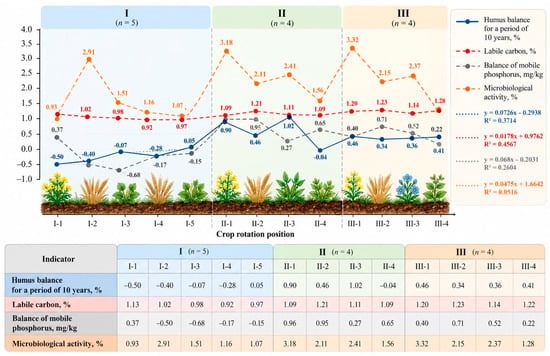
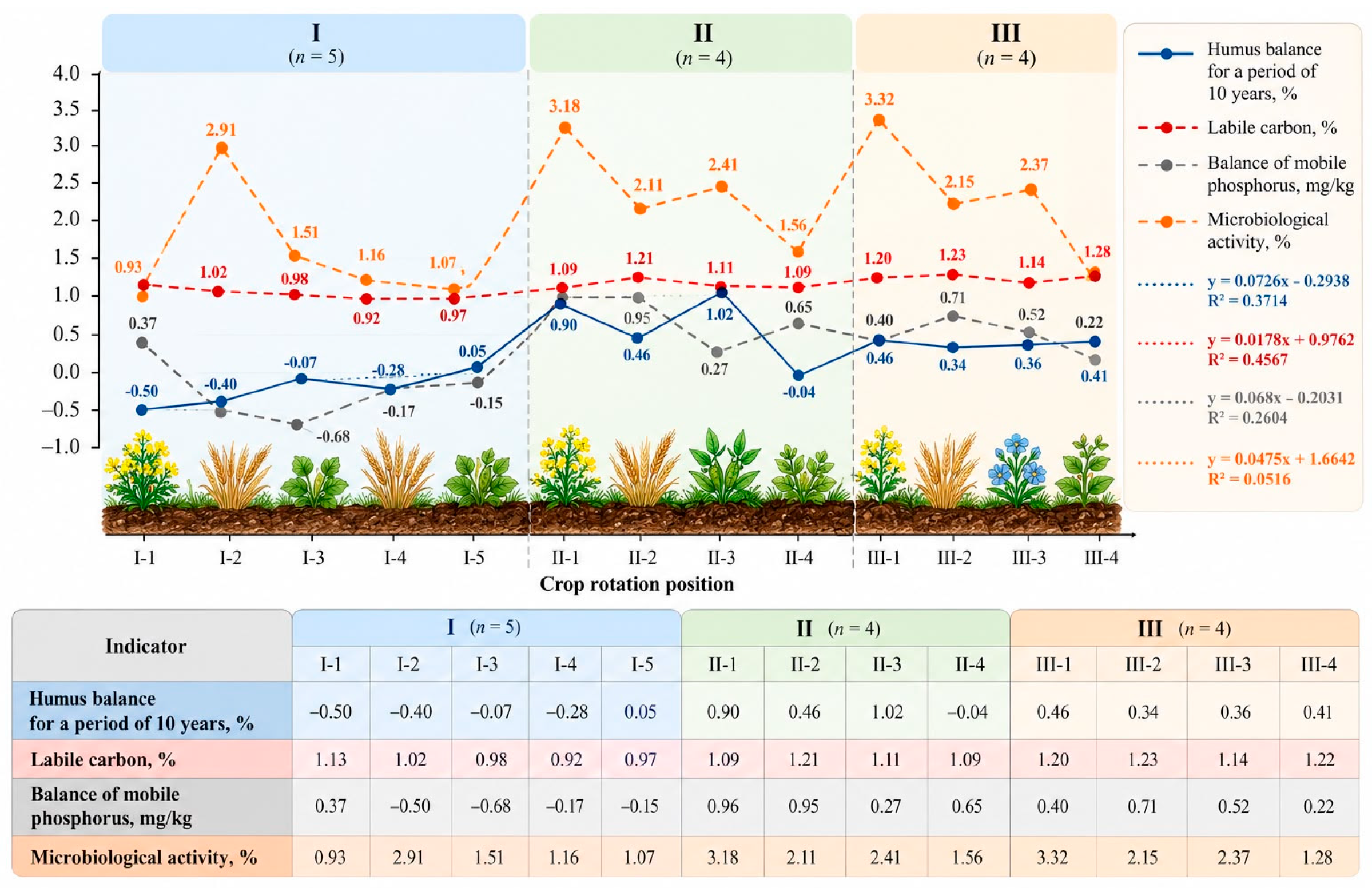
Regression analysis showed relationships between humus content and selected soil properties (Figure 5). The coefficients of determination for the relationships involving available phosphorus and soil carbon-related variables ranged from R2 = 0.26 to 0.45.
Figure 5.
Linear relationship between soil humus stock balance and the main factors influencing humification (North Kazakhstan Agricultural Experimental Station, North Kazakhstan Region). Experimental treatments: I—control crop rotation under Traditional-Till management (fields: I-1, fallow; I-2, rapeseed; I-3, wheat; I-4, pea; I-5, wheat); II—crop rotation under No-Till management (fields: II-1, pea; II-2, wheat; II-3, rapeseed; II-4, wheat); III—crop rotation under No-Till management (fields: III-1, lentil; III-2, wheat; III-3, flax; III-4, wheat).
The relationship between humus content and labile carbon was characterized by a maximum linear determination coefficient (R2) of 0.45, whereas the corresponding value for the humus balance was 0.37. A direct relationship between humus content and labile carbon or mobile phosphorus was described by a linear regression model with R2 values ranging from 0.26 to 0.45. In contrast, a weak correlation (R2 = 0.05) was observed between humus content and microbiological activity, indicating that the latter is a multiplicative parameter.
3.7. Integrated Relationships Among Soil Properties
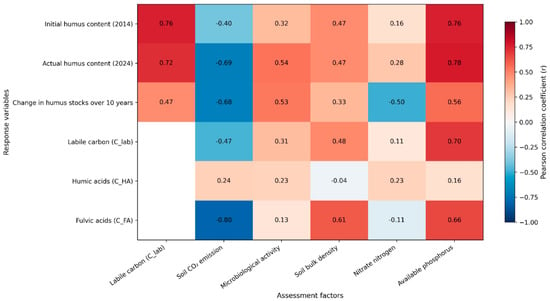
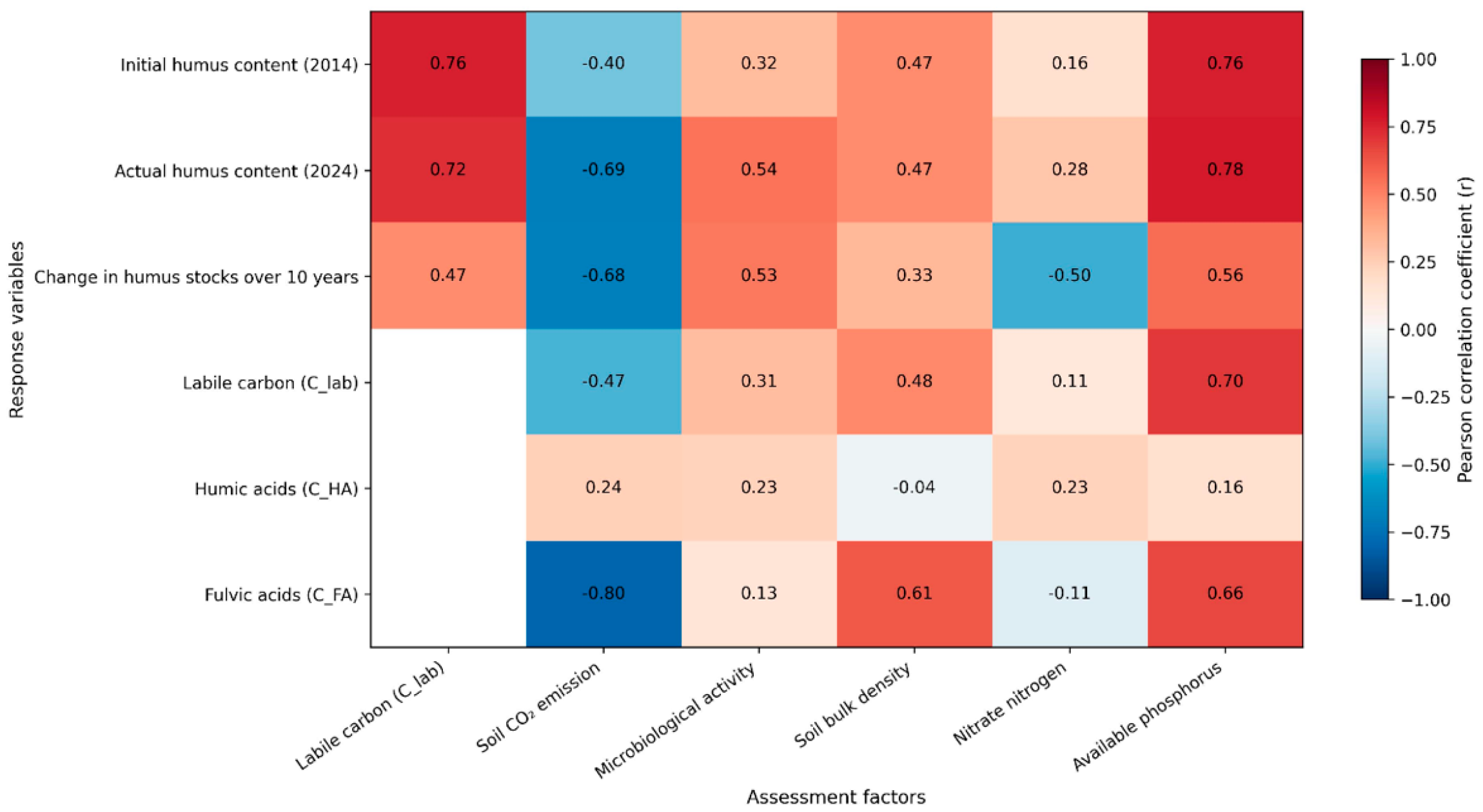
The correlation analysis was additionally visualized as a heatmap (Figure 6). The strongest positive associations with humus content were observed for available phosphorus (r = 0.78 in 2024) and labile carbon (r = 0.72), whereas humus change during 2014–2024 was positively associated with labile carbon (r = 0.47), microbiological activity (r = 0.53), and available phosphorus (r = 0.56).
Figure 6.
Heatmap of Pearson correlation coefficients between soil humus characteristics and selected soil properties.
Soil CO2 emission showed negative associations with humus content in 2024 (r = −0.69) and with the change in humus content over the experimental period (r = −0.68). The strongest relationship among the humus fractions and measured soil properties was observed between fulvic acid carbon and soil CO2 emission (r = −0.80), while fulvic acid carbon was positively correlated with available phosphorus (r = 0.66) and soil bulk density (r = 0.61).
4. Discussion
The results of the 2014–2024 field experiment demonstrated clear differences in the long-term dynamics of soil humus among the three crop rotation systems. Mean humus content increased under both No-Till rotations, by 0.61 percentage points in PWRW and 0.40 percentage points in LWFW, whereas the conventional FRWPW rotation showed a decrease of 0.24 percentage points. The positive changes observed under No-Till were also distributed across individual crop positions, with the largest increases occurring in pea and wheat following pea in the PWRW rotation and more uniform increases across the LWFW rotation.
The observed differences are consistent with the general role of reduced soil disturbance and residue retention in maintaining soil organic matter. Under No-Till, crop residues remain largely on the soil surface and provide a continuous source of organic substrates for microbial transformation and humus formation. Reduced mechanical disturbance can also limit the physical disruption of soil aggregates and exposure of protected organic matter to decomposition. These mechanisms have been widely discussed for conservation agriculture and long-term soil organic matter dynamics [38,39,40].
The stronger increase observed in PWRW compared with LWFW suggests that the effect of No-Till was additionally modified by crop rotation composition. The PWRW rotation included pea, whereas LWFW included lentil and flax. Grain legumes may contribute to greater organic matter accumulation through residue inputs and biological nitrogen fixation, while differences in residue quantity and quality among crop species can affect subsequent decomposition and humus formation. The particularly large increase in humus content in wheat following pea (+1.02 percentage points) indicates that the position of a crop within the rotation may be important for the redistribution and accumulation of soil organic matter.
The relatively small increase in humus content in wheat following rapeseed (+0.04 percentage points) in PWRW contrasts with the larger increases observed following pea. This pattern suggests that the crop-specific contribution to the soil organic matter balance may be important even when the overall tillage system remains unchanged. Rapeseed residues and nutrient removal associated with oilseed production may result in a different soil organic matter balance than that observed after grain legumes. The lower humus accumulation observed following rapeseed is consistent with the greater nutrient export and different residue characteristics associated with oilseed crops.
The decline in humus content under the conventional FRWPW rotation, particularly in rapeseed following fallow and wheat following rapeseed, indicates that conventional soil disturbance was associated with a less favorable long-term soil organic matter balance under the conditions of the experiment. The small increase observed in the fallow position should not be interpreted as evidence of an overall positive humus balance, because the mean value for the rotation declined over the experimental period.
The observed trend is comparable with the findings of Dubovik et al. [41], who reported higher humus contents under long-term No-Till compared with conventional management under similar soil and climatic conditions. In that study, the humus content under No-Till reached 5.40%, compared with 5.03% under conventional management, while differences among crop rotations were also associated with the presence of cruciferous and cereal crops. The agreement between these observations and the present experiment indicates that the positive effect of reduced tillage on soil organic matter can persist under the dry-steppe conditions of Northern Kazakhstan.
Climatic conditions during the experimental period should also be considered when interpreting the observed changes. Mean annual precipitation during 2014–2024 was 414.7 mm, compared with a long-term average of approximately 362 mm, while mean annual temperature was 2.4 °C, compared with a long-term average of 1.8 °C. Thus, precipitation was approximately 14.5% higher than the long-term average, while mean annual temperature was 0.6 °C higher. The relatively favorable moisture supply during the study period may have supported greater biomass production and organic residue input, potentially contributing to the observed accumulation of humus under No-Till. However, the long-term effect of management cannot be separated completely from interannual climatic variability.
The changes in total humus content were accompanied by differences in the composition of the humus fractions. Both No-Till rotations had higher contents of labile carbon, humic acid carbon, and fulvic acid carbon than the conventional FRWPW rotation. The increase was particularly pronounced for fulvic acid carbon, which was 34.6% higher in PWRW and 53.8% higher in LWFW than in the conventional treatment.
The greater concentration of labile carbon under No-Till indicates a larger pool of relatively available organic substrates. Such substrates can originate from crop residues, root-derived carbon, and microbial products and can serve as inputs for subsequent humification processes. The importance of plant-derived organic material as a source of carbon for soil biological processes and humus formation has been reported previously [42].
The differences in humic and fulvic acid fractions indicate that No-Till affected not only the quantity but also the composition of soil organic matter. In the conventional rotation, humic acids represented approximately 74% of the measured humic and fulvic acid carbon, whereas their proportion decreased to approximately 67–69% under No-Till because of the relatively greater increase in the fulvic acid fraction. Consequently, the HA/FA ratio was lower under both No-Till systems.
The formation and stabilization of humic substances depend on the quantity and quality of organic residues entering the soil, as well as on hydrothermal conditions, soil reaction, redox conditions, and biological activity [43]. The higher labile carbon and fulvic acid contents observed under No-Till may therefore reflect differences in the quantity and transformation of organic inputs under reduced soil disturbance.
The C:N ratio also differed among the systems, increasing from 6.2:1 in the conventional FRWPW rotation to 7.1:1 and 7.4:1 in PWRW and LWFW, respectively. The higher C:N ratios under No-Till indicate a relatively greater contribution of carbon-containing organic material to the soil organic matter pool. However, the absolute values remained relatively low compared with the commonly cited C:N range of approximately 10:1–12:1 for relatively stable organic residues or organic matter systems [44]. Therefore, the observed increase in C:N should be interpreted as a relative shift rather than evidence that the soil organic matter had reached an optimal C:N ratio.
The C:N ratio can affect the balance between mineralization and immobilization of nitrogen during decomposition. Thus, the differences among crop rotations may partly reflect differences in the quality of crop residues entering the soil. Nevertheless, C:N alone cannot be used to infer nitrogen losses or decomposition rates in the present experiment, because direct measurements of nitrogen mineralization, immobilization, or leaching were not performed.
The results therefore indicate that the long-term No-Till systems were associated with both greater humus accumulation and changes in the composition of the soil organic matter pool. The stronger changes observed in LWFW for labile and fulvic carbon suggest that crop identity and residue quality may modify the response of soil organic matter to No-Till management.
The dynamics of soil nutrients further differentiated the No-Till and conventional systems. Nitrate nitrogen increased in all three crop rotations during the experimental period, whereas available phosphorus increased under both No-Till systems but declined under conventional management. Thus, the response of phosphorus was more closely aligned with the observed differences in humus dynamics than the response of nitrate nitrogen.
The increase in available phosphorus was particularly pronounced in PWRW, where the mean concentration increased by 7.1 mg kg−1, compared with 4.7 mg kg−1 in LWFW. In contrast, available phosphorus in FRWPW decreased by 2.3 mg kg−1. These differences indicate that the long-term nutrient balance was affected by both tillage system and crop rotation composition.
The positive relationship between humus content and available phosphorus was also supported by the correlation analysis. Humus content in 2024 was strongly positively correlated with available phosphorus (r = 0.78), while the change in humus content during 2014–2024 was also positively correlated with available phosphorus (r = 0.56). Labile carbon showed a similar positive relationship with available phosphorus (r = 0.70).
Organic matter can influence phosphorus retention and availability through several mechanisms, including the contribution of organic phosphorus, interactions with mineral surfaces, and stimulation of microbial processes involved in phosphorus cycling [45]. Therefore, the higher available phosphorus concentrations under No-Till may be associated with the greater organic matter and labile carbon pools observed in these systems.
However, the positive relationship should not be interpreted as evidence that increased humus directly caused the observed increase in available phosphorus. Phosphorus availability is controlled by multiple processes, including fertilizer inputs, crop uptake, mineral reactions, organic matter turnover, and microbial transformation. The present experiment demonstrates an association between these variables rather than a direct causal relationship.
The increase in nitrate nitrogen was different from that of phosphorus. Nitrate nitrogen increased in all three systems, including the conventional rotation. The largest increase in the conventional system was associated with the fallow position. This suggests that the absence of crop uptake during fallow can influence the accumulation of mineral nitrogen. Consequently, the positive change in nitrate nitrogen in FRWPW should not be interpreted as evidence of an overall improvement in soil fertility comparable to the response of available phosphorus under No-Till.
Previous studies have shown that crop residues can influence nitrogen immobilization and subsequent mineralization depending on residue quantity and quality [46]. Differences in crop composition, particularly the inclusion of grain legumes, may therefore contribute to the contrasting nutrient dynamics observed among the rotations. Overall, the nutrient data support the conclusion that diversified No-Till rotations were associated with a more favorable phosphorus balance than conventional management. The relationship between phosphorus availability, labile carbon, and humus content further suggests that changes in soil organic matter were accompanied by broader changes in soil nutrient cycling.
The biological and agrophysical measurements provided additional evidence of differences between the conventional and No-Till systems. Mean soil CO2 emission at sowing and harvest was lower under both No-Till rotations than under the conventional rotation, while microbiological activity during the four-month growing season was substantially higher under No-Till.
The lower CO2 emission measured under No-Till should be interpreted carefully. Soil CO2 flux represents the combined contribution of root respiration, microbial respiration, and decomposition of organic substrates and therefore cannot by itself be equated directly with total soil carbon loss. Nevertheless, the lower measured CO2 emission at sowing and harvest, together with the greater humus and labile carbon contents under No-Till, indicates a different pattern of carbon cycling compared with conventional management.
Previous studies have associated intensive soil disturbance with greater aeration and exposure of physically protected organic matter, which can stimulate decomposition and CO2 release [47,48]. Under conservation agriculture, residue retention and reduced soil disturbance can alter the physical protection of organic matter and the distribution of carbon within soil aggregates [49].
The higher microbiological activity under No-Till was particularly pronounced in the grain-legume positions. Microbiological activity reached 31.8% in pea and 33.2% in lentil, compared with 11.6% in pea under FRWPW and 9.3% in fallow. The higher activity in legume-containing systems may reflect greater availability of organic substrates and differences in rhizosphere inputs. The positive correlation between microbiological activity and the change in humus content (r = 0.53) is consistent with a close association between biological activity and long-term soil organic matter dynamics.
The relationship should nevertheless be interpreted as associative rather than causal. Microbial activity contributes to decomposition and transformation of organic material, but the measured activity itself is also affected by substrate availability, moisture, temperature, crop residues, and nutrient status.
Soil bulk density increased slightly under No-Till, particularly at harvest, reaching mean values of 1.10–1.11 g cm−3 compared with 1.07 g cm−3 under conventional management. The higher bulk density is consistent with the absence of repeated mechanical soil loosening under No-Till. However, the measured values remained within the range reported as favorable for chernozem soils under agricultural use [50]. Therefore, the moderate increase in bulk density did not coincide with a decline in humus accumulation or microbiological activity. The results support the view that the response to No-Till should not be evaluated using a single soil property. Changes in biological activity, organic matter fractions, nutrient availability, and bulk density occurred simultaneously and differed according to crop rotation composition.
The correlation analysis showed that humus content was most strongly and positively associated with labile carbon and available phosphorus, while changes in humus content were positively associated with microbiological activity (r = 0.53) and negatively associated with soil CO2 emission (r = −0.68). The strong relationship between humus and labile carbon reflects the contribution of active organic matter pools to overall soil organic matter dynamics, whereas the positive association with available phosphorus indicates a close relationship between organic matter status and nutrient availability.
The negative correlations with CO2 emission should be interpreted cautiously, as soil CO2 flux reflects several processes and does not directly represent the complete soil carbon balance. Similarly, the observed correlations indicate associations rather than causal relationships. Regression analysis showed that individual soil properties explained only part of the variation in humus content (R2 = 0.26–0.45), supporting the multifactorial nature of humus dynamics.
Overall, long-term No-Till combined with diversified crop rotations was associated with greater humus accumulation, higher labile carbon and available phosphorus, increased microbiological activity, and lower measured CO2 emission. The PWRW rotation showed the greatest mean increase in humus, whereas LWFW demonstrated a more uniform response and greater increases in labile and fulvic acid carbon. These findings support the potential of diversified No-Till systems to improve soil organic matter and selected indicators of soil fertility under the dry-steppe conditions of Northern Kazakhstan. However, further measurements of carbon inputs, soil carbon stocks, nutrient cycling, and crop productivity are required to establish the underlying mechanisms and long-term carbon balance.
5. Conclusions
Long-term No-Till combined with diversified crop rotations improved soil organic matter and selected soil fertility indicators under the dry-steppe conditions of Northern Kazakhstan. Mean humus content increased by 0.61 and 0.40 percentage points in the PWRW and LWFW rotations, respectively, compared with a 0.24 percentage-point decrease under conventional tillage. No-Till was also associated with higher labile carbon, available phosphorus, and microbiological activity, together with lower measured soil CO2 emission. The PWRW rotation showed the greatest overall increase in humus content, whereas LWFW demonstrated a consistent improvement in soil organic matter quality. These results indicate that diversified No-Till systems can contribute to the maintenance and improvement of soil fertility in the dry-steppe zone. Further research should quantify carbon inputs and stocks, nutrient cycling, and crop productivity to assess their long-term sustainability.
Author Contributions
Conceptualization, O.S. and K.A.; methodology, O.S., V.Z. and K.A.; validation, O.S., V.Z. and B.K.; formal analysis, O.S., V.Z. and V.K.; investigation, O.S., K.A., and B.K.; resources, O.S. and V.Z.; data curation, O.S. and K.A.; writing—original draft preparation, O.S., K.A. and V.K.; writing—review and editing, O.S., V.Z. and V.K.; visualization, O.S., K.A. and B.K.; supervision, O.S. and V.Z.; project administration, O.S. All authors have read and agreed to the published version of the manuscript.
Funding
The research was carried out with financial support from the Ministry of Agriculture of the Republic of Kazakhstan BR22885719 “Development and Implementation of Sustainable Farming Systems for Profitable Agricultural Production under a Changing Climate in Different Soil and Climatic Zones of Kazakhstan” (2024–2026).
Informed Consent Statement
Not applicable.
Data Availability Statement
The data are contained within this article.
Conflicts of Interest
The authors declare no conflicts of interest.
References
- Pashkov, S.V.; Baybusinova, S.B. Natural and agrogene conditionality of soils fertility in Northern Kazakhstan. Transbaikal State Univ. J. 2017, 23, 16–27. [Google Scholar] [CrossRef] [Scilit]
- Bazilzhanov, E.K. State of Arable Land in Kazakhstan. Land Resources of Kazakhstan. 2016. Available online: https://prg.kz/document/?doc_id=38328225 (accessed on 20 September 2026).
- Lebed, L.; Yeserkepova, I. Environmental monitoring of cultivated lands within the national greenhouse gas inventory system. Hydrometeorol. Ecol. 2023, 1, 156–158. [Google Scholar]
- Belgibayev, M.E. Problems of soil conservation in the steppe zone of Kazakhstan. Steppes of Northern Eurasia. In Proceedings of the IX International Symposium; International Society for Horticultural Science: Leuven, Belgium, 2021; Volume 9, pp. 120–124. [Google Scholar] [CrossRef] [Scilit]
- Almanova, Z.; Kenzhegulova, S.; Kashkarov, A.; Kekilbayeva, G.; Ussalinov, E.; Yerzhan, D.; Zhakenova, A.; Zvyagin, G. Changes in Soil Fertility Indicators after Long-Term Agricultural Use in Northern Kazakhstan. Int. J. Des. Nat. Ecodynamics 2023, 18, 1045–1053. [Google Scholar] [CrossRef] [Scilit]
- Schwarzer, S.; Schmidt, H.P. Humus Enrichment of Soils. In 3 Degrees More; Wiegandt, K., Ed.; Springer: Cham, Switzerland, 2024; pp. 205–224. [Google Scholar] [CrossRef] [Scilit]
- Shokri, N.; Robinson, D.; Afshar, M.; Alewell, C.; Aminzadeh, M.; Arthur, E.; Broothaerts, N.; Campbell, G.; Eklund, L.; Gupta, S.; et al. Rethinking Global Soil Degradation: Drivers, Impacts, and Solutions. Rev. Geophys. 2025, 63, e2025RG000883. [Google Scholar] [CrossRef] [Scilit]
- Al-Musawi, Z.K.; Vona, V.; Kulmány, I.M. Utilizing Different Crop Rotation Systems for Agricultural and Environmental Sustainability: A Review. Agronomy 2025, 15, 1966. [Google Scholar] [CrossRef] [Scilit]
- Țopa, D.; Căpșună, S.; Calistru, A.; Ailincăi, C. Sustainable Practices for Enhancing Soil Health and Crop Quality in Modern Agriculture: A Review. Agriculture 2025, 15, 998. [Google Scholar] [CrossRef] [Scilit]
- Lal, R. Soil organic matter and water retention. Agron. J. 2020, 112, 3265–3277. [Google Scholar] [CrossRef] [Scilit]
- Du, C.; Li, L.; Effah, Z. Effects of Straw Mulching and Reduced Tillage on Crop Production and Environment: A Review. Water 2022, 14, 2471. [Google Scholar] [CrossRef] [Scilit]
- Irmak, S.; Kukal, M.S.; Mohammed, A.T.; Djaman, K. Disk-till vs. no-till maize evapotranspiration, microclimate, grain yield, production functions and water productivity. Agric. Water Manag. 2019, 216, 177–195. [Google Scholar] [CrossRef] [Scilit]
- Gilev, S.D.; Tsymbalenko, I.N.; Surkova, Y.V.; Nesterova, E.V. Dynamics of soil fertility under spring wheat cultivation in crop rotations and continuous cropping, depending on fertilization and tillage systems. Zemledelie 2017, 4, 22–26. [Google Scholar]
- Singh, N. Perenniality Impacts on Soil Physical and Hydraulic Properties and Ecosystem Services: A Review. Sustainability 2025, 17, 10988. [Google Scholar] [CrossRef] [Scilit]
- Zou, Y.; Liu, Z.; Chen, Y.; Wang, Y.; Feng, S. Crop Rotation and Diversification in China: Enhancing Sustainable Agriculture and Resilience. Agriculture 2024, 14, 1465. [Google Scholar] [CrossRef] [Scilit]
- Skinulienė, L.; Marcinkevičienė, A.; Dorelis, M.; Boguzas, V. The Effect of Long-Term Crop Rotations for the Soil Carbon Sequestration Rate Potential and Cereal Yield. Agriculture 2024, 14, 483. [Google Scholar] [CrossRef] [Scilit]
- Nurbekov, A.; Kosimov, M.; Islamov, S.; Khaitov, B.; Qodirova, D.; Yuldasheva, Z.; Khudayqulov, J.; Ergasheva, K.; Nurbekova, R. No-till, crop residue management and winter wheat-based crop rotation strategies under rainfed environment. Front. Agron. 2024, 6, 1453976. [Google Scholar] [CrossRef] [Scilit]
- Dang, Y.; Page, K.; Dalal, R.; Menzies, N. No-Till Farming Systems for Sustainable Agriculture: An Overview; Springer: Berlin/Heidelberg, Germany, 2020. [Google Scholar] [CrossRef] [Scilit]
- Korzhuk, A.B.; Vidyakin, A.V. Economic efficiency of no-till technology. Econ. Entrep. 2020, 8(121), 1106–1109. [Google Scholar] [CrossRef] [Scilit]
- Bertrand, S.; Roberts, A.-S.; Walker, E. No-Till Farming Improves Soil Health and Mitigates Climate Change. Agriculture and Climate Series. 2022. Available online: https://www.eesi.org/articles/view/no-till-farming-improves-soil-health-and-mitigates-climate-change (accessed on 10 September 2026).
- Miao, L.; Xiaoli, W.; Ming, L.; Tao, X.; Chaosu, L.; Yonglu, T. Innovative no-till seeding technology improves yield and nitrogen use efficiency while reducing environmental pressure in wheat after rice harvesting. Soil Tillage Res. 2024, 235, 105908. [Google Scholar] [CrossRef] [Scilit]
- Tereshchenko, A.; Tarabrina, A.M. Performance of grain and leguminous crops under resource saving cultivation technology in the Southern Steppe of Ukraine. Ukr. Black Sea Reg. Agrar. Sci. 2025, 29, 72–83. [Google Scholar] [CrossRef] [Scilit]
- Ma, Y.; Li, Z.; Xu, Y.; Li, C.; Ding, H.; Li, C.; Tang, Q.; Liu, M.; Hou, J. The Development of No-Tillage Seeding Technology for Conservation Tillage—A Review. Sustainability 2025, 17, 1808. [Google Scholar] [CrossRef] [Scilit]
- McBeath, T.; Davies, S.; Kirkegaard, J. Never say never: The interdependence of no-till and strategic deep tillage in sustainable production systems. Crop Environ. 2026, 5, 100130. [Google Scholar] [CrossRef] [Scilit]
- Sun, H.; Upadhaya, S.; Morris, C.; Arbuckle, J.; Nowatzke, L.; Zhu, Z. The Flux of Agricultural Conservation: Understanding Changes in Iowa Farmers of Cover Cultures and No-Till and Till and Times over time. Soc. Nat. Resour. 2026, 39, 200–219. [Google Scholar] [CrossRef] [Scilit]
- Thapa, B.; Dura, R. A review on tillage system and no-till agriculture and its impact on soil health. Arch. Agric. Environ. Sci. 2024, 9, 612–617. [Google Scholar] [CrossRef] [Scilit]
- Usmanov, A.; Seipataliev, O. Analysis of agrotechnologies for soil tillage. Izdenister Natijeler 2025, 4, 161–172. [Google Scholar] [CrossRef] [Scilit]
- Kunupiyayeva, G.T.; Zhapayev, R.K.; Bastaubayeva, S.O.; Ashirbekov, M.Z.; Didorenko, S.V.; Kushanova, R.Z.; Zhapparova, A.A. Features of the growth and development of field crops under various soil tillage methods. Sci. Educ. 2025, 4, 111–128. [Google Scholar] [CrossRef] [Scilit]
- Yeleuov, B.M.; Kalimov, N.Y.; Zharlygassov, Z.B.; Nugmanov, A.B. Biological and economic effectiveness of herbicides for no-till agriculture. 3i Intellect. Idea Innov. 2024, 2, 46–54. [Google Scholar] [CrossRef] [Scilit]
- GOST 26213-91; Soils. Methods for Determination of Organic Matter. Standards Publishing House: Moscow, Russia, 1992. Available online: https://internet-law.ru/gosts/gost/10564/ (accessed on 26 April 2014).
- Weil, R.R.; Islam, K.R.; Stine, M.A.; Gruver, J.B.; Samson-Liebig, S.E. Estimating active carbon for soil quality assessment: A simplified method for laboratory and field use. Am. J. Altern. Agric. 2003, 18, 3–17. [Google Scholar] [CrossRef] [Scilit]
- Soil Quality. Determination of Humus Group Composition by the Tyurin Method as Modified by Kononova and Belchikova. Available online: https://online.budstandart.com/ua/catalog/doc-page.html?id_doc=62737 (accessed on 20 April 2014).
- GOST 26488-85; Soils. Determination of Nitrates by CINAO Methods. Izdatelstvo Standartov: Moscow, Russia, 1987. Available online: https://internet-law.ru/gosts/gost/20472/ (accessed on 12 April 2014).
- GOST 26205-91; Soils. Determination of Mobile Compounds of Phosphorus and Potassium by Machigin Method Modified by CINAO. Izdatelstvo Standartov: Moscow, Russia, 1992. Available online: https://internet-law.ru/gosts/gost/10373/ (accessed on 15 April 2013).
- Sharkov, I.N. Methodology of quantitative determination of soil respiration in field conditions. Soils Environ. 2025, 8, e334. [Google Scholar] [CrossRef] [Scilit]
- Goncharova, O.Y.; Matyshak, G.; Bobrik, A. Diurnal dynamics of soil CO2 emission in typical biogeocenoses of northern Western Siberia. Mosc. Univ. Bull. 2026, 81, 211–220. [Google Scholar] [CrossRef] [Scilit]
- Nachimuthu, G.; Hundt, A.; Palmer, B.; Schwenke, G.D.; Knox, O.G. Cotton strip assay detects soil microbial degradation differences among crop rotation and tillage experiments on Vertisols. J. Microbiol. Methods 2022, 200, 106558. [Google Scholar] [CrossRef] [Scilit] [PubMed]
- Derpsch, R.; Kassam, A.; Reicosky, D.; Friedrich, T.; Calegari, A.; Basch, G.; Gonzalez-Sanchez, E.; dos Santos, D. Nature’s Laws of Declining Soil Productivity and Conservation Agriculture. Soil Secur. 2024, 14, 100127. [Google Scholar] [CrossRef] [Scilit]
- Kiryushin, V.I. Greening of Agriculture and Technological Policy; MSKhA Publishing House: Moscow, Russia, 2000; 473p, Available online: https://j.twirpx.link/file/3638891/ (accessed on 21 March 2025).
- Li, Y.; Qingping, Z.; Cai, Y.; Yang, Q.; Chang, S. Minimum tillage and residue retention increase soil microbial population size and diversity: Implications for conservation tillage. Sci. Total Environ. 2020, 716, 137164. [Google Scholar] [CrossRef] [Scilit] [PubMed]
- Dubovik, E.V.; Dubovik, D.V. The change in the macrostructural state of chernozem typical for various technologies of winter wheat cultivation. Agrar. Sci. 2025, 2, 123–128. [Google Scholar] [CrossRef] [Scilit]
- Gusev, V.N.; Kenenbayev, S.B.; Amangaliev , B.M.; Sagimbaeva, A.M.; Rustemova, K.U. Use of straw in dryland farming in southeastern Kazakhstan. Soil Sci. Agrochem. 2025, 3, 107–114. [Google Scholar]
- Tiwari, J.; Ramanathan, A.; Bauddh, K.; Korstad, J. Humic substances: Structure, function and benefits for agro-ecosystem: A review. Pedosphere 2022, 33, 237–249. [Google Scholar] [CrossRef] [Scilit]
- Zueva, N.B.; Zhloba, L.D. Influence of cultivation technology on total carbon and nitrogen content in southern calcareous chernozem. In Proceedings of the International Scientific and Practical Conference “Seifullin Readings”; Publishing House of Seifullin Kazakh Agrotechnical University: Astana, Republic of Kazakhstan, 2022; Volume 18, pp. 42–44. [Google Scholar]
- Leandro, O.V.; Saulo, A.Q. Why Soil Organic Matter Matters. LSU Agricultural Center. 2025. Available online: https://www.lsuagcenter.com/articles/page1756236547274 (accessed on 15 October 2026).
- Liao, C.; Tang, M.; Zhang, C.; Deng, M.; Li, Y.; Feng, S. Impacts of Various Straw Mulching Strategies on Soil Water, Nutrients, Thermal Regimes, and Yield in Wheat–Soybean Rotation Systems. Plants 2025, 14, 2233. [Google Scholar] [CrossRef] [Scilit] [PubMed]
- Khan, M.T.; Supronienė, S.; Žvirdauskienė, R.; Aleinikovienė, J. Climate, Soil, and Microbes: Interactions Shaping Organic Matter Decomposition in Croplands. Agronomy 2025, 15, 1928. [Google Scholar] [CrossRef] [Scilit]
- Derpsch, R.; Friedrich, T.; Kassam, A.; Hongwen, L. Current Status of Adoption of No-Till Farming in the World and some of its Main Benefits. Int. J. Agric. Biol. Eng. 2010, 3, 1–25. [Google Scholar] [CrossRef]
- Jayaraman, S.; Sahu, M.; Sinha, N.; Mohanty, M.; Chaudhary, R.; Yadav, B.; Srivastava, L.; Hati, K.; Patra, A.; Dalal, R. Conservation Agricultural Practices Impact on Soil Organic Carbon, Soil Aggregation and Greenhouse Gas Emission in a Vertisol. Agriculture 2022, 12, 1004. [Google Scholar] [CrossRef] [Scilit]
- Shchukin, S.V.; Gornich, E.A.; Trufanov, A.M.; Voronin, A.N. Evaluation of the effect of energy-saving primary tillage technologies on organic matter content and agrophysical fertility indicators. Sci. High. Prof. Educ. 2019, 4, 119–126. [Google Scholar] [CrossRef] [Scilit]

Disclaimer/Publisher’s Note: The statements, opinions and data contained in all publications are solely those of the individual author(s) and contributor(s) and not of MDPI and/or the editor(s). MDPI and/or the editor(s) disclaim responsibility for any injury to people or property resulting from any ideas, methods, instructions or products referred to in the content. |
© 2026 by the authors. Licensee MDPI, Basel, Switzerland. This article is an open access article distributed under the terms and conditions of the Creative Commons Attribution (CC BY) license.