


Abstract
Pharmaceutical contamination of irrigation water is an increasing concern for food safety, especially in hydroponic systems where dissolved contaminants remain highly bioavailable. This study evaluated low-dose ciprofloxacin (CIP; 0, 1, 5, and 10 µg L−1) effects on fresh shoot biomass, total phenolic content, in vitro antioxidant capacity (ORAC and DPPH), and CIP residues in edible tissue of hydroponically grown lettuce (Lactuca sativa L.). Shoot biomass increased by 13%, 20%, and 30% with increasing CIP, without visible phytotoxicity, while total phenolic content and ORAC increased by up to 97% and 12.4%, respectively, and DPPH IC50 decreased by 38–44%. In contrast, apparent CIP residues in shoot tissue tended to be lower at 5 and 10 µg L−1 than at 1 µg L−1; given these values were below the method limit of quantification (LOQ), this pattern is reported only as an indicative trend, and possible explanations such as uptake saturation and/or detoxification remain hypotheses that were not tested here. These results suggest that low-dose CIP exposure can be associated with higher biomass and phenolic/antioxidant indicators without evidence of a proportional rise in quantifiable residues, offering preliminary insight for food safety assessment in antibiotic-contaminated hydroponic systems. As this remains a preliminary assessment based mainly on biomass, total phenolics, in vitro antioxidant capacity, and CIP residues, further physiological and molecular analyses are needed to confirm the underlying mechanisms, together with longer-term validation under real production conditions.
1. Introduction
Pharmaceutical pollution has become a global environmental issue due to the large quantities of biologically active compounds released through municipal wastewater, hospital effluents, pharmaceutical manufacturing, livestock production, and the land application of manure or biosolids [1]. Although conventional wastewater treatment aims to remove these contaminants, many antibiotics and other residues are not eliminated and are detected in rivers and other surface waters worldwide, including waters used for irrigation [1,2]. Thus, the continuous presence of antibiotic concentrations can contribute to the selection and dissemination of antimicrobial resistance, linking water quality, agricultural production, ecosystem health, and human health [3,4].
Agricultural systems represent an important interface between contaminated water and the food chain. For example, crops can absorb pharmaceutical residues through their roots and transport them to shoots, leaves, fruits, and grains [5,6]. Although uptake depends on the compound’s ionisation, hydrophobicity, sorption behaviour, plant species, developmental stage, and environmental conditions [7,8], the presence of these toxic compounds could affect not only crop growth, but also food safety [8]. This is particularly relevant for leafy vegetables because the harvested organ is directly exposed to contaminants and is commonly consumed with limited processing. Additionally, hydroponic production may further increase exposure because soil sorption and microbial degradation are absent or reduced, leaving dissolved contaminants more bioavailable in the nutrient solution [9].
Several studies have reported quantitative occurrence data for this compound. In the first globally coordinated river monitoring campaign (1052 sites, 258 rivers, 104 countries), ciprofloxacin was among the antibiotics most frequently detected above concentrations of concern, with fluoroquinolone levels in the most affected catchments reaching the low µg/L range [10]. Effluents from pharmaceutical manufacturing represent the upper extreme, with concentrations up to 31 mg/L reported in Patancheru, India [11], while municipal wastewater effluents typically contain ciprofloxacin around 0.1 to 5 µg/L and affected surface waters range from tens of ng/L to several µg/L [10,12]. In Latin America, pharmaceutical residues have been quantified in both irrigation water and the lettuce it irrigates, confirming that this water to crop transfer pathway occurs under real field conditions [13]. This makes it necessary to evaluate how such concentrations affect the growth of vegetable crops.
Although a wide range of pharmaceutical classes such as analgesics, hormones, and antibiotics have been detected in agricultural water and soils, fluoroquinolones are of particular concern due to their extensive use in human and veterinary medicine and their resistance to environmental degradation [12,14]. In particular, Ciprofloxacin (CIP) is a widely used fluoroquinolone with high biological activity and environmental persistence. In plants, CIP can interfere with electron transport in photosystem II and mitochondria, disturb redox homeostasis, generate reactive oxygen species (ROS), alter nutrient acquisition, and accumulate in edible tissues [15,16]. At sufficiently high exposure levels, these effects can suppress photosynthesis and growth. However, responses at lower concentrations are less predictable and may range from no measurable effect to stimulation of biomass or secondary metabolism, depending on dose, species, genotype, exposure matrix, and duration [7,9,16].
Although lower concentrations likely do not produce a toxic effect, moderate ROS production may activate redox-sensitive transcriptional networks, antioxidant enzymes, and the phenylpropanoid pathway [17]. For example, phenylalanine ammonia-lyase (PAL) catalyses the conversion of phenylalanine to cinnamic acid, initiating the biosynthesis of phenolic compounds that can contribute to ROS scavenging [17,18]. Consequently, total phenolic content and antioxidant capacity may increase even when the contaminant remains detectable in plant tissue. Thus, a hormetic response requires evidence of a dose–response curve at low doses, where CIP concentrations are similar to those found in the environment.
Despite increasing evidence that antibiotics alter plant physiology, few studies have examined the hormetic responses induced by low antibiotic concentrations in hydroponically grown crops. Thus, this study evaluated fresh shoot biomass, total phenolic content, ORAC, DPPH IC50, and tissue CIP residues in Lactuca sativa L. grown hydroponically at 0, 1, 5, and 10 µg/L, in order to characterise the hormetic response to low-dose CIP exposure and inform future strategies for the safe use of antibiotic-contaminated water in hydroponic crop production.
2. Materials and Methods
2.1. Experimental Site and Plant Material
The experiment was conducted under controlled greenhouse conditions. Lettuce (Lactuca sativa L.) seeds were germinated in peat, and seedlings were grown for 4–6 weeks before transplantation into net pots containing a peat–perlite substrate (1:1, v/v). Perlite was used as the main supporting substrate. One hundred plants (20 independent NFT channels × 5 plants per channel) were established across twenty recirculating nutrient film technique (NFT) channels, with 20 cm spacing between planting holes within each channel and channels installed at 1.5–2% slope.
A commercial concentrated hydroponic nutrient solution kit (Hidropónika ABC; HIDROPONIKA S.A.C., Lima, Peru) was used. The nutrient solution was prepared with 80 L of Type II osmotized water and 500 mL of Solution A, 160 mL of Solution B, and 160 mL of Solution C, corresponding to 6.25, 2.00, and 2.00 mL/L, respectively. According to the manufacturer’s specifications, Solution A supplies N, P, and K from potassium nitrate, ammonium nitrate, and monopotassium phosphate; Solution B supplies Mg, S, K, Fe, Mn, B, Zn, Cu, and Mo, with Fe chelated by EDDHA and other micronutrients supplied in chelated form; and Solution C supplies N and Ca as calcium nitrate.
For leafy vegetables, the manufacturer’s reported approximate final nutrient concentrations were 225 mg/L N, 50 mg L−1 P, 280 mg/L K, 170 mg/L Ca, 100 mg/L S, 50 mg/L Mg, 3.00 mg/L Fe, 0.65 mg/L Mn, 0.50 mg/L B, 0.20 mg/L Zn, 0.13 mg/L Cu, and 0.05 mg/L Mo. The concentrated solutions were formulated using demineralized water obtained by reverse osmosis. Solutions A, B, and C were added sequentially to the water and thoroughly mixed after each addition.
The final nutrient solution had an approximate pH of 6.0 and an electrical conductivity (EC) of 1.6 mS/cm. These conditions are within suitable ranges for hydroponic lettuce production, supporting nutrient availability and plant growth. In addition, pH may influence the ionization state and physicochemical behavior of ciprofloxacin in the nutrient solution, potentially affecting its availability for uptake by plant roots.
During the first two days after transplantation, irrigation was programmed in 20 min cycles every hour. Thereafter, nutrient solution recirculation was maintained during the daytime (05:00–20:00 h). The nutrient solution temperature was maintained at 15–18 °C. The experiment lasted 35 days under controlled environmental conditions, with an average air temperature of 26 °C and relative humidity of approximately 85%, monitored daily using a digital thermo-hygrometer.
2.2. Preparation and Application of Ciprofloxacin
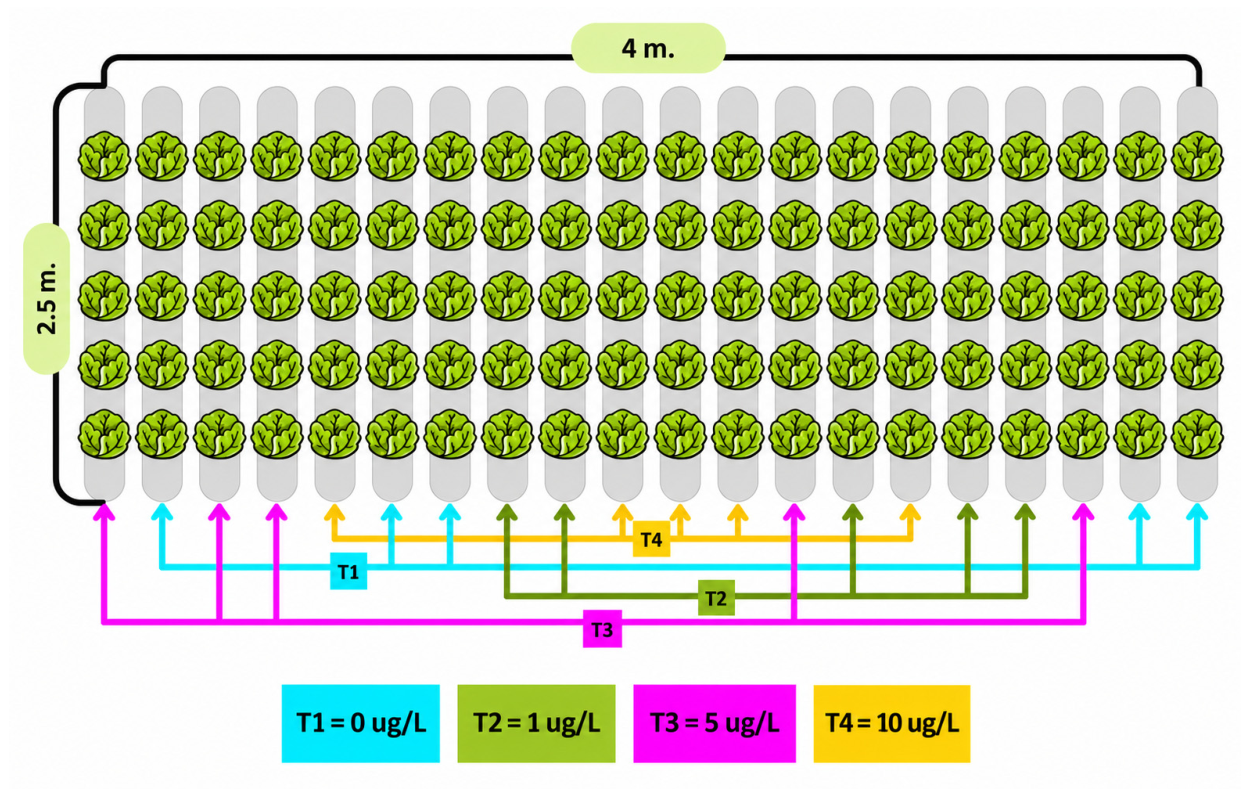
Ciprofloxacin was used to prepare a stock solution, which was subsequently diluted with the nutrient solution to obtain final concentrations of 1, 5, and 10 µg/L. A control treatment received the same nutrient solution without ciprofloxacin and, when applicable, an equivalent volume of the solvent used for stock solution preparation. The experiment followed a completely randomised design (CRD) with four treatments (0, 1, 5 and 10 µg/L CIP), each replicated in five independent, physically separated hydroponic subsystems (20 subsystems in total), so that every treatment had five true biological replicates (Figure 1).
Figure 1.
Layout of the NFT hydroponic system showing the randomised distribution of ciprofloxacin treatments (T1–T4) and their five independent replicate channels (subsystems), each with its own nutrient reservoir (n = 5 per treatment).
Each subsystem consisted of one dedicated NFT channel with its own nutrient reservoir, pump and return line, so that no nutrient solution was shared between replicates or treatments and cross contamination between CIP levels was prevented; channels were randomly assigned to treatments. Each replicate reservoir was charged with an independently prepared CIP working solution obtained by separate dilution of the stock. Five plants were grown per channel (100 plants in total; 25 plants per treatment), spaced 20 cm apart along the channel. To avoid edge effects associated with the two end positions of each channel, only the three central plants per channel were sampled and analysed; their values were averaged to obtain a single representative value per replicate prior to statistical analysis. Because the reservoir (channel) is the unit that received an independently prepared CIP solution and was randomly assigned to a treatment, it constitutes the true experimental unit for the CIP factor, with the three sampled plants per channel serving as subsamples rather than independent replicates; this design provides five independent biological replicates per treatment (n = 5 reservoirs), consistent with the completely randomised design and one-way ANOVA used in Section 2.9.
The corresponding ciprofloxacin solutions were incorporated into the hydroponic system at the beginning of the experimental period. Ciprofloxacin concentrations in each treatment reservoir were monitored by sampling an aliquot from each reservoir every 5 days throughout the 35-day cultivation period and quantifying ciprofloxacin using the same LC–MS/MS method described in Section 2.8; reservoirs were then replenished with freshly prepared CIP working solutions as needed to keep the nominal concentration constant. The values of 1, 5 and 10 µg/L therefore represent the actual concentrations maintained throughout the experimental period rather than only nominal initial values.
2.3. Extraction of Antioxidant Compounds
Antioxidant compounds were extracted following a solid–liquid extraction procedure adapted from Beratto et al. [19], with minor modifications. Briefly, 5.0 g of homogenised lettuce tissue (approximately 0.5 mm particle size) was mixed with 50 mL of 60% (v/v) methanol, maintaining a sample-to-solvent ratio of 1:10 (w/v). To minimise light-induced oxidation and solvent evaporation during extraction, the extraction vessels were wrapped with aluminium foil and sealed with parafilm. The mixtures were then extracted under continuous stirring at 40 °C and 400 rpm for 1 h using a thermostatically controlled magnetic stirrer.
Following extraction, the samples were centrifuged at 3500 rpm for 5 min, and the supernatants were filtered through Whatman No. 1 filter paper. The filtrates were adjusted to the initial extraction volume with 60% methanol, transferred to amber bottles, and stored at −20 °C until further analysis.
2.4. Total Phenolic Content
Total phenolic content (TPC) was determined using the Folin–Ciocalteu colourimetric assay adapted from Otero et al. [20], with minor modifications. Moisture content was determined gravimetrically to express the results on a dry weight basis. Prior to analysis, crude extracts were diluted 1:5 with the extraction solvent. The assay was performed in 96-well microplates by mixing 150 μL of Milli-Q water, 20 μL of diluted extract, blank (extraction solvent), or gallic acid standard, and 10 μL of 1 N Folin–Ciocalteu reagent. After 3 min of incubation at room temperature, 20 μL of 10% (w/v) sodium carbonate solution was added, and the reaction mixture was incubated in the dark for 60 min at room temperature. Absorbance was measured at 765 nm using a microplate reader. Gallic acid was used for calibration, and the results were expressed as milligrams of gallic acid equivalents (mg GAE) per gram of dry weight (DW).
2.5. Oxygen Radical Absorbance Capacity
The oxygen radical absorbance capacity (ORAC) assay was performed according to Chirinos et al. [21], with minor modifications for lettuce extracts. The assay was based on the use of fluorescein as the fluorescent probe, 2,2′-azobis (2-amidinopropane) dihydrochloride (AAPH) as the peroxyl radical generator, and Trolox as the calibration standard. A 75 mM phosphate-buffered saline (PBS, pH 7.4) was used to prepare all working solutions. Fluorescein and AAPH working solutions were prepared at final concentrations of 55 nM and 153 mM, respectively. Lettuce extracts were diluted with PBS (1:120–1:300) according to their antioxidant capacity, while Trolox calibration standards were prepared in the range of 8–40 µM.
The assay was carried out in black 96-well microplates by adding 25 μL of PBS (blank), diluted extract, or Trolox standard, followed by 250 μL of fluorescein solution. The microplates were incubated at 37 °C for 10 min, after which the reaction was initiated by the automatic injection of 25 μL of AAPH solution. Fluorescence was monitored every minute for 60 min at excitation and emission wavelengths of 485 and 520 nm, respectively, using a temperature-controlled microplate fluorescence reader. Antioxidant capacity was calculated from the area under the fluorescence decay curve using the Trolox calibration curve and expressed as micromoles of Trolox equivalents (µmol TE) per gram of dry weight (DW).
2.6. DPPH Radical-Scavenging Activity
The DPPH radical-scavenging activity was determined following the method described by Erpel et al. [22], with minor modifications. Lettuce extracts were diluted with methanol at dilution factors of 1:20, 1:40, and 1:80. In a 96-well microplate, 100 μL of each diluted extract was mixed with 100 μL of a freshly prepared 12.17 μM DPPH solution in methanol. The reaction mixtures were gently mixed and incubated in the dark at room temperature for 30 min to prevent photodegradation of the DPPH radical. Absorbance was measured at 517 nm using a microplate reader.
Methanol mixed with the extraction solvent was used as the blank, whereas the DPPH solution alone served as the control. Radical-scavenging activity was expressed as the percentage of DPPH inhibition relative to the control. The IC50 value, defined as the extract concentration required to inhibit 50% of the initial DPPH radical, was estimated by linear regression of the inhibition percentage against extract concentration.
2.7. Extraction and Determination of Ciprofloxacin Residues
Ciprofloxacin (CIP) residues were extracted from lettuce tissue following the plant-based procedure described by Eggen et al. [23], with minor modifications. Briefly, 5.00 g of homogenised lettuce tissue was weighed using an analytical balance and transferred into clean extraction tubes. For the extraction, 0.2 mL of a 0.01 M hydrochloric acid–methanol solution (60:40, v/v) was added, followed by 1.7 mL of an ammonium acetate–formic acid buffer (90:10, v/v) to stabilise the pH during the extraction process. The mixture was vortex-mixed for 5 min to facilitate the extraction of ciprofloxacin from the plant matrix.
The samples were first centrifuged at 4000 rpm for 10 min, and the supernatants were transferred to clean microcentrifuge tubes. A second centrifugation was performed at 10,000 rpm for 5 min to remove residual suspended particles. Finally, 1 mL of the purified supernatant was filtered through a 0.2 μm membrane filter into glass vials prior to instrumental analysis.
Ciprofloxacin residues were quantified by liquid chromatography coupled with tandem mass spectrometry (LC–MS/MS). The analytical procedure was evaluated in terms of calibration linearity, recovery, precision, and sensitivity. Calibration was performed using CIP standards prepared in methanol, obtaining the regression equation y = 1,274,361.066260x + 5567.454648, with a coefficient of determination (R2) of 0.99932849. The limit of detection (LOD) and limit of quantification (LOQ) were determined as 0.00379363 and 0.01251897 ug/kg, respectively. the analytical validation criteria were considered with reference to the LC–MS/MS validation approach described by Mula et al. [24].
The bioconcentration factor (BCF) was calculated as the ratio between the ciprofloxacin concentration in shoot tissue (µg/kg) and the applied ciprofloxacin concentration in the nutrient solution (µg/L), expressed in L/kg; relative BCF values (BCF rel.) were subsequently obtained by normalising each absolute BCF to that of the 1 µg/L treatment (1.000).
2.8. LC–MS/MS Conditions and Analytical Performance
Ciprofloxacin analysis was performed by liquid chromatography coupled with tandem mass spectrometry (LC–MS/MS) using an Agilent 1290 Infinity III liquid chromatograph coupled to an Agilent 6475 Triple Quadrupole mass spectrometer (Agilent Technologies, Santa Clara, CA, USA), following the method validated by Mula et al. [24]. Chromatographic separation was achieved on an Atlantis T3 column (3.0 μm, 3.0 × 100 mm, 150 Å) maintained at 35 °C. The injection volume was 2 μL, and the mobile phase flow rate was 0.2 mL min−1.
The mobile phase consisted of solvent A (water containing 0.1% formic acid) and solvent B (acetonitrile containing 0.1% formic acid). A gradient elution program was applied, starting at 90:10 (A:B), reaching 40:60 within 6 min, and returning to the initial conditions for column re-equilibration.
Mass spectrometric detection was performed using electrospray ionisation (ESI) operated in both positive (+3500 V) and negative (−3000 V) ionisation modes. The nebuliser pressure was set at 35 psi, the drying gas flow at 11 L min−1 with a temperature of 200 °C, and the sheath gas flow at 12 L min−1 with a temperature of 350 °C.
2.9. Statistical Analysis
A Completely Randomised Design (CRD) was used to randomly assign treatments within the hydroponic cultivation system, ensuring independence between experimental units. The experimental unit was the NFT channel with its independent reservoir (n = 5 per treatment); the three sampled plants per channel were treated as sub-samples, and the technical replicates of each analytical determination were averaged per plant. For each treatment, the three sampled plants within each of the five replicate channels were averaged to yield a single value per biological replicate. Data were subjected to a one-way Analysis of Variance (ANOVA) after verifying the assumptions of normality (Shapiro–Wilk test) and homogeneity of variances (Levene’s test). ANOVA was therefore performed on 20 values per response variable (4 treatments × 5 biological replicates). Subsequently, post hoc pairwise comparisons were conducted using Tukey’s HSD test at a significance level (α) of 0.05 to determine whether treatment means differed significantly. All statistical analyses were per-formed in R version 4.2.1 run through RStudio version 4.2.1. CIP residues in the 5 and 10 µg/L treatments were below the LOQ; therefore, these data are reported descriptively only and were not subjected to inferential comparisons.
3. Results
3.1. Fresh Shoot Biomass
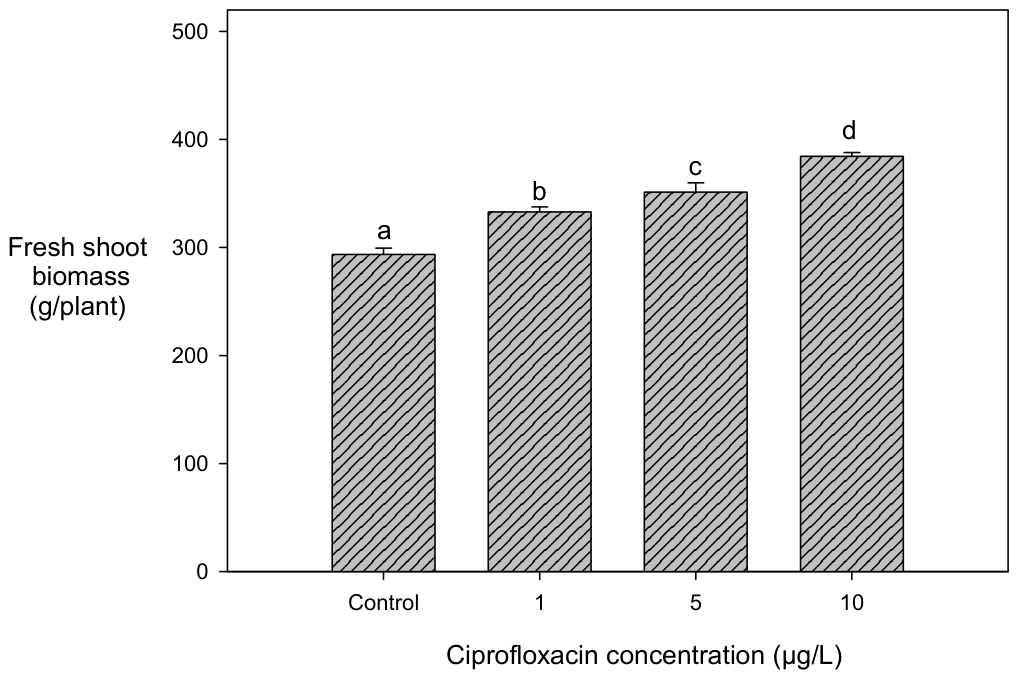
Fresh shoot biomass increased progressively with increasing CIP concentration in the irrigation solution (Figure 2). Relative to the control, biomass increased by approximately 13%, 20%, and 30% at CIP concentrations of 1, 5, and 10 µg/L, respectively, indicating a consistent, dose-dependent stimulatory effect rather than a toxic response within the tested concentration range (Figure 2).
Figure 2.
Effect of ciprofloxacin concentration on fresh shoot biomass. Bars represent mean ± SD of n = 5 independent biological replicates (reservoirs) per treatment, each representing the mean of 3 subsampled plants per channel. Different letters indicate significant differences (p-value < 0.05).
3.2. Total Phenolic Content
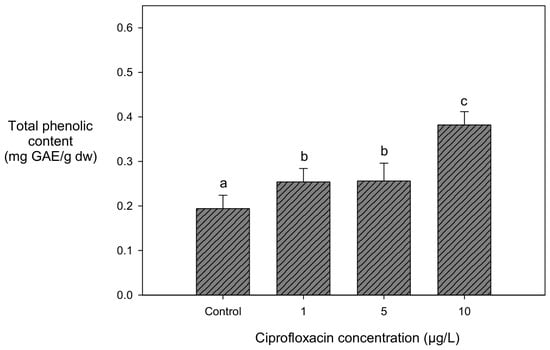
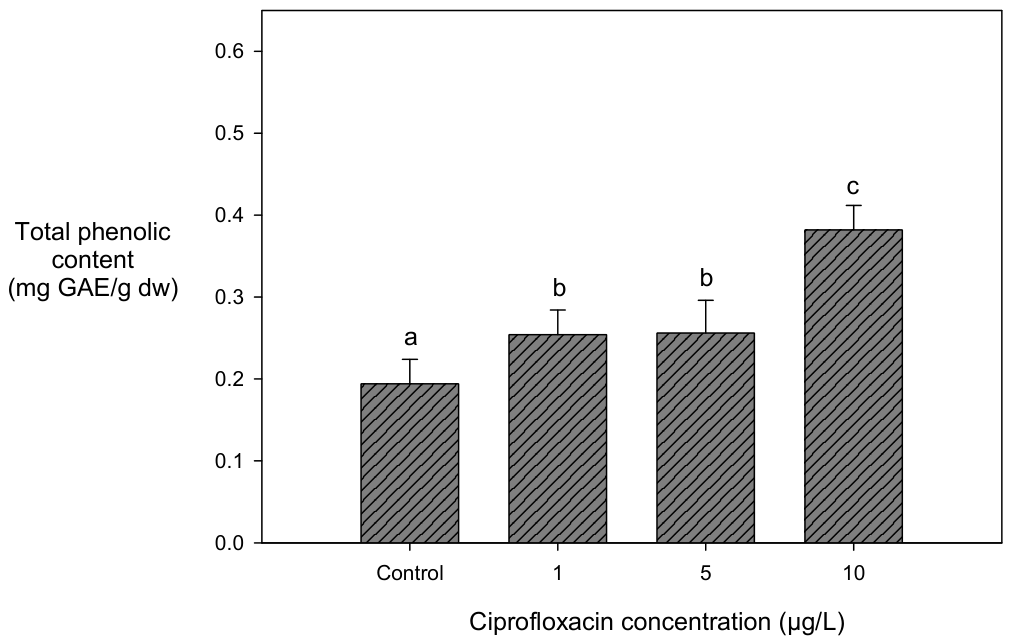
Total phenolic content increased progressively with CIP concentration in the irrigation solution (Figure 3). While intermediate CIP concentrations (1–5 µg/L) increased total phenolic content by 30–32% relative to the control, the highest concentration tested (10 µg L−1) increased total phenolic content by approximately 97% relative to the control (Figure 3).
Figure 3.
Effect of ciprofloxacin concentration on total phenolic content. Bars represent mean ± SD of n = 5 independent biological replicates (reservoirs) per treatment, each representing the mean of 3 subsampled plants per channel. Different letters indicate significant differences (p value < 0.05).
3.3. Antioxidant Capacity
Antioxidant capacity of the leaf extracts was assessed using two complementary in vitro assays based on distinct radical-neutralisation mechanisms: the Oxygen Radical Absorbance Capacity (ORAC) assay and the DPPH free radical scavenging assay. ORAC quantifies the ability of antioxidants to protect a fluorescent probe from oxidative decay induced by peroxyl radicals (AAPH), reflecting a hydrogen atom transfer mechanism relevant to biological lipid peroxidation [25], whereas DPPH measures the capacity of antioxidants to donate hydrogen atoms or electrons to the stable synthetic radical 2,2-diphenyl-1-picrylhydrazyl [26]. Thus, their combined use provides a more comprehensive characterization of antioxidant activity than either assay alone, linking phenolic accumulation to actual free-radical neutralising capacity of the extract. It is important to distinguish this chemical, extract-based property from the physiological antioxidant defense system of the living plant, which comprises enzymatic components such as superoxide dismutase, catalase, ascorbate peroxidase and glutathione reductase together with compartmentalized low-molecular weight antioxidants. ORAC and DPPH values quantify the former and cannot, on their own, demonstrate activation of the latter; throughout this section the two are therefore kept terminologically separate [21,27].
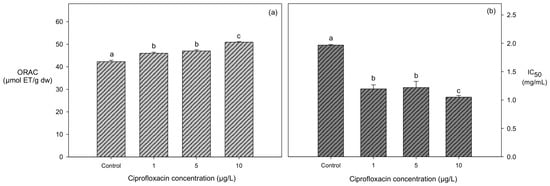
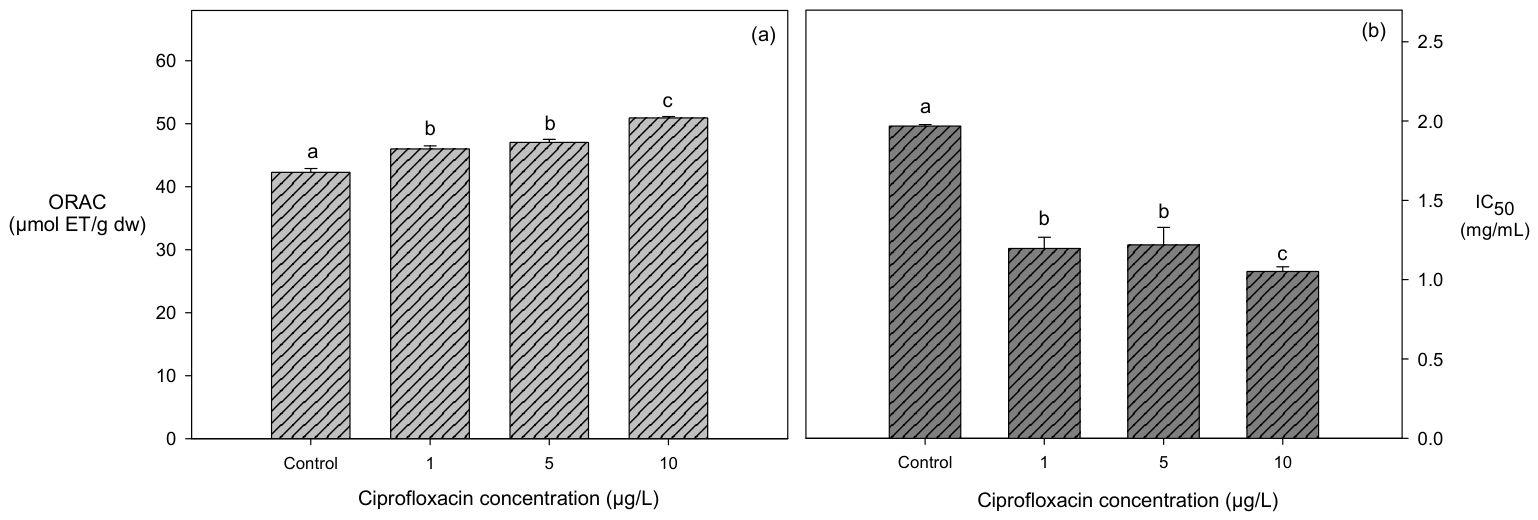
ORAC values increased progressively with CIP concentration in the irrigation solution (Figure 4a). Relative to the control, ORAC values increased by 1.55%, 3.83% and 12.40% with 1, 5 and 10 µg/L of CIP solution (Figure 4a). While, DPPH radical-scavenging activity, expressed as IC50, improved with CIP exposure (Figure 4b), although the behaviour differed from the trends observed for total phenolic content and ORAC. For DPPH, relative to the control, the IC50 value decreased by 39%, 38% and 44% at 1, 5 and 10 µg/L, respectively (Figure 4b).
Figure 4.
Effect of ciprofloxacin concentration on antioxidant activity determined by (a) ORAC and (b) DPPH assays. Bars represent mean ± SD of n = 5 independent biological replicates (reservoirs) per treatment, each representing the mean of 3 subsampled plants per channel. Different letters indicate significant differences (p-value < 0.05).
3.4. Ciprofloxacin Residues in Edible Shoot Tissue
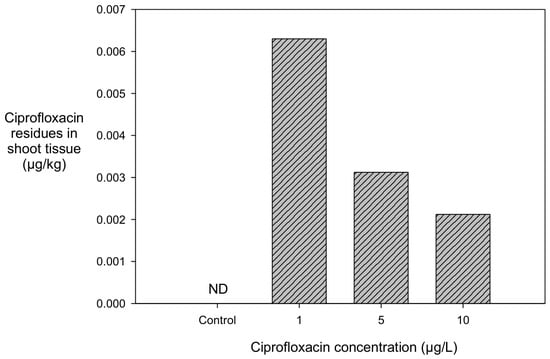
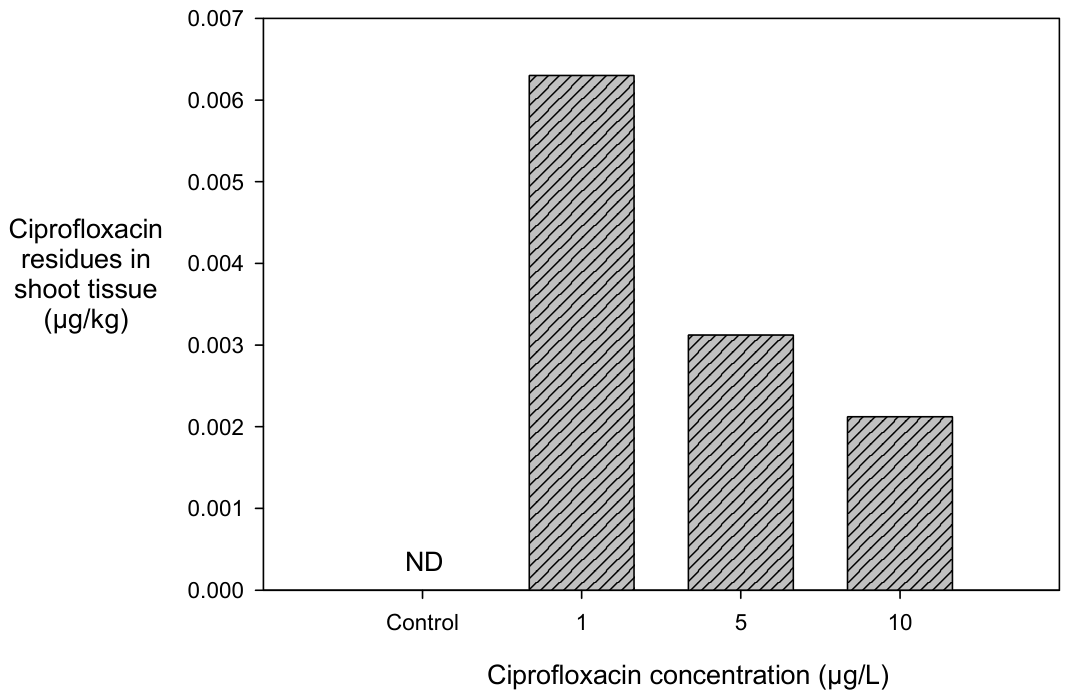
Unlike total phenolic content and antioxidant capacity, apparent CIP residues in lettuce shoot tissue appeared to follow an inverse pattern relative to the applied concentration (Figure 5), rather than accumulating proportionally with increasing CIP exposure. It should be noted that residue concentrations at 5 and 10 µg/L were below the method limit of quantification (Section 2.7) and are therefore reported for reference only. With this caveat, apparent shoot-tissue concentrations decreased by approximately 51.6% between 1 and 5 µg/L, and by approximately 66.1% between 1 and 10 µg/L (Figure 5). These percentages are indicative only and should not be interpreted as quantitative estimates.
Figure 5.
Accumulation of ciprofloxacin in shoot tissue. Bars represent means of n = 5 independent biological replicates (reservoirs) per treatment, each representing the mean of 3 subsampled plants per channel. ND, not detected. Residue concentrations at 5 and 10 µg/L were below the method limit of quantification and are shown for reference only. No inferential statistics were applied to residue data.
The relative bioconcentration factor (BCF), defined as the tissue concentration normalized to the exposure concentration, was calculated from these apparent residue values and was lower at 5 and 10 µg/L than at 1 µg/L (Table 1). However, given that the residue concentrations at these two levels were below the LOQ, the corresponding BCF values are not quantitatively reliable; they are presented solely as an indicative trend and were not used to estimate the magnitude of any reduction in uptake.
Table 1.
Ciprofloxacin bioconcentration factor (BCF).
4. Discussion
4.1. Fresh Shoot Biomass
A different response was reported by Zhao et al. [28], who found that a higher CIP concentration (1 mg/L), which is 100-fold greater than the maximum concentration used here, inhibited shoot biomass and photosynthesis in choysum. Differences in dose, plant species and genotype, exposure duration, nutrient composition, and developmental stage can therefore shift the plant’s response during growth. Low CIP concentrations likely induced mild reactive oxygen species (ROS) production, which acted as a signalling stimulus that altered carbon allocation, cell expansion, and defence metabolism without reaching damaging levels. ROS are known to participate in plant growth and hormonal signalling when their production and scavenging remain balanced [29,30]. Additionally, low CIP concentrations may induce moderate oxidative stress, which could activate endogenous antioxidant responses as a defence mechanism. For example, Gechev et al. [31] suggest that plants respond to low levels of oxidative stress by increasing the activity of antioxidant enzymes such as superoxide dismutase (SOD), catalase (CAT), and peroxidase (POD), which restore cellular redox balance and optimise metabolic efficiency, thereby promoting plant development.
4.2. Total Phenolic Content
This trend is consistent with reports of antibiotic-induced hormesis in other food crops irrigated with contaminated water. Mamani Ramos et al. [32] reported that in purple corn, total phenolic content approximately doubled when azithromycin concentration increased from 1 to 10 µg L. Quisocala Ramos et al. [7] reported that in quinoa irrigated with 100 ug/L of CIP, total phenolic content increased by 52% compared to the control.
These results show a progressive, dose-dependent increase in phenolic content over the range tested, a pattern compatible with the ascending limb of a hormetic dose–response [33,34,35] and with ROS-mediated activation of antioxidant defence [31]. A mechanism repeatedly proposed in the literature is that CIP competitively binds the quinone-binding site of photosystem II, disrupting electron transport and promoting ROS accumulation [36,37]; ROS may then act both as stress signals and as triggers of secondary metabolism [29,31], leading to upregulation of the phenylpropanoid pathway. Since neither photosynthetic parameters nor ROS concentrations, PAL activity or phenylpropanoid gene expression were determined in the present work, this sequence is presented as a possible explanation consistent with published evidence rather than as a mechanism demonstrated here.
4.3. Antioxidant Capacity
4.3.1. ORAC Method
Quisocala Ramos et al. [7] reported that in quinoa, ciprofloxacin produced 10 times more antioxidant capacity at 100 µg/L. Similarly, Mamani Ramos et al. [32] found that azithromycin enhanced antioxidant capacity at low doses (1–10 µg/L) in purple corn. According to our results, the higher the CIP concentration, the higher both the ORAC value and the polyphenol content, indicating that the extracts with higher total phenolic content also showed higher in vitro peroxyl-radical scavenging capacity. It may be hypothesized that, as CIP concentration increases, its interference with the PSII quinone-binding site intensifies and promotes ROS accumulation; however, ROS levels were not measured in this study.
4.3.2. DPPH Method
Although some plants increase total phenolic synthesis under antibiotic stress such as CIP, their effectiveness in neutralising free radicals such as DPPH depends on their specific structure; particularly the number and position of hydroxyl groups, since not all phenolic compounds are equally effective hydrogen or electron donors to the DPPH radical [38]. In this sense, CIP exposure was associated with higher total phenolic content in the extracts; because individual phenolic compounds were not profiled, the present data cannot determine whether this reflects changes in phenolic biosynthesis, turnover, or compartmentalization, nor which compounds account for the differences observed between the DPPH and ORAC assays.
4.4. Ciprofloxacin Residues in Edible Shoot Tissue
The apparent inverse relationship between applied CIP concentration and shoot-tissue residues (Figure 5) must be interpreted with caution, because residue concentrations at 5 and 10 µg/L were below the method LOQ (Section 2.7). This pattern therefore cannot be considered quantitatively established and is discussed here only as an indicative trend that generates hypotheses for future work. One hypothesis is that root membrane transport of CIP approaches saturation at higher external concentrations, so that uptake no longer increases proportionally with the external dose [39]. A second hypothesis is that higher exposure induces biotransformation enzymes that metabolize the parent compound, reducing the amount detected in the tissue [40,41]. Neither uptake kinetics nor detoxification enzymes or CIP transformation products were measured in this study, so neither hypothesis can be evaluated with the present data. Growth dilution is unlikely to explain the trend on its own, because shoot biomass increased by at most 30%, and the larger plants grown at higher doses probably transpired more water, which would be expected to deliver more, not less, CIP to the shoot. Confirming or rejecting this trend will require an analytical method with a lower LOQ, direct measurement of CIP in roots and in the nutrient solution, and analysis of transformation products.
4.5. Dietary Risk Assessment Considerations
No regulations establishing maximum permissible limits for this type of compound (CIP) in plant matrices have been reported; limit values exist only for meat products, since the animals involved are treated with antibiotics related to CIP. For context only, when compared against the concentrations shown in Figure 5 several of which fall below the method LOQ (Section 2.7) and should therefore be interpreted with caution, these values represent approximately 0.002% to 0.006% of the European Union maximum residue limit for the sum of enrofloxacin and ciprofloxacin in animal muscle (100 µg/kg) [42], and remain below comparable order of magnitude values reported for poultry tissue in other jurisdictions [43]. However, because these regulatory limits were established for a different matrix and commodity (animal muscle rather than a leafy vegetable), and because no residue limit specific to vegetables currently exists [44], this comparison cannot be used to directly infer the safety of lettuce consumption. The concentrations measured in this study should therefore be regarded only as preliminary, contextual information rather than evidence that consumption poses no risk; dedicated vegetable-specific intake and toxicological studies are needed before any conclusion about consumer risk can be drawn.
5. Conclusions
Under the hydroponic conditions tested, exposure to low-dose ciprofloxacin (1–10 µg/L) was associated with increased shoot biomass, total phenolic content, and in vitro antioxidant capacity (ORAC and DPPH) in Lactuca sativa L., with no visible signs of phytotoxicity. These responses are consistent with a hormetic-type pattern and may involve ROS-mediated activation of antioxidant and phenylpropanoid-related defences; however, since photosynthetic parameters, ROS levels, enzyme activities, and gene expression were not measured, this mechanistic explanation remains a hypothesis to be tested rather than a demonstrated pathway. Apparent CIP residues in edible tissue tended to be lower at higher applied doses; however, given residues at 5 and 10 µg/L were below the method LOQ, this is an indicative trend rather than a quantitative finding, and possible explanations such as uptake saturation and/or detoxification remain hypotheses that were not tested here. Within the concentration range tested, the data therefore provide no evidence of proportional residue accumulation in edible tissue, but confirming this requires analytical methods with lower quantification limits, together with crop- and dose-specific assessments. It should be emphasised that this work represents a preliminary assessment based mainly on biomass, total phenolic content, in vitro antioxidant capacity, and CIP residues; more detailed physiological and molecular analyses, together with validation under larger-scale, longer-term, and field-relevant hydroponic conditions, are required to confirm the mechanisms proposed here.
Author Contributions
F.Z.V., supervision and project administration; N.M.C., S.B.A.N., S.R.R.R., Y.M.R., E.J.C.A. and C.N.C.Q., investigation, methodology, and analysis; F.Z.V., K.F.M. and N.L.H.-C., validation and formal analysis data; N.L.H.-C. and F.Z.V., writing—review and editing. All authors have read and agreed to the published version of the manuscript.
Funding
This study was funded by the Universidad Nacional de Moquegua through the project titled “Hidroponía fortalecida: Aumentando la cantidad de polifenoles y su capacidad para proteger contra el oxidante en cultivos mediante el uso de antibióticos”, Resolución No. 181-2024-UNAM-CO.
Institutional Review Board Statement
Not applicable.
Informed Consent Statement
Not applicable.
Data Availability Statement
The original contributions presented in this study are included in the article. Further inquiries can be directed to the corresponding author.
Conflicts of Interest
The authors declare no conflicts of interest.
References
- Mosharaf, K.; Gomes, R.L.; Cook, S.; Alam, M.S.; Rasmusssen, A. Chemosphere Wastewater Reuse and Pharmaceutical Pollution in Agriculture: Uptake, Transport, Accumulation and Metabolism of Pharmaceutical Pollutants within Plants. Chemosphere 2024, 364, 143055. [Google Scholar] [CrossRef] [Scilit] [PubMed]
- Polianciuc, S.I.; Gurzău, A.E.; Kiss, B.; Georgia Ștefan, M.; Loghin, F. Antibiotics in the Environment: Causes and Consequences. Med. Pharm. Rep. 2020, 93, 231–240. [Google Scholar] [CrossRef] [Scilit] [PubMed]
- Gomes, M.P. The Convergence of Antibiotic Contamination, Resistance, and Climate Dynamics in Freshwater Ecosystems. Water 2024, 16, 2606. [Google Scholar] [CrossRef] [Scilit]
- Sassi, A.; Basher, N.S.; Kirat, H.; Meradji, S.; Ibrahim, N.A.; Idres, T.; Touati, A. The Role of the Environment (Water, Air, Soil) in the Emergence and Dissemination of Antimicrobial Resistance: A One Health Perspective. Antibiotics 2025, 14, 764. [Google Scholar] [CrossRef] [Scilit] [PubMed]
- Agathokleous, E.; Calabrese, E.J.; Barceló, D. Environmental Hormesis: New Developments. Sci. Total Environ. 2024, 906, 167450. [Google Scholar] [CrossRef] [Scilit] [PubMed]
- Mininni, A.N.; Pietrafesa, A.; Calabritto, M.; Di Biase, R.; Brunetti, G.; De Mastro, F.; Murgolo, S.; De Ceglie, C.; Salerno, C.; Dichio, B. Uptake and Translocation of Pharmaceutically Active Compounds by Olive Tree (Olea europaea L.) Irrigated with Treated Municipal Wastewater. Front. Plant Sci. 2024, 15, 1382595. [Google Scholar] [CrossRef] [Scilit] [PubMed]
- Ramos, A.Q.; Ramos, Y.M.; Camaticona, N.M.Q.; Tejeda, J.L.R.; Quiróz, C.N.C.; Maldonado, I.; Huamán-Castilla, N.L.; Vilca, F.Z. Deciphering Ciprofloxacin’s Impact on Growth Attributes and Antioxidant Compounds in Pasankalla Quinoa. Agronomy 2023, 13, 1738. [Google Scholar] [CrossRef] [Scilit]
- Choe, H.; Kantharaj, V.; Lee, K.A.; Shin, Y.; Chohra, H.; Yoon, Y.E.; Kim, Y.N.; Lee, Y.B. Morpho-Physiological, Biochemical, and Molecular Responses of Lettuce (Lactuca sativa L.) Seedlings to Chlortetracycline Stress. Environ. Exp. Bot. 2024, 219, 105615. [Google Scholar] [CrossRef] [Scilit]
- Rocha, D.C.; Kochi, L.Y.; Kitamura, R.S.A.; Brito, J.C.M.; da Silva Nogueira, K.; Gomes, M.P. Unveiling the Impact of Antimicrobial-Infused Water on Hydroponic Baby Leafy Vegetables (Lettuce, Rocket, and Watercress): Physiological Effects and Food Safety. J. Environ. Chem. Eng. 2024, 12, 112335. [Google Scholar] [CrossRef] [Scilit]
- Wilkinson, J.L.; Boxall, A.B.A.; Kolpin, D.W.; Leung, K.M.Y.; Lai, R.W.S.; Galbán-Malagón, C.; Adell, A.D.; Mondon, J.; Metian, M.; Marchant, R.A.; et al. Pharmaceutical Pollution of the World’s Rivers. Proc. Natl. Acad. Sci. USA 2022, 119, e2113947119. [Google Scholar] [CrossRef] [Scilit] [PubMed]
- Larsson, D.G.J.; de Pedro, C.; Paxeus, N. Effluent from Drug Manufactures Contains Extremely High Levels of Pharmaceuticals. J. Hazard. Mater. 2007, 148, 751–755. [Google Scholar] [CrossRef] [Scilit] [PubMed]
- Bhatt, S.; Chatterjee, S. Fluoroquinolone Antibiotics: Occurrence, Mode of Action, Resistance, Environmental Detection, and Remediation—A Comprehensive Review. Environ. Pollut. 2022, 315, 120440. [Google Scholar] [CrossRef] [Scilit] [PubMed]
- Moncayo-Lasso, A.; Rincón-Aguilar, C.M.; Botero-Coy, A.M.; Hernández, F.; Martínez-Pachón, D. Occurrence and Risk Assessment of Pharmaceuticals in Irrigation Water and Lettuce Crops in Colombia. J. Hazard. Mater. Adv. 2025, 20, 100891. [Google Scholar] [CrossRef] [Scilit]
- Li, W.C. Occurrence, Sources, and Fate of Pharmaceuticals in Aquatic Environment and Soil. Environ. Pollut. 2014, 187, 193–201. [Google Scholar] [CrossRef] [Scilit] [PubMed]
- Pedrosa, M.; Cristina, D.; César, J.; Brito, M.D.; Francisco, B.; Anna-santos, S.; Fisiologia, L.D.; Plantas, D.; Botânica, D.D.; Biológicas, S.D.C.; et al. Ecotoxicology and Environmental Safety Emerging Contaminants in Water Used for Maize Irrigation: Economic and Food Safety Losses Associated with Ciprofloxacin and Glyphosate. Ecotoxicol. Environ. Saf. 2020, 196, 110549. [Google Scholar] [CrossRef] [Scilit] [PubMed]
- Agathokleous, E. The Rise and Fall of Photosynthesis: Hormetic Dose Response in Plants. J. For. Res. 2021, 32, 889–898. [Google Scholar] [CrossRef] [Scilit]
- Panda, S.K.; Gupta, D.; Patel, M.; Vyver, C. Van Der Functionality of Reactive Oxygen Species (ROS) in Plants: Toxicity and Control in Poaceae Crops Exposed to Abiotic Stress. Plants 2024, 13, 2071. [Google Scholar] [CrossRef] [Scilit] [PubMed]
- Dixon, R.A.; Paiva, N.L. Stress-Induced Phenylpropanoid Metabolism. Plant Cell 1995, 7, 1085–1097. [Google Scholar] [CrossRef] [Scilit] [PubMed]
- Beratto-Ramos, A.; Castillo-Felices, R.D.P.; Troncoso-Leon, N.A.; Agurto-Muñoz, A.; Agurto-Muñoz, C. Selection Criteria for High-Value Biomass: Seasonal and Morphological Variation of Polyphenolic Content and Antioxidant Capacity in Two Brown Macroalgae. J. Appl. Phycol. 2018, 31, 653–664. [Google Scholar] [CrossRef] [Scilit]
- Otero, P.; Quintana, S.E.; Reglero, G.; Fornari, T.; García-Risco, M.R. Pressurized Liquid Extraction (PLE) as an Innovative Green Technology for the Effective Enrichment of Galician Algae Extracts with High Quality Fatty Acids and Antimicrobial and Antioxidant Properties. Mar. Drugs 2018, 16, 156. [Google Scholar] [CrossRef] [Scilit] [PubMed]
- Chirinos, R.; Campos, D.; Warnier, M.; Pedreschi, R.; Rees, J.F.; Larondelle, Y. Antioxidant Properties of Mashua (Tropaeolum Tuberosum) Phenolic Extracts against Oxidative Damage Using Biological in Vitro Assays. Food Chem. 2008, 111, 98–105. [Google Scholar] [CrossRef] [Scilit]
- Erpel, F.; Camilo, C.; Mateos, R.; Ricardo Pérez-Correa, J. A Macroporous Resin Purification Process to Obtain Food-Grade Phlorotannin-Rich Extracts with α-Glucosidase Inhibitory Activity from Chilean Brown Seaweeds: An UHPLC-MSn Profiling. Food Chem. 2023, 402, 134472. [Google Scholar] [CrossRef] [Scilit] [PubMed]
- Eggen, T.; Asp, T.N.; Grave, K.; Hormazabal, V. Uptake and Translocation of Metformin, Ciprofloxacin and Narasin in Forage- and Crop Plants. Chemosphere 2011, 85, 26–33. [Google Scholar] [CrossRef] [Scilit] [PubMed]
- Mula, J.; Chiara, F.; Manca, A.; Palermiti, A.; Maiese, D.; Cusato, J.; Simiele, M.; De Rosa, F.G.; Di Perri, G.; De Nicolò, A.; et al. Analytical Validation of a Novel UHPLC-MS/MS Method for 19 Antibiotics Quantification in Plasma: Implementation in a LC-MS/MS Kit. Biomed. Pharmacother. 2023, 163, 114790. [Google Scholar] [CrossRef] [Scilit] [PubMed]
- Ou, B.; Hampsch-Woodill, M.; Prior, R.L. Development and Validation of an Improved Oxygen Radical Absorbance Capacity Assay Using Fluorescein as the Fluorescent Probe Development and Validation of an Improved Oxygen Radical Absorbance Capacity Assay Using Fluorescein as the Fluorescent. ACS Agric. Food Chem. 2001, 49, 4619–4626. [Google Scholar] [CrossRef] [Scilit] [PubMed]
- Brand-Williams, W.; Cuvelier, M.E.; Berset, C. Use of a Free Radical Method to Evaluate Antioxidant Activity. LWT Food Sci. Technol. 1995, 28, 25–30. [Google Scholar] [CrossRef] [Scilit]
- Prior, R.L.; Wu, X.; Schaich, K. Standardized Methods for the Determination of Antioxidant Capacity and Phenolics in Foods and Dietary Supplements. J. Agric. Food Chem. 2005, 53, 4290–4302. [Google Scholar] [CrossRef] [Scilit] [PubMed]
- Zhao, H.; Huang, H.; Zhan, Z.; Ye, Y.; Cheng, J. Insights into the Molecular Network Underlying Phytotoxicity and Phytoaccumulation of Ciprofloxacin. Sci. Total Environ. 2024, 912, 169392. [Google Scholar] [CrossRef] [Scilit] [PubMed]
- Mittler, R. ROS Are Good. Trends Plant Sci. 2017, 22, 11–19. [Google Scholar] [CrossRef] [Scilit] [PubMed]
- Martin, R.E.; Postiglione, A.E.; Muday, G.K. ScienceDirect Plant Biology Reactive Oxygen Species Function as Signaling Molecules in Controlling Plant Development and Hormonal Responses. Curr. Opin. Plant Biol. 2022, 69, 102293. [Google Scholar] [CrossRef] [Scilit] [PubMed]
- Gechev, T.S.; Van Breusegem, F.; Stone, J.M.; Denev, I.; Laloi, C. Reactive Oxygen Species as Signals That Modulate Plant Stress Responses and Programmed Cell Death. BioEssays 2006, 28, 1091–1101. [Google Scholar] [CrossRef] [Scilit] [PubMed]
- Ramos, Y.M.; Castilla, N.L.H.; Ayma, E.J.C.; Condori, N.M.; Quiróz, C.N.C.; Vilca, F.Z. Divergent Effects of Azithromycin on Purple Corn (Zea mays L.) Cultivation: Impact on Biomass and Antioxidant Compounds. PLoS ONE 2024, 19, e0307548. [Google Scholar] [CrossRef] [Scilit] [PubMed]
- Agathokleous, E.; Calabrese, E.J. Fungicide-Induced Hormesis in Phytopathogenic Fungi: A Critical Determinant of Successful Agriculture and Environmental Sustainability. ACS Agric. Food Chem. 2021, 69, 4561–4563. [Google Scholar] [CrossRef] [Scilit] [PubMed]
- Calabrese, E.J.; Blain, R.B. The Hormesis Database: The Occurrence of Hormetic Dose Responses in the Toxicological Literature. Regul. Toxicol. Pharmacol. 2011, 61, 73–81. [Google Scholar] [CrossRef] [Scilit] [PubMed]
- Agathokleous, E.; Calabrese, E.J. Hormesis: The Dose Response for the 21st Century: The Future Has Arrived. Toxicology 2019, 425, 152249. [Google Scholar] [CrossRef] [Scilit] [PubMed]
- Aristilde, L.; Melis, A.; Sposito, G. Inhibition of Photosynthesis by a Fluoroquinolone Antibiotic. Environ. Sci. Technol. 2010, 44, 1444–1450. [Google Scholar] [CrossRef] [Scilit] [PubMed]
- Gomes, M.P.; Gonçalves, C.A.; de Brito, J.C.M.; Souza, A.M.; da Silva Cruz, F.V.; Bicalho, E.M.; Figueredo, C.C.; Garcia, Q.S. Ciprofloxacin Induces Oxidative Stress in Duckweed (Lemna minor L.): Implications for Energy Metabolism and Antibiotic-Uptake Ability. J. Hazard. Mater. 2017, 328, 140–149. [Google Scholar] [CrossRef] [Scilit] [PubMed]
- Yamauchi, M.; Kitamura, Y.; Nagano, H.; Kawatsu, J.; Gotoh, H. DPPH Measurements and Structure—Activity Relationship Studies on the Antioxidant Capacity of Phenols. Antioxidants 2024, 13, 309. [Google Scholar] [CrossRef] [Scilit] [PubMed]
- Malea, P.; Kevrekidis, T.; Chatzipanagiotou, K.R.; Mogias, A. Cadmium Uptake Kinetics in Parts of the Seagrass Cymodocea Nodosa at High Exposure Concentrations. J. Biol. Res.-Thessalon. 2018, 25, 5. [Google Scholar] [CrossRef] [Scilit] [PubMed]
- Kumar, S.; Jin, M.; Weemhoff, J.L. Cytochrome P450-Mediated Phytoremediation Using Transgenic Plants: A Need for Engineered Cytochrome P450 Enzymes. J. Pet. Environ. Biotechnol. 2014, 3, 1000127. [Google Scholar] [CrossRef] [PubMed]
- Pang, S.; Duan, L.; Liu, Z.; Song, X.; Li, X.; Wang, C. Co-Induction of a Glutathione-S-Transferase, a Glutathione Transporter and an ABC Transporter in Maize by Xenobiotics. PLoS ONE 2012, 7, e40712. [Google Scholar] [CrossRef] [Scilit] [PubMed]
- Wu, X.; Dodgen, L.K.; Conkle, J.L.; Gan, J. Plant Uptake of Pharmaceutical and Personal Care Products from Recycled Water and Biosolids: A Review. Sci. Total Environ. 2015, 536, 655–666. [Google Scholar] [CrossRef] [Scilit] [PubMed]
- Munanura, E.I.; Ntale, M.; Wasswa, J.; Kaggwa, B. Assessment of Enrofloxacin Usage and Residue Levels of En-rofloxacin-Ciprofloxacin in Breast and Liver Tissues of Commercial Broilers Sold in Kampala-Uganda. Infect. Drug Resist. 2023, 16, 7629–7639. [Google Scholar] [CrossRef] [Scilit] [PubMed]
- Li, J.; Yan, Q.; Du, B.; Feng, G. An Integrated Review of Pesticides and Antibiotics in Agricultural Environments: Occurrence, Cross Media Transport, and Plant Uptake. Foods 2026, 15, 1436. [Google Scholar] [CrossRef] [Scilit] [PubMed]

Disclaimer/Publisher’s Note: The statements, opinions and data contained in all publications are solely those of the individual author(s) and contributor(s) and not of MDPI and/or the editor(s). MDPI and/or the editor(s) disclaim responsibility for any injury to people or property resulting from any ideas, methods, instructions or products referred to in the content. |
© 2026 by the authors. Licensee MDPI, Basel, Switzerland. This article is an open access article distributed under the terms and conditions of the Creative Commons Attribution (CC BY) license.