


Abstract
Soil organic carbon (SOC) sequestration is vital for sustaining soil health, maintaining agricultural productivity, and combating land degradation in drylands. In these fragile regions, water scarcity, calcareous chemistry, and soil erosion create distinct challenges that traditional climate–substrate–disturbance frameworks fail to fully capture. Although numerous reviews have examined conservation management, they typically evaluate physical, biochemical, and microbial mechanisms in isolation, leaving their cross-regulations largely unresolved. To bridge this gap, we propose a coupled framework that merges physical aggregate protection with biochemical nutrient limitation. By linking ecoenzymatic stoichiometry to the soil aggregate hierarchy, our approach tracks metabolic signals alongside micro-structural changes. Drawing on evidence from the Loess Plateau and comparable semi-arid environments, we suggest that conservation practices stabilize SOC mainly by preserving pre-existing protected carbon rather than by forming new protective structures. Furthermore, the evidence suggests that this physical protection capacity is finite and texture-dependent, and, in the studies reviewed, physical and biochemical indicators together explain a large share of the variation in carbon mineralization. This framework offers an explanation for why four core agronomic practices (no-till duration, straw return rates, subsoiling frequency, and crop rotation combination) often show diminishing or context-dependent returns rather than linear increases, with diminishing responses consistent with capacity saturation. Finally, given the current scarcity of empirical data on tillage-driven nutrient limitations across aggregate fractions, we outline how integrating microbial–mineral carbon pump theory with long-term experimental networks could extend this framework for optimizing dryland agriculture.
1. Introduction
Soil organic carbon (SOC) serves as a key driver for restoring degraded dryland agroecosystems, yet it remains among the slowest soil components responding to management shifts. SOC stocks under altered management typically require years to decades to register a measurable change [1,2], particularly in water-limited systems where low primary productivity constrains plant C inputs. Under such C-constrained conditions, gains in SOC storage are associated with improved soil aggregate structure [3,4], water-holding capacity, and long-term agricultural productivity, which are considered core components of soil health [5,6,7]. Consequently, determining how conservation management practices affect SOC sequestration and stabilization is important for mitigating soil degradation and sustaining soil functionality in dryland croplands. In this review, SOC concentration (g kg−1) and SOC stock (Mg ha−1) are distinguished, as are sequestration (a net gain in SOC stock) and stabilization (the persistence of SOC against decomposition). Under no-till, increases in surface-layer SOC concentration may partly reflect vertical redistribution and changes in bulk density, so stocks are best compared on an equivalent-soil-mass basis or to a common depth; where the original studies report only concentrations or fixed depths, we state this explicitly.
Although conservation management practices are widely adopted to mitigate land degradation, existing reviews predominantly rely on two synthesis frameworks that share a limitation. The first presents qualitative catalogues pairing specific practices (such as reduced tillage, residue return, and crop diversification) with parallel physical, chemical, or microbial mechanisms [8,9]. The second relies on quantitative meta-analyses that document how moderators shift SOC storage without diagnosing why the underlying physical and biochemical pathways move together [10]. Consequently, neither paradigm clarifies how management intensity is linked to both physical protection and biochemical nutrient limitation, sometimes invoking “synergy” without identifying explicit mechanisms. To bridge this gap, this review introduces a diagnostic framework to evaluate physical and biochemical states from unified evidence and to examine how they may constrain each other.
Here, we develop this diagnostic framework using ecoenzymatic stoichiometry vector analysis, translating C-, N-, and P-acquiring enzyme activity ratios into vector length (quantifying microbial C limitation) and vector angle (indexing relative N versus P limitation) [11,12]. This tool enables an explicit evaluation of how conservation management practices influence soil organic carbon sequestration through the coupling of diagnosed microbial resource limitations and physical protection. To establish the required context, Section 2 and Section 3 detail the hydrothermal, edaphic, and erosional realities of dryland cropping systems alongside specific management practices. Building on this foundation, Section 4.1 and Section 4.2 synthesize physical and biochemical pathways sequentially, whereas Section 4.3 highlights empirical evidence consistent with their coupling rather than mere parallelism. Finally, Section 5 applies this mechanism to practice, examining how it informs management parameters, while Section 6 outlines where the diagnostic framework’s evidence base remains limited and identifies possible extensions.
The scope of this review is accordingly narrower than “conservation management and soil carbon” as a general topic. We focus specifically on dryland and semi-arid cropping systems, with mechanistic evidence primarily drawn from the calcareous soils of the Loess Plateau and comparable semi-arid regions. Within these systems, we evaluate reduced tillage and residue return as core drivers, treating crop rotation as an interacting variable rather than a standalone pathway. Ultimately, our central contribution is diagnostic rather than exhaustive, providing a framework to decipher the coupling of physical and biochemical stabilization pathways rather than an inventory of all SOC drivers.
Literature for this review was identified through searches of Web of Science, CNKI, and Google Scholar covering publications from 2000 to 2026, using combinations of terms such as “conservation tillage”, “no-till”, “straw return”, “soil aggregate”, “soil organic carbon”, “enzyme stoichiometry”, “vector analysis”, “dryland”, “semi-arid”, and “Loess Plateau”. An initial pool of 548 records was screened for relevance, from which 74 works were cited. Studies were selected first by recency and then by relevance to the coupling framework developed here; accordingly, 57 of the 74 cited works were published in or after 2015, while earlier publications were retained where they established foundational concepts, such as the aggregate hierarchy model and ecoenzymatic stoichiometry. Priority was given to field experiments in dryland or semi-arid croplands. Laboratory studies and studies from other climatic regions were included only where they provided mechanistic context and are identified as such in the text. Because this is a narrative rather than a systematic review, selection was guided by the authors’ judgment of relevance, which, together with the regional scope defined above, helps explain why the evidence is concentrated on the Loess Plateau.
2. Distinct Constraints on SOC Dynamics in Dryland Agroecosystems
Soil organic carbon (SOC) dynamics in dryland croplands differ from generic climate–substrate–disturbance models. Three key constraints define this divergence: a water-limited hydrothermal regime that overrides broad environmental controls, a calcareous–alkaline soil matrix introducing distinct stabilization chemistry, and severe erosion risks (wind erosion on open plains, water erosion on slopes) that historically drove local tillage practices long before carbon management emerged.
In dryland ecosystems of the western United States, soil moisture is the primary driver of carbon and water fluxes [13], and in a one-year in situ warming experiment, precipitation rather than warming controlled whether soil carbon was lost or accumulated [14]. Water availability therefore plausibly overrides temperature as the primary constraint on SOC accumulation in drylands. In semi-arid agroecosystems, water limitation has led many farmers to adopt extended summer fallow to store soil water [15,16]. In a survey of 96 no-till fields in the US Great Plains, however, more intensive rotations were associated with higher SOC concentrations, fungal biomass, and aggregate stability than wheat–fallow [16]. In a rainfall-manipulation experiment in semi-arid grassland on the Loess Plateau (0–5 cm, sampled in years 5 and 7), increased precipitation enhanced plant-derived carbon input, but its effect on SOC was moderated by precipitation thresholds, nutrient cycling, and ecosystem recovery stage [17]. As discussed in Section 4.1.1, precipitation may also constrain aggregate formation, although this has not been tested in dryland croplands. A second consequence of this water-limited regime may be a low SOC baseline with limited room for further accumulation. For instance, in a 12-year Mediterranean trial, extrapolation from cumulative carbon input indicated that straw-returned wheat monoculture would reach SOC saturation within 5 years, whereas rotations would require 13–19 years, and unreturned monoculture or fallow 33 and 50 years, respectively [18]. This suggests that, in water-limited soils, the margin for further sequestration depends strongly on carbon input.
Most evidence synthesized herein derives from a calcareous–alkaline soil matrix, representing a specific pedological context rather than a universal dryland feature. On the Loess Plateau, carbonate-rich parent materials may participate in carbon stabilization: manure application increased carbonate content in macroaggregates [19], while calcium ions are associated with the persistence of aggregate-associated organic carbon in reclaimed calcareous soils [20,21]. Yet this geochemical mechanism exhibits a dual effect: across a gradient of calcareous cropland soils, carbonate content correlates negatively with organic carbon specifically within silt- and clay-sized fractions [22]. Consequently, this carbon pool is fragile, with its vulnerability influenced by both soil type and management history. For instance, converting virgin loessial soil (Calcaric Cambisol) to cropland depleted topsoil SOC by 77% within 5 years through combined water and tillage erosion, whereas a Haplic Greyzem soil under 42 years of cultivation lost 70% primarily via water erosion and mineralization [23]. By contrast, a Brown Chernozem in the Canadian Prairies lost only 11% over 40 years under improved rotation and tillage that suppressed wind erosion, compared with 44% over 80 years under earlier, less protective practices, suggesting that parent material and land-use history influence the rate of SOC loss [23].
Erosion further exacerbates this carbon pool vulnerability and, in contrast to the preceding hydrological and geochemical constraints, directly links these physical limitations to the management practices evaluated in Section 3. On open plains, wind erosion selectively removes the finest, carbon-enriched soil fractions [24], and plant-mediated feedbacks further increase SOC losses beyond those from direct particle detachment alone [25]. On sloping land such as much of the Loess Plateau, water erosion predominates, as in the cropland-conversion examples above [23]. Historically, mitigating topsoil physical degradation under bare, disturbed conditions initially motivated the development of conservation practices that are currently recognized for their carbon sequestration benefits [26,27,28].
Together, a water-limited constraint on carbon accumulation, a calcareous matrix shaped by distinct geochemical stabilization pathways, and an erosion vulnerability tied to surface exposure define the boundary conditions of dryland agroecosystems, providing the mechanistic rationale for the conservation practices evaluated in the following section.
3. Conservation Management as a Primary Agronomic Driver in Dryland Systems
In dryland cropping systems, conservation management represents not a monolithic intervention but a continuum of interrelated practices, encompassing no-till, reduced tillage, and subsoiling with residue mulch, sharing a common principle: minimizing mechanical soil disturbance relative to conventional inversion tillage [28,29]. Straw or residue return is commonly integrated across these tillage systems as an additive management option, serving as an independent driver of organic matter inputs. Systematically defining these individual practices and their operational synergies provides a prerequisite for the mechanistic synthesis detailed in Section 4.
Rather than discrete alternatives, these primary tillage practices represent points along a continuous gradient of physical disturbance intensity, bound by conventional moldboard plowing and continuous no-till at opposing extremes, with reduced tillage and strategic subsoiling occupying intermediate spectrums [30]. In the cropping systems reviewed here, SOC dynamics appear to respond to the magnitude of disturbance reduction rather than nominal management categories. Even without complete no-till adoption, reducing tillage intensity can enhance SOC accumulation, alter pool fractionation, and shift its vertical distribution, with gains most pronounced in topsoil, as shown in an 18-year experiment on a calcareous Chernozem in temperate Hungary [31]. However, this gradient pattern applies only conditionally to the soil biota that mediate these SOC transformations. A review of six decades of tillage research, focused on German agroecosystems, shows that reduced disturbance reshapes soil functional diversity in a highly taxon-specific manner. Earthworm abundance and diversity increase, whereas impacts on microarthropods, nematodes, and microbial communities remain strongly context-dependent, co-regulated by soil texture and profile depth rather than tracking disturbance intensity alone [32]. Consequently, conceptualizing tillage intensity as a continuous gradient, rather than a rigid binary of ‘tilled’ versus ‘untilled,’ provides the analytical foundation adopted throughout this review.
Crop residue retention represents a distinct agronomic dimension, largely decoupled from tillage disturbance intensity. Residue retention can be implemented in various forms along the tillage gradient, whether surface-mulched under continuous no-till, ploughed-in under conventional tillage, or partially incorporated via reduced tillage. Its impact on SOC dynamics appears to depend on how exogenous carbon partitions are between particulate (POC) and mineral-associated organic carbon (MAOC) fractions, rather than tracking disturbance intensity per se. This physical partitioning is influenced by soil texture; in an incubation of three Loess Plateau soils, for instance, straw addition shifted the POC: MAOC balance in a texture-dependent way [33]. Because residue retention is a distinct management dimension, Section 5 evaluates crop residue return rate as an independent optimization parameter, rather than merging it with tillage intensity into a single composite practice.
On the degraded soils of the Loess Plateau, field evidence indicates that converting conventional tillage to no-till with straw mulch increases SOC storage [34], with a 10-year field experiment in a temperate region reporting parallel improvements in bulk density, aggregation, and nutrient availability [35]. Long-term (16–17-year) field trials on the Loess Plateau and North China Plain indicate that conservation tillage induces persistent physical modifications, specifically altering water-stable aggregate fractions and pore architecture compared to conventional tillage without residue [36,37], establishing the physical foundation evaluated in Section 4.1. In addition, long-term conservation tillage restructures the rhizosphere microbiome around specific keystone taxa in Loess Plateau soils [38], setting the biological groundwork for the biochemical pathways detailed in Section 4.2.
Together, a continuous tillage-intensity gradient, an independent residue-retention regime, and empirical support from the Loess Plateau define the primary management practices examined in this review. Therefore, the key objective is to elucidate how variations in soil disturbance and organic inputs influence physical and biochemical SOC dynamics (Table 1).
Table 1.
Disturbance intensity and SOC response across conservation management practices.
4. Coupled Mechanisms of Physical Protection and Biochemical Diagnosis
4.1. Physical Protection: Aggregate Hierarchy and the Fate of Occluded Carbon
The physical protection of soil organic carbon (SOC) within aggregates is conceptually based on the hierarchical model of Six et al. [44]. In this model, macroaggregates (>250 μm) form around fresh particulate organic matter; microaggregates then form within them and are released as the macroaggregates break down and their temporary binding agents degrade. Conventional tillage accelerates this turnover by mechanically disrupting macroaggregates, exposing previously occluded particulate organic matter to microbial and enzymatic attack, thereby liberating carbon that would otherwise remain physically protected [45]. Conservation tillage regimes (no-till and reduced tillage) enhance macroaggregation and lower SOC mineralization within macroaggregates, consistent with slower macroaggregate breakdown and a longer residence time of occluded SOC [46]. However, the extent to which SOC sequestration under reduced disturbance is attributable to this physical protection, as well as the specific hierarchical stage conferring this protection, remains insufficiently quantified.
4.1.1. Quantifying the Contribution of Aggregate Protection
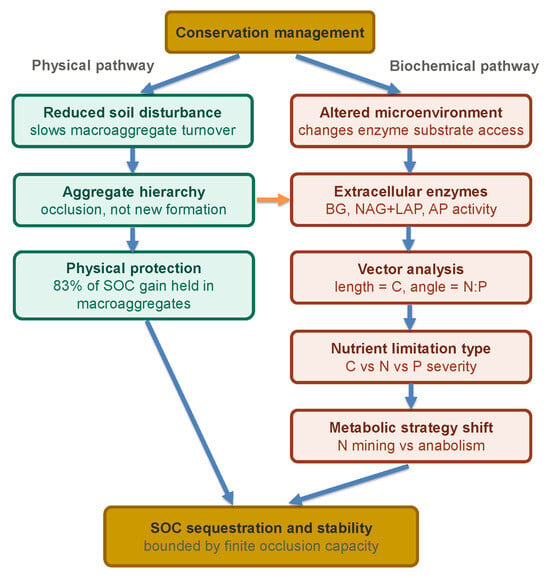
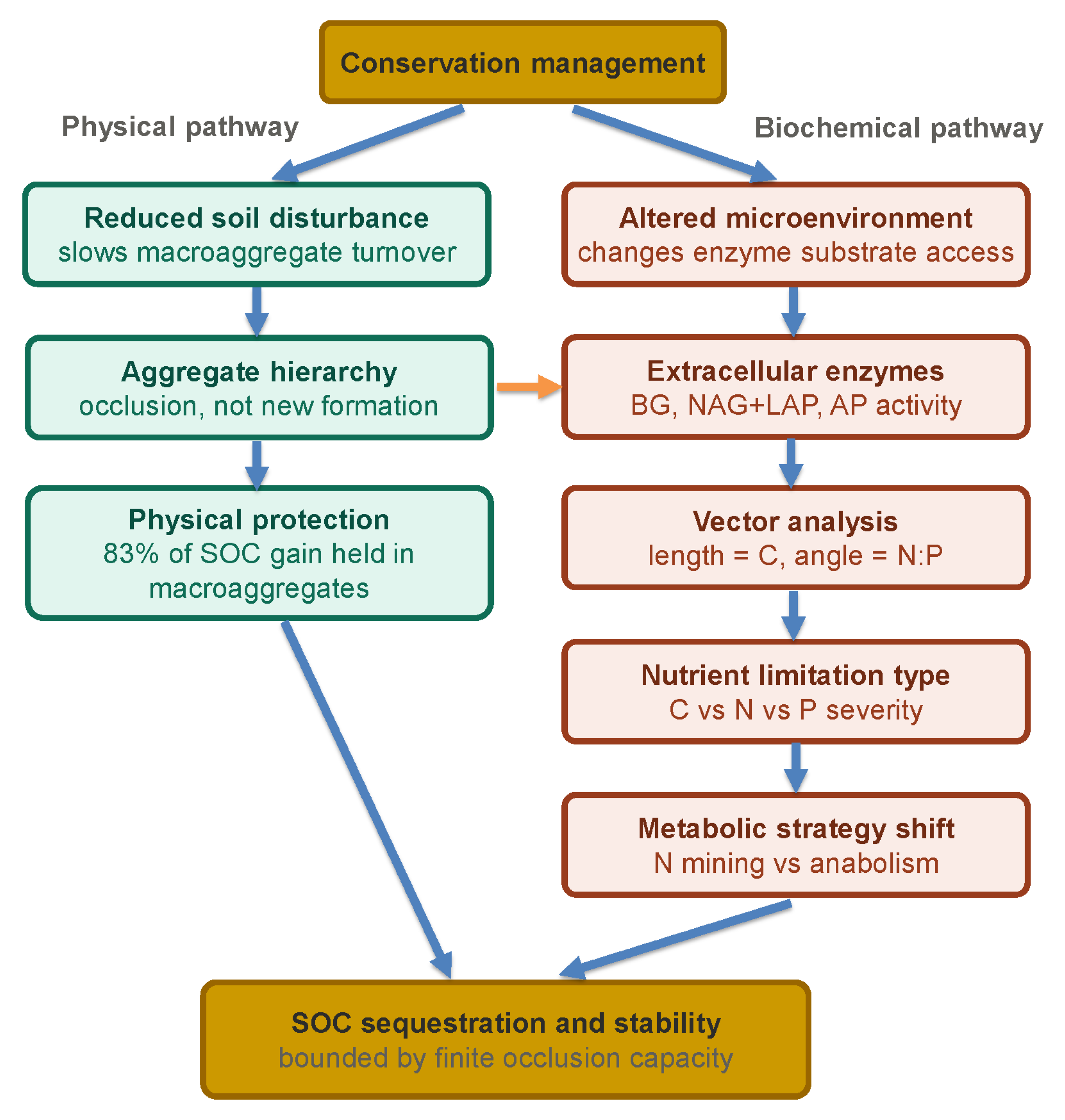
Beyond quantifying carbon allocation, King et al. [41] re-examined the physical pathway driving microaggregate protection. The classic conceptual model of Six et al. [44] posits that slower aggregate turnover promotes the de novo formation of microaggregates within macroaggregates, thereby driving net SOC accumulation. However, global empirical synthesis by King et al. [41] challenges this pathway, as total microaggregate mass (free plus occluded) exhibited no significant correlation with macroaggregate mass (slope = 0.06, 95% CI: −0.11 to 0.24, R2M = 0.01) and shared only a weak association with overall SOC concentration (slope = 0.08, R2M = 0.01). Instead, the proportion of pre-existing microaggregates occluded within macroaggregates increased with macroaggregate accumulation, exhibiting a substantially stronger relationship (slope = 0.21, 95% CI: 0.14–0.28, R2M = 0.14). In essence, enhanced microaggregate protection is associated with the preferential occlusion and retention of the pre-existing microaggregate pool rather than net microaggregate formation. This conceptual distinction refines how conservation tillage enhances soil carbon protection. Rather than driving microaggregate formation, reduced disturbance may sequester carbon by extending macroaggregate residence time, thereby keeping a higher proportion of microaggregates occluded and physically isolated from microbial decomposition (Figure 1).
Figure 1.
Conceptual framework coupling the physical and biochemical pathways of soil organic carbon (SOC) stabilization under conservation management. The physical pathway (green) operates through reduced soil disturbance, aggregate occlusion, and physical protection, where macroaggregates held 83% of the SOC gain per unit increase in global data [41]. The biochemical pathway (orange) operates through altered microenvironmental conditions, extracellular enzyme activity, and ecoenzymatic vector analysis, diagnosing microbial carbon and nutrient limitation. The orange arrow linking “Aggregate hierarchy” to “Extracellular enzymes” indicates the coupling emphasized throughout this review: the two pathways are not parallel and independent but are proposed to jointly constrain SOC sequestration.
Translating these global physical mechanisms to water-limited dryland ecosystems requires evaluating three environmental constraints: baseline carbon, mineral saturation capacity, and moisture availability. First, the magnitude of carbon accumulation per unit increase in aggregate mass depends on baseline SOC, as soils with higher carbon content display steeper response slopes (p < 0.00001) [41]. This positive feedback suggests that in low-SOC dryland soils, equivalent enhancements in aggregate protection yield smaller absolute carbon gains than in carbon-rich systems. Second, carbon accumulation within the silt-and-clay fraction exhibited no evidence of capacity saturation across sites [41]. This suggests that mineral surface availability is unlikely to limit physical carbon protection in low-SOC soils (median 14 g kg−1 in this dataset), although this has not been tested specifically in drylands. Finally, mean annual precipitation was a strong predictor of the lower boundary of macroaggregate mass across sites (boundary-line regression R2 = 0.89; R2 = 0.16 across all observations, versus 0.03 for clay content) [41]. This suggests that moisture availability, rather than clay content, may set a baseline constraint on aggregate formation in water-limited environments, although this comes from a global dataset rather than dryland croplands.
4.1.2. Biophysical Coupling of Fungal Hyphae and Aggregate Turnover in Carbon Stabilization
To elucidate the microbiological drivers of macroaggregate formation, Denef et al. [47] conducted a 74-day incubation using 13C-labeled wheat straw, crossing fungal inhibition against an uninhibited control under contrasting moisture dynamics. These results indicate that fungi were the primary agent of macroaggregate (>2000 μm) formation. In the −F treatment, fungal biomass correlated strongly with macroaggregate percentage (R2 = 0.93), whereas fungal suppression (+F) completely prevented macroaggregate formation throughout the 74 days. By contrast, changes in bacterial biomass showed no corresponding relationship with macroaggregate abundance. These insights indicate that fungal hyphae act as the primary structural scaffold for macroaggregate turnover, providing a mechanistic basis for microaggregate occlusion and carbon protection.
Superimposing wetting–drying dynamics onto biological protection adds a temporal dimension, showing how hydrological disturbance frequency affects aggregate stability over time. Specifically, an initial wetting–drying event caused substantial slaking of macroaggregates in uninhibited soils (declining from 30.0%), whereas subsequent cycles imparted marked resistance to further disruption. This phenomenon indicates that aggregate sensitivity to physical stress is non-linear, progressively attenuating with repeated hydrological disturbance.
Application of 13C isotopic tracing in the same experiment further elucidated the precise carbon sequestration pathways coupled with aggregate dynamics. During macroaggregate formation, the depletion of labeled carbon in the free light fraction coincided precisely with its accumulation in the coarse intra-aggregate particulate organic matter (coarse iPOM, 250–2000 μm, located within macroaggregates). This reciprocal dynamic indicates that fresh residue is initially occluded as coarse iPOM prior to undergoing subsequent biochemical transformations. Moreover, aggregate turnover rates influenced the subsequent trajectories of carbon stabilization. Under control conditions characterized by slow turnover, labeled carbon in coarse iPOM declined steadily between days 14 and 74, whereas fine iPOM (53–250 μm) exhibited a corresponding 13C enrichment. This coarse-to-fine particulate transition is consistent with the classic Six et al. [44] framework regarding aggregate-turnover-driven microaggregate formation. In the dry–wet cycled treatment, where aggregate turnover was repeatedly interrupted, this coarse-to-fine transformation was suppressed, leaving fine iPOM labeled carbon significantly lower than in the control. These results, alongside the steady, continuous accumulation of microaggregate iPOM in the control versus its early plateau under disturbance, indicate that physical disturbance does not simply slow the formation of protected carbon pools, but disrupts their maturation sequence.
4.1.3. Field Evidence from the Loess Plateau
A 12-year field trial in Heyang County demonstrated that no-till and subsoiling increased 0–20 cm soil organic carbon (SOC) stocks relative to conventional tillage—by 12% and 8% under crop rotation, and by 11% and 8% under continuous monocropping, respectively, with rotation systems consistently outperforming monoculture [42]. In the 0–10 cm layer, aggregate mean weight diameter (MWD) was markedly greater under conservation practices than under conventional tillage. Across all soil profiles, MWD scaled positively with carbon input (r = 0.487–0.673, p < 0.05 or p < 0.01), providing field-level evidence linking minimized disturbance and carbon input to aggregate stabilization. Fourier-transform infrared spectroscopy (FTIR) revealed that no-till and subsoiling enriched aliphatic C–H hydrophobic functional groups, thereby enhancing the hydrophobicity of aggregate-associated organic carbon compared with conventional tillage. Conversely, rotation systems receiving lower-lignin crop residues exhibited lower hydrophobicity than continuous monocropping. This finding highlights a chemical stabilization mechanism operating alongside, rather than merely within, the physical aggregation pathway [42].
Organic carbon hydrophobicity correlated inversely with mineralizable carbon and the decomposition rate of the slow carbon pool. Concurrently, aggregate MWD served as a primary explanatory variable of carbon mineralization across all soil layers (p < 0.05), exhibiting a negative correlation with mineralizable carbon. Physical aggregation and chemical hydrophobicity jointly explained 50%, 37%, and 57% of the variance in carbon mineralization across the 0–10, 10–20, and 20–40 cm layers, respectively [42]. This suggests that physical aggregation and chemical stabilization are jointly associated with carbon mineralization on the Loess Plateau.
A 7-year field experiment on the Loess Plateau revealed that no-till with straw retention increased macroaggregates (>2 mm), small aggregates (0.25–2 mm), and MWD by 9.1%, 12.2%, and 9.8%, respectively, whereas microaggregate and free silt–clay proportions decreased by 88.1% and 92.6%, all relative to conventional tillage [43]. Under no-till with straw retention, aggregate-associated SOC exhibited simultaneous enrichment, peaking with a 91.1% relative increase in microaggregates, consistent with the higher carbon concentrations in occluded microaggregates reported by King et al. [41], alongside a 10.0% elevation in bulk soil SOC. High-throughput sequencing indicated that arbuscular mycorrhizal fungal genera Septoglomus and Glomus proliferated under no-till with straw retention, with Septoglomus abundance strongly correlating with macroaggregate proportion, aggregate-associated carbon, and bulk soil SOC (r = 0.900–0.973). Stepwise multiple regression identified macroaggregate proportion as the primary predictor of bulk soil SOC variance (R2 = 0.85, p < 0.01). Conversely, mechanical tillage disrupts the fungal hyphal network and suppresses arbuscular mycorrhizal fungal colonization and diversity, which diminishes fungal contributions to macroaggregate formation, consistent with the framework of Denef et al. [47].
4.1.4. Mechanistic Synthesis and Multi-Pathway Coupling
King et al. [41] establish the magnitude of the effect while refining the underlying mechanism: under reduced disturbance, aggregate protection appears to operate primarily by extending the turnover time of an existing microaggregate pool rather than by accelerating its formation. Denef et al. [47] supply a process-level explanation, identifying fungal hyphal activity as an important driver of macroaggregate formation and aggregate turnover rate as a factor influencing whether occluded carbon proceeds along a maturation pathway toward microaggregates. Zhang et al. [42] and Lu et al. [43] report field results on the Loess Plateau that are consistent with these dynamics, with the former showing that aggregate stability and organic carbon hydrophobicity jointly explain a large share of the variation in carbon mineralization. This interaction anticipates the premise of Section 4.3: physical protection and the biochemically diagnosed nutrient-limitation pathway are not parallel, self-sufficient mechanisms, but a coupled system whose joint activity may influence the fate of SOC under conservation tillage.
4.2. Biochemical Diagnosis: Ecoenzymatic Vector Analysis of Microbial Nutrient Limitation
Ecoenzymatic vector analysis transforms the proportional activities of carbon-, nitrogen-, and phosphorus-acquiring enzymes into two spatial metrics: vector length, indicating the magnitude of microbial carbon limitation, and vector angle, defining the relative degree of nitrogen versus phosphorus limitation [11,12,48]. Microbial communities facing acute nutrient scarcity upregulate resource-acquisition enzymes, and the resulting stoichiometry serves as a functional signature of metabolic strategy—resource-synthesis-oriented when limitation relaxes and resource-mining-oriented when it persists.
4.2.1. Microbial Enzyme Activities Respond More Strongly than Bulk Carbon Pools
Soil enzyme activities showed larger relative responses to reduced mechanical disturbance than bulk carbon pools in two independent Loess Plateau field trials. This divergence provides the empirical foundation for the diagnostic framework. Comparing 11 years of reduced tillage with straw retention against conventional tillage with residue removal, Chen et al. [49] observed that bulk soil hydrolytic and oxidative enzyme activities increased by 46–68% (the range across individual enzymes in this single tillage comparison), exceeding the 33–34% gains recorded for SOC and total nitrogen (TN) over the identical period. Conducting an 11-year experiment across six tillage-rotation combinations at a separate Loess Plateau site, He et al. [50] quantified this sensitivity hierarchy: across four wheat growth stages, five enzyme activities generally exceeded labile carbon fractions (microbial biomass carbon [MBC], permanganate-oxidizable carbon [POXC], and particulate organic carbon [POC]), which in turn exceeded total SOC. Conservation tillage raised enzyme activities by 0.12–169%, compared with 4–90% for the labile carbon fractions and 2–44% for total SOC (ranges across enzymes, growth stages and tillage–rotation combinations). These two independently sited and timed experiments suggest a gradient, with enzymes exhibiting the highest responsiveness, active carbon intermediate dynamics, and total SOC the slowest. This consistency supports the use of ecoenzymatic stoichiometry, rather than carbon stocks alone, as a management-responsive diagnostic within our framework.
The universality of this biogeochemical pattern beyond the Loess Plateau remains debated. Evaluating four South Dakota sites, Sekaran et al. [51] observed that long-term no-till increased β-glucosidase activity by 1.5- to 2.1-fold at three locations compared with conventional tillage, aligning with findings from China. However, at a fourth site in Mitchell, conventional tillage unexpectedly sustained higher microbial biomass and activities of several enzymes than both short- and long-term no-till treatments—an anomaly the authors tentatively attributed to rotation effects, wherein continuous maize under conventional tillage supplied greater residue inputs than the maize–soybean–wheat rotation under no-till. This divergence does not invalidate the enzyme-sensitivity pattern; rather, it highlights its conditional nature, suggesting that crop-system contexts can mask or invert these responses and caution against overstating conclusions derived from limited regional datasets.
4.2.2. Stoichiometry Resolved at the Aggregate Scale
Extending the diagnostic framework from Section 4.1 to the intra-aggregate scale, Han et al. [52] investigated a 7-year tillage-intensity gradient in an arid, irrigated area of Minqin next to the Tenggeli Desert (mean annual precipitation of 113 mm). By quantifying carbon-, nitrogen-, and phosphorus-acquiring enzymes separately within macro-, small macro-, and micro-aggregates, they found that C- and P-acquiring activities increased as aggregate size decreased, whereas N-acquiring activity showed no such gradient under the two conventional treatments. The resulting enzymatic C:N ratio increased toward the micro-aggregate fraction, whereas the N:P ratio declined. These gradients occurred across tillage treatments, with N:P ratios lower overall under the two conventional treatments than under no-till and minimal tillage. Ultimately, the interior of micro-aggregates contains a stoichiometric signature distinct from that of macro-aggregates, and this differentiation persisted under conservation tillage.
4.2.3. A Gap the Diagnostic Tool Itself Must Acknowledge
Although ecoenzymatic vector analysis has been increasingly applied to evaluate nutrient limitation under various agricultural management practices (such as nitrogen addition [48], cropland abandonment [53], long-term fertilization [54], or grassland water-nitrogen addition [55]), comprehensive assessments specifically resolving vector length and angle along tillage-intensity gradients under conservation regimes remain scarce. Vector analysis also has methodological limits: it infers relative resource limitation from enzyme activity ratios rather than measuring it directly. Its interpretation depends on which enzymes are assayed (omitting N-acetyl-β-glucosaminidase (NAG), for example, can overestimate P limitation in acidic soils) and on soil properties such as pH and the substrate and nutrient context of the system [12]. Nevertheless, Cui et al. [54] (30-year fertilization, Northeast China) applied three parallel diagnostics (enzyme stoichiometry, vector angle, and threshold elemental ratios). Diagnosed nitrogen limitation was significantly correlated with the ratio of cellulase to amylase gene abundance in bacterial communities (r = 0.66, p < 0.01) but not in fungal communities (r = 0.21, not significant). Working on Loess Plateau soils, Xiao et al. [53] observed that microbial nutrient limitation shifted across secondary succession sequences. Vector analysis revealed a co-limitation by carbon and phosphorus, whereas threshold elemental ratio analysis indicated co-limitation by nitrogen and phosphorus (with phosphorus acting as the more persistent constraint). Furthermore, a 277-site survey of coastal Ningbo soils (including paddy fields) by Wang et al. [56] showed via path modeling that carbon and phosphorus limitation had the largest negative total effect on microbial carbon-use efficiency, outperforming traditional stoichiometric ratios and bulk nutrient concentrations.
4.2.4. Synthesis of Biochemical Diagnostic Evidence
Across two independent Loess Plateau experiments, enzyme activity emerged as the most management-responsive signal, outperforming active carbon fractions and total SOC alike. However, as indicated by the Mitchell reversal, this high responsiveness is subject to specific boundary conditions. Evidence on the dominant limitation is mixed: vector analysis indicated carbon–phosphorus co-limitation in abandoned croplands of the Loess Plateau [53], nitrogen limitation emerged under long-term fertilization in Northeast China [54], and carbon and phosphorus limitation was weaker in agricultural than in natural soils in coastal Ningbo [56]. Furthermore, Han et al. [52] applied the diagnostic at the aggregate scale rather than the bulk-soil average. This micro-scale resolution provides an empirical basis for Section 4.3, which examines whether physical protection and biochemical limitation operate not as parallel outcomes of reduced disturbance but as a coupled system.
4.3. Coupling and Feedback: Physical Protection and Biochemical Diagnosis as One System
Quantitative evidence suggested that aggregate stability and carbon chemistry are linked rather than independent [42]. At their Loess Plateau site, mean weight diameter and organic carbon hydrophobicity jointly explained 37% to 57% of the variance in mineralizable carbon across three soil depths, surpassing the explanatory power of either factor alone. Variance partitioning shows shared explanatory power but does not test synergy; the studies below examine the linkage further.
4.3.1. Coupled Physical and Biochemical Indicators
A 13C-glucose incubation of soils from a long-term Loess Plateau experiment comparing conventional tillage, no-till, and mulch-amended subsoiling reported distinct tillage effects on priming [57]. Carbon priming under conventional tillage was 19.5% and 24.7% higher than under no-till and subsoiling, respectively, alongside a markedly increased proportion of >250 μm aggregates and their occluded carbon and nitrogen stocks under conservation management. Carbon priming correlated negatively with aggregate stability and the carbon-to-nitrogen threshold ratio, but positively with the β-glucosidase-to-peroxidase activity ratio, consistent with soils that resisted microbial mining of native carbon simultaneously exhibiting enzyme stoichiometry reflective of lower nitrogen limitation. Redundancy analysis further revealed that stoichiometric ratios explained 72.21% of the variation in soil organic carbon and priming, wherein aggregate stability and threshold ratios were associated with higher microbial biomass and carbon storage, whereas mining-associated enzyme ratios were associated with greater mineralization and lower carbon stocks. These findings suggest that aggregate protection and enzymatic diagnostics reflect one process, although correlation alone cannot establish this.
Extending this perspective, Samson et al. [58] reported for two contrasting soil textures that while physical protection and microbial-derived carbohydrates represent statistically separable dimensions of variation, they are synchronously driven by the same management force. Specifically, tillage was most strongly correlated with the main axis of variation (>60%), followed by residue management, directionally consistent with [57], although [58] compared minimum and inversion tillage and did not measure enzymes.
4.3.2. Uncoupling Physical Protection from Biochemical Suppression
Correlation and shared variance establish concurrent trajectories, yet they cannot resolve directional causality or the underlying mechanistic sequence. Drawing on a 21-year Loess Plateau field trial (Cambisols), Liu et al. [59] quantified carbon transfer dynamics across aggregate size classes using natural-abundance δ13C tracing, while integrating aggregate hierarchies, enzyme kinetics, and carbon mineralization into a unified framework. They found that no-till and subsoiling with mulching increased macroaggregate proportion by 12–26% and SOC in bulk soil and aggregate fractions (0–10 cm) by 12–53% relative to conventional and reduced tillage, aligning with the physical-protection evidence in Section 4.1. These conservation practices also suppressed hydrolase and oxidase activities by 9–35% and 8–56%, respectively, across all aggregate fractions. Physical protection alone therefore does not appear sufficient to explain the lower mineralization. Instead, lower carbon mineralization was closely associated with reduced enzyme activities, pointing to a biochemical contribution; the path models explained 68–85% of the variation in cumulative mineralization. Δ13C values between aggregate fractions, which vary inversely with the probability of carbon flow, were larger under no-till and subsoiling than under conventional and reduced tillage, indicating lower flow probability. Conservation tillage thus also appears to slow carbon movement among fractions, beyond enlarging the protected pool.
4.3.3. Intra-Aggregate Enzymatic and Stoichiometric Differentiation
Based on a nitrogen and water addition field experiment in a semi-arid grassland, Wang et al. [55] quantified enzyme activities within micro- and macroaggregates independently. They reported that β-glucosidase and phosphatase activities were higher in microaggregates than in small macroaggregates, unlike the expectation that enzymatically active substrates concentrate in macroaggregates, whereas nitrogen-acquiring activities dominated in macroaggregates. Aggregate size classes thus differ in enzymatic stoichiometry, a baseline that management can modulate. In an arid, irrigated Gansu tillage experiment, Han et al. [52] observed that enzymatic C:N ratios increased toward microaggregates while N:P ratios declined, with these gradients tending to be more pronounced under no-till and minimum tillage relative to conventional practices. Aggregate protection coexists with a distinct nutrient-limitation regime inside the protected fraction, and conservation tillage may amplify this internal difference.
4.3.4. Synthesis
Drawing on studies from China and Canada, several lines of evidence point towards a unified mechanism: aggregate protection and enzymatic stoichiometry are complementary rather than competing explanations, with physical microenvironments shaping metabolic constraints and thereby carbon retention. Section 5 builds on this framework, but its recommendations remain provisional. Management interventions that enhance aggregate mean weight diameter (MWD) independently of microbial stoichiometry, or those that alleviate nutrient constraints without retarding aggregate turnover, may be less effective than tillage regimes that synchronously couple both processes (Table 2). Most of this evidence is correlational; experimentally supported links are limited to lower priming and mineralization under conservation tillage [57,59], and the causal direction between aggregate protection and enzymatic constraint remains a hypothesis.
Table 2.
Diagnostic indicators of microbial nutrient limitation and physical protection: what each reveals and where each is limited.
5. Optimizing the Technical Parameters That Drive SOC Stability Under Conservation Management
The accumulation of protected carbon should scale with time under no-till, and it does: a comparison of two long-term Ohio experiments found a sequestration rate of 175 kg C ha−1 yr−1 in silt loam, though no response was found in clay, suggesting that duration effects depend on soil texture [61]. A 20-year Mediterranean no-till chronosequence found that SOC gain was concentrated in the surface layer, with the sequestration rate peaking around the fifth year and more than 75% of the total gain occurring in the first 11 years [62]. Set against the saturation thresholds estimated in Section 2, where extrapolation indicated saturation within five years under high-input cropping [18], duration functions as a bounded rather than indefinite factor. Its agronomic efficacy is greatest in the early years and depends on soil texture, consistent with a recent review of arid and semi-arid regions reporting that sequestration rates declined over time [63].
Clear evidence of diminishing marginal efficiency emerges from a six-year rotation trial evaluating zero, one-third, two-thirds, and complete residue return. Although soil organic carbon storage increased monotonically with residue input (3.6, 7.0, 7.8, and 9.9 Mg ha−1), carbon input efficiency declined, with full incorporation 64.1% less efficient than the one-third rate [64]. This decline may reflect a physical constraint on occlusion capacity rather than mere residue wastage, an interpretation not tested in [64]. Saturation should be distinguished by type: mineral-associated capacity (for which [41] found no evidence of saturation in the silt-and-clay fraction), aggregate occlusion capacity, and water-limited aggregate formation; only occlusion capacity is invoked here.
A two-year Spanish field trial showed that periodic zone-tillage subsoiling relieved compaction and raised yields relative to continuous no-till in year one. Yet, by the second year, these physical benefits had reverted to no-till levels, and surface SOC under zone tillage never exceeded that under no-till [39]. A subsequent five-year extension at the same experimental site showed that no-till and zone tillage maintained 6 to 7 Mg ha−1 more surface soil organic carbon than conventional or minimum tillage [40]. On the Loess Plateau, film-mulched and manure-amended plots reached a SOC equilibrium after twelve years [65]. The authors of [65] proposed periodic subsoiling to break this plateau, a hypothesis that remains to be tested. These examples come from different soils, climates and management histories, so they indicate possibilities rather than general rules.
No-till management and crop rotation diversity rarely operate as isolated or purely additive practices; instead, their interaction can be an important driver of soil carbon dynamics. In a semi-arid Tunisian wheat cropping system, integrating no-till with a triennial faba bean–wheat–barley rotation yielded among the highest soil organic carbon stocks, microbial biomass carbon, mycorrhizal colonization, and microbial respiration, with a significant tillage × rotation interaction [66]. An aggregate-scale example comes from an Italian wheat–soybean trial. Under minimum tillage combined with nitrogen fertilization, soil organic carbon within occluded microaggregates increased by up to 84% at depth, whereas identical fertilization under conventional tillage decreased it. This divergence indicates that tillage intensity influences whether N fertilization increases or decreases SOC in occluded microaggregates [67]. Tillage and crop rotation thus appear to interact rather than act as substitutable practices.
6. Future Directions
As the core diagnostic framework of this review, ecoenzymatic vector analysis warrants expansion toward two methodological directions that current data make accessible but have yet to converge. First, and as the principal test of the proposed coupling framework, aggregate-fraction-resolved vector analysis can isolate carbon and nutrient limitation across distinct aggregate size classes rather than bulk soil. To our knowledge, however, it has mainly been applied under long-term straw return rather than tillage gradients [60]; consequently, whether these fraction-specific limitation signatures persist under conservation tillage remains largely untested. Second, as a more exploratory extension, coupling vector analysis with functional-guild annotation tools such as FUNGuild (which assigns fungal taxa to ecological guilds) [68] has similarly been reported, albeit within arid restoration frameworks rather than managed croplands. In this context, mycorrhizal amendment shifted fungal functionality toward saprotrophic–symbiotic guilds concurrently with the vector-indicated relief of nitrogen limitation [69]. Applying this dual approach to tillage-driven microbial shifts could help bridge the current gap between enzyme-based mechanism diagnoses and functional consequences in agroecosystems.
A further, more exploratory direction involves coupling with the microbial carbon pump (MCP) [70] and mineral carbon pump (MnCP) [71] framework, which provides a conceptual basis for the stabilization mechanisms examined herein. A recent study in a semi-humid wheat–maize system reported that coupled MCP and MnCP contributed 10.3–14.9% to the stable SOC pool [72]. Furthermore, a “mineral sieve” model proposes that parent material predominantly controls the pathway of mineral-associated organic carbon formation and modulates its response to disturbance [73]. However, neither study accounts for the aggregate-hierarchy physical protection pathway prioritized herein; thus, uniting physical occlusion and microbial-mineral pumping into a comprehensive quantitative framework for soil carbon stabilization remains a key imperative.
Several parameters, most notably the optimal subsoiling interval, remain difficult to resolve through single-site trials regardless of duration, as site-specific climatic variability and management history confound the target parameters. Coordinated networks such as the United States Department of Agriculture Long-Term Agroecosystem Research (LTAR) initiative provide a methodological example. Synthesizing eddy-covariance carbon flux measurements from thirteen sites and 182 site-years helps separate management effects from climatic variability, achieving a resolution unattainable at single-site scales. Furthermore, this approach found that carbon fluxes at rainfed sites correlated more strongly with precipitation than with temperature [74], consistent with the moisture limitation discussed in Section 2. Establishing a comparable network of long-term dryland tillage trials, including the 24-year experimental platform maintained by this research group, would enable the tillage intensity and subsoiling frequency questions identified herein to be resolved across broad spatial domains rather than within isolated sites.
7. Conclusions
This review does not simply catalog the physical, biochemical, and microbial mechanisms driving soil organic carbon sequestration under conservation management, but instead points to interdependent constraints linking these pathways. For instance, integrating ecoenzymatic vector analysis with the aggregate-hierarchy framework suggests that physical protection derived from reduced tillage and microbial biochemical nutrient limitation operate not as isolated consequences of management disturbances, but as linked processes, each shaping the conditions of the other.
This coupling has agronomic implications. Across the parameters evaluated in Section 5, metrics such as no-till duration, straw return rate, subsoiling frequency, and rotation combination show diminishing or context-dependent responses, and in some studies approach saturation. These responses may be linked to the finite capacity of the aggregate pool to physically occlude carbon (Section 4.1), suggesting that optimizing management requires shifting away from maximizing isolated practices toward calibrating agronomic intensity against the apparent physical capacity.
Nevertheless, the conceptual framework retains a critical knowledge gap that warrants explicit acknowledgement. Although the vector-analysis evidence compiled herein is available under tillage-driven management, the aggregate-fraction-resolved diagnostics required to rigorously test our coupling hypothesis remain limited. Thus far, they have mainly been applied under alternative drivers such as residue return. Resolving this empirical discrepancy, rather than simply compiling additional mechanistic pathways, is the principal test to determine whether the integrative coupling highlighted here holds true specifically under active tillage management.
Author Contributions
Conceptualization, C.L. and L.L.; methodology, C.L. and L.L.; validation, C.L.; investigation, C.L. and A.X.; resources, A.X.; writing—original draft preparation, C.L.; writing—review and editing, L.L.; project administration, J.X.; funding acquisition, Z.L. All authors have read and agreed to the published version of the manuscript.
Funding
This research was funded by the State Key Laboratory of Aridland Crop Science of China, grant number GSCS-2024-10; the National Natural Science Foundation of China, grant numbers 32460550, 32572472, and 32660355; and the Innovation Group of Basic Research in Gansu Province, grant number 25JRRA807.
Data Availability Statement
No new data was generated or analyzed in support of this review.
Acknowledgments
The authors thank the State Key Laboratory of Aridland Crop Science of China for providing the research platform. During the preparation of this manuscript, the authors used Claude (Anthropic) for language polishing and improving the readability of the text. The AI tool was used solely for refining the language and did not contribute to the research design, data analysis, or interpretation of the results. The authors have reviewed and edited the output and take full responsibility for the content of this publication.
Conflicts of Interest
The authors declare no conflicts of interest.
Abbreviations
The following abbreviations are used in this manuscript:
| SOC | Soil organic carbon |
| POC | Particulate organic carbon |
| MAOC | Mineral-associated organic carbon |
| MWD | Mean weight diameter |
| TN | Total nitrogen |
| MBC | Microbial biomass carbon |
| POXC | Permanganate-oxidizable carbon |
| FTIR | Fourier-transform infrared spectroscopy |
| LTAR | Long-Term Agroecosystem Research |
| MCP | Microbial carbon pump |
| MnCP | Mineral carbon pump |
References
- Wang, X.; Min, F.; Yu, D.; Xin, Z.; Li, L.; Li, X.; Sun, X.; Pan, J. Mean residence times of active and slow soil organic carbon pools in croplands across China. Catena 2021, 202, 105271. [Google Scholar] [CrossRef] [Scilit]
- Costa Junior, C.; Corbeels, M.; Bernoux, M.; Píccolo, M.C.; Siqueira Neto, M.; Feigl, B.J.; Cerri, C.E.P.; Cerri, C.C.; Scopel, E.; Lal, R. Assessing soil carbon storage rates under no-tillage: Comparing the synchronic and diachronic approaches. Soil Tillage Res. 2013, 134, 207–212. [Google Scholar] [CrossRef] [Scilit]
- Bronick, C.J.; Lal, R. Soil structure and management: A review. Geoderma 2005, 124, 3–22. [Google Scholar] [CrossRef] [Scilit]
- Zheng, F.; Liu, X.; Zhang, M.; Li, S.; Song, X.; Wang, B.; Wu, X.; van Groenigen, K.J. Strong links between aggregate stability, soil carbon stocks and microbial community composition across management practices in a Chinese dryland cropping system. Catena 2023, 233, 107509. [Google Scholar] [CrossRef] [Scilit]
- Doran, J.W. Soil health and global sustainability: Translating science into practice. Agric. Ecosyst. Environ. 2002, 88, 119–127. [Google Scholar] [CrossRef] [Scilit]
- Lal, R. Soil health and carbon management. Food Energy Secur. 2016, 5, 212–222. [Google Scholar] [CrossRef] [Scilit]
- Lehmann, J.; Bossio, D.A.; Kögel-Knabner, I.; Rillig, M.C. The concept and future prospects of soil health. Nat. Rev. Earth Environ. 2020, 1, 544–553. [Google Scholar] [CrossRef] [Scilit]
- Hussain, S.; Hussain, S.; Guo, R.; Sarwar, M.; Ren, X.; Krstic, D.; Aslam, Z.; Zulifqar, U.; Rauf, A.; Hano, C.; et al. Carbon sequestration to avoid soil degradation: A review on the role of conservation tillage. Plants 2021, 10, 2001. [Google Scholar] [CrossRef] [Scilit] [PubMed]
- Yin, W.; Chai, Q.; Fan, Z.; Hu, F.; Zhao, L.; Wan, P.; Zhao, C.; Yu, A.; Chen, H.; Abdalla, M.; et al. A review of mechanisms underlying soil carbon sequestration and enhancement strategies via diversified planting and green manure integration. Farming Syst. 2026, 4, 100235. [Google Scholar] [CrossRef] [Scilit]
- Kasrija, L.; Hui, D. Enhancing soil organic carbon sequestration through conservation tillage: A comprehensive mega-analysis. Front. Earth Sci. 2026, 20, 141–150. [Google Scholar] [CrossRef] [Scilit]
- Sinsabaugh, R.L.; Hill, B.H.; Follstad Shah, J.J. Ecoenzymatic stoichiometry of microbial organic nutrient acquisition in soil and sediment. Nature 2009, 462, 795–798, Erratum in Nature 2009, 468, 122. [Google Scholar] [CrossRef] [Scilit] [PubMed]
- Moorhead, D.L.; Sinsabaugh, R.L.; Hill, B.H.; Weintraub, M.N. Vector analysis of ecoenzyme activities reveal constraints on coupled C, N and P dynamics. Soil Biol. Biochem. 2016, 93, 1–7. [Google Scholar] [CrossRef] [Scilit]
- Kannenberg, S.A.; Anderegg, W.R.L.; Barnes, M.L.; Dannenberg, M.P.; Knapp, A.K. Dominant role of soil moisture in mediating carbon and water fluxes in dryland ecosystems. Nat. Geosci. 2024, 17, 38–43. [Google Scholar] [CrossRef] [Scilit]
- Waring, B.G.; Smith, K.R.; Grote, E.E.; Howell, A.; Reibold, R.; Tucker, C.L.; Reed, S.C. Climatic controls on soil carbon accumulation and loss in a dryland ecosystem. J. Geophys. Res. Biogeosci. 2021, 126, e2021JG006492. [Google Scholar] [CrossRef] [Scilit]
- Peterson, G.A.; Westfall, D.G. Managing precipitation use in sustainable dryland agroecosystems. Ann. Appl. Biol. 2004, 144, 127–138. [Google Scholar] [CrossRef] [Scilit]
- Rosenzweig, S.T.; Fonte, S.J.; Schipanski, M.E. Intensifying rotations increases soil carbon, fungi, and aggregation in semi-arid agroecosystems. Agric. Ecosyst. Environ. 2018, 258, 14–22. [Google Scholar] [CrossRef] [Scilit]
- Li, N.; Wang, B.; Huang, Q.; Zhu, Z.; Dou, Y.; Jiao, F.; An, S. Resilience of soil organic carbon under precipitation variability: Insights from carbon-nitrogen dynamics in semi-arid grasslands. Soil Tillage Res. 2026, 255, 106814. [Google Scholar] [CrossRef] [Scilit]
- Novara, A.; Poma, I.; Sarno, M.; Venezia, G.; Gristina, L. Long-term durum wheat-based cropping systems result in the rapid saturation of soil carbon in the Mediterranean semi-arid environment. Land Degrad. Dev. 2016, 27, 612–619. [Google Scholar] [CrossRef] [Scilit]
- Wang, X.; Shi, T.; Zhou, H.; Lu, T.; Zhang, J.; Xu, M. Organic amendments enhance the formation of soil carbonate in macroaggregates of loess soils. Agric. Ecosyst. Environ. 2026, 411, 110603. [Google Scholar] [CrossRef] [Scilit]
- Huang, X.; Jia, Z.; Guo, J.; Li, T.; Sun, D.; Meng, H.; Yu, G.; He, X.; Ran, W.; Zhang, S.; et al. Ten-year long-term organic fertilization enhances carbon sequestration and calcium-mediated stabilization of aggregate-associated organic carbon in a reclaimed Cambisol. Geoderma 2019, 355, 113880. [Google Scholar] [CrossRef] [Scilit]
- Rowley, M.C.; Grand, S.; Verrecchia, É.P. Calcium-mediated stabilisation of soil organic carbon. Biogeochemistry 2018, 137, 27–49. [Google Scholar] [CrossRef] [Scilit]
- Tao, L.; Ma, D.; Zhang, C.; Chen, L.; Zhang, J. Distribution Characteristics of Calcium Forms and Their Relations with Organic Carbon Content in Calcareous Soil Aggregates. Soils 2021, 53, 715–722. (In Chinese) [Google Scholar]
- Wu, T.; Schoenau, J.J.; Li, F.; Qian, P.; Malhi, S.S. Influence of cultivation on organic carbon in three typical soils of China Loess Plateau and Canada Prairies. Chin. J. Appl. Ecol. 2003, 14, 2213–2218. (In Chinese) [Google Scholar]
- Blanco-Canqui, H.; Wortmann, C. Crop residue removal and soil erosion by wind. J. Soil Water Conserv. 2017, 72, 97A–104A. [Google Scholar] [CrossRef] [Scilit]
- Lei, L.; Zhang, K.; Zhang, X.; Wang, Y.; Xia, J.; Piao, S.; Hui, D.; Zhong, M.; Ru, J.; Zhou, Z.; et al. Plant feedback aggravates soil organic carbon loss associated with wind erosion in Northwest China. J. Geophys. Res. Biogeosci. 2019, 124, 825–839. [Google Scholar] [CrossRef] [Scilit]
- Lal, R.; Reicosky, D.C.; Hanson, J.D. Evolution of the plow over 10,000 years and the rationale for no-till farming. Soil Tillage Res. 2007, 93, 1–12. [Google Scholar] [CrossRef] [Scilit]
- Nordstrom, K.F.; Hotta, S. Wind erosion from cropland in the USA: A review of problems, solutions and prospects. Geoderma 2004, 121, 157–167. [Google Scholar] [CrossRef] [Scilit]
- Hobbs, P.R.; Sayre, K.; Gupta, R. The role of conservation agriculture in sustainable agriculture. Philos. Trans. R. Soc. B Biol. Sci. 2008, 363, 543–555. [Google Scholar] [CrossRef] [Scilit] [PubMed]
- Gonzalez-Sanchez, E.J.; Veroz-Gonzalez, O.; Blanco-Roldan, G.L.; Marquez-Garcia, F.; Carbonell-Bojollo, R. A renewed view of conservation agriculture and its evolution over the last decade in Spain. Soil Tillage Res. 2015, 146, 204–212. [Google Scholar] [CrossRef] [Scilit]
- Lavergne, S.; Halde, C.; Lynch, D.H. Cropping diversity is a main driver of soil health under intensive organic cropping systems. Geoderma 2025, 461, 117441. [Google Scholar] [CrossRef] [Scilit]
- Jakab, G.; Madarász, B.; Masoudi, M.; Karlik, M.; Király, C.; Zacháry, D.; Filep, T.; Dekemati, I.; Centeri, C.; Al-Graiti, T.; et al. Soil organic matter gain by reduced tillage intensity: Storage, pools, and chemical composition. Soil Tillage Res. 2023, 226, 105584. [Google Scholar] [CrossRef] [Scilit]
- van Capelle, C.; Schrader, S.; Brunotte, J. Tillage-induced changes in the functional diversity of soil biota—A review with a focus on German data. Eur. J. Soil Biol. 2012, 50, 165–181. [Google Scholar] [CrossRef] [Scilit]
- Wang, Q.; Sun, Y.; Fan, S.; Lian, X.; Zhou, Y.; Wang, L.; Xu, C.; Hu, F.; Du, W.; Lv, J. Soil texture mediates the short-term response of particulate and mineral-associated organic carbon to straw return in the Loess Plateau. Agronomy 2026, 16, 647. [Google Scholar] [CrossRef] [Scilit]
- Wang, H.; Wang, S.; Zhang, Y.; Wang, X.; Wang, R.; Li, J. Tillage system change affects soil organic carbon storage and benefits land restoration on loess soil in North China. Land Degrad. Dev. 2018, 29, 2880–2887. [Google Scholar] [CrossRef] [Scilit]
- Topa, D.; Cara, I.G.; Jităreanu, G. Long term impact of different tillage systems on carbon pools and stocks, soil bulk density, aggregation and nutrients: A field meta-analysis. Catena 2021, 199, 105102. [Google Scholar] [CrossRef] [Scilit]
- Gao, L.; Wang, B.; Li, S.; Wu, H.; Wu, X.; Liang, G.; Gong, D.; Zhang, X.; Cai, D.; Degré, A. Soil wet aggregate distribution and pore size distribution under different tillage systems after 16 years in the Loess Plateau of China. Catena 2019, 173, 38–47. [Google Scholar] [CrossRef] [Scilit]
- Wu, H.; Timilsina, A.; Chen, S.; Li, X.; Zhang, Y.; Hu, C.; Dong, W. Long-term conservation tillage practices affect total carbon and contribute to the formation of soil aggregates in the semi-arid North China Plain. Soil Use Manag. 2024, 40, e13143. [Google Scholar] [CrossRef] [Scilit]
- Jia, L.J.; Wang, Z.; Ji, L.; De Neve, S.; Struik, P.C.; Yao, Y.; Lv, J.; Zhou, T.; Jin, K. Keystone microbiome in the rhizosphere soil reveals the effect of long-term conservation tillage on crop growth in the Chinese Loess Plateau. Plant Soil 2022, 473, 457–472. [Google Scholar] [CrossRef] [Scilit]
- López-Fando, C.; Dorado, J.; Pardo, M.T. Effects of zone-tillage in rotation with no-tillage on soil properties and crop yields in a semi-arid soil from central Spain. Soil Tillage Res. 2007, 95, 266–276. [Google Scholar] [CrossRef] [Scilit]
- López-Fando, C.; Pardo, M.T. Changes in soil chemical characteristics with different tillage practices in a semi-arid environment. Soil Tillage Res. 2009, 104, 278–284. [Google Scholar] [CrossRef] [Scilit]
- King, A.E.; Congreves, K.A.; Deen, B.; Dunfield, K.E.; Voroney, R.P.; Wagner-Riddle, C. Quantifying the relationships between soil fraction mass, fraction carbon, and total soil carbon to assess mechanisms of physical protection. Soil Biol. Biochem. 2019, 135, 95–107. [Google Scholar] [CrossRef] [Scilit]
- Zhang, X.; Shen, S.; Xue, S.; Hu, Y.; Wang, X. Long-term tillage and cropping systems affect soil organic carbon components and mineralization in aggregates in semiarid regions. Soil Tillage Res. 2023, 231, 105742. [Google Scholar] [CrossRef] [Scilit]
- Lu, X.; Lu, X.; Liao, Y. Effect of Tillage Treatment on the Diversity of Soil Arbuscular Mycorrhizal Fungal and Soil Aggregate-Associated Carbon Content. Front. Microbiol. 2018, 9, 2986. [Google Scholar] [CrossRef] [Scilit] [PubMed]
- Six, J.; Elliott, E.T.; Paustian, K. Soil macroaggregate turnover and microaggregate formation: A mechanism for C sequestration under no-tillage agriculture. Soil Biol. Biochem. 2000, 32, 2099–2103. [Google Scholar] [CrossRef] [Scilit]
- Balesdent, J.; Chenu, C.; Balabane, M. Relationship of soil organic matter dynamics to physical protection and tillage. Soil Tillage Res. 2000, 53, 215–230. [Google Scholar] [CrossRef] [Scilit]
- Kan, Z.-R.; Liu, W.-X.; Liu, W.-S.; Lal, R.; Dang, Y.P.; Zhao, X.; Zhang, H.-L. Mechanisms of soil organic carbon stability and its response to no-till: A global synthesis and perspective. Glob. Change Biol. 2022, 28, 693–710. [Google Scholar] [CrossRef] [Scilit] [PubMed]
- Denef, K.; Six, J.; Bossuyt, H.; Frey, S.D.; Elliott, E.T.; Merckx, R.; Paustian, K. Influence of dry-wet cycles on the interrelationship between aggregate, particulate organic matter, and microbial community dynamics. Soil Biol. Biochem. 2001, 33, 1599–1611. [Google Scholar] [CrossRef] [Scilit]
- Xu, H.; Qu, Q.; Li, G.; Liu, G.; Geissen, V.; Ritsema, C.J.; Xue, S. Impact of nitrogen addition on plant-soil-enzyme C–N–P stoichiometry and microbial nutrient limitation. Soil Biol. Biochem. 2022, 170, 108714, Erratum in Soil Biol. Biochem. 2022, 174, 108834. [Google Scholar] [CrossRef] [Scilit]
- Chen, H.; Liang, Q.; Gong, Y.; Kuzyakov, Y.; Fan, M.; Plante, A.F. Reduced tillage and increased residue retention increase enzyme activity and carbon and nitrogen concentrations in soil particle size fractions in a long-term field experiment on Loess Plateau in China. Soil Tillage Res. 2019, 194, 104296. [Google Scholar] [CrossRef] [Scilit]
- He, L.; Lu, S.; Wang, C.; Mu, J.; Zhang, Y.; Wang, X. Changes in soil organic carbon fractions and enzyme activities in response to tillage practices in the Loess Plateau of China. Soil Tillage Res. 2021, 209, 104940. [Google Scholar] [CrossRef] [Scilit]
- Sekaran, U.; Sagar, K.L.; Denardin, L.G.D.O.; Singh, J.; Singh, N.; Abagandura, G.O.; Kumar, S.; Farmaha, B.S.; Bly, A.; Posselt Martins, A. Responses of soil biochemical properties and microbial community structure to short and long-term no-till systems. Eur. J. Soil Sci. 2020, 71, 1018–1033. [Google Scholar] [CrossRef] [Scilit]
- Han, C.; Zhou, W.; Gu, Y.; Wang, J.; Zhou, Y.; Xue, Y.; Shi, Z.; Siddique, K.H.M. Effects of tillage regime on soil aggregate-associated carbon, enzyme activity, and microbial community structure in a semiarid agroecosystem. Plant Soil 2024, 498, 543–559. [Google Scholar] [CrossRef] [Scilit]
- Xiao, L.; Liu, G.; Li, P.; Li, Q.; Xue, S. Ecoenzymatic stoichiometry and microbial nutrient limitation during secondary succession of natural grassland on the Loess Plateau, China. Soil Tillage Res. 2020, 200, 104605. [Google Scholar] [CrossRef] [Scilit]
- Cui, J.; Zhu, R.; Wang, X.; Xu, X.; Ai, C.; He, P.; Liang, G.; Zhou, W.; Zhu, P. Effect of high soil C/N ratio and nitrogen limitation caused by the long-term combined organic-inorganic fertilization on the soil microbial community structure and its dominated SOC decomposition. J. Environ. Manag. 2022, 303, 114155. [Google Scholar] [CrossRef] [Scilit] [PubMed]
- Wang, R.; Dorodnikov, M.; Yang, S.; Zhang, Y.; Filley, T.R.; Turco, R.F.; Zhang, Y.; Xu, Z.; Li, H.; Jiang, Y. Responses of enzymatic activities within soil aggregates to 9-year nitrogen and water addition in a semi-arid grassland. Soil Biol. Biochem. 2015, 81, 159–167. [Google Scholar] [CrossRef] [Scilit]
- Wang, X.; Zhang, H.; Cao, D.; Wu, C.; Wang, X.; Wei, L.; Guo, B.; Wang, S.; Ding, J.; Chen, H.; et al. Microbial carbon and phosphorus metabolism regulated by C:N:P stoichiometry stimulates organic carbon accumulation in agricultural soils. Soil Tillage Res. 2024, 242, 106152. [Google Scholar] [CrossRef] [Scilit]
- Han, Z.; Wu, X.; Gao, H.; Jia, A.; Gao, Q. Long-Term Conservation Tillage Increases Soil Organic Carbon Stability by Modulating Microbial Nutrient Limitations and Aggregate Protection. Agronomy 2025, 15, 1571. [Google Scholar] [CrossRef] [Scilit]
- Samson, M.E.; Chantigny, M.H.; Vanasse, A.; Menasseri-Aubry, S.; Royer, I.; Angers, D.A. Management practices differently affect particulate and mineral-associated organic matter and their precursors in arable soils. Soil Biol. Biochem. 2020, 148, 107867. [Google Scholar] [CrossRef] [Scilit]
- Liu, X.; Song, X.; Li, S.; Liang, G.; Wu, X. Understanding how conservation tillage promotes soil carbon accumulation: Insights into extracellular enzyme activities and carbon flows between aggregate fractions. Sci. Total Environ. 2023, 897, 165408. [Google Scholar] [CrossRef] [Scilit] [PubMed]
- Xu, L.; Zhou, Y.; Miao, C.; Chen, H.; Zhang, J.; Qian, H.; Hou, P.; Ding, Y.; Liu, Z.; Li, W.; et al. Long-term straw return increases fungal residual contribution to soil microaggregate nitrogen pool: An eco-enzymatic stoichiometric study. Soil Tillage Res. 2024, 244, 106278. [Google Scholar] [CrossRef] [Scilit]
- Jarecki, M.K.; Lal, R. Soil organic carbon sequestration rates in two long-term no-till experiments in Ohio. Soil Sci. 2005, 170, 280–291. [Google Scholar] [CrossRef] [Scilit]
- Álvaro-Fuentes, J.; Plaza-Bonilla, D.; Arrúe, J.L.; Lampurlanés, J.; Cantero-Martínez, C. Soil organic carbon storage in a no-tillage chronosequence under Mediterranean conditions. Plant Soil 2014, 376, 31–41. [Google Scholar] [CrossRef] [Scilit]
- Thapa, V.R.; Ghimire, R.; Adhikari, K.P.; Lamichhane, S. Soil organic carbon sequestration potential of conservation agriculture in arid and semi-arid regions: A review. J. Arid Environ. 2023, 217, 105028. [Google Scholar] [CrossRef] [Scilit]
- Yin, J.; Ren, X.; Hou, H.; Ma, M.; Fang, Y.; Liu, Y.; Lei, K. Soil carbon sequestration cannot be enhanced efficiently under all-straw return in cool semiarid regions: Evidences from a long-term experiment in a crop rotation system. Soil Use Manag. 2024, 40, e13105. [Google Scholar] [CrossRef] [Scilit]
- Zhang, F.; Wei, Y.; Bo, Q.; Tang, A.; Song, Q.; Li, S.; Yue, S. Long-term film mulching with manure amendment increases crop yield and water productivity but decreases the soil carbon and nitrogen sequestration potential in semiarid farmland. Agric. Water Manag. 2022, 273, 107909. [Google Scholar] [CrossRef] [Scilit]
- Jaziri, S.; M’hamed, H.C.; Rezgui, M.; Labidi, S.; Souissi, A.; Rezgui, M.; Barbouchi, M.; Annabi, M.; Bahri, H. Long term effects of tillage-crop rotation interaction on soil organic carbon pools and microbial activity on wheat-based system in Mediterranean semi-arid region. Agronomy 2022, 12, 953. [Google Scholar] [CrossRef] [Scilit]
- Piazza, G.; Pellegrino, E.; Moscatelli, M.C.; Ercoli, L. Long-term conservation tillage and nitrogen fertilization effects on soil aggregate distribution, nutrient stocks and enzymatic activities in bulk soil and occluded microaggregates. Soil Tillage Res. 2020, 196, 104482. [Google Scholar] [CrossRef] [Scilit]
- Nguyen, N.H.; Song, Z.; Bates, S.T.; Branco, S.; Tedersoo, L.; Menke, J.; Schilling, J.S.; Kennedy, P.G. FUNGuild: An open annotation tool for parsing fungal community datasets by ecological guild. Fungal Ecol. 2016, 20, 241–248. [Google Scholar] [CrossRef] [Scilit]
- Bi, Y.; Zhang, K.; Xiao, L.; Wang, D. The legacy effects of mycorrhizal fungal inoculation alleviate soil nitrogen limitations by modulating the homeostasis of extracellular enzymes and fungal function in arid mining regions. Soil Use Manag. 2024, 40, e13130. [Google Scholar] [CrossRef] [Scilit]
- Liang, C.; Schimel, J.P.; Jastrow, J.D. The importance of anabolism in microbial control over soil carbon storage. Nat. Microbiol. 2017, 2, 17105. [Google Scholar] [CrossRef] [Scilit] [PubMed]
- Xiao, K.-Q.; Zhao, Y.; Liang, C.; Zhao, M.; Moore, O.W.; Otero-Fariña, A.; Zhu, Y.-G.; Johnson, K.; Peacock, C.L. Introducing the soil mineral carbon pump. Nat. Rev. Earth Environ. 2023, 4, 135–136, Erratum in Nat. Rev. Earth Environ. 2023, 4, 506. [Google Scholar] [CrossRef] [Scilit]
- Li, Z.; Liu, X.; Chen, G.; Liu, S.; Zou, J. Enhancing soil organic carbon stabilization by coupling microbial-mineral carbon pumps in agroecosystem. Environ. Technol. Innov. 2025, 40, 104431. [Google Scholar] [CrossRef] [Scilit]
- Jiang, R.; Liang, C.; Guo, Z.; Adingo, S.; Gao, L.; Liu, S.; Peng, X. Parent material in controlling mineral-associated organic carbon formation pathways: A mineral sieve mechanism. Appl. Soil Ecol. 2026, 225, 107264. [Google Scholar] [CrossRef] [Scilit]
- Menefee, D.; Scott, R.L.; Abraha, M.; Alfieri, J.G.; Baker, J.; Browning, D.M.; Chen, J.; Gonet, J.; Johnson, J.M.F.; Miller, G.R.; et al. Unraveling the effects of management and climate on carbon fluxes of US croplands using the USDA Long-Term Agroecosystem (LTAR) network. Agric. For. Meteorol. 2022, 326, 109154. [Google Scholar] [CrossRef] [Scilit]

Disclaimer/Publisher’s Note: The statements, opinions and data contained in all publications are solely those of the individual author(s) and contributor(s) and not of MDPI and/or the editor(s). MDPI and/or the editor(s) disclaim responsibility for any injury to people or property resulting from any ideas, methods, instructions or products referred to in the content. |
© 2026 by the authors. Licensee MDPI, Basel, Switzerland. This article is an open access article distributed under the terms and conditions of the Creative Commons Attribution (CC BY) license.