


Abstract
Ginseng replant disease occurs when ginseng is planted in soil previously used for ginseng production, resulting in almost the complete mortality of the crop due to severe root rot. This review groups the proposed explanations for ginseng replant disease into four hypotheses, none of which are conclusively proven, and critically evaluates each, particularly in terms of affecting replanted ginseng decades after the first crop and the association with root rot severity. The soil physiochemical hypothesis is that the first crop of ginseng alters the soil structure and chemical properties, which damages subsequent ginseng plants grown in the same soil. The allelopathic autotoxicity hypothesis is that ginseng plants in the first crop release root exudates that accumulate in soil, damaging ginseng plants growing later in that soil. The allelopathic soil microbiology hypothesis is that root exudates from the first crop affect soil microbial communities, resulting in higher levels of pathogens and lower levels of beneficials, promoting severe root rot of the replanted crop. The allelopathic plant defence response hypothesis is that as non-harvested ginseng tissues decay, compounds are released into soil that are converted by soil microbes into chemicals that suppress elements of the innate immune system of ginseng roots in a replanted crop.
1. Introduction
The genus Panax comprises perennial herbaceous plants whose roots are harvested for medicinal applications, such as improving cognitive functions, lowering blood pressure, and stabilizing heart rate [1,2]. Asian ginseng (Panax ginseng) and American ginseng (Panax quinquefolius) are the most widely cultivated species, but Chinese ginseng (P. notoginseng) is also cultivated [3]. In Canada, P. quinquefolius is found natively growing in Eastern Canada, but it is primarily cultivated in Ontario, largely as an export to East Asia [4].
The cultivation of P. quinquefolius is relatively complicated and expensive, starting with ginseng seeds being stratified between 16 and 22 months [5,6]. Seedlings are grown for 1 year and transplanted to raised beds that were fumigated 4 to 6 weeks earlier to reduce nematodes and other soil pathogens, such as Fusarium spp. and Ilyonectra spp. Raised beds are covered with straw mulch, and polyester nets are placed on poles above ground for an 80% reduction in light intensity. Plants are cultivated for 3 to 4 years, with aboveground parts dying back at the end of each growing season. During cultivation, pesticides are applied to control diseases and insects, such as Alternaria leaf spot and various leafrollers. After 3 to 4 years, roots are typically collected with a modified potato harvester. Due to the many inputs required for this crop, ginseng cultivation can be expensive, and the long period of growth exposes it to many possible biotic and abiotic stresses.
One major limitation in ginseng production is ginseng replant disease, which is the failure to grow cultivated ginseng, regardless of species, for the second time in the same soil where it was previously grown [7]. It is the predominant continuous-cropping obstacle for ginseng, as it cannot be replanted in the same soil for at least 30 years, severely limiting production [8]. Replant disease can be considered a form of soil sickness, which is the impairment of plant growth with reduced quality and quantity due to negative plant–soil feedback that is induced by the monoculture cropping of some species [9]. During ginseng replant disease, symptoms start as dark-brown lesions on the root that spread to the lateral roots and crown, resulting in foliar wilting, a reddish-brown discoloration, and death [10]. Roots typically show the complete disintegration of internal tissue with only the epidermis remaining, called disappearing root rot [11]. Ginseng in replanted soil has more severe symptoms (i.e., more disappearing root rot) than in non-replanted soil, where ordinary root rot is primarily limited to discrete dark-brown lesions, which rarely kills the plant and usually only slightly affects yield [11,12]. The most common root rot pathogens of ginseng root rot are species of Pythium, Phytophthora, Fusarium, and Ilyonectria [6]. However, for ginseng undergoing replant disease, Ilyonectria mors-panacis (Cylindrocarpon destructans) is the most common pathogen associated with root rot symptoms [7,13,14,15]. This review was based on the literature obtained from Google Scholar and examined up to the date of submission.
2. Ginseng Replant Disease Hypotheses
There have been many proposed mechanisms for the cause of ginseng replant disease. Several researchers [8,16,17] have reviewed papers that propose various mechanisms for ginseng replant disease, such as soil physicochemical deterioration, accumulation of autotoxic metabolites, disruption of soil microbial communities, build-up of inoculum of I. mors-panacis in soil, long-term soil metabolic changes, or interactions between one or more of these factors. Although there are many speculations, there is no consensus or conclusive evidence on the cause of replant disease, making it difficult to plan effective control measures. One reason for this is that many changes occur that are associated with replant disease. For example, in an examination of replant disease of P. quinquefolius, Li et al. [18] found 110 factors in soil linked to replant disease, with 53 of them still altered 20 years after the first crop was harvested. In this review, we grouped the most likely factors related to the development of ginseng replant disease into four hypotheses. These hypotheses are named the soil physiochemistry, allelopathic autotoxicity, and allelopathic soil microbiology hypotheses, as well as a novel hypothesis named the allelopathic plant defence response.
2.1. Soil Physiochemistry Hypothesis (Figure 1)
The soil physiochemistry hypothesis is that the growth of the first ginseng crop disrupts the soil structure and unbalances soil chemical properties, such as its nutrients and pH, which damage and eventually kill ginseng plants of the replanted crop [7,19]. There are many reports about the changes in ginseng soil that supports the soil physiochemistry hypothesis, such as the increase in soil bulk density. Under field cultivation, soil bulk density increased over three years of first-crop P. ginseng cultivation [20]. Lee et al. [21], however, reported no significant increase in bulk soil density between the second and sixth years of P. ginseng growth under field cultivation. For P. quinquefolius, increased bulk density was also observed with cultivation of over 4 years [22]. A higher bulk density means a reduction in soil porosity, and so the soil has fewer large pores where air and water can percolate, impairing nutrient diffusion [23], aeration [24], and root growth, as well as its architecture [25]. Evidence that high bulk density is detrimental to P. quinquefolius shows that roots are shorter, rounder, and lighter when soil was mechanically compressed to increase bulk density compared to roots grown in uncompacted soil [26].
Figure 1.
Soil physiochemistry hypothesis. Healthy plant from first ginseng crop on left and diseased plant with root rot from replanted ginseng crop on right. The effect of the first crop on soil compaction, ginseng root exudate accumulation, and cation uptake changes the soil physiochemistry, resulting in increased soil bulk density (up arrow), lowered soil pH (down arrow), reduced nutrient availability (down arrow), and increased metal toxicity (up arrow), which damages the plant in the replanted crop.
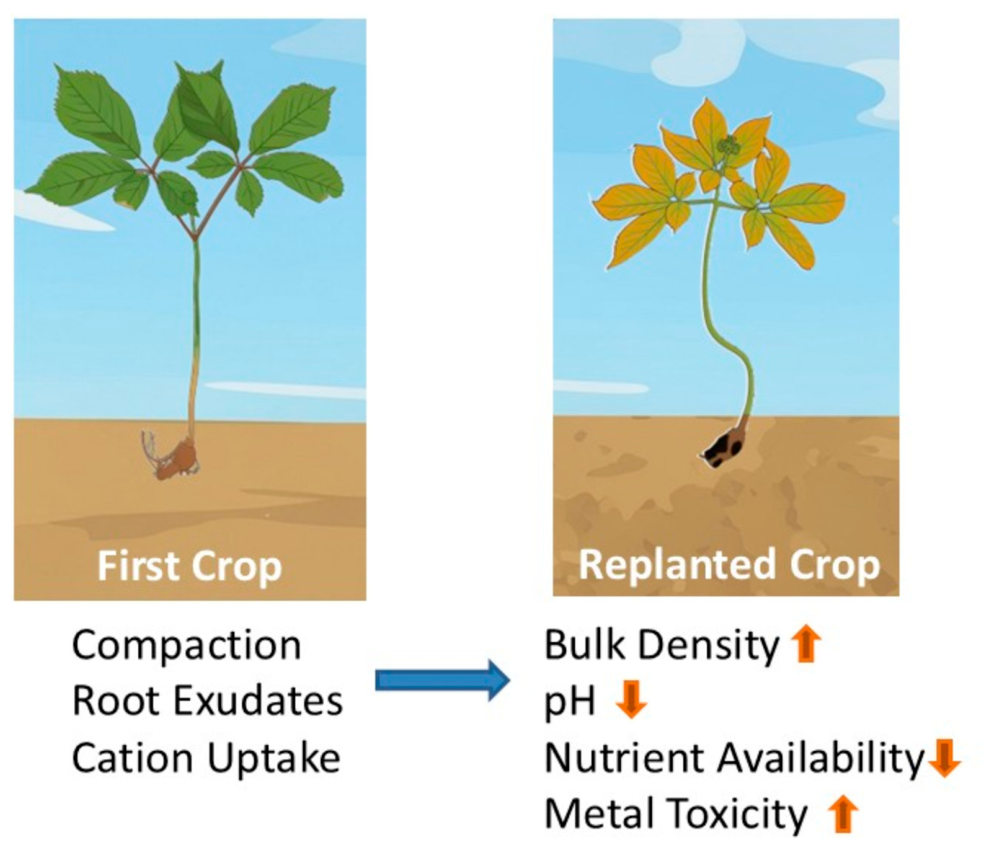
Soil acidification is also proposed to occur during ginseng cultivation, which fits with the soil physiochemistry hypothesis of replant disease. For P. ginseng, direct-seeded plants decreased soil pH from approximately 4.9 to 4.2 over three years [20], from 6.5 to 5.4 over four years [27], and from 7.1 to 5.5 over six years [28]. For P. quinquefolius cultivated for three years at three sites in China, soil pH decreased from 5.7 to 4.9 at Zakoushi, from 7.2 to 6.2 at Yingpan, and from 6.5 to 4.9 at Miaotaizi [29]. Three-year-old P. ginseng plants grown at pH 4.5 had significantly thinner and etiolated aerial parts, with lighter, shorter, and thinner roots than those grown at pH 7.2, demonstrating the detrimental effects of a low soil pH [30]. Root exudates can contain organic acids, such as citramalic and salicylic acids in sugar beet, which can influence soil nutrient availability [31]. In the case of ginseng, root exudates and plant residues contained phenolic compounds, such as salicylic, cinnamic, and benzoic acids [32]. A decrease in pH can also occur when free protons accumulate in the soil due to the higher uptake of cations over anions [33], as well as the conversion of ammonium to nitrate (nitrification) [34]. Decreased concentrations of exchangeable calcium and ammonium, along with nitrate accumulation indicating nitrification, were associated with the decline in soil pH observed during P. ginseng cultivation by You et al. [20]. Soil acidification has also been related to replant disease of P. quinquefolius [18,35].
Soil nutrient imbalances may also be associated with ginseng replant disease. Such changes may be related to soil acidification, since strongly acidic soils (pH below 5) can reduce the availability of certain essential nutrients, particularly phosphorus and molybdenum; promote the depletion of exchangeable base cations, such as calcium, magnesium, and potassium; and alter nitrogen and sulphur cycling [36]. Under acidic conditions, hydrogen and aluminum ions can displace exchangeable base cations from the soil, increasing their susceptibility to leaching, while phosphorus availability may decline due to adsorption onto iron and aluminum oxides and hydroxides and the formation of sparingly soluble iron and aluminum phosphates [37]. Examples of the effects of nutrient deficiency in ginseng include four-year-old P. quinquefolius that showed reduced root weight when grown under low phosphorus in pots [38]; two-year-old P. ginseng that showed reduced sprout weight when grown under low nitrogen in pots [39]; four-year-old P. quinquefolius that showed reduced root weight and root yield when grown in fox loamy sand (Psammentic Haplu-dalf) with low nitrogen in the field [40]; and three-year-old P. ginseng that showed thinner and etiolated aerial parts, with shorter and thinner roots along with reduced weight, when grown in the field under low levels of calcium and magnesium [30].
Plants growing in soil below pH 5 may also experience metal toxicity due to increased solubility and availability of certain metals, particularly aluminum and manganese, while iron and zinc toxicity may occur depending on their concentrations and soil conditions [36]. For example, first-crop P. ginseng showed significantly increased inorganic aluminum content that correlated to decreased soil pH from 4.9 to 4.2 over three years [20]. Several studies have shown that higher levels of metal ions can be toxic to ginseng. When four-year-old P. ginseng roots are exposed to 600 µM iron, they became a rusty reddish-brown with altered cell structures, including shrinkage, folding, and thickening of the cell wall; protoplast shrinkage; and increased vacuolation and starch granulation in the cytoplasm, compared to the control exposed to 100 µM, which showed no symptoms [41]. Two-year-old P. ginseng grown with 500 mM iron showed a significant increase in hydrogen peroxide content and lipid peroxidation in its leaves and roots compared to plants grown with 0 mM iron [42]. One-year-old P. quinquefolius with added zinc showed inhibited root and shoot growth compared to those grown without added zinc [43].
While there is evidence for soil physiochemistry changes during ginseng cultivation, including increased soil bulk density, decreased soil pH, nutrient imbalances, and metal ion toxicity, the soil physiochemistry hypothesis is not supported by the observation that even when ginseng farmers considerably adjust the soil chemistry before the second crop, replant disease still occurs. Bulk density can be decreased by rotary tillage [44], pH can be adjusted by liming, inorganic NPK fertilizers can be used to ensure adequate nutrient levels [45], and nutrients can be increased by adding inorganic fertilizers, composted animal manure, or plough-down crops [6]. Also, replant disease can occur multiple decades after the first crop with many subsequent crops, even those that have different soil management regimes altering the soil physiochemistry [8]. In addition, this hypothesis fails to directly address plant–pathogen interactions, as replant disease is often associated with root rot primarily caused by I. mors-panacis [7]. However, soil physiochemistry changes could be related to root rot susceptibility through the creation of damaging plant stress that affects the roots.
2.2. Allelopathic Autotoxicity Hypothesis (Figure 2)
The allelopathic autotoxicity hypothesis is that ginseng root exudates, such as phenols and ginsenosides, can damage and eventually kill ginseng plants of the replanted crop [46]. Thus, ginseng replant disease results from the release of toxic compounds by ginseng itself that interfere with the growth of other ginseng plants [47]. Allelopathy against oneself is called autotoxicity, and the inhibition of plant growth and germination are common forms of allelopathy that have been related to replant diseases of other crops, such as alfalfa, apple, sugarcane, coffee, and eucalyptus [48]. Autotoxicity can be caused by many different plant-secreted compounds, such as organic acids, phenolic acids, alcohols, alkaloids, and terpenoids [48].
One class of allelopathic compounds in ginseng is phenolic acids. During the cultivation of P. quinquefolius, many phenolic acids increased in the soil compared to control soil cultivated with maize, with the most common being coumaric acid, which was associated with reduced growth as indicated by the decreased lateral root formation and dry root weight [49]. Nine phenolic compounds were isolated from the P. quinquefolius rhizosphere that decreased the radicle length of seedlings compared to the control grown in sterilized water, with the highest activities reported for salicylic acid (SA) and benzoic acid, followed by trans-cinnamic acid, ferulic acid, vanillic acid, p-hydroxybenzoic acid, vanillin, syringic acid, and p-coumaric acid [46]. Five phenolic acids (gallic acid, SA, 3-phenylpropionic acid, benzoic acid, and cinnamic acid) isolated from P. ginseng rhizosphere decreased the growth rate and root weight of two-year-old P. ginseng seedlings in the field, with 3-phenylpropionic acid being the most inhibitory [50]. Benzoic acid and palmitic acid from the P. ginseng rhizosphere reduced radicle and shoot length in vitro [51]. Overall, the most potent phenolic acids in these studies appeared to be coumaric acid [49], SA [46], benzoic acid [52], and 3-phenylpropionic [50]. However, there have also been reports that phenolic acids do not accumulate in soils with ginseng cultivation history and thus do not contribute to allelopathy [18].
Figure 2.
Allelopathic autotoxicity hypothesis. Healthy plant from first ginseng crop on left and diseased plant with root rot from replanted ginseng crop on right. The first crop releases root exudates containing compounds that accumulate in the soil (up arrow), such as phenolic acids, ginsenosides, and polyacetylenes, resulting in damage to ginseng plants that are replanted in the same soil.
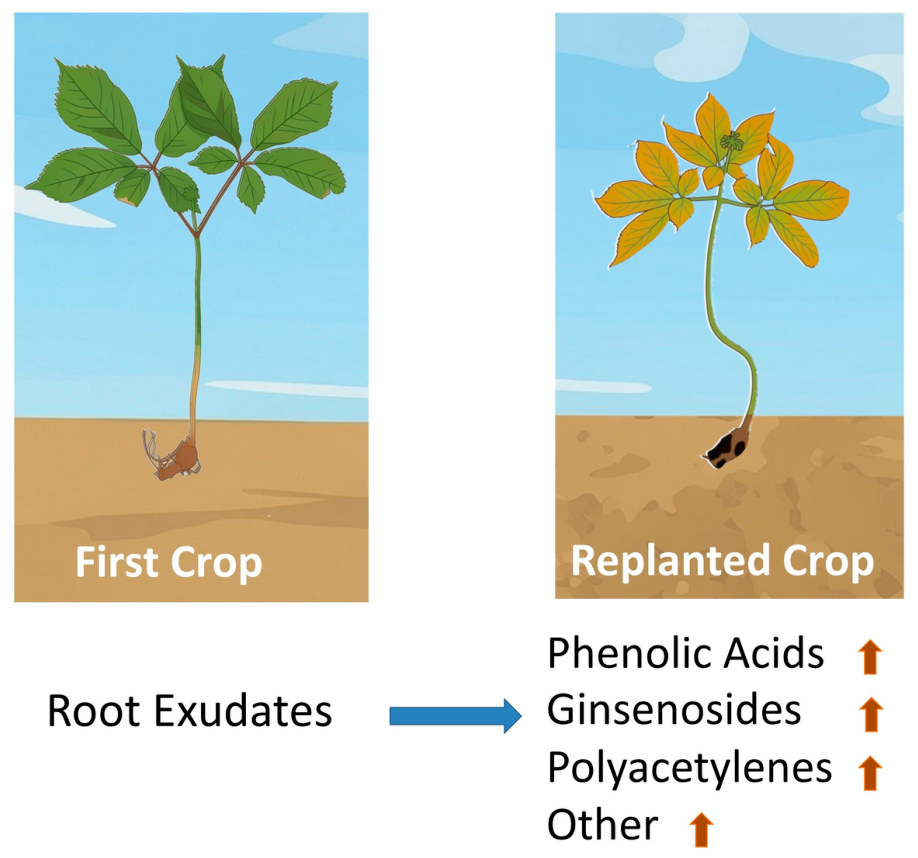
Another class of allelopathic compounds from ginseng root exudates is ginsenosides. Ginsenosides are divided into two major classes, protopanaxadiol (PPD) and protopanaxatriol (PPT) [53]. For root ginsenosides, Rb1, Rg1, and Rb2 are the major types in P. ginseng; Rb1, Re, and Rd are the dominant ones in P. quinquefolius; and Rb1, Rg1, Ra3, and R1 are the most common in P. notoginseng [54]. In four-year-old roots of P. quinquefolius, >75% of ginsenosides are represented by Re and Rb1 [55], reaching 90% when Rb2, Rc, Rd, and Rg1 are included [56]. For P. quinquefolius, evidence that ginsenosides are being secreted shows that F11, Rb1, Rc, Rd, Re and Rg1 were recovered from pots where plants were grown in sand that was washed with water [57], and Rb1, Rb2 and Rd were recovered in rhizosphere soil of three- to four-year-old roots [58]. For P. notoginseng, Rg1, Rb1, and Rd were recovered from bottles where seedlings were being grown in silica and washed with water [59], and Rg1, Re, Rg2, and Rd were identified in root exudates [47].
There has been a number of reports that ginsenosides are autotoxic. In P. notoginseng, seedling emergence and growth and root cell vigour decreased in pots when Rg1 and Rb1 were added to the soil [47], and seedling biomass was reduced in pots when Rg1 was added to the soil [60]. In P. ginseng, the survival of 130-day-old seedlings and their root dry weight was reduced in pots when plants were irrigated with water passed through the soil of four-year-old ginseng growing in pots, presumably due to ginsenosides from root exudates [61]. Water passed through ginseng soil can be used to retrieve ginsenosides, as shown by Nicol et al. [57] with P. quinquefolius, and by Luo et al. [59] with P. notoginseng. In P. quinquefolius, seedling radicle length was reduced in tissue culture when high levels of PPD and PPT were added to the media [62], and the seedling height and radicle length were reduced in pots when high levels of Rb1, Rb2, and Rd were added to the soil [58]. In support of the autotoxicity ginsenoside hypothesis, replant disease in P. notoginseng was reduced with the use of the reductive soil disinfestation technique, which caused the degradation of Rb1 and Rh1 by creating a more diverse ginsenoside-degrading microbiome [63]. Further evidence comes from Yang et al. [47], who applied P. notoginseng root exudate to a hydroponic solution for 30 days and observed that the survival of P. notoginseng seedlings was significantly greater when 12% activated charcoal was included compared to when no activated charcoal was added. The increased survival rate was believed to be due to the activated charcoal binding ginsenosides in root exudates.
There are compounds other than phenolic acids and ginsenosides that show allelopathic activity to ginseng. Several compounds that can negatively affect ginseng, as shown by the inhibited germination of P. quinquefolius seeds, were found to accumulate in replanted ginseng soils, including pyruvic acid and myristic acid [18]. Jia and Yang [64] found that the levels of the polyacetylenes, panaxydol, and panaxynol in P. quinquefolius root exudate may contribute to ginseng replant disease. These compounds, along with the ginsenoside Rb1, accumulate in soil during ginseng cropping, but panaxydol and panaxynol remain in ginseng soil longer and exhibit a stronger negative correlation with disease occurrence than ginsenosides. They proposed that there is a plant–soil feedback mechanism wherein the accumulation of polyacetylenes in the soil inhibit ginseng roots from synthesizing these allelochemicals in the roots, thus reducing their resistance to pathogens.
The allelopathic autotoxicity hypothesis is supported by the observation that several compounds, including phenolic acids and ginsenosides, are present in the soil when ginseng is cultivated, and these are allelochemicals based on their negative impacts on growth of ginseng roots and seedlings. However, the allelopathic autotoxicity hypothesis is not supported by the observation that allelochemicals alone cannot be responsible for replant disease since their activity is to directly inhibit root growth, whereas replant disease is associated with root rot caused by soil-borne plant pathogens [11]. These allelochemicals, however, may affect ginseng by causing root stress, making them more susceptible to root rot. Another aspect that does not support this hypothesis is that ginseng seedling growth itself is inhibited by phenols [65] and ginsenosides [62]; therefore, one might expect to see replant disease in the first crop as exudates accumulate in the soil over 3 to 4 years before harvesting. Instead, replant symptoms are only observed in a replanted crop and is usually first observed later in the first year, with increased disease severity occurring in the second and third years of cultivation of a replanted crop [7,66]. Thus, replant disease only occurs after harvesting the first crop and is associated with mature plants in the second crop rather than seedlings.
Another issue with replant disease being caused by allelopathic ginseng root exudates is that it remains unclear how these compounds can persist in soil for decades after the ginseng is first cultivated. The persistence of allelopathic compounds in the soil for decades has not been demonstrated. Most allelopathic compounds persist in the soil for just a short period, such as the quassinoid ailanthone in Ailanthus altissima root exudates that remain for almost a month in soil [67], the saponins of Medicago sativa that remain for less than a month in soil [68], and the phenolic acids of Pueraria montana that remain for approximately six weeks in soil [69]. The best-known exception for this is the naphthoquinone juglone of Juglans sp., which remains in the soil for over a year, even after the tree has been removed [70], though this is still far shorter than the 30 or more years that ginseng replant disease can still be observed. One of the most long-lived types of compounds in soil are hydrophobic polycyclic aromatic hydrocarbons (PAHs), such as benzo[ghi]perylene from coal and oil tar and coronene from carpathite, which have half-lives of over 9 years [71]. The persistence of certain organic pollutants in soil has been proposed to be related to their hydrophobicity making them less reactive [72,73]. Hydrophobicity could be a factor in replant disease, since the backbone of ginsenosides is a dammarane-like triterpene structure, comprising three cyclohexane and one cyclopentane, making it the hydrophobic part of the ginsenoside [74]. Microbial transformation of ginsenosides occurs due to deglycosylation of the sugar moieties, which are hydrophilic parts of ginsenosides. For example, the β-glycosidase from the ginseng soil fungus Aspergillus niger isolated from ginseng soil can, when grown in culture, hydrolyze the sugar moieties from PPD ginsenosides to produce the aglycon PPD [75]. If a similar process of complete deglycosylation of ginsenosides by ginseng soil microorganisms occurs, then this would result in a highly hydrophobic and potentially persistent dammarane-like di/triterpenoid product in the soil. Therefore, the production of such a highly hydrophobic compound by soil microbes could explain such a long persistence of allelopathic compounds in the soil, but no compounds related to ginseng replant disease have yet been reported from soil used for ginseng cultivation; thus, it is unknown if the concentration of soil compounds related to ginseng replant disease changes over time, are progressively converted to other forms, or are produced under other circumstances.
2.3. Allelopathic Soil Microbiology Hypothesis (Figure 3)
The allelopathic soil microbiology hypothesis is that ginseng root exudates alter soil microbial communities by increasing pathogen populations and decreasing the abundance of beneficial microbes, eventually resulting in the death of ginseng plants in the replanted crop due to severe root rot [76]. In many plants, pathogen sporulation and growth can be increased by root exudates, such as Fusarium oxysporum f. sp. niveum after the addition of watermelon root exudate to a low-nutrient fungal culture medium [77], F. oxysporum and Fusarium solani after the addition of peanut root exudates in low-nutrient fungal culture medium [78], and F. oxysporum f. sp. cucumerinum after the addition of cinnamic acid from cucumber root exudate to a hydroponic solution [79]. Root exudates can also act as chemo-attractants to plant-pathogenic bacteria, oomycetes, and fungi, resulting in increased disease [80]. For example, as ethyl β-D-glucoside in tomato root exudates increase Ralstonia solanacearum [81], isoflavones in soybean root exudates affect Phytophthora sojae [82], and ginsenosides in P. ginseng root exudates attract I. mors-panacis [83].
Figure 3.
Allelopathic soil microbiology hypothesis. Healthy plant from first ginseng crop on left and diseased plant with root rot from replanted ginseng crop on right. The first crop alters the aspects of the soil physiochemistry and releases root exudates that alter the soil microbiome. As a result, ginseng plants in the replanted crop experience higher populations (up arrow) of soil-borne pathogens and reduced populations (down arrow) of soil-borne beneficial microorganisms, resulting in increased root rot.
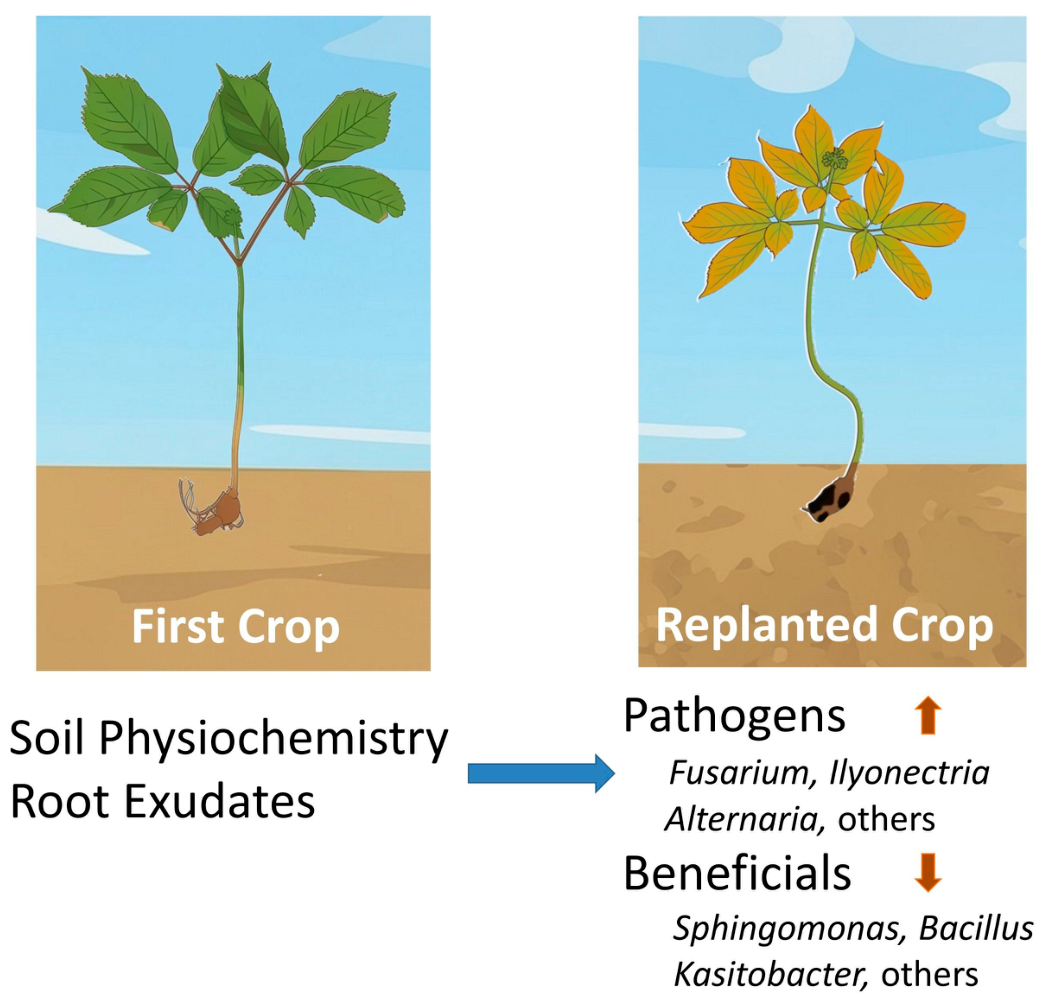
Populations of potential plant-beneficial microorganisms have been found to decrease over time with ginseng cultivation. In P. ginseng rhizosphere soils, for example, populations decreased of the bacteria Paralcaligenes and Sphingomonas over 3 years [84], and Thermoleophilia, Bacilli, and Nitrospira over 9 years [85]. In P. quinquefolius rhizosphere soils, examples include decreased populations of the bacteria Kaistobacter, Rhodoplanes, and Mycobacterium over 4 years [86]; Methylibium, Rubrivivax, Variovorax, and Sphingomonas over 4 years [29]; and KD4-96 (Chloroflexi), RB41 (Acidobacteria), and Sphingomonas over 4 years [35]. A decline in beneficial bacteria and fungi was observed over time with the cultivation of P. quinquefolius [22], and seven beneficial bacteria and three beneficial fungi had a lower abundance in soil previously used for P. quinquefolius compared to the controls [18]. In P. notoginseng rhizosphere soils, examples include population decreases for the bacteria Kaistobacter, Actinotalea, Plesiomonas, and Pandoreae over 3 years [87]; Bacillus, Acinetobacter, and Burkholderia over 1 year [88]; and Acidothermus, Sphingomonas, Rhodanobacter, Mizugakiibacter, and Nitrobacter over 5 years [89]. These reductions in the relative abundance of potentially beneficial microorganisms in soils used for ginseng production may be associated with decreases in antagonistic activity against soil-borne pathogens, the induction of plant defence responses, ginsenoside degradation, heavy metal detoxification, phosphate solubilisation, nitrogen fixation, and phytohormone production, potentially affecting disease resistance and plant growth [90,91,92].
Populations of potentially plant-pathogenic microorganisms can increase over time with ginseng cultivation. In P. ginseng rhizosphere, populations increased for the fungi Tetracladium and Leptodontidium over 9 years [85], Fusarium over 3 years [84], F. oxysporum over 3 years [27], and F. solani, Monographella cucumerina, I. mors-panacis, Ilyonectria robusta, and Nectria ramulariae over 5 years of cultivation [93]. In P. quinquefolius rhizosphere soils, populations increased for the fungi Monographella, Ilyonectria, and F. oxysporum over 3 years [94], while I. robusta, Vishniacozyma heimaeyensis, and Fusarium hostae increased over 4 years [29], and Fusarium increased over 4 years of cultivation [35]. In P. notoginseng rhizosphere soils, populations increased for the pathogenic fungus Phaeosphaeria over 3 years [88]; Alternaria, Armillaria, Aphanoascus, Aspergillus, Setophoma, and Rhexocercosporidium over 5 years [95]; and F. oxysporum, F. solani and M. cucumerina over 1 year of cultivation [89].
Since I. mors-panacis is the pathogen most often associated with root rot in ginseng replant disease, replant disease could be due to the selection of more virulent strains or increased populations in the soil. However, Behdarvandi et al. [96] found no significant differences in virulence based on root lesion sizes between Ilyonectria isolates obtained from first- and second-crop ginseng soils, suggesting that pathogen virulence did not generally increase during growth of the first crop. Westerveld and Shi [8] described the hypothesis that replant disease was due to an increase in its population as well as this selection for more virulent isolates during growth of the first ginseng crop. However, the authors pointed out that this is not consistent with the long duration wherein replant disease can occur in soil (i.e., multiple decades), and with the many crops other than ginseng being grown in the same soil over time, all of which would affect the soil microbiome, including I. mors-panacis. A pathogen identified as C. destructans was detected in Korean ginseng soils more than 10 years after the previous crop was harvested [97], which is much shorter than the 30-plus years duration of ginseng replant potential of soil. However, the species identity of older isolates of C. destructans cannot be resolved under current Ilyonectria taxonomy, as not all isolates of C. destructans were reclassified as I. mors-panacis [15]. Thus, their detection does not necessarily establish the maximum survival period of I. mors-panacis. Also, Westerveld and Shi [8] pointed out that ginseng replant disease is atypical of root rots, as it is highly uniform in a replanted field and does not spread to nearby ginseng plants growing in soil not previously planted with ginseng, even if these are only 15 cm away. In addition, they noted that there is less replant disease if a second crop is planted immediately after the first crop when the pathogen inoculum would likely be at its highest level compared to planting years later following various non-host crops of I. mors-panacis. All of these indicate that replant disease is not simply related to accumulation of root rot pathogen inoculum, but that it is a combination of soil factors found in post-harvest ginseng soil interacting with perhaps very low populations of I. mors-panacis to ultimately cause the severe root rot in replant disease [8]. The lack of a correlation between I. mors-panacis populations in soil and root rot severity in ginseng replant disease may also explain why studies that examine multiple soil factors find a correlation with abiotic factors rather than biotic factors, such as I. mors-panacis, when analyzing soils previously planted with ginseng [18].
One factor affecting the soil microbiome could be ginsenosides in ginseng root exudates, which can increase pathogen populations. For example, Phytophthora cactorum and Pythium irregulare growth increased when P. quinquefolius crude ginsenoside extract was added to potato dextrose agar [57]. Ilyonectria mors-panacis growth was increased when P. ginseng root exudate was added to rose Bengal agar [84], and its sporulation increased when crude ginsenoside extract or the purified PPDs Rb1, Rb2, Rc, and Rd or PPTs Re and Rg1 were added to V8 agar [98]. Fusarium oxysporum, F. solani, and M. cucumerina populations were also higher at 90 days than at 30 days in the rhizosphere of P. notoginseng grown in pots, which was believed to be due to the influence of root exudates [88], and this can be related to ginsenosides, since the addition of Rg1, Rb1, and Rd to the soil had the same effect [59]. However, ginsenosides can also decrease pathogen populations. Pythium irregulare growth was inhibited with purified b1, Rb2, Rc, and Rd added to water agar [99], and was inhibited in Czapek-Dox agar when F2 from P. quinquefolius was added. This may result from P. irregulare requiring exposure to glycosylated ginsenosides to induce the expression of glycosidases to deglycosylated F2, thus preventing F2 from inhibiting its growth [100]. Ginsenosides can also suppress non-pathogenic rhizosphere populations. Populations of species of Pseudomonas, Arthrobacter, and Mesorhizobium were lower in P. notoginseng rhizosphere soil after Rg1, Rb1, and Rd were added [59]. Growth of beneficial fungi, such as Trichoderma harzianum and T. hamatum was inhibited with P. quinquefolius crude ginsenoside extract added to Czapek-Dox gel [101], and T. hamatum growth was inhibited with Rb1, Rb2, Rc, and Rd added to Czapek-Dox broth [99].
Another factor that could affect the soil microbiome are phenolic acids in ginseng root exudates. Populations of species of the potentially plant-pathogenic fungi Fusarium, Humicola, and Gibberella showed an increased relative abundance in P. ginseng rhizosphere when gallic acid, salicylic acid, and 3-phenylpropionic acid were individually added to the soil, while the relative abundance of Ilyonectria increased only when cinnamic acid was added to the soil [50]. Species of the phytopathogenic bacterial genus Clostridium showed an increased relative abundance in the P. quinquefolius rhizosphere after a 10-year crop rotation that corresponded with increased levels of salicylic and cinnamic acids in the soil [89]. Phenolic acids in ginseng root exudates can also decrease beneficial populations in its rhizosphere. The beneficial fungus Mortierella sp. showed a decreased relative abundance when gallic acid, SA, and 3-phenylpropionic acid were individually added to the soil but increased when cinnamic acid was added to the soil [50]. The beneficial bacteria Acidothermus sp. and Sphingomonas sp. also showed a decreased relative abundance in P. quinquefolius rhizosphere after a 10-year crop rotation that was associated with increased levels of salicylic and cinnamic acids in the soil [89].
The effects of root exudates on the ginseng soil microbiome could also be due the decline in soil pH that occurs over time under ginseng cultivation [29,102]. There are many acidic compounds in ginseng root exudates, such as amino acids, phenolic acids, and organic acids, which can contribute to lowered soil pH [103]. In particular, organic acids released by plant roots can contribute to mineral nutrient mobilization through acidification and complexation reactions, thereby affecting nutrient acquisition in the rhizosphere [104]. Also, soil pH can decrease over time due to H+ or OH− from root exudates being released into the soil, and their association with soil carbon dioxide results in carbonic acid accumulation [105]. Changes in soil pH can have widespread effects on the microbial community in soil, most likely by affecting nutrient availability [106].
The allelopathic soil microbiology hypothesis is supported by ginseng root exudate components, such as ginsenosides and phenolic acids, acting as chemo-attractants and promoting the growth of plant-pathogenic fungi while suppressing the growth of beneficial organisms. Also, in support of this hypothesis, microbial populations are affected over time associated with a decrease in soil pH [29], resulting in the promotion of potentially pathogenic fungi and the suppression of potentially beneficial organisms. The symptoms of replant disease are more evident in the second and third years of replanted cultivation [7,66], and these are associated with more mature plants being more susceptible [11,66], which would agree with changes over time occurring due to the accumulation of root exudates, a decrease in soil pH, and changes in microbial populations.
However, this hypothesis is not supported by the observation that ginseng replant disease persists for decades in the soil, even after crop rotation with other species, such as soybean and corn, which would alter the soil microbiome, such as selecting for the pathogens of those crops. It has been observed that pathogen populations decrease over time when non-host crops are grown [107]. Thus, it would be expected that after 30 years of other crops being cultivated after ginseng, the effects of ginseng on the soil microbiome would be greatly diminished. Also, American ginseng farmers use pre-plant fumigants that reduce total microbial populations, but this only slightly affects the levels of replant disease [8], which does not support the allelopathic soil microbial hypothesis. In addition, an increase in the pathogen populations in the rhizosphere would most likely increase disease incidence (i.e., lesion numbers per root) rather than severity (i.e., lesion size). In a first crop of ginseng, losses remain relatively low. However, in ginseng replant disease, losses reach almost 100%, with root rot lesions not being limited in size, as mostly seen in a first crop, but expanding to rot the entire root (i.e., disappearing root rot) over a similar period of time. Lesions of I. mors-panacis with greater expansion that result in plant death could be related to a variety of events, such as repeated infections, increased virulence of the pathogen, or reduced pre- or post-resistance mechanisms of the host. Another observation that does not support this hypothesis is that the hypothetical allelopathic microbe-affecting compounds from ginseng root exudates would need to persist for a very long period in the soil. However, as discussed above, allelopathic compounds are not known to persist for such a long time in the soil, regardless of whether they affect plant growth or modify the soil microbiology.
2.4. Allelopathic Plant Defence Response Hypothesis (Figure 4)
The allelopathic plant defence response hypothesis is that ginseng root compounds are released into the soil and then undergo conversion by soil microbes into compounds that can be absorbed by ginseng roots of a replanted crop roots, thereby suppressing elements of the innate immune system. This reduces their resistance to pathogens in the soil, resulting in more severe root rot. The innate immune system of plants is based on PAMP-triggered immunity (PTI, pathogen-associated molecular patterns) due to the recognition of microbial PAMPs, such as chitin, or plant DAMPs (Damage-Associated Molecular Patterns), such as cell-wall fragments, as well as effector-triggered immunity (ETI) due to the recognition of effectors released by pathogens [108]. Defences against necrotrophs are associated with gene expression regulated by JA (jasmonic acid) or ethylene (ET), while, in contrast, defences against biotrophs are associated with SA-regulated gene expression [109]. Root rot pathogens are necrotrophs, and it has been noted that PTI against root rot pathogens involve JA-regulated defences [110]. Evidence for JA-regulated defences against Ilyonectria root rot in ginseng includes the increase in JA levels in P. ginseng roots triggered by I. robusta but not by the more virulent species, such as I. mors-panacis, after 2 weeks of infection. This led to the speculation that suppression of JA defence responses only by the more aggressive I. mors-panacis was associated with its higher virulence [111]. In addition, JA triggering of ginseng root defences was shown by drenching P. ginseng roots in methyl JA before inoculation with C. destructans (i.e., I. mors-panacis), which increased defence responses, such as antimicrobial compound production and cell-wall strengthening, and reduced disease incidence by 23% at 15 days post-infection [112].
The lesions on American ginseng root caused by I. mors-panacis size did not differ significantly in size between the infection alone and treatment with ginseng root extract before infection, but lesions were larger when roots were treated with an extract from previous ginseng soil before infection compared to the infection alone [113]. Thus, there are some compounds in previous ginseng soil that could increase the lesion size (i.e., severity) of Ilyonectria root rot. Behdarvandi and Goodwin [113] also measured the expression of a series of P. quinquefolius genes. These were PqChi-1, PqPR5, PqCPI, PqPR10-2, and PqSPD, which are considered to be JA responsive since their homologues in P. ginseng are upregulated with JA alone or infection by a necrotroph, as well as the measured expression of PqGlu-1, considered to be SA responsive, as its homologue in P. ginseng was upregulated by SA but not by methyl jasmonate. Infection of P. quinquefolius roots by I. mors-panacis induced expression of all JA and SA marker genes, except PqCPI. When roots were treated with ginseng root extract before infection, relatively similar expression patterns were observed for the marker genes, whereas when roots were treated with previous ginseng soil extract before infection, the JA-dependent PqChi-1, PqPR5, and PqSPD had lower induction while PqCPI and PqPR10-2 were suppressed. However, the SA-dependent PqGlu-1 had even greater induction. Thus, some compounds in the previous ginseng soil extract, which Behdarvandi and Goodwin [113] named ginseng immunosuppressors, can increase the severity of the disease, decrease the JA defence response, and increase the SA defence response. However, ginseng immunosuppressor activity was not found in ginseng root extracts. The SA pathway is antagonistic to the JA pathway [114] and hence, the induction of the SA defence response may be suppressing the JA defence response, which has been shown for other necrotrophic pathogens, such as Botrytis cinerea and Alternaria brassicicola, in different JA, SA, and ET mutants of Arabidopsis thaliana [115].
Figure 4.
Allelopathic plant defence response hypothesis. Healthy plant from first ginseng crop on left and diseased plant with root rot from replanted ginseng crop on right. After the first crop is harvested, non-harvested ginseng tissues decay, releasing compounds into the soil. Some of these compounds are then converted into other compounds (immunosuppressors) by soil microorganisms that can be absorbed by ginseng roots when replanted in the same soil. This results in the suppression of JA-related defences (orange down arrow) in the roots of the replanted crop, making them more susceptible to root rot.
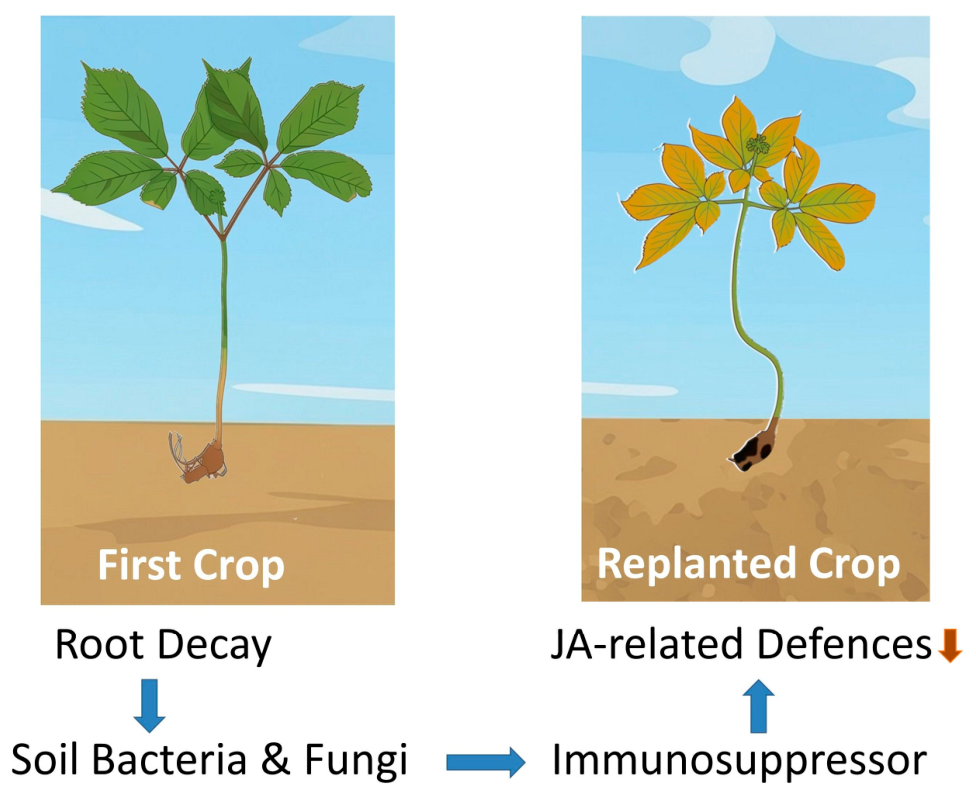
Li et al. [18] noted that while pathogen populations were lower in replanted ginseng soil than in soil not used for ginseng, there was still a higher incidence of root rot, and it was proposed that there must be factors in soil previously used for P. quinquefolius that weaken the resistance of ginseng to infection. The soil factors may be the compounds soluble in methanol from previous ginseng soil that increased the severity of Ilyonectria root rot and suppressed JA-related elements of defence gene expression, presumably weakening their resistance [113]. However, the compounds were not extractable from ginseng roots, as ginseng root extract showed no immunosuppressor activity. Thus, if the compounds with immunosuppressor activity originated from ginseng roots, then they must be converted into other forms after they somehow enter soil. Goodwin and Hsiang [116] showed that culturing the non-pathogenic bacterium from previous P. quinquefolius-cultivated soil, Pseudomonas plecoglossicida, in minimal media with P. quinquefolius root extract resulted in compounds in the cell-free extract that increased root rot lesion size caused by I. mors-panacis, similar to extracts from previous ginseng soil. Thus, it is possible that ginseng root compounds are released into the soil in some manner and are then converted by a soil bacterium into immunosuppressors of P. quinquefolius that suppress the innate immune system during root rot. Subsequent work has shown that P. plecoglossicida is not unique, and that 10 out of 62 bacterial isolates from previous ginseng soil also could produce immunosuppressor activity when grown in minimal media with P. quinquefolius root extract. These included a diverse range of common soil bacteria, such species of Bacillus, Paenibacillus, Pseudomonas, and Pantoea [117]. A survey of soil fungi from previous ginseng soil identified six out of 40 isolates that also produced immunosuppressor activity when grown in minimal media with P. quinquefolius root extract. These included a diverse range of common soil fungal species, such as species of Neurospora, Plectosphaerella, Tetracladium and Absidia [117]. Thus, it appears that while it is not a common trait, there is still a broad taxonomic range of soil microbes that are able to convert ginseng root compounds into those with ginseng immunosuppressor activity.
To identify the compounds responsible for ginseng immunosuppressor activity, two rounds of high-performance liquid chromatography (HPLC) were done on a cell-free extract, with immunosuppressor activity produced in culture by a Paenibacillus isolate from soil previously used for P. quinquefolius production. Activity was associated with a relatively polar fraction, making it unlikely to be a phenolic acid or ginsenoside, which are the most common allelopathic compounds identified in ginseng root exudates [117]. While the compound with ginseng immunosuppressor activity was not identified, it appears to be a relatively low-molecular-weight, moderately polar compound with an aromatic or conjugated functional group, possibly a nitrogen-containing heterocyclic compound such as a shikimate pathway metabolite or its derivative. However, it is unlikely to be any of the known components of ginseng root exudates. Ginseng replant disease does not occur in a first crop of ginseng, even though the crop is typically commercially harvested after 3 to 4 years of growth, which would be sufficient time for ginseng root exudates to accumulate in soil. In a survey of soils. it was found that ginseng immunosuppressor activity was not detected in first-crop ginseng soil, even after several years of growth; it was only first detectable in soil extracts collected the following spring after the crop was harvested [118]. Examining a commercially harvested P. quinquefolius garden, Suárez et al. [119] found that approximately 8% of estimated ginseng fresh root weight remained in the soil following harvest, but almost none remained in the soil by late spring of the following year, with changes in the soil microbiome occurring during decay. They estimated that between 0.6 and 1.8 g of ginsenosides would be released per square metre of soil. Thus, the appearance of ginseng immunosuppressor activity correlated with the decay of non-harvested ginseng crop debris, including its roots, rather than the release of root exudates as the first ginseng crop grew.
Ginseng replant disease persists for decades after the ginseng crop is cultivated, and it is unusual for an organic compound, such as a putative immunosuppressor, to actively persist in the soil for such a long period. However, Goodwin and Zaro [118] were able to detect ginseng immunosuppressor activity in soils up to 30 years after an original P. quinquefolius crop, but they did not observe activity in soils not planted with P. quinquefolius. Thus, the ginseng immunosuppressor may be highly persistent in the soil in some manner once it has been synthesized by soil microbes, explaining the long duration of ginseng replant disease. If ginseng is planted in such soil, then the immunosuppressor in the soil may be absorbed by ginseng roots over time, making them more susceptible to root rot by I. mors-panacis and possibly other necrotrophs. Thus, it affects the severity of the disease. Even if root rot pathogen populations are low in replanted ginseng soil, more severe infections could quickly increase their relative populations, spreading the disease to more ginseng plants with compromised innate immune systems. One possible explanation for the greater occurrence of I. mors-panacis with replant disease than other root rot pathogens is the finding of Shi [66] that latent infections by I. mors-panacis are common in ginseng roots, increase over the years as the crop grows, and occur more frequently in roots from a replanted ginseng crop than a first crop. Thus, the greater prevalence of I. mors-panacis than other root rot pathogens in replant disease may simply be that latent infections by it have already occurred, and the development of symptoms only requires activation from those latent infections.
The allelopathic plant defence response hypothesis is supported by the observation that previous ginseng soil extract increases the severity of root rot by I. mors-panacis but not with non-ginseng soil extract [113]. The hypothesis is also supported by the observation that the application of previous ginseng soil extract before I. mors-panacis infection can suppress the induction of several JA-responsive genes, and the JA pathway appears essential for the defences against I. mors-panacis (C. destructans) [112,113]. This hypothesis is also consistent with the observation that immunosupressor activity is not detected in first ginseng crop soil but is highly persistent in soils previously planted with ginseng and associated with the decay of ginseng tissues in soil after harvesting [118]. A major limitation, however, is that the compound responsible for this activity has not yet been identified, and studies of large-scale gene expression during infection, including those of the pathogen, have not been done.
3. Conclusions
All cultivated Panax species studied can experience indistinguishable replant diseases, as exhibited by their higher mortality due to the severe root rots when grown in soil previously used for ginseng cultivation. There is compelling evidence that I. mors-panacis/C. destructans is the main pathogen causing the root rot observed with ginseng replant disease [7,8,10]. Although there are many proposed reasons for ginseng replant disease, none of them have been proven conclusively. A weakness of the soil physiochemistry, allelopathic autotoxicity, and allelopathic soil microbiology hypotheses is that they do not directly explain the increase in lesion sizes (disease severity) caused by I. mors-panacis in a replanted ginseng crop compared to a first crop. Either they do not consider root rot as the primary factor (soil physiochemistry and soil allelopathic autotoxicity hypotheses), or they imply that replant disease is related to increased disease incidence with more lesions per root, without considering why lesions more often become larger (allelopathic soil microbiology hypothesis). A key factor in ginseng replant disease is that root rot lesions are less likely to be limited but more likely to spread throughout the root resulting in plant death, which is observed as higher levels of disappearing root rot [11,12,15]. This could be due to a post-infection factor, although this could also be related to changes in the roots prior to infection that compromises resistance. Soil changes following ginseng cultivation may be contributing factors, but it is root rot by I. mors-panacis that is the ultimate cause of ginseng replant disease. Li et al. [18] demonstrated that long-term ginseng replant disease soil is more strongly associated with abiotic factors, such as persistent soil metabolic disturbances, rather than with biotic factors, such as increases in pathogen population or declines in beneficial microbial populations. While useful in identifying the soil factors involved, such studies do not explain why root rot by I. mors-panacis is more severe in replant soil killing almost all the plants. On the other hand, studies on ginseng plants with root rot growing in replanted soil (or treated with previous ginseng soil extract) can address the host and pathogen factors responsible for disappearing root rot, which is the ultimate factor killing plants and causing ginseng replant disease.
Although the soil physiochemistry, soil allelopathic autotoxicity, and allelopathic soil microbiology hypotheses do not directly explain the increase in disease severity of I. mors-panacis in ginseng replanted soil, they could still be related to ginseng replant disease. The detrimental effects on the plant due to soil physiochemical changes in the soil could damage roots suppressing pre- or post-infection ginseng root defences against I. mors-panacis and thus could be responsible for the levels of disappearing root rot by I. mors-panacis when ginseng is replanted. There are many examples of soil physiochemical changes that make plants more susceptible to diseases, such as soil acidification for Ralstonia solanacearum wilt in tobacco [120] and a higher bulk density for Fusarium solani root rot in white beans [121]. The uptake of soil allelopathic autotoxins by ginseng roots could also increase the occurrence of disappearing root rot by I. mors-panacis by damaging plants without killing them, and such physiological damage could reduce the level of resistance to I. mors-panacis. Examples of allelochemicals making plants more susceptible to diseases include phenolic acids, such as vanillic acid for Colletotrichum musae crown rot in bananas [122] and ferulic acid for Ralstonia solanacearum wilt in tomato and tobacco [123]. Changes in the soil microbiome due to ginseng growth could also increase root rot severity, such as by reducing the growth of beneficial microorganisms in ginseng replant soil, as seen with Trichoderma spp., that can benefit plant growth and trigger ISR (induced systemic resistance) in plants [124]. Thus, more disappearing root rot may develop due to certain factors, such as the level of ISR being reduced in the roots of ginseng in a replanted crop. More learning is needed about all the hypotheses of ginseng replant disease, but this review is the first to summarize the recently proposed allelopathic plant defence response hypothesis; we showed that it is a promising alternative explanation of ginseng replant disease that directly predicts increased lesion sizes due to I. mors-panacis when ginseng is grown in soil already used for ginseng production, which could be related to roots having lowered JA-regulated defences.
Author Contributions
Conceptualization: P.H.G. and T.H.; Methodology, P.H.G. and T.H.; formal analysis: I.B.N. and P.H.G.; resources: P.H.G.; writing—original draft preparation: I.B.N.; writing—review and editing: P.H.G. and T.H. All authors have read and agreed to the published version of the manuscript.
Funding
This review received no external funding.
Data Availability Statement
No new data were created or analyzed in this study. Data sharing is not applicable to this article.
Conflicts of Interest
The authors declare that the research was conducted and the review written in the absence of any commercial or financial relationships that could be constructed as potential conflicts of interest.
References
- Bahrke, M.S.; Morgan, W.P. Evaluation of the ergogenic properties of ginseng: An update. Sports Med. 2000, 29, 113–133. [Google Scholar] [CrossRef] [Scilit] [PubMed]
- Yue, J.; Zuo, Z.; Huang, H.; Wang, Y. Application of identification and evaluation techniques for ethnobotanical medicinal plant of genus Panax: A review. Crit. Rev. Anal. Chem. 2020, 51, 373–398. [Google Scholar] [CrossRef] [Scilit] [PubMed]
- Cordell, G.A. Ginseng: The Genus Panax Medicinal and Aromatic Plants, Industrial Profiles; Court, W.E., Ed.; Harwood Academic Publishers: Amsterdam, The Netherlands, 2000; Volume 15, pp. 1–266. [Google Scholar]
- Punja, Z.K. American ginseng: Research developments, opportunities, and challenges. J. Ginseng Res. 2011, 35, 368–374. [Google Scholar] [CrossRef] [Scilit] [PubMed]
- Lim, W.; Mudge, K.W.; Vermeylen, F. Effects of population, age, and cultivation methods on ginsenoside content of wild American ginseng (Panax quinquefolium). J. Agric. Food Chem. 2005, 53, 8498–8505. [Google Scholar] [CrossRef] [Scilit] [PubMed]
- Westerveld, S. Guide to Ginseng Production; Ontario Ministry of Agriculture, Food and Agribusiness Publication No. 848; Queen’s Printer for Ontario: Toronto, ON, Canada, 2026. Available online: https://www.publications.gov.on.ca/302050 (accessed on 30 August 2026).
- Li, T.S. Asian and American ginseng—A review. HortTechnology 1995, 5, 27–34. [Google Scholar] [CrossRef] [Scilit]
- Westerveld, S.M.; Shi, F. The history, etiology, and management of ginseng replant disease: A Canadian perspective in review. Can. J. Plant Sci. 2021, 101, 886–901. [Google Scholar] [CrossRef] [Scilit]
- Singh, S.P.S.; Gautam, M.P.; Kumawat, N.; Singh, S.P.S. Soil sickness, causes and its management. Int. J. Trend Res. Dev. 2019, 5, 449–451. [Google Scholar]
- Reeleder, R.D.; Brammall, R.A. Pathogenicity of Pythium species, Cylindrocarpon destructans, and Rhizoctonia solani to ginseng seedlings in Ontario. Can. J. Plant Pathol. 1994, 16, 311–316. [Google Scholar] [CrossRef] [Scilit]
- Rahman, M.; Punja, Z.K. Factors influencing development of root rot on ginseng caused by Cylindrocarpon destructans. Phytopathology 2005, 95, 1381–1390. [Google Scholar] [CrossRef] [Scilit] [PubMed]
- Farh, M.E.A.; Kim, Y.J.; Kim, Y.J.; Yang, D.C. Cylindrocarpon destructans/Ilyonectria radicicola-species complex: Causative agent of ginseng root-rot disease and rusty symptoms. J. Ginseng Res. 2018, 42, 9–15. [Google Scholar] [CrossRef] [Scilit] [PubMed]
- Westerveld, S.M.; Riddle, R.N.; Shi, F. Efficacy of fumigants and biofumigants for the control of replant disease of American ginseng (Panax quinquefolius). Can. J. Plant Pathol. 2023, 45, 405–419. [Google Scholar] [CrossRef] [Scilit]
- Bischoff Nunes, I.; Goodwin, P.H. Interaction of ginseng with Ilyonectria root rot pathogens. Plants 2022, 11, 2152. [Google Scholar] [CrossRef] [Scilit] [PubMed]
- Cabral, A.; Groenewald, J.Z.; Rego, C.; Oliveira, H.; Crous, P.W. Cylindrocarpon root rot: Multi-gene analysis reveals novel species within the Ilyonectria radicicola species complex. Mycol. Prog. 2012, 11, 655–688. [Google Scholar] [CrossRef] [Scilit]
- Leng, Y.; Li, X.Y.; Li, Q.; Wang, S.M.; Wang, E.P.; Chen, X.; Wang, H.; Chen, C.B. Research progress on causes and methods to reduce continuous cropping problems of ginseng. Allelopath. J. 2024, 61, 115–138. [Google Scholar] [CrossRef] [Scilit]
- Chen, K.; Tong, Y.; Wang, T.; Zhou, X.; Zhou, J.; Ge, Y.; Zheng, H.; Yu, M.; Luo, Y.; Ji, R. Challenges of continuous cropping obstacles in Panax ginseng: Formation and response mechanisms. Sci. Tradit. Chin. Med. 2025, 3, 8–14. [Google Scholar] [CrossRef] [Scilit]
- Li, C.; Chen, G.; Zhang, X.; Zou, N.; Zhang, H.; Li, H.; Zhu, P.; Bai, X.; Zhao, Y.; Hou, Y. Soil metabolic disturbance drives replant disease (intraspecific negative plant–soil feedback): Insights from an experiment examining soil impacts up to 20 years after a ginseng crop. Geoderma 2024, 451, 117059. [Google Scholar] [CrossRef] [Scilit]
- Xiao, P.G.; Zhu, Z.Y.; Zhang, F.Q.; Zhu, W.H.; Chen, J.T.; Zhang, G.D.; Liu, G.T. Ginseng Research and Cultivation; AgriRoot Publication House: Beijing, China, 1987. [Google Scholar]
- You, J.; Liu, X.; Zhang, B.; Xie, Z.; Hou, Z.; Yang, Z. Seasonal changes in soil acidity and related properties in ginseng artificial bed soils under a plastic shade. J. Ginseng Res. 2015, 39, 81–88. [Google Scholar] [CrossRef] [Scilit] [PubMed]
- Lee, I.H.; Yuk, C.S.; Park, H. Yield and missing plant rate of Panax ginseng affected by the annual change in physico-chemial properties of ginseng cultivated soil. Korean J. Soil Sci. Fert. 1989, 22, 18–24. [Google Scholar]
- Chen, G.; Xue, Y.; Yu, X.; Li, C.; Hou, Y.; Zhu, H.; Jiang, L.; Zheng, W.; Feng, Z.; Li, Y. The structure and function of microbial community in rhizospheric soil of american ginseng (Panax quinquefolius L.) changed with planting years. Curr. Microbiol. 2022, 79, 281. [Google Scholar] [CrossRef] [Scilit] [PubMed]
- Wolkowski, R.P. Relationship between wheel-traffic-induced soil compaction, nutrient availability, and crop growth: A review. J. Prod. Agric. 1990, 3, 460–469. [Google Scholar] [CrossRef] [Scilit]
- Kozlowski, T.T. Soil aeration and growth of forest trees. Scan. J. For. Res. 1986, 1, 113–123. [Google Scholar] [CrossRef] [Scilit]
- Stirzaker, R.J.; Passioura, J.B.; Wilms, Y. Soil structure and plant growth: Impact of bulk density and biopores. Plant Soil 1996, 185, 151–162. [Google Scholar] [CrossRef] [Scilit]
- Roy, R.C.; Ball Coelho, B.R.; Reeleder, R.D.; Bruin, A.J.; Grohs, R.; White, P.; Capell, B. Effect of planting bed shape, mulch and soil density on root yield and shape in North American ginseng (Panax quinquefolius L.). Can. J. Plant Sci. 2008, 88, 937–949. [Google Scholar] [CrossRef] [Scilit]
- Xiao, C.; Yang, L.; Zhang, L.; Liu, C.; Han, M. Effects of cultivation ages and modes on microbial diversity in the rhizosphere soil of Panax ginseng. J. Ginseng Res. 2016, 40, 28–37. [Google Scholar] [CrossRef] [Scilit] [PubMed]
- Nguyen, N.L.; Kim, Y.J.; Hoang, V.A.; Subramaniyam, S.; Kang, J.P.; Kang, C.H.; Yang, D.C. Bacterial diversity and community structure in Korean ginseng field soil are shifted by cultivation time. PLoS ONE 2016, 11, e0155055. [Google Scholar] [CrossRef] [Scilit] [PubMed]
- Zhang, J.; Fan, S.; Qin, J.; Dai, J.; Zhao, F.; Gao, L.; Lian, X.; Shang, W.; Xu, X.; Hu, X. Changes in the microbiome in the soil of an American ginseng continuous plantation. Front. Plant Sci. 2020, 11, 572199. [Google Scholar] [CrossRef] [Scilit] [PubMed]
- Lee, S.W.S.H.; Park, K.H.; Lee, S.W.S.H.; Jang, I.B.; Lan, J.M.; Kim, K.H. Effect of application level of calcium hydroxide on brown-leaf symptom and root yield of Panax ginseng cultivated in paddy soil. Korean J. Med. Crop Sci. 2015, 23, 150–154. [Google Scholar] [CrossRef] [Scilit]
- Khorassani, R.; Hettwer, U.; Ratzinger, A.; Steingrobe, B.; Karlovsky, P.; Claassen, N. Citramalic acid and salicylic acid in sugar beet root exudates solubilize soil phosphorus. BMC Plant Biol. 2011, 11, 121. [Google Scholar] [CrossRef] [Scilit] [PubMed]
- Sun, J.; Fu, J.; Zhou, R.; Yan, X. Antibiotic effects of four exogenous phenolic acids on soilborne pathogen, Cylindrocarpon destructans. Appl. Mech. Mat. 2013, 295, 2294–2299. [Google Scholar] [CrossRef] [Scilit]
- Tang, C.; Rengel, Z. Role of plant cation/anion uptake ratio in soil acidification. In Handbook of Soil Acidity; Renge, Z., Ed.; Marcel Dekker: New York, NY, USA, 2003; pp. 57–81. [Google Scholar] [CrossRef] [Scilit]
- Cáceres, R.; Malińska, K.; Marfà, O. Nitrification within composting: A review. Waste Manag. 2018, 72, 119–137. [Google Scholar] [CrossRef] [Scilit] [PubMed]
- Li, S.; Wei, H.; Qi, D.; Li, W.; Dong, Y.; Duan, F.A.; Ni, S.Q. Continuous planting American ginseng (Panax quinquefolius L.) caused soil acidification and bacterial and fungal communities’ changes. BMC Microbiol. 2024, 24, 473. [Google Scholar] [CrossRef] [Scilit] [PubMed]
- Dalal, R.C.; Probert, M.E. Soil nutrient depletion. In Sustainable Crop Production in the Sub-Tropics: An Australian Perspective; Clarke, A.L., Ed.; Queensland Department of Primary Industries: Brisbane, Australia, 1997; pp. 42–63. Available online: http://hdl.handle.net/102.100.100/220681?index=1 (accessed on 30 August 2026).
- Marschner, P.; Rengel, Z. Nutrient availability in soils. In Marschner’s Mineral Nutrition of Higher Plants, 3rd ed.; Marschner, P., Ed.; Academic Press: Adelaide, Australia, 2011; pp. 315–330. [Google Scholar] [CrossRef] [Scilit]
- Konsler, T.R.; Shelton, J.E. Lime and phosphorus effects on American ginseng: I. Growth, soil fertility, and root tissue nutrient status response. J. Am. Soc. Hortic. Sci. 1990, 115, 570–574. [Google Scholar] [CrossRef] [Scilit]
- Jang, I.B.; Yu, J.; Suh, S.J.; Jang, I.B.; Kwon, K.B. Growth and ginsenoside content in different parts of ginseng sprouts depending on harvest time. Korean J. Med. Crop Sci. 2018, 26, 205–213. [Google Scholar] [CrossRef] [Scilit]
- Beyaert, R.P. Influence of nitrogen fertilization on the growth and yield of North American ginseng. J. Herbs Spices Med. Plants 2006, 11, 65–80. [Google Scholar] [CrossRef] [Scilit]
- Zhang, Y.; Wang, Q.; Xu, C.; Sun, H.; Wang, J.; Li, L. Iron (Fe2+)-induced toxicity produces morphological and physiological changes in roots in Panax ginseng grown in hydroponics. Toxicol. Environ. Chem. 2016, 98, 630–637. [Google Scholar] [CrossRef] [Scilit]
- Huo, Y.; Kang, J.P.; Ahn, J.C.; Kim, Y.J.; Piao, C.H.; Yang, D.U.; Yang, D.C. Siderophore-producing rhizobacteria reduce heavy metal-induced oxidative stress in Panax ginseng Meyer. J. Ginseng Res. 2021, 45, 218–227. [Google Scholar] [CrossRef] [Scilit] [PubMed]
- Ren, F.C.; Liu, T.C.; Liu, H.Q.; Hu, B.Y. Influence of zinc on the growth, distribution of elements, and metabolism of one-year old American ginseng plants. J. Plant Nutr. 1993, 16, 393–405. [Google Scholar] [CrossRef] [Scilit]
- Jiang, X.U.; Dong, L.L.; Wang, R.; Niu, W.H.; Zhang, N.W.; Naoki, F.; Chen, S.L. Soil improvement promoted micro-ecology of farmlands for ginseng cultivation. China J. Chin. Mat. Med. 2017, 42, 875–881. [Google Scholar] [CrossRef] [PubMed]
- Harris, P.M. Mineral nutrition. In The Potato Crop: The Scientific Basis for Improvement, 2nd ed.; Harris, P.M., Ed.; Chapman & Hall: London, UK, 1992; pp. 162–213. [Google Scholar] [CrossRef] [Scilit]
- He, C.N.; Gao, W.W.; Yang, J.X.; Bi, W.; Zhang, X.S.; Zhao, Y.J. Identification of autotoxic compounds from fibrous roots of Panax quinquefolium L. Plant Soil 2009, 318, 63–72. [Google Scholar] [CrossRef] [Scilit]
- Yang, M.; Zhang, X.; Xu, Y.; Mei, X.; Jiang, B.; Liao, J.; Yin, Z.; Zheng, J.; Zhao, Z.; Fan, L.; et al. Autotoxic ginsenosides in the rhizosphere contribute to the replant failure of Panax notoginseng. PLoS ONE 2015, 10, e0118555. [Google Scholar] [CrossRef] [Scilit] [PubMed]
- Singh, H.P.; Batish, D.R.; Kohli, R.K. Autotoxicity: Concept, organisms, and ecological significance. Crit. Rev. Plant Sci. 1999, 18, 757–772. [Google Scholar] [CrossRef] [Scilit]
- Jiao, X.L.; Zhang, X.S.; Lu, X.H.; Qin, R.; Bi, Y.M.; Gao, W.W. Effects of maize rotation on the physicochemical properties and microbial communities of American ginseng cultivated soil. Sci. Rep. 2019, 9, 8615. [Google Scholar] [CrossRef] [Scilit] [PubMed]
- Li, Z.; Fu, J.; Zhou, R.; Wang, D. Effects of phenolic acids from ginseng rhizosphere on soil fungi structure, richness and diversity in consecutive monoculturing of ginseng. Saudi J. Biol. Sci. 2018, 25, 1788–1794. [Google Scholar] [CrossRef] [Scilit] [PubMed]
- Li, Y.; Huang, X.F.; Ding, W.L. Autotoxicity of Panax ginseng rhizosphere and non-rhizosphere soil extracts on early seedlings growth and identification of chemicals. Allelopath. J. 2011, 28, 145–154. [Google Scholar]
- Wu, Z.; Hao, Z.; Zeng, Y.; Guo, L.; Huang, L.; Chen, B. Molecular characterization of microbial communities in the rhizosphere soils and roots of diseased and healthy Panax notoginseng. Int. J. Gen. Mol. Microbiol. 2015, 108, 1059–1074. [Google Scholar] [CrossRef] [Scilit] [PubMed]
- Biswas, T.; Mathur, A.K.; Mathur, A. A literature update elucidating production of Panax ginsenosides with a special focus on strategies enriching the anti-neoplastic minor ginsenosides in ginseng preparations. Appl. Microbiol. Biotech. 2017, 101, 4009–4032. [Google Scholar] [CrossRef] [Scilit] [PubMed]
- Kim, D.H. Chemical diversity of Panax ginseng, Panax quinquefolium, and Panax notoginseng. J. Ginseng Res. 2012, 36, 1–15. [Google Scholar] [CrossRef] [Scilit] [PubMed]
- Li, T.S.C.; Mazza, G.; Cottrell, A.C.; Gao, L. Ginsenosides in roots and leaves of American ginseng. J. Agric. Food Chem. 1996, 44, 717–720. [Google Scholar] [CrossRef] [Scilit]
- Corbit, R.M.; Ferreira, J.F.S.; Ebbs, S.D.; Murphy, L.L. Simplified extraction of ginsenosides from American ginseng (Panax quinquefolius L.) for high-performance liquid chromatography–ultraviolet analysis. J. Agric. Food Chem. 2005, 53, 9867–9873. [Google Scholar] [CrossRef] [Scilit] [PubMed]
- Nicol, R.W.; Yousef, L.; Traquair, J.A.; Bernards, M.A. Ginsenosides stimulate the growth of soilborne pathogens of American ginseng. Phytochemistry 2003, 64, 257–264. [Google Scholar] [CrossRef] [Scilit] [PubMed]
- Jiao, X.L.; Bi, X.B.; Zhang, X.S.; Gao, W.W. Autotoxic effect of ginsenoside extracts on growth of American ginseng in different medium. Zhongguo Zhong Yao Za Zhi 2015, 40, 1433–1438. [Google Scholar] [CrossRef] [Scilit]
- Luo, L.F.; Yang, L.; Yan, Z.X.; Jiang, B.B.; Li, S.; Huang, H.C.; Liu, Y.X.; Zhu, S.S.; Yang, M. Ginsenosides in root exudates of Panax notoginseng drive the change of soil microbiota through carbon source different utilization. Plant Soil 2020, 455, 139–153. [Google Scholar] [CrossRef] [Scilit]
- Yang, M.; Chuan, Y.; Guo, C.; Liao, J.; Xu, Y.; Mei, X.; Liu, Y.; Huang, H.; He, X.; Zhu, S. Panax notoginseng root cell death caused by the autotoxic ginsenoside Rg1 is due to over-accumulation of ROS, as revealed by transcriptomic and cellular approaches. Front. Plant Sci. 2018, 9, 264. [Google Scholar] [CrossRef] [Scilit] [PubMed]
- Lee, S.H.; Ro, J.S.; Lee, K.S. Study on the allelopathy of the Korean ginseng. Korean J. Ecol. 1983, 6, 250–256. [Google Scholar]
- Zhang, A.; Lei, F.; Fang, S.; Jia, M.; Zhang, L. Effects of ginsenosides on the growth and activity of antioxidant enzymes in American ginseng seedlings. J. Med. Plants Res. 2011, 5, 3217–3223. [Google Scholar] [CrossRef] [Scilit] [PubMed]
- Li, Y.; Wang, B.; Chang, Y.; Yang, Y.; Yao, C.; Huang, X.; Zhang, J.; Cai, Z.; Zhao, J. Reductive soil disinfestation effectively alleviates the replant failure of Sanqi ginseng through allelochemical degradation and pathogen suppression. Appl. Microbiol. Biotechnol. 2019, 103, 3581–3595. [Google Scholar] [CrossRef] [Scilit] [PubMed]
- Jia, S.; Yang, S. Research on soil-borne diseases of ginseng due to root exudates. J. Phytopathol. 2024, 172, e13281. [Google Scholar] [CrossRef] [Scilit]
- Bi, X.B.; Yang, J.X.; Gao, W.W. Autotoxicity of phenolic compounds from the soil of American ginseng (Panax quinquefolium L.). Allelopath. J. 2010, 25, 115–121. [Google Scholar]
- Shi, F. Ilyonectria Mors-Panacis Latency, Plant Age Susceptibility, and Soil Treatments in Replant Disease of American Ginseng (Panax quinquefolius L.). Ph.D. Thesis, University of Guelph, Guelph, ON, Canada, 2026. Available online: https://atrium.lib.uoguelph.ca/bitstreams/5cd07329-b64c-45ba-8e09-29cddbd8e222/download (accessed on 30 August 2026).
- Heisey, R.M. Evidence for allelopathy by tree-of-heaven (Ailanthus altissima). J. Chem. Ecol. 1990, 16, 2039–2055. [Google Scholar] [CrossRef] [Scilit] [PubMed]
- Jilani, G.; Mahmood, S.; Chaudhry, A.N.; Hassan, I.; Akram, M. Allelochemicals: Sources, toxicity and microbial transformation in soil—A review. Ann. Microbiol. 2008, 58, 351–357. [Google Scholar] [CrossRef] [Scilit]
- Rashid, M.H.; Asaeda, T.; Uddin, M.N. Litter-mediated allelopathic effects of kudzu (Pueraria montana) on Bidens pilosa and Lolium perenne and its persistence in soil. Weed Biol. Manag. 2010, 10, 48–56. [Google Scholar] [CrossRef] [Scilit]
- Willis, R.J. Juglans spp., juglone and allelopathy. Allelopath. J. 2000, 7, 1–55. [Google Scholar]
- Wild, S.R.; Berrow, M.L.; Jones, K.C. The persistence of polynuclear aromatic hydrocarbons (PAHs) in sewage sludge amended agricultural soils. Environ. Pollut. 1991, 72, 141–157. [Google Scholar] [CrossRef] [Scilit] [PubMed]
- Aihara, J. Why aromatic compounds are stable. Sci. Am. 1992, 266, 62–68. [Google Scholar] [CrossRef] [Scilit]
- Cerniglia, C.E. Biodegradation of polycyclic aromatic hydrocarbons. Biodegradation 1992, 3, 351–368. [Google Scholar] [CrossRef] [Scilit]
- Chung, A.S.; Park, K.M. Anticancer and antineurodegenerative effects of ginsenosides. Stud. Nat. Prod. Chem. 2016, 50, 131–158. [Google Scholar] [CrossRef] [Scilit]
- Liu, L.; Zhu, X.M.; Wang, Q.J.; Zhang, D.L.; Fang, Z.M.; Wang, C.Y.; Wang, Z.; Sun, B.S.; Wu, H.; Sung, C.K. Enzymatic preparation of 20(S,R)-protopanaxadiol by transformation of 20(S,R)-Rg3 from black ginseng. Phytochemistry 2010, 71, 1514–1520. [Google Scholar] [CrossRef] [Scilit] [PubMed]
- Dong, L.; Xu, J.; Zhang, L.; Yang, J.; Liao, B.; Li, X.; Chen, S. High-throughput sequencing technology reveals that continuous cropping of American ginseng results in changes in the microbial community in arable soil. Chin. Med. 2017, 12, 18. [Google Scholar] [CrossRef] [Scilit] [PubMed]
- Hao, W.Y.; Ren, L.X.; Ran, W.; Shen, Q.R. Allelopathic effects of root exudates from watermelon and rice plants on Fusarium oxysporum f.sp. niveum. Plant Soil 2010, 336, 485–497. [Google Scholar] [CrossRef] [Scilit]
- Li, X.G.; Zhang, T.L.; Wang, X.X.; Hua, K.; Zhao, L.; Han, Z.M. The composition of root exudates from two different resistant peanut cultivars and their effects on the growth of soil-borne pathogen. Int. J. Biol. Sci. 2013, 9, 164–173. [Google Scholar] [CrossRef] [Scilit] [PubMed]
- Ye, S.F.; Yu, J.Q.; Peng, Y.H.; Zheng, J.H.; Zou, L.Y. Incidence of Fusarium wilt in Cucumis sativus L. is promoted by cinnamic acid, an autotoxin in root exudates. Plant Soil 2004, 263, 143–150. [Google Scholar] [CrossRef] [Scilit]
- Lugtenberg, B. Life of microbes in the rhizosphere. In Principles of Plant-Microbe Interactions: Microbes for Sustainable Agriculture; Lugtenberg, B., Ed.; Springer International Publishing: Cham, Switzerland, 2015; pp. 7–15. [Google Scholar] [CrossRef] [Scilit]
- Hasegawa, T.; Okabe, A.; Kato, Y.; Ooshiro, A.; Kawaide, H.; Natsume, M. Ethyl β-D-glucoside: A novel chemoattractant of Ralstonia solanacearum isolated from tomato root exudates by a bioassay-guided fractionation. Biosci. Biotechnol. Biochem. 2018, 82, 2049–2052. [Google Scholar] [CrossRef] [Scilit] [PubMed]
- Morris, P.F.; Ward, E.W.B. Chemoattraction of zoospores of the soybean pathogen, Phytophthora sojae, by isoflavones. Physiol. Mol. Plant Pathol. 1992, 40, 17–22. [Google Scholar] [CrossRef] [Scilit]
- Xu, Y.; Chi, K.; Zhang, A.; Lei, F.; Yang, H.; Zhao, Y.; Li, K.; Wang, E.; Li, Q.; Kim, J.S. Chemotactic response study of Cylindrocarpon destructans towards ginseng root exudates. Korean J. Med. Crop Sci. 2016, 24, 360–369. [Google Scholar] [CrossRef] [Scilit]
- Dong, L.; Xu, J.; Zhang, L.; Cheng, R.; Wei, G.; Su, H.; Yang, J.; Qian, J.; Xu, R.; Chen, S. Rhizospheric microbial communities are driven by Panax ginseng at different growth stages and biocontrol bacteria alleviates replanting mortality. Acta Pharm. Sin. B 2018, 8, 272–282. [Google Scholar] [CrossRef] [Scilit] [PubMed]
- Wang, Q.; Sun, H.; Li, M.; Xu, C.; Zhang, Y. Different age-induced changes in rhizosphere microbial composition and function of Panax ginseng in transplantation mode. Front. Plant Sci. 2020, 11, 563240. [Google Scholar] [CrossRef] [Scilit] [PubMed]
- Jiang, J.; Yu, M.; Hou, R.; Li, L.; Ren, X.; Jiao, C.; Yang, L.; Xu, H. Changes in the soil microbial community are associated with the occurrence of Panax quinquefolius L. root rot diseases. Plant Soil 2019, 438, 143–156. [Google Scholar] [CrossRef] [Scilit]
- Dong, L.; Xu, J.; Feng, G.; Li, X.; Chen, S. Soil bacterial and fungal community dynamics in relation to Panax notoginseng death rate in a continuous cropping system. Sci. Rep. 2016, 6, 31802. [Google Scholar] [CrossRef] [Scilit] [PubMed]
- Luo, L.; Guo, C.; Wang, L.; Zhang, J.; Deng, L.; Luo, K.; Huang, H.; Liu, Y.; Mei, X.; Zhu, S.; et al. Negative plant-soil feedback driven by re-assemblage of the rhizosphere microbiome with the growth of Panax notoginseng. Front. Microbiol. 2019, 10, 1597. [Google Scholar] [CrossRef] [Scilit] [PubMed]
- Tan, Y.; Cui, Y.; Li, H.; Kuang, A.; Li, X.; Wei, Y.; Ji, X. Diversity and composition of rhizospheric soil and root endogenous bacteria in Panax notoginseng during continuous cropping practices. J. Basic Microbiol. 2017, 57, 337–344. [Google Scholar] [CrossRef] [Scilit] [PubMed]
- Goodwin, P.H. The rhizosphere microbiome of ginseng. Microorganisms 2022, 10, 1152. [Google Scholar] [CrossRef] [Scilit] [PubMed]
- Hyun, T.K. Composition, diversity, and functional roles of the rhizosphere microbiome in Panax ginseng. Plant Pathol. J. 2025, 41, 425–436. [Google Scholar] [CrossRef] [Scilit] [PubMed]
- Liu, P. Advances in rhizosphere microbiome research of Panax species: Structure and function, interactions, and applications. Rhizosphere 2026, 38, 101329. [Google Scholar] [CrossRef] [Scilit]
- Tong, A.Z.; Liu, W.; Liu, Q.; Xia, G.Q.; Zhu, J.Y. Diversity and composition of the Panax ginseng rhizosphere microbiome in various cultivation modes and ages. BMC Microbiol. 2021, 21, 18. [Google Scholar] [CrossRef] [Scilit] [PubMed]
- Ji, L.; Tian, L.; Nasir, F.; Chang, J.; Chang, C.; Zhang, J.; Li, X.; Tian, C. Impacts of replanting American ginseng on fungal assembly and abundance in response to disease outbreaks. Arch. Microbiol. 2021, 203, 2157–2170. [Google Scholar] [CrossRef] [Scilit] [PubMed]
- Zhao, J.; Li, Y.; Wang, B.; Huang, X.; Yang, L.; Lan, T.; Zhang, J.; Cai, Z.J. Comparative soil microbial communities and activities in adjacent Sanqi ginseng monoculture and maize-Sanqi ginseng systems. Appl. Soil Ecol. 2017, 120, 89–96. [Google Scholar] [CrossRef] [Scilit]
- Behdarvandi, B.; Hsiang, T.; Valliani, M.; Goodwin, P.H. Differences in saprophytic growth, virulence, genomes, and secretomes of Ilyonectria robusta and I. mors-panacis isolates from roots of American ginseng (Panax quinquefolius). Horticulturae 2023, 9, 713. [Google Scholar] [CrossRef] [Scilit]
- Kang, S.W.; Yeon, B.Y.; Hyeon, G.S.; Bae, Y.S.; Lee, S.W.; Seong, N.S. Changes of soil chemical properties and root injury ratio by progress years of postharvest of continuous cropping soils of ginseng. Korean J. Med. Crop Sci. 2007, 15, 157–161. [Google Scholar]
- Zhao, X.; Gao, J.; Song, C.; Fang, Q.; Wang, N.; Zhao, T.; Liu, D.; Zhou, Y. Fungal sensitivity to and enzymatic deglycosylation of ginsenosides. Phytochemistry 2012, 78, 65–71. [Google Scholar] [CrossRef] [Scilit] [PubMed]
- Yousef, L.F.; Bernards, M.A. In vitro metabolism of ginsenosides by the ginseng root pathogen Pythium irregulare. Phytochemistry 2006, 67, 1740–1749. [Google Scholar] [CrossRef] [Scilit] [PubMed]
- Ivanov, D.A.; Georgakopoulos, J.R.C.; Bernards, M.A. The chemoattractant potential of ginsenosides in the ginseng–Pythium irregulare pathosystem. Phytochemistry 2016, 122, 56–64. [Google Scholar] [CrossRef] [Scilit] [PubMed]
- Nicol, R.W.; Traquair, J.A.; Bernards, M.A. Ginsenosides as host resistance factors in American ginseng (Panax quinquefolius). Can. J. Bot. 2002, 80, 557–562. [Google Scholar] [CrossRef] [Scilit]
- Kim, C.; Choo, G.C.; Cho, H.S.; Lim, J.T. Soil properties of cultivation sites for mountain-cultivated ginseng at local level. J. Ginseng Res. 2015, 39, 76–80. [Google Scholar] [CrossRef] [Scilit] [PubMed]
- Carvalhais, L.C.; Dennis, P.G.; Fedoseyenko, D.; Hajirezaei, M.R.; Borriss, R.; von Wirén, N. Root exudation of sugars, amino acids, and organic acids by maize as affected by nitrogen, phosphorus, potassium, and iron deficiency. J. Plant Nutr. Soil Sci. 2011, 174, 3–11. [Google Scholar] [CrossRef] [Scilit]
- Dakora, F.D.; Phillips, D.A. Root exudates as mediators of mineral acquisition in low-nutrient environments. Plant Soil 2002, 245, 35–47. [Google Scholar] [CrossRef] [Scilit]
- Hinsinger, P.; Plassard, C.; Tang, C.; Jaillard, B. Origins of root-mediated pH changes in the rhizosphere and their responses to environmental constraints: A review. Plant Soil 2003, 248, 43–59. [Google Scholar] [CrossRef] [Scilit]
- Zhalnina, K.; Dias, R.; de Quadros, P.D.; Davis-Richardson, A.; Camargo, F.A.O.; Clark, I.M.; McGrath, S.P.; Hirsch, P.R.; Triplett, E.W. Soil pH determines microbial diversity and composition in the park grass experiment. Microb. Ecol. 2015, 69, 395–406. [Google Scholar] [CrossRef] [Scilit] [PubMed]
- Bullock, D.G. Crop rotation. Crit. Rev. Plant Sci. 1992, 11, 309–326. [Google Scholar] [CrossRef]
- Yuan, M.; Ngou, B.P.M.; Ding, P.; Xin, X.F. PTI-ETI crosstalk: An integrative view of plant immunity. Curr. Opin. Plant Biol. 2021, 62, 102030. [Google Scholar] [CrossRef] [Scilit] [PubMed]
- Glazebrook, J. Contrasting mechanisms of defense against biotrophic and necrotrophic pathogens. Annu. Rev. Phytopathol. 2005, 43, 205–227. [Google Scholar] [CrossRef] [Scilit] [PubMed]
- Okubara, P.A.; Paulitz, T.C. Root defense responses to fungal pathogens: A molecular perspective. Plant Soil 2005, 274, 215–226. [Google Scholar] [CrossRef] [Scilit]
- Farh, M.E.A.; Kim, Y.J.; Abbai, R.; Singh, P.; Jung, K.H.; Kim, Y.J.; Yang, D.-C. Pathogenesis strategies and regulation of ginsenosides by two species of Ilyonectria in Panax ginseng: Power of speciation. J. Ginseng Res. 2020, 44, 332–340. [Google Scholar] [CrossRef] [Scilit] [PubMed]
- Sun, J.; Fu, J.; Zhou, R.; Su, W.; Yan, X. Effects of methyl jasmonate on Cylindrocarpon root rot development on ginseng. Adv. Mater. Res. 2013, 610, 3511–3517. [Google Scholar] [CrossRef] [Scilit]
- Behdarvandi, B.; Goodwin, P.H. Effect of soil and root extracts on the innate immune response of American ginseng (Panax quinquefolius) to root rot caused by Ilyonectria mors-panacis. Plants 2023, 12, 2540. [Google Scholar] [CrossRef] [Scilit] [PubMed]
- Caarls, L.; Pieterse, C.M.J.; Van Wees, S.C.M. How salicylic acid takes transcriptional control over jasmonic acid signaling. Front. Plant Sci. 2015, 6, 00170. [Google Scholar] [CrossRef] [Scilit] [PubMed]
- Leon-Reyes, A.; Du, Y.; Koornneef, A.; Proietti, S.; Körbes, A.P.; Memelink, J.; Pieterse, C.M.J.; Ritsema, T. Ethylene signaling renders the jasmonate response of Arabidopsis insensitive to future suppression by salicylic acid. Mol. Plant-Microbe Interact. 2010, 23, 187–197. [Google Scholar] [CrossRef] [Scilit] [PubMed]
- Goodwin, P.H.; Hsiang, T. Cell-free extracts of the ginseng soil bacterium Pseudomonas plecoglossicida promote suppression of resistance of American ginseng (Panax quinquefolius) to root rot caused by Ilyonectria mors-panacis. Biology 2024, 13, 671. [Google Scholar] [CrossRef] [Scilit] [PubMed]
- Bischoff Nunes, I. Immunosuppression of Panax quinquefolius Against Ilyonectria Mors-Panacis. Ph.D. Thesis, School of Environmental Sciences, University of Guelph, Guelph, ON, Canada, 2026. [Google Scholar]
- Goodwin, P.H.; Zaro, G. Appearance and persistence of activity in soil extracts increasing root rot of American ginseng (Panax quinquefolius) by Ilyonectria mors-panacis. Soil Syst. 2024, 8, 133. [Google Scholar] [CrossRef] [Scilit]
- Suárez, I.D.S.; Valliani, M.; Hsiang, T.; Goodwin, P.H. Decay of root debris after harvesting American ginseng (Panax quinquefolius) and changes in soil chemistry and microbiology. Soil Syst. 2023, 7, 108. [Google Scholar] [CrossRef] [Scilit]
- Li, S.; Liu, Y.; Wang, J.; Yang, L.; Zhang, S.; Xu, C.; Ding, W. Soil acidification aggravates the occurrence of bacterial wilt in South China. Front. Microbiol. 2017, 8, 703. [Google Scholar] [CrossRef] [Scilit] [PubMed]
- Tu, J.C.; Tan, S.C. Soil compaction effect on photosynthesis, root rot severity, and growth of white beans. Can. J. Soil Sci. 1988, 68, 455–459. [Google Scholar] [CrossRef] [Scilit]
- Ewané, C.A.; Lepoivre, P.; de Bellaire, L.L.; Lassois, L. Involvement of phenolic compounds in the susceptibility of bananas to crown rot. A review. Biotechnol. Agron. Soc. Environ. 2012, 16, 393–404. [Google Scholar]
- Zhang, Y.; Li, J.; Zhang, W.; Wang, R.; Qiu, Q.; Luo, F.; Hikichi, Y.; Ohnishi, K.; Ding, W. Ferulic acid, but not all hydroxycinnamic acids, is a novel T3SS inducer of Ralstonia solanacearum and promotes its infection process in host plants under hydroponic condition. Front. Plant Sci. 2017, 8, 01595. [Google Scholar] [CrossRef] [Scilit] [PubMed]
- Hermosa, R.; Viterbo, A.; Chet, I.; Monte, E. Plant-beneficial effects of Trichoderma and of its genes. Microbiology 2012, 158, 17–25. [Google Scholar] [CrossRef] [Scilit] [PubMed]
Disclaimer/Publisher’s Note: The statements, opinions and data contained in all publications are solely those of the individual author(s) and contributor(s) and not of MDPI and/or the editor(s). MDPI and/or the editor(s) disclaim responsibility for any injury to people or property resulting from any ideas, methods, instructions or products referred to in the content. |
© 2026 by the authors. Licensee MDPI, Basel, Switzerland. This article is an open access article distributed under the terms and conditions of the Creative Commons Attribution (CC BY) license.