


Abstract
Agrobiodiversity encompasses the diversity of plants, animals, and microorganisms that sustain agricultural ecosystems and underpin global food security. Within agrobiodiversity, Plant Genetic Resources for Food and Agriculture (PGRFA) play a central role in enhancing the adaptability and resilience of cropping systems. However, the transition to modern, high-yielding cultivars during the Green Revolution led to widespread genetic erosion, particularly affecting landraces. Although extensive ex situ conservation efforts have been undertaken, complementary in situ and on-farm strategies remain essential to maintain evolutionary potential and local adaptation. In Northern Italy, numerous maize landraces are currently threatened by extinction, especially in Alpine and pre-Alpine areas where materials are poorly documented and often absent from seed banks. In this study, we report the morphological, agronomic and molecular characterization of a group of maize landraces typically grown in Northern Italy and used to prepare the traditional dish polenta. The combined approach supported the identification and characterization of each accession, the exploration of phylogenetic relationships, and the analysis of population structure. Our results, demonstrating the distinctiveness of the accessions analyzed, highlight the importance of their conservation and valorization. Their protection and reintroduction into local agroecosystems represent a strategic opportunity to strengthen resilient agriculture, promote short supply chains, and contribute to long-term food security under changing environmental conditions.
1. Introduction
According to the Food and Agriculture Organization of the United Nations (FAO), agrobiodiversity encompasses the variety and variability of animals, plants, and microorganisms used directly or indirectly for food and agriculture, including the diversity of genetic resources and agro-ecosystems, and is essential for food security [1]. Plant agrobiodiversity comprises plant genetic resources with actual or potential value for food and agriculture, collectively known as Plant Genetic Resources for Food and Agriculture (PGRFA). These resources, including modern and obsolete varieties, landraces, and crop wild relatives (CWR), are essential for sustaining present and future food supplies, supporting farmers’ needs while also providing fundamental resources for research and plant breeding [2]. Agrobiodiversity strengthens the resilience of agroecosystems, enabling them to withstand or mitigate the negative impacts of climate change. Despite its importance, global agrobiodiversity is declining at an alarming rate, threatening long-term food security [3]. Since the second half of the last century, the shift to modern agriculture driven by the Green Revolution [4] promoted the replacement of local varieties with modern, uniform, high-yielding varieties, resulting in severe genetic erosion [5]. Furthermore, the narrow genetic base of modern varieties, resulting from genetic improvement programs aimed at maximizing and stabilizing yields, soon proved to be a critical issue, as it increased the susceptibility of these cultivars to biotic and abiotic stresses. As hybrids began to replace traditional varieties, a large number of local varieties were collected worldwide and conserved ex situ in germplasm banks to preserve agrobiodiversity [6]. However, there is broad agreement that static ex situ preservation needs to be complemented by in situ approaches, which allow populations to evolve in response to changing environmental pressures [7]. In particular, on-farm conservation, defined as the cultivation and management of crop populations within the agroecosystems in which these crops historically developed their distinctive characteristics, has proven to have positive effects on the maintenance of the evolutionary potential and the genetic diversity of landraces [8,9]. PGRFA conserved ex situ and in situ represent a valuable source of crop genetic diversity for future breeding programs aimed at reducing the genetic vulnerability of modern varieties, overcoming environmental challenges, and ensuring future food security. In Italy, an extensive survey of maize landraces was carried out in the 1950s, and these accessions are preserved ex situ at the CREA-CI Genebank (Council for Agricultural Research and Analysis of Agricultural Economics, Research Centre for Cereal and Industrial Crops, Bergamo, Italy) [10,11,12].
Maize is one of the major crops in Italian agriculture, particularly in the northern regions, where favorable agro-environmental conditions and its integration into livestock production have historically supported its cultivation. According to FAOSTAT [13], Italy produced approximately 4.94 million tonnes of maize in 2024, ranking 26th among the world’s maize-producing countries. Despite its continued importance, Italian maize production has declined substantially over recent decades, from more than 11 million tonnes recorded in the early 2000s to current levels.
No comprehensive national statistics are currently available on the production of traditional Italian maize varieties. Their production is geographically fragmented and is often maintained by small farms, local associations, cooperatives or short supply chains; consequently, landrace production is generally included within broader national maize statistics. Available evidence nevertheless indicates that traditional landraces account for only a very small fraction of the national maize area. A well-documented example is Nostrano di Storo, cultivated over approximately 350 hectares in the Chiese Valley in Trentino, North-Eastern Italy, by more than 100 farmers [14]. Other landraces are maintained in smaller, locally organized production areas for which comparable and regularly updated national data are not available and which are often at risk of genetic erosion and extinction.
A complete morphological and genetic characterization of PGRFA is therefore fundamental to both ex situ and in situ conservation because it ensures accurate identification of accessions, helps avoid redundant conservation, and supports the development of effective strategies for germplasm conservation [15,16,17,18,19,20,21,22,23,24]. Morphological characterization can lead to the identification of interesting traits that could be useful for reviving cultivation, either at the agronomic (resistance to abiotic or biotic stress) or nutritional level (distinctive flavor, presence of secondary metabolites that make the product a functional food) [25,26,27,28,29]. Molecular characterization, on the other hand, is essential for establishing the unique identity of a variety, clarifying cases of homonymy (different accessions with the same name) or synonymy (different names for the same accession), and tracing any phylogenetic relationships between different accessions [17,30,31].
The Italian regulatory framework reflects the need to protect PGRFA, with the ratification of the Convention on Biological Diversity (CBD) in 1994 and Law 194/2015 [32], which established the National Register of Biodiversity of Agricultural and Food Interest [33]. For outcrossing species, due to the high levels of genetic diversity within and among populations, it can be particularly difficult to meet the uniformity standards required for variety registration [34]. This problem has been overcome thanks to the concept of conservation varieties, introduced by EU Directive 98/95/EC in 1998 [35]. The varieties threatened by genetic erosion, which may not meet the full criteria for registration in the National Register of biodiversity, can be included in the National Register of Conservation Varieties [36] and marketed under specific conditions. In Italy, this EU directive supported the registration as conservation varieties of several maize varieties, including Spinato di Gandino, Rostrato Rosso di Rovetta, Scagliolo di Carenno, and Nero Spinoso, traditionally cultivated in Northern Italy. Their reintroduction into the original territories has been successful, thanks to the interest of local farmers resulting in the creation of local supply chains with positive economic impacts for the entire community [37]. Furthermore, their comprehensive characterization enabled the identification of valuable traits for future breeding programs. For example, in the landrace Nero Spinoso, high phlobaphene content and pointed kernel shape were associated with faster kernel desiccation and reduced mycotoxin accumulation, conferring advantages for both yield and food safety, particularly in mountainous areas [26,38,39].
Today, several maize landraces and obsolete cultivars are still grown in Italy, preserved through the dedication of numerous custodian farmers [40]. These farmers have continued to cultivate them for generations, either because they consider these maize types superior in flavor or agronomic performance, or simply because of their sentimental value, as the varieties have been passed down from parents or grandparents. In recent years, many of these “relics” have been surveyed and sampled for ex situ conservation in germplasm banks. Most of the materials conserved consist of flint and semi-flint maize traditionally used for the production of polenta, a traditional maize-based dish. While certain groups, such as the Rostrato types, have been relatively well studied and conserved [41], others remain poorly characterized. This knowledge gap is even more pronounced in Alpine areas, where these materials are still largely undocumented and at high risk of being lost, particularly because they are often not conserved in seed banks. Given the growing market interest in traditional maize for local and short supply chains, the collection, characterization, and conservation of these varieties represent an important strategy for preventing their loss and encouraging their cultivation and use.
In this paper we report the characterization of a group of maize landraces traditionally cultivated in Northern Italy for the preparation of the traditional dish polenta. Currently, these accessions are cultivated on a small scale, generally for family use, by a few, and sometimes just a single farmer; as a result, these accessions are at high risk of extinction. To prevent the loss of these valuable genetic resources, we characterized the accessions from morphological, agronomic, and genetic perspectives. The results obtained will enable their unambiguous identification and, by highlighting the uniqueness of the analyzed accessions, will help define conservation priorities and appropriate strategies for their conservation and valorization. These data could also support the registration of these accessions in the National Register of Conservation Varieties or in the National Register of Biodiversity of Agricultural and Food Interest, further contributing to their protection and the revival of their cultivation.
2. Materials and Methods
2.1. Plant Material
The 19 maize accessions analyzed in this study are listed in Table 1, together with the abbreviations used throughout the manuscript to refer to them. With the exception of the modern variety (HYB), all accessions were conserved ex situ in the germplasm banks of the University of Pavia, the University of Milan, and CREA-CI (Table 1). The historical accessions obtained from the CREA-CI maize collection were included as reference materials because they represent varieties officially registered in the Italian National Register of Conservation Varieties. The remaining accessions sampled across Northern Italy represent small local productions that are still maintained by farmers, local associations or short supply chains, often by only one or a few growers. Their inclusion therefore allowed the comparison of formally recognized historical germplasm with local maize populations that are still cultivated on farm. The Diecifile (DIE) and Dodicifile (DOD) accessions were included in this study because they are known to have originated from uncontrolled crosses involving the Ottofile variety, probably with the Marano landrace. The traditional varieties belong to the following historical racial groups, according to the classification proposed by Brandolini and Brandolini [12]:
Table 1.
List of the accessions characterized in this study.
Insubrian flints: NS, SG, RRR-B, RRG, SC, RGV, RRR-A, RRV-A, and RRV-B.
This is a group of very late-maturing, medium-to-tall landraces adapted to the fertile plains of northern Italy, particularly the Insubrian–Euganean region. They show considerable diversity in ear shape and kernel morphology due to intercrossing among different maize genetic groups.
Eight-row flints: DOD, DIE, OC, OG, OP, and OT.
This is a widely distributed group found throughout Italy, ranging from extra-early to late-maturing types. It is characterized by eight-rowed ears and generally large flint kernels. Cross-pollination with other maize types produced several 10–12-rowed derivatives.
Early dwarf flints: AG.
These are landraces adapted to mountain valleys, dry environments and small coastal plains of northern and central Italy. They are characterized by a very short growing cycle, reduced plant height, small ears and predominantly orange flint kernels.
Microsperma flints: QM.
Mainly cultivated in northern and central Italy, these landraces have subcylindrical ears and small, deep-orange kernels with a very hard, horny texture. They are adapted to either spring or summer sowing and are particularly suitable for traditional food products.
Among the 19 accessions listed in Table 1, 12 were selected for both morphological and agronomic characterization and molecular analysis. One additional accession, hybrid flint (HYB), was included as a benchmark for the morphological and agronomic analyses, whereas six accessions (DOD, DIE, MF, NS, SG, and RRR-B) were included as reference genotypes for the molecular analysis. Thus, a total of 13 accessions were included in the morphological and agronomic analyses, while 18 accessions were included in the molecular analysis.
2.2. Plant Growth and Sampling
The maize genotypes analyzed in this study were cultivated in the experimental field of the University of Milan, located at Landriano (PV), Italy, 45°55′50.66′′ N, 10°13′48.98′′ E, during the agronomic seasons in 2023, 2024 and 2025.
For morphological and agronomic analysis, the experiment was conducted using a randomized complete block design with plots measuring 4.0 × 2.1 m. Each plot consisted of four rows spaced 70 cm apart and 20 cm intra-row (13 accessions × 3 plots = 39 plots).
We lost 2024 season data due to weather conditions. In May 2024, the official ARPA Lombardia agro-meteorological station in Landriano (Cascina Marianna) recorded a total rainfall of approximately 235 mm, a value that is more than triple the local 30-year historical average of 70–80 mm and reflects a severe weather anomaly across the Pavia and southern Milan plains. Notably, nearly half of this monthly volume (about 95–100 mm) fell within a single 24 h period during the storm event of 15 May 2024, triggering widespread flooding across the surrounding hydrological basin. Therefore, due to the adverse environmental conditions of the 2024 growing season, complete data for all accessions were available only for the 2023 and 2025 trials.
On the first DAS (days after sowing) a treatment with a pre-emergence herbicide (Clarido) was done. For fertilization, urea was utilized at the maize sixth leaf stage (200 kg/ha). Rainfall was supplemented with irrigation, provided periodically as needed.
The reproduction of each accession was carried out through controlled sib pollinations [42]. Specifically, a sib-pool pollination approach, commonly used to maintain germplasm identity and genetic diversity in maize populations [43], was adopted. Pollen was collected from 20 plants of the same accession and bulked. The resulting pollen mixture was then used to fertilize at least 20 ears of the same accession [42].
For genetic analysis, two sib pool ears were selected for each of the 18 accessions under investigation (Table 1) to ensure maximum representation of genetic variability. From each selected ear, 20 seeds were germinated on paper, kept in the dark for 5 days at a temperature of 24–26 °C, and then exposed to light (14/10 h light/dark cycle) for about 10 days at a temperature of 26–28 °C. After 10 days, eight seedlings were sampled from each ear, using a 9 mm punch, making a total of 16 seedlings sampled per accession, and stored at −20 °C for genomic DNA extraction.
2.3. Morphological and Agronomic Parameters
For morphological and agronomic characterization, in each of the 39 plots we measured the following parameters: plant height, ear height, tassel length, number of tassel branches, flowering time, grain weight per ear, and 1000-seed weight. The experiment was conducted using a randomized complete block design (13 accessions × 3 plots = 39 plots); phenotypic data were collected from plants in the two central rows to minimize border effects. Plant height was measured as the distance from the soil surface to the flag leaf insertion. Ear height was measured as the distance from the soil surface to the node bearing the uppermost ear. Tassel length was measured as the distance from the flag leaf to the tassel tip. Flowering time was measured as days to 50% anthesis. Sample sizes per plot were as follows: plant and ear height: n = 25 plants; tassel length and number of tassel branches: n = 25 tassels; grain weight per ear and thousand-seed weight: n = 25 ears.
One plot of an accession in the 2025 growing season experienced a substantial loss of plants (sample size: n = 10 plants; for tassel length and number of tassel branches: n = 5 tassels; for grain weight per ear and thousand-seed weight: n = 3 ears).
The statistical analysis of the data was performed as described in the Section 2.5.
2.4. Molecular Analyses
Molecular analysis was performed on DNA extracted from leaf tissue using the Simple Sequence Repeat (SSR) markers reported in Table 2. The eight SSR markers were selected based on their high Polymorphism Information Content (PIC) values and had previously been used to characterize maize landraces from Northern Italy [28,44].
Table 2.
SSR molecular markers, primer sequences, chromosomal map positions, and annealing temperatures used for the genetic characterization of the 18 traditional maize varieties.
For DNA extraction, the plant material was homogenized in a mortar with liquid nitrogen and transferred to centrifuge tubes, to which 3 mL of extraction buffer (2 M NaCl; 200 mM Tris-HCl, pH 8.0; 70 mM EDTA, pH 8.0; 20 mM sodium meta-bisulfite) was added. After shaking the tubes, 3 mL of a 1:1 phenol:chloroform mixture was added, the samples were centrifuged for 20 min at 12,000 rpm at 4 °C and the supernatant was carefully recovered. Isopropanol was then added, and the sample was centrifuged for 30 min at 10,000 rpm at 4 °C. The pellet was air-dried and resuspended in 500 µL of distilled water. A second precipitation step was carried out by adding 200 µL of 3 M CH3COONa and 700 µL of isopropanol; the mixture was shaken and kept on ice for 15 min, followed by centrifugation for 30 min at 13,000 rpm. The supernatant was removed, and the pellet was resuspended in 50 µL of distilled water with 3 μL of RNase (10 µg/mL).
The extracted DNA was diluted to 5–10 ng/µL, and 1 µL was used for PCR amplification with 6-FAM-labeled forward primers. Each PCR reaction was performed in a final volume of 20 µL and contained 0.1 µM of each primer (forward and reverse), 200 µM of each dNTP, 2.5 mM MgCl2, and 1 U of Taq DNA polymerase (Promega, Madison, WI, USA). PCR amplification was conducted on a thermocycler with the following conditions: initial denaturation at 95 °C for 5 min, followed by 35 cycles of denaturation at 95 °C for 30 s, annealing at the temperature specified for each SSR (Table 2), extension at 72 °C for 30 s, and final extension at 72 °C for 10 min.
The amplified fragments were checked by electrophoresis on a 4% agarose gel, stained with ethidium bromide to visualize the bands, and then sent to BMR Genomics (Padova, Italy) for fragment sizing.
2.5. Data Analysis
Morphological and agronomic data were summarized as means ± standard deviations (SD). For each growing season, differences among the 13 accessions, including the commercial hybrid, were assessed separately by one-way analysis of variance (ANOVA), followed by Tukey’s honestly significant difference (HSD) test for multiple comparisons at p < 0.05. The experimental plot was considered the replicate, and three plot means were used for each accession and year. Flowering time was excluded from the inferential analyses because it was recorded in only one plot.
For traits measured in both 2023 and 2025, plant height, ear height, grain weight per ear and thousand-seed weight, the data were also analyzed jointly using a two-way ANOVA that included accession, year and the accession × year interaction as fixed effects. Before performing ANOVA, the distribution of model residuals was preliminarily examined using histograms and Q–Q plots to assess approximate normality and identify potential outliers or marked deviations from the assumptions of the analysis. Tassel length and tassel branch number were excluded from the combined analysis because they were measured only in 2023. Statistical significance was evaluated at p < 0.05.
Relationships among the seven morphological and agronomic traits measured in 2023 were evaluated using Pearson’s correlation coefficients, with significance assessed at p < 0.05. Phenotypic variation among accessions was further investigated by principal component analysis (PCA) based on the 2023 morphological and agronomic data. A descriptive K-means clustering with K = 3 was applied to summarize the grouping pattern observed in the PCA ordination. In addition, hierarchical cluster analysis was performed using the unweighted pair group method with arithmetic mean (UPGMA) and Euclidean distances. The robustness of the resulting clusters was assessed using 10,000 bootstrap replicates.
For the molecular dataset, genetic diversity was evaluated across the eight SSR loci and 16 individuals per accession. The following parameters were calculated for each accession: mean number of alleles per locus (Na), percentage of polymorphic loci (P), effective number of alleles (Ne), Shannon’s information index (I), observed heterozygosity (Ho) and expected heterozygosity (He). Genetic relationships among accessions were examined through Principal Coordinate Analysis (PCoA) based on the multilocus SSR dataset. A descriptive K-means clustering with K = 2 was subsequently applied to the PCoA coordinates to summarize the main grouping pattern observed in the ordination; no formal optimization criterion was used to determine the number of clusters.
Statistical analyses, including ANOVA, Tukey’s HSD test, Pearson’s correlations, PCA, K-means clustering and UPGMA analysis, were conducted using PAST version 4.12 [45]. Population genetic diversity parameters and PCoA were calculated using GenAlEx version 6.5 [46].
3. Results
3.1. Morphological and Agronomic Diversity
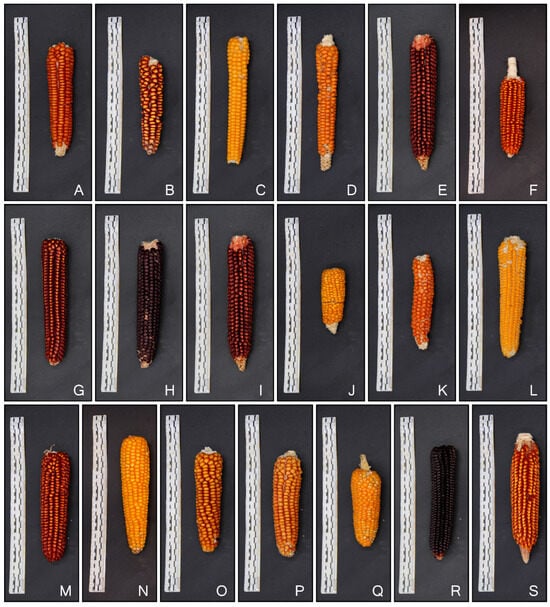
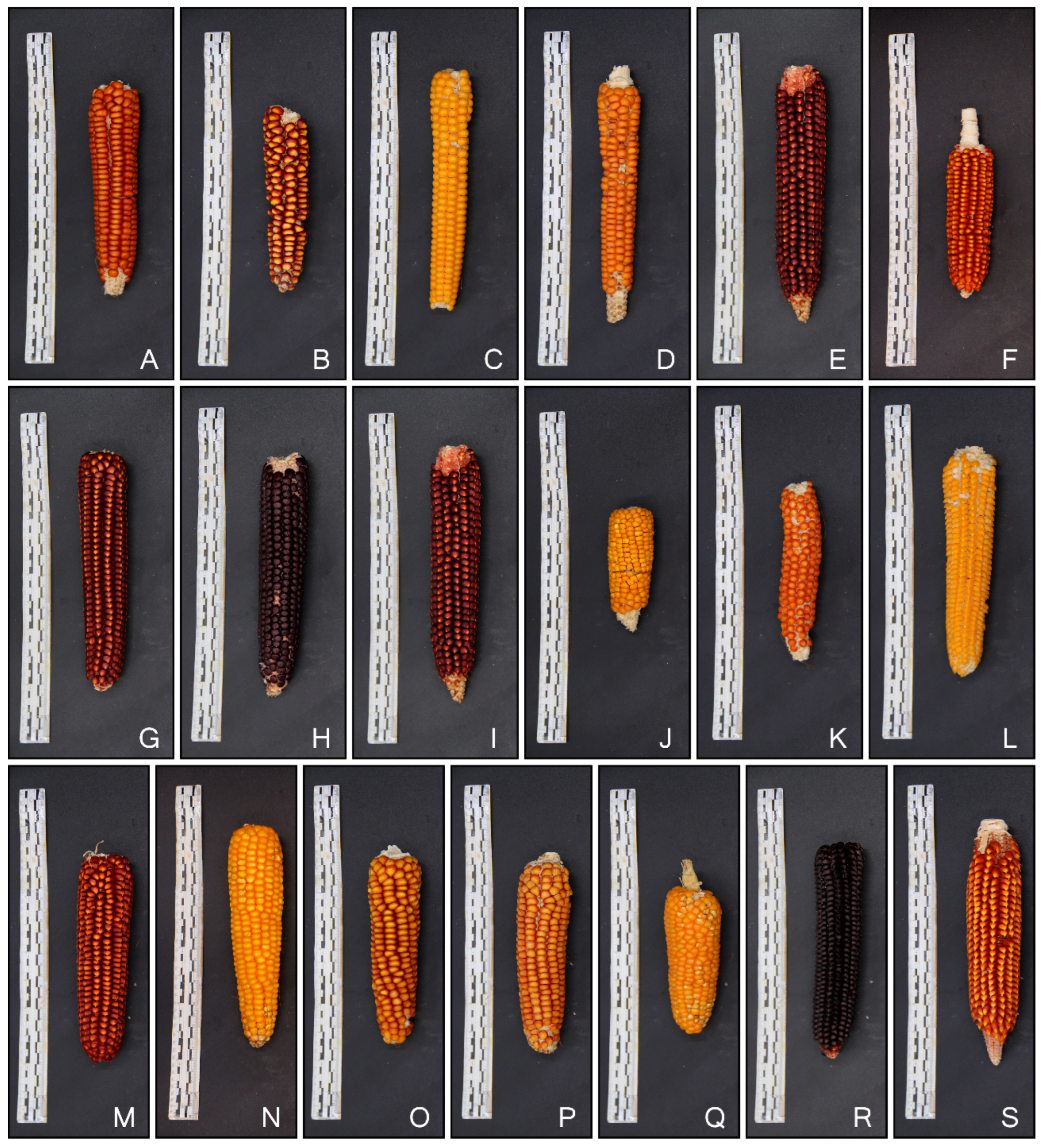
Twelve maize accessions cultivated in Northern Italy for the production of the traditional dish polenta (OC, OT, OG, OP, RRV-A, RRV-B, RRR-A, RRG, RGV, QM, SC, AG) were grown in the experimental field of the University of Milan to enable their morphological, agronomic and genetic characterization, a fundamental step for effective conservation. Together with these accessions, seven accessions (HYB, DIE, DOD, MF, NS, SG, RRR-B) were grown under the same agronomic conditions as reference genotypes (Table 1). All accessions were propagated through controlled pollination using the sib-pool method to maintain their genetic integrity while preserving their characteristic genetic diversity (Figure 1). During the 2023 and 2025 growing seasons, on the 13 accessions, several morphological and agronomic traits (plant height, ear height, flowering time, tassel length, and number of tassel branches) were recorded in triplicate randomized plots. After harvest, the ears were analyzed, and two additional traits (grain weight per ear and thousand-seed weight) were measured (Figure 2 and Table S1).
Figure 1.
Mature ears of the accessions studied. (A): OC; (B): OG, (C): OP; (D): OT; (E): RGV; (F): RRG; (G): RRR-A; (H): RRV-A; (I): RRV-B; (J): AG; (K): QM; (L): SC; (M): RRR-B; (N): HYB; (O): DIE; (P): DOD; (Q): MF; (R): NS; (S): SG. From (A–L): the 12 traditional varieties; from (M–S) the standards used for morphological (N) and genetic analysis (M,O–S). For accession abbreviations, see Table 1.
Figure 2.
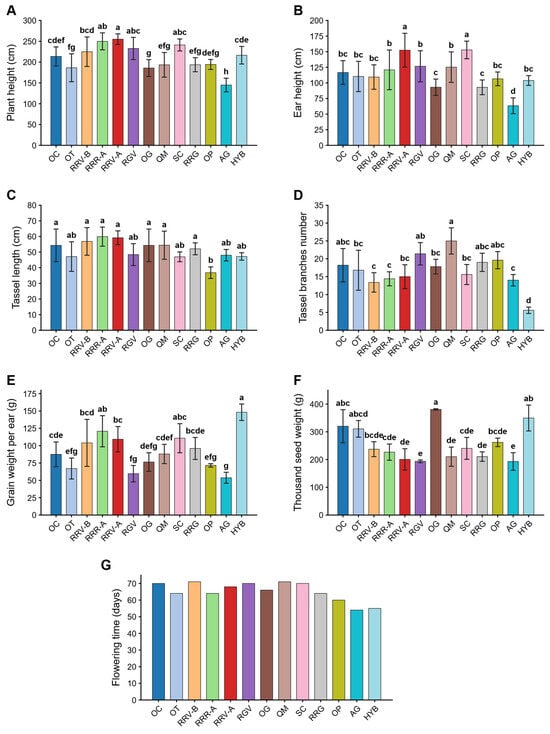
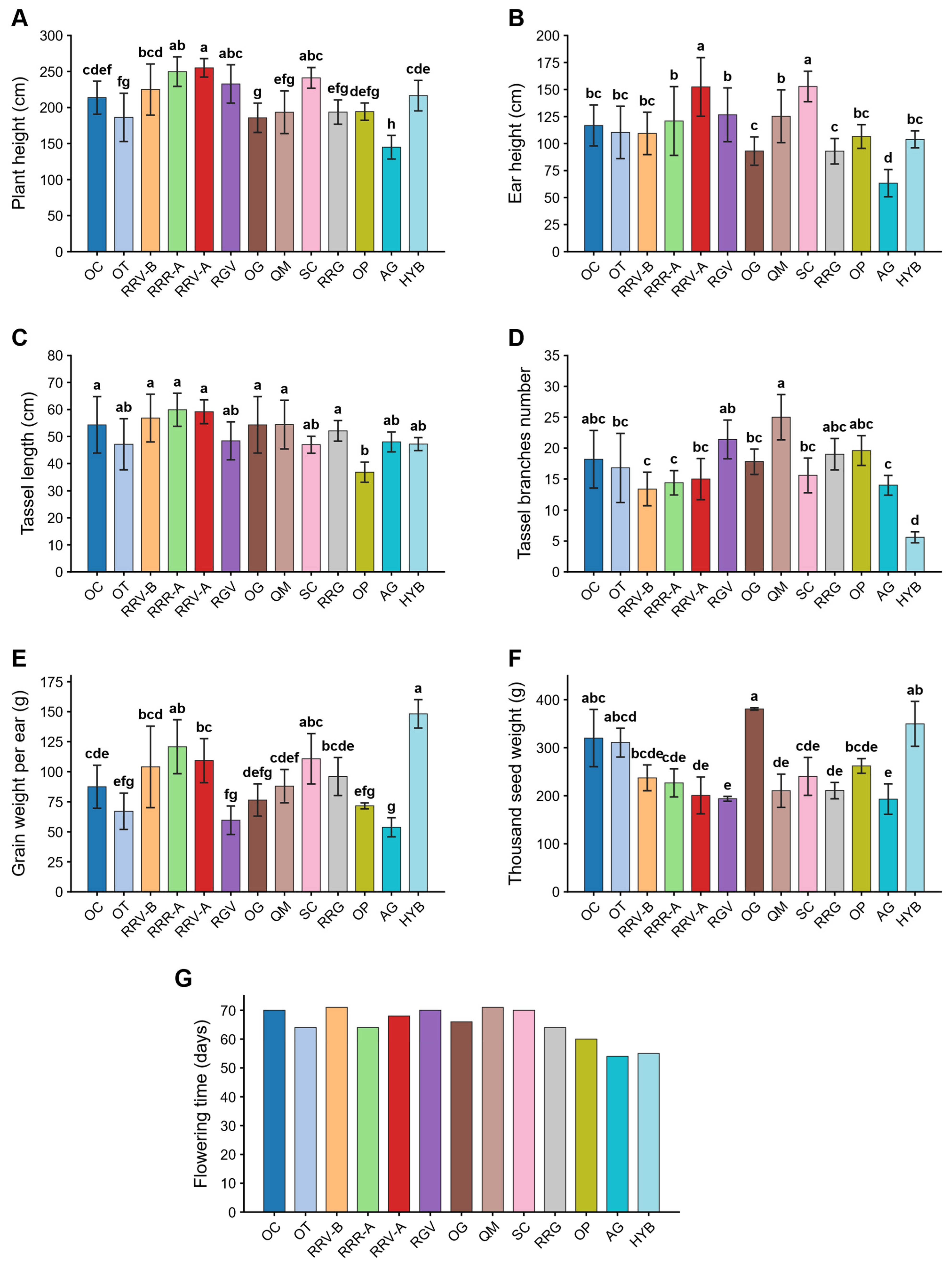
Morphological and agronomical characterization of the twelve selected accessions and the reference hybrid. (A): Plant height (cm); (B): ear height (cm); (C): tassel Length (cm); (D): tassel branches number; (E): grain weight per ear (g/ear), (F): thousand-seed weight (g); (G): flowering time (days). Error bars indicate ± SD. Different letters above bars indicate significant differences among genotypes according to Tukey’s HSD test (p ≤ 0.05). Data refer to the mean value of three plots, recorded in the 2023 season, except for flowering time (FT), which was measured in only one plot. For accession abbreviations, see Table 1. Significant variation was observed among the evaluated maize accessions for all agronomic and yield-related traits assessed (Tukey’s HSD, p ≤ 0.05).
In particular, considering the data collected during the 2023 season, plant height ranged from approximately 145 to 255 cm. Accessions RRV-A, RRR-A, SC and RGV exhibited the greatest plant height, whereas AG showed the lowest value. Ear height followed a similar pattern, with SC, RRV-A, RGV and RRR-A presenting the highest ear height and AG the lowest. Significant differences among genotypes were detected for both traits.
Tassel length varied moderately among accessions, with values ranging from approximately 37 to 60 cm. The highest tassel lengths were observed in RRR-A, RRV-A and RRV-B, while OP exhibited significantly shorter tassels. Tassel branch number also differed significantly among genotypes, ranging from about 6 to 25 branches. QM showed the greatest number of tassel branches, whereas HYB had the fewest.
Grain weight per ear displayed substantial variability among accessions. HYB produced the highest yield per ear (approximately 150 g), significantly exceeding all other genotypes. Intermediate yields were recorded for RRR-A, SC, RRV-A, and RRV-B, while AG exhibited the lowest yield (approximately 54 g). A rather different trend was observed for 1000-seed weight, with OG, OC and OT showing the highest values (approximately 380–310 g) along with HYB (approximately 342 g), followed by OP, SC and RRV-B (260–237 g), whereas the remaining accessions displayed intermediate values (226–193 g).
The flowering time showed comparatively lower variation among genotypes, ranging from approximately 54 to 71 days. Most accessions flowered within a narrow interval, although AG (54 DAS) was the earliest flowering genotype along with the HYB (55 DAS), while the varieties with the latest flowering times were RRV-B and QM (71 DAS) and OC, RGV, and SC (70 DAS). The same experimental protocol was applied during the 2025 growing season. The morphological and agronomic traits, with the exception of tassel length and number of tassel branches, which were not evaluated in 2025, are reported in Supplementary Table S1 together with the 2023 data. In Table S1, the data for the 12 analyzed accessions, together with the control (HYB), were compared separately for each of the two years considered (2023 and 2025). Subsequently, the data from the two years were analyzed jointly.
The two-way ANOVA (Table S2) showed significant differences among accessions for all the analyzed traits, confirming the presence of substantial phenotypic variability within the evaluated germplasm. The year significantly affected plant height (PH) and thousand-seed weight (TS), whereas ear height (EH) and grain weight per ear (GW) were comparatively stable across the two seasons. The accession × year interaction was significant only for TS, indicating that the relative value of the accessions for this trait changed between 2023 and 2025. Overall, accession was the main source of variation, although additional multi-year trials are needed to confirm the temporal stability of these results.
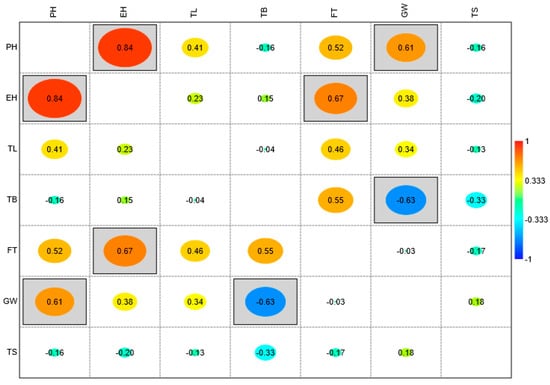
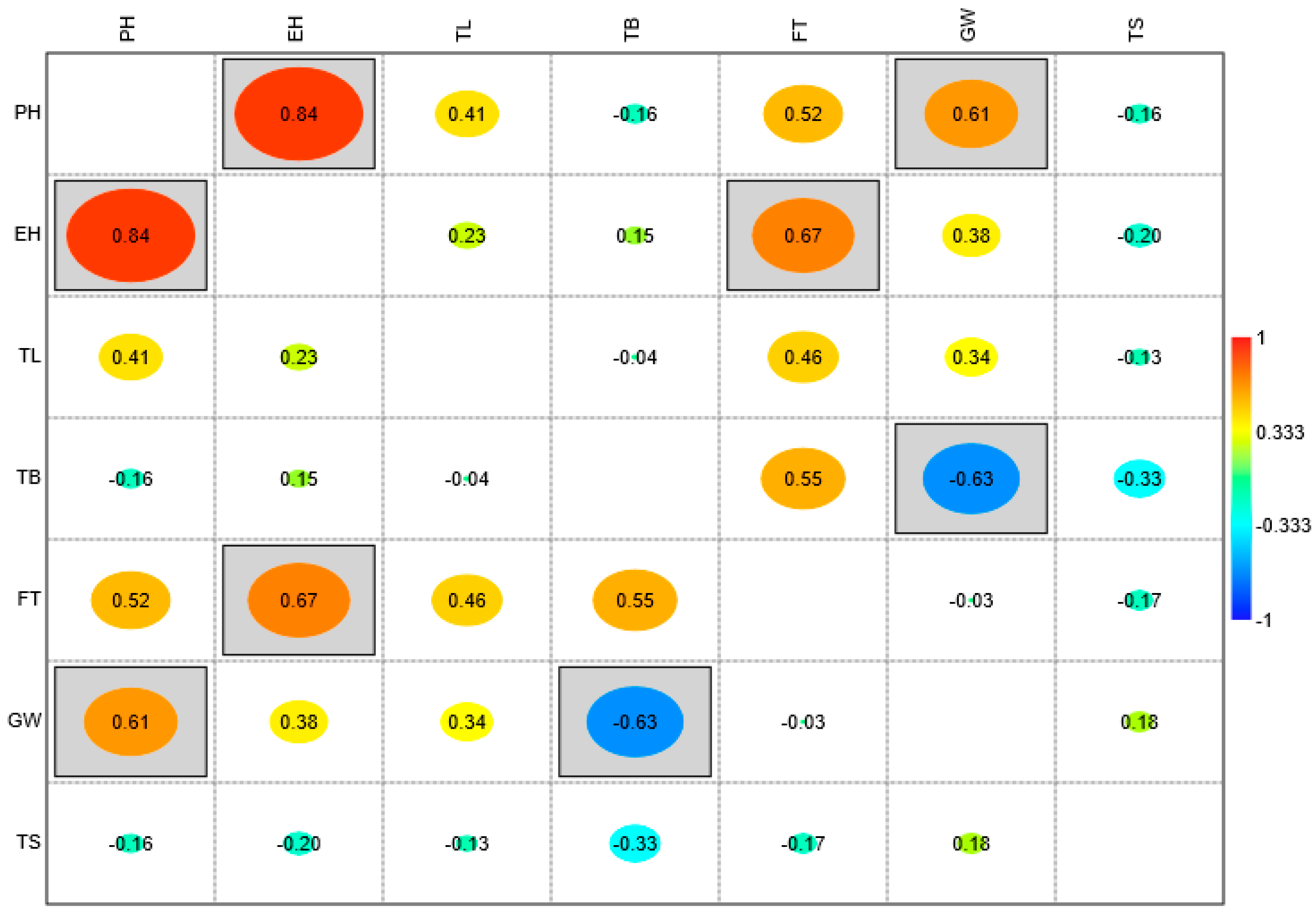
Pearson’s correlation analysis revealed several significant relationships among the evaluated morphological and agronomic traits (Figure 3).
Figure 3.
Correlation analysis among morphological and agronomic traits evaluated in the group of twelve polenta maize accessions from Northern Italy and the reference hybrid. PH, plant height; EH, ear height; TL, tassel length; TB, tassel branches; FT, flowering time; GW, grain weight per ear; TS, thousand-seed weight. Numbers indicate the correlation coefficients (r), while gray rectangles highlight statistically significant correlations (p < 0.05). Data refer to the 2023 season.
Correlation analysis revealed four statistically significant associations among the morphological traits analyzed (Figure 3). The strongest correlation was observed between plant height (PH) and ear height (EH) (r = 0.84, p < 0.001), indicating a strong positive association between these two traits. Plant height was also positively correlated with grain weight per ear (GW) (r = 0.61, p = 0.027), while ear height showed a significant positive correlation with flowering time (FT) (r = 0.67, p = 0.013). In contrast, tassel branch number (TB) was negatively correlated with grain weight per ear (r = −0.63, p = 0.022). A positive correlation was also observed between TB and FT (r = 0.55), although this association was not statistically significant (p = 0.052). The remaining correlations were weak to moderate and did not reach statistical significance.
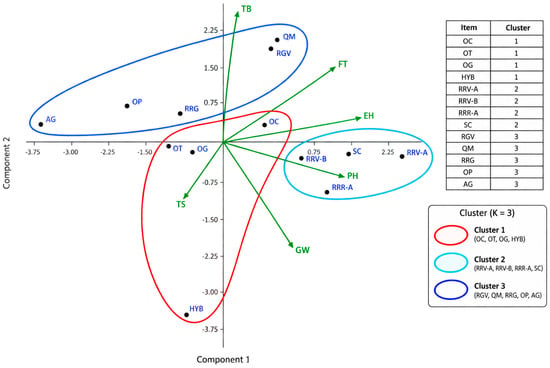
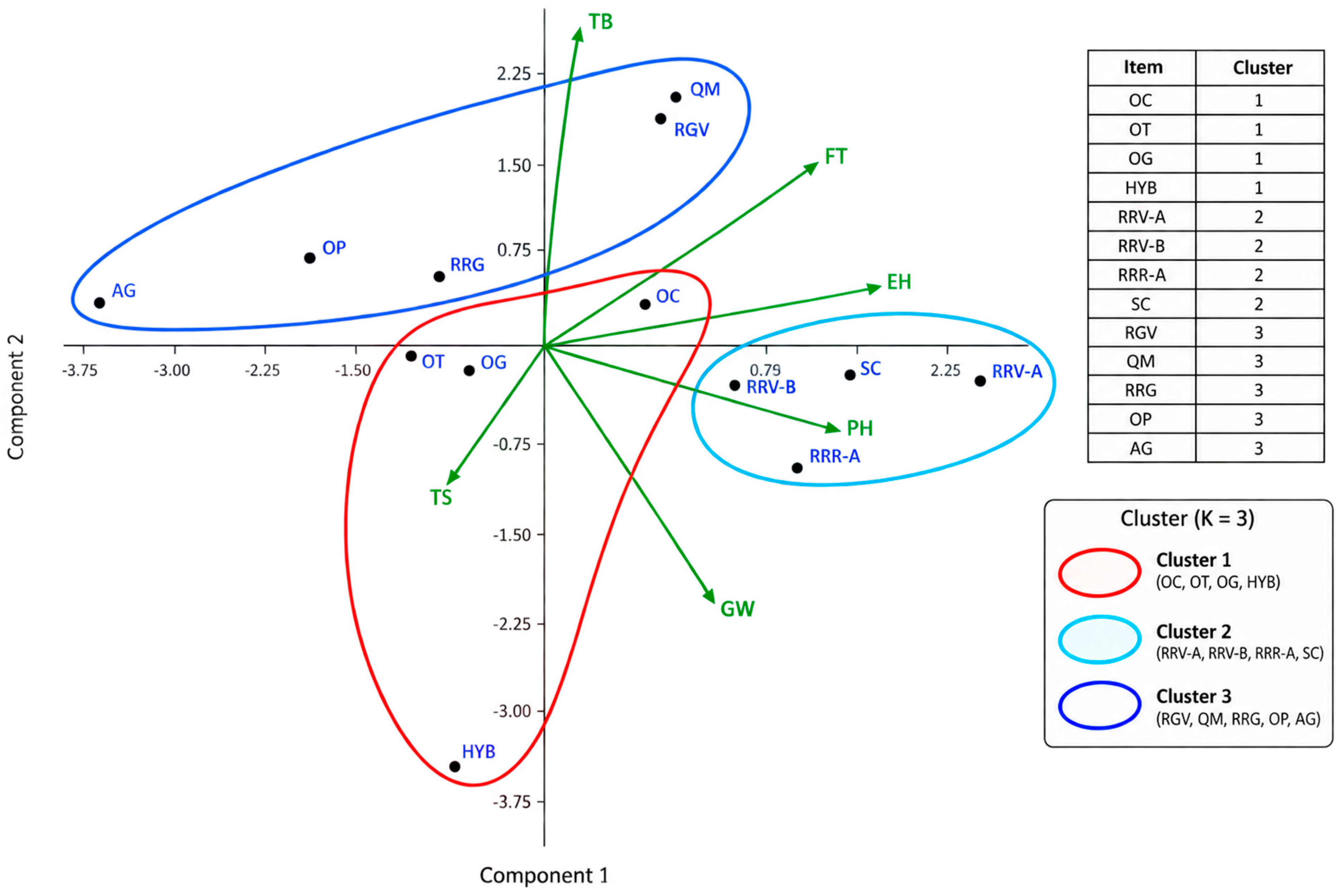
Principal component analysis (PCA) performed on the morphological and agronomic traits identified two principal components, explaining 70.04% of the total phenotypic variation (Figure 4).
Figure 4.
Principal component analysis (PCA) based on 7 morphological and agronomic traits analyzed on twelve polenta maize accessions from Northern Italy and the reference hybrid. The scatter plot represents the distribution of accessions according to the first two principal components (PC1 and PC2), explaining respectively 41.118% and 29.224% of the total variance. Cluster assignments obtained with K = 3 are indicated by different colors. PH, plant height; EH, ear height; TL, tassel length; TB, tassel branches; FT, flowering time; GW, grain weight per ear; TS, 1000-seed weight. Data refer to the 2023 season. For accession abbreviations, see Table 1.
K-means clustering with k = 3 separated the accessions into three clusters: cluster 1 included three of the four Ottofile accessions (OC, OT, OG) together with the hybrid; cluster 2 comprised four pointed accessions (RRV-A, RRV-B, RRR-A and SC); and cluster 3 contained two pointed accessions (RGV and RRG), one Ottofile accession (OP), and two very early accessions (QM and AG).
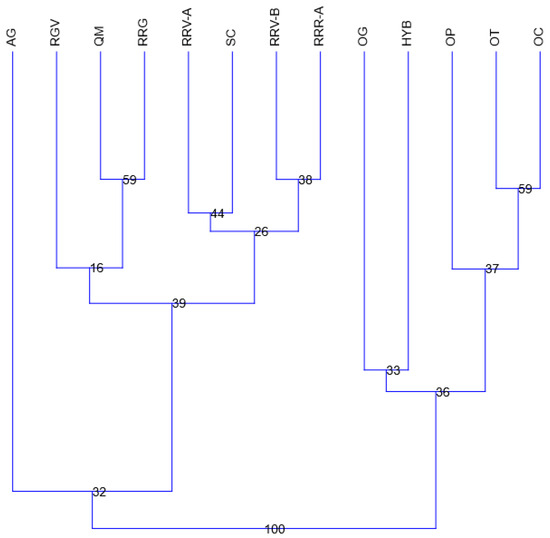
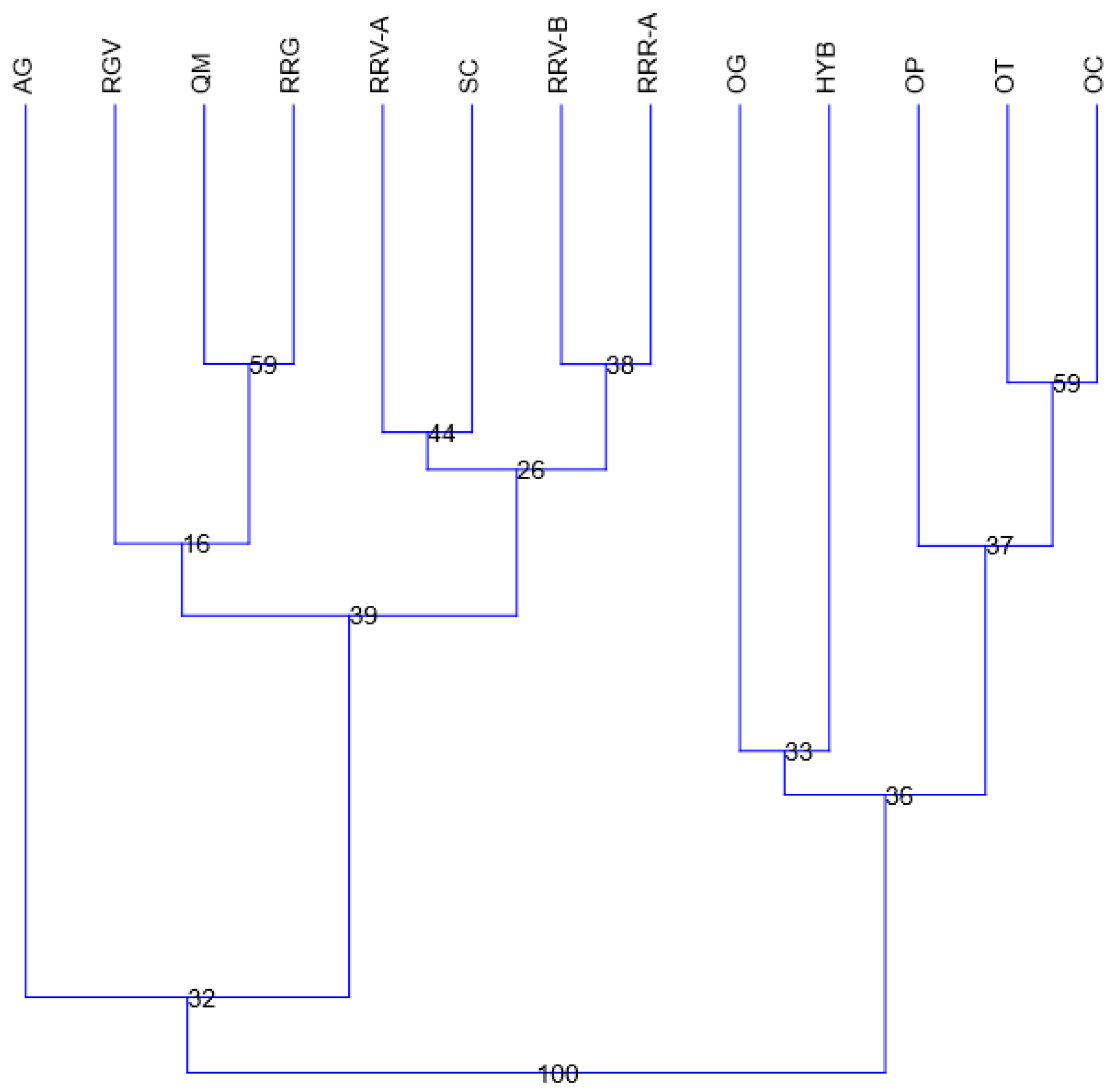
The UPGMA (Unweighted Pair Group Method with Arithmetic Mean) analysis based on morphological and agronomic traits separated the accessions into two major clusters (Figure 5).
Figure 5.
Hierarchical cluster analysis of twelve polenta maize accessions from Northern Italy and the reference hybrid based on morphological and agronomic traits. The dendrogram was obtained using UPGMA clustering with Euclidean distance in PAST software. Bootstrap support values (%) based on 10,000 replicates are shown at the nodes. For accession abbreviations, see Table 1.
The first cluster included the four Ottofile varieties (OC, OT, OP, OG) and the commercial hybrid (HYB), whereas the remaining traditional varieties were assigned to the second major cluster. This primary split was strongly supported by the bootstrap analysis (100%), whereas the following nodes showed low bootstrap support, indicating that the further subdivision within the two main clusters was not statistically robust (Figure 5).
3.2. Molecular Diversity
Genetic Diversity Analysis
The twelve accessions that underwent morphological analysis were further analyzed using SSR markers reported in Table 2. Four accessions (MF, NS, SG, and RRR), which had already been well characterized morphologically and well documented in the literature [28,38,39], and two accessions (DIE and DOD), known to be derived from Ottofile varieties, were included in the present study as references for the molecular analysis (Table 1). The genetic diversity parameters estimated using the eight SSR loci across the 18 maize accessions are reported in Table 3.
Table 3.
Main descriptors of molecular analysis based on 8 SSR markers and 16 individuals for each of the 18 populations.
A moderate degree of genetic variation was observed overall, although considerable differences emerged among populations (Table 3). The average number of alleles per locus (Na) ranged from 1.50 to 2.25, with the highest values detected in populations RRG, RRR-B, and MF, while OG, OC, and RRV-A exhibited the lowest allelic number. The proportion of polymorphic loci (P) showed substantial variation, spanning from 37.5% in RRV-A to 87.5% in RRG, RRR-B, and MF. A similar trend was observed for the effective number of alleles (Ne), which varied between 1.452 and 2.114, indicating differences in allele frequency distribution among populations. Shannon’s diversity index (I) ranged from 0.300 to 0.715, with the highest values recorded in RRG, MF, and RRR-B, whereas RRV-A displayed the lowest level of diversity.
Observed heterozygosity (Ho) ranged from 0.234 to 0.477, while expected heterozygosity (He) ranged from 0.199 to 0.470 (Table 3). In most accessions, Ho was broadly comparable to He, indicating that the observed level of heterozygosity was generally consistent with that expected from the estimated allele frequencies. This pattern is compatible with the substantial maintenance of within-population heterozygosity, although conclusions regarding inbreeding cannot be drawn without specific estimates and statistical testing of the fixation index (FIS).
The main molecular diversity descriptors based on the 8 SSR markers selected are summarized in Table 4.
Table 4.
Main molecular diversity descriptors based on 8 simple sequence repeat (SSR) markers.
Taken together, the diversity estimates consistently identified RRG, RRR-B, and MF as the most variable populations, whereas RRV-A showed reduced levels of genetic variation across all examined parameters. These results highlight a heterogeneous distribution of genetic diversity within the germplasm analyzed and point to specific populations as important sources of genetic variability.
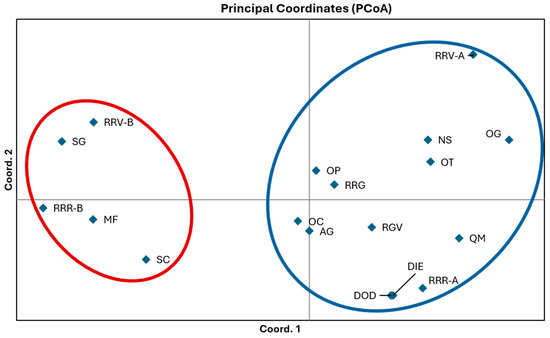
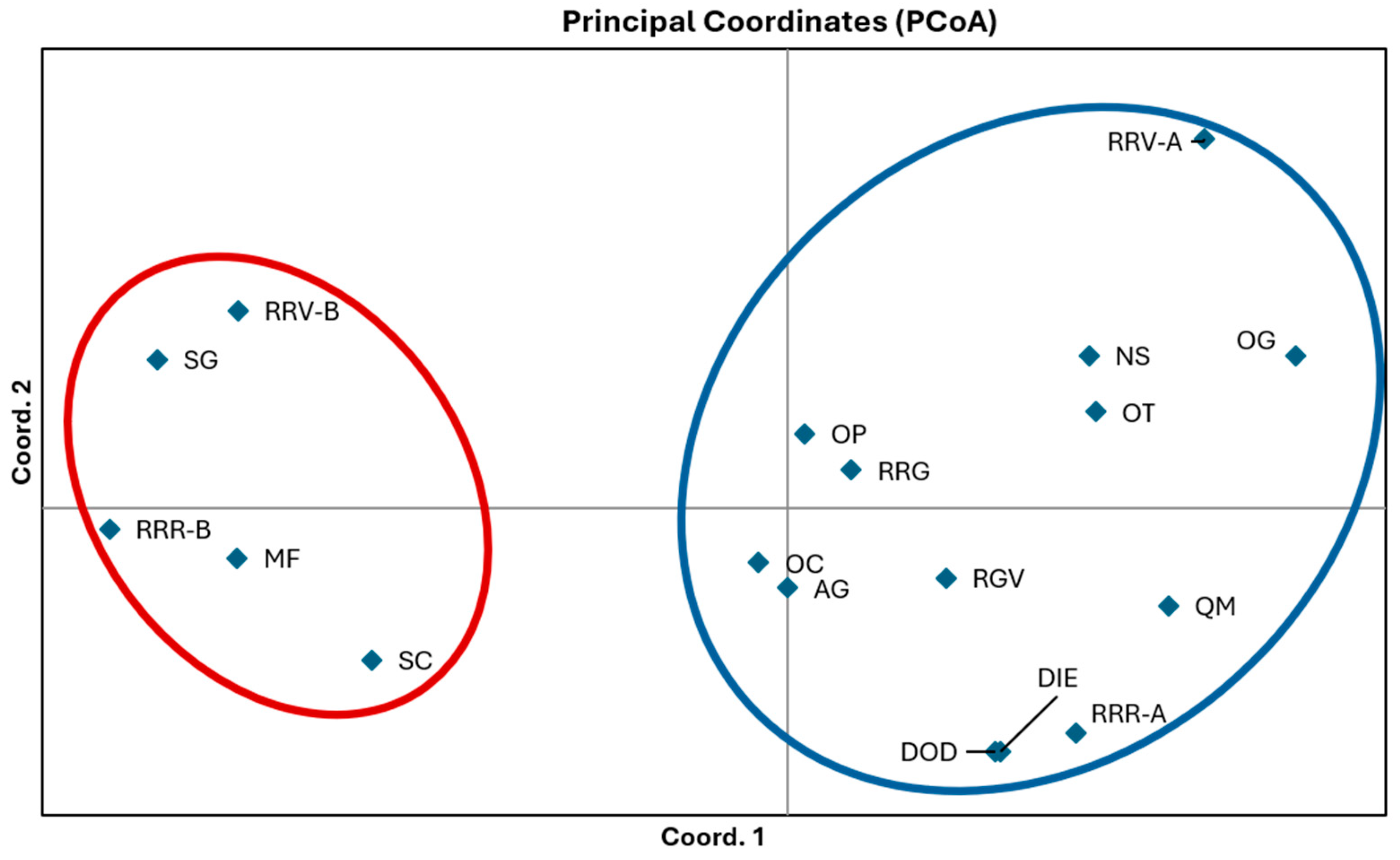
The Principal Coordinate Analysis (PCoA) performed on the SSR dataset revealed a pattern of genetic differentiation among the 18 traditional maize accessions studied (Figure 6).
Figure 6.
Principal Coordinate Analysis (PCoA; eigenvalue scaling) of 18 traditional maize varieties studied, based on eight SSR markers. A descriptive K-means partition with K = 2 is shown to summarize the main grouping pattern observed in the PCoA ordination. For accession abbreviations, see Table 1.
K-means clustering performed in PAST using K = 2 partitioned the accessions into two groups corresponding to the main separation observed in the PCoA ordination. One cluster included five accessions (RRV-B, SG, RRR-B, MF, SC), whereas all remaining accessions were grouped on the positive side of the same axis. The first coordinate accounted for the major component of genetic divergence, driving the separation between the two groups. The accessions assigned to the first cluster formed a relatively compact assemblage, reflecting a more restricted genetic background. By contrast, individuals belonging to the second cluster were more broadly distributed within the ordination space, suggesting a higher level of genetic variability within this group. The only exception was represented by the two accessions, DOD and DIE, which appeared partially overlapping in the PCoA plot.
4. Discussion
The rapid adoption of modern, high-yielding varieties during the first half of the twentieth century resulted in the widespread replacement of traditional varieties [47], raising concerns about the erosion of genetic diversity and the loss of PGRFA [5]. In the United States, these concerns led to the establishment, in 1958, of the National Seed Storage Laboratory, laying the foundations of the National Plant Germplasm System for the long-term conservation of crop genetic resources [48]. At the same time, in Italy, the Experimental Maize Station of Bergamo initiated a systematic nationwide collection of maize germplasm in 1954, which led to the establishment of the Italian maize germplasm collection, now preserved ex situ at the CREA-CI Research Centre, Bergamo, Italy [10,11,12]. Some of the landraces conserved ex situ in germplasm banks are still grown in home gardens for family use or on small farms supplying local markets. To contribute to their conservation and valorization, the present study characterized, both morphologically and genetically, a group of local maize varieties, traditionally cultivated in Northern Italy, for the production of the traditional dish polenta.
The first step toward proper conservation is a thorough characterization of the accessions under study to ensure accurate identification leading to the establishment of an appropriate conservation priority scale and to enable the adoption of the best conservation strategies. Proper characterization, in fact, prevents cases of synonymy and homonymy, which, on the one hand, constitute a waste of resources and, on the other, would result in the failure to conserve genetic resources that are otherwise valuable [49,50,51].
The twelve traditional varieties characterized in this study were grown together in the same experimental field under identical agronomic conditions, together with the seven varieties used as standards for morphological and genetic characterization (see Materials and Methods, 2.1 Plant materials). The morphological and agronomic data were analyzed to evaluate the relationships, differences, and similarities among the accessions and the correlations among the measured traits.
The correlation analysis highlighted several statistically significant relationships among the evaluated traits (Figure 3). The positive correlations involving plant height, ear height, flowering time, and grain weight per ear indicate that later-maturing and taller accessions tend to exhibit greater vegetative growth and biomass accumulation, consistent with the coordinated development of vegetative and reproductive traits in maize [52,53]. Conversely, the negative correlation between grain weight per ear and tassel branch number is consistent with the well-known trade-off in resource allocation between male reproductive structures and grain production. Indeed, previous studies have shown that smaller tassels enhance grain production efficiency by reducing leaf shading and increasing the allocation of assimilates to ear development [54,55]. Consequently, modern maize breeding programs have focused on genotypes with smaller tassels, a trait that has contributed to the significant increases in grain yield achieved in recent decades [43].
The PCA plot illustrated the distribution of accessions based on morphological and agronomic traits (Figure 4). The separation of the commercial hybrid flint from traditional populations has clearly shown what modern breeding has produced: a combination of agronomic traits uniform and selected for specific ideotypes and agronomic performance, distinctly different from those of local accessions [54]. Among traditional accessions, the wide variation observed reflects a continuous phenotypic variation in which, however, three quite distinct groups can still be identified. In particular, the PCA highlights the separation between the Ottofile varieties and the Rostrato/Scagliolo varieties, a separation that is also clearly evident from the UPGMA analysis (Figure 5).
The clustering of the Ottofile accessions observed in both the PCA and UPGMA analyses suggests a relatively close relationship among these accessions, consistent with their classification within the Ottofile racial complex [12]. Nevertheless, the position of OP in a mixed cluster in the PCA suggests that some degree of variability exists within the Ottofile group, as also recently reported in the literature [56].
Taken together, the PCA and UPGMA cluster analysis provide complementary evidence that the polenta maize accessions from Northern Italy retain substantial morphological differentiation. This pattern is expected for traditional open-pollinated populations, which have evolved under different environmental conditions and farmer selection practices over many generations [20,57].
Several of the phenotypic differences observed among the accessions may reflect adaptation to the heterogeneous growing conditions of Alpine and sub-Alpine environments, reinforced over generations by farmer selection. Early flowering is particularly advantageous at higher elevations, where the growing season is short and plants must complete grain development before the onset of low autumn temperatures. Differences in plant height may similarly reflect contrasting cultivation environments and farmer preferences. Reduced plant stature and earlier maturity may be advantageous in exposed mountain fields because they allow faster completion of the crop cycle and may reduce susceptibility to wind and lodging, whereas taller and later-maturing plants can exploit the longer growing season and greater resource availability of more favorable sub-Alpine and lowland sites. Kernel shape may also have an adaptive and post-harvest function. Sangiorgio et al. [39] demonstrated that pointed kernels enhance airflow and water loss during natural drying; under simulated cool and low-airflow conditions, pointed kernels retained approximately 15% less water than conventionally shaped kernels after the same exposure time. This characteristic would have been particularly useful in the cool and humid conditions of the Lombardy pre-Alps, where ears were traditionally dried naturally under farmhouse roofs, because faster drying could reduce the risk of fungal development after harvest. Although pointed ears generally have a lower kernel-packing efficiency and yield potential, farmers may have retained this morphology because of its advantages for grain drying, storability and the production of traditional foods. Thus, the combinations of flowering time, plant architecture and kernel morphology observed in these accessions likely reflect both environmental constraints and long-term farmer-mediated selection [39].
Both the morphological/agronomic and molecular analyses revealed substantial diversity among the accessions; however, their clustering patterns were not fully concordant.
Regarding the molecular analysis, although the number of loci used was limited, the fact that the SSR markers were multiallelic and highly polymorphic allowed us to formulate some hypotheses. Panels of a limited number of highly informative SSR markers have been reported to be useful for accession discrimination and for detecting broad patterns of genetic differentiation [50,58,59]. Nevertheless, the results obtained here should be interpreted as describing broad genetic relationships, whereas a larger marker set or genome-wide SNP analysis would be required for robust inference of fine-scale population structure.
More specifically, SSR data highlighted considerable differences among populations, with RRG, RRR-B and MF showing the highest levels of allelic richness, polymorphism and heterozygosity, whereas RRV-A consistently displayed lower diversity values (Tab 3). The generally high levels of observed heterozygosity (Ho), often comparable to or exceeding expected heterozygosity (He), suggest limited inbreeding and the maintenance of a balanced genetic structure within most accessions. The PCoA revealed a genetic structure, separating the accessions into two major clusters, with RRV-B, SG, RRR-B, MF and SC belonging to the first cluster and the remaining varieties belonging to the second (Figure 6). The different clustering patterns identified by multivariate analyses based on morphological and molecular data can be explained by the fact that morphological and molecular data may capture different components of diversity. SSR markers, particularly when used as neutral markers, primarily provide information on genetic diversity and historical relationships among accessions, whereas morphological traits are influenced by both genetic and environmental factors and may also reflect selection for locally adaptive or agronomically relevant characteristics [56,60]. Accordingly, accessions that are genetically related may differ phenotypically as a consequence of divergent selection, while phenotypically similar accessions may retain different neutral genetic backgrounds.
A key aspect in the interpretation of PCoA results is the historical context of the collection. Three of the 18 accessions analyzed (SG, RRR-B and MF) derive from the CREA-CI maize collection (Stezzano, BG, Italy), sampled between the 1950s and 1970s, during the transition from traditional open-pollinated varieties to commercial hybrids (Table 1) [10,11,12,61]. These three accessions could therefore be considered genetic snapshots of maize diversity present before the most severe phase of genetic erosion associated with agricultural modernization and the widespread adoption of hybrids. Along with the three varieties SG, RRR-B, and MF, the varieties RRV-B and SC also belong to the same cluster. In particular, the SC accession was sampled in a hilly area of the Province of Lecco (Monte Marenzo), where several farms continue to cultivate it. The fields are located on terraces, hillside strips, or small clearings surrounded by woodland. We could therefore hypothesize that these geographic barriers may have contributed to preserving the genetic distinctiveness of the SC accession by reducing the potential for pollen-mediated gene flow, preventing introgression from hybrid maize, which is intensively cultivated in the surrounding plains [62]. The other accession included in the group of historical varieties was RRV-B, grown in Valchiavenna (SO). The geographical isolation of this mountainous area, combined with traditional farming practices, such as cultivating this accession in plots separated from other maize fields, may have helped preserve its genetic integrity. Similar practices have previously been reported for Italian beaked maize landraces, where farmers use spatial separation from hybrid maize, including isolated fields and clearings within woodlands, to reduce the risk of introgression [41].
In contrast, the accessions stored in the germplasm banks of the Universities of Pavia and Milan were collected from the early 2000s to 2020 (Table 1) from farmers who have continued to grow these traditional maize populations [9,63]. Unlike historical materials preserved ex situ in genebanks, these populations, maintained through on-farm cultivation, have been and continue to be exposed to modern agricultural environments characterized by the widespread cultivation of hybrids and improved varieties. Because maize is highly outcrossing and pollen-mediated gene flow can occur over considerable distances, complete reproductive isolation under on-farm conditions is difficult to maintain. Consequently, recently collected populations may have experienced varying degrees of introgression from modern germplasm. Evidence of adaptive introgression from improved germplasm into maize landraces has been previously reported, indicating that contemporary populations may contain alleles that were absent from the original landraces [63,64,65,66]. These observations can be viewed as part of the ongoing debate on the definition of landrace. While early definitions emphasized historical origin and the absence of formal breeding [67], some authors have proposed a broader interpretation that refers to “cultivated varieties that have evolved and may continue evolving, using conventional or modern breeding techniques, in traditional or new agricultural environments within a defined ecogeographical area and under the influence of local human culture” [68].
Within this framework, we hypothesize that the two genetic clusters identified by PCoA may reflect differences in conservation history. Historical accessions (SG, RRR-B, MF, RRV-B, and SC) may retain a larger proportion of the original European gene pool that was present before the widespread diffusion of modern hybrids, which were mainly derived from American germplasm, whereas recently collected populations (AG, DOD, DIE, NS, OC, OP, OT, QM, RGV, RRG, RRR-A, and RRV-A) may have accumulated additional genetic variation through gene flow from modern hybrids and local adaptation.
The first group, comprising the historical landraces, fits well within the more traditional definition of a landrace [67], whereas the second group is more consistent with the broader and more dynamic concept of a landrace [68]. From a conservation perspective, these findings highlight the complementary value of historical and recently collected germplasm. Historical collections represent invaluable archives of pre-Green Revolution diversity, whereas recently collected populations document the ongoing evolutionary dynamics of maize landraces under contemporary agricultural conditions.
The recently collected germplasm also includes the two accessions DIE (Diecifile) and DOD (Dodicifile), which partially overlap in the PCoA plot. In fact, Brandolini and Brandolini [12] pointed out that the contamination of the Ottofile variety with other types of maize led to the formation of 10–12-row races, grouped with the Ottofile varieties within the “Eight rows flints” cluster. This common origin could therefore explain both the high genetic similarity observed between DOD and DIE and their position within the group of more recently sampled accessions.
5. Conclusions
The combined morphological, agronomic and molecular characterization provided a comprehensive assessment of a group of Northern Italian maize accessions traditionally used for polenta. The accessions showed substantial phenotypic differentiation and considerable genetic diversity, allowing their reliable identification and highlighting their distinctiveness. Molecular analyses also revealed genetic structuring within the collection, although the molecular groups did not fully correspond to those obtained from morphological and agronomic traits. From a methodological perspective, the use of high-PIC SSR markers proved to be an effective and cost-effective approach for the characterization and conservation management of PGRFA. The results further highlight the complementary value of historical germplasm conserved ex situ and more recently collected populations maintained on-farm, which may represent dynamic gene pools shaped by both local adaptation and contemporary agricultural practices. In particular, in situ sampling carried out after the widespread introduction of commercial hybrids should consider the evolution of landraces over time, including adaptation to changing environmental conditions and gene flow from commercial hybrids, potentially modifying their original genetic composition and contributing to changes in their gene pool.
The conservation of these maize accessions should therefore combine on-farm maintenance with ex situ seed storage. Priority should be given to accessions cultivated over very limited areas, maintained by only one or a few farmers, or not yet securely represented in germplasm banks, as these materials may face a greater risk of genetic erosion or disappearance. During on-farm conservation and seed multiplication, pollen-mediated gene flow from commercial hybrids should be minimized through adequate spatial isolation, the use of fields protected by natural or landscape barriers, temporal isolation through differentiated sowing dates, buffer rows and, where feasible, controlled pollination. Regeneration should involve a sufficiently large number of representative plants to minimize genetic drift and preserve the genetic diversity characteristic of open-pollinated maize populations.
The SSR profiles obtained in this study may also contribute to the identification and conservation management of these accessions. When combined with information on geographical origin, cultivation history, and morphological and agronomic characteristics, molecular data can help verify varietal identity, distinguish genetically differentiated accessions, clarify possible cases of synonymy or homonymy, and provide reference profiles for monitoring genetic changes over successive regeneration cycles. SSR characterization should therefore be considered a complementary tool supporting applications for inclusion in the Italian National Register of Conservation Varieties, rather than a substitute for the official historical, morphological and agronomic documentation required for registration.
Supplementary Materials
The following supporting information can be downloaded at: https://www.mdpi.com/article/10.3390/agronomy16202015/s1, Table S1: Morphological and agronomical data collected in the 2023 and 2025 seasons; Table S2: Results of the two-way analysis of variance for the effects of accession, year and their interaction on morphological and agronomic traits measured during the 2023 and 2025 growing seasons.
Author Contributions
Conceptualization, R.P. and M.L.; methodology, R.P. and M.L.; validation, R.P., M.L., A.G. and E.L.C.D.; formal analysis, R.P., M.L. and E.C.; investigation, A.G., E.L.C.D., M.G. and E.C.; resources, R.P. and G.R.; data curation, R.P., M.L., M.G. and E.C.; writing—original draft preparation, R.P., M.L., E.L.C.D. and A.G.; writing—review and editing, R.P. and M.L.; visualization, R.P., M.L., E.L.C.D. and A.G.; supervision, R.P. and M.L. project administration, R.P. and M.L.; funding acquisition, R.P. and G.R. All authors have read and agreed to the published version of the manuscript.
Funding
This research was co-funded by Regione Lombardia through Operation 10.2.01 “Conservation of animal and plant biodiversity”, Sub-measure 10.2 “Support for the conservation, sustainable use and development of genetic resources in agriculture” of the Rural Development Programme 2014–2020, within the MaisAlpi project (grant number F13C22001280005) awarded to R.P. and G.R.
Data Availability Statement
The original contributions presented in this study are included in the article/Supplementary Material. Further inquiries can be directed to the corresponding author.
Acknowledgments
The authors wish to thank Davide Reginelli for his valuable support in the experimental field of the University of Milan and for his contribution to the management and monitoring of the field trials throughout the growing seasons.
Conflicts of Interest
The authors declare no conflicts of interest.
Abbreviations
The following abbreviations are used in this manuscript:
| AG | Agostanello |
| CBD | Convention on Biological Diversity |
| CREA-CI | Council for Agricultural Research and Analysis of Agricultural Economics, Research Centre for Cereal and Industrial Crops |
| CWR | Crop Wild Relatives |
| DAS | Days After Sowing |
| DIE | Diecifile |
| DOD | Dodicifile |
| EH | Ear Height |
| FAO | Food and Agriculture Organization of the United Nations |
| FT | Flowering Time |
| GW | Grain Weight Per Ear |
| HYB | Hybrid LG32.85 |
| MF | Mais delle Fiorine |
| NS | Nero Spinoso della Val Camonica |
| OC | Ottofile della Val Codera |
| OG | Ottofile del Garda |
| OP | Ottofile del pavese |
| OT | Ottofile tortonese |
| PCA | Principal Component Analysis |
| PCoA | Principal Coordinate Analysis |
| PGRFA | Plant Genetic Resources for Food and Agriculture |
| PH | Plant Height |
| PIC | Polymorphism Information Content |
| QM | Quarantino Marano |
| RGV | Rostrato giallo di Valchiavenna |
| RRG | Rostrato rosso di Grosio |
| RRR-A | Rostrato rosso di Rovetta-A |
| RRR-B | Rostrato rosso di Rovetta-B |
| RRV-A | Rostrato rosso della Valchiavenna-A |
| RRV-B | Rostrato rosso della Valchiavenna-B |
| SC | Scagliolo di Carenno |
| SG | Spinato di Gandino |
| SSR | Simple Sequence Repeats |
| TB | Tassel Branches |
| TL | Tassel Length |
| TS | Thousand-Seed Weight |
| UPGMA | Unweighted Pair Group Method with Arithmetic Mean |
References
- FAO. What Is Agrobiodiversity? Available online: https://www.fao.org/4/y5956e/Y5956E03.htm (accessed on 16 August 2026).
- FAO. Seeds and Plant Genetic Resources: A Basis for Life. Available online: https://www.fao.org/agriculture/crops/core-themes/theme/seeds-and-plant-genetic-resources/en/ (accessed on 16 August 2026).
- FAO. The state of the world’s biodiversity for food and agriculture. In FAO Commission on Genetic Resources for Food and Agriculture Assessments; B’elanger, J., Pilling, D., Eds.; FAO: Rome, Italy, 2019; Available online: https://www.fao.org/documents/card/en?details=ca3129en (accessed on 16 August 2026).
- Khush, G.S. Green revolution: The way forward. Nat. Rev. Genet. 2001, 2, 815–822. [Google Scholar] [CrossRef] [Scilit]
- Giupponi, L.; Pilu, R.; Scarafoni, A.; Giorgi, A. Plant agro-biodiversity needs protection, study and promotion: Results of research conducted in Lombardy region (Northern Italy). Biodivers. Conserv. 2020, 29, 409–430. [Google Scholar] [CrossRef] [Scilit]
- Khoury, C.K.; Brush, S.; Costich, D.E.; Curry, H.A.; De Haan, S.; Engels, J.M.; Guarino, L.; Hoban, S.; Mercer, K.L.; Miller, A.J.; et al. Crop genetic erosion: Understanding and responding to loss of crop diversity. New Phytol. 2022, 233, 84–118. [Google Scholar] [CrossRef] [Scilit]
- Dulloo, M.E.; Hunter, D.; Borelli, T. Ex situ and in situ conservation of agricultural biodiversity: Major advances and research needs. Not. Bot. Horti Agrobot. Cluj-Napoca 2010, 38, 123–135. [Google Scholar] [CrossRef] [Scilit]
- Wang, Y.; Wang, Y.; Sun, X.; Caiji, Z.; Yang, J.; Cui, D.; Cao, G.; Ma, X.; Han, B.; Xue, D.; et al. Influence of ethnic tra-ditional cultures on genetic diversity of rice landraces under on-farm conservation in southwest China. J. Ethnobiol. Ethnomed. 2016, 12, 51. [Google Scholar] [CrossRef] [Scilit]
- McLean-Rodriguez, F.D.; Costich, D.E.; Camacho-Villa, T.C.; Pe, M.E.; Dell’Acqua, M. Genetic diversity and selection signatures in maize landraces compared across 50 years of in situ and ex situ conservation. Heredity 2021, 126, 913–928. [Google Scholar] [CrossRef] [Scilit]
- Brandolini, A. Il germoplasma del mais e la sua conservazione. Maydica 1958, 3, 4–14. [Google Scholar]
- Brandolini, A.; Brandolini, A. Il Mais in Italia-Storia Naturale e Agricola; CRF Press: Bergamo, Italy, 2006; 370p. [Google Scholar]
- Brandolini, A.; Brandolini, A. Maize introduction, evolution and diffusion in Italy. Maydica 2009, 54, 233–242. [Google Scholar]
- FAO. FAOSTAT: Crop Production, Yield, Harvested Area (Global, National–Annual); Food and Agriculture Organization of the United Nations: Rome, Italy, 2025; Available online: https://data.fao.org/catalog/iso/d24a448b-3b62-4c09-8c1d-4a39bb599876?utm_source=chatgpt.com (accessed on 16 August 2026).
- European Cooperative Programme for Plant Genetic Resources. Nostrano di Storo Landrace Case Study. Available online: https://www.ecpgr.org/in-situ-landraces-best-practice-evidence-based-database/landrace?landraceUid=13456 (accessed on 12 September 2026).
- Hartings, H.; Berardo, N.; Mazzinelli, G.F.; Valoti, P.; Verderio, A.; Motto, M. Assessment of genetic diversity and relationships among maize (Zea mays L.) Italian landraces by morphological traits and AFLP profiling. Theor. Appl. Genet. 2008, 117, 831–842. [Google Scholar] [CrossRef] [Scilit]
- Ristic, D.; Kostadinovic, M.; Kravic, N.; Andjelkovic, V.; Vancetovic, J.; Ignjatovic-Micic, D. Genetic Diversity in maize flint landraces assessed by morphological and SSR Markers. J. Int. Sci. Publ. Agric. Food 2014, 2, 206–213. [Google Scholar]
- Santos, L.F.; Andueza-Noh, R.H.; Ruíz, E.S.; Moreno, L.L.; Garruña, R.; Mijangos-Cortes, J.O.; Martinez-Castillo, J. Characterization of the genetic structure and diversity of maize (Zea mays L.) landrace populations from Mexico. Maydica 2017, 62, 7. [Google Scholar]
- Kizilgeci, F.; Yildirim, M.; Albayrak, O.; Bicer, B.T.; Hossain, A.; Sabagh, A.E.; Akinci, C. Evaluation of Turkish maize landraces through observing their yield and agro-morphological traits for genetic improvement of new maize cultivars. Acta Fytotech. Zootech. 2018, 21, 31–43. [Google Scholar] [CrossRef] [Scilit]
- Yousuf, N.; Dar, S.A.; Shikari, A.B.; Dar, Z.A.; Lone, A.A.; Sofi, P.A.; Gulzar, S. Assessment of genetic diversity at molecular and morphological levels of temperate maize landraces collected from diverse ecological niches in Kashmir. Indian J. Genet. Plant Breed. 2021, 81, 557–565. [Google Scholar] [CrossRef]
- Rivas, J.G.; Gutierrez, A.V.; Defacio, R.A.; Schimpf, J.; Vicario, A.L.; Hopp, H.E.; Paniego, N.B.; Lia, V.V. Mor-phological and genetic diversity of maize landraces along an altitudinal gradient in the Southern Andes. PLoS ONE 2022, 17, e0271424. [Google Scholar] [CrossRef] [Scilit]
- Balconi, C.; Galaretto, A.; Malvar, R.A.; Nicolas, S.D.; Redaelli, R.; Andjelkovic, V.; Revilla, P.; Bauland, C.; Gouesnard, B.; Butron, A.; et al. Genetic and Phenotypic Evaluation of European Maize Landraces as a Tool for Conservation and Valorization of Agrobiodiversity. Biology 2024, 13, 454. [Google Scholar] [CrossRef] [Scilit]
- Guo, R.; Li, T.; Zhang, Q.; Wang, J.; Guo, J.; Wang, L.; Song, L.; Yan, Y.; Zhang, D.; Wei, J.; et al. Genetic and molecular characterization of maize landraces from central China. Agronomy 2024, 14, 1278. [Google Scholar] [CrossRef] [Scilit]
- Woore, M.S.; Flint-Garcia, S.A.; Holland, J.B. Phenotypic characterization of Southeastern United States open-pollinated maize landraces. Crop Sci. 2024, 64, 772–787. [Google Scholar] [CrossRef] [Scilit]
- Defacio, R.A.; Paz, N.M.; Schlater, A.R.; Ferrer, M.E.; Bramardi, S.J. Agro-morphological and molecular charac-terization of Argentine maize (Zea mays L.) landraces of ‘Cristalino Colorado’race. Genet. Resour. 2025, 6, 14–25. [Google Scholar] [CrossRef] [Scilit]
- Drinic, S.M.; Andjelkovic, V.; Micic, D.I. Genetic diversity of maize landraces as sources of favorable traits. In The Molecular Basis of Plant Genetic Diversity; InTech: Rijeka, Croatia, 2012; pp. 89–112. [Google Scholar]
- Landoni, M.; Puglisi, D.; Cassani, E.; Borlini, G.; Brunoldi, G.; Comaschi, C.; Pilu, R. Phlobaphenes modify pericarp thickness in maize and accumulation of the fumonisin mycotoxins. Sci. Rep. 2020, 10, 1417. [Google Scholar] [CrossRef] [Scilit]
- Nelimor, C.; Badu-Apraku, B.; Nguetta, S.P.A.; Tetteh, A.Y.; Garcia-Oliveira, A.L. Phenotypic characterization of maize landraces from Sahel and Coastal West Africa reveals marked diversity and potential for genetic improvement. J. Crop Improv. 2020, 34, 122–138. [Google Scholar] [CrossRef] [Scilit]
- Giupponi, L.; Leoni, V.; Colombo, F.; Cassani, E.; Hejna, M.; Rossi, L.; Pilu, R. Characterization of “Mais delle Fiorine” (Zea mays L.) and nutritional, morphometric and genetic comparison with other maize landraces of Lombardy region (Northern Italy). Genet. Resour. Crop Evol. 2021, 68, 2075–2091. [Google Scholar] [CrossRef] [Scilit]
- Tasnim, F.; Ahmed, M.S.; Rahaman, M.A.; Sagor, G.H.M. Morphological characterization of maize (Zea mays L.) genotypes for drought tolerance. J. Phytol. 2025, 17, 46–54. [Google Scholar] [CrossRef] [Scilit]
- Baruah, S.; Bharti, T.; Rajasekhar, D.; Tatiparthi, H.; Nongbri, E.L.; Sen, D. Genetic characterization and evaluation of pigmented maize (Zea mays L.) landraces of the North East Hill Region of India-an established centre of maize diversity. Plant Genet. Resour. 2024, 22, 223–233. [Google Scholar] [CrossRef] [Scilit]
- Hammami, M.D.E.; Madur, D.; Kthiri, Z.; Galaretto, A.; Nicolas, S.D.; Charcosset, A.; Combes, V.; Karmous, C.; Revilla, P. Phylogenetic relationships and genetic diversity of Tunisian maize landraces. PLoS ONE 2025, 20, e0316185. [Google Scholar] [CrossRef] [Scilit]
- Italian Law 194/2015, Provisions for the Protection and Enhancement of Agricultural and Food Biodiversity. Available online: https://www.gazzettaufficiale.it/eli/id/2015/12/11/15G00210/sg%20 (accessed on 16 August 2026).
- National Register of Biodiversity of Agricultural and Food Interest (Italy). Available online: https://rica.crea.gov.it/APP/anb/search.php (accessed on 16 August 2026).
- Spataro, G.; Negri, V. The European seed legislation on conservation varieties: Focus, implementation, present and future impact on landrace on farm conservation. Genet. Resour. Crop Evol. 2013, 60, 2421–2430. [Google Scholar] [CrossRef] [Scilit]
- Didonna, A.; Bocci, R.; Renna, M.; Santamaria, P. The conservation varieties regime: Its past, present and future in the protection and commercialisation of vegetable landraces in Europe. Horticulturae 2024, 10, 877. [Google Scholar] [CrossRef] [Scilit]
- National Register of Conservation Varieties. Available online: https://www.sian.it/mivmPubb/autenticazione.do (accessed on 16 August 2026).
- Spinato di Gandino. Available online: https://www.mais-spinato.com/ (accessed on 16 August 2026).
- Cassani, E.; Puglisi, D.; Cantaluppi, E.; Landoni, M.; Giupponi, L.; Giorgi, A.; Pilu, R. Genetic studies regarding the control of seed pigmentation of an ancient European pointed maize (Zea mays L.) rich in phlobaphenes: The “Nero Spinoso” from the Camonica valley. Genet. Resour. Crop Evol. 2017, 64, 761–773. [Google Scholar] [CrossRef] [Scilit]
- Sangiorgio, S.; Colombo, F.; Ghidoli, M.; Giupponi, L.; Ferro, G.; Ferro, C.G.; Cassani, E.; Landoni, M.; Pilu, R. The ancient varieties of mountain maize: The inheritance of the pointed character and its effect on the natural drying process. Agronomy 2021, 11, 2295. [Google Scholar] [CrossRef] [Scilit]
- Byrnes, A.; Sthapit, B. A Guide to the Identification and Importance of Custodian Farmers; Bioversity International: Rome, Italy, 2016; 2p, Available online: https://cgspace.cgiar.org/server/api/core/bitstreams/707ead85-7b15-406f-b017-8479c0d7486a/content (accessed on 16 August 2026).
- Ardenghi, N.M.G.; Rossi, G.; Guzzon, F. Back to beaked: Zea mays subsp. mays Rostrata Group in northern Italy, refugia and revival of open-pollinated maize landraces in an intensive cropping system. PeerJ 2018, 6, e5123. [Google Scholar] [CrossRef] [Scilit]
- Landoni, M.; Sangiorgio, S.; Ghidoli, M.; Cassani, E.; Pilu, R. Study of Pollen Traits, Production, and Artificial Pollination Methods in Zea mays L. Agriculture 2024, 14, 1791. [Google Scholar] [CrossRef] [Scilit]
- Crossa, J.; Taba, S.; Eberhart, S.A.; Bretting, P.; Vencovsky, R. Practical considerations for maintaining germplasm in maize. Theor. Appl. Genet. 1994, 89, 89–95. [Google Scholar] [CrossRef] [Scilit]
- Maize Genetics and Genomics Database. Available online: https://www.maizegdb.org/gbrowse/maize_v2/?name=MAGI_7527 (accessed on 16 August 2026).
- Hammer, Ø.; Harper, D.A.; Ryan, P.D. PAST: Paleontological statistics software package for education and data analysis. Palaeontol. Electron. 2001, 4, 9. [Google Scholar]
- Peakall, R.O.D.; Smouse, P.E. GenAlEx 6.5: Genetic analysis in Excel. Population genetic software for teaching and research—An update. Bioinformatics 2012, 28, 2537–2539. [Google Scholar] [CrossRef] [Scilit]
- Crow, J.F. 90 Years Ago: The Beginning of Hybrid Maize. Genetics 1998, 148, 923–928. [Google Scholar] [CrossRef] [Scilit]
- National Research Council. The U.S. National Plant Germplasm System; National Academy Press: Washington DC, USA, 1991. [Google Scholar] [CrossRef] [Scilit]
- Singh, N.; Wu, S.; Raupp, W.J.; Sehgal, S.; Arora, S.; Tiwari, V.; Vikram, P.; Singh, S.; Chhuneja, P.; Gill, B.S.; et al. Efficient curation of genebanks using next generation sequencing reveals substantial duplication of germplasm accessions. Sci. Rep. 2019, 9, 650. [Google Scholar] [CrossRef] [Scilit]
- Bergonzoni, L.; Alessandri, S.; Domenichini, C.; Dondini, L.; Caracciolo, G.; Pietrella, M.; Baruzzi, G.; Tartarini, S. Characterization of red-fleshed pear accessions from Emilia-Romagna region. Sci. Hortic. 2023, 312, 111857. [Google Scholar] [CrossRef] [Scilit]
- Landoni, M.; Bertoncini, A.; Ghidoli, M.; Rossi, G.; Cassani, E.; Locatelli, S.; Balconi, C.; Pilu, R. PGRFA management of outcrossing plants propagated by seed: From on-farm to ex situ conservation and some italian maize case studies. Agronomy 2024, 14, 1030. [Google Scholar] [CrossRef] [Scilit]
- Tollenaar, M.; Lee, E.A. 2 Strategies for enhancing grain yield in maize. In Plant Breeding Reviews; Wiley Blackwell: Hoboken, NJ, USA, 2011; Volume 34, pp. 37–82. [Google Scholar]
- Peiffer, J.A.; Romay, M.C.; Gore, M.A.; Flint-Garcia, S.A.; Zhang, Z.; Millard, M.J.; Gardner, C.A.; McMullen, M.D.; Holland, J.B.; Bradbury, P.J.; et al. The genetic architecture of maize height. Genetics 2014, 196, 1337–1356. [Google Scholar] [CrossRef] [Scilit]
- Duvick, D.N.; Smith, J.S.C.; Cooper, M. Long-term selection in a commercial hybrid maize breeding program. In Plant Breeding Reviews; Janick, J., Ed.; John Wiley & Sons, Inc.: Hoboken, NJ, USA, 2010; Volume 34, pp. 109–151. [Google Scholar]
- Gao, Z.; Sun, L.; Ren, J.H.; Liang, X.G.; Shen, S.; Lin, S.; Zhao, X.; Chen, X.M.; Wu, G.; Zhou, S.L. Detasseling increases kernel number in maize under shade stress. Agric. For. Meteorol. 2020, 280, 107811. [Google Scholar] [CrossRef] [Scilit]
- Lezzi, A.; Stagnati, L.; Caproni, L.; Dell’Acqua, M.; Busconi, M.; Lanubile, A.; Marocco, A. Leveraging Knowledge of Traditional Italian Maize Landrace Diversity to Identify Signals of Local Adaptation. Evol. Appl. 2026, 19, e70186. [Google Scholar] [CrossRef] [Scilit]
- Di Pasquale, G.M.; Stagnati, L.; Lezzi, A.; Lanubile, A.; Marocco, A.; Rossi, G.; Busconi, M. Morphological and genetic characterization of maize landraces adapted to marginal hills in North-West Italy. Plants 2024, 13, 1030. [Google Scholar] [CrossRef] [Scilit]
- Galli, Z.; Halász, G.; Kiss, E.; Heszky, L.; Dobránszki, J. Molecular identification of commercial apple cultivars with microsatellite markers. HortScience 2005, 40, 1974–1977. [Google Scholar] [CrossRef] [Scilit]
- Vietina, M.; Agrimonti, C.; Marmiroli, M.; Bonas, U.; Marmiroli, N. Applicability of SSR markers to the traceability of monovarietal olive oils. J. Sci. Food Agric. 2011, 91, 1381–1391. [Google Scholar] [CrossRef] [Scilit]
- Pressoir, G.; Berthaud, J. Population structure and strong divergent selection shape phenotypic diversification in maize landraces. Heredity 2004, 92, 95–101. [Google Scholar] [CrossRef] [Scilit]
- Vaccino, P.; Antonetti, M.; Balconi, C.; Brandolini, A.; Cappellozza, S.; Caputo, A.R.; Carboni, A.; Caruso, M.; Copetta, A.; de Dato, G.; et al. Plant genetic resources for food and agriculture: The role and contribution of CREA (Italy) within the national program RGV-FAO. Agronomy 2024, 14, 1263. [Google Scholar] [CrossRef] [Scilit]
- Cultivation of Scagliolo di Carenno in Monte Marenzo (LC). Available online: https://www.youtube.com/watch?v=4rSW9DyP8T4&list=PLJiDS7WrHG2ZqY7mwgark0oZHDBBpQ3ev&index=4 (accessed on 16 August 2026).
- Redaelli, R.; Bassolino, L.; Balconi, C.; Terracciano, I.; Torri, A.; Nicoletti, F.; Benedetti, G.; Iacoponi, V.; Rea, R.; Taviani, P. Morpho-phenological, chemical, and genetic characterization of Italian maize landraces from the Lazio region. Plants 2024, 13, 3249. [Google Scholar] [CrossRef] [Scilit]
- Bitocchi, E.; Nanni, L.; Rossi, M.; Rau, D.; Bellucci, E.; Giardini, A.; Buonamici, A.; Vendramin, G.G.; Papa, R. Introgression from modern hybrid varieties into landrace populations of maize (Zea mays ssp. mays L.) in central Italy. Mol. Ecol. 2009, 18, 603–621. [Google Scholar] [CrossRef] [Scilit]
- Bitocchi, E.; Bellucci, E.; Rau, D.; Albertini, E.; Rodriguez, M.; Veronesi, F.; Attene, G.; Nanni, L. European flint landraces grown in situ reveal adaptive introgression from modern maize. PLoS ONE 2015, 10, e0121381. [Google Scholar] [CrossRef] [Scilit]
- Rojas-Barrera, I.C.; Wegier, A.; Sanchez Gonzalez, J.D.J.; Owens, G.L.; Rieseberg, L.H.; Piñero, D. Contemporary evolution of maize landraces and their wild relatives influenced by gene flow with modern maize varieties. Proc. Natl. Acad. Sci. USA 2019, 116, 21302–21311. [Google Scholar] [CrossRef] [Scilit]
- Villa, T.C.C.; Maxted, N.; Scholten, M.A.; Ford-Lloyd, B.V. Defining and identifying crop landraces. Plant Genet. Res. 2005, 3, 373–384. [Google Scholar] [CrossRef] [Scilit]
- Casañas, F.; Simó, J.; Casals, J.; Prohens, J. Toward an evolved concept of landrace. Front. Plant Sci. 2017, 8, 145. [Google Scholar] [CrossRef] [Scilit]

Disclaimer/Publisher’s Note: The statements, opinions and data contained in all publications are solely those of the individual author(s) and contributor(s) and not of MDPI and/or the editor(s). MDPI and/or the editor(s) disclaim responsibility for any injury to people or property resulting from any ideas, methods, instructions or products referred to in the content. |
© 2026 by the authors. Licensee MDPI, Basel, Switzerland. This article is an open access article distributed under the terms and conditions of the Creative Commons Attribution (CC BY) license.