


Abstract
Soil organic carbon (SOC) is a core component of farmland fertility, and its content is significantly influenced by tillage practices. To clarify the effects of alternate tillage on soil organic carbon sequestration and soil aggregate stability, a tillage experiment was initiated in 2017. The study focused on the distribution of soil aggregates across different particle sizes and their organic carbon contents under four tillage treatments: (1) rotary tillage for two consecutive years after initial deep plowing (RT_DP); (2) no-tillage for two consecutive years after initial deep plowing (NT_DP); (3) continuous rotary tillage (RT); and (4) continuous no-tillage (NT). Compared with continuous rotary tillage (RT), RT_DP increased the crop yield by 14.78%, NT decreased the yield by 10.59%, and NT_DP increased the yield by 3.40%. In the topsoil, soil organic carbon (SOC) content increased by 21.57% under RT_DP, 24.47% under NT, and 21.57% under NT_DP. In the subsoil, SOC content increased by 36.91% under RT_DP, 24.80% under NT, and 42.52% under NT_DP. Compared with the RT treatment, practices such as RT_DP increased the SOC content and the proportion of macroaggregates. No significant differences were observed among all treatments in the topsoil. However, in the subsoil, RT_DP significantly increased the SOC content (by 36.91%), SOC content within >0.25 mm aggregates (by 35.75%), and the proportion of >0.25 mm aggregates (by 1.28%), relative to RT. Compared with NT, NT_DP also increased these three indices by 14.2%, 13.38%, and 0.32%, respectively. In the topsoil, the NT_DP treatment resulted in higher mean weight diameter (MWD) stability than the other treatments. In the subsoil, the NT treatment showed the highest MWD and geometric mean diameter (GMD) values, while both RT_DP and NT_DP had significantly higher MWD and GMD than RT. In the deeper soil layer, the NT treatment exhibited the highest aggregate stability. Further analysis indicated that the positive effects of alternate tillage (NT_DP and RT_DP) on aggregate distribution, aggregate stability, and subsoil SOC sequestration were mainly due to improvements in the soil’s nutrient availability, bulk density, porosity, and water content. The optimization of these soil properties further enhanced soil enzyme activity and ultimately promoted the stabilization and accumulation of SOC. In conclusion, incorporating deep plowing into rotational tillage can effectively promote SOC accumulation, especially in the subsoil of maize farmland, and enhance the physical protection of SOC. This study provides a practical tillage strategy for increasing the maize yield and enhancing soil organic carbon sequestration.
1. Introduction
Soil degradation is a major global environmental issue that is primarily driven by intensive land use [1]. This problem is particularly severe in the maize-growing regions of Northeast China, where a continuous monoculture has deteriorated soil structure and reduced its overall quality [2,3]. As a key indicator of soil quality, soil organic carbon (SOC) plays a central role in nutrient cycling, directly sustaining fertility and improving the physical and chemical properties of soil, and is essential for maintaining stable and high crop yields [4]. Nearly two-thirds of agricultural carbon is stored in soils, and SOC stock reflects the soil capacity for carbon sequestration. Soil aggregates, the fundamental structural units of soil, strongly influence the soil structure and carbon retention [5]. Their stability and formation are closely linked to SOC storage, and higher SOC levels support crop growth [6]. Therefore, understanding the physical protection of SOC by aggregates is critical for improving aggregate stability and SOC accumulation, ultimately enhancing farmland carbon sequestration. Soil’s physicochemical properties are highly sensitive to tillage practices. Conventional agricultural practices, such as plowing and fertilization, disrupt aggregate structures [7]. Thus, maintaining adequate organic matter and a high proportion of water-stable aggregates is crucial for enhancing soil quality and promoting the sustainable development of agricultural ecosystems.
Tillage practices influence the carbon sequestration potential of soil aggregates. Such operations often disrupt the aggregate structure, with larger aggregates being particularly susceptible to damage. Under continuous tillage, the proportion of large aggregates can decline by 8–58.6%, and the mean weight diameter (MWD) can decrease by 15–25%. Soil aggregates physically shield SOC from microbial decomposition [8,9] and typically have porous structures. The pore size distribution governs soil aeration and water retention, and both pore size and porosity are closely linked to soil carbon storage capacity [10,11]. Macroaggregates store organic carbon through physical encapsulation and isolation, which reduces exposure to microorganisms and the external environment, thereby enhancing SOC stability. Microaggregates also contribute to SOC protection by forming stronger chemical bonds or through physical adsorption.
Previous studies have shown a strong positive correlation between SOC and macroaggregates, with macroaggregates generally containing higher SOC levels than microaggregates [12]. Appropriate adjustments to tillage practices are essential for maintaining soil’s carbon balance and stability and are widely recognized as sustainable agricultural strategies [13]. Conservation tillage can significantly improve the physical properties of the 0–20 cm soil layer. No-till practices may increase the surface SOC by 10.5–32.7%, although they are not suitable for all soil types. Over extended periods, no-till can cause compaction, increasing bulk density by approximately 0.04 g/kg. In contrast, periodic tillage following no-till improves soil physical properties, reducing the bulk density by 2.3–16.8% and increasing the total porosity by 4.1–5.9%, thereby creating favorable conditions for maize root growth [14]. Compared with continuous no-till or continuous deep loosening, a rotational system combining no-till and deep loosening better preserves soil’s physical quality [15]. These tillage strategies not only modify the soil environment and microbial habitat but also reshape the soil pore system by altering the proportion of water-stable aggregates and associated SOC [16]. Consequently, soil structure, including the soil pore system (SPS) and aggregates, emerges as a key determinant of soil physical properties and an important indicator of soil health. The trade-off between aggregate fragmentation and SOC sequestration caused by tillage disturbance highlights the need for the dynamic optimization of farming systems [16]. Continuous conventional tillage disrupts large aggregates (>0.25 mm), thereby directly weakening their role as physical barriers to SOC loss. In this study, we assessed SOC physical protection by analyzing the soil structure, nutrient status, and biological factors, with particular emphasis on the protective function of aggregates in SOC stabilization.
In previous studies, most researchers have focused on the topsoil, whereas the subsoil has only recently attracted attention. Notably, subsoil exhibits greater potential for carbon sequestration, owing to its larger volume and higher efficiency of carbon utilization by microorganisms [17]. Therefore, we designed an experiment to study the physical protection of the SOC in topsoil and subsoil under different tillage systems, especially the stability of carbon in soil aggregates. Specifically, we investigated the microbial and enzymatic activities, as well as the organic carbon content of soil aggregates in the topsoil (0–20 cm) and subsoil (20–40 cm) under four tillage systems. This study aimed to elucidate the mechanisms by which tillage practices affect the physical protection of SOC within aggregates across different soil horizons.
2. Materials and Methods
2.1. Overview of the Test Site
The experiment was conducted in Qingshan Town, Taobei District, Baicheng City, Jilin Province, China (45.69° N, 122.86° E) at an elevation of 292 m. The site is located on the alluvial fan of the Taoer River in the Songnen Plain, characterized by a flat terrain and a temperate continental climate. The mean annual temperature is 5.2 °C, with an average annual precipitation of 400 mm. The soil at the experimental site is classified as sieved leakage soil, derived from alluvial parent material. The plow layer configuration was A11–AH–Bk–C, with an effective soil depth of 30–50 cm [18]. Before the experiment, the 0–20 cm soil layer exhibited the following properties: bulk density of 1.5 g cm−3, porosity of 43.8%, organic matter content of 23.2 g kg−1, total nitrogen (TN) content of 2.1 g kg−1, alkali-hydrolyzed nitrogen (AN) of 92.3 mg kg−1, and available potassium (AK) of 100.13 mg kg−1. The climatic data for the period 2018–2020 are available in the Supplementary Materials.
2.2. Experimental Design
The crop of this experiment was corn of the variety Liangyu 99. The experiment began in the winter of 2017 and ended in the winter of 2020. Sowing was carried out in early May each year and harvesting was performed in early October. Continuous cropping of corn results in one maturity per year. The sowing depth of corn is 3–5 cm, and it is harvested when it is mature. Before the experiment, this area was continuously rotary tillage. The field trial adopted a randomized complete block design. There were a total of four treatments, each of which was repeated three times: two years of crop rotation after the first year of deep tillage (RT_DP), two years of no-tillage (NT_DP) after the first year of deep tillage (NT_DP), continuous crop rotation (RT), and continuous no-tillage (NT). After sowing, drip irrigation should be carried out to keep the soil moist. In no-till areas, straw is retained on the soil surface, while in crop rotation and deep plowing areas, straw is chopped and mixed into the soil. The rotary tiller is the Dongfanghong 1GZL-300 rotary tiller (Yto Group Corporation, Luoyang, China), and the deep tiller is the Shandong Yto Machinery 320 field edge leveling plow (Shandong Yto Machinery Co., Ltd., Weifang, China), with a plowing depth of ≥30 cm. Each plot has an area of 500 square meters. Before planting, the cracked areas should be treated. The sowing density of the corn variety “Liangyu 99” is 70,000 plants per hectare. The fertilizer application rate is 800 kg ha−1 (26% N, 11% P, 11% K), which should be applied simultaneously when sowing. The irrigation amounts for each growth stage were as follows: 100 t ha−1 in the sowing stage, 150 t ha−1 in the jointing stage, 300 t ha−1 in the bell stage, 350 t ha−1 in the silk production stage, and 100 t ha−1 in the grain-filling stage.
2.3. Soil Sample Collection and Determination
In October 2020, soil samples were collected from the 0–20 cm and 20–40 cm layers after harvest. The soil was collected by the five-point sampling method, with each plot being repeated three times. Plant debris and gravel were removed during sampling, and the samples were passed through an 8 mm sieve. Among them, the total nitrogen content in the soil was determined using the Kjeldahl digestion method [19]. Soil organic matter content was determined using the K2Cr2O7–H2SO4 oxidation method [16]. Alkali-hydrolyzable nitrogen (AN) was measured using the alkaline hydrolysis diffusion method [20]. The available phosphorus (AP) was extracted using sodium bicarbonate, and its concentration was determined by using a microplate reader [21]. The available potassium (AK) was extracted using CH3COONH4 and measured using flame photometry [21]. The soil’s bulk density was determined by the ring knife method, using a stainless steel core ring knife with a diameter of 50.46 mm and 100 cm3 [22]. Soil porosity was calculated using Equation (3), and soil moisture content was determined using the oven-drying method [23].
Aggregate size distribution was determined using the wet sieving method [24]. When sampling, we removed the soil that has deformed due to direct contact with the soil shovel on the outside of the soil block. We evenly took about 1.5 to 2 kg of the soil inside and placed it in a covered plastic box. A 50 g soil sample was first apportioned according to the mass proportion of each particle size. The sample was then passed through a series of sieves (2 mm, 0.25 mm, and 0.053 mm) using a soil aggregate analyzer and oscillated vertically at 30 r min−1 with a 40 mm amplitude. After sieving, aggregates from each size fraction were collected in aluminum boxes, oven-dried, and weighed.
where BD is the soil bulk density (g cm−3); m is the weight of the wet soil in the ring knife (g); m1 is the weight of the dried soil (g); V is the volume of the ring knife (cm3); W is the soil moisture content (g kg−1); SP is the soil porosity (%); and ds is the soil particle density, assumed to be 2.65 g cm−3 [25].
The stability of soil aggregates was characterized by the mean weight diameter (MWD, mm) and the geometric mean diameter (GMD, mm). The calculation methods are presented in Equations (4) and (5), respectively. In addition, the contribution rate of aggregates of each particle size to soil organic carbon (Pi, %) was calculated according to Equation (6) [26]. The calculation formulas of the Chao1 index and Shannon index are shown as (7) and (8).
where Wi is the mass of the ith aggregate (g); Di is the average diameter of the ith aggregate class (mm); Ci is the organic carbon content of the ith aggregate fraction (g kg−1); and SOC is the soil organic carbon content (g kg−1). Sobs is the number of OTUs/species actually observed in the sample; F1 is the number of OTUs containing only one sequence; F2 is the number of OTUs containing only two sequences; Sobs is the total number of observed OTUs/species in the sample; and pi is the proportion of the sequence number of the i-th out, relative to the total sequence number of the sample (pi = ni/N, ni = the number of sequences of the i-th OTU; N = the total number of sequences in the sample).
The total SOC was determined by weighing an appropriate amount of air-dried soil into a conical flask, adding a potassium dichromate–sulfuric acid solution, and heating the mixture on an electric plate at 170–180 °C for 5 min. After cooling, the solution was titrated with a standard FeSO4 solution using o-phenanthroline as an indicator [27]. The endpoint was indicated by a color change from orange-yellow to blue-green to brick red. Aggregate-associated SOC was measured from wet-sieved aggregates that were dried at 55 °C, ground, and passed through a 0.25 mm sieve, followed by determination using the external heating potassium dichromate method. Enzyme activities, including urease (URE), sucrase (SUC), neutral phosphatase (NEP), catalase (CAT), β-glucosidase (BG), and cellobiohydrolase (CBH), were assayed using commercial kits (Mengxi) and quantified using a SpectraMax M5 microplate reader.
2.4. High-Throughput Sequencing and Taxonomic Profiling of Soil Microbial Communities
DNA was extracted from 0.5 g of soil per sample using the DNeasy PowerSoil Kit (QIAGEN Strasse 1, Hilden, Germany), following the manufacturer’s protocol. High-throughput sequencing of bacterial and fungal communities in top- and subsoils under different tillage practices was conducted using an Illumina MiSeq platform (Illumina, San Diego, CA, USA). The sequencing reagents were purchased from F. Hoffmann-La Roche AG (Basel, Switzerland). Each sample group contained six replicates (three in situ replicates × two technical replicates). For bacterial community analysis, the V3–V4 region of the 16S rRNA gene was amplified using the primer pair described by Jin Li [28], including forward primer f (5′-ACTCCTACGGGAGGCAGCA-3′) and reverse primer r (5′-GGACTACHVGGGTWTCTAAT-3′). For fungal community analysis, the ITS1 region of the ITS gene was amplified using the primers reported by Weisong Zhao [29]: namely, forward primer f (5′-GGAAGTAAAAGTCGTAACAAGG-3′) and reverse primer r (5′-GCTGCGTTCTTCATCGATGC-3′). Sequencing data were processed using the UPARSE pipeline. Forward and reverse reads were merged to generate clean reads, which were truncated to 400 bp for bacteria and 240 bp for fungi, respectively. Low-quality sequences (quality score < 30) and singletons were excluded. The “unoise3” algorithm was used to correct sequencing errors and remove chimeras. Zero-radius operational taxonomic units (zOTUs), defined as sequences differing by only a single nucleotide, were generated for downstream analysis. Taxonomic classification was performed, using the RDP classifier with the UNITE database (v8.3) for fungi and the 16S rRNA training set 18 for bacteria.
2.5. Data Analysis and Calculation Methods
Statistical analyses were performed using IBM SPSS Statistics 27 (IBM Corp., Armonk, NY, USA). One-way analysis of variance (ANOVA) was conducted with the least significant difference (LSD) test at p < 0.05. Following the verification of normality and homogeneity of variances, homogeneous group partitioning was performed using Duncan’s multiple range test. All graphs were prepared using OriginPro 2021C (OriginLab Corporation, Northampton, MA, USA). To assess the relative contributions of soil and microbial factors to SOC, random forest (RF) analysis was conducted in R (v4.4.2), using the “rfPermute” and “rfUtility” packages, with the parameters set as “seed” = 500 and “ntree” = 5000 to ensure precision and consistency. PLS-SEM was performed in R, using the “plspm”, “semPLS”, “plspmGUI”, “matrixpls”, and “semTools” packages. Only models with a good overall fit (p < 0.05) were retained for visualization and interpretation of PLS-SEM pathways.
3. Results
3.1. Effects of Different Tillage Methods on Soil Physicochemical Properties
As shown in Table 1, the spatial distribution of soil nutrients and moisture content exhibited significant variations. In the surface soil, TN, AN, and AP showed a consistent trend: NT > RT_DP > NT_DP > RT. SP and SWC followed the same pattern: RT > NT_DP > NT > RT_DP. Compared to the RT treatment, AP content increased significantly by 77% under NT, by 27.85% under RT_DP, and by 3.19% under NT_DP. BD increased by 8.99% under NT_DP and by 4.92% under NT compared to RT, while no significant change was observed under RT_DP. TK content increased by 11.55% under NT_DP, 7.16% under NT, and 8.92% under RT_DP. AK content increased by 17.05% (NT_DP), 49.84% (NT), and 1.70% (RT_DP). TP content increased by 11.11% under NT and by 13.33% under both RT_DP and NT_DP compared to RT. In the subsoil, TN and SWC showed similar trends: NT_DP > RT_DP > NT > RT. Compared to RT, TN increased by 2.94% under NT, 7.35% under RT_DP, and 13.24% under NT_DP. SWC increased by 1.86%, 6.20%, and 9.77% under NT, RT_DP, and NT_DP, respectively. TP, SP, and AN exhibited a consistent trend: RT_DP > NT_DP > NT > RT. Specifically, TP increased by 2.33% under NT, 13.95% under RT_DP, and 9.30% under NT_DP. SP increased by 5.37%, 9.84%, and 6.27%, while AN increased by 8.10%, 25.70%, and 21.83% under NT, RT_DP, and NT_DP, respectively. BD increased by 4.08% under NT but decreased by 3.40% under RT_DP and 0.68% under NT_DP. TK content followed the following order: NT_DP > NT > RT > RT_DP. AP increased substantially by 60.69% under NT_DP and slightly by 1.21% under RT_DP, but decreased by 18.97% under NT.
Table 1.
Soil physicochemical properties at different depths.
3.2. Effects of Different Tillage Methods on Aggregates and Their Stability
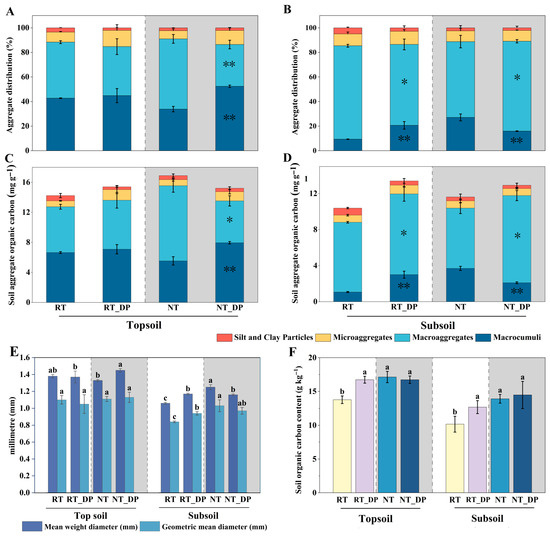
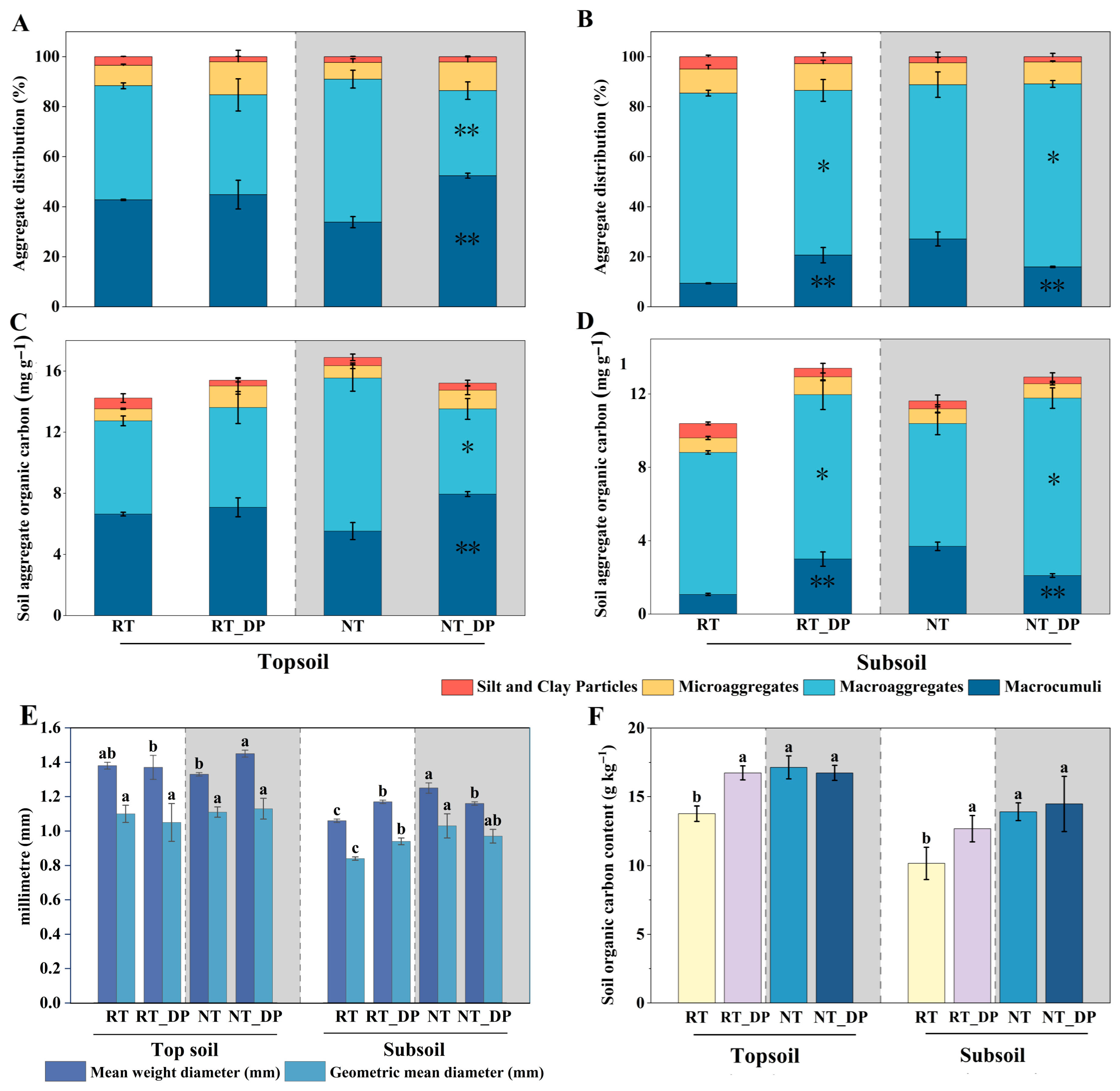
Across all tillage treatments, aggregates larger than 0.25 mm accounted for 86–93% of the total aggregates (Figure 1A,B). In the topsoil, no significant difference (p > 0.05) was observed in the water-stable aggregate content between the macrocumuli and macroaggregate fractions. The proportion of aggregates larger than 0.25 mm followed the order NT > RT > NT_DP > RT_DP. In deep soil, the content of macroaggregates was significantly higher (p < 0.05) than that of macrocumuli, with the order NT > NT_DP > RT_DP > RT. Aggregate stability indices (MWD and GMD) showed that NT_DP had significantly higher stability than the other treatments in the topsoil (Figure 1E). In contrast, NT exhibited the highest stability in the deep soil.
Figure 1.
Water-stable aggregates (A,B), aggregate carbon content (C,D), mean weight diameter and geometric mean diameter (E), and soil organic carbon content (F) in topsoil and subsoil under different treatments. RT, continuous rotary tillage for three years; NT, continuous no-tillage for three years; RT_DP, deep plowing in the first year, followed by rotary tillage for two years; NT_DP, deep plowing in the first year, followed by no-tillage for two years. Significance levels are indicated as * p < 0.05, ** p < 0.01. Different letters indicate significant differences among treatments within the same soil layer (p < 0.05).
3.3. Effects of Different Tillage Methods on Aggregate Organic Carbon
The aggregate organic carbon content decreased with increasing soil depth (Figure 1C,D). In both the top and subsurface layers, the SOC content under RT was consistently lower than that under the other treatments. In the topsoil, the organic carbon content of the RT_DP treatment increased by 21.57% compared with that of the RT treatment; in the subsoil, the organic carbon content of the RT_DP treatment increased by 36.91% compared with that of the RT treatment; and the organic carbon content of the NT_DP treatment increased by 14.2% compared with that of the NT treatment. Most aggregate carbon was concentrated in silt–clay fractions with particle sizes greater than 0.25 mm, accounting for 91% of the soil carbon in the topsoil and 89% in the deep soil. In the surface layer, compared with RT, the SOC increased by 24.53%, 21.61%, and 21.64% under NT, RT_DP, and NT_DP, respectively (Figure 1F). For aggregates > 2 mm, the SOC content followed the order NT_DP > RT_DP > NT > RT (Figure 1C). In 2–0.25 mm aggregates, NT had the highest SOC, exceeding RT by 16.42%, RT_DP by 16.89%, and NT_DP by 22.67%. In microaggregates, RT_DP showed the largest increase compared with RT (3.67%). For silt and clay particles, NT had the highest SOC, whereas RT_DP had the lowest. In the deep soil, the SOC content under all other treatments was 24.84–42.60% higher than that under RT. For macroaggregates, the SOC content followed the order NT_DP > RT_DP > NT > RT. In both the macrocumuli and microaggregate fractions, all treatments showed significant increases in the SOC content when compared.
3.4. Effects of Different Tillage Methods on Soil Enzyme Activity
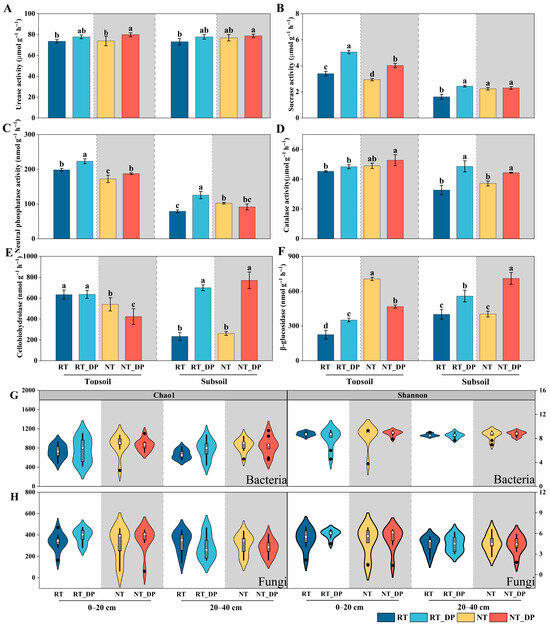
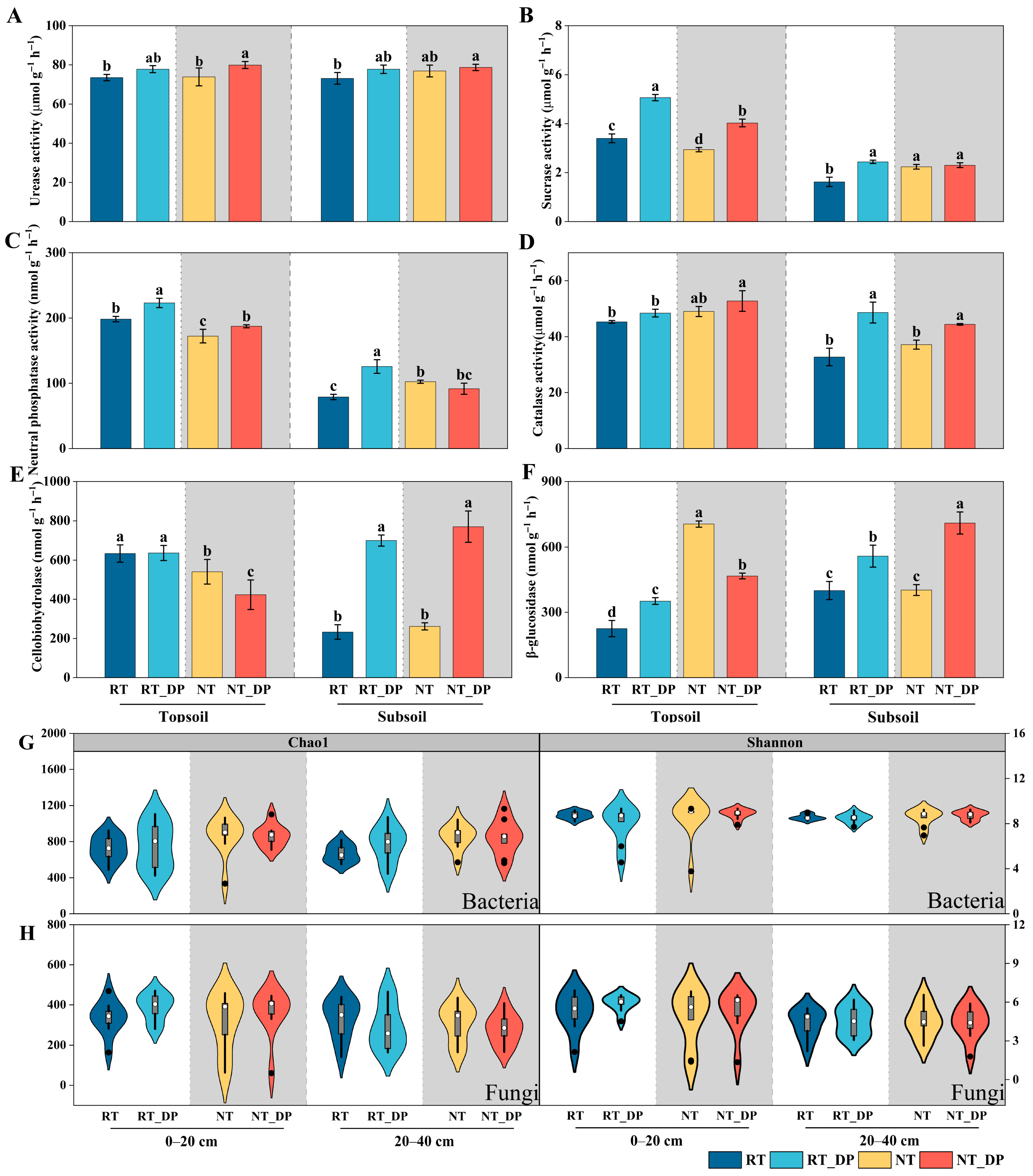
In the topsoil, enzyme activities under NT were higher than those under RT, and NT_DP was higher than those under RT_DP. RT_DP and RT exhibited the same URE activity (1.03; Figure 2A). Both NT and NT_DP exhibited higher activities than RT and RT_DP, with NT_DP exceeding NT. Specifically, URE activity under NT was 5.84% greater than that under RT. For SUC, the activity followed the order NT > NT_DP > RT > RT_DP (Figure 2B), with NT showing the largest increase over RT (48.89%). NEP activity was highest under NT and lowest under RT_DP (Figure 2C). In the deep soil, CAT and SUC exhibited the same trend (Figure 2D), with RT_DP > NT_DP > NT > RT. CAT activity in RT_DP was 48.5% higher than that in RT. For BG and CBH, the activities followed the order of NT_DP as highest, RT_DP as lowest, and RT as higher than NT (Figure 2E,F).
Figure 2.
(A) Activities of urease (URE), (B) Activities of sucrase (SUC), (C) Activities of neutral phosphatase (NEP), (D) Activities of catalase (CAT), (E) Activities of cellobiohydrolase (CBH), and (F) Activities of β-glucosidase (BG) in the surface and subsoil under different tillage treatments. Alpha diversity of bacteria (G) and fungi (H) in the surface and subsoil under different tillage treatments. RT, continuous rotary tillage for three years; NT, continuous no-tillage for three years; RT_DP, deep plowing in the first year, followed by rotary tillage for two years; NT_DP, deep plowing in the first year, followed by no-tillage for two years. Different letters indicate significant differences among treatments within the same soil layer (p < 0.05).
3.5. Effects of Different Tillage Methods on Soil Microbial Diversity
In the topsoil, the Chao1 index under RT_DP and NT_DP was significantly higher than that under RT and NT, indicating that conservation tillage effectively enhanced bacterial species richness (Figure 2G). NT_DP showed the highest Chao1 index (3850), which was approximately 18% higher than that of RT. The Shannon index followed a similar pattern, with NT_DP significantly exceeding all other treatments (p < 0.05). In the deep soil, the Chao1 index pattern differed from that of the surface layer. RT was slightly higher (3200) than that in the other treatments, although the differences were less pronounced than those in the topsoil. The Shannon index showed no significant differences among treatments, but values under no-tillage (NT and NT_DP) were lower than those under rotary tillage (RT and RT_DP). For fungi, RT and NT had significantly higher Chao1 and Shannon indices than RT_DP and NT_DP in the topsoil, with NT_DP achieving the greatest improvement, which was approximately 22% higher than that of RT (Figure 2H). In the deep soil, the diversity index under RT was slightly higher than that under the other treatments.
3.6. The Effect of Increased Organic Matter on Yield
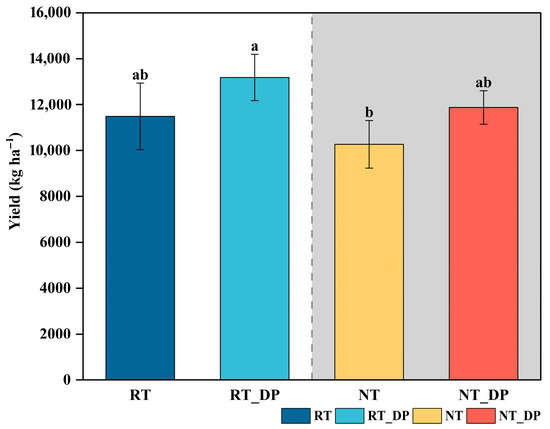
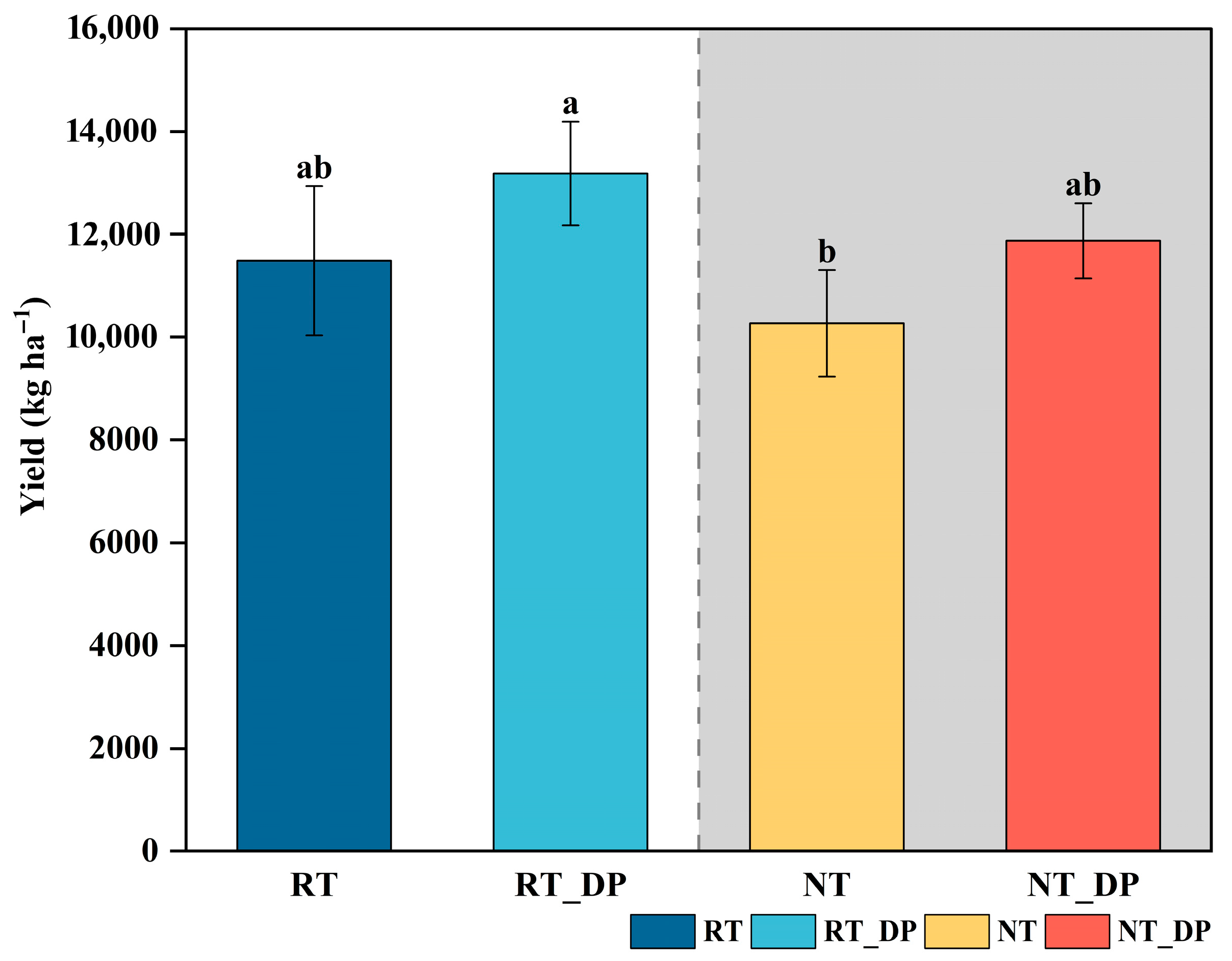
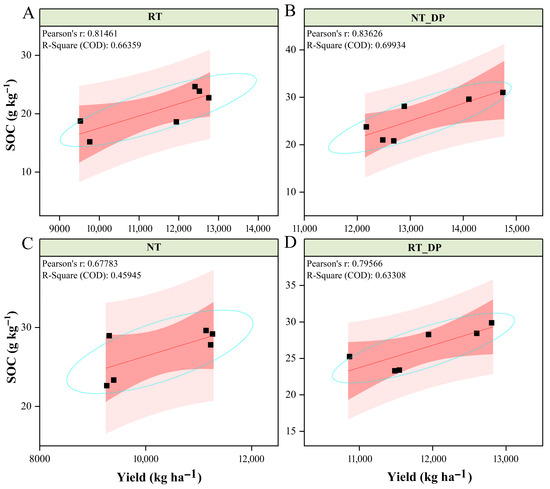
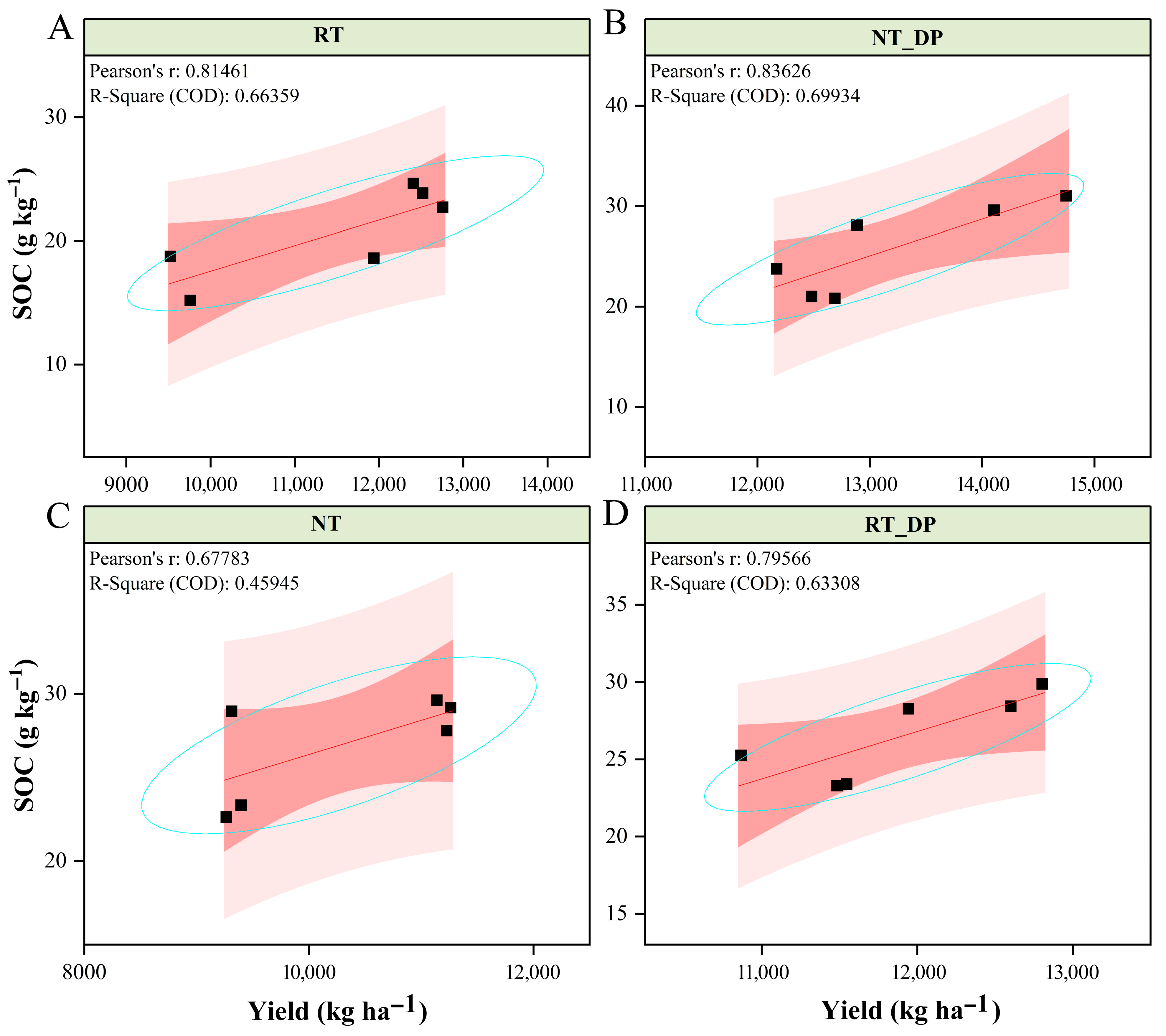
As shown in Figure 3, the crop yield differed significantly across the four tillage treatments: the no-tillage (NT) treatment yielded the lowest, while the reduced tillage with the deep plowing (RT_DP) treatment achieved the highest yield. Notably, integrating deep plowing (DP) into the two basic tillage systems (RT and NT) significantly enhanced the maize yield—RT_DP increased the yield by 14.78% compared with RT alone, and NT_DP improved the yield by 15.65% relative to NT alone (Figure 3), with treatment-specific correlational characteristics as follows: for the NT_DP treatment (Figure 4B), the yield–SOC correlation was the strongest among all treatments (Pearson’s r = 0.83626, p < 0.01), supported by a coefficient of determination (R2) of 0.69934. This result indicates that nearly 70% of the yield variability under NT_DP can be explained by dynamic changes in the SOC, highlighting the dominant regulatory role of SOC in mediating yield within the NT_DP system. Under the RT_DP treatment (Figure 4D), a statistically significant strong positive correlation was also observed between the yield and SOC (Pearson’s r = 0.79566, p < 0.05), with an R2 of 0.63308. Approximately 63% of the yield variation was attributed to the SOC, which was a magnitude higher than that of the NT treatment, but marginally weaker than that of NT_DP. In summary, these findings demonstrate that tillage practices significantly modulate the coupling intensity between the SOC and crop yield, with both RT_DP and NT_DP treatments enhancing the dependence of the yield on the SOC—providing critical evidence for the role of the SOC in driving the yield-increasing effects of deep plowing.
Figure 3.
Final yield. Different letters indicate significant differences among treatments within the same soil layer (p < 0.05).
Figure 4.
(A) presents the linear regression analysis of the relationship between soil organic carbon (SOC) and crop yield for the RT treatment. (B–D) represent the same analysis for the RT_DP, NT, and NT_DP treatments, respectively. The red area represents the 95% confidence interval.
4. Discussion
4.1. The Influence of Different Farming Methods on Corn Yield
This study, by analyzing the relationship between the crop yield and the soil organic carbon (SOC) under different tillage methods, revealed the key role of deep loosening tillage in increasing the corn yield and its coupling strength with the SOC. The results showed that the treatment of less tillage combined with deep loosening (RT_DP) achieved the highest yield, and both it and the treatment of no-tillage combined with deep loosening (NT_DP) significantly enhanced the yield’s dependence on the SOC. Among them, the SOC could explain approximately 70% of the yield variation in the NT_DP treatment, and this proportion was approximately 63% in the RT_DP treatment. This indicates that deep loosening measures not only directly promote the increase in yield but also further consolidate the effect of increasing production by enhancing the regulatory capacity of soil’s organic matter on the yield.
4.2. Effects of Different Tillage Models on Soil’s Physical Structure
Soil aggregates are key indicators of soil function and quality [30]. Long-term rotary tillage can disrupt aggregates and reduce their stability [31], whereas prolonged no-tillage can increase bulk density, cause uneven nutrient distribution (e.g., phosphorus enrichment in the surface layer), restrict root penetration, and reduce nutrient uptake, ultimately inhibiting crop growth [32]. To address these issues, we combined deep tillage, rotary tillage, and no-tillage to optimize the aggregate stability. Our results showed significant differences in the soil’s aggregate distribution among tillage treatments. Continuous high-intensity disturbance under RT reduced the proportion of large aggregates and decreased MWD, whereas treatments involving deep plowing significantly improved aggregate stability. This effect was most pronounced in the topsoil (0–20 cm). First, no-tillage reduces soil disturbance, thereby facilitating the formation of large aggregates. Second, straw inputs are initially decomposed into particulate organic carbon, which acts as a nucleation core for macroaggregates and simultaneously provides energy for the microbial synthesis of binding agents such as polysaccharides and glutamic acid [33], thereby promoting macroaggregate formation. In contrast, rotary tillage pulverizes crop straw and increases soil disturbance simultaneously, creating more pores in the soil, enhancing soil aeration, and accelerating the decomposition of organic materials such as straw. Compared with rotary tillage, both deep tillage and no-tillage reduce soil disturbance, favoring the long-term retention and stability of macroaggregates [34]. The results of these studies suggest that deep tillage, combined with no-till and rotary tillage strategies, can improve both the quantity and stability of soil aggregates [35,36].
4.3. Effect of Different Tillage Models on Soil Carbon Fixation
An increase in the number and stability of macroaggregates is critical for SOC protection because they physically encapsulate organic carbon, thereby limiting microbial exposure and oxidation [37] and favoring long-term sequestration [38,39]. The increase in no-tillage treatment increased the porosity and decreased the porosity. In this study, NT_DP showed higher MWD and GMD than NT (Figure 1E), and both the RT_DP and NT_DP treatments accumulated more organic carbon in aggregates (Figure 1C,D). In contrast, RT consistently exhibited the lowest SOC content in both the surface and subsoil layers. Continuous no-tillage minimizes soil disturbance and leads to organic matter accumulation in the surface layer, thereby reducing the oxidation of surface organic carbon and promoting its sequestration [16]. However, in our experiment, deep plowing transferred the topsoil that was rich in organic matter to deeper layers and improved the subsoil structure, facilitating the formation of root-associated aggregates. This process promotes deep-soil carbon sequestration and enhances the long-term benefits of no-tillage [36,40,41]. In contrast, rotary tillage mixes surface organic matter with deeper layers, resulting in relatively uniform but lower SOC content across soil depths. This practice increases soil porosity, accelerates mineralization, and enhances decomposition of organic carbon [42]. Overall, our findings suggest that the protective effect of organic carbon within aggregates is strengthened under alternating tillage systems [43,44].
4.4. Effects of Different Farming Models on Enzyme Activities
Soil enzymes are key drivers of biochemical processes in soil ecosystems, and their activity levels serve as important biological indicators of soil health [45]. In the topsoil, enzyme activities were generally higher under no-tillage than under rotary tillage, and URE and CAT activities were higher in treatments that included deep tillage. This can be attributed to the fact that no-tillage reduces soil disturbance and, when combined with surface straw mulching, promotes the formation of stable macroaggregates, optimizes the soil’s pore structure, and improves the balance of water and air supply. However, in NT, the absence of an initial deep tillage treatment may have limited pore continuity and microbial exposure, resulting in lower particulate organic carbon accumulation. Changes in the physical structure directly affect microbial habitats and activity, which in turn regulate the production and diffusion of soil enzymes [46]. Deep tillage can stimulate microbial activity by incorporating fresh organic materials such as straw into the tillage layer, thereby improving enzyme activity. Baoyi Ji also reported that deep tillage increased SUC, NEP, and CAT activities, compared with rotary tillage [47]. The enhanced activities of sucrase, urease, and neutral phosphatase accelerate the mineralization and transformation of carbon, nitrogen, phosphorus, and other nutrients (e.g., sucrase-mediated carbon release, urease-mediated nitrogen release, and phosphatase-mediated phosphorus release) [48,49]. This provides energy and nutrients for microorganisms [8,50], which in turn stimulates microbial biomass carbon (MBC) growth [51,52]. As a key component of the physical protection of organic carbon, MBC directly contributes to the long-term stability of the soil’s organic carbon pool [11,44].
4.5. Integrated Pathway Analysis of Tillage Effects on SOC Stabilization
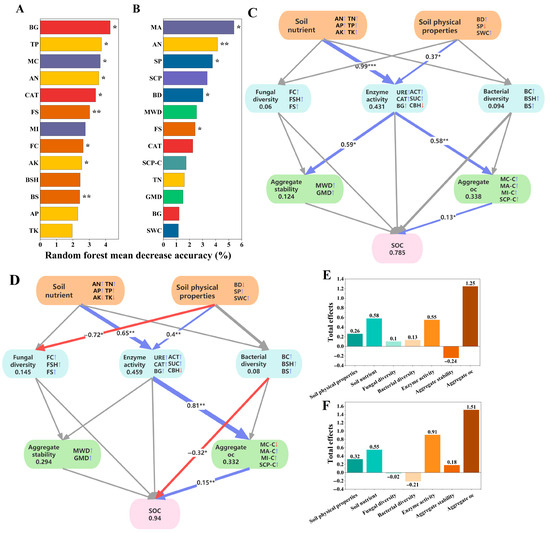
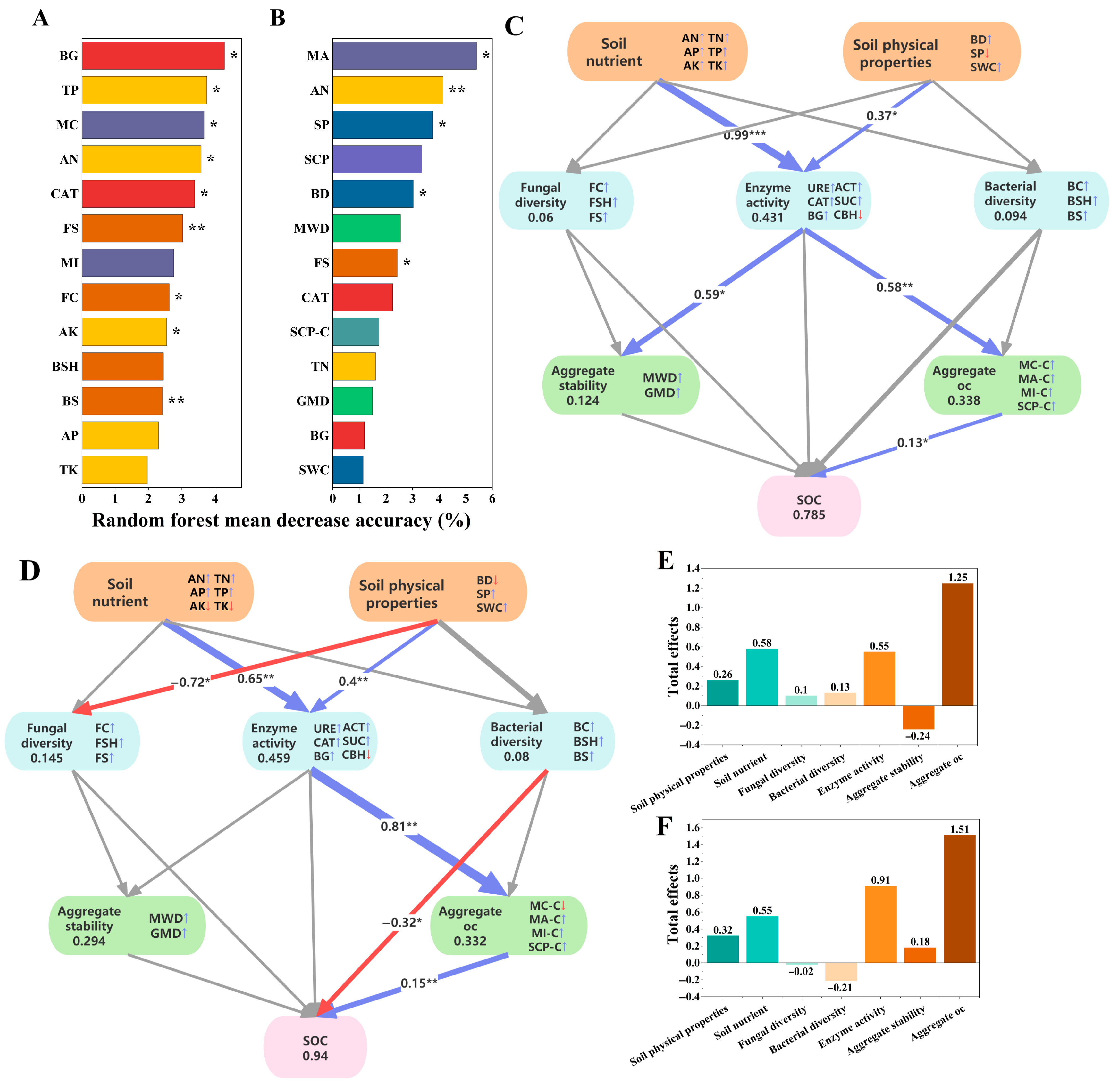
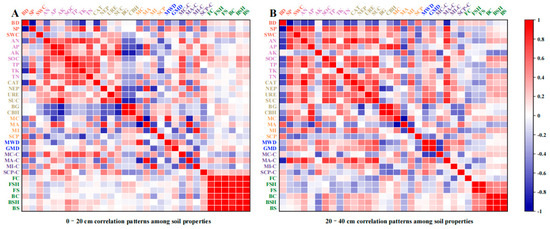
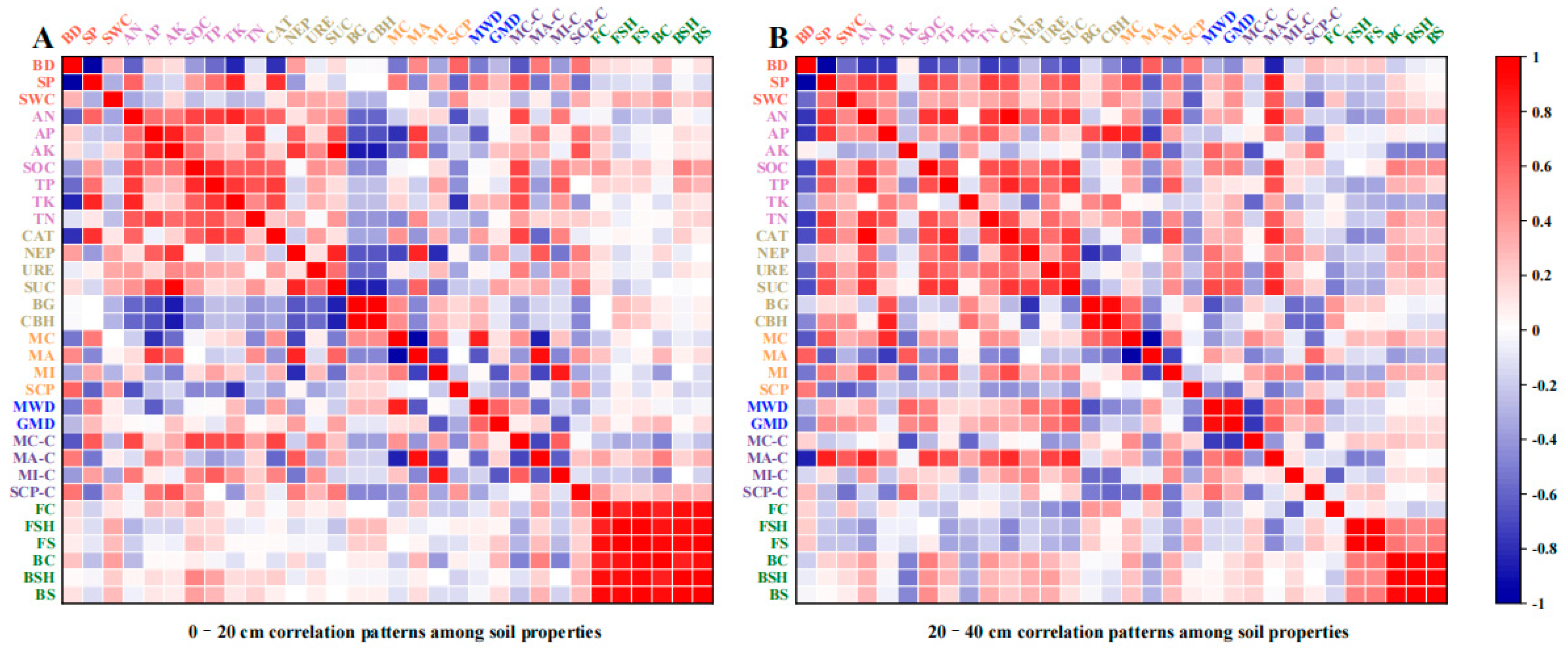
In the topsoil, integrated PLS-SEM pathway analysis revealed that soil nutrient availability directly affected the soil’s enzyme activity. Enhanced enzyme activity accelerates the decomposition of fresh organic matter [39,53], releasing binding agents that promote aggregate formation (Figure 5A,C). Aggregates reduce SOC mineralization through physical protection, thereby increasing the organic carbon content of the aggregates. An increased agglomerate content can significantly increase SOC storage [54]. Random forest analysis further showed that in the topsoil, SOC exhibited greater sensitivity to fungal abundance and nutrient availability, particularly to TP, AN, and AK [8,55]. These relationships were visually supported by the heatmap results (Figure 6A). In contrast, the subsoil promotes enzyme activity through improved nutrient status and increased porosity, which facilitates SOC accumulation within macrocumuli and microaggregates, ultimately enhancing the overall SOC accumulation via enzyme-mediated processes [49,56] (Figure 5B,D and Figure 6B). Combined SEM and RF analyses indicated that SOC, as a core response variable, could not be effectively accumulated and stabilized without the coupled effects of soil structure and biological activity (enzyme function) [57]. Notably, variables with higher importance in the RF model also exhibited strong path coefficients in the SEM, and the positive correlation between the two confirmed the robustness of RF in identifying potential causal pathways. Although microbial diversity was less influential in the topsoil, it indirectly influenced soil function by regulating the C/N ratio and SOC stability [58].
Figure 5.
Random forest models for topsoil (A) and subsoil (B). The models revealed the relationships between the soil’s chemical properties, the soil’s physical properties, fungi, bacteria, the soil’s enzyme activities, aggregate stability, aggregate organic carbon content, and organic matter content under the topsoil (C) and subsoil (D). The topsoil total effects (E), subsoil total effects (F). Blue lines represent significant positive correlations, and red lines represent significant negative correlations. The values on the arrows indicate the path coefficients of positive or negative effects. Significance levels are indicated as * p < 0.05, ** p < 0.01 and *** p < 0.001. Meanwhile, the red downward arrow denotes the negative effect of the indicator, and the blue upward arrow denotes the positive effect of the indicator. The topsoil goodness-of-fit of the model was 0.557; The subsoil goodness-of-fit of the model was 0.553. Abbreviations: BD, soil bulk density; SP, soil porosity; SWC, soil moisture content; TN, total nitrogen; TP, total phosphorus; TK, total potassium; AN, alkali-hydrolyzed nitrogen; AP, available phosphorus; AK, available potassium; MWD, mean weight diameter; GMD, geometric mean diameter; URE, urease; SUC, sucrase; NEP, neutral phosphatase; CAT, catalase; BG, β-glucosidase; CBH, cellobiohydrolase; MC-C, organic carbon in aggregates >2 mm; MA-C, organic carbon in aggregates 0.25–2 mm; MI-C, organic carbon in aggregates 0.25–0.053 mm; SCP-C, organic carbon in aggregates < 0.053 mm; FC, fungal Chao1 index; FSH, fungal Shannon index; FS, fungal Simpson index; BC, bacterial Chao1 index; BSH, bacterial Shannon index; and BS, bacterial Simpson index.
Figure 6.
Heatmap of the correlations among various soil indicators in different soil layers. Topsoil correlation patterns among soil properties (A); subsoil correlation patterns among soil properties (B). Abbreviations: BD, soil bulk density; SP, soil porosity; SWC, soil moisture content; TN, total nitrogen; TP, total phosphorus; TK, total potassium; AN, alkali-hydrolyzed nitrogen; AP, available phosphorus; AK, available potassium; MWD, mean weight diameter; GMD, geometric mean diameter; URE, urease; SUC, sucrase; NEP, neutral phosphatase; CAT, catalase; BG, β-glucosidase; CBH, cellobiohydrolase; MC, >2 mm aggregates; MA, 0.25–2 mm aggregates; MI, 0.25–0.053 mm aggregates; SCP, <0.053 mm aggregates; MC-C, organic carbon in aggregates > 2 mm; MA-C, organic carbon in aggregates 0.25–2 mm; MI-C, organic carbon in aggregates 0.25–0.053 mm; SCP-C, organic carbon in aggregates <0.053 mm; FC, fungal Chao1 index; FSH, fungal Shannon index; FS, fungal Simpson index; BC, bacterial Chao1 index; BSH, bacterial Shannon index; and BS, bacterial Simpson index.
This study systematically evaluated the combined effects of deep tillage and continuous no-till/rotary tillage on soil’s aggregate structure and the physical protection of the SOC at different depths within the black soil zone of Northeast China. Unlike previous studies that mainly focused on a single factor, this study examined the synergistic interactions between tillage disturbance and conservation practices. The results demonstrated that in the subsoil, the combination of moderate disturbance (deep tillage) and rotary tillage produced more stable aggregates, supporting long-term SOC retention. However, this tillage mode was less effective than continuous rotary tillage in enhancing the SOC under no-till conditions. Overall, deep tillage, particularly when integrated with rotary tillage or no-tillage, significantly improved the physical protection of the SOC within subsoil macroaggregates by strengthening the soil structure and increasing the aggregate size. These findings highlight the importance of appropriate tillage regulation for SOC pool management and provide strong evidence to support the macroaggregate-driven SOC conservation theory. However, this study had some limitations. PLS-SEM pathway analysis suggested that microbial metabolites may accelerate the decomposition of aggregate-associated SOC, whereas exogenous organic matter may stimulate microbial activity and enhance carbon sequestration. However, these mechanisms cannot be fully validated because of limited mechanistic data. Future studies should include in vitro experiments, using individual or combined microbial metabolites to monitor aggregate formation rates and size distributions, quantify the fraction of SOC protected by metabolite activity using 13C isotope tracing, and assess how soil texture and moisture conditions modulate these effects.
5. Conclusions
This study showed that the combination of deep tillage, no-tillage, and crop rotation significantly enhanced the production capacity of corn, the stability of soil aggregates, and the carbon sequestration capacity of the subsoil. The stability of soil aggregates increases with the increase in organic carbon content, indicating the key role of physical protection in preventing the microbial decomposition of large aggregates. These findings emphasized the necessity of optimizing farming methods to balance soil disturbance and protection. Incorporating deep cultivation into the protection management system was an effective way to strengthen the soil structure and promote long-term carbon sequestration.
Supplementary Materials
The following supporting information can be downloaded at: https://www.mdpi.com/article/10.3390/agronomy16020198/s1, Figure S1: Climatic data (2018–2020) of the experimental site.
Author Contributions
Methodology, J.L.; Software, J.C.; Validation, C.Z.; Formal analysis, H.W. (Hongbin Wang) and D.W.; Investigation, J.C., Z.B. and Y.Y.; Resources, B.S.; Data curation, J.C.; Writing—original draft, J.C.; Writing—review & editing, J.C.; Supervision, J.C. and Z.B.; Project administration, J.C., Y.Y., B.C. and L.W.; Funding acquisition, X.Z., F.L. and H.W. (Hongjun Wang). All authors have read and agreed to the published version of the manuscript.
Funding
This study was funded by the National Key R&D Program of China (Grant No. 2022YFD1500105, 2023YFD2301705, and 2024YFD1501005).
Data Availability Statement
The dataset used in this study is available upon request from the corresponding authors.
Conflicts of Interest
The authors declare no conflicts of interest.
References
- Shen, Y.; Zhang, T.T.; Cui, J.C.; Chen, S.Y.; Han, H.F.; Ning, T.Y. Subsoiling increases aggregate-associated organic carbon, dry matter, and maize yield on the north China plain. PeerJ 2021, 9, e11099. [Google Scholar] [CrossRef] [Scilit] [PubMed]
- Pervaiz, Z.H.; Iqbal, J.; Zhang, Q.M.; Chen, D.M.; Wei, H.; Saleem, M. Continuous cropping alters multiple biotic and abiotic indicators of soil health. Soil Syst. 2020, 4, 59. [Google Scholar] [CrossRef] [Scilit]
- Wang, J.; Shu, K.; Wang, S.; Zhang, C.; Feng, Y.; Gao, M.; Li, Z.; Cai, H. Soil enzyme activities affect soc and tn in aggregate fractions in sodic-alkali soils, northeast of China. Agronomy 2022, 12, 2549. [Google Scholar] [CrossRef] [Scilit]
- Ma, Y.Q.; Woolf, D.; Fan, M.S.; Qiao, L.; Li, R.; Lehmann, J. Global crop production increase by soil organic carbon. Nat. Geosci. 2023, 16, 1159–1165. [Google Scholar] [CrossRef] [Scilit]
- Stockmann, U.; Adams, M.A.; Crawford, J.W.; Field, D.J.; Henakaarchchi, N.; Jenkins, M.; Minasny, B.; McBratney, A.B.; de Courcelles, V.d.R.; Singh, K.; et al. The knowns, known unknowns and unknowns of sequestration of soil organic carbon. Agric. Ecosyst. Environ. 2013, 164, 80–99. [Google Scholar] [CrossRef] [Scilit]
- Ontl, T.A.; Cambardella, C.A.; Schulte, L.A.; Kolka, R.K. Factors influencing soil aggregation and particulate organic matter responses to bioenergy crops across a topographic gradient. Geoderma 2015, 255–256, 1–11. [Google Scholar] [CrossRef] [Scilit]
- Al-Shammary, A.A.G.; Al-Shihmani, L.S.S.; Fernández-Gálvez, J.; Caballero-Calvo, A. Optimizing sustainable agriculture: A comprehensive review of agronomic practices and their impacts on soil attributes. J. Environ. Manag. 2024, 364, 121487. [Google Scholar] [CrossRef] [Scilit]
- Han, C.D.; Chen, L.; Jia, Z.J.; Zou, H.; Ma, L.; Zhang, C.; Zhou, G.; Ma, D.; Zhang, J. Organic amendments enhance rhizosphere carbon stabilization in macroaggregates of saline-sodic soils by regulating keystone microbial clusters. J. Environ. Manag. 2025, 380, 125086. [Google Scholar] [CrossRef] [Scilit]
- Sun, L.; Han, S. Microbial functional trait predicts soil organic carbon across soil aggregates in northeastern China. Soil Biol. Biochem. 2025, 206, 109793. [Google Scholar] [CrossRef] [Scilit]
- Song, K.; Zheng, X.Q.; Lv, W.G.; Qin, Q.; Sun, L.; Zhang, H.; Xue, Y. Effects of tillage and straw return on water-stable aggregates, carbon stabilization and crop yield in an estuarine alluvial soil. Sci. Rep. 2019, 9, 4586. [Google Scholar] [CrossRef] [Scilit]
- Zhang, C.Z.; Zhao, Z.H.; Li, F.; Zhang, J.B. Effects of organic and inorganic fertilization on soil organic carbon and enzymatic activities. Agronomy 2022, 12, 3125. [Google Scholar] [CrossRef] [Scilit]
- Liu, M.; Han, G.L.; Li, Z.C.; Zhang, Q.; Song, Z.L. Soil organic carbon sequestration in soil aggregates in the Karst Critical Zone Observatory, Southwest China. Plant Soil Environ. 2019, 65, 253–259. [Google Scholar] [CrossRef] [Scilit]
- Yu, H.; Huang, X.; Yang, K.; Xi, B.D.; Tan, B.W. Differential effects of microplastics on soil organic carbon via lignin phenols and amino sugars in soil aggregates. Front. Environ. Sci. Eng. 2025, 19, 90. [Google Scholar] [CrossRef] [Scilit]
- Ren, B.Z.; Li, X.; Dong, S.T.; Liu, P.; Zhao, B.; Zhang, J.W. Soil physical properties and maize root growth under different tillage systems in the North China Plain. Crop J. 2018, 6, 669–676. [Google Scholar] [CrossRef] [Scilit]
- Abu-hashim, M.; Lilienthal, H.; Schnug, E.; Lasaponara, R.; Mohamed, E.S. Can a change in agriculture management practice improve soil physical properties. Sustainability 2023, 15, 3573. [Google Scholar] [CrossRef] [Scilit]
- Olson, K.R.; Al-Kaisi, M.M.; Lal, R.; Lowery, B. Experimental Consideration, Treatments, and Methods in Determining Soil Organic Carbon Sequestration Rates. Soil Sci. Soc. Am. J. 2014, 78, 348–360. [Google Scholar] [CrossRef] [Scilit]
- Kan, Z.-R.; Li, Z.; Amelung, W.; Zhang, H.-L.; Lal, R.; Bol, R.; Bian, X.; Liu, J.; Xue, Y.; Li, F.-M.; et al. Soil carbon accrual and crop production enhanced by sustainable subsoil management. Nat. Geosci. 2025, 18, 631–638. [Google Scholar] [CrossRef] [Scilit]
- Shi, J.; Song, G. Soil type database of China: A nationwide soil dataset based on the second national soil survey. China Sci. Data 2016, 1, 1–12. [Google Scholar] [CrossRef] [Scilit]
- Zhang, L.; Zeng, G.; Dong, H.; Chen, Y.; Zhang, J.; Yan, M.; Zhu, Y.; Yuan, Y.; Xie, Y.; Huang, Z. The impact of silver nanoparticles on the co-composting of sewage sludge and agricultural waste: Evolutions of organic matter and nitrogen. Bioresour. Technol. 2017, 230, 132–139. [Google Scholar] [CrossRef] [Scilit] [PubMed]
- Mulvaney, R.; Khan, S. Diffusion methods to determine different forms of nitrogen in soil hydrolysates. Soil Sci. Soc. Am. J. 2001, 65, 1284–1292. [Google Scholar] [CrossRef] [Scilit]
- Tian, H.; Qiao, J.; Zhu, Y.; Jia, X.; Shao, M.A. Vertical distribution of soil available phosphorus and soil available potassium in the critical zone on the loess plateau, China. Sci. Rep. 2021, 11, 3159. [Google Scholar] [CrossRef] [Scilit]
- Al-Shammary, A.A.G.; Kouzani, A.Z.; Kaynak, A.; Khoo, S.Y.; Norton, M.; Gates, W. Soil bulk density estimation methods: A review. Pedosphere 2018, 28, 581–596. [Google Scholar] [CrossRef] [Scilit]
- Chien, S.C.; Krumins, J.A. Natural versus urban global soil organic carbon stocks: A meta-analysis. Sci. Total. Environ. 2022, 807, 150999. [Google Scholar] [CrossRef] [Scilit]
- Almajmaie, A.; Hardie, M.; Acuna, T.; Birch, C. Evaluation of methods for determining soil aggregate stability. Soil Tillage Res. 2017, 167, 39–45. [Google Scholar] [CrossRef] [Scilit]
- Márquez, C.O.; Garcia, V.J.; Cambardella, C.A.; Schultz, R.C.; Isenhart, T.M. Aggregate-size stability distribution and soil stability. Soil Sci. Soc. Am. J. 2004, 68, 725–735. [Google Scholar] [CrossRef] [Scilit]
- Karami, A.; Homaee, M.; Afzalinia, S.; Ruhipour, H.; Basirat, S. Organic resource management: Impacts on soil aggregate stability and other soil physico-chemical properties. Agric. Ecosyst. Environ. 2012, 148, 22–28. [Google Scholar] [CrossRef] [Scilit]
- Barančíková, G.; Makovníková, J. Comparison of two methods of soil organic carbon determination. Pol. J. Soil Sci. 2016, 48, 47. [Google Scholar] [CrossRef] [Scilit]
- Li, J.; Gao, F.; Chen, X.; Zhang, Y.; Dong, H. Insights into nitrogen removal from seawater-based wastewater through marine anammox bacteria under ampicillin stress: Microbial community evolution and genetic response. J. Hazard. Mater. 2022, 424, 127597. [Google Scholar] [CrossRef] [Scilit]
- Zhao, W.; Guo, Q.; Li, S.; Wang, P.; Dong, L.; Su, Z.; Zhang, X.; Lu, X.; Ma, P. Effects of bacillus subtilis ncd-2 and broccoli residues return on potato verticillium wilt and soil fungal community structure. Biol. Control 2021, 159, 104628. [Google Scholar] [CrossRef] [Scilit]
- Olagoke, F.K.; Bettermann, A.; Nguyen, P.T.B.; Redmile-Gordon, M.; Babin, D.; Smalla, K.; Nesme, J.; Sørensen, S.J.; Kalbitz, K.; Vogel, C. Importance of substrate quality and clay content on microbial extracellular polymeric substances production and aggregate stability in soils. Biol. Fertil. Soils 2022, 58, 435–457. [Google Scholar] [CrossRef] [Scilit]
- Steponavičienė, V.; Bogužas, V.; Sinkevičienė, A.; Skinulienė, L.; Sinkevičius, A.; Klimas, E. Soil physical state as influenced by long-term reduced tillage, no-tillage and straw management. Zemdirbyste 2020, 107, 195–202. [Google Scholar] [CrossRef] [Scilit]
- Dyck, M.; Malhi, S.S.; Nyborg, M.; Puurveen, D. Effects of short-term tillage of a long-term no-till land on available n and p in two contrasting soil types. Sustain. Agric. Res. 2015, 4, 27. [Google Scholar] [CrossRef] [Scilit]
- McDaniel, M.D.; Grandy, A.S.; Tiemann, L.K.; Weintraub, M.N. Crop rotation complexity regulates the decomposition of high and low quality residues. Soil Biol. Biochem. 2014, 78, 243–254. [Google Scholar] [CrossRef] [Scilit]
- Lal, R. Soil carbon sequestration to mitigate climate change. Geoderma 2004, 123, 1–22. [Google Scholar] [CrossRef] [Scilit]
- Zhang, M.N.; Song, X.J.; Wu, X.P.; Zheng, F.; Li, S.; Zhuang, Y.; Man, X.; Degré, A. Microbial regulation of aggregate stability and carbon sequestration under long-term conservation tillage and nitrogen application. Sustain. Prod. Consum. 2023, 44, 74–86. [Google Scholar] [CrossRef] [Scilit]
- Zhang, Y.J.; Osborne, B.; Dang, S.N.; Zou, J.L. The effects of straw return and tillage depth on soil respiration and soil organic carbon: Implications for improving the sustainability of agro-ecosystems in China. Eur. J. Agron. 2025, 168, 127630. [Google Scholar] [CrossRef] [Scilit]
- Blagodatskii, S.A.; Bogomolova, I.N.; Blagodatskaya, E.V. Microbial biomass and growth kinetics of microorganisms in chernozem soils under different land use modes. Microbiology 2008, 77, 99–106. [Google Scholar] [CrossRef] [Scilit]
- Piotrowska-Długosz, A.; Kobierski, M.; Długosz, J. Enzymatic activity and physicochemical properties of soil profiles of luvisols. Materials 2021, 14, 6364. [Google Scholar] [CrossRef] [Scilit]
- Yang, Y.H.; Li, M.J.; Wu, J.C.; Pan, X.Y.; Gao, C.M.; Tang, D.W.S. Impact of combining long-term subsoiling and organic fertilizer on soil microbial biomass carbon and nitrogen, soil enzyme activity, and water use of winter wheat. Front. Plant Sci. 2022, 12, 788651. [Google Scholar] [CrossRef] [Scilit] [PubMed]
- Wang, B.S.; Gao, L.L.; Yu, W.S.; Wei, X.; Li, J.; Li, S.; Song, X.; Liang, G.; Cai, D.; Wu, X. Distribution of soil aggregates and organic carbon in deep soil under long-term conservation tillage with residual retention in dryland. J. Arid Land 2019, 11, 241–254. [Google Scholar] [CrossRef] [Scilit]
- Gao, P.J.; Abbas, H.; Li, F.Q.; Tang, G.R.; Lv, J.Z.; Zhou, X.B. Effect of planting methods and tillage practices on soil health and maize productivity. Front. Plant Sci. 2024, 15, 1436011. [Google Scholar] [CrossRef] [Scilit]
- Six, J.; Paustian, K.; Elliott, E.T.; Combrink, C. Soil structure and organic Matter I. Distribution of aggregate-size classes and aggregate-associated carbon. Soil Sci. Soc. Am. J. 2000, 64, 681–689. [Google Scholar] [CrossRef] [Scilit]
- Monroe, P.H.M.; Barreto-Garcia, P.A.B.; Barros, W.T.; de Oliveira, F.G.R.B.; Pereira, M.G. Physical protection of soil organic carbon through aggregates in different land use systems in the semi-arid region of brazil. J. Arid Environ. 2021, 186, 104427. [Google Scholar] [CrossRef] [Scilit]
- Naresh, R.K.; Singh, P.K.; Bhatt, R.; Chandra, M.S.; Kumar, Y.; Mahajan, N.C.; Gupta, S.K.; Al-Ansari, N.; Mattar, M.A. Long-term application of agronomic management strategies effects on soil organic carbon, energy budgeting, and carbon footprint under rice–wheat cropping system. Sci. Rep. 2024, 14, 337. [Google Scholar] [CrossRef] [Scilit]
- Kögel-Knabner, I.; Guggenberger, G.; Kleber, M.; Kandeler, E.; Kalbitz, K.; Scheu, S.; Eusterhues, K.; Leinweber, P. Organo-mineral associations in temperate soils: Integrating biology, mineralogy, and organic matter chemistry. J. Plant Nutr. Soil Sci. 2008, 171, 61–82. [Google Scholar] [CrossRef] [Scilit]
- Kim, S.W.; Liang, Y.; Zhao, T.; Rillig, M.C. Indirect effects of microplastic-contaminated soils on adjacent soil layers: Vertical changes in soil physical structure and water flow. Front. Environ. Sci. 2021, 9, 681934. [Google Scholar] [CrossRef] [Scilit]
- Ji, B.Y.; Hu, H.; Zhao, Y.L.; Mu, X.; Liu, K.; Li, C.H. Effects of deep tillage and straw returning on soil microorganism and enzyme activities. Sci. World J. 2014, 2014, 451493. [Google Scholar] [CrossRef] [Scilit] [PubMed]
- Bautista-Cruz, A.; Ortíz-Hernández, Y.D. Hydrolytic soil enzymes and their response to fertilization: A short review. Comun. Sci. 2015, 6, 255–262. [Google Scholar] [CrossRef] [Scilit]
- Wen, L.S.; Peng, Y.; Zhou, Y.R.; Cai, G.; Lin, Y.Y.; Li, B.Y. Effects of conservation tillage on soil enzyme activities of global cultivated land: A meta-analysis. J. Environ. Manag. 2023, 345, 118904. [Google Scholar] [CrossRef] [Scilit] [PubMed]
- Liang, Y.; Al-Kaisi, M.; Yuan, J.C.; Liu, J.; Zhang, H.; Wang, L.; Cai, H.; Ren, J. Effect of chemical fertilizer and straw-derived organic amendments on continuous maize yield, soil carbon sequestration and soil quality in a Chinese Mollisol. Agric. Ecosyst. Environ. 2021, 314, 107403. [Google Scholar] [CrossRef] [Scilit]
- Yuan, Y.H.; Liang, Y.; Cai, H.; Yuan, J.; Li, C.; Liu, H.; Zhang, C.; Wang, L.; Zhang, J. Soil organic carbon accumulation mechanisms in soil amended with straw and biochar: Entombing effect or biochemical protection? Biochar 2025, 7, 33. [Google Scholar] [CrossRef] [Scilit]
- Zhang, R.; Wang, Y.J.; Zhang, X.C.; Luo, F.; Wei, X.; Li, M.; Li, H.; Zhao, X.; Duan, Z.; Song, X.; et al. Mulching increases soil organic carbon via plant inputs and its microbial transformation. Biol. Fertil. Soils 2025, 61, 1113–1128. [Google Scholar] [CrossRef] [Scilit]
- Kobierski, M.; Lemanowicz, J.; Wojewódzki, P.; Kondratowicz-Maciejewska, K. The effect of organic and conventional farming systems with different tillage on soil properties and enzymatic activity. Agronomy 2020, 10, 1809. [Google Scholar] [CrossRef] [Scilit]
- Lee, J.H.; Ulbrich, T.C.; Oerther, M.; Kuzyakov, Y.; Guber, A.K.; Kravchenko, A.N. Belowground plant carbon and nitrogen exchange: Plant-derived carbon inputs and pore structure formation. Soil Biol. Biochem. 2025, 207, 109833. [Google Scholar] [CrossRef] [Scilit]
- Zhong, X.L.; Li, J.T.; Li, X.J.; Ye, Y.-C.; Liu, S.-S.; Hallett, P.D.; Ogden, M.R.; Naveed, M. Physical protection by soil aggregates stabilizes soil organic carbon under simulated n deposition in a subtropical forest of China. Geoderma 2017, 285, 323–332. [Google Scholar] [CrossRef] [Scilit]
- Li, J.; Wang, Y.K.; Guo, Z.; Li, J.-B.; Tian, C.; Hua, D.-W.; Shi, C.-D.; Wang, H.-Y.; Han, J.-C.; Xu, Y. Effects of conservation tillage on soil physicochemical properties and crop yield in an arid loess plateau, China. Sci. Rep. 2020, 10, 4716. [Google Scholar] [CrossRef] [Scilit] [PubMed]
- Sinsabaugh, R.L.; Lauber, C.L.; Weintraub, M.N.; Ahmed, B.; Allison, S.D.; Crenshaw, C.; Contosta, A.R.; Cusack, D.; Frey, S.; Gallo, M.E.; et al. Stoichiometry of soil enzyme activity at global scale. Ecol. Lett. 2008, 11, 1252–1264. [Google Scholar] [CrossRef] [Scilit] [PubMed]
- Liu, Y.Q.; Ma, W.H.; Kou, D.; Niu, X.; Wang, T.; Chen, Y.; Chen, D.; Zhu, X.; Zhao, M.; Hao, B.; et al. A comparison of patterns of microbial C:N:P stoichiometry between topsoil and subsoil along an aridity gradient. Biogeosciences 2020, 17, 2009–2019. [Google Scholar] [CrossRef] [Scilit]

Disclaimer/Publisher’s Note: The statements, opinions and data contained in all publications are solely those of the individual author(s) and contributor(s) and not of MDPI and/or the editor(s). MDPI and/or the editor(s) disclaim responsibility for any injury to people or property resulting from any ideas, methods, instructions or products referred to in the content. |
© 2026 by the authors. Licensee MDPI, Basel, Switzerland. This article is an open access article distributed under the terms and conditions of the Creative Commons Attribution (CC BY) license.