


Abstract
Potato leaf size directly affects photosynthetic efficiency and yield; therefore, elucidating the genetic regulation of this trait is important for breeding improvement. In this study, a natural population of 476 tetraploid potato accessions was used to evaluate compound leaf size and apical leaflet size. Both traits were scored on a 1–9 ordinal scale in accordance with the national standard GB/T 19557.28-2018. The two-year (2019–2020) phenotypic means showed continuous variation consistent with polygenic quantitative trait architecture. Correlation analysis revealed a strong, highly significant positive association between compound leaf size and apical leaflet size (R = 0.71, p < 2.2 × 10⁻¹⁶). Genome-wide association analysis identified 211 SNPs significantly associated with compound leaf size, predominantly located on chromosomes Chr05 and Chr06, from which 75 candidate genes were identified. KEGG enrichment analysis showed that these candidate genes were significantly enriched in pathways related to RNA degradation, ribosomes, phenylalanine biosynthesis and genetic information processing. Putative candidate genes potentially regulating compound leaf size include DM8C10G01290.1 (Rcd1-like), DM8C11G02500.1 (ADH_zinc_N domain-containing), DM8C10G01180.1 (Ribosomal_S8e domain-containing), DM8C06G16880.1 (Methyltransf_2 domain-containing) and DM8C05G27660.1 (Inositol_P domain-containing). A total of 671 SNP loci were identified as significantly associated with apical leaflet size, primarily localised on chromosomes Chr04 and Chr06, which led to the identification of 175 candidate genes. KEGG enrichment analysis showed that candidate genes for apical leaflet size were mainly enriched in pathways related to energy metabolism, secondary metabolism and plant hormone signal transduction. Putative candidate genes potentially regulating apical leaflet size include DM8C10G13560.1 (Malic_M domain-containing), DM8C01G21400.1 (PPDK_N domain-containing), DM8C08G02250.1 (UDPGT domain-containing), DM8C03G19930.1 (Orn_Arg_deC_N domain-containing), DM8C04G29090.1 (peroxidase), DM8C02G10960.2 (Pro_CA domain-containing), DM8C01G45290.1 (NIR_SIR domain-containing), DM8C08G02280.1 (Glyco_tranf_2_3 domain-containing), DM8C06G27780.1 (UDPGT domain-containing), DM8C06G27490.1 (Transket_pyr domain-containing), DM8C04G23010.1 (LRRNT_2 domain-containing) and DM8C03G01180.1 (BES1_N domain-containing). This study elucidated the genetic basis of potato leaf size and provided promising candidate markers and genetic resources, which require further validation in independent populations and environments before deployment in molecular marker-assisted breeding.
1. Introduction
Potatoes (Solanum tuberosum L.) are rich in essential amino acids, vitamins, minerals, ascorbic acid, dietary fibre and other nutrients and bioactive compounds. They are also a major source of carbohydrates and protein, offering broad nutritional value [1,2], and have been hailed as “the most affordable complete food.” Potatoes are highly adaptable and resilient to adverse environments, and they serve as a staple crop in China’s high-altitude cold regions, where they play a vital role in agricultural production [2]. As global food demand continues to shift, the potato sector has steadily advanced, with cultivation and production increasing year by year; consequently, the crop has become crucial for food security in many countries. At present, the area under potato cultivation in developing countries far exceeds that in developed countries [3], and the large-scale promotion of potato cultivation has significant strategic importance for optimising the agricultural industrial structure, strengthening food security, and supporting targeted poverty alleviation in rural areas [4]. Potatoes have been cultivated in China for approximately 400 years. As a major staple crop, they play an irreplaceable role in ensuring national food security, promoting rural revitalisation and fostering sustainable agricultural development [5,6].
Leaves are the primary organs through which potato plants perform photosynthesis and accumulate dry matter. Leaf development and morphology determine photosynthetic efficiency and the level of dry matter accumulation, thereby regulating growth, development and yield formation [7]. Compound leaves are the predominant leaf form in potato, and leaf size is a key agronomic trait that shapes canopy architecture, light capture for photosynthesis and field adaptability. By modulating the population’s use of light energy and patterns of dry matter allocation, leaf size strongly influences yield formation and plant morphogenesis. The apical leaflet of the compound leaf, situated at the tip shows developmental priority and distinctive morphology; its size not only governs the overall symmetry and growth habit of the compound leaf but also directly indicates its developmental stage. Consequently, apical leaflet size is a crucial trait for determining potato leaf form, optimising canopy photosynthetic structure, and affecting yield potential [8]. Leaf morphology is determined by the combined processes of cell division, differentiation and expansion. By controlling cell number and size, these processes shape leaf phenotype and form the fundamental physiological basis for the development of leaf traits [9,10]. The genetic regulation of leaf traits is complex and this complexity provides an important framework for investigating plant growth and development, environmental adaptation and evolutionary strategies. Studies of leaf-size traits have considerable theoretical value for clarifying patterns of resource allocation in plants and the mechanisms of ecological adaptation [11,12,13].
The development of potato compound leaves and their apical leaflet is a complex biological process that requires polygenic coordination and interactions among multiple signalling pathways; numerous fundamental studies have elucidated aspects of its molecular regulation. Compound leaf size is chiefly governed by the initiation of leaf primordia, cell proliferation and differentiation, and rachis elongation, with multiple gene families jointly forming a complex genetic regulatory network [14]. The regulatory system controlling apical leaflet size combines general and specialised features; it depends on the overall developmental programmes of the compound leaf while also exhibiting autonomous mechanisms for cell division, elongation and polar development. These mechanisms overlap in part with genes that regulate compound leaf development but also include genes that are specific to apical leaflet formation [15]. Existing research indicates that auxin is a central signalling molecule that regulates apical meristem activation and the initiation and growth of leaflets [16,17]. In this context, PIN family genes direct auxin transport to the apical meristem and thus provide the signalling basis for leaf primordium development [18], while KNOX1 family genes maintain meristem activity and regulate cell differentiation, making them key regulators of compound leaf organogenesis [18,19]. The BP gene of the KNOX family collaborates with the AS1 gene and auxin signalling to regulate leaf primordium separation and the initiation of leaf development, and it acts synergistically with multiple genetic factors to control apical meristem division and differentiation [18]. The evolutionarily conserved NAM/CUC3 transcription factor is also a key regulator of organ initiation and morphogenesis; it controls organ separation by suppressing local disordered growth and specifically regulates KNOXI gene expression, thereby mediating meristem development and leaf morphogenesis [19,20,21].
In this study, we used 476 potato accessions from around the world as experimental material and systematically analysed two core quantitative traits of leaf morphology—compound leaf size and apical leaflet size—by whole-genome resequencing and genome-wide association studies (GWASs) to identify variant loci and candidate genes significantly associated with these traits. The findings enrich the theoretical understanding of the genetic regulation of potato leaf morphology, fully exploit superior germplasm resources linked to the pathways governing these core quantitative traits, and provide theoretical foundations and genetic support for the improvement of potato leaf morphology, molecular breeding and the enhancement of yield potential.
2. Materials and Methods
2.1. Planting Accessions and Field Experiment Design
All potato germplasm materials used in this study were obtained from the Qinghai Academy of Agricultural and Forestry Sciences. Tubers were planted at the High-Altitude Potato Experimental Station in Huangyuan County, Qinghai Province (101.035° E, 36.729° N). A randomised complete block design (RCBD) with three replicates was used, with ten plants per accession in each replicate. Standard field management practices were applied throughout the growing season. A sandy loam plot with loose soil and ample sunlight was chosen; the soil was deep-ploughed to 25–30 cm, and single-row ridges were formed with a ridge height of 25–35 cm and ridge spacing of 70–90 cm. A basal application of 40–60 kg/mu of specialist compound fertiliser for potatoes was applied. Sowing depth was 10–15 cm, with plant spacing of 20–28 cm, and thorough irrigation was carried out after sowing to ensure uniform emergence. The trial was repeated three times. During the budding stage, tender leaves were collected from each sample and preserved for subsequent DNA extraction, library preparation and sequencing.
2.2. Characterisation of Potato Leaf Traits
All 476 potato accessions used in this study are tetraploid and were obtained from the Qinghai Academy of Agricultural and Forestry Sciences. The accessions, comprising cultivated varieties, landraces and advanced breeding lines, are held long-term by the Qinghai Academy of Agricultural and Forestry Sciences. They originate from 18 countries or regions, the largest groups coming from China (166 accessions), Peru (166 accessions), the USA (18), Canada (13) and Russia (7); geographic origin is unavailable for 73 accessions. Detailed provenance for all accessions is provided in Supplementary Table S1. The tubers were planted at the High-Altitude Potato Experimental Station in Huangyuan County, Qinghai Province (101.035° E, 36.729° N) in 2019 and 2020. A randomised complete block design (RCBD) with three replicates, with ten plants per accession in each replicate. We selected a sandy loam plot with loose soil and good sunlight exposure; the soil was deep-ploughed to 25–30 cm, and single-row ridges were formed with a ridge height of 25–35 cm and ridge spacing of 70–90 cm. A basal application of 40–60 kg/mu of specialised compound potato fertiliser was applied; sowing depth was 10–15 cm and plant spacing 20–28 cm, followed by thorough irrigation to ensure uniform emergence. Phenotypic data from the two years were combined by simple arithmetic mean. During the budding stage, we collected tender leaves from each sample and preserved them for subsequent DNA extraction, library preparation and sequencing.
In accordance with the “Guidelines for Testing the Specificity, Uniformity and Stability of Plant Varieties—Potato” (GB/T 19557.28-2018; https://openstd.samr.gov.cn/bzgk/gb/, accessed on 17 March 2026), standard recorded traits were assessed using a 1–9 ordinal scoring scale. Phenotypic data for two leaf traits—compound leaf size and apical leaflet size—were collected from 476 potato accessions. Observations of leaf traits were made at the budding stage, defined as when plants with flower buds protruding beyond the apical leaf comprised more than 75% of the plants in the plot. The 1–9 ordinal scores were treated as continuous variables for the subsequent GWASs, because the nine-point scale provides sufficient granularity to approximate a continuous distribution; this approach is consistent with previous GWASs of ordinal morphological traits in potato [22] (Table 1).
Table 1.
Phenotypic classification standards for compound leaf size and apical leaflet size.
2.3. Potato DNA Extraction and Sequencing
Genomic DNA was extracted from the leaves of 476 potato accessions using the QIAGEN Genomic DNA Extraction Kit. The genomic DNA was fragmented randomly with a Covaris S220 ultrasonic disruptor (Covaris, LLC, Woburn, MA, USA) to produce fragments with a principal peak at 300–350 bp. After magnetic bead purification and recovery, the fragments underwent end repair and ligation to sequencing adapters; unligated adapters were removed by a second round of magnetic bead purification. In accordance with the NEBNext Ultra II FS DNA Library Prep Kit (#E7805) (New England Biolabs, Inc. (NEB), Ipswich, MA, USA) instructions, specific primers were added for PCR amplification to enrich adapter-ligated products and to introduce unique barcode sequences for each sample. Following magnetic bead purification of the PCR products, quality control assessed library concentration and fragment distribution. Qualified double-stranded DNA libraries were denatured, circularised and digested with restriction enzyme to yield single-stranded circular DNA. DNA nanoballs (DNBs) were prepared by rolling circle amplification and immobilised on sequencing chips; high-throughput resequencing was then carried out on the DNBSEQ-T7 platform at an average depth of approximately 10× to obtain raw sequencing data. Raw reads were trimmed using fastp (version 0.23.2) [23] to remove adapters and low-quality sequences. Clean reads were aligned to the potato reference genome DM v8.1 using BWA [24]. The resulting SAM files were converted to BAM files, sorted, and indexed using SAMtools [25,26]. SNP calling was performed using the Genome Analysis Toolkit (GATK, version 4.2) [27], and variant call format (VCF) files were generated. Raw reads were trimmed and aligned to the potato DM v8.1 reference genome, and SNP calling was performed using standard bioinformatics pipelines. After quality filtering (MAF > 0.05, HWE > 0.001, missing data threshold), a total of 3,651,282 high-quality SNPs were retained for the 476-accession subset. SNP calling used a diploidised genotyping model (biallelic classes AA, AB, BB), an approach widely adopted in tetraploid potato GWASs [22]. The detailed population structure and genotyping information for this tetraploid potato panel have been reported in our previous publication [28].
2.4. Association Analysis of Potato Leaf Traits
Genome-wide association studies were performed using high-quality SNPs (MAF > 0.05 and HWE > 0.001). Association analyses for two leaf-related traits, compound leaf size and apical leaflet size, were conducted with the Compressed Mixed Linear Model (CMLM) implemented in the R package GAPIT. The CMLM accounted for population structure by using a kinship matrix calculated internally by GAPIT, while the number of principal components was determined automatically under the default CMLM settings. Manhattan plots were produced using the R package CMplot. The genomic inflation factors (lambda) were 1.47 for compound leaf size and 1.63 for apical leaflet size. Significant SNPs were identified using a Bonferroni-corrected threshold (p = 0.05/N, where N = 3,651,282 is the total number of high-quality SNPs; corresponding to p = 2.739 × 10⁻⁷), and SNP types and genomic locations were annotated against the DM reference genome. For the allelic variation effect analyses (Section 3.4), genotype-group comparisons were carried out using the non-parametric Kruskal–Wallis H test, with correction for multiple testing. Given the ordinal-scored phenotypes, Q-Q plots were not used to evaluate model fit evaluation. The CMLM was applied to control for population structure and kinship, thereby reducing false-positive associations. Phenotypic differences among genotype classes at significant GWAS loci were assessed using the non-parametric Kruskal–Wallis H test, appropriate for ordinal-scored phenotypes without normality assumptions. Sample sizes are provided in Supplementary Tables S2 and S3, with significance defined as p < 0.05.
2.5. Candidate Gene Identification and Enrichment Analysis
Candidate regions were defined as ±60 kb upstream and downstream of significant SNP loci, based on the linkage disequilibrium (LD) decay distance of approximately 60 kb previously estimated for this tetraploid potato population [28]. Genes were designated as candidates when their entire gene region lay within a candidate region or when more than 90% of the gene region did so; final candidate genes were then prioritised according to genomic position and functional annotation. KEGG enrichment analysis was carried out with TBtools (v2.086) using a hypergeometric test (Fisher’s exact test), with 15,404 annotated genes from the DM reference genome as the background. Multiple-testing correction was applied by the Benjamini–Hochberg (BH) method, with a significance threshold of adjusted p-value < 0.05. The PlantTFDB website (http://planttfdb.gao-lab.org/, accessed on 25 May 2026) was consulted to identify transcription factors (TFs) among the candidate genes, to elucidate the genetic regulation of potato compound leaf size and apical leaflet size and to identify superior genes.
3. Results
3.1. Phenotypic Analysis of Compound Leaf Size and Apical Leaflet Size
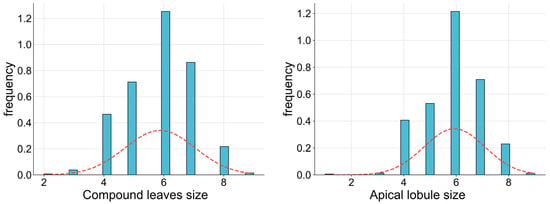
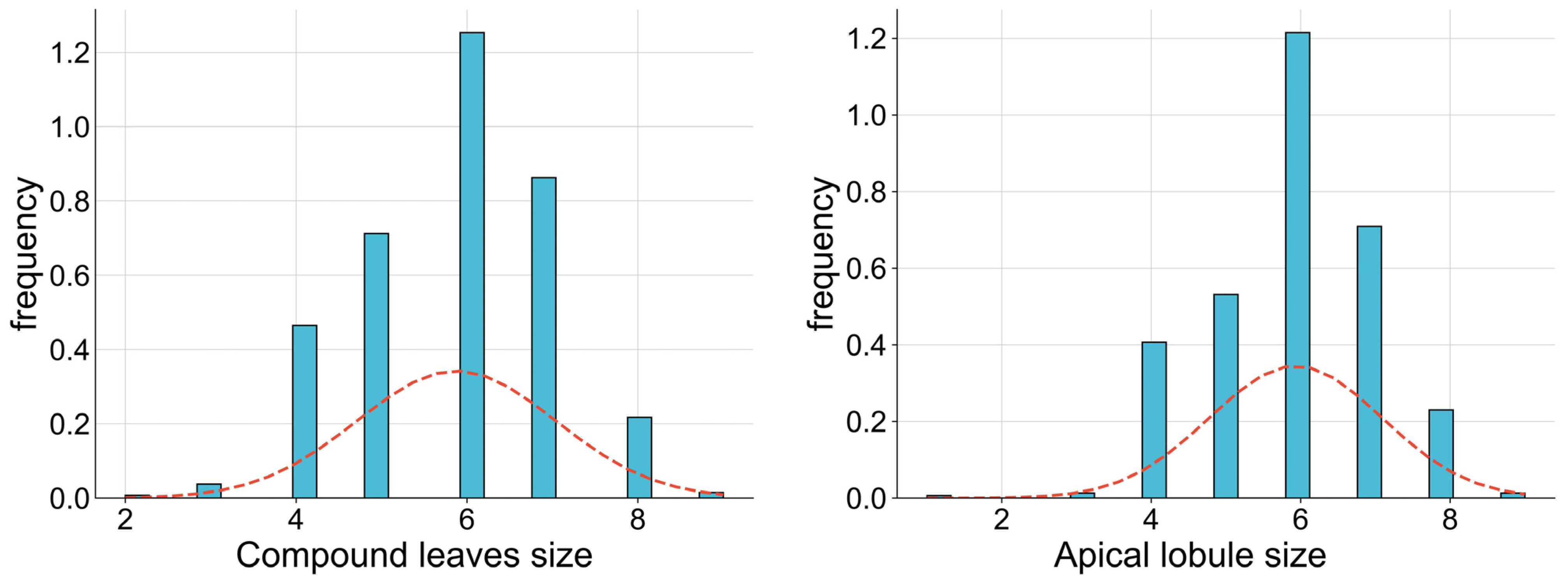
A potato compound leaf is a complete odd-pinnate structure composed of an apical leaflet, several pairs of lateral leaflets, and the entire petiole. The potato apical (terminal) leaflet is the single leaflet at the tip of the compound leaf and develops independently of the lateral leaflets. Both compound leaf size and apical leaflet size are quantitative traits that vary substantially across environments and years. Therefore, frequency distributions for these traits were plotted using mean values from the 2019–2020 observations (Figure 1). Leaf size was classified into nine groups according to Table 1. Compound leaf size was mainly medium (5), medium–large (6) and large (7), comprising 95 (19.96%), 167 (35.08%) and 115 (24.16%) samples, respectively; apical leaflet size was predominantly medium (5), medium to large (6) and large (7), with 81 (17.02%), 185 (38.87%) and 108 (25.68%) accessions respectively (Table 1). The frequency histograms for both traits showed continuous variation consistent with a polygenic quantitative trait architecture, indicating that compound leaf size and apical leaflet size are suitable for GWAS analysis.
Figure 1.
Frequency histogram of compound leaf size and apical leaflet size in 476 potato accessions.
3.2. Correlation Analysis Between Compound Leaf Size and Apical Leaflet Size
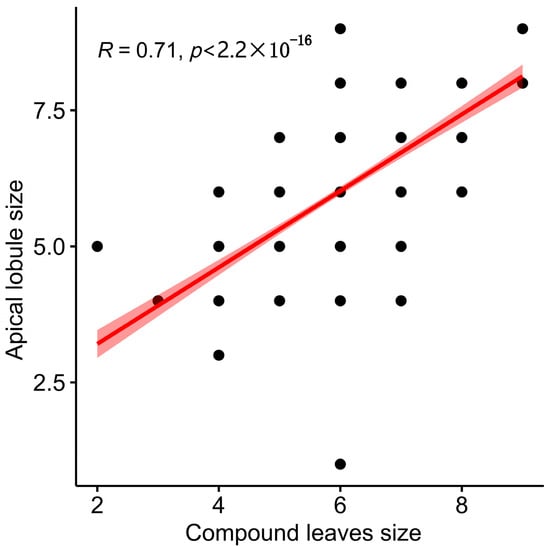
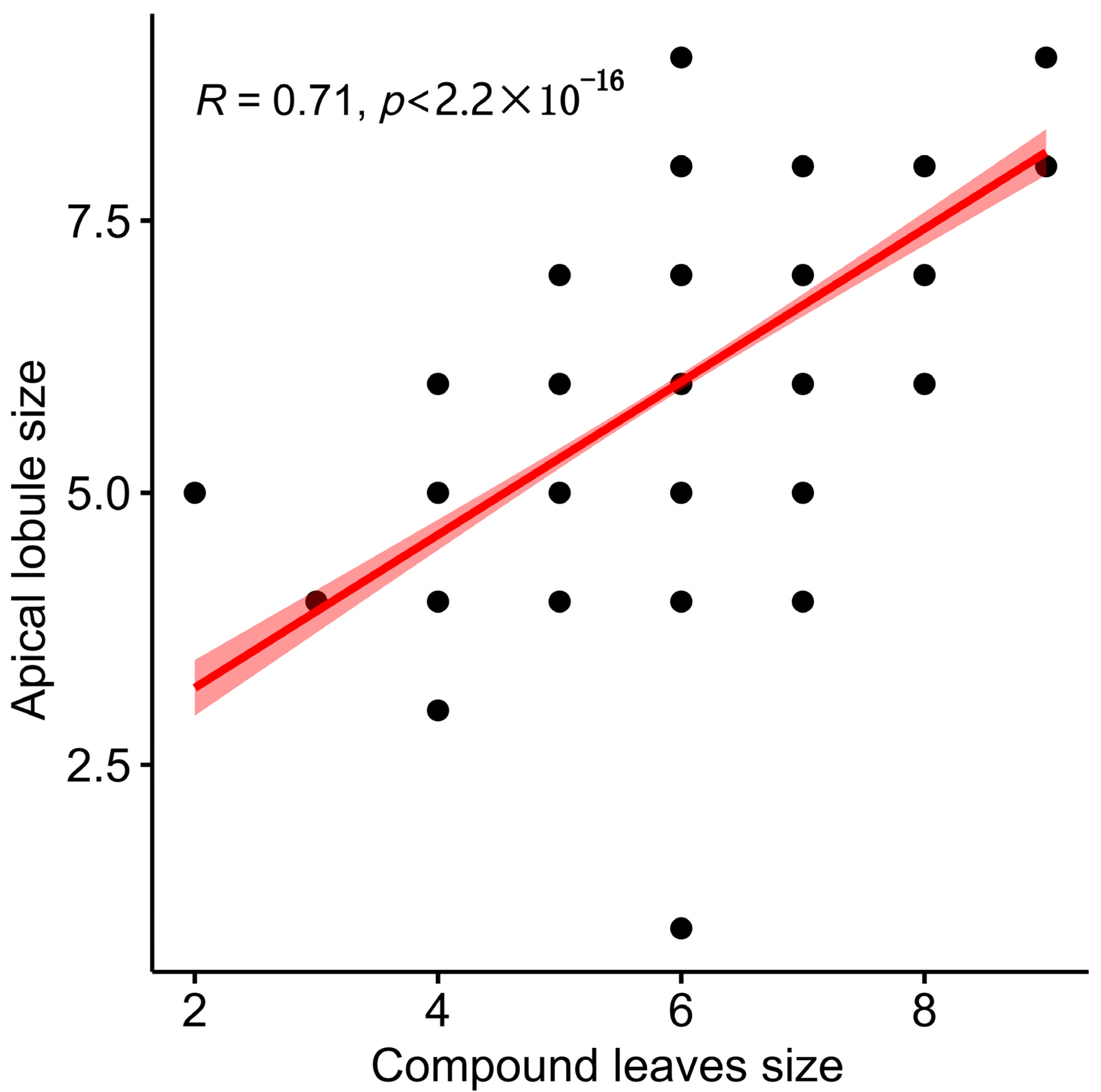
The scatter plot relating apical leaflet size to compound leaf size displays compound leaf size on the horizontal axis (range 2–8) and apical leaflet size on the vertical axis (range 2.5–7.5). The plot shows that, as compound leaf size increases, apical leaflet size generally increases, suggesting a positive relationship between the two variables. Correlation analysis confirmed a strong statistically significant positive association (R = 0.71, p < 2.2 × 10⁻¹⁶). The R value of 0.71 indicates a marked positive relationship: larger compound leaves tend to have larger apical leaflet. The p-value is far below the conventional significance threshold of α = 0.05, at 2.2 × 10⁻¹⁶, which indicates that the correlation is highly significant and the result is robust, supporting the existence of a true association between the traits (Figure 2).
Figure 2.
Scatterplot of leaf trait correlations in 476 potato accessions.
3.3. Genome-Wide Association Analysis of Potato Compound Leaf Size and Apical Leaflet Size
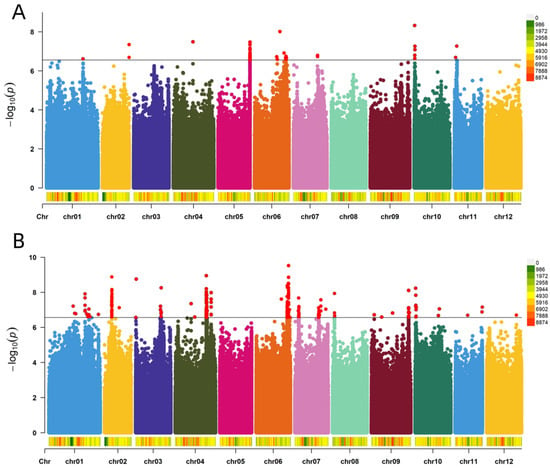
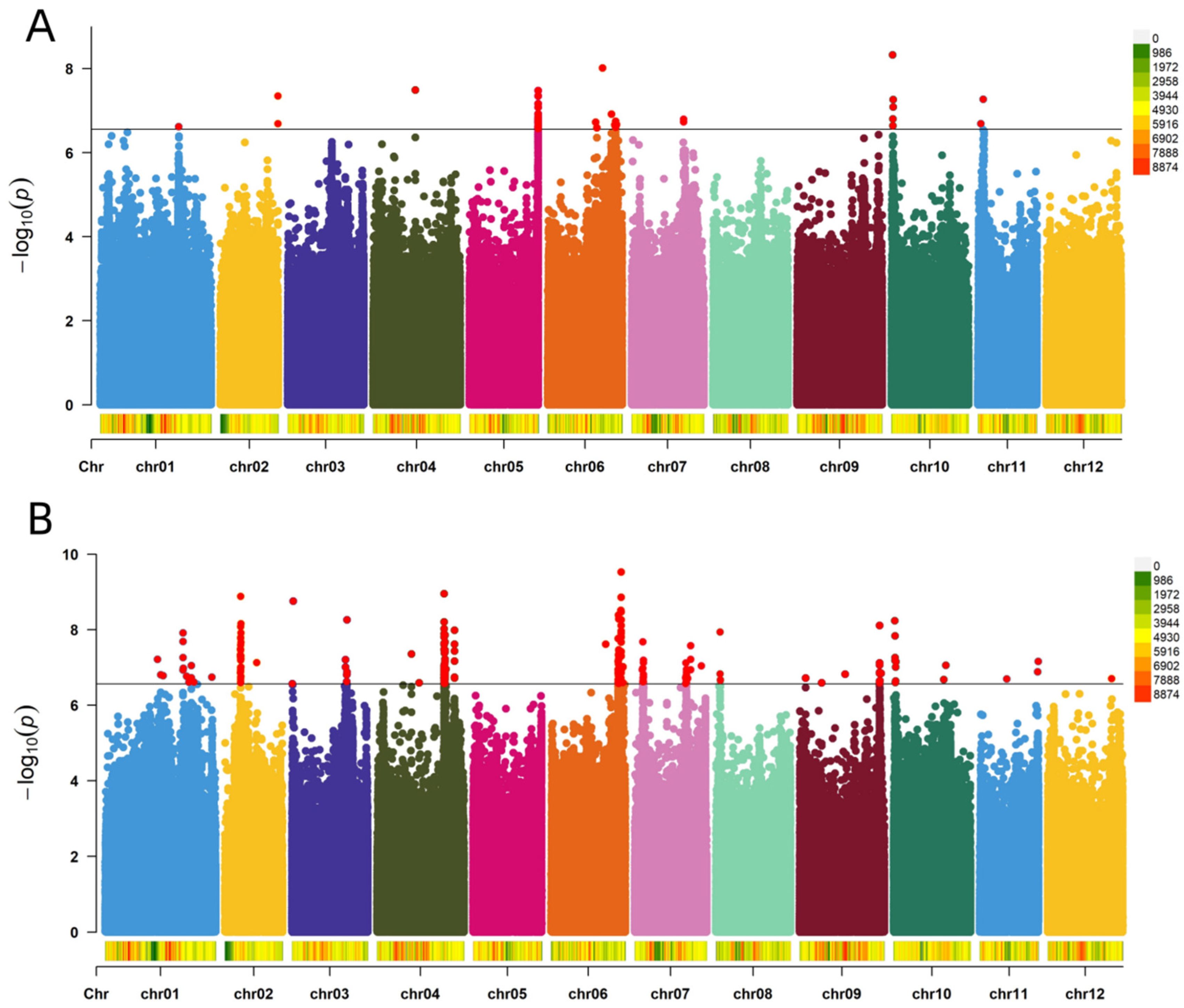
The genome-wide association analysis for compound leaf size in potato identified 211 significantly associated SNP loci. These loci were found on every chromosome except Chr08. Two pronounced association peaks occurred on Chr05 and Chr06; the Chr05 region produced the strongest signal, comprising 84 significant SNPs (40% of the total); while Chr06 contained 63 loci (30% of the total) (Figure 3A). For apical leaflet size, 671 significant SNP loci were detected and were distributed across all chromosomes. Two major peaks appeared on Chr04 and Chr06; the Chr04 region produced the strongest signal, with 185 significant SNPs (27.6% of the total), and Chr06 contained 155 loci (23.1% of the total). The comparatively large number of significant SNPs partly reflects the extensive LD in the potato genome. Multiple physically linked SNPs within the same LD block frequently exceeded the significance threshold together, so the significant SNP set comprises both independent association signals and clusters of LD-linked markers (Figure 3B).
Figure 3.
Manhattan plot of genome-wide association analysis for potato compound leaf size and apical leaflet size. (A) The Manhattan plot shows the association between single-nucleotide polymorphisms (SNPs) in the potato genome and leaf size. (B) The Manhattan plot shows the association between single-nucleotide polymorphisms (SNPs) in the potato genome and the size of the apical leaflet. Bonferroni-corrected threshold (p = 2.739 × 10⁻⁷).
3.4. Analysis of Haplotypes and Allelic Variation Effects
3.4.1. Analysis of Allelic Variation Effects on Potato Compound Leaf Size
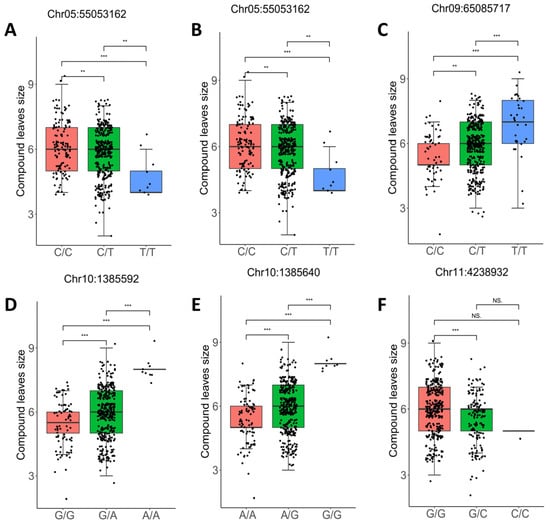
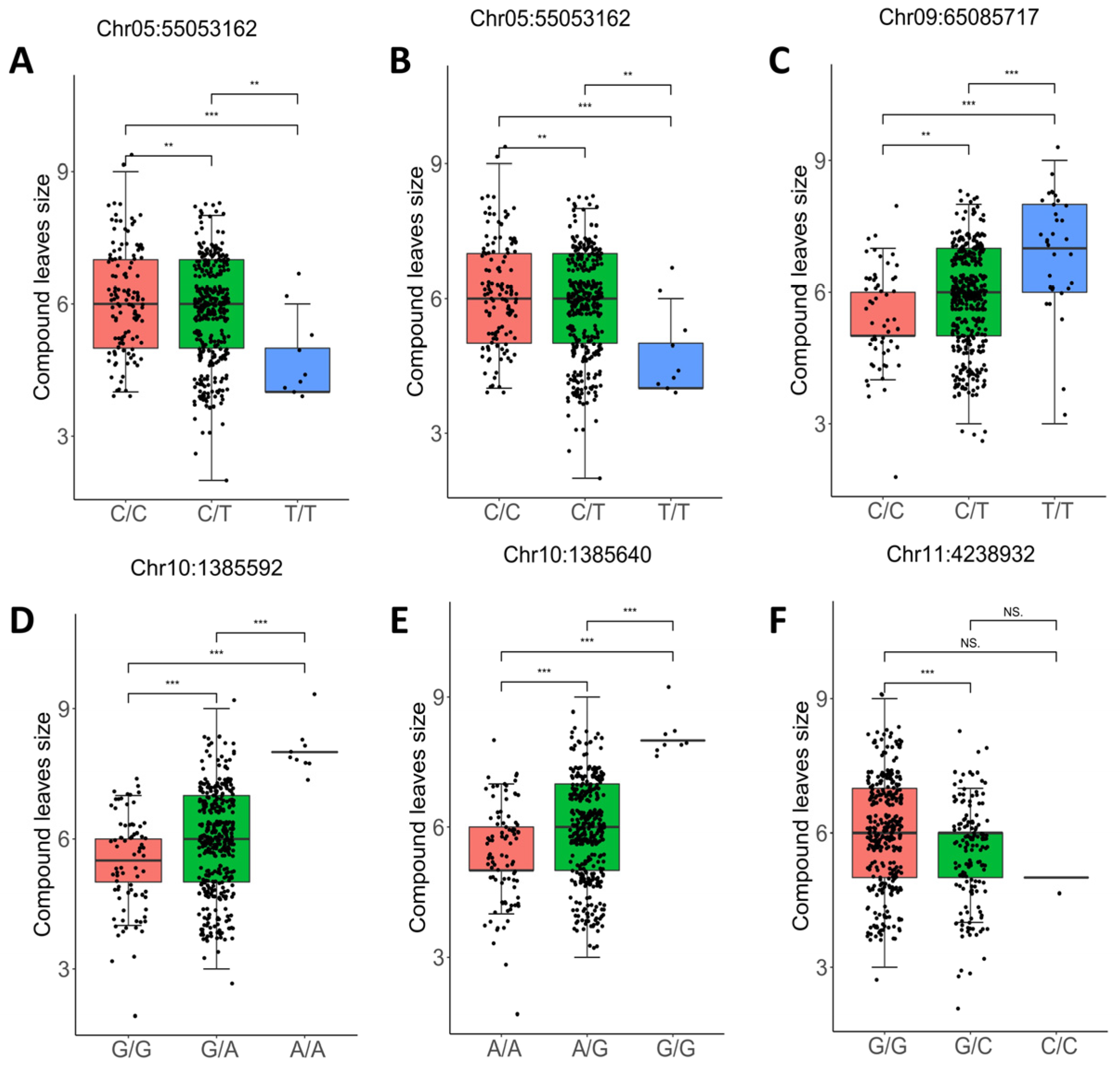
To identify key molecular markers associated with compound leaf size, we detected six significant SNPs on chromosomes 5, 9, 10 and 11. The six SNP loci are Chr05:55053162, Chr05:55107582, Chr09:65085717, Chr10:1385592, Chr10:1385640 and Chr11:4238932. The box plot for Chr05:55053162 shows that plants with the CC genotype had significantly smaller compound leaves than those with CT or TT genotypes (Figure 4A). For Chr05:55107582, plants with the AA genotype had significantly smaller compound leaves than those with GG or GA genotypes (Figure 4B). At Chr09:65085717 plants carrying the TT genotype had significantly larger compound leaves than those with CT or CC genotypes (Figure 4C). For Chr10:1385592, the AA genotype was associated with significantly larger compound leaves than the GG or GA genotypes (Figure 4D). At Chr10:1385640, plants with the GG genotype had significantly larger compound leaves than those with AA or AG genotypes (Figure 4E). Finally, at Chr11:4238932, the GG genotype was associated with significantly larger compound leaves than the GC or CC genotypes (Figure 4F). All comparisons were performed using the non-parametric Kruskal–Wallis H test, with correction for multiple testing.
Figure 4.
SNP genotyping analysis of six significant loci for leaf size. ** p < 0.01; *** p < 0.001; NS—not significant. Genotypic comparisons: Kruskal–Wallis H test; sample sizes in Supplementary Table S4.
3.4.2. Analysis of Allelic Variation Effects on the Size of Potato Apical Leaflet
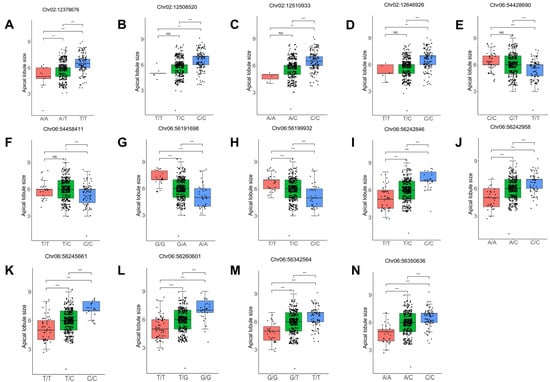
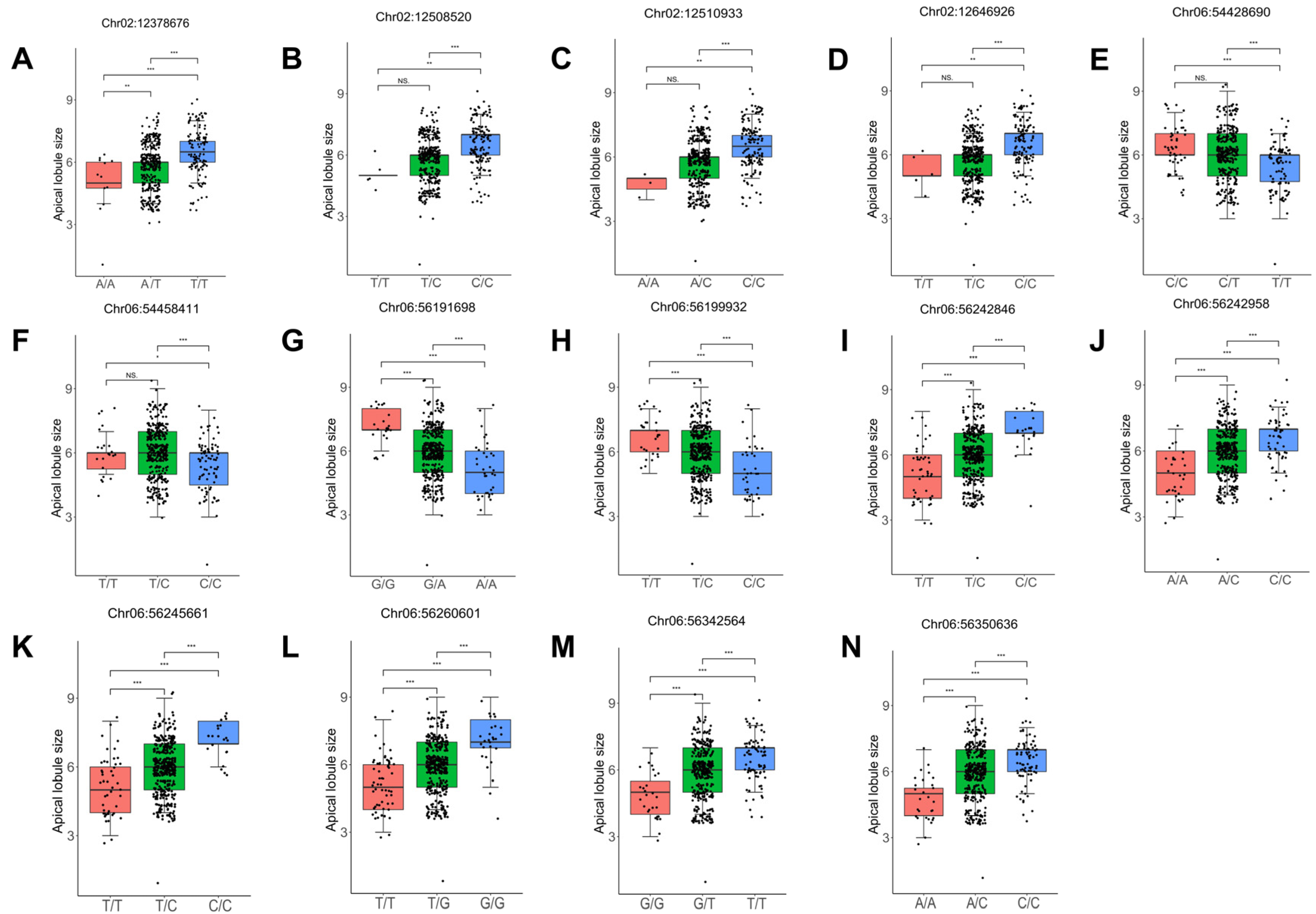
To identify molecular markers associated with compound leaf size, we detected 14 significant SNPs on chromosomes 2 and 6: Chr02:12378676, Chr02:12508520, Chr02:12510933, Chr02:12646926, Chr06:54428690, Chr06:54458411, Chr06:56191698, Chr06:56199932, Chr06:56242846, Chr06:56242958, Chr06:56245661, Chr06:56260601, Chr06:56342564, Chr06:56350636. Genotypes at these loci were analysed for association with potato apical leaflet size. At Chr02:12378676, individuals with the TT genotype exhibited significantly larger apical leaflet than those with AA or AT (Figure 5A). At Chr02:12508520, the CC genotype showed significantly greater leaflet size than TT or TC (Figure 5B). At Chr02:12510933, CC plants had significantly larger apical leaflet than AA or AC (Figure 5C). At Chr02:12646926, the CC genotype corresponded to significantly larger leaflets than TT or TC genotypes (Figure 5D). At Chr06:54428690, TT plants had significantly smaller apical leaflet than CC or CT genotypes (Figure 5E). At Chr06:54458411, the TC genotype was associated with significantly larger leaflets than TT or CC (Figure 5F). At Chr06:56191698, the GG genotype yielded significantly larger apical leaflet than the AA or GA genotypes (Figure 5G). At Chr06:56199932, the CC genotype produced significantly smaller apical leaflet than TT or TC genotypes (Figure 5H). At Chr06:56242846, the CC genotype produced significantly larger apical leaflet than the TT or TC (Figure 5I). At Chr06:56242958, the AA genotype produced significantly smaller apical leaflet than the CC or AC genotypes (Figure 5J). At Chr06:56245661, the CC genotype produced significantly larger apical leaflet than the TT or TC genotypes (Figure 5K). At Chr06:56260601, the apical leaflet was significantly larger for the GG genotype than for the TT or TG (Figure 5L). For locus Chr06:56342564, the apical leaflet was significantly smaller in the GG genotype than in the TT or GT genotypes (Figure 5M). Finally, at locus Chr06:56350636, the AA genotype had a significantly larger apical leaflet than the CC or AC genotypes (Figure 5N). All comparisons were performed using the non-parametric Kruskal–Wallis H test, with correction for multiple testing.
Figure 5.
SNP genotyping analysis of 14 significant loci associated with apical leaflet size. * p < 0.05; ** p < 0.01; *** p < 0.001; NS—not significant. Genotypic comparisons: Kruskal–Wallis H test; sample sizes in Supplementary Table S4.
3.5. Candidate Gene Analysis
3.5.1. KEGG Enrichment Analysis
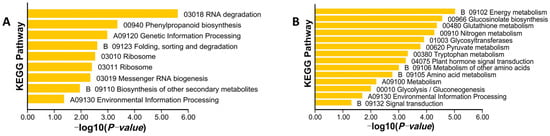
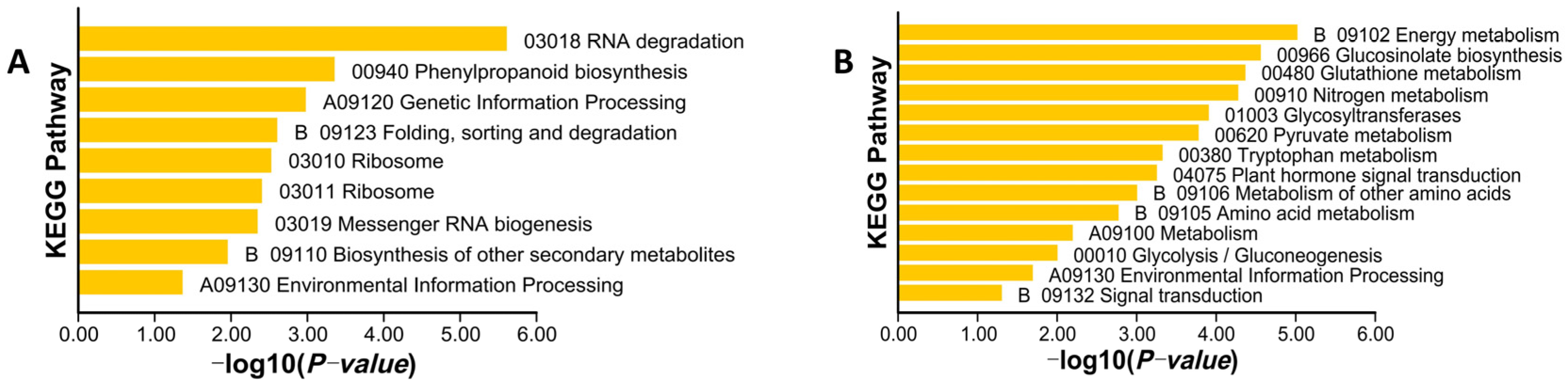
KEGG enrichment analysis of candidate genes associated with potato compound leaf size showed significant involvement in pathways including RNA degradation (adjusted p < 0.05), ribosome function, phenylalanine biosynthesis, mRNA biogenesis, and protein folding, sorting and degradation (Figure 6A). Of the 75 candidate genes for compound leaf size, 48 possessed KEGG annotations. KEGG enrichment analysis of candidate genes for apical leaflet size revealed significant enrichment in pathways related to energy metabolism, glucosinolate biosynthesis, glutathione metabolism, nitrogen metabolism, pyruvate metabolism and plant hormone signal transduction (all adjusted p < 0.05; Figure 6B). Of the 175 candidate genes for apical leaflet size, 112 possessed KEGG annotations. Enrichment analysis was carried out in TBtools using a hypergeometric test with Benjamini–Hochberg multiple-testing correction (adjusted p < 0.05), and 15,404 annotated genes were used as the background.
Figure 6.
KEGG enrichment analysis of candidate genes. (A) Compound leaf size. (B) Apical leaflet size.
3.5.2. Analysis of Candidate Genes for Potato Compound Leaf Size
Candidate gene regions were defined by the population linkage disequilibrium (LD) decay pattern (≈60 kb); genes whose entire sequence, or at least 90% of it, lay within an associated region were designated as candidate genes. After further screening, 75 candidate genes associated with the compound leaf size regulatory pathway were identified (Supplementary Table S5). These comprise enzymes involved in the regulation of gene expression and the maintenance of protein homeostasis, such as RNA-degrading enzymes, ribosomal proteins, protein folding chaperones and phenylalanine synthases, together with functional regulatory proteins, including mRNA biosynthesis regulators and signal transduction components. Seven candidate genes were prioritised from this gene set. We concentrated on genes that lay beneath the most significant association peaks, identified by the lowest p-values, that carried functional annotations related to leaf development, cell division or hormone signalling, and that were supported by evidence in the literature. We tentatively hypothesised that these genes participate in cell division and hormone-signalling pathways relevant to leaf development. The candidates are DM8C10G01290.1 (encoding an Rcd1-like cell differentiation family protein, ko:K12606), DM8C10G01180.1 (encoding a ribosomal structural protein containing the Ribosomal_S8e domain), DM8C11G02500.1 (encoding a key enzyme in phenylalanine biosynthesis containing the ADH_zinc_N domain); DM8C10G01320.2 (encoding an Rcd1-like cell differentiation family protein, ko:K12606); DM8C06G13960.1 (encoding a heat shock protein 70 family protein, HSP70, ko:K09490); DM8C06G16880.1 (encoding a secondary metabolite enzyme containing the Methyltransf_2 domain) and DM8C05G27660.1 (encoding an environmental signalling protein containing the Inositol_P domain).
3.5.3. Analysis of Candidate Genes for Potato Apical Leaflet Size
Using the same approach, 175 candidate genes associated with the core pathway controlling apical leaflet size were identified (Supplementary Table S6). They include putative regulators of energy metabolism; for example, DM8C10G13560.1 (Malic_M) and DM8C01G21400.1 (PPDK_N); enzymes implicated in glucosinolate biosynthesis such as DM8C08G02250.1 and DM8C08G02260.1 (UDPGT); and enzymes involved in glutathione metabolism; for example, DM8C03G19930.1 (Orn_Arg_deC_N) and DM8C04G29090.1 (peroxidase). Nitrogen metabolism-related enzymes include DM8C02G10960.2 (Pro_CA) and DM8C01G45290.1 (NIR_SIR). Glycosyltransferase family proteins comprise DM8C08G02280.1 (Glyco_tranf_2_3) and DM8C06G27780.1 (UDPGT domain-containing), and the pyruvate metabolism enzyme DM8C06G27490.1 (Transket_pyr) was also identified. In addition, proteins associated with plant hormone signal transduction include DM8C04G23010.1 (LRRNT_2) and DM8C03G01180.1 (BES1_N).
4. Discussion
Leaves serve as the principal source organ for plant growth and development; dry matter accumulation derives mainly from leaf photosynthesis and thereby determines growth, development, reproduction and final yield [29]. Identifying and utilising genes that regulate leaf size, number and morphology is therefore essential for optimising crop architecture and increasing yield.
Genome-wide association studies of compound leaf size and apical leaflet size have identified several candidate genes: an RNA degradation-related enzyme (Rcd1-like; DM8C10G01290.1), an environmental signal transduction protein with an Inositol_P domain (DM8C05G27660.1), and proteins involved in plant hormone signal transduction, including a BES1_N domain-containing protein (DM8C03G01180.1) and an LRRNT_2 domain-containing protein (DM8C04G23010.1). Inositol phosphate (InsP) represents a key upstream regulatory pathway in auxin signalling. In Arabidopsis, inositol kinases such as IPK1 and PIP5K have been reported to influence vascular differentiation and root development through interactions with auxin signalling pathways (references herein) [30]. RCD1 (Radical-induced Cell Death 1) is a conserved nuclear protein in plants that participates in auxin signal transduction and developmental regulation, maintains root apical meristem fate and modulates hormone responses; mutants show abnormal development and impaired stress responses [31]. Auxin acts at every stage of plant development, from embryogenesis to organ senescence; it directly modulates cell responses and indirectly regulates gene expression, thereby shaping plant growth and development [21]. BES1 (BRI1-EMS-SUPPRESSOR 1) influences axillary bud germination, lateral branch formation, and leaf expansion, size and morphology [31,32]. In rice, the BES1 homolog OsBZR1 interacts with D53 to repress FC1 (the TB1 homolog), thereby promoting tillering; strigolactone induces D53 degradation, relieves FC1 lifting the repression and inhibits tillering [33]. In cotton, GhBES1 binds the E-box in the GhEXO2 promoter, activates its expression, promotes leaf cell expansion and positively regulates leaf size [34].
Correlation analysis of compound leaf size identified DM8C06G13960.1 (encoding a heat shock protein 70, HSP70) as a putative candidate gene for maintaining protein homeostasis in meristematic tissues, ensuring correct folding of proteins involved in the cell cycle and division, and sustaining meristematic vitality [35]. The absence of chloroplast HSP70 (cpHsc70-1) leads to variegated cotyledons, malformed leaves and stunted growth; under stress, it impairs leaf cell proliferation and expansion [36]. In tomato, class I KNOX transcription factors such as LeT6 regulate compound leaf development by maintaining morphogenetic activity and initiating leaflets [37,38,39,40]. As molecular chaperones, HSP70 proteins may contribute to the stability of these developmental regulators [41]. Overexpression of the Tribulus terrestris KNOXI genes MtKNOX1/2/6/7 increased leaf number and produced a pinnate five-leaf pattern; however, simultaneous knockout of MtKNOX1/2/6/7 did not alter the trifoliate pattern in Medicago, suggesting that one or more inhibitory factors suppress MtKNOXI function during Astragalus compound leaf development [42].
Among the candidate genes identified by association analysis of apical leaflet size, DM8C10G13560.1, which encodes a malic enzyme (ME), supplies energy for cell division, nucleic acid synthesis and cell elongation and provides reducing power [43]. Members of the malic enzyme family are highly expressed in meristematic tissues, young leaves and rapidly growing organs. NADPH produced by NADP-ME is an essential substrate for DNA replication, cell cycle progression and cell-wall synthesis; ME deficiency causes NADPH shortage, cell-division arrest and growth inhibition [44]. Phosphoenolpyruvate carboxylase (PEPcase) governs carbon metabolism and the supply of carbon skeletons, thereby supporting rapid cell division and organ expansion and directly affecting growth rate, biomass and leaf size [45]. In sorghum, SbPPC3-silenced plants were stunted, with above-ground and below-ground biomass reduced by 11–15% and 5–12%, respectively; leaves were smaller and stomatal conductance declined, indicating that PEPcase sustains growth and stress tolerance by maintaining carbon metabolism and osmotic balance [43]. In Arabidopsis, PEPcase mutants showed a 35% reduction in leaf cell number, a 20% decrease in cell size and a 50% reduction in leaf area; PEPcase therefore acts as a key metabolic regulator of leaf size by modulating both cell proliferation and expansion through effects on cyclin expression (CDKA, Cyclin D) [46].
A genome-wide association study of compound leaf size and apical leaflet size traits in 476 potato natural populations revealed several candidate genes annotated with functions related to auxin signalling and hormone response pathways, suggesting potential involvement of auxin pathways in potato leaf size regulation; this finding will require functional validation in future studies. The molecular markers and candidate genes identified in this study provided promising markers and genetic resources for improving potato leaf morphology, but these markers required further validation in independent populations and environments before they could be deployed in marker-assisted breeding.
This study has several distinctive features that underline its novelty. First, field trials were carried out at a high-altitude experimental station in Huangyuan County, Qinghai Province (36°68′ N, 101°26′ E), a plateau environment with strong ultraviolet radiation, large diurnal temperature fluctuations and low oxygen pressure; these conditions impose specific selective pressures on potato leaf morphology and photosynthetic adaptation. Second, the association panel comprised 476 tetraploid potato accessions from 18 countries and regions, representing a broad and diverse germplasm resource that captures extensive allelic variation for leaf-related traits. Third, whole-genome resequencing at approximately 10× depth produced 3,651,282 high-quality SNPs, thereby providing much greater genomic coverage and resolution than array-based genotyping approaches. Finally, to the best of our knowledge, this was the first genome-wide association study to target compound leaf size and apical leaflet size in tetraploid potato, two agronomically important traits that directly influenced photosynthetic capacity and tuber yield.
Several limitations of this study should be acknowledged. First, leaf morphological traits were scored on an ordinal 1–9 scale, which may not capture continuous variation as precisely as quantitative morphometric measurements. Second, phenotypic data from two years were combined using arithmetic means rather than mixed-model BLUEs/BLUPs, so year, block and genotype-by-year effects were not fully accounted for. Third, the field evaluation was conducted at a single location (Huangyuan, Qinghai), limiting the generalisability of the results to other environments. Fourth, geographic origin information was unavailable for 342 of the 476 accessions, which constrained our ability to relate genetic variation to geographic distribution. Fifth, the genomic inflation factors (λ = 1.47 and 1.63) indicate possible residual population structure that the CMLM did not entirely control. Sixth, tetraploid genotypes were diploidised for analysis, thereby disregarding allele dosage information and potentially underestimating genetic complexity. Seventh, the identified candidate genes lack independent validation in a separate population and functional confirmation using transgenic or gene-editing approaches. Future studies should address these limitations through multi-environment trials, mixed-model phenotypic analysis, tetraploid-specific GWAS methods, and functional validation of candidate genes.
5. Conclusions
We conducted a genome-wide association study of compound leaf size and apical leaflet size in a natural population of 476 tetraploid potato accessions using 3,651,282 high-quality SNPs. We identified 211 significant SNPs associated with compound leaf size, predominantly on Chr05 and Chr06, and 671 significant SNPs associated with apical leaflet size, predominantly on Chr04 and Chr06. We prioritised 75 candidate genes for compound leaf size and 175 for apical leaflet size; key candidates included genes implicated in RNA degradation (Rcd1-like), protein homeostasis (HSP70), inositol signalling, hormone response (BES1), energy metabolism (malic enzyme), and cell wall modification. KEGG enrichment analysis showed significant over-representation of RNA degradation, ribosome, energy metabolism, and plant hormone signal transduction pathways. These results elucidated the genetic architecture of potato leaf morphology and provided promising candidate markers and genes for functional validation and potential application in potato molecular breeding.
Supplementary Materials
The following supporting information can be downloaded at: https://www.mdpi.com/article/10.3390/agronomy16191942/s1, Table S1: Geographical origin information of the 476 potato accessions used in this study; Table S2: Significant SNP loci identified in the genome-wide association study of compound leaf size; Table S3: Significant SNP loci identified in the genome-wide association study of apical leaflet size; Table S4: Sample sizes of each genotype class at significant GWAS loci for compound leaf size and apical leaflet size traits; Table S5: Candidate genes identified in the association analysis of compound leaf size; Table S6: Candidate genes identified in the association analysis of apical leaflet size; Table S7: Statistical data on the size of 476 potato compound leaves and apical leaflet.
Author Contributions
F.W., J.W.: Writing—review and editing, Supervision, Funding acquisition, Project administration. M.X., L.Z. Writing—original draft, Visualisation, Validation, Resources, Methodology, Investigation, Formal analysis, Data curation. Y.B., Y.M., C.L.: Validation, Resources. All authors have read and agreed to the published version of the manuscript.
Funding
This research was funded by the Kunlun Talent High-End Innovation and Entrepreneurship Talent Leading Talent Project of Qinghai Province; Special Program for Enhancing the Scientific Research Strength of Qinghai University (2026KTSQ13).
Data Availability Statement
Data will be made available on request.
Conflicts of Interest
The authors declare no conflicts of interest.
References
- Amr, A.M.; Anderson, G.H.; Vien, S.; Fabek, H. Potatoes Compared with Rice in Meals with either Animal or Plant Protein Reduce Postprandial Glycemia and Increase Satiety in Healthy Adults: A Randomized Crossover Study. J. Nutr. 2024, 154, 2999–3011. [Google Scholar] [CrossRef] [Scilit]
- Robertson, T.M.; Alzaabi, A.Z.; Robertson, M.D.; Fielding, B.A. Starchy Carbohydrates in a Healthy Diet: The Role of the Humble Potato. Nutrients 2018, 10, 1764. [Google Scholar] [CrossRef] [Scilit]
- Stokstad, E. The new potato. Science 2019, 363, 574–577. [Google Scholar] [CrossRef] [Scilit]
- Devaux, A.; Goffart, J.-P.; Kromann, P.; Andrade-Piedra, J.; Polar, V.; Hareau, G. The Potato of the Future: Opportunities and Challenges in Sustainable Agri-food Systems. Potato Res. 2021, 64, 681–720. [Google Scholar] [CrossRef] [Scilit]
- Qin, R.; Zhang, F.; Yu, C.; Zhang, Q.; Qi, J.; Li, F.-M. Contributions made by rain-fed potato with mulching to food security in China. Eur. J. Agron. 2022, 133, 126435. [Google Scholar] [CrossRef] [Scilit]
- Zhang, H.; Xu, F.; Wu, Y.; Hu, H.-H.; Dai, X.-F. Progress of potato staple food research and industry development in China. J. Integr. Agric. 2017, 16, 2924–2932. [Google Scholar] [CrossRef] [Scilit]
- Du, X.; Zhang, X.; Chen, X.; Jin, W.; Huang, Z.; Kong, L. Drought stress reduces the photosynthetic source of subtending leaves and the transit sink function of podshells, leading to reduced seed weight in soybean plants. Front. Plant Sci. 2024, 15, 1337544. [Google Scholar] [CrossRef] [Scilit]
- Champagne, C.; Sinha, N. Compound leaves: Equal to the sum of their parts? Development 2004, 131, 4401–4412. [Google Scholar] [CrossRef] [Scilit]
- Busov, V.B.; Brunner, A.M.; Strauss, S.H. Genes for control of plant stature and form. New Phytol. 2008, 177, 589–607. [Google Scholar] [CrossRef] [Scilit]
- Tsukaya, H. Controlling size in multicellular organs: Focus on the leaf. PLoS Biol. 2008, 6, e174. [Google Scholar] [CrossRef] [Scilit]
- Fujino, K.; Matsuda, Y.; Ozawa, K.; Nishimura, T.; Koshiba, T.; Fraaije, M.W.; Sekiguchi, H. NARROW LEAF 7 controls leaf shape mediated by auxin in rice. Mol. Genet. Genom. 2008, 279, 499–507. [Google Scholar] [CrossRef] [Scilit]
- Kumar, P.; Gill, H.S.; Singh, M.; Kaur, K.; Koupal, D.; Talukder, S.; Bernardo, A.; Amand, P.S.; Bai, G.; Sehgal, S.K. Characterization of flag leaf morphology identifies a major genomic region controlling flag leaf angle in the US winter wheat (Triticum aestivum L.). Theor. Appl. Genet. 2024, 137, 205. [Google Scholar] [CrossRef] [Scilit]
- Wright, I.J.; Dong, N.; Maire, V.; Prentice, I.C.; Westoby, M.; Díaz, S.; Gallagher, R.V.; Jacobs, B.F.; Kooyman, R.; Law, E.A.; et al. Global climatic drivers of leaf size. Science 2017, 357, 917–921. [Google Scholar] [CrossRef] [Scilit]
- He, L.; Yang, L.; Zhao, W.; Chen, J. Multilayered regulatory control of compound leaf development. Curr. Opin. Plant Biol. 2026, 89, 102847. [Google Scholar] [CrossRef] [Scilit]
- Du, L.; Adkins, S.; Xu, M. Leaf development in Medicago truncatula. Genes 2022, 13, 1203. [Google Scholar] [CrossRef] [Scilit]
- Heisler, M.G.; Ohno, C.; Das, P.; Sieber, P.; Reddy, G.V.; Long, J.A.; Meyerowitz, E.M. Patterns of auxin transport and gene expression during primordium development revealed by live imaging of the Arabidopsis inflorescence meristem. Curr. Biol. 2005, 15, 1899–1911. [Google Scholar] [CrossRef] [Scilit]
- Reinhardt, D.; Pesce, E.-R.; Stieger, P.; Mandel, T.; Baltensperger, K.; Bennett, M.; Traas, J.; Friml, J.; Kuhlemeier, C. Regulation of phyllotaxis by polar auxin transport. Nature 2003, 426, 255–260. [Google Scholar] [CrossRef] [Scilit]
- Barkoulas, M.; Galinha, C.; Grigg, S.P.; Tsiantis, M. From genes to shape: Regulatory interactions in leaf development. Curr. Opin. Plant Biol. 2007, 10, 660–666. [Google Scholar] [CrossRef] [Scilit]
- Bharathan, G.; Goliber, T.E.; Moore, C.; Kessler, S.; Pham, T.; Sinha, N.R. Homologies in leaf form inferred from KNOXI gene expression during development. Science 2002, 296, 1858–1860. [Google Scholar] [CrossRef] [Scilit]
- Aida, M.; Tasaka, M. Genetic control of shoot organ boundaries. Curr. Opin. Plant Biol. 2006, 9, 72–77. [Google Scholar] [CrossRef] [Scilit]
- Tsukaya, H. Leaf shape: Genetic controls and environmental factors. Int. J. Dev. Biol. 2005, 49, 547–555. [Google Scholar] [CrossRef] [Scilit]
- Zia, M.; Demirel, U.; Nadeem, M.; Çaliskan, M.E. Genome-wide association study identifies various loci underlying agronomic and morphological traits in diversified potato panel. Physiol. Mol. Biol. Plants 2020, 26, 1003–1020. [Google Scholar] [CrossRef] [Scilit]
- Chen, S.; Zhou, Y.; Chen, Y.; Gu, J. Fastp: An ultra-fast all-in-one FASTQ preprocessor. Bioinformatics 2018, 34, i884–i890. [Google Scholar] [CrossRef] [Scilit] [PubMed]
- Li, H.; Durbin, R. Fast and accurate short read alignment with Burrows–Wheeler transform. Bioinformatics 2009, 25, 1754–1760. [Google Scholar] [CrossRef] [Scilit] [PubMed]
- Li, H.; Handsaker, B.; Wysoker, A.; Fennell, T.; Ruan, J.; Homer, N. The Sequence Alignment/Map format and SAMtools. Bioinformatics 2009, 25, 2078–2079. [Google Scholar] [CrossRef] [Scilit] [PubMed]
- Li, H. A statistical framework for SNP calling, mutation discovery, association mapping and population genetical parameter estimation from sequencing data. Bioinformatics 2011, 27, 2987–2993. [Google Scholar] [CrossRef] [Scilit] [PubMed]
- Mckenna, A.; Hanna, M.; Banks, E.; Sivachenko, A.; Cibulskis, K.; Kernytsky, A.; Garimella, K.; Altshuler, D.; Gabriel, S.; Daly, M.; et al. The Genome Analysis Toolkit: A MapReduce framework for analyzing next-generation DNA sequencing data. Genome Res. 2020, 20, 1297–1303. [Google Scholar] [CrossRef] [Scilit]
- Zhao, L.; Zou, M.; Deng, K.; Xia, C.; Jiang, S.; Zhang, C.; Ma, Y.; Dong, X.; He, M.; Na, T.; et al. Insights into the genetic determination of tuber shape and eye depth in potato natural population based on autotetraploid potato genome. Front. Plant Sci. 2023, 14, 1080666. [Google Scholar] [CrossRef] [Scilit]
- Breuil-Broyer, S.; Morel, P.; De Almeida-Engler, J.; Coustham, V.; Negrutiu, I.; Trehin, C. High-resolution boundary analysis during Arabidopsis thaliana flower development. Plant J. 2004, 38, 182–192. [Google Scholar] [CrossRef] [Scilit]
- Aida, M.; Ishida, T.; Tasaka, M. Shoot apical meristem and cotyledon formation during Arabidopsis embryogenesis: Interaction among the CUP-SHAPED COTYLEDON and SHOOT MERISTEMLESS genes. Development 1999, 126, 1563–1570. [Google Scholar] [CrossRef] [Scilit]
- Teotia, S.; Lamb, R.S. RCD1 and SRO1 are necessary to maintain meristematic fate in Arabidopsis thaliana. J. Exp. Bot. 2011, 62, 1271–1284. [Google Scholar] [CrossRef] [Scilit]
- von der Mark, C.; Cruz, T.M.; Blanco-Touriñan, N.; Rodriguez-Villalon, A. Bipartite phosphoinositide-dependent modulation of auxin signaling during xylem differentiation in Arabidopsis thaliana roots. New Phytol. 2022, 236, 1734–1747. [Google Scholar] [CrossRef] [Scilit]
- Fang, Z.; Ji, Y.; Hu, J.; Guo, R.; Sun, S.; Wang, X. Strigolactones and Brassinosteroids Antagonistically Regulate the Stability of the D53–OsBZR1 Complex to Determine FC1 Expression in Rice Tillering. Mol. Plant 2020, 13, 586–597. [Google Scholar] [CrossRef] [Scilit]
- Li, S.; Xing, K.; Qanmber, G.; Chen, G.; Liu, L.; Guo, M.; Hou, Y.; Lu, L.; Qu, L.; Liu, Z.; et al. GhBES1 mediates brassinosteroid regulation of leaf size by activating expression of GhEXO2 in cotton (Gossypium hirsutum). Plant Mol. Biol. 2022, 111, 89–106. [Google Scholar] [CrossRef] [Scilit]
- Park, S.-H.; Jeong, J.S.; Zhou, Y.; Mustafa, N.F.B.; Chua, N.-H. Deubiquitination of BES1 by UBP12/UBP13 promotes brassinosteroid signaling and plant growth. Plant Commun. 2022, 3, 100348. [Google Scholar] [CrossRef] [Scilit]
- Su, P.H.; Li, H.M. Stromal Hsp70 is important for protein translocation into pea and Arabidopsis chloroplasts. Plant Cell 2010, 22, 1516–1531. [Google Scholar] [CrossRef] [Scilit]
- Hareven, D.; Gutfinger, T.; Parnis, A.; Eshed, Y.; Lifschitz, E. The Making of a Compound Leaf: Genetic Manipulation of Leaf Architecture in Tomato. Cell 1996, 84, 735–744. [Google Scholar] [CrossRef] [Scilit]
- Parnis, A.; Cohen, O.; Gutfinger, T.; Hareven, D.; Zamir, D.; Lifschitz, E. The dominant developmental mutants of tomato, Mouse-ear and Curl, are associated with distinct modes of abnormal transcriptional regulation of a Knotted gene. Plant Cell 1997, 9, 2143–2158. [Google Scholar] [CrossRef] [Scilit]
- Janssen, B.-J.; Lund, L.; Sinha, N. Overexpression of a Homeobox Gene, LeT6, Reveals Indeterminate Features in the Tomato Compound Leaf. Plant Physiol. 1998, 117, 771–786. [Google Scholar] [CrossRef] [Scilit]
- Hay, A.; Tsiantis, M. The genetic basis for differences in leaf form between Arabidopsis thaliana and its wild relative Cardamine hirsuta. Nat. Genet. 2006, 38, 942–947. [Google Scholar] [CrossRef] [Scilit]
- Wang, W.; Vinocur, B.; Shoseyov, O.; Altman, A. Role of plant heat-shock proteins and molecular chaperones in the abiotic stress response. Trends Plant Sci. 2004, 9, 244–252. [Google Scholar] [CrossRef] [Scilit]
- Leng, L.; Liang, Q.; Jiang, J.; Zhang, C.; Hao, Y.; Wang, X.; Su, W. A subclass of HSP70s regulate development and abiotic stress responses in Arabidopsis thaliana. J. Plant Res. 2017, 130, 349–363. [Google Scholar] [CrossRef] [Scilit]
- Sun, X.; Han, G.; Meng, Z.; Lin, L.; Sui, N. Roles of malic enzymes in plant development and stress responses. Plant Signal Behav. 2019, 14, e1644596. [Google Scholar] [CrossRef] [Scilit]
- Wang, Y.; Chen, R. Regulation of Compound Leaf Development. Plants 2014, 3, 1–17. [Google Scholar] [CrossRef] [Scilit]
- Lu, Z.; Zhang, J.; Wang, H.; Zhang, K.; Gu, Z.; Xu, Y.; Zhang, J.; Wang, M.; Han, L.; Xiang, F.; et al. Rewiring of a KNOXI regulatory network mediated by UFO underlies the compound leaf development in Medicago truncatula. Nat. Commun. 2024, 15, 2988. [Google Scholar] [CrossRef] [Scilit]
- Estavillo, G.; Rao, S.; Reiskind, J.; Bowes, G. Characterization of the NADP malic enzyme gene family in the facultative, single-cell C-4 monocot Hydrilla verticillata. Photosynth. Res. 2007, 94, 43–57. [Google Scholar] [CrossRef] [Scilit]

Disclaimer/Publisher’s Note: The statements, opinions and data contained in all publications are solely those of the individual author(s) and contributor(s) and not of MDPI and/or the editor(s). MDPI and/or the editor(s) disclaim responsibility for any injury to people or property resulting from any ideas, methods, instructions or products referred to in the content. |
© 2026 by the authors. Licensee MDPI, Basel, Switzerland. This article is an open access article distributed under the terms and conditions of the Creative Commons Attribution (CC BY) license.