


Abstract
Yellow River alluvial sandy soil suffers from poor structural stability and low fertility, constraining soybean productivity. We hypothesised that co-applying straw return with an organic–inorganic composite would modify Fe–Al oxide fractions, promote water-stable macroaggregate formation, and thereby improve soybean physiological performance and yield components, with the ternary combination outperforming single or binary regimes. A soil-column experiment was conducted at Shandong Agricultural University Experimental Station, Tai’an, China, using a completely randomised design (n = 3) with six treatments: straw-only control (CK), organic fertiliser (JO), biochar (JB), organic fertiliser+attapulgite (JOA), biochar+attapulgite (JBA), and organic fertiliser+biochar+attapulgite (JOBA). Compared with CK, JOBA increased water-stable macroaggregates (>0.25 mm) by 268.82%, mean weight diameter by 89.88%, and decreased soil bulk density by 19.97%; it also increased catalase activity by 35.74%, pods per plant by 110.34%, seeds per plant by 128.57%, and 100-seed weight by 60.82%. The JOBA showed the greatest overall improvement, reflecting complementary functions among amendments. However, these findings were obtained in a controlled short-term column experiment; field validation and even long-term evaluation are required.
1. Introduction
Sandy soil, a widely distributed low-to-medium-yield arable soil type, covers an area of 5–14 million km2 worldwide, with 1.7 million km2 being located in China [1]. Its poor structure, low organic matter and microbial activity, monotonous microbial community structure and weak water and nutrient retention [2] substantially constrain grain yield and the sustainable development of regional agriculture [3]. Therefore, improving sandy soil and elucidating yield-enhancing strategies are an urgent requirement for unlocking the yield potential of arable land, consolidating food security foundations, alleviating soil drought stress, improving arable land quality, ensuring stable and increased crop yields and promoting green and high-quality agricultural development [4].
A good plough layer structure is the cornerstone of maintaining agricultural productivity. Coordinating and optimising the water–nutrient–air–heat dynamic balance in the soil is a prerequisite for creating a soil environment conducive to high crop yield and sustainable agricultural development [4]. Straw return, a widely adopted conservation tillage practice, plays a key role in the initial improvement of soil quality [5]. Long-term straw return increases soil organic carbon (SOC) by 12–20%, reduces soil bulk density (SBD) and improves the pore structure, effectively alleviating soil compaction [6]. However, straw return alone is often insufficient to rapidly reverse the inherent structural defects of sandy soil, and highly effective soil amendments are required [7] for targeted remediation of poor soil structure, insufficient organic matter, low microbial activity and weak water and nutrient retention [3]. Organic fertiliser acts as a fundamental substrate for improving soil structure and stimulating soil microbial activity [8]. Compared with chemical fertilisers alone, organic fertiliser can increase the proportion of macroaggregates (>0.25 mm), enhance aggregate-associated carbon sequestration and increase readily available phosphorus and potassium, substantially expanding the soil’s nutrient-buffering capacity. Engineered carbon-based materials and natural clay minerals, especially biochar and attapulgite, are attracting increasing attention due to their unique structural advantages and superior performance [9]. Biochar, a rigid carbonaceous material characterised by a highly developed aromatic structure, large specific surface area and abundant surface oxygen-containing functional groups, plays a multifunctional role in remediating the deficiencies of sandy soil [10]. At practical agronomic application rates, biochar reduces SBD and increases the saturated hydraulic conductivity and water-holding capacity of sandy soil [11]. Furthermore, due to its strong affinity for nutrient cations and stimulating effect on soil biotic communities, biochar increases soil microbial biomass carbon by 21.3% and enhances the cation exchange capacity and microbial diversity [12]. Attapulgite, a Mg-rich hydrated aluminosilicate clay mineral with a layered-chain nanocrystalline structure, a surface abundant in silanol groups and an extensive internal pore system, has considerable potential for improving sandy soil. It has superior physicochemical properties, giving it a strong capacity to adsorb and retain water and nutrient ions [9]. It can reduce sandy soil’s SBD by 3.6% and increase SOC by 4.52% and the microaggregate mass fraction by 5.20% [13]. By promoting flocculation and aggregate formation, these single amendments can effectively enhance sandy soil’s water-holding and nutrient retention capacities, thereby reducing the risk of nutrient leaching [2].
Although single amendments have positive effects on sandy soil’s physicochemical properties [7,14], they have functional limitations, and a pivotal question is: can organic–inorganic composite application achieve superior combined effects? Organic–inorganic composites organically combine the physical structure-regulating effects of inorganic materials with the biological soil-enriching effects of organic materials and substantially enhance soil quality by promoting flocculation and driving the transformation of fine-grained fractions into stable aggregates [15]. Biochar+bentonite combined application improves aeolian sandy soil health by reducing SBD, enhancing aggregate stability and increasing carbon sequestration potential [16]. Similar combined amendments also substantially increase the aggregate mean weight diameter (MWD) and crop yield [17]. However, research on organic–inorganic synergistic improvement specifically for soybean is relatively scarce [18]. Furthermore, the underlying mechanisms linking the cementation characteristics of soil Fe/Al oxides, structure and crop antioxidant physiological responses under composite treatments are unclear [15].
We hypothesised that the straw-combined application of organic fertiliser, biochar and attapulgite can modify the transformation of Fe–Al oxide fractions, increase water-stable macroaggregates and enhance aggregate stability, benefiting soybean yield components. Furthermore, triple combined application effects more than single and binary applications. To test these hypotheses, this study aims to (i) quantify the effects of single and combined organic–inorganic amendments on soil aggregate composition, stability and Fe–Al oxide speciation; (ii) evaluate soybean physiological responses (antioxidant enzymes, photosynthetic pigments) and yield components; and (iii) identify the optimal amelioration mode via correlation analysis and Mantel test, and clarify the links among soil structure, Fe–Al oxides and crop performance.
2. Materials and Methods
2.1. Experimental Materials
Yellow River alluvial sandy soil was selected as the research object. The soil was classified as sandy soil with 89.33% sand, 4.00% silt, and 6.67% clay. Soil samples were layer-collected from farmland situated in the Yellow River alluvial plain, at the depths (0–20 cm, layer 1; and 20–40 cm, layer 2) in Shawo Town, Heze City, Shandong Province, China (115°1′36.034′ E; 35°13′17.720′ N) using stratified sampling. The soil properties (Layer 1, Layer 2) were as follows: soil bulk density, 1.60 g cm−3 and 1.76 g cm−3; soil porosity, 39.50% and 33.40%; soil organic matter, 1.96 g/kg and 1.31 g/kg; soil available phosphorus, 9.81 mg/kg and 7.35 mg/kg; soil available potassium, 76.15 mg/kg and 59.21 mg/kg; sand fraction, 89.33% and 91.66%; silt fraction, 4.00% and 3.33%; and clay fraction, 6.67% and 5.00%.
The soil column apparatus was constructed from custom-made polyvinyl chloride (PVC) pipes with an internal diameter of 15.0 cm (equivalent to an internal radius of 7.5 cm) and a height of 50 cm. The organic fertiliser (organic matter ≥ 45%) was purchased from Siji Wangnonghua Co., Ltd. (Weifang City, Shandong Province, China); maize straw biochar (prepared via pyrolysis of maize straw at 500 °C) from Nanjing Zhironglian Technology Co., Ltd. (Nanjing, Jiangsu Province, China); and attapulgite (grade X500, fineness 200 mesh) from Changzhou Dingbang Mineral Products Technology Co., Ltd. (Changzhou, Jiangsu Province, China). Soybean (Glycine max L. cv. Hedou 37) seeds were obtained from Heze Academy of Agricultural Sciences, Heze, Shandong Province, China.
2.2. Experimental Design
Samples were packed into the apparatus in stratigraphic sequence, with each layer’s SBD maintained to match that in the field. Six treatments were administered: control (CK), organic fertiliser (JO), biochar (JB), organic fertiliser+attapulgite (JOA), biochar+attapulgite (JBA) and organic fertiliser+biochar+attapulgite (JOBA). Straw return was set as a unified treatment. The experiment was conducted in an outdoor net house at the Shandong Agricultural University Experimental Station (Tai’an, Shandong, China), with three replicates per treatment. A base fertiliser (controlled-release urea, 0.84 g; diammonium phosphate, 0.27 g; and potassium sulphate, 0.54 g) was applied per column, thoroughly mixed into layer 1. Based on a dry soil mass of 5654.87 g per soil column for the 0–20 cm layer (volume = 3534.29 cm3; soil bulk density set at 1.60 g·cm−3), the amendment application rates on a dry mass basis (w/w) per column correspond to: organic fertiliser 6.62 g (0.117%), biochar 113.04 g (2.00%), attapulgite 169.56 g (3.00%), and straw 15.89 g (0.281%). The corresponding areal application rates are 3.75 Mg·ha−1 for organic fertiliser, 63.97 Mg·ha−1 for biochar, 95.95 Mg·ha−1 for attapulgite, and 8.99 Mg·ha−1 for straw.
Soybeans were sown on 30 May 2024, at a sowing depth of 3 cm, thinned to one plant per column after emergence, and harvested on 28 October 2024. Plants were grown under natural light and ambient temperature in an outdoor net house. The soil columns were arranged in a completely randomised design, and re-randomised every two weeks to eliminate positional environmental effects. After the soil columns had absorbed water to saturation, they were allowed to drain freely for 48 h, and field water-holding capacity was determined using the gravimetric method. During the experiment, the soil columns were weighed every 2–3 days and supplemented with deionised water to maintain soil moisture content at 60–70% of field water-holding capacity. Each soil column was fitted with a drainage outlet to collect leachate throughout the experiment, and the collected leachate was promptly re-irrigated into the corresponding soil column to prevent nutrient loss. As no significant pest or disease outbreaks occurred throughout the entire cultivation cycle, no pesticides were applied at any stage.
2.3. Analytical Methods
2.3.1. Soil Indicators
Soil aggregates’ size distribution was quantified into three distinct fractions (>0.25 mm, macroaggregates; 0.25–0.053 mm, microaggregates; and <0.053 mm, silt+clay) using wet sieving [19]. Based on the aggregate proportions in each fraction, the mean weight diameter (MWD), geometric mean diameter (GMD) and macroaggregate proportion (R0.25) were calculated to quantitatively characterise soil aggregate stability and structural integrity [20].
GMD as GMD = exp[Σ(wi × ln xi)/Σwi]
MWD was calculated as MWD = Σ(xi × wi)/Σwi
Soil bulk density (SBD) was determined using the conventional ring-and-knife method, and total soil porosity (SP, %) was calculated as SP = (1 − SBD/ρp) × 100, where ρp = 2.65 g cm−3 is the assumed soil particle density [21]. Note: SP is mathematically derived from SBD and therefore not an independent measurement.
Different forms of Fe and Al oxides in aggregates were determined [22,23]: Free Fe/Al oxides (Fed/Ald) were extracted using the sodium dithionite–sodium citrate–sodium bicarbonate method, amorphous Fe/Al oxides (Feo/Alo) were extracted using an oxalic acid–ammonium oxalate buffer solution, and complexed Fe/Al oxides (Fep/Alp) were extracted using alkaline sodium pyrophosphate solution. All extracts were analysed using inductively coupled plasma–optical emission spectrometry [23].
2.3.2. Leaf Physiological Indicators
The activities of superoxide dismutase (SOD) and catalase (CAT), as well as the contents of malondialdehyde (MDA) and reduced glutathione (GSH) in soybean leaves, were quantified using commercial biochemical assay kits (Jiangsu Addison Biotechnology Co., Ltd., Lianyungang, Jiangsu, China; catalogue nos. ADS-W-KY011, ADS-W-KY002, ADS-W-YH002, ADS-W-G001, respectively) in strict accordance with the manufacturer’s protocols. SOD activity was assayed via the WST-1 method and detected at 450 nm, CAT activity was measured by a visible-light colorimetric method at 405 nm, MDA content was determined with the thiobarbituric acid (TBA) method at 532 nm, and GSH content was quantified using the DTNB method at 412 nm. All absorbance readings were recorded on a Synergy HTX microplate reader (BioTek Instruments, Winooski, VT, USA). For sample preparation, three subsamples were collected from each soil column and fully pooled to form one composite sample prior to biochemical analysis, and a single technical replicate measurement was performed for each pooled sample [24].
Chlorophyll a (Chl a), chlorophyll b (Chl b), and carotenoid (Car) contents in fresh soybean leaves were quantified via acetone extraction. Absorbance of the extracts was measured at 663 nm, 645 nm, and 470 nm using a Synergy HTX microplate reader (BioTek Instruments, Winooski, VT, USA), and pigment concentrations were calculated according to Arnon’s equations [25].
2.3.3. Plant Sample Analysis
At soybean maturity, plant height and root length were measured using a ruler, and stem diameter with a vernier calliper, and the root nodule number (RNN) was counted [26]. Yield components including pods per plant, total pods, empty pods and seed number of each treatment were recorded. All seeds collected from plants in each soil column were collected and mixed, then one hundred seeds were randomly selected and weighed to calculate the 100-seed weight [27].
2.3.4. Statistical Analysis
To elucidate the intrinsic relationships among sandy soil’s physicochemical properties and their roles in altering soybean plants’ functional traits, we conducted a comprehensive assessment combining Pearson correlation analysis and the Mantel test. Hierarchical cluster analysis of the six treatments was performed based on comprehensive indices of soil physicochemical properties and soybean biological traits using Euclidean distance and Ward’s method. Comprehensive indices were calculated as the standardised mean (z-score) of all measured soil and plant variables per treatment. Data normality was assessed using the Shapiro–Wilk test, and homogeneity of variances using Levene’s test; all variables met ANOVA assumptions. One-way analysis of variance (ANOVA) was performed with treatment as the fixed factor and column as the experimental unit (n = 3 per treatment). Plants within a column were treated as subsamples and averaged before analysis. Duncan’s multiple-range test was used for post-hoc pairwise comparisons (p < 0.05). Pearson correlation analysis was conducted using treatment means (n = 6); results should be interpreted as associations, not causal relationships. Hierarchical cluster analysis is presented as an exploratory/descriptive analysis. Data are presented as mean ± standard deviation (SD) of three independent replicate columns (n = 3), unless otherwise stated. Data processing, graphing and correlation analysis were performed using Microsoft Excel 2024, IBM SPSS Statistics 27 and OriginPro 2024 software.
3. Results
3.1. Soil Structural Properties
3.1.1. Soil Bulk Density and Porosity
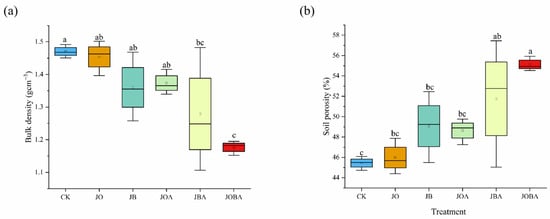
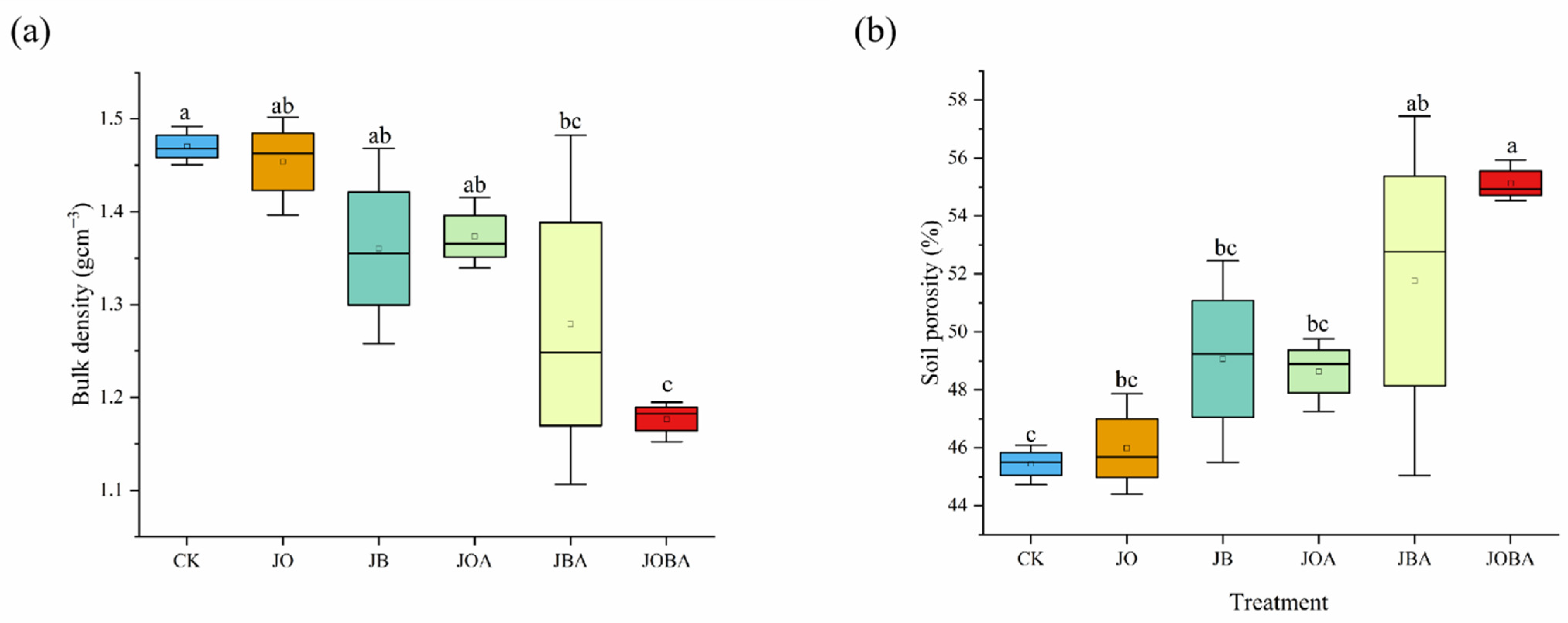
SBD and SP are key indicators reflecting soil structural quality. Compared with CK, JBA and JOBA decreased SBD by 13.01% and 19.97% and increased SP by 13.89% and 21.32%, respectively (Figure 1a,b); SBD and SP were similar between JBA and JOBA. No significant differences in SBD or SP were observed among CK, JO, JB and JOA. JOBA significantly decreased SBD and increased SP compared with JO, JOA and JB (all p < 0.05), while differences between JOBA and JBA were not significant.
Figure 1.
SBD (a) and SP (b) of sandy soil samples after different treatments (n = 3). Different lowercase letters indicate significant differences between treatments (p < 0.05). SBD: soil bulk density; SP: soil porosity. CK: control; JB: biochar; JBA: biochar+attapulgite; JO: organic fertiliser; JOA: organic fertiliser+attapulgite; JOBA: organic fertiliser+biochar+attapulgite.
3.1.2. Composition and Stability of Water-Stable Soil Aggregates
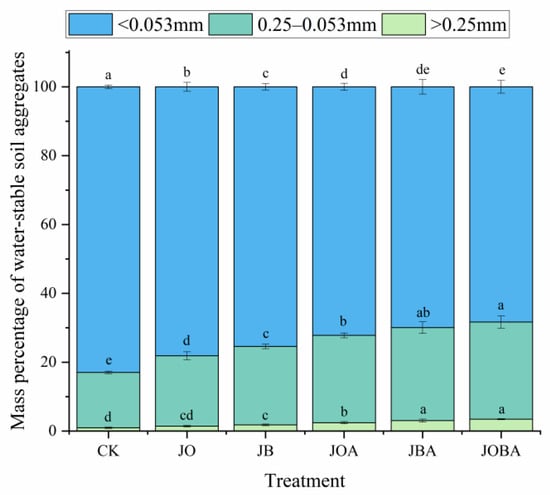
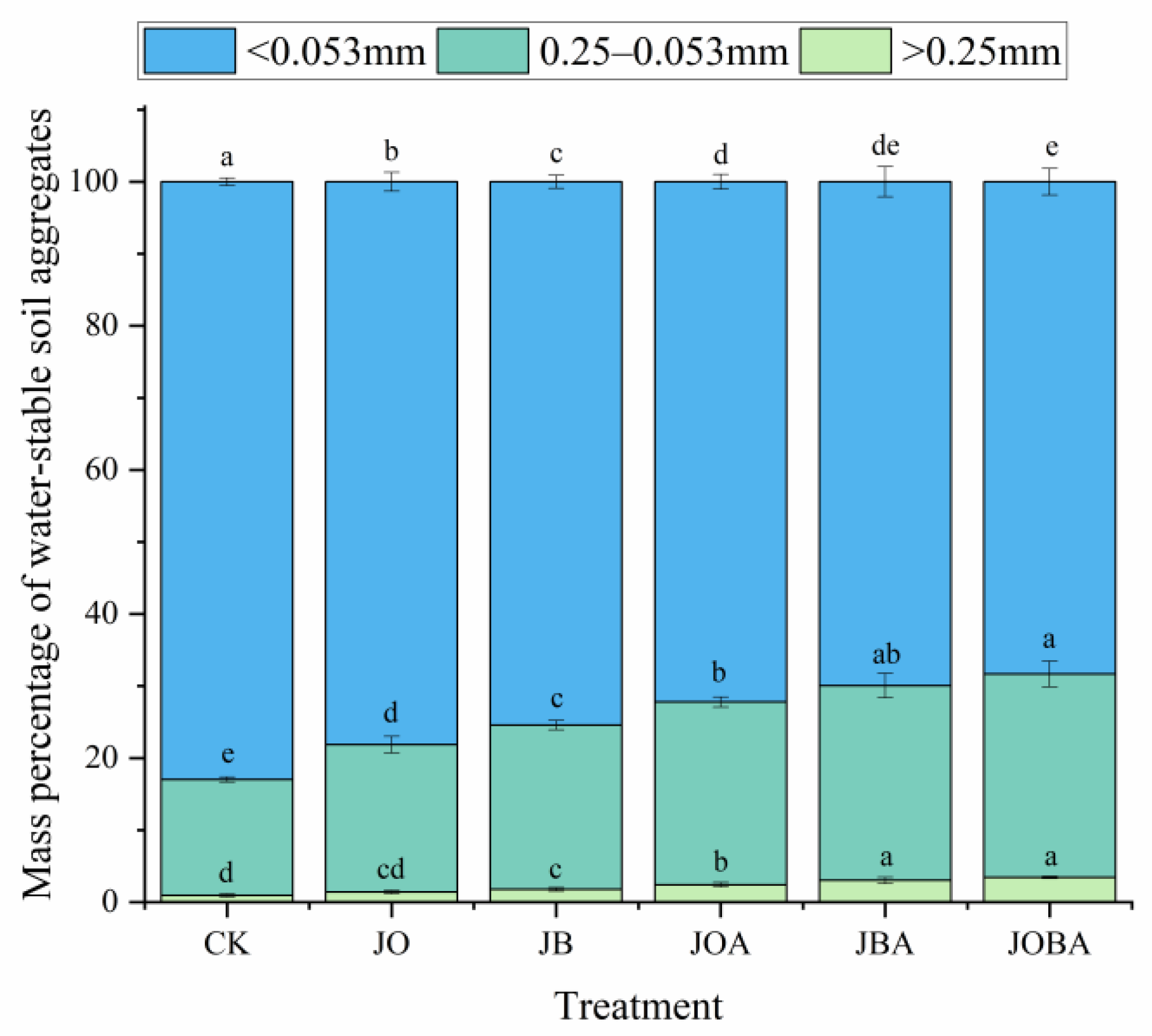
Soil particle size fundamentally governs soil structure formation and stability. As shown in Figure 2, compared with CK, JB, JOA, JBA and JOBA significantly increased macroaggregates by 90.32%, 160.22%, 224.73% and 268.82% and microaggregates by 41.59%, 57.52%, 67.87% and 75.33%, while significantly decreasing silt+clay by 9.08%, 12.96%, 15.69% and 17.64%, respectively (all p < 0.05). JO significantly increased microaggregates by 27.10% and decreased silt+clay by 5.82% versus CK, with no significant change in macroaggregates. Treatments containing attapulgite (JOA, JBA, JOBA) showed the largest increases in macroaggregates, with JOBA being highest; all three aggregate fractions were similar between JBA and JOBA.
Figure 2.
Percentage by weight of particle size fractions in stabilised sandy soil aggregates after different treatments (n = 3). The bars show average mass fractions for each particle size fraction. Different lowercase letters indicate significant differences between treatments (p < 0.05). CK: control; JB: biochar; JBA: biochar+attapulgite; JO: organic fertiliser; JOA: organic fertiliser+attapulgite; JOBA: organic fertiliser+biochar+attapulgite.
Regarding aggregate stability indices (Table 1), compared with CK, all amendment treatments significantly increased MWD and GMD, with increases ranging from 23.21% to 89.88% for MWD and from 13.29% to 49.37% for GMD (all p < 0.05). JB, JOA, JBA and JOBA increased R0.25 by 90.32%, 160.22%, 224.73% and 268.82%, respectively (p < 0.05), while JO showed a similar R0.25 to CK. JOBA achieved the highest MWD, GMD and R0.25 among all treatments, significantly exceeding JO, JOA and JB (all p < 0.05); values were similar between JBA and JOBA.
Table 1.
Soil aggregate stability indices under different treatments.
3.2. Active Fe/Al Oxide Content
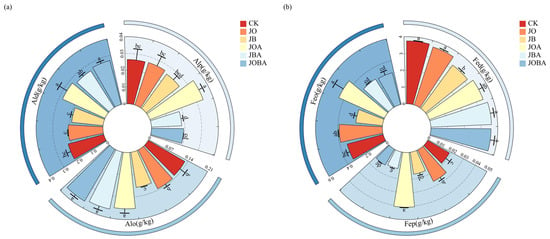
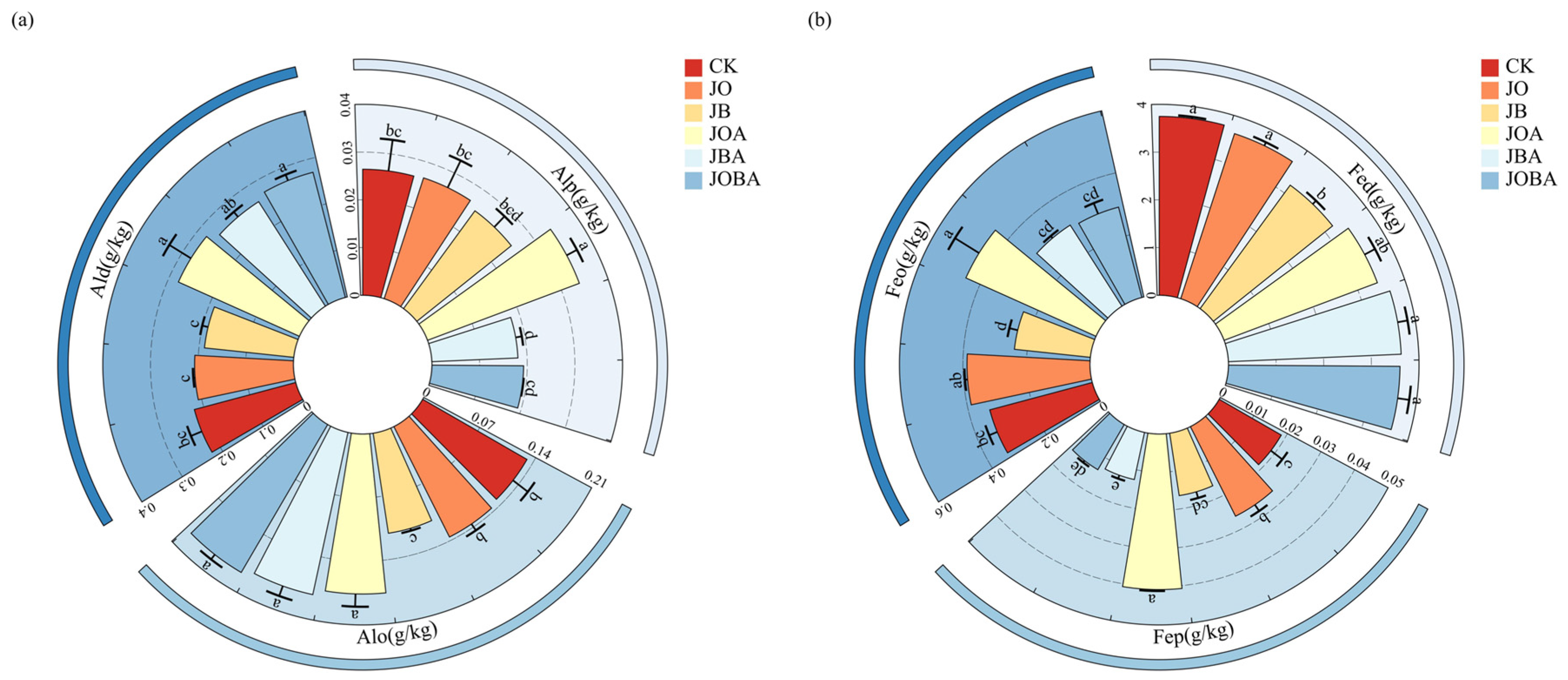
As shown in Figure 3a, compared with CK, JOA significantly increased Alp by 28.85%, whereas JBA significantly decreased Alp by 31.58%; JO, JB and JOBA showed similar Alp levels to CK. For Alo, JB significantly decreased by 16.10%, while JOA, JBA and JOBA significantly increased by 32.74%, 37.68% and 42.21%, respectively; JO showed no significant difference. JOA and JOBA significantly increased Ald by 26.39% and 23.09%, respectively (p < 0.05), while JO, JB and JBA showed comparable Ald levels to CK. Overall, attapulgite-containing treatments (JOA, JBA, JOBA) tended to increase amorphous Al (Alo), whereas effects on complexed (Alp) and free (Ald) Al varied by treatment combination.
Figure 3.
Contents of different forms of Al (a) and Fe (b) oxides in sandy soil after different treatments (n = 3). Different lowercase letters indicate significant differences between treatments (p < 0.05). CK: control; JB: biochar; JBA: biochar+attapulgite; JO: organic fertiliser; JOA: organic fertiliser+attapulgite; JOBA: organic fertiliser+biochar+attapulgite.
As shown in Figure 3b, compared with CK, JB significantly decreased Fed by 14.47%, while JO, JOA, JBA and JOBA showed similar Fed levels. JO and JOA significantly increased Fep by 39.91% and 116.87%, respectively, whereas JBA and JOBA significantly decreased it by 32.84% and 27.04%; JB showed no significant difference. For Feo, JB significantly decreased it by 28.05%, JOA significantly increased it by 34.34%, and the remaining treatments showed comparable levels to CK. The divergent responses indicate that organic fertiliser promotes complexed Fe (Fep), while biochar-containing treatments tend to reduce active Fe fractions.
3.3. Physiological Characteristics of Soybean
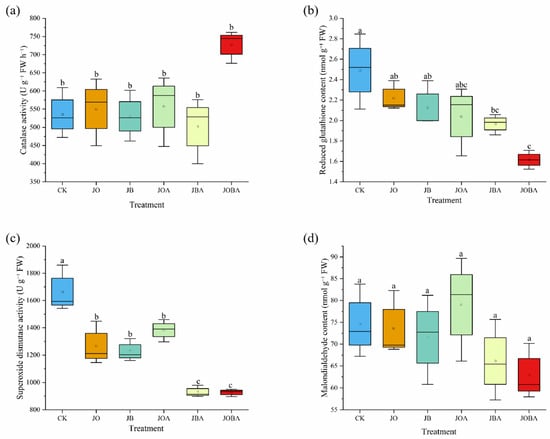
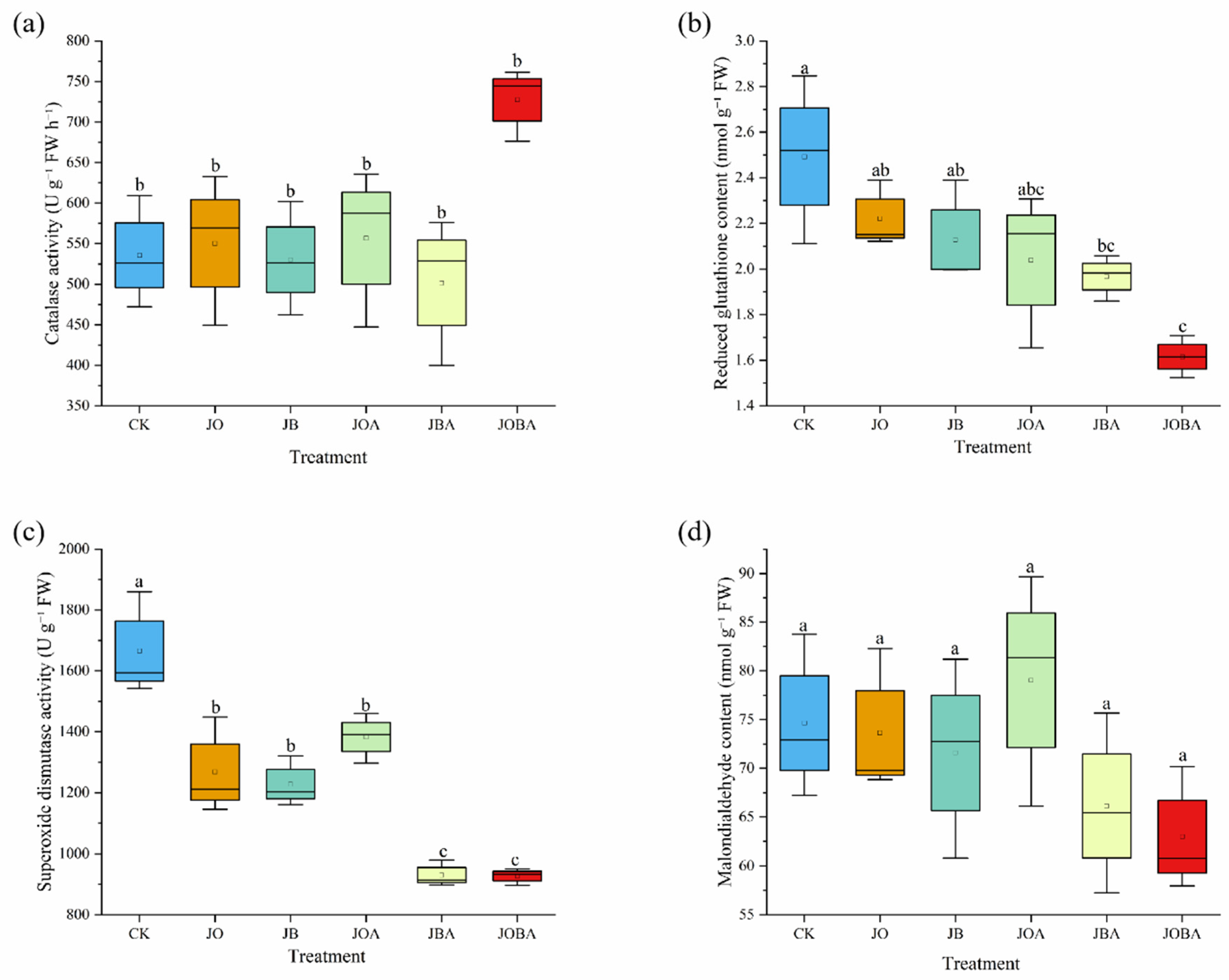
Compared with CK, JOBA significantly increased CAT activity by 35.74% (Figure 4a); all amendment treatments significantly decreased SOD activity, with reductions ranging from 16.98% to 44.33% (Figure 4c). JBA and JOBA significantly decreased GSH by 21.10% and 35.20%, respectively (p < 0.05) (Figure 4b). No significant difference was observed in MDA content among all treatments (Figure 4d). JOBA increased CAT activity by 35.74% but decreased SOD activity by 44.33% and GSH by 35.20%; MDA did not differ significantly among treatments. These mixed responses indicate modulation of antioxidant enzyme activities rather than a uniform enhancement of antioxidant defence.
Figure 4.
CAT activity (a), GSH levels (b), SOD activity (c) and MDA levels (d) in mature soybean leaves (n = 3). Different lowercase letters indicate significant differences between treatments (p < 0.05). CAT: catalase; GSH: reduced glutathione; MDA: malondialdehyde; SOD: superoxide dismutase. CK: control; JB: biochar; JBA: biochar+attapulgite; JO: organic fertiliser; JOA: organic fertiliser+attapulgite; JOBA: organic fertiliser+biochar+attapulgite.
3.4. Total Photosynthetic Pigment Content
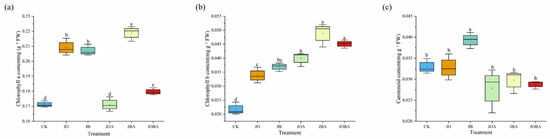
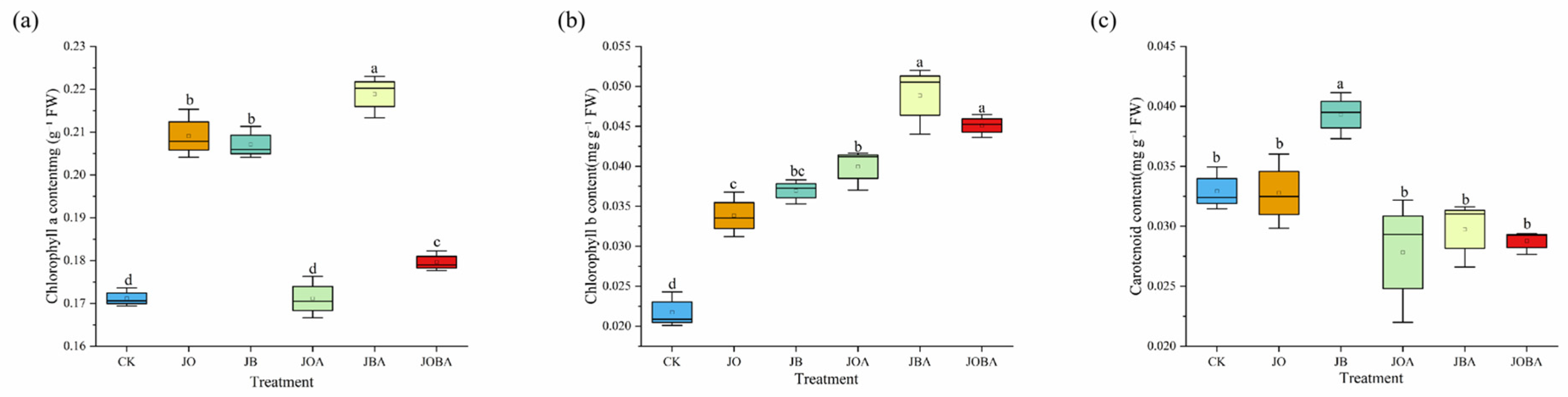
As shown in Figure 5, compared with CK, JO, JB, JBA and JOBA significantly increased Chl a by 22.13%, 20.97%, 27.83% and 4.92%, respectively, while JOA showed similar Chl a levels. All amendment treatments significantly increased Chl b, with increases ranging from 55.51% to 124.45%. JB significantly increased Car by 19.34% (p < 0.05), while no significant Car differences were observed among the other treatments. Overall, amendments primarily enhanced Chl b, with JBA showing the strongest effect.
Figure 5.
Chl a (a), Chl b (b) and Car (c) levels in soybean leaves (n = 3). Different lowercase letters indicate significant differences between treatments (p < 0.05). Car: carotenoid; Chl: chlorophyll; CK: control; JB: biochar; JBA: biochar+attapulgite; JO: organic fertiliser; JOA: organic fertiliser+attapulgite; JOBA: organic fertiliser+biochar+attapulgite.
3.5. Soybean’s Agronomic Traits and Yield Components
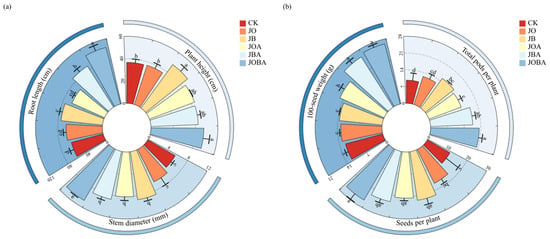
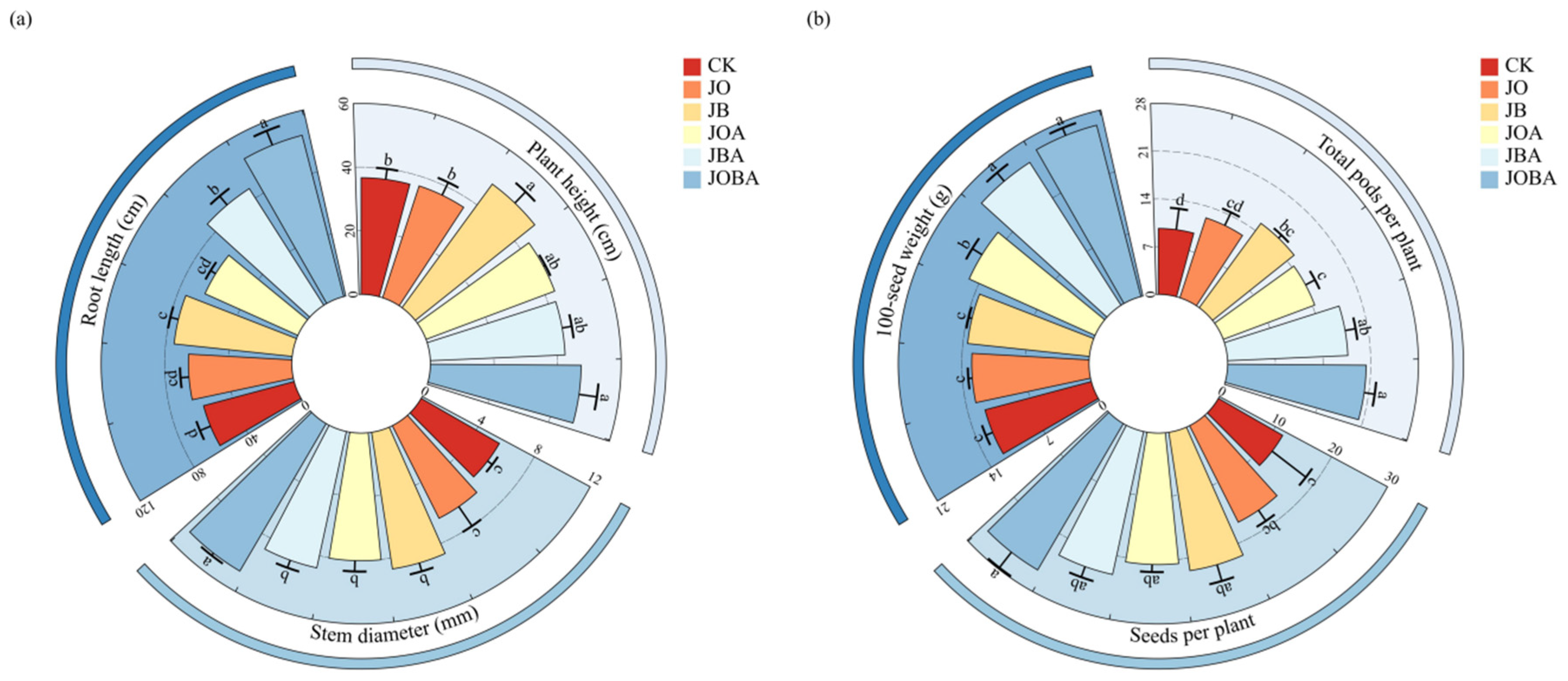
As shown in Figure 6a, compared with CK, JB and JOBA significantly increased plant height by 31.27% and 29.36%, respectively. JB, JOA, JBA and JOBA significantly increased stem diameter by 52.99%, 41.31%, 54.46% and 89.20%, respectively, while JO showed no significant difference. JB, JBA and JOBA significantly increased root length by 26.61%, 47.51% and 77.53%, respectively (p < 0.05). JOBA achieved the highest stem diameter and root length among all treatments, significantly exceeding JO, JOA, JB and JBA (all p < 0.05).
Figure 6.
Plant height, stem diameter and root length (a) and total pods per plant, seeds per plant and 100-seed weight (b) of soybean after different treatments (n = 3). Different lowercase letters indicate significant differences between treatments (p < 0.05). CK: control; JB: biochar; JBA: biochar+attapulgite; JO: organic fertiliser; JOA: organic fertiliser+attapulgite; JOBA: organic fertiliser+biochar+attapulgite.
As shown in Figure 6b, compared with CK, JB, JOA, JBA and JOBA significantly increased total pods per plant by 58.62%, 48.28%, 82.76% and 110.34% and seeds per plant by 88.57%, 77.14%, 97.14% and 128.57%, respectively, while JO showed similar levels to CK. JOA, JBA and JOBA significantly increased 100-seed weight by 25.38%, 54.03% and 60.82%, respectively (p < 0.05). JOBA showed the highest values for all yield components, significantly exceeding JO and JB in pods per plant and 100-seed weight (both p < 0.05).
As shown in Figure S1, compared with CK, JOA, JBA and JOBA significantly increased the RNN per plant by 23.08%, 35.38% and 47.69%, respectively (p < 0.05), while JO and JB showed similar RNNs to CK. JOBA achieved the highest RNN, significantly exceeding JO, JOA and JB (all p < 0.05); JBA and JOBA showed similar RNNs per plant.
3.6. Statistical Correlation and Mantel Test Analysis
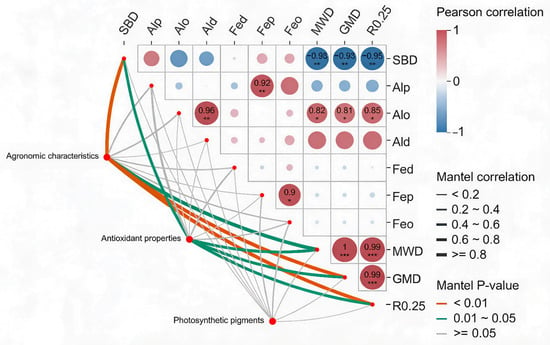
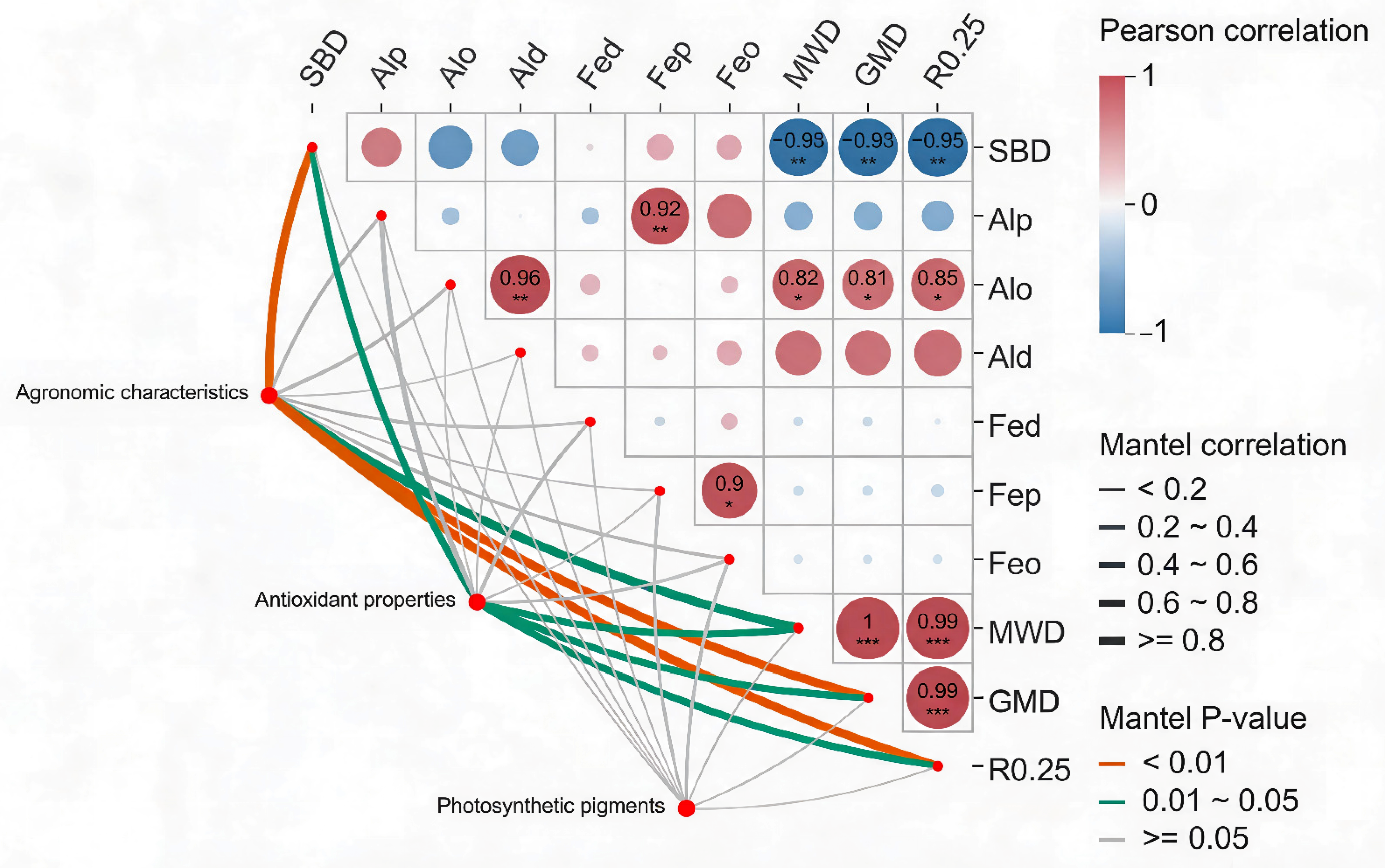
Pearson correlation analysis showed that among Fe and Al oxides, Alo was significantly positively correlated with Ald (r = 0.92), while Fed was positively correlated with both Fep (r = 0.90) and Feo (r = 0.81), indicating close transformational linkages among different oxide forms (Figure 7). Feo was also strongly positively correlated with aggregate stability indices (MWD, GMD and R0.25; r = 0.82–0.85), indicating that Fe oxides play an important cementing role in aggregate formation. Mantel test results revealed that all three categories of biological traits showed significant associations with soil physicochemical factors to varying degrees:
Figure 7.
Pearson correlation matrices and Mantel test results of sandy soil’s physicochemical properties, Fe/Al oxide forms and indicators of water-stable aggregates in relation to soybean’s agronomic traits, antioxidant properties and photosynthetic pigments (n = 3 for treatment means; n = 6 for correlation analysis). The top three blocks show Pearson correlation coefficients between various indicators (labelled in the legend with circles): red, positive correlation; blue, negative correlation; *, ** and *** indicate significance at p < 0.05, p < 0.01 and p < 0.001, respectively. The connecting lines represent associations identified by the Mantel test; the line thickness indicates the Mantel correlation coefficient magnitude, while the line colour indicates the test significance level (orange: p < 0.01; green: 0.01 ≤ p < 0.05; grey: p ≥ 0.05). The mean values of each indicator, correlation coefficients and significance test results are displayed; the different markings represent correlations, association degrees and between-indicator differences in significance. GMD: geometric mean diameter; MWD: mean weight diameter.
(1) Agronomic traits were significantly negatively correlated with SBD (p < 0.01) and significantly positively correlated with MWD, GMD and R0.25, as well as Fe and Al oxide contents, with the strongest correlation strength, indicating that soil structural optimisation and Fe/Al oxide accumulation are key associated promoters for soybean growth and yield components.
(2) Antioxidant properties were significantly associated with most soil physicochemical indicators (p < 0.05), with correlations with Feo, Fed, MWD, GMD and R0.25 being relatively strong, indicating that soil improvement may indirectly influence the plant antioxidant system response by regulating the physicochemical environment.
(3) Photosynthetic pigments were negatively correlated with SBD and positively correlated with MWD, GMD, R0.25 and Fe/Al oxides, with most connecting lines reaching significance, reflecting that improved soil structure is associated with more leaf photosynthetic pigment and, thus, potentially enhanced photosynthetic capacity.
3.7. Exploratory Hierarchical Cluster Analysis
Hierarchical cluster analysis grouped the six treatments into two main clusters at a Euclidean distance of 1.2: Cluster I comprised JBA and JOBA, which showed the best comprehensive improvement, whereas Cluster II comprised CK, JO, JOA and JB with lower overall efficacy (Figure S2 in Supplementary Materials).
4. Discussion
Sandy soil severely constrains crop growth and development [7]. Improving soil fertility and cultivated land quality via targeted amendment technologies is crucial to unlock the yield potential of sandy soils, ensuring regional food security and promoting green and high-quality agricultural development. This study tested whether combining organic fertiliser, biochar and attapulgite with straw return would reorient Fe–Al oxide speciation, increase water-stable macroaggregates, and improve soybean physiology and yield components, with the triple combination (JOBA) expected to outperform single and binary applications. Results indicated that JOBA gave the largest macroaggregate, MWD, GMD and R0.25 gains, the lowest bulk density, and the best physiological and yield-component traits.
Biochar acts as a physical framework to promote the aggregation of fine soil particles. In this study, JB was especially effective in promoting large aggregate formation in coarse-textured soil and optimising the pore structure; this finding is consistent with the soil structure improvement effects observed by Pituello et al. [28] in sandy agricultural ecosystems. Khademalrasoul et al. [29] demonstrated that biochar application prioritises macroaggregate assembly and modulates pore size distribution in coarse-textured soils. Ibrahim et al. [30] documented an increase of 42–76% in macroaggregates induced by sole biochar application in sandy soils; the enhancement magnitude we observed post-JB treatment exceeds this range, indicating that JB had a more pronounced aggregation-promoting effect in the sandy soil of the study area. In contrast, JO primarily generated colloidal organic fractions during mineralisation, which predominantly bound silt and clay particles into microaggregates and exerted a relatively weak effect on macroaggregate formation. Arachchige et al. [31] reported a similar pattern in the effects of organic amendments on soil aggregation. Such divergent effects between JB and JO show that short-term application of conventional organic fertiliser alone fails to substantially improve the macrostructure of sandy soil. The intrinsic discrepancies in physicochemical properties between organic fertiliser and biochar fundamentally determine their distinct MOAs and improvement performances in sandy soil [32]. Combined application with attapulgite further enhanced the structural improvement effects of both JO and JB treatments, but JOA and JBA showed obvious differences in regulatory pathways. In organic fertiliser systems, attapulgite delays oxide crystallisation and maintains the amorphous phase of Fe/Al oxides. In parallel, organic ligands continuously released during JO decomposition further intensify Fe and Al ion complexation and activation, enlarging the pool of active oxide cementing agents. A similar activation pattern has been reported in clay–organic composite amendment systems [33], and the resulting effect appears to enhance JOA’s aggregate stability, shifting the microaggregate-dominated improvement pattern of single organic fertiliser toward greater macroaggregate formation and linking microscopic oxide changes to macroscopic structural optimisation. As part of JBA, attapulgite may contribute to a dual-pore configuration, as proposed previously [34]. Specifically, biochar contributes abundant internal micropores, while fibrous attapulgite crystals interlace among soil particles to construct mesopore pathways. This combined pore-regulating effect optimises pore size distribution more efficiently and significantly reduces SBD, an outcome unattainable by sole biochar treatment [35]. Distinct from the activation effect of JOA, JBA exhibits strong adsorption affinity for organo-complexed oxides. With negatively charged surfaces on both components, JBA may immobilise organo-mineral complexes and contribute to the conversion of active complexed oxides towards more stable crystalline free forms, which is potentially favourable for the long-term stability of soil structure. Yao et al. [36] documented similar oxide transformation patterns in soils amended with biochar–clay composites. Correspondingly, the aggregate cementation capacity of JBA is significantly stronger than JB’s. In this study, the optimal comprehensive improvement effect was achieved among the treatments tested, reflecting the combined contribution of organic and inorganic amendments. The multicomponent system realises functional complementarity: The organic fertiliser provides carbon sources for microbial activity and generates organic colloids for aggregate cementation, biochar acts as a rigid structural skeleton to resist external compaction and attapulgite exerts a clay filling effect and provides flocculation sites for fine particles. The three components appear to act complementarily to improve soil structure across particle-to-pore scales; this combined improvement was not observed with single or binary amendment regimes. Li et al. [32] showed that most single or binary amendments achieve only a 4–11% reduction in SBD, while JOBA caused a markedly higher reduction than this general baseline, reflecting the benefit of combining organic and inorganic amendments [7]. A global meta-analysis found that biochar on average reduces bulk density by only 0.8% across soils and rates [37], far below our value; this likely reflects the very high amendment rates and extremely sandy soil rather than a uniquely powerful triple effect. But JOBA may support a dual-cementation involving both organic colloids and inorganic minerals, which appears to maintain a balance between active amorphous oxides and relatively stable free oxides, consistent with the observed enhancement of aggregate water stability. Jia et al. [38] emphasised that such a dual-cementation mechanism is critical for improving aggregate stability in coarse-textured soils. Introducing biochar in the ternary system may also contribute to the shift of part of the Fe/Al oxides to transform from active complexed forms toward more stable crystalline forms, which may balance immediate improvement effects and longer-term structural stability.
Optimising and improving sandy soil’s physical structure further enhances the water and nutrient environment in the rhizosphere, regulating crop physiology, metabolism and yield through soil–crop interactions; the differences in yield enhancement across different soil improvement systems are an external manifestation of the divergent pathways that regulate soil structure. Both JO and JB were associated with lower leaf SOD activity, likely reflecting improved soil water and nutrient status that reduced the need for stress-responsive SOD production. JB’s more pronounced pigment-promoting effect is closely associated with biochar’s unique capacity to enhance the availability of chlorophyll synthesis-related trace elements (e.g., Mg and Fe) via surface adsorption and sustained release. Lai et al. [39] provided a mechanistic explanation for this phenomenon by attributing the improved photosynthetic performance to biochar-mediated micronutrient supply. Regarding growth performance, JB’s short-term growth-promoting effect is superior to JO’s in sandy soil, which benefits from biochar’s stronger water-holding capacity that creates a stable rhizosphere environment for root development. Wei et al. [40] synthesised global field evidence and concluded that biochar application increases plant-available water in sandy soil by an average of 28.5%, offering a quantitative basis for biochar’s drought-mitigating and yield-enhancing effects. Combined biochar+attapulgite application further optimises soil structure, synchronously enhancing soybean yield. In this study, JOA reinforced aggregate cementation and nutrient retention compared to JO, significantly improving core yield components, which was also observed by Yao et al. [36] in similar amendment trials. JBA optimised the pore structure and improved aeration, creating more favourable conditions for rhizobial nitrogen-fixing activity. The elevated nodule count, in turn, enhanced nitrogen supply and facilitated grain filling, leading to a substantial yield increment compared to JOA treatment. Asirifi et al. [18] similarly demonstrated that soil aeration improvement is a key pathway by which structural amendments promote legume nodulation and yield increase. This differentiation between JOA and JBA further indicates that the combined effects of attapulgite with different materials shape the final crop response. Among all treatments, JOBA had the most pronounced combined improvement in carotenoid soybean physiological status and yield components. With respect to antioxidant physiology, JOBA was associated with a 35.74% increase in CAT activity relative to CK, but also with a 44.33% decrease in SOD activity and a 35.20% decrease in GSH content, while MDA did not differ significantly among treatments. This pattern does not by itself demonstrate a uniformly enhanced antioxidant defence system. Rather, the reduced SOD and GSH under JOBA may indicate a lower basal oxidative burden in plants grown in the improved soil environment, such that stress-responsive enzymes and non-enzymatic antioxidants were less strongly induced. The absence of a significant MDA difference further suggests that lipid peroxidation was not exacerbated by any treatment. The up-regulation of CAT alone may reflect a recalibrated H2O2-processing capacity under more favourable growth conditions rather than conclusive evidence of comprehensive mitigation of oxidative damage. These observations should therefore be interpreted as modulation of the leaf antioxidant profile in response to improved soil conditions, rather than as direct proof of reduced oxidative stress. Rathour et al. [41] reported a similar regulatory pattern in crops grown on amended sandy soils, where CAT served as the dominant antioxidant enzyme responding to improved soil conditions, although the concurrent reduction in other antioxidant indices was not discussed in that study. Murtaza et al. [42] likewise reported biochar-induced physiological and biochemical alterations in soybean, further supporting the view that biochar amendment modulates the leaf antioxidant profile rather than uniformly enhancing all defence enzymes. The Mantel test further verified that soil physicochemical indices, especially Feo, Fed and aggregate stability indices, are significantly associated with plant antioxidant indices, indicating that soil improvement indirectly affects the plant antioxidant system response by regulating the soil physicochemical environment. Regarding yield components, JOBA significantly outperformed JOA and JBA in core yield indices and RNNs. Improved yield components under JOBA may be attributable to the combined contribution of multiple pathways: improved soil structure enhances water and nutrient retention and may reduce nutrient leaching, balanced Fe/Al oxide fractions contribute to cementing effects and nutrient supply, and an optimised rhizosphere environment supports root development and nodular nitrogen fixation. These pathways may collectively contribute to improved soybean growth and yield components through the soil–fertiliser–crop continuum [43]. However, this experiment was conducted in an outdoor net house rather than under field conditions, which limits the field applicability and extension value of the findings. In addition, this study focused on soil physical structure, oxide forms, and crop physiological and yield traits under different amendment treatments, but did not systematically measure soil chemical indicators. Therefore, it cannot fully reveal how combined amendment regimes affect soil nutrient cycling, chemical transformations, and microbial metabolism. Further field experiments combined with systematic soil physicochemical measurements are needed to validate and refine these conclusions.
5. Conclusions
In this outdoor net-house soil-column experiment, the combined application of organic fertiliser, biochar and attapulgite with straw return improved Yellow River alluvial sandy soil structure, modulated Fe/Al oxide forms, and enhanced soybean physiological status and yield components through the complementary functions of the three amendments. The ternary combination (JOBA) showed the greatest overall improvement among the tested regimes. These findings are limited to a short-term outdoor net-house column experiment; long-term field trials with agronomically realistic rates are required to verify scalability, sustainability, and environmental effects before practical recommendations can be made.
Supplementary Materials
The following supporting information can be downloaded at: https://www.mdpi.com/article/10.3390/agronomy16191908/s1, Figure S1: RNNs per soybean plant after different treatments (n = 3); Figure S2: Hierarchical clustering dendrogram showing dissimilarity among different treatments.
Author Contributions
M.W.: Investigation, Data curation, Formal analysis, Writing—original draft. J.C.: Investigation, Methodology, Data curation. S.G.: Investigation. Y.L. (Yaping Li): Resources. H.P.: Software. F.H.: Validation. H.W.: Formal Analysis. Q.Y.: Resources, Supervision, Writing—review & editing. Y.Z.: Supervision, Project administration, Writing—review & editing. Y.L. (Yanhong Lou): Conceptualization, Supervision, Funding acquisition, Writing—review & editing. All authors have read and agreed to the published version of the manuscript.
Funding
This work was supported by the National Key Research and Development Program of China (2023YFD1902700).
Data Availability Statement
The data that support the findings of this study are available from the corresponding authors upon reasonable request.
Conflicts of Interest
The authors declare no conflicts of interest.
References
- Cao, B.; Li, Y.; Gao, Y.; Chen, Y.; Hao, J.; Meng, X.; Shi, J.; Tian, X. Effects of microbial inoculant application on the decomposition of organic materials and the priming effect in sandy soils. Agronomy 2026, 16, 1350. [Google Scholar] [CrossRef] [Scilit]
- Poudel, P.; Ye, R.; Parajuli, B. Clay soil amendment suppressed microbial enzymatic activities while increasing nitrogen availability in sandy soils. Soil Sci. Soc. Am. J. 2024, 88, 1647–1658. [Google Scholar] [CrossRef] [Scilit]
- El-Akhdar, I.; Shabana, M.M.A.; El-Khateeb, N.M.M.; Elhawat, N.; Alshaal, T. Sustainable wheat cultivation in sandy soils: Impact of organic and biofertilizer use on soil health and crop yield. Plants 2024, 13, 3156. [Google Scholar] [CrossRef] [Scilit] [PubMed]
- Musei, S.K.; Kuyah, S.; Nyawira, S.; Ng’ang’a, S.K.; Karugu, W.N.; Smucker, A.; Nkurunziza, L. Sandy soil reclamation technologies to improve crop productivity and soil health: A review. Front. Soil Sci. 2024, 4, 1345895. [Google Scholar] [CrossRef] [Scilit]
- Chernet Madolo, M.; Chen, X.; Beyene, Y.; Guo, Y.; Zhang, H.; Dawa, C.; Ul Islam, M.; Jiang, F. Conservation tillage combined with straw return improves soil quality and crop yield in a Nitisol of Ethiopia. Arch. Agron. Soil Sci. 2026, 72, 1–12. [Google Scholar] [CrossRef] [Scilit]
- Xie, M.; Zhang, T.; Liu, S.; Liu, Z.; Wang, Z. Profile soil organic and inorganic carbon sequestration in maize cropland after long-term straw return. Front. Environ. Sci. 2023, 11, 1095401. [Google Scholar] [CrossRef] [Scilit]
- Sui, X.; Wang, L.; Lv, X.; Liu, Y.; Zhu, Y.; Fan, L.; Wang, H. Influence of composite amendments on the characteristics of sandy soil. Sustainability 2025, 17, 7619. [Google Scholar] [CrossRef] [Scilit]
- Ma, P.; Nan, S.; Yang, X.; Qin, Y.; Ma, T.; Li, X.; Yu, Y.; Bodner, G. Macroaggregation is promoted more effectively by organic than inorganic fertilizers in farmland ecosystems of China—A meta-analysis. Soil Tillage Res. 2022, 221, 105394. [Google Scholar] [CrossRef] [Scilit]
- Yang, T.; Xing, X.; Gao, Y.; Ma, X. An environmentally friendly soil amendment for enhancing soil water availability in drought-prone soils. Agronomy 2022, 12, 133. [Google Scholar] [CrossRef] [Scilit]
- Niraj, K.C.; Mahat, B. A review article on the effect of biochar on soil properties. J. Wastes Biomass Manag. 2024, 6, 77–81. [Google Scholar] [CrossRef] [Scilit]
- Alghamdi, A.G.; Alomran, A.; Ibrahim, H.M.; Alkhasha, A.; Alasmary, Z. Date palm waste-derived biochar for improving hydrological properties of sandy soil under saturated and unsaturated conditions. Sustainability 2024, 16, 11081. [Google Scholar] [CrossRef] [Scilit]
- Kumar, Y.; Ren, W.; Tao, H.; Tao, B.; Lindsey, L.E. Impact of biochar amendment on soil microbial biomass carbon enhancement under field experiments: A meta-analysis. Biochar 2025, 7, 2. [Google Scholar] [CrossRef] [Scilit]
- Niu, Z.; Su, Y.; Li, J.; An, F.; Liu, T. Effect of attapulgite application on aggregate formation and carbon and nitrogen content in sandy soil. Sustainability 2023, 15, 12511. [Google Scholar] [CrossRef] [Scilit]
- Zhu, Z.; Zhang, Y.; Tao, W.; Zhang, X.; Xu, Z.; Xu, C. The biological effects of biochar on soil’s physical and chemical characteristics: A review. Sustainability 2025, 17, 2214. [Google Scholar] [CrossRef] [Scilit]
- Gu, W.; Wang, Y.; Sun, Y.; Liu, Z.; Wang, W.; Wu, D.; Zhang, Y.; Sun, W.; Wang, X.; Feng, Z.; et al. Assessing the formation and stability of paddy soil aggregate driven by organic carbon and Fe/Al oxides in rice straw cyclic utilization strategies: Insight from a six-year field trial. Sci. Total Environ. 2024, 951, 175607. [Google Scholar] [CrossRef] [Scilit] [PubMed]
- Li, W.; Tang, J.; Liu, Y.; Su, S.; Jiang, X.; Huang, L.; Tang, S.; Huang, M. Biochar and bentonite application improves aeolian sandy soil health and enhances soil carbon sequestration and emission reduction potential. Sci. Rep. 2025, 15, 2205. [Google Scholar] [CrossRef] [Scilit] [PubMed]
- Kheir, A.M.S.; Govind, A.; Zoghdan, M.G.; Khalifa, T.H.; Aboelsoud, H.M.; Shabana, M.M.A. The fusion impact of compost, biochar, and polymer on sandy soil properties and bean productivity. Agronomy 2023, 13, 2544. [Google Scholar] [CrossRef] [Scilit]
- Asirifi, I.; Osei, M.B.; Adu-Gyamfi, R.; Lamptey, S.; Herre, M.; Heinze, S.; Werner, S.; Pierburg, R.; Marschner, B. Combined biochar and compost or P applications improve soybean yield and inoculation in tropical acidic soil. Urban Agric. Reg. Food Syst. 2025, 10, e70020. [Google Scholar] [CrossRef] [Scilit]
- Fan, Y.; Ma, Z.; Ai, P.; Ma, Y.; Li, F.; Heng, T.; Xu, Y.; Wang, Z. Effects of irrigation with magnetized saline water on soil aggregate size distribution and stability. Agriculture 2026, 16, 1190. [Google Scholar] [CrossRef] [Scilit]
- Cao, X.; Xu, Y.; Wang, F.; Zhang, Z.; Xu, X. Changes of soil organic carbon and aggregate stability along elevation gradient in Cunninghamia lanceolata plantations. Sci. Rep. 2024, 14, 31778. [Google Scholar] [CrossRef] [Scilit] [PubMed]
- Xu, J.; Song, F.; Wang, Z.; Qi, Z.; Liu, M.; Guan, S.; Sun, J.; Li, S.; Zhao, J. Effects of different straw return methods on the soil structure, organic carbon content and maize yield of black soil farmland. Agronomy 2024, 14, 2011. [Google Scholar] [CrossRef] [Scilit]
- Cao, T.; Zhang, H.; Zhang, Y.; Chen, T.; Yang, C.; Wang, Y.; Zhou, H. Study on the stabilization mechanism of aeolian sandy soil formation by adding a natural soft rock. Open Geosci. 2023, 15, 20220527. [Google Scholar] [CrossRef] [Scilit]
- Wu, M.; Wu, J.; Zhang, H.; Zhang, Q.; Cheng, X. Mineral protection rather than aggregate stability improved soil organic carbon contents at high altitudes of Yulong Mountain in Southwest China. J. Plant Ecol. 2025, 18, rtaf050. [Google Scholar] [CrossRef] [Scilit]
- Peter, O.; Imran, M.; Shaffique, S.; Kang, S.-M.; Rolly, N.; Felistus, C.; Bilal, S.; Zhao, D.-D.; Hoque, M.I.; Kwon, E.; et al. Combined application of melatonin and Bacillus sp. strain IPR-4 ameliorates drought stress tolerance via hormonal, antioxidant, and physiomolecular signaling in soybean. Front. Plant Sci. 2024, 15, 1274964. [Google Scholar] [CrossRef] [Scilit] [PubMed]
- Nguyen, M.K.; Yang, C.-M.; Shih, T.-H.; Lin, S.-H.; Pham, G.T.; Nguyen, H.C. Chlorophyll biosynthesis and transcriptome profiles of chlorophyll b-deficient type 2b rice (Oryza sativa L.). Not. Bot. Horti Agrobot. 2021, 49, 12380. [Google Scholar] [CrossRef] [Scilit]
- Khan, K.; Li, Z.W.; Khan, R.; Ali, S.; Ahmad, H.; Shah, M.A.; Zhou, X.B. Co-exposure impact of nickel oxide nanomaterials and Bacillus subtilis on soybean growth and nitrogen assimilation dynamics. Plant Physiol. 2025, 197, kiae638. [Google Scholar] [CrossRef] [Scilit] [PubMed]
- Vu, H.; Le, C.; Vu Dinh, H.; Nguyen, T.; Pham, T.N. Correlations and path coefficients for yield related traits in soybean progenies. Asian J. Crop Sci. 2019, 11, 32–39. [Google Scholar] [CrossRef] [Scilit]
- Pituello, C.; Dal Ferro, N.; Francioso, O.; Simonetti, G.; Berti, A.; Piccoli, I.; Pisi, A.; Morari, F. Effects of biochar on the dynamics of aggregate stability in clay and sandy loam soils. Eur. J. Soil Sci. 2018, 69, 827–842. [Google Scholar] [CrossRef] [Scilit]
- Khademalrasoul, A.; Naveed, M.; Heckrath, G.; Kumari, I.; de Jonge, L.; Elsgaard, L.; Vogel, H.-J.; Iversen, B. Biochar effects on soil aggregate properties under no-till maize. Soil Sci. 2014, 179, 273–283. [Google Scholar] [CrossRef] [Scilit]
- Ibrahim, A. Impact of biochar and compost on aggregate stability in loamy sand soil. Agric. Res. J. 2021, 58, 34–44. [Google Scholar] [CrossRef] [Scilit]
- Pitumpe Arachchige, P.S.; Hettiarachchi, G.M.; Rice, C.W.; Dynes, J.J.; Maurmann, L.; Kilcoyne, A.L.D.; Attanayake, C.P. Direct evidence on the impact of organic amendments on carbon stabilization in soil microaggregates. Soil Sci. Soc. Am. J. 2024, 88, 1529–1544. [Google Scholar] [CrossRef] [Scilit]
- Li, W.; Chen, X.; Mao, Q.; Yue, X.; Peng, W.; Gu, H. Effects of combined application of coal-based charcoal and organic fertilizer on soil properties and plant growth in desertified soils. Plants 2026, 15, 1963. [Google Scholar] [CrossRef] [Scilit] [PubMed]
- Zhao, W.; Wang, S.; Tang, L.; Xiao, J.; Chen, G. Combined application of humic acid and attapulgite improves physical structure and nutrients in coastal saline-alkali soils. Land Degrad. Dev. 2025, 36, 4415–4424. [Google Scholar] [CrossRef] [Scilit]
- Wang, X.; Gu, Y.; Tan, X.; Liu, Y.; Zhou, Y.; Hu, X.; Cai, X.; Xu, W.; Zhang, C.; Liu, S. Functionalized biochar/clay composites for reducing the bioavailable fraction of arsenic and cadmium in river sediment. Environ. Toxicol. Chem. 2019, 38, 2337–2347. [Google Scholar] [CrossRef] [Scilit] [PubMed]
- Jiang, F.; Liu, M.; Li, S.; Liang, M.; Hu, X.; Li, F. Mechanism study on the immobilization of Cu2+/Pb2+ in aqueous phase by mineral co-milling-modified biochar. Langmuir 2024, 40, 17897–17908. [Google Scholar] [CrossRef] [Scilit] [PubMed]
- Yao, Y.; Cheng, Q.; Zhou, H.; Ding, J.; Xu, P.; Zhang, P.; Hou, S.; Yu, M.; Han, P.; Zhang, D. Effects of magnetite- and attapulgite-modified biochar with organic fertiliser: Mineral-driven microbial mechanisms regulating the nitrogen cycle. Environ. Technol. 2026, 47, 2190–2201. [Google Scholar] [CrossRef] [Scilit] [PubMed]
- Edeh, I.G.; Mašek, O.; Buss, W. A meta-analysis on biochar’s effects on soil water properties—New insights and future research challenges. Sci. Total Environ. 2020, 714, 136857. [Google Scholar] [CrossRef] [Scilit] [PubMed]
- Jia, N.; Li, L.; Guo, H.; Xie, M. Important role of Fe oxides in global soil carbon stabilization and stocks. Nat. Commun. 2024, 15, 10318. [Google Scholar] [CrossRef] [Scilit] [PubMed]
- Lai, C.; Zhan, J.; Chai, Q.; Wang, C.; Yang, X.; He, H.; Huang, B.; Pan, X. Dissolved carbon in biochar: Exploring its chemistry, iron complexing capability, toxicity in natural redox environment. J. Environ. Sci. 2025, 147, 217–229. [Google Scholar] [CrossRef] [Scilit] [PubMed]
- Wei, B.; Peng, Y.; Lin, L.; Zhang, D.; Ma, L.; Jiang, L.; Li, Y.; He, T.; Wang, Z. Drivers of biochar-mediated improvement of soil water retention capacity based on soil texture: A meta-analysis. Geoderma 2023, 437, 116591. [Google Scholar] [CrossRef] [Scilit]
- Rathour, K.; Sidhu, A.; Sharma, V.; Kalia, A. Sulfide-infused FeS-palygorskite nanohybrid with redox-modulating properties improves iron assimilation and physiological-biochemical performance in soybean. J. Agric. Food Chem. 2026, 74, 9991–10008. [Google Scholar] [CrossRef] [Scilit] [PubMed]
- Murtaza, G.; Rizwan, M.; Usman, M.; Ahmed, Z.; Iqbal, J.; Ahmad, S.; Alwahibi, M.S.; Rizwana, H.; Iqbal, R.; Deng, G.; et al. Physiological and biochemical alterations in soybean by banana peel biochar under different degrees of salt stress. Sci. Rep. 2025, 15, 30532. [Google Scholar] [CrossRef] [Scilit] [PubMed]
- Wang, S.; Gao, P.; Zhang, Q.; Shi, Y.; Guo, X.; Lv, Q.; Wu, W.; Zhang, X.; Li, M.; Meng, Q. Biochar improves soil quality and wheat yield in saline-alkali soils beyond organic fertilizer in a 3-year field trial. Environ. Sci. Pollut. Res. 2023, 30, 19097–19110. [Google Scholar] [CrossRef] [Scilit] [PubMed]

Disclaimer/Publisher’s Note: The statements, opinions and data contained in all publications are solely those of the individual author(s) and contributor(s) and not of MDPI and/or the editor(s). MDPI and/or the editor(s) disclaim responsibility for any injury to people or property resulting from any ideas, methods, instructions or products referred to in the content. |
© 2026 by the authors. Licensee MDPI, Basel, Switzerland. This article is an open access article distributed under the terms and conditions of the Creative Commons Attribution (CC BY) license.