


Abstract
This study investigates the water–energy nexus in vineyards adopting innovative practices, focusing on water management through rainwater harvesting systems and the installation of photovoltaic panels for renewable energy production. The research focuses on two regions in Greece, Nemea in Corinthia and Nea Anchialos in Magnesia, using historical time series of meteorological data to establish water and energy balances. The study aims to examine the practical use of these technologies to improve water and energy efficiency in grape and wine production, which are important parts of the country’s primary sector. A daily water balance model is applied to estimate the required storage capacity of rainwater tanks for irrigation use in vine cultivation, using daily rainfall and evapotranspiration data over 20 hydrological years (2001/02–2020/21). Additionally, the installation of photovoltaic panels covering a specific percentage of the total utilized area in the study parcels is examined. The analysis showed that the use of a rainwater collection system with a catchment area of 500 m2 for crop areas from 500 to 10,000 m2 and using rainwater tanks from 10 to 200 m3 can ensure demand coverage rates from 60% to 95%. The production of green energy through the panels ranges from 149 to 156 MWh per year.
1. Introduction
Water and energy are two of the most critical resources in modern agriculture, and their availability and management significantly influence productivity and sustainability. In Mediterranean climates, where rainfall is strongly seasonal and prolonged dry periods are common, securing adequate water supplies for irrigation has become increasingly challenging. Overexploitation of groundwater in recent decades has lowered aquifer levels and contributed to salinization of soils and water quality degradation, thereby threatening the long-term sustainability of agricultural production [1]. These challenges are more pronounced in Greece, where agriculture accounts for approximately 80–82% of total freshwater withdrawals [2], and are further intensified due to inefficient irrigation practices and hydroclimatic variability. Moreover, the country faces major challenges in the domain of electrical energy, in the context of its transition from lignite-based power generation to renewable energy sources and the adoption of a free-market model that further complicates resource management in agricultural [3].
Viticulture is one of the most important agricultural sectors in Greece because of its historical and economic significance, but it is also highly vulnerable to water and energy constraints [4,5]. Grape yield and quality are dependent on water management practices in vineyards, as both excessive and insufficient water supply can adversely affect vine growth and fruit composition [5,6]. In Mediterranean countries, such as Greece, groundwater is the main source of irrigation, which is not only environmentally unsustainable in areas suffering from water scarcity, but also costly [4]. Treated urban wastewater (reclaimed water) represents an additional irrigation source, particularly in water scarce Mediterranean regions. Its reuse can reduce pressure on groundwater resources while its nutrient content may also reduce the mineral fertilizer requirements [7].
Beyond food production, irrigated perennial crops can provide ecosystem services, such as climate regulation, soil protection, water regulation and carbon sequestration. Recent research on irrigated orchards has highlighted these broader environmental benefits [8]. Although vineyards differ from orchards, they are also perennial cropping systems and may provide similar environmental functions. In this context, rainwater harvesting can reduce dependence on conventional water sources and improve water use efficiency, while on-farm PV systems can contribute to renewable energy production. Studies of agrivoltaic systems have also shown potential benefits from the combined production of food and renewable energy [9]. Therefore, the combined use of RWH and PV systems may contribute to the environmental sustainability of vineyards.
In addition, the energy consumption by pumping and water distribution systems increases the overall production costs and reduces profitability [10]. It should be noticed that in the case of irrigated agriculture, the energy-driven cost of water is quite important with respect to other on-farm energy expenditures that are associated with fuel, lubricants, fertilizers, etc. [11].
This situation has led to a growing interest in approaches that can better balance water and energy use and support more sustainable viticulture under increasing environmental and economic pressures [12]. The combination of rainwater harvesting (RWH) and photovoltaic (PV) energy generation seems to be a promising approach to overcome these challenges. These systems are gaining increasing interest in agriculture because of their potential to improve water availability, increase resilience against climate variability, and promote more sustainable water management practices [13].
In particular, at the field scale, RWH systems collect and store rainwater locally for later use, thereby supplementing irrigation, reducing dependence on groundwater resources, and improving resilience under dry conditions [13]. Previous studies have been shown that RWH can improve irrigation reliability and reduce risks to water supply in controlled environments, such as greenhouses and high value crop systems [14,15,16]. When RWH systems are paired with photovoltaic panels, they can serve a dual purpose: the panels generate renewable energy and provide impervious surfaces for rainwater collection [17]. Such hybrid systems are also consistent with the sustainability goals of the European Green Deal and promote greater climate resilience in agricultural production systems [18].
Agrivoltaic systems, which combine photovoltaic panels with crop cultivation, can also improve water management in agricultural fields. The shade provided by photovoltaic panels helps maintain lower soil and plant temperatures, retain soil water content and reduce water losses through evaporation and transpiration [19]. As a result, crop water requirements decrease and water use efficiency is improved. Therefore, they can support more efficient water use in agriculture, while also contributing to renewable energy production. Regarding the implementation of agrivoltaics in vineyards, there is limited experience worldwide, although the reported outcomes are encouraging [20].
Although RWH and PV technologies have been extensively investigated as individual strategies for improving water availability and renewable energy production, respectively, their combined assessment in viticultural systems remains comparatively limited. Previous RWH studies have primarily focused on greenhouse or other agricultural applications [14,15,16], whereas agrivoltaic studies have mainly emphasized renewable energy production, land-use interactions, and microclimatic effects [18,19,20]. A recent study has also examined agrivoltaic systems in Mediterranean vineyards, mainly focusing on microclimate, soil moisture, and vine performance [21]. Consequently, there is still a need for quantitative assessments that relate long-term rainfall variability, vineyard irrigation requirements, rainwater storage capacity, and PV energy production within a common case-study framework.
The novelty of the present study does not lie in the development of a new water-balance model, but in its application within a joint RWH–PV assessment applied to vineyard systems. In this vein, the proposed framework combines a long-term daily water-balance simulation with a reliability-based evaluation of RWH storage, considering different vineyard and tank sizes, while simultaneously quantifying the renewable electricity production associated with the PV catchment surface. Its application to two important Greek viticultural regions with different hydroclimatic conditions, i.e., Nemea and Nea Anchialos, further allows system performance to be compared under different local climatic conditions. In this way, the study provides a quantitative basis for assessing the potential contribution of combined RWH and PV infrastructure to water and energy resource management in Mediterranean viticulture.
Based on the above, the objectives of this study are twofold: (i) to evaluate the reliability of rainwater harvesting tanks as a supplementary irrigation water source, reducing dependence on conventional water sources (e.g., groundwater); and (ii) to assess the renewable energy production potential of the associated PV systems. For this purpose, historical meteorological data and a daily water balance model were used for two main wine growing regions of Greece, Nemea and Nea Anchialos. The findings of this study could provide useful information for improving resource use efficiency and supporting more sustainable vineyard management under variable climatic conditions.
2. Materials and Methods
2.1. Study Areas
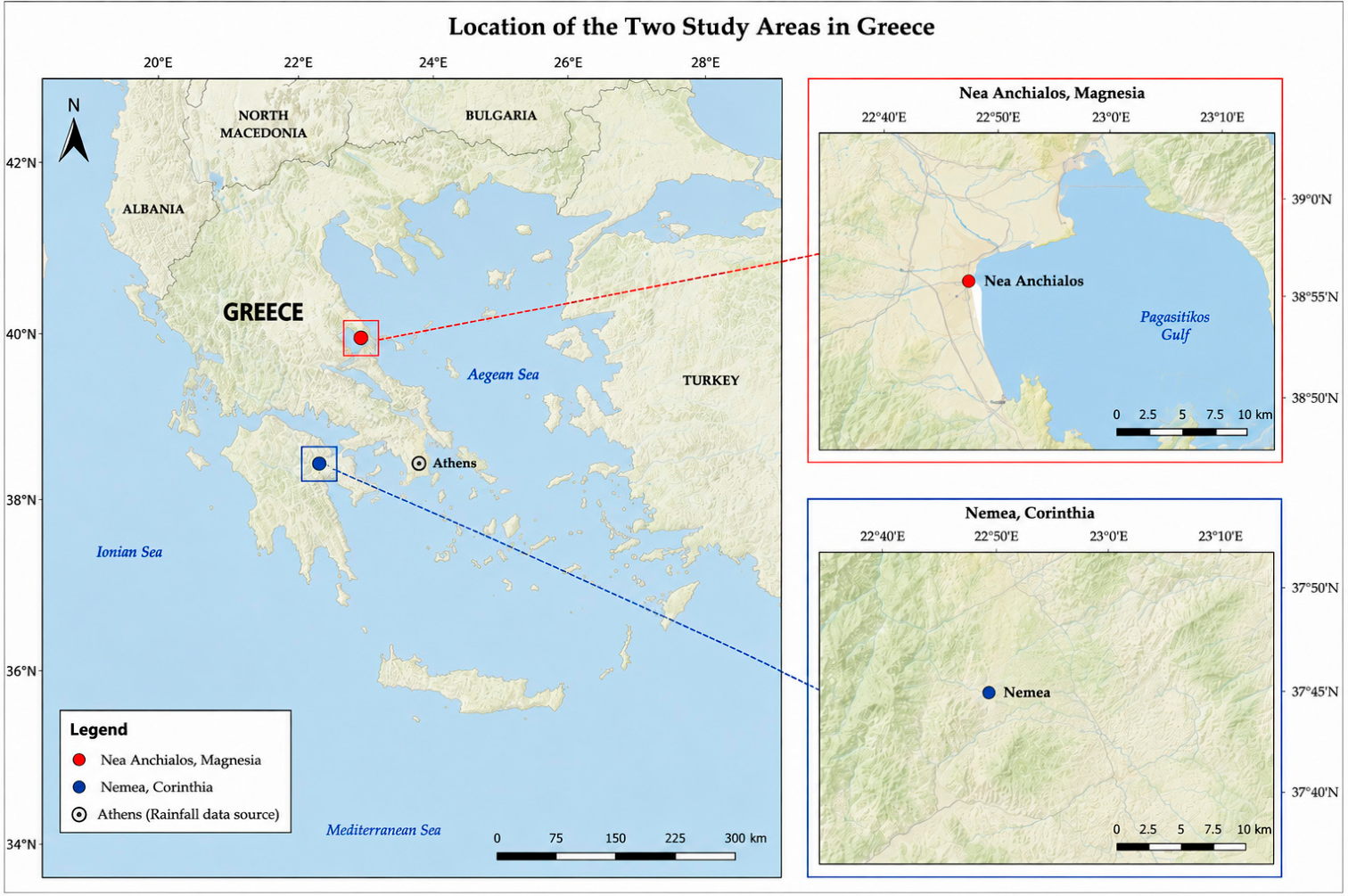
The present study focuses on two regions with strong wine-making interest: the Regional Units of Corinthia and Magnesia. These areas were selected because of their established viticultural activity and their different climate and geography, which allow a comparison of the proposed technologies. Corinthia, in the northeastern Peloponnese, is one of the main wine-producing regions in Greece and includes the Nemea Protected Designation of Origin (PDO) zone, which is a mountainous area, known for its large vineyard area, high wine production, and many wineries. In contrast, Magnesia, located in Thessaly, has a smaller but locally important wine sector, especially in the coastal area of Nea Anchialos, where vine cultivation supports local wine production and related agricultural activities. The locations of the two study areas are shown in Figure 1.
Although indicative figures reported in the literature suggest that Corinthia has a substantially larger vineyard area compared to Magnesia, consistent and officially disaggregated statistical data at the regional unit level are not readily available in public datasets, and therefore such values should be interpreted as approximate representations of regional viticultural scale. The presence of long-standing local cooperatives and established wine production traditions further highlights the agricultural and economic importance of both regions within the Greek viticultural landscape.
Figure 1.
Geographical location of the study areas in Greece, including Nea Anchialos (Magnesia) and Nemea (Corinthia).
The present study is based on a top-down simulation approach and does not refer to specific experimental vineyard plots. Therefore, vineyard characteristics, such as grape variety and planting density, were not explicitly considered in the analysis. The simulations represent typical wine-grape cultivation conditions in the two study areas. Irrigation was assumed to be applied through a drip irrigation system during the main irrigation period, i.e., from March to September. Crop water requirements were estimated according to the FAO-56 methodology, using the corresponding crop coefficient values for wine grapes.
2.2. Climate and Rainfall Characteristics
The climate in Greece is typically Mediterranean. That broadly means that there is a cold and rainy season lasting from mid-October until the end of March while the period from April to September is generally warm and dry, with limited rainfall. Long sunshine duration is also characteristic of most parts of the year. Due to the country’s complex topography, several climatic subtypes occur within the broader Mediterranean climate regime across different regions of Greece.
For the purposes of the present study, two representative rainfall stations were selected, one for each study area where the RWH tanks and photovoltaic systems will be installed, based on the availability and completeness of daily rainfall records. The rainfall data used for the tank sizing analysis were obtained from the database of the National Observatory of Athens for the period 2001–2021. The selected dataset covers 20 hydrological years (2001/02–2020/21), thus exceeding the minimum rainfall record length of 10 years recommended for rainwater harvesting tank sizing by Tsihrintzis et al. [22]. This 20-year rainfall record, although smaller than the typical 30-year climatological normal, contains both dry and wet clusters, thus being considered quite representative of the long-term climatic variability of the broader Mediterranean.
2.3. Daily Water Balance Simulation Model
A daily water balance simulation model was adopted following the approach proposed by Londra et al. [14], in which rainfall, the effective catchment area of the photovoltaic panels, the runoff coefficient, storage tank capacity, irrigation water demand, and evapotranspiration losses (expressed in volumetric terms) are considered on a daily time step. A daily time step was selected because RWH system performance depends on the sequence of rainfall dynamics and irrigation demand, allowing tank storage, overflow and water deficits to be calculated day by day, while coarser-scale data smooth rainfall variability and intermittency effects which are important for representing short-term storage dynamics and tank sizing. Therefore, daily rainfall and evapotranspiration data were used in the water balance model, as also employed in numerous previous RWH studies [14,15].
Although a sensitivity analysis comparing daily and coarser temporal resolutions was not performed, monthly or seasonal time steps may provide comparable estimates of total water availability. However, such temporal aggregation cannot explicitly represent daily changes in tank storage, overflow, and water deficits. Since the present study evaluates RWH system performance and reliability for different storage capacities, rather than total annual water availability alone, a daily time step was retained.
For each simulation day, a preliminary tank water balance is first calculated as
where is the unconstrained preliminary storage balance, is the actual stored water volume at the end of the previous day, is the harvested rainwater volume, is the daily gross irrigation water requirement of the vineyard, calculated as described in Section 2.3.2, and represents evaporation losses from the storage tank. In the present study, was considered negligible because closed tanks were assumed. All variables are expressed in terms of equivalent water depths (mm).
The preliminary storage balance is subsequently constrained by the physical limits of the tank, as described in Section 2.3.3. Therefore, negative tank storage is not permitted in the simulation. A negative preliminary balance results in zero actual tank storage and an external water requirement, whereas a preliminary balance exceeding the tank capacity results in overflow. The water balance simulation model is embedded within an optimization context, to estimate the required tank volume ensuring a desirable reliability level. For a given storage capacity, it also allows for evaluating the system’s performance under varying hydrological conditions.
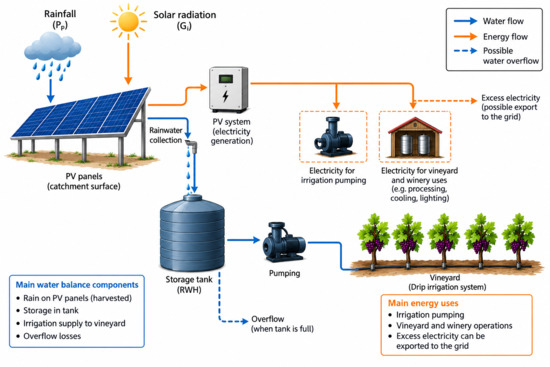
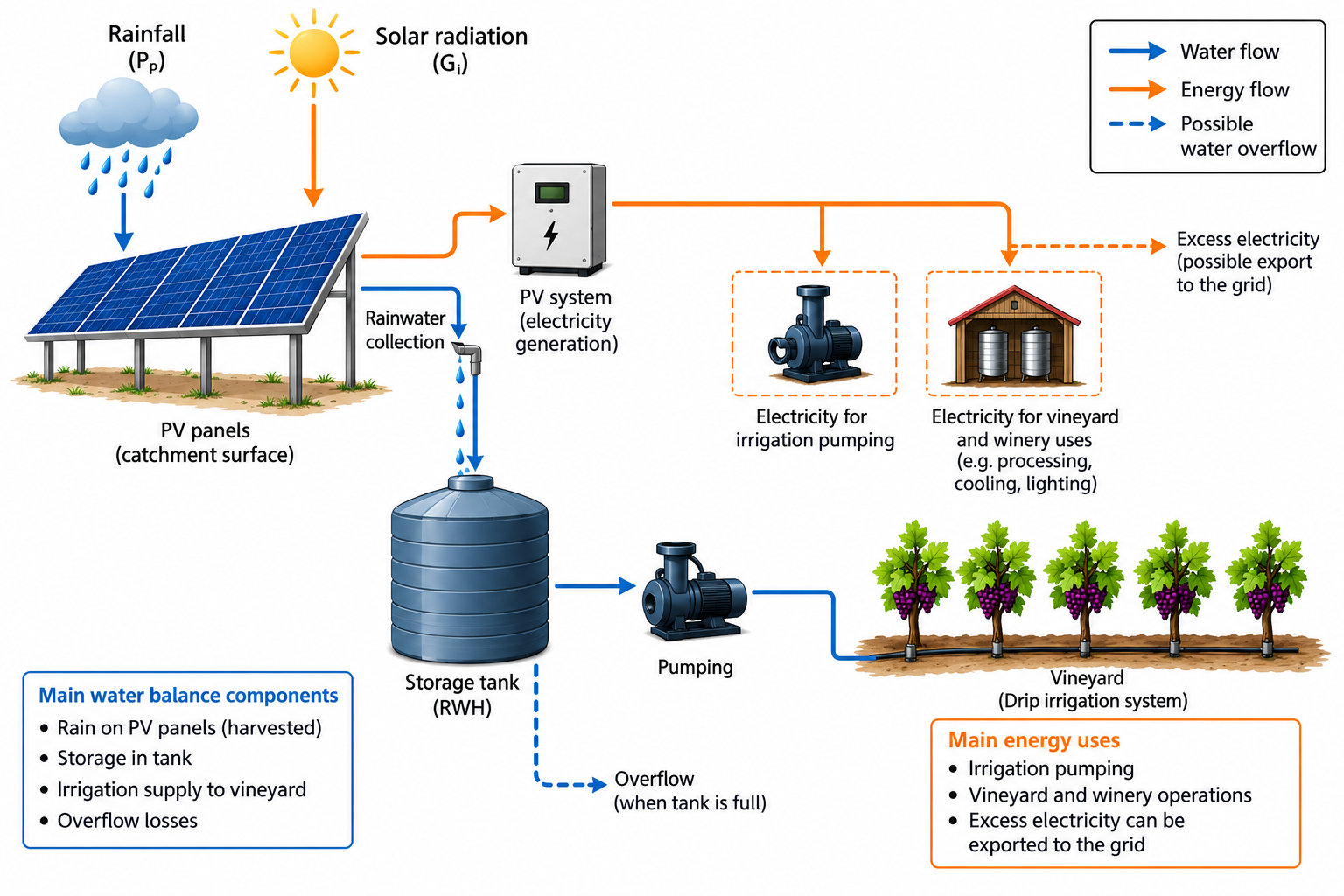
The configuration of the integrated rainwater harvesting and photovoltaic (RWH–PV) system considered in the present study is schematically illustrated in Figure 2.
Figure 2.
Schematic representation of the integrated rainwater harvesting–photovoltaic (RWH–PV) system considered in the study.
2.3.1. Harvested Rainwater Volume
The daily volume of harvested rainwater from the photovoltaic panel surface, denoted as , is estimated as follows:
where is the so-called runoff coefficient, Ap is the effective photovoltaic catchment area projected onto the horizontal plane (m2), and Pt is the daily rainfall depth at the end of t-th day (mm).
Rainfall depth was considered with respect to the horizontal plane, as conventionally reported by meteorological stations. In the present analysis, an effective horizontal PV catchment area of 500 m2 was adopted, incorporating a panel slope of 35°. A runoff coefficient of C = 0.90 was used to account for minor collection losses from the smooth and impervious PV surface. The estimation of harvested rainwater follows the conventional rainfall–runoff approach, in which the collected volume is determined from catchment area, rainfall depth, and runoff efficiency [23].
2.3.2. Soil Water Storage and Irrigation Demand
The soil water storage within the vineyard root zone (SWt) is simulated by using a daily water balance approach, representing the soil as a conceptual dynamic reservoir replenished by the effective rainfall and depleted by crop evapotranspiration:
where is the soil water storage at the end of -th day (mm), is the soil water storage at the beginning of -th day (mm), is the daily effective rainfall (mm), and is the daily crop evapotranspiration (mm day−1).
Following the FAO-56 methodology [24], medium-textured soil conditions and an effective rooting depth of 1.5 m were used to represent the soil–plant system. An available water content of 0.16 m3 m−3 was assumed for the representative soil conditions. Thus, the total available water (TAW) in the root zone was calculated as 240 mm. The readily available water (RAW), i.e., the fraction of total available water that can be depleted before crop water stress occurs, can be calculated as RAW = p × TAW, where p is the soil water depletion factor.
Using the above-mentioned soil conditions, effective rooting depth and an assumption of depletion factor , the readily available soil water was calculated as RAW = 0.70 × 240 = 168 mm. In the present model, SWt represents the remaining readily available soil water in the root zone, which is constrained between 0 and 168 mm.
When is insufficient to meet crop water requirements, “external” water provided through irrigation is required to maintain non-stress conditions and sustain potential crop evapotranspiration rates. When is fully depleted (), the crop water requirements must be supplied through irrigation.
The irrigation period was assumed to extend from March to September, corresponding to the main stages of vine growth and development under Mediterranean climatic conditions. Within this period, daily irrigation requirements were subsequently calculated as follows:
where Dt is the daily gross irrigation requirements (mm), ETc,t is the daily crop evapotranspiration, Kc is the crop coefficient, ET0,t is the daily reference evapotranspiration (mm), and ei is the irrigation application efficiency.
The crop coefficient is varying according to the vineyard growth stage, adopting the values recommended by FAO-56 [24] for wine grapes: Kc,ini = 0.30, Kc,mid = 0.70, and Kc,end = 0.45. The variable ET0,t is calculated on the grounds of meteorological data, by using the FAO Penman–Monteith equation [25]. The daily effective rainfall Pef,t is estimated assuming that 80% of the measured rainfall contributes to soil water storage, following previous irrigation studies under Greek vineyard conditions [26]. By considering well-managed drip irrigation systems, the irrigation application efficiency is set equal to ei = 0.90.
The irrigation demand represents the daily gross irrigation water requirement of the vineyard. It is calculated from the crop evapotranspiration requirement not covered by effective rainfall and available soil water and is adjusted for the irrigation application efficiency. When the effective rainfall and stored available water were sufficient to meet crop evapotranspiration (), the irrigation requirements are set equal to zero ().
Conversely, when crop evapotranspiration exceeds the available water supply by effective rainfall and soil water storage, the deficit is assumed to be fully covered by irrigation, adjusted by the irrigation system efficiency, ei.
Under complete depletion conditions, where soil water storage is exhausted (), the irrigation demand approaches the full crop evapotranspiration requirements.
Daily changes in soil water are governed by the balance between incoming effective rainfall and outgoing crop evapotranspiration. When rainfall occurs, the soil water is first replenished up to its maximum capacity, while any excess water beyond this threshold is considered as surface runoff or percolation. Conversely, when evapotranspiration exceeds available soil water, irrigation is required to cover the deficit.
Finally, assuming that irrigation is applied through a drip irrigation system with an application efficiency of 0.90, the average annual irrigation requirements were calculated at 350 mm/y in the Nea Anchialos area and at 250 mm/y in the Nemea area.
2.3.3. Reliability Optimization Approach for Rainwater Tank Sizing
Based on the previously defined equations, the model combines the daily harvested rainwater from the PV panels with the daily gross irrigation water requirement. For each simulation day, the preliminary balance calculated using Equation (1) is constrained by the physical storage limits of the tank as follows:
where Stank,t is the actual available water volume stored in the tank at the end of -th day, is the unconstrained preliminary storage balance calculated using Equation (1), and Vtank is the tank storage capacity.
When the tank is full, the overflow volume, Ot, can be calculated as follows:
Overflow occurs only after the irrigation demand has been fully met. Conversely, when the stored rainwater volume in the tank, Stank,t is inadequate to meet the demand, Dt, the deficit will be met by an external water supply, Tt, such as the public water network or a private drill, calculated as follows:
In the present study, an initially empty rainwater tank is assumed, and an effective rainwater catchment area of 500 m2 was considered.
A reliability metric, Re, is applied as an indicator of the performance of the rainwater harvesting (RWH) system in satisfying a predefined water demand. In the present study, reliability is empirically defined as the percentage of simulation days during which the water demand is fully met by the stored rainwater. Mathematically, it is expressed as
where Ns is the number of days water demand is fully met, and Ntot is the total number of simulation days. By setting a specific reliability level, the minimum required storage capacity of the RWH tank is determined by solving the underlying optimization problem.
2.4. Photovoltaic Systems
Photovoltaic panels installed in non-exploited parts of vineyards can serve two purposes: renewable energy production and rainwater collection for irrigation. In the present study, the PV panels were assumed to be installed adjacent to the vineyard rather than above the vine rows; therefore, PV-induced shading effects on vineyard evapotranspiration were not considered. A PV system with a nominal capacity of 100 kWp was considered, consisting of approximately 250 modules of 400 W each. For the rainwater harvesting analysis, an effective PV catchment area of 500 m2 was adopted. The panels were assumed to be installed at a fixed tilt angle of 35°, allowing rainfall runoff to be directed towards the rainwater storage system.
According to Greek Law 5106/2024, the installation of photovoltaic systems on agricultural land is subject to specific regulations. Farmers are allowed to install systems with a capacity of up to 1.0 MW, provided that the panels do not exceed 0.8% of the arable land in each Regional Unit. Systems below 1.0 MW are exempt from full environmental permitting, as long as a “Certificate of Exemption from Environmental Approval” is obtained [27].
Table 1 presents the estimated average annual specific energy yield of photovoltaic systems in the two study areas, expressed in kWh/kWp. The values were obtained from the Photovoltaic Geographical Information System (PVGIS), developed by the European Commission Joint Research Centre (JRC), and were subsequently used to estimate the annual electricity production of the considered 100 kWp PV system [28]. The estimated average annual specific energy yield is slightly higher in Nemea (1560 kWh/kWp) than in Nea Anchialos (1490 kWh/kWp), according to the PVGIS estimates for the two study locations. The resulting annual capacity factors are 17.8% and 17.0%, respectively, which are in agreement with recent estimates, based on detailed spatial analyses of the PV solar potential of Greece [29].
Table 1.
Estimated average annual specific energy yield of photovoltaic systems in the study areas.
Estimation of Electric Power Generation
According to the current regulatory framework, photovoltaic systems installed on agricultural land are subject to specific restrictions regarding their capacity and the area occupied by the installation [27]. These restrictions should therefore be considered when planning a PV system in agricultural areas.
In the present study, an effective PV catchment area of 500 m2 is considered for the rainwater harvesting analysis, as described in Section 2.3.1. For the energy analysis, a nominal PV system capacity of 100 kWp is assumed. The PV system is installed adjacent to the vineyard. Annual electricity production is estimated using the average annual specific energy yields obtained from PVGIS and presented in Table 1 [28]. The annual energy production is calculated as
where Epv is the annual electricity production (kWh year−1), Pinst is the nominal installed PV capacity (kWp), and is the average annual specific energy yield (kWh kWp−1 year−1).
Accordingly, for the considered 100 kWp system, the estimated annual electricity production is 149 MWh in Nea Anchialos and 156 MWh in Nemea. The generated electricity could contribute to covering the energy requirements of vineyard operations, while any surplus electricity could potentially be supplied to the electricity grid.
3. Results
Daily rainfall data from the two stations were analyzed to determine the mean annual rainfall (P), and the maximum (Ndd, max), minimum (Ndd, min), and mean (Ndd) lengths of the longest annual dry spells, as reported in Table 2. The two stations record substantially different amounts of annual rainfall; however, the duration of associated dry periods is quite similar, ranging from approximately 2.5 to 3.0 consecutive months. More specifically, the “Nemea” station records a mean annual rainfall of 637 mm and a mean longest dry period of 45.2 days, while the “Nea Anchialos” station records lower mean annual rainfall of 485 mm, accompanied by a slightly longer mean dry period of 52.1 days.
Table 2.
Mean annual rainfall (P) and the mean, maximum, and minimum durations of the longest annual dry periods (Ndd, Ndd,max, and Ndd,min) at the studied stations over 20 hydrological years (2001/02–2020/21).
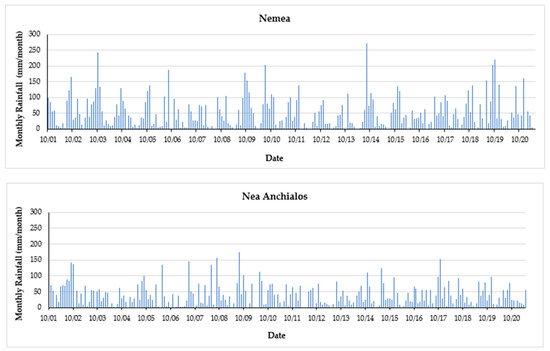
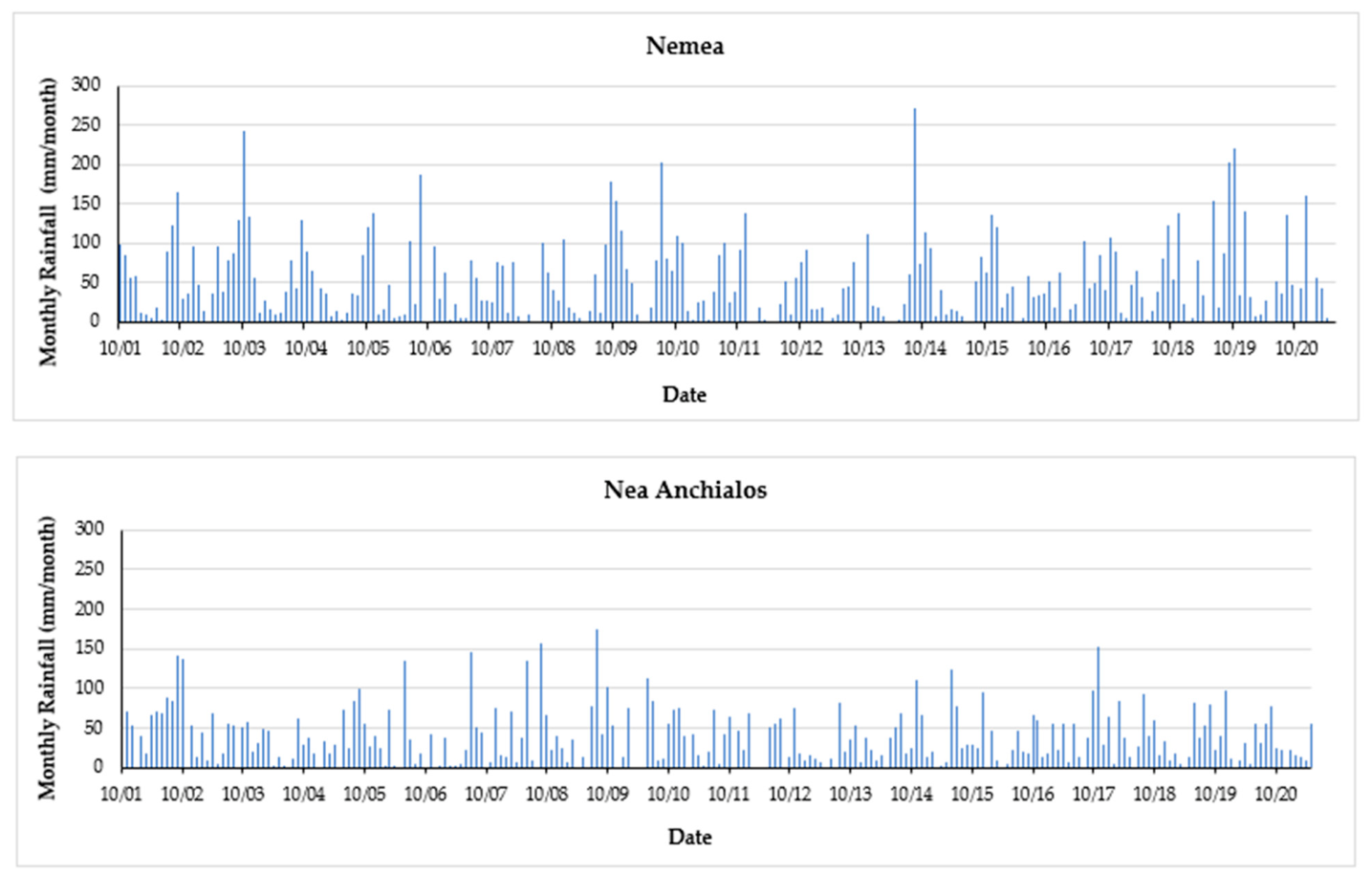
Figure 3 illustrates the monthly rainfall time series over the 20 hydrological years (2001/02–2020/21). At both stations, rainfall is predominantly concentrated during the wet season (October to April). This pattern is followed by a distinct dry period during the summer months (May to September), which is a characteristic feature of the Mediterranean climate.
Figure 3.
Monthly rainfall time series over 20 hydrological years (2001/02–2020/21) at meteorological stations: Nemea (Corinthia, Greece); and Nea Anchialos (Magnesia, Greece).
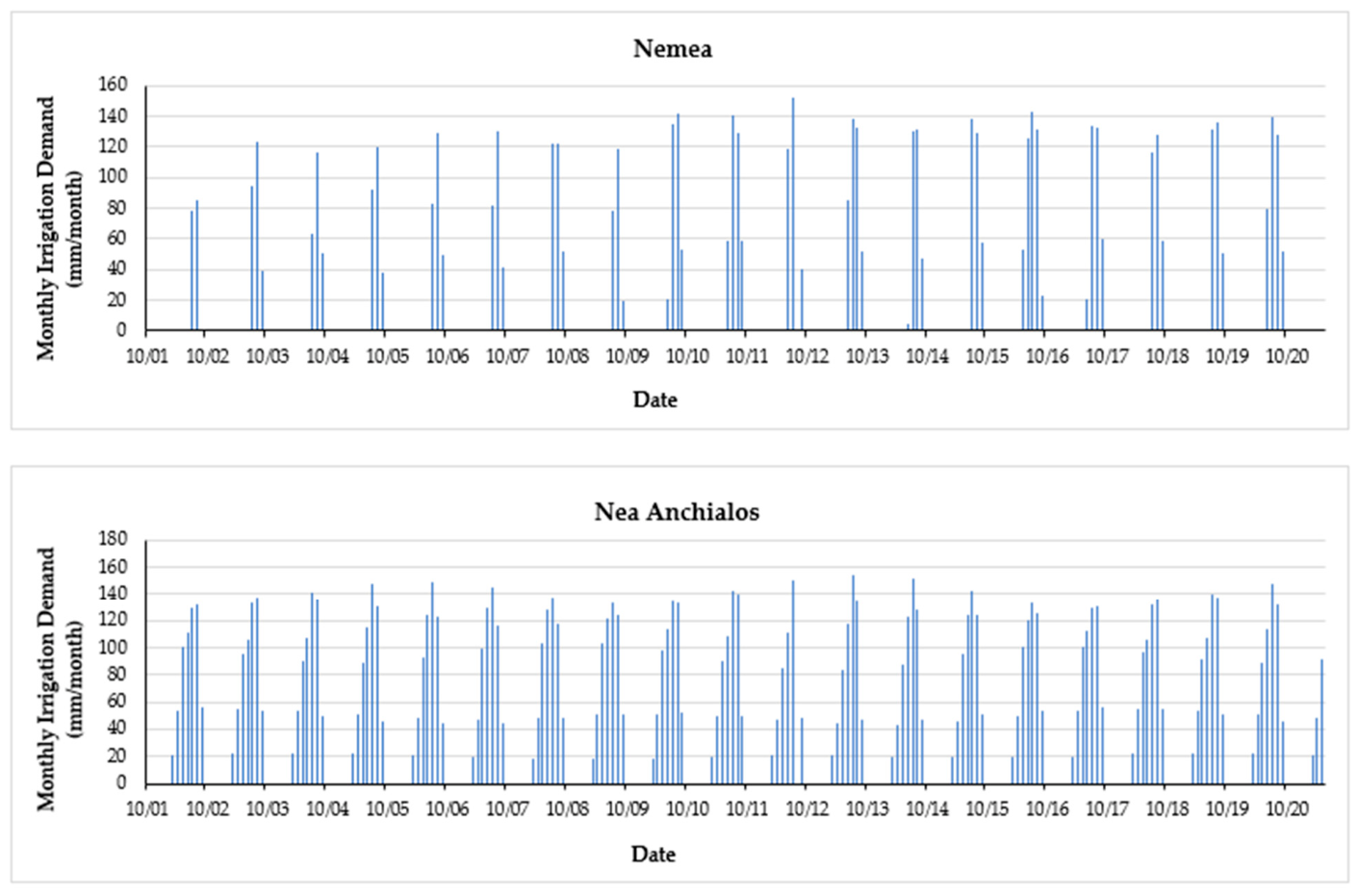
Figure 4 illustrates the water requirements for irrigation over 20 hydrological years (2001/02–2020/21), highlighting the temporal variability throughout the year. Increased water demand is observed during the summer months, reflecting higher potential evapotranspiration rates and reduced rainfall, while lower irrigation requirements are evident during the winter period.
Figure 4.
Monthly irrigation water demand over 20 hydrological years (2001/02–2020/21) at Nemea (Corinthia, Greece) and Nea Anchialos (Magnesia, Greece).
The seasonal patterns shown in Figure 3 and Figure 4 also provide an indication of the periods during which stored rainwater is most likely to be available or depleted. Tank replenishment occurs mainly during the wetter autumn and winter months, when rainfall is relatively high and irrigation demand is low or absent. Conversely, stored water is progressively depleted during the spring and summer irrigation period, when rainfall becomes limited and crop water demand increases. Consequently, water deficits are more likely to occur during prolonged dry periods in the main irrigation season, particularly in Nea Anchialos and for larger cultivated areas. The exact timing and duration of individual deficit periods vary among hydrological years because of interannual rainfall variability.
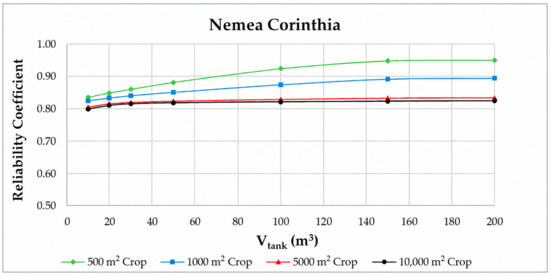
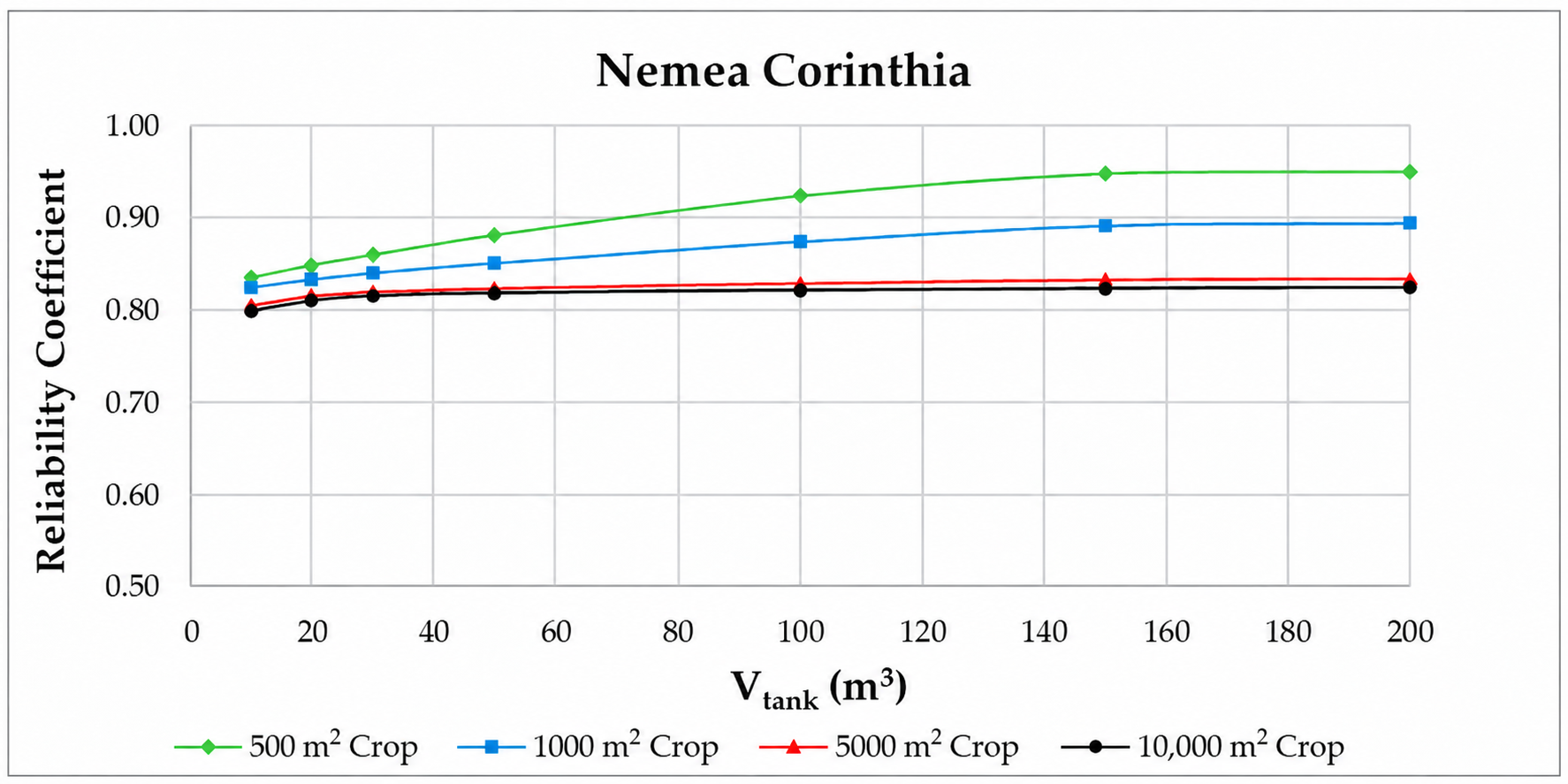
Figure 5 and Figure 6 illustrate the reliability curves of the rainwater harvesting system in meeting irrigation demands, as a function of storage tank volume, for a catchment area of 500 m2 and cultivated areas ranging from 500 to 10,000 m2 in the regions of Nemea and Nea Anchialos. As shown in Figure 5, for a cultivated area of 500 m2, the system reliability coefficient (Re) ranges from 84% to 95% for storage tank volumes between 10 and 200 m3, respectively. As the cultivated area increases, the reliability coefficient decreases for the same range of tank sizes, given that the rainwater catchment area remains constant. However, it is worth noting that in all cases the reliability remains above 80%, which is quite a satisfactory value for irrigation purposes.
Figure 5.
Reliability curves of the rainwater harvesting system for meeting irrigation demands as a function of storage tank volume (Vtank), for a catchment area of 500 m2 and cultivated areas ranging from 500 to 10,000 m2 in the region of Nemea (Corinthia).
Figure 6.
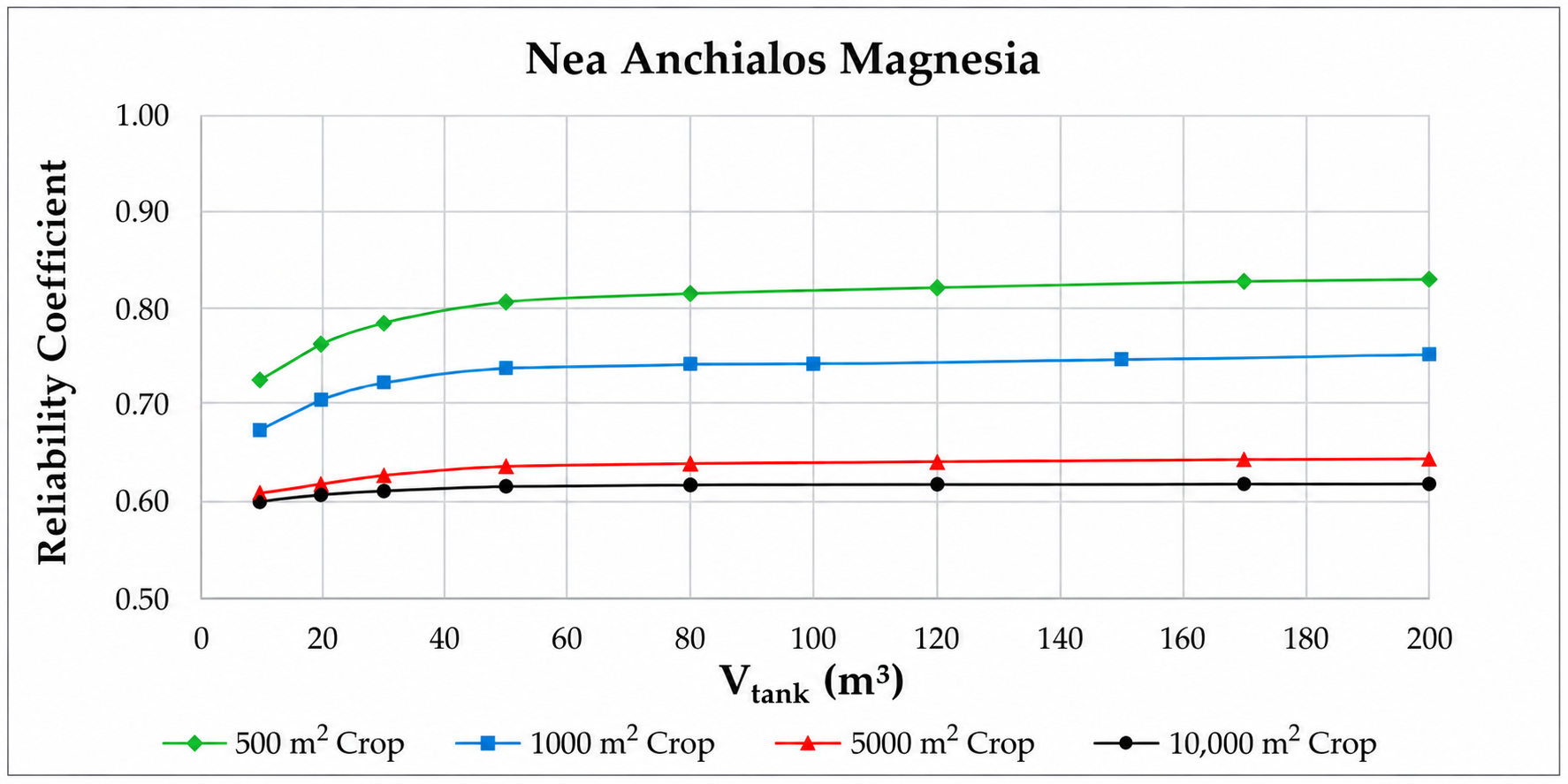
Reliability curves of the rainwater harvesting system for meeting irrigation demands as a function of storage tank volume (Vtank), for a catchment area of 500 m2 and cultivated areas ranging from 500 to 10,000 m2 in the region of Nea Anchialos (Magnesia).
In the case of Nea Anchialos, the reliability is lower, which is expected given that this area receives approximately 150 mm less rainfall on average annually, resulting in reduced rainwater collection. Specifically, for a cultivated area of 500 m2, the system reliability coefficient ranges from 72% to 82% for storage tank volumes between 10 and 200 m3, respectively. The value of reliability decreases as the cultivated area increases; however, it remains above 60% in all cases examined.
The relatively small differences observed between some reliability curves, particularly for the larger irrigated areas, indicate that increasing tank capacity alone does not always result in a proportional improvement in system performance. When the rainwater catchment area remains fixed at 500 m2, the total volume of water that can be harvested becomes the main limiting factor as the irrigated area increases. Under these conditions, enlarging the storage tank cannot fully compensate for the imbalance between the available harvested rainwater and the larger irrigation demand. This explains the progressive flattening and convergence of some reliability curves for larger irrigated areas and highlights the importance of considering the relationship between catchment area, irrigation demand, and tank capacity rather than tank size alone.
From a practical perspective, the reliability curves can be used to identify indicative storage ranges rather than a single universally optimal tank size. For a cultivated area of 500 m2, tank volumes of approximately 100–150 m3 in Nemea provide reliability values above 90%, while further increases result in relatively small gains. In Nea Anchialos, most of the improvement for the same cultivated area is achieved with approximately 50–80 m3, after which reliability approaches a plateau near 80%. For larger cultivated areas, particularly 5000–10,000 m2, increasing tank volume only produces limited improvements because the fixed 500 m2 rainwater catchment area becomes the main constraint. Therefore, in such cases, increasing the catchment area would be more effective than further increasing tank capacity. These values should be considered indicative for the simulated conditions rather than universal design recommendations, since the appropriate storage volume also depends on the target reliability level and local rainfall conditions.
4. Discussion
The results are generally consistent with previous RWH studies carried out under Mediterranean conditions. Londra et al. [14], using a daily water balance model for greenhouse irrigation in Greece, also reported that increasing tank volume improves system reliability, although the additional benefit becomes progressively smaller for larger storage capacities. Similarly, Londra et al. [15] showed that the rainfall regime and the duration of dry periods strongly affect the required storage capacity and the reliability of RWH systems. Although these studies focused on greenhouse crops rather than vineyards, the same general behavior is observed in the present study. In particular, the higher reliability obtained for Nemea compared with Nea Anchialos reflects the higher annual rainfall available for rainwater harvesting. These findings confirm that RWH tank sizing cannot be considered independently of local rainfall conditions, irrigation demand and the relationship between catchment and cultivated areas.
Regarding combined PV-RWH systems, García-Chica et al. [17] demonstrated the potential of using PV surfaces for both energy production and rainwater harvesting. In the present study, the emphasis is placed on the long-term reliability of RWH for vineyard irrigation under two different Greek climatic conditions, together with the associated PV energy production. Regarding the use of PV surfaces for rainwater harvesting, the present study focuses on the quantity of collected water and does not assess its quality. Since water quality may be affected by surface contaminants, appropriate first-flush management and water quality monitoring could be considered before irrigation use [30]. The electricity produced by the PV systems can be used for different purposes within vineyard operation, with the potential to increase energy self-sufficiency and reduce the amount of electricity drawn from the grid. Main uses include powering groundwater pumps, supporting drip irrigation systems, storing energy on-site and possibly supplying electricity to winery facilities.
Irrigation can represent an important component of vineyard energy use because electricity is required for water pumping and pressurization. In drip irrigation systems, the actual energy demand depends mainly on pumping head, system pressure, operating time, and pump efficiency [31]. Accordingly, the energy required for irrigation can vary considerably among vineyards and irrigation system configurations.
Vineyard studies reported substantial variability in irrigation related electricity consumption, depending mainly on irrigation requirements, pumping head and system configuration. For example, electricity use for vineyard irrigation pumping has been reported to range from approximately 1000 to 3750 kWh ha−1 under different irrigation regimes [32], while other grape production studies have reported values around 685 kWh ha−1 [33].
A general estimate of the energy required for the operation of the irrigation system can be made by assuming an average operating time of 2 to 4 h per irrigation event over a 120-day irrigation period. Taking into account the pump characteristics, the annual energy consumption for irrigation pumping is estimated to range from approximately 120 to 700 kWh per 1000 m2 per year.
In cases where groundwater is extracted through boreholes, higher-capacity pumps are generally required. For pumping depths of 30–80 m, submersible pumps with rated power of 1.5 to 3.0 kW are often used. Assuming an average daily operating time of 2–3 h, the annual energy consumption for groundwater pumping is estimated to range from about 1000 to 3000 kWh, depending on irrigation demand and aquifer depth.
As for the operation of a drip irrigation system, little additional energy beyond water pumping is needed, since it operates at low pressure (generally 1 to 2 bars). This makes it more efficient than sprinkler systems [34]. In this study, the PV system produces about 149–156 MWh per year, while the vineyard’s direct energy demand is only a small part of this amount. This leaves a large energy surplus, which can be used for other farm operations or applications.
A temporal mismatch may arise between PV electricity generation and irrigation energy demand, since PV generation is concentrated during daylight hours, whereas irrigation may be scheduled during cooler periods of the day or at night. Battery energy storage systems (BESS) may mitigate this mismatch by storing excess electricity generated during the day for later use. Such systems can increase energy availability during non-solar hours and improve on-site self-consumption [35]. However, their effectiveness depends on the temporal profiles of PV generation and irrigation demand, as well as on the selected battery capacity and operating strategy. Alternatively, excess electricity may be exported to the grid, subject to the applicable regulatory and market framework, potentially providing an additional source of income and improving the economic viability of the investment.
Moreover, the electricity produced could be used to operate small or medium-sized winery facilities. Energy use in wineries can typically range from 0.2 to 0.6 kWh per liter of wine produced, depending on the level of mechanization and processing needs [36]. For instance, a facility producing 100 m3 per year would need around 20,000 to 60,000 kWh annually, which can be supplied by a part of the PV system’s yearly output.
In summary, adding photovoltaic systems to a vineyard can provide energy for irrigation and water management, while surplus electricity may also be used for other farm or winery activities or supplied to the electricity grid. This flexible use of energy can improve both the sustainability and the economic performance of vineyard businesses.
From an economic perspective, the annual PV production estimated in this study (149–156 MWh) indicates a considerable potential for reducing electricity purchased from the grid, particularly when part of the generated electricity is directly used for irrigation pumping or winery operations. However, the actual economic benefit depends on several factors, including the level of self-consumption, electricity prices, the applicable compensation scheme for electricity exported to the grid, as well as the investment and operating costs of the PV system. Therefore, a complete economic assessment would require a detailed analysis of the temporal energy demand of each vineyard or winery together with investment-specific cost data. Such an analysis is beyond the scope of the present study but represents an important next step for evaluating the economic feasibility of the proposed system.
5. Conclusions
This study evaluated the combined use of rainwater harvesting (RWH) and photovoltaic (PV) systems as a means of improving water and energy management in vineyards in two areas of Greece, Nemea and Nea Anchialos. The results showed that RWH systems can cover a significant percentage of the irrigation water demand, with a reliability coefficient Re ranging from 60% to 95%, depending on the rainfall regime of the study area, the tank volume and the vineyard size. The highest reliability values were observed in Nemea, due to its favorable climatic characteristics.
Furthermore, the analysis of the results showed that increasing the volume of the RWH tank improved the reliability of the system, although the benefit gradually decreases after a certain tank volume. Therefore, the need for proper tank sizing is highlighted, based mainly on the relation between rainfall and irrigation requirements of the vineyard in each study area and not only on maximizing the tank volume.
The addition of photovoltaic panels, not only ensures the rainwater collection surface of the RWH system, but also produces renewable energy and consequently enhances the overall efficiency of the system. The estimated annual energy production, which ranges from 149 to 156 MWh, is higher than the typical energy needs of viticultural activities, creating an energy surplus that could be directly used for other farm or winery activities or supplied to the electricity grid.
A limitation of the present study is that the analysis is based on typical vineyard conditions and not on measurements from specific vineyard plots. In addition, PV energy production was estimated on an annual basis rather than measured in an operating vineyard system; consequently, the hourly matching between PV generation and irrigation energy demand and the required battery storage capacity were not examined. Also, potential shading effects of the PV panels on crop water requirements were not considered, since the panels were assumed to be installed next to the vineyard. Future research could include field validation of the RWH–PV system, evaluation of different PV catchment areas and rainwater tank sizes under future climate scenarios, and a detailed economic analysis of the RWH–PV system. In conclusion, it can be asserted that the combined application of RWH and PV systems constitutes a technically promising approach for vineyards, especially in areas where water and energy management are particularly important. The proposed system can contribute to more efficient use of available resources and enhance the resilience of viticultural production in conditions of climate variability.
Author Contributions
Conceptualization, N.T., P.L. and A.E.; methodology, N.T., P.L. and A.E.; software, N.T. and P.L.; validation, N.T., P.L. and A.E.; formal analysis, N.T.; data curation, N.T.; visualization, N.T.; supervision, P.L. and A.E.; writing—original draft preparation, N.T.; writing—review and editing, N.T., P.L. and A.E. All authors have read and agreed to the published version of the manuscript.
Funding
This research received no external funding.
Data Availability Statement
The original contributions presented in this study are included in the article. Further inquiries can be directed to the corresponding authors.
Acknowledgments
The authors would like to thank the reviewers and the Editors for their valuable and constructive comments, as well as for the timely handling and decisions throughout the review process.
Conflicts of Interest
The authors declare no conflicts of interest.
References
- European Environment Agency. Water Resources Across Europe—Confronting Water Stress: An Updated Assessment; European Environment Agency: Copenhagen, Denmark, 2019.
- Organization for Economic Co-Operation and Development (OECD). Water Use in Agriculture in Greece; OECD Publishing: Paris, France, 2023. [Google Scholar]
- Hellenic Ministry of Environment and Energy. National Energy and Climate Plan; Government of Greece: Athens, Greece, 2023.
- Food and Agriculture Organization of the United Nations (FAO). Climate Change and Viticulture; FAO: Rome, Italy, 2013. [Google Scholar]
- Keller, M. The Science of Grapevines: Anatomy and Physiology; Academic Press: San Diego, CA, USA, 2010. [Google Scholar]
- Jones, G.V.; White, M.A.; Cooper, O.R.; Storchmann, K. Climate Change and Global Wine Quality. Clim. Change 2005, 73, 319–343. [Google Scholar] [CrossRef] [Scilit]
- Shtull-Trauring, E.; Cohen, A.; Ben-Hur, M.; Israeli, M.; Bernstein, N. NPK in treated wastewater irrigation: Regional scale indices to minimize environmental pollution and optimize crop nutritional supply. Sci. Total Environ. 2022, 806, 150387. [Google Scholar] [CrossRef] [Scilit] [PubMed]
- Matias, P.; Trindade, A.R.; Magalhães, T.; de Souza, S.L., Jr.; Duarte, B.; Coelho, L.; Freitas, M.; Barrote, I.; Duarte, A. The Ecosystem Services of Irrigated Orchards: A Review. Agriculture 2026, 16, 1336. [Google Scholar] [CrossRef] [Scilit]
- Walston, L.J.; Barley, T.; Bhandari, I.; Campbell, B.; McCall, J.; Hartmann, H.M.; Dolezal, A.G. Opportunities for agrivoltaic systems to achieve synergistic food-energy-environmental needs and address sustainability goals. Front. Sustain. Food Syst. 2022, 6, 932018. [Google Scholar] [CrossRef] [Scilit]
- Pereira, L.S.; Cordery, I.; Iacovides, I. Coping with water scarcity: Addressing the challenges. In Agricultural Water Management in the 21st Century; Springer: Berlin/Heidelberg, Germany, 2009. [Google Scholar]
- Pimenow, S.; Pimenowa, O.; Sitnicki, M.W.; Dluhopolskyi, O.; Zieliński, M. Energy Use, Costs and Economic Resilience of EU Agriculture: The Role and Potential of CAP Eco-Schemes in Reducing Energy Intensity. Energies 2026, 19, 1016. [Google Scholar] [CrossRef] [Scilit]
- Romero, P.; Navarro, J.M.; Ordaz, P.B. Towards a Sustainable Viticulture: The Combination of Deficit Irrigation Strategies and Agroecological Practices in Mediterranean Vineyards. A Review and Update. Agric. Water Manag. 2022, 259, 107216. [Google Scholar] [CrossRef] [Scilit]
- Velasco-Muñoz, J.F.; Aznar-Sánchez, J.A.; Batlles-dela Fuente, A.; García-Sánchez, A. Sustainable water use in agriculture: A review. Water 2019, 11, 2259. [Google Scholar] [CrossRef] [Scilit]
- Londra, P.A.; Kotsatos, I.-E.; Theotokatos, N.; Theocharis, A.T.; Dercas, N. Reliability Analysis of Rainwater Harvesting Tanks for Irrigation Use in Greenhouse Agriculture. Hydrology 2021, 8, 132. [Google Scholar] [CrossRef] [Scilit]
- Londra, P.A.; Gkolfinopoulou, P.; Mponou, A.; Theocharis, A.T. Effect of Rainfall Regime on Rainwater Harvesting Tank Sizing for Greenhouse Irrigation Use. Hydrology 2022, 9, 122. [Google Scholar] [CrossRef] [Scilit]
- Yannopoulos, S.; Giannopoulou, I.; Kaiafa-Saropoulou, M. Investigation of the Current Situation and Prospects for the Development of Rainwater Harvesting as a Tool to Confront Water Scarcity Worldwide. Water 2019, 11, 2168. [Google Scholar] [CrossRef] [Scilit]
- García-Chica, A.; Rodriguez-Perez, A.M.; Caparros-Mancera, J.J.; Rodríguez-Gonzalez, C.A.; Chica, R.M. Integrated photovoltaic system for rainwater collection and sustainable irrigation. Irrig. Sci. 2025, 43, 1385–1395. [Google Scholar] [CrossRef] [Scilit]
- Barron-Gafford, G.A.; Pavao-Zuckerman, M.A.; Minor, R.L.; Sutter, L.F.; Barnett-Moreno, I.; Blackett, D.T.; Macknick, J.E. Agrivoltaics provide mutual benefits across the food–energy–water nexus in drylands. Nat. Sustain. 2019, 2, 848–855. [Google Scholar] [CrossRef] [Scilit]
- Roxani, A.; Zisos, A.; Sakki, G.-K.; Efstratiadis, A. Multidimensional Role of Agrovoltaics in Era of EU Green Deal: Current Status and Analysis of Water–Energy–Food–Land Dependencies. Land 2023, 12, 1069. [Google Scholar] [CrossRef] [Scilit]
- Padilla, J.; Toledo, C.; Abad, J. Enovoltaics: Symbiotic integration of photovoltaics in vineyards. Front. Energy Res. 2022, 10, 1007383. [Google Scholar] [CrossRef] [Scilit]
- Magarelli, A.; Mazzeo, A.; Ferrara, G. Exploring the Grape Agrivoltaic System: Climate Modulation and Vine Benefits in the Puglia Region, Southeastern Italy. Horticulturae 2025, 11, 160. [Google Scholar] [CrossRef] [Scilit]
- Tsihrintzis, V.A.; Baltas, E. Determination of rainwater harvesting tank size. Glob. Nest J. 2014, 16, 822–831. [Google Scholar] [CrossRef] [Scilit]
- Kinkade-Levario, H. Design for Water: Rainwater Harvesting, Stormwater Catchment, and Alternate Water Reuse; New Society Publishers: Gabriola Island, BC, Canada, 2007. [Google Scholar]
- Allen, R.G.; Pereira, L.S.; Raes, D.; Smith, M. Crop Evapotranspiration: Guidelines for Computing Crop Water Requirements; Food and Agriculture Organization of the United Nations (FAO): Rome, Italy, 1998; FAO Irrigation and Drainage Paper No. 56. [Google Scholar]
- Allen, R.G.; Jensen, M.E.; Wright, J.L.; Burman, R.D. Operational estimates of reference evapotranspiration. Agron. J. 1989, 81, 650–662. [Google Scholar] [CrossRef] [Scilit]
- Apostolopoulou, C.; Giannelos, M.; Baltzoi, P.; Malamos, N.; Tsirogiannis, I. Evaluation of a decision support system for irrigation management for the case of a Vertzami wine grape orchard in northwest Greece. In Proceedings of the 12th National Congress of the Hellenic Society of Agricultural Engineers, Thessaloniki, Greece, 21–22 October 2021. [Google Scholar]
- Hellenic Republic. Law 5106/2024: Regulations for Addressing the Multilevel Impacts of Climate Change in the Sectors of Water Management, Forest Protection, Urban Resilience, Combating Illegal Construction, Energy Security and Other Urgent Provisions; Government Gazette (FEK) A 63/01.05.2024; National Printing Office: Athens, Greece, 2024; Available online: https://www.et.gr (accessed on 28 June 2026).
- European Commission, Joint Research Centre (JRC). PVGIS—Photovoltaic Geographical Information System. Available online: https://re.jrc.ec.europa.eu/pvg_tools/en/ (accessed on 28 June 2026).
- Zisos, A.; Chatzopoulos, D.; Efstratiadis, A. The Concept of Spatial Reliability Across Renewable Energy Systems—An Application to Decentralized Solar PV Energy. Energies 2024, 17, 5900. [Google Scholar] [CrossRef] [Scilit]
- Gikas, G.D.; Tsihrintzis, V.A. Assessment of water quality of first-flush roof runoff and harvested rainwater. J. Hydrol. 2012, 466–467, 115–126. [Google Scholar] [CrossRef] [Scilit]
- Córcoles, J.I.; Domínguez, A.; Ortega, J.F.; Moreno, M.A. Decision Support System Tool to Reduce the Energy Consumption of Water Abstraction from Aquifers for Irrigation. Water 2019, 11, 323. [Google Scholar] [CrossRef] [Scilit]
- Balafoutis, A.T.; Koundouras, S.; Anastasiou, E.; Fountas, S.; Arvanitis, K. Life Cycle Assessment of Two Vineyards after the Application of Precision Viticulture Techniques: A Case Study. Sustainability 2017, 9, 1997. [Google Scholar] [CrossRef] [Scilit]
- Veisi, H.; Ghazvini, M.; Khoshbakht, K.; Shahmohammadi, A. Sustainable Energy Management: Energy Flow and Economic Analysis of Grape Production. Sustainability 2025, 17, 2372. [Google Scholar] [CrossRef] [Scilit]
- Sokol, J.; Amrose, S.; Nangia, V.; Talozi, S.; Brownell, E.; Montanaro, G.; Abu Naser, K.; Bany Mustafa, K.; Bahri, A.; Bouazzama, B.; et al. Energy Reduction and Uniformity of Low-Pressure Online Drip Irrigation Emitters in Field Tests. Water 2019, 11, 1195. [Google Scholar] [CrossRef] [Scilit]
- Lund, H.; Ostergaard, P.A.; Connolly, D.; Mathiesen, B.V. Energy storage and smart energy systems. Energy 2015, 93, 1–12. [Google Scholar] [CrossRef] [Scilit]
- Martin, R.; Brunner, C.; Simmons, R. Energy and English wine production: A review of energy use and benchmarking. Energy Sustain. Dev. 2014, 23, 85–91. [Google Scholar] [CrossRef] [Scilit]

Disclaimer/Publisher’s Note: The statements, opinions and data contained in all publications are solely those of the individual author(s) and contributor(s) and not of MDPI and/or the editor(s). MDPI and/or the editor(s) disclaim responsibility for any injury to people or property resulting from any ideas, methods, instructions or products referred to in the content. |
© 2026 by the authors. Licensee MDPI, Basel, Switzerland. This article is an open access article distributed under the terms and conditions of the Creative Commons Attribution (CC BY) license.