


Abstract
Maize, as a globally important food crop, is threatened by pests including the fall armyworm (FAW, Spodoptera frugiperda) throughout its production. Current management strategies are largely limited to conventional chemical insecticides and transgenic maize varieties. However, the identification and functional characterization of endogenous insect-resistance genes within maize inbred line populations, as well as the underlying molecular mechanisms governing resistance, remain poorly understood. Here, we systematically evaluate FAW resistance on 300 modern maize inbred lines and 200 recombinant inbred lines (RIL) populations in field, followed by quantitative trait locus (QTL) and genome-wide association studies (GWAS) mapping to screen candidate genes. Our data demonstrate that a β-glucosidase ZmBGLU17 was identified as a key FAW resistance gene, which contributes to the accumulation of two defense metabolites, lignin and DIMBOA. Overexpression of the ZmBGLU17 gene confers enhanced resistance to the FAW by significantly reducing larval survival. Haplotype analysis revealed two distinct haplotypes, with haplotype 1 demonstrating significantly enhanced resistance to FAW infestation compared with haplotype 2. Jointly, our research identified ZmBGLU17 as a key resistance-associated gene against FAW and confirmed its functional role through rigorous genetic validation. Furthermore, haplotype analysis revealed prevalent resistance-linked haplotypes, thereby establishing a molecular foundation for the development of FAW-resistant maize inbred lines.
1. Introduction
Maize (Zea mays L.) is one of the world’s most economically and nutritionally significant cereal crops, serving as a major food source and feed around the world. In recent decades, maize production has seen a steady increase. However, insect feeding causes large losses in maize yield and quality, and remains a pressing global concern. Corn borer, fall armyworm (FAW, Spodoptera frugiperda) and aphids are the main pests. Worldwide, FAW is a major migratory agricultural pest, characterized by rapid spread and severe damage. Generally, FAW infestation is estimated to reduce maize yields by approximately 20% annually, and there may even be total maize failure in severely damaged plots. Conventional control strategies chemical and biological means have delivered only partial and often unsustainable efficacy [1,2,3], making the identification and deployment of endogenous pest-resistant genes through marker-assisted or genomic breeding represents the most economically viable, environmentally sustainable, and long-term effective strategy for mitigating FAW damage.
Maize employs a multilayered defense system comprising both constitutive and inducible mechanisms against herbivore attack [4,5]. Key regulatory phytohormones including jasmonic acid (JA), salicylic acid (SA), and ethylene (ET) display distinct defensive responses for maize insect, while specialized metabolites such as benzoxazinoids (Bxs) serve as critical chemical effectors to against maize insect [6,7,8]. JA and ET are more protected against chewing insects, but SA is especially effective against piercing–sucking insects [9,10]. Maize JA biosynthesis mutant lox10 was significantly susceptible to the insect beet armyworm (Spodptera exigua) [11], and JA-deficient opr7 opr8 mutants were susceptible to S. exigua [12]. In addition to hormonal and metabolic defenses, maize also produces herbivore-induced plant volatiles that function as defense-signaling cues to prime systemic resistance [13,14]. Among the best-characterized defensive compounds in maize, benzoxazinoids (Bxs) play a central role in mediating resistance to herbivore invasion [4,15,16,17]. In addition, maize can also protect itself against various pests using defense components in the plant cell wall, including lignin, cellulose, and pectin. Lignin is the second-most abundant biopolymer in the cell wall, playing a major function in stem hardness and pest defense [18,19,20].
Lignin, as a complex biopolymer, plays a dual role in plant development, and also acts as a key physical barrier against pest and pathogen invasion [19,21,22,23,24,25]. Elevated lignin deposition in the cell wall contributes to enhanced resistance against the brown plant hopper (BPH) [26,27,28]. Lignin biosynthesis has been extensively investigated in the context of sucking pests; relatively few studies have addressed its role against chewing insect pests in rice, including lepidopteran leafrollers. Low nitrate content has been shown to elevate lignin concentrations and enhance the accumulation of various defense-related secondary metabolites, including phenolic acids, flavonoids, and saccharides, that collectively contribute to enhanced resistance against insect herbivores [29]. In poplar, the p-coumarate 3-hydroxylase PagC3H3 catalyzes a critical step in lignin biosynthesis [30]. The overexpression line of PagC3H3 increases lignin content, enhancing resistance to arthropod herbivory [30].
Benzoxazine (Bxs) constitutes a class of specialized plant secondary metabolites that confer broad-spectrum resistance against insect and pathogens in maize [17,25,31]. The biosynthesis of Bxs is a complex network and has been extensively studied [32,33,34]. In maize, it involves a highly coordinated enzymatic cascade encoded by the Bx gene cluster (BX1–BX9), which converts indole-3-glycerol phosphate to 2,4-dihydroxy-7-methoxy-1,4-benzoxazin-3-one glucoside (DIMBOA-Glc). Subsequent O-methylation by BX10–BX12 yields 2-hydroxy-4,7-dimethoxy-1,4-benzoxazin-3-one glucoside (HDMBOA-Glc) [35]. Both DIMBOA-Glc and HDMBOA-Glc are stored in vacuoles remaining non-toxic, and can be further hydroxylated by specific glucosidases to toxic DIMBOA and HDMBOA when the cell is damaged and disrupted [17,36]. A β-glucosidase ZmBGLU17 displayed the ability to protect against Ostrinia furnacalis by modulating DIMBOA-Glc and DIMBOA contents in maize [25]. In addition, the application of DIMBOA in maize leaves negatively regulates the body weight in the first-instar larvae of multiple pests [17]. The Bxs biosynthesis gene mutants Bx1, Bx2 and Bx6 also negatively regulate maize leaf aphid (Rhopalosiphum maids) resistance [15,37].
β-Glucosidase (EC 3.2.1.21) belongs to multiple glycoside hydrolase (GH) families, including GH1, GH2, GH3, GH5, GH30, GH39, and GH116 [38], which catalyzes the hydrolysis of β-glucosidic bonds in diverse substrates. Plant GH1 β-glucosidases act as key enzymes involved in the catalyzation of β-glucosylated secondary metabolites, such as salicylic acid, tuberonic acid, abscisic acid [39,40,41,42], gibberellin [43] and benzoxazinoids [44,45]. Moreover, certain plant β-glucosidases mediate the vacuolar conversion of the inactive storage form DIMBOA-Glc into the bioactive defense compound DIMBOA upon pathogen or herbivore attack [17,25,35,36].
In this study, we identify ZmBGLU17, a dominant quantitative resistance gene conferring resistance to FAW in maize. To evaluate natural variation in FAW resistance, a field-based phenotypic screening was conducted across 300 maize inbred lines and 200 RIL (recombination inbred line) populations. Subsequent genome-wide association study (GWAS) analysis pinpointed ZmBGLU17 as a robust candidate gene significantly associated with enhanced resistance. Functional characterization indicates that ZmBGLU17 positively regulates the accumulation of two key defense-related metabolites, lignin and DIMBOA, thereby strengthening maize chemical defenses against FAW herbivory. Finally, haplotype analysis of the ZmBGLU17 gene revealed two distinct haplotypes: haplotype 1 was associated with enhanced FAW resistance relative to haplotype 2.
2. Materials and Methods
2.1. Plant Materials and Field Management
A genome-wide association mapping panel of 300 maize inbred lines, together with a recombinant inbred line (RIL) population comprising 200 lines (derived from BT-1 × N6), was used to assess FAW resistance. Field trials were conducted in the summers of 2023 and 2024 at two sites in Henan Province, China: the Zhengzhou experimental farm of Henan Agricultural University (field codes 23ZZ and 24ZZ; 112°42′ E, 34°16′ N) and the Yuanyang experimental farm (field codes 23XX and 24YY; 114°30′ E, 35°16′ N).
Maize inbred lines used in this study were provided by Henan Agricultural University (Zhengzhou, China). The transgenic materials consisted of two ZmBGLU17-overexpressing lines, ZmBGLU17-OE1 and ZmBGLU17-OE2, which were generated in the ND101 genetic background.
Field trials were sown in June (summer) at the corresponding experimental sites, and FAW resistance was evaluated starting from the vegetative stage of maize growth. For indoor seedling culture, maize seeds of uniform size and vigor were sown in plastic pots filled with nutrient soil and placed in a climate-controlled growth chamber at 25 °C, 60% relative humidity, with a photoperiod of 16 h light and 8 h dark. Seedlings were grown until the vegetative stage, and those with uniform growth were selected for FAW evaluation.
2.2. Rearing of FAW Larvae and Experimental Infestation Protocol for Corn Plants
The fall armyworm (FAW, Spodoptera frugiperda) employed in this study was reared under controlled environmental conditions in an intelligent artificial climate chamber (PRX-280C; Kesheng Experimental Instrument Co., Ltd., Ningbo, China). The chamber was maintained at a constant temperature of 25 ± 1 °C, relative humidity of 60 ± 5%, and a photoperiod of 16 h light/8 h dark.
Corn plants (Zea mays) were selected for bioassay at the early vegetative stage—specifically, the whorl (or “heart leaf”) stage, corresponding to 6–8 fully expanded leaves—while exhibiting uniform, healthy growth. Prior to inoculation, plants were visually inspected to ensure phenotypic consistency and absence of biotic or abiotic stress symptoms. A total of five third-instar FAW larvae were carefully transferred onto the inner surface of the whorl leaves using a fine-bristled brush. Inoculations were conducted between 15:00 and 18:00 h to avoid morning dew accumulation on leaf surfaces, thereby minimizing potential adverse effects on larval attachment and survival. Leaf damage severity was evaluated based on the number and length of windowpane lesions and holes on the leaf surface caused by FAW feeding. The extent of damage was classified into nine grades (1 to 9) according to the Davis nine-level rating scale.
2.3. Genetic Analysis of FAW Resistance in Maize Inbred Lines
Analysis of variance (ANOVA) and best linear unbiased estimates (BLUE) were performed using IciMapping version 4.2 software. Through reduced-representation genome sequencing, a total of 482,808 single nucleotide polymorphisms (SNPs) were identified across the 300 inbred lines. Of these, 265,336 high-quality SNPs were selected following a previously described method [46]. The kinship matrix and principal component analysis (PCA) were computed using TASSEL 5.0 software. GWAS was subsequently conducted using the BLUP values of FAW resistance, employing both the generalized linear model (GLM) and the mixed linear model (MLM) [47].
For the RIL population, sequencing and QTL analysis were performed following previously established procedures [46]. Briefly, targeted sequencing of specific genomic regions was carried out based on next-generation sequencing (NGS) technology [48]. A total of 20,000 biotinylated DNA probes were designed and synthesized to capture all polymorphic sites within the genomic DNA [49]. Linkage map construction and QTL analysis were conducted using the Map function of IciMapping software.
2.4. Total RNA Extraction and Reverse Transcription-Quantitative Pcr (Rt-qPCR) Analysis
Total RNA was extracted using Trizol reagent (TRANS, Beijing, China). First-strand cDNA synthesis was performed with the HiScript II 1st Strand cDNA Synthesis Kit (Vazyme, Nanjing, China), and the resulting cDNA was diluted 50-fold to serve as the template for real-time quantitative PCR (RT-qPCR). RT-qPCR reactions were carried out on an ABI StepOne Plus Real-Time PCR System (Life Technologies, Carlsbad, CA, USA) using the SYBR Green I method (Kermeibio, Beijing, China). The expression level of ZmBGLU17 was detected using the primers (forward: ACGTGTATTCATGGATAGCTTGC; reverse: CGTACGGTGTAATGCCTGTTTA). ZmEF1α was used as the internal reference gen (forward: TGGGCCTACTGGTCTTACTACTGA, reverse: ACATACCCACGCTTCAGATCCT, Zm00001d046449). Relative mRNA levels were calculated using the 2−ΔΔCt method [50].
2.5. Extraction and Quantification of Dimboa
Approximately 0.5 g of the third leaf was collected from maize seedlings at the V2 stage grown in the greenhouse. The sample was ground to a fine powder in liquid nitrogen and subsequently extracted with 10 mL of extraction buffer containing 50% methanol, 0.5% formic acid, and 10 μg of 4-methylgentisic acid as an internal standard. DIMBOA content was then analyzed using an HPLC-MS/MS system (LCMS-8040, Shimadzu, Kyoto, Japan) following a previously published protocol [51].
2.6. Paraffin Sectioning and Xylem Staining
Overexpressing lines (ZmBGLU17-OE) and wild-type (ND101) plants were grown in a growth chamber for 10 days (at the vegetative stage). The middle portion of the second leaf (approximately 1 cm in length) was excised and fixed in FAA fixative containing 70% alcohol for more than 48 h. Paraffin sectioning and staining were performed by Wuhan Servicebio Technology Co., Ltd. (Wuhan, China), with at least three biological replicates per group. Cell walls and xylem tissues were stained using the safranin O–fast green double-staining method. Sections were scanned entirely using a digital scanning microscope (Motic, Xiamen, China), and lignin deposition was observed.
3. Results
3.1. Variation in FAW Resistance Among Maize Inbred Lines Population
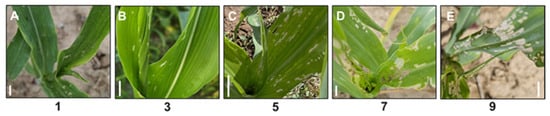
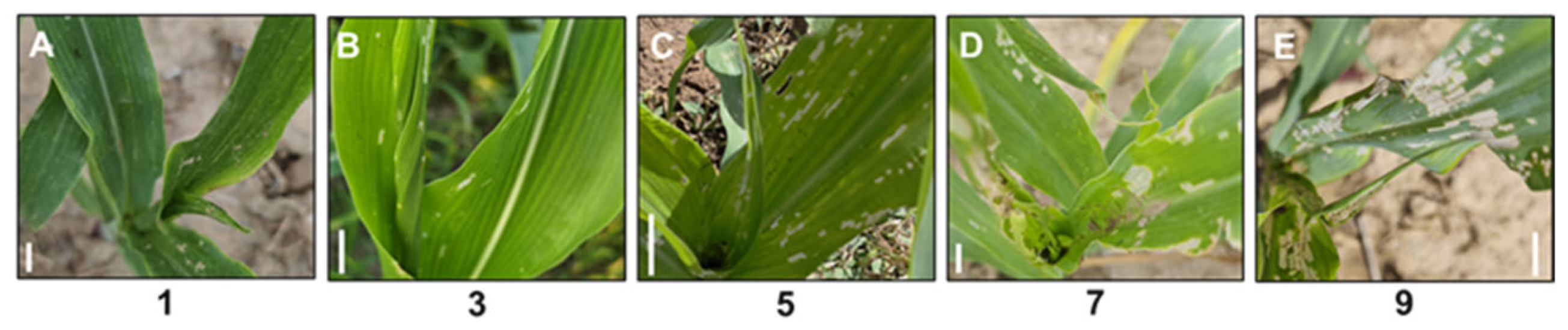
To evaluate FAW resistance in maize, we scored leaf damage in seedlings (at early vegetative stage) 3–5 days after larval inoculation, using a natural variation population of 300 modern inbred lines and a recombinant inbred line (RIL) population of 200 lines. All insect resistance phenotyping experiments were conducted under field conditions to mimic the natural growing environment. The 300 modern maize inbred lines were evaluated at 23ZZ (Zhengzhou, 2023) and 23XX (Xunxian, 2023), while the 200 RILs were assessed at 24ZZ (Zhengzhou, 2024) and 24YY (Yuanyang, 2024), following the FAW rating scale described in Table S1. Leaf damage severity was rated on a 1–9 scale based on the extent of feeding lesions at inoculation sites (Figure 1 and Table S1). Damage scores for the modern inbred lines were approximately normally distributed (Figure S1). Genotypic variance (σ2g) and genotype-by-environment variance (σ2ge) for leaf damage were both significant (Table 1). Heritability estimates for leaf damage ranged from 0.4126 to 0.643 across individual environments, with a combined-environment heritability of 0.3407 (Table 1). Similarly, the RIL population also exhibited an approximately normal distribution of damage scores (Figure S2), with significant genotypic variance (σ2g) and genotype-by-environment variance (σ2ge) (Table 1). Heritability for the RILs ranged from 0.7894 to 0.8341 across environments, and the combined estimate was 0.6425 (Table 1). These moderate-to-high heritability values indicate that phenotypic variation was governed by both genetic and environmental factors. Moreover, maize inbred lines were systematically classified into five FAW resistance levels including high resistance (HR), resistance (R), medium resistance (MR), susceptible (S) and high susceptibility (HS) according to the extent of leaf damage observed (Figure 1; Table S2).
Figure 1.
The leaf damage grades of maize inbred lines with FAW invasion. (A–E) Photos illustrating different grades of leaf damage with FAW invasion in maize inbred lines from a natural population in the summer of 2023 at Zhengzhou. “1”, “3”, “5”, “7”, “9” represent different grades of leaf damage with FAW invasion, from lowest to highest. Scale bar = 1 cm.
Table 1.
Descriptive phenotype statistics of FAW resistance in natural and RIL populations.
Based on the FAW resistance levels of maize inbred lines, we evaluated the FAW resistance of 300 modern inbred lines. At Zhengzhou experimental farm, 6 displayed HR (2.11%), 52 displayed R (18.26%), 138 had MR (48.61%), 71 had S (25.01%), and 17 had HS (6.1%) (Figure S3A); at Xunxian experimental farm, 4 displayed HR (1.31%), 54 displayed R (18.21%), 150 had MR (50.75%), 84 had S (28.42%), and 4 had HS (1.31%) (Figure S3B). For the RIL population, at Zhengzhou experimental farm, 16 displayed HR (8.56%), 41 displayed R (21.97%), 85 had MR (45.45%), 28 had S (14.97%), and 17 had HS (9.14%) (Figure S4A); at Yuanyang experimental farm, 12 displayed HR (6.52%), 36 displayed R (19.57%), 88 had MR (47.83%), 41 had S (22.28%), and 7 had HS (3.8%) (Figure S4B). Collectively, these findings suggest that the majority of inbred lines display MR to FAW, while only a small proportion demonstrate either HR or HS to this pest.
3.2. Identification of FAW Resistance Related Qtl from Maize Ril Population
To target FAW resistance quantitative trait loci (QTLs), we employed a RIL population for FAW resistance identification experiments across two distinct environments, utilizing the best linear unbiased estimates (BLUEs) of the phenotype from both environments.
The FAW resistance scores of the RIL population followed a normal distribution, with heritability estimated at a moderate level (Table 1). A total of 12 QTLs associated with FAW resistance were identified across 24ZZ, 24YY, and BLUE (Table S3). The proportion of phenotypic variance explained (PVE%) by each locus ranged from 2.8897% to 9.4459%. None of the identified loci qualified as a major-effect QTL based on conventional thresholds. These experimental results indicate that all identified QTL associated with FAW resistance are partial QTL.
3.3. GWAS Identifies Candidate Genes Conferring FAW Resistance in Maize
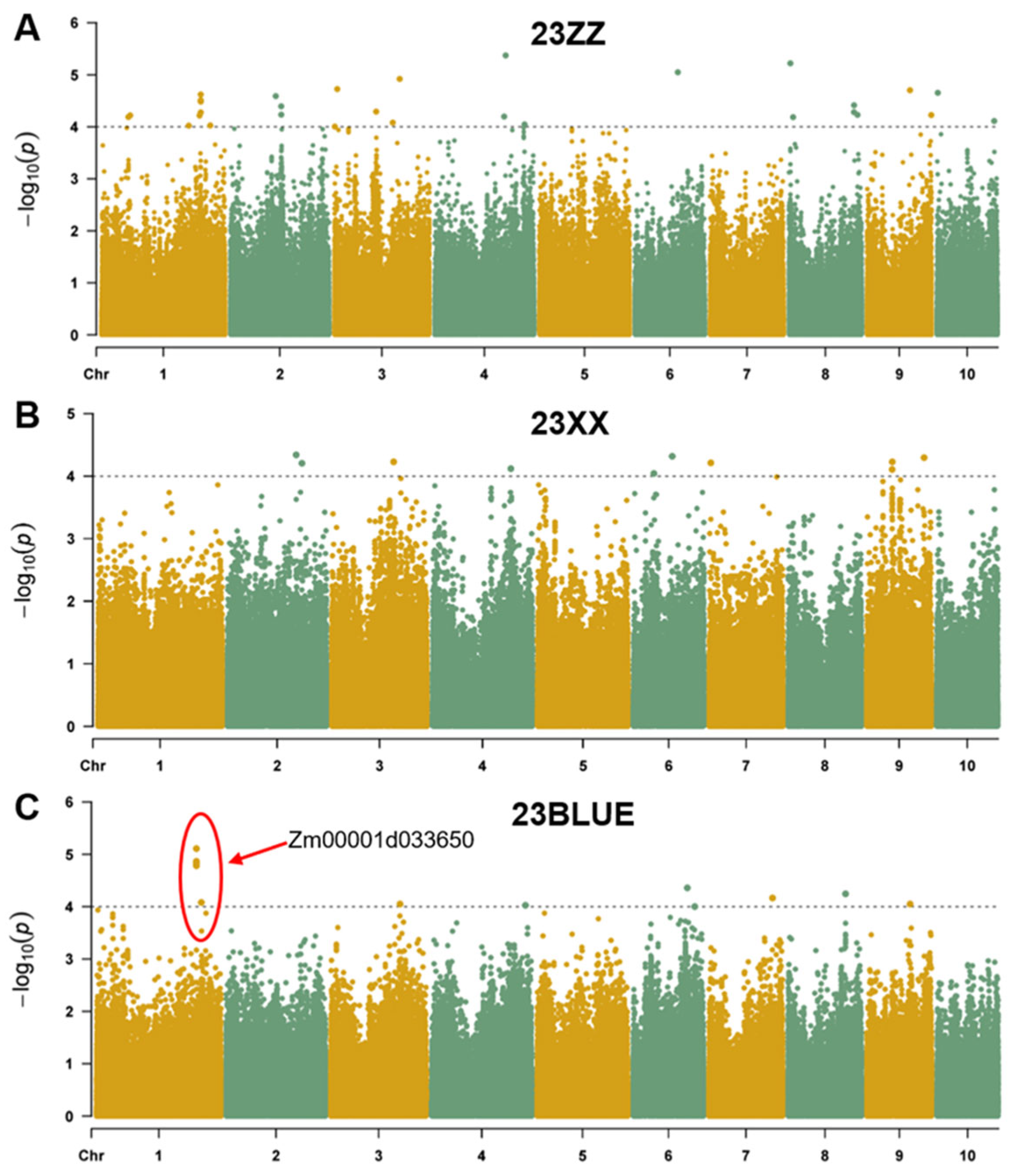
GWAS was conducted on the 300 modern maize lines phenotype for FAW resistance, employing a mixed linear model (MLM) that jointly accounted for population structure (represented by the first three principal components (PCs)) and kinship (K matrix). The quantile–quantile (Q–Q) plot indicated that the observed SNP association p-values largely followed the expected null distribution, confirming that the PCs and kinship covariates adequately controlled for population structure (Figure S5). GWA analysis identified 47 SNPs significantly associated with FAW resistance (p ≤ 1.0 × 10⁻⁴) across two independent environments, corresponding to 18 candidate genes (Table 2 and Figure 2). Using BLUEs of phenotypic values combined across the two environments, we detected 26 additional significant SNPs, which were anchored to eight candidate genes and mapped to 16 loci distributed on chromosomes 1, 2, 3, 4, 8, and 9 (Table 2 and Figure 2). Functional annotation of these candidate genes revealed their involvement in multiple biological processes, including fatty acids biosynthesis, lignin accumulation, BXs homeostasis, and cold tolerance [25,52,53]. Moreover, homologous genes corresponding to several candidate genes have been experimentally implicated in insect resistance in other plant species.
Table 2.
Single nucleotide polymorphisms and corresponding candidate genes significantly associated with FAW resistance in maize inbred lines.
Figure 2.
Genome-wide association study of FAW resistance in maize inbred lines. (A–C) Manhattan plots of 23 BLUE, two environments jointly analyzed at Zhengzhou and Xunxian in 2023; (A) 23ZZ, the Zhengzhou Experimental Farm in 2023; (B) 23XX, the Xunxian Experimental Farm in 2023; (C) Dots above the horizontal line show genome-wide significance with a moderately stringent threshold of −log(10−4). BLUE, best linear unbiased estimator.
Notably, we identified a candidate gene, Zm00001d033650, located on chromosome 1. This gene is predicted to encode β-glucosidase 17 (ZmBGLU17), a member of the glycosyl hydrolase family 1 (GH1), according to the previous classification [54]. Temporal expression analysis of ZmBGLU17 revealed significant upregulation in seedling leaves FAW infestation (Figure S6), indicating a potential involvement of this β-glucosidase gene in maize defense responses against FAW. Collectively, these findings suggest that ZmBGLU17 constitutes a key resistance-associated gene and represents a priority candidate for further functional characterization in this study.
3.4. Zmbglu17 Functions as a Positive Regulator of FAW Resistance in Maize
GWAS data indicate a statistically significant association between the ZmBGLU17 gene and resistance to FAW; quantitative real-time PCR analysis further revealed that FAW infestation induces marked upregulation of ZmBGLU17 expression in maize. Therefore, these findings collectively underscore the functional relevance of ZmBGLU17 in mediating plant defense responses and highlight the necessity of further functional characterization of this gene.
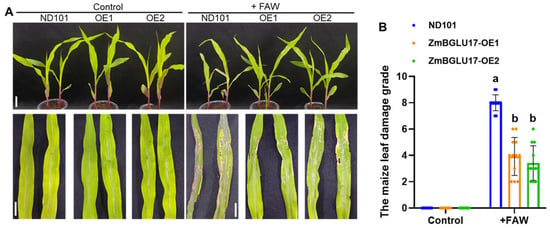
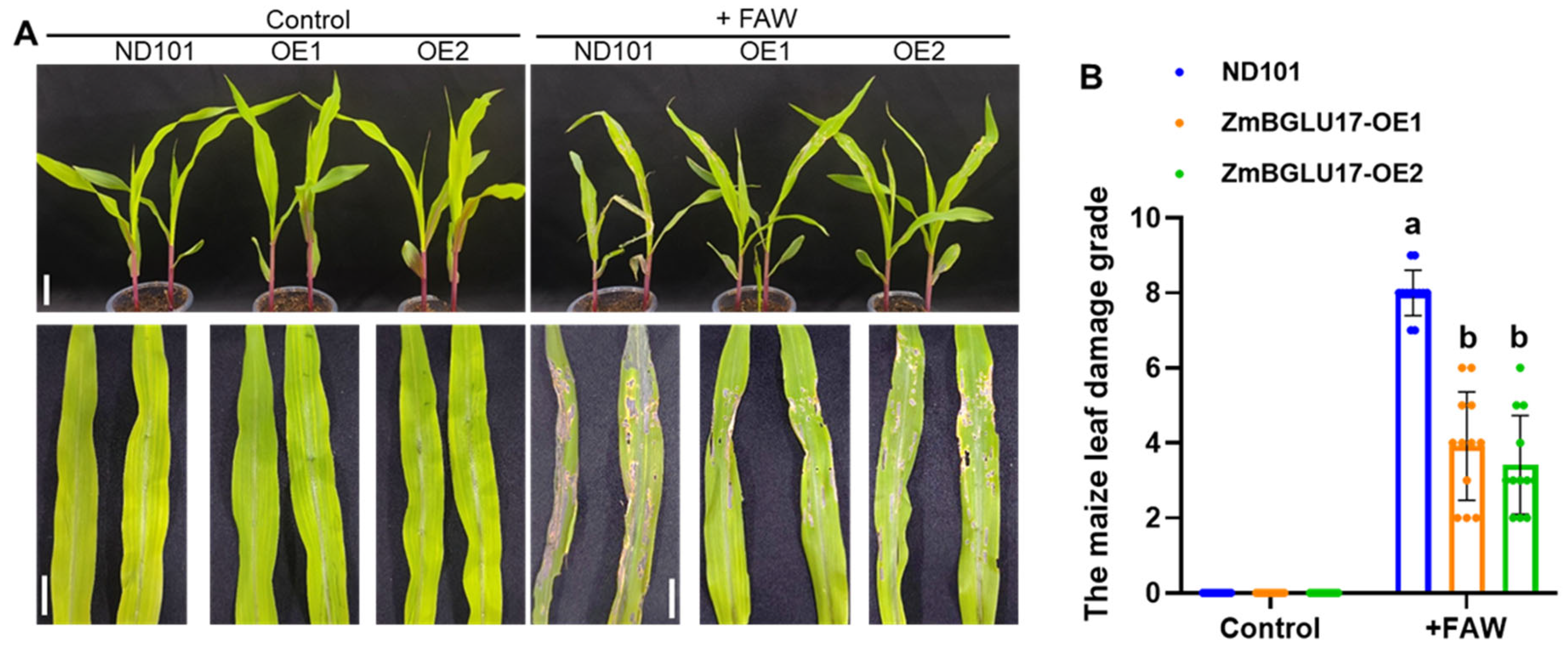
To validate the functional role of ZmBGLU17 in maize resistance to FAW, we employed two independent transgenic overexpression lines (ZmBGLU17-OE1 and ZmBGLU17-OE2) in the ND101 genetic background. Comparative bioassays revealed that both OE1 and OE2 exhibited significantly enhanced resistance to FAW infestation relative to the ND101 control, when the FAW larvae were allowed to feed on maize leaves for a period of 72 h under controlled conditions (Figure 3A,B). Meanwhile, we also measured the survival rate of the FAW larvae. The results showed that the survival rate of the overexpressed lines OE1 and OE2 was significantly lower than that of the ND101 (Figure S7A). However, the mean larval length and weight in the overexpression line were marginally reduced relative to the ND101, with no statistically significant difference observed (Figure S7B,C). These findings suggest that ZmBGLU17 exerts primary against to the FAW by significantly reducing larval survival, rather than by suppressing growth.
Figure 3.
ZmBGLU17 was significantly associated with fall armyworm resistance. (A) FAW resistance of wide type (WT, ND101) and ZmBGLU17 overexpression lines (OE1, OE2) at seedling stage; scale bar = 1 cm. (B) Quantification of the maize leaf damage grade with or without FAW invasion. Error bars represent SD (n > 12). p < 0.05 by one-way ANOVA followed by Tukey’s multiple comparisons test. Letter code labels the significant differences between the genotypes.
ZmBGLU17 is a secreted protein as it has a signal peptide. The subcellular localization of ZmBGLU17 were detected in both the vacuoles and the extracellular space [25]. Extracellular β-glucosidases catalyze the hydrolysis of lignin glycoconjugates in the plant cell wall, thereby releasing monolignols, key precursors for lignin biosynthesis, and contributing to increased lignin deposition [55]. Moreover, lignin can promote defense against pathogen infection and herbivore feeding in maize. Therefore, we investigated the potential role of ZmBGLU17 in modulating lignin accumulation. Lignin deposition in leaf tissues was assessed via safranin O-fast green staining, showing significantly enhanced lignin staining intensity in OE1 and OE2 relative to the ND101 control line (Figure S8). This finding suggests that ZmBGLU17 promotes the lignin accumulation in maize.
In addition, the ZmBGLU17 signal is also detected at the vacuoles [25]. Vascular-localized glucosidases are hypothesized to catalyze the hydrolysis of the defensive metabolite DIMBOA-Glc into its bioactive aglycone, DIMBOA, upon cellular disruption, such as that induced by pathogen infection or herbivore feeding, thereby contributing to plant defense [17]. The expression levels of DIMBOA biosynthesis-related genes were significantly elevated in the OE1 and OE2 compared with ND101 [25]. Moreover, the concentration of DIMBOA in ZmBGLU17 overexpression lines is significantly higher than ND101 in maize stalk, enhancing stalk resistance against P. aphanidermatum and Ostrinia furnacalis [25]. Therefore, we quantified DIMBOA content in maize leaves using high-performance liquid chromatography (HPLC). This analysis was conducted because the FAW larvae primarily feed on maize leaves. Quantitative analysis revealed that DIMBOA content was significantly elevated in OE1 and OE2 relative to ND101 (Figure S9A). As DIMBOA-Glc is the precursor of DIMBOA, we also quantified DIMBOA-Glc content. The result displayed that DIMBOA-Glc content in overexpression lines is slightly less than WT, but not significantly (Figure S9B). Together, these results support that ZmBGLU17 is a positive regulator of FAW resistance in maize.
3.5. The Favorable Haplotype of Zmbglu17 Is Rarely Retained in Modern Maize Inbred Lines
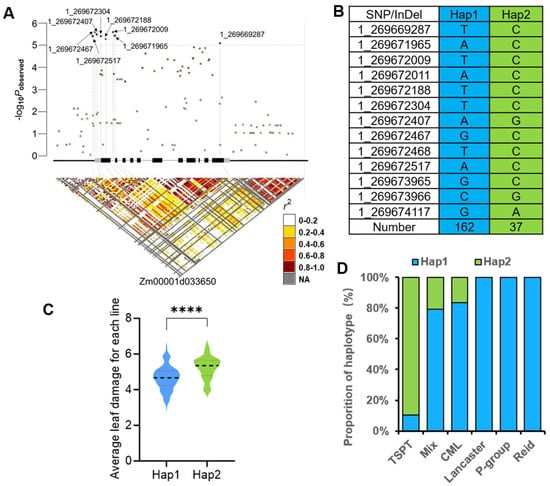
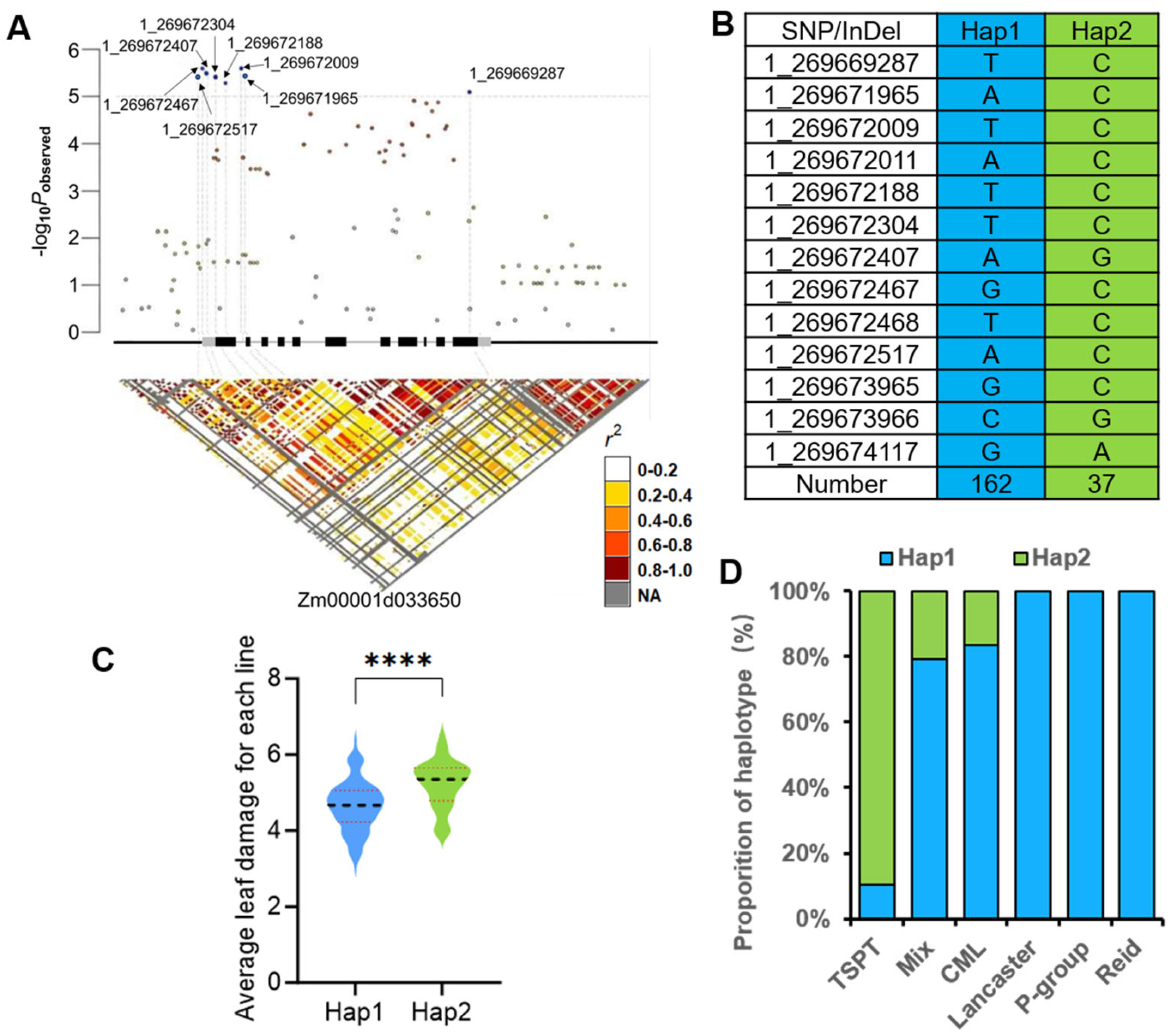
Candidate gene association analysis identified 13 SNPs located within the promoter and coding regions of ZmBGLU17, which resolved into two distinct linkage disequilibrium (LD) blocks (Figure 4A) and partitioned the 300 inbred lines into two haplotype groups (Figure 4B). Specifically, 162 lines carrying the resistant haplotype (Hap1) exhibited a mean damage severity score (DSS) of 1.5, while the remaining 37 lines harboring the susceptible haplotype (Hap2) showed a mean DSS of 2.1. Statistical comparison revealed that Hap1 lines displayed significantly higher FAW resistance than Hap2 lines (p = 7.0 × 10⁻³). Based on these phenotypic differences, Hap1 and Hap2 were designated as the resistant and susceptible allelic variants of ZmBGLU17, respectively (Figure 4C).
Figure 4.
Association analysis and identification of ZmBGLU17 haplotypes. (A) Association analysis of ZmBGLU17. The upper portions show the marker-trait associations and LD (linkage disequilibrium) of the most significant loci with the others, the middle portion shows the filtered gene models indicated by narrows, and the bottom portion shows the LD matrix. Single nucleotide polymorphism and insertion-deletion variation in ZmBGLU17 were significantly associated with FAW resistance. Dots above the horizontal line show significance with a moderately stringent threshold of −log (10−4). (B) The two haplotypes identified for ZmBGLU17. (C) The grade of FAW resistance of the two haplotypes. N = 162 (Haplotype 1), N = 37 (Haplotype 2); data are mean ± SD (Dunnett’s multiple-comparison test). **** p < 0.05, by Student’s t-test (D) The favorable genotype Haplotype 1 is present in 11.2% of the TSPT, 79.2% of the Mix, 82.3% of the CML inbred lines, 100% of the Lancaster, P-group and Reid inbred lines.
Given that the 300 maize inbred lines belonged to genetically distinct subgroups (including TPST, Mix, CML, Lancaster, P-group, Reid), we performed haplotype proportion analysis separately for each subgroup. Within the TSPT, Hap2 was overwhelmingly predominant, constituting approximately 90% of all observed haplotypes, whereas Hap1 represented only about 10% (Figure 4D), indicating that susceptible genetic variation was the dominant component. In contrast, Hap1 was the predominant variant in both the mixed and CML, representing 80% and 85%, respectively, whereas Hap2 constituted only 20% and 15% in these subgroups (Figure 4D), also suggesting that most of the resistant genetic variation was from these subgroups. Notably, the Lancaster, P-group, and Reid each comprised exclusively variant Hap1, with no instances of variant Hap2 observed (Figure 4D).
4. Discussion
As one of the world’s major staple crops, maize incurs severe yield losses and quality deterioration as a consequence of insect pest infestations. Conventional chemical pest control methods and genetically modified insect-resistant maize constitute the two primary pest management strategies. However, both approaches have been associated with well-documented safety and environmental risks [1,2,3]. Consequently, there is an urgent need to develop insect-resistant maize inbred lines using natural selection-based breeding approaches. Among these pests, FAW is a primary biotic constraint to maize production in China. To identify genetic loci conferring resistance to FAW, we conducted GWAS and linkage analysis using 300 modern maize inbred lines and 200 RIL population, respectively. Subsequent fine-mapping, candidate gene annotation, and functional validation were performed to characterize key resistance genes. Both modern inbred lines and RIL population exhibited a predominantly MR phenotype, with relatively few individuals exhibiting either HR or HS, indicating that the inbred line populations contain abundant genetic variation for FAW resistance.
The construction of RILs in maize is a widely adopted genetic mapping approach for identifying QTLs associated with stress resistance [46,56]. In this study, an RIL population was developed from BT-1 (FAW-resistant) × N6 (FAW-susceptible) to conduct genetic mapping of FAW resistance. A total of 11 statistically significant QTLs associated with resistance were identified; among these, major-effect QTLs were predominantly localized to chromosomes 1, 2, 3, 4, and 7.
Moreover, GWAS represent the primary approach for identifying key candidate genes associated with stress resistance in maize [46,56,57]. GWA analysis of 300 maize modern inbred lines, conducted under field conditions to evaluate FAW resistance, identified 18 major candidate genes across two distinct environments and identified an additional 8 genes by using the BLUE of the phenotype in the two environments, all showing significant associations with FAW resistance. The identified gene Zm00001d053424 encodes a receptor-like protein kinase 5, which belongs to the putative leucine-rich repeat receptor-like protein kinase (LRR-RLK) family. In maize, this LRR-RLK has been experimentally confirmed to exhibit antimicrobial activity against pathogenic microorganisms [58,59].
The GWAS identified Zm00001d033650 (ZmBGLU17) as the most significantly associated candidate gene. This gene encodes a β-Glucosidase and belongs to the glycoside hydrolase family 1 (GH1). Prior research has demonstrated that ZmBGLU17 acts as a positive regulator of resistance against maize stalk rot disease and concurrently exhibits inhibitory activity against O. furnacalis growth [25]. To further investigate its functional role in herbivore resistance, we conducted phenotypic assays using transgenic maize lines overexpressing ZmBGLU17 and challenged them with FAW. ZmBGLU17 overexpression conferred enhanced resistance to FAW by elevating lignin and DIMBOA content, confirming its role as a positive regulator of anti-herbivore defense. Lignin, as a component of the cell wall, plays a very important role in preventing herbivory, such as promoting the resistance to pest BPH in rice [26,27,28], and improving resistance to O. furnacalis in maize [25]. Moreover, the benzoxazinoids (Bxs) DIMBOA and DIMBOA-Glc play a pivotal role in mediating plant resistance against herbivory. DIMBOA has an anti-insect effect in maize against O. furnacalis and M. separate [17,25]. Together, these indicate that lignin and DIMBOA/DIMBOA-Glc have broad resistance to pests.
Notably, the ZmBGLU17 gene exhibits two distinct haplotypes. Haplotype 1 is the predominant variant and confers significantly enhanced resistance to FAW relative to Haplotype 2. Analysis of modern maize inbred lines with diverse genetic backgrounds revealed that the majority of Mix and CML carry Haplotype 1, whereas most TSPT lines harbor Haplotype 2. In contrast, Lancaster, P-group and Reid exclusively possess Haplotype 1. These data indicate that Lancaster, P-group and Reid harbor a large number of anti-insect allelic variants, whereas TPST carries a comparable number of insect-susceptible variants. These contrasting genetic profiles indicate that both maize inbred lines serve as valuable genetic resources for developing insect-resistant maize cultivars through targeted breeding strategies.
Jointly, our results demonstrate the resistance response of modern maize inbred line population to FAW and identified ZmBGLU17 as a key candidate gene underlying this resistance. Additionally, haplotype analysis suggests the feasibility of natural selection breeding of FAW-resistant maize varieties through the utilization of modern maize inbred lines derived from genetically diverse background. These findings constitute a significant advance toward the utilization of genetic resistance to FAW for improving crop sustainability and agricultural resilience.
5. Conclusions
In this study, we employed forward genetics to identify maize resistance genes conferring resistance to the FAW (Spodoptera frugiperda) and subsequently elucidated the underlying molecular mechanisms. We systematically evaluated FAW resistance under field conditions using 300 modern maize inbred lines and 200 recombinant inbred line (RIL) populations, followed by genome-wide association study (GWAS) and quantitative trait locus (QTL) mapping to identify candidate resistance genes. Integrated genetic and biochemical analyses revealed ZmBGLU17, a β-glucosidase, as a key FAW resistance gene that promotes the accumulation of two critical defense metabolites: lignin and DIMBOA. Transgenic overexpression of ZmBGLU17 significantly enhanced maize resistance to FAW, as evidenced by markedly reduced larval survival rates. Haplotype analysis identified two major haplotypes; haplotype 1 conferred significantly stronger resistance to FAW infestation than haplotype 2. Collectively, this study functionally validated ZmBGLU17 as a well-characterized FAW resistance gene and established its causal role through rigorous genetic and phenotypic evidence. Moreover, the prevalence of resistance-associated haplotype 1 provides a robust molecular basis for marker-assisted selection and breeding of FAW-resistant maize inbred lines.
Supplementary Materials
The following supporting information can be downloaded at https://www.mdpi.com/article/10.3390/agronomy16171683/s1, Figure S1: The frequency distribution of maize inbred lines leaf damage grade in a natural population. (A) 23BLUE represents joint analysis of frequency distribution of two environments in Zhengzhou and Xunxian of natural populations in 2023, N = 298; (B) 23ZZ represents the frequency distribution of natural populations in Zhengzhou Experimental Farm in 2023, N = 283; (C) 23XX represents the frequency distribution of natural populations on the Xunxian Experimental Farm in 2023, N = 295. The x-axis represents the grade of aerial root mucilage secretion; Figure S2: The frequency distribution of leaf damage grade in maize inbred lines in the RIL population. (A) 24BLUE, the frequency distribution of a joint analysis of RIL populations at two environments in Zhengzhou and Yuanyang in 2024, N = 198. (B) 24ZZ, the frequency distribution of natural populations in the Zhengzhou Experimental Farm in 2024, N = 187. (C) 24YY, the frequency distribution of natural populations on the Yuanyang Experimental Farm in 2024, N=184. The x-axis represents the grade of aerial root mucilage secretion; Figure S3: The frequency distribution of maize inbred lines with different FAW resistance in a natural population. (A) 23ZZ represents the frequency distribution of natural populations in the Zhengzhou Experimental Farm in 2023, N = 284; (B) 23XX represents the frequency distribution of natural populations on the Xunxian Experimental Farm in 2023, N = 296; (C) 23BLUE represents joint analysis of frequency distribution of two environments in Zhengzhou and Xunxian of natural populations in 2023, N = 298.The x-axis represents the grade of FAW resistance, High Resistance (HR); Resistance (R); Medium Resistance (MR); Susceptible (S); High Susceptible (HS); Figure S4: The frequency distribution of maize inbred lines with different FAW resistance in RIL population. (A) 24ZZ represents the frequency distribution of RIL population in the Zhengzhou Experimental Farm in 2024, N = 187; (B) 24YY represents the frequency distribution of RIL population on the Yuanyang Experimental Farm in 2024, N = 184; (C) 24BLUE represents joint analysis of frequency distribution of two environments in Zhengzhou and Yuanyang of RIL population in 2024, N = 198.The x-axis represents the grade of FAW resistance, High Resistance (HR); Resistance (R); Medium Resistance (MR); Susceptible (S); High Susceptible (HS); Figure S5: Quantile–quantile (Q–Q) plots of the p-values resulting from the genome-wide association study. (A–C) Q–Q plots of 23BLUE, the two environments jointly analyzed at Zhengzhou and Xunxian in 2023 (A); 23ZZ, the Zhengzhou Experimental Farm in 2023 (B); 23XX, the Xunxian Experimental Farm in 2023 (C); Figure S6: The expression level of ZmBGLU17 is upregulated with FAW invasion. qRT-PCR analysis of the ZmBGLU17 expression level in WT (B73) leaf. Maize seedling were treated with FAW for 3 h, 6 h, 12 h, 24 h and 72 h before leaf RNA extraction. EF-2α expression was analyzed as an internal control. Data are means ±SD from three independent experiments. * p < 0.05 and ** p < 0.01, compared with control without FAW treatment; Figure S7: ZmBGLU17 was significantly associated with FAW resistance. (A–C) Quantification of the survival rate of FAW larvae (A), the average length of FAW larvae (B) and the average weight of FAW larvae (C) of ND101, OE1 and OE2. Error bars represent SD (n > 50). p < 0.05 by one-way ANOVA followed by Tukey’s multiple comparisons test. Letter code labels the significant differences.; Figure S8: ZmBGLU17 positively promote lignin accumulation. Lignin staining analysis of maize leaves from the ND101 and ZmBGLU17 overexpression lines (OE1 and OE2). The leaves depicted in the figure were harvested from 10-day-old maize seedlings and subjected to safranin O-fast green staining to visualize lignin deposition. The red arrow highlights the anatomically significant site of lignin deposition. scale bar = 2 mm; Figure S9: ZmBGLU17 positively regulate DIMBOA content. (A,B) DIMBOA and DIMBOA-Glc content from ND101 and ZmBGLU17 overexpression lines (OE1 and OE2) measured by high-performance liquid chromatography analysis; Table S1: Evaluation standard for grade of leaf damage; Table S2: Evaluation standard for mucilage secretion of aerial root in maize; Table S3: The QTL for FAW resistance identified by RIL population.
Author Contributions
All authors discussed the results and contributed to the finalization of the manuscript. Material preparation, data collection, and formal analysis were performed by Z.W. (Zhaokun Wu), X.T., Z.W. (Zhao Wang), R.S.J., D.S. and Q.W.; the software analysis was performed by Z.W. (Zhao Wang), X.T. and Z.Z.; the investigation and resources of the project were performed and produced by Z.W. (Zhaokun Wu), Q.W. and J.W.; the original draft was written by Z.W. (Zhaokun Wu), Q.W. and J.W. All authors have read and agreed to the published version of the manuscript.
Funding
This project is supported by a grant from the National Key R&D (Research and Development) Program of China (Grant No. 2022YFD1201803), the Young Scientists Fund of the National Natural Science Foundation of China (Grant No. 32201864), the Henan Province Science and Technology Key Project (Grant No. 262102111113) and acknowledge the special fund at Henan Agricultural University.
Data Availability Statement
The original contributions presented in this study are included in the article and Supplementary Materials. Further inquiries can be directed to the corresponding authors.
Acknowledgments
We thank Xianru Guo from Henan Agricultural University for sharing FAW larvae rearing protocol, Jianju He from Henan Agricultural University for technical support, Jinfeng Qi from Chinese Academy of Sciences for quantification of DIMBOA and Wangsheng Zhu from China Agricultural University for sharing the ND101, ZmBGLU17-OE1 and ZmBGLU17-OE2 seeds.
Conflicts of Interest
The authors declare no conflicts of interest.
References
- Yang, X.; Yang, X.; Zhao, S.; Liu, B.; Gao, Y.; Hu, C.; Li, W.; Yang, Y.; Li, G.; Wang, L.; et al. Bt maize can provide non-chemical pest control and enhance food safety in China. Plant Biotechnol. J. 2023, 21, 391–404. [Google Scholar] [CrossRef] [Scilit] [PubMed]
- Van den Berg, J.; du Plessis, H. Chemical Control and Insecticide Resistance in Spodoptera frugiperda (Lepidoptera: Noctuidae). J. Econ. Entomol. 2022, 115, 1761–1771. [Google Scholar] [CrossRef] [Scilit] [PubMed]
- He, L.; Zhou, Y.; Wu, W.; Wang, L.; Yang, Q.; Liang, G.; Wu, K. Control efficacy of Bt-Cry1Ab maize (event DBN9936) against Ostrinia furnacalis (Guenée) in Sichuan Province, China. Pest Manag. Sci. 2025, 81, 1218–1228. [Google Scholar] [CrossRef] [Scilit] [PubMed]
- Balmer, D.; de Papajewski, D.V.; Planchamp, C.; Glauser, G.; Mauch-Mani, B. Induced resistance in maize is based on organ-specific defence responses. Plant J. 2013, 74, 213–225. [Google Scholar] [CrossRef] [Scilit] [PubMed]
- Chávez-Arias, C.C.; Ligarreto-Moreno, G.A.; Ramírez-Godoy, A.; Restrepo-Díaz, H. Maize Responses Challenged by Drought, Elevated Daytime Temperature and Arthropod Herbivory Stresses: A Physiological, Biochemical and Molecular View. Front. Plant Sci. 2021, 12, 702841. [Google Scholar] [CrossRef] [Scilit] [PubMed]
- Gorman, Z.; Christensen, S.A.; Yan, Y.; He, Y.; Borrego, E.; Kolomiets, M.V. Green leaf volatiles and jasmonic acid enhance susceptibility to anthracnose diseases caused by Colletotrichum graminicola in maize. Mol. Plant Pathol. 2020, 21, 702–715. [Google Scholar] [CrossRef] [Scilit] [PubMed]
- Yuan, W.; Jiang, T.; Du, K.; Chen, H.; Cao, Y.; Xie, J.; Li, M.; Carr, J.P.; Wu, B.; Fan, Z.; et al. Maize phenylalanine ammonia-lyases contribute to resistance to Sugarcane mosaic virus infection, most likely through positive regulation of salicylic acid accumulation. Mol. Plant Pathol. 2019, 20, 1365–1378. [Google Scholar] [CrossRef] [Scilit] [PubMed]
- Zhou, C.; Li, D.; Shi, X.; Zhang, J.; An, Q.; Wu, Y.; Kang, L.; Li, J.-Q.; Pan, C. Nanoselenium Enhanced Wheat Resistance to Aphids by Regulating Biosynthesis of DIMBOA and Volatile Components. J. Agric. Food Chem. 2021, 69, 14103–14114. [Google Scholar] [CrossRef] [Scilit] [PubMed]
- Moreira, X.; Abdala-Roberts, L.; Castagneyrol, B. Interactions between plant defence signalling pathways: Evidence from bioassays with insect herbivores and plant pathogens. J. Ecol. 2018, 106, 2353–2364. [Google Scholar] [CrossRef] [Scilit]
- Xu, J.; Wang, X.; Zu, H.; Zeng, X.; Baldwin, I.T.; Lou, Y.; Li, R. Molecular dissection of rice phytohormone signaling involved in resistance to a piercing-sucking herbivore. New Phytol. 2021, 230, 1639–1652. [Google Scholar] [CrossRef] [Scilit] [PubMed]
- Christensen, S.A.; Nemchenko, A.; Borrego, E.; Murray, I.; Sobhy, I.S.; Bosak, L.; DeBlasio, S.; Erb, M.; Robert, C.A.; Vaughn, K.A.; et al. The maize lipoxygenase, ZmLOX10, mediates green leaf volatile, jasmonate and herbivore-induced plant volatile production for defense against insect attack. Plant J. 2013, 74, 59–73. [Google Scholar] [CrossRef] [Scilit] [PubMed]
- Yan, Y.; Christensen, S.; Isakeit, T.; Engelberth, J.; Meeley, R.; Hayward, A.; Emery, R.N.; Kolomiets, M.V. Disruption of OPR7 and OPR8 reveals the versatile functions of jasmonic acid in maize development and defense. Plant Cell 2012, 24, 1420–1436. [Google Scholar] [CrossRef] [Scilit] [PubMed]
- Degenhardt, J.; Hiltpold, I.; Köllner, T.G.; Frey, M.; Gierl, A.; Gershenzon, J.; Hibbard, B.E.; Ellersieck, M.R.; Turlings, T.C.J. Restoring a maize root signal that attracts insect-killing nematodes to control a major pest. Proc. Natl. Acad. Sci. USA 2009, 106, 13213–13218. [Google Scholar] [CrossRef] [Scilit] [PubMed]
- Vaughan, M.M.; Block, A.; Christensen, S.A.; Allen, L.H.; Schmelz, E.A. The effects of climate change associated abiotic stresses on maize phytochemical defenses. Phytochem. Rev. 2018, 17, 37–49. [Google Scholar] [CrossRef] [Scilit]
- Ahmad, S.; Veyrat, N.; Gordon-Weeks, R.; Zhang, Y.; Martin, J.; Smart, L.; Glauser, G.; Erb, M.; Flors, V.; Frey, M.; et al. Benzoxazinoid metabolites regulate innate immunity against aphids and fungi in maize. Plant Physiol. 2011, 157, 317–327. [Google Scholar] [CrossRef] [Scilit] [PubMed]
- Ye, J.; Zhong, T.; Zhang, D.; Ma, C.; Wang, L.; Yao, L.; Zhang, Q.; Zhu, M.; Xu, M. The Auxin-Regulated Protein ZmAuxRP1 Coordinates the Balance between Root Growth and Stalk Rot Disease Resistance in Maize. Mol. Plant 2019, 12, 360–373. [Google Scholar] [CrossRef] [Scilit] [PubMed]
- Zhang, C.; Li, J.; Li, S.; Ma, C.; Liu, H.; Wang, L.; Qi, J.; Wu, J. ZmMPK6 and ethylene signalling negatively regulate the accumulation of anti-insect metabolites DIMBOA and DIMBOA-Glc in maize inbred line A188. New Phytol. 2021, 229, 2273–2287. [Google Scholar] [CrossRef] [Scilit] [PubMed]
- Bhuiyan, N.H.; Selvaraj, G.; Wei, Y.; King, J. Gene expression profiling and silencing reveal that monolignol biosynthesis plays a critical role in penetration defence in wheat against powdery mildew invasion. J. Exp. Bot. 2009, 60, 509–521. [Google Scholar] [CrossRef] [Scilit] [PubMed]
- Barros, J.; Serk, H.; Granlund, I.; Pesquet, E. The cell biology of lignification in higher plants. Ann. Bot. 2015, 115, 1053–1074. [Google Scholar] [CrossRef] [Scilit] [PubMed]
- Sun, Q.; Liu, X.; Yang, J.; Liu, W.; Du, Q.; Wang, H.; Fu, C.; Li, W.-X. MicroRNA528 Affects Lodging Resistance of Maize by Regulating Lignin Biosynthesis under Nitrogen-Luxury Conditions. Mol. Plant 2018, 11, 806–814. [Google Scholar] [CrossRef] [Scilit] [PubMed]
- Cesarino, I. Structural features and regulation of lignin deposited upon biotic and abiotic stresses. Curr. Opin. Biotechnol. 2019, 56, 209–214. [Google Scholar] [CrossRef] [Scilit] [PubMed]
- Malinovsky, F.G.; Fangel, J.U.; Willats, W.G.T. The role of the cell wall in plant immunity. Front. Plant Sci. 2014, 5, 178. [Google Scholar] [CrossRef] [Scilit] [PubMed]
- Sattler, S.E.; Funnell-Harris, D.L. Modifying lignin to improve bioenergy feedstocks: Strengthening the barrier against pathogens? Front. Plant Sci. 2013, 4, 70. [Google Scholar] [CrossRef] [Scilit] [PubMed]
- Vanholme, R.; Demedts, B.; Morreel, K.; Ralph, J.; Boerjan, W. Lignin biosynthesis and structure. Plant Physiol. 2010, 153, 895–905. [Google Scholar] [CrossRef] [Scilit] [PubMed]
- Liu, C.; He, S.; Chen, J.; Wang, M.; Li, Z.; Wei, L.; Chen, Y.; Du, M.; Liu, D.; Li, C.; et al. A dual-subcellular localized β-glucosidase confers pathogen and insect resistance without a yield penalty in maize. Plant Biotechnol. J. 2024, 22, 1017–1032. [Google Scholar] [CrossRef] [Scilit] [PubMed]
- Jannoey, P.; Pongprasert, W.; Lumyong, S.; Roytrakul, S.; Nomura, M. Comparative proteomic analysis of two rice cultivars (Oryza sativa L.) contrasting in brown planthopper (BPH) stress resistance. Plant OMICS 2015, 8, 96–105. [Google Scholar]
- Guo, J.; Xu, C.; Wu, D.; Zhao, Y.; Qiu, Y.; Wang, X.; Ouyang, Y.; Cai, B.; Liu, X.; Jing, S.; et al. Bph6 encodes an exocyst-localized protein and confers broad resistance to planthoppers in rice. Nat. Genet. 2018, 50, 297–306. [Google Scholar] [CrossRef] [Scilit] [PubMed]
- He, J.; Liu, Y.; Yuan, D.; Duan, M.; Liu, Y.; Shen, Z.; Yang, C.; Qiu, Z.; Liu, D.; Wen, P.; et al. An R2R3 MYB transcription factor confers brown planthopper resistance by regulating the phenylalanine ammonia-lyase pathway in rice. Proc. Natl. Acad. Sci. USA 2020, 117, 271–277. [Google Scholar] [CrossRef] [Scilit] [PubMed]
- Kariyat, R.R.; Raya, C.E.; Chavana, J.; Cantu, J.; Guzman, G.; Sasidharan, L. Feeding on glandular and non-glandular leaf trichomes negatively affect growth and development in tobacco hornworm (Manduca sexta) caterpillars. Arthropod-Plant Interact. 2019, 13, 321–333. [Google Scholar] [CrossRef] [Scilit]
- Fan, E.; Liu, C.; Liu, Y.; Fu, P.; Liu, Y.; Yang, C.; Wang, J.; Qu, G. The role of PagC3H3 in lignin biosynthesis and insect resistance in Populus alba × Populus glandulosa. Plant Cell Rep. 2025, 44, 201. [Google Scholar] [CrossRef] [Scilit] [PubMed]
- Makowska, B.; Bakera, B.; Rakoczy-Trojanowska, M. The genetic background of benzoxazinoid biosynthesis in cereals. Acta Physiol. Plant. 2015, 37, 176. [Google Scholar] [CrossRef] [Scilit]
- Frey, M.; Chomet, P.; Glawischnig, E.; Stettner, C.; Grün, S.; Winklmair, A.; Eisenreich, W.; Bacher, A.; Meeley, R.B.; Briggs, S.P.; et al. Analysis of a chemical plant defense mechanism in grasses. Science 1997, 277, 696–699. [Google Scholar] [CrossRef] [Scilit] [PubMed]
- Niemeyer, H.M. Hydroxamic acids derived from 2-hydroxy-2H-1,4-benzoxazin-3(4H)-one: Key defense chemicals of cereals. J. Agric. Food Chem. 2009, 57, 1677–1696. [Google Scholar] [CrossRef] [Scilit] [PubMed]
- Niculaes, C.; Abramov, A.; Hannemann, L.; Frey, M. Plant Protection by Benzoxazinoids—Recent Insights into Biosynthesis and Function. Agronomy 2018, 8, 143. [Google Scholar] [CrossRef] [Scilit]
- Meihls, L.N.; Handrick, V.; Glauser, G.; Barbier, H.; Kaur, H.; Haribal, M.M.; Lipka, A.E.; Gershenzon, J.; Buckler, E.S.; Erb, M.; et al. Natural variation in maize aphid resistance is associated with 2,4-dihydroxy-7-methoxy-1,4-benzoxazin-3-one glucoside methyltransferase activity. Plant Cell 2013, 25, 2341–2355. [Google Scholar] [CrossRef] [Scilit] [PubMed]
- Glauser, G.; Marti, G.; Villard, N.; Doyen, G.A.; Wolfender, J.; Turlings, T.C.; Erb, M. Induction and detoxification of maize 1,4-benzoxazin-3-ones by insect herbivores. Plant J. 2011, 68, 901–911. [Google Scholar] [CrossRef] [Scilit] [PubMed]
- Tzin, V.; Fernandez-Pozo, N.; Richter, A.; Schmelz, E.A.; Schoettner, M.; Schäfer, M.; Ahern, K.R.; Meihls, L.N.; Kaur, H.; Huffaker, A.; et al. Dynamic Maize Responses to Aphid Feeding Are Revealed by a Time Series of Transcriptomic and Metabolomic Assays. Plant Physiol. 2015, 169, 1727–1743. [Google Scholar] [CrossRef] [Scilit] [PubMed]
- Lombard, V.; Golaconda Ramulu, H.; Drula, E.; Coutinho, P.M.; Henrissat, B. The carbohydrate-active enzymes database (CAZy) in 2013. Nucleic Acids Res. 2014, 42, D490–D495. [Google Scholar] [CrossRef] [Scilit] [PubMed]
- Himeno, N.; Saburi, W.; Wakuta, S.; Takeda, R.; Matsuura, H.; Nabeta, K.; Sansenya, S.; Cairns, J.R.K.; Mori, H.; Imai, R.; et al. Identification of rice β-glucosidase with high hydrolytic activity towards salicylic acid β-D-glucoside. Biosci. Biotechnol. Biochem. 2013, 77, 934–939. [Google Scholar] [CrossRef] [Scilit] [PubMed]
- Wakuta, S.; Hamada, S.; Ito, H.; Matsuura, H.; Nabeta, K.; Matsui, H. Identification of a beta-glucosidase hydrolyzing tuberonic acid glucoside in rice (Oryza sativa L.). Phytochemistry 2010, 71, 1280–1288. [Google Scholar] [CrossRef] [Scilit] [PubMed]
- Wakuta, S.; Hamada, S.; Ito, H.; Imai, R.; Mori, H.; Matsuura, H.; Nabeta, K.; Matsui, H. Comparison of Enzymatic Properties and Gene Expression Profiles of Two Tuberonic Acid Glucoside β-Glucosidases from Oryza sativa L. J. Appl. Glycosci. 2011, 58, 67–70. [Google Scholar] [CrossRef] [Scilit] [PubMed][Green Version]
- Lee, K.H.; Piao, H.L.; Kim, H.-Y.; Choi, S.M.; Jiang, F.; Hartung, W.; Hwang, I.; Kwak, J.M.; Lee, I.-J.; Hwang, I. Activation of glucosidase via stress-induced polymerization rapidly increases active pools of abscisic acid. Cell 2006, 126, 1109–1120. [Google Scholar] [CrossRef] [Scilit] [PubMed]
- Hua, Y.; Sansenya, S.; Saetang, C.; Wakuta, S.; Cairns, J.R.K. Enzymatic and structural characterization of hydrolysis of gibberellin A4 glucosyl ester by a rice β-D-glucosidase. Arch. Biochem. Biophys. 2013, 537, 39–48. [Google Scholar] [CrossRef] [Scilit] [PubMed]
- Babcock, G.D.; Esen, A. Substrate specificity of maize β-glucosidase. Plant Sci. 1994, 101, 31–39. [Google Scholar] [CrossRef] [Scilit]
- Sue, M.; Ishihara, A.; Iwamura, H. Purification and characterization of a hydroxamic acid glucoside beta-glucosidase from wheat (Triticum aestivum L.) seedlings. Planta 2000, 210, 432–438. [Google Scholar] [CrossRef] [Scilit] [PubMed]
- Gao, J.; Feng, P.; Zhang, J.; Dong, C.; Wang, Z.; Chen, M.; Yu, Z.; Zhao, B.; Hou, X.; Wang, H.; et al. Enhancing maize’s nitrogen-fixing potential through ZmSBT3, a gene suppressing mucilage secretion. J. Integr. Plant Biol. 2023, 65, 2645–2659. [Google Scholar] [CrossRef] [Scilit] [PubMed]
- Bradbury, P.J.; Zhang, Z.; Kroon, D.E.; Casstevens, T.M.; Ramdoss, Y.; Buckler, E.S. TASSEL: Software for association mapping of complex traits in diverse samples. Bioinformatics 2007, 23, 2633–2635. [Google Scholar] [CrossRef] [Scilit] [PubMed]
- Mamanova, L.; Coffey, A.J.; Scott, C.E.; Kozarewa, I.; Turner, E.H.; Kumar, A.; Howard, E.; Shendure, J.; Turner, D.J. Target-enrichment strategies for next-generation sequencing. Nat. Methods 2010, 7, 111–118. [Google Scholar] [CrossRef] [Scilit] [PubMed]
- Lin, X.; Tang, W.; Ahmad, S.; Lu, J.; Colby, C.C.; Zhu, J.; Yu, Q. Applications of targeted gene capture and next-generation sequencing technologies in studies of human deafness and other genetic disabilities. Hear. Res. 2012, 288, 67–76. [Google Scholar] [CrossRef] [Scilit] [PubMed]
- Livak, K.J.; Schmittgen, T.D. Analysis of relative gene expression data using real-time quantitative PCR and the 2(-Delta Delta C(T)) Method. Methods 2001, 25, 402–408. [Google Scholar] [PubMed]
- Gao, L.; Shen, G.; Zhang, L.; Qi, J.; Zhang, C.; Ma, C.; Li, J.; Wang, L.; Malook, S.U.; Wu, J. An efficient system composed of maize protoplast transfection and HPLC-MS for studying the biosynthesis and regulation of maize benzoxazinoids. Plant Methods 2019, 15, 144. [Google Scholar] [CrossRef] [Scilit] [PubMed]
- Zeng, R.; Zhang, X.; Song, G.; Lv, Q.; Li, M.; Fu, D.; Zhang, Z.; Gao, L.; Zhang, S.; Yang, X.; et al. Genetic variation in the aquaporin TONOPLAST INTRINSIC PROTEIN 4;3 modulates maize cold tolerance. Plant Biotechnol. J. 2024, 22, 3037–3050. [Google Scholar] [CrossRef] [Scilit] [PubMed]
- Campbell, A.A.; Stenback, K.E.; Flyckt, K.; Hoang, T.; Perera, M.A.D.; Nikolau, B.J. A single-cell platform for reconstituting and characterizing fatty acid elongase component enzymes. PLoS ONE 2019, 14, e0213620. [Google Scholar] [CrossRef] [Scilit] [PubMed]
- Gómez-Anduro, G.; Ceniceros-Ojeda, E.A.; Casados-Vázquez, L.E.; Bencivenni, C.; Sierra-Beltrán, A.; Murillo-Amador, B.; Tiessen, A. Genome-wide analysis of the beta-glucosidase gene family in maize (Zea mays L. var B73). Plant Mol. Biol. 2011, 77, 159–183. [Google Scholar] [CrossRef] [Scilit] [PubMed]
- Baiya, S.; Hua, Y.; Ekkhara, W.; Cairns, J.R.K. Expression and enzymatic properties of rice (Oryza sativa L.) monolignol β-glucosidases. Plant Sci. 2014, 227, 101–109. [Google Scholar] [CrossRef] [Scilit] [PubMed]
- Zhao, B.; Hou, X.; Yu, Z.; Zhang, R.; Teng, H.; Yang, Z.; He, J.; Wang, H.; Song, Z.; Zheng, J.; et al. Genetic basis of the mucilage secretion ability associated with nitrogen fixation from aerial roots of maize inbred lines under low nitrogen conditions. Crop J. 2025, 13, 432–443. [Google Scholar] [CrossRef] [Scilit]
- Dong, C.; Wu, Y.; Gao, J.; Song, Y.; Wu, Z.; Wang, Z.; He, J.; Yu, Q.; Zhao, Z.; Cao, M.; et al. An InDel insertion in the promoter of a UDP-ᴅ-glucuronate 4-epimerase 1 gene enhances maize resistance to Fusarium ear rot. Plant Commun. 2025, 6, 101380. [Google Scholar] [CrossRef] [Scilit] [PubMed]
- Song, W.; Wang, B.; Li, X.; Wei, J.; Chen, L.; Zhang, D.; Zhang, W.; Li, R. Identification of Immune Related LRR-Containing Genes in Maize (Zea mays L.) by Genome-Wide Sequence Analysis. Int. J. Genom. 2015, 2015, 231358. [Google Scholar] [CrossRef] [Scilit] [PubMed]
- Mu, X.; Li, J.; Dai, Z.; Xu, L.; Fan, T.; Jing, T.; Chen, M.; Gou, M. Commonly and Specifically Activated Defense Responses in Maize Disease Lesion Mimic Mutants Revealed by Integrated Transcriptomics and Metabolomics Analysis. Front. Plant Sci. 2021, 12, 638792. [Google Scholar] [CrossRef] [Scilit] [PubMed]

Disclaimer/Publisher’s Note: The statements, opinions and data contained in all publications are solely those of the individual author(s) and contributor(s) and not of MDPI and/or the editor(s). MDPI and/or the editor(s) disclaim responsibility for any injury to people or property resulting from any ideas, methods, instructions or products referred to in the content. |
© 2026 by the authors. Licensee MDPI, Basel, Switzerland. This article is an open access article distributed under the terms and conditions of the Creative Commons Attribution (CC BY) license.