


Abstract
Water retention availability remains a primary constraint on both vegetation restoration and agricultural productivity across the Chinese Loess Plateau. Attapulgite (ATP) has considerable potential as a soil amendment for improving soil water retention and crop performance, yet its effectiveness is likely to depend on soil texture and climatic water availability. Here, we evaluated the effects of five ATP application rates (0%, 1%, 2%, 3%, and 4%, w/w) on soil hydraulic properties and maize (Zea mays L.) grain yield in three representative soils: clay loam, loam, and sandy loam. Soil water retention curves and field maize experiments were conducted to quantify the hydrological and agronomic responses to ATP addition. The classical van Genuchten (VG) model was further modified by incorporating ATP-dependent parameter relationships to better characterize the water retention behavior of ATP-amended soils. The modified model consistently provided a more accurate representation of the relationship between soil water content and matric suction than the original VG model. The derived soil hydraulic parameters were subsequently incorporated into the DSSAT cropping system model, which was calibrated and evaluated against field observations from Yangling in 2019 and 2020. The calibrated model was then used to simulate maize yield responses to ATP application from 2011 to 2020 at three representative sites: Yangling (clay loam), Changwu (loam), and Yan’an (sandy loam). Simulated yield responses varied markedly with soil texture and interannual climatic conditions. In clay loam, maize yield generally decreased with increasing ATP application, although positive responses occurred in relatively dry years. In sandy loam, ATP application generally increased maize yield across most years, whereas the loam soil exhibited stronger interannual variability in yield response. These contrasting responses indicate that the agronomic effectiveness of ATP is governed by the balance between enhanced soil water retention and local climatic water availability. Overall, the coupled soil hydraulic–crop modeling framework provides a mechanistic basis for developing site-specific ATP management strategies and highlights the importance of matching soil amendments to both soil texture and climatic conditions in water-limited agroecosystems.
1. Introduction
The Chinese Loess Plateau is one of the regions worldwide most severely affected by soil erosion and ecological degradation and is also characterized by extensive rainfed dryland agriculture [1]. Although the region is underlain by thick loess deposits, its soils are predominantly silt-rich and structurally loose. Combined with limited annual precipitation and its pronounced seasonal unevenness, these characteristics result in low soil water retention capacity and substantial evaporative water losses. Consequently, limited water availability has become a primary constraint on both vegetation restoration and agricultural productivity across the region. Improving soil water-use efficiency under conditions of limited water supply, while maintaining stable and enhanced crop production, therefore remains a long-standing and pressing scientific challenge for sustainable dryland agriculture on the Loess Plateau [1,2].
One of the most crucial methods for enhancing the effectiveness of soil water utilization and raising crop yields is the addition of soil conditioners. Soil amendments can boost the water storage capacity of soil, but they also impact or limit the ability of crops to absorb water from the soil in dry conditions [3,4,5]. As a result, the effect of soil amendments on crop growth in rained-out locations is a very complex topic that is influenced by a combination of soil type, amendment dosing and meteorological conditions.
Attapulgite (ATP), a common clay mineral, is utilized as a soil conditioner because it contains constant and trace elements that plants need. Its unique colloidal characteristics and crystal structure make it great for enhancing the physical and chemical qualities of soil [6,7,8,9]. The majority of current research on ATP in agricultural soil and water resource environments separates the effects of soil hydraulic properties and ATP addition to field soils on crop growth processes, and studies on the hydraulic properties and water retention effectiveness of ATP addition to a variety of typical soils are not systematic enough.
The soil water retention curve, which describes the relationship between soil water content and suction, is the primary regulator for soil water movement. Soil water retention characteristics govern the relationship between soil water content and matric suction and therefore strongly influence plant-available water, irrigation requirements, drought stress, soil water infiltration and redistribution, evaporation, and the transport of dissolved nutrients and contaminants in the vadose zone [10,11,12,13]. The relationship between soil water content and suction can be utilized to analyze the water-holding capacity and water retention effectiveness of soils with various textures, providing a foundation for sensible agricultural irrigation management [12,14,15]. The soil water retention curve is influenced by a combination of physical factors, including soil structure, bulk density, organic matter content, and soil aggregates. These physical factors work together to determine the rate of water flow through the soil, the derivation of hydrodynamic parameters, and the simulation of soil moisture distribution [16]. Over the past decades, many techniques have been developed for determining soil water retention curves, including traditional mechanical and empirical models [17], soil conversion functions for predicting soil water retention curves for specific soil types [18], and more recent research focused on determining soil water retention curves considering soil pore size and distribution [11,12,19,20,21,22]. However, the conventional van Genuchten (VG) model and its commonly used parameterizations have been applied primarily to unamended soils or soils with relatively stable pore structures. The incorporation of ATP, a highly water-absorptive and colloidal clay mineral, can substantially modify soil pore size distribution, specific surface area, and particle surface physicochemical properties, thereby altering soil water retention behavior. Such structural and interfacial changes may cause the soil water retention curve of ATP-amended soils to deviate from the response patterns typically described by the conventional VG model. As a result, the standard VG formulation may not adequately capture the distinctive water retention characteristics induced by ATP amendment. Developing a more accurate representation of soil water retention under ATP application is therefore essential for quantitatively evaluating its water conservation effects and for optimizing its application in water-limited agricultural systems.
The influence of ATP on soil hydraulic properties must be systematically analyzed according to different soil types in order to determine the appropriate amount of ATP for different areas. Additionally, the effect of ATP dosage on water availability and demand during crop growth must be studied in conjunction with local climatic circumstances in order to reach a more valid conclusion. However, the validity of most recent research studies on soil amendments, including ATP, needs to be further investigated because they were largely based on individual soils and field trials over a few years.
Furthermore, coupling soil hydraulic properties with crop growth responses is essential for advancing agricultural water management from qualitative assessment to quantitative prediction. The Decision Support System for Agrotechnology Transfer (DSSAT) crop model, a widely used process-based crop modeling framework, can integrate the effects of climate, soil properties, crop genotype, and management practices on crop growth and yield formation. However, the incorporation of ATP-induced changes in soil hydraulic parameters into DSSAT to predict crop yield responses remains largely unexplored. This knowledge gap is particularly relevant to the Loess Plateau, where pronounced spatial variability in soil texture interacts with strong interannual fluctuations in precipitation. Consequently, the long-term effects of ATP application on maize yield, as well as their dependence on soil type and climatic variability, remain poorly quantified. Integrating ATP-induced modifications in soil hydraulic properties into a process-based crop model therefore provides a promising framework for elucidating the linkage among soil water regulation, crop growth, and yield formation and for assessing the long-term yield benefits of ATP across contrasting soil and climatic conditions.
This study aims to evaluate the effects of different ATP application rates on soil hydraulic conductivity and crop yield and to determine reasonable ranges of ATP application for different regions. To achieve the above objectives, we selected three typical soils with varying textures (clay loam, loam, and sandy loam) on the Loess Plateau and set five ATP additions (0%, 1%, 2%, 3%, 4%). The effects of ATP on the hydraulic characteristics and water retention effectiveness of typical Loess Plateau soils were systematically examined by conducting maize field trials. The validity of the soil water retention curve with ATP was confirmed, and a preliminary model of the water retention curve with ATP incorporation was built. The hydrological parameters derived from this model were then coupled with the DSSAT-CERES-Maize model to simulate corn yields at the three sites under various climate scenarios for the period 2011–2020, allowing us to investigate the effects of ATP application on maize yield in typical regions of the Loess Plateau and to determine the appropriate mixing dosages.
Compared with previous studies [1,22], this study makes significant contributions from both theoretical and practical perspectives. Theoretically, the classical van Genuchten model was modified by introducing parameters that reflect the effects of ATP addition, thereby constructing a water retention model applicable to ATP-amended soils. Practically, we coupled the modified model with DSSAT-CERES-Maize to simulate crop yield responses and conducted 10-year scenario simulations across three sites to identify suitable ATP application ranges under different climate conditions. These findings provide a scientific basis for optimizing ATP application in rainfed agricultural regions of the Loess Plateau and support sustainable production in fragile arid ecosystems.
2. Materials and Methods
In this study, three typical textural soils on the Loess Plateau were selected, and five ATP addition rates were set to conduct laboratory measurements of soil water characteristic curves and field maize experiments. Based on the measured data, a modified van Genuchten water retention model was constructed and validated. The hydraulic parameters derived from the model were then coupled into the DSSAT model, which was calibrated using measured yield data from Yangling. Subsequently, scenario simulations for Changwu and Yan’an during 2011–2020 were carried out to evaluate the effects of different ATP application rates on maize yield.
2.1. Soil Collection and ATP Treatments
Three representative agricultural soils with contrasting textures were collected from Yangling, Changwu, and Yan’an on the Chinese Loess Plateau. At each site, soil samples were collected from the cultivated layer (0–20 cm). The soils were classified as clay loam at Yangling, loam at Changwu, and sandy loam at Yan’an (Table 1). After collection, the soils were air-dried, gently crushed, and passed through a 2 mm sieve to remove stones, roots, and other coarse materials.
Table 1.
Basic physicochemical properties of the three soils used in this study.
ATP was obtained from Yixiang New Material Co., Ltd. (Zhengzhou, China). Its basic physical properties and chemical composition were as follows: the clay content was 50.0%, the silt content was 32.2%, and the sand content was 17.8%; the pH value was 7.5; and the particle density was 2.05 g cm−3. Five ATP application rates (0%, 1%, 2%, 3%, and 4%, w/w, corresponding to field-equivalent dosages of 27.0, 54.0, 81.0, and 108.0 t·ha−1, respectively) were established by thoroughly mixing ATP with each soil [1]. Each treatment was replicated three times. In addition to these experimentally validated treatments, exploratory ATP application scenarios of 6%, 8%, and 10% were evaluated through mathematical extrapolation of the established soil hydraulic relationships. The 0% ATP treatment served as the control.
2.2. Soil Water Retention Characteristics and Model Development
2.2.1. Determination of Soil Water Retention Curves
Soil water retention curves (SWRCs) were determined using a high-speed soil centrifuge (model H-1400pF, Kokusan Co., Ltd., Saitama, Japan). For each treatment, the soil was packed into cylindrical rings with an internal diameter of 5 cm and a height of 5 cm. For each soil texture, samples were packed into soil rings to the corresponding field-measured bulk density (Table 1). Care was taken to maintain a consistent packing condition among treatments. Before the test, soil samples were soaked in distilled water for 48 h to saturate; they were then weighed, and the saturated mass was recorded. The fully saturated soil samples were centrifuged at various speeds; the speed range of the centrifuge was set to 0–11,600 rpm, and the corresponding suction range was 0–14,367.
Prior to measurement, the packed soil samples were slowly saturated with distilled water for 48 h. After saturation, excess surface water was removed, and the saturated mass of each sample was recorded. The saturated samples were subsequently subjected to a series of centrifugal forces corresponding to different soil matric potentials. After equilibrium was reached at each centrifugal step, the samples were weighed to determine soil water content at the corresponding matric potential.
The measured SWRC data were initially fitted to the VG model (Equation (1)):
where θ is the soil volumetric water content, cm3·cm−3; θr is the residual water content, cm3·cm−3; θs is the saturated water content, cm3·cm−3; h is the soil pressure head, cm; α is a scaling parameter related to the inverse of the air-entry pressure, cm−1; and n is a dimensionless parameter describing the shape of the water retention curve.
2.2.2. Development of an ATP-Responsive Water Retention Model
The conventional VG model describes soil water retention using a fixed set of hydraulic parameters for a given soil. However, ATP incorporation modifies soil pore structure and water retention behavior, resulting in systematic changes in the fitted hydraulic parameters with increasing ATP application rates [22,23,24]. Therefore, rather than treating the VG parameters as constants independent of ATP addition, relationships between individual hydraulic parameters and ATP application rate were established from the measured SWRC data. The relationship between soil hydraulic parameters and ATP addition amount was established based on the measured data (Equation (2)) and substituted into Equation (3). The van Genuchten model was built to suit the water retention curve of ATP-treated soils:
For each soil, the dependence of the VG parameters on the ATP application rate was described using the following functions (Equation (2)):
where w is the amount of ATP applied, % (on a dry-soil mass basis); ai is the fitting parameter, i = 1, 2, 3, and 4; and bi is the fitting parameter, i = 1, 2, 3, and 4.
These ATP-dependent parameter functions were subsequently incorporated into the VG formulation to derive a modified soil water retention model, as expressed in Equation (3):
where the soil water content is jointly expressed as a function of soil pressure head (h) and ATP application rate (w). The parameter fitting of this model constitutes a nonlinear optimization problem. Conventional gradient-based methods, such as the Gauss–Newton method, although computationally efficient, are highly dependent on the initial parameter guess and are prone to becoming trapped in local optima or even failing to converge. As a global search algorithm, the genetic algorithm can effectively circumvent these issues and was therefore adopted for parameter estimation in this study. The genetic algorithm uses real number coding. The population size was set to 100, and the maximum iteration algebra was 300. The search range of each parameter was determined based on physical constraints. The range of correction parameters was determined by a pre-test. The iteration was terminated when the fitness change of 50 consecutive generations was less than 10. Parameters describing the relationships between ATP rate and individual hydraulic properties were estimated from the experimental data.
Because the modified formulation contains additional parameters that cannot be reliably estimated using conventional nonlinear regression alone, a genetic algorithm implemented in MATLAB R2019a (MathWorks, Natick, MA, USA) was used for parameter optimization. Model performance was evaluated by comparing predicted and measured soil water contents using the statistical indices described in Section 2.4.
2.3. Maize Yield Simulation Using the DSSAT Model
2.3.1. Field Maize Experiment
Field experiments with summer maize were conducted in 2019 and 2020 at the Irrigation Experiment Station of Northwest A&F University in Yangling, located on the southern margin of the Chinese Loess Plateau at an elevation of 454.8 m. The study area has a warm-temperate, semi-humid monsoon climate, with a mean annual sunshine duration of 2196 h, a mean annual temperature of 12–14 °C, a frost-free period of approximately 221 days, a mean annual evaporation of approximately 1500 mm, and a mean annual precipitation of 621.6 mm. Precipitation is highly unevenly distributed throughout the year, with approximately 70% occurring from July to September. Before the experiment, the basic physicochemical properties of the 0–20 cm soil layer were as follows: bulk density, 1.33 g cm−3; pH, 8.57; soil organic matter, 15.40 g kg−1; total N, 0.83 g kg−1; total P2O5, 0.51 g kg−1; and total K2O, 9.23 g kg−1.
The summer maize cultivar Zhengdan 958 was used in the experiment. Five ATP application treatments were established at rates of 0%, 1%, 2%, 3%, and 4% on a dry-soil mass basis. The experiment was arranged in a randomized complete block design with three replicates per treatment. Each experimental plot measured 7.2 m2 (2.4 m × 3.0 m), and each treatment had three replicates. The experimental plots were arranged in a randomized complete block design. Maize was planted at a density of 67,500 plants ha−1. All treatments received an equivalent N application rate of 210 kg N ha−1. A compound fertilizer with a N:P:K ratio of 23:6:11 was applied as basal fertilizer before sowing. Summer maize was sown in mid-June and harvested in early to mid-October in both 2019 and 2020, following local agronomic practices in Yangling. No irrigation was applied throughout the growing season. Prior to maize sowing, ATP was uniformly broadcast onto the soil surface and incorporated into the cultivated soil layer by tillage to ensure homogeneous mixing.
During the maize growing season, the soil water content within the soil profile and leaf area index (LAI) were measured periodically, and grain yield was determined at maturity. The measurements and calculations were performed as follows.
Soil water content. Soil samples were collected using a soil auger (inner diameter of 50 mm) from the 0–100 cm soil profile at 10 cm depth intervals. The gravimetric soil water content was determined using the oven-drying method at 105 °C to constant mass.
Leaf area index. At each maize growth stage, five representative plants were selected from each plot. The length and maximum width of each fully expanded leaf were measured using a measuring tape, and LAI was calculated according to Equation (4).
where ρ represents planting density; Lij and Bij represent the length and maximum width, respectively, of the (i)th leaf on the (j)th sampled plant; (n) is the total number of leaves on the (j)th plant; and (m) is the number of sampled plants.
Grain yield. At physiological maturity, all maize plants within each plot were harvested, and the ears were shelled. Grain moisture content was determined immediately after harvest, and the measured grain weight was converted to yield at a standard moisture content of 14%. Grain yield was subsequently expressed in kg ha−1.
2.3.2. Parameterization of Soil Hydraulic Properties for DSSAT
ATP application modifies soil pore structure and consequently affects soil water storage and transmission [25,26,27,28]. These changes are reflected in several hydraulic parameters that DSSAT requires to simulate soil water balance and crop water availability [1].
The DSSAT soil module requires the drained upper limit (SDUL, cm3 cm−3), lower limit of plant-extractable water (SLLL, cm3 cm−3), saturated soil water content (SSAT, cm3 cm−3), and saturated hydraulic conductivity (SSKS, cm h−1) to describe soil hydraulic behavior.
For each soil and ATP application rate, SDUL and SLLL were derived from the measured soil water retention curves. SSAT was determined by the cutting-ring method. SSKS was measured using the constant-head method on undisturbed soil samples. The resulting values of SDUL, SLLL, SSAT, and SSKS were incorporated into the corresponding DSSAT soil profile files.
Because ATP was incorporated only into the cultivated layer under realistic field management, ATP-induced changes in hydraulic parameters were assigned exclusively to the 0–20 cm soil layer [29,30]. The hydraulic properties of soil layers below 20 cm were kept unchanged among ATP treatments. This approach allowed the simulations to isolate the effects of ATP-induced changes in the surface soil hydraulic environment on crop growth and yield.
2.3.3. Crop Genetic Parameterization and DSSAT Calibration
Crop simulations were performed using DSSAT version 4.5. The CERES-Maize module was used to simulate maize phenological development, leaf area dynamics, biomass accumulation, soil water balance, and grain yield [31].
Cultivar-specific genetic coefficients for Zhengdan 958 were initialized using values reported in previous studies and subsequently calibrated using the Generalized Likelihood Uncertainty Estimation (GLUE) procedure embedded in DSSAT. The calibration procedure focused on minimizing discrepancies between simulated and observed crop growth variables, particularly LAI and grain yield.
At Yangling, the observed field data from the 2019 and 2020 maize growing seasons, together with the corresponding meteorological, soil, management, and ATP-dependent hydraulic data, were used to calibrate the DSSAT model and to evaluate whether incorporation of the modified water retention relationships improved the ability of DSSAT to reproduce observed crop responses to ATP application. It should be noted that these two years of data were used exclusively for model calibration and goodness-of-fit assessment.
Following calibration and evaluation at Yangling, the ATP-dependent soil hydraulic parameterization was applied to the Changwu and Yan’an soils to simulate maize yield responses under contrasting soil textures and climatic conditions.
2.3.4. Meteorological Data and Climatic Classification
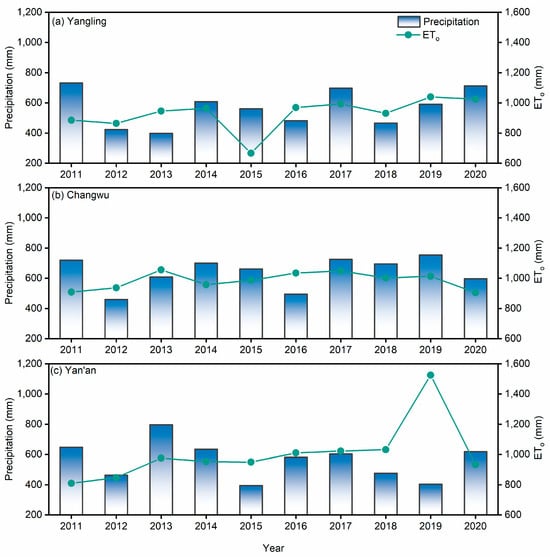
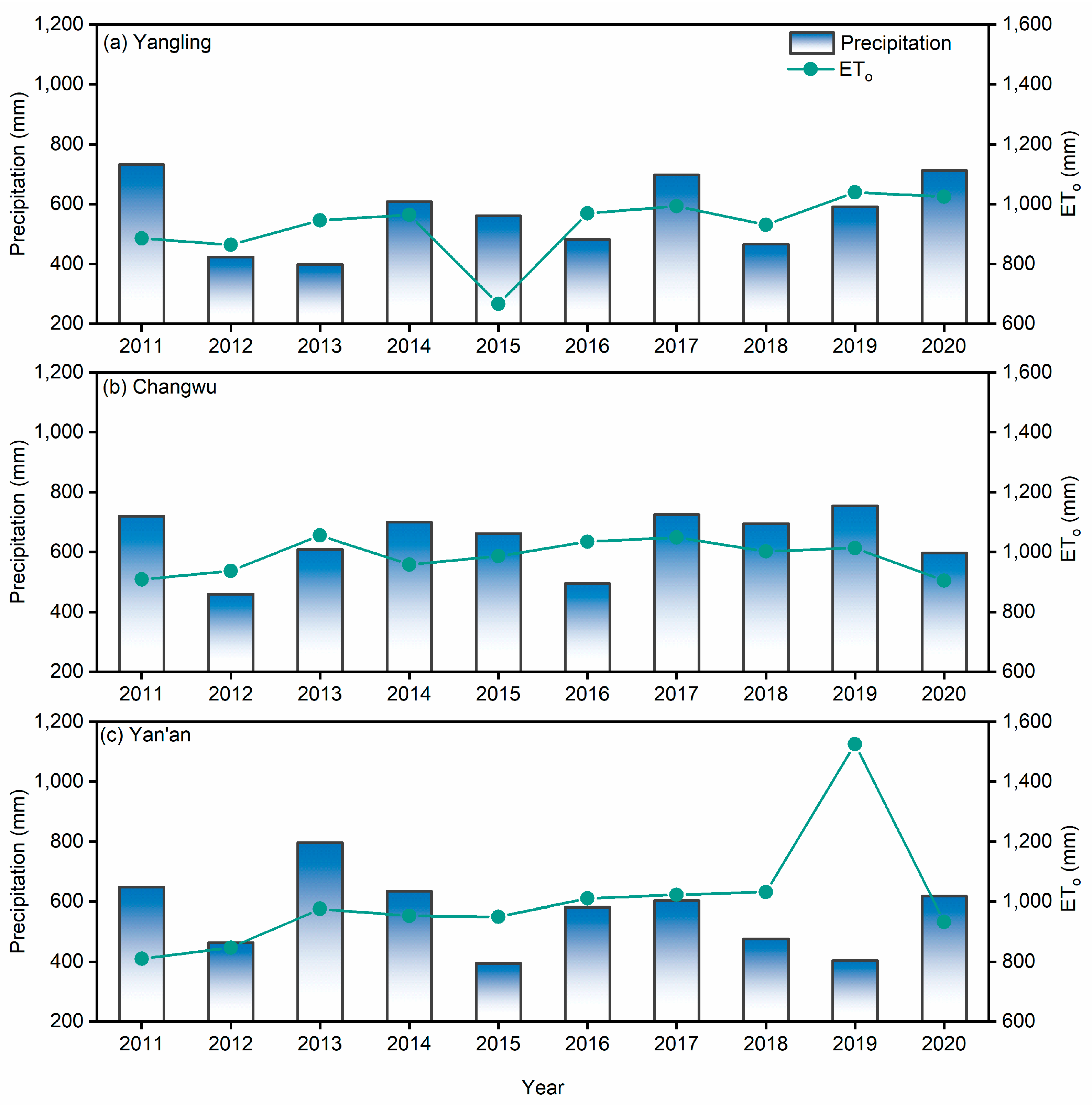
Daily meteorological data for Yangling, Changwu, and Yan’an from 2011 to 2020 were used to drive the DSSAT simulations. The meteorological inputs included variables required by DSSAT for crop growth and soil water balance simulations. Annual precipitation and reference evapotranspiration were used to characterize climatic differences among the three sites (Figure 1).
Figure 1.
Annual precipitation and reference evapotranspiration at Yangling (a), Changwu (b), and Yan’an (c) on the Chinese Loess Plateau during 2011–2020. Note: Meteorological data for the three study sites were obtained from long-term monitoring stations located in close proximity to the corresponding experimental fields. Data for Yangling were obtained from the meteorological station of the Institute of Soil and Water Conservation, Northwest A&F University; data for Changwu were obtained from the Shaanxi Changwu National Field Scientific Observation and Research Station for Farmland Ecosystems; and data for Yan’an were obtained from the National Observation and Research Station of Earth Critical Zone on the Loess Plateau in Shaanxi. All meteorological stations were located within 3 km of the corresponding experimental sites, ensuring that the meteorological records were representative of the local climatic conditions.
Interannual variability in precipitation was further characterized using a drought index (DI), calculated according to Equation (5):
where R is the annual precipitation, mm; M is the average precipitation from 2011 to 2020; and σ is the standard error of multi-year precipitation. The DI value is used to classify dry years (DI < −0.35), normal years (−0.35 ≤ DI ≤ 0.35) and wet years (DI > 0.35) [32].
2.4. Model Performance Evaluation and Statistical Analysis
The performance of both the modified soil water retention model and the DSSAT simulations was evaluated using multiple complementary statistical indices. The Nash–Sutcliffe efficiency (NSE), coefficient of residual mass (CRM), and mean absolute percentage error (MAPE) were used to quantify overall model performance. The coefficient of determination (R2) and root mean square error (RMSE) were used to assess the agreement between simulated and observed values. The statistical indices were calculated using Equations (6)–(11):
where Si and Mi denote the observed and predicted values, respectively; and are the mean of the observed values and predicted values, respectively; and (n) is the number of observations. The R2 was additionally calculated from the linear relationship between the observed and predicted values.
The ATP-responsive water retention model was developed and calibrated using MATLAB R2019a. Genetic algorithms were used to optimize the additional parameters introduced into the modified VG model. DSSAT cultivar parameters were calibrated using the GLUE module embedded in DSSAT 4.5.
Statistical analyses were conducted using IBM SPSS Statistics 22.0. Microsoft Excel 2024 was used for data organization and auxiliary calculations, and figures were prepared using Origin 2024.
3. Results and Discussion
3.1. Modified Water Characteristic Curve Model Parameterization and Model Accuracy Evaluation
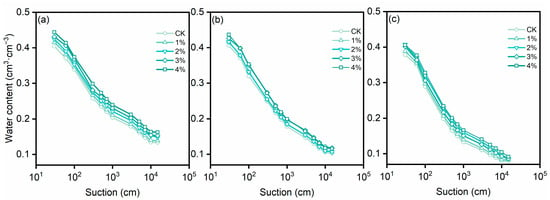
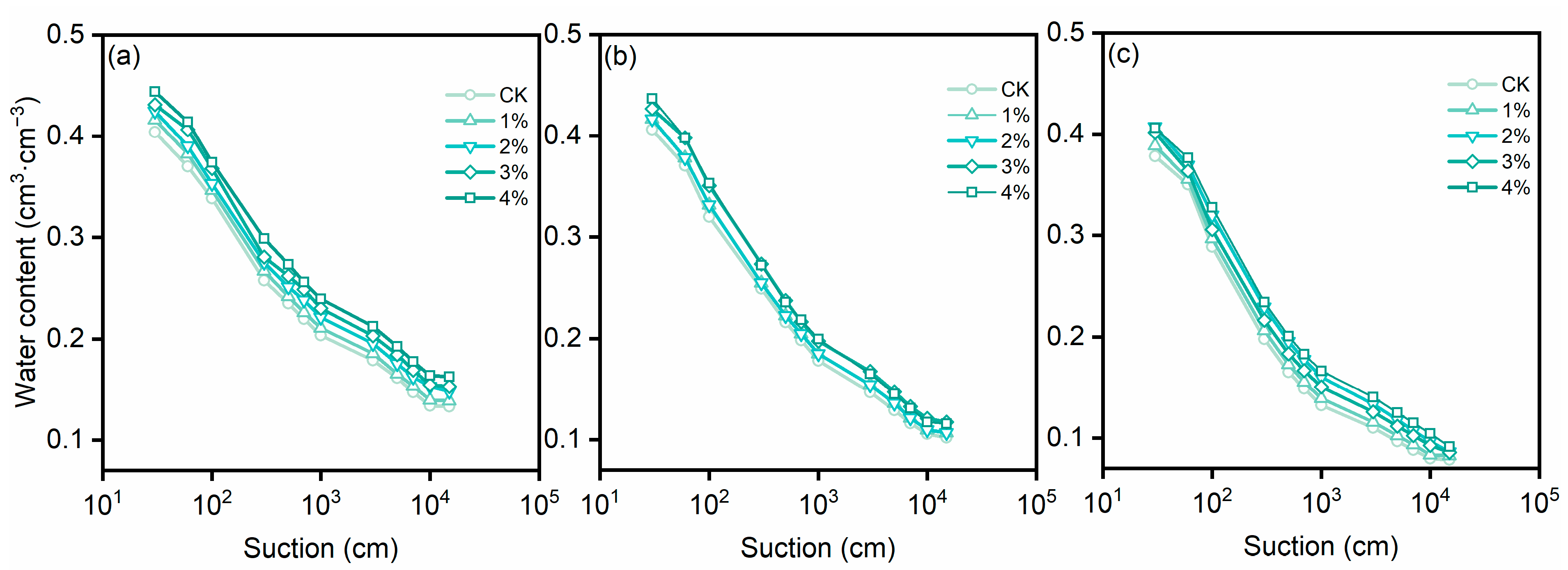
Figure 2 shows the SWCCs for three types of soil under various ATP application rates. At a given matric suction, the clay loam soil generally retained more soil water content than the other two soils, whereas the sandy loam soil exhibited relatively lower soil water content. To further characterize the effects of ATP on soil water retention across different suction ranges, the measured suction range was divided into three intervals for comparative analysis, namely, low suction (<100 cm), medium suction (100–3000 cm), and high suction (>3000 cm), based on the characteristic changes in the SWCCs and the relationship between matric suction and equivalent pore size [33,34]. The largest variations in soil water content occurred in the low-suction range, whereas the changes became more gradual and regular in the medium-suction range. ATP application altered soil water retention to varying degrees across these suction ranges.
Figure 2.
The soil water retention curves for three texturally distinct soils, namely, clay loam (a), loam (b), and sandy loam (c), in response to varying application rates of attapulgite (ATP).
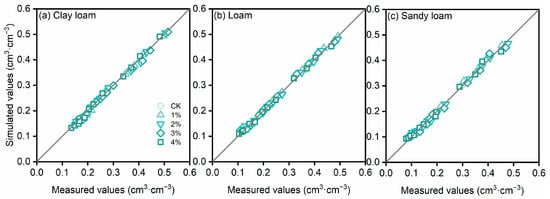
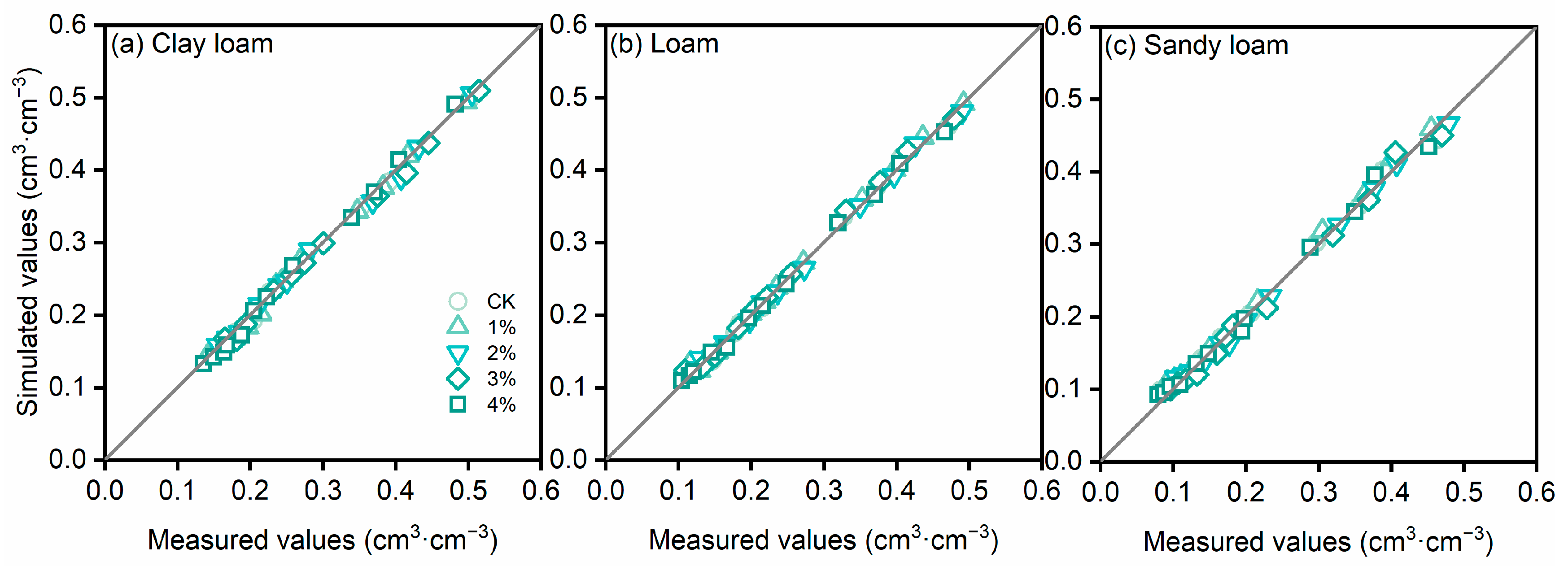
The modified model introduced several additional parameters that could not be readily estimated using conventional fitting methods. Therefore, a genetic algorithm was employed to optimize the parameters of the modified van Genuchten model (Table 2), and statistical error metrics were used to evaluate the agreement between the simulated and measured values (Table 3). CRM, NS, and MAPE were used to assess model performance. In general, CRM and MAPE values closer to 0 and NS values closer to 1 indicate better agreement between simulated and measured data and, consequently, better model performance. Compared with the original van Genuchten model, the modified model consistently produced higher NS values, which were closer to 1. Meanwhile, the CRM and MAPE values of the modified model were generally closer to 0, indicating that the modified model provided a more accurate description of the soil water retention curves under different ATP treatments. The R2 values for all treatments were close to 1, while the RMSE values were below 0.1, further demonstrating the good agreement between the simulated and measured soil water contents. Consistent with these statistical results, Figure 3 shows only minor deviations between the values simulated by the modified model and the corresponding measurements.
Table 2.
Parameter calibration of the modified model for the ATP-treated soil water characteristic curves.
Table 3.
Error analyses of the modified model for the soil water characteristic curves for ATP-treated soils.
Figure 3.
Comparison of measured soil water characteristic curves and simulated soil water characteristic curves obtained from the modified van Genuchten model in clay loam (a), loam (b), and sandy loam (c).
3.2. Effect of ATP Dosing on Crop Yield and Determination of Reasonable Dosing in Different Regions and Year Types
3.2.1. Crop Genetic Parameter Determination
The DSSAT model was run by determining crop yield [31], which was manually adjusted to achieve an accurate fit between the simulated and observed values. For ‘Xianyu 335’ in the Changwu region and ‘Shendan 10’ in the Yan’an region, their genetic parameters were obtained from published research findings in the same region of the Loess Plateau [35,36]. Crop genetic parameters were calibrated using the DSSAT-GLUE parameter estimation tool provided with the DSSAT model [37] (Table 4). The Generalized Likelihood Uncertainty Estimation (GLUE) framework is a global parameter search approach based on likelihood-based uncertainty analysis. Parameter sets are randomly sampled from predefined prior distributions within specified upper and lower bounds, and the model is repeatedly executed for each parameter combination. The agreement between simulated and observed data is then evaluated using a likelihood measure to identify behavioral or optimal parameter sets. Owing to its global search strategy, GLUE is less susceptible than local optimization methods to convergence toward local optima, making it suitable for calibrating multiple interacting crop model parameters.
Table 4.
Determination of genetic parameters for different maize varieties.
3.2.2. Model Validation and Applicability Evaluation
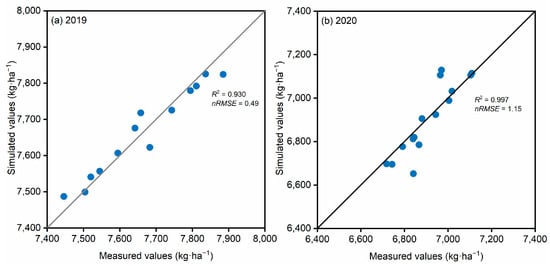
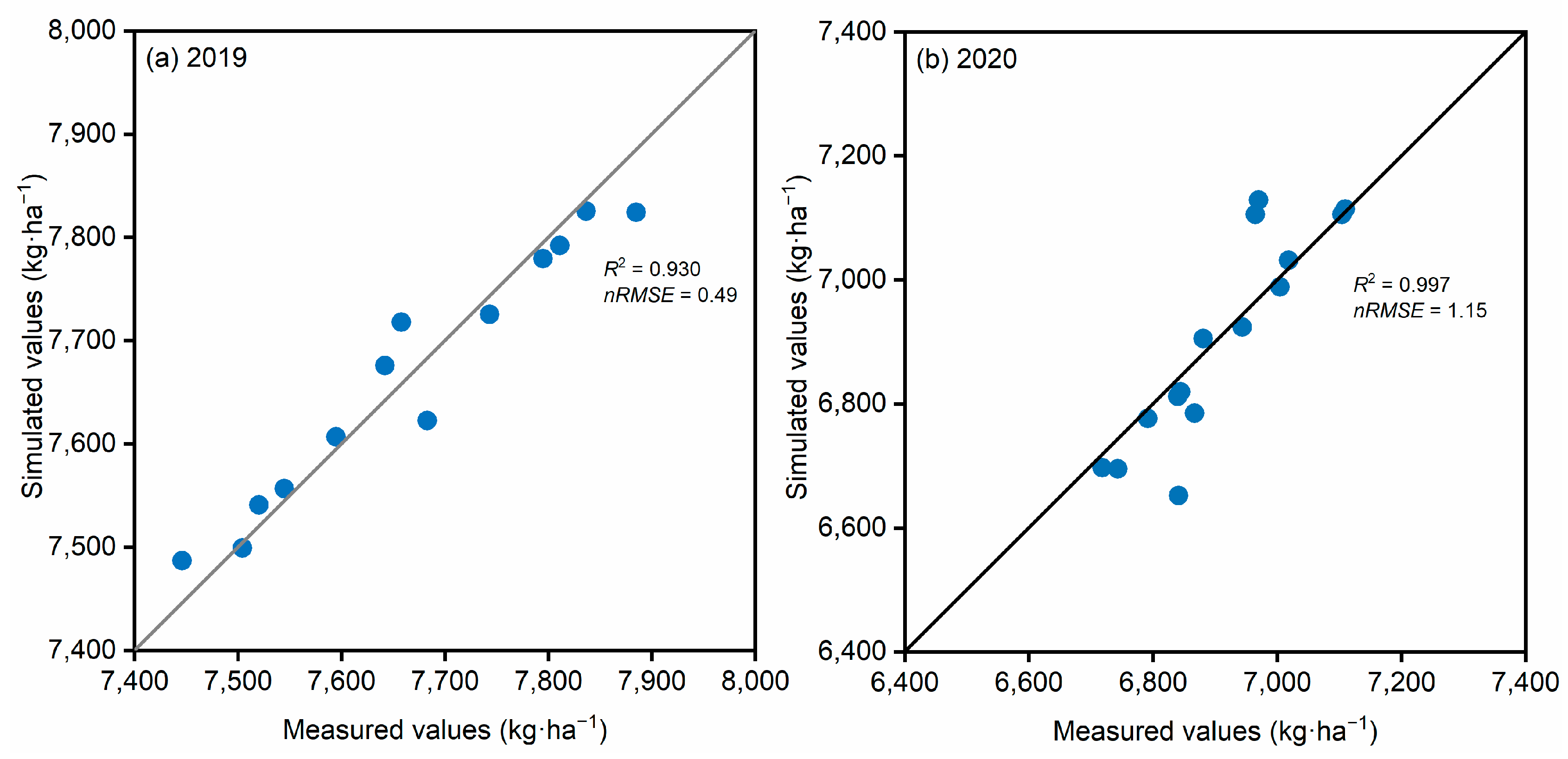
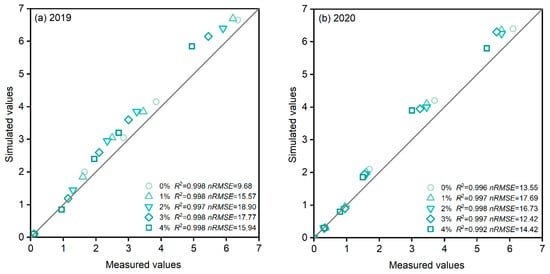
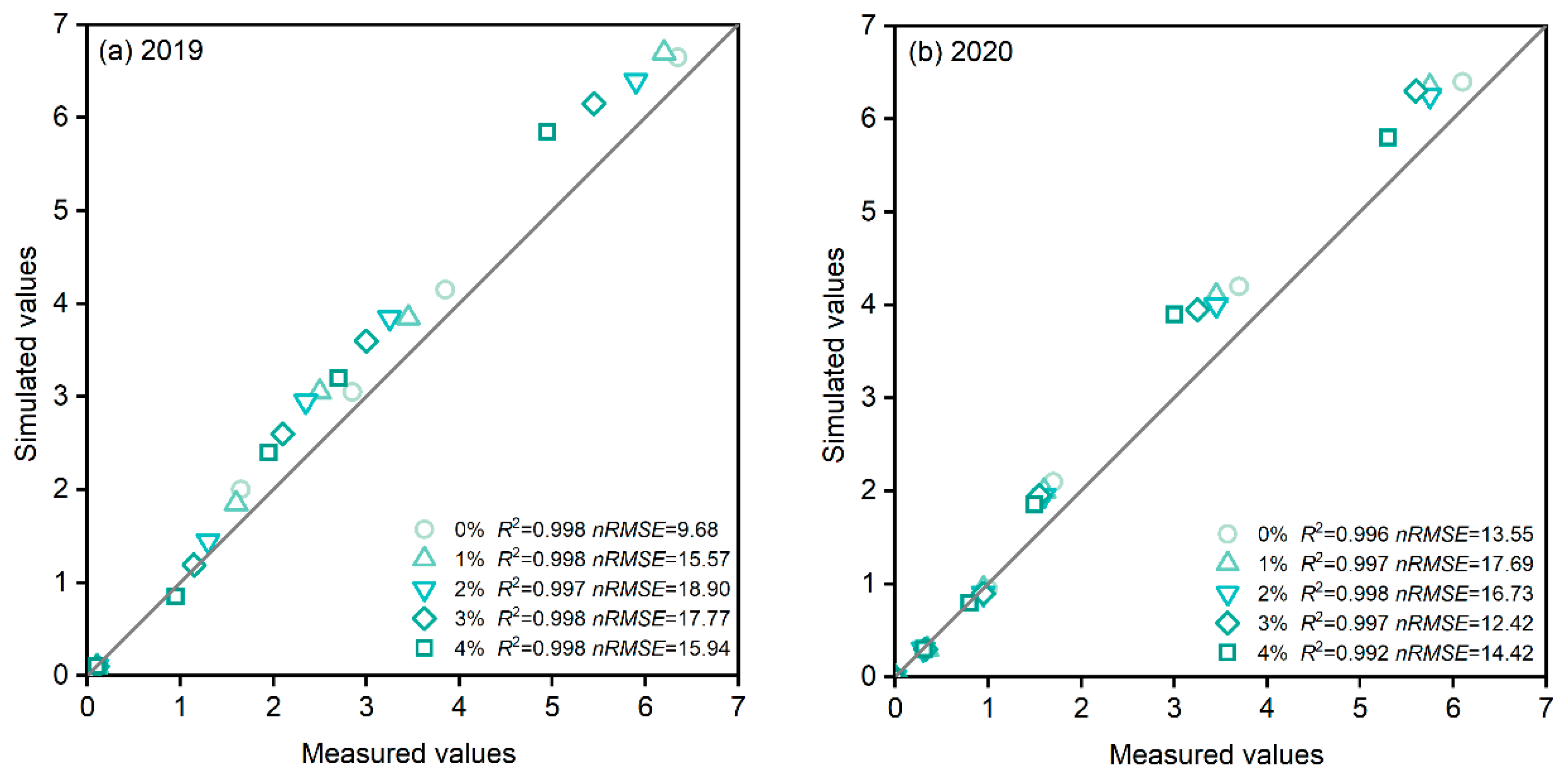
The performance of the calibrated DSSAT model was evaluated using maize yield and LAI data collected at Yangling in 2019 and 2020 (Figure 4 and Figure 5). For maize yield, the coefficients of determination (R2) between the simulated and measured values were 0.93 and 0.997 in 2019 and 2020, respectively, with corresponding nRMSE values of 0.49% and 1.15%. Across both growing seasons, R2 values for maize yield exceeded 0.90 and nRMSE values remained below 5%. Similarly, the simulated LAI agreed well with the observations, with R2 values exceeding 0.90 and nRMSE values below 20%. These results indicate that the calibrated model adequately reproduced the observed variations in maize yield and LAI under different ATP application rates, demonstrating its ability to represent crop responses to ATP-induced changes in soil conditions. The consistently high R2 and relatively low nRMSE values further suggest that the parameterization captured the major relationships between soil hydraulic conditions and crop growth in the experimental system. However, because the same experimental dataset was used for both parameter calibration and performance assessment, these results should be interpreted as evidence of goodness of fit rather than independent model validation. Consequently, application of the calibrated model beyond the experimental conditions should be undertaken cautiously, and further evaluation using independent datasets across additional years or locations would strengthen confidence in its predictive capability.
Figure 4.
Comparison of simulated and measured maize yields in Yangling in 2019 (a) and 2020 (b).
Figure 5.
Comparison of simulated and measured leaf area index values for maize in Yangling in 2019 (a) and 2020 (b).
3.2.3. Maize Yield Prediction and Determination of Reasonable Attapulgite Doses in Different Regions
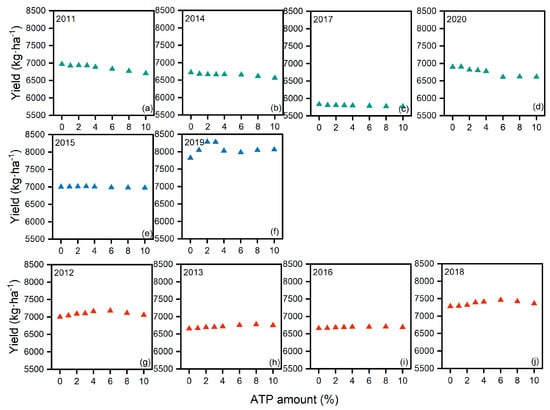
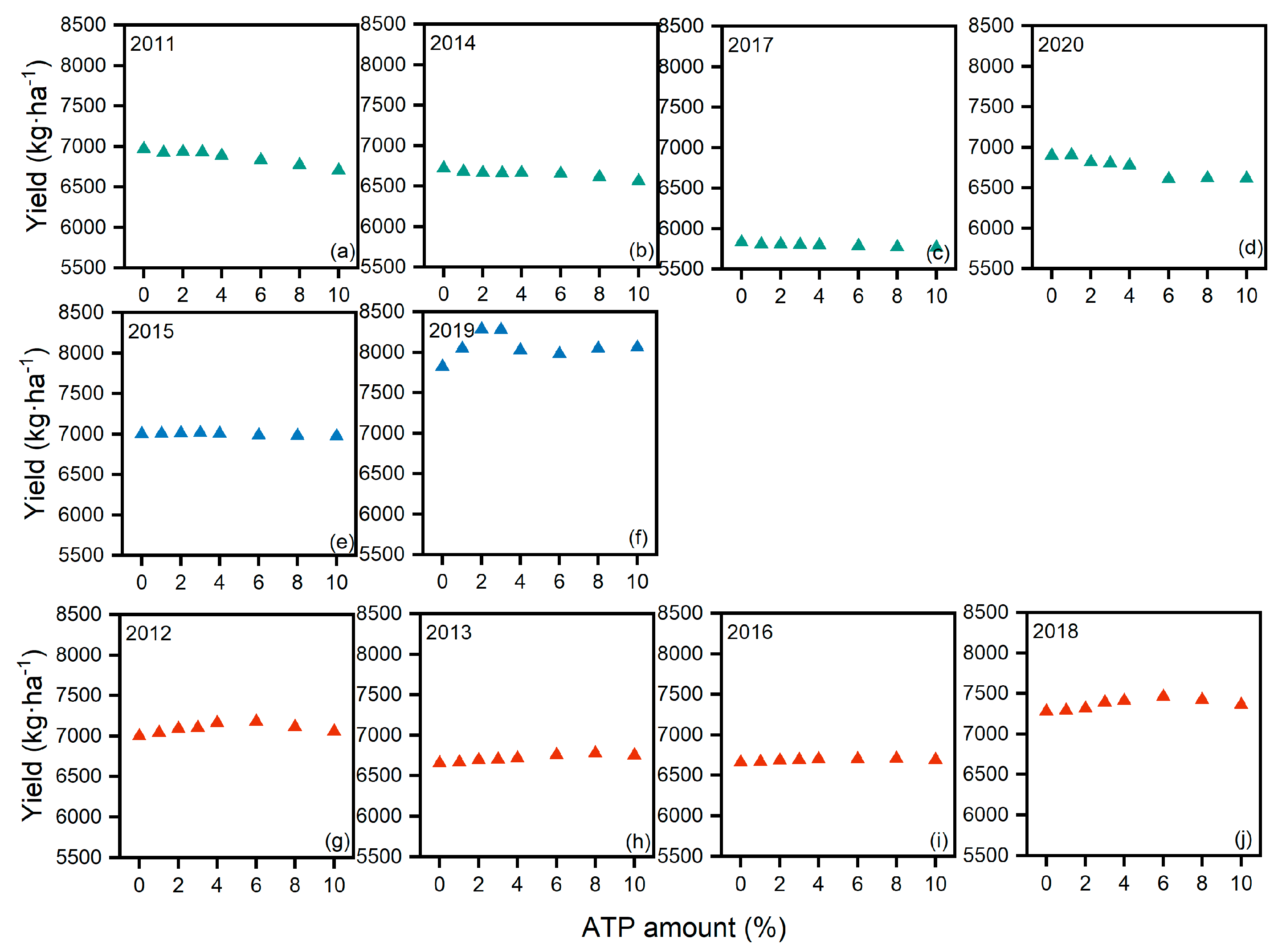
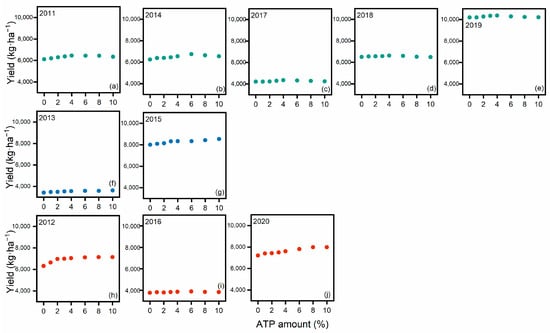
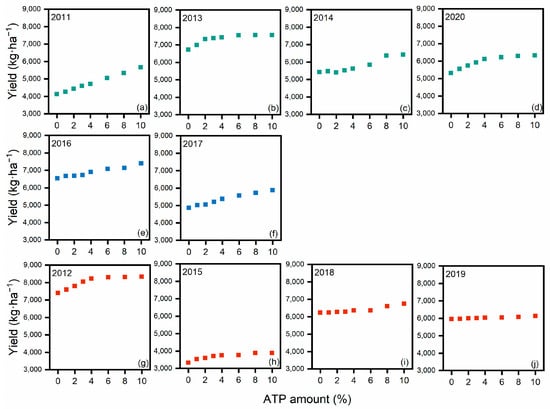
Figure 6, Figure 7 and Figure 8 show the simulated responses of maize yield to different ATP application rates in Yangling (clay loam), Changwu (loam) and Yan’an (sandy loam) from 2011 to 2020 using the CERES-Maize model. Substantial interannual and site-specific differences were observed in the yield response to ATP application. In Yangling, maize yield decreased with increasing ATP application in 2011, 2014, and 2017. In 2015 and 2019, yield initially increased and subsequently declined, with the maximum response occurring at approximately 3% ATP. More complex responses were observed in 2012, 2013, 2016, and 2018. In these years, exploratory simulations extending beyond the experimentally tested range indicated changes in the yield response at approximately 6–8% ATP, although these high-rate predictions should be interpreted cautiously.
Figure 6.
Maize yield simulation results under different ATP application rates at the Yangling area in wet years (a–d), normal years (e,f), and dry years (g–j), 2011–2020.
Figure 7.
Maize yield simulation results under different ATP application rates at the Changwu area in wet years (a–e), normal years (f,g), and dry years (h–j), 2011–2020.
Figure 8.
Maize yield simulation results under different ATP application rates at the Yan’an area in wet years (a–d), normal years (e,f), and dry years (g–j), 2011–2020.
In Changwu, maize yield decreased progressively with increasing ATP application in 2013 and 2015. In 2014, 2016, and 2020, the simulated yield exhibited a non-monotonic response, with exploratory simulations suggesting a turning point at approximately 6% ATP, beyond which yield tended to decline. In contrast, maize yield increased with ATP application up to approximately 4% in 2011, 2012, 2017, 2018, and 2019, after which the response weakened or changed direction. These interannual differences suggest that the agronomic effects of ATP in loam soil were strongly dependent on prevailing environmental conditions rather than being determined solely by the application rate.
The response in Yan’an differed markedly from those in Yangling and Changwu. Across the simulated 0–10% ATP range, maize yield generally increased with ATP application in most years, indicating a stronger positive response of maize production to ATP amendment in the sandy loam soil. This response may be associated with the greater potential of ATP to enhance soil water retention in coarse-textured soil, where limited water-holding capacity is more likely to constrain crop growth. Nevertheless, the response was not strictly monotonic at the higher ATP rates explored outside the experimental range. Turning points occurred at approximately 6% ATP in 2012, 2013, and 2018 and at approximately 8% ATP in 2014, beyond which simulated yields either plateaued or declined slightly. Overall, these results demonstrate that the yield response to ATP was jointly regulated by soil texture, application rate, and interannual environmental variability, with sandy loam soil showing a more consistently positive response than clay loam and loam soils.
Overall, in wet years, ATP application had a negative effect on maize yield in the Yangling area and a positive effect in the Yan’an area, while the response to ATP varied between years in the Changwu area. In normal years, maize yields varied between the three areas, with ATP application having a cumulative effect on maize yield in the Changwu area and Yan’an area and a cumulative effect on maize yield in the Yangling area at < 4% ATP. In dry years, maize yields increased with increasing ATP application in all three regions.
The incorporation of ATP into soil can modify its particle size composition and structure, thereby altering soil water retention and water–air transport processes. At relatively high application rates, particularly under wet conditions, the enhanced water-holding capacity of ATP-amended soil may reduce air-filled porosity and restrict soil aeration, potentially increasing the risk of waterlogging and adversely affecting root water and nutrient uptake [7,38]. In Yangling, precipitation is relatively abundant, and the difference between precipitation and evapotranspiration is comparatively small. In addition, the clay loam soil has a relatively high water-holding capacity because its finer texture and greater proportion of small pores retain more water against gravitational drainage. Consequently, excessive ATP application during wet years may further increase soil water retention while reducing aeration, thereby negatively affecting maize growth and yield. By contrast, during normal and dry years, improved soil water retention following ATP application can alleviate water limitation and enhance soil water availability to crops. Therefore, moderate ATP application may increase maize yield under water-limited conditions, whereas excessive application under wet conditions may be counterproductive. Within the experimentally validated range (0–4%), maize growth is favored when the application rate is no more than 4% in normal years. Exploratory simulations suggested that slightly higher rates might be beneficial in dry years.
In contrast to Yangling, the Yan’an region is characterized by relatively low precipitation, high evaporative demand, and limited soil water storage. Under these water-limited conditions, ATP application can increase the proportion of small pores and soil specific surface area, thereby enhancing soil water retention and plant-available water content [1,22,29]. Improved soil water availability can alleviate crop water stress and facilitate root water uptake, ultimately promoting maize growth and increasing grain yield. This may explain why maize yield in Yan’an generally exhibited a more positive response to increasing ATP application than that observed in the finer-textured soils of Yangling and Changwu.
The Changwu soil has an intermediate clay content compared with the soils of Yangling and Yan’an, while the difference between mean annual evaporation and precipitation is smaller than that in Yan’an [32]. Under relatively wet conditions, excessive ATP application may further enhance soil water retention and reduce soil aeration, thereby adversely affecting maize growth. Accordingly, the simulated maize yields in Changwu tended to decline in wet years when ATP application exceeded 4%. Considering that the experimentally validated application range was limited to 0–4% ATP, site-specific recommendations should be based primarily on responses within this range. For Yangling, ATP application should generally be maintained below 4% because higher rates within the tested range frequently reduced simulated yield. In Changwu and Yan’an, application rates below 4% were generally beneficial or had little adverse effect, whereas the apparent benefits of rates above 4% were derived from exploratory model extrapolation and therefore require experimental verification before practical recommendation. It should be noted that the three sites differ simultaneously in terms of variety, soil, and climate. The differences in yield responses reflect the combined effects of these three factors rather than being attributable to any single factor. This study aimed to evaluate the overall effect of ATP application under actual regional production conditions, rather than to isolate the independent contributions of individual factors.
Furthermore, although the model simulations indicated potential yield responses at higher ATP application rates, these results should be interpreted as exploratory and hypothesis-generating rather than as direct agronomic recommendations. The economic feasibility of applying ATP at such high rates also remains uncertain and should be evaluated through comprehensive cost–benefit analyses and field-scale validation before practical recommendations are developed. Future research should therefore focus on improving ATP application efficiency, for example, through localized rather than uniform incorporation or through co-application with organic amendments, with the aim of reducing the required dosage while retaining its beneficial effects on soil water availability and crop productivity.
4. Conclusions
A model of the water retention curve with ATP incorporation was constructed. Based on this, maize yields in three textured soils at three locations (Yangling, Changwu and Yan’an) on the Chinese Loess Plateau were simulated using the DSSAT crop model to explore the effects of ATP application on maize yields and reasonable dosing in typical areas of the Loess Plateau. ATP enhances soil water-holding capacity and available water content by increasing the proportion of small pores and specific surface area in soil. However, excessive application can reduce soil air permeability and saturated hydraulic conductivity, inhibit crop root water uptake, and thus affect yield. This mechanism primarily improves water retention and efficiency in sandy soils (Yan’an), whereas in clayey soils (Yangling), it is more prone to causing aeration limitations. The RMSE and R2 values for all treatments indicate that the use of the modified model is more effective than the traditional van Genuchten model for simulating the water retention curve in ATP-treated soils. The DSSAT model was used to verify the applicability of the modified van Genuchten model by combining maize growth data from the Yangling plot in 2019 and 2020.
The nRMSE and R2 values indicated that the model could better simulate the maize yield and leaf area index of ATP-treated soils. The application of ATP increased maize yield in the Yan’an and Changwu regions while decreasing yield in the Yangling region. Based on the analysis of maize yields across the three regions under different year types, the recommended ATP rate within the experimentally validated range (0–4%) is below 4% for Yangling. In the exploratory simulations, turning points were observed at approximately 6% for Changwu and 8% for Yan’an in certain years. The above results provide a preliminary scientific basis for the rational application of ATP on the Loess Plateau. However, the optimal application rates derived from simulations still require further validation through field experiments. The methodological framework established in this study, which couples the hydraulic parameters of the modified water retention model with DSSAT yield simulations, quantitatively integrates the effects of soil amendments on soil hydraulic properties with crop growth responses. This approach enables cross-year and cross-climate scenario simulation extrapolation based on limited field experimental data and can serve as a methodological reference for agricultural research in arid regions.
Author Contributions
W.F.: Conceptualization, methodology, visualization, data curation, formal analysis, writing—original draft, writing—review and editing, and funding acquisition. B.L.: Investigation, data curation, formal analysis, validation, and writing—review and editing. T.Y.: Conceptualization, methodology, visualization, supervision, and writing—review and editing. All authors have read and agreed to the published version of the manuscript.
Funding
This research was funded by the National Natural Science Foundation of China (Grant No. 42507481).
Data Availability Statement
Data will be made available on request.
Conflicts of Interest
The authors declare no conflicts of interest.
References
- Yang, T.; Xing, X.; Gao, Y.; Ma, X. An environmentally friendly soil amendment for enhancing soil water availability in drought-prone soils. Agronomy 2022, 12, 133. [Google Scholar] [CrossRef] [Scilit]
- Zhang, S.; Yang, D.; Yang, Y.; Piao, S.; Yang, H.; Lei, H.; Fu, B. Excessive afforestation and soil drying on China’s Loess Plateau. J. Geophys. Res. Biogeosci. 2018, 123, 923–935. [Google Scholar] [CrossRef] [Scilit]
- Udom, B.E.; Omovbude, S.; Abam, P.O. Topsoil removal and cultivation effects on structural and hydraulic properties. Catena 2018, 165, 100–105. [Google Scholar] [CrossRef] [Scilit]
- Liu, T.; Wu, L.; Tang, S.; Shaaban, M.; Meng, L.; Xu, M.; Zhang, W. Positive effects of amendments on crop yield and organic carbon in sandy soils are regulated by aridity: A global meta-analysis. Geoderma 2025, 462, 117540. [Google Scholar] [CrossRef] [Scilit]
- Akter, S.; Mia, M.S.; Prodhan, M.A.; Azam, G.; Solaiman, Z.M.; Siddique, K.H.M. Effects of soil amelioration on wheat growth, nutrition, and soil microbiome dynamics in sandy soil. J. Soil Sci. Plant Nutr. 2026, 26, 6421–6437. [Google Scholar] [CrossRef] [Scilit]
- Xie, L.H.; Liu, M.Z.; Ni, B.L.; Zhang, X.; Wang, Y. Slow-release nitrogen and boron fertilizer from a functional superabsorbent formulation based on wheat straw and attapulgite. Chem. Eng. J. 2011, 167, 342–348. [Google Scholar] [CrossRef] [Scilit]
- Lv, P.; Liu, C.; Rao, Z. Review on clay mineral-based form-stable phase change materials: Preparation, characterization and applications. Renew. Sustain. Energy Rev. 2017, 68, 707–726. [Google Scholar] [CrossRef] [Scilit]
- Ren, J.; Liao, Q.; Fan, J.; Zhu, B.; Xu, W.; Lu, Y. Effect of in-situ stabilizing remediation of Cd-polluted soil by attapulgite. Ecol. Environ. Sci. 2017, 26, 2161–2168. (In Chinese) [Google Scholar] [CrossRef]
- Wang, L.; Wang, F.; Huang, B.; Tang, Q. Recent advances in superhydrophobic composites based on clay minerals. Appl. Clay Sci. 2020, 198, 105793. [Google Scholar] [CrossRef] [Scilit]
- Sekucia, F.; Dlapa, P.; Kollár, J.; Cerdá, A.; Hrabovský, A.; Svobodová, L. Land-use impact on porosity and water retention of soils rich in rock fragments. Catena 2020, 195, 104807. [Google Scholar] [CrossRef] [Scilit]
- Xing, X.; Li, Y.; Ma, X. Water retention curve correction using changes in bulk density during data collection. Eng. Geol. 2018, 233, 231–237. [Google Scholar] [CrossRef] [Scilit]
- Zhou, C.; So, P.S.; Chen, X.W. A water retention model considering biopolymer-soil interactions. J. Hydrol. 2020, 586, 124874. [Google Scholar] [CrossRef] [Scilit]
- Ghorbani, A.; Sadeghi, M.; Tuller, M.; Durner, W.; Jones, S.B. A generalized van Genuchten model for unsaturated soil hydraulic conductivity. Vadose Zone J. 2024, 23, e20369. [Google Scholar] [CrossRef] [Scilit]
- Ng, C.W.W.; Pang, Y.W. Influence of stress state on soil-water characteristics and slope stability. J. Geotech. Geoenviron. Eng. 2000, 126, 157–166. [Google Scholar] [CrossRef] [Scilit]
- Hu, Q.; Li, X.; Šimůnek, J.; Shi, H.; Chen, N.; Zhang, Y.; Xin, M.; Song, F. Evaluating soil water dynamics under a no-tillage system with residual plastic film mulching in an arid region of western China using HYDRUS-2D. Soil Tillage Res. 2023, 234, 105849. [Google Scholar] [CrossRef] [Scilit]
- Hussain, R.; Ravi, K.; Garg, A. Influence of biochar on the soil water retention characteristics (SWRC): Potential application in geotechnical engineering structures. Soil Tillage Res. 2020, 204, 104713. [Google Scholar] [CrossRef] [Scilit]
- Yi, S.; Chang, N.Y.; Imhoff, P.T. Predicting water retention of biochar-amended soil from independent measurements of biochar and soil properties. Adv. Water Resour. 2020, 142, 103638. [Google Scholar] [CrossRef] [Scilit]
- Bagarello, V.; Iovino, M. Testing the BEST procedure to estimate the soil water retention curve. Geoderma 2012, 187–188, 67–76. [Google Scholar] [CrossRef] [Scilit]
- Xing, X.; Liu, Y.; Garg, A.; Ma, X.; Yang, T.; Zhao, L. An improved genetic algorithm for determining modified water-retention model for biochar-amended soil. Catena 2021, 200, 105143. [Google Scholar] [CrossRef] [Scilit]
- Lamorski, K.; Šimůnek, J.; Sławiński, C.; Lamorska, J. An estimation of the main wetting branch of the soil water retention curve based on its main drying branch using the machine learning method. Water Resour. Res. 2017, 53, 1539–1552. [Google Scholar] [CrossRef] [Scilit]
- Shwetha, P.; Varija, K. Soil water retention curve from saturated hydraulic conductivity for sandy loam and loamy sand textured soils. Aquat. Procedia 2015, 4, 1142–1149. [Google Scholar] [CrossRef] [Scilit]
- Yang, T.; Fu, W. Modified water-retention model containing a swelling-shrinkage variation feature: Investigation attapulgite-treated soil permeability. Bull. Eng. Geol. Environ. 2025, 84, 102. [Google Scholar] [CrossRef] [Scilit]
- Lim, T.J.; Spokas, K.A.; Feyereisen, G. Predicting the impact of biochar additions on soil hydraulic properties. Chemosphere 2016, 142, 136–144. [Google Scholar] [CrossRef] [Scilit]
- Xing, X.; Ma, X. Analysis of cracking potential and modification of soil-water characteristic curve by adding wheat residues. Soil Sci. Soc. Am. J. 2019, 83, 1299–1308. [Google Scholar] [CrossRef] [Scilit]
- Razzaghi, F.; Plauborg, F.; Jacobsen, S.E.; Jensen, C.R.; Andersen, M.N. Effect of nitrogen and water availability of three soil types on yield, radiation use efficiency and evapotranspiration in field-grown quinoa. Agric. Water Manag. 2012, 109, 20–29. [Google Scholar] [CrossRef] [Scilit]
- Liu, H.L.; Yang, J.Y.; Tan, C.S.; Drury, C.F.; Reynolds, W.D.; Zhang, T.Q.; Bai, Y.L.; Jin, J.; He, P.; Hoogenboom, G. Simulating water content, crop yield and nitrate-N loss under free and controlled tile drainage with subsurface irrigation using the DSSAT model. Agric. Water Manag. 2011, 98, 1105–1111. [Google Scholar] [CrossRef] [Scilit]
- Li, Z.T.; Yang, J.Y.; Drury, C.F.; Hoogenboom, G. Evaluation of the DSSAT-CSM for simulating yield and soil organic C and N of a long-term maize and wheat rotation experiment in the Loess Plateau of Northwestern China. Agric. Syst. 2015, 135, 90–104. [Google Scholar] [CrossRef] [Scilit]
- Zhang, S.Y.; Zhang, G.C.; Gu, S.Y.; Xia, J.B.; Zhao, J.K. Critical responses of photosynthetic efficiency of goldspur apple tree to soil water variation in semiarid loess hilly area. Photosynthetica 2010, 48, 589–595. [Google Scholar] [CrossRef] [Scilit]
- Sung-inthara, T.; Juntahum, S.; Senawong, K.; Katekaew, S.; Laloon, K. Pelletization of soil amendment: Optimizing the production and quality of soil amendment pellets from compost with water and biochar mixtures and their impact on soil properties. Environ. Technol. Innov. 2024, 33, 103505. [Google Scholar] [CrossRef] [Scilit]
- Cox, J.; Hue, N.V.; Ahmad, A.; Kobayashi, K.D. Surface-applied or incorporated biochar and compost combination improves soil fertility, Chinese cabbage and papaya biomass. Biochar 2021, 3, 213–227. [Google Scholar] [CrossRef] [Scilit]
- Liu, S.; Yang, J.Y.; Zhang, X.Y.; Drury, C.F.; Reynolds, W.D.; Hoogenboom, G. Modelling crop yield, soil water content and soil temperature for a soybean–maize rotation under conventional and conservation tillage systems in Northeast China. Agric. Water Manag. 2013, 123, 32–44. [Google Scholar] [CrossRef] [Scilit]
- Guo, S.; Zhu, H.; Dang, T.; Wu, J.; Liu, W.; Hao, M.; Li, Y.; Syers, J.K. Winter wheat grain yield associated with precipitation distribution under long-term nitrogen fertilization in the semiarid Loess Plateau in China. Geoderma 2012, 189–190, 442–450. [Google Scholar] [CrossRef] [Scilit]
- Meurer, K.; Barron, J.; Chenu, C.; Coucheney, E.; Fielding, M.; Hallett, P.; Herrmann, A.M.; Keller, T.; Koestel, J.; Larsbo, M.; et al. A framework for modelling soil structure dynamics induced by biological activity. Glob. Change Biol. 2020, 26, 5382–5403. [Google Scholar] [CrossRef] [Scilit]
- Assouline, S. What can we learn from the water retention characteristic of a soil regarding its hydrological and agricultural functions? Review and analysis of actual knowledge. Water Resour. Res. 2021, 57, e2021WR031026. [Google Scholar] [CrossRef] [Scilit]
- Chen, S.; Jiang, T.; Ma, H.; He, C.; Xu, F.; Malone, R.W.; Feng, H.; Yu, Q.; Siddique, K.H.M.; Dong, Q.; et al. Dynamic within-season irrigation scheduling for maize production in Northwest China: A method based on weather data fusion and yield prediction by DSSAT. Agric. For. Meteorol. 2020, 285–286, 107928. [Google Scholar] [CrossRef] [Scilit]
- Zou, L. Applicability Evaluation of the DSSAT Model and Its Application to Water and Fertilizer Management in the Hilly Loess Region. Master’s Thesis, Research Center of Soil and Water Conservation and Ecological Environment, Chinese Academy of Sciences and Ministry of Education, Xianyang, China, 2014. (In Chinese) [Google Scholar]
- He, J.; Dukes, M.D.; Jones, J.W.; Graham, W.D.; Judge, J. Applying GLUE for estimating CERES-Maize genetic and soil parameters for sweet corn production. Trans. ASABE 2009, 52, 1907–1921. [Google Scholar] [CrossRef] [Scilit]
- Wang, Y.; Magliulo, V.; Yan, W.; Shangguan, Z. Assessing land surface drying and wetting trends with a normalized soil water index on the Loess Plateau in 2001–2016. Sci. Total Environ. 2019, 676, 120–130. [Google Scholar] [CrossRef] [Scilit]

Disclaimer/Publisher’s Note: The statements, opinions and data contained in all publications are solely those of the individual author(s) and contributor(s) and not of MDPI and/or the editor(s). MDPI and/or the editor(s) disclaim responsibility for any injury to people or property resulting from any ideas, methods, instructions or products referred to in the content. |
© 2026 by the authors. Licensee MDPI, Basel, Switzerland. This article is an open access article distributed under the terms and conditions of the Creative Commons Attribution (CC BY) license.