


Abstract
Hydroponic and soilless systems are increasingly adopted as low-cost, sustainable solutions for global food production, yet they remain highly susceptible to contamination by potential toxic elements (PTEs), particularly arsenic. While biochar is widely recognized as an effective amendment for mitigating PTE contamination in soil-based systems, its ability to alleviate PTE stress in hydroponic environments has been largely overlooked. The gap reveals a critical and underexplored frontier in controlled-environment agriculture, where extending biochar-based mitigation strategies could yield substantial benefits. Here, we evaluated whether Acacia auriculiformis wood biochar could alleviate arsenic (As) toxicity in lettuce (Lactuca sativa) grown in a continuous-flow hydroponic system. Using a completely randomized factorial design (arsenic species × dose × biochar) with three independent replicates per treatment, we tested biochar under 0.2 and 0.8 mg/L of As(III) and As(V). Arsenic significantly (p < 0.05) reduced lettuce growth, with As(III) being more toxic than As(V). Biochar significantly (p < 0.05) improved morphological traits (2.4–103%), cell membrane stability (5.5–12%), photosynthetic pigments (3–73%), and stress indicators proline (8–11%) and malondialdehyde (8–14%). Arsenic accumulated mainly in roots (1.7–2.63 mg/kg) and shoots (0.76–1.36 mg/kg), but biochar reduced accumulation by 28–47% in roots and 33–48% in shoots. Additionally, biochar enhanced nutrient uptake (K, P, Ca, Mg, B, Zn, Cu, S, Mn) at both arsenic levels. Overall, the results indicate that Acacia biochar can substantially reduce arsenic toxicity and improve plant physiological responses in continuous-flow hydroponics, highlighting its promise as a viable and scalable mitigation tool for safeguarding soilless food production systems against PTE contamination.
1. Introduction
Contamination of agricultural systems by potential toxic elements (PTEs) poses major risks to environmental integrity and human health. Driven largely by anthropogenic activities such as industrialization, urbanization, and intensive chemical use in agriculture, PTEs accumulate in soils and aquatic environments, where they can enter food chains and pose risks to food safety [1,2,3,4]. Arsenic (As) is of particular concern because of its high toxicity and carcinogenicity, with widespread contamination of surface and groundwater reported in South and Southeast Asia and other regions [4,5,6,7]. Arsenic occurs in several oxidation states [As(0), As(–III), As(III), and As(V)] and is present in more than 200 natural minerals, but its high solubility increases the risk of leaching into agricultural soils and water resources [6]. This dynamic not only affects traditional soil-based farming but also directly threatens hydroponic systems, which depend entirely on water quality for nutrient delivery and crop growth. Unlike soil-based systems that provide some buffering against contaminants, hydroponic systems expose crops directly to dissolved substances, making even trace levels of PTEs potentially harmful [8].
Plants readily absorb arsenic and other PTEs through their roots and translocate them to aerial tissues via the xylem [6,9,10]. Accumulated As disrupts growth by impairing plant morphological development, reducing nutrient uptake, and disturbing physiological and biochemical functions [7,11,12,13,14,15]. In response, plants activate defense mechanisms that include the production of reactive oxygen species (ROS), lipid peroxidation, proline accumulation, and antioxidant enzyme activity, which further destabilize nutrient balance and hinder normal growth and development [10,16,17,18].
Biochar, a carbon-rich material produced through pyrolysis of plant and animal residues, has emerged as an environmentally beneficial soil amendment with the potential to mitigate PTE contamination in agricultural systems [19,20]. It reduces the mobility and bioavailability of metals and metalloids through mechanisms such as precipitation, sorption, surface complexation, and ion exchange, as well as by increasing pH and cation exchange capacity [21,22,23]. In addition to immobilizing toxic elements, biochar improves nutrient availability and soil fertility, thereby demonstrating increased plant growth and tolerance to abiotic stresses such as drought, salinity, and heavy-metal toxicity [24,25,26,27,28,29]. However, its effectiveness is species-specific and influenced by multiple factors, including biochar feedstock, pyrolysis conditions, substrate characteristics, and application rate or dose [26,29,30,31]. Hydroponic cultivation is increasingly adopted in controlled-environment agriculture, particularly in urban and water-limited regions [32]. Lettuce (Lactuca sativa) is one of the most common hydroponic crops, valued for its short growth cycle, nutritional quality, and market demand [33]. However, hydroponic systems are highly vulnerable to waterborne contaminants. Arsenic contamination of irrigation water is a global health concern, and lettuce is known to accumulate arsenic, posing risks to both yield and food safety [34,35]. Ensuring the safe production of leafy vegetables in soilless systems is a critical priority, particularly in regions that rely on hydroponic cultivation or containerized food production to overcome the limitations of soil-based agriculture and increasing food import costs, such as northern Canadian communities [36].
Although biochar has been widely studied for its capacity to improve soil health, promote plant growth, and mitigate PTE toxicity, its role in hydroponic systems under metalloid stress remains poorly understood [19,20,27]. While extensive research has demonstrated biochar’s effectiveness in soil remediation, its performance in soilless cultivation systems has not been thoroughly investigated. Existing evidence shows that biochar’s efficacy depends strongly on feedstock type, pyrolysis conditions, application rate, and crop species [37,38]. Studies on lettuce grown in soil have reported that biochar can reduce toxicity from cadmium, lead, copper, and zinc [39,40,41,42,43], improve growth and enhance nutrient uptake [44]. In contrast, only a few studies have examined lettuce responses to PTE stress in hydroponic systems. Existing research has primarily focused on copper, cadmium, lead, and selenium [45,46,47,48]. Only a few studies have investigated the use of biochar in soilless cultivation to assess arsenic uptake and metabolism in lettuce [35,49], and limited reports suggest biochar may improve lettuce nutrition or reduce metal (lead) toxicity in soilless culture [50,51,52]. Furthermore, Feng et al. examined the toxicity of six different arsenic compounds on lettuce growth, bioaccumulation, and the distribution of arsenic species [53]. However, the specific interaction between biochar and arsenic in hydroponic systems remains largely unexplored.
To address this gap, the present study evaluated the potential of Acacia auriculiformis wood biochar to mitigate arsenic toxicity in lettuce (Lactuca sativa) under hydroponic conditions. We address the following questions: (i) Can biochar enhance the morphological, physiological, and biochemical responses of lettuce exposed to As(III) and As(V) in hydroponic systems? (ii) If so, to what extent does biochar reduce arsenic accumulation in roots and shoots? (iii) Can biochar improve the uptake of essential nutrients in lettuce under arsenic stress?
2. Materials and Methods
2.1. Preparation and Characterization of Biochar
To produce biochar, we used the wood of Acacia auriculiformis, which is a fast-growing tree species and widely planted across Bangladesh primarily for timber and fuelwood. After harvesting the wood, it was air-dried, and then the pyrolysis process was used to produce biochar at 450–550 °C for approximately 7 h, as outlined by Karim et al. [54]. After production, the biochar was air-dried under direct sunlight for 3 days, manually ground and sieved through a 2 mm mesh. The moisture content of the produced biochar was determined by weight loss by drying at 105 °C for 24 h, and the electrical conductivity (EC) and pH were measured at a 1:5 (w/v) dilution. Ash content and total organic matter were quantified by combusting the biochar at 550 °C for 4 h in a muffle furnace. Bulk density was determined using the dried biochar powder (particle size < 2 mm) by the weight and volumetric method, and the Kjeldahl method was used to determine the nitrogen content of biochar [55]. Ground samples (0.65 g) were mixed with K2SO4 (9 g) and CuSO4 (1 g), then digested in closed vessels with H2SO4 at 400 °C for 60 min. After digestion, the samples were distilled using the UDK 129 Distillation Unit (VELP Scientifica Srl, Usmate (MB), Italy) for 5 min, set to 50 mL, and distilled water and 35% NaOH. The nitrogen content was then determined by titration with 0.1 N H2SO4. The elemental concentration of biochar was evaluated by ICP-OES after acid digestion, following the same process for digesting and measuring elements in plant tissue as described later. The physiochemical properties of the produced biochar are described in Table 1.
Table 1.
Physicochemical properties of Acacia auriculiformis biochar used in the present study.
2.2. Hydroponic Setup
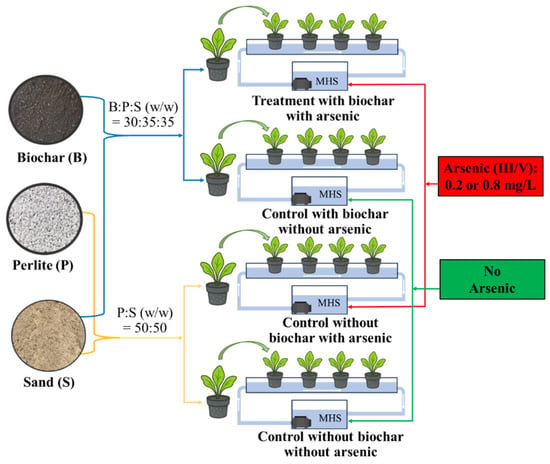
To evaluate the effect of biochar on early plant growth under heavy metal (HM) stress, a continuous flow hydroponic experiment was established (Figure 1). Lettuce seedlings (with eight independent replicate units per treatment, each unit being a separate hydroponic reservoir with its own treatment solution) were grown in a nearby nursery, and one-month-old seedlings were transferred to plastic pots (pot size 210 mL) within the hydroponic system. The hydroponic stock solutions contained (gm/L) 91.4 N, 71.7 K, 88.6 Ca, 40.3 P, 324 Mg, 1.5 Mn, 0.074 Mo, 0.035 Zn, 0.031 Cu, 0.934 B, and 10.4 Fe. The final working solution was prepared with 1.25 mL/L of N, P, K, Ca, and Mn stock solutions, and 0.21 mL/L of Mn, B, Zn, Cu, and Fe stock solutions. After 10 days, they were treated with various treatments. To apply arsenic stress, two different salts of arsenic (S) were used: sodium arsenate (Na2HAsO4), representing As(V), and sodium arsenite (NaAsO2), representing As(III). Treatments were arranged as a completely randomized factorial combining two arsenic species (S: As(V) and As(III)), two arsenic doses (D: 0.2 and 0.8 mg/L), and two biochar levels (B: with and without biochar), giving eight arsenic-exposed treatment combinations. Biochar was randomized at the level of the individual experimental unit rather than being imposed as a whole-plot factor; the design is therefore a completely randomized fixed-effects factorial. Each treatment combination comprised eight independent experimental units, each independent hydroponic reservoir with its own treatment solution, which served as the unit of replication. An unexposed control (0 mg/L arsenic) was maintained at both biochar levels as a common baseline; because arsenic species are undefined at zero dose, the control was not incorporated as a level of the species factor (i.e., it was not duplicated across As(V) and As(III)) and did not enter the crossed species × dose factorial. The control was instead analyzed separately against each treatment (Section 2.6), so the factorial itself remained fully balanced (2 × 2 × 2, three replicates per cell). Arsenic doses (0.2 and 0.8 mg/L) were selected based on previous literature [53,56] and a small-scale preliminary experiment to ensure detectable changes in morphological, physiological, and biochemical responses. For applying treatments, we used a mixture of perlite and sand (w/w) (50:50) without biochar (B) treatments and a separate mixture that included 30% biochar (w/w) combined with 70% of the perlite and sand mixture (50:50) for biochar treatments (Figure 1). A total of 15 L hydroponic working solution was applied to each experimental unit: pH of the solution varied between 6.5 and 7.0. The EC and pH of the sand at 1:5 dilution were 141 ± 18.33 μS/cm and 7.9 ± 0.14, respectively, while they were 156 ± 5.29 μS/cm and 7.2 ± 0.25 for perlite and 564.37 ± 7.05 μS/cm and 8.8 ± 0.26 for the biochar-amended substrate (30% w/w), respectively. The seedlings were exposed to arsenic stress conditions for 20 days after transplanting [48,57].
Figure 1.
Experimental setup showing the applied treatments on lettuce seedlings growing on modified Hoagland solution (MHS) in a continuous flow hydroponic system.
2.3. Assessment of Morphological Responses of Lettuce Seedlings
The seedlings were harvested after termination of treatment and three plants, each taken from a separate replicate reservoir (three of the eight independent units per treatment), were randomly selected and destructively sampled to provide three independent replicates (n = 3) for morphological measurements such as shoot length and root length (cm) and dry biomass (g) (oven dry at 65 °C for 72 h).
2.4. Assessment of Biochemical and Physiological Responses of Lettuce Seedlings
For each biochemical and physiological analysis, leaf tissue from the eight replicate units per treatment was pooled into three composite samples, each drawn from a non-overlapping subset of units (approximately three, three, and two units per composite). These three composites served as three independent biological replicates (n = 3) for statistical analysis. For measuring chlorophyll, 200 mg fresh leaf samples were cut into very small pieces and then soaked in 20 mL of 80% acetone for 72 h in the dark. After filtering, the absorbance of these solutions was measured at 645 nm and 663 nm for chlorophyll and 480 nm and 510 nm for carotenoids using a spectrophotometer. The pigments were measured using the formula outlined by Gogoi et al. [58]. Proline content was measured according to the method of Bates et al. (1973) [59]. A 0.25 g fresh leaf sample was homogenized in 10 mL of 3% sulfosalicylic acid, and the filtrate solution was mixed with acid-ninhydrin and glacial acetic acid at 100 °C for 60 min. The solution was allowed to cool to room temperature, and the mixture was extracted using toluene. The absorbance was measured at 520 nm, and the proline content was determined using a standard curve. MDA in the leaves was quantified as described by Zhang et al. [60]. At first, fresh leaf tissue (0.1 g) was homogenized in 1 mL of 0.1% TCA. After centrifuging, the supernatant was reacted with 4 mL of 20% TCA and 0.5% TBA. Then the mixture was boiled for 15 min, and after cooling and re-centrifuging, the supernatant of the solution was collected. Finally, the MDA content was determined by measuring optical density at 532 nm using a standard curve. For measuring MSI, the electric conductivity of leaf leaches was measured after incubating at 40 °C for 30 min (C1) and at 100 °C for 10 min (C2). The following formula was used for the calculation: MSI = [1 − (C1/C2)] × 100 [61].
2.5. Assessment of Arsenic Accumulation and Nutrient Uptake in Lettuce Roots and Shoots
Three composite plant samples were digested using the nitric/perchloric acid digestion method, as described by Zheljazkov et al. [62]. Each composite was pooled from a non-overlapping subset of the eight replicate units per treatment (as in Section 2.4), providing three independent biological replicates (n = 3). Samples were dried at 65 °C and ground to a fine powder; 0.2–0.5 g was prepared for roots and 0.3–0.5 g for shoots. The digestion process was carried out entirely under a fume hood; 10 mL of 70% concentrated HNO3 was added to the samples. The samples were heated on a hot plate at 50 °C for 30 min, and then the temperature of the hot plate was raised to 80 °C until the samples were nearly dried. After cooling to room temperature, 5 mL of 60% perchloric acid (HClO4) was added. Then, the samples were again heated at 180–200 °C until the dark color disappeared. An additional 1–2 mL of HClO4 was added to remove any black particles adhering to the sides of the flask. The digestion was considered complete when the samples appeared as white sand. Once cooled, the samples were diluted with deionized water to a final volume of 50 mL. Then the samples were analyzed using ICP-OES for measuring the elemental concentration of arsenic (As), potassium (K), phosphorus (P), Sulphur (S), calcium (Ca), magnesium (Mg), zinc (Zn), copper (Cu), manganese (Mn), and boron (B).
2.6. Data Analysis
All data were analyzed using R (version 4.1.1). Data normality of residuals and homogeneity of variance were checked using the Shapiro–Wilk and Levene’s test, respectively. For the arsenic-exposed treatments, a three-way fixed-effects analysis of variance (ANOVA) was carried out on the balanced 2 × 2 × 2 factorial of biochar (B), arsenic species (S), and arsenic dose (D), fitting all main effects together with the B × S, B × D, S × D, and B × S × D interactions (model: response ~ B ×S × D, using the aov function of the stats package; three replicates per cell, 16 residual degrees of freedom). Because biochar, arsenic species and arsenic dose were all randomized at the level of the individual experimental unit, a single residual error term was appropriate, and the data were analyzed as a completely randomized factorial rather than as a split-plot; consequently, the F-statistic for biochar is tested against the same residual error as the other effects. The unexposed control (0 mg/L arsenic) was excluded from this factorial because arsenic species are undefined at zero dose, and including it would either duplicate control values across species levels (pseudo-replication) or unbalance the design. To retain a baseline, control means were compared against each arsenic treatment using a separate one-way ANOVA across all 10 treatment groups, followed by Tukey’s HSD; the letter groupings shown on the control bars in Figure 2, Figure 3, Figure 4 and Figure 5 derive from this one-way analysis, whereas the factorial F-tests in Supplementary Tables S1–S4 are based only on the arsenic-exposed treatments. Post-hoc analysis was conducted using Tukey’s HSD for pairwise comparisons of responses among treatments at the 95% confidence intervals. We used the stats package for conducting the three-way ANOVA, the multcomp for the Tukey HSD post-hoc test, and ggplot2 for the data visualization.
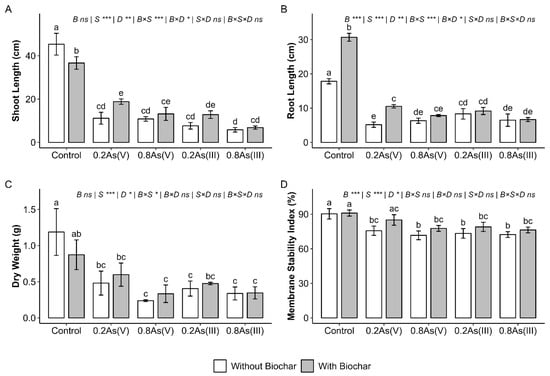
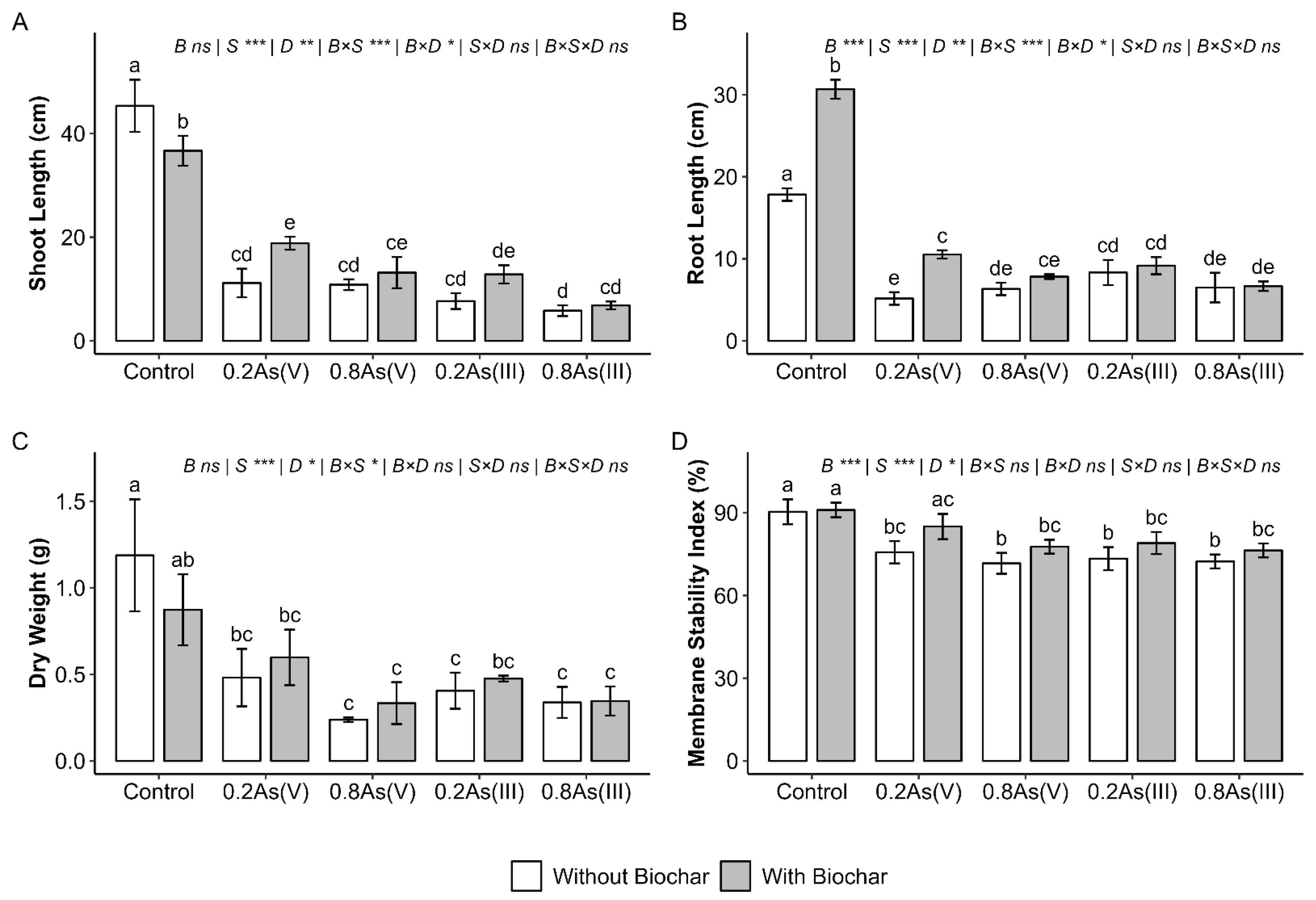
Figure 2.
Effect of biochar on mean shoot length (A), root length (B), dry biomass (C), and membrane stability index (D) of lettuce under different arsenic treatments with and without biochar (n = 3 per treatment). Asterisks indicate the level of significance: *** p < 0.001, ** p < 0.01, * p < 0.05, and ns p > 0.05 according to a three-way analysis of variance (ANOVA). Different letter(s) indicate significant differences based on Tukey’s post hoc analysis at a significance level of p < 0.05. Error bar indicates standard error. [Note: Control = no arsenic stress; 0.2As(V) = 0.2 mg/L As(V); 0.8As(V) = 0.8 mg/L As(V); 0.2As(III) = 0.2 mg/L As(III); 0.8As(III) = 0.8 mg/L As(III); Biochar = B; Arsenic species = S; Arsenic doses = D].
Figure 3.
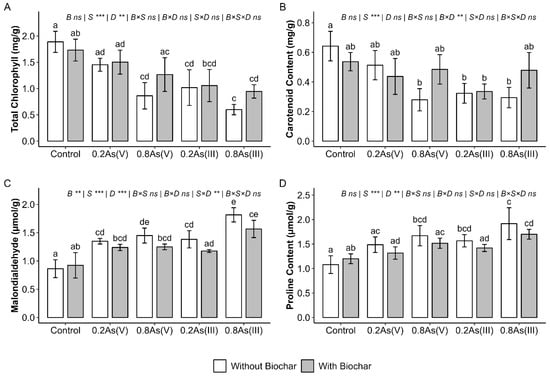
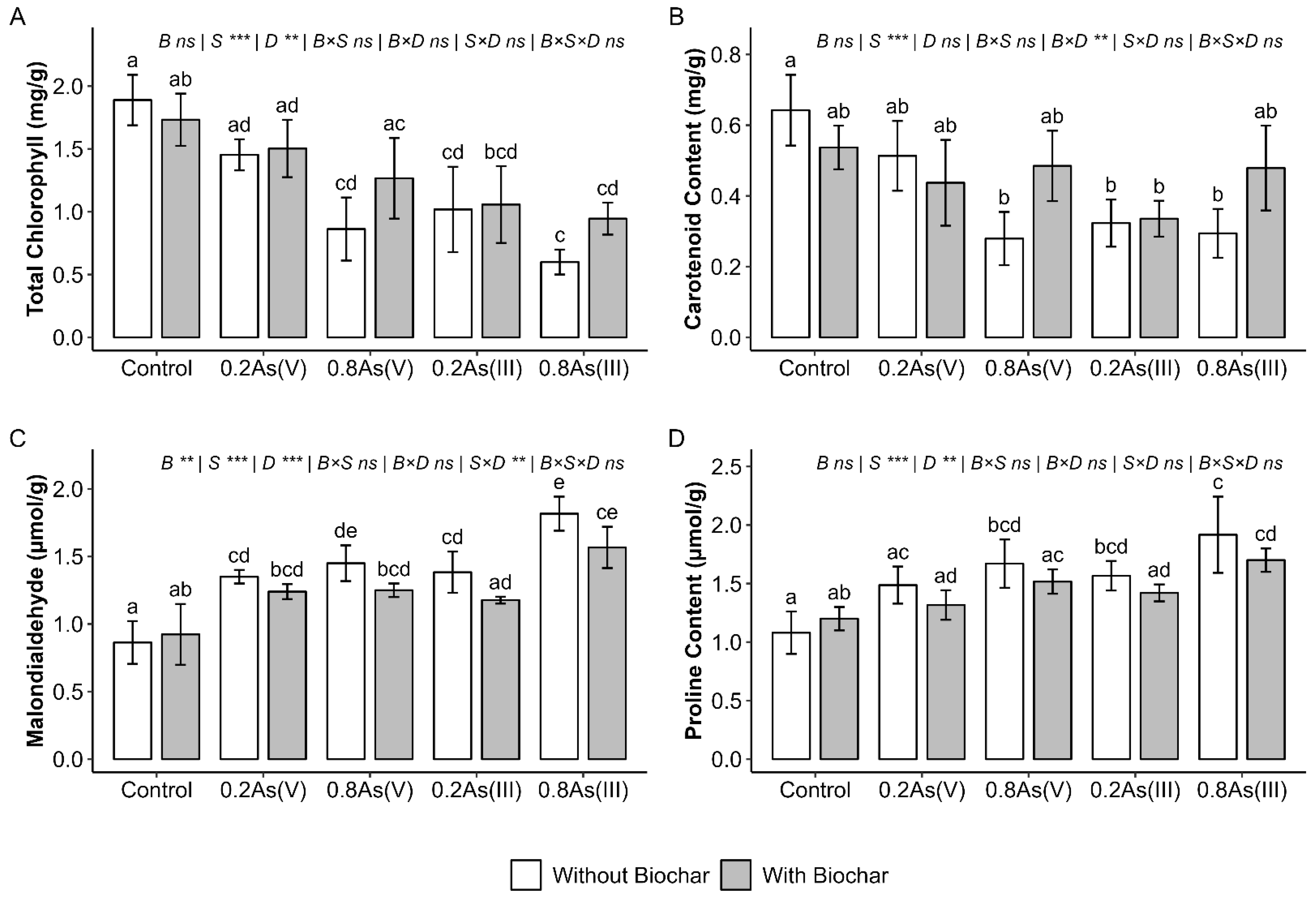
Effect of biochar on mean total chlorophyll (A), carotenoid (B), malondialdehyde (C), and proline (D) levels in lettuce under different arsenic treatments with and without biochar (n = 3 per treatment). Asterisks indicate the level of significance: *** p < 0.001, ** p < 0.01, and ns p > 0.05 according to a three-way analysis of variance (ANOVA). Different letter(s) indicate significant differences based on Tukey’s post hoc analysis at a significance level of p < 0.05. The error bar indicates standard error. [Note: Control = no arsenic stress; 0.2As(V) = 0.2 mg/L As(V); 0.8As(V) = 0.8 mg/L As(V); 0.2As(III) = 0.2 mg/L As(III); 0.8As(III) = 0.8 mg/L As(III); Biochar = B; Arsenic species = S; Arsenic doses = D].
Figure 4.
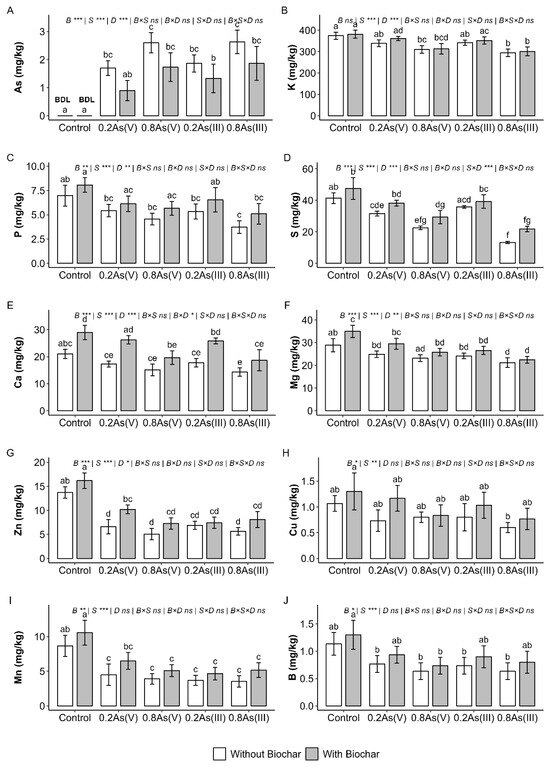
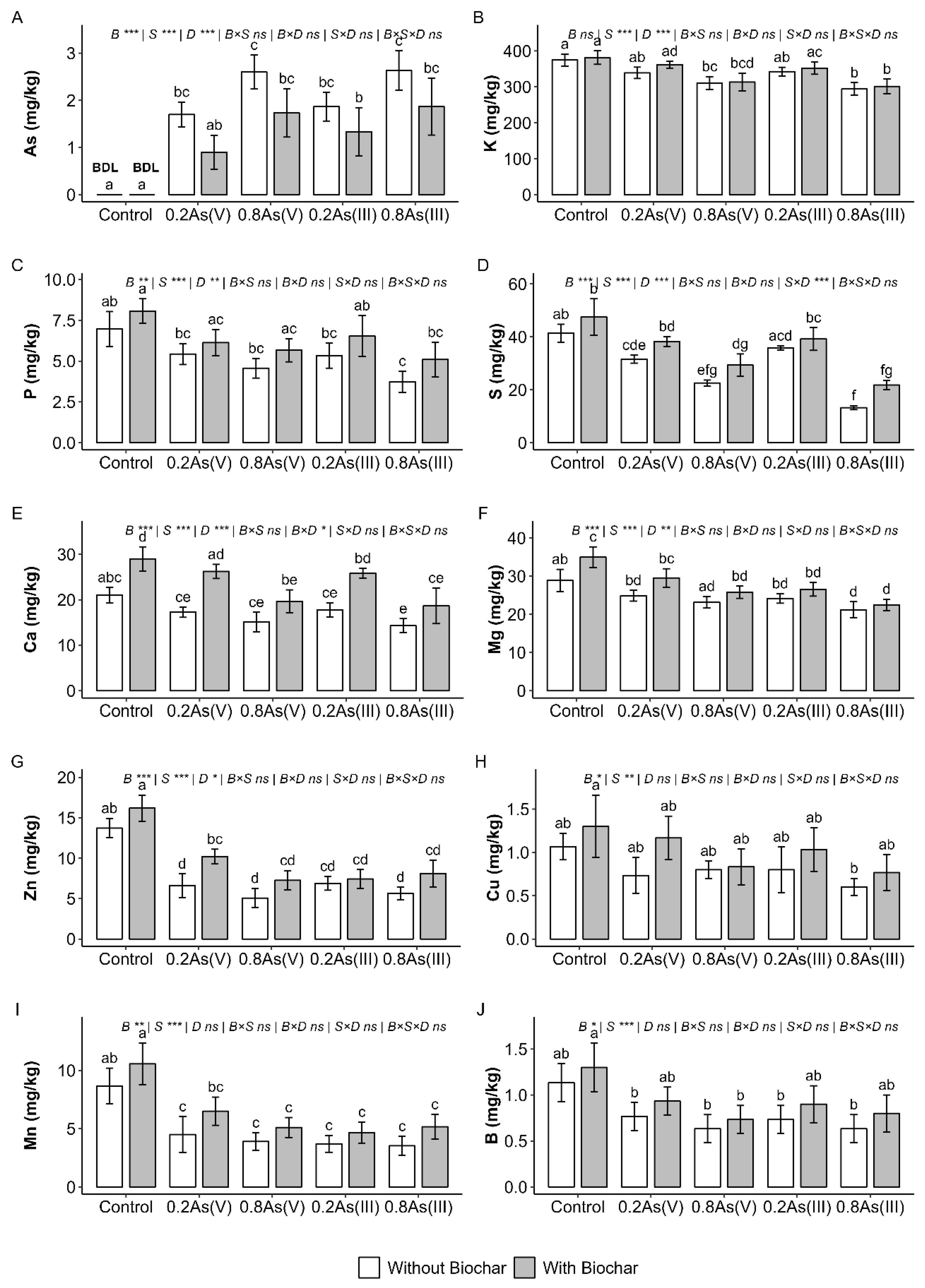
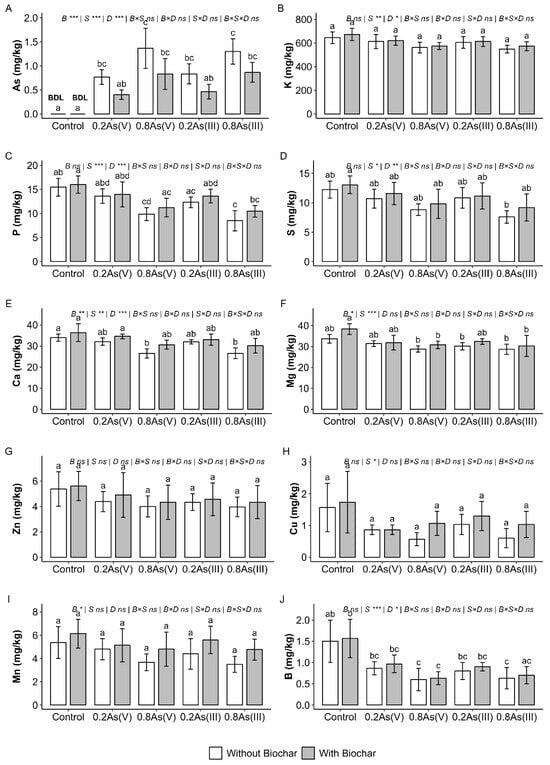
Effect of biochar on mean concentration of arsenic (A), potassium (B), phosphorus (C), sulfur (D), calcium (E), magnesium (F), zinc (G), copper (H), manganese (I) and boron (J) in lettuce roots under different arsenic treatments with and without biochar (n = 3 per treatment). Asterisks indicate the level of significance: *** p < 0.001, ** p < 0.01, * p < 0.05, and ns p > 0.05 according to a three-way analysis of variance (ANOVA). Different letter(s) indicate significant differences based on Tukey’s post hoc analysis at a significance level of p < 0.05. The error bar indicates standard error. [Note: Control = no arsenic stress; 0.2As(V) = 0.2 mg/L As(V); 0.8As(V) = 0.8 mg/L As(V); 0.2As(III) = 0.2 mg/L As(III); 0.8As(III) = 0.8 mg/L As(III); Biochar = B; Arsenic species = S; Arsenic doses = D; BDL = Below detection limit].
Figure 5.
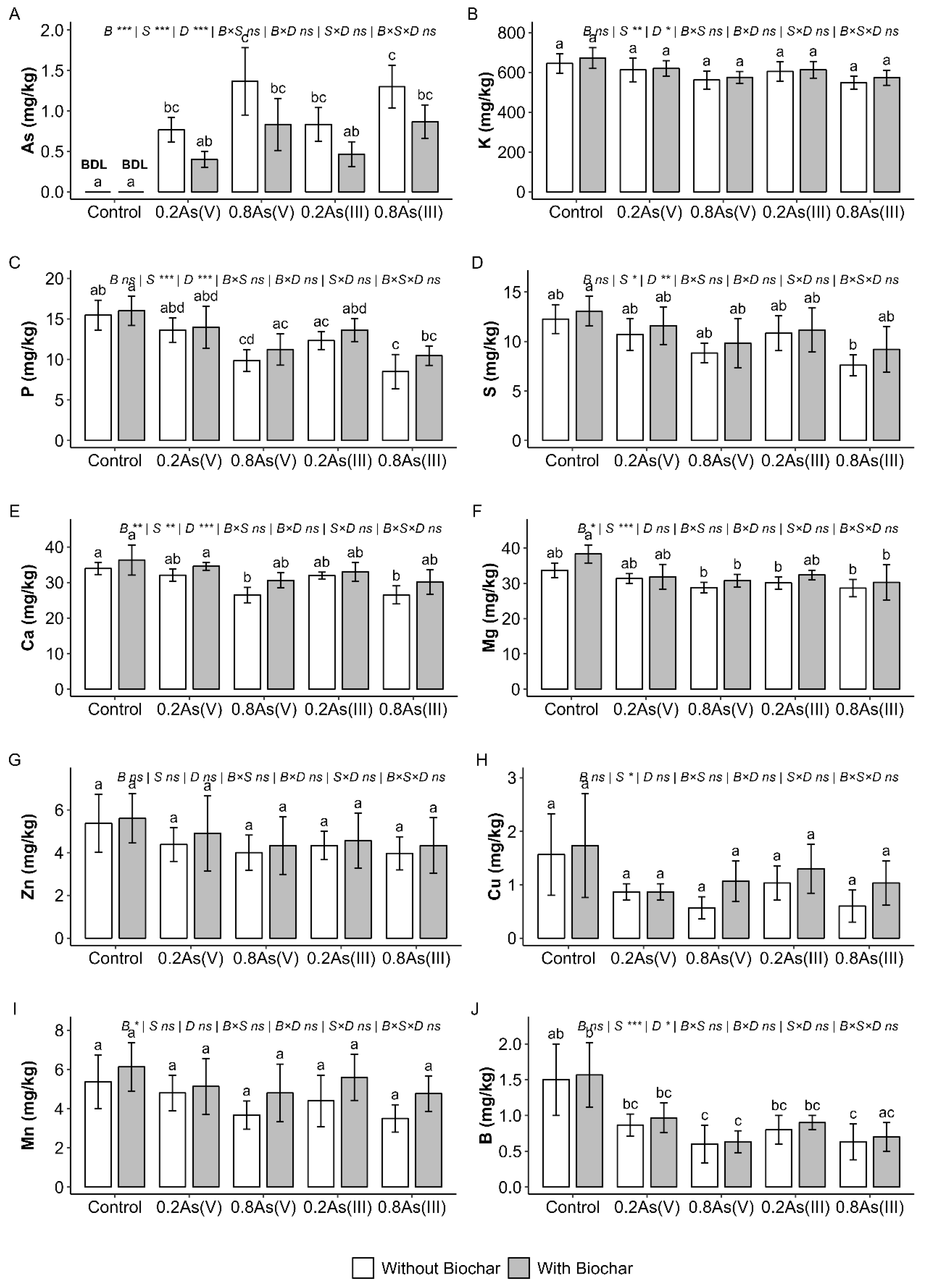
Effect of biochar on mean concentration of arsenic (A), potassium (B), phosphorus (C), sulfur (D), calcium (E), magnesium (F), zinc (G), copper (H), manganese (I) and boron (J) in lettuce shoots under different arsenic treatments with and without biochar (n = 3 per treatment). Asterisks indicate the level of significance: *** p < 0.001, ** p < 0.01, * p < 0.05, and ns p > 0.05 according to a three-way analysis of variance (ANOVA). Different letter(s) indicate significant differences based on Tukey’s post hoc analysis at a significance level of p < 0.05. The error bar indicates standard error. [Note: Control = no arsenic stress; 0.2As(V) = 0.2 mg/L As(V); 0.8As(V) = 0.8 mg/L As(V); 0.2As(III) = 0.2 mg/L As(III); 0.8As(III) = 0.8 mg/L As(III); Biochar = B; Arsenic species = S; Arsenic doses = D; BDL = Below detection limit].
3. Results
3.1. Morphological Responses of Lettuce Plants to Biochar Amendment Under Arsenic Stress
Arsenic exposure in the hydroponic system severely inhibited the shoot growth, root length, and dry biomass accumulation in lettuce (Figure 2). The detrimental effects on all morphological growth parameters were dose-dependent (p < 0.001), with the highest inhibition observed at 0.8 mg/L arsenic (Figure 2A–C, Supplementary Table S1). Furthermore, the impact of the two different species of arsenic was found to be statistically different (p < 0.05), suggesting distinct adverse effects of As(III) and As(V) on the aerial growth of lettuce (Figure 2A–C, Supplementary Table S1). Moreover, our results showed that As(III) caused more deleterious effects than As(V) (Figure 2A–C). However, application of biochar improved overall morphological traits of lettuce, and the efficacy of biochar varied significantly between the two arsenic species (p < 0.05) (Figure 2A–C, Supplementary Table S1). Moreover, the effectiveness of biochar was dose-dependent for shoot and root growth (p < 0.05) (Figure 2A–C, Supplementary Table S1). These findings suggest that the functional performance of biochar is influenced by both the type of arsenic compound and the application rate.
Our results demonstrated that, although biochar reduced shoot length by 19% in control seedlings, it improved shoot growth by 69% and 67% under low arsenic (0.2 mg/L) exposure of As(V) and As(III), respectively (Figure 2A). Under high arsenic stress (0.8 mg/L), the increase in shoot length due to biochar ranged from 17% to 21% (Figure 2A). However, our post-hoc analysis revealed that beneficial role of biochar for boosting lettuce growth under arsenic stress was only statistically significant (p < 0.05) at low (0.2 mg/L) As(V) stressed conditions (Figure 2A). Moreover, our results showed that, biochar increased root length by 72% compared to our control without biochar seedlings (Figure 2B). Moreover, it promoted root growth by 103% and 23% at 0.2 mg/L and 0.8 mg/L As(V), respectively, while it was only 10% and 2.6% for As(III) at 0.2 mg/L and 0.8 mg/L concentration, respectively (Figure 2B). Our pairwise comparison showed that root length enhancement by biochar was only statistically significant (p < 0.05) at control without arsenic stress and low (0.2 mg/L) concentration of As(V) stress (Figure 2B). In addition, biochar supplementation increased dry mean biomass by (40%) at high arsenic (0.8 mg/L) exposure of As(V), while it was 22% at low arsenic (0.2 mg/L) exposure of As(V) (Figure 2C) in stressed conditions. While, the effectiveness of dry biomass was less prominent under As(III) exposure, the improvement was 17% and 2.4% under low (0.2 mg/L) and high (0.8 mg/L) stressed conditions (Figure 2C). Nevertheless, none of these increments was statistically significant (p > 0.05) according to Tukey post-hoc analysis (Figure 2C).
3.2. Physiological Responses of Lettuce Plants to Biochar Amendment Under Arsenic Stress
We measured the membrane stability index (MSI) to measure the integrity and stability of cell membranes under experimental conditions. Our results demonstrated a significant effect of arsenic species (p < 0.001) and doses of arsenic (p < 0.05) on MSI. Biochar improved cell membrane stability significantly (p < 0.001); however, the interaction effect of biochar with arsenic species and doses of arsenic was not statistically significant (p > 0.05) (Figure 2D, Supplementary Table S1). The application of biochar increased the mean MSI by 1% without arsenic control seedlings. The increase was approximately 12% and 8% under low arsenic (0.2 mg/L) and high arsenic (0.8 mg/L) exposure to As(V). Similarly, biochar also showed its potential to enhance MSI by 7% and 5.5% under low (0.2 mg/L) and high (0.8 mg/L) As(III) exposure, respectively (Figure 2D). These results indicate that biochar contributes to improved cell membrane stability and helps mitigate the toxic effects of arsenic on physiological parameters. However, our post-hoc analysis revealed that not all of the increments were statistically significant (p > 0.05) (Figure 2D).
3.3. Biochemical Responses of Lettuce Plants to Biochar Amendment Under Arsenic Stress
Our results showed that total chlorophyll, carotenoid, MDA, and proline levels of lettuce seedlings differed significantly (p < 0.001) between the two arsenic species, indicating that different arsenic species exert different magnitudes of negative impact on biochemical responses (Figure 3A–D, Supplementary Table S2). The detrimental effects of arsenic increased significantly with rising arsenic concentrations (p < 0.01), except for carotenoid content (Figure 3A–D, Supplementary Table S2). Our results showed that biochar application increased the mean levels of total photosynthetic pigments (chlorophyll and carotenoid) in lettuce under arsenic stress; however, this improvement was not found to be statistically significant (p > 0.05) (Figure 3A,B, Supplementary Table S2). In addition, supplementing biochar showed a declining trend in production of stress molecules (MDA and proline); however, the reduction in MDA was only statistically significant (p < 0.01) (Figure 3C,D, Supplementary Table S2). Furthermore, the effectiveness of biochar did not differ significantly (p > 0.05) between the two forms of arsenic and the doses of arsenic (except carotenoid content) (Figure 3A–D, Supplementary Table S2).
We measured leaf total chlorophyll and carotenoid content to assess the role of biochar in enhancing lettuce photosynthetic efficiency and stress tolerance under applied arsenic stress. Biochar increased mean total leaf chlorophyll by 56% and 46% at higher arsenic treatment levels (0.8 mg/L) of both As(III) and As(V), respectively (Figure 3A), whereas, the increase was only about 3% at low (0.2 mg/L) concentrations of both As(III) and As(V) (Figure 3A). However, our pairwise comparison revealed that none of these increments were statistically significant (p > 0.05) compared to those without biochar (Figure 3A). Biochar also increased carotenoid levels by 62% and 73% under high-stress conditions (0.8 mg/L) of both As(III) and As(V), respectively, compared to controls without biochar (Figure 3B). However, according to Tukey test, the impact of biochar was only found to be statistically significant (p < 0.05) at high (0.8 mg/L) arsenic stressed conditions (Figure 3B). Furthermore, biochar reduced the mean oxidative damage indicator (MDA) by 8% and 13% under low (0.2 mg/L) and high (0.8 mg/L) As(V) exposure, respectively, and by 14% under both stress levels of As(III) (Figure 3C). These findings suggest that biochar mitigates oxidative damage and helps maintain membrane stability in plants under arsenic stress. However, our Tukey test showed that this impact was not significant (p > 0.05) (Figure 3C). To further evaluate stress response, we measured leaf proline content, a protective molecule produced under stress. Our results showed that biochar reduced leaf proline levels by 11% and 8% at low arsenic (0.2 mg/L) concentrations of As(V) and As(III), respectively, (Figure 3D), and by 9% and 10% under high stress (0.8 mg/L) of As (V) and As(III), respectively, compared to treatments without biochar. However, our post-hoc test revealed that these changes were not statistically significant (p > 0.05) compared to treatments without biochar (Figure 3D).
3.4. Arsenic Accumulation in Roots and Shoots of Lettuce Plants to Biochar Amendment Under Arsenic Stress
Lettuce seedlings accumulated arsenic from the hydroponic solution, with most of the absorbed arsenic stored in roots rather than shoots (Figure 4A and Figure 5A). The accumulation of arsenic in plant parts was found to be dose-dependent (p < 0.001), and the highest accumulation was found under high-stress (0.8mg/L) conditions (Figure 4A and Figure 5A; Supplementary Tables S3 and S4). Moreover, arsenic accumulation varied statistically (p < 0.001) across two arsenic species, suggesting different pathways and mechanisms of accumulation and translocation for different forms of arsenic. However, biochar application showed significant (p < 0.001) potential to reduce arsenic accumulation in both roots and shoots. Furthermore, the effectiveness of biochar was statistically similar (p > 0.05) for both arsenic species and doses (Figure 4A and Figure 5A; Supplementary Tables S3 and S4). In addition, our findings demonstrated that, under low (0.2 mg/L) and high (0.8 mg/L) exposure levels of As(V), lettuce seedlings accumulated 1.70 mg/kg and 2.60 mg/kg of arsenic, respectively, but under the same stressed conditions of As(III), the accumulation was 1.86–2.63 mg/kg (Figure 4A). Biochar application reduced arsenic accumulation in roots by 47% and 33% at low (0.2 mg/L) and high (0.8 mg/L) exposure to As(V), respectively, compared to untreated controls. Similarly, reductions of 29% and 28% were observed in roots under low (0.2 mg/L) and high (0.8 mg/L) stressed conditions of As(III), respectively. Our post-hoc analysis revealed that the amending role of biochar was not statistically significant (p > 0.05) (Figure 4A). Furthermore, lettuce seedlings accumulated 0.76–1.36 mg/kg As in shoots under As(V) stress and 0.86–1.30 mg/kg under As(III) stress, across the applied concentration range (Figure 5A). Nevertheless, biochar treatment demonstrated the reduction of arsenic concentration in shoots by 48% and 44% at low (0.2 mg/L) stress of As(V) and As(III), respectively. Likewise, under high-stress (0.8 mg/L) conditions, the reduction was 39% and 33% for As(V) and As(III), in contrast to those without biochar treatments. Nevertheless, based on pairwise comparison, the remediation role of biochar was not found to be significant (p > 0.05) (Figure 5A).
3.5. Effects of Biochar on Nutrient Uptake in Lettuce Roots
The exposure of arsenic stress substantially reduced nutrient uptake in lettuce roots (Figure 4B–J). The two arsenic species exhibited significantly different (p < 0.05) detrimental effects on nutrient uptake. (Figure 4B–H, Supplementary Table S3). Nutrient uptake in roots was also negatively influenced by arsenic concentration (p < 0.05), except for Cu, Mn, and B. However, adding biochar to hydroponic systems significantly (p < 0.05) increased uptake of P, S, Ca, Mg, Zn, Cu, Mn, and B. The efficacy of biochar in promoting nutrient uptake in roots did not differ statistically (p > 0.05) with respect to different arsenic species or stress level (except Ca), suggesting that biochar is equally effective for boosting nutrient uptake under both species of arsenic, regardless of applied stress levels (Figure 4B–H, Supplementary Table S3).
Our findings revealed that applied biochar increased uptake of K (1–8%), P (12–36%), S (10–64%), Cu (4–59%), Mg (5–18%), Mn (26–46%), and B (15–26%) (Figure 4B–D,F,H–J). However, our post-hoc analysis revealed that none of these improvements in nutrient uptake was statistically significant (p > 0.05) compared to the same stressed conditions without biochar (Figure 4B–D,H–J). In contrast, biochar treatment significantly increased the concentration of Ca in roots (p < 0.05) by 45–51% and 30–31% under low (0.2 mg/L) exposure of arsenic (Figure 4E). Moreover, our results also showed that biochar addition improved Zn uptake by 8–54% under stressed conditions (Figure 4G). According to post-hoc analysis, the improvement of Zn concentration in roots was only significant (p < 0.05) at low exposure to As(V) (Figure 4G).
3.6. Effects of Biochar on Nutrient Uptake in Lettuce Shoots
As with root nutrient uptake, the total concentration of shoot nutrients was negatively affected by arsenic stress (Figure 5B–J). Furthermore, the toxic effects of two different arsenic species varied statistically (p < 0.05) for nutrient concentrations of K, P, S, Ca, Mg, Cu, and B (Figure 5B–J, Supplementary Table S4). Moreover, the arsenic toxicity level adversely affected (p < 0.05) the uptake of all nutrients except Mg, Zn, Cu, and Mn. Although biochar improved nutrient concentrations in shoots compared to control seedlings, our analysis of variance showed that its enhancement was only significant (p < 0.05) for Ca, Mg, and Mn. The effectiveness of biochar did not vary statistically (p > 0.05) across arsenic species and levels of arsenic exposure (Figure 5B–J, Supplementary Table S4). However, our result demonstrate that biochar supplementation increased concentration of K (1–5%), p (3–23%), S (3–21%), Ca (7–15%), Mg (2–13%), Zn (4–12%), Cu (1–88%), Mn (7–36%), and B (4–12%) in shoots of lettuce (Figure 5B–J). According to our post-hoc analysis, none of these increments were statistically significant (p > 0.05) compared to the same stress without biochar (Figure 5B–J).
4. Discussion
We present the first study to evaluate the combined effects of arsenic and biochar in hydroponic systems. This study investigated the role of Acacia auriculiformis biochar in mitigating arsenic toxicity in hydroponically grown lettuce. Consistent with findings from soil and soilless systems, our results also demonstrated arsenic exposure reduced plant growth, altered physiological and biochemical traits, and limited nutrient uptake, with As(III) producing stronger adverse effects than As(V) [15,35,63]. Biochar application partly alleviated these effects by enhancing root growth, improving photosynthetic pigments and membrane stability, reducing stress indicators, lowering arsenic accumulation in roots and shoots, and increasing the uptake of essential nutrients [39,51,52,64]. Although the magnitude of response varied across traits, the overall pattern demonstrates that biochar can reduce arsenic stress and improve lettuce performance in hydroponic systems.
4.1. Morphological and Physiological Responses to Biochar Under Arsenic Stress
Arsenic toxicity disrupts plant metabolism and growth, leading to stunted development and yield loss. In this study, arsenic exposure reduced lettuce shoot and root length, as well as total dry biomass, consistent with previous findings in lettuce and other species under heavy-metal stress [6,45]. Root systems were particularly sensitive (Figure 2B), likely because they are the primary entry point for arsenic and therefore exposed to direct phytotoxic concentrations that impair nutrient uptake and root architecture [65,66]. Biochar application partially alleviated these effects, enhancing shoot length (17–69%), root length (2–103%), and dry biomass (2.4–40%), although the magnitude of improvement varied across arsenic species and concentrations (Figure 2A–C). Importantly, the benefits of biochar were greater under arsenic stress than under non-stress conditions, indicating that its ameliorative capacity is most pronounced when plants experience significant toxicity. This interaction pattern has also been reported for cadmium stress in lettuce [67] and nickel stress in tomato [68], supporting the view that biochar’s main mode of action is to immobilize toxic ions, buffer rhizosphere chemistry, and restore nutrient balance. Reported biomass gains in the literature range from modest (e.g., ~18% increase in lettuce [40]) to very large (e.g., ~100% increases with biochar–perlite mixtures [50], and 66–336% increases in contaminated soils [64]). Such variation reflects differences in feedstock, pyrolysis conditions, application rates, plant growth media, and stress intensity [29].
Larger improvements are often observed under severe stress, where biochar directly addresses limiting factors such as heavy-metal toxicity or nutrient deficiency, whereas smaller gains are reported under mild or no stress when baseline growth potential is already high. This variation illustrates the importance of tailoring biochar feedstocks, pyrolysis conditions, and application rates to specific systems in order to optimize benefits in both hydroponic and soil-based cultivation [29]. In this study, biochar likely contributed to growth recovery by improving pH buffering, increasing cation exchange capacity, supplying essential nutrients (K, P, Ca, Mg, Fe, Zn, Mn), and immobilizing arsenic, thereby reducing its bioavailability [20,67,69]. These combined improvements support more robust root systems, enhance water and nutrient uptake, and improved physiological performance under toxic conditions. However, root systems were particularly sensitive, likely because roots are the main route for arsenic entry and are exposed to phytotoxic concentrations that limit nutrient availability [65,66].
The application of biochar significantly mitigated these negative effects, improving morphological traits under arsenic stress, although the extent of recovery was not uniform across arsenic species and stress levels (Figure 2). Importantly, our results demonstrated a clear interaction: the ameliorative capacity of biochar was greater under arsenic stress than under control conditions without arsenic (Figure 2). Similar interaction patterns have been reported in other contexts, where biochar’s benefits were amplified under cadmium stress in lettuce [67] and nickel stress in tomato [68]. This suggests that immobilization of toxic ions and stabilization of the rhizosphere are central to biochar’s mode of action. Physiological responses further support this interpretation. Arsenic stress significantly decreased the membrane stability index (MSI), indicating increased cellular damage, a finding consistent with earlier work on rice under hydroponic arsenic stress [70]. Biochar application improved MSI under arsenic stress (Figure 2D), reflecting enhanced membrane integrity and reduced electrolyte leakage. Such effects are consistent with arsenic immobilization, which reduces oxidative stress and helps maintain cell function [71].
In addition, our results also confirmed that As(III) exerted more severe effects on morpho-physiological traits compared to As(V). This is in agreement with earlier reports showing that As(III) is ~60 times more toxic than As(V), primarily because of its affinity for sulfhydryl (-SH) and dithiol groups in proteins, which disrupt enzymatic activity and cellular function [6,72]. The positive effects of biochar observed here likely reflect a combination of physical, chemical, and biological mechanisms, as well as the stability of biochar particles within the hydroponic system. By increasing surface complexation, cation exchange capacity, and pH, biochar enhanced the availability of important nutrients such as K+, Ca2+, and Mg2+, while immobilizing arsenic through surface functional groups and precipitation reactions [29,69,73]. Moreover, biochar may have stimulated beneficial rhizosphere microorganisms, which further improve nutrient uptake efficiency and root system development under stress [29,43]. Together, these effects explain why biochar’s benefits in this study, and in similar reports, are most pronounced under acute chemical stress such as arsenic exposure.
4.2. Biochemical Responses and Photosynthetic Pigments
Arsenic stress interferes with core metabolic processes by disrupting chlorophyll biosynthesis, destabilizing photosystems, and activating oxidative stress pathways. These disruptions result in reduced photosynthetic pigment concentrations and elevated levels of malondialdehyde (MDA) and proline, well-recognized markers of oxidative damage and osmotic adjustment [15,74,75,76,77]. In this study, both As(III) and As(V) significantly decreased chlorophyll and carotenoid contents, while MDA and proline levels increased. This pattern is consistent with arsenic-induced overproduction of reactive oxygen species (ROS) and subsequent membrane lipid peroxidation [6,17]. By reducing the uptake of arsenic into plant tissues, biochar likely limited the initial trigger for oxidative stress. Biochar displays strong sorption capacity for metalloid ions, driven by surface functional groups and high pH, which can immobilize arsenic in the growth medium and restrict its translocation into plant tissues [73,78]. This immobilization effect limits arsenic’s direct interference with antioxidant enzymes and the photosynthetic apparatus, thereby minimizing the overproduction of ROS [79]. Consequently, MDA accumulation and proline synthesis tended to be lower (non-significant) in biochar-treated plants, consistent with higher MSI (Figure 2D) and prior studies [70,71]. The observed trend of improved preservation of chlorophyll and carotenoid contents in biochar-amended treatments suggests that photosynthetic capacity was slightly better maintained under stress. Beyond their role in light harvesting, carotenoids act as antioxidants, protecting lipids and proteins from oxidative damage and quenching excess ROS [75]. Comparable protective effects of biochar on pigment stability and oxidative stress have been reported under other metal stresses, including nickel in tomato [68] and cadmium in lettuce [41]. This convergence of evidence across different heavy metals points to a general mechanism: biochar immobilizes toxic ions, thereby indirectly stabilizing plant biochemical processes. In our study, this protective effect manifested as higher pigment concentrations, lower oxidative damage, and ultimately improved physiological performance under arsenic stress.
4.3. Arsenic Accumulation and Biochar’s Mitigating Effects
Plants absorb inorganic arsenic primarily via protein transporters, with the concentration gradient between roots and the external medium serving as the major driver of uptake [66]. In general, arsenic concentrations in plant tissues remain below 0.1% of dry weight, though the extent of accumulation depends on its chemical form and uptake pathways [6,80]. In this study, arsenic accumulation in lettuce varied significantly (p < 0.001) with arsenic species and dose (Figure 4A and Figure 5A). Consistent with previous findings, the majority of arsenic was retained in roots, while only a smaller fraction was translocated to shoots [35,63]. Higher concentrations of both As(III) and As(V) in the hydroponic solution increased accumulation in roots and shoots [49]. Despite their differences in toxicity and uptake, As(III) via nodulin-26-like intrinsic proteins (NIPs) and silicon transporters and As(V) via phosphate channels, our results showed broadly comparable levels of accumulation under equivalent stress [6,81]. Application of Acacia auriculiformis biochar significantly reduced arsenic concentrations in both roots (28–47% reduction) and shoots (33–48% reduction), with the largest relative effects observed at the lower exposure level (0.2 mg L−1). The reductions were statistically similar across arsenic species and doses (p > 0.05). These findings are consistent with hydroponic studies where biochar decreased Pb uptake in lettuce by up to 80% [52], lowered Cd accumulation in roots and shoots [40], and reduced Ni accumulation in tomato [68]. Similar effects have also been reported in soil-based systems, where biochar lowered Cd, Cu, Pb, and Zn in lettuce leaves [39] and reduced Cd uptake in spinach [82]. Together, this evidence indicates that biochar exerts a broad-spectrum capacity to immobilize toxic elements and reduce their entry into plant tissues.
The mitigation observed in this study can be attributed to several physicochemical properties of the Acacia-derived biochar. First, its high pH ~10.14 (Table 1) increased the pH of the biochar-amended substrate (30% w/w) to 8.8, and containing oxygen functional groups likely promoted ligand exchange and Ca-mediated precipitation of arsenate, reducing dissolved As and its bioavailability [23,67,83]. Second, the biochar’s high base cation contents, particularly Ca (~3026 ppm), K (~1986 ppm), and Mg (~480 ppm) suggest substantial cation exchange capacity (CEC) (Table 1). These cations can displace arsenic from solutions and, in the case of Ca, form low-solubility Ca–arsenic precipitates [84]. Third, the fine particle size (<2 mm) provided greater surface area and sorption kinetics, enabling faster immobilization of available arsenic [44]. Fourth, the high organic matter content (96.27%) and stable biochar particles offer abundant oxygen-containing groups (–COOH, –OH), which can form strong inner-sphere complexes with arsenic species [73]. Finally, although the ash fraction was low (3.72%), the biochar contained beneficial micronutrients (Zn, Mn, B, Cu) that may have alleviated As-induced nutrient deficiencies, indirectly reducing physiological drivers for As uptake [12,69]. Overall, these findings confirm that Acacia-derived biochar effectively reduces arsenic accumulation in hydroponically grown lettuce by immobilizing As in the growth medium and improving rhizosphere conditions. This reduction is particularly important from a food safety perspective, as lower shoot arsenic concentrations directly decrease potential dietary exposure.
4.4. Arsenic Species Toxicity and Biochar Mitigation
As(III) exerted stronger toxicity than As(V), consistent with prior reports [85]. Biochar mitigated toxicity from both species to a broadly similar extent. Although the raw means suggested somewhat larger gains under As(V) than under As(III) (e.g., dry-biomass increases of 22–40% versus ~2.4–17% and reductions in As accumulation of 33–47% versus 28–29%; Figure 2C, Figure 4A and Figure 5A), the biochar × species (B × S) interaction was not statistically significant for root or shoot As accumulation (Supplementary Tables S3 and S4), so the apparent difference in arsenic-immobilization efficiency between the two species is not statistically supported. Although B × S was significant for some growth traits (shoot length, root length, and dry biomass; Supplementary Table S1), the absence of a corresponding interaction for As accumulation means these growth differences cannot be attributed to species-selective arsenic immobilization, and we do not interpret them as such. As a hypothesis for future testing only, arsenic speciation could in principle modulate immobilization: at the experimental pH (~10), As(V) is anionic (H2AsO4−/HAsO42−) and more amenable to ligand exchange and Ca–arsenate precipitation than the largely neutral As(III) (H3AsO3). Establishing any such selectivity would require an experiment explicitly powered to detect the B × S interaction, together with direct sorption measurements.
4.5. Effect of Biochar on Nutrient Uptake Enhancement
Efficient uptake of essential nutrients is critical for plant growth, particularly under toxic stress. In this study, arsenic exposure reduced macro- and micronutrient accumulation in both roots and shoots of lettuce, in agreement with observations in Cicer arietinum [16], Helianthus annuus [12], and lettuce exposed to Cu stress in hydroponic systems [46]. Mechanistically, As(V) competes with phosphate for uptake through Pi transporters, thereby inducing phosphorus deficiency and disrupting metabolism, while As(III) binds to sulfhydryl groups in proteins, impairing enzymatic activity and cellular function [79,86]. Biochar application showed an alleviating trend of these nutrient deficiencies by slightly enhancing mean nutrient uptake (non-significant) in roots and, to a lesser extent, in shoots (Figure 4B–J and Figure 5B–J). The overall direction of response was consistent across both arsenic species and dose levels, although the magnitude of improvement and the degree of translocation to shoots varied, likely reflecting residual stress effects on long-distance transport. However, significant enhancements of nutrient concentrations in lettuce and tomato under PTE stress have been reported with biochar in hydroponic systems [50,68]. However, previous studies [29,51] showed that nutrient responses to biochar can be variable depending on feedstock and application rate, underscoring the complexity of plant–biochar–metal interactions. The positive effects observed here are consistent with established mechanisms: pH buffering, increased nutrient availability, cation exchange capacity, ion exchange and surface complexation, precipitation of arsenic with Ca and Mg, and supply of base cations [6,27,28,29,87]. High organic carbon content may further promote nutrient retention and improve root-zone chemistry [88]. Collectively, these mechanisms explain the observed increasing trend in nutrient uptake, despite ongoing arsenic stress, and demonstrate that Acacia-derived biochar has the potential to improve nutrient acquisition in hydroponic lettuce exposed to arsenic toxicity. Given these benefits across growth, physiology, biochemical stability, arsenic accumulation, and nutrient acquisition, it is important to consider the broader implications of biochar use in hydroponic systems.
4.6. Broader Implications and Future Directions
Our results provide a clear proof-of-concept that biochar can safeguard hydroponic crops against arsenic stress. By reducing growth inhibition (Figure 2A–C), improving physio-biochemical responses (Figure 2D and Figure 3A–D), lowering shoot arsenic concentrations (Figure 4A and Figure 5A), and enhancing nutrient uptake (Figure 4B–J and Figure 5B–J), biochar offers a practical means to secure both yield and food safety when using arsenic-contaminated water, ensuring that arsenic accumulation in lettuce remains below the Chinese permissible limit (0.5 mg kg−1) [89]. This permissible limit has important implications for controlled-environment agriculture, particularly in regions where water quality limits safe production. From a circular-economy perspective, producing biochar from locally abundant biomass such as Acacia auriculiformis off-cuts adds value to otherwise underutilized resources and could reduce input costs for growers. Nevertheless, several limitations must be acknowledged. First, the short exposure period (20 days) does not reveal the long-term stability of arsenic immobilization, and sorption sites may become saturated over successive crop cycles. Second, given the small number of replicates per treatment (n = 3), the statistical power of the Tukey post-hoc pairwise comparisons were likely low. Third, physicochemical characterization (e.g., FTIR, XPS, SEM-EDS) and potential changes in hydroponic solution chemistry are required for a profound understanding of arsenic-biochar interactions and elucidation of the immobilization mechanisms. Fourth, while effective, the economic feasibility of incorporating biochar at 30% (w/w) of the substrate requires evaluation; dose–response optimization is needed to identify a minimum effective rate compatible with commercial practice. Fifth, biochar performance is strongly dependent on feedstock, pyrolysis temperature, and crop species [27,37]. Comparative studies using diverse, regionally relevant feedstocks such as rice husks or coconut coir are therefore warranted. Finally, expanding trials to other hydroponic crops and to additional contaminants (e.g., Pb, Cd) would test whether the observed benefits generalize across species and stressors. Addressing these gaps will be essential for developing standardized, cost-effective biochar protocols for safe and sustainable hydroponic production.
5. Conclusions
In conclusion, this study demonstrates that biochar derived from Acacia auriculiformis can effectively mitigate arsenic toxicity in hydroponically grown lettuce (Lactuca sativa). Biochar significantly reduced arsenic accumulation in roots (28–47%) and shoots (33–48%), partially improved biomass, preserved photosynthetic pigments, stabilized membranes, and enhanced nutrient uptake under both As(III) and As(V) stress. These results provide the first experimental evidence that biochar can improve crop performance and food safety in hydroponic systems exposed to arsenic-contaminated water. Soilless agriculture producers, particularly in regions where arsenic-contaminated groundwater and surface water limit safe production, can use biochar as a promising strategy for PTE mitigation. However, the inferences are limited to early growth (20 days) and a single, high application rate (30% w/w). Future research should focus on long-term efficacy across crop cycles, dose–response optimization to ensure economic feasibility, and comparative evaluation of different biochar feedstocks to accelerate sustainable integration of this technology into controlled-environment agriculture.
Supplementary Materials
The following supporting information can be downloaded at: https://www.mdpi.com/article/10.3390/agronomy16141337/s1, Table S1. Summary of three-way ANOVA for morpho-physiological traits of lettuce under experimental conditions; Table S2. Summary of three-way ANOVA for biochemical traits of lettuce under experimental conditions; Table S3. Summary of three-way ANOVA for root elements accumulation (mg/kg) in lettuce under experimental conditions; Table S4. Summary of three-way ANOVA for shoot elements accumulation (mg/kg) in lettuce under experimental conditions.
Author Contributions
Conceptualization, M.A.H.A., R.A. and M.A.H.; Methodology, M.A.H.A.; Validation, R.A.; Formal Analysis, M.A.H.A. and M.A.H.; Investigation, M.A.H.A.; Resources, R.A. and S.S.; Data Curation, M.A.H.A.; Writing—Original Draft Preparation, M.A.H.A.; Writing—Review & Editing, R.A., M.A.H., S.S., M.M.U.H.; Visualization, M.A.H.A.; Supervision, R.A.; Funding Acquisition, R.A. and S.S. All authors have read and agreed to the published version of the manuscript.
Funding
The authors gratefully acknowledge the internal funding provided by Université Laval, Québec (QC) G1V 0A6, Canada; the receiver of this fund is Sivajanani Sivarajah, which made this research possible. This work was also funded by the Center for Research in Environment, iGen and Livelihood (CREGL), Sylhet 3114, Bangladesh (Grant No. CREGL/RG/2024-01).
Data Availability Statement
The raw data supporting the conclusions of this article will be made available by the authors on request.
Acknowledgments
The authors are grateful to Md Ali Newaj, Aranya Goon, Md Abdur Rahman, Farhan Shahriar, Md Sajib Mia, and Tirtha Chandra Das for their support in preparing biochar, harvesting, and laboratory analysis.
Conflicts of Interest
Author Md Abdul Halim was employed by the company CredoSense Inc. The remaining authors declare that the research was conducted in the absence of any commercial or financial relationships that could be construed as a potential conflict of interest.
References
- Nieder, R.; Benbi, D.K. Potentially Toxic Elements in the Environment—A Review of Sources, Sinks, Pathways and Mitigation Measures. Rev. Environ. Health 2024, 39, 561–575. [Google Scholar] [CrossRef] [Scilit] [PubMed]
- Rosas-Castor, J.M.; Guzmán-Mar, J.L.; Hernández-Ramírez, A.; Garza-González, M.T.; Hinojosa-Reyes, L. Arsenic Accumulation in Maize Crop (Zea mays): A Review. Sci. Total Environ. 2014, 488–489, 176–187. [Google Scholar] [CrossRef] [Scilit] [PubMed]
- Khan, N.I.; Owens, G.; Bruce, D.; Naidu, R. Human Arsenic Exposure and Risk Assessment at the Landscape Level: A Review. Environ. Geochem. Health 2009, 31, 143–166. [Google Scholar] [CrossRef] [Scilit] [PubMed]
- Chowdhury, U.K.; Biswas, B.K.; Chowdhury, T.R.; Samanta, G.; Mandal, B.K.; Basu, G.C.; Chanda, C.R.; Lodh, D.; Saha, K.C.; Mukherjee, S.K.; et al. Groundwater Arsenic Contamination in Bangladesh and West Bengal, India. Environ. Health Perspect. 2000, 108, 393–397. [Google Scholar] [CrossRef] [PubMed]
- Agency for Toxic Substances and Disease Registry (ATSDR). Toxicological Profile for Arsenic. 2007. Available online: https://www.atsdr.cdc.gov/toxprofiles/tp2.pdf (accessed on 1 March 2026).
- Abbas, G.; Murtaza, B.; Bibi, I.; Shahid, M.; Niazi, N.K.; Khan, M.I.; Amjad, M.; Hussain, M. Natasha Arsenic Uptake, Toxicity, Detoxification, and Speciation in Plants: Physiological, Biochemical, and Molecular Aspects. Int. J. Environ. Res. Public Health 2018, 15, 59. [Google Scholar] [CrossRef] [Scilit] [PubMed]
- Niazi, N.K.; Bibi, I.; Fatimah, A.; Shahid, M.; Javed, M.T.; Wang, H.; Ok, Y.S.; Bashir, S.; Murtaza, B.; Saqib, Z.A.; et al. Phosphate-Assisted Phytoremediation of Arsenic by Brassica Napus and Brassica Juncea: Morphological and Physiological Response. Int. J. Phytoremediat. 2017, 19, 670–678. [Google Scholar] [CrossRef] [Scilit] [PubMed]
- Khan, I.; Choudhary, B.C.; Izhar, S.; Kumar, D.; Satyanarayanan, M.; Rajput, V.D.; Khan, S. Exploring Geochemical Distribution of Potentially Toxic Elements (PTEs) in Wetland and Agricultural Soils and Associated Health Risks. Environ. Sci. Pollut. Res. 2024, 31, 17964–17980. [Google Scholar] [CrossRef] [Scilit] [PubMed]
- Zhao, F.J.; McGrath, S.P.; Meharg, A.A. Arsenic as a Food Chain Contaminant: Mechanisms of Plant Uptake and Metabolism and Mitigation Strategies. Annu. Rev. Plant Biol. 2010, 61, 535–559. [Google Scholar] [CrossRef] [Scilit] [PubMed]
- Kanwar, M.K.; Poonam; Bhardwaj, R. Arsenic Induced Modulation of Antioxidative Defense System and Brassinosteroids in Brassica juncea L. Ecotoxicol. Environ. Saf. 2015, 115, 119–125. [Google Scholar] [CrossRef] [Scilit] [PubMed]
- Upadhyay, A.K.; Singh, N.K.; Singh, R.; Rai, U.N. Amelioration of Arsenic Toxicity in Rice: Comparative Effect of Inoculation of Chlorella Vulgaris and Nannochloropsis Sp. on Growth, Biochemical Changes and Arsenic Uptake. Ecotoxicol. Environ. Saf. 2016, 124, 68–73. [Google Scholar] [CrossRef] [Scilit] [PubMed]
- Gunes, A.; Inal, A.; Bagci, E.G.; Kadioglu, Y.K. Combined Effect of Arsenic and Phosphorus on Mineral Element Concentrations of Sunflower. Commun. Soil Sci. Plant Anal. 2010, 41, 361–372. [Google Scholar] [CrossRef] [Scilit]
- Rafiq, M.; Shahid, M.; Abbas, G.; Shamshad, S.; Khalid, S.; Niazi, N.K.; Dumat, C. Comparative Effect of Calcium and EDTA on Arsenic Uptake and Physiological Attributes of Pisum sativum. Int. J. Phytoremediat. 2017, 19, 662–669. [Google Scholar] [CrossRef] [Scilit] [PubMed]
- Pandey, S.; Rai, R.; Rai, L.C. Biochemical and Molecular Basis of Arsenic Toxicity and Tolerance in Microbes and Plants. In Handbook of Arsenic Toxicology; Academic Press: Cambridge, MA, USA, 2015; pp. 627–674. [Google Scholar] [CrossRef] [Scilit]
- Gusman, G.S.; Oliveira, J.A.; Farnese, F.S.; Cambraia, J. Arsenate and Arsenite: The Toxic Effects on Photosynthesis and Growth of Lettuce Plants. Acta Physiol. Plant. 2013, 35, 1201–1209. [Google Scholar] [CrossRef] [Scilit]
- Malik, J.A.; Goel, S.; Sandhir, R.; Nayyar, H. Uptake and Distribution of Arsenic in Chickpea: Effects on Seed Yield and Seed Composition. Commun. Soil Sci. Plant Anal. 2011, 42, 1728–1738. [Google Scholar] [CrossRef] [Scilit]
- Mubarak, H.; Mirza, N.; Chai, L.Y.; Yang, Z.H.; Yong, W.; Tang, C.J.; Mahmood, Q.; Pervez, A.; Farooq, U.; Fahad, S.; et al. Biochemical and Metabolic Changes in Arsenic Contaminated Boehmeria nivea L. BioMed Res. Int. 2016, 2016, 1423828. [Google Scholar] [CrossRef] [Scilit] [PubMed]
- Gunes, A.; Pilbeam, D.J.; Inal, A. Effect of Arsenic-Phosphorus Interaction on Arsenic-Induced Oxidative Stress in Chickpea Plants. Plant Soil 2009, 314, 211–220. [Google Scholar] [CrossRef] [Scilit]
- Bilias, F.; Nikoli, T.; Kalderis, D.; Gasparatos, D. Towards a Soil Remediation Strategy Using Biochar: Effects on Soil Chemical Properties and Bioavailability of Potentially Toxic Elements. Toxics 2021, 9, 184. [Google Scholar] [CrossRef] [Scilit] [PubMed]
- Ngaba, M.J.Y.; Yemele, O.M.; Hu, B.; Rennenberg, H. Biochar Application as a Green Clean-up Method: Bibliometric Analysis of Current Trends and Future Perspectives. Biochar 2025, 7, 83. [Google Scholar] [CrossRef] [Scilit]
- Tan, Z.; Wang, Y.; Zhang, L.; Huang, Q. Study of the Mechanism of Remediation of Cd-Contaminated Soil by Novel Biochars. Environ. Sci. Pollut. Res. 2017, 24, 24844–24855. [Google Scholar] [CrossRef] [Scilit] [PubMed]
- Cao, X.; Harris, W. Properties of Dairy-Manure-Derived Biochar Pertinent to Its Potential Use in Remediation. Bioresour. Technol. 2010, 101, 5222–5228. [Google Scholar] [CrossRef] [Scilit] [PubMed]
- Zhang, R.H.; Li, Z.G.; Liu, X.D.; Wang, B.C.; Zhou, G.L.; Huang, X.X.; Lin, C.F.; Wang, A.H.; Brooks, M. Immobilization and Bioavailability of Heavy Metals in Greenhouse Soils Amended with Rice Straw-Derived Biochar. Ecol. Eng. 2017, 98, 183–188. [Google Scholar] [CrossRef] [Scilit]
- Xu, X.; Cao, X.; Zhao, L. Comparison of Rice Husk- and Dairy Manure-Derived Biochars for Simultaneously Removing Heavy Metals from Aqueous Solutions: Role of Mineral Components in Biochars. Chemosphere 2013, 92, 955–961. [Google Scholar] [CrossRef] [Scilit] [PubMed]
- Mansoor, S.; Kour, N.; Manhas, S.; Zahid, S.; Wani, O.A.; Sharma, V.; Wijaya, L.; Alyemeni, M.N.; Alsahli, A.A.; El-Serehy, H.A.; et al. Biochar as a Tool for Effective Management of Drought and Heavy Metal Toxicity. Chemosphere 2021, 271, 129458. [Google Scholar] [CrossRef] [Scilit] [PubMed]
- Murtaza, G.; Rizwan, M.; Usman, M.; Hyder, S.; Akram, M.I.; Deeb, M.; Alkahtani, J.; AlMunqedhi, B.M.; Hendy, A.S.; Ali, M.R.; et al. Biochar Enhances the Growth and Physiological Characteristics of Medicago sativa, Amaranthus caudatus and Zea mays in Saline Soils. BMC Plant Biol. 2024, 24, 304. [Google Scholar] [CrossRef] [Scilit] [PubMed]
- Rizwan, M.; Ali, S.; Qayyum, M.F.; Ibrahim, M.; Zia-ur-Rehman, M.; Abbas, T.; Ok, Y.S. Mechanisms of Biochar-Mediated Alleviation of Toxicity of Trace Elements in Plants: A Critical Review. Environ. Sci. Pollut. Res. 2016, 23, 2230–2248. [Google Scholar] [CrossRef] [Scilit] [PubMed]
- Chi, W.; Nan, Q.; Liu, Y.; Dong, D.; Qin, Y.; Li, S.; Wu, W. Stress Resistance Enhancing with Biochar Application and Promotion on Crop Growth. Biochar 2024, 6, 43. [Google Scholar] [CrossRef] [Scilit]
- Antonangelo, J.A.; Sun, X.; Eufrade-Junior, H.d.J. Biochar Impact on Soil Health and Tree-Based Crops: A Review. Biochar 2025, 7, 51. [Google Scholar] [CrossRef] [Scilit]
- Lu, K.; Yang, X.; Shen, J.; Robinson, B.; Huang, H.; Liu, D.; Bolan, N.; Pei, J.; Wang, H. Effect of Bamboo and Rice Straw Biochars on the Bioavailability of Cd, Cu, Pb and Zn to Sedum Plumbizincicola. Agric. Ecosyst. Environ. 2014, 191, 124–132. [Google Scholar] [CrossRef] [Scilit]
- Song, X.D.; Xue, X.Y.; Chen, D.Z.; He, P.J.; Dai, X.H. Application of Biochar from Sewage Sludge to Plant Cultivation: Influence of Pyrolysis Temperature and Biochar-to-Soil Ratio on Yield and Heavy Metal Accumulation. Chemosphere 2014, 109, 213–220. [Google Scholar] [CrossRef] [Scilit] [PubMed]
- Podgorski, J.; Berg, M. Global Threat of Arsenic in Groundwater. Science 2020, 368, 845–850. [Google Scholar] [CrossRef] [Scilit] [PubMed]
- Kannan, M.; Elavarasan, G.; Balamurugan, A.; Dhanusiya, B.; Freedon, D. Hydroponic Farming—A State of Art for the Future Agriculture. Mater. Today Proc. 2022, 68, 2163–2166. [Google Scholar] [CrossRef] [Scilit]
- Kanel, S.R.; Das, T.K.; Varma, R.S.; Kurwadkar, S.; Chakraborty, S.; Joshi, T.P.; Bezbaruah, A.N.; Nadagouda, M.N. Arsenic Contamination in Groundwater: Geochemical Basis of Treatment Technologies. ACS Environ. Au 2023, 3, 135–152. [Google Scholar] [CrossRef] [Scilit] [PubMed]
- Martínez-Castillo, J.I.; Ozuna, C.; Arcibar-Orozco, J.A.; Saldaña-Robles, A. Arsenic Uptake in Lettuce: Its Impact on Crop Quality and Metabolic Stress. Appl. Ecol. Environ. Res. 2023, 21, 5285–5298. [Google Scholar] [CrossRef] [Scilit]
- Wilkinson, A.; Gerlach, C.; Karlsson, M.; Penn, H. Controlled Environment Agriculture and Containerized Food Production in Northern North America. J. Agric. Food Syst. Community Dev. 2021, 10, 127–142. [Google Scholar] [CrossRef] [Scilit]
- Farhangi-Abriz, S.; Torabian, S.; Qin, R.; Noulas, C.; Lu, Y.; Gao, S. Biochar Effects on Yield of Cereal and Legume Crops Using Meta-Analysis. Sci. Total Environ. 2021, 775, 145869. [Google Scholar] [CrossRef] [Scilit]
- Gale, N.V.; Thomas, S.C. Dose-Dependence of Growth and Ecophysiological Responses of Plants to Biochar. Sci. Total Environ. 2019, 658, 1344–1354. [Google Scholar] [CrossRef] [Scilit] [PubMed]
- Kim, H.S.; Kim, K.R.; Kim, H.J.; Yoon, J.H.; Yang, J.E.; Ok, Y.S.; Owens, G.; Kim, K.H. Effect of Biochar on Heavy Metal Immobilization and Uptake by Lettuce (Lactuca sativa L.) in Agricultural Soil. Environ. Earth Sci. 2015, 74, 1249–1259. [Google Scholar] [CrossRef] [Scilit]
- Zhou, C.; Wang, Y.; Wei, L.; Huang, H.; Yu, C.; Yin, X. Effects of Water Hyacinth Biochar on Lettuce Growth in Cadmium-Contaminated Soil. Front Soil Sci. 2022, 2, 998654. [Google Scholar] [CrossRef] [Scilit]
- Fedeli, R.; Zhatkanbayeva, Z.; Marcelli, R.; Zhatkanbayev, Y.; Desideri, S.; Loppi, S. Mitigation of Cadmium and Copper Stress in Lettuce: The Role of Biochar on Metal Uptake, Oxidative Stress, and Yield. Plants 2025, 14, 2255. [Google Scholar] [CrossRef] [Scilit] [PubMed]
- Nigussie, A.; Kissi, E.; Misganaw, M.A.G. Effect of Biochar Application on Soil Properties and Nutrient Uptake of Lettuces (Lactuca sativa) Grown in Chromium Polluted Soils. Am. J. Agric. Environ. Sci. 2012, 12, 369–376. [Google Scholar]
- Akumuntu, A.; Hong, J.K.; Jho, E.H.; Omidoyin, K.C.; Park, S.J.; Zhang, Q.; Zhao, X. Biochar Derived from Rice Husk: Impact on Soil Enzyme and Microbial Dynamics, Lettuce Growth, and Toxicity. Chemosphere 2024, 349, 140868. [Google Scholar] [CrossRef] [Scilit] [PubMed]
- Letey, C.G.; Abagale, F.K.; Osei, R.A. Reduction of Heavy Metal Uptake by Lettuce (Lactuca sativa) under Synthetic Wastewater Irrigation Using Adsorbents for Soil Amendment. Clean. Waste Syst. 2025, 11, 100263. [Google Scholar] [CrossRef] [Scilit]
- Monteiro, C.; Santos, C.; Pinho, S.; Oliveira, H.; Pedrosa, T.; Dias, M.C. Cadmium-Induced Cyto- and Genotoxicity Are Organ-Dependent in Lettuce. Chem. Res. Toxicol. 2012, 25, 1423–1434. [Google Scholar] [CrossRef] [Scilit] [PubMed]
- Shams, M.; Ekinci, M.; Turan, M.; Dursun, A.; Kul, R.; Yildirim, E. Growth, Nutrient Uptake and Enzyme Activity Response of Lettuce (Lactuca sativa L.) to Excess Copper. Environ. Sustain. 2019, 2, 67–73. [Google Scholar] [CrossRef] [Scilit]
- Michalska, M.; Asp, H. Influence of Lead and Cadmium on Growth, Heavy Metal Uptake, and Nutrient Concentration of Three Lettuce Cultivars Grown in Hydroponic Culture. Commun. Soil Sci. Plant Anal. 2001, 32, 571–583. [Google Scholar] [CrossRef] [Scilit]
- Hawrylak-Nowak, B. Comparative Effects of Selenite and Selenate on Growth and Selenium Accumulation in Lettuce Plants under Hydroponic Conditions. Plant Growth Regul. 2013, 70, 149–157. [Google Scholar] [CrossRef] [Scilit]
- Sandil, S.; Záray, G.; Endrédi, A.; Füzy, A.; Takács, T.; Óvári, M.; Dobosy, P. Arsenic Uptake and Accumulation in Bean and Lettuce Plants at Different Developmental Stages. Environ. Sci. Pollut. Res. Int. 2023, 30, 118724–118735. [Google Scholar] [CrossRef] [Scilit] [PubMed]
- Awad, Y.M.; Lee, S.E.; Ahmed, M.B.M.; Vu, N.T.; Farooq, M.; Kim, I.S.; Kim, H.S.; Vithanage, M.; Usman, A.R.A.; Al-Wabel, M.; et al. Biochar, a Potential Hydroponic Growth Substrate, Enhances the Nutritional Status and Growth of Leafy Vegetables. J. Clean. Prod. 2017, 156, 581–588. [Google Scholar] [CrossRef] [Scilit]
- Olszyk, D.M.; Shiroyama, T.; Novak, J.M.; Cantrell, K.B.; Sigua, G.; Watts, D.W.; Johnson, M.G. Biochar Affects Essential Nutrients of Carrot Taproots and Lettuce Leaves. HortScience 2020, 55, 261–271. [Google Scholar] [CrossRef] [Scilit] [PubMed]
- Vannini, A.; Bianchi, E.; Avi, D.; Damaggio, N.; Di Lella, L.A.; Nannoni, F.; Protano, G.; Loppi, S. Biochar Amendment Reduces the Availability of Pb in the Soil and Its Uptake in Lettuce. Toxics 2021, 9, 268. [Google Scholar] [CrossRef] [Scilit] [PubMed]
- Feng, H.; Zhang, Y.; Fang, K.; Hu, Y.; Cheng, H. Investigating the Toxic Impacts of Various Arsenic Compounds on Hydroponics Lettuce (Lactuca sativa L.): Biomass, Arsenic Accumulation and Species Distribution. Water Air Soil Pollut. 2025, 236, 287. [Google Scholar] [CrossRef] [Scilit]
- Karim, M.R.; Halim, M.A.; Gale, N.V.; Thomas, S.C. Biochar Effects on Soil Physiochemical Properties in Degraded Managed Ecosystems in Northeastern Bangladesh. Soil Syst. 2020, 4, 69. [Google Scholar] [CrossRef] [Scilit]
- Kjeldahl, J. Neue Methode Zur Bestimmung Des Stickstoffs in Organischen Körpern. Z. Anal. Chem. 1883, 22, 366–382. [Google Scholar] [CrossRef] [Scilit]
- Huang-Takeshi Kohda, Y.; Hamai, T.; Horiuchi, K.; Semoto, Y.; Inoue, C. New evidence of the arsenic uptake and translocation in As-hyperaccumulator fern Pteris cretica using a modified hydroponic system. J. Hazard. Mater. 2024, 463, 132855. [Google Scholar] [CrossRef] [Scilit] [PubMed]
- da Silva Cuba Carvalho, R.; Bastos, R.G.; Souza, C.F. Influence of the Use of Wastewater on Nutrient Absorption and Production of Lettuce Grown in a Hydroponic System. Agric. Water Manag. 2018, 203, 311–321. [Google Scholar] [CrossRef] [Scilit]
- Gogoi, M.; Basumatary, M. Estimation of the Chlorophyll Concentration in Seven Citrus Species of Kokrajhar District, BTAD, Assam, India. Trop. Plant Res. 2018, 5, 83–87. [Google Scholar] [CrossRef] [Scilit]
- Bates, L.S.; Waldren, R.P.; Teare, I.D. Rapid Determination of Free Proline for Water-Stress Studies. Plant Soil 1973, 39, 205–207. [Google Scholar] [CrossRef] [Scilit]
- Zhang, Z.; Huang, R. Analysis of Malondialdehyde, Chlorophyll Proline, Soluble Sugar, and Glutathione Content in Arabidopsis Seedling. Bio-Protocol 2013, 3, e817. [Google Scholar] [CrossRef] [Scilit]
- Sairam, R.K.; Rao, K.; Srivastava, G.C. Differential Response of Wheat Genotypes to Long Term Salinity Stress in Relation to Oxidative Stress, Antioxidant Activity and Osmolyte Concentration. Plant Sci. 2002, 163, 1037–1046. [Google Scholar] [CrossRef] [Scilit]
- Zheljazkov, V.D.; Warman, P.R. Comparison of Three Digestion Methods for the Recovery of 17 Plant Essential Nutrients and Trace Elements from Six Composts. Compost Sci. Util. 2002, 10, 197–203. [Google Scholar] [CrossRef] [Scilit]
- Yañez, L.M.; Alfaro, J.A.; Avila Carreras, N.M.E.; Bovi Mitre, G. Arsenic Accumulation in Lettuce (Lactuca sativa L.) and Broad Bean (Vicia faba L.) Crops and Its Potential Risk for Human Consumption. Heliyon 2019, 5, e01152. [Google Scholar] [CrossRef] [Scilit] [PubMed]
- Yang, X.; Zhang, Z.; Zhang, J.; Wu, X.; Luo, W.; Mu, G. Effect of Biochar and Acidithiobacillus Ferrooxidans on Heavy Metal Content in Soil and Lettuce. Soil Sediment Contam. Int. J. 2023, 32, 910–925. [Google Scholar] [CrossRef] [Scilit]
- López-Bucio, J.; Cruz-Ramírez, A.; Herrera-Estrella, L. The Role of Nutrient Availability in Regulating Root Architecture. Curr. Opin. Plant Biol. 2003, 6, 280–287. [Google Scholar] [CrossRef] [Scilit] [PubMed]
- Chandrakar, V.; Dubey, A.; Keshavkant, S. Modulation of Antioxidant Enzymes by Salicylic Acid in Arsenic Exposed Glycine max L. J. Soil Sci. Plant Nutr. 2016, 16, 662–676. [Google Scholar]
- Zhou, L.; Zhou, L.; Wu, H.; Li, J.; Kong, L.; Yang, H. Effects of Applying Biochar on Soil Cadmium Immobilisation and Cadmium Pollution Control in Lettuce (Lactuca sativa L.). Agriculture 2024, 14, 1068. [Google Scholar] [CrossRef] [Scilit]
- Mosa, A.; El-Banna, M.F.; Gao, B. Biochar Filters Reduced the Toxic Effects of Nickel on Tomato (Lycopersicon esculentum L.) Grown in Nutrient Film Technique Hydroponic System. Chemosphere 2016, 149, 254–262. [Google Scholar] [CrossRef] [Scilit] [PubMed]
- Whyte, D.; Simpson, L.; Osborne, C. Response of Lettuce (Lactuca sativa L.) Inoculated with Rhizophagus Irregularis to Charcoal Amended Tabela Sand. J. Acad. Res. Essays 2024, 4, 27–43. [Google Scholar] [CrossRef] [Scilit]
- Begum, M.C.; Islam, M.S.; Islam, M.; Amin, R.; Parvez, M.S.; Kabir, A.H. Biochemical and Molecular Responses Underlying Differential Arsenic Tolerance in Rice (Oryza sativa L.). Plant Physiol. Biochem. 2016, 104, 266–277. [Google Scholar] [CrossRef] [Scilit] [PubMed]
- Hakeem, K.R.; Alharby, H.F.; Bamagoos, A.A.M.; Pirzadah, T.B. Biochar Promotes Arsenic (As) Immobilization in Contaminated Soils and Alleviates the As-Toxicity in Soybean (Glycine max (L.) Merr.). Chemosphere 2022, 292, 133407. [Google Scholar] [CrossRef] [Scilit] [PubMed]
- Jiang, Q.Q.; Singh, B.R. Effect of Different Forms and Sources of Arsenic on Crop Yield and Arsenic Concentration. Water Air Soil Pollut. 1994, 74, 321–343. [Google Scholar] [CrossRef] [Scilit]
- Ho, S.H.; Zhu, S.; Chang, J.S. Recent Advances in Nanoscale-Metal Assisted Biochar Derived from Waste Biomass Used for Heavy Metals Removal. Bioresour. Technol. 2017, 246, 123–134. [Google Scholar] [CrossRef] [Scilit] [PubMed]
- Nagajyoti, P.C.; Lee, K.D.; Sreekanth, T.V.M. Heavy Metals, Occurrence and Toxicity for Plants: A Review. Environ. Chem. Lett. 2010, 8, 199–216. [Google Scholar] [CrossRef] [Scilit]
- Hasanuzzaman, M.; Nahar, K.; Rahman, A.; Al Mahmud, J.; Hossain, M.S.; Alam, M.K.; Oku, H.; Fujita, M. Actions of Biological Trace Elements in Plant Abiotic Stress Tolerance. In Essential Plant Nutrients Uptake, Use Efficiency, and Management; Springer: Cham, Switzerland, 2017; pp. 213–274. [Google Scholar] [CrossRef] [Scilit]
- Duman, F.; Ozturk, F.; Aydin, Z. Biological Responses of Duckweed (Lemna minor L.) Exposed to the Inorganic Arsenic Species As(III) and As(V): Effects of Concentration and Duration of Exposure. Ecotoxicology 2010, 19, 983–993. [Google Scholar] [CrossRef] [Scilit] [PubMed]
- Rafiq, M.; Shoaib, A.; Javaid, A.; Perveen, S.; Umer, M.; Arif, M.; Cheng, C. Exploration of resistance level against Black Scurf caused by Rhizoctonia solani in different cultivars of potato. Plant Stress 2024, 12, 100476. [Google Scholar] [CrossRef] [Scilit]
- Qin, J.; Niu, A.; Liu, Y.; Lin, C. Arsenic in Leafy Vegetable Plants Grown on Mine Water-Contaminated Soils: Uptake, Human Health Risk and Remedial Effects of Biochar. J. Hazard. Mater. 2021, 402, 123488. [Google Scholar] [CrossRef] [Scilit] [PubMed]
- Finnegan, P.M.; Chen, W. Arsenic Toxicity: The Effects on Plant Metabolism. Front. Physiol. 2012, 3, 182. [Google Scholar] [CrossRef] [Scilit] [PubMed]
- Neidhardt, H.; Kramar, U.; Tang, X.; Guo, H.; Norra, S. Arsenic Accumulation in the Roots of Helianthus Annuus and Zea Mays by Irrigation with Arsenic-Rich Groundwater: Insights from Synchrotron X-Ray Fluorescence Imaging. Geochemistry 2015, 75, 261–270. [Google Scholar] [CrossRef] [Scilit]
- Kumar, S.; Dubey, R.S.; Tripathi, R.D.; Chakrabarty, D.; Trivedi, P.K. Omics and Biotechnology of Arsenic Stress and Detoxification in Plants: Current Updates and Prospective. Environ. Int. 2015, 74, 221–230. [Google Scholar] [CrossRef] [Scilit] [PubMed]
- Younis, U.; Malik, S.A.; Rizwan, M.; Qayyum, M.F.; Ok, Y.S.; Shah, M.H.R.; Rehman, R.A.; Ahmad, N. Biochar Enhances the Cadmium Tolerance in Spinach (Spinacia oleracea) through Modification of Cd Uptake and Physiological and Biochemical Attributes. Environ. Sci. Pollut. Res. 2016, 23, 21385–21394. [Google Scholar] [CrossRef] [Scilit] [PubMed]
- Dong, D.; Zhao, X.; Hua, X.; Liu, J.; Gao, M. Investigation of the Potential Mobility of Pb, Cd and Cr(VI) from Moderately Contaminated Farmland Soil to Groundwater in Northeast, China. J. Hazard. Mater. 2009, 162, 1261–1268. [Google Scholar] [CrossRef] [Scilit] [PubMed]
- Zama, E.F.; Li, G.; Tang, Y.T.; Reid, B.J.; Ngwabie, N.M.; Sun, G.X. The Removal of Arsenic from Solution through Biochar-Enhanced Precipitation of Calcium-Arsenic Derivatives. Environ. Pollut. 2022, 292, 118241. [Google Scholar] [CrossRef] [Scilit] [PubMed]
- Vromman, D.; Martínez, J.P.; Kumar, M.; Šlejkovec, Z.; Lutts, S. Comparative effects of arsenite (As(III)) and arsenate (As(V)) on whole plants and cell lines of the arsenic-resistant halophyte plant species Atriplex atacamensis. Environ. Sci. Pollut. Res. 2018, 25, 34473–34486. [Google Scholar] [CrossRef] [Scilit] [PubMed]
- Smith, S.E.; Christophersen, H.M.; Pope, S.; Smith, F.A. Arsenic Uptake and Toxicity in Plants: Integrating Mycorrhizal Influences. Plant Soil 2010, 327, 1–21. [Google Scholar] [CrossRef] [Scilit]
- Li, M.; Lou, Z.; Wang, Y.; Liu, Q.; Zhang, Y.; Zhou, J.; Qian, G. Alkali and Alkaline Earth Metallic (AAEM) Species Leaching and Cu(II) Sorption by Biochar. Chemosphere 2015, 119, 778–785. [Google Scholar] [CrossRef] [Scilit] [PubMed]
- Ippolito, J.A.; Laird, D.A.; Busscher, W.J. Environmental Benefits of Biochar. J. Environ. Qual. 2012, 41, 967–972. [Google Scholar] [CrossRef] [Scilit] [PubMed]
- Heikens, A. Arsenic Contamination of Irrigation Water, Soil and Crops in Bangladesh: Risk Implications for Sustainable Agriculture and Food Safety in Asia. In Food and Agriculture Organization of the United Nations; Regional Office for Asia and the Pacific: Bangkok, Thailand, 2006. [Google Scholar]

Disclaimer/Publisher’s Note: The statements, opinions and data contained in all publications are solely those of the individual author(s) and contributor(s) and not of MDPI and/or the editor(s). MDPI and/or the editor(s) disclaim responsibility for any injury to people or property resulting from any ideas, methods, instructions or products referred to in the content. |
© 2026 by the authors. Licensee MDPI, Basel, Switzerland. This article is an open access article distributed under the terms and conditions of the Creative Commons Attribution (CC BY) license.