


Abstract
Water stress is a major constraint on peanut (Arachis hypogaea L.) production, as it limits plant growth and biological nitrogen fixation. The development of long-lasting microbial inoculants is a key strategy for mitigating these effects. This study investigated whether the addition of trehalose improves the long-term functionality of Bradyrhizobium sp. SEMIA 6144 when encapsulated in alginate beads, and how this influences peanut yield under water stress conditions. Encapsulated bacteria, with and without trehalose, were stored for 12 months, and their ability to interact with plants at an early stage and promote plant growth was examined. Storage increased bacterial motility and aggregation, while biofilm formation remained stable. Trehalose supplementation significantly enhanced root adhesion, increasing bacterial colonization by approximately 105%. In pot experiments, inoculation with the encapsulated bacteria improved plant growth and nodulation under stress conditions. Plants inoculated with fresh beads exhibited increases in shoot length of up to 24%, maintaining higher biomass than uninoculated controls. Encapsulated formulations also mitigated the effects of drought on nodulation and physiological parameters. Overall, trehalose-enriched alginate encapsulation preserves bacterial functionality during long-term storage and enhances plant–microbe interactions, thereby improving peanut resilience under water stress and offering a promising strategy for the development of sustainable bioinoculants.
1. Introduction
Arid and semi-arid regions currently account for around 46.2% of the Earth’s land surface, and this figure is projected to increase due to global warming [1]. This expansion is a serious threat to agricultural systems that depend on crop production for food security. These constraints are further exacerbated by climate change and anthropogenic environmental degradation, which disrupt essential physiological processes such as photosynthesis, respiration, and plant water balance, ultimately reducing biomass production, crop yield, and soil fertility [2,3,4].
In this context, peanut (Arachis hypogaea L.) is a strategic crop due to its economic importance and high nutritional value, with a global annual production of approximately 33 million tons [5]. Peanut seeds are characterized by high contents of lipids (approximately 44–56%), proteins (22–34%), and carbohydrates (6–24%), and provide approximately 10% of the recommended daily intake of vitamin E, phosphorus, potassium, magnesium, copper, folate, and niacin [6]. However, in Argentina, water stress represents one of the main limitations to agricultural productivity, negatively impacting crop yield [7]. In this sense, generating quality protein sources by improving biological nitrogen fixation and increasing the content of essential amino acids is a strategic focus for ensuring equitable access to quality food and promoting food security.
Plant growth-promoting rhizobacteria (PGPR) represent a promising strategy for mitigating abiotic stress in crops. Rhizobial inoculants are particularly important in legume-based cropping systems due to their ability to establish symbiotic relationships with host plants and mitigate stress. This enables biological nitrogen fixation, which improves plant nutrition and soil fertility. For PGPR and rhizobia to be effectively implemented in agricultural practices, stable and efficient bioinoculant formulations must be developed to preserve cell viability and functionality during transport, storage, and field application. Despite their agronomic and environmental benefits, the large-scale use of liquid rhizobial inoculants is often limited by their short shelf life, particularly for non-spore-forming Gram-negative bacteria such as Bradyrhizobium. Therefore, developing protective delivery systems capable of maintaining microbial viability (cell survival) and functionality (preservation of plant growth-promoting traits and symbiotic performance) during extended storage periods is crucial for improving the reliability of biofertilisers [8].
Encapsulating PGPR in biopolymer matrices such as sodium alginate has emerged as an effective way to improve bacterial survival [9,10,11,12,13]. Immobilization within alginate beads enables the gradual release of viable cells into the soil as the polymer matrix degrades, thereby increasing the persistence and efficacy of the inoculant [14]. Alginate is a linear, hydrophilic, polyionic polysaccharide derived from brown seaweed. It is composed of α-L-guluronic acid and β-D-mannuronic acid residues that are arranged in homopolymeric and heteropolymeric blocks. Sodium alginate is widely used due to its high water solubility and rapid, irreversible gelation in the presence of divalent cations such as calcium [15]. Incorporating osmoprotectants such as trehalose can further improve formulation stability by protecting bacterial membranes during dehydration and preserving lipid bilayer integrity. Trehalose stabilizes phospholipid membranes by forming hydrogen bonds with polar head groups, thereby preventing phase transitions and structural collapse [16]. It can also serve as an energy source under stress conditions [17].
The peanut plant forms symbiotic relationships with a variety of rhizobia, with species belonging to the Bradyrhizobium genus recognized as its primary microsymbionts. In Brazil, the strain Bradyrhizobium sp. SEMIA 6144 has been used in the production of commercial peanut inoculants for over three decades [18], and it is also widely used in Argentina for the same purpose [14,19,20,21,22,23,24]. This strain forms an efficient symbiosis with the plant, which is known for its high sensitivity to reduced water availability. Under drought conditions, however, nitrogen fixation efficiency and overall plant performance are severely impaired.
Although alginate-based formulations for rhizobia have been widely studied, few investigations have simultaneously addressed long-term bacterial viability and plant physiological responses under water stress conditions. Moreover, the specific impact of trehalose incorporation within the alginate matrix on early bacterial interaction events remains poorly explored, particularly regarding how entrapped cells physiologically respond under these conditions. Successful root colonization by rhizosphere bacteria is a multi-stage, closely coordinated process that includes chemotaxis toward root exudates, active motility, surface adhesion, and subsequent biofilm development [25]. Bacterial self-aggregation is a mechanism by which cells adhere to one another, forming multicellular aggregates, which can significantly influence their ability to colonize roots. This behavior favors adhesion to biotic and abiotic surfaces, including plant tissues, and facilitates biofilm formation by constituting a key early stage in its development [26]. Early cell interactions can increase local cell density at the root interface, thus promoting successful establishment. Biofilm formation is a more advanced stage of colonization, characterized by the production of an extracellular polymeric matrix that anchors bacterial cells to the root surface and provides structural stability. Biofilms confer greater tolerance to environmental stress and contribute to persistence in the rhizosphere [27]. Within this conceptual framework, evaluating how encapsulation and trehalose incorporation influence these early interaction traits allows a better understanding of the physiological state adopted by entrapped bacteria and their potential performance upon release into the rhizosphere.
This study aimed to determine whether trehalose supplementation preserves the early colonization traits of Bradyrhizobium sp. SEMIA 6144 encapsulated in alginate beads over the long term, and to evaluate how these effects influence the growth and symbiotic performance of peanut plants under water stress conditions.
2. Materials and Methods
2.1. Bacterial Strains and Growth Conditions
The bacterial strain Bradyrhizobium sp. SEMIA6144 (MIRCEN/FEPAGRO, Porto Alegre, Brazil) (SEMIA 6144 in the rest of the text) was used. It was cultured in YEM medium [27] and incubated at 28 °C with shaking at 150 rpm (Allied Fisher Scientific, Waltham, MA, USA) until the stationary phase (96 h). After this time, the culture was centrifuged at 10,000 rpm, after which the biomass was resuspended in different solutions. Cultures were then used for immobilization in a sodium alginate matrix.
2.2. Preparation of the Alginate Beads
To produce the encapsulated formulation, SEMIA 6144 culture samples were immobilized using the ionic gelation technique described by Bashan and Joe et al. [28,29]. This technique employs sodium alginate (ALG) as a polymer matrix to generate beads. Approximately 30 mL of the SEMIA 6144 culture, previously centrifuged and resuspended in a physiological saline solution for the control treatment (without trehalose), or a 0.3 M trehalose solution for the treatment, was mixed with 20 mL of 2% (w/v) ALG under aseptic conditions and kept under agitation at 28 °C for 30 min. The bacterial culture and alginate solution were then extruded drop by drop through a sterile blue micropipette tip (100–1000 μL) into the 2% CaCl2 cross-linking solution over a period of 30 min, resulting in spherical beads with an average diameter of approximately 1 mm. The formed capsules were separated and washed three times with a physiological saline solution. Once the Ca-alginate beads were obtained (No Trehalose, NT, and Trehalose, T, beads), they were stored at 4 °C for 12 months. Subsequently, 1 g of beads from each condition (with and without trehalose, stored for 0 and 12 months) was dissolved in sodium citrate buffer for each of the following assays.
2.3. Early Plant–Bacteria Interaction Events
2.3.1. Bacteria Motility Assays
Swimming (0.3% agar) and swarming (0.5% agar) motility assays were performed according to the protocol of Vicario [19] on bacteria trapped in beads with and without trehalose (T and NT, respectively) after storage for 0 and 12 months (t0 and t12, respectively). For the swimming motility assay, the rhizobia were inoculated by stabbing the center of the plate with a loop. For the swarming motility assay, a 5 μL drop of the bacterial suspension was added. The plates were then incubated at 28 °C for seven days. After incubation, the diameter was measured, and photographs were taken.
2.3.2. Autoaggregation and Biofilm
SEMIA 6144, both unentrained and entrained in NT and T beads, stored for 0 and 12 months, was centrifuged, and the pellet was resuspended in different amounts of YEM medium.
The autoaggregation capacity of the strains was determined as described by Madi and Henis [30], with modifications. The pellet was resuspended in 3 mL of YEM medium, shaken, and placed in glass tubes. The tubes were stored for 24 h at 4 °C. After 24 h, the OD (600 nm) of the upper phase (ODi) was measured. The tubes were shaken to homogenize the contents, and the OD (ODt) was measured again. The percentage was calculated using the following Formula (1):
% Aggregation = (ODt − ODi) × 100/ODt.
Biofilm formation was determined using a quantitative assay [31]. The SEMIA 6144 pellet was resuspended in 200 μL of YEM medium, shaken, and placed into sterile glass tubes. The tubes were then incubated with the sterile cap in an incubator at 28 °C for 96 h. After this time, the culture medium was removed, and the planktonic cells were eliminated by washing three times with 200 μL of sterile distilled water. The tubes were then air-dried aseptically for 30 min. Then, 150 μL of crystal violet (0.1% in water) was added to each tube, and the tubes were incubated at room temperature for 10–15 min. After washing and drying, 200 μL of pure ethanol was added, and the solution was transferred to multiwell plates to measure biofilm formation by turbidimetry at 550 nm.
2.3.3. Bacterial Adhesion to Peanut Roots
Peanut seedlings used for the adhesion assay were grown under aseptic conditions. Briefly, 20 mL of Hoagland nutrient solution was dispensed into test tubes and sterilized by autoclaving. Surface-disinfected and pre-germinated peanut seeds, showing approximately 1 cm radicle length, were transferred aseptically into the tubes and incubated in a growth chamber for seven days. The lower part of the tubes was covered to simulate underground conditions for the seeds and roots. All manipulations were carried out under laminar flow to maintain sterility.
Root adhesion was performed according to the method described by Dardanelli [21]. The strain labeled with mCherry SEMIA6144 was kindly provided by Dr. Maitrayee Das-Gupta. This strain fluoresces and allows observation of root colonization, was prepared beforehand. Five lateral roots (0.1 g each) were taken from seven-day-old peanut plants and placed in sterile Eppendorf tubes. Then, 1 mL of the bacterial suspension from the time-zero (t0) formulation was added to the tubes. The tubes were shaken for two hours, after which the bacterial suspension was removed, and the roots were washed with a physiological solution. The washed roots were placed in a sterile mortar and crushed with 500 μL of physiological solution. The viable count was performed using the Miles and Misra microdrop technique [27], where aliquots of each dilution were seeded on plates with YEMA solid medium, with the addition of 1 mg L−1 vancomycin and 25 mg/L cycloheximide. The count values were expressed as colony-forming units per milligram of root (CFU·mg−1).
2.4. Advanced Interaction Events
2.4.1. Pot Experiment and Plant Growth Parameters
The seeds of Arachis hypogaea L., cv. Granoleico (provided by El Carmen S.A., General Cabrera, Córdoba, Argentina), were washed three times in sterile distilled water. They were then immersed in 96% ethanol for 30 s to clean the surface, and to increase porosity and facilitate the subsequent disinfectant’s penetration due to the astringent effect of the ethanol. The alcohol was then removed, and the seeds were washed three times in sterile distilled water. The seeds were then disinfected using 15% hydrogen peroxide for 15 min. After removing the peroxide, the seeds were thoroughly washed with sterile distilled water [32] and pre-germinated at 28 °C on sterile water agar in Petri dishes.
Three days later, the seedlings, which had roots measuring 1 cm, were placed in pots filled with sterilized vermiculite (treated in an autoclave twice for 2 h at 121 °C) and transferred to a growth chamber at 24 °C with 16 h of light per day [21]. Two inoculation trials were conducted independently: one with NT and T fresh alginate beads (t0), and one with NT and T beads stored for 12 months (t12). Each seedling was inoculated with 1 g of alginate beads. Additionally, trials were conducted with the same inoculations to study the effect of applied treatments on water stress in peanut plants.
Therefore, for each bead storage time (0 and 12 months), the experiment had a factorial structure with a completely randomized 4 × 2 design: The first factor was inoculation treatments, with four levels: (a) Uninoculated; (b) Inoculated with bacterial culture; (c) Inoculated with beads without trehalose (NT); (d) Inoculated with trehalose beads (T). The second factor was water irrigation regime, with two levels: (a) suppression of irrigation: irrigation was completely stopped 15 days after seedling emergence, and no rewatering was applied for 20 days until harvest (35 days after emergence); and (b) well-watered conditions: plants were irrigated regularly throughout the experimental period. Substrate moisture and pH were measured using a 3 Way Soil Meter for Moisture and pH Testing (ControllersTech®, Uttarakhand, India). Substrate moisture values were 55% under well-watered conditions and 30% under irrigation suppression conditions, while the pH of the moistened substrate was 7.
2.4.2. Morphological and Growth Parameters
The plants were harvested after 35 days, and the following parameters were measured:
Root Parameters
Root biomass: The dry biomass of the root system (roots and nodules) was measured after 24 h of drying at 60 °C until a constant weight was reached.
Number of nodules: The nodules present on the main root, and lateral roots were quantified to determine the total number.
Leghemoglobin content: At the end of the test, 100 mg of nodules were extracted from each treatment to determine the amount of leghemoglobin using Drabbling’s reagent [33]. The nodules were ground with 600 μL of the reagent twice, and the extracts were placed in Eppendorf tubes. The extracts were then centrifuged for 10 min. The supernatant was transferred to a new tube. Another 600 μL of reagent was added to the pellet. The pellet was centrifuged again, and the two resulting supernatants were combined. The measurement was taken in a spectrophotometer at 540 nm.
Shoot Parameters
Shoot biomass: The dry biomass of the aerial part (stems and leaves) was measured after 24 h of drying at 60 °C until a constant weight was reached.
Leaf area: To estimate leaf area, one leaflet was collected from each of the four leaves of each plant in each treatment (nine leaves per treatment). The leaflets were scanned using an Odyssey CLx CE scanner (model 9140) with software version 3.1 from LI-COR Biosciences and viewed in Image Studio software version 1.43u. The leaf area was then determined using the ImageJ 1.43u image processor on a 3 GHz Windows PC with IE 6.0 and Microsoft Java 1.1.4 [34].
Chlorophylls and carotenoids: To determine the concentrations of chlorophyll a (Chl a), b (Chl b), total chlorophyll (Chl Total), and carotenoids (Carot), the method described by [35] was used. The same leaves used for fluorescence measurement were used for this purpose. A disk was cut out of each leaf using a hole punch, and the leaves were then placed in Eppendorf tubes containing 1 mL of 80% acetone (9 Eppendorf tubes per treatment) and left at 5 to 10 °C for 96 h. After this time, the contents of Chl a, Chl b, and carotenoids were measured at three wavelengths: 663, 647, and 470 nm, respectively. The following calculations (2) were performed using these measurements:
where A646.8 and A663.2 are the absorbance at wavelengths 646.8 and 663.2 nm, respectively. The weights of Chl a, Chlo b, and Chl Total (a + b) were determined based on the fresh weight of each disk used for analysis, measured in milligrams (mg). Each experiment was performed in triplicate, and the mean value was reported.
Chl a = 12.25 × A663 nm − 2.79 × A647 nm
Chl b = 21.5 × A663 nm − 5.1 × A663 nm
Carot = (1000 × A470 nm − 1.82 × (Chl a) − 85.02 × (Chl b))/198
Chl Total = 17.95 × A647 nm × 28 + 7.9 × A663 nm
2.5. Statistical Analysis
The results were expressed as means (from three biological replicates) and standard errors. The data were statistically analyzed using InfoStat software, version 2020e. General linear and mixed models were used to evaluate differences between factors and their interaction. In cases where significant differences were observed, a comparison of means was performed using Fisher’s least significant difference test (p < 0.05).
Growth parameters of peanut seedlings were analyzed individually using general linear models corresponding to a two-way analysis of variance, with the inoculation factor (uninoculated, inoculated with bacterial culture, inoculated with beads without trehalose at t0, inoculated with beads with trehalose at t0, inoculated with beads without trehalose at t12, and inoculated with beads with trehalose at t12), the water stress factor (with and without stress), and their interaction as fixed effects. When significant differences were observed, comparisons of means were performed using Fisher’s least significant difference (LSD) test (p < 0.05).
To enable a more robust interpretation of the relationships among the evaluated variables and treatments, a principal component analysis (PCA) was performed using InfoStat software. Before the analysis, variables were standardized by mean-centering and scaling to unit variance, and the PCA was conducted using the correlation matrix.
3. Results
3.1. Storage Time Influences Bacterial Motility
The two types of motilities analyzed, swimming and swarming (Table 1), showed no significant differences between NT and T beads (p = 0.1 and 0.6) or interaction between factors (p = 0.08 and 0.6), but they did show significant differences with storage time (p = 0.002 and 0.003, respectively). Swimming motility increased after 12 months by 31% and 43%, while swarming motility increased by 37% and 44% for NT and T beads, respectively (Table 1).
Table 1.
Swimming and swarming mobility of SEMIA 6144 trapped in beads with and without trehalose at time 0 and stored for 12 months. Values shown are the mean ± SD of three independent pairs of triplicate experiments. Values shown are the mean ± SD of three independent pairs of triplicate experiments.
3.2. Aggregation and Biofilm Remain Stable After Storage
The aggregation capacity of SEMIA 6144 (Table 2) showed significant differences with storage time (p = 0.03), increasing after 12 months by 48% and 15% in NT and T beads, respectively. After this time, the values were comparable to those observed in the liquid culture (37%), indicating that encapsulation preserves this function over time. Overall, SEMIA 6144 encapsulated in alginate beads and stored for 12 months retained its self-aggregation capacity, with values ranging from 20% to 39%. Biofilm production by SEMIA 6144 (Table 2) did not differ significantly for any of the factors studied (encapsulation and storage time; p = 0.5), nor were any interactions found between these factors (p = 0.4). However, SEMIA 6144 encapsulated in NT beads showed an 18% increase in biofilm formation after 12 months of storage compared to t0 beads and a 20% increase compared to the non-encapsulated control culture. In contrast, T beads maintained stable levels of biofilm formation over time, with values comparable to those of the control culture (2.7).
Table 2.
Aggregation capacity and biofilm formation of Bradyrhizobium sp. SEMIA 6144, in a bacterial culture (unencapsulated) and trapped in beads NT and T, at 0 and 12 months of storage. Values shown are the mean ± SD of three independent pairs of triplicate experiments.
3.3. Trehalose Promotes Bacterial Cell Adhesion to Peanut Roots
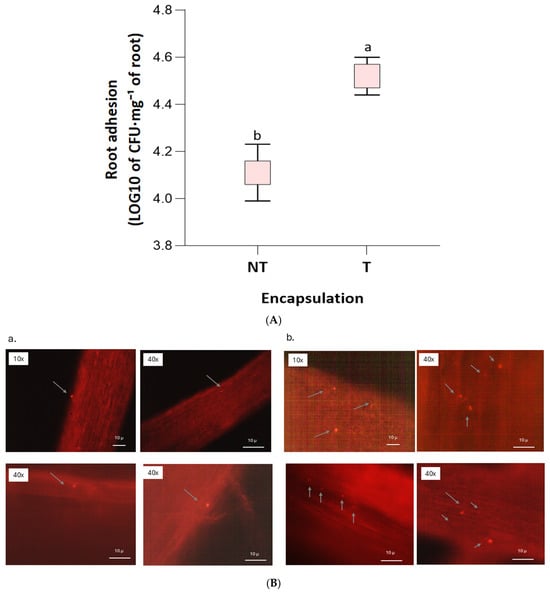
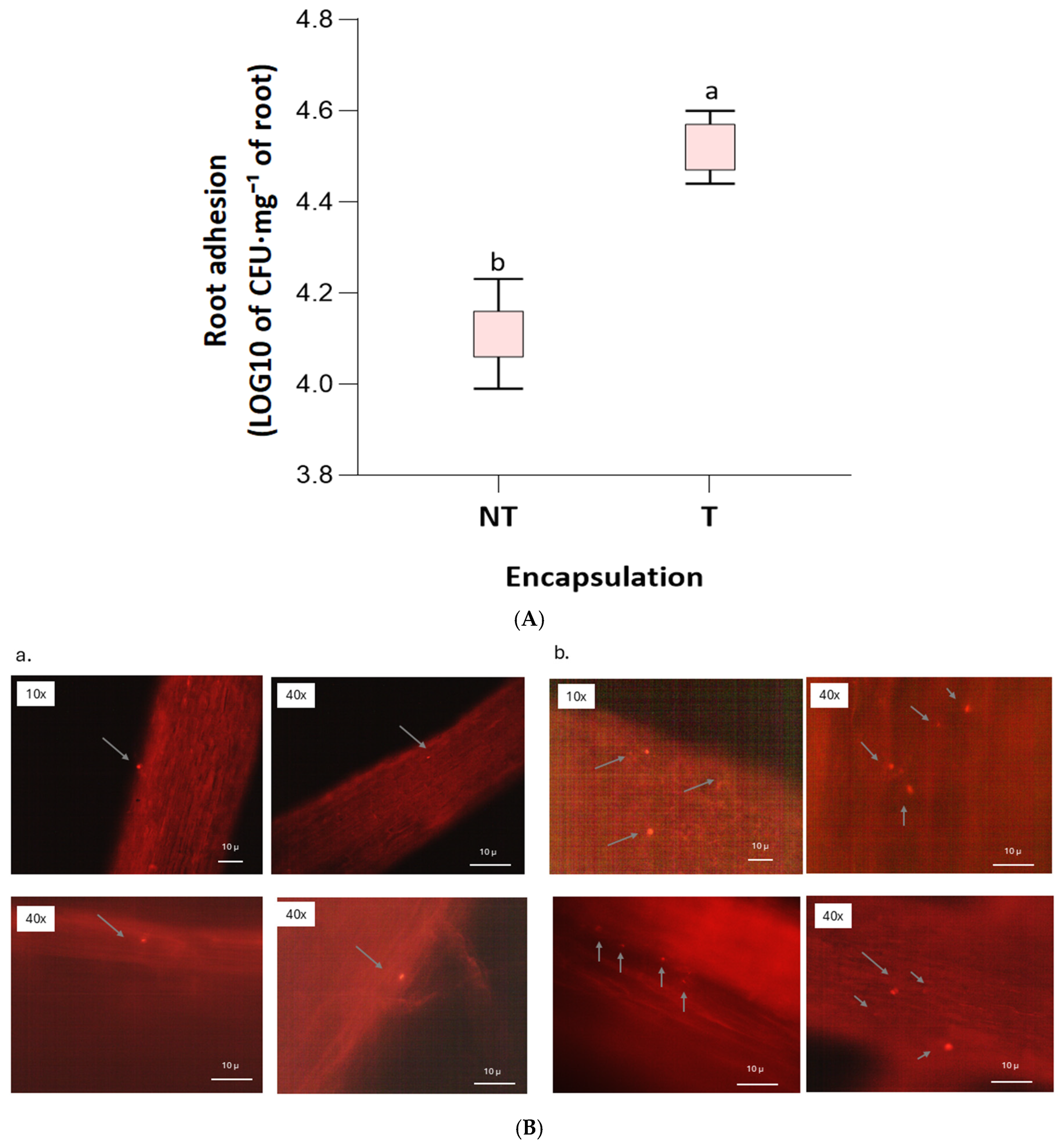
We next evaluated the adhesion capacity of encapsulated SEMIA 6144 at t0. At this time point, the presence of trehalose in the alginate matrix was associated with an approximately 105% increase in the number of bacterial cells recovered from peanut roots, rising from 1.88 × 10⁴ CFU·mg−1 of root in NT to 3.86 × 10⁴ CFU·mg−1 of root in its T (Figure 1A). As shown in Figure 1B, a higher density of fluorescent cells was observed in the presence of trehalose, which supports the quantitative adhesion results.
Figure 1.
(A). Log10 CFU·mg−1 of root of SEMIA 6144, attached to peanut roots, encapsulated in alginate beads without trehalose (NT) and with trehalose (T), at time zero of storage (t0). The values represent the mean of six independent trials. Different letters (a, b) indicate significant differences between treatments according to Tukey’s test (p < 0.05) (B). Representative fluorescence microscopy images showing adhesion of Bradyrhizobium sp. SEMIA 6144 expressing Cherry fluorescent protein in peanut roots. (a) Cells grown without trehalose (NT) and (b) cells grown in the presence of trehalose (T), observed at 10× and 40× magnification. Arrows indicate bacterial colonization sites on the root surface. Images are representative of three independent experiments.
3.4. Inoculation with Semia6144 Beads Modulates the Response of Peanut to Water Stress
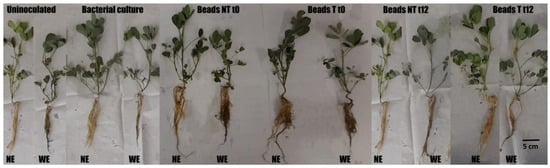
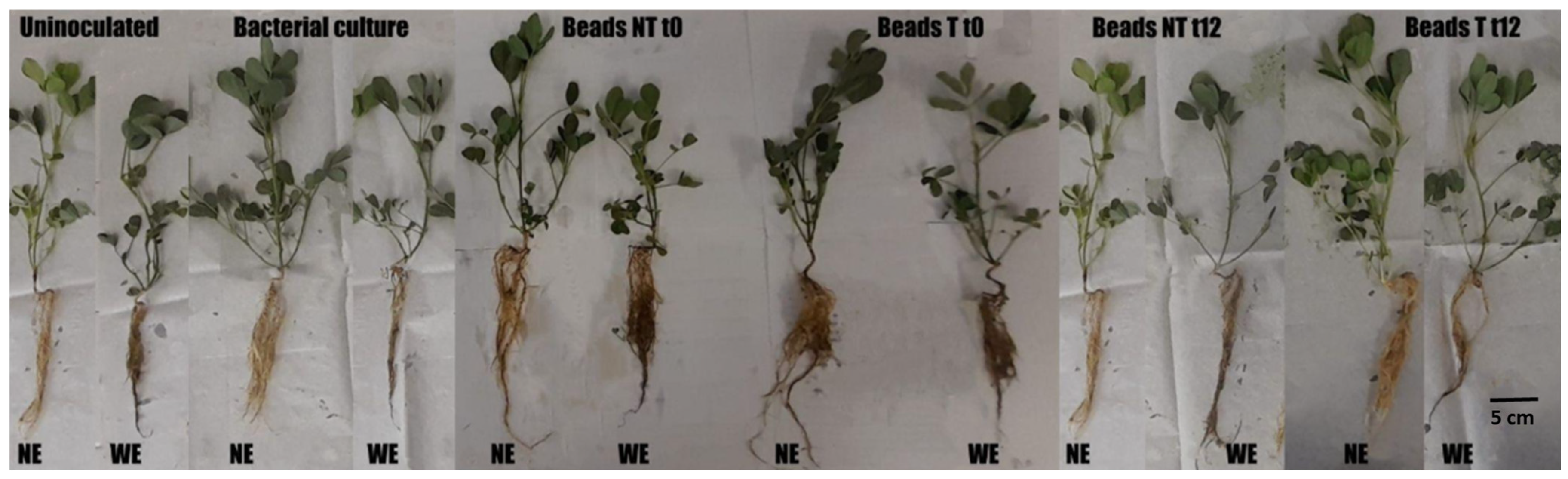
We evaluated the effects of inoculation with NT and T beads stored for 0 and 12 months on growth parameters, nodulation, and chlorophyll content in 35-day-old A. hypogae plants grown under water stress conditions (Figure 2).
Figure 2.
Peanut plants 35 days after inoculation with Bradyrhizobium sp. SEMIA 6144 in a liquid culture and trapped in alginate beads without trehalose (NT) and with trehalose (T), at time zero (t0) and after 12 months of storage (t12). Not stress (NE) and water stress (WE).
3.4.1. Growth and Nodulation Parameters
The growth parameters of uninoculated plants and plants inoculated with NT and T beads at t0 and t12, stored under both non-stress and water stress conditions, are shown in Table 3. The parameters studied were: shoot length (SL), dry biomass of the shoot (SDB), root length (RL), dry biomass of the root (RDB), number of nodules (N° nodules), and leghemoglobin content (leghemoglobin).
Table 3.
Growth parameters of peanut plants without inoculation and inoculated with bacterial culture and new beads (t0) and 12 months (t12) of SEMIA 6144 with and without trehalose (NT and T) with and without water stress. SL (shoot length), RL (root length), SDB (shoot dry biomass), RDB (root dry biomass). Data represent the mean ± SE (n = 30).
Not all evaluated parameters exhibited the same response pattern to water regime and inoculation treatments. Two-way ANOVA revealed that, depending on the variable analyzed, the interaction between factors (stress × inoculation) was significant in some cases but not in others. Therefore, each parameter is described according to its corresponding statistical outcome.
A significant interaction between inoculation and water stress was detected for shoot length (SL; p < 0.0001), shoot dry biomass (SDB; p = 0.0001), and root dry biomass (RDB; p = 0.0001), indicating that, for these parameters, the effect of inoculation depended on the water regime. For SL, under non-stress conditions, the highest values were observed in uninoculated plants, bacterial culture, and T t12, whereas, under water stress, plants inoculated with t0 beads (NT and T) showed the highest values. It should be noted that SEMIA 6144 encapsulation promoted an increase in SL of 22% and 24% (NT and T, t0), compared to plants without stress. This contrasts with the other treatments applied, which decreased under these conditions. For SDB, the presence of trehalose in the beads (both t0 and t12) promoted the highest biomass in stressed plants. Water stress reduced SDB in all treatments; however, plants inoculated maintained comparatively higher biomass under stress, compared to non-inoculated plants. Under optimal irrigation conditions, plants inoculated with T beads (both t0 and t12) exhibited the highest values of RDB. However, inoculation did not produce the same response under water stress conditions, decreasing in all treatments compared to plants without water stress.
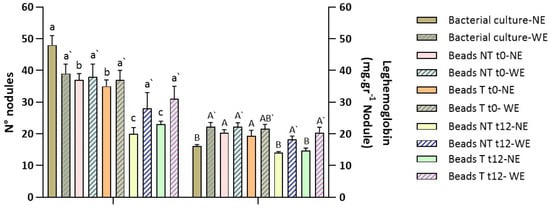
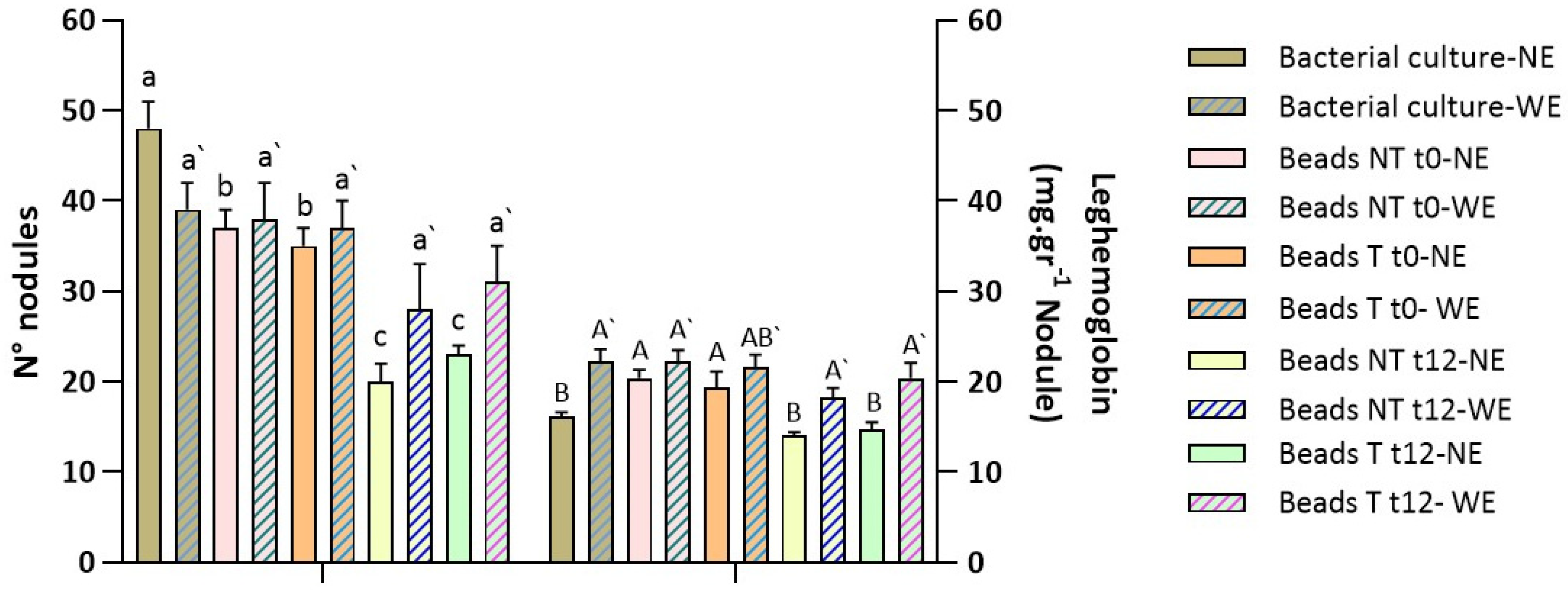
For RL, number of nodules, and leghemoglobin content, no significant interaction between inoculation and water stress was detected. Therefore, variations in these parameters were related to each factor separately (stress or inoculation). RL was associated with the main effect of the water regime (p = 0.03) and was not influenced by the inoculation factor, with a decrease in values observed in all treatments. When grown under water stress conditions, the RL values of plants decreased, except for those inoculated with T microspheres (t0 and t12), where RL remained stable or increased slightly. The decrease in uninoculated plants and plants inoculated with bacterial culture and NT t0 and t12 beads was 16, 14, 12, and 10.5%, respectively. The number of nodules was significant for the inoculation factor (p < 0.0001), with the highest value obtained by plants inoculated with the bacterial culture, both in plants without stress and with water stress (48 and 42, respectively), followed by plants inoculated with t0 beads. Interestingly, although not significant with the stress factor (p = 0.6), it was observed that when water stress was applied (Figure 3), the plants inoculated with bacterial culture decreased their number of nodules by 12.5%, while those inoculated with beads increased by 3, 6, 40, and 35 (NT and T t0 beads and NT and T t12 beads, respectively). In addition, a differential distribution of nodules was observed depending on the type of inoculation (Figure S1). Plants inoculated with bacterial culture had the highest number of nodules on their main root in plants without water stress, but when water stress was applied, the highest number of nodules was found on the lateral roots. As for plants inoculated with SEMIA 6144 beads, most nodules were found on lateral roots regardless of water stress. Regarding leghemoglobin content (Figure 3), the highest values were obtained for plants inoculated with t0 beads (NT and T) under optimal irrigation conditions, with lower values observed in plants inoculated with t12 beads and bacterial culture. However, when water stress was applied, this parameter increased by 38%, 9%, 11%, 29% and 38% (for bacterial culture, NT t0, T t0, NT t0, and T t12, respectively) compared to unstressed plants.
Figure 3.
Number of nodules (left axis) and leghemoglobin content (right axis) in peanut plants subjected to different types of inoculation: uninoculated control, bacterial culture, beads at t0 without trehalose (NT) and with trehalose (T), and beads at t12 without trehalose (NT) and with trehalose (T). Solid bars represent plants grown under non-water-stressed conditions (NE), while striped bars represent plants subjected to water stress (WE). Different lowercase letters indicate significant differences in nodule number, whereas different uppercase letters indicate significant differences in leghemoglobin content (p < 0.05). Non-primed and primed letters represent independent statistical comparisons. No significant interaction between water stress and inoculation was detected; only significant differences for the inoculation factor were observed in both variables.
3.4.2. Photosynthetic and Physiological Parameters
The physiological and photosynthetic parameters evaluated are shown in Table 4. Two-way ANOVA revealed a significant inoculation × water stress interaction for Chlo a (p = 0.02), Chlo b (p = 0.0007), and Total chlo (p = 0.0018) content.
Table 4.
Physiological and photosynthetic parameters of peanut plants without inoculation and inoculated with bacterial culture and new beads (t0) and 12 months (t12) of SEMIA 6144 with and without trehalose (NT and T) with and without water stress. Chlo a (chlorophyll a), Chlo b (chlorophyll b), carotenoids (Carot), total chlorophyll (Total chlo), leaf area, and fluorescence intensity. Data means ± SE. Different letters correspond to significant differences in each parameter according to Fisher’s LSD test (α = 0.05). No interaction between inoculation and stress was detected in terms of carotenoid content and leaf area.
Under non-stress conditions, inoculation increased the total chlorophyll content of the plants compared to the uninoculated control. The greatest increase (26%) was observed in plants that received the liquid bacterial culture, while the encapsulated formulations (NT and T) showed more moderate increases (13% and 17%, respectively) at t0. However, the encapsulated treatments promoted a larger leaf area than the liquid inoculum, suggesting a differential effect of the formulation on vegetative growth.
Under water stress conditions, leaf area decreased by 24% in non-inoculated plants and by 21% in plants inoculated with the bacterial culture, compared to non-stress conditions. Plants inoculated with encapsulated formulations at t0 (NT and T) showed smaller reductions in leaf area (10% and 17%, respectively) than non-inoculated plants or plants inoculated with the bacterial culture, maintaining relatively higher values under reduced water availability Similarly, encapsulated formulations stored for 12 months (NT and T) showed reductions in leaf area close to 10%, which were lower than those observed in the non inoculated and bacterial culture treatments. These results indicate that the ability to mitigate the effects of water stress was maintained after storage. Regarding Chl Total content under water stress, the values were comparable among the inoculated treatments, with no significant differences between formulations. No significant differences in carotenoids were detected between treatments (p > 0.05). An upward trend was observed in plants inoculated with a bacterial culture (20%) or stored T-beads (14%), compared to plants grown under non-stress conditions.
Overall, the results suggest that although the bacterial culture showed greater increases in chlorophyll under non-stress conditions, the encapsulated formulations were more effective in maintaining leaf area yield in stressed plants under water, even after 12 months of storage.
3.4.3. Multivariate Statistical Analysis of Principal Components
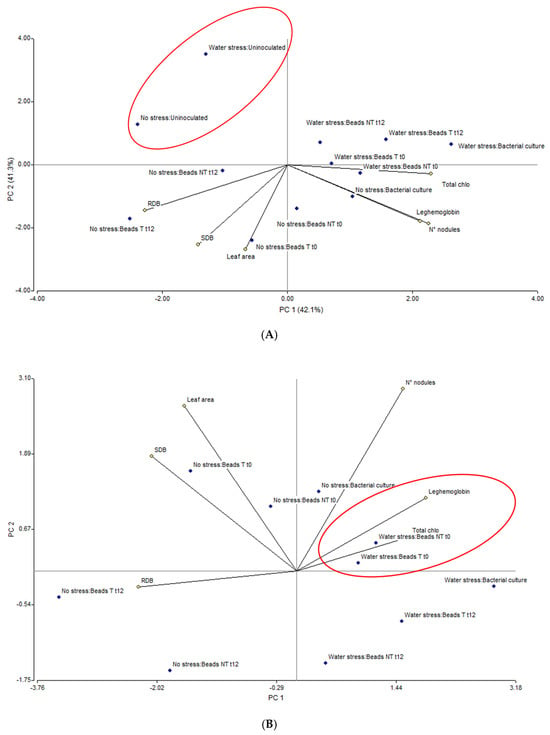
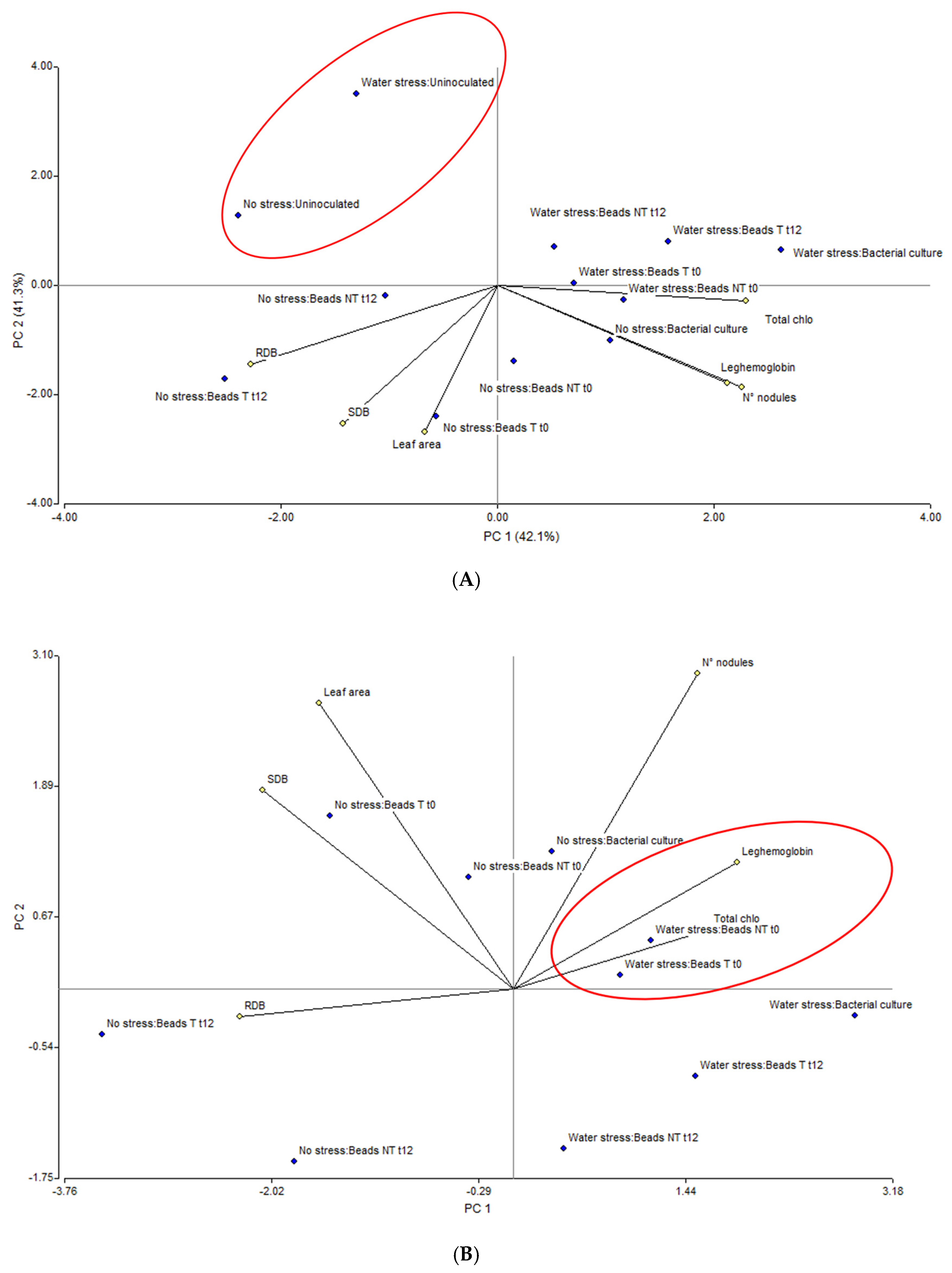
To place the variables measured in the six treatments carried out within a framework that allows a rigorous interpretation, we performed multivariate statistical analysis of principal components. The main objective of this analysis was to compare the effects of different combinations of water stress factors and inoculations on parameters related to growth and nodulation in plants (Figure 4). This analysis allowed the variability of the evaluated variables to be summarized into two components that together explained 83.4% of the total variance. The first component (PC1) explained 42% of the variability and was mainly associated with variables related to nodulation and the physiological state of the plants, such as the number of nodules, leghemoglobin, and Chl Total. The second component (PC2) explained 41.3% of the variability and was mainly related to vegetative growth variables, such as leaf area and biomass.
Figure 4.
Principal component analysis plot generated by InfoStat software, version 2020e. Straight lines represent correlations between RDB, SDB, Leaf area, N° nodules, leghemoglobin, and Total Chlo. Isolated points represent different inoculation treatments. PC1 and PC2 represent principal components 1 and 2. (A) Considering the data corresponding to the uninoculated control. (B) Considering only the inoculated treatments.
The distribution of treatments showed a clear separation between inoculated and non-inoculated plants (Figure 4A), as well as between stressed and non-stressed plants. As shown in Figure 4B, most variables related to plant growth parameters were associated with the t0 (NT and T) and t12 T bead inoculation treatments under stress-free conditions. The variance explained by each principal component for Figure 4A,B has been included in the Supplementary Material (Tables S1 and S2). The number of nodules was more strongly associated with the liquid inoculation under stress-free conditions. However, under water stress, leghemoglobin and total chlorophyll concentration were associated with the t0 (NT and T) bead inoculations.
4. Discussion
In encapsulated formulations intended for use as inoculants, the preservation of bacterial functional traits is crucial for their biological performance. Among these, motility plays a central role in the early stages of root colonization [36,37]. In this study, the addition of trehalose was associated with higher swimming motility values compared to the formulation without this disaccharide, after 12 months of storage. These results suggest a protective effect of trehalose on this function, which is key in the early stages of the plant–microorganism interaction, as it determines the selection of the initial contact site with the root and, consequently, the efficiency of the colonization process [38]. The increased motility observed after 12 months could be attributed to the protective effect of trehalose on cell integrity and the functionality of flagellar systems under storage conditions. Beads supplemented with trehalose maintained bacterial viability at approximately 7.5–8 log CFU g−1 over the 12-month period, whereas unsupplemented beads exhibited a gradual decline to approximately 5.3 log CFU g−1. Therefore, the greater motility observed after storage may be associated both with improved preservation of cellular functionality and with the maintenance of a larger viable bacterial population in trehalose-containing microspheres. However, considering that the diameter of the swimming halo can also be influenced by differences in cell viability [39], it cannot be ruled out that greater bacterial survival may have partially contributed to the observed effect. Furthermore, although trehalose has been reported as a potential chemoattractant [40], the absence of differences at time zero suggests that the phenomenon is not associated with an immediate chemotactic stimulus via diffusion from the bead, but rather with a sustained physiological effect. While the use of trehalose as an osmoprotectant in liquid formulations has been widely documented, its specific implications in encapsulated matrices and its impact on processes related to rhizosphere colonization symbiotic establishment still require further investigation.
Cell aggregation and biofilm formation are key processes in bacterial persistence in the rhizosphere and in the establishment of plant–microorganism interactions [41,42]. In this study, this parameter was evaluated as an indicator of physiological adaptation to prolonged cold storage within alginate beads and to analyze its potential modulation by trehalose. The results showed greater self-aggregation in bacteria released from trehalose-containing beads at the beginning of storage, suggesting that this disaccharide could promote a more cooperative physiological state from early stages. Furthermore, after 12 months, an increase was observed in both treatments (NT and T). This behavior is consistent with reports describing the induction of aggregative phenotypes under stress conditions, such as nutritional or osmotic limitation [26,41], and is interpreted as an adaptive response that contributes to bacterial survival. Taken together, these results indicate that prolonged storage in a polymer matrix could promote physiological adjustments associated with greater cell cohesion, while the presence of trehalose could modulate this process early on.
Regarding biofilm formation, it was observed that bacteria extracted from NT beads after 12 months of storage exhibited a greater biofilm capacity compared to the initial time point, a result consistent with the increase in self-aggregation recorded in this treatment. This association has been widely described, as enhanced cell clustering promotes cell–cell contact and constitutes an early step in the establishment of microcolonies and the development of biofilm structures [26,43]. In this sense, the concomitant increase in cooperative behavior and biofilm formation in NT at 12 months could reflect a transition to a more structured physiological state, potentially associated with adaptation to prolonged storage within the alginate matrix.
The adhesion of rhizobia to host roots is the first step required for infection and subsequent nodulation [44]. Interestingly, we demonstrated that the presence of trehalose significantly increased the number of SEMIA 6144 cells adhered to peanut roots compared to those not entrapped with trehalose. This effect could be beneficial, since better root colonization can promote a more efficient establishment of symbiosis and, consequently, improve nodulation and plant growth. The adhesion of rhizobia to host roots is the first step required for infection and subsequent nodulation [44]. Interestingly, we demonstrated that the presence of trehalose significantly increased the number of SEMIA 6144 cells adhered to peanut roots compared to those not entrapped with trehalose. This response may be related to the protective role of trehalose in bacterial cells [16], since trehalose functions as a compatible solute involved in osmotic stress tolerance, stabilization of proteins and membranes, and maintenance of cellular integrity under unfavorable environmental conditions. Improved physiological status of rhizobial cells could enhance their ability to colonize root surfaces. In addition, trehalose has been associated with increased production of extracellular polymeric substances and biofilm formation in several bacterial systems, which are key processes involved in bacterial attachment and persistence on plant roots. Therefore, the higher adhesion observed in the presence of trehalose may result from improved cell survival together with enhanced surface interactions between rhizobia and root tissues, ultimately favoring symbiotic establishment.
The effect of inoculation on early peanut plant growth was clearly dependent on the water regime. Consistent with the findings previously reported by Cesari [21], the results showed a significant reduction in shoot biomass in peanut plants subjected to water restriction, confirming the negative impact of water stress on plant growth. Our results constitute the first report describing the use of alginate beads containing Bradyrhizobium SEMIA 6144 enriched with trehalose in a matrix as a bioinoculate to mitigate the effects of water stress in peanuts. Under this condition, plants inoculated with t0-T beads showed an attenuation of the stress impact, evidenced by greater shoot length and shoot dry biomass and lower root dry biomass. These responses suggest a reorganization of growth as an adaptive strategy aimed at sustaining water absorption and gas exchange under limited water availability. The greater sensitivity of shoot length to inoculant aging may be associated with a reduced number of viable rhizobia and consequently lower nodulation efficiency in stored beads (t12). Fresh beads (t0), containing a larger viable bacterial population, likely promoted earlier or more effective nodulation, thereby improving nitrogen acquisition and favoring aerial growth in stressed plants. In contrast, root length appeared less affected by storage time, particularly in T-t12 beads, which may not necessarily indicate enhanced root promotion but rather a relative maintenance of root development despite the reduced stimulation of shoot growth. Under water stress, root growth may also represent a plant adaptive response less strictly dependent on symbiotic performance than shoot elongation. Similarly, in the absence of water stress, plants inoculated with T beads exhibited the highest shoot and root biomass values at both storage times, indicating that trehalose could enhance the inoculant’s performance and boost plant growth under optimal environmental conditions. This could be attributed to trehalose’s ability to improve microbial survival under stress conditions, such as drought and salinity, which ultimately contributes to improved stress tolerance in host plants [45,46,47]. Trehalose could also act as an additional carbon source, stimulating the inoculant’s proliferation and metabolic activity, as demonstrated in studies conducted with genetically modified Azospirillum strains unable to accumulate trehalose [48,49].
Nodulation was influenced by both the type of inoculation and the water regime. Under conditions without water restriction, plants inoculated with the liquid culture of SEMIA 6144 exhibited the highest total number of nodules, located primarily on the main root. However, under water stress, a reduction in nodulation was observed in this treatment, accompanied by a shift in distribution towards lateral roots. In contrast, in plants inoculated with SEMIA 6144 immobilized in alginate beads, most nodules were located on lateral roots regardless of the water condition. Although the total number of nodules in the encapsulated treatments was lower than that observed with the liquid culture under optimal conditions, nodulation remained more stable under stress conditions. In particular, the t0 beads (NT and T) and the T t12 beads maintained or even increased the number of nodules compared to their non-stressed condition. In line with the findings reported by Cerezini et al. and Hami et al. [50,51], who described a decrease in nodulation under drought stress in soybean plants inoculated with strains of Bradyrhizobium elkanii and Bradyrhizobium diazoefficiens, and in pea, fava bean, and common bean plants inoculated with strains of Rhizobium laguerreae, Bacillus sp., and Enterobacter aerogenes, in our study, this reduction was more pronounced in the liquid culture treatment than in the encapsulated formulations, particularly when the bacteria were co-encapsulated with trehalose.
Although the total number of nodules is commonly used as a symbiotic parameter, several studies have indicated that nodule functionality, including nodule mass and leghemoglobin content, is a more reliable indicator of biological N2 fixation than the number of nodules alone [52,53]. Under water stress, while the encapsulated formulations showed a lower total number of nodules compared to the liquid culture, they maintained comparable leghemoglobin levels. This behavior could reflect a physiological adjustment aimed at maintaining a microaerobic environment suitable for nitrogenase activity under restrictive conditions [54]. In this sense, our results suggest that, even though nodulation was quantitatively lower, symbiotic functionality was not compromised in the encapsulated treatments. Taken together, these findings indicate that encapsulation could contribute to sustaining the efficiency of symbiotic interaction and plant performance when water availability is limited, even after prolonged storage.
Leaf area proved particularly sensitive to water stress, showing a generalized reduction across all inoculation types. This decrease is a common adaptive response under water stress, associated with limited cell expansion and reduced transpiring surface area [55]. However, the relative maintenance of leaf area in plants inoculated with alginate beads under stress contrasted with the greater reduction observed in uninoculated plants or those inoculated with liquid culture, suggesting better structural and functional preservation of the photosynthetic apparatus. Furthermore, in beads stored for 12 months, the presence of trehalose was associated with a more favorable effect, evidenced by higher Chl Total concentrations and leaf area. Given that leaf area is a key physiological component of crop yield, its preservation under adverse conditions is especially relevant. In this regard, studies conducted on six bean cultivars showed a positive correlation between larger leaf area and early pod filling under field conditions [56], as well as continuous growth and greater nutrient uptake, factors associated with higher grain yield in common beans [57].
Taken together, these results suggest that alginate encapsulation, particularly in the presence of trehalose, not only influences key physiological traits of the inoculant, such as motility, aggregation, biofilm formation, and root adhesion, but also that these modifications result in differentiated plant responses to water stress. Rather than maximizing performance under optimal conditions, the encapsulated formulations appear to help preserve symbiotic and physiological functionality under water stress.
5. Conclusions
This study provides evidence that the incorporation of trehalose into alginate-based formulations of Bradyrhizobium sp. SEMIA 6144 modulates bacterial physiological traits relevant to early colonization, such as motility, aggregation, and root adhesion, particularly after prolonged storage. Notably, the presence of trehalose significantly increased root adhesion compared to formulations without this compound, highlighting its potential role during the initial stages of colonization. Furthermore, trehalose contributed to the preservation of functional attributes associated with symbiotic establishment.
At the plant level, the effects of inoculation were strongly influenced by the water regime. Under water stress, the encapsulated formulations, especially those enriched with trehalose, showed greater functional stability compared to the liquid culture, evidenced by greater shoot dry biomass and leaf area, and the maintenance of nodular functionality, indicated by comparable leghemoglobin content despite lower quantitative nodulation.
Taken together, these findings support the potential of trehalose-enriched alginate beads as a promising bioinoculant strategy for legume cultivation under prolonged storage and limited water availability.
Supplementary Materials
The following supporting information can be downloaded at: https://www.mdpi.com/article/10.3390/agronomy16111056/s1, Figure S1: Distribution of nodules between main and lateral roots under different inoculation treatments and water stress conditions; Table S1: Eigenvalues, percentage of explained variance, and cumulative variance for the principal component analysis (PCA) including all treatments shown in Figure 4A; Table S2: Eigenvalues, percentage of explained variance, and cumulative variance for the principal component analysis (PCA) including only inoculated treatments shown in Figure 4B.
Author Contributions
V.E.C.M.: Methodology, formal analysis, data curation, writing—original draft preparation, writing—review and editing. N.S.P.: validation, formal analysis, data curation; writing—review and editing. A.B.C.: conceptualization, methodology, formal analysis, supervision, and writing—original draft preparation and review and editing. M.S.D.: formal analysis, resources, writing—review and editing. All authors have read and agreed to the published version of the manuscript.
Funding
This study was financially supported by PICT (Grant No. 4162/18 and 696/21), PIP CONICET (Grant No. 11220210100155CO) and PPI Universidad Nacional de Río Cuarto (Grant No. C530-1).
Data Availability Statement
The raw data supporting the conclusions of this article will be made available by the authors on reasonable request.
Acknowledgments
A.B.C., N.S.P. and M.S.D. are members of the CONICET Research Career, Argentina; V.E.C.M. received a fellowship from CONICET (National Scientific and Technical Research Council, Argentina) and is currently a CONICET-Argentina fellow.
Conflicts of Interest
The authors declare no conflicts of interest.
References
- Raza, A.; Bhardwaj, S.; Rahman, M.; Caparrós, P.; Habib, M.; Saeed, F.; Charagh, S.; Foyer, C.H.; Siddique, K.; Varshney, R. Trehalose: A sugar molecule involved in temperature stress management in plants. Crop J. 2024, 12, 1–16. [Google Scholar] [CrossRef]
- Ali, S.; Akhtar, M.; Siraj, M.; Zaman, W. Molecular Communication of Microbial Plant Biostimulants in the Rhizosphere Under Abiotic Stress Conditions. Int. J. Mol. Sci. 2024, 25, 12424. [Google Scholar] [CrossRef] [Scilit]
- Singh, M.; Jha, S.; Pathak, D.; Maisnam, G. Advancing biofertilizers: The evolution from single-strain formulations to synthetic microbial communities (SynCom) for sustainable agriculture. Discov. Plants 2025, 2, 226. [Google Scholar] [CrossRef] [Scilit]
- Rodriguez, A.; Cota, F.; Chavez, L.; Ortega, L.; Alvarado, M.; Santoyo, G.; Villalobos, S. Microbial Inoculants in Sustainable Agriculture: Advancements, Challenges, and Future Directions. Plants 2025, 14, 191. [Google Scholar] [CrossRef] [Scilit]
- FAOSTAT. Available online: https://www.fao.org/faostat/en/#home (accessed on 20 January 2026).
- USDA. Available online: https://www.ars.usda.gov/ (accessed on 15 March 2026).
- Lopes, T.; Costa, P.; Cardoso, P.; Silva, J.; Figueira, E. Inducing Drought Resilience in Maize Through Encapsulated Bacteria: Physiological and Biochemical Adaptations. Plants 2025, 14, 812. [Google Scholar] [CrossRef] [Scilit]
- Rodriguez, M.; Bonilla, G.; Pérez, J.; Álvarez, M.; Barrera, M. Hydrogel capsules as new approach for increasing drying survival of plant biostimulant gram-negative consortium. Appl. Microbiol. Biotechnol. 2023, 107, 6671–6682. [Google Scholar] [CrossRef] [Scilit]
- Vejan, P.; Khadiran, T.; Abdullah, R.; Ismail, S.; Dadrasnia, A. Encapsulation of plant growth promoting Rhizobacteria—Prospects and potential in the agricultural sector: A review. J. Plant Nutr. 2019, 42, 2600–2623. [Google Scholar] [CrossRef] [Scilit]
- Riseh, R.; Skorik, Y.; Thakur, V.; Pour, M.; Tamanadar, E.; Noghabi, S. Encapsulation of Plant Biocontrol Bacteria with Alginate as a Main Polymer Material. Int. J. Mol. Sci. 2021, 22, 11165. [Google Scholar] [CrossRef] [Scilit] [PubMed]
- Balla, A.; Silini, A.; Silini, H.C.; Bouket, A.; Alenezi, F.; Belbahri, L. Recent Advances in Encapsulation Techniques of Plant Growth-Promoting Microorganisms and Their Prospects in Sustainable Agriculture. Appl. Sci. 2022, 12, 9020. [Google Scholar] [CrossRef] [Scilit]
- Zhang, W.; Zheng, L.; Lang, D.; Zhang, X.; Ma, X.; Li, X.; Zhang, X. Eco-friendly bio-encapsulation from sodium alginate-trehalose-kaolin and its performance evaluation in improving plant growth under salt or/and drought conditions. Int. J. Biol. Macromol. 2023, 225, 123–134. [Google Scholar] [CrossRef] [Scilit] [PubMed]
- Ali, S.; Zain, M.; Yahya, E. Biopolymers in sustainable agriculture: A review on their roles in precision farming and composite fertilizers. Polym. Bull. 2025, 83, 16. [Google Scholar] [CrossRef] [Scilit]
- Cesari, A.B.; Paulucci, N.S.; Yslas, E.; Dardanelli, M.S. Immobilization of Bradyrhizobium and Azospirillum in alginate matrix for a long time of storage maintains cell viability and interaction with peanut. Appl. Microbiol. Biotechnol. 2020, 104, 10145–10164. [Google Scholar] [CrossRef] [Scilit] [PubMed]
- Pasin, B.L.; Azón, C.G.; Garriga, A.M. Microencapsulation with alginate in food. Techniques and applications. Rev. Venez. Cienc. Tecnol. Aliment 2012, 3, 130–151. [Google Scholar]
- Maiti, A.; Daschakraborty, S. Unraveling the Molecular Mechanisms of Trehalose-Mediated Protection and Stabilization of Escherichia coli Lipid Membrane during Desiccation. J. Phys. Chem. B 2023, 127, 4496–4507. [Google Scholar] [CrossRef] [Scilit]
- Zago, S.L.; Santos, M.F.; Konrad, D.; Fiorini, A.; Rosado, F.R.; Missio, R.F.; Vendruscolo, E.C.G. Shelf Life of Azospirillum brasilense in Alginate Beads Enriched With Trehalose and Humic Acid. J. Agric. Sci. 2019, 11, 269. [Google Scholar] [CrossRef] [Scilit]
- Santos, J.; Rocha, G.; Nunes, L.; Dias, M.; Santos, J.; Fernandes, P.; Gondim, T.; Lima, L.; Fernandes, P. Peanut drought tolerance and yield enhanced by new Brazilian Bradyrhizobium strains. Pesqui. Agropecu. Bras. 2025, 60, e04109. [Google Scholar] [CrossRef] [Scilit]
- Vicario, J.; Primo, E.; Dardanelli, M.; Giordano, W. Promotion of Peanut Growth by Co-inoculation with Selected Strains of Bradyrhizobium and Azospirillum. J. Plant Growth Regul. 2015, 35, 413–419. [Google Scholar] [CrossRef] [Scilit]
- Dardanelli, M.S.; Angelini, J.; Fabra, A. A calcium-dependent bacterial surface protein is involved in the attachment of rhizobia to peanut roots. Can. J. Microbiol. 2003, 49, 399–405. [Google Scholar] [CrossRef] [Scilit]
- Cesari, A.B.; Paulucci, N.S.; Gómez, M.L.; Castellanos, J.; Plá, C.; Dardanelli, M.S. Performance of Bradyrhizobium and Bradyrhizobium–Azospirillum in Alleviating the Effects of Water-Restrictive Conditions During the Early Stages of Arachis hypogaea Growth. J. Plant Growth Regul. 2019, 38, 1362–1374. [Google Scholar] [CrossRef] [Scilit]
- Ibañez, F.; Angelini, J.; Taurian, T.; Tonelli, M.L.; Fabra, A. Endophytic occupation of peanut root nodules by opportunistic Gammaproteobacteria. Syst. Appl. Microbiol. 2009, 32, 49–55. [Google Scholar] [CrossRef] [Scilit]
- Taurian, T.; Anzuay, M.S.; Ludueña, M.L.; Angelini, J.G.; Muñoz, V.; Valetti, L.; Fabra, A. Effects of single and co-inoculation with native phosphate solubilising strain Pantoea sp. J49 and the symbiotic nitrogen fixing bacterium Bradyrhizobium sp. SEMIA 6144 on peanut (Arachis hypogaea L.) growth. Symbiosis 2012, 59, 77–85. [Google Scholar] [CrossRef] [Scilit]
- Valetti, L.; Angelini, J.G.; Taurian, T.; Ibañez, F.J.; Muñoz, V.L.; Anzuay, M.S.; Ludueña, M.L.; Fabra, A. Development and field evaluation of liquid inoculants with native Bradyrhizobial strains for peanut production. Afr. Crop Sci. J. 2016, 24, 1–13. [Google Scholar] [CrossRef] [Scilit]
- Wheatley, R.M.; Poole, P.S. Mechanisms of bacterial attachment to roots. FEMS Microbiol. Rev. 2018, 42, 448–461. [Google Scholar] [CrossRef] [Scilit] [PubMed]
- Bogino, P.C.; Oliva, M.D.M.; Sorroche, F.G.; Giordano, W. The role of bacterial biofilms and surface components in plant-bacterial associations. Int. J. Mol. Sci. 2013, 14, 15838–15859. [Google Scholar] [CrossRef] [Scilit]
- Somasegaran, P.; Hoben, H.J. Quantifying the Growth of Rhizobia. In Handbook for Rhizobia; Springer: New York, NY, USA, 1994; Volume 5, pp. 47–57. [Google Scholar] [CrossRef] [Scilit]
- Bashan, Y.; Hernández, J.P.; Leiva, L.A.; Bacilio, M. Alginate microbeads as inoculant carriers for plant growth-promoting bacteria. Biol. Fertil. Soils 2002, 35, 359–368. [Google Scholar] [CrossRef] [Scilit]
- Joe, M.M.; Karthikeyan, B.; Chauhan, P.S.; Shagol, C.; Islam, M.R.; Deiveekasundaram, M.; Sa, T. Survival of Azospirillum brasilense flocculated cells in alginate and its inoculation effect on growth and yield of maize under water deficit conditions. Eur. J. Soil Biol. 2012, 50, 198–206. [Google Scholar] [CrossRef] [Scilit]
- Madi, N.; Henis, Y. Aggregation in Azospirillum brasilense Cd: Conditions and factors involved in cell-to-cell adhesion. Plant Soil 1989, 115, 89–98. [Google Scholar] [CrossRef] [Scilit]
- Sorroche, F.; Spesia, M.; Zorreguieta, A.; Giordano, W. A Positive Correlation between Bacterial Autoaggregation and Biofilm Formation in Native Sinorhizobium meliloti Isolates from Argentina. Appl. Environ. Microbiol. 2012, 78, 4092–4101. [Google Scholar] [CrossRef] [Scilit]
- Vincent, J.M. A Manual for the Practical Study of the Root-Nodule Bacteria; International Biological Program; Blackwell Scientific Publications: Oxford, UK, 1970. [Google Scholar]
- Wilson, D.O.; Reisenauer, H.M. Determination of leghemoglobin in legume nodules. Anal. Biochem. 1963, 6, 27–30. [Google Scholar] [CrossRef] [Scilit]
- Martin, T.N.; Fipke, G.M.; Winck, J.E.M.; Márchese, J.A. Software ImageJ cómo método alternativo para estimar área foliar en avena. Acta Agron. 2020, 69, 162–170. [Google Scholar]
- Lichtenthaler, H.K.; Wellburn, A.R. Determinations of total carotenoids and chlorophylls a and b of leaf extracts in different solvents. Biochem. Soc. Trans. 1983, 11, 591–592. [Google Scholar] [CrossRef] [Scilit]
- Van de Broek, A.; Lambrecht, M.; Vanderleyden, J. Bacterial chemotactic motility is important for the initiation of wheat root colonization by Azospirillum brasilense. Microbiology 1998, 144, 2599–2606. [Google Scholar] [CrossRef] [Scilit]
- Feng, H.; Fu, R.; Hou, X.; Lv, Y.; Zhang, N.; Liu, Y.; Xu, Z.; Miao, Y.; Krell, T.; Shen, Q. Chemotaxis of Beneficial Rhizobacteria to Root Exudates: The First Step towards Root–Microbe Rhizosphere Interactions. Int. J. Mol. Sci. 2021, 22, 6655. [Google Scholar] [CrossRef] [Scilit]
- Liu, Y.; Xu, Z.; Chen, L.; Xun, W.; Shu, X.; Chen, Y.; Sun, X.; Wang, Z.; Ren, Y.; Shen, Q.; et al. Root colonization by beneficial rhizobacteria. FEMS Microbiol. Rev. 2024, 48, fuad066. [Google Scholar] [CrossRef] [Scilit]
- Lauffenburger, D.; Aris, R.; Keller, K. Effects of cell motility and chemotaxis on microbial population growth. Biophys. J. 1982, 40, 209–219. [Google Scholar] [CrossRef] [Scilit]
- Deveau, A.; Brulé, C.; Palin, B.; Champmartin, D.; Rubini, P.; Garbaye, J.; Sarniguet, A.; Frey-Klett, P. Role of fungal trehalose and bacterial thiamine in the improved survival and growth of the ectomycorrhizal fungus Laccaria bicolor S238N and the helper bacterium Pseudomonas fluorescens BBc6R8. Environ. Microbiol. Rep. 2010, 2, 560–568. [Google Scholar] [CrossRef] [Scilit] [PubMed]
- Capellari, L.; Bogino, P.; Nievas, F.; Giordano, W.; Banchio, E. Exploring the Differential Impact of Salt Stress on Root Colonization Adaptation Mechanisms in Plant Growth-Promoting Rhizobacteria. Plants 2023, 12, 4059. [Google Scholar] [CrossRef] [Scilit]
- Ajijah, N.; Fiodor, A.; Pandey, A.; Rana, A.; Prana, K. Plant Growth-Promoting Bacteria (PGPB) with Biofilm-Forming Ability: A Multifaceted Agent for Sustainable Agriculture. Diversity 2023, 15, 112. [Google Scholar] [CrossRef] [Scilit]
- Flemming, H.C.; Wingender, J. The biofilm matrix. Nat. Rev. Microbiol. 2010, 8, 623–633. [Google Scholar] [CrossRef] [Scilit]
- Albareda, M.; Dardanelli, M.S.; Sousa, C.; Megías, M.; Temprano, F.; Rodríguez-Navarro, D.N. Factors affecting the attachment of rhizospheric bacteria to bean and soybean roots. FEMS Microbiol. Lett. 2006, 259, 67–73. [Google Scholar] [CrossRef] [Scilit]
- Onwe, R.O.; Onwosi, C.O.; Ezugworie, F.N.; Ekwealor, C.C.; Okonkwo, C.C. Microbial trehalose boosts the ecological fitness of biocontrol agents, the viability of probiotics during long-term storage and plants tolerance to environmental-driven abiotic stress. Sci. Total Environ. 2022, 806, 150432. [Google Scholar] [CrossRef] [Scilit]
- Sharma, V.; Bhattacharyya, S.; Kumar, R.; Kumar, A.; Ibañez, F.; Wang, J.; Guo, B.; Sudini, H.K.; Gopalakrishnan, S.; DasGupta, M.; et al. Molecular Basis of Root Nodule Symbiosis between Bradyrhizobium and ‘Crack-Entry’ Legume Groundnut (Arachis hypogaea L.). Plants 2020, 9, 276. [Google Scholar] [CrossRef] [Scilit]
- Eh, T.; Jiang, Y.; Jiang, M.; Li, J.; Lei, P.; Ji, X.; Kim, H.; Zaho, X.; Meng, F. The role of trehalose metabolism in plant stress tolerance. J. Adv. Res. 2025, 76, 57–72. [Google Scholar] [CrossRef] [Scilit] [PubMed]
- García, J.; Pagnussat, L.; Amenta, M.; Casanovas, E.; Diaz, P.; Labarthe, M.; Martino, M.; Groppa, M.; Creus, C.; Maroniche, G. Maize drought protection by Azospirillum argentinense Az19 requires bacterial trehalose accumulation. Appl. Microbiol. Biotechnol. 2024, 108, 543. [Google Scholar] [CrossRef] [Scilit]
- Griffiths, C.; Xue, X.; Miret, J.; Salvagiotti, F.; Siaca, L.; Gimeno, J.; Reynolds, M.; Hassall, K.; Halsey, K.; Puranik, S.; et al. Membrane-permeable trehalose 6-phosphate precursor spray increases wheat yields in field trials. Nat. Biotechnol. 2025, 44, 316–325. [Google Scholar] [CrossRef] [Scilit] [PubMed]
- Cerezini, P.; Kuwano, B.; Grunvald, A.; Hungria, M.; Nogueira, M. Soybean tolerance to drought depends on the associated Bradyrhizobium strain. Braz. J. Microbiol. 2020, 51, 1977–1986. [Google Scholar] [CrossRef] [Scilit]
- Hami, A.; El Attar, I.; Mghazli, N.; Ennajeh, S.; Ait-Ouakrim, E.H.; Bennis, M.; Oulghazi, S.; Badaoui, B.; Aurag, J.; Sbabo, L.; et al. Enhancing drought tolerance in Pisum sativum and Vicia faba through interspecific interactions with a mixed inoculum of Rhizobium laguerreae and non-host beneficial rhizobacteria. Front. Plant Sci. 2025, 16, 1528923. [Google Scholar] [CrossRef] [Scilit]
- Sprent, J.I.; Gehlot, H.S. Nodulated legumes in arid and semi-arid environments: Are they important? Plant Ecol. Divers. 2010, 3, 211–219. [Google Scholar] [CrossRef] [Scilit]
- O’hara, G.W. Nutritional constraints on root nodule bacteria affecting symbiotic nitrogen fixation: A review. Aust. J. Exp. Agric. 2001, 41, 417–433. [Google Scholar] [CrossRef] [Scilit]
- Bergersen, F.J. The quantitative relationship between nitrogen fixation and the acetylene-reduction assay. Aust. J. Biol. Sci. 1970, 23, 1015–1025. [Google Scholar] [CrossRef] [Scilit]
- Saini, S.; Lohani, S.; Khati, P.; Rani, V. PGPR-mediated mitigation of biotic and abiotic stress in plants. In Advanced Microbial Technology for Sustainable Agriculture and Environment; Academic Press: Cambridge, MA, USA, 2023; pp. 199–277. [Google Scholar] [CrossRef] [Scilit]
- Lima, E.; Santiago, A.; Araújo, A.P.; Teixeira, M. Effects of the size of sown seed on growth and yield of common bean cultivars of different seed sizes. Braz. J. Plant Physiol. 2005, 17, 273–281. [Google Scholar] [CrossRef] [Scilit]
- Araújo, A.P.; Teixeira, M. Relationships between grain yield and biomass, nitrogen, and phosphorus accumulation in common bean cultivars. Rev. Bras. Ciência 2008, 32, 1977–1986. [Google Scholar] [CrossRef] [Scilit]

Disclaimer/Publisher’s Note: The statements, opinions and data contained in all publications are solely those of the individual author(s) and contributor(s) and not of MDPI and/or the editor(s). MDPI and/or the editor(s) disclaim responsibility for any injury to people or property resulting from any ideas, methods, instructions or products referred to in the content. |
© 2026 by the authors. Licensee MDPI, Basel, Switzerland. This article is an open access article distributed under the terms and conditions of the Creative Commons Attribution (CC BY) license.