


Abstract
Climate change represents one of the most critical challenges, especially in the Mediterranean area. Using organic and localized fertilization could be an effective agroecological strategy to help mitigate the environmental impacts of climate change. Our study was carried out in an experimental field over a three-year crop succession including broccoli, sweet pepper and barley. A randomized complete block design was adopted, with two factors: (i) fertilization method (100% broadcast and 40% localized) and (ii) fertilizer type by testing: on-farm compost, two types of commercial compost and a mineral fertilizer. Environmental impacts per hectare and marketable yield were quantified using Life Cycle Assessment (LCA), considering abiotic depletion (AD), acidification (AA), eutrophication (EU), global warming potential (GWP), and photochemical oxidation (PO). The localized application of fertilizers achieved marketable yields comparable to the broadcast method, despite lower fertilizer inputs, suggesting an optimal nutrient-use efficiency. The LCA demonstrated that localized fertilization also enhanced environmental sustainability, decreasing Global Warming Potential (GWP) by 20% per hectare, compared to broadcast treatments. Moreover, considering only the fertilization phase, we observed a 59% reduction in GWP under the localized strategy. Even though localized fertilization emerges as an effective climate-smart strategy without compromising productivity, future research is recommended to assess its long-term impacts in site-specific conditions.
1. Introduction
The Mediterranean region is considered as a climate change hotspot, being characterized by increasing frequency of extreme events, like heavy short-duration rainfall and droughts [1,2]. Compared to temperate and humid regions, these agroecosystems are subject to irregular rainfall patterns and frequent dry periods, exacerbating the temporal variability of water and nutrient availability. In particular, intensified soil erosion, by flooding and surface run-off, negatively affects cultivated soils [3]. Under these conditions, rising temperatures accelerate soil organic matter mineralization and nutrient leaching processes, thus reducing soil fertility [4]. Nutrient use efficiency is also generally lower and more variable than in other climatic zones, making fertilizer management more challenging and site-specific. On the other hand, about 23% of the world’s anthropogenic greenhouse gas (GHG) emissions, the main driver of climate change [3], come from different agricultural activities and agriculture-related processes. These activities and processes include deforestation, land use change, as well as the overuse of synthetic agrochemicals and fertilizers [5,6]. About 70% and 80% of NO2 and NH3 emissions, respectively, are generated by agricultural activities that include mineral fertilization and the management of livestock manure in agricultural systems [7,8].
In this context, many studies demonstrated that adopting agroecological strategies in agricultural systems can help mitigate and adapt to climate change effects and environmental disturbances. This is obtained by improving soil fertility, water use efficiency, and biodiversity of agroecosystems [9,10,11]. The agroecological strategies include the use of stabilized organic inputs from plant residues, agro-industrial waste and by-products (e.g., compost), crop diversification and precision farming [12,13,14].
In the Mediterranean area, farmers particularly require adopting alternative and effective fertilization approaches to maintain soil fertility and ensure crop yield stability, under climate change conditions [15]. This urgent need also arises from the increased costs of fertilizers. This is a widespread issue [16], along with indirect costs associated with their environmental impacts. Conventional (broadcast) fertilization strategy refers to the uniform distribution of fertilizers by manual or mechanical application [17]. This method typically starts with a basal application (with or without incorporation in soil), followed by 2–3 topdressing applications during crop cultivation [18]. Broadcast fertilization may lead to soil nutrient accumulation, causing groundwater and air pollution with GHG emissions more than 60% higher in comparison with localized fertilization [18,19]. This is particularly true when high fertilizer doses are applied under unfavorable weather conditions, such as heavy rainfall after application [20]. Broadcast fertilization can also result in decreased crop yield and quality, along with increased overall production costs. To reduce these costs, placing fertilizers near the root zone in quantities required by the plants could be crucial for farmers [21,22]. Localized application provides a sustainable alternative to broadcast one, since it improves nutrient use efficiency, increases economic returns and reduces environmental impacts [23,24]. In addition, it allows reducing nutrient concentration around the fertilizer zone placement, thus sustaining nutrient availability while optimizing root architecture and adaptation behavior, in different soil conditions [25,26,27]. The localized fertilizer application also reduces the NH3 and N2O emissions, improving N use efficiency [28,29].
Understanding the environmental trade-offs of these different fertilization strategies is fundamental for developing sustainable practices and supporting farmers in their adoption [30]. Hopefully, to improve the knowledge on fertilization methods, researchers and farmers should co-create and share new effective options, according to specific agricultural contexts. These issues have been part of an ongoing discussion between stakeholders in our site of study. The discussion highlighted the need for sustainable fertilization methods adapted to the local/territorial context, capable of supporting ecosystem services and reducing costs and environmental impacts. Therefore, efficient tools were required to quantify and consequently minimize these impacts [31].
Life Cycle Assessment (LCA) is widely applied to assess the environmental effects of different agricultural systems in diverse contexts [32,33]. According to ISO 14040 (2006), LCA considers direct and indirect inputs and outputs throughout the entire life cycle of a product or process, translating them into environmental impacts. It also identifies the life cycle stages with the greatest impact, thus finding the most effective mitigation strategies [34]. This approach enables the comparison of different management strategies within the same functional unit and the assessment of sub-system impacts, identifying those with the greatest environmental burden [35]. As an example, evidence from LCA indicates that organic fertilizers application in crop production often enhances environmental and economic performance, when compared to mineral fertilizers [36,37,38].
In recent decades, the (reduced) localized nutrient application has been investigated and compared to the broadcast application in terms of both crop yield [39,40] and environmental impact [41,42]. Nevertheless, there is a knowledge gap concerning the assessment of the environmental sustainability of an entire cultivation system, in relation to broadcast and localized organic and mineral fertilization, on horticultural and cereal crop production. Therefore, our study aims to evaluate the impacts of different fertilizers applied by two fertilization strategies (broadcast vs. localized) within a crop succession (broccoli–sweet pepper–barley) in the Mediterranean environment. Environmental impacts of the two application methods were quantified by using the LCA approach to suggest a sustainable fertilization strategy for climate change mitigation. This approach would also allow sustaining crop yield while reducing production costs for local farmers.
2. Materials and Methods
2.1. Experimental Site Description
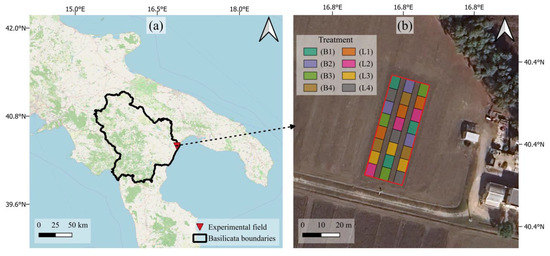
The study was set up in the experimental farm of CREA (Council for Agricultural Research and Economics) located in Metaponto, Southern Italy (lat. 40°24′ N; long. 16°48′ E—Figure 1a). The climate is classified ‘thermo-Mediterranean’, according to the UNESCO-FAO [43] bioclimatic map. Rainfall is mainly concentrated in the autumn-winter period, while the summer season is usually dry. The seasonal average temperature is about 17 °C, and the mean annual rainfall is about 550 mm year−1. Furthermore, based on the Köppen–Geiger classification, the experimental site is identified as a “Csa” climate zone, with hot and dry summers along with mild, wet winters [44]. The soil of the experimental site is “Typic Epiaquert”. It has 42%, 39%, and 19% of clay, silt, and sand, respectively. The organic matter is about 25 g kg−1, the pH is 7.8, and the electric conductivity is 0.48 mS cm−1. Moreover, the soil has low nitrogen content (1.0 g kg−1), 759 mg kg−1 of exchangeable potassium, 31 mg kg−1 of available phosphorus, and an average bulk density of 1350 kg m−3.
Figure 1.
(a) Basilicata region, south Italy (black boundaries) with geolocation (in red) of the CREA experimental farm [45]; (b) spatial distribution of the treatments within the experimental field (red boundaries) during the trial (Map data © 2015 Google). Note: B1 (on-farm compost), B2 (commercial compost n.1), B3 (commercial compost n.2), B4 (mineral fertilizer); L1 (on-farm compost), L2 (commercial compost n.1), L3 (commercial compost n.2), L4 (mineral fertilizer).
2.2. Field Experimental Design, Treatments and Measurements
The field trial was carried out to evaluate two fertilization strategies in a three-year crop succession of horticultural and cereal crops. A randomized complete block design (RCBD) was adopted, with three replications and two factors: (i) fertilization method (broadcast—B—and localized—L) and (ii) fertilizer type, i.e., on-farm compost and two types of commercial compost (n.1 and n.2), compared to a mineral fertilizer.
The on-farm compost (EC = 5.51 mS‧cm−1, pH = 7.40, TOC = 27.95%, Norg = 2.15% dry weight [hereafter indicated as “dw”], C/N = 13.03) was obtained in the composting pilot plant located in the experimental farm of CREA. It was made by composting lawn residues, fava beans and different vegetable crop residues. The commercial compost n.1 (EC = 4.2 mS‧cm−1, pH = 7.5, TOC = 30% dw, Norg = 1.85% dw, C/N = 15) was obtained in the industrial plant of Tersan S.p.A. (Bari, Italy) by composting municipal solid wastes from separate collection and biodegradable wastes from parks and gardens management. The commercial compost n.2 (EC = 7 mS‧cm−1, pH = 7.1, TOC = 31% dw, Norg = 3.48% dw, C/N = 7.75; Tersan S.p.A.) was a new type of compost from municipal solid waste, characterized by an inoculum of selected microorganisms (Hypocreaceae, Pseudomonadaceae, and Bacillaceae). The mineral fertilized treatment was composed of an initial application as 18% N—46% P2O5, before transplanting, while the remaining amount was top-dressed as UREA (46% N). The organic fertilizers were distributed before transplanting as 120 kg N ha−1 for broccoli and sweet pepper, and 100 kg N ha−1 for barley. The fertilizers were applied with both the broadcast (B) and localized (L) methods. Therefore, the compared treatments were the following: B1 (on-farm compost), B2 (commercial compost n.1), B3 (commercial compost n.2), and B4 (mineral fertilizer) for the first method; L1 (on-farm compost), L2 (commercial compost n.1), L3 (commercial compost n.2), and L4 (mineral fertilizer) for the second method. Furthermore, in the localized distribution, fertilizer rate was reduced to 40%. The fertilizer doses were different, according to each treatment and crop cycle (Table 1).
Table 1.
Fertilizer treatments and application rates (Mg ha−1) for each crop cycle (i.e., broccoli, sweet pepper and barley). Note: B1 (on-farm compost), B2 (commercial compost n.1), B3 (commercial compost n.2), B4 (mineral fertilizer); L1 (on-farm compost), L2 (commercial compost n.1), L3 (commercial compost n.2), L4 (mineral fertilizer).
The crop succession was established as follows: broccoli (Brassica oleracea var. italica-cv Naxos), landrace PGI (Protected Geographical Indication) sweet pepper (Capsicum annuum L. cv Senise), and barley (Hordeum vulgare L. cv Ortilus). Each elementary plot was 7 × 5 m (35 m2), corresponding to a total area of 105 m2 per treatment with three replications (Figure 1b). For broccoli and sweet pepper, five rows per plot were spaced 1.0 m × 0.6 m and 1.0 m × 0.4 m, respectively. Instead, for barley, sowing was carried out in rows spaced 12.5 cm apart with continuous seeding along the rows.
In each crop cycle, the agricultural practices (tillage, weed and pest control, and harvest) were managed in the same way across treatments, except for fertilization, which differed between broadcast and localized methods. Although seed-placed fertilizer is standard for broad-acre cereals, our localized treatment for barley was adapted to ensure methodological consistency throughout the horticultural rotation. Specifically, due to the proximity of the rows, localized treatment consisted of uniform distribution across the entire surface, with a 40% reduction in fertilizer quantity to make the fertilization rate comparable among crops in the succession. This approach implies being aware that fertilization methods must be fine-tuned according to the crops and the availability of farm machinery. Irrigation was done with a drip system, using seasonal water volumes of 928 m3 ha−1 for broccoli, 2286 m3 ha−1 for sweet pepper, while barley was grown under rainfed conditions.
At commercial maturity, the marketable yield (Mg ha−1) and aboveground biomass (Mg ha−1) were measured from five well-separated plants per elementary plot, both for broccoli and sweet peppers. Plants were selected consistently across all plots to ensure that any potential sampling bias remained uniform across treatments, thereby not affecting relative comparisons. The fresh weight of these samples was recorded in the field, and representative sub-samples were dried at 70 °C until constant weight to determine the dry matter fraction. Measured values per plant were subsequently scaled to the plot area and then to a per-hectare basis, multiplying the average per-plant data by the verified plant density (1.67 plants m−2 for broccoli and 2.5 plants m−2 for sweet pepper). Border rows were excluded from sampling to minimize edge effects. For barley, an area of 1 m2 per plot was considered. Furthermore, to facilitate comparison among the three crops, marketable yield and dry biomass were converted from Mg ha−1 into energy equivalents and expressed in megajoules (MJ). In particular, marketable yields were calculated using conversion factors [46] of 1.63, 1.29, and 14.9 MJ kg−1 for broccoli, pepper, and barley (seed), respectively, while dry biomass was converted using a factor of 0.3 MJ kg−1 [47]. Detailed soil nutrient dynamics were not monitored during the trial, which focused on crop yield and biomass production. Using parametric ANOVA, the effect of fertilizer method and type on marketable yield and dry biomass, expressed as energy equivalent, was then assessed. Before analysis, the Levene test was performed to verify the homogeneity of error variances, whereas the Kolmogorov–Smirnov and Shapiro–Wilk tests were computed to check the normality. The mean comparison was carried out according to the Duncan Multiple Range Test (DMRT) at a p < 0.05 probability level. R software (version 4.6.0) was used to perform statistical analysis.
2.3. Weather Conditions
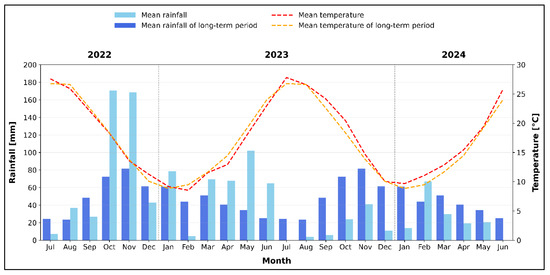
During the field trial, the mean monthly temperatures and rainfall were recorded by an agrometeorological station located on the experimental farm and compared with the long-term averages (30 years, from 1994 to 2024; Figure 2).
Figure 2.
Mean monthly rainfall and temperature during the three-year crop succession system, compared with the long-term averages (1994–2024).
During broccoli growth (from 30 August to 12 December 2022), the cumulative rainfall reached 446 mm, which was about 55% higher than the long-term average (287 mm), especially in October and November. In the same period, the mean temperature was similar to the long-term value (18.2 °C vs. 18.3 °C). In the sweet pepper cycle (from 6 June to 26 September 2023), a total rainfall of 74.7 mm was recorded, which was 38% lower than the long-term average (121 mm). Furthermore, a rainfall shortage occurred in July and August, with values close to 0 mm. The mean temperature reached a slightly higher value than that of the long-term period (25.4 °C and 25.0 °C, respectively). In particular, in July and August, high temperatures along with dry conditions occurred.
For the barley cultivation season (from 10 November 2023 to 27 May 2024), cumulative rainfall was 202 mm, which was 46% lower than the long-term value (374 mm). This gap was shown particularly between March and May 2024. The mean temperature (13.3 °C) was higher than in the long-term period (12.5 °C).
2.4. Environmental Impacts of the Tested Fertilization Strategies
The assessment of the environmental impacts of treatments was performed by using the LCA methodology. According to ISO 14040–44 [48,49], LCA was implemented considering the following phases: aim definition, life cycle inventory, impact assessment, and interpretation. The aim was to define the environmental impacts of the entire system that included both organic and mineral fertilizers applied with two application methods (i.e., B and L), within three different crop cycles (broccoli—sweet pepper—barley). All inputs used for each crop growing cycle (fuel, fertilizers, water, plastics materials, machinery, etc.) were included, considering their manufacturing processes. The functional units were both the hectare (ha) of the cultivated area and the marketable yield (Mg ha−1). For each treatment and crop process, the following farming operations were considered: soil preparation (plowing and seedbed preparation), transplanting and sowing, spraying (disease control), irrigation system preparation and irrigation practice, fertilization and harvesting. The machinery and implemented weight for each operation (W in kg) were calculated as follows:
where:
M = mass (kg);
t = duration of each operation (h);
l = lifecycle of the tools (h).
A specific LCA was carried out for each fertilizer to quantify its environmental impacts. Each piece of data for on-farm composting operations was collected directly at the experimental farm. References direct emissions generated during composting processes were obtained from the literature [50,51]. For commercial organic fertilizers, impacts were based on the Agribalyse dataset [52]. The processes described by Avadì [50] were adapted to match the specific characteristics of the investigated products. Moreover, the avoided impacts associated with conventional organic waste management (e.g., incineration or landfilling) were considered. These impacts were subtracted from the total impacts of the commercial composts to fully account for the benefits of this alternative waste management.
OpenLCA (2.6.1—GreenDelta, Berlin, Germany), a free and open-source software created by GreenDelta [53] was used to perform the LCA analysis, following the problem-oriented LCA method CML 2001 [54]. A midpoint approach was adopted to express results as characterization values, with equivalent indicators applied to each impact category. Normalization was then performed, using the ‘EU25’ region as a reference. Therefore, we considered the impact categories generally used in agricultural LCAs: abiotic depletion (AD), acidification (AA), eutrophication (EU), global warming potential (GWP), and photochemical oxidation (PO). We reported the results as characterized environmental impacts. Finally, to highlight the differences among treatments, the GWP was analyzed in detail, being the most widely recognized and significant impact category, by showing the contributions of each agricultural operation. The applied LCA approach did not explicitly account for long-term carbon soil sequestration processes, as it was based on a midpoint methodology, focusing on emissions associated with inputs and field operations.
3. Results
3.1. Agronomic Performance
The ANOVA results for the crop system performance are summarized in Table 2. While marketable yield was not significantly affected by any factor, dry biomass production was influenced by the fertilizer type (T) (p < 0.01). However, since no significant interaction between method and type was observed, the data were averaged across fertilizer treatments. This allows for a direct comparison between the two application techniques in Figure 3.
Table 2.
ANOVA results for total marketable yield and dry biomass expressed as energy values.
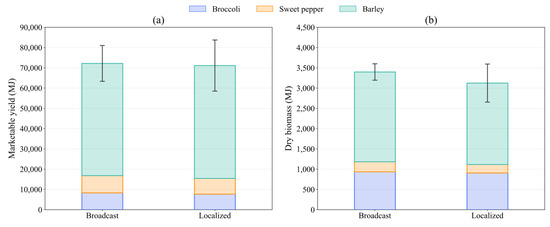
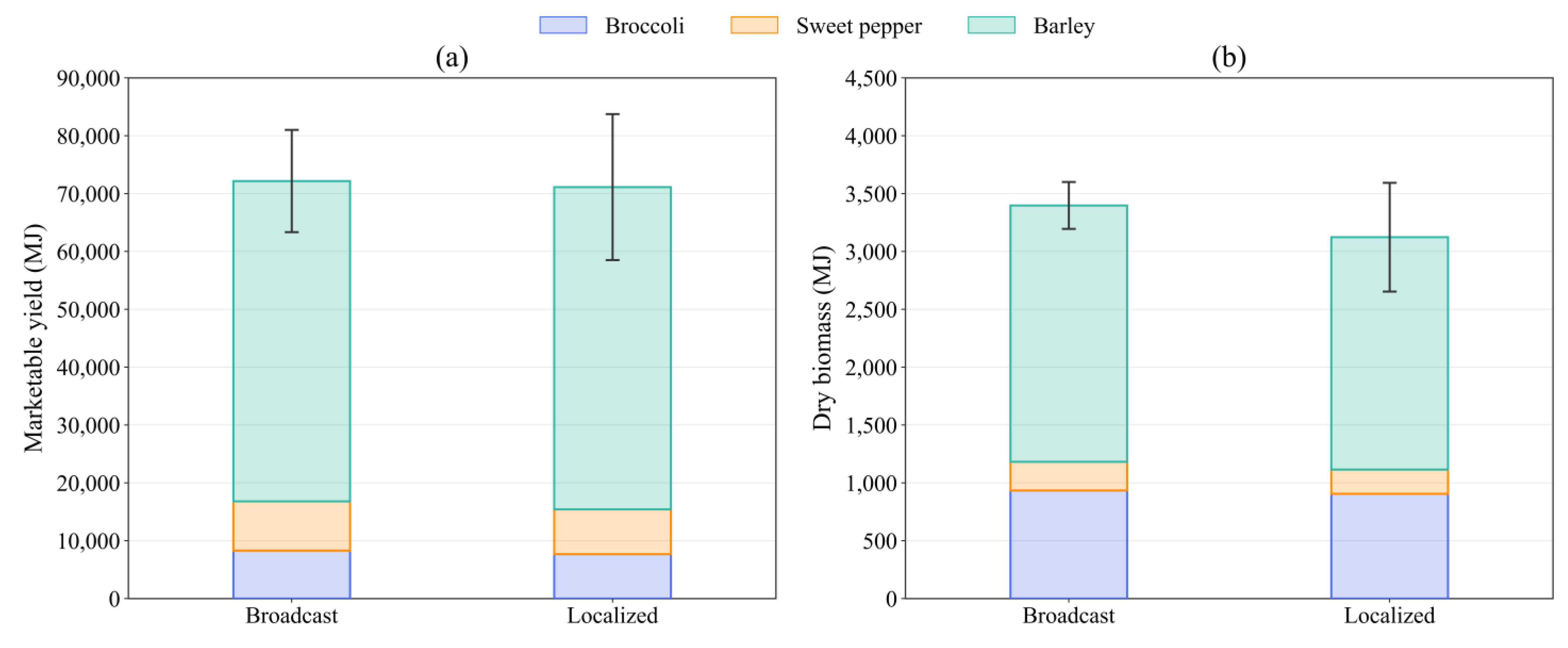
Figure 3.
Marketable yield (a) and dry biomass (b) expressed in megajoules (MJ) for the crop succession of broccoli, sweet pepper, and barley, under two fertilization strategies (broadcast and localized).
Figure 3 shows marketable yield and dry biomass, comparing fertilization strategies, converted into energy equivalents. The two different fertilization strategies were comparable in terms of marketable yield (Figure 3a), showing a total value of 72,164 and 71,113 MJ ha−1 in broadcast and localized treatments, respectively, but this numerical difference was not statistically significant. Conversely, they were slightly different in terms of dry biomass production, the localized fertilization leading to a moderate decrease in total biomass accumulation (Figure 3b). Most of the differences in the total dry biomass of the three-crop succession were due to the effect on barley. For this crop, the localized fertilization generated a reduction of 19% compared to the broadcast treatment, although this effect was not statistically significant.
3.2. Environmental Impacts per Hectare and Unit of Production
The environmental impacts of the different fertilization treatments are reported in Table 3 for the main impact categories, expressed as characterized values, considering the hectare as the functional unit.
Table 3.
Characterized environmental impacts per hectare across field treatments (B1–B4; L1–L4) considering the entire crop succession. Note: B1 (on-farm compost), B2 (commercial compost n.1), B3 (commercial compost n.2), B4 (mineral fertilizer); L1 (on-farm compost), L2 (commercial compost n.1), L3 (commercial compost n.2), L4 (mineral fertilizer); AD = Abiotic depletion; AA = Acidification; EU = Eutrophication; GWP = Global warming; PO = Photochemical oxidation.
Applying on-farm compost via localized fertilization (L1) mitigated the environmental impacts compared to broadcast applications (B1). Regarding AD, L1 showed a 42% lower impact than B1. Furthermore, a 21% decrease was observed for AA, while reductions ranged from 25% to 26% for EU, GWP and PO. The benefits of localized fertilization were also evident for commercial compost n.1. In particular, in L2, reductions of 36%, 26%, and 20% were observed for AD, AA and GWP, respectively. However, negative values occurred in EU and PO, where both treatments (B2 and L2) resulted in environmental credits. The localized application of commercial compost n.2 (L3) reduced the impacts by 23%, 18% and 19% for AD, AA and GWP, respectively, compared to broadcast application. The trend was the opposite for EU and PO, thus resulting in higher impacts than B3. Finally, localized mineral fertilization (L4) achieved environmental benefits compared to broadcast application (B4), showing clear reductions for AD (30%), AA (31%), EU (27%), GWP (19%) and PO (34%).
When marketable yield was adopted as the functional unit (Table 4), variability among fertilizer treatments increased, due to yield differences across the crop succession. In this scenario, except for the mineral fertilizer (B4 vs. L4), the localized application strategy generally resulted in a smaller reduction in term of impacts compared to previous analyses based on cultivated area (Table 3). Regarding GWP, an average 22% impact reduction was observed both for the B1-L1 and B4-L4 comparisons, whereas the reductions for B2-L2 and B3-L3 were 3% and 12%, respectively. This trend was also observed in other impact categories (i.e., AD, AA, EU, PO). Particularly, for AD, the percentage reduction ranged from a minimum of 19% (B3-L3) to a maximum of 37% (B1-L1), whereas for AA it ranged from 11% (B2-L2) to 36% (B4-L4). However, for EU and PO, the impact reductions were observed only in the B1-L1 and B4-L4 comparisons, with decreases of 16% and 36% in EU, and 23% and 35% in PO, respectively. Two exceptions were detected: (i) the B2-L2 comparison showed negative EU and PO values; (ii) as for EU and PO, the L3 treatment resulted in a higher impact than B3.
Table 4.
Characterized environmental impacts per marketable production (Mg−1) with SD across field treatments (B1-B4, L1-L4) considering the entire crop succession. Note: B1 (on-farm compost), B2 (commercial compost n.1), B3 (commercial compost n.2), B4 (mineral fertilizer); L1 (on-farm compost), L2 (commercial compost n.1), L3 (commercial compost n.2), L4 (mineral fertilizer); AD = Abiotic depletion; AA = Acidification; EU = Eutrophication; GWP = Global warming; PO = Photochemical oxidation.
3.3. Normalized Environmental Impacts
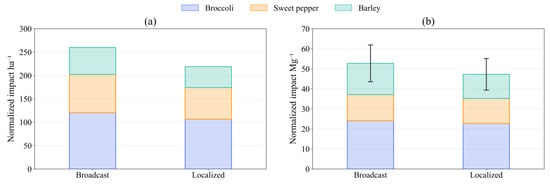
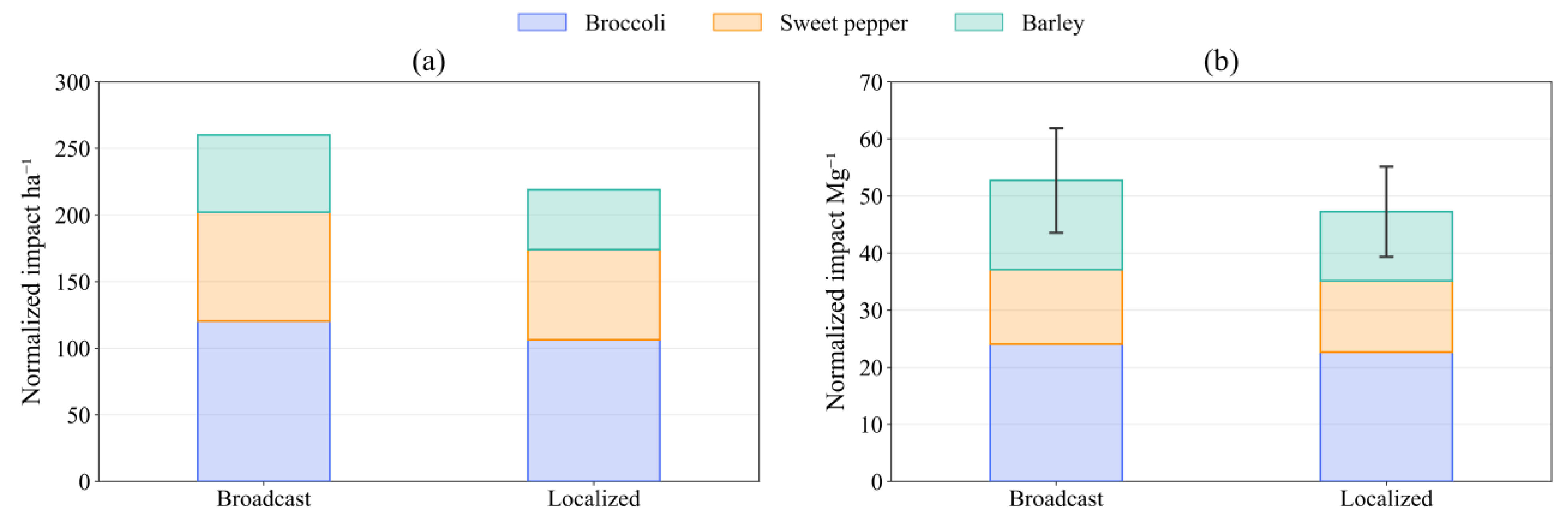
Localized fertilization showed a 15.8% reduction in the cumulative normalized impact per hectare across the three-crop succession, compared to the broadcast fertilization (Figure 4a). Among the crops, broccoli was the largest contributor to the total impact, followed by sweet pepper and barley. Specifically, the shift from a broadcasting approach to localized fertilization led to impact reductions of 11.6%, 17.2%, and 22.5% in broccoli, sweet pepper and barley, respectively. On the other hand, when considering normalized values per ton of marketable yield (Figure 4b), localized fertilization achieved a total reduction of 10.4% in terms of environmental impacts. Reductions of 5.8% and 4.5% were observed for broccoli (from 24.06 to 22.67) and sweet pepper (from 13.07 to 12.48), respectively. In barley, the percentage of reduction remained similar to the value observed when using the hectare as the functional unit (22.5%).
Figure 4.
Normalized LCA impacts for broccoli, sweet pepper, and barley, under two fertilization strategies (broadcast and localized). The data are expressed as impact per hectare normalized values 1011 (a) and as impact per megagram (Mg) of marketable yield normalized values 1011 (b).
3.4. Global Warming Potential Analysis
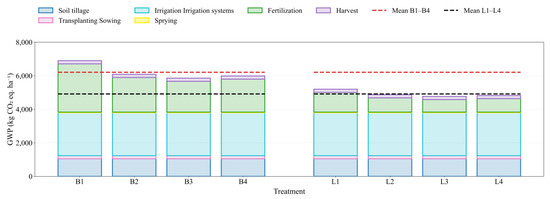
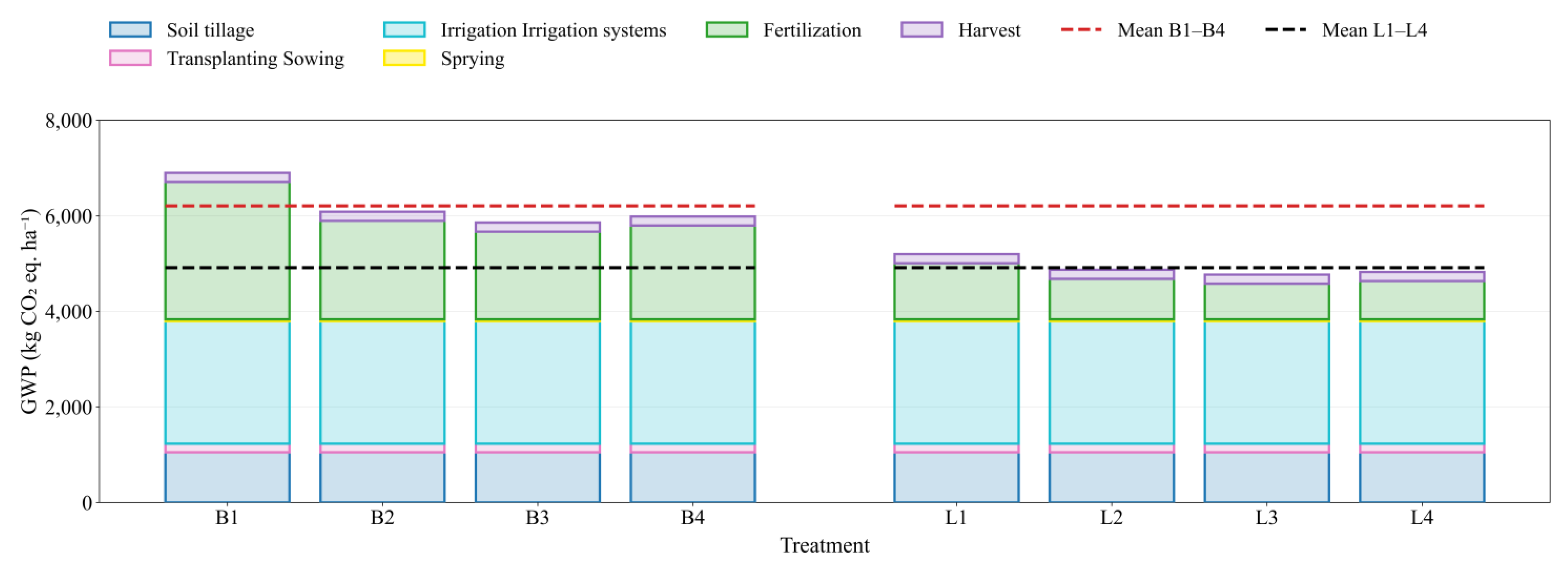
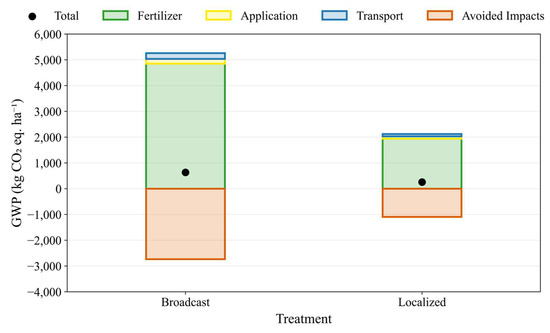
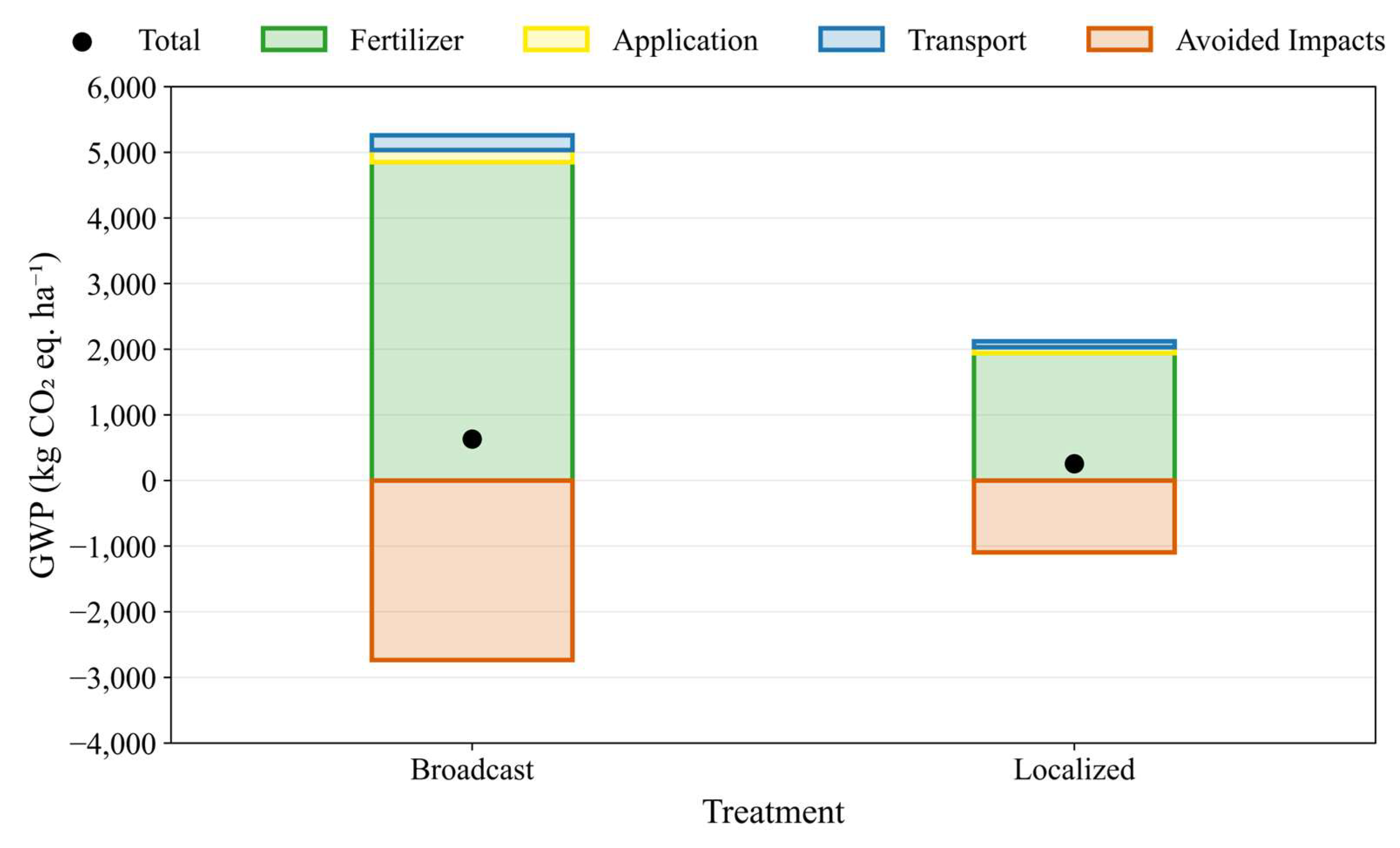
Regarding the Global Warming Potential (GWP) of the analyzed scenarios divided by crop operations (Figure 5), the broadcast treatments had higher total values. These values ranged between 5856 and 6898 kg CO2 eq ha−1, as compared to the localized ones, which ranged between 4767 and 5195 kg CO2 eq ha−1. Furthermore, localized fertilization reduced total GWP by approximately 20% compared to the broadcast option. Among the agricultural operations, fertilization and irrigation were the main contributors to the total GWP. Together they accounted for more than 70% of the total emissions. Fertilization operation determined the largest differences between treatments (from 2875 kg CO2 eq ha−1 in B1 to 744 kg CO2 eq ha−1 in L3), while soil tillage, transplanting/sowing, spraying, and harvest had an equal contribution. Additionally, focusing on fertilization technique (Figure 6), for the broadcast method, a total GWP of approximately 4849 kg CO2 eq ha−1 was found, whereas the localized one determined 1939 kg CO2 eq ha−1. Thus, the localized method determined a 59% reduction in global warming.
Figure 5.
GWP (kg CO2 eq ha−1) of agricultural techniques for each field treatment (B1–B4, L1–L4). Note: B1 (on-farm compost), B2 (commercial compost n.1), B3 (commercial compost n.2), B4 (mineral fertilizer); L1 (on-farm compost), L2 (commercial compost n.1), L3 (commercial compost n.2), L4 (mineral fertilizer).
Figure 6.
GWP (kg CO2 eq ha−1) of two fertilization strategies (i.e., broadcast and localized), divided by the main fertilization operations.
4. Discussion
4.1. Agronomic Performance
From the ongoing interactive engagement of stakeholders, adopting cost-effective and climate-smart fertilization emerged as an urgent need in the study site, both at the farm and territorial levels. Interestingly, our results indicated that, although a substantial reduction in the amount of fertilizers under localized compared to broadcast fertilization, marketable yields were comparable across all crops in succession (Figure 3a). This would suggest that nutrient availability was efficiently kept within the root-explored rhizosphere, in the site-specific conditions, enhancing root proliferation and nutrient uptake efficiency [25,27]. Under Mediterranean conditions, characterized by irregular water availability, localized nutrient distribution may reduce nutrient losses through leaching during intense rainfall events. However, in other studies, based on similar fertilizer rates but different conditions [18,40], localized fertilization also determined higher yields than broadcast applications. On the other hand, the slight differences observed in the total biomass values were mostly attributable to the barley biomasses and were likely due to reduced fertilization rate. In fact, the localized placement of fertilizers was not feasible for this crop, due to its sowing pattern. As a consequence, in this cereal crop, roots explored the entire area equally, making the nutrient distribution in the localized plots equivalent to that of broadcast ones, although with a lower nutrient availability. It should also be acknowledged that agronomic outcomes were influenced by seasonal conditions, as different crops were grown in different years within the rotation system. Therefore, inter-annual differences in yield performance should be interpreted considering the inherent variability of long-term rotation trials.
4.2. Environmental Impacts
In our study, the LCA analysis highlighted differences between the two fertilization strategies, particularly confirming that nutrient application rates can strongly affect the results [55]. These results may be interpreted considering the interaction between soil processes, crop uptake, and climatic conditions. In Mediterranean environments, dry periods followed by intense rainfall events affect nutrient dynamics, influencing both availability to plants and environmental losses [4,20]. Such interactions are reflected in the LCA indicators, particularly eutrophication and global warming potential, which are closely linked to nitrogen losses through leaching, volatilization, and denitrification [28,29]. In addition, soil properties, such as texture, organic matter content, and water retention capacity, may further influence nutrient retention and transformation processes. Thus, both crop uptake and environmental emissions [4] are affected, consequently driving variations in LCA impact categories.
The localized application as 40% N units showed a lower impact across all fertilizers and both functional units. Different fertilizers also determined different environmental emissions across impact categories (Table 3 and Table 4). This is because results may vary depending not only on nutrient content of the fertilizer and the total amount applied, but also on the type of fertilizer. Other studies showed that fertilizers’ production significantly contributes to impact categories such as, acidification and resource depletion [56,57], whereas their application employs the most pressure on eutrophication. Organic fertilizers or recycled nutrient sources could offer additional advantages, by avoiding impacts of energy-intensive fertilizer production. Since they enhance soil organic matter and microbial activity, fostering long-term soil fertility [58], they can also reduce the risk of nutrient losses through leaching, with potential benefits for groundwater quality. As a consequence, agroecosystem sustainability is improved.
Our crops in succession registered lower normalized impact per area (ha) under localized treatments (Figure 4). The reductions ranged from 11.6 to 22.5% compared to broadcast treatments, with a cumulative reduction of 15%. This result may be due to fertilizer efficiency associated with localized distribution. Different studies [21,40] reported that nutrient uptake could be improved by optimizing the nutrient availability in the root zone, reducing the amount of surplus fertilizer. This helps to further explain the impacts reduction in our study. Moreover, as indicated in Cameron et al. [59], localized fertilization can decrease nutrient losses by concentrating nutrients within the crop root zone, improving synchronization between nutrient supply and plant uptake. This behavior reduces nutrient exposure to leaching and volatilization processes, particularly in inter-row areas. When we changed the functional unit, the relative reductions in localized fertilization were smaller (10%) compared to broadcast application, reflecting a partial compensation due to the slight yield differences. The study of Brentrup and Palière [60] showed similar but more accentuated patterns, with higher impact reductions per area but smaller ones per unit of production.
4.3. Mechanisms Underlying Localized Fertilization Effects
The results for GWP category divided by operations (Figure 5) also align with other studies [61,62], indicating that fertilization is the most environmentally impactful agricultural technique. This is particularly true in terms of carbon emissions, accounting for 50–80% of the total GHG emissions. Differences between broadcast and localized fertilization were observed in the fertilization stage itself, likely due to both the reduction in fertilizer input and improved nutrient efficiency. These findings support the results of Guardia et al. [63], which validated the hypothesis that localized fertilization can reduce nitrous oxide emissions due to optimized nitrogen availability. The lack of significant differences in yield and biomass (Table 2) suggests that localized fertilization achieves comparable agronomic results by optimizing nutrient placement. This increase in nutrient use efficiency acts as the primary driver for the reduced environmental impacts observed, as the same output is obtained with a more targeted distribution of inputs. The comparison among the different steps of fertilization (in Figure 6) highlights the potential of localized fertilization technique as an effective mitigation option, showing more than 50% reduction in terms of GWP. Therefore, this method of fertilization could be a possible solution for farmers (particularly organic ones) in the study area, which is characterized by climate change issues.
However, other studies suggested that reducing the total amounts of fertilizers may have some limits, particularly for organic ones, although environmentally advantageous in the short term. These results should be interpreted with caution, as long-term soil carbon sequestration was not included in the LCA framework; therefore, the potential contribution of organic amendments to carbon storage may be underestimated. Reduced fertilization rates may limit the replacement of soil nutrient pools and reduce the accumulation of soil organic matter compared to systems receiving full broadcast doses [64,65]. Localized fertilization can determine spatial heterogeneity in soil fertility and potentially restrict root development to nutrient-enriched microsites, thus decreasing nutrient exploration in unfertilized zones over multiple seasons [66,67]. In the long term, repeated localized applications may further alter the spatial distribution of nutrients within the soil profile, potentially leading to nutrient stratification and heterogeneous fertility patterns. These changes may influence root system architecture, microbial activity, and nutrient cycling processes, with possible implications for soil resilience and sustainability of the agroecosystem. Although localized fertilization has shown clear advantages in nutrient-use efficiency without compromising productions, its potential long-term effects on distribution pattern of soil nutrients and biological stability should be further investigated.
5. Conclusions
The application of LCA highlighted that localized fertilization is an effective strategy for mitigating the environmental impact of agricultural sector. By reducing fertilizer input without compromising marketable yields, the localized approach decreased GWP and abiotic depletion, compared to conventional broadcast distribution. Our findings confirm that the environmental impact of agriculture is highly dependent on fertilizer manufacturing and application rates. Thus, optimizing nutrient application proved to be more relevant for the carbon footprint than the fertilizer type itself. Although localized applications had benefits in terms of nutrient use efficiency and GHG reductions, the potential risks of a heterogeneous distribution of nutrients in soil and soil organic matter depletion over time need further investigation. Adopting a localized fertilization strategy offers a practical pathway for farmers to improve the agroecosystems, aligning production needs with global climate change mitigation goals. This approach may be particularly suitable for Mediterranean agricultural systems, where improving nutrient use efficiency under variable climatic conditions is essential. However, the selection of the most appropriate fertilizer type and application method should consider crop characteristics, soil properties, and local environmental conditions. Therefore, site-specific optimization is required to identify the most suitable fertilization strategy for different production systems. Future research should address whether repeated localized applications over multiple seasons may lead to nutrient stratification, reduced root exploration of different crops within unfertilized zones, or decreased overall soil resilience. Finally, an economic assessment based on local market prices could provide additional insight into the practical implications of the results and should be considered in future studies on a local scale.
Author Contributions
L.C. and A.P.: Conceptualization, writing—original draft; formal analysis, Data curation; M.D.: conceptualization, writing—review and editing, funding acquisition; A.M., V.A. and F.M.: writing—review and editing. All authors have read and agreed to the published version of the manuscript.
Funding
This research was funded by Tersan Puglia S.p.A., research project BIOFERS “BIOfertilizzanti innovativi per una FERtilizzazione Sostenibile”.
Data Availability Statement
The original contributions presented in this study are included in the article. Further inquiries can be directed to the corresponding author.
Acknowledgments
The authors wish to acknowledge Angelo Fiore, Rosalba Scazzarriello, Marco Favale, Francesco Rinaldi and Giuseppe Dell’Orco for their technical assistance and field management.
Conflicts of Interest
The authors report there are no competing interests to declare.
References
- Noto, L.V.; Cipolla, G.; Pumo, D.; Francipane, A. Climate change in the Mediterranean Basin (Part II): A review of challenges and uncertainties in climate change modelling and impact analyses. Water Resour. Manag. 2023, 37, 2307–2323. [Google Scholar] [CrossRef] [Scilit] [PubMed]
- Costanza, L.; Lorente, B.; Salcedo, F.P.; Pasanisi, F.; Giannico, V.; Ardito, F.; Martínez, C.M.M.; Garofalo, S.P. Predicting olive tree chlorophyll fluorescence using explainable AI with Sentinel-2 Imagery in Mediterranean Environment. Appl. Sci. 2025, 15, 2746. [Google Scholar] [CrossRef] [Scilit]
- Pörtner, H.O.; Roberts, D.C.; Tignor, M.; Poloczanska, E.S.; Mintenbeck, K.; Alegría, A.; Craig, M.; Langsdorf, S.; Löschke, S.; Möller, V.; et al. Summary for Policymakers. In Climate Change 2022: Impacts, Adaptation, and Vulnerability. Contribution of Working Group II to the Sixth Assessment Report of the Intergovernmental Panel on Climate Change; Cambridge University Press: Cambridge, UK, 2022. [Google Scholar]
- Mondal, S. Impact of Climate Change on Soil Fertility. In Climate Change and the Microbiome: Sustenance of the Ecosphere; Springer: Berlin/Heidelberg, Germany, 2021; pp. 551–569. [Google Scholar]
- Kopittke, P.M.; Menzies, N.W.; Wang, P.; McKenna, B.A.; Lombi, E. Soil and the intensification of agriculture for global food security. Environ. Int. 2019, 132, 105078. [Google Scholar] [CrossRef] [Scilit]
- He, Z.; Ding, B.; Pei, S.; Cao, H.; Liang, J.; Li, Z. Impact of organic fertilizer replacement on greenhouse gas emissions and its influencing factors. Sci. Total Environ. 2023, 905, 166917. [Google Scholar] [CrossRef] [Scilit] [PubMed]
- Fan, Y.; Hao, X.; Carswell, A.; Misselbrook, T.; Ding, R.; Li, S.; Kang, S. Inorganic nitrogen fertilizer and high N application rate promotes N2O emission and suppress CH4 uptake in a rotational vegetable system. Soil Tillage Res. 2021, 206, 104848. [Google Scholar] [CrossRef] [Scilit]
- Chataut, G.; Bhatta, B.; Joshi, D.; Subedi, K.; Kafle, K. Greenhouse gas emission from agricultural soil: A review. J. Agric. Food Res. 2023, 11, 100533. [Google Scholar] [CrossRef] [Scilit]
- Altieri, M.A.; Nicholls, C.I.; Henao, A.; Lana, M.A. Agroecology and the design of climate change-resilient farming systems. Agron. Sustain. Dev. 2015, 35, 869–890. [Google Scholar] [CrossRef] [Scilit]
- Carolina, Q.; Alejandra, A.; Nadine, A. Evidence of agroecology’s contribution to mitigation, adaptation, and resilience under climate variability and change in Latin America. Agroecol. Sustain. Food Syst. 2024, 48, 228–252. [Google Scholar] [CrossRef] [Scilit]
- Diacono, M.; Fiore, A.; Di Bene, C.; Farina, R.; Trinchera, A.; Li, J.; Geelen, D.; Pleissner, D.; Almendinger, M.; Montemurro, F.; et al. On-farm compost and parsley residues extract use on organic fennel crop to improve agronomic performance and environmental sustainability. Agroecol. Sustain. Food Syst. 2025, 49, 615–640. [Google Scholar] [CrossRef] [Scilit]
- Diacono, M.; Montemurro, F. Long-term effects of organic amendments on soil fertility. Agron. Sustain. Dev. 2010, 30, 401–422. [Google Scholar] [CrossRef] [Scilit]
- Diacono, M.; Rubino, P.; Montemurro, F. Precision nitrogen management of wheat. Agron. Sustain. Dev. 2013, 33, 219–241. [Google Scholar] [CrossRef] [Scilit]
- Hiywotu, A.M. Advancing sustainable agriculture for zero hunger. Agroecol. Sustain. Food Syst. 2025, 49, 1027–1055. [Google Scholar] [CrossRef] [Scilit]
- Diacono, M.; Persiani, A.; Alfano, V.; Monteforte, A.; Montemurro, F. Fertilization strategies on fennel crop in the Mediterranean Environment: Agronomic Performance, Costs and Sustainability Assessment. Agriculture 2023, 13, 1048. [Google Scholar] [CrossRef] [Scilit]
- Antip, M. Fertilizer Market Developments; FAO Food Outlook, June 2024 Special Feature; FAO: Rome, Italy, 2024. [Google Scholar]
- Zhang, K.; Bai, M.; Li, Y.; Zhang, S.; Xu, D. A Non-Uniform Broadcast Fertilization Method and Its Performance Analysis under Basin Irrigation. Water 2020, 12, 292. [Google Scholar] [CrossRef] [Scilit]
- Yokamo, S.; Wang, B.; Ishfaq, M.; Huan, W.; Irfan, M.; Wang, Y.; Nkoh, J.N.; Lu, D.; Chen, X.; Wang, H. Comprehensive assessment of the agronomic, environmental and economic benefits of localized fertilizer placement in China's intensive cereal production systems. Agric. Syst. 2025, 228, 104372. [Google Scholar] [CrossRef] [Scilit]
- Rahman, K.M.A.; Zhang, D. Effects of Fertilizer Broadcasting on the Excessive Use of Inorganic Fertilizers and Environmental Sustainability. Sustainability 2018, 10, 759. [Google Scholar] [CrossRef] [Scilit]
- Fan, M.; Shen, J.; Yuan, L.; Jiang, R.; Chen, X.; Davies, W.J.; Zhang, F. Improving crop productivity and resource use efficiency to ensure food security and environmental quality in China. J. Exp. Bot. 2012, 63, 13–24. [Google Scholar] [CrossRef] [Scilit] [PubMed]
- Nkebiwe, P.M.; Weinmann, M.; Bar-Tal, A.; Müller, T. Fertilizer placement to improve crop nutrient acquisition and yield: A review and meta-analysis. Field Crop. Res. 2016, 196, 389–401. [Google Scholar] [CrossRef] [Scilit]
- Cai, S.; Zhao, X.; Yan, X. Towards precise nitrogen fertilizer management for sustainable agriculture. Earth Crit. Zone 2025, 2, 100026. [Google Scholar] [CrossRef] [Scilit]
- Simonne, E.H.; Gazula, A.; Ozores-Hampton, M.; DeValerio, J.; Hochmuth, R.C. Localized Application of Fertilizers in Vegetable Crop Production. In Advances in Research on Fertilization Management of Vegetable Crops; Tei, F., Nicola, S., Benincasa, P., Eds.; Springer: Cham, Switzerland, 2017. [Google Scholar] [CrossRef] [Scilit]
- Cai, S.; Zhao, X.; Liu, X.; Yan, X. Nitrogen management to minimize yield-scaled ammonia emission from paddy rice in the Middle and Lower Yangtze River Basin: A meta-analysis. Environ. Pollut. 2023, 318, 120854. [Google Scholar] [CrossRef] [Scilit]
- Wu, X.; Li, H.; Rengel, Z.; Whalley, W.R.; Li, H.; Zhang, F.; Shen, J.; Jin, K. Localized nutrient supply enhances nitrogen-use efficiency. Soil Tillage Res. 2022, 215, 105198. [Google Scholar] [CrossRef] [Scilit]
- Cheng, L.; Chen, X.; Lu, D.; Wang, H. Long-acting mechanisms of concentrated urea application. Appl. Soil Ecol. 2023, 182, 104723. [Google Scholar] [CrossRef] [Scilit]
- Zhang, A.; Wang, X.-X.; Zhang, D.; Dong, Z.; Ji, H.; Li, H. Localized nutrient supply promotes maize growth and nutrient acquisition by shaping root morphology and physiology and mycorrhizal symbiosis. Soil Tillage Res. 2023, 225, 105550. [Google Scholar] [CrossRef] [Scilit]
- Cheng, L.; Wang, H.; Lu, D.; Chen, X. One-time root-zone nitrogen fertilisation in oilseed rape. J. Soil Sci. Plant Nutr. 2022, 22, 1074–1087. [Google Scholar] [CrossRef] [Scilit]
- Song, H.; Chen, X.; Cheng, L.; Lu, D.; Wang, H. Negligible ammonia volatilization loss with one-time root-zone targeted application of common nitrogen, phosphorus, and potassium fertilizers in transplanted rice cultivation. Agric. Ecosyst. Environ. 2022, 338, 108072. [Google Scholar] [CrossRef] [Scilit]
- Persiani, A.; Fabroni, S.; Montemurro, F.; Diacono, M. Agroecological practices affect agronomic performance and resilience in fennel cultivation. Nutr. Cycl. Agroecosyst. 2025, 131, 81–95. [Google Scholar] [CrossRef] [Scilit]
- Nemecek, T.; Roesch, A.; Bystricky, M.; Jeanneret, P.; Lansche, J.; Stüssi, M.; Gaillard, G. Swiss agricultural life cycle assessment. Int. J. Life Cycle Assess. 2024, 29, 433–455. [Google Scholar] [CrossRef] [Scilit]
- de Backer, E.; Aertsens, J.; Vergucht, S.; Steurbaut, W. Assessing the ecological soundness of organic and conventional agriculture by means of life cycle assessment (LCA). Br. Food J. 2009, 111, 1028–1061. [Google Scholar] [CrossRef] [Scilit]
- Cucurachi, S.; Scherer, L.; Guinée, J.; Tukker, A. Life cycle assessment of food systems. One Earth 2019, 1, 292–297. [Google Scholar] [CrossRef] [Scilit]
- Vidergar, P.; Perc, M.; Lukman, R.K. A survey of the life cycle assessment of food supply chains. J. Clean. Prod. 2021, 286, 125506. [Google Scholar] [CrossRef] [Scilit]
- Pradeleix, L.; Roux, P.; Bouarfa, S.; Bellon-Maurel, V. Multilevel environmental assessment of regional farming activities with life cycle assessment: Tackling data scarcity and farm diversity with life cycle inventories based on agrarian system diagnosis. Agric. Syst. 2022, 196, 103328. [Google Scholar] [CrossRef] [Scilit]
- Zhong, J.; Wei, Y.; Wan, H.; Wu, Y.; Zheng, J.; Han, S.; Zheng, B. Greenhouse gas emissions from swine manure com-posting. Atmos. Environ. 2013, 81, 348–355. [Google Scholar] [CrossRef] [Scilit]
- Muñoz, E.; Curaqueo, G.; Cea, M.; Vera, L.; Navia, R. Environmental hotspots in a biochar–soil system. J. Clean. Prod. 2017, 158, 1–7. [Google Scholar] [CrossRef] [Scilit]
- Dai, Y.; Zheng, H.; Jiang, Z.; Xing, B. Comparison of crop residue-based technologies for energy production and air pollutant emission. Sci. Total Environ. 2020, 707, 136122. [Google Scholar] [CrossRef] [Scilit] [PubMed]
- Weligama, C.; Tang, C.; Sale, P.W.G.; Conyers, M.K.; Liu, D.L. Localised nitrate and phosphate application enhances root proliferation by wheat and maximises rhizosphere alkalisation in acid subsoil. Plant Soil 2008, 312, 101–115. [Google Scholar] [CrossRef] [Scilit]
- Jing, J.; Zhang, F.; Rengel, Z.; Shen, J. Localized fertilization with P plus N elicits an ammonium-dependent en-hancement of maize root growth and nutrient uptake. Field Crop. Res. 2012, 133, 176–185. [Google Scholar] [CrossRef] [Scilit]
- Halvorson, A.D.; Del Grosso, S.J. Nitrogen source and placement effects on N2O emissions. J. Environ. Qual. 2012, 41, 1349–1360. [Google Scholar] [CrossRef] [Scilit]
- Linquist, B.A.; Adviento-Borbe, M.A.; Pittelkow, C.M.; van Kessel, C.; van Groenigen, K.J. Fertilizer management prac-tices and greenhouse gas emissions from rice systems: A quantitative review and analysis. Field Crop. Res. 2012, 135, 10–21. [Google Scholar] [CrossRef] [Scilit]
- UNESCO-FAO. Bioclimatic Map of the Mediterranean Zone; NS.62/III, 21A. UNESCO Paris, Fr, p. 58.; FAO: Rome, Italy, 1963. [Google Scholar]
- Beck, H.E.; Zimmermann, N.E.; McVicar, T.R.; Vergopolan, N.; Berg, A.; Wood, E.F. Present and future Köppen-Geiger climate classification maps at 1-km resolution. Sci. Data 2018, 5, 180214. [Google Scholar] [CrossRef] [Scilit]
- Openstreetmap.org. 2025. Available online: https://www.openstreetmap.org/ (accessed on 11 September 2025).
- USDA. United States Department of Agriculture Agricultural Research Service National Nutrient Database for Standard Reference Legacy Release. 2024. Available online: https://fdc.nal.usda.gov/ (accessed on 8 October 2025).
- Pugnoli, P.; Baldi, F.; Parenti, P. L’analisi energetica per un miglior uso delle risorse nei processi agricoli. Applicazione ad aziende toscane. Riv. Ing. Agrar. 1993, 4, 225–233. [Google Scholar]
- ISO 14040:2006a; Environmental Management—Life Cycle Assessment—Principles and Framework. ISO: Geneva, Switzerland.
- ISO 14044:2006b; Environmental Management—Life Cycle Assessment—Requirements and Guidelines. ISO: Geneva, Switzerland.
- Avadí, A. Screening LCA of French organic amendments and fertilisers. Int. J. Life Cycle Assess. 2020, 25, 698–718. [Google Scholar] [CrossRef] [Scilit]
- Vergara, S.E.; Silver, W.L. Greenhouse gas emissions from windrow composting of organic wastes: Patterns and emissions factors. Environ. Res. Lett. 2019, 14, 124027. [Google Scholar] [CrossRef] [Scilit]
- Koch, P.; Salou, T. AGRIBALYSE®: Rapport Méthodologique—Version 1.3; ART: Zürich, Switzerland; INRA: Paris, France; ADEME: Angers Cedex, France, 2016. [Google Scholar]
- GreenDelta. GreenDelta Software. 2023. Available online: https://www.greendelta.com/software/ (accessed on 10 October 2025).
- Guinée, J.B.; Gorrée, M.; Heijungs, R.; Huppes, G.; Kleijn, R.; De Koning, A.; Van Oers, L.; Sleeswijk, A.W.; Suh, S.; De Haes, H.A.U.; et al. Handbook on Life Cycle Assessment, Operational Guide to ISO Standards; Guinée, J., Ed.; Kluwer Academic Publishers: Dordrecht, The Netherlands, 2002. [Google Scholar]
- Hasler, K.; Bröring, S.; Omta, S.; Olfs, H.-W. LCA of fertilizer product types. Eur. J. Agron. 2015, 69, 41–51. [Google Scholar] [CrossRef] [Scilit]
- Brentrup, F.; Pallière, C. GHG emissions and energy efficiency in European nitrogen fertiliser production and use. In Proceedings of the The International Fertiliser Society Conference, Cambridge, UK, 11 December 2008; Volume 639. pp. 1–25. [Google Scholar]
- Skowrońska, M.; Filipek, T. Life cycle assessment of fertilizers: A review. Int. Agrophysics 2014, 28, 101–110. [Google Scholar] [CrossRef] [Scilit]
- Allam, M.; Radicetti, E.; Quintarelli, V.; Petroselli, V.; Marinari, S.; Mancinelli, R. Influence of organic and mineral ferti-lizers on soil organic carbon and crop productivity under different tillage systems: A meta-analysis. Agriculture 2022, 12, 464. [Google Scholar] [CrossRef] [Scilit]
- Cameron, K.C.; Di, H.J.; Moir, J.L. Nitrogen losses from the soil/plant system: A review. Ann. Appl. Biol. 2013, 162, 145–173. [Google Scholar] [CrossRef] [Scilit]
- Brentrup, F.; Küsters, J.; Kuhlmann, H.; Lammel, J. Environmental impact assessment of agricultural production systems using the life cycle assessment methodology. Eur. J. Agron. 2004, 20, 247–264. [Google Scholar] [CrossRef] [Scilit]
- Persiani, A.; Montemurro, F.; Fiore, A.; Scazzarriello, R.; Diacono, M. On-farm fertilizing materials in organic horticul-ture. Arch. Agron. Soil Sci. 2021, 67, 1944–1960. [Google Scholar] [CrossRef] [Scilit]
- Persiani, A.; Diacono, M.; Canali, S.; Montemurro, F. Sustainability assessment of cover crop termination by integrated LCA approach in different organic horticultural cropping systems. Biol. Agric. Hortic. 2025, 41, 252–271. [Google Scholar] [CrossRef] [Scilit]
- Guardia, G.; Sanz-Cobena, A.; Sanchez-Martín, L.; Fuertes-Mendizábal, T.; González-Murua, C.; Álvarez, J.M.; Chadwick, D.; Vallejo, A. Urea-based fertilization strategies in wheat. Agric. Ecosyst. Environ. 2018, 265, 421–431. [Google Scholar] [CrossRef] [Scilit]
- Janzen, H. The soil carbon dilemma. Soil Biol. Biochem. 2006, 38, 419–424. [Google Scholar] [CrossRef] [Scilit]
- Lal, R. Restoring Soil Quality to Mitigate Soil Degradation. Sustainability 2015, 7, 5875–5895. [Google Scholar] [CrossRef] [Scilit]
- He, Y.; Liao, H.; Yan, X. Localized supply of phosphorus induces root morphological and architectural changes of rice in split and stratified soil cultures. Plant Soil 2003, 248, 247–256. [Google Scholar] [CrossRef] [Scilit]
- Li, H.; Ma, Q.; Li, H.; Zhang, F.; Rengel, Z.; Shen, J. Root morphological responses to localized nutrient supply differ among crop species with contrasting root traits. Plant Soil 2014, 376, 151–163. [Google Scholar] [CrossRef] [Scilit]

Disclaimer/Publisher’s Note: The statements, opinions and data contained in all publications are solely those of the individual author(s) and contributor(s) and not of MDPI and/or the editor(s). MDPI and/or the editor(s) disclaim responsibility for any injury to people or property resulting from any ideas, methods, instructions or products referred to in the content. |
© 2026 by the authors. Licensee MDPI, Basel, Switzerland. This article is an open access article distributed under the terms and conditions of the Creative Commons Attribution (CC BY) license.