


Abstract
The adoption of grain amaranth (Amaranthus hypochondriacus L.) as a climate-smart crop due to its hardiness and drought escape mechanisms in sub-Saharan Africa is under threat from the lack of pure seed due to contamination by weedy relatives, such as pigweed (A. hybridus L.). Due to limited land availability, proper isolation distances to attain seed purity in the small-scale farming sector are impossible. A study investigating the cross-pollination rate between grain amaranth and pigweed at distances between 3 and 150 m was conducted at three sites in Zimbabwe during the 2020/2021 and 2021/2022 rainy seasons. Grain amaranth was planted at radial distances of 3 to 150 m from the pure pigweed plot. Meteorological conditions, such as temperature and wind speed and direction, were measured during the anthesis period. The cross-pollination rate in grain amaranth was influenced by distance from the pollen source. A maximum cross-pollination rate of 12.9% was observed within a 10 m radius from the pollen donor plot, and a minimum outcrossing rate of 0.45% was recorded at 150 m. The complete removal of weedy relatives within an extrapolated distance of 325 m is recommended to maintain the genetic purity of grain amaranth in small-scale farming systems.
1. Introduction
The three species of grain Amaranthus, namely, Amaranthus cruentus L., A. hypochondriacus L., and A. caudatus L. are future crops in African agricultural systems due to their nutritional supremacy and drought tolerance [1,2]. Grain Amaranthus (grain amaranth) can contribute immensely to alleviating malnutrition in most African countries with predominantly maize-based diets due to its higher protein levels. Considerable interest warranting the cultivation of genetically pure grain amaranth has increased due to the crop’s gluten-free and anti-cancer properties, as well as higher nutrients relative to those in typical cereals [3]. Grain amaranth is low input in nature and is resistant to most environmental stresses such as salinity, heat, and drought [3]. Although the adoption of grain amaranth is on the rise in sub-Saharan African countries, such as Zimbabwe, maintaining seed purity is impossible for farmers, a major obstacle in the upscaling of the crop. The amaranth seed system in Zimbabwe is informal, with seeds being exchanged between farmers through vegetable markets or barter trade. This lack of formal seed systems for grain amaranth can potentially affect the genetic purity of grain amaranth seed in the long run [4,5]. Increased production of grain amaranth must begin with the availability of genetically pure quality seeds. The hybridisation of grain amaranth with its weedy species relatives widens the risk of seed contamination, leading to the loss of seed genetic purity, especially between neighbouring farms in the small-scale farming sector [6,7]. In this sector, maintaining isolation distances of over 10 m is almost unachievable due to the unavailability of land [8].
Many species within the Amaranthaceae family are either monoecious or dioecious, with grain amaranth being predominantly monoecious. Varying degrees of grain amaranth contamination have been recorded in several studies [9,10,11]. Some weedy types can cross with grain amaranth [9]. We have observed that the genetic contamination of grain amaranth, introduced in Zimbabwe as part of climate-smart crops with drought escape mechanisms, remains a considerable challenge as pure seed becomes increasingly unavailable. Weedy species that are cross-compatible with grain amaranth include dioecious species, such as A. arenicola I. M. Johnst., A. palmeri S. Watson, and A. tuberculatus (Moq.) J. D. Sauer, or monoecious, such as pigweed., A. powellii S. Watson, and A. retroflexus L. [10]. Several studies have indicated varying degrees of crop contamination by weedy species in Mexico [7,12]. The cultivated white-seeded grain becomes less valuable if contaminated by the weedy relatives through cross-pollination [8]. Crop-weedy hybrids continue to pose a seed purity problem for cultivated grain amaranth by producing off-type seeds that reduce grain marketability [9]. In Zimbabwe, grain amaranth has been observed to hybridise with weedy types, forcing farmers to abandon the crop. Therefore, preventing weedy amaranth from cross-pollinating with the cultivated grain varieties is imperative. An investigation by Raybould and Gray [13] indicated that grain amaranth seeds harvested from crops contaminated by weedy amaranth species can produce crop-weedy hybrids that reduce the quality and yield of grain types. However, in trying to minimise outcrossing and maintaining genetic purity among varieties of different seed crops, including grain amaranth, several strategies ranging from physical, temporal, and spatial isolation have been adopted [14]. Isolation distance is the minimum separation required between two varieties of the same species to prevent seed contamination [15]. Several studies have shown that isolation by distance is the most reliable method whereby sufficient distance between a variety and any possible source of contamination is ensured [9,10].
The major problem associated with isolation by distance is that much space is needed, especially when the species can predominantly cross-pollinate. This is particularly challenging in areas where land scarcity is common. Although several studies on the effects of isolation distance on amaranth genetic purity have been conducted, predicting the characteristics and extent of foreign pollen outcrossing in smallholder farming sectors in Africa where farms have isolation distances of over 10 m may not be achieved. Due to a lack of resources to mechanise farming or to buy herbicides, weeding is predominantly manual. This increases weed pressure in the smallholder sector, including from weedy Amaranthus species. In a field trial at the Rodale Research Center in America, strips of maize were planted between amaranth lines to reduce pollen movement between the lines [11], a technique known as physical isolation through the use of barriers. The technique has proven to lack depth in fighting seed contamination, as significant pollen intrusion has been noted in several studies [4].
Recommended separation distances are limited and controversial, as shown by the many debates among researchers, but they range between 150 and 400 m [1,16]. Therefore, treating these recommended isolation distances as general guidelines is crucial, and seed savers in their respective areas of operation should conduct field trials to establish separation distances relevant to their unique geographic areas [17]. This is especially important because pollinating agents, environmental conditions, and landscape features differ from place to place. Therefore, this study aimed to determine the level of cross-pollination in grain Amaranthus within the minimum isolation distances to provide recommendations to farmers and policymakers on maintaining or promoting access to pure grain amaranth seed.
2. Materials and Methods
2.1. Study Area
Field experiments were conducted at two sites during the 2020/21 rainy season, namely, the Zimbabwe Republic Police’s Worcestershire Farm in Gweru (18°47′ S and 30°84′ E) and Stella Farm, located in Bindura (17°20′ S and 19°13′ E). Another experiment was conducted at Save Our Souls Farm in Shamva (16°47′ S and 31°19′ E) during the 2021/22 rainy season. Zimbabwe has a sub-tropical climate with rains falling in summer, mainly between late October and the end of March. The Gweru site was selected because it is in a predominantly animal ranching area with very few cropping activities; hence, it was unlikely to have Amaranthus pollen from weedy sources. Bindura and Shamva were deliberately selected to represent intensive cropping areas where weedy Amaranthus species are part of the common weed spectrum. The Shamva site had high pollinator pressure due to numerous insects, including bees, making it a good site for comparison with the other sites.
2.2. Pollen Source and Pollen Recipient Materials
White-coloured grain amaranth seed (A. hypochondriacus) was obtained from the Midlands State University (MSU; Gweru, Zimbabwe). The grain amaranth seed was assumed to be pure based on its white colour and MSU’s deliberate purity maintenance under the seed multiplication programme for Amaranthus and quinoa in the Sizimele Consortium of the Zimbabwe Resilience Building Fund (ZRBF) targeting low rainfall areas of Matabeleland North and South provinces. Black-seeded pigweed (also intended for the ZRBF programme and assumed to be homozygous) was obtained from lines that were being selfed to produce segregating Amaranthus lines meant for vegetable production.
2.3. Planting Arrangements and Crop Management
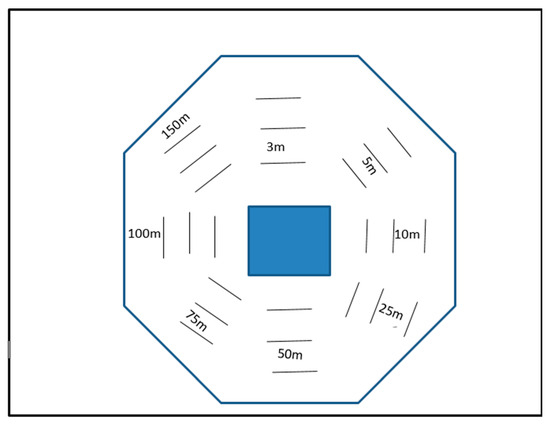
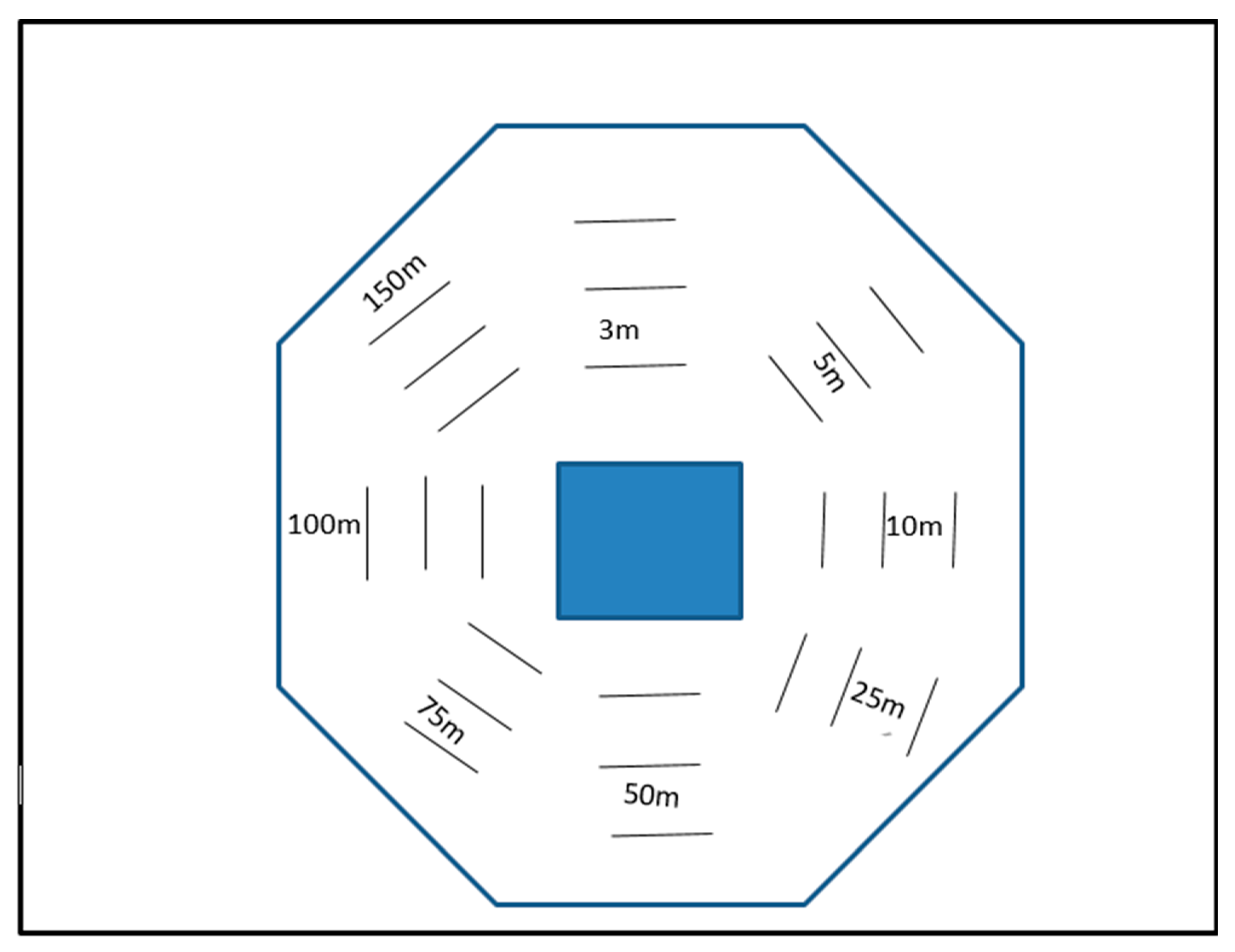
This study used grain amaranth seed as the pollen recipient, while smooth pigweed was used as the donor crop. Planting across all the sites was staggered to ensure synchronisation between the pollen donor and recipient crop. Smooth pigweed was planted on the 13th of January, while grain amaranth was planted on the 27th of January during the 2020/21 and 2021/22 seasons. At each site, the pigweed was planted at the centre of a plot measuring 5 m × 8 m (40 m2) as a pollen donor, while A. hypochondriacus was planted around the donor plot at several indicated radial distances. Across the sites, pollen source plots had a density of 177 plants, and the recipient plots contained 88 plants each (Figure 1). Across all sites, supplementary irrigation was provided to ensure uniformity in germination, and all plots received the same fertiliser and weed management regimes.
Figure 1.
Outline of the experimental field design showing the distance from the pigweed in the blue rectangle at the centre.
2.4. Synchronisation of Flowering
To achieve maximum synchronisation of flowering between the two species, the pigweed was planted 14 days before grain amaranth. The flowering period was defined as the period between the commencement of the first pollen shedding and the last few remaining pollen grains. Flowering data were recorded for all grain amaranth plots, whereas only pollen-shedding period data were recorded for pigweed (Table 1).
Table 1.
Experimental sites showing planting material, plot dimension, anthesis, and sowing dates.
2.5. Climate Monitoring during the Flowering Period
Meteorological data, including wind direction, air temperature, and wind speed covering the entire flowering period, were obtained from the nearest Meteorological Services Department Weather Stations (Table 2). Wind speed (km/h) and direction (°) were recorded 7 days before and after flowering of the recipient crop. The evaluated hours were restricted to 6 a.m. and 4 p.m. when nearly all pollen shedding occurred [18]. This time frame was, therefore, taken as the actual pollination period where possible cross-pollination will occur.
Table 2.
Meteorological data during the flowering period at Gweru, Bindura, and Shamva.
2.6. Sampling and Data Analysis
At maturity, seeds from pollen recipient plots were harvested and threshed plot by plot and then subjected to examination. Seed contamination analysis was conducted using grain amaranth seed colour as a morphological marker, and the cross-pollination rate of the whole field (CPf) was used for statistical calculations. CPf is the ratio of all off-white grains found in each sample to the total grains of the sample. In this study, a workable sample of 5 g per plot was randomly selected, and the contamination rate was calculated as the ratio of off-white amaranth grains to all grains of the sample using the following formula below:
CPf (%) = [Sum (off-white grains in the sample)/Sum (total grains in the sample)] × 100
Data on the cross-pollination rate across the three sites were combined, and an analysis of variance (ANOVA) was carried out using Genstat 14th Edition. The least significant difference (LSD) at a 5% significance level was used to separate the means. The cross-pollination rate data with distance from the pigweed pollen donor for the combined sites were then fitted to the exponential decline model as follows:
where Y is cross-pollination (%), Y0 is cross-pollination extrapolated to X = 0, B is the shape coefficient, and X is the distance (m) of the sampled plot from the pollen source.
Y = Y0e − BX
3. Results
3.1. Effect of Meteorological Factors on Anthesis of Grain Amaranth at Gweru, Bindura, and Shamva
Synchronisation during the anthesis period between pollen donor and recipient plants varied at the Gweru, Bindura, and Shamva sites (Table 1). At Gweru, the pollen recipient and donor plots reached 50% pollen shedding by 15 and 12 March 2021, respectively. The prevailing wind mostly originated from the south and southeast directions during the flowering period, with an average daily wind speed of 12 km/h (Table 2). This weather pattern agreed with common wind patterns observed in the area for the past 2 years. The average wind speed was higher (13.1 km/h) from 15 to 24 March compared with that between 5 and 14 March 2021 (10.7 km/h). The meteorological data pattern indicated that the recipient grain amaranth in the northern direction was on the downwind side (Table 2). At Bindura, the pollen donor plot, flowering started on 6 March 2021 and was delayed by 3 days in the recipient plot (Table 2). By 10 March, 50% pollen shedding was recorded in the donor plot, and grain amaranth started shedding pollen on 13 March despite slight variations in individual plant development. Most winds originated from the southern side of the site, and 7 days recorded winds of non-distinctive origin (VRB). From 5 to 14 March, an average wind speed of 14.1 km/h was recorded, increasing to 18.6 km/h from 15 to 24 March (Table 2). High synchronisation between pollen donor and recipient plants during the anthesis period was recorded at the Shamva site (Table 2). The pollen donor plot started flowering on 11 March 2022, and a day later, flowering commenced in the pollen recipient plot. The synchronicity of pollen shedding was also high. The pollen donor plot started shedding pollen on 14 March, and the pollen recipient plot commenced on 15 March. The site was characterised by variable wind directions. An average wind speed of 12.2 km/h was recorded from 5 to 14 March, and 19.3 km/h was recorded from 15 to 24 March.
3.2. Effect of Isolation Distance on Outcrossing of Grain Amaranth and Pigweed at Combined Sites Gweru, Bindura, and Shamva Districts of Zimbabwe
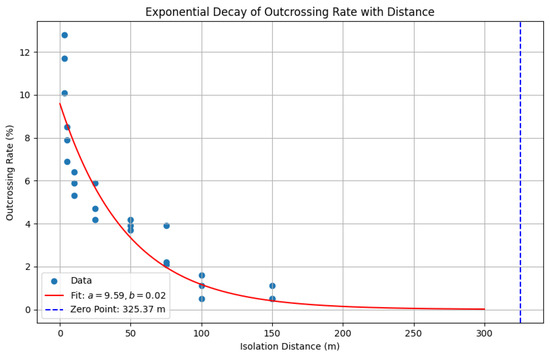
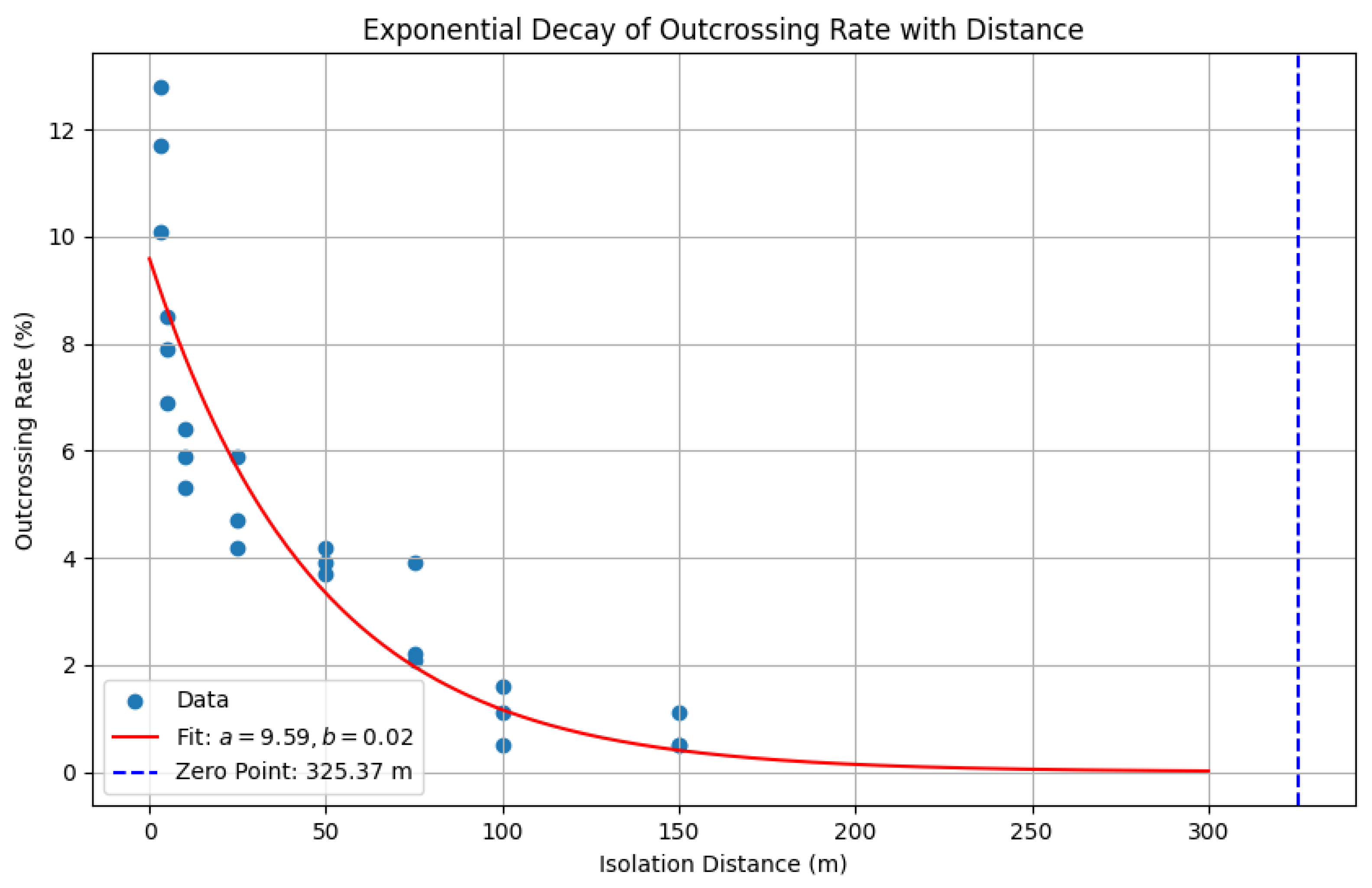
There were no significant differences (p = 0.093) in the outcrossing rates among the three sites (Gweru, Bindura, Shamva). However, there was a significant difference (p < 0.05) in the outcrossing rate due to the distance between the three sites (Figure 2). The results show that there was a high outcrossing rate of 11.28% at 3 m from the pollen source that gradually decreased at a rate of decay rate 0.027/m until a non-significant level of 325.4 m from the source was reached (Figure 2).
Figure 2.
The fitted exponential decay model that includes a vertical line indicating the point where the outcrossing rate effectively becomes zero.
4. Discussion
The results indicated the effectiveness of staggered planting in achieving anthesis synchronisation across all three sites (Table 1). At Gweru, the pollen recipient and donor plots reached 50% pollen shedding by 15 and 12 March 2021, respectively. At Bindura, the pollen donor plot, flowering started on 6 March 2021 and was delayed by 3 days in the recipient plot (Table 2). High synchronisation between pollen donor and recipient plants during the anthesis period was recorded at the Shamva site (Table 2). The pollen donor plot started flowering on 11 March 2022, and a day later, flowering commenced in the pollen recipient plot. The synchronicity of pollen shedding was also high. However, it must be noted that the contamination rate in the grain amaranth population with distance to the pollen source was well explained by the exponential decline function (p < 0.05) and adjusted r2 of 0.96 (Figure 2). Across the three combined sites, high cross-pollination rates were observed within the shorter distances between the pollen recipient and donor plots [4]. This demonstrates that grain amaranth seed genetic purity depends on the distance from pollen donors. Apart from close-range distances, high cross-pollination can be attributed to the high synchronisation of flowering and pollen shedding between the pollen donor and recipient populations. Wind speed and direction also contributed to high cross-pollination rates, as the highest contamination was recorded on the downwind side. However, low cross-pollination rates could be attributed to greater distances between pollen recipient and donor plots. Wind direction significantly contributed to reduced outcrossing rates, as the plots that recorded the lowest values were in the upwind direction. However, attributing outcrossing to meteorological factors alone is not adequate. The production of grain amaranth seeds with high genetic quality requires accurate estimates of all possible means of pollen dispersal, pollen flight, and viability. While isolation distances of 100-150 m produced the purest seed of 2% in this study, this cannot guarantee seed purity for small-scale farmers. Extrapolation of our decay model estimated that zero percent contamination is achievable at 325 m from the source of pollen, but this needs validation through experimentation in future studies. In related studies involving Amaranthus species, long distances of up to 800 m have indicated possible pollen outcrossing [19]. Molecular markers, polymerase chain reaction (PCR) tools, and other biotechnology tools can be used to validate cross-pollination beyond the visible xenia effects.
5. Conclusions
The results obtained in the present study indicate that cross-pollination and genetic contamination in grain amaranth are considerable despite the crop being predominantly self-pollinating. Seed purity increases with increased isolation distance and exponentially decreases with decreasing distance to the pollen donor as indicated in this study where distances of between 100 and 150 m from the donor had the highest purity of 2%. Further studies involving different factors promoting outcrossing in grain amaranth must be performed at longer distances. Furthermore, seed purity analysis using molecular markers could potentially resolve the rate of cross-pollination in grain Amaranthus.
Author Contributions
Conceptualisation, T.M., C.N., and F.M.; methodology F.M., C.N., N.S., and T.M.; software C.N., F.M., and N.S.; validation, R.M., W.M.C., and P.M.; writing—original draft preparation, C.N., and W.M.C.; writing—review and editing, E.K.M., J.C., R.M., and P.M.; funding of grammatical editing, P.M. All authors have read and agreed to the published version of the manuscript.
Funding
This research received no external funding from any organizations.
Data Availability Statement
Data used in this study were used to write a dissertation for Canaan Nyambo’s BSc in Agronomy. The submitted copies of the dissertation are kept in the Department of Agronomy and Horticulture at the Midlands State University. A summary of the raw data is available on request.
Acknowledgments
We would like to thank the Midlands State University for providing resources and support for this study over the two experimental seasons. We also want to thank Mutangabende, the laboratory supervisor at Seed Services Harare, for the support she offered in conducting physical purity analysis. Financial support for the study was equally contributed by the authors involved. No innovations are expected from this study.
Conflicts of Interest
The authors declare no conflicts of interest.
References
- Vargas-Ortiz, E.; Espitia-Rangel, E.; Tiessen, A.; Delano-Frier, J.P. Grain Amaranths are defoliation tolerant crop species capable of utilizing stem and root carbohydrate reserves to sustain vegetative and reproductive growth after leaf loss. J. Agric. Sci. Technol. 2013, 5, 6–15. [Google Scholar] [CrossRef] [Scilit] [PubMed]
- Alemayehu, F.R.; Bendevis, M.A.; Jacobsen, S.E. The potential for utilising the seed crop Amaranth in East Africa as an alternative crop to food security and climate change mitigation. J. Agron. Crop Sci. 2015, 20, 321–329. [Google Scholar] [CrossRef] [Scilit]
- Rehman, I.U.; Ayesha, N.; Anam, K.; Khalid, A.; Ali, L.; Nazir, H.; Burhan, Z.; Sadique, U. Improving of Amaranth (Amaranthus spp.) and Quinoa (Chenopodium quinoa) by Genetic Resources. Asian J. Res. Crop Sci. 2024, 9, 1–9. [Google Scholar] [CrossRef] [Scilit]
- Kimenye, L. Improving Access to Quality Seeds in Africa; CABI Study Brief 7; CABI: Wallingford, LK, 2014. [Google Scholar]
- Mabaya, E.; Mujaju, C.; Nyakanda, P.; Mungoya, M. The African Seed Access Index (TASAI). Zimbabwe Brief 2017. 2017. Available online: http://tasai.org/reports (accessed on 17 August 2024).
- Jain, S.K.; Hauptil, H.; Vaidya, K.R. Outcrossing rate in grain Amaranths. J. Hered. 1982, 73, 71–72. [Google Scholar] [CrossRef] [Scilit]
- Forrest, J.R.K. Plant size, sexual selection, and the evolution of protandry in dioecious plants. Am. Nat. 2014, 184, 338–351. [Google Scholar] [CrossRef] [Scilit] [PubMed]
- Machida, L.; Derera, J.; Tongoona, P.; Mutanga, O.; MacRobert, J. Geostatîstîcal analysis of quality protein maize outcrossing with pollen from adjacent normal endosperm maize varieties. Crop Sci. 2012, 52, 1235–1245. [Google Scholar] [CrossRef] [Scilit]
- Mccormack, J.H. Principles and Practices of Isolation Distances for Seed Crops: An Organic Seed Production Manual for Seed Growers in the Mid-Atlantic and Southern US; McCormack: Pendleton, OR, USA, 2004; p. 3. [Google Scholar]
- Sosnoskie, L.M.; Webster, T.M.; Dales, D.; Rains, G.C.; Grey, T.L.; Culpepper, A.S. Pollen Grain Size, Density, and Settling Velocity for Palmer Amaranth (Amaranthus Palmeri); Cambridge University Press: Cambridge, UK, 2017. [Google Scholar]
- Brenner, D.M.; Johnson, W.G.; Sprague, C.L.; Tranel, P.J.; Young, B.G. Crop-weed hybrids are more frequent for the grain Amaranth-Plainsman. Genet. Resour. Crop Evol. 2013, 60, 2201–2205. [Google Scholar] [CrossRef] [Scilit]
- Ellstrand, N.C. Pollen as a vehicle for the escape of engineered genes? Trends Ecol. Evol. 1988, 3, S30–S32. [Google Scholar] [CrossRef] [Scilit] [PubMed]
- Raybould, A.F.; Gray, A.J. Genetically modified crops and hybridization with wild relatives: A UK perspective. J. Appl. Ecol. 1993, 30, 199–219. [Google Scholar]
- Oyekale, K.O. Growing an effective seed management system: A case study of Nigeria. J. Agric. Environ. Sci. 2014, 3, 345–354. [Google Scholar]
- Ndinya, C.; Onyango, E.; Dinssa, F.F.; Odendo, M.; Simon, J.E.; Weller, S.; Thuranira, E.; Nyabinda, N.; Maiyo, N. Participatory variety selection of three African leafy vegetables in Western Kenya. J. Med. Act. Plants 2020, 9, 145–156. [Google Scholar]
- Kauffman, C.S.; Weber, L.E. Grain Amaranth. In Advances in New Crops; Timber Press: Portland, OR, USA, 1990; pp. 127–139. [Google Scholar]
- Bannert, M.; Stamp, P. Cross pollination of maize at long distance. Eur. J. Agron. 2007, 27, 44–51. [Google Scholar] [CrossRef] [Scilit]
- Agong, S.G.; Ayiecho, P.O. The rate of outcrossing in grain Amaranths. Plant Breed. 1991, 107, 156–160. [Google Scholar] [CrossRef] [Scilit]
- Liu, J.; Davis, A.S.; Tranel, P.J. Pollen biology and dispersal dynamics in waterhemp (Amaranthus tuberculatus). Weed Sci. 2012, 60, 416–422. [Google Scholar] [CrossRef] [Scilit]

Disclaimer/Publisher’s Note: The statements, opinions and data contained in all publications are solely those of the individual author(s) and contributor(s) and not of MDPI and/or the editor(s). MDPI and/or the editor(s) disclaim responsibility for any injury to people or property resulting from any ideas, methods, instructions or products referred to in the content. |
© 2024 by the authors. Licensee MDPI, Basel, Switzerland. This article is an open access article distributed under the terms and conditions of the Creative Commons Attribution (CC BY) license (https://creativecommons.org/licenses/by/4.0/).