

Organic Oat Response to Variety, Seeding Rate, and Nutrient Source and Rate



Abstract
1. Introduction
2. Materials and Methods
3. Results and Discussion
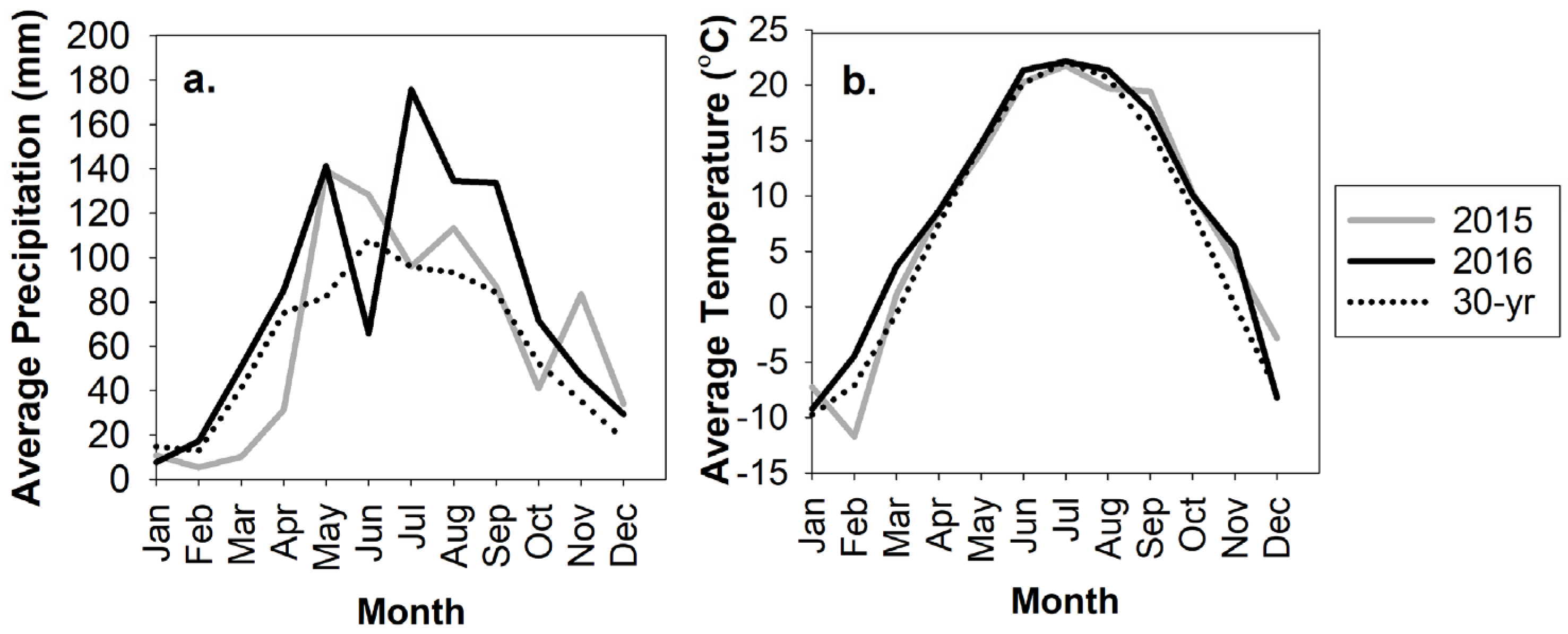
3.1. Weather
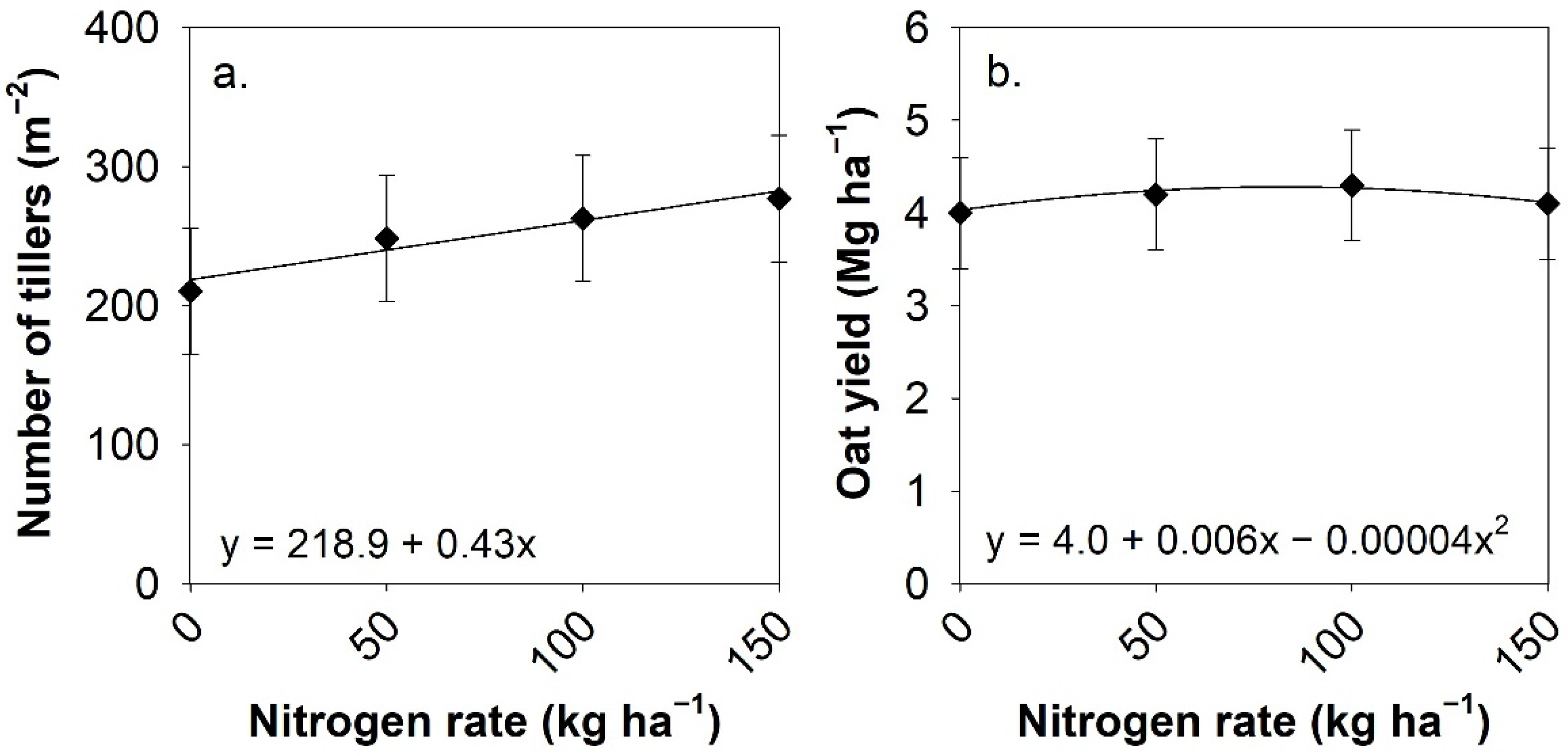
3.2. Plant Population and Tillers per Plant
3.3. Grain Yield
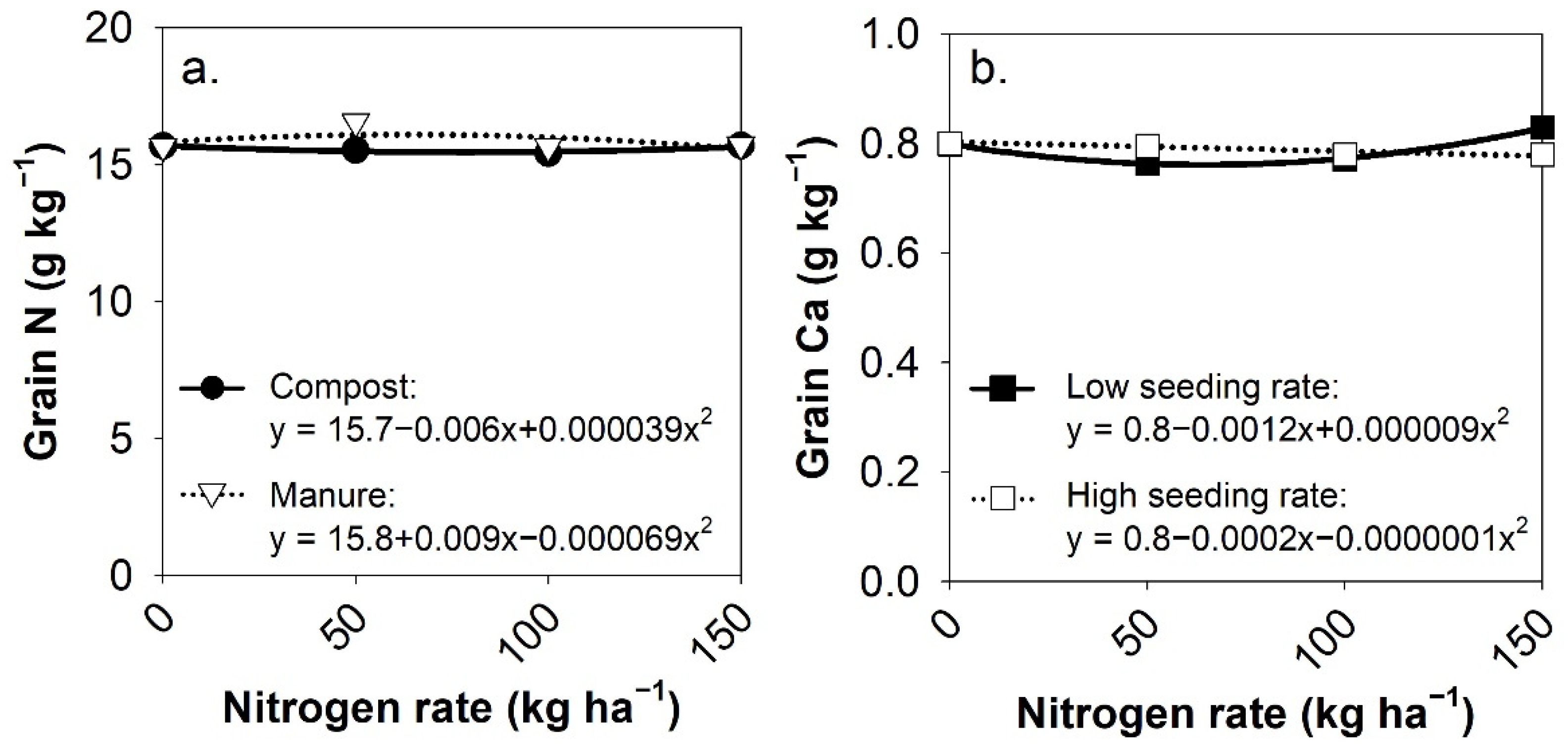
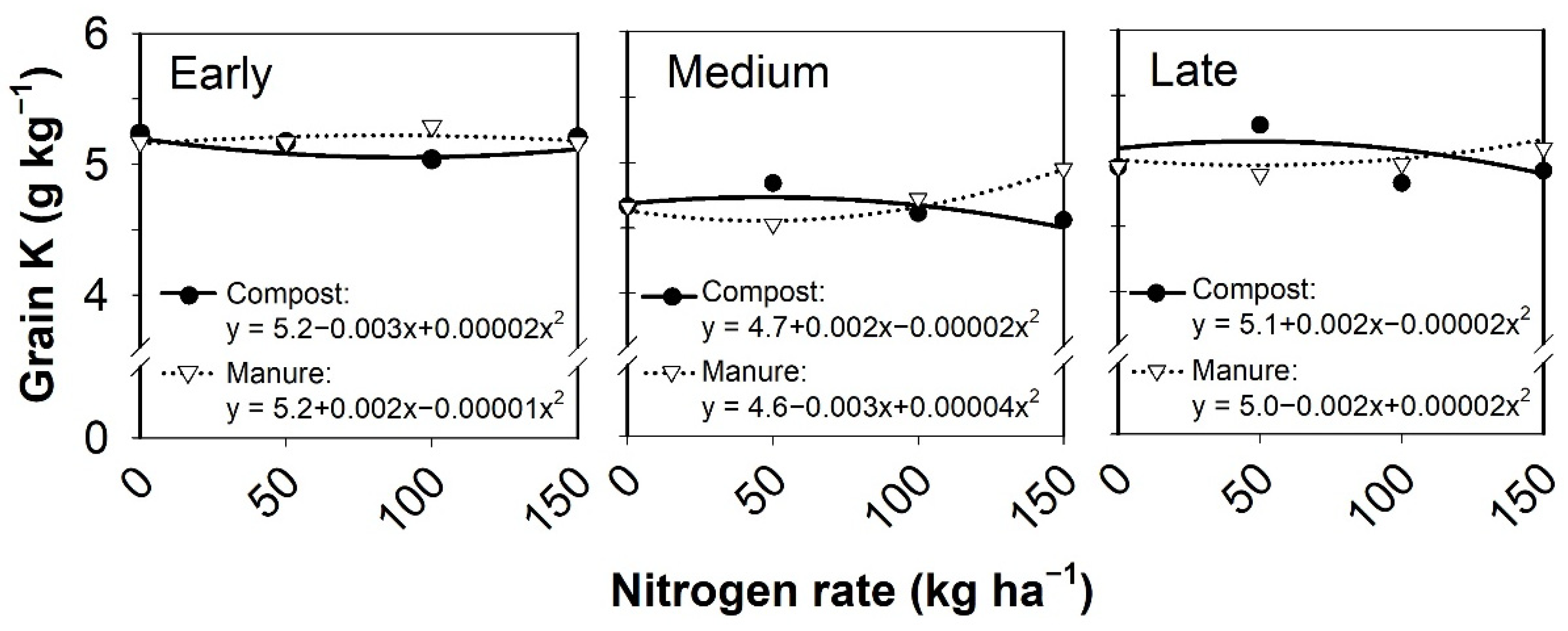
3.4. Grain Nutrient Content
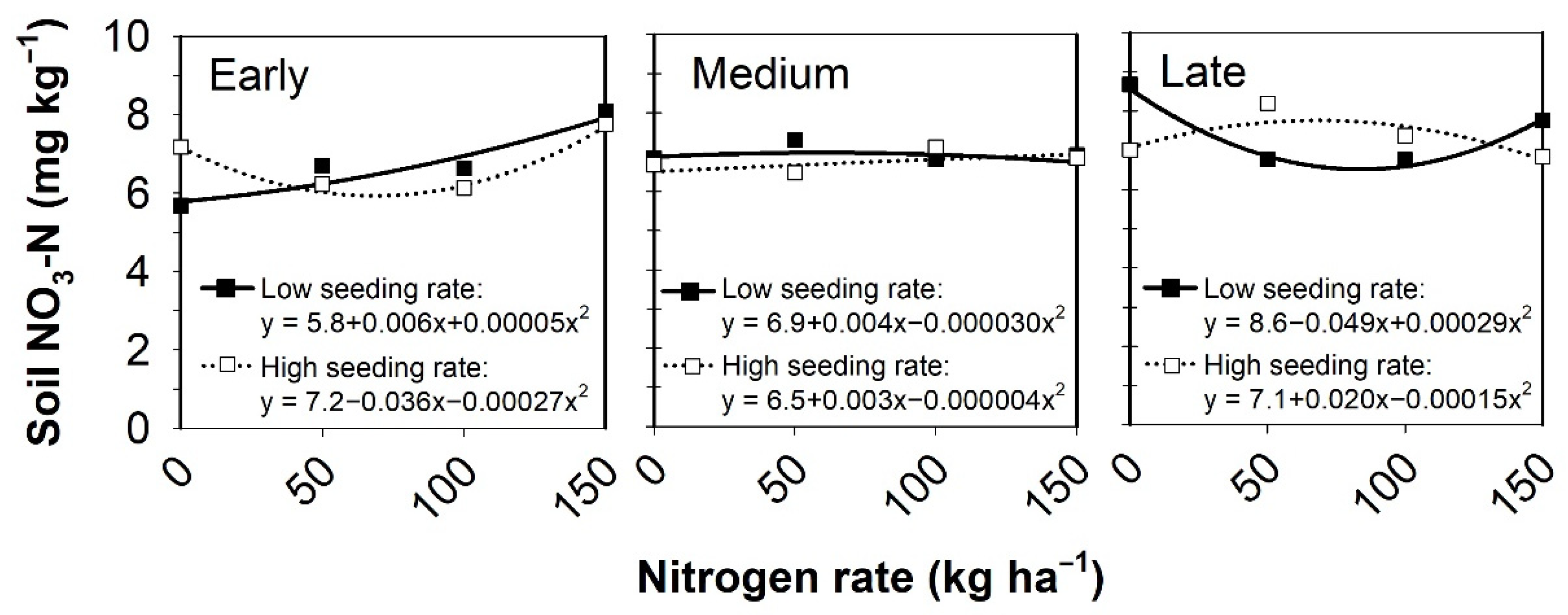
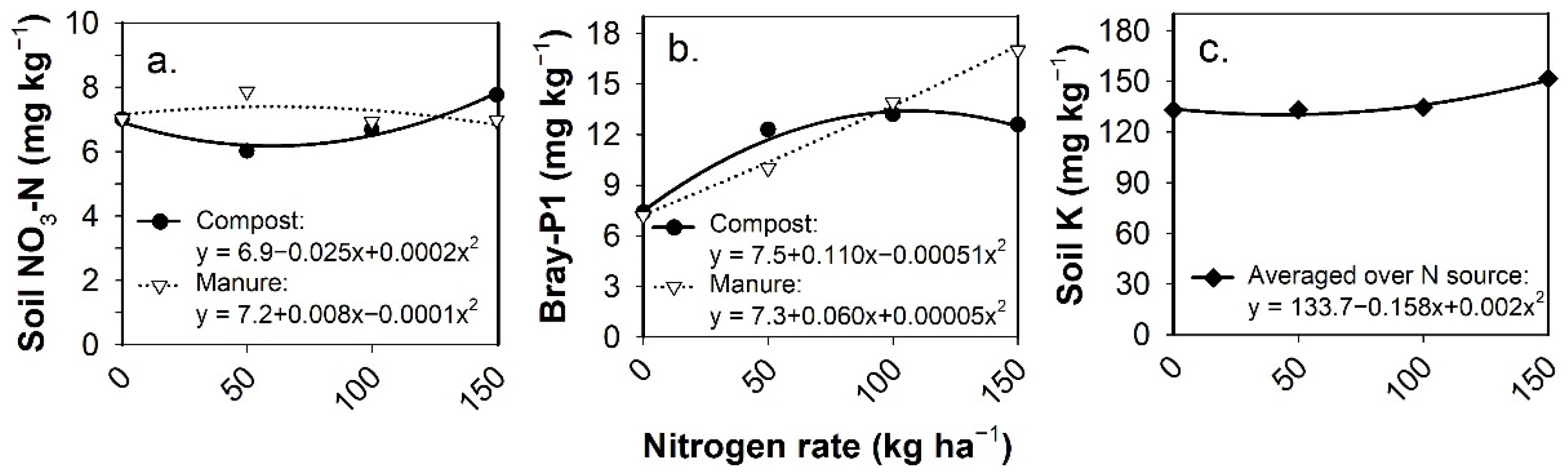
3.5. Post-Harvest Residual Soil Nutrients
4. Conclusions
Supplementary Materials
Author Contributions
Funding
Institutional Review Board Statement
Informed Consent Statement
Data Availability Statement
Conflicts of Interest
References
- McBride, W.D.; Greene, C. The Profitability of Organic Soybean Production. Renew. Agric. Food Syst. 2009, 24, 276–284. [Google Scholar] [CrossRef] [Scilit]
- Weisberger, D.A.; Wiedenhoeft, M.H.; Smith, M.A.; Liebman, M.Z. Balancing Objectives in an Organic Oat Rotation Year: Implications of Planting Date and Crop Density. Agron. J. 2019, 111, 816–825. [Google Scholar] [CrossRef] [Scilit]
- Teasdale, J.R.; Mangum, R.W.; Radhakrishnan, J.; Cavigelli, M.A. Weed Seedbank Dynamics in Three Organic Farming Crop Rotations. Agron. J. 2004, 96, 1429–1435. [Google Scholar] [CrossRef] [Scilit]
- Nair, A.; Delate, K. Composting, crop rotation, and cover crop practices in organic vegetable production. In Organic Farming for Sustainable Agriculture; Nandwani, D., Ed.; Springer International Publishing: Basel, Switzerland, 2016; pp. 231–257. ISBN 978-3-319-26803-3. [Google Scholar]
- Delate, K.; Cambardella, C.A. Agroecosystem Performance during Transition to Certified Organic Grain Production. Agron. J. 2004, 96, 1288. [Google Scholar] [CrossRef] [Scilit]
- Delbridge, T.A.; Coulter, J.A.; King, R.P.; Sheaffer, C.C.; Wyse, D.L. Economic Performance of Long-Term Organic and Conventional Cropping Systems in Minnesota. Agron. J. 2011, 103, 1372–1382. [Google Scholar] [CrossRef] [Scilit]
- USDA-NASS Certified Organic Survey 2016 Summary; USDA-National Agricultural Statistics Service: Washington, DC, USA, 2017; Available online: https://downloads.usda.library.cornell.edu/usda-esmis/files/zg64tk92g/70795b52w/4m90dz33q/OrganicProduction-09-20-2017_correction.pdf (accessed on 22 September 2020).
- MCIA Oats; Minnesota Crop Improvement Association: Saint Paul, MN, USA, 2020; Available online: http://docs.mncia.org/public/website/UMN-Oat-Brochure-2020.pdf (accessed on 23 June 2021).
- Delate, K.; Duffy, M.; Chase, C.; Holste, A.; Friedrich, H.; Wantate, N. An Economic Comparison of Organic and Conventional Grain Crops in a Long-Term Agroecological Research (LTAR) Site in Iowa. Am. J. Alternative Agric. 2003, 18, 59–69. [Google Scholar] [CrossRef] [Scilit]
- Coleman, P. Guide for Organic Crop Producers; USDA-Agricultural Marketing Service—National Organic Program: Washington, DC, USA, 2012; Available online: https://www.ams.usda.gov/sites/default/files/media/CropProducersGuide.pdf (accessed on 23 June 2021).
- Mason, H.; Navabi, A.; Frick, B.; O’Donovan, J.; Spaner, D. Cultivar and Seeding Rate Effects on the Competitive Ability of Spring Cereals Grown under Organic Production in Northern Canada. Agron. J. 2007, 99, 1199–1207. [Google Scholar] [CrossRef] [Scilit]
- Olsen, J.M.; Griepentrog, H.-W.; Nielsen, J.; Weiner, J. How Important Are Crop Spatial Pattern and Density for Weed Suppression by Spring Wheat? Weed Sci. 2012, 60, 501–509. [Google Scholar] [CrossRef] [Scilit]
- Benaragama, D.; Shirtliffe, S.J. Integrating Cultural and Mechanical Methods for Additive Weed Control in Organic Systems. Agron. J. 2013, 105, 1728–1734. [Google Scholar] [CrossRef] [Scilit]
- Ma, B.L.; Biswas, D.K.; Zhou, Q.P.; Ren, C.Z. Comparisons among Cultivars of Wheat, Hulled and Hulless Oats: Effects of N Fertilization on Growth and Yield. Can. J. Plant Sci. 2012, 92, 1213–1222. [Google Scholar] [CrossRef] [Scilit]
- Ma, B.L.; Zheng, Z.; Pageau, D.; Vera, C.; Fregeau-Reid, J.; Xue, A.; Yan, W. Nitrogen and Phosphorus Uptake, Yield and Agronomic Traits of Oat Cultivars as Affected by Fertilizer N Rates under Diverse Environments. Nutr. Cycl. Agroecosyst. 2017, 108, 245–265. [Google Scholar] [CrossRef] [Scilit]
- Mulder, E.G. Effect of Mineral Nutrition on Lodging of Cereals. Plant Soil 1954, 5, 246–306. [Google Scholar] [CrossRef] [Scilit]
- USDA Organic production and handling requirements—§205.203. In Electronic Code of Federal Regulations (eCFR); Part 205—National Organic Program; United Stated Department of Agriculture: Washington, DC, USA, 2020; Available online: https://www.ecfr.gov (accessed on 21 June 2021).
- Ahmed, S.; Mickelson, S.; Pederson, C.; Baker, J.; Kanwar, R.; Lorimor, J.; Webber, D. Swine Manure Rate, Timing, and Application Method Effects on Post-Harvest Soil Nutrients, Crop Yield, and Water Quality Implications in a Corn-Soybean Rotation. Trans. ASABE 2013, 56, 395–408. [Google Scholar] [CrossRef] [Scilit]
- Eghball, B.; Power, J.F. Phosphorus- and Nitrogen-Based Manure and Compost Applications: Corn Production and Soil Phosphorus. Soil Sci. Soc. Am. J. 1999, 63, 895–901. [Google Scholar] [CrossRef] [Scilit]
- Fuerst, E.P.; Koenig, R.T.; Kugler, J.; Painter, K.; Stannard, M.; Goldberg, J. Organic Alfalfa Management Guide; Washington State University Extension: Pullman, WA, USA, 2009; Available online: https://www.nrcs.usda.gov/Internet/FSE_PLANTMATERIALS/publications/wapmcpu10176.pdf (accessed on 23 June 2021).
- Yost, M.A.; Coulter, J.A. Managing the Rotation from Alfalfa to Corn. 2018. Available online: https://extension.umn.edu/corn-cropping-systems/managing-rotation-alfalfa-corn (accessed on 6 April 2021).
- Jungers, J.M.; Kaiser, D.E.; Lamb, J.F.S.; Lamb, J.A.; Noland, R.L.; Samac, D.A.; Wells, M.S.; Sheaffer, C.C. Potassium Fertilization Affects Alfalfa Forage Yield, Nutritive Value, Root Traits, and Persistence. Agron. J. 2019, 111, 2843–2852. [Google Scholar] [CrossRef] [Scilit]
- Schmitt, M.A.; Shaeffer, C.C.; Randall, G.W. Preplant Manure and Commercial P and K Fertilizer Effects on Alfalfa Production. J. Prod. Agric. 1993, 6, 385–390. [Google Scholar] [CrossRef] [Scilit]
- Wilson, M. Guidelines for Manure Application Rates. University of Minnesota Extension. 2020. Available online: https://extension.umn.edu/manure-land-application/manure-application-rates (accessed on 21 June 2021).
- Marshall, H.G.; Kolb, F.L.; Roth, G.W. Effects of Nitrogen Fertilizer Rate, Seeding Rate, and Row Spacing on Semidwarf and Conventional Height Spring Oat. Crop Sci. 1987, 27, 572–575. [Google Scholar] [CrossRef] [Scilit]
- May, W.E.; Mohr, R.M.; Lafond, G.P.; Johnston, A.M.; Stevenson, F.C. Effect of Nitrogen, Seeding Date and Cultivar on Oat Quality and Yield in the Eastern Canadian Prairies. Can. J. Plant Sci. 2004, 84, 1025–1036. [Google Scholar] [CrossRef] [Scilit]
- United States Department of Agriculture—Natural Resources Conservation Service Web Soil Survey. Available online: https://www.nrcs.usda.gov/wps/portal/nrcs/detail/soils/survey/?cid=nrcseprd1464818 (accessed on 4 July 2021).
- Recommended Chemical Soil Test Procedures for the North Central Region; Brown, J.R., Ed.; Missouri Agricultural Experiment Station SB 1001: Columbia, MO, USA, 1998; Available online: https://www.canr.msu.edu/uploads/234/68557/rec_chem_soil_test_proce55c.pdf (accessed on 23 June 2021).
- Murphy, J.; Riley, J.P. A Modified Single Solution Method for the Determination of Phosphate in Natural Waters. Anal. Chim. Acta 1962, 27, 31–36. [Google Scholar] [CrossRef] [Scilit]
- Eghball, B. Nitrogen Mineralization from Field-Applied Beef Cattle Feedlot Manure or Compost. Soil Sci. Soc. Am. J. 2000, 64, 2024–2030. [Google Scholar] [CrossRef] [Scilit]
- Peters, J.; Combs, S.; Hoskins, B.; Jarman, J.; Kovar, J.; Watson, M.; Wolf, A.; Wolf, N. Recommended Methods of Manure Analysis; Peters, J., Ed.; University of Wisconsin-Extension: Madison, WI, USA, 2003; Available online: https://cdn.shopify.com/s/files/1/0145/8808/4272/files/A3769.pdf (accessed on 23 June 2021).
- Gavlak, R.; Horneck, D.A.; Miller, R.O. Soil, Plant, and Water Reference Methods for the Western Region, 3rd ed.; Western Rural Development Cente: Corvallis, OR, USA, 2005; 207p. [Google Scholar]
- Doane, T.A.; Horwáth, W.R. Spectrophotometric Determination of Nitrate with a Single Reagent. Anal. Lett. 2003, 36, 2713–2722. [Google Scholar] [CrossRef] [Scilit]
- SAS Institute Inc. SAS/STAT® 14.2 User’s Guide; SAS Institute Inc.: Cary, NC, USA, 2016; Available online: https://documentation.sas.com/doc/en/statcdc/14.2/statug/titlepage.htm (accessed on 23 June 2021).
- Littell, R.C.; Milliken, G.A.; Stroup, W.W.; Wolfinger, R.D.; Schabenberger, O. SAS for Mixed Models, 2nd ed.; SAS Institute: Cary, NC, USA, 2007; ISBN 978-1-59994-078-6. [Google Scholar]
- Kim, T.K. T Test as a Parametric Statistic. Korean J. Anesth. 2015, 68, 540–546. [Google Scholar] [CrossRef] [Scilit]
- Schober, P.; Boer, C.; Schwarte, L.A. Correlation Coefficients: Appropriate Use and Interpretation. Anesth. Analg. 2018, 126, 1763–1768. [Google Scholar] [CrossRef] [Scilit] [PubMed]
- Sorrells, M.E.; Simmons, S.R. Influence of environment on the development and adaptation of oat. In Oat Science and Technology; American Society of Agronomy, Inc. and Crop Science Society of America, Inc.: Madison, WI, USA, 1992; pp. 115–163. ISBN 978-0-89118-225-2. [Google Scholar]
- Wiersma, J.; Ransom, J.; Hofman, V. Seeding Rate for Small Grains. 2018. Available online: https://extension.umn.edu/planting-small-grains/seeding-rate-small-grains (accessed on 2 January 2021).
- Ahmad, A.H.; Wahid, A.; Khalidg, F.; Fiaz, N.; Zamir, M.S.I. Impact of Organic and Inorganic Sources of Nitrogen and Phosphorus Fertilizers on Growth, Yield and Quality of Forage Oat (Avena sativa L.). Cercet. Agron. Mold. 2011, 44, 39–49. [Google Scholar] [CrossRef] [Scilit]
- Bilal, M.; Ayub, M.; Tariq, M.; Tahir, M.; Nadeem, M.A. Dry Matter Yield and Forage Quality Traits of Oat (Avena Sativa L.) under Integrative Use of Microbial and Synthetic Source of Nitrogen. J. Saudi Soc. Agric. Sci. 2017, 16, 236–241. [Google Scholar] [CrossRef] [Scilit]
- Reeves, D.L.; Sraon, H.S. How an oat plant develops. In Research Bulletins of the South Dakota Agricultural Experiment Station (1887–2011); South Dakota Agricultural Experiment Station, South Dakota State University: Brookings, SD, USA, 1976; p. 15. [Google Scholar]
- Wiersma, J.; Dill-Macky, R.; Rines, H.; Tiede, T.; Smith, K. 2016 Oat Field Crop Trials Results; Minnesota Agricultural Experiment Station: Saint Paul, MN, USA, 2016; Available online: https://www.maes.umn.edu/sites/maes.umn.edu/files/oat_2016_final-update.pdf (accessed on 23 June 2021).
- Entz, M.H.; Guilford, R.; Gulden, R. Crop Yield and Soil Nutrient Status on 14 Organic Farms in the Eastern Portion of the Northern Great Plains. Can. J. Plant Sci. 2001, 81, 351–354. [Google Scholar] [CrossRef] [Scilit]
- Langemeier, M.; O’Donnell, M. Conventional and Organic Enterprise Net Returns. In Farmdoc Daily 2020. Available online: https://farmdocdaily.illinois.edu/2020/09/conventional-and-organic-enterprise-net-returns.html (accessed on 1 April 2021).
- Caffe-Treml, M.; Guiterrez, L.; Smith, K.P.; Kleinjan, J. 2017–2018 Multi-State Organic Oat Variety Trial Results; South Dakota State University Extension: Brookings, SD, USA, 2019; Available online: https://extension.sdstate.edu/sites/default/files/2019-05/P-00107.pdf (accessed on 23 June 2021).
- Brinkman, M.A.; Rho, Y.D. Response of Three Oat Cultivars to N Fertilizer. Crop Sci. 1984, 24, 973–977. [Google Scholar] [CrossRef] [Scilit]
- Hamill, M.L. The Effect of Cultivar, Seeding Date, Seeding Rate and Nitrogen Fertility on Oat (Avena sativa L.) Yield and Milling Quality. Master’s Thesis, University of Manitoba, Winnipeg, MB, Canada, 2002. [Google Scholar]
- Lafond, G.P.; May, W.E.; Holzapfel, C.B. Row Spacing and Nitrogen Fertilizer Effect on No-Till Oat Production. Agron. J. 2013, 105, 1–10. [Google Scholar] [CrossRef] [Scilit]
- May, W.E.; Brandt, S.; Hutt-Taylor, K. Response of Oat Grain Yield and Quality to Nitrogen Fertilizer and Fungicides. Agron. J. 2020, 112, 1021–1034. [Google Scholar] [CrossRef] [Scilit]
- Pecio, A.; Bichonski, A. Nitrogen Fertilization and Fungicide Application as Elements of Oat Production. Pol. J. Environ. Stud. 2010, 19, 1297–1305. [Google Scholar]
- Buckley, K.E.; Mohr, R.M.; Therrien, M.C. Yield and Quality of Oat in Response to Varying Rates of Swine Slurry. Can. J. Plant Sci. 2010, 90, 645–653. [Google Scholar] [CrossRef] [Scilit]
- Yost, M.A.; Coulter, J.A.; Russelle, M.P.; Sheaffer, C.C.; Kaiser, D.E. Alfalfa Nitrogen Credit to First-Year Corn: Potassium, Regrowth, and Tillage Timing Effects. Agron. J. 2012, 104, 953–962. [Google Scholar] [CrossRef] [Scilit]
- Grain Millers, Inc. The Growth and Development of Oats: A Production Guide; Grain Millers, Inc.: Eden Prairie, MN, USA, 2017; Available online: http://allamakeeswcd.org/wp-content/uploads/2017/10/Oat-Production-Guide.pdf (accessed on 26 March 2021).
- Ciolek, A.; Makarska, E.; Wesolowski, M.; Cierpiala, R. Content of Selected Nutrients in Wheat, Barley, and Oat Grain from Organic and Conventional Farming. J. Elem. 2012, 17, 181–189. [Google Scholar] [CrossRef] [Scilit]
- Malhi, S.S.; Johnston, A.M.; Schoenau, J.J.; Wang, Z.L.; Vera, C.L. Seasonal Biomass Accumulation and Nutrient Uptake of Wheat, Barley and Oat on a Black Chernozem Soil in Saskatchewan. Can. J. Plant Sci. 2006, 86, 1005–1014. [Google Scholar] [CrossRef] [Scilit]
- Kaiser, D. Oat Fertilizer Recommendations. 2018. Available online: https://extension.umn.edu/crop-specific-needs/oat-fertilizer-recommendations (accessed on 15 January 2021).
- Nelson, N.O.; Janke, R.R. Phosphorus Sources and Management in Organic Production Systems. HortTechnology 2007, 17, 442–454. [Google Scholar] [CrossRef] [Scilit]
- Nesme, T.; Colomb, B.; Hinsinger, P.; Watson, C.A. Soil Phosphorus Management in Organic Cropping Systems: From Current Practices to Avenues for a More Efficient Use of P Resources. In Organic Farming, Prototype for Sustainable Agricultures: Prototype for Sustainable Agricultures; Bellon, S., Penvern, S., Eds.; Springer: Dordrecht, The Netherlands, 2014; pp. 23–45. ISBN 978-94-007-7927-3. [Google Scholar]
- Ochsner, T.E.; Schumacher, T.W.; Venterea, R.T.; Feyereisen, G.W.; Baker, J.M. Soil Water Dynamics and Nitrate Leaching under Corn–Soybean Rotation, Continuous Corn, and Kura Clover. Vadose Zone J. 2018, 17, 170028. [Google Scholar] [CrossRef] [Scilit]
- Pfarr, C.J.; Wilson, M.L.; Coulter, J.A.; Fernández, F.G. Liquid Swine Manure as a Sidedressed Nitrogen Source for Corn. Agron. J. 2020, 112, 5206–5221. [Google Scholar] [CrossRef] [Scilit]
- Eghball, B.; Wienhold, B.J.; Gilley, J.E.; Eigenberg, R.A. Mineralization of Manure Nutrients. J. Water Conserv. 2002, 57, 470–472. [Google Scholar]
- Larney, F.J.; Sullivan, D.M.; Buckley, K.E.; Eghball, B. The Role of Composting in Recycling Manure Nutrients. Can. J. Soil Sci. 2006, 86, 597–611. [Google Scholar] [CrossRef] [Scilit]
- Pagliari, P.H.; Laboski, C.A.M. Dairy Manure Treatment Effects on Manure Phosphorus Fractionation and Changes in Soil Test Phosphorus. Biol. Fertil. Soils 2013, 49, 987–999. [Google Scholar] [CrossRef] [Scilit]
- Pagliari, P.H. Variety and solubility of phosphorus forms in animal manure and their effects on soil test phosphorus. In Applied Manure and Nutrient Chemistry for Sustainable Agriculture and Environment; Springer: Dordrecht, The Netherlands, 2014; pp. 141–161. [Google Scholar]
- Pagliari, P.H.; Laboski, C.A.M. Effects of Manure Inorganic and Enzymatically Hydrolyzable Phosphorus on Soil Test Phosphorus. Soil Sci. Soc. Am. J. 2014, 78, 1301. [Google Scholar] [CrossRef] [Scilit]
- Duncan, E.W.; King, K.W.; Williams, M.R.; LaBarge, G.; Pease, L.A.; Smith, D.R.; Fausey, N.R. Linking Soil Phosphorus to Dissolved Phosphorus Losses in the Midwest. Agric. Environ. Lett. 2017, 2, 170004. [Google Scholar] [CrossRef] [Scilit]
- Maguire, R.O.; Sims, J.T. Soil Testing to Predict Phosphorus Leaching. J. Environ. Qual. 2002, 31, 1601–1609. [Google Scholar] [CrossRef] [Scilit] [PubMed]
- Sharpley, A.; Daniel, T.C.; Sims, J.T.; Pote, D.H. Determining Environmentally Sound Soil Phosphorus Levels. J. Soil Water Conserv. 1996, 51, 160–166. [Google Scholar]
- Elser, J.; Bennett, E. A Broken Biogeochemical Cycle. Nature 2011, 478, 29–31. [Google Scholar] [CrossRef] [Scilit] [PubMed]
- Kaiser, D.; Rosen, C.J. Potassium for Crop Production. 2018. Available online: https://extension.umn.edu/phosphorus-and-potassium/potassium-crop-production (accessed on 6 April 2021).
- Heinrich, A.; Falen, J.; Stone, A. High Soil Test Phosphorus and Potassium Levels on a Long-Term Organic Farm: Trends, Causes, and Solutions. 2020. Available online: https://eorganic.org/node/20735 (accessed on 23 June 2021).

| Year | 0–15 cm | |||
|---|---|---|---|---|
| pH | Organic Matter g kg−1 | Bray P-1 | K | |
| mg kg−1 | ||||
| 2015 | 7.3 | 49 | 10 | 108 |
| 2016 | 7.3 | 53 | 7 | 230 |
| Year | Nutrient Source | Nutrient Concentration | Target N Application Rate kg N ha−1 | Actual Application Rates | |||||
|---|---|---|---|---|---|---|---|---|---|
| TN | P | K | Rate Mg ha−1 | TN | P | K | |||
| kg Mg−1 | kg ha−1 | ||||||||
| 2015 | Compost | 8.0 | 4.4 | 5.5 | 50 | 6.3 | 50.2 | 27.6 | 34.5 |
| 100 | 12.6 | 100.4 | 55.2 | 69.0 | |||||
| 150 | 18.8 | 150.6 | 82.9 | 103.6 | |||||
| Manure | 9.4 | 2.6 | 7.1 | 50 | 5.4 | 50.6 | 14.0 | 38.2 | |
| 100 | 10.8 | 101.1 | 28.0 | 76.4 | |||||
| 150 | 16.1 | 151.7 | 42.0 | 114.6 | |||||
| 2016 | Compost | 7.4 | 5.0 | 4.8 | 50 | 6.7 | 49.8 | 33.5 | 32.3 |
| 100 | 13.5 | 99.5 | 67.0 | 64.6 | |||||
| 150 | 20.2 | 149.3 | 100.5 | 96.8 | |||||
| Manure | 8.3 | 5.3 | 6.9 | 50 | 6.1 | 50.2 | 32.1 | 41.8 | |
| 100 | 12.1 | 100.5 | 64.2 | 83.5 | |||||
| 150 | 18.2 | 150.7 | 96.2 | 125.3 | |||||
| Variety 1 | Maturity Group | Plant Population 2 | Yield |
|---|---|---|---|
| Plants m−2 | Mg ha−1 | ||
| Tack/Saber | Early | 261.1 ± 25.6 b | 4.0 ± 0.6 b |
| Shelby | Medium | 356.8 ± 25.6 a | 3.8 ± 0.6 c |
| Deon | Late | 261.6 ± 25.6 b | 4.8 ± 0.6 a |
| Variety 1 | Maturity Group | Grain Nutrient Content 2 | |||||
|---|---|---|---|---|---|---|---|
| N | P | K 3 | Ca | Mg | S | ||
| g kg−1 | |||||||
| Tack/Saber | Early | 16.0 ± 0.4 a | 3.9 ± 0.2 a | 5.2 ± 1.7 a | 0.77 ± 0.01 b | 1.4 ± 0.2 a | 1.5 ± 0.1 b |
| Shelby | Medium | 15.2 ± 0.4 b | 3.8 ± 0.2 a | 4.7 ± 1.7 b | 0.95 ± 0.01 a | 1.3 ± 0.2 c | 1.5 ± 0.1 b |
| Deon | Late | 15.9 ± 0.4 a | 3.8 ± 0.2 a | 5.0 ± 1.7 ab | 0.65 ± 0.01 c | 1.4 ± 0.2 b | 1.6 ± 0.1 a |
Publisher’s Note: MDPI stays neutral with regard to jurisdictional claims in published maps and institutional affiliations. |
© 2021 by the authors. Licensee MDPI, Basel, Switzerland. This article is an open access article distributed under the terms and conditions of the Creative Commons Attribution (CC BY) license (https://creativecommons.org/licenses/by/4.0/).
Share and Cite
Wilson, M.L.; Evans, E.E.; Klossner, L.; Pagliari, P.H. Organic Oat Response to Variety, Seeding Rate, and Nutrient Source and Rate. Agronomy 2021, 11, 1418. https://doi.org/10.3390/agronomy11071418
Wilson ML, Evans EE, Klossner L, Pagliari PH. Organic Oat Response to Variety, Seeding Rate, and Nutrient Source and Rate. Agronomy. 2021; 11(7):1418. https://doi.org/10.3390/agronomy11071418
Chicago/Turabian StyleWilson, Melissa L., Emily E. Evans, Lee Klossner, and Paulo H. Pagliari. 2021. "Organic Oat Response to Variety, Seeding Rate, and Nutrient Source and Rate" Agronomy 11, no. 7: 1418. https://doi.org/10.3390/agronomy11071418
APA StyleWilson, M. L., Evans, E. E., Klossner, L., & Pagliari, P. H. (2021). Organic Oat Response to Variety, Seeding Rate, and Nutrient Source and Rate. Agronomy, 11(7), 1418. https://doi.org/10.3390/agronomy11071418

