


Abstract
In emerging applications such as flexible electronics, wearable systems, and impact-protection components, there is an urgent need for polymeric materials that simultaneously deliver high strength and lightweight characteristics. Thermoplastic polyamide elastomers (TPAEs), combining rigid polyamide hard segments with flexible polyether soft segments, are promising candidates; however, the simultaneous optimization of mechanical properties and melt stability remains a major challenge for microcellular foaming processing. To overcome this bottleneck, we propose a hard-segment-content regulation strategy to improve the molecular relaxation and melt rheological behavior of TPAE. The TPAE containing 60 wt.% hard segments exhibits a tensile strength of 35 MPa and an elongation at break of 1117%, demonstrating a combination of high tensile strength and substantial extensibility. After supercritical carbon dioxide (scCO2) foaming, the low-hard-segment formulation reaches a high expansion ratio of ~17.3-fold. This study systematically investigates the effects of hard-segment content on the mechanical properties, melt rheological behavior, and supercritical CO2 foaming characteristics of TPAEs. The results elucidate the composition-dependent relationships among molecular structure, viscoelastic behavior, and cellular morphology, providing insights into the design of TPAE foams with tailored mechanical properties and cellular structures.
1. Introduction
With the rapid development of emerging engineering technologies such as flexible electronics, wearable devices, lightweight transportation, impact protection, and advanced thermal management, polymeric materials are increasingly required to withstand complex mechanical and thermal environments while maintaining low density and structural integrity [1,2]. Therefore, how to rationally construct polymer systems that combine desirable mechanical properties with suitable melt-state viscoelastic responses for controllable microporous structure development remains a major challenge in the development of next-generation lightweight functional materials.
Thermoplastic polyamide elastomers (TPAEs) are typically composed of crystalline or semi-crystalline polyamide hard segments and flexible polyether soft segments [3]. By virtue of the unique overall balance among strength, toughness, elasticity, heat resistance, and melt processability, TPAEs have gradually become a class of highly promising high-performance thermoplastic elastomers [4]. In particular, the polyamide hard segments can form physical cross-linking domains consisting of hydrogen bonds and crystal structures, which act as reversible reinforcing nodes to provide the material with high mechanical strength and dimensional stability [5]. Meanwhile, the flexible polyether soft segments endow the molecular chains with high mobility and large elastic deformability, enabling TPAE to withstand large strains without permanent fracture [6,7]. This hard-segment/soft-segment synergistic structure endows TPAE with great application potential in fields that require a combination of mechanical strength and flexibility [8,9,10]. However, the inherent microphase-separated structure of TPAE also gives rise to a critical structural contradiction. When the hard-segment content is insufficient, the physical cross-linking effect in the system is weak, resulting in inadequate melt strength, whereas excessive introduction of hard segments restricts molecular chain motion and weakens the intrinsic elastic characteristics of the material [11]. Therefore, how to establish a reasonable balance among hard-segment reinforcement, soft-segment chain mobility, and intermolecular interactions is the key to achieving a synergistic unification of high strength and stable processability [12,13].
Furthermore, the melt rheological behavior of TPAE also plays a decisive role in advanced microcellular foaming processing. Supercritical carbon dioxide (scCO2) foaming technology, as a green and residue-free processing method, has attracted considerable attention for fabricating lightweight polymer foams with finely controlled cellular structures [14,15]. Compared with traditional chemical foaming, scCO2 exhibits excellent gas diffusion capability, tunable solubility, and environmentally friendly processing characteristics [16]. However, the formation of a stable microcellular structure requires a precise balance among multiple processes, including CO2 dissolution, cell nucleation, cell growth, polymer chain relaxation, and cell wall solidification [17,18,19]. The balance between mechanical flexibility and melt-state viscoelasticity is an important consideration in the design of TPAE foams. Increasing the soft-segment fraction may facilitate chain mobility and improve material flexibility, whereas increasing the hard-segment content may strengthen physical interactions and crystalline domains, thereby enhancing mechanical reinforcement [20]. However, changes in hard-segment content can also alter melt viscoelasticity and the resistance of cell walls to deformation during foaming. Consequently, the effects of hard-segment content on foam expansion and cellular morphology are likely to depend on the interplay between polymer-chain mobility, melt-state viscoelastic response, and the foaming conditions. Understanding these composition-dependent relationships is therefore important for tailoring the expansion behavior and cellular structure of TPAE foams [21].
To address the above issues, researchers have extensively tuned the hard-segment/soft-segment structure of thermoplastic elastomers through compositional regulation and molecular structure design [22,23,24,25,26]. Increasing the hard-segment content is an effective way to enhance physical cross-linking and increase melt viscosity; however, an excessive number of hard segments may restrict the mobility of soft segments and reduces the intrinsic elasticity of the matrix [27,28,29]. On the other hand, increasing the flexible soft-segment content can improve the extensibility and deformability of the material, but the resulting decrease in intermolecular interactions and physical cross-linking density may lead to insufficient melt strength and a reduced ability to resist cell wall deformation [30]. Despite extensive studies on TPAE foaming, the relationship between hard-segment fraction, solid-state reinforcement, melt-state viscoelasticity, and cellular evolution remains dependent on both material composition and processing conditions. In particular, an increase in hard-segment content may strengthen the physical junctions and crystalline domains, but its effects on molecular relaxation, CO2-induced plasticization, and cell expansion are not necessarily proportional. Therefore, a systematic comparison of TPAEs with different hard-segment contents is needed to clarify how these competing factors correlate with the observed foaming behavior under defined scCO2 processing conditions [31,32,33].
In view of the above limitations, this study employed dodecanedioic acid (DDA) and 1,10-diaminodecane (DMD) to construct polyamide hard segments, and introduced polyetheramine (PEA) as flexible soft segments, thereby building a typical hard-segment/soft-segment TPAE molecular structure. Unlike previous studies, the present work systematically regulates the hard-segment content while retaining the same PEA soft-segment chemistry, focusing on its effects on mechanical properties, melt-state viscoelasticity, and scCO2 foaming behavior. By adjusting the hard-segment content, the viscoelastic response of the material in both solid and molten states can be effectively controlled. Subsequently, the prepared TPAEs were processed into lightweight porous materials using scCO2 microcellular foaming technology. The high diffusivity and tunable solubility of scCO2 facilitate gas dissolution and cell nucleation within the polymer matrix, while the subsequent cell growth and morphological evolution are influenced by the interplay between molecular-chain mobility, melt-state viscoelastic response, and processing conditions [34]. By investigating thermal properties, mechanical performance, and micromorphological characteristics, the effect of TPAE hard-segment content on scCO2 foaming was systematically discussed. The findings establish a basis for tailoring the mechanical properties and cellular morphology of TPAE foams through hard-segment content regulation, highlighting their potential for lightweight applications where a balance between mechanical performance and foam expansion is required [35,36].
2. Materials and Methods
2.1. Materials
Dodecanedioic acid (DDA) was purchased from Shandong Kaisai Biotechnology Materials Co., Ltd. (Jinan, China). 1,10-Diaminodecane (DMD) was acquired from Wuxi Yinda Nylon Co., Ltd. (Wuxi, China). Polyetheramine (PEA, ELASTAMINE RE-970 amine, number-average molecular weight Mn ≈ 970) was obtained from Huntsman Corporation. Phosphorous acid (H3PO3) was purchased from Shanghai Macklin Biochemical Technology Co., Ltd. (Shanghai, China). Antioxidant 1010 (AO-1010) was acquired from Shanghai Ciba-Gaoqiao Chemical Co., Ltd. (Shanghai, China). All reagents were used as received without further purification.
2.2. Methods of Synthesis
2.2.1. Synthesis of TPAEs
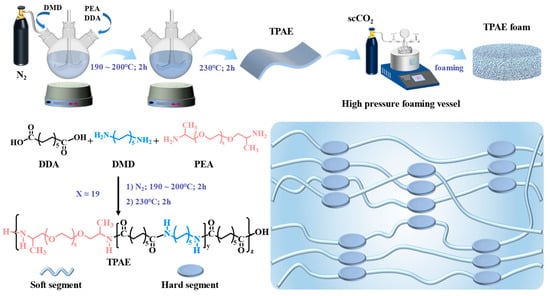
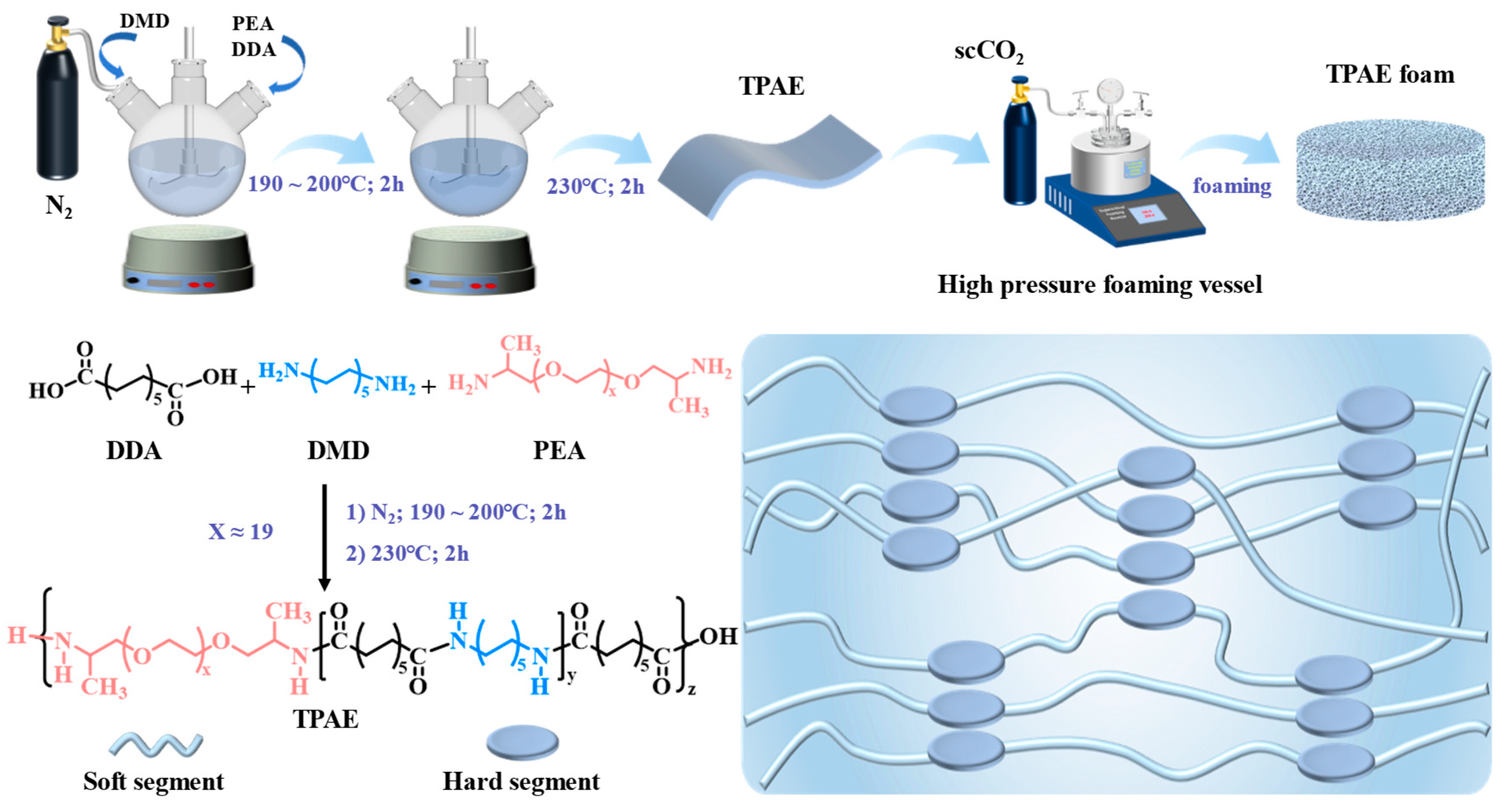
DDA, DMD, PEA, catalyst (H3PO3), and AO-1010 were first added into a polymerization reactor according to the predetermined formulation (Table S1). The reactor was then sealed, and the internal atmosphere was purged with nitrogen (N2). The temperature was raised to 190–200 °C, after which the pressure relief valve was opened to slowly release the internal pressure. The pressure inside the reactor was reduced to atmospheric pressure within 2 h. Subsequently, the reaction was kept at 230 °C for 2 h. Vacuum was then applied, and the reaction was terminated when the stirring speed decreased from its initial value of 90 rpm to 18 rpm. N2 was introduced into the reactor, and the product was discharged through the bottom valve and pelletized. The obtained particles were dried for sample preparation and characterization [37,38].
2.2.2. Preparation of TPAE Foams
The synthesized TPAE samples were subjected to scCO2 foaming. All TPAE samples were subjected to a 15 min CO2 holding treatment at 14 MPa prior to foaming. The same nominal saturation conditions were applied to all samples. Different foaming temperatures were selected to foam the synthesized TPAE pellets. Prior to foaming, the TPAE pellets were prepared with a particle size of 2–3 mm. The entire foaming process consisted of three steps: pressurization, saturation, and depressurization [39]. First, the samples were placed in a small hollow cage made of iron wire to ensure uniform exposure to CO2, and the cage was then placed into a high-pressure autoclave and the lid was tightly closed. When the temperature and pressure reached the set values, CO2 entered its supercritical state. Next, the inlet and outlet valves of the autoclave were closed to maintain a sealed environment, and the samples were held for 15 min to allow sufficient CO2 diffusion [40,41]. Finally, after rapid depressurization, with a pressure drop of at least 8 MPa within the first second and the pressure decreasing to ≤0.5 MPa within 3 s, the autoclave lid was opened to obtain the TPAE foams (Figure 1).
Figure 1.
Synthetic route of samples. The figure was created using Microsoft PowerPoint 2024 (Microsoft Office 2024), Version 2608.
2.3. Characterization
Fourier transform infrared spectroscopy (FT-IR): The infrared spectra of TPAE samples were recorded on a Nicolet iS10 spectrometer (Thermo Fisher Scientific, Waltham, MA, USA) using the attenuated total reflection (ATR) mode over a wavenumber range of 500–4000 cm−1. The TPAE samples were obtained by hot pressing, dried in a vacuum oven, and then placed on the spectrometer for measurement [42].
Nuclear magnetic resonance hydrogen spectroscopy (1H-NMR): The structure of the prepared TPAE samples was further characterized and analyzed using an AV III HD 400 MHz NMR spectrometer (Bruker, Bremen, Germany). For measurement, approximately 1.0 mg of the sample was dissolved in deuterated trifluoroacetic acid (CF3COOD).
Differential scanning calorimetry (DSC): The DSC2500 Differential Scanning Calorimeter produced by TA Instruments (New Castle, DE, USA) was used to conduct the test in a N2 atmosphere, and the test mode was “heating up–cooling down–heating up” to eliminate the thermal history of the synthesized samples, with the temperature range of −80–230 °C, and the rate of heating up/cooling down was 10 °C/min. The experimental data were recorded during the second heating cycle [43].
Dynamic mechanical analysis (DMA): The dynamic mechanical properties of TPAE were tested using the Dynamic Mechanical Analyzer (Tritec 2000, Triton Technology, Cheshire, UK). DMA was performed in tensile mode using a film tension fixture. The specimens were rectangular strips with dimensions of approximately 14 mm × 5 mm × 0.1 mm (length × width × thickness). The temperature scanning was carried out with TPAE samples, a test frequency of 1.0 Hz, a heating rate of 5 °C/min, and a temperature range of −100–140 °C [7].
Rheological tests: Before rheological testing, the TPAE samples were hot-pressed into disks with a diameter of 25 mm and a thickness of 1 mm. Hot-pressing temperature: 210 °C; holding pressure: 10 MPa; holding time: 10 min; cooling time: 20 min. Prior to testing, the samples were dried in an oven at 100 °C for 24 h. The rheological behaviors of the unfoamed samples were characterized using a modular compact rheometer (Discovery HR-3, TA, New Castle, DE, USA), and the measurements were performed under a N2 atmosphere [44]. The frequency sweep tests were conducted over an angular frequency range of 100 to 1 rad·s−1 at a fixed strain amplitude (γ) of 1%, with a constant temperature of 200 °C.
Thermal gravimetric analysis (TGA): The thermal stability of the synthesized TPAE samples was evaluated using a Q50 thermogravimetric analyzer (TA Instruments, New Castle, DE, USA) under N2 atmosphere with a heating rate of 10 °C/min over a temperature range of 30–600 °C.
Mechanical properties: The TPAE specimens were prepared by injection molding under the following conditions: injection temperature: 210 °C, mold temperature: 30 °C, injection pressure: 50 MPa, injection speed: 30%, holding pressure: 35 MPa, holding time: 10 s, cooling time: 1 min. The specimen type was a dumbbell-shaped test piece with a narrow-section length of 33 mm and a width of 6 mm. Furthermore, the tensile properties of the injection-molded specimens were evaluated using a GTM2500 computer-controlled electronic universal testing machine (Xieqiang Instrument Manufacturing (Shanghai) Co., Ltd., Shanghai, China) according to GB/T 1040.2-2022 [45] with a tensile speed of 200 mm/min. The elongation at break was calculated from the crosshead displacement recorded by the universal testing machine relative to the initial gauge length of the specimen. No extensometer was used during the tensile tests.
Scanning electron microscope (SEM): The cellular microstructure of the cross-sections of TPAE foams was observed using a JSM-6060 scanning electron microscope (JEOL Ltd., Tokyo, Japan). All samples were sputter-coated with gold prior to observation [46]. SEM specimens were prepared by cryogenic fracture after immersion in liquid nitrogen and were subsequently sputter-coated with gold prior to observation.
Expansion ratio and void fraction: The density (ρsolid and ρfoam) was calculated from the mass and volume of the unfoamed and foamed samples using a T2-3000A-618 fully automatic electronic densimeter (Shanghai Tianzhi Industrial Co., Ltd., Shanghai, China) based on the water-displacement method, respectively, and the expansion ratio (ER) of the foamed samples was calculated using Equation (1):
ER was brought into Equation (2) to obtain void fraction (VF):
Cell density (Nf) was calculated using Equation (3), where n is the number of cells counted within a selected region of the SEM image, and SA is the corresponding actual area of the selected region (cm2):
Average cell size: The average cell size (Dn) of the foamed samples was calculated using Equation (4), where ni is the number of cells with a diameter of Di quantified from the SEM images using ImageJ software (Version 1.54g):
3. Results and Discussion
3.1. Functional Groups of Synthesized TPAE
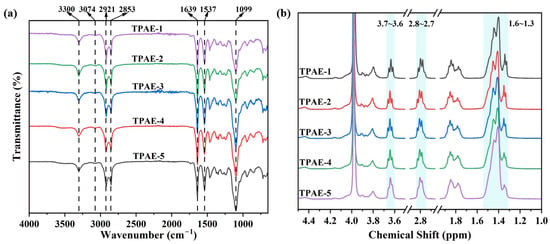
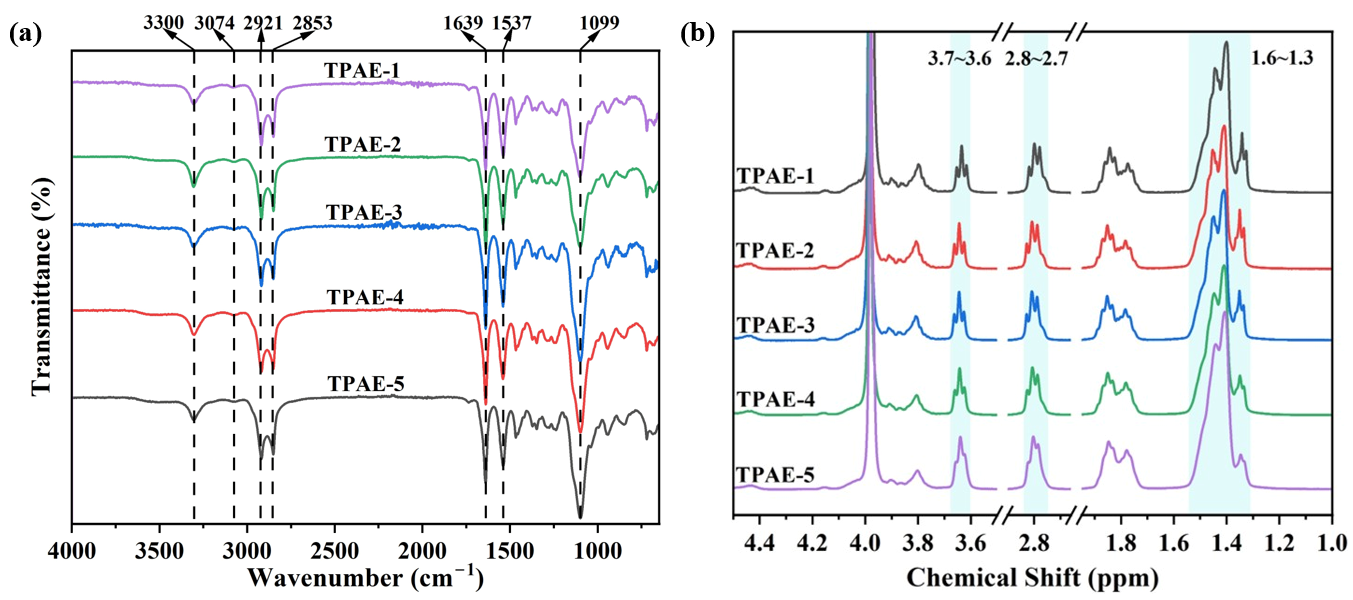
The molecular structures of the samples were characterized by FTIR. Figure 2a presents the FTIR spectra of TPAE, which exhibit largely similar characteristic peaks, indicating identical or analogous chemical backbones. As shown in the figure, the features around 3300 cm−1 and 3074 cm−1 are associated with N-H stretching vibrations and the amide B Fermi resonance, respectively. Additionally, the bands near 2921 cm−1 and 2853 cm−1 are assigned to the asymmetric and symmetric C-H stretching vibrations of aliphatic chains, respectively. The characteristic bands at 1639 cm−1 and 1537 cm−1 are attributed to the C=O stretching vibration (amide I band) and the combined C-N-H bending vibration (amide II band) of the amide linkage, confirming the formation of polyamide hard segments. Furthermore, the peak around 1099 cm−1 corresponds to the asymmetric C-O-C stretching, verifying the successful incorporation of polyether soft segments. According to the literature, all characteristic IR absorption bands of TPAE are in excellent agreement with previously reported data, and the presence of these distinctive bands validates the successful synthesis of the target product. In addition, the chemical structures of the products were comprehensively analyzed by 1H NMR spectroscopy. Figure 2b and Figure S1 display the 1H NMR spectra of TPAE. The resonance at a chemical shift of approximately δ = 11.7 ppm represents the proton signal of the deuterated trifluoroacetic acid (CF3COOD) solvent (Figure S1). As shown in Figure 2b and Table S2, the characteristic peaks at δ = 4.0–3.8 ppm are attributed to the proton signals of methylene groups adjacent to ether oxygen atoms in the PEG soft segments. The peaks at δ = 3.7–3.6 ppm correspond to the methylene protons bonded to nitrogen atoms in the amide groups, while those at δ = 2.8–2.7 ppm are assigned to the methylene protons adjacent to the carbonyl carbon atoms of the amide groups. The peaks at δ = 1.8–1.7 ppm are attributed to the β-methylene protons adjacent to the amide groups, and those at δ = 1.6–1.4 ppm correspond to the proton signals of the long-chain methylene groups in the polyamide hard segments. The remaining chemical shifts are in close agreement with literature data [47]. Collectively, these distinctive signals provide strong evidence for the successful synthesis of TPAE. To correlate molecular structure with foaming behavior, GPC was employed to determine the molecular weights of TPAE-1 to TPAE-5 (Table S3 and S4). The obtained Mn and Mw values span 62,830 to 66,368 g·mol-1 and 110,749 to 115,057 g·mol-1, respectively [48]. Furthermore, XRD patterns of TPAE samples with different hard-segment contents are shown in Figure S2. The results show that all TPAE samples exhibit two characteristic diffraction peaks at 2θ = 20.0° and 23.2°, which are assigned to the α-crystalline phase of the polyamide hard segments. Additionally, the weak feature near 38° is attributed to minor interference during the testing process. Furthermore, the presence of ordered hard-segment domains may contribute to physical associations within the TPAE structure. Collectively, the FTIR, 1H NMR, and XRD results confirm the successful synthesis of TPAEs and reveal composition-dependent differences in the structural organization of the hard segments. These differences may influence intermolecular constraints and provide a structural basis for understanding the thermal transitions and viscoelastic responses discussed below.
Figure 2.
(a) FT-IR spectra and (b) 1H NMR spectra of TPAE-1, TPAE-2, TPAE-3, TPAE-4 and TPAE-5.
3.2. Thermal Properties of Synthesized TPAE
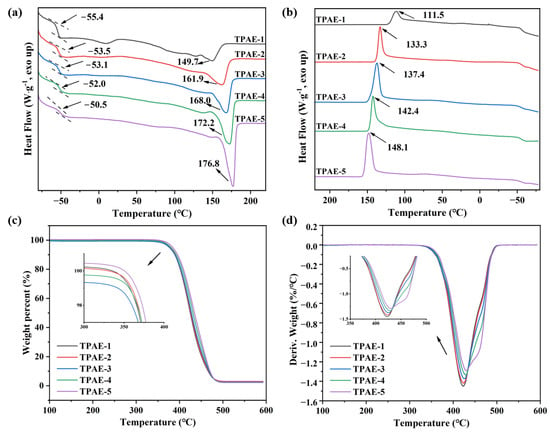
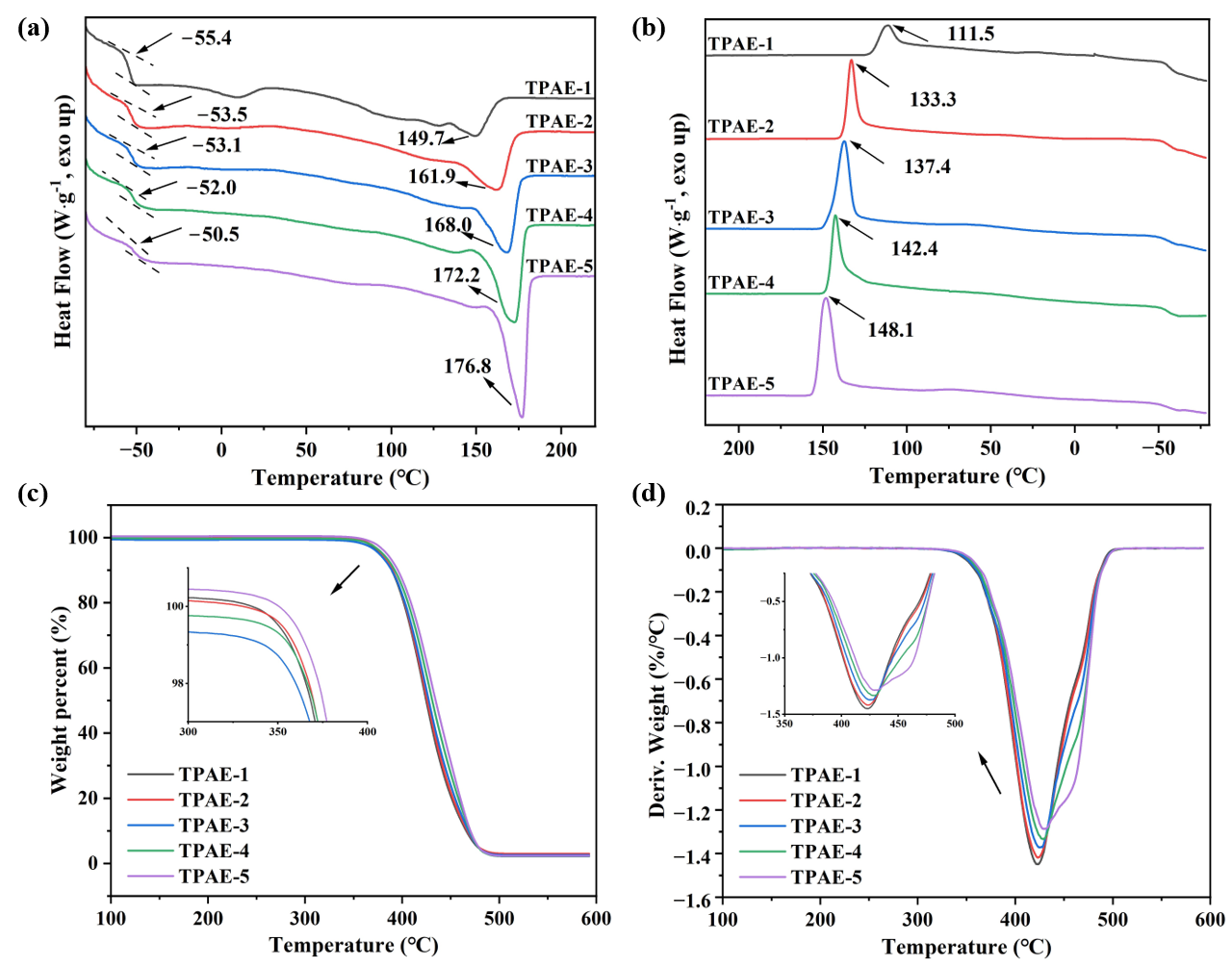
The DSC curves of TPAE are shown in Figure 3, and the DSC data are summarized in Table S5. The glass transition temperatures (Tg) of TPAE-1, TPAE-2, TPAE-3, TPAE-4, and TPAE-5 are approximately −55.4 °C, −53.5 °C, −53.1 °C, −52.0 °C, and −50.5 °C, respectively (Figure 3a). The variation in Tg with hard-segment content indicates changes in the glass-transition behavior of the TPAE samples. Such changes may be associated with differences in the local mobility of the soft segments and their surrounding molecular environments. In addition, the distinct melting endotherms (Tm) shift from 149.7 °C to 176.8 °C, corresponding to the melting of polyamide hard-segment crystallites, which serve as physical crosslinks in the material. During cooling (Figure 3b), the crystallization peaks (Tc) shift from 111.5 °C to 148.1 °C, reflecting a change in the position of the crystallization exotherm under the applied DSC cooling conditions. The melt flow rates (MFR) decreased from TPAE-2 to TPAE-3 and subsequently increased slightly for TPAE-4 and TPAE-5. Furthermore, Figure 3c shows the TG curves of the synthesized TPAE. The temperatures at 5% weight loss (Td,5) for TPAE-1, TPAE-2, TPAE-3, TPAE-4, and TPAE-5 are 378.0 °C, 379.1 °C, 376.2 °C, 376.6 °C, and 384.1 °C, respectively (data summarized in Table S6). Moreover, TPAE-5, with the highest hard-segment content, exhibits the highest Td,5 (384.1 °C), and possesses excellent heat resistance. Overall, all samples exhibit negligible weight loss below 300 °C, demonstrating good thermal stability. Figure 3d shows the DTG curves of the samples. As listed in Table S6, the maximum degradation rate temperatures (Tmax) for TPAE-1, TPAE-2, TPAE-3, TPAE-4, and TPAE-5 are 423.6 °C, 423.1 °C, 425.0 °C, 428.4 °C, and 430.1 °C, respectively. Among all samples, TPAE-2 shows the highest char yield at 600 °C, at 2.9%. The results show that the DTG curves display only a single degradation peak, and all TPAE samples exhibit a typical one-step main weight loss behavior under N2, with their thermal degradation dominated by random main-chain scission. The molecular composition and thermal characteristics provide the basis for understanding the temperature-dependent mobility of the TPAE chains. However, the implications of these structural features for foaming cannot be established from thermal transitions alone. Therefore, the dynamic mechanical and rheological responses were further examined to assess how hard-segment regulation affects the viscoelastic behavior relevant to cell growth and stabilization.
Figure 3.
(a) DSC 2nd heating thermograms and (b) cooling thermograms; (c) TG and (d) DTG curves of TPAE-1, TPAE-2, TPAE-3, TPAE-4, and TPAE-5.
3.3. Mechanical Properties of Synthesized TPAE
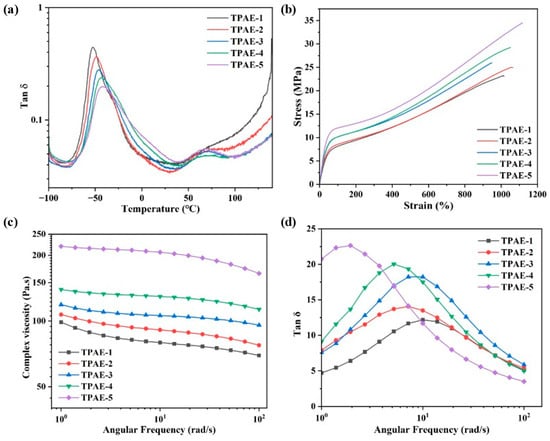
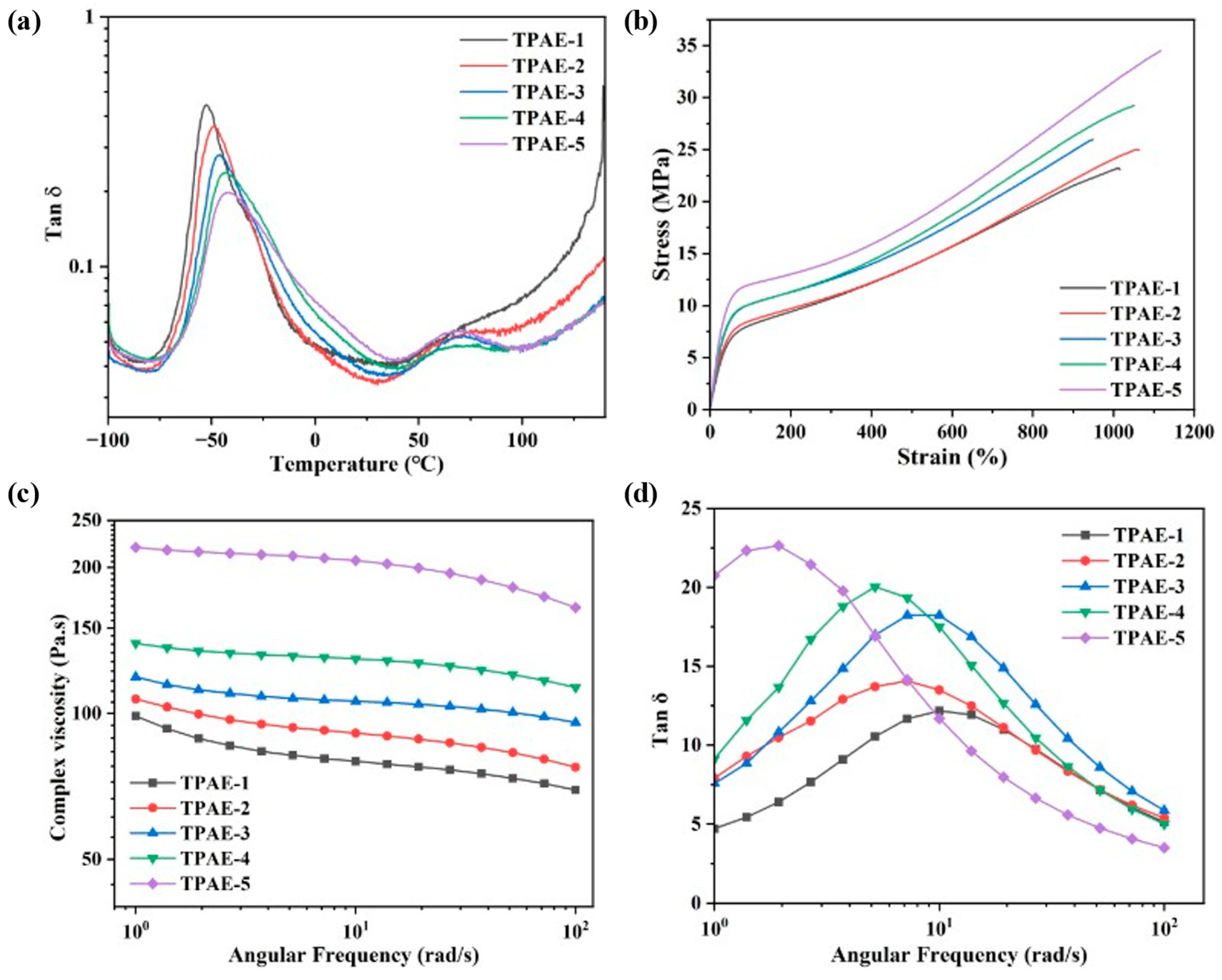
The viscoelastic and mechanical properties of TPAE were investigated by DMA, tensile tests, and oscillatory rheology. The DMA temperature sweep (Figure 4a) shows a distinct tanδ peak around −50 °C for all samples, corresponding to the glass transition of the polyether soft segments, which is consistent with the DSC results (Figure 3). With increasing hard-segment content, the tanδ peak intensity of TPAE gradually decreases, reflecting the enhanced restriction imposed by the increasing hard-segment content. As shown in Figure 4b and Table S7, the mechanical testing results indicate that the tensile strengths of TPAE-1, TPAE-2, TPAE-3, TPAE-4, and TPAE-5 are 23 MPa, 25 MPa, 26 MPa, 29 MPa, and 35 MPa, respectively; the elongations at break are 1016%, 1064%, 949%, 1050%, and 1117%, respectively. Therefore, the tensile strength of the TPAE samples increases overall from 23 MPa for TPAE-1 to 35 MPa for TPAE-5, indicating an improvement in tensile load-bearing capacity across the investigated compositions. In contrast, the elongation at break exhibits a non-monotonic variation, ranging from 949% to 1117%. This behavior reflects the combined effects of hard-segment-mediated intermolecular interactions and structural constraints, which enhance tensile load-bearing capacity, and flexible polyether segments, which accommodate deformation. Thus, the tensile properties are governed by the balance between hard-segment reinforcement and soft-segment mobility. The melt rheological dynamics of the system were studied by dynamic rotational rheology (Figure 4c,d and Figure S3). The complex viscosity decreases with increasing angular frequency, indicating shear-thinning behavior, while the high tanδ values suggest a predominantly viscous response under the measurement conditions (Figure 4c,d and Figure S3). These rheological characteristics reflect the deformation resistance of TPAE melts and are relevant to cell-wall stabilization during scCO2 foaming. However, foam expansion also requires sufficient molecular mobility. Therefore, the foaming behavior was further examined to assess the balance between melt viscoelastic resistance and chain mobility [49,50,51].
Figure 4.
(a) Loss tangent (tanδ) curves of the samples obtained from DMA; (b) stress–strain curves; dynamic rheological properties of the samples: (c) complex viscosity (η*) and (d) tanδ curves.
3.4. Foaming Behavior of Synthesized TPAE
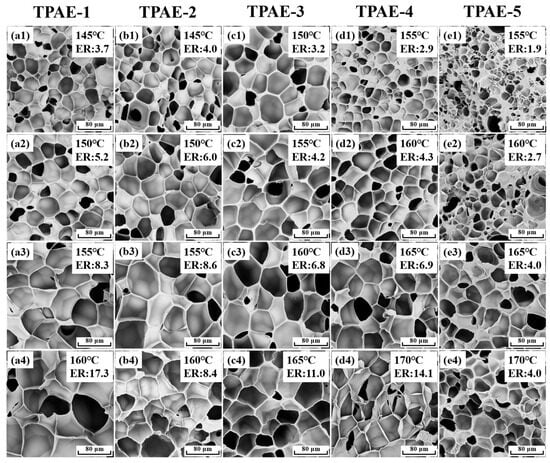
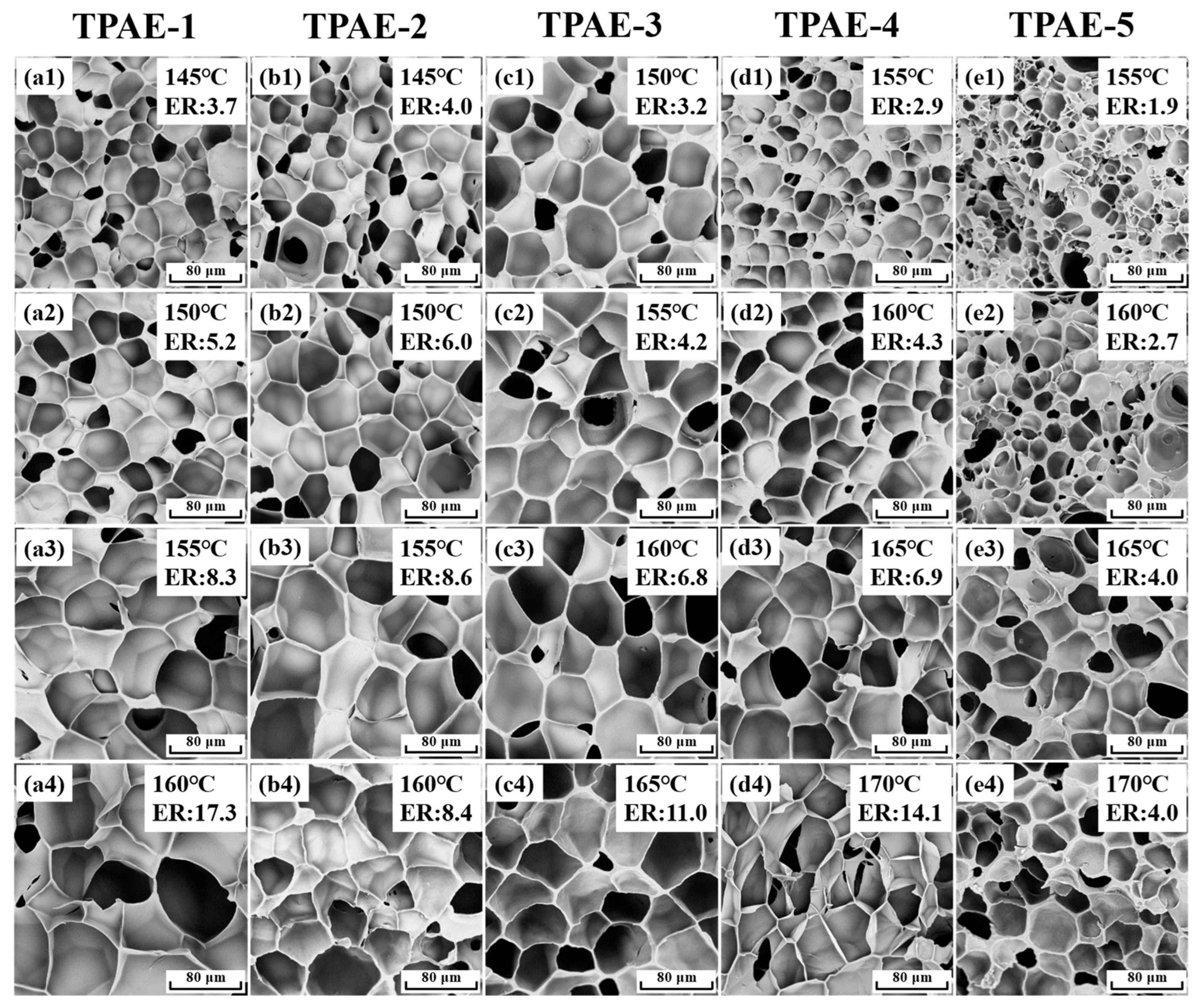
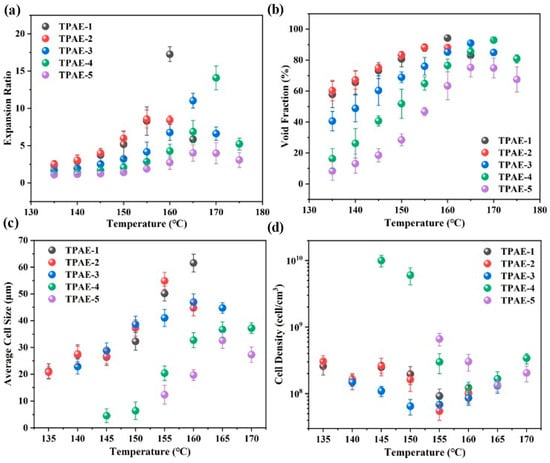
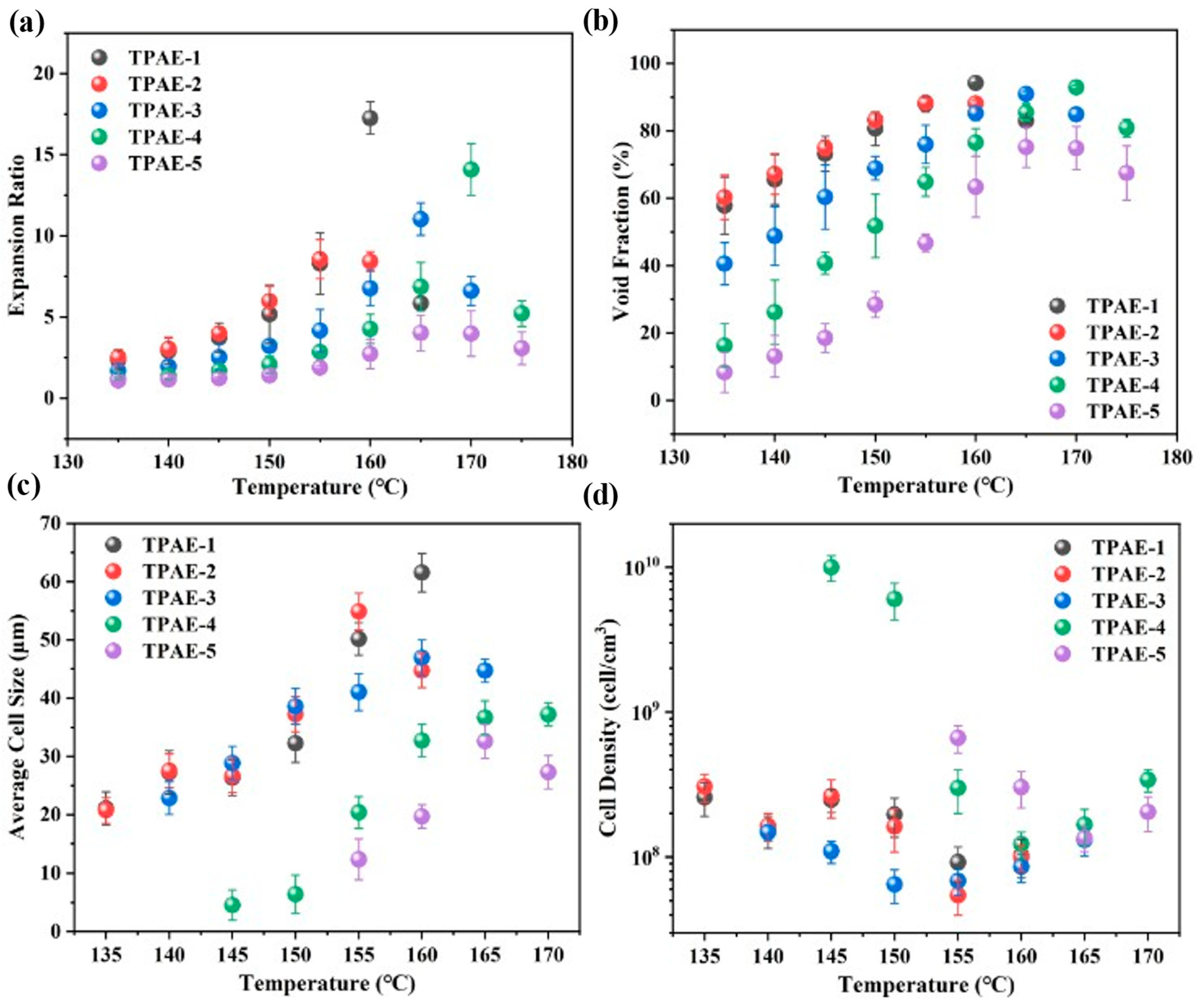
TPAE foams were fabricated using supercritical fluid foaming technology, and the evolution of cellular morphology with hard-segment content and foaming temperature was investigated. Figure 5 shows the cell morphology characteristics of TPAE-1, TPAE-2, TPAE-3, TPAE-4, and TPAE-5 foams at different foaming temperatures. Figure 6a–d and Tables S8–S10 present the expansion ratio (ER), void fraction (VF), average cell size (Dn), and cell density (Nf) of the samples at different foaming temperatures, respectively. The mechanical properties, melt rheology, and foaming behavior of TPAE are closely interrelated. Hard-segment content can modify chain packing and intermolecular constraints, thereby influencing solid-state stress transfer and melt viscoelasticity. These effects govern the balance between mechanical reinforcement, elastic support, and molecular mobility during foaming. At the respective foaming temperatures, all samples were processed under a nominal CO2 pressure of 14 MPa and a holding time of 15 min. The ER of TPAE-1 with 40 wt.% hard-segment content (reaching up to ~17.3-fold at 160 °C) is significantly higher than that of TPAE-5 with 60 wt.% hard-segment content (1.1–4.0 folds). A comparison between TPAE-4 and TPAE-5 at 170 °C highlights the trade-off between melt viscoelasticity and foam expansion. Despite its higher complex viscosity, TPAE-5 exhibits a lower expansion ratio (4.0) than TPAE-4 (14.1), indicating that higher melt viscosity does not necessarily promote greater expansion. This behavior reflects the balance between viscoelastic resistance, which helps stabilize cell walls, and molecular mobility, which facilitates bubble growth. Moreover, ER and VF characterize overall volumetric expansion, whereas Dn and Nf describe cellular morphology. These parameters provide complementary information and should therefore be considered collectively when evaluating foaming performance. SEM results show that the cell morphology of TPAE foam varies with composition and foaming temperature. It is worth noting that the morphological observations are interpreted qualitatively rather than as evidence of a quantitatively verified suppression mechanism. The composition-dependent foaming behavior reflects the interplay between molecular constraints, viscoelastic relaxation, and cell-wall stability. Achieving a balance between melt elasticity and chain mobility is therefore essential for obtaining highly expanded foams with uniform and stable cellular structures. Rather than identifying a universally optimal formulation, this study highlights the trade-offs associated with hard-segment regulation and demonstrates that foaming performance depends on both material composition and processing conditions [52,53].
Figure 5.
SEMmicrographs of the cellular structure of TPAE foams prepared at different foaming temperatures. The column labels denote TPAE-1, TPAE-2, TPAE-3, TPAE-4, and TPAE-5, respectively; the row labels (1–4) denote the foaming temperature, increasing from top to bottom. (a1–e1) Foamed at 145, 145, 150, 155, and 155 °C, with expansion ratios (ER) of 3.7, 4.0, 3.2, 2.9, and 1.9, respectively; (a2–e2) at 150, 150, 155, 160, and 160 °C, with ER of 5.2, 6.0, 4.2, 4.3, and 2.7, respectively; (a3–e3) at 155, 155, 160, 165, and 165 °C, with ER of 8.3, 8.6, 6.8, 6.9, and 4.0, respectively; (a4–e4) at 160, 160, 165, 170, and 170 °C, with ER of 17.3, 8.4, 11.0, 14.1, and 4.0, respectively.
Figure 6.
(a) Expansion ratio, (b) void fraction, (c) average cell size and (d) cell density of foam samples at various foaming temperatures.
4. Conclusions
In this study, the hard-segment content of TPAEs was regulated to investigate its effects on molecular structure, mechanical properties, melt viscoelasticity, and scCO2 foaming behavior. The results indicate that the TPAE exhibits a tensile strength of 35 MPa and an exceptional elongation at break of 1117%. TPAE-1 with a low hard-segment content achieves a high expansion ratio of approximately 17.3-fold at 160 °C, demonstrating excellent cell growth capability. Therefore, the differences in cell morphology with changes in composition and temperature, as well as the foaming behavior of TPAEs and the resulting cell morphology, largely depend on the formulation and processing temperature. These findings provide insights into the composition- and temperature-dependent relationships among mechanical properties, melt viscoelastic behavior, and cellular morphology in TPAEs, offering guidance for tailoring the properties and cellular structures of TPAE foams under the investigated scCO2 foaming conditions. Despite these findings, several limitations should be acknowledged. The foaming experiments were conducted at a single CO2 saturation pressure (14 MPa), the rheological measurements were performed only at 200 °C rather than across the actual foaming temperature range (145–170 °C), and the CO2-induced depression of the Tm was not directly measured. Future work will address these limitations by examining different saturation pressures, conducting rheological measurements at foaming-relevant temperatures, and directly characterizing the effect of CO2 on melting behavior.
Supplementary Materials
The following supporting information can be downloaded at: https://www.mdpi.com/article/10.3390/polym18232987/s1, Figure S1: 1H NMR spectra of the samples. Figure S2: XRD spectra of samples [54,55,56]. Figure S3: DMA and rheological curves of TPAE. Table S1: Ratios of the synthetic raw materials for the samples. Table S2: Peak areas and relative contents of different methylene groups in TPAE samples. Table S3: Molecular weight characteristics and polydispersity indices of TPAE samples determined by GPC. Table S4: Molecular weight characteristics of PMMA standards used for GPC calibration. Table S5: DSC data and melt flow rates of samples. Table S6: TGA data of samples. Table S7: Mechanical characteristics of samples. Table S8: Cellular structural parameters of foam samples at various foaming temperature. Table S9: Effects of holding time on the apparent density and expansion ratio of TPAE samples at 160 °C and 14 MPa. Table S10: Effects of holding time on the apparent density and expansion ratio of TPAE samples at 170 °C and 14 MPa.
Author Contributions
Conceptualization, G.L.; Methodology, P.G. and Q.L.; Software, Y.L. (Yajie Lei); Validation, P.G.; Formal Analysis, G.L.; Investigation, Y.L. (Yajie Lei) and Q.L.; Resources, Q.L.; Data Curation, Y.L. (Yonglei Liu) and R.Z.; Writing—Original Draft, R.Z.; Writing—Review & Editing, Y.L. (Yonglei Liu); Visualization, G.L.; Supervision, P.G.; Project Administration, Y.L. (Yonglei Liu); Funding Acquisition, Q.L. All authors have read and agreed to the published version of the manuscript.
Funding
This research was funded by the National Natural Science Foundation (No. U2230202, 52473038 and 52073187), Sichuan Science and Technology Program (2024ZHCG0198 and 2025JDRC0014), National Natural Science Foundation for the Youth of China (No. 52403013), and State Key Laboratory of Advanced Polymer Materials (No. sklpme2025-1-03).
Data Availability Statement
The data supporting the findings of this study are available within the article and its Supplementary Materials.
Acknowledgments
The authors are grateful to the National Natural Science Foundation (No. U2230202, 52473038 and 52073187) and the support from Sichuan Science and Technology Program (2024ZHCG0198 and 2025JDRC0014) for their financial support of this project. We are also thankful for the support from the National Natural Science Foundation for the Youth of China (No. 52403013) and State Key Laboratory of Advanced Polymer Materials (No. sklpme2025-1-03).
Conflicts of Interest
Author Rongli Zhu was employed by the company Zigong Zhongtiansheng New Material Technology Co., Ltd. The remaining authors declare that the research was conducted in the absence of any commercial or financial relationships that could be construed as a potential conflict of interest.
References
- Amirkhosravi, M.; Yue, L.; Ju, T.X.; Manas-Zloczower, I. Designing thermal annealing to control mechanical performance of thermoplastic polyurethane elastomers. Polymer 2021, 214, 123254–123261. [Google Scholar] [CrossRef] [Scilit]
- Cortazar-Noguerol, J.; Cortés, F.; Sarría, I.; Elejabarrieta, M.J. Preload Influence on the Dynamic Properties of a Polyurethane Elastomeric Foam. Polymers 2024, 16, 1844. [Google Scholar] [CrossRef] [Scilit]
- Chen, Z.X.; Ma, H.R.; Li, Y.X.; Meng, J.J.; Yao, Y.W.; Yao, C. Biomass polyamide elastomers based on hydrogen bonds with rapid self-healing properties. Eur. Polym. J. 2020, 133, 109802–109810. [Google Scholar] [CrossRef] [Scilit]
- Chen, J.; Gong, C.H.; Yang, C.; Yi, C.W. Flexible preparation of polyamide-6 based thermoplastic elastomers via amide exchange. J. Mater. Sci. 2021, 56, 12018–12029. [Google Scholar] [CrossRef] [Scilit]
- Wang, S.Q.; Chen, J.L.; Zhang, Q.L.; Wang, J.W.; Tao, Y.H. Facile Synthesis of Biobased, Low-Melting-Point Thermoplastic Polyamide Elastomer with Intrinsic Antibacterial Properties. Biomacromolecules 2026, 27, 2668–2675. [Google Scholar] [CrossRef] [Scilit]
- Choi, M.C.; Jung, J.Y.; Chang, Y.W. Shape memory thermoplastic elastomer from maleated polyolefin elastomer and nylon 12 blends. Polym. Bull. 2013, 71, 625–635. [Google Scholar] [CrossRef] [Scilit]
- Fu, X.B.; Zhang, T.; Yang, J.C.; Zhang, G.; Zhang, M.L.; Wang, X.J.; Yang, J. Structures and properties of newly synthesized semi-aromatic polyamide thermoplastic elastomers. Polym. Chem. 2022, 13, 4980–4991. [Google Scholar] [CrossRef] [Scilit]
- Huang, G.T.; Li, S.Y.; Li, Y.C.; Wu, X.; Feng, X.X.; Gui, Y.; Deng, J.P.; Wang, C.; Pan, K. Preparation and characterization of microcellular foamed thermoplastic polyamide elastomer composite consisting of EVA/TPAE1012. J. Appl. Polym. Sci. 2021, 138, 50952–50965. [Google Scholar] [CrossRef] [Scilit]
- Wang, X.Y.; Yang, Z.H.; Zhang, Y.M.; Wang, T.M.; Li, S.; Wang, Q.H.; Zhang, X.R. Syncretic of soft, hard, and rigid segments cultivate high-performance elastomer. Chem. Eng. J. 2024, 495, 153466–153475. [Google Scholar] [CrossRef] [Scilit]
- Zhang, X.X.; Wang, L.P.; Zhang, K.Q.; Zhou, K.Y.; Hou, K.Y.; Zhao, Z.X.; Li, G.L.; Yao, Q.; Sun, N.; Wang, X. Hybrid Soft Segments Boost the Development of Ultratough Thermoplastic Elastomers with Tunable Hardness. Adv. Mater. 2025, 37, 2414720–2414735. [Google Scholar] [CrossRef] [Scilit]
- Yao, Y.Q.; Jiang, J.; Zhang, B.Y.; Li, J.J.; Zhao, L.; Xi, Z.H. Biobased Polyamide Elastomers Engineered by Chain Entanglement for Superior Elasticity: Enabling Flexible Sensing via Tailored Interface Percolation Networks. ACS Sustain. Chem. Eng. 2026, 14, 5471–5486. [Google Scholar] [CrossRef] [Scilit]
- Cristiani, T.R.; Filippidi, E.; Behrens, R.L.; Valentine, M.T.; Eisenbach, C.D. Tailoring the Toughness of Elastomers by Incorporating Ionic Cross-Linking. Macromolecules 2020, 53, 4099–4109. [Google Scholar] [CrossRef] [Scilit]
- Liu, Y.N.; Liu, H.M.; Wang, Y.Q.; Sun, Y.B.; Chen, S.H.; Wang, X.D. Synergistic Toughening and Microcellular Foaming Properties of LCBPP with Oriented Elastomer Fibers and β-Nucleating Agents. ACS Appl. Polym. Mater. 2025, 7, 8421–8431. [Google Scholar] [CrossRef] [Scilit]
- Shao, Y.; Luo, C.; Deng, B.W.; Yin, B.; Yang, M.B. Flexible porous silicone rubber-nanofiber nanocomposites generated by supercritical carbon dioxide foaming for harvesting mechanical energy. Nano Energy 2020, 67, 104290–104296. [Google Scholar] [CrossRef] [Scilit]
- Kang, X.; Mao, L.H.; Shi, J.W.; Liu, Y.B.; Zhai, B.J.; Xu, J.; Jiang, Y.Z.; Lichtfouse, E.; Jin, H.; Guo, L.J. Supercritical carbon dioxide systems for sustainable and efficient dissolution of solutes: A review. Environ. Chem. Lett. 2024, 22, 815–839. [Google Scholar] [CrossRef] [Scilit]
- Fan, Z.Z.; Wang, B.; Zhao, Y.S.; Xu, R.Y.; Zhang, L.; Li, G.X.; Liao, X. Design of thermal conductive porous elastomer via supercritical CO2 foaming-assisted BN alignment. Compos. Sci. Technol. 2025, 270, 111275–111283. [Google Scholar] [CrossRef] [Scilit]
- Chen, P.; Chen, S.; Hu, N.N.; Zhu, W.D.; Wu, J.M.; Geng, L.H.; Peng, X.F. Improved Foaming Performance of Thermoplastic Polyether Amide Elastomers via Chain Extension: Toward Self-Powered Intelligent Footwear. Adv. Eng. Mater. 2025, 27, 2403005–2403015. [Google Scholar] [CrossRef] [Scilit]
- Lin, W.Y.; Ohshima, M. Stretching-induced foaming of gas-laden thermoplastic elastomers. Polymer 2023, 270, 125785–125792. [Google Scholar] [CrossRef] [Scilit]
- Ma, Y.F.; Wen, H.; Xin, C.L.; He, Y.D. Chain extension of thermoplastic polyamide elastomer and its foaming performance. J. Appl. Polym. Sci. 2022, 139, 52233–52243. [Google Scholar] [CrossRef] [Scilit]
- Sheth, J.P.; Xu, J.N.; Wilkes, G.L. Solid state structure-property behavior of semicrystalline poly(ether-block-amide) PEBAX® thermoplastic elastomers. Polymer 2003, 44, 743–756. [Google Scholar] [CrossRef] [Scilit]
- Fan, D.L.; Shi, Z.Y.; Li, N.X.; Qiu, J.; Xing, H.P.; Jiang, Z.W.; Li, M.G.; Tang, T. Novel Method for Preparing a High-Performance Auxetic Foam Directly from Polymer Resin by a One-Pot CO2 Foaming Process. ACS Appl. Mater. Interfaces 2020, 12, 48040–48048. [Google Scholar] [CrossRef] [Scilit]
- Tong, X.; Peng, W.M.; Zhang, M.L.; Wang, X.J.; Zhang, G.; Long, S.R.; Yang, J. A new class of poly(ether-block-amide)s based on semi-aromatic polyamide: Synthesis, characterization and structure-property relations. Polym. Int. 2021, 70, 230–241. [Google Scholar] [CrossRef] [Scilit]
- Tong, X.; Wang, Z.; Zhang, M.L.; Wang, X.J.; Zhang, G.; Long, S.R.; Yang, J. Synthesis, Characterization and Non-Isothermal Crystallization Kinetics of a New Family of Poly (Ether-Block-Amide)s Based on Nylon 10T/10I. Polymers 2021, 13, 72. [Google Scholar] [CrossRef] [Scilit]
- Wei, F.; Fan, X.D.; Li, R.L.; Jin, Z.W.; Zhou, T. Characterizations and Properties of POM Toughened by Thermoplastic Polyamide Elastomer. Polym. Sci. Ser. A 2021, 63, 275–282. [Google Scholar] [CrossRef] [Scilit]
- Wu, J.L.; Wang, H.H.; Li, W.Q.; Zhang, Y.C.; Zhao, W.; Li, X.; Zhang, X.M.; Cui, Z.; Fu, P.; Pang, X.C.; et al. Smart transparent polyamide elastomer for protective coating. Prog. Org. Coat. 2025, 204, 109257–109266. [Google Scholar] [CrossRef] [Scilit]
- Wu, M.; Yuan, L.; Jiang, F.; Zhang, Y.Q.; He, Y.R.; You, Y.Z.; Tang, C.B.; Wang, Z.K. Strong Autonomic Self-Healing Biobased Polyamide Elastomers. Chem. Mater. 2020, 32, 8325–8332. [Google Scholar] [CrossRef] [Scilit]
- Paran, S.M.R.; Naderi, G.; Ghoreishy, M.H.R.; Dubois, C. Essential work of fracture and failure mechanisms in dynamically vulcanized thermoplastic elastomer nanocomposites based on PA6/NBR/XNBR-grafted HNTs. Eng. Fract. Mech. 2018, 200, 251–262. [Google Scholar] [CrossRef] [Scilit]
- Baeza, G.P.; Sharma, A.; Louhichi, A.; Imperiali, L.; Appel, W.P.J.; Fitié, C.F.C.; Lettinga, M.P.; Van Ruymbeke, E.; Vlassopoulos, D. Multiscale organization of thermoplastic elastomers with varying content of hard segments. Polymer 2016, 107, 89–101. [Google Scholar] [CrossRef] [Scilit]
- Kamal, T.; Park, S.Y.; Park, J.H.; Chang, Y.W. Structural evolution of poly(ether-b-amide12) elastomers during the uniaxial stretching: An in situ wide-angle X-ray scattering study. Macromol. Res. 2012, 20, 725–731. [Google Scholar] [CrossRef] [Scilit]
- Yuan, R.C.; Wang, X.L.; Yu, J.Y.; Wu, D.Q.; Li, F.X. Phase Evolution of Polyamide 6 (PA6)-Based Thermoplastic Elastomers during Heating and Cooling Investigated by Moving-Window 2D Correlation Infrared Spectroscopy. Macromol. Mater. Eng. 2020, 305, 2000440–2000451. [Google Scholar] [CrossRef] [Scilit]
- Hou, G.Y.; Zhou, X.L.; Li, S.; Jiang, R.F.; Zhang, Z.Y.; Dong, M.J.; Liu, J.; Lu, Y.L.; Wang, W.C.; Zhang, L.Q.; et al. Exploiting Synergistic Experimental and Computational Approaches to Design and Fabricate High-Performance Elastomer. Macromolecules 2020, 53, 6452–6460. [Google Scholar] [CrossRef] [Scilit]
- Ma, Y.F.; Zhai, Y.J.; Zhao, Y.Y.; Xin, C.L.; He, Y.D. Effect of calcium silicate on foaming and anti-shrinkage behavior of thermoplastic polyamide elastomers: Revelation of the open-cell mechanism. J. Appl. Polym. Sci. 2024, 141, 56161–56173. [Google Scholar] [CrossRef] [Scilit]
- Mahmud, M.B.; Anstey, A.; Shaayegan, V.; Lee, P.C.; Park, C.B. Enhancing the mechanical performance of PA6 based composites by altering their crystallization and rheological behavior via in-situ generated PPS nanofibrils. Compos. Part B 2020, 195, 108067–108077. [Google Scholar] [CrossRef] [Scilit]
- Zheng, H.; Guo, G.L.; Pei, X.Q.; Huang, P.K.; Liu, X.L.; Zheng, W.G. Customized Multimodal Cellular Elastomer Foams through Presetting Cells before CO2 Foaming. ACS Appl. Polym. Mater. 2024, 6, 3003–3014. [Google Scholar] [CrossRef] [Scilit]
- Kajita, T.; Noro, A.; Matsushita, Y. Design and properties of supramolecular elastomers. Polymer 2017, 128, 297–310. [Google Scholar] [CrossRef] [Scilit]
- Tian, X.; Zheng, X.; Li, Z.L.; Wang, X.D.; Chen, S.H. High Compressive Strength Branched Polyamide 11 Foams: Reinforcement Effect of Nylon Elastomer and Structural Optimization. J. Appl. Polym. Sci. 2026, 143, 70473–70482. [Google Scholar] [CrossRef] [Scilit]
- Li, X.P.; Lai, J.; Wei, J.D.; Peng, X.F.; Wu, J.M.; Geng, L.H. Structure and morphology of thermoplastic polyamide 6 elastomers with different soft segment content and their foaming behavior using supercritical CO2. Polym. Eng. Sci. 2022, 62, 103–115. [Google Scholar] [CrossRef] [Scilit]
- Jiang, J.; Tang, Q.Y.; Pan, X.; Li, J.J.; Zhao, L.; Xi, Z.H.; Yuan, W.K. Facile Synthesis of Thermoplastic Polyamide Elastomers Based on Amorphous Polyetheramine with Damping Performance. Polymers 2021, 13, 2645. [Google Scholar] [CrossRef] [Scilit]
- Zhai, Y.J.; Zhao, Y.Y.; Ma, Y.F.; Zhang, J.; Yang, Y.X.; Deng, X.L.; Xin, C.L.; He, Y.D. Low-Shrinkage Thermoplastic Polyamide Elastomer Foam Prepared by Microcellular Foaming With CO2 and N2 Co-Blowing Agent. J. Appl. Polym. Sci. 2025, 142, 56987–57000. [Google Scholar] [CrossRef] [Scilit]
- Yen, H.C.; Mao, H.I.; Chang, Y.Y.; Chan, T.H.; Lin, W.H.; Chen, C.W. Influence of Branch Side-Chains on the Foaming Properties of Thermoplastic Polyether Ester Elastomers in Supercritical CO2. J. Appl. Polym. Sci. 2025, 142, 56828–56838. [Google Scholar] [CrossRef] [Scilit]
- Kong, H.J.; Lee, S.H.; Kim, D.G.; Kim, H.J.; Park, G.W.; Hyun, K. Investigation of thermoplastic elastomer (TPE) foaming process using blowing agent by rheological and morphological methods. J. Appl. Polym. Sci. 2018, 136, 47358–47370. [Google Scholar] [CrossRef] [Scilit]
- Qiu, C.; Zhu, P.; Dong, X.; Wang, D.J. Supercritical foaming of novel poly(ether-b-amide) elastomer and compression property characterization. J. Appl. Polym. Sci. 2024, 141, 55455–55469. [Google Scholar] [CrossRef] [Scilit]
- Yuan, R.C.; Fan, S.; Wu, D.Q.; Wang, X.L.; Yu, J.Y.; Chen, L.J.; Li, F.X. Facile synthesis of polyamide 6 (PA6)-based thermoplastic elastomers with a well-defined microphase separation structure by melt polymerization. Polym. Chem. 2018, 9, 1327–1336. [Google Scholar] [CrossRef] [Scilit]
- Isik-Gulsac, I.; Yilmazer, U.; Bayram, G. Mechanical and rheological properties, and morphology of polyamide-6/organoclay/elastomer nanocomposites. J. Appl. Polym. Sci. 2012, 125, 4060–4073. [Google Scholar] [CrossRef] [Scilit]
- Standard’s GB/T 1040.2-2022; Plastics—Determination of tensile properties—Part 2: Test conditions for moulding and extrusion plastics. Standards Press of China: Beijing, China, 2022.
- Lee, Y.H.; Lee, C.W.; Chou, C.H.; Lin, C.H.; Chen, Y.H.; Chen, C.W.; Way, T.F.; Rwei, S.P. Sustainable polyamide elastomers from a bio-based dimer diamine for fabricating highly expanded and facilely recyclable microcellular foams via supercritical CO2 foaming. Eur. Polym. J. 2021, 160, 110765–110779. [Google Scholar] [CrossRef] [Scilit]
- Zhou, X.J.; Wang, Y.Q.; Zhang, J.; Wang, G.Q.; Liu, Y.T.; Gao, C.H. Preparation and properties of flame retardant biobased polyamide elastomer with shape memory. Polym. Adv. Technol. 2023, 34, 1381–1392. [Google Scholar] [CrossRef] [Scilit]
- Zhong, W.P.; Zhou, X.; Zhang, M.M.; Cui, W.H.; Mi, H.Y.; Dong, B.B.; Liu, C.T.; Shen, C.Y. Wrinkled thermoplastic polyamide elastomer foams with enhanced mechanical properties fabricated by dynamic supercritical CO2 foaming. Polym. Eng. Sci. 2024, 65, 834–845. [Google Scholar] [CrossRef] [Scilit]
- Ding, Z.Y.; Tang, Z.H.; An, X.L.; Guo, B.C. Mechanical and rheological properties of poly(lactic acid) toughened by bio-based thermoplastic polyamide elastomer. Polym. Eng. Sci. 2025, 65, 3662–3672. [Google Scholar] [CrossRef] [Scilit]
- Mishra, V.S.; K.Tiwari, K.A.; Naik, R.S.; Chakraborty, B.C.; Thakur, D.S.; Ratna, D. Studies on mechanical, thermal, rheological and impact properties of polyamide 6 and thermoplastic copoly(ether-ester) elastomer blends. J. Macromol. Sci. Part A 2024, 61, 885–896. [Google Scholar] [CrossRef] [Scilit]
- Lei, Y.; Li, C.B.; Fu, X.W.; Lei, J.X.; Zhou, C.L. Synthesis and characterization of a high performance polyamide-6 elastomer based on poly(ether-block-amide) multiblock copolymer by reactive processing in torque rheometer. Adv. Polym. Technol. 2017, 37, 1782–1789. [Google Scholar] [CrossRef] [Scilit]
- Huang, W.Z.; Yu, L.L.; Yu, Z.; Yang, L.J.; Wen, S.B.; Zhang, Z.X. Lightweight Antistatic Thermoplastic Elastomer Blend Foam: The Foaming Behavior and Mechanical Properties. ACS Appl. Polym. Mater. 2023, 5, 4288–4295. [Google Scholar] [CrossRef] [Scilit]
- Lai, J.; Huang, F.; Huang, A.; Liu, T.; Peng, X.F.; Wu, J.M.; Geng, L.H. Foaming behavior of polyamide 1212 elastomers/polyurethane composites with improved melt strength and interfacial compatibility via chain extension. Polym. Eng. Sci. 2023, 63, 1082–1093. [Google Scholar] [CrossRef] [Scilit]
- Zhao, Y.Y.; Zheng, J.X.; Guo, P.; Wang, C.X.; Guo, M.H.; Xin, C.L.; He, Y.D. Study on Chain Extension Blending Modification and Foaming Behavior of Thermoplastic Polyamide Elastomer. ACS Omega 2023, 8, 9832–9842. [Google Scholar] [CrossRef] [Scilit]
- Xu, Z.R.; Wang, G.L.; Zhao, J.C.; Zhang, A.M.; Dong, G.W.; Zhao, G.Q. Anti-shrinkage, high-elastic, and strong thermoplastic polyester elastomer foams fabricated by microcellular foaming with CO2 & N2 as blowing agents. J. CO2 Util. 2022, 62, 102076–102085. [Google Scholar] [CrossRef] [Scilit]
- Yu, C.T.; Lai, C.C.; Wang, F.M.; Liu, L.C.; Liang, W.C.; Wu, C.L.; Chiu, J.C.; Liu, H.C.; Hsiao, H.T.; Chen, C.M. Fabrication of thermoplastic polyurethane (TPU)/thermoplastic amide elastomer (TPAE) composite foams with supercritical carbon dioxide and their mechanical properties. J. Manuf. Process. 2019, 48, 127–136. [Google Scholar] [CrossRef] [Scilit]
Disclaimer/Publisher’s Note: The statements, opinions and data contained in all publications are solely those of the individual author(s) and contributor(s) and not of MDPI and/or the editor(s). MDPI and/or the editor(s) disclaim responsibility for any injury to people or property resulting from any ideas, methods, instructions or products referred to in the content. |
© 2026 by the authors. Licensee MDPI, Basel, Switzerland. This article is an open access article distributed under the terms and conditions of the Creative Commons Attribution (CC BY) license.