


Abstract
Binuclear α-diimine nickel catalysts have attracted significant interest in ethylene polymerization due to their distinctive metal–metal cooperativity, which enables catalytic properties not achievable with mononuclear systems. This review summarizes the structural design principles and recent advances of these binuclear catalysts, with an emphasis on how different bridging architectures such as rigid aryl, flexible chain, N-heterocyclic, and specialty bridges regulate intermetallic distance, steric environment, and electronic effects. The impact of these structural factors on catalytic activity, polymer molecular weight, branching density, and mechanical properties is discussed. By establishing structure–performance relationships, this review provides a foundation for the rational design of binuclear nickel catalysts for advanced polyethylene synthesis.
1. Introduction
Polyolefins are the largest class of synthetic polymers worldwide by production volume and are widely used in plastics, elastomers, and fibers. Polyolefin synthesis can be categorized according to the underlying polymerization mechanisms into coordination polymerization [1,2,3], radical polymerization [4,5], ionic polymerization [6,7], metathesis polymerization [8,9], and emerging approaches such as photo- and electrochemically triggered polymerization [10,11]. Each method exhibits distinct advantages and limitations. On an industrial scale, coordination and radical polymerization continue to dominate the production of bulk polyolefin materials. Between the two, coordination polymerization is particularly advantageous owing to its ability to afford controlled polymer microstructures under relatively mild conditions.
As the most representative variety of polyolefin materials, polyethylene (PE) has found its applications permeating virtually every facet of modern life, ranging from everyday commodity items such as food packaging films and lightweight shopping bags, to load-bearing hollow containers, pressure-resistant and corrosion-resistant municipal water supply and drainage pipes and further extending to wire and cable insulation layers that demand stringent material performance, as well as load-bearing components in artificial joints within the biomedical field. Owing to the tunability of its molecular weight and crystallinity, polyethylene is commercially available in a series of grades, including low-density polyethylene (LDPE), high-density polyethylene (HDPE), and ultra-high-molecular-weight polyethylene (UHMWPE), which collectively enable its versatile deployment across a broad spectrum of requirements, from flexible packaging to rigid structural applications and from routine consumer uses to advanced medical devices. Such remarkable adaptability has established polyethylene as an indispensable foundational material supporting both modern industry and public welfare.
Catalyst molecular design is central to achieving structural diversity and performance customization of polyolefins [1,3,12,13,14,15,16]. Since Brookhart’s 1995 seminal report on α-diimine nickel/palladium catalysts, late-transition metal nickel systems have become a cornerstone of polyolefin catalysis research, owing to their unique chain-walking mechanism [17,18,19,20,21,22,23,24,25,26,27,28,29,30]. Nonetheless, conventional mononuclear catalysts remain challenged by inadequate thermal stability and limited precision in regulating polymer microstructures, including branching density and molecular weight distribution (MWD).
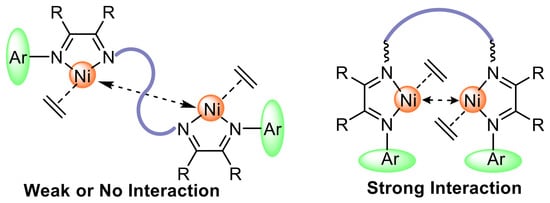
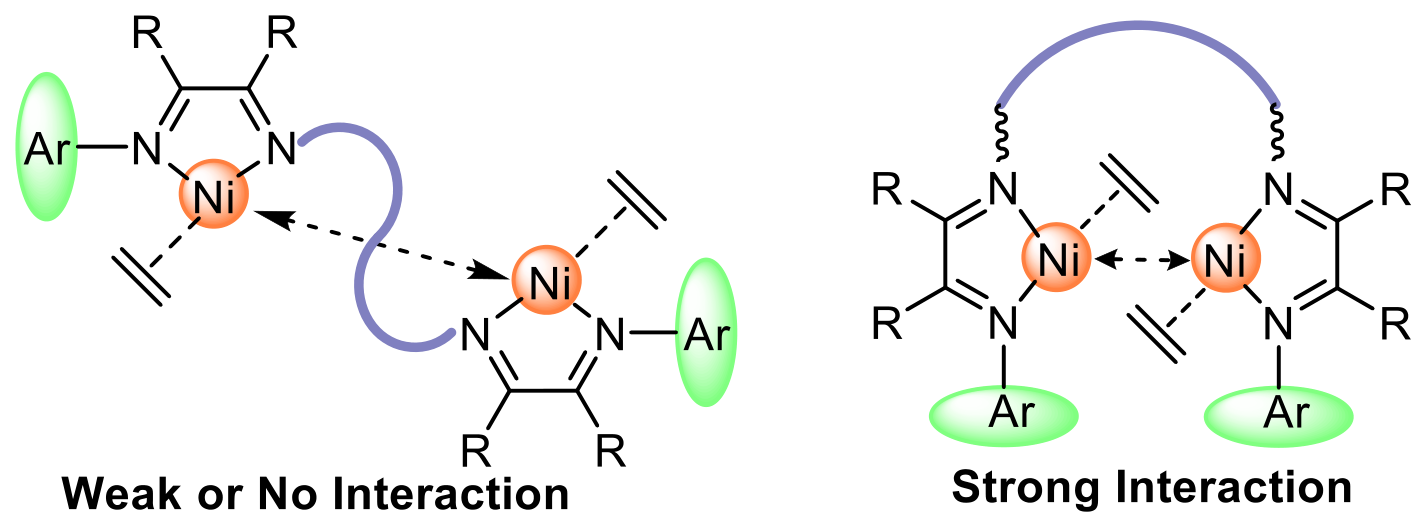
To overcome the performance limitations inherent to mononuclear catalysts, researchers have drawn inspiration from the catalytic mechanisms of metalloenzymes [31,32,33]. In many such enzymes, two or more metal centers are positioned in close proximity and function cooperatively to simultaneously activate electrophilic and nucleophilic substrates, thereby achieving remarkable catalytic activity and selectivity. This cooperative activation mode of multi-metal centers has directed research efforts toward the development of binuclear and even multinuclear homogeneous catalytic systems [34,35,36,37,38,39,40,41,42]. Studies have demonstrated that synergistic reactivity patterns involving two or more metal centers are strongly dependent on the catalyst architecture [43,44,45,46,47]. Significant metal–metal cooperativity is observed when the two active centers are appropriately connected through a bridging group to establish well-designed interactions. Conversely, in the absence of such interactions, the cooperative effect is unlikely to be manifested (Figure 1).
Figure 1.
Structural scheme of a binuclear α-diimine nickel catalyst.
In binuclear α-diimine nickel catalytic systems, the design of the bridging structure plays a pivotal role in modulating metal–metal cooperativity. The distance between the two active centers and the nature of the substituents have been identified as two core parameters influencing the cooperative effects between the metal centers in olefin polymerization. Furthermore, the overall geometry of the multinuclear catalyst profoundly impacts its catalytic performance. The chemical nature and geometric characteristics of the bridging unit directly determine the coordination environment and spatial orientation of the bimetallic centers, thereby profoundly influencing catalytic activity, thermal stability, and polymer microstructure through the regulation of metal–metal interactions. Based on the chemical nature and geometric features of the bridges, binuclear α-diimine nickel catalytic systems can be classified into distinct categories.
Based on this review, binuclear α-diimine nickel catalytic systems are classified into four major categories: rigid aryl-bridged, flexible chain-bridged, N-heterocyclic-bridged, and special unsymmetric catalysts. The following sections systematically review the molecular design strategies and structural characteristics of these four catalyst classes, as well as their regulatory effects on catalytic behavior and polymer properties in ethylene polymerization. This review aims to provide theoretical guidance for the design and development of high-performance binuclear catalysts and to offer perspectives on future directions in this research field.
2. Rigid Aryl-Bridged Catalysts
In the field of bridging architectures, the rigid aryl-bridged type has been the subject of the most extensive research to date. Depending on the degree of conjugation, spatial configuration, and electronic effects of the aromatic ring system, binuclear metal catalysts can be further subdivided into the following four subtypes: mono-benzene-bridged catalysts, bulky o-phenylene-bridged catalysts, fused-ring aromatic-bridged catalysts, and methylene-containing diaryl-bridged catalysts. This structural classification facilitates understanding of structure–activity relationships in catalysis and provides an important theoretical basis for the targeted design and synthesis of binuclear nickel systems with specific catalytic performance.
2.1. Mono-Benzene-Bridged Catalysts
Mono-benzene-bridged binuclear complexes refer to a class of compounds in which the two metal centers are connected through a single aryl framework linking the imine bonds. In recent years, research groups such as that of Mostafa Khoshsefat have conducted a series of studies on this type of structure, systematically investigating their synthetic methods, catalytic performance, and polymer structural characteristics [48,49,50,51,52,53,54].
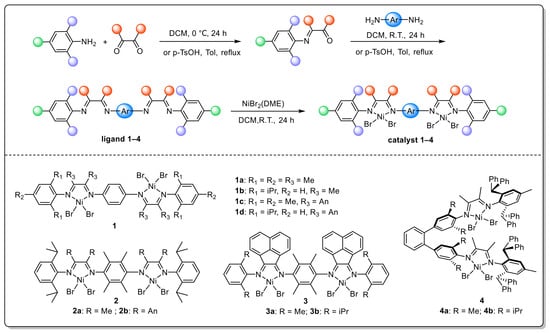
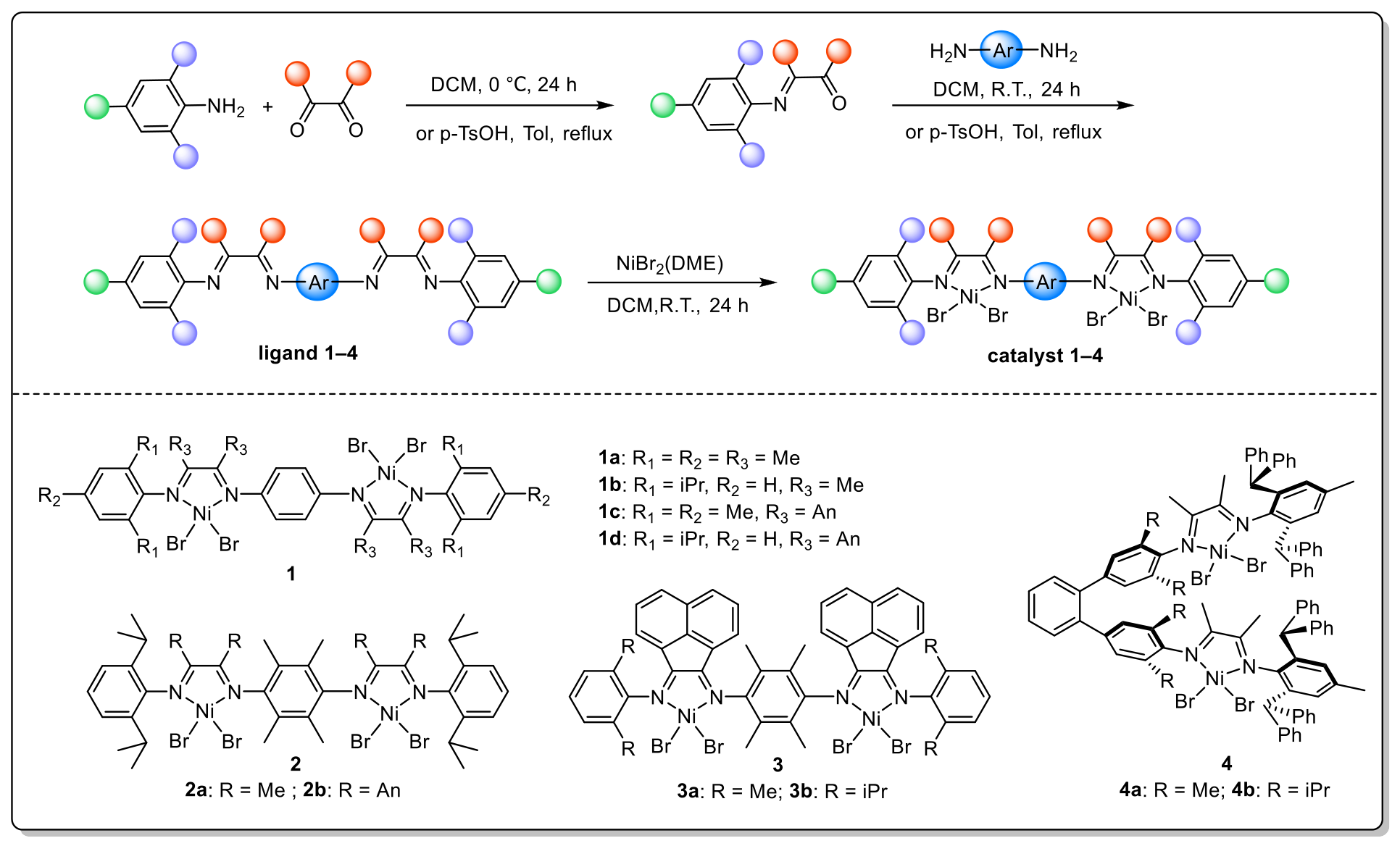
In 2016, Khoshsefat et al. [48] designed and synthesized a novel class of binuclear α-diimine Ni(II)-based catalysts (Figure 2 (1)) for ethylene polymerization. The ensuing results demonstrated that under conditions of [Al]/[Ni] = 2000/1 and Tp = 42 °C, catalyst 1d exhibited a catalytic activity of 1.07 × 10⁶ g mol−1 h−1 when R1 = isopropyl (iPr), R2 = H, and R3 = acenaphthylene (An). Theoretical analysis indicated that the steric and electronic effects of both the substituents and the diimine backbone exerted a significant influence on the catalyst behavior, such as catalytic activity, the viscosity average molecular weight and the degree of branching of the polymer products. Furthermore, GPC and DSC analyses revealed that, owing to the cooperative effect between the active centers, the polyethylene obtained from catalyst 1d displayed a broad molecular weight distribution, and its crystallization melting curve exhibited the coexistence of a peak along with a wide shoulder. Increased ethylene pressure led to a higher polyethylene yield, as well as improved uniformity and regularity of chain growth. These effects were evidenced by changes in the DSC thermogram and corroborated by the greater morphological uniformity visible in SEM images.
Figure 2.
Synthesis and structural scheme of the mono-benzene-/bulky o-phenylene-bridged binuclear α-dimine nickel catalysts.
In 2021, Zohuri et al. [49] further applied binuclear Ni-based catalyst 1d to the copolymerization of methyl methacrylate (MMA) with 1-hexene, successfully obtaining copolymers with an MMA incorporation rate in the main chain as high as 96%. In this work, catalyst 1d was appropriately employed to generate novel semiconducting materials with high resistance, which possesses a vacancy (hole) in its structure. The copolymer synthesized with equimolar fractions of the comonomers exhibited efficient electrical resistance without degradation and demonstrated good semiconducting properties.
Khoshsefat et al. [50] replaced the phenyl bridging with a tetramethylphenyl unit to design and synthesize a binuclear α-diimine nickel catalyst (Figure 2 (2)), which was employed in the polymerization of 1-hexene. Using ethylaluminum sesquichloride (EASC) as the efficient cocatalyst, the effects of various polymerization conditions on catalytic performance were systematically investigated. Compared with the mononuclear analog, the binuclear catalyst exhibited higher catalytic activity, and the resulting polymer also showed a significantly increased viscosity average molecular weight. Notably, the synergistic effect of high local monomer concentration, steric hindrance, and electronic effects accounts for the pronounced chain walking of catalyst 2b. In addition, longer α-olefins (1-octene and 1-decene) enhanced productivity, conversion, molecular weight, and narrowed MWD, with lower branching density. Elevated temperatures further confirmed the superior thermal stability of binuclear over mononuclear catalysts.
In 2022, Mortazavi et al. [51] employed modified methylaluminoxane (MMAO) as a cocatalyst and selected the binuclear α-diimine nickel catalyst 2b to elucidate the homopolymerization mechanism of 5-ethylidene-2-norbornene (ENB). The findings indicated that the maximum polymerization activity of the binuclear catalyst was considerably higher than that of its mononuclear analog. In addition, the catalyst structure was identified as a primary factor influencing the glass transition temperature (Tg) of the resulting cyclic polyolefins. The polymer obtained from the binuclear catalyst demonstrated a Tg of 176 °C, while the polymer derived from the mononuclear catalyst exhibited a Tg of 140 °C. Dynamic mechanical thermal analysis (DMTA) further confirmed that variations in catalyst structure exert a profound influence on the microstructure of the polymer chains.
The same group [52] expanded upon their previous research, continuing to utilize MMAO as the cocatalyst. They conducted a systematic investigation into the catalytic behavior of the binuclear α-diimine nickel catalyst 2b in the copolymerisation of ENB and norbornene (NB). This investigation resulted in the successful preparation of a series of copolymers with varying ENB molar ratios. The study found that catalytic activity tended to increase with a higher proportion of ENB in the feed, and the binuclear catalyst consistently exhibited superior activity relative to the mononuclear catalyst throughout the copolymerization process. It is noteworthy that beyond addition polymerization, a detailed analysis of the polymer microstructures 1HNMR unexpectedly indicated the concomitant occurrence of cationic and ring-opening polymerization pathways during copolymerization, though their respective contributions differed significantly.
Zohuri et al. [53] synthesized a series of binuclear α-diimine nickel catalysts featuring an anthraquinone backbone by varying the ortho-substituents of the aniline moiety (Figure 2 (3)) and applied them in the synthesis of polynorbornene. The findings demonstrated that the binuclear catalysts exhibited superior catalytic efficiency, and the resulting polynorbornenes generally possessed elevated molecular weights (Mw) in comparison to those obtained with mononuclear catalysts. Thermal analyses, incorporating DSC, DMTA and TGA, further revealed that the polymer produced by catalyst 3b possessed a more uniform microstructure and higher stereoregularity.
Khoshsefat et al. [54] employed the binuclear nickel catalyst 3b for the homopolymerization and copolymerization of 1-hexene with MMA, using MMAO as the cocatalyst. The findings demonstrated that, in comparison to the mononuclear analog, the binuclear catalyst 3b exhibited significant advantages in terms of both catalytic activity and copolymer molecular weight. Remarkably, the addition of MMA (up to [MMA]/[1-hexene] = 50/50 molar ratio) boosted the catalytic activity across all catalysts. 1HNMR analysis further established a clear correlation between increased MMA feed composition and enhanced comonomer incorporation, a trend quantitatively supported by reactivity ratios derived from the Kelen–Tudos method.
2.2. Bulky o-Phenylene-Bridged Catalysts
In mono-benzene-bridged structures, the two metal centers are connected via a single aryl unit, rendering their spatial distance relatively fixed. The cooperative effects in such systems rely primarily on the steric hindrance imparted by the ortho-substituents of the aniline and the electronic effect of the ligand backbone. To further expand the tunability of the intermetallic distance and to investigate the impact of bridge rigidity and conjugation degree on catalytic behavior, researchers have extended the bridging unit from a single benzene ring to a bulky o-phenylene-bridged structure. Only a limited number of bimetallic α-diimine catalysts featuring sterically bulky substituents on o-aryl positions have been documented to date.
Motivated by the established bimetallic synergistic effects in epoxide/CO2 copolymerization [55], Liu et al. [56] proceeded to design and synthesize a series of bulky o-phenylene-bridged bimetallic α-diimine Ni(II) catalysts (Figure 2 (4)) and systematically investigate their catalytic performance in ethylene polymerization. The findings demonstrated that, in comparison to their mononuclear analogs, the binuclear Ni(II) catalysts 4 exhibited elevated catalytic activity (up to 4.80 × 10⁶ g mol−1 h−1). Concurrently, the resultant polymers were characterized by elevated molecular weights and diminished branching densities.
Furthermore, by modulating the catalyst structure and polymerization conditions, all prepared polyethylenes displayed elastomeric behavior, with their mechanical properties tunable over a wide range. It is noteworthy that the polyethylene material produced by catalyst 4b achieved a strain recovery rate (SR) of up to 86%, a value comparable to the optimal recovery rates reported for polyethylene thermoplastic elastomers, thereby demonstrating outstanding elastic performance.
2.3. Fused-Ring Aromatic-Bridged Catalysts
Beyond simple mono-benzene and o-phenylene moieties, fused-ring aromatic system serve as widely adopted bridging units in the construction of binuclear α-diimine catalysts, a utility derived from their unique conjugated nature and geometric conformation. These bridging structures provide a means to regulate both the spatial separation and mutual alignment of the bimetallic centers, while also potentially tuning catalytic performance via electronic modulation. Consequently, they offer a promising molecular design approach for the development of advanced polyolefin materials.
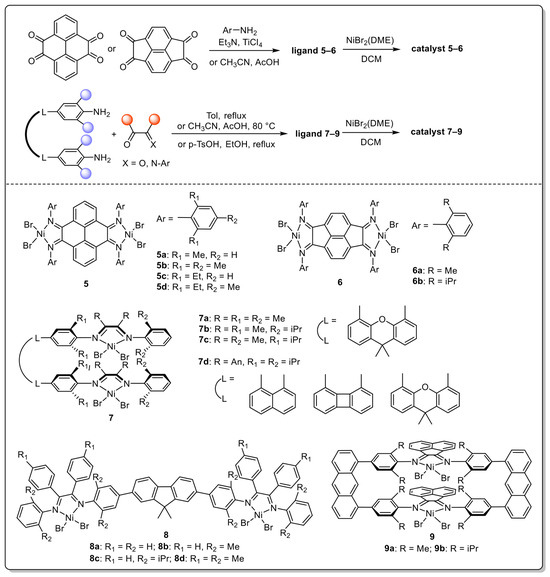
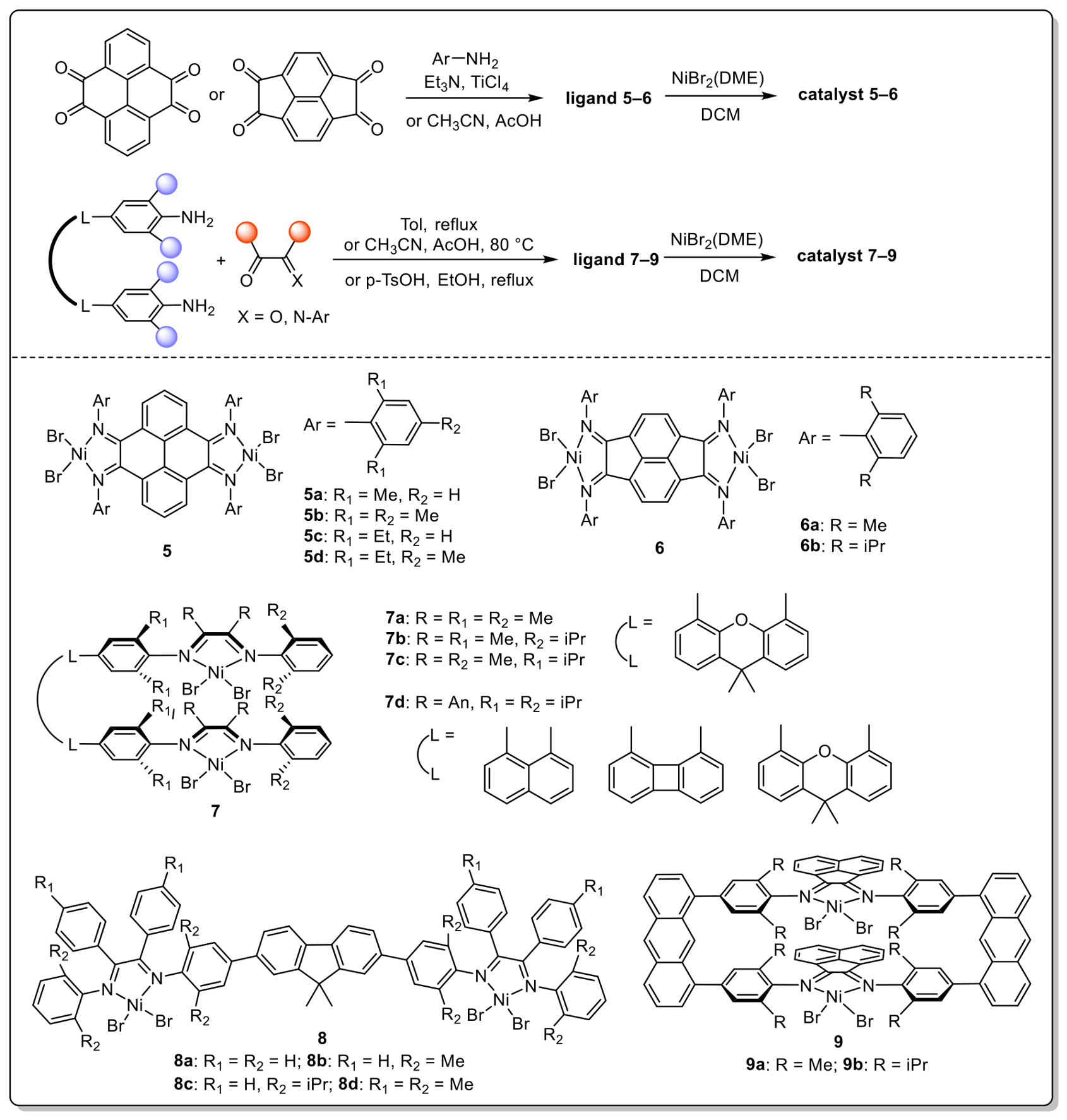
Sun et al. [57] synthesized a novel class of binuclear α-diimine nickel complexes (Figure 3 (5)) bearing 4,5,9,10-tetra(arylimino)-pyrenylidenes based on the planar conjugated pyrene-4,5,9,10-tetraone backbone via condensation with a series of aniline derivatives. A comprehensive characterization of the ligands and complexes was conducted, and their bimetallic molecular structures were confirmed by single-crystal X-ray diffraction. The study demonstrated that, when employing methyl aluminoxane (MAO) or dimethylaluminum chloride (Me2AlCl) as cocatalysts, this series of binuclear nickel catalysts exhibited high catalytic activity in ethylene polymerization along with excellent prolonged period, maintaining an activity of up to 1.30 × 10⁶ g(PE) mol(Ni)−1 h−1.
Figure 3.
Synthesis and structural scheme of the fused-ring aromatic-bridged binuclear α-dimine nickel catalysts.
Fu et al. [58] designed and synthesized a series of α-diimine binuclear nickel catalysts with a conjugated backbone (Figure 3 (6)). A systematic investigation was conducted to ascertain the influence of catalyst structure, cocatalyst ratio, polymerization time, and solvent on the catalytic activity, polymer molecular weight, and branching architecture. The experiments demonstrated that, upon activation with MMAO, these binuclear nickel catalysts efficiently mediated ethylene polymerization, achieving a maximum activity of 1.05 × 10⁶ g(PE) mol(Ni)−1 h−1. Notably, under identical polymerization conditions, the activity of catalyst 6b was twice that of its corresponding mononuclear analog, underscoring the promotional effect of the binuclear architecture on catalytic performance.
In 2021, the same group [59] further explored the application of catalyst 6b in ethylene polymerization using alkyl aluminum and organoboron compounds as binary cocatalyst system. The study revealed a close correlation between the enhancement in catalytic activity and the nature of the organoboron compound, the type of alkyl aluminum, and the catalyst structure. When combined with diethylaluminum chloride (Et2AlCl), the introduction of sodium tetrakis [3,5-bis(trifluoromethyl)phenyl]borate (NaBArF) significantly promoted ethylene polymerization at elevated temperatures, with a 41.3% increase in activity observed at 70 °C. This binary cocatalyst system has been demonstrated to reduce the required molar ratio of [Al]/[Ni], while concomitantly increasing the number of active centers and prolonging their lifetime. These effects offer a viable pathway for industrial ethylene polymerization under high-temperature conditions.
Chen et al. [60] reported a class of dinuclear α-diimine Ni(II) catalysts featuring a xanthene-bridged scaffold (Figure 3 (7a–7c)), detailing their synthesis, structural characterization, and ethylene polymerization behavior of these catalysts. The desired dianiline utilized in this series of ligands can be readily obtained on a multigram scale without using column chromatography. The results of the polymerization demonstrated that these catalysts exhibited both good thermal stability and high polymerization activity, with the maximum activity reaching 5.00 × 10⁶ g(PE) mol(Ni)−1 h−1. Notably, they retained high activity exceeding 106 g(PE) mol(Ni)−1 h−1 even at an elevated temperature of 80 °C. The resulting polyethylenes were characterized by high molecular weight, narrow MWD, and exceptionally low branching density, which the researchers attributed to a metal–metal cooperativity effect between the two nickel centers that effectively suppresses β-H elimination and chain walking.
To further expand the structural diversity of the bridging, the Chen group [61] introduced naphthalene- and biphenylene-bridged moieties, synthesizing a new series of binuclear α-diimine Ni(II) catalysts (Figure 3 (7d)). In comparison to their mononuclear counterparts, these binuclear catalysts demonstrated enhanced activity, higher molecular weight, and significantly reduced branching density in the process of ethylene polymerization. DFT calculations revealed that the Ni-Ni distances across the different bridging scaffolds (naphthalene-, biphenylene-, and xanthene-bridged structures) were comparable, thereby accounting for the largely consistent catalytic performance observed across the series.
Yang et al. [62] synthesized four fluorene-based binuclear α-diimine Ni catalysts (Figure 3 (8)) and systematically evaluated the influence of catalyst structure on polymerization activity, polymer branching density, and molecular weight using Et2AlCl as the cocatalyst. This work demonstrated that the selection of ligand structure is paramount in the modulation of the microstructure of the resultant polymer. In this study, the effects of catalyst concentration, the molar ratio of [Al]/[Ni], and the ethylene pressure on polymerization behavior were investigated using catalyst 8d as a representative selection. The findings indicated that the polymerization activity attained a maximum of 12,437 g(PE) g(cat)−1, suggesting a promising prospect for potential practical applications.
Jian et al. [63] ingeniously integrated the rigid constraint of a macrocyclic framework with the cooperative effect of bimetallic centers into the classical α-diimine nickel catalytic system, designing and synthesizing a class of structurally unique macrocyclic binuclear α-diimine nickel catalysts (Figure 3 (9)). A series of studies have demonstrated that, in comparison with classical Brookhart-type acyclic mononuclear α-diimine nickel catalysts, this innovative binuclear catalyst demonstrates higher thermal stability (up to 110 °C) in the context of MAO-activated ethylene polymerization. Furthermore, the production of polyethylene is observed to be accompanied by a substantial augmentation in molecular weight, alongside a considerable reduction in branching density (9/1000C). It is noteworthy that by merely adjusting the ortho-aryl substituents, a bimodal polyethylene with a broad molecular weight distribution (MWD = 8.08~14.66) could be synthesized using a single catalyst. This finding provides a novel approach for the precise synthesis of diverse polyethylene materials.
2.4. Methylene-Containing Diaryl-Bridged Catalysts
A class of methylene-containing diaryl-based multinuclear α-diimine nickel complexes can be synthesized via the condensation of a diketone backbone with methylene-bridged dianiline and aniline derivatives bearing various substituents. By modulating the intermetallic distances between bimetallic or multimetallic centers through the bridging moiety, this type of catalysts provides an effective molecular design strategy for investigating metal–metal cooperative effects and optimizing polymerization performance.
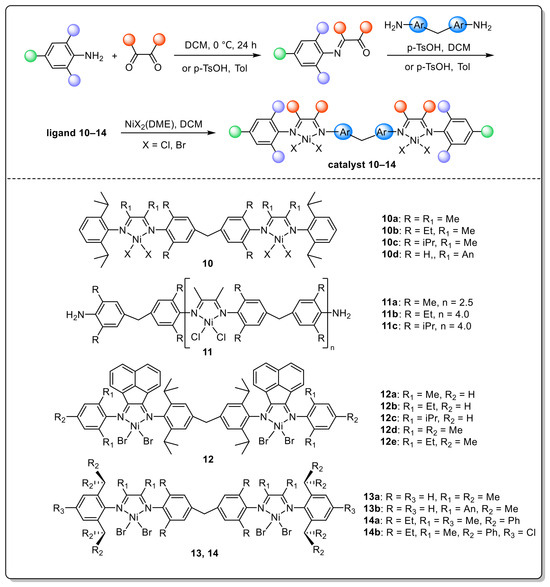
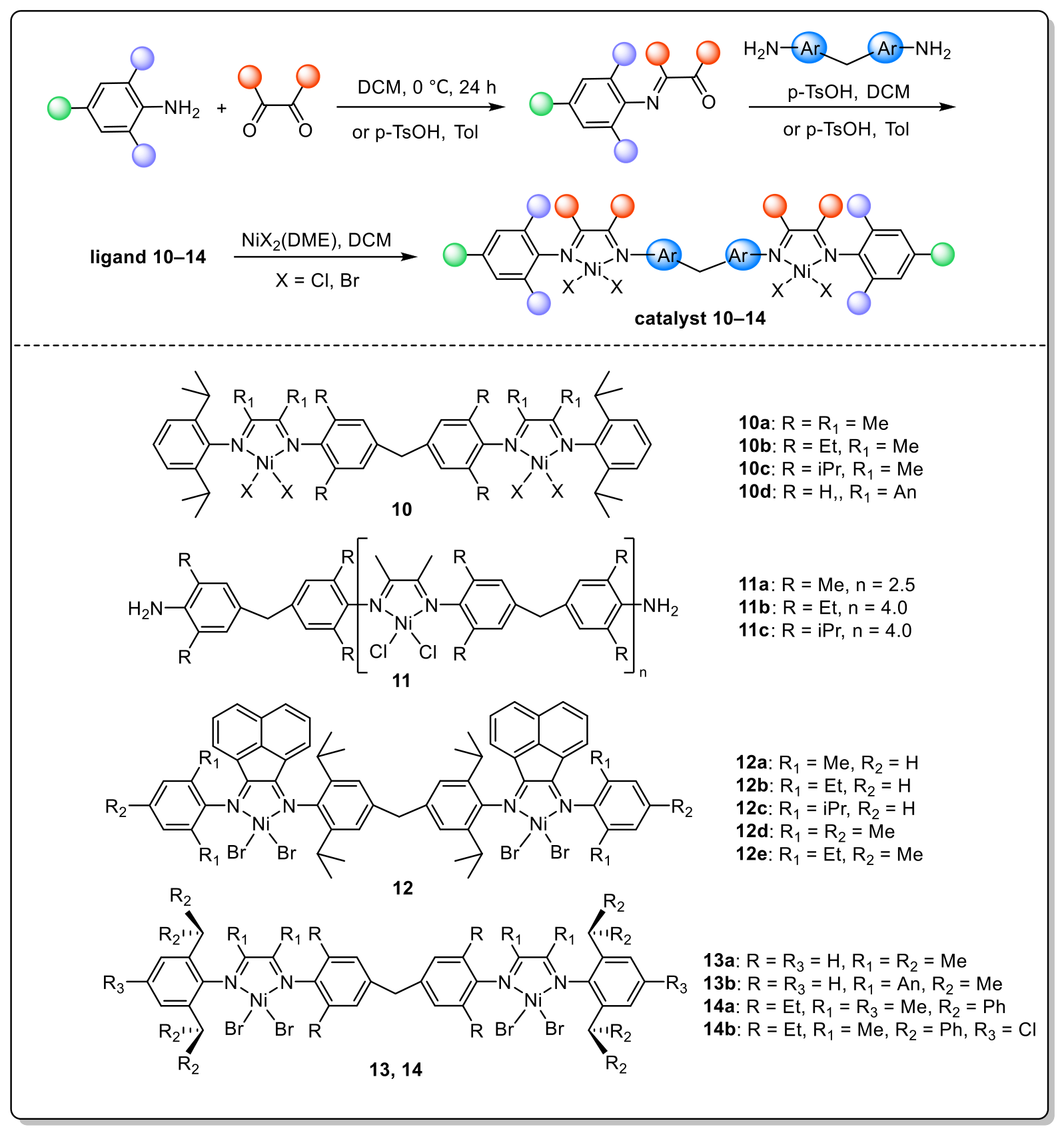
In 2004, Schumann et al. [64] pioneered the preparation of a series of structurally well-defined binuclear nickel complexes (Figure 4 (10)) via Schiff base condensation of 2,3-butanedione, 2,6-diisopropylaniline, and substituted methylene-bridged bis-aniline. Structural analysis revealed that, compared to the mono-nickel-center catalysts, the molecules of the new catalysts were significantly bigger, and the intermetallic distance between the two active centers was effectively controlled, thereby enabling precise modulation of the microchemical environment around each nickel center. Ethylene polymerization evaluation demonstrated that the binuclear architecture exerts a pronounced influence on catalytic activity when the substituent R was isopropyl or ethyl (Figure 4 (10b,10c)), the activities of the binuclear catalysts substantially exceeded those of the corresponding mononuclear analogs. In contrast, when the substitute was methyl (Figure 4 (10a)), the new catalyst exhibited lower activity than its mononuclear reference.
Figure 4.
Synthesis and structural scheme of the methylene-containing diaryl-bridged multinuclear α-dimine nickel catalysts.
The group further prepared multinuclear nickel catalysts (Figure 4 (11)) through direct condensation of 2,3-butanedione with substituted methylene-bridged bis-aniline, thereby extending the scope of spatial control over multiple active centers. Among these, the multinuclear catalyst bearing ethyl substituents (Figure 4 (11b)) displayed optimal catalytic performance at 25 °C with an [Al]/[Ni] ratio at 500, achieving an activity of 3220 g(PE) g(Ni)−1 h−1.
In 2013, Sun et al. [65] synthesized a series of structurally well-defined α-diimine binuclear nickel complexes (Figure 4 (12)) using isopropyl-substituted dianiline as a key intermediate, and their molecular structures were confirmed through single-crystal X-ray diffraction. Upon activation with Et2AlCl or MAO, these catalysts exhibited exceptionally high ethylene polymerization activities on the order of 106 g(PE) mol(Ni)−1 h−1 over a temperature range from room temperature to 50 °C. Notably, catalyst 12d achieved a maximum activity of 1.59 × 10⁷ g(PE) mol(Ni)−1 h−1. Compared with mononuclear nickel analogs, the binuclear complexes not only displayed higher activities but also yielded polyethylenes with simultaneously enhanced molecular weights and branching densities. This concurrent optimization of activity, molecular weight, and branching degree highlights the distinct advantages conferred by the binuclear architecture.
Khoshsefat et al. [66,67] synthesized binuclear α-diimine nickel catalysts (Figure 4 (13)) by varying the diketone backbone and systematically compared the influence of different bridging structures on catalytic performance. Further investigation revealed that, beyond the ligand backbone, the presence of a second metal center and its cooperative interplay with the bridging moiety are critical factors governing catalyst behavior. By tuning the nature and length of the bridging group, the electron density at the metal centers, catalyst stability, and polymerization performance can be effectively modulated. For instance, substituents with greater steric bulk confer higher electron density, thereby imparting enhanced stability and activity to the binuclear catalysts. The study identified that the catalyst possessing optimal steric hindrance exhibited the highest activity among all binuclear and mononuclear counterparts, reaching 1.6 × 10⁶ g(PE) mol(Ni)−1 h−1, along with the lowest short-chain branching density (32.5/1000C).
Dai et al. [68] designed and synthesized a class of methylene-bridged binuclear bulky dibenzhydryl α-diimine Ni(II) catalysts (Figure 4 (14)) and applied them to ethylene polymerization. These binuclear complexes exhibited high activity on the order of 106 g(PE) mol(Ni)−1 h−1, and successfully produced highly branched polyethylenes (79~92/1000C) with high molecular weights (Mn up to 44.57 × 10⁴ g mol−1). The resulting polymeric materials demonstrated outstanding elastic recovery performance, with a SR value as high as 84%. Compared with mononuclear α-diimine nickel catalysts, these binuclear catalysts not only exhibited enhanced thermal stability and polymerization activity but also yielded polyethylenes with significantly higher molecular weights, thereby further substantiating the potential of binuclear cooperative effects in advancing the performance of polyolefin materials.
3. Flexible Chain-Bridged Catalysts
In the design of binuclear α-diimine nickel catalysts, beyond the extensively investigated rigid aryl-bridged architectures, the introduction of flexible chain as a bridging unit between the two metal centers represents an equally intuitive and effective design strategy. However, studies on flexible chain-bridged binuclear nickel catalysts remain comparatively limited in the extant literature when compared to their rigid-bridged counterparts. This class of catalysts enables precise modulation of both the intermetallic distance and the relative orientation of the two metal centers simply by varying the number of methylene (-CH2-) units within the flexible tether, thereby exerting direct control over the resultant catalytic behavior.
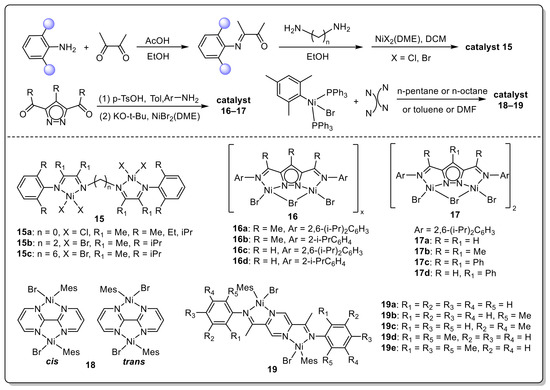
Revankar et al. [69] provided a versatile set of binuclear α-diimine nickel complexes (Figure 5 (15a)) featuring two nickel centers connected via a direct bond. In combination with MAO as a cocatalyst, these catalysts efficiently mediate ethylene oligomerization. At 30 °C and an [Al]/[Ni] ratio of 300/1, the catalytic system predominantly produced oligomeric fractions C2~C20, achieving a catalytic activity as high as 1123 kg(oligomer) mol(Ni)−1 bar−1. Substituent-induced shifts in metal center potential, verified by cyclic voltammetry, correlated strongly with oligomerization activity. Trace polyethylene formation occurred with C1 and C3 at 30 °C, but selectivity shifted entirely to oligomers at higher temperatures for all complexes.
Figure 5.
Synthesis and structural scheme of the flexible chain-/N-heterocyclic-bridged binuclear α-dimine nickel catalysts.
Khoshsefat et al. [66,67,70] further extended the flexible bridge strategy by introducing ethyl and hexyl spacers between the two metal centers, thereby designing and synthesizing binuclear α-diimine nickel catalysts 15b (ethyl-bridged) and 15c (hexyl-bridged) with distinct flexible tether lengths (Figure 5). Their catalytic performance was systematically investigated in both 1-hexene homopolymerization and ethylene homopolymerization. The experimental revealed that, in 1-hexene polymerization, the mononuclear catalyst proceeded via a conventional insertion pathway, predominantly yielding poly(1-hexene) containing a high density of butyl branches. In contrast, the binuclear catalysts 15b and 15c, influenced by a partial chain-walking mechanism, produced poly(1-hexene) with a notably higher content of less common short-chain branches, such as ethyl and propyl branches. Computational investigation of the dinuclear catalysts corroborated the presence of different stereoisomers (syn and anti), linking their existence to the broadened MWD, the altered polymerization pathway, and the unique short-chain branching (SCB) curves.
In ethylene homopolymerization, the mononuclear catalyst yielded highly branched, amorphous polyethylene. In contrast, the polyethylenes produced by the binuclear catalysts 15b and 15c exhibited pronounced methyl selectivity in their branching architecture. The polymer chains derived from these binuclear catalysts developed crystalline sequences with high melting points (Tm), and their melting temperatures even exceeded that of ideally 100% crystalline polyethylene, thereby displaying chain structural characteristics reminiscent of ethylene/propylene copolymers analogs.
More importantly, this work systematically compared the influence of different bridging architectures (catalysts 1a, 2, 10d, 15b, and 15c) on polymerization performance. The pronounced hexyl branch selectivity of catalyst 2b evidenced cooperative bimetallic interactions, whereas the methyl branch preference of catalysts 15b and 15c produced crystalline domains with higher melting points. The elevated vinyl end-group content observed for catalyst 10d correlated with the larger intermetallic Ni···Ni distance.
Kinetic profiling and computational analysis of the precatalysts and catalysts established that the polymerization rate constant correlates directly with both the precatalyst–catalyst energy gap and the Et···methyl cationic active center interaction energy. A small energy gap (low activation barrier) ensures rapid activation (mononuclear nickel catalyst), whereas strong ethylene binding drives high monomer uptake and productivity (catalyst 2b). Accordingly, theoretical parameters including electron affinity, Ni Mulliken charge, chemical potential and hardness, and global electrophilicity indicated catalyst 2b as the optimal system.
4. N-Heterocyclic Bridged Catalysts
Beyond the aforementioned bridging strategies, nitrogen-containing heterocycles have also been employed to construct structurally novel binuclear or multinuclear olefin polymerization catalysts, owing to their versatile coordination modes and potential electron-mediating capabilities.
Meyer et al. [71,72,73,74] synthesized a series of pyrazolate-based dinuclear α-diimine ligands bearing different backbone substituents and steric hindrance. Subsequent to the reaction of these ligands with NiBr2(DME), mass spectrometry analysis indicated the formation of an oligonuclear species [LNi2Br3]x (Figure 5 (16)). This conclusion was confirmed through single-crystal X-ray diffraction structure of [LNi2Br3]3. The binuclear ligand framework effectively prevented the dissociation of the complex into mononuclear species and maintained the adjacent nickel centers in suitable spatial orientation. This may have enabled cooperative effects during ethylene polymerization. Structure–activity correlations demonstrated that substituents on the pyrazole backbone and bulky ortho-substituents on the aniline moiety were beneficial for ethylene polymerization activity. However, despite their unique structure, the polymerization activity of this novel class of pyrazole-imine binuclear nickel catalysts, as well as the microstructures (e.g., branching degree, Mw, and Tm) of the resulting polyethylene, did not exhibit significant differences compared to those obtained with conventional mononuclear cationic α-diimine nickel catalysts.
In 2008, the same group [75] further expanded the ligand library by introducing different backbone at the pyrazole-C4 and substituents such as -H, -Me, and -Ph of the imine, respectively, synthesizing a series of pyrazolate-bridged binuclear ligands with finely varied structural differences. Similar to the synthesis of catalyst 16, the resulting nickel complexes exhibited a tetranuclear structure [L2Ni4Br6] (Figure 5 (17)), which contains a nearly planar rectangular arrangement of Ni4 with an unusual central μ4-bromide. When this multinuclear nickel catalysts was applied to the addition polymerization of norbornene, it was found that their catalytic activity was highly sensitive to solvent. The resulting polynorbornenes (PNB) were noncrystalline and insoluble in conventional solvents, but exhibited a Tg.
Klein et al. [76] designed and synthesized a bipyrimidine-bridged binuclear nickel complex (Figure 5 (18), Mes = 2,4,6-trimethylphenyl), and thoroughly characterized it using electrochemical and various spectroscopic techniques. The long-wavelength absorption features of the binuclear complex indicated a significant degree of electronic coupling between the two nickel centers through the low-lying unoccupied π* orbital (LUMO) of the bridging ligand. Electrochemical studies revealed that while the mononuclear analog underwent rapid bromide dissociation upon one-electron reduction, the binuclear nickel complex 18 exhibited stable, reversible reduction electrochemistry and generated radical anion species with spin density predominantly localized on the ligand center. Structural analysis revealed that the mononuclear complex exhibited shorter Ni-N bonds, thereby favoring optimal orbital overlap. Conversely, in the binuclear complex 18, the bulky [Ni(Mes)Br] fragments impeded the concurrent attainment of perfect adaptation to both chelating sites of the bipyrimidine bridge, thereby partially weakening the orbital overlap between the metal and the ligand.
In 2012, the Klein’s group [77] further extended the bridging unit to pyrazine, preparing and characterizing the bis(arylimino)-1,4-pyrazine binuclear nickel complex (Figure 5 (19)). The researchers innovatively combined nuclear magnetic resonance (NMR) spectroscopy with quantum chemical calculations to successfully assign the stereoisomers of the complex and determine their relative stability. Analogous to complex 18, the two nickel centers in complex 19 also exhibited substantial electronic coupling through the low-lying π* orbital of the bridging ligand. This complex underwent a reversible reduction process, resulting in the formation of a stable anionic complex. The spin density of this complex was found to be localized on the ligand-centered radical.
5. Special Unsymmetric Catalysts
In recent years, in addition to classical structures, binuclear nickel catalysts with special unsymmetric molecular architectures including homo/hetero-nuclear dimetallic have also been successively developed, providing new research avenues for the structural regulation and performance expansion of polyolefin materials.
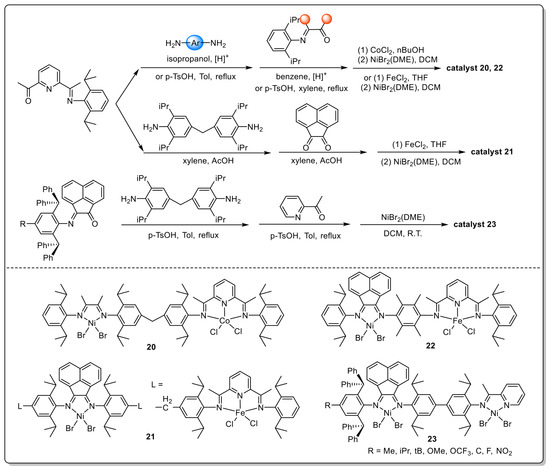
Wang et al. [78] prepared a heterobinuclear Ni-Co complex incorporating both α-diimine and pyridine diimine units (Figure 6 (20)) in ethylene polymerization. When triethylaluminum (TEA) or MMAO was used as a cocatalyst, the ethylene polymerization activity of catalyst 20 was lower than that of an equivalent mixture of the mononuclear complexes Ni and Co. Furthermore, the nickel center in the binuclear complex 20 produced less high-molecular-weight polyethylene compared to the binary system. However, when TEA combined with [PhMe2NH][B(C6F6)4] was employed as the cocatalyst, the productivity of the nickel site improved, although the resulting polyethylene exhibited a lower degree of branching than that produced by the mononuclear Ni complex. UV-vis spectroscopy revealed that the absorption band corresponding to the active nickel center in catalyst 20 was weaker than that in the binary system. These results indicate that the productivity of the nickel center in the heterobinuclear complex is predominantly suppressed due to selective activation of the metal centers.
Figure 6.
Synthesis and structural scheme of the special unsymmetric homo/hetero-binuclear α-dimine nickel catalysts.
Based on a bimetallic heterocatalyst precursor, Kim et al. [79] successfully synthesized a novel trinuclear Fe(II)/Ni(II) heteronuclear catalyst for ethylene polymerization, which contains two Fe centers and one Ni center (Figure 6 (21)). When activated with MAO or common alkyl aluminums such as Et2AlCl and TMA, all the catalysts exhibited ethylene polymerization activities exceeding 105 g(PE)/(mol(Metal)·h) at 30 °C. Compared with monometallic Ni analogs and homobimetallic Fe analogs, this heterotrimetallic catalyst 21 demonstrated higher catalytic activity and a longer life time, particularly under high temperature polymerization conditions.
Khoshsefat et al. [80] synthesized a heterodinuclear Fe-Ni catalyst 22 (Figure 6) and employed it in ethylene polymerization under Zn-assisted cooperative conditions to investigate the effect of adjacency of second metal center on chain transfer efficiency. Compared with mononuclear analogs and homobimetallic catalysts, this heterobinuclear catalyst 22 was capable of synergistically generating random copolymers containing both short-chain and long-chain branches in the presence of diethyl zinc. Moreover, under low and high diethyl zinc concentrations, block copolymers were obtained via coordination chain transfer polymerization (CCTP) and chain shuttling polymerization (CSP), respectively.
Recently, Sun et al. [81] integrated α-diimine units with pyridine–imine units into a single ligand, efficiently synthesizing a series of ligands featuring a para-biphenylene-linked structure through a two-step procedure. The electronic effects of these ligands can be systematically tuned by varying the para-substituents on the benzene rings. The reaction of these ligands with two equivalents of NiBr2(DME) resulted in the successful formation of binuclear nickel complexes (Figure 6 (23)). Following activation with AlMe3 or Me2AlCl, these catalysts demonstrated moderate to high catalytic activity in ethylene polymerization, with the most active catalyst exhibiting a activity of 8.5 × 10⁶ g(PE) mol(Ni)−1 h−1. The resulting polyethylene exhibited a discernible bimodal molecular weight distribution, with the ratio of the high-molecular-weight component to the low-molecular-weight component being significantly influenced by the polymerization temperature. It is noteworthy that the obtained polyethylenes all possessed highly branched structures. Consequently, these bimodal materials exhibited superior tensile strength and elastic recovery compared to the unimodal polyethylene prepared using mononuclear nickel catalysts. This finding demonstrates their potential application as thermoplastic elastomers.
6. Conclusions
Binuclear α-diimine nickel catalysts have shown significant promise in ethylene polymerization owing to their unique intermetallic cooperativity and structurally tunable designs. This review has systematically surveyed four catalyst classes including rigid aryl-bridged, flexible chain-bridged, N-heterocyclic-bridged, and specialty unsymmetric systems. The bridging unit critically governs intermetallic distance, orientation, and cooperative effects, thereby influencing catalytic activity, thermal stability, and chain-walking behavior. Through rational design, certain binuclear catalysts have achieved superior activity and unique microstructural control (branching type, density, and molecular weight distribution) compared to mononuclear analogs, enabling tailored synthesis of novel polyethylens.
The most prominent advantage of binuclear α-diimine nickel catalysts lies in their unique chain-walking mechanism, which enables flexible regulation of the microstructural control of the resulting polyethylene through straightforward modifications of the ligand structure. In addition, these catalysts exhibit the capability for copolymerization with comonomers, offering a promising route to overcome the longstanding challenge associated with conventional catalysts in preparing functionalized polyolefins. Nevertheless, several limitations remain to be addressed. Their thermal stability is still insufficient, as the polymerization temperature generally must be maintained below 90 °C; otherwise, a marked decline in activity or even complete deactivation occurs. Moreover, as homogeneous catalytic systems, they are difficult to apply directly in existing industrial plants, owing to issues related to catalyst separation and polymer morphology control, although progress has been achieved in immobilization studies. Furthermore, in comparison with well-established Ziegler–Natta and metallocene catalysts, their industrial application remains at an exploratory stage. Thus, there still exist a multitude of challenges that need to be tackled before further advancement can be achieved. The bimetallic synergy mechanism requires direct spectroscopic evidence and theoretical support via in situ characterization and computational chemistry. Catalyst design remains largely empirical, necessitating a predictive platform for structure–activity relationships. Precise synergistic control over branching distribution, copolymer sequence, and molecular weight distribution is still elusive. Finally, long-term stability and cost-effectiveness under industrial conditions require further validation.
Author Contributions
J.Y.: literature review and writing—original draft. R.G. and Q.G.: supervision, funding acquisition and writing–editing. R.Z., T.L., J.L., Y.W. and Q.Y.: writing–editing. All authors have read and agreed to the published version of the manuscript.
Funding
This research was funded by National Natural Science Foundation of China [NSFC, U23B6011].
Data Availability Statement
No new data were created or analyzed in this study. Data sharing is not applicable to this article.
Conflicts of Interest
All authors were employed by SINOPEC (Beijing) Research Institute of Chemical Industry Co., Ltd. The authors declare that the research was conducted in the absence of any commercial or financial relationships that could be construed as a potential conflict of interest.
References
- Baier, M.C.; Zuideveld, M.A.; Mecking, S. Post-Metallocenes in the Industrial Production of Polyolefins. Angew. Chem. Int. Ed. 2014, 53, 9722–9744. [Google Scholar] [CrossRef] [Scilit]
- Alt, H.G.; Köppl, A. Effect of the Nature of Metallocene Complexes of Group IV Metals on Their Performance in Catalytic Ethylene and Propylene Polymerization. Chem. Rev. 2000, 100, 1205–1222. [Google Scholar] [CrossRef] [Scilit] [PubMed]
- Chen, C.L. Designing Catalysts for Olefin Polymerization and Copolymerization: Beyond Electronic and Steric Tuning. Nat. Rev. Chem. 2018, 2, 6–14. [Google Scholar] [CrossRef] [Scilit]
- Magenau, A.J.D.; Strandwitz, N.C.; Gennaro, A.; Matyjaszewski, K. Electrochemically Mediated Atom Transfer Radical Polymerization. Science 2011, 332, 81–84. [Google Scholar] [CrossRef] [Scilit] [PubMed]
- Zhao, C.; Harth, E. Polar Polyethylene Block Copolymer Synthesis Via Organometallic-Mediated Radical Polymerization Using Co(Salen) Complexes. Eur. Polym. J. 2024, 220, 113460. [Google Scholar] [CrossRef] [Scilit]
- Chen, C.; Luo, S.; Jordan, R.F. Cationic Polymerization and Insertion Chemistry in the Reactions of Vinyl Ethers with (α-Diimine)PdMe+ Species. J. Am. Chem. Soc. 2010, 132, 5273–5284. [Google Scholar] [CrossRef] [Scilit] [PubMed]
- Xiao, P.; Zhang, J.; Dumur, F.; Tehfe, M.A.; Morlet-Savary, F.; Graff, B.; Gigmes, D.; Fouassier, J.P.; Lalevée, J. Visible Light Sensitive Photoinitiating Systems: Recent Progress in Cationic and Radical Photopolymerization Reactions under Soft Conditions. Prog. Polym. Sci. 2015, 41, 32–66. [Google Scholar] [CrossRef] [Scilit]
- Hilf, S.; Kilbinger, A.F.M. Functional End Groups for Polymers Prepared Using Ring-Opening Metathesis Polymerization. Nat. Chem. 2009, 1, 537–546. [Google Scholar] [CrossRef] [Scilit] [PubMed]
- Savka, R.; Foro, S.; Gallei, M.; Rehahn, M.; Plenio, H. Oxidation-Triggered Ring-Opening Metathesis Polymerization. Chem.-Eur. J. 2013, 19, 10655–10662. [Google Scholar] [CrossRef] [Scilit]
- Bonometti, V.; Labbé, E.; Buriez, O.; Mussini, P.; Amatore, C. Exploring the First Steps of an Electrochemically-Triggered Controlled Polymerization Sequence: Activation of Alkyl- and Benzyl Halide Initiators by an Electrogenerated FeIISalen Complex. J. Electroanal. Chem. 2009, 633, 99–105. [Google Scholar] [CrossRef] [Scilit]
- Theriot, J.C.; Lim, C.-H.; Yang, H.; Ryan, M.D.; Musgrave, C.B.; Miyake, G.M. Organocatalyzed Atom Transfer Radical Polymerization Driven by Visible Light. Science 2016, 352, 1082–1086. [Google Scholar] [CrossRef] [Scilit] [PubMed]
- Arriola, D.J.; Carnahan, E.M.; Hustad, P.D.; Kuhlman, R.L.; Wenzel, T.T. Catalytic Production of Olefin Block Copolymers Via Chain Shuttling Polymerization. Science 2006, 312, 714–719. [Google Scholar] [CrossRef] [Scilit] [PubMed]
- Hustad, P.D. Frontiers in Olefin Polymerization: Reinventing the World’s Most Common Synthetic Polymers. Science 2009, 325, 704–707. [Google Scholar] [CrossRef] [Scilit] [PubMed]
- Klosin, J.; Fontaine, P.P.; Figueroa, R. Development of Group IV Molecular Catalysts for High Temperature Ethylene-α-Olefin Copolymerization Reactions. Acc. Chem. Res. 2015, 48, 2004–2016. [Google Scholar] [CrossRef] [Scilit] [PubMed]
- Liu, X.; Xia, T.; Jie, S.Y.; Gong, X.C.; Li, H.; Wang, Q.; Chen, Z.R.; Cao, K.; Fan, Z.Q. Efficient Synthesis of the Cyclo-Olefin Copolymers at High Temperature and Pressure in a Homogeneous Mini-Tubular Reactor. Chem. Eng. J. 2024, 497, 154602. [Google Scholar] [CrossRef] [Scilit]
- Zhang, X.W.; Zhang, M.X.; Liu, S.F.; Li, Z.B. Synthesis of Amido-Quinoline Hafnium and Zirconium Complexes with Improved Performances toward Ethylene/1-Octene Copolymerization. Organometallics 2024, 43, 2472–2479. [Google Scholar] [CrossRef] [Scilit]
- Johnson, L.K.; Killian, C.M.; Brookhart, M. New Pd(II)- and Ni(II)-Based Catalysts for Polymerization of Ethylene And α-Olefins. J. Am. Chem. Soc. 1995, 117, 6414–6415. [Google Scholar] [CrossRef] [Scilit]
- Zhang, Y.X.; Zhang, Y.X.; Hu, X.Q.; Wang, C.Q.; Jian, Z.B. Advances on Controlled Chain Walking and Suppression of Chain Transfer in Catalytic Olefin Polymerization. ACS Catal. 2022, 12, 14304–14320. [Google Scholar] [CrossRef] [Scilit]
- Schmid, M.; Eberhardt, R.; Klinga, M.; Leskela, M.; Rieger, B. New C2v- and Chiral C2-Symmetric Olefin Polymerization Catalysts Based on Nickel(II) and Palladium(II) Diimine Complexes Bearing 2,6-Diphenyl Aniline Moieties: Synthesis, Structural Characterization, and First Insight into Polymerization Properties. Organometallics 2001, 20, 2321–2330. [Google Scholar] [CrossRef] [Scilit]
- Hu, X.Q.; Kang, X.H.; Jian, Z.B. Suppression of Chain Transfer at High Temperature in Catalytic Olefin Polymerization. Angew. Chem. Int. Ed. 2022, 61, e202207363. [Google Scholar] [CrossRef] [Scilit]
- Rhinehart, J.L.; Brown, L.A.; Long, B.K. A Robust Ni(II) α-Diimine Catalyst for High Temperature Ethylene Polymerization. J. Am. Chem. Soc. 2013, 135, 16316–16319. [Google Scholar] [CrossRef] [Scilit] [PubMed]
- Zhang, D.F.; Nadres, E.T.; Brookhart, M.; Daugulis, O. Synthesis of Highly Branched Polyethylene Using “Sandwich” (8-p-Tolyl Naphthyl α-Diimine)Nickel(II) Catalysts. Organometallics 2013, 32, 5136–5143. [Google Scholar] [CrossRef] [Scilit]
- Kanai, Y.; Foro, S.; Plenio, H. Bispentiptycenyl-Diimine-Nickel Complexes for Ethene Polymerization and Copolymerization with Polar Monomers. Organometallics 2019, 38, 544–551. [Google Scholar] [CrossRef] [Scilit]
- Guan, Z.B.; Cotts, P.M.; McCord, E.F.; McLain, S.J. Chain Walking: A New Strategy to Control Polymer Topology. Science 1999, 283, 2059–2061. [Google Scholar] [CrossRef] [Scilit] [PubMed]
- Wang, F.Z.; Chen, C.L. A Continuing Legend: The Brookhart-Type α-Diimine Nickel and Palladium Catalysts. Polym. Chem. 2019, 10, 2354–2369. [Google Scholar] [CrossRef] [Scilit]
- Lu, Z.; Xu, X.W.; Luo, Y.; He, S.B.; Fan, W.G.; Dai, S.Y. Unexpected Effect of Catalyst’s Structural Symmetry on the Branching Microstructure of Polyethylene in Late Transition Metal Polymerization Catalysis. ACS Catal. 2023, 13, 725–734. [Google Scholar]
- Peng, D.; Chen, C.L. Photoresponsive Palladium and Nickel Catalysts for Ethylene Polymerization and Copolymerization. Angew. Chem. Int. Ed. 2021, 60, 22195–22200. [Google Scholar] [CrossRef] [Scilit]
- Hu, X.Q.; Chen, J.M.; Li, Q.K.; Kang, X.H.; Jian, Z.B. A Facile Neutral Nickel Catalyst Platform for High-Temperature Solution Copolymerization of Ethylene and Acrylate. Angew. Chem. Int. Ed. 2026, 65, e25742. [Google Scholar] [CrossRef] [Scilit]
- Dai, J.J.; Dai, S.Y. Flexible α-Diimine Ni(II) and Pd(II) Catalysts Featuring Backbone and Axial Cycloalkyl Substituents in Ethylene (Co)Polymerization. J. Polym. Sci. 2025, 63, 1527–1535. [Google Scholar] [CrossRef] [Scilit]
- Zhong, L.; Li, G.L.; Liang, G.D.; Gao, H.Y.; Wu, Q. Enhancing Thermal Stability and Living Fashion in α-Diimine-Nickel-Catalyzed (Co)Polymerization of Ethylene and Polar Monomer by Increasing the Steric Bulk of Ligand Backbone. Macromolecules 2017, 50, 2675–2682. [Google Scholar] [CrossRef] [Scilit]
- Gahan, L.R.; Smith, S.J.; Neves, A.; Schenk, G. Phosphate Ester Hydrolysis: Metal Complexes as Purple Acid Phosphatase and Phosphotriesterase Analogues. Eur. J. Inorg. Chem. 2009, 2009, 2745–2758. [Google Scholar] [CrossRef] [Scilit]
- Mitic, N.; Smith, S.J.; Neves, A.; Guddat, L.W.; Gahan, L.R.; Schenk, G. The Catalytic Mechanisms of Binuclear Metallohydrolases. Chem. Rev. 2006, 106, 3338−3363. [Google Scholar] [CrossRef] [Scilit]
- Bruice, T.C.; Benkovic, S.J. Chemical Basis for Enzyme Catalysis. Biochemistry 2000, 39, 6267–6274. [Google Scholar] [CrossRef] [Scilit] [PubMed]
- Liang, T.; Goudari, S.B.; Chen, C.L. A Simple and Versatile Nickel Platform for the Generation of Branched High Molecular Weight Polyolefins. Nat. Commun. 2020, 11, 372. [Google Scholar] [CrossRef] [Scilit] [PubMed]
- Shu, D.; Mouat, A.R.; Stephenson, C.J.; Invergo, A.M.; Delferro, M.; Marks, T.J. Ligand-Unsymmetrical Phenoxyiminato Dinickel Catalyst for High Molecular Weight Long-Chain Branched Polyethylenes. ACS Macro Lett. 2015, 4, 1297–1301. [Google Scholar] [CrossRef] [Scilit] [PubMed]
- Takano, S.; Takeuchi, D.; Osakada, K.; Akamatsu, N.; Shishido, A. Dipalladium Catalyst for Olefin Polymerization: Introduction of Acrylate Units into the Main Chain of Branched Polyethylene. Angew. Chem. Int. Ed. 2014, 53, 9246–9250. [Google Scholar] [CrossRef] [Scilit]
- Li, J.Y.; Liu, Y.; Mu, H.L.; Jian, Z.B. Mono- and Bi-Nuclear Phosphine-Phenolate Neutral Nickel Catalysts Via Simple Schiff-Base Condensation for Ethylene Polymerization. J. Catal. 2024, 432, 115413. [Google Scholar] [CrossRef] [Scilit]
- Chen, Z.T.; Yao, E.D.; Wang, J.C.; Gong, X.Y.; Ma, Y.G. Ethylene (Co)Polymerization by Binuclear Nickel Phenoxyiminato Catalysts with Cofacial Orientation. Macromolecules 2016, 49, 8848–8854. [Google Scholar] [CrossRef] [Scilit]
- Takeuchi, D.; Iwasawa, T.; Osakada, K. Double-Decker-Type Dipalladium Catalysts for Copolymerization of Ethylene with Acrylic Anhydride. Macromolecules 2018, 51, 5048–5054. [Google Scholar] [CrossRef] [Scilit]
- Rong, C.Y.; Wang, F.Z.; Li, W.M.; Chen, M. Ethylene Polymerization by Dinuclear Xanthene-Bridged Imino- and Aminopyridyl Nickel Complexes. Organometallics 2017, 36, 4458–4464. [Google Scholar] [CrossRef] [Scilit]
- Takeuchi, D.; Chiba, Y.; Takano, S.; Kurihara, H.; Kobayashi, M.; Osakada, K. Ethylene Polymerization Catalyzed by Dinickel Complexes with a Double-Decker Structure. Polym. Chem. 2017, 8, 5112–5119. [Google Scholar] [CrossRef] [Scilit]
- Liu, Z.; Gong, Y.K.; Zhang, J.B.; Liu, S.F.; Li, Z.B. Dinuclear Half-Titanocene Complex Bearing an Anthracene-Bridged Bifunctional Alkoxide Ligand: Unprecedented Cooperativity toward Copolymerization of Ethylene with 1-Octene or Norbornene. Macromolecules 2024, 57, 162–173. [Google Scholar]
- Delferro, M.; Marks, T.J. Multinuclear Olefin Polymerization Catalysts. Chem. Rev. 2011, 111, 2450–2485. [Google Scholar] [CrossRef] [Scilit] [PubMed]
- Van Wyk, S.C.; Onani, M.O.; Nordlander, E. Bimetallic Nickel and Palladium Complexes for Catalytic Applications. Chem. Pap. 2016, 70, 1003–1023. [Google Scholar] [CrossRef] [Scilit]
- Suo, H.Y.; Solan, G.A.; Ma, Y.P.; Sun, W.H. Developments in Compartmentalized Bimetallic Transition Metal Ethylene Polymerization Catalysts. Coord. Chem. Rev. 2018, 372, 101–116. [Google Scholar] [CrossRef] [Scilit]
- Invergo, A.M.; Liu, S.F.; Dicken, R.D.; Mouat, A.R.; Delferro, M.; Lohr, T.L.; Marks, T.J. How Close Is Too Close? Polymerization Behavior and Monomer-Dependent Reorganization of a Bimetallic Salphen Organotitanium Catalyst. Organometallics 2018, 37, 2429–2436. [Google Scholar] [CrossRef] [Scilit]
- Liu, S.F.; Invergo, A.M.; McInnis, J.P.; Mouat, A.R.; Motta, A.; Lohr, T.L.; Delferro, M.; Marks, T.J. Distinctive Stereochemically Linked Cooperative Effects in Bimetallic Titanium Olefin Polymerization Catalysts. Organometallics 2017, 36, 4403–4421. [Google Scholar] [CrossRef] [Scilit]
- Khoshsefat, M.; Zohuri, G.H.; Ramezanian, N.; Ahmadjo, S.; Haghpanah, M. Polymerization of Ethylene Using a Series of Binuclear and a Mononuclear Ni (II)-Based Catalysts. J. Polym. Sci. Part A Polym. Chem. 2016, 54, 3000–3011. [Google Scholar] [CrossRef] [Scilit]
- Ahmed, Z.Z.; Ahmadzadeh, H.; Zohuri, G.H. Microstructural, Thermal and Electrical Properties of Methyl Methacrylate and 1-Hexene Copolymers Made by Dinuclear Ni-Based Catalysts. ChemistrySelect 2021, 6, 10190–10200. [Google Scholar] [CrossRef] [Scilit]
- Dechal, A.; Khoshsefat, M.; Ahmadjo, S.; Mortazavi, S.M.M.; Zohuri, G.H.; Abedini, H. Mono- and Binuclear Nickel Catalysts for 1-Hexene Polymerization. Appl. Organomet. Chem. 2018, 32, e4355. [Google Scholar] [CrossRef] [Scilit]
- Mansouri, S.; Omidvar, M.; Mortazavi, S.M.M.; Ahmadjo, S. 5-Ethylidene-2-Norbornene Polymerization by α-Diimine Nickel Catalyst: A Revealing Insight into the Pivotal Function of Binuclear and Mononuclear Catalyst Structure in Tailoring Polymer Architecture. Macromol. React. Eng. 2022, 16, 2100052. [Google Scholar] [CrossRef] [Scilit]
- Mansouri, S.; Omidvar, M.; Soleimannezhad, A.; Shakeri, S.E.; Mortazavi, S.M.M.; Ahmadjo, S. Copolymerization of Cyclic Monomers by Nickel α-Diimine Catalysts: Catalyst Structure, Polymer Characterization. J. Polym. Res. 2022, 29, 409. [Google Scholar] [CrossRef] [Scilit]
- Shakeri, S.E.; Mortazavi, S.M.M.; Ahmadjo, S.; Zohuri, G.H. Comparison of Mono and Dinuclear α-Diimine Ni-Based Catalysts for Synthesis of Polynorbornene and Its Microstructure Study. J. Macromol. Sci. Part A 2020, 57, 837–843. [Google Scholar] [CrossRef] [Scilit]
- Bagherabadi, M.; Zohuri, G.; Ramezanian, N.; Kimiaghalam, M.; Khoshsefat, M. Microstructural Study on MMA/1-Hexene Copolymers Made by Mononuclear and Dinuclear α-Diimine Nickel (II) Catalysts. Appl. Organomet. Chem. 2021, 35, e6121. [Google Scholar]
- Liu, Y.; Ren, W.M.; Liu, J.; Lu, X.B. Asymmetric Copolymerization of CO2 with Meso-Epoxides Mediated by Dinuclear Cobalt(III) Complexes: Unprecedented Enantioselectivity and Activity. Angew. Chem. Int. Ed. 2013, 52, 11594–11598. [Google Scholar] [CrossRef] [Scilit]
- Chen, S.Y.; Pan, R.C.; Liu, Y.; Lu, X.B. Bulky o-Phenylene-Bridged Bimetallic α-Diimine Ni(II) and Pd(II) Catalysts in Ethylene (Co)Polymerization. Organometallics 2021, 40, 3703–3711. [Google Scholar] [CrossRef] [Scilit]
- Xing, Q.F.; Song, K.F.; Liang, T.L.; Liu, Q.B.; Sun, W.H.; Redshaw, C. Synthesis, Characterization and Ethylene Polymerization Behaviour of Binuclear Nickel Halides Bearing 4,5,9,10-Tetra(Arylimino)Pyrenylidenes. Dalton Trans. 2014, 43, 7830–7837. [Google Scholar] [CrossRef] [Scilit]
- Zhu, L.; Fu, Z.S.; Pan, H.J.; Feng, W.; Chen, C.L.; Fan, Z.Q. Synthesis and Application of Binuclear α-Diimine Nickel/Palladium Catalysts with a Conjugated Backbone. Dalton Trans. 2014, 43, 2900–2906. [Google Scholar] [CrossRef] [Scilit] [PubMed]
- Wang, X.E.; Feng, Z.W.; Guo, W.Q.; Zhong, W.T.; Liu, X.Y.; Wang, C.; Fu, Z.S.; Fan, Z.Q. Improvement of Catalytic Activity for α-Diimine Nickel Complex with Active Sites Stabilized by Bulky Boron Counterions at Elevated Temperature. Appl. Organomet. Chem. 2022, 36, e6599. [Google Scholar] [CrossRef] [Scilit]
- Wang, R.K.; Sui, X.L.; Pang, W.M.; Chen, C.L. Ethylene Polymerization by Xanthene-Bridged Dinuclear α-Diimine NIII Complexes. ChemCatChem 2016, 8, 434–440. [Google Scholar]
- Na, Y.N.; Wang, X.B.; Lian, K.B.; Zhu, Y.; Li, W.M.; Luo, Y.; Chen, C.L. Dinuclear α-Diimine NiII and PdII Complexes That Catalyze Ethylene Polymerization and Copolymerization. ChemCatChem 2017, 9, 1062–1066. [Google Scholar] [CrossRef] [Scilit]
- Yang, B.; Yang, Y.F.; Sun, Y.N.; Guo, Y.; Shan, Z.G.; Wang, X.H.; Dong, Y. Ethylene Polymerization Catalyzed by Fluorene-Based Binuclear α-Diimine Ni Complexes. China Elastomerics 2020, 3, 16–19. [Google Scholar]
- Yang, J.S.; Zhang, Y.X.; Jian, Z.B. Macrocyclic Binuclear α-Diimine Nickel Catalysts for Ethylene Polymerization. Chem. Res. Chin. Univ. 2023, 39, 797–802. [Google Scholar] [CrossRef] [Scilit]
- Luo, H.-K.; Schumann, H. New Bi-Nuclear and Multi-Nuclear α-Diimine/Nickel Catalysts for Ethylene Polymerization. J. Mol. Catal. A Chem. 2005, 227, 153–161. [Google Scholar] [CrossRef] [Scilit]
- Kong, S.L.; Song, K.F.; Liang, T.L.; Guo, C.Y.; Sun, W.H.; Redshaw, C. Methylene-Bridged Bimetallic α-Diimino Nickel(II) Complexes: Synthesis and High Efficiency in Ethylene Polymerization. Dalton Trans. 2013, 42, 9176–9187. [Google Scholar] [CrossRef] [Scilit] [PubMed]
- Khoshsefat, M.; Dechal, A.; Ahmadjo, S.; Mortazavi, S.M.M.; Zohuri, G.; Soares, J.B.P. Cooperative Effect through Different Bridges in Nickel Catalysts for Polymerization of Ethylene. Appl. Organomet. Chem. 2019, 33, e4929. [Google Scholar] [CrossRef] [Scilit]
- Khoshsefat, M.; Ahmadjo, S.; Mortazavi, S.M.M.; Zohuri, G.H.; Soares, J.B.P. Synthesis of Low to High Molecular Weight Poly(1-Hexene); Rigid/Flexible Structures in a Di- and Mononuclear Ni-Based Catalyst Series. New J. Chem. 2018, 42, 8334–8337. [Google Scholar] [CrossRef] [Scilit]
- Yan, Z.P.; Xu, G.Y.; Wang, H.; Dai, S.Y. Synthesis of Thermoplastic Polyethylene Elastomers and Ethylene-Methyl Acrylate Copolymers Using Methylene-Bridged Binuclear Bulky Dibenzhydryl α-Diimine Ni(II) and Pd(II) Catalysts. Eur. Polym. J. 2022, 168, 111105. [Google Scholar] [CrossRef] [Scilit]
- Netalkar, S.P.; Netalkar, P.P.; Sathisha, M.P.; Budagumpi, S.; Revankar, V.K. Synthesis, Characterization and Ethylene Oligomerization Studies of Nickel Complexes Bearing Novel Bis-A-Diimine Ligands. Catal. Lett. 2014, 144, 181–191. [Google Scholar] [CrossRef] [Scilit]
- Khoshsefat, M.; Dechal, A.; Ahmadjo, S.; Mortazavi, S.M.M.; Zohuri, G.H.; Soares, J.B.P. Synthesis of Poly(α-Olefins) Containing Rare Short-Chain Branches by Dinuclear Ni-Based Catalysts. New J. Chem. 2018, 42, 18288–18296. [Google Scholar] [CrossRef] [Scilit]
- Noël, G.; Röder, J.C.; Dechert, S.; Pritzkow, H.; Bolk, L.; Mecking, S.; Meyer, F. Pyrazolate-Based Dinuclear α-Diimine-Type Palladium(II) and Nickel(II) Complexes-a Bimetallic Approach in Olefin Polymerisation. Adv. Synth. Catal. 2006, 348, 887–897. [Google Scholar] [CrossRef] [Scilit]
- Feth, M.P.; Klein, A.; Bertagnolli, H. Investigation of the Ligand Exchange Behavior of Square-Planar Nickel(II) Complexes by X-Ray Absorption Spectroscopy and X-Ray Diffraction. Eur. J. Inorg. Chem. 2003, 2003, 839–852. [Google Scholar] [CrossRef] [Scilit]
- Klein, A.; Feth, M.P.; Bertagnolli, H.; Záliš, S. On the Electronic Structure of Mesitylnickel Complexes of α-Diimines- Combining Structural Data, Spectroscopy and Calculations. Eur. J. Inorg. Chem. 2004, 2004, 2784–2796. [Google Scholar] [CrossRef] [Scilit]
- Klein, A. Synthese, Spektroskopische Eigenschaften Und MolekuÈlstruktur Von 2,29-Bipyridindimesitylnickel(II). Z. Anorg. Allg. Chem. 2001, 627, 645–650. [Google Scholar]
- Sachse, A.; Demeshko, S.; Dechert, S.; Daebel, V.; Lange, A.; Meyer, F. Highly Preorganized Pyrazolate-Bridged Palladium(II) and Nickel(II) Complexes in Bimetallic Norbornene Polymerization. Dalton Trans. 2010, 39, 3903–3914. [Google Scholar] [CrossRef] [Scilit] [PubMed]
- Klein, A.; Schmieder, A.K.; Hurkes, N.; Hamacher, C.; Schüren, A.O.; Feth, M.P.; Bertagnolli, H. Mono- and Binuclear Arylnickel Complexes of the α-Diimine Bridging Ligand 2,2′-Bipyrimidine (Bpym). Eur. J. Inorg. Chem. 2010, 2010, 934–941. [Google Scholar] [CrossRef] [Scilit]
- Klein, A.; Biewer, C.; Hamacher, C.; Hurkes, N.; Outeiral, J.P.; Paniagua, E.M.; Schmieder, A.K.; Schüren, A.O.; Burma, P.R.; Ciszewski, J.T.; et al. Binuclear Arylnickel Complexes with Bridging Bis(Arylimino)-1,4-Pyrazine Ligands. Eur. J. Inorg. Chem. 2012, 2012, 2444–2455. [Google Scholar] [CrossRef] [Scilit]
- Sun, T.; Wang, Q.; Fan, Z. Selective Activation of Metallic Center in Heterobinuclear Cobalt and Nickel Complex in Ethylene Polymerization. Polymer 2010, 51, 3091–3098. [Google Scholar] [CrossRef] [Scilit]
- Bahuleyan, B.K.; Lee, K.J.; Lee, S.H.; Liu, Y.; Zhou, W.; Kim, I. Trinuclear Fe(II)/Ni(II) Complexes as Catalysts for Ethylene Polymerizations. Catal. Today 2011, 164, 80–87. [Google Scholar] [CrossRef] [Scilit]
- Khoshsefat, M.; Dechal, A.; Ahmadjo, S.; Mortazavi, M.M.; Zohuri, G.H.; Soares, J.B.P. Zn-Assisted Cooperative Effect for Copolymers Made by Heterodinuclear Fe-Ni Catalyst. ChemCatChem 2020, 12, 5809–5818. [Google Scholar] [CrossRef] [Scilit]
- Zhang, Q.Y.; Lin, W.H.; Ning, Z.; Wang, Y.Z.; Ma, Y.P.; Solan, G.A.; Liang, T.L.; Sun, W.H. Bimodal and Highly Branched Polyethylenes Using Dual-Site Nickel Catalysts Supported on an Unsymmetrical Bian-Pi Compartmental Ligand Scaffold. Macromolecules 2024, 57, 1087–1105. [Google Scholar] [CrossRef] [Scilit]
Disclaimer/Publisher’s Note: The statements, opinions and data contained in all publications are solely those of the individual author(s) and contributor(s) and not of MDPI and/or the editor(s). MDPI and/or the editor(s) disclaim responsibility for any injury to people or property resulting from any ideas, methods, instructions or products referred to in the content. |
© 2026 by the authors. Licensee MDPI, Basel, Switzerland. This article is an open access article distributed under the terms and conditions of the Creative Commons Attribution (CC BY) license.