



Insights into the Applications of Natural Fibers to Metal Separation from Aqueous Solutions
Abstract
1. Introduction
2. Classification and Characterization of Biofibers
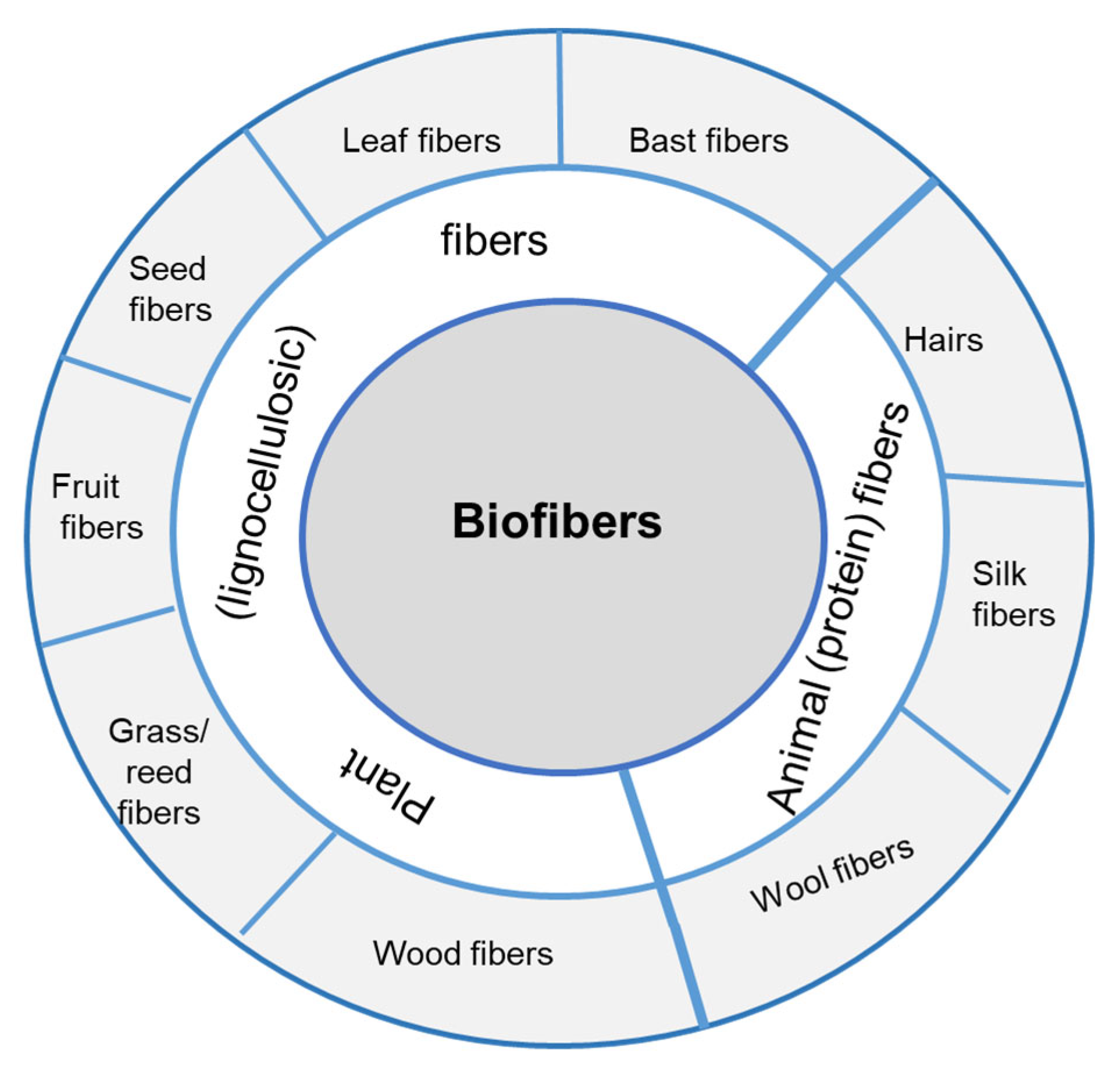
2.1. Types of Biofibers
2.2. General Properties of Biofibers
2.3. Properties of Natural Fibers with a Deciding Influence on Their Biosorption Potential
3. Biofibers for the Uptake of Metal Ions from Synthetic Aqueous Solutions
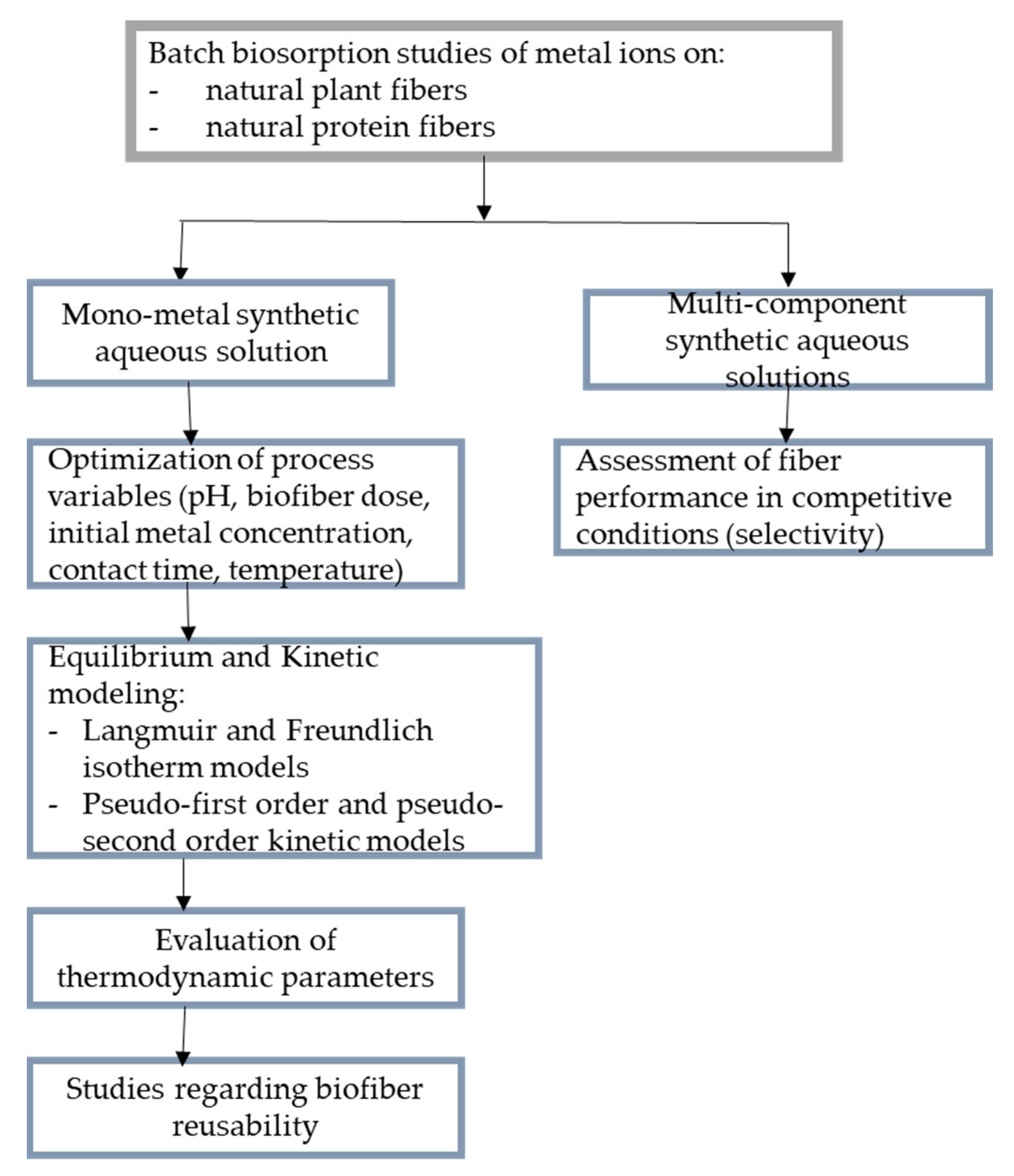
3.1. Metal Biosorption Approaches on Natural Fibers at Laboratory Scale
3.2. Natural Plant Fibers for Metal Biosorption from Synthetic Aqueous Solutions
3.2.1. Non-Competitive Biosorption
3.2.2. Competitive Biosorption
3.3. Natural Protein Fibers for Metal Uptake from Synthetic Aqueous Solutions
3.3.1. Mono-Metal Systems of Biosorption
- -
- wool powder and oxidized wool powder performed better than waste wool fibers in biosorption of Cu(II) and Zn(II) from mono-component synthetic aqueous solutions, the optimum pH being 6 [205];
- -
- tussah silk > Bombyx mori silk > wool order was determined for Co(II) uptake on different untreated protein fibers [206];
- -
- the removal efficiencies of some powdered biosorbents have shown the trends: silk powder > wool powder > cashmere guard hair powder and cashmere guard hair powder > wool powder > silk powder versus Zn(II) and Cr(VI), respectively [207];
- -
- the efficiency of biosorption of Pb(II) from aqueous solutions with pH = 5.8 on human hair, goat hair and sheep wool has reached the highest value (33 mg/g) on human hair [208].
Wool Biosorbents
Biosorbents Based on Silk Fibers
Biosorbents Based on Human Hair Waste
3.3.2. Multi-Metal Systems of Biosorption
4. Applications of Biosorbents Based on Natural Fibers to Metal Removal from Real Wastewaters
5. Future Perspectives
- -
- expanding the range of natural fibers tested for biofilter function and target metals;
- -
- complete clarification and quantification of the relationships between chemical composition, structure, and properties of the bio-based fibers;
- -
- replacement of pollutant chemical methods applied for the treatment of biofibers with cleaner procedures;
- -
- a substantial increase in the number of studies on: (i) competitive biosorption; (ii) fixed bed column biosorption; (iii) desorption–regeneration; (iv) disposal of exhausted biosorbents;
- -
- thorough deciphering of the biosorption mechanism;
- -
- expanding the process scale;
- -
- economic analyses;
- -
- strong expansion of work on real samples
6. Conclusions
Funding
Data Availability Statement
Conflicts of Interest
References
- Kozłowski, R.; Muzyczek, M. (Eds.) Natural Fibers: Properties, Mechanical Behavior, Functionalization and Applications; Nova Science Publishers Inc.: Cambridge, UK, 2017; p. 393. [Google Scholar]
- Jagadeesh, P.; Puttegowda, M.; Mavinkere Rangappa, S.; Siengchin, S. A review on extraction, chemical treatment, characterization of natural fibers and its composites for potential applications. Polym. Compos. 2021, 42, 6239–6264. [Google Scholar] [CrossRef]
- Mahir, F.I.; Keya, K.N.; Sarker, B.; Nahiun, K.M.; Khan, R.A. A brief review on natural fiber used as a replacement of synthetic fiber in polymer composites. Mater. Eng. Res. 2019, 1, 86–97. [Google Scholar] [CrossRef]
- Mohammed, L.; Ansari, M.N.; Pua, G.; Jawaid, M.; Islam, M.S. A review on natural fiber reinforced polymer composite and its applications. Int. J. Polym. Sci. 2015, 2015, 243947. [Google Scholar] [CrossRef]
- Peças, P.; Carvalho, H.; Salman, H.; Leite, M. Natural fibre composites and their applications: A review. J. Compos. Sci. 2018, 2, 66. [Google Scholar] [CrossRef]
- Thyavihalli Girijappa, Y.G.; Mavinkere Rangappa, S.; Parameswaranpillai, J.; Siengchin, S. Natural fibers as sustainable and renewable resource for development of eco-friendly composites: A comprehensive review. Front. Mater. 2019, 6, 226. [Google Scholar] [CrossRef]
- Sanjay, M.R.; Siengchin, S.; Parameswaranpillai, J.; Jawaid, M.; Pruncu, C.I.; Khan, A. A comprehensive review of techniques for natural fibers as reinforcement in composites: Preparation, processing and characterization. Carbohydr. Polym. 2019, 207, 108–121. [Google Scholar] [CrossRef]
- Kumar, P.; UI Haq, M.R.; Raiwa, A.; Anand, A. Industrial applications of natural fibre-reinforced polymer composites-challenges and opportunities. Int. J. Sustain. Eng. 2019, 12, 212–220. [Google Scholar] [CrossRef]
- Dhaliwal, J.S. Natural Fibers: Applications. In Generation, Development and Modifications of Natural Fibers; Abbas, M., Jeon, H.-Y., Eds.; IntechOpen: London, UK, 2019. [Google Scholar] [CrossRef]
- Thomas, S.; Paul, S.A.; Pothan, L.A.; Deepa, B. Natural fibres: Structure, properties and applications. In Cellulose Fibers: Bio-And Nano-Polymer Composites; Springer: Berlin/Heidelberg, Germany, 2011; pp. 3–42. [Google Scholar]
- Crini, G.; Lichtfouse, E.; Chanet, G.; Morin-Crini, N. Applications of hemp in textiles, paper industry, insulation and building materials, horticulture, animal nutrition, food and beverages, nutraceuticals, cosmetics and hygiene, medicine, agrochemistry, energy production and environment: A review. Environ. Chem. Lett. 2020, 18, 1451–1476. [Google Scholar] [CrossRef]
- Allafi, F.; Hossain, M.S.; Lalung, J.; Shaah, M.; Salehabadi, A.; Ahmad, M.I.; Shadi, A. Advancements in applications of natural wool fiber. J. Nat. Fibers 2022, 19, 497–512. [Google Scholar] [CrossRef]
- Vinod, A.; Sanjay, M.R.; Suchart, S.; Jyotishkumar, P. Renewable and sustainable biobased materials: An assessment on biofibers, biofilms, biopolymers and biocomposites. J. Clean. Prod. 2020, 258, 120978. [Google Scholar] [CrossRef]
- Zwawi, M. A review on natural fiber bio-composites, surface modifications and applications. Molecules 2021, 26, 404. [Google Scholar] [CrossRef]
- Fu, F.; Wang, Q. Removal of heavy metal ions from wastewaters: A review. J. Environ. Manag. 2011, 92, 407–418. [Google Scholar] [CrossRef]
- Muharrem, I.N.C.E.; Ince, O.K. An overview of adsorption technique for heavy metal removal from water/wastewater: A critical review. Int. J. Pure Appl. Sci. 2017, 3, 10–19. [Google Scholar] [CrossRef]
- Qasem, N.A.A.; Mohammed, R.H.; Lawal, D.U. Removal of heavy metal ions from wastewater: A comprehensive and critical review. NPJ Clean Water 2021, 4, 36. [Google Scholar] [CrossRef]
- Abidli, A.; Huang, Y.; Rejeb, Z.B.; Zaoui, A.; Park, C.B. Sustainable and efficient technologies for removal and recovery of toxic and valuable metals from wastewater: Recent progress, challenges, and future perspectives. Chemosphere 2022, 292, 133102. [Google Scholar] [CrossRef]
- Shrestha, R.; Ban, S.; Devkota, S.; Sharma, S.; Joshi, R.; Tiwari, A.P.; Kim, H.Y.; Joshi, M.K. Technological trends in heavy metals removal from industrial wastewater: A review. J. Environ. Chem. Eng. 2021, 9, 105688. [Google Scholar] [CrossRef]
- Saleh, T.A.; Mustaqeem, M.; Khaled, M. Water treatment technologies in removing heavy metal ions from wastewater: A review. Environ. Nanotechnol. Monit. Manag. 2022, 17, 100617. [Google Scholar] [CrossRef]
- Zaimee, M.Z.A.; Sarjadi, M.S.; Rahman, M.L. Heavy metals removal from water by efficient adsorbents. Water 2021, 13, 2659. [Google Scholar] [CrossRef]
- Chai, W.S.; Cheun, J.Y.; Kumar, P.S.; Mubashir, M.; Majeed, Z.; Banat, F.; Ho, S.-H.; Show, P.L. A review on conventional and novel materials towards heavy metal adsorption in wastewater treatment application. J. Clean. Prod. 2021, 296, 126589. [Google Scholar] [CrossRef]
- Park, D.; Yun, Y.S.; Park, J.M. The past, present, and future trends of biosorption. Biotechnol. Bioprocess Eng. 2010, 15, 86–102. [Google Scholar] [CrossRef]
- Michalak, I.; Chojnacka, K.; Witek-Krowiak, A. A state of the art for the biosorption process—A review. Appl. Biochem. Biotechol. 2013, 170, 1389–1416. [Google Scholar] [CrossRef] [PubMed]
- Fomina, M.; Gadd, G.M. Biosorption: Current perspectives on concept, definition and application. Bioresour. Technol. 2014, 160, 3–14. [Google Scholar] [CrossRef] [PubMed]
- Vijayaraghavan, K.; Balasubramanian, R. Is biosorption suitable for decontamination of metal-bearing wastewaters? A critical review on the state-of-the-art of biosorption processes and future directions. J. Environ. Manag. 2015, 160, 283–296. [Google Scholar] [CrossRef] [PubMed]
- Escudero, L.B.; Quintas, P.Y.; Wuilloud, R.G.; Dotto, G.L. Recent advances on elemental biosorption. Environ. Chem. Lett. 2019, 17, 409–427. [Google Scholar] [CrossRef]
- Beni, A.A.; Esmaeili, A. Biosorption, an efficient method for removing heavy metals from industrial effluents: A review. Environ. Technol. Innov. 2020, 17, 100503. [Google Scholar] [CrossRef]
- Elgarahy, A.M.; Elwakeel, K.Z.; Mohammad, S.H.; Elshoubaky, G.A. A critical review of biosorption of dyes, heavy metals and metalloids from wastewater as an efficient and green process. Clean. Eng. Technol. 2021, 4, 100209. [Google Scholar] [CrossRef]
- Tofan, L.; Bojoaga, C.N.; Paduraru, C. Biosorption for the recovery and analysis of rare earth elements and platinum group metals from real samples. A review. Environ. Chem. Lett. 2022, 20, 1225–1248. [Google Scholar] [CrossRef]
- Calderón, O.A.R.; Abdeldayem, O.M.; Pugazhendhi, A.; Rene, E.R. Current updates and perspectives of biosorption technology: An alternative for the removal of heavy metals from wastewater. Curr. Pollut. Rep. 2020, 6, 8–27. [Google Scholar] [CrossRef]
- Singh, S.; Kumar, V.; Datta, S.; Dhanjal, D.S.; Sharma, K.; Samuel, J.; Singh, J. Current advancement and future prospect of biosorbents for remediation. Sci. Total Environ. 2020, 709, 135895. [Google Scholar] [CrossRef]
- Qin, H.; Hu, T.; Zhai, Y.; Lu, N.; Aliyeva, J. The improved methods of heavy metals removal by biosorbents: A review. Environ. Pollut. 2020, 258, 113777. [Google Scholar] [CrossRef]
- de Freitas, G.R.; da Silva, M.G.R.; Vieira, M.G.A. Biosorption technology for removal of toxic metals: A review of commercial biosorbents and patents. Environ. Sci. Polut. Res. 2019, 26, 19097–19118. [Google Scholar] [CrossRef] [PubMed]
- Bilal, M.; Ihsanullah, I.; Younas, M.; Shah, M.U.H. Recent advances in applications of low-cost adsorbents for the removal of heavy metals from water: A critical review. Sep. Purif. Technol. 2021, 278, 119510. [Google Scholar] [CrossRef]
- Aryal, M. A comprehensive study on the bacterial biosorption of heavy metals: Materials, performances, mechanisms, and mathematical modellings. Rev. Chem. Eng. 2021, 37, 715–754. [Google Scholar] [CrossRef]
- Znad, H.; Awual, M.R.; Martini, S. The Utilization of Algae and Seaweed Biomass for Bioremediation of Heavy Metal-Contaminated Wastewater. Molecules 2022, 27, 1275. [Google Scholar] [CrossRef] [PubMed]
- Anastopoulos, I.; Pashalidis, I.; Bandegharaei, A.-H.; Giannakoudakis, D.A.; Robalds, A.; Usman, M.; Escudero, L.B.; Zhou, Y.; Colmenares, J.C.; Núñez-Delgado, A.; et al. Agricultural biomass/waste as adsorbents for toxic metal decontamination of aqueous solutions. J. Mol. Liq. 2019, 295, 111684. [Google Scholar] [CrossRef]
- Alalwan, H.A.; Kadham, M.A.; Alminshid, A.H. Removal of heavy metals from wastewaters using agricultural byproducts. J. Water Supply Res. T. 2020, 69, 97–112. [Google Scholar] [CrossRef]
- Ahmaruzzaman, M. Industrial wastes as low-cost potential adsorbents for the treatment of wastewater laden with heavy metals. Adv. Colloid Interface Sci. 2011, 166, 36–59. [Google Scholar] [CrossRef]
- da Silva Alves, D.C.; Healy, B.; Pinto, L.A.d.A.; Cadaval, T.R.S., Jr.; Breslin, C.B. Recent Developments in Chitosan-Based Adsorbents for the Removal of Pollutants from Aqueous Environments. Molecules 2021, 26, 594. [Google Scholar] [CrossRef]
- Anderson, A.; Anbarasu, A.; Pasupuleti, R.R.; Sekar, M.; Praveenkumar, T.R.; Kumar, J.A. Treatment of heavy metals containing wastewater using biodegradable adsorbents: A review of mechanism and future trends. Chemosphere 2022, 295, 133724. [Google Scholar] [CrossRef]
- Corral-Bobadila, M.; Lostado-Lorza, R.; Somovilla-Gomez, F.; Escribano-Gomez, R. Biosoprtion of Cu(II) ions as a method for the effective use of activated carbon from grape stall waste: RMS optimization and kinetic studies. Energ. Source Part A 2022, 44, 4706–4726. [Google Scholar] [CrossRef]
- Zhang, A.; Uchiyama, G.; Asakura, T. The adsorption properties and kinetics of uranium (VI) with a novel fibrous and polymeric adsorbent containing amidoxime chelating functional group from seawater. Sep. Sci. Technol. 2003, 38, 1829–1849. [Google Scholar] [CrossRef]
- Dai, L.; Cui, L.; Zhou, D.; Huang, J.; Yuan, S. Resource recovery of Cr (VI) from electroplating wastewater: Laboratory and pilot-scale investigation using fibrous weak anion exchanger. J. Taiwan Inst. Chem. Eng. 2015, 54, 170–177. [Google Scholar] [CrossRef]
- Ko, Y.G.; Chun, Y.J.; Kim, C.H.; Choi, U. Removal of Cu (II) and Cr (VI) ions from aqueous solution using chelating fiber packed column: Equilibrium and kinetic studies. J. Hazard Mater. 2011, 194, 92–99. [Google Scholar] [CrossRef]
- Cheng, Y.; He, P.; Dong, F.; Nie, X.; Ding, C.; Wang, S.; Zhang, Y.; Liu, H.; Zhou, S. Polyamine and amidoxime groups modified bifunctional polyacrylonitrile-based ion exchange fibers for highly efficient extraction of U (VI) from real uranium mine water. Chem. Eng. J. 2019, 367, 198–207. [Google Scholar] [CrossRef]
- Niu, Y.; Li, K.; Ying, D.; Wang, Y.; Jia, J. Novel recyclable adsorbent for the removal of copper(II) and lead(II) from aqueous solution. Bioresour. Technol. 2017, 229, 63–68. [Google Scholar] [CrossRef]
- Monier, M.; Akl, M.A.; Ali, W.M. Modification and characterization of cellulose cotton fibers for fast extraction os some precious metal ions. Int. J. Biol. Macromol. 2014, 66, 125–134. [Google Scholar] [CrossRef]
- Du, Z.; Zheng, T.; Wang, P. Experimental and modelling studies on a fixed bed adsorption for Cu(II) removal from aqueous solution by carboxyl modified jute fiber. Powder Technol. 2018, 338, 952–959. [Google Scholar] [CrossRef]
- Krishnamoorthi, R.; Anbazhagan, R.; Tsai, H.C.; Wang, C.F.; Lai, J.Y. Biodegradable, superwettable caffeic acid/chitosan polymer coated cotton fibers for the simultaneous removal of oils, dyes, and metal ions from water. Chem. Eng. J. 2022, 427, 131920. [Google Scholar] [CrossRef]
- Batool, A.; Valiyaveettil, S. Sequential Removal of Oppositely Charged Multiple Compounds from Water Using Surface-Modified Cellulose. Ind. Eng. Chem. Res. 2022, 61, 716–726. [Google Scholar] [CrossRef]
- Hao, L.; Zheng, J.; Jiang, J.; Hu, Q.; Li, X.; Wang, P. Removal of As(III) form water using modified jute fibers as a hybrid adsorbent. RSC Adv. 2015, 5, 10723–10732. [Google Scholar] [CrossRef]
- Vandenbossche, M.; Jimenez, M.; Casetta, M.; Bellayer, S.; Beaurain, A.; Bourbigot, S.; Traisnel, M. Chitosan- grafted nowoven geotextile for heavy metals sorption in sediments. React. Funct. Polym. 2013, 73, 53–59. [Google Scholar] [CrossRef]
- Gu, H.; Liu, Q.; Sun, G.; Liu, J.; Chen, R.; Yu, J.; Zhu, J.; Wang, J. Comprehensive biocompatible hemp fibers improved by phosphate zwitterion with high U (VI) affinity in the marine conditions. Chem. Eng. J. 2022, 430, 132742. [Google Scholar] [CrossRef]
- Haji, A. Modified textile fibers for waste water treatment. Environ. Sci. Eng. 2016, 4, 327–353. [Google Scholar]
- Candido, I.C.M.; Pires, I.C.B.; de Oliveira, H.P. Natural and Synthetic Fiber-Based Adsorbents for Water Remediation. Clean–Soil Air Water 2021, 49, 2000189. [Google Scholar] [CrossRef]
- Ma, F.; Gui, P.; Liu, Y.; Xue, Y.; Song, W. Functionalized fibrous materials based adsorbents for uranium adsorption and environmental removal. Chem. Eng. J. 2020, 390, 124597. [Google Scholar] [CrossRef]
- Zubair, N.A.; Moawia, R.M.; Nasef, M.M.; Hubbe, M.; Zakeri, M. A Critical Review on Natural Fibers Modifications by Graft Copolymerization for Wastewater Treatment. J. Polym. Environ. 2022, 30, 1199–1227. [Google Scholar] [CrossRef]
- Rahman, N.S.A.; Yhaya, M.F.; Azahari, B.; Ismail, W.R. Utilisation of natural cellulose fibres in wastewater treatment. Cellulose 2018, 25, 4887–4903. [Google Scholar] [CrossRef]
- Babu, R.S.; Prasanna, K.; Kumar, P.S. A censorious review on the role of natural lignocellulosic fiber waste as a low-cost adsorbent for removal of diverse textile industrial pollutants. Environ. Res. 2022, 215, 114183. [Google Scholar] [CrossRef]
- Tofan, L.; Paduraru, C.; Teodosiu, C. Hemp Fibers for Wastewater Treatment. In Sustainable Agriculture Reviews 42: Hemp Production and Applications; Crini, G., Lichtfouse, E., Eds.; Springer: Cham, Switzerland, 2020; pp. 295–326. [Google Scholar]
- Al Arni, S.; Elwaheidi, M.; Converti, A.; Benaissa, M.; Salih, A.A.; Ghareba, S.; Abbas, N. Application of Date Palm Surface Fiber as an Efficient Biosorbent for Wastewater Treatment. ChemBioEng Rev. 2023, 10, 55–63. [Google Scholar] [CrossRef]
- Futalan, C.M.; Choi, A.E.S.; Soriano, H.G.O.; Cabacungan, M.K.B.; Millare, J.C. Modification Strategies of Kapok Fiber Composites and Its Application in the Adsorption of Heavy Metal Ions and Dyes from Aqueous Solutions: A Systematic Review. Int. J. Environ. Res. Public Health 2022, 19, 2703. [Google Scholar] [CrossRef]
- Khadir, A.; Motamedi, M.; Pakzad, E.; Sillanpää, M.; Mahajan, S. The prospective utilization of Luffa fibres as a lignocellulosic bio-material for environmental remediation of aqueous media: A review. J. Environ. Chem. Eng. 2021, 9, 104691. [Google Scholar] [CrossRef]
- Morin-Crini, N.; Loiacono, S.; Placet, V.; Torri, G.; Bradu, C.; Kostić, M.; Cosentino, C.; Chanet, G.; Martel, B.; Lichtfouse, E.; et al. Hemp-based materials for metal removal. In Green Adsorbents for Pollutant Removal; Crini, G., Lichtfouse, E., Eds.; Springer: Cham, Switzerland, 2018; pp. 1–34. [Google Scholar]
- Mongioví, C.; Morin-Crini, N.; Placet, V.; Bradu, C.; Lado Ribeiro, A.R.; Ivanovska, A.; Kostić, M.; Martel, B.; Cosentino, C.; Torri, G.; et al. Hemp-Based Materials for Applications in Wastewater Treatment by Biosorption-Oriented Processes: A Review. In Cannabis/Hemp for Sustainable Agriculture and Materials; Agrawal, D.C., Kumar, R., Dhanasekaran, M., Eds.; Springer: Singapore, 2022; pp. 239–296. [Google Scholar] [CrossRef]
- Morin-Crini, N.; Loiacono, S.; Placet, V.; Torri, G.; Bradu, C.; Kostić, M.; Cosentino, C.; Chanet, G.; Martel, B.; Lichtfouse, E.; et al. Hemp-based adsorbents for sequestration of metals: A review. Environ. Chem. Lett. 2019, 17, 393–408. [Google Scholar] [CrossRef]
- Akpomie, K.G.; Conradie, J. Advances in application of cotton based adsorbents for heavy metals trapping, surface modification and future perspectives. Ecotoxicol. Environ. Saf. 2020, 201, 110825. [Google Scholar] [CrossRef]
- Ahmad, T.; Rafatullah, M.; Ghazali, A.; Sulaiman, O.; Hashim, R. Oil palm biomass–based adsorbents for the removal of water pollutants- A review. J. Environ. Sci. Health 2011, 29, 177–222. [Google Scholar] [CrossRef]
- Sanagi, M.M. Recent Advances in the preparation of oil palm waste-based adsorbents for removal of environmental pollutants—A review. Malays. J. Anal. Sci. 2018, 22, 175–184. [Google Scholar] [CrossRef]
- Vakili, M.; Rafatullah, M.; Ibrahim, M.H.; Abdullah, A.Z.; Salamatinia, B.; Gholami, Z. Oil palm biomass as an adsorbent for heavy metals. Rev. Environ. Contam. Toxicol. 2014, 232, 61–88. [Google Scholar] [CrossRef]
- Anastopoulos, I.; Pashalidis, I. Environmental applications of Luffa cylindrica-based adsorbents. J. Mol. Liq. 2020, 319, 114127. [Google Scholar] [CrossRef]
- Ghosh, A.; Collie, S.R. Keratinous materials as novel absorbent systems for toxic pollutants. Def. Sci. J. 2014, 64, 209–221. [Google Scholar] [CrossRef]
- Gore, P.M.; Naebe, M.; Wang, X.; Kandasubramanian, B. Progress in silk materials for integrated water treatments: Fabrication, modification and applications. Chem. Eng. J. 2019, 374, 437–470. [Google Scholar] [CrossRef]
- Crini, G.; Lichtfouse, E.; Chanet, G.; Morin-Crini, N. Traditional and new applications of Hemp. In Sustainable Agriculture Reviews 42: Hemp Production and Applications; Crini, G., Lichtfouse, E., Eds.; Springer: Cham, Switzerland, 2020; pp. 37–87. [Google Scholar] [CrossRef]
- Rizal, S.; HPS, A.K.; Oyekanmi, A.A.; Gideon, O.N.; Abdullah, C.K.; Yahya, E.B.; Alfatah, T.; Sabaruddin, F.A.; Rahman, A.A. Cotton wastes functionalized biomaterials from micro to nano: A cleaner approach for a sustainable environmental application. Polymers 2021, 13, 1006. [Google Scholar] [CrossRef]
- Zheng, Y.; Wang, J.; Zhu, Y.; Wang, A. Research and application of kapok fiber as an absorbing material: A mini review. J. Environ. Sci. 2015, 27, 21–32. [Google Scholar] [CrossRef] [PubMed]
- Zheng, Y.; Wang, J.; Wang, A. Recent advances in the potential applications of hollow kapok fiber-based functional materials. Cellulose 2021, 28, 5269–5292. [Google Scholar] [CrossRef]
- Rajabinejad, H.; Bucişcanu, I.I.; Maier, S.S. Current apprroaches for raw wool waste management and unconventional valorization: A review. Environ. Eng. Manag. J. 2019, 18, 1439–1456. [Google Scholar]
- Gupta, A. Human hair “waste” and its utilization: Gaps and possibilities. J. Waste Manag. 2014, 2014, 498018. [Google Scholar] [CrossRef]
- Karimah, A.; Ridho, M.R.; Munawar, S.S.; Adi, D.S.; Damayanti, R.; Subiyanto, B.; Fatriasari, W.; Fudholi, A. A review on natural fibers for development of eco-friendly bio-composite: Characteristics, and utilizations. J. Mater. Res. Technol. 2021, 13, 2442–2458. [Google Scholar] [CrossRef]
- Azman, W.A.; Asyraf, M.R.; Khalinze, A.; Petru, M.; Ruzaidi, C.M.; Sapuans, S.M.; Wan Nik, W.B.; Ishak, M.R.; Ilyas, R.A.; Suriani, M.J. Natural fiber reinforced composite material for product design: A short review. Polymers 2021, 13, 1917. [Google Scholar] [CrossRef]
- Ramamoorthy, S.K.; Skrifvars, M.; Persson, A. A review of natural fibers used in biocomposites: Plant, animal and regenerated cellulose fibers. Polym. Rev. 2015, 55, 107–162. [Google Scholar] [CrossRef]
- Sanjay, M.; Arpitha, G.; Naik, L.L.; Gopalakrishna, K.; Yogesha, B. Applications of natural fibers and its composites: An overview. Nat. Resour. 2016, 7, 108–114. [Google Scholar] [CrossRef]
- Chandgude, S.; Salunkhe, S. Biofiber-reinforced polymer hybrid composites: An overview on mechanical and tribological properties. Polym. Compos. 2020, 41, 3908–3939. [Google Scholar] [CrossRef]
- Jeferson Andrew, J.; Dhakal, H.N. Sustainable biobased composites for advanced applications: Recent trends and future opportunities: A critical review. Compos. Part C Open Access 2022, 7, 100220. [Google Scholar] [CrossRef]
- Jayaprakash, K.; Osama, A.; Rajagopal, R.; Goyette, B.; Karthikeyan, O.P. Agriculture Waste Biomass Repurposed into Natural Fibers: A Circular Bioeconomy Perspective. Bioengineering 2022, 9, 296. [Google Scholar] [CrossRef]
- Chen, H.; Liu, Z.; Tan, C. Classification of different animal fibers by near infrared spectroscopy and chemometric methods. Microchem. J. 2019, 144, 489–494. [Google Scholar] [CrossRef]
- Laitala, K.; Klepp, G.; Henry, B. Does use matter? Comparison of environmental impacts of clothing based on fiber type. Sustainability 2018, 10, 2524. [Google Scholar] [CrossRef]
- Guru, R.; Kumar, A.; Kumar, R. Basic functional application for natural fibers and types. In Natural Fiber. Jeon, H., Ed.; IntechOpen: London, UK, 2022. Available online: https://10.5772/intechopen.10.2998 (accessed on 25 October 2022).
- Fuqua, M.A.; Huo, S.; Ulven, C.A. Natural fiber reinforced composites. Polym. Rev. 2012, 52, 259–320. [Google Scholar] [CrossRef]
- Kicińska-Jakubowska, A.; Bogacz, E.; Zimniewska, M. Review of natural fibers. Part I-Vegetable fibers. J. Nat. Fibers 2012, 9, 150–167. [Google Scholar] [CrossRef]
- Madhu, P.; Sanjay, M.R.; Senthamaraikannan, P.; Pradeep, S.; Saravanakumar, S.S.; Yogesha, B. A review on synthesis and characterization of commercially available natural fibers: Part-I. J. Nat. Fibers 2019, 16, 1132–1144. [Google Scholar] [CrossRef]
- Madhu, P.; Sanjay, M.R.; Senthamaraikannan, P.; Pradeep, S.; Saravanakumar, S.S.; Yogesha, B. A review on synthesis and characterization of commercially available natural fibers: Part II. J. Nat. Fibers 2019, 16, 25–36. [Google Scholar] [CrossRef]
- Chokshi, S.; Parmar, V.; Gohil, P.; Chaudhary, V. Chemical composition and mechanical properties of natural fibers. J. Nat. Fibers 2022, 19, 3942–3953. [Google Scholar] [CrossRef]
- Darshan, S.M.; Suresha, B.; Divya, G.S. Waste silk fiber reinforced polymer matrix composites: A review. Ind. J. Adv. Chem. Sci. S1 2016, 183, 189. [Google Scholar]
- Gholampour, A.; Ozbakkaloglu, T. A review on natural fiber composites: Properties, modification and processing techniques, characterization, applications. J. Mater. Sci. 2020, 55, 829–892. [Google Scholar] [CrossRef]
- Ranakoti, L.; Gangil, B. Synthesis and surface treatments of bio-based fibers. In Advances in Bio-Based Fiber: Moving towards a Green Society; Rangappa, S.M., Puttegowda, M., Parameswaranpilai, S., Siengchin, S., Gorbatyuk, S., Eds.; Elsevier: Amsterdam, The Netherlands, 2022; pp. 22–32. [Google Scholar] [CrossRef]
- Chvalinová, R.; Wiener, J. Sorption properties of wool fibres after plasma treatment. Chem. Listy 2008, 102, 1473–1477. [Google Scholar]
- Kong, I. Properties of bio-based fibers. In Advances in Bio-Based Fiber: Moving towards a Green Society; Rangappa, S.M., Puttegowda, M., Parameswaranpilai, S., Siengchin, S., Gorbatyuk, S., Eds.; Elsevier: Amsterdam, The Netherlands, 2022. [Google Scholar] [CrossRef]
- Jawaid, M.; Khalil, H.P.S.A. Cellulosic/synthetic fiber reinforced polymer hybrid composites: A review. Carbohydr. Polym. 2011, 86, 1–18. [Google Scholar] [CrossRef]
- Khalid, M.Y.; Rashid, A.A.; Arif, Z.U.; Ahmed, W.A.; Arshad, H.; Zaidi, A.A. Natural fiber reinforced composites: Sustainable materials for emerging applications. Results. Eng. 2021, 11, 100263. [Google Scholar] [CrossRef]
- Belbeoch, C.; Lejeune, J.; Vroman, P.; Salaun, F. Silkworm and spider silk electrospinning: A review. Environ. Chem. Lett. 2021, 19, 1737–1763. [Google Scholar] [CrossRef]
- Dénes, T.-O.; Iştoan, R.; Tǎmaş-Gavrea, D.R.; Manea, D.L.; Hegyi, A.; Popa, F.; Vasile, O. Analysis of Sheep Wool-Based Composites for Building Insulation. Polymers 2022, 14, 2109. [Google Scholar] [CrossRef]
- Zamora-Mendoza, L.; Guamba, E.; Miño, K.; Romero, M.P.; Levoyer, A.; Alvarez-Barreto, J.F.; Machado, A.; Alexis, F. Antimicrobial Properties of Plant Fibers. Molecules 2022, 27, 7999. [Google Scholar] [CrossRef]
- Madueke, C.I.; Mbah, O.M.; Umunakwe, R. A review on the limitations of natural fibres and natural fibre composites with emphasis on tensile strength using coir as a case study. Polym. Bull. 2023, 80, 3489–3506. [Google Scholar] [CrossRef]
- Tavares, T.D.; Antunes, J.C.; Ferreira, F.; Felgueiras, H.P. Biofunctionalization of natural-reinforced biocomposites for biomedical applications. Biomolecules 2020, 10, 148. [Google Scholar] [CrossRef]
- Rangabhashiyam, S.; Balasubramanian, P. Characteristics, performances, equilibrium and kinetic modeling aspects of heavy metal removal using algae. Bioresour. Technol. Rep. 2019, 5, 261–279. [Google Scholar] [CrossRef]
- Siddiquee, S.; Rovina, K.; Azad, S.A.; Naher, L.; Suryani, S.; Chaikaew, P. Heavy metal contaminants removal from wastewater using the potential filamentous fungi biomass: A review. J. Microb. Biochem. Technol. 2015, 7, 384–393. [Google Scholar] [CrossRef]
- Ayele, A.; Haile, S.; Alemu, D.; Kamaraj, M. Comparative Utilization of Dead and Live Fungal Biomass for the Removal of Heavy Metal: A Concise Review. Sci. World J. 2021, 2021, 5588111. [Google Scholar] [CrossRef]
- Aryal, M.; Liakopoulou-Kyriakides, M. Bioremoval of heavy metals by bacterial biomass. Environ. Monit. Assess. 2014, 187, 1–26. [Google Scholar] [CrossRef]
- Jena, P.S.; Pradhan, A.; Nanda, S.P.; Dash, A.K.; Naik, B. Biosorption of heavy metals from wastewater using Saccharomyce cerevisiae as a biosorbent: A mini review. Mater. Today Proc. 2022, 67, 1140–1146. [Google Scholar] [CrossRef]
- dos Santos, W.N.L.; Cavalcante, D.D.; da Silva, E.G.P.; das Vargens, C.F.; de Souza Dias, F. Biosorption of Pb(II) and Cd(II) ions by Agave sisalana(sisal fiber). Microchem. J. 2011, 97, 269–273. [Google Scholar] [CrossRef]
- de Gisi, S.; Lofrano, G.; Grassi, M.; Notarnicola, M. Characteristics and adsorption capacities of low-cost sorbents for wastewater treatment: A review. Sustain. Mater. Technol. 2016, 9, 10–40. [Google Scholar] [CrossRef]
- Pathirana, C.; Ziyath, A.M.; Jinadasa, K.B.S.N.; Egodawatta, P.; Sarina, S.; Goonetilleke, A. Quantifying the influence of surface physico-chemical properties of biosorbents for heavy metal biosorption. Chemosphere 2019, 234, 488–495. [Google Scholar] [CrossRef]
- Pathirana, C.; Ziyath, A.M.; Jinadasa, K.B.S.N.; Egodawatta, P.; Goonetilleke, A. Mathematical modelling of the influence of physico-chemical properties on heavy metal adsorption by biosorbents. Chemosphere 2020, 255, 126965. [Google Scholar] [CrossRef]
- Bukhari, A.A.H.; Monier, M.; Elsayed, N.H.; Hashem, M.S.; Eldiasty, J.G.; Alnawmasi, J.S.; Hafik, A.L. Flax fiber grafted with Cd (II)-imprinted 2-pyridylthiourea for selective ion removal. Mater. Chem. Phys. 2022, 287, 126239. [Google Scholar] [CrossRef]
- Huang, Q.; Hu, D.; Chen, M.; Bao, C.; Jin, X. Sequential removal of aniline and heavy metal ions by jute fiber biosorbents: A practical design of modifying adsorbent with reactive adsorbate. J Mol. Liq. 2019, 285, 288–298. [Google Scholar] [CrossRef]
- Sahu, U.K.; Mahapatra, S.S.; Patel, R.K. Synthesis and characterization of an eco-friendly composite of jute fiber and Fe2O3 nanoparticles and its application as an adsorbent for removal of As (V) from water. J. Mol. Liq. 2017, 237, 313–321. [Google Scholar] [CrossRef]
- Wang, X.; Li, Q.; Yang, D.; An, X.; Qian, X. Phytic Acid Doped Polyaniline as a Binding Coating Promoting Growth of Prussian Blue on Cotton Fibers for Adsorption of Copper Ions. Coatings 2022, 12, 138. [Google Scholar] [CrossRef]
- Chwastowski, J.; Staroń, P. Influence of Saccharomyces cerevisiae yeast cells immobilized on Cocos nucifera fibers for the adsorption of Pb (II) ions. Colloids Surf. A Physicochem. Eng. Asp. 2022, 632, 127735. [Google Scholar] [CrossRef]
- Igwe, J.C.; Abia, A.A.; Ibeh, C.A. Adsorption kinetics and intraparticulate diffusivities of Hg, As and Pb ions on unmodified and thiolated coconut fiber. Int. J. Environ. Sci. Technol. 2008, 5, 83–92. [Google Scholar] [CrossRef]
- Xiao, F.; Cheng, Y.; Zhou, P.; Chen, S.; Wang, X.; He, P.; Nie, X.; Dong, F. Fabrication of novel carboxyl and amidoxime groups modified luffa fiber for highly efficient removal of uranium (VI) from uranium mine water. J. Environ. Chem. Eng. 2021, 9, 105681. [Google Scholar] [CrossRef]
- Nikiforova, T.; Kozlov, V.; Islyaikin, M. Sorption of d-metal cations by keratin from aqueous solutions. J. Environ. Chem. Eng. 2019, 7, 103417. [Google Scholar] [CrossRef]
- Zhang, F.; Chen, M.; Hu, S.; Cheng, H. Chemical treatments on the cuticle layer enhancing the uranium (VI) uptake from aqueous solution by amidoximated wool fibers. J. Radioanal. Nucl. Chem. 2017, 314, 1927–1937. [Google Scholar] [CrossRef]
- Akoh, F.; Bouchoum, H.; El Bouchti, M.; Cherkaoui, O.; Jadha, A.; Tahiri, M. Sulphate removal from aqueous solutions using esterified wool fibers: Isotherms, kinetic and thermodinamic studies. Des. Water Treat. 2020, 194, 417–428. [Google Scholar] [CrossRef]
- Condurache, B.-C.; Cojocaru, C.; Samoila, P.; Cosmulescu, S.-F.; Predeanu, G.; Enache, A.-E.; Harabagiu, V. Oxidized biomass and its usage as adsorbent for removal of heavy metal ions from aqueous solutions. Molecules 2022, 27, 6119. [Google Scholar] [CrossRef]
- Gore, P.M.; Naebe, M.; Wang, X.; Kandasubramanian, B. Nano-fluoro dispersion functionalized superhydrophobic degummed & waste silk fabric for sustained recovery of petroleum oils & organic solvents from wastewater. J. Hazard. Mater. 2022, 426, 127822. [Google Scholar] [CrossRef]
- Mia, M.S.; Yao, Y.; Zhu, X.; Lei, X.; Xing, T.; Chen, G. Degradation of textile dyes from aqueous solution using tea-polyphenol/Fe loaded waste silk fabrics as Fenton—Like catalyst. RSC Adv. 2021, 11, 8290–8305. [Google Scholar] [CrossRef]
- Zaini, M.A.A.; Sudi, R.M. Valorization of human hair as methylene blue dye adsorbents. Green Process. Synth. 2018, 7, 344–352. [Google Scholar] [CrossRef]
- Mondal, N.K.; Basu, S. Potentiality of waste human hair towards removal of chromium(VI) from solution: Kinetic and equilibrium studies. Appl. Water Sci. 2019, 9, 49. [Google Scholar] [CrossRef]
- Shukla, S.R.; Pai, R.P. Removal of Pb(II) from solution using cellulose containing materials. J. Chem. Technol. Biotechnol. 2005, 80, 176–183. [Google Scholar] [CrossRef]
- Dakiky, M.; Khanis, M.; Manassra, A.; Mer’eb, M. Selective adsorption of chromium(VI) in industrial wastewater using low-cost abundantly available adsorbents. Adv. Environ. Res. 2002, 6, 533–540. [Google Scholar] [CrossRef]
- Cruz, J.; Fangueiro, R. Surface modification of natural fibers: A review. Procedia Eng. 2016, 155, 285–288. [Google Scholar] [CrossRef]
- Amiandamhen, S.O.; Meincken, M.; Tyhoda, L. Natural fibre modification and its influence on fibre-matrix interfacial properties in biocomposite materials. Fibers Polym. 2020, 21, 677–689. [Google Scholar] [CrossRef]
- Aksu, Z. Application of biosorption for the removal of organic pollutants: A review. Process. Biochem. 2005, 40, 997–1026. [Google Scholar] [CrossRef]
- Patel, H. Comparison of batch and fixed bed column adsorption: A critical review. Int. J. Environ. Sci. Technol. 2022, 19, 10409–10426. [Google Scholar] [CrossRef]
- Kumar, P.A.; Chakraborty, S. Fixed-bed column study for hexavalent chromium removal and recovery by short-chain polyaniline synthesized on jute fiber. J. Hazard. Mater. 2009, 162, 1086–1098. [Google Scholar] [CrossRef]
- Borna, M.O.; Pirsaheb, M.; Niri, M.V.; Mashizie, R.K.; Kakavandi, B.; Zare, M.R.; Asadi, A. Batch and column studies for the adsorption of chromium (VI) on low-cost Hibiscus Cannabinus kenaf, a green adsorbent. J. Taiwan Inst. Chem. Eng. 2016, 68, 80–89. [Google Scholar] [CrossRef]
- Manassra, A.; Khamis, M.; Ihmied, T.; ElDakiky, M. Removal of chromium by continuous flow using wool packed columns. Electron. J. Environ. Agric. Food Chem. 2010, 9, 651–663. [Google Scholar]
- Abbar, B.; Alem, A.; Marcotte, S.; Pantet, A.; Ahfir, N.D.; Bizet, L.; Duriatti, D. Experimental investigation on removal of heavy metals (Cu2+, Pb2+, and Zn2+) from aqueous solution by flax fibres. Process. Saf. Environ. Prot. 2017, 109, 639–647. [Google Scholar] [CrossRef]
- Mongioví, C.; Morin-Crini, N.; Lacalamita, D.; Bradu, C.; Raschetti, M.; Placet, V.; Ribeiro, A.R.L.; Ivanovska, A.; Kostic, M.; Crini, G. Biosorbents from Plant Fibers of Hemp and Flax for Metal Removal: Comparison of Their Biosorption Properties. Molecules 2021, 26, 4199. [Google Scholar] [CrossRef] [PubMed]
- Pejic, B.; Vukcevic, M.; Kostic, M.; Skundric, P. Biosorption of heavy metal ions from aqueous solutions by short hemp fibers: Effect of chemical composition. J. Hazard. Mater. 2009, 164, 146–153. [Google Scholar] [CrossRef] [PubMed]
- Tofan, L.; Păduraru, C. Sorption studies of Ag (I), Cd (II) and Pb (II) ions on sulphdryl hemp fibers. Croat. Chem. Acta 2004, 77, 581–586. [Google Scholar]
- Shukla, S.R.; Pai, R.S. Adsorption of Cu(II), Ni(II) and Zn(II) on modified jute fibers. Bioresour. Technol. 2005, 96, 1430–1438. [Google Scholar] [CrossRef]
- Hassan, M.S.; Ali, N.M.; Attia, R.M.; Zohdy, M.H.; Rabie, A.M. Adsorption of heavy metal ions from aqueous media using amidoximated jute fibres: A comparative study. Egypt. J. Rad. Sci. Appl. 2015, 28, 61–75. [Google Scholar]
- Lee, B.G.; Rowell, R.M. Removal of heavy metal ions from aqueous solutions using lignocellulosic fibers. J. Nat. Fibers 2004, 1, 97–108. [Google Scholar] [CrossRef]
- Paulino, A.G.; da Cunha, A.J.; da Silva Alfaya, R.V.; da Silva Alfaya, A.A. Chemically modified natural cotton fiber: A low-cost biosorbent for the removal of the Cu(II), Zn(II), Cd(II), and Pb(II) from natural water. Desalin. Water Treat. 2014, 52, 4223–4233. [Google Scholar] [CrossRef]
- Zhang, G.; Qu, R.; Sun, C.; Ji, O.; Chen, H.; Wang, C.; Niu, Y. Adsorption for metal ions on chitosan coated cotton fiber. J. Appl. Polym. Sci. 2008, 110, 2321–2327. [Google Scholar] [CrossRef]
- Chung, B.Y.; Cho, J.Y.; Lee, M.H.; Wi, S.G.; Kim, J.H.; Kim, J.S.; Kim, J.S.; Kam, P.H.; Nho, Y.C. Adsorption of heavy metal ions onto chemically oxidized Ceiba pentandra (L.) Gaertn.(kapok) fibers. J. Appl. Biol. Chem. 2008, 51, 28–35. [Google Scholar] [CrossRef]
- Shukla, S.R.; Pai, R.S.; Shendarkar, A.D. Adsorption of Ni(II), Zn(II) and Fe(II) on modified coir fibers. Sep. Purif. Technol. 2006, 47, 141–147. [Google Scholar] [CrossRef]
- Shukla, P.M.; Shukla, R.S. Biosorption of Cu(II), Pb(II), Ni(II) and Fe(II) on alkali treated coir fibers. Sep. Sci. Technol. 2013, 48, 421–428. [Google Scholar] [CrossRef]
- Flores-Trujillo, A.K.I.; Mussali-Galante, P.; de Hoces, M.C.; Blázquez-García, G.; Saldarriaga-Noreña, H.A.; Rodríguez-Solís, A.; Tovar-Sanchez, E.; Sanchez- Salinas, E.; Ortiz-Hernández, L. Biosorption of heavy metals on Opuntia fuliginosa and Agave angustifolia fibers for their elimination from water. Int. J. Environ. Sci. Technol. 2021, 18, 441–445. [Google Scholar] [CrossRef]
- Bennacer, L.; Benmammar, D.; Ahfir, N.D.; Alem, A.; Mignot, M.; Pantet, A.; El Maana, S. Potential of using Alfa grass fibers (Stipa Tenacissima L.) to remove Pb2+, Cu2+, and Zn2+ from an aqueous solution. Environ. Technol. 2022, 1–17. [Google Scholar] [CrossRef]
- Hassan, M.S.; Zohdy, M.H. Adsorption kinetics of toxic heavy metal ions from aqueous solutions onto grafted jute fibers with acrylic acid by gamma irradiation. J. Nat. Fibers 2018, 15, 506–516. [Google Scholar] [CrossRef]
- Hossain, M.M.; Moniruzzaman, M.; Khan, M.A.; Shahjahan, M.; Alam, M.Z.; Jamal, M.S. Preparation of selective ion adsorbent by gamma radiation induced graft copolymerization of n-butyl methacrylate & phosphoric acid on jute fiber. Indian J. Adv. Chem. Sci. 2014, 2, 146–150. [Google Scholar]
- Sun, Z.; Liu, Y.; Huang, Y.; Tan, X.; Zeng, G.; Hu, X.; Yang, Z. Fast adsorption of Cd2+ and Pb2+ by EGTA dianhydride (EGTAD) modified ramie fiber. J. Colloid Interface Sci. 2014, 434, 152–158. [Google Scholar] [CrossRef]
- Zang, C.; Zhang, D.; Xiong, J.; Lin, H.; Chen, Y. Preparation of a novel adsorbent and heavy metal ion adsorption. J. Eng. Fibers Fabr. 2014, 9, 165–170. [Google Scholar] [CrossRef]
- Sekine, A.; Seko, N.; Tamada, M.; Suzuki, Y. Biodegradable metal adsorbent synthesized by graft polymerization onto nonwoven cotton fabric. Radiat. Phys. Chem. 2010, 79, 16–21. [Google Scholar] [CrossRef]
- Sokker, H.H.; Badawy, S.M.; Zayed, E.M.; Nour Eldien, F.A.; Farag, A.M. Radiation-induced grafting of glycidyl methacrylate onto cotton fabric waste and its modification for anchoring hazardous wastes from their solutions. J. Hazard. Mater. 2009, 168, 137–144. [Google Scholar] [CrossRef] [PubMed]
- Hoshina, H.; Takahashi, M.; Kasai, N.; Seko, N. Adsorbent for arsenic (V) removal synthesized by radiation-induced graft polymerization onto nonwoven cotton fabric. Int. J. Org. Chem. 2012, 2, 173–177. [Google Scholar] [CrossRef]
- Liu, C.; Yan, C.; Luo, W.; Li, X.; Ge, W.; Zhou, S. Simple preparation and enhanced adsorption properties of loofah fiber adsorbent by ultraviolet radiation graft. Mater. Lett. 2015, 157, 303–306. [Google Scholar] [CrossRef]
- Gupta, V.K.; Agarwal, S.; Singh, P.; Pathania, D. Acrylic acid grafted cellulosic Luffa cylindrical fiber for the removal of dye and metal ions. Carbohydr. Polym. 2013, 98, 1214–1221. [Google Scholar] [CrossRef] [PubMed]
- Singha, A.S.; Guleria, A. Synthesis and applications of functional polymers from natural okra fibers for removal of Cu (II) ions from aqueous solution. J. Nat. Fibers 2015, 12, 587–603. [Google Scholar] [CrossRef]
- Singha, A.S.; Guleria, A.; Rana, R.K. Adsorption and equilibrium isotherm study of removal of copper (II) ions from aqueous solution by chemically modified Abelmoschus esculentus fibers. Int. J. Polym. Anal. Charact. 2013, 18, 451–463. [Google Scholar] [CrossRef]
- Johari, I.S.; Yusof, N.A.; Haron, M.J.; Nor, S.M.M. Preparation and Characterization of Poly(ethyl hydrazide)-Grafted Oil Palm Empty Fruit Bunch Fibre for the Removal of Cu(II) Ions from an Aqueous Environment. Molecules 2013, 18, 8461–8472. [Google Scholar] [CrossRef]
- Johari, I.S.; Yusof, N.A.; Haron, M.J.; Nor, S.M.M. Preparation and Characterization of Poly(ethyl hydrazide) Grafted Oil Palm Empty Fruit Bunch for Removal of Ni(II) Ion in Aqueous Environment. Polymers 2013, 5, 1056–1067. [Google Scholar] [CrossRef]
- Dai, W.; Zhang, J.; Xiao, Y.; Luo, W.; Yang, Z. Dual function of modified palm leaf sheath fibers in adsorbing Reactive Yellow 3 and Cr (VI) from dyeing wastewater. J. Polym. Environ. 2021, 29, 3854–3866. [Google Scholar] [CrossRef]
- Ofomaja, A.E. Equilibrium studies of copper ion adsorption onto palm kernel fibre. J. Environ. Manag. 2010, 91, 1491–1499. [Google Scholar] [CrossRef]
- de Sousa, D.A.; de Oliveira, E.; da Costa Nogueira, M.; Espósito, B.P. (2010). Development of a heavy metal sorption system through the PS functionalization of coconut (Cocos nucifera) fibers. Bioresour. Technol. 2010, 101, 138–143. [Google Scholar] [CrossRef]
- Pejić, B.; Vukčević, M.; Lazić, B.; Janjić, S.; Kostić, M. The Role of Cellulosic and Noncellulosic Functional Groups in the Biosorption of Lead Ions by Waste Flax Fibers. J. Nat. Fibers 2023, 20, 21403. [Google Scholar] [CrossRef]
- Gapusan, R.B.; Balela, M.D.L. Adsorption of anionic methyl orange dye and lead (II) heavy metal ion by polyaniline-kapok fiber nanocomposite. Mater. Chem. Phys. 2020, 243, 122682. [Google Scholar] [CrossRef]
- Chwastowski, J.; Staroń, P.; Kołoczek, H.; Banach, M. Adsorption of hexavalent chromium from aqueous solutions using Canadian peat and coconut fiber. J. Mol. Liq. 2017, 248, 981–989. [Google Scholar] [CrossRef]
- Henryk, K.; Jarosław, C.; Witold, Ż. Peat and coconut fiber as biofilters for chromium adsorption from contaminated wastewaters. Environ. Sci. Pollut. Res. 2016, 23, 527–534. [Google Scholar] [CrossRef]
- Staroń, P.; Chwastowski, J.; Banach, M. Sorption and desorption studies on silver ions from aqueous solution by coconut fiber. J. Clean. Prod. 2017, 149, 290–301. [Google Scholar] [CrossRef]
- Kajeiou, M.; Alem, A.; Mezghich, S.; Ahfir, N.D.; Mignot, M.; Pantet, A. Desorption of zinc, copper and lead ions from loaded flax fibres. Environ. Technol. 2023, 44, 1808–1821. [Google Scholar] [CrossRef]
- Kyzas, G.Z.; Terzopoulou, Z.; Nikolaidis, V.; Alexopoulou, E.; Bikiaris, D.N. Low-cost hemp biomaterials for nickel ions removal from aqueous solutions. J. Mol. Liq. 2015, 209, 209–218. [Google Scholar] [CrossRef]
- Teklu, T.; Wangatia, L.M.; Alemayehu, E. Removal of Pb(II) from aqueous media using adsorption onto polyaniline coated sisal fibers. J. Vinyl Addit. Technol. 2019, 25, 189–197. [Google Scholar] [CrossRef]
- Duan, C.; Zhao, N.; Yu, X.; Zhang, X.; Xu, J. Chemically modified kapok fiber for fast adsorption of Pb2+, Cd2+ Cu2+ from aqueous solution. Cellulose 2013, 20, 849–860. [Google Scholar] [CrossRef]
- Huang, Z.; Wu, P.; Yin, Y.; Zhou, X.; Fu, L.; Wang, L.; Chen, S.; Tang, X. Preparation of cotton fibers modified with aromatic heterocyclic compounds and study of Cr(VI) adsorption performance. Cellulose 2021, 28, 11037–11049. [Google Scholar] [CrossRef]
- Jia, J.; Liu, C.; Wang, L.; Liang, X.; Chai, X. Double functional polymer brush-grafted cotton fiber for the fast visual detection and efficient adsorption of cadmium ions. Chem. Eng. J. 2018, 347, 631–639. [Google Scholar] [CrossRef]
- Wang, S.; Wang, L.; Kong, W.; Ren, J.; Liu, C.; Wang, K.; Sun, R.; She, D. Preparation, characterization of carboxylated bamboo fibers and their adsorption for lead (II) ions in aqueous solution. Cellulose 2013, 20, 2091–2100. [Google Scholar] [CrossRef]
- Tangtubtim, S.; Saikrasun, S. Effective removals of copper (II) and lead (II) cations from aqueous solutions by polyethyleneimine-immobilized pineapple fiber. Bioresour. Technol. Rep. 2019, 7, 100188. [Google Scholar] [CrossRef]
- Tangtubtim, S.; Saikrasun, S. Adsorption behavior of polyethyleneimine-carbamate linked pineapple leaf fiber for Cr (VI) removal. Appl. Surf. Sci. 2019, 467, 596–607. [Google Scholar] [CrossRef]
- Abutaleb, A.; Tayeb, A.M.; Mahmoud, M.A.; Daher, A.M.; Desouky, O.A.; Bakather, O.Y.; Farouq, R. Removal and recovery of U (VI) from aqueous effluents by flax fiber: Adsorption, desorption and batch adsorber proposal. J. Adv. Res. 2020, 22, 153–162. [Google Scholar] [CrossRef]
- Loiacono, S.; Crini, G.; Martel, B.; Chanet, G.; Cosentino, C.; Raschetti, M.; Placet, V.; Torri, G.; Morin-Crini, N. Simultaneous removal of Cd, Co, Cu, Mn, Ni, and Zn from synthetic solutions on a hemp-based felt. II. Chemical modification. J. Appl. Polym. Sci. 2017, 134, 45138. [Google Scholar] [CrossRef]
- Kajeiou, M.; Alem, A.; Mezghich, S.; Ahfir, N.D.; Mignot, M.; Devouge-Boyer, C.; Pantet, A. Competitive and non-competitive zinc, copper and lead biosorption from aqueous solutions onto flax fibers. Chemosphere 2020, 260, 127505. [Google Scholar] [CrossRef]
- Ivanovska, A.; Dojcinovic, B.; Maletic, S.; Pavun, L.; Asanovic, K.; Kostic, M. Waste jute fabric as a biosorbent for heavy metal ions from aqueous solution. Fiber Polym. 2020, 21, 1992–2002. [Google Scholar] [CrossRef]
- Du, Z.; Zheng, T.; Wang, P.; Hao, L.; Wang, Y. Fast microwave-assisted preparation of a low-cost and recyclable carboxyl modified lignocellulose-biomass jute fiber for enhanced heavy metal removal from water. Bioresour. Technol. 2016, 201, 41–49. [Google Scholar] [CrossRef]
- Mihajlović, S.; Vukčević, M.; Pejić, B.; Grujić, A.P.; Ristić, M. Application of waste cotton yarn as adsorbent of heavy metal ions from single and mixed solutions. Environ. Sci. Pollut. Res. 2020, 27, 35769–35781. [Google Scholar] [CrossRef]
- Zheng, Y.; Wang, W.; Huang, D.; Wang, A. Kapok fiber oriented-polyaniline nanofibers for efficient Cr (VI) removal. Chem. Eng. J. 2012, 191, 154–161. [Google Scholar] [CrossRef]
- Wang, D.; Kim, D.; Shin, C.H.; Zhao, Y.; Park, J.S.; Ryu, M. Removal of lead (II) from aqueous stream by hydrophilic modified kapok fiber using the Fenton reaction. Environ. Earth Sci. 2018, 77, 1–10. [Google Scholar] [CrossRef]
- Ridwan, S.; Hanisom, A.; Azlan, K. Application of Kenaf Bast fiber to adsorb Cu (II), Pb (II) and Zn (II) in aqueous solution: Single-and multi-metal systems. Int. J. Environ. Sci. Dev. 2016, 7, 715–723. [Google Scholar] [CrossRef]
- Gupta, V.K.; Pathania, D.; Sharma, S.; Agarwal, S.; Singh, P. Remediation of noxious chromium (VI) utilizing acrylic acid grafted lignocellulosic adsorbent. J. Mol. Liq. 2013, 177, 343–352. [Google Scholar] [CrossRef]
- Qu, R.; Sun, C.; Ma, F.; Zhang, Y.; Ji, C.; Xu, Q.; Wang, C.; Chen, H. Removal and recovery of Hg(II) from aqueous solution using chitosan- coated cotton fibers. J. Hazard. Mater. 2009, 167, 717–727. [Google Scholar] [CrossRef]
- Cao, E.; Duan, W.; Yi, L.; Wang, A.; Zheng, Y. Poly (m-phenylenediamine) functionalized Calotropis gigantea fiber for coupled adsorption reduction for Cr (VI). J. Mol. Liq. 2017, 240, 225–232. [Google Scholar] [CrossRef]
- Bai, Z.; Liu, Q.; Zhang, H.; Liu, J.; Yu, J.; Wang, J. A novel 3D reticular anti-fouling bio-adsorbent for uranium extraction from seawater: Polyethylenimine and guanidyl functionalized hemp fibers. Chem. Eng. J. 2020, 382, 122555. [Google Scholar] [CrossRef]
- Bai, Z.; Liu, Q.; Zhang, H.; Liu, J.; Yu, J.; Wang, J. High efficiency biosorption of Uranium (VI) ions from solution by using hemp fibers functionalized with imidazole-4, 5-dicarboxylic. J. Mol. Liq. 2020, 297, 111739. [Google Scholar] [CrossRef]
- Niu, Y.; Hu, W.; Guo, M.; Wang, Y.; Jia, J.; Hu, Z. Preparation of cotton-based fibrous adsorbents for the removal of heavy metal ions. Carbohydr. Polym. 2019, 225, 115218. [Google Scholar] [CrossRef]
- Tang, X.; Zhang, Q.; Liu, Z.; Pan, K.; Dong, Y.; Li, Y. Removal of Cu (II) by loofah fibers as a natural and low-cost adsorbent from aqueous solutions. J. Mol. Liq. 2014, 199, 401–407. [Google Scholar] [CrossRef]
- Nikiforova, T.E.; Kozlov, V.A.; Sionokhina, N.N. Pelicularities of sorption of copper(II) ions by modified wool keratin. Prot. Met. Phys. Chem. Surf. 2019, 55, 849–857. [Google Scholar] [CrossRef]
- Naik, R.; Wen, G.; MS, D.; Hureau, S.; Uedono, A.; Wang, X.; Liu, X.; Cookson, P.G.; Smith, S.V. Metal ion binding properties of novel wool powders. J. Appl. Polym. Sci. 2010, 115, 1642–1650. [Google Scholar] [CrossRef]
- Rajkhowa, R.; Naik, R.; Wang, L.; Smith, S.V.; Wang, X. An investigation into transition metal ion binding properties of silk fibers and particles using radioisotopes. J. Appl. Polym. Sci. 2011, 119, 3630–3639. [Google Scholar] [CrossRef]
- Atef El-Sayed, A.; Salama, M.; Kantouch, A.A.M. Wool micro powder as a metal ion exchanger for the removal of copper and zinc. Desalin. Water Treat. 2015, 56, 1010–1019. [Google Scholar] [CrossRef]
- Tsukada, M.; Arai, T.; Colonna, G.M.; Boschi, A.; Freddi, G. Preparation of metal-containing protein fibers and their antimicrobial properties. J.Appl. Polym. Sci. 2003, 89, 638–644. [Google Scholar] [CrossRef]
- Patil, K.; Smith, S.V.; Rajkhowa, R.; Tsuzuki, T.; Wang, X.; Lin, T. Milled cashmere guard hair powders: Absorption properties to heavy metal ions. Powder Technol. 2012, 218, 162–168. [Google Scholar] [CrossRef]
- Mahdavian, L. Effects of magnetic field, pH and retention time on the lead (Pb2+) adsorption by modified human hair, goat hair and sheep wool. Afr. J. Microbiol. Res. 2012, 6, 183–189. [Google Scholar] [CrossRef]
- Simonič, M.; Flucher, V.; Luxbacher, T.; Vesel, A.; Fras Zemljič, L. Adsorptive Removal of Heavy Metal Ions by Waste Wool. J. Nat. Fibers 2022, 19, 14490–14503. [Google Scholar] [CrossRef]
- Jumean, F.H.; Khamis, M.I.; Sara, Z.A.; AbouRich, M.S. Concurrent removal and reduction of Cr (VI) by wool: Short and long term equilibration studies. Am. J. Analyt. Chem. 2015, 6, 53055. [Google Scholar] [CrossRef]
- Enkhzaya, S.; Shiomori, K.; Oyuntsetseg, B. Effective adsorption of Au (III) and Cu (II) by chemically treated sheep wool and the binding mechanism. J. Environ. Chem. Eng. 2020, 8, 104021. [Google Scholar] [CrossRef]
- Enkhzaya, S.; Shiomori, K.; Oyuntsetseg, B. Removal of Heavy Metals from Aqueous Solution by Adsorption using Livestock Biomass of Mongolia. J. Environ. Sci. Technol. 2017, 10, 107–119. [Google Scholar] [CrossRef]
- Radetić, M.; Jocić, D.; Jovančić, P.; Rajaković, L.; Thomas, H.; Petrović, Z.L. Recycled-wool-based nonwoven material as a sorbent for lead cations. J. Appl. Polym. Sci. 2003, 90, 379–386. [Google Scholar] [CrossRef]
- Li, W.; Ye, Y. Modified wool as adsorbent for the removal of Cr (III) from aqueous solution: Adsorption properties, isotherm and kinetics. Res. Chem. Intermed. 2015, 41, 803–812. [Google Scholar] [CrossRef]
- Simonič, M.; Fras Zemljič, L. Functionalized wool as an efficient and sustainable adsorbent for removal of Zn (II) from an aqueous solution. Materials 2020, 13, 3208. [Google Scholar] [CrossRef]
- Hanzlíková, Z.; Braniša, J.; Jomová, K.; Fülöp, M.; Hybler, P.; Porubská, M. Electron beam irradiated sheepwool—Prospective sorbent for heavy metals in wastewater. Sep. Purif. Technol. 2018, 193, 345–350. [Google Scholar] [CrossRef]
- Ma, H.; Zhang, F.; Li, Q.; Chen, G.; Hu, S.; Cheng, H. Preparation of ZnO nanoparticle loaded amidoximated wool fibers as a promising antibiofouling adsorbent for uranium (VI) recovery. RSC Adv. 2019, 9, 18406–18414. [Google Scholar] [CrossRef]
- Porubská, M.; Jomová, K.; Lapčík, Ľ.; Braniša, J. Radiation-modified wool for adsorption of redox metals and potentially for nanoparticles. Nanotechnol. Rev. 2020, 9, 1017–1026. [Google Scholar] [CrossRef]
- Braniša, J.; Kleinová, A.; Jomová, K.; Malá, R.; Morgunov, V.; Porubská, M. Some properties of electron beam-irradiated sheep wool linked to Cr(III) sorption. Molecules 2019, 24, 4401. [Google Scholar] [CrossRef]
- Braniša, J.; Jomová, K.; Kovalčíková, R.; Hybler, P.; Porubská, M. Role of Post-Exposure Time in Co(II) Sorption of Higher Concentrations on Electron Irradiated Sheep Wool. Molecules 2019, 24, 2639. [Google Scholar] [CrossRef]
- Hanzlíková, Z.; Braniša, J.; Hybler, P.; Šprinclová, I.; Jomová, K.; Porubská, M. Sorption properties of sheep wool irradiated by accelerated electron beam. Chem. Pap. 2016, 70, 1299–1308. [Google Scholar] [CrossRef]
- Braniša, J.; Kleinová, A.; Jomová, K.; Weissabel, R.; Cvik, M.; Branišová, Z.; Porubská, M. Sheep Wool Humidity under Electron Irradiation Affects Wool Sorptivity towards Co(II) Ions. Molecules 2021, 26, 5206. [Google Scholar] [CrossRef] [PubMed]
- Porubská, M.; Kleinová, A.; Hybler, P.; Braniša, J. Why natural or electron irradiated sheep wool show anomalous sorption of higher concentrations of copper(II). Molecules 2018, 23, 3180. [Google Scholar] [CrossRef] [PubMed]
- Braniša, J.; Jomová, K.; Lapčík, Ľ.; Porubská, M. Testing of electron beam irradiated sheep wool for adsorption of Cr(III) and Co(II) of higher concentrations. Polym. Test. 2021, 99, 107191. [Google Scholar] [CrossRef]
- Yin, Z.; Xiong, J.; Chen, M.; Hu, S.; Cheng, H. Recovery of uranium(VI) from aqueous solution by amidoxime functionalized wool fibers. J. Radioanal. Nucl. Chem. 2016, 307, 1471–1479. [Google Scholar] [CrossRef]
- Wen, J.; Li, Q.; Li, H.; Chen, M.; Hu, S.; Cheng, H. Nano-TiO2 imparts amidoximated wool fibers with good antibacterial activity and adsorption capacity for uranium (VI) recovery. Ind. Eng. Chem. Res. 2018, 57, 1826–1833. [Google Scholar] [CrossRef]
- Yin, Z.; Chen, M.; Hu, S.; Cheng, H. Carboxylate functionalized wool fibers for removal of Cu (II) and Pb (II) from aqueous solution. Desalin. Water Treat. 2016, 57, 17367–17376. [Google Scholar] [CrossRef]
- Cao, C.; Kang, H.; Che, N.; Liu, Z.; Li, P.; Zhang, C.; Li, W.; Liu, R.; Huang, Y. Wool graft polyacrylamidoxime as the adsorbent for both cationic and anionic toxic ions from aqueous solutions. RSC Adv. 2014, 4, 60609–60616. [Google Scholar] [CrossRef]
- Monier, M.; Nawar, N.; Abdel-Latif, D.A. Preparation and characterization of chelating fibers based on natural wool for removal of Hg (II), Cu (II) and Co (II) metal ions from aqueous solutions. J. Hazard. Mater. 2010, 184, 118–125. [Google Scholar] [CrossRef]
- Monier, M.; Ayad, D.M.; Sarhan, A.A. Adsorption of Cu (II), Hg (II), and Ni (II) ions by modified natural wool chelating fibers. J.Hazard. Mater. 2010, 176, 348–355. [Google Scholar] [CrossRef]
- Rastogi, S.; Kandasubramanian, B. Processing trends of silk fibers: Silk degumming, regeneration and physical functionalization. J. Text. Inst. 2020, 111, 1794–1810. [Google Scholar] [CrossRef]
- Arai, T.; Freddi, G.; Colonna, G.M.; Scotti, E.; Boschi, A.; Murakami, R.; Tsukada, M. Absorption of metal cations by modified B. mori silk and preparation of fabrics with antimicrobial activity. J. Appl. Polym. Sci. 2001, 80, 297–303. [Google Scholar] [CrossRef]
- Taddei, P.; Monti, P.; Freddi, G.; Arai, T.; Tsukada, M. IR study on the binding mode of metal cations to chemically modified Bombyx mori and Tussah silk fibres. J. Mol. Struct. 2003, 651, 433–441. [Google Scholar] [CrossRef]
- Shivani, R.; Balasubramanian, K. Progressive trends in heavy metal ions and dyes adsorption using silk fibroin composites. Environ. Sci. Pollut. Res. Int. 2020, 27, 210–237. [Google Scholar] [CrossRef]
- Gupta, S.; Nighojkar, A.; Mayilswamy, N.; Kandasubramanian, B. Recent Trends in the Application of Silk-Based Composites for Remediation of Toxic Contaminants from Wastewater. J. Polym. Environ. 2022. [Google Scholar] [CrossRef]
- Mia, M.S.; Zhu, X.; Yao, P.; Zhao, J.; Yan, X.; Xing, T.; Chen, G. Adsorption of Cd2+, Cu2+, and Ni2+ with Modified Silk Fabric. Fibers Polym. 2021, 22, 3003–3013. [Google Scholar] [CrossRef]
- Mia, M.S.; Yao, P.; Zhu, X.; Zhang, J.; Chen, G. Removal of heavy metals from aqueous solutions by modified waste silk. Text. Res. J. 2022, 92, 1952–1965. [Google Scholar] [CrossRef]
- Abbasi, F.; Farrokhnia, A.; Bamdad, M.; Mirzajani, R. The kinetic and thermodynamic study of the removal of Cr(VI) ion from aqueous solution by human hair waste. J. Iran. Chem. Soc. 2017, 14, 1741–1752. [Google Scholar] [CrossRef]
- Olawale, S.A.; Bonilla-Petriciolet, A.; Mendoza-Castillo, D.I.; Okafor, C.C.; Sellaoui, L.; Badawi, M. Thermodynamics and mechanism of the adsorption of heavy metal ions on keratin biomasses for wastewater detoxification. Adsorpt. Sci. Technol. 2022, 2022, 7384924. [Google Scholar] [CrossRef]
- Zhang, H.; Carrillo-Navarrete, F.; Lapes-Messos, M.; Palet, C. Use of chemically treated human hair wastes for the removal of heavy metal ions from water. Water 2020, 12, 1263. [Google Scholar] [CrossRef]
- Ogata, F.; Nagai, N.; Soeda, A.; Yamashiro, K.; Nakamura, T.; Saenjum, C.; Kawasaki, N. Removal of Sr (II) ions from aqueous solution by human hair treated with EDTA. Bioresour. Technol. Rep. 2020, 9, 100393. [Google Scholar] [CrossRef]
- Saini, A.S.; Melo, J.S. Biosorption of uranium by human black hair. J. Environ. Radioact. 2015, 142, 29–35. [Google Scholar] [CrossRef] [PubMed]
- Braniša, J.; Kóšová, K.; Lendelová, K.; Porubská, M. Competitive Adsorption of Cr (III) and Cu (II) on Electron Beam-Irradiated Sheep Wool from Binary Solutions Can be Controlled by the Absorbed Dose. ACS Omega 2022, 7, 38015–38024. [Google Scholar] [CrossRef] [PubMed]
- Porubská, M.; Koóšová, K.; Braniša, J. Competitive Cation Adsorption on Electron-Irradiated Sheep Wool Changes the Fitting of Adsorption Isotherms for Single-Component Solutions. Processes 2023, 11, 502. [Google Scholar] [CrossRef]
- Banat, F.; Al-Asheh, S.; Al-Rousan, D. Comparison between different keratin-composed biosorbents for the removal of heavy metal ions from aqueous solutions. Adsorpt. Technol. 2002, 20, 393–416. [Google Scholar] [CrossRef]
- Zhang, H.; Carrillo, F.; López-Mesas, M.; Palet, C. Valorization of keratin biofibers for removing heavy metals from aqueous solutions. Text. Res. J. 2019, 89, 1153–1165. [Google Scholar] [CrossRef]
- Yu, D.; Morisada, S.; Kawakita, H.; Sakaguchi, K.; Osada, S.; Ohto, K.; Inoue, K.; Song, X.M.; Zhang, H.; Sathuluri, R.R. Gold recovery from precious metals in acidic media by using human hair waste as a new pretreatment-free green material. J. Environ. Chem. Eng. 2021, 9, 104724. [Google Scholar] [CrossRef]
- Nouh, A. Manganese oxide-coated wool as adsorbent for U(VI) removal from aqueous waste solutions. Int. J. Environ. Analyt. Chem. 2022, 102, 2246–2259. [Google Scholar] [CrossRef]
- Roh, H.G.; Kim, S.G.; Jung, J. Adsorption of heavy-metal ions (Pb2+, Cu2+) on perm-lotion-treated human hair. Korean J. Chem. Eng. 2014, 31, 310–314. [Google Scholar] [CrossRef]
- Akioka, S.; Hirai, S.; Ise, T.; Gando, N.; Alharbi, M.A.H. Selective recovery of palladium by wool resin and woven wool fabric resinrbents. Hydrometallurgy 2021, 203, 105629. [Google Scholar] [CrossRef]
- Dey, P.; Mahapatra, B.S.; Juyal, V.K.; Pramanick, B.; Negi, M.S.; Paul, J.; Singh, S.P. Flax processing waste–A low-cost, potential biosorbent for treatment of heavy metal, dye and organic matter contaminated industrial wastewater. Ind. Crops Prod. 2021, 174, 114195. [Google Scholar] [CrossRef]
- Razak, M.R.; Yusof, N.A.; Haron, M.J.; Ibrahim, N.; Mohammad, F.; Kamaruzaman, S.; Al-Lohedan, H.A. Iminodiacetic acid modified kenaf fiber for waste water treatment. Int. J. Biol. Macromol. 2018, 112, 754–760. [Google Scholar] [CrossRef]
- Loiacono, S.; Crini, G.; Chanet, G.; Raschetti, M.; Placet, V.; Morin-Crini, N. Metals in aqueous solutions and real effluents: Biosorption behavior of a hemp-based felt. J. Chem. Technol. Biotechnol. 2018, 93, 2592–2601. [Google Scholar] [CrossRef]
- Razak, M.R.; Yusof, N.A.; Aris, A.Z.; Nasir, H.M.; Haron, M.J.; Ibrahim, N.A.; Johari, I.S.; Kamaruzaman, S. Phosphoric acid modified kenaf fiber (K-PA) as green adsorbent for the removal of copper (II) ions towards industrial waste water effluents. React. Funct. Polym. 2020, 147, 104466. [Google Scholar] [CrossRef]
- Ideriah, T.J.K.; David, O.D.; Ogbonna, D.N. Removal of heavy metal ions in aqueous solutions using palm fruit fibre as adsorbent. J. Environ. Chem. Ecotoxicol. 2012, 4, 82–90. [Google Scholar] [CrossRef]
- Alhogbi, B.G.; Salam, M.A.; Ibrahim, O. Environmental remediation of toxic lead ions from aqueous solution using palm tree waste fibers biosorbent. Desalin. Water Treat. 2019, 145, 179–188. [Google Scholar] [CrossRef]
- Selambakkannu, S.; Othman, N.A.F.; Bakar, K.A.; Shukor, S.A.; Karim, Z.A. A kinetic and mechanistic study of adsorptive removal of metal ions by imidazole-functionalized polymer graft banana fiber. Radiat. Phys. Chem. 2018, 153, 58–69. [Google Scholar] [CrossRef]



| Topic | Main Addressed Issues | Ref. | |||
|---|---|---|---|---|---|
| Fibrous adsorbents for wastewater treatment | |||||
| -Modified textile fibers | Fibrous ion exchangers based on fibers of cellulose, wool polyacrylonitrile, polypropylene, polyethylene terephtalate, and polyamide for remediation of heavy metal ions and dyes from aqueous effluents | [56] | |||
| -Natural and synthetic fibers | Natural and synthetic fibers for oil spill treatment and removal of trace metals and dyes; representative fibrous natural and synthetic polymer adsorbents for uranium remediation in wastewaters and sea water | [57,58] | |||
| -Natural fibers modified by graft copolymerization | Treatment for natural fibers; graft copolymerization onto natural fibers; application of grafted natural fibers for removal of heavy metal ions, dyes, other toxic pollutants; recovery of precious/ are earth metals | [59] | |||
| -Natural plant fibers | Overview of natural fibers; fiber treatment; types of physical forms of adsorbent materials; natural plant fibers for effluent treatment; adsorption ability of agro-fiber wastes for textile industrial pollutants (dyes, heavy metal ions, oils) | [60,61] | |||
| -Hemp fibers | Sorption removal of pollutants from aqueous solutions by different types of hemp fibers; the applicability of sorbents based on hemp fibers for water and wastewater treatment | [62] | |||
| -Data palm surface fiber | Types and characteristics of data palm fibers; performances of data palm surface fiber in the removal of pollutants (acid and basic dyes, heavy metals, pesticides, oils) from wastewaters | [63] | |||
| -Kapok fibers | Pretreatments and surface modification of kapok fibers; heavy metal and dye adsorption on modified kapok fibers | [64] | |||
| -Luffa fibers | Effective parameters in adsorption; characteristics of Luffa and its derivations; Luffa, its composites, preparation, and comparisons with other adsorbents | [65] | |||
| Adsorbents based on a certain type of natural fiber precursor biomaterial | |||||
| -Hemp | Biosorption, a useful decontamination process for contaminant removal; hemp-based materials (raw, modified, impregnated, carbonized, composite) as biosorbents of metals | [66,67,68] | |||
| -Cotton | Isotherms, kinetics, thermodynamics, and reusability of unmodified and surface-modified cotton-based adsorbents for heavy metals trapping | [69] | |||
| -Oil palm | The achievements of oil palm biomass (trunks, fronds, leaves, empty fruit bunches, shells, etc.) to the removal of dyes, pesticides, heavy metals, phenolic compounds, various gaseous pollutants | [70,71,72] | |||
| -Luffa cylindrica | Luffa cylindrica-based materials for adsorption of toxic metals, dyes, and emerging pollutant | [73] | |||
| -Keratinous materials | General characteristics of keratins; extraction of keratins and fabrication of materials; mechanism of pollutant removal; electrostatic characteristics of keratin materials; removal of oily substances; removal of metal ions; regeneration of adsorbents | [74] | |||
| -Silk | Structure and properties of silk; degumming and regeneration of silk fibroins; functionalization of silk materials; silk biomaterials for the removal of toxic ions and pollutants from effluents, oil–water separation and unidirectional water collection and transport | [75] | |||
| Various applications of natural fibers, including environmental ones -Hemp -Cotton wastes -Kapok -Raw wool wastes -Hair human waste | Oil spill cleanup | Removal of dyes | Removal of heavy metals | Removal of phenolic compounds | [76] [77] [78,79] [80] [81] |
x x x | x x x | x x x x x | x | ||
| Criterion of Characterization | Plant Fibers | Animal Fibers |
|---|---|---|
| Availability | Infinite | Limited |
| Variability | According to the species and maturity of plants, geographical location, origin, time and season of the year, quality, mode of fiber extraction, and processing | Owing to the variability of animal species and individuals and food types |
| Chemical composition | Cellulose consisting of repeating units of D-anhydroglucose joined by β-1,4-glycosidic linkages: 30–80%; Hemicelluloses (d-xylose, d-mannose, d-glucose, d-galactose, l-arabinose, l-rhamnose): 7–40%; Lignin (polymer of phenylpropane units with three different aromatic units): 3–33% | >95% pure proteins Wool: α-keratins with high content of cystine (sulfur containing amino acids) Silk: 72–81% fibroin rich in alanine, glycine, tyrosine, and serine amino- acids; 19–28% sericin made up of amino acids such as serine, glycine, aspartic acid, glutamic acid |
| Structure | Layered structure: center lumen → secondary wall (S3, S2 and S1) with the S2 middle layer comprising of microfibrils that are made up of 30–100 molecules of cellulose and helically wound → primary wall | Core shell structure: -wool: cortex (inner protein core) and cuticle (the surface shell that is composed of 3 layers -silk: inner core of protein, a protein skin, and some types of coating |
| Density | Low (1.35–1.7 g/cm3) | Low (silk: 1.3 g/cm3) |
| Moisture regain | 8–13.75% | Wool: up to 15–17%; silk: >9–11% |
| Mechanical properties | Relatively good strength, high stiffness; Order of tensile strength and Young’s modulus: bast fibers > leaf fibers > seed fibers | Moderate strength, resiliency, and elasticity; among all natural fibers, wool has the smallest mechttensil strength, and silk has a very high rigidity |
| Chemical properties | Sensitive to mineral acids and resistant to alkalis | Resistant to acids, sensitive to alkalis and oxidizing agents |
| Thermal properties | Low value of thermal conductivity: (0.29–0.32 W/mK) Low temperature resistance (degradation can begin at 170–200 °C) | Lower thermal conductivity (wool: 0.038- 0.054 W/mK) Temperature of silk thermal decomposition > 1500 °C |
| Biological properties | Antimicrobial capacity | Antimicrobial activity |
| Biofiber | Specific Surface Area | Pore Volume | Other Reported Characteristics | Reference |
|---|---|---|---|---|
| Flax | 3.25 m2/g | Elemental composition: C (40.3%); H (5.7%); N (0.02%); mean diameter of fibers: 24.3 µm | [118] | |
| Jute | 0.998 m2/g 0.57 m2/g 1.25 m2/g | 0.0021 cm3/g | Average pore size: 6.12 nm Elemental composition: C (54.62%); O (42.71%) Elemental composition: C (46.15%); O (53.85%) | [119] [53] [120] |
| Cotton | 15.83 m2/g | 0.033 cm3/g | Micropore volume: 0.0066 cm3/g; mesoporous volume: 0.035 cm3/g | [121] |
| Coconut | 3.6672 m2/g | 0.00360 cm3/g | Surface in pores: 0.440 m2/g; total area in pores: 1.921 m2/g; Elemental analysis: humidity (3.61%); ash (2.03%); C (42.57%); H (4.53%); N (0.64%) | [122] |
| 3.9 cm3/g | pH = 5.35; cation exchange capacity: 64 mg/100 g; surface charge: 5.39 × 1024 meq/m2 | [123] | ||
| Luffa cylindrica | 0.966 m2/g | 0.001 cm3/g | Point of zero charge (pHPZC) = 7.14 | [124] |
| Wool | 159 m2/g | 7.6 × 10⁻³ cm3/g | Isoelectric point pH ≈ 4; average pore diameter: 1.8 nm Average tensile strength: 3.23 cN/dtex; elongation: 4.68 mm | [125] [126] |
| 0.67 m2/g | Amount of carboxylic functions: 1.7 mmol/g Elemental composition: C (60.4%); N (14.7%); O (19.1%); S (4.0%); average fiber diameter: 66.0 ± 6.7 µm | [127] [128] | ||
| Silk | 15.835 m2/g | 0.017 cm3/g | Elemental composition: C (49%); N (17%); O (33%) General isoelectric point around 1.2–2.8 pH values; surface elemental composition: C (70.75%); O (17.84%); N (10.94%) | [129] [130] |
| Human hair waste | 1.36 m2/g | pH = 5.43; elemental composition: C (72.3%); O (26.5%); S (1.2%); point of zero charge (pHPZC) = 6.9363 | [131] [132] |
| Biosorbent; Targeted Metals | Working Conditions | Maximum Capacity of Biosorption (mg/g) | |||||||
|---|---|---|---|---|---|---|---|---|---|
| pH of Solution | Biomass Dose | Contact Time | Pb | Cd | Cu | Zn | Ni | Reference | |
| Flax fibers; Pb, Cu, Zn | 4–6 (Pb, Cu) and 7 for Zn | 0.5 g/250 mL of solution | 60 min | 10.741 | 9.921 | 8.453 | [142] | ||
| Flax based felt; Al, Cd, Co, Cu, Mn, Ni, Zn | 4,5,6 | 1 g/100 mL of solution | 60 min | 3.00 | 5.53 | 2.05 | 1.56 | [143] | |
| Waste short hemp fibers; Pb, Cd, Zn | 5.5 | 0.5 g/200 mL of solution | 2 h | 16.16 | 5.9 | 4.57 | [144] | ||
| Natural hemp fibers modified with ß-mercaptopropionic acid; Ag, Cd, Pb | 5.75 (Cd) 3.03 (Pb) | 0.5 g/25 mL of solution | 24 h | 22.97 | 14.05 | [145] | |||
| Hemp based felt: Al, Cd, Co, Cu, Mn, Ni, Zn | 4, 5, 6 | 1 g/100 mL of solution | 60 min | 1.02 | 4.51 | 0.76 | 0.53 | [143] | |
| Unmodified jute fibers; Cu, Zn, Ni | 5.5 | 1 g/50 mL of solution | 120 min | 4.23 | 3.55 | 3.37 | [146] | ||
| Dye loaded jute fibers; Cu, Zn, Ni | 5.5 | 1 g/50 mL of solution | 120 min | 8.40 | 5.95 | 5.26 | |||
| Oxidized jute fibers; Cu, Zn, Ni | 5.5 | 1 g/50 mL of solution | 120 min | 7.73 | 8.02 | 5.57 | |||
| Aminoximated jute fibers; Pb, Cu, Ni | 4 | 0.2 g/50 mL of solution | 60 min | 39.9 | 27.6 | 10.1 | [147] | ||
| Natural fibers of kenaf; Cu, Ni, Zn | 0.5 g/10 mL of solution | 24 h | 0.61 | 0.53 | 0.39 | [148] | |||
| Natural fibers of cotton; Cu, Ni, Zn | 0.5 g/10 mL of solution | 24 h | 0.03 | 0.18 | 0.07 | ||||
| Natural fibers of coconut coir; Cu, Ni, Zn | 0.5 g/10 mL of solution | 24 h | 0.42 | 0.31 | 0.20 | ||||
| Natural cotton fibers modified with citric acid; Cu, Zn, Cd, Pb | 5 | 21.62 | 8.22 | 6.12 | 4.53 | [149] | |||
| Natural cotton fibers coated by high loading of chitosan; Cu, Ni, Pb, Cd | 6.5 | 0.1 g/25 mL of solution | 24 h | 101.52 | 15.73 | 24.78 | 7.63 | [150] | |
| Chemically oxidized kapok fibers; Pb, Cu, Cd, Zn | 1 g/ 50 mL of solution | 150 min | 38.46 | 58.47 | 36.9 | 39.37 | [151] | ||
| Unmodified coir fibers; Ni, Zn, Fe | 6.5 | 1 g/50 mL of solution | 120 min | 1.83 | 2.51 | [152] | |||
| Oxidized coir fibers; Ni, Zn, Fe | 6.5 | 1 g/50 mL of solution | 120 min | 7.88 | 4.33 | ||||
| Alkali treated coir fibers; Cu, Pb, Ni, Fe | 6.5 | 1 g/50 mL of solution | 120 min | 29.41 | 9.43 | 8.84 | [153] | ||
| Fibers of Opuntia fuliginosa; Zn, Pb, Cd, Mn, Cr, Fe, Cu | 5 | 0.5 g/75 mL of solution | 8 h | 30.86 | 30.21 | 53.92 | 34.38 | [154] | |
| Fibers of Agave angustifolia; Zn, Pb, Cd, Mn, Cr, Fe, Cu | 5 | 0.5 g/75 mL of solution | 8 h | 25.12 | 34.84 | 14.51 | 22.47 | ||
| Alfa grass fibers (Stipa Tenacissima L.); Pb, Cu, Zn | 6.3 | 500 mg/L of solution | 25 min | 14.492 | 11.904 | 8.695 | [155] | ||
| Lignocellulosic Fiber-Based Biosorbent; Reference | Targeted Metal Ions | Desorption Agent | Number of Used Cycles (n) | Maximum Capacity of Biosorption, (mg/g) | Remarks | |
|---|---|---|---|---|---|---|
| Original | After n Cycles | |||||
| Ethylene glycol-bis(2-aminoethylether)-N,N,N′,N′-tetraacetic acid dianhydride modified ramie fiber; [158] | Cd(II) Pb(II) | 0.5 M HCl | 10 10 | 76.8 149.7 | 30.5 61.3 | A 20 s ultrasonic treatment after HCl desorption ensured 95–99% efficiency of regeneration |
| Hemp-based materials; [178] -fibers -untreated -treated with citric acid -shives -untreated -treated with citric acid | Ni(II) | Aqueous solutions of pH = 2 | 10 | 158 184 145 175 | Biosorption ability loss from first to last cycle: 65–30%; 69–55% 59–24% 60–43% | |
| Polyaniline-coated sisal fibers; [179] | Pb(II) | 0.1 M HCl | 10 | 6.53 | Up to 5th cycle, the desorption efficiency has been >80% | |
| Kapok fibers modified with diethylenetriamine pentaacetic acid; [180] | Pb(II) Cd(II) Cu(II) | 1 M HCl | 8 | 310.6 163.7 101.0 | >90% of the original ones | Insignificant influence on the ester bonds |
| Palm leaf sheath fibers loaded with Reactive Yellow 3 dye; [169] | Cr(VI) | 0.1 M NaOH | 7 | 189.48 | 151.98 | Desorption rate: 85% after first cycle |
Cotton fibers chemically modified with
| Cr(VI) | 2wt % thiourea-HCl | 6 | 89.66 54.92 | 82.34 47.28 | Good flexibility of cotton fibers used as substrate |
| Double functional polymer brush-grafted coton fibers; [182] | Cd(II) | 0.1 M solution of EDTA | 6 | 182.27 | Sufficient stable | Desorption efficiency: >90% |
| Chelating fibers based on cotton fabrics modified by insertion of phenylthiosemicarbazide; [49] | Au(III) Pd(II) Ag(I) | 0.1 N HNO3 | 5 | 198.21 87.43 71.14 | 188.10 82.36 67.44 | No noticeable loss of biosorbent activity |
| Carboxylated bamboo fibers; [183] | Pb(II) | 0.1 M HCl | 5 | 127.1 | 103.4 | Recovery efficiency: 96.2% (first cycle) and 88.5% after 5 cycles |
| Polyethyleneimine- immobilized pineapple fiber; [184] | Cu(II) Pb(II) | 0.1 M HCl | 5 | 250 160 | 160 80 | Better reusable performances than those of alkali-treated pineapple fibers |
| Alkali treated pineapple fiber Polyethyleneimine-carbamate-linked pineapple fiber; [185] | Cr(VI) | 0.1 M NaOH | 5 | 133 222 | <40 >100 | Proposed desorption mechanism: displacement of chromate anions with hydroxyl ions |
| Flax fibers; [186] | U(VI) | 1.5 M HNO3 | 5 | 27.27 | 21.44 | Mechanism of desorption with HNO3: replacement of U(VI) ions fiber surface by H+ ions |
| Coconut fibers -unmodified -modified with Saccharomyces cerevisiae yeast cells; [122] | Pb(II) | 1 M citric acid and 1 M acetic acid | 5 | 64.627 84.935 | The desorption degree is dependent on the nature of desorption agent | |
| Keratin Fibrous Biosorptive Material | Studied Metal Ions | Maximum Capacity of Biosorption | Other Distinctive Performances | Biosorption Mechanism | Reference |
|---|---|---|---|---|---|
| Raw wool fibers | Zn(II) Cu(II) | 0.0712 mg/g 0.0726 mg/g | Maximum biosorption efficiency at pH = 7: Zn(II): 95.5%; Cu(II): 94% | Mix of chemisorption and physisorption; complexation of Zn(II) and Cu(II) with amino and carboxylic acid groups | [209] |
| Waste wool fibers | Zn(II) Cu(II) | 0.0149 mg/g 0.0212 mg/g | Maximum biosorption efficiency at pH = 7: Cu(II): 60.4%; Zn(II): 34.4% | ||
| Pristine wool fibers | Cr(VI) | 64.5 mg/g | Removal percentage >99% for a contact time at least 5 days at pH = 1.5 | Cr(VI) adsorption on wool → catalytic reduction of Cr(VI) to Cr(III) | [210] |
| Cu(II) Cd(II) Ni(II) Zn(II) | 0.37 mol/kg 0.31 mol/kg 0.34 mol/kg 0.29 mol/kg | Affinity order: Cu2 + >Ni2+ ~ Cd2 + > Zn2+; time to reach equilibrium: 90 min | Chelation | [125] | |
| Na2S-treated sheep wool | Cu(II) Au(III) Cu(II) Pb(II) Cd(II) | 0.817 mmmol/g 0.950 mmmol/g 26.2 mg/g 42.55 mg/g 32.46 mg/g | Ability to uptake both heavy and precious metal ions; favorable kinetics Biosorption efficiency > 80% at an initial metal concentration of 10 mg/L | Cu binding through O of carboxyl groups; binding of Au via amino and thiol groups | [211] [212] |
| Recycled wool-based nonwoven material - untreated | Pb(II) | 4.76 mg/g | No treatment is required for biosorptive properties improvement of the recycled fibers at low concentrations of Pb; significant increase of the uptake capacity by temperature rise from 20 °C to 70 °C | Chelation | [213] |
| - treated with chitosan | 4.95 mg/g | ||||
| - treated with low-temperature air plasma | 4.72 mg/g | ||||
| - treated with chitosan and low-temperature air plasma | 5.00 mg/g | ||||
| Merino wool powder treated with sodium salt of dichloroisocyanuric acid | Co(II) Cu(II) Cd(II) | 7.7 ± 1.2 (moles ×10−9)/mg 9.1 ± 0.9 (moles ×10−9)/mg 8.6 ± 3.2 (moles ×10−9)/mg | Highest biosorption at pH 6, 7, and 8 for Cu, Cd, and Co, respectively; Much faster uptake of Cu on wool powder than wool fibers | Complexation | [203] |
| Maleic anhydride-modified wool | Cr(III) | 43.3 mg/g | Good kinetic features; maximum level of biosorption at pH = 4.5 and 40 °C | Chemical and physical interactions | [214] |
| Natural wool | Zn(II) | 0.62 mg/g | Best biosorbent: wool physically modified with 1% chitosan solution at pH 7; 98.19% efficiency of Zn(II) removal from a solution with initial concentration of 12.5 mg/L, at pH 5 and 25 °C | Chemical bond between depronated amino groups of wool and Zn(II), with possible formation of mono- or bi- complexes | [215] |
| Wool physically modified with chitosan | 1.53 mg/g | ||||
| Wool chemically functionalized by chitosan | 0.94 mg/g | ||||
| Electron-irradiated sheep wool (applied dose: 350 kGy) | Cr(III) Cd(II) Pb(II) | 2.08 mg/g 4.95 mg/g 10.15 mg/g | Order of biosorption: Pb(II) > Cd(II) > Cr(III); improvement of biosorption properties due to the residual humidity of irradiated wool | Ion exchange and complexing reactions | [216] |
| Non-irradiated sheep wool | By 1.87, 1.28, and 1.39 times lower for Cr, Cd, and Pb, respectively | ||||
| Amidoxime functionalized wool fibers loaded with ZnO nanoparticles | U(VI) | 95.6022 mg/g | Rapid biosorption rate; high efficiency in the pH range of 6–9 | Chemical adsorption | [217] |
| Biosorbent; Reference | Metal Ion | Desorbing Agent | Desorption Conditions | Desorption Percentage | Number of Cycles |
|---|---|---|---|---|---|
| Carboxylate functionalized wool fibers; [227] | Cu(II) Pb(II) | 0.1 M solution of H2C2O4 | 200 mL of desorbing solution; contact time: 24 h; 40 °C | 92.4 % | 6 |
| Coarse wool graft with polyacrylamidoxime; [228] | Hg(II) Pb(II) Cd(II) | Saturated solution of EDTA | 20 mL of desorption solution; 12 h contact time; 25 °C | 5 | |
| Wool-grafted-poly(cyano-acetic acid α-amino-acrylic-hydrazide) chelating fibers; [229] | Hg(II) Cu(II) Cd(II) | 0.1 M solution of EDTA | 100 mL of EDTA; 0.2 of metal loaded wool fibers | 93.3% 96.2% 93.5% | 5 |
| Wool-grafted -poly(satin acrylic hydrazone) chelating fibers; [230] | Cu(II) Hg(II) Ni(II) | 0.01 M solution of EDTA | 88.6% 90.4% 85.4% | 5 | |
| Amidoxime functionalized wool fibers; [225] | U(VI) | 0.1 M solution of EDTA | 200 mL of EDTA solution contact time: 24 h; 30 °C. | 95.8 % | 4 |
| Oxidized wool fibers; [128] | Cu(II) Cd(II) Pb(II) | 0.1 M HCl | 15 mL of HCl solution; desorption time: 1 h; 27 °C | 67–88% | 3 |
| Biosorbent | Targeted Metal Ion | Optimum Conditions: pH; Dose of Biosorbent; Contact Time; Initial Metal Concentration | Maximum Biosorption Capacity | Remarks | Reference |
|---|---|---|---|---|---|
| Human hair waste | Cr(VI) | pH = 1; 1 g/50 mL; 50 min; 20 mg/L pH = 2; 0.5 g /100 mL; 150 min; 50 mg/L | 9.852 mg/g 11.64 mg/g | 69% percentage of Cr(VI) removal by regenerated biomass Physisorption reaction of endothermic nature | [132] [238] |
| Waste of human hair | Pb(II) Cr(VI) Cd(II) | pH = 4; 0.8 g/L; 200 min; 0.48 mmol/L | 0.26 mmol/g 1.48 mmol/g 0.07 mmol/g | Multi-ionic process; biosorption enthalpy: 84.5 kJ/mol | [239] |
| Oxidized human hair wastes | Cr(III) Cu(II) Cd(II) Pb(II) | pH = 4; 10 g/L; 30 min; 0.18 mmol/L | 9.47·10−5 mol/g 5.57·10−5 mol/g 3.77·10−5 mol/g 3.61·10−5 mol/g | Percentage of Pb(II) desorption with 0.1 M solution of EDTA: 89 ± 1%; 2 reused cycles | [240] |
| Human hair treated with 25% ethylenediamine-N,N,N′, N′-tetraacetic acid | Sr(II) | pH = 4; 2 g/L; 24 h; 50 mg/L | 17 mg/g | Electrostatic interactions; desorption percentage of 95.4% with NaOH solution at pH = 3 | [241] |
| Human black hair waste treated with NaOH | U(VI) | pH = 4.5; 2 g/L; 2 h; 50 mg/L | 62.5 mg/g | Distribution coefficient: 100.8 mL/g; U recovery of about 62% with 1 M HNO3 | [242] |
| Real Effluent | Metal Ion of Interest | Concentration of Targeted Metal Ion in Real Sample | Biosorbent Based on Natural Fibers | Working Conditions pH; Sample Volume; Biosorbent Dose; Contact Time; Temperature | Removal Efficiency | Reference |
|---|---|---|---|---|---|---|
| Real uranium mine water | U(VI) | 1809 µg/L | Carboxyl/ amidoxime groups modified Luffa cylindrica fibers | pH = 5; 50 mL; 0.02 g; 24 h; 25 °C | 99.7% | [124] |
| Aluminum powder coating wastewater | Cr(VI) | 100 ppm | Natural wool fibers | pH = 2; 25 mL; 16 g/L; 2 h; 30 °C | 70.6% | [134] |
| Natural seawater | U(VI) | 3.25 µg/g | Polyethylenimine and guanidyl functionalized hemp fibers | pH = 7; 50 mL; 0.02 g; 24 h; | 77.53% | [198] |
| Composite samples of flax retting wastewaters | Zn(II) Cu(II) Pb(II) | 0.420 mg/L 0.391 mg/L 0.009 mg/L | Flax processing waste | pH = 6.5; 2 g/L; 60 min; 25 °C | 97.38% 98.72% ~100% | [251] |
| Wastewater from: -electroplating industry -wood treatment | Cu(II) | 218.3 ppm 300.1 ppm | Iminodiacetic acid modified kenaf fibers | pH = 5; 20 mL; 0.1 g; 1080 min; 25 °C | 96.5% 78.2%; | [252] |
| Eight industrial effluents from a metal-finishing factory | Cd(II) Pb(II) Cu(II) Ni(II) Fe(II) Zn(II) Co(II) Cr(III) Al(III) Mn(II) | 4.7–5.1 mg/L 0.019 mg/L 0.97–5.5 mg/L 5.5–14.3 mg/L 8.7–24.5 mg/L 3.3–11.6 mg/L 3.3–11.3 mg/L 0.3–2.1 mg/L 1.1–9.6 mg/L 4.8–22.3 mg/L | Hemp based felt | pH~5; 100 mL; 60 min; 20 °C | 100% ~100% ~100% ~100% 85% 84% 69% 68% 43% 26% | [253] |
| Wastewater from electroplating industry Wastewater from wood treatment | Cu(II) | 218.3 ppm 300.1 ppm | Phosphoric acid modified hemp fibers | pH = 5; 20 mL; 0.1 g; 1080 min; 25 °C | 88.2% 61.5% | [254] |
| Polluted river waters | Pb(II) Cr(VI) Ni(II) Cu(II) | 0.025 mg/L 0.0205 mg/L 0.0085 mg/L 0.016 mg/L | Powdered palm fruit fibers | pH = 2–4; 50 mL; 2 g; 60–80 min | 73% 78% 87% 82% | [255] |
| Wastewater sample collected from a wastewater treatment plant | Pb(II) | 200 mg/L | Natural palm tree waste fibers | pH = 6; 25 mL; 0.3 g; 120 min | 99.92% | [256] |
| Domestic sewage effluent | Cu(II) Pb(II) Zn(II) | 73.21 ppm 48.53 ppm 42.72 ppm | Imidazole- functionalized polymer graft banana fiber | pH = 3.25; 50 mL; 0.05 g; 1 h | 100% | [257] |
Disclaimer/Publisher’s Note: The statements, opinions and data contained in all publications are solely those of the individual author(s) and contributor(s) and not of MDPI and/or the editor(s). MDPI and/or the editor(s) disclaim responsibility for any injury to people or property resulting from any ideas, methods, instructions or products referred to in the content. |
© 2023 by the author. Licensee MDPI, Basel, Switzerland. This article is an open access article distributed under the terms and conditions of the Creative Commons Attribution (CC BY) license (https://creativecommons.org/licenses/by/4.0/).
Share and Cite
Tofan, L. Insights into the Applications of Natural Fibers to Metal Separation from Aqueous Solutions. Polymers 2023, 15, 2178. https://doi.org/10.3390/polym15092178
Tofan L. Insights into the Applications of Natural Fibers to Metal Separation from Aqueous Solutions. Polymers. 2023; 15(9):2178. https://doi.org/10.3390/polym15092178
Chicago/Turabian StyleTofan, Lavinia. 2023. "Insights into the Applications of Natural Fibers to Metal Separation from Aqueous Solutions" Polymers 15, no. 9: 2178. https://doi.org/10.3390/polym15092178
APA StyleTofan, L. (2023). Insights into the Applications of Natural Fibers to Metal Separation from Aqueous Solutions. Polymers, 15(9), 2178. https://doi.org/10.3390/polym15092178