


Abstract
Starch and flour from various plants have been widely used for sundry applications, especially in the food and chemical industries. However, native starch and flour have several weaknesses, especially in functional, pasting, and physicochemical properties. The quality of native starch and flour can be improved by a modification process. The type of modification that is safe, easy, and efficient is physical modification using hydrothermal treatment techniques, including heat moisture treatment (HMT) and annealing (ANN). This review discusses the hydrothermal modifications of starch and flour, especially from various tubers and cereals. The discussion is mainly on its effect on five parameters, namely functional properties, morphology, pasting properties, crystallinity, and thermal properties. Modification of HMT and ANN, in general, can improve the functional properties, causing cracking of the granule surface, stable viscosity to heat, increasing crystallinity, and increasing gelatinization temperature. However, some modifications of starch and flour by HMT and ANN had no effect on several parameters or even had the opposite effect. The summary of the various studies reviewed can be a reference for the development of hydrothermal-modified starch and flour applications for various industries.
1. Introduction
Natural flours and starches from various plants generally have several weaknesses in their characteristics, which limit their application in various industries [1,2,3]. These characteristics can be improved through physical, enzymatic, and chemical modification processes [4,5,6,7,8]. Various types of modifications can be applied, including physical modification by hydrothermal treatment. Hydrothermal treatment has several advantages compared to other treatments: greater safety and environmentally friendliness, as it does not use harmful chemicals; greater ease of use, as process control is needed only on temperature, moisture content, and time settings; lower costs, as the materials and equipment are simple; and greater effectiveness in improving the properties of starch and flour from various plants [9,10,11].
Other starch treatments have several advantages but also some disadvantages. Chemical modification can produce changes in starch molecules quickly and significantly but has the potential to leave chemical residues and is not environmentally friendly. Enzymatic modifications also result in rapid, specific, and significant changes in starch molecules, but controlling the process is relatively difficult [3,12,13,14]. Hydrothermal modification is known to be effective in modifying starch. However, the treatment applied must be appropriate so that the level of change or improvement in characteristics is as desired [15,16,17,18,19,20,21,22,23]. Therefore, it is necessary to select the right or optimal modification method and process conditions to obtain good starch quality. The most frequently used hydrothermal modifications are annealing (ANN) and heat moisture treatment (HMT), because these two types of physical modifications have proven effective in improving the characteristics of various types of starch and flour, especially in relation to their stability in heat and under acid conditions [14,24,25]. Several studies related to the HMT of sweet potato starch [26] and the ANN of sweet potato starch [27] were able to have a significant effect on the pasting properties of starch, which indirectly also increased heat stability.
Hydrothermal modifications (ANN and HMT) are the type of physical modification that has the principle of using specific humidity, heat, and pressure levels [14,16,28,29,30]. Modification of ANN took place under conditions of excess (>60% w/w) or moderate (40% w/w) water content at temperatures above the glass transition temperature (Tg) and below the initial gelatinization temperature (To), i.e., ±40–75 °C for a certain period [31,32,33,34,35]. The HMT modification took place at a limited water content (< 35%), a temperature above the Tg and above the starch gelatinization temperature, namely ± 84–120 °C for 15 min–16 h [14,36,37].
The positive impact of hydrothermal modification is an opportunity for the development of starch and flour-based products, especially for various food and chemical industries [38,39,40]. Therefore, a review of the modification of flour and starch by hydrothermal treatments (ANN and HMT) is needed as a basis for further development so that its application is wider and more efficient. The main objective of this review is to obtain a comprehensive comparison of the functional, pasting, and physicochemical properties of hydrothermally modified starch and flour (ANN and HMT) from various plant sources so that they can be used as a reference for the development of modified starch and flour for various industrial needs. The characteristics of ANN- and HMT-modified starch were assessed from several parameters, including functional properties, morphology, pasting, crystallinity, and thermal properties. The following are characteristics of hydrothermally modified starch and flour.
This review was carried out by collecting various articles using the Scopus, Web of Science, and Google search engines, using keywords of hydrothermal treatment, heat moisture treatment, annealing, from August 2021 to October 2022. The articles obtained were selected based on their suitability and were not included in the predatory journals.
2. Functional Properties of Hydrothermal Modified Starch and Flour
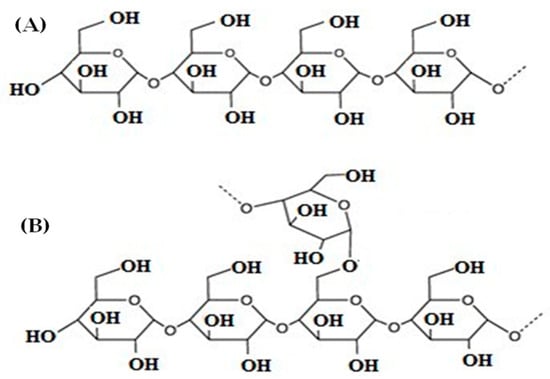
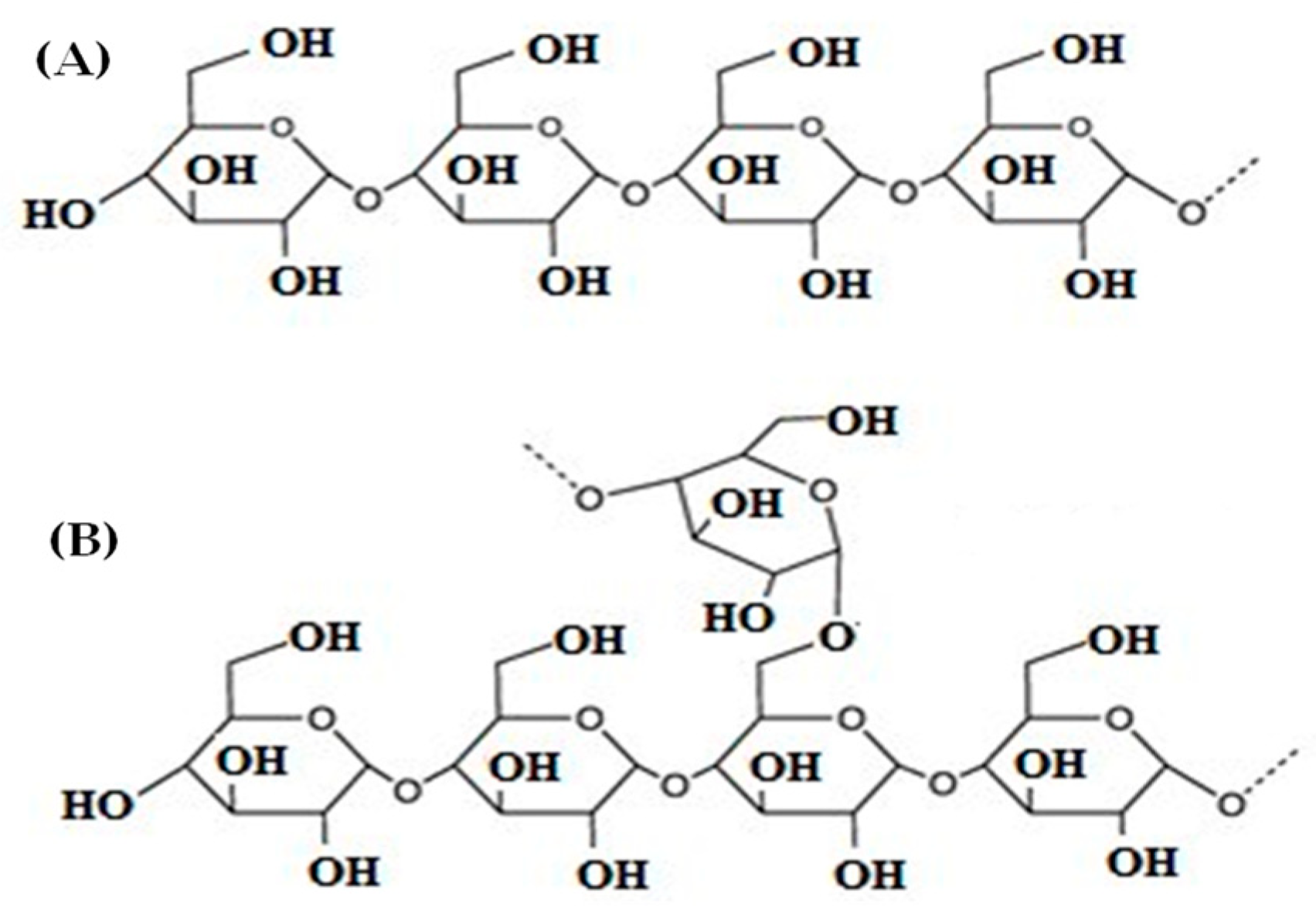
The functional properties of ANN and HMT hydrothermal-modified starch and flour are quite diverse, and they can be in the form of increasing or decreasing the parameter values. However, in general, both experienced a decrease in swelling power (SP) and solubility. The decrease in swelling power and solubility was related to the changes in the overall arrangement of starch granules. There was an improvement in the structure of amylopectin, amylose, and amylopectin levels in starch granules where swelling power increased with high amylose content and the intensity of intra- and interchain interactions [41,42,43]. The molecular structure of amylose and amylopectin can be seen in Figure 1.
Figure 1.
The molecular structure of amylose (A) and amylopectin (B).
Generally, HMT has a greater effect on the solubility and crystallinity of flour than starch. Sun et al. [44] reported that HMT in sorghum flour decreased swelling volume and solubility, which was greater than that in sorghum starch. HMT also increased the crystallinity of sorghum flour, which was greater than that of sorghum starch. However, the effect can be different in certain starches, which are affected by the amylose-amylopectin composition in starch and non-starch components in flours. Non-starch components such as proteins, phenolic compounds, lipids, and minerals can form complexes with starch during treatment, which decreases solubility and increases crystallinity [44,45]. Amylose-amylose, amylose-amylopectin, and/or amylopectin-amylopectin, decreased hydration and diffusion, leading to increased molecular mobility and decreased hydroxyl groups, formation of amylose-lipid complexes, decreased amylose leaching, temperature, and humidity [14,26,28,31,35,37,46]. Several studies related to the effect of hydrothermal modifications on the functional properties of starch and flour can be seen in Table 1.
Table 1.
Several studies related to the effect of hydrothermal modifications on the functional properties of starch and flour.
Hydrothermal treatments (HMT and ANN) generally cause a decrease in swelling power and solubility in line with water absorption capacity and inversely with an increase in gel hardness. The less water absorbed by the starch molecules, the greater the starch gel hardness due to structural damage and cross-link interactions between starch chains (especially the stronger amylose fraction), making the gel stiffer [16,22,65]. In addition, the increase in gel hardness was affected by the formation of a wider junction zone [35,36]. The decrease in functional properties of HMT-modified starch was relatively more significant than in ANN. This is because HMT tends to limit the movement of water molecules in starch granules as their crystallinity increases [60,66,67,68].
The decrease in swelling power and solubility values was shown by the modification of HMT [20,25,28,40,44,47,48,50,52,53,55,61,62] and was cyclical [26,36,56]. Modification of HMT causes rearrangements in starch granules, increasing the mobility of starch molecules, which results in increased bond interactions between amylose-amylose and amylose-amylopectin, formation of amylose-lipid molecular complexes, changes in diffusion and hydration mechanisms [69,70,71]. These changes are due to the reduction of hydroxyl groups involved and available, which causes a decrease in the value of swelling power, solubility, and amylose leaching as well as an increase in starch gel hardness [14,72,73].
Changes in functional properties can also be affected by the applied cycle of hydrothermal treatments. As the modification cycle increases, the level of interaction between the starch chains also increases [74,75]. This event is indicated by a decrease in the value of swelling power and solubility. However, there is a threshold change in certain starch modification cycles where cycles 4 and 5 in sweet potato starch did not show significant changes [26]. Although the cycle has an impact on the functional properties, in general, the decrease is more affected by temperature and humidity than by the number of cycles applied, because the addition of the HMT cycle does not cause the amylopectin crystals to break. However, high temperature is more influential, which then has an impact in the form of a decrease in the degree of starch crystallinity [36,76].
The decrease in swelling power and solubility was shown by ANN modifications and cyclical ANN. The modification of ANN made the crystalline structure stronger as the hydration level of the amorphous portion of the starch decreased [31,32]. This is indicated by a decrease in swelling power and solubility as well as an increase in gel hardness due to a decrease in gel volume [14,65,77].
Changes in functional characteristics can also be affected by the applied cycle. Cyclic ANN modifications in sweet potato starch [27] and red adzuki bean starch [59] showed a decrease in swelling power and solubility with cycles and when ANN was applied. In addition to cycles, modifications can also be made continuously. However, cycle modification is more effective than continuous modification, which is represented by the lower swelling power and solubility values in the cycle modification [34,35]. This is due to starch degradation events that may occur during the cooling/transition phase of the modified cycle treatment. This phase causes the number of small starch granules to increase; the natural structure of starch is damaged, the double helix structure which was originally damaged undergoes partial repair, and redistribution of water molecules occurs in the amylose and amylopectin active sites along with an increase in the interaction, mainly through hydrogen bonds, which then increases the interaction between the amylose-amylopectin chains in starch [15,22,36]. The lower value of swelling and diffusion capacity of amylose in cyclically modified starch compared to continuous indicates that starch has a more stable structure [26,57]. However, in general, the decrease in functional parameters that occurs is more affected by temperature and humidity than by the number of cycles applied [36].
Changes in the functional properties of starch will be indirectly related and reflected in the characteristics of the granules that can be identified through microscopic observations, which are known as the morphological properties of starch.
3. Morphological Properties of Hydrothermal Modified Starch and Flour Granules
Morphological properties of ANN- and HMT-modified starch granules showed a change, but some studies were not significant. Changes are seen in the size and irregularity of the starch granule surface: texture and the presence of holes, fissures, cavities, indentations, or cracks [23,78,79]. These changes are largely determined by internal factors (amylose and amylopectin components) and external factors (temperature, moisture, time, and environmental pressure). These two factors influence each other in the process of aggregation and agglomeration during the hydrothermal modification process. Starch with high–medium amylose content produced more aggregated starch granules with a more irregular surface, whereas starch with a low amylose content decreased the integrity of starch granules, which caused starch granules to be more susceptible to partial gelatinization and physical changes [14,17,26,37,52,56,57,60]. Several studies related to the effect of hydrothermal modifications on the morphology of starch and flour can be seen in Table 2.
Table 2.
Several studies related to the effect of hydrothermal modifications on the morphology of starch and flour.
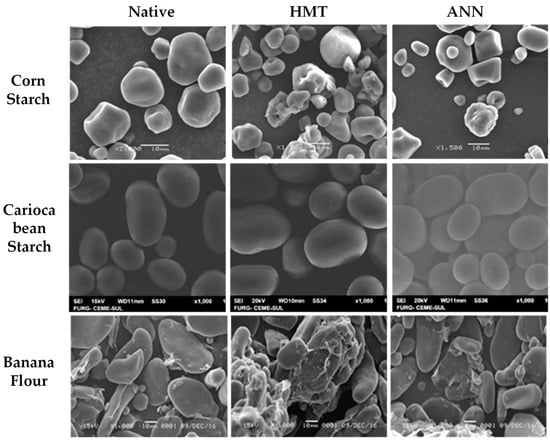
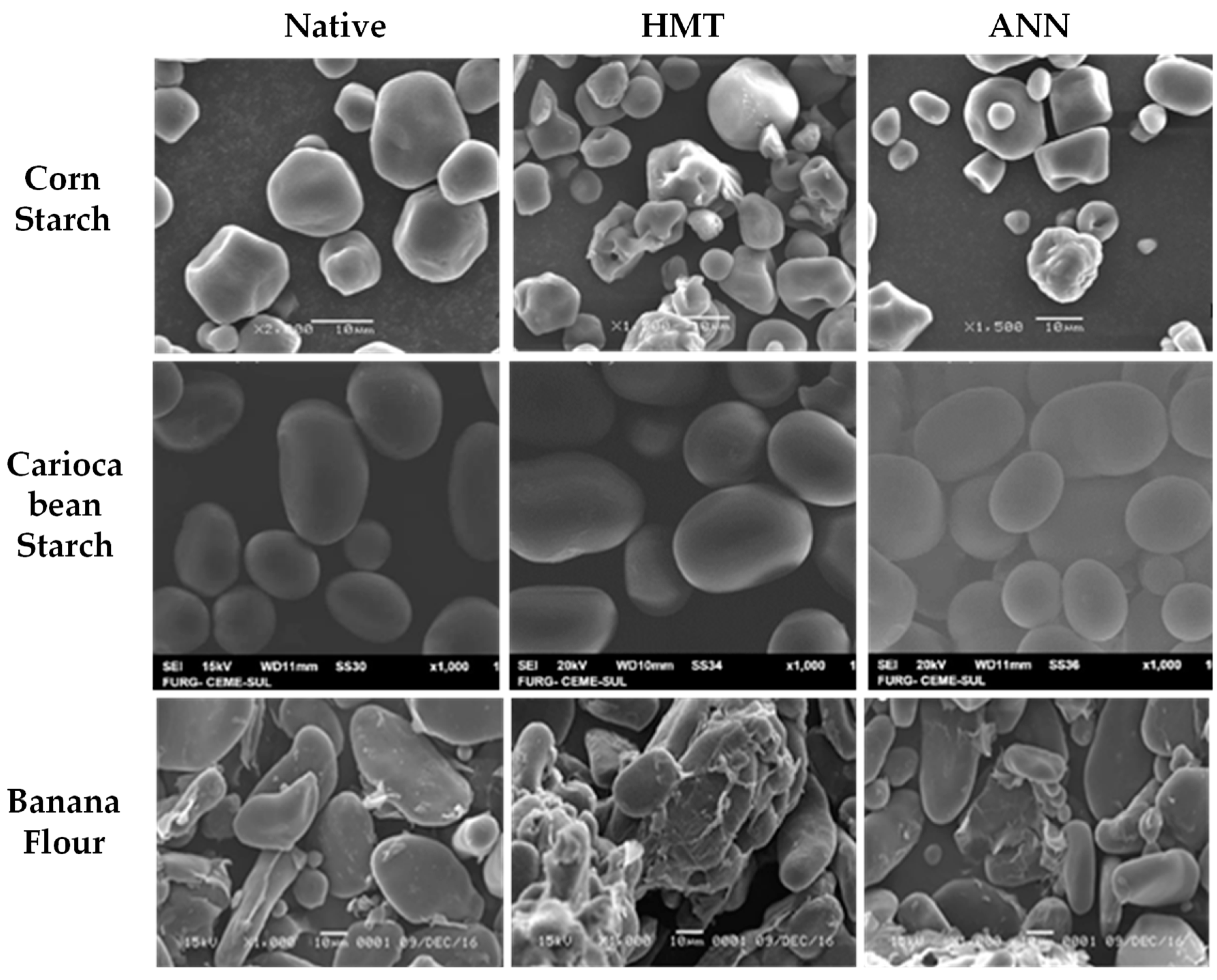
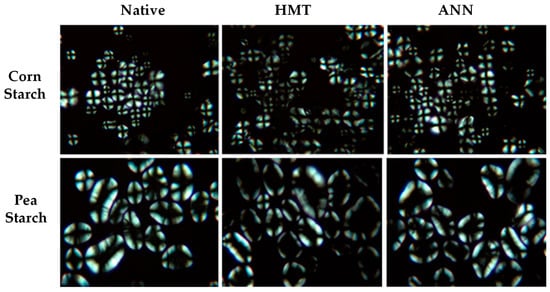
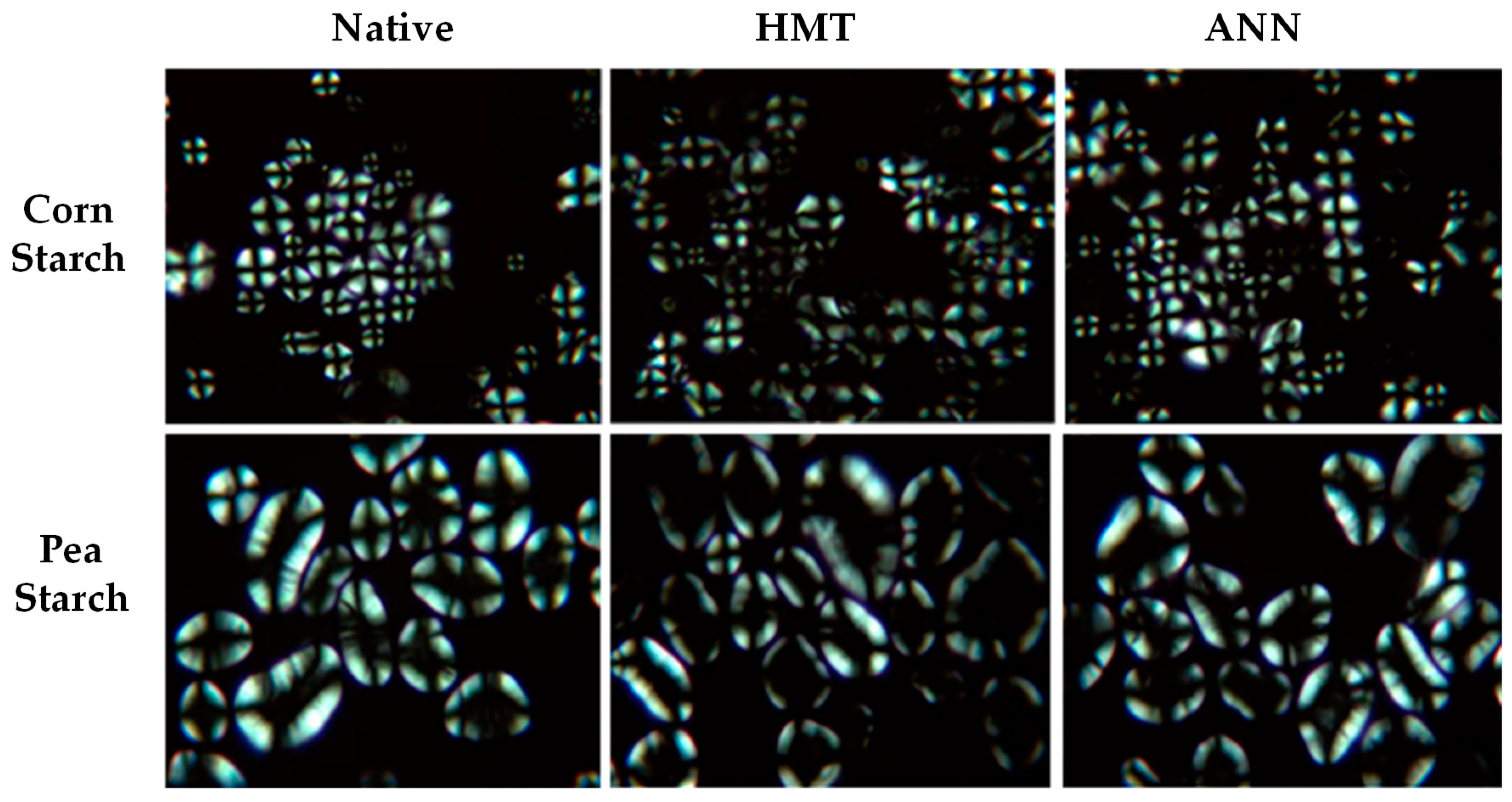
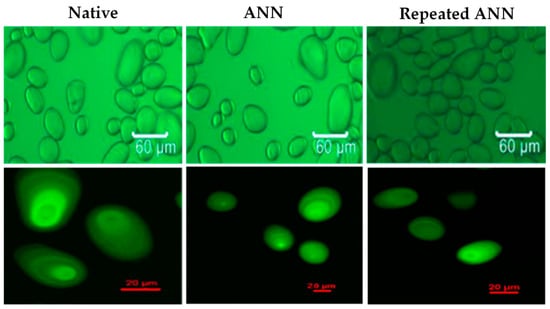
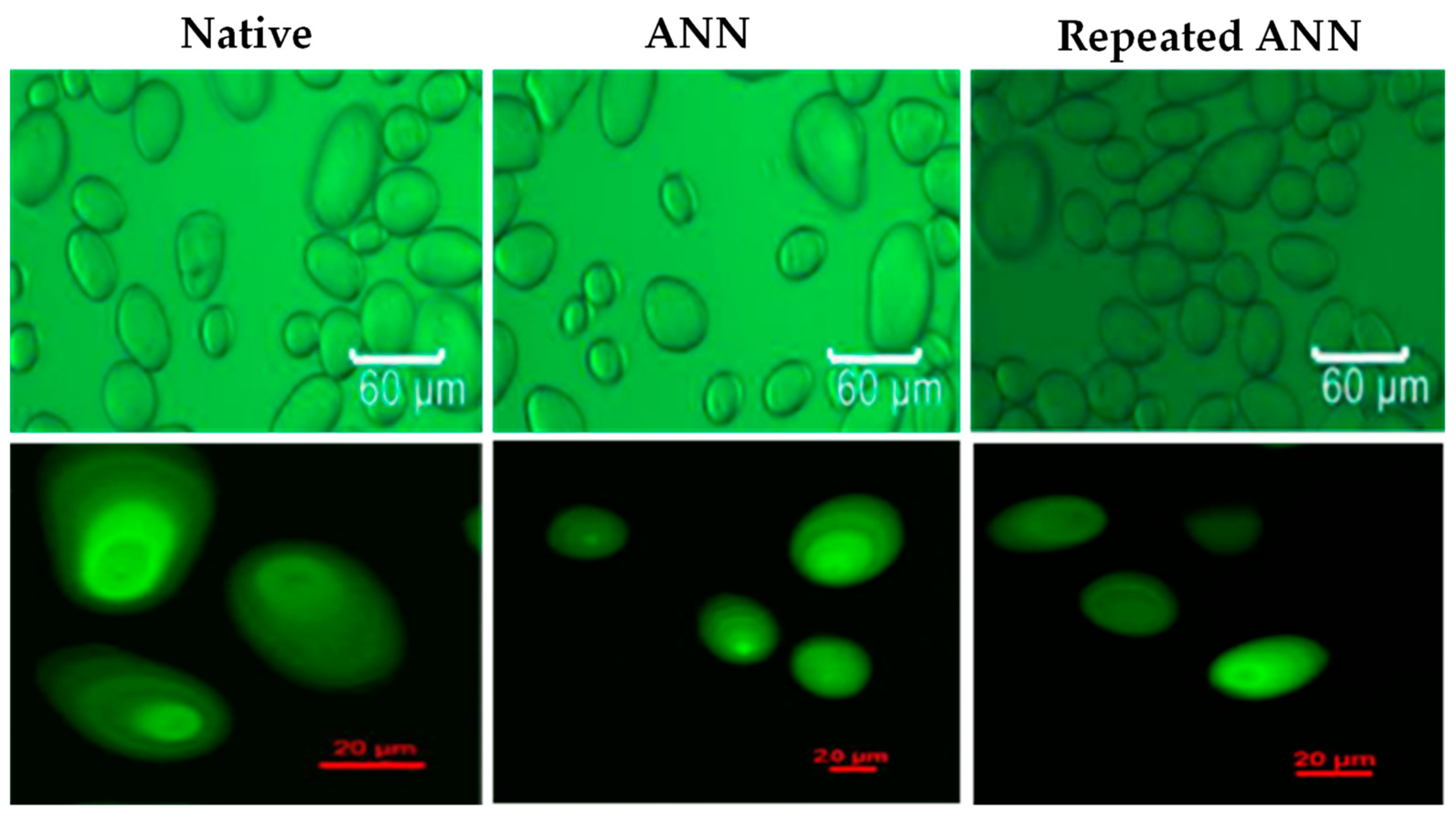
Changes that occur in granule morphology tend to have a more significant effect on HMT-modified starch than ANN, which is proven to be dominant in combination modification [14,83]. This change is also in line with the birefringence pattern observed through analysis with SEM, LM, PLM, and CLSM. Granule morphology of several types of starch/flour modified by HMT and ANN analyzed by scanning electron microscope (SEM) can be seen in Figure 2. ANN- and HMT-modified starch showed different birefringence patterns. This difference reflects the different effects on the internal conditions of starch granules where the radial orientation of the helical structure and its mobility change according to the heat energy obtained during modification [57,68]. The birefringence pattern of the starch granules after hydrothermal treatment can be analyzed by a polarized light microscope (PLM) which can be seen in Figure 3, or by using a light microscope (LM) and confocal laser scanning microscope (CLSM), as in the example that can be seen in Figure 4. Modification of ANN relatively maintains the birefringence pattern with the characteristic of a clear and bright granule pattern without any change in polarization cross, while HMT causes a decrease in brightness intensity with a more opaque appearance of the starch hilum structure (growth rings are more difficult to detect) [84,85]. The insignificant changes or no changes in the birefringence pattern indicated that the starch granule structure was more stable, while the changes in the form of a decrease occurred due to the destruction of amylose-amylose and amylose-amylopectin chains during modification [27,35,56].
Figure 2.
Starch granule morphology of HMT and ANN treatment was analyzed by scanning electron microscope (SEM) of maize starch [86], with permission from John Wiley and Sons, 2016, carioca bean starch [82], with permission from Wiley and Sons, 2018, and banana flour [63], with permission from Elsevier, 2019.
Figure 3.
The birefringence pattern of starch granules modified by HMT and ANN was analyzed by a polarized light microscope (PLM) of corn and pea starches at the magnification (400×) [40], with permission from Elsevier, 2009.
Figure 4.
Starch granule morphology after hydrothermal treatment was analyzed by light microscope (LM) (above) and confocal laser scanning microscope (CLSM) (below) of potato starch [35], with permission from Elsevier, 2018.
HMT modifications have different effects on starch and flour granules for each type of starch and treatment. Several factors affect the morphology of starch granules during HMT, including internal factors (amylose and amylopectin composition), as well as conditions before and during modification (temperature, humidity, time, and pressure) [87,88]. These factors trigger an increase in starch polymer chain interactions to associate or strengthen bonds between amylose-amylopectin chains, which are referred to as aggregation and agglomeration processes [26,56].
Aggregation and agglomeration processes take place along with swelling and partial gelatinization during modification. These events cause morphological changes in the form of indentations, cracks, holes/gaps/cavities, irregularities, and changes in the size/shape of starch granules, so that the amorphous part of the starch granules becomes more compact [18,79,89]. However, the opposite effect is also possible. This is due to the components that make up the amorphous part (amylose and amylopectin) in each type of starch being different. Starch with medium–high amylose content tends to produce more aggregated starch granules with a more irregular surface, while starch with low amylose content shows a decrease in the integrity of starch granules so that they are more susceptible to partial gelatinization and physical changes [14,17,26,37,52,56,57,60].
The agglomeration process can also continue along with HMT modification cycles and times which cause disruption of starch granules [26]. This is related to the birefringence properties of starch granules. The birefringence pattern shows a change marked by the loss of a polarization cross over time and the number of modification cycles. The cross-polarization of starch is related to the event of partial gelatinization and changes that occur in the starch granules, such as holes in the center of the granules formed during agglomeration. A polarization cross can be represented by a wide dark area in the middle of the cross [28,40,48].
HMT modification also causes a decrease in brightness intensity; the starch hilum becomes darker, the edges of the starch granules become more opaque, and the growth rings are more difficult to detect. These changes also indicated a decrease in the starch crystallinity index. This decrease occurs due to the destruction of amylose-amylose and amylose-amylopectin chains during cyclical and continuous modifications. [56]. This result is also in accordance with the study of Zhao et al. [57] on mung bean starch, which resulted in a decrease in the starch crystallinity index. However, several other studies reported an increase in birefringence patterns in starch after HMT modification. Changes in the birefringence pattern indicate changes that occur in the starch granules are characterized by the loss of the radial orientation of the helical structure that makes up the starch granules. This change occurs due to the mobility of the helical structure due to heat energy during modification [40,48].
Almost the same thing happened to the modification of starch and flour by ANN. ANN modifications in potato, barley, lentil, oat, and wheat starch did not show significant morphological changes, but other high-amylose starches showed significant changes [31,46,90]. The changes that occurred were reported by Molavi et al. [17] in the form of surface irregularities of starch granules, including their size and shape. Other changes in the form of cracks or the appearance of pores on the starch surface over time and modification cycles are due to amylose leaching during modification [27].
The effect of ANN modification on the morphological characteristics of starch can also be seen from its birefringence pattern. The relative ANN modification maintains the birefringence pattern. The results of the study that did not show changes in the birefringence pattern were found in ANN modifications for corn starch, lentils, and peas [40], cyclical and continuous ANN modification on red adzuki bean starch [59], and ANN modification on sweet potato starch [27]. The results of these studies show that the clear birefringence or Maltese cross pattern is displayed clearly and brightly and the polarization cross remains in the center of the particle. This indicates that no significant changes were observed [27]. ANN modification can strengthen the crystal structure, encourage the process of rearranging starch molecules, and increase the overall stability of starch. There were no significant changes in the birefringence and polarization cross patterns, indicating that the starch granules were not gelatinized during ANN modification due to their more stable structure. ANN modification can maintain the internal integrity of starch granules, and cycle treatment is more effective than continuous treatment in modifying starch characteristics [27,56,59].
However, if other studies found different birefringence patterns, this indicates that the changes that occur in the starch granules are not always the same due to various factors, both internal and external, during different processes [14,87,88]. Changes that occur in granule morphology and functional properties can be further identified by observing other parameters, namely pasting properties. Pasting properties is a mini simulation of food processing that is useful for determining the stability of materials.
4. Pasting Properties of Hydrothermal Modified Starch and Flour
The pasting properties of various ANN- and HMT-modified starches showed very different results on the same parameters, either with or without the application of certain cycles. In general, hydrothermal modification causes a decrease in peak viscosity (PV) and breakdown (BD) [17,91,92]. The decrease in PV and BD occurred due to the improvement of the molecular arrangement of the starch granules, especially the crystalline region, which was influenced by the increase in the intra- and inter-starch granule interactions. The decrease in PV and BD can also be influenced by the presence of carboxyl groups which then affect the structure and interactions between amylose-amylopectin [93,94,95]. This event is also closely related to other processes, including a decrease in the hydration level of the amorphous part, the expansion process, solubility, and amylose leaching, as well as an increase in the thermal stability of starch. This event is in line with the increase in hot paste viscosity or through viscosity (TV) which is commonly found in hydrothermal modifications. The increase in TV is an indication that the risk of separating the starch granule structure is getting smaller (the starch structure is getting stronger) [26,27,31,96]. In addition to the TV value, hydrothermal modification generally causes an increase in the final viscosity (FV) and setback viscosity (SB) values. The increase in FV and SB indicated that the cold stability of starch was not good. This change was caused by the aggregation and restructuring of amylose molecules during the cooling phase, which continued to increase with time and modification cycles. Increased TV and FV values are generally found in the hydrothermal modification of ANN [17,27,34,60]. Several studies related to the effect of hydrothermal modifications on the pasting properties of starch and flour can be seen in Table 3.
Table 3.
Several studies related to the effect of hydrothermal modifications on the pasting properties of starch and flour.
Viscosity changes that occur are more significant in HMT-modified starch than in ANN [2,14,25,40,82,86]. Changes in viscosity can be seen from the pasting properties graph, which shows an improvement in the heat stability of ANN- and HMT-modified starch with differences in the gelatinization pattern. The gelatinization pattern of ANN-modified starch tends to show a type B gelatinization pattern, while the HMT-modified starch tends to show a type C gelatinization pattern [14,21,24,98]. Gelatinization profile B is starch with moderate swelling power (moderate) and similar characteristics to profile A (lower PV value of profile B). Gelatinization profile C is starch with limited expansion, which is characterized by the absence of PV and BD with relatively constant or increasing viscosity during food processing [3,10,14,60].
Apart from the changes in pasting properties, HMT and ANN showed better efficiency when applied with certain cycles rather than singly. Treatment cycles (a certain number of cycles) were more effective than single or continuous treatment in modifying starch [11,26,56,57,99]. The hydrothermal modifications that have a significant effect are HMT modifications rather than ANN and other combination modifications [27,34,63,82].
Changes in the pasting properties of starch due to modification are strongly influenced by the process of perfecting the crystalline part that occurs. This event can be studied further through an approach to starch crystallinity, which can be analyzed using X-ray diffraction (XRD) [63,100].
5. The Crystallinity of Hydrothermal Modified Starch and Flour
Starch crystallinity can be seen from the relative crystallinity (RC) index with an RC value of 15–45%. Starch crystallinity does not always show the same results because there are varying influencing factors, including the nature of the natural polymorph of the material, which includes amylose/amylopectin ratio, amylopectin chain length and branching, the mole percentage of amylopectin fraction/degree of polymerization (DP), crystal size, and interactions, and a constituent double helix (density and orientation) [14,47,101,102]. Several studies related to the effect of hydrothermal modifications on the crystallinity of starch and flour can be seen in Table 4.
Table 4.
Several studies related to the effect of hydrothermal modifications on the crystallinity of starch and flour.
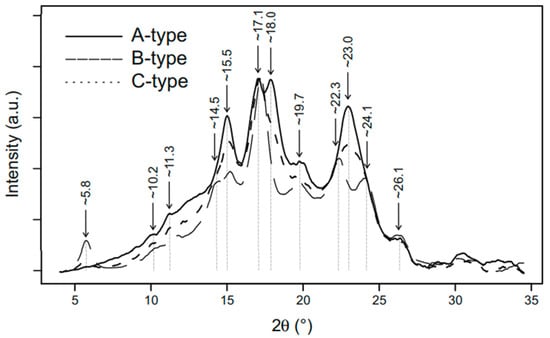
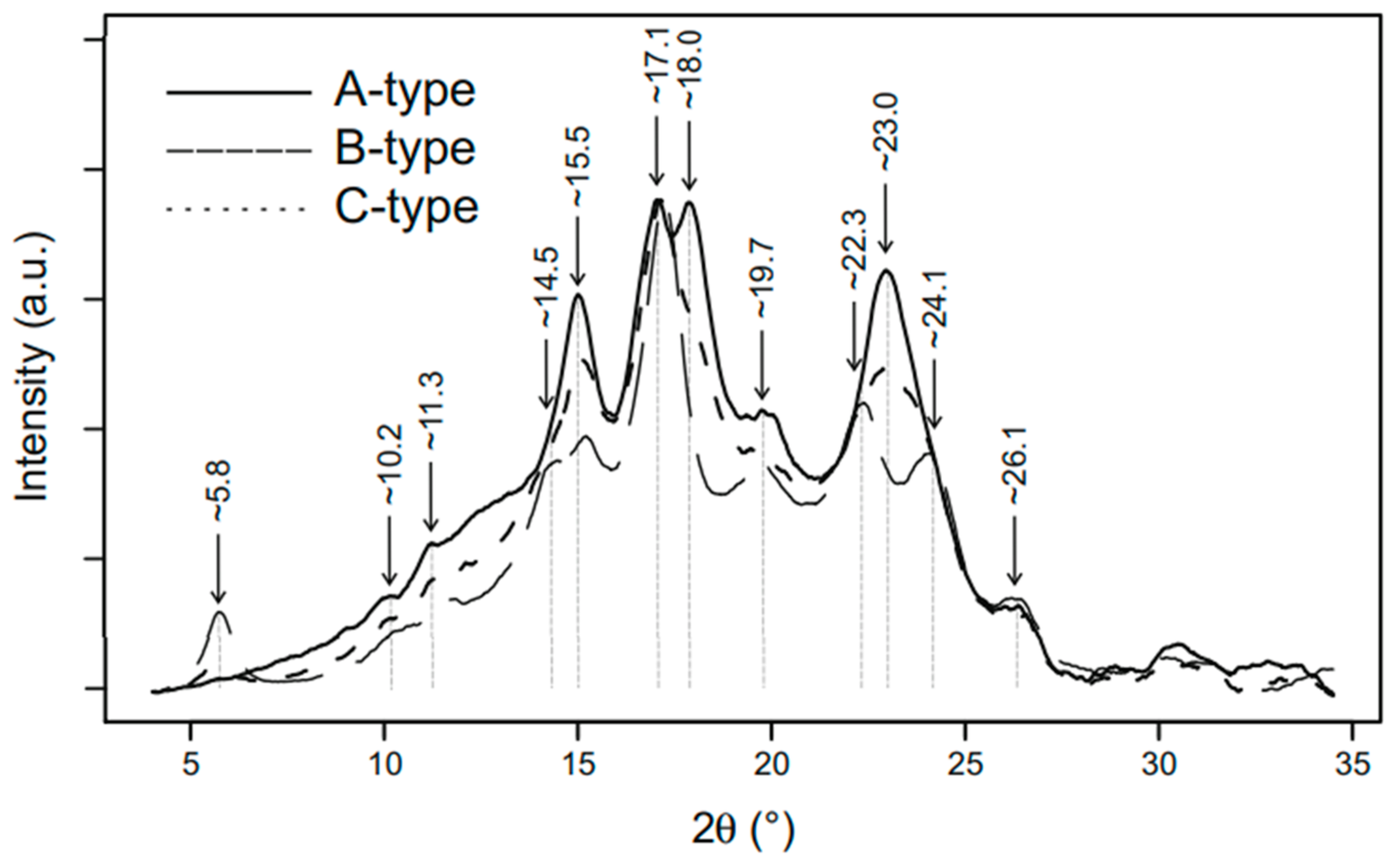
The degree of crystallinity greatly determines the type of starch crystallinity, which is divided into three types, namely types A, B, and C. The type of starch crystallinity (A-type, B-type, and C-type), as shown by X-ray diffraction patterns, can be seen in Figure 5. Crystalline type A is generally a cereal group; type B is found in tubers, fruits, and high amylose starch), while type C is a combination of types A and B, which are found in legume starch. In addition to these three types, there is also type V, which is a group of amylose that has complex bonds with other organic compounds [14,101,104].
Figure 5.
The type of starch crystallinity (type A, type B, and type C) as shown by X-ray diffraction patterns [105], with permission from Springer Nature, 2018.
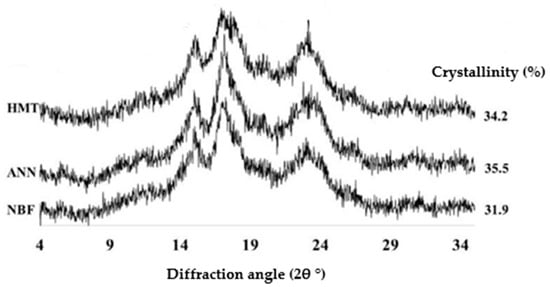
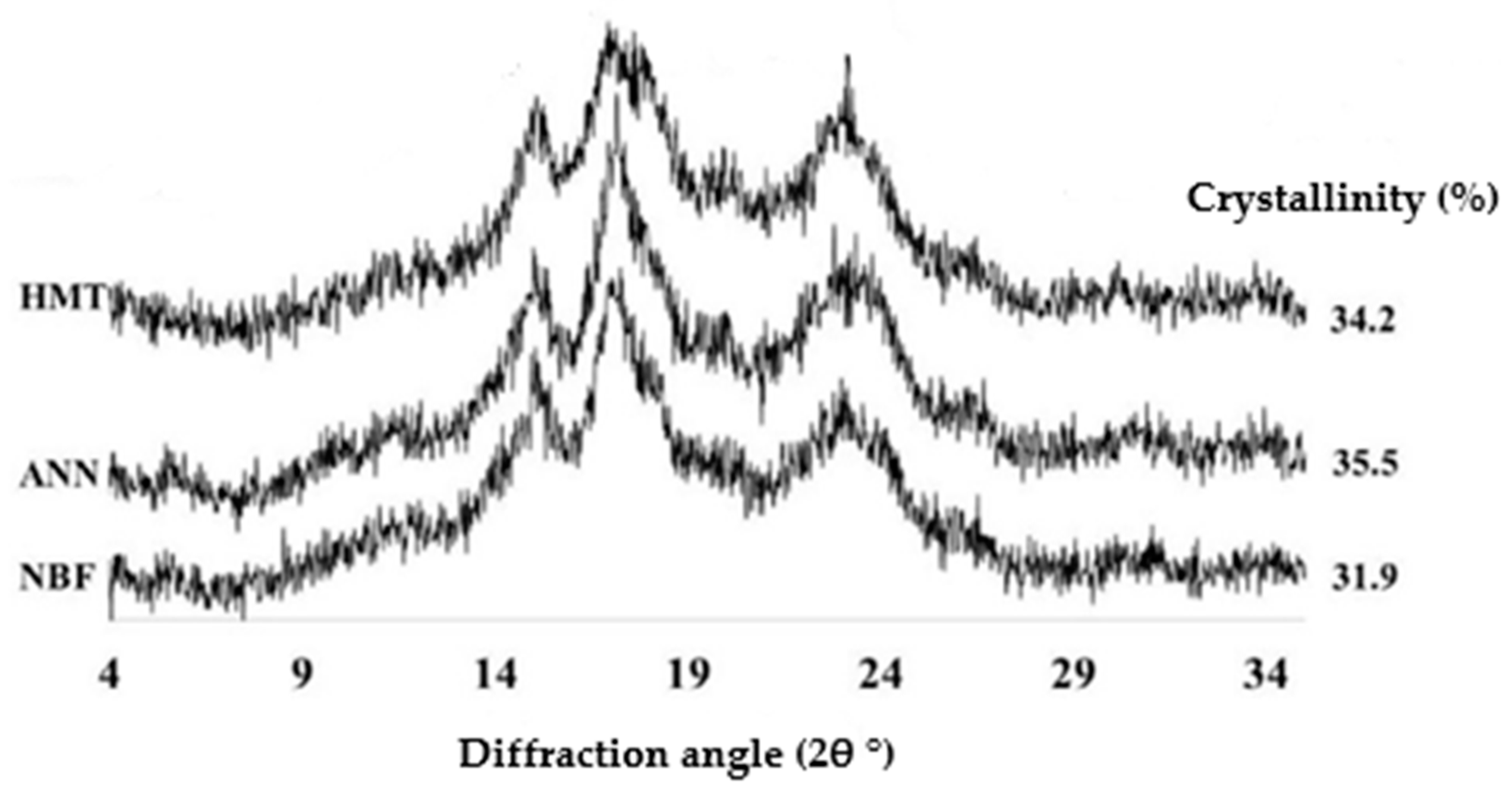
Starch crystallinity index may increase, decrease, or change insignificantly with the main characteristic of hydrothermally modified starch, namely the type of crystallinity that is relatively fixed or transformed into type A [15,18,82,86,103,106,107]. The crystallinity, as shown by X-ray diffraction patterns of modified starch/flour by ANN and HMT, can be seen in Figure 6. Although the polymorph type between ANN and HMT starch is the same, ANN-modified starch has higher crystallinity, better than HMT and the combination. This is evident from RCANN > RCNatural/HMT/Combination. Optimum ANN modification can produce an orderly and perfect structure. The choice of the type of modification affected the crystallinity of starch more significantly than the choice of treatment (cycles/continuous), although cycles/continuous treatments still had an effect on starch [35,108]. Characteristics of starch crystallinity are quite diverse, but hydrothermally modified starch ANN and HMT tend to have one thing in common. In addition to crystallinity, starch characteristics can also be identified based on thermal properties analyzed by a differential scanning calorimeter (DSC).
Figure 6.
XRD patterns of native banana flour (NBF), annealing (ANN), and heat moisture treatment (HMT) [63], with permission from Elsevier, 2019.
6. Thermal Properties of Hydrothermal Modified Starch and Flour
Thermal properties in this study focused on three parameters, namely gelatinization temperature, gelatinization temperature range (GTR), and heating enthalpy (ΔH). The characteristics of the three parameters from each study are not necessarily the same, even though the modified method used is the same. However, in general, ANN and HMT have similar thermal properties in the form of increasing gelatinization temperature [2,14,68,109,110]. The increase in gelatinization temperature occurs because the bonds and interactions in the starch granules are getting stronger, making the starch conformation more stable (increased heat stability). The more stable the starch, the higher the initial gelatinization temperature [14,65,111]. Although the gelatinization temperature of both methods increased, other parameters showed different and quite varied results. Several studies related to the effect of hydrothermal modifications on the thermal properties of starch and flour can be seen in Table 5.
Table 5.
Several studies related to the effect of hydrothermal modifications on thermal properties.
The heating enthalpy parameter (ΔH) of ANN-modified starch could be an increase, decrease, or insignificant change, while HMT-modified starch generally decreased [13,68,113,114]. The increase in ΔH indicates the amylose-amylose and/or amylose-amylopectin interactions that occur, causing the formation of new double helix bonds. The decrease in ΔH indicates the process of melting and expansion of starch granules accompanied by partial melting of the crystalline part that occurs when the modification temperature approaches the initial temperature of natural starch gelatinization [13,14]. The insignificant change in ΔH indicates that the arrangement of the double helix bonds during the refinement of the crystalline section has no significant effect, so the energy requirements during the process also do not change significantly [31,108].
Likewise, the gelatinization temperature range (GTR) of ANN- and HMT-modified starch showed different results. The GTR of ANN-modified starch showed a decrease, while the HMT modification caused an increase in GTR. GTR is a parameter of the homogeneity of the starch granule structure. A decrease in GTR indicates a more homogeneous starch granule structure, and more even crystal melting occurs, while an increase in GTR indicates a more heterogeneous starch granule structure. The increase in GTR is also in line with the increase in gelatinization temperature. Both indicate an increase in the need for heat/temperature energy for the melting process [31,35,40,47,50,57,60,106,108]. If the hydrothermal modification takes place at optimum conditions, the characteristics of starch can be improved by the characteristic of increasing the gelatinization temperature of starch (the crystalline structure which was initially weak becomes more stable) with or without decreasing H and the starch crystallinity index. This can be achieved by selecting the right type of modification. One example is the modification of ANN, which can produce better stability of starch configuration [10]. In addition, cycles also affect the characteristics of the results. The modified starch of HMT and ANN cycles had a starch crystal structure that was more perfect than the single or continuous treatment. This is evidenced by the higher gelatinization temperature and lower ∆H [27,31,56].
7. Applications of Hydrothermal Treated Starch and Flour
Hydrothermal-treated starch and flour (ANN and HMT) can be applied to a variety of food products, especially those that require a stable product when exposed to heating/cooling and a strong texture. HMT- and ANN-modified starches can be used in noodles, baking products, frozen foods, canned foods, edible films, and other various products [14,38,115,116]. The use of HMT- and ANN-starch in noodle production can improve firm texture and cooking quality [65,117,118]. HMT-flour/starch is able to maintain the quality of dough and bread properties produced compared to untreated flour [65,117,118]. HMT-starch can increase the tensile strength, elongation, and thickness of edible films [119,120]. HMT-starch is also able to maintain the stability of the viscosity of tomato sauce during heating [38]. Some applications of hydrothermal-treated starch and flour (HMT and ANN) can be seen in Table 6.
Table 6.
Some applications of hydrothermal-treated starch and flour (HMT and ANN) for food products.
8. Conclusions and Future Research
Hydrothermal treatments (ANN and HMT) in general have a significant effect on the physical and functional properties of starch, granule morphology, pasting properties, crystallinity, and the thermal properties of starch and flour. However, several studies have produced various characteristics depending on the source of starch/flour and the conditions of the modification process. The combination of hydrothermal modification with ANN and treatment cycles can increase the effectiveness and quality of modified starch products so that they are potentially suitable for application in various industries in the development of flour and starch from various plant sources.
Hydrothermal-modified starch and flour have been widely used for various applications in the food, chemical, and pharmaceutical fields. However, modification of starch through hydrothermal treatments still has several weaknesses, such as instability in some physical properties, the appearance of cracks or wrinkles on the surface of the starch granules, and a darker color. Therefore, several additional treatments are needed to improve these characteristics. Further studies are needed to combine with other treatments, especially environmentally friendly ones, to improve the characteristics. These treatments include oxidation with ozonation, the use of vacuum pressure to reduce heat, cavitation energy through ultrasonication, irradiation with ultraviolet (UV) light, sublimation with freeze drying, and other treatments. Oxidation by ozonation can improve color brightness and solubility; vacuum pressure can improve process efficiency; ultrasonication can increase the porosity of the granule surface and improve process efficiency; UV light can increase solubility; and sublimation can increase the porosity of the granules and increase the solubility. In addition, the effects of several hydrothermal treatments can also produce porous starch granules, so that they have the potential to be developed into porous starch which can be used as an adsorbent, encapsulant, and fast-cooking starch.
Author Contributions
Conceptualization, E.S., M. and R.I.; methodology, E.S. and A.N.I.; validation, V.P.Y., M. and R.I.; formal analysis, R.I. and A.N.I.; investigation, E.S. and A.N.I.; resources, V.P.Y.; data curation, A.N.I. and V.P.Y.; writing—original draft preparation, E.S. and A.N.I.; writing—review and editing, M., R.I. and V.P.Y.; visualization, E.S. and R.I.; project administration, A.N.I. and V.P.Y.; funding acquisition, E.S., M. and R.I. All authors have read and agreed to the published version of the manuscript.
Funding
This article was supported by Universitas Padjadjaran, Indonesia.
Institutional Review Board Statement
Not applicable.
Data Availability Statement
Not applicable.
Acknowledgments
The authors would like to thank the Rector of Universitas Padjadjaran and The Ministry of Education, Culture, Research, and Technology of the Republic of Indonesia.
Conflicts of Interest
The authors declare no conflict of interest.
References
- Maniglia, B.C.; Castanha, N.; Le-Bail, P.; Le-Bail, A.; Augusto, P.E.D. Starch Modification through Environmentally Friendly Alternatives: A Review. Crit. Rev. Food Sci. Nutr. 2021, 61, 2482–2505. [Google Scholar] [CrossRef] [Scilit] [PubMed]
- Mathobo, V.M.; Silungwe, H.; Ramashia, S.E.; Anyasi, T.A. Effects of Heat-Moisture Treatment on the Thermal, Functional Properties and Composition of Cereal, Legume and Tuber Starches—A Review. J. Food Sci. Technol. 2021, 58, 412–426. [Google Scholar] [CrossRef] [Scilit] [PubMed]
- Zia-ud-Din; Xiong, H.; Fei, P. Physical and Chemical Modification of Starches: A Review. Crit. Rev. Food Sci. Nutr. 2017, 57, 2691–2705. [Google Scholar] [CrossRef] [Scilit] [PubMed]
- Subroto, E.; Filianty, F.; Indiarto, R.; Andita Shafira, A. Physicochemical and Functional Properties of Modified Adlay Starch (Coix Lacryma-Jobi) by Microwave and Ozonation. Int. J. Food Prop. 2022, 25, 1622–1634. [Google Scholar] [CrossRef] [Scilit]
- Aprianita, A.; Purwandari, U.; Watson, B.; Vasiljevic, T. Physico-Chemical Properties of Flours and Starches from Selected Commercial Tubers Available in Australia. Int. Food Res. J. 2009, 16, 507–520. [Google Scholar]
- Nurmilah, S.; Subroto, E. Chemical Modification of Starch for the Production of Resistant Starch Type-4 (Rs4): A Review. Int. J. Eng. Trends Technol. 2021, 69, 45–50. [Google Scholar] [CrossRef] [Scilit]
- Yuliana, N.; Nurdjanah, S.; Sugiharto, R.; Amethy, D. Effect of Spontaneous Lactic Acid Fermentation on Physico-Chemical Properties of Sweet Potato Flour. Microbiol. Indones. 2014, 8, 1–8. [Google Scholar] [CrossRef] [Scilit]
- Subroto, E.; Indiarto, R.; Djali, M.; Rosyida, H.D. Production and Application of Crosslinking- Modified Starch as Fat Replacer: A Review. Int. J. Eng. Trends Technol. 2020, 68, 26–30. [Google Scholar] [CrossRef] [Scilit]
- Deka, D.; Sit, N. Dual Modification of Taro Starch by Microwave and Other Heat Moisture Treatments. Int. J. Biol. Macromol. 2016, 92, 416–422. [Google Scholar] [CrossRef] [Scilit]
- Adebowale, K.O.; Olu-owolabi, B.I.; Olayinka, O.O.; Olayide, S. Effect of Heat Moisture Treatment and Annealing on Physicochemical Properties of Red Sorghum Starch. Afr. J. Biotechnol. 2005, 4, 928–933. [Google Scholar]
- Adiyanti, T.; Subroto, E. Modifications Of Banana Starch And Its Characteristics: A Review. Int. J. Sci. Technol. Res. 2020, 9, 3–6. [Google Scholar]
- Ashogbon, A.O.; Akintayo, E.T. Recent Trend in the Physical and Chemical Modification of Starches from Different Botanical Sources: A Review. Starch Staerke 2014, 66, 41–57. [Google Scholar] [CrossRef] [Scilit]
- Fonseca, L.M.; EL Halal, S.L.M.; Dias, A.R.G.; Zavareze, E.d.R. Physical Modification of Starch by Heat-Moisture Treatment and Annealing and Their Applications: A Review. Carbohydr. Polym. 2021, 274, 118665. [Google Scholar] [CrossRef] [Scilit]
- Zavareze, E.D.R.; Dias, A.R.G. Impact of Heat-Moisture Treatment and Annealing in Starches: A Review. Carbohydr. Polym. 2011, 83, 317–328. [Google Scholar] [CrossRef] [Scilit]
- Chakraborty, I.; Govindaraju, I.; Rongpipi, S.; Mahato, K.K.; Mazumder, N. Effects of Hydrothermal Treatments on Physicochemical Properties and In Vitro Digestion of Starch. Food Biophys. 2021, 16, 544–554. [Google Scholar] [CrossRef] [Scilit]
- Liu, J.-L.; Tsai, P.-C.; Lai, L.-S. Impacts of Hydrothermal Treatments on the Morphology, Structural Characteristics, and In Vitro Digestibility of Water Caltrop Starch. Molecules 2021, 26, 4974. [Google Scholar] [CrossRef] [Scilit] [PubMed]
- Molavi, H.; Razavi, S.M.A.; Farhoosh, R. Impact of Hydrothermal Modifications on the Physicochemical, Morphology, Crystallinity, Pasting and Thermal Properties of Acorn Starch. Food Chem. 2018, 245, 385–393. [Google Scholar] [CrossRef] [Scilit]
- Zeng, F.; Ma, F.; Kong, F.; Gao, Q.; Yu, S. Physicochemical Properties and Digestibility of Hydrothermally Treated Waxy Rice Starch. Food Chem. 2015, 172, 92–98. [Google Scholar] [CrossRef] [Scilit] [PubMed]
- Yeh, Y.; Lai, L.-S. Effect of Single and Dual Hydrothermal Treatments on the Resistant Starch Content and Physicochemical Properties of Lotus Rhizome Starches. Molecules 2021, 26, 4339. [Google Scholar] [CrossRef] [Scilit] [PubMed]
- Piecyk, M.; Drużyńska, B.; Ołtarzewska, A.; Wołosiak, R.; Worobiej, E.; Ostrowska-Ligęza, E. Effect of Hydrothermal Modifications on Properties and Digestibility of Grass Pea Starch. Int. J. Biol. Macromol. 2018, 118, 2113–2120. [Google Scholar] [CrossRef] [Scilit]
- Marta, H.; Cahyana, Y.; Bintang, S.; Soeherman, G.P.; Djali, M. Physicochemical and Pasting Properties of Corn Starch as Affected by Hydrothermal Modification by Various Methods. Int. J. Food Prop. 2022, 25, 792–812. [Google Scholar] [CrossRef] [Scilit]
- Iuga, M.; Mironeasa, S. A Review of the Hydrothermal Treatments Impact on Starch Based Systems Properties. Crit. Rev. Food Sci. Nutr. 2020, 60, 3890–3915. [Google Scholar] [CrossRef] [Scilit] [PubMed]
- Majzoobi, M.; Pesaran, Y.; Mesbahi, G.; Farahnaky, A. Evaluation of the Effects of Hydrothermal Treatment on Rice Flour and Its Related Starch. Int. J. Food Prop. 2016, 19, 2135–2145. [Google Scholar] [CrossRef] [Scilit]
- Subroto, E.; Indiarto, R.; Marta, H.; Shalihah, S. Effect of Heat—Moisture Treatment on Functional and Pasting Properties of Potato (Solanum tuberosum L. Var. Granola) Starch. Food Res. 2019, 3, 469–476. [Google Scholar] [CrossRef] [Scilit] [PubMed]
- Trung, P.T.B.; Ngoc, L.B.B.; Hoa, P.N.; Tien, N.N.T.; Hung, P. Van Impact of Heat-Moisture and Annealing Treatments on Physicochemical Properties and Digestibility of Starches from Different Colored Sweet Potato Varieties. Int. J. Biol. Macromol. 2017, 105, 1071–1078. [Google Scholar] [CrossRef] [Scilit] [PubMed]
- Huang, T.T.; Zhou, D.N.; Jin, Z.Y.; Xu, X.M.; Chen, H.Q. Effect of Repeated Heat-Moisture Treatments on Digestibility, Physicochemical and Structural Properties of Sweet Potato Starch. Food Hydrocoll. 2016, 54, 202–210. [Google Scholar] [CrossRef] [Scilit]
- Zhang, B.; Wu, H.; Gou, M.; Xu, M.; Liu, Y.; Jing, L.; Zhao, K.; Jiang, H.; Li, W. The Comparison of Structural, Physicochemical, and Digestibility Properties of Repeatedly and Continuously Annealed Sweet Potato Starch. J. Food Sci. 2019, 84, 2050–2058. [Google Scholar] [CrossRef] [Scilit]
- Da Rosa Zavareze, E.; Storck, C.R.; de Castro, L.A.S.; Schirmer, M.A.; Dias, A.R.G. Effect of Heat-Moisture Treatment on Rice Starch of Varying Amylose Content. Food Chem. 2010, 121, 358–365. [Google Scholar] [CrossRef] [Scilit]
- Marta, H.; Cahyana, Y.; Djali, M.; Pramafisi, G. The Properties, Modification, and Application of Banana Starch. Polymers 2022, 14, 3092. [Google Scholar] [CrossRef] [Scilit]
- Marta, H.; Cahyana, Y.; Arifin, H.R.; Khairani, L. Comparing the Effect of Four Different Thermal Modifications on Physicochemical and Pasting Properties of Breadfruit (Artocarpus Altilis) Starch. Int. Food Res. J. 2019, 26, 269–276. [Google Scholar]
- Jayakody, L.; Hoover, R. Effect of Annealing on the Molecular Structure and Physicochemical Properties of Starches from Different Botanical Origins—A Review. Carbohydr. Polym. 2008, 74, 691–703. [Google Scholar] [CrossRef] [Scilit]
- Dias, A.R.G.; da Rosa Zavareze, E.; Spier, F.; de Castro, L.A.S.; Gutkoski, L.C. Effects of Annealing on the Physicochemical Properties and Enzymatic Susceptibility of Rice Starches with Different Amylose Contents. Food Chem. 2010, 123, 711–719. [Google Scholar] [CrossRef] [Scilit]
- Tester, R.F.; Debon, S.J.J. Annealing of Starch—A Review. Int. J. Biol. Macromol. 2000, 27, 1–12. [Google Scholar] [CrossRef] [Scilit] [PubMed]
- Zou, J.; Xu, M.; Wang, R.; Li, W. Structural and Physicochemical Properties of Mung Bean Starch as Affected by Repeated and Continuous Annealing and Their in Vitro Digestibility. Int. J. Food Prop. 2019, 22, 898–910. [Google Scholar] [CrossRef] [Scilit]
- Xu, M.; Saleh, A.S.M.; Gong, B.; Li, B.; Jing, L.; Gou, M.; Jiang, H.; Li, W. The Effect of Repeated versus Continuous Annealing on Structural, Physicochemical, and Digestive Properties of Potato Starch. Food Res. Int. 2018, 111, 324–333. [Google Scholar] [CrossRef] [Scilit] [PubMed]
- Klein, B.; Pinto, V.Z.; Vanier, N.L.; Zavareze, E.D.R.; Colussi, R.; Do Evangelho, J.A.; Gutkoski, L.C.; Dias, A.R.G. Effect of Single and Dual Heat-Moisture Treatments on Properties of Rice, Cassava, and Pinhao Starches. Carbohydr. Polym. 2013, 98, 1578–1584. [Google Scholar] [CrossRef] [Scilit] [PubMed]
- Jacobs, H.; Delcour, J.A. Hydrothermal Modifications of Granular Starch, with Retention of the Granular Structure: A Review. Agric. Food Chem. 1998, 46, 2895–2905. [Google Scholar] [CrossRef] [Scilit]
- Subroto, E.; Indiarto, R.; Marta, H.; Shalihah, S. Application of Heat-Moisture Treatment Potato Starch to Improve the Heat Stability of Tomato Sauce. IOP Conf. Ser. Earth Environ. Sci. 2020, 443, 012076. [Google Scholar] [CrossRef] [Scilit]
- Kim, M.J.; Oh, S.G.; Chung, H.J. Impact of Heat-Moisture Treatment Applied to Brown Rice Flour on the Quality and Digestibility Characteristics of Korean Rice Cake. Food Sci. Biotechnol. 2017, 26, 1579–1586. [Google Scholar] [CrossRef] [Scilit]
- Chung, H.J.; Liu, Q.; Hoover, R. Impact of Annealing and Heat-Moisture Treatment on Rapidly Digestible, Slowly Digestible and Resistant Starch Levels in Native and Gelatinized Corn, Pea and Lentil Starches. Carbohydr. Polym. 2009, 75, 436–447. [Google Scholar] [CrossRef] [Scilit]
- Vamadevan, V.; Bertoft, E. Observations on the Impact of Amylopectin and Amylose Structure on the Swelling of Starch Granules. Food Hydrocoll. 2020, 103, 105663. [Google Scholar] [CrossRef] [Scilit]
- Marta, H.; Tensiska, T. Functional and Amylographic Properties of Physically-Modified Sweet Potato Starch. KnE Life Sci. 2018, 2, 689. [Google Scholar] [CrossRef] [Scilit]
- Kaur, M.; Oberoi, D.P.S.; Sogi, D.S.; Gill, B.S. Physicochemical, Morphological and Pasting Properties of Acid Treated Starches from Different Botanical Sources. J. Food Sci. Technol. 2011, 48, 460–465. [Google Scholar] [CrossRef] [Scilit] [PubMed]
- Sun, Q.; Han, Z.; Wang, L.; Xiong, L. Physicochemical Differences between Sorghum Starch and Sorghum Flour Modified by Heat-Moisture Treatment. Food Chem. 2014, 145, 756–764. [Google Scholar] [CrossRef] [Scilit]
- Putri, A.A.; Anggreini, R.A. Effect of Heat-Moisture Treatment on Structural Characteristics and Physico-Chemical Properties of Corn Starch-Hydrocolloid: A Review. NST Proc. 2022, 2022, 348–355. [Google Scholar] [CrossRef] [Scilit]
- Waduge, R.N.; Hoover, R.; Vasanthan, T.; Gao, J.; Li, J. Effect of Annealing on the Structure and Physicochemical Properties of Barley Starches of Varying Amylose Content. Food Res. Int. 2006, 39, 59–77. [Google Scholar] [CrossRef] [Scilit]
- Gunaratne, A.; Hoover, R. Effect of Heat-Moisture Treatment on the Structure and Physicochemical Properties of Tuber and Root Starches. Carbohydr. Polym. 2002, 49, 425–437. [Google Scholar] [CrossRef] [Scilit]
- Li, S.; Ward, R.; Gao, Q. Effect of Heat-Moisture Treatment on the Formation and Physicochemical Properties of Resistant Starch from Mung Bean (Phaseolus Radiatus) Starch. Food Hydrocoll. 2011, 25, 1702–1709. [Google Scholar] [CrossRef] [Scilit]
- Ahn, J.H.; Baek, H.R.; Kim, K.M.; Han, G.J.; Choi, J.B.; Kim, Y.; Moon, T.W. Slowly Digestible Sweetpotato Flour: Preparation by Heat-Moisture Treatment and Characterization of Physicochemical Properties. Food Sci. Biotechnol. 2013, 22, 383–391. [Google Scholar] [CrossRef] [Scilit]
- Kim, J.Y.; Huber, K.C. Heat-Moisture Treatment under Mildly Acidic Conditions Alters Potato Starch Physicochemical Properties and Digestibility. Carbohydr. Polym. 2013, 98, 1245–1255. [Google Scholar] [CrossRef] [Scilit]
- Puncha-Arnon, S.; Uttapap, D. Rice Starch vs. Rice Flour: Differences in Their Properties When Modified by Heat-Moisture Treatment. Carbohydr. Polym. 2013, 91, 85–91. [Google Scholar] [CrossRef] [Scilit] [PubMed]
- Liu, H.; Lv, M.; Peng, Q.; Shan, F.; Wang, M. Physicochemical and Textural Properties of Tartary Buckwheat Starch after Heat-Moisture Treatment at Different Moisture Levels. Starch Staerke 2015, 67, 276–284. [Google Scholar] [CrossRef] [Scilit]
- Li, Y.; Liu, S.; Liu, X.; Tang, X.; Zhang, J. The Impact of Heat-Moisture Treatment on Physicochemical Properties and Retrogradation Behavior of Sweet Potato Starch. Int. J. Food Eng. 2017, 13, 5. [Google Scholar] [CrossRef] [Scilit]
- Pérez, I.C.; Mu, T.H.; Zhang, M.; Ji, L.L. Effect of Heat Treatment to Sweet Potato Flour on Dough Properties and Characteristics of Sweet Potato-Wheat Bread. Food Sci. Technol. Int. 2017, 23, 708–715. [Google Scholar] [CrossRef] [Scilit] [PubMed]
- Sindhu, R.; Devi, A.; Khatkar, B.S. Physicochemical, Thermal and Structural Properties of Heat Moisture Treated Common Buckwheat Starches. J. Food Sci. Technol. 2019, 56, 2480–2489. [Google Scholar] [CrossRef] [Scilit]
- Gong, B.; Xu, M.; Li, B.; Wu, H.; Liu, Y.; Zhang, G.; Ouyang, S.; Li, W. Repeated Heat-Moisture Treatment Exhibits Superiorities in Modification of Structural, Physicochemical and Digestibility Properties of Red Adzuki Bean Starch Compared to Continuous Heat-Moisture Way. Food Res. Int. 2017, 102, 776–784. [Google Scholar] [CrossRef] [Scilit] [PubMed]
- Zhao, K.; Zhang, B.; Su, C.; Gong, B.; Zheng, J.; Jiang, H.; Zhang, G.; Li, W. Repeated Heat-Moisture Treatment: A More EffectiveWay for Structural and Physicochemical Modification of Mung Bean Starch Compared with Continuous Way. Food Bioprocess Technol. 2020, 13, 452–461. [Google Scholar] [CrossRef] [Scilit]
- Bhattacharjya, B.; Dutta, H.; Patwari, K.; Mahanta, C.L. Properties of Annealed Jackfruit (Artocarpus Heterophyllus Lam.) Seed Starch. Acta Aliment. 2015, 44, 501–510. [Google Scholar] [CrossRef] [Scilit]
- Xu, M.; Saleh, A.S.M.; Liu, Y.; Jing, L.; Zhao, K.; Wu, H.; Zhang, G.; Yang, S.O.; Li, W. The Changes in Structural, Physicochemical, and Digestive Properties of Red Adzuki Bean Starch after Repeated and Continuous Annealing Treatments. Starch Staerke 2018, 70, 1700322. [Google Scholar] [CrossRef] [Scilit]
- Adebowale, K.O.; Afolabi, T.A.; Olu-Owolabi, B.I. Hydrothermal Treatments of Finger Millet (Eleusine Coracana) Starch. Food Hydrocoll. 2005, 19, 974–983. [Google Scholar] [CrossRef] [Scilit]
- Lawal, O.S. Studies on the Hydrothermal Modifications of New Cocoyam (Xanthosoma Sagittifolium) Starch. Int. J. Biol. Macromol. 2005, 37, 268–277. [Google Scholar] [CrossRef] [Scilit] [PubMed]
- Liu, H.; Guo, X.; Li, W.; Wang, X.; Lv, M.; Peng, Q.; Wang, M. Changes in Physicochemical Properties and in Vitro Digestibility of Common Buckwheat Starch by Heat-Moisture Treatment and Annealing. Carbohydr. Polym. 2015, 132, 237–244. [Google Scholar] [CrossRef] [Scilit] [PubMed]
- Cahyana, Y.; Wijaya, E.; Halimah, T.S.; Marta, H.; Suryadi, E.; Kurniati, D. The Effect of Different Thermal Modifications on Slowly Digestible Starch and Physicochemical Properties of Green Banana Flour (Musa Acuminata Colla). Food Chem. 2019, 274, 274–280. [Google Scholar] [CrossRef] [Scilit] [PubMed]
- Yan, X.; Wu, Z.Z.; Li, M.Y.; Yin, F.; Ren, K.X.; Tao, H. The Combined Effects of Extrusion and Heat-Moisture Treatment on the Physicochemical Properties and Digestibility of Corn Starch. Int. J. Biol. Macromol. 2019, 134, 1108–1112. [Google Scholar] [CrossRef] [Scilit]
- Hormdok, R.; Noomhorm, A. Hydrothermal Treatments of Rice Starch for Improvement of Rice Noodle Quality. LWT Food Sci. Technol. 2007, 40, 1723–1731. [Google Scholar] [CrossRef] [Scilit]
- Liao, L.; Liu, H.; Gan, Z.; Wu, W. Structural Properties of Sweet Potato Starch and Its Vermicelli Quality as Affected by Heat-Moisture Treatment. Int. J. Food Prop. 2019, 22, 1122–1133. [Google Scholar] [CrossRef] [Scilit]
- Su, C.; Zhao, K.; Zhang, B.; Liu, Y.; Jing, L.; Wu, H.; Gou, M.; Jiang, H.; Zhang, G.; Li, W. The Molecular Mechanism for Morphological, Crystal, Physicochemical and Digestible Property Modification of Wheat Starch after Repeated versus Continuous Heat-Moisture Treatment. LWT 2020, 129, 109399. [Google Scholar] [CrossRef] [Scilit]
- Li, W.; Shu, C.; Zhang, P.; Shen, Q. Properties of Starch Separated From Ten Mung Bean Varieties and Seeds Processing Characteristics. Food Bioprocess Technol. 2011, 4, 814–821. [Google Scholar] [CrossRef] [Scilit]
- Yang, S.; Dhital, S.; Zhang, M.-N.; Wang, J.; Chen, Z.-G. Structural, Gelatinization, and Rheological Properties of Heat-Moisture Treated Potato Starch with Added Salt and Its Application in Potato Starch Noodles. Food Hydrocoll. 2022, 131, 107802. [Google Scholar] [CrossRef] [Scilit]
- Alcázar-Alay, S.C.; Meireles, M.A.A. Physicochemical Properties, Modifications and Applications of Starches from Different Botanical Sources. Food Sci. Technol. 2015, 35, 215–236. [Google Scholar] [CrossRef] [Scilit]
- Xing, J.; Liu, Y.; Li, D.; Wang, L.; Adhikari, B. Heat-Moisture Treatment and Acid Hydrolysis of Corn Starch in Different Sequences. LWT Food Sci. Technol. 2017, 79, 11–20. [Google Scholar] [CrossRef] [Scilit]
- Olayinka, O.O.; Adebowale, K.O.; Olu-Owolabi, B.I. Effect of Heat-Moisture Treatment on Physicochemical Properties of White Sorghum Starch. Food Hydrocoll. 2008, 22, 225–230. [Google Scholar] [CrossRef] [Scilit]
- Pranoto, Y.; Rahmayuni; Haryadi; Rakshit, S.K. Physicochemical Properties of Heat Moisture Treated Sweet Potato Starches of Selected Indonesian Varieties. Int. Food Res. J. 2014, 21, 2031–2038. [Google Scholar]
- Khawas, P.; Deka, S.C. Effect of Modified Resistant Starch of Culinary Banana on Physicochemical, Functional, Morphological, Diffraction, and Thermal Properties. Int. J. Food Prop. 2017, 20, 133–150. [Google Scholar] [CrossRef] [Scilit]
- Faridah, D.N.; Silitonga, R.F.; Indrasti, D.; Afandi, F.A.; Jayanegara, A.; Anugerah, M.P. Verification of Autoclaving-Cooling Treatment to Increase the Resistant Starch Contents in Food Starches Based on Meta-Analysis Result. Front. Nutr. 2022, 9, 904700. [Google Scholar] [CrossRef] [Scilit]
- Cordeiro, M.J.M.; Veloso, C.M.; Santos, L.S.; Bonomo, R.C.F.; Caliari, M.; da Costa Ilhéu Fontan, R. The Impact of Heat-Moisture Treatment on the Properties of Musa paradisiaca L. Starch and Optimization of Process Variables. Food Technol. Biotechnol. 2018, 56, 506–515. [Google Scholar] [CrossRef] [Scilit]
- Chung, K.M.; Tae Wha, M.; Chun, J.K. Influence of Annealing on Gel Properties of Mung Bean Starch. Cereal Chem. 2000, 77, 567–571. [Google Scholar] [CrossRef] [Scilit]
- Li, X.; Peng, H.; Niu, S.; Liu, X.; Li, Y. Effect of High-Temperature Hydrothermal Treatment on Chemical, Mechanical, Physical, and Surface Properties of Moso Bamboo. Forests 2022, 13, 712. [Google Scholar] [CrossRef] [Scilit]
- Yadav, B.S.; Guleria, P.; Yadav, R.B. Hydrothermal Modification of Indian Water Chestnut Starch: Influence of Heat-Moisture Treatment and Annealing on the Physicochemical, Gelatinization and Pasting Characteristics. LWT Food Sci. Technol. 2013, 53, 211–217. [Google Scholar] [CrossRef] [Scilit]
- Vieira, F.C.; Sarmento, S.B.S. Heat-Moisture Treatment and Enzymatic Digestibility of Peruvian Carrot, Sweet Potato and Ginger Starches. Starch Staerke 2008, 60, 223–232. [Google Scholar] [CrossRef] [Scilit]
- Jiranuntakul, W.; Puttanlek, C.; Rungsardthong, V.; Puncha-Arnon, S.; Uttapap, D. Microstructural and Physicochemical Properties of Heat-Moisture Treated Waxy and Normal Starches. J. Food Eng. 2011, 104, 246–258. [Google Scholar] [CrossRef] [Scilit]
- Zanella Pinto, V.; Goncalves Deon, V.; Moomand, K.; Levien Vanier, N.; Pilatti-Riccio, D.; da Rosa Zavareze, E.; Lim, L.T.; Guerra Dias, A.R. Characteristics of Modified Carioca Bean Starch upon Single and Dual Annealing, Heat-Moisture-Treatment, and Sonication. Starch Staerke 2019, 71, 1800173. [Google Scholar] [CrossRef] [Scilit]
- Park, S.; Kim, Y.-R. Clean Label Starch: Production, Physicochemical Characteristics, and Industrial Applications. Food Sci. Biotechnol. 2021, 30, 1–17. [Google Scholar] [CrossRef] [Scilit] [PubMed]
- Chen, F.; Lu, Y.; Pan, L.; Fan, X.; Li, Q.; Huang, L.; Zhao, D.; Zhang, C.; Liu, Q. The Underlying Physicochemical Properties and Starch Structures of Indica Rice Grains with Translucent Endosperms under Low-Moisture Conditions. Foods 2022, 11, 1378. [Google Scholar] [CrossRef] [Scilit] [PubMed]
- Liu, X.; Wu, J.H.; Xu, J.H.; Mao, D.Z.; Yang, Y.J.; Wang, Z.W. The Impact of Heat-Moisture Treatment on the Molecular Structure and Physicochemical Properties of Coix Seed Starches. Starch Staerke 2016, 68, 662–674. [Google Scholar] [CrossRef] [Scilit]
- Liu, H.; Lv, M.; Wang, L.; Li, Y.; Fan, H.; Wang, M. Comparative Study: How Annealing and Heat-Moisture Treatment Affect the Digestibility, Textural, and Physicochemical Properties of Maize Starch. Starch Staerke 2016, 68, 1158–1168. [Google Scholar] [CrossRef] [Scilit]
- Chakraborty, I.; Pooja, N.; Mal, S.S.; Paul, U.C.; Rahman, M.H.; Mazumder, N. An Insight into the Gelatinization Properties Influencing the Modified Starches Used in Food Industry: A Review. Food Bioprocess Technol. 2022, 15, 1195–1223. [Google Scholar] [CrossRef] [Scilit]
- Ayuningtyas, L.P.; Benita, A.M.; Triastuti, D. Crystalline and Digestive Characteristics of Heat Moisture Treated and Annealed Lesser Yam (Dioscorea Esculenta) Starch. J. Pangan Agroindustri 2022, 10, 1–8. [Google Scholar] [CrossRef] [Scilit]
- Sharma, M.; Yadav, D.N.; Singh, A.K.; Tomar, S.K. Rheological and Functional Properties of Heat Moisture Treated Pearl Millet Starch. J. Food Sci. Technol. 2015, 52, 6502–6510. [Google Scholar] [CrossRef] [Scilit]
- Kiseleva, V.I.; Krivandin, A.V.; Fornal, J.; Błaszczak, W.; Jeliński, T.; Yuryev, V.P. Annealing of Normal and Mutant Wheat Starches. LM, SEM, DSC, and SAXS Studies. Carbohydr. Res. 2005, 340, 75–83. [Google Scholar] [CrossRef] [Scilit]
- Ariyantoro, A.R.; Fitriyani, A.; Affandi, D.R.; Muhammad, D.R.A.; Yulviatun, A.; Nishizu, T. The Effect of Dual Modification with Annealing and Heat Moisture Treatment (HMT) on Physicochemical Properties of Jack Bean Starch (Canavalia Ensiformis). Food Res. 2022, 6, 189–198. [Google Scholar] [CrossRef] [Scilit] [PubMed]
- Jyothi, A.N.; Sajeev, M.S.; Sreekumar, J.N. Hydrothermal Modifications of Tropical Tuber Starches. 1. Effect of Heat-Moisture Treatment on the Physicochemical, Rheological and Gelatinization Characteristics. Starch Stärke 2010, 62, 28–40. [Google Scholar] [CrossRef] [Scilit]
- Lewandowicz, J.; Le Thanh-Blicharz, J.; Szwengiel, A. The Effect of Chemical Modification on the Rheological Properties and Structure of Food Grade Modified Starches. Process 2022, 10, 938. [Google Scholar] [CrossRef] [Scilit]
- Sangseethong, K.; Lertphanich, S.; Sriroth, K. Physicochemical Properties of Oxidized Cassava Starch Prepared under Various Alkalinity Levels. Starch Stärke 2009, 61, 92–100. [Google Scholar] [CrossRef] [Scilit]
- Subroto, E.; Sitha, N.; Filianty, F.; Indiarto, R.; Sukri, N. Freeze Moisture Treatment and Ozonation of Adlay Starch (Coix Lacryma-Jobi): Effect on Functional, Pasting, and Physicochemical Properties. Polymers 2022, 14, 3854. [Google Scholar] [CrossRef] [Scilit]
- Gomand, S.V.; Lamberts, L.; Gommes, C.J.; Visser, R.G.F.; Delcour, J.A.; Goderis, B. Molecular and Morphological Aspects of Annealing-Induced Stabilization of Starch Crystallites. Biomacromolecules 2012, 13, 1361–1370. [Google Scholar] [CrossRef] [Scilit]
- Lim, S.; Chang, E.; Chung, H. Thermal Transition Characteristics of Heat Moisture Treated Corn and Potato Starches. Carbohydr. Polym. 2001, 46, 107–115. [Google Scholar] [CrossRef] [Scilit]
- Aaliya, B.; Sunooj, K.V.; Rajkumar, C.B.; Navaf, M.; Akhila, P.P.; Sudheesh, C.; George, J.; Lackner, M. Effect of Thermal Pretreatments on Phosphorylation of Corypha umbraculifera L. Stem Pith Starch: A Comparative Study Using Dry-Heat, Heat-Moisture and Autoclave Treatments. Polymers 2021, 13, 3855. [Google Scholar] [CrossRef] [Scilit]
- Nakamura, S.; Okumura, H.; Sugawara, M.; Noro, W.; Homma, N.; Ohtsubo, K. Effects of Different Heat–Moisture Treatments on the Physicochemical Properties of Brown Rice Flour. Biosci. Biotechnol. Biochem. 2017, 81, 2370–2385. [Google Scholar] [CrossRef] [Scilit]
- Subroto, E.; Jeanette, G.; Meiyanasari, Y.; Luwinsky, I.; Baraddiaz, S. Review on the Analysis Methods of Starch, Amylose, Amylopectinin Food and Agricultural Products. Int. J. Emerg. Trends Eng. Res. 2020, 8, 3519–3529. [Google Scholar] [CrossRef] [Scilit]
- Lopez-Rubio, A.; Flanagan, B.M.; Gilbert, E.P.; Gidley, M.J. A Novel Approach for Calculating Starch Crystallinity and Its Correlation with Double Helix Content: A Combined XRD and NMR Study. Biopolymers 2008, 89, 761–768. [Google Scholar] [CrossRef] [Scilit] [PubMed]
- Buléon, A.; Colonna, P.; Planchot, V.; Ball, S. Starch Granules: Structure and Biosynthesis. Int. J. Biol. Macromol. 1998, 23, 85–112. [Google Scholar] [CrossRef] [Scilit] [PubMed]
- Vermeylen, R.; Goderis, B.; Delcour, J.A. An X-ray Study of Hydrothermally Treated Potato Starch. Carbohydr. Polym. 2006, 64, 364–375. [Google Scholar] [CrossRef] [Scilit]
- Cheetham, N.W.H.; Tao, L. Variation in Crystalline Type with Amylose Content in Maize Starch Granules: An X-Ray Powder Diffraction Study. Carbohydr. Polym. 1998, 36, 277–284. [Google Scholar] [CrossRef] [Scilit]
- Pozo, C.; Rodríguez-Llamazares, S.; Bouza, R.; Barral, L.; Castaño, J.; Müller, N.; Restrepo, I. Study of the Structural Order of Native Starch Granules Using Combined FTIR and XRD Analysis. J. Polym. Res. 2018, 25, 266. [Google Scholar] [CrossRef] [Scilit]
- Chung, H.J.; Liu, Q.; Hoover, R. Effect of Single and Dual Hydrothermal Treatments on the Crystalline Structure, Thermal Properties, and Nutritional Fractions of Pea, Lentil, and Navy Bean Starches. Food Res. Int. 2010, 43, 501–508. [Google Scholar] [CrossRef] [Scilit]
- Mendes, M.P.; Demiate, I.M.; Monteiro, A.R.G. Effect of Individual and Combined Physical Treatments on the Properties of Corn Starch. Acta Sci. Technol. 2018, 40, 35118. [Google Scholar] [CrossRef] [Scilit]
- Shi, Y.C. Two- and Multi-Step Annealing of Cereal Starches in Relation to Gelatinization. J. Agric. Food Chem. 2008, 56, 1097–1104. [Google Scholar] [CrossRef] [Scilit]
- Yashini, M.; Khushbu, S.; Madhurima, N.; Sunil, C.K.; Mahendran, R.; Venkatachalapathy, N. Thermal Properties of Different Types of Starch: A Review. Crit. Rev. Food Sci. Nutr. 2022, 1–24, Online ahead of print.. [Google Scholar] [CrossRef] [Scilit]
- Marboh, V.; Gayary, M.A.; Gautam, G.; Mahanta, C.L. Comparative Study of Heat-Moisture Treatment and Annealing on Morphology, Crystallinity, Pasting, and Thermal Properties of Sohphlang (Flemingia Vestita) Starch. Starch Stärke 2022, 74, 2100294. [Google Scholar] [CrossRef] [Scilit]
- Gomes, A.M.M.; Mendes Da Silva, C.E.; Ricardo, N.M.P.S.; Sasaki, J.M.; Germani, R. Impact of Annealing on the Physicochemical Properties of Unfermented Cassava Starch (“polvilho Doce”). Starch Staerke 2004, 56, 419–423. [Google Scholar] [CrossRef] [Scilit]
- Ye, J.; Luo, S.; Huang, A.; Chen, J.; Liu, C.; McClements, D.J. Synthesis and Characterization of Citric Acid Esterified Rice Starch by Reactive Extrusion: A New Method of Producing Resistant Starch. Food Hydrocoll. 2019, 92, 135–142. [Google Scholar] [CrossRef] [Scilit]
- Dewi, A.M.; Santoso, U.; Pranoto, Y.; Marseno, D.W. Dual Modification of Sago Starch via Heat Moisture Treatment and Octenyl Succinylation to Improve Starch Hydrophobicity. Polymers 2022, 14, 1086. [Google Scholar] [CrossRef] [Scilit] [PubMed]
- Ismailoglu, S.O.; Basman, A. Effects of Infrared Heat-Moisture Treatment on Physicochemical Properties of Corn Starch. Starc Stärke 2015, 67, 528–539. [Google Scholar] [CrossRef] [Scilit]
- Schafranski, K.; Ito, V.C.; Lacerda, L.G. Impacts and Potential Applications: A Review of the Modification of Starches by Heat-Moisture Treatment (HMT). Food Hydrocoll. 2021, 117, 106690. [Google Scholar] [CrossRef] [Scilit]
- Hoover, R. The Impact of Heat-Moisture Treatment on Molecular Structures and Properties of Starches Isolated from Different Botanical Sources. Crit. Rev. Food Sci. Nutr. 2010, 50, 835–847. [Google Scholar] [CrossRef] [Scilit] [PubMed]
- Chandla, N.K.; Saxena, D.C.; Singh, S. Processing and Evaluation of Heat Moisture Treated (HMT) Amaranth Starch Noodles; An Inclusive Comparison with Corn Starch Noodles. J. Cereal Sci. 2017, 75, 306–313. [Google Scholar] [CrossRef] [Scilit]
- Wang, L.; Zhang, C.; Chen, Z.; Wang, X.; Wang, K.; Li, Y.; Wang, R.; Luo, X.; Li, Y.; Li, J. Effect of Annealing on the Physico-Chemical Properties of Rice Starch and the Quality of Rice Noodles. J. Cereal Sci. 2018, 84, 125–131. [Google Scholar] [CrossRef] [Scilit]
- Indrianti, N.; Pranoto, Y.; Abbas, A. Preparation and Characterization of Edible Films Made from Modified Sweet Potato Starch through Heat Moisture Treatment. Indones. J. Chem. 2018, 18, 679–687. [Google Scholar] [CrossRef] [Scilit]
- Da Rosa Zavareze, E.; Pinto, V.Z.; Klein, B.; El Halal, S.L.M.; Elias, M.C.; Prentice-Hernández, C.; Dias, A.R.G. Development of Oxidised and Heat–Moisture Treated Potato Starch Film. Food Chem. 2012, 132, 344–350. [Google Scholar] [CrossRef] [Scilit]
- Collar, C.; Armero, E. Impact of Heat Moisture Treatment and Hydration Level of Flours on the Functional and Nutritional Value-Added Wheat-Barley Blended Breads. Food Bioprocess Technol. 2018, 11, 966–978. [Google Scholar] [CrossRef] [Scilit]
- Ji, N.; Ge, S.; Li, M.; Wang, Y.; Xiong, L.; Qiu, L.; Bian, X.; Sun, C.; Sun, Q. Effect of Annealing on the Structural and Physicochemical Properties of Waxy Rice Starch Nanoparticles: Effect of Annealing on the Properties of Starch Nanoparticles. Food Chem. 2019, 286, 17–21. [Google Scholar] [CrossRef] [Scilit] [PubMed]

Publisher’s Note: MDPI stays neutral with regard to jurisdictional claims in published maps and institutional affiliations. |
© 2022 by the authors. Licensee MDPI, Basel, Switzerland. This article is an open access article distributed under the terms and conditions of the Creative Commons Attribution (CC BY) license (https://creativecommons.org/licenses/by/4.0/).