Review

Chemical Design of Functional Polymer Structures for Biosensors: From Nanoscale to Macroscale

1
Department of Polymer Engineering, Graduate School, Chonnam National University, 77 Yongbong-ro, Buk-gu, Gwangju 61186, Korea
2
Department of Materials Science and Engineering, Seoul National University, 1 Gwanak-ro, Gwanak-gu, Seoul 08826, Korea
3
School of Polymer Science and Engineering, Chonnam National University, 77 Yongbong-ro, Buk-gu, Gwangju 61186, Korea
*
Authors to whom correspondence should be addressed.
These authors contributed equally to this work.
Polymers 2018, 10(5), 551; https://doi.org/10.3390/polym10050551
Submission received: 20 April 2018 / Revised: 14 May 2018 / Accepted: 14 May 2018 / Published: 21 May 2018
(This article belongs to the Special Issue Polymer Based Bio-Sensors)

Abstract

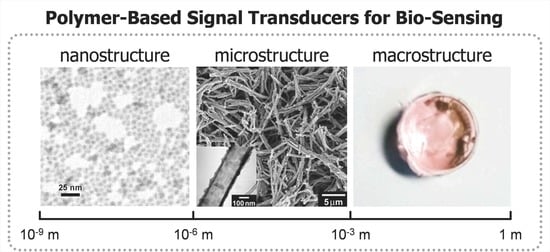
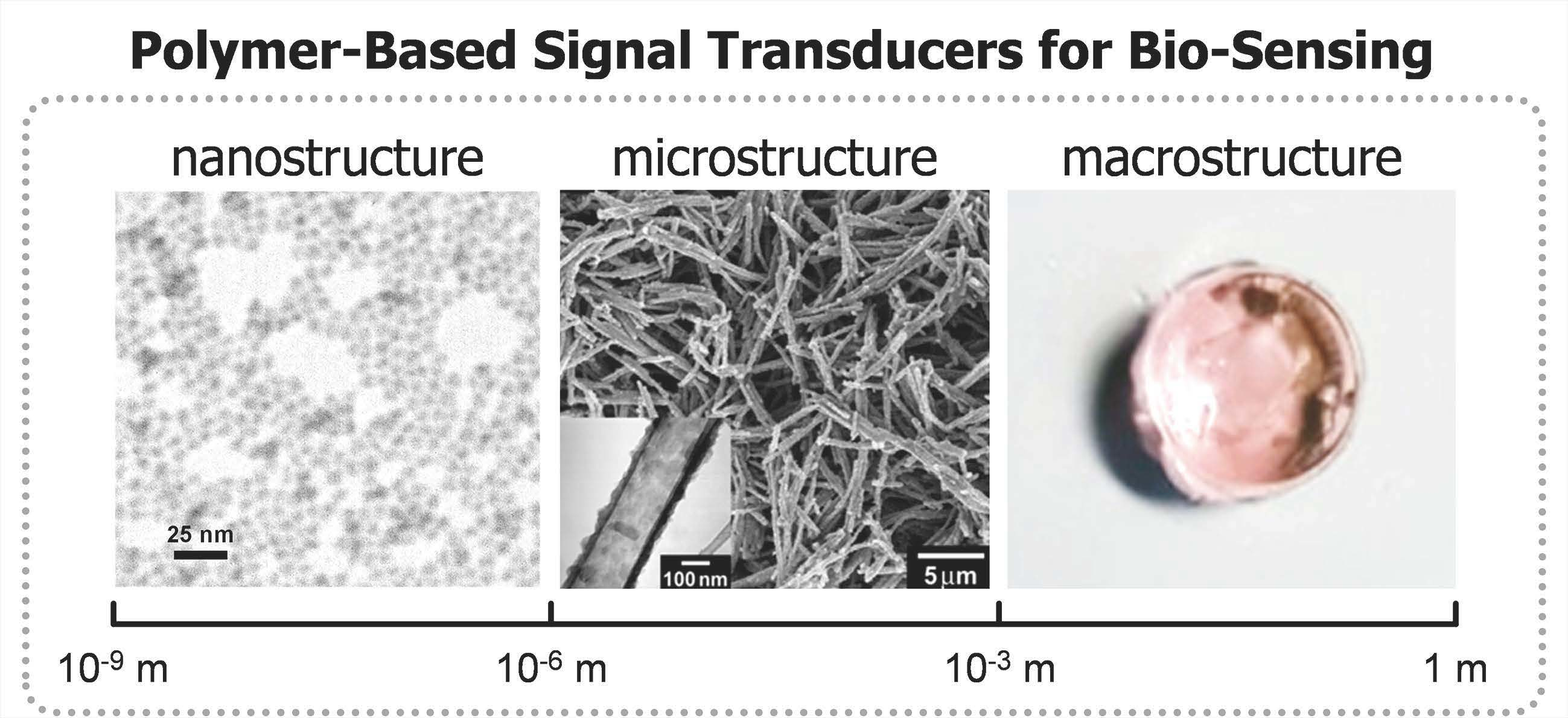
Over the past decades, biosensors, a class of physicochemical detectors sensitive to biological analytes, have drawn increasing interest, particularly in light of growing concerns about human health. Functional polymeric materials have been widely researched for sensing applications because of their structural versatility and significant progress that has been made concerning their chemistry, as well as in the field of nanotechnology. Polymeric nanoparticles are conventionally used in sensing applications due to large surface area, which allows rapid and sensitive detection. On the macroscale, hydrogels are crucial materials for biosensing applications, being used in many wearable or implantable devices as a biocompatible platform. The performance of both hydrogels and nanoparticles, including sensitivity, response time, or reversibility, can be significantly altered and optimized by changing their chemical structures; this has encouraged us to overview and classify chemical design strategies. Here, we have organized this review into two main sections concerning the use of nanoparticles and hydrogels (as polymeric structures) for biosensors and described chemical approaches in relevant subcategories, which act as a guide for general synthetic strategies.
Keywords: functional polymers; nanoparticles; hydrogels; chemical structures; biosensor functional polymers; nanoparticles; hydrogels; chemical structures; biosensor
Graphical Abstract