


Abstract
The presence of ferrite in 316 austenitic stainless steel affects its magnetic permeability, and the secondary precipitates formed by ferrite decomposition can further degrade the corrosion resistance, limiting its application in industries such as nuclear power and medical devices. In previous studies, the characteristics of ferrite and precipitates in several 316 stainless steel continuous-casting billet samples with different Ni contents were analyzed. In this work, remelting experiments were further conducted on several 316L stainless steels with different Ni contents using a tube furnace; according to the Ni content, they are designated as L-316, M-316, and H-316 stainless steels. Metallographic analysis and electron back-scattered diffraction (EBSD) characterization were employed. The effects of Ni content and cooling rate on the microstructure of 316 stainless steel were systematically investigated. The results show that for the L-316 stainless steel, the ferrite morphologies in water-cooled, oil-cooled, air-cooled, and furnace-cooled samples change successively as follows: skeletal and lath-like, clustered network, lath-like and clustered network, and short rod-like. For the M-316 stainless steel remelted samples, the ferrite morphologies are network and skeletal, network and short rod-like, semi-network and short rod-like, and semi-network, respectively. The solidification modes of the L-316, M-316, and H-316 stainless steel remelted samples are FA, FA, and AF modes, respectively. Increasing Ni content reduces the ferrite content under all cooling conditions. When the Ni content increases from 10% to 12.17%, the ferrite content decreases significantly, with a greater reduction at higher cooling rates; when the Ni content further increases to 14.25%, the decrease in ferrite content slows down, indicating that after Ni content reaches a certain level, its inhibiting effect on ferrite formation weakens. The effect of cooling rate on ferrite content depends on the solidification mode: in the FA mode, slow cooling promotes diffusional transformation of ferrite to austenite, so the ferrite content decreases with decreasing cooling rate—for L-316 stainless steel, the ferrite content drops from 22.44% in the water-cooled sample to 2.71% in the furnace-cooled sample. In the AF mode, slow cooling favors the enrichment of elements at grain boundaries and promotes ferrite nucleation and growth; the overall trend of ferrite content increases as the cooling rate decreases. For the H-316 stainless steel specimens, the ferrite content is similar between water-cooled specimens (0.36%) and oil-cooled specimens (0.26%); for air-cooled specimens, the ferrite content increases significantly to 1.49%; and finally, it reaches 1.94% for the furnace-cooled specimen. Regarding secondary precipitates, the phase constituents of the L-316 stainless steel specimens after water cooling, oil cooling, and air cooling consist of an austenite matrix and ferrite, with a secondary precipitated Chi phase forming only under furnace cooling conditions. For the M-316 stainless steel, the Sigma phase and Chi phase begin to form under oil cooling conditions, and the Sigma phase also precipitates in the oil-cooled specimens of the H-316 stainless steel. In the air-cooled and furnace-cooled specimens of both M-316 and H-316 stainless steels, the secondary precipitated phase is the Sigma phase. All three types of water-cooled stainless steel specimens exhibited no secondary precipitate phase; increasing the cooling rate suppresses atomic diffusion, thereby reducing the precipitation of Chi phase and Sigma phase; however, a higher Ni content shifts the solidification mode toward the AF mode, making secondary precipitates more prone to form.
1. Introduction
Austenitic stainless steels are widely used in many industrial fields such as the petrochemical, medical, and nuclear power industries, owing to their excellent plasticity, toughness, weldability, and corrosion resistance, as well as their relatively low thermal conductivity, magnetic permeability, and electrical conductivity [1,2,3,4,5,6,7]. 316 austenitic stainless steel is developed from 304 austenitic stainless steel by adding Ni and Mo elements; the addition of Mo enriches Mo in the passive film, thereby improving the corrosion resistance of the austenitic stainless steel [8,9,10,11,12]. However, during solidification, the as-cast structure of 316 austenitic stainless steel usually contains a ferrite magnetic phase [13,14,15,16], and the residual ferrite is difficult to eliminate in subsequent processing. In industries that require a non-magnetic environment, such as nuclear power [17,18], medical devices [19,20], and high-end mobile phones, the ferrite content in 316 stainless steel is required to be less than 1% [21,22,23]. In addition to affecting magnetism, the decomposition of ferrite forms secondary precipitates such as sigma phase and M23C6 carbides [24,25,26,27,28], which can induce material embrittlement and reduce corrosion resistance and mechanical properties [29,30,31,32,33]. Therefore, it is of great significance to study the formation mechanisms and control methods of ferrite and precipitates in 316L austenitic stainless steel.
The morphology and content of residual ferrite in austenitic stainless steels are mainly influenced by composition, cooling rate [34], and changes in solidification mode [35,36,37,38]. The solidification modes of austenitic stainless steels can be classified into four types—A mode, AF mode, FA mode, and F mode—according to the precipitation sequence of ferrite (F) and austenite (A). Among them, the AF mode and FA mode correspond to the processes in which austenite or ferrite, respectively, nucleates and grows as the primary phase during the initial stage of solidification. The composition of 316 stainless steel is near the eutectic point, making its solidification mode highly sensitive to variations in composition and cooling rate [39]. Wang et al. [40] conducted real-time observations of the solidification process of 316L specimens with different nickel contents using high-temperature confocal laser scanning microscopy (HT-CLSM) experiments and found that low-nickel 316L stainless steel solidifies in the FA mode, while high-nickel 316L stainless steel solidifies in the AF mode. Brooks et al. [41] measured the Ni concentration distribution between ferrite and austenite using scanning transmission electron microscopy and found that the Ni content distribution in austenitic stainless steels solidified in the AF and FA modes differs significantly. Similarly, cooling rate also affects elemental segregation behavior and consequently influences secondary phase precipitation.
Many researchers have investigated the ferrite morphology, content, and solidification mode of 316 stainless steels with different compositions. Chun et al. [42] studied the weld microstructures of 316FR austenitic stainless steel with Ni contents of 12.02% and 11.50%, and found that the 316FR stainless steel with 12.02% Ni had a ferrite content of 2.1% and a short rod-like morphology, with the short rod-like ferrite distributed at austenite grain boundaries and an AF solidification mode; the 316FR stainless steel with 11.50% Ni had a ferrite content of 5.3% and a skeletal morphology, with the skeletal ferrite distributed at dendrite centers and an FA solidification mode. In the study of Wu et al. [43], it was also found that as-cast 316 stainless steel with 11.24% Ni exhibited a skeletal ferrite morphology and an FA solidification mode, while as-cast 316 stainless steel with 12.72% Ni exhibited ferrite in an isolated island-like morphology distributed at austenite grain boundaries, with an AF solidification mode. Song et al. [44] studied a hot-rolled plate of 316L stainless steel with 10.11% Ni and found that its ferrite content was 10% and its solidification mode was FA. Zhang et al. [45] and Pei et al. [46] studied continuous casting slabs with a Ni content of about 10% and found that the ferrite content varied in the ranges of 6.92–11.2% and 4.2–10.6%, respectively. Wang et al. [47] investigated 316L casting slabs with Ni contents of 13–14% and found that the ferrite content varied between 1.5% and 4.8%.
Cooling rate is also a key influencing factor on ferrite morphology, content, and solidification mode. David et al. [48] studied the room-temperature microstructures of austenitic stainless steels under different cooling rates. When the welding speed was increased from 25 cm/min to 125 cm/min, the solidification mode changed from FA mode to A mode, and with increasing cooling rate, the room-temperature microstructure was essentially fully austenitic. Baldissin et al. [49] employed rapid solidification techniques to study the as-cast solidification structures of 304 austenitic stainless steel. They found that in the low-cooling-rate region, skeletal and vermicular ferrite appeared, and the solidification mode was FA; while in the high-cooling-rate region, a fully austenitic structure was obtained, and the solidification mode transformed to A mode. Zhu and Liang [50] investigated the effect of cooling rate on the solidification mode of Fe-Cr-Mn-Cu series austenitic stainless steel. In their study, the cooling rates were 0.2 °C/s, 10 °C/s, and 40 °C/s. It was found that at slower cooling rates, the solidification mode was FA, while at faster cooling rates, the solidification mode changed. Li et al. [23] used high-temperature laser confocal microscopy technology to study the change in volume fraction of δ-ferrite in 316H austenitic stainless steel during cooling from 5 °C/min to 6000 °C/min. The results showed that regardless of the cooling rate, the solidification mode of 316H was FA mode, and the higher the cooling rate, the greater the volume fraction of δ-ferrite. In the continuous casting process, the cooling rates vary considerably at different positions, leading to significant differences in ferrite content within the same composition slab [35]. Wang et al. [51] studied the ferrite morphology and distribution across the entire thickness of a thick-section 316H casting slab. They found that the cooling rate gradually decreased from 1.3 °C/s at the surface to 0.2 °C/s at the center. At the surface position, cellular δ-ferrite with a content of less than 3% was observed, while at the center, skeletal δ-ferrite with a content as high as 8% was present. Chu et al. [52] studied the distribution of precipitates in 316L casting slabs. They found that at low cooling rates, in the center and at the quarter-thickness positions, some ferrite transformed into sigma phase; however, at the edge positions with high cooling rates, ferrite did not transform into sigma phase.
In summary, there have been few studies on the effects of different Ni contents and cooling rates on the ferrite and precipitates in 316 stainless steel. The aforementioned studies have mainly focused on the effects of a single condition on ferrite content and precipitates, whereas systematic comparative investigations on the formation behavior of ferrite and precipitates in 316 stainless steel under various Ni contents and cooling rates are still lacking.
In previous studies, analyses were performed on samples taken from three 316 stainless steel casting slabs with different compositions and different slab shapes [53]. Because the sampling positions differed, and the ferrite content and cooling rate varied greatly at different locations within the slabs [54,55,56,57], it was not possible in those previous studies to accurately analyze the effects of composition and cooling rate on the microstructure of 316 stainless steel. There is an urgent need to investigate the influence of cooling rate on the microstructure of 316 stainless steel with different Ni contents under the same experimental conditions. Moreover, the previous study [53] did not conduct in-depth research on the precipitates. Based on the previous work, this study eliminates the differences arising from different sampling positions in the slab and systematically and quantitatively investigates the effects of Ni content and cooling rate on the ferrite content, morphological evolution, and formation of secondary precipitates in 316 austenitic stainless steel under the same preparation methods (water cooling, oil cooling, air cooling, and furnace cooling), while revealing the underlying mechanisms. The ferrite content and EBSD data of H-316 cited in this paper are used only for comparative analysis to ensure the completeness of the analysis of microstructural evolution under different cooling conditions; all other experimental results are newly obtained data from this study.
2. Materials and Methods
Using the three types of stainless steel cast slabs reported in a previous study [53] as raw materials, specimens were cut for remelting experiments, and their specific compositions are listed in Table 1. The Cr, Mo, and Mn contents of the three stainless steels are comparable: L-316, M-316, and H-316 contain 2.01%, 2.61%, and 2.73% Mo, respectively, while their Ni contents show significant differences despite similar Mo levels, on the basis of which they are classified into low-nickel (L-316), medium-nickel (M-316), and high-nickel (H-316) grades.
Table 1.
Chemical composition of L-316, M-316, and H-316 stainless steels (mass fraction, %).
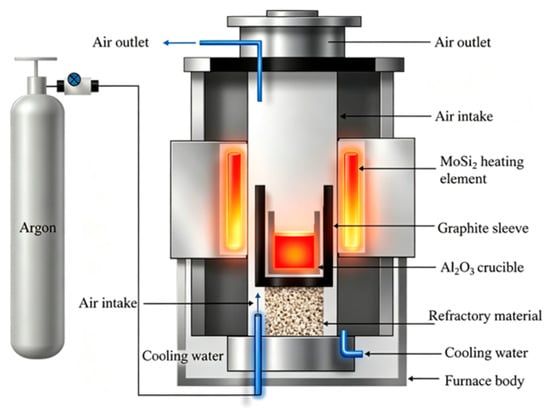
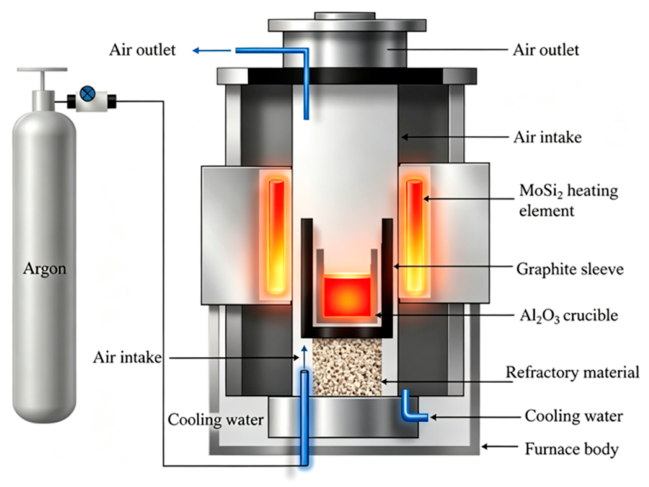
The remelting was carried out in a high-temperature tube furnace (shown in the schematic diagram in Figure 1): the base material was placed in an alumina crucible, which was then inserted into the tube furnace; after evacuation, high-purity argon was introduced for protection. The furnace was heated to 1600 °C at a heating rate of 0.2 °C/s and held for 1.5 h to ensure complete melting. During the holding period, argon gas was continuously supplied to prevent oxidation. After complete melting, a cup sampler was used to extract the melt, which was then subjected to water cooling, oil cooling, air cooling, and furnace cooling, respectively, to obtain remelted ingots corresponding to the four cooling methods for each stainless steel. The remelted ingots were cut and sampled. To ensure data accuracy, the sampling positions, cooling methods, and specimen treatment procedures for the L-316 and M-316 stainless steel remelted specimens were all consistent with those for the H-316 stainless steel remelted specimens [53], and the specimen dimensions were 10 mm × 10 mm × 10 mm.
Figure 1.
Schematic diagram of a high-temperature tubular furnace.
The as-received specimens were subjected to grinding and polishing, and then etched in a mixed solution of 0.5 g FeCl3, 5 mL HCl, and 10 mL H2O. Subsequently, the secondary dendrite arm spacing (SDAS) was measured using Image-Pro-Plus (IPP) software (version: Image-Pro-Plus 7.0), with the measurement direction perpendicular to the growth direction of the primary dendrite arms. For SDAS measurement, at least 5 fields of view and no fewer than 100 secondary dendrite arms were randomly selected from each specimen, and the average value was calculated for subsequent analysis. The ferrite content was determined by a metallographic method [58]: at least 10 fields of view on the specimen surface were observed under a ZEISS AX10 optical microscope (at 100× magnification). During image analysis with IPP software, a manual threshold segmentation method was adopted: the threshold separating the austenite matrix (gray) from the ferrite phase (black) was selected based on the grayscale histogram. The threshold settings were performed by the same operator under identical lighting conditions to ensure consistency. The ferrite content (volume fraction) in each field was measured using IPP software, after which the average value was calculated. For further microstructural analysis, the pre-ground and polished specimens were electropolished in a 10 vol% HClO4 ethanol solution (polishing voltage: 25 V, polishing time: 20 s). The treated samples were then examined by electron backscatter diffraction (EBSD) using a JEOL IT500 electron microscope (accelerating voltage: 20 kV, working distance: 15 mm, sample tilt: 70°, step size: 0.1–0.5 μm) to obtain the crystallographic orientation and phase precipitation information for each specimen.
3. Results
3.1. Metallographic Observation Results
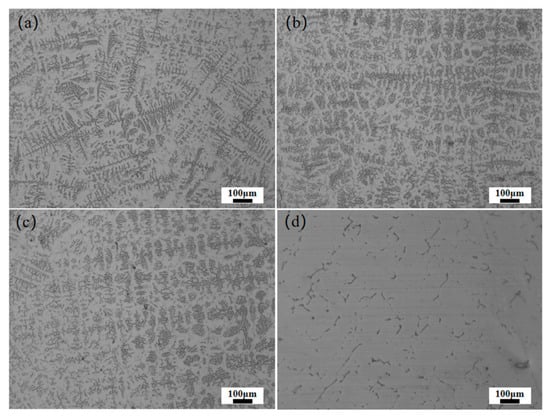
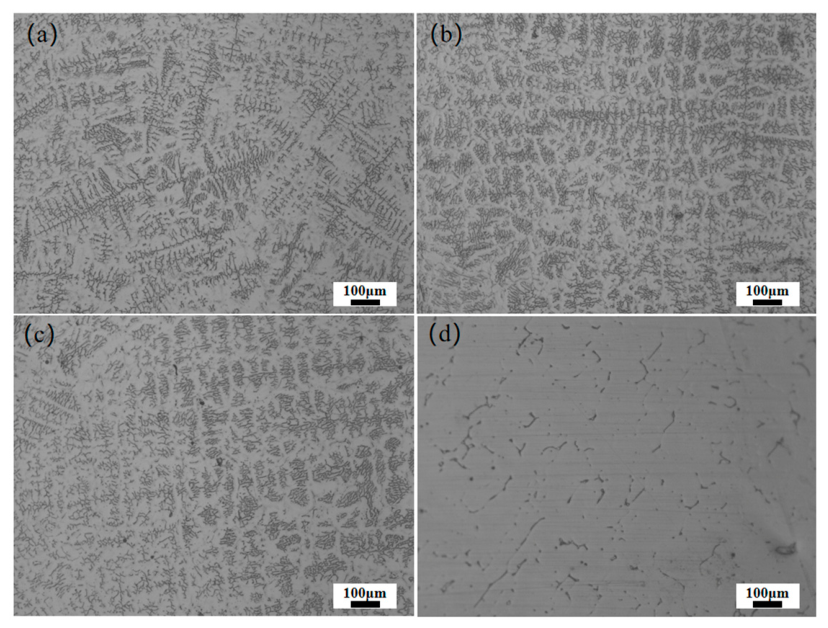
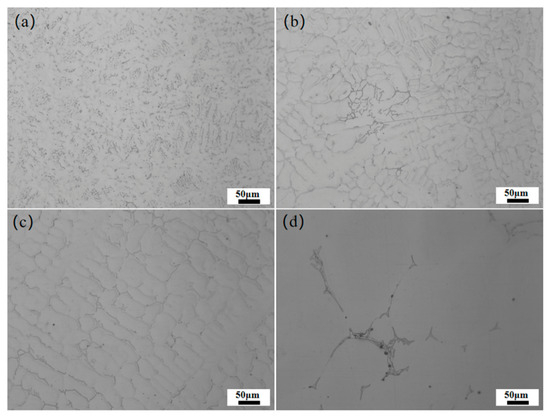
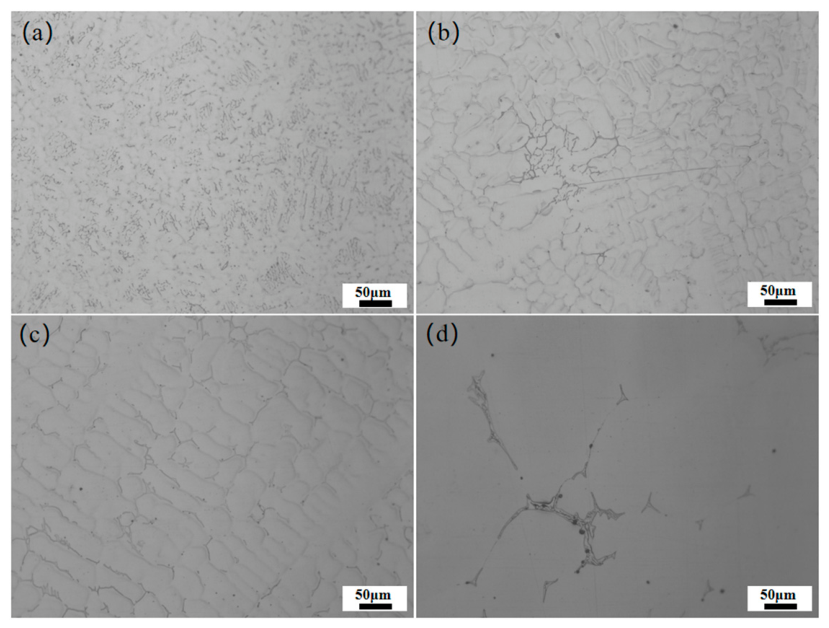
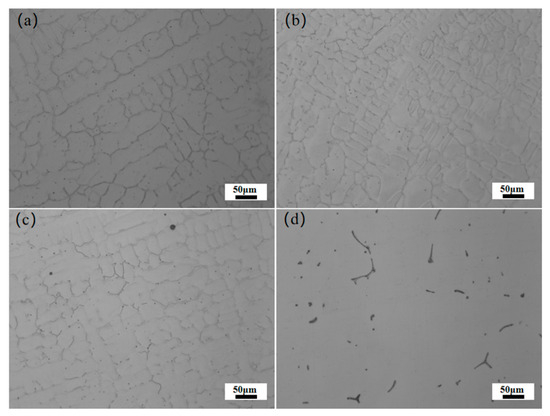
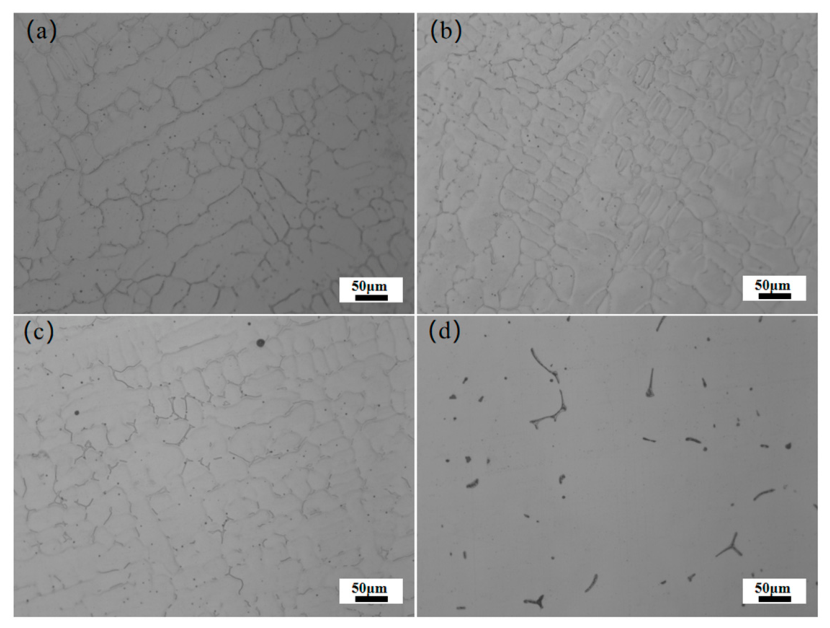
Metallographic observations were conducted on the remelted specimens of L-316, M-316, and H-316 stainless steels, with the results shown in Figure 2, Figure 3 and Figure 4, respectively. In these figures, the gray matrix is the austenite phase, and the black structures are the ferrite phase.
Figure 2.
Metallographic observations of the remelted L-316 stainless steel specimens: (a) water-cooled; (b) oil-cooled; (c) air-cooled; (d) furnace-cooled.
Figure 3.
Metallographic observations of the remelted M-316 stainless steel specimens: (a) water-cooled; (b) oil-cooled; (c) air-cooled; (d) furnace-cooled.
Figure 4.
Metallographic observations of the remelted H-316 stainless steel specimens: (a) water-cooled; (b) oil-cooled; (c) air-cooled; (d) furnace-cooled.
As shown in Figure 2, the ferrite morphology and distribution vary considerably among the remelted specimens of L-316 stainless steel. In the water-cooled, oil-cooled, and air-cooled specimens, the ferrite dendrites are fine and densely distributed, whereas in the furnace-cooled specimen, the ferrite dendrites are larger and more sparsely distributed. From Figure 2a,b, it can be seen that the ferrite morphology in the water-cooled L-316 specimen is mainly skeletal and lath-like structures; in the oil-cooled specimen, the ferrite morphology is predominantly a cluster-network structure; in the air-cooled specimen, the ferrite morphology exhibits a combination of lath-like and cluster-network structures; and in the furnace-cooled specimen, the ferrite morphology differs significantly from the other three, appearing mainly as a small amount of short rod-like structures.
Figure 3 presents the metallographic observations of the remelted M-316 stainless steel specimens. Compared with the ferrite morphologies of the L-316 remelted specimens in Figure 2, it is evident that the ferrite content and distribution uniformity in all the M-316 remelted specimens are significantly reduced. From Figure 3a,b, it can be seen that the ferrite morphologies of the M-316 remelted specimens are slightly different, and the ferrite dendrites gradually increase in size. The ferrite morphology in the water-cooled M-316 specimen is mainly a network structure with a small amount of skeletal structure; in the oil-cooled specimen, it is a small amount of network and short rod-like structures; in the air-cooled and furnace-cooled specimens, the ferrite morphology is mainly short rod-like and semi-network structures. From Figure 3d, it can be clearly observed that the ferrite in the furnace-cooled M-316 specimen is unevenly distributed internally, and the ferrite may have decomposed.
Figure 4 presents the metallographic observations of the remelted H-316 stainless steel specimens. The ferrite content and distribution uniformity of the H-316 remelted specimens are further decreased compared with those of the M-316 specimens in Figure 3. From Figure 4a,b, it can be seen that the ferrite dendrites in all the H-316 remelted specimens also gradually increase in size. In the water-cooled and oil-cooled specimens, only a very small amount of ferrite can be observed, and the ferrite is mainly distributed in a short rod-like form along the austenite grain boundaries. In the air-cooled and furnace-cooled H-316 specimens, a small amount of short rod-like and granular ferrite can be observed, also located only at the austenite grain boundaries.
Based on the closely arranged skeletal and network structures observed in the remelted L-316 and M-316 stainless steel specimens, it can be determined that their solidification mode is the FA mode [59]. In contrast, the ferrite distributed as short rod-like and granular shapes along the austenite grain boundaries in the remelted H-316 stainless steel specimen indicates that its solidification mode is the AF mode.
3.2. Cooling Rate and Ferrite Content
The effect of cooling rate on the residual ferrite content is relatively complex. Currently, researchers often use the secondary dendrite arm spacing (SDAS) in the solidification structure to indirectly estimate cooling rate [51], mainly through Equation (1) [60,61]. The constants in Equation (1) were obtained by regression analysis of experimental data on the solidification of stainless steel slabs, with the cooling rate range covered in that study being approximately 0.7 °C/s to 40 °C/s. The cooling rates in this study mostly fall within this range; only the furnace-cooled specimens from three different stainless steels exhibit cooling rates slightly below this range.
where λ2 is SDAS (unit: μm) and ν is the cooling rate (unit: °C/s).
λ2 = 44ν−0.38
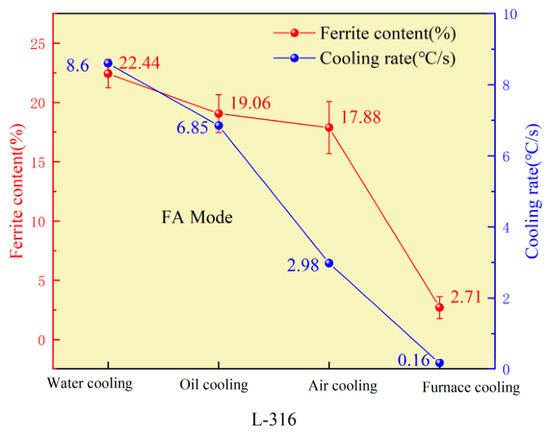
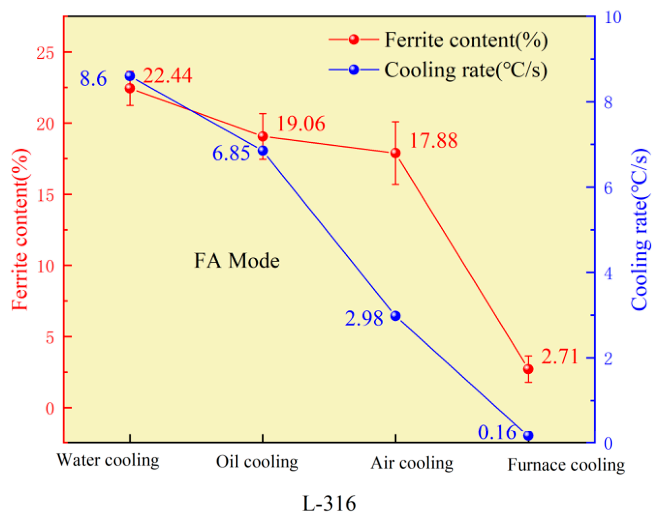
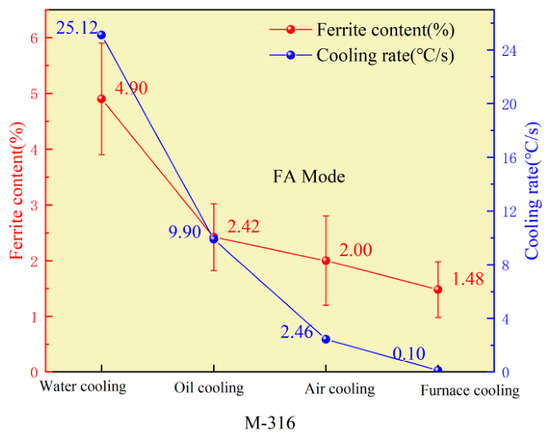
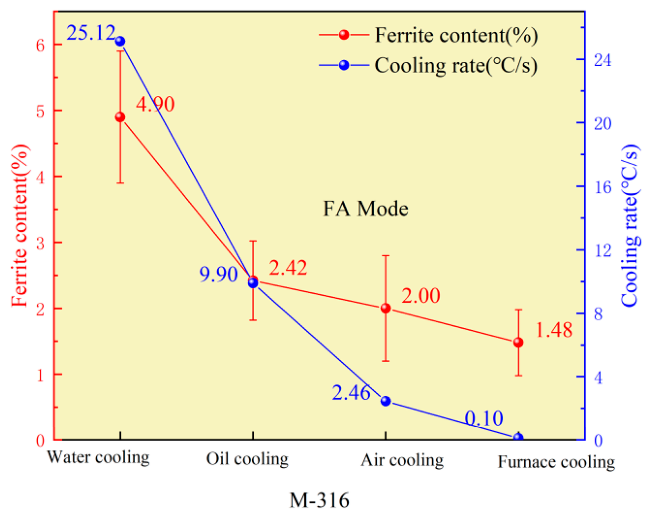
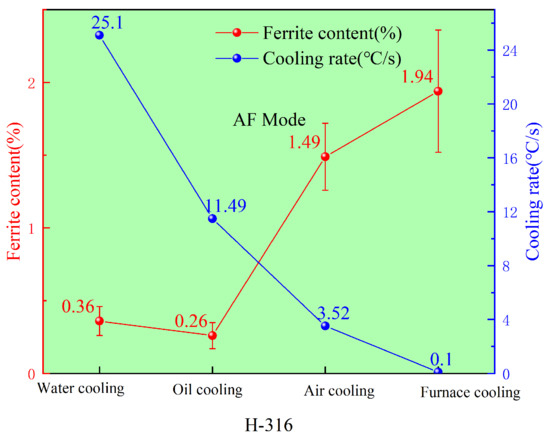
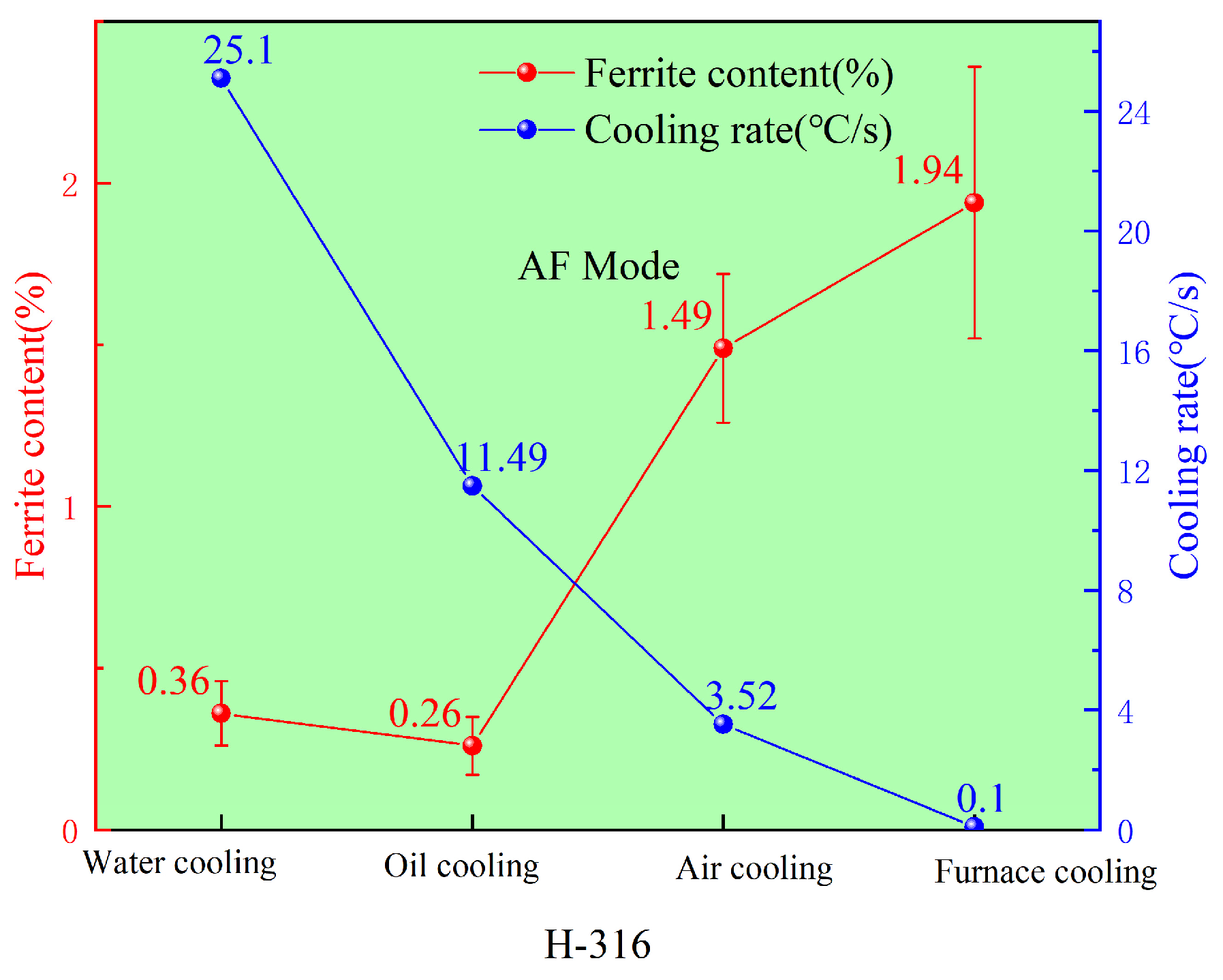
As shown in Figure 5, the ferrite contents of the water-cooled, oil-cooled, air-cooled, and furnace-cooled L-316 stainless steel specimens are 22.44%, 19.06%, 17.88%, and 2.71%, respectively, with corresponding cooling rates of 8.6, 6.85, 2.98, and 0.16 °C/s. It can be seen that the ferrite content of the L-316 remelted specimens is generally high and decreases with decreasing cooling rate. From the results in Figure 6, the ferrite contents of the water-cooled, oil-cooled, air-cooled, and furnace-cooled M-316 specimens are 4.9%, 2.42%, 2%, and 1.48%, respectively, and the corresponding cooling rates are 25.12, 9.9, 2.46, and 0.1 °C/s. Similarly, the ferrite content of the M-316 remelted specimens decreases with decreasing cooling rate, but its ferrite content is much lower than that of the L-316 remelted specimens. Figure 7 presents the ferrite contents and cooling rates of the H-316 remelted specimens. The ferrite contents of the water-cooled, oil-cooled, air-cooled, and furnace-cooled specimens are 0.36%, 0.26%, 1.49%, and 1.94%, with corresponding cooling rates of 25.1, 11.49, 3.52, and 0.1 °C/s. The ferrite content of the H-316 remelted specimens is again lower than that of the M-316 remelted specimens. However, unlike L-316 and M-316, the ferrite content of the H-316 remelted specimens increases with decreasing cooling rate. This different trend may be related to the fact that its solidification mode is different from that of L-316 and M-316, and this will be analyzed in Section 4.1 of the discussion.
Figure 5.
Ferrite content and cooling rate of the remelted L-316 stainless steel specimens.
Figure 6.
Ferrite content and cooling rate of the remelted M-316 stainless steel specimens.
Figure 7.
Ferrite content and cooling rate of the remelted H-316 stainless steel specimens.
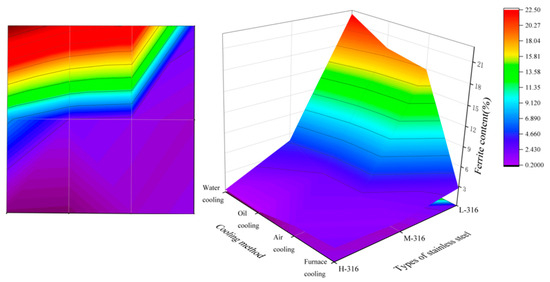
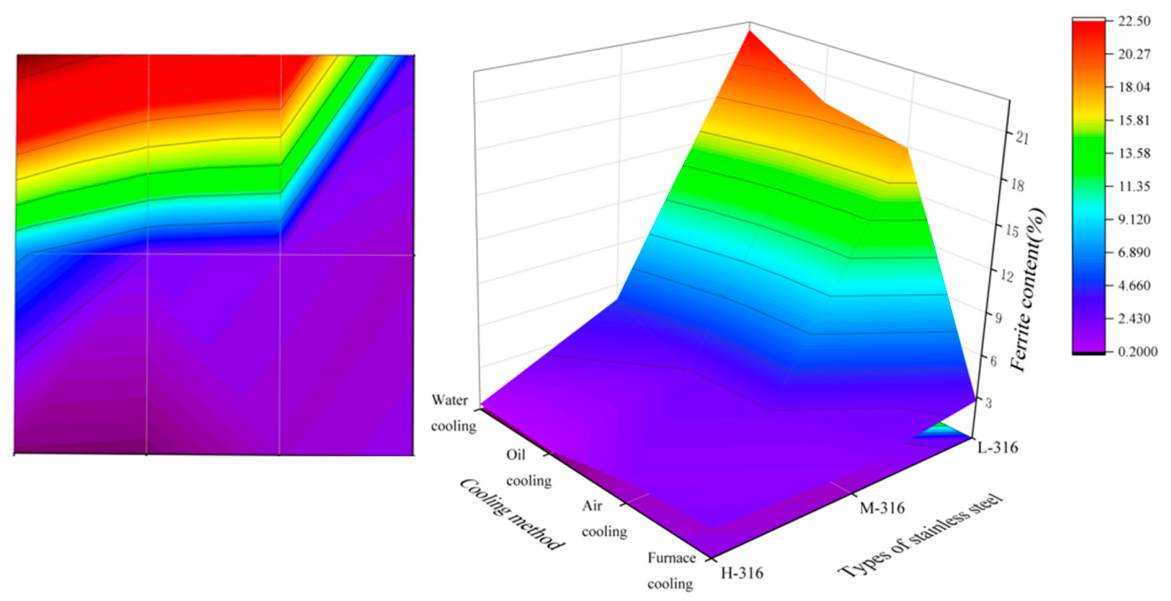
Figure 8 shows a three-dimensional distribution diagram of the ferrite content in the remelted specimens of L-316, M-316, and H-316 stainless steels. It can be seen that the ferrite content is highest in the water-cooled L-316 specimen and lowest in the water-cooled H-316 specimen. From the peak ferrite contents of the remelted specimens of L-316, M-316, and H-316 stainless steels in the three-dimensional distribution diagram, it is evident that as the Ni content increases, the ferrite content of the remelted specimens under each cooling medium decreases. When the Ni content increases from 10% in L-316 to 12.17% in M-316, the ferrite content of all remelted specimens decreases significantly, and the decrease is more pronounced in cooling media with higher cooling rates. When the Ni content further increases from 12.17% in M-316 to 14.25% in H-316, the ferrite content of the remelted specimens also decreases, but the extent of the decrease is much reduced. This indicates that once the Ni content reaches a certain level, its inhibitory effect on ferrite formation is weakened.
Figure 8.
Three-dimensional distribution diagram of ferrite content in the remelted L-316, M-316, and H-316 stainless steel specimens.
3.3. Secondary Phase Precipitation
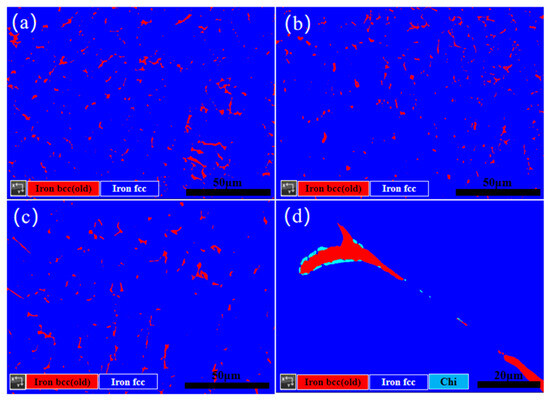
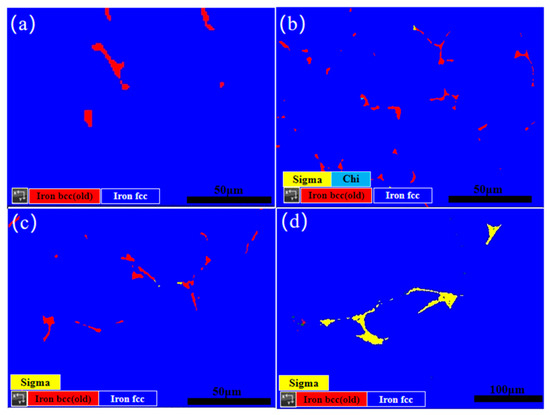
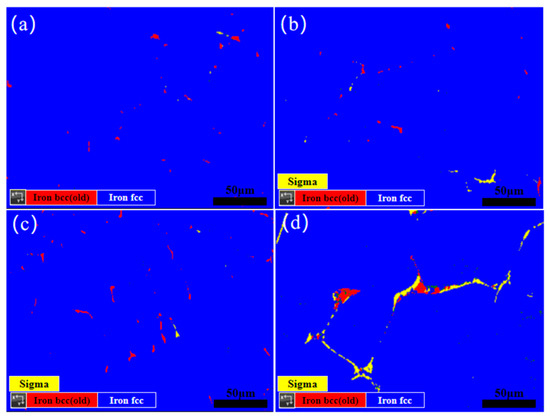
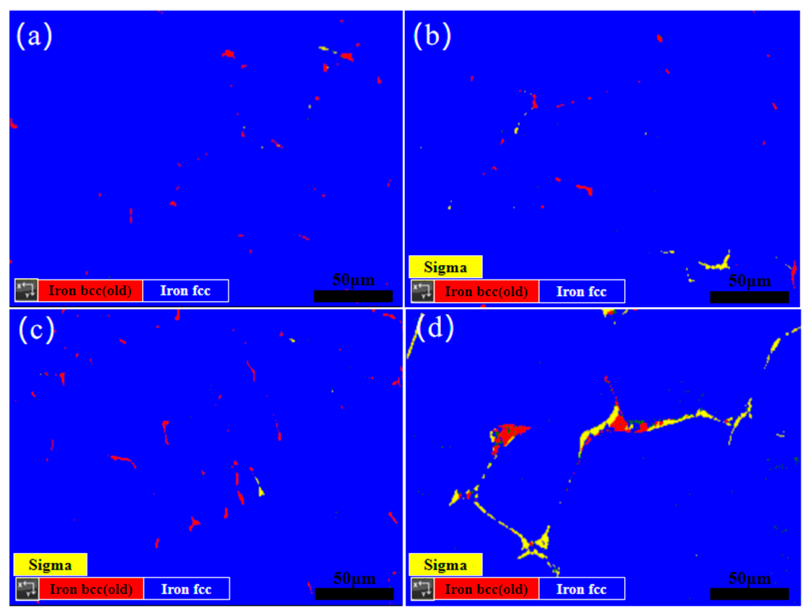
EBSD was used to examine and analyze the water-cooled, oil-cooled, air-cooled, and furnace-cooled specimens of L-316 and M-316 stainless steels, in order to observe the phase precipitation in the remelted specimens under different cooling conditions. The results are shown in Figure 9 and Figure 10.
Figure 9.
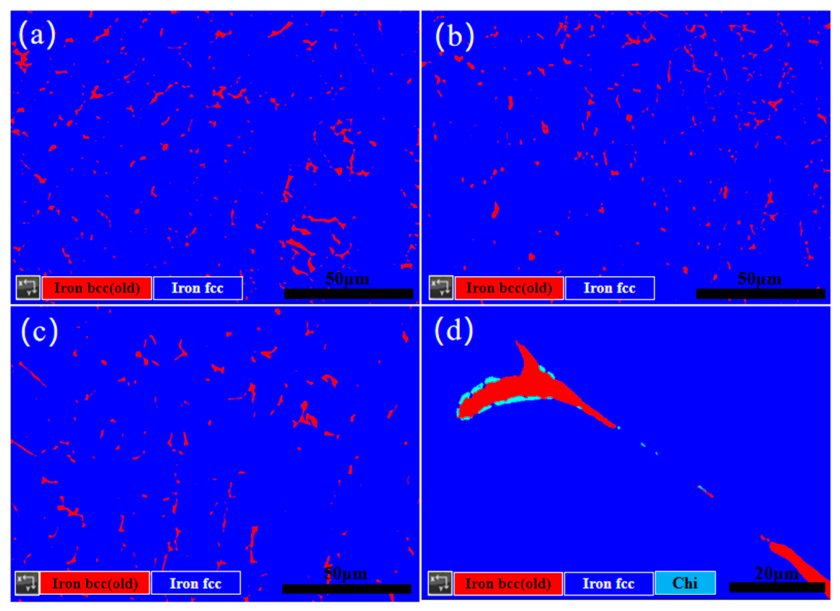
EBSD phase analysis results of the remelted L-316 stainless steel specimens. (a) Water-cooled; (b) oil-cooled; (c) air-cooled; (d) furnace-cooled.
Figure 10.
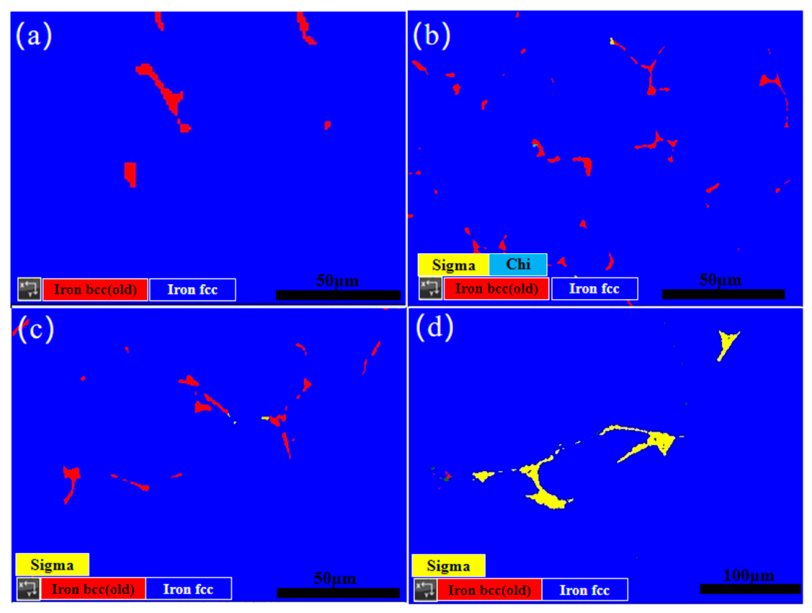
EBSD phase analysis results of the remelted M-316 stainless steel specimens. (a) Water-cooled; (b) oil-cooled; (c) air-cooled; (d) furnace-cooled.
Figure 9 presents the EBSD phase analysis results of the L-316 remelted specimens. As shown in Figure 9a, the phase composition of the water-cooled L-316 specimen consists of an austenite matrix and ferrite, with ferrite being extensively distributed and exhibiting fine dendrites, and no secondary precipitated phases are present. Owing to the relatively high cooling rate under water cooling conditions, the ferrite precipitated at high temperatures did not have sufficient time to grow, and thus was retained, with relatively fine grains. From Figure 9b,c, it can be seen that the phase compositions of the oil-cooled and air-cooled L-316 specimens are also austenite matrix and ferrite, with no secondary precipitated phases observed. However, as shown in Figure 9d, Chi-phase precipitation is observed at the ferrite/austenite phase interfaces in the furnace-cooled L-316 specimen. The secondary precipitated phase appears in the furnace-cooled specimen, which has the lowest cooling rate among the L-316 remelted specimens.
Analysis of the water-cooled M-316 specimen in Figure 10a indicates that its phase composition consists of an austenite matrix and a small amount of ferrite. Figure 10b presents the EBSD results of the oil-cooled specimen; in addition to the austenite matrix and some ferrite, secondary precipitated Sigma phase and Chi phase are detected, and a coupled structure formed by ferrite and Chi phase can be observed. Figure 10c,d shows the EBSD results of the air-cooled and furnace-cooled specimens, respectively. In the air-cooled specimen, the phase composition includes an austenite matrix, ferrite, and a secondary precipitated Sigma phase, but no Chi phase is found, and the Sigma phase is distributed within the austenite grains. In the furnace-cooled specimen, the secondary precipitated phase is also only Sigma phase; however, it is characterized by more extensive decomposition of ferrite, with a higher degree of transformation into Sigma phase, and this phase is mainly precipitated along the austenite grain boundaries.
Previous research [53] has found that the phase constitution of the water-cooled H-316 specimen consists only of austenite matrix and a very small amount of ferrite; in the oil-cooled and air-cooled H-316 specimens, a small amount of ferrite transforms into Sigma phase; and in the furnace-cooled specimen, a larger amount of ferrite has transformed into Sigma phase. Comparing the secondary precipitation results of the L-316, M-316, and H-316 remelted specimens, it can be seen that Ni content and cooling rate have certain effects on the secondary precipitated phases. This will be analyzed in Section 4.2 of the discussion.
Previous studies reported that the ferrite contents of H-316 stainless steel under water cooling, oil cooling, air cooling, and furnace cooling were 0.36%, 0.26%, 1.49%, and 1.94%, respectively. Among these, the ferrite contents in the water-cooled and oil-cooled specimens were extremely low, making it difficult to effectively distinguish ferrite from the austenite matrix by conventional metallographic methods. Therefore, EBSD analysis (Figure 11) was employed to confirm this, and the results indicated that the volume fractions of ferrite in both specimens were already below 1%.
Figure 11.
EBSD phase analysis results of the remelted H-316 stainless steel specimens [53]. (a) Water-cooled; (b) oil-cooled; (c) air-cooled; (d) furnace-cooled.
Table 2 summarizes the ferrite content, cooling rate, and phase precipitation of the remelting experiments for L-316, M-316, and H-316 stainless steels. It can be seen from the table that there are considerable differences in ferrite content, cooling rate, and phase precipitation among the remelted specimens obtained by solidification using the same cooling method for the different compositions of 316 stainless steels. The effects of Ni content and cooling rate on the ferrite content and phase precipitation of 316 stainless steel will be discussed in the Section 4.
Table 2.
Ferrite content, cooling rate, and phase precipitation of the remelting experiments for L-316, M-316, and H-316 stainless steels.
4. Discussion
In this study, four cooling media, namely water cooling, oil cooling, air cooling, and furnace cooling, were employed to achieve different ranges of cooling rates, which is a common research method [62,63]. It is worth noting that even when the same cooling medium (i.e., the same preparation method) was used, the actual cooling rates of stainless steels with different Ni contents still exhibited certain differences (see Table 2). In the present study, when analyzing the effects of Ni content and cooling rate on ferrite content, the cooling medium category was used as the basis. Moreover, the relatively large differences in cooling rates among the water-cooled specimens of L-316, M-316, and H-316 stainless steels are mainly attributed to the fact that the relationship between SDAS and cooling rate is an empirical correlation, which is controlled not only by external cooling conditions but also by factors such as alloy composition, solute segregation, width of the liquid–solid two-phase region, dendrite coarsening behavior, and elemental diffusion kinetics. This leads to differences in the effective cooling rates calculated using the empirical formula. Furthermore, the method of deriving cooling rates from SDAS itself has certain limitations. The empirical formula employed was established under specific alloy systems and experimental conditions; applying it to 316 austenitic stainless steels with different Ni contents inevitably introduces certain errors. Therefore, the subsequent discussion will continue to be based on the specimen preparation methods.
4.1. Effect of Composition and Cooling Rate on Ferrite Content
Nickel, as a core austenite-stabilizing element, is a key factor determining the solidification mode and the residual ferrite content of 316 stainless steel. In previous work [53], the equilibrium solidification modes of L-316, M-316, and H-316 stainless steel slabs were calculated using the Thermo-Calc thermodynamic (version: Thermo-Calc 2025a ) software as FA, FA, and AF modes, respectively; however, the solidification mode of the M-316 ingot specimen was ultimately judged to be AF mode based on the ferrite morphology (short rod-like distribution along austenite grain boundaries). It has been reported in the literature [16,47] that the solidification mode may change within the interior of 316 stainless steel slabs, so determining the solidification mode solely from the ferrite morphology of a single specimen is inaccurate. In previous work [53], the Cr equivalent/Ni equivalent (Creq/Nieq) ratio of M-316 was calculated using the empirical formula for chromium and nickel equivalents proposed by Hammer-Svensson [64], and was found to be located exactly at the boundary between the AF and FA modes (approximately 1.48). At this critical composition, the solidification mode is highly sensitive to local conditions; therefore, the determination based solely on the AF morphology at a single location in the previous work had limitations. In the present study, remelting experiments were conducted to eliminate the differences arising from slab positions. Based on the Creq/Nieq ratio, the results of Thermo-Calc thermodynamic calculations for the FA solidification mode, and the closely arranged skeletal and network structures observed in all remelted specimens of L-316 and M-316 stainless steels, it was ultimately determined that the solidification mode of the L-316 and M-316 remelted specimens is the FA mode; and based on the ferrite distributed as short rod-like and granular shapes along the austenite grain boundaries in the remelted H-316 specimens, its solidification mode is determined to be AF mode. Thus, the actual solidification modes of the remelted L-316, M-316, and H-316 stainless steel specimens in this experiment are consistent with the Thermo-Calc thermodynamic calculations.
The previous work [53] has calculated the Creq/Nieq equivalent ratios of L-316, M-316, and H-316 stainless steels as 1.7, 1.48, and 1.4, respectively. As the nickel content increases, the Creq/Nieq equivalent ratio continuously decreases, causing the solidification mode to shift from FA mode to AF mode, and the ferrite-forming ability is substantially weakened. In the low-nickel (L-316) stainless steel with FA solidification, ferrite is the primary phase; the water-cooled specimen has a ferrite content as high as 22.44%. In the medium-nickel (M-316) stainless steel, which still retains the FA solidification mode, the competitive nucleation capability of austenite is enhanced, but the peak ferrite content is only 4.9%. In the high-nickel (H-316) stainless steel, which transforms to the AF solidification mode, austenite precipitates preferentially, and ferrite only precipitates in small amounts along the interdendritic regions, with the water-cooled specimen having a ferrite content as low as 0.36%, indicating that nickel exerts a significant inhibitory effect on ferrite formation.
Furthermore, the effect of cooling rate on ferrite content exhibits opposite trends in the FA and AF modes. In L-316 and M-316 stainless steels (FA mode), the ferrite content decreases with decreasing cooling rate: for L-316, the water-cooled specimen (8.6 °C/s) has 22.44% ferrite, while the furnace-cooled specimen (0.16 °C/s) has only 2.71%; for M-316, the water-cooled specimen (25.12 °C/s) has 4.9%, and the furnace-cooled specimen (0.1 °C/s) has 1.48%. The water cooling process involves a very high cooling rate, which is equivalent to quenching in heat treatment, allowing the high-temperature ferrite to be retained and thus considered as the initial ferrite. According to thermodynamic calculation results [53] and previous research [65], the cooling rate mainly affects the diffusional transformation from δ-ferrite to austenite after solidification. Under furnace cooling conditions, the ferrite content decreases; observations reveal an increase in the secondary dendritic spacing and dendrite coarsening of the ferrite phase (as shown in Figure 2 and Figure 3), indirectly indicating that the austenite grain size also increases. It is likely that slow cooling promotes element diffusion, thereby accelerating the δ→γ transformation. Within the cooling-rate range of this study, the promoting effect of prolonged diffusion time on ferrite decomposition outweighs the hindering effect of increased diffusion distance, so under slow cooling conditions the transformation of ferrite to austenite is more complete, resulting in lower residual ferrite content [66,67,68]. In contrast, in H-316 stainless steel (AF mode), the ferrite content increases with decreasing cooling rate: the water-cooled specimen (25.1 °C/s) has only 0.36%, while the furnace-cooled specimen (0.1 °C/s) has 1.94%. In the AF mode, ferrite forms only at austenite grain boundaries during the final stage of solidification, and its content is mainly determined by the enrichment of ferrite-forming elements in the remaining liquid phase at the end of solidification. The lower the cooling rate, the more fully the elements diffuse in the liquid, and the more sufficient the nucleation and growth of ferrite, so the ferrite content increases with decreasing cooling rate [41,69,70].
4.2. Effect of Composition and Cooling Rate on Secondary Phase Precipitation
In a previous study [53], the precipitated phases in austenitic stainless steels were not analyzed in depth. The results presented in Figure 9 and Figure 10 and Table 2 show that the types and amounts of secondary precipitated phases in the three remelted stainless steel specimens are affected by the combined influence of Ni content and cooling rate. The underlying reason is that the solidification mode determines the distribution and stability of ferrite. From the perspective of solidification mode, L-316 stainless steel (FA mode) exhibits only a very small amount of Chi phase under furnace cooling conditions, whereas M-316 stainless steel begins to precipitate Chi phase and Sigma phase under oil cooling conditions, and similarly, Sigma phase formation is observed in H-316 stainless steel under oil cooling conditions. This difference is closely related to the micro-segregation behavior of alloying elements during different solidification modes. In the FA solidification mode, ferrite forms as the primary phase, with a relatively uniform distribution of ferrite-forming elements, resulting in a weak driving force for transformation to Chi phase and Sigma phase. In contrast, in the AF solidification mode, austenite nucleates and grows as the primary phase; since austenite has a lower solubility for ferrite-forming elements, these elements are continuously rejected into the remaining liquid during austenite growth, ultimately forming significant elemental enrichment at austenite grain boundaries, which makes ferrite prone to decomposition and transformation. In this study, the Ni content increases from 10.00% in L-316 to 14.25% in H-316. As an austenite-stabilizing element, Ni expands the austenite phase field, making the AF solidification mode more stable and intensifying microsegregation. This also explains why Sigma phase can precipitate in H-316 at relatively high cooling rates, whereas only a small amount of Chi phase appears in L-316 under furnace cooling.
From the perspective of cooling rate, in L-316 stainless steel (FA mode), Chi phase precipitation occurs only under furnace cooling (0.16 °C/s), while no secondary phases are found in the water-cooled, oil-cooled, or air-cooled specimens. This is because the formation of Chi phase and Sigma phase is a solid-state phase transformation controlled by elemental diffusion, which requires long-range migration of atoms of various elements. Higher cooling rates limit the kinetic conditions for atomic diffusion, thereby preventing ferrite from transforming into Chi or Sigma phase [52,65]. In M-316 stainless steel, because the solidification mode in some regions tends toward AF mode, elemental enrichment at grain boundaries increases, allowing Chi phase and Sigma phase to be observed even under oil cooling (9.9 °C/s). As the cooling rate is further reduced to air cooling (2.46 °C/s) and furnace cooling (0.1 °C/s), the transformation of ferrite to Sigma phase becomes more complete. The Chi phase serves as a precursor for the Sigma phase; upon complete element diffusion, it transforms into the more stable Sigma phase. For H-316 stainless steel (AF mode), due to elemental enrichment at grain boundaries, the kinetic barrier for Sigma phase precipitation is low; Sigma phase forms under oil cooling (11.49 °C/s), whereas under water cooling, the extremely high cooling rate effectively suppresses atomic diffusion, so that ferrite is retained without transforming into precipitated phases. In summary, increasing the cooling rate can effectively reduce or even avoid the precipitation of Chi phase and Sigma phase by suppressing atomic diffusion. However, a higher Ni content promotes a shift toward the AF solidification mode, making the formation of precipitated phases more favorable.
4.3. Future Work
This study systematically reveals the effects of Ni content and cooling rate on ferrite and secondary precipitates in 316 stainless steel, and some aspects can be explored further in the future. First, M-316 stainless steel is near the critical composition for the transition between FA and AF solidification modes (Creq/Nieq ≈ 1.48). In future work, a series of alloys with more varied Ni contents can be designed, combined with Thermo-Calc calculations and in situ observation experiments, to precisely locate the boundary of the solidification mode transition. The design of Mo content could also be considered in future work. In the future, statistical methods such as response surface methodology or machine learning could also be employed for composition optimization design [71,72,73], which is also part of our ongoing research. Moreover, in H-316 stainless steel, which mainly exhibits the AF solidification mode, the identification of the χ phase and σ phase currently relies primarily on EBSD crystallographic indexing. In the future, they can be studied in depth using methods such as transmission electron microscopy [74,75,76]. However, since the present study focuses on ferrite, this aspect is not explored in detail for now.
5. Conclusions
- The ferrite morphologies of the L-316 stainless steel water-cooled, oil-cooled, air-cooled, and furnace-cooled specimens change as follows: skeletal and lath-like, cluster-network, lath-like and cluster-network, and short rod-like. The corresponding ferrite contents are 22.44%, 19.06%, 17.88%, and 2.71%, respectively. For the M-316 stainless steel specimens, the ferrite morphologies under water-cooled, oil-cooled, air-cooled, and furnace-cooled conditions are network and skeletal, network and short rod-like, semi-network and short rod-like, and semi-network, with ferrite contents of 4.9%, 2.42%, 2%, and 1.48%, respectively.
- The actual solidification modes of the L-316, M-316, and H-316 remelted specimens are FA, FA, and AF modes, respectively. Increasing the Ni content reduces the ferrite content of the remelted specimens under different cooling media: when the Ni content increases from 10% to 12.17%, the ferrite content decreases significantly, with the water-cooled ferrite content dropping from 22.44% in L-316 to 4.9% in M-316, and the decrease is more pronounced under cooling media with higher cooling rates. When the Ni content is further increased to 14.25%, the ferrite content continues to decrease (from 4.9% in M-316 to 0.36% in H-316 under water cooling), but the extent of the decrease is reduced. This indicates that once the Ni content reaches a certain level, its inhibitory effect on ferrite formation is weakened.
- The phase composition of the water-cooled, oil-cooled, and air-cooled L-316 specimens consists of an austenite matrix and ferrite, with secondary Chi phase forming only under furnace cooling conditions. M-316 stainless steel begins to form the Sigma and Chi phases under oil cooling conditions; similarly, H-316 stainless steel oil-cooled specimens also exhibit precipitation of the Sigma phase. For M-316 and H-316 stainless steel specimens subjected to air cooling and furnace cooling, the secondary precipitate phase is the Sigma phase. A higher Ni content promotes the transition of the solidification mode toward the AF mode, making the formation of secondary precipitated phases more favorable.
- The effect of cooling rate on ferrite content is governed by the solidification mode, and the trends for the two modes are completely opposite. In the FA solidification mode, a lower cooling rate allows more sufficient diffusion transformation of ferrite to austenite, resulting in lower residual ferrite content. In the AF solidification mode, a lower cooling rate favors elemental enrichment at grain boundaries during the final stage of solidification, promoting the nucleation and growth of intergranular ferrite, so the overall ferrite content increases as the cooling rate decreases.
Author Contributions
Conceptualization, L.C., K.Y., Y.S. and C.C.; methodology, L.C., K.Y. and C.C.; software, Z.X., D.H., Z.L. and C.C.; validation, Z.X., Z.S., J.L. and S.M.; formal analysis, Z.X., L.C., K.Y. and Z.L.; investigation, Z.X., D.H., Z.S., J.L. and S.M.; resources, L.C., K.Y. and Z.L.; data curation, Z.X., D.H., Z.S., J.L. and S.M.; writing—original draft preparation, Z.X. and L.C.; writing—review and editing, L.C., K.Y., Y.S. and C.C.; visualization, Z.X., D.H., Z.S., J.L. and S.M.; supervision, K.Y., Y.S. and C.C.; project administration, C.C.; funding acquisition, Z.X., D.H. and C.C. All authors have read and agreed to the published version of the manuscript.
Funding
The authors are grateful for the financial support of the Applied Fundamental Research Programs of Shanxi Province (202303021221036), Graduate Innovation Project of Shanxi Province (2025XS228), and Undergraduate Innovation and Entrepreneurship Training Program of Shanxi Province (20250175).
Institutional Review Board Statement
Not applicable.
Informed Consent Statement
Not applicable.
Data Availability Statement
Data are contained within the article.
Conflicts of Interest
The remaining authors declare that the research was conducted in the absence of any commercial or financial relationships that could be construed as potential conflicts of interest.
References
- Lo, K.H.; Shek, C.H.; Lai, J.K.L. Recent developments in stainless steels. Mater. Sci. Eng. R Rep. 2009, 65, 39–104. [Google Scholar] [CrossRef] [Scilit]
- Chen, L.; Li, S.Y.; Zhu, S.Y.; Wang, T.; Huang, Q.X. Physicochemical co-evolution of SUS304 ultra-thin steel foils induced by laser and its effect on interface bonding of steel/CFRP joints. J. Iron Steel Res. Int. 2026, 33, 80. [Google Scholar] [CrossRef] [Scilit]
- Chen, Q.Q.; Chen, W.Q.; Zheng, Y.; Ma, A.L.; Hu, X.W.; Zhang, L.M.; Li, Y.F.; Zhang, J.R.; Xu, L.; Ding, Z.X.; et al. Corrosion behavior of 304L and high Si-containing austenitic stainless steels in hot nitric acid solution containing Ce3+ or Ce4+ ions. J. Iron Steel Res. Int. 2026, 33, 41. [Google Scholar] [CrossRef] [Scilit]
- Zhu, L.; Sun, C.Y.; Wang, B.Y.; Zhou, J. Cross wedge rolling deformation law and bonding mechanism of 304 stainless steel/Q235 carbon steel bimetallic shaft. J. Iron Steel Res. Int. 2024, 31, 2423–2437. [Google Scholar] [CrossRef] [Scilit]
- Zhang, Y.; Liu, X.; Wang, C.J.; Liu, C. Effect of heat treatment on microstructure and mechanical properties of selective laser-melted PH13-8Mo stainless steel. J. Iron Steel Res. Int. 2024, 31, 945–955. [Google Scholar] [CrossRef] [Scilit]
- Huang, L.L.; Qin, J.; Huang, J.L.; Yu, H.; Jiang, C.; Song, L.Y.; Yu, Z.L.; Liao, Z.Q.; Cai, Y.Z.; Ma, L.; et al. Effect of Zr on microstructure and mechanical properties of 304 stainless steel joints brazed by Ag–Cu–Sn–In filler metal. J. Iron Steel Res. Int. 2024, 31, 2448–2462. [Google Scholar] [CrossRef] [Scilit]
- Hu, J.Z.; Li, S.; Zhang, L.; Ren, Y.; Zhang, L.F. Pitting corrosion initiated by SiO2–MnO–Cr2O3–Al2O3-based inclusions in a 304 stainless steel. J. Iron Steel Res. Int. 2024, 31, 2281–2293. [Google Scholar] [CrossRef] [Scilit]
- Toppo, A.; Pujar, M.G.; Sreevidya, N.; Philip, J. Pitting and stress corrosion cracking studies on AISI type 316N stainless steel weldments. Def. Technol. 2018, 14, 226–237. [Google Scholar] [CrossRef] [Scilit]
- Godec, M.; Zaefferer, S.; Podgornik, B.; Šinko, M.; Tchernychova, E. Quantitative multiscale correlative microstructure analysis of additive manufacturing of stainless steel 316L processed by selective laser melting. Mater. Charact. 2020, 160, 110074. [Google Scholar] [CrossRef] [Scilit]
- Li, J.S.; Mao, Q.Z.; Chen, M.; Qin, W.B.; Lu, X.K.; Liu, T.; She, D.S.; Kang, J.J.; Wang, G.; Zhu, X.B.; et al. Enhanced pitting resistance through designing a high-strength 316L stainless steel with heterostructure. J. Mater. Res. Technol. 2021, 10, 132–137. [Google Scholar] [CrossRef] [Scilit]
- Cara, V.; Abedini, M.; Hanke, S. Microstructural control of cavitation erosion in 316L stainless steel: Roles of grain size and grain boundary character. Wear 2026, 602, 206863. [Google Scholar] [CrossRef] [Scilit]
- Luo, H.B.; Yang, M.; Han, B.; Hao, Z.S.; Li, B.C.; Zheng, P.Y.; Zhang, Q. High-performance 316L stainless steel composites: Tailoring microstructure and mechanics with WC reinforcement via selective laser melting. J. Iron Steel Res. Int. 2026, 33, 3. [Google Scholar] [CrossRef] [Scilit]
- Padilha, A.F.; Tavares, C.F.; Martorano, M.A. Delta Ferrite Formation in Austenitic Stainless Steel Castings. Mater. Sci. Forum 2013, 730, 733–738. [Google Scholar] [CrossRef] [Scilit]
- Martorano, M.A.; Tavares, C.F.; Padilha, A.F. Predicting delta ferrite content in stainless steel castings. ISIJ Int. 2012, 52, 1054–1065. [Google Scholar] [CrossRef] [Scilit]
- Teixeira, R.L.P.; Damasceno, A.I.P.; Nascimento, R.; Vilas Boas, S.B.; de Lacerda, J.C.; Penha, R.N.; Brito, R.F.; Hasegawa, H.L.; de Brito, T.G.; da Silva, E.M. Phase stability, microstructural evolution, and corrosion behavior of GTAW-welded AISI 316 L austenitic stainless steel. Mater. Today Commun. 2026, 50, 114537. [Google Scholar] [CrossRef] [Scilit]
- Wang, Y.; Chen, C.; Ren, R.J.; Xue, Z.X.; Wang, H.Z.; Zhang, Y.Z.; Wang, J.X.; Wang, J.; Chen, L.; Mu, W.Z. Ferrite formation and decomposition in 316H austenitic stainless steel electro slag remelting ingot for nuclear power applications. Mater. Charact. 2024, 218, 114581. [Google Scholar] [CrossRef] [Scilit]
- Murty, K.L.; Charit, I. Structural materials for Gen-IV nuclear reactors: Challenges and opportunities. J. Nucl. Mater. 2008, 383, 189–195. [Google Scholar] [CrossRef] [Scilit]
- Chen, S.H.; Xie, A.; Lv, X.L.; Chen, S.H.; Yan, C.G.; Jiang, H.C.; Rong, L.J. Tailoring Microstructure of Austenitic Stainless Steel with Improved Performance for Generation-IV Fast Reactor Application: A Review. Crystals 2023, 13, 268. [Google Scholar] [CrossRef] [Scilit]
- Mani, G.; Feldman, M.D.; Patel, D.; Agrawal, C.M. Coronary stents: A materials perspective. Biomaterials 2007, 28, 1689–1710. [Google Scholar] [CrossRef] [Scilit] [PubMed]
- Chandar, J.B.; Lenin, N.; Rathinasuriyan, C. Exploring surface integrity Experimental investigation into abrasive waterjet deep hole drilling on ss 316L for biomedical applications. J. Alloys Metall. Syst. 2024, 8, 100109. [Google Scholar] [CrossRef] [Scilit]
- Rho, B.S.; Hong, H.U.; Nam, S.W. The effect of δ-ferrite on fatigue cracks in 304L steels. Int. J. Fatigue. 2000, 22, 683–690. [Google Scholar] [CrossRef] [Scilit]
- Kumar, A.; Ganesh, P.; Sharma, V.K.; Manekar, M.; Gupta, R.K.; Singh, R.; Singh, M.K.; Mundra, G.; Kaul, R. Development of low-magnetic-permeability welds of 316L stainless steel. Weld. J. 2021, 100, 323–337. [Google Scholar] [CrossRef] [Scilit]
- Li, X.; Gao, F.; Jiao, J.H.; Cao, G.M.; Wang, Y.; Liu, Z.Y. Influences of cooling rates on delta ferrite of nuclear power 316H austenitic stainless steel. Mater. Charact. 2021, 174, 111029. [Google Scholar] [CrossRef] [Scilit]
- Wang, Z.G.; Gao, F.; Cao, G.M.; Tang, S.; Liu, Z.Y. Elemental inter-diffusions for the transformation of δ/M23C6/γ phases during heat treatment processes in heavy gage 316H-type austenitic stainless steel. Metall. Mater. Trans. A 2022, 53, 2652–2664. [Google Scholar] [CrossRef] [Scilit]
- Liu, Z.Q.; Wang, J.; Chen, C.; Tian, H.Y.; Han, P.D. Effect of boron on the solidification characteristics and constitutive equation of S31254 superaustenitic stainless steel. Steel Res. Int. 2024, 95, 2400050. [Google Scholar] [CrossRef] [Scilit]
- Hou, Y.H.; Xu, Z.K.; Zhou, S.L.; Li, G.Q. Atomic-scale mechanism of effect of co-separation of elements at interface of ferrite and austenite on Cr-depleted zone of duplex stainless steel. J. Iron Steel Res. Int. 2024, 31, 710–718. [Google Scholar] [CrossRef] [Scilit]
- Xu, S.G.; He, J.S.; Zhang, R.Z.; Zhang, F.C.; Wang, X.T. Static recrystallization behaviors and mechanisms of 7Mo super-austenitic stainless steel with undissolved sigma precipitates during double-stage hot deformation. J. Iron Steel Res. Int. 2024, 31, 475–487. [Google Scholar] [CrossRef] [Scilit]
- Xie, A.; Chen, S.H.; Chen, S.H.; Jiang, H.C.; Rong, L.J. Austenite decomposition behavior adjacent to δ-ferrite in a Si-modified Fe-Cr-Ni austenitic stainless steel during thermal aging at 550 °C. Acta Mater. 2024, 272, 119948. [Google Scholar] [CrossRef] [Scilit]
- Sasikala, G.; Mathew, M.D.; Rao, K.B.S.; Mannan, S.L. Creep deformation and fracture behaviour of a nitrogen-bearing type 316 stainless steel weld metal. J. Nucl. Mater. 1999, 273, 257–264. [Google Scholar] [CrossRef] [Scilit]
- Warren, A.D.; Griffiths, I.J.; Harniman, R.L.; Flewitt, P.E.J.; Scott, T.B. The role of ferrite in Type 316H austenitic stainless steels on the susceptibility to creep cavitation. Mater. Sci. Eng. A 2015, 635, 59–69. [Google Scholar] [CrossRef] [Scilit]
- Xin, H.G.; Geng, X.; Ma, Y.X.; Ren, S.Q.; Jiang, Z.H.; Liu, F.B. Control of residual δ-ferrite content in nuclear-grade 316H stainless steel and its impact on mechanical properties. J. Iron Steel Res. Int. 2026, 33, 164. [Google Scholar] [CrossRef] [Scilit]
- Chu, H.Y.; Wu, M.C.; Shiue, R.K.; Cheng, S.Y. Investigating the sigma formation in homogenization treatment of the 309L stainless cast billet. J. Mater. Res. Technol. 2025, 35, 2354–2368. [Google Scholar] [CrossRef] [Scilit]
- Lv, X.L.; Chen, S.H.; Rong, L.J. Absence of dynamic strain aging induced by precipitation in 316 austenitic stainless steel during thermal aging at 750 °C. Mater. Charact. 2024, 207, 113580. [Google Scholar] [CrossRef] [Scilit]
- Wang, Y.; Mu, W. Effect of Cooling Rate on Crystallization Behavior during Solidification of Hyper Duplex Stainless Steel S33207: An In Situ Confocal Microscopy Study. Crystals 2023, 13, 1114. [Google Scholar] [CrossRef] [Scilit]
- Chen, C.; Cheng, G.G. Delta-ferrite distribution in a continuous casting slab of Fe-Cr-Mn austenitic stainless steel. Metall. Mater. Trans. B 2017, 48, 2324–2333. [Google Scholar] [CrossRef] [Scilit]
- Nhung, L.T.; Nam, N.D.; Khanh, P.M. Effect of Temperature on δ-Ferrite Morphology of Carbon Steel and Austenitic Stainless Steel Welds. Mater. Sci. Forum 2021, 1034, 23–32. [Google Scholar] [CrossRef] [Scilit]
- Niessen, F.; Tiedje, N.S.; Hald, J. Kinetics modeling of delta-ferrite formation and retainment during casting of supermartensitic stainless steel. Mater. Des. 2017, 118, 138–145. [Google Scholar] [CrossRef] [Scilit]
- Yang, J.Q.; Dong, W.C.; Lu, S.P. Effect of solidification mode on the nitric acid corrosion resistance behavior for weld deposited metal of high SiN austenitic stainless steel. J. Mater. Sci. Technol. 2026, 241, 114–122. [Google Scholar] [CrossRef] [Scilit]
- Mazumdar, S.; Ray, S.K. Solidification control in continuous casting of steel. Sādhanā 2001, 26, 179–198. [Google Scholar] [CrossRef] [Scilit]
- Wang, Y.; Chen, C.; Yang, X.Y.; Zhang, Z.R.; Wang, J.; Li, Z.; Chen, L.; Mu, W.Z. Solidification modes and delta-ferrite of two types 316L stainless steels: A combination of as-cast microstructure and HT-CLSM research. J. Iron Steel Res. Int. 2025, 32, 426–436. [Google Scholar] [CrossRef] [Scilit]
- Brooks, J.A.; Williams, J.C.; Thompson, A.W. STEM analysis of primary austenite solidified stainless steel welds. Metall. Trans. A 1983, 14, 23–31. [Google Scholar] [CrossRef] [Scilit]
- Chun, E.J.; Baba, H.; Nishimoto, K.; Said, K. Precipitation of sigma and chi phases in δ-ferrite of Type 316FR weld metals. Mater. Charact. 2013, 86, 152–166. [Google Scholar] [CrossRef] [Scilit]
- Wu, C.F.; Li, S.L.; Zhan, C.H.; Wang, X.T. Microstructural evolution in 316LN austenitic stainless steel during solidification process under different cooling rates. J. Mater. Sci. 2016, 51, 2529–2539. [Google Scholar] [CrossRef] [Scilit]
- Song, R.B.; Xiang, J.Y.; Hou, D.P. Characteristics of mechanical properties and microstructure for 316L austenitic stainless steel. J. Iron Steel Res. Int. 2011, 18, 53–59. [Google Scholar] [CrossRef] [Scilit]
- Zhang, Z.R.; Chen, C.; Wang, Y.; Zhou, F.; Ma, H.; Sun, X.; Li, Y.F.; Mu, W.Z. Characteristics of ferrite in low-nickel 316L stainless steel slab and effect of cooling rate. Iron Steel 2025, 60, 156–166. [Google Scholar] [CrossRef]
- Pei, C.C.; Sun, X.; Hou, D.Z.; Zhang, Z.R.; Xue, Z.X.; Zhao, Q.; Yang, K.; Chen, L.; Mou, W.Z.; Chen, C. Ferrite and phase distribution in low-nickel 316L austenitic stainless steel billet. Chin. J. Eng. 2026, 48, 1089–1097. [Google Scholar] [CrossRef]
- Wang, Y.; Chen, L.; Mu, W.Z.; Zhang, Z.R.; Wang, J.; Chen, C. Solidification mode and residual ferrite characteristics of high nickel 316L stainless steel continuous casting billet. Iron Steel 2024, 59, 80–91. [Google Scholar] [CrossRef]
- David, S.A.; Vitek, J.M.; Hebble, T.L. Effect of Rapid Solidification on Stainless Steel Weld Metal Microstructures and Its Implications on the Schaeffler Diagram; Oak Ridge National Lab: Oak Ridge, TN, USA, 1987. [Google Scholar]
- Baldissin, D.; Baricco, M.; Battezzati, L. Microstructures in rapidly solidified AISI 304 interpreted according to phase selection theory. Mater. Sci. Eng. A. 2007, 449–451, 999–1002. [Google Scholar] [CrossRef] [Scilit]
- Zhu, L.; Liang, X.B. Effect of cooling rate on microstructure and solidification mode of austenitic stainless steel Cr15Mn9Cu2Ni1N. Foundry Technol. 2009, 30, 864–867. [Google Scholar]
- Wang, Q.Y.; Chen, S.H.; Rong, L.J. δ-ferrite formation and its effect on the mechanical properties of heavy-section AISI 316 stainless steel casting. Metall. Mater. Trans. A 2020, 51, 2998–3008. [Google Scholar] [CrossRef] [Scilit]
- Chu, H.Y.; Shiue, R.K.; Cheng, S.Y. The Effect of Homogenization Heat Treatment on 316L Stainless Steel Cast Billet. Materials 2024, 17, 232. [Google Scholar] [CrossRef] [Scilit] [PubMed]
- Chen, L.; Wang, Y.; Li, Y.F.; Zhang, Z.R.; Xue, Z.X.; Ban, X.Y.; Hu, C.H.; Li, H.X.; Tian, J.; Mu, W.Z.; et al. Effect of Nickel Content and Cooling Rate on the Microstructure of as Cast 316 Stainless Steels. Crystals 2025, 15, 168. [Google Scholar] [CrossRef] [Scilit]
- Zargar, T.; Sadeghi, F.; Kim, J.W.; Lee, J.S.; Heo, Y.U.; Yim, C.H. Kinetic model to investigate the effect of cooling rate on δ-Ferrite behavior and its application in continuous casting of AISI 304 stainless steel. Met. Mater. Int. 2022, 28, 2263–2276. [Google Scholar] [CrossRef] [Scilit]
- dos Santos, F.A.M.; Martorano, M.A.; Padilha, A.F. Delta ferrite formation and evolution during slab processing from an 80-ton industrial heat of AISI 304 austenitic stainless steel. REM Int. Eng. J. 2023, 76, 47–54. [Google Scholar] [CrossRef] [Scilit]
- Zhu, H.C.; Zhang, R.; Li, H.B.; Zheng, Y.J.; Jiang, Z.H.; Ni, Z.W.; He, Z.Y.; Feng, H.; Zhang, S.C. Cracking tendency induced by precipitated phases in S32654 continuous casting slab. J. Iron Steel Res. Int. 2025, 32, 3847–3859. [Google Scholar] [CrossRef] [Scilit]
- Xue, Z.X.; Yang, K.; Li, Y.F.; Pei, C.C.; Hou, D.Z.; Zhao, Q.; Wang, Y.; Chen, L.; Chen, C.; Mu, W.Z. The Influence of Heat Treatment Process on the Residual Ferrite in 304L Austenitic Stainless Steel Continuous Casting Slab. Materials 2025, 18, 3724. [Google Scholar] [CrossRef] [Scilit] [PubMed]
- Jerzy, N.; Lukasz, M. Review of methods for measurement of ferrite content in high alloyed steels and their welded joints. Weld. Int. 2014, 28, 345–353. [Google Scholar] [CrossRef] [Scilit]
- Fu, J.W. Study on Microstructure Formation and Evolution of Sub-rapid Solidification Austenitic Stainless Steel; Institute of Technology: Harbin, China, 2009. [Google Scholar]
- Cicutti, C.; Boeri, R. On the relationship between primary and secondary dendrite arm spacing in continuous casting products. Scr. Mater. 2001, 45, 1455–1460. [Google Scholar] [CrossRef] [Scilit]
- Fukumoto, S.; Oikawa, Y.; Tsuge, S. Prediction of σ Phase Formation in Fe–Cr–Ni–Mo–N Alloys. ISIJ Int. 2010, 50, 445–449. [Google Scholar] [CrossRef] [Scilit]
- Liu, C.S.; Xu, L.F.; Zeng, J.; Ran, X.G.; Wang, Y.; Zhang, H.; Li, J.; Ni, H.W. Characteristic variation and growth mechanism of inclusions in 316L stainless steel during solidification. J. Iron Steel Res. Int. 2026, 33, 62. [Google Scholar] [CrossRef] [Scilit]
- Li, F.K.; Liu, C.S.; Wang, Y.; Zhang, H.; Li, J.; Lu, Y.Y.; Xiong, L.; Ni, H.W. Effect of inclusion and microstructure transformation on corrosion resistance of 316L stainless steel after isothermal heat treatment. J. Iron Steel Res. Int. 2025, 32, 2133–2151. [Google Scholar] [CrossRef] [Scilit]
- Hammar, O.; Svenssonn, U. Solidification and Casting of Metals; The Metal Society: London, UK, 1997; p. 401. [Google Scholar]
- Kim, S.K.; Shin, Y.K.; Kim, N.J. Distribution of δ ferrite content in continuously cast type 304 stainless steel slabs. Ironmak. Steelmak. 1995, 22, 316–325. [Google Scholar]
- Fan, W.H.; Zhou, C.; Jiang, T.L.; Songxin, L.K.Z.M. Research on the Formation and Dissolution Processes of δ-Fe Under Different Cooling Rates. JOM 2026, 78, 2342–2355. [Google Scholar] [CrossRef] [Scilit]
- Banoth, S.; Verma, S.; Kakehi, K.; Kumar, D.; Pant, P. Optimization of heat-treatment condition in selective laser-melted SS316L using in-situ high-temperature confocal scanning laser microscopy. Mater. Charact. 2026, 233, 116036. [Google Scholar] [CrossRef] [Scilit]
- Spaccarotella, A.; Ridolf, M.R.; Picht, G.; Scheller, P.R. Control of δ-γ Transformation during Solidification of Stainless Steel Slabs in the Mould. Steel Res. Int. 2003, 74, 693–699. [Google Scholar] [CrossRef] [Scilit]
- Kerr, H.W.; Kurz, W. Solidification of peritectic alloys. Int. Mater. Rev. 1996, 41, 129–164. [Google Scholar] [CrossRef]
- Kajihara, M.; Kikuchi, M. Analysis of dissolution of α phase in γ/α/γ diffusion couples of the Fe-Cr-Ni system using analytical solutions for semi-infinite diffusion couples. Acta. Metall. Mater. 1995, 43, 807–820. [Google Scholar] [CrossRef] [Scilit]
- Xu, C.; Chen, D.Z.; Zhang, X.F.; Wang, Q.; Yu, J.Y.; Wang, S.; Guo, J.J.; Fu, H.Z.; Chen, R.R.; Lookman, T. High temperature Nb-Si alloys using data science: Optimization of fracture toughness and high-temperature strength. Nat. Commun. 2026. [Google Scholar] [CrossRef] [Scilit] [PubMed]
- Xi, W.; Ping, Y.Y.; Hu, R.Y.; Song, Z.Y. Mapping the Global Research Landscape of Tourmaline: Quantitative Advances and Implications for mineral exploration and petrogenetic studies. Open Geosci. 2026, 18, 20250994. [Google Scholar] [CrossRef] [Scilit]
- Kang, M.; Liang, Y.; Zhao, B.X.; Liu, J.; Wang, X.Z.; Wu, C.; Li, Q.; Zhang, J.M.; Tian, W. Machine learning-based detection technology for electron beam and laser processing. Opt. Laser Technol. 2026, 201, 115292. [Google Scholar] [CrossRef] [Scilit]
- Huang, X.H.; Kang, N.; Wang, Q.Z.; Mansori, M.E.; Guittonneau, F. Wear of directed energy deposited H13 steel as a function of its graded microstructure. Tribol. Int. 2025, 207, 110617. [Google Scholar] [CrossRef] [Scilit]
- Xie, J.L.; Jiang, Z.Q.; Wu, Z.M.; Shen, J.J.; Zhou, Y.H.; Chen, Y.H.; He, P.; Oliveira, J.P. Joining of TiAl intermetallic Compound/CoCrFeMnNi high-entropy alloy dissimilar metals by vacuum brazing process: Microstructure, mechanical properties and processing parameters. Intermetallics 2026, 197, 109374. [Google Scholar] [CrossRef] [Scilit]
- He, X.Z.; Yu, X.F.; Zhao, D.C.; Suo, Z.Y.; Li, T.Q.; Ding, Y.F.; Yao, B.M.; Yu, J.Z.; Hou, X. Simultaneous enhancement of strength, ductility and wear resistance in Al5052 alloy via hybrid in-situ Al3Ni and nano-SiC reinforcement during friction stir processing. Ceram. Int. 2026, 52, 25597–25611. [Google Scholar] [CrossRef] [Scilit]

Disclaimer/Publisher’s Note: The statements, opinions and data contained in all publications are solely those of the individual author(s) and contributor(s) and not of MDPI and/or the editor(s). MDPI and/or the editor(s) disclaim responsibility for any injury to people or property resulting from any ideas, methods, instructions or products referred to in the content. |
© 2026 by the authors. Licensee MDPI, Basel, Switzerland. This article is an open access article distributed under the terms and conditions of the Creative Commons Attribution (CC BY) license.