


Abstract
The effect of quenching rate combined with pre-tempering treatments on the mechanical properties of H13 steel was systematically investigated in this study. Tensile testing, electron backscatter diffraction (EBSD), scanning electron microscopy (SEM), and X-ray diffraction analysis (XRD) were employed to study the structure–property relationships associated with different heat treatment conditions. The results showed that the specimen subjected to pre-tempering at 680 °C exhibited optimal strength performance, and fractographic analysis revealed that the specimen exhibited characteristic ductile fracture features. Further analysis revealed that increasing the quenching cooling rate effectively refined the grain size of the matrix, thereby significantly enhancing the strength of the sample. Tensile tests demonstrated optimal comprehensive mechanical performance with a yield strength of ~1050.4 MPa and elongation after fracture of ~17.1% for the oil-quenched specimen subjected to 680 °C pre-tempering treatment. The findings provide valuable experimental evidence and theoretical guidance for optimizing the heat treatment process of H13 steel and improving its failure resistance.
1. Introduction
Due to its superior hardenability and exceptional resistance to thermal cracking, 4Cr5MoSiV1 steel (H13) is widely used in mold fabrication [1,2,3]. However, in practical applications, H13 steel undergoes substantial mechanical loading and stress accumulation, leading to premature failure [4,5]. With the development of technology, the manufacturing industry has become increasingly demanding in terms of the performance of mold fabrication, which has also raised the performance requirements for mold materials. As such, for decades, extensive research efforts have been devoted to improving the strength and fracture toughness of H13 steels [6,7].
The quenching and tempering process has been demonstrated to be an effective treatment for the property optimization of H13 steel and has led to many research results [8,9]. In particular, the quenching rate critically influences the evolution of the microstructure and the resultant mechanical properties of study materials [10]. The tempering process governs the ultimate mechanical properties through its control over carbide precipitation characteristics, including type, morphology, size and distribution [11]. Thus, the study of quenching and tempering process parameters on the microstructure evolution and mechanical properties of H13 steel has important scientific significance.
In this study, the influence of quenching rate and tempering parameters on the microstructure and mechanical properties of H13 steel was investigated, addressing the industrial demand for enhanced strength and fracture toughness in mold applications. By optimizing the heat treatment process, H13 steel shows superior comprehensive mechanical performance with ~1050.4 MPa tensile strength and ~17.1% elongation.
2. Materials and Methods
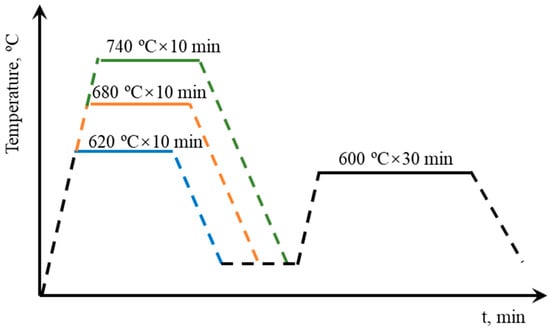
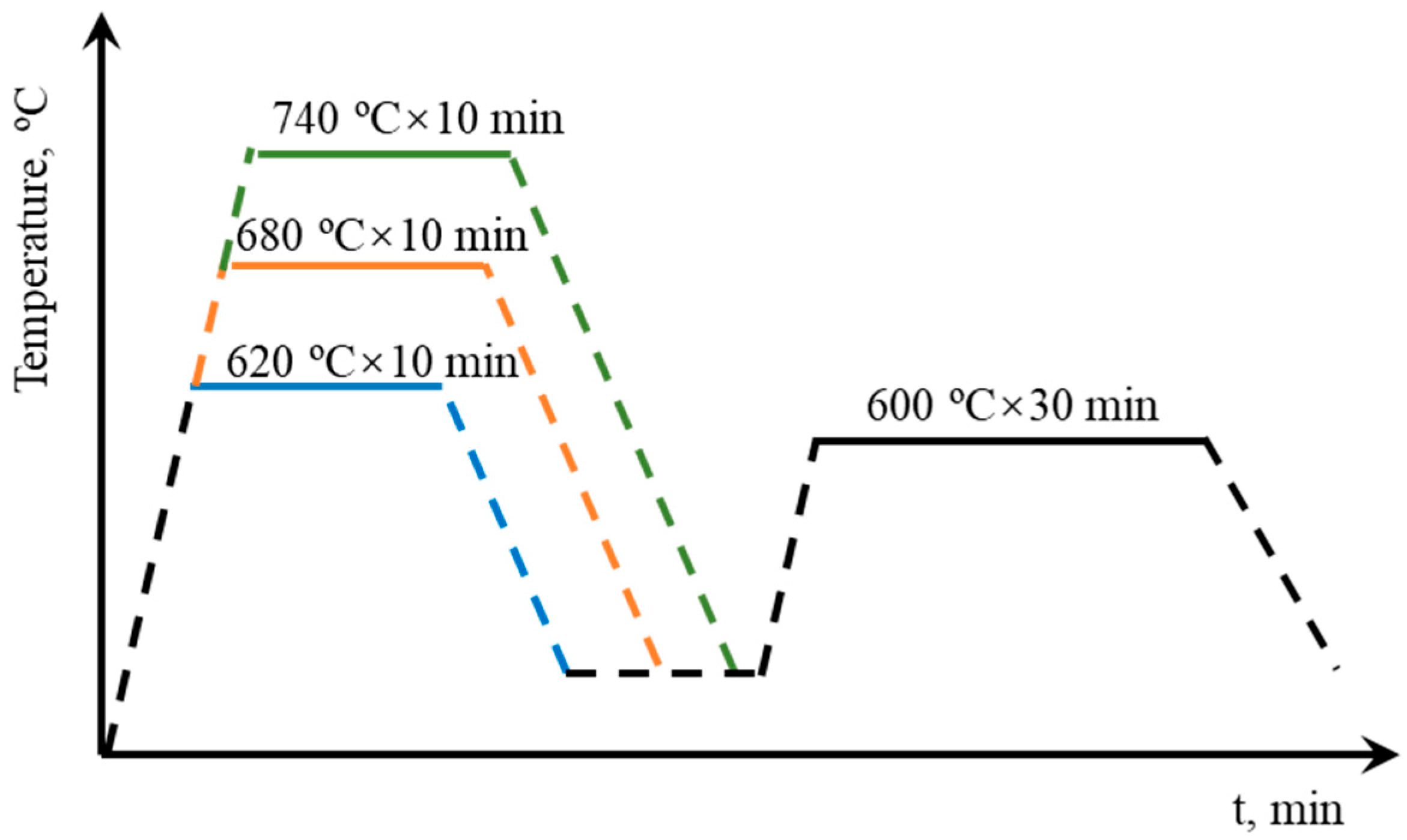
A commercially available H13 steel (chemical composition in wt.%: C 0.35, Si 1.00, V 0.83, Cr 4.89, Mn 0.30, Ni 0.16, Mo 1.15 and Fe in balance) was used in this study. Firstly, the samples underwent isothermal spheroidizing treatment with the following steps: heating to 900 °C and holding for 1.5 h, furnace cooling to 740 °C for 3.0 h, and then slowly cooling to 450 °C at a rate of <50 °C·h−1, followed by cooling to room temperature. Then, the steels were solution-treated at 1030 °C for 0.5 h and then quenched with different cooling rates (in air or oil), named Sair and Soil. Finally, to avoid the coarsening of precipitates due to excessive tempering duration, 10 min pre-tempering was applied to the samples. The influence of different tempering treatments on the properties of H13 steel was studied, and a schematic diagram of the parameters is shown in Figure 1. All heat treatments in this study were performed using a box-type furnace (SX-G18133).
Figure 1.
Schematic diagram of tempering treatments.
EBSD samples (10 mm × 10 mm × 2 mm) and XRD samples (20 mm × 20 mm × 1 mm) were ground using 5000-grit sandpaper (Hangzhou Fanxi Tools Co., Ltd., Hangzhou, China, followed by mechanical polishing to obtain a smooth surface. All samples for EBSD measurements were electrochemically polished in a solution of 1:10 HClO4:C2H5OH, volume ratio, at −30 °C and 25 V for 120 s. Then, microstructural observation was performed via electron backscattered diffraction (EBSD, Oxford Instruments, Oxford, UK) using a Zeiss Supra55 scanning electron microscope (SEM, CarlZeiss AG, Oberkochen, Germany) at randomly selected positions on the prepared specimen with a 0.2 μm scanning step size. X-ray diffraction (XRD) characterization was performed using a Bruker D8 Advance diffractometer (Bruker Corporation, Karlsruhe, Germany) with Cu Kα radiation. The measurements were carried out under the following conditions: 2θ range of 40–100°, step size of 0.02°, and dwell time of 1 s per step. A tensile test machine (TSE504C, Shenzhen Wance Testing Equipment Co., Ltd., Shenzhen, China) was used to perform a slow strain rate tensile (SSRT) test at room temperature (strain rate set as 1 × 10⁻⁵ s−1). Dog-bone-shaped tensile specimens (5 mm cross-section, 25 mm gauge length) were machined for the SSRT test. The measurements of mechanical properties were repeated three times. Finally, the fracture surface was excised and ultrasonically rinsed with C2H5OH for 5 min for morphological observation. In addition, specimens of 5 mm × 5 mm × 2 mm were sectioned, ground, and polished for hardness testing. The tests were performed using a load of 200 g and a hold time of 10 s. Five random measurements were taken per specimen; after discarding the highest and lowest values, the average of the remaining three was taken as the final hardness.
3. Results
3.1. Mechanical Properties of Steels
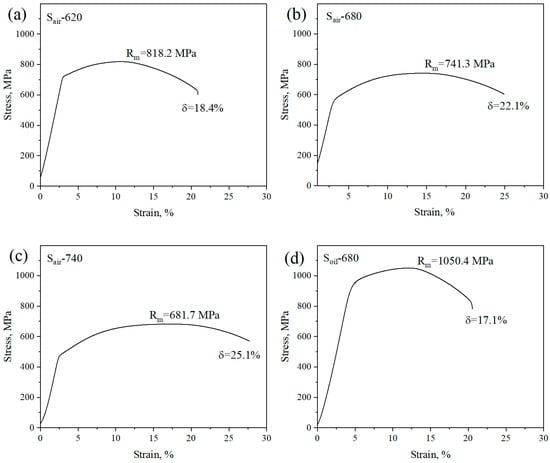
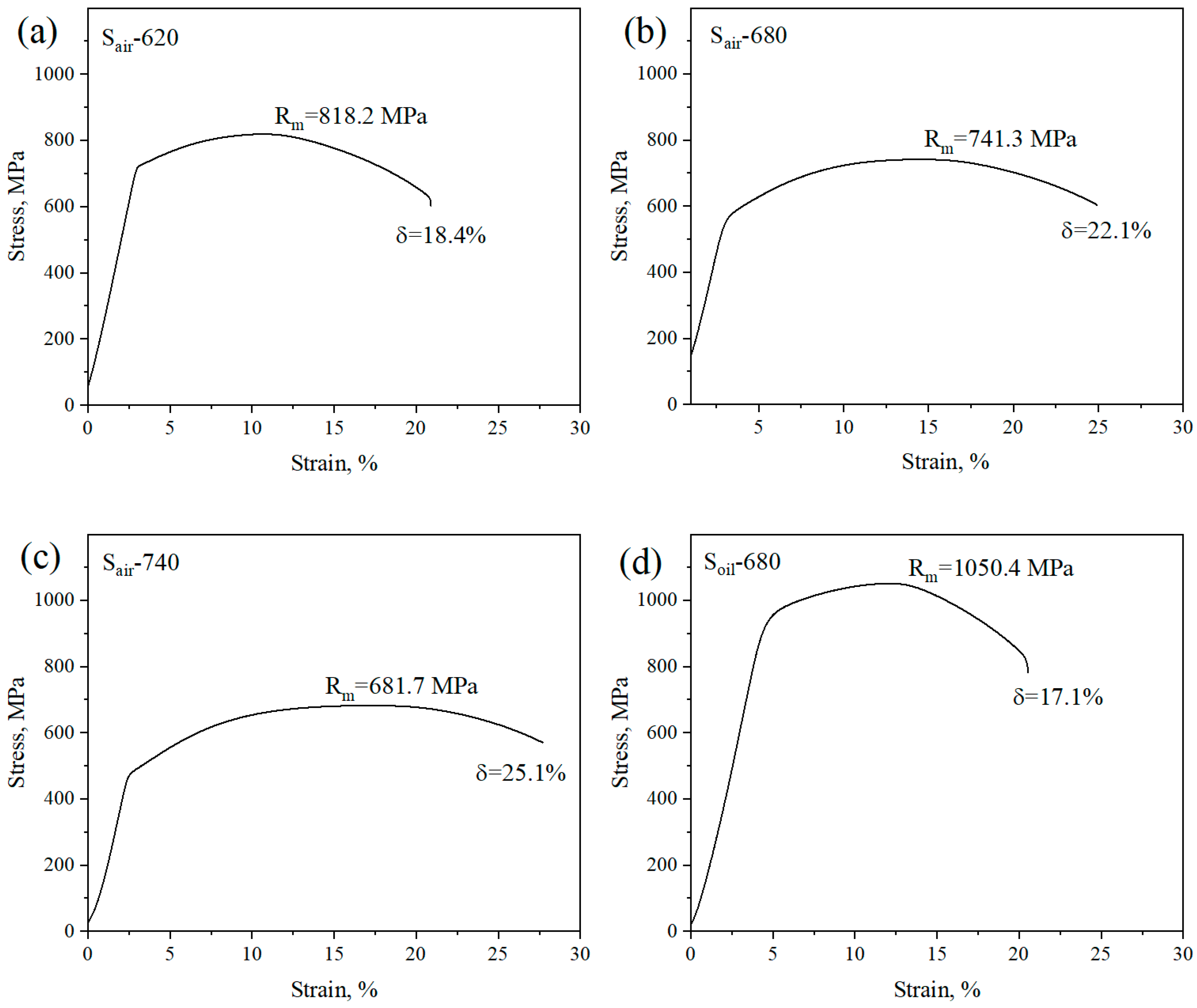
Figure 2 shows the stress–strain curves obtained from SSRT tests for the samples subjected to different heat treatments. The results indicate that cooling rate and pre-tempering temperature substantially affect the mechanical properties of the experimental steels. When other parameters remain constant, increasing the pre-tempering temperature results in higher elongation after fracture but lower strength in the specimens. Optimal comprehensive mechanical properties (tensile strength is ~741.3 MPa, elongation after fracture is ~22.1%) are achieved with a pre-tempering temperature of 680 °C for 10 min. Compared the Sair-680 sample, it can be found that the oil-quenched specimen exhibits a higher ultimate tensile strength (~1050.4 MPa) while maintaining good elongation after fracture (~17.1%), which can be attributed to its faster cooling rate. Compared to specimen Sair-680, the Soil-680 sample exhibits a ~43% enhancement in tensile strength with only a 22.6% reduction in fracture elongation. Therefore, the Soil-680 specimen demonstrates a favorable combination of strength and ductility. The distinct mechanical properties resulting from the pre-tempering temperature and cooling rate are fundamentally governed by microstructural evolution, as will be systematically elucidated in subsequent discussions. The Vickers hardness values of the four specimens are listed in Table 1. It can be seen from this table that as the pre-tempering temperature increases, hardness gradually decreases. In contrast, the Soil-680 specimen shows higher hardness than the Sair-680 specimen. This trend is consistent with the change in tensile strength.
Figure 2.
Stress–strain curves for samples after different heat treatments obtained from the slow strain rate tensile tests. (a) Sair-620, (b) Sair-680, (c) Sair-740, and (d) Soil-680.
Table 1.
The Vickers hardness of the four specimens under different heat treatment conditions.
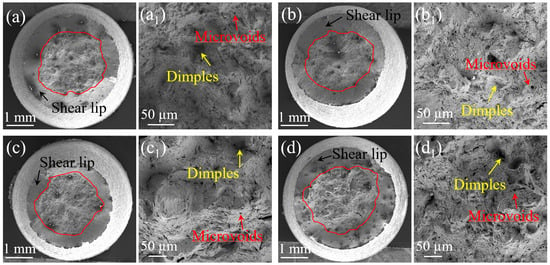
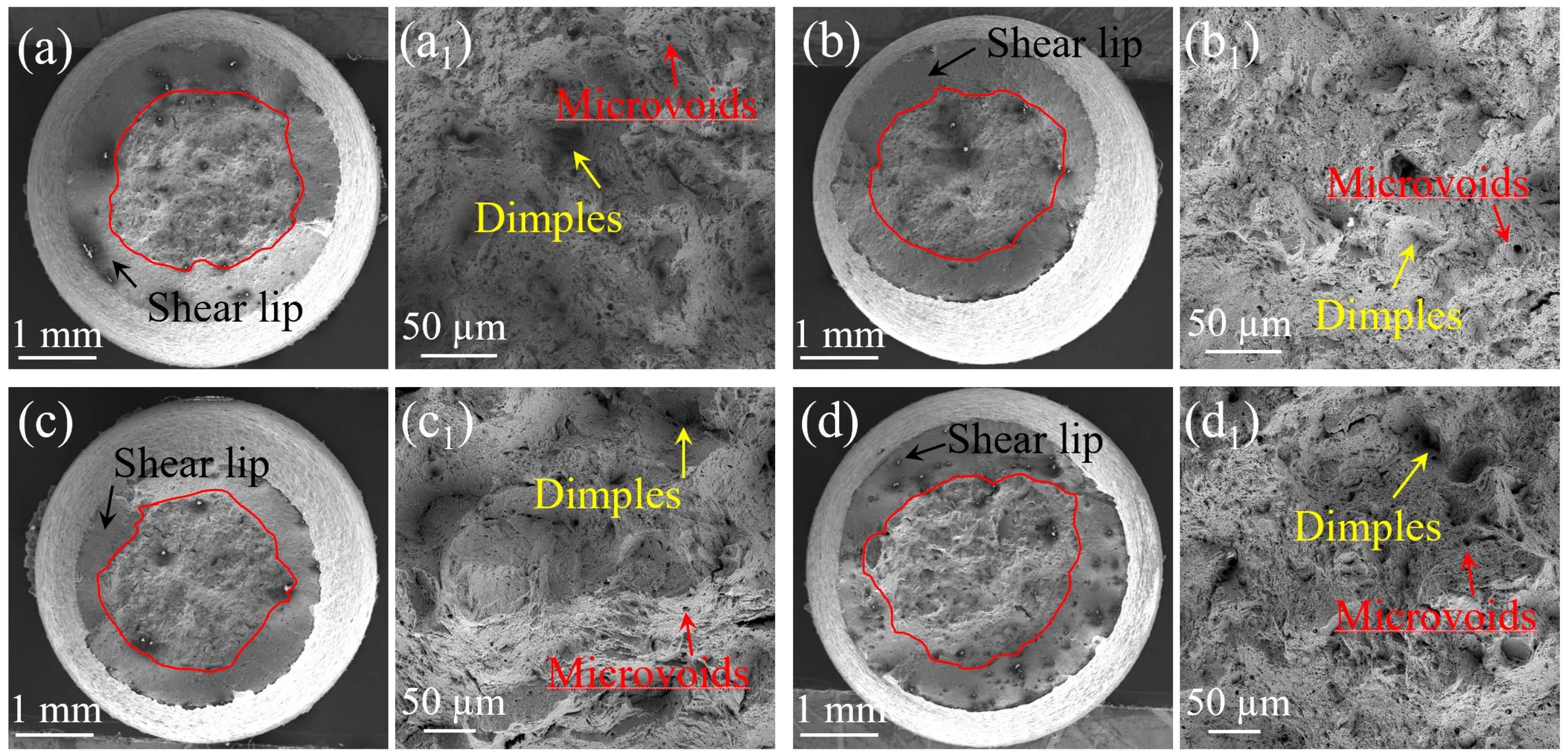
Related fracture morphologies of the samples after SSRT tests are shown in Figure 3. The large number of dimples indicates that all samples failed in a ductile fracture dominated by microvoid coalescence, and no clear crack initiation site is observed in the fracture morphologies. Furthermore, the fracture surface exhibiting two distinct regions, a central dimple zone (marked with red circles) and peripheral shear lips (marked with black arrows), demonstrates that the samples underwent plastic deformation and developed necking during tensile loading. Large and deep dimples are observed in Figure 3c, indicating the superior ductility of this specimen. Furthermore, microvoids are observed in the matrix of the samples, which may function as crack nucleation sites, potentially diminishing fracture elongation. It is worth noting that the microvoids are uniformly distributed in the matrix, resulting in a uniform dimple morphology on the fracture surface with no crack initiation sites. Notably, this Sair-740 specimen also possesses the lowest strength (~681.7 MPa), and a lower strength level inherently permits greater plastic deformation before fracture (~25.1%).
Figure 3.
Fracture morphologies for specimens after different heat treatments. (a,a1) Sair-620, (b,b1) Sair-680, (c,c1) Sair-740, and (d,d1) Soil-680.
3.2. Microstructures of Steels
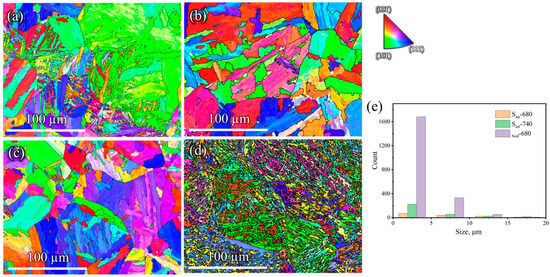
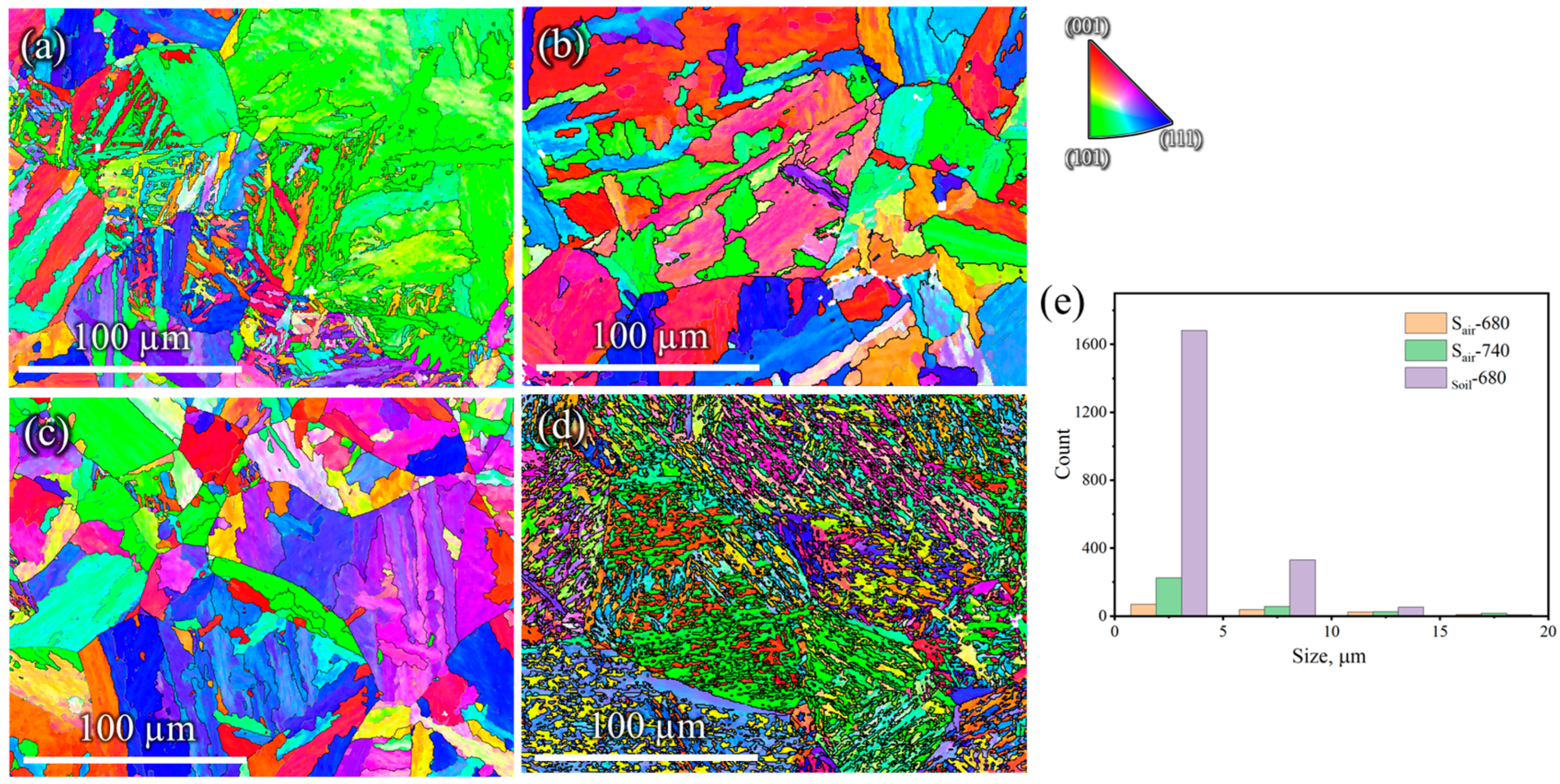
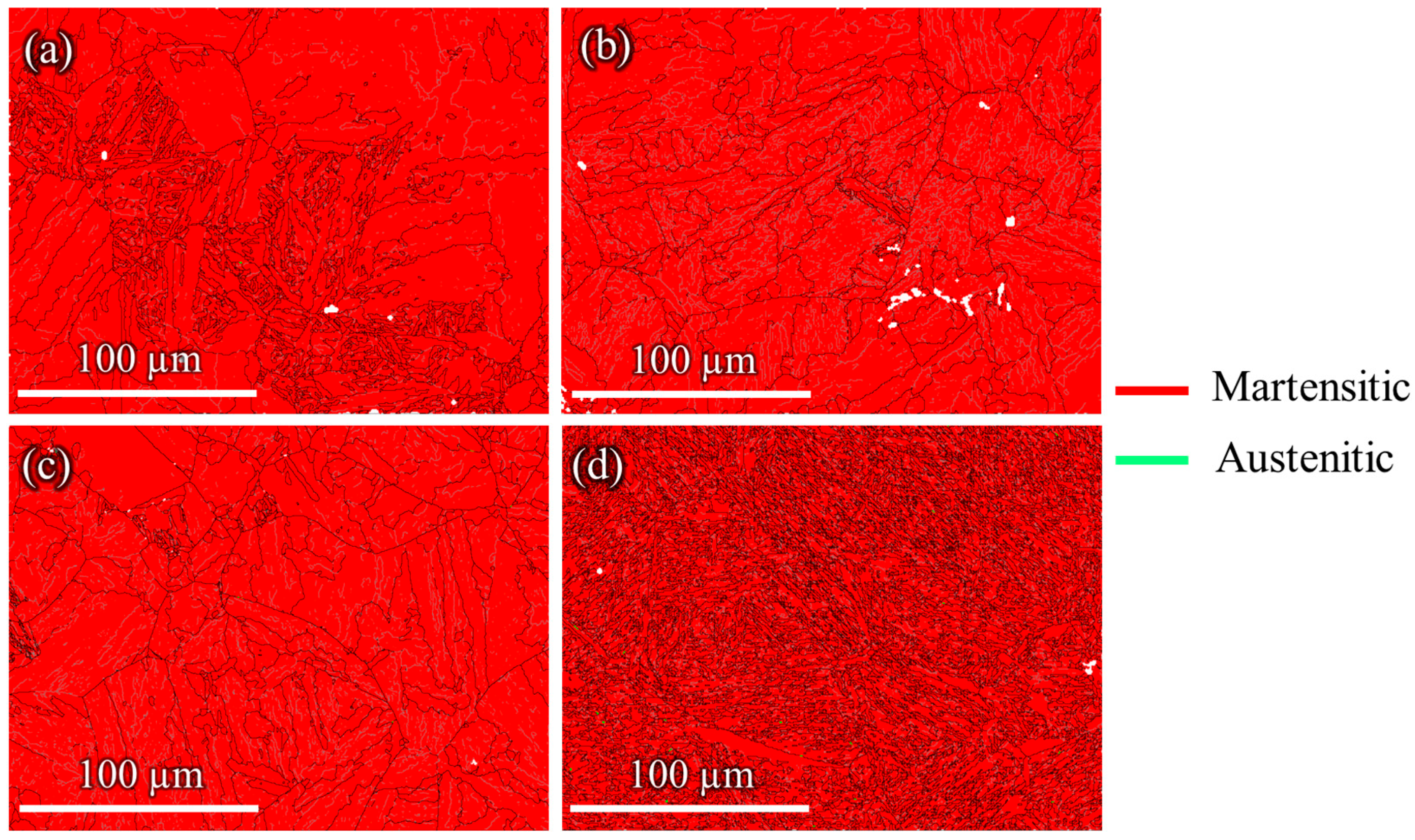
To better understand the influence of pre-tempering temperature and quenching rate on the mechanical properties of the samples, the microstructures following different heat treatments were characterized with EBSD, as shown in Figure 4. The matrix microstructure of the studied steel consisted of martensite, with clearly visible prior austenite grain boundaries, packet boundaries, and block boundaries. Phase maps reveal the complete absence of the austenitic phase across all characterized specimens (seen in Figure 5). EBSD analysis shows that the grain sizes of Sair-620, Sair-680, Sair-740, and Soil-680 are ~5.4 µm, ~7.1 µm, ~11.4 µm, and ~3.8 µm, respectively (seen in Figure 4e). Finer grain sizes were found to produce correspondingly finer lath martensite structures. For the Sair-620, Sair-680 and Sair-740 samples, grain size increases with temperature due to the higher pre-tempering temperature, which promotes lath martensite coarsening via the visible merging of adjacent laths [1]. The examination of the microstructural differences between specimens Sair-680 and Soil-680 demonstrates that accelerated quenching rates (oil quenching for Soil-680 sample) can refine the microstructure through extensive lath martensite formation, leading to significant strength enhancement (1050.4 MPa for Soil-680). Based on the microstructure analysis, above all, the pre-tempering temperature and quenching rates have a significant effect on microstructures, which directly determine mechanical properties.
Figure 4.
EBSD results of samples after different heat treatments. (a) Sair-620, (b) Sair-680, (c) Sair-740, (d) Soil-680, (e) grain size distribution for different samples.
Figure 5.
Ph + GB maps of the samples after different heat treatments. (a) Sair-620, (b) Sair-680, (c) Sair-740, (d) Soil-680.
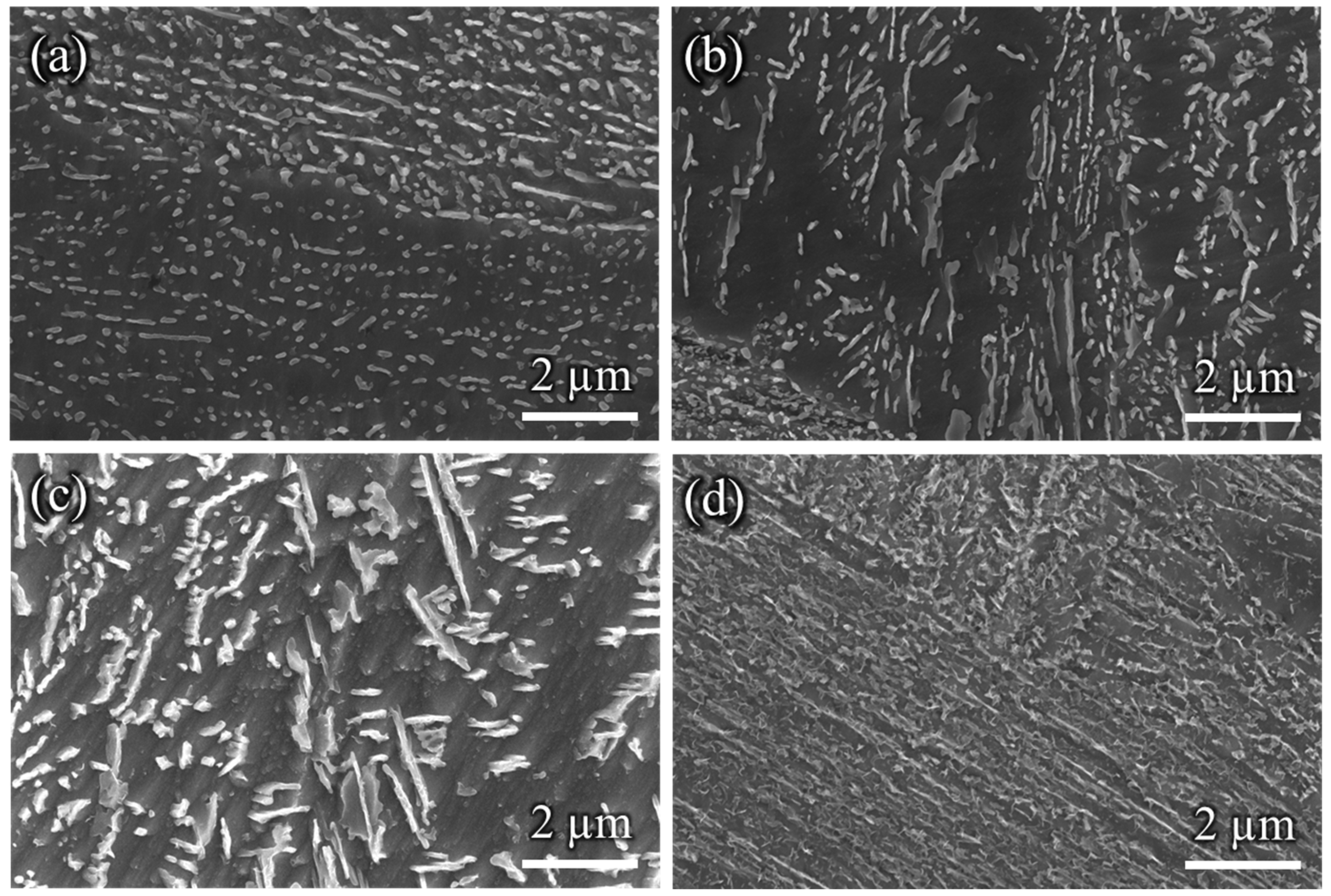
Ning et al. [12] studied the evolution of carbide in H13 steel during tempering treatment and found that the evolution of these carbides affects the precipitation strengthening effect. To investigate the influence of the four heat treatment processes on the mechanical properties of H13 steel, SEM tests were conducted on the samples, and the results are shown in Figure 6. It can be seen from the figures that a large number of white carbides are present, which is consistent with the findings of Ma et al. [13]. Moreover, as the pre-tempering temperature increases, the size of carbides in the oil-quenched samples gradually increases. In contrast, the water-quenched sample, owing to its faster cooling rate, obtains finer martensite laths and a higher dislocation density. Even after pre-tempering at 680 °C, its carbide size remains significantly smaller than that of the oil-quenched sample at the same temperature, thereby achieving the highest strength (~1050.4 MPa) while maintaining good plasticity (~17.1%).
Figure 6.
SEM results of samples after different heat treatments. (a) Sair-620, (b) Sair-680, (c) Sair-740, (d) Soil-680.
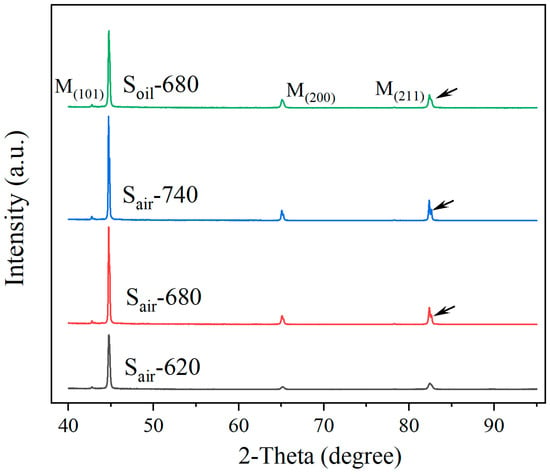
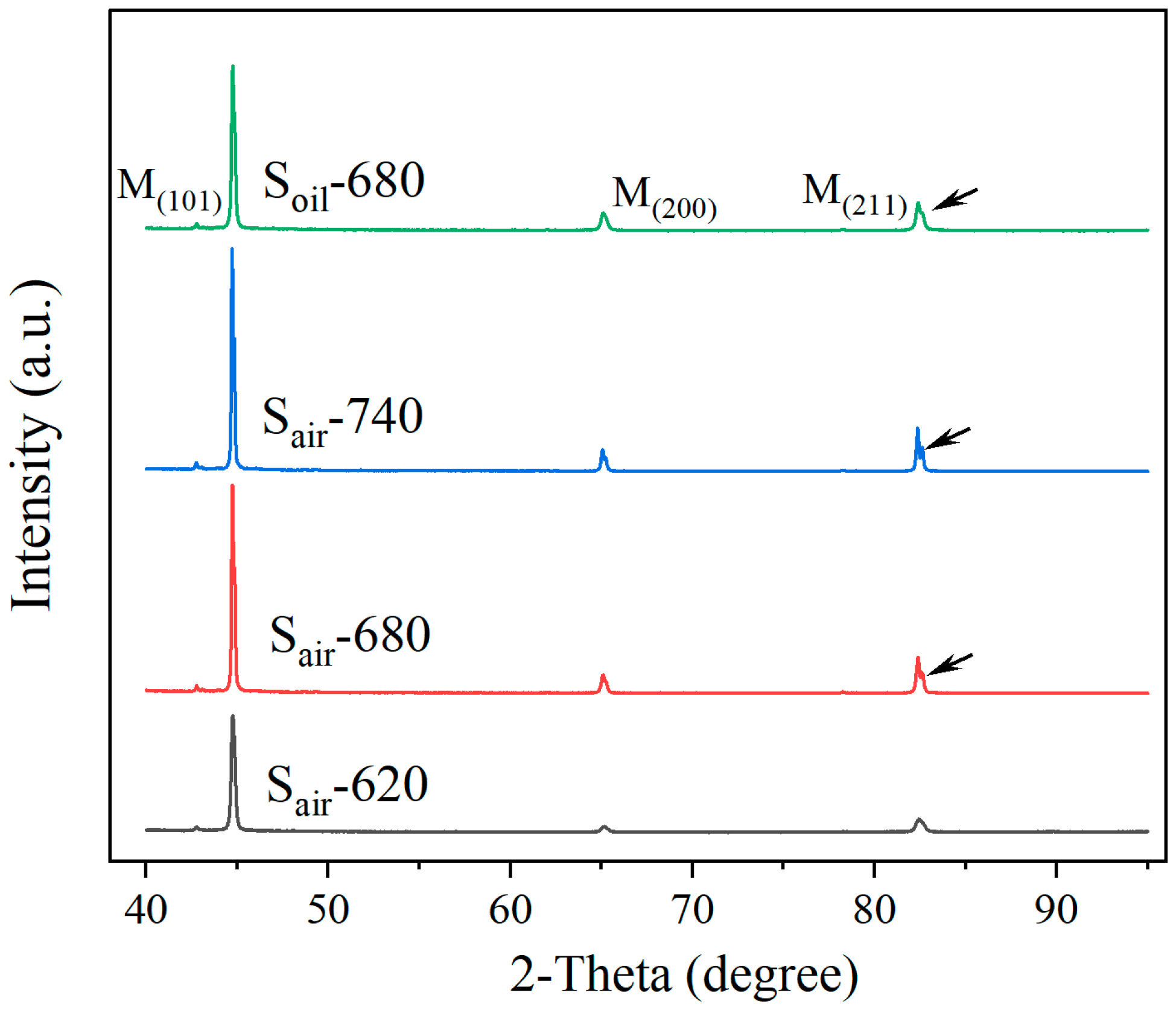
Correspondingly, the XRD results are shown in Figure 7. No peak corresponding to austenite was found in the XRD profiles. Three typical diffraction peaks are observed in the figure at ~44.5°, ~65°, and ~82.5°, corresponding to the M(101), M(200), and M(211) planes, respectively. After quenching in air, the XRD curves of samples tempered at 680 °C and 740 °C exhibit peak asymmetry near 82.5° (marked with the arrows in Figure 6), while the sample tempered at 620 °C does not show this feature. Furthermore, the XRD pattern of the Sair-620 sample displays an asymmetric peak shape, indicating that the carbides are fine and distributed uniformly in the matrix, resulting in a significant precipitation strengthening effect. The peak asymmetry of the Sair-680 and Sair-740 samples near 82.5° shows that the carbides coarsen, and the precipitation strengthening effect is reduced. Comparing cooling rates during quenching processes, due to its faster cooling rate, the Soil-680 sample obtains finer grains and a higher dislocation density, resulting in significantly higher strength than that of all air-cooled samples. In the corresponding XRD pattern, due to the broadening effect of diffraction peaks caused by high-density dislocations and fine grains, peak asymmetry nearing M(211) appears blunted rather than sharp.
Figure 7.
XRD results of sample steels after different heat treatments.
4. Conclusions
Above all, by using SSRT, SEM, EBSD, and XRD, the effect of quenching rate and pre-tempering treatments on the mechanical properties and the microstructure evolution of H13 steels was investigated. Major conclusions can be drawn as follows:
- (1)
- Microstructural analysis reveals that both pre-tempering temperature and quenching rate can effectively control mechanical properties through grain size refinement. With increasing pre-tempering temperature, the specimens exhibited a gradual decrease in strength accompanied by a corresponding increase in elongation at fracture.
- (2)
- Optimal mechanical performance was achieved in oil-quenched and 680 °C pre-tempered specimens, displaying a tensile strength of ~1050.4 MPa and fracture elongation of ~17.1%. All fracture surfaces exhibited typical dimpled morphology characteristic of ductile failure.
Author Contributions
Conceptualization, M.R. and H.S.; methodology, M.R. and H.S.; formal analysis, M.R.; investigation, M.R. and H.S.; resources, H.S. and Z.Z.; data curation, M.R. and Z.Z.; writing—original draft preparation, M.R.; writing—review and editing, M.R., H.S., Z.Z. and Y.C.; supervision, K.G. and Y.C.; project administration, M.R. and K.G.; funding acquisition, H.S. All authors have read and agreed to the published version of the manuscript.
Funding
This research was funded by the National Natural Science Foundation of China (No. 52501028).
Data Availability Statement
The data presented in this study are available on request from the corresponding author due to legal and ethical reasons.
Conflicts of Interest
Authors M.R., H.S., Y.C. were employed by Beijing National Innovation Institute of Lightweight Ltd.; author Z.Z. was employed by China Academy of Machinery Science and Technology Group Co., Ltd. The funders had no role in the design of the study; in the collection, analyses, or interpretation of data; in the writing of the manuscript; or in the decision to publish the results.
References
- Wang, W.; Cheng, X.N.; Miao, X.H.; Ni, C.; Jia, H.T.; Liu, C.J.; Jiang, Q.Y.; Ding, H.N.; Luo, R. Effect of Pre-tempering Process on Microstructure and Properties of H13 Steel. Mater. Mech. Eng. 2024, 48, 47–54. [Google Scholar]
- Yan, G.H.; Huang, X.M.; Wang, Y.Q.; Qin, X.G.; Yang, M.; Chu, Z.M.; Jin, K. Effects of Heat Treatment on Mechanical Properties of H13 Steel. Met. Sci. Heat Treat. 2010, 52, 393–395. [Google Scholar] [CrossRef] [Scilit]
- Ma, M.W.; Tang, L.; Liu, X.Y.; Li, T.X.; Hu, M.; Li, J.; Wang, X. Study on Heat Treatment Process of H13 Hot Work Die Steel. Nonferrous Met. 2024, 14, 9–16. [Google Scholar]
- Lee, J.; Choe, J.; Park, J.; Yu, J.H.; Kim, S.; Jung, I.D.; Sung, H. Microstructural Effects on the Tensile and Fracture Behavior of Selective Laser Melted H13 Tool Steel Under Varying Conditions. Mater. Charact. 2019, 155, 109817. [Google Scholar] [CrossRef] [Scilit]
- Wang, Y.C.; Wang, M.C.; Shi, R.X.; Yao, L.; Jie, Z.C.; Wu, C. Effect of Oil Quenching and Tempering Treatment on the Microstructure and Mechanical Properties of H13 Steel. J. Netshape Form. Eng. 2025, 17, 167–179. [Google Scholar]
- Di, Y.N.; Ma, D.S.; Zhou, J.; Chi, H.X.; Gu, J.B. Effect of Cryogenic treatment on microstructure and mechanical properties of H13 steel. Heat Treat. Met. 2024, 49, 38–42. [Google Scholar] [CrossRef]
- Zhu, J.; Zhang, Z.H.; Xie, J.X. Improving Strength and Ductility of H13 Die Steel by Pre-tempering Treatment and its Mechanism. Mater. Sci. Eng. A 2019, 752, 101–114. [Google Scholar] [CrossRef] [Scilit]
- Perez, M.; Rodriguze, C.; Belzunce, F.J. The Use of Cryogenic Thermal Treatments to Increase the Fracture Toughness of a Hot Work Tool Steel Used to Make Forging Dies. Procedia Mater. Sci. 2014, 3, 604–609. [Google Scholar]
- Wang, F. Analysis of Fracture Cause of H13 Hot Work Die Steel andImprovement of Heat Treatment Process. Die Mould Manuf. 2024, 24, 63–66. [Google Scholar] [CrossRef]
- Lv, S.G.; Yu, B.; Wen, Z.H.; Zhai, Y.H. Effects of Normalizing Control Cooling Process on Microstructure and Impact Toughness of H13 Steel. Hot Work. Technol. 2021, 50, 149–152. [Google Scholar] [CrossRef]
- Hu, L.X.; Zhou, J.; Liu, J.X.; Chi, H.X.; Ma, D.S.; Lin, P. Effect of Quenching Cooling Rate on Microstructure and Mechanical Properties of H13 Die Steel. Heat Treat. Met. 2018, 43, 123–128. [Google Scholar] [CrossRef]
- Ning, A.G.; Mao, W.W.; Guo, H.J.; Chen, X.C. Precipitation Behaviors and Strengthening of Carbides in H13 Steel during Quenching. Chin. J. Process Eng. 2014, 14, 1041–1046. [Google Scholar]
- Ma, F.F.; Zhou, X.F.; Gao, Q.X.; Duan, B.Y.; Yang, F.; Wang, H.Y. Formation and control of grain boundary carbides in H13 hot work die steel. J. Inn. Mong. Univ. Sci. Technol. 2020, 39, 339–341. [Google Scholar]

Disclaimer/Publisher’s Note: The statements, opinions and data contained in all publications are solely those of the individual author(s) and contributor(s) and not of MDPI and/or the editor(s). MDPI and/or the editor(s) disclaim responsibility for any injury to people or property resulting from any ideas, methods, instructions or products referred to in the content. |
© 2026 by the authors. Licensee MDPI, Basel, Switzerland. This article is an open access article distributed under the terms and conditions of the Creative Commons Attribution (CC BY) license.