


Abstract
Diamane, a fully sp3-hybridized two-dimensional carbon allotrope, has attracted attention due to its exceptional mechanical strength, tunable electronic properties, and potential for nanoelectronic and nanomechanical applications. While most studies focus on semi-functionalized (50% surface functionalization) C4X2 diamane, the stability and properties of configurations with lower functional group coverage remain unexplored. Here, we propose a novel diamane structure with 25% surface functionalization, denoted as C4X (X = H, F, OH, NH2), crystallizing in the P6/mmm space group. Using first-principles calculations, we systematically investigate the effects of different functional groups on the electronic and mechanical properties. Our results show that the bandgap can be effectively tuned from 2.97 to 3.42 eV, with C4F and C4OH exhibiting wider gaps due to strong C-p and O(F)-p orbital hybridization. C4H and C4NH2 possess high electron mobilities on the magnitude order of of cm2 V−1 s−1. Mechanically, C4H demonstrates a Young’s modulus up to 614 GPa and a shear modulus of 274 GPa, underscoring its exceptional mechanical robustness. This work uncovers a previously unexplored low-coverage diamane configuration, highlighting the crucial role of surface chemistry in modulating electronic and mechanical behavior, and provides a promising design strategy for high-performance carbon-based nanoelectronic and nanomechanical devices.
1. Introduction
Two-dimensional (2D) materials have emerged as a major research frontier in condensed matter physics and materials science owing to their atomic-scale thickness, unique electronic structures, and tunable optical, thermal, and mechanical properties. These characteristics enable versatile bandgap engineering and facilitate the design of multifunctional devices through external stimuli or chemical functionalization [1].
Diamane, a fully sp3-hybridized two-dimensional carbon allotrope with the stoichiometry C4X2 (X = H, F, etc.) [2], exhibits diverse and exceptional physical properties and has emerged as a promising and distinctive member of the carbon materials family [3,4,5]. Distinct from the intrinsic zero-band-gap nature of graphene, the band gap of diamane can be continuously tuned from insulating to metallic behavior through variations in layer number, stacking configuration, or surface functionalization [3,6,7,8], making it a promising candidate for nanoelectronic and optoelectronic applications. Certain asymmetrically functionalized diamane structures have been predicted to exhibit ferromagnetic ordering [9,10,11]. In addition, diamane has been shown to host intriguing quantum phenomena, including superconductivity in twisted stacking structures at the magic angle of 1.1° [12] and long-lived room-temperature spin coherence associated with nitrogen-vacancy (NV) and silicon-vacancy defects [13], highlighting its potential for quantum information applications. Diamane also exhibits exceptional stiffness comparable to that of bulk diamond [14,15], while retaining the elasticity and structural flexibility inherent to 2D materials [16].
Compared with other low-dimensional carbon materials, such as graphene and carbon nanotubes, diamane combines a sizable and tunable band gap with remarkable mechanical strength, while retaining the atomically thin nature of 2D materials. These distinctive characteristics make diamane a versatile platform for the design of multifunctional devices through external stimuli or chemical functionalization. Furthermore, several diamane structures have recently been realized experimentally through high-pressure synthesis [15,17,18] and chemical vapor deposition [19,20,21], representing a significant step toward their practical implementation.
Despite these advances, existing studies have primarily focused on semi-functionalized C4X2 configurations, in which 50% of the carbon atoms are terminated by functional groups. Whether diamane with lower functional group coverage can maintain structural stability while retaining desirable electronic and mechanical properties remains largely unexplored. In particular, it is unclear whether reduced functionalization can preserve the sp3 bonding network while providing additional degrees of freedom for tuning the physical properties.
In this work, we address this issue by proposing a novel low-coverage diamane configuration, C4X (X = H, F, OH, NH2), with 25% surface functionalization. Using first-principles calculations, we systematically investigate the influence of different functional groups on the electronic structure, carrier mobility, mechanical performance, and optical properties. Our results show that the proposed structures remain dynamically stable while exhibiting tunable bandgaps ranging from 2.97 to 3.42 eV, high electron mobility, and excellent mechanical strength with a Young’s modulus up to 614 GPa. These findings highlight the crucial role of surface chemistry in modulating the physical properties of diamane and provide a viable design strategy for carbon-based materials in high-performance nanoelectronic and nanomechanical devices.
2. Computational Methods
All the calculations were performed within Density Functional Theory (DFT) as implemented in the Vienna Ab initio Simulation Package (VASP) [22,23] with use of the projector-augmented plane-wave (PAW) potentials. The exchange–correlation interaction was treated by the generalized gradient approximation (GGA) [24] functional parametrized by the Perdew–Burke–Ernzerhof (PBE) [25]. The Heyd–Scuseria–Ernzerhof hybrid functional (HSE06) [26] containing 25% exact exchange contribution was further employed to correct the bandgap obtained by GGA functional. All structures were fully relaxed without symmetry constraints with a cutoff energy of 550 eV, and the convergence of energy and force are set to eV and 0.001 eV/Å, respectively. The Brillouin zone was sampled using a 7 × 7 × 1 Monkhorst–Pack k-point mesh [27], and the convergence tests for both the plane-wave cutoff energy and k-point sampling density were performed for the representative C4H structure (shown in Figure S1 of the Supplementary Information). To avoid interaction between the neighboring structural layers, the vacuum height along the c axis of the cell was set to 20 Å, and the van der Waals correction using the optPBE-vdW method [28,29] was included for all calculations. Spin-polarized structural optimizations were also performed for C4X (X = H, F, OH, NH2), and the results show that all the optimized structures converge to nonmagnetic ground states. The phonon dispersions were calculated by using the PHONOPY code [30]. Ab initio molecular dynamics (AIMD) simulation by using the Nose–Hoover thermostat [31,32] was implemented to analyze the thermal stability of configurations at ambient temperature (300 K) for 10 ps with a time step of 1 fs.
3. Results and Discussion
3.1. Structure and Stability
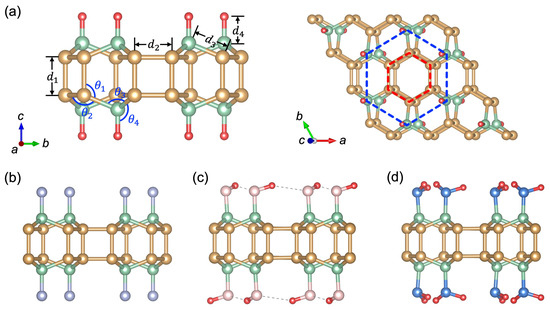
Since diamane can be derived from bilayer graphene through surface functionalization that induces interlayer sp3 bonding, we design an alternative diamane structure by partially functionalizing the surface carbon atoms of AA-stacked bilayer graphene. Specifically, 25% of the carbon atoms on the outer surfaces of bilayer graphene are terminated by functional groups X (X = H, F, OH, NH2), as illustrated in Figure 1. The remaining surface carbon atoms remain unfunctionalized and participate in the formation of interlayer C–C bridging bonds. As a result, 75% of the carbon atoms (denoted as C-inner) form interlayer bonds that connect the two graphene layers, while the functionalized carbon atoms (denoted as C-outer) stabilize the surface through C–X bonding. This arrangement generates a fully interconnected sp3-hybridized carbon framework that crystallizes in the P6/mmm space group.
Figure 1.
(a) C4H, (b) C4F, (c) C4OH, and (d) C4NH2. In panel (a), the left (right) part shows the side (top) view of C4H. Brown and cyan spheres represent C-inner and C-outer atoms, while H, F, O, and N atoms are colored red, grey, pink, and blue, respectively.
As shown in Figure 1a, the C-inner atoms form a C12 motif (indicated by the red dotted line) at the center of the lattice, which is surrounded by a large hexagonal ring composed of C-outer atoms (blue dotted line). The densely interconnected sp3 bonding network effectively compensates for the reduced surface functionalization, thereby stabilizing the C4X structure despite its lower functional group coverage.
Four surface functional groups, specifically H, F, OH, and NH2, were employed to fully passivate the dangling bonds on the surface of the proposed diamane. The lattice parameter and bond lengths of C-C interlayer bond (d1), C-C intralayer bond (d2, d3), and C–X bonds (d4) are shown in Table 1. The lattice parameters of C4X exhibit slight deviations as the surface functional groups vary. Notably, C4OH displays a reduced lattice constant, attributable to hydrogen-bond formation, whereas the C4NH2 shows an expanded lattice parameter, arising from the increased repulsion of large group. The C–C bond lengths in the C4X structure varies from 1.523 to 1.588 Å, closely approximating the characteristic sp3 C–C bond length of 1.54 Å in diamond. In addition, the representative C–C–C and C–C–X bond angles are distributed in the range of 105.41°∼117.88°, showing a moderate deviation from the ideal tetrahedral angle of 109.5° (see Table S1 in the Supplementary Information for detailed data). Such deviations arise from the 2D structural constraint and the different sizes/electronegativities of the surface functional groups.
Table 1.
Structure parameters, bond lengths of C-C or C-X (X = H, F, OH, NH2), and cohesive energy () for C4H derivatives.
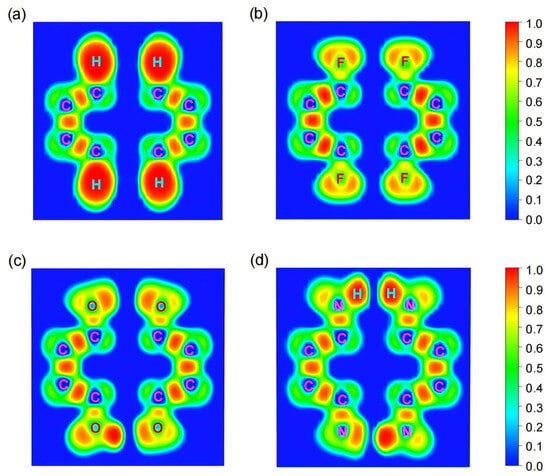
The electron localization function (ELF) analysis (shown in Figure 2) further reveals the formation of strong covalent C–C sp3-bonds. The character of the bonding interactions between carbon atoms and the functional group X varies with the type of X. For H- and NH2-functionalized groups, the comparatively low electronegativities of H and N atoms favor the formation of covalent C–H and C–N bonds. The corresponding Bader charge analysis shows that 0.02 e− and 0.32 e− are transferred from the C atoms to the H atom and NH2 group, respectively, suggesting relatively weak bond polarity. As illustrated in Figure 2b,c, the regions of high electron density are localized primarily around the F and O atoms, with the C–F and C–O bonds exhibiting more pronounced characteristics of polar bonding. Bader charge analysis reveals that C atoms transferred 0.62 e− and 0.52 e− to F- and OH-, respectively.
Figure 2.
Electron localization function (ELF) of (a) C4H, (b) C4F, (c) C4OH, and (d) C4NH2 along the c direction. Red and blue regions correspond to localized and delocalized electronic states, respectively.
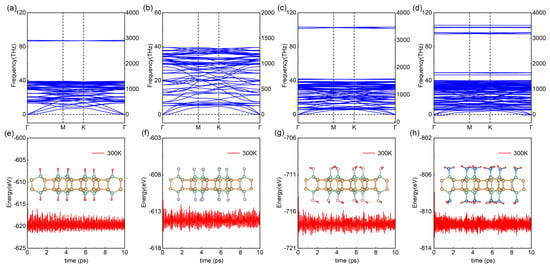
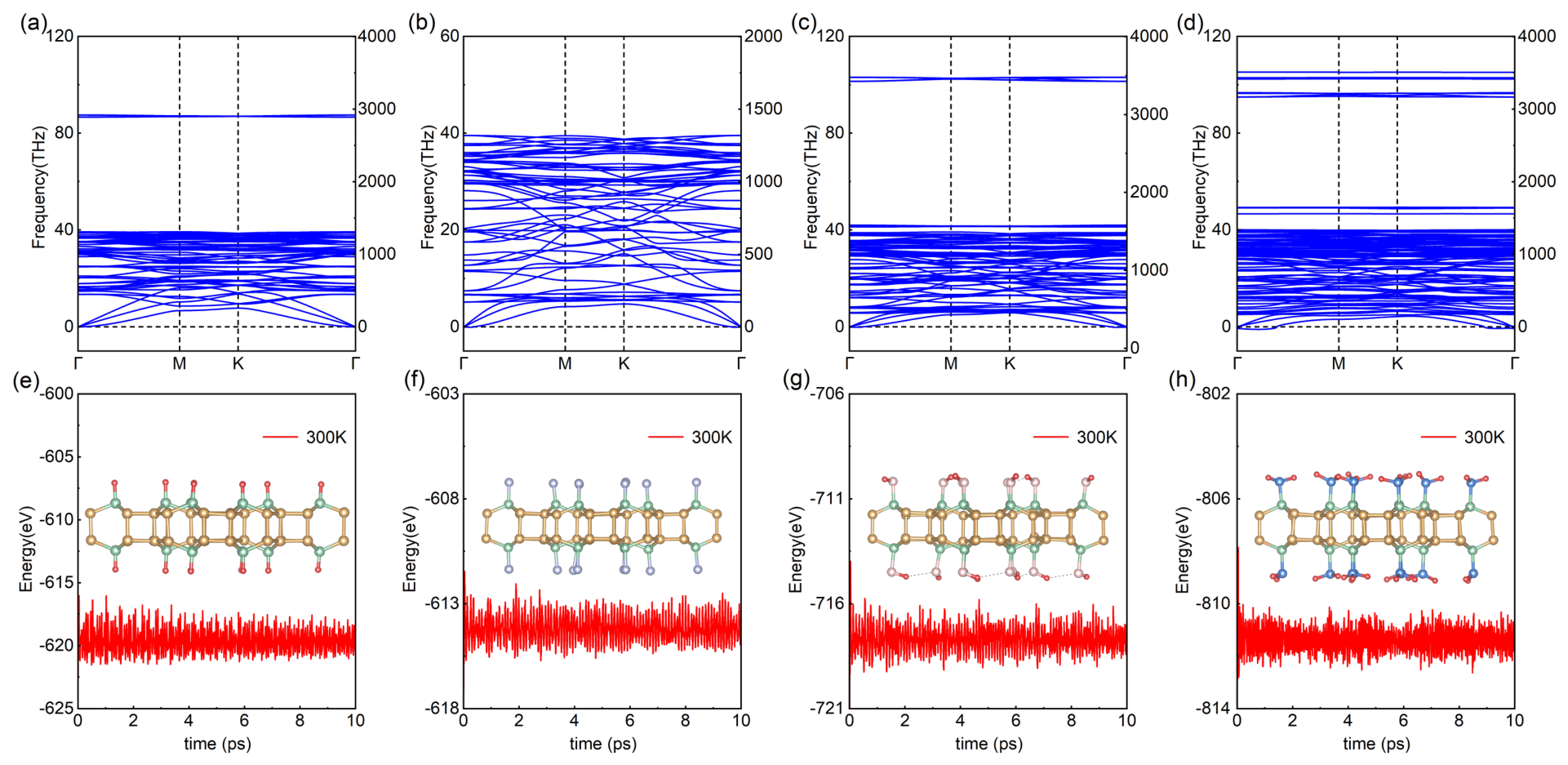
The phonon dispersions of the C4X (X = H, F, OH, NH2) are shown in Figure 3a–d. The absence of imaginary frequencies within the whole Brillouin zone indicates that C4X structures are dynamically stable. To further verify the stability of the proposed diamane configuration, we ran 10 ps ab initio MD simulations using the NVT ensemble at 300 K with a 1 fs time step, and the results are shown in Figure 3e–h. The energy oscillations of C4X (X = H, F, OH, NH2) stay in a small energy range of ∼3 eV per 2 × 2 × 1 supercell, equivalent to ∼30 meV/atom at 300 K. A comparison between the initial and final structures reveals a well-preserved molecular unit and overall crystal structure, suggesting that C4X maintain their integrity well without significant structural changes under ambient temperature.
Figure 3.
The phonon dispersions for (a) C4H, (b) C4F, (c) C4OH, and (d) C4NH2. The primary frequency scale is given in THz on the left axis, while a secondary scale in cm−1 is provided on the right axis. The fluctuations of the total energy with time in AIMD simulations for (e) C4H, (f) C4F, (g) C4OH, and (h) C4NH2. The illustrations show the final configurations after running 10 ps MD simulations.
To evaluate the experimental viability of the novel diamane, we calculated the cohesive energy (). The is defined as energy of C4X relative to its constituent isolated atoms, as expressed below:
where represents the energy of diamane with stoichiometry of C4X. represents the energy of a single isolated C atom and is the sum of the energies of each single isolated atom in group X. N is the total number of atoms in the unit cell. The calculated values are shown in Table 1. The cohesive energies for all four structures are negative and are comparable to that of C4X2 (6.672 eV for C4F2 [7]), which realized by laser-heating layered graphene in a diamond anvil cell [18], implying that C4X could be synthesized under specific experimental conditions. The mechanical stability of C4X configurations is confirmed via Born stability criteria for 2D materials [33], namely and .
3.2. Electronic Properties
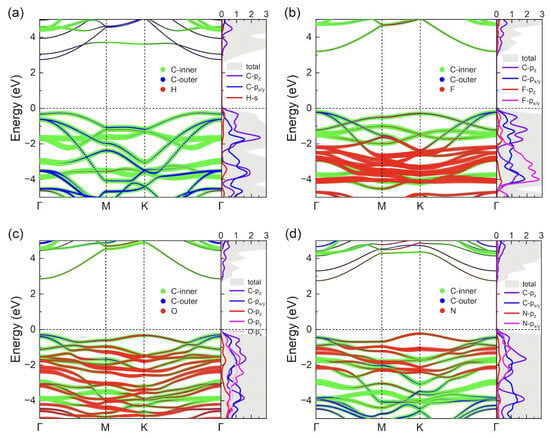
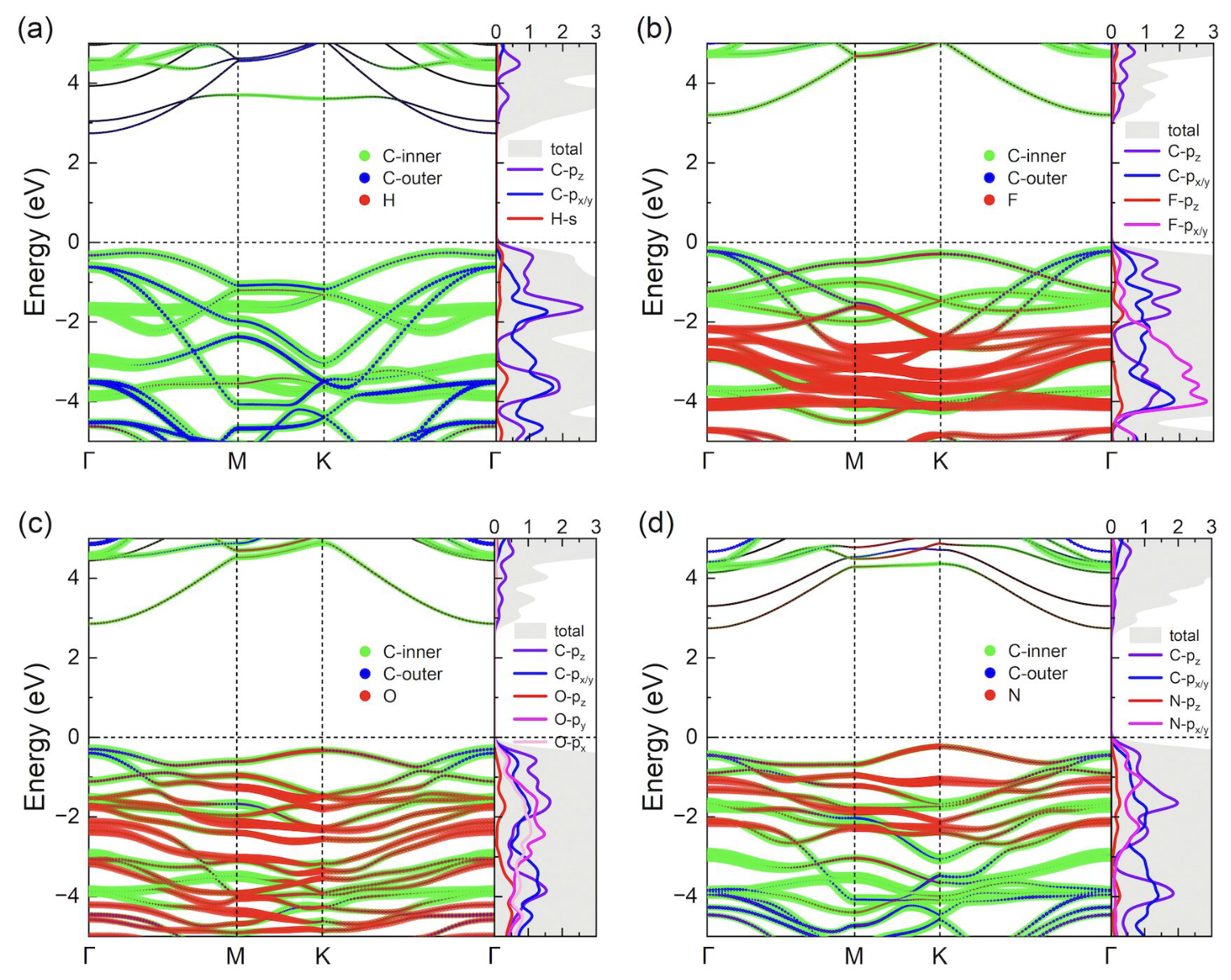
The electronic properties of these structures were systematically investigated through band-structure calculations, and the resulting band-gap values are summarized in Table 2. It can be seen that the bandgap value of C4X ranges from 2.97 eV to 3.42 eV, which are comparable with the bandgap of C4H2 (3.04 eV) [2]. The band-gap value increases monotonically with functionalization from H, OH to F, in accordance with the increasing electronegativity of the H, O, and F atoms that directly passivate the sp3-hybridized carbon atoms. In both C4H and C4NH2, the C-outer forms a covalent bond with the adsorbed species, and both band structures exhibit an indirect band gap.
Table 2.
Calculated bandgap energies ( with PBE and HSE06 in eV), carrier effective masses ( in , the mass of an electron), deformation potential constants ( in eV), and carrier mobilities ( in cm2 V−1s−1) of C4X (X = H, F, OH, NH2), based on the Bardeen–Shockley deformation-potential model.
As shown in Figure 4a, the valence band maximum of the H-functionalized structure is primarily derived from the internal C- orbitals, yielding a band gap of 3.00 eV. Furthermore, the lone pair electrons of the NH2 group introduce additional N- orbital contributions near the valence band edge [shown in Figure 4d], which raise the valence band maximum (VBM) and slightly reduce the band gap to 2.97 eV. In contrast, in the C4F (C4OH) configuration, the conduction band minimum (CBM) is primarily attributed to the antibonding state formed by the hybridization between C- and F-p (O-p) orbitals. The orbital interaction significantly elevates CBM, resulting in larger direct band gaps of 3.15 eV and 3.42 eV, respectively. Since the PBE functional underestimates the band gap, we calculated the band gap again using the hybridized functional (HSE06). The band gap of HSE06 is about 1.20 eV larger than the values calculated based on the PBE functional.
Figure 4.
The orbital projected band structures and partial density of states (PDOS) of (a) C4H, (b) C4F, (c) C4OH, and (d) C4NH2. The Fermi level is set to zero. The left parts illustrate contributions from C-inner, C-outer, and H/F/O/N. The size of the colored dots represents the proportional contribution of each atom.
3.3. Transport Properties
We further calculated the carrier mobility at room temperature in C4X using the deformation-potential theory proposed by Bardeen and Shockley [34,35], as expressed below:
where represents the in-plane elastic modulus. is carrier effective mass, and is the average effective mass determined by . refers to deformation-potential constant by the formula via linear fitting relation of band edges with applied uniaxial strains . All data were obtained by first-principles calculations. The temperature (T) is 300 K. This formula has been applied successfully in phosphorene and transition metal dichalcogenides [36,37]. The calculated parameters for C4X along x-direction and y-direction (with structure shown in Figure S2 of the Supplementary Information) are summarized in Table 2.
It can be observed that the carrier mobility exhibits significant selective enhancement depending on the type of surface functional group. The transport properties of C4H or C4F structures along the x-direction and y-direction is isotropic, as evidenced by the negligible difference in carrier mobility. The hole mobility in C4OH and C4NH2 displays a significant directional dependence due to the polarity of the adsorbed species. Specifically, the hole mobility along the y-direction is 1.64 times and 2.57 times that along the x-direction for C4OH and C4NH2, revealing anisotropic carrier transport in C4OH and C4NH2 configuration.
As shown in Table 2, the deformation potential constant of VBM () for the four structures range from 2.83 to 4.59 eV, consistent with the VBM dispersion relation presented in Figure S1. Notably, C4H and C4NH2 exhibit relatively small deformation potential constant () (∼1.6 eV), combined with their comparatively low electron effective masses, result in exceptionally high electron mobilities, cm2/V·s and cm2/V·s along the x-direction, respectively. And electron mobilities are factors of 8.5 and 16.9 larger than their hole mobilities for C4H and C4NH2, confirming strong n-type transport characteristics. The electron mobility of C4H is an order of magnitude higher than that of C4H2 ( cm2/V·s), signifying its superior conductivity and enhanced potential for applications in high-speed electronic and optoelectronic devices [8]. In contrast, C4F and C4OH exhibit larger , with values of 6.42 eV and 3.65 eV along the x-direction, respectively. This larger is primarily attributed to enhanced hybridization between the C- and F-p (or O-p) orbitals, which strengthens orbital–lattice coupling, ultimately leads to reduced electron mobility, 230 cm2/V·s and cm2/V·s along the x-direction, respectively. The electron mobility of C4F is approximately one order of magnitude lower than that of diamane-C4F2 ( cm2/V·s) [38]. This finding clearly demonstrates that carrier mobility is strongly dependent on the surface carbon-network of diamane.
For the C4X structures, both electron and hole mobilities are on the order of cm2/V·s. These values are markedly higher than that in MoS2 films ( cm2/V·s and cm2/V·s for electron and hole) [39] and are competitive with black phosphorus ( cm2/V·s and cm2/V·s for electron and hole) [40], while black phosphorus is limited by the high susceptibility to oxidation. Beyond their high mobilities, the C4X structures feature an adjustable carrier type and a moderate band gap in the range of 2.97–3.42 eV. This selective modulation of carrier transport type and carrier mobility via surface functionalization offers a promising route toward novel high-performance, low-power electronic and optoelectronic devices.
3.4. Optical Properties
In the following, we analyze the optical characteristics of C4X. The optical properties of the C4X monolayers were investigated within the independent-particle approximation (IPA) [41] using the frequency-dependent dielectric function calculated within the GGA-PBE framework, which can be expressed as
where and denote the real and imaginary parts of at the incident photon frequency , respectively. The imaginary part was obtained from the interband electronic transitions according to the Adler-Wiser formalism [42,43], while the real part was derived through the Kramers–Kronig transformation.
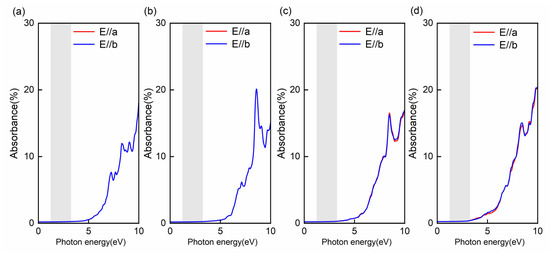
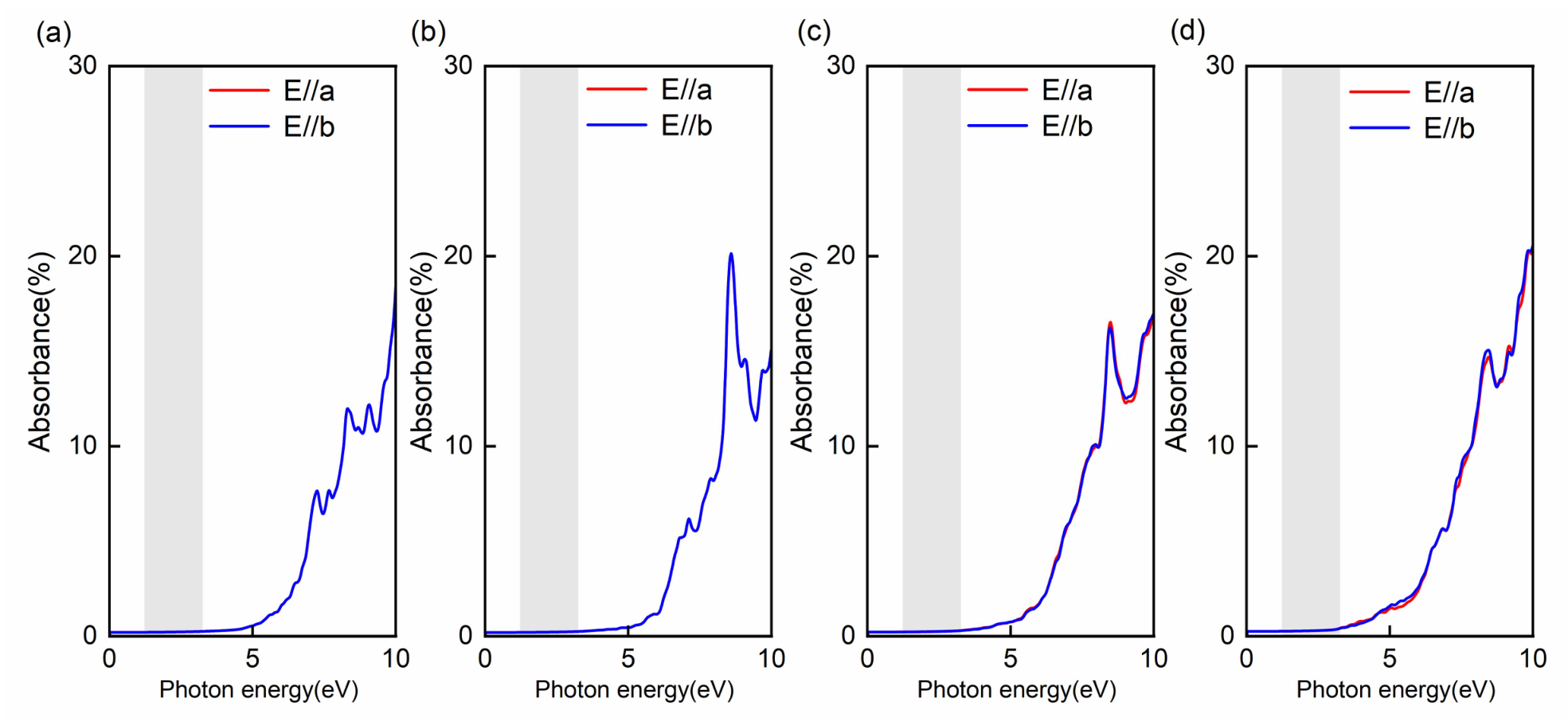
The calculated absorbances results derived from dielectric function for the C4X are presented in Figure 5. In analogy with the carrier mobility results, C4H and C4F exhibit isotropic adsorption behavior in the a-direction and b-direction with the structure shown in Figure 1, whereas C4OH and C4NH2 display light anisotropic adsorption behavior. Additionally, it is clear that the light absorption ranges of C4X nanosheets mainly locate at 3 to 8 eV, but are nearly absent in the visible region, as expected from their large band gaps (>2.97 eV). This finding is consistent with previously reported results that C4X2 absorbs exclusively in the ultraviolet region [8]. Consequently, owing to the sp3-hybridized carbon framework, the high transmittance (see Figure S3 of Supplementary Information) is essentially independent of the functionalizing species.
Figure 5.
Calculated absorbance versus photon energy for (a) C4H, (b) C4F, (c) C4OH, and (d) C4NH2 within the GGA-PBE framework.
Since electron–hole interactions can significantly modify the optical spectra of low-dimensional wide-bandgap semiconductors, many-body perturbation theory calculations were further performed using the GW0 approximation and the Bethe–Salpeter equation (BSE) to evaluate excitonic effects [44,45]. The calculated quasiparticle band gaps (GW0), first excitonic transition energies , and exciton binding energies are summarized in Table 3, and the imaginary dielectric functions obtained from GW0+BSE calculations are shown in Figure S4 of the Supplementary Information. The GW0 calculations predict quasiparticle band gaps ranging from 4.71 to 6.24 eV, confirming the wide-bandgap semiconducting nature of all C4X monolayer. The inclusion of electron–hole interactions through the GW0+BSE approach reveals appreciable excitonic effects in all C4X monolayers. The calculated exciton binding energies are 0.225, 0.577, 0.445, and 0.502 eV for C4H, C4F, C4OH, and C4NH2, respectively. Among them, C4F exhibits the strongest excitonic effect, whereas C4H shows the weakest electron–hole interaction.
Table 3.
Calculated bandgap energies ( with GW0 in eV), first excitonic transition energies ( in eV), and exciton binding energies ( in eV) of C4X(X = H, F, OH, NH2).
3.5. Mechanical Properties
It is well known that diamond has a very high hardness with Young’s modulus values of 1116 GPa and shear modulus values of 522 GPa [46,47], which originates from characteristic of sp3-hybridized C atoms. Featuring a fully sp3-hybridized carbon network, the C4X configuration possesses exceptional mechanical properties that could be useful in super hard protective coatings and ultra-stable supporting substrates.
For 2D materials with planar structures, the elastic constants () [48] can be calculated using the energy-strain method with the following formula:
where is the area of unstrained simulation cell in the x-y plane. is the total energy of new structure within the simulation cell distorted by correspondingly applied strains up to of the lattice parameter. However, for 2D materials with a finite vertical thickness, the energy required for in-plane stretching increases with thickness, rendering the method based on Equation (4) no longer applicable. Furthermore, the elastic constants calculated from Equation (4) are intrinsic two-dimensional quantities with units of N/m, which cannot be directly compared with the elastic moduli of bulk materials with units of GPa. Therefore, we adopted a commonly used approach in which is converted into a conventional three-dimensional elastic constant by normalizing it with an effective interlayer spacing, as shown in the following formula:
where denotes the equilibrium interlayer spacing obtained from the fully optimized multilayer stacked structure without vacuum. This approach has been widely employed in the evaluation of the elastic properties of two-dimensional materials, such as graphene [48,49,50] and monolayer MoS2 [51,52], and the results are in good agreement with experimental measurements.
The relation between Young’s modulus, shear modulus, Poisson’s ratio and the elastic constants for a 2D system can be derived as [53]:
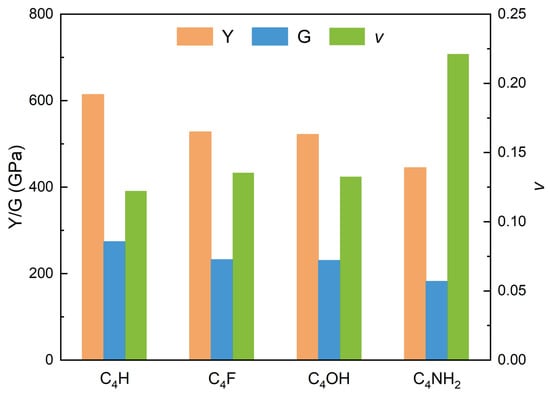
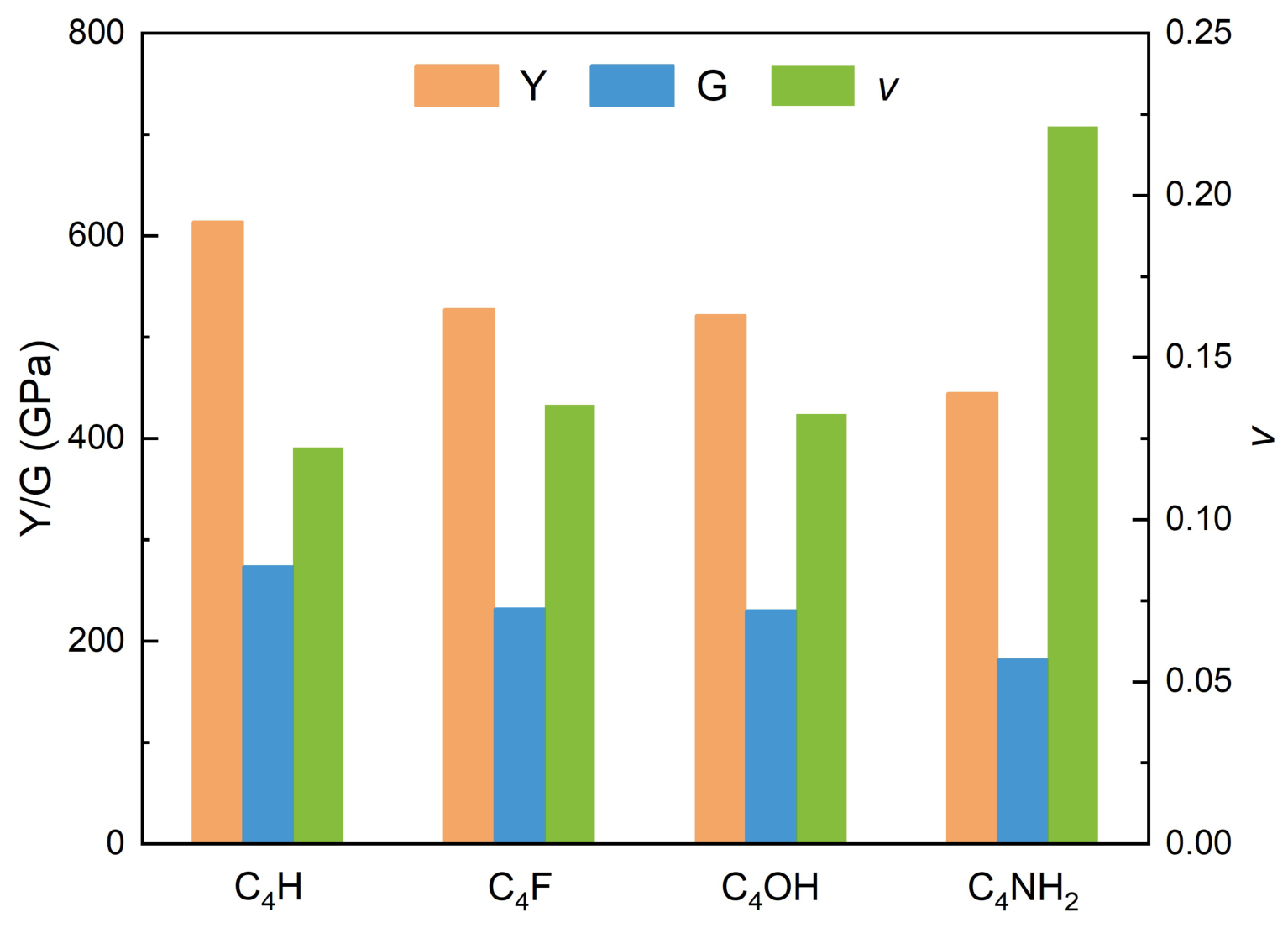
The calculated results are shown in Figure 6. In C4X systems, the chemical identity of the terminal functional groups serves as a key determinant in tailoring their macroscopic mechanical properties. Among the structures investigated, the C4H system exhibits the highest elastic moduli, with a Young’s modulus of 614 GPa, corresponding to approximately 60% of that of graphene (∼1.0 TPa) [49]. The mechanical moduli of C4F and C4OH are moderately reduced, whereas the C4NH2 functionalized system demonstrates the lowest stiffness, characterized by a Young’s modulus of 445 GPa and a shear modulus of 182 GPa. Despite the reduction induced by surface functionalization, all C4X structures exhibit remarkable stiffness, demonstrating the excellent mechanical robustness of the low-coverage diamane framework. The exceptional mechanical properties of the C4X system originate from its distinctive sp3-bonding network architecture, most notably the formation of continuous interlayer covalent bonds between C-inner atoms. This structural characteristic substantially enhances in-plane stiffness and structural stability. This indicates that the C4X structure possesses a high upper limit of mechanical strength and a highly stable carbon framework, providing a foundation for its prospective applications in the field of nanomechanical devices.
Figure 6.
2D Young’s modulus (E), shear modulus (G), and Poisson’s ratio () of C4X with different functional groups (-H, -F, -OH, -NH2).
Furthermore, the Poisson’s ratio of the functionalized two-dimensional carbon material C4X exhibits a sensitive dependence on surface chemical groups. As shown in Figure 6, the Poisson’s ratio of C4H, C4F, and C4OH structures is approximately 0.13, indicating that their lateral shrinkage effect is weaker than that of graphene (0.169) [48] under axial stretching. This is mainly due to the strong directionality of the bonds formed between H, F, OH, and the carbon skeleton. In particular, highly electronegative groups such as F and OH can polarize the electron clouds of adjacent C–C bonds through inductive effects, enhancing the covalent component and stiffness of the bonds, thereby suppressing the lateral deformation mode dominated by bond angle changes to a certain extent, resulting in a lower Poisson’s response. The C4NH2 structure has a high Poisson’s ratio, approximately 0.22, even higher than graphene (0.169) [48]. This is mainly attributed to the steric effect and electron-donating properties of the NH2 group. The N atom in NH2 possesses a lone pair of electrons, which could couple with the C- orbitals, softening certain in-plane vibrational modes to some extent. Simultaneously, its significant steric hindrance may introduce local structural distortions, promoting more pronounced transverse relaxation during stretching, thereby enhancing the Poisson’s ratio.
4. Conclusions
In summary, we identify a hitherto unknown diamane C4X (X = H, F, OH, NH2) with low functional group coverage using first-principles calculations. We systematically investigate its structural stability as well as its electronic, transport, optical, and mechanical properties. Our results demonstrate that different functional groups can effectively tune the electronic structure, yielding band gaps ranging from 2.97 to 3.42 eV, with C4F exhibiting the largest gap. In addition, C4H and C4NH2 display exceptionally high electron mobilities on the order of cm2 V−1 s−1, exceeding those reported for black phosphorus. Mechanically, C4H possesses a Young’s modulus and shear modulus of 614 and 274 GPa, respectively, highlighting the exceptional mechanical robustness of the low-coverage diamane framework. The combination of tunable wide-bandgap semiconducting behavior, efficient electron transport, and outstanding mechanical stiffness highlights the potential of C4X materials for applications in nanoelectronics, optoelectronics, and superhard coatings and may stimulate further experimental exploration.
Supplementary Materials
The following supporting information can be downloaded at: https://www.mdpi.com/article/10.3390/cryst16060403/s1, Table S1: Bond angles of ∠C-C-C or ∠C-C-X (–) in C4X (X = H, F, OH, NH2) monolayers; Figure S1: Convergence tests for the representative C4H structure. Total energy per atom as a function of plane-wave cutoff energy (a) and k-point sampling density (b). The red dashed lines represent the computational parameters adopted in this work; Figure S2: The crystal structure and band structure for (a) C4H, (b) C4F, (c) C4OH, and (d) C4NH2 along x-direction and y-direction for the calculation of carrier mobilities; Figure S3: Calculated transmittance versus photon energy for (a) C4H, (b) C4F, (c) C4OH, and (d) C4NH2 within the GGA-PBE framework; Figure S4: Imaginary dielectric functions obtained from GW0+BSE calculations for (a) C4H, (b) C4F, (c) C4OH, and (d) C4NH2 monolayers.
Author Contributions
Conceptualization, C.N.; methodology, M.X.; software, Y.L.; validation, C.N., J.H. and M.X.; formal analysis, L.H., S.C., C.N., J.H. and M.X.; investigation, X.M. and L.H.; resources, C.N.; data curation, C.N.; writing—original draft preparation, C.N. and J.H.; writing—review and editing, M.X.; visualization, C.N.; supervision, M.X.; project administration, Y.L.; funding acquisition, C.N., M.X. and Y.L. All authors have read and agreed to the published version of the manuscript.
Funding
This work was supported by the National Natural Science Foundation of China (Grants No. 12404015, No. 12374010, No. 12474012, the Six Talent Peaks Project, the 333 High-level Talents Project of Jiangsu Province, and the Natural Science Foundation of Colleges and Universities in Jiangsu Province (Grant No. 24KJB140010). Computational resources were provided by the High-performance Computing Center of the School of Physics and Electronic Engineering of Jiangsu Normal University.
Data Availability Statement
The original contributions presented in this study are included in the article/Supplementary Materials. Further inquiries can be directed to the corresponding author.
Conflicts of Interest
The authors declare no conflicts of interest.
References
- Jin, H.; Guo, C.; Liu, X.; Liu, J.; Vasileff, A.; Jiao, Y.; Zheng, Y.; Qiao, S.Z. Emerging two-dimensional nanomaterials for electrocatalysis. Chem. Rev. 2018, 118, 6337–6408. [Google Scholar] [CrossRef] [Scilit] [PubMed]
- Chernozatonskii, L.A.; Sorokin, P.B.; Kvashnin, A.G.; Kvashnin, D.G. Diamond-like C2H nanolayer, diamane: Simulation of the structure and properties. JETP Lett. 2009, 90, 134–138. [Google Scholar] [CrossRef] [Scilit]
- Qin, G.; Wu, L.; Gou, H. Diamane: Design, synthesis, properties, and challenges. Funct. Diam. 2022, 1, 83–92. [Google Scholar] [CrossRef] [Scilit]
- Sorokin, P.B.; Yakobson, B.I. Two-dimensional diamond—diamane: Current state and further prospects. Nano Lett. 2021, 21, 5475–5484. [Google Scholar] [CrossRef] [Scilit] [PubMed]
- Liu, B.; Emmanuel, E.; Liang, T.; Wang, B. Advancements in theoretical and experimental investigations on diamane materials. Nanoscale 2023, 15, 10498–10512. [Google Scholar] [CrossRef] [Scilit] [PubMed]
- Li, H.; Li, J.; Wang, Z.; Zou, G. Layer number-dependent structural evolution of two-dimensional diamond films. Chem. Phys. Lett. 2012, 550, 130–133. [Google Scholar] [CrossRef] [Scilit]
- Shu, H. Strain effects on stability, electronic and optical properties of two-dimensional C4X2 (X= F, Cl, Br). J. Mater. Chem. C 2021, 9, 4505–4513. [Google Scholar] [CrossRef] [Scilit]
- Ge, L.; Liu, H.; Wang, J.; Huang, H.; Cui, Z.; Huang, Q.; Fu, Z.; Lu, Y. Properties of diamane anchored with different groups. Phys. Chem. Chem. Phys. 2021, 23, 14195–14204. [Google Scholar] [CrossRef] [Scilit] [PubMed]
- Chernozatonskii, L.A.; Demin, V.A.; Kvashnin, D.G. Fully hydrogenated and fluorinated bigraphenes–diamanes: Theoretical and experimental studies. C 2021, 7, 17. [Google Scholar] [CrossRef] [Scilit]
- Martins, L.G.P.; Matos, M.J.; Paschoal, A.R.; Freire, P.T.; Andrade, N.F.; Aguiar, A.L.; Kong, J.; Neves, B.R.; de Oliveira, A.B.; Mazzoni, M.S.; et al. Raman evidence for pressure-induced formation of diamondene. Nat. Commun. 2017, 8, 96. [Google Scholar] [CrossRef] [Scilit] [PubMed]
- Niu, C.; Zhao, J.; Xia, W.; Chen, G.; Luo, W.; Zhang, J.; Ahuja, R.; Wang, X. Configuration stability and physical properties of new diamondene structure. Mater. Today Commun. 2023, 36, 106465. [Google Scholar] [CrossRef] [Scilit]
- Chernozatonskii, L.A.; Katin, K.P.; Demin, V.A.; Maslov, M.M. Moiré diamanes based on the hydrogenated or fluorinated twisted bigraphene: The features of atomic and electronic structures, Raman and infrared spectra. Appl. Surf. Sci. 2021, 537, 148011. [Google Scholar] [CrossRef] [Scilit]
- Gupta, S.; Yang, J.H.; Yakobson, B.I. Two-level quantum systems in two-dimensional materials for single photon emission. Nano Lett. 2018, 19, 408–414. [Google Scholar] [CrossRef] [Scilit] [PubMed]
- Pakornchote, T.; Ektarawong, A.; Alling, B.; Pinsook, U.; Tancharakorn, S.; Busayaporn, W.; Bovornratanaraks, T. Phase stabilities and vibrational analysis of hydrogenated diamondized bilayer graphenes: A first principles investigation. Carbon 2019, 146, 468–475. [Google Scholar] [CrossRef] [Scilit]
- Gao, Y.; Cao, T.; Cellini, F.; Berger, C.; De Heer, W.A.; Tosatti, E.; Riedo, E.; Bongiorno, A. Ultrahard carbon film from epitaxial two-layer graphene. Nat. Nanotechnol. 2018, 13, 133–138. [Google Scholar] [CrossRef] [Scilit] [PubMed]
- Wu, Y.C.; Shao, J.L.; Zheng, Z.; Zhan, H. Mechanical properties of a single-layer diamane under tension and bending. J. Phys. Chem. C 2020, 125, 915–922. [Google Scholar] [CrossRef] [Scilit]
- Ke, F.; Zhang, L.; Chen, Y.; Yin, K.; Wang, C.; Tzeng, Y.K.; Lin, Y.; Dong, H.; Liu, Z.; Tse, J.S.; et al. Synthesis of atomically thin hexagonal diamond with compression. Nano Lett. 2020, 20, 5916–5921. [Google Scholar] [CrossRef] [Scilit] [PubMed]
- Li, J.; Du, G.; Zhao, L.; Han, W.; Ming, J.; Chen, S.; Zhao, P.; Bai, L.; Yan, J.; Du, Y.; et al. Experimental demonstration and transformation mechanism of quenchable two-dimensional diamond. Nat. Commun. 2026, 17, 1244. [Google Scholar] [CrossRef] [Scilit] [PubMed]
- Bakharev, P.V.; Huang, M.; Saxena, M.; Lee, S.W.; Joo, S.H.; Park, S.O.; Dong, J.; Camacho-Mojica, D.C.; Jin, S.; Kwon, Y.; et al. Chemically induced transformation of chemical vapour deposition grown bilayer graphene into fluorinated single-layer diamond. Nat. Nanotechnol. 2020, 15, 59–66. [Google Scholar] [CrossRef] [Scilit] [PubMed]
- Piazza, F.; Monthioux, M.; Puech, P.; Gerber, I.C. Towards a better understanding of the structure of diamanoïds and diamanoïd/graphene hybrids. Carbon 2020, 156, 234–241. [Google Scholar] [CrossRef] [Scilit]
- Piazza, F.; Cruz, K.; Monthioux, M.; Puech, P.; Gerber, I. Raman evidence for the successful synthesis of diamane. Carbon 2020, 169, 129–133. [Google Scholar] [CrossRef] [Scilit]
- Kresse, G.; Furthmüller, J. Efficient iterative schemes for ab initio total-energy calculations using a plane-wave basis set. Phys. Rev. B 1996, 54, 11169. [Google Scholar] [CrossRef] [Scilit] [PubMed]
- Kresse, G.; Furthmüller, J. Efficiency of ab-initio total energy calculations for metals and semiconductors using a plane-wave basis set. Comput. Mater. Sci. 1996, 6, 15–50. [Google Scholar] [CrossRef] [Scilit]
- Kohn, W.; Sham, L.J. Self-consistent equations including exchange and correlation effects. Phys. Rev. 1965, 140, A1133. [Google Scholar] [CrossRef] [Scilit]
- Perdew, J.P.; Burke, K.; Ernzerhof, M. Generalized gradient approximation made simple. Phys. Rev. Lett. 1996, 77, 3865. [Google Scholar] [CrossRef] [Scilit] [PubMed]
- Heyd, J.; Scuseria, G.E.; Ernzerhof, M. Hybrid functionals based on a screened Coulomb potential. J. Chem. Phys. 2003, 118, 8207–8215. [Google Scholar] [CrossRef] [Scilit]
- Pack, J.D.; Monkhorst, H.J. Special points for Brillouin-zone integrations—A reply. Phys. Rev. B 1977, 16, 1748. [Google Scholar] [CrossRef] [Scilit]
- Klimeš, J.; Bowler, D.R.; Michaelides, A. Van der Waals density functionals applied to solids. Phys. Rev. B 2011, 83, 195131. [Google Scholar] [CrossRef] [Scilit]
- Klimeš, J.; Bowler, D.R.; Michaelides, A. Chemical accuracy for the van der Waals density functional. J. Phys. Condens. Matter 2010, 22, 022201. [Google Scholar] [CrossRef] [Scilit] [PubMed]
- Togo, A.; Tanaka, I. First principles phonon calculations in materials science. Scr. Mater. 2015, 108, 1–5. [Google Scholar] [CrossRef] [Scilit]
- Nosé, S. A unified formulation of the constant temperature molecular dynamics methods. J. Chem. Phys. 1984, 81, 511–519. [Google Scholar] [CrossRef] [Scilit]
- Hoover, W.G. Canonical dynamics: Equilibrium phase-space distributions. Phys. Rev. A 1985, 31, 1695. [Google Scholar] [CrossRef] [Scilit] [PubMed]
- Zhang, S.; Zhou, J.; Wang, Q.; Chen, X.; Kawazoe, Y.; Jena, P. Penta-graphene: A new carbon allotrope. Proc. Natl. Acad. Sci. USA 2015, 112, 2372–2377. [Google Scholar] [CrossRef] [Scilit] [PubMed]
- Bruzzone, S.; Fiori, G. Ab-initio simulations of deformation potentials and electron mobility in chemically modified graphene and two-dimensional hexagonal boron-nitride. Appl. Phys. Lett. 2011, 99, 222108. [Google Scholar] [CrossRef] [Scilit]
- Lang, H.; Zhang, S.; Liu, Z. Mobility anisotropy of two-dimensional semiconductors. Phys. Rev. B 2016, 94, 235306. [Google Scholar] [CrossRef] [Scilit]
- Cai, Y.; Zhang, G.; Zhang, Y.W. Polarity-reversed robust carrier mobility in monolayer MoS2 nanoribbons. J. Am. Chem. Soc. 2014, 136, 6269–6275. [Google Scholar] [CrossRef] [Scilit] [PubMed]
- Hou, B.; Zhang, Y.; Zhang, H.; Shao, H.; Ma, C.; Zhang, X.; Chen, Y.; Xu, K.; Ni, G.; Zhu, H. Room temperature bound excitons and strain-tunable carrier mobilities in janus monolayer transition-metal dichalcogenides. J. Phys. Chem. Lett. 2020, 11, 3116–3128. [Google Scholar] [CrossRef] [Scilit] [PubMed]
- Cheng, T.; Liu, Z.; Liu, Z. High elastic moduli, controllable bandgap and extraordinary carrier mobility in single-layer diamond. J. Mater. Chem. C 2020, 8, 13819–13826. [Google Scholar] [CrossRef] [Scilit]
- Rawat, A.; Jena, N.; Dimple; De Sarkar, A. A comprehensive study on carrier mobility and artificial photosynthetic properties in group VI B transition metal dichalcogenide monolayers. J. Mater. Chem. A 2018, 6, 8693–8704. [Google Scholar] [CrossRef] [Scilit]
- Qiao, J.; Kong, X.; Hu, Z.X.; Yang, F.; Ji, W. High-mobility transport anisotropy and linear dichroism in few-layer black phosphorus. Nat. Commun. 2014, 5, 4475. [Google Scholar] [CrossRef] [Scilit] [PubMed]
- Gajdoš, M.; Hummer, K.; Kresse, G.; Furthmüller, J.; Bechstedt, F. Linear optical properties in the projector-augmented wave methodology. Phys. Rev. B 2006, 73, 045112. [Google Scholar] [CrossRef] [Scilit]
- Adler, S.L. Quantum theory of the dielectric constant in real solids. Phys. Rev. 1962, 126, 413. [Google Scholar] [CrossRef] [Scilit]
- Wiser, N. Dielectric constant with local field effects included. Phys. Rev. 1963, 129, 62. [Google Scholar] [CrossRef] [Scilit]
- Shishkin, M.; Marsman, M.; Kresse, G. Accurate quasiparticle spectra from self-consistent GW calculations with vertex corrections. Phys. Rev. Lett. 2007, 99, 246403. [Google Scholar] [CrossRef] [Scilit] [PubMed]
- Shishkin, M.; Kresse, G. Implementation and performance of the frequency-dependent GW method within the PAW framework. Phys. Rev. B 2006, 74, 035101. [Google Scholar] [CrossRef] [Scilit]
- Fan, Q.; Chai, C.; Wei, Q.; Wong, K.; Liu, Y.; Yang, Y. Theoretical investigations of group IV alloys in the Lonsdaleite phase. J. Mater. Sci. 2018, 53, 2785–2801. [Google Scholar] [CrossRef] [Scilit]
- Ding, Y.; Wang, Y. Density functional theory study of the silicene-like SiX and XSi3 (X= B, C, N, Al, P) honeycomb lattices: The various buckled structures and versatile electronic properties. J. Phys. Chem. C 2013, 117, 18266–18278. [Google Scholar] [CrossRef] [Scilit]
- Wei, X.; Fragneaud, B.; Marianetti, C.A.; Kysar, J.W. Nonlinear elastic behavior of graphene: Ab initio calculations to continuum description. Phys. Rev. B 2009, 80, 205407. [Google Scholar] [CrossRef] [Scilit]
- Lee, C.; Wei, X.; Kysar, J.W.; Hone, J. Measurement of the elastic properties and intrinsic strength of monolayer graphene. Science 2008, 321, 385–388. [Google Scholar] [CrossRef] [Scilit] [PubMed]
- Lee, C.; Wei, X.; Li, Q.; Carpick, R.; Kysar, J.W.; Hone, J. Elastic and frictional properties of graphene. Phys. Status Solidi B 2009, 246, 2562–2567. [Google Scholar] [CrossRef] [Scilit]
- Liu, K.; Yan, Q.; Chen, M.; Fan, W.; Sun, Y.; Suh, J.; Fu, D.; Lee, S.; Zhou, J.; Tongay, S.; et al. Elastic properties of chemical-vapor-deposited monolayer MoS2, WS2, and their bilayer heterostructures. Nano Lett. 2014, 14, 5097–5103. [Google Scholar] [CrossRef] [Scilit] [PubMed]
- Bertolazzi, S.; Brivio, J.; Kis, A. Stretching and breaking of ultrathin MoS2. ACS Nano 2011, 5, 9703–9709. [Google Scholar] [CrossRef] [Scilit] [PubMed]
- Wei, Q.; Peng, X. Superior mechanical flexibility of phosphorene and few-layer black phosphorus. Appl. Phys. Lett. 2014, 104, 251915. [Google Scholar] [CrossRef] [Scilit]

Disclaimer/Publisher’s Note: The statements, opinions and data contained in all publications are solely those of the individual author(s) and contributor(s) and not of MDPI and/or the editor(s). MDPI and/or the editor(s) disclaim responsibility for any injury to people or property resulting from any ideas, methods, instructions or products referred to in the content. |
© 2026 by the authors. Licensee MDPI, Basel, Switzerland. This article is an open access article distributed under the terms and conditions of the Creative Commons Attribution (CC BY) license.