


Abstract
The magnetic properties of Dy6MnBi2 and Dy6FeBi2 intermetallic compounds have been investigated within the framework of density functional theory. These materials are attracting considerable attention due to their potential in magnetic refrigeration applications, as they exhibit a pronounced magnetocaloric effect. In the present work, we compute the equation of state, electronic density of states, and magnetic moments, and compare the results with available experimental data. The calculated quantities are found to be in good agreement with the experimental findings, thereby supporting once again the reliability of DFT as a theoretical framework for exploring the magnetic behavior of ternary intermetallic compounds.
1. Introduction
Ternary intermetallic compounds have attracted significant attention in recent years owing to their unconventional magnetic behavior and potential for magnetocaloric applications [1,2,3,4,5,6,7,8,9,10]. Among them, the family of compounds with general formula R6TX2 (where R is a rare-earth element, T is a transition metal, and X = Bi, Te, or Sb) is particularly notable. Many members of this family exhibit two distinct magnetic phase transitions accompanied by sizable magnetocaloric effects, in some cases extending to technologically relevant temperature ranges. Beyond their applied interest, these systems are of considerable fundamental importance due to the complexity of their magnetic ordering. Typically, a paramagnetic (PM) to ferromagnetic (FM) transition occurs at intermediate temperatures, followed at much lower temperatures by a transition into non-collinear spin states.
The case of Dy6(Fe,Mn)Bi2 is especially remarkable. Across this series, the PM–FM transition temperature lies approximately in the 129–370 K range, depending on composition, while additional spin-reorientation transitions occur at lower temperatures (~52–170 K) [1,2]. These trends, and particularly the variation in the transition temperature with substitution of Fe by Mn, are not easily explained in terms of conventional mean-field arguments. Since the magnetic ion separation is larger in the Mn compound, one would expect the Curie temperature to decrease, whereas experimentally it increases. Orbital hybridization between electronic states has been proposed as a possible explanation [11,12,13], but a comprehensive theoretical understanding is still lacking. Developing microscopic theoretical models capable of capturing these effects remains highly desirable, both for advancing our understanding of these compounds and for guiding the design of new materials with optimized magnetocaloric properties.
Analytical approaches, however, are exceedingly challenging for these systems and typically yield only qualitative insights. By contrast, density functional theory (DFT) has emerged as a robust and widely used framework in condensed matter physics and materials science, providing quantitative predictions of structural, electronic, and magnetic properties [14]. In some cases, DFT has even enabled the discovery of new materials with tailored functionalities.
In a recent study, we applied DFT to the Ho analogs Ho6MnBi2 and Ho6FeBi2 and showed that this approach reliably reproduces their crystallographic, electronic, and magnetic properties [3]. The present work extends that investigation to the Dy compounds Dy6MnBi2 and Dy6FeBi2. By doing so, we not only assess the robustness of DFT predictions across different rare-earth ions but also highlight the similarities and differences between the Ho and Dy systems, which may provide insight into the role of rare-earth substitution in tuning magnetocaloric performance.
In this work, DFT is employed to investigate the structural and magnetic properties of Dy6MnBi2 and Dy6FeBi2. The calculations are restricted to collinear spin configurations and, thus, the results presented below correspond to the ferromagnetic phase of these compounds. The experimentally observed low-temperature non-collinear phase is beyond the scope of the present study. The reliability of the theoretical framework is first assessed by comparing optimized crystal structures with experimental data. Subsequently, the equation of state (EOS), electronic density of states (DOS), and magnetic moments are calculated and analyzed. The results demonstrate that DFT provides a consistent description of these compounds, with good agreement with experimental observations, thereby supporting its use as a predictive tool for rare-earth-based intermetallics of magnetocaloric relevance.
This paper is organized as follows. Section 2 describes the crystallographic structure of Dy6MnBi2 and Dy6FeBi2. Section 3 outlines the computational methodology. Section 4 presents the main results and their comparison with experimental data, including optimized crystal structures, EOS, DOS, and magnetic moments. Finally, Section 5 summarizes the conclusions.
2. The Dy6MnBi2 and Dy6FeBi2 Crystals
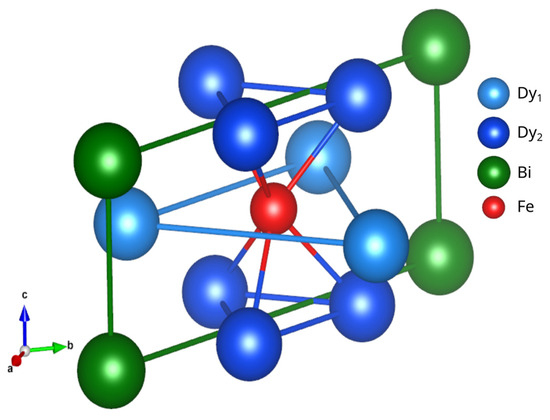
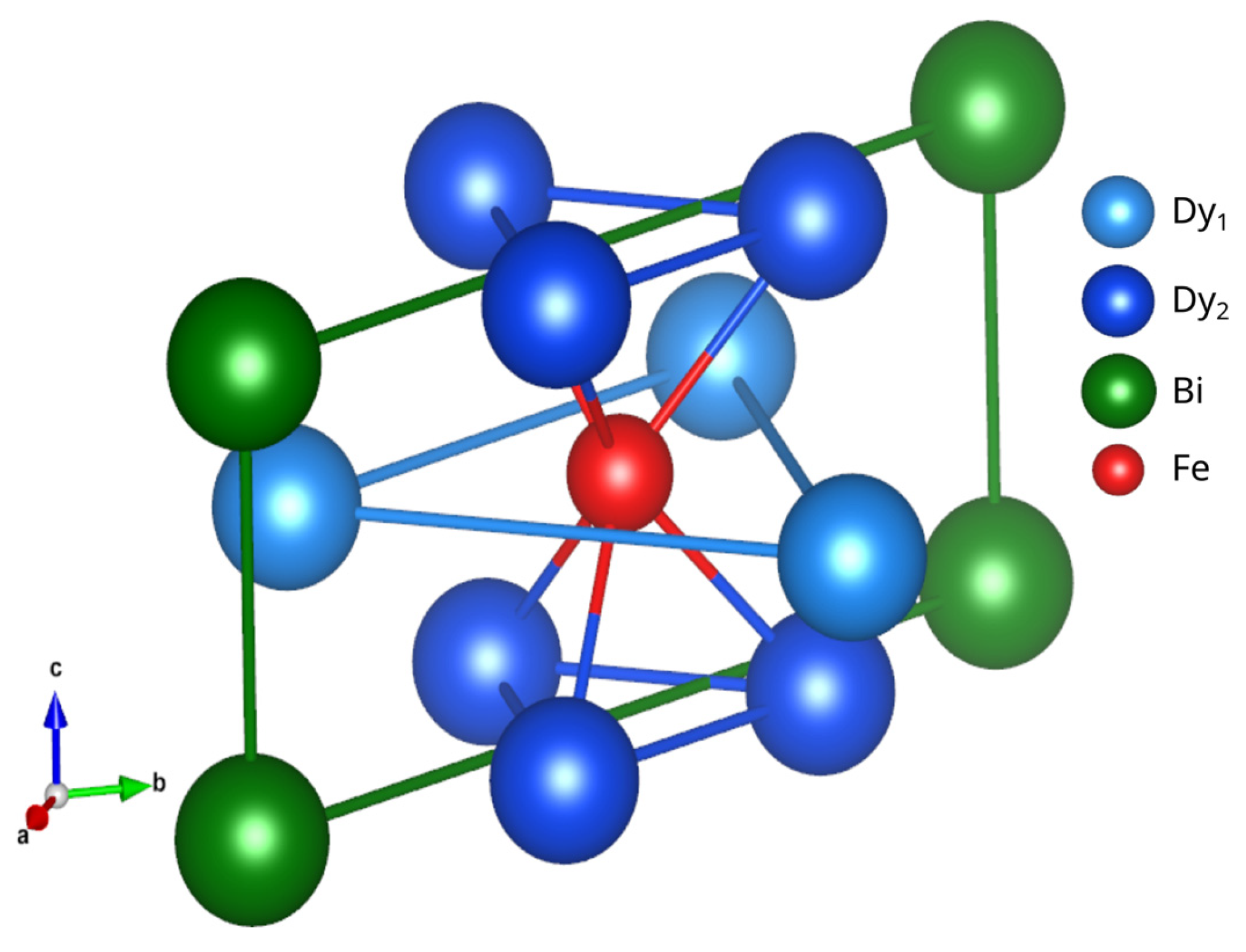
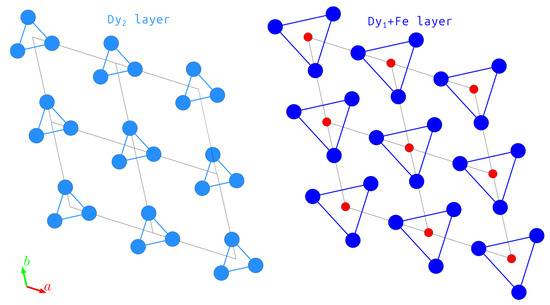
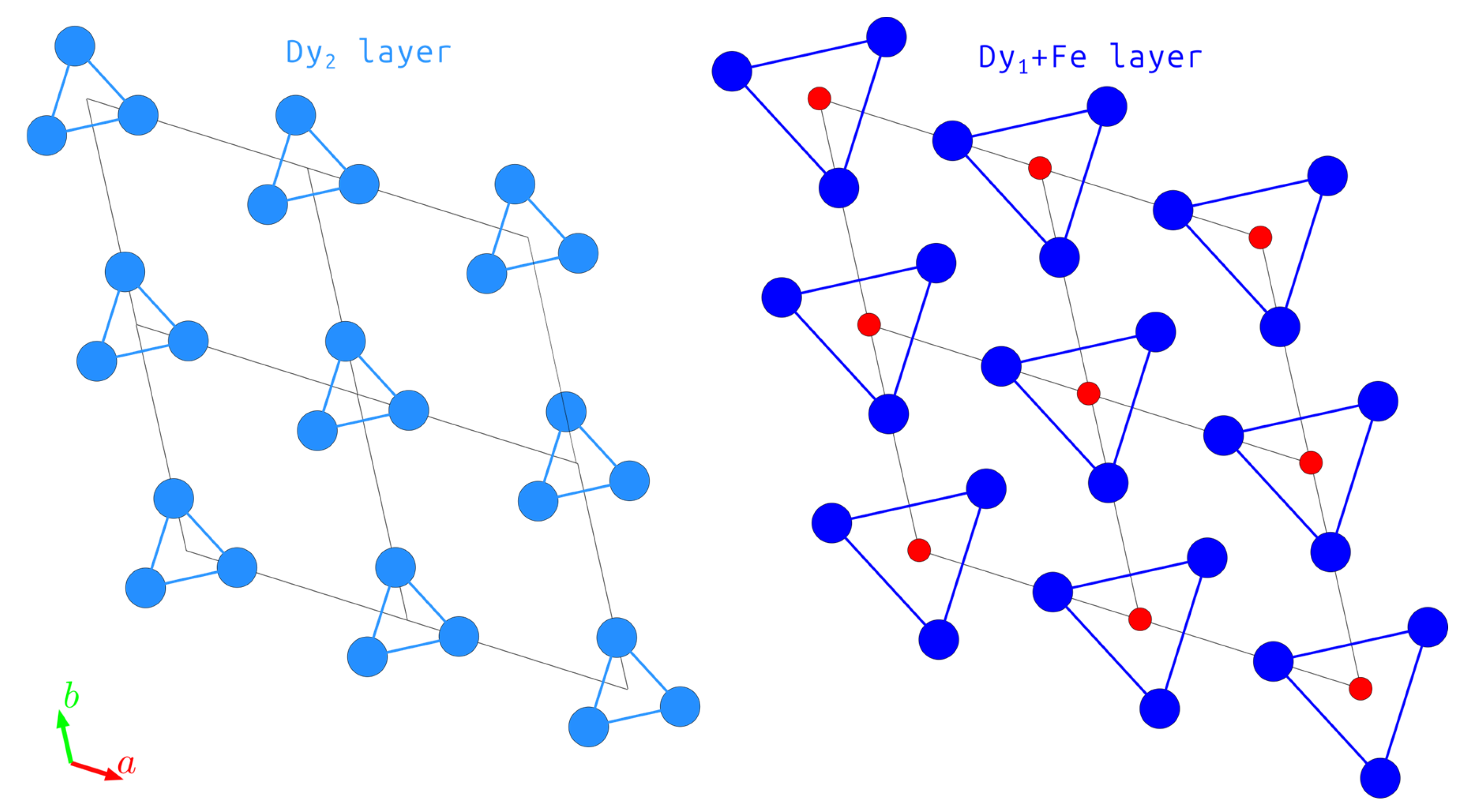
Both Dy6MnBi2 and Dy6FeBi2 crystallize in the non-centrosymmetric hexagonal Fe2P-type (often described as the Zr6CoAs2-type superstructure) with space group P-62m (No. 189). The structure consists of two magnetically active rare-earth sublattices (Dy1 and Dy2) occupying inequivalent sites that form stacked triangular nets along the c axis, interleaved with a transition-metal (T = Mn, Fe) layer and a bismuth sublattice; the latter arranges as honeycomb-sheets stacked along c (see Figure 1). This layered geometry provides a natural separation between Dy-only planes and mixed T–Dy planes (see Figure 2), a feature that is relevant for interlayer versus intralayer exchange pathways.
Figure 1.
The basis of the Dy6FeBi2 crystal. The Mn compound is based on the same crystal structure, with the Fe ion replaced by a Mn ion.
Figure 2.
Magnetic sublattices comprising the magnetic structure of the Dy6FeBi2 crystal. Four unit cells are shown. Bi ions are omitted for clarity. The Dy2 layers are located at integer values of the crystallographic c axis, whereas the layers containing both Dy1 and Fe ions are located at semi-integer values of c. The lines connecting Dy ions are included only as visual guides. Dy6MnBi2 exhibits the same magnetic sublattice arrangement, with Mn ions occupying the Fe sites.
At room temperature, reported lattice parameters for the Dy–Bi members are as follows. For Dy6MnBi2, a = 0.82204(7) nm, c = 0.42929(3) nm; for Dy6FeBi2, a = 0.82494(6) nm, c = 0.41899(3) nm [1]. Both compounds thus share comparable basal-plane metrics, while the Mn member exhibits a noticeably elongated c axis relative to the Fe analog, i.e., a larger c/a ratio. These values are consistent with the Fe2P/Zr6CoAs2-type assignment and with computational databases that list Dy6TBi2 entries in P-62m.
In the standard crystallographic description of the Fe2P family, the rare-earth sites split into two Wyckoff sites (3f- and 3g-type) forming triangular sublattices at z = 0 and z = 1/2, while the transition metal occupies the layer that shares the mixed plane with one of the Dy sublattices; Bi occupies two nonequivalent positions that generate the stacked honeycomb. Although individual internal coordinates vary slightly among reports and samples, the Dy1/Dy2 layering and the T–Dy stacking sequence are robust features repeatedly confirmed across the R6TX2 literature and are the basis for the layered-magnet picture used later in our magnetic analysis.
It is interesting to note that the interplay between this type of layered triangular, or kagome-like, lattice structure and the contribution of transition-metal electronic states plays a significant role in determining the magnetic behavior in other magnetocaloric compounds, even leading to the appearance of geometrical frustration [15,16]. Although this is not the case for the present materials, since they order ferromagnetically in the range of interest for magnetocaloric applications, these results emphasize the importance of understanding the relative roles of crystal geometry, electronic hybridization, and exchange interactions in rare-earth intermetallics from first-principles calculations.
For completeness, we note that the Fe2P (P-62m) assignment for Dy6FeBi2 and Dy6MnBi2 also appears in independent materials datasets (and agrees with our own data), providing an additional cross-validation of the crystallographic structure used as the starting point for our calculations.
3. Methodology and Computational Details
The first-principles calculations of the electronic properties were carried out within the framework of density functional theory (DFT) using the Quantum Espresso package (version 6.5) [17,18]. Following the recommendations of the Materials Cloud project [19,20], a projector-augmented-wave (PAW) representation [21] of the core electrons was employed for the Dy atoms, using the pseudopotential developed by Wentzcovitch et al. [22]. For Bi, the ultrasoft (US) GBRV pseudopotential was used [23], while the Fe atoms were described with the PAW potential from the PSlibrary 0.3.1 [24], and the Mn atoms with the corresponding US GBRV potential [23].
For both Dy6FeBi2 and Dy6MnBi2, the exchange–correlation energy was treated within the generalized-gradient approximation (GGA) using the functionals of Perdew–Burke–Ernzerhof (PBE) and PBE for solids (PBEsol) [25,26]. As in our previous Ho-based study [3], the PBEsol functional yielded structural parameters in closer agreement with our experimental findings and was therefore adopted for the final results presented here.
Both spin-polarized and non-spin-polarized calculations were performed, considering only collinear magnetic configurations (ferromagnetic and antiferromagnetic). The experimentally observed low-temperature non-collinear magnetic phases were not explicitly investigated in the present work. This is due to the fact that the Dy atoms were described using the scalar-relativistic PAW pseudopotentials, as stated above. Preliminary tests employing alternative fully relativistic pseudopotentials resulted in severe convergence difficulties. Nevertheless, as shown throughout this manuscript, the adopted computational approach provides robust convergence and yields structural and magnetic properties in qualitative agreement with the available experimental data.
Working with rare-earth elements in DFT is notoriously demanding, mainly because of the highly localized 4f states. To ensure well-converged total energies and structural parameters, parameter values considerably higher than those typically used for similar systems were required [19,20]. The plane-wave kinetic-energy cutoff was set to 120 Ry, and the charge-density cutoff to 1440 Ry. Brillouin-zone integrations were performed using a Γ-centered 6 × 6 × 12 k-point mesh, with an energy convergence threshold of 1.8 × 10⁻⁹ Ry in the self-consistent-field cycle.
Particular care was taken in the choice of smearing parameters, as convergence proved highly sensitive to this setting. Marzari–Vanderbilt cold smearing was applied in all calculations [27]. Although smearing widths in the mRy range are commonly used, the spin-polarized runs presented poor numerical stability and strong variations with respect to the k-point mesh below 0.05 Ry due to oscillations associated with the splitting of near-degenerate states around the Fermi level upon spin polarization. To stabilize convergence, a smearing width of 0.075 Ry was adopted throughout. The analytical correction for the entropic contribution to the total energy provided by this smearing scheme ensures that the resulting total energies remain physically meaningful.
Once reliable convergence parameters were established, both the unit-cell parameters and atomic positions were relaxed using the Broyden–Fletcher–Goldfarb–Shanno (BFGS) quasi-Newton algorithm. The fully optimized structure was subsequently employed for the calculation of the equation of state (EOS), the density of states (DOS), and the magnetic coupling constants.
The EOS was obtained following the procedure described by Jackson et al. [28]: starting from the equilibrium configuration, 15 crystal volumes were generated by isotropically scaling the cell between 0.96 and 1.04 times the relaxed volume. For each case, the lattice shape and internal atomic coordinates were relaxed at fixed volume. The resulting energy–volume data were fitted to a Murnaghan EOS, yielding equilibrium parameters consistent with those from the full relaxation, with deviations smaller than experimental uncertainties.
Both total and projected (atomic-orbital-resolved) densities of states were computed to analyze the magnetic behavior. The DOS calculations proceeded in three steps: (i) a self-consistent calculation for the equilibrium structure; (ii) a non-self-consistent run with a denser k-point mesh employing the tetrahedron method for Brillouin-zone integration [29]; and (iii) post-processing to obtain the total and partial DOS.
4. Results and Discussion
4.1. Geometry Optimization and EOS
For the Dy-based compounds, the relaxed structure was found to be rather insensitive to the choice of experimental data set used as the starting point. Therefore, the EOS calculations were performed using the structural data reported by Herrero et al. [1] and Morozkin et al. [8] as inputs, as summarized in Table 1. These experimental structures were relaxed as described in the previous section and the results are also summarized in Table 1. The crystallographic angles and the atomic positions of the Bi and TM atoms are not reported, as they remain unchanged with respect to the original structure, despite being fully relaxed during the optimization procedure.
Table 1.
Experimental and calculated structural parameters and unique Dy positions of the Dy6TBi2 (T = Mn, Fe) compounds.
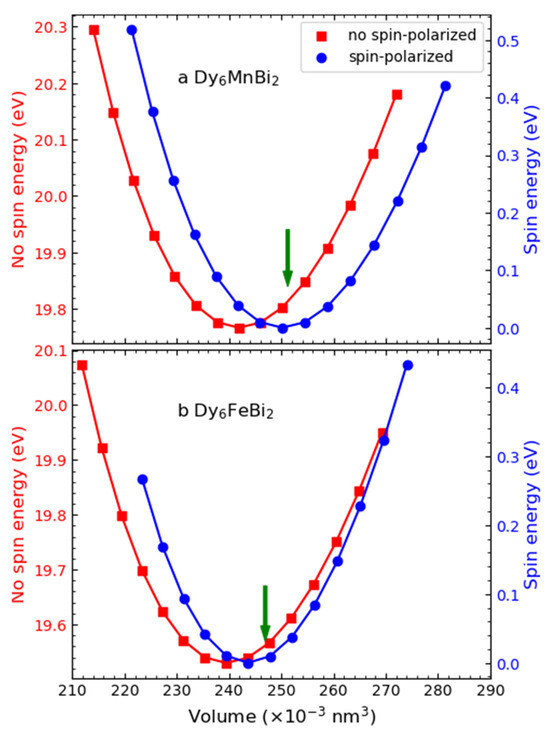
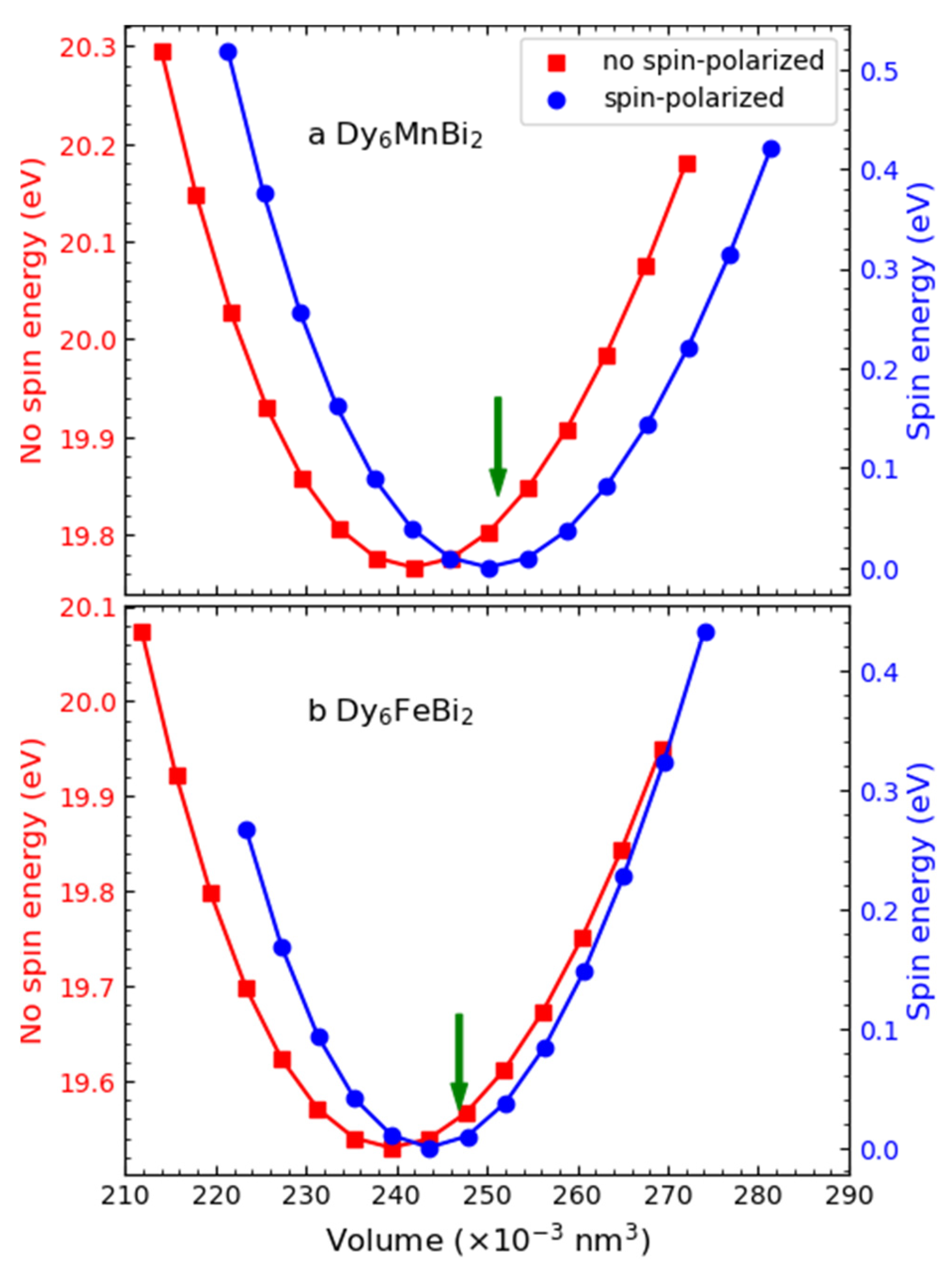
The EOS was obtained both with and without spin polarization, starting from the relaxed geometries reported in Table 1, and the resulting energy–volume data were fitted to a Murnaghan equation of state, as depicted in Figure 3a,b. Several important features can be extracted from these results. First, in all Dy-based systems the spin-polarized case is clearly more stable, pointing to the magnetic nature of the ground state. Second, the computed data follow the Murnaghan EOS with excellent accuracy, with maximum deviations below 10−6%. Third, the equilibrium volumes obtained from the Murnaghan EOS are virtually identical to those extracted from the full relaxation of the lattice, with differences below 0.1%. Finally, a comparison with the experimental findings (indicated by the green arrows) shows that the theoretical equilibrium volumes obtained from spin-polarized calculations are in much better agreement with the measured values than those obtained without spin polarization.
Figure 3.
(a) EOS for the Dy6MnBi2 system. (b) EOS for the Dy6FeBi2 system. The symbols represent the calculated data points, while the solid lines correspond to fits using the Murnaghan equation of state. The green arrow indicates the experimental unit-cell volume (see Table 1).
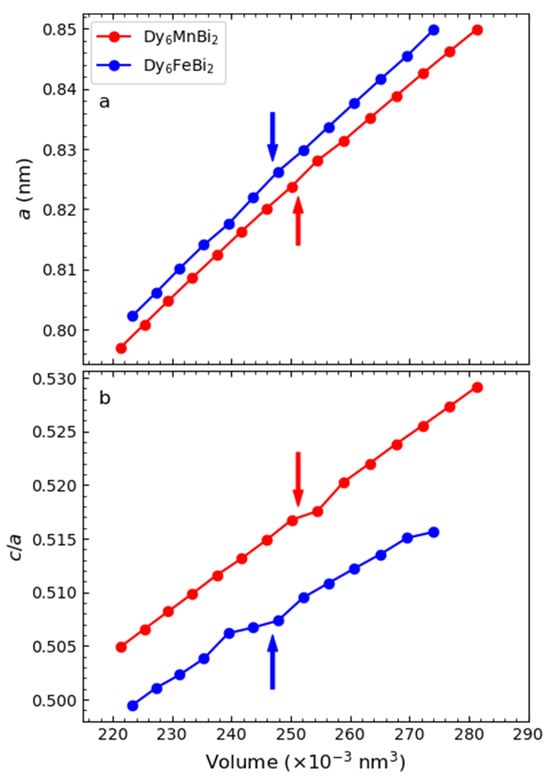
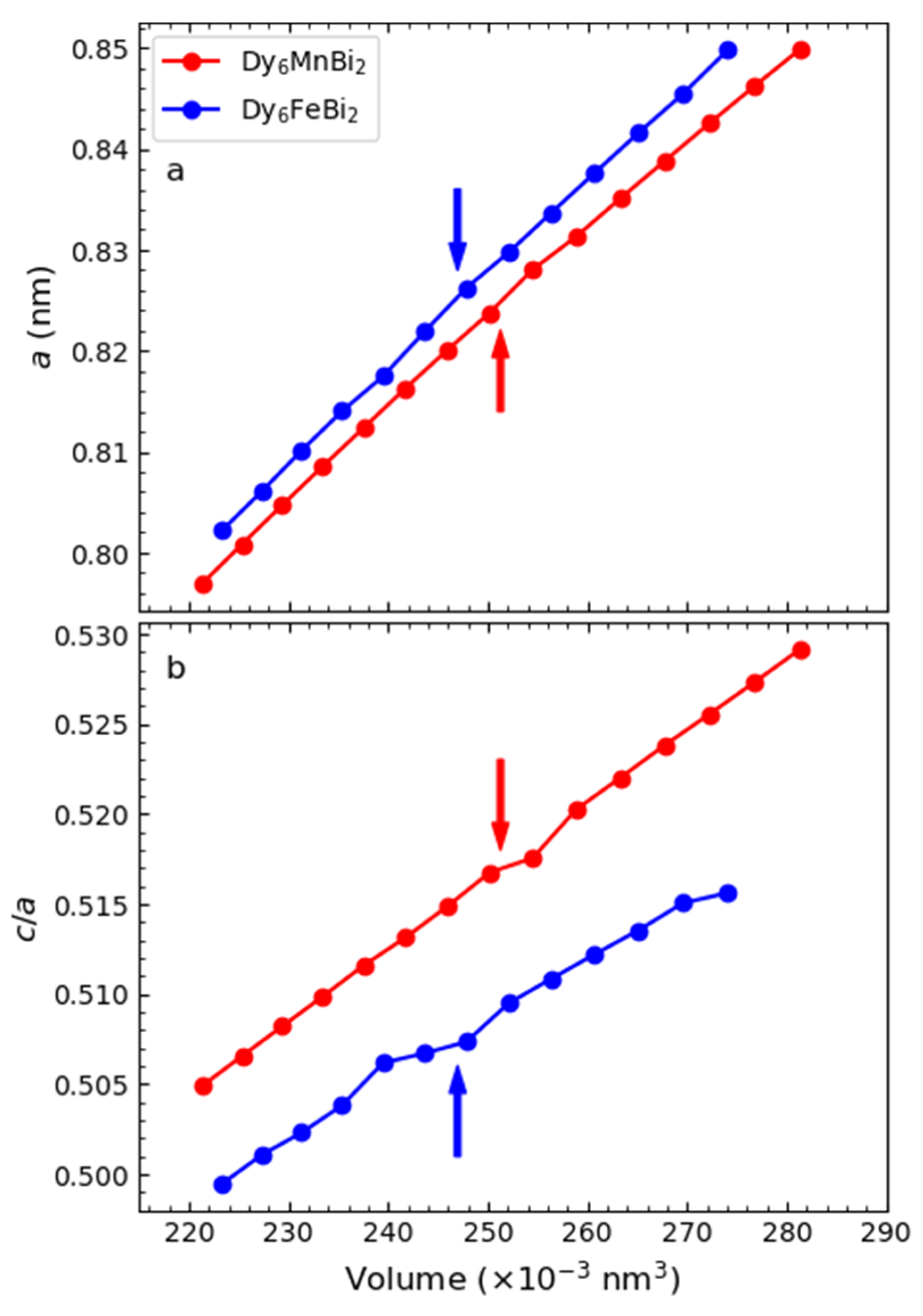
In addition, we analyzed the evolution of the unit-cell shape along the EOS curve. In this case, the only constraint imposed in the calculations was the unit-cell volume, while the internal degrees of freedom were fully relaxed. The resulting values of the lattice parameter a and the c/a ratio are presented in Figure 4. As can be seen, the parameter a increases linearly with volume, a behavior highlighted by the linear fits shown in the top panel. In contrast, the c/a ratio exhibits a more complex trend: it increases monotonically but shows a clear change in slope around the equilibrium volume. This crossover indicates a variation in the anisotropic compressibility of the lattice, likely associated with subtle relaxations of the internal coordinates (such as puckering of the Bi/Dy layers) and magneto-elastic effects, since the development of the 3d moments with increasing volume alters the exchange striction along the c direction. The anomaly is more pronounced in Dy6FeBi2, consistent with the stronger Fe–Bi covalency, which stiffens the basal plane and enhances the contrast between in-plane and out-of-plane responses. Importantly, the symmetry is preserved (the α and γ angles do not change, although they are allowed to do so in the simulation), confirming that the effect reflects anisotropic elasticity rather than a structural phase transition. As discussed in Section 4.3, such anisotropy may strongly influence the interlayer Dy1–Dy2 magnetic couplings.
Figure 4.
(a) Equilibrium lattice parameter along the EOS curve. The lines are linear fits to the calculated points. (b) Same for the ratio c/a. The arrows indicate the corresponding equilibrium volume for each system.
A direct comparison with the Ho-based analogues, reported in previous work [3], reveals both similarities and differences. In both families of compounds, the inclusion of spin polarization not only stabilizes the magnetic structure and provides equilibrium volumes in excellent agreement with the experimental findings, but also preserves the hexagonal symmetry along the EOS. However, while the Ho-based systems also display a non-trivial evolution of the c/a ratio, the crossover near equilibrium is less marked than in the Dy counterparts. This suggests that Dy-based compounds are more sensitive to magneto-elastic coupling effects, likely due to the different balance between 3d–5d hybridization and rare-earth 4f magnetism. In the Ho-based case, the anisotropy was argued to play a central role in controlling the magnetic coupling between Ho1 and Ho2 ions located in adjacent layers along the c axis, and a similar mechanism can be anticipated for the Dy-based compounds, albeit with a stronger lattice response to isotropic stress. The fact that both series show comparable structural trends while differing in the magnitude of the c/a anomaly underscores the importance of anisotropic elasticity and magnetostructural coupling as common features of these intermetallics.
These results demonstrate that, although the overall hexagonal symmetry is preserved under isotropic stress, both Ho- and Dy-based compounds exhibit a pronounced anisotropic elastic response, with the Dy systems displaying a stronger crossover behavior in the c/a ratio. Since such lattice anisotropies are expected to couple directly to the magnetic degrees of freedom, it is natural to analyze next how the local magnetic moments evolve along the EOS.
4.2. Geometry Optimization and Magnetic Moments
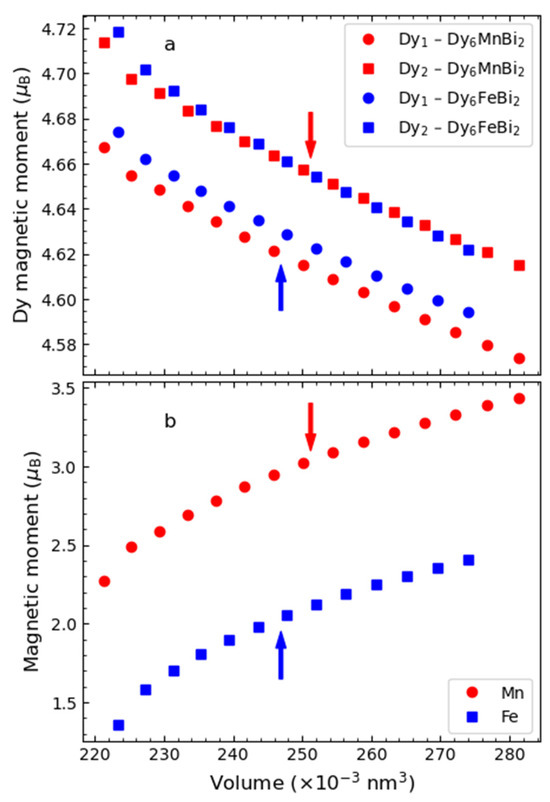
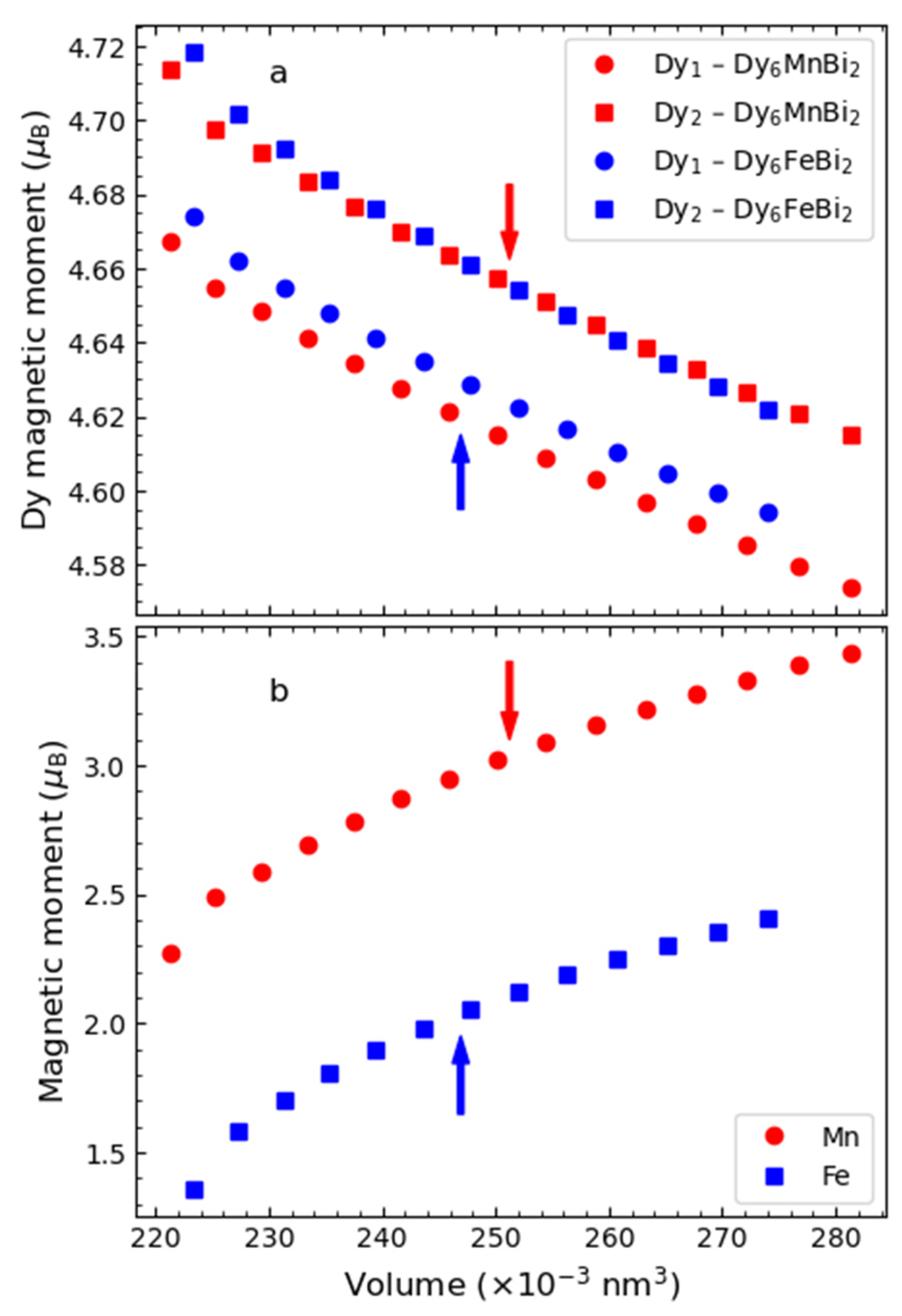
The evolution of the site-resolved magnetic moments with unit-cell volume for the Dy-based compounds is shown in Figure 5. Around the equilibrium volume, the two crystallographically inequivalent rare-earth sites carry moments close to 4.6–4.7 μB (Dy1 slightly larger than Dy2), which decrease only mildly as the volume increases, even for ≈8% volume changes. This volume dependence reflects the sensitivity of the rare-earth electronic polarization to the crystal environment. Although the Dy 4f electrons remain highly localized and preserve the local-moment character of the Dy ions, lattice expansion modifies the overlap between conduction states and the more extended Dy 5d orbitals. This could affect the intra-atomic 4f–5d exchange polarization and lead to a gradual reduction in the calculated Dy moment with increasing volume. Since the 4f states remain energetically well separated from the transition-metal 3d bands (according to the density of states calculations, see Section 4.3.), this effect seems to not be associated with a direct 3d–4f hybridization mechanism, but rather with changes in the conduction-electron-mediated magnetic polarization induced by the variation in the lattice parameters.
Figure 5.
(a) Calculated magnetic moments of the Ho ions. (b) Calculated magnetic moments of the Mn and Fe ions. The arrows indicate the corresponding equilibrium volume for each system.
On the other hand, the transition-metal sublattice displays non-zero magnetic moments in the DFT results (Mn above 3 μB; Fe ≈ 1.5–2.5 μB), and these values increase with volume. However, experiments on this family report a quenched transition-metal moment, so the DFT values must be regarded as spurious. Their appearance is consistent with known limitations of standard collinear GGA calculations that (i) neglect spin–orbit coupling and thus the orbital/quenching channels at the transition-metal site, (ii) may underplay 3d–p and 3d–5d hybridization and overestimate the Stoner exchange splitting, and (iii) do not include dynamical spin fluctuations. The systematic growth of the computed 3d moment with volume—i.e., with reduced bandwidth—fits the picture of a proximity-to-Stoner instability that DFT over-stabilizes, while the real materials remain non-magnetic at the transition-metal site. These points will be revisited below when discussing the microscopic mechanism for the high ordering temperatures.
The Ho-based compounds reported previously [3,5,8,15] exhibit the same qualitative trends: rare-earth moments (≈3.6–3.8 μB for Ho1/Ho2) vary only weakly and decrease slightly with increasing volume, whereas DFT again predicts non-zero Mn/Fe moments despite the experimental evidence for a quenched transition-metal moment. The common DFT artifact across Ho and Dy, together with the similar increase in the computed 3d moment with volume, points to the same underlying origin (band-narrowing/Stoner tendency partly compensated for by hybridization and spin–orbit-driven quenching). Thus, while the transition-metal sublattice appears non-magnetic experimentally, its hybridization with the rare-earth network likely mediates the exchange that yields the large ordering temperatures. A more quantitative assessment would require including spin–orbit coupling and beyond-GGA corrections (e.g., GGA + U and/or non-collinear states) [30], or constraining the transition-metal moment to zero and comparing total energies—tasks that we leave for future work (see Section 4.1 for computational limitations).
These results highlight both the robustness of the calculated rare-earth magnetic moments and the persistent DFT overestimation of the transition-metal magnetic moments. They set the stage for the following section, where we analyze the microscopic mechanisms underlying the collective magnetic behavior.
4.3. Density of States
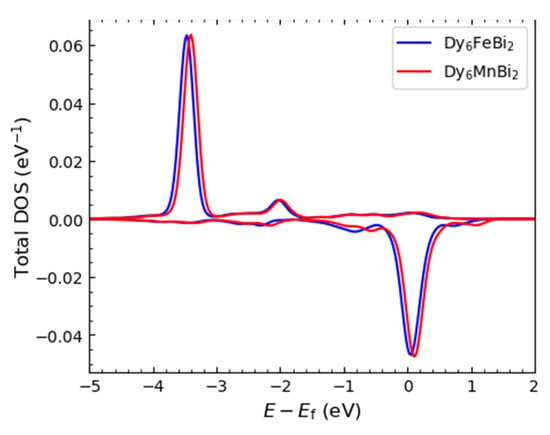
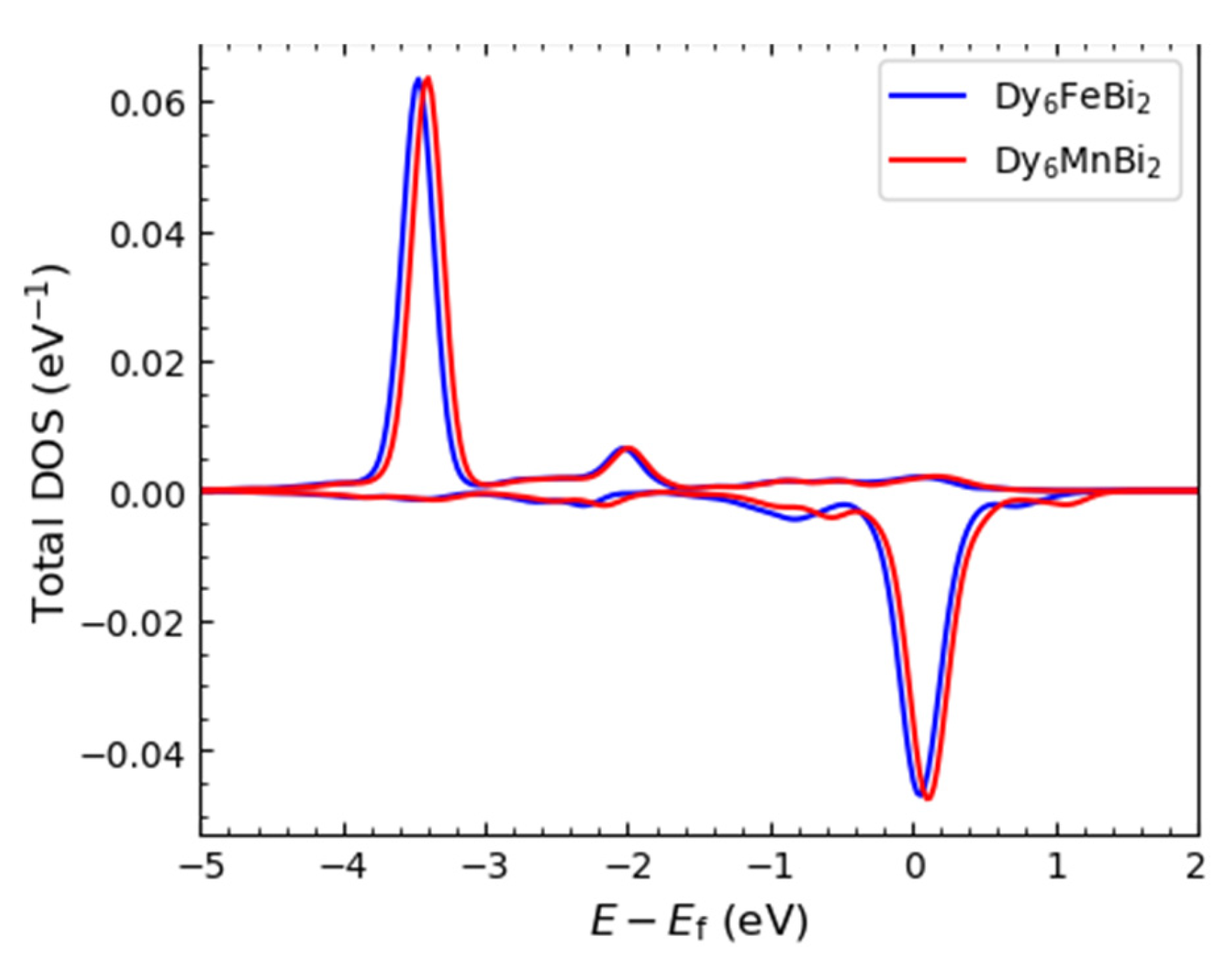
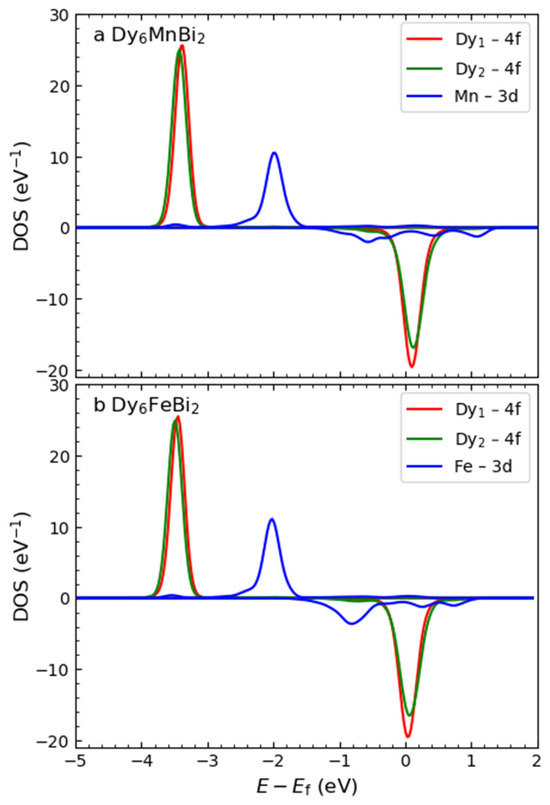
The total and partial densities of states (DOS) for Dy6MnBi2 and Dy6FeBi2 are shown in Figure 6 and Figure 7, respectively. The total DOS (Figure 6) exhibits a strong asymmetry between the spin-up and spin-down channels, confirming the spin-polarized character of both compounds. The majority-spin components of the two inequivalent Dy sites share the same orientation, indicating a ferromagnetic arrangement within the Dy sublattice. The transition-metal (TM) ions are likewise ferromagnetically aligned with the Dy moments, resulting in a fully ferromagnetic configuration of the rare-earth and TM sublattices.
Figure 6.
Total density of states for the spin-up and spin-down channels.
Figure 7.
Orbital-resolved density of states for the spin-up and spin-down channels.
As illustrated in Figure 7, the Dy 4f states form narrow, well-localized peaks centered around −4 eV, whereas the TM 3d bands extend approximately from −3 eV up to +2 eV. The lack of energetic overlap between these manifolds rules out any substantial 3d–4f hybridization. This is particularly relevant given that the Curie temperature increases sharply when Fe is replaced by Mn: such an enhancement therefore cannot originate from a strong 3d–4f interaction. Instead, the data point to an indirect exchange interaction between the inequivalent Dy sites, likely mediated by the itinerant Bi 6p or TM 3d electrons.
The Mn compound exhibits a slightly higher and more asymmetric DOS at the Fermi level, consistent with a larger density of itinerant carriers. Since the interaction between the localized Dy moments is expected to be mediated by itinerant electrons, this may enhance the indirect magnetic coupling between Dy ions. This suggests that the magnetic ordering temperature is controlled primarily by the details of the electronic structure rather than by geometric factors alone, providing a plausible explanation for the higher ordering temperature observed experimentally in Dy6MnBi2 despite its larger lattice parameters.
A comparison with the previously studied Ho6TBi2 (T = Mn, Fe) analogues [3] supports this interpretation. In both families, the rare-earth 4f states remain localized well below the Fermi level, and the TM 3d bands dominate the near-Ef region with minimal overlap. While the Ho compounds display an antiferromagnetic alignment between the rare-earth and TM sublattices, the Dy series shows ferromagnetic Dy–TM coupling. However, as discussed in [3], the sign of the Dy–TM (or Ho–TM) interaction is not physically meaningful, since the TM magnetic moments obtained in the DFT calculations are an artifact of the computational method and do not represent real, experimentally relevant moments. The essential physics is therefore governed not by the TM alignment, but by an indirect, conduction-electron-mediated RE1–RE2 exchange whose strength dictates the magnetic ordering temperature.
5. Conclusions
In this work, the structural and magnetic properties of Dy6MnBi2 and Dy6FeBi2 have been investigated within the framework of density functional theory. The equilibrium crystal structures, equation of state, electronic density of states, and magnetic moments were calculated and compared with available experimental data. The results confirm that DFT provides a consistent and reliable description of these systems, with calculated quantities in reasonable agreement with experiments. In particular, the optimized structures reproduce the experimental trends upon substitution of Fe by Mn, and the energetic stabilization of spin-polarized states is correctly captured.
A direct comparison with our recent work on the Ho analogs [3] highlights both similarities and differences. As in the Ho case, the Dy compounds display stabilization of the spin-polarized structures, linear growth of the basal-plane parameter a with increasing volume, and non-trivial evolution of the c axis under isotropic stress. However, quantitative distinctions are noteworthy. The Dy compounds exhibit larger equilibrium volumes, consistent with lanthanide contraction, and the energetic stabilization of the magnetic states is more pronounced, particularly for Dy6MnBi2. Furthermore, the anisotropy of the c/a ratio under isotropic stress is enhanced in the Dy systems, producing a clearer separation between the Mn and Fe systems. These results suggest that substitution of Ho by Dy alters the balance of interlayer and intralayer exchange interactions, which may ultimately impact the magnetocaloric performance of these materials.
Overall, the present study reinforces the predictive power of DFT for rare-earth-based intermetallics and provides a foundation for future work exploring the systematic role of rare-earth substitution in tuning magnetocaloric properties.
Author Contributions
Conceptualization: Á.J.G.-A. and A.O.; methodology: Á.J.G.-A. and E.A.; validation: F.R., I.R.A. and A.H.; formal analysis: F.R., Á.J.G.-A. and E.A.; investigation: all the authors; data curation: A.H. and I.R.A.; writing—original draft preparation: Á.J.G.-A. and A.O.; writing—review and editing: all the authors; visualization: Á.J.G.-A., E.A. and F.R.; supervision: Á.J.G.-A. and A.O.; project administration: A.O.; funding acquisition: A.O. All authors have read and agreed to the published version of the manuscript.
Funding
This work was funded by Departamento de Educación del Gobierno Vasco, grant number IT1959-26.
Data Availability Statement
The original data presented in the study are openly available in Zenodo at https://doi.org/10.5281/zenodo.18862701.
Acknowledgments
During the preparation of this study, the authors used ChatGPT (GPT-5.4) for the purposes of checking the manuscript’s English usage and grammar. The authors have reviewed and edited the output and take full responsibility for the content of this publication.
Conflicts of Interest
The authors declare no conflict of interest.
Abbreviations
The following abbreviations are used in this manuscript:
| DFT | Density Functional Theory |
| TM | Transition Metal |
| PM | Paramagnetic |
| FM | Ferromagnetic |
| AFM | Antiferromagnetic |
| DOS | Density of States |
| EOS | Equation of State |
References
- Herrero, A.; Oleaga, A.; Aseguinolaza, I.; Garcia-Adeva, A.; Apiñaniz, E.; Garshev, A.; Yapaskurt, V.; Morozkin, A. Tailoring the magnetocaloric, magnetic and thermal properties of Dy6(Fe,Mn)X2 intermetallics (X = Sb, Te, Bi). J. Alloys Compd. 2022, 890, 161849. [Google Scholar] [CrossRef] [Scilit]
- Herrero, A.; Aseguinolaza, I.R.; Oleaga, A.; Garcia-Adeva, A.J.; Apiñaniz, E.; Garshev, A.V.; Yapaskurt, V.O.; Morozkin, A.V. Selecting optimal R6TX2 intermetallics (R = Gd, Tb, Dy; T = Mn, Fe, Co, Ni; X = Sb, Te) for magnetic refrigeration. Dalton Trans. 2023, 52, 5780–5797. [Google Scholar] [CrossRef] [Scilit] [PubMed]
- Garcia-Adeva, A.J.; Apiñaniz, E.; Herrero, A.; Aseguinolaza, I.R.; Oleaga, A. First-principle calculations of magnetic properties of Ho6(Fe, Mn)Bi2 compounds. Rare Met. 2024, 43, 6034–6047. [Google Scholar] [CrossRef] [Scilit]
- Aseguinolaza, I.R.; Herrero, A.; Garcia-Adeva, A.J.; Apiñaniz, E.; Garshev, A.V.; Morozkin, A.V.; Oleaga, A. Broad table-like magnetocaloric effect in the full hydrogen liquefaction range in Gd3Ni6XY. J. Alloys Compd. 2024, 1010, 177154. [Google Scholar] [CrossRef] [Scilit]
- Herrero, A.; Oleaga, A.; Salazar, A.; Garshev, A.V.; Yapaskurt, V.O.; Morozkin, A.V. Magnetocaloric properties, magnetic interactions and critical behavior in Ho6(Fe,Mn)Bi2 intermetallics. J. Alloys Compd. 2020, 821, 153198. [Google Scholar] [CrossRef] [Scilit]
- Oleaga, A.; Herrero, A.; Salazar, A.; Garshev, A.V.; Yapaskurt, V.O.; Morozkin, A.V. Magnetocaloric properties and unconventional critical behavior in (Gd,Tb)6(Fe,Mn)Bi2 intermetallics. J. Alloys Compd. 2020, 843, 155937. [Google Scholar] [CrossRef] [Scilit]
- Herrero, A.; Oleaga, A.; Provino, A.; Aseguinolaza, I.R.; Salazar, A.; Peddis, D.; Manfrinetti, P. Crystallographic, magnetic and magnetocaloric properties in novel intermetallic materials R3CoNi (R = Tb, Dy, Ho, Er, Tm, Lu). J. Alloys Compd. 2021, 865, 158948. [Google Scholar] [CrossRef] [Scilit]
- Morozkin, A.V. New Zr6CoAs2-type R6FeSb2 (R = Sc, Y, Lu, Dy, Ho, Tm) and Ho6FeBi2 compounds. J. Alloys Compd. 2003, 353, L16–L18. [Google Scholar] [CrossRef] [Scilit]
- Morozkin, A.V. New Zr6CoAs2-type R6MnSb2 and R6MnBi2 compounds (R = Y, Lu, Dy, Ho). J. Alloys Compd. 2003, 360, L1–L2. [Google Scholar] [CrossRef] [Scilit]
- Morozkin, A.V. Magnetic structures of Zr6CoAs2-type Ho6FeSb2, Ho6CoBi2, Ho6FeBi2 and Ho6MnBi2 compounds. J. Alloys Compd. 2005, 395, 7–16. [Google Scholar] [CrossRef] [Scilit]
- Morozkin, A.; Nirmala, R.; Malik, S. Structural and magnetic properties of Fe2P-type R6TX2 compounds (R = Zr, Dy, Ho, Er, T = Mn, Fe, Co, Cu, Ru, Rh, X = Sb, Bi, Te). Intermetallics 2011, 19, 1250–1264. [Google Scholar] [CrossRef] [Scilit]
- Zhang, J.; Kang, Y.M.; Shan, G.; Bobev, S. Structural analysis of Gd6FeBi2 from single-crystal X-ray diffraction methods and electronic structure calculations. Acta Crystallogr. Sect. C Struct. Chem. 2019, 75, 562–567. [Google Scholar] [CrossRef] [Scilit] [PubMed]
- Gupta, S.; Suresh, K.G. Review on magnetic and related properties of RTX compounds. J. Alloys Compd. 2015, 618, 562–606. [Google Scholar] [CrossRef] [Scilit]
- Jain, A.; Shin, Y.; Persson, K.A. Computational predictions of energy materials using density functional theory. Nat. Rev. Mater. 2016, 1, 15004. [Google Scholar] [CrossRef] [Scilit]
- Chen, Z.; Chen, W.; Feizpour, D.; Wang, B.; Feizpour, M.; Zhang, Y.; Godec, M.; Li, L. Experimental and theoretical insights into cryogenic magnetic and magnetocaloric properties in geometrically frustrated REAgGe (RE = Ho, Er, and Tm) compounds. J. Rare Earths, 2026; in press. [CrossRef] [Scilit]
- Yang, J.; Lin, J.; Gong, X.; Xu, J.; Kong, Z.; Li, L. Magnetic transition and magnetocaloric properties in Tm2FeAl3 compound. J. Magn. Magn. Mater. 2026, 648, 174110. [Google Scholar] [CrossRef] [Scilit]
- Giannozzi, P.; Baroni, S.; Bonini, N.; Calandra, M.; Car, R.; Cavazzoni, C.; Ceresoli, D.; Chiarotti, G.L.; Cococcioni, M.; Dabo, I.; et al. QUANTUM ESPRESSO: A modular and open-source software project for quantum simulations of materials. J. Phys. Condens. Matter 2009, 21, 395502. [Google Scholar] [CrossRef] [Scilit] [PubMed]
- Giannozzi, P.; Baseggio, O.; Bonfà, P.; Brunato, D.; Car, R.; Carnimeo, I.; Cavazzoni, C.; de Gironcoli, S.; Delugas, P.; Ferrari Ruffino, F.; et al. Quantum ESPRESSO toward the exascale. J. Chem. Phys. 2020, 152, 154105. [Google Scholar] [CrossRef] [Scilit] [PubMed]
- Prandini, G.; Marrazzo, A.; Castelli, I.E.; Mounet, N.; Marzari, N. Precision and efficiency in solid-state pseudopotential calculations. npj Comput. Mater. 2018, 4, 72. [Google Scholar] [CrossRef] [Scilit]
- Lejaeghere, K.; Bihlmayer, G.; Björkman, T.; Blaha, P.; Blügel, S.; Blum, V.; Caliste, D.; Castelli, I.E.; Clark, S.J.; Dal Corso, A.; et al. Reproducibility in density functional theory calculations of solids. Science 2016, 351, 1415. [Google Scholar] [CrossRef] [Scilit] [PubMed]
- Blöchl, P.E. Projector augmented-wave method. Phys. Rev. B 1994, 50, 17953–17979. [Google Scholar] [CrossRef] [Scilit] [PubMed]
- Topsakal, M.; Wentzcovitch, R.M. Accurate projected augmented wave (PAW) datasets for rare-earth elements (RE = La–Lu). Comput. Mater. Sci. 2014, 95, 263–270. [Google Scholar] [CrossRef] [Scilit]
- Garrity, K.F.; Bennett, J.W.; Rabe, K.M.; Vanderbilt, D. Pseudopotentials for high-throughput DFT calculations. Comput. Mater. Sci. 2014, 81, 446–452. [Google Scholar] [CrossRef] [Scilit]
- Dal Corso, A. Pseudopotentials periodic table: From H to Pu. Comput. Mater. Sci. 2014, 95, 337–350. [Google Scholar] [CrossRef] [Scilit]
- Perdew, J.P.; Burke, K.; Ernzerhof, M. Generalized gradient approximation made simple. Phys. Rev. Lett. 1996, 77, 3865–3868. [Google Scholar] [CrossRef] [Scilit] [PubMed]
- Perdew, J.P.; Ruzsinszky, A.; Csonka, G.I.; Vydrov, O.A.; Scuseria, G.E.; Constantin, L.A.; Zhou, X.; Burke, K. Restoring the Density-Gradient Expansion for Exchange in Solids and Surfaces. Phys. Rev. Lett. 2008, 100, 136406. [Google Scholar] [CrossRef] [Scilit] [PubMed]
- Marzari, N.; Vanderbilt, D.; De Vita, A.; Payne, M.C. Thermal Contraction and Disordering of the Al(110) Surface. Phys. Rev. Lett. 1999, 82, 3296–3299. [Google Scholar] [CrossRef] [Scilit]
- Jackson, A.J.; Skelton, J.M.; Hendon, C.H.; Butler, K.T.; Walsh, A. Crystal structure optimisation using an auxiliary equation of state. J. Chem. Phys. 2015, 143, 184101. [Google Scholar] [CrossRef] [Scilit] [PubMed]
- Zaharioudakis, D. Tetrahedron methods for Brillouin zone integration. Comput. Phys. Commun. 2004, 157, 17–31. [Google Scholar] [CrossRef] [Scilit]
- Yang, T.; Zhang, J.; He, W.; Shih, K.; Ma, S.; He, C. Tuning structure and magnetic properties of table-like magnetocaloric effect in Er6MnSb2 by zirconium substitution. J. Rare Earths 2023, 41, 1073–1082. [Google Scholar] [CrossRef] [Scilit]

Disclaimer/Publisher’s Note: The statements, opinions and data contained in all publications are solely those of the individual author(s) and contributor(s) and not of MDPI and/or the editor(s). MDPI and/or the editor(s) disclaim responsibility for any injury to people or property resulting from any ideas, methods, instructions or products referred to in the content. |
© 2026 by the authors. Licensee MDPI, Basel, Switzerland. This article is an open access article distributed under the terms and conditions of the Creative Commons Attribution (CC BY) license.