


Abstract
Polyphenolic compounds extracted from Taraxacum officinale (dandelion) were used as natural chelating ligands to synthesize copper–polyphenol complexes, which were subsequently immobilized on sericite to obtain hybrid organic–inorganic materials. The complexes were prepared under controlled pH and temperature conditions, yielding structures with different Cu–polyphenol ratios. Structural characterization confirmed the formation of Cu(II)–polyphenol chelates, partial reduction to Cu(I) species at higher pH values, and the deposition of mixed Cu2O/CuO phases on the layered sericite substrate. Copper–polyphenol superstructures, copper nanoparticles, and copper oxide crystallites were heterogeneously distributed depending on synthesis conditions and metal–ligand ratios. The hybrid materials exhibited modified optical properties, combining the intrinsic reflectance of sericite with UV absorption from polyphenols and copper species. When incorporated into an emulsion matrix, the materials showed promising UV-screening performance, with SPF-equivalent values ranging from 7 to 33 depending on concentration. Antimicrobial evaluation demonstrated that copper–polyphenol complexes displayed enhanced activity against Staphylococcus aureus, Staphylococcus epidermidis, Escherichia coli, and Candida albicans compared to the natural extract, while sericite-supported hybrids retained selective efficacy, particularly against Gram-positive bacteria and C. albicans. These results indicate the potential of dandelion-derived copper complexes and their sericite hybrids as multifunctional bioactive agents for cosmetic dermatology applications.
1. Introduction
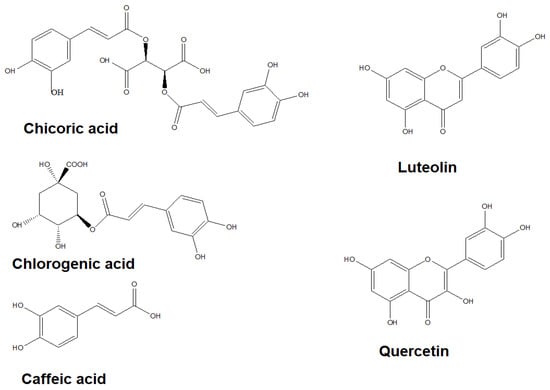
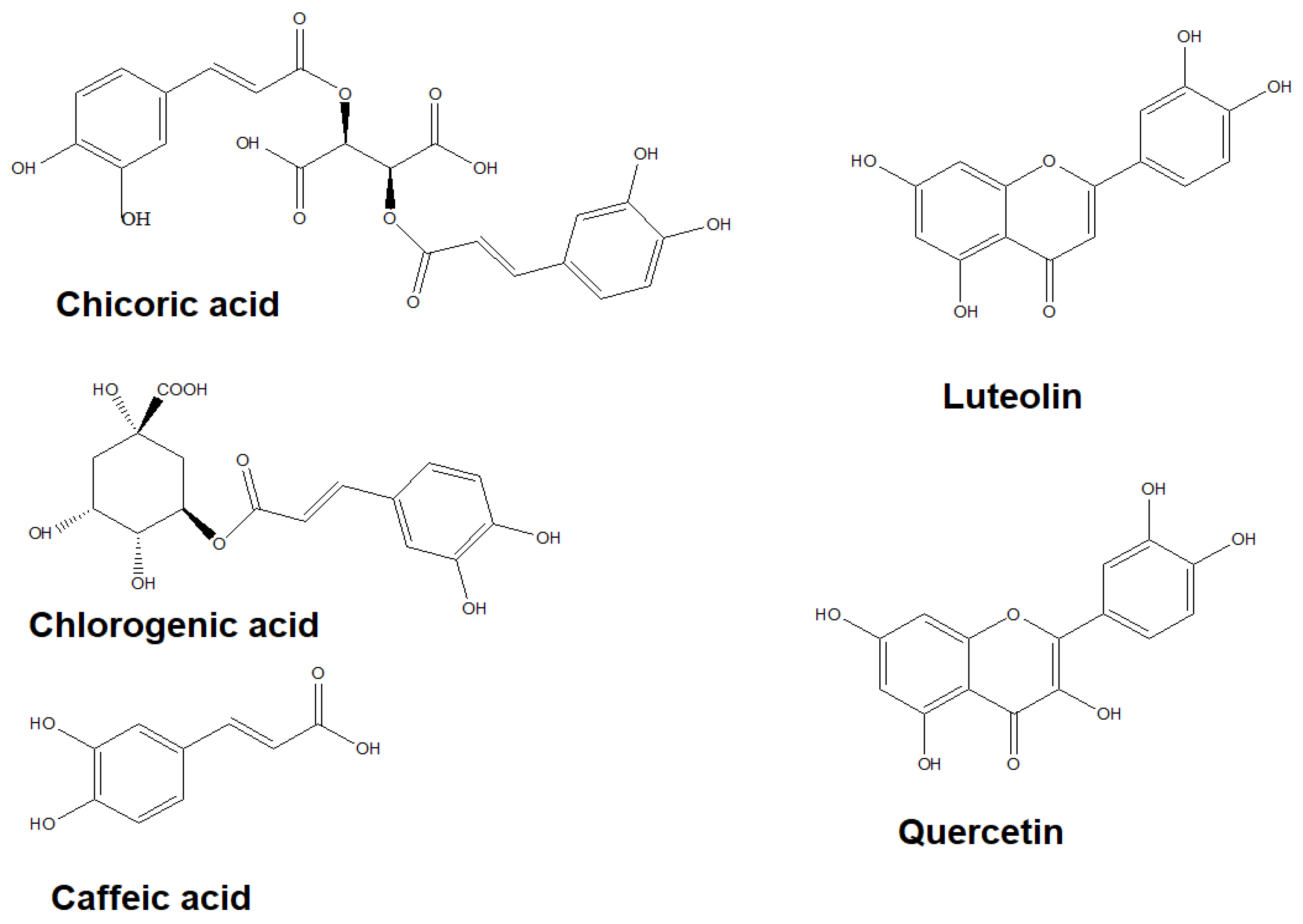
The growing demand for environmentally friendly and biocompatible materials has encouraged the exploration of plant-derived compounds as sustainable alternatives in chemistry and materials science. Taraxacum officinale (dandelion) is found naturally throughout much of the world, including North America, Europe, and Asia. Dandelion is a widely distributed medicinal plant rich in polyphenolic compounds (Figure 1) such as flavonoids (luteolin, apigenin, and quercetin) and carotenoids, known for their strong antioxidant and anti-inflammatory properties. Dandelion has a long history of use in traditional medicine and is currently being studied for its potential in treating liver and kidney disorders, managing diabetes, and providing diuretic effects. Some compounds can protect against atherosclerosis by preventing the formation and worsening of this process. Flavonoids also contribute to cardio-protective roles. The polyphenolic compounds contribute to other effects, including antiviral, antimutagenic, and antimicrobial activities [1,2,3,4,5]. These natural molecules can act as chelating ligands, forming stable coordination complexes with transition metal ions such as copper (II), iron (III), or zinc (II) [6,7,8,9]. Copper complexes with natural ligands have attracted increasing attention due to their diverse biological properties, including antimicrobial, antioxidant, and wound-healing effects [7,10,11]. In biomedical applications, such complexes show promise as therapeutic agents, drug carriers, and bioactive components in tissue regeneration. Furthermore, in the cosmetic dermatology field, copper–polyphenol complexes are explored for their ability to protect the skin from oxidative stress, promote collagen synthesis, and enhance pigmentation stability in natural formulations [12,13,14,15].
Figure 1.
The structural formulas of selected phenolic compounds as examples of the class of compounds under discussion.
Beyond their biological potential, copper complexes derived from dandelion pigments can be immobilized or deposited onto inorganic supports to form hybrid biofunctional coatings. Materials such as silica, titania, and aluminosilicate-based matrices provide excellent mechanical stability, tunable porosity, and a chemically compatible surface for the anchoring of metal–organic complexes [16,17,18,19,20]. Hybrid systems obtained by loading natural compounds (e.g., polyphenols, tannins, alkaloids, and polysaccharides) onto mineral supports have undergone significant development in recent years. These systems are designed to stabilize volatile compounds and those sensitive to light or other degradation factors by depositing them onto inorganic host platforms [21,22,23]. In this way, the application range of natural extracts has been expanded without compromising their antioxidant, antibacterial, or thermal stability properties. Such hybrid materials are used in the food industry and for coatings with antioxidant, anticorrosion, or antimicrobial functionalities. Controlled-delivery systems for active natural compounds have also been developed for applications in agriculture, medicine, and cosmetics [24,25,26,27]. Although copper is an essential trace element involved in fibroblast proliferation, collagen synthesis, lysyl oxidase activity, and angiogenesis [28,29], the literature clearly indicates that its biological effects are heavily dose-dependent. Specifically, Li et al. demonstrated that certain copper salts (such as CuCl2 and Cu(OAc)2) induce the expression of the inflammatory markers IL-1α and IL-8, while exhibiting significant cytotoxicity in human keratinocytes at elevated concentrations; conversely, other forms, such as the GHK-Cu complex, display a more favorable safety profile [30]. Furthermore, a recent analysis published in Dermatology and Therapy underscores that topical Cu/Zn products are generally well tolerated when formulated for localized use, characterized by minimal systemic absorption and constraints regarding both application time and surface area [29].
Sericite, a fine-grained mica-type aluminosilicate, possesses a layered structure with a high aspect ratio, hydrophilic surface groups, and a large specific area, making it an ideal carrier for functional nanostructures. The interlayer spacing and abundant –OH groups on sericite surfaces facilitate the adsorption or intercalation of complex compounds, ensuring homogeneous distribution and enhanced stability [31,32,33,34]. Due to these properties, sericite is often used as a platform in composites with hierarchical micro/nano structures of the sericite-rutile or sericite/TiO2/Cu2O type, resulting in hybrid materials with UV shielding, antimicrobial, or photocatalytic properties [35,36,37,38,39]. The composites studied so far have targeted thermal insulation applications, reflective coatings, or photovoltaic performance of dye-sensitized solar cells (DSSC) supported by the light scattering properties exhibited by sericite [36,40,41]. Along with other clay minerals, such as bentonite and hectorite, sericite has a high refractive index and optimal light scattering properties for use in sunscreens [42]. Sericite is not only a substrate for nanoscale metal oxides for the manufacture of microscale composite materials but also affects the formation of their various crystalline forms. Thus, the synergistic effect of sericite-iron oxide or titanium oxide nanoparticles composites can facilitate the photocatalytic degradation properties of metal oxides and have the potential to be used as environmentally friendly photocatalysts in the degradation of pollutants [43,44].
In this study, we used the chelating properties of polyphenolic compounds extracted from dandelion to form a complex with copper ions. The resulting complexes were deposited on sericite support, thus obtaining hybrid organic–inorganic materials. While the green synthesis of copper-based nanoparticles using various floral extracts has been documented [45,46,47], their stabilization onto functional cosmetic mineral matrices remains vastly unexplored. This study addresses this gap by synthesizing a novel ternary hybrid system consisting of Taraxacum officinale-derived polyphenols and copper oxides (CuO/Cu2O) anchored onto a cosmetic-grade sericite substrate. Unlike unsupported nanoparticles reported in previous literature, this sericite-supported complex serves a dual purpose: the mineral matrix provides texturizing properties essential for topical formulations, while the immobilized dandelion-derived polyphenols and copper oxides act synergistically to deliver high antioxidant, UV-filtering, and anti-acne biocide activities. The antibacterial activity was evaluated for the copper complex compounds as well as for the cream in which they were incorporated.
2. Materials and Methods
2.1. Materials
The fresh plant materials, dandelion flowers, were collected from Romania, Sighisoara (coordinates: 46°13′1″ N 24°47′28″ E). They were collected from a meadow, late in the morning on a sunny day in July. Copper sulfate (CuSO4·5H2O), ethanol (EtOH), and dimethylsulfoxide (DMSO) were purchased from Merck (Darmstadt, Germany) and were used without further purification. The sericite mineral support was purchased from the website www.ellemental.ro. Tests were performed to evaluate the shielding effect against ultraviolet light by incorporating the hybrid materials into a cream not having a protective factor (Eveline, Zytnia, Poland).
2.2. Synthesis of Cu–Polyphenol Metal Complexes
The determination of flavonoid contents in extract was determined using the standard method of thin layer chromatography (TLC) and by High Performance Liquid Chromatography (Supplementary Materials, Figure S1 and Table S1). The analysis was carried out using TLC plates (silicagel F254, Merck, Darmstadt, Germany ) and a solution of ethyl acetate: glacial acetic acid–hexane (3:0.1:2 v/v). After TLC analysis, the spots (2 μL, volume) were exposed under a lamp with ultraviolet light at 365 nm. The value of the relative velocity of movement of flavonoids (Rf) was determined using the following formula:
where, R = the distance covered by the substance, cm; R0 = the distance covered by the eluent, cm.
The natural extract of active compounds was prepared by submerging 5 g of fresh dandelion flower petals in 100 mL of EtOH. Extraction was carried out using a thermostatted ultrasonic bath at 50 °C for 1 h. The plant material was removed by manual pressing, and the resulting filtrate, which exhibited an extraction efficiency of 126 mg of polyphenols per gram of fresh biomass (yielding a total polyphenolic concentration of 6.3 mg/mL) was used for the copper ion chelation.
For the chelation process, 5–20 mL of the natural extract was combined with 5 mL of an aqueous copper sulfate solution at varying concentrations (0.01–0.1 mol/L) [48]. The pH was adjusted from an initial value of 5 to a range of 7–8 using 0.1 M NaOH (Table 1). The resulting mixtures were held in a thermostatted ultrasonic bath at 60 °C for 2 h, during which time the solution color changed to green. The formed Cu–polyphenol metallic complexes were isolated by centrifugation and filtration. The solid phase was suspended, under magnetic stirring, in 10 mL EtOH to eliminate free polyphenolic compounds; then, it was filtered and subsequently dried at 90 °C. To establish the optimal conditions of the complexation reaction, the Folin–Ciocalteu method was used. In this way, the number of phenolic groups involved in coordination bonds with the metal was qualitatively evaluated. Thus, from each reaction mixture, after 2 h, 100 μL of sample was taken, to which 500 μL of Folin–Ciocalteu solution and 1500 μL of 7.5% Na2CO3 solution were added. After equilibrating the reaction in the dark, the absorbance at 765 nm was measured. The total concentration of polyphenolic compounds was calculated using a standard gallic acid solution.
Table 1.
Metal complexes and their synthesis conditions.
2.3. Obtaining Hybrid Materials by Depositing Cu–Polyphenol Complexes on the Sericite Mineral
The inorganic sericite matrix, before being used as a support for Cu–polyphenol complexes, was subjected to an acid activation treatment using 3.0 mol·L−1 HCl at 100 °C [49]. For the preparation of the hybrid materials, 0.5 g of activated sericite was suspended in 50 mL of an alcoholic solution of the Cu–polyphenol complex (10 mg/mL). The suspension was treated in a thermostatted ultrasonic bath at 40 °C for 30 min, during which the absorbance of the alcoholic solution was measured every 10 min. After 30 min, the differences between the absorption maxima were insignificant. Following this, the suspension was centrifuged, and the precipitate was filtered. The resulting hybrid materials were then dried at 90 °C for 4 h. The adsorption efficiency of the metallic complexes onto the mineral support ranged from 20% to 33%, whereas the polyphenolic extract without copper content exhibited a lower adsorption efficiency of 18%. This efficiency was calculated based on the absorbance of the liquid phase measured before and after the deposition process (Table 2).
Table 2.
Hybrid materials and their synthesis conditions.
The equation used to calculate the efficiency of the deposition process (R%) is as follows:
where, R% = adsorption rate of metal complexes on sericite; Ai = absorbance of the initial solution of Cu–polyphenol complex; Af = absorbance of the final solution after deposition of Cu–polyphenol complex.
2.4. Methods for Characterizing and Testing the Morphostructural Properties of Cu–Polyphenol Complexes and Final Hybrid Materials
The analysis of natural extract was performed using an Agilent 1100 HPLC system equipped with a diode-array detector (DAD) (Agilent Technologies, Santa Clara, CA, USA), including a pump, an automatic sample injection system, and a thermostated column compartment. Chromatographic separation was achieved on a Kromasil C18 column (150 mm × 4.6 mm, 5 μm) (Kromasil, Gothenburg, Sweden). The mobile phase consisted of a mixture of two eluents: eluent A, water containing 0.1% (v/v) formic acid, and eluent B, methanol. The flow rate was maintained at 0.7 mL/min, and the injection volume was 10 μL. A stock solution of 100 mg L−1 was prepared in methanol, while calibration standards were obtained by appropriate dilution of the stock solution. All working standard solutions and the analyzed sample were filtered through 0.45 μm syringe filters prior to analysis.
The spectrophotometer (V570 UV-VIS-NIR, Jasco Int. Co., Ltd., Tokyo, Japan) equipped with a JASCO ILN-472 (150 mm, Jasco Int. Co., Ltd., Tokyo, Japan) integrating sphere, using Spectralon as reference, in the range 260–780 nm, was used to record the absorption spectra of natural extracts and metal complexes and the optical characteristics of hybrid materials by recording diffuse reflectance spectra. To evaluate the UV-shielding effect, the hybrid materials were dispersed in a viscous oil-in-water (o/w) cosmetic emulsion without intrinsic sun protection factor (SPF) activity. The emulsion matrix consisted mainly of water, glycerin, cetearyl alcohol, ceteareth-20, Butyrospermum parkii Butter, betaine, Triticum vulgare germ oil, Aloe barbadensis leaf extract, and others. The active hybrid materials (Sericite, SC1, SC2, and SC3) were accurately weighed and uniformly dispersed into the cooling emulsion at 40 °C at specific weight fractions (10 wt.% and 20 wt.%), after which they were spread onto a 20 cm2 piece of the 3M TransporeTM tape (3M Company, Saint Paul, MN, USA). The transmission spectra were measured in the range 290–400 nm, under the following conditions: bandwidth: 5.0 nm; scan speed: 100 nm/min; response: 0.96 s.; data interval: 1 nm, according to the Diffey and Robson method for calculating sun protection factor (SPF) in vitro [50].
The obtained Cu–polyphenol complex and organic–inorganic hybrid materials were structurally characterized by a series of FTIR analyses recorded in the 400–4000 cm−1 range (with JASCO FT-IR 6300 instrument, Jasco Int. Co., Ltd., Tokyo, Japan) using the diffuse reflectance Fourier-transform infrared (DRIFT) method.
X-ray diffraction for complexes and hybrid materials recorded in the 2θ range 2–90° (9 kW) (Rigaku SmartLab equipment, Rigaku Corporation, Tokyo, Japan), operated at 45 kV and 200 mA, CuKα radiation—1.54059 Å, in scanning mode 2θ/θ. All the XRD data interpretation and calculations were performed using the dedicated software PDXL (v. 2.7.2.0.) by comparison with the ICDD database. The crystallite size was calculated using the Debye–Scherrer equation:
where Dp = the average size of the crystallites; K = the Scherrer constant (for cubic structures, K = 0.94); β = the peak broadening at full width at half-height of the diffraction maximum; θ = the Bragg angle; λ = X-ray wavelength—1.54059 Å.
The topography of the Cu–polyphenol complexes and the hybrid materials were captured using a scanning electron microscope operated at an accelerating voltage 15 kV (SEM, model TM4000Plus from HITACHI in Tokyo, Japan), and an energy-dispersive X-ray spectrometer (EDS, model X-stream-2 from Oxford Instruments in Oxford, UK) in the SEM configuration enabling to analyze the elemental composition using AZtecOne 1.0 software from Oxford Instruments.
The textural characterization of the hybrid materials was performed using the Nova 2200e Quantachrome automated gas adsorption system (Quantachrome Instruments Corporate Drive, Boynton Beach, FL, USA). All samples were degassed at 250 °C for 4 h, after which N2 adsorption–desorption isotherms were measured at −196 °C. Surface area measurements, pore volume, and pore size were determined by the BET (Brunauer–Emmett–Teller) and BJH (Barrett–Joyner–Halenda) methods, respectively.
The thermogravimetric analysis of metal complexes and hybrid materials was performed with Q5000IR instrument (TA Instruments, New Castle, DE, USA) using 3–6 mg of each sample placed in platinum pans under the following conditions: heating ramp 10 °C·min−1 up to 750 °C, Nitrogen 5.0 (99.999%), used as purge gas at a 50 mL·min−1 flow rate.
2.5. Antibacterial Test of Cu–Polyphenol Complex and Hybrid Materials
The antibacterial activity of the natural extract, Cu–polyphenol complex, and hybrid materials against bacterial strains Staphylococcus aureus (ATCC 25923), Staphylococcus epidermidis, and Escherichia coli (ATCC 25922), as well as the antifungal activity against the fungal strain Candida albicans (ATCC 10231), was tested using the diffusion method. The method was performed in Petri dishes on specific agar media: Mueller–Hinton agar for the bacterial strains E. coli, S. epidermidis, and S. aureus, and Sabouraud agar for the fungal strain C. albicans. The working inoculum was a standardized suspension prepared from a fresh 18–24 h microbial culture. This suspension was adjusted in sterile physiological saline (AFS) to a density of 1–3 × 10⁸ CFU/mL, which is equivalent to the 0.5 McFarland standard. Optical density was further adjusted by measuring the absorbance at 600 nm until an optimal value was achieved. All samples were inoculated aseptically at a volume of 30 μL per spot onto the agar medium, which had been previously inoculated “lawn-style” with the tested microorganisms. For bacterial strains, the inoculated Petri dishes were incubated for 24 h at 37 °C. For the fungal strain C. albicans, plates were incubated at 28 °C. Antimicrobial activity was assessed by measuring the diameter of the zone of inhibition (halo) that appeared around the samples. A larger halo diameter indicates a higher antimicrobial activity. The tested samples used for the antimicrobial evaluation included: natural extract of Taraxacum officinale (C0), Cu–polyphenol complex (C1 and C2), SC2 hybrid material in aqueous suspension or incorporated into a cream matrix (1:10 w/w), and sericite mineral support.
The results were compared with positive controls: Clindamycin (2 μg) and Ciprofloxacin (50 μg) antibacterial standards; Ketoconazole (50 μg) antifungal standard.
2.6. Statistical Analysis
All experiments were performed in triplicate (n = 3), and the results were expressed as mean ± standard deviation (SD). Data were analyzed using Student’s t-test to determine the significance of differences between each tested sample and the positive control. A p-value of less than 0.05 (p < 0.05) was considered statistically significant. Statistical analysis was performed using Microsoft Excel 2021.
3. Results
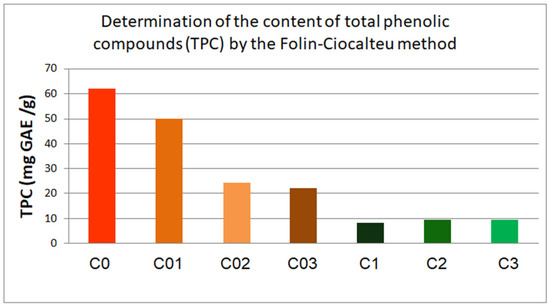
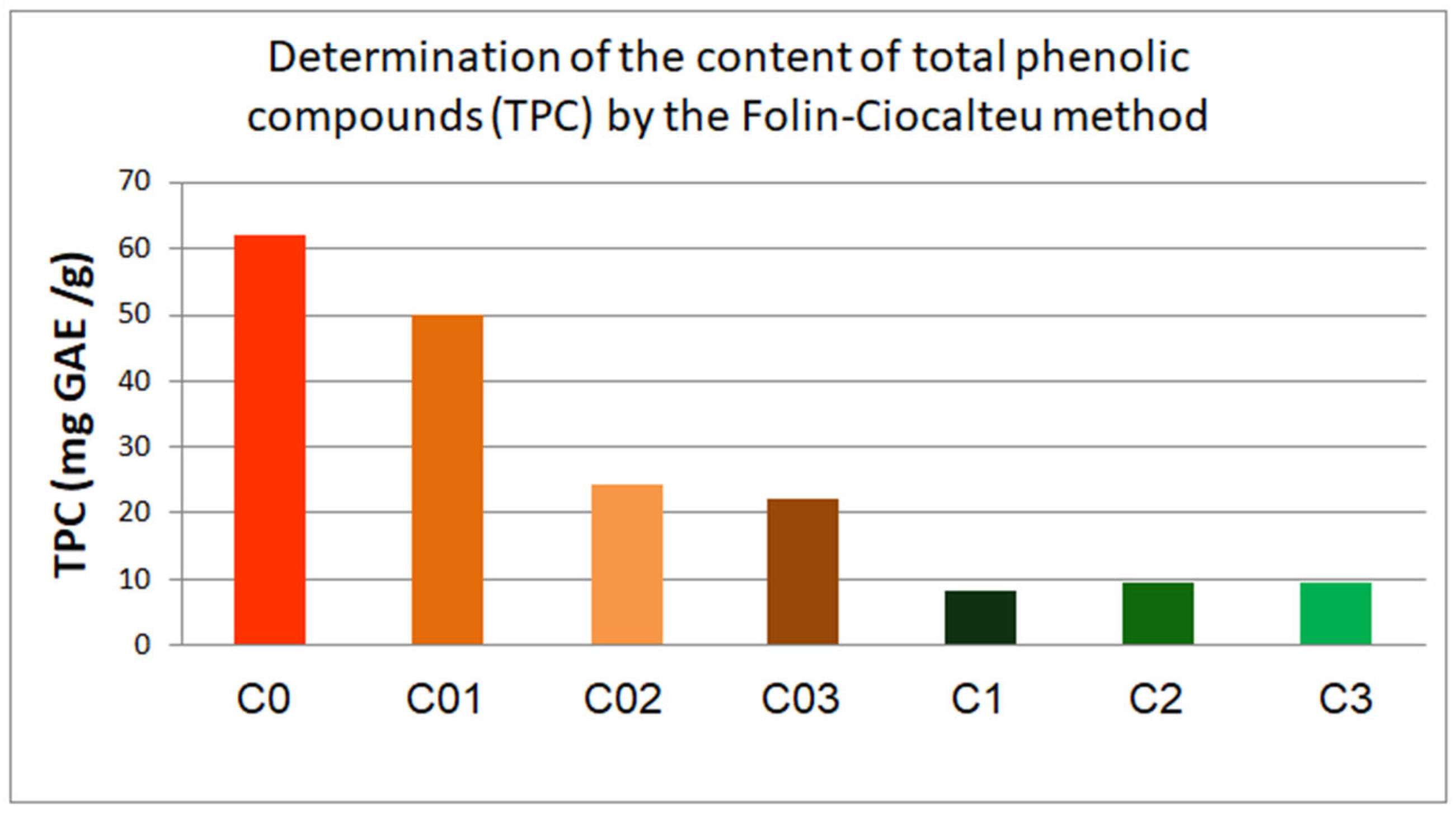
Copper complexes with polyphenolic ligands were obtained according to the Wang method [48] modified by varying the complexation reaction parameters. Polyphenolic compounds contained in dandelion flowers were extracted using ethanol. The extract (C0) with a residual mass after solvent evaporation of 6.3 mg/mL was analyzed by thin-layer chromatography. After developing the chromatogram, three spots were obtained: the first, Rf = 0.42, was assigned to the lutein compound, and the second, Rf = 0.87, was assigned to chicoric acid, while Rf = 0.96 was confirmed by the literature to represent caffeic acid [51,52,53]. To establish the parameters of the complexation reaction of phenolic compounds with copper ions, the total concentration of phenolic compounds was determined by the Folin–Ciocalteu method [53]. This method was used considering that the hydroxyl groups otherwise available to form coordinate bonds with copper ions could be evaluated (Figure 2).
Figure 2.
Determination of phenolic compounds in the extract relative to the concentration of copper ions: C01(0.01 mol/L); C02(0.01 mol/L); C03(0.025 mol/L); C1(0.025 mol/L); C2(0.05 mol/L); C3(0.1 mol/L).
The resulting extract was then treated with an aqueous solution of copper sulfate at varying concentrations, while also manipulating the pH and temperature. The results of the total phenolic content (TPC) determination via the Folin–Ciocalteu method, plotted as a function of copper ion concentration and precursor volumetric ratios, are systematized in Figure 2. The native dandelion extract (C0) exhibited the maximum phenolic concentration, recording a value of approximately 62 mg GAE/g. Upon the introduction of the copper precursor into the system, a drastic and progressive reduction in the detectable free TPC values is observed. This decline is directly proportional to both the increasing molarity of the copper solution (from 0.01 mol/L to 0.1 mol/L) and the shift in volumetric ratios toward the inorganic phase (from 4:1 to 1:1, v/v). For samples synthesized with higher copper concentrations (C1, C2, and C3 at a 1:1, v/v ratio), the TPC values stabilized at a minimum plateau below 10 mg GAE/g.
This sharp downward trend provides direct experimental evidence of the active involvement of Taraxacum officinale polyphenols in the redox and stabilization pathways. The decrease in the TPC signal indicates that the phenolic hydroxyl groups capable of reducing the Folin–Ciocalteu reagent were competitively depleted through two main mechanisms: (i) their irreversible oxidation into quinone structures during the partial reduction of Cu2+ ions, and (ii) their coordinate blocking and steric immobilization as capping agents anchoring onto the surfaces of the newly nucleated copper oxide (CuO/Cu2O) nanoparticles (Supplementary Materials, Figure S2).
The structural and morphological characterization of the three selected hybrid systems was performed using X-ray diffraction (XRD), scanning electron microscopy (SEM), and energy-dispersive X-ray spectroscopy (EDX) analyses (data provided in the Supplementary Materials, Figure S3, and Tables S2 and S3). The experimental results revealed that the final structural architecture and composition of the copper–polyphenol complexes are concomitantly governed by the multicomponent phytochemical profile of the extract and the initial concentration of copper ions in the system. Consequently, a gradual increase in the copper precursor concentration mediates a competitive redox and hydrolysis process, leading to the generation of mixed crystalline phases. These phases consist of a heterogeneous mixture of copper oxides (CuO/Cu2O), onto whose surfaces the polyphenolic compounds derived from the Taraxacum officinale extract remain structurally anchored, exerting a stabilizing capping effect.
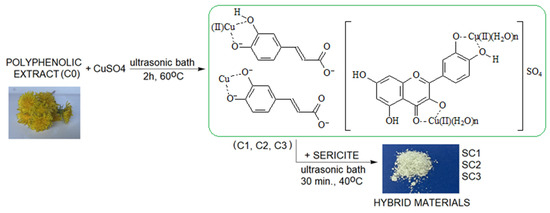
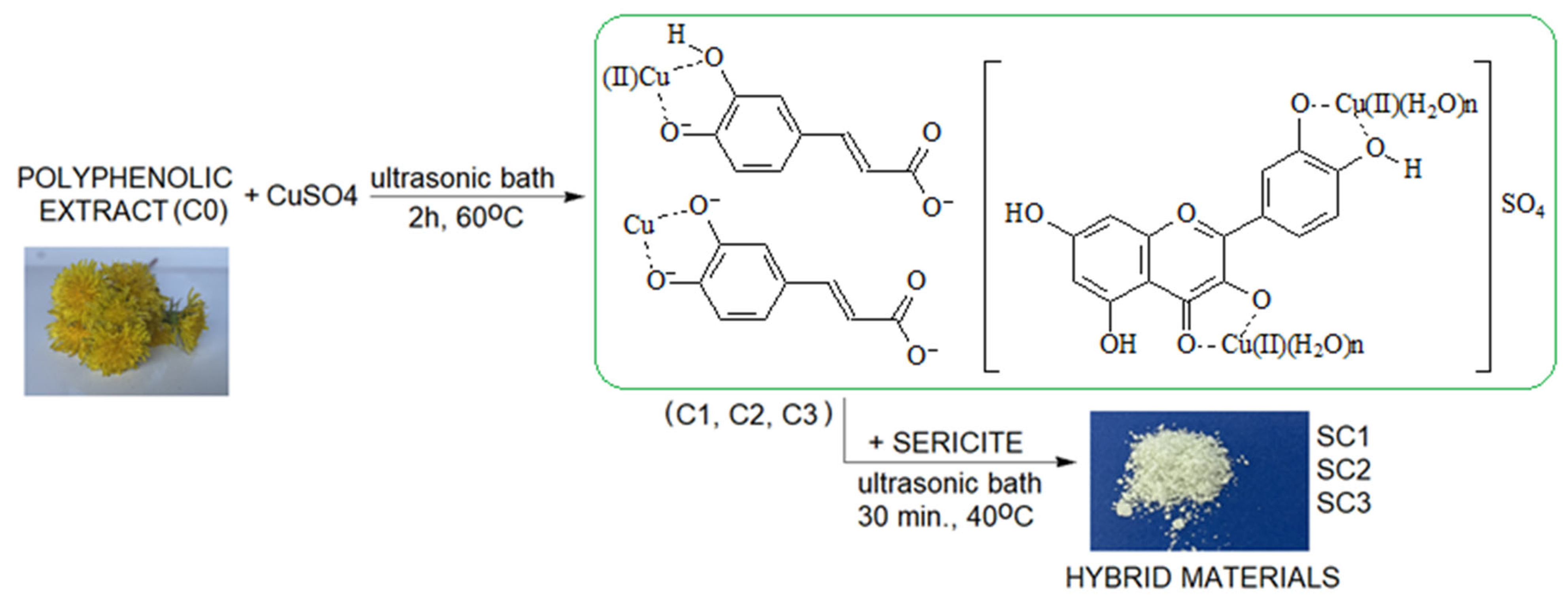
The resulting complexes were subsequently deposited onto a sericite mineral substrate, culminating in the production of hybrid materials (Figure 3) loaded with copper–polyphenolic complexes, whose morphostructural properties were then investigated. The final hybrid materials were characterized morphostructurally, and these characteristics were correlated with their optical and antimicrobial properties to identify potential application domains.
Figure 3.
Scheme of the process for obtaining copper–polyphenol complexes immobilized on the sericite support.
3.1. Structural Characterization
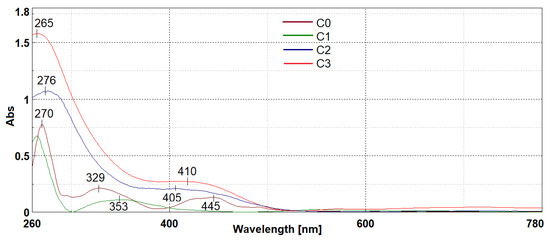
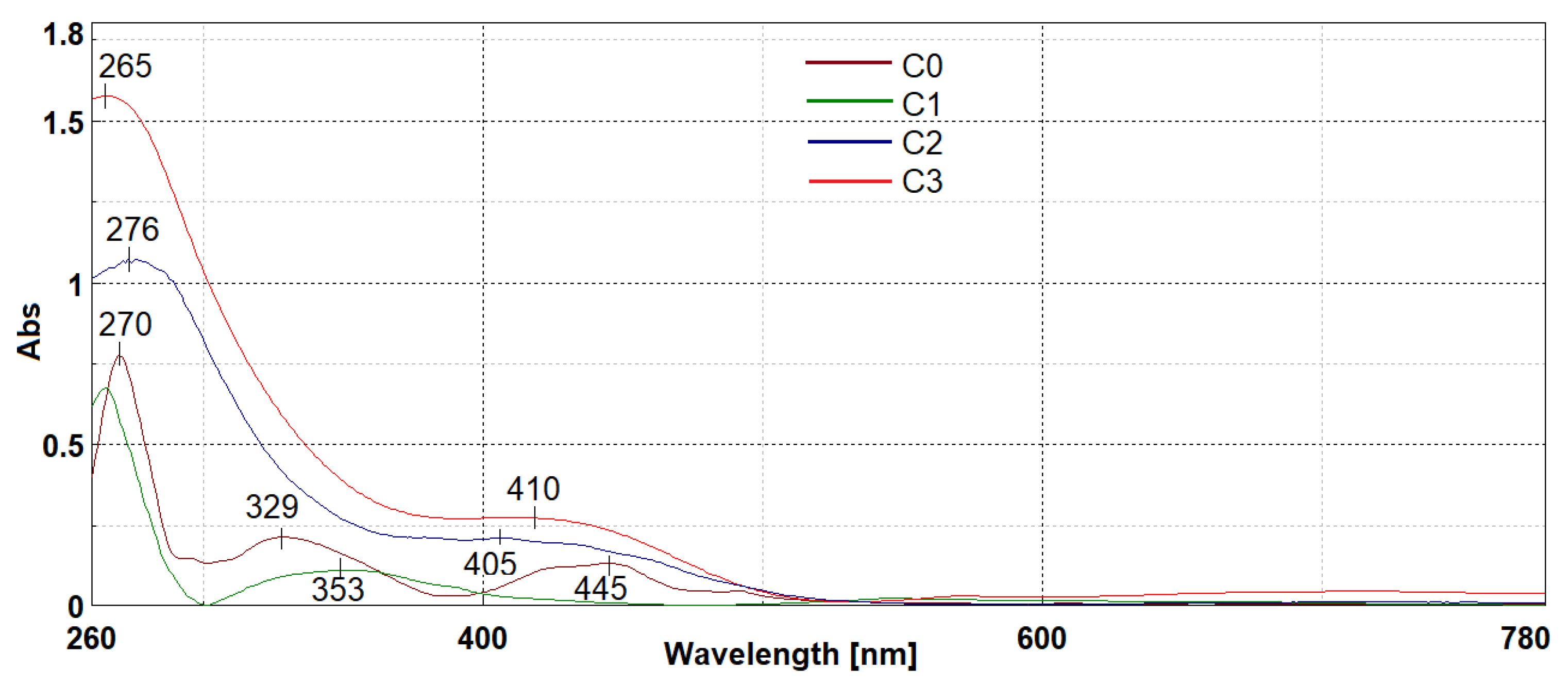
The absorption spectrum of the natural alcoholic extract from dandelion flowers exhibits a triplet of absorption bands with a maximum at 445 nm, characteristic of carotenoid compounds (Figure 4). The presence of polyphenolic compounds is confirmed by the band with a maximum absorption at 329 nm (Band I), attributed to n→π* transitions, and at 270 nm (Band II), characteristic of π→π* electronic transitions of aromatic phenolic groups. Following chelation with copper ions, Band I undergoes a bathochromic shift of its maximum by 24 nm, which is due to charge transfer (donor–acceptor) interactions between the polyphenolic oxygen and Cu(II). In an aprotic solvent such as dimethyl sulfoxide (DMSO), as the concentration of copper ions increases, conditions are created for the formation of complexes of the type Cu–polyphenol 2:1, and the band shift is significantly larger, ranging from approximately 52 to 57 nm compared to C1 [54,55].
Figure 4.
Absorption spectra of C0 (the natural extract), C1(copper–polyphenol complexes) in ethanolic solution, and C2, C3 (copper–polyphenol complexes) dissolved in DMSO solvent.
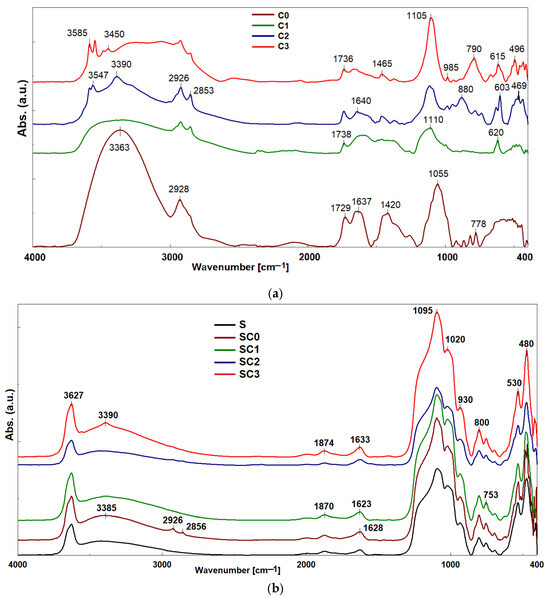
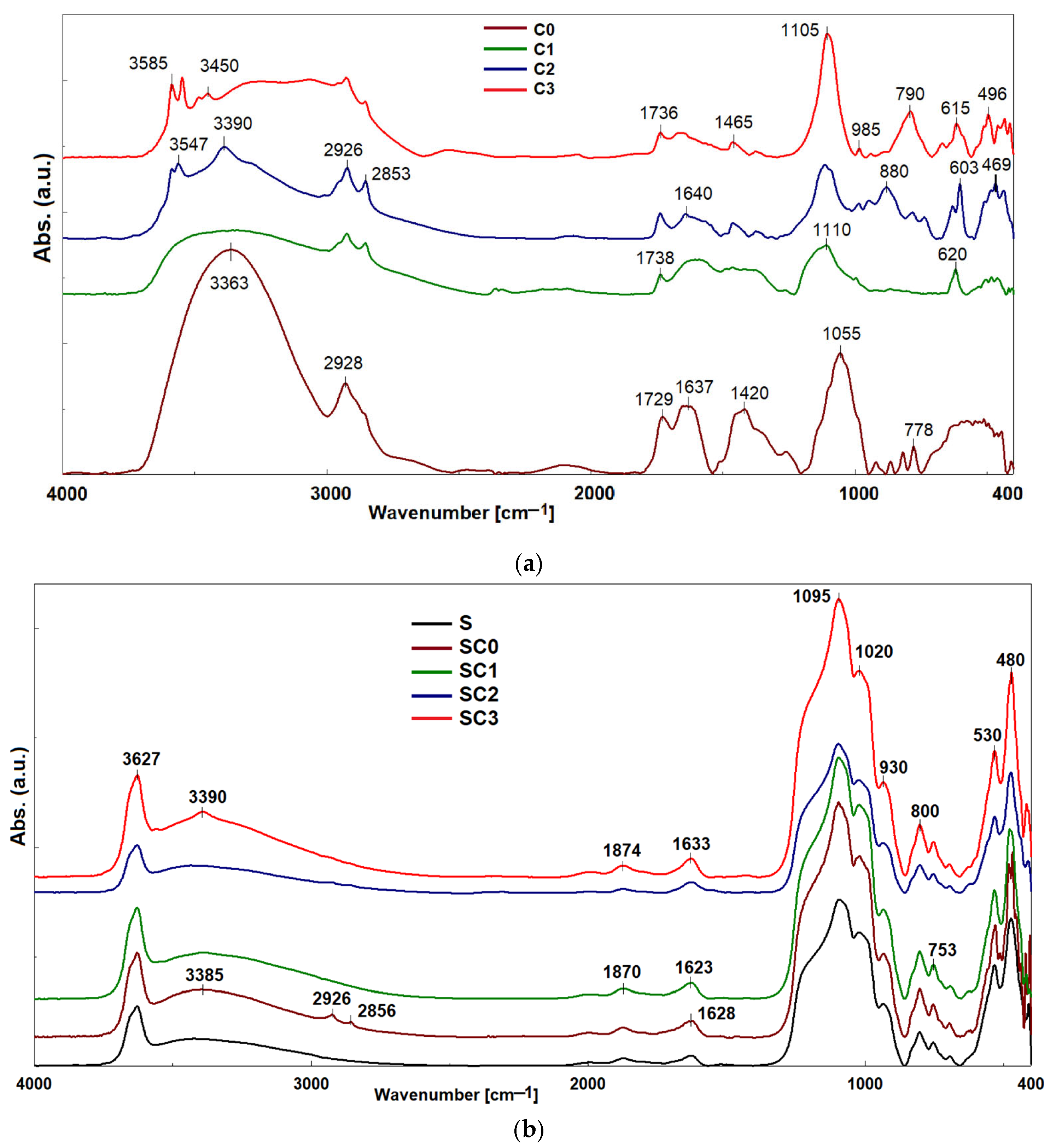
Analysis of the FTIR spectra recorded for the copper–polyphenol complexes (Figure 5a) reveals a drastic decrease in the intensity of the band with a maximum around 3350 cm−1, the characteristic of the stretching vibration of the O–H bond, in C0, decreased in intensity in the case of the C1–C3 chelated compounds. The emergence of bands at 3585–3550 cm−1, which corresponds to the O–H stretching vibration of weakly hydrogen-bonded water or hydroxyl groups, is likely due to coordinated water molecules within the Cu–polyphenol complex clusters [56]. The bands with maxima at 2925 and 2850 cm−1 corresponded to the vibrational stretching peak of the C–H bond on the benzene ring of polyphenols. The absorption band at approximately 1730 cm−1 corresponds to the carbonyl group, and the band at 1640 cm−1 was attributed to the C=C stretching vibrations in the polyphenols. The absorption peak with a maximum at 1055 cm−1, characteristic of the C–O stretching vibration in the C0, undergoes a major shift in the metallic complexes C1–C3, peaking at 1105 cm−1. The identification of bands at a wavenumber of 620 cm−1 in the complex indicated the existence of an oxygen–copper bond, which was absent in natural extract C0.
Figure 5.
FTIR spectra of the mixture of polyphenols, copper–polyphenol complexes (a), and spectra of hybrid materials loaded with metal complexes (b).
The sericite mineral support (S), a mica-derived phyllosilicate, exhibits bands in the FTIR spectrum Figure 5b, with maxima at 3630–3390 cm−1 and 800 cm−1 characteristic of the hydroxyl groups present in the inorganic lattice. The absorption bands at 1095 cm−1 and 750 cm−1 are attributed to the stretching vibrations of Si–O–Si, Si–O, Al–O–Si, or Al–O [57]. The low concentration of organic compounds present on the inorganic support does not significantly alter the overall spectrum shape, only causing slight shifts in the absorption maxima in some instances. The deposition of the organic compounds on sericite is confirmed by the emergence of absorption peaks at 2926 and 2856 cm−1 attributed to the C–H bond on the benzene ring of polyphenols.
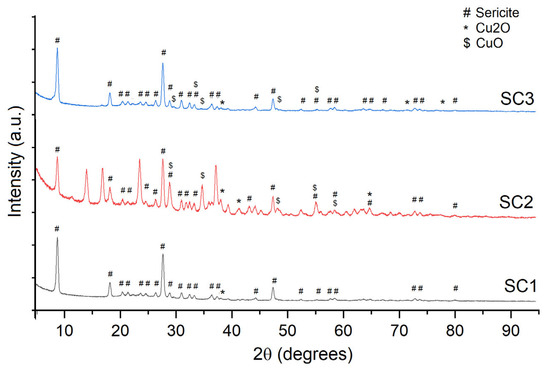
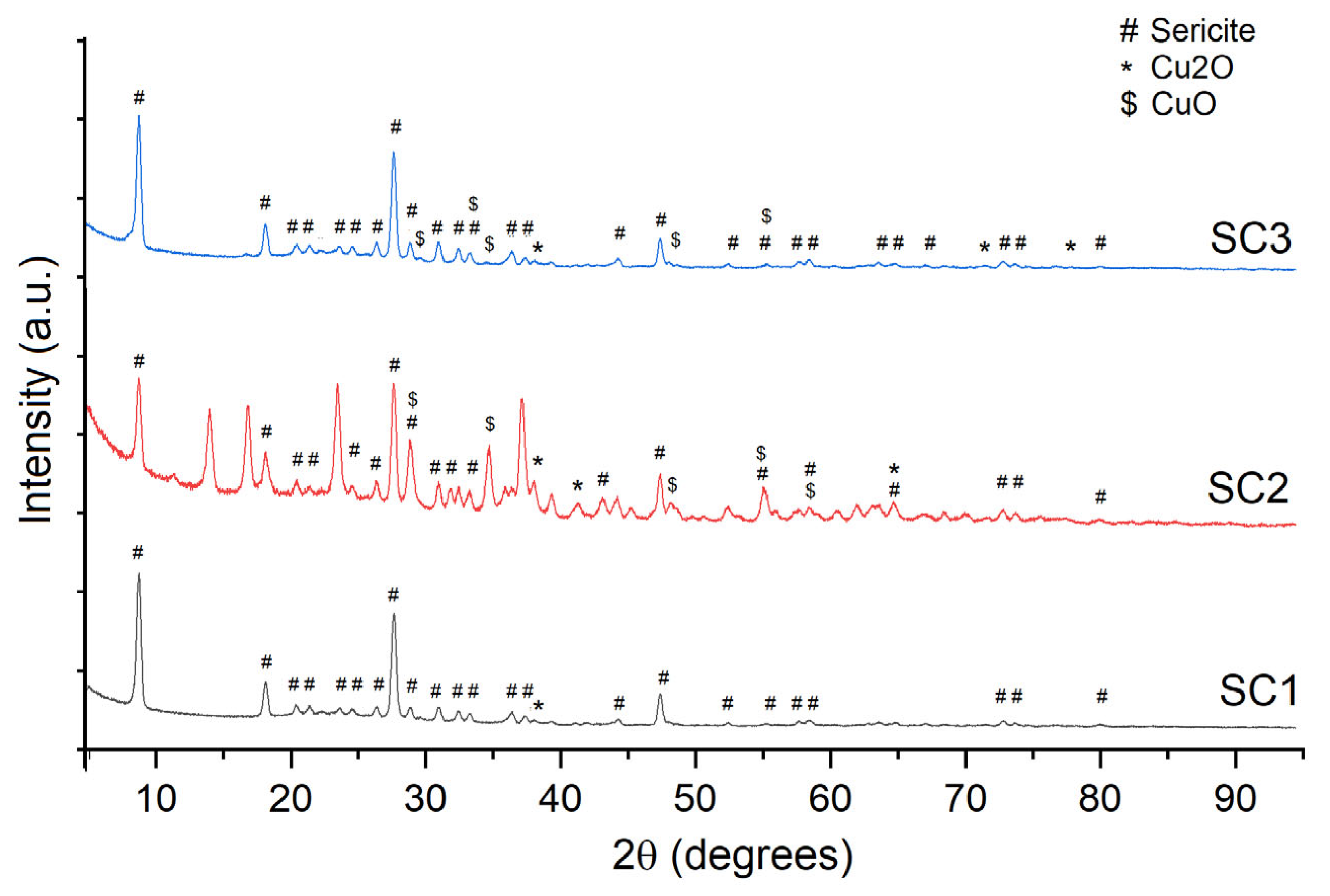
The structural difference between the three multicomponent phases obtained by varying the concentration of copper ions (Supplementary Materials, Table S3), respectively, the three types of hybrid material obtained by the deposition of Cu–polyphenol complexes, was confirmed by recording the X-ray diffractograms (Figure 6). For the identification of the crystal structures, ICDD-00-012-0216 for sericite, ICDD-04-025-6792 for copper oxide, and ICDD-04-005-4871 for the cuprite crystalline phase were used. Comparing the three diffractograms, the characteristic peaks of the sericite support at 8.8°, 19.70°, the doublets in the range 22.20°, 24.64°, 26.7°, and 45.67° (2θ) are observed in agreement with other studies [38,43]. In the case of compound SC1, the crystallinity changes are insignificant compared to sericite. By increasing the copper concentration in the polyphenolic extract, the complexes formed have complex structures, as shown in the SC2 diffractogram. It can be observed that a mixture of compounds containing characteristic Cu2O crystalline phases, confirmed by peaks at 36.53°, 42.43°, 64.57° (2θ), and CuO crystalline phases characterized by peaks at 28.37°, 33.28°, 47.52°, 55.34°, and 57.18° (2θ), respectively, was deposited on the inorganic support. In the case of SC3, the polymorphic structures are reduced compared to SC2, highlighting a crystalline organization guided by the crystalline structure of the host support (Table 3).
Figure 6.
XRD patterns of the hybrid material SC1, SC2, and SC3.
Table 3.
Average crystallite size calculated using the Scherrer equation.
The sample SC2 (synthesized from the C2 precursor, 0.05 mol/L) corresponds to the threshold where the available free polyphenols reached their minimum depletion plateau (~9.4 mg GAE/g), signifying an optimal capacity for ionic reduction and capping. Consequently, a well-defined and chemically restricted cuprite phase (Cu2O, 14.47 nm) was successfully stabilized onto the sericite matrix. Conversely, for the sample SC3 (derived from the C3 precursor, 0.1 mol/L), the copper concentration was doubled while the total pool of bio-reducing agents remained depleted at the same baseline plateau. Due to this deficit in electron-donating polyphenols, the excess copper ions could not undergo further chemical reduction, forcing the system to favor the growth of the unreduced phase (CuO). This stoichiometric constraint directly accounts for the observed increase in the CuO crystallite size from 22.75 nm in SC2 to 23.65 nm in SC3, validating that the phase architecture of the sericite-supported nanocomposite is strictly modulated by the initial precursor-to-extract ratio. The average crystallite size was estimated using the Scherrer equation, employing a shape factor K = 0.94, taken as an approximate value commonly used for nanocrystalline oxide materials. Since CuO possesses a monoclinic crystal structure, the calculated crystallite sizes should be regarded as approximate estimates because the shape factor depends on crystallite morphology and diffraction reflection.
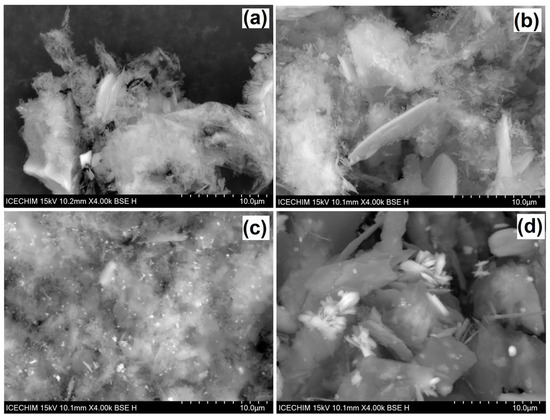
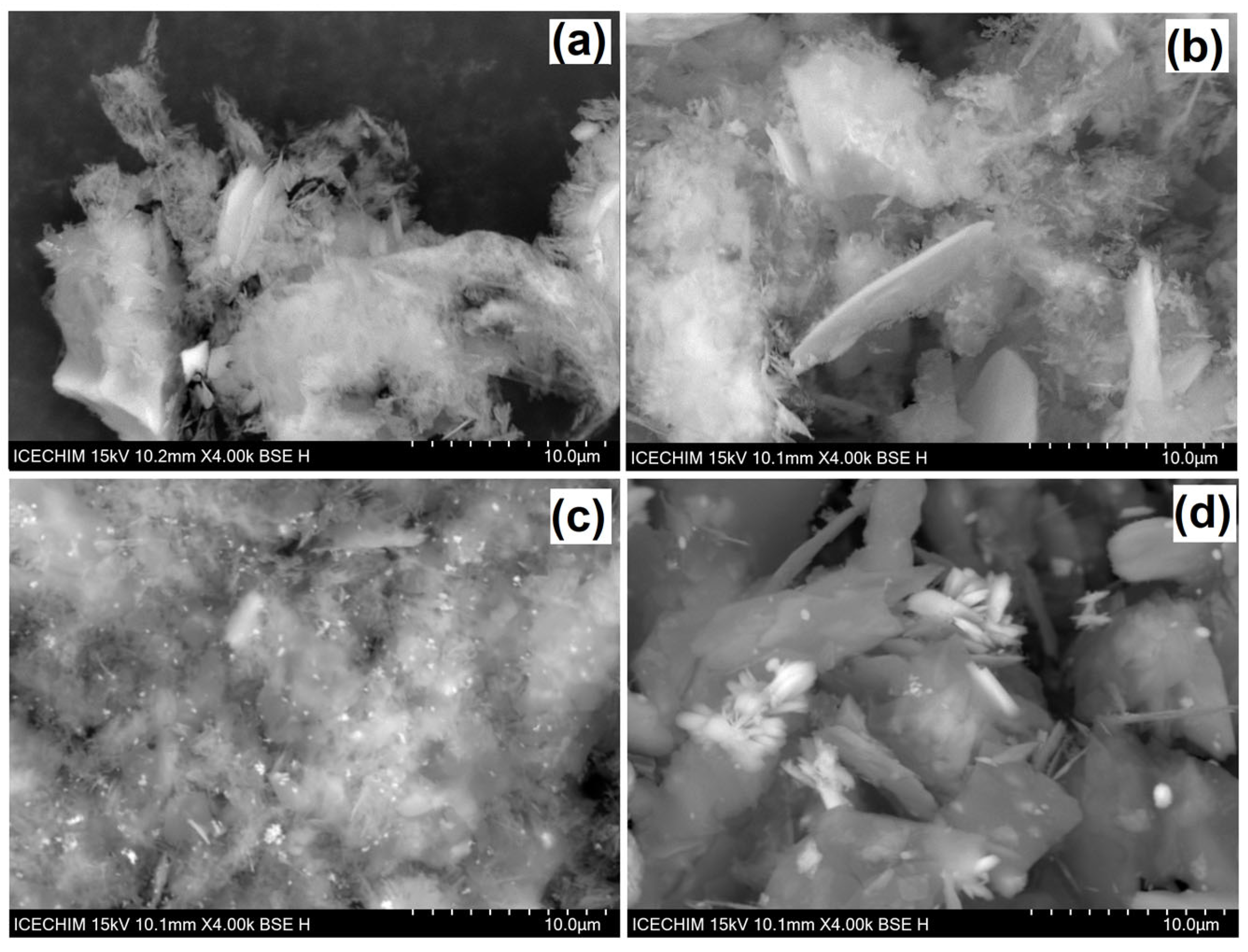
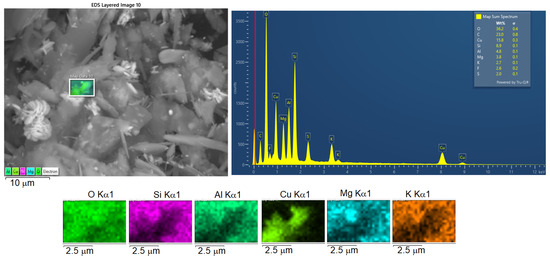
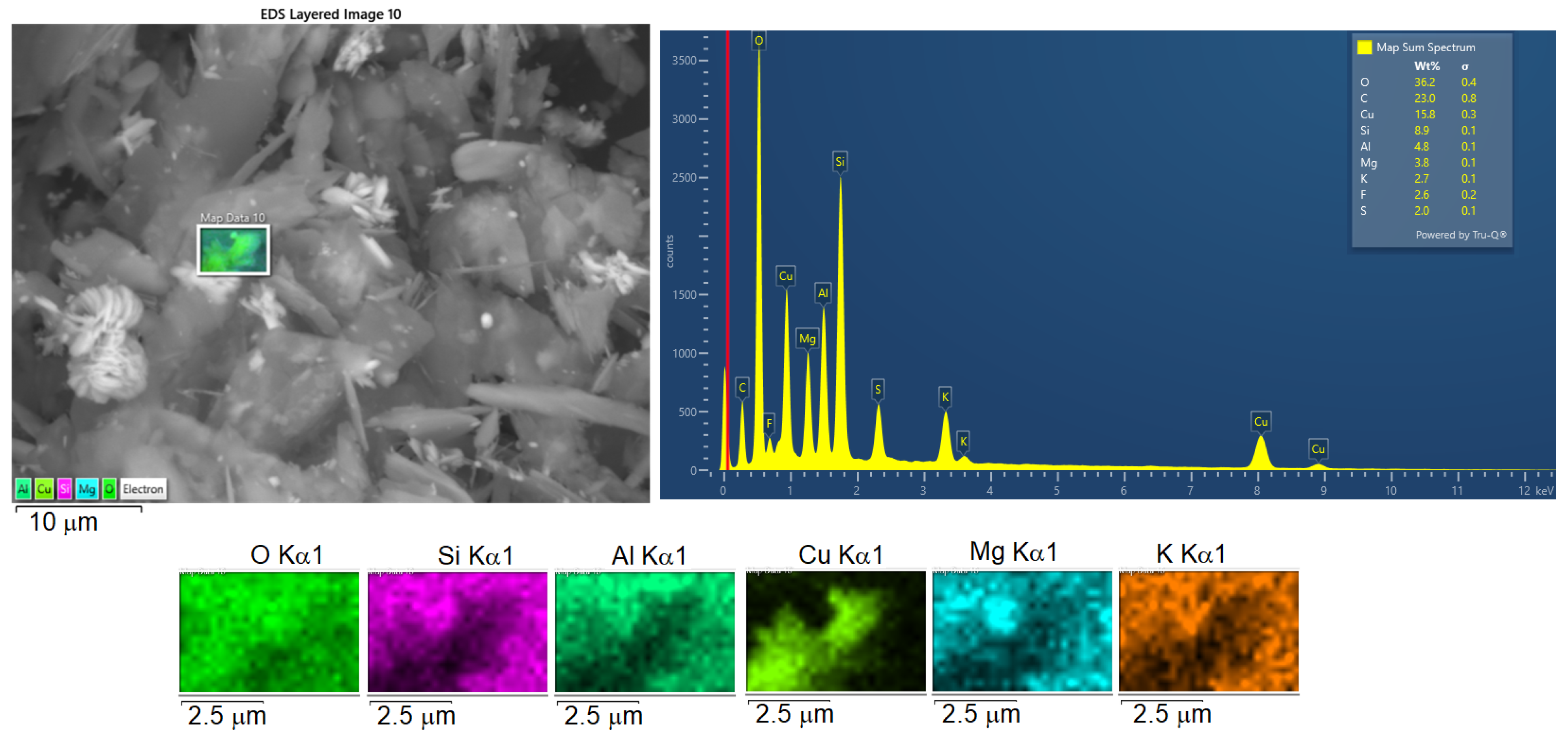
The disproportionate ratio between the two components of the hybrid materials—the copper–polyphenol complexes and sericite—is clearly discernible through scanning electron microscopy (SEM) images. The images in Figure 7 also highlight the structural differences in the chelated complexes resulting from varying synthesis conditions. While Figure 7a shows the transparent and flexible sericite sheets, the adjacent image (b) presents the inorganic mineral sheets loaded with Cu–polyphenol complexes synthesized at pH = 5. In Figure 7c, it is observed that as the pH is modified, the chelated complexes undergo a structural change, generating copper nanoparticles accompanied by polyphenolic ligands, which are uniformly distributed within the host network. As the concentration of copper ions in the natural dandelion extract increases, the copper ion reduction process competes with the crystallization process. Consequently, Figure 7d shows copper oxide crystals intercalated between the sericite sheets. These competing processes were confirmed by elemental-dispersive X-ray spectroscopy (EDX) analysis (Figure 8).
Figure 7.
SEM images for the sericite support, S0 (a), and hybrid materials, SC1 (b), SC2 (c), and SC3 (d), respectively.
Figure 8.
Image of hybrid material (SC3) during EDX analysis.
The results presented in Table 4 indicate a highly concentration-dependent and structurally mediated alteration of the sericite substrate during the deposition process. The native sodium content (0.2 wt.% in raw sericite) undergoes a significant shift, becoming undetectable in samples SC2 and SC3. This trend is driven by a dual mechanism: (i) a classical ion-exchange displacement governed by the law of mass action, where the surging concentration of incoming Cu2+ ions outcompetes the native Na+ ions on the aluminosilicate sheets, and (ii) a structural masking effect. As confirmed by XRD crystallite data, the nucleation and aggressive growth of supported CuO/Cu2O crystalline domains at higher precursor concentrations physically overlayer the mineral matrix. This dense inorganic–organic coverage attenuates the weak X-ray emission of any residual core sodium, pushing it below the EDX detection threshold. Potential interference from reagent-borne sodium impurities was ruled out based on the analytical grade of the CuSO4 precursor (Na ≤ 0.005%), a fact corroborated by the inverse correlation observed between copper loading and sodium detectability.
Table 4.
SEM-EDX results for sericite (S) and hybrid materials SC1–SC3.
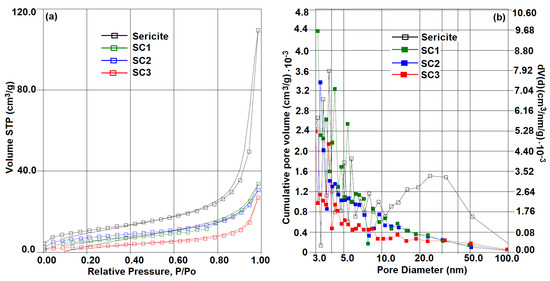
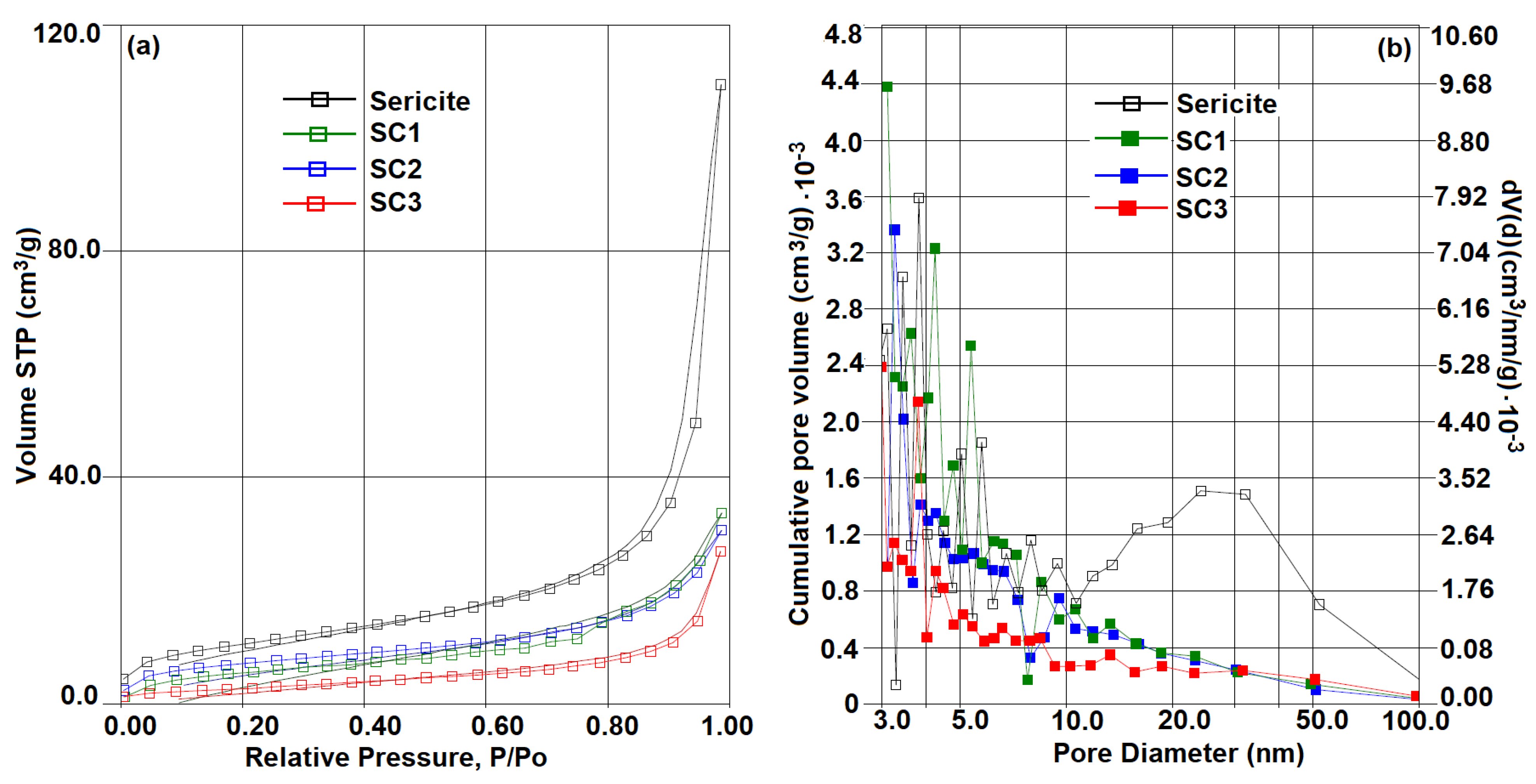
Porosimetric analysis, illustrated in Figure 9a, reveals that all hybrid materials exhibit Type IV isotherms according to IUPAC classification, indicative of mesoporous structures. The observed hysteresis loop at high relative pressures (P/P0 > 0.4) confirms capillary condensation in the mesopores. The inorganic support demonstrates the highest adsorption capacity, achieving a nitrogen volume of approximately 110 cm3/g at P/P0~1.0, suggesting a well-developed porous structure following acid treatment, with pore sizes ranging from 3 nm to over 40 nm (Figure 9b). In contrast, hybrid materials SC1–SC3 show a significant reduction in adsorbed volume compared to the sericite support, indicating that copper species (complexes, nanoparticles, or oxides) may have partially occupied or blocked the pore network. The active components penetrate the support’s pores, leading to a notable decrease in total pore volume (Vtot) and specific surface area (SBET) for samples SC1–SC3, as shown in Table 5. Among the hybrids, SC1 and SC2 exhibit similar adsorption profiles, whereas SC3 displays the lowest adsorption, suggesting denser coverage or more pronounced pore blockage.
Figure 9.
Adsorption–desorption isotherms (a) and pore size distribution of hybrid materials by the BJH method (b) of sericite and hybrid materials SC1–SC3.
Table 5.
Textural characteristics of sericite and SC1–SC3 subjected to porosimetric analysis.
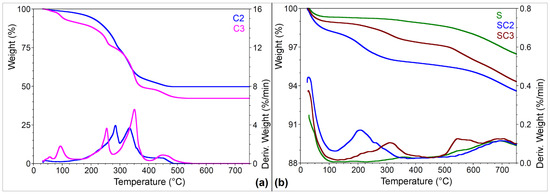
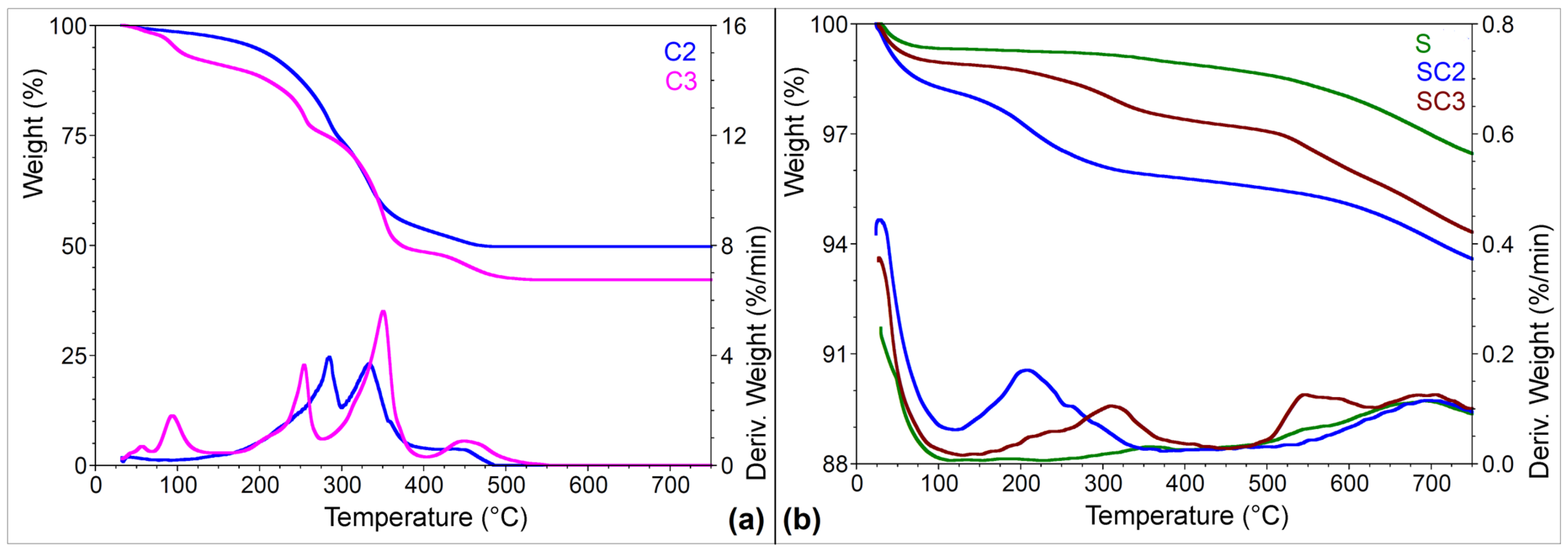
The stability and thermal behavior of the metallic complexes (Figure 10a) and the hybrid materials (Figure 10b) were evaluated using thermogravimetric analysis (TGA). Due to the homogeneous structure of the C2 composite, its thermogravimetric curve exhibited two major decomposition steps. The first thermal event occurred in the range of 93–300 °C, with an approximate mass loss of 25%, at a maximum temperature of 284 °C, likely involving the cleavage of organic ligands and the onset of their oxidation to quinone forms. The second decomposition stage took place in the range of 300–423 °C, with a temperature maximum at 333 °C, corresponding to the pyrolysis of the organic compounds and a mass loss of 21%. In the final stage, between 423 and 750 °C, the mass loss was minor, 2.55%, with the processes involved being the crystallization and structural rearrangement of residual Cu2O/CuO oxides. The C3 composite, due to its structure, exhibits an initial stage in the 32–145 °C range, where about 8.7% of adsorbed or sequestered water is eliminated from the crystalline lattice (Tmax = 93.5 °C), which is virtually absent in sample C2. This variance highlights a fundamental divergence in their surface architectures. In C2, the optimal precursor-to-extract ratio promotes the formation of a dense, steric capping shell composed of dandelion-derived polyphenols, whose aromatic networks effectively suppress moisture adsorption. In contrast, the polyphenol-deficient synthesis of C3 yields a more hydrophilic inorganic surface crowded with exposed oxide domains and unreacted, hygroscopic sulfate species. These domains structurally entrap a considerable network of coordinated and physically adsorbed water molecules, which easily volatilize during the initial heating phase. The second decomposition stage (Tmax = 254.2 °C) begins earlier than for C2, specifically between 145 and 277 °C, with a lower mass loss of approximately 16%. The third stage occurs in a similar temperature range to C2, but the mass loss is higher, about 27%. Similarly, in the final stage of oxide crystallization and stabilization, the maximum temperature shifted to 449 °C, while the mass loss was approximately 4% greater than for C2.
Figure 10.
Thermogravimetric curves of Cu–polyphenol complexes (a) and hybrid materials (b).
The thermal behavior of the hybrid materials was easily predictable by correlating with the topographical evaluation results obtained from the SEM images. The SC2 material, which featured a uniformly deposited C2 composite, showed an insignificant mass loss of2% in the first heating stage, between 23 and 120 °C, likely corresponding to adsorbed water. Heating continued between 120 and 374 °C with Tmax = 208 °C, where the pyrolysis of the organic compounds occurred, with a mass loss of 2.3%. The third stage continued heating up to 700 °C, resulting in an additional weight loss of 2.25%, at Tmax = 693 °C, which involved the crystallographic transformations of copper oxides and structural rearrangements on the sericite support. For SC3, where SEM images clearly indicated structural differences from SC2, the principal thermal decomposition stage occurred over a temperature range of 129–454 °C, with the maximum temperature shifted to 310 °C. This phase involved the oxidation and pyrolysis of organic ligands superficially bound to the mineral support, with Cu(II) being partially reduced to Cu(I) and the formation of amorphous copper oxide species on the sericite surface (mass loss 1.7%). In the subsequent stage, 454–630 °C, 1.53% weight was lost, likely representing organic compounds sequestered in formed clusters and released during the collapse of the crystalline structure established between the hosted metallic complex and the inorganic matrix. In the final heating stage, 630–750 °C, the mass loss was insignificant, 1.4%, and involved changes in the crystallinity and stabilization of CuO anchored in the sericite network [36].
3.2. The Optical Properties of Hybrid Materials
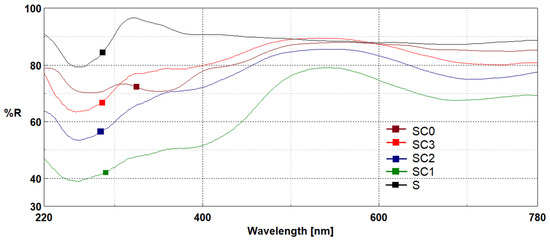
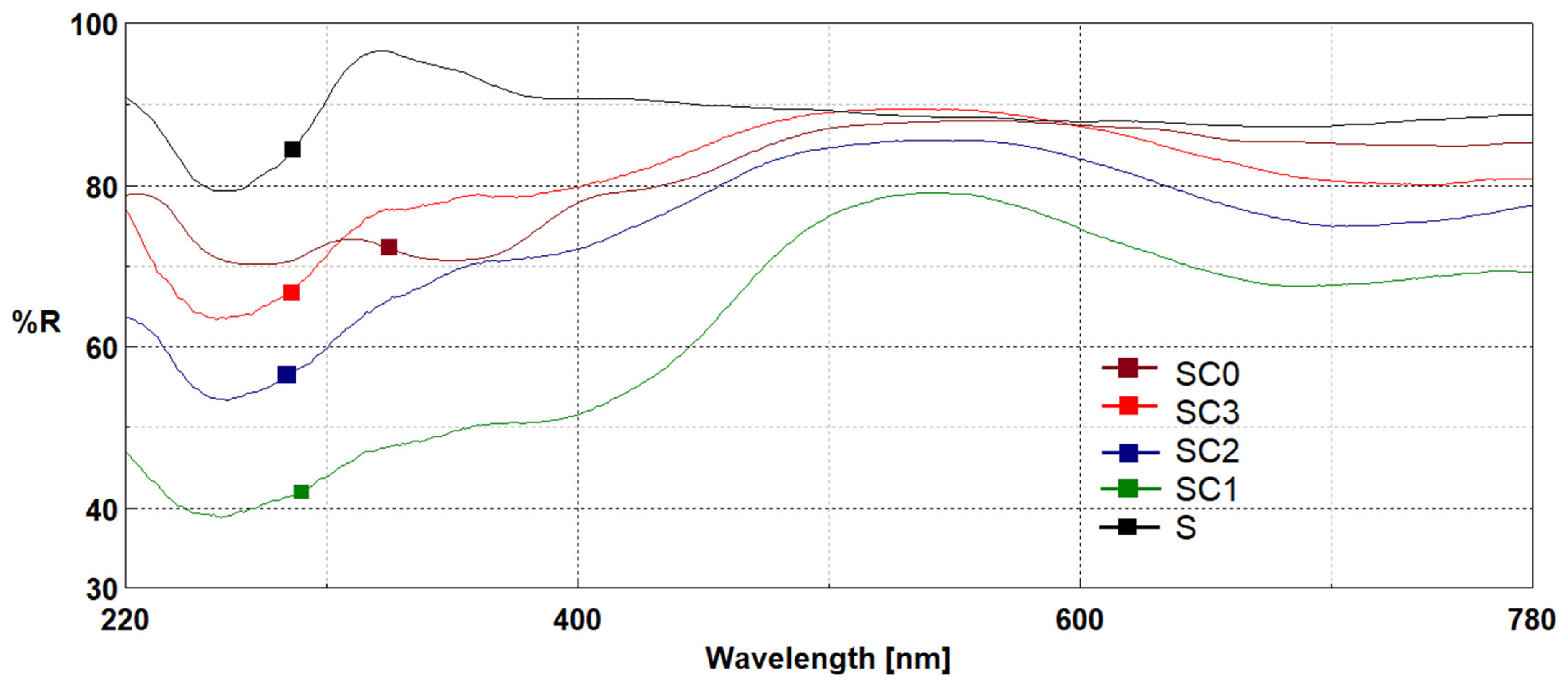
The hybrid materials were evaluated for changes in optical properties following the loading of metallic compounds onto the inorganic support by comparing their reflectance spectra (Figure 11). The flaky, lamellar, and planar structure provides the sericite mineral with high light reflectance properties in the visible and UVA region (315–780 nm) [36,41]. The natural dandelion extract absorbs light radiation (Figure 1) in the UV–Vis range (260–450 nm), and its deposition on the mineral support (SC0) results in a diminution of reflectance in this region. The presence of chelated (C1), which absorbs around 350 nm on the sericite support (SC1), leads to an extension of the absorption interval and a decrease in reflectance to as low as 50% in the visible and near-UV domains (360–400 nm). In the case of SC2, reflectance increases in the 380–550 nm interval, likely due to the presence of copper in the form of Cu2O, a phenomenon more evident for SC3, where the copper oxides exhibit larger dimensions.
Figure 11.
Reflectance spectra of the sericite mineral support (S) and the hybrid materials (SC0–SC3).
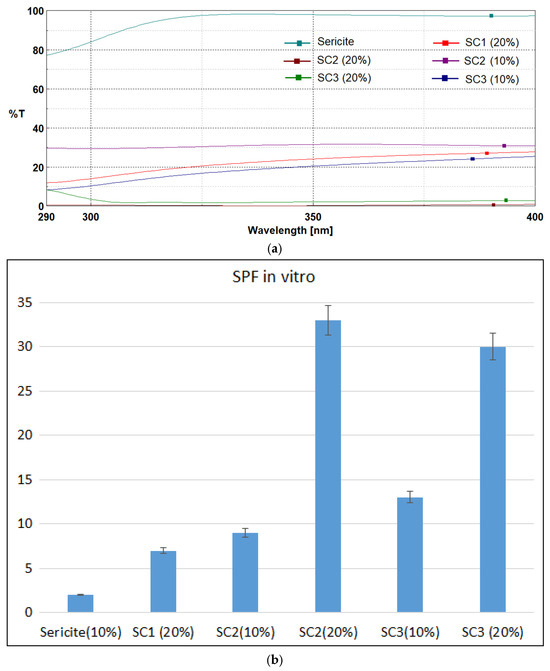
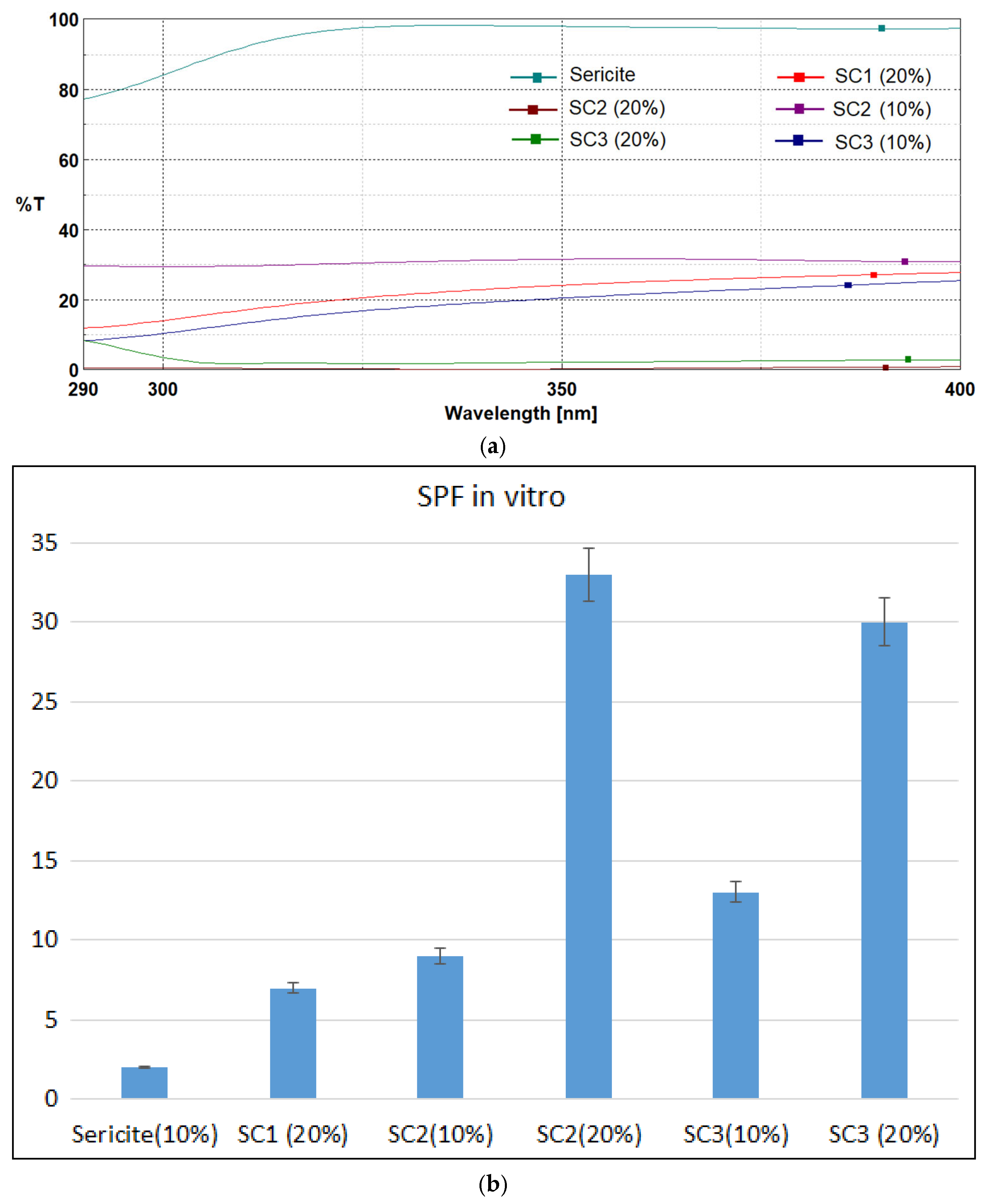
These results led to the proposal and testing of the hybrid materials as UV-light screening agents. Tests were conducted in accordance with Diffey’s method using a previously mentioned in-house method [58]. Hybrid materials incorporated into an emulsion-type matrix exhibited light-screening properties upon measuring their transmission spectra in the 290–400 nm range (Figure 12a). The Sun Protection Factor (SPF), calculated based on Equation (4), varied between SPF = 7 and 33 (Figure 12b and Table 6) and was directly influenced by the proportion of hybrid material incorporated into the emulsion.
where E(λ) is the radiation intensity of sunlight, T(λ) is the diffuse transmittance spectrum (%) measured in the range 290–400 nm, and R(λ) is the CIE reference erythema action spectrum.
Figure 12.
The transmittance spectra (290–400 nm) of hybrid materials embedded in o/w emulsion (a). Sun protective performances of sericite and hybrid materials at different concentrations (b).
Table 6.
Phytochemical and physical parameter overview of the formulated cosmetic creams.
3.3. Antimicrobial Properties of Copper–Polyphenol Complexes and Their Hybrid Materials
The use of dandelion as an adjuvant or in the treatment of various diseases, owing to its polyphenol content, is well established in phytotherapy. Current promising applications focus on its antimicrobial properties [59,60].
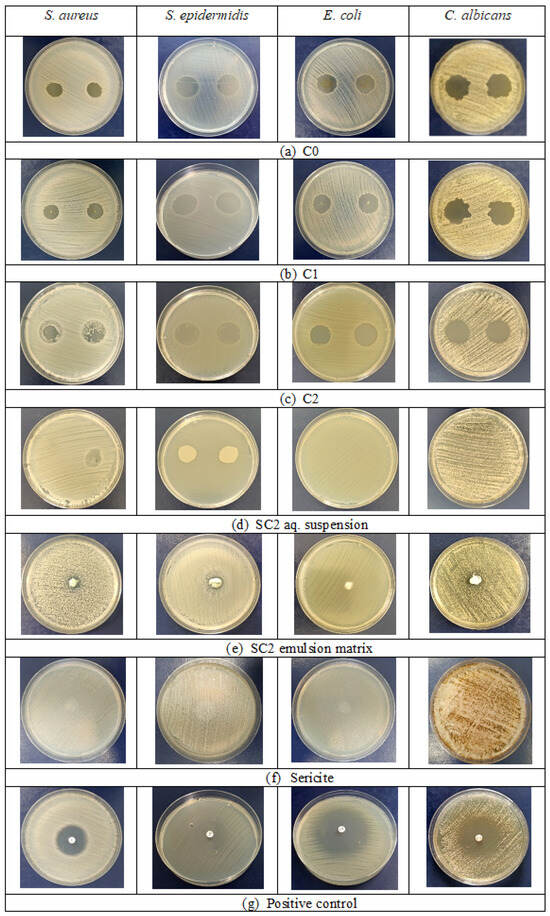
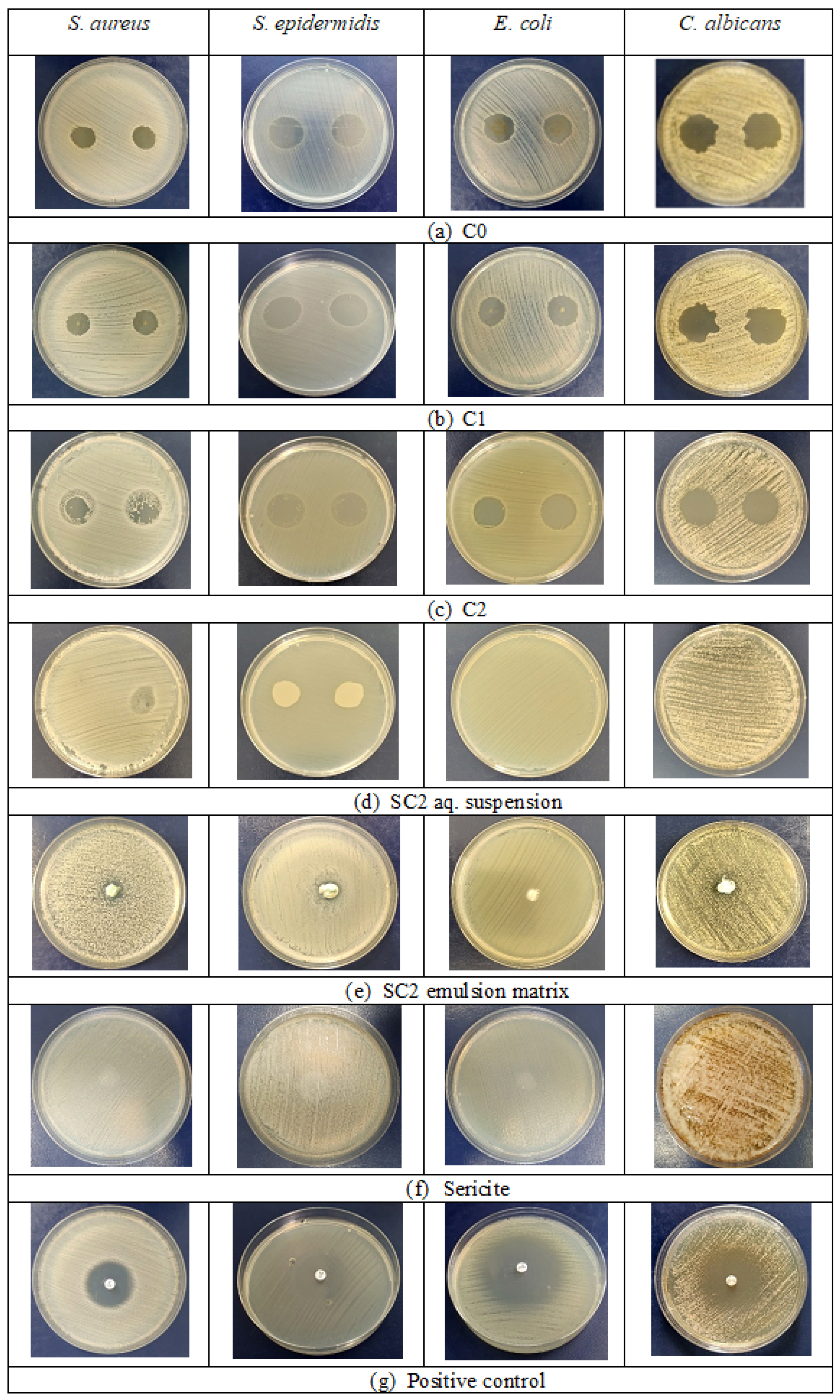
Taraxacum officinale extract and Cu–polyphenol complexes were tested to evaluate their antimicrobial activity (Figure 13) against three bacterial strains (Staphylococcus aureus, Staphylococcus epidermidis, and Escherichia coli) and one fungal strain (Candida albicans). The dandelion extract demonstrated good antimicrobial activity against all tested microorganisms, confirming the presence of broad-spectrum bioactive compounds (Figure 13). Test results (Table 7) showed that the Cu–polyphenol complexes (C1 and C2) exhibited a slight enhancement of antimicrobial activity compared to the simple extract, against all tested strains, specifically against S. epidermidis, E. coli, and C. albicans. Sample C2 caused partial inhibition of the S. aureus bacterial strain, as indicated by the presence of colonies within the inhibition halo, suggesting limited antibacterial activity. When loaded on sericite, the antimicrobial activity decreases in the case of SC2, so the concentrations must be adjusted by the amount of hybrid material in the test solution or by increasing the concentration of metal complex deposited on the host support. The SC2 sample in an emulsion matrix, representing a final cream-type product formulated based on dandelion extract and copper oxide, showed moderate antibacterial activity against the tested Gram-positive strains (S. epidermidis and S. aureus) and against C. albicans. These results suggest selectivity in antimicrobial action, predominantly targeting Gram-positive bacteria, which are frequently involved in superficial skin infections or microbial flora imbalances, particularly in immunocompromised individuals. The viscous oil-in-water matrix imposes a strict physical barrier that limits the free, rapid diffusion of active copper ions and phytocompounds into the agar media within the standard incubation period. However, the retention of significant biocidal action against S. aureus (10.33 ± 0.47 mm) and S. epidermidis (11.16 ± 0.23 mm) highlights the efficacy of the formulation. Sample SC2 was selected for this formulation because it represents the optimal stoichiometric balance between copper loading and organic capping density, ensuring a sustained bioactive release while minimizing the potential cytotoxicity risks associated with the polyphenol-deficient domains found in higher concentrations (e.g., SC3).
Figure 13.
Antimicrobial activity of natural extract (a); copper–polyphenol complex in ethanol (b,c); SC2 hybrid material in aqueous suspension (d); SC2 embedded in an emulsion matrix (e); sericite mineral support (f); and positive control (g), using the diffusion method through spot inoculation.
Table 7.
Antimicrobial activity results and diameter of the zone of inhibition.
Antimicrobial testing revealed that the final SC2 embedded in an emulsion matrix product exhibited no visible activity against E. coli, while maintaining activity against Gram-positive bacteria (S. aureus, S. epidermidis) and the fungus C. albicans (Table 7). This difference can be attributed both to the biological characteristics of the microorganisms and to the properties of the emulsion matrix. Gram-positive bacteria possess a thick but permeable cell wall that allows antimicrobial diffusion, whereas C. albicans has a cell wall structure susceptible to such compounds. In contrast, E. coli, a Gram-negative bacterium, has an outer membrane rich in lipopolysaccharides that acts as an effective barrier, requiring higher concentrations of active compound for inhibition. However, once penetrated inside, these copper species induce severe intracellular oxidative stress (ROS generation) and damage vital cytoplasmic components, leading to cell death [61,62].
4. Discussion
The complexation behavior of copper ions with polyphenolic compounds extracted from Taraxacum officinale is strongly governed by the structural features of the phenolic ligands, particularly the 3-hydroxy-4-keto, 3,4-dihydroxy, and 5-hydroxy-4-keto moieties known to coordinate divalent metal ions through bidentate or bridging interactions [54,55]. Our results confirm previous findings that such groups enable the formation of Cu(II)–polyphenol chelates, as evidenced by the bathochromic shifts of about 24 nm in the UV–Vis spectra and the diminution of the O–H stretching band in FTIR spectra. At higher pH values, the system is dominated not only by coordination chemistry but also by redox processes: polyphenolic ligands undergo partial oxidation to quinone species [54], promoting electron transfer, and enabling the reduction of Cu2+ to Cu+ or even Cu0. This competition between complexation and reduction becomes increasingly relevant as the Cu–polyphenol ratio increases, explaining the formation of mixed Cu2O and CuO phases observed particularly in the C2, C3, SC2, and SC3 samples (Supplementary Materials, Figure S2). Thus, pH and metal concentration act as key parameters in steering the pathway toward either supramolecular coordination structures or crystalline copper oxide domains [55].
Equally important is the interaction between these Cu–polyphenol species and the sericite substrate. Sericite’s negatively charged aluminosilicate layers, rich in Na+ and K+ as exchangeable interlayer cations, provide a favorable environment for cation exchange and adsorption processes. The structural differences among the hybrid materials synthesized at different pH values suggest that the extent of ion exchange plays a decisive role in shaping the resulting surface architecture. In acidic media, protonation of the surface silanol and aluminol groups limits the cation exchange capacity, preventing the effective substitution of Na+ and allowing it to remain detectable on the mineral surface. Conversely, at neutral and alkaline pH, deprotonation leads to increased negative surface charge, thereby enhancing the affinity of sericite for Cu2+, Cu+, and copper oxide nanoparticles. This promotes the displacement of Na+ from the interlayers and facilitates the anchoring of copper-based species onto the sericite flakes. The complete or near-complete disappearance of Na+ in EDX spectra for SC2 and SC3 confirms both efficient cation exchange and surface coverage by newly formed copper oxide or Cu–polyphenol clusters [36].
The structural and compositional differences arising from these pH-dependent processes directly impact the thermal and optical properties of the hybrid materials. The distinct thermal decomposition profiles of C2 versus C3 reflect differences in the coordination environment and degree of oxidation of the copper centers. When immobilized on sericite, these complexes display thermal stability shifts of more than 100 °C compared to the free complexes, demonstrating the stabilizing influence of the inorganic matrix and the variations in binding interactions between organic ligands, metal species, and the aluminosilicate surface. Morphological analyses further indicate that the size and spatial distribution of copper oxide crystallites affect both heat-transfer dynamics and optical behavior. Larger and more crystalline copper oxide domains in SC3 contribute to higher reflectance recovery in the visible region, whereas the more homogeneous deposition of smaller nanoparticles in SC2 enhances UV absorption while preserving sericite’s intrinsic scattering [41,42,43].
The optical properties of the hybrid materials arise from a synergistic interplay between the three components—sericite, polyphenols, and copper oxides. Sericite contributes high reflectance in the visible and near-UV range, whereas the polyphenols and copper complexes introduce strong absorption in the 260–450 nm region. Copper oxide species further modulate these characteristics through their semiconductor band-gap transitions. The combined effect results in hybrid structures capable of attenuating UV radiation while maintaining adequate visible-light reflectance, a desirable property for cosmetic formulations where transparency and light scattering must be balanced. The achievable SPF-equivalent values (7–33), modulated by loading level and composite composition, underscore the practical relevance of these materials as UV-screening agents.
The antimicrobial activity of the copper–polyphenol complexes corroborates literature reports indicating that metal–phenolic coordination enhances cellular uptake and facilitates interactions with microbial membranes. The polyphenols may increase the lipophilicity of copper species, enabling better penetration into the cell envelope and potentiating the known bactericidal mechanisms of copper, such as membrane disruption, protein oxidation, and DNA damage. The hybrid materials, although generally less potent than the free complexes due to the immobilization of active species, retain selective antimicrobial activity, particularly toward Gram-positive bacteria and Candida albicans. This selectivity likely arises from differences in cell wall architecture: Gram-negative bacteria possess an outer membrane that restricts the permeation of metal ions and phenolic compounds, while Gram-positive bacteria and fungi have more accessible peptidoglycan or chitin–glucan layers. The performance of the SC2-containing emulsion further suggests that formulation effects—such as partitioning of active species within the lipid or aqueous phases—play an important role in determining antimicrobial efficacy [36,63]. Although copper-containing nanomaterials exhibit promising antimicrobial and skin-regenerative properties, copper ions and copper oxide species may induce concentration-dependent cytotoxic and inflammatory responses. The biological effects of copper strongly depend on its chemical form, dose, release kinetics, and exposure duration. Therefore, comprehensive toxicological profiling—including in vitro cytocompatibility, skin irritation and sensitization assays, dermal penetration studies, and long-term safety evaluation—is required before these materials can be used for cosmetic dermatology applications.
Overall, the combined structural, optical, thermal, and biological data demonstrate that the properties of copper–polyphenol–sericite hybrids are highly tunable through reaction conditions, particularly pH and copper concentration. Understanding these interdependent processes provides a foundation for optimizing their performance in targeted applications, including cosmetic dermatology, antimicrobial coatings, and UV-protective formulations. Future work integrating advanced spectroscopic methods and molecular modeling will be essential for elucidating the precise coordination environments and electron-transfer pathways governing the behavior of these bioinspired hybrid materials.
5. Conclusions
Following the complexation process, three types of metal–polyphenol complexes were synthesized, with different Cu–polyphenol ratios. The complexes were deposited on sericite support, resulting in three types of hybrid materials, the structure of which was confirmed by FTIR, XRD, BET, and SEM-EDX analyses. The optical properties of the hybrid materials were evaluated, and it was found that they present both light reflection properties, characteristic of sericite, and absorption properties in the UV range, this synergy leading to their feasibility for applications in sunscreens. At the same time, the antimicrobial properties of the metal complexes were successfully tested. It was highlighted that by controlling the concentration, we can also obtain hybrid materials with antimicrobial activity with applications in the field of cosmetic dermatology.
Due to the current limitations of the analytical capabilities of our laboratory, we could not fully characterize the complexation processes of copper ions with polyphenolic compounds. However, we will continue our studies to fully elucidate the molecular interaction mechanisms of polyphenolic compounds with metal ions, combining practical experiments with theoretical molecular modeling calculations to further validate the results obtained in the laboratory. In the future, we intend to study the influence of other molecular structures extracted together with polyphenols on the complexation process with metal ions. These improvements will contribute to a deeper understanding of the mechanisms of ionic complexation and may support the development of alternative synthesis strategies based on naturally derived ligands.
Supplementary Materials
The following supporting information can be downloaded at: https://www.mdpi.com/article/10.3390/cryst16060379/s1, Figure S1. Chromatography separation of natural compounds extracted from dandelion; Figure S2. The reactions for obtaining multicomponent phases; Figure S3. SEM images of the Cu–polyphenol complexes; Table S1. Phenolic acid content in the sample; Table S2. SEM-EDX results for Cu–polyphenol complexes; Table S3. Attribution of the peaks present in the diffractograms of the Cu–polyphenol structures.
Author Contributions
Conceptualization, F.M.R. and V.R.; methodology, F.M.R.; validation, V.R. and A.R.; formal analysis, R.C.F., I.R., R.S. and C.-A.N.; investigation, A.R. and F.M.R.; writing—original draft preparation, F.M.R.; writing—review and editing, V.R.; visualization, F.M.R.; supervision, V.R.; project administration, F.M.R. All authors have read and agreed to the published version of the manuscript.
Funding
This work was supported by a grant of the Ministry of Research, Innovation, and Digitization, CCCDI–UEFISCDI, project number PN–IV–P7–7.1–PED–2024–0838, within PNCDI IV. V.R. also gratefully acknowledges the support of the Ministry of Research, Innovation, and Digitization through INCDCP ICECHIM Bucharest Core Program—ChemNewDeal PN 23.06, within the National Plan for Research, Development, and Innovation 2022–2027, project no. PN 23.06.01.01 (AQUAMAT).
Data Availability Statement
The original contributions presented in this study are included in the article/Supplementary Materials. Further inquiries can be directed to the corresponding author.
Acknowledgments
The SEM analysis was carried out on equipment acquired in the context of a grant from the Romanian Ministry of Research, Innovation and Digitization, MCI, NeXT–BExcel 15PFE/2021.
Conflicts of Interest
The authors declare no conflicts of interest.
References
- Kania-Dobrowolska, M.; Baraniak, J. Dandelion (Taraxacum officinale L.) as a Source of Biologically Active Compounds Supporting the Therapy of Co-Existing Diseases in Metabolic Syndrome. Foods 2022, 11, 2858. [Google Scholar] [CrossRef] [Scilit]
- Grauso, L.; Emrick, S.; de Falco, B.; Lanzotti, V.; Bonanomi, G. Common dandelion: A review of its botanical, phytochemical and pharmacological profiles. Phytochem. Rev. 2019, 18, 1115–1132. [Google Scholar] [CrossRef] [Scilit]
- Fan, M.; Zhang, X.; Song, H.; Zhang, Y. Dandelion (Taraxacum Genus): A Review of Chemical Constituents and Pharmacological Effects. Molecules 2023, 28, 5022. [Google Scholar] [CrossRef] [Scilit] [PubMed]
- Tanasa, M.-V.; Negreanu-Pirjol, T.; Olariu, L.; Negreanu-Pirjol, B.-S.; Lepadatu, A.-C.; Anghel, L.; Rosoiu, N. Bioactive Compounds from Vegetal Organs of Taraxacum Species (Dandelion) with Biomedical Applications: A Review. Int. J. Mol. Sci. 2025, 26, 450. [Google Scholar] [CrossRef] [Scilit]
- Fatima, T.; Bashir, O.; Naseer, B.; Hussain, S.Z. Dandelion: Phytochemistry and clinical potential. J. Med. Plants Stud. 2018, 6, 198–202. [Google Scholar]
- Samantaray, B.; Nayak, S.S.; Jogimahanti, K.; Kanhar, S.; Adhikari, L. Metallo-herb complexes as emerging therapeutics: Chemistry, synthesis approaches, and pharmacological insights. Biometals 2026, 39, 473–516. [Google Scholar] [CrossRef] [Scilit]
- Hameed, S.E.A.; El-Maaty, W.M.A.; Gomaa, E.A.; Awad, F.S. Redox properties of quercetin iron II complex with enhanced antioxidant and antiviral activities. Sci. Rep. 2025, 15, 44139. [Google Scholar] [CrossRef] [Scilit] [PubMed]
- Liu, Y.; Guo, M. Studies on Transition Metal-Quercetin Complexes Using Electrospray Ionization Tandem Mass Spectrometry. Molecules 2015, 20, 8583–8594. [Google Scholar] [CrossRef] [Scilit]
- Corrente, G.A.; Malacaria, L.; Beneduci, A.; Marino, T.; Furia, E. Quercetin and luteolin complexation with first-row transition metals in purely aqueous solutions: Stoichiometry and binding site selectivity. Dalton Trans. 2025, 54, 7828. [Google Scholar] [CrossRef] [Scilit]
- Liu, N.; Zhu, S.; Deng, Y.; Xie, M.; Zhao, M.; Sun, T.; Yu, C.; Zhong, Y.; Guo, R.; Cheng, K.; et al. Construction of multifunctional hydrogel with metal-polyphenol capsules for infected full-thickness skin wound healing. Bioact. Mater. 2023, 24, 69–80. [Google Scholar] [CrossRef] [Scilit]
- Yap, P.G.; Gan, C.Y. Optimized extraction and characterization of ramie leaf polysaccharides using deep eutectic solvent and microwave: Antioxidant, metal chelation, and UV protection properties. Int. J. Biol. Macromol. 2024, 282, 136927. [Google Scholar] [CrossRef] [Scilit]
- Bharadvaja, N.; Gautam, S.; Singh, H. Natural polyphenols: A promising bioactive compounds for skin care and cosmetics. Mol. Biol. Rep. 2023, 50, 1817–1828. [Google Scholar] [CrossRef] [Scilit]
- Cioanca, O.; Lungu, I.-I.; Batir-Marin, D.; Lungu, A.; Marin, G.-A.; Huzum, R.; Stefanache, A.; Sekeroglu, N.; Hancianu, M. Modulating Polyphenol Activity with Metal Ions: Insights into Dermatological Applications. Pharmaceutics 2025, 17, 194. [Google Scholar] [CrossRef] [Scilit] [PubMed]
- Sun, M.; Deng, Y.; Cao, X.; Xiao, L.; Ding, Q.; Luo, F.; Huang, P.; Gao, Y.; Liu, M.; Zhao, H. Effects of Natural Polyphenols on Skin and Hair Health: A Review. Molecules 2022, 27, 7832. [Google Scholar] [CrossRef] [Scilit] [PubMed]
- Rispo, F.; De Negri Atanasio, G.; Demori, I.; Costa, G.; Marchese, E.; Perera-del-Rosario, S.; Serrano-Candelas, E.; Palomino-Schätzlein, M.; Perata, E.; Robino, F.; et al. An extensive review on phenolic compounds and theirpotential estrogenic properties on skin physiology. Front. Cell Dev. Biol. 2024, 11, 1305835. [Google Scholar] [CrossRef] [Scilit] [PubMed]
- Wahnou, H.; Liagre, B.; Sol, V.; El Attar, H.; Attar, R.; Oudghiri, M.; Duval, R.E.; Limami, Y. Polyphenol-Based Nanoparticles: A Promising Frontier for Enhanced Colorectal Cancer Treatment. Cancers 2023, 15, 3826. [Google Scholar] [CrossRef] [Scilit]
- Kim, J.; Lee, K.; Nam, Y.S. Metal-polyphenol Complexes as Versatile Building Blocks for Functional Biomaterials. Biotechnol. Bioprocess Eng. 2021, 26, 689–707. [Google Scholar] [CrossRef] [Scilit]
- Trendafilova, I.; Popova, M. Porous Silica Nanomaterials as Carriers of Biologically Active Natural Polyphenols: Effect of Structure and Surface Modification. Pharmaceutics 2024, 16, 1004. [Google Scholar] [CrossRef] [Scilit]
- Che Lah, N.A.; Murthy, P.; Mohd Zubir, M.N. The physical and optical investigations of the tannic acid functionalized Cu-based oxide nanostructures. Sci. Rep. 2022, 12, 9909. [Google Scholar] [CrossRef] [Scilit]
- Cruces, E.; Arancibia-Miranda, N.; Manquián-Cerda, K.; Perreault, F.; Bolan, N.; Azócar, M.I.; Cubillos, V.; Montory, J.; Rubio, M.A.; Sarkar, B. Copper/Silver Bimetallic Nanoparticles Supported on Aluminosilicate Geomaterials as Antibacterial Agents. ACS Appl. Nano Mater. 2022, 5, 1472–1483. [Google Scholar] [CrossRef] [Scilit]
- Wieszczycka, K.; Staszak, K.; Wozniak-Budych, J.M.; Litowczenko, J.; Maciejewska, M.B.; Jurga, S. Surface functionalization—The way for advanced applications of smart materials. Coord. Chem. Rev. 2021, 436, 213846. [Google Scholar] [CrossRef] [Scilit]
- Ahmat, A.M.; Thiebault, T.; Guégan, R. Phenolic acids interactions with clay minerals: A spotlight on the adsorption mechanisms of Gallic Acid onto montmorillonite. Appl. Clay Sci. 2019, 180, 105188. [Google Scholar] [CrossRef] [Scilit]
- Raduly, F.M.; Raditoiu, V.; Raditoiu, A.; Wagner, L.E.; Amariutei, V.; Nicolae, C.A. Luminescent Hybrid Materials Based on Curcumin Derivatives Embedded in Palygorskite. Mater. Plast. 2018, 55, 63–67. [Google Scholar] [CrossRef] [Scilit]
- Xu, W.; Lin, Z.; Cortez-Jugo, C.; Qiao, G.G.; Caruso, F. Antimicrobial Phenolic Materials: From Assembly to Function. Angew. Chem. Int. Ed. 2025, 64, e202423654. [Google Scholar] [CrossRef] [Scilit]
- De Rossi, L.; Rocchetti, G.; Lucini, L.; Rebecchi, A. Antimicrobial Potential of Polyphenols: Mechanisms of Action and Microbial Responses—A Narrative Review. Antioxidants 2025, 14, 200. [Google Scholar] [CrossRef] [Scilit]
- Sahraeian, S.; Abdollahi, B.; Rashidinejad, A. Biopolymer-polyphenol conjugates: Novel multifunctional materials for active packaging. Int. J. Biol. Macromol. 2024, 280, 135714. [Google Scholar] [CrossRef] [Scilit]
- Antonelli, A.; Palma, F. Nanocarrier-Based Delivery Systems for Natural Compounds Across Research Stages. Materials 2025, 18, 4960. [Google Scholar] [CrossRef] [Scilit] [PubMed]
- Li, H.; Toh, P.Z.; Tan, J.Y.; Zin, M.T.; Lee, C.-Y.; Li, B.; Leolukman, M.; Bao, H.; Kang, L. Selected Biomarkers Revealed Potential Skin Toxicity Caused by Certain Copper Compounds. Sci. Rep. 2016, 6, 37664. [Google Scholar] [CrossRef] [Scilit] [PubMed]
- Kluger, N.; Lain, E.; Frasson, N.; Doat, G.; Stennevin, A.; Bianchi, P. The Multifaceted Properties of Copper and Zinc in Skin Healing. Dermatol. Ther. 2026, 16, 143–154. [Google Scholar] [CrossRef] [Scilit] [PubMed]
- Pickart, L.; Vasquez-Soltero, J.M.; Margolina, A. GHK-Cu may Prevent Oxidative Stress in Skin by Regulating Copper and Modifying Expression of Numerous Antioxidant Genes. Cosmetics 2015, 2, 236–247. [Google Scholar] [CrossRef] [Scilit]
- Gao, H.; Yuan, J.; Wang, X.; Guan, J.; Zhang, L.; Jing, Z.; Mao, Y. Mechanism of Surface Modification for Sericite. J. Wuhan Univ. Technol.-Mater. Sci. Ed. 2007, 22, 53–57. [Google Scholar] [CrossRef] [Scilit]
- Morimoto, K.; Tamura, K.; Sakuma, H. Generation of Second-Stage Structure in the Alkylammonium Cation and Potassium Sericite Mica System. Chem. Lett. 2016, 45, 336–338. [Google Scholar] [CrossRef] [Scilit]
- Lee, S.M.; Tiwari, D. Organo and inorgano-organo-modified clays in the remediation of aqueous solutions: An overview. Appl. Clay Sci. 2012, 59, 84–102. [Google Scholar] [CrossRef] [Scilit]
- Nosrati, A.; Addai-Mensah, J.; Skinner, W. Muscovite clay mineral particle interactions in aqueous media. Powder Technol. 2012, 219, 228–238. [Google Scholar] [CrossRef] [Scilit]
- Wang, X.; Hao Ding, H.; Xu, Z.; Zhang, J.; Yao, Y. Preparation of a UV anti-aging and superhydrophobic self-cleaning coating by loading nano-rutile on sericite and being modified with HDTMS. Appl. Clay Sci. 2024, 247, 107212. [Google Scholar] [CrossRef] [Scilit]
- Ding, X.; Wang, Y.; Han, S.; Zhang, D.; Zhang, P. Engineering Mica/TiO2/Cu2O ternary nanomaterial for enhanced thermal insulation and antibacterial coating. J. Ind. Eng. Chem. 2025, 149, 543–553. [Google Scholar] [CrossRef] [Scilit]
- Li, Y.; Sun, H.; Peng, T.; You, H.; Zeng, L.; Qin, Y. Preparation and Visible Photocatalytic Properties of N-Doped TiO2/Muscovite Nanocomposites. Clays Clay Miner. 2021, 69, 254–262. [Google Scholar] [CrossRef] [Scilit]
- Ding, H.; Wang, Y.; Liang, Y.; Qin, F. Preparation and Characterization of Cetyl Trimethylammonium Intercalated Sericite. Adv. Mater. Sci. Eng. 2014, 2014, 480138. [Google Scholar] [CrossRef] [Scilit]
- Liang, Y.; Li, W.; Bei, B.; Li, C.; He, Z.; Wang, X.; Zhou, R.; Ding, H.; Li, S. Composites of TiO2 pillared sericite: Synthesis, characterization and photocatalytic degradation of methyl orange. Appl. Clay Sci. 2023, 242, 107044. [Google Scholar] [CrossRef] [Scilit]
- Yuan, J.; Jiao, Z.; Chai, J.; Farnham, C.; Emura, K. Reflective coatings: Enhancing building performance and sustainability. Nano-Struct. Nano-Objects 2024, 39, 101296. [Google Scholar] [CrossRef] [Scilit]
- Chen, L.S.; Sil, M.C.; Lee, Y.H.; Liu, H.J.; Chen, C.M. Hybrid titanium dioxide/sericite light scattering layer to enhance light harvesting of dye-sensitized solar cells. Electrochim. Acta 2021, 390, 138820. [Google Scholar] [CrossRef] [Scilit]
- Viseras, C.; Carazo, E.; Borrego-Sánchez, A.; García-Villén, F.; Sánchez-Espejo, R.; Cerezo, P.; Aguzzi, C. Clay Minerals In Skin Drug Delivery. Clays Clay Miner. 2019, 67, 59–71. [Google Scholar] [CrossRef] [Scilit]
- Huang, C.W.; Wu, M.C. Photocatalytic degradation of methylene blue by UV-assistant TiO2 and natural sericite composites. J. Chem. Technol. Biotechnol. 2020, 95, 2715–2722. [Google Scholar] [CrossRef] [Scilit]
- Abdullah, N.H.; Shameli, K.; Abdullah, E.C.; Abdullah, L.C. Low cost and efficient synthesis of magnetic iron oxide/activated sericite nanocomposites for rapid removal of methylene blue and crystal violet dyes. Mater. Charact. 2020, 163, 110275. [Google Scholar] [CrossRef] [Scilit]
- Mukhopadhyay, R.; Kazi, J.; Debnath, M.C. Synthesis and characterization of copper nanoparticles stabilized with Quisqualis indica extract: Evaluation of its cytotoxicity and apoptosis in B16F10 melanoma cells. Biomed. Pharmacother. 2018, 97, 1373–1385. [Google Scholar] [CrossRef] [Scilit]
- Chattopadhyay, S.; Kataria, S.; Kumar, A.; Subban, M.; Prusty, S.; Sutradhar, S. Biosynthesis of Copper Based Nanomaterials for Biosensor and Drug Delivery Applications. BME Horiz. 2024, 2, 134. [Google Scholar] [CrossRef] [Scilit]
- Jeyapratha, J.; Christina, C.; Chandra, L.N. Green synthesis of copper nanoparticles from the flower extract of Ipomea pes-caprae collected from Thoothukudi coastal areas. Int. J. Adv. Sci. Res. Manag. 2019, 4, 6–9. [Google Scholar]
- Wang, Y.; Zhang, T.; Huang, M.; Zhang, M.; He, Y.C. Preparation of dandelion flower extract-based polyvinyl alcohol-chitosan-dandelion-CuNPs composite gel for efficient bacteriostatic and dye adsorption. Int. J. Biol. Macromol. 2024, 281, 136512. [Google Scholar] [CrossRef] [Scilit] [PubMed]
- Tiwari, D.; Lalhmunsiama, C.S.I.; Lee, S.M. Activated sericite: An efficient and effective natural clay material for attenuation of cesium from aquatic environment. Pedosphere 2014, 24, 731–742. [Google Scholar] [CrossRef] [Scilit]
- Diffey, B.L.; Robson, J.J. A New Substrate to Measure Sunscreen Protection Factors Throughout the Ultraviolet Spectrum. J. Soc. Cosmet. Chem. 1989, 40, 127–133. [Google Scholar]
- Dias, M.I.; Barros, L.; Alves, R.C.; Oliveira, M.B.P.P.; Santos Buelga, C.; Ferreira, I.C.F.R. Nutritional composition, antioxidant activity and phenolic compounds of wild Taraxacum sect. Ruderalia. Food Res. Int. 2014, 56, 266–271. [Google Scholar] [CrossRef] [Scilit]
- Wang, Y.; Geng, Y.; Wang, S.; Wang, X.; Li, L.; Chen, J. Comprehensive characterization of volatile and non-volatile compounds in the different parts of dandelion (Taraxacum mongolicum) integrating HS-GC-IMS, LC-MS and molecular networking. Microchem. J. 2026, 220, 116458. [Google Scholar] [CrossRef] [Scilit]
- Epure, A.; Pârvu, A.; Vlase, L.; Benedec, D.; Hanganu, D.; Vlase, A.M.; Oniga, I. Polyphenolic Compounds, Antioxidant Activity And Nephroprotective Properties Of Romanian Taraxacum officinale. Farmacia 2022, 70, 47–53. [Google Scholar] [CrossRef] [Scilit]
- Gong, S.; Yang, C.; Li, M.; Li, X. Study on the correlation between proton transfer of phenolic hydroxyl groups of 6 flavonoid compounds and their antioxidant activities. BBA Biomembr. 2025, 1867, 184444. [Google Scholar] [CrossRef] [Scilit]
- Šimunková, M.; Biela, M.; Šteklác, M.; Hlincík, A.; Klein, E.; Malcek, M. Cu(II) complexes of flavonoids in solution: Impact of the Cu(II) ion on the antioxidant and DNA-intercalating properties. J. Mol. Liq. 2022, 359, 119230. [Google Scholar] [CrossRef] [Scilit]
- Laurson, P.; Raudsepp, P.; Kaldmae, H.; Kikas, A.; Maeorg, U. The deconvolution of FTIR-ATR spectra to five Gaussians for detection of small changes in plant–water clusters. AIP Adv. 2020, 10, 085214. [Google Scholar] [CrossRef] [Scilit]
- Bai, Z.; Han, Y.; Jin, J.; Sun, Y.; Zhang, Q. Crystal Transformation of Sericite during Fluidized Roasting: A Study Combining Experiment and Simulation. Minerals 2022, 12, 1223. [Google Scholar] [CrossRef] [Scilit]
- Raditoiu, A.; Raditoiu, V.; Grapin, M.; Fierascu, R.C.; Nicolae, C.A.; Raduly, M.F. Delivery Systems for Curcumin Derivatives Based on Calcium Carbonate Structures for Biomedical Applications. Crystals 2025, 15, 508. [Google Scholar] [CrossRef] [Scilit]
- Yan, Q.; Xing, Q.; Liu, Z.; Zou, Y.; Liu, X.; Xia, H. The phytochemical and pharmacological profile of dandelion. Biomed. Pharmacother. 2024, 179, 117334. [Google Scholar] [CrossRef] [Scilit]
- Di Napoli, A.; Zucchetti, P. A comprehensive review of the benefits of Taraxacum officinale on human health. Bull. Natl. Res. Cent. 2021, 45, 110. [Google Scholar] [CrossRef] [Scilit]
- Gudkov, S.V.; Burmistrov, D.E.; Fomina, P.A.; Validov, S.Z.; Kozlov, V.A. Antibacterial Properties of Copper Oxide Nanoparticles (Review). Int. J. Mol. Sci. 2024, 25, 11563. [Google Scholar] [CrossRef] [Scilit]
- Dube, E.; Okuthe, G.E. Biogenic Copper-Based Nanoparticles: Emerging Antimicrobial Agents Against Pathogenic Microorganisms. Appl. Nano 2026, 7, 5. [Google Scholar] [CrossRef] [Scilit]
- Yao, T.; Zeng, X.; Li, H.; Luo, T.; Tao, X.; Xu, H. Metal-polyphenol coordination nanosheets with synergistic peroxidase-like and photothermal properties for efficient antibacterial treatment. Int. J. Biol. Macromol. 2024, 269, 132115. [Google Scholar] [CrossRef] [Scilit]

Disclaimer/Publisher’s Note: The statements, opinions and data contained in all publications are solely those of the individual author(s) and contributor(s) and not of MDPI and/or the editor(s). MDPI and/or the editor(s) disclaim responsibility for any injury to people or property resulting from any ideas, methods, instructions or products referred to in the content. |
© 2026 by the authors. Licensee MDPI, Basel, Switzerland. This article is an open access article distributed under the terms and conditions of the Creative Commons Attribution (CC BY) license.