


Abstract
300M ultra-high-strength steel for critical load-bearing components such as aircraft landing gear requires a better balance of strength, ductility, and toughness. However, the effect of partitioning temperature on the microstructural evolution and mechanical property balance of Q-P-treated 300M steel under a fixed interrupted quenching condition remains unclear. In this work, 300M steel was subjected to quenching–partitioning treatment with interrupted quenching at 220 °C for 300 s, followed by partitioning at 250–400 °C for 1 h. As the partitioning temperature increased, the yield strength and ultimate tensile strength decreased from 1599 MPa to 1499 MPa and from 1987 MPa to 1801 MPa, respectively, whereas the elongation to failure and impact toughness increased from 11.52% to 16.50% and from 240 kJ·m−2 to 271 kJ·m−2. The microstructure remained lath-martensitic throughout, while higher partitioning temperature promoted martensite recovery, reduced dislocation density, and caused precipitate coarsening. Retained austenite remained mainly between martensite laths and exhibited both morphology variation and a non-monotonic diffraction response. Within the investigated window, partitioning at 350 °C gave the most favorable combination of strength, ductility, and impact toughness. These results establish the partitioning temperature dependence of microstructural evolution and mechanical property balance in Q-P-treated 300M steel, and provide guidance for heat treatment optimization.
1. Introduction
300M steel is one of the most representative ultra-high-strength martensitic steels used for critical load-bearing components such as aircraft landing gear. For such structural materials operating under high loads, severe impact, and complex stress states, the objective is not simply to maximize strength, but to achieve a more reasonable balance among strength, ductility, toughness, and damage tolerance. Recent reviews have emphasized that the central challenge for ultra-high-strength martensitic steels is not whether high strength can be obtained, but how to mitigate the strength-toughness trade-off [1].
Previous studies have shown that the performance of 300M steel is highly sensitive to heat treatment routes and microstructural states. Kasana et al. demonstrated that the property differences in 300M steel processed through different heat treatment routes mainly arise from variations in microstructural state and substructural evolution [2]. In laser solid formed 300M steel, tempering temperature significantly changes martensite, carbide characteristics, and strength response, indicating that performance is governed not by a single phase fraction, but by the coupled evolution of matrix state and precipitation behavior [3]. In directed energy deposited 300M steel, improved impact toughness also depends on post-treatment homogenization and phase redistribution rather than on a single strength index [4]. Recent work on LPBF 300M steel further confirmed that post heat treatment remains essential for achieving a better strength-toughness balance [5]. These studies collectively indicate that the key difficulty in 300M steel is not obtaining high strength itself but further releasing ductility and toughness on the basis of a high-strength martensitic matrix.
Quenching–partitioning (Q-P) treatment provides an alternative microstructural design route to conventional tempering-based strategies. In this process, interrupted quenching is carried out between the martensite start and martensite finish temperatures so that part of the austenite remains untransformed. During the subsequent partitioning stage, carbon redistributes from supersaturated martensite to austenite, thereby stabilizing retained austenite at room temperature while simultaneously altering the martensitic matrix state and precipitation behavior [6]. From a microstructure–property perspective, the mechanical response of Q-P-treated martensitic steels is not controlled by retained austenite alone. The martensitic matrix mainly contributes to strength through lath/boundary strengthening and dislocation substructure, whereas partitioning-induced matrix recovery can reduce strength but improve strain accommodation and impact-energy absorption. Retained austenite contributes to ductility and toughness through its amount, morphology, and stability; therefore, a higher retained austenite fraction does not necessarily guarantee a better overall property balance [7]. In addition, precipitation during partitioning can provide particle-pinning strengthening when the precipitates are fine and dispersed, but excessive coarsening weakens this strengthening contribution and may also affect carbon redistribution between martensite and austenite [8]. Therefore, the final strength–ductility–toughness balance should be understood as the result of coupled changes in martensitic matrix state, precipitation behavior, and austenite retention/morphology. However, recent studies on Q-P steels have repeatedly shown that improved overall mechanical performance does not simply mean that more retained austenite is always beneficial. Liu et al. showed that optimum properties require a balance between the fraction and stability of retained austenite rather than maximization of retained austenite content alone [9]. Wang and Huang further pointed out that simultaneous improvement in strength, ductility, and fracture resistance requires coordinated design of the martensitic matrix and retained austenite [10]. Tan et al. demonstrated that microstructural evolution during Q-P treatment is accompanied by both carbon partitioning and strain partitioning, indicating that the final mechanical response is inherently a result of multiphase interaction [11]. Seo et al. further showed that the mechanical behavior of Q-P steels is governed by the coupling among phase fraction, domain size, carbon partitioning, and dislocation evolution rather than by a single parameter [12].
Recent studies have also shifted the focus from whether retained austenite exists to what kind of retained austenite is present and how it is retained. Xu et al. showed that film-like and blocky retained austenite differ in carbon-partitioning kinetics during partitioning, and that morphology itself affects the formation of stable retained austenite [13]. Gao et al. demonstrated that the crystallographic orientation of retained austenite significantly affects its mechanical stability [14]. Ye et al. further showed that the transformation behavior of retained austenite in low-carbon microalloyed Q-P steels is markedly heterogeneous, and that its relationship with mechanical response is not simply linear [15]. Wu et al. pointed out that the contribution of metastable retained austenite to crack growth resistance depends on its stability and transformation mode rather than on its mere presence [16].
Austenite retention is accompanied by competitive precipitation and incomplete carbon partitioning. Zhang et al. showed that carbide precipitation in a high-carbon steel during Q-P treatment directly affects the fraction and stability of retained austenite [17]. Dai et al. further indicated that incomplete carbon partitioning during the Q-P process may result from both Cottrell atmospheres around dislocations and transitional carbide precipitation, thereby weakening austenite stabilization [18]. Tkachev et al. demonstrated that carbide formation and growth during Q-P treatment alter carbon redistribution between martensite and retained austenite, affecting the final size, morphology, and mechanical response of retained austenite [19]. In addition, Kumpati et al. showed that retained austenite stability is jointly influenced by size, orientation, and surrounding phase environment [20]. Dong et al. reported that overall mechanical performance and retained austenite stability can be further reshaped by phase constitution [21], while Liu et al. showed that coordinated optimization of austenite and carbide contents can significantly modify the balance between strengthening and ductility [22].
However, the above understanding has been established mainly in low-alloy Si-Mn steels, medium-Mn steels, or model Q-P steel systems. For a medium-carbon, Ni-Cr-Mo-V alloyed ultra-high-strength steel such as 300M, hardenability, martensite recovery behavior, precipitation response, and carbon redistribution among martensite, precipitates, and austenite may differ substantially from those of the Q-P steels most commonly studied. As a result, one key question remains unresolved: under a fixed interrupted quenching condition, how does partitioning temperature alter the relative roles of martensite recovery, precipitation evolution, austenite retention, and possible bainitic or carbide-free bainitic transformation in 300M steel, and how does this redistribution reshape the balance among strength, ductility, and toughness.
In this work, 300M ultra-high-strength steel was systematically investigated under different partitioning temperatures with a fixed interrupted quenching condition. The aim was not simply to demonstrate whether Q-P treatment is effective, but to establish a clearer relationship among partitioning temperature, microstructural evolution, and overall mechanical performance. Specifically, this study examines whether increasing partitioning temperature drives 300M steel from a strength-dominant state toward a more balanced strength–ductility–toughness combination, and to what extent this transition is associated with the combined effects of martensite recovery, precipitation evolution, austenite retention, and possible competing bainitic transformation.
2. Materials and Methods
2.1. Material
The material used in this study was 300M ultra-high-strength steel produced by Fushun Special Steel in the form of a 150 mm diameter bar. The alloy was manufactured through vacuum induction melting, followed by vacuum arc remelting. Its chemical composition is listed in Table 1. The nominal composition was 0.39C-1.69Si-0.80Mn-1.81Ni-0.82Cr-0.40Mo-0.08V (wt.%), with Fe as the balance and other minor impurity elements. All specimens were cut from the same batch of the bar and then machined into blanks for subsequent Q-P heat treatment, microstructural characterization, tensile testing, and impact testing to ensure comparability in the subsequent microstructural characterization and mechanical property evaluation.
Table 1.
Chemical composition of the 300M steel used in this study (wt.%).
2.2. Heat Treatment Design
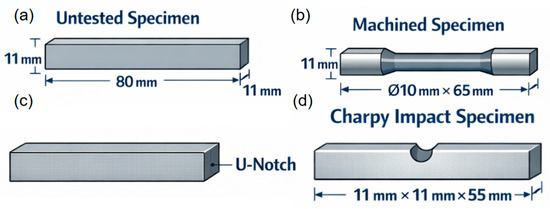
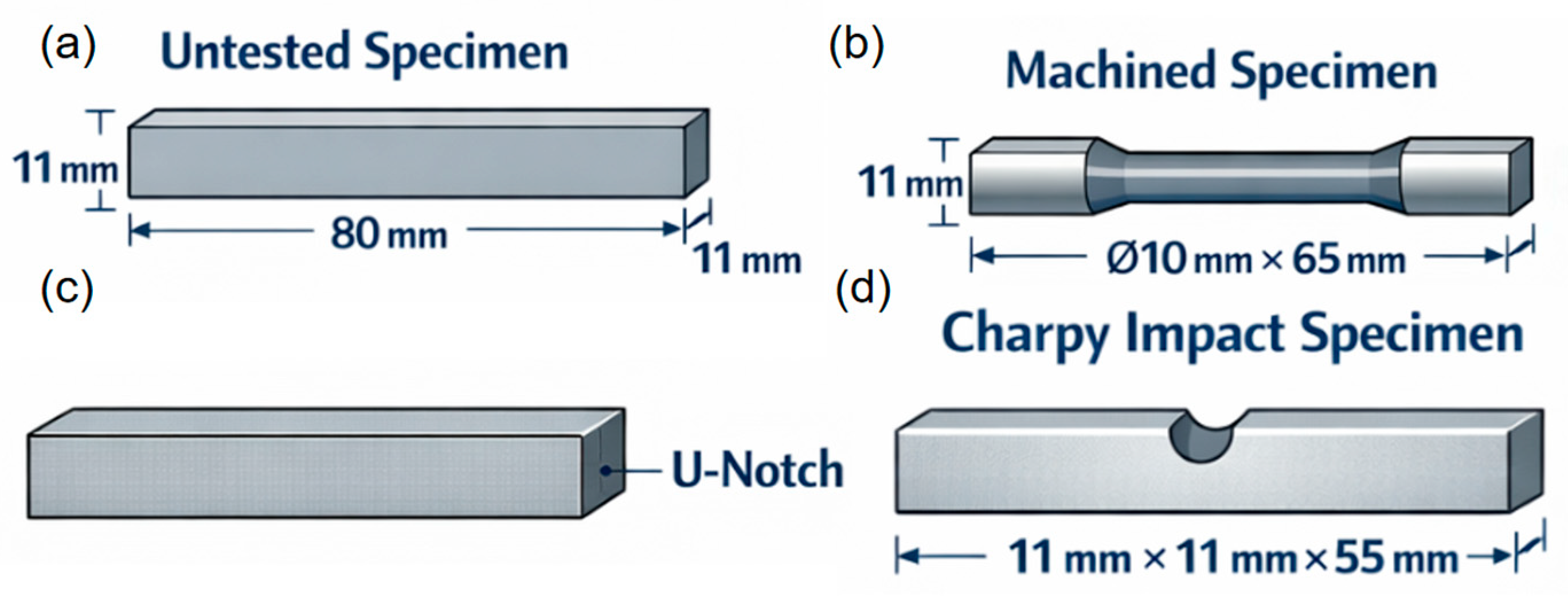
Before heat treatment, cubic specimens with dimensions of 10 mm × 10 mm × 10 mm were prepared for microstructural characterization. Tensile blanks, with dimensions of 11 mm × 11 mm × 80 mm and Charpy impact blanks, with dimensions of 11 mm × 11 mm × 55 mm, were also machined before heat treatment.
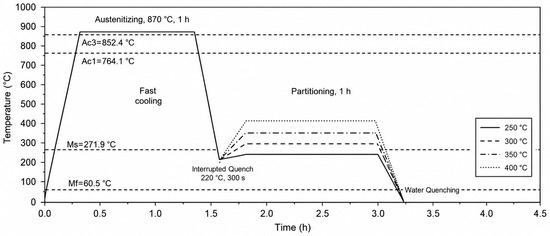
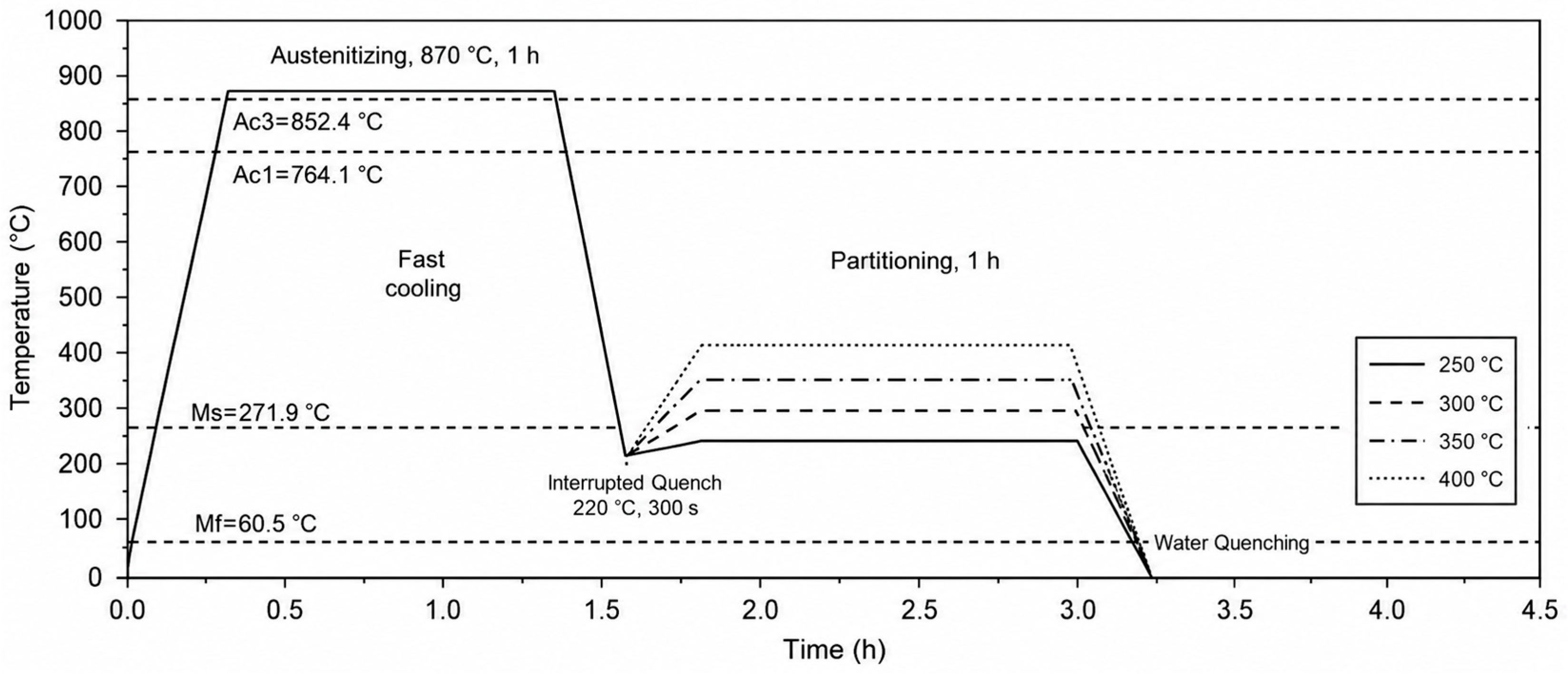
To investigate the effect of partitioning temperature on the microstructural evolution and mechanical properties of 300M steel, a Q-P route with a fixed interrupted quenching condition was adopted. According to the reported transformation temperatures of 300M steel, Ac1 and Ac3 are approximately 764.1 °C and 852.4 °C, respectively [23]. Therefore, the specimens were austenitized at 870 °C for 1 h under an argon atmosphere to ensure full austenitization and minimize decarburization. The martensite start temperature (Ms) and martensite finish temperature (Mf) were estimated to be 271.9 °C and approximately 60.5 °C, respectively, from the JMatPro-calculated martensite fraction–temperature curve. Thus, the specimens were rapidly transferred to an alkali bath at 220 °C within 2 s and held for 300 s for interrupted quenching, allowing partial martensitic transformation while retaining untransformed austenite for subsequent carbon partitioning. Based on the Koistinen–Marburger relationship, the expected volume fraction of primary martensite formed at 220 °C was approximately 43.5%, leaving about 56.5% untransformed austenite before the partitioning step. The specimens were then partitioned in a nitrate salt bath at 250, 300, 350, and 400 °C for 1 h, followed by final water quenching to room temperature. Therefore, partitioning temperature was the only processing variable in the present heat treatment design.
The austenitizing treatment was performed using a KSL-1200X box-type (Hefei Kejing Material Technology Co., Ltd., Hefei, China) resistance furnace. The interrupted quenching and partitioning treatments were carried out using salt bath furnaces, with an alkali bath used for the 220 °C interrupted quenching step and a nitrate salt bath used for the subsequent partitioning treatment. The bath temperatures were monitored using calibrated thermocouples to ensure temperature stability during heat treatment.
As shown in Figure 1, all partitioning treatments were conducted for the same duration of 1 h. The different horizontal segments in the partitioning stage therefore represent different partitioning temperatures rather than different partitioning times.
Figure 1.
Schematic illustration of the heat treatment schedule.
2.3. Mechanical Testing
To evaluate the overall mechanical performance of 300M steel under different partitioning temperatures, room temperature tensile and impact tests were carried out. The tensile blanks had dimensions of 11 mm × 11 mm × 80 mm, and the machined tensile specimens had an original gauge dimension of ⌀10 mm × 65 mm. The impact specimens measured 11 mm × 11 mm × 55 mm and contained a U-shaped notch. The dimensions of the tensile and impact specimens are shown in Figure 2. All specimens were taken from the central region of the material in order to minimize the influence of sampling position on the comparison of results.
Figure 2.
Dimensions of the test specimens: (a) tensile blank; (b) tensile specimen; (c) impact blank; (d) impact specimen.
Room temperature tensile tests were conducted on an MTS Exceed E45.305 electronic universal testing machine (MTS Systems Corporation, Eden Prairie, MN, USA) at a constant crosshead speed of 2 mm·min−1, corresponding to an initial strain rate of approximately 5.1 × 10⁻⁴ s−1 within the gauge length. The yield strength, ultimate tensile strength, elongation to failure, and reduction in area were obtained from the tensile tests. Room temperature impact tests were carried out using a JB-300B pendulum impact testing machine, and the impact toughness was recorded. For each heat treatment condition, at least three parallel specimens were tested for both tensile and impact measurements, and the results are reported as average values.
2.4. Microstructural Characterization
Scanning electron microscopy (SEM) was performed using a GeminiSEM 300 field-emission scanning electron microscope (Carl Zeiss Microscopy GmbH, Jena, Germany) to examine the overall microstructural morphology after Q-P treatment. The specimens were mechanically ground, polished, and etched using 4 vol.% nital at room temperature for 8–10 s. Transmission electron microscopy (TEM) was performed using a Tecnai G2 F20 S-TWIN transmission electron microscope (FEI Company, Hillsboro, OR, USA) to characterize martensite lath morphology, dislocation substructure, precipitate characteristics, and retained austenite morphology. TEM foils were prepared by mechanical grinding to below 50 μm, punching into 3 mm disks, and twin-jet electropolishing in 5 vol.% perchloric acid–ethanol solution at −25 °C and 30 V. X-ray diffraction (XRD) was performed using a Bruker D8 ADVANCE diffractometer (Bruker AXS GmbH, Karlsruhe, Germany) with Cu Kα radiation to characterize the variation in retained austenite-related diffraction signals under different partitioning temperatures. The XRD measurements were performed over a 2θ range of 40–100°, with a step size of 0.02° and a scanning rate of 2°/min. The retained austenite content was estimated from the integrated intensities of the austenite and martensite diffraction peaks. In the present work, XRD was used to compare the relative retention behavior of retained austenite under different partitioning temperatures.
The size distribution of precipitate-like features was obtained from TEM micrographs using ImageJ software (version 1.53t, National Institutes of Health, Bethesda, MD, USA), and the precipitate size was defined as the equivalent circular diameter measured from the projected area.
3. Results
3.1. Mechanical Response to Partitioning Temperature
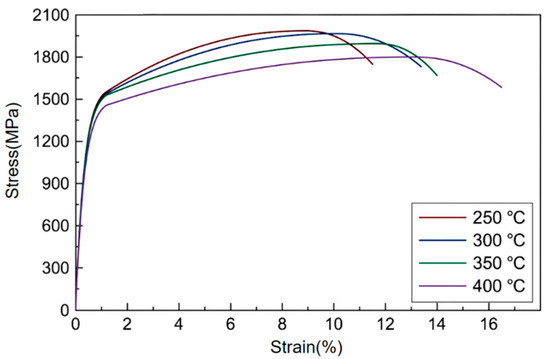
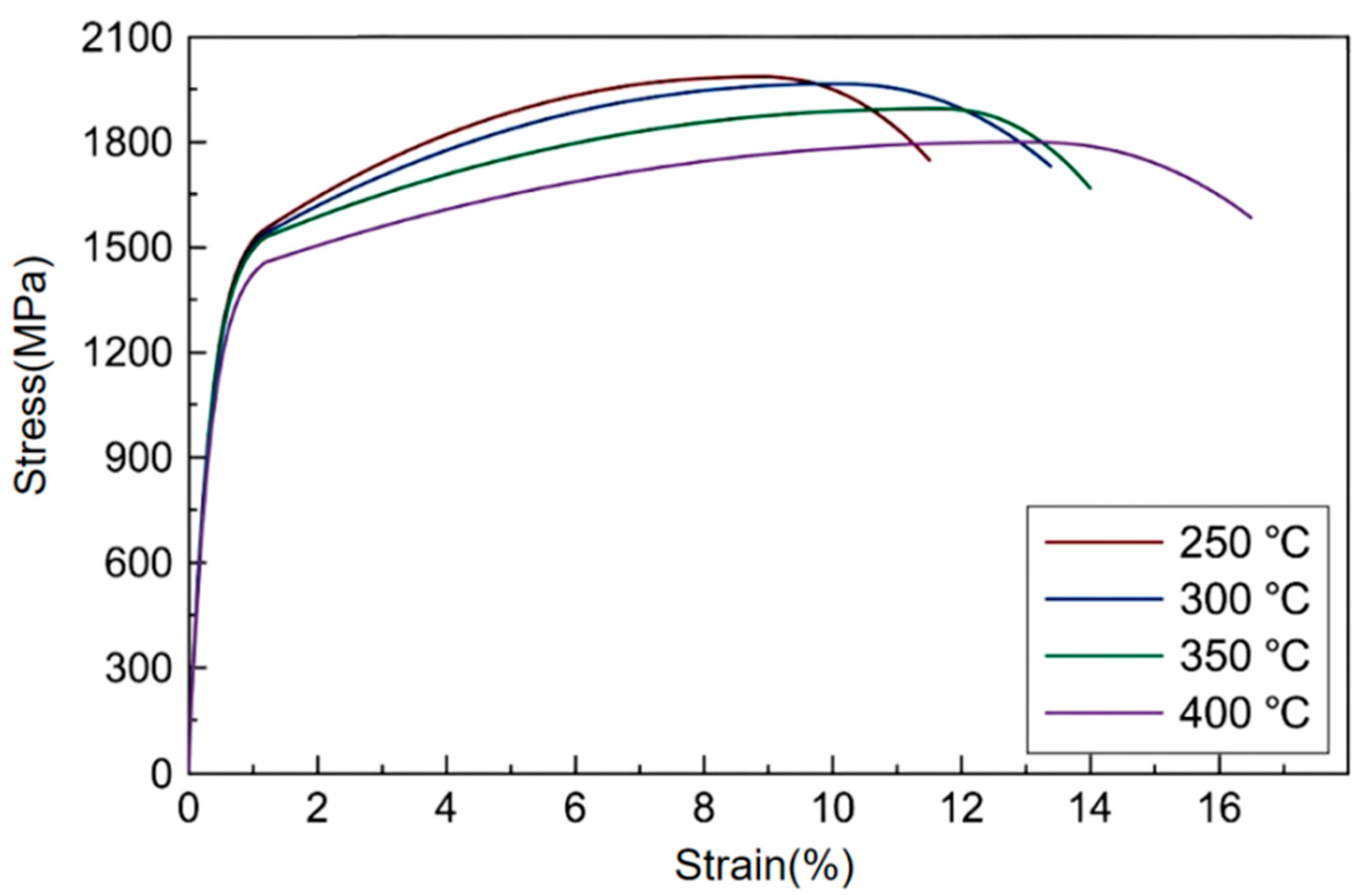
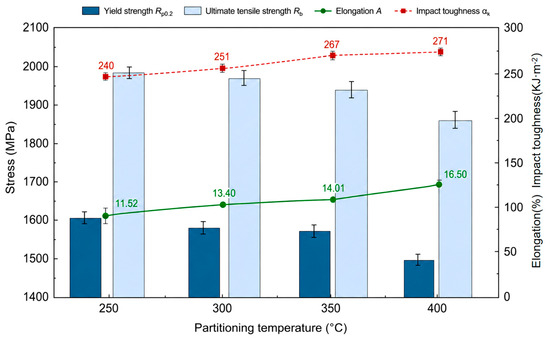
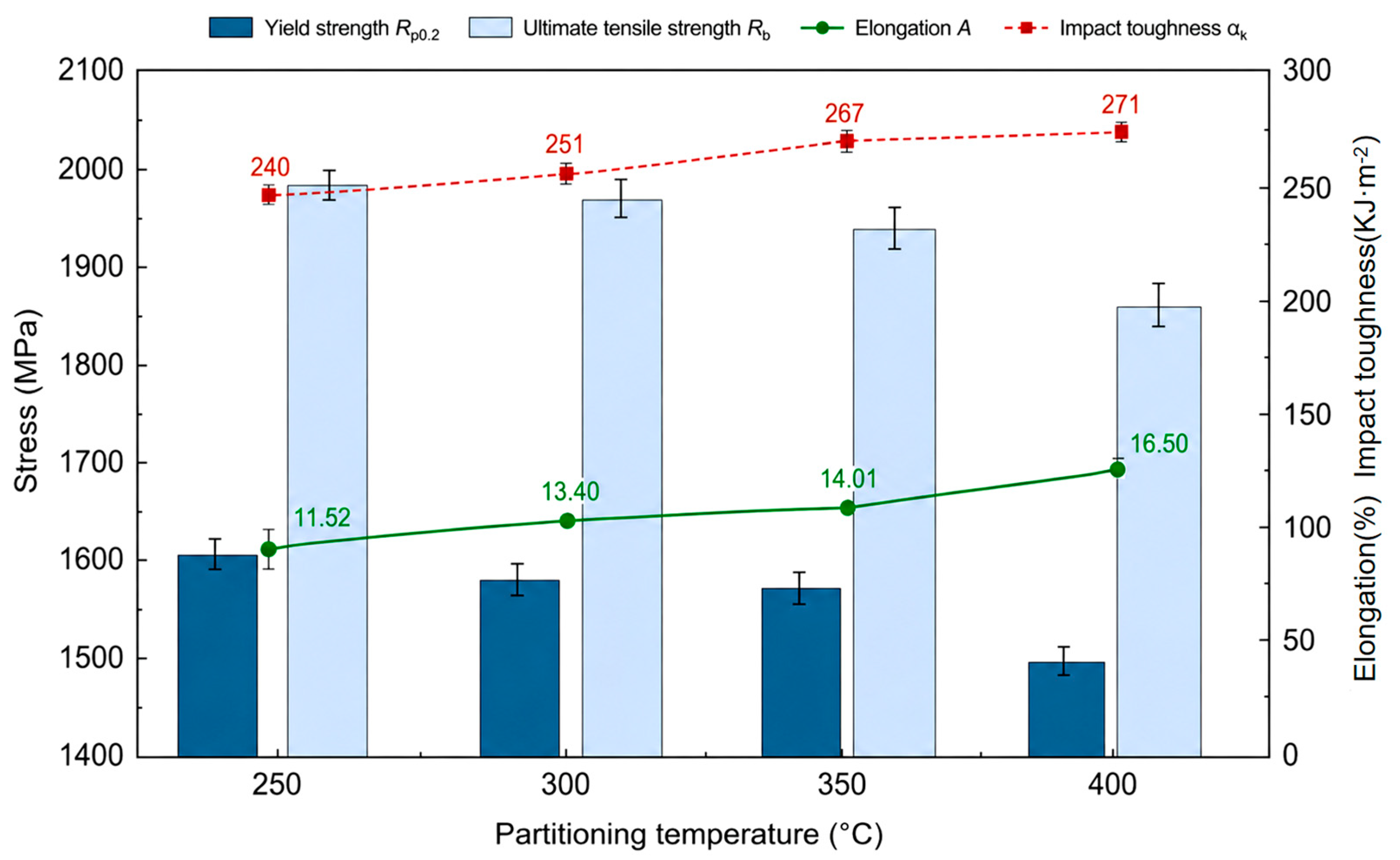
Figure 3 shows the engineering stress–strain curves of 300M steel at different partitioning temperatures under a fixed interrupted quenching temperature of 220 °C, and Figure 4 summarizes the corresponding mechanical property data. All Q-P-treated specimens exhibited continuous work hardening after yielding and retained a certain extent of uniform deformation, indicating that stable plastic deformation was maintained within the partitioning temperature range investigated in this study.
Figure 3.
Engineering stress–strain curves of 300M steel at different partitioning temperatures.
Figure 4.
Comparison of the tensile properties and impact toughness of 300M steel at different partitioning temperatures.
As shown in Figure 3, with increasing partitioning temperature, the overall tensile response shifted from high stress and low strain to low stress and high strain. The specimen partitioned at 250 °C exhibited the highest stress level and the smallest fracture strain. At 300 °C, the overall stress level decreased slightly compared with that at 250 °C, whereas the plastic deformation range became longer. At 350 °C, the uniform deformation stage was further extended. The specimen treated at 400 °C showed the lowest stress level and the largest fracture strain. These results indicate that increasing partitioning temperature progressively changed the tensile response of 300M steel from a strength-dominant state to a state with greater deformability.
The quantitative results in Figure 4 are consistent with this trend. As the partitioning temperature increased from 250 °C to 400 °C, the yield strength decreased from 1599 MPa to 1499 MPa and the ultimate tensile strength decreased from 1987 to 1801 MPa. In contrast, the elongation to failure increased from 11.52% to 16.50%, and the impact toughness increased from 240 kJ·m−2 to 271 kJ·m−2. At 300 °C, the yield strength and ultimate tensile strength were 1587 MPa and 1967 MPa, respectively, accompanied by an elongation to failure of 13.40% and an impact toughness of 251 kJ·m−2. At 350 °C, the corresponding values were 1574 MPa, 1896 MPa, 14.01%, and 267 kJ·m−2, respectively.
Overall, lower partitioning temperatures favored strength retention, whereas higher partitioning temperatures promoted ductility and impact toughness. Within the investigated process window, the 300–350 °C range provided a more favorable overall mechanical property combination, since relatively high strength was still maintained while ductility and impact toughness had already improved appreciably.
3.2. Evolution of Martensitic Microstructure
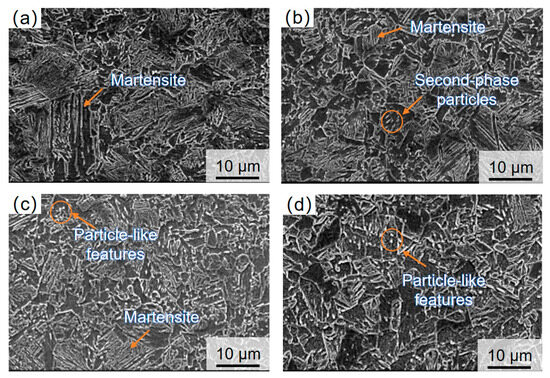
Figure 5 shows the SEM micrographs of 300M steel after Q-P treatment at different partitioning temperatures. All specimens retained a lath-martensitic microstructure, with the laths arranged in bundles. Particle-like contrast features were observed within the laths and near lath-bundle boundaries. Since these features were not chemically identified by SEM, they are described here as particle-like contrast features, and their possible relationship with precipitation behavior is discussed together with the TEM observations in Section 4.2.
Figure 5.
SEM micrographs of Q-P-treated 300M steel at different partitioning temperatures: (a) 250 °C; (b) 300 °C; (c) 350 °C; (d) 400 °C.
Figure 5a corresponds to the 250 °C condition. The lath-martensite boundaries are discernible, the bundle morphology remains intact, and the number of particle-like contrast features is relatively small, mainly appearing near local lath intersections. Figure 5b corresponds to the 300 °C condition. The overall lath morphology is similar to that at 250 °C, but more particle-like contrast features can be identified near the lath-bundle boundaries, and their distribution changes from isolated to locally continuous. Figure 5c corresponds to the 350 °C condition. The lath-bundle contours remain recognizable, the number of particle-like contrast features near the interfaces further increases, and in some regions the interparticle spacing decreases, leading to clustered distributions of adjacent features. Figure 5d corresponds to the 400 °C condition. Multiple particle-like contrast features can be observed continuously along the bundle boundaries, and their occurrence frequency is higher than that in the low-temperature specimens.
Taken together, Figure 5a–d indicate that increasing partitioning temperature did not change the basic lath-martensitic framework, but continuously modified the amount, spatial continuity, and local arrangement of particle-like contrast features near laths and bundle boundaries. The temperature effect was therefore first reflected in the local microstructural state and in particle-like contrast features near interfaces, rather than in a reconstruction of the overall microstructure type.
3.3. Morphological Evolution and Retention Characteristics of Retained Austenite
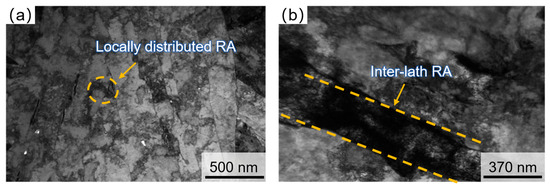
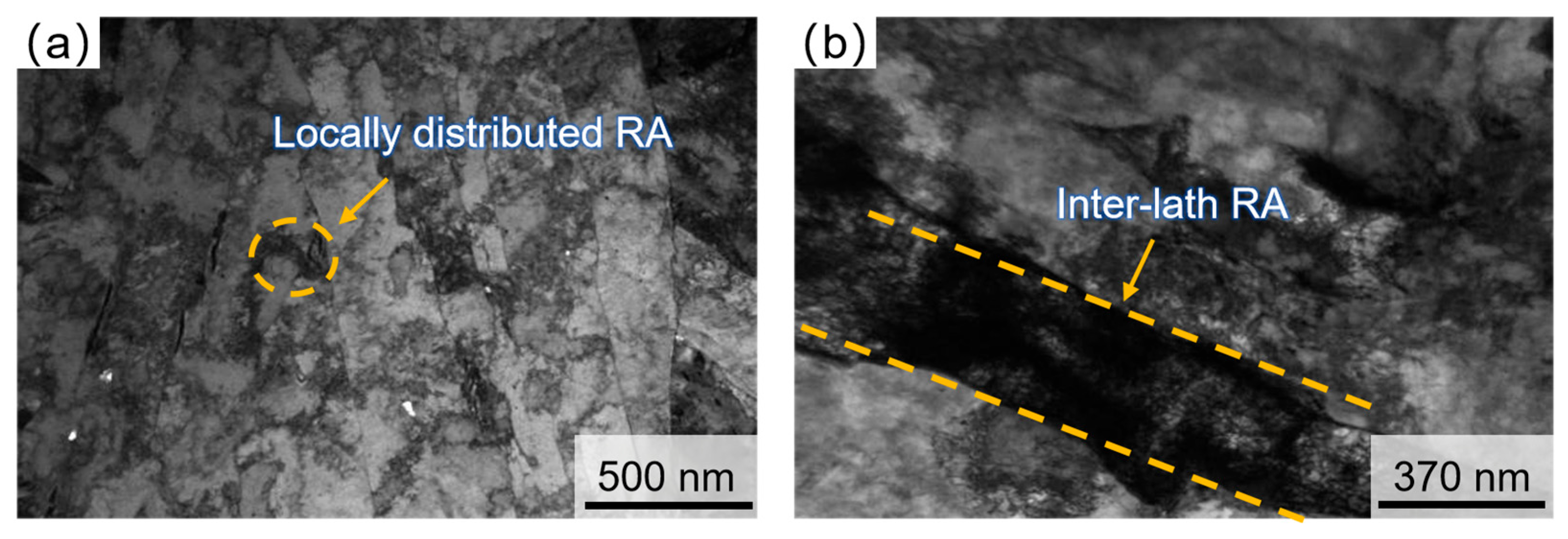
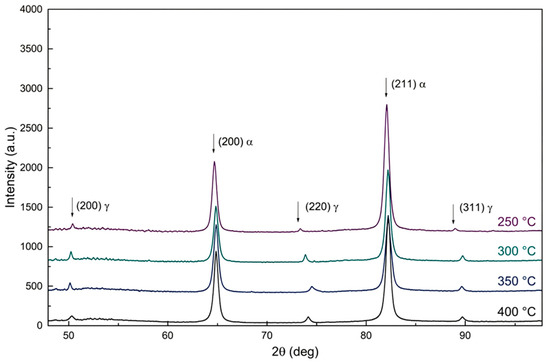
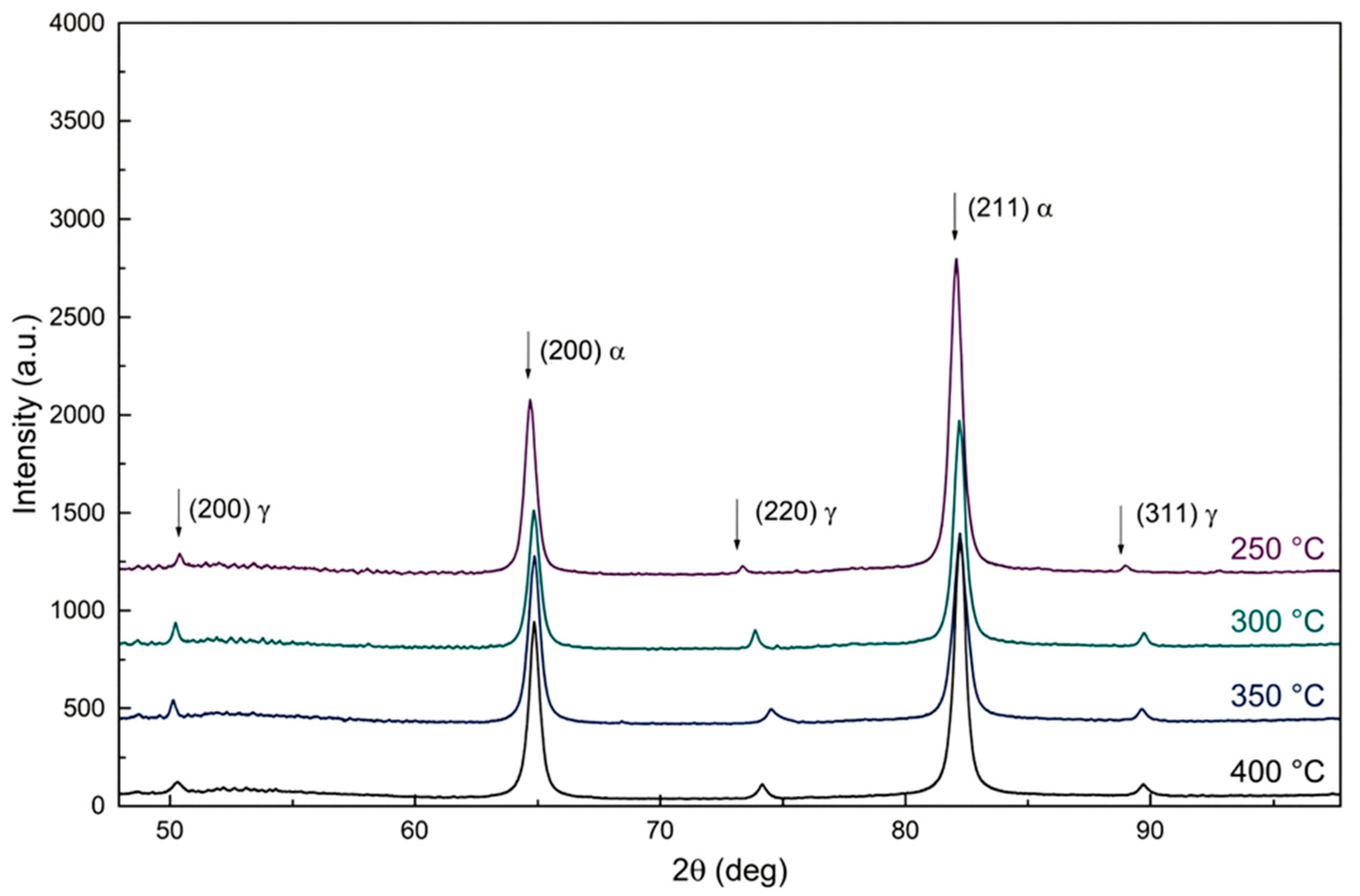
Figure 6 and Figure 7 show the TEM morphologies and XRD patterns of retained austenite in 300M steel at different partitioning temperatures. The response of retained austenite to partitioning temperature is reflected in both morphology and retention behavior. The former is manifested in the scale and continuity of retained austenite between martensite laths, whereas the latter is reflected by the variation in retained austenite-related diffraction peak intensity.
Figure 6.
TEM images of retained austenite in 300M steel at different partitioning temperatures: (a) 250 °C; (b) 400 °C.
Figure 7.
XRD patterns of 300M steel at different partitioning temperatures.
Figure 6a corresponds to the 250 °C condition. Retained austenite mainly appears as locally distributed fine units between martensite laths, with a discontinuous distribution and small characteristic size. Figure 6b corresponds to the 400 °C condition. Retained austenite between laths becomes more abundant and forms wider, more continuous band-like regions, with both scale and continuity greater than those in Figure 6a. The comparison between these two representative conditions indicates that increasing partitioning temperature changes the retained austenite distribution from a locally discontinuous state at low temperature to a more continuous inter-lath distribution at high temperature.
Figure 7 shows that retained austenite-related diffraction peaks can be identified in all Q-P-treated specimens, indicating that retained austenite was retained at room temperature under all processing conditions used in this study. The peak intensities vary with partitioning temperature. The retained austenite-related peaks are weak at low partitioning temperature, increase at intermediate temperatures, and then decrease again at higher temperature. The retained austenite content was further estimated from the XRD results, as listed in Table 2. It increased from 3.8% at 250 °C to 5.6% at 300 °C, then slightly decreased to 5.0% at 350 °C and further decreased to 4.0% at 400 °C. This confirms that the retained austenite content exhibits a non-monotonic dependence on partitioning temperature, with a relatively higher retention level in the 300–350 °C range.
Table 2.
XRD-estimated retained austenite content of Q-P-treated 300M steel at different partitioning temperatures.
In addition to the variation in retained austenite content, a slight position change in the (220)γ peak can also be observed with increasing partitioning temperature. This indicates that partitioning temperature affects not only the amount of retained austenite, but also its lattice state and internal stress state. In Q-P steels, such a peak-position variation may be associated with carbon redistribution between martensite and austenite, stress relaxation caused by martensite recovery, and carbon consumption by precipitation or possible competing transformation during partitioning. Therefore, the retained austenite response in the present steel should be interpreted as a coupled change in retention amount, morphology, and lattice state, rather than as a simple variation in retained austenite fraction alone.
Taken together, Figure 6 and Figure 7 indicate that the response of retained austenite to partitioning temperature is not one-dimensional. Figure 6 reflects the morphological and distributional differences between the low- and high-temperature representative conditions, whereas Figure 7 reflects the non-monotonic variation in retention behavior across the full temperature range. In the present study, the temperature dependence of retained austenite therefore involves both representative morphological differences and overall retention characteristics.
4. Discussion
4.1. Recovery of Martensitic Matrix and Mechanical Response
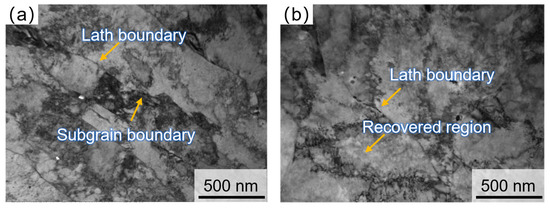
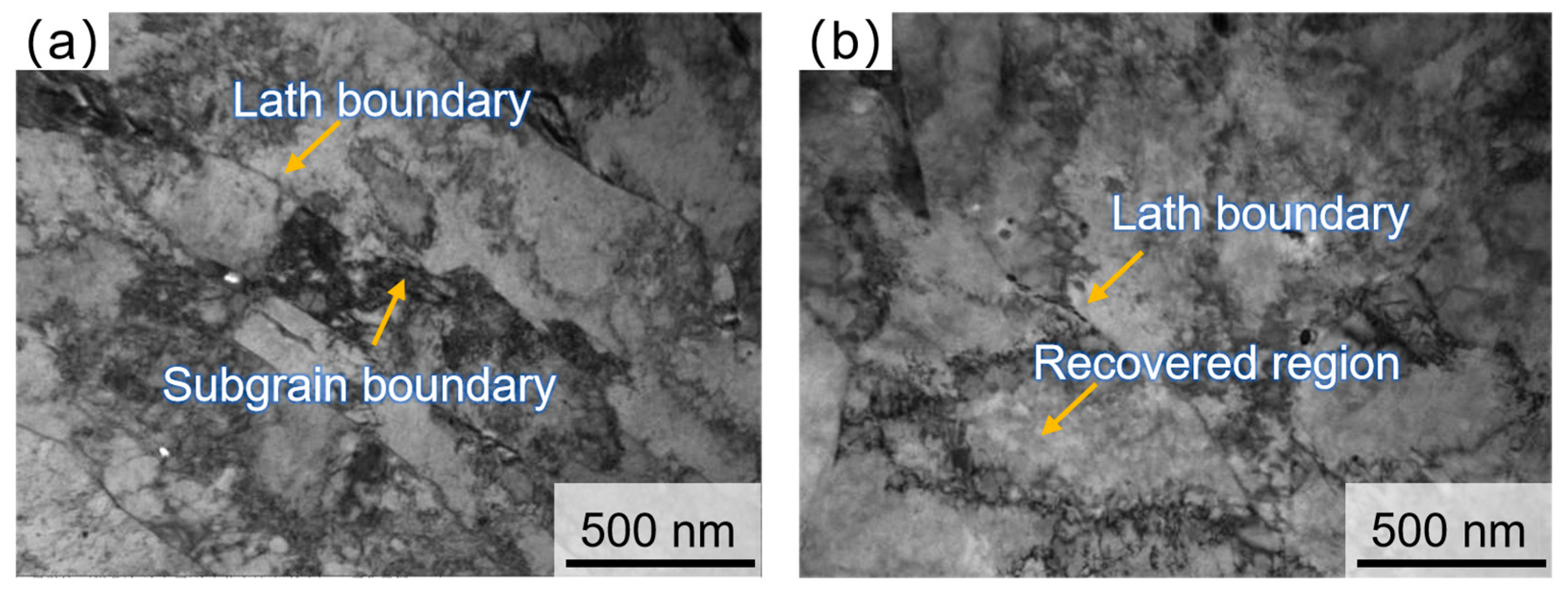
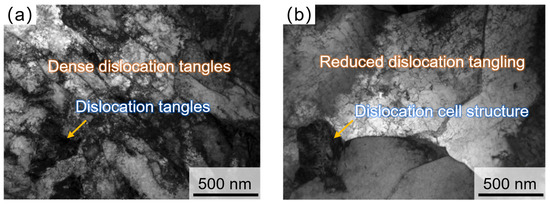
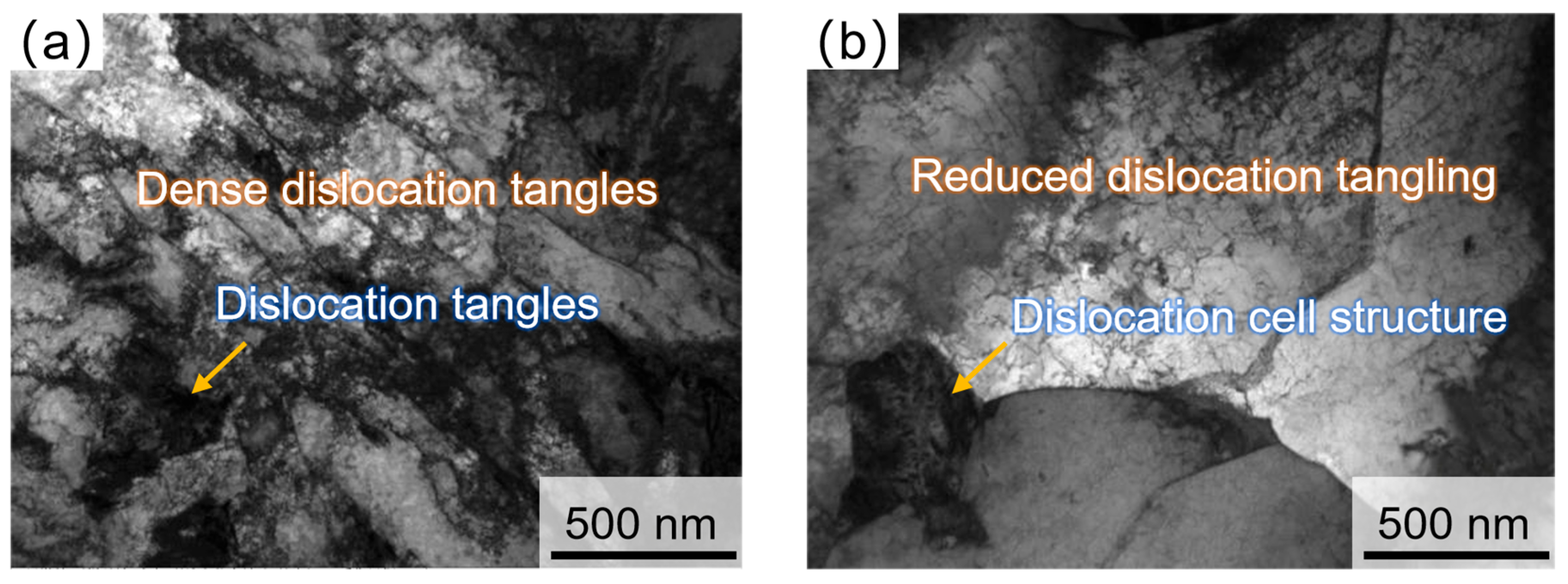
Section 3.1 showed that, with increasing partitioning temperature, the yield strength and ultimate tensile strength of 300M steel decreased continuously, whereas the elongation to failure and impact toughness increased continuously. The interpretation of this trend should first be based on changes in the martensitic matrix itself. Figure 8 and Figure 9 show clear differences in lath morphology and dislocation substructure between the low- and high-temperature representative specimens. In Figure 8a, lath boundaries are discernible and the substructural units remain intact; in Figure 8b, boundary contrast decreases and local lath widening is observed. In Figure 9a, dense dislocation tangles and pile-up features are observed, indicating a highly distorted martensitic substructure after low-temperature partitioning. In Figure 9b, the dislocation contrast becomes less tangled and more locally organized, and cell-like recovery features appear. These BF-TEM observations are used here to compare the dislocation substructure and recovery features qualitatively rather than to determine absolute dislocation density [24].
Figure 8.
TEM images of martensite lath morphology at different partitioning temperatures: (a) 250 °C; (b) 400 °C.
Figure 9.
TEM images of dislocation substructure at different partitioning temperatures: (a) 250 °C; (b) 400 °C.
At low partitioning temperatures, dense dislocation tangles, stronger substructure contrast, and more intact lath/bundle boundaries together provide stronger substructure-related and boundary-related strengthening, allowing the material to retain high yield strength and ultimate tensile strength. As the partitioning temperature increases, dislocation rearrangement and martensitic matrix recovery gradually transform the high-stored-energy martensitic matrix toward a more recovered state, thereby weakening substructure strengthening and boundary constraint and leading to a continuous decrease in strength. This trend is consistent with the reported role of matrix state in controlling strength retention in Q-P steels [25].
The recovery process also changes stress redistribution during deformation. At low partitioning temperatures, dense dislocation tangles, and stronger internal stress concentration favor strength retention, but they may also promote local stress concentration. As the partitioning temperature increases, martensitic matrix recovery relieves part of the internal stress and allows strain to be redistributed over a larger volume, leading to improved ductility and impact toughness absorption. Therefore, the decrease in strength and the increase in ductility should be regarded as two manifestations of the same matrix evolution process rather than as two independent phenomena [26]. This interpretation accounts for the contribution of matrix substructure, whereas the roles of precipitate-like feature evolution and austenite retention still need to be considered in combination with the subsequent results.
4.2. Precipitate-like Feature Coarsening and Strength Loss
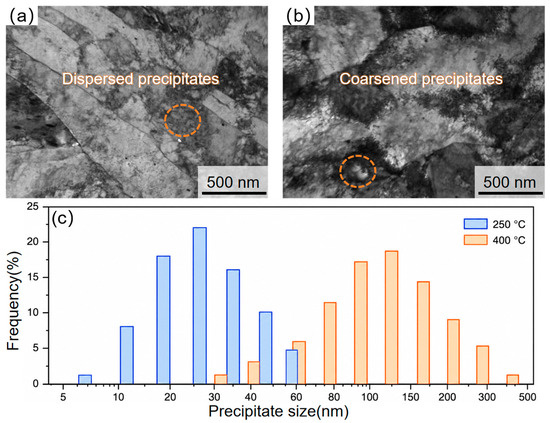
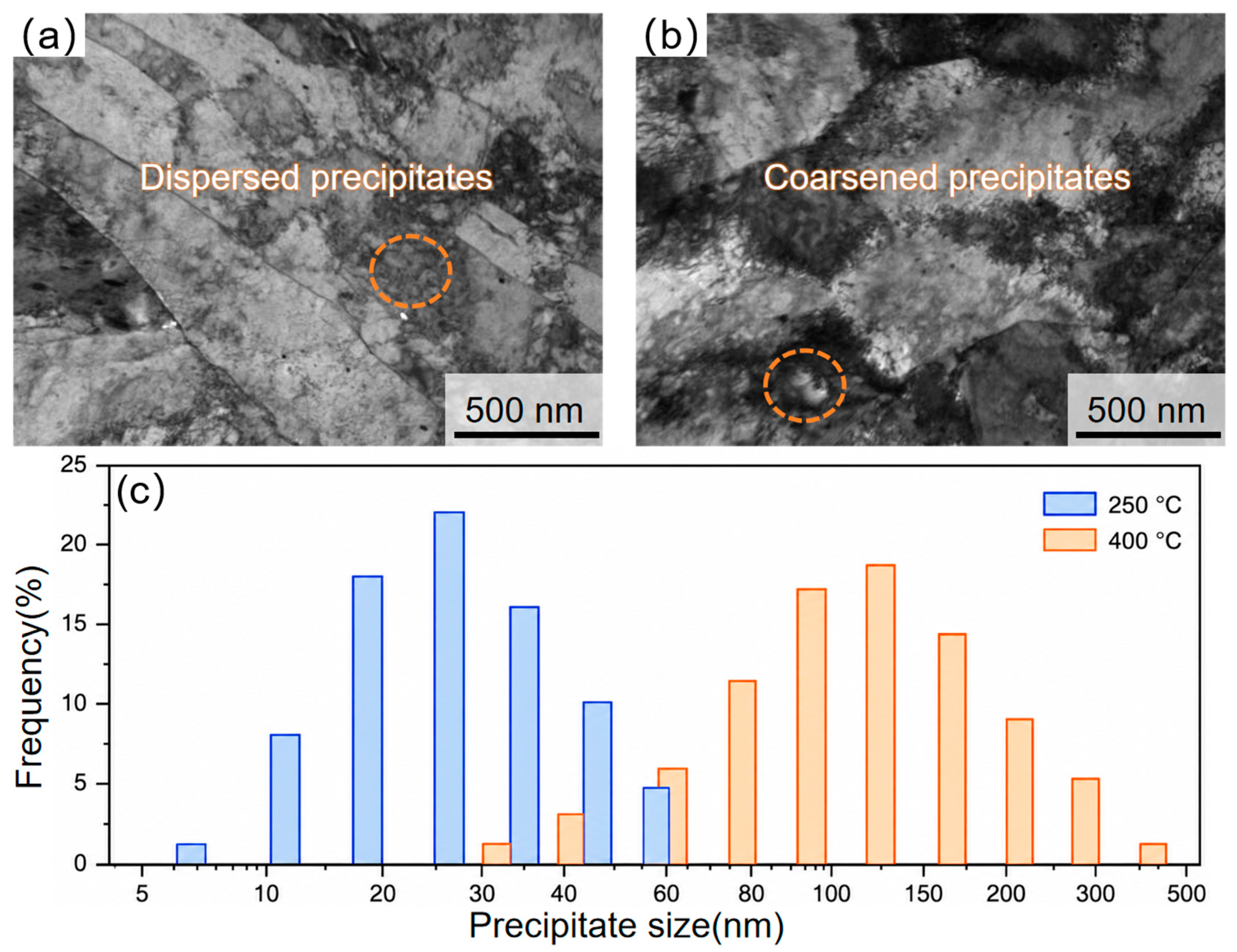
Figure 10 presents representative TEM images and size distribution analysis of precipitate-like features under low- and high-temperature partitioning conditions. In the specimen partitioned at 250 °C, the precipitate-like features were relatively fine and dispersed within the martensitic matrix, as shown in Figure 10a. In contrast, after partitioning at 400 °C, the precipitate-like features became visibly coarser and more locally concentrated, indicating that higher partitioning temperature promoted the coarsening of these features (Figure 10b) [27].
Figure 10.
TEM characterization and statistical analysis of precipitate-like features in Q-P-treated 300M steel: (a) 250 °C; (b) 400 °C; (c) precipitate size distribution.
The size distribution shown in Figure 10c further supports this tendency. For the 250 °C condition, the precipitate-like features were mainly distributed in the smaller-size range, with the highest frequency appearing at approximately 20–30 nm. By contrast, the 400 °C condition exhibited a broader size distribution shifted toward larger sizes, with the main distribution located at approximately 80–150 nm and a tail extending to larger sizes. This comparison demonstrates that increasing the partitioning temperature from 250 °C to 400 °C significantly changes the precipitate state from a fine and dispersed distribution to a coarsened distribution.
This evolution is important for understanding the decrease in strength with increasing partitioning temperature. Fine and dispersed precipitate-like features at lower partitioning temperature can act as effective obstacles to dislocation motion and thus contribute to strength retention. However, coarsening at higher partitioning temperature reduces the effectiveness of particle pinning and weakens the strengthening contribution associated with these features. Therefore, the continuous decrease in yield strength and ultimate tensile strength with increasing partitioning temperature can be partly attributed to precipitate coarsening, together with martensite recovery and the reduction in dislocation density [28].
It should be noted that the present TEM observations and size distribution analysis mainly demonstrate the morphological evolution and coarsening tendency of precipitate-like features. Since their exact crystallographic and compositional identity has not been fully determined in the present work, these features are conservatively described as precipitate-like features rather than being assigned to a specific carbide phase. Further TEM-EDS, high-resolution TEM, or selected-area diffraction analysis would be required to clarify their exact phase identity [29].
4.3. Retained Austenite Stability as a Function of Partitioning Temperature
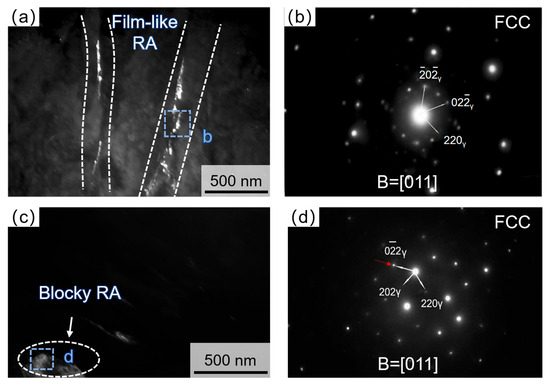
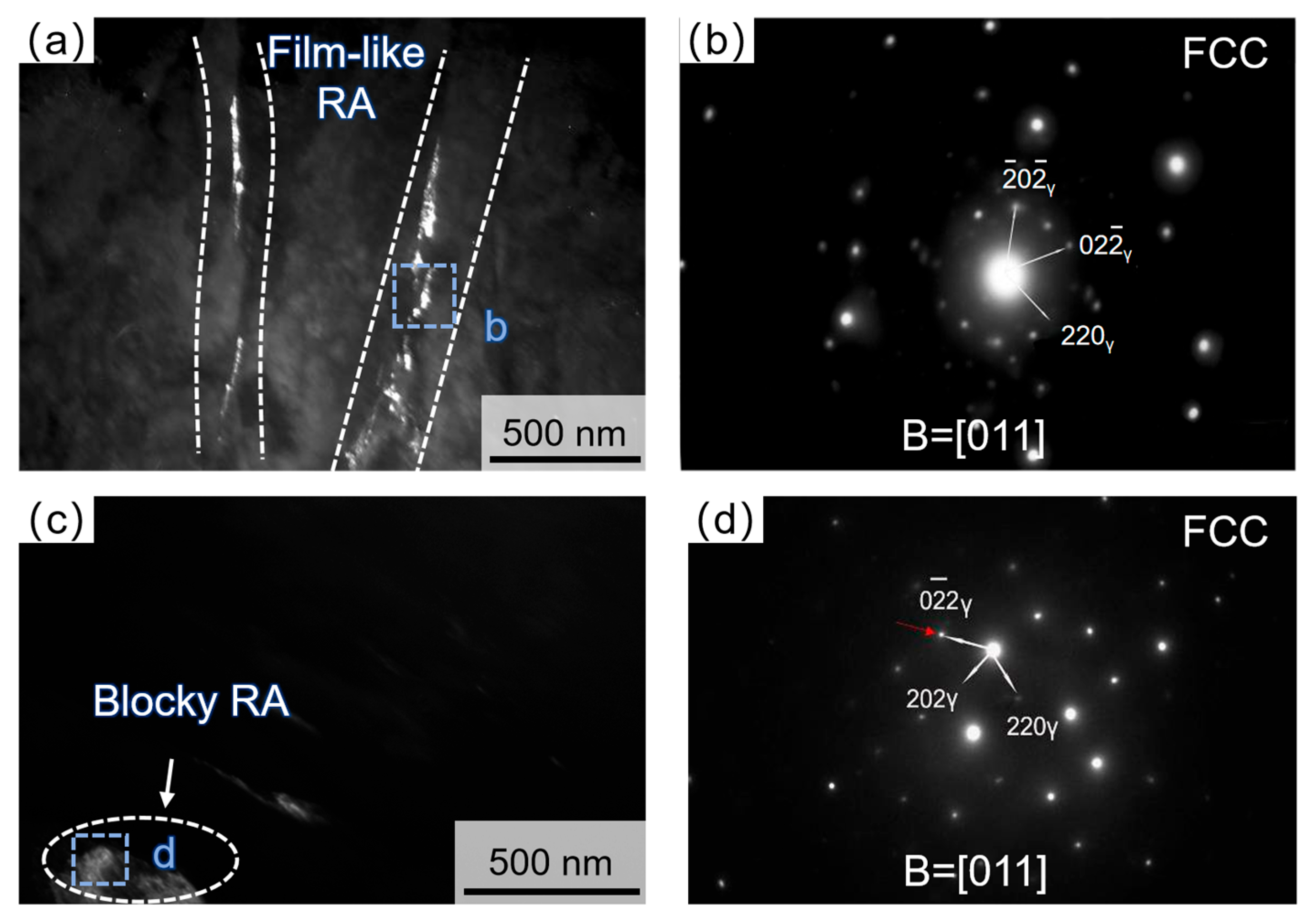
Figure 6 and Figure 7 together show that the response of retained austenite to partitioning temperature involves both retention behavior and morphology. In particular, Figure 6 highlights the difference between the low- and high-temperature representative conditions, whereas Figure 7 reflects the overall variation in retention behavior across the full temperature range. Figure 11 further confirms that retained austenite in the present alloy can exist in both film-like and locally blocky forms.
Figure 11.
TEM images and SAED patterns of retained austenite at different partitioning temperatures: (a) film-like retained austenite at 250 °C; (b) corresponding SAED pattern; (c) blocky retained austenite at 400 °C; (d) corresponding SAED pattern.
The XRD results further suggest that retained austenite evolution involves both amount variation and lattice-state variation. The retained austenite content reaches a relatively higher level in the 300–350 °C range, whereas the slight change in the (220)γ peak position implies that the lattice parameter and internal stress state of retained austenite may also vary with partitioning temperature. At lower partitioning temperature, limited carbon diffusion restricts austenite stabilization. At intermediate temperatures, carbon partitioning from supersaturated martensite to untransformed austenite becomes more effective, thereby improving austenite retention. At 400 °C, however, enhanced martensite recovery, precipitate coarsening, and possible carbon consumption by precipitation or competitive transformation may reduce the carbon available for austenite stabilization. This explains why the retained austenite content does not increase monotonically with partitioning temperature.
At low partitioning temperatures, carbon enrichment of austenite is limited, and the room temperature retention of retained austenite is correspondingly low. At intermediate partitioning temperatures, retained austenite is retained more readily, whereas at higher temperatures the related diffraction intensity decreases again, indicating that the retention behavior does not increase monotonically with temperature. Within the present processing range, this trend suggests the existence of a partitioning temperature window for austenite retention [30].
The role of retained austenite cannot be represented by volume fraction alone. Film-like retained austenite is subjected to stronger geometric constraint from the surrounding martensitic matrix, whereas locally blocky retained austenite is associated with a different local stress-response condition. As the partitioning temperature increases, retained austenite evolves from thin film-like regions toward thicker and locally blocky regions, and the corresponding deformation response is expected to change accordingly. In the present study, the contribution of retained austenite to ductility and impact toughness is therefore more reasonably interpreted in terms of the combined variation in retention behavior and morphology, rather than as a simple fraction effect [31]. Here, the term stability mainly refers to room temperature retention behavior and its possible morphology dependence, rather than to mechanical stability directly measured during in situ loading.
It should be noted that possible bainitic transformation or carbide-free bainite formation cannot be fully excluded during partitioning in the 300–400 °C range. Based on the present SEM/TEM/XRD evidence, this possible transformation product cannot be quantitatively separated from the recovered martensitic matrix. Therefore, it is considered here as a possible competing process that may affect carbon redistribution, retained austenite stabilization, and the resulting mechanical property balance.
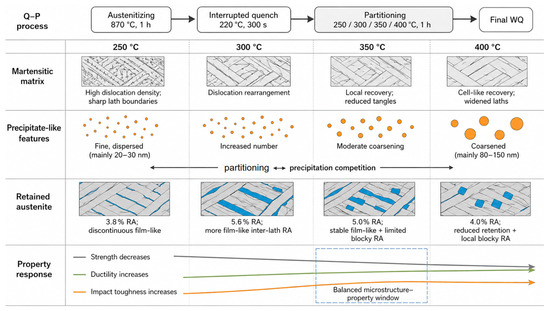
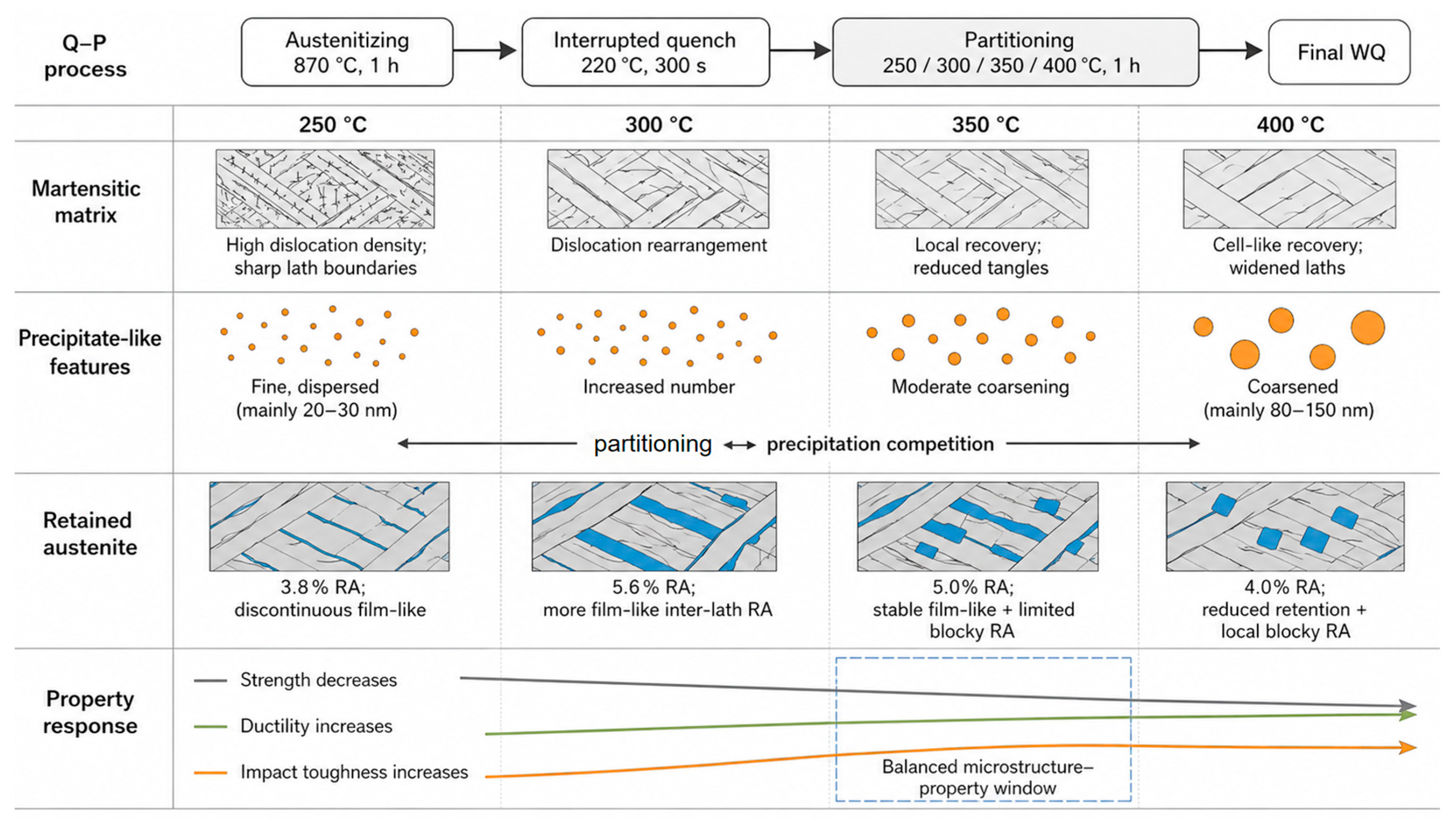
Figure 12 summarizes the relationship between partitioning temperature, microstructural evolution, and mechanical property balance in the present study. With increasing partitioning temperature, the martensitic matrix evolves from a high dislocation density state with sharp lath/subgrain boundaries to a recovered state characterized by dislocation rearrangement, reduced dislocation tangles, cell-like recovery features, and widened laths, consistent with the TEM observations in Figure 8 and Figure 9.
Figure 12.
Schematic summary of partitioning temperature-dependent microstructural evolution and mechanical property balance in Q-P-treated 300M steel.
Meanwhile, the precipitate-like features change from a fine and dispersed distribution at 250 °C to a coarsened distribution at 400 °C, as supported by the TEM observations and size distribution analysis in Figure 10. Retained austenite also exhibits coupled changes in content and morphology: the XRD-estimated retained austenite content is relatively high in the 300–350 °C range, while the morphology evolves from discontinuous film-like retained austenite toward thicker inter-lath or locally blocky retained austenite.
These coupled microstructural changes account for the mechanical property rebalance with increasing partitioning temperature. Martensitic matrix recovery and precipitate-like feature coarsening reduce dislocation strengthening and particle-pinning effects, leading to a decrease in strength. In contrast, matrix recovery and retained austenite-related deformation accommodation contributes to the improvement in ductility and impact toughness. Therefore, the 350 °C condition represents a balanced microstructure–property window within the investigated processing range, rather than the maximum of any single microstructural parameter [32].
5. Conclusions
In this work, 300M ultra-high-strength steel was subjected to quenching–partitioning treatment with a fixed interrupted quenching condition of 220 °C for 300 s, followed by partitioning at 250–400 °C for 1 h. Based on the microstructural characterization and mechanical testing, the following conclusions can be drawn:
- (1)
- Under a fixed interrupted quenching condition of 220 °C for 300 s, increasing the partitioning temperature from 250 °C to 400 °C shifted 300M steel from a strength-dominant state to a more ductile and impact-tolerant state. The yield strength and ultimate tensile strength decreased from 1599 MPa to 1499 MPa and from 1987 MPa to 1801 MPa, respectively, whereas the elongation to failure and impact toughness increased from 11.52% to 16.50% and from 240 kJ·m−2 to 271 kJ·m−2.
- (2)
- The steel retained a lath-martensitic matrix over the entire partitioning temperature range, but its local microstructural state evolved systematically with temperature. Increasing partitioning temperature promoted martensitic matrix recovery, reduced dislocation tangling, and changed the precipitate-like feature state from fine and dispersed to coarsened. Retained austenite remained mainly distributed between martensite laths and showed both morphology variation and non-monotonic retention behavior, as indicated by the XRD-estimated retained austenite content.
- (3)
- Within the investigated processing window, the 350 °C partitioning condition represents a balanced microstructure–property window rather than the optimum of any single microstructural parameter. Compared with lower-temperature conditions, partitioning at 350 °C provides sufficient martensitic matrix recovery and retained austenite-related deformation accommodation to improve ductility and impact toughness. Compared with the 400 °C condition, it avoids excessive matrix recovery, severe coarsening of precipitate-like features, and the reduction in austenite retention, thereby maintaining a relatively high strength level. Therefore, the favorable property balance at 350 °C originates from the coordinated redistribution of strength-retaining and toughness-enhancing contributions during partitioning.
Author Contributions
Conceptualization, J.M. and A.M.; methodology, J.M., X.G., M.Z. and A.Z.; formal analysis, J.M., M.Z. and A.M.; investigation, J.M., X.G. and C.Z.; data curation, J.M., A.Z., C.Z. and A.M.; writing—original draft preparation, J.M.; writing—review and editing, J.M., M.Z., C.Z. and A.M.; supervision, X.G., M.Z. and A.M.; funding acquisition, X.G. and J.M. All authors have read and agreed to the published version of the manuscript.
Funding
This research was funded by the Scientific Research Project of Shaanxi Provincial Department of Education, titled “Study on Microstructure and Property Control of Ultra-High Strength Steel for Aircraft Landing Gear During Heat Treatment” (Grant No. 24JP088), and supported by the Shaanxi Provincial University Youth Innovation Team for Precise Control of Shape and Properties of Key Aviation Structural Components (Grant No. 2023-98).
Data Availability Statement
Data will be made available on request.
Acknowledgments
The authors would like to express their sincere gratitude to Xiaoyong Zhang from Xi’an Shiyou University for his valuable and constructive review of this manuscript. During the preparation of this manuscript, AI-assisted language tools (ChatGPT-5.5) was used only for grammar correction, spelling, punctuation, formatting, and improvement in language clarity. The scientific content, experimental data, data analysis, interpretation, conclusions, and final version of the manuscript were prepared, checked, and approved by all authors.
Conflicts of Interest
The authors declare no conflicts of interest.
Abbreviations
The following abbreviations are used in this manuscript:
| Q-P | Quenching–partitioning |
| SEM | Scanning electron microscopy |
| TEM | Transmission electron microscopy |
| XRD | X-ray diffraction |
| SAED | Selected area electron diffraction |
References
- Li, J.; Zhan, D.; Jiang, Z.; Zhang, H.; Yang, Y.; Zhang, Y. Progress on improving strength-toughness of ultra-high strength martensitic steels for aerospace applications: A review. J. Mater. Res. Technol. 2023, 23, 172–190. [Google Scholar] [CrossRef] [Scilit]
- Kasana, S.S.; Sharma, S.; Pandey, O.P. Influence of heat treatment (routes) on the microstructure and mechanical properties of 300M ultra high strength steel. Arch. Civ. Mech. Eng. 2022, 22, 126. [Google Scholar] [CrossRef] [Scilit]
- Liu, F.; Lin, X.; Song, M.; Yang, H.; Song, K.; Guo, P.; Huang, W. Effect of tempering temperature on microstructure and mechanical properties of laser solid formed 300M steel. J. Alloys Compd. 2016, 689, 225–232. [Google Scholar] [CrossRef] [Scilit]
- Liu, F.; Lin, X.; Shi, J.; Zhang, Y.; Bian, P.; Li, X.; Hu, Y. Effect of microstructure on the Charpy impact properties of directed energy deposition 300M steel. Addit. Manuf. 2019, 29, 100795. [Google Scholar] [CrossRef] [Scilit]
- Dong, Y.; Lan, X.; Yang, S.; Lu, J.; Yan, S.; Wei, K.; Wang, Z. Effect of quenching and tempering treatments on microstructure and mechanical properties of 300M ultra-high strength steel fabricated by laser powder bed fusion. Mater. Charact. 2024, 212, 113935. [Google Scholar] [CrossRef] [Scilit]
- Sabirov, I.; Santofimia, M.J.; Petrov, R.H. Advanced High-Strength Steels by Quenching and Partitioning. Metals 2021, 11, 1419. [Google Scholar] [CrossRef] [Scilit]
- de Knijf, D.; Föjer, C.; Kestens, L.A.I.; Petrov, R. Factors influencing the austenite stability during tensile testing of quenching and partitioning steel determined via in-situ electron backscatter diffraction. Mater. Sci. Eng. A 2015, 638, 219–227. [Google Scholar] [CrossRef] [Scilit]
- Toji, Y.; Miyamoto, G.; Raabe, D. Carbon partitioning during quenching and partitioning heat treatment accompanied by carbide precipitation. Acta Mater. 2015, 86, 137–147. [Google Scholar] [CrossRef] [Scilit]
- Liu, L.; He, B.B.; Cheng, G.J.; Yen, H.W.; Huang, M.X. Optimum properties of quenching and partitioning steels achieved by balancing fraction and stability of retained austenite. Scr. Mater. 2018, 150, 1–6. [Google Scholar] [CrossRef] [Scilit]
- Wang, Z.; Huang, M.X. Optimising the strength-ductility-toughness combination in ultra-high strength quenching and partitioning steels by tailoring martensite matrix and retained austenite. Int. J. Plast. 2020, 134, 102851. [Google Scholar] [CrossRef] [Scilit]
- Tan, X.; Ponge, D.; Lu, W.; Xu, Y.; Yang, X.; Rao, X.; Yan, D.; Chen, T.; Wu, D.; Raabe, D. Carbon and strain partitioning in a quenched and partitioned steel containing ferrite. Acta Mater. 2019, 165, 561–576. [Google Scholar] [CrossRef] [Scilit]
- Seo, E.J.; Cho, L.; Estrin, Y.; De Cooman, B.C. Microstructure-mechanical properties relationships for quenching and partitioning (Q&P) processed steel. Acta Mater. 2016, 113, 124–139. [Google Scholar] [CrossRef] [Scilit]
- Xu, Y.; Chen, F.; Li, Z.; Yang, G.; Bao, S.; Zhao, G.; Mao, X.; Shi, J. Kinetics of Carbon Partitioning of Q&P Steel: Considering the Morphology of Retained Austenite. Metals 2022, 12, 344. [Google Scholar] [CrossRef] [Scilit]
- Gao, P.; Liu, J.; Chen, W.; Li, F.; Pang, J.; Zhao, Z. Quasi-Situ Characterization of Retained Austenite Orientation in Quenching and Partitioning Steel via Uniaxial Tensile Tests. Materials 2020, 13, 4609. [Google Scholar] [CrossRef] [Scilit]
- Ye, X.; Zheng, H.; Zhang, G.; Chang, Z.; Zheng, Z.; Huang, Z.; Gao, X.; Su, G. In Situ Observation of Retained Austenite Transformation in Low-Carbon Micro-Alloyed Q&P Steels. Crystals 2023, 13, 351. [Google Scholar] [CrossRef] [Scilit]
- Wu, R.; Xu, Y.; Li, K. Role of Metastable Austenite on Crack Resistance of Quenching and Partitioning Sheet Steels. Metals 2023, 13, 762. [Google Scholar] [CrossRef] [Scilit]
- Zhang, J.; Dai, Z.; Zeng, L.; Zuo, X.; Wan, J.; Rong, Y.; Chen, N.; Lu, J.; Chen, H. Revealing carbide precipitation effects and their mechanisms during quenching-partitioning-tempering of a high carbon steel: Experiments and Modeling. Acta Mater. 2021, 217, 117176. [Google Scholar] [CrossRef] [Scilit]
- Dai, Z.; Yang, Z.; Zhang, C.; Chen, H. Incomplete carbon partitioning during quenching and partitioning of Fe-C-Mn-Si steels: Modeling and experimental validations. Acta Mater. 2020, 200, 597–607. [Google Scholar] [CrossRef] [Scilit]
- Tkachev, E.; Borisov, S.; Borisova, Y.; Kniaziuk, T.; Belyakov, A.; Kaibyshev, R. Austenite stabilization and precipitation of carbides during quenching and partitioning (Q&P) of low-alloyed Si-Mn steels with different carbon content. Mater. Sci. Eng. A 2024, 895, 146212. [Google Scholar] [CrossRef] [Scilit]
- Kumpati, J.; Bonvalet Rolland, M.; Hasan, S.M.M.; Shanks, K.S.; Hedström, P.; Borgenstam, A. Deconstructing the retained austenite stability: In situ observations on the austenite stability in one- and two-phase bulk microstructures during uniaxial tensile tests. Metall. Mater. Trans. A 2024, 55, 4600–4612. [Google Scholar] [CrossRef] [Scilit]
- Dong, X.X.; Shen, Y.F.; Jia, N.; Zhu, Y.T. Improving mechanical properties and retained-austenite stability of a medium carbon Q&P steel by adjusting phase ratio. Mater. Sci. Eng. A 2022, 833, 142580. [Google Scholar] [CrossRef] [Scilit]
- Liu, Y.; Zhao, F.; Tan, Y.; Huang, W.; Yang, M. Optimizing austenite and carbide content in medium carbon silicon-rich steel: A stepped partitioning strategy and analysis of strengthening and ductility enhancement mechanisms. Mater. Sci. Eng. A 2024, 896, 146248. [Google Scholar] [CrossRef] [Scilit]
- Zhao, M.; Huang, L.; Li, C.; Li, J.; Li, P. Evaluation of the deformation behaviors and hot workability of a high-strength 300M steel. Mater. Sci. Eng. A 2021, 810, 141031. [Google Scholar] [CrossRef] [Scilit]
- Mishnev, R.; Borisova, Y.; Gaidar, S.; Kniaziuk, T.; Vagina, O.; Kaibyshev, R. Q&P Response of a Medium Carbon Low Alloy Steel. Metals 2023, 13, 689. [Google Scholar] [CrossRef] [Scilit]
- Masoumi, M.; Andrade Centeno, D.M.; Ariza Echeverri, E.A. Tailoring the Microstructure using Quenching and Partitioning Processing in a Commercial Mn-Si-Cr Spring Steel to Improve Tensile Properties. Arab. J. Sci. Eng. 2024, 49, 15121–15141. [Google Scholar] [CrossRef] [Scilit]
- Liu, Y.; Gan, X.; Liang, W.; Xu, G.; Qi, J.; Liu, M. Microstructure Evolution and Mechanical Response of a Direct Quenched and Partitioned Steel at Different Finishing Rolling Temperatures. Materials 2023, 16, 3575. [Google Scholar] [CrossRef] [Scilit] [PubMed]
- Tkachev, E.; Borisov, S.; Borisova, Y.; Kniaziuk, T.; Gaidar, S.; Kaibyshev, R. Strength-Toughness of a Low-Alloy 0.25C Steel Treated by Q&P Processing. Materials 2023, 16, 3851. [Google Scholar] [CrossRef] [Scilit]
- Kantanen, P.; Somani, M.; Kaijalainen, A.; Haiko, O.; Porter, D.; Kömi, J. Microstructural Characterization and Mechanical Properties of Direct Quenched and Partitioned High-Aluminum and High-Silicon Steels. Metals 2019, 9, 256. [Google Scholar] [CrossRef] [Scilit]
- Mishnev, R.; Borisova, Y.; Kniaziuk, T.; Kaibyshev, R. Phase transformations during partitioning in a Q&P steel with blocky retained austenite. Mater. Sci. Eng. A 2024, 915, 147184. [Google Scholar] [CrossRef] [Scilit]
- Zhang, C.; Xiong, Z.; Li, Z.; Cao, Y.; Yang, D.; Cheng, X. On the role of chemical heterogeneity in carbon diffusion during quenching and partitioning. Acta Mater. 2024, 271, 119902. [Google Scholar] [CrossRef] [Scilit]
- Zhang, C.; Xiong, Z.; Yang, D.; Cheng, X. Heterogeneous quenching and partitioning from manganese-partitioned pearlite: Retained austenite modification and formability improvement. Acta Mater. 2022, 235, 118060. [Google Scholar] [CrossRef] [Scilit]
- Yang, D.; Zhang, Y.; Cheng, X.; Yang, L.; Wang, Y.; Zhang, C.; Wang, X.; Xiong, Z. Quenching and partitioning in Si/Al-free steels: Effect of quenching temperature. J. Mater. Res. Technol. 2025, 36, 9391–9402. [Google Scholar] [CrossRef] [Scilit]

Disclaimer/Publisher’s Note: The statements, opinions and data contained in all publications are solely those of the individual author(s) and contributor(s) and not of MDPI and/or the editor(s). MDPI and/or the editor(s) disclaim responsibility for any injury to people or property resulting from any ideas, methods, instructions or products referred to in the content. |
© 2026 by the authors. Licensee MDPI, Basel, Switzerland. This article is an open access article distributed under the terms and conditions of the Creative Commons Attribution (CC BY) license.