


Abstract
Halide-based solid electrolytes have emerged as promising candidates for next-generation all-solid-state lithium metal batteries due to their high room-temperature ionic conductivity, wide electrochemical stability window, and favorable mechanical properties. This review provides a comprehensive overview of the fundamental structure–property relationships, Li+ transport mechanisms, and performance optimization strategies for Li3MX6-type halide solid electrolytes. The unique structural framework of halide electrolytes, characterized by close-packed anion sublattices (hexagonal close-packed and cubic close-packed) and edge-sharing [MX6]3− octahedral networks, establishes three-dimensional Li+ percolation pathways with low migration barriers (0.20–0.33 eV). This review concludes by identifying key challenges and future research directions, including high-entropy halide design, scalable aqueous synthesis methods, earth-abundant material alternatives, and integrated cell architectures that combine halide catholytes with complementary anolyte materials for practical all-solid-state battery applications.
1. Introduction
With the widespread adoption of electric vehicles and the continuous upgrading of portable electronic devices, modern society faces an increasingly urgent demand for secondary batteries featuring high energy density and long cycle life. Although lithium-ion batteries (LIBs) achieve superior energy density by elevating operating voltage, this design paradigm relies on flammable organic electrolytes, introducing severe safety hazards. In contrast, all-solid-state lithium batteries (ASSLBs) replace liquid electrolytes with solid-state electrolytes (SSEs) and integrate lithium metal anodes, simultaneously achieving breakthroughs in safety, thermal stability, and energy capacity, thereby overcoming the aforementioned limitations [1].
An ideal SSE must satisfy three key criteria: (i) a wide electrochemical stability window, (ii) good mechanical deformability, and (iii) superionic conductivity exceeding 1 mS cm−1 at room temperature. Among existing SSE families, oxides and sulfides achieve room-temperature conductivities above 10−3 S cm−1, yet their practical applications are respectively constrained by rigid interfaces (oxides) and narrow oxidation stability windows (sulfides), forming an inherent conductivity–stability trade-off [2].
Halide-based SSEs have thus emerged as a compelling alternative. Since Asano et al. [3] reported that mechanochemically synthesized Li3YCl6 exhibits ionic conductivity exceeding 1 mS cm−1, a series of ternary halides (Li-M-Cl; M = In, Sc, Zr, Ta, Nb) have been successively reported [4]. These materials share a common structural motif: edge-sharing [MX6]3− octahedra arranged into hexagonal or cubic close-packed anion sublattices. Among them, chlorides achieve an optimal balance between high ionic conductivity and wide electrochemical stability due to the monovalent nature of Cl−—compared with divalent S2−, Cl− significantly weakens the Coulombic trapping effect [5,6,7,8,9,10]. Recently reported halide SSEs, including Li3YCl6 (LYC), Li3YBr6 (LYB), Li3InCl6, Li3ScCl6, and Li2ZrCl6, exhibit room-temperature conductivities exceeding 10−3 S cm−1 and oxidation potentials above 4.2 V (vs. Li/Li+), enabling high-voltage stable operation without protective coatings [11,12,13,14,15,16,17,18,19,20,21,22]. First-principles calculations further reveal that the close-packed ionic lattice in halides maintains three-dimensional Li+ percolation pathways, establishing structure–conductivity design principles for rational design [23].
In previous studies, the field of halide solid electrolytes has witnessed several transformative advances, yet concurrent concerning trends and persistent challenges have also emerged. On the positive side, the mixed-halide strategy has matured from empirical optimization to a design principle: compositions such as Li0.5La0.83Cl2.5Br0.5 now achieve a record ionic conductivity of 66 mS cm−1, demonstrating that anion polarizability tuning can lower migration barriers to as low as 0.10 eV [24]. Simultaneously, the high-entropy concept—introducing five or more cations into a single phase—has been successfully validated in chloride systems, yielding electrolytes with suppressed phase transitions and enhanced conductivity [25,26]. In parallel, water-mediated synthesis has transitioned from a laboratory curiosity to a viable scalable route, with multiple studies reporting phase-pure Li3InCl6 and related compositions without the need for high-energy ball milling [27,28]. However, a critical examination reveals three concerning trends. First, the proliferation of compositions has outpaced mechanistic understanding: while dozens of new doped and high-entropy halides are reported annually, systematic studies linking local structure (e.g., cation site occupancy, vacancy distribution) to macroscopic transport remain rare. Second, despite the acknowledged instability of halides against lithium metal being a consensus, most studies continue to report full-cell performance using In/Li or Li–In alloy anodes rather than pure lithium metal, masking the true interfacial challenge [29]. Third, the reproducibility of aqueous-synthesized halides remains questionable, with different research groups reporting widely varying conductivities for nominally identical compositions, likely due to uncontrolled hydration and residual water [28,30]. These trends underscore the urgent need for standardized synthesis protocols, operando interfacial characterization, and a paradigm shift from compositional discovery to mechanistic elucidation.
Despite these significant advances in halide-based SSEs, the rapid proliferation of related literature has led to a fragmented research landscape: while individual studies report impressive conductivity values or novel compositions, a systematic and critical integration of the underlying Li+ migration mechanisms—particularly how structural polymorphism and defect chemistry collectively govern ion transport—remains conspicuously absent. Furthermore, existing reviews tend to catalog materials by composition or electrochemical performance without critically analyzing the causal relationships among anion packing geometry, vacancy distribution, cation disorder, and macroscopic conductivity. Therefore, this Review aims to provide a mechanistic understanding of Li+ transport in Li3MX6-type halides, focusing on two orthogonal design levers: structural regulation and defect manipulation.
Three key challenges and unresolved issues have emerged in recent studies:
(i) Interfacial instability with the lithium metal anode. High-valence central cations (Zr4+, Hf4+, Ta5+) undergo thermodynamic reduction upon contact with lithium metal, leading to continuous electrolyte decomposition. Although partial reduction can form passivating interphase components (e.g., LiCl, LiI) that kinetically stabilize the interface [12], long-term cycling stability remains a concern, and design principles for intrinsically reduction-stable halides are still in their infancy.
(ii) Ambiguous structure–property relationships. Li3MX6 exists in multiple polymorphs (monoclinic C2/m, trigonal P-3m1, orthorhombic Pnma), but the quantitative relationships among anion packing (hexagonal close-packed, HCP vs. cubic close-packed, CCP), Li+/vacancy ordering, and migration barriers (0.20–0.33 eV) have not been fully elucidated. Controversies persist regarding whether tetrahedral sites act as genuine relay stations or merely as transition states, and how stacking faults—ubiquitous in mechanochemically synthesized samples—alter percolation pathways [9,31,32].
(iii) Bottlenecks in scalable synthesis. High-performance halide electrolytes are primarily synthesized via high-energy ball milling or prolonged annealing at 400–550 °C, methods that are energy-intensive and difficult to scale. Aqueous synthesis offers a low-cost alternative, but the effects of hydration/dehydration processes on phase purity and ionic conductivity require systematic elucidation [14,28].
Although previous reviews have comprehensively cataloged the compositions and electrochemical performances of halides [33,34,35,36], a systematic integration of the following three critical aspects remains notably absent: (a) the fundamental Li+ migration pathways in different polymorphs, (b) the role of defect engineering (vacancies, antisite defects, stacking faults) in flattening the energy landscape, and (c) the coupled effects of aliovalent doping and halogen substitution on ionic conductivity and interfacial stability.
Based on the above research gaps, this Review first outlines the development history of chloride-based SSEs, then systematically describes their structural frameworks and Li+ transport mechanisms within different close-packed anion sublattices. On this basis, we critically analyze how structural regulation (via phase transformation and aliovalent doping) and defect manipulation (via vacancies, cation disorder, and stacking faults) enhance ionic conductivity. Next, we summarize synthesis strategies, with particular attention to scalable aqueous synthesis routes. Finally, this Review evaluates current application scenarios and outlines future directions, including high-entropy halide design, interfacial engineering, and integrated battery architectures toward practical all-solid-state batteries.
2. Fundamentals of HSE Li3MCl6
2.1. Structure of Halides HSES with Trivalent Metal Elementals
Anionic-framework LiaMXb halides are universally viewed as rock-salt LiX derivatives. A systematic synthesis of Li3MCl6 (with M spanning Tb–Lu, Y, and Sc) and Li3MBr6 (with M covering Tm–Lu and Y) was carried out by Gerd Meyer and colleagues in 1997, from which the corresponding crystal structures and Li+ migration pathways were elucidated [36,37,38]. Even at 300 °C, these chlorides and bromides reach only modest conductivities of 10−4–10−3 S cm−1 [39,40,41,42]. Li3MCl6 adopts one of three polymorphs—trigonal (P-3m1), orthorhombic (Pnma) or monoclinic (C2/m)—dictated by the M3+ radius [4,35]. Because Cl− (167 pm) greatly exceeds Li+ (73 pm, tetrahedral; 90 pm, octahedral) and M3+ (88–118 pm) in size, the cationic sub-lattice—Li+, M3+ and their vacancies—is dispersed within a rigid halide framework [4,35].
Depending on the stacking geometry of anions, halides with the general formula LiaMXb are typically categorized into two subclasses—HCP and CCP—as illustrated in Figure 1a–d. CCP arrays adopt higher symmetry and are universally indexed as monoclinic CCP-m (C2/m) (Figure 1a), whereas HCP arrays give trigonal HCP-T (P-3m1) (Figure 1b) or orthorhombic HCP-O (structure I Pnma) (Figure 1c) I, (Figure 1d) an orthogonal structure II.; the disparate cation occupancies produce contrasting Li+ transport behaviors [43].
Figure 1.
Crystal structures with a single unit cell (outlined) and the corresponding Li+ sublattice for (a) a monoclinic structure, (b) a trigonal structure, (c) an orthogonal structure I, (d) an orthogonal structure II. Adapted with permission from Ref. [43]; copyright (2023); “American Chemical Society”.
In contrast to the trigonal polymorph and orthorhombic phase I, orthorhombic phase II exhibits an additional lithium octahedral site, which significantly facilitates Li+ conduction [43,44,45]. Large M3+ ions (r ≥ 102 pm) enforce HCP stacking of the Cl− array [36]. Thus, Li3MCl6 with M = Tb–Tm (106.3–102 pm) crystallizes in the trigonal HCP-t form (P-3m1), exemplified by Li3YCl6 and Li3ScCl6 [36,46]. Intermediate radii (Yb–Lu, 102–100 pm) stabilize the orthorhombic HCP -O polymorph (Pnma), whereas small M3+ (<100 pm, e.g., Sc3+, In3+) collapses the anion lattice into CCP stacking, yielding the monoclinic CCP -m phase (C2/m) [47]. No Li–M–Cl phases exist for La–Eu (M3+ 94.7–103.2 pm) and no Li–M–Br phases for La–Pm (M3+ 97–103.2 pm), consistent with the lower stability of large-cation frameworks. The absence of Li–M–Cl compounds for M = La–Eu and Li–M–Br compounds for M = La–Pm is likely attributable to the excessively large ionic radii of the corresponding trivalent metal cations (94.7–103.2 pm and 97–103.2 pm, respectively). This absence mirrors the lanthanide contraction, whereby M3+ radii decrease monotonically with atomic number [48].
Consequently, the CCP polymorph forms only when small M3+ (e.g., Sc3+) or large halides (e.g., Br−) destabilize HCP stacking. Among the diverse crystal structures exhibited by ternary halides, the UCl3-type structure is particularly notable for its abundant channel sites, which not only accommodate monovalent cations but also serve as migration pathways. The UCl3-type structure, which belongs to space group P63/m, is interpretable as a distorted HCP sphere packing. This arrangement is generally described by the MX3 stoichiometry, with M ranging from La to Gd and X representing a halogen. Halogen atoms (X) occupy the Wyckoff position 6h in this structure. By contrast, the Wyckoff position 2c—located within the (002) plane—contains M1 atoms, and these M1 atoms subsequently give rise to [MX9]6− polyhedra [49]. Six shorter and three longer M–X bond distances are present, wherein the three X atoms participating in the longer bonds receive particular emphasis. As described in article [49], each of these [MX9]6− polyhedra resembles a tri-capped trigonal prism, with an extra atom capping every rectangular face of the underlying trigonal prism. Edge-sharing among these [MX9]6− polyhedra leads to the formation of a hexagonal channel oriented along (001). Along the (001) direction, this columnar packing produces vacant sites (both octahedral and trigonal prismatic) capable of housing extra cations. Because UCl3-type binary trichlorides and their derivatives are so abundant, it is likely that many promising materials exhibiting high ionic conductivity at room temperature have yet to be identified. As a consequence, a diverse family of derivatives derived from the UCl3-type structure has been developed.
2.2. The Li+ Migration Pathways of Chloride SSES with Trivalent Metal Elementals
To explore both the migration pathways and associated energy barriers of Li ions within Li3MCl6 solid electrolytes, the bond-valence site energy (BVSE) approach was utilized (Figure 2a,c,e). According to the BVSE calculations, for Li3MCl6 solid electrolytes that share an identical space group, the ionic migration pathways are identical—a finding that suggests the crystal structure underpins their transport properties [31]. As further demonstrated by the BVSE calculations, monoclinic structures feature Li ion migration pathways comprising both three-dimensional cross-layer routes and two-dimensional intralayer routes (Figure 2a). Interconnection between these two pathway types occurs through tetrahedral interstitial sites that lie between octahedral sites, thereby giving rise to an octahedral–tetrahedral–octahedral (O–T–O) arrangement. Anisotropic migration behavior was observed in the case of trigonal and orthorhombic structures, both of which possess a HCP anion sublattice (Figure 2c,e). More specifically, a one-dimensional pathway runs along the c axis, directly connecting octahedral sites by octahedral–octahedral (O–O). In contrast, a two-dimensional pathway extends along the ab plane, where octahedral sites are linked through intervening tetrahedral interstitial sites (O–T–O). The migration pathways observed here align well with those documented earlier for Li3YCl6 (which adopts an HCP anion sublattice) and Li3YBr6 (characterized by a CCP anion sublattice).
Tetrahedral sites, which exhibit relatively higher energy, function as transition states in the ionic conduction process (Figure 2b,d). Within the (002) plane, a possible migration pathway between adjacent Li2 tetrahedral sites poses a high energy barrier of 0.495 eV. A cation-blocking effect induced by the presence of holmium impedes the free migration of Li+ ions (Figure 2b). Three-dimensional ion diffusion is feasible across all investigated compositions, as evidenced by the bond valence energy landscape plots and corresponding isosurfaces. This phenomenon is attributable to the combined effect of enlarged lattice volume and increased vacancy concentration, which collectively facilitate ion percolation in frameworks richer in bromine.
For compositions within the HCP regime, Li-ion hopping proceeds via face-sharing O–O, O–T–O, and tetrahedral–tetrahedral (T–T) pathways. An additional migration mechanism involves O–T–O interstitial jumps occurring within the (001) plane, whereby a Li-ion migrates from an octahedral site to an unoccupied neighboring tetrahedral interstitial site, followed by a subsequent hop to a lower-energy octahedral site, with an associated energy barrier of 0.690 eV [9,31].
Within the network of interconnected polyhedra, four distinct types of ionic jumps can be identified as potential diffusion pathways [9,50,51]:
- (1)
- Jumps occurring along the z-direction between face-sharing LiCl65− octahedra, referred to as the Oh (6h)–Oh (6g) jump. Two additional jumps are possible within the a–b plane, where edge-sharing LiCl65− octahedra require migration through a tetrahedral transition state.
- (2)
- Within the (002) plane, jumps from 6h to 6h—referred to as the Oh (6h)–Td–Oh (6h) jump—are possible.
- (3)
- jumps occurring within the (001) plane from 6g to 6g, designated as the Oh (6g)–Td–Oh (6g) jump.
- (4)
- A forth type—the Td–Td jump—is theoretically possible, though energetically improbable given that it represents a transition between two transition states.
While complete occupation of the 6g sites makes the Oh (6g)–Td–Oh (6g) route energetically prohibitive, more rapid anisotropic diffusion could alternatively take place through the Oh (6g)–Oh (6h) and Oh (6h)–Td–Oh (6h) pathways. It has been proposed that lithium migration pathways exist both along the c direction—via face-sharing LiCl65 octahedra—and within the a–b plane through tetrahedral voids (Figure 2f). In this plane, substantial Li+ transport is thought to be mediated exclusively by the partially occupied lithium sites located at the 6h Wyckoff positions.
Figure 2.
Calculated Li+ migration pathways in (a,c,e) monoclinic, trigonal, and orthorhombic Li3MCl6 (BVSE method). Adapted with permission from Ref. [51]; copyright (2020) “American Chemical Society” (b,d) Schematic migration pathways in monoclinic and trigonal frameworks. Adapted with permission from Ref. [31]; copyright (2025); “Wiley” (f) Possible Li+ pathways along c-direction and through a-b plane tetrahedral voids. (g,h) Schematic of Er-induced lithium substructure reordering (g) and associated bottleneck reduction (h). Adapted with permission from Ref. [32]; copyright (2020); “Wiley”.
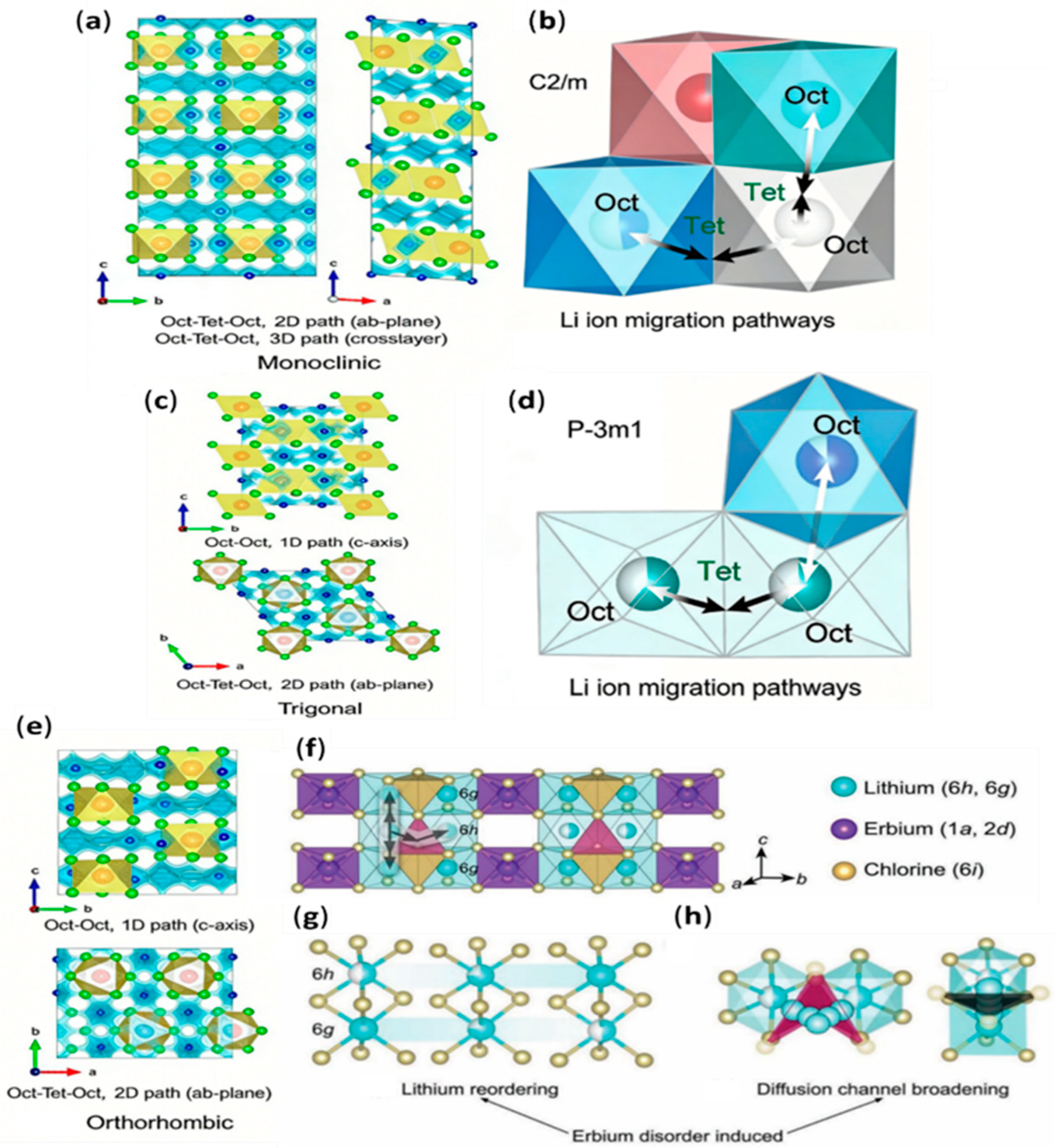
Octahedral voids formed by the surrounding halide ions—namely the 6g and 6h Wyckoff positions—serve as the residence sites for Li+ ions within the crystal lattice. Around each MCl63− octahedron, six Li+ ions are coordinated, and these ions collectively form a honeycomb lattice consisting of edge-sharing LiCl65 octahedra within the a–b plane [32].
Furthermore, X-ray diffraction data reveal that, while the Li sites at the 6g Wyckoff positions within the (001) plane are completely filled, the Li+ ions residing at the 6h positions in the (002) plane show only fractional occupancy. This finding implies that a primary diffusion pathway exists both within the (002) plane and along the face-sharing octahedra oriented in the z direction. This behavior is thought to arise from a Coulombic-repulsion-driven rearrangement of lithium ions, which occurs in response to the disordered distribution of erbium (Figure 2g). The decrease in activation barrier that has been observed presumably stems from an alteration of the diffusion bottlenecks that migrating Li+ ions encounter (Figure 2h). Such a rearrangement would modify the effective charge-carrier density in both crystallographic planes, consequently exerting a substantial impact on the fundamental transport mechanism.
To elucidate the influence of cation disorder on Li+ migration pathways, both temperature-dependent neutron diffraction data and extensive ab initio molecular dynamics simulations are required—these are necessary for accurately determining the positions of lithium ions and the variations in their site occupancies arising from different synthesis methods. Severe local distortions, which arise from the mechanical milling process and the accompanying site disorder, can significantly alter the structural windows available for ionic jumps (Figure 2h). Modifications to the structural bottleneck regions result in a reduction in the activation energy, which in turn correlates with a diminished anion displacement required for lithium diffusion between adjacent vacant sites [9,15,32,46].
2.2.1. The Energy Barrier of Different Pathways
[MCl6]3− Polyhedra
As validated by ab initio molecular dynamics (AIMD) simulations, the actual Li+ migration trajectories show good agreement with the pathways derived from the bond-valence site energy (BVSE) method. In the case of HCP-structured Li3YCl6, for instance, Li+ diffusion exhibits anisotropic behavior, characterized by fast one-dimensional (1D) channels along the c-axis, where Li+ ions hop between adjacent face-sharing octahedral sites. These 1D channels are interconnected via tetrahedral interstitial sites within the ab-plane, albeit with slower diffusivity, thereby forming an anisotropic three-dimensional (3D) diffusion network (Figure 3a,b). Under equivalent lattice volumes for Li3YCl6 and Li3YBr6, the HCP anion lattices of both chlorides and bromides exhibit low migration barriers—0.25 eV for the O-O pathway along the c-channel and 0.29 eV for the O–T–O pathway—whereas their cubic close-packed (face-centered cubic (FCC)) counterparts display a barrier of 0.28 eV for the O–T–O pathway (Figure 3c,d).
Figure 3.
(a,b) Li+ migration pathways in LYC (a) and LYB (b) (red: octahedral, blue: tetrahedral). (c,d) Energy landscape of single Li+ migration in HCP (c) and FCC (d) anion lattices. (e,f) Arrhenius plots of Li+ diffusivity in LYC (e) and LYB (f). Adapted with permission from Ref. [7]; copyright (2019); “Wiley”. (g–i) CI-NEB results for O4-Li3MI6: diffusion path schematic (g), energy variations (h), energy barriers (i). (j–m) Four defect models of Li3ErCl6: Model 1 (j), Model 2 (k), Model 3 (l), Model 4 (m). Adapted with permission from Ref. [41]; copyright (2019); “American Chemical Society”.
For Li3MCl6 (LYC), ab initio molecular dynamics (AIMD) simulations yield a predicted room-temperature ionic conductivity (σRT) of 14 mS/cm, with a lower bound of 4.5 mS/cm. This predicted range exceeds the experimentally reported value (0.51 mS/cm) by one to two orders of magnitude. Moreover, the computed activation energy (0.19 ± 0.03 eV) also falls below the experimentally determined value of 0.40 eV, as shown in Figure 3e. This consistency between computed barriers and activation energies obtained from both AIMD simulations and experimental measurements is noteworthy.
After variations in lattice volume and site geometry are taken into account across different anion chemistries, chlorides and bromides—whether adopting FCC or HCP anion lattices—are observed to possess migration barriers that fall within the sufficiently low range of 0.2–0.3 eV. Such values tend to be lower than those typically observed in sulfide-based anion lattices, for which migration barriers on the order of 0.4 eV are commonplace.
The lower energy landscape observed for the Cl− anion lattice is primarily attributable to the monovalent nature of Cl− relative to S2−, as the resulting weaker Coulombic interactions with Li+ give rise to a reduced potential energy landscape.
[MBr6]3− Polyhedra
Provided a sufficient charge-carrier concentration is available, the migration barriers in close-packed chlorides and bromides are low enough to enable high ionic conductivities on the order of 10−3 S·cm−1. The inherently low migration barriers found in chlorides and bromides originate from the fact that Cl− and Br− are monovalent, unlike O2− and S2−, which are divalent. Despite having an ionic radius comparable to that of S2−, along with a higher electronegativity and lower polarizability, the Cl− anion is not expected to promote Li+ migration on the basis of these attributes.
For Li3MBr6 (LYB), the Li+ conductivity at 300 K (σRT) extrapolated from simulations is 2.2 mS·cm−1—a value that shows excellent agreement with the experimentally obtained figure of 1.7 mS·cm−1. In comparison, the calculated activation energy (Ea) for this material is 0.28 ± 0.02 eV, which is substantially lower than the barrier of 0.37 eV determined through experiment (Figure 3f).
[MI6]3− Polyhedra
Given the distinct Li occupation environments in O4-type Li3MI6 iodides, five distinct diffusion pathways—comprising intralayer paths (0 ↔ 1, 1 ↔ 2, 2 ↔ 3, and 4 ↔ 5) and cross-layer paths (4 ↔ 7 and 5 ↔ 6)—were considered for Li+ migration between adjacent octahedral sites via a transition state, as illustrated in Figure 3g.
Figure 3h displays the energy profiles—obtained from climbing image nudged elastic band (CI NEB) calculations—for Li+ diffusion within O4-type Li3MI6 (where M = Sc, Y, or La). Cross-layer pathways exhibit activation energy barriers that are substantially greater than those of their intralayer counterparts, which suggests that Li+ diffusion proceeds more readily within the x–y plane than along the z-axis. When arranged in descending order of magnitude, the activation energy barriers for Li+ diffusion in O4 Li3MI6 follow the sequence Li3ScI6 > Li3YI6 > Li3LaI6. This trend implies that, for transition metals with identical valence, a greater mass of the M cation facilitates Li+ diffusion across this structural family.
A deeper investigation into how the activation barrier (Ep) depends on anion charge was conducted by monitoring the energy changes that accompany Li+ migration—from one octahedral site to a neighboring octahedral site through a transition state—as a function of the I− anion charge within an FCC iodine sublattice. Only one migrating Li+ ion was taken into account within this model. These computational outcomes are illustrated in Figure 3i. A comparable methodology was earlier adopted by Ceder and colleagues. Shown in Figure 3i, the activation barrier (Ep) separating the LiI4 tetrahedron from the LiI4 octahedron diminishes as the negative charge carried by the I− anion increases. Consequently, systems with more negatively charged anions exhibit a reduced overall activation energy (Ea).
It may therefore be inferred that Li+ diffusion in Li3MI6 compounds is fundamentally regulated by the electronegativity of the M element. More specifically, the faster Li+ migration observed in Li3LaI6 is attributable to the lower electronegativity of lanthanum (La).
2.3. Four Possible Defect Models
The relatively low ionic conductivity observed for Li3YCl6 may be attributable to its intrinsically anisotropic conduction mechanism. Density functional theory (DFT) calculations were employed to evaluate the thermodynamic feasibility of site disorder. Four possible defect models—differing in the extent of Er2–Er3 disorder—along with their corresponding energies, are illustrated in Figure 3g–j for a 1 × 1 × 2 supercell.
Structural Model 1 (Figure 3j) represents a fully ordered configuration of Li3ErCl6, wherein both the Er1 and Er2 sites are fully occupied. Disorder Structural Model 2 (Figure 3k) describes a complete site inversion between Er2 and Er3, resulting in full occupancy of the Er3 site and complete vacancy of the Er2 site. Although Model 2 could also be considered fully ordered, it will herein be described as fully disordered in contrast to the fully ordered Model 1. Defect Model 3 (Figure 3l) features alternating full occupancy of the Er2 and Er3 sites, respectively, while preserving the mirror plane along the (002) plane. This leads to a formal partial occupancy of 50% for each of the two sites. Defect Model 4 (Figure 3m) involves random occupancy of the Er2 and Er3 sites, which results in a further reduction in symmetry and the formation of face-sharing ErCl63− octahedra.
As demonstrated by Wang et al. [36] for Li3YCl6, density functional theory (DFT) calculations herein corroborate that even a structure featuring full site inversion from Er2 to Er3 (Figure 3k) can exhibit energies and stabilities comparable to those of the fully ordered configuration. The same conclusion applies to the alternating Model 3, which features full Er2 and Er3 occupancy (Figure 3l). Although this structure would induce a pronounced reduction in local symmetry—one that cannot be experimentally captured in the present work—it nevertheless clearly demonstrates the feasibility of mixed site occupancies. Model 4, which arises from a random Er2–Er3 configuration, is depicted in Figure 3m and features local face-sharing ErCl63− octahedra. This model exhibits the highest energy and consequently the lowest stability, a phenomenon likely attributable to the enhanced electrostatic repulsion between Er2 and Er3 arising from their diminished separation in this configuration.
Overall, the comparable energies calculated for the disordered structures corroborate the local structural motifs derived from pair distribution function analysis, in which site disorder appears to be prevalent. At equivalent lattice volumes, LYC and LYB display barriers of 0.25 eV (O–O, c-channel) and 0.29 eV (O–T–O) in HCP Cl/Br arrays, versus 0.28 eV for O–T–O in their CCP analogues [3,4,36].
3. Enhancing Lithium Conductivity by Structure Tuning
3.1. Lattice Regulation
3.1.1. Structure Tuning
Halide superionic conductors derive their functionality from an [MCl6]3− octahedral framework that templates an anisotropic Li+ sublattice. Inside this scaffold, Li+ diffusion is not a random walk but a topologically constrained process dictated by (i) the three-dimensional tiling of edge- and face-sharing polyhedra and (ii) the statistical availability of quasi-degenerate Li+ sites. Macroscopic transport emerges from short-range octahedral (Oh) → tetrahedral (Td) → octahedral hops whose lowest-barrier trajectories are confined to crystallographic channels of reduced electrostatic penalty.
Ab-plane migration (P-3m1 or C2/m) proceeds via a zig-zag chain of hops with an activation barrier < 0.25 eV, establishing this plane as the dominant 2D conduit [5,52]. Along c, Oh(6h) → Oh(6g) hops plane furnish 3D connectivity; although the local barrier rises to ~0.35 eV, the interpenetration of ab and c pathways multiplies percolating corridors and boosts the effective diffusion coefficient by >10× relative to a purely 2D network [52,53,54,55,56,57].
Machine-learning-driven molecular dynamics shows that the c-axis component becomes rate-limiting at 298 K, an observation attributed to the intrinsic anisotropy of the HCP anion array [58]. Consequently, Li3MCl6 electrolytes hosting trivalent cations (74.5 pm ≤ r(M3+) ≤ 103.2 pm) must satisfy four simultaneous structural prerequisites [36]:
- (1)
- a mobile Li+ radius (r(Li+) ≈ 76 pm) commensurate with the octahedral window;
- (2)
- a vacancy manifold whose site energies are statistically degenerate (ΔE < kT);
- (3)
- uniform, disordered Li+ occupancy of Wyckoff 6g/6h octahedra to prevent channel blocking;
- (4)
- an anion scaffold—HCP or CCP—that presents a continuous low-barrier trajectory.
High conductivity is therefore contingent not on transient Li+ occupancy of tetrahedral sites but on the symmetry and packing efficiency of the anion sublattice. Systematic surveys reveal a monotonic trend in conductivity: monoclinic (CCP) > orthorhombic > cubic (HCP). The origin is three-fold [9,50,59]:
Symmetry: CCP affords higher operational symmetry, fixes inter-slab spacings and suppresses channel breathing;
Packing efficiency: the larger intrinsic free volume of CCP lowers the migration enthalpy;
Bonding continuity: stronger intraslab cohesion in CCP preserves percolation during extensive Li+ extraction/insertion cycling.
By tailoring the close-packed anion array—via aliovalent doping, strain engineering or entropy-driven stacking faults—the Li+ diffusion tensor can be isotropically enhanced without extrinsic carriers, offering a universal design lever for next-generation halide solid electrolytes.
An in situ interfacial growth of Li3InCl6 on LiCoO2 is presented by Changhong Wang et al. [60]: InCl3 and LiCl were dissolved in deionized water at a stoichiometric ratio of 1:3, yielding a transparent solution of Li3InCl6·nH2O. LiCoO2 was subsequently introduced into the resulting solution. Following evaporation of the aqueous solution at 100 °C, the resulting dry powder was transferred to a vacuum oven and heated at 200 °C for 5 h to complete the dehydration process. The as-obtained Li3InCl6-coated LiCoO2 (LIC@LCO) cathode composites were directly employed in all-inorganic solid-state batteries (AISSBs). After 200 cycles, the LIC@LCO composite with 15 wt % LIC retained a specific capacity of 90.3 mAh g−1 with a Coulombic efficiency (CE) of 99.3%. In contrast, the composite with 10 wt % LIC maintained only 39.1 mAh g−1, while that with 5 wt % LIC could no longer undergo reversible charge–discharge cycling.
Furthermore, the LIC@LCO composite with 15 wt% LIC exhibited exceptional cycling stability over 400 cycles at a rate of 0.5 C [60].
3.1.2. Synthesis Method
The classical synthesis appears deceptively simple: stoichiometric halide powders are loaded into a quartz ampoule without deliberate mixing, evacuated, sealed, and annealed. Li3MCl6 (M = Tb–Lu, Y, Sc) and Li3MBr6 (M = Lu, Y) were obtained in this manner at 400 °C for two weeks in 1997 [37,38,56].
Contemporary protocols premix the precursors by high-energy ball milling, after which the same phases crystallize within 1 h at 400–550 °C (e.g., Li3YCl6, Li3InCl6, Li3ErCl6) [32,53,61,62,63,64,65].
Mechanical treatment lowers the nucleation barrier, bypasses long-range diffusion, and introduces a defect reservoir that templates rapid growth. Prolonged milling (1–6 h, 400–600 rpm) enables direct formation of the electrolyte at room temperature.
Frictional heat triggers a self-propagating metathesis, yielding 20–50 nm crystallites that can be directly pressed into all-solid-state cells. Paradoxically, the ionic conductivity of the as-milled powders often exceeds that of their well-annealed counterparts (e.g., Li3YCl6 and Li3ErCl6) [32,36].
Li3YCl6 solid electrolyte was synthesized by high-energy ball milling without any post-annealing [66]. Rietveld refinement revealed a phase-pure tetragonal Li3YCl6 structure free of impurities. Stacking faults in the layered halide create two-dimensional fast diffusion pathways. Li SLR NMR confirmed that mechanochemically synthesized Li3InCl6 contains a high density of dislocations that activate local Li hops at low temperature, significantly reducing the apparent activation energy [67]. Synchrotron X-ray diffraction reveals that Li vacancies preferentially order along the (131) planes, constructing a three-dimensional isotropic diffusion network [28]. The origin is twofold: (i) cation-site disorder that smooths the energy landscape and (ii) a high density of stacking faults that generate additional Li+ pathways between adjacent Cl− layers.
Although ball milling is nominally performed at room temperature, the collision energy locally raises the temperature to several hundred degrees Celsius. Consequently, the ionic conductivity of some mechanochemically synthesized halide SSEs surpasses that of their annealed counterparts. For example, mechanochemically synthesized Li3YCl6 contains a high concentration of stacking faults (planar defects) that lower the Li+ migration barrier and create additional interlayer diffusion pathways. Figure 4a presents the process of solvent-mediated synthesis of halides, and the details are described in the experiment section. After drying in the blast oven for 12 h, most of the liquid evaporated, and the colorless and transparent compounds crystallized. During further drying for another 12 h, a small amount of liquid continued to evaporate, and the material crystallized into white blocks, which was recorded as the precursor.
Figure 4.
(a) Schematic diagram of the solution-mediated synthesis route for halide electrolytes; (b) optical images of the obtained Li3InCl6 electrolytes and their SEM micromorphology; (c) schematic diagram of ASSLMBs; (d) cycling performance at 0.1 C. Adapted with permission from Ref. [28]; copyright (2025); “American Chemical Society”.
Since the precursor contains crystalline water molecules, subsequent heat treatment is needed to obtain the pure phase of Li3InCl6. Figure 4b shows photos and micromorphology of the Li3InCl6 electrolytes. Owing to the fact that the viscosity of ethanol is higher than that of water, it can be seen that the electrolyte particles synthesized in ethanol show slight agglomeration and even show a flaky morphology, while the sample synthesized by water presents a more dispersed powder form [28].
A sulfide layer is introduced between Li3InCl6 and the Li–In foil in order to shield the Li metal anode from undesirable side reactions. A schematic illustration of the ASSLMBs employed in the present study is provided in Figure 4c. Furthermore, the cycling performance of the ASSLMB at a rate of 0.1 C (where 1 C corresponds to 170 mAh·g−1) is displayed in Figure 4d. An initial discharge capacity of 153.9 mAh·g−1 was achieved, while after the 50th cycle, a reversible capacity of 126.7 mAh·g−1 remained—corresponding to a capacity retention of 82.83%.
In a separate investigation, Li and colleagues [50] introduced In3+ into Li3YCl6 using high-energy ball milling followed by annealing, which yielded a hexagonal close-packed (HCP) structure belonging to space group Pnma. As the In3+ content is raised, the structure of the electrolyte gradually shifts toward a cubic close-packed (CCP) arrangement. Electrolytes adopting the CCP architecture demonstrate more rapid Li+ migration than those with the HCP structure. In line with this observation, the ionic conductivity was found to rise from 6.08 × 10⁻⁵ S·cm−1 to 1.22 × 10⁻³ S·cm−1.
When synthesized by calcination at 350 °C, Li3YbCl6 adopts a trigonal structure belonging to the HCP family, namely space group P-3m1. As the In content was progressively increased, the crystal framework gradually converted to a CCP structure. Concomitantly, the ionic conductivity elevated from 6.08 × 10⁻⁵ S·cm−1 to 1.22 × 10⁻³ S·cm−1 [50,68].
Moreover, the trigonal and orthorhombic polymorphs of the same HCP arrangement are interconvertible [68,69]. Li3YbCl6 synthesized at 350 °C adopts the trigonal HCP structure (space group P-3m1) [69]. Upon heating to 400 °C, the majority of the sample converts to the orthorhombic structure (space group Pnma). Upon heating to 650 °C, the structure undergoes a further transformation from the HCP to a monoclinic CCP polymorph. The crystal structure can also be modified through subsequent heat treatment [9,68,70]. Li3Y(Br3Cl3) could be prepared by hot pressing [70].
As revealed by Rietveld refinement, the transition-metal (TM) slab is composed of YX6 and LiX6 octahedra alongside vacant octahedral sites, whereas the Li slab similarly consists of LiX6 octahedra and vacancies [71,72]. Short-range order is present within the TM slab and between Li and vacancy arrays. In addition, five distinct Li+ sites were identified on tetrahedral (8j) positions. Thus, Li+ simultaneously occupies both tetrahedral and octahedral sites. Overall, approximately one-third of Li resides in tetrahedral sites and two-thirds in octahedral sites. The layered structure thus exhibits an intriguing coexistence of tetrahedral (t-Li) and octahedral (o-Li) lithium [45,70].
This mixed tetrahedral–octahedral distribution is thereby realized. The presence of t-Li not only generates additional octahedral vacancies but also flattens the energy landscape, leading to synergistic Li+ diffusion [45,51,55,73]. reported a family of halide superionic conductors Li2+xHf1−xInxCl6 that exhibit an ionic conductivity of 1.05 mS cm−1 at 30 °C and high-voltage stability [73]. Increasing the heterovalent In3+ content gradually transforms the framework from trigonal to monoclinic, accompanied by a redistribution of Li+.
In In3+-substituted Li2HfCl6, the O–T–O pathway constitutes the preferred two-dimensional diffusion route. A scalable ammonia-assisted hydrolysis–freeze-drying (AAH-FD) route was developed to synthesize halide electrolytes [74]. The Li3YCl6 prepared by the AAH-FD route adopts the orthorhombic Pnma structure. Park et al. proposed an ethanol-mediated synthesis route [30]. During post-treatment, the organic species in the ethanol-mediated precursor volatilized as light gases. The product exhibits the largest unit-cell parameters and an enhanced vacancy concentration that orders along the (131) plane, furnishing a three-dimensional isotropic Li+ migration network [28].
3.2. Control Effect of Defective Engineering Structure on Lithium-Ion Transport in Halogen Solid Electrolyte
Defect-structure engineering in Li3MX6 (M = In, Sc, Y, Er, etc.) halide electrolytes provides a direct and scalable route to boost Li+ conductivity without changing the global composition [75,76]. Because the conductive network is dictated by the anion-stacking sublattice, local imperfections—vacancies, anti-site pairs, cation disorder, and stacking faults—govern carrier concentration, percolation topology, and the height of the migration barrier on length scales of only a few angstroms.
3.2.1. Point-Defect Hierarchy
Ab initio defect-formation energies reveal that neutral Li vacancies (V_Li) and Li interstitials (Li_i) are the lowest-energy excitations in most Li3MX6 phases; antistites defects (M_Li or Li_M) are higher in energy, except for V_In in Sc-based bromides [9]. For comparative purposes, the Li+ migration pathways associated with structural models corresponding to x = 1, 1.8, and 5 reveal pronounced differences (Figure 5a–d).
Figure 5.
(a–d) Li+ probability density (yellow isosurfaces) along the a-axis for (a) Li5ScCl8 (x = 5), (b) Li3ScCl6 (x = 3), (c) Li1.8ScCl4.8 (x = 1.8), and (d) LiScCl4 (x = 1). (e) Schematic of the Sc blocking effect (green: Cl, purple: Sc, blue: blocked tetrahedral site). (f) Sc–Li radial distribution function illustrating the blocking effect of Sc in LixScCl3+x. (g) Arrhenius plot of Li+ diffusivity in LixScCl3+x from AIMD simulations. Adapted with permission from Ref. [9]; copyright (2020); “American Chemical Society”. (h,i) Li+ density plots for Li0.5La0.83Cl2.5Br0.5 at 1000 K in the (h) ab plane and (i) ac plane (pink dashed circles: La vacancy sites). Adapted with permission from Ref. [24]; copyright (2025); “Wiley”.
As has been noted earlier, the c axis hosts two distinct cationic layers: the first is composed of Sc and Li—which occupy the 2a and 4g sites—whereas the second contains vacancies along with Li, the latter residing at the 4h and 2d positions. In compositions where x exceeds 3, a decrease in Sc1 occupancy at the 2a site is observed alongside an increased occupation of Li at the 4h and 2d sites. Such changes yield a heightened Li+ concentration while simultaneously reducing the pool of vacancies that remain accessible for Li+ migration.
In the case of x < 3, progressively more incorporated Sc3+ ions tend to occupy either the Li2 or Li3 sites, both of which are located within the Li layer that contains vacancies. Owing to the resultant Coulombic repulsion between Sc3+ and Li+, the tetrahedral interstitial sites located adjacent to Sc3+ become inaccessible—a phenomenon that is marked by the blue sites in Figure 5e. Further evidence for this blocking effect comes from the Li–Sc radial distribution function, which was derived from AIMD simulations performed across the entire series of LixScCl3+x compositions. More specifically, no peak is observed at the tetrahedral blocking site adjacent to the Sc site near 2.3 Å. This finding agrees well with the lack of Li+ probability density around Sc3+, as depicted in Figure 5a–d. These observations account for why the Li+ migration pathways seen in Li1.8ScCl4.8 (Figure 5c) and LiScCl4 (Figure 5d) differ from those found in Li3ScCl6. As a consequence, when certain Li+ migration pathways become blocked, the corresponding energy barrier for migration may be elevated.
Furthermore, at 700 K, the effective hopping rates for ionic migration in LiScCl4 (x = 1), Li1.8ScCl4.8 (x = 1.8), Li3ScCl6 (x = 3), and Li5ScCl8 (x = 5) are determined to be 1.3, 1.1, 1.6, and 1.0 ps−1, respectively. Li3ScCl6 stands out as having the highest ionic hopping rate among all compositions examined. Consequently, the structure of Li3ScCl6 attains an optimal vacancy concentration paired with a continuous network of diffusion channels—features that are both advantageous for Li+ conduction. Figure 5g presents a comparison of the ionic conductivities derived from AIMD simulations for these four structures.
The Haven ratio for these compositions’ approaches unity, which suggests that the majority of ionic hopping events are uncorrelated. Despite the calculated activation energy (Ea) for Li3ScCl6 (0.25 ± 0.04 eV) being comparable to that for Li5ScCl8 (0.26 ± 0.07 eV), the latter exhibits a lower ionic conductivity. This disparity originates from the diminished ionic hopping rate in Li5ScCl8, a reduction that can be ascribed to its comparatively lower vacancy concentration. LiScCl4 (0.37 ± 0.07 eV) and Li1.8ScCl4.8 (0.34 ± 0.07 eV) exhibit calculated activation energies exceeding that of Li3ScCl6. This elevation is ascribed to the blocking effect arising from extra Sc atoms occupying sites within the vacancy-containing Li layer.
Through systematic investigation of the variable site occupation configurations in LixScCl3+x solid-state electrolytes (SSEs), three key parameters governing Li+ diffusion were identified: the Sc-induced blocking effect, the concentration of Li+ charge carriers, and the concentration of available vacancies for hopping. The tunability of the Li+ diffusion mechanism via site occupation engineering in halide SSEs represents a phenomenon not previously observed in other highly conductive SSEs, where Li+ migration typically proceeds through well-defined channels inherent to the crystal structural framework.
AIMD trajectories show that only V_Li and Li_i accelerate diffusion, whereas other point defects serve as transient traps [22,23,31]. Notably, V_Li, Li_i, Br_i, and Br_Li species simultaneously widen the Li+ transport window and improve cathode–electrolyte interfacial compatibility by suppressing space-charge accumulation.
3.2.2. Native-Defect Cocktails
In Li3InCl6, the experimental conductivity (1.2 mS cm−1 at 30 °C) is reproduced only when the grand-potential surface contains a mixed-defect cocktail—V_Li and Li_i as majority carriers plus minority V_Cl and In_Li antisites. The coexistence of donor- and acceptor-like defects pins the Fermi level near mid-gap, maximizing the net Li+ vacancy–interstitial product and flattening the local energy landscape. These short-range defects can change the conductivity by an order of magnitude within a few atomic distances; for example, they modulate the size of the Li+ diffusion channel, the migration barrier, the percolation path, the carrier concentration, and the site-energy distribution.
Regardless of the synthesis route, the highest conductivities emerge when the global anion framework (HCP or CCP) is preserved while local defectivity simultaneously (i) creates ≥10% Li-site vacancies or interstitials, (ii) randomizes Li occupancies over symmetrically distinct octahedral positions, and (iii) introduces planar defects that interconnect otherwise isolated 2D channels.
Because these criteria can be satisfied by room-temperature mechanochemistry, mild annealing, or lattice-mismatched epitaxy, defect-structure engineering offers a processing-compatible route to halide superionic conductors that rival or exceed the performance of benchmark sulfides while retaining intrinsic oxidative stability above 4 V vs. Li/Li+.
3.3. Coupling Effect of Vacancy Concentration and Li+ Migration Path
3.3.1. Vacancy Engineering: Tuning the Li+/Vacancy Equilibrium in Halide Electrolytes
The Li+ jump probability is extremely sensitive to the concentrations of both mobile Li+ and vacancies, enabling order-of-magnitude swings in conductivity [77,78]. Li+ transport is gated by the availability of a vacant nearest-neighbor site; a ±1% shift in vacancy concentration can change σ by one order of magnitude. In close-packed anion frameworks, the diffusion coefficient is therefore dictated by the stoichiometry-controlled vacancy reservoir rather than by lattice softness alone.
3.3.2. Intrinsic Vacancy Creation
In stoichiometric Li3MX6 (M3+ = Y, Sc, Er, …), each M3+ replaces three Li+ and introduces two octahedral vacancies for charge compensation. The resulting cation/vacancy ratio (3:1:2 for Li+:M3+: vacancies) leaves ≈ 33% of the octahedral sites empty [14,61,79]. These vacancies percolate along O–T–O pathways, reducing Ea to 0.20–0.33 eV and enabling three-dimensional isotropic diffusion (AIMD) [9].
A comparison of the average phonon frequencies of Li+ ions across different structures reveals a progressive decrease with increasing doping concentration. This phenomenon is attributable to the modification of the local lattice structure induced by Zr/Hf doping. The incorporation of larger tetravalent ions markedly alters the vibrational modes of Li+ ions, giving rise to an increased population of low-frequency vibrational modes. As the concentration of lithium vacancies increases, the Li+ vibrational density of states (VDOS) shifts toward lower frequencies, accompanied by a reduction in the average phonon frequency [79].
3.3.3. Aliovalent-Doping Leverage
Partial substitution of M3+ by Zr4+/Hf4+ increases the formal vacancy concentration beyond the intrinsic 33% [80]. In Li3Sc1−xZrxCl6, the highest σ (5.6 mS cm−1, Ea = 0.22 eV) is reached at x = 0.625; beyond this threshold, lattice softening triggers symmetry collapse and vacancy ordering, reversing the gain. Thus, a delicate balance between Li+ carrier and vacancy densities must be preserved. The highest ionic conductivity is obtained at the stoichiometric composition x = 3. A LiCl–ScCl3 eutectic flux yields LixScCl3+x (x = 2.5–4) with continuous CCP anion stacking.
Increasing x raises the Li+ carrier density but dilutes vacancy and strengthens the Sc-blocking effect; Li3ScCl6 (x = 3) delivers the best compromise: 3.0 mS cm−1 at 25 °C and an electrochemical window of 0.9–4.3 V vs. Li+/Li.
In HCP Li2.9Zr0.1Cl4.9 (LLZC), the same Li+/ vacancies equilibrium—rather than stacking-fault proliferation—governs transport. Fine-tuning the stoichiometry furnishes 1.5 mS cm−1 and Ea = 0.285 eV, enabling a Co-free LiMn2O4 LLZC cell to cycle >1000 times at 0.3 C with <0.02% capacity loss per cycle [9,73,80,81].
The cubic polymorph of Li4YI7 (space group F43m) tolerates up to 25% vacancies without symmetry breaking. Synchrotron X-ray and neutron refinements reveal that Li+ and vacancies order into a diamond-like sublattice that provides isotropic <111> diffusion channels, yielding σ = 1.04 × 10⁻³ S cm−1 at 25 °C—one of the highest values reported for iodide conductors [24,82,83].
The directional dependence and underlying mechanisms of Li-ion diffusion in Li0.5La0.83Cl2.5Br0.5 are further explored. The modest increase in Li- ion diffusion with temperature from 600 to 1000 K, which results in the very low activation energy of 0.10 eV obtained for this composition. Even at 1000 K, Li-ion diffusion through the 1D channels is still the dominant transport mechanism compared to diffusion in the ab plane. Nevertheless, as depicted in the Li-ion density plots in Figure 5h,i, there is still substantial Li-ion diffusion across the ab plane as a result of the presence of La vacancies. This highlights the potential for further increases in Li-ion diffusion and the realization of isotropic 3D transport in Li0.5La0.83Cl2.5Br0.5 through the optimization of La vacancy concentration, as has been achieved by doping with high- valence elements, including Ta, Nb, Mo, and W [18].
3.4. Cation Disorder and Local Structural Distortion
Configurational entropy, a central concept in statistical thermodynamics, quantifies lattice disorder and serves as a key design metric for boosting ionic conductivity [84,85]. The “chaos principle” states that increasing chemical complexity favors glass-like domain formation [49,86,87].
Foreign-atom doping enhances ionic conductivity by optimizing carrier concentration or tailoring lattice geometry. High-charge-density cations (e.g., Al3+ and Fe3+) increase M–X bond covalency and generate a local asymmetric field that destabilizes migrating Li+, thereby lowering the migration barrier and significantly boosting conductivity. The enhanced covalency also improves framework deformability, facilitating adaptive lattice relaxation during Li+ migration [84,85].
Multielement doping introduces local lattice distortion and nanoscale glass-like domains, both of which flatten the energy landscape and improve ionic conductivity [49]. Partial substitution of Y3+ by Zr4+ in Li3YCl6 expands the YCl6 interlayer spacing, optimizing the Li+ migration highway and raising conductivity to 1.19 mS cm−1 [23].
In Li3YbCl6, Zr4+ substitution drives a transition from a metastable trigonal phase to an orthorhombic phase, increasing conductivity from 0.1 to 1.1 mS cm−1 [5]. Li3−xM1−xZrxCl6 (M = Y3+, Er3+) exhibits a Zr-driven phase transition that boosts conductivity to 1.4 mS cm−1 [26].
Beyond phase transitions, local structural perturbations significantly modulate ionic conductivity. High-entropy occupancy of a single cation site—e.g., Li2.75Y0.16Er0.16Yb0.16In0.25Zr0.25Cl6 and Li1.75Zr0.75Ta0.25Cl6—lengthens the Li–Cl bond and creates a percolative Li+ migration network [25,26].
Cation doping strategies are broadly classified as heterovalent or homovalent substitutions. Although isovalent ions carry identical charges, their radii and extranuclear electron distributions differ. Isovalent substitution tunes the number of cation vacancies and mobile carriers; different ionic radii alter lattice volume and, hence, crystal structure. Li et al.partially replaced Y3+ with In3+ to synthesize Li3Y1−xInxCl6; increasing In3+ drives a transition from HCP to CCP stacking [88]. Li3InxHo1−xCl6 (0 ≤ x ≤ 0.4) was synthesized by replacing Ho3+ with In3+ [89].
A series of Li3InxHo1−xCl6 samples prepared by isovalent substitution were used to probe the effect on Li+ migration. Concurrently, the lattice contracts and ultimately collapses into a crystalline–amorphous mixture at x = 0.3. This collapse is attributed to the small In3+ radius and the partial volatilization of In during synthesis, which increases the vacancy reservoir. Heterovalent dopants are classified as high-valence or low-valence stimulants. Zr4+ and Hf4+ are the most widely used high-valence stimulants in Li3MCl6 (M = Er, Yb, In, Y, Ho, Lu) halide electrolytes. Accounting for the partial loss of In3+ during processing, the resulting cation filling ratio (In/Ho) is determined to be 0.12.
X ray diffraction (XRD) was conducted to determine the crystalline structure of the Li3−xEr1−xZrxCl6 (x = 0, 0.1, 0.2, …, 1) halide solid electrolytes, with the resulting patterns presented in Figure 6a. At x = 0.2, despite the partial loss of In3+, the structure remained unchanged, retaining its HCP trigonal form. As illustrated in Figure 6b,d, the migration barrier (ΔE) for Li+ in Li3In0.2Ho0.8Cl6 was determined to be 0.29 eV, substantially lower than the value of 0.38 eV obtained for Li3HoCl6. It can therefore be concluded that at x = 0.2, despite the partial loss of In3+, the structure is preserved, and the concomitant increase in cation vacancies indeed facilitates Li+ conduction.
Figure 6.
(a) XRD patterns of Li3−xEr1−xZrxCl6 (x = 0–1) halide SSEs obtained by ball milling. (b) Corresponding enlarged view of the XRD patterns in the 30–34° region. (c–f) CV curves of (c) Li3ErCl6, (d) Li2.6Er0.6Zr0.4Cl6, (e) Li2.4Er0.4Zr0.6Cl6, and (f) Li2ZrCl6 (scan rate: 0.1 mV s−1); insets show schematic diagrams of ASSLBs for CV measurements. Adapted with permission from Ref. [26]; copyright (2022); “American Chemical Society”.
All diffraction patterns corresponding to the Li3−xEr1−xZrxCl6 series can be readily indexed to the Li3ErCl6 phase (space group P-3m1, ICDD PDF# 00-087-0132), with no discernible impurity phases detected.
As illustrated in Figure 6b, the (031) diffraction peak progressively shifts toward higher angles with increasing Zr content. This shift is attributable to the smaller ionic radius of Zr4+ (72 pm) compared to that of Er3+ (89 pm), indicating that Zr substitutes for Er within the Li3ErCl6 lattice. Notably, all Li3−xEr1−xZrxCl6 solid electrolytes prepared by ball milling (BM) retain the same trigonal structure as Li3ErCl6. This observation contrasts with the findings reported by Nazar et al. [90], in which Zr substitution induced a structural transformation from trigonal to orthorhombic.
Li3ErCl6 exhibits an oxidation onset potential of 4.26 V, while the reduction of Er3+ initiates at 0.85 V (Figure 6c). This yields a wide electrochemical stability window spanning 0.85–4.26 V, which is consistent with the computed range of 0.63–4.26 V reported by Mo et al. [8]. Upon Zr doping, the oxidation stability of Li3ErCl6 diminishes. Specifically, the oxidation onset voltages for Li2.6Er0.6Zr0.4Cl6, Li2.4Er0.4Zr0.6Cl6, and Li2ZrCl6 are 4.21, 3.81, and 3.64 V, respectively, as depicted in Figure 6d–f.
Furthermore, cathodic scan analysis reveals the emergence of a new peak following Zr doping, the intensity of which progressively increases with higher Zr content. This feature is attributed to the reduction of Zr4+ [91,92,93]. Li et al. studied the effects of Zr4+, Ta5+ and W6+ doping on the structure and conductivity of Y-based halides [23].
Zr4+ accelerates Li+ diffusion on both (001) and (002) planes by expanding octahedral and tetrahedral voids, Ta5+ enhances (001) but suppresses (002) diffusion, and W6+ shows the opposite trend. Zr substitution yields a conductivity of 0.437 mS cm−1 and excellent capacity, cycling and rate performance. High-valence doping generates additional Li-site vacancies. The extra vacancies reduce electrostatic repulsion between M3+ and Li+, facilitating Li+ diffusion and boosting conductivity.
Mo et al. predicted Li2.75In0.75Zr0.25Cl6 (25 atom% Zr4+) to exhibit an exceptional conductivity of 2.2 × 10⁻² S cm−1 by computation [57,94,95]. These predictions have recently been partially validated. Zr4+ doping of Li3YCl6 and Li3ErCl6 increases their bulk conductivity from 10−5 to 10−3 S cm−1 [96].
High-valence doping increases the lithium-vacancy reservoir, a key lever for enhancing HSE conductivity [97]. Nazar et al. reported Li3−xM1−xZrxCl6 (M = Y, Er) chloride electrolytes [15]. Small-radius dopants such as Zr4+ trigger space-group changes. Li3YCl6 (space group P-3m1) transforms into the Pnma polymorph with conductivity reaching 1.4 × 10⁻³ S cm−1. Liu et al. synthesized Li3Y(Br3Cl3) dihalide by hot-pressing at 170 °C. The material exhibits a room-temperature conductivity of 7.2 × 10⁻³ S cm−1 [70]. Hot-pressing enhances grain-boundary transport and thus the macroscopic ionic conductivity of the SSE. Nb5+ doping introduces Li-site disorder around Y(Nb) columns, enhancing cooperative Li+ diffusion and overall migration [98]. Luo et al. reported that Hf4+ substitution of Li3YCl6 improves transport through extensive cation disorder and a highly covalent (Y/Hf)Cl6 framework [99]. Structural and theoretical analyses reveal an infinite 3D network of edge-sharing octahedra that provides continuous Li+ diffusion pathways in Hf-substituted Li3YCl6. Moreover, the milled SSE exhibits excellent interfacial stability toward high-voltage LiCoO2, enabling full cells with Li-metal anodes to deliver outstanding electrochemical performance.
Hao et al. prepared a high-entropy LaCl3-based halide SSE, [0.5LiCl–xLaCl3–(TaCl5·ZrCl4·AlCl3·CaCl2)1/4(1−x)] (HE-LaX), by ball-milling [100]. Recently, Yin et al. added Ta5+ to LiCl–LaCl3 to obtain Li0.388Ta0.238La0.475Cl3. The material exhibits a conductivity of 3.02 mS cm−1 at 25 °C with an activation energy of only 0.197 eV [59]. The cation doping increases the Li+ fraction, enlarging the pool of mobile carriers and thus the overall conductivity [45,49,59,82].
Joo Hyeon Noh et al. found that the hopping rate for Li2.11ZrCl5.89S0.11—encompassing all local pathways within the plane [46]. Notably, a marked increase in the hopping rate is observed within planes containing substituted S2− ions (designated as S-planes), whereas the hopping rates in other ab-planes (S-free planes) exhibit only modest changes.
Motivated by this observation, the dependence of the lithium site energy within the intermediate tetrahedron—corresponding to the estimated barrier for Li+ migration—on the tetrahedral volume was systematically calculated for both Li2ZrCl6 and Li2.11ZrCl5.89S0.11. Even when comparing materials with the same tetrahedral volume, the migration barriers differ between Li2ZrCl6 and Li2.11ZrCl5.89S0.11, with the latter consistently exhibiting lower values [46].
3.5. Halogen Substitution
Anion substitution—selective replacement of Cl−, Br− or I− with foreign halides or chalcogenides—offers a decoupled lever to tune both the energy landscape and the mechanical response of Li3MX6 halide electrolytes while preserving the M3+ sub-lattice [31,46]. Because the conduction topology is dictated by the close-packed anion framework, even trace foreign anions redistribute Li+ site energies, bottleneck sizes, and lattice phonons, often yielding order-of-magnitude conductivity gains without sacrificing oxidative stability.
3.6. Halide–Halide Mixing
Partial Br− → Cl− substitution in Li3YCl6 drives a trigonal-to-monoclinic transition, raising the room-temperature conductivity from 0.51 to 7.2 mS cm−1; simultaneously, Li3YCl4.5Br1.5 increases the oxidative limit by 0.5 V versus pure Li3YBr6 [54,98]. Fully disordered Li3GdCl3Br3 suppresses the phase-transition temperature and delivers σ = 11 mS cm−1, the highest value yet reported for an undoped halide [23,58]. Trace fluorination of Li3YCl6 enhances oxidative stability without sacrificing ionic conductivity, thereby improving the charge–discharge efficiency of solid-state cathodes [101].
Moreover, halogen substitution tunes the polarizability and mechanical properties of Li3MX6; softer, more polarizable frameworks lower the activation energy and boost ionic conductivity [102,103,104]. This correlation stems from effective shielding of Li+ charge by highly polarizable anions, which weakens Li+–host interactions. Ab initio calculations yield low Li3LaCl3Br3 mixing energies, confirming solid-solution behavior across the entire LaCl3–LaBr3 join; the band gap remains >5 eV, adequate for electrolyte use. The optimal composition Li0.5La0.83Cl2.5Br0.5 exhibits σ = 66 mS cm−1 with an activation energy of only 0.10 eV [46]. Mixed halides soften the anion sub-lattice, enlarge the migration window, and introduce configurational entropy that stabilizes the high-temperature conductive polymorph down to room temperature. Divalent S2− (r = 184 pm vs. 181 pm for Cl−) can be substituted without measurable lattice strain.
First-principles nudged-elastic-band calculations reveal that a single S2− at a channel intersection (i) electrostatically anchors adjacent vacancies, suppressing repulsive Li+–Li+ interactions, and (ii) opens two new O–T–O percolation branches.
The optimal defect landscape requires (i) ≈33% uniformly distributed vacancies, (ii) moderate cation disorder to avoid site inversion that blocks pathways, and (iii) sufficient stacking faults to furnish extra 2D migration highways.
This strategy offers a universal theoretical framework and experimental roadmap for designing high-conductivity halide SSEs. The interfacial evolution mechanisms of Li/ Li2ZrCl6 and Li/Li2ZrCl4I2 over time were summarized in Figure 7a–f. When the electrolyte contacts Li metal, electron infiltration at the interface induces the reduction of Zr4+, leading to electrolyte decomposition.
Figure 7.
Schematic illustrations showing the interplay between Li metal and Li2ZrCl6, Li2ZrCl4I2, electrolytes. (a) Ion and electron exchange at the Li/Li2ZrCl6, interface. (b) Side reactions occur at the Li2ZrCl6/Li interface, and the interface phase cannot block electron exchange. (c) The reaction terminates after Li metal is completely consumed. (d) Ion and electron exchange at the Li/ Li2ZrCl4I2 interface. (e) Side reactions occur at the Li2ZrCl4I2/Li interface, but no electron transfer occurs. (f) Formation of a stable interfacial phase to prevent further side reactions. Adapted with permission from Ref. [12]; copyright (2025); “American Chemical Society”.
In the Li2ZrCl6 system (Figure 7a), the relatively high reduction potential promotes the reduction of central Zr4+ to metallic Zr. The resulting mixed ionic-electronic conductive phase hinders the effective blocking of electron transfer by reaction products, ultimately causing continuous electrolyte degradation until the Li is exhausted as shown in Figure 7b,c. Conversely, in the Li/ Li2ZrCl4I2 system (Figure 7d), the high polarizability of I− ions enhance the covalent interaction between Zr and I, which suppresses the reduction of Zr4+ and improves the electrolyte’s resistance to reduction. Therefore, Zr4+ is only partially reduced, forming ZrClx and ZrIx rather than metallic Zr (Figure 7e).
Simultaneously, LiCl and LiI form a dense protective layer at the interface, leading to a self-limiting reaction that prevents further electrolyte decomposition. As shown in Figure 7f, ToF-SIMS compositional analysis of the Li/ Li2ZrCl4I2 interface after 100 h of cycling reveals that Zr-related compounds are scarcely detected during the initial sputtering phase, with Zr signals appearing only after extended sputtering.
The ion depth profile confirms the formation of a layered interfacial structure, with the outermost layer predominantly consisting of a LiI-LiCl mixture. With further cycling, the interfacial composition becomes increasingly homogeneous. LiCl and LiI possess wide bandgaps, enabling them to act as electronic insulators that effectively inhibit electron transfer at the interface. In addition, their high surface energy and low diffusion energy barriers facilitate uniform, dendrite-free lithium deposition [105].
Consequently, the passivation layer composed of LiCl and LiI serves to suppress further electrolyte decomposition by preventing electronic leakage and uncontrolled lithium growth.
In addition, Li+ ions can also undergo inter-plane diffusion along the c-axis via an O-O hopping mechanism between face-sharing octahedral sites.
Joohyeon Noh et al. closely examined the influence of coordination environment changes—induced by neighboring anions—on local Li+ hopping dynamics. To gain further insight, the formation of lithium transport networks was investigated via lithium probability density analysis. The results for pristine Li2ZrCl6 and Li2.11ZrCl5.89S0.11 indicate that both materials exhibit well-connected three-dimensional lithium percolation networks, demonstrating facile Li+ migration along both the ab plane and the c-axis. In pristine Li2ZrCl6, percolated lithium networks are primarily observable within the Zr-1 plane along the O-T-O hopping paths. The vacant sites were also found to face-share with neighboring Zr4+ cations located in the underlying Zr-2 plane, which results in strong electrostatic repulsion that effectively prevents lithium migration [46].
To provide a quantitative overview of the efficacy of the optimization strategies, Table 1 summarizes the room-temperature ionic conductivities of representative solid electrolytes reported experimentally. The materials are ordered by descending conductivity, highlighting the outstanding performance of mixed-halide and high-entropy compositions. Several key trends emerge from Table 1. First, mixed-halide systems (e.g., Li0.5La0.83Cl2.5Br0.5) achieve the highest conductivities, underscoring the benefit of anion polarizability tuning. Second, aliovalent doping (Zr4+, Ta5+) consistently elevates conductivity by introducing additional Li vacancies. Third, the CCP anion framework consistently outperforms HCP counterparts, as seen in the In3+-substituted Li3YCl6 series.
Table 1.
Room-temperature ionic conductivity and corresponding optimization strategies of representative halide solid electrolytes.
4. Summary and Perspective
This review has comprehensively surveyed recent advances in halide solid electrolytes, specifically focusing on the synthesis routes, structural frameworks, ion transport mechanisms, and electrode/electrolyte interface compatibility of Li3MX6-type halide electrolytes. In highly faulted, imperfectly crystalline halides, the presence of disordered polyhedra creates abundant Li-Cl coordination environments and expands diffusion channel dimensions, ultimately enabling fast ion migration. The interfacial stability between halides and ternary cathode materials is highly correlated with the type of transition metal present, and side reactions between kinetically active transition metals and the central metal of the halide can lead to gradual interface degradation [106,107,108].
Although halide electrolytes have made significant progress in enhancing ionic conductivity, defect engineering, and room-temperature application in all-solid-state batteries, they remain at an early stage of development, and challenges persist in many aspects of practical application (Figure 8). To fully enhance the competitiveness of halide-based all-solid-state batteries in the industrialization process, future research can focus on the following five directions:
Figure 8.
Summary of halide solid-state electrolytes: advantages, challenges, fabrications and mechanisms.
(1) Elucidation of Ion Transport Mechanisms. Many currently developed halide electrolytes exhibit complex polymorphic transitions and local structural disorder. The structure-activity relationship between different stacking modes (HCP vs. CCP) and lithium ion/vacancy distribution has not yet been fully clarified. Advanced characterization techniques—such as synchrotron X-ray diffraction, neutron powder diffraction, solid-state NMR, and pair distribution function analysis—should be employed to resolve local structural features, including central metal coordination geometry, anion disorder, Li+ site distribution and occupancy, and their evolution with temperature. Coupled with computational simulations such as molecular dynamics and density functional theory, establishing quantitative structure-activity relationships will effectively promote the design and development of next-generation superionic halide electrolytes.
(2) Enhancement of Electrode/Electrolyte Interface Compatibility. High-valence central metal ions (e.g., Zr4+, Hf4+, Ta5+) in halide electrolytes readily undergo redox reactions with lithium metal anodes, leading to interface failure and hindering widespread application in lithium metal-based all-solid-state batteries. Introducing sulfide interlayers can create space-charge layers impeding ion transport, while alloy anodes reduce energy density. Although halide electrolytes are intrinsically compatible with high-voltage cathode materials, oxidative decomposition may still occur under high cut-off potentials and elevated temperatures. Developing novel superionic halide electrolytes with intrinsically low reduction potentials—for example, by introducing central metals with lower electronegativity or tuning halide polarizability—and constructing self-adaptive passivation layers at the lithium anode/halide interface will provide important pathways for high-energy-density applications.
(3) Enhancement of Chemical Stability. The chemical stability of solid electrolytes critically influences all stages of their lifecycle, including synthesis, storage, transport, and practical application. Compared to oxides, halide electrolytes exhibit higher humidity sensitivity. Exposure to moist air triggers hydrolysis reactions, generating corrosive HCl gas and causing significant decreases in ionic conductivity. Additionally, chemical reactions with conventional polar solvents greatly limit their application in wet-chemical processes. In-depth elucidation of degradation mechanisms, particularly the nucleophilic substitution pathways between Cl−/Br−/I− and H2O induced by moisture, will provide theoretical guidance for developing moisture-tolerant halides and identifying halide-compatible non-aqueous solvents.
(4) Fabrication of Electrolyte and Electrode Thin Films. Developing processes for fabricating flexible, ultrathin halide-based electrolyte membranes and subsequently constructing high-specific-energy pouch cells is critical for commercialization. Tape casting and spray coating are considered scalable strategies for batch production. Given the poor compatibility of halides with conventional polar solvents, developing or screening weakly polar/non-polar solvent and binder systems with good halide compatibility, as well as optimizing slurry composition ratios, are important future directions. Furthermore, understanding the influence of polymer matrix and lithium salt ratios on composite membrane performance is of great significance. In addition, fabricating free-standing halide electrolyte membranes via solvent-free dry roll pressing can effectively avoid polar solvents that may cause side reactions, while offering advantages such as simplified processing and reduced environmental impact. This approach will provide a feasible pathway for scalable applications.
(5) Scalable Synthesis and Particle Size Control. Wet-chemical synthesis offers advantages such as ease of scalability, controllable particle size and morphology, and shortened reaction times, making it more feasible for commercial application than traditional ball milling and high-temperature solid-state sintering. Although various types of halide electrolytes have been controllably synthesized via liquid-phase routes, large-scale synthesis via wet-chemical methods still faces the challenge of removing hydrated intermediates. Furthermore, precise control of particle size distribution helps improve interparticle ion transport and enhance the densification and mechanical performance of electrolyte membranes. Introducing additives that preferentially form stable intermediates and designing halide systems that enable reversible conversion between hydrated intermediates and anhydrous phases under mild heat treatment conditions will provide important guidance for the development of wet-chemical synthesis routes.
In summary, halide electrolytes represent a highly promising class of inorganic solid-state electrolyte systems for practical all-solid-state battery applications, owing to their high oxidative stability, excellent mechanical deformability, low production cost, and ultrahigh ionic conductivity comparable to liquid electrolytes. Research on halide electrolytes is currently undergoing rapid development. With continued efforts from researchers worldwide, significant breakthroughs are expected in scalable synthesis routes, enhanced chemical stability, and fabrication of ultrathin electrolyte membranes. The unique single-anion chemistry of halide electrolytes, combined with defect engineering strategies, positions them as one of the most promising solid-state electrolytes for achieving commercial application of all-solid-state batteries. It is foreseeable that halide electrolyte-based all-solid-state batteries will open new opportunities for safe, high-energy-density energy storage systems.
Author Contributions
Y.X.: Writing—original draft, Conceptualization, Writing—review and editing; J.W.: Writing—review and editing, Funding acquisition, Conceptualization; Q.L.: Writing—review and editing, Conceptualization; T.L.: Writing—review and editing; Y.Z.: Writing—review and editing. All authors have read and agreed to the published version of the manuscript.
Funding
This work was financially supported by the Leading (Key) Projects of Fujian Province, China (No. 2022Y0006), and Innovative Training Program for College Students of Fujian Normal University(cxxl-2026157).
Data Availability Statement
No primary research results, software or code have been included and no new data were generated or analysed as part of this review.
Conflicts of Interest
The authors declare no conflicts of interest.
References
- Wang, Q.; Shen, Z.; Du, P.; Zhou, Y.; Zhang, P.; Liu, Y.; Sun, D.; Lei, Z. From Li7La3Zr2O12 to Li4La4Zr2Cl24: Rapid Three-Dimensional Transport of Ions in Halide Solid Electrolytes. Energy Storage Mater. 2025, 76, 104168. [Google Scholar] [CrossRef] [Scilit]
- Lee, J.; Zhou, S.; Ferrari, V.C.; Zhao, C.; Sun, A.; Nicholas, S.; Liu, Y.; Sun, C.; Wierzbicki, D.; Parkinson, D.Y.; et al. Halide Segregation to Boost All-Solid-State Lithium-Chalcogen Batteries. Science 2025, 388, 724–729. [Google Scholar] [CrossRef] [Scilit]
- Asano, T.; Sakai, A.; Ouchi, S.; Sakaida, M.; Miyazaki, A.; Hasegawa, S. Solid Halide Electrolytes with High Lithium-Ion Conductivity for Application in 4 V Class Bulk-Type All-Solid-State Batteries. Adv. Mater. 2018, 30, 1803075. [Google Scholar] [CrossRef] [Scilit]
- Wu, S.; Wang, C.; Li, S.; Lin, L.; Tong, Q.; Zhu, M.; Weng, J. Coconstruction of Supramolecular Lithium-Conducting Cross-Linked Networks Based on PVDF and Triblock Polymer Nanomicrosphere Solid-State Polymer Electrolytes for Lithium-Metal Batteries. ACS Appl. Mater. Interfaces 2024, 16, 28482–28492. [Google Scholar] [CrossRef] [Scilit]
- Vaselabadi, S.A.; Benham, B.; Wolden, C.A. Facile One-Pot Synthesis of High-Purity Sodium Antimony Chalcogenides in Polar Solvents. Inorg. Chem. Front. 2025, 12, 658–671. [Google Scholar] [CrossRef] [Scilit]
- Chen, S.; Yu, C.; Luo, Q.; Wei, C.; Li, L.; Li, G.; Cheng, S.; Xie, J. Research Progress of Lithium Metal Halide Solid Electrolytes. Acta Phys.-Chim. Sin. 2023, 39, 2210032. [Google Scholar] [CrossRef] [Scilit]
- Wang, S.; Bai, Q.; Nolan, A.M.; Liu, Y.; Gong, S.; Sun, Q.; Mo, Y. Lithium Chlorides and Bromides as Promising Solid-State Chemistries for Fast Ion Conductors with Good Electrochemical Stability. Angew. Chem. Int. Ed. 2019, 58, 8039–8043. [Google Scholar] [CrossRef] [Scilit] [PubMed]
- Kim, K.; Park, D.; Jung, H.-G.; Chung, K.Y.; Shim, J.H.; Wood, B.C.; Yu, S. Material Design Strategy for Halide Solid Electrolytes Li3MX6 (X = Cl, Br, and I) for All-Solid-State High-Voltage Li-Ion Batteries. Chem. Mater. 2021, 33, 3669–3677. [Google Scholar] [CrossRef] [Scilit]
- Liang, J.; Li, X.; Wang, S.; Adair, K.R.; Li, W.; Zhao, Y.; Wang, C.; Hu, Y.; Zhang, L.; Zhao, S.; et al. Site-Occupation-Tuned Superionic LixScCl3+x Halide Solid Electrolytes for All-Solid-State Batteries. J. Am. Chem. Soc. 2020, 142, 7012–7022. [Google Scholar] [CrossRef] [Scilit] [PubMed]
- Rosenbach, C.; Walther, F.; Ruhl, J.; Hartmann, M.; Hendriks, T.A.; Ohno, S.; Janek, J.; Zeier, W. Visualizing the Chemical Incompatibility of Halide and Sulfide-Based Electrolytes in Solid-State Batteries. Adv. Energy Mater. 2023, 13, 2203673. [Google Scholar] [CrossRef] [Scilit]
- Lannelongue, P.; Lindberg, S.; Gonzalo, E.; Golov, A.; Bonilla, F.; del Amo, J.M.L.; Marchandier, T.; Tron, A.; Carrasco, J.; López-Aranguren, P. Stable Cycling of Halide Solid State Electrolyte Enabled by a Dynamic Layered Solid Electrolyte Interphase between Li Metal and Li3YCl4Br2. Energy Storage Mater. 2024, 72, 103733. [Google Scholar] [CrossRef] [Scilit]
- Wang, S.; Zhou, Y.; Huang, X.; Xu, D.; Li, M.; Wu, G.; Cheng, H.; Cheng, Y.; Yu, Z.; Tian, B. An Iodide-Chloride Solid Electrolyte Compatible with Lithium Metal for All-Solid-State Lithium Batteries. ACS Appl. Mater. Interfaces 2025, 17, 44430–44439. [Google Scholar] [CrossRef] [Scilit]
- Bonsu, J.O.; Bhadra, A.; Kundu, D. Wet Chemistry Route to Li3InCl6: Microstructural Control Render High Ionic Conductivity and Enhanced All-Solid-State Battery Performance. Adv. Sci. 2024, 11, 2403208. [Google Scholar] [CrossRef] [Scilit]
- Tian, Y.; Zeng, G.; Rutt, A.; Shi, T.; Kim, H.; Wang, J.; Koettgen, J.; Sun, Y.; Ouyang, B.; Chen, T.; et al. Promises and Challenges of Next-Generation “Beyond Li-Ion” Batteries for Electric Vehicles and Grid Decarbonization. Chem. Rev. 2021, 121, 1623–1669. [Google Scholar] [CrossRef] [Scilit]
- Zhou, L.; Kwok, C.Y.; Shyamsunder, A.; Zhang, Q.; Wu, X.; Nazar, L.F. A New Halospinel Superionic Conductor for High-Voltage All Solid State Lithium Batteries. Energy Environ. Sci. 2020, 13, 2056–2063. [Google Scholar] [CrossRef] [Scilit]
- Kwak, H.; Han, D.; Lyoo, J.; Park, J.; Jung, S.H.; Han, Y.; Kwon, G.; Kim, H.; Hong, S.-T.; Nam, K.-W.; et al. New Cost-Effective Halide Solid Electrolytes for All-Solid-State Batteries: Mechanochemically Prepared Fe3+-Substituted Li2ZrCl6. Adv. Energy Mater. 2021, 11, 2003190. [Google Scholar] [CrossRef] [Scilit]
- Li, F.; Cheng, X.; Lu, G.; Yin, Y.-C.; Wu, Y.-C.; Pan, R.; Luo, J.-D.; Huang, F.; Feng, L.-Z.; Lu, L.-L.; et al. Amorphous Chloride Solid Electrolytes with High Li-Ion Conductivity for Stable Cycling of All-Solid-State High-Nickel Cathodes. J. Am. Chem. Soc. 2023, 145, 27774–27787. [Google Scholar] [CrossRef] [Scilit]
- Tanaka, Y.; Ueno, K.; Mizuno, K.; Takeuchi, K.; Asano, T.; Sakai, A. New Oxy-Halide Solid Electrolytes with High Lithium Ionic Conductivity >10 mS cm−1 for All-Solid-State Batteries. Angew. Chem. Int. Ed. 2023, 62, e202217581. [Google Scholar] [CrossRef] [Scilit]
- Li, X.; Liang, J.; Chen, N.; Luo, J.; Adair, K.R.; Wang, C.; Banis, M.N.; Sham, T.-K.; Zhang, L.; Zhao, S.; et al. Back Cover: Water-Mediated Synthesis of a Superionic Halide Solid Electrolyte. Angew. Chem. Int. Ed. 2019, 58, 16698. [Google Scholar] [CrossRef] [Scilit]
- Wang, K.; Ren, Q.; Gu, Z.; Duan, C.; Wang, J.; Zhu, F.; Fu, Y.; Hao, J.; Zhu, J.; He, L. A Cost-Effective and Humidity-Tolerant Chloride Solid Electrolyte for Lithium Batteries. Nat. Commun. 2021, 12, 4410. [Google Scholar] [CrossRef] [Scilit] [PubMed]
- Yang, Y.; Yang, S.; Xue, X.; Zhang, X.; Li, Q.; Yao, Y.; Rui, X.; Pan, H.; Yu, Y. Inorganic All-Solid-State Sodium Batteries: Electrolyte Designing and Interface Engineering. Adv. Mater. 2024, 36, 2308332. [Google Scholar] [CrossRef] [Scilit]
- Wu, M.; Su, H.; Zhong, Y.; Zhao, F.; Tu, J.; Wang, X. Interfacial Coordination Engineering to Boost Li-Ion Conduction in Economic Zr-Based Halide Electrolytes. Adv. Mater. 2025, 37, 2509928. [Google Scholar] [CrossRef] [Scilit] [PubMed]
- Jin, H.; Lei, J.; Hussain, F.; Tang, W.; Zhao, C.; Yu, P.; Li, Y.; Liu, M.; Zhang, J.; Yin, W. Regulating Chemical Bonds in Halide Frameworks for Lithium Superionic Conductors. ACS Nano 2025, 19, 6399–6411. [Google Scholar] [CrossRef] [Scilit]
- Mao, X.; Dawson, J.A. Optimizing Li-Ion Transport in LaCl3-xBrx Solid Electrolytes through Anion Mixing. EcoMat 2025, 7, e70006. [Google Scholar] [CrossRef] [Scilit]
- Song, Z.; Wang, T.; Yang, H.; Kan, W.H.; Chen, Y.; Yu, Q.; Wang, L.; Zhang, Y.; Dai, Y.; Chen, H.; et al. Promoting High-Voltage Stability through Local Lattice Distortion of Halide Solid Electrolytes. Nat. Commun. 2024, 15, 1481. [Google Scholar] [CrossRef] [Scilit] [PubMed]
- Shao, Q.; Yan, C.; Gao, M.; Du, W.; Chen, J.; Yang, Y.; Gan, J.; Wu, Z.; Sun, W.; Jiang, Y. New Insights into the Effects of Zr Substitution and Carbon Additive on Li3-xEr1-xZrxCl6 Halide Solid Electrolytes. ACS Appl. Mater. Interfaces 2022, 14, 8095–8105. [Google Scholar] [CrossRef] [Scilit]
- Li, X.; Liang, J.; Chen, N.; Luo, J.; Adair, K.R.; Wang, C.; Banis, M.N.; Sham, T.-K.; Zhang, L.; Zhao, S.; et al. Water-Mediated Synthesis of a Superionic Halide Solid Electrolyte. Angew. Chem. Int. Ed. 2019, 58, 16427–16432. [Google Scholar] [CrossRef] [Scilit]
- Xiong, R.; Yuan, L.; Song, R.; Hao, S.; Ji, H.; Cheng, Z.; Zhang, Y.; Jiang, B.; Shao, Y.; Li, Z. Solvent-Mediated Synthesis and Characterization of Li3InCl6 Electrolytes for All-Solid-State Li-Ion Battery Applications. ACS Appl. Mater. Interfaces 2024, 16, 36281–36288. [Google Scholar] [CrossRef] [Scilit] [PubMed]
- Morino, Y.; Aoki, N.; Nakamoto, M. Revealing the Reductive Decomposition at the Interface of Li3YCl6–Lithium Metal. ACS Appl. Mater. Interfaces 2025, 17, 45744–45751. [Google Scholar] [CrossRef] [Scilit]
- Luo, X.; Cai, D.; Wang, X.; Xia, X.; Gu, C.; Tu, J. A Novel Ethanol-Mediated Synthesis of Superionic Halide Electrolytes for High-Voltage All-Solid-State Lithium-Metal Batteries. ACS Appl. Mater. Interfaces 2022, 14, 29844–29855. [Google Scholar] [CrossRef] [Scilit]
- Ogbolu, B.O.; Poudel, T.P.; Dikella, T.N.D.D.; Truong, E.; Chen, Y.; Hou, D.; Li, T.; Liu, Y.; Gabriel, E.; Xiong, H.; et al. Tailoring Ion Transport in Li3-3yHo1+yCl6-xBrx via Transition-Metal Free Structural Planes and Charge Carrier Distribution. Adv. Sci. 2024, 12, 2409668. [Google Scholar] [CrossRef] [Scilit] [PubMed]
- Schlem, R.; Muy, S.; Prinz, N.; Banik, A.; Shao-Horn, Y.; Zobel, M.; Zeier, W.G. Mechanochemical Synthesis: A Tool to Tune Cation Site Disorder and Ionic Transport Properties of Li3MCl6 (M = Y, Er) Superionic Conductors. Adv. Energy Mater. 2020, 10, 1903719. [Google Scholar] [CrossRef] [Scilit]
- Kwak, H.; Wang, S.; Park, J.; Liu, Y.; Kim, K.T.; Choi, Y.; Mo, Y.; Jung, Y.S. Emerging Halide Superionic Conductors for All-Solid-State Batteries: Design, Synthesis, and Practical Applications. ACS Energy Lett. 2022, 7, 1776–1805. [Google Scholar] [CrossRef] [Scilit]
- He, B.; Zhang, F.; Xin, Y.; Xu, C.; Hu, X.; Wu, X.; Yang, Y.; Tian, H. Halogen Chemistry of Solid Electrolytes in All-Solid-State Batteries. Nat. Rev. Chem. 2023, 7, 826–842. [Google Scholar] [CrossRef] [Scilit]
- Liang, J.; Li, X.; Adair, K.R.; Sun, X. Metal Halide Superionic Conductors for All-Solid-State Batteries. Acc. Chem. Res. 2021, 54, 1023–1033. [Google Scholar] [CrossRef] [Scilit]
- Li, X.; Liang, J.; Yang, X.; Adair, K.R.; Wang, C.; Zhao, F.; Sun, X. Progress and Perspectives on Halide Lithium Conductors for All-Solid-State Lithium Batteries. Energy Environ. Sci. 2020, 13, 1429–1461. [Google Scholar] [CrossRef] [Scilit]
- Bohnsack, A.; Stenzel, F.; Zajonc, A.; Balzer, G.; Wickleder, M.S.; Meyer, G. Ternäre Halogenide vom Typ A3MX6. VI 1. Ternäre Chloride der Selten-Erd-Elemente mit Lithium, Li3MCl6 (M = Tb–Lu, Y, Sc): Synthese, Kristallstrukturen und Ionenbewegung. Z. Anorg. Allg. Chem. 1997, 623, 1067–1073. [Google Scholar] [CrossRef] [Scilit]
- Bohnsack, A.; Balzer, G.; Wickleder, M.S.; Güdel, H.-U.; Meyer, G. ChemInform Abstract: Ternary Halides of the A3MX6 Type. Part 7. The Bromides Li3LnBr6 (Ln: Sm–Lu, Y): Synthesis, Crystal Structure, and Ionic Mobility. ChemInform 1997, 28. [Google Scholar] [CrossRef] [Scilit]
- Sendek, A.D.; Yang, Q.; Cubuk, E.D.; Duerloo, K.-A.N.; Cui, Y.; Reed, E.J. Holistic Computational Structure Screening of More than 12,000 Candidates for Solid Lithium-Ion Conductor Materials. Energy Environ. Sci. 2017, 10, 306–320. [Google Scholar] [CrossRef] [Scilit]
- Weng, J.; Bai, J.; Pan, H.; Zhou, Y.; Li, T.; Lian, H. The Fading Mechanism of the Carbon Anode in Li-Ion Battery and the Optimizing Strategy Based on Architectures Porosity Nano-Framework Carbon Materials: A Review. Mater. Today Chem. 2026, 51, 103306. [Google Scholar] [CrossRef] [Scilit]
- Xu, Z.; Chen, X.; Liu, K.; Chen, R.; Zeng, X.; Zhu, H. Influence of Anion Charge on Li Ion Diffusion in a New Solid-State Electrolyte, Li3LaI6. Chem. Mater. 2019, 31, 7425–7433. [Google Scholar] [CrossRef] [Scilit]
- Ginnings, D.C.; Phipps, T.E. Temperature-Conductance Curves of Solid Salts. III. Halides of Lithium. J. Am. Chem. Soc. 1930, 52, 1340–1345. [Google Scholar] [CrossRef] [Scilit]
- Wang, H.; Li, Y.; Tang, Y.; Ye, D.; He, T.; Zhao, H.; Zhang, J. Electrochemically Stable Li3-xIn1-xHfxCl6 Halide Solid Electrolytes for All-Solid-State Batteries. ACS Appl. Mater. Interfaces 2023, 15, 5504–5511. [Google Scholar] [CrossRef] [Scilit]
- Wang, C.; Wu, S.; Weng, J. Integrating with a Tough Framework and Efficient Self-Healing Behavior Based on a Flexible Polymer Skeleton for Si Anode Binders in Lithium-Ion Cells. J. Energy Storage 2024, 80, 110314. [Google Scholar] [CrossRef] [Scilit]
- Wang, Y.; Ren, Z.; Zhang, J.; Lu, S.; Hua, C.; Yuan, H.; Luo, J.; Liu, Y.; Nai, J.; Tao, X. Prediction of Novel Trigonal Chloride Superionic Conductors as Promising Solid Electrolytes for All-Solid-State Lithium Batteries. Adv. Sci. 2024, 11, 2404213. [Google Scholar] [CrossRef] [Scilit]
- Noh, J.; Kim, M.; Yu, S.; Kim, W.; Yoo, J.; Lee, S.; Han, S.; Won, D.; Park, C.; Choi, G.; et al. Tuning Lithium Diffusion by Anionic Substitution in a Trigonal Halide Superionic Conductor. Solid State Ion. 2025, 428, 116920. [Google Scholar] [CrossRef] [Scilit]
- Li, X.; Kim, J.T.; Luo, J.; Zhao, C.; Xu, Y.; Mei, T.; Li, R.; Liang, J.; Sun, X. Structural Regulation of Halide Superionic Conductors for All-Solid-State Lithium Batteries. Nat. Commun. 2024, 15, 53. [Google Scholar] [CrossRef] [Scilit]
- Siekierski, S. Shape of Lanthanide Contraction as Reflected in Changes of Unit Cell Volumes, Lanthanide Radius and Free Energy of Complex Formation. J. Inorg. Nucl. Chem. 1971, 33, 377–386. [Google Scholar] [CrossRef] [Scilit]
- Li, X.; Xu, Y.; Zhao, C.; Wu, D.; Wang, L.; Zheng, M.; Han, X.; Zhang, S.; Yue, J.; Xiao, B.; et al. The Universal Super Cation-Conductivity in Multiple-Cation Mixed Chloride Solid-State Electrolytes. Angew. Chem. Int. Ed. 2023, 62, e202306433. [Google Scholar] [CrossRef] [Scilit]
- Li, C.; Zeng, Z.; Zhang, W.; Shi, X.; Zhang, Q.; Du, Y. Exploring Tetra-/Penta-/Hexavalent Ion Substitution in Yttrium-Based Halide Solid-State Electrolytes. Nano Lett. 2025, 25, 1792–1799. [Google Scholar] [CrossRef] [Scilit] [PubMed]
- Park, D.; Park, H.; Lee, Y.; Kim, S.-O.; Jung, H.-G.; Chung, K.Y.; Shim, J.H.; Yu, S. Theoretical Design of Lithium Chloride Superionic Conductors for All-Solid-State High-Voltage Lithium-Ion Batteries. ACS Appl. Mater. Interfaces 2020, 12, 34806–34814. [Google Scholar] [CrossRef] [Scilit]
- Shao, Y.; Zhong, G.; Lu, Y.; Liu, L.; Zhao, C.; Zhang, Q.; Hu, Y.-S.; Yang, Y.; Chen, L. A Novel NASICON-Based Glass-Ceramic Composite Electrolyte with Enhanced Na-Ion Conductivity. Energy Storage Mater. 2019, 23, 514–521. [Google Scholar] [CrossRef] [Scilit]
- Schlem, R.; Banik, A.; Ohno, S.; Suard, E.; Zeier, W.G. Insights into the Lithium Sub-Structure of Superionic Conductors Li3YCl6 and Li3YBr6. Chem. Mater. 2021, 33, 327–337. [Google Scholar] [CrossRef] [Scilit]
- Liu, Z.; Chien, P.-H.; Wang, S.; Song, S.; Lu, M.; Chen, S.; Xia, S.; Liu, J.; Mo, Y.; Chen, H. Tuning Collective Anion Motion Enables Superionic Conductivity in Solid-State Halide Electrolytes. Nat. Chem. 2024, 16, 1584–1591. [Google Scholar] [CrossRef] [Scilit] [PubMed]
- Zhang, Y.; Song, Z.; Wang, L.; Chen, Y.; Yu, Q.; Sun, G.; Deng, Y.; Kan, W.H.; Luo, W. A Li-Rich Fluorinated Lithium Zirconium Chloride Solid Electrolyte for 4.8 V-Class All-Solid-State Batteries. Small 2025, 21, 2407418. [Google Scholar] [CrossRef] [Scilit]
- Li, Y.; Xu, B.; Xu, H.; Duan, H.; Lü, X.; Xin, S.; Zhou, W.; Xue, L.; Fu, G.; Manthiram, A.; et al. Hybrid Polymer/Garnet Electrolyte with a Small Interfacial Resistance for Lithium-Ion Batteries. Angew. Chem. Int. Ed. 2017, 56, 753–756. [Google Scholar] [CrossRef] [Scilit] [PubMed]
- Tong, Y.; Chen, B.; Liu, C.; Wang, R.; Wang, D.; Zhang, T.; Ma, X.; Sun, L.; Yang, J.; Yang, W.; et al. Achieving an Ultrastable Halide-Based All-Solid-State Lithium Battery via High-Valent Doping-Induced s–p–d Hybridization. Adv. Funct. Mater. 2025, 35, 2502201. [Google Scholar] [CrossRef] [Scilit]
- Geng, J.; Yan, Z.; Zhu, Y. Elucidating Anisotropic Ionic Diffusion Mechanism in Li3YCl6 with Molecular Dynamics Simulations. ACS Appl. Energy Mater. 2024, 7, 7019–7024. [Google Scholar] [CrossRef] [Scilit]
- Yin, Y.-C.; Yang, J.-T.; Luo, J.-D.; Lu, G.-X.; Huang, Z.; Wang, J.-P.; Li, P.; Li, F.; Wu, Y.-C.; Tian, T.; et al. A LaCl3-Based Lithium Superionic Conductor Compatible with Lithium Metal. Nature 2023, 616, 77–83. [Google Scholar] [CrossRef] [Scilit]
- Wang, C.; Liang, J.; Jiang, M.; Li, X.; Mukherjee, S.; Adair, K.; Zheng, M.; Zhao, Y.; Zhao, F.; Zhang, S.; et al. Interface-Assisted In-Situ Growth of Halide Electrolytes Eliminating Interfacial Challenges of All-Inorganic Solid-State Batteries. Nano Energy 2020, 76, 105015. [Google Scholar] [CrossRef] [Scilit]
- Wu, E.A.; Banerjee, S.; Tang, H.; Richardson, P.M.; Doux, J.-M.; Qi, J.; Zhu, Z.; Grenier, A.; Li, Y.; Zhao, E.; et al. A Stable Cathode-Solid Electrolyte Composite for High-Voltage, Long-Cycle-Life Solid-State Sodium-Ion Batteries. Nat. Commun. 2021, 12, 1256. [Google Scholar] [CrossRef] [Scilit]
- Xu, G.; Luo, L.; Liang, J.; Zhao, S.; Yang, R.; Wang, C.; Yu, T.; Wang, L.; Xiao, W.; Wang, J.; et al. Origin of High Electrochemical Stability of Multi-Metal Chloride Solid Electrolytes for High Energy All-Solid-State Lithium-Ion Batteries. Nano Energy 2022, 92, 106674. [Google Scholar] [CrossRef] [Scilit]
- Kochetkov, I.; Zuo, T.-T.; Ruess, R.; Singh, B.; Zhou, L.; Kaup, K.; Janek, J.; Nazar, L. Different Interfacial Reactivity of Lithium Metal Chloride Electrolytes with High Voltage Cathodes Determines Solid-State Battery Performance. Energy Environ. Sci. 2022, 15, 3933–3944. [Google Scholar] [CrossRef] [Scilit]
- Cuan, J.; Zhou, Y.; Zhou, T.; Ling, S.; Rui, K.; Guo, Z.; Liu, H.; Yu, X. Borohydride-Scaffolded Li/Na/Mg Fast Ionic Conductors for Promising Solid-State Electrolytes. Adv. Mater. 2019, 31, 1803533. [Google Scholar] [CrossRef] [Scilit]
- Lv, Z.; Ma, G.; Mu, H.; Guo, J.; Zhu, M.; Li, J.; Li, F. Mechanistic Insights into the Impact of Bromide Ion Adsorption and Surface Bromination on Cu2O for Enhanced Selectivity and Activity in Electrochemical CO2 Reduction. J. Colloid Interface Sci. 2025, 692, 137492. [Google Scholar] [CrossRef] [Scilit]
- Subramanian, Y.; Rajagopal, R.; Ryu, K.-S. Toward Achieving a High Ionic Conducting Halide Solid Electrolyte through Low-Cost Metal (Zr and Fe) and F Substitution and Their Admirable Performance in All-Solid-State Batteries. ACS Appl. Mater. Interfaces 2024, 16, 24534–24546. [Google Scholar] [CrossRef] [Scilit] [PubMed]
- Stainer, F.; Gadermaier, B.; Wilkening, H.M.R. Local and Long-Range Li+ Diffusion in Li3InCl6: Impact of Preparation Method on Ion Dynamics. Chem. Mater. 2025, 37, 2650–2663. [Google Scholar] [CrossRef] [Scilit]
- Kim, S.Y.; Kaup, K.; Park, K.-H.; Assoud, A.; Zhou, L.; Liu, J.; Wu, X.; Nazar, L.F. Lithium Ytterbium-Based Halide Solid Electrolytes for High Voltage All-Solid-State Batteries. ACS Mater. Lett. 2021, 3, 930–938. [Google Scholar] [CrossRef] [Scilit]
- Park, J.; Han, D.; Kwak, H.; Han, Y.; Choi, Y.J.; Nam, K.-W.; Jung, Y.S. Heat Treatment Protocol for Modulating Ionic Conductivity via Structural Evolution of Li3-xYb1-xMxCl6 (M = Hf4+, Zr4+) New Halide Superionic Conductors for All-Solid-State Batteries. Chem. Eng. J. 2021, 425, 130630. [Google Scholar] [CrossRef] [Scilit]
- Liu, Z.; Ma, S.; Liu, J.; Xiong, S.; Ma, Y.; Chen, H. High Ionic Conductivity Achieved in Li3Y(Br3Cl3) Mixed Halide Solid Electrolyte via Promoted Diffusion Pathways and Enhanced Grain Boundary. ACS Energy Lett. 2021, 6, 298–304. [Google Scholar] [CrossRef] [Scilit]
- Plass, M.A.; Bette, S.; Dinnebier, R.E.; Lotsch, B.V. Enhancement of Superionic Conductivity by Halide Substitution in Strongly Stacking Faulted Li3HoBr6-xIx Phases. Chem. Mater. 2022, 34, 3227–3235. [Google Scholar] [CrossRef] [Scilit]
- Gombotz, M.; Wilkening, H.M.R. Fast Li Ion Dynamics in the Mechanosynthesized Nanostructured Form of the Solid Electrolyte Li3YBr6. ACS Sustain. Chem. Eng. 2021, 9, 743–755. [Google Scholar] [CrossRef] [Scilit]
- Tuo, K.; Yin, F.; Mi, F.; Sun, C. Elucidating the Diffusion Pathway of Lithium Ions in Superionic Halide Solid Electrolytes Li2+xHf1-xInxCl6 for All-Solid-State Lithium-Metal Based Batteries. J. Energy Chem. 2023, 87, 12–23. [Google Scholar] [CrossRef] [Scilit]
- Qiu, P.; Chen, Y.; Wang, W.; Liu, T.; Wu, J. A Scalable and Versatile Synthetic Strategy of Halide Electrolytes for High-Performance All-Solid-State Lithium Batteries. ACS Appl. Energy Mater. 2025, 8, 6035–6043. [Google Scholar] [CrossRef] [Scilit]
- Jiang, M.; Chen, Z.-W.; Rao, A.; Chen, L.-X.; Adeli, P.; Mercier, P.; Abu-Lebdeh, Y.; Singh, C.V. Effects of Neutral Point Defects on the Solid-State Electrolyte Li3ScBr6. J. Mater. Chem. C 2024, 12, 4885–4896. [Google Scholar] [CrossRef] [Scilit]
- Wu, M.; Su, L.; Zhang, J.; Sun, B.; Liu, G.; Xu, B.; Ouyang, C. Origin of High Ionic Conductivity in Halide Solid Electrolyte Li3InCl6: Insights from Native Defects. Appl. Phys. Lett. 2025, 126, 223903. [Google Scholar] [CrossRef] [Scilit]
- Bo, S.-H.; Wang, Y.; Kim, J.C.; Richards, W.D.; Ceder, G. Computational and Experimental Investigations of Na-Ion Conduction in Cubic Na3PSe4. Chem. Mater. 2016, 28, 252–258. [Google Scholar] [CrossRef] [Scilit]
- Moon, C.K.; Lee, H.-J.; Park, K.H.; Kwak, H.; Heo, J.W.; Choi, K.; Yang, H.; Kim, M.-S.; Hong, S.-T.; Lee, J.H.; et al. Vacancy-Driven Na+ Superionic Conduction in New Ca-Doped Na3PS4 for All-Solid-State Na-Ion Batteries. ACS Energy Lett. 2018, 3, 2504–2512. [Google Scholar] [CrossRef] [Scilit]
- Li, X.; Liang, J.; Luo, J.; Banis, M.N.; Wang, C.; Li, W.; Deng, S.; Yu, C.; Zhao, F.; Hu, Y.; et al. Air-Stable Li3InCl6 Electrolyte with High Voltage Compatibility for All-Solid-State Batteries. Energy Environ. Sci. 2019, 12, 2665–2671. [Google Scholar] [CrossRef] [Scilit]
- Ren, Y.; Li, S.; Li, J.; Gai, Y.; Feng, W.; Zhai, Y.; Song, A.; Zhang, C. Coupling Effect of the Lithium Vacancy Concentration and Phonon Vibration Frequency on the Ion Transport in Halide Solid Electrolytes. Mater. Today Chem. 2025, 47, 102869. [Google Scholar] [CrossRef] [Scilit]
- Zhang, S.; Zhao, F.; Su, H.; Zhong, Y.; Liang, J.; Chen, J.; Zheng, M.L.; Liu, J.; Chang, L.-Y.; Fu, J. Cubic Iodide LixYI3+x Superionic Conductors through Defect Manipulation for All-Solid-State Li Batteries. Angew. Chem. Int. Ed. 2024, 63, e202316360. [Google Scholar] [CrossRef] [Scilit] [PubMed]
- Molaiyan, P.; Mailhiot, S.E.; Voges, K.; Kantola, A.M.; Hu, T.; Michalowski, P.; Kwade, A.; Telkki, V.-V.; Lassi, U. Investigation of the Structure and Ionic Conductivity of a Li3InCl6 Modified by Dry Room Annealing for Solid-State Li-Ion Battery Applications. Mater. Des. 2023, 227, 111690. [Google Scholar] [CrossRef] [Scilit]
- Wang, C.; Wang, S.; Liu, X.; Wu, Y.; Yu, R.; Duan, H.; Kim, J.T.; Huang, H.; Wang, J.; Mo, Y. New Insights into Aliovalent Substituted Halide Solid Electrolytes for Cobalt-Free All Solid-State Batteries. Energy Environ. Sci. 2023, 16, 5136–5143. [Google Scholar] [CrossRef] [Scilit]
- Park, S.S.; Tulchinsky, Y.; Dincă, M. Single-Ion Li+, Na+, and Mg2+ Solid Electrolytes Supported by a Mesoporous Anionic Cu–Azolate Metal–Organic Framework. J. Am. Chem. Soc. 2017, 139, 13260–13263. [Google Scholar] [CrossRef] [Scilit] [PubMed]
- Miner, E.M.; Park, S.S.; Dincă, M. High Li+ and Mg2+ Conductivity in a Cu-Azolate Metal–Organic Framework. J. Am. Chem. Soc. 2019, 141, 4422–4427. [Google Scholar] [CrossRef] [Scilit]
- Fan, X.; Ou, X.; Zhao, W.; Liu, Y.; Zhang, B.; Zhang, J.; Zou, L.; Seidl, L.; Li, Y.; Hu, G.; et al. In Situ Inorganic Conductive Network Formation in High-Voltage Single-Crystal Ni-Rich Cathodes. Nat. Commun. 2021, 12, 5320. [Google Scholar] [CrossRef] [Scilit]
- Ou, X.; Liu, T.; Zhong, W.; Fan, X.; Guo, X.; Huang, X.; Cao, L.; Hu, J.; Zhang, B.; Chu, Y.S.; et al. Enabling High Energy Lithium Metal Batteries via Single-Crystal Ni-Rich Cathode Material Co-Doping Strategy. Nat. Commun. 2022, 13, 2319. [Google Scholar] [CrossRef] [Scilit]
- Peng, J.; Xian, L.; Kong, L.-B. Effects of Br Substitution to Improve the Ionic Conductivity of Chloride Electrolytes without Changing Crystal Structure. Ionics 2023, 29, 2657–2664. [Google Scholar] [CrossRef] [Scilit]
- Xian, L.; Peng, J.; Li, B.; Kong, L.-B. Isovalent Ion Substitution to Improve the Li+ Conduction of the Li3HoCl6 SSEs. Electrochim. Acta 2025, 520, 145896. [Google Scholar] [CrossRef] [Scilit]
- Park, K.-H.; Kaup, K.; Assoud, A.; Zhang, Q.; Wu, X.; Nazar, L.F. High-Voltage Superionic Halide Solid Electrolytes for All-Solid-State Li-Ion Batteries. ACS Energy Lett. 2020, 5, 533–539. [Google Scholar] [CrossRef] [Scilit]
- Luo, X.; Hu, X.; Zhong, Y.; Wang, X.; Tu, J. Degradation Evolution for Li2ZrCl6 Electrolytes in Humid Air and Enhanced Air Stability via Effective Indium Substitution. Small 2024, 20, 2306736. [Google Scholar] [CrossRef] [Scilit]
- Chen, S.; Yu, C.; Chen, S.; Peng, L.; Liao, C.; Wei, C.; Wu, Z.; Cheng, S.; Xie, J. Enabling Ultrafast Lithium-Ion Conductivity of Li2ZrCl6 by Indium Doping. Chin. Chem. Lett. 2022, 33, 4635–4639. [Google Scholar] [CrossRef] [Scilit]
- Fu, J.; Wang, S.; Wu, D.; Luo, J.; Wang, C.; Liang, J.; Lin, X.; Hu, Y.; Zhang, S.; Zhao, F. Halide Heterogeneous Structure Boosting Ionic Diffusion and High-Voltage Stability of Sodium Superionic Conductors. Adv. Mater. 2024, 36, 2308012. [Google Scholar] [CrossRef] [Scilit]
- Xu, J.; Wang, Y.; Wu, S.; Yang, Q.; Fu, X.; Xiao, R.; Li, H. New Halide-Based Sodium-Ion Conductors Na3Y2Cl9 Inversely Designed by Building Block Construction. ACS Appl. Mater. Interfaces 2023, 15, 21086–21096. [Google Scholar] [CrossRef] [Scilit] [PubMed]
- Shannon, R.D. Revised Effective Ionic Radii and Systematic Studies of Interatomic Distances in Halides and Chalcogenides. Acta Crystallogr. Sect. A 1976, 32, 751–767. [Google Scholar] [CrossRef] [Scilit]
- Ho, T.-L. Hard Soft Acids Bases (HSAB) Principle and Organic Chemistry. Chem. Rev. 1975, 75, 1–20. [Google Scholar] [CrossRef] [Scilit]
- Ni, J.; Liu, Y.; Zhu, S. Unconventional Designs for Functional Sodium-Sulfur Batteries. Energy Environ. Mater. 2023, 6, e12589. [Google Scholar] [CrossRef] [Scilit]
- Yu, T.; Wang, L.; Sun, Q.; Xiao, B.; Bai, X.; Yang, R.; Duan, Y.; Wu, Y.; Li, G.; Xu, G.; et al. Enabling High Ionic Conductivity in Yttrium-Based Lithium Halide Electrolytes by Composition Modulation for All-Solid-State Batteries. Mater. Today Chem. 2023, 30, 101510. [Google Scholar] [CrossRef] [Scilit]
- Luo, J.; Sun, Q.; Liang, J.; Adair, K.; Zhao, F.; Deng, S.; Zhao, Y.; Li, R.; Huang, H.; Yang, R. Rapidly In Situ Cross-Linked Poly(butylene oxide) Electrolyte Interface Enabling Halide-Based All-Solid-State Lithium Metal Batteries. ACS Energy Lett. 2023, 8, 3676–3684. [Google Scholar] [CrossRef] [Scilit]
- Hao, X.; Chen, K.; Jiang, M.; Tang, Y.; Liu, Y.; Cai, K. Multiple-Cation Doped LaCl3-Based Chloride Solid-State Electrolyte Compatible with Lithium Metal. Chem. Eng. J. 2025, 504, 158963. [Google Scholar] [CrossRef] [Scilit]
- Wei, Z.; Nazar, L.F.; Janek, J. Emerging Halide Solid Electrolytes for Sodium Solid-State Batteries: Structure, Conductivity, Paradigm of Applications. Batter. Supercaps 2024, 7, e202400005. [Google Scholar] [CrossRef] [Scilit]
- Lin, X.; Zhao, Y.; Wang, C.; Luo, J.; Fu, J.; Xiao, B.; Gao, Y.; Li, W.; Zhang, S.; Xu, J.; et al. A Dual Anion Chemistry-Based Superionic Glass Enabling Long-Cycling All-Solid-State Sodium-Ion Batteries. Angew. Chem. Int. Ed. 2024, 63, e202314181. [Google Scholar] [CrossRef] [Scilit]
- Lin, X.; Zhang, S.; Yang, M.; Xiao, B.; Zhao, Y.; Luo, J.; Fu, J.; Wang, C.; Li, X.; Li, W.; et al. A Family of Dual-Anion-Based Sodium Superionic Conductors for All-Solid-State Sodium-Ion Batteries. Nat. Mater. 2025, 24, 83–91. [Google Scholar] [CrossRef] [Scilit] [PubMed]
- Zhao, T.; Samanta, B.; Martinez de Irujo-Labalde, X.; Whang, G.; Yadav, N.; Kraft, M.A.; Adelhelm, P.; Hansen, M.R.; Zeier, W.G. Sodium Metal Oxyhalides NaMOCl4 (M = Nb, Ta) with High Ionic Conductivities. ACS Mater. Lett. 2024, 6, 3683–3689. [Google Scholar] [CrossRef] [Scilit]
- Cao, J.; Du, G.; Qian, G.; Lu, X.; Sun, Y.; Lu, X. Li Alloy/Li Halide Mixed Layer: An Emerging Star for Electro-Chemo-Mechanically Stable Li/Electrolyte Interface. Electrochem. Energy Rev. 2024, 7, 31. [Google Scholar] [CrossRef] [Scilit]
- Wu, H.; Han, H.; Yan, Z.; Zhao, Q.; Chen, J. Chloride Solid-State Electrolytes for All-Solid-State Lithium Batteries. J. Solid State Electrochem. 2022, 26, 1791–1808. [Google Scholar] [CrossRef] [Scilit]
- Harari, Y.; Pathak, C.S.; Edri, E. Molecular Relays in Nanometer-Scale Alumina: Effective Encapsulation for Water-Submersed Halide Perovskite Photocathodes. Nanoscale 2023, 15, 4951–4961. [Google Scholar] [CrossRef] [Scilit] [PubMed]
- Zevgolis, A.; Wood, B.C.; Mehmedovic, Z.; Hall, A.T.; Alves, T.C.; Adelstein, N. Alloying Effects on Superionic Conductivity in Lithium Indium Halides for All-Solid-State Batteries. APL Mater. 2018, 6, 047903. [Google Scholar] [CrossRef] [Scilit]
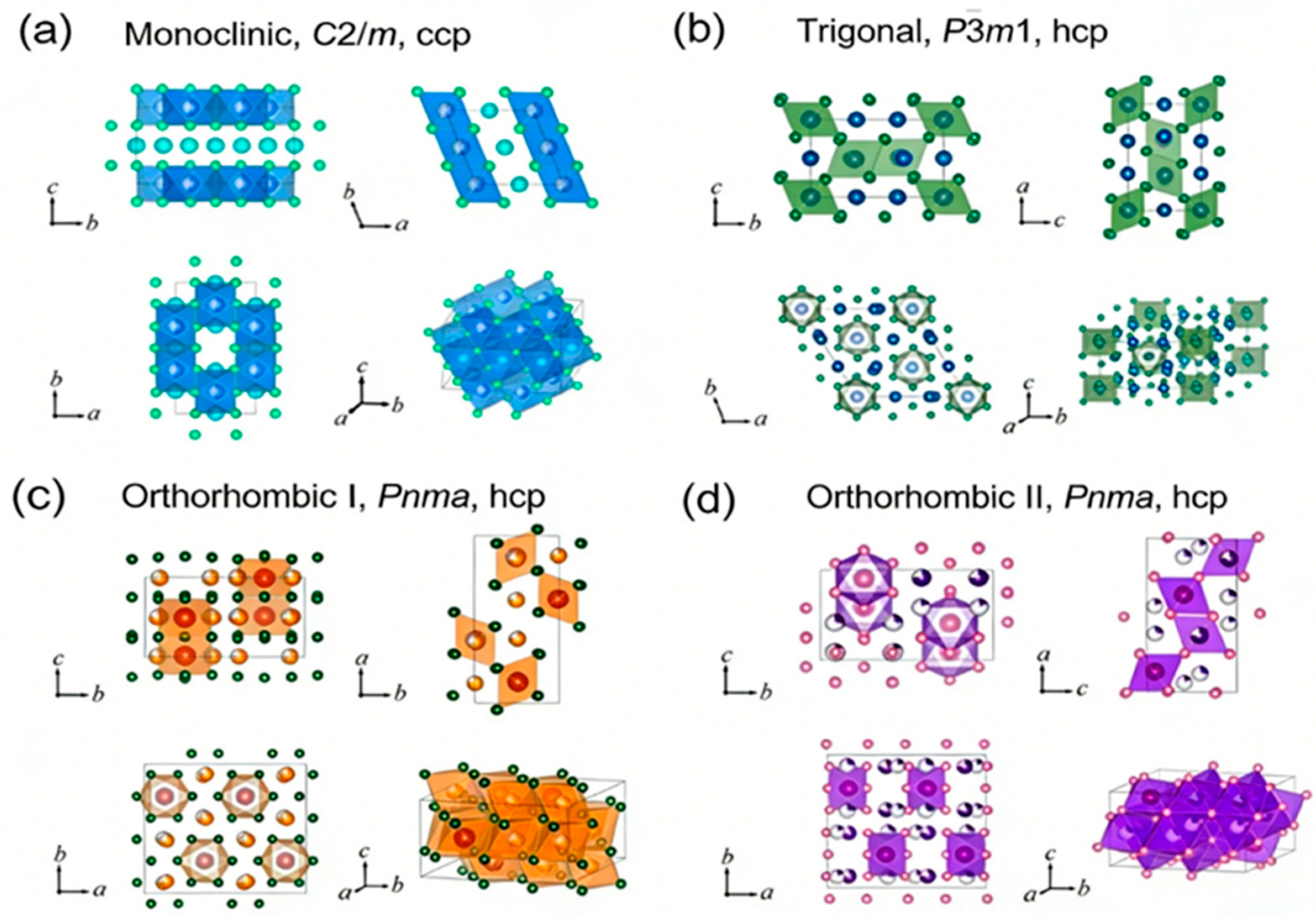
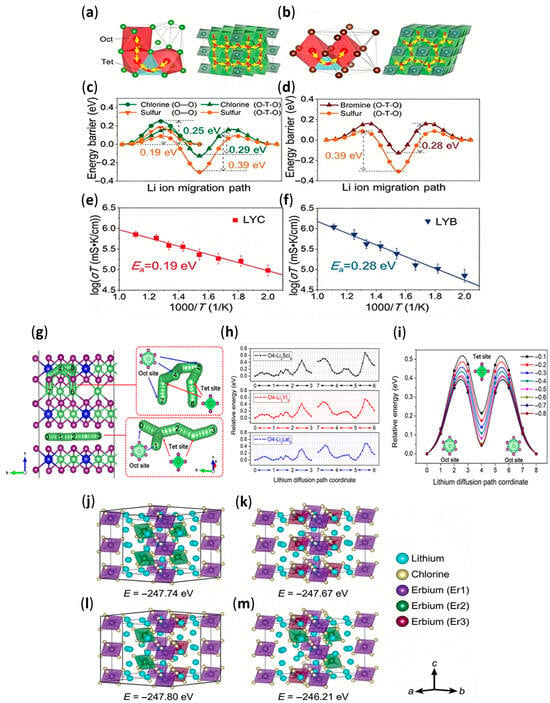
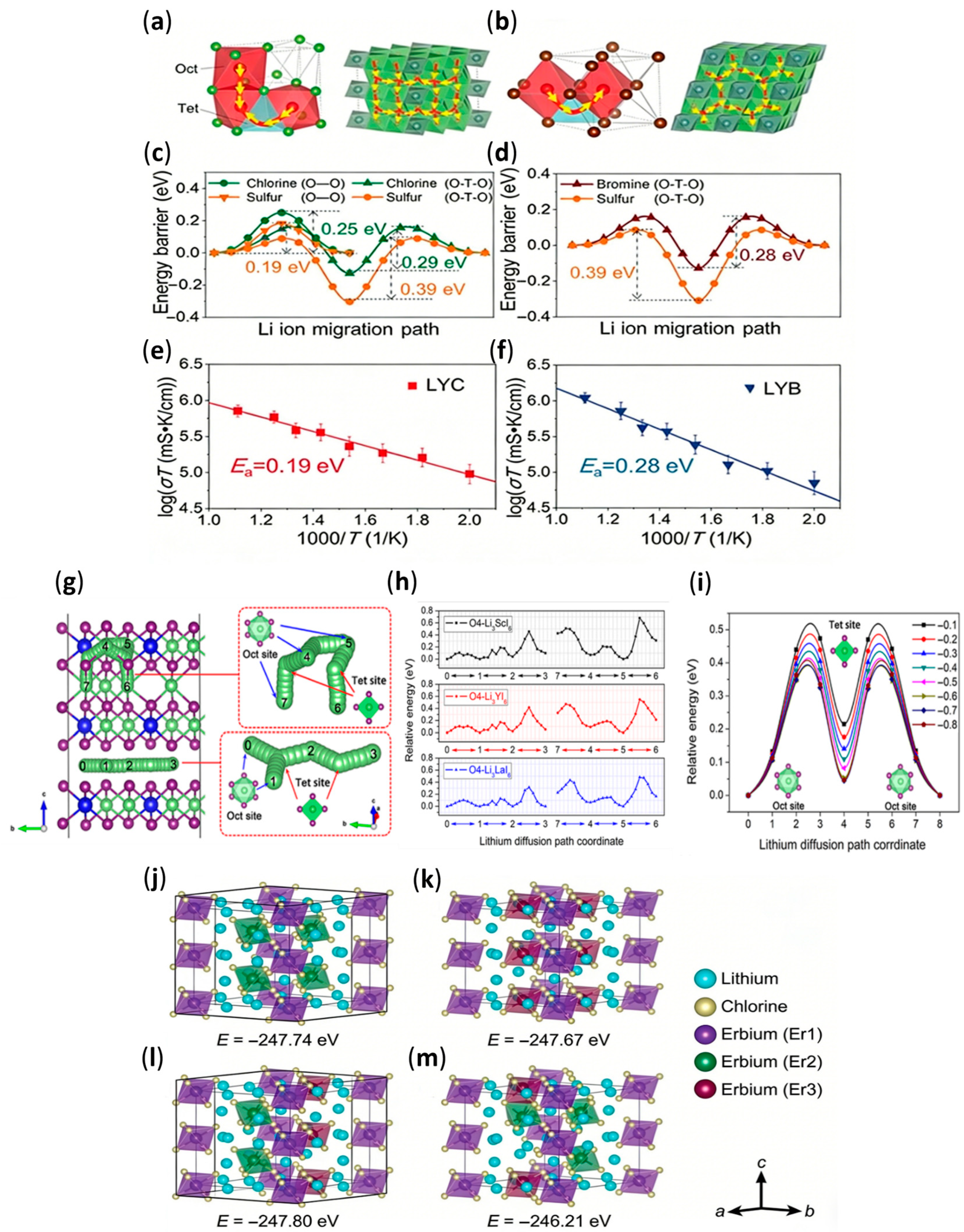
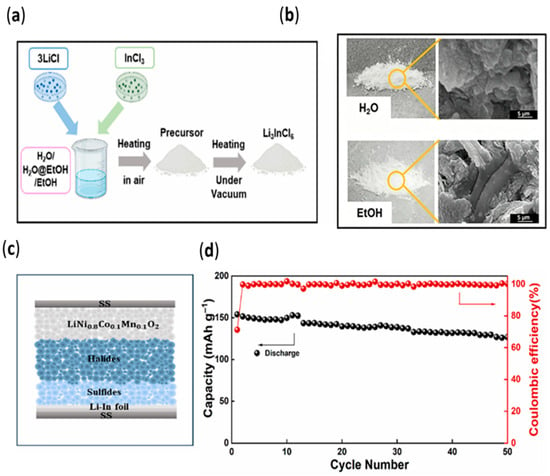
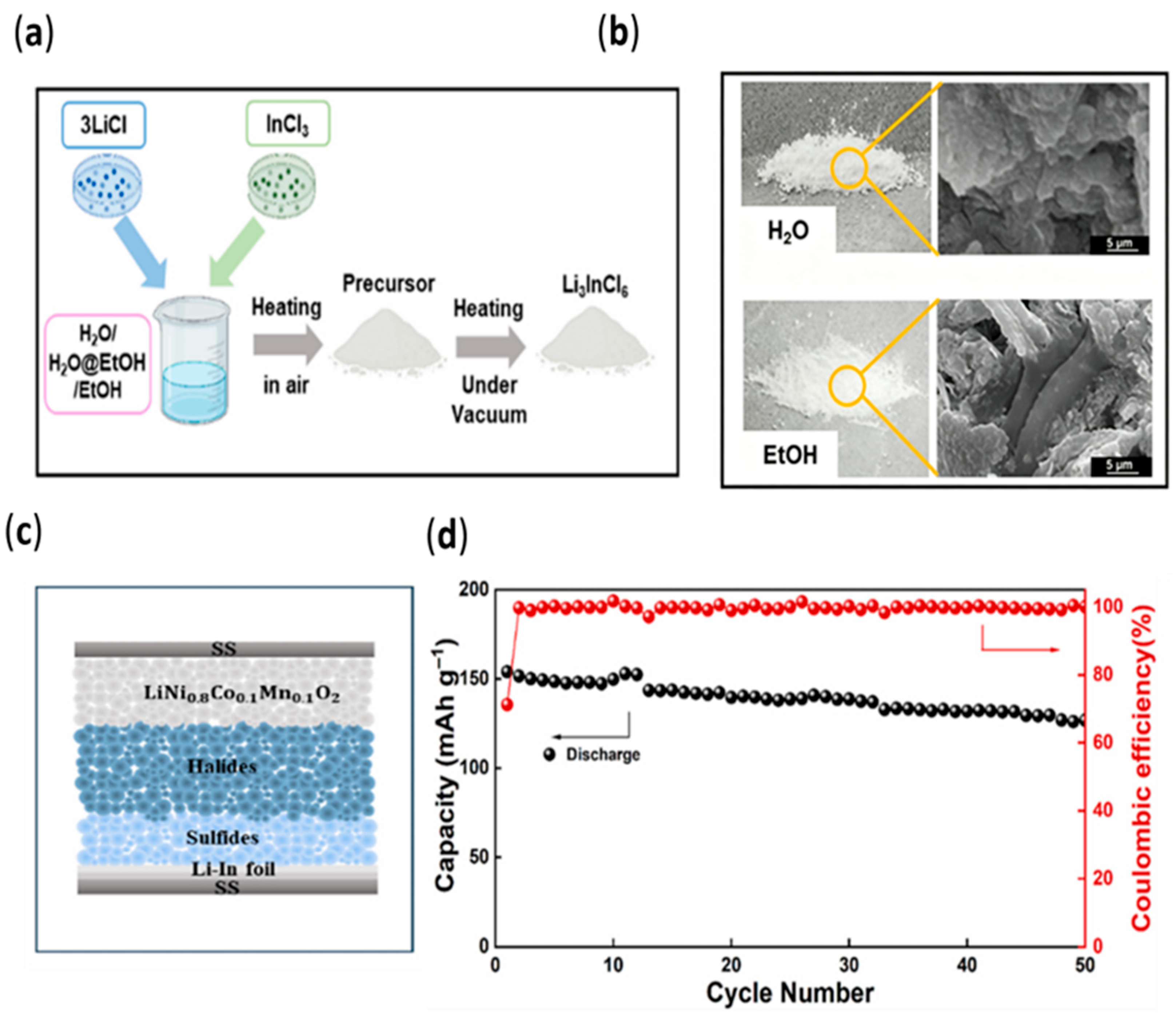
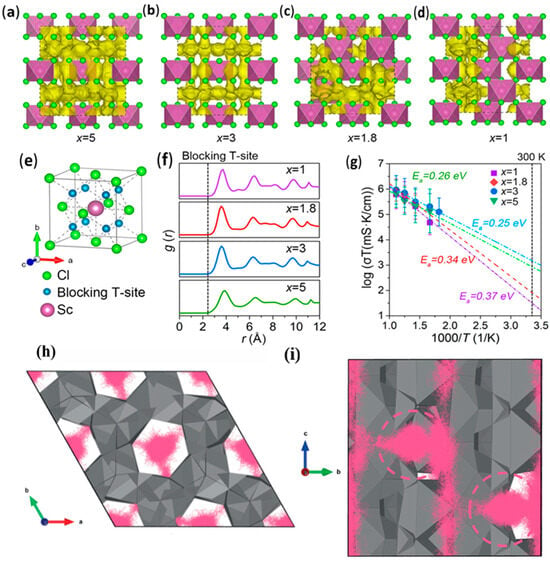
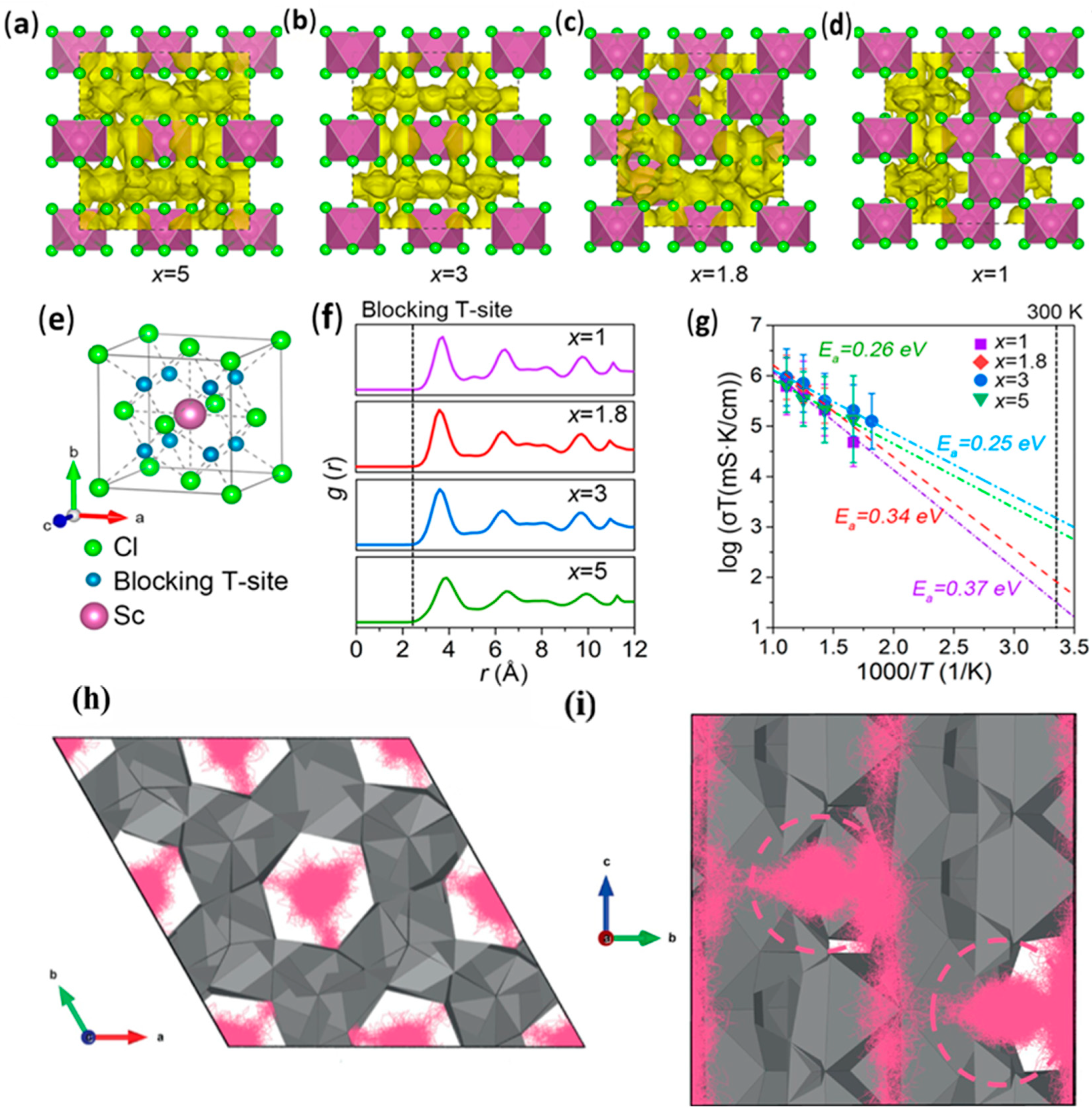
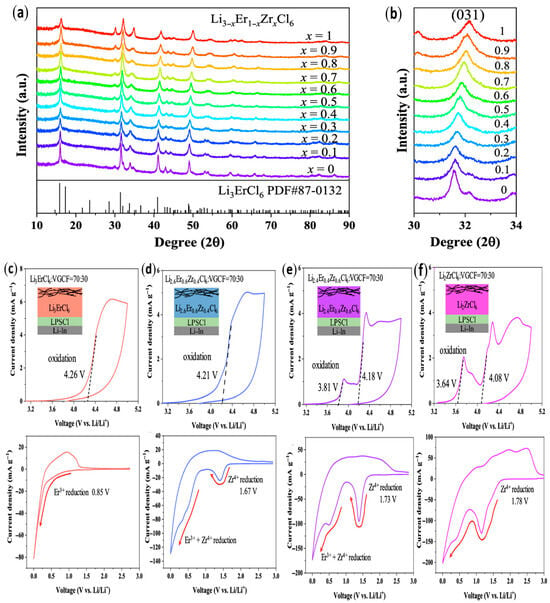
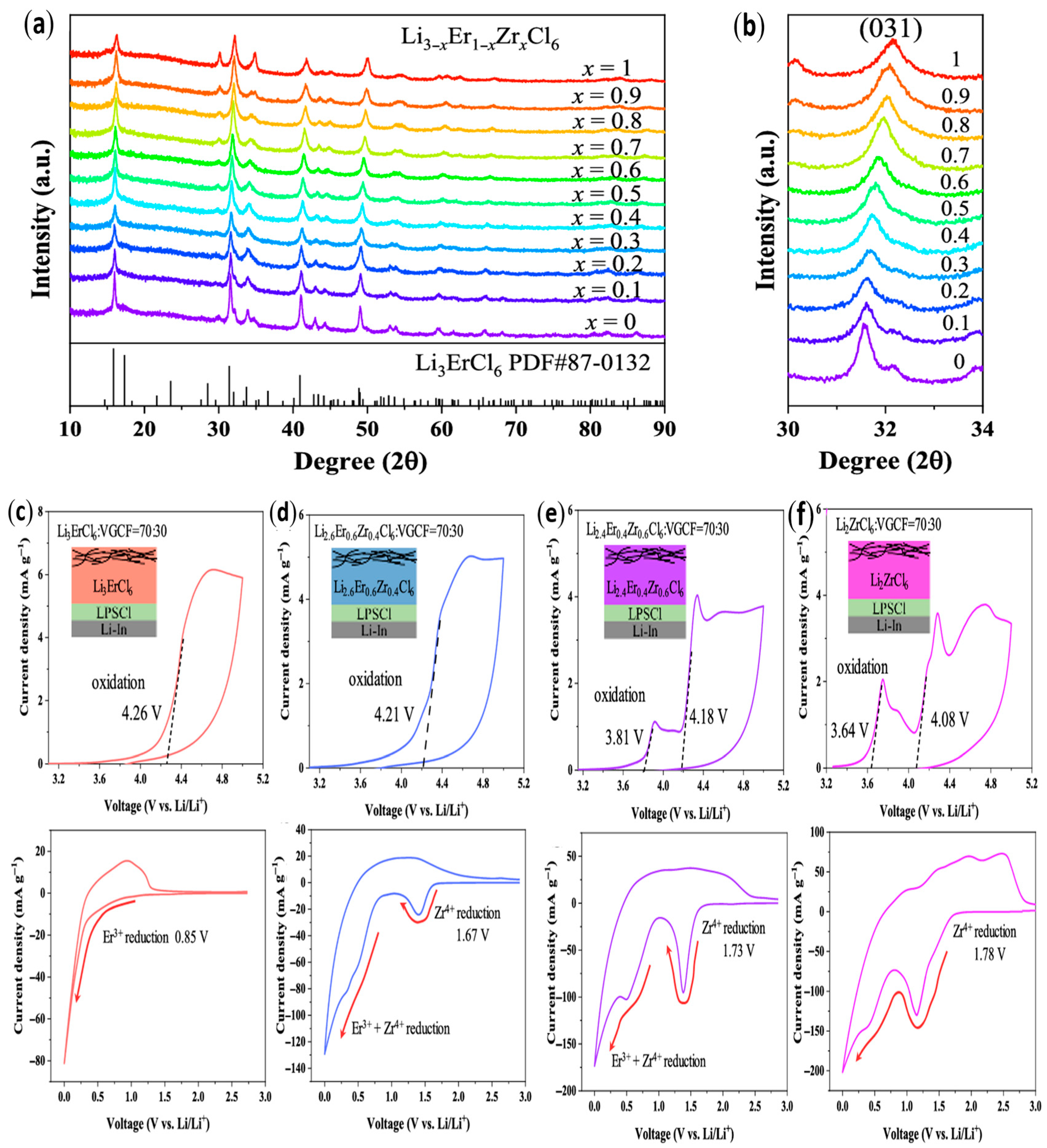
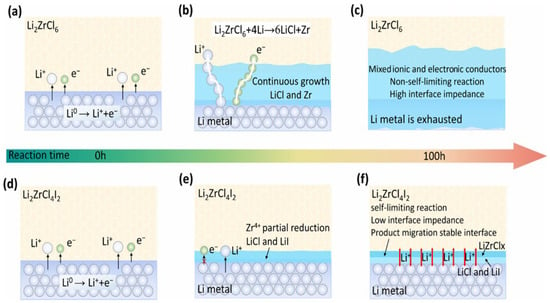
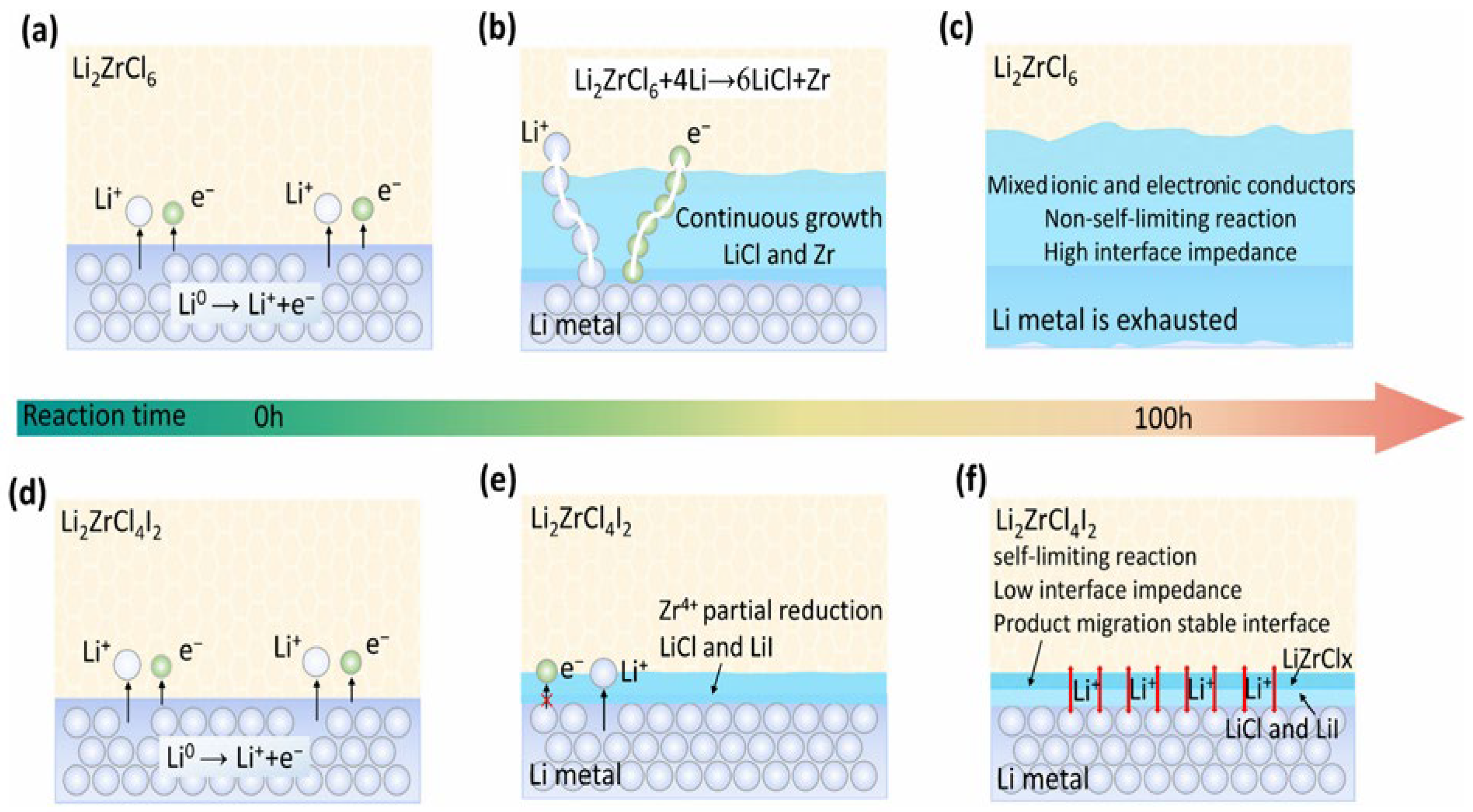
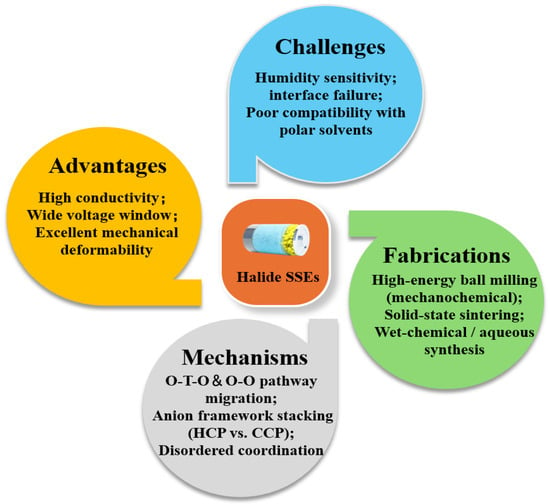
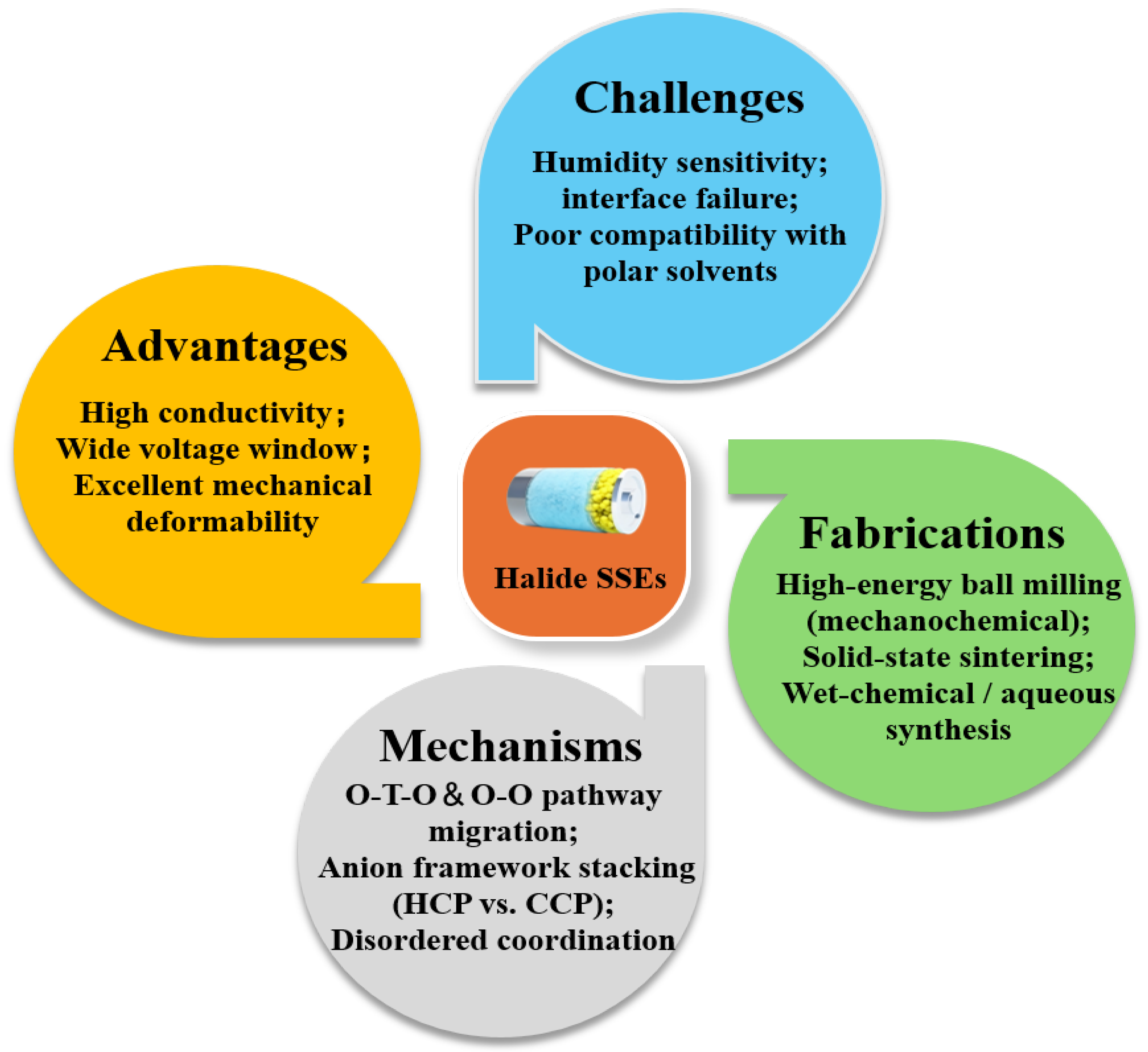

Disclaimer/Publisher’s Note: The statements, opinions and data contained in all publications are solely those of the individual author(s) and contributor(s) and not of MDPI and/or the editor(s). MDPI and/or the editor(s) disclaim responsibility for any injury to people or property resulting from any ideas, methods, instructions or products referred to in the content. |
© 2026 by the authors. Licensee MDPI, Basel, Switzerland. This article is an open access article distributed under the terms and conditions of the Creative Commons Attribution (CC BY) license.