


Abstract
Vanadium borate (V3BO6) has recently been synthesized and identified as a promising material for use in energy storage applications, particularly as a potential anode for lithium-ion batteries. However, despite previous studies highlighting its electrochemical performance, a comprehensive understanding of its intrinsic mechanical, thermal, and vibrational properties remains limited. The compound crystallizes in an orthorhombic phase with the Pnma (No. 62) space group. To explore its intrinsic physical characteristics, full geometry optimization of the unit cell and atomic positions was performed using density functional theory (DFT) within the CASTEP framework. The Perdew–Burke–Ernzerhof (PBE) functional under the generalized gradient approximation (GGA) was used to model exchange–correlation effects. A plane-wave cut-off of 408 eV and a 6 × 6 × 13 Monkhorst–Pack grid were employed to ensure numerical convergence. The optimized lattice constants (a = 9.9025 Å, b = 8.4751 Å and c = 4.5354 Å) are highly consistent with experimental data, which confirms the reliability of the computational approach adopted. The elastic behaviour was further investigated using the first-principles strain-energy method, yielding nine independent elastic constants consistent with orthorhombic symmetry. The calculated bulk and shear moduli, along with the anisotropy parameters, suggest that V3BO6 has a favourable balance of mechanical robustness and moderate ductility. A Vickers hardness of 10.95 GPa and a B/G ratio of approximately 1.93 corroborate these findings. Additional parameters, such as Poisson’s ratio, Debye temperature and average sound velocities, were derived to gain deeper insight into the material’s thermomechanical performance. These results provide a solid theoretical foundation for understanding the mechanical stability and potential anode suitability of V3BO6 in lithium-ion battery systems.
1. Introduction
In the modern era, the global push for renewable energy has made effective energy storage technologies increasingly important [1]. Lithium-ion batteries have emerged as the dominant solution among the available systems due to their high energy density, long cycle life and negligible memory effect. This makes them suitable for a broad spectrum of applications, ranging from portable electronics to electric vehicles [2,3,4,5,6]. Anode materials are integral components of these systems and exert a crucial influence on the overall electrochemical performance of batteries.
Previous research on anode materials has primarily focused on conventional options, particularly graphite and silicon [7,8,9,10,11]. However, these materials present challenges in terms of limited capacity, slow charging kinetics, and inadequate structural stability [12,13,14]. To overcome these limitations, the quest for advanced materials has sparked significant interest in carbon-based nanostructures, particularly graphene and carbon nanotube (CNT) hybrids. Recent studies have demonstrated that hybrid carbon nanofiber (CNF)/highly branched graphene nanosheet (HBGN) structures can offer reversible capacities of approximately 300 mAh/g with excellent cycling stability [15,16]. Similarly, the strategic integration of graphene and multiwalled carbon nanotubes (MWNTs) has been shown to prevent the restacking of graphene sheets, ensuring a high surface area and short diffusion paths for Li-ions [17,18]. Furthermore, synergistic effects in ternary nanocomposites, such as TiNb2O7/graphene/CNT, have enhanced high-rate capacity and cyclic reliability [19].
Despite these advancements in carbon hybrids, the search for high-performance inorganic alternatives like vanadium borate (V3BO6) has received increasing attention. Vanadium borate has an orthorhombic crystal structure belonging to the Pnma (62) space group, and experimental and theoretical studies have identified it as a potential anode material for lithium-ion batteries [20,21,22]. The potential of V3BO6 as an anode has not been widely investigated, with only a few studies addressing its applicability in energy storage systems [22,23,24,25]. Furthermore, the detailed crystallographic characteristics of vanadium borate have not yet been fully examined. While several studies have discussed other vanadium-based compounds, the atomic-scale structural arrangements and their implications for electronic behaviour still require deeper investigation [22,26,27,28]. Furthermore, despite limited prior reports, there is still a lack of comprehensive data on the mechanical and thermal properties of vanadium borate [28,29,30,31,32].
While previous experimental and theoretical studies have identified V3BO6 as a promising anode candidate, it is important to note that these investigations evaluated its potential without assessing its fundamental mechanical and thermal properties. However, the structural integrity of an anode during lithiation/delithiation cycles is heavily governed by its mechanical robustness and ability to withstand thermal fluctuations. The present study addresses this critical gap in the existing literature by providing a first-principles evaluation of the mechanical, thermal, and vibrational characteristics of V3BO6.
2. Methodology
The crystal structure of V3BO6 will be characterized using density functional theory (DFT) in combination with the generalized gradient approximation (GGA) to clarify the atomic-level arrangements and their impact on electronic behaviour. This comprehensive evaluation aims to improve our understanding of the role of vanadium borate in battery systems, its long-term usability and its potential for future applications.
In this study, first-principles DFT calculations with the GGA approach were employed [33,34,35,36] to determine the optimized geometry and electronic configuration of V3BO6 at the atomic scale. Lattice parameters and atomic coordinates were fully relaxed using the CASTEP 20.1 simulation package [37], without any external constraints. Additionally, mechanical properties, including elastic constants and Vickers hardness, were computed to provide insights into the material’s anisotropic behaviour and structural stability.
Although previous studies have reported the structural parameters and electrochemical performance of V3BO6 as a lithium-ion anode [14,22], many of its intrinsic physical properties remain largely unexplored. While some preliminary ab initio investigations have focused on basic lattice optimization and electronic density of states, a systematic evaluation of its mechanical response and thermal characteristics is still lacking. To bridge this gap, the present work conducts a comprehensive, first-principles analysis to clarify the material’s behaviour under different physical conditions. Specifically, the second-order elastic constants, which govern the material’s resistance to deformation and structural stability during lithiation/delithiation cycles, are calculated for the first time using the strain-energy method implemented in the CASTEP computational package [37]. From these constants, key polycrystalline mechanical parameters, including the bulk, shear, and Young’s moduli, were derived, and the elastic anisotropy was subsequently assessed. These results provide a deeper understanding of the mechanical stability and direction-dependent elasticity of this orthoborate compound, offering essential insights that were absent in prior reports.
Although the DFT+U approach is often employed to improve the description of localized d-electron systems, in the present study, V3BO6 is treated as a mixed ionic–covalent material where the V(3d) states are significantly hybridized with O(2p) and B-related states. Therefore, the d-electrons are not strongly localized, and the application of a Hubbard U correction is not expected to qualitatively change the structural and physical trends reported in this work. To further support the reliability of the present results, the optimized structural parameters obtained within the GGA-PBE framework show good agreement with available experimental data, within the typical error range of such calculations. Hence, the main conclusions of this study remain robust without the inclusion of a U correction.
All calculations were performed within the CASTEP framework [37] using the revised PBE functional for exchange–correlation effects [38], which enhances structural prediction reliability. A plane-wave cut-off energy of 408 eV was adopted, and Brillouin zone sampling employed a Monkhorst–Pack k-point mesh of 6 × 6 × 13, corresponding to a k-point spacing of approximately 0.01 Å−1. These computational parameters were carefully optimized to ensure numerical convergence and reproducibility of the structural and elastic properties of V3BO6.
3. Results and Discussion
3.1. Structural Properties
This research aims to examine the physical and chemical characteristics of V3BO6 crystals using ab initio computational methods. A thorough investigation of their structural, mechanical and electronic properties will enhance our understanding of how the material could be used in battery-related technologies. Additionally, the mechanical integrity and elastic response of V3BO6 will be evaluated to assess its mechanical reliability, workability, and long-term performance in battery systems under operating conditions.
Transition-metal orthoborates generally fall into one of five main structural categories, depending on their crystallographic framework: calcite-type, kotoite-type, oxoborate-type, zircon-type and norbergite-type. The compound analyzed in this study belongs to the norbergite-type class of transition-metal orthoborates and crystallizes in an orthorhombic lattice with Pnma symmetry (Space Group No. 62).
The crystallographic parameters and atomic-scale details of this material were experimentally determined by Zeng et al. [22]. In their study, X-ray crystallography was employed to model the atomic arrangement and thoroughly characterize the compound’s electrochemical performance. Their findings demonstrated that norbergite-type transition-metal orthoborates exhibit remarkable potential as anode materials for lithium-ion batteries. Its high specific capacity, strong cycling stability and extended lifespan identify it as a promising candidate for advanced energy storage applications. These outcomes further support the hypothesis that orthoborate-type materials could function as active constituents in next-generation energy storage devices.
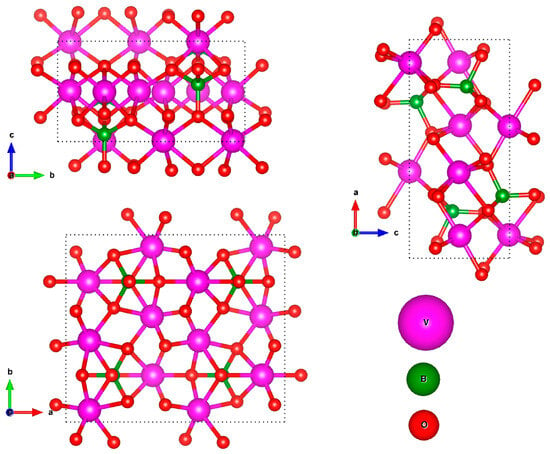
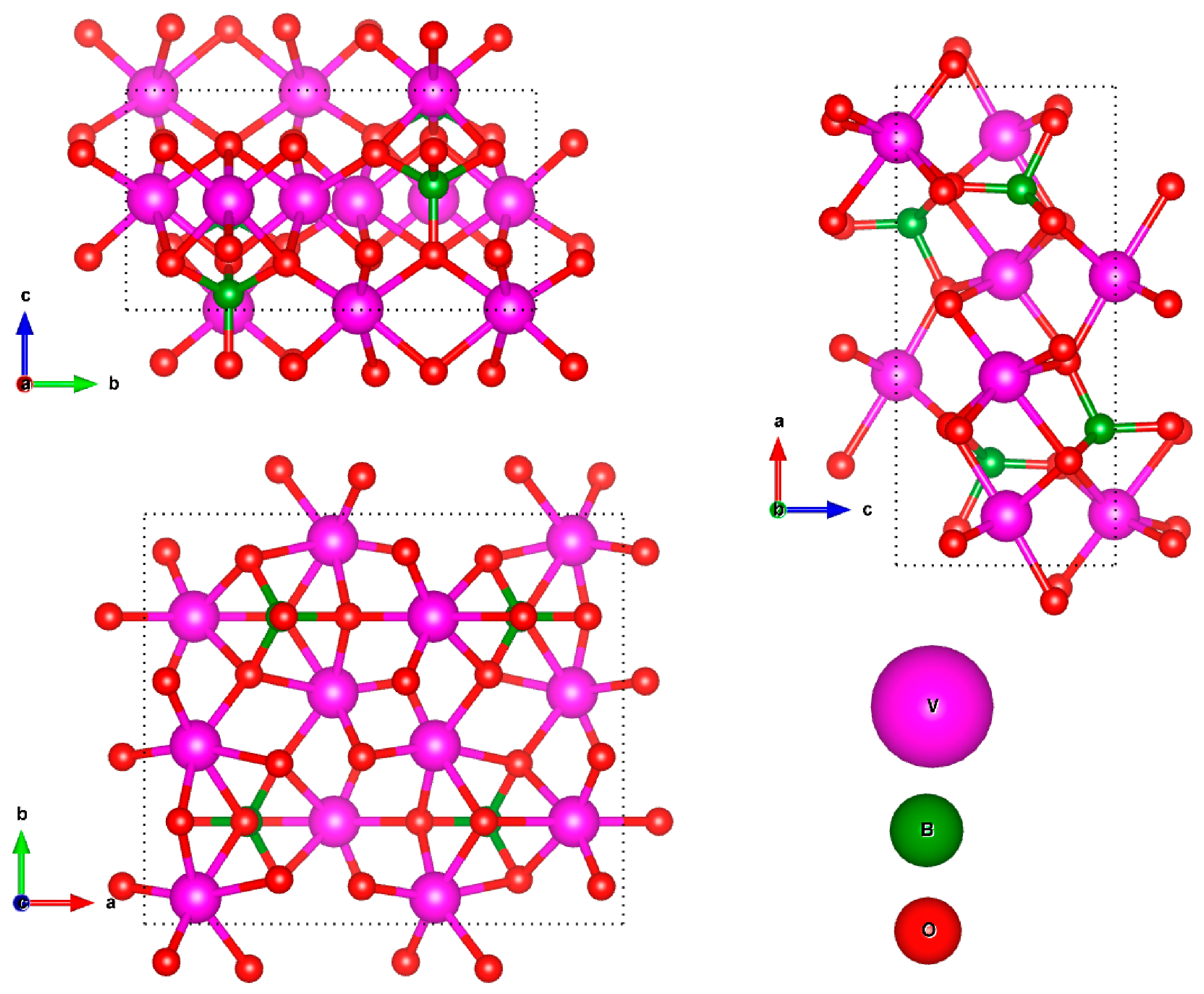
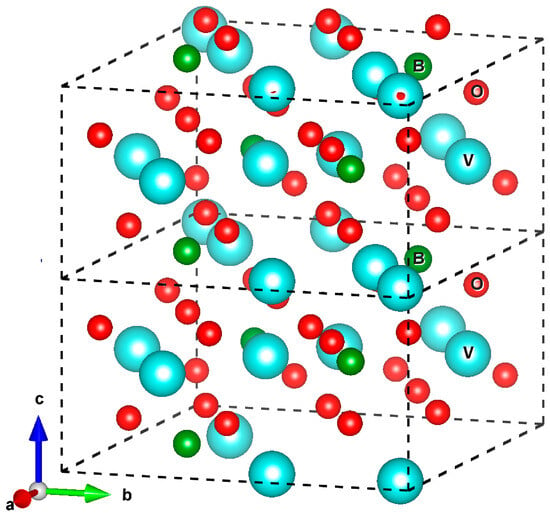
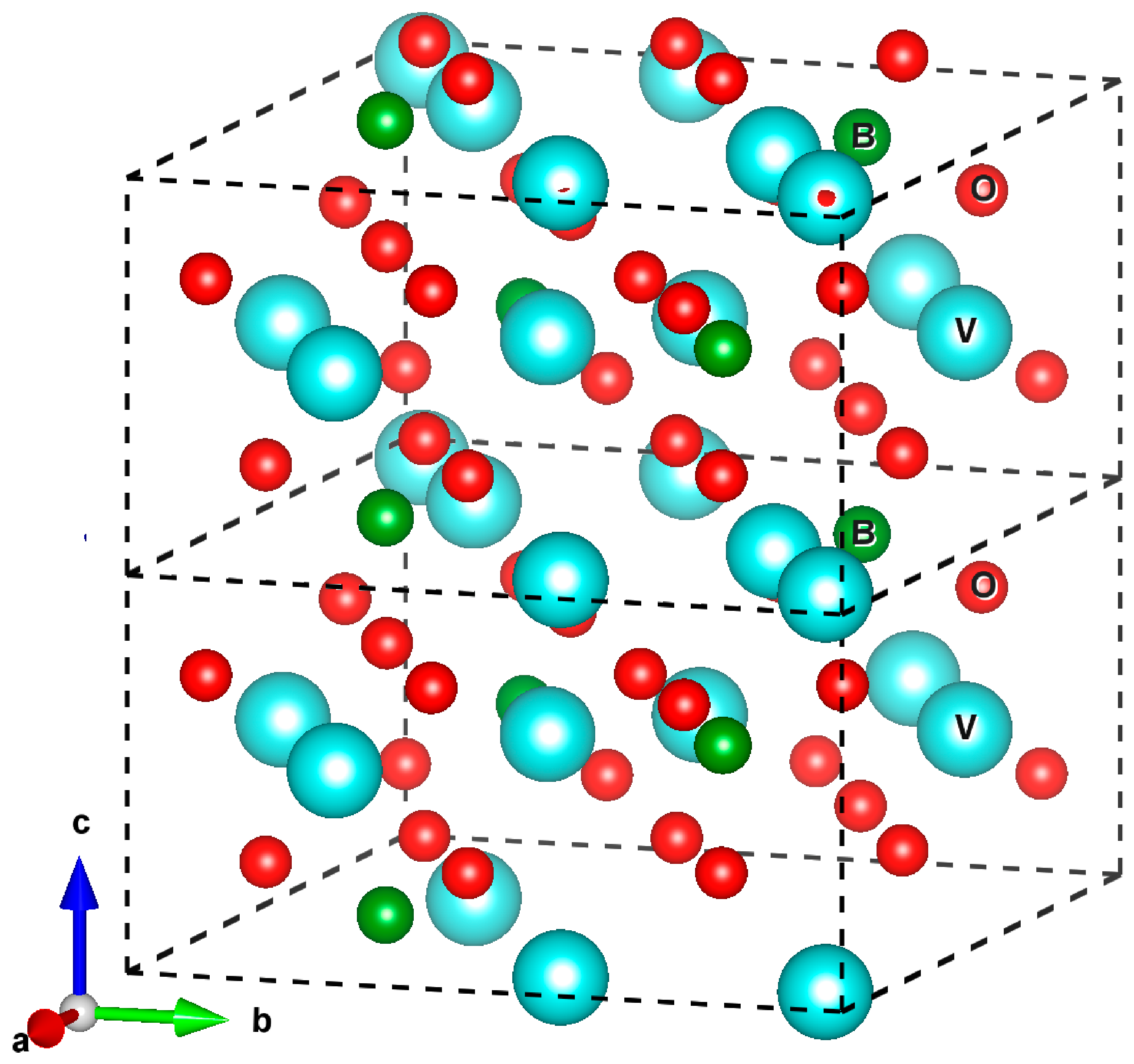
Table 1 summarizes the data reported by Zeng et al. [22,39,40], which are referenced throughout the present study. The crystal structure of V3BO6 was analyzed in detail using X-ray powder diffraction (XRD), and the unit cell parameters, such as the lattice constants (a, b and c), the cell volume and the symmetry descriptors, were tabulated. These results confirm the orthorhombic nature of the structure (Pnma, No: 62) and quantitatively validate its crystallographic characteristics. Figure 1 shows the V3BO6 unit cell from multiple orientations (the [100], [010] and [001] directions) to highlight its intrinsic symmetry, atomic coordination and three-dimensional lattice configuration. These visual representations, created using crystallographic modelling software, reveal detailed information about atomic bonding networks, coordination geometries and site occupancies within the unit cell.
Table 1.
The structural parameters and atomic coordinates of the V3BO6 compound: a = 10.0202 (4)Å, b = 8.5589 (4)Å, c = 4.4525 (3)Å, and Vol. = 381.85 (3) Å3 in space group Pnma.
Figure 1.
The crystal structure schematic of V3BO6.
The optimized lattice parameters of the V3BO6 compound were determined to be a = 9.9025 Å, b = 8.4751 Å and c = 4.5354 Å. These calculated values closely correspond to the parameters measured experimentally (a = 10.0202 Å, b = 8.5589 Å and c = 4.4525 Å) [22]. The slight deviation from perfect symmetry observed in the optimized V3BO6 structure can be attributed to small distortions in the atomic positions obtained after full geometry optimization within the DFT framework. Such deviations are commonly encountered in low-symmetry orthorhombic systems, where the relaxation of internal coordinates leads to minor variations in bond lengths and angles while preserving the overall crystal symmetry (Pnma). These subtle distortions do not affect the overall structural stability but reflect the realistic equilibrium configuration of the system under quantum mechanical optimization. The relative deviations, summarized in Table 2, fall within the normal error range expected for GGA-based DFT methods and are consistent with prior findings for similar transition-metal borates [41,42]. This agreement validates the computational reliability of the PBE functional applied through the CASTEP framework, confirming that the obtained geometry is suitable for further mechanical analyses.
Table 2.
The calculated equilibrium lattice parameters (a, b and c in Å) and volume (V0 in Å3/f.u) along with the available experimental data for the V3BO6 compound.
The elastic constants of the Pnma-structured V3BO6 crystal were calculated using density functional theory (DFT) as implemented in the CASTEP code [37,43]. Following variable-cell geometry optimization with converged stress, the generate_strain.py script from the elastic constants toolkit [43,44] was used to generate eighteen strained configurations of the unit cell. For each deformed structure, single-point CASTEP calculations were performed to obtain the stress tensor. The elastics.py script then derived the full elastic constant matrix (Cij) by linearly fitting the stress–strain relationship [45,46], also yielding the bulk and shear moduli, Young’s modulus, and Poisson’s ratios. Elastic constants are fundamental descriptors of a material’s behaviour under external stress. They offer insights into its mechanical integrity, bonding strength, anisotropic nature and tendency to exhibit either ductile or brittle characteristics [47]. For orthorhombic structures, nine independent stiffness coefficients are recognised: C11, C12, C13, C22, C23, C33, C44, C55 and C66. The computed single-crystal elastic constants for V3BO6 are summarized in Table 3. In the absence of existing experimental or theoretical data for V3BO6, the results presented here serve as a pioneering benchmark for its mechanical properties. The fact that these constants strictly satisfy the Born stability criteria confirms the structural robustness of the compound and the reliability of our computational framework. As shown in Table 4, these constants satisfy the Born criteria for mechanical stability [48], confirming that V3BO6 is structurally robust.
Table 3.
The calculated elastic constants (Cij in GPa) for the V3BO6 compound.
Table 4.
Orthorhombic Born Stability Criteria.
The elastic constants C11, C22 and C33 represent the material’s resistance to uniaxial compression along the x-, y- and z-axes respectively. In the case of V3BO6, C33 is considerably greater than C11 and C22, suggesting lower compressibility along the x-axis compared to other crystallographic directions. This characteristic may account for the relatively minor variation in the lattice constant with temperature and pressure compared to the b and c lattice constants [49]. The elastic constant C44 reflects resistance to shear deformation and implies that shear along the (010) plane in the [100] direction occurs more readily than shear along the (001) plane.
3.2. Mechanical Properties
Table 5 summarizes the polycrystalline elastic moduli obtained from the calculated second-order elastic constants (Cij). These parameters provide valuable insights into the material’s overall mechanical performance [50]. The evaluated bulk moduli (approximately 183.2 GPa), shear moduli (approximately 95 GPa) and Young’s moduli (approximately 242.9 GPa) indicate that V3BO6 has considerable mechanical strength and hardness [51,52]. When compared with structural steels and aluminum alloys (see Table 6, Table 7 and Table 8) [53,54,55,56,57,58,59,60,61,62,63,64], these values show that V3BO6 has a comparable stiffness and resistance to deformation. The computed Vickers hardness value, which exceeds 10 GPa, further confirms the classification of V3BO6 as a hard material [65].
Table 5.
The calculated bulk moduli (B in GPa), shear moduli (G in GPa), Young’s moduli (E in GPa), Poisson’s ratio (v), B/G ratio, Vickers hardness (HV in GPa), Cauchy pressure (Pc in GPa), Universal anisotropy factor (Au), sound velocity (vl, vt and vm in m/s) and Debye temperature (θD in K).
Table 6.
Approximate bulk moduli for common materials [53].
Table 7.
Typical values for shear moduli (GPa) (at room temperature) [53].
Table 8.
Approximate Young’s moduli for various materials [53].
The ratio of bulk to shear moduli (B/G) is a reliable indicator of ductile or brittle behaviour. With a B/G value of around 1.93, it is suggested that V3BO6 exhibits ductile characteristics. Additionally, the universal anisotropy index (Au ≈ 0.21) reflects moderate elastic anisotropy. Positive Cauchy pressure (PC = C12–C44) implies a predominantly covalent bonding nature, while the estimated Debye temperature (θD ≈ 719 K) sheds light on the material’s thermal and vibrational behaviour.
Table 9 presents the orientation-dependent variations in the computed polycrystalline elastic moduli, providing a clear understanding of the elastic anisotropy in V3BO6. Comparative evaluation indicates that Young’s moduli, bulk compressibility, and shear moduli differ by as much as 1.5 times among various orientations, demonstrating a pronounced elastic anisotropy [66,67]. Moreover, Poisson’s ratio exhibits an even higher level of directional dependence, varying by nearly a factor of five across distinct crystallographic directions, which further underscores the anisotropic mechanical behaviour of the material [54].
Table 9.
Variations in elastic moduli.
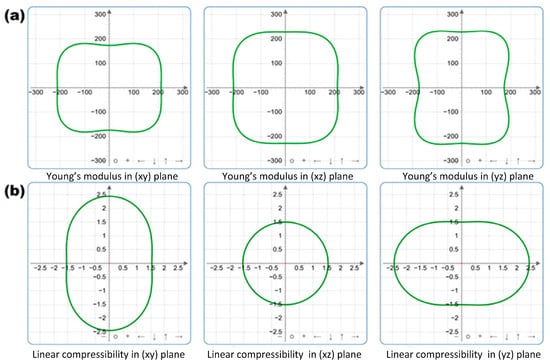
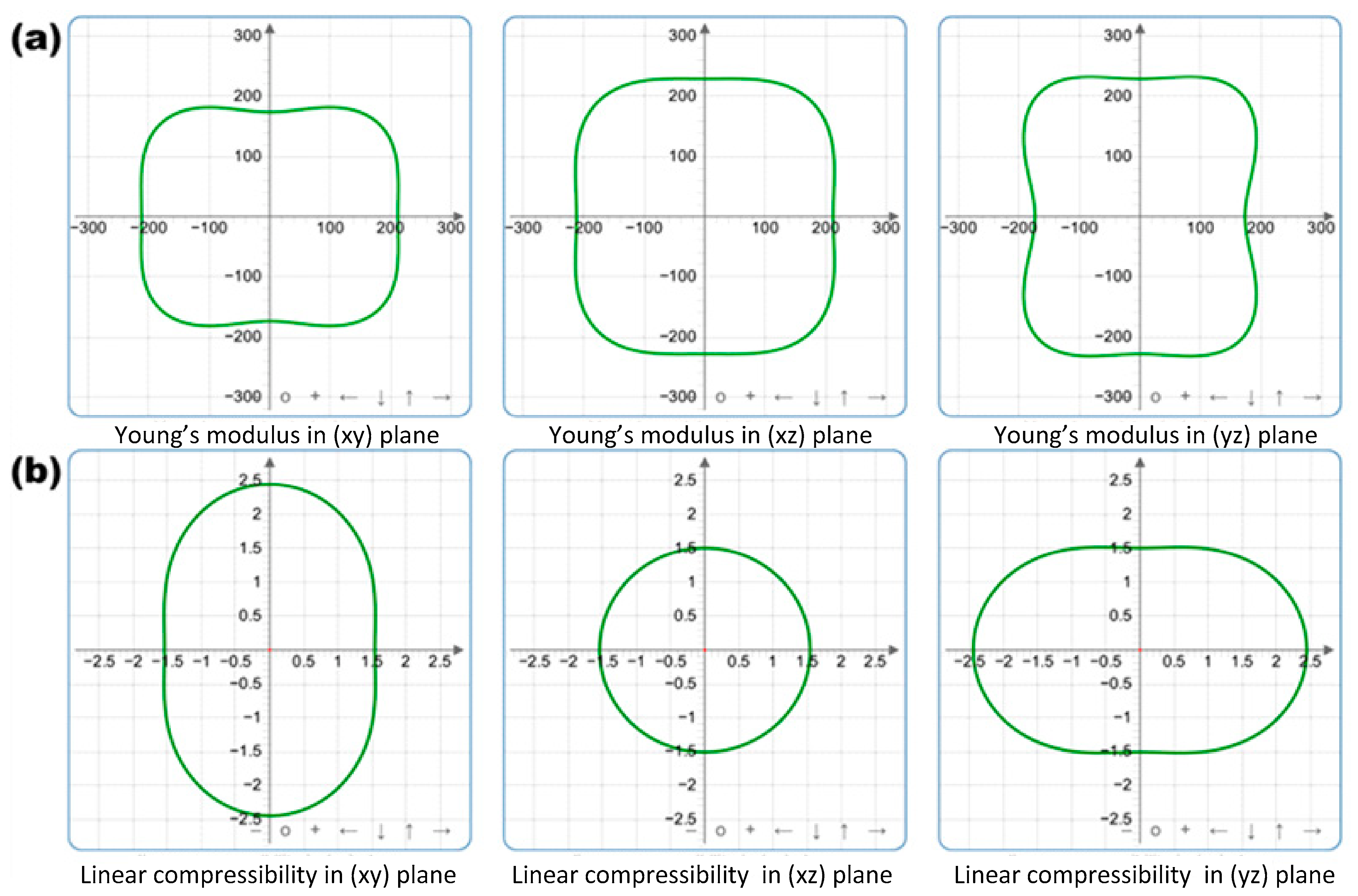
Figure 2 shows how Young’s modulus varies in different directions across the xy, xz and yz planes. This further demonstrates the elastic anisotropy of V3BO6. The modulus exhibits lower magnitudes along the primary crystallographic axes, reaching peak values along diagonal orientations. This distribution is characteristic of the anisotropic mechanical behaviour commonly observed in low-symmetry crystalline systems [54,67,68]. The observed directional dependence indicates that V3BO6 exhibits greater stiffness and more isotropic behaviour in the xz plane. In contrast, along the y-axis, the material demonstrates pronounced elastic compliance and reduced rigidity [69].
Figure 2.
(a) Spatial dependence of Young’s moduli, (b) spatial dependence of linear compressibility.
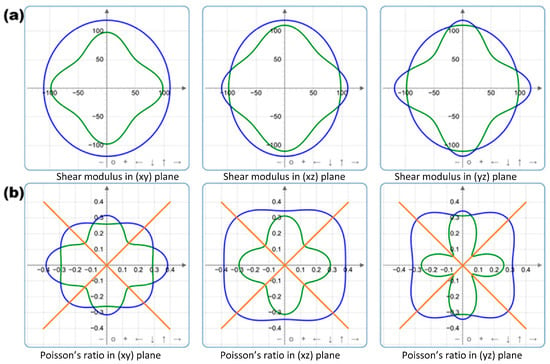
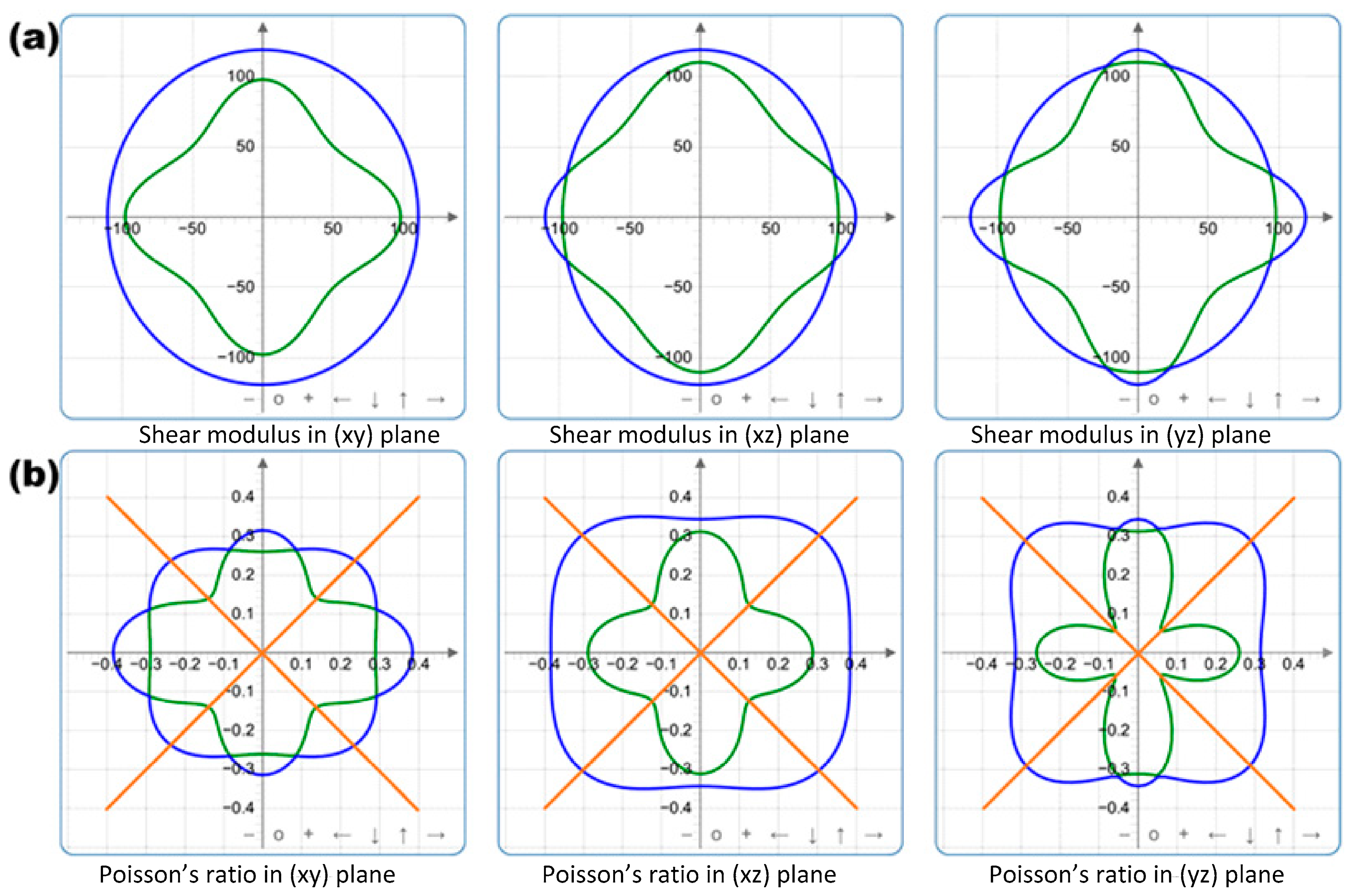
Figure 3 illustrates the orientation-dependent behaviour of the shear moduli, revealing their lowest magnitudes within the xy plane. While the overall distribution remains consistent across the xy, xz and yz planes, minor directional variations reflect the unique characteristics of low-symmetry anisotropic crystals [54,67]. Figure 3 also shows the variation in Poisson’s ratio, which is most anisotropic in the yz plane, dropping to values near 0.1 in certain directions. Such low Poisson’s ratio values indicate strong directional bonding primarily associated with covalent interactions that limit lateral deformation, thereby contributing to high hardness and reduced ductility [65,69]. These observations support the classification of V3BO6 as a mechanically hard and anisotropic compound.
Figure 3.
(a) Spatial dependence of shear moduli, (b) spatial dependence of Poisson’s ratio.
3.3. Vibrational and Thermal Properties
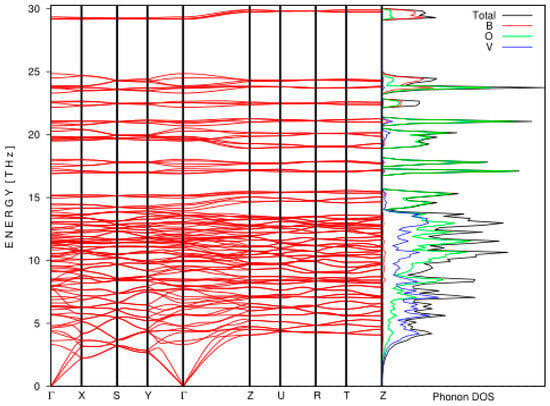
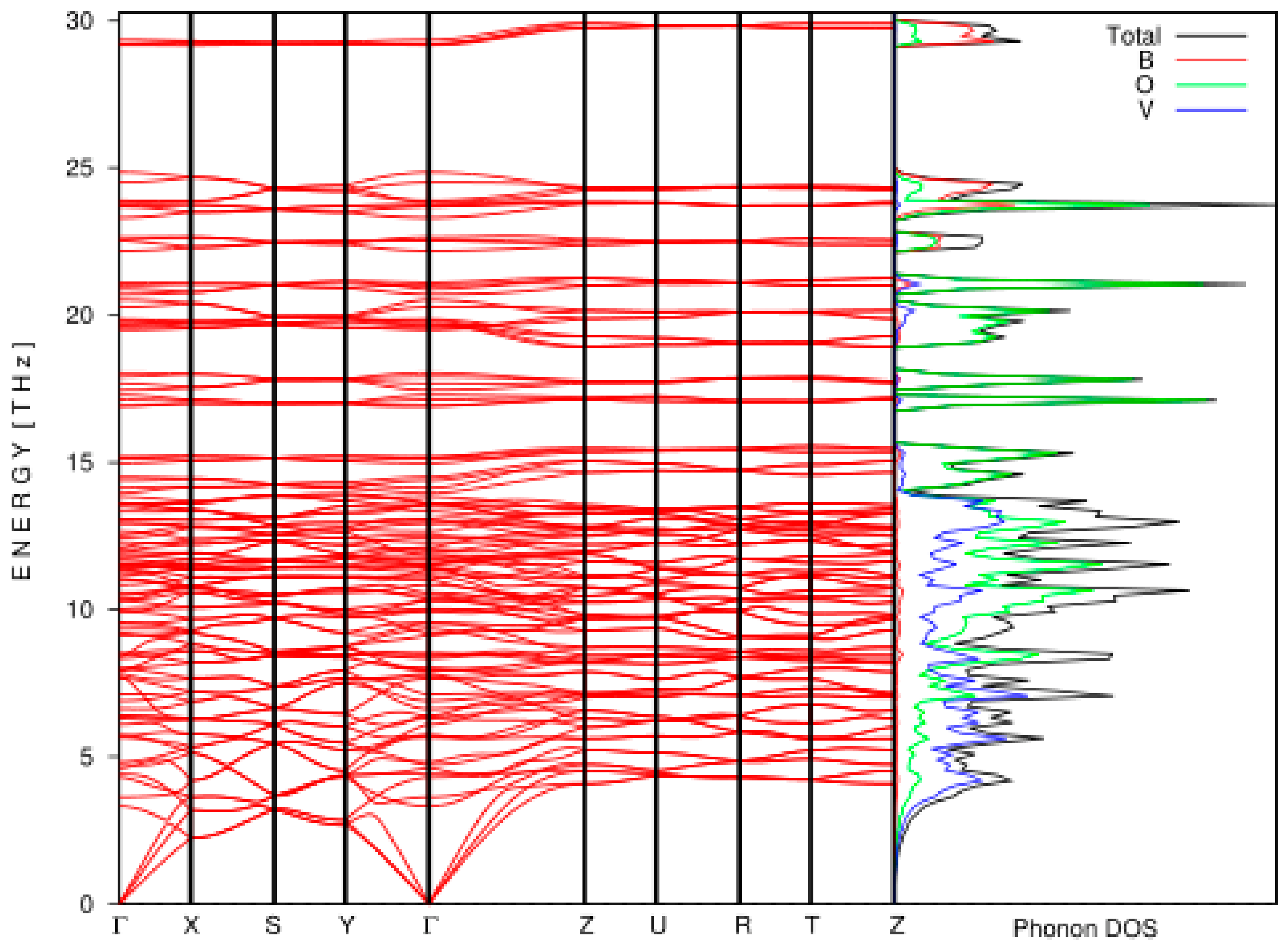
Figure 4 shows the vibrational characteristics of V3BO6 obtained through phonon dispersion calculations. A 1 × 1 × 2 supercell (see Figure 5) was constructed using the phonopy code, and force constants were computed for 34 unique atomic displacements using the finite displacement approach. The resulting phonon dispersion curves, plotted along the high-symmetry directions of the Brillouin zone, exhibit no imaginary frequencies, thereby confirming the dynamic stability of V3BO6 in its equilibrium configuration [70,71]. Although orbital-resolved density of states (DOS) analysis and orbital contribution to vibrational properties would provide deeper insight into the electronic and lattice dynamics of V3BO6, the present study focuses on the structural, mechanical, and vibrational properties within the current computational framework. A detailed orbital-resolved analysis, including the contributions of d orbitals and O(2p) states, will be considered in future work to further extend the understanding of the electronic–vibrational coupling in this material.
Figure 4.
Vibrational properties of V3BO6: phonon dispersion and density of states.
Figure 5.
The 1 × 1 × 2 supercell of V3BO6 is utilized for phonon/vibrational calculations (the basic unit cell is outlined).
Phonon mode analysis reveals that vanadium and oxygen atoms dominate the acoustic and low-frequency optical branches, while boron atoms contribute more to the high-frequency optical modes. This distribution of atomic participation is the result of the significant mass differences and distinct bonding environments of the constituent elements’ behaviour, which is consistent with that observed in other borate materials [72].
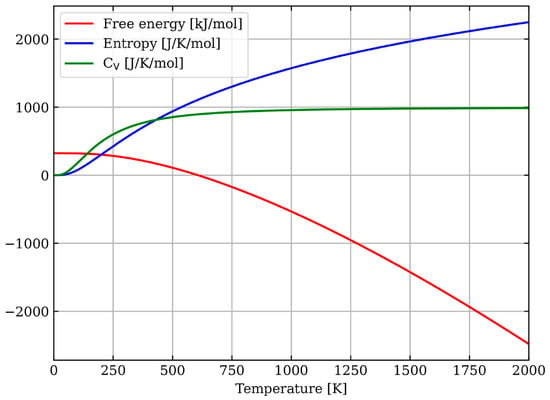
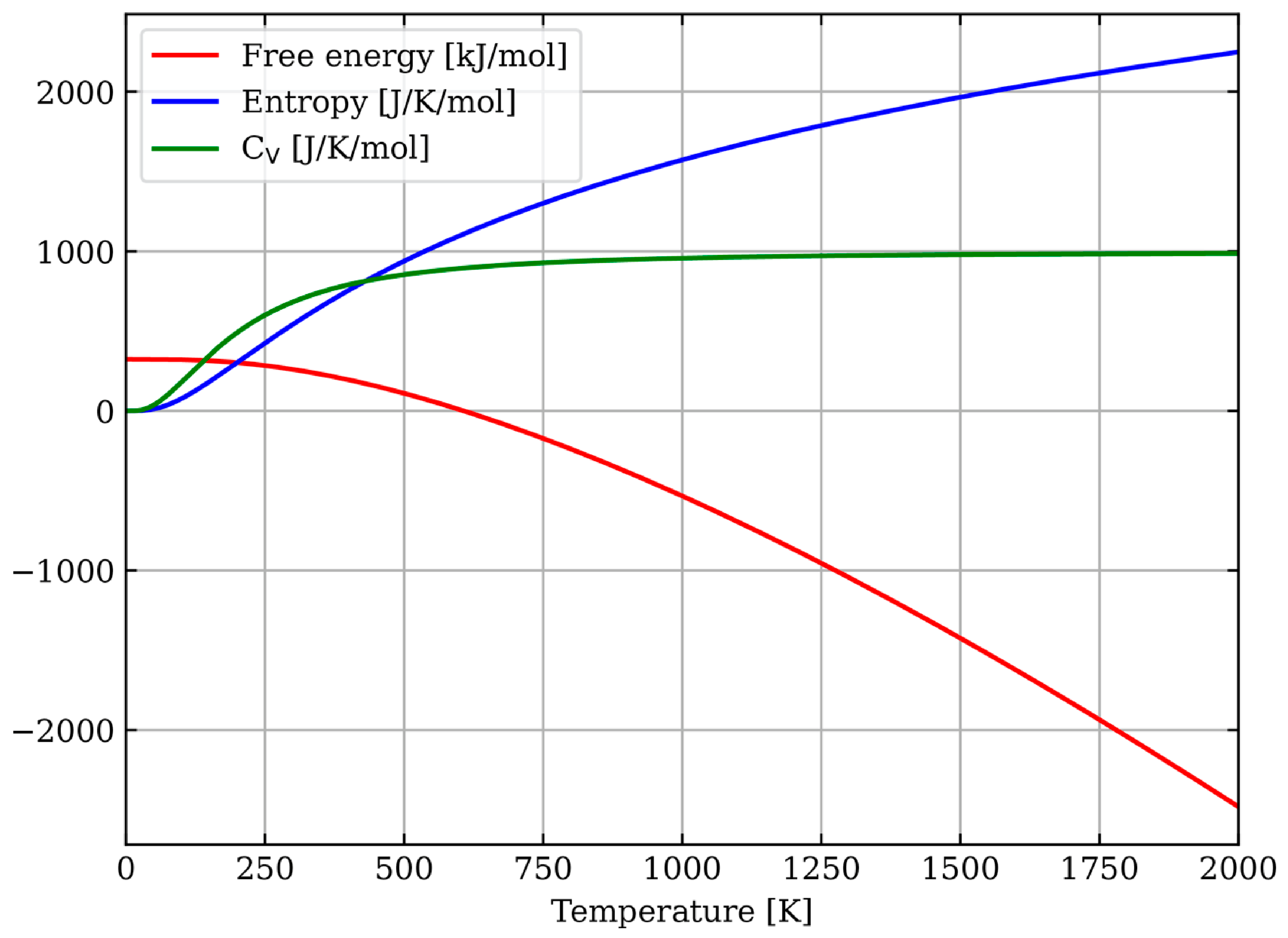
Additionally, the temperature-dependent thermodynamic quantities (namely the Helmholtz free energy, entropy and constant-volume heat capacity (Cv)) were computed based on the phonon density of states. As can be seen in Figure 6, the heat capacity gradually approaches the classical Dulong–Petit limit of ~998 J/mol·K around 800 K, which is consistent with theoretical predictions derived from the number of atoms per unit cell (N = 40) using the relation C = 3NR. This yields a value of C = 3 × 40 × 8.314 ≈ 998 J/mol·K [70,73].
Figure 6.
Thermal properties of V3BO6: temperature-dependent thermodynamic quantities.
In view of these results, the thermal behaviour of V3BO6 can be further interpreted by comparison with well-known reference materials such as diamond and graphene. Diamond, which represents strong covalent bonding, exhibits a relatively low specific heat capacity (~502 J/kg.K) [74], whereas graphene, due to its two-dimensional structure, enhanced vibrational freedom, and high phonon density, shows a significantly higher value (~710 J/kg.K) [54,75]. In this context, V3BO6 is positioned within an intermediate-to-high range of heat capacity.
This behaviour can be attributed to the rich phonon spectrum arising from the complex bonding environment of V–O and B–O networks within the structure. The coexistence of different bond strengths and coordination geometries leads to a broad distribution of vibrational modes, thereby supporting the observed thermal response.
Furthermore, this moderate-to-high heat capacity suggests that V3BO6 may act as an effective “thermal buffer” in battery systems by absorbing sudden temperature fluctuations. This property provides a significant advantage in maintaining structural integrity and enhancing thermal stability under operating conditions [75].
4. Conclusions
This comprehensive ab initio study systematically investigated the structural, mechanical, vibrational and thermodynamic characteristics of the Norbergite-type V3BO6 compound using advanced first-principles simulations. The optimized lattice parameters exhibited excellent agreement with available experimental results, confirming the accuracy and robustness of the DFT–PBE computational framework.
Mechanical stability was verified through the second-order elastic constants, which satisfied the Born criteria for orthorhombic crystals. The calculated bulk moduli (183.2 GPa), Young’s moduli (242.9 GPa) and Vickers hardness (10.95 GPa) suggest that V3BO6 is hard, stiff and ductile, advantageous properties for maintaining structural reliability under battery operating conditions. Furthermore, the B/G ratio (>1.75) and positive Cauchy pressure emphasize the compound’s predominantly covalent bonding and ductile nature.
The evaluation of elastic anisotropy demonstrated a pronounced directional dependence of mechanical parameters, particularly for Young’s moduli and Poisson’s ratio. This highlights the importance of crystal orientation in engineering applications. Phonon dispersion calculations confirmed the dynamical stability of the structure, and thermodynamic analyses revealed that the heat capacity approaches the Dulong–Petit limit at around 800 K. This supports the compound’s thermal reliability at high temperatures.
Overall, the results confirm that V3BO6 is structurally and mechanically stable and exhibits favourable vibrational and thermodynamic properties. These combined attributes make it a promising candidate for next-generation lithium-ion battery anodes. The material’s balance of high stiffness, moderate anisotropy and thermal endurance provides a solid basis for the experimental validation and potential optimization of V3BO6-based electrode materials for advanced energy storage technologies.
Funding
This research received no external funding.
Data Availability Statement
The data presented in this study are available on request from the corresponding author. The data are not publicly available due to privacy or ethical restrictions.
Acknowledgments
The numerical calculations reported in this paper were partially performed at TUBITAK ULAKBIM, High Performance and Grid Computing Center (TRUBA resources).
Conflicts of Interest
The authors declare no conflict of interest.
References
- Nasiri, A. Integrating energy storage with renewable energy systems. In Proceedings of the 34th Annual Conference of IEEE Industrial Electronics, Orlando, FL, USA, 10–13 November 2008; pp. 17–18. [Google Scholar]
- Chen, T.; Jin, Y.; Lv, H.; Yang, A.; Liu, M.; Chen, B.; Xie, Y.; Chen, Q. Applications of Lithium-Ion Batteries in Grid-Scale Energy Storage Systems. Trans. Tianjin Univ. 2020, 26, 208–217. [Google Scholar] [CrossRef] [Scilit]
- Diouf, B.; Pode, R. Potential of lithium-ion batteries in renewable energy. Renew. Energy 2015, 76, 375–380. [Google Scholar] [CrossRef] [Scilit]
- Divakaran, A.M.; Minakshi, M.; Bahri, P.A.; Paul, S.; Kumari, P.; Divakaran, A.M.; Manjunatha, K.N. Rational design on materials for developing next generation lithium-ion secondary battery. Prog. Solid State Chem. 2021, 62, 100298. [Google Scholar] [CrossRef] [Scilit]
- Jung, H.G.; Jang, M.W.; Hassoun, J.; Sun, Y.K.; Scrosati, B. A high-rate long-life Li4Ti5O12/Li[Ni0.45Co0.1 Mn1.45]O4 lithium-ion battery. Nat. Commun. 2011, 2, 516. [Google Scholar] [CrossRef] [Scilit]
- Zhou, G.; Paek, E.; Hwang, G.S.; Manthiram, A. Long-life Li/polysulphide batteries with high sulphur loading enabled by lightweight three-dimensional nitrogen/sulphur-codoped graphene sponge. Nat. Commun. 2015, 6, 8760. [Google Scholar] [CrossRef] [Scilit]
- Huang, S.; Cheong, L.Z.; Wang, D.; Shen, C. Nanostructured Phosphorus Doped Silicon/Graphite Composite as Anode for High-Performance Lithium-Ion Batteries. ACS Appl. Mater. Interfaces 2017, 9, 23672–23678. [Google Scholar] [CrossRef] [Scilit] [PubMed]
- Jing, X.; Cheng, W.; Liubin, S.; Youhang, Z. Research progress of nano-silicon based anode materials and silicon-carbon composite anode materials for lithium ion batteries. J. Solid State Electrochem. 2022, 26, 1125–1136. [Google Scholar]
- Kwon, H.J.; Hwang, J.Y.; Shin, H.J.; Jeong, M.G.; Chung, K.Y.; Sun, Y.K.; Jung, H.G. Nano/Microstructured Silicon–Carbon Hybrid Composite Particles Fabricated with Corn Starch Biowaste as Anode Materials for Li-Ion Batteries. Nano Lett. 2020, 20, 625–635. [Google Scholar] [CrossRef] [Scilit]
- Orapim, N.; Thanaphat, A.; Viratchara, L.; Ruttapol, B.; Mitsutaka, H.; Hiroki, K.; Aisui, Y.; Torranin, C.; Thapanee, S. Improved electrochemical performance of anode materials for high energy density lithium-ion batteries through Sn(SnO2)–SiO2/graphene-based nanocomposites prepared by a facile and low-cost approach. Sustain. Energy Fuels 2020, 4, 4625–4636. [Google Scholar]
- Wu, Y.; Rahm, E.; Holze, R. Carbon anode materials for lithium ion batteries. J. Power Sources 2003, 114, 228–236. [Google Scholar] [CrossRef] [Scilit]
- Chae, S.; Choi, S.H.; Kim, N.; Sung, J.; Cho, J. Integration of Graphite and Silicon Anodes for the Commercialization of High-Energy Lithium-Ion Batteries. Angew. Chem. 2020, 59, 110–135. [Google Scholar] [CrossRef] [Scilit]
- Cheng, Q.; Zhang, Y. Multi-Channel Graphite for High-Rate Lithium Ion Battery. J. Electrochem. Soc. 2018, 165, A1104–A1109. [Google Scholar] [CrossRef] [Scilit]
- Lu, Z.; Liu, N.; Lee, H.; Zhao, J.; Li, W.; Li, Y.; Cui, Y. Nonfilling carbon coating of porous silicon micrometer-sized particles for high-performance lithium battery anodes. ACS Nano 2015, 9, 2540–2547. [Google Scholar] [CrossRef] [Scilit]
- Aghamohammadi, H.; Eslami-Farsani, R.; Oskouei, H.I. Electrochemical performance of TiNb2O7/graphene/CNTs hybrid nanocomposites as anode materials for Li-ion batteries. Diam. Relat. Mater. 2024, 141, 110654. [Google Scholar] [CrossRef] [Scilit]
- Vinayan, B.P.; Nagar, R.; Raman, V.; Rajalakshmi, N.; Dhathathreyan, K.S.; Ramaprabhu, S. Synthesis of graphene-multiwalled carbon nanotubes hybrid nanostructure by strengthened electrostatic interaction and its lithium ion battery application. J. Mater. Chem. 2012, 22, 9949–9956. [Google Scholar] [CrossRef] [Scilit]
- Sehrawat, P.; Abid, A.; Islam, S.S.; Mauger, A.; Julien, C.M. Nanostructured graphene oxide-based hybrids as anodes for lithium-ion batteries. C-J. Carbon Res. 2020, 6, 81. [Google Scholar] [CrossRef] [Scilit]
- Kim, H.; Huang, X.; Guo, X.; Wen, Z.; Cui, S.; Chen, J. Novel hybrid carbon nanofiber/highly branched graphene nanosheet for anode materials in lithium-ion batteries. ACS Appl. Mater. Interfaces 2014, 6, 18590–18596. [Google Scholar] [CrossRef] [Scilit]
- Shabbir, H.; Pervaiz, M.; Shahzadi, R.; Saeed, Z.; Khan, R.R.M.; Younas, U. Graphene and CNT-based hybrid nanocomposite and its application in electrochemical energy conversion and storage devices. Synth. Met. 2025, 311, 117847. [Google Scholar] [CrossRef] [Scilit]
- Balogun, M.S.; Qiu, W.; Jian, J.; Huang, Y.; Luo, Y.; Yang, H.; Liang, C.; Lu, X.; Tong, Y. Vanadium nitride nanowire supported SnS2 nanosheets with high reversible capacity as anode material for lithium-ion batteries. ACS Appl. Mater. Interfaces 2015, 7, 23205–23215. [Google Scholar] [CrossRef] [Scilit]
- Long, B.; Balogun, M.S.; Luo, L.; Luo, Y.; Qiu, W.; Song, S.; Zhang, L.; Tong, Y. Encapsulated Vanadium-Based Hybrids in Amorphous N-Doped Carbon Matrix as Anode Materials for Lithium-Ion Batteries. Small 2017, 13, 1702081. [Google Scholar] [CrossRef] [Scilit] [PubMed]
- Zeng, X.; Kuang, Q.; Fan, Q.; Dong, Y.; Zhao, Y.; Chen, S.; Liu, S. Synthesis, structure, and electrochemical performance of V3BO6 nanocomposite: A new vanadium borate as high-rate anode for Li-ion batteries. Electrochim. Acta 2020, 335, 135661. [Google Scholar] [CrossRef] [Scilit]
- Chung, Y.; Noh, C.; Kwon, Y. Role of borate functionalized carbon nanotube catalyst for the performance improvement of vanadium redox flow battery. J. Power Sources 2019, 428, 227063. [Google Scholar] [CrossRef] [Scilit]
- Xue, J.; Jiang, Y.; Zhang, Z.; Zhang, T.; Han, C.; Liu, Y.; Chen, Z.; Xie, Z.; Zhanggao, L.; Dai, L.; et al. A novel catalyst of titanium boride toward V3+/V2+ redox reaction for vanadium redox flow battery. J. Alloys Compd. 2021, 875, 159915. [Google Scholar] [CrossRef] [Scilit]
- Yu, X.; Licht, S. High capacity alkaline super-iron boride battery. Electrochim. Acta 2007, 52, 8138–8143. [Google Scholar] [CrossRef] [Scilit]
- Bontchev, R.P.; Do, J.; Jacobson, A.J. Synthesis and characterization of the layered vanadium borophosphate (imidazolium)3.8(H3O)1.2[(VO)4(BO)2(PO4)5]·0.3H2O. Inorg. Chem. 2000, 39, 3320–3324. [Google Scholar] [CrossRef] [Scilit]
- Bosi, F.; Reznitskii, L.Z.; Sklyarov, E.V. Oxy-vanadium-dravite, NaV3(V4Mg2)(Si6O18)(BO3)3(OH)3O: Crystal structure and redefinition of the “vanadium-dravite” tourmaline. Am. Mineral. 2013, 98, 501–505. [Google Scholar] [CrossRef] [Scilit]
- Su, X.; Yang, Z.; Lee, M.H.; Pan, S.; Wang, Y.; Fan, X.; Huang, Z.; Zhang, B. Evidence of “new hot spots” from determining the nonlinear optical behavior of materials: Mechanistic studies of the vanadium borate crystal, Na3VO2B6O11. Phys. Chem. Chem. Phys. 2014, 17, 5338–5344. [Google Scholar] [CrossRef] [Scilit] [PubMed]
- Bandyopadhyay, A.K.; Isard, J.O.; Parke, S. Polaronic conduction and spectroscopy of borate glasses containing vanadium. J. Phys. D 2001, 11, 2559–2576. [Google Scholar] [CrossRef] [Scilit]
- Harrod, D.L.; Gold, R.E. Mechanical properties of vanadium and vanadium-base alloys. Int. Mater. Rev. 1980, 25, 163–222. [Google Scholar] [CrossRef] [Scilit]
- Ravan, B.A.; Faghihnasiri, M.; Jafari, H. Ab initio investigation of mechanical and thermodynamic properties of vanadium-nitride. Mater. Chem. Phys. 2019, 228, 237–243. [Google Scholar] [CrossRef] [Scilit]
- Wang, P.; Kumar, R.S.; Sankaran, E.M.; Qi, X.; Zhang, X.; Popov, D.; Cornelius, A.L.; Li, B.; Zhao, Y.; Wang, L. Vanadium Diboride (VB2) Synthesized at High Pressure: Elastic, Mechanical, Electronic, and Magnetic Properties and Thermal Stability. Inorg. Chem. 2018, 57, 1096–1105. [Google Scholar] [CrossRef] [Scilit] [PubMed]
- Bano, A.; Gaur, N.K. Investigation of electronic structure and chemical bonding of intermetallic Pd2HfIn: An ab-initio study. AIP Conf. Proc. 2018, 1953, 110004. [Google Scholar]
- Benkrima, Y.; Souigat, A.; Achouri, A.; Soudani, M.E.; Chaouche, Y.; Korichi, Z.; Slimani, D. Study of the Structural and Electronic Properties of MgO in the Wurtzite Phase Using the Density Functional Theory. J. Nano Electron. Phys. 2022, 14, 1003–1008. [Google Scholar] [CrossRef] [Scilit] [PubMed]
- Gryaznov, D.; Heifets, E.; Kotomin, E.A. Ab initio DFT+U study of He atom incorporation into UO2 crystals. Phys. Chem. Chem. Phys. 2009, 11, 7241–7247. [Google Scholar] [CrossRef] [Scilit]
- Idkhil, R.S.D.S. Study Electronic and Mechanical Properties of Carbon, Silicon, and Hypothetical (SiC) in Diamond Structure Using Generalized Gradient Approximation (GGA) Density Functional Theory (DFT). J. Appl. Phys. 2015, 7, 11–17. [Google Scholar]
- Clark, S.J.; Segall, M.D.; Pickard, C.J.; Hasnip, P.J.; Probert, M.J.; Refson, K.; Payne, M.C. First principles methods using CASTEP. Z. Krist. 2005, 220, 567–570. [Google Scholar] [CrossRef] [Scilit]
- Perdew, J.P.; Ruzsinszky, A.; Csonka, G.I.; Vydrov, O.A.; Scuseria, G.E.; Constantin, L.; Zhou, X.; Burke, K. Restoring the density-gradient expansion for exchange in solids and surfaces. Phys. Rev. Lett. 2009, 102, 136406. [Google Scholar] [CrossRef] [Scilit]
- Ateser, E.; Ozisik, H.; Colakoglu, K.; Deligoz, E. The structural and mechanical properties of CdN compound: A first principles study. Comput. Mater. Sci. 2011, 50, 3208. [Google Scholar] [CrossRef] [Scilit]
- Ozisik, H.; Deligoz, E.; Colakoglu, K.; Surucu, G. Structural and mechanical stability of rare-earth diborides. Chin. Phys. B 2013, 22, 046202. [Google Scholar] [CrossRef] [Scilit]
- Tran, F.; Blaha, P. Accurate band gaps of semiconductors and insulators with a semilocal exchange-correlation potential. Phys. Rev. Lett. 2009, 102, 226401. [Google Scholar] [CrossRef] [Scilit]
- Singh, D.J.; Nordström, L. Planewaves, Pseudopotentials and the LAPW Method; Kluwer Academic: Boston, MA, USA, 1994. [Google Scholar]
- CASTEP Documentation. Elastic Constants [Tutorial]. Available online: https://castep-docs.github.io/castep-docs/tutorials/Tools/elastic_constants/ (accessed on 24 April 2026).
- Walker, A. Elastic-Constants: Scripts to Calculate Elastic Properties from a Set of Strained Structures [Computer Software]. GitHub. Last Updated 5 September 2020. 2010. Available online: https://github.com/andreww/elastic-constants (accessed on 24 April 2026).
- Le Page, Y.; Saxe, P. Symmetry-general least-squares extraction of elastic data for strained materials from ab initio calculations of stress. Phys. Rev. B 2002, 65, 104104. [Google Scholar] [CrossRef] [Scilit]
- Nielsen, O.H.; Martin, R.M. Stresses in semiconductors: Ab initio calculations on Si, Ge and GaAs. Phys. Rev. B 1985, 32, 3792–3805. [Google Scholar] [CrossRef] [Scilit] [PubMed]
- Deligoz, E.; Colakoglu, K.; Ciftci, Y.O. Ab Initio Study on Hypothentical Silver Nitride. Chin. Phys. Lett. 2008, 25, 2154–2157. [Google Scholar]
- Born, M. On the stability of crystal lattices. I. Math. Proc. Camb. Philos. Soc. 1940, 36, 160–172. [Google Scholar] [CrossRef] [Scilit]
- Li, S.; Ju, X.; Wan, C. Theoretical studies of elastic properties of orthorhombic LiBH4. Comput. Mater. Sci. 2014, 81, 378–385. [Google Scholar] [CrossRef] [Scilit]
- Nye, J.F. Physical Properties of Crystals: Their Representation by Tensors and Matrices; Oxford University Press: New York, NY, USA, 2002. [Google Scholar]
- Anderson, O.L. A simplified method for calculating the Debye temperature from elastic constants. J. Phys. Chem. Solids 1963, 24, 909–917. [Google Scholar] [CrossRef] [Scilit]
- Callister, W.D.; Rethwisch, D.G. Materials Science and Engineering: An Introduction, 9th ed.; Wiley: Hoboken, NJ, USA, 2013. [Google Scholar]
- Approximate Bulk Moduli and Shear Moduli for Common Materials, Approximate Young’s Moduli for Various Materials. Wikipedia. 24 April 2026. Available online: https://en.wikipedia.org/wiki/Shear_modulus (accessed on 24 April 2026).
- Kittel, C. Introduction to Solid State Physics, 8th ed.; Wiley: Hoboken, NJ, USA, 2005. [Google Scholar]
- Gallas, M.R.; Piermarini, G.J. Bulk moduli and Young’s moduli of nanocrystalline γ-alumina. J. Am. Ceram. Soc. 1994, 77, 2917–2920. [Google Scholar] [CrossRef] [Scilit]
- Jaszczak, J.A. Graphite Properties Page, Michigan Technological University. 24 April 2026. Available online: https://pages.mtu.edu/~jaszczak/graphprop.html (accessed on 24 April 2026).
- Delebecq, E.; Hermeline, N.; Flers, A.; Ganachaud, F. Looking over liquid silicone rubbers:(2) mechanical properties vs network topology. ACS Appl. Mater. Interfaces 2012, 4, 3353–3363. [Google Scholar] [CrossRef] [Scilit] [PubMed]
- McSkimin, H.J.; Andreatch, P. Elastic moduli of diamond as a function of pressure and temperature. J. Appl. Phys. 1972, 43, 2944–2948. [Google Scholar] [CrossRef] [Scilit]
- Crandall, S.H.; Dahl, N.C.; Dill, E.H. An Introduction to the Mechanics of Solids; American Institute of Physics: New York, NY, USA, 1960; Volume 13, p. 46. [Google Scholar]
- Rayne, J.A.; Chandrasekhar, B.S. Elastic constants of iron from 4.2 to 300 °K. Phys. Rev. J. Arch. 1961, 122, 1714–1716. [Google Scholar] [CrossRef] [Scilit]
- AZoM. An Introduction to Copper AZoM.com. 20 July 2001. Available online: https://www.azom.com/article.aspx?ArticleID=597 (accessed on 24 April 2026).
- Spanos, P. Cure system effect on low temperature dynamic shear moduli of natural rubber. Rubber World 2003, 229, 22–27. [Google Scholar]
- Hoek, E.; Bray, J.D. Rock Slope Engineering; CRC Press: Boca Raton, FL, USA, 1981. [Google Scholar]
- Pariseau, W.G. Design Analysis in Rock Mechanics; CRC Press: Boca Raton, FL, USA, 2017. [Google Scholar]
- Gao, F.; He, J.; Wu, E.; Liu, S.; Yu, D.; Li, D.; Zhang, S.; Tian, Y. Hardness of covalent crystals. Phys. Rev. Lett. 2003, 91, 015502. [Google Scholar] [CrossRef] [Scilit]
- Pugh, S.F. Relations between the elastic moduli and the plastic properties of polycrystalline pure metals. Philos. Mag. J. Sci. 1954, 45, 823–843. [Google Scholar] [CrossRef] [Scilit]
- Ranganathan, S.I.; Ostoja-Starzewski, M. Universal elastic anisotropy index. Phys. Rev. Lett. 2008, 101, 055504. [Google Scholar] [CrossRef] [Scilit]
- Pettifor, D.G. A chemical scale for crystal-structure maps. Solid State Commun. 1984, 51, 31–34. [Google Scholar] [CrossRef] [Scilit]
- Ledbetter, H.; Migliori, A. A general elastic-anisotropy measure. J. Appl. Phys. 2006, 100, 063516. [Google Scholar] [CrossRef] [Scilit]
- Wallace, D.C. Thermodynamics of Crystals; Dover Publications: Mineola, NY, USA, 1998. [Google Scholar]
- Togo, A.; Tanaka, I. First principles phonon calculations in materials science. Scr. Mater. 2015, 108, 1–5. [Google Scholar] [CrossRef] [Scilit]
- Baroni, S.; de Gironcoli, S.; Corso, A.D.; Giannozzi, P. Phonons and related crystal properties from density-functional perturbation theory. Rev. Mod. Phys. 2001, 73, 515–562. [Google Scholar] [CrossRef] [Scilit]
- Ashcroft, N.W.; Mermin, N.D. Solid State Physics; Harcourt College Publishers: New York, NY, USA, 1976. [Google Scholar]
- Wei, L.; Kuo, P.K.; Thomas, R.L.; Anthony, T.R. Thermal conductivity of isotopically modified single crystal diamond. Phys. Rev. Lett. 1993, 70, 3764–3767. [Google Scholar] [CrossRef] [Scilit] [PubMed]
- Pop, E.; Varshney, V. Thermal properties of graphene: Fundamentals and applications. MRS Bull. 2012, 37, 1273–1281. [Google Scholar] [CrossRef] [Scilit]

Disclaimer/Publisher’s Note: The statements, opinions and data contained in all publications are solely those of the individual author(s) and contributor(s) and not of MDPI and/or the editor(s). MDPI and/or the editor(s) disclaim responsibility for any injury to people or property resulting from any ideas, methods, instructions or products referred to in the content. |
© 2026 by the author. Licensee MDPI, Basel, Switzerland. This article is an open access article distributed under the terms and conditions of the Creative Commons Attribution (CC BY) license.