


Abstract
The reaction of (3-py)2Hg (1) with Cu(OAc)2·H2O, in a 1:2 molar ratio, afforded the isolation of [(3-py)2Hg{Cu2(OAc)4}]n (2). This new bimetallic coordination polymer based on copper(II)- and mercury(II)-containing building blocks was characterized by an elemental analysis, IR and UV-Vis spectroscopies, a thermogravimetric analysis, and powder X-ray diffraction. For comparison, the UV-Vis properties of solid 1 are also reported. The structure of both 1 and 2 were established by single-crystal X-ray diffraction. The structural analysis of 2 shows a zig-zag 1D chain with alternating (3-py)2Hg molecules and Cu2(OAc)4 fragments connected via N → Cu coordinative bonds. Further interchain Hg···O, H···π, and π···π interactions support a 2D layer of zig-zag chains.
1. Introduction
Coordination polymers (CPs) or metal–organic frameworks (MOFs) have attracted attention in the last 30 years due to their diverse properties, like catalysis, non-linear optical properties, luminescence, electrical conductivity, tunable porosity, and zeolite-like behavior, or applications for separation and purification, just to mention a few [1,2]. The first step to obtain organized supramolecular motifs is the mixture of a donor and an acceptor, which results in well-ordered 1D, 2D or 3D structures [3]. Historically, CPs [4] and MOFs [5,6] were not clearly distinguished from each other, and these terms were used interchangeably [1,3]; however, since 2013 MOFs have been required to have a permanent porosity (voids), whereas CPs have not [7].
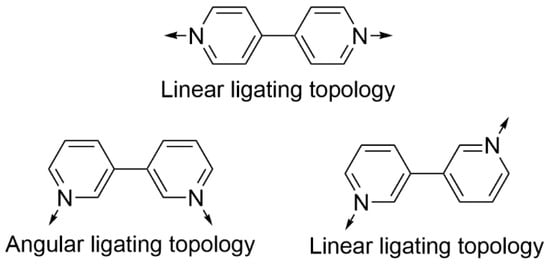
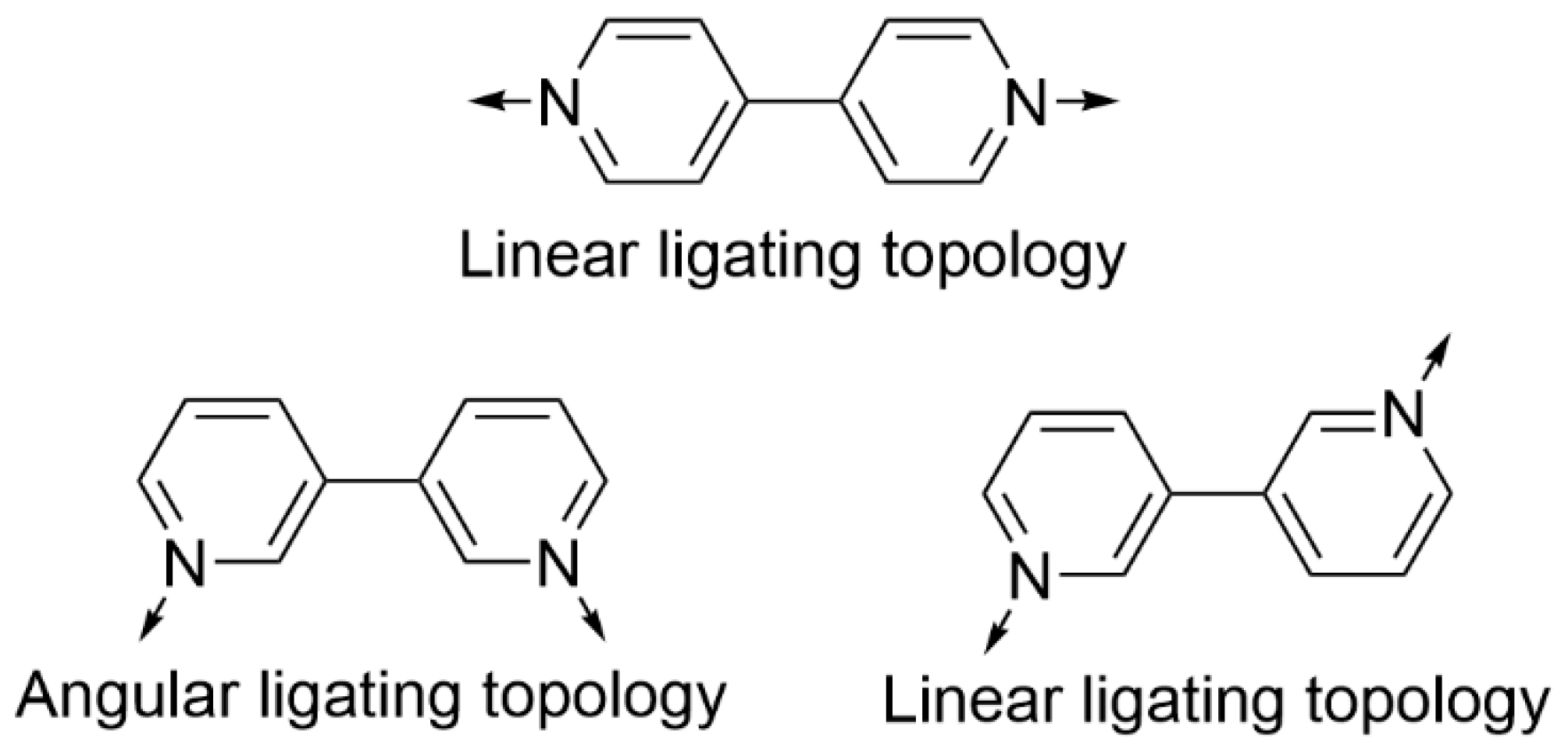
Bipyridines, mainly 2,2′-, 3,3′- and 4,4′-bipyridine, are well utilized in preparation of CPs and MOFs [8,9]. A large number of examples exist with 4,4′-bipyridine [8,10,11,12,13]; however, 3,3′-bipyridine has been used less to build CPs or MOFs, although some studies have been reported [14,15,16]. One reason is the coordination topology of 3,3′-bipyridine, which has two possibilities (linear and angular) compared to 4,4′-bipyridine with only one (linear) (see Scheme 1) [8]. Notably, copper(II) complexes with both 3,3′-bipyridine [17] and 4,4′-bipyridine [6,18,19,20,21,22] were described. The magnetic properties of copper complexes containing the “paddle-wheel” copper acetate dimeric structure have been deeply studied since the mid-1950s, showing strong antiferromagnetic coupling between metal ions within the dimer [23,24,25,26,27,28]; however, in our case, the long distance between the dinuclear nodes prevents any magnetic interactions between them, and only typically strong antiferromagnetic coupling within the node is expected.
Scheme 1.
Ligating topology of bipyridines.
Organometallic building blocks were rarely utilized before the turn of the century; however, since 1999 [29,30] more and more interest has been focused on the potential advantages these building blocks can provide via their increased number of potential interactions, like π∙∙∙M, M∙∙∙N, M∙∙∙O, and π∙∙∙π [31]. For mercury, the coordination sphere around the Hg atom was previously studied back in 1985 [32].
Several organometallic species with direct pyridyl groups bonded to a metal atom were reported, i.e., (4-py)2SiR2 (R = Me, Ph) [33], (4-py)3SiMe [34], (4-py)3SnPh [35], (3-py)3Pn (Pn = Sb, Bi) [36,37], (4-py)3Pn (Pn = Sb, Bi) [38], and (4-py)2Hg [31,39]. Related triorganophosphines, such as (3-py)3P [37,40,41,42,43,44,45,46,47] and (4-py)3P [40,45,48,49], including some metal complexes, were also described. Other examples exist within the 2,3,5,6-tetrafluoropyridyl fragment [50,51,52]; however, these compounds have been rarely utilized for crystal engineering.
The diorganomercury(II) compound, (4-py)2Hg, was originally reported on without any mention of its use as a potential building block [53]. The same applies for the related (3–py)2Hg species; its synthesis was reported on back in 2000 [54], but so far no reports are available regarding its use as a ligand in coordination chemistry. The above-mentioned diorganomercury(II) compounds containing pyridyl groups directly attached to the metal center can act as ditopic linkers [31,39], while [(E)-4-(4′-pyN=CH)C6H4]2Hg and related species can act as multidentate linkers due to the increased number of donor atoms per molecular unit [55].
As a continuation of our research on the synthesis of coordination complexes bearing organometallic linkers, we report now on [(3-py)2Hg(Cu2OAc4)]n, a coordination polymer featuring an interesting copper(II) paddle-wheel unit.
2. Materials and Methods
2.1. General Aspects
The reagents used as starting materials were purchased from Merck (Darmstadt, Germany) and Sigma-Aldrich (St. Louis, MI, USA) and used without further purification. All solvents were freshly distilled before use. The compound (3-py)2Hg (1) was synthesized as described in the literature [54].
Elemental analysis for C, H, and N was carried out with an Elementar Vario MICRO CUBE (Elementar Analysensysteme GmbH, Langenselbold, Germany), using helium as the carrier gas. The combustion chamber was set to 950 °C. Samples were weighed using an Ohaus Discovery DV215CDM Semi-Micro Balance (OHAUS Corp., Parsippany, NJ, USA) with ±0.01 mg precision. All samples weighed between 1 and 2 mg in tin weighting boats supplied by Elementar (Elementar Analysensysteme GmbH, Langenselbold, Germany). Acetanilide was used as standard for the CHN analysis mode. Three determinations were carried out, and the average of the results is given.
The FT–IR spectrum of compound 2 was recorded in the 4000–400 cm−1 region on a Bruker Tensor 37 spectrometer (Bruker, Karlsruhe, Germany). Absorption spectra on solid-state samples were measured using a diffuse reflectance technique on a JASCO V-670 spectrophotometer (ABL&E-JASCO Romania, Cluj-Napoca, Romania). The TA Instruments SDT Q600 V20.9 Build 20 (TA Instruments, New Castle, DE, USA) equipment was used for TG and DTA analysis. The investigations were carried out under an air atmosphere between 30 °C and 1000 °C, at a heating rate of 10 °C/min, using alumina crucibles. The powder X-ray diffraction (PXRD) patterns were recorded on a Proto AXRD Benchtop (Proto Manufacturing Inc., Taylor, MI, USA) using Cu-Kα radiation (λ = 1.54059 Å) in the 2Θ range of 5–35°.
2.2. Synthesis of [(3-py)2Hg{Cu2(OAc)4}]n (2)
Solution of 1 (89 mg, 0.25 mmol) in 30 mL of MeOH was mixed with a solution of Cu(OAc)2·H2O (100 mg, 0.50 mmol) in 60 mL of MeOH. The color of the reaction mixture turned immediately to bright turquoise, and, after 15 min of stirring, a precipitate started to form. After 2 h the precipitate was filtered off, washed with 2 × 10 mL of MeOH, followed by 2 × 10 mL Et2O, and then dried at a reduced pressure for 4 h, to produce 110 mg of compound 2 as a green–turquoise fine powder (yield 60%), m.p. 225 °C. Elemental analysis for C18H20Cu2HgN2O8 (MW 720.05): calcd. C, 30.03; H, 2.80; N, 3.89%; found: C, 29.80; H, 3.27; N, 3.89%. UV–Vis (KBr, λmax, nm): 721, 386, 265. IR (KBr, υ, cm−1): 3735(w), 2987(w), 2932(w), 2360(m), 2341(w), 2326(w), 1608(vs), 1575(vs), 1470(m), 1426(vs), 1406(vs), 1343(m), 1220(w), 1201(m), 1127(w), 1087(w), 1039(s), 798(s), 705(s), 680(vs), 642(s), 624(s), 510(m).
Single crystals of 2 were grown via slow diffusion of a methanolic solution of (3-py)2Hg layered over CHCl3, protecting the solid Cu(OAc)2·H2O at the bottom of the vial. After two weeks, small green crystals, suitable for single-crystal X-ray diffraction measurements, were obtained.
2.3. X-Ray Crystallography
The crystals of 1 and 2 were mounted on MiTeGen microMount cryoloops (MiTeGen, LLC, Ithaca, NY, USA), and data were collected with a Bruker D8 VENTURE diffractometer (Bruker, Karlsruhe, Germany) using Mo-Kα radiation (λ = 0.71073 Å) from a IμS 3.0 microfocus source with multilayer optics at room temperature (295 K) for 1 and a low temperature (100 K) for 2, respectively. The structures were refined with anisotropic thermal parameters for non-H atoms. Hydrogen atoms were placed in fixed, idealized positions and were refined with a riding model and a mutual isotropic thermal parameter. For structure solving and refinement, the Bruker APEX4 Software Package (Bruker, Karlsruhe, Germany, v2022.10-0) was used [56]. Further details on the data collection and refinement methods can be found in Table 1. Drawings were created using the Diamond program [57]. The CCDC reference numbers are 2335074 (for 1) and 2535575 (for 2). The supplementary crystallographic data for this article can be obtained free of charge from The Cambridge Crystallographic Data Centre via https://www.ccdc.cam.ac.uk/structures/ (accessed on 1 April 2026).
Table 1.
Crystal and refinement data for compounds 1 and 2.
3. Results and Discussion
3.1. Synthesis and General Characterization
The organomercury(II) compound (3-py)2Hg (1) was obtained as previously described in the literature [54], and its phase purity was verified by PXRD (see Figure S3). The complex [(3-py)2Hg{Cu2(OAc)4}]n (2) was obtained by reacting (3-py)2Hg (1) with Cu(OAc)2·H2O, in a 1:2 molar ratio (Scheme 2), and isolated as a fine green–turquoise powder. The elemental analysis for 2 agrees with the proposed composition, i.e., when maintaining the 1:2 ratio between the metal atoms. It should be noted here that a mixture of 3,3ʹ-bipyridine and Cu(OAc)2·H2O, in a 1:1 molar ratio and heated in a borosilicate glass tube, resulted in blue crystals of [(3,3′-bipy)Cu(OAc)2(H2O)]n, with 3,3′-bipyridine in an anti-conformation connecting square with pyramidally coordinated Cu(II) centers [58].
Scheme 2.
Synthesis of compound 2.
In the IR spectrum of 2 (Figure S1), one can observe the characteristic strong stretching vibrations of the carboxylate groups, i.e., carboxylate bands at 1608/1575 cm−1 for νasym(CO2) and 1426/1406 cm−1 for νsym(CO2). These values compare very well with those observed for dinuclear [Cu(OAc)2(H2O)]2 (cf. 1610/1410 cm−1 for νasym(CO2)/νasym(CO2) [59]; 1600/1425 cm−1 for νasym(CO2)/νasym(CO2) [60]; 1605/1570 (shoulder) cm−1 for νasym(CO2); and 1421/1410 (shoulder) cm−1 for νsym(CO2) at 298 K [61]), thus suggesting bridging acetate groups between Cu(II) centers in 2 [62].
The powder XRD measurements for 2 indicate the phase purity of bulk samples after isolation. The good agreement between the positions of the diffraction peaks (2Θ) in the experimental and simulated powder XRD patterns (Figure S4) confirms that the bulk crystalline phases of 1 (Figure S3) and 2 (Figure S4), respectively, correspond to the structures determined by the single-crystal X-ray diffraction.
3.2. Crystal Structure Descriptions
3.2.1. Structure of (3-py)2Hg (1)
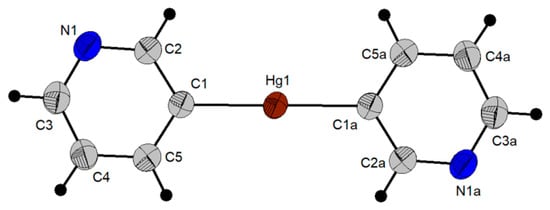
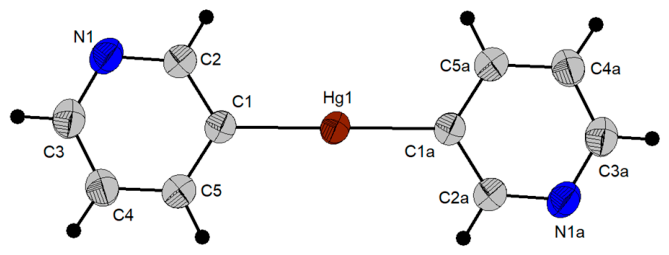
Single crystals of 1, suitable for X-ray diffraction studies, were obtained via the slow evaporation of a dichloromethane solution. The ORTEP-like representation of this compound with an atom numbering scheme is depicted in Figure 1. Selected bond lengths and bond angles for 1 are summarized in Table 2.
Figure 1.
ORTEP representation of (3–py)2Hg (1), with ellipsoids drawn at the 50% probability level [symmetry equivalent atoms (1 − x, −y, 1 − z) are given by “a”].
Table 2.
Selected interatomic distances (Å) and angles (°) for 1 a.
The asymmetric unit of 1 is generated via inversion symmetry; thus, the two N atoms are in trans positions compared to each other [C(1)–Hg(1)–C(1a) 180°]. The length of the Hg(1)–C(1) bond is 2.0788(18) Å, which fits in the range of 2.06–2.15 Å as reported for diarylmercury(II) compounds [63]. The N atoms were chosen based on the C–N bond lengths [N(1)–C(2) 1.338(3) Å and N(1)–C(3) 1.329(3) Å], which are relatively shorter than the other bonds within the heterocycle [C(2)–C(1) 1.389(3) Å, C(1)–C(5) 1.391(3) Å, C(5)–C(4) 1.396(3) Å, and C(4)–C(3) 1.382(3) Å, respectively (see Table 2)]. Because of the center of inversion in Hg1, the aromatic rings in molecule 1 are perfectly coplanar, with the nitrogen atoms lying in an anti-conformation pattern.
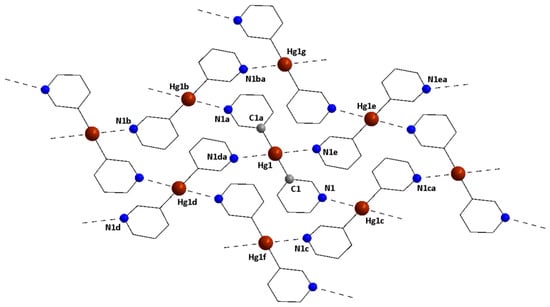
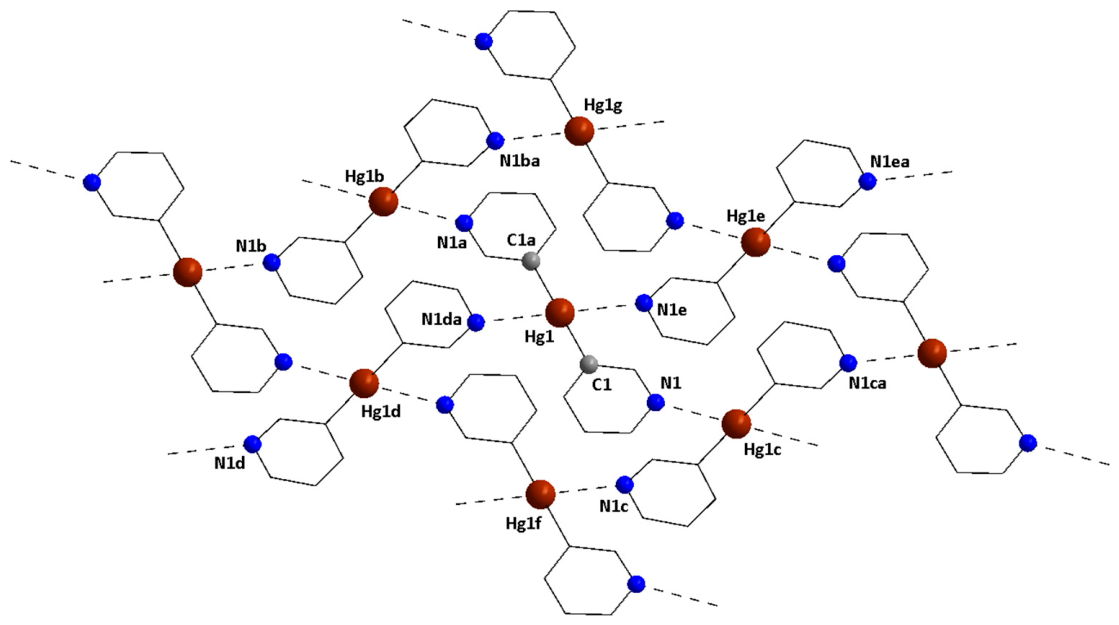
A closer check of the crystal structure of 1 revealed several intermolecular interactions. Each metal atom in a molecule of 1 is connected through Hg∙∙∙N interactions [Hg(1)∙∙∙N(1da) and Hg(1)∙∙∙N(1e) of 3.058(2) Å, placed in a trans pattern next to each other, N(1da)∙∙∙Hg(1)∙∙∙N(1e) 180°] with two other molecules, cf. ΣrvdW(Hg,N) 4.11 Å [64], thus resulting in a 2D layer in the crystal (Figure 2). The HgC2N2 core is planar, with a distorted square planar environment around the mercury atom [N(1da)∙∙∙Hg(1)–C(1) 89.63(7)°; N(1da)∙∙∙Hg(1)–C(1a) 90.37(7)°, while the non-bonding angles N(1da)–C(1)–N(1e) and C1–N(1e)–C(1a) are 111.58(7)° and 68.42(6)°, respectively].
Figure 2.
2D layer built through Hg∙∙∙N interactions in the crystal of 1 (the hydrogen atoms are omitted for clarity) [symmetry equivalent atoms (1 − x, −y, 1 − z), (1 − x, −1/2 + y, 3/2 − z), (1 − x, 1/2 + y, 1/2 − z), (1 − x, 1/2 + y, 3/2 − z), (1 − x, −1/2 + y, 1/2 − z), (x, 1 + y, z), and (x, −1 + y, z) are given by “a”, “b”, “c”, “d”, “e”, “f”, and “g”, respectively].
3.2.2. Structure of [(3-py)2Hg{Cu2(OAc)4}]n (2)
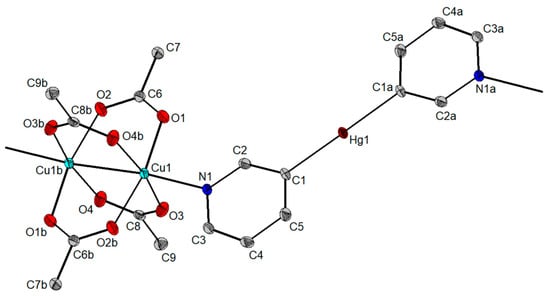
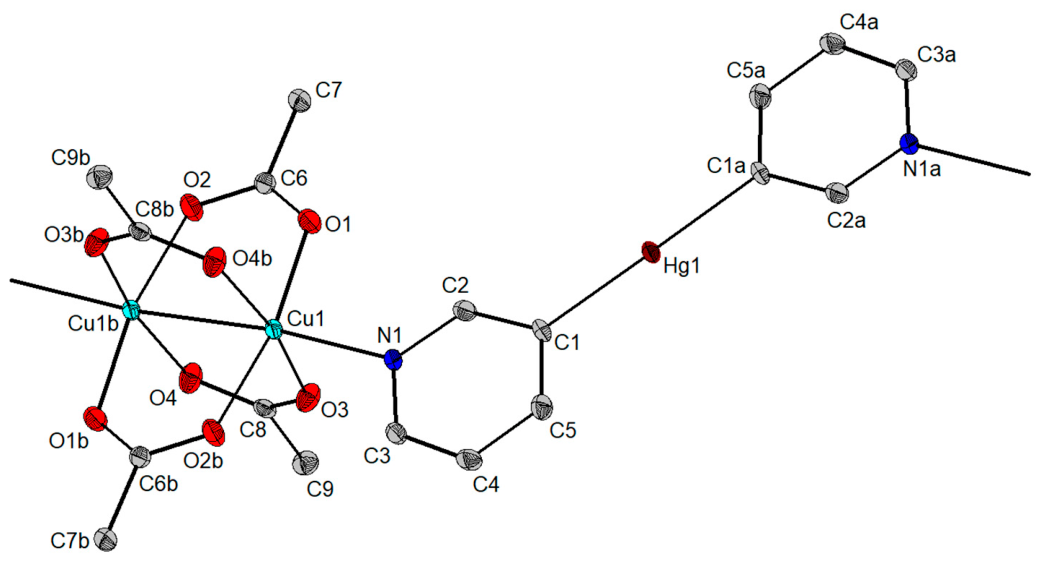
Well-formed needle crystals, suitable for single-crystal X-ray diffraction studies, were obtained using the reverse antisolvent technique [65]. As expected, a 1D coordination polymer was obtained, and the ORTEP-like representation of the repeating unit in the crystal of 2 with an atom numbering scheme is depicted in Figure 3. Selected bond lengths and bond angles for 2 are summarized in Table 3.
Figure 3.
An ORTEP representation of the repeating unit in the crystal of [(3-py)2Hg{Cu2(OAc)4}]n (2), with ellipsoids drawn at the 50% probability (the hydrogen atoms are omitted for clarity) [symmetry equivalent atoms (2 − x, 1 − y, −z) and (−x, 1 − y, 1 − z) are given by “a” and “b”, respectively].
Table 3.
Selected interatomic distances (Å) and angles (°) for 2 a.
The (3-py)2Hg molecules, acting as bridging ligands between copper(II) atoms, preserve their planarity and the anti-conformation functions of the nitrogen atoms. They connect dinuclear Cu2(OAc)4 units with a paddle-wheel aspect, based on four acetate groups bridging the transition metal atoms. This results in a zig-zag chain motif (Figure 4) with Cu(1)–N(1) and Cu(1)–Cu(1b) distances of 2.188(2) Å and 2.6561(4) Å, respectively, which are shorter than ΣrvdW(Cu,N) 4.04 Å and ΣrvdW(Cu,Cu) 4.76 Å [64]. The copper(II) achieves a distorted octahedral environment in the Cu(Cu)O4N core (for angles at the central metal atom, see Table 2). This contrasts with [(3,3′-bipy)Cu(OAc)2(H2O)]n, a 1D coordination polymer in which the copper(II) centers exhibit a square pyramidal environment, with two nitrogen atoms from two 3,3′-bipyridine molecules [Cu–N 2.016(1)/2.017(1) Å] and two oxygen atoms from two different monodentate acetate anions [Cu–Oacetato 1.955(1)/1.960(1) Å], describing the basal plane, and an oxygen atom from an aqua ligand [Cu–Owater 2.316(1) Å] in an apical position [58]. It should be noted here that a mixture of copper(II) nitrate, 4,4′-biphenyldicarboxylic acid and 4,4′-bipyridine heated in DMSO in an autoclave produced green crystals of a 3D coordination polymer, [(4,4′-bipyridine)Cu2(O2CC6H4-C6H4CO2)2]n, also based on Cu2(O2CR)4 paddle-wheel units [66].
Figure 4.
The 1D polymer chain built through Cu–N and Cu–Cu bonds in the crystal of 2 (the hydrogen atoms are omitted for clarity) [symmetry equivalent atoms (2 − x, 1 − y, −z), (−x, 1 − y, 1 − z), (2 + x, y, −1 + z), (4 − x, 1 − y, −1 − z), (−2 + x, y, 1 + z), and (−2 − x, 1 − y, 2 − z) are given by “a”, “b”, “c”, “d”, “e” and “f”, respectively].
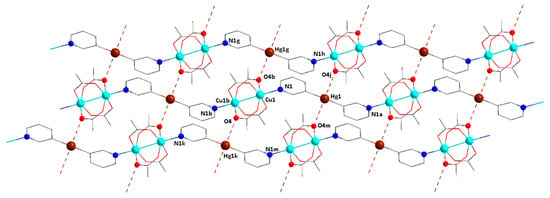
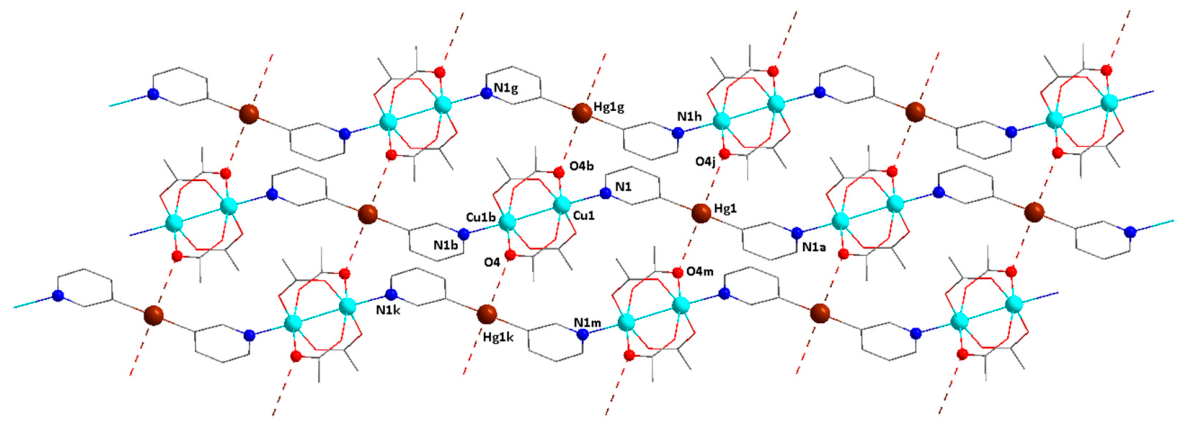
Interchain Hg···Oacetate interactions [Hg1···O4j and Hg1···O4m 3.031(2) Å] (cf. ΣrvdW(Hg,O) 3.95 Å [64]) are established, resulting in 2D layers with distorted square planar HgC2O2 cores [C1–Hg1···O4j 83.08(9)°; C1–Hg1···O4m 96.92(9)°; O4j···Hg1···O4m 180°; non-bonding angles O(4j)–C(1)–O(4m) and C1–O(4j)–C(1a) are 111.13(8)° and 68.87(7)°, respectively] (Figure 5).
Figure 5.
2D layer built through Cu–N and Cu–Cu bonds, as well as Hg∙∙∙O interactions, in the crystal of 2 (the hydrogen atoms are omitted for clarity) [symmetry equivalent atoms (2 − x, 1 − y, −z), (−x, 1 − y, 1 − z), (−1 + x, y, z), (1 − x, 1 − y, −z), (1 + x, y, −1 + z), (−1 + x, y, 1 + z) and (1 − x, 1 − y, 1 − z) are given by “a”, “b”, “g”, “h”, “j”, “k” and “m”, respectively].
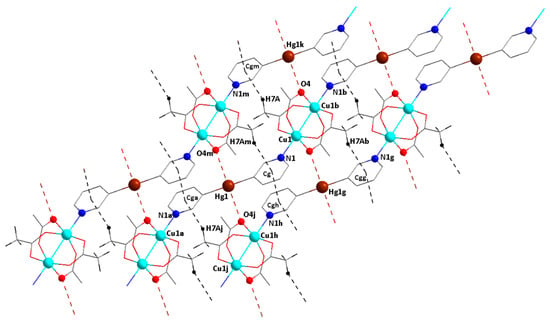
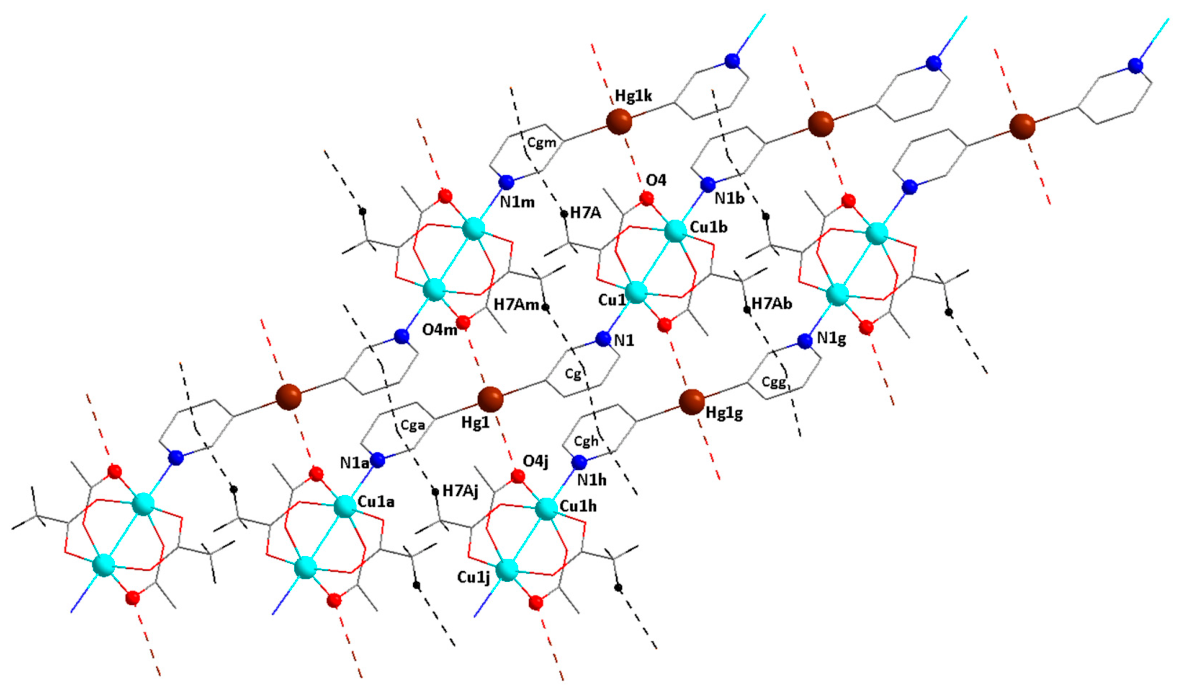
In addition to Hg···Oacetate interactions, several interchain C−Hmethyl∙∙∙π (3-pyridyl centroid, Cg) interactions [H7A∙∙∙Cgm 2.79 Å, γ = 6.96°; cf. H···Arcentroid contacts shorter than 3.1 Å and an angle γ between the outside and the center of the aromatic (Arcentroid) ring and the line defined by the H atom and Arcentroid smaller than 30°] [67] as well as π(Cg)∙∙∙π(Cg) interactions between parallel 3-pyridyl rings from neighboring chains [Cg···Cgh 3.65 Å; γ = 19.26° (defined as the angle between the outside and the center of the Pycentroid and the line defined by the two Pycentroid rings] [68] support and strengthen the 2D layer structure in the crystal of 2 (Figure 6).
Figure 6.
2D layer in the crystal of 2 via π∙∙∙π, π∙∙∙H and Cu∙∙∙Cu interactions (the hydrogen atoms are omitted for clarity) [symmetry equivalent atoms (2 − x, 1 − y, −z), (−x, 1 − y, 1 − z), (−1 + x, y, z), (1 − x, 1 − y, −z), (1 + x, y, −1 + z), (−1 + x, y, 1 + z) and (1 − x, 1 − y, 1 − z) are given by “a”, “b”, “g”, “h”, “j”, “k” and “m”, respectively].
3.3. Thermogravimetric Analyses (TGAs)
At the melting point of compound 2 (225 °C), first a color change can be observed, followed by the formation of a dark solid, suggesting decomposition and requiring further investigation. As seen in Figure S2, in the first step, the decomposition of the Cu2(OAc)4 fragment to Cu2O is observed (Figure S2), as expected [69], whereas the (3-py)2Hg fragment remains largely unchanged (69.04%). However, in the next step, at 243 °C (which is above the melting point of 1, i.e., 239 °C), a sharp loss in weight is observed, which corresponds to the loss of the pyridine rings, the oxygen from Cu2O and the partial loss of Hg, producing a probable composition of Cu2Hg0.75 (38.55%), followed by the steady loss of Hg until a final composition of Cu2Hg0.45 (29.98%) under the measured conditions. The loss of mercury is in accordance with literature reports [70,71,72,73].
3.4. UV–Vis Spectral Analysis
To characterize the optical properties of 1 and its bimetallic copper(II) coordination polymer [(3-py)2Hg{Cu2(OAc)4}]n (2), the absorption UV–Vis electronic spectra were recorded in potassium bromide (Figure S5). The UV–Vis spectrum of compound 1 shows a strong π → π* transition in the UV region at 295 nm, attributed to the pyridyl ligands. In the case of 2, the coordination of the diorganomercury(II) ligand to the transition metal is confirmed by the appearance of a new absorption band in the visible region at 721 nm, characteristic of a d–d transition [74]. The band at 386 nm is associated with a ligand to metal charge transfer (LMCT) N → Cu(II) [75].
4. Conclusions
This paper reports on the synthesis and characterization of a novel bimetallic 1D coordination polymer 2, in which dinuclear, paddle-wheel Cu2(OAc)4 units are bridged by bis(3-pyridyl)mercury(II) (1) spacers. Both compounds 1 and 2 were characterized by single-crystal XRD, where interesting 2D packing was observed for compound 1 with a distorted square planar geometry around the Hg atom. The thermal decomposition of compound 2 was studied. The UV–Vis spectra confirm the significant change in the electronic environment of Cu(II) ions upon the coordination of 1 to the transition metal in the bimetallic polymer 2.
Supplementary Materials
The following supporting information can be downloaded at https://www.mdpi.com/article/10.3390/cryst16050314/s1, Figure S1: FT-IR spectrum of compound 2; Figure S2: TGA/DTA spectrogram of compound 2; Figure S3: PXRD of compound 1: experimental (top) and simulated (bottom); Figure S4: PXRD compound 2: experimental (top) and simulated (bottom); Figure S5: UV–Vis spectra of compounds 1 and 2. The complete set of the structural parameters in CIF format is available, free of charge, from the Cambridge Crystallographic Database (http://www.ccdc.cam.ac.uk/data_request/cif) (accessed on 1 April 2026) when quoting the depository number (CCDC 2335074 for 1, and 2535575 for 2).
Author Contributions
Conceptualization, L.C.P. and L.K.; investigation and data curation, A.P., C.S., L.C.P. and L.K.; single-crystal X-ray diffraction studies, A.P.; writing—original draft preparation, A.P. and L.C.P.; writing—review and editing, C.S., L.C.P. and L.K.; funding acquisition, C.S. All authors have read and agreed to the published version of the manuscript.
Funding
This work was supported by the Minister of Research and Innovation, CNCS-UEFISCDI (Romania), project number PN-III-P4-ID-PCCF-2016-0088, within PNCDI III. The support provided by The National Center for X-Ray Diffraction (Babeş-Bolyai University, Cluj-Napoca, Romania) for single-crystal XRD determinations and refinement is highly acknowledged.
Data Availability Statement
The data is contained within the article or Supplementary Materials. Further data sets are available from the authors if there is legitimate interest.
Acknowledgments
The authors would like to thank Augustin Mădălan (Faculty of Chemistry, University of Bucharest, Romania) for recording the IR and UV-Vis spectra, as well as the powder XRD diffractograms, and Liliana Bizo (Faculty of Chemistry and Chemical Engineering, Babeș-Bolyai University, Cluj-Napoca, Romania) for TG/DTA measurements.
Conflicts of Interest
The authors declare no conflicts of interest.
References
- Janiak, C.; Vieth, J.K. MOFs, MILs and More: Concepts, Properties and Applications for Porous Coordination Networks (PCNs). New J. Chem. 2010, 34, 2366–2388. [Google Scholar] [CrossRef] [Scilit]
- Mehtab, M.; Zeeshan, M.; Kumar, M.; Ansari, A.; Khan, M.Y.; Sama, F.; Ahmad, M.; Shahid, M. Decoding Desulfurization Pathways in Metal–Organic Frameworks (MOFs) via Experimental and Computational Approaches: A Step toward Sustainable Fuel Purification. Inorg. Chem. 2026, 65, 1419–1435. [Google Scholar] [CrossRef] [Scilit]
- Janiak, C. Engineering Coordination Polymers towards Applications. Dalton Trans. 2003, 2781–2804. [Google Scholar] [CrossRef] [Scilit]
- Bailar, J.C., Jr. Preparative Inorganic Reactions; W. L. Jolly Intersciences: New-York, NY, USA, 1964; Volume 1. [Google Scholar]
- Yaghi, O.M.; Li, G.; Li, H. Selective Binding and Removal of Guests in a Microporous Metal–Organic Framework. Nature 1995, 378, 703–706. [Google Scholar] [CrossRef] [Scilit]
- Yaghi, O.M.; Li, H. Hydrothermal Synthesis of a Metal-Organic Framework Containing Large Rectangular Channels. J. Am. Chem. Soc. 1995, 117, 10401–10402. [Google Scholar] [CrossRef] [Scilit]
- Batten, S.R.; Champness, N.R.; Chen, X.-M.; Garcia-Martinez, J.; Kitagawa, S.; Öhrström, L.; O’Keeffe, M.; Suh, M.P.; Reedijk, J. Terminology of metal–organic frameworks and coordination polymers (IUPAC Recommendations 2013). Pure Appl. Chem. 2013, 85, 1715–1724. [Google Scholar] [CrossRef] [Scilit]
- Adarsh, N.N.; Dastidar, P. Coordination Polymers: What Has Been Achieved in Going from Innocent 4,4′-Bipyridine to Bis-Pyridyl Ligands Having a Non-Innocent Backbone? Chem. Soc. Rev. 2012, 41, 3039–3060. [Google Scholar] [CrossRef] [Scilit] [PubMed]
- Verma, C.; Yaagoob, I.Y.; Goni, L.K.M.O.; Abdelkreem, S.S.E.; Mubarak, S.A.; Al-Mohsin, H.A.M.; Alfantazi, A.; Jafar Mazumder, M.A. Coordination Complexes of Bipyridines (CCBs): Chemistry, Bonding and Applications. Coord. Chem. Rev. 2025, 529, 216433. [Google Scholar] [CrossRef] [Scilit]
- Musgrave, T.R.; Mattson, C.E. Coordination Chemistry of 4,4′-Bipyridine. Inorg. Chem. 1968, 7, 1433–1436. [Google Scholar] [CrossRef] [Scilit]
- Cheetham, A.K.; Rao, C.N.R.; Feller, R.K. Structural Diversity and Chemical Trends in Hybrid Inorganic–Organic Framework Materials. Chem. Commun. 2006, 4780–4795. [Google Scholar] [CrossRef] [Scilit]
- Biradha, K.; Sarkar, M.; Rajput, L. Crystal Engineering of Coordination Polymers Using 4,4′-Bipyridine as a Bond between Transition Metal Atoms. Chem. Commun. 2006, 4169–4179. [Google Scholar] [CrossRef] [Scilit]
- Klein, N.; Senkovska, I.; Baburin, I.A.; Grünker, R.; Stoeck, U.; Schlichtenmayer, M.; Streppel, B.; Mueller, U.; Leoni, S.; Hirscher, M.; et al. Route to a Family of Robust, Non-Interpenetrated Metal–Organic Frameworks with Pto-like Topology. Chem. Eur. J. 2011, 17, 13007–13016. [Google Scholar] [CrossRef] [Scilit]
- LaDuca, R.L.; Desciak, M.P.; Rarig, R.S., Jr.; Zubieta, J.A. Hydrothermal Synthesis, Solid State Structure, and Thermal Properties of a Family of Isomorphous 1-D Coordination Polymers Aggregated by Extensive Hydrogen Bonding: [M(3,3′-Bpy)(H2O)4](SO4)·2H2O (M = Co, Ni, Zn). Z. Anorg. Allg. Chem. 2006, 632, 449–453. [Google Scholar] [CrossRef] [Scilit]
- Cavichioli, G.F.; Martin, D.P.; Ursini, A.J.; LaDuca, R.L. Synergistic Oxoanion and Ligand Conformation Control of Dimensionality in Coordination Polymers Formed via 3,3′-Bipyridine Tethers: From 1D Undulating Chains to a Doubly Interpenetrated 3D Framework. J. Mol. Struct. 2008, 881, 107–116. [Google Scholar] [CrossRef] [Scilit]
- Ishikawa, R.; Noda, T.; Ueno, S.; Okubo, T.; Yamakawa, H.; Sakamoto, K.; Kawata, S. Spin Crossover in Bipyridine Derivative Bridged One-Dimensional Iron(III) Coordination Polymer. Magnetochemistry 2020, 6, 29. [Google Scholar] [CrossRef] [Scilit]
- Lopez, S.; Kahraman, M.; Harmata, M.; Keller, S.W. Novel 2-Fold Interpenetrating Diamondoid Coordination Polymers: [Cu(3,3′-Bipyridine)2]X (X = BF4-, PF6-). Inorg. Chem. 1997, 36, 6138–6140. [Google Scholar] [CrossRef] [Scilit] [PubMed]
- Lo, S.M.-F.; Chui, S.S.-Y.; Shek, L.-Y.; Lin, Z.; Zhang, X.X.; Wen, G.; Williams, I.D. Solvothermal Synthesis of a Stable Coordination Polymer with Copper-I−Copper-II Dimer Units: [Cu4{1,4-C6H4(COO)2}3(4,4′-Bipy)2]n. J. Am. Chem. Soc. 2000, 122, 6293–6294. [Google Scholar] [CrossRef] [Scilit]
- Bie, H.-Y.; Yu, J.-H.; Zhao, K.; Lu, J.; Duan, L.-M.; Xu, J.-Q. Syntheses, Characterization and Fluorescent Properties of Two Square Pyramidal Cu (II) Inorganic–Organic Hybrid Polymers. J. Mol. Struct. 2005, 741, 77–84. [Google Scholar] [CrossRef] [Scilit]
- Pang, Y.; Tian, D.; Zhu, X.-F.; Luo, Y.-H.; Zheng, X.; Zhang, H. Copper(II) and Nickel(II) Coordination Polymers Assembled from 2,4-Dibenzoylisophthalic Acid and Different N-Donor Co-Ligands: Syntheses, Crystal Structures, and Magnetic Properties. CrystEngComm 2011, 13, 5142–5151. [Google Scholar] [CrossRef] [Scilit]
- Liu, G.-Z.; Li, S.-H.; Wang, L.-Y. Five M(II) Coordination Polymers Assembled from Various Polynuclear Units Spaced by Semirigid Carboxyphenylpropionate and N-Donor Coligand. CrystEngComm 2012, 14, 880–889. [Google Scholar] [CrossRef] [Scilit]
- Sánchez-Férez, F.; Calvet, T.; Font-Bardia, M.; Pons, J. Cu(II) Coordination Polymers with 4,4′-Bipyridine. Synthesis and Crystal Structures. J. Mol. Struct. 2021, 1235, 130219. [Google Scholar] [CrossRef] [Scilit]
- Figgis, B.N.; Martin, R.L. 746. Magnetic Studies with Copper(II) Salts. Part I. Anomalous Paramagnetism and δ-Bonding in Anhydrous and Hydrated Copper(II) Acetates. J. Chem. Soc. 1956, 3837–3846. [Google Scholar] [CrossRef] [Scilit]
- Gregson, A.K.; Martin, R.L.; Mitra, S. The Magnetic Anisotropy and Electronic Structure of Binuclear Copper(II) Acetate Monohydrate. Proc. Roy. Soc. Lond. A. 1971, 320, 473–486. [Google Scholar] [CrossRef] [Scilit]
- Delgado, S.; Molina-Ontoria, A.; Medina, M.E.; Pastor, C.J.; Jiménez-Aparicio, R.; Priego, J.L. Structural Diversity of Copper Complexes with Angular and Linear Dipyridyl Ligands. Polyhedron 2007, 26, 2817–2828. [Google Scholar] [CrossRef] [Scilit]
- Sengupta, A.; Datta, S.; Su, C.; Herng, T.S.; Ding, J.; Vittal, J.J.; Loh, K.P. Tunable Electrical Conductivity and Magnetic Property of the Two Dimensional Metal Organic Framework [Cu(TPyP)Cu2(O2CCH3)4]. ACS Appl. Mater. Interfaces 2016, 8, 16154–16159. [Google Scholar] [CrossRef] [Scilit]
- Yano, N.; Handa, M.; Mitsumi, M.; Kataoka, Y. One-Dimensional Chain-Type Dicopper Coordination Polymer Linked by 1,4-Di(4-Pyridyl)Benzene; Synthesis, Crystal Structure, Magnetic Property, and Gas-Adsorption Property. Magnetochemistry 2018, 4, 26. [Google Scholar] [CrossRef] [Scilit]
- Sang, W.; Liu, M.; Xu, L.; Yang, S.; Wang, Y.; Zhang, C.; Lu, W. Evaluation of Anticancer Potential of a Binuclear Copper(II) Complex with a 3-(Pyridin-3-Yl) Coumarin Ligand: Synthesis, Crystal Structure, Magnetism, DNA Interaction and Molecular Dynamics Simulations. New J. Chem. 2026, 50, 3482–3494. [Google Scholar] [CrossRef] [Scilit]
- Braga, D.; Grepioni, F. Organometallic Crystal Engineering: Prospects for a Systematic Design1. Coord. Chem. Rev. 1999, 183, 19–41. [Google Scholar] [CrossRef] [Scilit]
- Braga, D.; Maini, L.; Polito, M.; Scaccianoce, L.; Cojazzi, G.; Grepioni, F. Design of Organometallic Molecular and Ionic Materials. Coord. Chem. Rev. 2001, 216–217, 225–248. [Google Scholar] [CrossRef] [Scilit]
- Mocanu, T.; Kiss, L.; Sava, A.; Shova, S.; Silvestru, C.; Andruh, M. Coordination Polymers and Supramolecular Solid-State Architectures Constructed from an Organometallic Tecton, Bis(4-Pyridyl)Mercury. Polyhedron 2019, 166, 7–16. [Google Scholar] [CrossRef] [Scilit]
- Lobana, T.S. Coordination Chemistry of Organomercury(II) Involving Phenanthrolines, Bipyridines, Tertiary Phosphines/Arsines and Some Related Ligands. Coord. Chem. Rev. 1985, 63, 161–215. [Google Scholar] [CrossRef] [Scilit]
- Schmitz, M.; Leininger, S.; Fan, J.; Arif, A.M.; Stang, P.J. Preparation and Solid-State Properties of Self-Assembled Dinuclear Platinum(II) and Palladium(II) Rhomboids from Carbon and Silicon Tectons. Organometallics 1999, 18, 4817–4824. [Google Scholar] [CrossRef] [Scilit]
- Cotton, F.A.; Dikarev, E.V.; Petrukhina, M.A.; Schmitz, M.; Stang, P.J. Supramolecular Assemblies of Dimetal Complexes with Polydentate N-Donor Ligands: From a Discrete Pyramid to a 3D Channel Network. Inorg. Chem. 2002, 41, 2903–2908. [Google Scholar] [CrossRef] [Scilit]
- Yang, E.S.; Plajer, A.J.; García-Romero, Á.; Bond, A.D.; Ronson, T.K.; Álvarez, C.M.; García-Rodríguez, R.; Colebatch, A.L.; Wright, D.S. A Tris(3-Pyridyl)Stannane as a Building Block for Heterobimetallic Coordination Polymers and Supramolecular Cages. Chem. Eur. J. 2019, 25, 14003–14009. [Google Scholar] [CrossRef] [Scilit]
- García-Romero, Á.; Martín-Álvarez, J.M.; Miguel, D.; Wright, D.S.; Álvarez, C.M.; García-Rodríguez, R. Cation- and Anion-Mediated Supramolecular Assembly of Bismuth and Antimony Tris(3-Pyridyl) Complexes. Inorg. Chem. 2021, 60, 19206–19218. [Google Scholar] [CrossRef] [Scilit]
- García-Romero, Á.; Miguel, D.; Wright, D.S.; Álvarez, C.M.; García-Rodríguez, R. Structural and Dimensional Control of Porphyrin Capsules Using Group 15 Tris(3-Pyridyl) Linkers. Chem. Sci. 2023, 14, 6522–6530. [Google Scholar] [CrossRef] [Scilit] [PubMed]
- Waters, J.E.; Berger, G.; Peel, A.J.; García-Rodríguez, R.; Bond, A.D.; Wright, D.S. Uncovering the Hidden Landscape of Tris(4-Pyridyl) Ligands: Topological Complexity Derived from the Bridgehead. Chem. Eur. J. 2021, 27, 12036–12040. [Google Scholar] [CrossRef] [Scilit] [PubMed]
- Mocanu, T.; Raţ, C.I.; Maxim, C.; Shova, S.; Tudor, V.; Silvestru, C.; Andruh, M. Bis(4-Pyridyl)Mercury-a New Linear Tecton in Crystal Engineering: Coordination Polymers and Co-Crystallization Processes. CrystEngComm 2015, 17, 5474–5487. [Google Scholar] [CrossRef] [Scilit]
- Kleij, A.W.; Lutz, M.; Spek, A.L.; van Leeuwen, P.W.N.M.; Reek, J.N.H. Encapsulated Transition Metal Catalysts Comprising Peripheral Zn(II)Salen Building Blocks: Template-Controlled Reactivity and Selectivity in Hydroformylation Catalysis. Chem. Commun. 2005, 3661–3663. [Google Scholar] [CrossRef] [Scilit]
- Meyer, W.H.; Bowen, R.J.; Billing, D.G. Tri(3-Pyridyl)Phosphine as Amphiphilic Ligand in the Rhodium-Catalysed Hydroformylation of 1-Hexene. Z. Naturforsch. B. 2007, 62b, 339–345. [Google Scholar] [CrossRef] [Scilit]
- Kluwer, A.M.; Kapre, R.; Hartl, F.; Lutz, M.; Spek, A.L.; Brouwer, A.M.; van Leeuwen, P.W.N.M.; Reek, J.N.H. Self-Assembled Biomimetic [2Fe2S]-Hydrogenase-Based Photocatalyst for Molecular Hydrogen Evolution. Proc. Nat. Acad. Sci. USA 2009, 106, 10460–10465. [Google Scholar] [CrossRef] [Scilit] [PubMed]
- Bocokić, V.; Kalkan, A.; Lutz, M.; Spek, A.L.; Gryko, D.T.; Reek, J.N.H. Capsule-Controlled Selectivity of a Rhodium Hydroformylation Catalyst. Nat. Commun. 2013, 4, 2670. [Google Scholar] [CrossRef] [Scilit]
- Jacobs, I.; van Duin, A.C.T.; Kleij, A.W.; Kuil, M.; Tooke, D.M.; Spek, A.L.; Reek, J.N.H. Conformational Studies of Ligand-Template Assemblies and the Consequences for Encapsulation of Rhodium Complexes and Hydroformylation Catalysis. Catal. Sci. Technol. 2013, 3, 1955–1963. [Google Scholar] [CrossRef] [Scilit]
- Dubován, L.; Pöllnitz, A.; Silvestru, C. Tri(3-Pyridyl)- and Tri(4-Pyridyl)phosphine Chalcogenides and Their Complexes with ZnTPP (TPP = Tetraphenylporphyrinate). Eur. J. Inorg. Chem. 2016, 2016, 1521–1527. [Google Scholar] [CrossRef] [Scilit]
- Wang, X.; Nurttila, S.S.; Dzik, W.I.; Becker, R.; Rodgers, J.; Reek, J.N.H. Tuning the Porphyrin Building Block in Self-Assembled Cages for Branched-Selective Hydroformylation of Propene. Chem. Eur. J. 2017, 23, 14769–14777. [Google Scholar] [CrossRef] [Scilit]
- Zaffaroni, R.; Dzik, W.I.; Detz, R.J.; van der Vlugt, J.I.; Reek, J.N.H. Proton Relay Effects in Pyridyl-Appended Hydrogenase Mimics for Proton Reduction Catalysis. Eur. J. Inorg. Chem. 2019, 2019, 2498–2509. [Google Scholar] [CrossRef] [Scilit]
- Kleij, A.W.; Kuil, M.; Tooke, D.M.; Spek, A.L.; Reek, J.N.H. Template-Assisted Ligand Encapsulation; the Impact of an Unusual Coordination Geometry on a Supramolecular Pyridylphosphine−Zn(II)Porphyrin Assembly. Inorg. Chem. 2005, 44, 7696–7698. [Google Scholar] [CrossRef] [Scilit]
- Nurttila, S.S.; Brenner, W.; Mosquera, J.; van Vliet, K.M.; Nitschke, J.R.; Reek, J.N.H. Size-Selective Hydroformylation by a Rhodium Catalyst Confined in a Supramolecular Cage. Chem. Eur. J. 2019, 25, 609–620. [Google Scholar] [CrossRef] [Scilit] [PubMed]
- Tyrra, W.; Aboulkacem, S.; Pantenburg, I. Silver Compounds in Synthetic Chemistry. Part 3. 4-Tetrafluoropyridyl Silver(I), AgC5F4N—A Reagent for Redox Transmetallations with Group 12–14 Elements. J. Organomet. Chem. 2006, 691, 514–522. [Google Scholar] [CrossRef] [Scilit]
- Tyrra, W.; Aboulkacem, S.; Hoge, B.; Wiebe, W.; Pantenburg, I. Silver Compounds in Synthetic Chemistry: Part 4. 4-Tetrafluoropyridyl Silver(I), AgC5F4N in Redox Transmetallations—Possibilities and Limitations in Reactions with Group 15 Elements. J. Fluor. Chem. 2006, 127, 213–217. [Google Scholar] [CrossRef] [Scilit]
- Solyntjes, S.; Neumann, B.; Stammler, H.-G.; Ignat’ev, N.; Hoge, B. Difluorotriorganylphosphoranes for the Synthesis of Fluorophosphonium and Bismuthonium Salts. Eur. J. Inorg. Chem. 2016, 2016, 3999–4010. [Google Scholar] [CrossRef] [Scilit]
- Partyka, D.V.; Gray, T.G. Facile Syntheses of Homoleptic Diarylmercurials via Arylboronic Acids. J. Organomet. Chem. 2009, 694, 213–218. [Google Scholar] [CrossRef] [Scilit]
- Trécourt, F.; Breton, G.; Bonnet, V.; Mongin, F.; Marsais, F.; Quéguiner, G. New Syntheses of Substituted Pyridines via Bromine–Magnesium Exchange. Tetrahedron 2000, 56, 1349–1360. [Google Scholar] [CrossRef] [Scilit]
- Kiss, L.; Pop, A.; Shova, S.; Raț, C.I.; Silvestru, C. Synthesis and Characterization of [4-{(CH2O)2CH}C6H4]2Hg, [4-(O=CH)C6H4]2Hg and [(E)-4-(RN=CH)C6H4]2Hg (R = 2′-Py, 4′-Py, 2′-pyCH2, 4′-pyCH2). Appl. Organomet. Chem. 2021, 35, e6339. [Google Scholar] [CrossRef] [Scilit]
- Sheldrick, G.M. SHELXT—Integrated Space-Group and Crystal-Structure Determination. Acta Crystallogr. Sect. A Found. Adv. 2015, 71, 3–8. [Google Scholar] [CrossRef] [Scilit]
- Putz, H.; Brandendurg, K.; Bernardt, M. DIAMOND—Visual Crystal Structure Information System 2024. Available online: https://www.crystalimpact.com/diamond/publ/jac.htm (accessed on 1 April 2026).
- Desciak, M.; Rarig, R.S., Jr.; Zubieta, J.; LaDuca, R.L. A One-Dimensional Coordination Polymer Incorporating a Less Common Bipyridine Isomer: Catena-Poly[[Bis(Acetato-κO)Aquacopper(II)]-μ-3,3′-Bipyridine-κ2N:N′]. Acta Crystallogr. Sect. E Struct. Rep. Online 2007, 63, m435–m437. [Google Scholar] [CrossRef] [Scilit]
- Edwards, D.A.; Hayward, R.N. Transition Metal Acetates. Can. J. Chem. 1968, 46, 3443–3446. [Google Scholar] [CrossRef] [Scilit]
- Dubicki, L.; Martin, R. The Electronic Spectra of Binuclear Molybdenum(II) Carboxylates. Aust. J. Chem. 1969, 22, 1571–1581. [Google Scholar] [CrossRef] [Scilit]
- Heyns, A.M. The Low-Temperature Infrared Spectra of the Copper(II)Acetates. J. Mol. Struct. 1972, 11, 93–103. [Google Scholar] [CrossRef] [Scilit]
- Deacon, G.B.; Phillips, R.J. Relationships between the Carbon-Oxygen Stretching Frequencies of Carboxylato Complexes and the Type of Carboxylate Coordination. Coord. Chem. Rev. 1980, 33, 227–250. [Google Scholar] [CrossRef] [Scilit]
- Kuz’mina, L.G.; Struchkov, Y.T.; Kuz’mina, L.G.; Struchkov, Y.T. Structural Chemistry of Organomercury Compounds. Role of Secondary Interactions. Croat. Chem. Acta 1984, 57, 701–724. [Google Scholar]
- Alvarez, S. A Cartography of the van Der Waals Territories. Dalton Trans. 2013, 42, 8617–8636. [Google Scholar] [CrossRef] [Scilit] [PubMed]
- Park, Y.; Hong, M.; Koo, J.Y.; Lee, M.; Lee, J.; Moon, D.J.; Sohn, S.H.; Joo, T.; Lim, W.T.; Lim, H.; et al. Reverse Anti-Solvent Crystallization Process for the Facile Synthesis of Zinc Tetra(4-Pyridyl)Porphyrin Single Crystalline Cubes. Sci. Rep. 2017, 7, 2582. [Google Scholar] [CrossRef] [Scilit] [PubMed]
- Pichon, A.; Fierro, C.M.; Nieuwenhuyzen, M.; James, S.L. A Pillared-Grid MOF with Large Pores Based on the Cu2(O2CR)4 Paddle-Wheel. CrystEngComm 2007, 9, 449–451. [Google Scholar] [CrossRef] [Scilit]
- Nishio, M. The CH/π Hydrogen Bond in Chemistry. Conformation, Supramolecules, Optical Resolution and Interactions Involving Carbohydrates. Phys. Chem. Chem. Phys. 2011, 13, 13873–13900. [Google Scholar] [CrossRef] [Scilit]
- Janiak, C. A Critical Account on π–π Stacking in Metal Complexes with Aromatic Nitrogen-Containing Ligands. J. Chem. Soc. Dalton Trans. 2000, 3885–3896. [Google Scholar] [CrossRef] [Scilit]
- Sibokoza, S.B.; Moloto, M.J.; Mtunzi, F.; Moloto, N. Thermal Decomposition of Copper Acetate at Various Temperature and Time to Form Copper Oxide/Copper Nanoparticles. Asian J. Chem. 2022, 34, 239–244. [Google Scholar] [CrossRef] [Scilit]
- Bhatia, S.; Kaushik, N.K.; Sodhi, G.S. Thermal Studies on Organomercury(II) Complexes of Isoniazid. Thermochim. Acta 1987, 116, 357–362. [Google Scholar] [CrossRef] [Scilit]
- Bhatia, S.; Kaushik, N.K.; Sodhi, G.S. Studies on Organomercury(II) Complexes of Isoniacinamide. Z. Naturforsch. B. 1988, 43, 318–322. [Google Scholar] [CrossRef] [Scilit]
- Ahluwalia, V.K.; Kaur, J.; Ahuja, B.S.; Sodhi, G.S. Thermal Studies on Organomercury(II) Complexes of 6-Thioguanine. Thermochim. Acta 1991, 176, 321–325. [Google Scholar] [CrossRef] [Scilit]
- Marwaha, S.S.; Kaur, J.; Sodhi, G.S. Organomercury(II) Complexes of Kojic Acid and Maltol: Synthesis, Characterization, and Biological Studies. J. Inorg. Biochem. 1994, 54, 67–74. [Google Scholar] [CrossRef] [Scilit]
- Mikuriya, M.; Indrawati, R.; Hashido, R.; Matsubara, S.; Nakamura, C.; Yoshioka, D.; Yokota, K.; Fukuzaki, M.; Handa, M. Chain Compounds Based on Paddle-Wheel Copper(II) Carboxylate Bearing Four Nitroxide Radicals. Magnetochemistry 2018, 4, 22. [Google Scholar] [CrossRef] [Scilit]
- Masternak, J.; Zienkiewicz-Machnik, M.; Łakomska, I.; Hodorowicz, M.; Kazimierczuk, K.; Nosek, M.; Majkowska-Młynarczyk, A.; Wietrzyk, J.; Barszcz, B. Synthesis and Structure of Novel Copper(II) Complexes with N,O- or N,N-Donors as Radical Scavengers and a Functional Model of the Active Sites in Metalloenzymes. Int. J. Mol. Sci. 2021, 22, 7286. [Google Scholar] [CrossRef] [Scilit] [PubMed]





Disclaimer/Publisher’s Note: The statements, opinions and data contained in all publications are solely those of the individual author(s) and contributor(s) and not of MDPI and/or the editor(s). MDPI and/or the editor(s) disclaim responsibility for any injury to people or property resulting from any ideas, methods, instructions or products referred to in the content. |
© 2026 by the authors. Licensee MDPI, Basel, Switzerland. This article is an open access article distributed under the terms and conditions of the Creative Commons Attribution (CC BY) license.