


Abstract
Cadmium contamination of water resources represents a serious environmental and public health challenge, with conventional treatment methods often proving inadequate for industrial-level remediation. In this study, we present a novel, sustainable composite material, functionalized cellulose nanocrystal polyvinyl alcohol zinc oxide ferric chloride (CNC-PVA-ZnOFe) beads for the efficient removal of cadmium from contaminated water. The material integrates adsorption, coagulation, and flocculation mechanisms within a single hybrid platform, with coagulation–flocculation serving as the dominant mechanism given the material’s macroporous structure and limited surface area (1.2–3.3 m2/g). Functionalized cellulose nanocrystals provide supporting adsorptive sites for metal binding, while a PVA matrix incorporating ZnOFe improves structural integrity, mechanical stability, and coagulation performance. Characterization confirmed successful functionalization, enhanced thermal stability, and a macroporous structure (12–52 nm pores) conducive to floc entrapment, though with limited surface area (1.2–3.3 m2/g) for conventional adsorption. Under optimized conditions (pH 7–10, initial Cd2+ concentration of 100 mg/L, coagulant dose of 0.1 g, and sedimentation time of 60 min), the functionalized CNC-PVA-ZnOFe beads achieved a cadmium removal efficiency of 78%, achieving significantly higher cadmium removal efficiency than traditional coagulants, such as aluminum sulfate (69%). The beads also demonstrated good reusability, retaining 85% removal efficiency after five regeneration cycles. This work presents a scalable, eco-friendly material for cadmium removal under controlled laboratory conditions using synthetic solutions. However, further evaluation in real wastewater matrices containing competing ions and organic matter is necessary to establish practical applicability for water treatment applications. The study highlights the combined potential of multifunctional hybrid materials while acknowledging the need for validation under environmentally relevant conditions. While the results indicate successful integration of multiple removal mechanisms, direct validation of synergistic interactions through techniques such as zeta potential and XPS analysis remains an important direction for future research.
1. Introduction
Contamination of water by heavy metals, mainly cadmium (Cd2+) poses a significant risk to both the environment and human health. High concentrations of cadmium containing waste discharge by industries such as metal plating and mining, as well as wastewater discharge poses significant health issues such as kidney damage, osteoporosis, and cancer [1,2,3,4]. Long-term exposure can lead to disruption of enzymatic processes and bioaccumulation in aquatic ecosystems [5]. These factors warrant urgent development of sustainable methods for remediation of cadmium in potable water [6]. The coagulation and flocculation method is widely used in water treatment plants due to its ease of use and low cost [7]. The principle in these processes is based on the aggregation of suspended particles and dissolved contaminants into larger flocs, which are subsequently removed through sedimentation or filtration. CNCs have emerged as promising agents that aid to improve coagulation and adsorption in water treatment [8,9].
CNCs extracted from cellulose crystalline regions offer exceptional water treatment properties, including tunable surface chemistry (OH groups), and large surface area for adsorption [10]. CNCs are mainly extracted from biomass, such as SCB, through acid hydrolysis using sulfuric acid as it produces stable suspension with reduced aggregation [11]. Acid hydrolysis selectively removes amorphous regions from cellulose resulting in highly crystalline nanoparticles with increased surface charge due to introduction of sulphate groups [12,13]. The resulting high surface area and charge in CNCs render them suitable for adsorption of heavy metals such as cadmium in water [14].
CNCs can be functionalized to further enhance their adsorption capacity. The introduction of carboxyl groups (-COOH) onto the CNC surface through carboxylation, acts as a binding site for metal ions through complexation and ion exchange [15]. In this study, carboxylation will be achieved through the use of N-[3-(trimethoxysilyl)propyl]ethylenediamine triacetic acid trisodium salt (EDTA-silane) which provides both the carboxyl and the silane group that enhances the coagulation of cadmium ions [16,17]. In addition, the amination will be achieved through functionalization with EDA. The addition of amine groups (-NH2) to the CNCs further enhances the ability of the coagulant to bind metal cations such as cadmium through complexation or chelation, and significantly increases the active sites for metal adsorption [18].
The efficiency and stability of the CNCs will be improved by incorporation of PVA and ZnO forming composite hybrid material. The choice of PVA is influenced by the fact that it forms a water-soluble polymer that improves the mechanical properties of the CNC-based coagulant, making it suitable for practical water treatment applications such as packed bed columns and batch adsorption [19,20]. The inclusion of ZnO, alongside its hybridization with ferric chloride (FeCl3), aims to enhance the composite’s structural stability, surface properties, and coagulation efficiency [21]. ZnO contributes to the material’s surface area and, when combined with Fe3+, forms an effective hybrid coagulant that promotes particle aggregation and floc formation [22,23]. FeCl3 is a widely used coagulant in traditional water treatment methods due to its ability to neutralize charged particles and promotion of floc formation [24,25].
In a traditional water treatment plant, the coagulation and flocculation process remains one of the critical processes in water treatment for the removal of fine particles, colloids, and dissolved contaminants such as heavy metals [26,27]. During coagulation, a coagulant is added to destabilize suspended particles by neutralizing their charges, while flocculation promotes formation of aggregates from the destabilized particles into larger flocs that can settle or be filtered out [28,29]. In this study, the prepared CNC-PVA-ZnO beads are designed to function as both an adsorbent and a coagulant. The role of carboxylation and amination is to provide active sites for cadmium ion adsorption, while the ZnOFeCl3 hybrid’s role is to promote the aggregation of particles into flocs [24,30]. The structural integrity of the beads is maintained by the PVA matrix, allowing for efficient cadmium remediation [19].
The efficient and sustainable removal of cadmium remains a persistent challenge despite significant advancements in water treatment technologies. This is magnified in developing countries and regions with limited access to advanced facilities. While traditional coagulation and flocculation processes remain effective, they are limited by their inability to remove concentrations of heavy metals and failure to adapt to varying conditions. Likewise, CNCs as adsorbents have shown great promise in removing heavy metals in water but are often hindered by low mechanical stability and limited scalability. The existing hybrid involving CNCs and other components have not yet fully exploited the combined potential that comes with the functionalized CNC, PVA, ZnO, and FeCl3 for simultaneous adsorption, coagulation, and flocculation. Recent advances in hybrid coagulants have demonstrated the efficacy of integrating multiple mechanisms within a single formulation. A comprehensive review by Ouadrhiri et al. [27] reported that hybrid coagulants (inorganic–inorganic or inorganic–biopolymer) achieve turbidity removal rates up to 98.5%, COD reduction up to 73.3%, and heavy metal removal exceeding 90% while minimizing the need for pH adjustment. These findings underscore the promise of hybrid systems and provide context for the present work, which similarly integrates functionalized CNCs with inorganic components within a coagulant bead platform. The main aim of the study is to address this critical gap by developing a novel functionalized CNC-PVA-ZnOFe hybrid material designed for improved cadmium remediation through integrated mechanisms. This study offers a comprehensive solution by combination of high adsorption capacity and functionalized CNCs with structural reinforcement with PVA, and the coagulation efficiency of FeCl3. The proposed material does not only address enhanced cadmium removal efficiency but also benefits sustainable water treatment practices. It should be noted, however, that while the material is designed to integrate multiple mechanisms, direct validation of synergistic interactions requires further experimental investigation beyond the scope of this initial study.
2. Materials and Methods
2.1. Materials
The sugar company at Empangeni (Felixton), KwaZulu Natal, South Africa, supplied the sugarcane bagasse (SCB) waste. Laboratory Supplies (Durban, South Africa) supplied sodium hydroxide pellets, sulfuric acid (98%), and hydrochloric acid (32%), which were utilized exactly as supplied. Prestige Laboratories (Durban, South Africa) provided the following: acetic acid, sodium chlorite (80%), chloroacetic acid, zinc oxide, boric acid, polyvinyl alcohol, absolute ethanol, tetraethyl orthosilicate (98%). The following products were purchased from Merck in Johannesburg, South Africa: ethylenediamine, glutaraldehyde (25%), N-[3-trimethoxysilyl) propyl] ethylenediamine triacetic acid trisodium salt (EDTA-silane), diethylamine (DEA), octadecylamine, and cadmium nitrate.
2.2. Extraction of Cellulose
The sugarcane bagasse (SCB) was first mechanically processed using a Fritsch cutting mill pulverizer 15. It was soaked in distilled water for two hours, followed by drying overnight at 55 °C in an oven. The dried SCB was cleaned with distilled water after being treated with a 4 wt% sodium hydroxide (NaOH) solution at 80 °C for one hour. Two separate alkali treatments were performed. Following treatment, the SCB was oven-dried at 55 °C.
A buffer solution comprising 54 g of NaOH, 150 mL of acetic acid (CH3COOH), and 2 L of 1.7 wt% sodium chlorite (NaClO2) was used to bleach the alkali-treated SCB for an hour at 80 °C. The bleaching procedure was then repeated a second time. After filtration and thorough rinsing with distilled water until the pH reached 7 (neutral range), the resulting cellulose material was left to dry overnight at 55 °C.
2.3. Extraction of Cellulose Nanocrystals
Chemical-purified cellulose (CPC) was ground into a fine powder in a mill. A total of 15 g of CPC was weighed into a 600 mL beaker. A 55% H2SO4 solution was freshly prepared by diluting concentrated sulfuric acid with distilled water in a 250 mL volumetric flask. After carefully mixing the cellulose powder with 250 mL of 55% H2SO4, the beaker was placed in an ice bath. The mixture was then cooled using an ice bath to approximately 10 °C, with care taken to maintain the temperature below this threshold. The solution was cooled with water after being stirred for 30 min using a mechanical stirrer. The mixture was allowed to settle at room temperature for several hours, after which it was centrifuged twice for fifteen minutes each. A dialysis membrane was used to separate the cellulose nanocrystals from excess sulfuric acid, with dialysis performed against distilled water for five days until the pH reached 7. The CNCs were dried at approximately 50 °C for several hours.
2.4. Functionalization of Cellulose Nanocrystals
2.4.1. Carboxylate Cellulose Nanocrystals
Carboxylate cellulose nanocrystals (CCNC) were prepared using EDTA-silane. To create a homogeneous solution, 2 mL of EDTA-silane was dissolved in 50 mL of ethanol, ensuring complete dissolution. This solution was gradually added to the CNC suspension under continuous stirring at room temperature. The reaction was allowed to proceed for two hours to enable the grafting of carboxyl groups onto the CNC surface. Following the reaction, unreacted EDTA-silane was removed from the modified CNC through centrifugation and thorough washing with deionized water.
2.4.2. Amination of Cellulose Nanocrystals
A sequential process involving both EDA and glutaraldehyde was used to aminate carboxylate cellulose nanocrystals (CCNC). A volume of 4 mL of EDA was diluted with 50 mL of ethanol to prepare an EDA solution. The prepared solution was then added gradually to the CCNC suspension. The crosslinking of aminated CCNC was achieved by introducing 1 mL of 25% glutaraldehyde into the aminated CCNC suspension with continuous stirring at room temperature for 2 h. The aminated CCNC was finally washed with deionized water to remove any unreacted DEA.
2.5. Preparation of Functionalized CNC-PVA-ZnO Beads
A mass of 5 g of PVA was dissolved in 100 mL of deionized water by heating the mixture to 90 °C and constantly stirring until complete dissolution. The solution was then allowed to cool to room temperature. To prepare the functionalized CNC-PVA-ZnO beads, a volume of 100 mL of 1 wt% of functionalized CNC suspension was mixed with 50 mL of 0.5 wt% ZnO solution. The composite solution was prepared by gradually adding the cooled PVA solution to the mixture above with continuous stirring at room temperature.
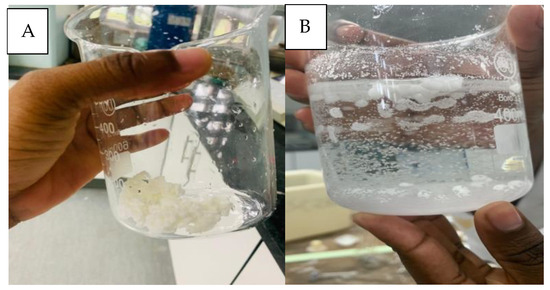
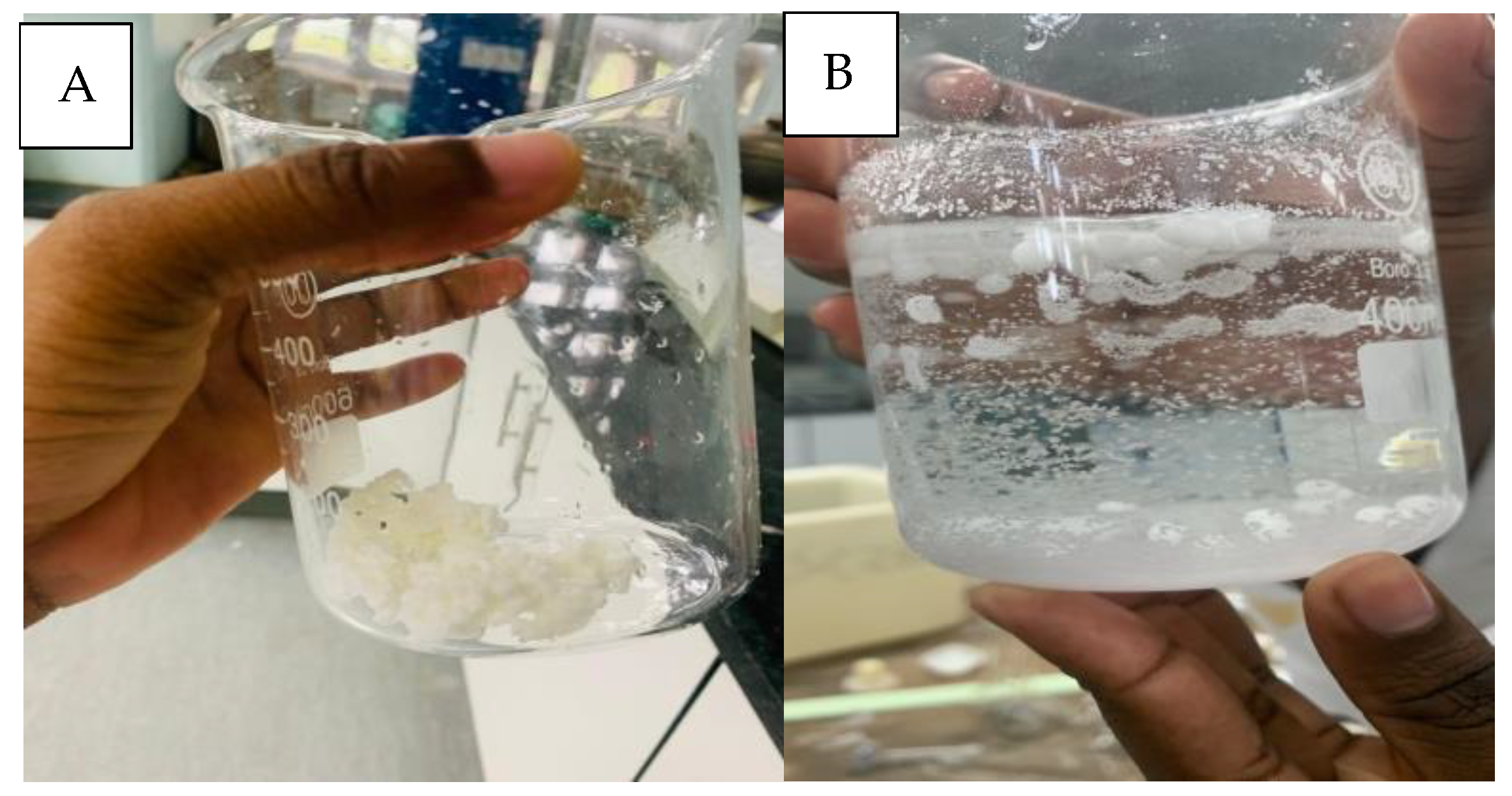
The formation of beads and crosslinking was achieved using a 0.1 M boric acid solution. The prepared composite material solution was dispersed in a bath of boric acid at a controlled rate of 1 mL/min using a standard pasture pipette (orifice diameter ~1.5 mm), therefore forming spherical beads (Figure 1). The beads were then left in the bath for a further 30 min to ensure complete gelation. Finally, the beads were washed with deionized water to remove excess boric acid and dried at 40 °C for 24 h. This method produced spherical beads with a visually consistent diameter in the range of 1.5–2.5 mm upon drying, suitable for batch coagulation studies.
Figure 1.
Showing (A) digital photograph of wet beads, (B) digital photograph of dried beads.
2.6. Preparation of Functionalized CNC-PVA-ZnOFe Beads
To prepare the beads, a procedure similar to Section 2.5 above was followed. The resulting functionalized CNC-PVA-ZnOFe beads were spherical and exhibited similar physical dimensions and consistency to those described in Section 2.5.
2.7. Characterization Methods
2.7.1. Fourier Transform Infrared Spectroscopy
A Perkin Elmer attenuated total reflection FTIR spectrometer (Perkin Elmer UATR Two, Johannesburg, South Africa) was used to analyze the samples using a Fourier transform infrared spectroscopy (FTIR) in diffuse reflectance mode. The investigation’s spectral range was 4000–500 cm−1. For each sample, 32 scans were co-added and averaged to obtain the final spectrum at a resolution of 4 cm−1.
2.7.2. X-Ray Diffraction
The samples underwent X-ray diffraction (XRD) analysis using a Bruker AXS Advance D8 diffractometer located in Karlsruhe, Germany. The instrument utilized mono-chromatic Cu Kα radiation (λ = 1.5406 Å) as the X-ray source, operating at 40 kV and 40 mA under ambient temperature conditions. The crystallinity index (CI) was determined using both the Segal empirical method and the deconvolution method. The Segal empirical method calculates the CI based on the heights of I002 and Imin, positioned between the 002 and 001 peaks. The CI calculation followed the procedure outlined below [31]:
Here, Iam is the diffraction intensity of the amorphous material, and I002 is the peak’s greatest diffraction intensity [31].
By taking into account the ratio of the entire area under the diffraction curve to the total area of all crystalline peaks, the deconvolution method determines the crystallinity index (CI).
In this instance, the region associated with the crystalline domain is represented by Acryst, and the region associated with the amorphous domain by Aamorp.
2.7.3. Scanning Electron Microscopy
Samples were subjected to SEM studies using an FEI Quanta 200 (Hillsboro, OR, USA) electron microscope running at a 20 kV acceleration voltage. Before being examined, the samples were carbon-coated using Edward’s E306A coating system.
2.7.4. Thermogravimetric Analysis
A Perkin Elmer Pyris 6 (Johannesburg, South Africa) thermogravimetric analyzer was used to perform thermogravimetric analysis (TGA) on the samples. At a rate of 5 °C per minute, samples weighing 10–15 mg were heated from 30 to 700 °C. In a nitrogen environment, the analysis was conducted at a flow rate of 20 mL/min.
2.7.5. Brunauer–Emmett–Teller
The pore structure of the coagulants was analyzed with a nitrogen gas adsorption–desorption surface area analyzer (Tristar II, produced by Micromeritics, Norcross, GA, USA). Samples were degassed initially at 90 °C for 1 h, then at 100 °C for 16 h. The BET method was used to measure the surface area, pore size, and pore volume through nitrogen adsorption at 77 K. Additionally, the Barrett–Joyner–Halenda (BJH) model, based on the BET equation, was employed to determine the pore size distribution and specific surface area of the coagulants.
2.8. Coagulation and Flocculation
The performance of the prepared composite beads for cadmium removal was evaluated using a standard jar test apparatus (VELP Scientifica JLT6, Usmate, Italy) to simulate coagulation–flocculation conditions. All experiments were conducted at room temperature (25 ± 2 °C).
Experimental Procedure:
A synthetic cadmium solution with an initial concentration (C0) of 100 mg/L was prepared by dissolving cadmium nitrate (Cd (NO3)2·4H2O) in deionized water. For each test, a volume (V) of 500 mL of this solution was placed in a 1 L glass beaker. The pH was adjusted to the desired value using 0.1 M NaOH or 0.1 M HNO3 and measured with a calibrated pH meter (Hanna Instruments HI98107). A predetermined mass (M) of the dry composite beads (coagulant dose) was added to the solution to initiate the experiment.
The jar test sequence was as follows:
- Rapid Mixing (Coagulation): Immediate stirring at 200 rpm for 2 min to ensure complete dispersion of the coagulant and destabilization of contaminants.
- Slow Mixing (Flocculation): Gentle stirring at 40 rpm for 20 min to promote the growth of settleable flocs.
- Sedimentation: The stirring was stopped, and the suspension was allowed to settle for a predetermined time (varied from 10 to 60 min).
After the sedimentation period, a 10 mL aliquot was carefully extracted from approximately 2 cm below the liquid surface using a pipette to avoid disturbing the settled flocs. The aliquot was immediately filtered through a 0.45 µm membrane filter.
Cadmium Concentration Analysis:
The concentration of cadmium (Cx) in the filtered supernatant was determined using a Meck Pharo 300 Spectroquant spectrometer with supplied cell tests. Each sample was analyzed in triplicate, and the average value was used for calculations. The instrument detection limit for Cd under these conditions was 0.005 mg/L.
The performance of the prepared composite beads was evaluated through coagulation and flocculation process for the removal of cadmium in contaminated water. Key parameters such as pH, initial cadmium concentration, coagulant dose, settling time, and beads recyclability were optimized for accurate evaluation of the composite beads’ performance. Deionized water was spiked with cadmium (100 mg/L) to simulate contaminated water.
The removal efficiency was calculated using the formula below:
C0 denotes the initial concentration, while Ct denotes the concentration post coagulation and flocculation process, V denotes volume (L) of cadmium solution, and M denotes mass (g) of the coagulant.
Experimental Design and Replicates:
Key operational parameters pH (2–12), initial Cd2+ concentration (20–140 mg/L), coagulant dose (0.05–0.2 g), and sedimentation time (10–60 min) were systematically optimized in a univariate approach. For the optimization of each parameter, the other conditions were held constant at their central values (pH 7, [Cd] = 100 mg/L, dose = 0.1 g, sedimentation time = 60 min). Each data point presented represents the mean value of three independent replicate experiments. The error bars in the figures indicate the standard deviation (mean ± SD). The performance summary reports the mean removal values under optimized conditions, with standard deviations of less than ±5% for all materials tested.
The reusability of the beads was evaluated over five consecutive cycles using the optimized conditions. After each cycle, the beads were regenerated by immersing them in 50 mL of 0.1 M HNO3 for 30 min with mild shaking, followed by thorough rinsing with deionized water and drying at 40 °C for 24 h before the next cycle.
Blank Control Experiments: To verify that cadmium removal was attributable to the beads rather than hydroxide precipitation, blank control experiments were conducted under identical conditions without the addition of functionalized CNC-PVA-ZnOFe beads. For each experimental condition (pH variation, initial concentration variation, coagulant dose, and sedimentation time), parallel control runs were performed using the same synthetic cadmium solutions and jar test procedure, omitting the bead addition. In all cases, cadmium removal in blank controls was less than 3%, confirming that precipitation did not contribute significantly to the observed removal efficiencies. All reported removal values represent total removal in bead-containing experiments, as blank correction was not necessary given the negligible precipitation.
3. Results and Discussion
3.1. FTIR Analysis
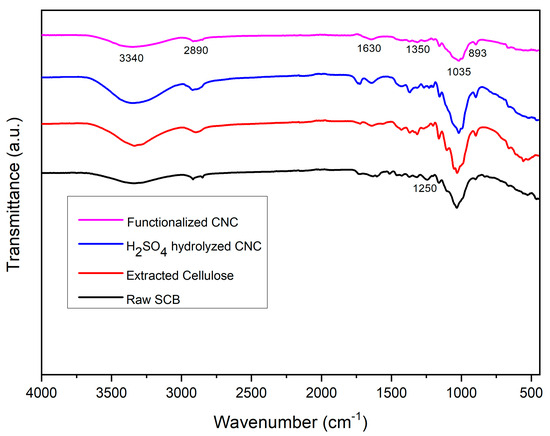
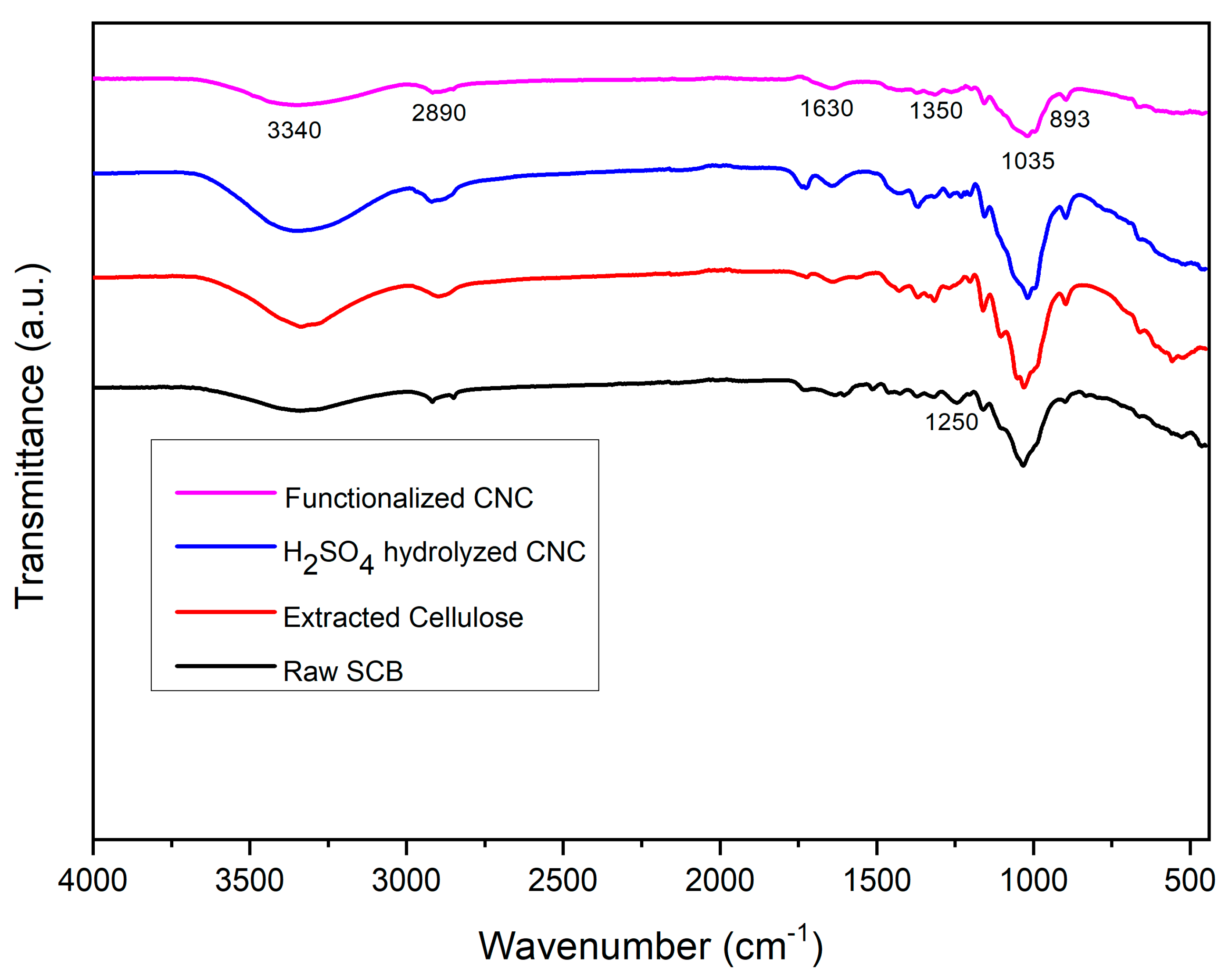
The FTIR of prepared materials including raw SCB, extracted cellulose, acid hydrolyzed CNCs, and functionalized CNC are shown in Figure 2. The spectrum of extracted cellulose shows the characteristic peaks of a typical cellulose structure corresponding to each stage of the extraction and functionalization process. The stages that are shown in the FTIR are cellulose extraction, acid hydrolysis, and amination. Carboxylation does not show on the FTIR due to sequential functionalization. The presence of a broad adsorption peak at ~3340 cm−1 is attributed to O-H stretching vibration, indicating the presence of hydroxyl within the cellulose backbone [11]. The presence of absorption peaks at ~2890 cm−1 are attributed to C–H stretching vibration from both CH and CH2 groups [32]. Glycosidic linkages characteristic peaks of the cellulose structure (C-O-C) are observed as a prominent peak near 1050 cm−1. Based on the sharpness and intensity of this peak it implies a successful deconstruction of SCB structure during acid hydrolysis. Furthermore, an O-H bending peak is observed around 1630 cm−1 due to the absorption of water molecules, common in hydrophilic cellulose materials [33,34].
Figure 2.
FTIR spectra of raw SCB, extracted cellulose, CNCs, and functionalized CNCs.
There is an additional broad peak between 3200 and 3500 cm−1 for functionalized CNC. This peak is attributed to an amino group N-H suggesting a successful incorporation of primary and secondary amine during the amination with EDA. The peak at around 1640 cm−1 is suggested to correspond to C=N stretching peaks due to the formation of Schiff base, a side reaction during amination. Moreover, the presence of new peaks around 1250–1350 cm−1 representing C-N stretching vibration, thereby confirming the presence of covalently bonded amine groups. The spectrum further displays broadened O-H stretching peaks. This is attributed to an extensive hydrogen bonding between the cellulose matrix and the newly introduced functional groups. The observed decrease in intensity of C-O-C peaks ~1000–1100 cm−1 signifies interactions between cellulose, carboxyl, and amine groups introduced during functionalization.
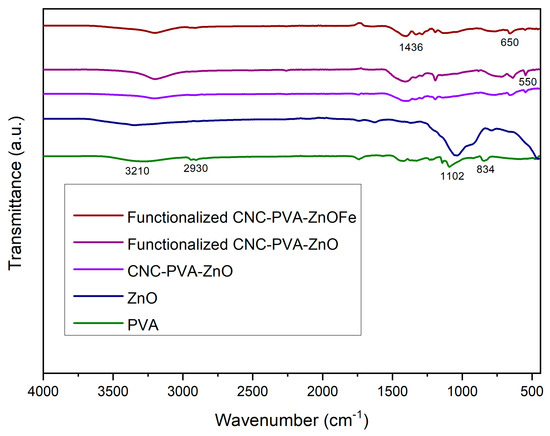
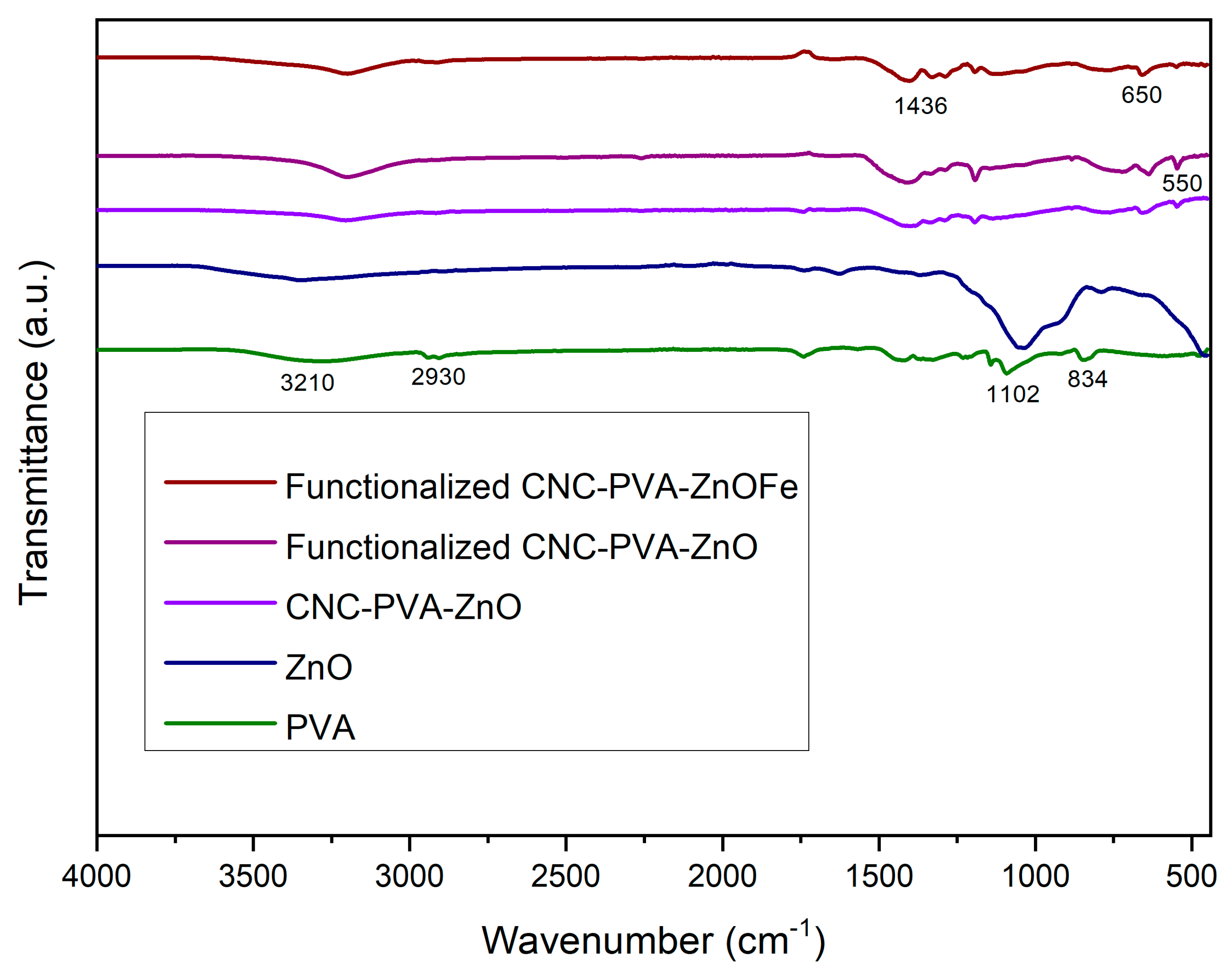
The FTIR spectra of PVA, ZnO, CNC-PVA-ZnO, Functionalized CNC-PVA-ZnO, and functionalized CNC-PVA-ZnOFe are shown in Figure 3. These spectrum provides insight into the chemical and structural modifications of such materials. The incorporation of PVA in all three materials is apparent from the O-H stretching vibration peak around 3201 cm−1, C-H stretching peak around 2935 cm−1, and C-O stretching peak at around 1138 cm−1. These peaks indicate strong hydrogen bonding and interaction with CNC. The incorporation of ZnO is confirmed by Zn-O streching vibration peak at around 543 cm−1. The addition of Fe is validated by the presence of Fe-O strecthing vibration peak (~659 cm−1) confirming the incorporation of Fe into the ZnO matrix in the functionalized CNC-PVA-ZnOFe, which contributes to its coagulation and adsorption properties [35]. Using boric acid as a crosslinker introduced B-O stretching vibration peaks between 1300 and 1400 cm−1 as well as shifts in hydroxy bands, emphasizing formation of a stable gel network.
Figure 3.
FTIR spectra of PVA, ZnO, CNC-PVA-ZnO, Functionalized CNC-PVA-ZnO, and functionalized CNC-PVA-ZnOFe.
3.2. X-Ray Diffraction Analysis
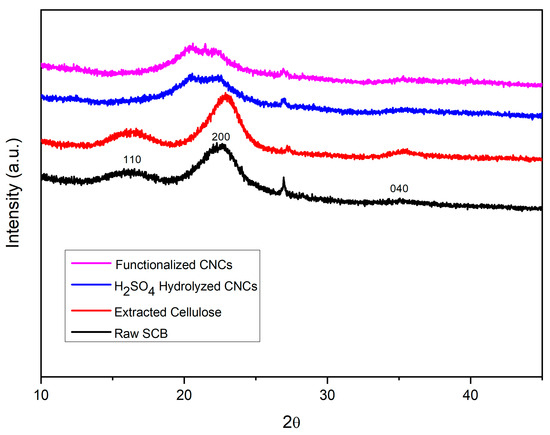
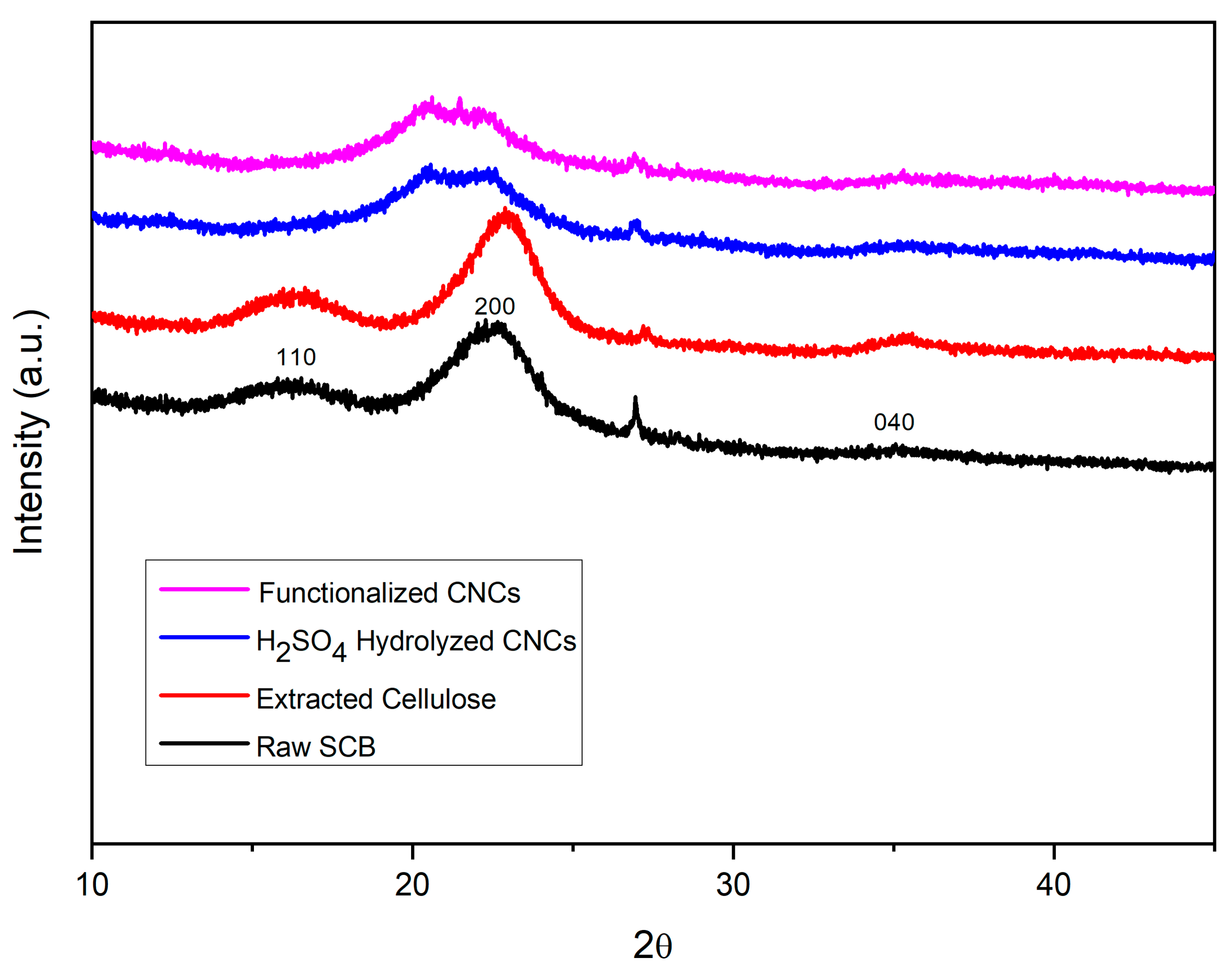
The XRD spectra was employed to study crystallinity advancement and structural modifications from the transformation of raw SCB, to extracted cellulose, to H2SO4 hydrolyzed CNCs, and finally to functionalized cellulose (Figure 4). The crystallinity index (CI) of all studied materials was quantified using both the Segal and deconvolution methods (Table 1).
Figure 4.
XRD spectra of raw SCB, extracted cellulose, CNCs, and functionalized CNCs.
Table 1.
Crystalline index values of materials studied using Segal and deconvolution methods.
Both raw SCB and extracted cellulose displayed similar peak patterns with the main peaks at 2ϴ = 16.5, 22.5, and 35.5°. These peak patterns confirmed the (110), (200), and (040) planes associated with cellulose (I) allomorph [36]. There was an increase in CI values (both Segal and deconvolution method) upon the extraction of cellulose indicating the removal amorphous material such as hemicellulose [37,38]. It can also be noted that upon alkalization and bleaching process, the extracted cellulose peaks became sharper and better refined at 2ϴ = 22.5°. This observation in combination with the increase in CI further proves the removal of amorphous regions [39].
Interestingly, both the H2SO4 hydrolyzed CNCs and functionalized CNCs displayed peaks at 2ϴ = 20 and 22° which is different from both the raw SCB and extracted cellulose. This is attributed to the change in the d-spacing of the crystal planes due to the introduction of sulphate ester groups to the cellulose chain. In addition, the CI increased from extracted cellulose to H2SO4 hydrolyzed CNCs due to further removal of amorphous regions during acid hydrolysis. The sharper peaks also reflect the nanoscale dimensions and uniformity of the crystalline regions in the CNCs [40].
Functionalization of CNCs, such as carboxylation with EDTA-silane and amination using EDA and glutaraldehyde, introduced chemical modifications on the CNC surface without significantly disrupting the crystalline regions. The XRD spectrum of functionalized CNCs maintained the characteristic 002 peaks, albeit with slight broadening, suggesting that functionalization primarily affects the surface properties rather than the crystalline core. The CI values were slightly reduced to 71.4% (Segal) and 73.5% (deconvolution), likely due to the incorporation of functional groups that slightly alter the packing density and introduce minor structural distortions [41].
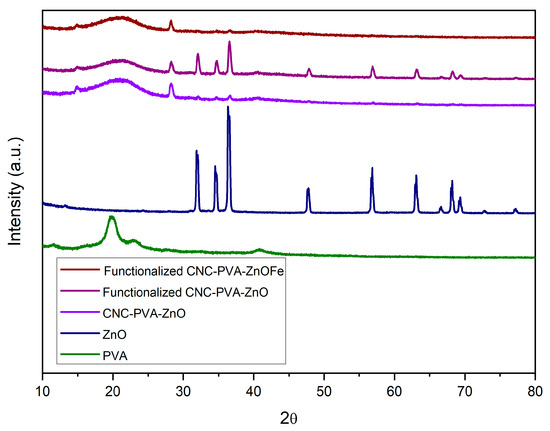
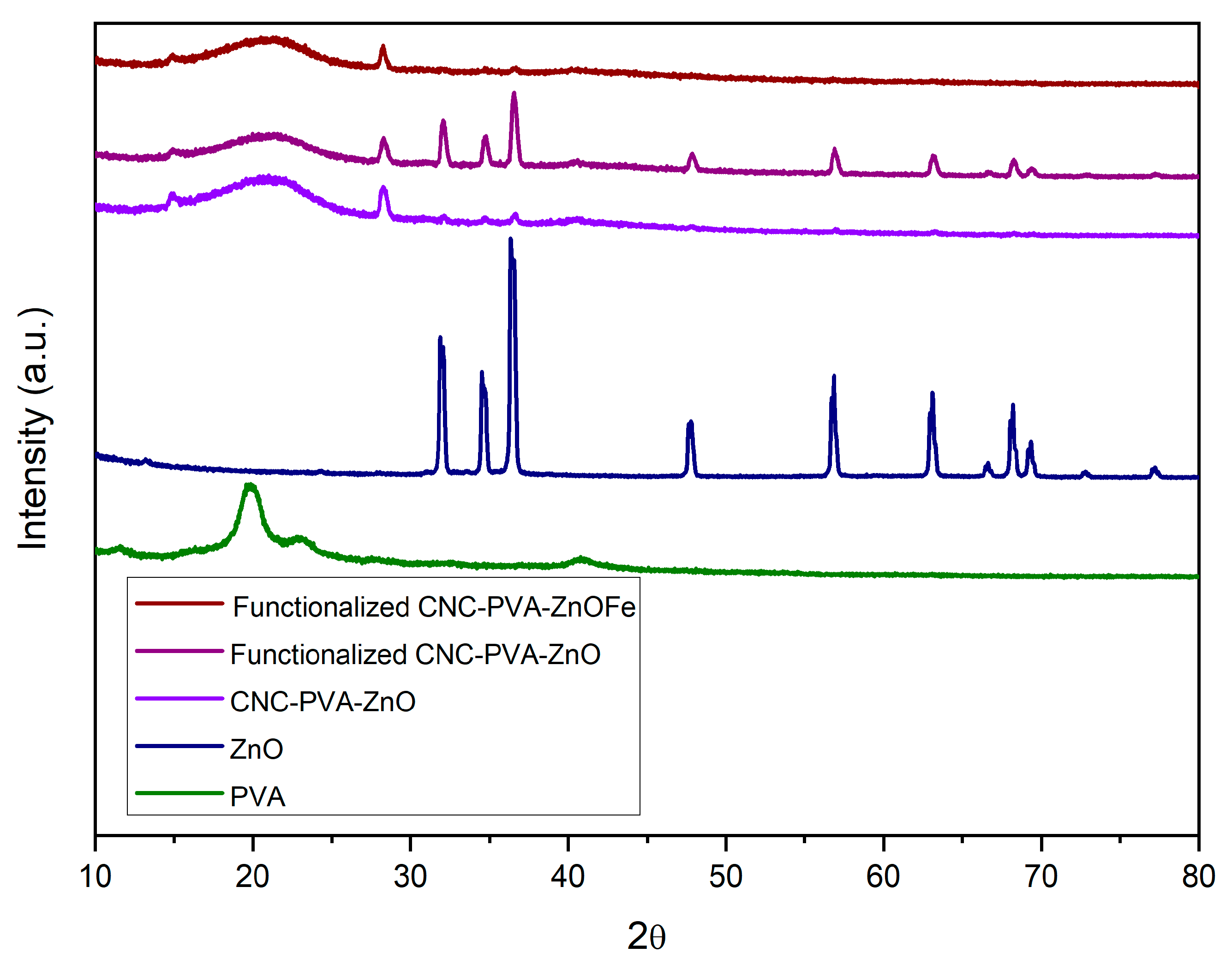
The XRD spectra of PVA, ZnO, CNC-PVA-ZnO, functionalized CNC-PVA-ZnO, and functionalized CNC-PVA-ZnOFe (Figure 5) reveal the structural evolution and phase integration achieved during the synthesis of the composite beads. The spectrum of PVA exhibited a broad peak around 2ϴ = 20°, which corresponds to the semi-crystalline nature of PVA. This characteristic peak is due to the partial ordering of PVA chains through hydrogen bonding, indicating its amorphous and crystalline domains [42]. For pure ZnO, sharp and intense diffraction peaks were observed at 2ϴ = 31.7°, 34.4°, 36.2°, 47.5°, 56.6°, and 62.8°, corresponding to the wurtzite hexagonal crystal structure of ZnO [43]. The intensity and sharpness of these peaks highlight the high crystallinity of the ZnO nanoparticles [44].
Figure 5.
XRD spectra of PVA, ZnO, CNC-PVA-ZnO, functionalized CNC-PVA-ZnO, and functionalized CNC-PVA-ZnOFe.
Both CNC-PVA-ZnO and functionalized CNC-PVA-ZnO showed similar peak patterns with the former showing a significant reduction in peak intensity escpecially with peaks corresponding to ZnO. The decrease in peak intensity suggests a partial intergration of ZnO within the polymer-CNC matrix. In addition, there is a peak broadening at around 2ϴ = 20° corresponding to the PVA region proving the intergration of CNC and ZnO [45]. Futhermore, the CI of CNC-PVA-ZnO decreased (both Segal and deconvulution method Table 1) indicating that the addition of PVA and ZnO disrupted the crystaline structure of CNCs.
The functionalized CNC-PVA-ZnO displayed an increase in peak intensity compared to the unfunctionalized counterpart. In addition, there was also an increase in CI values compared to CNC-PVA-ZnO, indicating the improvement in the structural order created by improving despersion and compatibility of ZnO within the polymer matrix [46]. A distinctly different phenomenon was observed upon incorporation of Fe3+ to form the functionalized CNC-PVA-ZnOFe composite. Unlike functionalization, which increased crystallinity through improved dispersion and interfacial ordering, the addition of iron resulted in decreased crystallinity (CI dropping from 72% to 68%). This decrease is attributed to heterogeneous nucleation effects, disruption of the ordered polymer matrix by incorporated metal ions, and the formation of ZnOFe hybrid phases that introduce structural irregularities and lattice strain. The functional groups that previously enhanced ordering may also coordinate with Fe3+ ions, altering the hydrogen bonding network between CNCs and PVA. Thus, the two phenomena functionalization and iron incorporation operate through fundamentally different mechanisms and produce opposite effects on composite crystallinity.
3.3. SEM and TEM Analysis
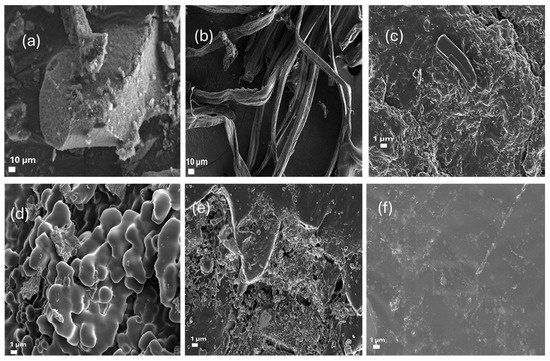
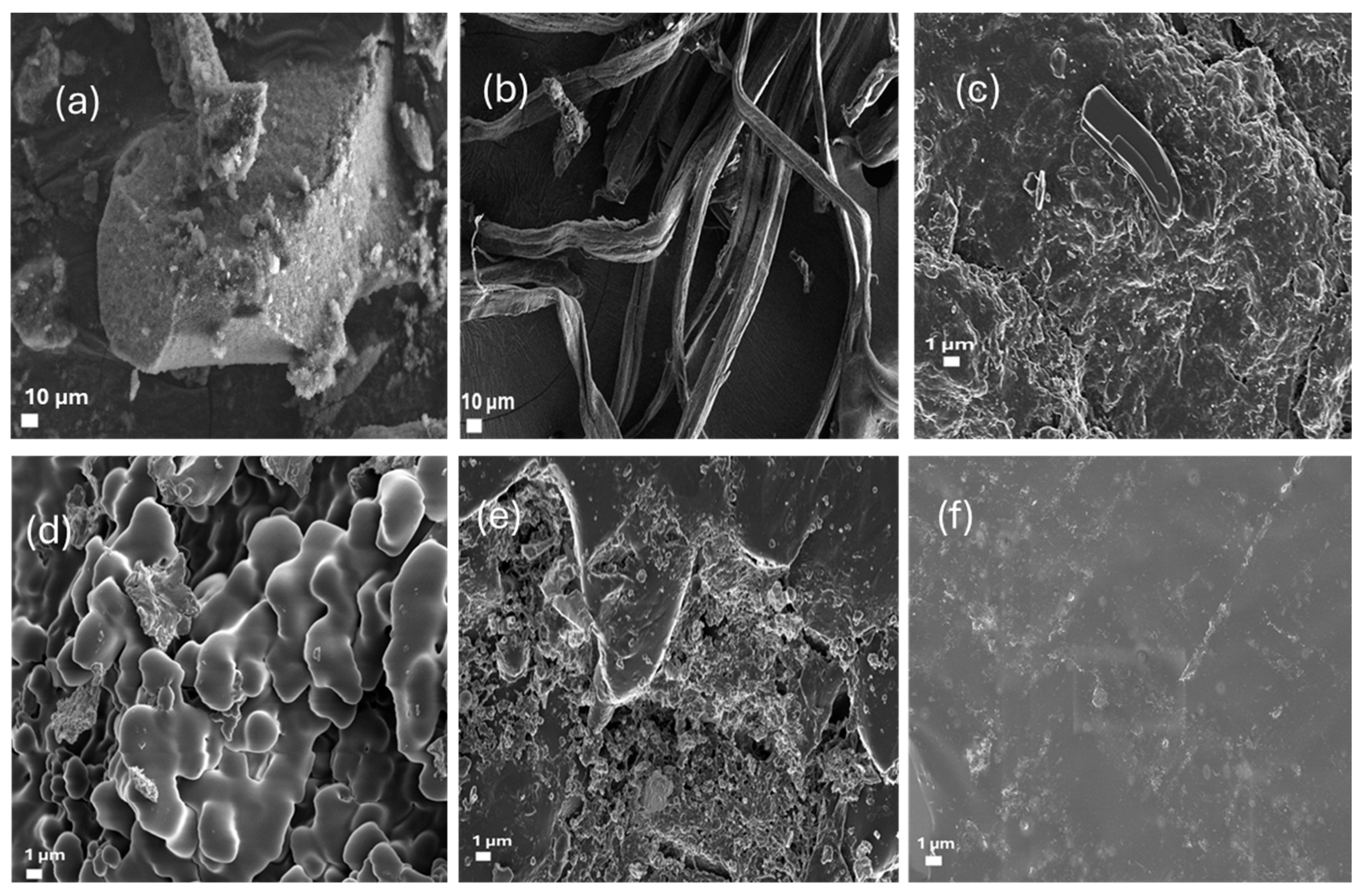
SEM was employed to monitor the morphological transformation of the studied materials in each processing step and functionalization. The SEM images of raw SCB, extracted cellulose, H2SO4 hydrolyzed CNCs, CNC-PVA-ZnO, functionalized CNC-PVA-ZnO, and functionalized CNC-PVA-ZnOFe are presented in Figure 6. The raw SCB (Figure 6a) displayed noticable particles on the surface with proof non-fibrious and course material. This is attributed to the presence of pectin, hemicellulose, lignin, and external contaminants [39,47]. Upon alkalization and bleaching, the extracted cellulose (Figure 6b) showed a smoother surface and fibrillar structure. This is due to the removal of amorphous regions through alkalization and bleaching [48]. The H2SO4 hydrolyzed CNCs (Figure 6c) showed further removal of amorphous regions through the decrease in the diameter of the fibrillar structure to become needle-like and the increase in surface area [40]. The incorporation of CNCs and ZnO in a PVA matrix (Figure 6d) showed a more stable and homogeneous structure with no evidence of aggregation. This proved the uniform dispersion and perfect unison of the materials. The functionalized CNC-PVA-ZnO showed an altered but uniform and dense surface, suggesting the functional groups addition took place in the surface of the material [46]. The incorporation of Fe (Figure 6e) indicated signs of minor aggregation with the distribution of ZnOFe clusters. The SEM proves the formation of a hybrid metal phase within the PVA-CNC matrix with the potential of improving coagulation, flocculation, and adsorption capabilities.
Figure 6.
SEM images of (a) raw SCB, (b) extracted cellulose, (c) CNCs, (d) CNC-PVA-ZnO, (e) functionalized CNC-PVA-ZnO, and (f) functionalized CNC-PVA-ZnOFe.
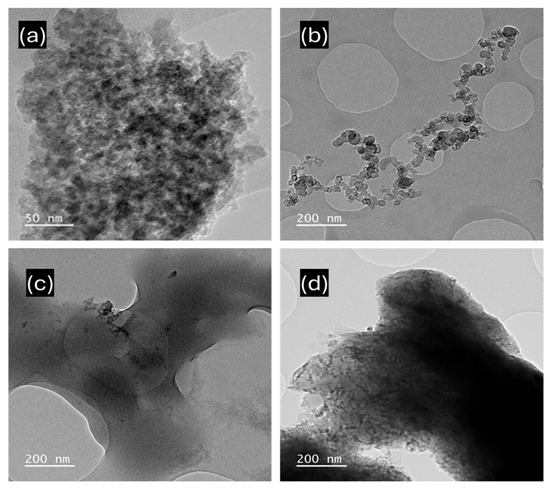
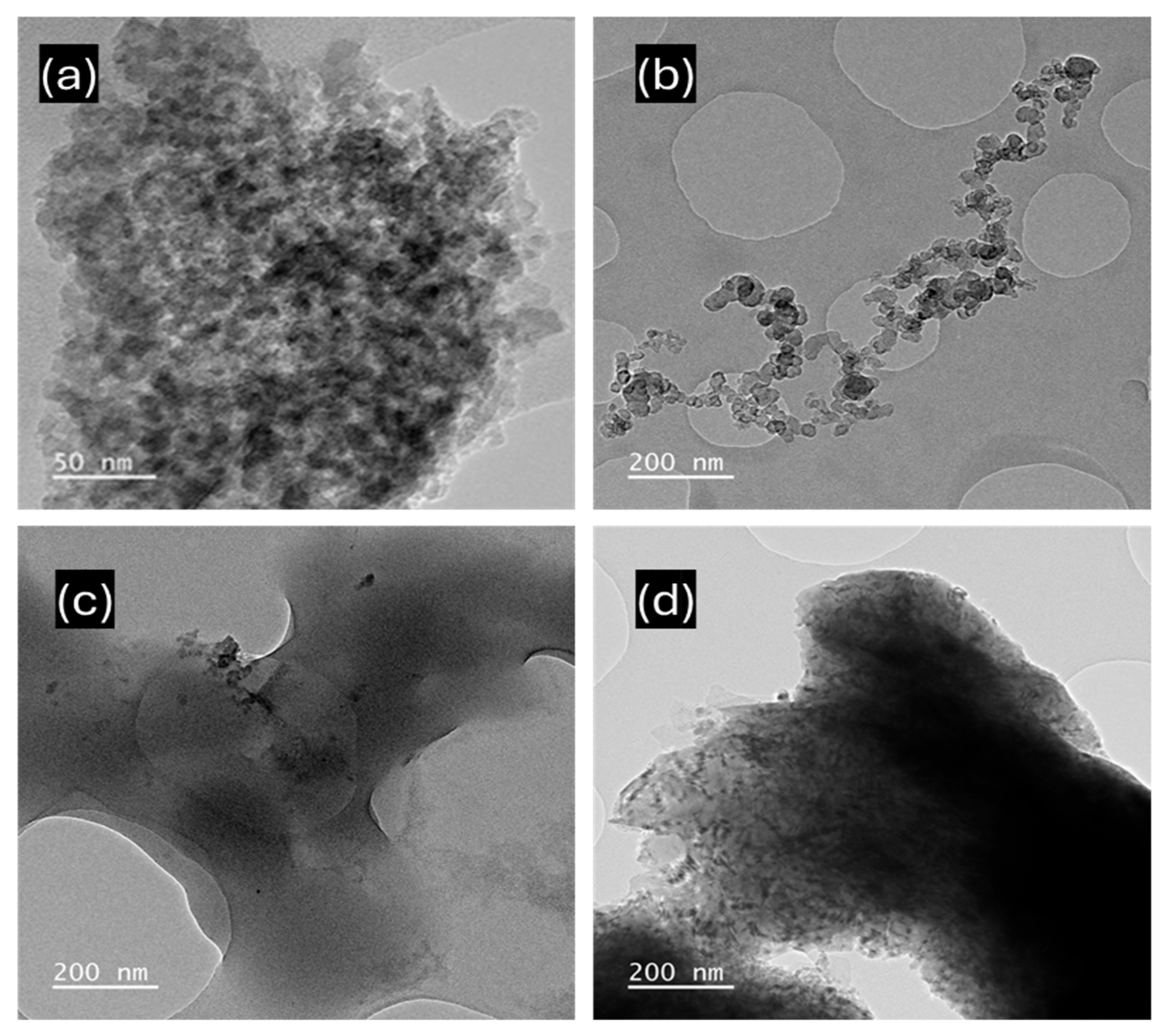
TEM was used to study the morphology and distribution of the prepared materials in the nanoscale region. The TEM images of CNCs, CNC-PVA-ZnO, functionalized CNC-PVA-ZnO, and functionalized CNC-PVA-ZnOFe hybrid materials are presented in Figure 7. Similar to the SEM results, the H2SO4 hydrolyzed CNCs (Figure 7a) displayed needle-like morphology indicating the removal of amorphous regions during acid hydrolysis [40]. The CNC-PVA-ZnO (Figure 7b) TEM image displayed no signs of aggregate formation during the incorporation of ZnO and CNC in the PVA matrix [43]. The functionalization of CNCs through amination and carboxylation showed fewer signs of aggregation compared to the unfunctionalized counterparts (Figure 7c) [18]. A TEM image of functionalized CNC-PVA-ZnOFe (Figure 7d) showed visible darker contrast clusters indicating poor dispersion of ZnOFe in a polymer-CNC matrix [49]. The formation of heterojunctions has an ability to enhance the adsorption, coagulation and flocculation process providing synergistic active sites.
Figure 7.
TEM images of (a) CNCs, (b) CNC-PVA-ZnO, (c) functionalized CNC-PVA-ZnO, and (d) functionalized CNC-PVA-ZnOFe.
3.4. TGA
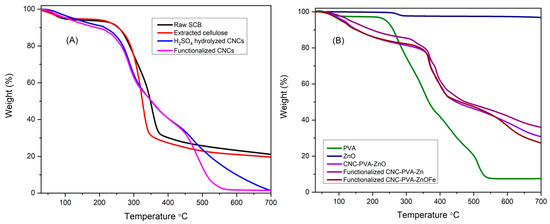
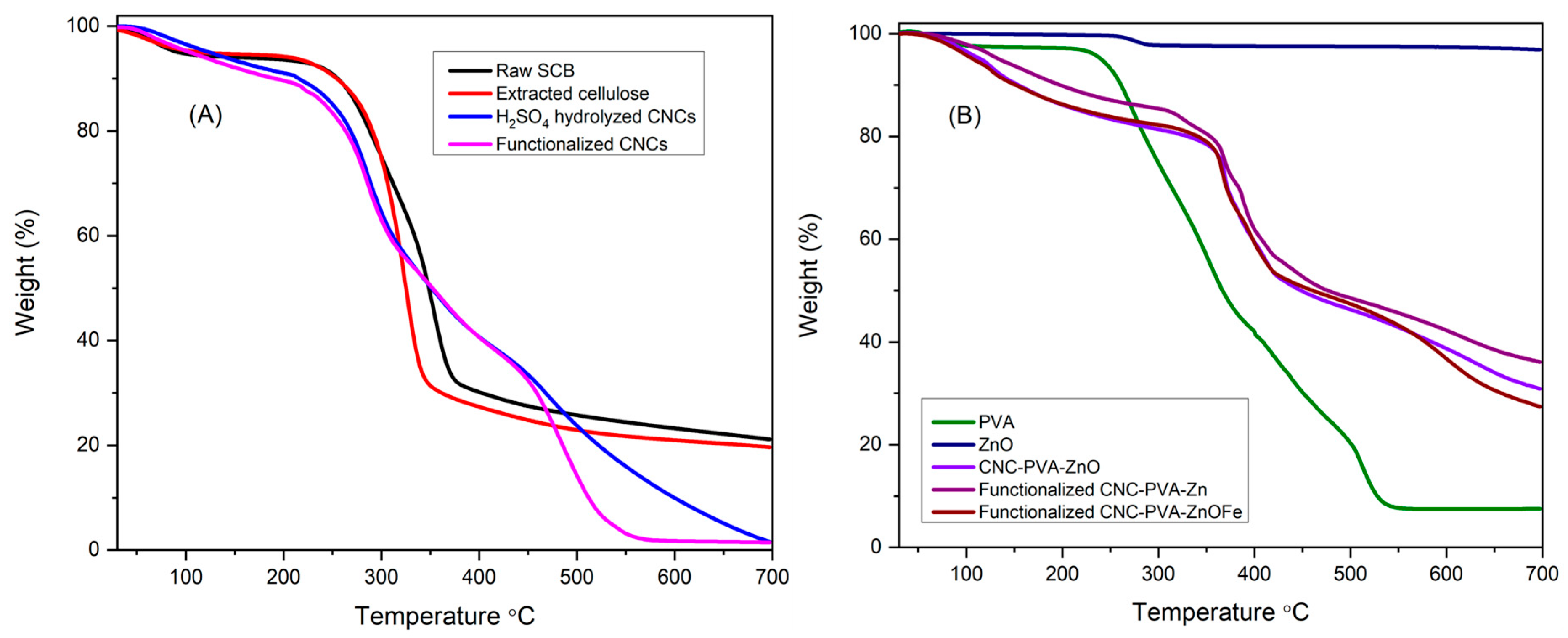
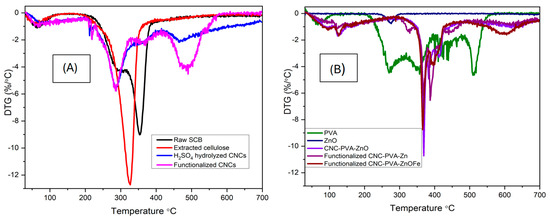
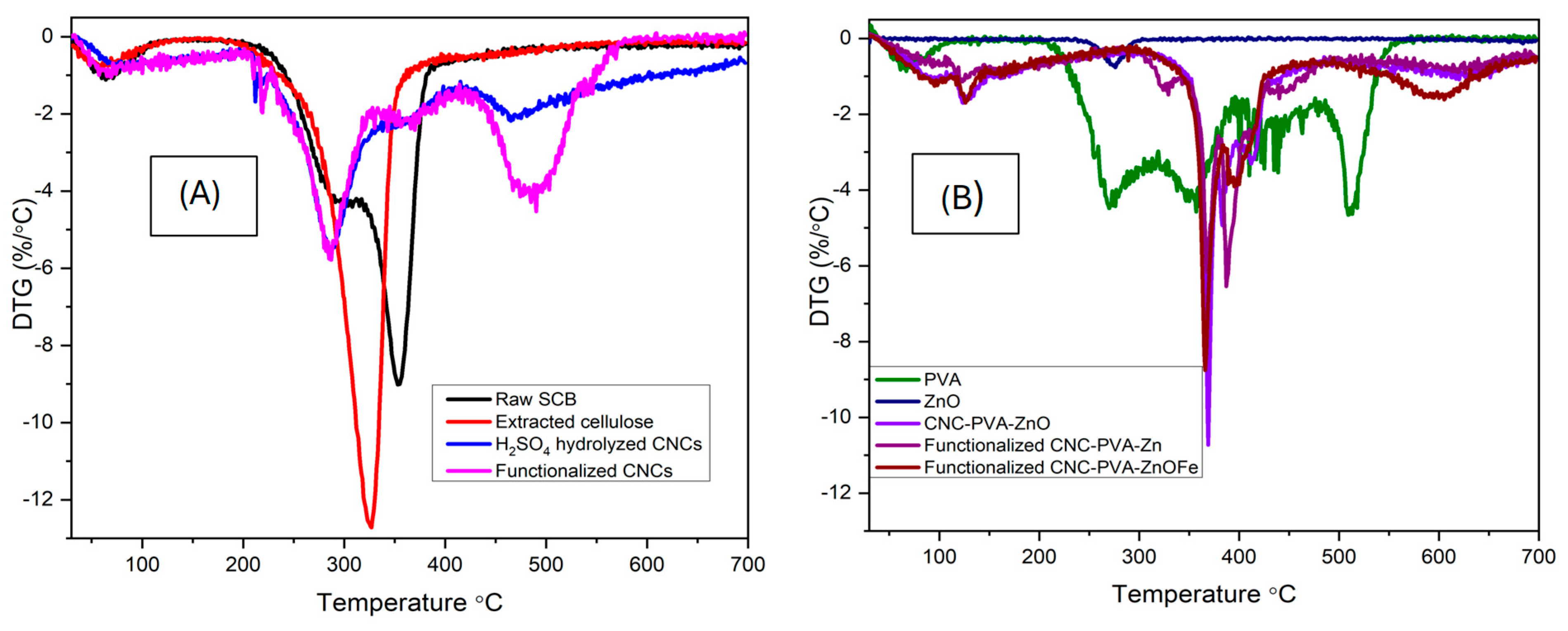
Thermogravimetric analysis was employed to study the behavior of the prepared materials subjected to high temperatures. Figure 8 and Figure 9 show the TGA and DTG spectra respectively of all studied materials.
Figure 8.
TGA spectra of (A) raw SCB, extracted cellulose, CNCs, and functionalized CNCs, (B) PVA, ZnO, CNC-PVA-ZnO, functionalized CNC-PVA-ZnO, and functionalized CNC-PVA-ZnOFe.
Figure 9.
DTG spectra of (A) raw SCB, extracted cellulose, CNCs, and functionalized CNCs, (B) PVA, ZnO, CNC-PVA-ZnO, functionalized CNC-PVA-ZnO, and functionalized CNC-PVA-ZnOFe.
Raw SCB TGA displayed three degradation steps with the first taking place around 100 °C which is attributed to the removal of moisture (Table 2). The second degradation step between 210 and 390 °C, which is attributed to the removal of amorphous regions mainly hemicellulose. The third degradation step took place around 320–354 °C and is attributed to the removal of lignin [50,51,52]. There is an observed improvement in thermal stability for extracted cellulose, with a degradation observed between 275 and 370 °C, attributed by the further removal of amorphous regions [53,54,55].
Table 2.
Thermogravimetric analysis parameters of prepared materials.
The H2SO4 hydrolyzed CNCs displayed lower thermal stability compared to extracted cellulose. This is due to the introduction of sulphate groups on the CNC surface destabilizing the material against degradation [36]. The functionalized CNCs showed similar peak pattern to H2SO4 hydrolyzed CNCs with a slight peak broadening between 450 and 550 °C due to the amination and carboxylation [56,57].
In the composites, PVA degrades in two stages: dehydration (~100 °C) and polymer chain scission (~250–500 °C), with a DTG peak at ~300 °C [42]. Zinc oxide remains thermally stable up to 700 °C, as expected for an inorganic material [43,44].
The CNC-PVA-ZnO composite demonstrates improved stability, with decomposition at 300–400 °C and a shifted DTG peak, reflecting interactions between ZnO and the organic matrix [45,58]. The functionalized CNC-PVA-ZnOFe composite shows a broader decomposition range (300–400 °C) and reduced residual content, attributed to ZnOFe phase formation [49,59].
These findings highlight the synergistic effects of functionalization and inorganic additives, enhancing thermal stability for applications like water treatment [58,59].
3.5. BET Analysis
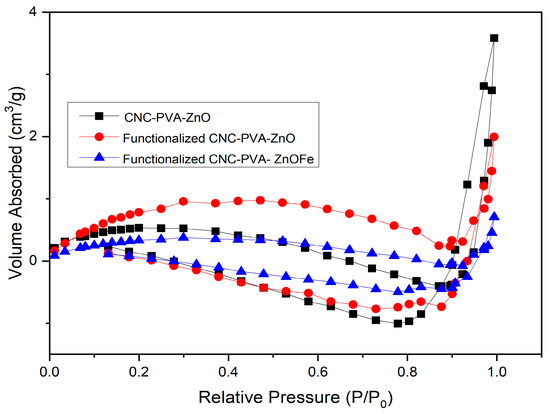
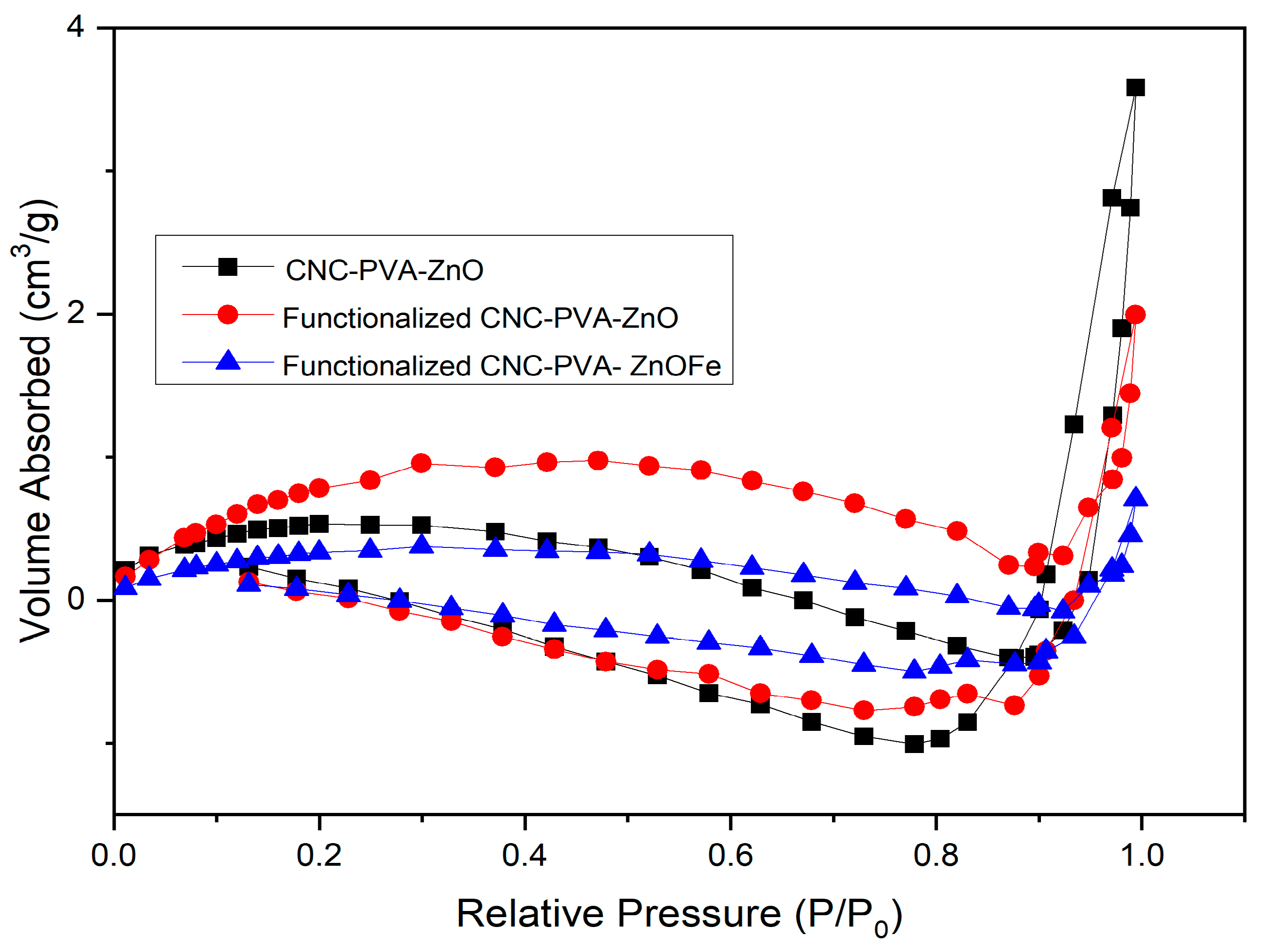
The Brunauer–Emmett–Teller (BET) analysis was performed to evaluate the textural properties of the prepared nanocomposites. The nitrogen adsorption–desorption isotherms for CNC–PVA–ZnO, functionalized CNC–PVA–ZnO, and functionalized CNC–PVA–ZnOFe all exhibited Type IV behavior with distinct H3-type hysteresis loops (Figure 10), which is typically associated with the presence of slit-shaped pores formed by platelet-like particle aggregates [60]. This indicates a predominantly macroporous structure with contributions from interparticle voids rather than intrinsic micro- or mesoporosity [61].
Figure 10.
Nitrogen adsorption and desorption isotherms plots for CNC-PVA-ZnO, functionalized CNC-PVA-ZnO, and functionalized CNC-PVA-ZnOFe.
As shown in Table 3, the measured BET surface areas were remarkably low (1.2–3.3 m2/g), which is consistent with the formation of dense, aggregated structures observed in SEM and TEM images (Figure 6 and Figure 7). This low surface area has important implications for the removal mechanism: it indicates that conventional surface adsorption which typically requires surface areas > 100 m2/g for high-performance materials cannot be the dominant mechanism. Instead, these textural data suggest that coagulation and flocculation, rather than adsorption, are likely the primary processes responsible for cadmium removal. The adsorption branch of functionalized CNC-PVA-ZnO in Figure 10 shows a steeper uptake at higher relative pressures, reflecting its improved surface accessibility. In contrast, the introduction of iron in functionalized CNC-PVA-ZnOFe resulted in substantially reduced surface area (1.2391 m2/g) and pore volume (0.61681 cm3/g), with the isotherm showing less pronounced adsorption at intermediate pressures, suggesting potential pore blockage effects [62].
Table 3.
Physical parameters of the prepared coagulants.
Notably, the pore-diameter values derived from the Barrett–Joyner–Halenda (BJH) model applied to the desorption branch, are in the range of 12.4–52.4 nm (Table 2). These values correspond to the inter-aggregate voids visible in the TEM micrographs, confirming that the porosity arises from the interstitial spaces between clustered nanoparticles rather than from well-defined internal pores. The steep uptake at high relative pressures in the isotherms further supports the presence of large inter-aggregate voids. Consequently, the materials are best described as macroporous aggregates with limited internal surface area. This textural profile is characteristic of materials designed for coagulation–flocculation applications, where contaminant removal occurs primarily through particle aggregation, charge neutralization, and physical enmeshment within the porous network, rather than through surface adsorption. The macroporous structure provides spaces for floc growth and entrapment, while the limited surface area precludes adsorption-dominated removal. This interpretation aligns with the observed performance and explains why the material outperforms conventional coagulants despite its low surface area.
Typical high-performance adsorbents such as activated carbons, zeolites, and metal–organic frameworks possess surface areas of 500–3000 m2/g. The two orders of magnitude lower surface area of the present materials (1.2–3.3 m2/g) confirms that adsorption cannot be the primary removal mechanism. This textural evidence supports the optimization of the coagulation and flocculation process (Section 3.6 and Section 3.7) as opposed to the adsorption parameters. In addition, it further proves that the dominant removal process is indeed the coagulation and flocculation process.
3.6. Factors Affecting Both Coagulation, Flocculation, and Adsorption of Cd
The quantification of the adsorption, coagulation, and flocculation process for the removal of Cd2+ in contaminated water was achived by first optimizing the reaction conditions. The influencial conditions that were optimized included pH, coaguland dose, initial cadmium concentration, and sedimentation time. In addition, the recyclability of the coagulant was studied for the best perfoming material. The optimized parameters are detailed in Section 3.6.1, Section 3.6.2, Section 3.6.3 and Section 3.6.4. The perfomance of all studied materials is summarized in Table 4. To better comprehend the perfomance of prepared materials, they were compared with the perfomance of the common and widely used coagulant aluminum sulphate. Aluminum sulphate achieved 69% removal efficiency while the best performing CNC-PVA-ZnOFe hybrid composite beads achieved 78% removal with a removal capacity of 78 mg/g. In addition, the removal % of functionalized CNC-PVA-ZnO was achieved to be 64% compared to 53% for the unfunctionalized counterpart. For direct comparison, aluminum sulphate (Al2(SO4)3·18H2O, analytical grade) was evaluated under identical experimental conditions as the functionalized CNC-PVA-ZnOFe beads: pH 7 (adjusted with 0.1 M NaOH or HNO3), initial Cd2+ concentration of 100 mg/L, coagulant dose of 0.1 g (for beads) or 0.1 g of Al2(SO4)3 salt dissolved directly into the solution, sedimentation time of 60 min, and the same jar test mixing protocol (2 min rapid mixing at 200 rpm, 20 min slow mixing at 40 rpm). All comparative experiments were conducted at room temperature (25 ± 2 °C) with triplicate runs. It is important to note that aluminum sulphate functions as a dissolved coagulant, releasing Al3+ ions into solution upon dissolution, whereas the hybrid beads remain as solid materials throughout the process. This fundamental difference in physical form has implications for the comparison and for practical applications, as discussed in Section 3.6.6. This proves that amination and carboxylation improves the removal effeciency of cadmium in contaminated water. Furthermore, hybridization with FeCl3 proves to promote floc formation and increase adsorption through neutralizing charged particles [22].
Table 4.
Coagulation, flocculation, and adsorption study results for all cellulose-based PVA beads.
3.6.1. Effect of pH
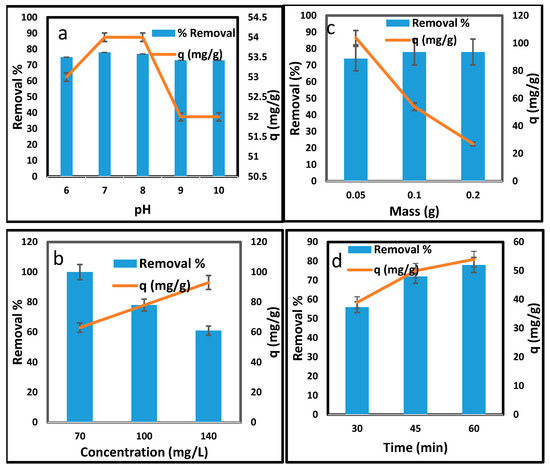
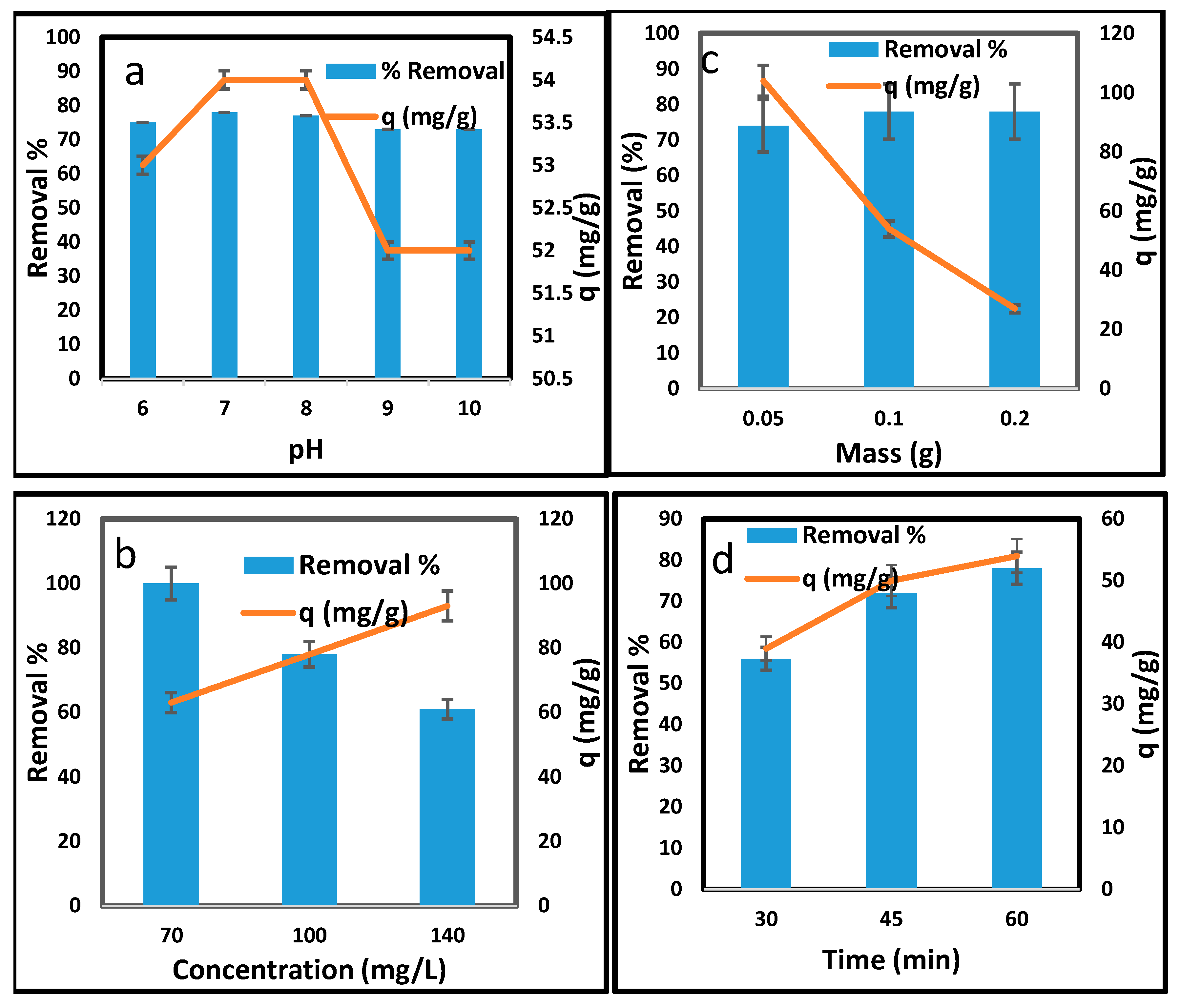
The pH of the solution is a critical parameter governing the removal efficiency, as it simultaneously affects the speciation of cadmium in solution and the surface charge of the adsorbent. Figure 11a shows the impact of pH on Cd2+ removal by the functionalized CNC-PVA-ZnOFe beads. Blank control experiments conducted without beads at each pH value showed negligible cadmium removal (<3% across the entire pH range), confirming that cadmium hydroxide precipitation did not contribute significantly to the observed removal. The removal efficiency was low in highly acidic media (pH < 5), increased significantly in the near-neutral to alkaline range (pH 7–10), and showed a slight decline at very high pH (>10).
Figure 11.
(a) Effect of pH, (b) effect of initial concentration, (c) effect of adsorbent dose, (d) flocculation time on coagulation and flocculation removal of Cd in contaminated water.
The pH of the solution significantly influences cadmium removal efficiency, as shown in Figure 11a. Removal was low under highly acidic conditions (pH < 5), increased markedly in the near-neutral to alkaline range (pH 7–10), and showed a slight decline at very high pH (>10). Blank control experiments conducted without beads confirmed that precipitation contributed negligibly (<3%) across the pH range, indicating that the observed pH dependence reflects interactions with the beads rather than homogeneous precipitation [16,17].
3.6.2. Effect of Initial Cd Concentration
Figure 11b illustrates the impact of initial concentration on both the removal percentage and removal capacity (q). Blank control experiments conducted without beads at each initial concentration (20–140 mg/L) showed negligible cadmium removal (<3% at all concentrations), confirming that precipitation did not contribute to the observed removal. The highest removal efficiency occurred at an initial concentration of 70 mg/L, achieving 98%. This indicates that there are sufficient active sites to capture all available molecules. At this concentration, the removal capacity measured 60 mg/g.
However, when the initial concentration increases to 100 mg/L, the removal percentage decreases to 78%. This implies that the availability of sites is a limiting factor. The removal capacity rises to 78 mg/g, suggesting that a higher initial concentration leads to enhanced adsorption per unit mass, even though the process efficiency declines. At the maximum initial concentration of 140 mg/L, the removal rate falls to 61%. This supports the idea that binding site saturation hinders the removal of additional substances. Although the removal capacity reaches its peak at 92 mg/g, which is the highest among the three concentrations, the removal efficiency remains lower. This indicates that while the coagulant continues to remove more chemicals at elevated concentrations, its effectiveness diminishes over time. As the initial concentration increases, the removal rate declines, while the removal capacity increases. This occurs because as the active sites become saturated, the coagulant can hold more material at higher concentrations.
3.6.3. Effect of Coagulant Dose
Figure 11c illustrates how varying amounts of dry functionalized CNC-PVA-ZnOFe (ranging from 0.05 to 0.2 g) influence the adsorption, coagulation, and flocculation of cadmium while maintaining other conditions constant. The removal efficiency remained above 70% as the quantity of adsorbent increased from 0.05 g to 0.2 g. This phenomenon occurred as the removal capacity decreased from 89 mg/g to 20 mg/g. This shift in behavior can be attributed to the increased availability of surface sites for cadmium removal. Conversely, larger quantities of the coagulant lead to a higher tendency for particles to aggregate, which diminishes the coagulant’s capacity to retain particles [24].
3.6.4. Effect of Sedimentation Time
Figure 11d shows how sedimentation time influences the removal efficiency and removal capacity of cadmium on functionalized CNC-PVA-ZnOFe beads. Blank control experiments conducted without beads at each time point showed negligible cadmium removal (<3% at all times), confirming that any potential slow precipitation did not contribute to the observed removal. The results indicate that increasing the sedimentation time to 60 min significantly improves both the removal rate and removal capacity of cadmium ions. In the initial 30 min, the removal rate quickly rises to 55%, with a removal capacity of 55 mg/g. A similar increase occurs from 30 to 60 min, reaching 78% removal and an adsorption capacity of 78 mg/g. This improvement is attributed to allowing sufficient time for the interaction of CNC-PVA-ZnOFe beads and cadmium. The reasonable sedimentation time makes the process practical for continuous-flow systems [63].
3.6.5. Analysis of Removal Mechanisms in Light of Textural Data
The superior performance of the functionalized CNC-PVA-ZnOFe beads, achieving 78% Cd2+ removal compared to 69% for conventional Al2(SO4)3 (Table 4), must be interpreted in the context of the textural data. With BET surface areas of only 1.2–3.3 m2/g (Table 3), these materials cannot function primarily as conventional adsorbents. Therefore, the removal mechanism is necessarily dominated by coagulation and flocculation processes, with adsorption playing a secondary, supporting role. This re-evaluation aligns the mechanistic interpretation with the experimental evidence.
Contribution of Surface Functionalization (Complexation): Comparing the unfunctionalized CNC-PVA-ZnO beads (53% removal) to their functionalized (aminated/carboxylated) counterpart f-CNC-PVA-ZnO (64% removal) reveals an 11% increase attributable directly to the introduced -COO- and -NH2 groups. Given the low surface area, this enhancement cannot be explained by increased adsorption capacity alone. Instead, the functional groups likely enhance coagulation efficiency through several mechanisms: (i) they improve the dispersion of CNCs within the PVA matrix, creating more accessible surface sites for particle interactions; (ii) they modify the surface charge characteristics, potentially enhancing charge neutralization of Cd2+ species; and (iii) they may facilitate bridging flocculation by extending polymer chains that can connect multiple particles. The FTIR evidence confirms successful grafting (Section 3.1), but the textural data indicates that these functional groups contribute primarily to coagulation enhancement rather than substantial surface adsorption.
Contribution of the ZnOFe Hybrid (Primary Coagulation Mechanism): Comparing f-CNC-PVA-ZnO (64%) to f-CNC-PVA-ZnOFe (78%) shows a 14% increase upon iron incorporation. This substantial enhancement, combined with the low surface area evidence, confirms that coagulation–flocculation is the dominant removal mechanism. The Fe3+ species functions through classical coagulation pathways: (i) charge neutralization of negatively charged colloidal particles and dissolved Cd species; (ii) sweep flocculation where amorphous metal hydroxide precipitates enmesh contaminants; and (iii) bridging flocculation where polymeric Fe species form links between particles. The macroporous structure (12–52 nm pores) provides an ideal scaffold for floc growth and physical entrapment of aggregated particles. The altered surface morphology observed in SEM (Figure 6f) supports the occurrence of aggregation, while the low surface area precludes adsorption-dominated removal.
The Proposed Mechanism (Coagulation-Dominated): Based on the textural evidence and performance data, we propose that cadmium removal occurs through a coagulation-dominated mechanism with supporting contributions from functional groups: (a) Fe3+/ZnO species destabilize dissolved Cd2+ and colloidal particles through charge neutralization, initiating floc formation; (b) the functionalized CNC surfaces, despite their limited surface area, provide additional sites for initial Cd2+ complexation, creating nuclei for floc growth; (c) these micro-flocs aggregate further, potentially bridging between multiple beads or growing within the solution; (d) the macroporous bead structure (pore diameters 12–52 nm, Table 3, Figure 10) physically entraps these aggregates, facilitating their removal by sedimentation. In this model, coagulation is the primary driver of removal, with adsorption playing a supporting role by concentrating Cd2+ at nucleation sites and enhancing local supersaturation to promote precipitation. This model explains why the composite outperforms both traditional coagulants (which lack high adsorption capacity) and pure adsorbents (which lack strong coagulation functionality). The synergy lies in the mutual enhancement where adsorption creates nuclei for floc growth, and coagulation rapidly removes adsorbed species from the solid–liquid interface, continually renewing adsorption sites and preventing saturation.
The term ‘synergy’ implies that the combined effect exceeds the sum of individual effects. In this study, we have not demonstrated that the observed 78% removal exceeds what would be expected from additive contributions of adsorption and coagulation independently. Such demonstration would require controlled experiments isolating each mechanism, which is challenging given their interdependent nature. Therefore, we describe the material as having integrated or combined mechanisms rather than claiming proven synergy. The incremental analysis presented above quantifies the additional removal associated with each modification but does not constitute proof of synergistic enhancement beyond additive effects.
The low BET surface areas (1.2–3.3 m2/g) conclusively demonstrate that this material is not a high-surface-area adsorbent. Any interpretation invoking substantial adsorption as a primary mechanism is inconsistent with the experimental data. The removal mechanism must be understood as coagulation-dominated, with adsorption serving a supporting function.
3.6.6. Inferred Mechanism of Cadmium Removal
As detailed in Section 3.6.5, the removal of Cd2+ by functionalized CNC-PVA-ZnOFe beads occurs through a coagulation-dominated mechanism with supporting adsorptive contributions [18]. The textural evidence (BET surface areas of 1.2–3.3 m2/g) confirms that adsorption cannot be the primary mechanism, and the performance enhancements observed upon functionalization and iron incorporation are consistent with enhanced coagulation efficiency through charge neutralization, sweep flocculation, and particle entrapment within the macroporous network. The functionalized CNC-PVA-ZnOFe beads achieved 78% Cd2+ removal under optimized conditions, compared to 69% for conventional aluminum sulphate tested under identical conditions (pH 7, 100 mg/L Cd2+, 0.1 g dose, 60 min sedimentation, same mixing protocol). However, a meaningful comparison requires consideration of the fundamental differences between these materials [22].
3.6.7. Limitations and Future Directions
Indirect Nature of Mechanistic Evidence: The proposed coagulation-dominated mechanism is inferred from comparative removal efficiencies, material characterization, and textural analysis. The low BET surface areas (1.2–3.3 m2/g) provide critical evidence that adsorption cannot be the primary mechanism, and future work should fully embrace this constraint by focusing on coagulation-specific characterization rather than adsorption-focused studies. Specifically, the following evidence is needed to validate the coagulation-dominated mechanism:
- Zeta potential measurements;
- Floc size distribution analysis to quantify aggregation kinetics;
- Settling velocity measurements to assess floc characteristics;
- Fe leaching quantification to determine the role of dissolved versus surface-bound coagulant species.
Recommendations for Future Mechanistic Studies (Coagulation-Focused): 1. Zeta potential analysis of bead suspensions before and after Cd2+ exposure across the pH range 2–12 to determine the point of zero charge and quantify charge neutralization; 2. dynamic light scattering (DLS) or focused beam reflectance measurement (FBRM) to track floc size evolution during coagulation; 3. ICP-OES analysis of supernatant solutions to quantify Fe leaching and correlate with coagulation efficiency; 4. jar test optimization focused on mixing intensity and duration to optimize floc formation; 5. floc strength and recovery factor analysis to assess floc robustness; 6. XPS characterization to confirm Cd coordination with functional groups, acknowledging that this addresses the supporting adsorption role rather than the primary mechanism.
Additional Limitations:
- This study was conducted using synthetic cadmium solutions, while real wastewater matrices contain competing ions and organic matter;
- Long-term stability in continuous-flow systems remains unexplored;
- Regeneration efficiency declined over cycles, requiring optimization;
- Life cycle assessment and cost analysis are needed.
3.7. Coagulant Recycling
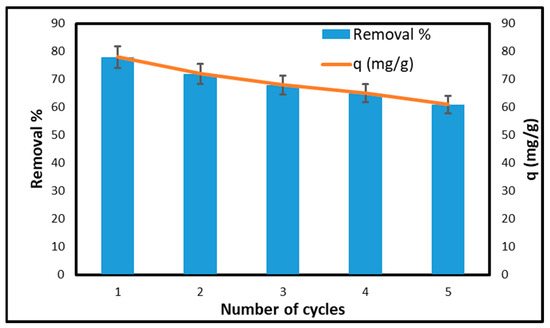
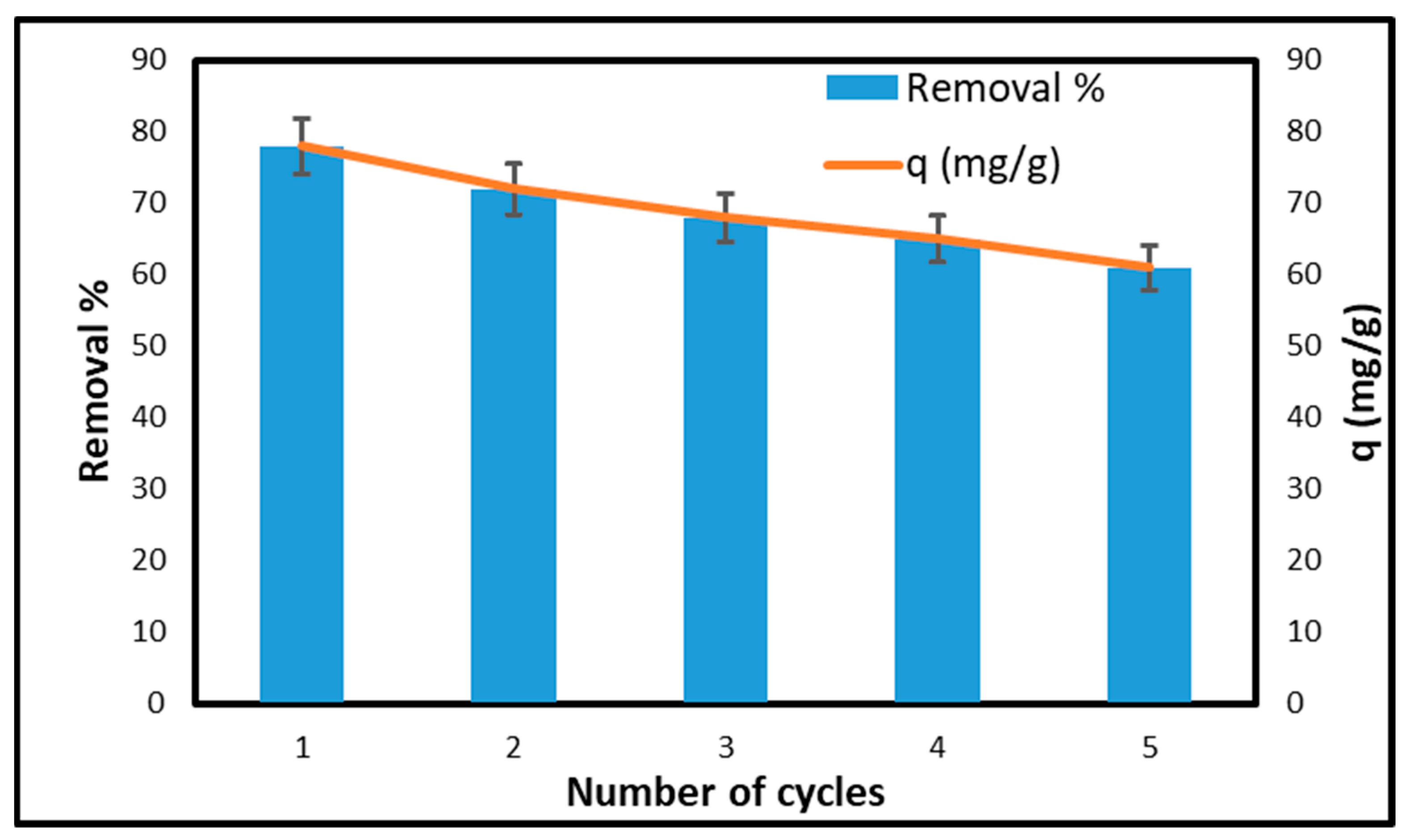
The reusability of functionalized CNC-PVA-ZnOFe beads was evaluated over multiple cycles using acid regeneration (Figure 12). The beads retained ~85% of their initial Cd removal efficiency after five cycles, demonstrating their stability and practical applicability. The slight decline in performance was attributed to minor structural degradation and incomplete desorption of Cd ions [22].
Figure 12.
Reusability of functionalized CNC-PVA-ZnOFe beads for coagulation and flocculation removal of Cd in contaminated water.
4. Conclusions
This research synthesized and assessed a new array of functionalized CNC-PVA-ZnO beads designed to improve the removal of cadmium ions from polluted water. Comprehensive spectroscopic and morphological analyses validated the sequential extraction, hydrolysis, and functionalization (carboxylation and amination) of cellulose nanocrystals obtained from sugarcane bagasse; thus identifying critical active sites for metal ion complexation. Incorporating these CNCs into a PVA matrix with ZnO/ZnOFe nanoparticles resulted in composite beads that exhibited enhanced strength, increased surface area, and multifunctionality. Furthermore, structural characterization confirmed the successful formation of functionalized CNC–PVA–ZnOFe hybrid beads. BET analysis, supported by SEM and TEM, revealed that the materials exhibit a macroporous architecture with inter-aggregate voids (pore diameters 12–52 nm) and remarkably low surface areas (1.2–3.3 m2/g) two to three orders of magnitude lower than typical adsorbents. This textural evidence suggests the removal mechanism is primarly dominated by coagulation and flocculation, rather than adsorption processes. The macroporous framework provides spaces for floc growth and physical entrapment of aggregated particles, while the limited surface area precludes adsorption-dominated removal. The functional groups (-COO-, -NH2) and ZnOFe hybrid contribute primarily to enhancing coagulation efficiency through charge neutralization, particle destabilization, and floc formation, with adsorption playing a supporting role by concentrating Cd2+ at nucleation sites.
The functionalized CNC-PVA-ZnOFe beads achieved 78% Cd2+ removal, outperforming conventional aluminum sulphate (69%). This enhanced performance is attributed to a coagulation-dominated mechanism (supported by textural evidence of low surface area) with adsorptive contributions from functional groups that enhance dispersion and provide nucleation sites for floc growth. The ZnOFe hybrid contributes through classical coagulation pathways’ charge neutralization, sweep flocculation, and bridging with the macroporous structure facilitating floc entrapment. These mechanistic interpretations, while consistent with all characterization and performance data, are inferred rather than directly demonstrated; direct validation through zeta potential, XPS, and Fe leaching studies remains an important direction for future research. While post-adsorption spectroscopic analysis (e.g., FTIR, XPS of spent beads) would provide direct evidence of these interactions, it is beyond the scope of this study and is recommended as a focus for future research. In addition, the optimization tests demonstrated that pH, coagulant dosage, and settling time are critical parameters influencing the removal process. A more detailed investigation of the surface charge properties, such as through zeta potential measurements to determine the point of zero charge (PZC), would provide definitive evidence for the electrostatic interactions inferred in this study and is an important direction for future work. The beads can be reused multiple times with minimal loss of efficacy after several regeneration cycles. This indicates their potential long-term utility in water treatment systems.
This work demonstrates the potential of functionalized CNC-PVA-ZnOFe beads for cadmium removal under controlled laboratory conditions using synthetic solutions. The composite material employs agricultural waste and incorporates multiple remediation mechanisms within a single platform. However, it is important to emphasize that all experiments were conducted in simplified synthetic systems, and performance in real wastewater matrices containing competing ions, organic matter, and variable water chemistry remains to be established. The material shows promise as a candidate for further development, but claims regarding practical applicability must be tempered until validated under environmentally relevant conditions. Future work must prioritize validation in real wastewater matrices alongside optimization of bead properties. Key priorities include: (1) systematic evaluation of competing ion effects on Cd2+ removal; (2) testing with actual industrial wastewater samples; (3) long-term continuous-flow column studies under realistic conditions; (4) assessment of mechanical durability and stability under shear; (5) optimization of regeneration protocols to improve long-term reusability; and (6) techno-economic analysis and life cycle assessment to establish practical feasibility. Only after such validation can the material be considered for real-world implementation.
Critical Assessment and Future Directions: While this work demonstrates the potential of functionalized CNC-PVA-ZnOFe beads for cadmium remediation, several important questions remain. Direct mechanistic validation through techniques such as zeta potential measurements, XPS analysis of spent beads, and Fe leaching quantification is needed to confirm the proposed adsorption–coagulation mechanisms and to distinguish between additive and truly synergistic effects. Future studies should also evaluate performance in real wastewater matrices, assess long-term stability in continuous-flow systems, optimize regeneration protocols, and conduct life cycle and cost analyses. Addressing these gaps will advance the fundamental understanding and practical applicability of this promising class of materials.
Author Contributions
Conceptualization, N.L.K.; Formal analysis, N.L.K. and N.M.; Investigation, N.L.K. and N.M.; Supervision, S.M.M., V.E. and T.E.M.; Writing—original draft, N.L.K.; Writing—review and editing, S.M.M. All authors have read and agreed to the published version of the manuscript.
Funding
This research was funded by Sibusiso Bhengu Development Grant, and the APC was funded by University of Zululand.
Data Availability Statement
The original contributions presented in this study are included in the article. Further inquiries can be directed at the corresponding author.
Conflicts of Interest
The authors declare no conflicts of interest.
References
- Ali, H.; Khan, E.; Ilahi, I. Environmental chemistry and ecotoxicology of hazardous heavy metals: Environmental persistence, toxicity, and bioaccumulation. J. Chem. 2019, 2019, 6730305. [Google Scholar] [CrossRef] [Scilit]
- Godt, J.; Scheidig, F.; Grosse-Siestrup, C.; Esche, V.; Brandenburg, P.; Reich, A.; Groneberg, D.A. The toxicity of cadmium and resulting hazards for human health. J. Occup. Med. Toxicol. 2006, 1, 22. [Google Scholar] [CrossRef] [Scilit]
- Gaddam, V.S.K.; Matli, C.S. Synthesis of a high-purity zeolite A from bagasse fly ash: Optimization, characterization, and application as a low-cost adsorbent for cadmium. Chem. Pap. 2025, 79, 3273–3289. [Google Scholar] [CrossRef] [Scilit]
- Purevjav, B.; Klein, B.; Chuluunbaatar, E.; Ganbat, G. Review of Recent Sustainable Water Technologies for Heavy Metal Removal. In Proceedings of the 3rd International Conference Resources and Technology (RESAT 2025), Ulaanbaatar, Mongolia, 19–20 June 2025; Springer Nature: Dordrecht, The Netherlands, 2026; p. 288. [Google Scholar]
- Pan, J.; Plant, J.A.; Voulvoulis, N.; Oates, C.J.; Ihlenfeld, C. Cadmium levels in Europe: Implications for human health. Environ. Geochem. Health 2010, 32, 1–12. [Google Scholar] [CrossRef] [Scilit] [PubMed]
- Fu, F.; Wang, Q. Removal of heavy metal ions from wastewaters: A review. J. Environ. Manag. 2011, 92, 407–418. [Google Scholar] [CrossRef] [Scilit] [PubMed]
- Aftab, R.A.; Yusuf, M.; Ahmad, F.; Danish, M.; Zaidi, S.; Vo, D.V.N.; Nguyen, A.-T.; Rahman, M.M.; Ibrahim, H. Green Technology Approach Towards the Removal of Heavy Metals, Dyes, and Phenols from Water Using Agro-based Adsorbents: A Review. Chem. Asian J. 2024, 19, e202400154. [Google Scholar] [CrossRef] [Scilit]
- Barzinjy, A.A. Zinc oxide NPs as solar photo-catalysis for water disinfection. Eurasian J. Sci. Eng. 2022, 8, 69–82. [Google Scholar] [CrossRef] [Scilit]
- Abdelhamid, H.N. Nanocellulose-Based Materials for Water Pollutant Removal: A Review. Int. J. Mol. Sci. 2024, 25, 8529. [Google Scholar] [CrossRef] [Scilit]
- Khumalo, N.L.; Mohomane, S.; Basson, A.K.; Motaung, T.E. Functional cellulose-based gels used in wastewater remediation, with a focus on heavy metals and dye removal: A critical review. Cellul. Chem. Technol 2025, 59, 665–682. [Google Scholar] [CrossRef]
- Khumalo, N.; Mohomane, S.; Linganiso, L.; Linganiso, E.; Songca, S.; Motaung, T. Effect of Acid Hydrolyses on Properties of Cellulosepoly Furfural Alchol Pfa Composites from Maize Stalk. Wood Res. 2023, 68, 96–111. [Google Scholar] [CrossRef] [Scilit]
- Khalil, H.A.; Davoudpour, Y.; Islam, M.N.; Mustapha, A.; Sudesh, K.; Dungani, R.; Jawaid, M. Production and modification of nanofibrillated cellulose using various mechanical processes: A review. Carbohydr. Polym. 2014, 99, 649–665. [Google Scholar] [CrossRef] [Scilit] [PubMed]
- Saito, T.; Kimura, S.; Nishiyama, Y.; Isogai, A. Cellulose nanofibers prepared by TEMPO-mediated oxidation of native cellulose. Biomacromolecules 2007, 8, 2485–2491. [Google Scholar] [CrossRef] [Scilit] [PubMed]
- Jing, S.; Wu, L.; Siciliano, A.P.; Chen, C.; Li, T.; Hu, L. The critical roles of water in the processing, structure, and properties of nanocellulose. ACS Nano 2023, 17, 22196–22226. [Google Scholar] [CrossRef] [Scilit] [PubMed]
- Claude, B.J.; Masindi, V.; Sibali, L.L. Predictive removal of nickel (II) from wastewater onto cellulose nanocrystal nanocomposite using deep machine learning. J. Environ. Sci. Health Part A 2025, 60, 430–444. [Google Scholar] [CrossRef] [Scilit]
- Liu, Y.; Lou, Z.; Sun, Y.; Zhou, X.; Baig, S.A.; Xu, X. Influence of complexing agent on the removal of Pb (II) from aqueous solutions by modified mesoporous SiO2. Microporous Mesoporous Mater. 2017, 246, 1–13. [Google Scholar] [CrossRef] [Scilit]
- Stolyarchuk, N.V.; Tomina, V.V.; Mishra, B.; Tripathi, B.P.; Vaclavikova, M.; Dudarko, O.A.; Melnyk, I.V. Direct synthesis of efficient silica-based adsorbents carrying EDTA groups for the separation of Cu (II) and Ni (II) ions. Colloids Surf. A Physicochem. Eng. Asp. 2022, 650, 129538. [Google Scholar] [CrossRef] [Scilit]
- Ellebracht, N.C.; Jones, C.W. Amine functionalization of cellulose nanocrystals for acid–base organocatalysis: Surface chemistry, cross-linking, and solvent effects. Cellulose 2018, 25, 6495–6512. [Google Scholar] [CrossRef] [Scilit]
- Lee, J.; Patel, R. Wastewater treatment by polymeric microspheres: A review. Polymers 2022, 14, 1890. [Google Scholar] [CrossRef] [Scilit]
- Huang, S. Cellulose Nanocrystals Derived from Waste Textile for the Construction of Antibacterial Packaging Materials. Ph.D. Thesis, McGill University, Montréal, QC, Canada, 2022. [Google Scholar]
- Heris, S.Z.; Etemadi, M.; Mousavi, S.B.; Mohammadpourfard, M.; Ramavandi, B. Preparation and characterizations of TiO2/ZnO nanohybrid and its application in photocatalytic degradation of tetracycline in wastewater. J. Photochem. Photobiol. A Chem. 2023, 443, 114893. [Google Scholar] [CrossRef] [Scilit]
- Ndagijimana, P.; Rong, H.; Duan, L.; Li, S.; Nkinahamira, F.; Hakizimana, J.C.; Kumar, A.; Aborisade, M.A.; Ndokoye, P.; Cui, B.; et al. Synthesis and evaluation of a novel cross-linked biochar/ferric chloride hybrid material for integrated coagulation and adsorption of turbidity and humic acid from synthetic wastewater: Implications for sludge valorisation. Environ. Res. 2024, 255, 119134. [Google Scholar] [CrossRef] [Scilit]
- Arrisujaya, D.; Yulizar, Y.; Saefumillah, A. Accelerated Water Purification with Magnetite (Iron (II, III) Oxide) Nanoparticles: Coagulation Applications. J. Chem. Rev. 2025, 7, 25–62. [Google Scholar]
- Wang, L.K.; Wang, M.-H.S.; Shammas, N.K.; Hahn, H.H. Physicochemical treatment consisting of chemical coagulation, precipitation, sedimentation, and flotation. Integr. Nat. Resour. Res. 2021, 22, 265–397. [Google Scholar]
- Aragaw, T.A.; Bogale, F.M. Role of coagulation/flocculation as a pretreatment option to reduce colloidal/bio-colloidal fouling in tertiary filtration of textile wastewater: A review and future outlooks. Front. Environ. Sci. 2023, 11, 1142227. [Google Scholar]
- Bakr, M.M.; Wang, Y.; Hao, P.; Dawoud, M.; Peng, L.; Wang, Y. Biochar from Al (OH) 3-activated sugarcane bagasse for efficient removal of cadmium: Optimization using the response surface method (RSM). Biomass Convers. Biorefinery 2025, 15, 19487–19504. [Google Scholar] [CrossRef] [Scilit]
- El Ouadrhiri, F.; Saleh, E.A.M.; Lahkimi, A. From mineral salts to smart hybrids: Coagulation–flocculation at the nexus of water, energy, and resources—A critical review. Processes 2025, 13, 3405. [Google Scholar]
- Kurniawan, S.B.; Abdullah, S.R.S.; Imron, M.F.; Said, N.S.M.; Ismail, N.I.; Hasan, H.A.; Othman, A.R.; Purwanti, I.F. Challenges and opportunities of biocoagulant/bioflocculant application for drinking water and wastewater treatment and its potential for sludge recovery. Int. J. Environ. Res. Public Health 2020, 17, 9312. [Google Scholar] [CrossRef] [Scilit] [PubMed]
- Cui, H.; Huang, X.; Yu, Z.; Chen, P.; Cao, X. Application progress of enhanced coagulation in water treatment. RSC Adv. 2020, 10, 20231–20244. [Google Scholar] [CrossRef] [Scilit]
- Tan, G.; Xiao, D. Adsorption of cadmium ion from aqueous solution by ground wheat stems. J. Hazard. Mater. 2009, 164, 1359–1363. [Google Scholar] [CrossRef] [Scilit]
- Park, S.; Baker, J.O.; Himmel, M.E.; Parilla, P.A.; Johnson, D.K. Cellulose crystallinity index: Measurement techniques and their impact on interpreting cellulase performance. Biotechnol. Biofuels 2010, 3, 10. [Google Scholar] [CrossRef] [Scilit]
- Ji, H.; Xiang, Z.; Qi, H.; Han, T.; Pranovich, A.; Song, T. Strategy towards one-step preparation of carboxylic cellulose nanocrystals and nanofibrils with high yield, carboxylation and highly stable dispersibility using innocuous citric acid. Green Chem. 2019, 21, 1956–1964. [Google Scholar] [CrossRef] [Scilit]
- Yang, X.; Han, F.; Xu, C.; Jiang, S.; Huang, L.; Liu, L.; Xia, Z. Effects of preparation methods on the morphology and properties of nanocellulose (NC) extracted from corn husk. Ind. Crops Prod. 2017, 109, 241–247. [Google Scholar]
- Pan, M.; Zhou, X.; Chen, M. Cellulose nanowhiskers isolation and properties from acid hydrolysis combined with high pressure homogenization. BioResources 2013, 8, 933–943. [Google Scholar]
- Hasanpour, M.; Motahari, S.; Jing, D.; Hatami, M. Investigation of the different morphologies of zinc oxide (ZnO) in cellulose/ZnO hybrid aerogel on the photocatalytic degradation efficiency of methyl orange. Top. Catal. 2021, 67, 1334–1347. [Google Scholar]
- Khumalo, N.L.; Mohomane, S.M.; Malevu, T.D.; Motloung, S.V.; Koao, L.F.; Motaung, T.E. Effect of Acid Concentration on Structural, Thermal, and Morphological Properties of Cellulose Nanocrystals from Sugarcane Bagasse and Their Reinforcement in Poly (Furfuryl) Alcohol Composites. Crystals 2025, 15, 403. [Google Scholar] [CrossRef] [Scilit]
- Silva, T.A.L.; da Silva, A.C.; Pasquini, D. Synthesis and characterization of acid-activated carbon prepared from sugarcane bagasse for furfural production in aqueous media. Catalysts 2023, 13, 1372. [Google Scholar] [CrossRef] [Scilit]
- Khumalo, N.L.; Mohomane, S.M.; Elumalai, V.; Motaung, T.E. Fabrication of a Carboxylate Cellulose Nanocrysal-Silica-TiO2 Aerogel for Enhanced Photocatalytic Degradation of Methylene Blue. Materials 2025, 18, 4702. [Google Scholar]
- Rao, L.N.; Lakavat, M.; Gandi, S.; Sri, G.K. Extraction and characterization of cellulose from agricultural waste materials. Mater. Today Proc. 2023, 80, 2740–2743. [Google Scholar]
- Long, W.; Ouyang, H.; Hu, X.; Liu, M.; Zhang, X.; Feng, Y.; Wei, Y. State-of-art review on preparation, surface functionalization and biomedical applications of cellulose nanocrystals-based materials. Int. J. Biol. Macromol. 2021, 186, 591–615. [Google Scholar]
- Thomas, B.; Raj, M.C.; Joy, J.; Moores, A.; Drisko, G.L.; Sanchez, C. Nanocellulose, a versatile green platform: From biosources to materials and their applications. Chem. Rev. 2018, 118, 11575–11625. [Google Scholar] [CrossRef] [Scilit]
- Ibrahim, M.M.; El-Zawawy, W.K.; Nassar, M.A. Synthesis and characterization of polyvinyl alcohol/nanospherical cellulose particle films. Carbohydr. Polym. 2010, 79, 694–699. [Google Scholar] [CrossRef] [Scilit]
- Mandal, A.K.; Katuwal, S.; Tettey, F.; Gupta, A.; Bhattarai, S.; Jaisi, S.; Bhandari, D.P.; Shah, A.K.; Bhattarai, N.; Parajuli, N. Current research on zinc oxide nanoparticles: Synthesis, characterization, and biomedical applications. Nanomaterials 2022, 12, 3066. [Google Scholar] [CrossRef] [Scilit]
- Moezzi, A.; McDonagh, A.M.; Cortie, M.B. Zinc oxide particles: Synthesis, properties and applications. Chem. Eng. J. 2012, 185, 1–22. [Google Scholar] [CrossRef] [Scilit]
- George, J.; Kumar, R.; Sajeevkumar, V.A.; Ramana, K.V.; Rajamanickam, R.; Abhishek, V.; Nadanasabapathy, S. Hybrid HPMC nanocomposites containing bacterial cellulose nanocrystals and silver nanoparticles. Carbohydr. Polym. 2014, 105, 285–292. [Google Scholar] [CrossRef] [Scilit] [PubMed]
- Kargarzadeh, H.; Mariano, M.; Gopakumar, D.; Ahmad, I.; Thomas, S.; Dufresne, A.; Huang, J.; Lin, N. Advances in cellulose nanomaterials. Cellulose 2018, 25, 2151–2189. [Google Scholar] [CrossRef] [Scilit]
- Khumalo, N.; Mohomane, S.; Elumalai, V.; Motaung, T. Synthesis of a CCNC–Silica–Graphene Oxide Porous Monolith for Efficient Copper Ion Removal. Gels 2025, 11, 832. [Google Scholar] [CrossRef] [Scilit] [PubMed]
- Khumalo, N.; Mohomane, S.; Elumalai, V.; Motaung, T. Comparative Study of Functionalized Cellulose Nanocrystal–Silica Aerogels for Methylene Blue Adsorption. Polymers 2025, 17, 2983. [Google Scholar] [CrossRef] [Scilit]
- Huong, P.T.L.; Van Quang, N.; Huyen, N.T.; Huong, H.T.; Tuan, D.A.; Tran, M.T.; Tran, Q.V.; Bach, T.N.; Tu, N.; Dao, V.-D. Efficiency enhancement of photocatalytic activity under UV and visible light irradiation using ZnO/Fe3O4 heteronanostructures. Sol. Energy 2023, 249, 712–724. [Google Scholar] [CrossRef] [Scilit]
- Yang, H.; Yan, R.; Chen, H.; Lee, D.H.; Zheng, C. Characteristics of hemicellulose, cellulose and lignin pyrolysis. Fuel 2007, 86, 1781–1788. [Google Scholar] [CrossRef] [Scilit]
- González-Peña, M.M.; Curling, S.F.; Hale, M.D. On the effect of heat on the chemical composition and dimensions of thermally-modified wood. Polym. Degrad. Stab. 2009, 94, 2184–2193. [Google Scholar] [CrossRef] [Scilit]
- Khumalo, N.; Mohomane, S.; Motloung, S.V.; Koao, L.; Thembinkosi, M.D.; Motaung, T.E. Effect of H2SO4/HClO4 mixture on properties of sugarcane bagasse cellulose crystals. Wood Res. 2022, 67, 929–940. [Google Scholar] [CrossRef] [Scilit]
- Sun, J.; Sun, X.; Sun, R.; Su, Y. Fractional extraction and structural characterization of sugarcane bagasse hemicelluloses. Carbohydr. Polym. 2004, 56, 195–204. [Google Scholar] [CrossRef] [Scilit]
- Dufresne, A. Nanocellulose: A new ageless bionanomaterial. Mater. Today 2013, 16, 220–227. [Google Scholar] [CrossRef] [Scilit]
- Khumalo, N.L.; Mohomane, S.M.; Motaung, T.E. Effect of Acetylation on the Morphology and Thermal Properties of Maize Stalk Cellulose Nanocrystals: A Comparative Study of Green-Extracted CNC vs. Acid Hydrolysed Followed by Acetylation. Crystals 2024, 14, 636. [Google Scholar] [CrossRef] [Scilit]
- Roman, M.; Winter, W.T. Effect of sulfate groups from sulfuric acid hydrolysis on the thermal degradation behavior of bacterial cellulose. Biomacromolecules 2004, 5, 1671–1677. [Google Scholar] [CrossRef] [Scilit] [PubMed]
- Habibi, Y.; Lucia, L.A.; Rojas, O.J. Cellulose nanocrystals: Chemistry, self-assembly, and applications. Chem. Rev. 2010, 110, 3479–3500. [Google Scholar] [CrossRef] [Scilit]
- Ren, J.-X.; Zhu, J.-L.; Shi, S.-C.; Yin, M.-Q.; Huang, H.-D.; Li, Z.-M. In-situ structuring a robust cellulose hydrogel with ZnO/SiO2 heterojunctions for efficient photocatalytic degradation. Carbohydr. Polym. 2022, 296, 119957. [Google Scholar] [CrossRef] [Scilit]
- Deka, B.K.; Baishya, P.; Maji, T.K. Synergistic effect of SiO2, ZnO and nanoclay on mechanical and thermal properties of wood polymer nanocomposite. J. Thermoplast. Compos. Mater. 2014, 27, 464–480. [Google Scholar] [CrossRef] [Scilit]
- Kostoglou, N.; Tzitzios, V.; Kontos, A.G.; Giannakopoulos, K.; Tampaxis, C.; Papavasiliou, A.; Charalambopoulou, G.; Steriotis, T.; Li, Y.; Liao, K.; et al. Synthesis of nanoporous graphene oxide adsorbents by freeze-drying or microwave radiation: Characterization and hydrogen storage properties. Int. J. Hydrogen Energy 2015, 40, 6844–6852. [Google Scholar] [CrossRef] [Scilit]
- Zhao, Y.; Zhong, K.; Liu, W.; Cui, S.; Zhong, Y.; Jiang, S. Preparation and oil adsorption properties of hydrophobic microcrystalline cellulose aerogel. Cellulose 2020, 27, 7663–7675. [Google Scholar] [CrossRef] [Scilit]
- Huang, X.; Zhao, Y.-P.; Wang, X.; Pan, L. Adsorption-induced pore blocking and its mechanisms in nanoporous shale due to interactions with supercritical CO2. J. Pet. Sci. Eng. 2019, 178, 74–81. [Google Scholar] [CrossRef] [Scilit]
- Rigoletto, M.; Calza, P.; Gaggero, E.; Laurenti, E. Hybrid materials for the removal of emerging pollutants in water: Classification, synthesis, and properties. Chem. Eng. J. Adv. 2022, 10, 100252. [Google Scholar] [CrossRef] [Scilit]

Disclaimer/Publisher’s Note: The statements, opinions and data contained in all publications are solely those of the individual author(s) and contributor(s) and not of MDPI and/or the editor(s). MDPI and/or the editor(s) disclaim responsibility for any injury to people or property resulting from any ideas, methods, instructions or products referred to in the content. |
© 2026 by the authors. Licensee MDPI, Basel, Switzerland. This article is an open access article distributed under the terms and conditions of the Creative Commons Attribution (CC BY) license.