


Abstract
In this work, the AgVO3/BiOBr heterojunction was constructed by a two-step hydrothermal method using two-dimensional BiOBr and one-dimensional AgVO3 as building blocks. The samples were characterized by XRD, SEM, EDS, and mapping. Their photocatalytic performance was evaluated by the degradation of ciprofloxacin (CIP) and Lanasol Red 5B (LR5B) under simulated sunlight irradiation. The AgVO3/BiOBr heterojunction exhibited significantly enhanced photocatalytic activity compared with pristine AgVO3 and BiOBr. The optimized AB-15 heterojunction achieved 63% degradation of CIP within 100 min, which was 1.47 times higher than that of pristine BiOBr. For LR5B, the AB-15 heterojunction achieved 99% degradation within 50 min, with a pseudo-first-order rate constant of 0.0489 min−1, which was 1.59 and 5.75 times higher than those of pristine BiOBr and AgVO3, respectively. The improved photocatalytic performance of the optimized AgVO3/BiOBr heterojunction originated from the combined contributions of efficient separation and migration of photogenerated charge carriers and strengthened light absorption. In addition, radical-trapping tests revealed that both h+ and •O2− were the primary reactive species. Moreover, the effects of catalyst dosage and coexisting ions on the degradation process were systematically investigated. The results demonstrated that high concentrations of Cu2+ and PO43− significantly inhibited the photocatalytic degradation, whereas Cl− had a negligible effect. This study provides a feasible strategy for constructing efficient heterojunction photocatalysts for wastewater treatment.
1. Introduction
Industrial wastewater frequently contains both synthetic dyes and antibiotics, whose coexistence complicates conventional biological treatment. In this work, Lanasol Red 5B (LR5B) and ciprofloxacin (CIP) were therefore selected as representative dye and antibiotic pollutants, respectively, to evaluate the proposed photocatalyst under realistic mixed-pollutant conditions [1]. Photocatalytic technology, as an emerging wastewater treatment method derived from advanced oxidation processes, has attracted extensive attention because of its advantages of no secondary pollution, thorough degradation of pollutants, mild reaction conditions, and relatively low cost [2]. The solar energy required for photocatalytic reactions is a clean and renewable resource, and the reactive species generated during photocatalysis, such as holes (h+), superoxide radicals (•O2−), and hydroxyl radicals (•OH), can completely degrade toxic and refractory pollutants into harmless small molecules [3]. Photocatalytic reactions also have the advantages of simple operation and convenient equipment, showing practical application potential [4]. Although TiO2 remains a benchmark photocatalyst, its wide band gap and fast charge recombination limit solar utilisation [5,6,7]. Therefore, structural modification of semiconductor catalysts or design of novel photocatalysts has become a new research direction.
Photocatalytic technology has gradually attracted worldwide attention because of its ability to completely degrade environmental pollutants, low cost, and relatively high stability [8]. Many materials can be used as photocatalysts, including TiO2, ZnO, SnO2, ZrO2, CdS, BiOBr, and other oxide or sulfide semiconductors [9,10,11,12]. Among them, BiOBr is one of the most popular nanophotocatalysts because of its strong catalytic oxidation ability, stable chemical properties, non-toxicity, and remarkable physical properties [13,14]. Heterogeneous photocatalytic oxidation technology has become a research trend because of its low energy consumption, simple operation, wide applicability, mild reaction conditions, and no secondary pollution [15]. However, it generally uses artificial light sources, which can effectively degrade organic pollutants but has limited practicality and high cost [16]. Therefore, the development and more effective utilization of solar energy are important research directions [17].
Designing nanoscale heterojunction composite semiconductor photocatalysts with large specific surface area is a current trend [18]. Recently, bismuth oxyhalides (BiOCl, BiOBr, BiOI) have attracted much attention [19,20]. BiOBr belongs to the layered bismuth oxyhalide family, in which [Bi2O2]2+ slabs alternate with Br− layers. This architecture favours charge separation, and the band gap decreases from BiOCl to BiOI (Cl > Br > I) [21,22]. BiOBr has a moderate bandgap and good response in the visible-light region, showing great potential in photocatalysis [23,24]. However, several intrinsic limitations restrict the use of BiOBr, such as poor solar light absorption and the fast recombination of photogenerated electron–hole pairs [25,26]. To address these limitations and boost photocatalytic performance, extensive efforts have been devoted to modifying BiOBr with the aim of improving charge transfer efficiency and inhibiting electron–hole recombination [27,28]. In particular, constructing heterojunctions with metal oxide semiconductors has proven effective in overcoming the aforementioned issues [29,30]. A BiOBr/ZnFe2O4 composite reported by Zhang et al. reached 99.2% tetracycline degradation, although the contribution of interfacial charge transfer was not resolved [31]. Similarly, a ternary BiOBr/BiOCl/g-C3N5 system achieved 86% degradation within 60 min, but its performance under real water matrices remains untested [32].
Silver metavanadate (AgVO3) is a visible-light-active one-dimensional vanadate that is stable under illumination and has been widely coupled with other semiconductors to suppress charge recombination [33]. As a novel one-dimensional functional material that has emerged in recent years, silver vanadate possesses good electrochemical, optical, and catalytic properties, as well as favorable heterojunction composite effects, showing broad application prospects in lithium-ion batteries, photocatalysis, sensors, and other fields. In the field of energy storage, β-AgVO3@PPy nanowires have been investigated as anode materials for lithium-ion batteries, where the polypyrrole coating improved electronic conductivity and cycling stability [34]. In photocatalysis, AgVO3-based heterojunctions have been extensively studied. A Z-scheme Ag/AgVO3/carbon-rich g-C3N4 heterojunction achieved degradation rate constants for sulfamethiadiazole approximately 13 and 30 times higher than those of carbon-rich g-C3N4 and Ag/AgVO3, respectively [35]. An Ag-bridged Z-scheme AgVO3/Bi4Ti3O12 heterojunction exhibited superior photocatalytic degradation of tetracycline compared with pure Bi4Ti3O12 [36]. A 0D/2D AgVO3/TiO2 direct Z-scheme heterojunction showed CO production rates 20.97 times higher than pristine TiO2 nanosheets [37]. The AgVO3@rGO-Ag3PO4 heterojunction simultaneously degraded sulfamethoxazole while generating ammonia and hydrogen under visible light [38]. A magnetic AgVO3/rGO/CuFe2O4 hybrid catalyst improved both hydrogen evolution and 4-nitrophenol degradation [39]. An n-n heterojunction Bi2O2CO3/AgVO3 achieved 99.55% methylene blue degradation within 90 min, with rates 2.51 and 2.79 times higher than the individual components [40]. These studies demonstrate that constructing heterojunctions effectively addresses the intrinsic limitations of AgVO3, such as rapid charge recombination and photocorrosion.
Therefore, based on two-dimensional BiOBr, this project designed and constructed an AgVO3/BiOBr composite photocatalyst with unique morphology and high performance by coupling with AgVO3, and applied it to the treatment of water pollutants. AgVO3/BiOBr heterojunctions were synthesized by a two-step hydrothermal method, and the phase structure and morphology were systematically characterized. The oxidative degradation of antibiotic CIP and dye LR5B by AgVO3, BiOBr, and AgVO3/BiOBr heterojunctions under simulated sunlight was evaluated, and the effects of representative environmental factors on CIP degradation were studied.
2. Experiment
2.1. Chemicals
Bismuth nitrate pentahydrate (Bi(NO3)3·5H2O), silver nitrate (AgNO3, ≥99.8%), ammonium vanadate (NH4VO3) and potassium bromide (KBr), were purchased from Sinopharm Group Co., Ltd., Beijing, China. Isopropanol (IPA), disodium ethylenediaminetetraacetic acid (EDTA-2Na), 1,4-benzoquinone (BQ), Lanasol Red 5B (LR5B) and ciprofloxacin (CIP) were purchased from Aladdin Reagent Co., Ltd., Shanghai, China. All reagents were of analytical grade and used without further purification.
2.2. Preparation of BiOBr
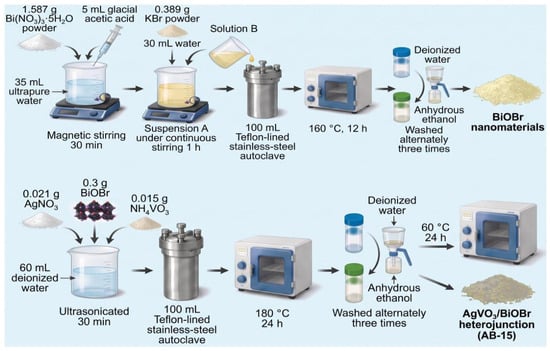
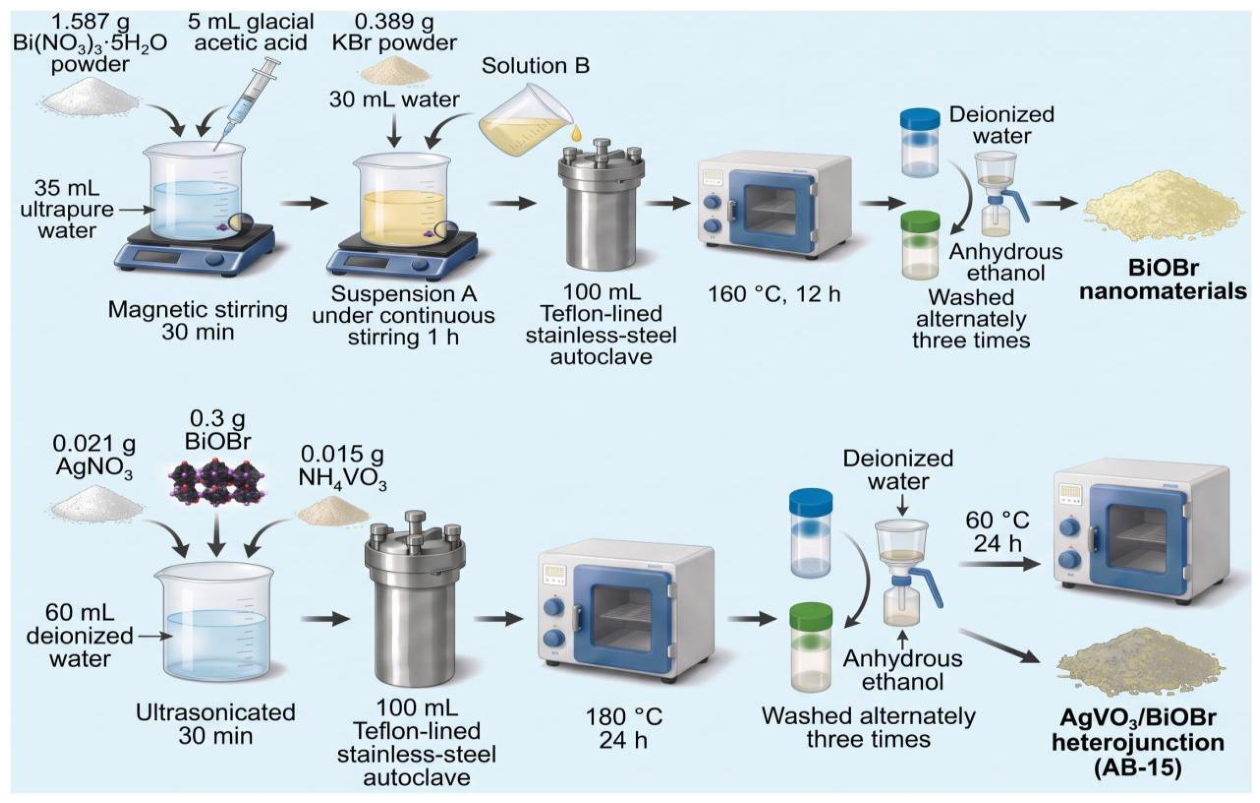
First, 1.587 g Bi(NO3)3·5H2O was dissolved in a mixed solution containing 35 mL ultrapure water and 5 mL glacial acetic acid to obtain suspension A. Then, 0.389 g KBr was dissolved in 30 mL water to obtain solution B. Under continuous stirring, solution B was added dropwise to solution A, and the mixture was stirred for about 1 h. Subsequently, the solution was transferred to a 100 mL Teflon-lined stainless-steel autoclave and kept at 160 °C for 12 h in a blast drying oven. The obtained heterojunction was washed three times with deionized water and anhydrous ethanol, respectively, and then dried in a vacuum drying oven at 60 °C for 24 h to obtain BiOBr nanomaterials.
2.3. Preparation of AgVO3/BiOBr Heterojunction
The formation of AgVO3/BiOBr heterostructure is depicted in Scheme 1, and the experimental details are given as follows. First, 0.021 g AgNO3 and 0.3 g BiOBr were dissolved in 60 mL deionized water. Then, 0.015 g NH4VO3 was added to the solution, and the mixture was ultrasonicated for 30 min. Subsequently, the suspension was transferred to a 100 mL Teflon-lined stainless-steel autoclave and kept at 180 °C for 24 h in a blast drying oven. The prepared heterojunction was washed three times with deionized water and anhydrous ethanol, respectively, and dried in a vacuum drying oven at 60 °C for 24 h to obtain AgVO3/BiOBr heterojunction nanomaterials with an AgVO3 mass fraction of 10%,15% and 20%, denoted as AB-10,AB-15 and AB-20.
Scheme 1.
The schematic diagram of synthesis of the AgVO3/BiOBr heterostructures.
2.4. Photocatalytic Performance
The photocatalytic degradation experiments of the heterojunction were carried out at room temperature using a 350 W xenon lamp as the light source. The photocatalytic activity for pollutant removal was detected under simulated sunlight. 40 mg catalyst was added to a quartz test tube containing 40 mL of 10 mg/L CIP (40 mg/L LR5B). Before the photocatalytic reaction, dark adsorption was carried out for 30 min to reach adsorption–desorption equilibrium between the photocatalyst and pollutant. Then, the light source was turned on and timing began. At certain intervals, 4 mL samples were taken. After filtration through a syringe and a 0.22 μm aqueous membrane, the absorbance was measured using a UV-Vis spectrophotometer (Shimadzu, Kyoto, Japan).
2.5. Characterisation
XRD patterns were recorded on a Bruker (Bruker AXS, Karlsruhe, Germany) D8 Advance diffractometer (Cu Kα, λ = 0.15406 nm) over 2θ = 10–80° at room temperature. XPS was performed on an ESCALAB 250Xi instrument (Thermo Fisher Scientific, Waltham, MA, USA), FESEM on an SU8010 microscope (Hitachi High-Tech, Tokyo, Japan), and UV-vis DRS on a Lambda 950 spectrophotometer (PerkinElmer, Waltham, MA, USA). Steady-state PL and fluorescence decay were measured at room temperature on an FP-6500 spectrofluorometer (JASCO, Tokyo, Japan) and an FLS980 time-domain spectrometer (Edinburgh Instruments, Livingston, UK), respectively.
3. Results and Discussion
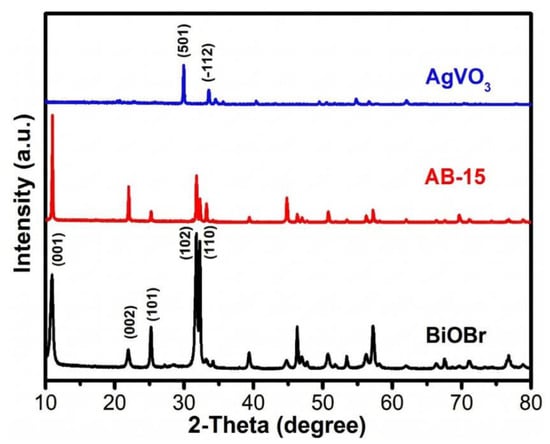
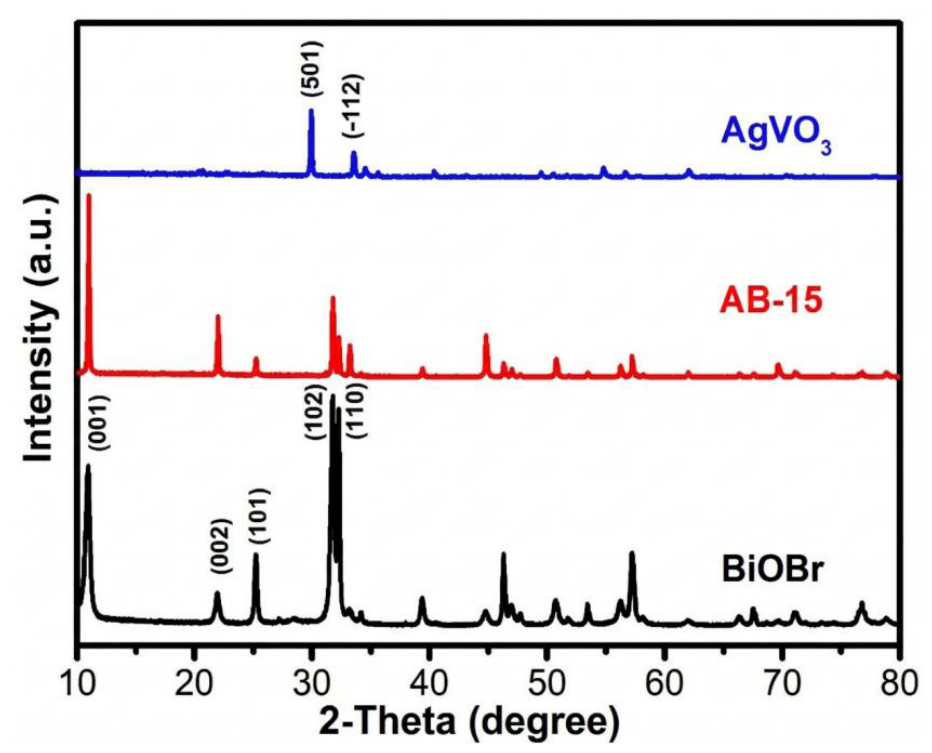
X-ray diffraction (XRD) was used to characterize the crystal structure and phase composition of the heterojunction samples. Figure 1 shows the XRD patterns of pristine BiOBr, pristine AgVO3, and AgVO3/BiOBr heterojunction. For the BiOBr pattern, the (001), (101), (102) and (110) reflections of tetragonal BiOBr (JCPDS 09-0393) appear at 10.9°, 25.2°, 31.7° and 32.2°, respectively, with unit cell parameters of a = b = 3.926 Å and c = 8.103 Å. For the AgVO3 pattern, typical (502) and (−112) peaks appear, which are completely consistent with the diffraction pattern of monoclinic β-AgVO3 (JCPDS No. 29-1154). The AgVO3/BiOBr heterostructure type is similar to that of BiOBr. The reduced crystallinity of BiOBr in the composites is likely to that the second hydrothermal step (180 °C, 24 h) promotes partial dissolution–recrystallization of the BiOBr surfaces, and the epitaxial/random attachment of AgVO3 nuclei on the BiOBr facets introduces interfacial strain and texture effects that broaden the diffraction peaks. For the composite, the characteristic peaks of AgVO3 did not appear in the pattern. This phenomenon may be attributed to the low loading amount of AgVO3 and its weak characteristic peaks.
Figure 1.
XRD patterns of pure BiOBr, AgVO3, and the AgVO3/BiOBr heterostructures.
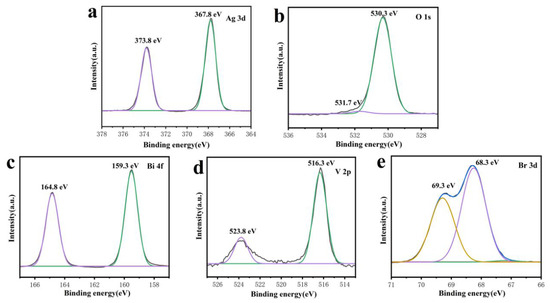
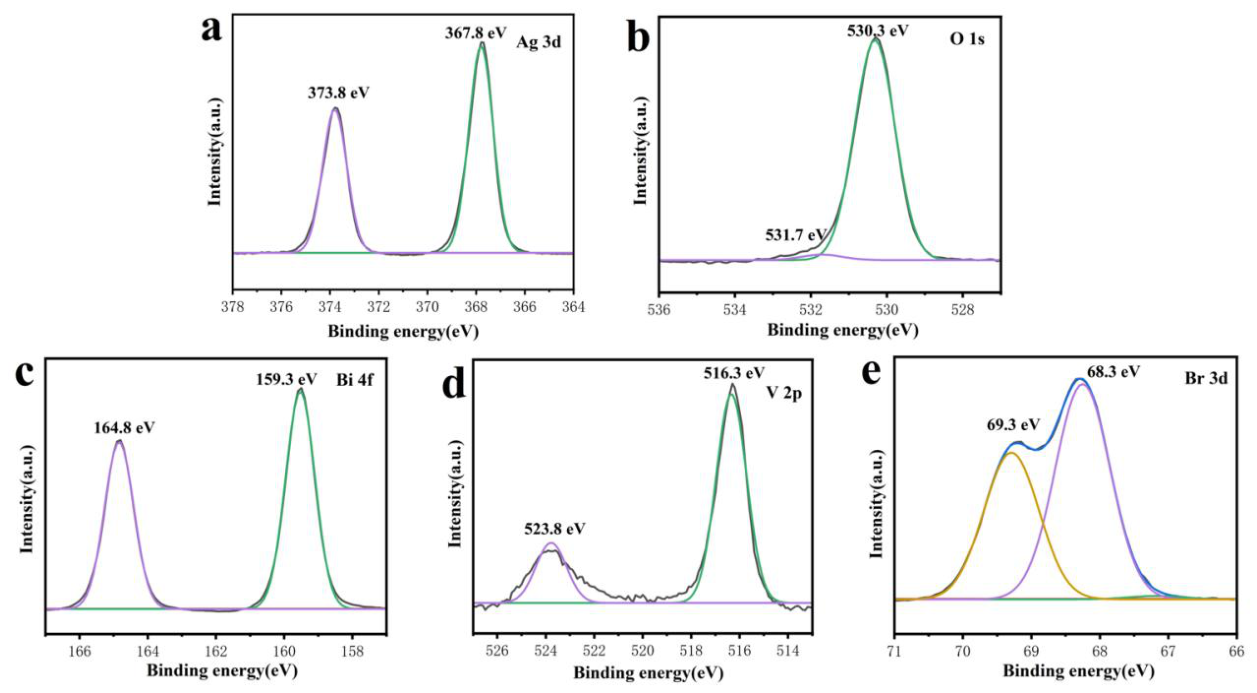
The chemical state and surface elemental composition of the AgVO3/BiOBr heterostructure were confirmed by XPS. Figure 2a shows the Ag 3d spectrum, displaying two peaks at 373.8 eV and 367.8 eV, which are attributed to Ag 3d3/2 and Ag 3d5/2 of Ag+, respectively [29]. In the O 1s spectrum (Figure 2b), the main peak at 530.3 eV corresponds to lattice oxygen, while the minor peak at 531.7 eV is associated with surface-adsorbed oxygen species [41]. The Bi 4f spectrum (Figure 2c) shows two peaks at 164.8 eV and 159.3 eV, assignable to Bi 4f5/2 and Bi 4f7/2 of Bi3+, respectively. In the V 2p spectra (Figure 2d), the peaks located at 523.8 eV and 516.3 eV are attributed to V 2p1/2 and V 2p3/2. Furthermore, the Br 3d spectrum (Figure 2e) exhibits two distinct peaks at 69.3 eV and 68.3 eV, corresponding to the Br 3d orbitals.
Figure 2.
XPS spectra of the AB-15 heterojunction: (a) Ag 3d spectrum, (b) O 1s spectrum, (c) Bi 4f spectrum, (d) V 2p spectrum and (e) Br 3d spectrum.
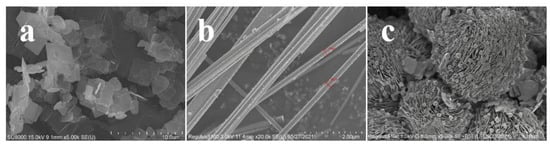
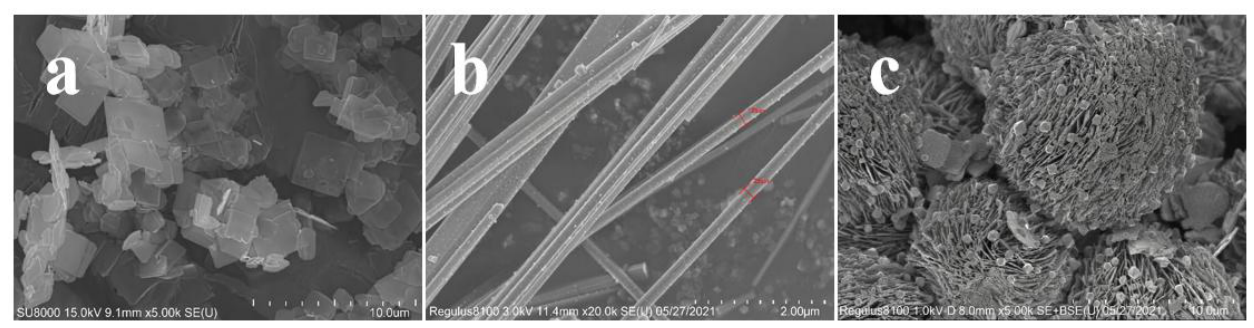
Figure 3 shows the SEM images of BiOBr, AgVO3, and AgVO3/BiOBr heterojunction. From Figure 3a, pristine BiOBr can be seen as a smooth sheet-like structure with a diameter of about 5 μm. Figure 3b shows that pristine AgVO3 exhibits a one-dimensional rod-like structure, and the width of the nanorods is about 190 nm. At the same time, granular AgVO3 structures that were not successfully assembled into nanorods were also observed. The AgVO3/BiOBr heterojunction (Figure 3c) is a flower-sphere structure self-assembled from nanosheets, and it is uniformly dispersed. A plausible explanation is that the formation of flower spheres may be due to the influence of AgVO3 crystal nuclei when AgVO3 nanorods are added, causing BiOBr nanosheets to form small nanosheets, which accumulate to form flower spheres. At the same time, BiOBr nanosheets also hinder the formation of AgVO3 nanorods, and granular AgVO3 is deposited on the surface of flower-sphere BiOBr.
Figure 3.
FE-SEM images of (a) BiOBr, (b) AgVO3, and (c) AgVO3/BiOBr heterojunction.
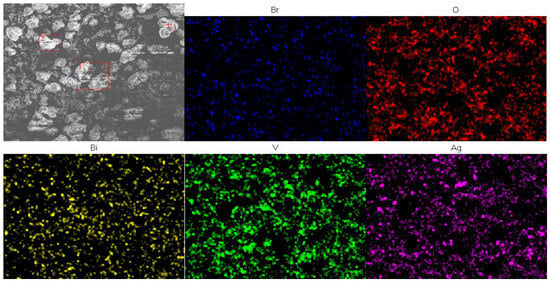
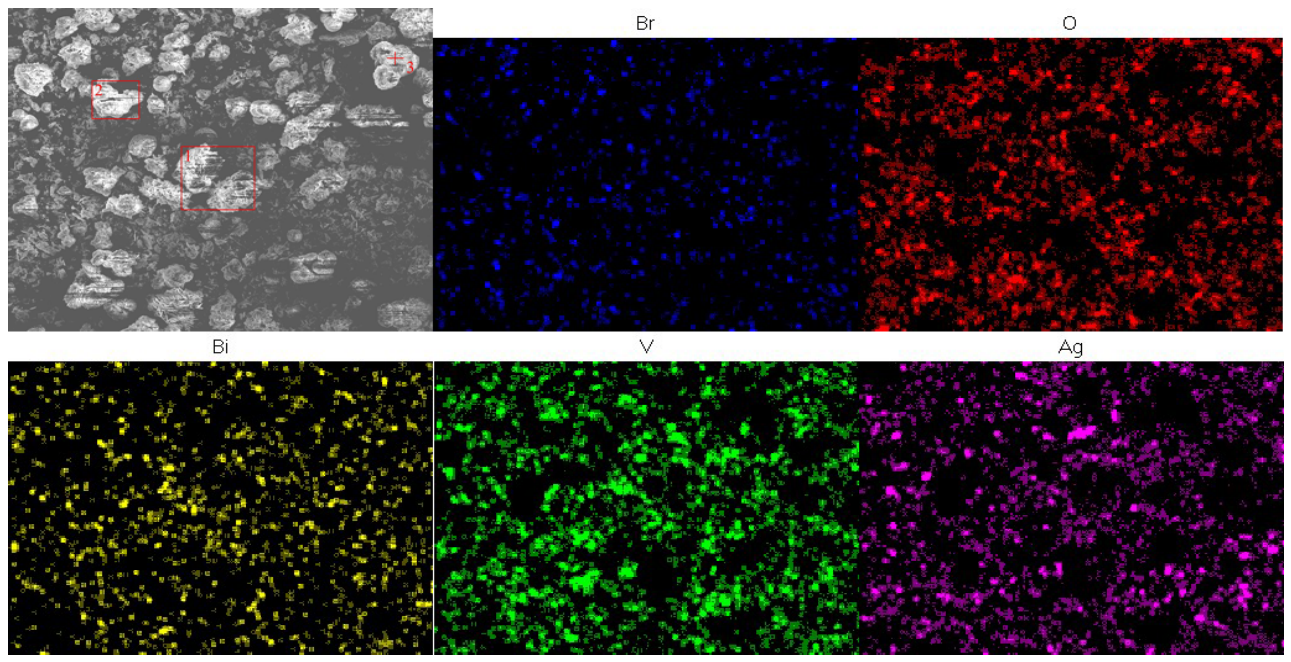
Figure 4 shows the mapping images of AB-15 heterojunction, indicating that the five elements Br, Bi, O, V, and Ag are uniformly distributed on the surface of the heterojunction, confirming the composition of the AB-15 heterojunction and being consistent with the XRD results.
Figure 4.
SEM-EDS elemental mapping of AgVO3/BiOBr heterojunction.
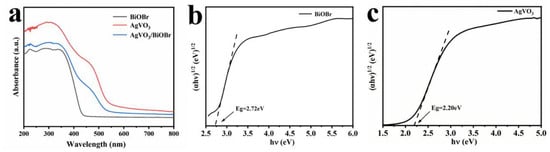
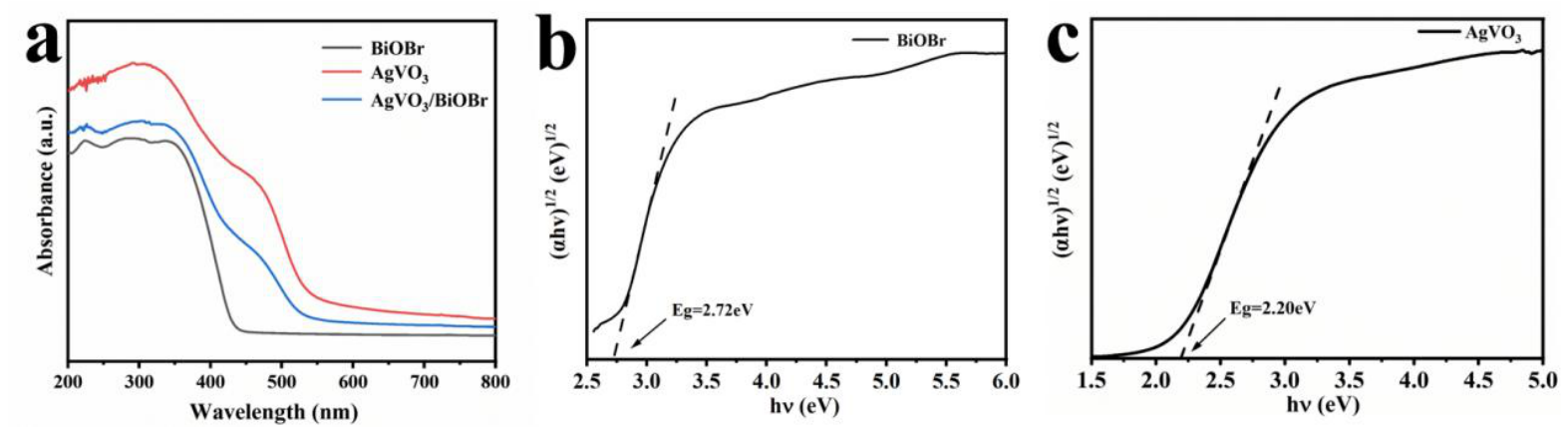
UV-vis DRS was often used to characterize the optical absorption capacity of semiconductor materials. Figure 5a shows the spectrum of the synthesized material in the range of 200 nm to 800 nm. The absorption edge of pristine BiOBr was approximately 430 nm. Compared to BiOBr, the light absorption of the AgVO3/BiOBr heterojunction (AB-15) underwent a redshift with an absorption edge extending to about 520 nm, and the AgVO3 sample exhibited strong absorption across the visible region. The experimental results indicated that the coupling of AgVO3 effectively enhanced the light absorption ability of the heterojunction, which helped to improve photocatalytic performance. The band gap could be calculated from the classic Tauc approach through the equation αhν=A(hν − Eg)n/2, where α, h, ν, A, and Eg are the optical absorption coefficient, Planck constant, photon frequency, a constant and band gap, respectively. According to the fitted bandgap, the band gaps of BiOBr and AgVO3 were estimated to be 2.72 eV and 2.20 eV, respectively (Figure 5b,c). According to the fitted bandgap, the band gaps of BiOBr and AgVO3 were estimated to be 2.72 eV and 2.20 eV, respectively (Figure 5b,c). According to the valence-band values reported in the literature [23,42] and the relation ECB = EVB − Eg, the conduction-band edges of the two materials are derived as: BiOBr ECB = −0.61 eV and AgVO3 ECB = +0.26 eV.
Figure 5.
(a) UV-vis diffuse reflectance spectra of pristine BiOBr, pristine AgVO3 and the AgVO3/BiOBr (AB-15) heterojunction, band gap energy of (b) BiOBr and (c) AgVO3.
4. Photocatalytic Degradation Performance Analysis
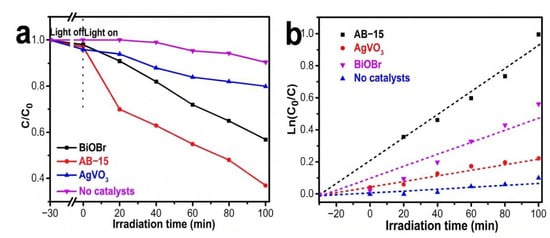
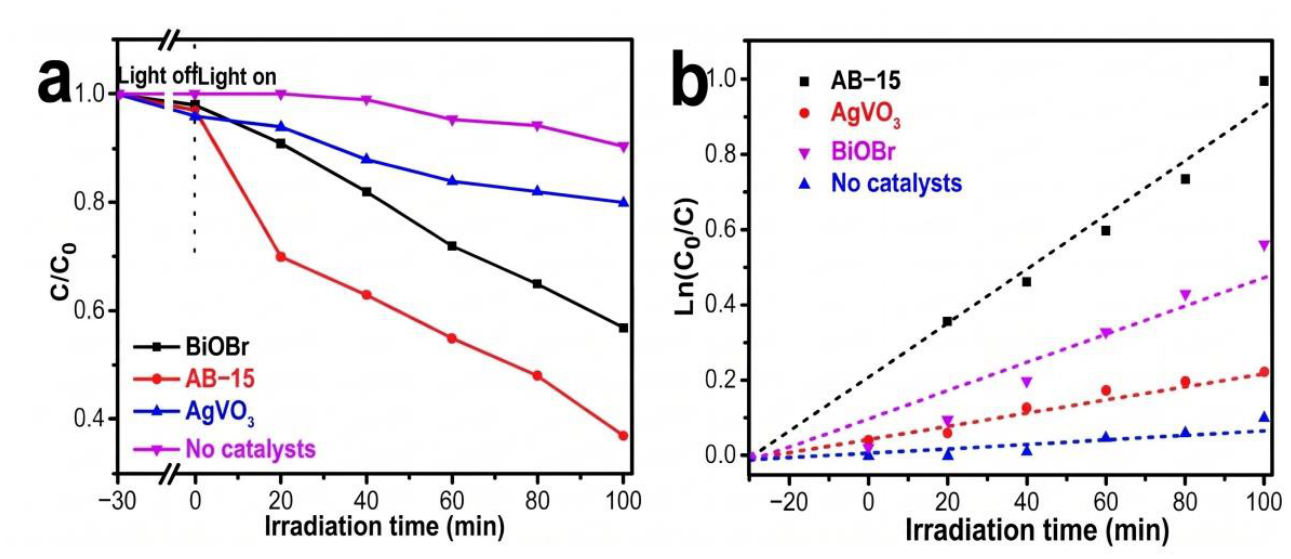
Ciprofloxacin (CIP) is a common antibiotic often found in wastewater and drinking water. It easily accumulates in the environment and organisms, causing surface water pollution and threatening human health. Therefore, CIP was selected as a pollutant model to evaluate the photocatalytic activity of the samples under simulated sunlight. First, the mixture of photocatalyst and CIP solution was fully stirred for 30 min in the dark to reach adsorption–desorption equilibrium. Unless otherwise stated, AB-15 was used as the representative composite because it exhibited the highest apparent activity among AB-10, AB-15 and AB-20 (Figure S1). As shown in Figure 6a, the control experiment showed that CIP hardly degraded under simulated sunlight without catalyst. The degradation rates of CIP by BiOBr and AgVO3 after 100 min of illumination were only 43% and 20%, respectively. Under the same conditions, the AB-15 heterojunction exhibited the strongest photocatalytic activity, with a CIP degradation rate of nearly 63%, which is consistent with the quenched PL and the red-shifted absorption edge of AB-15, both of which point to suppressed recombination at the BiOBr/AgVO3 interface. At low loading (AB-10), there is too little AgVO3 to form a continuous intimate interface, so the visible-light absorption is only marginally extended and few effective heterojunctions are available for charge separation, giving the lowest activity. At intermediate loading (AB-15), a well-distributed heterointerface is formed, as shown by the co-localized Ag/V signals on the BiOBr surface (Figure 4) and the anchored AgVO3 particles (Figure 3c), which produces the largest extension of light absorption (edge ca. 520 nm, Figure 5a) and the most effective suppression of recombination, accounting for its highest activity. At high loading (AB-20), the benefit saturates and detrimental effects dominate: excess AgVO3 shields BiOBr from incident light, blocks surface sites for pollutant adsorption, and introduces additional recombination centres, so the activity decreases relative to AB-15. The photocatalytic degradation results were fitted with reaction kinetics to quantitatively compare the catalytic activities of the samples. The results are shown in Figure 6b. The experiment conforms to the first-order kinetic model: ln(C0/Ci) = kt. The fitted kinetic constant k of the AB-15 heterojunction was 0.0078 min−1, which was 1.69 and 4.33 times those of pristine BiOBr and AgVO3, respectively.
Figure 6.
(a) Photocatalytic degradation of CIP (10 mg/L, 40 mL, catalyst dosage 40 mg) by BiOBr, AgVO3, AB-15 and the no-catalyst control under simulated sunlight. (b) The kinetic fit for the degradation of CIP using the as-prepared photocatalysts under simulated sunlight.
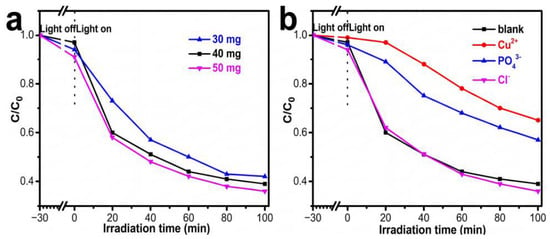
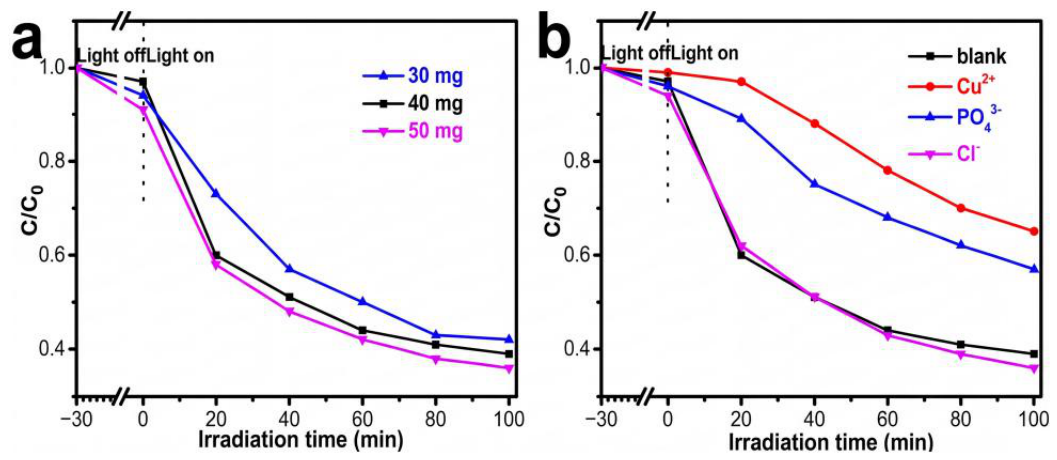
It is well known that in actual wastewater treatment, the catalyst dosage has a great influence on the photocatalytic degradation rate. The reaction system was 40 mL (10 mg/L) CIP solution (pH = 7). Figure 7a illustrates the effect of different catalyst dosages (30 mg, 40 mg, and 50 mg) on the photocatalytic degradation of CIP. The period from −30 to 0 min corresponds to the dark adsorption phase, during which all systems reached adsorption–desorption equilibrium. Upon light irradiation at 0 min, the C/C0 values of all three systems decreased with irradiation time, indicating the photocatalytic degradation of CIP. As shown in the figure, when the catalyst dosage increased from 30 mg to 40 mg, the degradation efficiency of CIP was further improved. Although the degradation efficiency reached its maximum (65%) at a dosage of 50 mg, the enhancement relative to that at 40 mg (63%) was marginal and levelled off. Considering that a further increase in dosage can induce severe light-shielding effects and particle aggregation, which significantly reduce the utilization efficiency per unit mass of the catalyst, 40 mg was selected as the standard catalyst dosage for subsequent experiments, taking into account both degradation performance and economic cost. Figure 7b shows the effect of adding different ions (PO43−, Cl−, and Cu2+) on the photocatalytic degradation of CIP. PO43−, Cl− and Cu2+ are selected because they are representative of (i) anions that act as hole scavengers (PO43−), (ii) the most abundant anion in natural waters (Cl−), and (iii) heavy-metal ions commonly co-existing with antibiotics in livestock wastewater (Cu2+). They are added as Na3PO4, NaCl and CuCl2·2H2O to give 1 mmol/L. The solution pH is measured before and after ion addition (7.0 ± 0.1 in all cases). No pH adjustment is made, so that the observed effects can be ascribed to the ions themselves rather than to pH. The results show that when PO43− was added, the photocatalytic degradation of CIP by the AB-15 heterojunction was severely inhibited. This is because PO43− directly consumes h+, inhibiting the photocatalytic degradation reaction. In addition, the degradation process of CIP was also seriously affected by Cu2+. This may be because Cu2+ distributed on the surface of AB-15 can be reduced by photogenerated electrons, consuming part of the photogenerated electrons and greatly limiting the generation of superoxide radicals, leading to decreased photocatalytic activity. Another possibility is that CIP or CIP intermediates combine with Cu2+ to form relatively stable metal complexes, hindering further decomposition of the degradation products. However, when Cl− was added, the photocatalytic degradation hardly changed, indicating that Cl− has no effect on the degradation reaction.
Figure 7.
(a) CIP degradation rate at different photocatalyst concentrations. (b) Effect of different ions on CIP degradation.
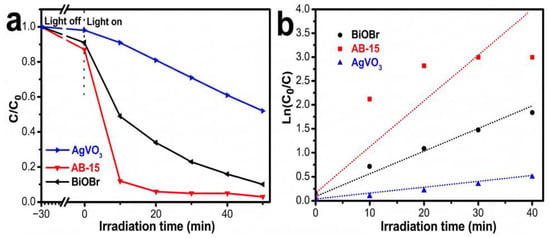
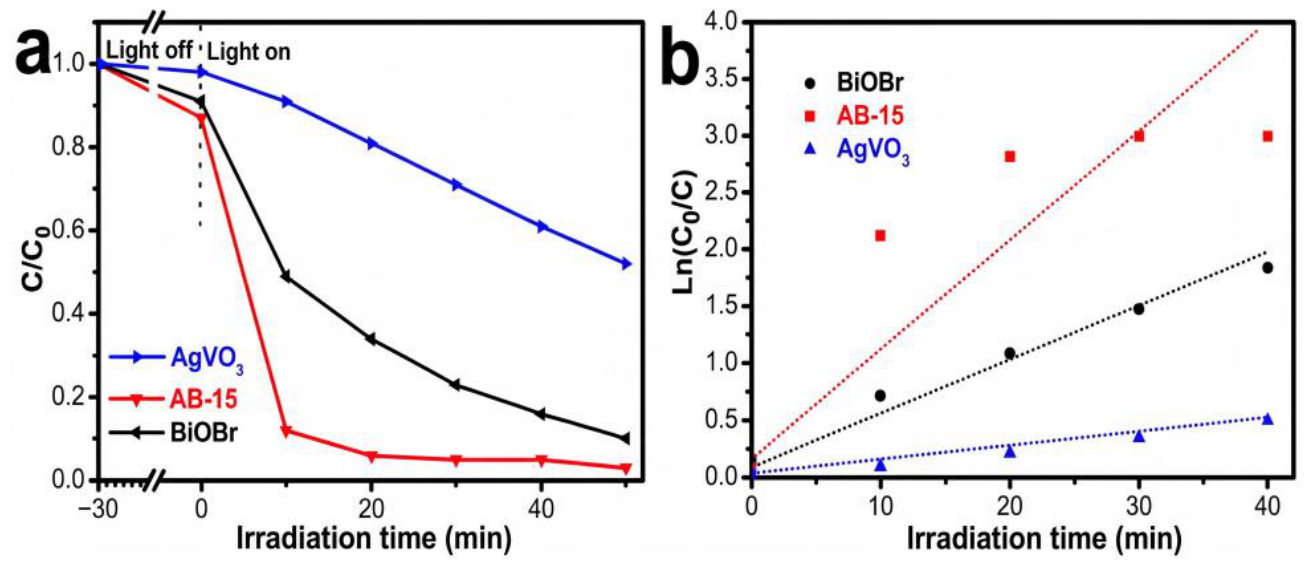
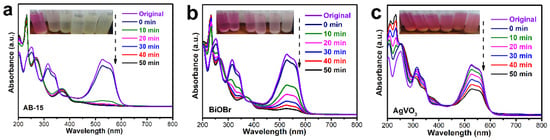
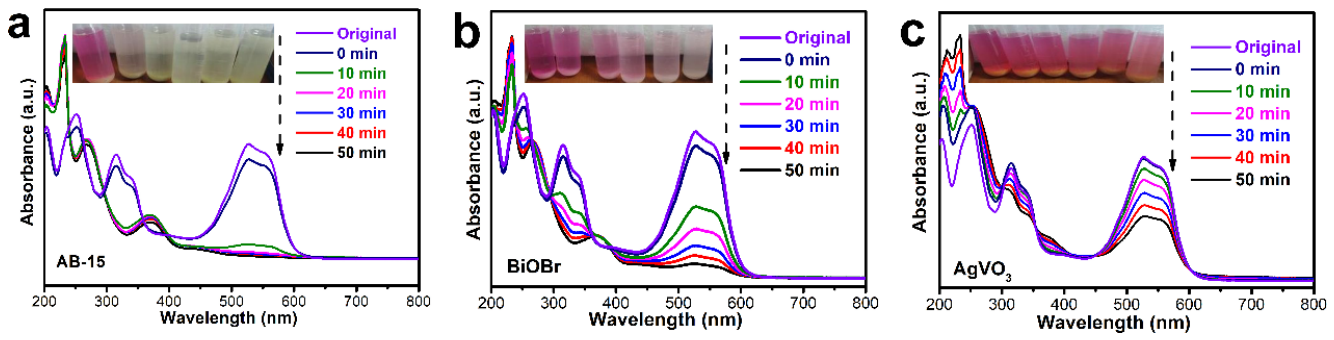
The photocatalytic performance of the samples was evaluated by the degradation of LR5B under simulated sunlight. As shown in Figure 8a, compared with pristine AgVO3 and BiOBr, the AB-15 heterojunction improved the degradation rate of LR5B, reaching 99% within 50 min. The interfacial contact between AgVO3 and BiOBr to form a heterojunction is the main reason for the improved photocatalytic activity, which promotes the separation of photogenerated electron–hole pairs and greatly improves light absorption. Figure 9a–c show the full-wavelength scanning spectra of LR5B degraded by the AB-15 heterojunction, BiOBr, and AgVO3 at different time intervals. It can be seen from the figures that at 528 nm, the characteristic absorption peak of LR5B gradually weakened, indicating that LR5B was gradually degraded. The pseudo-first-order kinetic equation ln(C0/Ct) = kt was used to simulate the degradation process of the photocatalysts, where Ct and C0 are the instantaneous concentration at reaction time t and the initial concentration of LR5B, respectively, and the rate constant is k. The fitted kinetic constant k of the AB-15 heterojunction was 0.0489 min−1, which was 1.59 and 5.75 times those of pristine BiOBr and AgVO3, respectively (Figure 8b).
Figure 8.
(a) Degradation effect of the synthesized samples on LR5B under simulated sunlight. (b) Pseudo-first-order kinetics simulation plot of the degradation reaction.
Figure 9.
Time-dependent UV–vis absorption spectra of LR5B degradation under simulated sunlight in the presence of (a) AB-15, (b) BiOBr and (c) AgVO3.
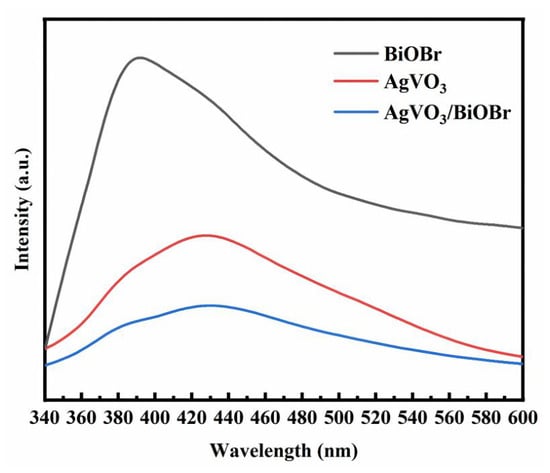
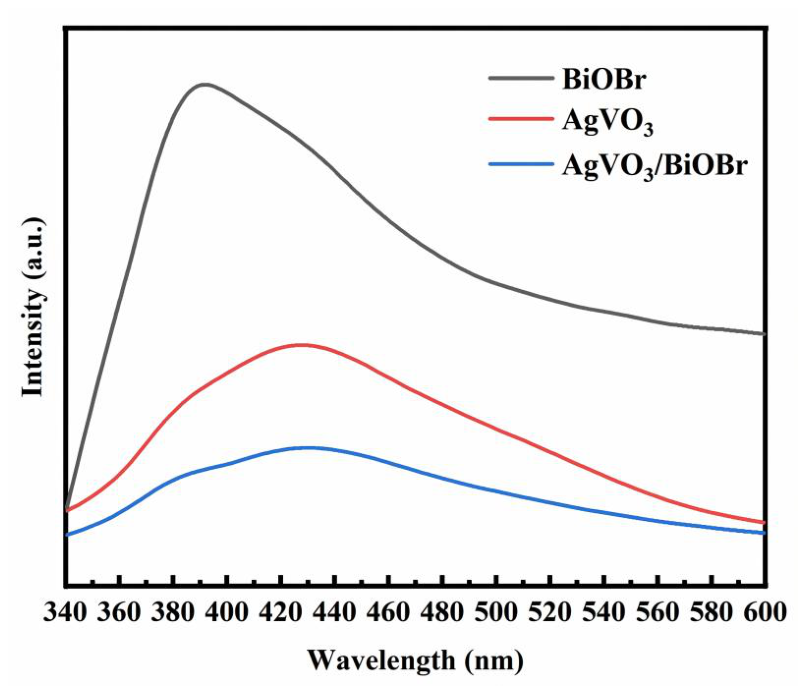
To investigate the separation and recombination efficiency of photogenerated electron-hole pairs, photoluminescence (PL) spectroscopy was performed. Figure 10 displays the PL spectra of pure BiOBr, pure AgVO3, and the AgVO3/BiOBr composite. As observed, all samples exhibit a prominent emission peak centered at approximately 400 nm, which is attributed to the radiative recombination of photogenerated charge carriers. Notably, the PL emission intensity follows the order: BiOBr > AgVO3 > AgVO3/BiOBr. Pure BiOBr exhibits the highest PL intensity, indicating a rapid recombination rate of photogenerated electron-hole pairs. In contrast, the AgVO3/BiOBr composite shows the lowest PL intensity among the three samples. This significant quenching of the PL signal suggests that the construction of the AgVO3/BiOBr heterojunction effectively facilitates the interfacial transfer of photogenerated electrons, thereby suppressing their recombination.
Figure 10.
PL spectra of the as-prepared samples.
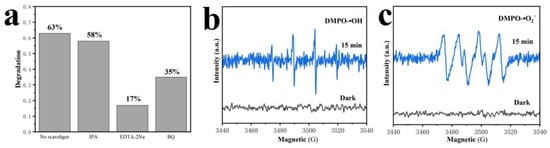
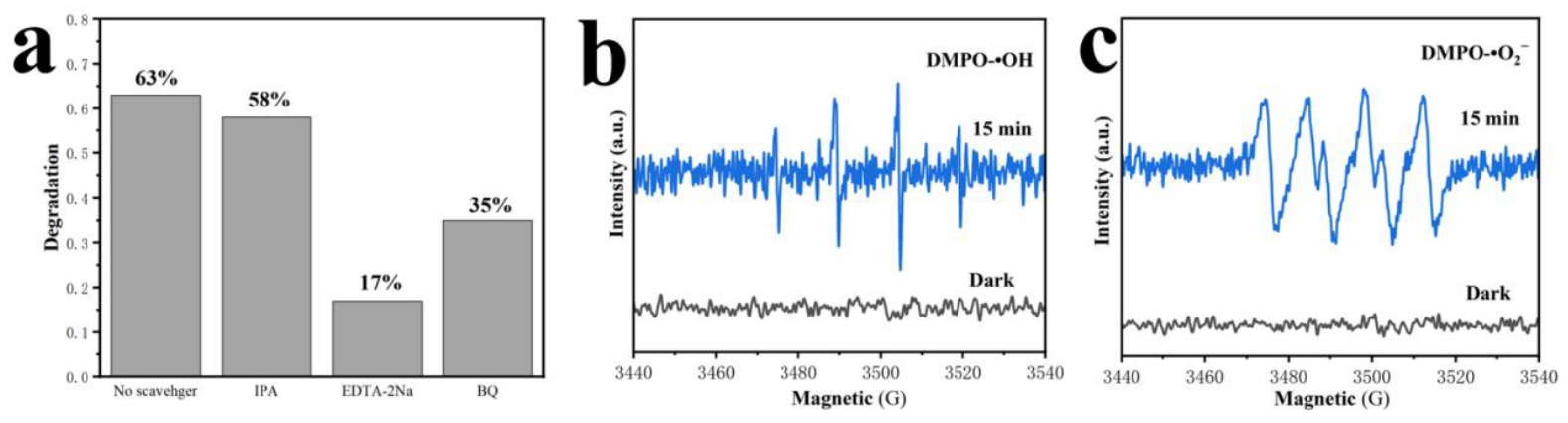
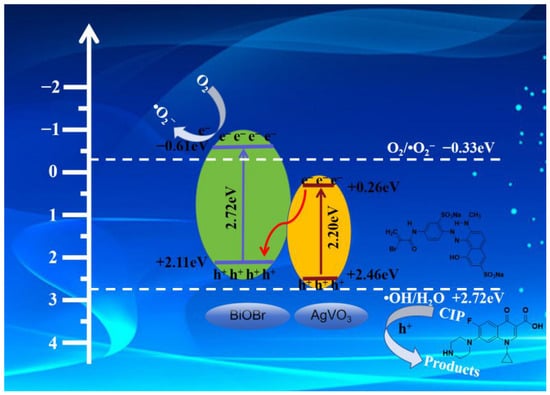
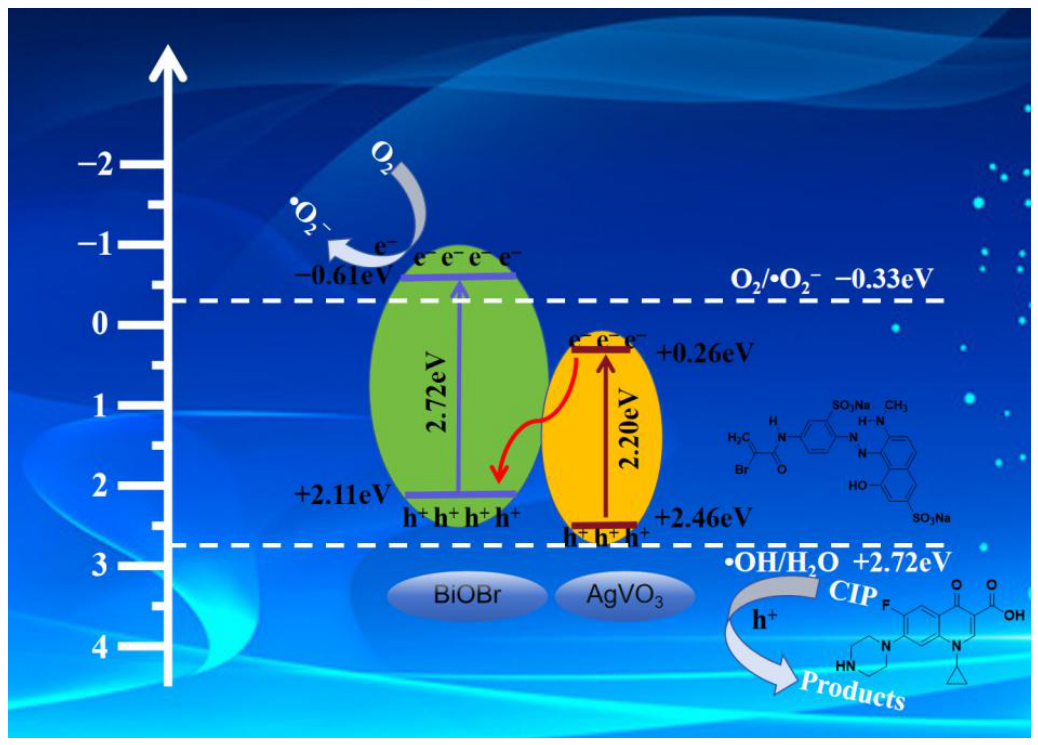
To further elucidate the photocatalytic mechanism and identify the dominant reactive species involved in the degradation process, radical trapping experiments were conducted using different scavengers. Isopropanol (IPA), disodium ethylenediaminetetraacetate (EDTA-2Na), and p-benzoquinone (BQ) were employed as scavengers for hydroxyl radicals (•OH), photogenerated holes (h+), and superoxide radicals (•O2−), respectively. As shown in Figure 11, the degradation efficiency of the pollutant without any scavenger was 63%. Upon the addition of IPA, the degradation efficiency exhibited a negligible decrease to 58%, indicating that •OH plays a minor role in the photocatalytic reaction. Conversely, the introduction of EDTA-2Na resulted in a dramatic suppression of the degradation rate, dropping sharply to 17%. This significant inhibition suggests that photogenerated holes (h+) are the predominant active species. Additionally, when BQ was added, the degradation efficiency decreased to 35%, implying that •O2− also participates in the degradation process to a moderate extent. Based on these results, it can be concluded that both h+ and •O2− are the primary reactive species responsible for the degradation of the target pollutant. To further verify the generation of these reactive species, electron spin resonance (ESR) measurements were performed. As shown in Figure 11b, no obvious characteristic peaks of DMPO-•OH were observed for the AB-15 suspension either in the dark or under irradiation, which is in good agreement with the trapping experiment result that •OH plays a negligible role. In contrast, the DMPO-•O2− adducts exhibited a distinct 1:1:1:1 characteristic quartet signal under irradiation, whereas the signal was almost invisible in the dark (Figure 11c). This confirms that •O2− is continuously generated during the photocatalytic process. The abundant generation of •O2− strongly supports the proposed direct Z-scheme mechanism, since the photogenerated electrons are retained on the more negative conduction band of BiOBr (−0.61 eV), which is thermodynamically capable of reducing O2 to •O2−.
Figure 11.
(a) Trapping experiments of active species during photodegradation of CIP in the presence of AB-15 under simulated sunlight. (b) DMPO-•OH and (c) DMPO-•O2− adducts on AB-15 under simulated sunlight.
Figure 12 illustrates the possible charge-transfer pathways in the AB-15 heterojunction under simulated sunlight. A conventional Type-II picture can be tested first against the band-edge positions. In such a picture, electrons would collect in the conduction band (CB) of AgVO3 and holes would migrate from the valence band (VB) of AgVO3 to that of BiOBr. The CB of AgVO3, however, lies at +0.26 eV, more positive than E0(O2/•O2−) (−0.33 eV vs. NHE), so O2 reduction to •O2− would be energetically forbidden at this site. This is incompatible with the radical-trapping result that •O2− is the dominant reactive species, and a Type-II scheme is therefore excluded. A Z-scheme pathway accounts for the same observations. Upon irradiation, both components generate electron–hole pairs; the CB electrons of BiOBr recombine with the VB holes of AgVO3 at the interface, leaving electrons in the CB of AgVO3 and holes in the VB of BiOBr. This interfacial recombination spatially separates the surviving carriers and suppresses their back-reaction. Because the CB of BiOBr (−0.61 eV) is more negative than E0(O2/•O2−) (−0.33 eV vs. NHE), the electrons retained on AgVO3—fed through the Z-scheme—can reduce dissolved O2 to •O2−, while the holes retained on BiOBr are sufficiently oxidizing to degrade LR5B and CIP directly. The combination of efficient charge separation and sustained generation of reactive species therefore accounts for the enhanced activity of the AgVO3/BiOBr composite.
Figure 12.
Proposed photocatalytic mechanism scheme of AB-15 toward CIP under simulated sunlight.
5. Conclusions
Based on the experimental results, the following conclusions can be drawn: the AgVO3/BiOBr heterojunction was successfully constructed by a two-step hydrothermal method, in which granular AgVO3 was deposited on flower-sphere BiOBr self-assembled from nanosheets, forming intimate interfacial contact. The AB-15 composite exhibited markedly enhanced photocatalytic activity under simulated sunlight, achieving 63% CIP degradation within 100 min with a rate constant 1.69 and 4.33 times those of pristine BiOBr and AgVO3, respectively, and 99% LR5B degradation within 50 min with a rate constant of 0.0489 min−1, which was 1.59 and 5.75 times higher than those of BiOBr and AgVO3. The improved performance stems directly from the complementary properties of the two components: the moderate band gap and strong oxidizing holes of BiOBr, together with the broad visible-light absorption and the electron-accepting CB of AgVO3, combine to give efficient charge separation and enhanced light utilization. Environmental factor studies revealed that high concentrations of Cu2+ and PO43− significantly suppressed CIP degradation, whereas Cl− had a negligible effect. This work demonstrates that constructing AgVO3/BiOBr heterojunctions is an effective strategy for overcoming the intrinsic limitations of BiOBr and provides a feasible route for the design of efficient visible-light photocatalysts for wastewater treatment.
Supplementary Materials
The following supporting information can be downloaded at https://www.mdpi.com/article/10.3390/cryst16120752/s1: Figure S1: Degradation efficiencies of CIP using the as-prepared photocatalysts under simulated sunlight. Figure S2. Photocatalytic reactor, Table S1. Molecular formulas and structures of several organic pollutions studied in this work.
Author Contributions
Conceptualization, W.D., S.F., H.Z. (Huijie Zhu) and Q.L.; Methodology, W.D., S.F. and H.Z. (Huijie Zhu); Software, S.W.; Formal analysis, W.D., S.F., Q.H., X.W. and Q.L.; Investigation, H.Z. (Huiyong Zhang), X.W., Z.M., M.W. and S.W.; Data curation, W.D., S.F., H.Z. (Huiyong Zhang) and M.W.; Writing—original draft, W.D.; Writing—review & editing, S.F. and H.Z. (Huijie Zhu); Visualization, Q.H. and Q.L.; Supervision, X.W.; Project administration, Z.M.; Funding acquisition, S.F. and Q.L. All authors have read and agreed to the published version of the manuscript.
Funding
This work was supported by the National Natural Science Foundation of China Youth Project (No. 12402430) and Key Scientific Research Project of Higher Education Institutions in Henan Province (No. 27B610004).
Data Availability Statement
The original contributions presented in this study are included in the article/Supplementary Material. Further inquiries can be directed to the corresponding author.
Conflicts of Interest
The authors declare no conflicts of interest.
References
- Samarasinghe, L.V.; Muthukumaran, S.; Baskaran, K. Recent advances in visible light-activated photocatalysts for degradation of dyes: A comprehensive review. Chemosphere 2023, 342, 140818. [Google Scholar] [CrossRef] [Scilit] [PubMed]
- Kumari, H.; Sonia; Suman; Ranga, R.; Chahal, S.; Devi, S.; Sharma, S.; Kumar, S.; Kumar, P.; Kumar, S.; et al. A Review on Photocatalysis Used For Wastewater Treatment: Dye Degradation. Water Air Soil Pollut. 2023, 234, 349. [Google Scholar] [CrossRef] [Scilit] [PubMed]
- Al Miad, A.; Saikat, S.P.; Alam, M.K.; Sahadat Hossain, M.; Bahadur, N.M.; Ahmed, S. Metal oxide-based photocatalysts for the efficient degradation of organic pollutants for a sustainable environment: A review. Nanoscale Adv. 2024, 6, 4781–4803. [Google Scholar] [CrossRef] [Scilit] [PubMed]
- Wang, H.; Li, X.; Zhao, X.; Li, C.; Song, X.; Zhang, P.; Huo, P. A review on heterogeneous photocatalysis for environmental remediation: From semiconductors to modification strategies. Chin. J. Catal. 2022, 43, 178–214. [Google Scholar] [CrossRef] [Scilit]
- Thuan, D.V.; Ngo, H.L.; Thi, H.P.; Chu, T.T.H. Photodegradation of hazardous organic pollutants using titanium oxides-based photocatalytic: A review. Environ. Res. 2023, 226, 115671. [Google Scholar] [CrossRef] [Scilit] [PubMed]
- Gao, Q.; Zhang, J.; Luo, H.; Sun, P.; Wen, J. Recent advances in visible-light modification strategies for titanium dioxide-based photocatalysts. Appl. Catal. A Gen. 2026, 685, 120235. [Google Scholar] [CrossRef] [Scilit]
- Shareef, M.; Batool, H.; Shehzadi, A.; Aftab, F.; Munir, A.; Manzoor, S.; Gohar, R.S.; Rehman, Z.; Ashiq, M.N.; Nazar, M.F. Structural functionalized TiO2-mediated photocatalysts as dye degradation agents: A systematic review. Mater. Res. Bull. 2026, 195, 113852. [Google Scholar] [CrossRef] [Scilit]
- Li, L.; Cai, J.; Yan, Y.; Zhao, F.; Zhou, J. Flower-like direct Z-scheme WS2/Bi2O2CO3 photocatalyst with enhanced photocatalytic activity. J. Alloys Compd. 2019, 810, 151872. [Google Scholar] [CrossRef] [Scilit]
- Sansenya, T.; Masri, N.; Chankhanittha, T.; Senasu, T.; Piriyanon, J.; Mukdasai, S.; Nanan, S. Hydrothermal synthesis of ZnO photocatalyst for detoxification of anionic azo dyes and antibiotic. J. Phys. Chem. Solids 2022, 160, 110353. [Google Scholar] [CrossRef] [Scilit]
- Koppala, S.; Balan, R.; Banerjee, I.; Li, K.; Xu, L.; Liu, H.; Kumar, D.K.; Reddy, K.R.; Sadhu, V. Room temperature synthesis of novel worm like tin oxide nanoparticles for photocatalytic degradation of organic pollutants. Mater. Sci. Energy Technol. 2021, 4, 280–286. [Google Scholar] [CrossRef] [Scilit]
- Ahmed, W.; Iqbal, J. Mn doped ZrO2 nanoparticles: An optically tuned photocatalyst with superior structural, magnetic and dielectric characteristics. J. Phys. Chem. Solids 2022, 160, 110285. [Google Scholar] [CrossRef] [Scilit]
- Singh, A.; Singh, D.; Ahmed, B.; Ojha, A.K. Sun/UV-light driven photocatalytic degradation of rhodamine B dye by Zn doped CdS nanostructures as photocatalyst. Mater. Chem. Phys. 2022, 277, 125531. [Google Scholar] [CrossRef] [Scilit]
- Li, J.; Yu, Y.; Zhang, L. Bismuth oxyhalide nanomaterials: Layered structures meet photocatalysis. Nanoscale 2014, 6, 8473–8488. [Google Scholar] [CrossRef] [Scilit] [PubMed]
- Yang, Y.; Zhang, C.; Lai, C.; Zeng, G.; Huang, D.; Cheng, M.; Wang, J.; Chen, F.; Zhou, C.; Xiong, W. BiOX (X = Cl, Br, I) photocatalytic nanomaterials: Applications for fuels and environmental management. Adv. Colloid Interface Sci. 2018, 254, 76–93. [Google Scholar] [CrossRef] [Scilit] [PubMed]
- Wang, H.; Zhang, L.; Chen, Z.; Hu, J.; Li, S.; Wang, Z.; Liu, J.; Wang, X. Semiconductor heterojunction photocatalysts: Design, construction, and photocatalytic performances. Chem. Soc. Rev. 2014, 43, 5234–5244. [Google Scholar] [CrossRef] [Scilit] [PubMed]
- Low, J.; Yu, J.; Jaroniec, M.; Wageh, S.; Al-Ghamdi, A.A. Heterojunction photocatalysts. Adv. Mater. 2017, 29, 1601694. [Google Scholar] [CrossRef] [Scilit] [PubMed]
- Moniz, S.J.A.; Shevlin, S.A.; Martin, D.J.; Guo, Z.-X.; Tang, J. Visible-light driven heterojunction photocatalysts for water splitting–a critical review. Energy Environ. Sci. 2015, 8, 731–759. [Google Scholar] [CrossRef] [Scilit]
- Liu, H.; Liang, J.; Shao, L.; Du, J.; Gao, Q.; Fu, S.; Li, L.; Hu, M.; Zhao, F.; Zhou, J. Promoting charge separation in dual defect mediated Z-scheme MoS2/g-C3N4 photocatalysts for enhanced photocatalytic degradation activity: Synergistic effect insight. Colloids Surf. A Physicochem. Eng. Asp. 2021, 609, 125668. [Google Scholar] [CrossRef] [Scilit]
- Xi, Y.; Wu, D.; Mao, Y.; Zhao, X.; Zhao, H.; Wang, Z.; Song, H.; Ye, J.; Tu, W. TEOA-Light-Mediated In Situ Transformation of BiOX (X = Cl, Br, I) to Bi2O2CO3 for Synergistic CO2 Capture and Conversion. Adv. Funct. Mater. 2026, 36, e75747. [Google Scholar] [CrossRef] [Scilit]
- Wang, F.W.; Yang, K.; Li, B.Y.; Zhuo-Ma, C.; Xie, Y.L. Synergistic peroxymonosulfate activation by a magnetically recyclable BiOCl/CoFe2O4 heterojunction photocatalyst for enhanced ciprofloxacin degradation. Sep. Purif. Technol. 2026, 421, 140479. [Google Scholar] [CrossRef] [Scilit]
- He, B.; Chen, H.; Liang, J.; Li, Y.; Peng, B.; Zhang, X.; Zhang, B.; Chen, H.; Zhang, K. Photocatalytic gaseous ammonia abatement: Performance and mechanism of BiOX (X = Cl, Br, I). Res. Chem. Intermed. 2026, 52, 7185–7198. [Google Scholar] [CrossRef] [Scilit]
- Nie, K.; Wang, H.; Zhang, Y.; Zhang, Y.; Wu, C.; Zhou, X.; Wang, Z.; Lu, X.; Hou, H.; Zhang, Q. Rational design of Bismuth oxyhalide Photocatalysts: From modification strategies to environmental and energy applications. J. Ind. Eng. Chem. 2026. [Google Scholar] [CrossRef] [Scilit]
- Fu, S.; Liu, X.; Yan, Y.; Li, L.; Liu, H.; Zhao, F.; Zhou, J. Few-layer WS2 modified BiOBr nanosheets with enhanced broad-spectrum photocatalytic activity towards various pollutants removal. Sci. Total Environ. 2019, 694, 133756. [Google Scholar] [CrossRef] [Scilit] [PubMed]
- Suwanchawalit, C.; Suvokhiaw, S.; Aiempanakit, M.; Phan, H.V.T.; Nguyen, V.K.; Hoang, L.T.T.T. Comprehensive study of tunable BiOI/BiOBr heterojunctions: Reactive species and mechanistic insights for visible-light degradation of indigo carmine. RSC Adv. 2026, 16, 22440–22449. [Google Scholar] [CrossRef] [Scilit] [PubMed]
- Dehghani, A.; Tavakolian, M.; Hosseini-Sarvari, M. Synthesis, Characterization, and Photocatalytic Application of Ag/AgBr/BiOBr: Toward the Synthesis of Unsymmetrical Thiourea Derivatives. ChemistrySelect 2025, 10, e00804. [Google Scholar] [CrossRef] [Scilit]
- Zhang, L.; Sun, X.; Chen, R.; Wang, J. Recent advances in bismuth oxyhalides BiOX (X = Cl, Br and I) based photocatalyst: Synthesis, properties, applications and looking beyond. Renew. Sustain. Energy Rev. 2026, 226, 116249. [Google Scholar] [CrossRef] [Scilit]
- Yusuf, T.L.; Orimolade, B.O.; Masekela, D.; Adegoke, K.A.; Modibane, K.D.; Makgato, S.S. BiOX(X=Cl, Br, I)-based S-scheme heterostructure photocatalysts for environmental remediation and energy conversion. Mater. Today Sustain. 2025, 30, 101115. [Google Scholar] [CrossRef] [Scilit]
- Fu, S.; Du, Y.; Bie, J.; Huang, Z.; Hu, H.; Huang, Q.; Zhu, H.; Yuan, W.; Li, L.; Liu, B. Facile fabrication of Z-scheme Ag2WO4/BiOBr heterostructure with oxygen vacancies for improved visible-light photocatalytic performance. J. Sci. Adv. Mater. Devices 2023, 8, 100561. [Google Scholar] [CrossRef] [Scilit]
- Tang, F.; Yang, Y.; Li, B.; Lin, H.; Yang, S.; Yu, Y.; Xue, Q.; Pan, H.; Shan, S.; Shen, X. S-scheme BiOBr/AgVO3 heterojunction for efficient photocatalytic degradation of norfloxacin: Performance, mechanism and degradation pathways. J. Alloys Compd. 2026, 1063, 187683. [Google Scholar] [CrossRef] [Scilit]
- Tabassum, M.; Aima-tul-ayesha; Yang, B.; Jia, X.; Zafar, M.N. Progress on synthesis, characterization and photocatalytic applications of bismuth oxyhalide based nanomaterials in cleaner environment and energy—A review. J. Clean. Prod. 2025, 494, 144868. [Google Scholar] [CrossRef] [Scilit]
- Zhang, Z.; Zhang, Y.; Li, Z.; Yang, X.; Yang, X.; Peng, Y.; Yu, J. Preparation, characterization and application of epitaxial grown BiOBr (110) film on ZnFe2O4 surface with enhanced photocatalytic Fenton oxidation properties. Nanomaterials 2022, 12, 1508. [Google Scholar] [CrossRef] [Scilit] [PubMed]
- Venkatachalam, N.; Reddy, M.E.; Vimal, S.; Marimuthu, P.; Sasikala, V. A novel interface engineered BiOBr/BiOCl/g-C3N5 ternary heterostructures for enhanced charge separation and visible-light photocatalytic environmental remediation. Next Mater. 2026, 13, 102665. [Google Scholar] [CrossRef] [Scilit]
- Kumar, A.; Rana, S.; Dhiman, P.; Lai, C.W.; Sharma, G.; Wang, T. Advances in enhancing the photocatalytic potential of AgVO3 catalyst for environmental and energy applications: A review. J. Environ. Chem. Eng. 2025, 13, 117276. [Google Scholar] [CrossRef] [Scilit]
- Zhang, S.; Jiang, Y.; Bai, H.; Yang, J. Cable-like β-AgVO3@PPy nanowires as novel anode materials for lithium-ion batteries. J. Phys. Chem. C 2020, 124, 19467–19475. [Google Scholar] [CrossRef] [Scilit]
- Liu, Z.; Liu, Y.; Sun, X.; Ji, H.; Liu, W.; Cai, Z. Construction of Z-scheme Ag/AgVO3/carbon-rich g-C3N4 heterojunction for enhanced photocatalytic degradation of sulfamethiadiazole: DFT calculation and mechanism study. Chem. Eng. J. 2022, 433, 133604. [Google Scholar] [CrossRef] [Scilit]
- Chen, Y.; Zhou, Y.; Zhang, J.; Li, J.; Yao, T.; Chen, A.; Chen, Z. Ag bridged Z-scheme AgVO3/Bi4Ti3O12 heterojunction for enhanced antibiotic degradation. J. Phys. Chem. Solids 2022, 161, 110428. [Google Scholar] [CrossRef] [Scilit]
- Wang, Y.; Jiang, J.; Yao, N.; Zuo, G.; Zhu, W.; Guo, X.; Xian, Q. Enhanced photocatalytic CO2 conversion over 0D/2D AgVO3/TiO2 heterojunctions assisted by Z-scheme charge separation. Sci. China Mater. 2024, 67, 1820–1829. [Google Scholar] [CrossRef] [Scilit]
- Wei, X.; Naraginti, S.; Yang, X.; Xu, X.; Li, J.; Zhu, M.; Chen, P.; Jiang, P. Simultaneous degradation of SMX for efficient nitrogen fixation to ammonia and hydrogen evolution using AgVO3@rGO-Ag3PO4 (110) heterojunction. Int. J. Hydrogen Energy 2024, 56, 629–641. [Google Scholar] [CrossRef] [Scilit]
- Wei, X.; Naraginti, S.; Yang, X.; Xu, X.; Li, J.; Sun, J.; Liu, Z.; Pei, J. A novel magnetic AgVO3/rGO/CuFe2O4 hybrid catalyst for efficient hydrogen evolution and photocatalytic degradation. Environ. Res. 2023, 229, 115948. [Google Scholar] [CrossRef] [Scilit] [PubMed]
- Hua, W.; Yuan, H.; Huang, S. Fabrication of novel n-n heterojunction Bi2O2CO3/AgVO3 photocatalytic materials with visible-light-driven photocatalytic activity enhancement. Materials 2025, 18, 4705. [Google Scholar] [CrossRef] [Scilit] [PubMed]
- Jayeola, K.D.; Sipuka, D.S.; Sebokolodi, T.I.; Babalola, J.O.; Zhao, Y.; Arotiba, O.A. Redistribution of charge in a 2D/1D BiOBr/Bi2O2S heterojunction for the photoelectrocatalytic oxidation of organic pollutants in water. RSC Adv. 2025, 15, 29680–29691. [Google Scholar] [CrossRef] [Scilit] [PubMed]
- Liang, F.; Wang, X.; Lv, Y.; Zhang, P.; Zhang, Y.; Wu, L.; Huang, X.; Jiang, Z. Silver-Based Composite Photocatalytic Materials and Their Visible-Light-Driven Degradation of Tetracycline Hydrochloride in Aqueous Solutions. Water 2026, 18, 2097. [Google Scholar] [CrossRef] [Scilit]
Disclaimer/Publisher’s Note: The statements, opinions and data contained in all publications are solely those of the individual author(s) and contributor(s) and not of MDPI and/or the editor(s). MDPI and/or the editor(s) disclaim responsibility for any injury to people or property resulting from any ideas, methods, instructions or products referred to in the content. |
© 2026 by the authors. Licensee MDPI, Basel, Switzerland. This article is an open access article distributed under the terms and conditions of the Creative Commons Attribution (CC BY) license.