


Abstract
A series of charge transfer cocrystals containing methyl substituted anthracenes as donors and benzofuroxans with chlorine atoms and nitro groups in the benzene ring as acceptors were grown and characterized. The electron density distribution calculations reveal the specific features of the electronic structure of benzofuroxans which determine their peculiar chemical properties and directionality of noncovalent interactions in cocrystals. Due to weak face-to-face π-π interactions, the crystal packing is predominantly determined by lateral Cl···H and O···H hydrogen bonds and Cl···O contacts defined by the locations of the lone electron pairs of the oxygen and chlorine atoms and σ-holes. The acceptor–acceptor and the Me∙∙∙O hydrogen bonding can be used to control the relative orientation of donor and acceptor within the stacks as well as the stoichiometry of cocrystals, while halogen interactions govern the relative shifts of the neighboring stacks. In cocrystals of phenanthrene with 4,6-dichloro-5-nitrobenzofuroxan with 1:2 donor–acceptor ratio, acceptor–acceptor interactions prevail over donor–acceptor contacts resulting in negligible charge transfer, as shown by UV spectroscopy. All the other cocrystals manifest charge transfer excitations in the UV/Vis spectra and also exhibit the enlarged oxidation potentials in comparison to individual polycyclic aromatic hydrocarbons.
1. Introduction
Organic charge transfer (CT) cocrystals are important for numerous modern applications. They may serve as semiconductors with ambipolar transport in OFET devices [1,2,3,4], as photosensitizers in photodynamic therapy [5] and in photothermal conversion [6], as phosphorescence materials for ambient phosphorescence devices [7], as photoresponse components in photovoltaic devices, etc. Recent applications include smart materials [6], multi-stimuli responsive sensors [8,9] and dynamic crystals [10,11]. CT cocrystals can be incorporated into polymer matrices to confine electron and hole transport in order to obtain high-performance energy storage doped polymeric materials [12].
It is important to note that the areas of their applicability are constantly expanding owing to the unlimited number of donor–acceptor combinations and our ability to fine-tune their functional characteristics for each specific application. The tuning may be achieved by changing the coformer while largely preserving the crystal structure [13]; for example, ambipolar transport in semiconducting cocrystals may be varied by using acceptors (A) with different number of fluorine atoms [14,15]. Another option is the modification of crystal packing by introducing various substituents into the donor (D) molecules [16]. Drastic changes can be induced via changing the components’ stoichiometry in cocrystals composed of the same coformers [17].
The necessity to overcome possible limitations of existing binary crystals and the search for new applications require new building blocks. At present the number of acceptors used in the design of CT cocrystals is surprisingly limited [4,18]; these are mostly cyano and halogen substituted benzenes, tetracyanoquinodimethane (TCNQ) or F4TCNQ and other quinone derivatives [19,20,21,22,23,24]. Less commonly used acceptors are pyromellitic dianhydrides or diimides [6,7].
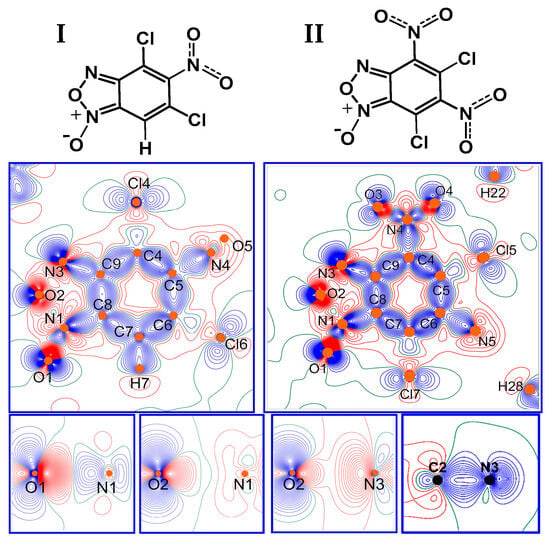
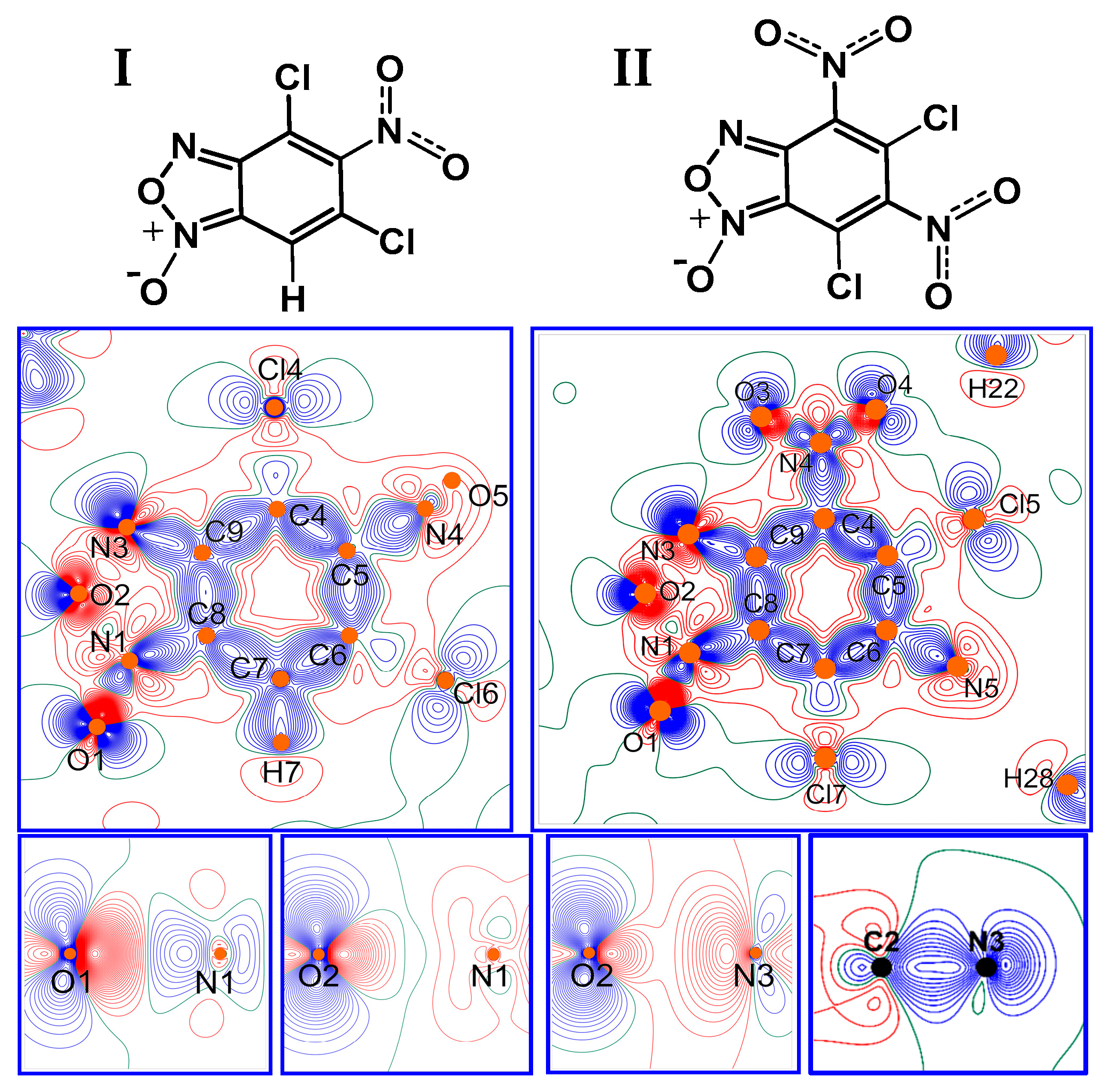
Herewith we offer a series of new heterocyclic aromatic acceptors belonging to the benzofuroxan (BFX) family (Figure 1), which are well known as lead-free energetic materials [25] and biologically active substances [26], but hitherto have been rarely used as acceptors in cocrystal design [27,28]. Their acceptor properties can be modulated by the introduction of electron withdrawing substituents such as halogen atoms or nitro groups. More crucially, various substituents at the periphery of acceptor molecules determine intermolecular interactions through steric effects and the contacts’ directionality. To rationalize the nature of chemical bonding in BFXs, intermolecular interactions, crystal packing and stoichiometry of cocrystals, the electron density distribution in the acceptor components is analyzed.
Figure 1.
BFX acceptors I and II: DED distribution in the bicyclic plane in cocrystals with anthracene. Contours are at 0.05 eÅ−3. Negative contours are red, positive contours are blue, and zero contour is green. Bottom panels show projections along the bonds of the 5-membered heterocycle orthogonal to its plane are given demonstrating the bond nature.
Our preliminary research showed that 4,6-dichloro-5-nitrobenzofuroxan (I) and 4,6-dinitro-5,7-dichlorobenzofuroxan (II) readily form CT complexes with anthracene [29]. In the present study we report a series of new cocrystals composed of BFXs (Figure 1) and polycyclic aromatic hydrocarbons (PAHs) of different topologies (substituted anthracenes and phenanthrene): 9-methylanthracene/(I) (MeAnt/I), 9,10-dimethylanthracene/(I) (Me2Ant/I), phenanthrene/(I) (Phen/I) the latter with stoichiometry 1:2, 9-methylanthracene/(II) (MeAnt/II), 9,10-dimethylanthracene/(II) (Me2Ant/II), and phenanthrene/(II) (Phen/II).
2. Materials and Methods
2.1. General Remarks
The following commercially available reagents were used: 9-methylanthracene (98%, TCI), 9,10-dimethylanthracene (98%, TCI), and phenanthrene (97%, Acros Organics). 4,6-Dichloro-5-nitrobenzofuroxan and 4,6-dinitro-5,7-dichlorobenzofuroxan were obtained according to the literature [30,31].
2.2. Synthesis and Crystal Growth
MeAnt/I, Me2Ant/I and Phen/I. A mixture of 4,6-dichloro-5-nitrobenzofuroxan (15 mg, 60 μmol) and 9-methylanthracene (13.2 mg, 69 μmol for MeAnt/I), 9,10-dimethylanthracene (14.2 mg, 69 μmol for Me2Ant/I), or phenanthrene (6.4 mg, 36 μmol for Phen/I) were placed in round glass jars (10 mL, 55 × 20 mm) and dissolved upon heating (on a bath at ~90 °C) in the mixture of methyl ethyl ketone (2.5 mL) and nonane (2 mL). Cocrystals were grown by keeping the resulting solutions at room temperature with slow solvents evaporation (up to ~1/3 of the original volume). The resulting crystals were filtered off, washed with 1 mL of nonane and dried in vacuo to give 1:1 MeAnt/I (13.7 mg, 51.7%), 1:1 Me2Ant/I (21 mg, 76.8%), and 1:2 Phen/I (11.4 mg, 56%) complexes, respectively. The same 1:2 ratio complex for Phen/I was also obtained using more than a twofold excess of phenanthrene (12.3 mg, 69 μmol) with practically the same yield (12.5 mg, 61.5%).
MeAnt/II, Me2Ant/II and Phen/II. A mixture of 4,6-dinitro-5,7-dichlorobenzofuroxan (18 mg, 61 μmol) and 9-methylanthracene (13.5 mg, 70 μmol for MeAnt/II), 9,10-dimethylanthracene (14.5 mg, 70 μmol for Me2Ant/II), or phenanthrene (12.5 mg, 70 μmol for Phen/II) was placed in round glass jars (10 mL, 55 × 20 mm) and dissolved upon heating (on a bath at ~90 °C) in the mixture of methyl ethyl ketone (3 mL) and nonane (2 mL). Cocrystals were grown by keeping the resulting solutions at room temperature with slow solvents evaporation (up to ~1/4 of the original volume). The resulting crystals were filtered off, washed with 1 mL of nonane and dried in vacuo to give 1:1 MeAnt/II (21.3 mg, 71.7%), 1:1 Me2Ant/II (23.8 mg, 77.9%), and 1:1 Phen/II (16.4 mg, 56.8%) complexes, respectively.
2.3. X-Ray Crystallography
The X-ray diffraction data for the single crystals of I and II with 9-methylanthracene, 9,10-dimethylanthracene and phenanthrene were collected on a Bruker AXS D8 Quest diffractometer (Karlsruhe, Germany) using Mo Kα radiation ( = 0.71073 Å). Data collection was performed according to recommended strategies employing an ω/φ-scan mode. The following programs were used: APEX3 (version 2018.1-0, Bruker AXS Inc., Madison, WI, USA) [32] for data collection; SAINT APEX3 (version 8.38A, Bruker AXS Inc., Madison, WI, USA) [33] for data reduction; SADABS (version 2016/2, Bruker AXS Inc., Madison, WI, USA) [34] for multi-scan absorption correction; SHELXT (version 2018/2, G.M. Sheldrick, Göttingen, Germany) [35] for structure solution; SHELXL [36] for structure refinement by full-matrix least-squares against F2. The details for cocrystals of I and II are given in Tables S1 and S2, respectively.
2.4. Solid-State Electrochemistry
Electrochemical measurements were performed using a BASi Epsilon E2P potentiostat (Bioanalytical Systems, Inc. West Lafayette, IN, USA). A conventional three-electrode system was employed, consisting of a Pt wire as the counter electrode and an Ag/Ag+ system as the reference electrode. A 0.1 M Bu4NBF4 acetonitrile solution served as the supporting electrolyte for determining current–voltage characteristics. All potentials were referenced vs. the Fc+/Fc redox couple. The carbon paste electrode (CPE) was prepared by grinding a mixture of graphite powder, phosphonium salt (dodecyl(tri-tert-butyl)phosphonium tetrafluoroborate), and the studied sample in a weight ratio of 85:10:5 (w/w/w) in a mortar to obtain a homogeneous mass. Finally, the surface of a glassy carbon working electrode (3 mm in diameter) was coated with a portion of the resulting paste [37] and analyzed by cyclic voltammetry at a scan rate of 0.1 V/s.
2.5. Optical Spectroscopy
UV/Vis measurements were carried out using a BRUKER Vertex80v FT-IR spectrometer (Ettingen, Germany), which is equipped with a Hyperion 2000 microscope (Bruker, Ettingen, Germany), which allows optical spectroscopy of small samples (measurement range size: 150 × 150 μm). For the visible range we have used a halogen lamp and a Si-diode as detector and in the UV range light came from a deuterium lamp and was detected with a GaP-diode. In general, samples for the optical investigations were prepared by placing a few crystals onto a KBr substrate using a flat spatula and spread out into a wide layer.
2.6. Gaussian Calculations
Geometry optimization were performed using the Gaussian 16 software package [38] within the framework of DFT (B3LYP) [39] method using aug-cc-pVTZ basis sets [40]. The topological analysis of the calculated electron density ρ(r) was performed within the framework of the atoms-in-molecules theory [41] using the AIMAll software (version 19.10.12, TK Gristmill Software, Overland Park, KS, USA) program [42].
The degree of charge transfer was evaluated using donor–acceptor arrangement from the experimental crystal structure without further geometry optimization, followed by a single-point wavefunction calculation performed in Gaussian16 at the B3LYP/aug-cc-pVTZ level of theory. Then the net atomic charges (q(A)) were summed up over all atoms in donor–acceptor dimers using AIMAll program.
2.7. Crystal Calculations
The crystal geometry optimization and periodic wave function calculations for model Ant/I and Ant/II cocrystals and crystal MeAnt/I were carried out at ωB97X/pob-TZVP-rev2 level [43,44] applying previous method [45] using the CRYSTAL17 software (version 1.0.2, University of Torino, Torino, Italy) [46]. The starting geometry was taken from the XRD data.
The model refined against theoretical structure factors was obtained by theoretical multipolar refinement against theoretical structure factors computed using the XFAC [46], and performed with MoProSuite v.21.06 [47] by analogy with a previously published procedure [48,49].
Electron density analysis. Analysis of electron density of the model refined against theoretical structure factors was carried out using WinXPRO v3.5.25 and 3Dplot v2.5.37 software [50] by analogy with previously described procedures [48,49]. The interaction energy was estimated as the sum of the corresponding BCP energies using the Espinosa–Molins–Lecomte relation [51].
3. Results and Discussion
3.1. Deformation Electron Density Distribution in BFXs
Electron density distribution is of major importance for characterization of acceptor properties of BFXs and the directionality of intermolecular interactions in cocrystals. Thus, quantum chemistry periodic calculations of two basic cocrystals of anthracene with I and II (Ant/I and Ant/II) were carried out.
The deformation electron density (DED) distribution in the molecules of acceptors I and II (Figure 1) clearly shows the aromatic character of the bicycle and highly ionic nature of the exocyclic N1-O1 bond. There is no accumulation of electron density in the regions of endocyclic N-O bonds reflecting their weak covalent character. Topological characteristics are given in Tables S3 and S4. Profiles of the DED and Laplacian of the electron density (LED) ρb along the bonds (Figure S1) confirm the presence of both positive and negative DED regions for all bonds except N3–O2, which is entirely negative. This explains the mechanism of the Boulton–Katritzky rearrangement that is very typical of BFXs [52] and the possibility of various isomeric structures [30]. Most probably, the low strength of the covalent bonds explains the irreversible character of electrochemical processes involving these BFXs and their complexes.
The features of electron density distribution which determine lateral intermolecular interactions and thus, the crystal packing, are the shape and directionality of lone electron pairs on chlorine and oxygen atoms (endocyclic O2, exocyclic O1 and oxygen atoms of the nitro groups) and N3 atom (Figure 1). One can see the regions of accumulation of electron density corresponding to electron lone pairs and the regions of electron-density depletion located on the continuation of the C-Cl and O-N3 bonds, so-called σ-holes. This anisotropy of electron density distribution determines the geometry of close contacts in crystals of anthracene and its derivatives with I and II.
3.2. The Crystal Structure of New BFXs Complexes
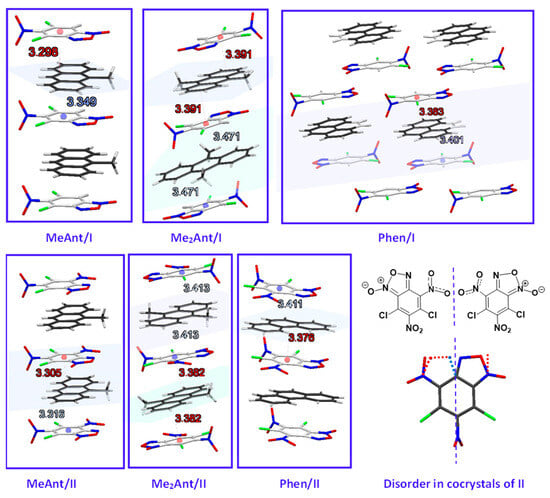
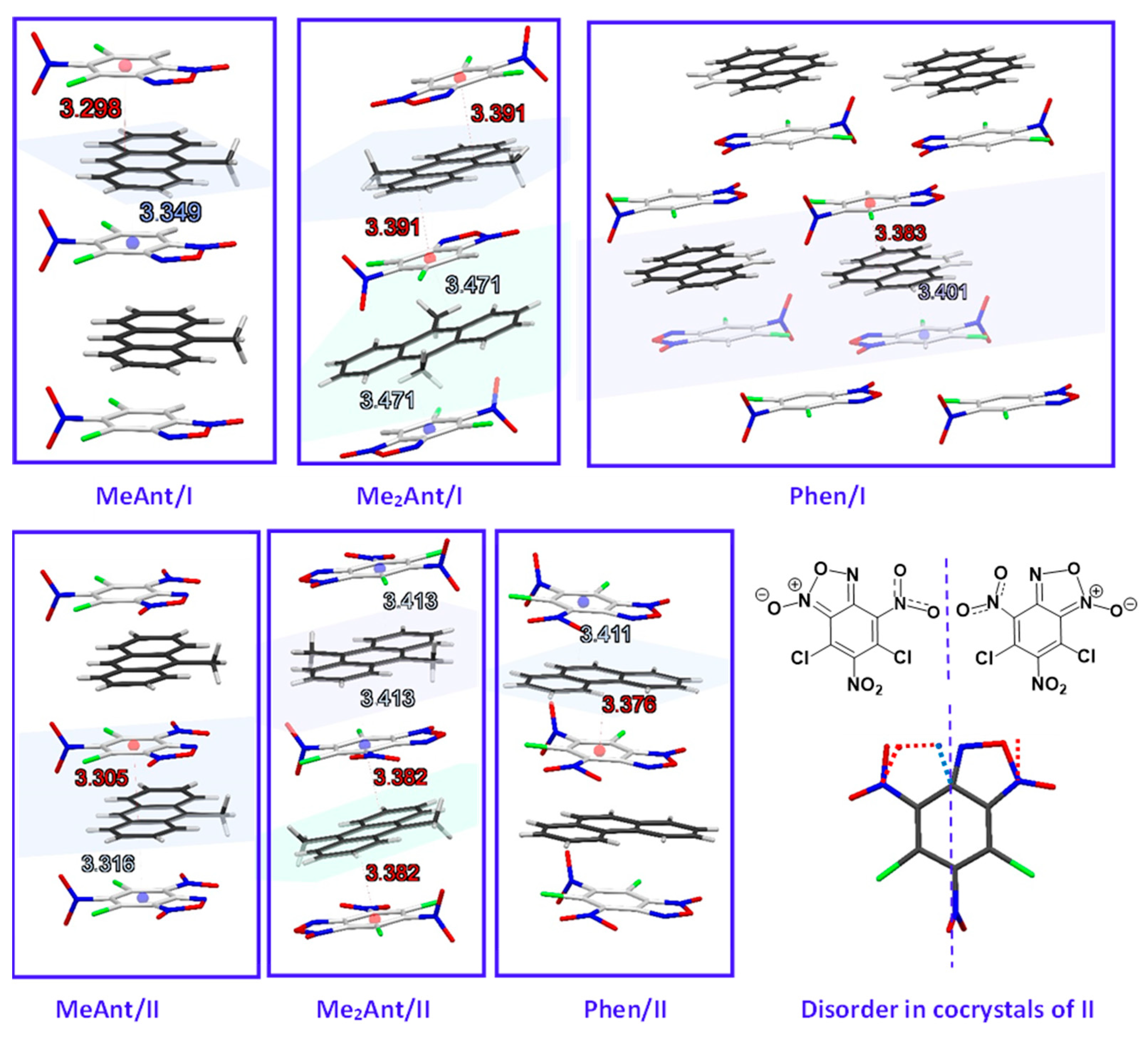
The X-ray single crystal diffraction revealed that BFXs I and II form 1:1 charge transfer cocrystals with 9-methyl- and 9,10-dimethylanthracenes with parallel arrangement of the donor and acceptor molecules in the mixed stacks typical to charge transfer complexes (Figure 2). For phenanthrene cocrystals, the components (D:A) ratio depends on the acceptor, being equal to 1:2 for I and 1:1 for II.
Figure 2.
Stacking arrangement in cocrystals of acceptors I and II. The donor–acceptor distances (Å) shown in the figure were calculated as the distance between the plane of the donor cyclic skeleton and the centroid of the benzene ring of the acceptor molecule. The disorder of the phenanthrene molecule is indicated by color. The plane of symmetry is shown by a dashed blue line.
The major feature of these cocrystals is the uneven distribution of donors and acceptors within the stacks. The methyl substituent in the anthracene molecule in cocrystals of MeAnt/I and MeAnt/II plays the crucial role in orienting all acceptor molecules in one direction within the stacks. These interactions will be discussed in detail in Section 3.5. The donor–acceptor distances are the shortest in these series of cocrystals. For dimethylanthracene cocrystals the crystal packing is more complicated with two independent donor molecules being in special positions on crystallographic inversion centers. In both cocrystals the stacks are composed of centrosymmetric A-D-A fragments with different interplanar distances (Figure 2). In Me2Ant/I two independent donor molecules have an approximately orthogonal orientation and the planes of these donor molecules are not strictly parallel, the angle being equal to 12°, while two independent donor molecules in Me2Ant/II have a similar orientation with an interplanar angle of 8°.
Of special interest is the crystal structure of the 1:2 system of Phen/I. The combination of weak donor and acceptor resulted in the absence of continuous stacking arrangement (Figure 2) with donor–acceptor distances being very close to the sum of the van der Waals radii. The phenanthrene molecule in this cocrystal is in a special position on an inversion center, thus simulating the structure of pyrene.
A specific feature of all cocrystals of II is the disorder of the acceptor molecule which varies in the series as 73:27, 58:42 and 75:25, respectively for MeAnt/II, Me2Ant/II and Phen/II. Two positions (Figure 2) are related by a symmetry plane; their overlap gives very close atomic positions, explaining the disorder in these cocrystals. In general, more regular donor–acceptor supramolecular arrangement is observed in the cocrystals of II.
3.3. DFT Study of Pair-Wise Donor–Acceptor Interactions
The crystal structures and electrochemical studies of individual BFXs [29] indicate their weaker acceptor properties in comparison with TCNQ, the reduction potentials of BFXs being equal to −0.78 (I) and −0.43 V (II) compared to −0.2 V for TCNQ, as recorded in similar conditions. To get a better insight into donor–acceptor π-π interactions we have studied pairwise interactions in the dimers of anthracene with BFXs. The optimization of the D-A dimers starting with the parallel geometry observed in the crystalline phase using the Gaussian package [38] showed that the energy of π-π interactions is not enough to retain the parallel arrangement in isolated dimers. In the minimum energy dimer, the dihedral angle between the planes of the donor and acceptor components varies from 17 to 73° (Figure S2) due to electrostatic interactions with participation of nitro oxygens and chlorines with anthracene hydrogens. The contribution of each contact amounts to 1–2 kcal/mole. The significant difference between the geometry of the isolated dimers and those in the crystalline environment indicates the importance of crystal packing and lateral intermolecular interactions in this series of cocrystals in contrast to the complexes of TCNQ derivatives with anthracenes and tetracene [16,45]. For the latter the arrangement of molecules in isolated dimers is very similar to the donor–acceptor orientation in cocrystals. In contrast to donor–acceptor dimers, the intermolecular interactions between two acceptor molecules are well reproduced, with the geometry of acceptor–acceptor hydrogen bonded dimers (Figure S3) being the same in individual crystals of I [53] and in cocrystals of Ant/I and Phen/I.
3.4. Electron Density Distribution and the Directionality of Intermolecular Interactions
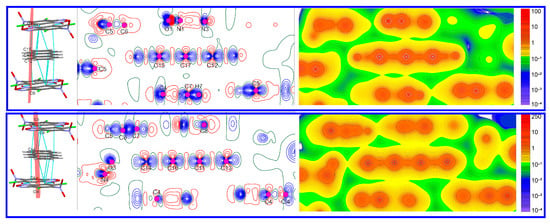
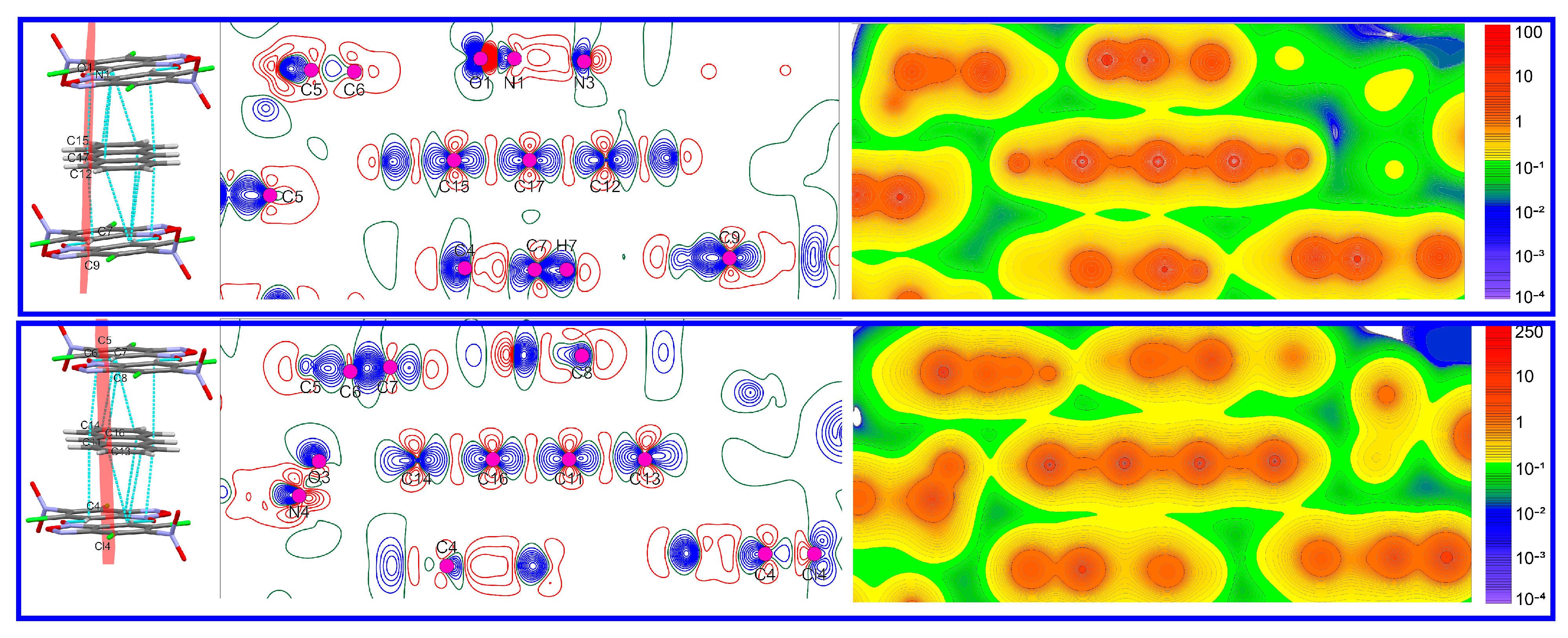
The electrostatic nature of π-π interactions between the anthracene and BFX molecules is clearly visible in the static deformation density distribution maps (Figure 3, center). In the planes drawn through the contacting atoms of donor and acceptor molecules the regions of the electron density accumulation are facing the electron density depletion. Further information on the interactions between the neighboring aromatic molecules in the stacks can be obtained by calculating the potential φ acting on an electron in a molecule (PAEM) [54,55,56,57] (Figure 3, right). On the PAEM, maps multiple regions of fused potential indicate the delocalization of the π-electrons (see yellow-colored merged areas connecting donor and acceptor molecules).
Figure 3.
The interactions between donor and acceptor molecules in the Ant/I (1:2) cocrystal: the interacting molecules, close contacts and section planes are shown on the left, static deformation density maps within the section planes (contour lines are drawn at intervals of 0.05 eÅ−3; positive, zero and negative values are shown in blue, green and red, respectively) are in the center and PAEM maps in a logarithmic scale (the color scale bar represents the values of −φ) are on the right.
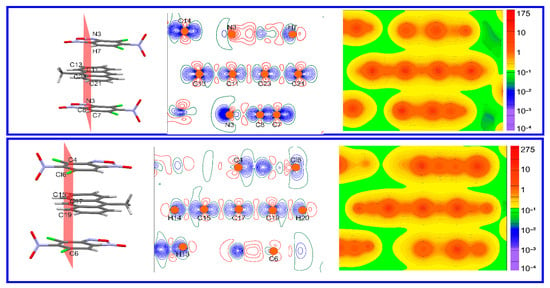
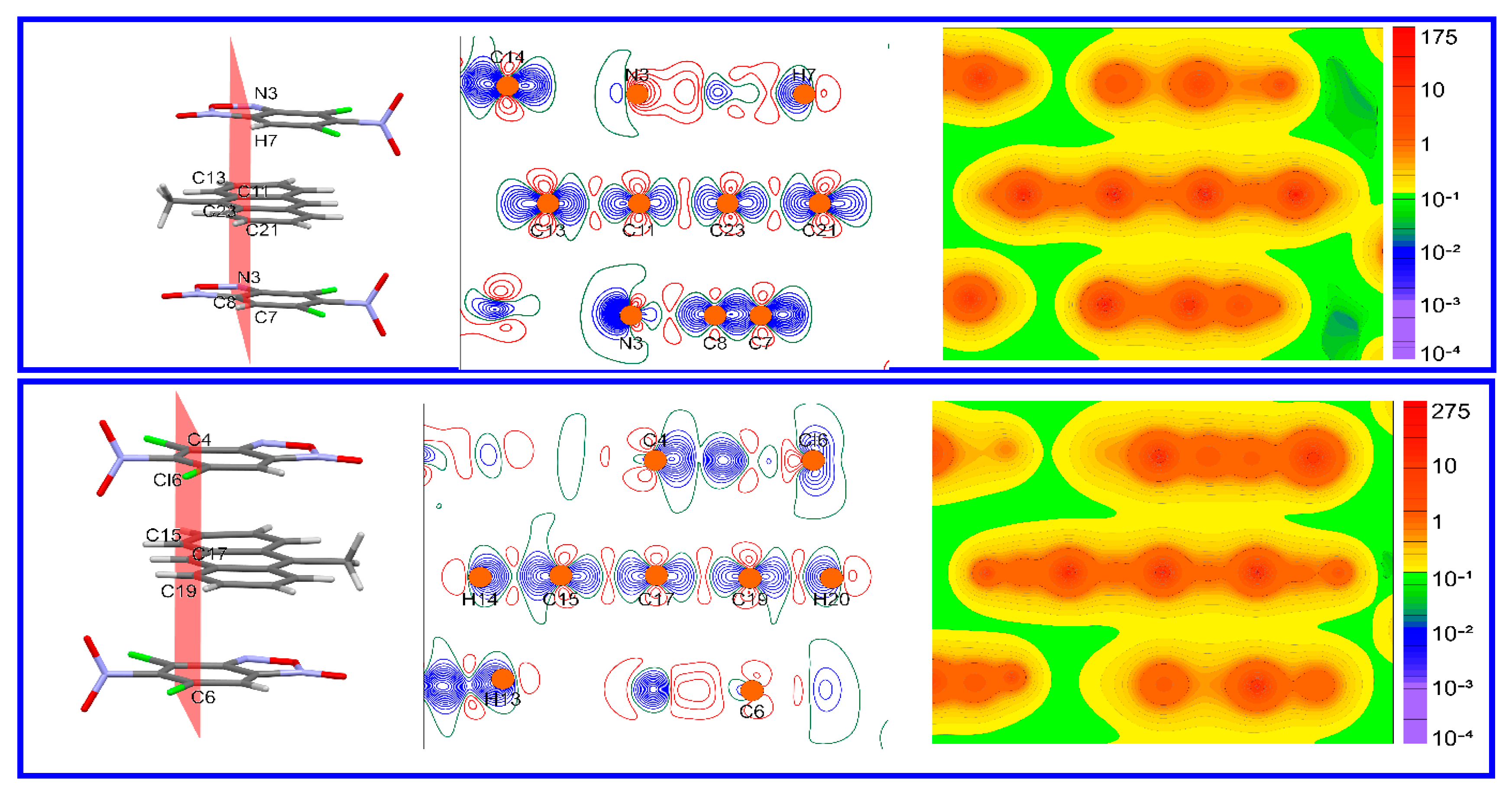
Similar consideration of the MeAnt/I cocrystal shows significantly larger regions of π-electrons delocalization in PAEM plots than for the Ant/I cocrystal with extended regions of fused potential colored yellow (Figure 4).
Figure 4.
The interactions between donor and acceptor molecules in the MeAnt/I cocrystal: the interacting molecules, close contacts and section planes are shown on the left, static deformation density maps within the section planes (contour lines are drawn at intervals of 0.05 eÅ−3; positive, zero and negative values are shown in blue, green and red, respectively) are in the center and PAEM maps in a logarithmic scale (the color scale bar represents the values of −φ) are on the right.
Thus, the methyl groups in substituted anthracene donors have a significant impact on their donor ability. In general, π-π interactions in these systems are not highly directional, as they imply numerous possible donor–acceptor orientations provided that the aromatic skeletons of interacting molecules are parallel.
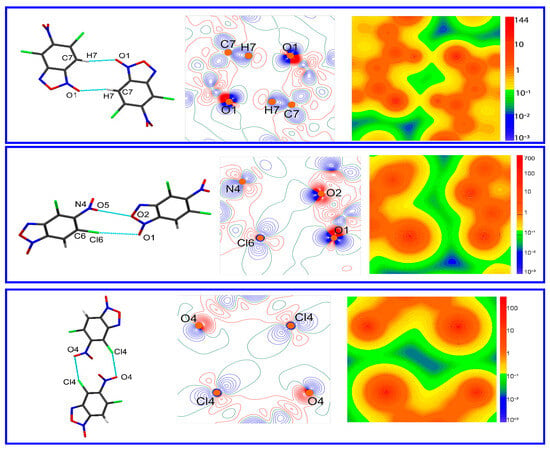
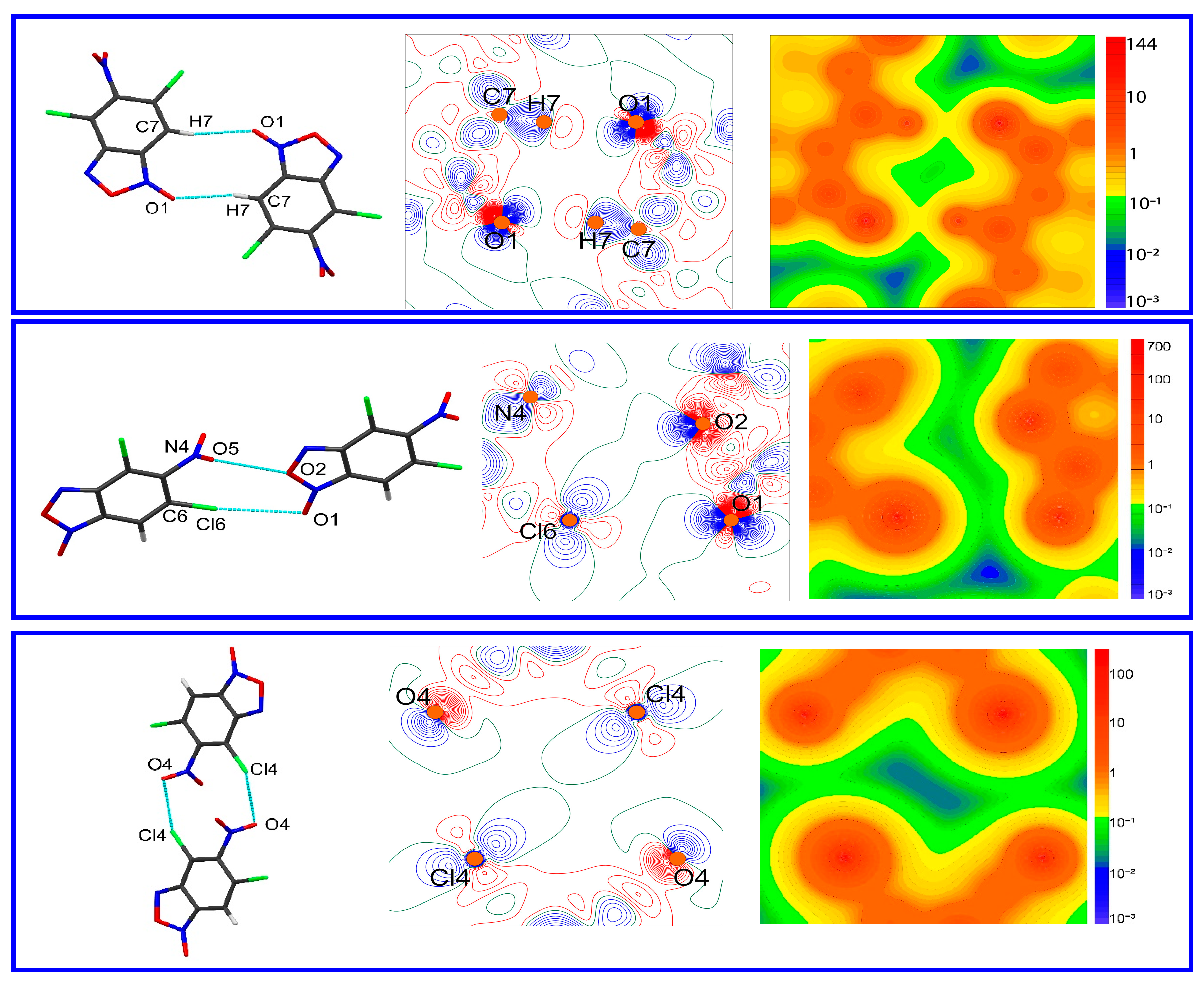
In contrast, lateral interactions in these cocrystals are highly directional (Figure 5). A good illustration of the directionality of intermolecular interactions is provided by the PAEM maps. While the static electron density distribution shows the shape of the lone electron pairs and the location of σ-holes, the PAEM maps demonstrate the bonding regions of the interactions. For all Cl···O short contacts lone electron pairs of oxygen atoms are directed towards the σ-holes located on the continuations of C-Cl bonds, while for O···O contacts one of the oxygens acts as a donor of electron density interacting with the σ-hole of another oxygen which can be considered as an acceptor. PAEM maps also visualize the strength of the interactions, indicating a weaker character of Cl···O and O···O contacts (green color of the scalebar). The strongest interaction in the cocrystal of Ant/I is the hydrogen bonding between the only the hydrogen atom in the benzene ring of the acceptor and the most negatively charged oxygen O1, whose energy equals to 1.9 kcal/mol per one contact. In the PAEM maps, one can see the highly directional bonding paths marked with a yellow color for these hydrogen bonds.
Figure 5.
The strongest intermolecular interactions and their directionality in cocrystal of the Ant/I: hydrogen bonds, lateral Cl···O and O···O acceptor–acceptor contacts, static deformation density maps (contour lines are drawn at intervals of 0.05 eÅ−3; positive, zero and negative values are shown in blue, green and red, respectively) and PAEM maps in a logarithmic scale (the color scale bar represents the values of −φ).
3.5. The Effect of Substitution in Acceptor and Donor Molecules on the Stoichiometry and Crystal Packing
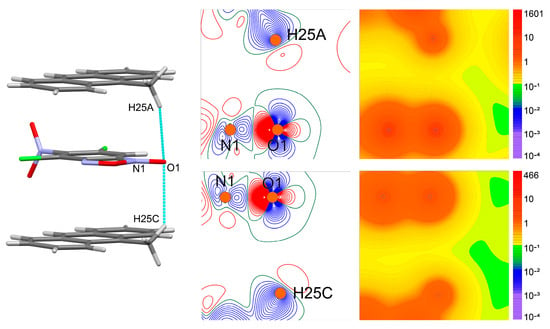
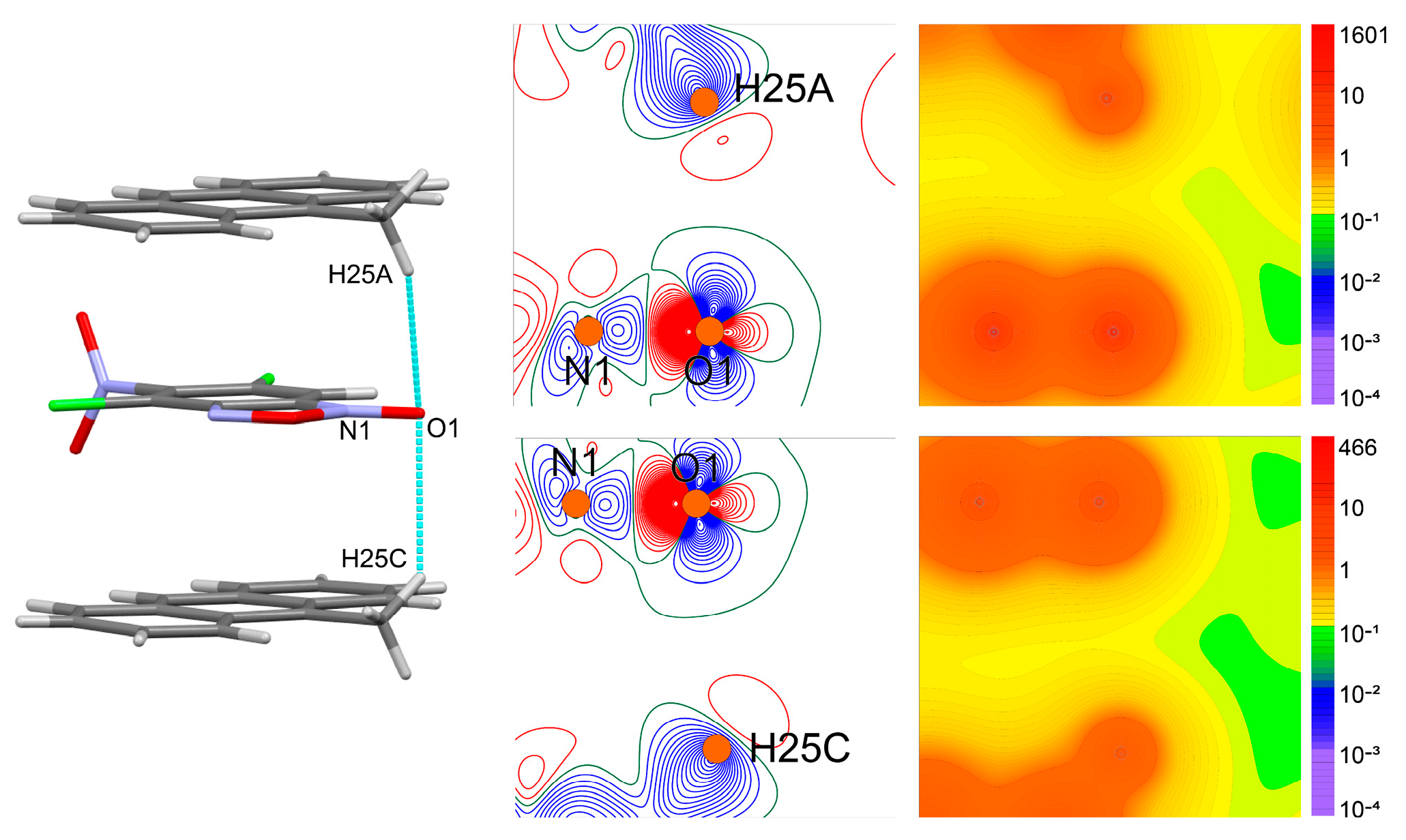
In cocrystals with anthracene and phenanthrene the energy balance in favor of the hydrogen bonding explains the D-A stoichiometry, which is 1:2. The stoichiometric ratio in MeAnt/I cocrystal is 1:1 in contrast to anthracene. Though the energy of π-π interactions is nearly the same in anthracene (4.15 kcal/mole with two acceptors) and methylanthracene (4.21 kcal/mole) cocrystals, the additional stabilization via the methyl group interactions (about 1.0–1.5 kcal/mole) is enough to surpass the A-A hydrogen bonding and to foster the equimolar composition of methylanthracene cocrystals whatever is the initial ratio of components. Moreover, the methyl groups affect the mutual orientation of donors and acceptors within the stacks due to their interactions with oxygen atoms of the acceptor (Figure 6).
Figure 6.
The interactions between methyl groups substituted anthracene molecules and nitro groups of acceptor in the MeAnt/I cocrystal: the interacting molecules on the left, static deformation density maps (contour lines are drawn at intervals of 0.05 eÅ−3; positive, zero and negative values are shown in blue, green and red, respectively) are in the center and PAEM maps in a logarithmic scale (the color scale bar represents the values of −φ) are on the right.
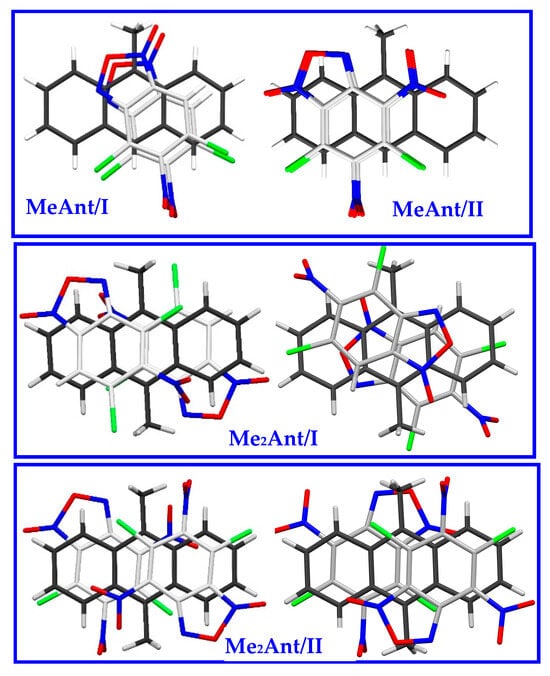
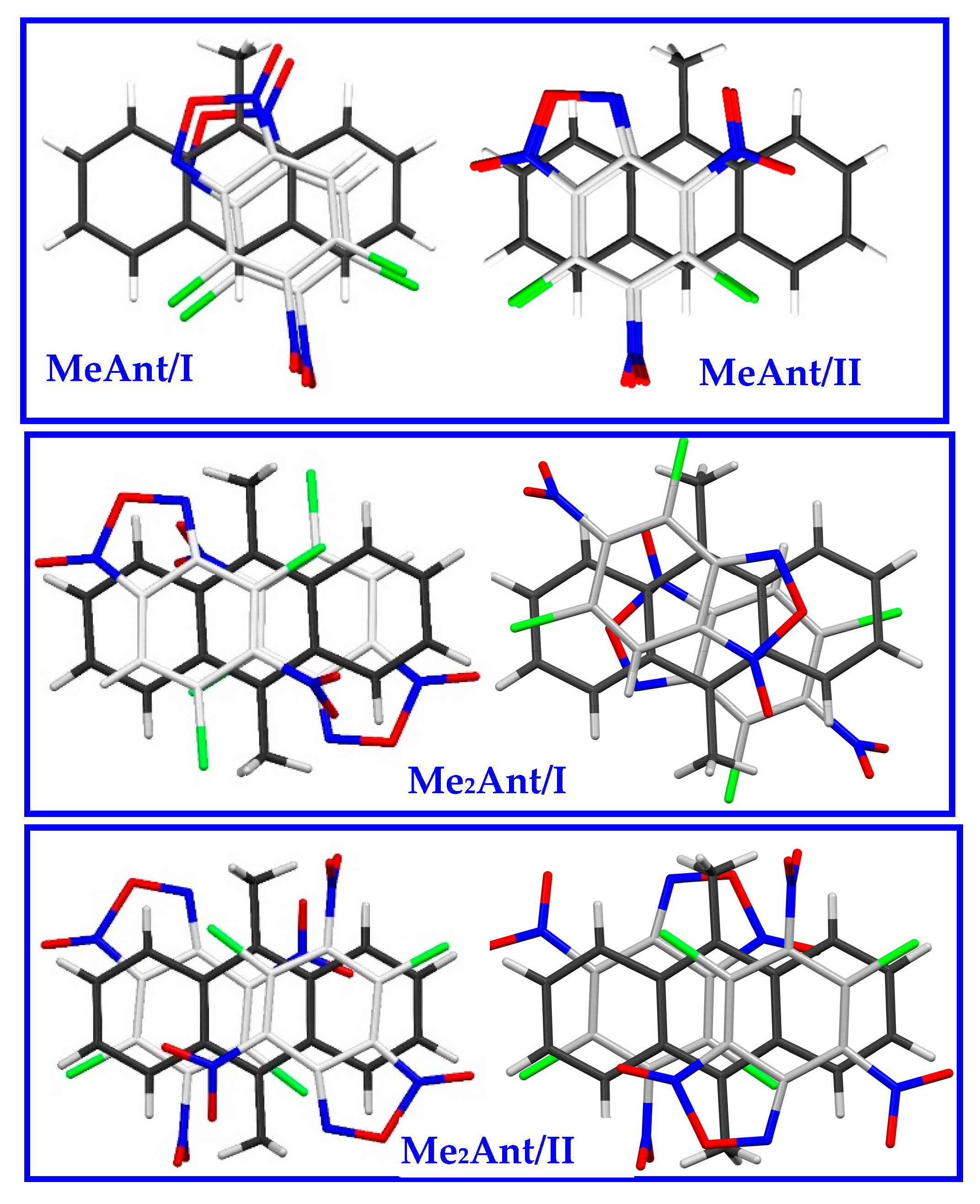
The influence of the methyl group on the D-A mutual orientation is clearly seen in cocrystals MeAnt/I and MeAnt/II. The donor molecules within the stacks are oriented in the same direction to provide close contact of methyl group with exocyclic oxygen atoms and endocyclic nitrogen atoms of acceptors (Figure 6 and Figure 7). The introduction of the second methyl substituent makes the donor molecule symmetric, thus removing the preferred orientation; similar interactions result in alternating directions of acceptor molecules within the stacks with centrosymmetric arrangement (Figure 7). The presence of two independent molecules in the asymmetric part of the unit cell in cocrystals of Me2Ant/I and Me2Ant/II allows the crystal packing to be optimized to meet the requirements of directionality for lateral interactions.
Figure 7.
The A-D-A overlay within the stacks in MeAnt/I and MeAnt/II cocrystals (first row). The overlay for Me2Ant/I and Me2Ant/II cocrystals is different for independent donor molecules in a asymmetric unit.
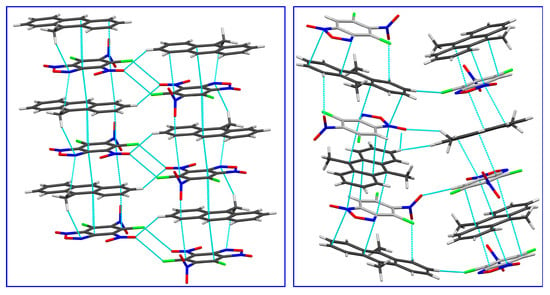
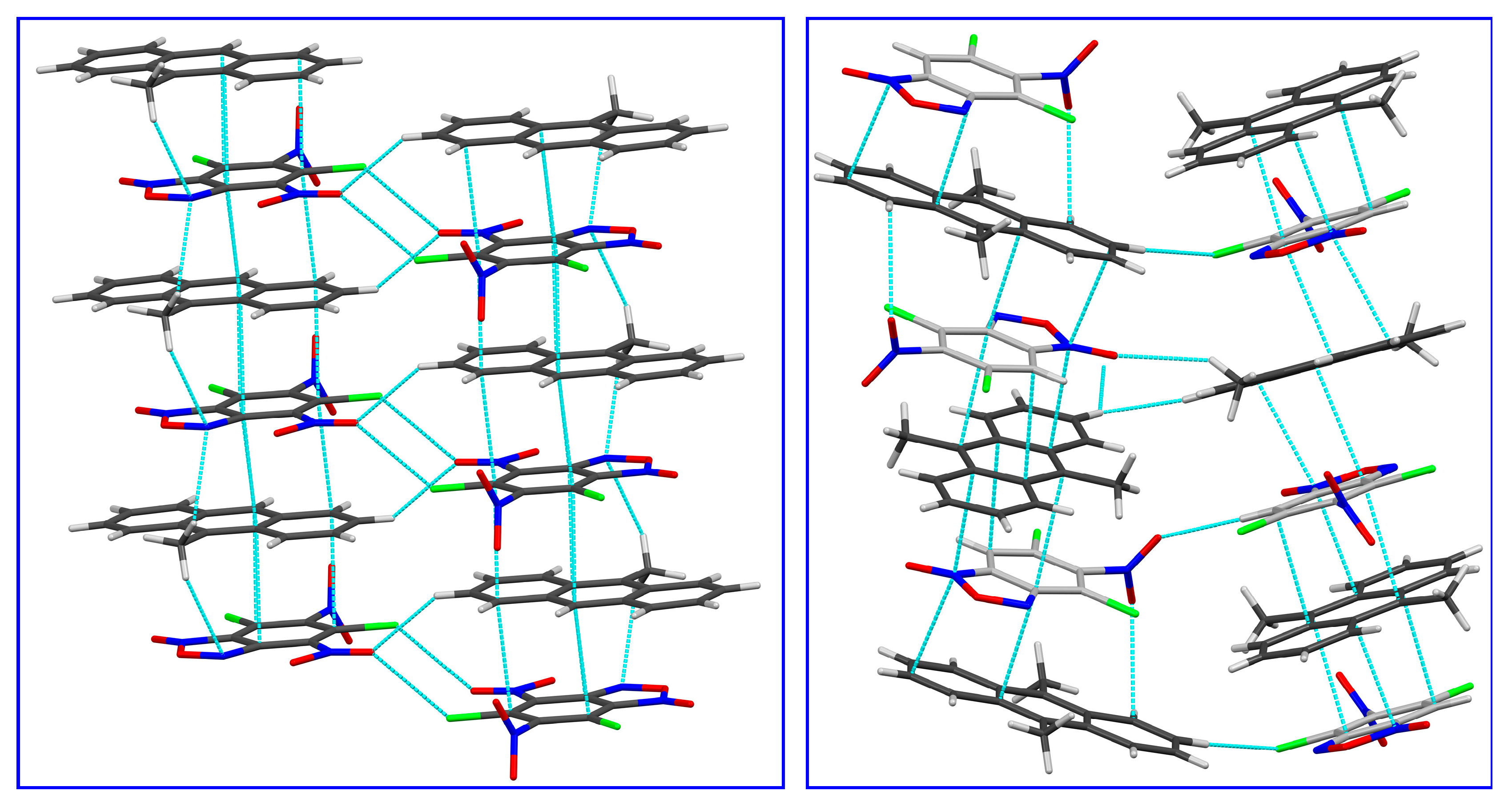
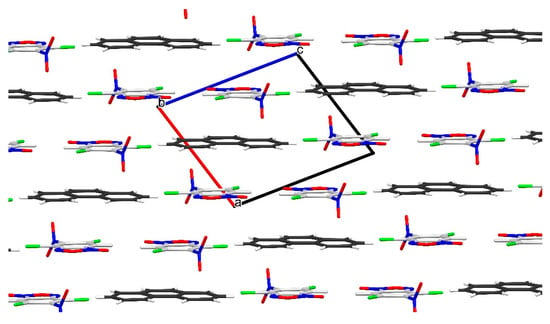
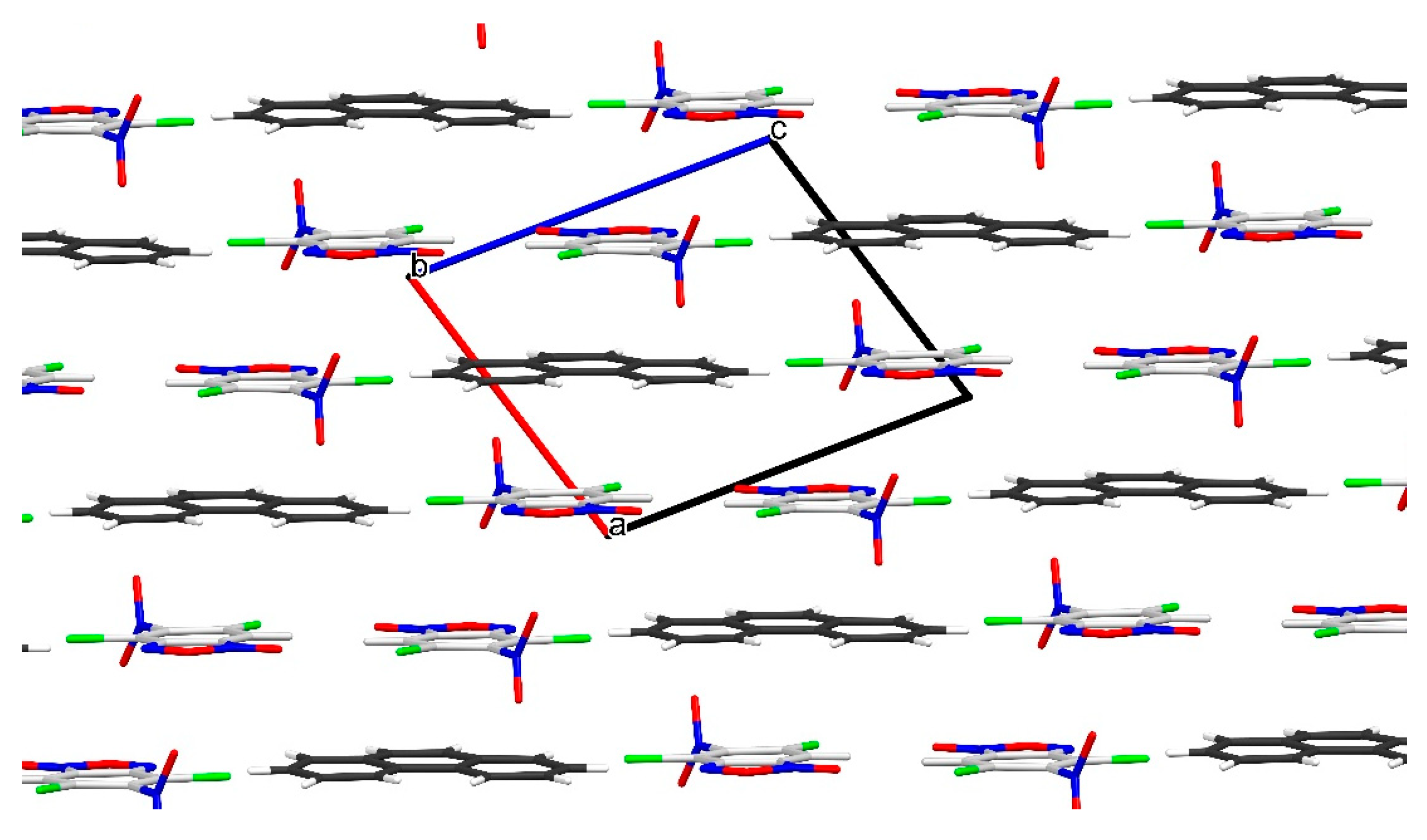
The neighboring stacks have stabilizing Cl···O and O···O interactions. The geometry of these close contacts is very similar in different cocrystals, being defined by the location of lone electron pairs and σ-holes. The angle C-Cl···O varies from 150 to 160° in this series of cocrystals; such geometry determines the shift in the interacting stacks respective to each other (Figure 8). In cocrystals with Me2Ant, acceptor molecules do not participate in Cl···O and O···O interactions, but there are multiple weak hydrogen Cl···H and O···H bonds with dimethylanthracene.
Figure 8.
The fragments of crystal packing showing the stacking arrangement and non-covalent interactions between the stacks in MeAnt/II (left) and Me2Ant/II (right).
All cocrystals of II have equimolar stoichiometry, while in cocrystals of I the fine balance between the A-A hydrogen bonding and D-A π-π interactions determines the stoichiometry. In anthracene and phenanthrene complexes, it is in favor of the hydrogen bonding between the BFX molecules, as these PAHs are the weakest donors in this series (see oxidation potentials in Table 1), and results in a 1:2 D-A stoichiometry regardless of the ratio of precursors. The presence of the hydrogen bonds with centrosymmetric planar arrangement results in layered crystal packing (Figure 9) in all cocrystals with a 1:2 component ratio.
Table 1.
Electrochemical data for cocrystals and optical gaps.
Figure 9.
A fragment of crystal packing for the Phen/I cocrystal showing the layered arrangement due to A-A hydrogen bonding.
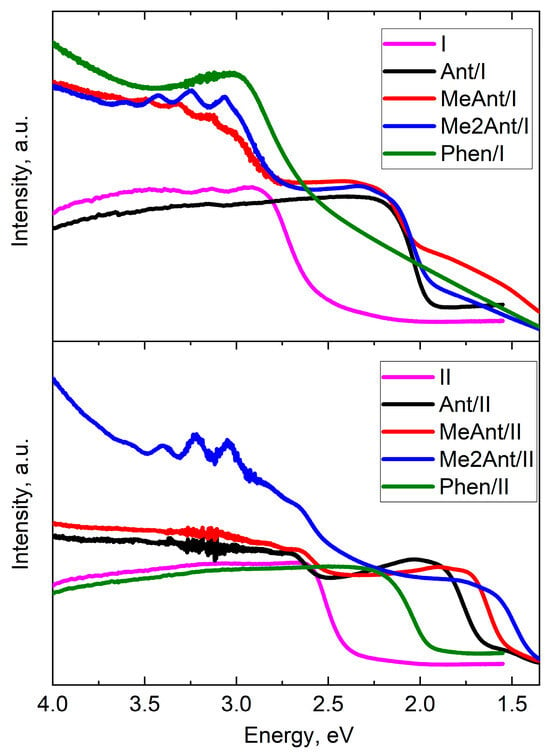
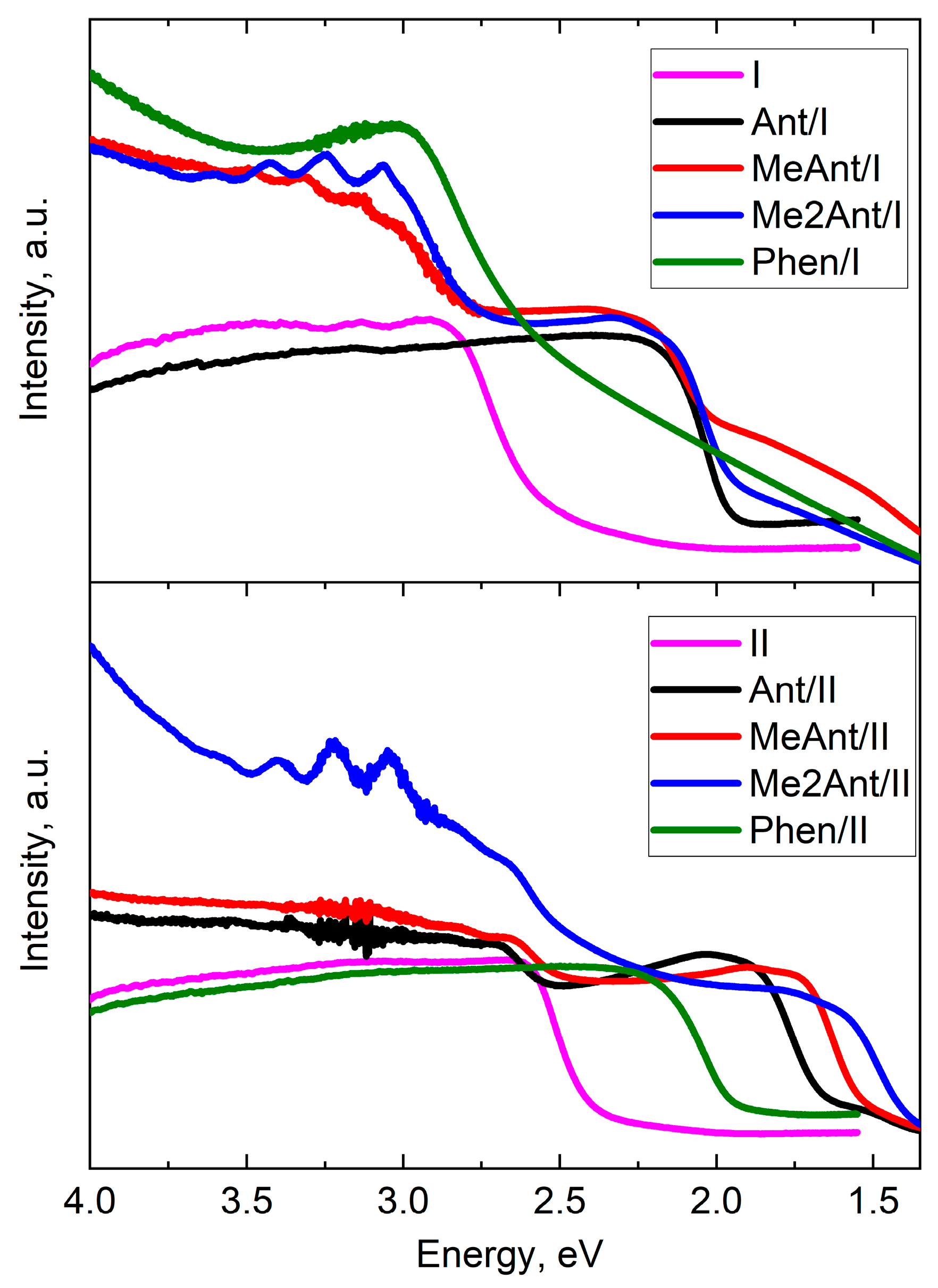
In general, in this series of cocrystals charge transfer interactions are very weak, though there are characteristic absorption bands in UV/Vis spectra for all cocrystals except phenanthrene ones (Figure 10). The distance between the planes of the acceptor and donor within the stacks varies from 3.3 Å in methylanthracene cocrystals and Ant/II to 3.4 Å in all other crystals. The estimation of the charge transfer within the framework of R. Bader’s theory of Atoms in Molecules QTAIM [41] for donor–acceptor pairs gave 0.05 e for Ant/I and MeAnt/I and 0.10 e for Ant/II. For the Phen/I cocrystal, the charge transfer is negligible due to the (1:2) stoichiometry and crystal packing. Though there is a donor–acceptor contact of 3.4 Å, the periodic stacking arrangement is disrupted (Figure 2).
Figure 10.
UV/Vis spectra for cocrystals of I and II.
3.6. Optical Spectroscopy of the Cocrystals
Charge transfer in mixed organic crystals can often be observed in the corresponding optical absorption spectra. In Figure 10 we present the absorption data as measured for our two BFX acceptors as well as of the mixed compounds.
The optical properties of individual components and cocrystals exhibit significant differences. Both BFX acceptors are characterized by an absorption onset at around 2.5 eV which is followed by a broad absorption profile. We note that the absorption of pure anthracene and phenanthrene starts at even higher energies, above 3 eV [58,59,60]. Figure 10 reveals that the absorption onset visibly shifts to lower energies in the mixed crystals with one exception, Phen/I. Moreover, for methyl and dimethyl anthracene cocrystals, which have stronger charge transfer interactions than anthracene and phenanthrene cocrystals, new absorption bands are observed with the maxima at about 2.0–2.5 eV for acceptor I, and 1.5–1.75 eV for acceptor II. The clear downshift cannot arise from a mere spectral superposition of the two individual components, respectively; it most likely results from intermolecular interaction and charge transfer, which cause changes in the energy of the molecular orbitals and thus the absorption energies. Equivalent lower absorption structures have been reported for other charge transfer compounds in the past [61,62,63]. We therefore take the spectra in Figure 10 as clear evidence for our conclusions that in all mixed compounds, except in Phen/I, there is intermolecular interaction resulting in a charge transfer between the constituents.
3.7. Redox Behavior of the Cocrystals
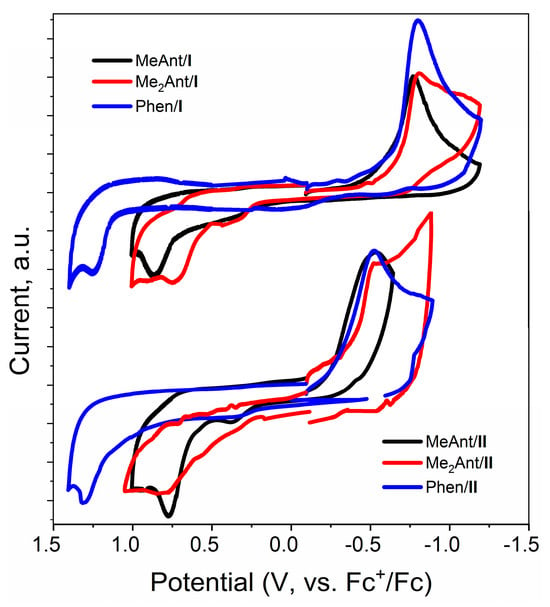
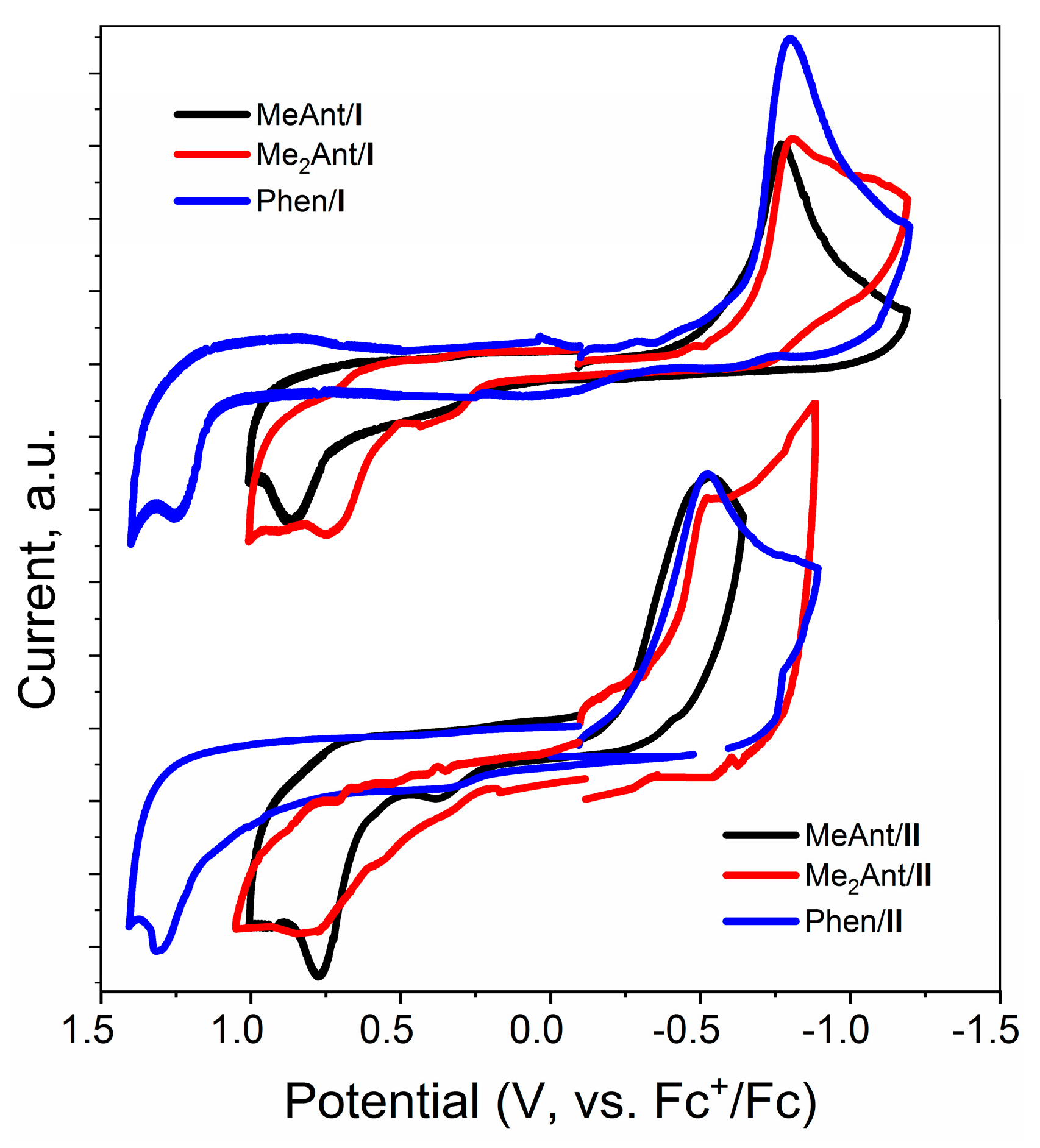
The redox properties of the investigated charge-transfer cocrystals were studied by cyclic voltammetry using a carbon paste electrode [37] (Figure 11). Based on the measured oxidation potentials ( for the donor) and reduction potentials ( for the acceptor) within the cocrystal, electrochemical gaps (ΔEel = − ) were calculated. Their trends were further analyzed in comparison with optical gaps (Table 1).
Figure 11.
Cyclic voltammograms for cocrystals of I and II recorded using a carbon paste electrode in acetonitrile (0.1 M n−Bu4NBF4) at a scan rate of 0.1 V/s.
The oxidation potentials of free donors (9-methylanthracene, 9,10-dimethylanthracene, phenanthrene), as well as the reduction potentials () of free acceptors (I and II), are summarized in Table 1. For the cocrystals, the peak potentials of the A and D fragments exhibit slight shifts in opposite directions. For cocrystals with acceptor II, a shift in reduction potentials of 0.09–0.1 V was observed relative to the potential of free acceptor II. For methylanthracene and phenanthrene, the oxidation potentials of the cocrystals remained unchanged. In contrast, for the Me2Ant/II cocrystal, a shift in the oxidation potential of 0.07 V compared to the free dimethylanthracene potential was found. Overall, the reduction and oxidation peaks were found to be irreversible in all cases. The electrochemical gaps of the cocrystals increased by 0.03–0.1 V for acceptor I and by 0.09–0.16 V for acceptor II compared to the electrochemical gaps of the corresponding free donors and acceptors.
The trends in the electrochemical gap (ΔEel) for systems based on acceptor I increase in the following order: Ant/I < Me2Ant/I < MeAnt/I < Phen/I. For acceptor II, a different sequence is observed: MeAnt/II, Me2Ant/II < Ant/II < Phen/II. In general electrochemical gaps have similar trends with optical gaps.
For cocrystals containing acceptor I, only minor changes in the reduction potential were observed compared to the potential of free acceptor I. Regarding oxidation potentials, a shift ranging from 0.03 to 0.11 V was observed relative to the potentials of the free donors.
A comparative analysis of the trends in electrochemical and optical gaps reveals a distinct correlation between these parameters. Irrespective of the calculation method employed, the minimum values for both gaps are characteristic of the Ant/I and Me2Ant/II cocrystals, whereas the maximum values are consistently observed for the Phen/I and Phen/II systems.
It is important to note that the oxidation potential of the donor is enlarged upon going from individual compound to cocrystals, except Phen/I. In this cocrystal it is smaller (1.25 V) in comparison to phenanthrene (1.30 V), this fact provides additional evidence that the charge transfer in this system is negligible.
4. Conclusions
A series of new acceptors belonging to the heterocyclic compounds of the benzofuroxan family are proposed for the design of charge transfer cocrystals with PAHs. The DFT calculations of the periodic structures of Ant/I, Ant/II and MeAnt/I cocrystals show the aromatic nature of BFXs and the weak character of N-O bonds which explains the chemical and tautomeric properties of BFXs and their irreversible redox behavior.
Due to the weak acceptor ability of BFXs, which is indicated by the values of reduction potentials in cyclic voltammetry, in cocrystals the mutual orientation between the donor and acceptor molecules is completely different from isolated dimers and is determined by the crystal packing with major contribution from lateral noncovalent interactions which are defined by the electron density distribution in acceptor molecules. The asymmetry of the electron density distribution on chlorine and oxygen atoms defines the directionality of multiple Cl···O, O···O noncovalent interactions. The energy of the lateral interactions is very close to the energy of face-to-face contacts. Their balance determines the stoichiometry of cocrystals and their supramolecular arrangement.
Cocrystals with 9-methylanthracene and 9,10-dimethylanthracene have charge transfer excitations in the spectra and also exhibit the enlarged oxidation potentials in comparison to individual PAHs. The amount of charge transfer was estimated to be 0.05 e for anthracene cocrystals and 0.10 e for MeAnt/II. The stoichiometry of cocrystal was found to have a drastic effect on their properties. UV/Vis spectroscopy shows very weak charge transfer interactions for Phen/II (1:1) cocrystal with a small shift in the absorption band of the acceptor. The Phen/I (1:2) cocrystal exhibits negligible charge transfer according to the UV/Vis spectroscopy and the electrochemistry studies.
In summary, BFXs as weak acceptors are of special interest in cocrystal engineering due to the high sensitivity of their cocrystals to substituents effects and lateral interactions, which can be used to control the relative shifts in the neighboring stacks, the relative orientation of donor and acceptor molecules and the stoichiometry of cocrystals.
Supplementary Materials
The following supporting information can be downloaded at https://www.mdpi.com/article/10.3390/cryst16120744/s1, Figure S1: (a) Static deformation electron density and (b) Laplacian of the electron density of Ant/I along selected acceptor’s bonds; Figure S2: The optimized geometries of the dimeric fragments and bond critical points dihedral angles τ between the benzene plane of BFX and the plane of the anthracene carbon skeleton, and the relative energies ΔE (kcal/mol); Figure S3: The optimized geometry of hydrogen bonded acceptor–acceptor dimer with critical points. The energy of each O∙∙∙H contact is 1.9 kcal/mol; Table S1: Crystal data and structure refinement details for cocrystals of I; Table S2: Crystal data and structure refinement details for cocrystals of II; Table S3: Selected geometric parameters and quantum-topological properties for multipole modeling data at the bond critical points of non-covalent interactions for Ant/II* single crystal (symmetry independent part); Table S4: Selected geometric parameters and quantum-topological properties for multipole modeling data at the bond critical points of non-covalent interactions for MeAnt/I single crystal (symmetry independent part). CCDC 2592289–2592296 contain the supplementary crystallographic data for this paper. These data can be obtained free of charge via www.ccdc.cam.ac.uk/data_request/cif, or by emailing data_request@ccdc.cam.ac.uk, or by contacting The Cambridge Crystallographic Data Centre, 12 Union Road, Cambridge CB2 1EZ, UK; fax: +44-1223-336033.
Author Contributions
Conceptualization, O.K. and K.M.; methodology, K.I.; electrochemical study, Y.B. (Yulia Budnikova) and V.K.; UV/Vis study, A.L., M.K. and M.N.; X-Ray study, A.F., K.I. and A.K.; syntheses and crystal growth, R.Z., K.M., I.G., L.Y. and Y.B. (Yulia Bakhtiyarova); writing, O.K.; discussion, M.K. All authors have read and agreed to the published version of the manuscript.
Funding
This work was supported by the Russian Science Foundation, project no. 25-73-20029.
Data Availability Statement
The original contributions presented in this study are included in the article/Supplementary Materials. Further inquiries can be directed to the corresponding author.
Acknowledgments
The authors gratefully acknowledge the Spectral-Analytical Center “CSF-SAC FRC KSC RAS” for providing necessary facilities to carry out this work.
Conflicts of Interest
The authors declare no conflicts of interest.
Abbreviations
The following abbreviations are used in this manuscript:
| A | acceptor |
| Ant | anthracene |
| BFX | benzofuroxan |
| CT | charge transfer |
| D | donor |
| DED | deformation electron density |
| DFT | density functional theory |
| LED | Laplacian of the electron density |
| MeAnt | 9-methylanthracene |
| Me2Ant | 9,10-dimethylanthracene |
| PAEM | potential acting on an electron in a molecule |
| PAH | polycyclic aromatic hydrocarbon |
| Phen | phenanthrene |
| TCNQ | tetracyanoquinodimethane |
References
- Zhu, L.; Yi, Y.; Li, Y.; Kim, E.-G.; Coropceanu, V.; Brédas, J.-L. Prediction of remarkable ambipolar charge-transport characteristics in organic mixed-stack charge-transfer crystals. J. Am. Chem. Soc. 2012, 134, 2340–2347. [Google Scholar] [CrossRef] [Scilit] [PubMed]
- Mandal, A.; Swain, P.; Nath, B.; Sau, S.; Mal, P. Unipolar to ambipolar semiconductivity switching in charge transfer cocrystals of 2,7-di-tert-butylpyrene. CrystEngComm 2019, 21, 981–989. [Google Scholar] [CrossRef] [Scilit]
- Mandal, A.; Rissanen, K.; Mal, P. Unravelling substitution effects on charge transfer characteristics in cocrystals of pyrene based donors and 3,5-dinitrobenzoic acid. CrystEngComm 2019, 21, 4401–4408. [Google Scholar] [CrossRef] [Scilit]
- Jiang, M.; Zhen, C.; Li, S.; Zhang, X.; Hu, W. Organic cocrystals: Recent advances and perspectives for electronic and magnetic applications. Front. Chem. 2021, 9, 764628. [Google Scholar] [CrossRef] [Scilit] [PubMed]
- Chen, W.; Zhao, M.; Chen, S.; Situ, Z.; Chen, G.; Li, J.; Chen, Y.; Huang, X.; Song, Y.; Chen, S.-L.; et al. A cocrystal strategy for harnessing UV-responsive endogenous photosensitizer in visible light photodynamic therapy. J. Phys. Chem. Lett. 2026, 17, 1393–1402. [Google Scholar] [CrossRef] [Scilit] [PubMed]
- Wang, X.; Wang, Z.; Wang, X.; Kang, F.; Gu, Q.; Zhang, Q. Recent advances of organic cocrystals in emerging cutting-edge properties and applictions. Angew. Chem. Int. Ed. 2024, 63, e202416181. [Google Scholar] [CrossRef] [Scilit] [PubMed]
- Kongasseri, A.A.; Ansari, S.N.; Garain, S.; Wagalgave, S.M.; George, S.J. Revisiting organic charge-transfer cocrystals for wide-range tunable, abient phosphorescence. Chem. Sci. 2023, 14, 12548–12553. [Google Scholar] [CrossRef] [Scilit] [PubMed]
- Xie, M.; Hisano, K.; Zhu, M.; Toyoshi, T.; Pan, M.; Okada, S.; Tsutsumi, O.; Kawamura, S.; Bowen, C. Flexible multifunctional sensors for wearable and robotic applications. Adv. Mater. Technol. 2019, 4, 1800626. [Google Scholar] [CrossRef] [Scilit]
- Liu, Y.; Li, A.; Xu, S.; Xu, W.; Liu, Y.; Tian, W.; Xu, B. Reversible luminescent switching in an organic cocrystal: Multi-stimuli-induced crystal-to-crystal phase transformation. Angew. Chem. Int. Ed. 2020, 59, 15098–15103. [Google Scholar] [CrossRef] [Scilit] [PubMed]
- Commins, P.; Desta, I.T.; Karothu, D.P.; Panda, M.K.; Naumov, P. Crystals on the move: Mechanical effects in dynamic solids. Chem. Commun. 2016, 52, 13941–13954. [Google Scholar] [CrossRef] [Scilit] [PubMed]
- Naumov, P.; Karothu, D.P.; Ahmed, E.; Catalano, L.; Commins, P.; Halabi, J.M.; Al-Handawi, M.B.; Li, L. The rise of the dynamic crystals. J. Am. Chem. Soc. 2020, 142, 13256–13272. [Google Scholar] [CrossRef] [Scilit] [PubMed]
- Zeng, T.; Liu, D.; Liu, G.; Meng, L.; Wang, F.; Li, Y.; Yuan, C. Donor-acceptor cocrystals as emerging organic semiconductors for high-temperature capacitive energy storage. Chem. Eng. J. 2026, 529, 173165. [Google Scholar] [CrossRef] [Scilit]
- Marasinghe, A.A.; Averkiev, B.B.; Aakeröy, C.B. Modulating some photophysical properties of cocrystals. CrystEngComm 2026, 28, 2548–2559. [Google Scholar] [CrossRef] [Scilit]
- Liu, H.; Liu, Z.; Jiang, W.; Fu, H. Tuning the charge transfer properties by optimized donor-acceptor cocrystal for FET applications: From P type to N type. J. Solid State. Chem. 2019, 274, 47–51. [Google Scholar] [CrossRef] [Scilit]
- Wei, Q.; Liu, L.; Xiong, S.; Zhang, X.; Deng, W.; Zhang, X.; Jie, J. Theoretical studies of bipolar transport in CnBTBT-FmTCNQ donor-acceptor cocrystals. J. Phys. Chem. Lett. 2020, 11, 359–365. [Google Scholar] [CrossRef] [Scilit] [PubMed]
- Ivshin, K.A.; Metlushka, K.; Fedonin, A.; Latypov, S.K.; Khrizanforova, V.V.; Budnikova, Y.H.; Vandyukov, A.E.; Kiiamov, A.G.; Laskin, A.; Avdoshenko, S.M.; et al. Substituent controllable assembly of anthracene donors and TCNQ acceptors in charge transfer cocrystals. Cryst. Growth Des. 2023, 23, 954–964. [Google Scholar] [CrossRef] [Scilit]
- Salzillo, T.; Masino, M.; Kociok-Köhn, G.; Di Nuzzo, D.; Venuti, E.; Della Valle, R.G.; Vanossi, D.; Fontanesi, C.; Girlando, A.; Brillante, A.; et al. Structure, stoichiometry, and charge transfer in cocrystals of perylene with TCNQ-FX. Cryst. Growth Des. 2016, 16, 3028–3036. [Google Scholar] [CrossRef] [Scilit]
- Mathur, C.; Gupta, R.; Bansal, R.K. Organic donor-acceptor complexes as potential semiconducting materials. Chem. Eur. J. 2024, 30, e202304139. [Google Scholar] [CrossRef] [Scilit] [PubMed]
- Tsuzuki, S.; Ono, R.; Inoue, S.; Matsuoka, S.; Hasegawa, T. Origin of the intermolecular forces that produce donor–acceptor stacks in π-conjugated charge-transfer complexes. Commun. Chem. 2024, 7, 253. [Google Scholar] [CrossRef] [Scilit] [PubMed]
- Yu, Y.; Xia, X.-Y.; Xu, C.-F.; Lv, Z.-J.; Wang, X.-D.; Liao, L.-S. Customizable organic charge-transfer cocrystals for the dual-mode optoelectronics in the NIR (II) window. J. Am. Chem. Soc. 2024, 146, 11845–11854. [Google Scholar] [CrossRef] [Scilit] [PubMed]
- Navarro-Huerta, A.; García-Aguilera, M.E.; Blahut, J.; Bartůňková, E.; Toscano, R.A.; Rodríguez, M.; Dračínský, M.; Rodríguez-Molina, B. Fine-tuning the motion of tetrafluoro-1,4-benzoquinone within charge-transfer cocrystals through variation of the donor: An entropic and enthalpic point of view. Chem. Eur. J. 2025, 31, e202501275. [Google Scholar] [CrossRef] [Scilit] [PubMed]
- Ferrari, E.; Mezzadri, F.; Masino, M. Mixed-vs-segregated stack polymorphism in the N,N,N′,N′-tetramethylbenzidine-TCNQF4 charge transfer complex. J. Phys. Chem. C 2025, 129, 8654–8662. [Google Scholar] [CrossRef] [Scilit] [PubMed]
- Rezvan, V.H. Charge transfer complexes: A review survey. Results Chem. 2025, 17, 102600. [Google Scholar] [CrossRef] [Scilit]
- Zhu, W.; Ni, Y.; Li, B.; González-Cano, R.C.; Hu, W. Quantitative correlation between charge transfer and two photon absorption in phenanthridine-TCNB cocrystal. IFM 2026, 3, 35–46. [Google Scholar] [CrossRef] [Scilit]
- Wang, J.-H.; Wang, F.-W.; Wang, J.-P.; Liu, Y.-C. Furazan and furoxan—A promising building block for energetic materials. Propellants Explos. Pyrotech. 2025, 50, e202400137. [Google Scholar] [CrossRef] [Scilit]
- Chugunova, E.A.; Gazizov, A.S.; Burilov, A.R.; Yusupova, L.M.; Pudovik, M.A.; Sinyashin, O.G. Benzofuroxans: Their synthesis, properties, and biological activity. Russ. Chem. Bull. 2019, 68, 887–910. [Google Scholar] [CrossRef] [Scilit]
- Britton, D.; Noland, W.E.; Pinnow, M.J.; Young, V.G. Crystal packing: An examination of the packing of molecules approximately isosteric with 4,5-dichlorophthalic anhydride. Helv. Chim. Acta. 2003, 86, 1175–1192. [Google Scholar] [CrossRef] [Scilit]
- Berionni, G.; Gonçalves, A.-M.; Mathieu, C.; Devic, T.; Etchéberry, A.; Goumont, R. Electrochemical and spectrophotometrical investigation of the electron-accepting strength of organic superelectrophiles: X-ray structure of their charge transfer complexes with tetrathiafulvalene. Phys. Chem. Chem. Phys. 2011, 13, 2857–2869. [Google Scholar] [CrossRef] [Scilit] [PubMed]
- Ivshin, K.A.; Metlushka, K.E.; Fedonin, A.P.; Zinnatullin, R.G.; Khrizanforova, V.V.; Laskin, A.I.; Bakhtiyarova, Y.V.; Yusupova, L.M.; Galkina, I.V.; Budnikova, Y.H.; et al. Acceptor properties of substituted benzofurazan and benzofuroxans and their charge transfer cocrystals with anthracene. Russ. J. Gen. Chem. 2026, 96, 81. [Google Scholar] [CrossRef] [Scilit]
- Galkina, I.V.; Yusupova, L.M.; Bakhtiyarov, D.I.; Gerasimov, A.V.; Islamov, D.R.; Litvinov, I.A.; Bakhtiyarova, Y.V. Synthesis, molecular, and crystal structure of 4,6-dinitro-5,7-dichloro-2,1,3-oxadiazole-1-oxide. Russ. J. Gen. Chem. 2022, 92, 2555–2560. [Google Scholar] [CrossRef] [Scilit]
- Yusupova, L.M.; Molodykh, Z.V.; Buzykin, B.I.; Falyakhov, I.F.; Anisimova, N.N.; Sharnin, G.P.; Bulidorov, V.V.; Sviridov, S.I.; Levinson, F.S. 4- or 6-Nitro-5,7-dichlorobenzofuroxane having fungicide activity. RF Patent No 2032678, 10 April 1995. [Google Scholar]
- Bruker. APEX3 Crystallography Software Suite; Bruker AXS Inc.: Madison, WI, USA, 2016. [Google Scholar]
- Bruker. SAINT Crystallography Software Suite; Bruker AXS Inc.: Madison, WI, USA, 2016. [Google Scholar]
- Krause, L.; Herbst-Irmer, R.; Sheldrick, G.M.; Stalke, D. Comparison of silver and molybdenum microfocus X-ray sources for single-crystal structure determination. J. Appl. Crystallogr. 2015, 48, 3–10. [Google Scholar] [CrossRef] [Scilit] [PubMed]
- Sheldrick, G.M. SHELXT—Integrated space-group and crystal-structure determination. Acta Crystallogr. Sect. A Found. Adv. 2015, 71, 3–8. [Google Scholar] [CrossRef] [Scilit] [PubMed]
- Sheldrick, G.M. Crystal structure refinement with SHELXL. Acta Crystallogr. Sect. C Struct. Chem. 2015, 71, 3–8. [Google Scholar] [CrossRef] [Scilit]
- Khrizanforov, M.N.; Arkhipova, D.M.; Shekurov, R.P.; Gerasimova, T.P.; Ermolaev, V.V.; Islamov, D.R.; Miluykov, V.A.; Kataeva, O.N.; Khrizanforova, V.V.; Sinyashin, O.G.; et al. Novel paste electrodes based on phosphonium salt room temperature ionic liquids for studying the redox properties of insoluble compounds. J. Solid State Electrochem. 2015, 19, 2883–2890. [Google Scholar] [CrossRef] [Scilit]
- Frisch, M.J.; Trucks, G.W.; Schlegel, H.B.; Scuseria, G.E.; Robb, M.A.; Cheeseman, J.R.; Scalmani, G.; Barone, V.; Petersson, G.A.; Nakatsuji, H.; et al. Gaussian 16; Revision A.03; Gaussian, Inc.: Wallingford, CT, USA, 2016. [Google Scholar]
- Becke, A.D. Density-functional thermochemistry. III. The role of exact exchange. J. Chem. Phys. 1993, 98, 5648–5652. [Google Scholar] [CrossRef] [Scilit]
- Kendall, R.A.; Dunning, T.H.; Harrison, R.J. Electron affinities of the first-row atoms revisited. Systematic basis sets and wave functions. J. Chem. Phys. 1992, 96, 6796–6806. [Google Scholar] [CrossRef] [Scilit]
- Bader, R.F.W. Atoms in Molecules: A Quantum Theory; Clarendon Press: Oxford, UK, 1990; 438p. [Google Scholar]
- Keith, T.A. AIMAll (Version 19.10.12); TK Gristmill Software: Overland Park, KS, USA, 2010. [Google Scholar]
- Chai, J.-D.; Head-Gordon, M. Systematic optimization of long-range corrected hybrid density functionals. J. Chem. Phys. 2008, 128, 084106. [Google Scholar] [CrossRef] [Scilit] [PubMed]
- Vilela Oliveira, D.; Laun, J.; Peintinger, M.F.; Bredow, T. BSSE-correction scheme for consistent Gaussian basis sets of double- and triple-zeta valence with polarization quality for solid-state calculations. J. Comput. Chem. 2019, 40, 2364–2376. [Google Scholar] [CrossRef] [Scilit] [PubMed]
- Kataeva, O.; Ivshin, K.; Metlushka, K.; Nikitina, K.; Khrizanforova, V.; Budnikova, Y.; Fayzullin, R.R.; Latypov, S.; Schiemenz, S.; Bretschneider, M.; et al. New charge transfer cocrystals of F2TCNQ with polycyclic aromatic hydrocarbons: Acceptor−acceptor interactions and their contribution to supramolecular arrangement and charge transfer. Cryst. Growth Des. 2022, 22, 751–762. [Google Scholar] [CrossRef] [Scilit]
- Dovesi, R.; Erba, A.; Orlando, R.; Zicovich-Wilson, C.M.; Civalleri, B.; Maschio, L.; Rérat, M.; Casassa, S.; Baima, J.; Salustro, S.; et al. Quantum-mechanical condensed matter simulations with CRYSTAL. WIREs Comput. Mol. Sci. 2018, 8, e1360. [Google Scholar] [CrossRef] [Scilit]
- Jelsch, C.; Guillot, B.; Lagoutte, A.; Lecomte, C. Advances in protein and small-molecule charge-density refinement methods using MoPro. J. Appl. Crystallogr. 2005, 38, 38–54. [Google Scholar] [CrossRef] [Scilit]
- Shteingolts, S.A.; Saifina, A.F.; Saifina, L.F.; Semenov, V.E.; Fukin, G.K.; Fayzullin, R.R. X-ray charge density study of the 6-methyluracil derivative in the crystal: Revealing, consequences, and multipole refinement of minor static disorder. J. Mol. Struct. 2021, 1228, 129724. [Google Scholar] [CrossRef] [Scilit]
- Shteingolts, S.A.; Voronina, J.K.; Saifina, L.F.; Shulaeva, M.M.; Semenov, V.E.; Fayzullin, R.R. On the transfer of theoretical multipole parameters for restoring static electron density and revealing and treating atomic anharmonic motion. Features of chemical bonding in crystals of an isocyanuric acid derivative. Acta Crystallogr. B Struct. Sci. Cryst. Eng. Mater. 2021, 77, 871–891. [Google Scholar] [CrossRef] [Scilit]
- Stash, A.I.; Tsirelson, V.G. Modern possibilities for calculating some properties of molecules and crystals from the experimental electron density. Crystallogr. Rep. 2005, 50, 177–184. [Google Scholar] [CrossRef] [Scilit]
- Espinosa, E.; Molins, E.; Lecomte, C. Hydrogen bond strengths revealed by topological analyses of experimentally observed electron densities. Chem. Phys. Lett. 1998, 285, 170–173. [Google Scholar] [CrossRef] [Scilit]
- Eckert, F.; Rauhut, G.; Katritzky, A.R.; Steel, P.J. A theoretical and experimental study of the molecular rearrangement of 5-methyl-4-nitrobenzofuroxan. J. Am. Chem. Soc. 1999, 121, 6700–6711. [Google Scholar] [CrossRef] [Scilit]
- Chugunova, E.; Akylbekov, N.; Dobrynin, A.; Burilov, A.; Boga, C.; Micheletti, G.; Frenna, V.; Mattioli, E.J.; Calvaresi, M.; Spinelli, D. 4,6-Dichloro-5-nitrobenzofuroxan: Different polymorphisms and DFT investigation of its reactivity with nucleophiles. Int. J. Mol. Sci. 2021, 22, 13460. [Google Scholar] [CrossRef] [Scilit] [PubMed]
- Yang, Z.-Z.; Davidson, E.R. Evaluation of a characteristic atomic radius by an ab initio method. Int. J. Quantum Chem. 1997, 62, 47–53. [Google Scholar] [CrossRef] [Scilit]
- Yang, Z.-Z.; Zhao, D.-X. A characteristic molecular contour evaluated by a theoretical method. Chem. Phys. Lett. 1998, 292, 387–393. [Google Scholar] [CrossRef] [Scilit]
- Zhang, M.-B.; Zhao, D.-X.; Yang, Z.-Z. The characteristic boundary radii of atoms. J. Theor. Comput. Chem. 2005, 4, 281–288. [Google Scholar] [CrossRef] [Scilit]
- Zhao, D.-X.; Yang, Z.-Z. Theoretical exploration of the potential and force acting on one electron within a molecule. J. Phys. Chem. A 2014, 118, 9045–9057. [Google Scholar] [CrossRef] [Scilit] [PubMed]
- Bree, A.; Lyons, L.E. 525. The intensity of ultraviolet light absorption by monocrystals. Part II. Absorption and reflection by anthracene of plane-polarized light. J. Chem. Soc. 1956, 159, 2662–2670. [Google Scholar] [CrossRef] [Scilit]
- Wolf, H.C. The electronic spectra of aromatic molecular crystals. In Solid State Physics; Seitz, F., Turnbull, D., Eds.; Academic Press: New York, NY, USA, 1959; Volume 9, pp. 1–81. [Google Scholar]
- Tomioka, K.; Amimoto, H.; Tomotika, T.; Matsui, A. Exciton-phonon interaction in crystalline phenanthrene. J. Chem. Phys. 1973, 59, 4157–4163. [Google Scholar] [CrossRef] [Scilit]
- Müller, E.; Mahns, B.; Büchner, B.; Knupfer, M. An electron energy-loss study of picene and chrysene based charge transfer salts. J. Chem. Phys. 2015, 142, 184702. [Google Scholar] [CrossRef] [Scilit] [PubMed]
- Kataeva, O.; Ivshin, K.; Metlushka, K.; Latypov, S.; Nikitina, K.; Zakharychev, D.; Laskin, A.; Alfonsov, V.; Sinyashin, O.; Mgeladze, E.; et al. Charge-transfer complexes of linear acenes with a new acceptor perfluoroanthraquinone. The interplay of charge-transfer and F···F interactions. Cryst. Growth Des. 2019, 19, 5123–5131. [Google Scholar] [CrossRef] [Scilit]
- Kataeva, O.; Nohr, M.; Ivshin, K.; Hampel, S.; Büchner, B.; Knupfer, M. Understanding intermolecular interactions in a tetracene–F4TCNQ cocrystal via its electron density distribution and topology. Cryst. Growth Des. 2021, 21, 471–481. [Google Scholar] [CrossRef] [Scilit]

Disclaimer/Publisher’s Note: The statements, opinions and data contained in all publications are solely those of the individual author(s) and contributor(s) and not of MDPI and/or the editor(s). MDPI and/or the editor(s) disclaim responsibility for any injury to people or property resulting from any ideas, methods, instructions or products referred to in the content. |
© 2026 by the authors. Licensee MDPI, Basel, Switzerland. This article is an open access article distributed under the terms and conditions of the Creative Commons Attribution (CC BY) license.