


Abstract
In this work, the cobalt ferrite ceramic was synthesized by using Pechini and densified using two different sintering routes: conventional sintering (CS) at 1200 °C for 3 h and microwave sintering (MS) at 1200 °C for 15 min. The influence of both sintering methods on the structural, microstructural, magnetic, and magnetostrictive properties was investigated. X-ray diffraction and Rietveld refinement confirmed the formation of a single-phase cubic spinel structure (Fd-3m) without secondary phases for both samples, and the crystal structure parameters exhibited only minor variations, indicating that the crystal structure remained essentially unaffected by the sintering route. In contrast, SEM micrographs revealed a remarkable reduction in average grain size from 7.72 µm (CS) to 0.74 µm (MS), demonstrating the effectiveness of microwave sintering in controlling grain growth (≈90% reduction in grain size). The magnetic measurements showed slightly higher saturation magnetization and coercive field values for sample MS, which were associated with the refined microstructure and enhanced magnetic anisotropy. Magnetostriction curves at room temperature yielded saturation values of −120 × 10−6 (CS) and −110 × 10−6 (MS) for samples, respectively. Despite the lower saturation magnetostriction, the microwave-sintered sample exhibited a significantly higher piezomagnetic coefficient (66 × 10−5 T−1) compared with the conventional sintered sample (35 × 10−5 T−1), it showed ≈8% decrease in saturation magnetostriction and ≈89% increase in piezomagnetic coefficient. Furthermore, a sign reversal of the magnetostrictive response was observed near 0.40 T for the MS sample, suggesting competition between magnetoelastic contributions associated with different crystallographic directions. The unstressed magnetostriction model successfully reproduced the experimental magnetostriction curves, confirming that grain-size refinement and grain-boundary effects play a dominant role in governing the magnetomechanical response of magnetic ceramics.
1. Introduction
The impact of spinel ferrites in industries and technology cannot be overstated, and these materials have extensive applications. Some prominent examples of ferrites include NiFe2O4, CoFe2O4, MnFe2O4, and SrFe12O19, among others [1]. Moreover, these materials have high saturation magnetization, significant magnetocrystalline anisotropy and large magnetostriction coefficients. These properties depend on suitable processing when making these materials desirable for a wide range of applications, such as ferrofluids [2], magnetic sensors [3], magnetic hyperthermia [4], and magnetoelectric multiferroic composites for energy harvesters and magnetoelectric random access memory (MeRAM) [5,6].
In the magnetic oxides family, cobalt ferrite (CoFe2O4) is a member that corresponds to the inverse of the spinel’s crystal structure; it exhibits a ferrimagnetic order that is due to antiparallel spin magnetic moments of the Fe3+ ions equally distributed at the tetrahedral and octahedral sites, and Co2+ ions at tetrahedral sites [7]. In addition, CoFe2O4 presents a magnetism in the hysteresis loop, and the mechanical deformation of its dimensions is a well-known magnetostriction effect that is apparent in the materials subjected to the presence of the force of the magnetic field [8].
The main technological goal in magnetic materials is to achieve high performance in the magnetic properties and microstructural strength for the functional material applications [9,10]; for such purpose, it is necessary to improve the physico-chemical properties by synthesis-based methods. Some examples include sol–gel, Pechini, combustion, co-precipitation, solid state reaction [11,12], and assisted sintering processes, such as thermal annealing [13], hot pressing [14], and conventional [15] and microwave-assisted methods [16]; these influence the final composition, grain size distribution, relative density, and other aspects.
The Pechini synthesis method is a technique for the sintering process of metallic complexes, starting from concentrated dissolutions of polyfunctional organic acids, salts, or hydroxides and forming mixed oxides such as titanates [17], zirconates [18], ferrites [19], aluminates [20] and silicates [21]. The main idea of the Pechini method is to obtain a polymeric resin forming macromolecular chains, in which several metallic ions can be uniformly distributed, avoiding the problems of segregation and precipitation in the solution, compared to the conventional method, due to the fixation of the cations in the resin. This facilitates the control over the stoichiometry of the desired compound, which is why mixed oxides can be synthesized with characteristics including high degree of product purity, homogeneity on an atomic scale, and very small mean particle size (on the order of <10 nm) [22,23,24,25].
The microwave sintering method offers the possibility of controlling the grain size growth up to the nanoparticle scale and obtains high performance in the magnetic properties [26,27]. As for processing conditions, the microwave method is a sintering technique that has the functionality of controlling growth in grain size, allowing high densification in ceramics and composites [28], even down to the nanoparticle scale [29], and obtaining superior magnetic properties [30].
On the other hand, it is important to mention theoretical studies; numerical simulations are crucial for analyzing experimental results and understanding the behaviors of crystalline and polycrystalline materials and their properties [31]. In the present case, magnetic oxide ceramics, the mathematical models have been employed to simulate magnetic effects, such as modelling magnetization by magnetic hysteresis [32], coercive field by the Stoner–Wohlfarth model [33], and magnetomechanical effects by magnetization models for magnetostriction [34] or by equilibrium magnetoelastic strain tensors by means of finite element method [35]. These numerical simulations provide valuable insights for comparing and interpreting experimental findings. In this way, it is possible to obtain information about magnetic domains, magnetocrystalline anisotropy, magnetoelastic coefficients, and the magnetostriction constant as a function of any applied external force, such as magnetic fields, heat sources, and mechanical stress [36].
In this work, we synthesized CoFe2O4 using the in situ Pechini method to obtain the polymer resin. Two different sintering techniques were used for processing the ceramic powders: microwave oven and conventional sintering. Our study focuses on analyzing the grain size growth control effects on the microstructural and magnetic properties, as well as the magnetomechanical response. Furthermore, we use experimental magnetization data to simulate the magnetostriction curve and examine the magnetomechanical behavior using the magnetostrictive and piezomagnetic coefficients. This provides a better understanding of the influences of both of the sintering techniques on cobalt ferrite’s properties, and those of associated ceramics, providing valuable insights into its potential applications, actuators and magnetoelectric coupling in multiferroic (and possibly other) materials. Our results will be very useful for the design and processing of particulate ferroic biphasic ceramics (connectivity 0–3) for the optimization of magnetoelectric coupling, based on the analysis and control of the grain growth of the magnetic and ferroelectric phases by means of densification by the microwave-assisted method, improving the structural and magnetic properties of the cobalt ferrite ceramic.
2. Materials and Methods
The cobalt ferrite—CoFe2O4 (CFO) was synthesized by the Pechini method. There was a previously prepared mixture of ethylene glycol (C2H6O2) (99.5%, Merck, Darmstadt, Germany) with citric acid (C6H8O7) (99.5%, Merck, Darmstadt, Germany) in molar proportion 4:1 at 70 °C. Simultaneously, the reagents Co(NO3)2∙6H2O (98.0%, Aldrich, St. Louis, MO, USA) and Fe(NO3)3∙9H2O (99.0%, Merck) were diluted in 50 mL of H2O in stoichiometric proportions, respectively; they were then added into the citric acid and ethylene glycol solution and the mixture was shaken for 15 min. The pH was evaluated by adding an ammonia solution (NH4OH) (25%, Alpha, Chennai, India) for formation of metallic citrate. This step was necessary to study the effect of pH and determine the best parameters for the actual synthesis in obtaining ceramic powders (Table 1).
Table 1.
Characteristics of cobalt ferrite powders at different pH values, calcined at 450 °C.
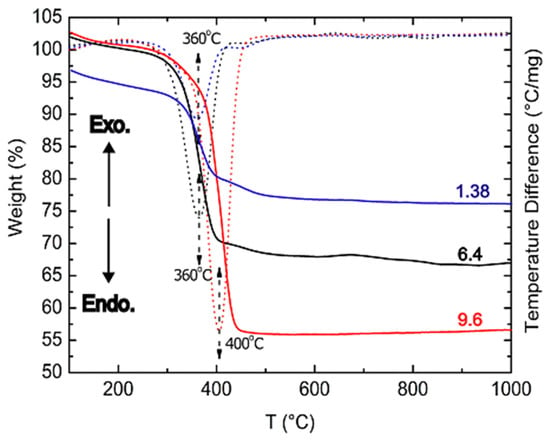
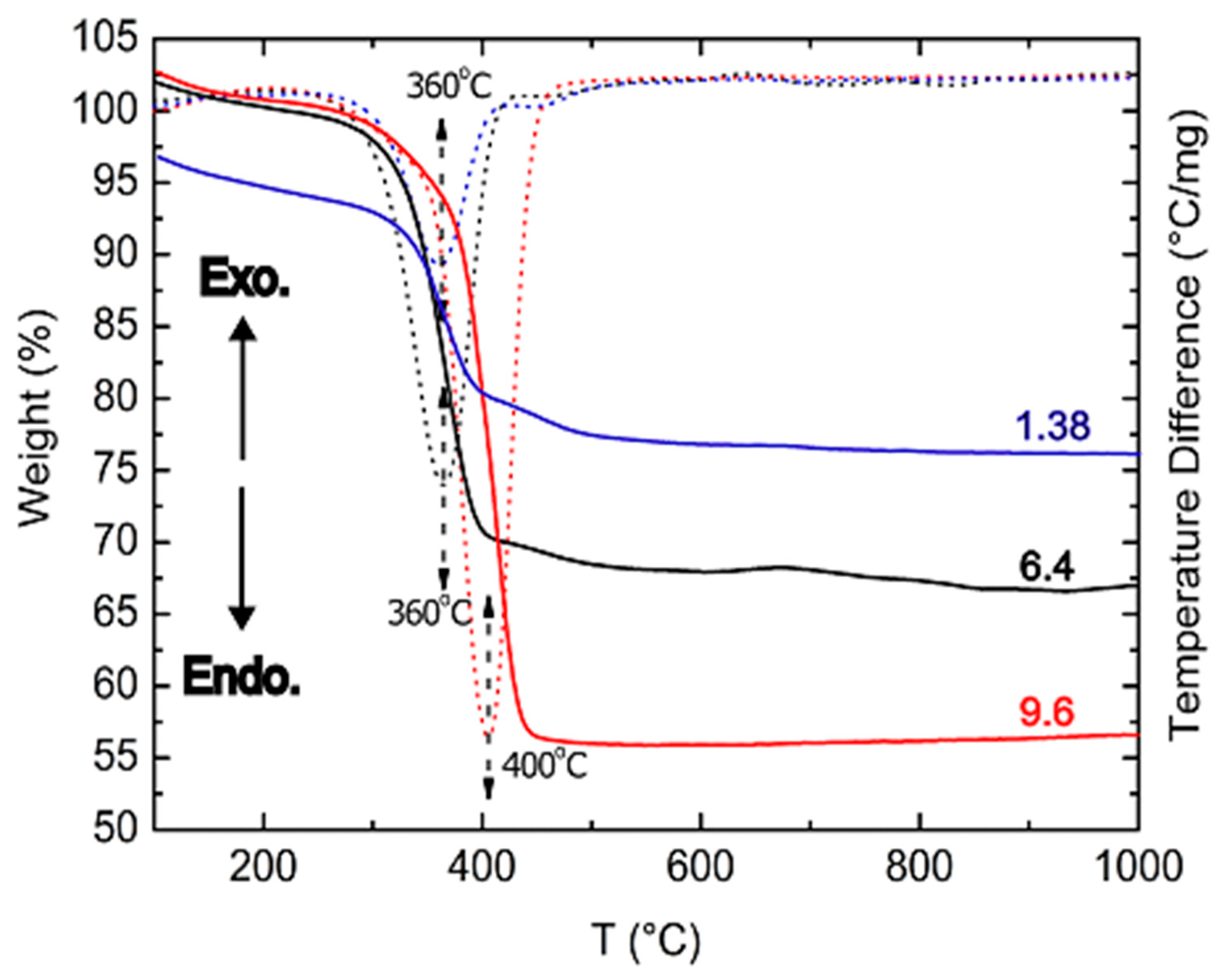
The DTA/TG characterization of the synthesized ceramic powders was performed on a Netzsch STA 402EP instrument (NETZSCH-Gerätebau GmbH, Selb, Germany) using a heating rate of 10 °C/min up to 1000 °C, under an air atmosphere, using an Al2O3 crucible. Thermogravimetric analysis (TG) provided information on the thermal decomposition pattern of the samples, as well as the stability of the final residue. Differential thermal analysis (DTA) allowed the obtaining of information on the combustion processes and crystalline phase formation. Figure 1 shows the thermograms of the pre-calcined samples at 250 °C. For the three pH calcined samples, the heating was established as follows: Samples pH 1.38 and 6.4 were heated at 370 °C with a rate of 3 °C/min for 30 min for the removal of the organic phase, and at 450 °C at 5 °C/min for 2 h. The samples with pH 9.6 were heated at 400 °C at 3 °C/min for 30 min, and at 450 °C at 5 °C/min for 2 h.
Figure 1.
Corresponding TG and DTA curves of the cobalt ferrite samples obtained for pH 1.38 (blue line and dashes), 6.4 (black line and dashes), and 9.6 (red line and dashes).
The solutions obtained with pH 1.38, 6.4, and 9.6 were chosen and heated at 120 °C and 140 °C to eliminate the solvent and form a polymer resin, which was pre-calcined in a muffle furnace at 250 °C (EDG 3000, Sao Paulo, Brazil) for 12 h, and calcined for 2 h at 450 °C to obtain the ceramic powders. To determine the specific surface area, the nitrogen/helium absorption method developed by Brunauer, Emmett and Teller (BET) was used, which is based on gas adsorption isotherms in the powders. These define the size and morphology of the pores and the specific surface area. The powders were analyzed using an ASAP-2020 Micrometrics instrument (Norcross, GA, USA). Table 1 shows the surface area BET, average particle diameter BET and crystallite size values. It can be observed that the surface area increases with increasing pH, a behavior that corresponds to the variation in the calculated average particle size and accords with the results of the crystallite size calculation, a variable which decreases with increasing pH.
The characterization of the crystalline phases of the powders and ceramic bodies was accomplished using X-ray diffraction with a Rigaku Rotaflex RU200B diffractometer (Akishima, Tokyo, Japan); CuK radiation was used, and the scanning range was 2 theta (2θ) from 15 to 90 at a rate of 2°/min. The standard cards from the JCPDS-ICDD database were used to verify the crystal symmetries of the materials.
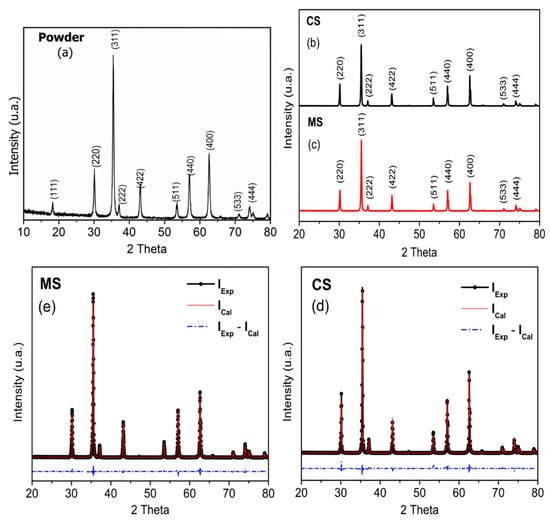
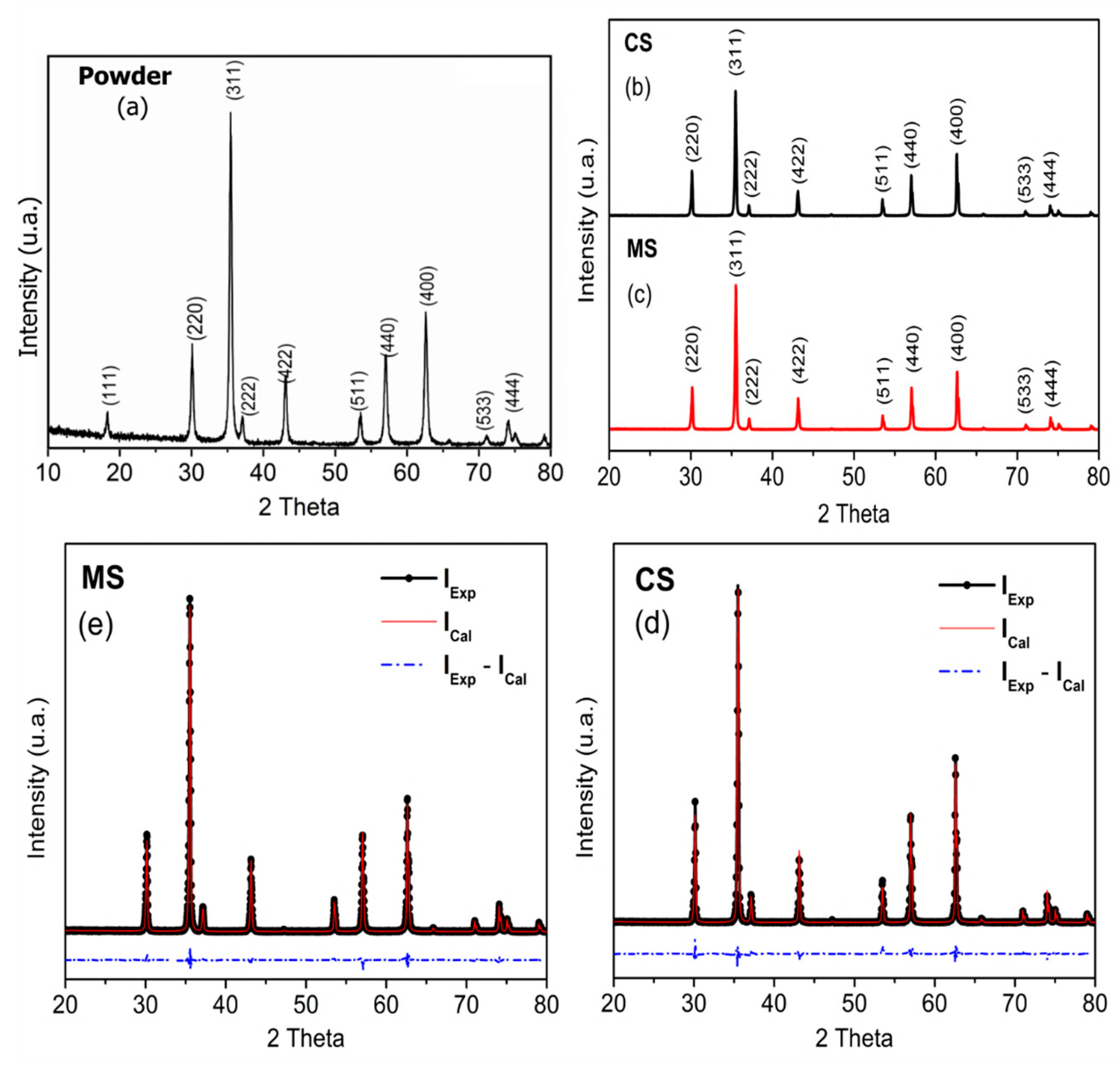
The crystallite sizes for each sample were determined using X-ray characterization, through Gaussian deconvolution of the peak at (311) for the calcined powders and using Scherrer’s formula. Table 1 shows a reduction in crystallite size with increasing pH. Specifically, the sample synthesized at pH 1.38 had a crystallite size of 34 nm, the sample at pH 6.4 had a size of 21 nm, and the sample under saturation conditions at pH 9.6 had a size of 18 nm. This reduction in crystallite size confirms the effect of pH on the theoretical chemical reductions of the Pechini method, since with increasing pH, all esterification reactions become more complex. This results in a resin with a larger volume where the cations are well distributed. Figure 2a shows the X-ray diffraction result of the pH 9.6 sample calcined at 450 °C. The peaks correspond to cobalt ferrite with a spinel structure and cubic symmetry, and no secondary phases were identified.
Figure 2.
X-RD patterns of CFO powder (a), ceramic samples by CS (b) and MS (c), and the Rietveld refined XRD for samples by CS (d), and MS (e); (a = b = c, α = β = γ). The circle-line represents experimental data IExp, the solid line is refined data ICal, and the dash–dot is the difference, IExp − ICal.
After the synthesis process, the selected powder samples were obtained at pH 9.6 and calcined at 450 °C for 2 h. The ceramic powders were pressed into disk-shaped samples using an isostatic pressure of 200 MPa. The disk diameters were approximately ~4 mm, with a thickness of ~1.5 mm. The CoFe2O4 disks were sintered by two methods: microwave sintering (MS) and conventional sintering (CS). Microwave sintering (MS) was performed at 2.45 GHz using a 6 kW magnetron furnace (Cober Electronics, model MS6K, Stamford, CT, USA). The samples were heated at a rate of 100 °C min−1 to final temperatures of 1150 °C and 1200 °C, held for 15 min in air, and subsequently cooled to room temperature. The sintering temperature was monitored using a Type K thermocouple (Omega Engineering, Norwalk, USA). In addition, a high-efficiency susceptor (cubic geometry) was employed to provide hybrid microwave heating, thereby enhancing the heating process required to activate mass transport and diffusion mechanisms, improving thermal uniformity, and promoting a more homogeneous densification of the ceramic bodies. The CS was performed, using a tubular Lindberg Blue/M furnace, by heating the samples at a rate of 5 °C/min for 3 h up to 1150 °C and 1200 °C in an air atmosphere, and the cooling was at a heating rate of 5 °C/min. Table 2 shows the Apparent (g/m2) Density and Relative Density (%) values as a function of densification temperatures, at 1150 and 1200 for both methods. The apparent density was determined using the Archimedes-principle method, with distilled water as the immersion liquid. The samples’ microstructural surfaces were analyzed using a Philips FEG XL30 SEM Scanning Electron Microscope (Eindhoven, The Netherlands). Microstructural analysis of the samples was performed on a fractured and polished surface. Therefore, the samples chosen for our analysis were those sintered at 1200 °C, because they exhibited better microstructural conditions, low porosity, and greater densification. These characteristics, among other factors, are required and desirable in forming the magnetostrictive constituent phase in multiferroic ceramic composites [10,37].
Table 2.
Physical characteristics of cobalt ferrite samples sintered by conventional (CS) and microwave-assisted (MS) means.
The magnetic characterization of the ceramic bodies was performed using an MPMS-3 VSM SQUID magnetometer (Quantum Design, Inc., San Diego, CA, USA) to measure the magnetization (magnetic sensitivity or resolution between ~10−9 to ~10−8 emu) for temperatures from 5 up to 300 K. The magnetostriction measurements in a function DC magnetic field were performed on a custom-built capacitance-cell using a capacitive bridge (Andeen-Hagering model 2500, Cleveland, OH, USA) to detect the relative size changes (length of the sample’s thickness) at room temperature. The homemade capacitance-cell consisted of three parts: the cell body, capacitive plates, and the sample region. The system was set up between the coils of an electromagnet with a DC magnetic field ramp from 0 to 10,000 Oe. Measurement monitoring was performed by computer, using LabVIEW (Version 2010, National Instruments, Austin, TX, USA).
Magnetostrictive materials have several applications, such as sensors and actuators, and they require high mechanical sensitivity when exhibiting the stress/strain process and applying external strength [38]. The physical origin of the magnetostrictive effect is associated with spin–orbit coupling, which is responsible for crystal anisotropy in material, and this means there is an interaction between magnetization and mechanical strain [38]. The main characteristics of a magnetostrictive material are its saturation value λ and piezomagnetic coefficient q = dλ/dH (strain derivative). Their mechanical deformation is attributed to the rotation of the magnetic moments and magnetoelastic coupling.
The general model for describing the saturate magnetostriction curve is the Square Magnetization Model (SqMM) [34,38,39]. This model relates mechanical strain (xij) and square magnetization (IkIl) through the coefficients of the fourth-rank magnetostriction tensor (Nijkl):
xij = NijklIkIl
This model does not account for the piezomagnetic and strain effects that occur in some magnetic materials such as magnetic oxide and multiferroic ceramics. If the Gibbs free energy is considered to include the contributions of elastic stiffness and piezomagnetic effects in addition to magnetostrictive effects [34], a more appropriate expression for total strain can be obtained for those materials. In order to understand and describe the magnetomechanical deformation behavior for our case, the Unstressed Magnetostriction Model (UnSMM) was used to simulate the magnetostriction curve result for the magnetization experimental data. This model was proposed by Gualdi et al. [34]. For the analysis, the magnetostriction (λT) behavior in magnetic oxides ceramics was assumed as the total strain-relative at the zero-field state [34]:
The λ1 and λ2 terms are:
where Mout and Mr are the out-plane magnetization and out-plane remanent magnetization in the direction magnetic field applied. The χout and χr are out-plane susceptibility and out-plane remanent susceptibility. These values are obtained from magnetic hysteresis loop. The first term in Equation (1) is linked up with the magnetostriction effect, and the second is the piezomagnetic contribution to the material. Therefore, this formalism for magnetostriction is expressed in terms dependent on magnetization and DC magnetic susceptibility, where λ1 and λ2 represent effective coefficients associated with magnetoelastic coupling. That is, λ1 and λ2 are phenomenological coefficients that reflect how the magnetic structure responds to deformation.
λ1 = N33 − N31, and λ2 = Q33,
The 1, 2, and 3 directions belong to the x, y, and z Cartesian axes. The 1 and 2 directions correspond to the coordinates in-plane, and the 3 direction is out-plane for the sample; then, the total magnetization can be found.
The N33, N31, and Q33 coefficients correspond to the matrix elements of magnetostriction (N) and piezomagnetic (Q) tensors [31]; the matrix representation of tensors for the Curie point group is as follows:
This model was applied to our experimental data results for the cobalt ferrite ceramic materials sintered by two methods; the magnetization data was utilized and compared with the magnetostriction curve and the grain-size average.
3. Results
3.1. XRD and Microstructures
The X-ray diffraction (X-RD) spectra of the CFO powder synthesized by the Pechini method are displayed in Figure 2. This confirms the crystallization of the cobalt ferrite after the calcination at a temperature of 450 °C (Figure 2a). The spinel structure with cubic symmetry was identified using the JCPDS (#22-1089). In Figure 2b,c), the first sample, using the conventional method (CS), was calcinated at 1200 °C for 3 h, and the second sample, using the microwave method (MS), was calcinated at 1200 °C for 15 min; the two samples were analyzed. The X-RD pattern was measured at a range from 20° to 80° with steps of 0.02° (2θ). The results reveal that all the reflection peaks correspond to the (220), (311), (222), (400), (422), (511), (440), and (533) planes, and for the (311) phase, the most intense reflection peaks occur at position 35.47° by CS and 35.52° by MS (JCPDS #16-0059). The X-RD patterns confirmed a cubic spinel structure formed for the Fd3m space group, and no impurities were detected. The Rietveld program Fullprof (FullProf.2k, Grenoble, France) was employed in the analysis of the X-RD patterns of the CS and MS CFO samples.
The average crystallite size recorded in Table 1 was calculated from the intensity peak for the (311) plane by applying the Debye–Scherrer formula,
where D, K, λ, β and θ are crystalline size, shape factor, X-ray wavelength, the line broadening at half the maximum intensity (FWHM), and the Bragg angle. The lattice parameter (a) structure was calculated by the standard relation for spinel cubic, where h, k, l are the Miller indices and d—interplanar spacing. In Figure 2d,e show the Rietveld-refined XRD patterns for samples of cobalt ferrite (CFO) rendered by CS and MS sintered at 1200 °C. Rietveld analysis shows consistency between the observed (IObs) and calculated (ICal) data, as seen from the observed and calculated diffraction patterns (IObs–ICal). The results for the lattice parameter, lattice volume, crystal size, and bulk density obtained by Rietveld analysis are summarized in Table 3. For both sintering methods, no significant changes were seen in the lattice parameters {aCFO (Å)} of the samples. The calculated lattice parameters were 8.393821 Å (CS) and 8.390962 Å (MS); for the highest-intensity diffraction peak (311), the lattice volumes were 591.397 Å3 for the CS sample and 590.793 Å3 for the MS sample, which is in agreement with the reported literature [40]. The (220) and (422) planes of the intensity peaks are associated with the tetrahedral sites, and the (222) plane corresponds to the octahedral sites of CFO, as shown in the XRD intensity peaks.
Table 3.
Sintered condition, lattice parameter, lattice volume, crystal size, apparent density, relative density, and average grain size for the CS and MS cobalt ferrite samples.
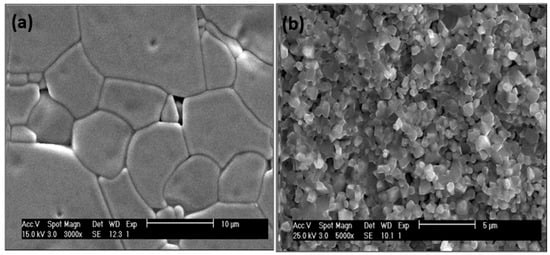
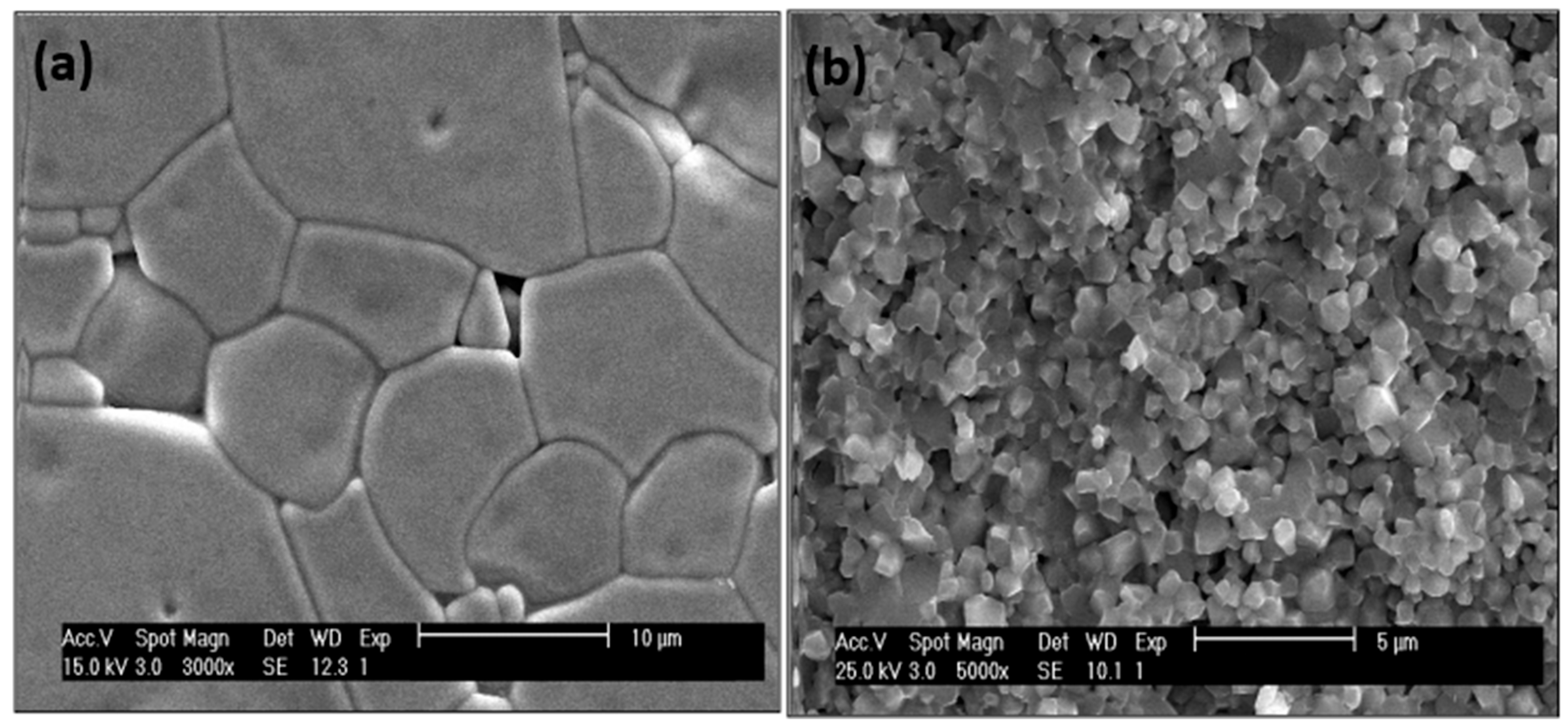
The microstructures of the sintered materials are shown in Figure 3. The SEM images for the CFO samples result from CS (a) at 1200 °C/3 h and MS (b) at 1200 °C/15 min. The CS sample showed an average grain size distribution value of ~7.72 µm, and the corresponding value for the MS sample was ~0.74 µm. In Figure 3b, it is possible to observe that the microstructure of the sample sintered by MS shows a small grain size distribution with morphological uniformity, in contrast to the sample sintered by CS, Figure 3a, which shows a big grain size distribution with less morphological homogeneity. This difference between the grain sizes of the samples is due to the fact that the microwave sintering method of heating the material uses electromagnetic energy absorption throughout the volume of the material, which transfers the heat, that is, it is a volumetric heating of the sample, which permits the control of the process of sintering and reduction of the growing of the grains [41].
Figure 3.
SEM images of the surface of CoFe2O4 particulates: conventionally sintered—CS (a), scale 10 µm, and microwave sintered—MS (b), scale 5 µm.
The process of heating is prosecuted on the surface of the material so that afterwards, the heat is driven into the substance. Therefore, there is a temperature gradient between the surface and the internal area of the sample [42]. However, the microwave sintering method has a sintering time 80% inferior to that used by the conventional method. This permits a big diffusion progress with less energy consumption, and heating is accomplished very quickly, a factor that reduces considerably the time of the progression.
Next, in the following section, the results of the magnetic characterization are presented, in addition to how they correlate with the results for apparent density, crystallite size, and average grain size and their influence on the magnetic properties, based on the comparison of the two sintering methods.
3.2. Magnetic Hysteresis (M-H)
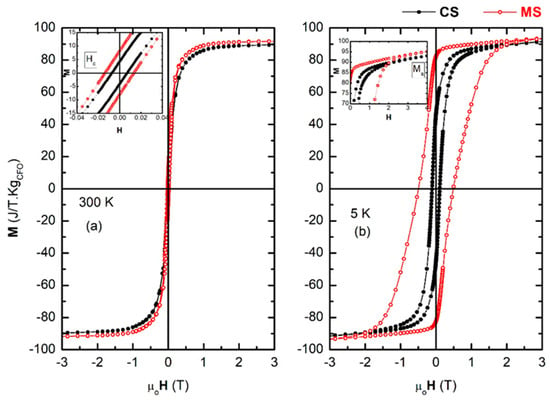
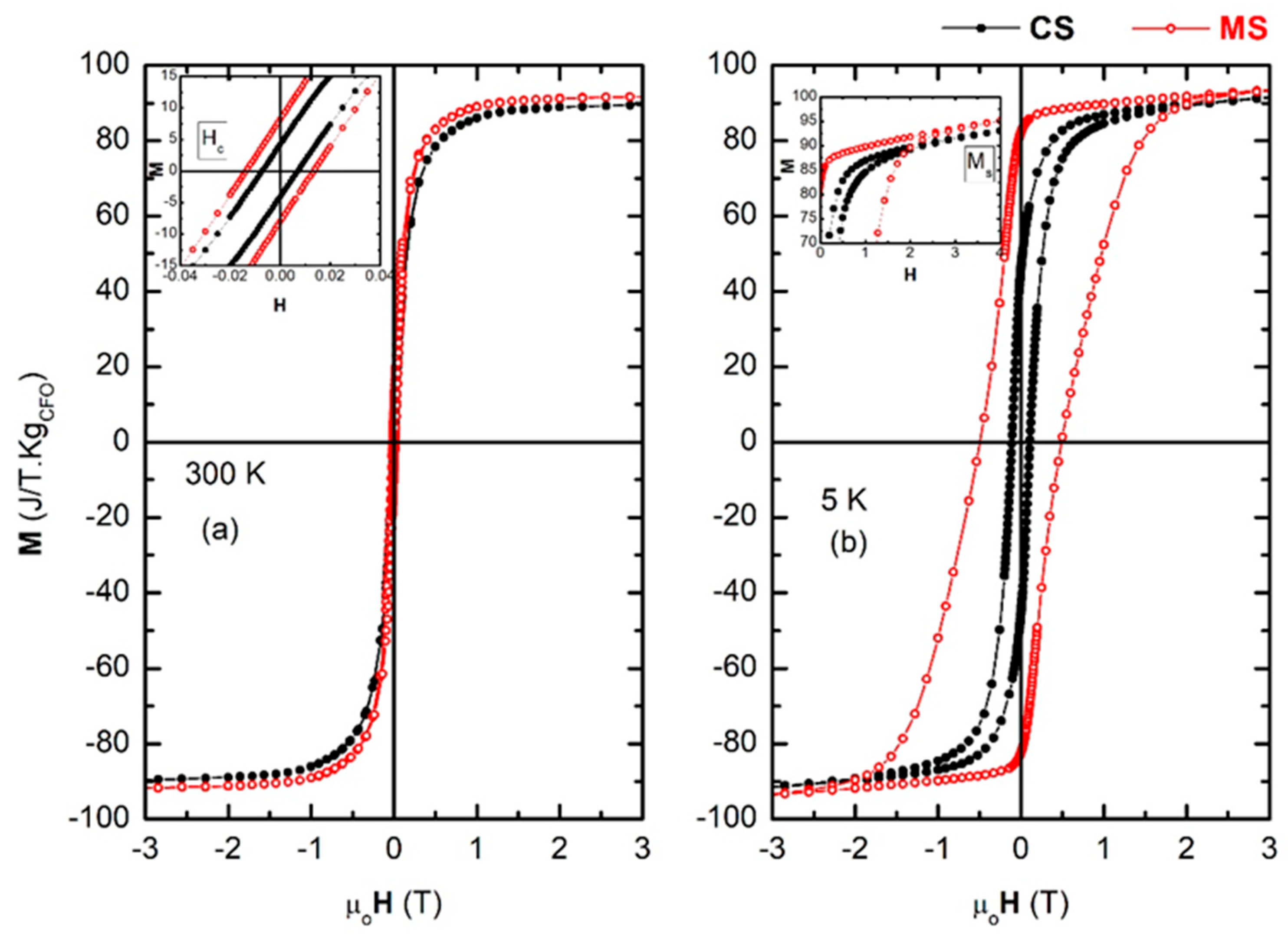
The magnetic hysteresis loops for the cobalt ferrite (CFO) by CS and MS samples were obtained at 300 K and 5 K, and the results can be seen in Figure 4. The saturation magnetization (Ms), coercive field (Hc) and remanent magnetization (Mr) values at 300 K and 5 K are listed in Table 4. In Figure 4a, the measured values Ms, Hc and Mr are 300 K, 88.64 J/T·kg; 0.010 T (≈0.10 kOe), and 4.12 J/T·kg for the CS sample and 91.43 J/T·kg; 0.012 T (≈0.12 kOe) and 8.08 J/T·kg for the MS sample.
Figure 4.
Magnetic hysteresis loop (MxH) at 300 K (a), and 5 K (b), for samples (CoFe2O4) by CS and MS.
Table 4.
Magnetic properties for samples (CoFe2O4) by CS and SM, at 300 K and 5 K, for Ms (saturation magnetization), Mr (remanent magnetization), and Hc (magnetic coercive field).
In Figure 4b, the measured values Ms, Hc and Mr are (at 5 K) 89.80 J/T·kg; 0.109 T (≈1.09 kOe) and 45.76 J/T·kg for the CS sample and 91.85 J/T·kg; 0.487 T (≈4.87 kOe) and 82.12 J/T·kg for the MS sample. The measured Ms values for the MS sample are higher than those of the CS sample. This behavior of high Ms is correlated with sintering temperature and, it might be due to the 2.45 GHz microwave field interacting with the cations Co2+ and Fe3+, changing the arrangements in the sub-lattices and the modification of dipole moments [23,43].
The high values for field coercivity are expected, given the low porosity and high density, and the grain size distributions of the samples. Nevertheless, the walls of the magnetic domains increase with the grain size because the contribution of the walls dynamic in the magnetization is higher than of the domains rotation. The magnetic hysteresis loops at 300 K showed a reduced area for the two samples (Figure 4a). This behavior is like a superparamagnetic system that consists of nanoparticles with magnetic monodomains [44]. For our systems, they are bulk-format, with an average grain size distribution in a sub-micrometric scale, where this behavior has been reported for nickel ferrite (NiFe2O4) bulk ceramic [44]. Both magnetic samples have a high relative density (%), the CS sample (≈97%), and the MS sample (≈95%). The high relative density can result in increased magnetic parameters in ferrites [45,46]. Consequently, this is also applied in comparisons of nanoparticles and nanocomposite materials.
In the coercivity region of the magnetic loop (Figure 4b), as for the MS sample at 5 K, its behavior could be attributed to a lashing process of the magnetic domain walls produced by the stress/strain associated with its grain size, in comparison with the CS sample at the same temperature. The difference is in the movement of the walls and rotation by the magnetic domains, as against the contraction of the grains; this requires a high investment of the applied field prior to the decrease to the magnetization remanent of the sample [13]. Furthermore, the higher coercivity (at 5 K) for the MS sample is due to the increase of magneto-crystalline anisotropy when compared to the CS sample [47]. This type of result is relevant and crucial for robust information storage, as it defines the stability of magnetic domains against fluctuating external fields (high demagnetizing resistance), such as in magnetoelectric random access memory [48,49].
3.3. Magnetostriction Measurements
The results for the X-RD and Rietveld refinement confirmed the formation of a single cubic spinel phase in both samples (CS and MS), with no evidence of secondary phases. Furthermore, the differences observed in the lattice parameter, cell volume, and crystallite size were minimal, suggesting that the variations in magnetomechanical properties are primarily related to microstructural changes induced by the different sintering routes.
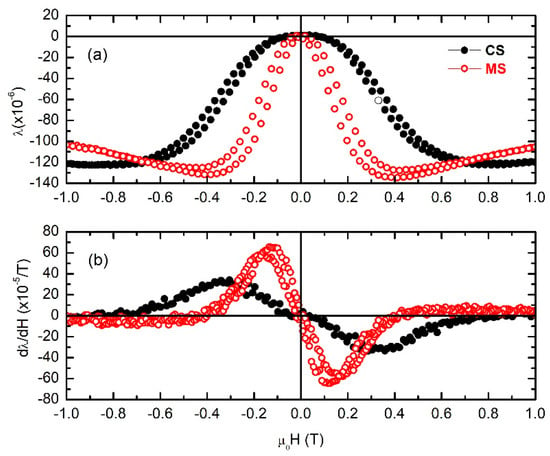
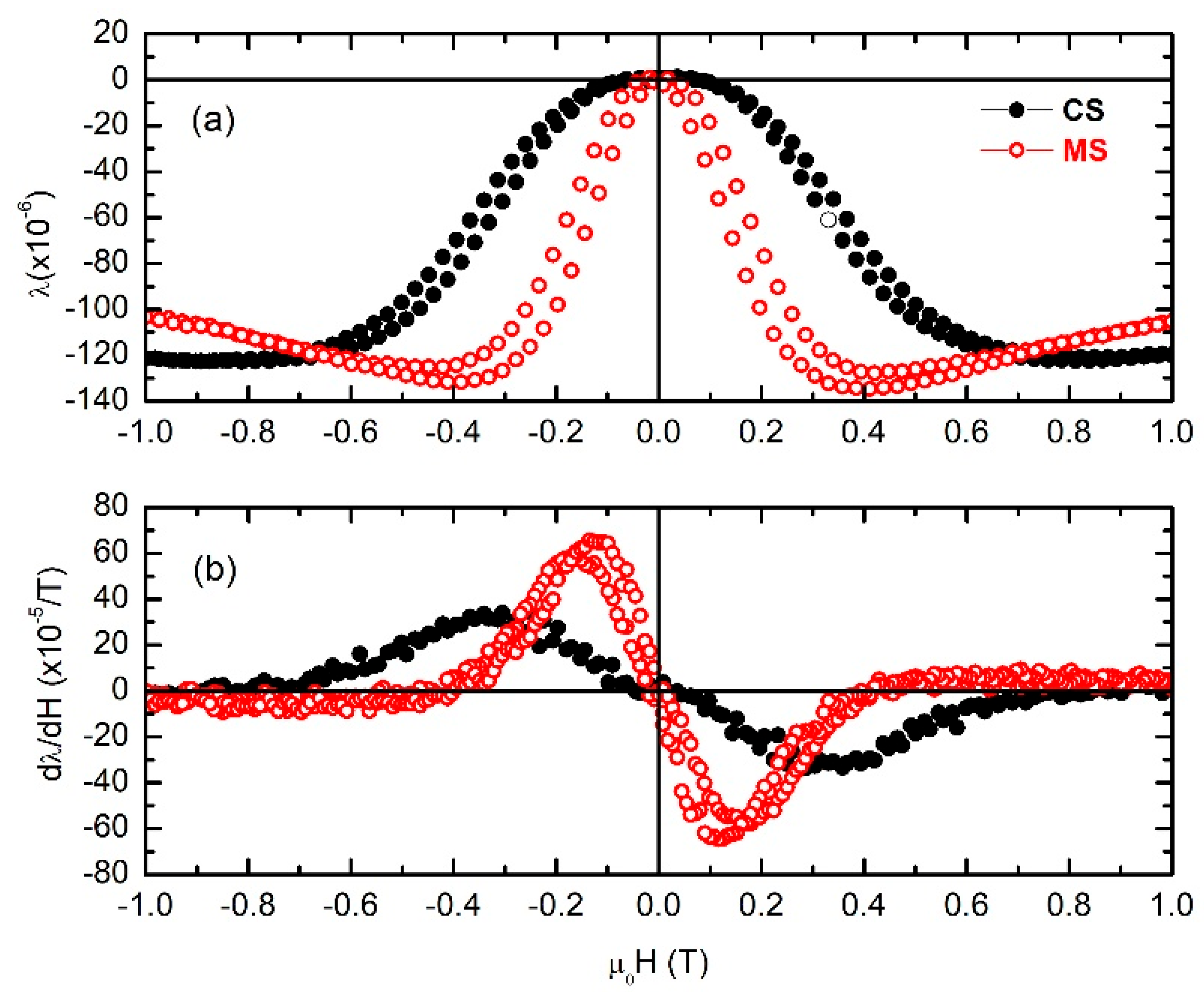
Figure 5a shows the magnetostriction saturation (λS) as a function of the applied static magnetic field, λS ≈ −120 × 10−6 with a density of 97% for the CS sample, and λS ≈ −110 × 10−6 with a density of 95% for the MS sample, respectively. In the reported literature, the saturation magnetostriction for iron (−7.0 × 10⁻⁶), nickel (−62.0 × 10⁻⁶), and cobalt (−34.0 × 10⁻⁶), resulting in metals such as Fe70Co30 (−67.3 × 10⁻⁶), and Fe50Ni50 (−28 × 10−6) [50,51,52,53], have lower values than cobalt ferrite; this indicates that cobalt ferrite has a higher saturation value than them. Figure 5a shows the magnetostriction curves with saturation values (λS) for the two sintering methods (CS and MS), which exhibit similar behaviors. The magnetomechanical deformation increased with the applied magnetic field DC, which is classified into three regions: slow, linear, and saturation. These regions correspond to the movement process of the magnetic domains in the samples, which are associated with the initial magnetization, the movement of the magnetic domain walls, and the rotation of each domain with the applied magnetic field [54]. It should be noted that these conditions can be affected by stress conditions prior to sample densification, as well as by the degree of densification, which depends on the sintering temperature. In our case, the uniaxial pressure was the same as before densification.
Figure 5.
Relative size-change measurements in the function of the magnetic field at room temperature. (a) Magnetostriction (λ × H) and (b) strain derivative (dλ/dH), for samples of cobalt ferrite (CoFe2O4), using the CS and MS methods.
The decrease in the λS value (−110 × 10−6) for the MS sample (0.74 μm) can be attributed to the increased density of grain boundaries, which act as regions of mechanical constraint and anchor points (or clamping effect) for the magnetic domain walls, limiting the maximum magnetostrictive deformation. The MS sample has an exponentially higher volume fraction of grain boundaries than the CS sample (7.72 μm). Since the CS sample has a large average grain size, its behavior is dominated by the intrinsic properties of the bulk (intra-granular). Here, the residual stress/strain is low due to the long sintering time (3 h), allowing the system to relax. In contrast to the MS sample (15 min), it exhibits a high density of grain boundaries that act as zones of high inter-granular mechanical and magnetic stress due to the misalignment of orientation between neighboring grains.
Figure 5b shows the strain derivative (dλ/dH) or piezomagnetic response, 35 × 10−5 T−1 at 0.31 T for the CS sample and 66 × 10−5 T−1 at 0.13 T for the MS sample. The λS and dλ/dH coefficients are listed in Table 5. These values are similar to those reported in the literature [23,55]. In our case, the magnetostrictive behavior is associated with the effects of the contraction of the substance with the increase in magnetic field DC. However, the magnetostriction loop for the MS sample shows a signal change in the value 0.40 T, which is associated with an expansion of its dimensions. These processes are attributed to a change of the sign of the first cubic anisotropy constants or a change of signs of total strain in the direction for a contraction (100) and an expansion (111) [35,53,56,57]. Similarly, these directions refer to the axes of difficult and easy magnetization in materials with magnetic ordering [58].
Table 5.
The saturation magnetostriction (λS) and the strain derivative (dλ/dH) for samples (CoFe2O4) constituted using CS and SM, at room temperature.
However, the MS sample exhibited a significantly higher piezomagnetic coefficient than the CS sample. This behavior indicates that magnetomechanical material sensitivity does not depend solely on the magnitude of the saturation magnetostriction, but also on the slope of the λ(H) curve. The high density of grain boundaries and the associated internal stress fields favor a more pronounced deformation response to small variations in the applied magnetic field, thereby increasing the piezomagnetic coefficient. The value of dλ/dH is zero at saturation and zero at null field, reaching its maximum value at an intermediate point known as the optimum polarization field (Hbias). For applications in two-phase magnetoelectric materials, if q = dλ/dH is very low, the transfer of mechanical energy across the ceramic interface decays, resulting in a minuscule output voltage. A cobalt ferrite with a high q value ensures that very small variations in the magnetic field generate strong mechanical stresses transferable to the piezoelectric array.
Figure 5b, for the MS sample, shows that with magnetostriction with a low magnetic field, the magnetic moments in grains are oriented in the (100) direction, and at high magnetic fields, oriented in the (111) direction. This same effect can be seen for magnetic systems such as cobalt ferrite under different preload conditions, in which is sought the most significant magnetostrictive performance under the applied preload [59]. This is possible to cause through internal magnetic domains and the stress direction aligned with saturation magnetization [59]. Nevertheless, there is another considerable influence in the magnetostriction response, the heating rapidly by microwaves. This is due to the fact that the thermal process can induce a stress of anisotropy. For instance, a uniaxial anisotropy induced by magnetic annealing for CoFe2O4 as reported by C. C. H. Lo et al. [55,60] showed improvements in high magnetomechanical response and strain derivative for this material after magnetic annealing and indicated that magnetostriction behavior depends on the domain structure and magnetization processes [61]. These results indicate that increasing the density of cobalt ferrite is beneficial for improving the magnetostrictive saturation and the strain derivative coefficients.
In addition, the MS samples exhibited a sign change in the magnetostriction curve around 0.40 T. This behavior suggests competition between the magnetoelastic contributions associated with the (100) and (111) crystallographic directions. At low magnetic fields, a contractive deformation predominates, whereas at higher fields, the expansive contribution associated with domain rotation toward the (111) direction becomes dominant [58]. The high density of grain boundaries and the residual stresses present in the microstructure of the MS sample can modify the effective magnetocrystalline anisotropy and the energy balance between both mechanisms, favoring the inversion of the magnetostrictive response observed experimentally.
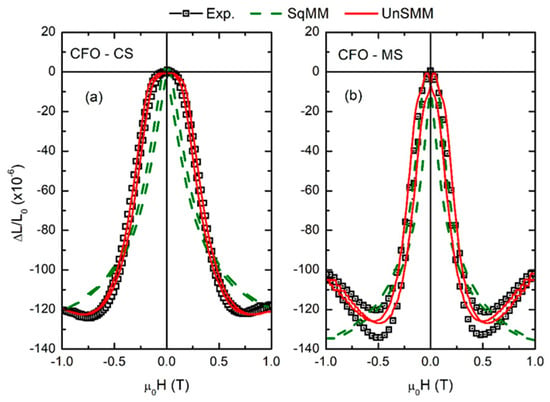
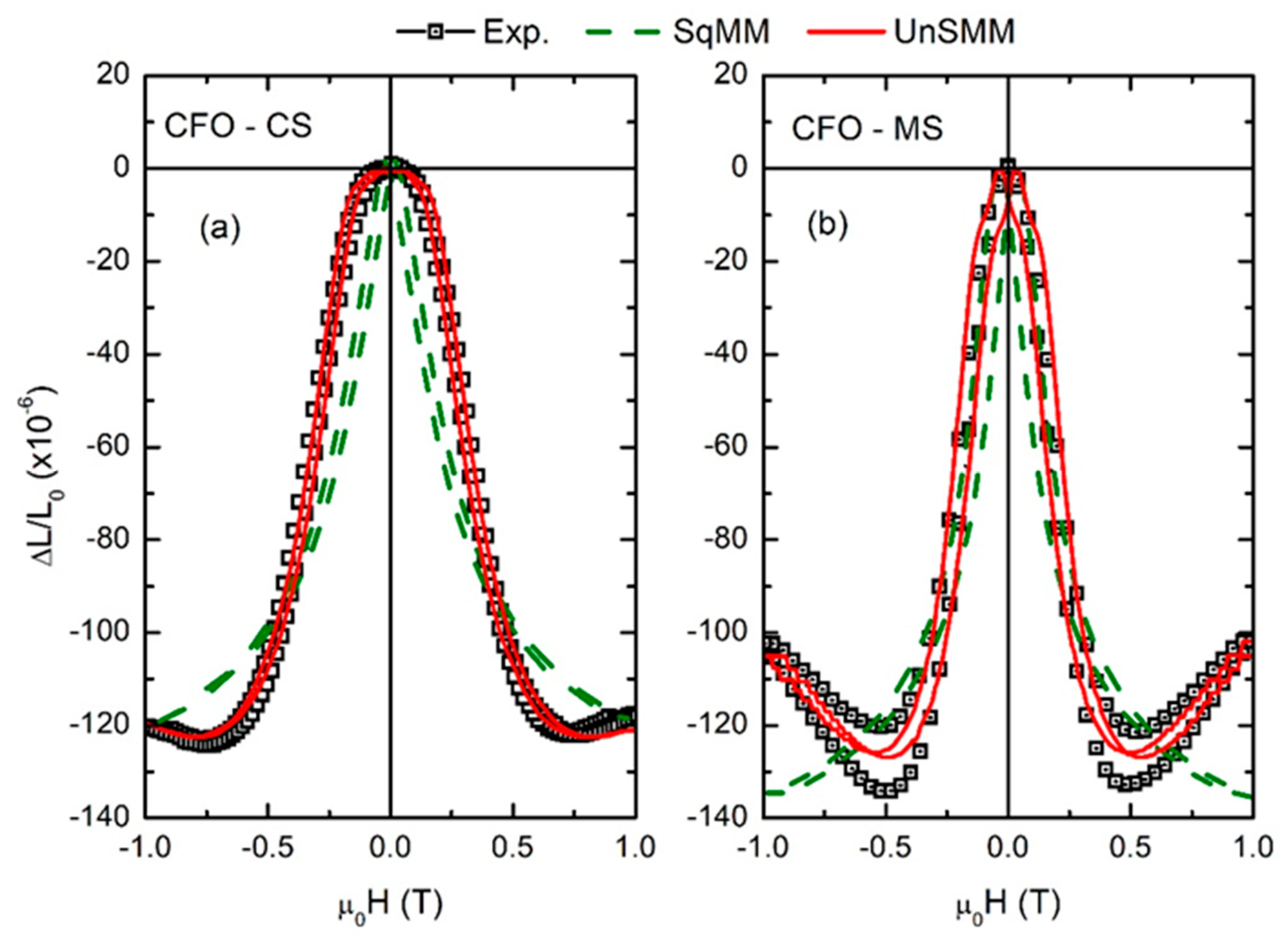
Figure 6a,b shows the magnetostriction experimental data and simulated curves (ΔL/L0 = λ) in comparisons by the mathematical model: L0 is the thickness of the sample and ΔL relative variation (relative change in length). The magnetization data at room temperature of the CS and MS CoFe2O4 samples was used to fit the magnetostriction using the SqMM (Square Magnetization Model) and UnSMM (Unstressed Magnetostriction Model) [34,39]. The results show that there is better agreement of the UnSMM model with the experimental data as function of applied magnetic field, relative to SqMM. The SqMM agrees only at a low magnetic field (≈0.10 T). Table 6 shows the λ1 and λ2 parameter values found for both simulations for the CoFe2O4 samples. For our case, the Mr values by CS and MS used for the mathematical model were 4.12 J/T·kg and 8.12 J/T·kg; and the Xr values by CS and MS were 0.37 m3/kg and 0.42 m3/kg at room temperature.
Figure 6.
Magnetostriction (ΔL⁄L_0 = λ) as function of the magnetic field at room temperature. CS (a) and MS (b), where the geometric symbol is experimental data; continuous lines, UnSMM; and dashed line, SqMM.
Table 6.
Comparison of the coefficients for simulation using the UnSMM and SMM models for the samples CS and MS.
The comparing of the coefficients λ1 and λ2 values, it can be seen that both decrease for sample MS. This suggests that the intrinsic magnetoelastic coupling is slightly lower, the maximum magnetostrictive strains are more restricted, and the grain boundaries absorb some of the magnetoelastic energy. This coincides with the reduction at magnetostrictive saturation (λs) of CS (−120 × 10−6) compared to MS (−110 × 10−6). Therefore, λ1 and λ2 describe the amplitude of the magnetoelastic coupling, while q describes the sensitivity of the strain to the applied field. Sample MS exhibits a lower total strain amplitude but a faster response to the applied field. That is, sample CS deforms more, while sample MS responds more efficiently to small field variations. This behavior is precisely what is sought after in magnetoelectric materials and sensors [62]. For the same material synthesized by conventional solid-state reaction and densified at 1050 °C for 0.5 h [34], Gualdi et al. reported the values for λ1 (−7.15 × 10⁻⁸) and λ2 (4.00 × 10⁻¹³) at room temperature using the UnSMM model. Our λ_1 and λ_2 values show a similar behavior in sign and order of magnitude. The λ_1 value for MS is close to that reported in the literature. This demonstrates a similar mathematical behavior in the λ_1 and λ_2 coefficients for cobalt ferrite prepared using different techniques.
The magnetostriction and magnetization results are associated with the average grain size; it is evident that high magnetostriction and piezomagnetic coefficients can be achieved in CoFe2O4 by controlling the grain size [63]. This suggests that enhancing magnetic anisotropy through grain size control can improve the performance of magnetic materials [6,64]. Microwave sintering drastically modifies the microstructure (grain size) without significantly altering the crystalline structure, producing a moderate decrease in saturation magnetostriction but a marked increase in piezomagnetic sensitivity at low magnetic fields, which is particularly advantageous for magnetomechanical applications and magnetic sensors. Therefore, these results, combined with previous ones, indicate that the samples obtained in this work are of good quality for use in the design of two-phase ferroic ceramics.
4. Conclusions
The cobalt ferrite samples were obtained by two sintering methods, using the same temperature of 1200 °C but different densification methods—the conventional sintering (CS) and the ultrafast microwave sintering (MS). XRD analysis and Rietveld confirmed the crystal structure without detectable secondary phases. The results demonstrated the effectiveness of microwave processing for grain growth control, rapid densification and ≈90% reduction in grain size.
Magnetic measurements revealed a slightly higher saturation magnetization and a significant incremental gain in coercivity for the microwave-sintered sample, which can be attributed to the refined grain structure and increased effective magnetic anisotropy.
Magnetostrictive measurements showed ≈8% decrease in saturation magnetostriction from CS (−120 × 10−6) to MS (−110 × 10−6), and ≈89% increase in piezomagnetic coefficient to MS sample. Although the reduction in grain size slightly decreased saturation magnetostriction due to increased grain-boundary constraints and possibly intra-grain stress, it achieved a significant incremental improvement in the piezomagnetic coefficient. This allowed the material to improve magnetomechanical sensitivity even when the maximum strain is reduced.
A sign reversal in the magnetostrictive response was observed near 0.40 T for the microwave-sintered sample (MS), suggesting competition between the magnetoelastic contributions associated with the the (100) and (111) crystallographic directions and the influence of grain-boundary-induced internal stresses. These may be related to the easy and difficult magnetization of axes in ferrimagnetic-ordered samples.
The Unstressed Magnetostriction Model (UnSMM) accurately reproduced the experimental magnetostriction curves, confirming that grain-size refinement and grain-boundary effects are the key factors controlling the magnetomechanical response of CoFe2O4 ceramics.
Finally, these results highlight microwave-assisted sintering as an effective strategy for improving the magnetic and magnetostrictive properties of cobalt ferrite, particularly the piezomagnetic coefficient at low applied magnetic fields, compared to the conventional method. This is highly useful in the design and processing of magnetoelectric biferroic ceramics for applications in energy conversion devices and MeRAM memories.
Author Contributions
K.P.-J.: writing—original draft, conceptualization, project administration, supervision, validation. D.T.-P.: writing—review, data curation and editing. All authors have read and agreed to the published version of the manuscript.
Funding
The authors acknowledge Universidad del Sinu–Elias Becahra Zainum for its internal funding under project “Electromagnetic and thermal properties analysis in functional materials”. The project was approved by the Faculty Council of Sciences and Engineering under Minutes No. 01-24012025, and No. 001-30012026.
Data Availability Statement
The original contributions presented in this study are included in the article. Further inquiries can be directed to the corresponding author.
Acknowledgments
The authors would like to acknowledge Universidad del Sinú–Elías Bechara Zainúm. The author gratefully acknowledges the assistance of ChatGPT-5 (OpenAI) for language revision and improvement of the English text during the preparation of this manuscript.
Conflicts of Interest
The authors declare no conflicts of interest.
References
- Dionne, G.F. Magnetic Oxides; Springer: Boston, MA, USA, 2009. [Google Scholar] [CrossRef] [Scilit]
- Kharat, P.B.; Somvanshi, S.B.; Kounsalye, J.S.; Deshmukh, S.S.; Khirade, P.P.; Jadhav, K.M. Temperature dependent viscosity of cobalt ferrite/ethylene glycol ferrofluids. AIP Conf. Proc. 2018, 1942, 1–5. [Google Scholar] [CrossRef] [Scilit]
- Aubert, A.; Garitaonandia, J.S.; Maccari, F.; Brötz, J.; Skokov, K.; Gutfleisch, O. Origin of the uniaxial magnetic anisotropy in cobalt ferrite induced by spark plasma sintering. Ceram. Int. 2023, 49, 5630–5636. [Google Scholar] [CrossRef] [Scilit]
- Heydaryan, K.; Mohammadalizadeh, M.; Montazer, A.H.; Almasi Kashi, M. Reaction time-induced improvement in hyperthermia properties of cobalt ferrite nanoparticles with different sizes. Mater. Chem. Phys. 2023, 303, 127773. [Google Scholar] [CrossRef] [Scilit]
- Jimenez, K.R.C.P.; Zabotto, F.L.; Garcia, D.; De Oliveira, A.J.A. Magnetic anisotropy enhancing by remanent electric polarization in 0.675(Pb(Mg1/3Nb2/3)O3-0.325PbTiO2/CoFe2O4 particulate composites. Ferroelectrics 2018, 534, 152–158. [Google Scholar] [CrossRef] [Scilit]
- Vorontsov, P.A.; Salnikov, V.D.; Savin, V.V.; Vorontsov, S.A.; Omelyanchik, A.S.; Shvets, P.V.; Panina, L.V.; Ershov, P.A.; Rodionova, V.V. Phase Composition, Surface Morphology, and Dielectric Properties of Poly(Vinylidene Fluoride)–Cobalt Ferrite Composite Films Depending on Thickness. Crystals 2024, 15, 47. [Google Scholar] [CrossRef] [Scilit]
- Chandekar, K.V.; Kant, K.M. Strain induced magnetic anisotropy and 3d 7 ions effect in CoFe2O4 nanoplatelets. Superlattices Microstruct. 2017, 111, 610–627. [Google Scholar] [CrossRef] [Scilit]
- Chen, G.; Jin, Z.; Chen, J. A review: Magneto-optical sensor based on magnetostrictive materials and magneto-optical material. Sens. Actuators Rep. 2023, 5, 100152. [Google Scholar] [CrossRef] [Scilit]
- Ortega, N.; Kumar, A.; Scott, J.F.; Katiyar, R.S. Multifunctional magnetoelectric materials for device applications. J. Phys. Condens. Matter 2015, 27, 504002. [Google Scholar] [CrossRef] [Scilit]
- Viana, D.S.F.; De Oliveira, A.J.A.; Jimenez, K.R.C.P.; Milton, F.P.; Eiras, J.A.; Santos, G.M.; Garcia, D. Synthesis and multiferroic properties of particulate composites resulting from combined size effects of the magnetic and ferroelectric phases. Ceram. Int. 2022, 48, 931–940. [Google Scholar] [CrossRef] [Scilit]
- Darwish, M.S.A. Magnetite @ Zinc Cobalt Ferrite Nanoparticles: Synthesis, Magnetic Behavior, and Optical Properties. Crystals 2023, 13, 1284. [Google Scholar] [CrossRef] [Scilit]
- Smith, S.E.; Tsui, M.; Williams, B.; Carpenter, E.E. Modern Ferrites: Chemical Processing and Magnetic Properties of Ferrite Nanoparticles; Harris, V.G., Ed.; Wiley: Hoboken, NJ, USA, 2022; Volume 1, pp. 269–294. [Google Scholar] [CrossRef] [Scilit]
- Kumari, M.; Bhatnagar, M.C. Study of structural and magnetic properties of cobalt ferrite nanoparticles sintered at different temperature. AIP Conf. Proc. 2018, 1953, 120075. [Google Scholar] [CrossRef] [Scilit]
- Yadav, R.S.; Kuřitka, I.; Havlica, J.; Hnatko, M.; Alexander, C.; Masilko, J.; Kalina, L.; Hajdúchová, M.; Rusnak, J.; Enev, V. Structural, magnetic, elastic, dielectric and electrical properties of hot-press sintered Co1−xZnxFe2O4 (x = 0.0, 0.5) spinel ferrite nanoparticles. J. Magn. Magn. Mater. 2018, 447, 48–57. [Google Scholar] [CrossRef] [Scilit]
- Zalite, I.; Heidemane, G.; Grabis, J.; Maiorov, M. The Synthesis and Characterization of Nickel and Cobalt Ferrite Nanopowders Obtained by Different Methods. In Powder Technology; InTech: London, UK, 2018. [Google Scholar] [CrossRef] [Scilit]
- Fariñas, J.; Moreno, R.; Pérez, A.; García, M.; García-Hernández, M.; Salvador, M.D.; Borrell, A. Microwave-assisted solution synthesis, microwave sintering and magnetic properties of cobalt ferrite. J. Eur. Ceram. Soc. 2018, 38, 2360–2368. [Google Scholar] [CrossRef] [Scilit]
- Köferstein, R.; Walther, T.; Hesse, D.; Ebbinghaus, S.G. Fine-grained BaTiO3–MgFe2O4 composites prepared by a Pechini-like process. J. Alloys Compd. 2015, 638, 141–147. [Google Scholar] [CrossRef] [Scilit]
- Sanchez Caceres, J.A.; Cardoso Passos, C.A. Effect of Er ion substitution on the micro-structural and electrical properties using a polymeric precursor method in PZT52/48 ceramics. J. Phys. Chem. Solids 2022, 160, 110375. [Google Scholar] [CrossRef] [Scilit]
- Sharma, S.; Verma, M.K.; Sharma, N.D.; Choudhary, N.; Singh, S.; Singh, D. Rare-earth doped Ni–Co ferrites synthesized by Pechini method: Cation distribution and high temperature magnetic studies. Ceram. Int. 2021, 47, 17510–17519. [Google Scholar] [CrossRef] [Scilit]
- Karakaş, İ.H.; Karakaş, Z.K.; Ertuğrul, M. Photocatalytic activity of cobalt aluminate nanoparticles synthesized by microwave-assisted combustion method. J. Phys. Chem. Solids 2022, 161, 110482. [Google Scholar] [CrossRef] [Scilit]
- Kioupis, D.; Kakali, G. Structural and electrical characterization of Sr- and Al- doped apatite type lanthanum silicates prepared by the pechini method. Ceram. Int. 2016, 42, 9640–9647. [Google Scholar] [CrossRef] [Scilit]
- Jouannaux, J.; Haeussler, A.; Drobek, M.; Ayral, A.; Abanades, S.; Julbe, A. Lanthanum manganite perovskite ceramic powders for CO2 splitting: Influence of Pechini synthesis parameters on sinterability and reactivity. Ceram. Int. 2019, 45, 15636–15648. [Google Scholar] [CrossRef] [Scilit]
- Pubby, K.; Babu, K.V.; Narang, S.B. Magnetic, elastic, dielectric, microwave absorption and optical characterization of cobalt-substituted nickel spinel ferrites. Mater. Sci. Eng. B 2020, 255, 114513. [Google Scholar] [CrossRef] [Scilit]
- Camayo, C.E.; Gaona, J.; Raigoza, C.F.V. Effect of La and Pr substitution on structure and magnetic properties of Pechini synthesized BiFeO3. J. Magn. Magn. Mater. 2021, 527, 167733. [Google Scholar] [CrossRef] [Scilit]
- Wang, Y.; Li, H.; Huang, D.; Wang, X.; Cai, L.; Chen, Y.; Wang, W.; Song, Y.; Han, G.; Zhen, B. A high-performance ethanol gas sensor based on Ce-doped SnO2 nanomaterials prepared by the Pechini method. Mater. Sci. Semicond. Process. 2022, 137, 106188. [Google Scholar] [CrossRef] [Scilit]
- Fernández, C.P.; Zabotto, F.L.; Garcia, D.; Kiminami, R.H.G.A. In situ sol-gel co-synthesis at as low hydrolysis rate and microwave sintering of PZT/Fe 2 CoO 4 magnetoelectric composite ceramics. Ceram. Int. 2017, 43, 5925–5933. [Google Scholar] [CrossRef] [Scilit]
- Bhongale, S.R.; Ingavale, H.R.; Shinde, T.J.; Vasambekar, P.N. Structural properties of nano-crystalline Mg-Ferrite prepared by microwave sintering technique. Integr. Ferroelectr. 2017, 185, 193–198. [Google Scholar] [CrossRef] [Scilit]
- Togashi, M.M.; Perdomo, C.P.F.; Kiminami, R.H.G.A. Densification kinetics of nano-hematite using microwave assisted dilatometry. Ceram. Int. 2020, 46, 28546–28560. [Google Scholar] [CrossRef] [Scilit]
- Montahaei, R.; Emamian, H.R. The impact of microwave-assisted sintering on fabrication of cobalt ferrite nanostructure foams for gas-sensing. Ceram. Int. 2022, 48, 26629–26637. [Google Scholar] [CrossRef] [Scilit]
- Oghbaei, M.; Mirzaee, O. Microwave versus conventional sintering: A review of fundamentals, advantages and applications. J. Alloys Compd. 2010, 494, 175–189. [Google Scholar] [CrossRef] [Scilit]
- Newnham, R.E. Properties of Materials; Oxford University Press: Oxford, UK, 2004. [Google Scholar] [CrossRef] [Scilit]
- Pop, N.C. A model for magnetic hysteresis. Eur. Phys. J. Plus 2019, 134, 567. [Google Scholar] [CrossRef] [Scilit]
- Schio, P.; Vidal, F.; Zheng, Y.; Milano, J.; Fonda, E.; Demaille, D.; Vodungbo, B.; Varalda, J.; de Oliveira, A.J.A.; Etgens, V.H. Magnetic response of cobalt nanowires with diameter below 5 nm. Phys. Rev. B Condens. Matter Mater. Phys. 2010, 82, 094436. [Google Scholar] [CrossRef] [Scilit]
- Gualdi, A.J.; Zabotto, F.L.; Garcia, D.; de Oliveira, A.J.A. Stress magnetization model for magnetostriction in multiferroic composite. J. Appl. Phys. 2013, 114, 053913. [Google Scholar] [CrossRef] [Scilit]
- Nieves, P.; Legut, D. Influence of grain morphology and orientation on saturation magnetostriction of polycrystalline Terfenol-D. Solid State Commun. 2022, 352, 114825. [Google Scholar] [CrossRef] [Scilit]
- Zhijun, W.; Pengpeng, S.; Hong-En, C.; Manru, H.; Zhenmao, C. A theoretical simulation for MBN testing: Modeling microscopic local magnetization jumps in magnetic domain movement. J. Magn. Magn. Mater. 2022, 552, 169170. [Google Scholar] [CrossRef] [Scilit]
- Adnan Islam, R.; Priya, S. Progress in Dual (Piezoelectric-Magnetostrictive) Phase Magnetoelectric Sintered Composites. Adv. Condens. Matter Phys. 2012, 2012, 320612. [Google Scholar] [CrossRef] [Scilit]
- Lee, E.W. Magnetostriction and magnetomechanical effects. Rep. Prog. Phys. 1955, 18, 184–229. [Google Scholar] [CrossRef] [Scilit]
- Jiles, D.C. Theory of the magnetomechanical effect. J. Phys. D. Appl. Phys. 1995, 28, 1537–1546. [Google Scholar] [CrossRef] [Scilit]
- Srinivasamurthy, K.; Zhang, C.; Jagadeesha Gouda, V.; Bhaskar, K.; Zhitomirsky, I.; Wu, S.Y.; Ganesh, V.; Yahia, I.; Algarni, H.; Manjunatha, K.; et al. Electrochemical performance of Sr-doped cobalt nickel ferrite ceramics for supercapacitor applications. J. Energy Storage 2025, 114, 115735. [Google Scholar] [CrossRef] [Scilit]
- Wang, G.; Guan, L.; Zhou, X.; Zhang, Y.; Zhu, Y.; Zhang, Y.; An, F.; Gao, Q.; Richter, A.; Zhang, R. Preparation of (ZrTiCoNiNb)Ox high entropy ceramics by microwave sintering. Mater. Today Commun. 2025, 49, 113853. [Google Scholar] [CrossRef] [Scilit]
- Ghasali, E.; Zhang, R.; Sadiqa, A.; Raza, S.; Jie, L.; Landarani-Isfahani, A.; Orooji, Y.; Karimi-Maleh, H. Conventional, microwave and spark plasma sintering of high entropy rare earth ceramic: La2O3-CeO2-Pr6O11-Nd2O3. J. Alloys Compd. 2026, 1050, 185670. [Google Scholar] [CrossRef] [Scilit]
- Zimur, S.D.; Gaikwad, P.; Mali, A.V.; Patil, A.P.; Burungale, S.H.; Kamble, P.D. Magnetic and structural characterization of Sn doped cobalt ferrites; A visible light-driven photocatalysts for degradation of rhodamine-B and modeling the process by artificial intelligence tools. J. Alloys Compd. 2023, 947, 169572. [Google Scholar] [CrossRef] [Scilit]
- Zabotto, F.L.; Gualdi, A.J.; Eiras, J.A.; De Oliveira, A.J.A.; Garcia, D. Influence of the sintering temperature on the magnetic and electric properties of NiFe2O4 ferrites. Mater. Res. 2012, 15, 428–433. [Google Scholar] [CrossRef] [Scilit]
- Li, J.; Liu, M.; Cheng, J.; Bao, X.; Gao, X. Giant improvement of magnetostrictive properties in polycrystalline CoFe2O4 ceramics via Cu doping and magnetic aligning during solid-state preparation process. J. Eur. Ceram. Soc. 2026, 46, 118108. [Google Scholar] [CrossRef] [Scilit]
- Bovtun, V.; Kempa, M.; Kukhar, V.; Solopan, S.; Savinov, M.; Belous, A.; Kamba, S. High-frequency absorption and shielding of the Ni0.5Zn0.5Fe2O4 spinel ferrite ceramics: Synergy effect of domain wall and grain boundary contributions. J. Magn. Magn. Mater. 2026, 648, 174065. [Google Scholar] [CrossRef] [Scilit]
- Murugesan, C.; Perumal, M.; Chandrasekaran, G. Structural, dielectric and magnetic properties of cobalt ferrite prepared using auto combustion and ceramic route. Phys. B Condens. Matter 2014, 448, 53–56. [Google Scholar] [CrossRef] [Scilit]
- Palneedi, H.; Annapureddy, V.; Priya, S.; Ryu, J. Status and Perspectives of Multiferroic Magnetoelectric Composite Materials and Applications. Actuators 2016, 5, 9. [Google Scholar] [CrossRef] [Scilit]
- Annapureddy, V.; Palneedi, H.; Hwang, G.-T.; Peddigari, M.; Jeong, D.-Y.; Yoon, W.-H.; Kim, K.-H.; Ryu, J. Magnetic energy harvesting with magnetoelectrics: An emerging technology for self-powered autonomous systems. Sustain. Energy Fuels 2017, 1, 2039–2052. [Google Scholar] [CrossRef] [Scilit]
- García-Arribas, A. Magnetostrictive Materials. In Magnetic Measurement Techniques for Materials Characterization, 1st ed.; Franco, D.B., Ed.; Springer International Publishing: Cham, Switzerland, 2021; Chapter 24; pp. 727–7500. [Google Scholar] [CrossRef] [Scilit]
- Froes, F.; Bormio-Nunes, C. High-temperature magnetization and bulk magnetostriction investigation of Ti and Nb addition to Fe70Co30 alloy. J. Mater. Sci. 2024, 59, 1652–1664. [Google Scholar] [CrossRef] [Scilit]
- Atif, M.; Nadeem, M.; Grössinger, R.; Turtelli, R.S. Studies on the magnetic, magnetostrictive and electrical properties of sol–gel synthesized Zn doped nickel ferrite. J. Alloys Compd. 2011, 509, 5720–5724. [Google Scholar] [CrossRef] [Scilit]
- Satish, M.; Shashanka, H.M.; Saha, S.; Anantharamaiah, P.N.; Ramana, C.V. Enhanced magnetostriction of Co–Ni-ferrite composites derived from hard (CoFe2O4) and soft (NiFe2O4) magnetostrictive phases. Ceram. Int. 2023, 49, 22566–22575. [Google Scholar] [CrossRef] [Scilit]
- Goldman, A. The Magnetization in Domains and Bulk Materials, 2nd ed.; Springer: New York, NY, USA, 2006. [Google Scholar] [CrossRef] [Scilit]
- Lee, S.J.; Lo, C.C.H.; Matlage, P.N.; Song, S.H.; Melikhov, Y.; Snyder, J.E.; Jiles, D.C. Magnetic and magnetoelastic properties of Cr-substituted cobalt ferrite. J. Appl. Phys. 2007, 102, 073910. [Google Scholar] [CrossRef] [Scilit]
- Santa-Rosa, W.; da Silva, P.S.; M’Peko, J.-C.; Amorín, H.; Algueró, M.; Venet, M. Enhanced piezomagnetic coefficient of cobalt ferrite ceramics by Ga and Mn doping for magnetoelectric applications. J. Appl. Phys. 2019, 125, 075107. [Google Scholar] [CrossRef] [Scilit]
- Shirsath, S.E.; Liu, X.; Yasukawa, Y.; Li, S.; Morisako, A. Switching of magnetic easy-axis using crystal orientation for large perpendicular coercivity in CoFe2O4 thin film. Sci. Rep. 2016, 6, 30074. [Google Scholar] [CrossRef] [Scilit]
- Nisticò, R.; Cesano, F.; Garello, F. Magnetic Materials and Systems: Domain Structure Visualization and Other Characterization Techniques for the Application in the Materials Science and Biomedicine. Inorganics 2020, 8, 6. [Google Scholar] [CrossRef] [Scilit]
- Jiang, T.; He, J.; Pi, J.; Zhang, J.; Xue, C.; Hou, D.; Shen, Z. Study on dynamic and static magnetic properties of polycrystalline cobalt ferrite under bias magnetic field. J. Alloys Compd. 2024, 1009, 176886. [Google Scholar] [CrossRef] [Scilit]
- Lo, C.C.H. Experimental and modeling studies of the magnetomechanical effect in substituted cobalt ferrites for magnetoelastic stress sensors. J. Appl. Phys. 2010, 107, 09E706. [Google Scholar] [CrossRef] [Scilit]
- Ohtake, M.; Imamura, K.; Futamoto, M. Magnetostriction. In Handbook of Magnetic Material for Motor Drive Systems; Springer: Singapore, 2025; pp. 1–28. [Google Scholar] [CrossRef] [Scilit]
- Aubert, A.; Loyau, V.; Pascal, Y.; Mazaleyrat, F.; LoBue, M. Dynamic Magnetostriction of CoFe2O4 and Its Role in Magnetoelectric Composites. Phys. Rev. Appl. 2018, 9, 044035. [Google Scholar] [CrossRef] [Scilit]
- Khaja Mohaideen, K.; Joy, P.A. Influence of initial particle size on the magnetostriction of sintered cobalt ferrite derived from nanocrystalline powders. J. Magn. Magn. Mater. 2013, 346, 96–102. [Google Scholar] [CrossRef] [Scilit]
- Lin, C.-F.; Yang, J.-B. Grain Size Reduction and Magnetic Property of Fe-Pd-Rh Alloys. IEEE Trans. Magn. 2009, 45, 2499–2502. [Google Scholar] [CrossRef] [Scilit]

Disclaimer/Publisher’s Note: The statements, opinions and data contained in all publications are solely those of the individual author(s) and contributor(s) and not of MDPI and/or the editor(s). MDPI and/or the editor(s) disclaim responsibility for any injury to people or property resulting from any ideas, methods, instructions or products referred to in the content. |
© 2026 by the authors. Licensee MDPI, Basel, Switzerland. This article is an open access article distributed under the terms and conditions of the Creative Commons Attribution (CC BY) license.