


Abstract
Flux-cored Zn–2Al filler metals were subjected to stress-relief treatment at different temperatures. The salt-spray test was subsequently carried out on the specimens, and the corrosion behavior was analyzed. The findings indicated that Zn–2Al filler metal mainly consisted of α-Al and η-Zn phases. Before stress-relief annealing, α-Al showed a prominent continuous banded distribution. At a stress-relief annealing temperature of 100 °C, recovery and limited recrystallization occurred. This weakened the continuous banded morphology and refined the grain size. Under salt-spray exposure, electrochemical corrosion took place within the filler metal. α-Al acted as the cathode, while η-Zn served as the anode. Stress-relief annealing improved grain-boundary stability and thus enhanced corrosion resistance. In addition, the discontinuous distribution of α-Al impeded corrosion propagation. This further improved the corrosion resistance of the filler metal. After 15 days of salt-spray corrosion, the stress-relieved filler metal retained an elongation of 4.96%. In contrast, elevated stress-relief annealing temperatures promoted Al precipitation at grain boundaries and restored the continuous distribution of α-Al. This created preferential pathways for inward corrosion penetration, which degraded corrosion performance. Accordingly, after 15 days of corrosion, the elongation of filler metal annealed at 250 °C decreased to 2.65%.
1. Introduction
The flux-cored Zn–Al filler metal was a composite brazing material. It was fabricated via casting, extrusion, and drawing processes [1,2,3]. It consisted of a brazing-alloy shell that encapsulated an inner flux core. This material offered high brazing efficiency and environmental friendliness. It also provided high joint strength and a moderate melting point. These advantages rendered it particularly suitable for Cu/Al dissimilar-metal brazing applications. Consequently, it became one of the most widely used cored filler metals [4,5]. Nevertheless, under hot-humid service conditions, corrosion attacked the filler metal, degrading its fluidity. This degradation consequently led to a loss of serviceability and substantial economic losses [6,7]. Therefore, inhibiting the corrosion of Zn–Al filler metals was of paramount significance. This was critical for the advancement of brazing technology and its practical applications.
The properties of filler metals, including strength, plasticity, and corrosion resistance, were dictated by their microstructure and phase distribution [8,9,10]. Previous investigations had documented suitable heat treatments for filler metals [11,12]. These treatments were capable of refining the microstructure and mitigating electrochemical corrosion, thereby enhancing the performance of filler metals. Annealing was the principal thermal processing route for Zn–Al alloys. Different annealing regimes produced distinct effects, modifying both the microstructure and the corrosion resistance of the alloys [13,14,15].
According to the Zn–Al binary phase diagram, the eutectoid temperature was 275 °C [16]. This temperature was regarded as a critical boundary, and researchers used it as a basis to investigate the effects of heat treatment on Zn–Al alloys. Annealing below 275 °C relieved residual stresses in the filler metals, promoted recrystallization, and enhanced mechanical properties. Lv et al. [17] found that homogenization annealing at 330 °C for 5 h promoted melting of the internal dendritic structure and dissolution of non-equilibrium eutectic microstructures in Zn-Al filler metals. These microstructural changes lowered hardness and tensile strength, while enhancing plastic deformation capacity. During subsequent stress-relief annealing, Al and Zn solute atoms also underwent desolvation within the alloy matrix. Wu et al. [18] systematically investigated the microstructural evolution of commonly used Zn–2Al filler metals during annealing. Recrystallization occurred at 100–175 °C. At 250 °C, abnormal grain growth emerged. When the temperature reached 325 °C, secondary recrystallization was triggered, producing numerous equiaxed grains throughout the alloy matrix. Jeshvaghani et al. [19] and Tribology research teams [20] reached similar conclusions: homogenization annealing eliminated the inherent dendritic morphology of Zn-Al alloys and promoted uniform elemental distribution, thereby reducing tensile strength and hardness. Cheng et al. [21] thermally treated Zn-Al alloys at 300 °C and found that cooling protocol and holding time induced pronounced grain coarsening. This coarsened grain structure, in turn, governed fracture behavior, leading to a typical transgranular cleavage mode.
Only a few studies have addressed how thermal treatment affects the corrosion resistance of Zn-Al filler metals. Bobic et al. [22] examined as-cast Zn-Al-Cu-Mg alloys after T4 treatment at 370 °C. The corrosion current density dropped from 14 to 6.6 μA·cm−2, indicating a clear improvement in anti-corrosion performance. This improvement arose from the fracture and dissolution of flower-like microstructures during thermal processing. These changes disrupted the continuous propagation of corrosive pathways. Michalik et al. [23] evaluated as-cast Zn-22Al-3Cu alloys treated at 350 °C. In simulated acid rain, the treatment raised the electrode potential of the alloy and thus improved its corrosion resistance. Yan et al. [24] reported a consistent result for homogenized Zn-15Al alloys: thermal treatment optimized the microstructure and enhanced corrosion resistance. Yan et al. [24] also annealed cold-drawn Zn-15Al filler metals at different temperatures to clarify how corrosion performance evolves with temperature. The best corrosion resistance was obtained at 100 °C, where the corrosion depth decreased markedly from 226.18 to 150.42 μm. Authors attributed the improvement at low temperature to relief of residual stress introduced by cold drawing, which reduced the corrosion susceptibility of the filler metal. Yet direct experimental evidence and mechanistic validation for this explanation remain insufficient. Raising the annealing temperature to 150 °C, however, degraded the anti-corrosion property; the corrosion depth increased to 217.88 μm. Lv et al. [17] further confirmed that stress-relief annealing enhanced the corrosion resistance of cold-drawn Zn-Al filler metals. They also showed that corrosion resistance was far more sensitive to annealing temperature than to holding time. To explain this behavior, they proposed a mechanism. Because Zn-Al alloys have an intrinsically low recrystallization temperature, partial dynamic recrystallization can occur during cold drawing. Even so, many deformed grains and considerable residual stress remain in the alloy matrix. This residual stress promotes crack initiation under corrosive service conditions. It also creates persistent diffusion paths for corrosive media, thereby accelerating corrosion. In contrast, recrystallization during annealing removes the residual stress caused by cold deformation. This fundamentally reduces the corrosion susceptibility of Zn-Al filler metals. However, this mechanism has not yet been directly proven by experimental evidence.
Existing studies agree on one point: thermal treatment can markedly improve the corrosion resistance of Zn-Al alloys. For as-cast Zn-Al filler metals, homogenization annealing acts mainly in two ways. First, it breaks up and dissolves the dendritic microstructure. This interrupts the continuous paths along which corrosion propagates. Second, it promotes sufficient dissolution of Al and Zn solute atoms. As a result, the heterogeneous matrix becomes more uniform, the electrode potential rises, and the corrosion current density falls. Corrosion resistance is therefore markedly improved. However, the effect of stress-relief annealing on cold-drawn Zn-Al filler metals remains less well-understood. Few studies have examined how stress-relief annealing affects their corrosion behavior. Those that exist focus mainly on macroscopic changes in corrosion performance. They confirm that annealing is beneficial. Yet they do not link the modified microstructure to the evolved corrosion properties. Mechanistic understanding at the microscale remains lacking. In the present work, stress-relief annealing was conducted at various temperatures, and both the microstructural evolution and the resultant corrosion response were systematically characterized.
2. Materials and Methods
In the present work, commercially pure zinc (99.95%, Tianshan Aluminum, Shihezi, China) and aluminum (99.70%, Mingtai Aluminum, Gongyi, China) were employed as raw materials to prepare Zn–2Al alloys (2%Al + 98%Zn). The raw materials are loaded into a high-frequency induction graphite crucible (Baitai Industry, Guangzhou, China) and heated to 650 °C for 5 min. Thereafter, it is air-cooled to 25 °C to obtain the ingots. The filler metal ingot is processed into Φ50 × 80 mm cylinder, with a Φ20 × 60 mm hole in the center. The brazing flux CsAlF4 is filled into the hole. The ingot filled with flux is extruded into alloy rods with a diameter of 8 mm at 380 °C. The alloy rods are processed into a wire-shaped flux-cored filler metal with a diameter of 3 mm through multi-pass processing.
Annealing was performed in an SX2-5-13C box-type resistance furnace (Bona Re Group, Zhengzhou, China). Filler metal specimens were annealed at room temperature (RT), 100 °C, 150 °C, and 250 °C. After isothermal holding, they were air-cooled to ambient temperature. Previous studies [17,18,24] reported that Zn-Al filler metals attain optimal corrosion resistance after annealing for 1.5–2 h. A fixed holding time of 2 h was therefore adopted in this work. This ensured reliable and comparable results.
The salt spray test was performed according to the standard GB/T10125-2021 standard [25]. The deionized water and NaCl are prepared in proportion to obtain a 3.5 wt.% NaCl solution. The test temperature was set to 38 °C to improve the corrosion rate. Filler metals were cleaned with ethanol before performing the salt spray test.
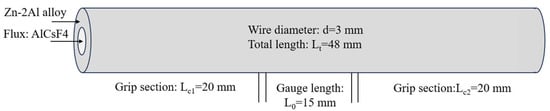
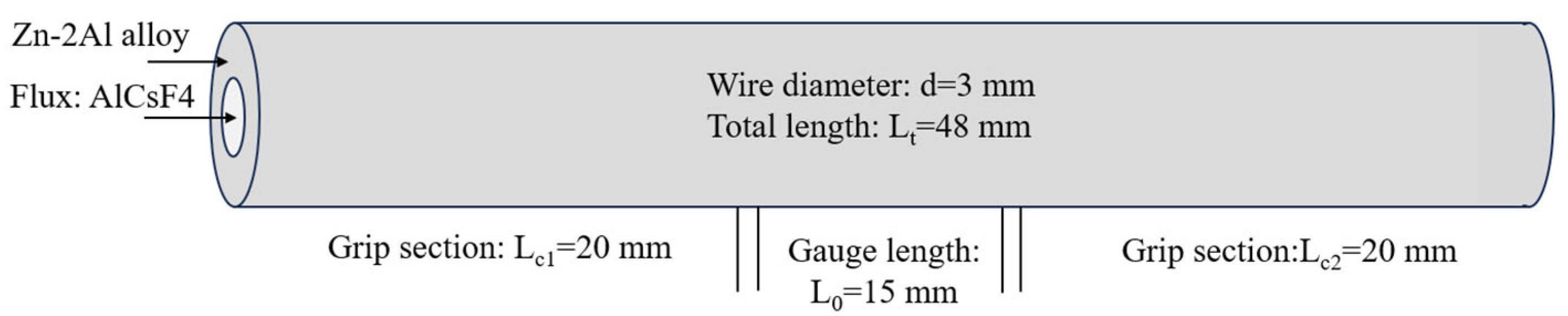
Tensile tests of the filler metal were performed on a universal testing machine (DNS-100, Changchun Institute of Mechanical Science, Changchun, China) with a constant crosshead displacement rate of 1 mm/min. Five parallel specimens were tested for each condition, and the average tensile strength was determined. All tensile measurements were implemented following the specification T/CMES 02006-2024 “Welding Wire Tensile Testing Method” [26]. The dimension drawing of tensile specimens is presented in Figure 1.
Figure 1.
Technical drawing of tensile samples.
Microstructural characterization and corrosion morphology observation were carried out using a field-emission scanning electron microscope (FE-SEM, ZEISS SUPRA 55, Carl Zeiss AG, Oberkochen, Germany) coupled with an energy dispersive X-ray spectroscopy system (EDS, Oxford Instruments, Abingdon, UK). Prior to the test, the surface of the filler metal was sequentially ground with 400#, 800#, 1000# and 2000# diamond abrasive papers to remove surface oxides and machining defects. After grinding, the specimens were further polished using diamond polishing suspensions to obtain a scratch-free surface. All samples were then ultrasonically cleaned in absolute ethanol for 15 min to eliminate residual abrasive particles. Backscattered electron (BSE) mode was selected to acquire micrographs for phase identification and morphological analysis. Electron backscatter diffraction (EBSD, IT800-SHL, Oxford Instruments, Abingdon, UK) was employed to characterize crystal orientation and residual stress distribution of the filler metal. The EBSD specimens were prepared by argon ion polishing using a PECS II MODEL 685 (Gatan, Pleasanton, CA, USA). The polishing procedure was performed at a tilt angle of 2°, an accelerating voltage of 5 kV, for a total duration of 60 min.
3. Results and Discussion
3.1. Microstructures of Filler Metals
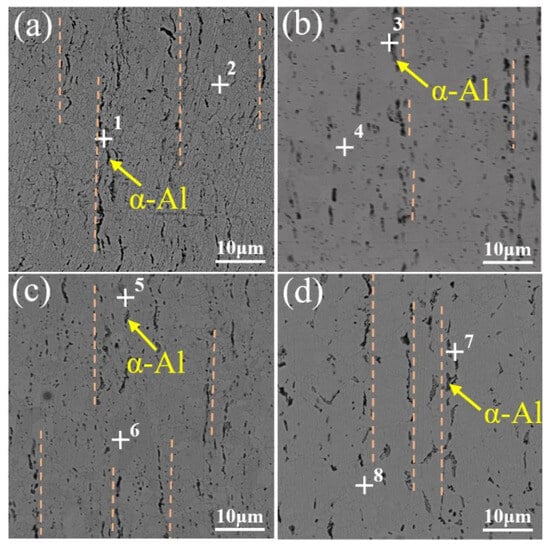
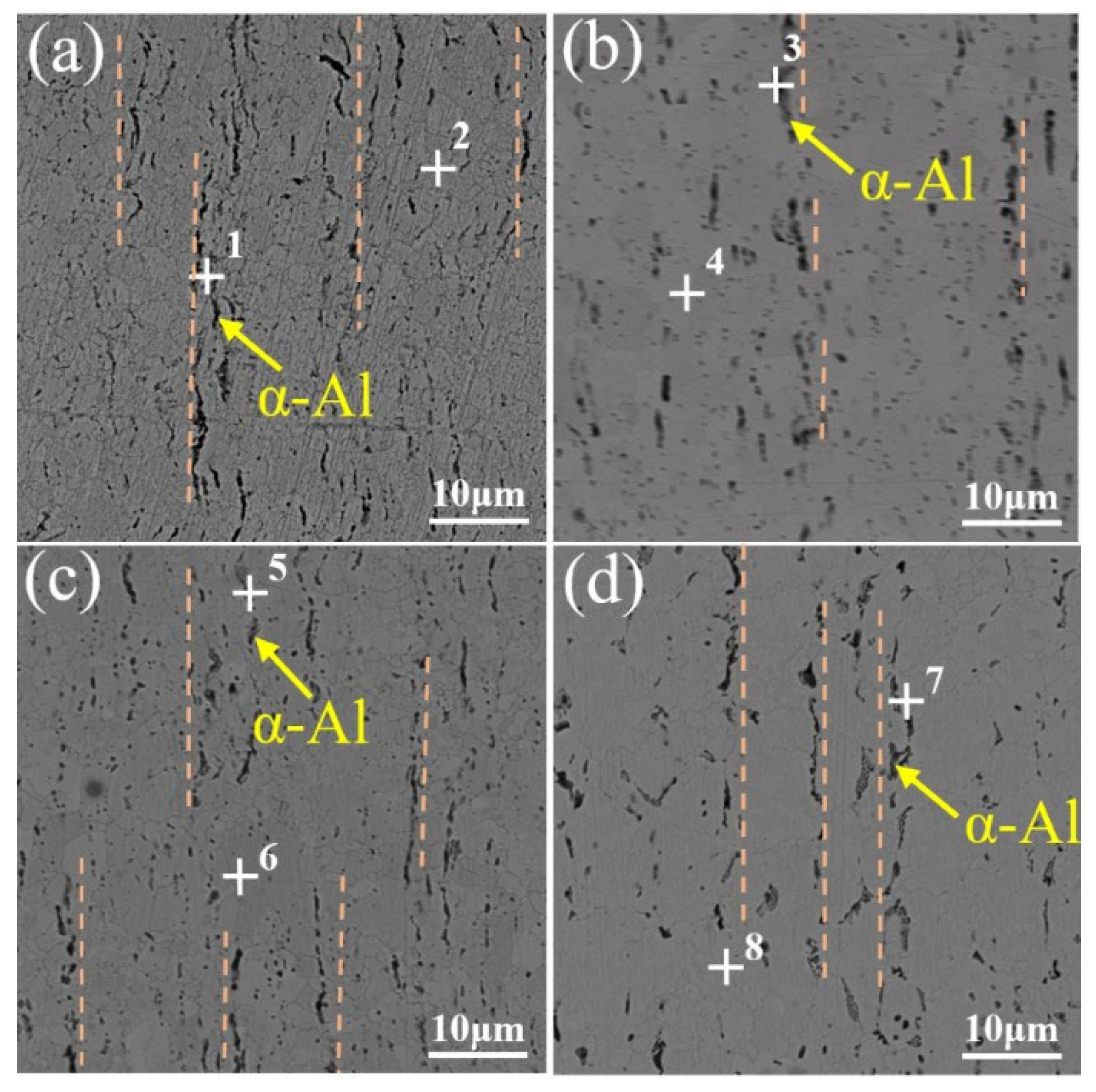
The typical microstructures of Zn–2Al filler metals annealed at different temperatures are presented in Figure 2. Zn–2Al filler metals contained black and gray phases. The EDS results are listed in Table 1. They revealed the chemical composition of the black phase (Point 1, 3, 5 and 7), which was identified as α-Al with 36.4 wt.% Al and 63.6 wt.% Zn. The gray phase (Point 2, 4, 6 and 8), consisting of 1.5 wt.% Al and 98.5 wt.% Zn, corresponded to the η-Zn phase. In the filler metal treated at RT (Figure 2a), α-Al exhibited a pronounced continuous band-like distribution, which originated from the drawing process during fabrication [2]. The α-Al band with a continuous distribution length exceeding 10 μm in Figure 2 was statistically quantified, and its average length was calculated. Table 2 summarizes the results. At room temperature (RT), seven long-band α-Al phases were identified, with an average length of 21.3 μm. After annealing at 100 °C (Figure 2b), the number of α-Al bands dropped to four, and the average length decreased to 12.2 μm, proving that the continuous features of the α-Al phase were notably weakened. Previous studies confirmed that such a microstructural change was beneficial to the corrosion resistance of the filler metal [7]. At 150 °C, the number rose again to seven, and the average length increased to 18.6 μm. Increasing the temperature to 250 °C further reduced the quantity. However, the average length increased markedly to 33.4 μm. This indicated that excessive annealing temperature mitigated the degradation of the continuously distributed α-Al phase.
Figure 2.
Microstructures of annealed Zn–2Al filler metals: (a) RT, (b) 100 °C, (c) 150 °C, (d) 250 °C.
Table 1.
EDS results marked in Figure 2 (wt.%).
Table 2.
Statistical results of the α-Al bands in Figure 2.
According to Table 1, following annealing, the Al fraction within the η-Zn of the filler metal was reduced, and the dimensions of Al-rich regions coarsened progressively. This evolution suggested that Al precipitated from the η-Zn matrix and concurrently segregated into the Al rich regions. Table 1 shows that the Al concentration in η-Zn reached 2.2 wt.%. This value exceeds the room-temperature equilibrium solubility of Al in η-Zn (close to zero), indicating that the phase is a supersaturated solid solution. During annealing, Al atoms precipitate from the η-Zn matrix via solid-state diffusion. Atomic diffusion is faster at higher temperatures. Higher annealing temperatures therefore enhance Al precipitation. Hence, with increasing annealing temperatures (Figure 2c,d), the Al-rich phases coarsened further. In addition, during the annealing process, the Al-rich phases underwent nucleation and growth, and their nucleation and growth rates obeyed Equations (1) and (2) [27],
where I denotes the nucleation rate, and N represents the number of atoms per unit volume in the parent phase. k is the Boltzmann constant, and T is the absolute temperature. v and v0 are the atomic vibration frequencies, Q is the activation energy for atomic diffusion, δ is the distance of a single atomic jump, and ΔGv is the driving force for phase transformation. As the annealing temperature increased, both the nucleation rate I and the growth rate u of the Al-rich phases rose accordingly, indicating that elevated temperatures accelerated nucleation and growth. Consequently, a greater number of Al-rich phases formed, with enlarged dimensions, and their morphological distribution evolved from discontinuous to continuous.
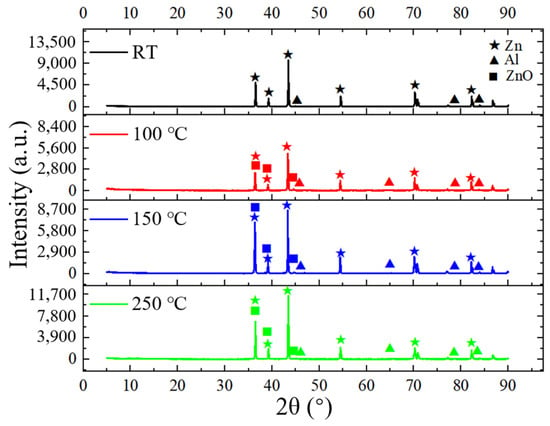
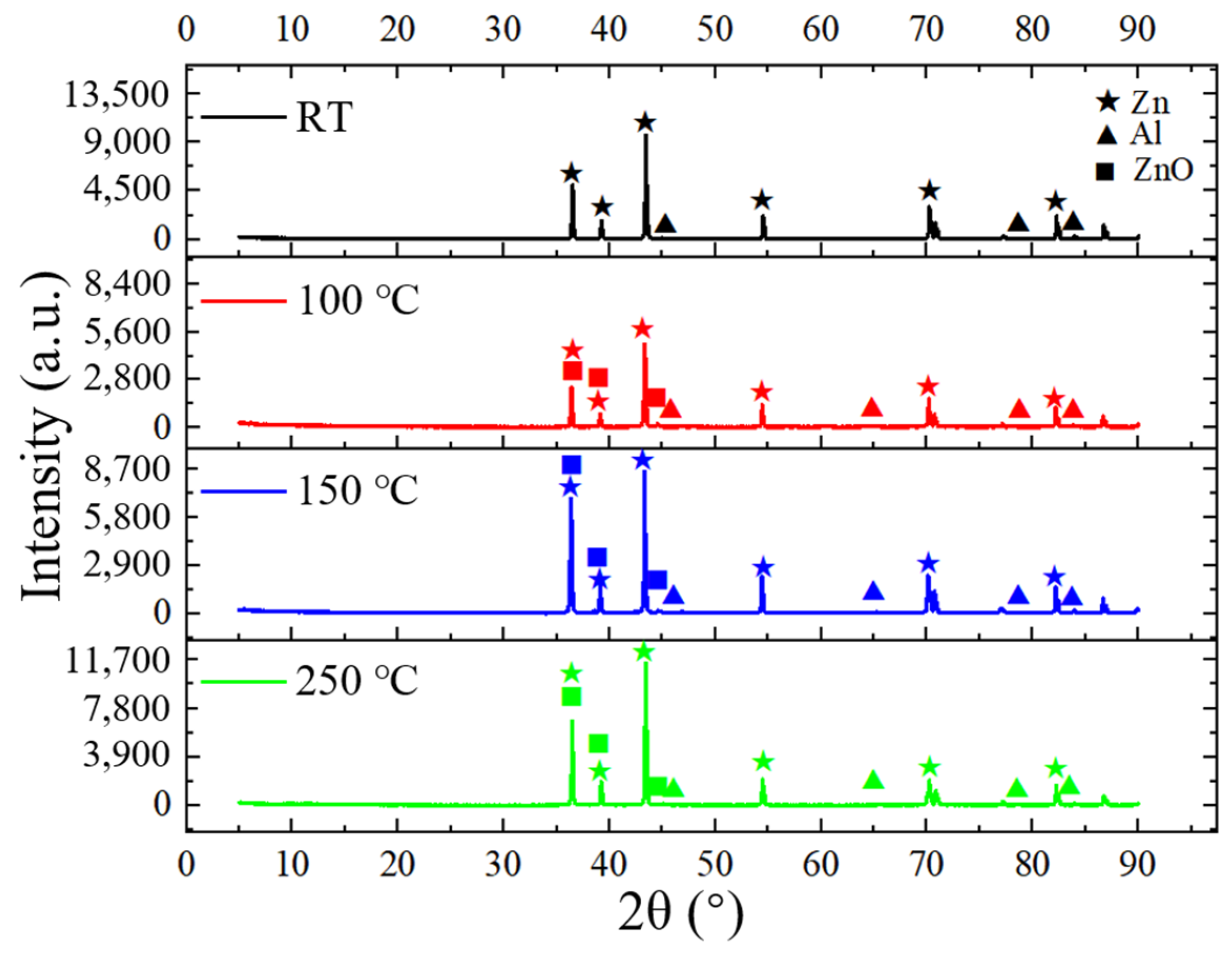
The XRD patterns of annealed Zn–2Al filler metals are presented in Figure 3. The annealed filler metal was composed of η-Zn, an Al-rich phase, and ZnO. In comparison with the unannealed samples, the Al-related diffraction peaks intensified, indicating a higher Al content on the surface of the filler metal. During annealing, Al atoms precipitated from the interior and accumulated in the Al-rich regions, which consequently coarsened these phases. These observations were consistent with the microstructural analysis presented in Figure 2.
Figure 3.
XRD patterns of Zn–2Al filler metals annealed at different temperatures.
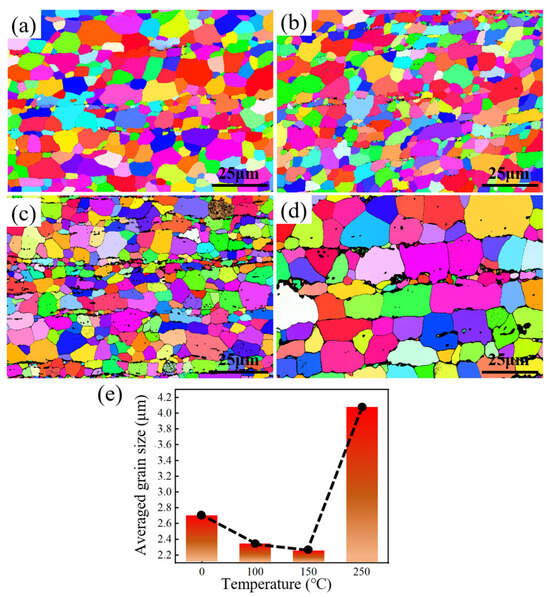
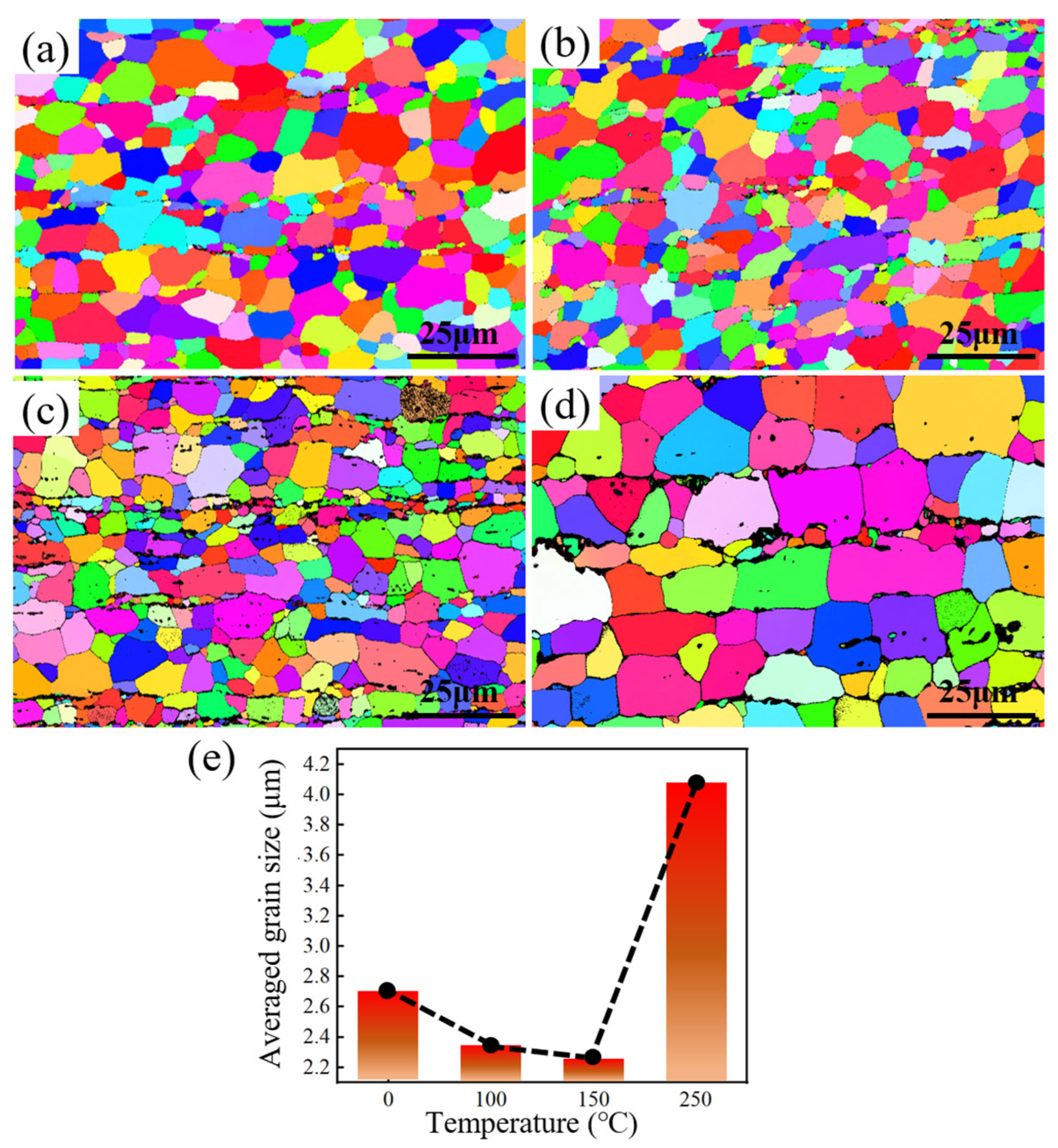
Figure 4 displays the IPF maps and grain size statistics of the Zn–2Al filler metal after annealing at 2 h with different temperatures. Figure 4a corresponds to the sample treated at RT. Its microstructure exhibited pronounced equiaxed grain characteristics. Dynamic recrystallization occurred during the drawing process; the increased strain facilitated dislocation motion within the filler metal, and dislocation pile ups elevated the internal stored deformation energy. Consequently, the matrix remained in a thermodynamically unstable state, while the heat generated by shear deformation provided the driving force for dynamic recrystallization, which consequently caused the filler metal to undergo such recrystallization. Nevertheless, the grain size homogeneity was relatively poor, with the maximum grain size approaching approximately 30 μm and the minimum around 0.5 μm. New dislocation free grains formed after dynamic recrystallization; however, these grains did not nucleate simultaneously during drawing. Nucleation preferentially occurred in regions characterized by high dislocation and distortion energy. Substantial differences in dislocation density existed between adjacent grains, prompting grain boundary migration as a means to reduce the total free energy of the system. The migrating boundaries continuously engulfed nearby sub grains, thereby lowering the overall free energy level of the matrix.
Figure 4.
IPF maps and corresponding average grain size statistics of stress-relief annealed Zn–2Al flux-cored filler metals: (a) as-received (RT), (b) 100 °C, (c) 150 °C, (d) 250 °C; (e) variation in average grain size under different annealing temperatures.
Figure 4b–d display the IPF maps of Zn–2Al filler metals annealed at 100–250 °C. All filler metals retained pronounced equiaxed grain structures. In comparison with RT-treated samples, the η-Zn grains were slightly refined at 100 °C and 150 °C, with average grain sizes below 10 μm. At 250 °C, the number of η-Zn grains decreased markedly, while the average grain size increased to 17.5 μm. This evolution indicated that partial recrystallization occurred at 100 °C and 150 °C, where the grain sizes remained nearly unchanged. In contrast, grain growth dominated at 250 °C, resulting in a substantial increase in the average grain size.
Recrystallization of cold-deformed alloys necessitated the following two prerequisites: deformation and annealing temperature. Greater deformation led to higher stored deformation energy, which provided a larger driving force for recrystallization. Elevated annealing temperatures promoted sub-boundary migration, during which the migrating boundaries continuously absorbed extensive dislocations and eventually transformed into high-angle grain boundaries that served as nucleation sites. Zinc was reported to undergo recrystallization at a strain of 70% and a temperature of 15 °C [27]. The drawing strain and temperature satisfied the conditions for dynamic recrystallization, which took place in the η-Zn phase within the Zn–2Al filler metal. Nevertheless, only slight recrystallization occurred during the subsequent annealing, since dynamic recrystallization had consumed most of the stored deformation energy, and the residual energy was insufficient to induce extensive annealing recrystallization. Fine equiaxed grains formed after recrystallization. At 250 °C, the η-Zn grains exhibited significant growth, dominated by high-angle boundary migration, during which neighboring grains consumed one another.
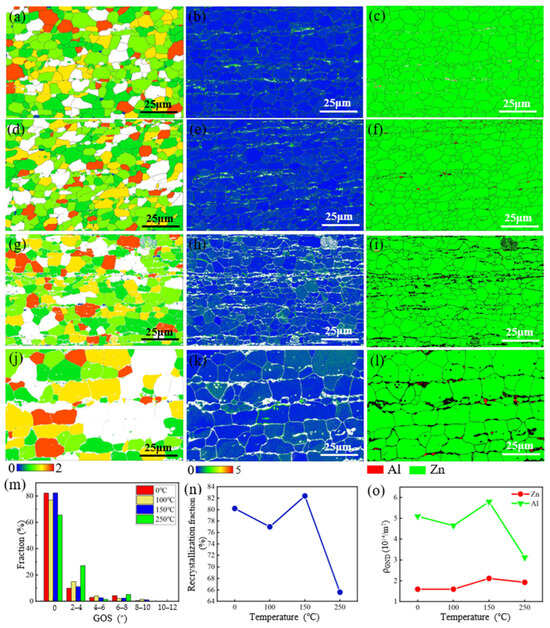
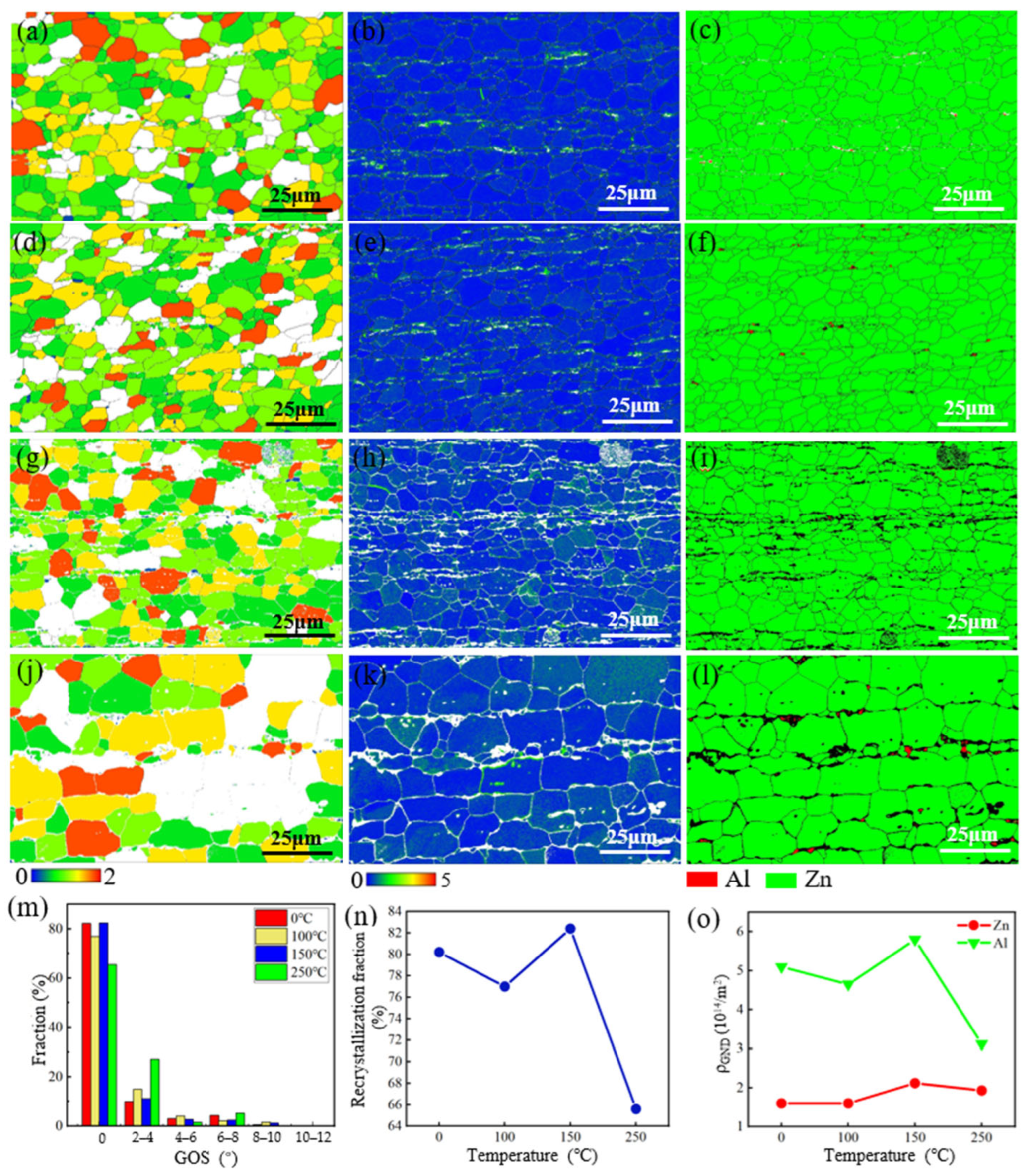
Figure 5 presents the GOS, KAM, and phase maps, along with the corresponding statistical data, for the annealed Zn–2Al filler metals. Figure 5a,d,g,j display the GOS maps for samples treated at RT, 100 °C, 150 °C, and 250 °C, respectively, while Figure 5m provides the associated statistical results. In comparison with the unannealed filler metal, the fractions of recrystallized grains remained within 77–82% at 100 °C and 150 °C, and the variation in these fractions was relatively limited, indicating that only partial recrystallization occurred under these two annealing conditions. At 250 °C, however, the proportion of grains with GOS below 2° decreased to 65%, which signified appreciable grain growth within the filler metal. These findings were in good agreement with the results derived from the IPF map analysis.
Figure 5.
GOS maps, KAM maps, phase distribution maps and corresponding statistical results of annealed Zn–2Al filler metals: (a–c) RT condition, (d–f) 100 °C, (g–i) 150 °C, (j–l) 250 °C, (m) GOS distribution, (n) dynamic recrystallization fraction, (o) average GND density.
The KAM maps of the cold-drawn Zn-Al filler metals are displayed in Figure 5b,e,h,k. Figure 5o quantitatively summarizes the average dislocation density of all annealed samples. The dislocation density showed a non-monotonic variation with annealing temperature. The order was 150 °C > 250 °C > room temperature (RT) > 100 °C. This differs from the conventional continuous decrease in dislocation density with higher annealing temperature. Here, an anomalous peak appeared at 150 °C. This peak was controlled by the competing and synergistic effects of the following three microstructural evolution behaviors: dislocation recovery, Al phase precipitation, and grain growth. Their dominant contributions varied markedly at different annealing temperatures.
Cold extrusion and drawing consumed part of the stored internal energy through dynamic recrystallization. This process preliminarily reduced the initial dislocation density. However, many residual dislocations remained in the as-drawn filler metal matrix. At 100 °C, thermal activation mainly triggered recovery of the deformed matrix. The residual dislocations rearranged and annihilated each other, especially those with opposite signs. As a result, the matrix dislocation density decreased substantially. At this low temperature, atomic diffusion was sluggish [28,29]. Al precipitation was therefore negligible. In this case, matrix recovery dominated microstructural evolution. It eliminated dislocations. By contrast, the dislocation increment from phase precipitation was insufficient to compensate for the recovered dislocations. Consequently, the overall dislocation density decreased further.
At 150 °C, thermal diffusion was enhanced. This remarkably promoted precipitation of supersaturated Al atoms from the η-Zn matrix. Abundant Al-rich secondary phases formed. Their heterogeneous nucleation and growth caused considerable lattice distortion at phase interfaces. This distortion generated a large number of new interfacial dislocations. At this temperature, dislocation proliferation from intensive Al precipitation far exceeded dislocation attenuation from moderate matrix recovery. Meanwhile, grain growth was not sufficiently activated at 150 °C. Its influence on phase interface areas and dislocation elimination was negligible. The precipitation-induced dislocation increments therefore dominated. It elevated the total dislocation density and formed a density peak at 150 °C.
At 250 °C, Al precipitation reached an extreme state. It continued to introduce interfacial dislocations. However, high-temperature thermal activation strongly promoted grain boundary migration and rapid grain growth. The significant grain coarsening reduced the total interfacial contact area between the Al-rich phase and the Zn-based matrix. This greatly diminished the generation sites for interfacial dislocation. Furthermore, high-temperature recovery further eliminated residual matrix dislocations. Thus, two effects were combined. Precipitation-induced dislocation proliferation weakened. In contrast, dislocation attenuation caused by recovery and grain growth strengthened. As a result, the overall dislocation density of the filler metal decreased markedly at 250 °C.
3.2. Corrosion Mechanism Feature of Filler Metals
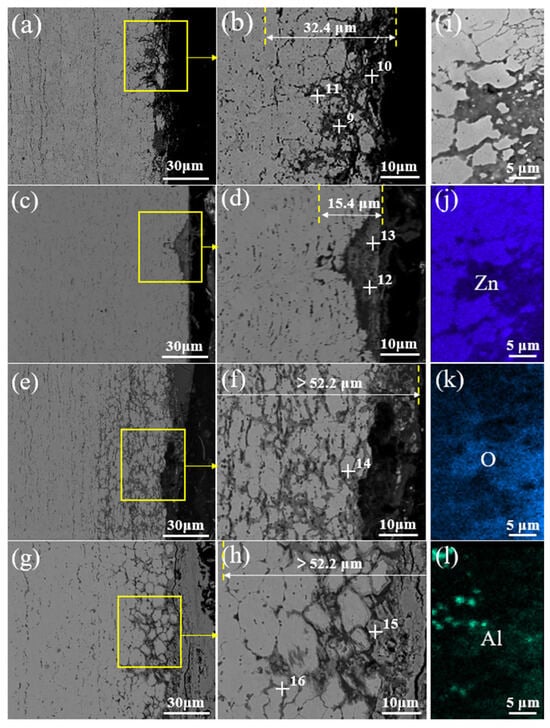
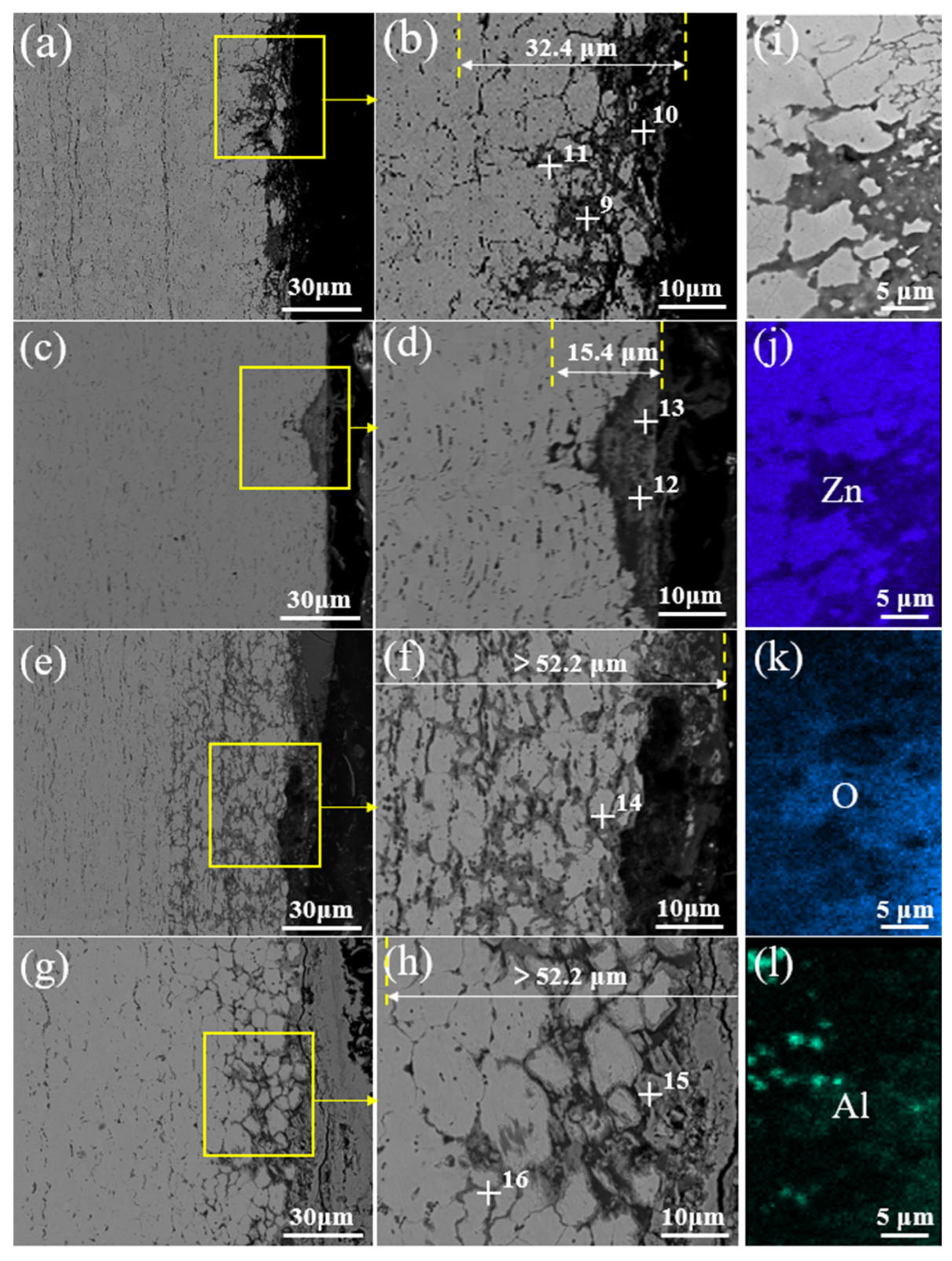
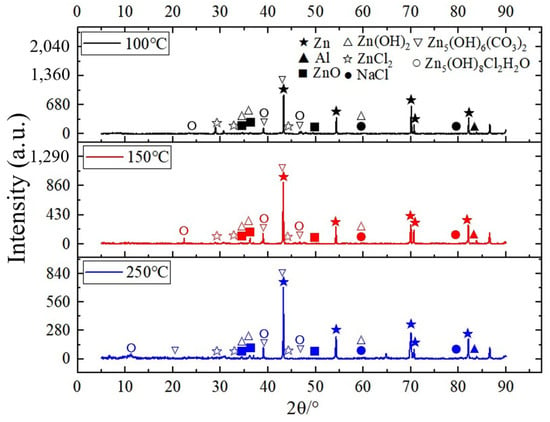
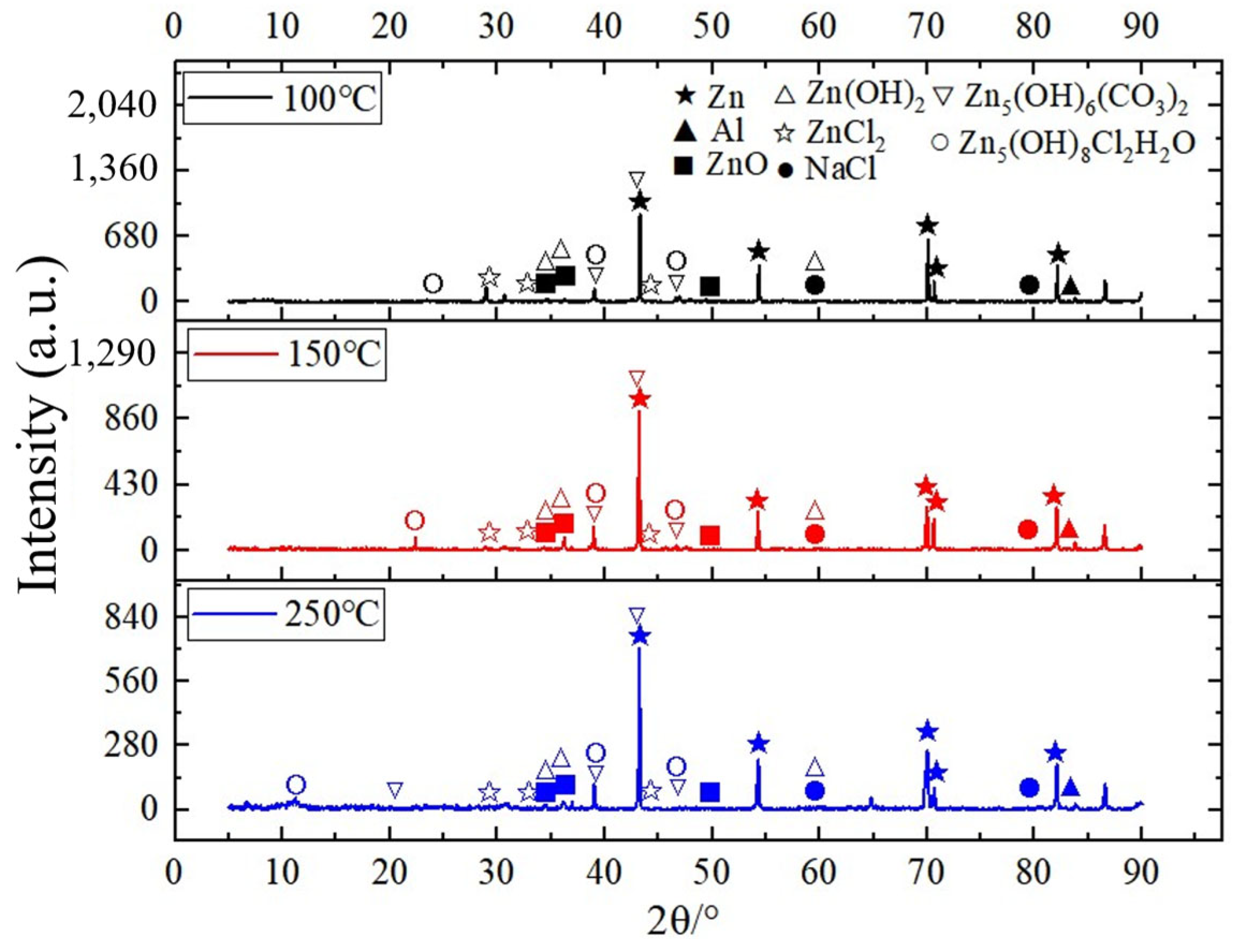
Figure 6 presents microstructures and elemental distributions in the annealed Zn–2Al filler metals after 10 h salt-spray corrosion. Table 3 summarizes the chemical compositions at the marked positions. The corroded zones exhibited grid-like morphologies, which were characteristic of intergranular corrosion. Hence, intergranular corrosion, a type of electrochemical corrosion, dominated the degradation of the Zn–2Al filler metal. For the sample treated at RT (Figure 6a,b), general corrosion occurred alongside intergranular corrosion, with a corrosion depth reaching 32.4 μm. At 100 °C (Figure 6c,d), the corrosion depth decreased to 15.4 μm, and general corrosion became the primary mode. At 150 °C and 250 °C (Figure 6e–h), intergranular corrosion prevailed, and the corrosion depths exceeded those of the RT-treated sample. Consequently, the filler metal exhibited the best corrosion resistance at 100 °C. Figure 6i–l provided detailed microstructures and elemental mapping. In the corroded areas, the Al and O contents increased while the Zn content declined. After 10 h corrosion, the Zn content in the η-Zn phase dropped to 69.32 wt.%, with O and Al reaching 28.07 wt.% and 2.61 wt.%, respectively. The maximum O content at grain boundaries attained 12.24 wt.%. The η-Zn phase acted as the anode and underwent anodic dissolution, whereas the α-Al phase served as the cathode during the corrosion process. This finding was highly consistent with the potentiodynamic polarization analysis of Zn and Al phases reported in Reference [7], which further verified the inherent galvanic corrosion characteristics of the Zn-Al alloy system. Figure 7 displays the XRD patterns of the corrosion products, which were identified as ZnO, Zn5(OH)8Cl2·H2O, and Zn(OH)2, thereby confirming the proposed anode cathode electrochemical corrosion mechanism. These findings were in full agreement with the results presented in Figure 6 and Table 3.
Figure 6.
Microstructures and element distributions of annealed Zn–2Al filler metals after 10 h salt-spray corrosion: (a,b) RT condition, (c,d) 100 °C, (e,f) 150 °C, (g,h) 250 °C, (i–l) element distributions in the corroded region.
Table 3.
EDS results marked in Figure 6 (wt.%).
Figure 7.
XRD patterns of corrosion products for annealed Zn–2Al filler metal after 10 h salt-spray corrosion.
From Figure 6, the filler metal annealed at 100 °C exhibited the weakest intergranular corrosion features, with general corrosion predominating in the corroded regions. In contrast, at 150 °C and 250 °C, intergranular corrosion became markedly more severe, and the corroded areas along grain boundaries expanded noticeably. The relevant literature correlated the corrosion rate with the distribution of α-Al [7]. A continuously distributed α-Al accelerated corrosion along the drawing direction, because α-Al and adjacent η-Zn constituted large cathode/small anode micro cells. Such micro cells generated high local anodic currents, which considerably accelerated the dissolution rate of the anode phase. The high Al content enlarged the cathode area at grain boundaries. The enlarged cathode area elevated the current density on the anodic η-Zn phase, thus increasing the overall corrosion rate of the filler metal. In addition, high dislocation density accelerates the corrosion of Zn–2Al filler metal mainly in three aspects. First, dislocation cores with severe lattice distortion serve as preferential anodic sites with reduced atomic dissolution activation energy, and corrosion preferentially nucleates at dislocation-enriched zones near grain boundaries and Al/Zn phase interfaces. Second, local stress concentration at dislocation tangles facilitates the generation of microcracks in the passive film, breaking its protective effect. Finally, dislocation-related defects provide short-circuit diffusion channels for corrosive ions such as chloride, facilitating the penetration of corrosive species inward and sustaining the propagation of intergranular corrosion.
Compared with the RT specimen, annealing at 100 °C induced static recovery and partial recrystallization. Recrystallization restructured the original α-Al phase and broke its continuous grain-boundary distribution. Dislocation rearrangement and annihilation via slip reduced dislocation density and intergranular corrosion susceptibility. As a result, corrosion rarely propagated inward along grain boundaries and mainly occurred around α-Al particles as general corrosion. At 150 °C, recrystallization was accompanied by Al precipitation. The precipitated α-Al accumulated at grain boundaries and expanded the cathode phase area, reconstructing large-cathode/small-anode micro-galvanic cells that accelerated η-Zn dissolution and intergranular corrosion. At 250 °C, prominent grain coarsening reduced the total grain boundary length and further elevated grain-boundary Al content, increasing corrosion susceptibility. Moreover, precipitated α-Al regained continuous distribution along grain boundaries and provided fast pathways for corrosion propagation. These combined effects degraded the corrosion resistance of the filler metal.
3.3. Mechanical Property of Zn–2Al Filler Metals
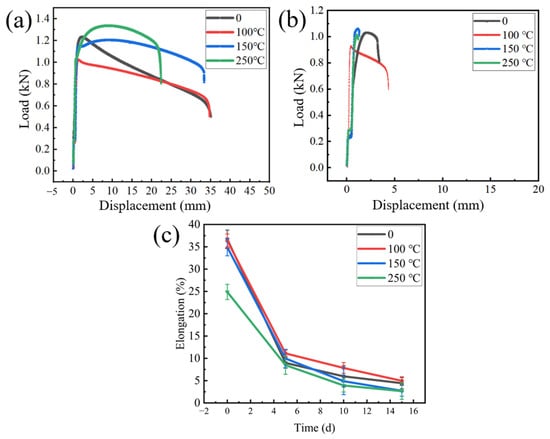
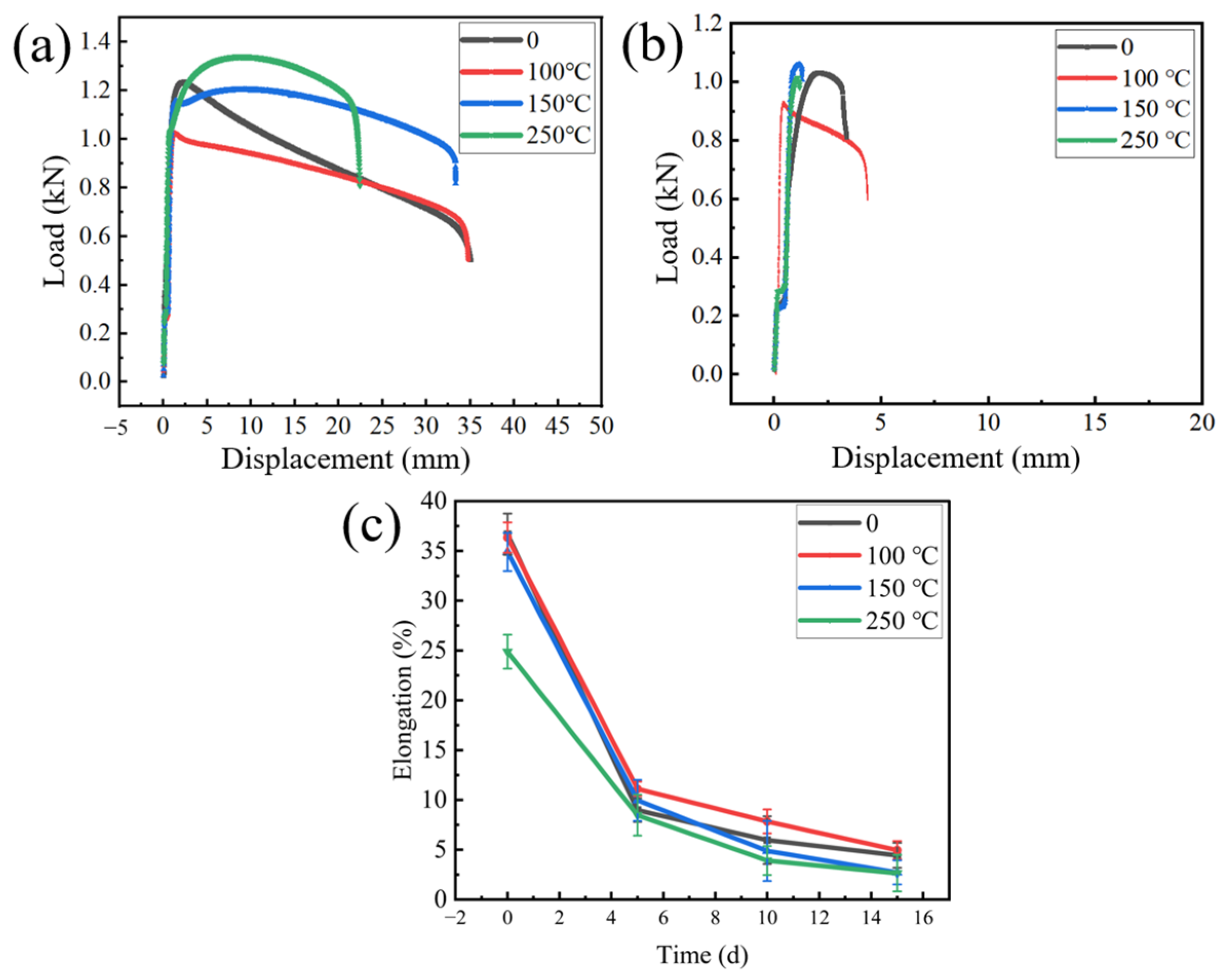
Figure 8a displays the load displacement curves of the Zn–2Al filler metals annealed at different temperature. The filler metal annealed at 250 °C exhibited the lowest elongation. Filler metals treated at 100 °C and 150 °C maintained elongation values close to 35%, which were comparable to annealed at RT. Figure 8b presents the curves and the corresponding mechanical property degradation after salt-spray exposure for different durations. The elongation of all samples decreased sharply with prolonged corrosion time. After 15 days of salt-spray corrosion, the elongation followed the descending order: 100 °C > unannealed > 150 °C > 250 °C, with the 100 °C annealed sample retaining the highest elongation (4.96%).
Figure 8.
Tensile load–displacement curves and mechanical property degradation of annealed Zn–2Al filler metal after salt-spray corrosion: (a) uncorroded condition, (b) after 15 days of salt-spray exposure, (c) variation in mechanical properties as a function of corrosion duration.
The corrosion process generated abundant Zn containing corrosion products within the filler metal. The corrosion products impaired the bonding strength among grains. Under external loading, these grain boundary products resisted plastic deformation, readily inducing severe stress concentration at these locations. This stress concentration accelerated crack initiation and propagation, ultimately leading to a decrease in the overall plasticity of the filler metal. At 100 °C, intergranular corrosion susceptibility reduced, impeding the inward propagation of corrosion. The weakened continuous α-Al phase prevented corrosion from advancing along the drawing direction. Hence, the smaller corroded zones preserved relatively satisfactory plasticity. In contrast, at 150 °C and 250 °C, the α-Al phase reestablished a continuous distribution, and the elevated Al content at grain boundaries accelerated the internal propagation of corrosion. The enlarged corroded areas and increased penetration depths further deteriorated the plasticity of the filler metal.
4. Conclusions
This study primarily investigates the effect of stress-relief annealing to the corrosion behavior of flux-cord Zn–2Al filler metal. The main conclusions are summarized as follows:
- The flux-cored Zn–2Al filler metal was mainly composed of α-Al and η-Zn phases. The α-Al phase exhibited an obvious band-like continuous distribution in the room-temperature specimen. This continuous feature was weakened after annealing at 100 °C, while higher annealing temperatures promoted the reestablishment of such continuous distribution.
- Static recovery and partial recrystallization took place in the flux-cored Zn–2Al filler metal annealed at 100 °C, accompanied by slight grain refinement. As the annealing temperature increased, recrystallization and grain growth occurred, together with Al precipitation. More Al-rich phases formed along the grain boundaries of the η-Zn matrix.
- The corrosion susceptibility of the flux-cored Zn–2Al filler metal was reduced after annealing at 100 °C. The specimen retained a plasticity of 4.96% following 15-day salt-spray corrosion. Higher annealing temperatures facilitated Al precipitation and restored its continuous distribution, which increased corrosion susceptibility and accelerated the anodic dissolution of η-Zn, leading to a significant drop in the plasticity of the filler metal.
Author Contributions
Conceptualization, Y.Z., S.H. and Y.S.; methodology, Y.Z., S.H. and Q.L.; software, X.W. (Xiaoyang Wang) and X.W. (Xuewen Wang); validation, Q.L. and Y.S.; formal analysis, Y.C. (Yinghao Cui); investigation, S.G.; resources, L.C.; data curation, X.L.; writing—original draft preparation, Y.Z.; writing—review and editing, Y.Z.; visualization, X.W. (Xiaoyang Wang); supervision, Y.C. (Yongqian Chen); funding acquisition, Y.Z. All authors have read and agreed to the published version of the manuscript.
Funding
This research was funded by Science and Technology Guidance Program Project of China National Textile and Apparel Council, grant number 2025070, Open Fund Project of Hubei Digital Textile Equipment Key Laboratory, grant number DTL2024006, Key Research and Development Special Project in Henan Province, grant number 241111220100, Key project for school achievement cultivation, grant number K2023ZDPY01, Basic research project of key scientific research projects in Henan Province, grant number 24ZX004, Natural Science Foundation of Henan Province, grant number 262300421421, Postgraduate Education Quality Improvement Project of Zhongyuan University of Technology, grant number ALK202506, GZZ202601, Postgraduate Education Reform and Quality Improvement Project of Henan Province, grant number YJS2025XQLH24; YJS2025AL60.
Institutional Review Board Statement
Not applicable.
Informed Consent Statement
Not applicable.
Data Availability Statement
Research dates are contained within the article.
Acknowledgments
We would like to thank everyone who supplied help.
Conflicts of Interest
The authors declare no conflicts of interest.
References
- Long, W.; Zhao, Y.; Zhong, S.; Zhang, G.; Huang, S. Research Progress on Intermetallic Compounds in Copper-Aluminum Brazed Joints. Rare Met. Mater. Eng. 2021, 50, 7–13. [Google Scholar]
- Zhao, Y.; Wang, X.; Lu, Q.; Shen, Y.; Cui, Y.; Guo, S.; Cui, L.; Chen, Y.; Li, X. Effects of Minor Ge on the Microstructure and Corrosion Resistance of Zn–2Al Filler Metals. Materials 2025, 18, 5111. [Google Scholar] [CrossRef] [Scilit] [PubMed]
- Yu, R.; Li, Y.; Liu, S.; Long, W.; Chen, Y. Microstructural and damp-heat corrosion characteristics of Zn-2 wt% Al filler metals alloys containing trace Ag. Mater. Res. Express 2018, 6, 026550. [Google Scholar] [CrossRef] [Scilit]
- Sun, H.; Yu, G.; Chen, S.; Huang, J.; Yang, J. Effect of ZnAl filler metals on the characteristics of the joint made by the high-frequency induction brazing of 304 stainless steel and 6A02 aluminum. J. Manuf. Processes 2021, 68, 961–972. [Google Scholar] [CrossRef] [Scilit]
- Tan, C.; Zang, C.; Xia, H.; Zhao, X.; Zhang, K.; Meng, S.; Chen, B.; Song, X.; Li, L. Influence of Al additions in Zn–based filler metals on laser welding–brazing of Al/steel. J. Manuf. Processes 2018, 34, 251–263. [Google Scholar] [CrossRef] [Scilit]
- Huang, S.; Long, W.; Lu, Q.; Jiu, Y.; Zhong, S.; Bao, L.; Zhao, Y. Research on the corrosion resistance of Cu-Al joints brazed with flux-cored Zn–2Al filler metal. Mater. Res. Express 2019, 6, 056560. [Google Scholar] [CrossRef] [Scilit]
- Zhao, Y.; Wang, X.; Guo, S.; Cui, L.; Cui, Y.; Lu, Q.; Shen, Y.; Li, X.; Chen, Y. Research on the Corrosion Behavior of Zn–2Al Filler Metals. Crystals 2026, 16, 188. [Google Scholar] [CrossRef] [Scilit]
- Liang, S.; Guan, D.; Tan, X. The relation between heat treatment and corrosion behavior of Mg-Gd-Y-Zr alloy. Mater. Des. 2011, 32, 1194–1199. [Google Scholar] [CrossRef] [Scilit]
- Guedou, J. Heat treatment optimization in titanium and nickel base alloys for structural parts in aero turboengines. Matér. Tech. 2009, 97, 99–108. [Google Scholar]
- Oluwapojuwomi, O.; Adelusi, I.; Aduewa, T.; Fatounde, S. Prior heat treatment effects on microstructure and corrosion of arc-welded Al-Zn-Mg alloys. Acad. Mater. Sci. 2026, 3, 1–14. [Google Scholar] [CrossRef] [Scilit]
- Adedayo, A.; Abdusalam, Y. Influence of Solution Heat Treatment on Tensile Properties of Zinc-aluminum (ZA5) Solder Alloy. Indian Weld. J. 2021, 54, 51–55. [Google Scholar]
- Fu, Y.; Li, X.; Wen, K.; Huang, S.; Dong, Y.; Rao, M.; Yang, F.; Wang, Y.; Xiong, B.; Li, Z. Effect of heat treatment on microstructures and properties of a novel Al-Zn-Mg-Cu alloy for oil drilling. Prog. Nat. Sci. Mater. Int. 2019, 29, 217–223. [Google Scholar] [CrossRef] [Scilit]
- Michalik, R.; Iwaniak, A.; Wieczorek, J. Influence of heat treatment on the wear resistance of the ZnAl40Cu1.5Ti1.5 alloy. Arch. Metall. Mater. 2017, 62, 129–136. [Google Scholar] [CrossRef] [Scilit]
- Windmann, M.; Barthen, M.; Opitz, T.; Hahn, I. Phase Formation during Heat Treatment of Zn and ZnAlMg-Coated Steels at 400 and 750 °C. Steel Res. Int. 2019, 90, 1800588. [Google Scholar] [CrossRef] [Scilit]
- Lin, G.; Zhang, R.; Wang, L.; Lei, Y.; He, J. Effects of stabilizing heat treatment on microstructures and creep behavior of Zn10Al2Cu0.02Ti alloy. Trans. Nonferrous Met. Soc. China 2013, 23, 86–91. [Google Scholar] [CrossRef] [Scilit]
- Tang, H.; Zeng, J.; Li, H.; Si, J. Research on the binary phase diagram of Zn-Al system. Spec. Cast. Nonferrous Alloys 2006, 26, 387–389. [Google Scholar]
- Lü, D.; Long, W.; Zhang, G.; Wang, X.; He, P. Effect of hygrothermal environment on microstructure andmechanical properties of Zn–2Al filler metal. Trans. China Weld. Inst. 2014, 35, 63–66. [Google Scholar]
- Wu, Q.; Ding, T.; Sun, H.; Liu, S. Effect of annealing temperature on microstructure and properties of extruded Zn–2Al solder. Heat Treat. Met. 2019, 44, 146–150. [Google Scholar]
- Jeshvaghani, R.; Ghahvechian, H.; Pirnajmeddin, H.; Shahverdi, H. Influence of heat treatment on the microstructure and wear behavior of end-chill cast Zn-27Al alloys with different copper content. Appl. Phys. A-Mater. Sci. Process. 2016, 122, 397. [Google Scholar] [CrossRef] [Scilit]
- Babić, M.; Ninković, R.; Mitrović, S.; Bobić, I. Influence of Heat Treatment on Tribological Behavior of Zn-Al Alloys. Tribol. Ind. 2007, 29, 23–31. [Google Scholar]
- Cheng, J.; Shi, Q.; Qi, H.; Chen, L.; Ma, W. Effect of heat treatment on microstructure and mechanical properties of Zn-Al alloy. Heat Treat. Met. 2015, 40, 50–54. [Google Scholar]
- Bobic, B.; Bajat, J.; Acimovic-Pavlovic, Z.; Rakin, M.; Bobic, I. The effect of T4 heat treatment on the microstructure and corrosion behaviour of Zn27Al1.5Cu0.02Mg alloy. Corros. Sci. 2011, 53, 409–417. [Google Scholar] [CrossRef] [Scilit]
- Michalik, R.; Wonica, H. Influence of Heat Treatment on Corrosion Resistance of the ZnAl22Cu3 Alloy. Defect Diffus. Forum 2013, 334, 225–257. [Google Scholar] [CrossRef] [Scilit]
- Yan, X.; Liu, S.; Long, W.; Huang, J.; Zhang, L.; Chen, Y. Stress corrosion crack of ZnAl15 alloys in hot and humid environment. Mater. Lett. 2013, 93, 183–186. [Google Scholar] [CrossRef] [Scilit]
- GB/T 10125-2021; Corrosion Tests in Artificial Atmospheres—Salt Spray Tests. State Administration for Market Regulation, Standardization Administration of the People’s Republic of China: Beijing, China, 2021.
- T/CMES 02006-2024; Welding Wire Tensile Testing Method. Chinese Mechanical Engineering Society: Beijing, China, 2024.
- Hu, G.; Cai, X.; Rong, Y. Fundamentals of Materials Science, 3rd ed.; Shanghai Jiao Tong University Press: Shanghai, China, 2010. [Google Scholar]
- Song, T. Inorganic Chemistry Course; Higher Education Press: Beijing, China, 2012. [Google Scholar]
- Arrhenius, S. Über die Reaktionsgeschwindigkeit bei der Inversion von Rohrzucker durch Säuren. Z. Für Phys. Chem. 1889, 4, 226–248. [Google Scholar] [CrossRef] [Scilit]

Disclaimer/Publisher’s Note: The statements, opinions and data contained in all publications are solely those of the individual author(s) and contributor(s) and not of MDPI and/or the editor(s). MDPI and/or the editor(s) disclaim responsibility for any injury to people or property resulting from any ideas, methods, instructions or products referred to in the content. |
© 2026 by the authors. Licensee MDPI, Basel, Switzerland. This article is an open access article distributed under the terms and conditions of the Creative Commons Attribution (CC BY) license.