


Abstract
A systematic density functional theory (DFT) and time-dependent DFT (TD-DFT) investigation of aluminum phosphide (AlxPx) nanoparticles with diverse dimensionalities and geometries is presented. Starting from a cubic-like Al4P4 building block, a series of one-dimensional (1D) elongated, two-dimensional (2D) exotic, and extended sheet-like nanostructures was constructed, enabling a unified structure–property analysis across size and topology. Optical absorption and infrared (IR) vibrational spectra were computed and correlated with geometric motifs, revealing pronounced shape-dependent tunability. Compact and highly interconnected 2D architectures exhibit red-shifted absorption and enhanced vibrational polarizability, whereas elongated or low-connectivity motifs lead to blue-shifted optical responses and stiffer vibrational frameworks. Benchmark comparisons indicate that CAM-B3LYP excitation energies closely reproduce reference EOM-CCSD trends for the lowest singlet states. Binding energy and HOMO-UMO gap analyses confirm increasing thermodynamic stability with size and dimensionality, alongside topology-driven electronic modulation. These findings establish AlP nanostructures as highly tunable platforms for optoelectronic and vibrationally active applications.
1. Introduction
Quantum dots (QDs) represent one of the most dynamically evolving classes of nanostructured materials, exhibiting size-dependent optical and electronic properties that arise from quantum confinement effects. Their unique behavior leads to significant progress in optoelectronics, photovoltaics, photocatalysis, and biological imaging applications [1]. The relationship between structure and properties in compound semiconductor QDs—particularly how particle size, morphology, and composition modulate the band gap and photoluminescence—has been extensively reviewed, revealing that structural control remains key to optimizing luminescence efficiency and spectral tunability [1]. In this framework, computational and experimental studies have highlighted the crucial interplay between particle geometry, confinement, and surface passivation in defining QD performance across various device platforms such as LEDs, solar cells, and sensors [2,3]. From a theoretical standpoint, density functional theory (DFT) and time-dependent DFT (TD-DFT) provide fundamental insights into the electronic structure and excitation mechanisms of semiconductor nanoclusters [4]. Such approaches are especially valuable in the so-called cluster regime, where the particle dimensions approach or fall below the exciton Bohr radius, and the effective mass approximation becomes insufficient [2]. Throughout this work, the term ‘cluster regime’ refers to finite-sized AlP nanostructures whose dimensions remain well below the thermodynamic limit, where size- and topology-dependent quantum confinement effects dominate their physical properties. In this regime, deviations from bulk-like optical and vibrational behavior emerge, and atomistic modeling becomes essential to predict structural stability, band-gap modulation, and optical absorption. Understanding these effects is of high importance for designing nanomaterials with tailored photonic and catalytic functions.
Among III–V compound semiconductors, aluminum phosphide (AlP) has recently gained attention due to its intermediate band gap (~2.5 eV in bulk) and its potential tunability toward the visible region when reduced to the nanoscale [5]. Early DFT studies on small (AlP)n clusters have shown that Al–P bonding combines covalent and ionic features, yielding a delicate balance between charge transfer and structural distortion [5]. This mixed bonding character allows for unique quantum confinement effects, which may result in optical transitions within or near the visible range—contrary to wide band-gap nitrides such as AlN. Furthermore, low-dimensional AlP-based materials have demonstrated exceptional potential across diverse applications, ranging from high-performance anode materials for alkali metal-ion batteries [6] to efficient hydrogen storage in Li-decorated monolayers [7], and selective adsorption of volatile organic compounds or drug molecules on Al12P12 nanocages [8,9]. Recent investigations have also explored rare-earth doping (e.g., La) to enhance nonlinear optical responses in AlP-based nanocages, confirming the robustness and tunability of their electronic structures [10]. Collectively, these studies reveal the intrinsic versatility of AlP at the nanoscale, bridging semiconducting and functional optoelectronic behavior.
Despite these promising insights, a comprehensive and geometry-dependent computational exploration of AlP nanoparticles (NPs) was not systematically reported. Existing works are primarily limited to small clusters or monolayer models [5,6,7,8,9,10], leaving open questions regarding how shape and dimensionality influence their optical, electronic, and vibrational characteristics. In particular, the effects of elongation, symmetry reduction, and defect introduction on the absorption spectrum and vibrational modes of AlP NPs remain largely unexplored. Addressing these gaps is crucial for understanding how to engineer visible-light-active AlP nanostructures suitable for use in solar energy conversion, light-emitting diodes (LEDs), and photocatalytic systems.
Previous computational works on related III–V or II–VI systems—such as magnesium monochalcogenides, scandium phosphides, and calcium monochalcogenide nanostructures—have demonstrated how shape and dimensionality strongly affect optical absorption and vibrational spectra [11,12,13]. These studies collectively underscore the importance of systematic geometry-based analyses in predicting and tuning nanoscale behavior.
In this study, a detailed first-principles investigation of the structural, vibrational, and optical properties of aluminum phosphide nanoparticles of different geometries, constructed from an initial cubic-like Al4P4 building block, was performed. All geometries were optimized using DFT, and their excited-state optical spectra were computed via TD-DFT methods. The results provide insight into how nanoparticle morphology and dimensionality govern electronic transitions and vibrational stability, revealing structure–property relationships that can guide the future design of AlP-based nanomaterials for visible-light optoelectronic and catalytic applications. The nanostructures examined in this work were not chosen arbitrarily but were systematically constructed starting from a common Al4P4 cubic-like motif through controlled elongation along one or two directions. This strategy allows for a unified exploration of size, dimensionality, and topology effects while preserving chemical consistency. Related one-dimensional, two-dimensional, and letter-like (L-, T-, S-type) geometries have been previously reported for other III–V and II–VI semiconductor nanoclusters, such as AlN, GaN, InP, MgS, and CaS, both in theoretical studies and in connection with gas-phase or plasma-assisted synthesis routes. By extending these established structural motifs to AlP nanoparticles, the present study provides a systematic and physically motivated framework for assessing structure–property relationships in an otherwise sparsely explored III–V system.
2. Materials and Methods
Density functional theory (DFT) and its time-dependent extension (TD-DFT) were employed to investigate the ground- and excited-state properties of the AlP nanostructures. Excited-state calculations were performed using the range-separated hybrid CAM-B3LYP functional, which has been shown to provide reliable excitation energies for semiconductor nanoclusters [14,15]. The investigated nanostructures were generated by elongating an initial cubic-like Al4P4 framework along one and two perpendicular directions, and their structural stability was subsequently evaluated. In earlier theoretical studies on related III–V clusters, it was demonstrated that such elongation schemes tend to yield stable morphologies, providing a reliable basis for constructing extended AlP nanoparticles [16,17].
Geometry optimizations were performed using the triple-ζ quality def2-TZVP basis set [18] in combination with the gradient-corrected Perdew–Burke–Ernzerhof (PBE) functional [19]. Subsequently, TD-DFT calculations were carried out on the optimized ground-state geometries in order to obtain the ultraviolet–visible (UV–Vis) absorption spectra and the lowest singlet vertical excitation energies for each nanoparticle. The CAM-B3LYP hybrid functional [20] was used for all TD-DFT computations due to its well-established accuracy in predicting excitation energies for semiconductor nanostructures. CAM-B3LYP was selected due to its improved description of long-range exchange interactions and its well-documented reliability in predicting excitation energies of finite-size semiconductor nanostructures, as well as excitonic and charge-transfer states [21].
To confirm dynamical stability and identify IR-active vibrational modes, harmonic vibrational frequency calculations were performed at the PBE/def2-TZVP level. Since experimental absorption spectra for the proposed AlP nanostructures are not yet available, preliminary benchmark tests employing multiple exchange–correlation functionals were conducted on smaller nanoparticles. In these tests, TD-DFT absorption spectra were compared against high-level EOM-CCSD reference calculations [22], despite the significantly higher computational cost associated with correlated wavefunction methods. This benchmarking ensured the reliability of the methodological choices adopted for the larger systems.
Absorption spectra were generated using a script that represents each electronic excitation as a Gaussian broadening function (standard deviation 0.1 eV) centered at the TD-DFT excitation energy, a value selected to mimic typical experimental peak widths. Similarly, vibrational spectra were plotted using Gaussian functions centered on the computed vibrational frequencies, applying a standard deviation of 10 cm−1.
All DFT and TD-DFT calculations reported in this work—including geometry optimizations, vibrational frequency analysis, and absorption spectrum simulations—were carried out using the TURBOMOLE software package (V7.6) [23], employing the PBE and CAM-B3LYP exchange–correlation functionals. For benchmarking purposes, EOM-CCSD excited-state calculations were performed on smaller reference structures (such as Al4P4) using the Gaussian software package [24], which provides a robust implementation of correlated wavefunction approaches. All electronic structure calculations were performed using the Gaussian 16 software package (Revision C.01).
In addition to the elongated linear nanoparticles, asymmetric geometries, such as L-, T-, and S-shaped AlP clusters, were also examined. These configurations, constructed from the same initial cubic-like Al4P4 unit, serve as representative models for systematically reducing structural symmetry while maintaining comparable atomic composition. Although geometry optimization alters the initial shapes, these structures remain stable and display a rich diversity in their optical and vibrational responses—consistent with observations in related nanoparticle families, such as ScN [25], MgS [26], CaS [27], and AlN [28]. Such motifs are particularly useful for probing how directional connectivity, bending, and reduced symmetry influence electronic delocalization and optical behavior. Combinations of these cubic-like AlP nanoparticles may be of further interest for future studies.
3. Results and Discussion
Our benchmarking analysis substantiates the choice of functional for extended AlxPx systems by reproducing earlier findings on the Al4P4 prototype. As summarized in Table 1, the CAM-B3LYP functional reproduces the EOM-CCSD excitation energies and oscillator strengths of the Al4P4-based nanoparticles with remarkable accuracy, yielding deviations consistently below 0.1 eV. This excellent agreement confirms the internal reliability of the chosen TD-DFT protocol. Comparable levels of accuracy were reported in previous benchmark studies, where CAM-B3LYP was shown to deliver excitation energies that closely match high-level correlated wavefunction methods, including EOM-CCSD [29,30]. Furthermore, earlier computational and experimental investigations of III–V phosphide nanoclusters, including InP and related systems, demonstrated similar functional performance and consistent trends in size-dependent and geometry-dependent optical shifts [31,32]. Collectively, these results justify the use of CAM-B3LYP for the excited-state characterization of AlP nanoparticles, while establishing TD-DFT with a range-separated hybrid functional as a robust and computationally efficient alternative to EOM-CCSD for larger cluster sizes.
Table 1.
The comparison of the first excitation energy in Al4P4 NP for different functionals.
In addition to the present excited-state benchmarking, the broader potential of AlP-based nanostructures is supported by a growing body of recent computational work. For example, Al12P12 nanocages were shown to be structurally robust, and they display strong electronic responses upon adsorption of volatile organic compounds or drug molecules, confirming their stability and chemical tunability at the nanoscale [33,34]. Moreover, 2D tetragonal AlP monolayers (t-AlP) were predicted to exhibit high mechanical resilience, metallic conductivity, and excellent ion diffusion characteristics, rendering them promising candidates for alkali-metal battery anodes [35]. Functionalization strategies further expand the applicability of AlP materials, as it was shown by Li-decorated AlP monolayers, which combine dynamical stability with significant hydrogen-storage capacities exceeding the hydrogen storage benchmarks set by the U.S. Department of Energy (DOE) [36]. Additional electronic tunability can be achieved through lanthanum doping of Al12P12 nanocages, which enhances nonlinear optical responses and induces favorable charge-transfer characteristics [37]. These trends collectively indicate that AlP clusters and nanoscale frameworks constitute a versatile platform for optoelectronic, catalytic, sensing, and energy-storage technologies.
Consistent with these findings, the present results reveal that the structural motifs constructed from the cubic-like Al4P4 unit remain dynamically stable across various dimensionalities. The diversity of their IR-active vibrational modes and the emergence of geometry-dependent absorption features are in line with previous observations on other III–V nanoclusters, where bending, reduced symmetry, and directional elongation modulate electronic delocalization and spectroscopic signatures [25,26]. Combined with the obtained agreement between our CAM-B3LYP TD-DFT data and EOM-CCSD reference calculations, these observations reinforce the reliability of the adopted computational framework and underscore the structural and optical tunability of AlP nanoparticles.
3.1. AlxPx Nanoparticles
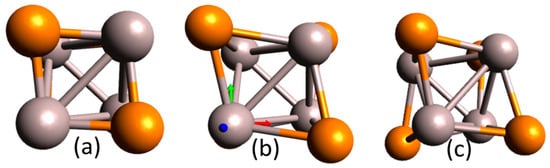
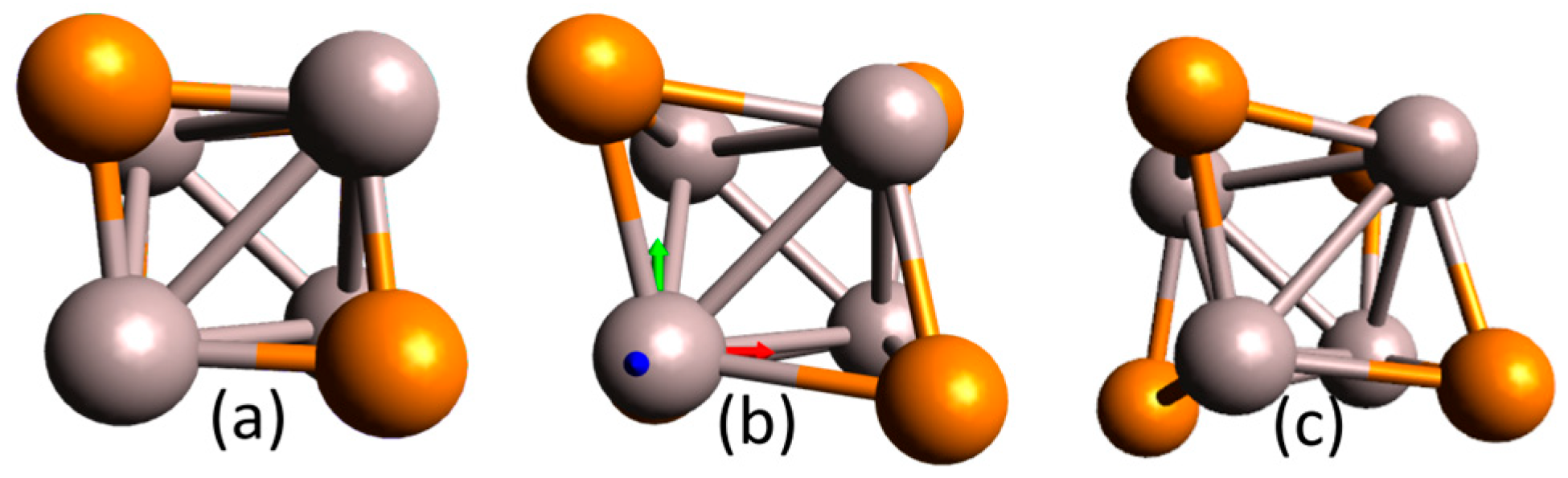
The present work extends the current understanding of aluminum phosphide nanoclusters by examining how geometric modification influences their structural integrity, vibrational behavior, and optical activity. All nanoparticles investigated here originate from the same fundamental unit, a quasi-cubic Al4P4 cluster, which serves as the primary building block for constructing larger architectures. As illustrated in Figure 1, the optimized structure of Al4P4 preserves a quasi-cubic framework, with internal bond angles showing moderate deviations from ideal orthogonal geometry due to structural relaxation. These small distortions indicate low intrinsic strain and confirm the structural robustness of the Al4P4 motif at the DFT level. By systematically elongating this building block along one or two orthogonal directions, we obtained a wide variety of stable AlxPx nanoparticles, many of which exhibit non-trivial geometries and distinct optical signatures. The resulting diversity in shape—ranging from linear 1D extensions to bent, folded, and planar 2D motifs—proves particularly important, as geometric anisotropy strongly affects electronic delocalization and, consequently, both the absorption and vibrational spectra of the nanoparticles. Based on the systematic elongation of the Al4P4 building block, the resulting AlxPx nanoparticles can be organized into four distinct structural families. The first family comprises the one-dimensional (1D) elongated structures—Al8P8, Al12P12–1D, and Al16P16–1D—which arise from linear extension of the cubic core along a single axis. The second family includes a set of Al16P16 nanoparticles derived from elongation along two perpendicular directions. These systems exhibit pronounced geometric distortion and give rise to a group of “exotic” shapes, such as the S-, S3-, L-, L3-, and T-type configurations. The adopted nomenclature for these exotic nanostructures is purely descriptive and reflects their qualitative resemblance to the corresponding Latin letters (S, L, and T) when viewed in their optimized planar projections, rather than implying any specific point-group symmetry or crystallographic classification. A similar trend is observed upon further expansion of the cubic motif, forming the third structural family, the Al24P24 nanoparticles. This group contains both symmetric 2D extensions and additional exotic variants (T, S, L1), all of which preserve stability upon optimization despite significant bending or angular deviations. Finally, the larger systems investigated here belong to the fourth family, which consists of the Al32P32–2D and Al32P32–2DH nanoparticles. These also represent structures that have been elongated in two directions, effectively approaching sheet-like geometries, while maintaining the fundamental AlP connectivity pattern. The optical characteristics obtained for all families reveal pronounced shape-dependent and size-dependent behavior, showing that geometric anisotropy and dimensionality play a decisive role in tuning the electronic excitations and vibrational responses of AlxPx clusters. This diversity in structural and spectral signatures suggests that these nanoparticles could be promising candidates for optoelectronic, sensing, and photocatalytic applications.
Figure 1.
(a) Side view of the initial cubic unit before geometry optimization, (b) side view of the structure after geometry optimization, (c) a different perspective of the optimized structure.
3.1.1. One-Dimensional AlxPx Nanoparticles
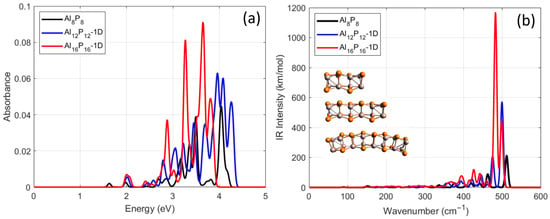
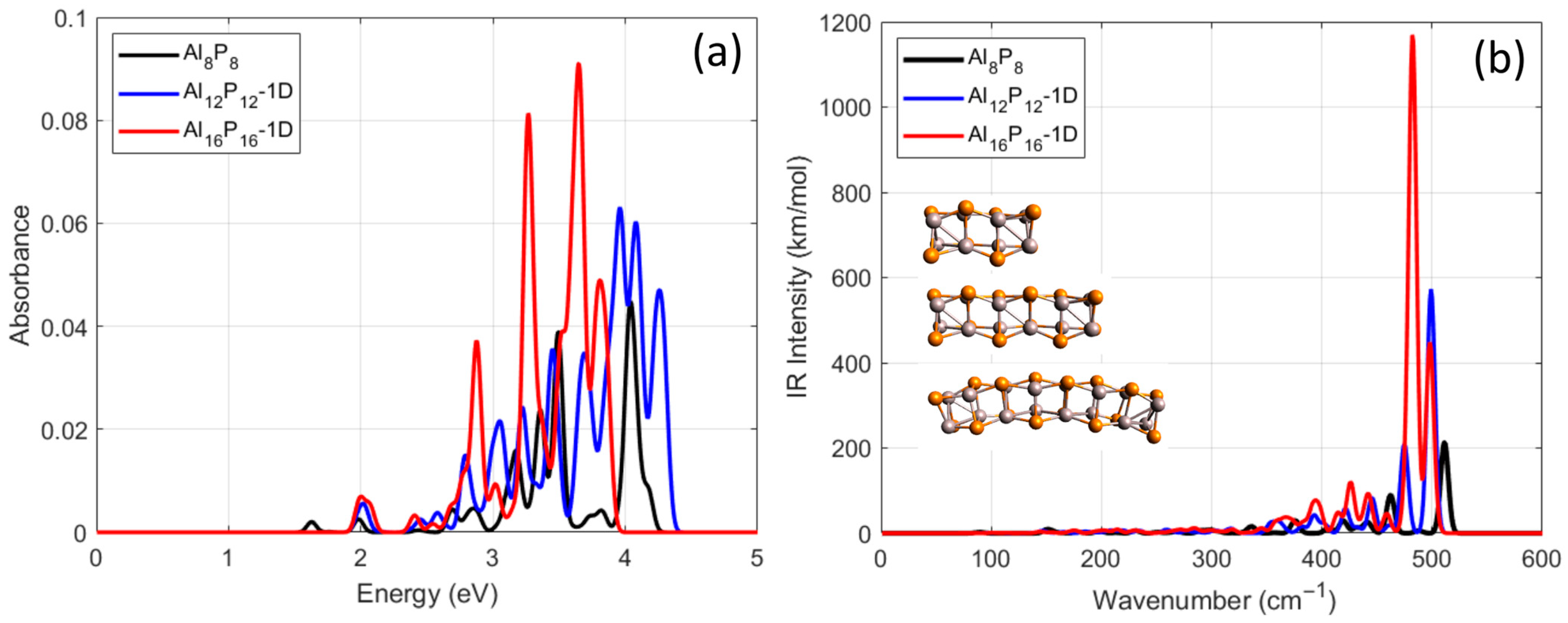
The one-dimensional AlxPx nanoparticles (Al8P8, Al12P12–1D, and Al16P16–1D) exhibit clear size-dependent trends in their electronic and vibrational responses, as shown in their absorption and IR spectra presented in Figure 2. The UV–Vis spectra reveal a progressive increase in spectral complexity with nanoparticle elongation. The smallest cluster, Al8P8, shows a relatively simple absorption profile with its most intense peak located at 4.1 eV, accompanied by weaker features between 2.6 eV and 3.48 eV. The intermediate structure, Al12P12–1D, displays several additional transitions between 2.1 and 4.3 eV, with a dominant maximum near 3.95 eV, indicating that the extension of the Al–P framework enhances the density of low-lying excited states. The longest 1D nanoparticle, Al16P16–1D, presents the richest spectral structure, characterized by strong, partially overlapping peaks in the 1.95–3.8 eV region, including two pronounced absorptions at 3.3 eV and 3.7 eV. Although the absolute absorbance decreases slightly with increasing size, the spectra exhibit a subtle but systematic red shift in the main excitation energies (ΔE ≈ 0.25 eV from Al8P8 to Al16P16–1D). This behavior is indicative of reduced quantum confinement and enhanced electronic delocalization along the elongated Al–P chain.
Figure 2.
(a) The UV-visible spectra for the AlxPx NPs, where x = 8, 12, 16, when considered after elongation in one direction. The figure legend indicates the color that represents each line of the plot. (b) The vibrational spectra of the AlxPx (x = 8, 12, 16) are considered after elongation in one direction. The figure legend indicates the color that represents each line of the plot. The inset in the plot presents the examined NPs for x = 8, 12, and 16.
The infrared spectra support and complement these electronic trends. All systems show intense IR-active modes predominantly in the 350–520 cm−1 region, corresponding to Al–P stretching and bending vibrations. The Al8P8 nanoparticle exhibits a modest IR signature with a main band at 510 cm−1 and intensity around 220 km·mol−1, whereas the Al12P12–1D structure develops a richer vibrational profile with several resonances over 360–500 cm−1, reaching intensities of 40–590 km·mol−1. The largest system, Al16P16–1D, shows the most pronounced vibrational activity: a dominant peak centered at 480 cm−1 with intensity exceeding 1190 km·mol−1, together with additional modes in the 380–500 cm−1 range. This substantial increase in intensity and mode multiplicity is consistent with the lower symmetry, greater polarizability, and cooperative vibrational coupling introduced by chain elongation. Notably, the increase in IR intensity mirrors the rise in electronic delocalization inferred from the UV–Vis spectra, confirming that structural extension enhances both the electronic transition dipoles and the vibrational dipole derivatives. In all cases, the absence of imaginary frequencies verifies the dynamical stability of the optimized structures.
Taken together, the combined UV–Vis and IR analyses indicate that even relatively small variations in the length of 1D AlxPx clusters lead to measurable and systematic modifications of their optical and vibrational fingerprints. The correlation between red-shifted electronic excitations and intensified vibrational activity highlights the strong coupling between geometry and electronic structure in AlP-based nanostructures. These findings suggest that controlled geometric elongation offers a reliable route for tuning the optical response of AlP nanoparticles within the visible range while simultaneously providing distinct vibrational signatures useful for spectroscopic identification and potential sensing applications.
3.1.2. Two-Dimensional Al16P16 Nanoparticles
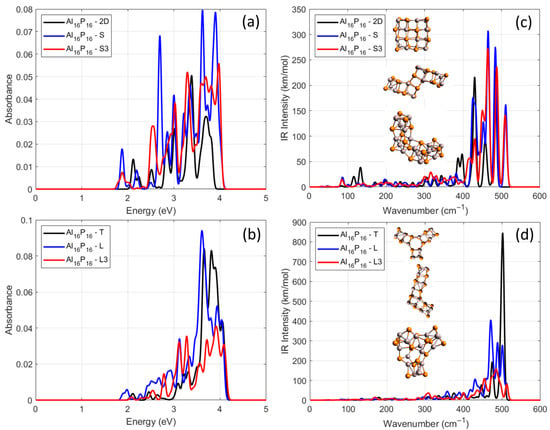
For the five asymmetric Al16P16 nanoparticles (L3, L, S3, S and T), all spectra exhibit their main absorption features in the 2.6–4.2 eV range, but with clear geometry-dependent differences in peak position and intensity, as shown in Figure 3. The spectra presented in Figure 3 were separated into groups of three for better clearance and comparison. The linear-like L structure shows one of the most intense and concentrated maxima at 3.6 eV, indicating that elongation along a single direction favors strong, well-aligned charge-transfer transitions along the main axis.
Figure 3.
(a,b) The UV-vis spectra for the second group of Al16P16 nanostructures, with familiar shapes, when considered after elongation along two perpendicular directions. (c,d) The vibrational spectra for the second group of nanostructures, with familiar shapes, are considered after elongation along two perpendicular directions. Figure legend indicates the color that represents each line of the plot.
The more kinked L3 and S3 geometries display slightly weaker but broader bands, with additional shoulders at lower energies, consistent with increased localization and fragmentation of the delocalized states along the bent backbone. The S-type nanoparticle already exhibits a pronounced feature at 2.6 eV together with substantial activity in the 3.0–3.8 eV region, suggesting that the strong bending allows extra low-energy excitations associated with localized states around the turning points. The T-shaped system shows some of the highest absorption amplitudes near the upper edge of the spectrum, close to 3.7–4.0 eV, with relatively narrow peaks that can be attributed to transitions delocalized over the three arms of the structure. Overall, the most asymmetric geometries (L, S, T) tend to enhance absorption and to generate a denser pattern of peaks, as symmetry reduction relaxes selection rules and activates additional dipole-allowed transitions compared to the more regular L3 and S3 motifs.
In the infrared domain, all five nanoparticles exhibit their dominant IR activity between roughly 350 and 520 cm−1, where Al–P stretching vibrations are concentrated. The L3, L and S3 structures show several medium-to-strong bands in the 430–500 cm−1 region with comparable maximum intensities, reflecting relatively similar distributions of vibrational modes in mildly distorted frameworks. By contrast, the highly bent S geometry develops a more irregular profile with multiple closely spaced bands, indicating stronger mode splitting and a richer coupling between in-plane and out-of-plane motions along the curved backbone. The T-shaped nanoparticle features one particularly intense and sharp band close to the upper end of the spectrum, on top of several weaker modes at lower wavenumbers, yielding a distinctive IR fingerprint that clearly differentiates it from the other shapes.
Taken together, the UV–Vis and IR spectra showthat geometric asymmetry in L-, S- and T-type Al16P16 clusters not only strengthens optical absorption but also generates well-resolved vibrational fingerprints. This sensitivity of both electronic and vibrational responses to shape suggests that controlled bending and branching of AlP building units can be used as an effective design handle for tuning the spectroscopic signatures of III–V semiconductor nanoparticles.
3.1.3. Τwo-Dimensional Al24P24 Nanoparticles
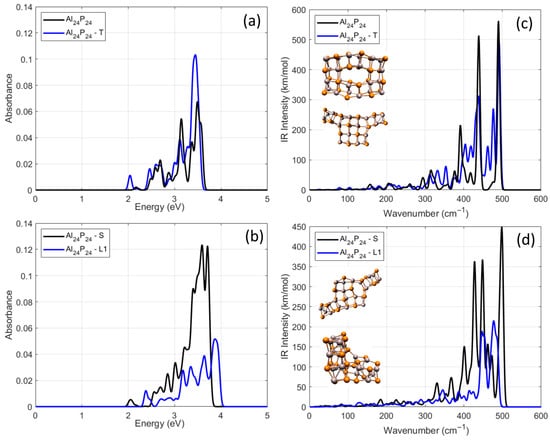
The transition to larger, Al24P24-based two-dimensional architectures reveals how extended bonding networks and mesoscale connectivity—rather than simple shape—govern their optical and vibrational properties. As shown in Figure 4, the Al24P24 NP serves as a useful reference, displaying a moderately broad absorption profile with an onset just below 2.5 eV, followed by a main peak near 3.3–3.4 eV. This behavior indicates a well-defined fundamental gap together with several accessible excited states characteristic of a relatively symmetric, densely connected 2D framework.
Figure 4.
(a,b) The UV-vis spectra for the third group of Al24P24 nanostructures, with familiar shapes, when considered after elongation along two perpendicular directions. (c,d) The vibrational spectra for the third group of nanostructures, with familiar shapes, are considered after elongation along two perpendicular directions. Figure legend indicates the color that represents each line of the plot.
Reorganizing the same Al24P24 formula into distinct extended motifs produces pronounced spectral differentiation. The L1-type structure exhibits a broadened absorption band extending from 2.3 to 3.9 eV, with its most intense feature emerging at 3.9 eV. The overall shape of the spectrum suggests partial electronic delocalization combined with anisotropic confinement along one in-plane direction, consistent with its elongated letter-like geometry. The S-type isomer shows the strongest and lowest-energy optical activity among the set, characterized by a dominant band spanning 2.2–3.6 eV and reaching its maximum at 3.55 eV. The substantial broadening and the high oscillator strength across this range reflect efficient in-plane electronic delocalization and the formation of multiple closely spaced excited states. This behavior identifies the S-type network as the configuration with the smallest effective optical gap within the Al24P24 family. In contrast, the T-type structure displays a clearly blue-shifted and more spectrally localized absorption profile, with a dominant peak near 3.3 eV and very weak intensity below 2.1 eV. This behavior indicates that the T-type connectivity enforces stronger quantum confinement on the frontier electronic states, reducing in-plane charge delocalization and shifting the main optical transitions to higher energies.
The vibrational spectra provide a coherent structural interpretation of the optical trends observed among the Al24P24 isomers. The S-type structure exhibits the strongest infrared activity within the series, characterized by a broad pair of high-intensity resonances between 400 and 500 cm−1, with peak values approaching 560 km/mol. This pronounced enhancement signals highly cooperative Al–P deformation and stretching modes enabled by its extended, strongly interconnected 2D framework. The same structural features that promote electronic delocalization and produce the red-shifted, intense optical absorption of this isomer are reflected here as large dipole-moment variations during vibrational motion. The compact Al24P24 cluster and the T-type isomer exhibit more moderate IR responses, consisting mainly of several well-defined modes in the 290–500 cm−1 region. Their lower intensities imply relatively stiffer vibrational frameworks and more localized structural distortions, consistent with their more blue-shifted and less intense absorption profiles in the optical spectrum. The L1 isomer displays an intermediate vibrational character, with two prominent resonances near 340 and 450 cm−1. This pattern reflects its anisotropic connectivity: softer bending motions along its elongated axis coexist with stiffer Al–P stretching modes perpendicular to it, producing a mixed vibrational signature.
Taken together, the Al24P24 series shows that, at this intermediate 2D scale, the optical gap and vibrational polarizability can be both tuned over a wide range—exceeding 1 eV—simply by altering the internal connectivity of the Al–P network. Among the examined motifs, the S-type architecture emerges as the most functionally promising, as it uniquely combines strong visible-range absorption with exceptionally intense infrared activity. This synergy underscores a central structure-related property principle according to which the extended and highly interconnected 2D AlP frameworks promote both enhanced electronic delocalization and a highly responsive lattice, offering a versatile platform for tailored optoelectronic and photonic performance.
3.1.4. Two-Dimensional Sheet-like Al32P32 Nanoparticles
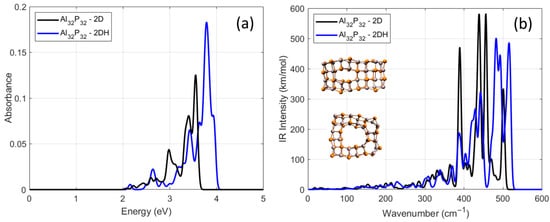
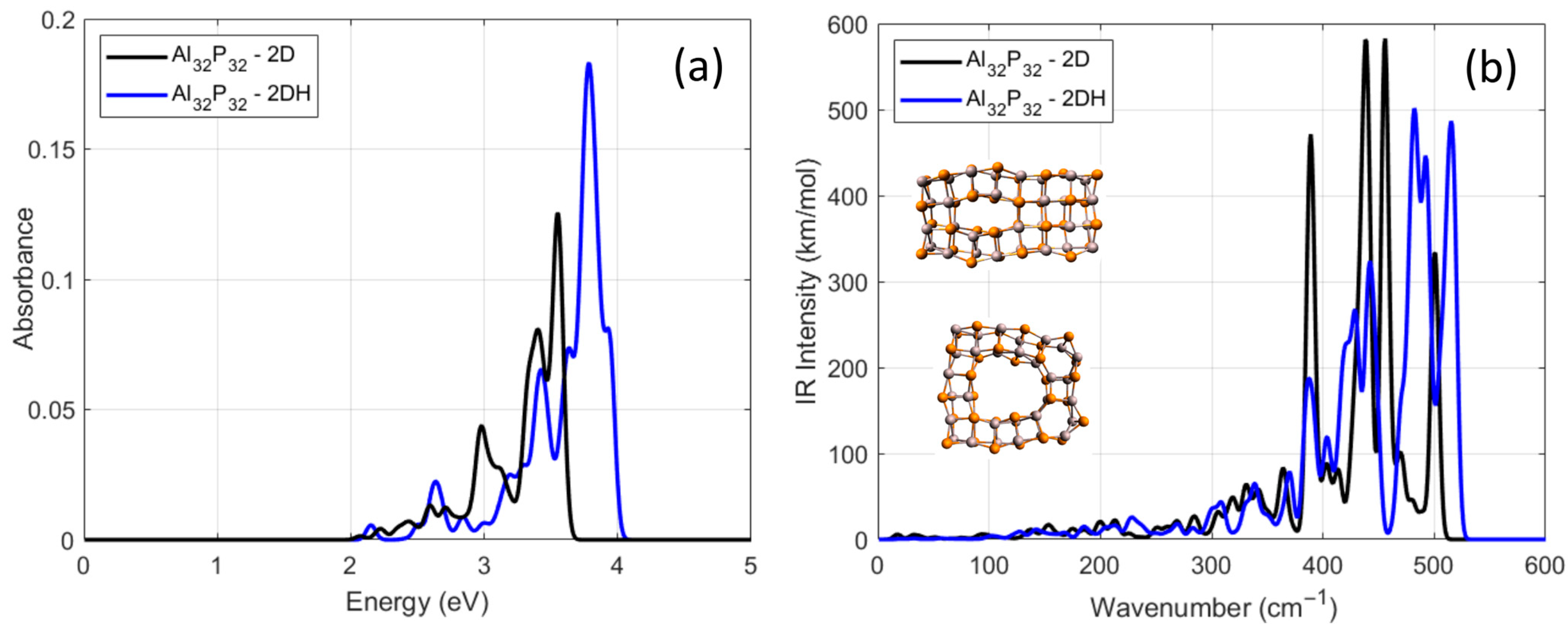
Τhe final class of systems examined corresponds to the extended sheet-like architectures Al32P32–2D and Al32P32–2DH, both of which represent larger two-dimensional fragments derived through lateral expansion of the Al4P4 building motif. These structures preserve the global planar topology but differ in their out-of-plane relaxation: the Al32P32–2D sheet remains nearly flat, whereas the Al32P32–2DH configuration exhibits a slight buckling distortion, giving rise to modified bonding environments and subtle variations in electronic delocalization. Their optical absorption and infrared vibrational responses are shown side-by-side in Figure 5.
Figure 5.
(a) The UV-vis spectra for the fourth group of Al32P32 nanostructures, with familiar shapes, are considered after elongation along two perpendicular directions. (b) The vibrational spectra for the fourth group of nanostructures, with familiar shapes, are considered after elongation along two perpendicular directions. Figure legend indicates the color that represents each line of the plot.
Both 2D structures display their absorption activity predominantly in the 2.6–4.0 eV window, but with important qualitative differences. The flat Al32P32–2D sheet exhibits its strongest absorption maximum at around 3.60 eV with a peak absorbance of approximately 0.13, accompanied by a secondary shoulder near 3.40 eV. These features are characteristic of moderately delocalized π–σ hybridized transitions across the extended, nearly planar framework. In contrast, the slightly buckled Al32P32–2DH sheet shows a more intense and narrower main resonance centered at about 3.82 eV, where the absorbance reaches roughly 0.19, i.e., clearly higher than that of the planar structure. This blue-shift of about 0.6 eV relative to the 2D sheet is consistent with the reduced orbital overlap induced by buckling, which increases the effective quantum confinement and widens the HOMO–LUMO separation. The enhanced oscillator strength of the 2DH peak further suggests that the buckled geometry enables more efficient dipole-allowed transitions, likely due to symmetry breaking and modified charge redistribution across the distorted Al–P network. Overall, the comparison reveals a planarity-controlled optical tunability, where the flatter sheet supports slightly lower excitation energies with broader and less intense bands, whereas the buckled sheet exhibits sharper, more intense transitions shifted toward higher energies. These observations indicate that even subtle structural distortions in 2D III–V fragments can significantly modulate their optoelectronic response.
The infrared spectra of both systems lie primarily within the 350–520 cm−1 region and are dominated by in-plane and out-of-plane Al–P stretching modes. Despite sharing the same stoichiometry, the two structures exhibit distinct intensity patterns due to their different geometric relaxation. The Al32P32–2D sheet shows its strongest IR peak at approximately 440–450 cm−1 with an intensity on the order of 580 km·mol−1, followed by several moderately strong resonances distributed between 390 and 510 cm−1. The overall spectrum is relatively compact and reflects the higher degree of symmetry associated with the nearly planar topology. In contrast, the buckled Al32P32–2DH system presents a more complex and asymmetric vibrational profile. Its most intense IR band appears near 490 cm−1, reaching an intensity of about 500 km·mol−1, slightly lower in height compared to the dominant peak of the 2D sheet, but accompanied by multiple closely spaced resonances in the 380–520 cm−1 region. This pronounced splitting of vibrational modes arises from symmetry lowering due to buckling, which relaxes degeneracies and activates additional IR-active modes.
When examined together, the absorption and IR spectra provide coherent evidence that geometric flatness versus buckling is the key variable controlling both the optical and vibrational behaviors of large Al32P32 nanosheets. The Al32P32–2D NP exhibits lower excitation energies, broader and more intense vibrational features concentrated in a few dominant bands, while the Al32P32–2DH NP displays blue-shifted and sharper absorption maxima and a more intricate IR fingerprint due to symmetry breaking. These trends mean that subtle structural distortions in 2D III–V nanosheets can simultaneously modulate electronic delocalization and vibrational coupling, offering a versatile platform for tuning optoelectronic and phononic properties at the nanoscale. Finally, it is worth commenting on the spatial character of the lowest-energy optical and vibrational features observed in these finite AlP nanostructures. For the smallest clusters, the lowest-energy optical transitions are expected to possess a pronounced surface- and edge-localized character, arising from undercoordinated Al and P atoms. With increasing size and dimensionality, these localized contributions are gradually reduced in favor of more delocalized electronic excitations, consistent with the partial saturation of the optical gap.
3.2. Stability and Binding Energy
To assess the thermodynamic stability of the optimized AlxPx nanostructures, the binding energy (BE) per formula unit (f.u.) was computed for all clusters using both self-consistent field (SCF) electronic energies and values corrected for zero-point vibrational contributions (ZPE). This quantity provides a direct measure of the cohesive strength of each nanoparticle and enables a consistent comparison across different sizes and dimensionalities.
In analogy with established approaches for III–V semiconductor clusters, all binding energies were referenced to isolated Al and P atoms. Although this convention typically yields somewhat larger absolute cohesive values than molecular referencing, it ensures a uniform and internally consistent framework for evaluating relative stability trends within the Al–P family. Test calculations using molecular Al–P species as alternative references confirmed that, while the absolute magnitude of the binding energy decreases, the ordering of stabilities among different clusters remains unchanged, reinforcing the robustness of the adopted methodology.
The binding energy of an AlxPx cluster was calculated according to:
where the index x indicates each examined formula of the structure (formula unit), E(Al) is the energy of isolated atoms of Al, E(P) is the energy of isolated atoms of P, and E(AlxPx) is the total energy of the NP. The binding energy per formula unit, which provides a size-normalized stability descriptor, is then defined as:
This metric allows direct comparison between clusters containing different numbers of AlP units, from the smallest 1D-elongated nanostructures to the extended 2D sheet-like systems.
As will be discussed in the following sections, the calculated binding energies exhibit a clear size- and dimensionality-dependent stabilization trend, with larger and more extended structures showing progressively stronger cohesion. This behavior is consistent with expectations for III–V phosphide nanoclusters and reflects the rapid reduction in surface-induced destabilization as the Al–P framework grows toward higher-dimensional motifs.
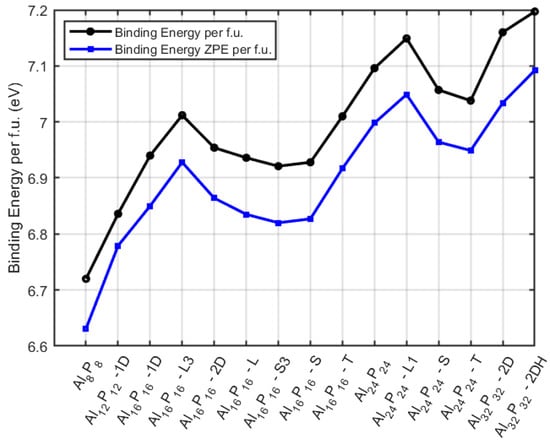
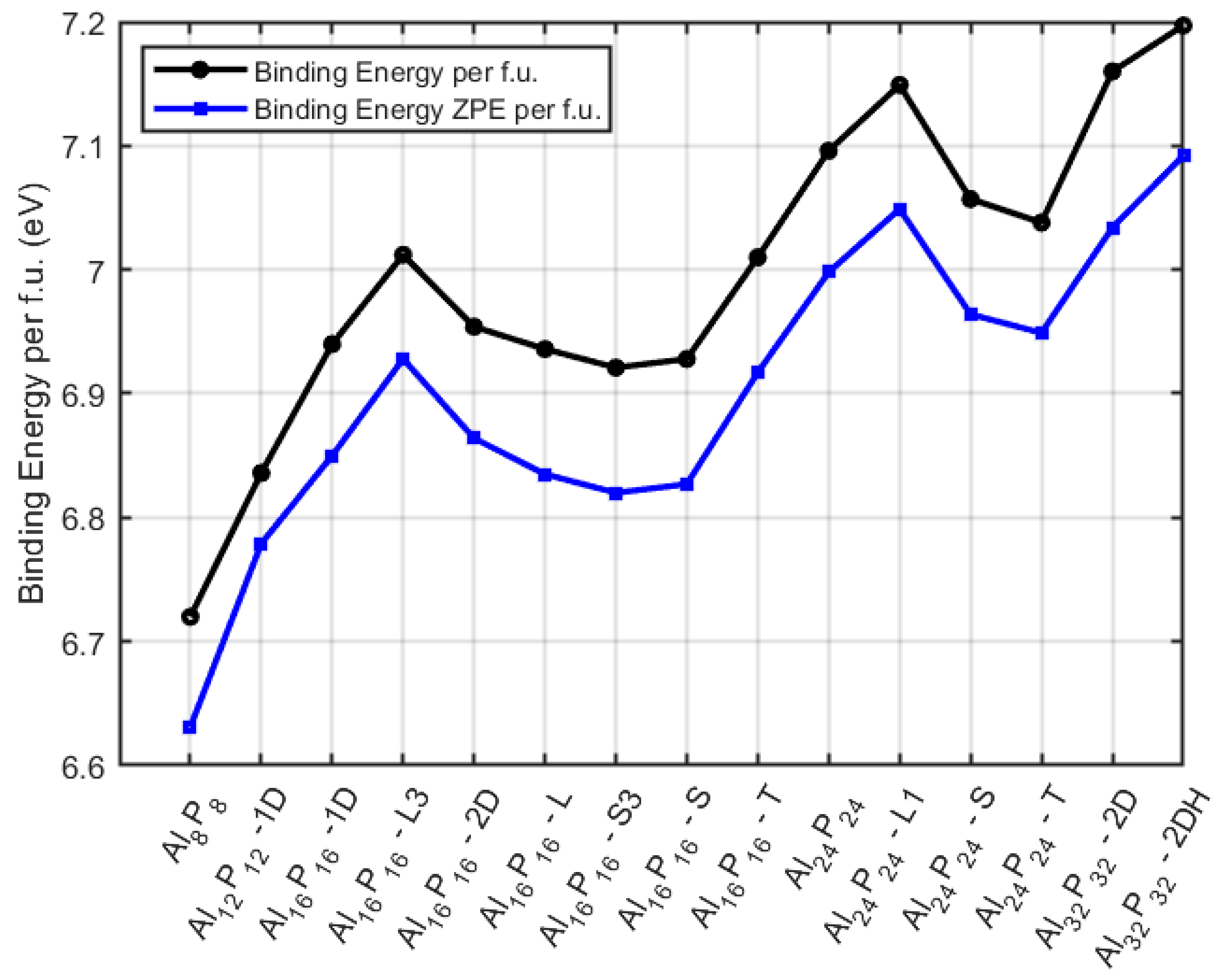
The calculated binding energies reveal a systematic and physically meaningful stabilization pattern across the full set of AlxPx nanostructures, reflecting the interplay between size, dimensionality, and geometric compactness within the Al–P framework. For all clusters, the binding energy per formula unit (BE/f.u.) increases monotonically from the smallest 1D elongated systems toward the more extended 2D and quasi-planar architectures, as shown in Figure 6. This behavior directly reveals the progressive reduction in surface-induced strain and the enhanced electronic delocalization that develops as the Al–P network grows.
Figure 6.
Τotal binding energies per f.u. (black markers) and ZPE-corrected binding energies per f.u. (blue markers) for all AlxPx nanostructures studied in this work, plotted as a function of the size of the system. Each data point corresponds to an optimized cluster of formula AlxNx (x = 8, 16, 24, 32) with varying dimensionality and geometry.
Among the 1D family, the Al8P8 cluster exhibits the lowest BE/f.u. value (≈6.72 eV), consistent with its high surface-to-volume ratio and limited structural relaxation. Increasing the length of the chain to Al12P12–1D and Al16P16–1D leads to a steady rise in cohesion, with BE/f.u. values approaching to 6.836 and 6.940 eV, respectively. This smooth energetic evolution confirms that elongation along a single axis stabilizes the framework by enabling more extensive Al–P bonding without introducing significant angular strain.
The exotic Al16P16 family (L, L3, S, S3, T) presents a richer energy landscape. All variants are more stable than the one-dimensional structures, but differ slightly depending on their geometric connectivity. In particular, the L3 and T architectures exhibit local maxima in the binding energy with corresponding values of 7.012 and 7.010 eV, indicating that certain bending-induced or branching motifs promote highly favorable Al-P binding environments. In contrast, the S and S3 configurations exhibit slightly lower coherence, suggesting a more strained or less efficiently packed framework. These differences, although small in magnitude, highlight the sensitivity of the Al-P binding features to local geometric distortions and the topology of the elongated building blocks.
A more pronounced stabilization emerges with the Al24P24 nanostructures, all of which surpass the 7.05 eV threshold. The L1 structure reaches one of the highest values in this family (≈7.149 eV), underscoring the role of increased dimensional extension and internal symmetry in maximizing cohesive interactions. The S and T variants, though slightly less stable, remain energetically favorable compared to all 1D and 16-atom clusters. These results indicate that the onset of quasi-planar character in 24-atom systems effectively mitigates surface distortions and allows stronger Al–P bonding across the expanded lattice.
The larger nanostructures, Al32P32–2D and Al32P32–2DH, represent the most coherent members of the entire data set, with the corresponding BE/f.u. values being 7.160 and 7.197 eV. The slightly improved stability of the 2DH variant reflects the more symmetrical and compact sheet-like arrangement, which minimizes dangling bonds and concentrates the electron density in a nearly continuous two-dimensional Al–P lattice. This trend parallels observations from III–V nitride and phosphide nanoclusters, where the transition from 1D to 2D confinement leads to a notable increase in thermodynamic robustness. Inclusion of zero-point vibrational corrections does not alter any stability ordering, and, thus, all clusters preserve the same energetic hierarchy, and ZPE-corrected BE/f.u. values remain consistently ~0.08–0.10 eV lower than their SCF counterparts. This confirms that the reported stability trends arise from intrinsic structural and electronic factors rather than vibrational artifacts. Overall, the binding-energy landscape demonstrates clearly that both dimensional expansion and geometric compactness enhance the thermodynamic stability of AlxPx nanoparticles, with 2D sheet-like configurations representing the most favorable limit within the size range explored here.
As also shown in Table 2, the calculated HOMO–LUMO gaps of the AlxPx nanostructures fall within a narrow 0.79–1.29 eV window, but exhibit clear trends governed by size, dimensionality, and internal connectivity. The 1D-elongated clusters show a gradual increase in the gap with growing length, while the 2D exotic Al16P16 isomers display larger variability, indicating that geometric topology can modulate the frontier electronic states as strongly as size. The Al24P24 family spans the widest gap range, with the highly anisotropic L1 structure producing the largest value (1.299 eV), whereas more symmetric motifs remain near 1.1 eV. The largest 2D sheets (Al32P32) approach a saturation regime, showing only modest gap variations. Overall, it is revealed by the HL gap analysis that both dimensional expansion and shape-controlled confinement provide effective pathways for tuning the electronic properties of AlP nanoparticles. In the finite-size cluster regime, surface and edge effects dominate over conventional quantum confinement, leading to reduced HOMO–LUMO gaps compared to bulk AlP. As dimensionality and connectivity increase, these surface-induced states are progressively suppressed. A noteworthy feature is the appearance of local maxima in the binding energy per formula unit for specific geometries, namely Al16P16–L3, Al24P24–L1, and Al32P32–2DH. These structures share a common geometric characteristic: an enhanced average coordination and a reduced fraction of low-coordinated surface atoms. As a result, surface-induced destabilization and mid-gap electronic states are suppressed. This structural compactness correlates with simultaneously increased HOMO–LUMO gaps, indicating enhanced chemical hardness and reduced electronic polarizability. The concurrence of high binding energy and larger HOMO–LUMO gap, therefore, reflects a common physical origin, rooted in optimized connectivity and electronic localization, rather than size alone.
Table 2.
HOMO–LUMO (HL) Gaps and Binding Energies per f.u. of AlxNx NPs.
4. Conclusions
In this work, a systematic first-principles investigation of aluminum phosphide (AlP) nanoparticles was carried out to elucidate structure–property relationships across a broad range of sizes, dimensionalities, and geometrical motifs. All nanostructures were generated from a quasi-cubic Al4P4 building block and extended in a controlled manner along one or two directions. The largest two-dimensional clusters examined here already exhibit near-saturation of key electronic and energetic descriptors, indicating a smooth evolution toward bulk-like behavior, while a fully periodic treatment of infinite systems is left for future work. Ground- and excited-state properties were examined using DFT and TD-DFT, with CAM-B3LYP excitation energies benchmarked against EOM-CCSD reference data for small systems, confirming the reliability of the adopted computational protocol.
The optimized AlxPx clusters were classified into four structural families, including one-dimensional elongated chains, two-dimensional exotic Al16P16 isomers, extended Al24P24 architectures, and near-sheet Al32P32 nanostructures. All systems were found to be dynamically stable, enabling a consistent assessment of how size, dimensionality, and internal connectivity jointly govern the electronic and vibrational response of AlP nanoparticles.
Optical absorption spectra reveal pronounced geometry-driven tunability. One-dimensional elongation induces moderate red shifts and increasingly complex spectral features, whereas at fixed composition, the optical response is primarily dictated by topology rather than size alone. Highly interconnected two-dimensional motifs exhibit red-shifted absorption onsets and enhanced oscillator strengths, while more anisotropic or lower-symmetry structures display blue-shifted and spectrally localized absorption. For the largest Al32P32 systems, the optical gap approaches saturation, although subtle connectivity effects remain relevant.
Vibrational analysis provides complementary insight, with all nanostructures exhibiting IR-active modes mainly in the 300–520 cm−1 region. Strong variations in intensity and mode distribution are observed, reflecting geometry-dependent vibrational coupling. Highly interconnected two-dimensional motifs show exceptionally intense low-wavenumber IR activity, indicative of cooperative Al–P deformations and enhanced vibrational polarizability, whereas elongated or less symmetric structures display weaker and more fragmented vibrational signatures.
Electronic and energetic stability metrics further support these trends. HOMO–LUMO gaps span a relatively narrow range (approximately 0.8–1.3 eV) but exhibit clear dependence on dimensionality and connectivity, demonstrating that topology-driven confinement can rival size effects. Binding energies per formula unit increase with cluster size and dimensionality, reaching values close to 7.2 eV for the largest two-dimensional systems, with zero-point energy corrections preserving the overall stability hierarchy.
Overall, this study provides a comprehensive and geometry-resolved mapping of optical, vibrational, and stability trends across a wide family of AlP nanoparticles. The results demonstrate that modest variations in internal connectivity and dimensionality can induce substantial changes in optical gaps and vibrational response, establishing a clear structure–property design framework. These findings offer both fundamental insight and practical guidance for the rational design of AlP-based nanomaterials with tailored optoelectronic and vibrational properties.
Author Contributions
Conceptualization, F.I.M., C.P., N.A.-Z. and M.M.S.; Methodology, F.I.M., C.P., N.A.-Z. and M.M.S.; Software, F.I.M., C.P., N.A.-Z. and M.M.S.; Validation, F.I.M., C.P., N.A.-Z. and M.M.S.; Formal analysis, F.I.M., C.P., N.A.-Z. and M.M.S.; Investigation, F.I.M., C.P., N.A.-Z. and M.M.S.; Resources, F.I.M., C.P., N.A.-Z. and M.M.S.; Data curation, F.I.M., C.P., N.A.-Z. and M.M.S.; Writing—original draft, F.I.M., C.P., N.A.-Z. and M.M.S.; Writing—review and editing, F.I.M., C.P., N.A.-Z. and M.M.S.; Visualization, F.I.M., C.P., N.A.-Z. and M.M.S.; Supervision, F.I.M., C.P., N.A.-Z. and M.M.S.; Project administration, F.I.M., C.P., N.A.-Z. and M.M.S.; Funding acquisition, F.I.M., C.P., N.A.-Z. and M.M.S. All authors have read and agreed to the published version of the manuscript.
Funding
This research received no external funding.
Data Availability Statement
The original contributions presented in this study are included in the article. Further inquiries can be directed to the corresponding author.
Acknowledgments
No generative artificial intelligence tools were used for data generation, data analysis, scientific interpretation, or figure preparation. The authors take full responsibility for the content of this manuscript.
Conflicts of Interest
The authors declare no conflicts of interest.
References
- Bera, D.; Qian, L.; Tseng, T.-K.; Holloway, P.H. Quantum dots and their multimodal applications: A review. Materials 2010, 3, 2260–2345. [Google Scholar] [CrossRef] [Scilit]
- Chen, Z.; Manian, A.; Widmer-Cooper, A.; Russo, S.P.; Mulvaney, P. Semiconductor Quantum Dots in the Cluster Regime: Focus Review. Chem. Rev. 2025, 125, 4359–4396. [Google Scholar] [CrossRef] [Scilit]
- Lim, S.Y.; Shen, W.; Gao, Z. Carbon quantum dots and their applications. Chem. Soc. Rev. 2015, 44, 362–381. [Google Scholar] [CrossRef] [Scilit]
- Reimann, S.M.; Manninen, M. Electronic structure of quantum dots. Rev. Mod. Phys. 2002, 74, 1283. [Google Scholar] [CrossRef] [Scilit]
- Yang, X.; Mao, C.; Hu, Y.; Cao, H.; Zhang, Y.; Zhao, D.; Chen, Z.; Xie, M. Two-dimensional aluminum phosphide semiconductor with tunable direct band gap for nanoelectric applications. RSC Adv. 2020, 10, 25170–25176. [Google Scholar] [CrossRef] [Scilit] [PubMed]
- Zyane, M.S.; Rghioui, H.; Ait Tamerd, M.; Boujibar, O.; Achahbar, A.; Marjaoui, A.; Zanouni, M. Two-dimensional AsP3 monolayer as an efficient anode material for Li-Ion batteries: A theoretical perspective. Appl. Phys. A 2024, 130, 649. [Google Scholar] [CrossRef] [Scilit]
- Rehman, A.; Razaaq, Z.; Tanveer, M.; Masood, M.K.; Bano, N.; Shakil, M. Li-decorated 2D Aluminium Phosphide monolayer for hydrogen storage capacity: Insights from DFT computations. J. Phys. Chem. Solids 2025, 199, 112497. [Google Scholar] [CrossRef] [Scilit]
- Ibrahim, M.A.A.; Manar, H.A.H.; Nayra, A.M.M.; Omar, H.A.-E.; Shaban, R.M.S.; Muhammad, N.A.; Ahmed, M.A.; Tamer, S. Aluminium phosphide (Al 12 P 12) nanocage as a potential sensor for volatile organic compounds: A DFT study. RSC Adv. 2024, 14, 13915–13925. [Google Scholar] [CrossRef] [Scilit]
- Rady, A.S.S.; Moussa, N.A.; Mohamed, L.A.; Sidhom, P.A.; Sayed, S.R.; Abd El-Rahman, M.K.; Dabbish, E.; Shoeib, T.; Ibrahim, M.A. Elucidating the adsorption of 2-Mercaptopyridine drug on the aluminum phosphide (Al12P12) nanocage: A DFT study. Heliyon 2023, 9, e18690. [Google Scholar] [CrossRef] [Scilit] [PubMed]
- Khaliq, F.; Ayub, K.; Mahmood, T.; Muhammad, S.; Tabassum, S.; Gilani, M.A. First example of lanthanum as dopant on Al12N12 and Al12P12 nanocages for improved electronic and nonlinear optical properties with high stability. Mater. Sci. Semicond. Process. 2021, 135, 106122. [Google Scholar] [CrossRef] [Scilit]
- Liu, M.; Zhu, Y.; Wang, X.; Jiang, G.; Luan, C.; Yu, K. Absorption features of CdTe nanoclusters: Aspect ratio dependency of the singlet/doublet from first-principles calculations. J. Phys. Chem. C 2021, 125, 25660–25669. [Google Scholar] [CrossRef] [Scilit]
- Koukaras, E.N.; Zdetsis, A.D.; Sigalas, M.M. Ab initio study of magnesium and magnesium hydride nanoclusters and nanocrystals: Examining optimal structures and compositions for efficient hydrogen storage. J. Am. Chem. Soc. 2012, 134, 15914–15922. [Google Scholar] [CrossRef] [Scilit] [PubMed]
- Tsukamoto, T.; Kambe, T.; Imaoka, T.; Yamamoto, K. Modern cluster design based on experiment and theory. Nat. Rev. Chem. 2021, 5, 338–347. [Google Scholar] [CrossRef] [Scilit] [PubMed]
- Kohn, W.; Sham, L.J. Self-consistent equations including exchange and correlation effects. Phys. Rev. 1965, 140, A1133. [Google Scholar] [CrossRef] [Scilit]
- Runge, E.; Gross, E.K.U. Density-Functional Theory for Time-Dependent Systems. Phys. Rev. Lett. 1984, 52, 997–1000. [Google Scholar] [CrossRef] [Scilit]
- Tomasulo, A.; Ramakrishna, M.V. Density functional studies of aluminum phosphide cluster structures. J. Chem. Phys. 1996, 105, 10449–10455. [Google Scholar] [CrossRef] [Scilit]
- Yu, K.; Schanze, K.S. Commemorating the Nobel Prize in Chemistry 2023 for the discovery and synthesis of quantum dots. ACS Cent. Sci. 2023, 9, 1989–1992. [Google Scholar] [CrossRef] [Scilit]
- Weigend, F.; Ahlrichs, R. Balanced basis sets of split valence, triple zeta valence and quadruple zeta valence quality for H to Rn: Design and assessment of accuracy. Phys. Chem. Chem. Phys. 2005, 7, 3297–3305. [Google Scholar] [CrossRef] [Scilit]
- Perdew, J.P.; Burke, K.; Ernzerhof, M. Generalized gradient approximation made simple. Phys. Rev. Lett. 1996, 77, 3865–3868. [Google Scholar] [CrossRef] [Scilit]
- Song, J.W.; Watson, M.A.; Nakata, A.; Hirao, K. Core-excitation energy calculations with a long-range corrected hybrid exchange-correlation functional including a short-range Gaussian attenuation (LCgau-BOP). J. Chem. Phys. 2008, 129, 184113. [Google Scholar] [CrossRef] [Scilit]
- Yanai, T.; Tew, D.; Handy, N. A new hybrid exchange-correlation functional using the Coulomb-attenuating method (CAM-B3LYP). Chem. Phys. Lett. 2004, 393, 51–57. [Google Scholar] [CrossRef] [Scilit]
- Goings, J.; Caricato, M.; Frisch, M.J.; Li, X. Assessment of low-scaling approximations to the equation of motion coupled-cluster singles and doubles equations. J. Chem. Phys. 2014, 141, 164116. [Google Scholar] [CrossRef] [Scilit] [PubMed]
- TURBOMOLE, V7.6; TURBOMOLE GmbH: Karlsruhe, Germany, 2022; Available online: https://www.turbomole.org (accessed on 9 August 2023).
- Curtiss, L.A.; Redfern, P.C.; Raghavachari, K. Gaussian-4 theory. J. Chem. Phys. 2007, 126, 084108. [Google Scholar] [CrossRef] [Scilit]
- Michos, F.I.; Chronis, A.G.; Sigalas, M.M. Optical Properties of ScnYn (Y = N, P As) Nanoparticles. Nanomaterials 2023, 13, 2589. [Google Scholar] [CrossRef] [Scilit]
- Aravantinos-Zafiris, N.; Michos, F.I.; Sigalas, M.M. Vibrational Spectrum of Magnesium Monochalcogenide Nanoparticles. Nanomaterials 2024, 14, 1918. [Google Scholar] [CrossRef] [Scilit] [PubMed]
- Li, Y.; Zhen, Z.; Shen, P.; Chen, Z. Spin gapless semiconductor−metal−half-metal properties in nitrogen-doped zigzag graphene nanoribbons. ACS Nano 2009, 3, 1952–1958. [Google Scholar] [CrossRef] [Scilit]
- Michos, F.I.; Papaspiropoulou, C.; Aravantinos-Zafiris, N.; Sigalas, M.M. Optical and Vibrational Properties of AlN Nanoparticles with Different Geometries: A DFT and TD-DFT Study. Crystals 2025, 15, 1003. [Google Scholar] [CrossRef] [Scilit]
- Ren, S.; Harms, J.; Caricato, M. An EOM-CCSD-PCM benchmark for electronic excitation energies of solvated molecules. J. Chem. Theory Comput. 2017, 13, 117–124. [Google Scholar] [CrossRef] [Scilit]
- Wang, C.-W. New Approach of Solvent Effects on Electronic Spectroscopy: Damped Harmonic Franck-Condon Theory and Simulation. Ph.D. Thesis, National Yang Ming Chiao Tung University, Hsinchu, Taiwan, 2020. [Google Scholar]
- Beerepoot, M.T.P.; Friese, D.H.; List, N.H.; Kongsted, J.; Ruud, K. Benchmarking two-photon absorption cross sections: Performance of CC2 and CAM-B3LYP. Phys. Chem. Chem. Phys. 2015, 17, 19306–19314. [Google Scholar] [CrossRef] [Scilit]
- Kwon, Y.; Kim, S. Indium phosphide magic-sized clusters: Chemistry and applications. NPG Asia Mater. 2021, 13, 37. [Google Scholar] [CrossRef] [Scilit]
- Ning, J.; Banin, U. Magic size InP and InAs clusters: Synthesis, characterization and shell growth. Chem. Commun. 2017, 53, 2626–2629. [Google Scholar] [CrossRef] [Scilit] [PubMed]
- Kaviani, S.; Shahab, S.; Sheikhi, M. Adsorption of alprazolam drug on the B12N12 and Al12N12 nano-cages for biological applications: A DFT study. Phys. E Low-Dimens. Syst. Nanostruct. 2021, 126, 114473. [Google Scholar] [CrossRef] [Scilit]
- Cheng, Z.; Gao, H.; Jiang, Z.-F.; Zhang, X.; Chen, G. Tetragonal aluminum phosphide monolayer as a promising anode material for alkali metal-ion battery applications. J. Energy Storage 2024, 104, 114504. [Google Scholar] [CrossRef] [Scilit]
- Ramirez-Gomez, S.; Arellano-Ramírez, I.; Gil Rebaza, A.; Amaya-Roncancio, S. Hydrogen adsorption on alkali and alkaline earth functionalized silicene: A first-principles and kinetic modeling study. Int. J. Hydrogen Energy 2025, 174, 151025. [Google Scholar] [CrossRef] [Scilit]
- Sohail, M.; Khaliq, F.; Mahmood, T.; Ayub, K.; Tabassum, S.; Gilani, M.A. Influence of bi-alkali metals doping over Al12N12 nanocage on stability and optoelectronic properties: A DFT investigation. Radiat. Phys. Chem. 2021, 184, 109457. [Google Scholar] [CrossRef] [Scilit]

Disclaimer/Publisher’s Note: The statements, opinions and data contained in all publications are solely those of the individual author(s) and contributor(s) and not of MDPI and/or the editor(s). MDPI and/or the editor(s) disclaim responsibility for any injury to people or property resulting from any ideas, methods, instructions or products referred to in the content. |
© 2026 by the authors. Licensee MDPI, Basel, Switzerland. This article is an open access article distributed under the terms and conditions of the Creative Commons Attribution (CC BY) license.