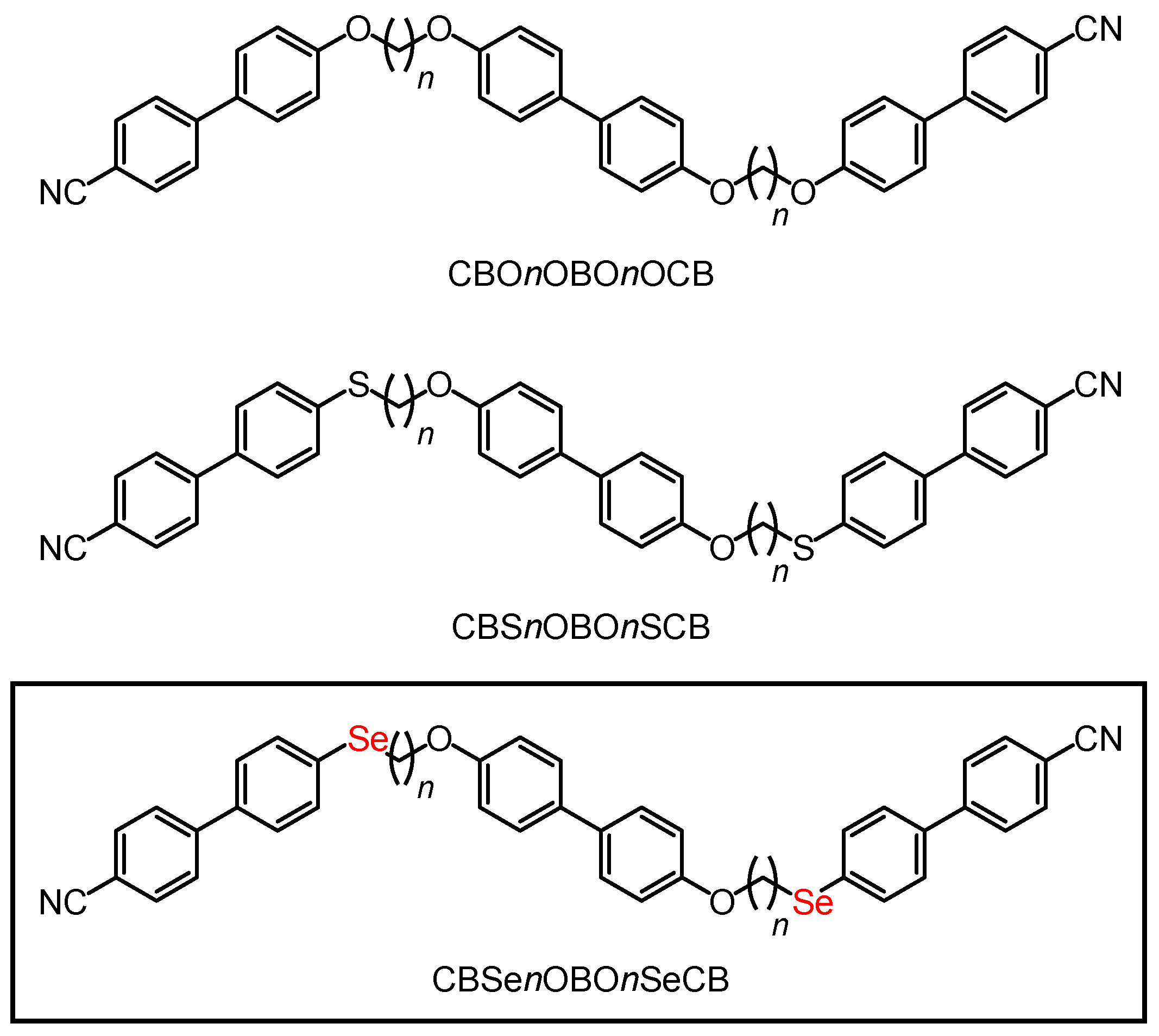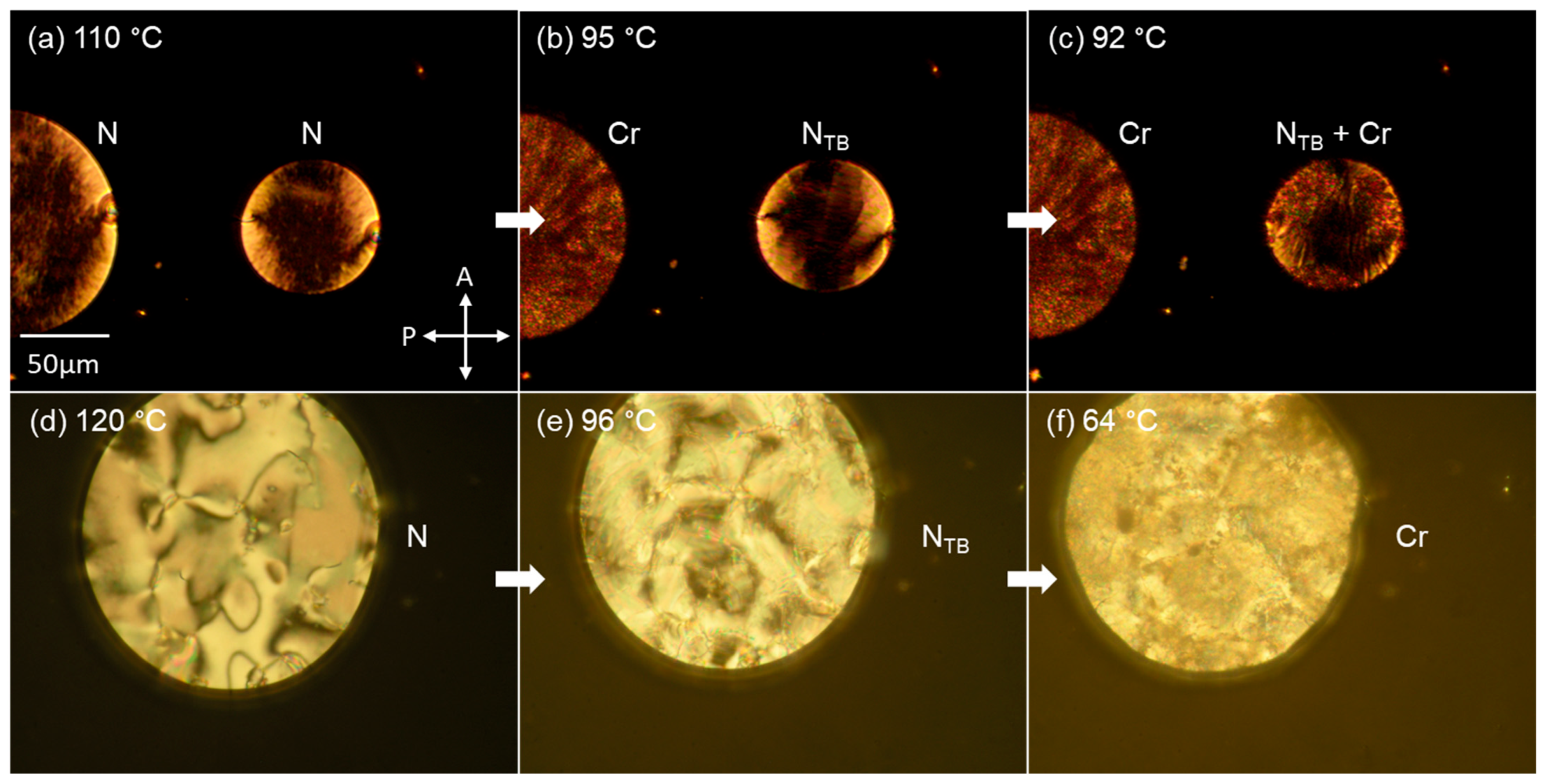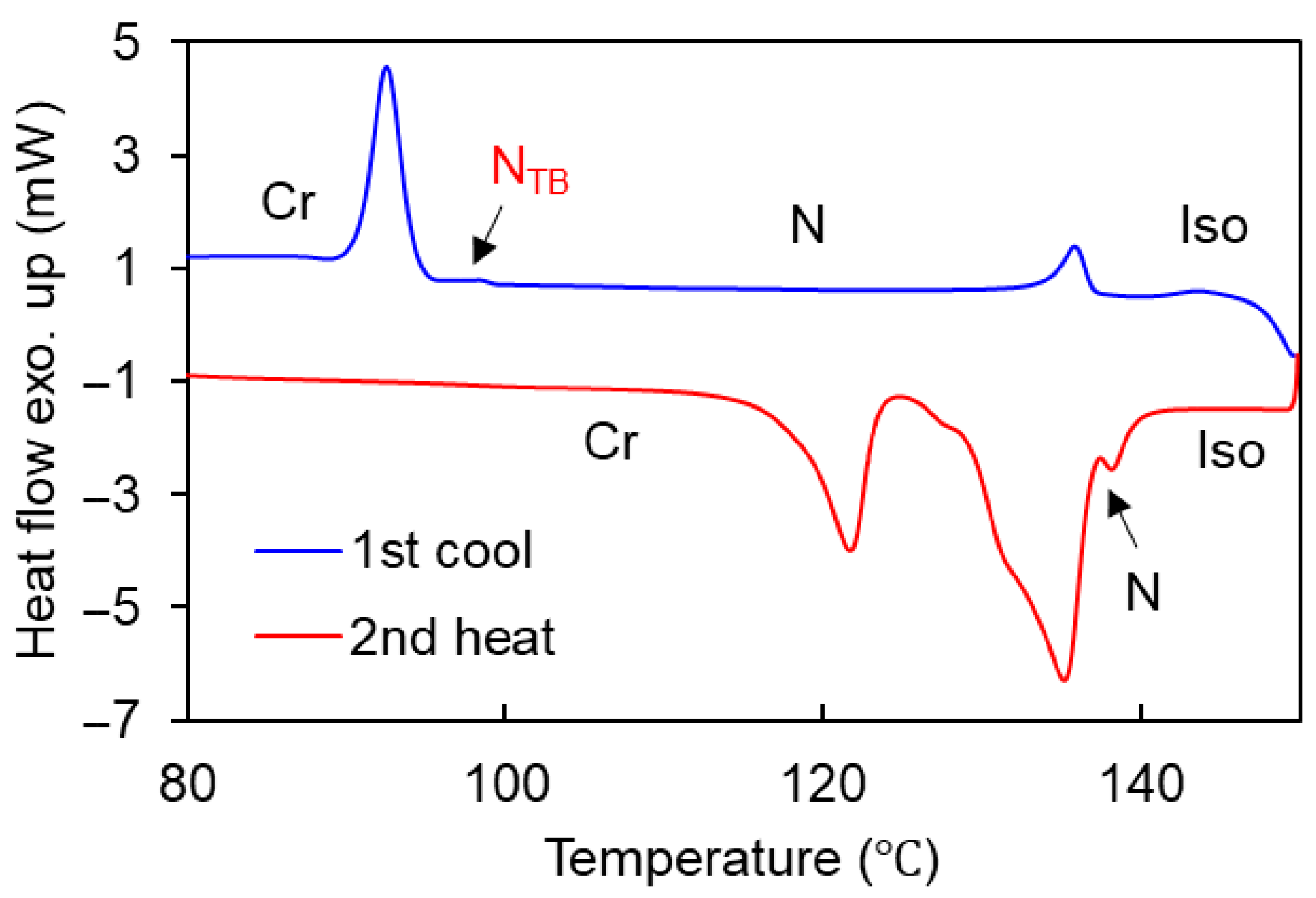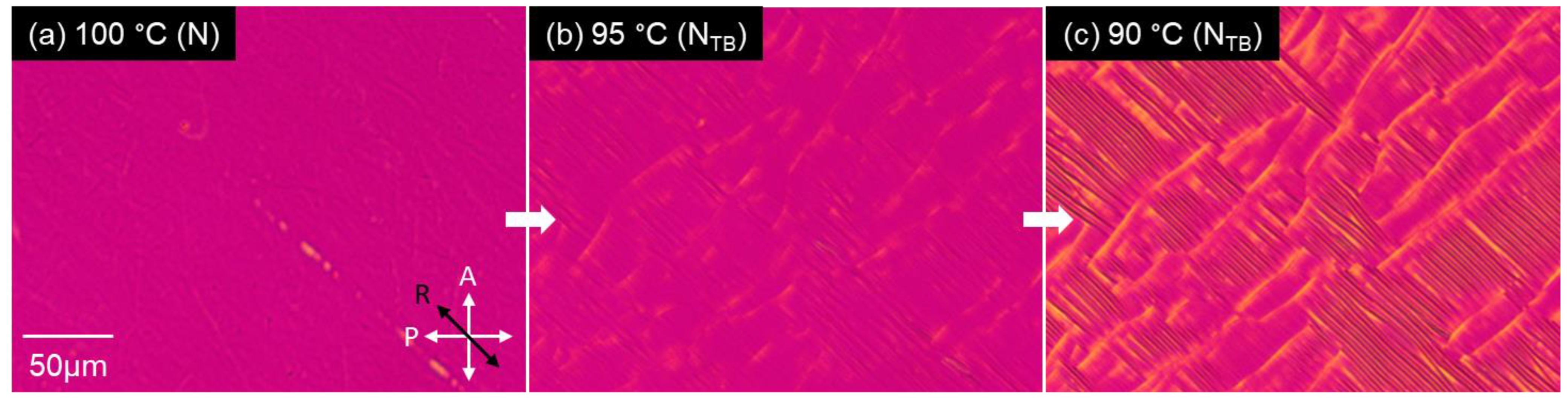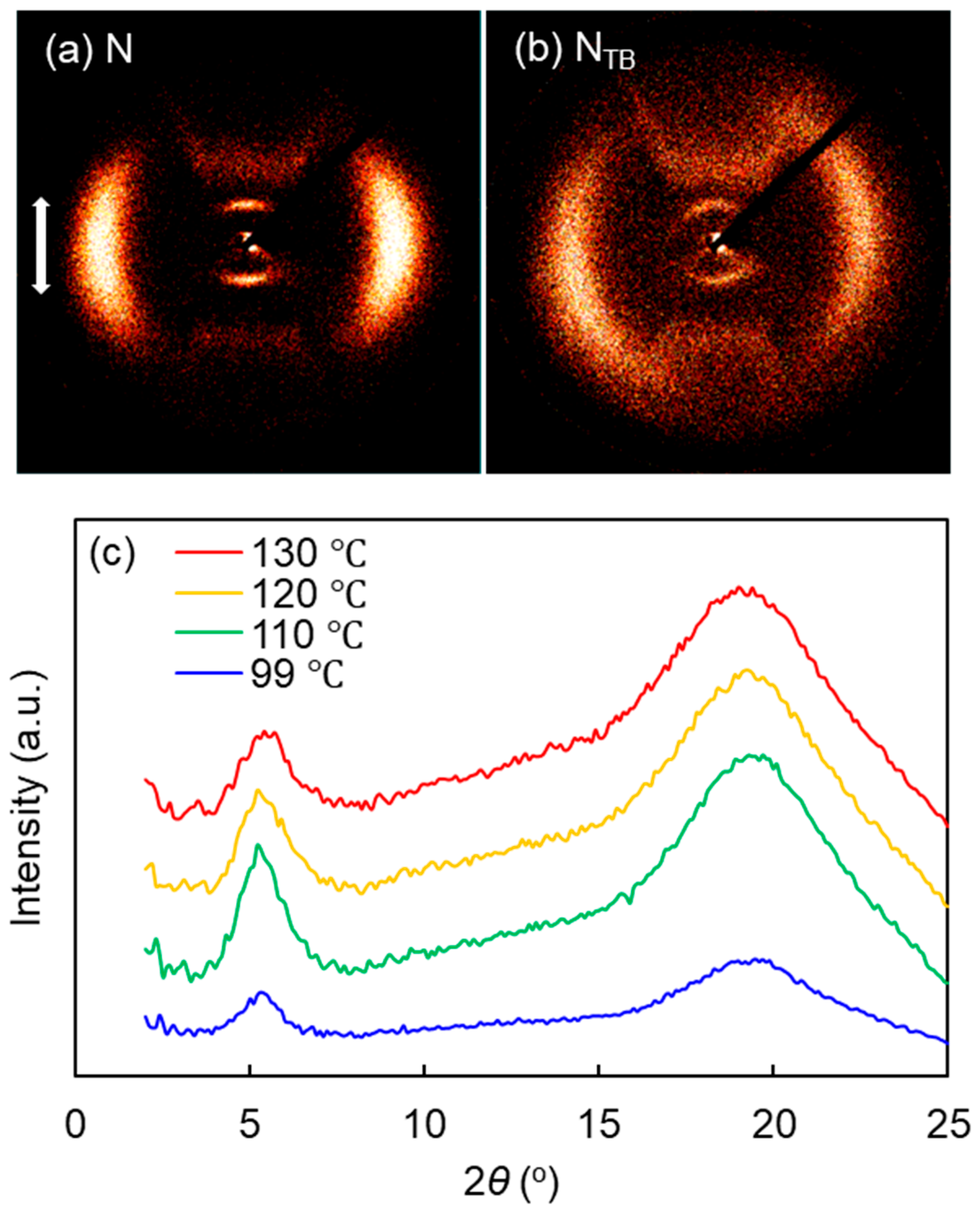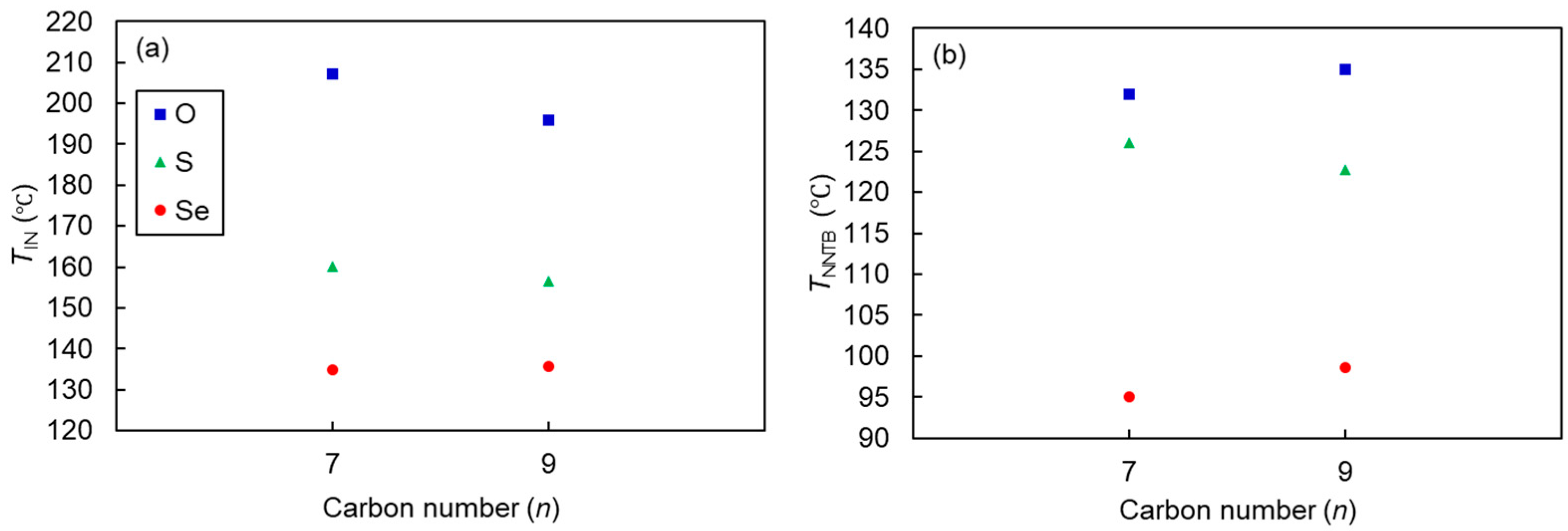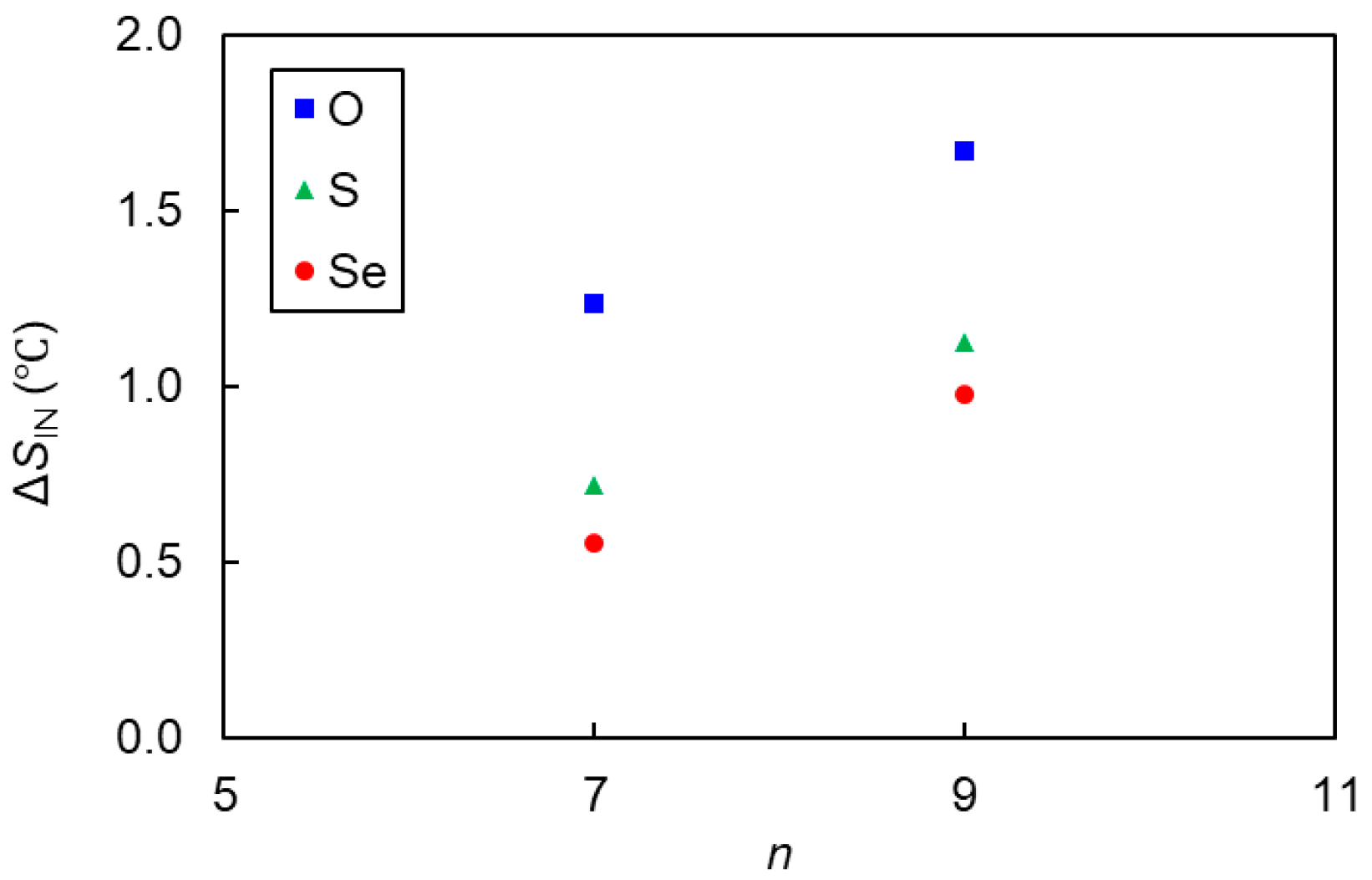

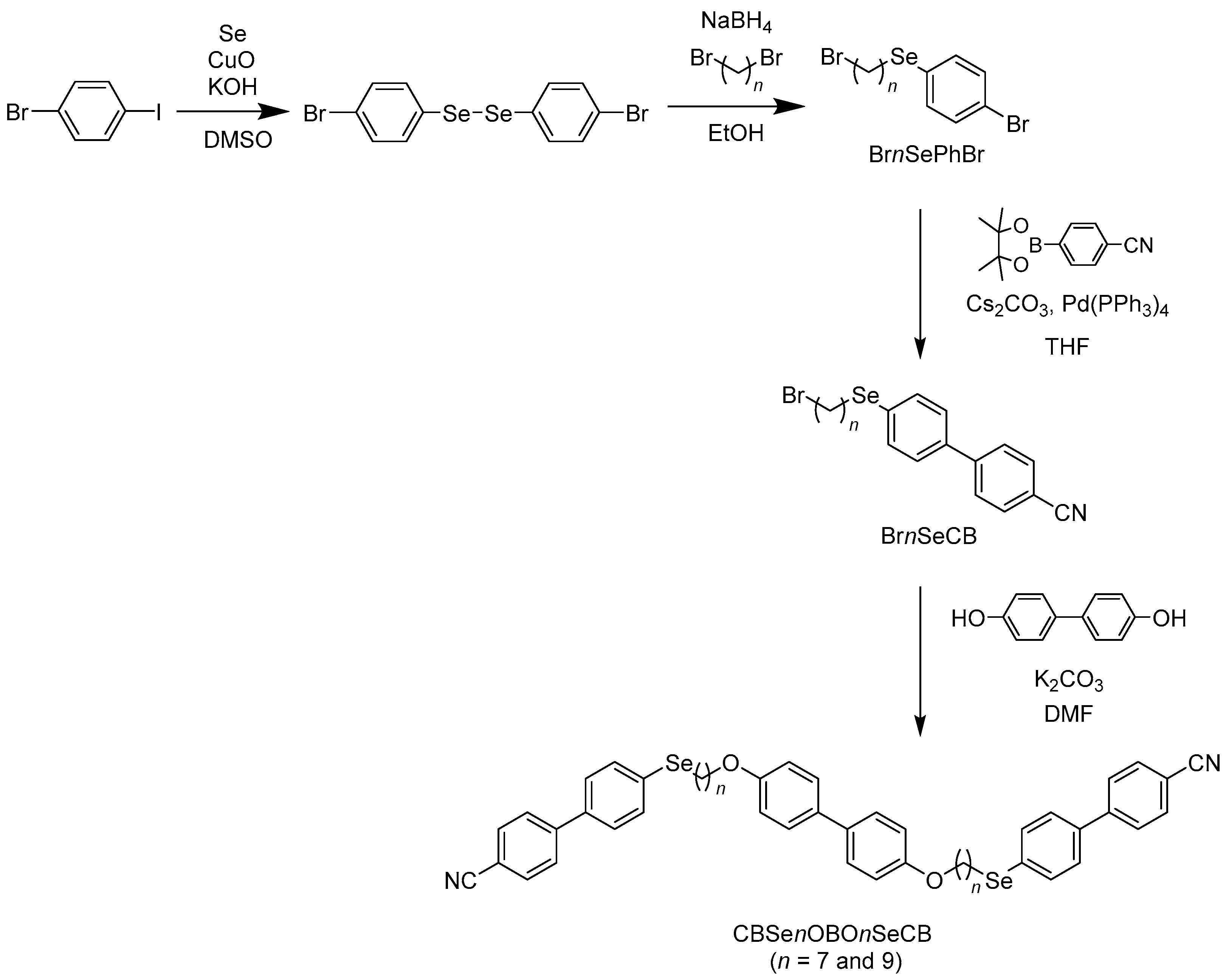
Selenoether-Linked Liquid Crystal Trimers and the Twist-Bend Nematic Phase


Abstract
1. Introduction
2. Materials and Methods
3. Results and Discussion
4. Conclusions
Supplementary Materials
Author Contributions
Funding
Data Availability Statement
Acknowledgments
Conflicts of Interest
References
- Watanabe, J.; Niori, T.; Choi, S.-W.; Takanishi, Y.; Takezoe, H. Antiferroelectric smectic liquid crystal formed by achiral twin dimer with two mesogenic groups linked by alkylene spacer. Jpn. J. Appl. Phys. 1998, 37, L401. [Google Scholar] [CrossRef]
- Choi, S.-W.; Zennyoji, M.; Takanishi, Y.; Takezoe, H.; Niori, T.; Watanabe, J. Structure and switching in bent-shaped molecular liquid crystal systems with two mesogenic groups linked by alkylene spacer. Mol. Cryst. Liq. Cryst. 1999, 328, 185–192. [Google Scholar] [CrossRef]
- Prasad, V.; Rao, D.S.; Prasad, S.K. Ferroelectric switching in a novel bent-shaped mesogen having two non-mesogenic units linked by an alkylene spacer. Liq. Cryst. 2000, 27, 585–590. [Google Scholar] [CrossRef]
- Dantlgraber, G.; Diele, S.; Tschierske, C. The first liquid crystalline dimers consisting of two banana-shaped mesogenic units: A new way for switching between ferroelectricity and antiferroelectricity with bent-core molecules. Chem. Commun. 2002, 2768–2769. [Google Scholar] [CrossRef]
- Yelamaggad, C.; Nagamani, S.A.; Hiremath, U.S.; Rao, D.S.; Prasad, S.K. Salicylaldimine-based symmetric dimers: Synthesis and thermal behaviour. Liq. Cryst. 2002, 29, 1401–1408. [Google Scholar] [CrossRef]
- Izumi, T.; Kang, S.; Niori, T.; Takanishi, Y.; Takezoe, H.; Watanabe, J. Smectic mesophase behavior of dimeric compounds showing antiferroelectricity, frustration and chirality. Jpn. J. Appl. Phys. 2006, 45, 1506. [Google Scholar] [CrossRef]
- Białecka-Florjańczyk, E.; Śledzińska, I.; Górecka, E.; Przedmojski, J. Odd-even effect in biphenyl-based symmetrical dimers with methylene spacer—Evidence of the B4 phase. Liq. Cryst. 2008, 35, 401–406. [Google Scholar] [CrossRef]
- Nakasugi, S.; Kang, S.; Chang, T.-F.M.; Manaka, T.; Ishizaki, H.; Sone, M.; Watanabe, J. Three Distinct Polar Phases, Isotropic, Nematic, and Smectic-A Phases, Formed from a Fluoro-Substituted Dimeric Molecule with Large Dipole Moment. J. Phys. Chem. B 2023, 127, 6585–6595. [Google Scholar] [CrossRef]
- Dozov, I. On the spontaneous symmetry breaking in the mesophases of achiral banana-shaped molecules. Europhys. Lett. 2001, 56, 247–253. [Google Scholar] [CrossRef]
- Memmer, R. Liquid crystal phases of achiral banana-shaped molecules: A computer simulation study. Liq. Cryst. 2002, 29, 483–496. [Google Scholar] [CrossRef]
- Panov, V.; Nagaraj, M.; Vij, J.; Panarin, Y.P.; Kohlmeier, A.; Tamba, M.; Lewis, R.; Mehl, G. Spontaneous Periodic Deformations in Nonchiral Planar-Aligned Bimesogens with a Nematic-Nematic Transition and a Negative Elastic Constant. Phys. Rev. Lett. 2010, 105, 167801. [Google Scholar] [CrossRef]
- Cestari, M.; Diez-Berart, S.; Dunmur, D.; Ferrarini, A.; de La Fuente, M.; Jackson, D.; Lopez, D.; Luckhurst, G.; Perez-Jubindo, M.; Richardson, R.; et al. Phase behavior and properties of the liquid-crystal dimer 1″, 7″-bis (4-cyanobiphenyl-4′-yl) heptane: A twist-bend nematic liquid crystal. Phys. Rev. E—Stat. Nonlinear Soft Matter Phys. 2011, 84, 031704. [Google Scholar] [CrossRef]
- Borshch, V.; Kim, Y.K.; Xiang, J.; Gao, M.; Jakli, A.; Panov, V.P.; Vij, J.K.; Imrie, C.T.; Tamba, M.G.; Mehl, G.H.; et al. Nematic twist-bend phase with nanoscale modulation of molecular orientation. Nat. Commun. 2013, 4, 2635. [Google Scholar] [CrossRef] [PubMed]
- Chen, D.; Porada, J.H.; Hooper, J.B.; Klittnick, A.; Shen, Y.; Tuchband, M.R.; Korblova, E.; Bedrov, D.; Walba, D.M.; Glaser, M.A. Chiral heliconical ground state of nanoscale pitch in a nematic liquid crystal of achiral molecular dimers. Proc. Natl. Acad. Sci. USA 2013, 110, 15931–15936. [Google Scholar] [CrossRef]
- Zhu, C.; Tuchband, M.R.; Young, A.; Shuai, M.; Scarbrough, A.; Walba, D.M.; Maclennan, J.E.; Wang, C.; Hexemer, A.; Clark, N.A. Resonant Carbon K-Edge Soft X-Ray Scattering from Lattice-Free Heliconical Molecular Ordering: Soft Dilative Elasticity of the Twist-Bend Liquid Crystal Phase. Phys. Rev. Lett. 2016, 116, 147803. [Google Scholar] [CrossRef] [PubMed]
- Cao, Y.; Feng, J.; Nallapaneni, A.; Arakawa, Y.; Zhao, K.; Zhang, H.; Mehl, G.H.; Zhu, C.; Liu, F. Deciphering helix assembly in the heliconical nematic phase via tender resonant X-ray scattering. J. Mater. Chem. C 2021, 9, 10020–10028. [Google Scholar] [CrossRef]
- Yu, H.; Welch, C.; Mehl, G.H. Mapping the local ambidextrous chirality in thin films of NTB phase by circular dichroism spectra. Spectrochim. Acta A Mol. Biomol. Spectrosc. 2025, 330, 125682. [Google Scholar] [CrossRef] [PubMed]
- Xiang, J.; Li, Y.; Li, Q.; Paterson, D.A.; Storey, J.M.; Imrie, C.T.; Lavrentovich, O.D. Electrically tunable selective reflection of light from ultraviolet to visible and infrared by heliconical cholesterics. Adv. Mater. 2015, 27, 3014. [Google Scholar] [CrossRef]
- Wang, Y.; Zheng, Z.-g.; Bisoyi, H.K.; Gutierrez-Cuevas, K.G.; Wang, L.; Zola, R.S.; Li, Q. Thermally reversible full color selective reflection in a self-organized helical superstructure enabled by a bent-core oligomesogen exhibiting a twist-bend nematic phase. Mater. Horiz. 2016, 3, 442–446. [Google Scholar] [CrossRef]
- Varanytsia, A.; Chien, L.C. Giant Flexoelectro-optic Effect with Liquid Crystal Dimer CB7CB. Sci. Rep. 2017, 7, 41333. [Google Scholar] [CrossRef]
- Aya, S.; Salamon, P.; Paterson, D.A.; Storey, J.M.D.; Imrie, C.T.; Araoka, F.; Jákli, A.; Buka, Á. Fast-and-Giant Photorheological Effect in a Liquid Crystal Dimer. Adv. Mater. Interfaces 2019, 6, 1802032. [Google Scholar] [CrossRef]
- Mrukiewicz, M.; Iadlovska, O.S.; Babakhanova, G.; Siemianowski, S.; Shiyanovskii, S.V.; Lavrentovich, O.D. Wide temperature range of an electrically tunable selective reflection of light by oblique helicoidal cholesteric. Liq. Cryst. 2019, 46, 1544–1550. [Google Scholar] [CrossRef]
- Sridurai, V.; Kanakala, M.B.; Yelamaggad, C.; Nair, G.G. Effect of gelation on the Frank elastic constants in a liquid crystalline mixture exhibiting a twist bend nematic phase. Soft Matter 2019, 15, 9982–9990. [Google Scholar] [CrossRef] [PubMed]
- Feng, C.; Feng, J.; Saha, R.; Arakawa, Y.; Gleeson, J.; Sprunt, S.; Zhu, C.; Jákli, A. Manipulation of the nanoscale heliconical structure of a twist-bend nematic material with polarized light. Phys. Rev. Res. 2020, 2, 032004. [Google Scholar] [CrossRef]
- Tang, W.; Deng, M.; Kougo, J.; Ding, L.; Zhao, X.; Arakawa, Y.; Komatsu, K.; Tsuji, H.; Aya, S. Extreme modulation of liquid crystal viscoelasticity via altering the ester bond direction. J. Mater. Chem. C 2021, 9, 9990–9996. [Google Scholar] [CrossRef]
- Liu, B.; Yuan, C.L.; Hu, H.L.; Wang, H.; Zhu, Y.W.; Sun, P.Z.; Li, Z.Y.; Zheng, Z.G.; Li, Q. Dynamically actuated soft heliconical architecture via frequency of electric fields. Nat. Commun. 2022, 13, 2712. [Google Scholar] [CrossRef]
- Liu, T.; Lin, H.; Hou, D.; Wang, J.; Zeng, S.; Che, C.; Wu, X.; Guo, J. Electrically-Triggered Oblique Helicoidal Cholesterics with a Single-Layer Architecture for Next-Generation Full-Color Reflective Displays. Adv. Funct. Mater. 2024, 34, 2408855. [Google Scholar] [CrossRef]
- Mahyaoui, C.N.; Davidson, P.; Meyer, C.; Dozov, I. Polymerisation of twist-bend nematic textures for electro-optical applications. Soft Matter 2024, 20, 4859–4867. [Google Scholar] [CrossRef]
- Zhou, Z.; Zhang, X.; Halder, S.; Hu, L.; Shin, Y.; Yang, D.K. Smart Switchable Window with Bistability and Tunability of Transmission. Adv. Opt. Mater. 2024, 12, 2302851. [Google Scholar] [CrossRef]
- Liu, H.; Guo, L.; Zhan, Y.; Ren, Y.; Wang, X.; Hu, H.; Yuan, C.; Zheng, Z.-G. Twist–bend nematic phase and heliconical superstructures of thioether-linked liquid crystal dimers. J. Chem. Phys. 2025, 163, 134901. [Google Scholar] [CrossRef]
- Greco, C.; Luckhurst, G.R.; Ferrarini, A. Molecular geometry, twist-bend nematic phase and unconventional elasticity: A generalised Maier–Saupe theory. Soft Matter 2014, 10, 9318–9323. [Google Scholar] [CrossRef]
- Tomczyk, W.; Pająk, G.; Longa, L. Twist-bend nematic phases of bent-shaped biaxial molecules. Soft Matter 2016, 12, 7445–7452. [Google Scholar] [CrossRef]
- Zola, R.; Barbero, G.; Lelidis, I.; Rosseto, M.; Evangelista, L. A continuum description for cholesteric and nematic twist-bend phases based on symmetry considerations. Liq. Cryst. 2017, 44, 24–30. [Google Scholar] [CrossRef]
- Matsuyama, A. Twist-bend nematic phases of banana-shaped molecules with an axial chirality. Liq. Cryst. 2019, 46, 2301–2321. [Google Scholar] [CrossRef]
- Yu, G.; Wilson, M.R. All-atom simulations of bent liquid crystal dimers: The twist-bend nematic phase and insights into conformational chirality. Soft Matter 2022, 18, 3087–3096. [Google Scholar] [CrossRef] [PubMed]
- Kubala, P.; Tomczyk, W.; Cieśla, M. In silico study of liquid crystalline phases formed by bent-shaped molecules with excluded volume type interactions. J. Mol. Liq. 2022, 367, 120156. [Google Scholar] [CrossRef]
- Szmigielski, M. Theoretical models of modulated nematic phases. Soft Matter 2023, 19, 2675–2704. [Google Scholar] [CrossRef] [PubMed]
- Wilson, M.R.; Yu, G. Computer simulations of a twist bend nematic (NTB): A coarse-grained simulation of the phase behaviour of the liquid crystal dimer CB7CB. Crystals 2023, 13, 502. [Google Scholar] [CrossRef]
- Revignas, D.; Ferrarini, A. Molecular shape, elastic constants and spontaneous twist in chiral and achiral nematics: Insights from a generalised Maier–Saupe framework. Liq. Cryst. 2024, 51, 898–918. [Google Scholar] [CrossRef]
- Szmigielski, M.; Buczkowska, M. Structural parameters of twist-bend nematics and splay-bend nematics in Dozov’s theory. Phys. Rev. E 2024, 109, 044702. [Google Scholar] [CrossRef]
- Kubala, P.; Tomczyk, W.; Cieśla, M. Relationship between the Size of Bent-Shaped Molecules and Mesophase Formation: A Computational Study. J. Phys. Chem. B 2025, 129, 7361–7371. [Google Scholar] [CrossRef]
- Vanakaras, A.G.; Photinos, D.J. A molecular theory of nematic-nematic phase transitions in mesogenic dimers. Soft Matter 2016, 12, 2208–2220. [Google Scholar] [CrossRef]
- Samulski, E.T.; Vanakaras, A.G.; Photinos, D.J. The twist bend nematic: A case of mistaken identity. Liq. Cryst. 2020, 47, 2092–2097. [Google Scholar] [CrossRef]
- Dozov, I.; Luckhurst, G.R. Setting things straight in ‘The twist-bend nematic: A case of mistaken identity’. Liq. Cryst. 2020, 47, 2098–2115. [Google Scholar] [CrossRef]
- Henderson, P.A.; Imrie, C.T. Methylene-linked liquid crystal dimers and the twist-bend nematic phase. Liq. Cryst. 2011, 38, 1407–1414. [Google Scholar] [CrossRef]
- Mandle, R.J.; Davis, E.J.; Lobato, S.A.; Vol, C.C.; Cowling, S.J.; Goodby, J.W. Synthesis and characterisation of an unsymmetrical, ether-linked, fluorinated bimesogen exhibiting a new polymorphism containing the N(TB) or ‘twist-bend’ phase. Phys. Chem. Chem. Phys. 2014, 16, 6907–6915. [Google Scholar] [CrossRef]
- Gorecka, E.; Salamonczyk, M.; Zep, A.; Pociecha, D.; Welch, C.; Ahmed, Z.; Mehl, G.H. Do the short helices exist in the nematic TB phase? Liq. Cryst. 2015, 42, 1–7. [Google Scholar] [CrossRef]
- Ahmed, Z.; Welch, C.; Mehl, G.H. The design and investigation of the self-assembly of dimers with two nematic phases. RSC Adv. 2015, 5, 93513–93521. [Google Scholar] [CrossRef]
- Mandle, R.J.; Davis, E.J.; Archbold, C.T.; Voll, C.C.; Andrews, J.L.; Cowling, S.J.; Goodby, J.W. Apolar bimesogens and the incidence of the twist-bend nematic phase. Chemistry 2015, 21, 8158–8167. [Google Scholar] [CrossRef] [PubMed]
- Mandle, R.J.; Davis, E.J.; Voll, C.C.A.; Archbold, C.T.; Goodby, J.W.; Cowling, S.J. The relationship between molecular structure and the incidence of the NTB phase. Liq. Cryst. 2015, 42, 688–703. [Google Scholar] [CrossRef]
- Gorecka, E.; Vaupotič, N.; Zep, A.; Pociecha, D.; Yoshioka, J.; Yamamoto, J.; Takezoe, H. A Twist-Bend Nematic (NTB) Phase of Chiral Materials. Angew. Chem. Inter. Ed. 2015, 54, 10155–10159. [Google Scholar] [CrossRef]
- Mandle, R.J.; Voll, C.C.A.; Lewis, D.J.; Goodby, J.W. Etheric bimesogens and the twist-bend nematic phase. Liq. Cryst. 2015, 43, 13–21. [Google Scholar] [CrossRef]
- Ivšić, T.; Vinković, M.; Baumeister, U.; Mikleušević, A.; Lesac, A. Towards understanding the NTB phase: A combined experimental, computational and spectroscopic study. RSC Adv. 2016, 6, 5000–5007. [Google Scholar] [CrossRef]
- Ivšić, T.; Baumeister, U.; Dokli, I.; Mikleušević, A.; Lesac, A. Sensitivity of the NTB phase formation to the molecular structure of imino-linked dimers. Liq. Cryst. 2016, 44, 93–105. [Google Scholar] [CrossRef]
- Mandle, R.J.; Goodby, J.W. A twist-bend nematic to an intercalated, anticlinic, biaxial phase transition in liquid crystal bimesogens. Soft Matter 2016, 12, 1436–1443. [Google Scholar] [CrossRef] [PubMed]
- Dawood, A.A.; Grossel, M.C.; Luckhurst, G.R.; Richardson, R.M.; Timimi, B.A.; Wells, N.J.; Yousif, Y.Z. On the twist-bend nematic phase formed directly from the isotropic phase. Liq. Cryst. 2016, 43, 2–12. [Google Scholar] [CrossRef]
- Archbold, C.T.; Andrews, J.L.; Mandle, R.J.; Cowling, S.J.; Goodby, J.W. Effect of the linking unit on the twist-bend nematic phase in liquid crystal dimers: A comparative study of two homologous series of methylene- and ether-linked dimers. Liq. Cryst. 2016, 44, 84–92. [Google Scholar] [CrossRef]
- Paterson, D.A.; Abberley, J.P.; Harrison, W.T.; Storey, J.M.; Imrie, C.T. Cyanobiphenyl-based liquid crystal dimers and the twist-bend nematic phase. Liq. Cryst. 2017, 44, 127–146. [Google Scholar] [CrossRef]
- Paterson, D.A.; Walker, R.; Abberley, J.P.; Forestier, J.; Harrison, W.T.A.; Storey, J.M.D.; Pociecha, D.; Gorecka, E.; Imrie, C.T. Azobenzene-based liquid crystal dimers and the twist-bend nematic phase. Liq. Cryst. 2017, 44, 2060–2078. [Google Scholar] [CrossRef]
- Dawood, A.A.; Grossel, M.C.; Luckhurst, G.R.; Richardson, R.M.; Timimi, B.A.; Wells, N.J.; Yousif, Y.Z. Twist-bend nematics, liquid crystal dimers, structure-property relations. Liq. Cryst. 2017, 44, 106–126. [Google Scholar]
- Abberley, J.P.; Killah, R.; Walker, R.; Storey, J.M.D.; Imrie, C.T.; Salamonczyk, M.; Zhu, C.; Gorecka, E.; Pociecha, D. Heliconical smectic phases formed by achiral molecules. Nat. Commun. 2018, 9, 228. [Google Scholar] [CrossRef]
- Lesac, A.; Baumeister, U.; Dokli, I.; Hameršak, Z.; Ivšić, T.; Kontrec, D.; Viskić, M.; Knežević, A.; Mandle, R.J. Geometric aspects influencing N-NTB transition—Implication of intramolecular torsion. Liq. Cryst. 2018, 45, 1101–1110. [Google Scholar] [CrossRef]
- Walker, R.; Pociecha, D.; Storey, J.M.D.; Gorecka, E.; Imrie, C.T. The Chiral Twist-Bend Nematic Phase (N*TB). Chem. Eur. J. 2019, 25, 13329–13335. [Google Scholar] [CrossRef]
- Zep, A.; Pruszkowska, K.; Dobrzycki, Ł.; Sektas, K.; Szałański, P.; Marek, P.H.; Cyrański, M.K.; Sicinski, R.R. Cholesterol-based photo-switchable mesogenic dimers. Strongly bent molecules versus an intercalated structure. CrystEngComm 2019, 21, 2779–2789. [Google Scholar] [CrossRef]
- Walker, R.; Majewska, M.; Pociecha, D.; Makal, A.; Storey, J.M.; Gorecka, E.; Imrie, C.T. Twist-Bend Nematic Glasses: The Synthesis and Characterisation of Pyrene-based Nonsymmetric Dimers. Chemphyschem 2021, 22, 461–470. [Google Scholar] [CrossRef]
- Knežević, A.; Dokli, I.; Novak, J.; Kontrec, D.; Lesac, A. Fluorinated twist-bend nematogens: The role of intermolecular interaction. Liq. Cryst. 2021, 48, 756–766. [Google Scholar]
- Wang, D.; Liu, J.; Zhao, W.; Zeng, Y.; Huang, J.; Fang, J.; Chen, D. Facile synthesis of liquid crystal dimers bridged with a phosphonic group. Chem. Eur. J. 2022, 28, e202202146. [Google Scholar] [CrossRef] [PubMed]
- Mandle, R.J. A ten-year perspective on twist-bend nematic materials. Molecules 2022, 27, 2689. [Google Scholar] [CrossRef] [PubMed]
- Ožegović, A.; Hobbs, J.; Mandle, R.; Lesac, A.; Knežević, A. Chiral cyanobiphenyl dimers—Significance of the linking group for mesomorphic properties and helical induction. J. Mater. Chem. C 2024, 12, 13985–13993. [Google Scholar] [CrossRef]
- Ožegović, A.; Dokli, I.; Knežević, A.; Šegota, S.; Lesac, A. Bent-shaped dimers with chiral spacer—Unravelling the potential of the naphthyl mesogenic unit. Liq. Cryst. 2024. [Google Scholar] [CrossRef]
- Baishya, B.; Dua, H.; Sarkar, U.; Paul, M.K. Synthesis, mesophase behavior, and computational studies of dimers composed of three-ring rod-shaped ester-imine linkage monomeric unit. J. Mol. Struct. 2024, 1313, 138754. [Google Scholar] [CrossRef]
- Mandle, R.J.; Goodby, J.W. Progression from nano to macro science in soft matter systems: Dimers to trimers and oligomers in twist-bend liquid crystals. RSC Adv. 2016, 6, 34885–34893. [Google Scholar] [CrossRef]
- Parsouzi, Z.; Babakhanova, G.; Rajabi, M.; Saha, R.; Gyawali, P.; Turiv, T.; Wang, H.; Baldwin, A.R.; Welch, C.; Mehl, G.H.; et al. Pretransitional behavior of viscoelastic parameters at the nematic to twist-bend nematic phase transition in flexible n-mers. Phys. Chem. Chem. Phys. 2019, 21, 13078–13089. [Google Scholar] [CrossRef] [PubMed]
- Arakawa, Y.; Komatsu, K.; Shiba, T.; Tsuji, H. Phase behaviors of classic liquid crystal dimers and trimers: Alternate induction of smectic and twist-bend nematic phases depending on spacer parity for liquid crystal trimers. J. Mol. Liq. 2021, 326, 115319. [Google Scholar] [CrossRef]
- Arakawa, Y.; Komatsu, K.; Ishida, Y.; Shiba, T.; Tsuji, H. Thioether-linked liquid crystal trimers: Odd-even effects of spacers and the influence of thioether bonds on phase behavior. Materials 2022, 15, 1709. [Google Scholar] [CrossRef]
- Arakawa, Y.; Komatsu, K.; Tsuji, H. 2, 7-substituted fluorenone-based liquid crystal trimers: Twist-bend nematic phase induced by outer thioether linkage. Phase Transit. 2022, 95, 331–339. [Google Scholar] [CrossRef]
- Mandle, R.J.; Goodby, J.W. A Liquid Crystalline Oligomer Exhibiting Nematic and Twist-Bend Nematic Mesophases. Chemphyschem 2016, 17, 967–970. [Google Scholar] [CrossRef]
- Mandle, R.J.; Goodby, J.W. Order parameters, orientational distribution functions and heliconical tilt angles of oligomeric liquid crystals. Phys. Chem. Chem. Phys. 2019, 21, 6839–6843. [Google Scholar] [CrossRef]
- Majewska, M.M.; Forsyth, E.; Pociecha, D.; Wang, C.; Storey, J.M.; Imrie, C.T.; Gorecka, E. Controlling spontaneous chirality in achiral materials: Liquid crystal oligomers and the heliconical twist-bend nematic phase. Chem. Commun. 2022, 58, 5285–5288. [Google Scholar] [CrossRef]
- Forsyth, E.; Majewska, M.; Walker, R.; Pociecha, D.; Gorecka, E.; Storey, J.M.; Imrie, C.T. Liquid crystal tetramers and spontaneous chirality: The heliconical twist-bend nematic phase. J. Mater. Chem. C 2026. [Google Scholar] [CrossRef]
- Yelamaggad, C.V.; Shashikala, I.S.; Li, Q. Liquid crystal trimers composed of banana-shaped and rodlike anisometric segments: Synthesis and Characterization. Chem. Mater. 2007, 19, 6561–6568. [Google Scholar] [CrossRef]
- Wang, Y.; Singh, G.; Agra-Kooijman, D.M.; Gao, M.; Bisoyi, H.K.; Xue, C.; Fisch, M.R.; Kumar, S.; Li, Q. Room temperature heliconical twist-bend nematic liquid crystal. CrystEngComm 2015, 17, 2778–2782. [Google Scholar] [CrossRef]
- Mandle, R.J.; Goodby, J.W. A Nanohelicoidal Nematic Liquid Crystal Formed by a Non-Linear Duplexed Hexamer. Angew. Chem. Int. Ed. 2018, 57, 7096–7100. [Google Scholar]
- Stevenson, W.D.; An, J.; Zeng, X.-B.; Xue, M.; Zou, H.-X.; Liu, Y.-S.; Ungar, G. Twist-bend nematic phase in biphenylethane-based copolyethers. Soft Matter 2018, 14, 3003–3011. [Google Scholar]
- Schröder, M.W.; Diele, S.; Pelzl, G.; Dunemann, U.; Kresse, H.; Weissflog, W. Different nematic phases and a switchable SmCP phase formed by homologues of a new class of asymmetric bent-core mesogens. J. Mater. Chem. 2003, 13, 1877–1882. [Google Scholar] [CrossRef]
- Sreenilayam, S.P.; Panov, V.P.; Vij, J.K.; Shanker, G. The NTB phase in an achiral asymmetrical bent-core liquid crystal terminated with symmetric alkyl chains. Liq. Cryst. 2017, 44, 244–253. [Google Scholar] [CrossRef]
- Mandle, R.J.; Archbold, C.T.; Sarju, J.P.; Andrews, J.L.; Goodby, J.W. The Dependency of Nematic and Twist-bend Mesophase Formation on Bend Angle. Sci. Rep. 2016, 6, 36682. [Google Scholar] [CrossRef] [PubMed]
- Arakawa, Y.; Komatsu, K.; Tsuji, H. Twist-bend nematic liquid crystals based on thioether linkage. New J. Chem. 2019, 43, 6786–6793. [Google Scholar] [CrossRef]
- Arakawa, Y.; Tsuji, H. Selenium-linked liquid crystal dimers for twist-bend nematogens. J. Mol. Liq. 2019, 289, 111097. [Google Scholar] [CrossRef]
- Arakawa, Y.; Fujisawa, I. Sulfur-linked liquid crystal dimers: Enhanced molecular bending. Liq. Cryst. 2025. [Google Scholar] [CrossRef]
- Arakawa, Y.; Ishida, Y.; Tsuji, H. Ether- and Thioether-Linked Naphthalene-Based Liquid-Crystal Dimers: Influence of Chalcogen Linkage and Mesogenic-Arm Symmetry on the Incidence and Stability of the Twist–Bend Nematic Phase. Chem. Eur. J. 2020, 26, 3767–3775. [Google Scholar] [CrossRef]
- Cruickshank, E.; Salamonczyk, M.; Pociecha, D.; Strachan, G.J.; Storey, J.M.D.; Wang, C.; Peng, J.; Zhu, C.H.; Gorecka, E.; Imrie, C.T. Sulfur-linked cyanobiphenyl-based liquid crystal dimers and the twist-bend nematic phase. Liq. Cryst. 2019, 46, 1595–1609. [Google Scholar] [CrossRef]
- Arakawa, Y.; Komatsu, K.; Inui, S.; Tsuji, H. Thioether-linked liquid crystal dimers and trimers: The twist-bend nematic phase. J. Mol. Struct. 2020, 1199, 126913. [Google Scholar] [CrossRef]
- Arakawa, Y.; Komatsu, K.; Ishida, Y.; Tsuji, H. Thioether-linked azobenzene-based liquid crystal dimers exhibiting the twist-bend nematic phase over a wide temperature range. Liq. Cryst. 2020, 48, 641–652. [Google Scholar] [CrossRef]
- Arakawa, Y.; Ishida, Y.; Komatsu, K.; Arai, Y.; Tsuji, H. Thioether-linked benzylideneaniline-based twist-bend nematic liquid crystal dimers: Insights into spacer lengths, mesogenic arm structures, and linkage types. Tetrahedron 2021, 95, 132351. [Google Scholar] [CrossRef]
- Arakawa, Y.; Komatsu, K.; Feng, J.; Zhu, C.H.; Tsuji, H. Distinct twist-bend nematic phase behaviors associated with the ester-linkage direction of thioether-linked liquid crystal dimers. Mater. Adv. 2021, 2, 261–272. [Google Scholar] [CrossRef]
- Arakawa, Y.; Komatsu, K.; Ishida, Y.; Igawa, K.; Tsuji, H. Carbonyl- and thioether-linked cyanobiphenyl-based liquid crystal dimers exhibiting twist-bend nematic phases. Tetrahedron 2021, 81, 131870. [Google Scholar] [CrossRef]
- Arakawa, Y.; Komatsu, K.; Shiba, T.; Tsuji, H. Methylene- and thioether-linked cyanobiphenyl-based liquid crystal dimers CBnSCB exhibiting room temperature twist-bend nematic phases and glasses. Mater. Adv. 2021, 2, 1760–1773. [Google Scholar] [CrossRef]
- Arakawa, Y.; Arai, Y.; Horita, K.; Komatsu, K.; Tsuji, H. Twist–bend nematic phase behavior of cyanobiphenyl-based dimers with propane, ethoxy, and ethylthio spacers. Crystals 2022, 12, 1734. [Google Scholar] [CrossRef]
- Arakawa, Y.; Arai, Y. Photoinduced Phase Transitions of Imine-Based Liquid Crystal Dimers with Twist–Bend Nematic Phases. Materials 2024, 17, 3278. [Google Scholar] [CrossRef]
- Arakawa, Y.; Okamatsu, H.; Igawa, K. Supramolecular hydrogen-bonded thioether-linked liquid crystal dimers and the twist-bend nematic phase. Liq. Cryst. 2025, 52, 686–696. [Google Scholar] [CrossRef]
- Arakawa, Y.; Shiba, T.; Igawa, K. Selenium-linked cyanobiphenyl-based liquid crystal dimers: The effects of chalcogen linkage and spacer length on the twist-bend nematic phase. Liq. Cryst. 2024, 51, 1506–1522. [Google Scholar] [CrossRef]
- Cruickshank, E.; Strachan, G.J.; Pearson, A.; Pociecha, D.; Gorecka, E.; Storey, J.M.; Imrie, C.T. Sulfur-linked cyanoterphenyl-based liquid crystal dimers and the twist-bend nematic phase. Phys. Chem. Chem. Phys. 2025, 27, 6111–6121. [Google Scholar] [CrossRef]
- Matkin, L.; Gleeson, H.; Mach, P.; Huang, C.; Pindak, R.; Srajer, G.; Pollmann, J.; Goodby, J.; Hird, M.; Seed, A. Resonant x-ray scattering at the Se edge in liquid crystal free-standing films and devices. Appl. Phys. Lett. 2000, 76, 1863–1865. [Google Scholar] [CrossRef]
- Hirst, L.; Watson, S.; Gleeson, H.; Cluzeau, P.; Barois, P.; Pindak, R.; Pitney, J.; Cady, A.; Johnson, P.; Huang, C.; et al. Interlayer structures of the chiral smectic liquid crystal phases revealed by resonant x-ray scattering. Phys. Rev. E 2002, 65, 041705. [Google Scholar] [CrossRef]
- Roberts, N.; Jaradat, S.; Hirst, L.; Thurlow, M.; Wang, Y.; Wang, S.; Liu, Z.; Huang, C.; Bai, J.; Pindak, R.; et al. Biaxiality and temperature dependence of 3-and 4-layer intermediate smectic-phase structures as revealed by resonant X-ray scattering. Europhys. Lett. 2005, 72, 976–982. [Google Scholar] [CrossRef]
- Fernandes, P.; Barois, P.; Grelet, E.; Nallet, F.; Goodby, J.; Hird, M.; Micha, J.-S. Extension of the resonant scattering technique to liquid crystals without resonant element. Eur. Phys. J. E 2006, 20, 81–87. [Google Scholar] [CrossRef]
- Gleeson, H.F.; Hirst, L.S. Resonant X-ray Scattering: A Tool for Structure Elucidation in Liquid Crystals. ChemPhysChem A Eur. J. Chem. Phys. Phys. Chem. 2006, 7, 321–328. [Google Scholar] [CrossRef]
- Jaradat, S.; Brimicombe, P.; Southern, C.; Siemianowski, S.; DiMasi, E.; Osipov, M.; Pindak, R.; Gleeson, H. Unexpected field-induced phase transitions between ferrielectric and antiferroelectric liquid crystal structures. Phys. Rev. E—Stat. Nonlinear Soft Matter Phys. 2008, 77, 010701. [Google Scholar] [CrossRef]
- Barois, P.; Gleeson, H.; Huang, C.; Pindak, R. Application of X-ray resonant diffraction to structural studies of liquid crystals. Eur. Phys. J. Spec. Top. 2012, 208, 333–350. [Google Scholar]
- Iida, A.; Takanishi, Y.; Fukuda, A.; Vij, J.K. Transitional subphases near the electric-field-induced phase transition to the ferroelectric phase in Se-containing chiral smectic liquid crystals observed by resonant x-ray scattering. Phys. Rev. E 2016, 94, 052703. [Google Scholar] [CrossRef] [PubMed]
- Stevenson, W.; Ahmed, Z.; Zeng, X.; Welch, C.; Ungar, G.; Mehl, G. Molecular organization in the twist–bend nematic phase by resonant X-ray scattering at the Se K-edge and by SAXS, WAXS and GIXRD. Phys. Chem. Chem. Phys. 2017, 19, 13449–13454. [Google Scholar] [CrossRef] [PubMed]
- Iida, A.; Takanishi, Y.; Fukuda, A.; Vij, J.K. Resonant x-ray scattering observation of transitional subphases during the electric-field-induced phase transition in a mixture of Se-containing chiral smectic liquid crystals. Phys. Rev. E 2018, 97, 062702. [Google Scholar] [CrossRef]
- Challa, P.K.; Borshch, V.; Parri, O.; Imrie, C.T.; Sprunt, S.N.; Gleeson, J.T.; Lavrentovich, O.D.; Jakli, A. Twist-bend nematic liquid crystals in high magnetic fields. Phys. Rev. E 2014, 89, 060501. [Google Scholar] [CrossRef] [PubMed]
- Zhou, J.; Tang, W.; Arakawa, Y.; Tsuji, H.; Aya, S. Viscoelastic properties of a thioether-based heliconical twist-bend nematogen. Phys. Chem. Chem. Phys. 2020, 22, 9593–9599. [Google Scholar] [CrossRef]
- Imrie, C.T.; Henderson, P.A.; Seddon, J.M. Non-symmetric liquid crystal trimers. The first example of a triply-intercalated alternating smectic C phase. J. Mater. Chem. 2004, 14, 2486–2488. [Google Scholar] [CrossRef]
- Luckhurst, G.R. Liquid crystal dimers and oligomers: Experiment and theory. Macromol. Symp. 1995, 96, 1–26. [Google Scholar] [CrossRef]




| Trimer Code | Tm [ΔH] | Phase Transition Temperature [ΔH] Upon Cooling | ||||||
|---|---|---|---|---|---|---|---|---|
| CBSe7OBO7SeCB | 156.7 [65.4] | Cr | 111.6 [59.0] | NTB | 95 a | N | 134.9 [1.9] | Iso |
| CBSe9OBO9SeCB | 135.2 [53.4] | Cr | 92.5 [29.1] | NTB | 98.6 [-] | N | 135.8 [3.8] | Iso |
Disclaimer/Publisher’s Note: The statements, opinions and data contained in all publications are solely those of the individual author(s) and contributor(s) and not of MDPI and/or the editor(s). MDPI and/or the editor(s) disclaim responsibility for any injury to people or property resulting from any ideas, methods, instructions or products referred to in the content. |
© 2026 by the authors. Licensee MDPI, Basel, Switzerland. This article is an open access article distributed under the terms and conditions of the Creative Commons Attribution (CC BY) license.
Share and Cite
Arakawa, Y.; Shiba, T. Selenoether-Linked Liquid Crystal Trimers and the Twist-Bend Nematic Phase. Crystals 2026, 16, 69. https://doi.org/10.3390/cryst16010069
Arakawa Y, Shiba T. Selenoether-Linked Liquid Crystal Trimers and the Twist-Bend Nematic Phase. Crystals. 2026; 16(1):69. https://doi.org/10.3390/cryst16010069
Chicago/Turabian StyleArakawa, Yuki, and Takuma Shiba. 2026. "Selenoether-Linked Liquid Crystal Trimers and the Twist-Bend Nematic Phase" Crystals 16, no. 1: 69. https://doi.org/10.3390/cryst16010069
APA StyleArakawa, Y., & Shiba, T. (2026). Selenoether-Linked Liquid Crystal Trimers and the Twist-Bend Nematic Phase. Crystals, 16(1), 69. https://doi.org/10.3390/cryst16010069