


Abstract
It is shown that in auxetic materials (materials with negative Poisson’s ratio), supersonic Stoneley waves travelling without attenuation with a velocity equal to or exceeding maximum bulk wave velocity, may exist. Analytical expressions for the relation between negative Poisson’s ratio and Young’s moduli of the contacting isotropic media ensuring the condition of propagation for supersonic Stoneley waves, are derived by solving a secular equation for Stoneley waves.
1. Introduction
It is known [1,2,3,4,5,6,7,8,9] that genuine Stoneley waves travel along an interface between two dissimilar halfspaces with subsonic velocity, which is smaller than the minimal shear bulk wave velocity in the halfspaces. However, as it is shown theoretically and numerically, the supersonic Stoneley waves may also exist when both halfspaces have a common negative Poisson’s ratio (auxetics). Propagation of the interfacial Stoneley waves in linearly elastic homogeneous isotropic and auxetic halfspaces is analyzed by constructing analytical solutions of a secular equation for Stoneley waves [1]. According to [1], the interfacial Stoneley waves propagate along an interface between two acoustically different halfspaces under ideal contact conditions. Thus, the contacting halfspaces form an inhomogeneous space. It is known [1,2,3,4] that these waves propagate at a constant speed, independent of frequency; therefore, Stoneley waves do not exhibit dispersion; and in both halfspaces, Stoneley waves exponentially attenuate with depth.
Herein, the secular equation is written in a dimensionless form close to Scholte’s secular equation [2,3] for the velocity of Stoneley waves propagating along an interface between two isotropic elastic halfspaces. While Scholte’s secular equation has been previously used for deriving the velocity of Stoneley waves, it is being used for the first time for analyzing the velocity of supersonic Stoneley waves, when acoustical properties ensure Stoneley wave velocity exceeding bulk wave velocity in one of the halfspaces.
where is the Stoneley wave velocity; are material densities of the contacting halfspaces, and
In Equation (2) are longitudinal and shear bulk wave velocities:
where are Lame’s constants.
The majority of theoretical works on Stoneley wave analyses [1,2,3,4,5,6,7,8,9] are concerned with the case of subsonic velocities, satisfying condition
Condition Equation (4) implies all the coefficients in the Stoneley equation to be real, and, as was asserted in [1], it is necessary for the existence of a positive root of the secular Equation (1) associated with the Stoneley wave velocity. Other methods for analyzing Stoneley waves propagating with subsonic velocities obeying condition Equation (4) relate to different variants of sextic formalisms, Stroh [10,11] and Cauchy [12], along with various asymptotic techniques [13,14,15]. The principal ability for leaky Stoneley waves propagating with velocities exceeding the limit in the right-hand side of Equation (4) is asserted in [10,11].
Herein, an explicit analytical condition between physical properties of the auxetic media is derived, ensuring the existence of supersonic leaky Stoneley waves propagating with velocity
The derivation is based on constructing analytical solution for Stoneley secular Equation (1) at a special condition
Condition Equation (6) is in some cases less restrictive than the Wiechert condition [16,17] frequently used at Stoneley wave analyses [1,2,3,4,5,6,7,8]:
since in view of Equation (3), condition Equation (6) imposes restriction on only, demanding
Note that condition Equation (8) does not necessarily imply . Actually, condition Equation (6) resembles the condition for equal acoustic impedances [17]. However, as will be shown below, condition Equation (6) is much less restrictive than the condition of equal acoustic impedances.
2. Solving Secular Equation
2.1. Basic Relations
Consider stratified inhomogeneous space consisting of two isotropic and homogeneous halfspaces with ideal mechanical contact between them. Introducing dimensionless Lame’s constants and dimensionless density
the dimensionless bulk wave velocities in the halfspaces take the form
with notations Equations (9) and (10), secular Equation (1) can be rewritten in terms of the dimensionless variables
where is the dimensionless velocity
and
In Equation (13) coefficient has the form
and
2.2. Secular Equation at Condition
In terms of the dimensionless parameters condition Equation (6) reads as
ensuring
The latter yields
Now, at Equation (18), Equation (11) becomes
Equation (19) may have nontrivial solution(s) with respect to , if
Suppose now that both contacting media have equal Poisson’s ratios then in view of condition Equation (16), relative bulk velocities become
and
where
In Equation (23) is the common Poisson’s ratio of both media.
3. Supersonic Stoneley Waves
Consider now the case when velocity of Stoneley waves satisfies supersonic condition Equation (5), then Equation (20) with account of Equations (21) and (22), yields
Note that parameter at , thus the left-hand sides of Equation (24) are real, despite all imaginary radicands.
3.1. Solutions for
Equation (24) admit analytical closed form solutions in terms of relations between and :
and
3.2. Solutions for
Relations Equation (25), can also be expressed in terms Poisson’s ratio and by use of Equation (23):
and
3.3. Numerical Analysis
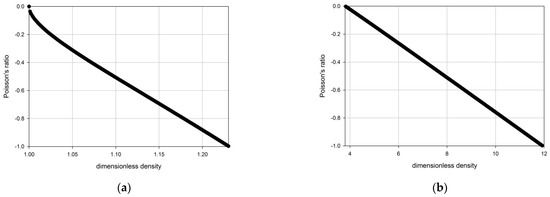
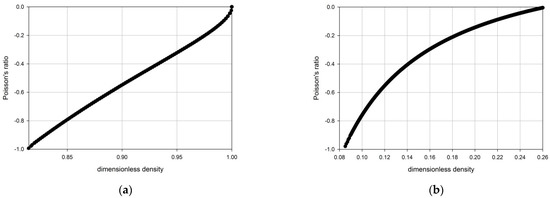
All four solutions in Equations (27) and (28) lead to auxetics (materials with negative Poisson’s ratio [18]), in particular, solution (27a) leads to negative Poisson’s ratios at ; solution (27b) leads to negative Poisson’s ratios at ; solution (28a) leads to negative Poisson’s ratios at ; and solution (28b) yields negative Poisson’s ratios at .
The plots revealing the variation of Poisson’s ratio vs relative material density corresponding to solutions (27a) and (27b) are shown in Figure 1.
Figure 1.
Variation of Poisson’s ratio vs. dimensionless density in auxetic media: (a) Equation (27a); (b) Equation (27b).
The plots obtained by Equations (27a) and (27b) are shown in Figure 2.
Figure 2.
Variation of Poisson’s ratio vs dimensionless density in auxetic media: (a) Equation (28a); (b) Equation (28b).
Thus, at both and there are intervals of relative material densities admitting propagation of non-attenuating leaky Stoneley waves for the considered auxetic media with common negative Poisson’s ratios; in this respect, see also [19,20,21]. It should also be noted that according to [22], auxetic materials need not be necessary anisotropic, but they may belong to the isotropic class. Another remark concerns some of the related works on acoustic wave propagation in media with more complicated properties; in this respect, see [23] for nonlinear waves and [24] for Stoneley waves in media satisfying the Wiechert condition.
4. Concluding Remarks
The obtained analytical expressions Equations (27) and (28) for the common Poisson’s ratios of the auxetic media and their densities, define supersonic leaky Stoneley waves propagating without attenuation in the direction of propagation along the interface plane, due to real values for the Stoneley wave velocity.
In contrast to the non-attenuating (in the direction of propagation) leaky Rayleigh waves that arise only at special kinds of elastic anisotropy [10,11], the analyzed supersonic and non-attenuating leaky Stoneley waves propagating with velocities
exist at the contacting isotropic auxetic halfspaces, satisfying condition Equation (16). Also note that at the intermediate velocity range
non-attenuating in direction of propagation leaky Stoneley waves cannot exist because of appearing imaginary terms in secular Equation (24), leading to complex values for velocity , and hence, attenuation in direction of propagation.
Funding
This research received no external funding.
Institutional Review Board Statement
Not applicable.
Informed Consent Statement
Not applicable.
Data Availability Statement
Not applicable.
Acknowledgments
Not applicable.
Conflicts of Interest
The authors declare no conflict of interest.
References
- Stoneley, R. Elastic waves at the surface of separation of two solids. Proc. R. Soc. Lond. Ser. A—Math. Phys. Sci. 1924, 106, 416–428. [Google Scholar]
- Scholte, J.G. On the Stoneley wave equation. I. Proc. K. Ned. Akad. Van Wet. 1942, 45, 20–25. [Google Scholar]
- Scholte, J.G. On the Stoneley wave equation. II. Proc. K. Ned. Akad. Van Wet. 1942, 45, 159–164. [Google Scholar]
- Sezawa, K. Formation of boundary waves at the surface of a discontinuity within the Earth’s crust. Bull. Earthq. Res. Inst. Tokyo Univ. 1938, 16, 504–526. [Google Scholar]
- Sezawa, K.; Kanai, K. The range of possible existence of Stoneley waves, and some related problems. Bull. Earthq. Res. Inst. Tokyo Univ. 1939, 17, 25. [Google Scholar]
- Cagniard, L. Reflexion et Refraction des Ondes Seismiques Progressive; Gauthier-Villard: Paris, France, 1939. [Google Scholar]
- Kuznetsov, S.V. SH-waves in laminated plates. Q. Appl. Math. 2006, 64, 153–165. [Google Scholar] [CrossRef] [Scilit]
- Vinh, P.C.; Malischewsky, P.G.; Giang, P.T.H. Formulas for the speed and slowness of Stoneley waves in bonded isotropic elastic half-spaces with the same bulk wave velocities. Int. J. Eng. Sci. 2012, 60, 53–58. [Google Scholar] [CrossRef] [Scilit]
- Barnett, D.M.; Lothe, J.; Gavazza, S.D.; Musgrave, M.J.P. Consideration of the existence of interfacial (Stoneley) waves in bonded anisotropic elastic half-spaces. Proc. R. Soc. Lond. Ser. A—Math. Phys. Sci. 1985, 412, 153–166. [Google Scholar]
- Chadwick, P.; Borejko, P. Existence and uniqueness of Stoneley waves. Geophys. J. Int. 1994, 118, 279–284. [Google Scholar] [CrossRef] [Scilit]
- Kuznetsov, S.V. Abnormal dispersion of Lamb waves in stratified media. Z. Für Angew. Math. Und Phys. 2019, 70, 175. [Google Scholar] [CrossRef] [Scilit]
- Kuznetsov, S.V. Abnormal dispersion of flexural Lamb waves in functionally graded plates. Z. Für Angew. Math. Und Phys. 2019, 70, 89. [Google Scholar] [CrossRef] [Scilit]
- Wootton, P.T.; Kaplunov, J.; Prikazchikov, D. A second-order asymptotic model for Rayleigh waves on a linearly elastic half plane. IMA J. Appl. Math. 2020, 85, 113–131. [Google Scholar] [CrossRef] [Scilit]
- Aydin, Y.; Erbas, B.; Kaplunov, J.; Prikazchikova, L. Asymptotic analysis of an anti-plane dynamic problem for a three-layered strongly inhomogeneous laminate. Math. Mech. Solids 2018, 25, 3–16. [Google Scholar]
- Ilyashenko, A.V.; Kuznetsov, S.V. SH waves in anisotropic (monoclinic) media. Z. Für Angew. Math. Und Phys. 2018, 69, 17. [Google Scholar] [CrossRef] [Scilit]
- Ilyashenko, A.V.; Kuznetsov, S.V. Pochhammer–Chree waves: Polarization of the axially symmetric modes. Arch. Appl Mech. 2018, 88, 1385–1394. [Google Scholar] [CrossRef] [Scilit]
- Menahem, A.B.; Singh, S.J. Seismic Waves and Sources; Springer: Berlin/Heidelberg, Germany, 1981. [Google Scholar]
- Goldstein, R.V.; Dudchenko, A.V.; Kuznetsov, S.V. The modified Cam-Clay (MCC) model: Cyclic kinematic deviatoric loading. Arch. Appl. Mech. 2016, 86, 2021–2031. [Google Scholar] [CrossRef] [Scilit]
- Kravtsov, A.V.; Kuznetsov, S.V.; Sekerzh-Zen’kovich, S.Y. Finite element models in Lamb’s problem. Mech. Solids 2011, 46, 952–959. [Google Scholar] [CrossRef] [Scilit]
- Kuznetsov, S.V. Lamb waves in stratified and functionally graded plates: Discrepancy, similarity, and convergence. Waves Random Complex Media 2021, 31, 1540–1549. [Google Scholar] [CrossRef] [Scilit]
- Goldstein, R.V.; Kuznetsov, S.V. Long-wave asymptotics of Lamb waves. Mech. Solids. 2017, 52, 700–707. [Google Scholar] [CrossRef] [Scilit]
- Saxena, K.K.; Das, R.; Calius, E.P. Three decades of auxetics research—Materials with negative Poisson’s ratio: A review. Adv. Eng. Mater. 2016, 18, 1847–1870. [Google Scholar] [CrossRef] [Scilit]
- Reda, H.; Elnady, K.; Ganghoffer, J.F.; Lakiss, H. Nonlinear wave propagation analysis in hyperelastic 1D microstructured materials constructed by homogenization. Mech. Res. Commun. 2017, 84, 136–141. [Google Scholar] [CrossRef] [Scilit]
- Kuznetsov, S.V. Stoneley waves in auxetics and non-auxetics: Wiechert case. Mech Adv. Mater. Struct. 2020, 29, 873–878. [Google Scholar] [CrossRef] [Scilit]
Publisher’s Note: MDPI stays neutral with regard to jurisdictional claims in published maps and institutional affiliations. |
© 2022 by the author. Licensee MDPI, Basel, Switzerland. This article is an open access article distributed under the terms and conditions of the Creative Commons Attribution (CC BY) license (https://creativecommons.org/licenses/by/4.0/).