


Abstract
A Pd-catalyzed isomerization-coupling reaction of P-containing allyl chloride with amine afforded imine or enamine that was converted to various functionalized phosphorus derivatives via hydrolysis, reduction, or Stork reactions. The reaction was confirmed to proceed via an isomerization of a starting material and a coupling of the resulting vinyl chloride with amine.
1. Introduction
The functionalized phosphorus derivatives have attracted extensive attention in recent years because of their wide pharmacological and biological applications. For example, α- and β-aminophosphonates are used as antibiotics, herbicides, antifungal agents, and enzyme inhibitors [1,2,3,4,5,6,7,8,9]. γ-Aminophosphonates and their analogues have been reported to show activity as receptor agonists and antagonists [10]. 2-Amino-3-phosphonopropanoic acid and 2-amino-4-phosphonobutyric acid are known to show potent selective antagonist activities against glutamate receptors, to show antiviral activity, and as herbicides widely used in genetically modified and glufosinate-tolerant crops [11,12,13,14]. The compounds are also widely applied in asymmetric synthesis as important auxiliaries, P-N or P-O ligands, or their precursors, via the formation of chelating five- or six-membered cycles with metallic ions [15,16,17,18,19].
Although the functional phosphorus derivatives are of high importance, the procedures to generate them always involve in multi-step reactions or special precursors, especially for the γ-functionalized phosphonates. For example, Palacios reported the introduction of the γ-amino via an aza-Michael addition to a β-unsaturated imine [20]. Cytlak reported the preparation of trifluoromethyl γ-aminophosphonates by nucleophilic aziridine ring opening [21]. The compounds could be prepared starting from an α-amino aldehyde via a Horner–Wadsworth–Emmons (HWE) reaction and subsequent conversions [10,22]. Straightforward and easy-to-handle methods to obtain the compounds still remain a challenge to chemists.
The Ullmann-type reactions can be effectively applied in the construction of C-N bonds via the coupling of aromatic halides with amines [23,24,25]. More recently, the Ullmann–Goldberg reactions between vinyl halides and amides have been developed [26,27,28,29,30,31,32,33,34,35,36,37,38], which can be effectively used in the preparation of N-containing heterocycles. Normally, the coupling of vinyl halides to an amine is expected to form enamines or imines, which are versatile intermediates for the generation of various functionalized substances. Additionally, the similar coupling between allyl halide and an amine is hoped to afford an allylic amine, which could also be converted to enamine or imine after isomerization. However, to the best of our knowledge, the generation of enamine or imine via a coupling and/or an isomerization reaction of allyl halide has rarely been reported (Chart 1) [31,39].
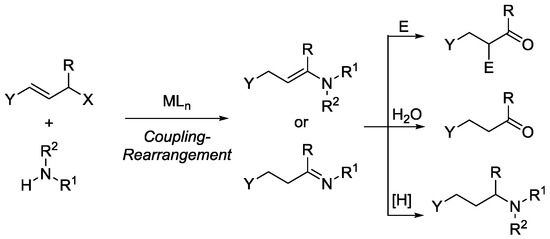
Chart 1.
Supposed coupling-isomerization reactions of allyl halide with amines and the applications.
By means of the strategy of Chart 1, the enamine or imine of ketones, which are normally more difficult to prepare that those of aldehydes [40], will be generated conveniently via the reaction of non-terminal allyl halide. Herein, we reported a palladium-catalyzed reaction of γ-chloro vinyl phosphorus derivative 1 with an amine, which afforded γ-imino or γ-enamino phosphorus derivatives via a coupling-isomerization reaction. The products could be conveniently converted to various γ-functionalized phosphorus derivatives, such as γ-keto, γ-hydroxyl, and γ-aminophosphonates and their analogues.
2. Results and Discussion
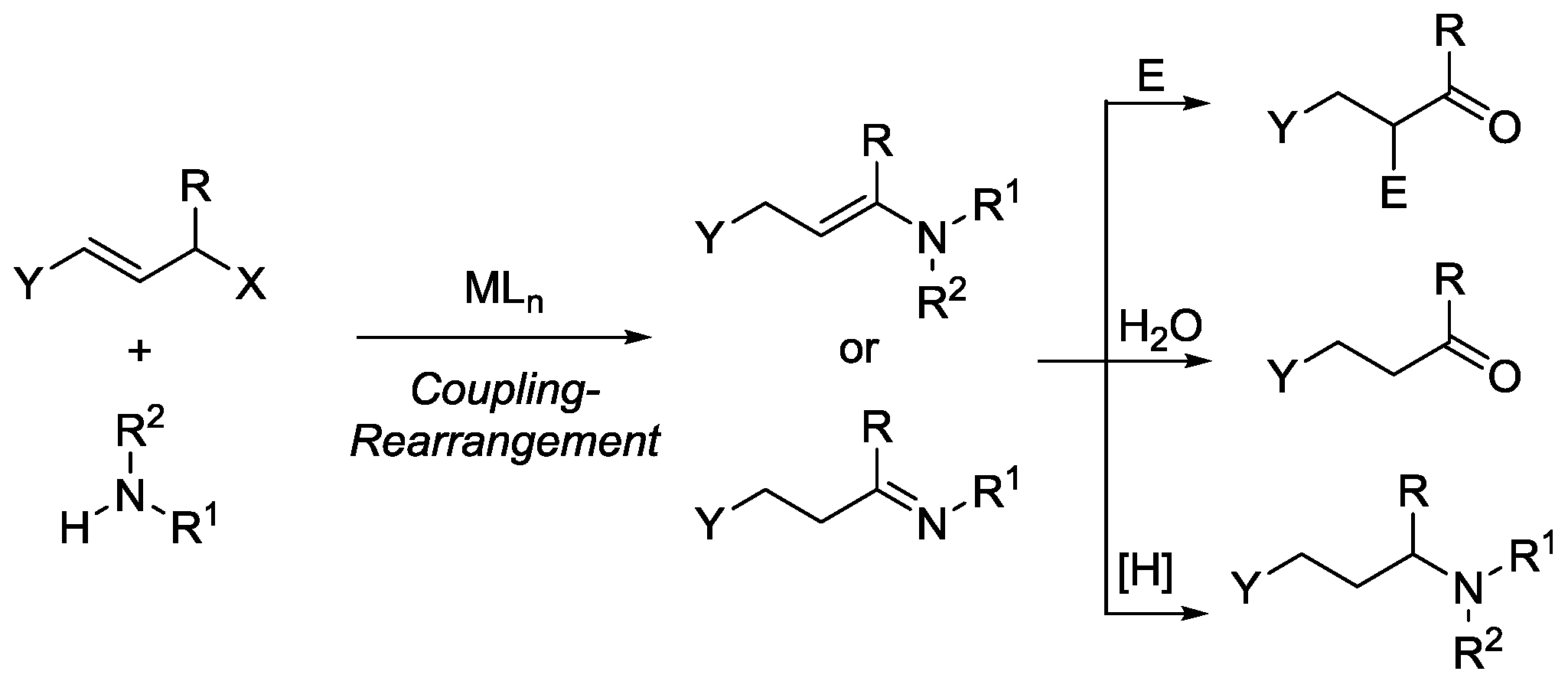
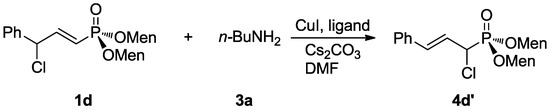
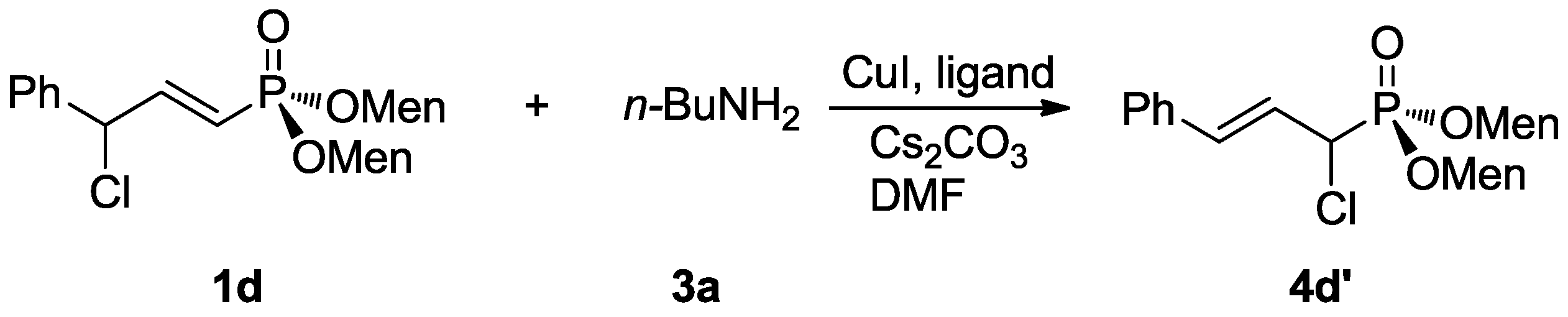
γ-Chlorovinylphosphinate 1a was obtained from the addition of H-phosphinate to cinnamic aldehyde and the subsequent chlorination of α-hydroxy allyl phosphinate 2a [41]. As seen in Scheme 1, 1a to 1g were prepared in excellent yields (NMR spectrum as seen in SM, Part 3). The copper-catalyzed coupling of 1 with amine 3a was firstly examined with reference to the reported synthesis of N-heterocycles via the reaction of vinyl halide with an amine [26]. When 1d was heated with the n-butyl amine 3a in the presence of cuprous iodide and a ligand (1,10-phenanthroline or glycine), the coupling product was not detected. Instead, the isolation of α-chloroallylphosphinate 4d’ was obtained as seen the dd peaks at 5.38 and 7.10 ppm on the 1H-NMR spectrum (Scheme 2, NMR spectrum as seen in SM, Part 3) [42].
Scheme 1.
The preparation of 1a to 1g from H-P species and cinnamic aldehydes.
Scheme 2.
The cuprous-iodide-catalyzed reaction of 1d with an amine.
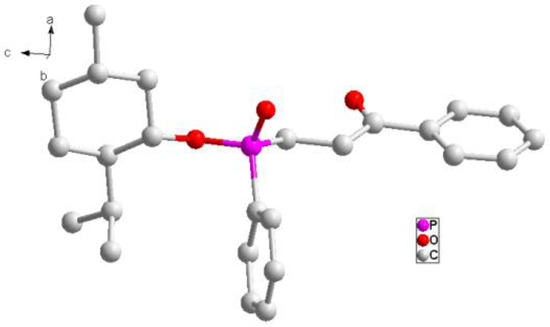
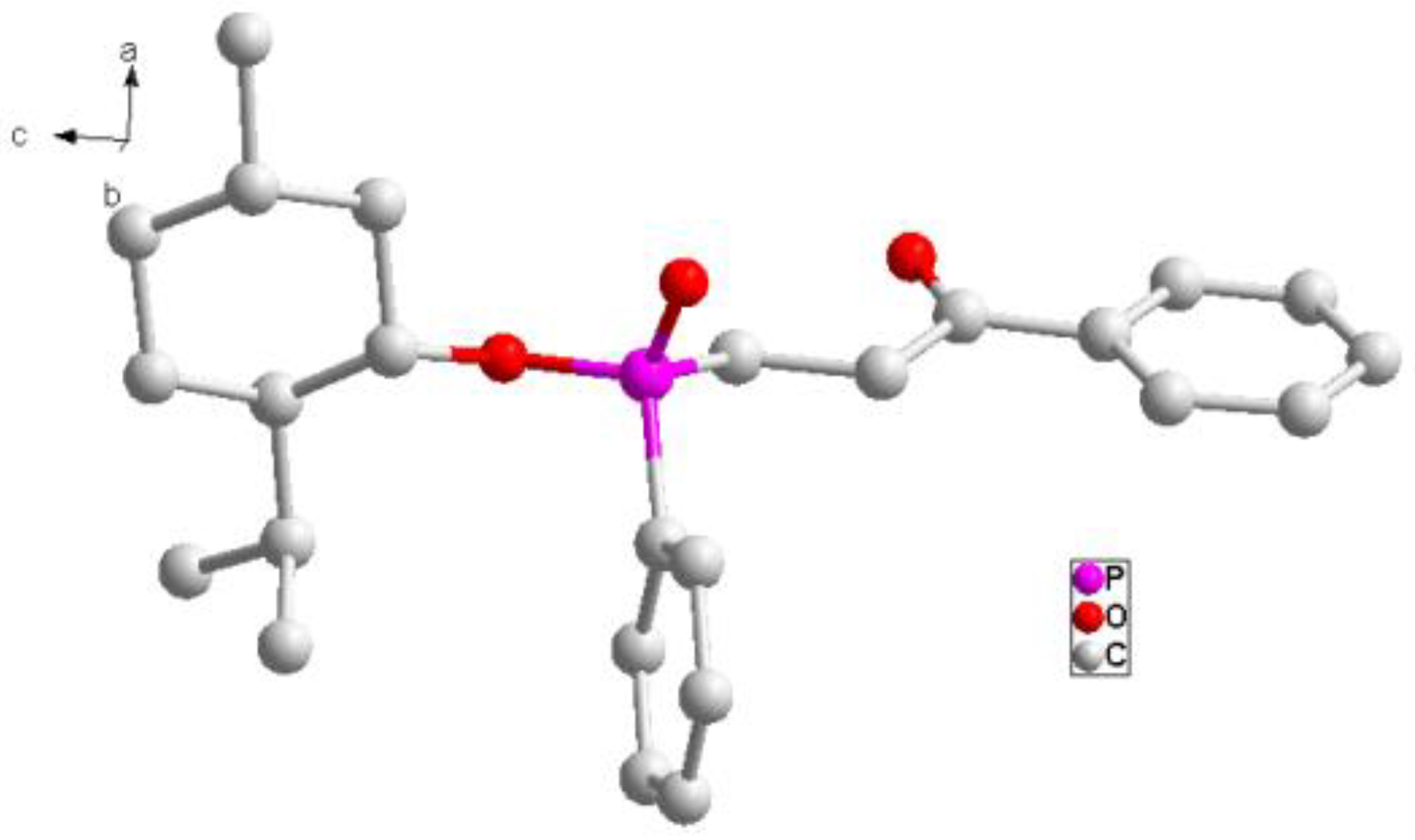
The palladium catalyst was thereafter examined for the coupling reaction of 1 with an amine. When 1a was heated with 3a in the presence of palladium acetate and triphenyl phosphine (TPP), two products, vinyl chloride 4a and γ-keto phosphinate 5a, were isolated (Table 1). The formation of 4a was proved by a quartet peak of a vinyl proton at 6.20 ppm on the 1H-NMR spectrum [43]. The structure of 5a was confirmed by X-ray diffraction results (Figure 1, as seen in SM, Part 1). Directive allylation of amine 3a with 1a was not detected.
Table 1.
The optimization of the reaction conditions of 1a with 3a.
Figure 1.
X-ray crystal structure of 5a.
When 1a was heated with one equivalent of 3a at 100 °C for 13 h, 5a was formed with a 46% yield (entry 3). When two molar of 3a was used, the yield of 5a was increased to 67% (entry 4). Carrying out the reaction at 120 °C gave nearly an entire formation of 5a (>99%, entry 6). A decreasing amount of TPP resulted in a reduced yield of 5a. The absence of either TPP or palladium led to an entire conversion of 1a to 4a with no detection of 5a (entries 11–12). The results indicated that the palladium and TPP were essential to the formation of 5a. Palladium chloride gave slightly poorer results than an acetate analog (entry 7). When the reactions were carried out in a polar solvent, such as DMA, DME, or NMP, an unsatisfactory yield of 5a was obtained (entries 8–10).
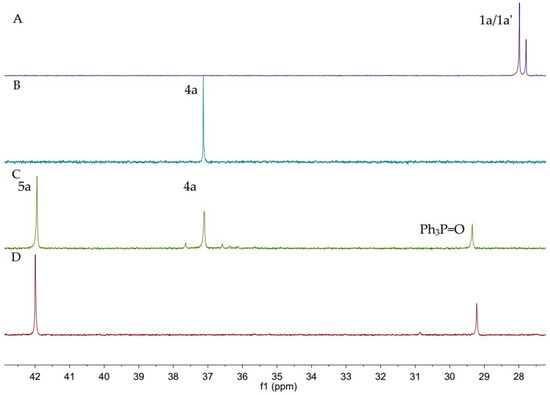
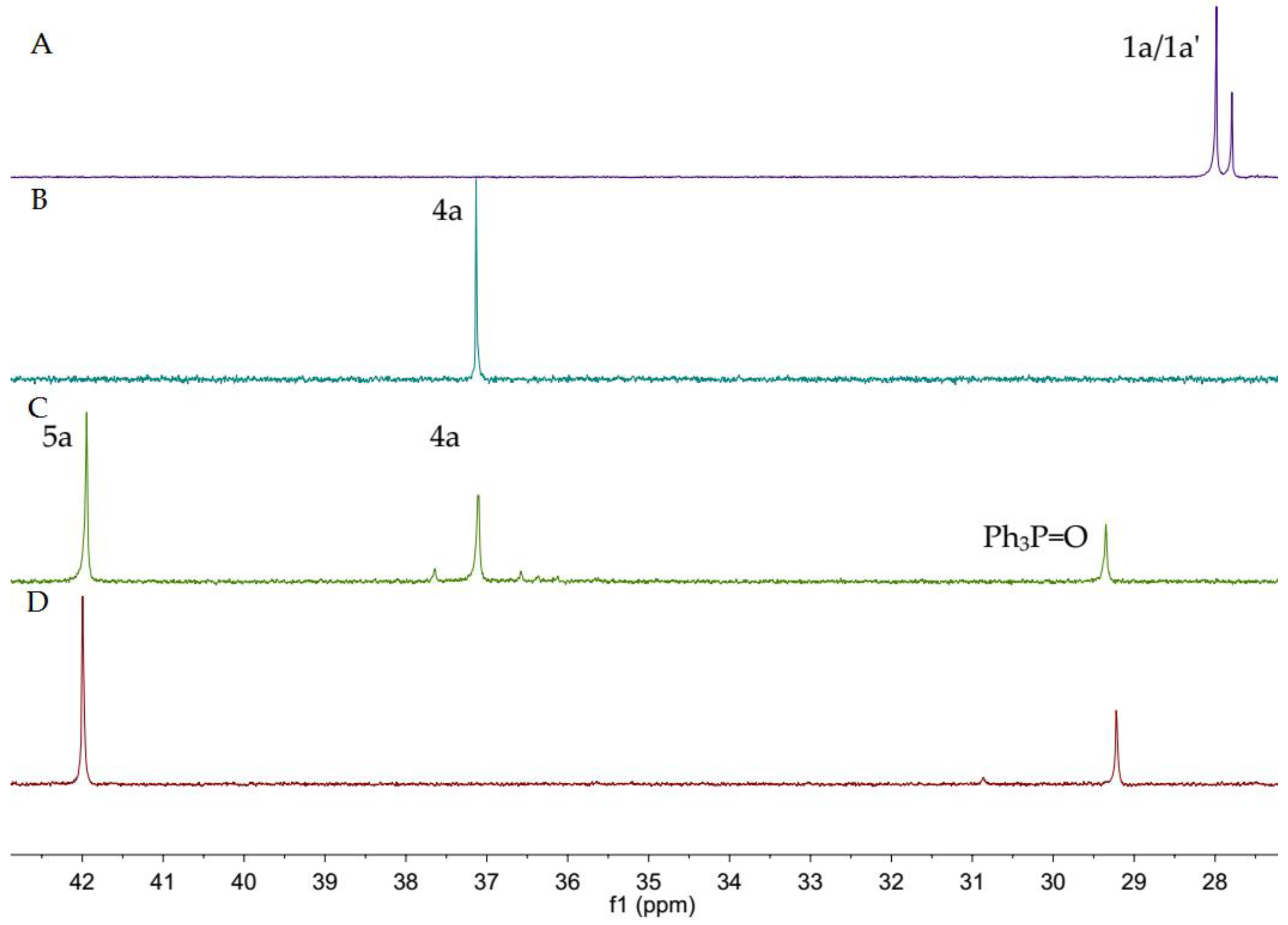
In a separate experiment, when 1a (together with its stereoisomer 1a’ deriving from chiral γ-carbon) was heated with 3a at 120 °C for 24 h, an entire isomerization of 1a to 4a was observed. When palladium acetate and TPP were added, 4a was consumed partly after 12 h and entirely within 24 h (Figure 2). γ-Keto phosphinate (5a) was obtained after quenching with aqueous ammonium chloride. The reaction of isolated 4a with 3a gave the same results.
Figure 2.
The variation of the NMR spectrum for the conversion of 1a to 5a. (A) Pure 1a/1a’; (B) Heating of 1a/1a’ and 3a at 120 °C for 24 h; (C) Addition of Pd(OAc)2 and TPP with heating at 120 °C for 12 h; (D) The mixture was heated for 24 h.
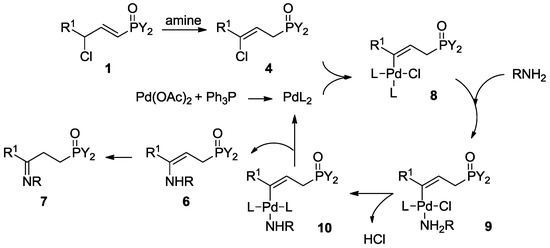
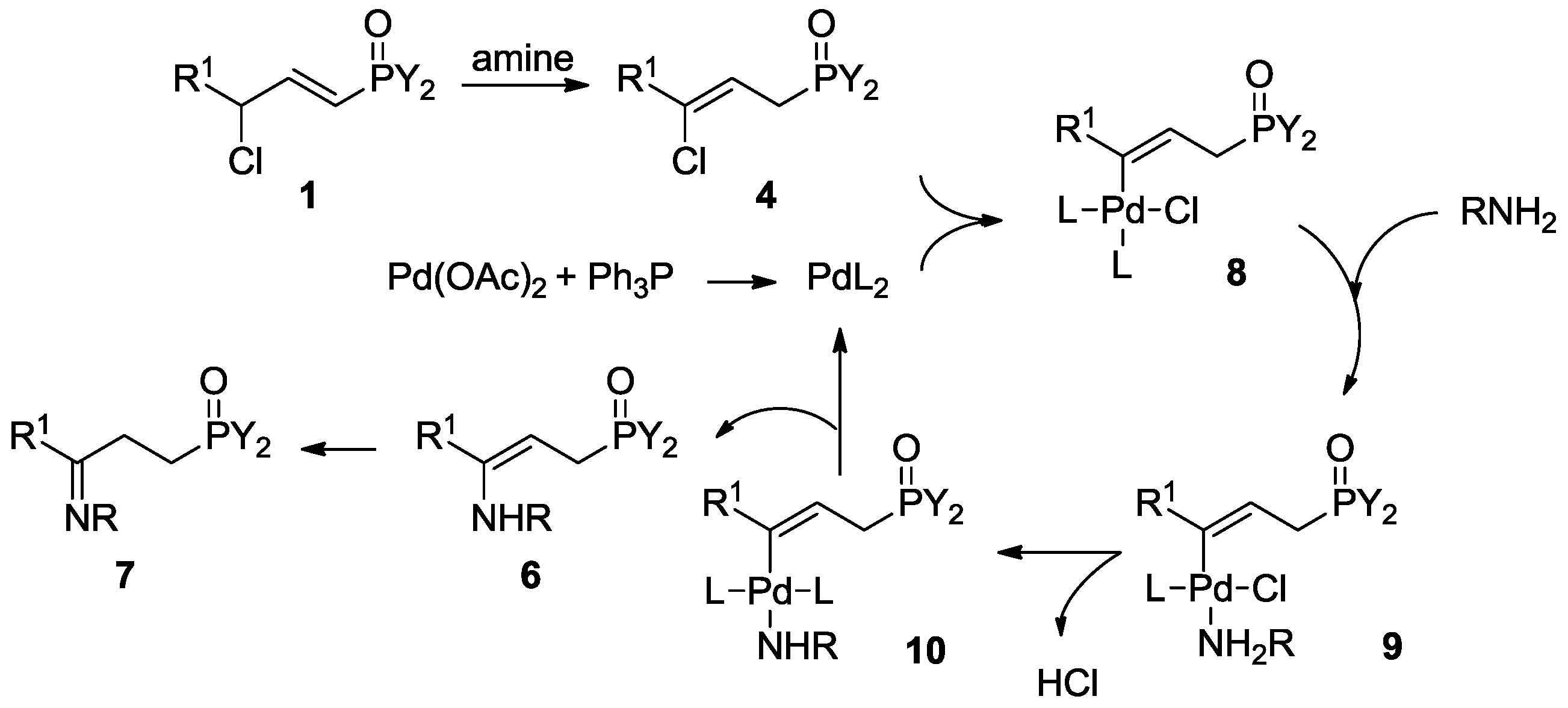
The palladium-catalyzed cross-coupling between 3a and 1a/4a was supposed to form the corresponding enamine 6a and then the imine 7a that was converted to 5a after removing the amine moieties via hydrolysis. As seen in Scheme 3, 1 was converted to 4 when heated in the presence of an amine. Vinyl chloride 4 combined with palladium via oxidative addition to form the vinyl palladium complex 8 that was converted to 9 via the coordination of the amine. The dehydrochlorination of 9 afforded 10. During the reductive elimination of 10, a γ-coupling product was formed. As for 1a/4a, the amino only linked to γ-carbon to generate enamine 6 or imine 7. No formation of an α-coupling product indicated that the reaction proceeded via vinyl palladium species as intermediates (as referred to in Scheme 5, vide infra).
Scheme 3.
The proposed mechanism for the isomerization-coupling reaction of the allyl chloride 1 with an amine.
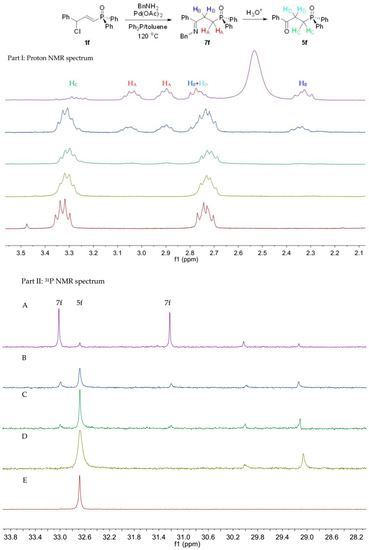
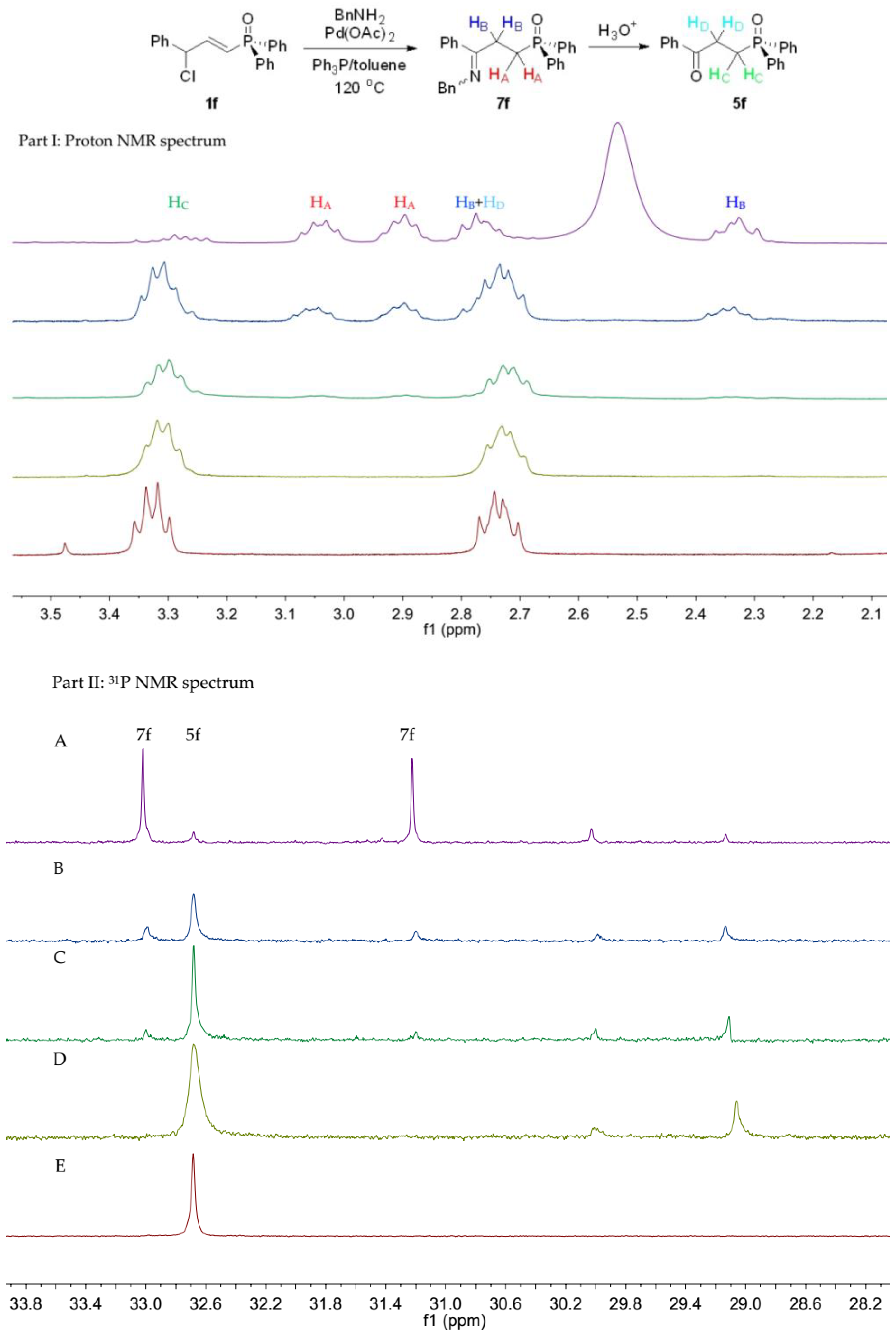
The γ-Keto phosphorus derivative 5 was formed from the hydrolysis of 6 or 7. Although the γ-imino derivative 7 was not obtained, it could be observed by means of the NMR spectrum. As seen in Figure 3, the coupling of 1f with a benzyl amine afforded 7f, whose cis/trans isomers gave four proton signals (HA and HB) around 3.07 to 2.70 ppm. Partial hydrolysis of 7f resulted in the formation of 5f that gave two proton singles of HC and HD at 3.36 and 2.70 ppm, respectively. On the 31P-NMR spectrum, cis/trans-7f gave two peaks at 33.0 and 31.2 ppm. During the treatment with aqueous ammonium chloride, an obviously increasing peak of 5f at 32.7 ppm was observed accompanied by decreasing peaks of 7f (NMR spectrum, as seen in SM, Part 2).
Figure 3.
The variation in NMR spectrum for the reaction of 1f with a benzyl amine. Part I. Proton NMR spectrum; Part II. 31P-NMR spectrum. (A) The crude product was analyzed with an NMR spectrum; (B) The solution of crude product was washed with aqueous ammonium chloride; (C) Further washing of the solution with aqueous ammonium chloride; (D) The solution of crude product was washed with diluted hydrochloric acid; (E) Isolated 5f.
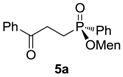
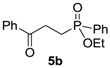
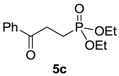
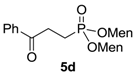
The isomerization-coupling reaction could be applied for the preparation of various phosphorus derivatives. Firstly, the γ-keto derivatives 5 were obtained via the hydrolysis of 6 or 7 (Table 2) [44,45]. The primary amines that contained primary, secondary, or tertiary alkyl groups afforded the same 5a. The coupling of a secondary amine, such as piperidine, also afforded 5a via the intermediate 6. Other γ-keto phosphorus derivatives, such as ethyl phenylphosphinate 5b, diethyl phosphonate 5c, dimenthyl phosphonate 5d, and diphenyl phosphine oxides 5f, were similarly obtained in moderate to excellent yields (NMR spectrum as seen in SM, Part 3).
Table 2.
Preparation of the γ-keto phosphorus derivatives 5.
Secondly, the imine 7 could also be used in situ for the preparation of the γ-amino phosphorus derivatives 11. In Table 3, various 11 derivatives were obtained, from the reaction of 1 with an amine and subsequent reduction with sodium borohydride, in moderate to excellent yields. The amplifying reaction of 1f (ca. 1.02 g) afforded 11fa with a 59% isolated yield. When the P-stereogenic 1a reacted with 3b (2-phenyl ethylamine), 11ab was obtained, which gave two close single peaks at 43.4 and 43.2 ppm on the 31P-NMR spectrum, in the ratio of around 50:50. The two peaks were ascribed to the two stereoisomers of 11ab deriving from the γ-stereogenic carbon atom. On the proton NMR spectrum, the γ-proton was observed as a multi-peak, and the two stereoisomers could not be distinguished. Similarly, the two stereoisomers were also observed for 11ac, 11db, 11dc, and 11dd. However, only one signal was observed on the 31P-NMR spectrum for 11aa and 11da (also for 11ga, vide infra) that contained an N-primary butyl. We believe that the two stereoisomers of 11aa and 11da were similarly formed, but their peaks coincided probably due to the weak influences of the butyl on the NMR spectrum (NMR spectrum as seen in SM, Part 3).
Table 3.
Preparation of the γ-amino phosphorous derivatives 11 via coupling-isomerization and subsequent reduction.
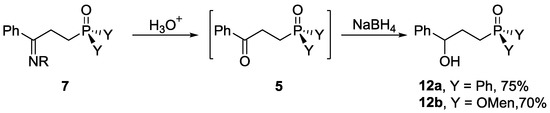
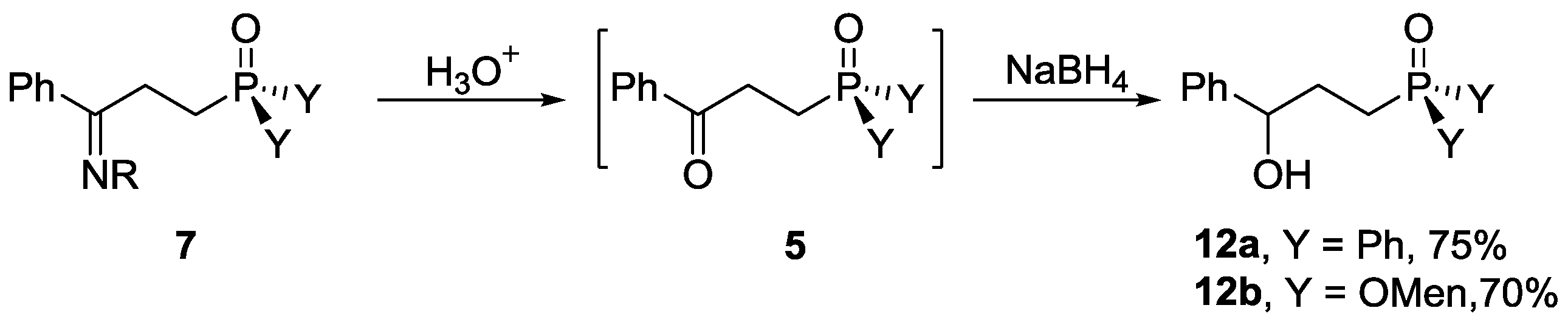
For the reaction of the amines containing sec- or tert-alkyl and aromatic amines, 11 were not obtained. Instead, the isolation of γ-hydroxyl phosphorus derivatives 12 was obtained. We supposed that the imines 7 derived from these amines were instable and hydrolyzed by trace water during the reduction with sodium borohydride; thereby, 12 was formed as the major product (Scheme 4, NMR spectrum as seen in SM, Part 3).
Scheme 4.
Preparation of the γ-hydroxyl phosphorous derivatives 12 (the yield was estimated by a 31P{1H}-NMR spectrum).
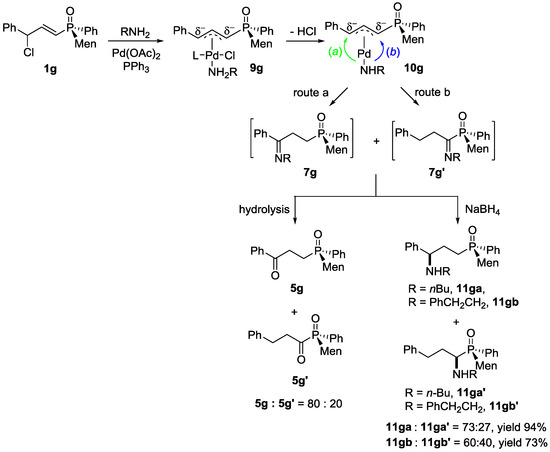
During the above reaction, only the γ-functional phosphorus derivatives were obtained. However, for the P-stereogenic γ-chloroallyl menthylphosphine oxide 1g, a mixture of α- and γ-keto 5g and 5g’ was afforded as observed by the two single peaks at 43.7 and 45.8 ppm on the 31P-NMR spectrum. The reduction with sodium borohydride gave 11 and 11’ also as a mixture, which indicated that α- and γ-imino 7g and 7g’ were formed as intermediates. When 3b (2-phenyl ethylamine) was used, the structures of the resulting 11gb and 11gb’ were confirmed by an NMR spectrum [46].
We found that either 1g or 4g similarly afforded a mixture of α- and γ-functional products. As supposed, 1g or 4g formed the allyl palladium complexes 9g and 10g (Scheme 5), which were different to the vinyl palladium species of Scheme 3. The reductive elimination of α- or γ-carbon (route a and route b) afforded 7g and 7g’, respectively. Compared to 1a or 1f, the alkoxy or phenyl linked to phosphorus was replaced by an aliphatic menthyl group in 1g. Because of the absence of a p-d or π-d interaction for menthyl, the α-anion probably was stabilized and the coupling reaction occurred at this position.
Scheme 5.
Reaction of the P-stereogenic 1g and subsequent conversions (the ratio was estimated by a 31P{1H}-NMR spectrum).
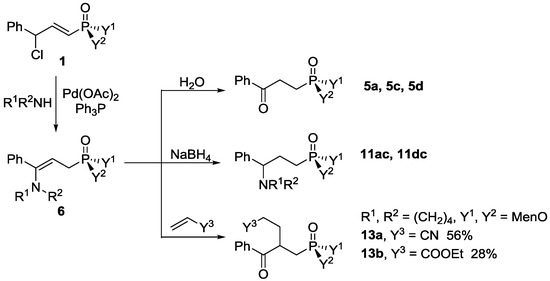
When a secondary amine was used, the enamine 6 was generated, which could be converted to β-alkylated products via a Stork reaction [47]. For example, directly heating 6 in situ with acrylonitrile afforded 13a with a 60% yield. Ethyl acrylate could similarly react with 6 to form 13b (Scheme 6, NMR spectrum as seen in SM, Part 3).
Scheme 6.
The preparation of the enamine 6 and the subsequent reactions.
3. Materials and Methods
3.1. Materials
1H-NMR spectra were recorded on a 400-MHz spectrometer (Varian, Palo Alto, CA, USA). The chemical shift for 1H-NMR spectra is reported (in parts per million) relative to internal tetramethylsilane (Me4Si, δ = 0.00 ppm) with CDCl3. 13C-NMR spectra were recorded at 101 MHz. Chemical shifts for 13C-NMR spectra are reported (in parts per million) relative to CDCl3 (δ = 77.0 ppm). 31P-NMR spectra were recorded at 162 MHz, and chemical shifts are reported (in parts per million) relative to external 85% phosphoric acid (δ = 0.0 ppm). TLC plates were visualized by UV (Kang Hua, Shanghai, China). All starting materials were purchased from commercial sources and used as received (Aladdin, Shanghai, China). The solvents were distilled under N2 and dried according to standard procedures. 31P-NMR spectra were referenced to phosphoric acid. The NMR yields of the articles are determined by integration of all the resonances in the 31P spectra. The yields obtained by the approach are generally accurate and reproducible.
3.2. Synthesis
3.2.1. Addition of H-P Species to Cinnamaldehyde to Form α-Hydroxy Allyl Phosphorus Derivatives 2
(SP)-Menthyl-1-hydroxy-3-phenylallyl phenylphosphinate, 2a
A mixture of (RP)-menthyl phosphinate (10.0 g, 36 mmol) and cinnamaldehyde (5.5 mL, 43 mmol) was heated at 80 °C for 5 h under nitrogen to give a yellow solid, which was recrystallized with dichloromethane/ether to give pure 2a as a white solid. Yield 68%, (10.1 g), m.p. 186.0–188.4 °C. 31P-NMR (162 MHz, CDCl3) δ = 35.67 (s, 68%), 35.03 (s, 32%). 1H-NMR (400 MHz, CDCl3) δ = 7.87–7.73 (m, 2H), 7.55 (q, J = 7.7 Hz, 1H), 7.49–7.38 (m, 2H), 7.29 (dq, J = 16.9, 9.7 Hz, 5H), 6.66–6.49 (m, 1H), 6.27 (dtd, J = 55.0, 10.8, 10.1, 5.6 Hz, 1H), 4.81–4.60 (m, 1H), 4.42 (dq, J = 10.7, 6.1 Hz, 1H), 2.30 (d, J = 6.4 Hz, 1H), 1.80 (d, J = 11.4 Hz, 1H), 1.71–1.54 (m, 2H), 1.51–1.38 (m, 1H), 1.31 (s, 1H), 1.11–0.95 (m, 2H), 0.93 (d, J = 7.0 Hz, 2H), 0.88–0.82 (m, 3H), 0.79 (d, J = 6.9 Hz, 2H), 0.75 (dd, J = 6.4, 3.2 Hz, 4H).
Ethyl 1-hydroxy-3-phenylallyl phenylphosphinate, 2b
A solution of dichlorophenylphosphine (5 mL, 37 mmol) in acetonitrile (10 mL) was added dropwise to ethanol (4.7 mL, 81 mmol) with cooling in an ice bath. After the mixture was warmed to room temperature, potassium carbonate (6.4 g, 46 mmol) and cinnamaldehyde (5.1 mL, 40.7 mmol) were added. The resulting mixture was stirred at room temperature for 14 h. A saturated solution of ammonium chloride (10 mL) was added and the mixture was extracted with dichloromethane (3 × 30 mL) then washed with water (3 × 20 mL). The combined organic layer was dried over anhydrous magnesium sulfate and concentrated in vacuo to give the crude product, which was recrystallized with ether to give pure 2b as a white solid. Yield 55%, (6.1 g), m.p. 137.6–141.7 °C. 31P-NMR (162 MHz, CDCl3) δ = 33.62 (s, 32%), 32.73 (s, 68%). 1H-NMR (400 MHz, CDCl3) δ = 7.87–7.74 (m, 2H), 7.56 (dd, J = 14.6, 7.3 Hz, 1H), 7.51–7.39 (m, 2H), 7.39–7.19 (m, 5H), 6.65–6.54 (m, 1H), 6.35–6.17 (m, 1H), 4.78 (d, J = 25.4 Hz, 1H), 4.16 (dddd, J = 24.8, 21.1, 12.2, 6.7 Hz, 2H), 1.35 (td, J = 7.0, 2.9 Hz, 3H).
Diethyl 1-hydroxy-3-phenylallylphosphonate, 2c
To a solution of diethyl phosphite (3.6 mL, 28 mmol) in acetonitrile (10 mL), potassium carbonate (5.8 g, 42 mmol) and cinnamaldehyde (4.2 mL, 33.6 mmol) were added at room temperature. The mixture was stirred for 13 h at the same temperature. A saturated solution of ammonium chloride (10 mL) was added and the mixture was extracted with dichloromethane (3 × 30 mL) then washed with water (3 × 20 mL). The combined organic layer was dried over anhydrous magnesium sulfate and concentrated in vacuo. The crude product was recrystallized with ether to give pure 2c as a white solid. Yield 87%, 9.1 g, m.p. 98.7–100.0 °C. 31P-NMR (162 MHz, CDCl3) δ = 21.50 (s). 1H-NMR (400 MHz, CDCl3) δ = 7.40 (d, J = 7.4 Hz, 2H), 7.31 (t, J = 7.4 Hz, 2H), 7.25 (d, J = 5.0 Hz, 1H), 6.78 (dd, J = 16.1, 4.1 Hz, 1H), 6.36–6.27 (m, 1H), 4.66 (dd, J = 13.0, 6.2 Hz, 1H), 4.23–4.15 (m, 4H), 1.33 (td, J = 7.0, 4.2 Hz, 6H).
Dimenthyl 1-hydroxy-3-phenylallylphosphonate, 2d
Compound 2d was prepared according a similar procedure to 2c, which was purified by chromatography with Rf = 0.22 (silica gel, petroleum ether). Pure 2d was obtained as yellow oil. Yield 60% (4.4 g). 31P-NMR (162 MHz, CDCl3) δ = 19.95 (s, 52%), 19.53 (s, 48%). 1H-NMR (400 MHz, CDCl3) δ = 7.41–7.35 (m, 2H), 7.31 (t, J = 6.8 Hz, 2H), 7.24 (d, J = 6.7 Hz, 1H), 6.82–6.73 (m, 1H), 6.33 (dt, J = 16.0, 5.1 Hz, 1H), 4.62 (d, J = 14.2 Hz, 1H), 4.36–4.21 (m, 2H), 2.41–2.10 (m, 4H), 1.66 (d, J = 7.5 Hz, 4H), 1.50–1.29 (m, 4H), 1.22–1.09 (m, 2H), 1.06–0.96 (m, 2H), 0.89 (dt, J = 10.8, 6.7 Hz, 12H), 0.85–0.77 (m, 9H).
Diethyl 1-hydroxy-3-p-tolyl allylphosphonate, 2e
Compound 2e was prepared according a similar procedure to 2c, which was recrystallized with ether. The pure 2e was obtained as a white solid. Yield 80% (6.4 g), m.p. 108.1–113.0 °C. 31P-NMR (162 MHz, CDCl3) δ = 21.45 (s). 1H-NMR (400 MHz, CDCl3) δ = 7.30 (d, J = 7.7 Hz, 2H), 7.13 (d, J = 7.7 Hz, 2H), 6.75 (d, J = 16.1 Hz, 1H), 6.26 (dt, J = 15.9, 5.9 Hz, 1H), 4.71–4.60 (m, 1H), 4.19 (m, 4H), 2.34 (s, 3H), 1.34 (t, J = 7.1 Hz, 6H).
Diphenyl 1-hydroxy-3-phenylallylphosphine oxide, 2f
To a solution of chlorodiphenyl phosphine (6 mL, 29 mmol) in acetonitrile (20 mL), water (0.5 mL) was added dropwise with cooling in an ice bath, then potassium carbonate (6.0 g, 43.5 mmol) and cinnamaldehyde (4.4 mL, 34.8 mmol) were added. The resulting mixture was stirred at room temperature for 18 h. A saturated solution of ammonium chloride (10 mL) was added and the resulting pink solid was collected by filtration and recrystallized with ethanol/ether to give pure 2f as a white solid. Yield 41% (3.9 g), m.p. 168.9–170.3 °C. 31P-NMR (162 MHz, CDCl3) δ = 26.31 (s). 1H-NMR (400 MHz, CDCl3) δ = 7.91–7.80 (m, 4H), 7.55 (dd, J = 15.1, 7.7 Hz, 2H), 7.50–7.43 (m, 4H), 7.27–7.20 (m, 5H), 6.58 (dd, J = 16.0, 4.4 Hz, 1H), 6.31–6.23 (m, 1H), 5.16 (t, J = 6.4 Hz, 1H).
(SP)-Menthyl 1-hydroxy-3-phenylallylphenylphosphine oxide, 2g
Compound 2g was prepared according a similar procedure to 2a, which was recrystallized with ether, and was obtained as a white solid. Yield 54% (8.1 g), m.p. 151.5–156.4 °C. 31P-NMR (162 MHz, CDCl3) δ = 40.12 (s, 58%), 36.47 (s, 42%). 1H-NMR (400 MHz, CDCl3) δ = 7.75 (dt, J = 42.3, 8.9 Hz, 2H), 7.56–7.36 (m, 3H), 7.23–7.12 (m, 5H), 6.44 (dd, J = 59.9, 16.5 Hz, 1H), 6.17–6.03 (m, 1H), 4.94 (d, J = 23.5 Hz, 1H), 2.52–2.20 (m, 2H), 1.95–1.63 (m, 4H), 1.46 (d, J = 30.6 Hz, 2H), 1.18–1.00 (m, 2H), 0.97 (d, J = 5.9 Hz, 1H), 0.91 (t, J = 5.9 Hz, 3H), 0.76 (d, J = 6.8 Hz, 1H), 0.70 (d, J = 6.8 Hz, 2H), 0.29 (d, J = 6.5 Hz, 1H).
3.2.2. Chlorination of α-Hydroxy Allyl Phosphorus Derivatives 2 to Form 1a–1g
(SP)-Menthyl 3-chloro-3-phenylprop-1-en-1-yl phenylphosphinate, 1a
To an ice-cooled solution of 2a (2.0 g, 4.8 mmol) and pyridine (0.6 mL, 7.2 mmol) in dichloromethane (10 mL), thionyl chloride (0.5 mL, 7.2 mmol) was added dropwise. The mixture was allowed to warm to room temperature slowly over 5 h. Water (5 mL) was added and the aqueous layer was extracted with dichloromethane (3 × 10 mL). The combined organic layer was dried over anhydrous magnesium sulfate and concentrated in vacuo. The crude product was recrystallized with petroleum ether (30–60 °C) to give pure 1a as a white solid. Yield 97% (2.1 g), m.p. 148.7–154.1 °C. 31P-NMR (162 MHz, CDCl3) δ = 27.45 (s, 23%), 27.25 (s, 77%). 1H-NMR (400 MHz, CDCl3) δ = 7.83–7.73 (m, 2H), 7.57–7.51 (m, 1H), 7.47 (dt, J = 7.2, 3.6 Hz, 2H), 7.38–7.29 (m, 5H), 6.98 (dddd, J = 19.1, 16.6, 5.8, 2.8 Hz, 1H), 6.19 (dd, J = 20.5, 16.6 Hz, 1H), 5.53 (d, J = 5.6 Hz, 1H), 4.31–4.16 (m, 1H), 2.10 (d, J = 13.6 Hz, 2H), 2.03 (s, 1H), 1.65 (d, J = 6.9 Hz, 2H), 1.41 (d, J = 9.4 Hz, 2H), 1.20–1.09 (m, 1H), 0.93 (dd, J = 9.1, 7.1 Hz, 3H), 0.86–0.81 (m, 4H), 0.80 (s, 1H), 0.75 (d, J = 6.9 Hz, 2H).
Ethyl 3-chloro-3-phenylprop-1-en-1-ylphenylphosphinate, 1b
The compound 1b was prepared similar to 1a, which was purified with flash column chromatography with Rf = 0.46 (silica gel, petroleum ether/ethyl acetate = 2:1 as eluent), and was obtained as a yellow oil. Yield 70% (1.5 g). 31P-NMR (162 MHz, CDCl3) δ = 33.18 (s, 50%), 33.10 (s, 50%). 1H-NMR (400 MHz, CDCl3) δ = 7.83–7.63 (m, 2H), 7.55–7.43 (m, 1H), 7.43–7.33 (m, 2H), 7.35–7.11 (m, 5H), 6.87 (dddd, J = 19.1, 16.7, 5.8, 2.3 Hz, 1H), 6.22–6.05 (m, 1H), 5.50–5.40 (m, 1H), 4.07–3.83 (m, 2H), 1.32–1.18 (m, 3H).
Diethyl 3-chloro-3-phenylprop-1-en-1-ylphosphonate, 1c
The compound 1c was prepared similar to 1a, which was purified with flash column chromatography with Rf = 0.52 (silica gel, petroleum ether/ethyl acetate = 3:1 as eluent), and was obtained as a yellow oil. Yield 65% (1.4 g). 31P-NMR (162 MHz, CDCl3) δ = 16.82 (s). 1H-NMR (400 MHz, CDCl3) δ = 7.47–7.31 (m, 5H), 6.96 (ddd, J = 22.5, 16.7, 5.9 Hz, 1H), 6.08–5.91 (m, 1H), 5.52 (d, J = 4.6 Hz, 1H), 4.21–3.98 (m, 4H), 1.40–1.23 (m, 6H). 13C-NMR (101 MHz, CDCl3) δ = 149.0 (d, J = 7.0 Hz), 138.1 (s), 128.9 (d, J=1.4 Hz), 127.5 (s), 120.1 (s), 118.2 (s), 62.0 (dd, J = 5.6, 2.9 Hz), 61.8 (d, J = 25.2 Hz), 16.3 (d, J = 6.3 Hz). HRMS (ESI+) Calcd. for C13H18ClO3P [M + Na+]: 311.0580, Found: 311.0587.
Dimenthyl 3-chloro-3-phenylprop-1-en-1-ylphosphonate, 1d
The compound 1d was prepared similar to 1a, which was purified with flash column chromatography with Rf = 0.48 (silica gel, petroleum ether/ethyl acetate = 5:1 as eluent), and was obtained as a yellow oil. Yield 92% (1.9 g). 31P-NMR (162 MHz, CDCl3) δ = 14.80 (s, 51%), 14.65 (s, 49%). 1H-NMR (400 MHz, CDCl3) δ = 7.36 (d, J = 2.3 Hz, 4H), 7.25 (dd, J = 13.4, 5.9 Hz, 1H), 7.00–6.86 (m, 1H), 6.05–5.88 (m, 1H), 5.50 (d, J = 5.0 Hz, 1H), 4.34–4.04 (m, 2H), 2.19 (dd, J = 40.1, 9.0 Hz, 3H), 1.98 (d, J = 5.8 Hz, 1H), 1.64 (d, J = 8.6 Hz, 4H), 1.52–1.24 (m, 4H), 1.22–1.07 (m, 2H), 1.07–0.76 (m, 20H), 0.73 (d, J = 6.9 Hz, 1H), 0.66 (d, J = 6.9 Hz, 1H). 13C-NMR (101 MHz, CDCl3) δ = 147.8 (dd, J = 14.9, 7.5 Hz), 138.4 (d, J = 3.8 Hz), 128.8 (d, J = 4.4 Hz), 127.5 (d, J = 5.0 Hz), 121.2 (d, J = 188.5 Hz), 77.7 (dd, J = 6.7, 3.8 Hz), 62.0 (dd, J = 25.5, 3.4 Hz), 48.4 (dd, J = 6.7, 3.6 Hz), 43.49 (s), 43.1 (d, J = 4.4 Hz), 34.0 (s), 31.7–31.3 (m), 25.5 (d, J = 6.7 Hz), 22.8 (s), 21.9 (d, J = 3.1 Hz), 20.9 (d, J = 2.5 Hz), 15.8 (d, J = 1.4 Hz), 15.6 (d, J = 13.1 Hz). HRMS (ESI+) Calcd. for C29H46ClO3P [M + Na+]: 531.2771, Found: 531.2766.
Diethyl 3-chloro-3-p-tolylprop-1-en-1-ylphosphonate, 1e
The compound 1e was prepared similar to 1a, which was purified with flash column chromatography (silica gel, petroleum ether/ethyl acetate = 1:1 as eluent), and was obtained as a yellow oil. Yield 65% (1.4 g). 31P-NMR (162 MHz, CDCl3) δ = 16.93 (s). 1H-NMR (400 MHz, CDCl3) δ = 7.27–7.22 (m, 2H), 7.18 (d, J = 7.8 Hz, 2H), 6.95 (ddd, J = 21.6, 16.7, 5.9 Hz, 1H), 6.03–5.90 (m, 1H), 5.50 (d, J = 5.6 Hz, 1H), 4.09 (dq, J = 12.1, 6.5, 6.0 Hz, 4H), 2.35 (s, 3H), 1.34 (m, 6H). 13C-NMR (101 MHz, CDCl3) δ = 150.5 (dd, J = 250.0, 6.2 Hz), 138.4 (d, J = 89.2 Hz), 135.3 (d, J = 24.5 Hz), 129.5 (s), 129.3 (s), 129.1 (s), 127.5 (s), 127.1 (s), 126.8 (s), 126.5 (s), 117.4 (dd, J = 300.6, 187.1 Hz), 82.9 (d, J = 21.3 Hz), 62.0 (dd, J = 6.5, 3.5 Hz), 61.7 (d, J = 6.1 Hz), 56.5 (s), 21.1 (d, J = 1.2 Hz), 16.3 (d, J = 6.3 Hz). HRMS (ESI+) Calcd. for C14H20ClO3P [M + Na+]: 325.0736, Found: 325.0746.
Diphenyl 3-chloro-3-phenylprop-1-en-1-ylphosphine oxide, 1f
The compound 1f was prepared similar to 1a, which was recrystallized with dichloromethane/ether, and was obtained as a yellow solid. Yield 90% (1.9 g), m.p. 109.2–112.4 °C. 31P-NMR (162 MHz, CDCl3) δ = 18.16 (s). 1H-NMR (400 MHz, CDCl3) δ = 7.73–7.64 (m, 4H), 7.59–7.52 (m, 2H), 7.48 (dddd, J = 8.4, 7.0, 4.5, 2.3 Hz, 4H), 7.39–7.31 (m, 5H), 6.99 (ddd, J = 18.2, 16.6, 5.6 Hz, 1H), 6.62 (ddd, J = 22.5, 16.6, 1.5 Hz, 1H), 5.62 (dt, J = 5.6, 2.0 Hz, 1H). 13C-NMR (101 MHz, CDCl3) δ = 148.2 (d, J = 4.1 Hz), 138.3 (s), 132.1 (d, J = 2.5 Hz), 131.3 (dd, J = 10.0, 1.5 Hz), 129.0 (s), 128.8 (d, J = 1.4 Hz), 128.7 (d, J = 1.4 Hz), 127.6 (s), 124.3 (d, J = 99.0 Hz), 65.8 (s), 62.3 (d, J = 18.7 Hz), 15.3 (s). HRMS (ESI+) Calcd. for C21H18ClOP [M + Na+]: 375.0681, Found: 375.0692.
(SP)-Menthyl-3-chloro-3-phenylprop-1-en-1-yl phenylphosphine oxide, 1g
The compound 1g was prepared similar to 1a, which was recrystallized with ether, and was obtained as a white solid. Yield 80% (1.6 g), m.p. 138.9–143.6 °C. 31P-NMR (162 MHz, CDCl3) δ = 32.80 (s, 32%), 32.67 (s, 68%). 1H-NMR δ = 7.77–7.65 (m, 2H), 7.48 (s, 3H), 7.34 (d, J = 8.2 Hz, 5H), 6.96 (td, J = 16.6, 5.5 Hz, 1H), 6.56–6.28 (m, 1H), 5.60 (d, J = 5.4 Hz, 1H), 2.15 (s, 1H), 2.07–1.94 (m, 1H), 1.80–1.48 (m, 4H), 1.02 (dq, J = 26.1, 14.2, 13.3 Hz, 2H), 0.89 (d, J = 6.5 Hz, 2H), 0.84 (d, J = 6.5 Hz, 3H), 0.78 (d, J = 6.6 Hz, 2H), 0.48 (t, J = 6.2 Hz, 3H). 13C-NMR (101 MHz, CDCl3) δ = 146.6 (dd, J = 140.6, 2.5 Hz), 138.7 (d, J = 7.0 Hz), 131.3 (d, J = 2.6 Hz), 130.3 (dd, J = 8.6, 4.7 Hz), 129.0 (s), 128.8 (d, J = 5.1 Hz), 128.6 (dd, J = 11.4, 6.1 Hz), 127.6 (d, J = 1.5 Hz), 62.8–62.2 (m), 43.7–43.0 (m), 41.0 (dd, J = 71.6, 30.3 Hz), 35.6 (d, J = 95.2 Hz), 34.3 (s), 33.2 (dd, J = 13.7, 11.4 Hz), 28.3 (dd, J = 7.6, 2.9 Hz), 24.6 (d, J = 12.8 Hz), 22.5 (s), 21.5 (d, J = 6.3 Hz), 15.4 (d, J = 42.7 Hz).HRMS (ESI+) Calcd. for C25H32ClOP [M + Na+]: 437.1777, Found: 437.1773.
3.2.3. The Preparation of (SP)-Menthyl 3-Chloro-3-Phenylallyl Phenyl Phosphine Oxide, 4g
The compound 1g (50 mg, 0.131 mmol) was dissolved in toluene (0.3 mL) and then heated at 120 °C for 14 h. After removing the solvent in vacuo, 4g was obtained as a yellow oil. Yield 98% (49 mg). 31P-NMR (162 MHz, CDCl3) δ = 41.60 (s). 1H-NMR (400 MHz, CDCl3) δ = 7.78–7.70 (m, 2H), 7.45 (s, 3H), 7.40–7.33 (m, 2H), 7.27 (dd, J = 3.9, 1.6 Hz, 3H), 6.16 (dd, J=14.4, 7.3, 1H), 3.27–3.03 (m, 2H), 2.21–1.99 (m, 2H), 1.90 (d, J = 6.2 Hz, 1H), 1.73 (d, J = 7.8 Hz, 4H), 1.43–1.24 (m, 2H), 1.03 (dd, J = 25.0, 12.6 Hz, 1H), 0.94 (dd, J = 8.3, 5.2 Hz, 4H), 0.85–0.78 (m, 3H), 0.42–0.35 (m, 3H). 13C-NMR (101 MHz, CDCl3) δ = 137.67 (d, J = 2.3 Hz), 135.81 (d, J = 12.8 Hz), 134.54 (s), 133.65 (s), 131.21 (d, J = 2.7 Hz), 130.32 (d, J = 8.7 Hz), 128.65 (s), 128.33 (s), 128.21 (d, J = 1.5 Hz), 126.46 (d, J = 1.2 Hz), 117.91 (d, J = 7.2 Hz), 43.32 (d, J = 3.5 Hz), 41.06 (d, J = 66.1 Hz), 35.26 (d, J = 2.4 Hz), 34.20 (d, J = 1.2 Hz), 33.23 (d, J = 13.2 Hz), 31.19 (d, J = 62.9 Hz), 28.31 (d, J = 2.8 Hz), 24.61 (d, J = 12.2 Hz), 22.59 (s), 21.53 (s), 15.20 (s). HRMS (ESI+) Calcd. for C25H32ClOP [M + Na+]: 437.1777, Found: 437.1773.
3.2.4. The Preparation of α-Chlorovinylphosphinate 4d’
Dimenthyl 1-chloro-3-phenylprop-1-en-1-ylphosphonate, 4d’
To a suspension of 1d (38 mg, 0.075 mmol), cuprous iodide (0.8 mg, 0.004 mmol, 5 mol %), 1,10-phenanthroline hydrate (14 mg, 0.008 mmol, 10 mol %), and cesium carbonate (29 mg, 0.09 mmol) in DMF (0.2 mL), 3a (7.1 µL, 0.075 mmol) was added. The mixture was heated at 80 °C for 16 h. A saturated aqueous solution of ammonium chloride (3 mL) was added and the mixture was extracted with dichloromethane (3 × 5 mL). The combined organic layer was washed with water (3 × 3 mL), dried over anhydrous magnesium sulfate, and concentrated in vacuo. The crude product was purified with preparative TLC with Rf = 0.50 (silica gel, petroleum ether/ethyl acetate = 3:1). Compound 4d’ was obtained as a yellow oil. Yield 65% (25 mg), 31P-NMR (162 MHz, CDCl3) δ = 16.31 (s). 1H-NMR (400 MHz, CDCl3) δ = 7.41 (t, J = 7.7 Hz, 4H), 7.17 (d, J = 7.7 Hz, 2H), 7.09 (dd, J = 21.1 Hz, 17.1, 1H), 5.46–5.31 (m, 1H), 4.12–3.94 (m, 2H), 2.11 (d, J = 11.8 Hz, 1H), 1.98 (dd, J = 17.3, 10.0 Hz, 2H), 1.85–1.76 (m, 1H), 1.37 (s, 3H), 1.17 (dd, J = 22.9, 12.1 Hz, 3H), 1.03 (dd, J = 23.3, 12.0 Hz, 2H), 0.93 (s, 2H), 0.91–0.85 (m, 10H), 0.83 (dd, J = 6.9, 2.6 Hz, 7H), 0.78 (d, J = 12.5 Hz, 1H), 0.70 (d, J = 6.9 Hz, 3H), 0.59 (d, J = 6.9 Hz, 3H). 13C-NMR (101 MHz, CDCl3) δ = 130.2 (s), 128.5 (s), 77.2 (d, J = 1.9 Hz), 48.3 (dd, J = 6.8, 2.6 Hz), 43.3 (d, J = 59.4 Hz), 34.0 (s), 31.5 (d, J = 3.8 Hz), 25.4 (d, J = 11.9 Hz), 22.8 (d, J = 7.0 Hz), 21.9 (d, J = 7.8 Hz), 21.0 (s), 15.7 (d, J = 12.8 Hz). HRMS (ESI+) Calcd. for C29H49ClO3P [M + H+]: 509.2951, Found: 509.2954.
3.2.5. Preparation of γ-Keto Phosphorus Derivatives 5
(SP)-Menthyl 3-oxo-3-phenylpropyl phenylphosphinate, 5a
To a solution of 1a (50 mg, 0.116 mmol), palladium acetate (1.3 mg, 0.058 mmol, 5 mol %), and triphenyl phosphine (6.1 mg, 0.232 mmol, 20 mol %) in toluene (0.5 mL), 3a (25 µL, 0.255 mmol) was added. The mixture was heated at 120 °C for 24 h and monitored with TLC. After removing the solvent in vacuo, the residue was dissolved in dichloromethane, filtered over silica gel, and washed with dichloromethane. After removing the solvent in vacuo, the residue was purified with preparative TLC with Rf = 0.55 (silica gel, petroleum ether/ethyl acetate = 1/1 as eluent). The pure 5a was obtained as a yellow solid. Yield 89% (43 mg), m.p. 95.6–100.7 °C. 31P-NMR (162 MHz, CDCl3) δ = 41.90 (s). 1H-NMR (400 MHz, CDCl3) δ = 7.91 (d, J = 7.8 Hz, 2H), 7.84 (dd, J = 11.6, 7.4 Hz, 2H), 7.55 (d, J = 7.6 Hz, 2H), 7.51–7.42 (m, 4H), 4.36–4.28 (m, 1H), 3.33 (s, 1H), 3.11 (s, 1H), 2.45–2.30 (m, 1H), 2.30–2.20 (m, 2H), 1.74 (d, J = 11.5 Hz, 1H), 1.63 (d, J = 27.1 Hz, 4H), 1.44–1.34 (m, 1H), 1.26 (s, 1H), 1.04–0.97 (m, 1H), 0.91 (dd, J = 14.0, 7.0 Hz, 7H), 0.80 (d, J = 12.3 Hz, 1H), 0.74 (d, J = 6.6 Hz, 3H). 13C-NMR (101 MHz, CDCl3) δ = 197.7 (d, J = 15.7 Hz), 136.2 (s), 133.3 (s), 133.1 (s), 132.1 (s), 131.9 (s), 131.3 (d, J = 9.9 Hz), 128.6 (s), 128.6 (s), 128.4 (s), 128.0 (s), 76.6 (s), 48.7 (d, J = 6.0 Hz), 43.1 (s), 34.0 (s), 31.4 (s), 30.9 (s), 25.7 (s), 24.4 (d, J = 103.3 Hz), 22.8 (s), 21.9 (s), 21.1 (s), 15.7 (s). HRMS (ESI+) Calcd. for C25H33O3P [M + H+]: 413.2246, Found: 413.2244.
Ethyl 3-oxo-3-phenylpropyl phenylphosphinate, 5b
The compound 5b was obtained as a yellow solid. Yield 81% (38 mg, containing 79% of 5b and ca. 21% of triphenyl phosphine oxide). Rf = 0.55 (petroleum ether/ethyl acetate = 1:1). 31P-NMR (162 MHz, CDCl3) δ = 44.36 (s, 81%), 29.14(s, 19%). 1H-NMR (400 MHz, CDCl3) δ = 7.93–7.88 (m, 2H), 7.83–7.76 (m, 2H), 7.68–7.61 (m, 2H), 7.56–7.44 (m, 6H), 7.44–7.39 (m, 3H), 4.08 (dd, J = 10.1, 7.1 Hz, 1H), 3.85 (dd, J = 10.1, 7.1 Hz, 1H), 3.34 (dddd, J = 18.1, 11.0, 9.1, 5.1 Hz, 1H), 3.16 (dddd, J = 18.1, 10.8, 9.6, 4.9 Hz, 1H), 2.44–2.20 (m, 3H), 1.26 (t, J = 7.1 Hz, 3H).
Diethyl 3-oxo-3-phenyl propylphosphonate, 5c
The pure 5c was obtained as a yellow solid. Yield 83% (39 mg) Rf = 0.63 (petroleum ether/ethyl acetate = 1:1), m.p. 78.5–83.6 °C. 31P-NMR (162 MHz, CDCl3) δ = 31.77 (s). 1H-NMR (400 MHz, CDCl3) δ = 8.01–7.91 (m, 2H), 7.58 (t, J = 7.4 Hz, 1H), 7.48 (t, J = 7.6 Hz, 2H), 4.19–4.02 (m, 4H), 3.30 (ddd, J = 10.6, 7.9, 4.8 Hz, 2H), 2.19 (dddd, J = 39.0, 37.6, 20.4, 17.3 Hz, 2H), 1.37–1.24 (m, 6H). 13C-NMR (101 MHz, CDCl3) δ = 197.4 (d, J = 15.7 Hz), 136.3 (s), 133.3 (s), 128.7 (s), 128.0 (s), 61.7 (d, J = 6.5 Hz), 39.4 (s), 31.7 (d, J = 3.0 Hz), 23.3 (s), 20.6–18.9 (m), 16.4 (d, J = 6.0 Hz), 13.7 (s). HRMS (ESI+) Calcd. for C13H19O4P [M]: 271.1099, Found: 271.1103.
Dimenthyl 3-oxo-3-phenylpropyl phenylphosphonate, 5d
The pure 5d was obtained as a yellow oil. Yield 89% (43 mg). Rf = 0.54 (petroleum ether/ethyl acetate = 5:1). 31P-NMR (400 MHz, CDCl3) δ = 29.24 (s). 1H-NMR (400 MHz, CDCl3) δ = 7.98 (d, J = 7.9 Hz, 2H), 7.58 (t, J = 7.3 Hz, 1H), 7.48 (t, J = 7.3 Hz, 2H), 4.27–4.18 (m, 2H), 3.29 (dd, J = 16.0, 8.7 Hz, 2H), 2.26 (s, 2H), 2.22–2.05 (m, 4H), 1.66 (d, J = 11.6 Hz, 4H), 1.45 (s, 2H), 1.31 (s, 2H), 1.20–1.09 (m, 2H), 1.01 (dd, J = 24.9, 13.2 Hz, 3H), 0.91 (d, J = 4.0 Hz, 12H), 0.84 (dd, J = 14.0, 7.7 Hz, 7H). 13C-NMR (101 MHz, CDCl3) δ = 197.8 (d, J = 16.7 Hz,), 136.4 (s), 133.2 (d, J = 2.8 Hz), 128.6 (s), 128.0 (s), 77.2 (d, J = 7.4 Hz), 48.6 (s), 43.7 (s), 43.1 (s), 34.1 (s), 32.2 (d, J = 3.2 Hz), 31.5 (d, J = 6.5 Hz), 25.7 (s), 25.4 (s), 22.8 (s), 22.5 (s), 21.9 (s), 21.0 (s), 15.8 (s), 15.6 (s). HRMS (ESI+) Calcd. for C29H47O4P [M + H+]: 491.3290, Found: 491.3297.
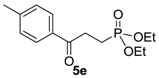
Diethyl 3-oxo-3-p-tolyl propylphosphonate, 5e
The compound 5e was obtained as a yellow solid. Yield 88% (41 mg, containing 90% of 5e and ca. 10% of triphenyl phosphine oxide, 5e was obtained in a yield of 88%). Rf= 0.58 (petroleum ether/ethyl acetate = 1:1). 31P-NMR (162 MHz, CDCl3) δ = 31.90 (s, 93%), 29.13 (s, 7%). 1H-NMR (400 MHz, CDCl3) δ = 7.86 (d, J = 8.0 Hz, 2H), 7.66 (dd, J = 12.0, 7.1 Hz, 0.58H), 7.58–7.50 (m, 0.28H), 7.46 (d, J = 5.0 Hz, 0.59H), 7.25 (d, J = 7.9 Hz, 2H), 4.19–4.02 (m, 4H), 3.29–3.18 (m, 2H), 2.40 (s, 3H), 2.22–2.10 (m, 2H), 1.32 (t, J = 7.1 Hz, 6H).
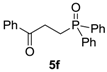
Diphenyl 3-oxo-3-phenyl propylphosphine oxide, 5f
The pure 5f was obtained as a yellow solid. Yield 87% (41 mg). Rf = 0.48 (petroleum ether/ethyl acetate = 1:1), m.p. 94.3–99.1 °C. 31P-NMR (162 MHz, CDCl3) δ = 28.03 (s). 1H-NMR (400 MHz, CDCl3) δ = 7.92 (d, J = 8.3 Hz, 2H), 7.79 (dd, J = 11.4, 8.1 Hz, 4H), 7.71–7.34 (m, 9H), 3.33 (dd, J = 15.8, 7.9 Hz, 2H), 2.74 (dd, J = 16.1, 10.4 Hz, 2H). 13C-NMR (101 MHz, CDCl3) δ = 197.8 (d, J = 14.1 Hz), 136.2 (s), 133.4 (s), 133.0 (s), 131.9 (d, J = 2.7 Hz), 130.8 (d, J = 9.3 Hz), 128.8 (s), 128.7 (s), 128.6 (s), 128.1 (s), 30.7 (s), 23.7 (d, J = 73.9 Hz). HRMS (ESI+) Calcd. for C21H19O2P [M]: 335.1201, Found: 335.1201.
(SP)-Menthyl 3-oxo-3-phenylpropyl phenylphosphine oxide, 5g/5g’
Compound 5g/5g’ was obtained as a yellow solid. Yield 85% (40 mg). Rf = 0.43 (petroleum ether/ethyl acetate = 1:1), m.p. 96.5–100.8 °C. 31P-NMR (162 MHz, CDCl3) δ = 45.87 (s, 20%), 43.78 (s, 80%). 1H-NMR (400 MHz, CDCl3) δ = 7.88 (dd, J = 17.0, 7.7 Hz, 2H), 7.79–7.68 (m, 2H), 7.62–7.44 (m, 4H), 7.40 (t, J = 7.6 Hz, 2H), 3.42 (ddd, J = 18.2, 11.6, 6.2 Hz, 1H), 3.00–2.43 (m, 1H), 2.33–2.14 (m, 2H), 2.11–1.88 (m, 3H), 1.73 (d, J = 8.8 Hz, 3H), 1.46–1.19 (m, 3H), 1.03 (dd, J = 29.4, 16.0 Hz, 1H), 0.92 (d, J = 6.3 Hz, 3H), 0.86 (t, J = 6.3 Hz, 4H), 0.79 (d, J = 6.9 Hz, 1H), 0.39 (d, J = 6.7 Hz, 2H). 13C-NMR (101 MHz, CDCl3) δ = 198.4 (d, J = 13.0 Hz), 133.7 (d, J = 93.4 Hz), 131.6–130.9 (m), 130.6 (d, J = 8.6 Hz), 128.5 (t, J = 5.4 Hz), 128.0 (d, J = 4.4 Hz), 43.4 (d, J = 3.3 Hz), 41.5 (dd, J = 67.3, 51.8 Hz), 35.8 (d, J = 78.0 Hz), 34.2 (s), 33.2 (dd, J = 13.2, 7.4 Hz), 30.6 (s), 28.4 (d, J = 19.9 Hz), 24.6 (d, J = 12.3 Hz), 22.2 (d, J = 57.4 Hz), 21.5–21.2 (m), 15.4 (d, J = 55.2 Hz). HRMS (ESI+) Calcd. for C25H33O2P [M]: 397.2296, Found: 397.2303.
3.2.6. Preparation of γ-Amino Phosphorous Derivatives 11
(SP)-Menthyl-3-butylamino-3-phenylpropyl phenylphosphinate, 11aa
To a solution of 1a (50 mg, 0.116 mmol), palladium acetate (1.3 mg, 0.058 mmol, 5 mol %), and triphenyl phosphine (6.1 mg, 0.232 mmol, 20 mol %) in toluene (0.5 mL), 3a (22 µL, 0.225 mmol) was added. The mixture was heated at 120 °C for 24 h, monitored with TLC, and then cooled to room temperature. Ethanol (2 mL) and sodium borohydride (8.7 mg, 0.232 mmol) were added. The mixture was stirred at room temperature for 10 h. After a saturated solution of ammonium chloride (3 mL) was added, the mixture was extracted with dichloromethane (3 × 5 mL) and washed with water (3 × 3 mL). The residue was purified with preparative TLC with Rf = 0.40 (silica gel, methanol/dichloromethane = 1/20 as eluent). The pure 11aa was obtained as a yellow oil. Yield 87% (47 mg). 31P-NMR (162 MHz, CDCl3) δ = 37.39 (s). 1H-NMR (400 MHz, CDCl3) δ = 7.77–7.65 (m, 2H), 7.52 (t, J = 7.3 Hz, 1H), 7.49–7.39 (m, 2H), 7.29 (dd, J = 12.3, 5.9 Hz, 5H), 4.27–4.09 (m, 1H), 3.77 (d, J = 33.2 Hz, 1H), 2.46 (d, J = 7.1 Hz, 2H), 2.23–1.93 (m, 3H), 1.84 (dt, J = 36.0, 14.3 Hz, 2H), 1.74–1.55 (m, 4H), 1.55–1.44 (m, 2H), 1.38–1.18 (m, 4H), 1.03–0.88 (m, 5H), 0.82 (ddd, J = 12.1, 7.0, 3.6 Hz, 6H), 0.77–0.68 (m, 3H). 13C-NMR (101 MHz, CDCl3) δ = 143.1 (s), 133.5 (d, J = 22.0 Hz), 132.3 (d, J = 21.5 Hz), 131.8 (d, J = 2.6 Hz), 131.4 (d, J = 2.2 Hz), 131.3 (d, J = 2.2 Hz), 128.5–128.3 (m), 128.2 (s), 127.2 (t, J = 7.1 Hz), 76.4–76.1 (m), 64.0–63.2 (m), 48.8 (d, J = 4.4 Hz), 47.3 (d, J = 4.3 Hz), 43.2 (s), 34.1 (s), 32.3 (s), 31.4 (s), 29.7 (s), 27.0 (dd, J = 100.8, 10.1 Hz), 25.6 (s), 22.8 (s), 21.9 (s), 21.1 (s), 20.4 (s), 15.7 (d, J = 2.6 Hz), 13.9 (s). HRMS (ESI+) Calcd. for C29H44NO2P [M]: 470.3188, Found: 470.3188.
(SP)-Menthyl-3-phenethylamino-3-phenylpropyl phenylphosphinate, 11ab
The pure 11ab was obtained as a yellow oil. Yield 83% (35 mg). Rf = 0.46 (methanol/dichloromethane = 1:20). 31P-NMR (162 MHz, CDCl3) δ = 43.35 (s, 48%), 43.20 (s, 52%). 1H-NMR (400 MHz, CDCl3) δ = 7.69 (dd, J = 19.5, 10.4 Hz, 2H), 7.57–7.38 (m, 4H), 7.29 (s, 2H), 7.24 (d, J = 7.4 Hz, 2H), 7.15 (dd, J = 22.6, 10.8 Hz, 5H), 4.01–3.86 (m, 1H), 3.59 (s, 1H), 2.80–2.59 (m, 4H), 2.30 (s, 1H), 2.00–1.78 (m, 5H), 1.60 (s, 4H), 1.31–1.10 (m, 3H), 0.84 (dd, J = 37.1, 6.5 Hz, 8H), 0.36–0.21 (m, 3H). 13C-NMR (101 MHz, CDCl3) δ = 142.8 (s), 139.9 (s), 131.9 (s), 131.4 (dd, J = 9.7, 5.2 Hz), 130.7 (d, J = 11.8 Hz), 128.6 (s), 128.4 (d, J = 1.6 Hz), 128.4 (d, J = 3.6 Hz), 128.3 (s), 127.3 (d, J = 3.0 Hz), 127.2 (s), 126.1 (s), 76.6 (d, J = 2.4 Hz), 63.4 (dd, J = 16.4, 9.0 Hz), 48.7 (d, J = 6.7 Hz), 48.6 (d, J = 3.6 Hz), 43.9 (s), 36.3 (s), 34.1 (s), 31.5 (s), 29.6 (s), 26.5 (d, J = 101.8 Hz), 25.3 (s), 22.6 (s), 22.0 (s), 21.0 (s), 15.1 (d, J = 4.6 Hz). HRMS (ESI+) Calcd. for C33H44NO2P [M]: 518.3188, Found: 518.3185.
(SP)-Menthyl 3-phenyl-3-pyrrolidin-1-yl propylphosphinate, 11ac
The pure 11ac was obtained as a yellow oil. Yield 83% (35 mg). Rf = 0.40 (methanol/dichloromethane = 1:20). 31P-NMR (162 MHz, CDCl3) δ = 42.71 (s, 51%), 42.50 (s, 49%). 1H-NMR (400 MHz, CDCl3) δ = 7.65 (dd, J = 18.9, 10.6 Hz, 2H), 7.48 (s, 1H), 7.40 (s, 2H), 7.29–7.19 (m, 3H), 7.16 (t, J = 7.1 Hz, 2H), 4.28–4.13 (m, 1H), 3.04 (d, J = 5.5 Hz, 1H), 2.45 (s, 2H), 2.27 (s, 2H), 2.20–2.04 (m, 2H), 1.97 (s, 2H), 1.77–1.43 (m, 9H), 1.30 (dd, J = 26.6, 13.7 Hz, 2H), 1.03–0.84 (m, 5H), 0.80 (t, J = 7.7 Hz, 3H), 0.70 (t, J = 5.4 Hz, 3H). 13C-NMR (101 MHz, CDCl3) δ = 141.9 (d, J = 19.1 Hz), 132.9 (dd, J = 124.2, 57.6 Hz), 131.9–131.7 (m), 131.3 (dd, J = 12.2, 9.8 Hz), 128.3 (s), 128.2 (s), 128.2 (s), 128.1 (s), 127.1 (d, J = 7.5 Hz), 76.2 (dd, J = 18.1, 7.4 Hz), 70.9 (dd, J = 37.9, 17.2 Hz), 52.7 (s), 52.4 (s), 48.9–48.6 (m), 43.1 (d, J = 7.7 Hz), 34.0 (s), 31.4 (d, J = 1.7 Hz), 27.6 (d, J = 4.7 Hz), 26.5 (dd, J = 101.2, 19.3 Hz), 25.6 (s), 23.2 (d, J = 2.5 Hz), 22.8 (s), 21.9 (s), 21.1 (s), 15.6 (d, J = 3.8 Hz). HRMS (ESI+) Calcd. for C29H42NO2P [M + H+]: 468.3031, Found: 468.3027.
Ethyl 3-butylamino-3-phenylpropyl phenylphosphinate, 11ba
The pure 11ba was obtained as a yellow oil. Yield 90% (50 mg). Rf = 0.41 (ethyl acetate). 31P-NMR (162 MHz, CDCl3) δ = 44.85 (s). 1H-NMR (400 MHz, CDCl3) δ = 7.70 (ddd, J = 11.6, 9.2, 6.8 Hz, 2H), 7.57–7.49 (m, 1H), 7.49–7.37 (m, 2H), 7.30 (d, J = 7.0 Hz, 1H), 7.25–7.21 (m, 1H), 7.18 (d, J = 7.2 Hz, 2H), 4.03 (dt, J = 20.1, 6.4 Hz, 1H), 3.80 (dt, J = 12.4, 7.3 Hz, 1H), 3.55 (dd, J = 12.8, 6.5 Hz, 1H), 2.37 (dt, J = 6.9, 5.1 Hz, 2H), 2.05–1.63 (m, 5H), 1.52 (s, 1H), 1.36 (d, J = 4.2 Hz, 2H), 1.25 (td, J = 7.0, 3.8 Hz, 5H), 0.84 (t, J = 7.3 Hz, 3H). 13C-NMR (101 MHz, CDCl3) δ = 143.1 (s), 132.1 (d, J = 2.7 Hz), 131.6 (s), 131.5 (s), 130.2 (d, J = 15.7 Hz), 128.6 (s), 128.5 (s), 128.4 (s), 127.5–127.0 (m), 63.6 (d, J = 18.8 Hz), 60.5 (d, J = 6.2 Hz), 47.3 (d, J = 3.8 Hz), 32.3 (s), 29.6 (d, J = 2.8 Hz), 26.3 (dd, J = 101.3, 21.0 Hz), 20.4 (s), 16.4 (d, J = 6.5 Hz), 13.9 (s). HRMS (ESI+) Calcd. for C21H30NO2P [M]: 360.2092, Found: 360.2094.
Ethyl 3-phenethylamino-3-phenylpropyl phenylphosphinate, 11bb
The pure 11bb was obtained as a yellow oil. Yield 85% (54 mg). Rf = 0.32 (ethyl acetate). 31P-NMR (162 MHz, CDCl3) δ = 44.76 (s). 1H-NMR (400 MHz, CDCl3) δ = 7.68 (ddd, J = 11.3, 9.9, 4.3 Hz, 2H), 7.53 (t, J = 6.8 Hz, 1H), 7.44 (dd, J = 8.9, 5.8 Hz, 2H), 7.26 (dt, J = 10.8, 7.3 Hz, 5H), 7.18 (d, J = 7.3 Hz, 1H), 7.12 (t, J = 8.3 Hz, 4H), 4.07–3.95 (m, 1H), 3.85–3.72 (m, 1H), 3.56 (dd, J = 12.5, 6.0 Hz, 1H), 2.78–2.59 (m, 4H), 2.01–1.60 (m, 5H), 1.24 (td, J = 7.0, 2.7 Hz, 3H). 13C-NMR (101 MHz, CDCl3) δ = 142.8 (s), 139.9 (s), 132.1 (d, J = 2.7 Hz), 131.6 (s), 131.5 (s), 131.4–130.0 (m), 128.6 (s), 128.5 (d, J = 1.5 Hz), 128.4 (s), 127.2 (d, J = 4.4 Hz), 127.1 (s), 126.1 (s), 63.4 (d, J = 17.4 Hz), 60.5 (d, J = 4.3 Hz), 48.6 (d, J = 3.4 Hz), 36.4 (s), 29.6 (d, J = 2.8 Hz), 26.3 (dd, J = 101.4, 21.2 Hz), 16.4 (d, J = 6.3 Hz). HRMS (ESI+) Calcd. for C25H30NO2P [M]: 408.2092, Found: 408.2107.
Diethyl 3-butylamino-3-phenyl propylphosphonate, 11ca
The pure 11ca was obtained as a yellow oil. Yield 86% (49 mg). Rf = 0.36 (ethyl acetate). 31P-NMR (162 MHz, CDCl3) δ = 32.49 (s). 1H-NMR (400 MHz, CDCl3) δ = 7.35–7.28 (m, 2H), 7.25 (d, J = 7.3 Hz, 3H), 4.10–3.90 (m, 4H), 3.59 (t, J = 6.7 Hz, 1H), 2.50–2.31 (m, 2H), 1.93 (tdd, J = 23.7, 21.5, 16.4 Hz, 3H), 1.79–1.50 (m, 3H), 1.40 (dt, J = 11.9, 7.0 Hz, 2H), 1.32–1.16 (m, 8H), 0.86 (t, J = 7.3 Hz, 3H). 13C-NMR (101 MHz, CDCl3) δ = 143.1 (s), 128.5 (s), 127.2 (s), 127.1 (s), 63.5 (d, J = 17.9 Hz), 61.5 (d, J = 1.4 Hz), 61.4 (d, J = 1.2 Hz), 47.3 (s), 32.3 (s), 30.4 (d, J = 4.4 Hz), 23.0 (s), 21.6 (s), 20.4 (s), 16.4 (d, J = 1.3 Hz), 16.3 (d, J = 2.0 Hz), 13.9 (s). HRMS (ESI+) Calcd. for C17H30NO3P [M]: 328.2042, Found: 328.2083.
Diethyl 3-phenylethylamino-3-phenyl propylphosphonate, 11cb
The pure 11cb was obtained as a yellow oil. Yield 79% (51 mg). Rf = 0.85 (petroleum ether:ethyl acetate = 1:3). 31P-NMR (162 MHz, CDCl3) δ = 32.38 (s). 1H-NMR (400 MHz, CDCl3) δ = 7.33–7.28 (m, 2H), 7.25 (dd, J = 6.5, 3.2 Hz, 3H), 7.22–7.17 (m, 3H), 7.14 (d, J = 6.9 Hz, 2H), 4.11–3.94 (m, 4H), 3.67–3.56 (m, 1H), 2.78–2.67 (m, 4H), 1.70–1.47 (m, 4H), 1.27 (td, J = 7.0, 3.5 Hz, 6H). 13C-NMR (101 MHz, CDCl3) δ = 142.8 (s), 139.9 (s), 128.7 (s), 128.5 (s), 128.4 (s), 127.3 (s), 127.1 (s), 126.1 (s), 110.0 (s), 63.3 (d, J = 17.8 Hz), 61.4 (d, J = 6.4 Hz), 48.6 (s), 36.4 (s), 30.4 (d, J = 4.3 Hz), 23.0 (s), 21.6 (s), 16.4 (dd, J = 6.0, 1.6 Hz). HRMS (ESI+) Calcd. for C21H30NO3P [M]: 376.2042, Found: 376.2041.
Dimenthyl 3-butylamino-3-phenyl propylphosphonate, 11da
The pure 11da was obtained as a yellow oil. Yield 77% (49 mg). Rf = 0.78 (petroleum ether:ethyl acetate = 1:3). 31P-NMR (162 MHz, CDCl3) δ = 30.07 (s). 1H-NMR (400 MHz, CDCl3) δ = 7.32 (d, J = 7.0 Hz, 2H), 7.30–7.24 (m, 3H), 4.21–4.04 (m, 2H), 3.62 (t, J = 6.7 Hz, 1H), 2.46 (d, J = 7.6 Hz, 2H), 2.21 (d, J = 11.4 Hz, 2H), 2.16–2.07 (m, 1H), 1.97 (ddd, J = 26.2, 16.9, 8.2 Hz, 3H), 1.77–1.51 (m, 10H), 1.50–1.37 (m, 5H), 1.37–1.22 (m, 5H), 1.15–0.96 (m, 2H), 0.91 (dd, J = 5.2, 2.0 Hz, 11H), 0.88 (dd, J = 6.9, 3.7 Hz, 3H), 0.81–0.78 (m, 3H), 0.74 (d, J = 6.9, 1H), 0.69 (d, J = 6.9, 1H). 13C-NMR (101 MHz, CDCl3) δ = 143.3 (s), 128.4 (s), 127.2 (dd, J = 8.8, 5.8 Hz), 77.3 (s), 77.1–76.5 (m), 63.7 (d, J = 18.0 Hz), 48.6 (d, J = 6.5 Hz), 47.4 (s), 43.7 (d, J = 7.9 Hz), 43.0 (d, J = 15.4 Hz), 34.1 (s), 32.4 (s), 31.6–31.2 (m), 30.9 (s), 25.6–25.1 (m), 23.7 (s), 22.7 (t, J = 5.6 Hz), 21.9 (s), 21.03 (s), 20.0 (s), 15.7 (dd, J = 26.2, 7.1 Hz), 13.9 (s). HRMS (ESI+) Calcd. for C33H58NO3P [M + H+]: 548.4233, Found: 548.4224.
Dimenthyl 3-phenylethylamino-3-phenyl propylphosphonate, 11db
The pure 11db was obtained as a yellow oil. Yield 77% (49 mg). Rf = 0.66 (petroleum ether:ethyl acetate = 1:3). 31P-NMR (162 MHz, CDCl3) δ = 29.96 (s, 50%), 29.94 (s, 50%). 1H-NMR (400 MHz, CDCl3) δ = 7.29 (d, J = 7.3 Hz, 3H), 7.23 (d, J = 5.6 Hz, 2H), 7.20 (d, J = 8.0 Hz, 3H), 7.14 (d, J = 8.0 Hz, 2H), 4.17–4.03 (m, 2H), 3.61 (dd, J = 13.1, 5.4 Hz, 1H), 2.73 (t, J = 6.3 Hz, 4H), 2.12 (d, J = 34.5 Hz, 3H), 1.94 (dd, J = 13.8, 7.0 Hz, 2H), 1.69–1.35 (m, 10H), 1.25 (s, 2H), 1.14–1.02 (m, 2H), 0.95 (dd, J = 21.1, 9.0 Hz, 3H), 0.91–0.84 (m, 12H), 0.78 (t, J = 8.4 Hz, 4H), 0.70 (d, J = 6.9 Hz, 1H), 0.65 (d, J = 6.9 Hz, 1H). 13C-NMR (101 MHz, CDCl3) δ = 142.9 (s), 140.0 (s), 128.7–128.3 (m), 127.2 (d, J = 6.7 Hz), 126.1 (s), 77.3 (s), 77.0 (s), 76.7 (s), 63.5 (d, J = 17.8 Hz), 49.1–48.1 (m), 43.7 (d, J = 8.2 Hz), 43.0 (d, J = 15.8 Hz), 36.4 (s), 34.1 (s), 32.0–31.3 (m), 30.9 (s), 29.7 (s), 25.3 (t, J = 18.1 Hz), 23.6 (d, J = 11.0 Hz), 22.7 (t, J = 5.5 Hz), 22.0 (d, J = 3.5 Hz), 21.1 (s), 15.8 (d, J = 5.7 Hz), 15.5 (d, J = 7.7 Hz). HRMS (ESI+) Calcd. for C37H58NO3P [M + H+]: 596.4233, Found: 596.4224.
Dimenthyl 3-phenyl-3-pyrrolidin-1-yl propylphosphonate, 11dc
The pure 11dc was obtained as a yellow oil. Yield 77% (49 mg). Rf = 0.80 (petroleum ether:ethyl acetate = 1:3). 31P-NMR (162 MHz, CDCl3) δ = 30.23 (s, 61%), 30.19 (s, 39%). 1H-NMR (400 MHz, CDCl3) δ = 7.26 (t, J = 13.1 Hz, 5H), 4.15–4.02 (m, 2H), 3.08 (d, J = 5.7 Hz, 1H), 2.53 (s, 1H), 2.36 (s, 2H), 2.15 (s, 3H), 1.99 (s, 2H), 1.67 (dd, J = 32.6, 15.7 Hz, 11H), 1.41 (s, 4H), 1.25 (s, 4H), 1.07 (dd, J = 22.6, 10.9 Hz, 2H), 0.87 (dd, J = 11.9, 6.6 Hz, 12H), 0.79–0.75 (m, 3H), 0.71 (d, J = 7.0 Hz, 2H), 0.63 (d, J = 6.9 Hz, 2H). 13C-NMR (101 MHz, CDCl3) δ = 142.1 (s), 128.3–127.9 (m), 127.1 (s), 77.3 (s), 77.0 (s), 76.7 (s), 71.1 (s), 52.7 (s), 48.5 (s), 43.8 (s), 43.0 (d, J = 18.4 Hz), 34.1 (s), 31.5 (d, J = 4.6 Hz), 29.7 (s), 29.0 (s), 25.7–24.8 (m), 23.3 (s), 22.7 (s), 21.9 (s), 21.1 (s), 15.6 (dd, J = 25.7, 12.3 Hz). HRMS (ESI+) Calcd. for C33H56NO3P [M + H+]: 546.4076, Found: 546.4069.
Dimenthyl-3-methyl phenylamino-3-phenyl propylphosphonate, 11dd
The pure 11dd was obtained as a yellow oil. Yield 62% (35 mg). Rf = 0.74 (petroleum ether:ethyl acetate = 1:3). 31P-NMR (162 MHz, CDCl3) δ = 30.28 (s, 50%), 30.26 (s, 50%). 1H-NMR (400 MHz, CDCl3) δ = 7.36–7.28 (m, 3H), 7.23 (dd, J = 18.7, 7.4 Hz, 6H), 7.13 (d, J = 7.4 Hz, 1H), 4.10 (s, 2H), 3.68 (dd, J = 29.0, 6.3 Hz, 1H), 3.48–3.24 (m, 1H), 2.13 (d, J = 41.4 Hz, 2H), 2.00 (s, 1H), 1.89–1.79 (m, 1H), 1.63 (d, J = 10.8 Hz, 8H), 1.40 (s, 2H), 1.32 (d, J = 6.3 Hz, 1H), 1.24 (d, J = 7.0 Hz, 4H), 1.10–0.97 (m, 2H), 0.87 (d, J = 6.3 Hz, 12H), 0.82 (d, J = 11.6 Hz, 2H), 0.77 (t, J = 7.1 Hz, 3H), 0.70 (d, J = 6.5 Hz, 3H). 13C-NMR (101 MHz, CDCl3) δ = 128.4 (d, J = 9.3 Hz), 127.4–126.6 (m), 126.5 (s), 77.3 (s), 77.1–76.5 (m), 60.2 (d, J = 18.3 Hz), 54.6 (s), 48.5 (s), 43.7 (s), 43.0 (d, J = 9.3 Hz), 34.1 (s), 31.5 (d, J = 10.2 Hz), 30.2 (s), 29.7 (s), 25.4 (dd, J = 28.7, 10.2 Hz), 23.0–22.6 (m), 22.3 (d, J = 12.6 Hz), 22.0 (d, J = 2.9 Hz), 21.1 (s), 15.8 (d, J = 7.0 Hz), 15.6 (s), 14.0 (s). HRMS (ESI+) Calcd. for C36H56NO3P [M + H+]: 582.4076, Found: 582.4080.
Diethyl 3-butylamino-3-p-tolyl propylphosphonate, 11ea
The pure 11ea was obtained as a yellow oil. Yield 83% (47 mg). Rf = 0.70 (dichloromethane/methanol = 20:1). 31P-NMR (162 MHz, CDCl3) δ = 32.57 (s). 1H-NMR (400 MHz, CDCl3) δ = 7.12 (d, J = 8.6 Hz, 4H), 4.09–3.97 (m, 4H), 3.56 (t, J = 6.7 Hz, 1H), 2.51–2.38 (m, 2H), 2.33 (s, 3H), 2.04–1.79 (m, 2H), 1.64 (dddd, J = 26.4, 19.3, 15.4, 4.8 Hz, 3H), 1.48–1.36 (m, 2H), 1.34–1.21 (m, 8H), 0.86 (t, J = 7.2 Hz, 3H). 13C-NMR (101 MHz, CDCl3) δ = 140.1 (s), 136.7 (s), 129.1 (s), 127.0 (s), 63.2 (d, J = 17.9 Hz), 61.4 (d, J = 2.2 Hz), 61.3 (d, J=2.1 Hz), 53.4 (s), 47.3 (s), 32.4 (s), 30.4 (d, J = 4.3 Hz), 29.6 (s), 23.1 (s), 21.7 (s), 21.0 (s), 20.4 (s), 16.4 (d, J = 6.0 Hz), 13.9 (s). HRMS (ESI+) Calcd. for C18H32NO3P [M]: 342.2198, Found: 342.2234.
Diethyl 3-phenethylamino-3-p-tolyl propylphosphonate, 11eb
The pure 11eb was obtained as a yellow oil. Yield 77% (49 mg). Rf = 0.65 (dichloromethane/methanol = 20:1). 31P-NMR (162 MHz, CDCl3) δ = 32.46 (s). 1H-NMR (400 MHz, CDCl3) δ = 7.25 (dd, J = 8.4, 5.8 Hz, 2H), 7.22–7.05 (m, 7H), 4.26–3.89 (m, 4H), 3.57 (t, J = 6.7 Hz, 1H), 2.95–2.55 (m, 4H), 2.32 (s, 3H), 2.29–1.81 (m, 2H), 1.74–1.47 (m, 3H), 1.26 (td, J = 7.0, 3.1 Hz, 6H). 13C-NMR (101 MHz, CDCl3) δ = 139.9 (d, J = 21.9 Hz), 136.8 (s), 129.1 (s), 128.6 (s), 128.3 (s), 127.0 (s), 126.0 (s), 63.0 (d, J = 17.9 Hz), 61.4 (d, J = 1.1 Hz), 61.3 (d, J = 1.1 Hz), 53.4 (s), 48.6 (s), 36.4 (s), 30.4 (d, J = 4.3 Hz), 23.0 (s), 21.6 (s), 21.0 (s), 16.4 (d, J = 0.7 Hz). HRMS (ESI+) Calcd. for C22H32NO3P [M]: 391.2276, Found: 391.2232.
Diphenyl 3-butylamino-3-phenylpropyl phosphine oxide, 11fa
The pure 11fa was obtained as a yellow oil. Yield 80% (44 mg). Rf = 0.50 (dichloromethane/methanol = 20:1). 31P-NMR (162 MHz, CDCl3) δ = 33.05 (s). 1H-NMR (400 MHz, CDCl3) δ = 7.62 (dd, J = 10.8, 7.9 Hz, 4H), 7.52–7.45 (m, 2H), 7.41 (qd, J = 7.1, 3.5 Hz, 4H), 7.31 (t, J = 7.2 Hz, 2H), 7.28–7.24 (m, 1H), 7.21 (t, J = 6.4 Hz, 2H), 3.66–3.58 (m, 1H), 2.45–2.32 (m, 2H), 2.30–2.18 (m, 1H), 2.18–1.96 (m, 3H), 1.91 (ddd, J = 20.6, 12.6, 6.4 Hz, 1H), 1.44–1.32 (m, 2H), 1.31–1.18 (m, 2H), 0.84 (t, J = 7.3 Hz, 3H). 13C-NMR (101 MHz, CDCl3) δ = 143.0 (s), 132.9 (dd, J = 98.4, 46.3 Hz), 131.6 (s), 130.8 (s), 130.7 (d, J = 2.2 Hz), 130.6 (s), 128.6 (s), 128.5 (d, J = 4.3 Hz), 127.2 (s), 63.6 (d, J = 14.6 Hz), 47.3 (s), 32.3 (s), 29.3 (d, J = 3.0 Hz), 26.0 (d, J = 72.6 Hz), 20.4 (s), 14.0 (s). HRMS (ESI+) Calcd. for C25H30NOP [M]: 392.2143, Found: 392.2147.
To a solution of 1a (1.02 g, 2.89 mmol), palladium acetate (32.5 mg, 0.145 mmol, 5 mol %), and triphenyl phosphine (0.152 g, 0.580 mmol, 20 mol %) in toluene (2 mL), 3a (0.63 mL, 6.36 mmol) was added. The mixture was heated at 120 °C for 24 h and monitored with TLC. After the reaction was completed, the mixture was cooled to room temperature. Ethanol (5 mL) and sodium borohydride (0.44 g, 11.6 mmol) were added. The mixture was stirred at room temperature for 14 h. After a saturated solution of ammonium chloride (10 mL) was added, the mixture was extracted with dichloromethane (3 × 15 mL) and washed with water (3 × 10 mL). The crude product was obtained as a red oil in a 66% yield (estimated by a 31P-NMR spectrum). The residue was dissolved in ethanol (5 mL), acidified to pH = 2 with diluted hydrochloric acid (ca. 7%, 6 mL), and then the ethanol was removed in vacuo. The residue was washed with ether (5 × 5 mL), and the aqueous phase was neutralized with saturated sodium bicarbonate solution (10 mL) until pH = 9. The mixture was extracted with dichloromethane (3 × 15 mL). After drying and removal of the solvent, 11fa was obtained as a yellow oil. Yield 59% (0.67 g). 11fa gave similar spectrum data to those above.
Diphenyl 3-phenethylamino-3-phenyl propylphosphine oxide, 11fb
The pure 11fb was obtained as a yellow oil. Yield 82% (51 mg). Rf = 0.53 (dichloromethane/methanol = 15:1). 31P-NMR δ = 33.02 (s). 1H-NMR (400 MHz, CDCl3) δ = 7.60 (dd, J = 10.0, 8.5 Hz, 4H), 7.54–7.45 (m, 2H), 7.41 (t, J = 7.2 Hz, 4H), 7.33–7.21 (m, 5H), 7.20–7.08 (m, 5H), 3.63 (t, J = 6.4 Hz, 1H), 2.81–2.60 (m, 4H), 2.28–2.15 (m, 1H), 2.14–2.04 (m, 1H), 2.04–1.94 (m, 1H), 1.94–1.81 (m, 1H). 13C-NMR (101 MHz, CDCl3) δ = 142.7 (s), 139.9 (s), 133.3 (d, J = 43.1 Hz), 132.4 (d, J = 43.0 Hz), 131.6 (s), 130.8 (s), 130.7 (s), 130.6 (s), 128.7 (d, J = 2.7 Hz), 128.5 (d, J = 2.1 Hz), 128.4 (s), 127.3 (d, J = 9.0 Hz), 126.1 (s), 63.4 (d, J = 14.6 Hz), 48.5 (s), 36.3 (s), 29.3 (d, J = 3.3 Hz), 26.0 (d, J = 72.6 Hz). HRMS (ESI+) Calcd. for C29H30NOP [M]: 440.2143, Found: 440.2142.
(SP)-Menthyl-3-butylamino-3-phenylpropyl phenylphosphine oxide, 11gaA/11gaB
Compound 11gaA/11gaB was obtained as a yellow oil. Yield 85% (56 mg). Rf = 0.46 (dichloromethane/methanol = 15:1). 31P-NMR (162 MHz, CDCl3) δ = 43.39 (s). 1H-NMR (400 MHz, CDCl3) δ = 7.58–7.51 (m, 2H), 7.48–7.39 (m, 3H), 7.29 (dd, J = 13.9, 6.5 Hz, 3H), 7.16 (d, J = 6.7 Hz, 2H), 3.59–3.51 (m, 1H), 2.43–2.27 (m, 2H), 2.13–1.89 (m, 5H), 1.88–1.77 (m, 1H), 1.67 (d, J = 10.8 Hz, 3H), 1.54–1.42 (m, 2H), 1.39–1.19 (m, 5H), 1.17–1.03 (m, 2H), 0.95 (dd, J = 23.2, 12.7 Hz, 2H), 0.86 (d, J = 6.6 Hz, 4H), 0.82 (d, J = 7.2 Hz, 2H), 0.78 (d, J = 6.8 Hz, 2H), 0.29 (d, J = 6.7 Hz, 3H). 13C-NMR (101 MHz, CDCl3) δ = 143.2 (s), 134.2 (d, J = 87.4 Hz), 130.8 (d, J = 2.6 Hz), 130.5 (d, J = 8.4 Hz), 128.4–128.2 (m), 127.4 (s), 127.1 (s), 63.9 (d, J = 13.6 Hz), 53.4 (s), 47.3 (s), 43.1 (s), 41.1 (s), 40.4 (s), 35.1 (s), 34.2 (s), 33.1 (d, J = 14.7 Hz), 32.2 (s), 29.1 (s), 28.1 (s), 24.6 (s), 24.3 (d, J = 2.3 Hz), 23.9 (s), 22.5 (s), 21.5 (s), 20.3 (s), 15.1 (s), 13.9 (s). HRMS (ESI+) Calcd. for C29H44NOP [M]: 454.3239, Found: 454.3248.
(SP)-Menthyl 3-phenethylamino-3-phenylpropyl phenylphosphine oxide, 11gbA/11gbB, 11gbA’/11gbB’
Compound 11gbA/11gbB, 11gbA’/11gbB’ was obtained as a yellow oil. Yield 87% (52 mg). Rf = 0.41 (dichloromethane/methanol = 20:1). 31P-NMR (162 MHz, CDCl3) δ = 45.80 (s, 17%), 45.34 (s, 23%), 43.44 (s, 31%), 43.28 (s, 29%). 1H-NMR (400 MHz, CDCl3) δ = 7.62–7.48 (m, 3H), 7.43 (dd, J = 7.4, 5.8 Hz, 2H), 7.35–7.22 (m, 5H), 7.21–7.07 (m, 5H), 3.65–3.53 (m, 1H), 2.79–2.46 (m, 4H), 2.10–1.81 (m, 4H), 1.78–1.41 (m, 7H), 1.26 (s, 2H), 1.16–0.94 (m, 2H), 0.87 (dd, J = 8.6, 6.5 Hz, 2H), 0.78 (dd, J = 9.3, 4.7 Hz, 4H), 0.75–0.70 (m, 1H), 0.31 (dd, J = 10.9, 6.8 Hz, 2H). 13C-NMR (101 MHz, CDCl3) δ = 143.0 (dd, J = 8.5, 6.1 Hz), 140.2–139.9 (m), 134.8–134.4 (m), 133.8 (d, J = 20.0 Hz), 131.2–130.9 (m), 130.8 (d, J = 3.3 Hz), 130.5 (dd, J = 8.5, 2.4 Hz), 128.6 (d, J = 4.4 Hz), 128.4 (d, J = 1.3 Hz), 128.3 (s), 128.2 (s), 128.0 (d, J = 4.2 Hz), 127.4 (s), 127.2–127.1 (m), 127.0 (d, J = 3.8 Hz), 126.0 (d, J = 1.5 Hz), 63.7–63.1 (m), 48.5 (dd, J = 13.3, 7.8 Hz), 43.5–43.1 (m), 41.6–40.4 (m), 37.0–36.8 (m), 36.2 (t, J = 11.7 Hz), 35.2 (dd, J = 15.5, 2.3 Hz), 34.2 (s), 33.2 (ddd, J = 13.3, 7.4, 4.1 Hz), 29.7 (s), 29.6–29.0 (m), 28.3 (dd, J = 22.1, 5.1 Hz), 25.3 (d, J = 4.4 Hz), 24.8–24.5 (m), 24.1 (d, J = 66.2 Hz), 22.5 (d, J = 3.3 Hz), 21.5–21.2 (m), 15.7–15.0 (m). HRMS (ESI+) Calcd. for C33H44NOP [M]: 502.3239, Found: 502.3238.
3.2.7. Preparation of γ-Hydroxy Phosphorous Derivatives 12
Diphenyl 3-hydroxy-3-phenylprop-1-en-1-ylphosphine oxide, 12a
To a solution of 1f (50 mg, 0.142 mmol), palladium acetate (1.6 mg, 0.007 mmol), and triphenyl phosphine (7.4 mg, 0.284 mmol) in toluene (0.5 mL), 3a (31 µL, 0.312 mmol) was added. The mixture was heated at 120 °C for 24 h and monitored with TLC, and then cooled to room temperature. Water (3 µL, 0.142 mmol) and sodium borohydride (10.8 mg, 0.284 mmol) were added. The mixture was stirred at room temperature for 13 h. After a saturated solution of ammonium chloride (3 mL) was added, the mixture was extracted with dichloromethane (3 × 5 mL) and washed with water (3 × 3 mL). The combined organic layer was dried over anhydrous magnesium sulfate and concentrated in vacuo. The residue was purified with preparative TLC. Rf = 0.63 (silica gel, petroleum ether/ethyl acetate = 1/5 as eluent). The pure 12a was obtained as a white solid. Yield 70% (33 mg), m.p. 142.2–144.6 °C. 31P-NMR (162 MHz, CDCl3) δ = 34.53 (s). 1H-NMR (400 MHz, CDCl3) δ = 7.73–7.62 (m, 4H), 7.54–7.47 (m, 2H), 7.44 (dd, J = 6.9, 3.3 Hz, 4H), 7.29 (dd, J = 8.1, 4.8 Hz, 4H), 7.25–7.19 (m, 1H), 4.81 (s, 1H), 4.19 (s, 1 H), 2.48–2.27 (m, 2H), 2.16–1.93 (m, 2H). 13C-NMR (101 MHz, CDCl3) δ = 139.3 (s), 128.1 (d, J = 18.6 Hz), 127.1 (s), 126.1 (dd, J = 9.4, 4.4 Hz), 123.9 (dd, J = 11.7, 1.6 Hz), 123.6 (s), 122.6 (s), 121.0 (s), 72.6 (s), 72.3 (s), 71.9 (s), 68.8 (d, J = 10.0 Hz), 26.6 (s), 21.5 (s), 20.8 (s). HRMS (ESI+) Calcd. for C21H21O2P [M + H+]: 337.1357, Found: 337.1362.
Dimenthyl 3-hydroxy-3-phenylprop-1-en-1-ylphosphonate, 12b
Compound 12b was prepared according to a similar procedure to that for the preparation of 12a, which was purified with preparative TLC with Rf = 0.68 (silica gel, petroleum ether/ethyl acetate = 1/3 as eluent), and 12b was obtained as a yellow oil. Yield 55% (26 mg). 31P-NMR (162 MHz, CDCl3) δ = 30.88 (s, 50%), 30.86 (s, 50%). 1H-NMR (400 MHz, CDCl3) δ = 7.76–7.48 (m, 1H), 7.35 (d, J = 4.2 Hz, 3H), 7.27 (s, 1H), 4.80 (s, 1H), 4.24–4.09 (m, 2H), 3.04 (d, J = 12.4 Hz, 1H), 2.22 (s, 2H), 2.17–2.00 (m, 4H), 1.83–1.70 (m, 3H), 1.68–1.58 (m, 7H), 1.44 (d, J = 7.6 Hz, 3H), 1.25 (s, 6H), 1.17–1.06 (m, 2H), 0.90 (d, J = 6.2 Hz, 9H), 0.81–0.77 (m, 3H), 0.76–0.73 (m, 1H). 13C-NMR (101 MHz, CDCl3) δ = 144.0 (s), 128.4 (s), 127.5 (d, J = 2.2 Hz), 125.8 (s), 125.7 (s), 77.2 (d, J = 4.4 Hz), 73.9 (dd, J = 13.2, 6.1 Hz), 48.7–48.6 (m), 48.6–48.5 (m), 43.7 (d, J = 1.8 Hz), 43.1 (d, J = 6.0 Hz), 41.3 (s), 34.6 (d, J = 15.5 Hz), 34.1 (s), 32.2 (dd, J = 5.0, 2.4 Hz), 31.6 (d, J = 1.7 Hz), 31.5 (s), 29.0 (s), 26.9 (s), 25.5 (d, J = 4.9 Hz), 25.3 (s), 22.8 (d, J = 3.3 Hz), 22.6 (d, J = 3.8 Hz), 21.9 (d, J = 2.9 Hz), 21.0 (d, J = 1.7 Hz), 15.8 (d, J = 2.3 Hz), 15.6 (d, J = 2.8 Hz), 14.1 (s), 11.4 (s). HRMS (ESI+) Calcd. for C29H49O4P [M + H+]: 493.3447, Found: 493.3447.
3.2.8. Reaction of 1 with Secondary Amine to Form Functional Phosphorus Derivatives
Dimenthyl 2-benzoyl-4-cyanobutylphosphonate, 13a
To a solution of 1d (50 mg, 0.098 mmol), palladium acetate (1.1 mg, 0.005 mmol, 5 mol %), and triphenyl phosphine (5.1 mg, 0.020 mmol, 20 mol %) in toluene (0.5 mL), pyrrolidine (18 µL, 0.216 mmol) was added. The mixture was heated at 120 °C for 24 h. The removal of toluene and excess pyrrolidine in vacuo afforded the crude enamine 6, which was used in situ. The crude 6 was dissolved in 0.5 mL of dry DMF, acrylonitrile (19 µL, 0.294 mmol) was added, and then the mixture was heated at 120 °C for 36 h. After cooling to room temperature, water (2 mL) was added and the mixture was extracted with dichloromethane (3 × 5 mL). The combined organic layer was washed with water, dried over anhydrous magnesium sulfate, and concentrated in vacuo to give the crude product as a brown oil, which was purified with preparative TLC with Rf = 0.34 (silica gel, dichloromethane/ethyl acetate= 5:1), to give pure 13a as a yellow oil. Yield 56% (28 mg). 31P-NMR (162 MHz, CDCl3) δ = 25.98 (s, 50%), 25.93 (s, 50%). 1H-NMR (400 MHz, CDCl3) δ = 8.02 (t, J = 7.9 Hz, 2H), 7.59 (dd, J = 7.3, 5.4 Hz, 1H), 7.48 (t, J = 7.5 Hz, 2H), 4.20–4.09 (m, 2H), 3.99 (dd, J = 12.4, 6.2 Hz, 1H), 2.44–2.09 (m, 6H), 2.07–1.68 (m, 4H), 1.61 (d, J = 9.0 Hz, 4H), 1.38 (d, J = 3.1 Hz, 2H), 1.15 (tdd, J = 22.6, 20.4, 11.6 Hz, 3H), 1.00–0.92 (m, 2H), 0.86 (dt, J = 11.4, 6.4 Hz, 11H), 0.79 (d, J = 7.0 Hz, 2H), 0.75 (dd, J = 10.6, 4.4 Hz, 7H). 13C-NMR (101 MHz, CDCl3) δ = 200.5 (dd, J = 19.8, 10.3 Hz), 135.8 (d, J = 5.8 Hz), 133.7 (d, J = 4.3 Hz), 128.8 (dd, J = 22.1, 5.6 Hz), 118.8 (s), 78.1 (d, J = 7.4 Hz), 77.9–76.8 (m), 76.7 (s), 48.7–48.1 (m), 43.6 (d, J = 4.7 Hz), 42.9 (d, J = 13.5 Hz), 39.2 (dd, J = 15.9, 3.9 Hz), 34.0 (d, J = 3.3 Hz), 31.5 (dd, J = 10.7, 3.9 Hz), 30.6 (s), 29.1 (s), 28.3 (dd, J = 9.1, 3.9 Hz), 25.7 (d, J = 9.8 Hz), 25.4 (d, J = 6.3 Hz), 22.7 (t, J = 6.3 Hz), 21.9 (d, J = 3.0 Hz), 20.9 (d, J = 11.1 Hz), 15.9–15.4 (m), 14.8 (d, J = 13.2 Hz). IR (KBr) ν/cm−1: 2247, 1685, 1181, 755, 558. HRMS (ESI+) Calcd. for C32H50NO4P [M + Na+]: 566.3375, Found: 566.3373.
Ethyl 4-dimenthylphosphoryl methyl-5-oxo-5-phenylpentanoate, 13b
The enamine 6 was prepared similarly to 13a, which was reacted with ethyl acrylate (31 µL, 0.294 mmol) for 48 h at 120 °C. The crude product was purified with preparative TLC with Rf = 0.41 (silica gel, dichloromethane/ethyl acetate= 20:1) to give pure 13b as a yellow oil. Yield 28% (15 mg). 31P-NMR (162 MHz, CDCl3) δ = 27.98 (s, 50%), 27.85 (s, 50%). 1H-NMR (400 MHz, CDCl3) δ = 8.02 (t, J = 9.1 Hz, 2H), 7.55 (d, J = 6.3 Hz, 1H), 7.46 (t, J = 7.1 Hz, 2H), 4.14–4.04 (m, 4H), 3.96 (s, 1H), 2.44–2.17 (m, 4H), 2.11 (d, J = 7.1 Hz, 2H), 2.05–1.87 (m, 3H), 1.82 (d, J = 17.5 Hz, 1H), 1.72 (s, 1H), 1.59 (s, 4H), 1.36 (s, 2H), 1.19 (t, J = 7.1 Hz, 3H), 1.13–1.01 (m, 2H), 0.98–0.89 (m, 4H), 0.85 (t, J = 6.3 Hz, 8H), 0.80 (d, J = 6.5 Hz, 3H), 0.77 (d, J = 7.5 Hz, 4H), 0.74–0.70 (m, 4H). 13C-NMR (101 MHz, CDCl3) δ = 201.5 (dd, J = 9.3, 6.7 Hz), 172.6 (s), 136.6 (d, J = 5.3 Hz), 133.2 (d, J = 4.0 Hz), 128.6 (dd, J = 7.5, 4.2 Hz), 77.7 (d, J = 7.3 Hz), 77.1 (s), 76.8 (s), 60.4 (s), 48.5 (d, J = 6.7 Hz), 48.4 (d, J = 3.7 Hz), 48.3 (d, J = 7.0 Hz), 43.5 (d, J = 8.3 Hz), 42.8 (d, J = 15.3 Hz), 39.5 (d, J = 3.9 Hz), 39.2 (s), 34.0 (t, J = 3.7 Hz), 31.5 (d, J = 3.5 Hz), 31.4 (s), 31.3 (d, J = 3.0 Hz), 31.2 (s), 30.2 (d, J = 9.7 Hz), 28.8 (dd, J = 26.9, 12.9 Hz), 25.6 (s), 25.5 (s), 25.2 (d, J = 3.0 Hz), 22.7 (d, J = 3.4 Hz), 22.6 (d, J = 4.6 Hz), 21.9 (s), 21.0 (s), 20.9 (s), 15.7 (d, J = 5.0 Hz), 15.6 (s), 14.1 (s). HRMS (ESI+) Calcd. for C34H55NO6P [M + Na+]: 613.3634, Found: 613.3649.
3.2.9. Physical Characterization of the Crystals
Single-crystal X-ray diffraction data for two Schiff base copper complexes, complex 1 and complex 2, were conducted on a Bruker-AXS CCD diffractometer, which was equipped with graphite-monochromated Mo-Ka radiation (λ = 0.71073 Å), at 298 K. All absorption corrections were applied using a multi-scan technique. The structures were solved by the direct method and refined through the full-matrix least-squares method on F2 using the SHELXTL 97 crystallographic software package. The FT-IR spectra were recorded with KBr as pellets in the range 4000–400 cm−1 on a Nicolet 170 SXFT/IR spectrometer (Nicolet, Madison, WI, USA).
4. Conclusions
In summary, the reaction of the phosphorus-containing allyl chloride 1 with an amine could form enamine or imino compounds 6 or 7 in the presence of a palladium catalyst. The reaction was confirmed to proceed via vinyl chloride as an intermediate that was formed from the isomerization of 1. Different to the reported coupling between aryl halides and an amine, the current reaction occurred in the presence of an amine and triphenyl phosphine. The imine or enamine could be converted to derivatives containing various functional groups, such as γ-keto, amino, and hydroxyl groups. When secondary amines were used, the enamine could be alkylated at the β-position via a Stork reaction. Utilizing the current procedure, a wide variety of phosphorus compounds having functional groups were obtained, which we hope will have important uses in biochemistry, pharmacology, and organic synthesis.
Supplementary Materials
The following are available online at http://www.mdpi.com/2073-4344/8/5/194/s1, Part 1. Crystallographic Information. Part 2. The NMR spectrum for the mechanism of 1f with benzyl amine. Part 3. Selected 31P, 1H and 13C-NMR spectroscopy of 1, 2, 4, 5, 11, 12 and 13.
Author Contributions
J.-H.W. conducted most of the experimental operations and analysis. Q.L. conducted the analysis of NMR spectrum. J.-J.Y. prepared several compounds. S.-Z.N. analyzed the identification of crystal structures. Q.X. conducted the high resolution mass spectrometry of the compounds. C.-Q.Z. edited the manuscript and polished the language of the manuscript.
Acknowledgments
The authors acknowledge the financial support of the Natural Science Foundation of China (grant No. 20772055) and the Natural Science Foundation of Shandong Province (grant Nos. ZR2016BM18 and ZR2014BP007).
Conflicts of Interest
The authors declare no conflict interest.
References and Notes
- Lejczak, B.; Kafarski, P.; Zygmunt, J. Inhibition of aminopeptidases by aminophosphonates. Biochemistry 1989, 28, 3549–3555. [Google Scholar] [CrossRef] [Scilit] [PubMed]
- Oleksyszyn, J.; Powers, J.C. Amino acid and peptide phosphonate derivatives as specific inhibitors of serine peptidases. Methods Enzymol. 1994, 244, 423–441. [Google Scholar] [CrossRef] [Scilit] [PubMed]
- Quin, L.D. A Guide to Organophosphorus Chemistry; John Wiley & Sons: New York, NY, USA, 2000; ISBN 9780471318248. [Google Scholar]
- Kafarski, P.; Lejczak, B. Aminophosphonic Acids of Potential Medical Importance. Curr. Med. Chem. Anti Cancer Agents 2001, 1, 301–312. [Google Scholar] [CrossRef] [Scilit] [PubMed]
- Orsini, F.; Sello, G.; Sisti, M. Aminophosphonic acids and derivatives. Synthesis and biological applications. Curr. Med. Chem. 2010, 17, 264–289. [Google Scholar] [CrossRef] [Scilit] [PubMed]
- Turcheniuk, K.V.; Kukhar, V.P.; Röschenthaler, G.-V.; Aceña, J.L.; Soloshonok, V.A.; Sorochinsky, A.E. Recent advances in the synthesis of fluorinated aminophosphonates and aminophosphonic acids. RSC Adv. 2013, 3, 6693–6716. [Google Scholar] [CrossRef] [Scilit]
- Roberts, P.J.; Foster, G.A.; Sharif, N.A.; Collins, J.F. Phosphonate analogues of acidic amino acids: Inhibition of excitatory amino acid transmitter binding to cerebellar membranes and of the stimulation of cerebellar cyclic GMP levels. Brain Res. 1982, 238, 475–479. [Google Scholar] [CrossRef] [Scilit]
- Kafarski, P.; Lejczak, B.; Mastalerz, P.; Dus, D.; Radzikowski, C. N-(Phosphonoacetyl)amino phosphonates. Phosphonate analogs of N-(phosphonoacetyl)-l-aspartic acid (PALA). J. Med. Chem. 1985, 28, 1555–1558. [Google Scholar] [CrossRef] [Scilit] [PubMed]
- Kudzin, Z.H.; Kudzin, M.H.; Drabowicz, J.; Stevens, C.V. Aminophosphonic acids-phosphorus analogues of natural amino acids. Part 1: Syntheses of α-aminophosphonic acids. Curr. Org. Chem. 2011, 15, 2015–2071. [Google Scholar] [CrossRef] [Scilit]
- Foss, F.W., Jr.; Snyder, A.H.; Davis, M.D.; Rouse, M.; Okusa, M.D.; Lynch, K.R.; Macdonald, T.L. Synthesis and biological evaluation of gamma-aminophosdphonates as potent, subtype-selective sphingosine 1-phosphate receptor agonists and antagonists. Bioorg. Med. Chem. 2007, 15, 663–677. [Google Scholar] [CrossRef] [Scilit] [PubMed]
- Jan, L.; Johan, R.; Marc, B.; Charles, T.; Rao, M. EP 0242246, 1987. Chem. Abstr. 1988, 109, 68192. [Google Scholar]
- Li, Y.M.; Du, X.H.; Zhou, Q.H.; Chen, S.D. A novel procedure for the synthesis of ammonium glufosinate. Org. Prep. Proced. Int. 2014, 46, 565–568. [Google Scholar] [CrossRef] [Scilit]
- Selvam, C.; Oueslati, N.; Lemasson, I.A.; Brabet, I.; Rigault, D.; Courtiol, T.; Cesarini, S.; Triballeau, N.; Bertrand, H.O.; Goudet, C.; et al. A virtual screening hit reveals new possibilities for developing group III metabotropic glutamate receptor agonists. J. Med. Chem. 2010, 53, 2797–2813. [Google Scholar] [CrossRef] [Scilit] [PubMed]
- Zeiss, H.J. Enantioselective synthesis of both enantiomers of phosphinothricin via asymmetric hydrogenation of alpha-acylamido acrylates. J. Org. Chem. 1991, 56, 1783–1788. [Google Scholar] [CrossRef] [Scilit]
- Ashburn, B.O.; Carter, R.G.; Zakharov, L.N. Synthesis of tetra-ortho-substituted, phosphorus-containing and carbonyl-containing biaryls utilizing a diels−alder approach. J. Am. Chem. Soc. 2007, 129, 9109–9116. [Google Scholar] [CrossRef] [Scilit] [PubMed]
- Heller, B.; Gutnov, A.; Fischer, C.; Drexler, H.J.; Spannenberg, A.; Redkin, D.; Sundermann, C.; Sundermann, B. Phosphorus-bearing axially chiral biaryls by catalytic asymmetric cross-cyclotrimerization and a first application in asymmetric hydrosilylation. Chem. Eur. J. 2007, 13, 1117–1128. [Google Scholar] [CrossRef] [Scilit] [PubMed]
- Nishida, G.; Noguchi, K.; Hirano, M.; Tanaka, K. Asymmetric assembly of aromatic rings to produce tetra-ortho-substituted axially chiral biaryl phosphorus compounds. Angew. Chem. Int. Ed. 2007, 46, 3951–3954. [Google Scholar] [CrossRef] [Scilit] [PubMed]
- Ashburn, B.O.; Carter, R.G. Diels–Alder approach to polysubstituted biaryls: Rapid entry to tri- and tetra-ortho-substituted phosphorus-containing biaryls. Angew. Chem. Int. Ed. 2006, 45, 6737–6741. [Google Scholar] [CrossRef] [Scilit] [PubMed]
- Doherty, S.; Knight, J.G.; Smyth, C.H.; Jorgenson, G.A. Electron-rich, bicyclic biaryl-like KITPHOS monophosphines via [4+2] cycloaddition between 1-alkynylphosphine oxides and anthracene: Highly efficient ligands for palladium-catalysed C-N and C-C Bond formation. Adv. Synth. Catal. 2008, 350, 1801–1806. [Google Scholar] [CrossRef] [Scilit]
- Vicario, J.; Aparicio, D.; Palacios, F. Conjugate addition of amines to an α,β-unsaturated imine derived from α-aminophosphonate. Synthesis of λ-Amino-α-dehydroaminophosphonates. J. Org. Chem. 2009, 74, 452–455. [Google Scholar] [CrossRef] [Scilit] [PubMed]
- Cytlak, T.; Saweliew, M.; Kubicki, M.; Koroniak, H. Synthesis of trifluoromethyl γ-aminophosphonates by nucleophilic aziridine ring opening. Org. Biomol. Chem. 2015, 13, 10050–10059. [Google Scholar] [CrossRef] [Scilit] [PubMed]
- Kaźmierczak, M.; Kubicki, M.; Koroniak, H. Preparation and characterization of α-fluorinated-λ-aminophosphonates. J. Fluor. Chem. 2014, 167, 128–134. [Google Scholar] [CrossRef] [Scilit]
- Sambiagio, C.; Marsden, S.P.; Blacker, A.J.; McGowan, P.C. Copper catalyzed Ullmann type chemistry: From mechanistic aspects to modern development. Chem. Soc. Rev. 2014, 43, 3525–3550. [Google Scholar] [CrossRef] [Scilit] [PubMed]
- Surry, D.S.; Buchwald, S.L. Diamine ligands in copper-catalyzed reactions. Chem. Sci. 2010, 1, 13–31. [Google Scholar] [CrossRef] [Scilit] [PubMed]
- Monnier, F.; Taillefer, M. Catalytic C-C, C-N and C-O Ullmann-Type coupling reactions. Angew. Chem. Int. Ed. 2009, 48, 6954–6971. [Google Scholar] [CrossRef] [Scilit] [PubMed]
- Rivero, M.R.; Buchwald, S.L. Copper-catalyzed vinylation of hydrazides. A regioselective entry to highly substituted pyrroles. Org. Lett. 2007, 9, 973–976. [Google Scholar] [CrossRef] [Scilit] [PubMed]
- Kong, L.K.; Zhou, Y.Y.; Huang, H.; Yang, Y.; Liu, Y.Y.; Li, Y.Z. Copper-catalyzed synthesis of substituted quinolines via C–N coupling/condensation from ortho-acylanilines and alkenyl iodides. J. Org. Chem. 2015, 80, 1275–1278. [Google Scholar] [CrossRef] [Scilit] [PubMed]
- Li, E.; Xu, X.B.; Li, H.F.; Zhang, H.M.; Xu, X.L.; Yuan, X.Y.; Li, Y.Z. Copper-catalyzed synthesis of five-membered heterocycles via double C–N bond formation: An efficient synthesis of pyrroles, dihydropyrroles, and carbazoles. Tetrahedron 2009, 65, 8961–8968. [Google Scholar] [CrossRef] [Scilit]
- Bao, W.L.; Liu, Y.Y.; Lv, X. Mild Copper(I) Iodide/β-keto ester catalyzed coupling reactions of styryl bromides with phenols, thiophenols, and imidazoles. Synthesis 2008, 12, 1911–1917. [Google Scholar] [CrossRef] [Scilit]
- Martín, R.; Cuenca, A.; Buchwald, S.L. Sequential copper-catalyzed vinylation/cyclization: An efficient synthesis of functionalized oxazoles. Org. Lett. 2007, 9, 5521–5524. [Google Scholar] [CrossRef] [Scilit] [PubMed]
- He, G.; Wang, J.; Ma, D.W. Highly convergent route to cyclopeptide alkaloids. Total synthesis of ziziphine N. Org. Lett. 2007, 9, 1367–1369. [Google Scholar] [CrossRef] [Scilit] [PubMed]
- Yuan, X.Y.; Xu, X.B.; Zhou, X.B.; Yuan, J.W.; Mai, L.G.; Li, Y.Z. Copper-catalyzed double N-alkenylation of amides: An efficient synthesis of di- or trisubstituted N-acylpyrroles. J. Org. Chem. 2007, 72, 1510–1513. [Google Scholar] [CrossRef] [Scilit] [PubMed]
- Martín, R.; Rivero, M.R.; Buchwald, S.L. Domino Cu-catalyzed C-N coupling/hydroamidation: A highly efficient synthesis of nitrogen heterocycles. Angew. Chem. Int. Ed. 2006, 45, 7079–7082. [Google Scholar] [CrossRef] [Scilit] [PubMed]
- Trost, B.M.; Stiles, D.T. Synthesis of allenamides by Copper-catalyzed coupling of allenyl halides with amides, carbamates, and ureas. Org. Lett. 2005, 7, 2117–2120. [Google Scholar] [CrossRef] [Scilit] [PubMed]
- Hu, T.S.; Li, C.Z. Synthesis of lactams via Copper-catalyzed intramolecular vinylation of amides. Org. Lett. 2005, 7, 2035–2038. [Google Scholar] [CrossRef] [Scilit] [PubMed]
- Pan, X.H.; Cai, Q.; Ma, D.W. CuI/N, N-dimethylglycine-catalyzed coupling of vinyl halides with amides or carbamates. Org. Lett. 2004, 6, 1809–1812. [Google Scholar] [CrossRef] [Scilit] [PubMed]
- Coleman, R.S.; Liu, P.H. Divergent and stereocontrolled synthesis of the enamide side chains of oximidines I/II/III, salicylihalamides A/B, lobatamides A/D, and CJ-12,950. Org. Lett. 2004, 6, 577–580. [Google Scholar] [CrossRef] [Scilit] [PubMed]
- Han, C.; Shen, R.C.; Su, S.; Porco, J.A., Jr. Copper-Mediated Synthesis of N-acyl vinylogous carbamic acids and derivatives: Synthesis of the antibiotic CJ-15,801. Org. Lett. 2004, 6, 27–30. [Google Scholar] [CrossRef] [Scilit] [PubMed]
- Son, S.; Fu, G.C. Nickel-catalyzed asymmetric Negishi cross-couplings of secondary allylic chlorides with alkylzincs. J. Am. Chem. Soc. 2008, 130, 2756–2757. [Google Scholar] [CrossRef] [Scilit] [PubMed]
- Stork, G.; Brizzolarha, A.; Landesman, H.; Szmuszkovicz, J.; Terrell, R. The enamine alkylation and acylation of carbonyl compounds. J. Am. Chem. Soc. 1963, 85, 207–222. [Google Scholar] [CrossRef] [Scilit]
- Ji, S.Y.; Sun, Y.M.; Zhang, H.; Hou, Q.G.; Zhao, C.Q. Phosphonium salt induced stereoselective allylic rearrangement during chlorination of α-hydroxyallylphosphinates. Tetrahedron Lett. 2014, 55, 5742–5744. [Google Scholar] [CrossRef] [Scilit]
- The mechanism for the copper-promoted formation of 4d’ was not studied in detail. On 1H-NMR and gCOSY spectrum, the peak of α-proton located at 7.41, which was overlapped by the signals of phenyl.
- On 1H-NMR spectrum, 1a gave two groups of peaks at 6.98 and 6.19 ppm that were assigned as α- and β-vinyl protons, respectively. In contrast, 4a only gave one kind of vinyl proton.
- Shan, C.; Chen, F.; Pan, J.; Gao, Y.; Xu, P.; Zhao, Y. Zn(OTf)2-catalyzed phosphinylation of propargylic alcohols: Access to γ-ketophosphine oxides. J. Org. Chem. 2017, 82, 11659–11666. [Google Scholar] [CrossRef] [Scilit] [PubMed]
- Wang, J.P.; Nie, S.Z.; Zhou, Z.Y.; Ye, J.J.; Wen, J.H.; Zhao, C.Q. Preparation of optically pure tertiary phosphine oxides via the addition of P-stereogenic secondary phosphine oxide to activated alkenes. J. Org. Chem. 2016, 81, 7644–7653. [Google Scholar] [CrossRef] [Scilit] [PubMed]
- A pair of stereoisomers, deriving from α- and γ-chiral carbon atoms, respectively, was observed for 11gb and 11gb’. On 31P-NMR spectrum, the two pairs of single peaks were observed at 45.80/45.34 (Δδ = 0.46) and 43.44/43.28 ppm (Δδ = 0.16), and the former was assigned as α-stereoisomers 11gb’, on the basis of the shorter distance thence the stronger interaction with chiral phosphorus.
- Procedure of Stork reaction: The pyrrolidine enamine 6 was prepared from heating 1d and pyrrolidine (2.2 equiv.) with Pd(OAc)2 (5 mol %), triphenyl phosphine (20 mol %) in toluene at 120 °C. After removal solvent, the residue was heated with ethyl acrylate or acrylonitrile (3 equiv.) at 120 °C.




© 2018 by the authors. Licensee MDPI, Basel, Switzerland. This article is an open access article distributed under the terms and conditions of the Creative Commons Attribution (CC BY) license (http://creativecommons.org/licenses/by/4.0/).