


Abstract
β-4′-Hydroxymethyl-deleted nucleosides are a class of four-carbon-sugar isonucleosides that possess significant research value in medicinal chemistry and artificial genetic polymer science. Nevertheless, current synthetic methodologies are hampered by several drawbacks, including poor diastereoselectivity, considerable side-product formation, and lengthy synthetic sequences. Herein, we report a cooperative catalytic strategy combining chiral phosphoric acid (CPA) and the achiral sulfur-containing Lewis base triphenylphosphine sulfide (Ph3PS) for the stereoselective synthesis of β-4′-hydroxymethyl-deleted nucleosides via asymmetric alkene iodocyclization. Acting as a Brønsted acid, CPA anchors the hydroxyl nucleophilic site of the substrate through hydrogen-bonding interactions, whereas Ph3PS activates the iodine source. The two catalysts work in concert to modulate the spatial conformation of iodonium intermediates, enabling the hydroxyl nucleophile to attack the iodonium carbon from the α-face of the substrate and thus construct the β-N-glycosidic bond with high stereoselectivity. This iodocyclization reaction delivers a diastereomeric ratio up to 98:2 and an isolated yield of 95%, and it can be readily scaled up to gram-scale preparation. Featuring mild reaction conditions and efficient practicality, the present synthetic strategy provides a concise and efficient asymmetric route toward 4′-hydroxymethyl-deleted isonucleosides.
1. Introduction
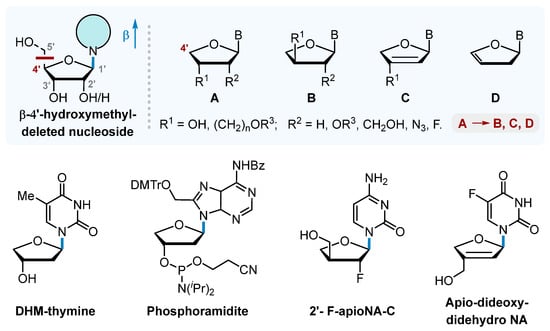
Nucleosides serve as core molecular scaffolds for the development of antiviral and antitumor drugs, and numerous nucleoside analogues (NAs) have been approved for the clinical treatment of herpesvirus infections (human immunodeficiency virus) HIV infection, and cancers [1,2,3]. Structural modifications of conventional nucleosides mainly focus on functional-group transformations at the C1′–C4′ chiral centers of the pentose sugar ring as well as base moiety modifications [4,5,6]. By reconstructing the sugar-ring framework, isonucleosides [7,8,9] break the inherent structural constraints of natural pentose nucleosides and constitute an important research branch within nucleoside chemistry. β-4′-Hydroxymethyl-deleted nucleosides (Figure 1) represent a typical family of four-carbon-sugar isonucleosides, in which the C4′-hydroxymethyl side chain of the pentose is absent. The pronounced conformational alteration of the sugar ring directly influences molecular recognition and phosphorylation-mediated activation by cellular deoxynucleoside kinases, endowing these molecules with distinctive biological activities different from those of conventional nucleosides [10,11,12]. Scaffold-A derivatives were first reported in the 1990s and originally identified as uridine phosphorylase inhibitors [13,14]. With the advancement of artificial genetic polymers, this scaffold has been further exploited as the building block for threose nucleic acid (TNA) [15,16,17,18,19,20,21]. Multiple scaffold variants such as B, C, and D are generally obtained from scaffold A via sequential functional-group transformations, enabling diversified modifications of sugar-ring stereochemistry and substituents [22]. Phosphoramidite monomers act as key building blocks for the solid-phase phosphoramidite synthesis of therapeutic oligonucleotides [16,23,24,25]. Unsaturated-modified apio-dideoxydidehydro nucleoside derivatives exhibit moderate-to-potent anti-human cytomegalovirus (anti-HCMV) activity with low cytotoxicity [26]. 2′-F-apioNA-C can be applied to construct highly stable antisense therapeutics; it retains the intrinsic exonuclease-resistant property of the apioNA scaffold and meanwhile possesses tunable duplex-destabilizing effects [27,28,29].
Figure 1.
Scaffold types of β-4′-hydroxymethyl-deleted nucleosides and representative NAs.
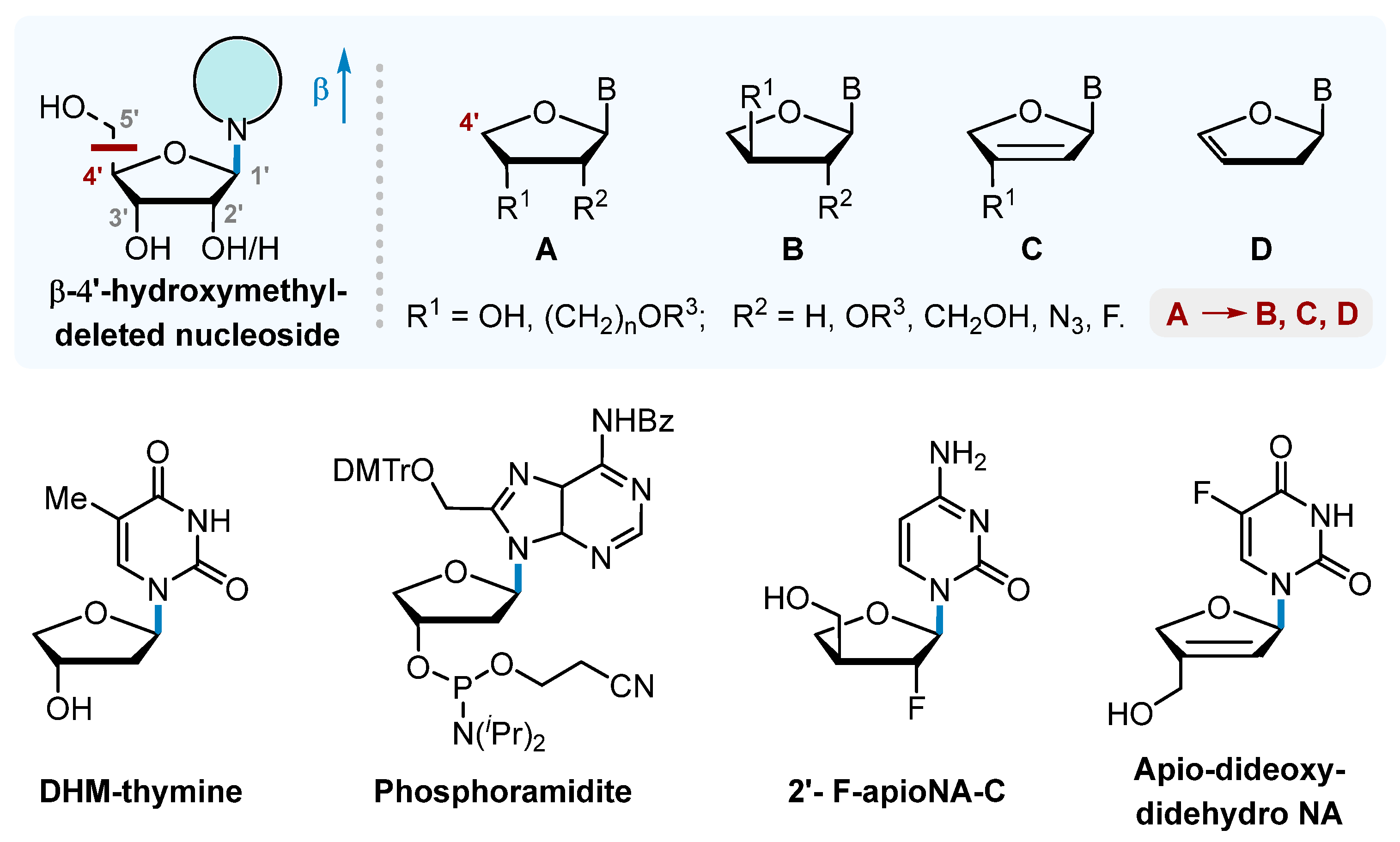
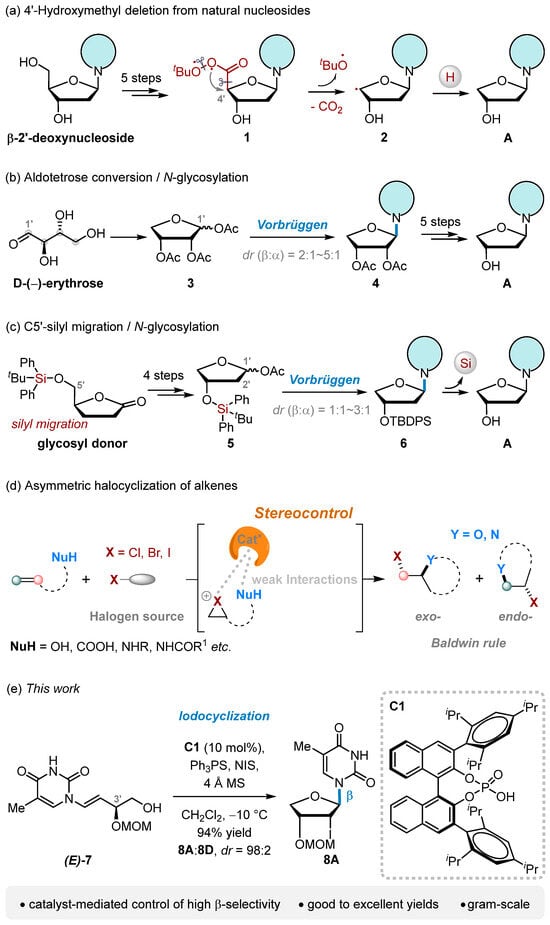
β-4′-Hydroxymethyl-deleted nucleosides hold considerable research value in medicinal chemistry and the synthetic biology of isonucleosides. The existing chemical synthetic strategies can be mainly classified into three categories. (1) 4′-Hydroxymethyl excision from natural nucleosides: Starting from deoxynucleosides, this route involves hydroxyl-group protection, peroxy-ester transformation, and subsequent removal of the 4′-hydroxymethyl group via radical fragmentation. This protocol exhibits good compatibility with purine and pyrimidine bases. Nevertheless, radical processes tend to trigger sugar-ring opening and base decomposition, and the separation of anomeric isomers remains challenging (Figure 2a) [30,31]. (2) Sugar-donor-mediated Vorbrüggen glycosylation strategy: Fully protected four-carbon acetyl sugar donors are prepared from D-erythrose. Silylated bases undergo N-glycosylation under Lewis-acid catalysis, followed by multi-step functional-group transformations to furnish target molecules. Sugar precursors are readily accessible for this route; however, the stereoselectivity of glycosylation is difficult to govern, affording a β/α diastereomeric ratio of merely 2:1 to 5:1 (Figure 2b) [23,32]. (3) Silyl-migration rearrangement-glycosylation strategy: Four-carbon-sugar intermediates are generated through silyl-migration, and the skeleton is subsequently constructed by Vorbrüggen glycosylation. Owing to the absence of C2′ neighboring-group participating moieties in the four-carbon sugar ring, neighboring-group participation cannot be exploited to achieve efficient stereocontrol over β-glycosidic bond formation (Figure 2c). Overall, developing novel synthetic methodologies featuring mild conditions and tunable stereoselectivity is of great practical significance for advancing the druggability research of β-4′-hydroxymethyl-deleted nucleosides [33,34].
Figure 2.
Synthetic methodologies for β-4′-hydroxymethyl-deleted nucleosides and this work. (a) Strategy for 4′-hydroxymethyl excision from natural nucleosides. (b) Sugar-donor-mediated Vorbrüggen glycosylation strategy. (c) Silyl-migration rearrangement-glycosylation strategy. (d) Introduction to asymmetric halocyclization of alkenes. (e) This work.
Asymmetric halocyclization of alkenes enables the one-step construction of chiral tetrahydrofuran heterocycles. It stereoselectively establishes the C1′ chiral center while simultaneously introducing a C−X bond, where the halogen atom serves as a versatile “synthetic handle” for further diversified derivatization of the sugar ring via transformations such as reduction and substitution (Figure 2d) [35,36,37,38]. The major challenge for this type of reaction lies in the stereochemical control of halonium ions within the cyclization transition state. Chiral phosphoric acid (CPA) catalysts rely on bifunctional hydrogen-bonding interactions to both activate halogen sources and create chiral cavities for precise modulation of halonium intermediates, thereby exhibiting outstanding catalytic performance in the field of alkene asymmetric halocyclization [39,40,41]. Herein, we report a cooperative catalytic strategy combining CPA and achiral sulfur-containing Lewis-base phenylphosphine sulfide (Ph3PS) for the stereocontrolled synthesis of β-4′-hydroxymethyl-deleted nucleosides via asymmetric alkene iodocyclization (Figure 2e). In our substrate design, the C4′-hydroxymethyl side chain is omitted, and sterically tunable hydroxyl-protecting groups are installed at the C3′ position. The steric hindrance cooperates with the chiral catalyst to remotely regulate the preferred conformation of halonium ions. Subsequent intramolecular cyclization affords the four-carbon sugar ring in a single step, achieving highly stereoselective formation of the β-N-glycosidic bond.
2. Results and Discussion
2.1. Synthesis of Racemic Halocyclization Substrates
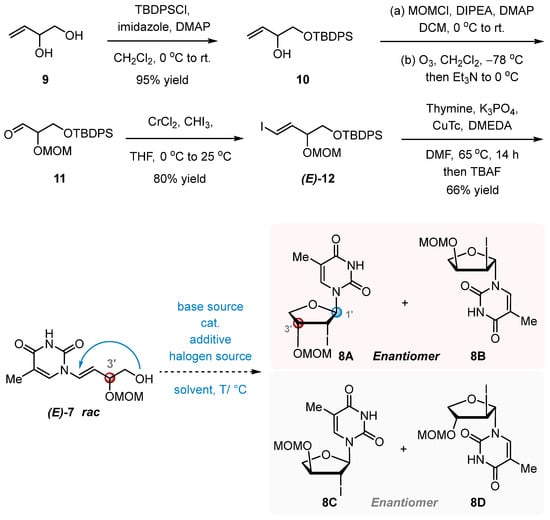
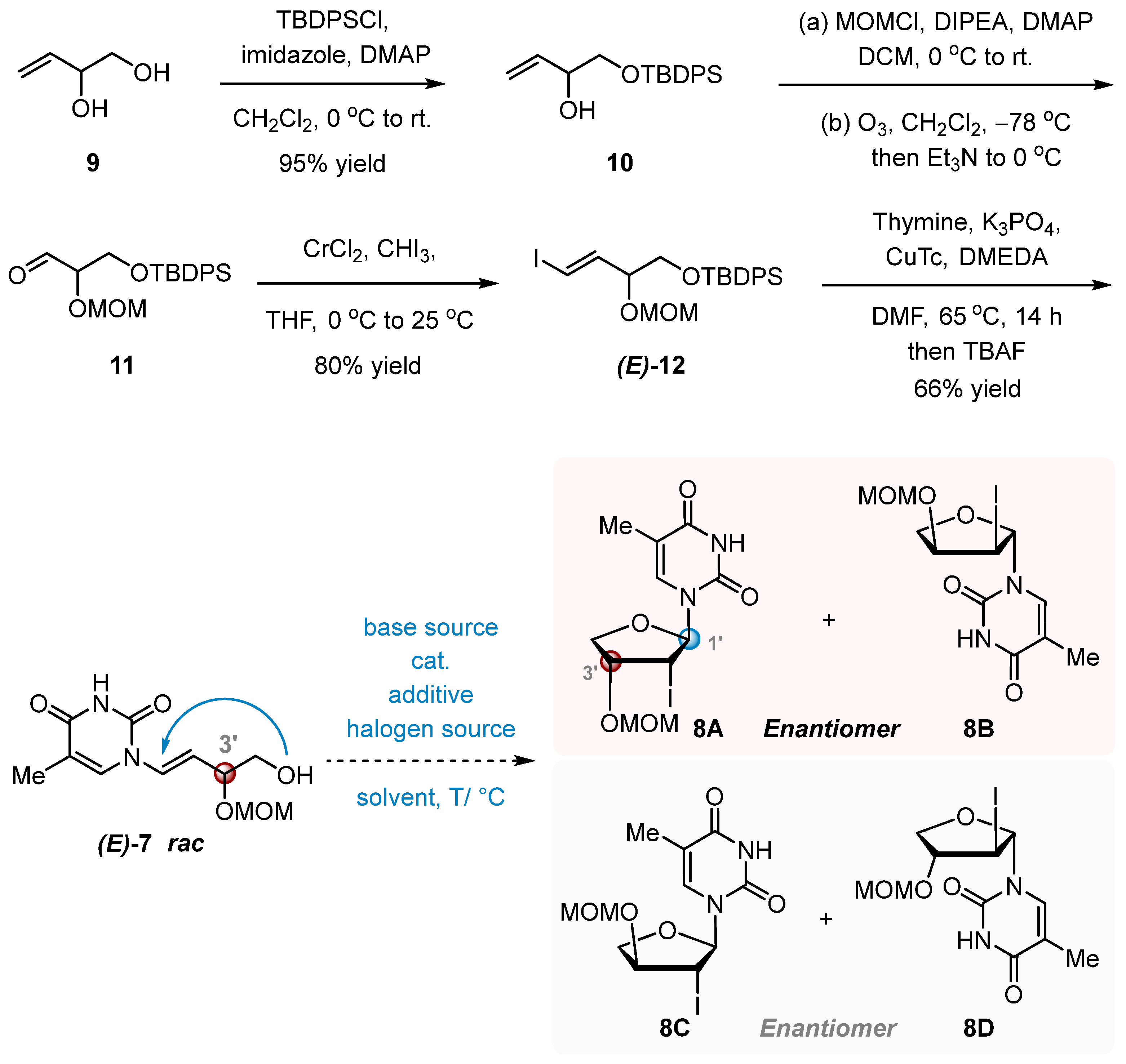
To establish a reaction model for the asymmetric iodocyclization of alkenes, we commenced with the synthesis of racemic alkenyl halocyclization substrates bearing tunable C3′-substituents (Scheme 1). Commercially available but-2-ene-1,4-diol (9) was used as the starting material. Selective silyl protection of the primary hydroxyl group first afforded the mono-protected intermediate 10. Subsequent modification of the secondary hydroxyl group with diverse protecting groups such as methoxymethylene (MOM) delivered intermediates, whose terminal C=C double bond was then cleaved via ozonolysis to yield aldehyde intermediate 11. The CrCl2-CHI3-mediated Takai reaction was further employed to stereoselectively furnish the E-configured alkenyl iodide intermediate (E)-12 (E:Z > 10:1). A copper-catalyzed C−N coupling reaction was then performed to install the thymine base onto the molecular skeleton. Subsequent desilylation with tetra-n-butylammonium fluoride (TBAF) afforded the target racemic alkene substrate (E)-7-rac. Following this synthetic sequence, five substrates bearing Me, n-propyl (n-Pr), MOM, benzyl (Bn), and benzoyl (Bz) groups at the C3′-position were prepared for subsequent reaction condition optimization and screening.
Scheme 1.
Synthesis of racemic substrates (E)-7-rac for alkene halocyclization.
2.2. Optimization of Reaction Conditions
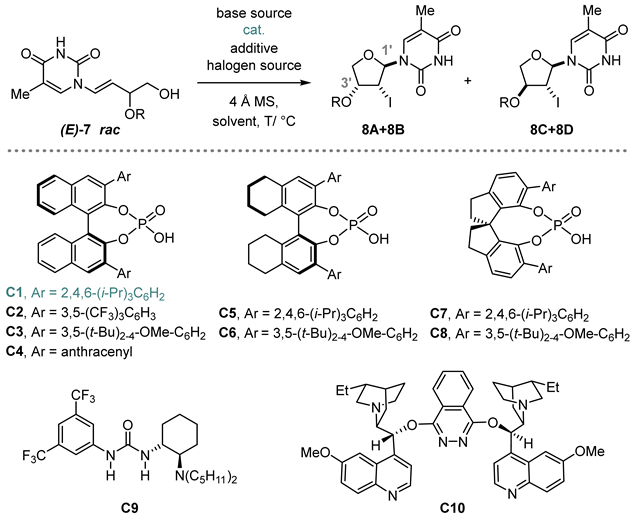
Alkene iodocyclization concurrently generates two new stereocenters at C1′ and C2′. Restricted by the 1,2-anti-addition rule, four stereoisomers (8A, 8B, 8C, and 8D) can theoretically be produced. The core goal of condition screening in this work is to selectively enrich the target enantiomeric pair 8A + 8B with opposite configurations at C1′ and C3′ (Table 1). First, the five previously prepared substrates bearing distinct protecting groups at the C3′-position were employed for protecting-group screening (Entries 1–5). Substrates substituted with Me, n-Pr, Bn, and Bz groups failed to deliver effective stereodifferentiation, whereas the C3′-OMOM substrate afforded relatively good stereocontrol (dr = 60:40). Accordingly, the MOM protecting group was selected for subsequent condition optimization. Base reagents were evaluated initially. When inorganic bases such as Na2CO3 and K2CO3 were utilized, the bases merely neutralized trace hydroiodic acid generated in situ in the system and did not participate in modulating halonium intermediates, and no improvement in reaction stereoselectivity was observed. Upon replacing the base with the sulfur-containing Lewis base Ph3PS, the diastereoselectivity (dr) increased to 78:22 (Entry 7). Previous literature has demonstrated that sulfur atoms can activate iodine sources and modify the electronic and steric properties of halonium active species, thereby altering the stereochemical preference of cyclization reactions [40]. After identifying Ph3PS as the optimal additive, small-molecule catalysts C1–C10 were intensively screened (Entries 8–17). CPA constructs chiral cavities via hydrogen-bond networks; the binaphthyl scaffold, steric bulk of aromatic substituents, and catalyst acidity collectively dictate the spatial geometry of transition-state assemblies. Among these candidates, catalyst C1 exhibited the best performance, delivering dr up to 95:5 with 92% yield. Although C2–C8 could catalyze the transformation, they provided poor stereocontrol. Thiourea and cinchona-derived catalysts showed almost no stereochemical induction. Given that Ph3PS could work cooperatively with CPA to tune the stereochemical outcome of halocyclization, its loading was further optimized (Entries 18–19). When the loading was gradually decreased from 1.1 to 0.1 equivalents, the yield remained at 92–94%, while dr was further improved to 96:4. Considering both reaction performance and cost-effectiveness, 0.1 eq was chosen as the optimal loading.
Table 1.
Optimization of reaction conditions for asymmetric iodocyclization of alkenes.
With the C1-Ph3PS combination established, the halogen source, solvent, and reaction temperature were further optimized (see SI). Halogen-source screening revealed that replacement of N-iodosuccinimide (NIS) with N-iodophthalimide (NIP), N-bromosuccinimide (NBS), or N-bromophthalimide (NBP) resulted in slight reductions in both yield and diastereoselectivity, and bromine-based systems exhibited a marginally more obvious decrease in selectivity (Entries 20–22). Solvent screening verified that CH2Cl2 was best suited for this hydrogen-bond-driven cooperative catalytic system (Entries 23–25). Temperature exerted a pronounced influence on stereoselectivity. At elevated temperatures, the reaction system possesses sufficient energy to overcome the energy barriers of both diastereomeric transition states, allowing the competing reaction pathway to proceed competitively and thus lowering stereoselectivity (Entry 26). In contrast, excessively low temperature significantly suppresses molecular motion and barrier-crossing efficiency, thereby markedly retarding the overall reaction rate (Entries 29–30). Balancing yield and diastereoselectivity, the optimal reaction conditions were determined: 10 mol % C1, 0.1 eq Ph3PS, NIS as a halogen source, anhydrous dichloromethane as a solvent, and reaction at −10 °C for 8 h, enabling efficient enrichment of the target isomers 8A + 8B.
2.3. Enantioselective Synthesis of β-4′-Hydroxymethyl-Deleted Nucleoside
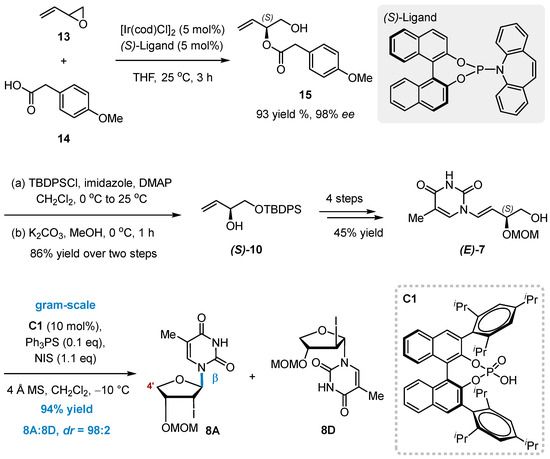
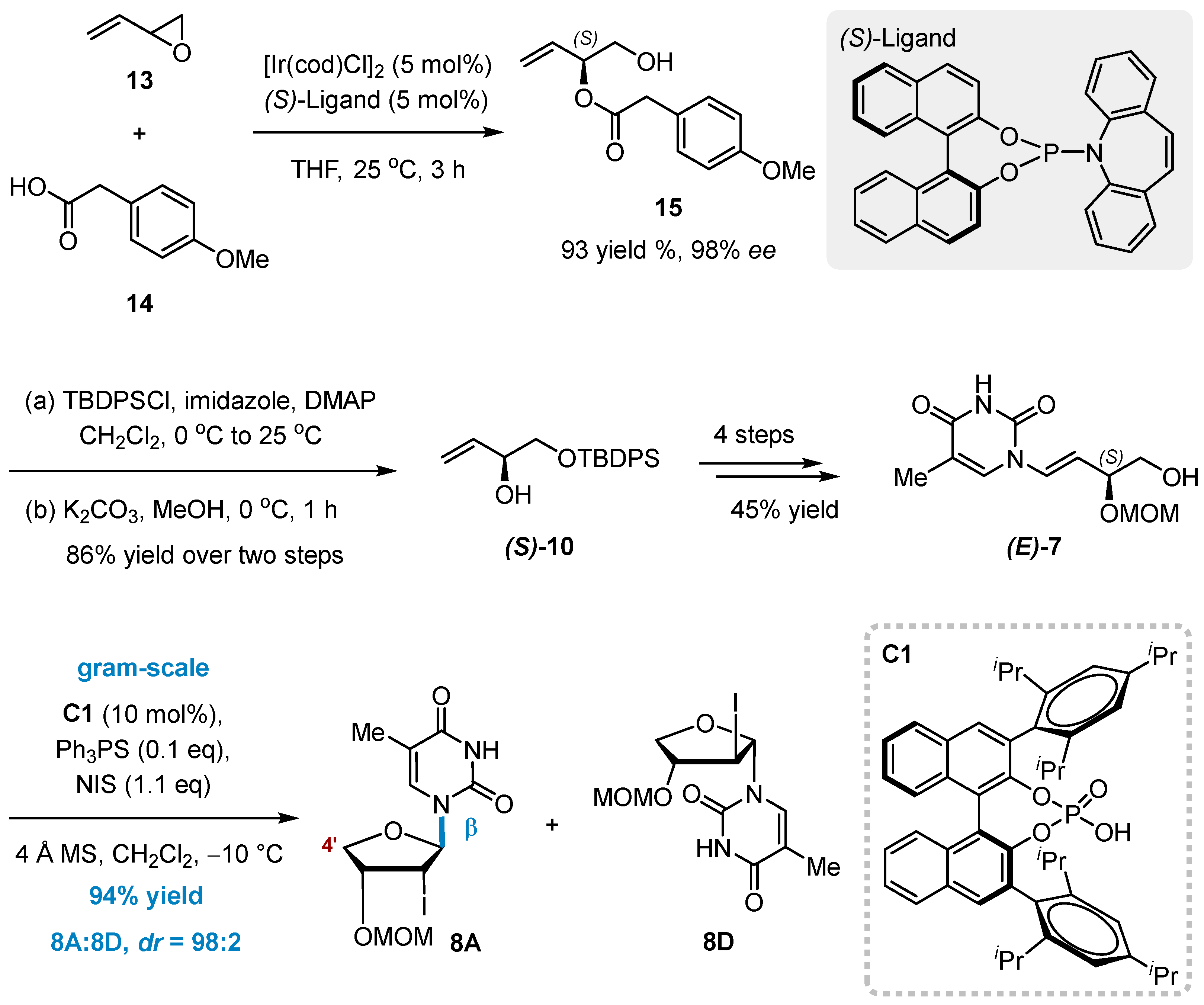
With the optimized conditions in hand, we next explored the enantioselective synthesis of β-4′-hydroxymethyl-deleted NAs (Scheme 2). The key to this synthesis lies in the efficient construction of the chiral secondary alcohol center at the C3′ position of the substrate. Following the iridium-catalyzed asymmetric epoxide-opening strategy reported in the literature [42], the chiral C3′-secondary-alcohol building block 15 was prepared. Starting from racemic epoxide 13 and p-methoxyphenylacetic acid 14, the cooperative catalytic system consisting of 5 mol % [Ir(cod)Cl]2 metal precursor and chiral (S)-phosphoramidite ligand delivered chiral ester intermediate 15 with 93% yield and high enantioselectivity (up to 98% ee), whereby the C3′ chiral center corresponding to the nucleoside scaffold was precisely set. Intermediate 15 was converted into chiral diol (S)-10 over two steps in an overall yield of 86%. Subsequent sequential transformations, including MOM protection of the secondary hydroxyl group, terminal alkene modification, thymine C−N coupling, and desilylation, afforded the optically pure halocyclization substrate (E)-7 in a four-step sequence in 45% overall yield and 93% ee (See Supplementary Information Figure S36). The C3′ stereochemical information established in the iridium-catalyzed step was fully preserved. The above-mentioned chiral substrate was subjected to intramolecular iodocyclization. Gram-scale preparation was achievable under the optimized catalytic conditions, and the target product 8A was isolated in 94% yield with dr (β:α) = 98:2 (See Supplementary Information Figure S37). The relative stereochemistry of the contiguous C1′, C2′, and C3′ stereocenters in product 8A was unambiguously assigned by two-dimensional nuclear magnetic resonance (2D NMR) spectroscopic characterization (The full spectra are shown in Supplementary Information Figures S10–S17).
Scheme 2.
Stereoselective synthesis of β-4′-hydroxymethyl-deleted nucleoside 8A.
2.4. Catalytic Mechanism
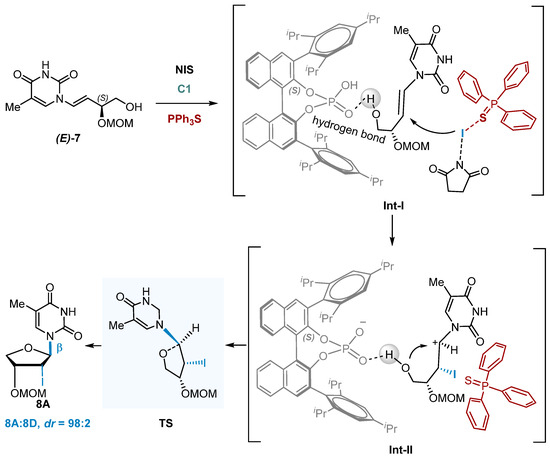
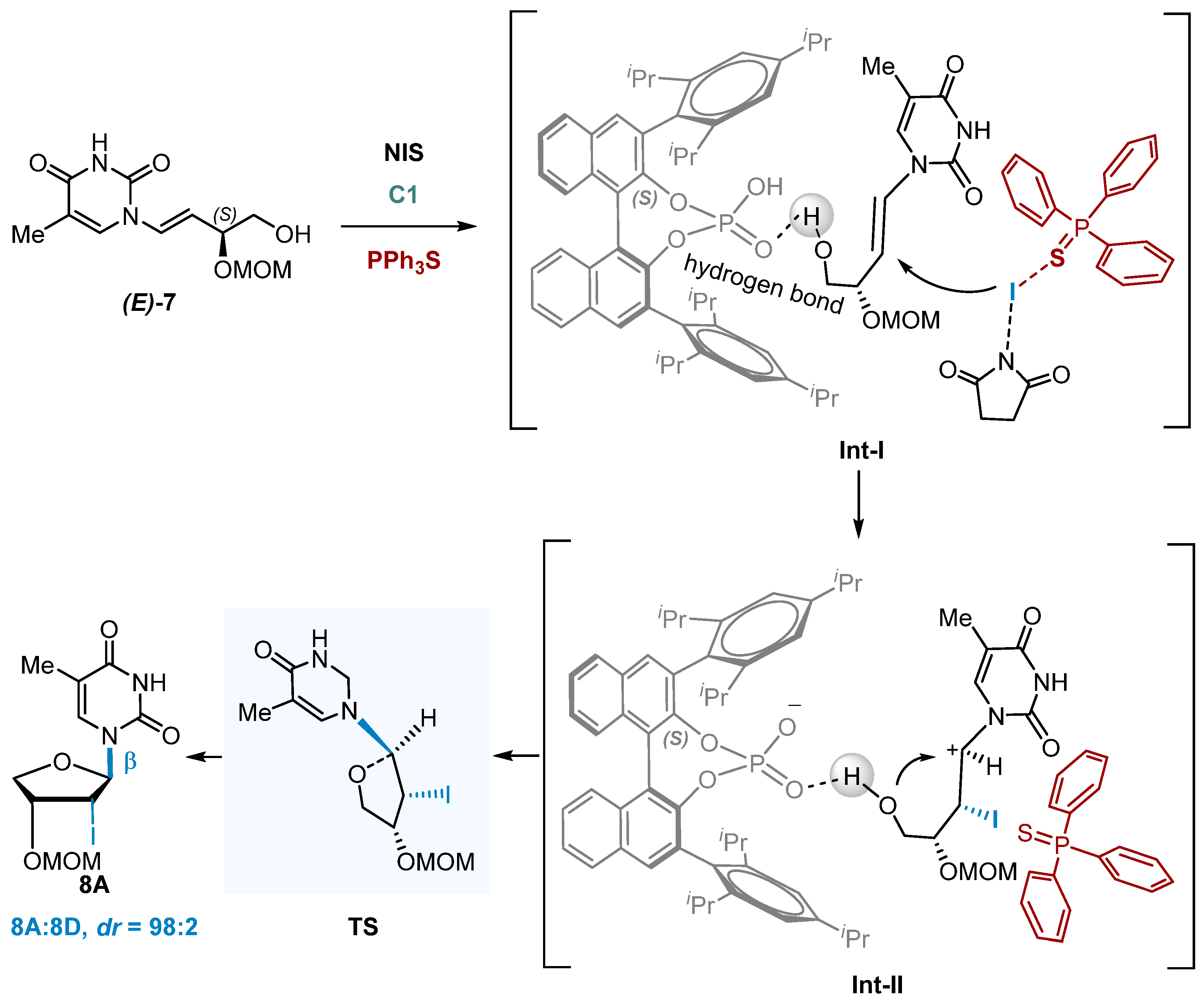
Next, based on previous studies regarding the application of the C1-Ph3PS cooperative catalytic system in halocyclization reactions [40], and combined with the structural features of our substrates, we speculate a plausible reaction pathway for the formation of product 8A (Scheme 3). First, Ph3PS coordinates with NIS via sulfur–iodine interaction to generate electrophilic iodine active species. Meanwhile, C1 serves as a Brønsted acid and forms hydrogen bonding between its acidic proton and the hydroxyl group of substrate (E)-7. This hydrogen-bonding anchoring fixes the substrate within the chiral cavity of C1 to afford Int I. Subsequent electrophilic iodination of the alkene moiety produces cyclic iodonium Int II, which predominates over the carbocation species according to the halocyclization mechanism. The CPA proton remains bound to the catalyst throughout the Int I to Int II transformation and sustains chiral confinement. In Int II, the combined steric hindrance from the C1 scaffold and Ph3PS creates an obvious steric clash on the β-face of the iodonium ring. This unfavorable steric interaction enforces a favored substrate conformation and confines nucleophilic attack to the less hindered α-face, thereby enabling stereoselective formation of the β-configured product 8A.
Scheme 3.
Proposed mechanistic pathway for C1-Ph3PS cooperative-catalyzed asymmetric alkene iodocyclization to afford 8A.
2.5. Synthetic Scope of β-4′-Hydroxymethyl-Deleted NAs
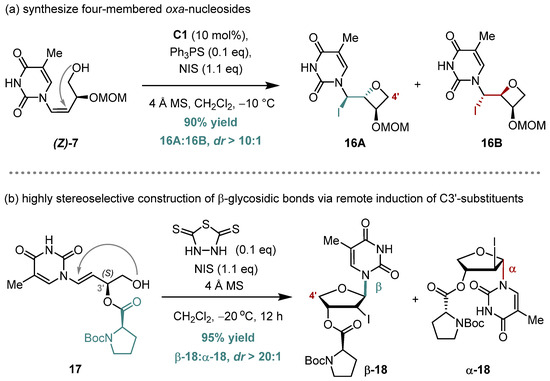
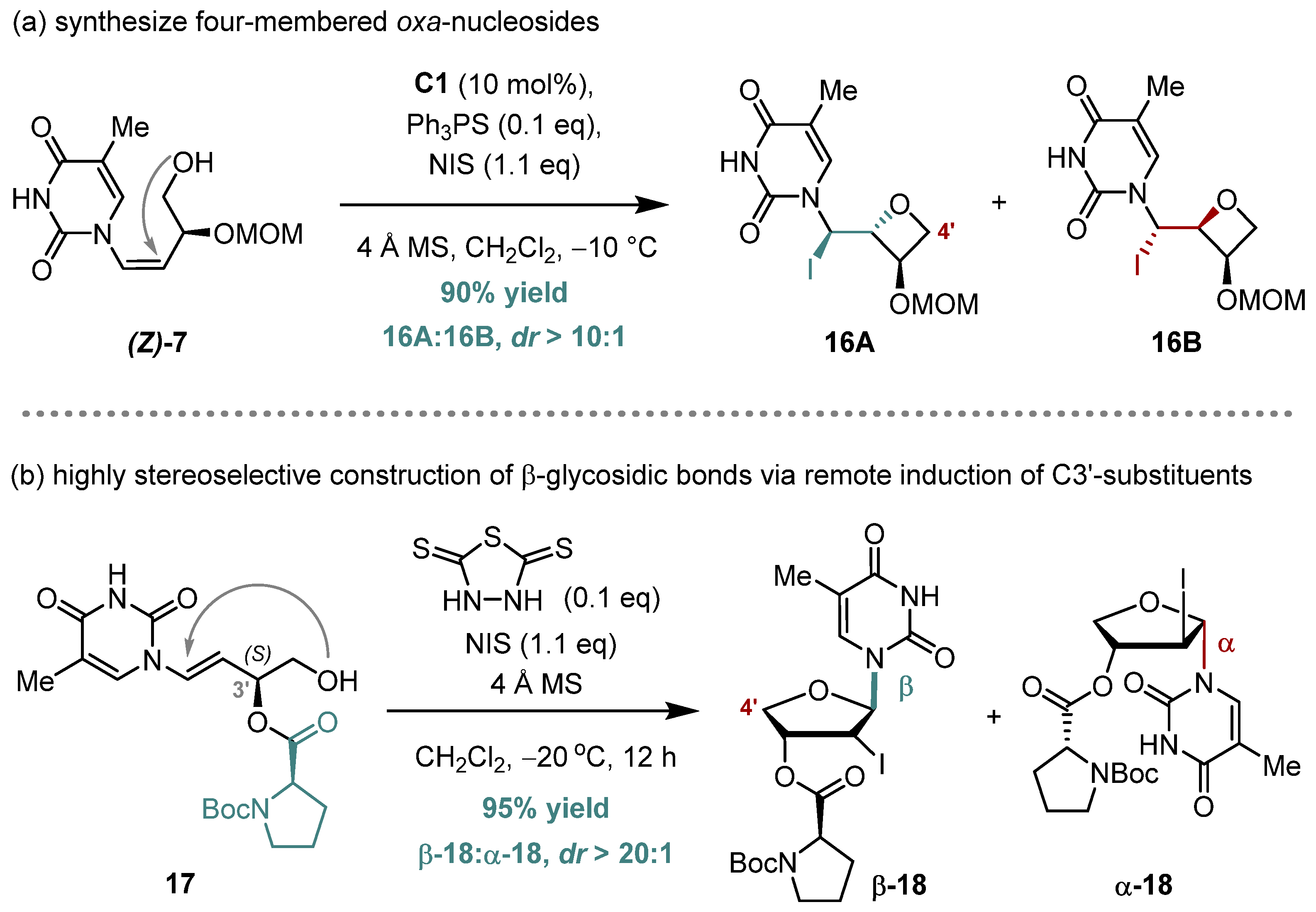
After accomplishing the enantioselective synthesis of target product 8A, we employed the by-product (Z)-7 obtained during this synthetic route to explore cyclization under the established optimal iodocyclization conditions (Scheme 4a). To our delight, this transformation proceeded smoothly to efficiently furnish product 16A bearing a strained four-membered oxacycle, in 90% yield with diastereoselectivity greater than 10:1. Product 16A also possesses the atypical β-4′-hydroxymethyl-deleted nucleoside scaffold, which can be readily derivatized for biological activity evaluation and holds potential value for pharmaceutical research. The foregoing studies confirm that the C1-Ph3PS cooperative-catalyzed system enables the highly stereoselective construction of β-N-glycosidic bonds. On this basis, we envisage replacing the MOM protecting group at the C3′ position of the substrate with chiral amino acid moieties. The remote induction effect originating from the substrate-embedded chirality would be utilized to achieve highly stereoselective formation of the β-N-glycosidic bond. Preliminary progress has already been made toward this objective.
Scheme 4.
Synthetic scope of β-4′-hydroxymethyl-deleted NAs via asymmetric iodocyclization of alkenes.
3. Materials and Methods
3.1. General Information
All commercially available reagents were used without further purification. Dichloromethane (CH2Cl2) and chloroform (CHCl3) were distilled from CaH2. Tetrahydrofuran (THF), ethyl acetate (EtOAc), and toluene (PhMe) were distilled from sodium/benzophenone ketyl. Chromatography was conducted by using 300−400 mesh silica gel. All new compounds gave satisfactory spectroscopic analyses (1H NMR, 13C NMR, HRMS, melting point). NMR spectra were recorded on a 400 MHz NMR or 600 MHz NMR spectrometer. High-resolution mass spectra (HRMS) were recorded on a Bruker micro-TOF-Q III spectrometer via ESI ionization. Melting point (m.p. for solid) was recorded on an SRS-optic melting point apparatus. HPLC was performed using an Agilent 5HC C18 (250 mm × 4.6 μm) analytical column. Unless otherwise noted, all products are isolated yields.
3.2. Reaction Conditions for Gram-Scale Preparation of Product 8A
Under an argon atmosphere, a mixture of (E)-7 (1.3 g, 5 mmol), C1 (375 mg, 0.5 mmol), Ph3PS (150 mg, 0.5 mmol), and 4 Å molecular sieves (4 Å MS) (60 mg/mmol) were dissolved in anhydrous CH2Cl2 (125 mL) at 0 °C and stirred for 15 min. After adding NIS (1.1 g, 5.5 mmol), the reaction mixture was stirred at 0 °C for 8 h. The solution was diluted with CH2Cl2 (50 mL) and saturated NH4Cl aq. (50 mL). The layers were separated, and the aqueous layer was extracted with CH2Cl2 (50 mL × 4). The combined organic layer was washed with brine (50 mL × 4), dried over Na2SO4 and filtered, concentrated in vacuo. The crude material was purified by silica gel column chromatography to obtain 8A. Rf = 0.48 (TLC, PE:Acetone = 1:1, UV), elution solvent is PE:EtOAc = 3:1, white solid (1.65 g, 94% yield). m.p.: 138.5–139.6 °C. = +25.4 (c = 0.35, CH2Cl2). 1H NMR (400 MHz, CD3OD) δ 7.44 (q, J = 1.4 Hz, 1H), 6.20 (d, J = 7.8 Hz, 1H), 4.79–4.73 (m, 2H), 4.71 (dd, J = 7.8, 4.4 Hz, 1H), 4.41 (dd, J = 9.4, 3.8 Hz, 1H), 4.20 (ddd, J = 4.4, 3.8, 2.2 Hz, 1H), 4.06 (dd, J = 9.4, 2.2 Hz, 1H), 3.45 (s, 3H), 1.90 (d, J = 1.4 Hz, 3H). 13C NMR (100 MHz, CD3OD) δ 166.2 152.5, 137.5, 112.3, 97.0, 93.8, 77.6, 73.2, 56.5, 26.6, 12.4. HRMS (ESI) m/z calcd. for C11H16IN2O5 [M + H]+: 382.0026, found: 383.0034, Δ = 2.1 ppm. IR (KBr disc): 3444, 2927, 1683, 1472, 1261, 1148, 1027, 796, 611 cm–1.
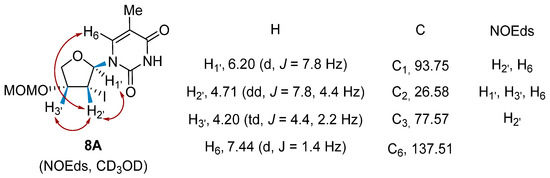
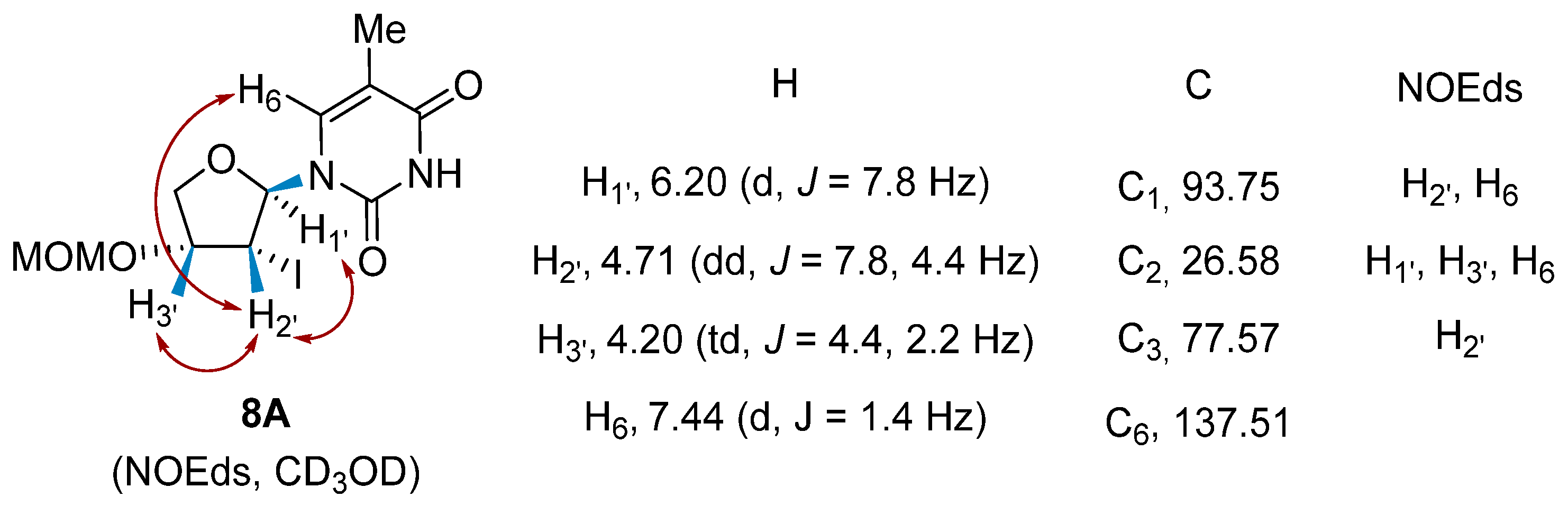
3.3. NOEds Data of 8A
The NOEDS data of compound 8A are illustrated in detail in Figure 3. In particular, the strong NOE correlations between H2’, H3’ and H6 allow us to confirm the absolute configuration of this compound.
Figure 3.
NOEds data of 8A.
4. Conclusions
In summary, this study establishes a cooperative catalytic system consisting of chiral phosphoric acid C1 and achiral sulfur-containing Lewis base Ph3PS. The stereoselective construction of the β-4′-hydroxymethyl-deleted nucleoside skeleton is efficiently achieved via intramolecular asymmetric iodocyclization of chiral acyclic alkene substrates. The phosphoryl oxygen moiety of C1 binds to the hydroxyl nucleophilic site of the substrate through hydrogen-bonding interactions, while Ph3PS activates the iodine source. Meanwhile, the MOM protecting group installed at the C3′ position of the substrate delivers moderate steric hindrance. The combined effects of these three factors precisely regulate the stereochemistry of iodonium intermediates, furnishing cyclized products with high diastereoselectivity under mild reaction conditions. This synthetic protocol exhibits favorable practicality. The target product 8A can be prepared on a gram scale with excellent yield and stereoselectivity maintained, and the relative configurations of multiple contiguous stereocenters within the product are unambiguously confirmed via two-dimensional nuclear magnetic resonance (2D NMR). Furthermore, further exploration employing the Z-alkene substrate furnishes 16A, a strained four-membered-oxacycle analogue of β-4′-hydroxymethyl-deleted nucleoside, which serves as a promising candidate for subsequent biological activity screening. It should be noted that the generation of highly enantioenriched products in the current system relies on the pre-installed C3′ chiral center of the substrate. Future work will replace the C3′-MOM protecting group with chiral amino acid fragments to realize stereocontrolled construction of β-N-glycosidic bonds via intrinsic substrate chiral induction. The C1-Ph3PS cooperative-catalyzed iodocyclization strategy developed in this work expands the synthetic toolbox for isonucleosides and provides solid support for further medicinal-chemistry research on this class of compounds.
Supplementary Materials
The following supporting information can be downloaded at: https://www.mdpi.com/article/10.3390/catal16090848/s1, Table S1: Screening the Base sourcea; Table S2: Screening the catalystsa; Table S3: Screening the additivea; Table S4: Screening the halogen sourcea; Table S5: Screening the solventa; Table S6: Screening the temperaturea; Figures S1–S34: 1H and 13C NMR Spectra; Figure S35: HPLC spectrum of S-15; Figure S36: HPLC spectrum of S-7; Figure S37: HPLC spectrum of 8A.
Author Contributions
Synthesis and characterization, Y.L., Y.C. and J.L. (Jia Liu); data curation, J.L. (Jiarui Li), J.L. (Jianing Li) and Y.P.; writing—original draft preparation, Q.W.; writing–review and editing, Q.W., J.N. and Y.L.; funding acquisition, Q.W. All authors have read and agreed to the published version of the manuscript.
Funding
The author gratefully acknowledges the financial support from the following organizations for this study: Organization Department of Shaanxi Provincial Party Committee (Grant No. Z20260108), Shaanxi Provincial Department of Science and Technology (Grant No. 2026JC-YBQN-0120), Shaanxi Provincial Department of Education (Grant No. 24JK0361), and Shaanxi University of Technology (Grant Nos. SLGRCQD005, SLGGZRPY07), National Undergraduate Training Program for Innovation and Entrepreneurship (202510720021).
Data Availability Statement
Data will be made available on request.
Acknowledgments
The original contributions presented in this study are included in the article and Supplementary Materials. Further inquiries can be directed to the corresponding authors.
Conflicts of Interest
The authors declare no conflicts of interest.
References
- Shelton, J.; Lu, X.; Hollenbaugh, J.A.; Cho, J.H.; Amblard, F.; Schinazi, R.F. Metabolism, biochemical actions, and chemical synthesis of anticancer nucleosides, nucleotides, and base analogs. Chem. Rev. 2016, 116, 14379–14455. [Google Scholar] [CrossRef] [Scilit] [PubMed]
- Wang, H.; Zhong, Y.; Xiao, Y.; Chen, F. Chemical and chemoenzymatic stereoselective synthesis of β-nucleosides and their analogues. Org. Chem. Front. 2022, 9, 1719–1741. [Google Scholar] [CrossRef] [Scilit]
- Scheeff, S.; Baguio, J.; Liang, B.; Amada, J.; Tao, K.; De Jonghe, S.; Persoons, L.; Chow, T.; Tse, C.; Wu, R.; et al. Antiviral profiling and cellular activation of carbobicyclic nucleoside analogues. J. Med. Chem. 2026, 69, 5501–5539. [Google Scholar] [CrossRef] [Scilit] [PubMed]
- Rajapaksha, D.G.; Mondal, S.; Wang, J.W.; Meanwell, M.W. A guide for the synthesis of key nucleoside scaffolds in drug discovery. Med. Chem. Res. 2023, 32, 1315–1333. [Google Scholar] [CrossRef] [Scilit]
- Liu, Z. Potentiality of nucleoside as antioxidant by analysis on oxidative susceptibility, drug discovery, and synthesis. Curr. Med. Chem. 2025, 32, 880–906. [Google Scholar] [CrossRef] [Scilit] [PubMed]
- Yang, Y.; Song, R.; Wang, S.; Zu, G.; Song, B. Antiviral activity and mechanism of purine morpholine nucleoside analogues incorporating a sulfonamide fragment. J. Adv. Res. 2026, 81, 43–56. [Google Scholar] [CrossRef] [Scilit] [PubMed]
- Huryn, D.M.; Sluboski, B.C.; Tam, S.Y.; Weigele, M.; Sim, I.; Anderson, B.D.; Mitsuya, H.; Broder, S. Synthesis and anti-HIV activity of isonucleosides. J. Med. Chem. 1992, 35, 2347–2354. [Google Scholar] [CrossRef] [Scilit] [PubMed]
- Tino, J.A.; Clark, J.M.; Kirk Field, A.; Jacobs, G.A.; Lis, K.A.; Michalik, T.L.; McGeever-Rubin, B.; Slusarchyk, W.A.; Spergel, S.H. Synthesis and antiviral activity of novel isonucleoside analogs. J. Med. Chem. 1993, 36, 1221–1229. [Google Scholar] [CrossRef] [PubMed]
- Fortuna, A.; Gonçalves-Pereira, R.; Costa, P.J.; Jorda, R.; Vojáčková, V.; Gonzalez, G.; Heise, N.V.; Csuk, R.; Conceição Oliveira, M.; Xavier, N.M. Synthesis and exploitation of the biological profile of novel guanidino xylofuranose derivatives. ChemMedChem 2022, 17, e20220018. [Google Scholar] [CrossRef] [Scilit] [PubMed]
- Bala, S.; Liao, J.; Zhang, L.; Tran, C.; Chim, N.; Chaput, J. Synthesis of 2′-deoxy-α-L-threofuranosyl Nucleoside Triphosphates. J. Org. Chem. 2018, 83, 8840–8850. [Google Scholar] [CrossRef] [Scilit] [PubMed]
- Yan, Y.; Zhou, X.; Novick, S.; Shaw, S.; Li, Y.; Brunzelle, J.; Hitoshi, Y.; Griffin, P.; Xu, H.; Melcher, K. Structures of AMP-activated protein kinase bound to novel pharmacological activators in phosphorylated, non-phosphorylated, and nucleotide-free states. J. Biol. Chem. 2019, 294, 953–967. [Google Scholar] [CrossRef] [Scilit] [PubMed]
- Liu, Y.; Wang, Y. Making nucleic acid monomers. Nat. Chem. 2022, 14, 725–727. [Google Scholar] [CrossRef] [Scilit] [PubMed]
- Huang, Y.; Yeh, P.; Lan, S.; Liu, P. Metabolites modulate the functional state of human uridine phosphorylase I. Protein Sci. 2020, 29, 2189–2200. [Google Scholar] [CrossRef] [Scilit] [PubMed]
- Nikam, R.; Harikrishna, S.; Gore, K. Synthesis, structural, and conformational analysis of 4′-C-alkyl-2′-O-ethyl-uridine modified nucleosides. Eur. J. Org. Chem. 2021, 2021, 924–932. [Google Scholar] [CrossRef] [Scilit]
- Toti, K.S.; Derudas, M.; McGuigan, C.; Balzarini, J.; Van Calenbergh, S. Synthesis and antiviral evaluation of α-L-2′-deoxythreofuranosyl nucleosides. Eur. J. Med. Chem. 2011, 46, 3704–3713. [Google Scholar] [CrossRef] [Scilit] [PubMed]
- Liu, C.; Dumbre, S.G.; Pannecouque, C.; Korba, B.; De Jonghe, S.; Herdewijn, P. Synthesis and antiviral evaluation of base-modified deoxythreosyl nucleoside phosphonates. Org. Biomol. Chem. 2017, 15, 5513–5528. [Google Scholar] [CrossRef] [Scilit] [PubMed]
- Wang, Y.; Wang, Y.; Song, D.; Sun, X.; Zhang, Z.; Li, X.; Li, Z.; Yu, H. A Threose nucleic acid enzyme with RNA ligase activity. J. Am. Chem. Soc. 2021, 143, 8154–8163. [Google Scholar] [CrossRef] [Scilit] [PubMed]
- McCloskey, C.M.; Li, Q.; Yik, E.J.; Chim, N.; Ngor, A.K.; Medina, E.; Grubisic, I.; Co Ting Keh, L.; Poplin, R.; Chaput, J.C. Evolution of Functionally Enhanced α-l-Threofuranosyl Nucleic Acid Aptamers. ACS Synth. Biol. 2021, 10, 3190–3199. [Google Scholar] [CrossRef] [Scilit] [PubMed]
- Whitaker, D.; Powner, M.W. Prebiotic synthesis and triphosphorylation of 3′-amino-TNA nucleosides. Nat. Chem. 2022, 14, 766–774. [Google Scholar] [CrossRef] [Scilit] [PubMed]
- Tomar, R.; Ghodke, P.P.; Patra, A.; Smyth, E.; Pontarelli, A.; Copp, W.; Guengerich, F.P.; Chaput, J.C.; Wilds, C.J.; Stone, M.P. DNA Replication across α-l-(3′-2′)-threofuranosyl nucleotides mediated by human DNA polymerase η. Biochemistry 2024, 63, 2425–2439. [Google Scholar] [CrossRef] [Scilit] [PubMed]
- Majumdar, B.; Sarma, D.; Yu, Y.; Lozoya-Colinas, A.; Chaput, J.C. Increasing the functional density of threose nucleic acid. RSC Chem. Biol. 2024, 5, 41–48. [Google Scholar] [CrossRef] [Scilit] [PubMed]
- Pontarelli, A.; Vasquez, G.; Fu, W.; Solan, Q.; Gaus, H.J.; Galindo-Murillo, R.; Huang, P.Y.; Pandit, B.; Rigo, F.; Østergaard, M.E. Synthesis, incorporation, and translation properties of threose nucleic acid modified trinucleotide cap analogs. ACS Omega 2025, 10, 53151–53162. [Google Scholar] [CrossRef] [Scilit] [PubMed]
- Czechtizky, W.; Vasella, A. Oligonucleotide analogues with a nucleobase-including backbone: Part 6 2-deoxy-D-erythrose-derived phosphoramidites: Synthesis and incorporation into 14-mer DNA strands. Helv. Chim. Acta 2001, 84, 1000–1016. [Google Scholar] [CrossRef] [Scilit]
- Obexer, R.; Nassir, M.; Moody, E.; Baran, P.; Lovelock, S. Modern approaches to therapeutic oligonucleotide manufacturing. Science 2024, 384, 174. [Google Scholar] [CrossRef] [Scilit] [PubMed]
- Jauregui-Matos, V.; Datta, D.; Kundu, J.; Kumar, V.; Harp, J.M.; Adebayo, A.; Donnelly, D.; Medina, E.; Chaput, J.C.; Egli, M.; et al. Synthesis and biophysical properties of 3′-deoxy β-D-apio-D-furanosyl nucleic acids. ACS Chem. Biol. 2025, 20, 2698–2708. [Google Scholar] [CrossRef] [Scilit] [PubMed]
- Gromova, M.; Balanzat, E.; Gervais, B.; Nardin, R.; Cadet, J. The direct effect of heavy ions and electrons on thymidine in the solid state. Int. J. Radiat. Biol. 1998, 74, 81–97. [Google Scholar] [CrossRef] [Scilit] [PubMed]
- Hong, J.H.; Kim, H.O.; Moon, H.R.; Jeong, L.S. Synthesis and Antiviral Activity of Fluoro-Substituted Apio Dideoxynucleosides. Arch. Pharmacal Res. 2001, 24, 95–99. [Google Scholar] [CrossRef] [Scilit] [PubMed]
- Jung, M.E.; Toyota, A.; De Clercq, E.; Balzarini, J. Synthesis and biological activity of a series of methylene-expanded oxetanocin nucleoside analogues. Monatshefte Chem. 2002, 133, 499–520. [Google Scholar] [CrossRef] [Scilit]
- Toti, K.; Renders, M.; Groaz, E.; Herdewijn, P.; VanCalenbergh, S. Nucleosides with trans posed base or 4′-hydroxymethylmoieties and their corresponding oligonucleotides. Chem. Rev. 2015, 115, 13484–13525. [Google Scholar] [PubMed]
- Montevecchi, P.; Manetto, A.; Navacchia, M.; Chatgilialoglu, C. Thermal decomposition of the tert-butyl perester of thymidine-5 carboxylic acid.: Formation and fate of the pseudo-C4′ radical. Tetrahedron 2004, 60, 4303–4308. [Google Scholar] [CrossRef] [Scilit]
- Kim, J.; Kreller, C.; Greenberg, M. Preparation and analysis of oligonucleotides containing the C4′-oxidized abasic site and related mechanistic probes. J. Org. Chem. 2005, 70, 8122–8129. [Google Scholar] [CrossRef] [Scilit] [PubMed]
- Naciuk, F.F.; Nascimento, A.F.Z.; Rocha, R.P.F.; Rustiguel, J.K.; Coimbra, L.D.; Marques, R.E.; Bruder, M. Competing interests during the key N-glycosylation of 6-chloro-7-deaza-7-iodopurine for the synthesis of 7-deaza-2′-methyladenosine using Vorbrüggen conditions. Front. Chem. 2023, 11, 1163486. [Google Scholar] [CrossRef] [Scilit] [PubMed]
- Yang, T.-F.; Kotra, L.P.; Teng, Q.; Naguib, F.N.M.; Sommadossi, J.-P.; Kouni, M.; Chu, C.K. Synthesis of [4-(hydroxy) tetrahydrofuran-2-yl] nucleosides as a novel class of uridine phosphorylase inhibitors. Tetrahedron Lett. 1995, 36, 983–986. [Google Scholar] [CrossRef] [Scilit]
- Chang, J. 4′-Modified nucleosides for antiviral drug discovery: A chievements and perspectives. Acc. Chem. Res. 2022, 55, 565–578. [Google Scholar] [CrossRef] [Scilit] [PubMed]
- Chen, G.; Ma, S. Enantioselective halocyclization reactions for the synthesis of chiral cyclic compounds. Angew. Chem. Int. Ed. 2010, 49, 8306–8308. [Google Scholar] [CrossRef] [Scilit] [PubMed]
- Khalid, M.; Mohammed, S. Recent halocyclization reactions of alenes-A review. Indian J. Heterocycl. Chem. 2018, 28, 507–527. [Google Scholar]
- China, H.; Kumar, R.; Kikushima, K.; Dohi, T. Halogen-induced controllable cyclizations as diverse heterocycle synthetic strategy. Molecules 2020, 25, 6007. [Google Scholar] [CrossRef] [Scilit] [PubMed]
- Liu, S.; Zhang, B.-Q.; Xiao, W.-Y.; Li, Y.-L.; Deng, J. Recent advances in catalytic asymmetric syntheses of functionalized heterocycles via halogenation/chalcogenation of carbon-Carbon unsaturated bonds. Adv. Synth. Catal. 2022, 364, 3974–4005. [Google Scholar] [CrossRef] [Scilit]
- Denmark, S.E.; Burk, M.T. Development and mechanism of an enantioselective bromocycloetherification reaction via Lewis base/chiral brønsted acid cooperative catalysis. Chirality 2014, 26, 344–355. [Google Scholar] [CrossRef] [Scilit] [PubMed]
- Guria, S.; Daniliuc, C.G.; Hennecke, U. Brønsted acid-catalyzed enantioselective iodocycloetherification enabled by triphenylphosphine selenide cocatalysis. Adv. Synth. Catal. 2021, 363, 3852–3858. [Google Scholar] [CrossRef] [Scilit]
- Wang, Q.; Mu, J.; Zeng, J.; Wan, L.; Zhong, Y.; Li, Q.; Li, Y.; Wang, H.; Chen, F. Additive-controlled asymmetric iodocyclization enables enantioselective access to both α- and β-nucleosides. Nat. Commun. 2023, 14, 138. [Google Scholar] [CrossRef] [Scilit] [PubMed]
- Pandit, S.; Adhikari, A.S. Iridium-catalyzed enantioselective ring opening of alkenyl oxiranes by unactivated carboxylic acids. Org. Lett. 2022, 24, 7388–7393. [Google Scholar] [CrossRef] [Scilit] [PubMed]

Disclaimer/Publisher’s Note: The statements, opinions and data contained in all publications are solely those of the individual author(s) and contributor(s) and not of MDPI and/or the editor(s). MDPI and/or the editor(s) disclaim responsibility for any injury to people or property resulting from any ideas, methods, instructions or products referred to in the content. |
© 2026 by the authors. Licensee MDPI, Basel, Switzerland. This article is an open access article distributed under the terms and conditions of the Creative Commons Attribution (CC BY) license.